US10065945B2 - Isoquinoline derivatives as MGAT2 inhibitors - Google Patents
Isoquinoline derivatives as MGAT2 inhibitors Download PDFInfo
- Publication number
- US10065945B2 US10065945B2 US15/104,537 US201515104537A US10065945B2 US 10065945 B2 US10065945 B2 US 10065945B2 US 201515104537 A US201515104537 A US 201515104537A US 10065945 B2 US10065945 B2 US 10065945B2
- Authority
- US
- United States
- Prior art keywords
- alkyl
- halogen
- mmol
- substitutedc
- alkoxy
- Prior art date
- Legal status (The legal status is an assumption and is not a legal conclusion. Google has not performed a legal analysis and makes no representation as to the accuracy of the status listed.)
- Active, expires
Links
- 0 [1*]NS(=O)(=O)C1=CC2=C(C=C1)CCN(C([4*])([5*])[6*])C2.[2*]C.[3*]C Chemical compound [1*]NS(=O)(=O)C1=CC2=C(C=C1)CCN(C([4*])([5*])[6*])C2.[2*]C.[3*]C 0.000 description 8
- KBZJGIPNXHCHGL-UHFFFAOYSA-N CC1=C(C(C)(C)C)ON=C1NS(=O)(=O)C1=CC2=C(C=C1)CCNC2 Chemical compound CC1=C(C(C)(C)C)ON=C1NS(=O)(=O)C1=CC2=C(C=C1)CCNC2 KBZJGIPNXHCHGL-UHFFFAOYSA-N 0.000 description 3
- DOBYVLNSSBUYSC-CYBMUJFWSA-N CCOC1=CC=C([C@@H](C)N2CCC3=C(C=C(S(=O)(=O)Cl)C=C3)C2)C=N1 Chemical compound CCOC1=CC=C([C@@H](C)N2CCC3=C(C=C(S(=O)(=O)Cl)C=C3)C2)C=N1 DOBYVLNSSBUYSC-CYBMUJFWSA-N 0.000 description 3
- RHCNVPDGWHLMBP-GFCCVEGCSA-N CCOC1=CN=C([C@@H](C)N2CCC3=C(C=C(S(=O)(=O)Cl)C=C3)C2)C=N1 Chemical compound CCOC1=CN=C([C@@H](C)N2CCC3=C(C=C(S(=O)(=O)Cl)C=C3)C2)C=N1 RHCNVPDGWHLMBP-GFCCVEGCSA-N 0.000 description 3
- ZCFBSIRMJCYTAG-SOFGYWHQSA-N C/C=C/C1=C(C(C)(C)C)ON=C1NS(=O)(=O)C1=CC2=C(C=C1)CCN(CC1=CN=C(OCC)S1)C2 Chemical compound C/C=C/C1=C(C(C)(C)C)ON=C1NS(=O)(=O)C1=CC2=C(C=C1)CCN(CC1=CN=C(OCC)S1)C2 ZCFBSIRMJCYTAG-SOFGYWHQSA-N 0.000 description 2
- XMCGBZLZQMNJQI-HYAZDXEPSA-N C/C=C/C1=C(C(C)(C)C)ON=C1NS(=O)(=O)C1=CC2=C(C=C1)CCN(CC1=CN=C(OCC)S1)C2.CC1=C(C(C)(C)C)ON=C1NS(=O)(=O)C1=CC2=C(C=C1)CCN(CC1=CN=C(SCC(F)(F)F)N=C1)C2.CC1=C(C(C)(C)C)ON=C1NS(=O)(=O)C1=CC2=C(C=C1)CCN([C@H](C)C1=NC=C(OCC(F)F)N=C1)C2.C[C@H](C1=CC=C(OCC(F)(F)F)N=C1)N1CCC2=C(C=C(S(=O)(=O)NC3=NOC(C(C)(C)F)=C3)C=C2)C1.C[C@H](C1=CC=C(OCC(F)F)N=C1)N1CCC2=C(C=C(S(=O)(=O)NC3=NOC(C(C)(C)C)=C3)C=C2)C1.C[C@H](C1=CC=C(OCC(F)F)N=C1)N1CCC2=C(C=C(S(=O)(=O)NC3=NOC(C4CC4)=N3)C=C2)C1.C[C@H](C1=CC=C(OCC2CC(F)(F)C2)N=C1)N1CCC2=C(C=C(S(=O)(=O)NC3=NOC(C4CC4)=N3)C=C2)C1.C[C@H](C1=NC=C(OCC(F)F)N=C1)N1CCC2=C(C=C(S(=O)(=O)NC3=NOC(C4CC4)=N3)C=C2)C1 Chemical compound C/C=C/C1=C(C(C)(C)C)ON=C1NS(=O)(=O)C1=CC2=C(C=C1)CCN(CC1=CN=C(OCC)S1)C2.CC1=C(C(C)(C)C)ON=C1NS(=O)(=O)C1=CC2=C(C=C1)CCN(CC1=CN=C(SCC(F)(F)F)N=C1)C2.CC1=C(C(C)(C)C)ON=C1NS(=O)(=O)C1=CC2=C(C=C1)CCN([C@H](C)C1=NC=C(OCC(F)F)N=C1)C2.C[C@H](C1=CC=C(OCC(F)(F)F)N=C1)N1CCC2=C(C=C(S(=O)(=O)NC3=NOC(C(C)(C)F)=C3)C=C2)C1.C[C@H](C1=CC=C(OCC(F)F)N=C1)N1CCC2=C(C=C(S(=O)(=O)NC3=NOC(C(C)(C)C)=C3)C=C2)C1.C[C@H](C1=CC=C(OCC(F)F)N=C1)N1CCC2=C(C=C(S(=O)(=O)NC3=NOC(C4CC4)=N3)C=C2)C1.C[C@H](C1=CC=C(OCC2CC(F)(F)C2)N=C1)N1CCC2=C(C=C(S(=O)(=O)NC3=NOC(C4CC4)=N3)C=C2)C1.C[C@H](C1=NC=C(OCC(F)F)N=C1)N1CCC2=C(C=C(S(=O)(=O)NC3=NOC(C4CC4)=N3)C=C2)C1 XMCGBZLZQMNJQI-HYAZDXEPSA-N 0.000 description 2
- NMMJHUZSTPHGCA-UHFFFAOYSA-N CC(=O)C1=NC=C(Cl)N=C1 Chemical compound CC(=O)C1=NC=C(Cl)N=C1 NMMJHUZSTPHGCA-UHFFFAOYSA-N 0.000 description 2
- MULMLDROTQLKML-UHFFFAOYSA-N CC(=O)N1CCC2=C(C=C(S(=O)(=O)Cl)C=C2)C1 Chemical compound CC(=O)N1CCC2=C(C=C(S(=O)(=O)Cl)C=C2)C1 MULMLDROTQLKML-UHFFFAOYSA-N 0.000 description 2
- JZOHANFJJTZDKS-UHFFFAOYSA-N CC(=O)N1CCC2=C(C=C(SCC3=CC=CC=C3)C=C2)C1 Chemical compound CC(=O)N1CCC2=C(C=C(SCC3=CC=CC=C3)C=C2)C1 JZOHANFJJTZDKS-UHFFFAOYSA-N 0.000 description 2
- SXIYTMAWGASBEA-ZQRQZVKFSA-N CC(=O)[O-].CCOC1=CC=C([C@@H](C)C2CCC3=C(C=C(S(=O)(=O)NC4=NC=C(CC(C)C)N=C4)C=C3)C2)C=N1 Chemical compound CC(=O)[O-].CCOC1=CC=C([C@@H](C)C2CCC3=C(C=C(S(=O)(=O)NC4=NC=C(CC(C)C)N=C4)C=C3)C2)C=N1 SXIYTMAWGASBEA-ZQRQZVKFSA-N 0.000 description 2
- YNYJPXWJPIFZBY-SHSDQIKJSA-N CC(C)(C)C1=C(Br)C(NS(=O)(=O)C2=CC3=C(CCN(CC4=CC(F)=CC(F)=C4)C3)N=C2)=NO1.CCC1=CC=C([C@@H](C)N2CCC3=CC=C(S(=O)(=O)CC4=NOC(C(C)(C)C)=C4C)C=C3C2)C=N1.CCC1=CN=C(NS(=O)(=O)C2=CC3=C(C=C2)CCN([C@H](C)C2=CC=C(OCC(F)F)N=C2)C3)C=N1.CCCC1=CC=C(CN2CCC3=CC=C(S(=O)(=O)CC4=NOC(C(C)(C)C)=C4Br)C=C3C2)C=N1.CCCC1=CC=C([C@@H](C)N2CCC3=CC=C(S(=O)(=O)CC4=NOC(C(C)(C)C)=C4Br)C=C3C2)C=N1.CCCC1=CN=C(NS(=O)(=O)C2=CC3=C(C=C2)CCN([C@H](C)C2=CC=C(OCC)N=C2)C3)C=N1.CCOC1=CC=C([C@@H](C)N2CCC3=C(C=C(S(=O)(=O)NC4=NC=C(CC(C)C)N=C4)C=C3)C2)C=N1.COCCOC1=CC=C([C@@H](C)N2CCC3=C(C=C(S(=O)(=O)NC4=NC=C(C5CC5)N=C4)C=C3)C2)C=N1 Chemical compound CC(C)(C)C1=C(Br)C(NS(=O)(=O)C2=CC3=C(CCN(CC4=CC(F)=CC(F)=C4)C3)N=C2)=NO1.CCC1=CC=C([C@@H](C)N2CCC3=CC=C(S(=O)(=O)CC4=NOC(C(C)(C)C)=C4C)C=C3C2)C=N1.CCC1=CN=C(NS(=O)(=O)C2=CC3=C(C=C2)CCN([C@H](C)C2=CC=C(OCC(F)F)N=C2)C3)C=N1.CCCC1=CC=C(CN2CCC3=CC=C(S(=O)(=O)CC4=NOC(C(C)(C)C)=C4Br)C=C3C2)C=N1.CCCC1=CC=C([C@@H](C)N2CCC3=CC=C(S(=O)(=O)CC4=NOC(C(C)(C)C)=C4Br)C=C3C2)C=N1.CCCC1=CN=C(NS(=O)(=O)C2=CC3=C(C=C2)CCN([C@H](C)C2=CC=C(OCC)N=C2)C3)C=N1.CCOC1=CC=C([C@@H](C)N2CCC3=C(C=C(S(=O)(=O)NC4=NC=C(CC(C)C)N=C4)C=C3)C2)C=N1.COCCOC1=CC=C([C@@H](C)N2CCC3=C(C=C(S(=O)(=O)NC4=NC=C(C5CC5)N=C4)C=C3)C2)C=N1 YNYJPXWJPIFZBY-SHSDQIKJSA-N 0.000 description 2
- CUEICYSQUCCTGG-UHFFFAOYSA-N CC(C)(C)C1=C(Br)C(NS(=O)(=O)C2=CC3=C(CCN(CC4=CC(F)=CC(F)=C4)C3)N=C2)=NO1.O=C(O)C(F)(F)F Chemical compound CC(C)(C)C1=C(Br)C(NS(=O)(=O)C2=CC3=C(CCN(CC4=CC(F)=CC(F)=C4)C3)N=C2)=NO1.O=C(O)C(F)(F)F CUEICYSQUCCTGG-UHFFFAOYSA-N 0.000 description 2
- XDIPMBFMOVPJTN-UHFFFAOYSA-N CC(C)(C)C1=C(F)C(N)=NO1 Chemical compound CC(C)(C)C1=C(F)C(N)=NO1 XDIPMBFMOVPJTN-UHFFFAOYSA-N 0.000 description 2
- ZMAANQLWDHDIEG-UHFFFAOYSA-N CC(C)(C)C1=C(F)C(NS(=O)(=O)C2=CC3=C(C=C2)CCN(CC2=CC=C(OCC(F)(F)F)N=C2)C3)=NO1 Chemical compound CC(C)(C)C1=C(F)C(NS(=O)(=O)C2=CC3=C(C=C2)CCN(CC2=CC=C(OCC(F)(F)F)N=C2)C3)=NO1 ZMAANQLWDHDIEG-UHFFFAOYSA-N 0.000 description 2
- KAXBFGAQPFBIMJ-AIGGCXEVSA-N CC(C)(C)C1=C(F)C(NS(=O)(=O)C2=CC3=C(C=C2)CCN(CC2=CC=C(OCC(F)(F)F)N=C2)C3)=NO1.CC1=C(C(C)(C)C)ON=C1NS(=O)(=O)C1=CC2=C(C=C1)CCN(CC1=CC=C(OCC(F)(F)F)N=C1)C2.CC1=C(C2=CN(C)N=C2)C(NS(=O)(=O)C2=CC3=C(C=C2)CCN([C@H](C)C2=CC=C(OCC(F)(F)F)N=C2)C3)=NO1.CCOC1=CC=C([C@@H](C)N2CCC3=C(C=C(S(=O)(=O)CC4=NOC(C(C)(C)C)=C4)C=C3)C2)C=N1.CCOC1=CC=C([C@@H](C)N2CCC3=C(C=C(S(=O)(=O)CC4=NOC(C(C)(C)C)=C4Cl)C=C3)C2)C=N1.CCOC1=CN=C([C@@H](C)N2CCC3=C(C=C(S(=O)(=O)CC4=NOC(C(C)(C)C)=C4C)C=C3)C2)C=N1.CCOC1=NC=C([C@@H](C)N2CCC3=C(C=C(S(=O)(=O)CC4=NOC(C(C)(C)C)=C4)C=C3)C2)C=N1.CCOC1=NC=C([C@@H](C)N2CCC3=C(C=C(S(=O)(=O)CC4=NOC(C(C)(C)C)=C4Br)C=C3)C2)C=N1.CCOC1=NC=C([C@@H](C)N2CCC3=C(C=C(S(=O)(=O)CC4=NOC(C(C)(C)C)=C4C4=CC(F)=CC=C4)C=C3)C2)C=N1.C[C@H](C1=CC=C(OCC(F)(F)F)N=C1)N1CCC2=C(C=C(S(=O)(=O)NC3=NOC(C(C)(C)O)=C3)C=C2)C1 Chemical compound CC(C)(C)C1=C(F)C(NS(=O)(=O)C2=CC3=C(C=C2)CCN(CC2=CC=C(OCC(F)(F)F)N=C2)C3)=NO1.CC1=C(C(C)(C)C)ON=C1NS(=O)(=O)C1=CC2=C(C=C1)CCN(CC1=CC=C(OCC(F)(F)F)N=C1)C2.CC1=C(C2=CN(C)N=C2)C(NS(=O)(=O)C2=CC3=C(C=C2)CCN([C@H](C)C2=CC=C(OCC(F)(F)F)N=C2)C3)=NO1.CCOC1=CC=C([C@@H](C)N2CCC3=C(C=C(S(=O)(=O)CC4=NOC(C(C)(C)C)=C4)C=C3)C2)C=N1.CCOC1=CC=C([C@@H](C)N2CCC3=C(C=C(S(=O)(=O)CC4=NOC(C(C)(C)C)=C4Cl)C=C3)C2)C=N1.CCOC1=CN=C([C@@H](C)N2CCC3=C(C=C(S(=O)(=O)CC4=NOC(C(C)(C)C)=C4C)C=C3)C2)C=N1.CCOC1=NC=C([C@@H](C)N2CCC3=C(C=C(S(=O)(=O)CC4=NOC(C(C)(C)C)=C4)C=C3)C2)C=N1.CCOC1=NC=C([C@@H](C)N2CCC3=C(C=C(S(=O)(=O)CC4=NOC(C(C)(C)C)=C4Br)C=C3)C2)C=N1.CCOC1=NC=C([C@@H](C)N2CCC3=C(C=C(S(=O)(=O)CC4=NOC(C(C)(C)C)=C4C4=CC(F)=CC=C4)C=C3)C2)C=N1.C[C@H](C1=CC=C(OCC(F)(F)F)N=C1)N1CCC2=C(C=C(S(=O)(=O)NC3=NOC(C(C)(C)O)=C3)C=C2)C1 KAXBFGAQPFBIMJ-AIGGCXEVSA-N 0.000 description 2
- FBRDZCIYNFAWRU-UHFFFAOYSA-N CC(C)(C)C1=CC(N(COCC[Si](C)(C)C)S(=O)(=O)C2=CC3=C(C=C2)CCNC3)=NO1 Chemical compound CC(C)(C)C1=CC(N(COCC[Si](C)(C)C)S(=O)(=O)C2=CC3=C(C=C2)CCNC3)=NO1 FBRDZCIYNFAWRU-UHFFFAOYSA-N 0.000 description 2
- KONROMUWHPRIQA-OAHLLOKOSA-N CC(C)C1=NC(NS(=O)(=O)C2=CC3=C(C=C2)CCN([C@H](C)C2=CC=C(OCC(F)(F)F)N=C2)C3)=NO1 Chemical compound CC(C)C1=NC(NS(=O)(=O)C2=CC3=C(C=C2)CCN([C@H](C)C2=CC=C(OCC(F)(F)F)N=C2)C3)=NO1 KONROMUWHPRIQA-OAHLLOKOSA-N 0.000 description 2
- WMUJFKQCSYHQFR-WIFHGKQPSA-N CC(C)C1=NC(NS(=O)(=O)C2=CC3=C(C=C2)CCN([C@H](C)C2=CC=C(OCC(F)(F)F)N=C2)C3)=NO1.CCC1=NOC(NS(=O)(=O)C2=CC3=C(C=C2)CCN([C@H](C)C2=CC=C(OCC(F)(F)F)N=C2)C3)=N1.CCOC1=CC=C([C@@H](C)N2CCC3=C(C=C(S(=O)(=O)CC4=NOC(C(C)(C)C)=C4C)C=C3)C2)C=N1.CCSC1=NC=C([C@@H](C)N2CCC3=C(C=C(S(=O)(=O)NC4=NOC(C(C)(C)C)=C4)C=C3)C2)C=N1.C[C@H](C1=C(F)C(F)=CC(F)=C1)N1CCC2=C(C=C(S(=O)(=O)NC3=NOC(C(C)(C)C)=C3)C=C2)C1.C[C@H](C1=CC(Cl)=CC=C1)N1CCC2=C(C=C(S(=O)(=O)NC3=NOC(C(C)(C)C)=C3)C=C2)C1.C[C@H](C1=CC=C(OCC(F)(F)F)N=C1)N1CCC2=C(C=C(S(=O)(=O)NC3=NOC(C4=CC=CC=C4)=N3)C=C2)C1.C[C@H](C1=CC=CC=C1)N1CCC2=C(C=C(S(=O)(=O)NC3=NOC(C(C)(C)C)=C3)C=C2)C1 Chemical compound CC(C)C1=NC(NS(=O)(=O)C2=CC3=C(C=C2)CCN([C@H](C)C2=CC=C(OCC(F)(F)F)N=C2)C3)=NO1.CCC1=NOC(NS(=O)(=O)C2=CC3=C(C=C2)CCN([C@H](C)C2=CC=C(OCC(F)(F)F)N=C2)C3)=N1.CCOC1=CC=C([C@@H](C)N2CCC3=C(C=C(S(=O)(=O)CC4=NOC(C(C)(C)C)=C4C)C=C3)C2)C=N1.CCSC1=NC=C([C@@H](C)N2CCC3=C(C=C(S(=O)(=O)NC4=NOC(C(C)(C)C)=C4)C=C3)C2)C=N1.C[C@H](C1=C(F)C(F)=CC(F)=C1)N1CCC2=C(C=C(S(=O)(=O)NC3=NOC(C(C)(C)C)=C3)C=C2)C1.C[C@H](C1=CC(Cl)=CC=C1)N1CCC2=C(C=C(S(=O)(=O)NC3=NOC(C(C)(C)C)=C3)C=C2)C1.C[C@H](C1=CC=C(OCC(F)(F)F)N=C1)N1CCC2=C(C=C(S(=O)(=O)NC3=NOC(C4=CC=CC=C4)=N3)C=C2)C1.C[C@H](C1=CC=CC=C1)N1CCC2=C(C=C(S(=O)(=O)NC3=NOC(C(C)(C)C)=C3)C=C2)C1 WMUJFKQCSYHQFR-WIFHGKQPSA-N 0.000 description 2
- GTZSVVSFUFJOHY-PZYGRECOSA-N CC(C)CNC(=O)C1=NOC(NS(=O)(=O)C2=CC3=C(C=C2)CCN([C@H](C)C2=CC(F)=CC(F)=C2)C3)=N1.C[C@H](C1=CC(F)=CC(F)=C1)N1CCC2=C(C=C(S(=O)(=O)NC3=NC(C(=O)N4CCCC4)=NO3)C=C2)C1 Chemical compound CC(C)CNC(=O)C1=NOC(NS(=O)(=O)C2=CC3=C(C=C2)CCN([C@H](C)C2=CC(F)=CC(F)=C2)C3)=N1.C[C@H](C1=CC(F)=CC(F)=C1)N1CCC2=C(C=C(S(=O)(=O)NC3=NC(C(=O)N4CCCC4)=NO3)C=C2)C1 GTZSVVSFUFJOHY-PZYGRECOSA-N 0.000 description 2
- QPHVZJNFLUJGOV-UHFFFAOYSA-N CC1=C(C(C)(C)C)ON=C1NS(=O)(=O)C1=CC2=C(C=C1)CCN(CC1=CC=C(OCC(F)(F)F)N=C1)C2 Chemical compound CC1=C(C(C)(C)C)ON=C1NS(=O)(=O)C1=CC2=C(C=C1)CCN(CC1=CC=C(OCC(F)(F)F)N=C1)C2 QPHVZJNFLUJGOV-UHFFFAOYSA-N 0.000 description 2
- XBABUODRGKFJGF-KJCLHSPUSA-N CC1=C(C(C)(C)C)ON=C1NS(=O)(=O)C1=CC2=C(C=C1)CCN([C@H](C)C1=CC=C(OCC3CC(F)(F)C3)N=C1)C2.CCOC1=CC=C(C(=O)N2CCC3=C(C=C(S(=O)(=O)NC4=NOC(C(C)(C)C)=C4C)C=C3)C2)C=N1.CCOC1=CC=C([C@@H](C)N2CCC3=C(C=C(S(=O)(=O)NC4=NOC(C(C)(C)C)=C4C)C=C3)C2)C=C1.CCOC1=CC=C([C@@H](C)N2CCC3=C(C=C(S(=O)(=O)NC4=NOC(C(C)(C)C)=C4CO)C=C3)C2)C=N1.COCCOC1=CC=C(C(=O)N2CCC3=C(C=C(S(=O)(=O)NC4=NOC(C(C)(C)C)=C4C)C=C3)C2)C=N1.COCCOC1=CC=C([C@@H](C)N2CCC3=C(C=C(S(=O)(=O)NC4=NOC(C(C)(C)C)=C4)C=C3)C2)C=N1 Chemical compound CC1=C(C(C)(C)C)ON=C1NS(=O)(=O)C1=CC2=C(C=C1)CCN([C@H](C)C1=CC=C(OCC3CC(F)(F)C3)N=C1)C2.CCOC1=CC=C(C(=O)N2CCC3=C(C=C(S(=O)(=O)NC4=NOC(C(C)(C)C)=C4C)C=C3)C2)C=N1.CCOC1=CC=C([C@@H](C)N2CCC3=C(C=C(S(=O)(=O)NC4=NOC(C(C)(C)C)=C4C)C=C3)C2)C=C1.CCOC1=CC=C([C@@H](C)N2CCC3=C(C=C(S(=O)(=O)NC4=NOC(C(C)(C)C)=C4CO)C=C3)C2)C=N1.COCCOC1=CC=C(C(=O)N2CCC3=C(C=C(S(=O)(=O)NC4=NOC(C(C)(C)C)=C4C)C=C3)C2)C=N1.COCCOC1=CC=C([C@@H](C)N2CCC3=C(C=C(S(=O)(=O)NC4=NOC(C(C)(C)C)=C4)C=C3)C2)C=N1 XBABUODRGKFJGF-KJCLHSPUSA-N 0.000 description 2
- HTQMCBVXYXSYNB-MRXNPFEDSA-N CC1=C(C2=CN(C)N=C2)C(NS(=O)(=O)C2=CC3=C(C=C2)CCN([C@H](C)C2=CC=C(OCC(F)(F)F)N=C2)C3)=NO1 Chemical compound CC1=C(C2=CN(C)N=C2)C(NS(=O)(=O)C2=CC3=C(C=C2)CCN([C@H](C)C2=CC=C(OCC(F)(F)F)N=C2)C3)=NO1 HTQMCBVXYXSYNB-MRXNPFEDSA-N 0.000 description 2
- SLQFACMAGJZHAQ-UHFFFAOYSA-N CCCC1=C(C(C)(C)C)ON=C1CS(=O)(=O)C1=CC=C2CCN(CC3=CC=C(CC)N=C3)CC2=C1 Chemical compound CCCC1=C(C(C)(C)C)ON=C1CS(=O)(=O)C1=CC=C2CCN(CC3=CC=C(CC)N=C3)CC2=C1 SLQFACMAGJZHAQ-UHFFFAOYSA-N 0.000 description 2
- WMGSYRVLOJFFQS-UHFFFAOYSA-N CCCC1=CC=C(CN2CCC3=CC=C(S(=O)(=O)CC4=NOC(C(C)(C)C)=C4Br)C=C3C2)C=N1 Chemical compound CCCC1=CC=C(CN2CCC3=CC=C(S(=O)(=O)CC4=NOC(C(C)(C)C)=C4Br)C=C3C2)C=N1 WMGSYRVLOJFFQS-UHFFFAOYSA-N 0.000 description 2
- YAHWTUUUYATFLL-GOSISDBHSA-N CCCC1=CC=C([C@@H](C)N2CCC3=CC=C(S(=O)(=O)CC4=NOC(C(C)(C)C)=C4Br)C=C3C2)C=N1 Chemical compound CCCC1=CC=C([C@@H](C)N2CCC3=CC=C(S(=O)(=O)CC4=NOC(C(C)(C)C)=C4Br)C=C3C2)C=N1 YAHWTUUUYATFLL-GOSISDBHSA-N 0.000 description 2
- UTLJQNMUVCZWCG-MRXNPFEDSA-N CCCC1=NC=C(NS(=O)(=O)C2=CC3=C(C=C2)CCN([C@H](C)C2=CC(F)=CC(F)=C2)C3)N=C1 Chemical compound CCCC1=NC=C(NS(=O)(=O)C2=CC3=C(C=C2)CCN([C@H](C)C2=CC(F)=CC(F)=C2)C3)N=C1 UTLJQNMUVCZWCG-MRXNPFEDSA-N 0.000 description 2
- YVUXNMTWFLYFPY-XUEJRXATSA-N CCNC(=O)C1=NOC(NS(=O)(=O)C2=CC3=C(C=C2)CCN([C@H](C)C2=CC(F)=CC(F)=C2)C3)=N1.CCOC(=O)C1=NOC(NS(=O)(=O)C2=CC3=C(C=C2)CCN([C@H](C)C2=CC(F)=CC(F)=C2)C3)=N1.CCOC1=CC=C([C@@H](C)N2CCC3=C(C=C(S(=O)(=O)NC4=NN=C(C(C)(C)C)C=C4)C=C3)C2)C=N1.CCOC1=CC=C([C@@H](C)N2CCC3=C(C=C(S(=O)(=O)NC4=NN=C(OC)C=C4)C=C3)C2)C=N1.C[C@H](C1=CC(F)=CC(F)=C1)N1CCC2=C(C=C(S(=O)(=O)NC3=NC(C(=O)N(C)C)=NO3)C=C2)C1.C[C@H](C1=CC(F)=CC(F)=C1)N1CCC2=C(C=C(S(=O)(=O)NC3=NC(C(=O)N4CCC4)=NO3)C=C2)C1.C[C@H](C1=CC(F)=CC(F)=C1)N1CCC2=C(C=C(S(=O)(=O)NC3=NC(C(=O)NCC(F)(F)F)=NO3)C=C2)C1.C[C@H](C1=CC(F)=CC(F)=C1)N1CCC2=C(C=C(S(=O)(=O)NC3=NC(C(N)=O)=NO3)C=C2)C1 Chemical compound CCNC(=O)C1=NOC(NS(=O)(=O)C2=CC3=C(C=C2)CCN([C@H](C)C2=CC(F)=CC(F)=C2)C3)=N1.CCOC(=O)C1=NOC(NS(=O)(=O)C2=CC3=C(C=C2)CCN([C@H](C)C2=CC(F)=CC(F)=C2)C3)=N1.CCOC1=CC=C([C@@H](C)N2CCC3=C(C=C(S(=O)(=O)NC4=NN=C(C(C)(C)C)C=C4)C=C3)C2)C=N1.CCOC1=CC=C([C@@H](C)N2CCC3=C(C=C(S(=O)(=O)NC4=NN=C(OC)C=C4)C=C3)C2)C=N1.C[C@H](C1=CC(F)=CC(F)=C1)N1CCC2=C(C=C(S(=O)(=O)NC3=NC(C(=O)N(C)C)=NO3)C=C2)C1.C[C@H](C1=CC(F)=CC(F)=C1)N1CCC2=C(C=C(S(=O)(=O)NC3=NC(C(=O)N4CCC4)=NO3)C=C2)C1.C[C@H](C1=CC(F)=CC(F)=C1)N1CCC2=C(C=C(S(=O)(=O)NC3=NC(C(=O)NCC(F)(F)F)=NO3)C=C2)C1.C[C@H](C1=CC(F)=CC(F)=C1)N1CCC2=C(C=C(S(=O)(=O)NC3=NC(C(N)=O)=NO3)C=C2)C1 YVUXNMTWFLYFPY-XUEJRXATSA-N 0.000 description 2
- QIXVPRWGPBQACQ-UHFFFAOYSA-N CCOC(=O)C1=C(C(C)(C)C)ON=C1N Chemical compound CCOC(=O)C1=C(C(C)(C)C)ON=C1N QIXVPRWGPBQACQ-UHFFFAOYSA-N 0.000 description 2
- XUAVPYKCPBTFDV-MRXNPFEDSA-N CCOC(=O)C1=C(C(C)(C)C)ON=C1NS(=O)(=O)C1=CC2=C(C=C1)CCN([C@H](C)C1=CC(F)=CC(F)=C1)C2 Chemical compound CCOC(=O)C1=C(C(C)(C)C)ON=C1NS(=O)(=O)C1=CC2=C(C=C1)CCN([C@H](C)C1=CC(F)=CC(F)=C1)C2 XUAVPYKCPBTFDV-MRXNPFEDSA-N 0.000 description 2
- JKFNXQGJPAXFFT-UHFFFAOYSA-N CCOC1=CC=C(C(=O)N2CCC3=C(C=C(S(=O)(=O)NC4=NOC(C(C)(C)C)=C4C)C=C3)C2)C=N1 Chemical compound CCOC1=CC=C(C(=O)N2CCC3=C(C=C(S(=O)(=O)NC4=NOC(C(C)(C)C)=C4C)C=C3)C2)C=N1 JKFNXQGJPAXFFT-UHFFFAOYSA-N 0.000 description 2
- DNYSVPIGAIOVJB-UHFFFAOYSA-N CCOC1=CN=C(C(C)=O)C=N1 Chemical compound CCOC1=CN=C(C(C)=O)C=N1 DNYSVPIGAIOVJB-UHFFFAOYSA-N 0.000 description 2
- QOTNUCIXIAYZPY-ZCFIWIBFSA-N CCOC1=CN=C([C@@H](C)N)C=N1 Chemical compound CCOC1=CN=C([C@@H](C)N)C=N1 QOTNUCIXIAYZPY-ZCFIWIBFSA-N 0.000 description 2
- PXGIZUXWBMMPLK-GFCCVEGCSA-N CCOC1=CN=C([C@@H](C)N2CCC3=C(C=C(Br)C=C3)C2)C=N1 Chemical compound CCOC1=CN=C([C@@H](C)N2CCC3=C(C=C(Br)C=C3)C2)C=N1 PXGIZUXWBMMPLK-GFCCVEGCSA-N 0.000 description 2
- DQOZOGHIEHDHJI-GOSISDBHSA-N CCOC1=CN=C([C@@H](C)N2CCC3=C(C=C(S(=O)(=O)CC4=NOC(C(C)(C)C)=C4C)C=C3)C2)C=N1 Chemical compound CCOC1=CN=C([C@@H](C)N2CCC3=C(C=C(S(=O)(=O)CC4=NOC(C(C)(C)C)=C4C)C=C3)C2)C=N1 DQOZOGHIEHDHJI-GOSISDBHSA-N 0.000 description 2
- LPBTYCYDEPDFFL-GOSISDBHSA-N CCOC1=CN=C([C@@H](C)N2CCC3=C(C=C(SCC4=CC=CC=C4)C=C3)C2)C=N1 Chemical compound CCOC1=CN=C([C@@H](C)N2CCC3=C(C=C(SCC4=CC=CC=C4)C=C3)C2)C=N1 LPBTYCYDEPDFFL-GOSISDBHSA-N 0.000 description 2
- QWMSKSNNAYFPFM-QGZVFWFLSA-N CCOC1=NC=C([C@@H](C)N2CCC3=C(C=C(S(=O)(=O)CC4=NOC(C(C)(C)C)=C4)C=C3)C2)C=N1 Chemical compound CCOC1=NC=C([C@@H](C)N2CCC3=C(C=C(S(=O)(=O)CC4=NOC(C(C)(C)C)=C4)C=C3)C2)C=N1 QWMSKSNNAYFPFM-QGZVFWFLSA-N 0.000 description 2
- XTFHUMWYBWRORA-MRXNPFEDSA-N CCOC1=NC=C([C@@H](C)N2CCC3=C(C=C(S(=O)(=O)CC4=NOC(C(C)(C)C)=C4Br)C=C3)C2)C=N1 Chemical compound CCOC1=NC=C([C@@H](C)N2CCC3=C(C=C(S(=O)(=O)CC4=NOC(C(C)(C)C)=C4Br)C=C3)C2)C=N1 XTFHUMWYBWRORA-MRXNPFEDSA-N 0.000 description 2
- WSROYVMZSPRHSS-LROBGIAVSA-N COCCOC1=CC=C([C@@H](C)C2CCC3=C(C=C(S(=O)(=O)NC4=NOC(C(C)(C)C)=C4)C=C3)C2)C=N1.O=C([O-])C(F)(F)F Chemical compound COCCOC1=CC=C([C@@H](C)C2CCC3=C(C=C(S(=O)(=O)NC4=NOC(C(C)(C)C)=C4)C=C3)C2)C=N1.O=C([O-])C(F)(F)F WSROYVMZSPRHSS-LROBGIAVSA-N 0.000 description 2
- YYGRWJQSYZTWQW-UHFFFAOYSA-N CON(C)C(=O)C1=NC=C(Cl)N=C1 Chemical compound CON(C)C(=O)C1=NC=C(Cl)N=C1 YYGRWJQSYZTWQW-UHFFFAOYSA-N 0.000 description 2
- YLGXPNGAUCDFJN-CQSZACIVSA-N C[C@H](C1=C(F)C(F)=CC(F)=C1)N1CCC2=C(C=C(S(=O)(=O)NC3=NOC(C(C)(C)C)=C3)C=C2)C1 Chemical compound C[C@H](C1=C(F)C(F)=CC(F)=C1)N1CCC2=C(C=C(S(=O)(=O)NC3=NOC(C(C)(C)C)=C3)C=C2)C1 YLGXPNGAUCDFJN-CQSZACIVSA-N 0.000 description 2
- DTGRPBJZUKQUKQ-MRXNPFEDSA-N C[C@H](C1=CC(Cl)=CC=C1)N1CCC2=C(C=C(S(=O)(=O)NC3=NOC(C(C)(C)C)=C3)C=C2)C1 Chemical compound C[C@H](C1=CC(Cl)=CC=C1)N1CCC2=C(C=C(S(=O)(=O)NC3=NOC(C(C)(C)C)=C3)C=C2)C1 DTGRPBJZUKQUKQ-MRXNPFEDSA-N 0.000 description 2
- NCSPZDHOWXRWON-OAHLLOKOSA-N C[C@H](C1=CC=C(OCC(F)(F)F)N=C1)N1CCC2=C(C=C(S(=O)(=O)NC3=NOC(C(C)(C)O)=C3)C=C2)C1 Chemical compound C[C@H](C1=CC=C(OCC(F)(F)F)N=C1)N1CCC2=C(C=C(S(=O)(=O)NC3=NOC(C(C)(C)O)=C3)C=C2)C1 NCSPZDHOWXRWON-OAHLLOKOSA-N 0.000 description 2
- GJKDETQFFCONJU-ATNAJCNCSA-N C[C@H](C1=CC=C(OCC(F)F)N=C1)C1CCC2=C(C=C(S(=O)(=O)NC3=NOC(C(C)(C)C)=C3)C=C2)C1.O=C([O-])C(F)(F)F Chemical compound C[C@H](C1=CC=C(OCC(F)F)N=C1)C1CCC2=C(C=C(S(=O)(=O)NC3=NOC(C(C)(C)C)=C3)C=C2)C1.O=C([O-])C(F)(F)F GJKDETQFFCONJU-ATNAJCNCSA-N 0.000 description 2
- RYIJJDQVMADKQS-GFCCVEGCSA-N C[C@H](C1=CC=C(OCC(F)F)N=C1)N1CCC2=C(C=C(S(=O)(=O)Cl)C=C2)C1 Chemical compound C[C@H](C1=CC=C(OCC(F)F)N=C1)N1CCC2=C(C=C(S(=O)(=O)Cl)C=C2)C1 RYIJJDQVMADKQS-GFCCVEGCSA-N 0.000 description 2
- DJSDXMVWFPQSLM-MRXNPFEDSA-N C[C@H](C1=CC=C(OCC2CC(F)(F)C2)N=C1)N1CCC2=C(C=C(S(=O)(=O)NC3=NOC(C4CC4)=N3)C=C2)C1.O=C([O-])C(F)(F)F Chemical compound C[C@H](C1=CC=C(OCC2CC(F)(F)C2)N=C1)N1CCC2=C(C=C(S(=O)(=O)NC3=NOC(C4CC4)=N3)C=C2)C1.O=C([O-])C(F)(F)F DJSDXMVWFPQSLM-MRXNPFEDSA-N 0.000 description 2
- IWDFGNMROMBRNJ-UHFFFAOYSA-N O=C(N1CCC2=C(C=C(Br)C=N2)C1)C(F)(F)F Chemical compound O=C(N1CCC2=C(C=C(Br)C=N2)C1)C(F)(F)F IWDFGNMROMBRNJ-UHFFFAOYSA-N 0.000 description 2
- CFTXKMVVWRDFRX-UHFFFAOYSA-N O=S(=O)(Cl)C1=CC2=C(C=C1)CCN(CC1=CC=C(OCC(F)(F)F)N=C1)C2 Chemical compound O=S(=O)(Cl)C1=CC2=C(C=C1)CCN(CC1=CC=C(OCC(F)(F)F)N=C1)C2 CFTXKMVVWRDFRX-UHFFFAOYSA-N 0.000 description 2
- IRZFIOXYROEMPD-UHFFFAOYSA-N BrC1=CC2=C(CCNC2)N=C1.Cl.Cl Chemical compound BrC1=CC2=C(CCNC2)N=C1.Cl.Cl IRZFIOXYROEMPD-UHFFFAOYSA-N 0.000 description 1
- DXFZOSASCIKJAQ-RGVLZGJSSA-N C/C(=N\[SH](O)C(C)(C)C)C1=CC=C(OCC2CC(F)(F)C2)N=C1 Chemical compound C/C(=N\[SH](O)C(C)(C)C)C1=CC=C(OCC2CC(F)(F)C2)N=C1 DXFZOSASCIKJAQ-RGVLZGJSSA-N 0.000 description 1
- GKLHNXUYFMSKON-AATRIKPKSA-N C/C=C/C1=C(C(C)(C)C)ON=C1NS(=O)(=O)C1=CC2=C(C=C1)CCNC2 Chemical compound C/C=C/C1=C(C(C)(C)C)ON=C1NS(=O)(=O)C1=CC2=C(C=C1)CCNC2 GKLHNXUYFMSKON-AATRIKPKSA-N 0.000 description 1
- ALSVPRTWFFHGQK-SNAWJCMRSA-N C/C=C/C1=NC=C(C(=O)N(C)OC)C=C1 Chemical compound C/C=C/C1=NC=C(C(=O)N(C)OC)C=C1 ALSVPRTWFFHGQK-SNAWJCMRSA-N 0.000 description 1
- WYIYYMSRJSCOIG-QDLOVBKTSA-N C/C=C/C1=NC=C(NS(=O)(=O)C2=CC3=C(C=C2)CCN([C@H](C)C2=CC(F)=CC(F)=C2)C3)N=C1 Chemical compound C/C=C/C1=NC=C(NS(=O)(=O)C2=CC3=C(C=C2)CCN([C@H](C)C2=CC(F)=CC(F)=C2)C3)N=C1 WYIYYMSRJSCOIG-QDLOVBKTSA-N 0.000 description 1
- NSRSCDONCQNBSD-UHFFFAOYSA-N C1=CC=C(CSC2=CC3=C(C=C2)CCNC3)C=C1 Chemical compound C1=CC=C(CSC2=CC3=C(C=C2)CCNC3)C=C1 NSRSCDONCQNBSD-UHFFFAOYSA-N 0.000 description 1
- BOTGGSBNIOUTPP-UHFFFAOYSA-N C=CC1=NC=C(C(=O)N(C)OC)C=C1 Chemical compound C=CC1=NC=C(C(=O)N(C)OC)C=C1 BOTGGSBNIOUTPP-UHFFFAOYSA-N 0.000 description 1
- CULPROHETHENLZ-UHFFFAOYSA-N CC(=O)C1=CC=C(OCC(F)F)N=C1 Chemical compound CC(=O)C1=CC=C(OCC(F)F)N=C1 CULPROHETHENLZ-UHFFFAOYSA-N 0.000 description 1
- PVUAIRIUGRBFMI-UHFFFAOYSA-N CC(=O)C1=CC=C(OCC2CC(F)(F)C2)N=C1 Chemical compound CC(=O)C1=CC=C(OCC2CC(F)(F)C2)N=C1 PVUAIRIUGRBFMI-UHFFFAOYSA-N 0.000 description 1
- BRCWIAOJCHONPZ-UHFFFAOYSA-N CC(=O)N1CCC2=C(C=C(S(=O)(=O)N(COCC[Si](C)(C)C)C3=NOC(C(C)(C)C)=C3)C=C2)C1 Chemical compound CC(=O)N1CCC2=C(C=C(S(=O)(=O)N(COCC[Si](C)(C)C)C3=NOC(C(C)(C)C)=C3)C=C2)C1 BRCWIAOJCHONPZ-UHFFFAOYSA-N 0.000 description 1
- VDIACUUSISKUTD-UHFFFAOYSA-N CC(=O)N1CCC2=C(C=C(S(=O)(=O)N(COCC[Si](C)(C)C)C3=NOC(C(C)(C)C)=C3Br)C=C2)C1 Chemical compound CC(=O)N1CCC2=C(C=C(S(=O)(=O)N(COCC[Si](C)(C)C)C3=NOC(C(C)(C)C)=C3Br)C=C2)C1 VDIACUUSISKUTD-UHFFFAOYSA-N 0.000 description 1
- YQJSWYYLICMGCT-UHFFFAOYSA-N CC(=O)N1CCC2=C(C=C(S(=O)(=O)NC3=NOC(C(C)(C)C)=C3)C=C2)C1 Chemical compound CC(=O)N1CCC2=C(C=C(S(=O)(=O)NC3=NOC(C(C)(C)C)=C3)C=C2)C1 YQJSWYYLICMGCT-UHFFFAOYSA-N 0.000 description 1
- HMBGNWYXZXFVCW-UHFFFAOYSA-N CC(=O)N1CCC2=C(C=C(S(=O)(=O)NC3=NOC(C(C)(C)C)=C3Br)C=C2)C1 Chemical compound CC(=O)N1CCC2=C(C=C(S(=O)(=O)NC3=NOC(C(C)(C)C)=C3Br)C=C2)C1 HMBGNWYXZXFVCW-UHFFFAOYSA-N 0.000 description 1
- VOEOAHABYBWXMC-ATNAJCNCSA-N CC(=O)[O-].CCC1=CN=C(NS(=O)(=O)C2=CC3=C(C=C2)CCC([C@H](C)C2=CC=C(OCC(F)F)N=C2)C3)C=N1 Chemical compound CC(=O)[O-].CCC1=CN=C(NS(=O)(=O)C2=CC3=C(C=C2)CCC([C@H](C)C2=CC=C(OCC(F)F)N=C2)C3)C=N1 VOEOAHABYBWXMC-ATNAJCNCSA-N 0.000 description 1
- UJSYPMZKQPQQOI-LROBGIAVSA-N CC(=O)[O-].CCCC1=CN=C(NS(=O)(=O)C2=CC3=C(C=C2)CCC([C@H](C)C2=CC=C(OCC)N=C2)C3)C=N1 Chemical compound CC(=O)[O-].CCCC1=CN=C(NS(=O)(=O)C2=CC3=C(C=C2)CCC([C@H](C)C2=CC=C(OCC)N=C2)C3)C=N1 UJSYPMZKQPQQOI-LROBGIAVSA-N 0.000 description 1
- YPGKDPDCXQJHKO-LROBGIAVSA-N CC(=O)[O-].CCOC1=CC=C([C@@H](C)C2CCC3=C(C=C(S(=O)(=O)NC4=NN=C(C(C)(C)C)C=C4)C=C3)C2)C=N1 Chemical compound CC(=O)[O-].CCOC1=CC=C([C@@H](C)C2CCC3=C(C=C(S(=O)(=O)NC4=NN=C(C(C)(C)C)C=C4)C=C3)C2)C=N1 YPGKDPDCXQJHKO-LROBGIAVSA-N 0.000 description 1
- VKMFGQAWZXSXAK-ZZWBGTBQSA-N CC(=O)[O-].CCOC1=CC=C([C@@H](C)C2CCC3=C(C=C(S(=O)(=O)NC4=NOC(C(C)(C)C)=C4C)C=C3)C2)C=C1 Chemical compound CC(=O)[O-].CCOC1=CC=C([C@@H](C)C2CCC3=C(C=C(S(=O)(=O)NC4=NOC(C(C)(C)C)=C4C)C=C3)C2)C=C1 VKMFGQAWZXSXAK-ZZWBGTBQSA-N 0.000 description 1
- HRBWIXCJVHPDGI-KKFHFHRHSA-N CC(=O)[O-].CCOC1=CC=C([C@@H](C)C2CCC3=C(C=C(S(=O)(=O)NC4=NOC(C(C)(C)C)=C4CO)C=C3)C2)C=N1 Chemical compound CC(=O)[O-].CCOC1=CC=C([C@@H](C)C2CCC3=C(C=C(S(=O)(=O)NC4=NOC(C(C)(C)C)=C4CO)C=C3)C2)C=N1 HRBWIXCJVHPDGI-KKFHFHRHSA-N 0.000 description 1
- YUKQWZUBKKPCOB-YMXDCFFPSA-N CC(=O)[O-].COCCOC1=CC=C([C@@H](C)C2CCC3=C(C=C(S(=O)(=O)NC4=NC=C(C5CC5)N=C4)C=C3)C2)C=N1 Chemical compound CC(=O)[O-].COCCOC1=CC=C([C@@H](C)C2CCC3=C(C=C(S(=O)(=O)NC4=NC=C(C5CC5)N=C4)C=C3)C2)C=N1 YUKQWZUBKKPCOB-YMXDCFFPSA-N 0.000 description 1
- NZHPSWDMBGCCKY-UHFFFAOYSA-N CC(C)(C)C1=C(Br)C(N(COCC[Si](C)(C)C)S(=O)(=O)C2=CC3=C(C=C2)CCNC3)=NO1 Chemical compound CC(C)(C)C1=C(Br)C(N(COCC[Si](C)(C)C)S(=O)(=O)C2=CC3=C(C=C2)CCNC3)=NO1 NZHPSWDMBGCCKY-UHFFFAOYSA-N 0.000 description 1
- JZJJBHUNQQOIBC-UHFFFAOYSA-N CC(C)(C)C1=C(Br)C(NS(=O)(=O)C2=CC3=C(C=C2)CCN(CC2=CC=C(OCC(F)(F)F)N=C2)C3)=NO1 Chemical compound CC(C)(C)C1=C(Br)C(NS(=O)(=O)C2=CC3=C(C=C2)CCN(CC2=CC=C(OCC(F)(F)F)N=C2)C3)=NO1 JZJJBHUNQQOIBC-UHFFFAOYSA-N 0.000 description 1
- LLBOCTWPYYYQFE-UHFFFAOYSA-N CC(C)(C)C1=C(Br)C(NS(=O)(=O)C2=CC3=C(CCNC3)N=C2)=NO1.O=C(O)C(F)(F)F Chemical compound CC(C)(C)C1=C(Br)C(NS(=O)(=O)C2=CC3=C(CCNC3)N=C2)=NO1.O=C(O)C(F)(F)F LLBOCTWPYYYQFE-UHFFFAOYSA-N 0.000 description 1
- GZZOAIFJDVSCAP-UHFFFAOYSA-N CC(C)(C)OC(=O)CC1=NOC(C(C)(C)C)=C1 Chemical compound CC(C)(C)OC(=O)CC1=NOC(C(C)(C)C)=C1 GZZOAIFJDVSCAP-UHFFFAOYSA-N 0.000 description 1
- APCVXCKODKCLCI-UHFFFAOYSA-N CC(C)(C)SC1=CC2=C(CCN(C(=O)C(F)(F)F)C2)N=C1 Chemical compound CC(C)(C)SC1=CC2=C(CCN(C(=O)C(F)(F)F)C2)N=C1 APCVXCKODKCLCI-UHFFFAOYSA-N 0.000 description 1
- WSDVHKAFWIWVFY-UHFFFAOYSA-N CC(C)CC1=NC=C(N)N=C1 Chemical compound CC(C)CC1=NC=C(N)N=C1 WSDVHKAFWIWVFY-UHFFFAOYSA-N 0.000 description 1
- OFKVFWHEXDCJAD-UHFFFAOYSA-N CC(C)CC1=NC=C([N+](=O)[O-])N=C1 Chemical compound CC(C)CC1=NC=C([N+](=O)[O-])N=C1 OFKVFWHEXDCJAD-UHFFFAOYSA-N 0.000 description 1
- NPGSHVGVBVCWDR-OAHLLOKOSA-N CC(C)CNC(=O)C1=NOC(NS(=O)(=O)C2=CC3=C(C=C2)CCN([C@H](C)C2=CC(F)=CC(F)=C2)C3)=N1 Chemical compound CC(C)CNC(=O)C1=NOC(NS(=O)(=O)C2=CC3=C(C=C2)CCN([C@H](C)C2=CC(F)=CC(F)=C2)C3)=N1 NPGSHVGVBVCWDR-OAHLLOKOSA-N 0.000 description 1
- GDKYOFOGJQFFEF-CYBMUJFWSA-N CC1=C(Br)C(NS(=O)(=O)C2=CC3=C(C=C2)CCN([C@H](C)C2=CC=C(OCC(F)(F)F)N=C2)C3)=NO1 Chemical compound CC1=C(Br)C(NS(=O)(=O)C2=CC3=C(C=C2)CCN([C@H](C)C2=CC=C(OCC(F)(F)F)N=C2)C3)=NO1 GDKYOFOGJQFFEF-CYBMUJFWSA-N 0.000 description 1
- YDMHBKRAJNJOGE-HXBUSHRASA-N CC1=C(C(C)(C)C)ON=C1NS(=O)(=O)C1=CC2=C(C=C1)CCC([C@H](C)C1=CC=C(OCC3CC(F)(F)C3)N=C1)C2.O=C([O-])C(F)(F)F Chemical compound CC1=C(C(C)(C)C)ON=C1NS(=O)(=O)C1=CC2=C(C=C1)CCC([C@H](C)C1=CC=C(OCC3CC(F)(F)C3)N=C1)C2.O=C([O-])C(F)(F)F YDMHBKRAJNJOGE-HXBUSHRASA-N 0.000 description 1
- ZOJJCTGMIYNBAY-BUSXIPJBSA-N CC1=C(C(C)(C)C)ON=C1NS(=O)(=O)C1=CC2=C(C=C1)CCC([C@H](C)C1=NC=C(OCC(F)F)N=C1)C2.O=C([O-])C(F)(F)F Chemical compound CC1=C(C(C)(C)C)ON=C1NS(=O)(=O)C1=CC2=C(C=C1)CCC([C@H](C)C1=NC=C(OCC(F)F)N=C1)C2.O=C([O-])C(F)(F)F ZOJJCTGMIYNBAY-BUSXIPJBSA-N 0.000 description 1
- ZUPMSWVOZLPUJA-UHFFFAOYSA-N CC1=C(C(C)(C)C)ON=C1NS(=O)(=O)C1=CC2=C(C=C1)CCN(C(=O)C1=CC=C(Cl)N=C1)C2 Chemical compound CC1=C(C(C)(C)C)ON=C1NS(=O)(=O)C1=CC2=C(C=C1)CCN(C(=O)C1=CC=C(Cl)N=C1)C2 ZUPMSWVOZLPUJA-UHFFFAOYSA-N 0.000 description 1
- VALRANMZWRKVEX-UHFFFAOYSA-N CC1=C(C(C)(C)C)ON=C1NS(=O)(=O)C1=CC2=C(C=C1)CCN(CC1=CN=C(Cl)N=C1)C2 Chemical compound CC1=C(C(C)(C)C)ON=C1NS(=O)(=O)C1=CC2=C(C=C1)CCN(CC1=CN=C(Cl)N=C1)C2 VALRANMZWRKVEX-UHFFFAOYSA-N 0.000 description 1
- OKUGDEIRVFNYBG-UHFFFAOYSA-N CC1=C(C(C)(C)C)ON=C1NS(=O)(=O)C1=CC2=C(C=C1)CCN(CC1=CN=C(OCC(F)(F)F)N=C1)C2 Chemical compound CC1=C(C(C)(C)C)ON=C1NS(=O)(=O)C1=CC2=C(C=C1)CCN(CC1=CN=C(OCC(F)(F)F)N=C1)C2 OKUGDEIRVFNYBG-UHFFFAOYSA-N 0.000 description 1
- SCQNGBUJLHUNMY-UHFFFAOYSA-N CC1=C(C(C)(C)C)ON=C1NS(=O)(=O)C1=CC2=C(C=C1)CCN(CC1=CN=C(SCC(F)(F)F)N=C1)C2 Chemical compound CC1=C(C(C)(C)C)ON=C1NS(=O)(=O)C1=CC2=C(C=C1)CCN(CC1=CN=C(SCC(F)(F)F)N=C1)C2 SCQNGBUJLHUNMY-UHFFFAOYSA-N 0.000 description 1
- SZWHZTOQOWJBIO-UHFFFAOYSA-N CC1=NC=C(C(C)O)C=N1 Chemical compound CC1=NC=C(C(C)O)C=N1 SZWHZTOQOWJBIO-UHFFFAOYSA-N 0.000 description 1
- YBFHMYAZWVQNBD-OAHLLOKOSA-N CC1=NC=C([C@@H](C)N2CCC3=C(C=C(S(=O)(=O)NC4=NOC(C(C)(C)C)=C4)C=C3)C2)C=N1 Chemical compound CC1=NC=C([C@@H](C)N2CCC3=C(C=C(S(=O)(=O)NC4=NOC(C(C)(C)C)=C4)C=C3)C2)C=N1 YBFHMYAZWVQNBD-OAHLLOKOSA-N 0.000 description 1
- JRRSEYALRODDLD-DKLPMCSJSA-N CCC(=O)C1=C(C(C)(C)C)ON=C1CS(=O)(=O)C1=CC2=C(C=C1)CCN([C@H](C)C1=CC(F)=CC(F)=C1)C2.CCC1=CC=C(CN2CCC3=CC=C(S(=O)(=O)CC4=NOC(C(C)(C)C)=C4CC)C=C3C2)C=N1.CCCC1=C(C(C)(C)C)ON=C1CS(=O)(=O)C1=CC=C2CCN(CC3=CC=C(CC)N=C3)CC2=C1.CCCC1=NC=C(NS(=O)(=O)C2=CC3=C(C=C2)CCN([C@H](C)C2=CC(F)=CC(F)=C2)C3)N=C1.CCOC(=O)C1=C(C(C)(C)C)ON=C1NS(=O)(=O)C1=CC2=C(C=C1)CCN([C@H](C)C1=CC(F)=CC(F)=C1)C2.CCOC1=CN=C([C@@H](C)N2CCC3=C(C=C(S(=O)(=O)NC4=NOC(C5=CC=CC=C5)=N4)C=C3)C2)C=N1.CCOC1=CN=C([C@@H](C)N2CCC3=CC=C(S(=O)(=O)CC4=NOC(C(C)(C)C)=C4C)C=C3C2)C=N1.CCOC1=CN=C([C@@H](C)N2CCC3=CC=C(S(=O)(=O)CC4=NOC(C(C)(C)C)=C4Cl)C=C3C2)C=N1 Chemical compound CCC(=O)C1=C(C(C)(C)C)ON=C1CS(=O)(=O)C1=CC2=C(C=C1)CCN([C@H](C)C1=CC(F)=CC(F)=C1)C2.CCC1=CC=C(CN2CCC3=CC=C(S(=O)(=O)CC4=NOC(C(C)(C)C)=C4CC)C=C3C2)C=N1.CCCC1=C(C(C)(C)C)ON=C1CS(=O)(=O)C1=CC=C2CCN(CC3=CC=C(CC)N=C3)CC2=C1.CCCC1=NC=C(NS(=O)(=O)C2=CC3=C(C=C2)CCN([C@H](C)C2=CC(F)=CC(F)=C2)C3)N=C1.CCOC(=O)C1=C(C(C)(C)C)ON=C1NS(=O)(=O)C1=CC2=C(C=C1)CCN([C@H](C)C1=CC(F)=CC(F)=C1)C2.CCOC1=CN=C([C@@H](C)N2CCC3=C(C=C(S(=O)(=O)NC4=NOC(C5=CC=CC=C5)=N4)C=C3)C2)C=N1.CCOC1=CN=C([C@@H](C)N2CCC3=CC=C(S(=O)(=O)CC4=NOC(C(C)(C)C)=C4C)C=C3C2)C=N1.CCOC1=CN=C([C@@H](C)N2CCC3=CC=C(S(=O)(=O)CC4=NOC(C(C)(C)C)=C4Cl)C=C3C2)C=N1 JRRSEYALRODDLD-DKLPMCSJSA-N 0.000 description 1
- XWUXJLNOMBIIRF-UHFFFAOYSA-N CCC1=CC=C(CC2CCC3=CC=C(S(=O)(=O)Cl)C=C3C2)C=N1.Cl Chemical compound CCC1=CC=C(CC2CCC3=CC=C(S(=O)(=O)Cl)C=C3C2)C=N1.Cl XWUXJLNOMBIIRF-UHFFFAOYSA-N 0.000 description 1
- GHGVZPIJMQOTNF-UHFFFAOYSA-N CCC1=CC=C(CN2CCC3=CC=C(Br)C=C3C2)C=N1 Chemical compound CCC1=CC=C(CN2CCC3=CC=C(Br)C=C3C2)C=N1 GHGVZPIJMQOTNF-UHFFFAOYSA-N 0.000 description 1
- LELVAJOJQMEEFX-UHFFFAOYSA-N CCC1=CC=C(CN2CCC3=CC=C(S(=O)(=O)CC4=NOC(C(C)(C)C)=C4CC)C=C3C2)C=N1 Chemical compound CCC1=CC=C(CN2CCC3=CC=C(S(=O)(=O)CC4=NOC(C(C)(C)C)=C4CC)C=C3C2)C=N1 LELVAJOJQMEEFX-UHFFFAOYSA-N 0.000 description 1
- JKKSPLDQWGBCMJ-PVIYPDRXSA-N CCC1=CC=C(CN2CCC3=CC=C(S(=O)(=O)CC4=NOC(C(C)(C)C)=C4CC)C=C3C2)C=N1.CCCC1=C(C(C)(C)C)ON=C1CS(=O)(=O)C1=CC=C2CCN(CC3=CC=C(CC)N=C3)CC2=C1.CCCC1=NC=C(NS(=O)(=O)C2=CC3=C(C=C2)CCN([C@H](C)C2=CC(F)=CC(F)=C2)C3)N=C1.CCOC(=O)C1=C(C(C)(C)C)ON=C1NS(=O)(=O)C1=CC2=C(C=C1)CCN([C@H](C)C1=CC(F)=CC(F)=C1)C2.CCOC1=CN=C([C@@H](C)N2CCC3=C(C=C(S(=O)(=O)NC4=NOC(C5=CC=CC=C5)=N4)C=C3)C2)C=N1.CCOC1=CN=C([C@@H](C)N2CCC3=CC=C(S(=O)(=O)CC4=NOC(C(C)(C)C)=C4C)C=C3C2)C=N1.CCOC1=CN=C([C@@H](C)N2CCC3=CC=C(S(=O)(=O)CC4=NOC(C(C)(C)C)=C4Cl)C=C3C2)C=N1.CNC(=O)C1=C(C(C)(C)C)ON=C1CS(=O)(=O)C1=CC2=C(C=C1)CCN([C@H](C)C1=CC(F)=CC(F)=C1)C2 Chemical compound CCC1=CC=C(CN2CCC3=CC=C(S(=O)(=O)CC4=NOC(C(C)(C)C)=C4CC)C=C3C2)C=N1.CCCC1=C(C(C)(C)C)ON=C1CS(=O)(=O)C1=CC=C2CCN(CC3=CC=C(CC)N=C3)CC2=C1.CCCC1=NC=C(NS(=O)(=O)C2=CC3=C(C=C2)CCN([C@H](C)C2=CC(F)=CC(F)=C2)C3)N=C1.CCOC(=O)C1=C(C(C)(C)C)ON=C1NS(=O)(=O)C1=CC2=C(C=C1)CCN([C@H](C)C1=CC(F)=CC(F)=C1)C2.CCOC1=CN=C([C@@H](C)N2CCC3=C(C=C(S(=O)(=O)NC4=NOC(C5=CC=CC=C5)=N4)C=C3)C2)C=N1.CCOC1=CN=C([C@@H](C)N2CCC3=CC=C(S(=O)(=O)CC4=NOC(C(C)(C)C)=C4C)C=C3C2)C=N1.CCOC1=CN=C([C@@H](C)N2CCC3=CC=C(S(=O)(=O)CC4=NOC(C(C)(C)C)=C4Cl)C=C3C2)C=N1.CNC(=O)C1=C(C(C)(C)C)ON=C1CS(=O)(=O)C1=CC2=C(C=C1)CCN([C@H](C)C1=CC(F)=CC(F)=C1)C2 JKKSPLDQWGBCMJ-PVIYPDRXSA-N 0.000 description 1
- BHHSARSBEABWHA-UHFFFAOYSA-N CCC1=CC=C(CN2CCC3=CC=C(SCC4=CC=CC=C4)C=C3C2)C=N1 Chemical compound CCC1=CC=C(CN2CCC3=CC=C(SCC4=CC=CC=C4)C=C3C2)C=N1 BHHSARSBEABWHA-UHFFFAOYSA-N 0.000 description 1
- OMTSALFUPDMFSW-CYBMUJFWSA-N CCC1=CC=C([C@@H](C)N2CCC3=C(C=C(Br)C=C3)C2)C=N1 Chemical compound CCC1=CC=C([C@@H](C)N2CCC3=C(C=C(Br)C=C3)C2)C=N1 OMTSALFUPDMFSW-CYBMUJFWSA-N 0.000 description 1
- CJVMVLAHEFZZRX-LJQANCHMSA-N CCC1=CC=C([C@@H](C)N2CCC3=CC=C(S(=O)(=O)CC4=NOC(C(C)(C)C)=C4C)C=C3C2)C=N1 Chemical compound CCC1=CC=C([C@@H](C)N2CCC3=CC=C(S(=O)(=O)CC4=NOC(C(C)(C)C)=C4C)C=C3C2)C=N1 CJVMVLAHEFZZRX-LJQANCHMSA-N 0.000 description 1
- SPWPFXQIOLPCCR-CYBMUJFWSA-N CCC1=CC=C([C@@H](C)N2CCC3=CC=C(S(=O)(=O)Cl)C=C3C2)C=N1 Chemical compound CCC1=CC=C([C@@H](C)N2CCC3=CC=C(S(=O)(=O)Cl)C=C3C2)C=N1 SPWPFXQIOLPCCR-CYBMUJFWSA-N 0.000 description 1
- JMURLPVJNUPNOD-GOSISDBHSA-N CCC1=CC=C([C@@H](C)N2CCC3=CC=C(S(=O)(=O)NC4=NOC(C(C)(C)C)=C4C)C=C3C2)C=N1 Chemical compound CCC1=CC=C([C@@H](C)N2CCC3=CC=C(S(=O)(=O)NC4=NOC(C(C)(C)C)=C4C)C=C3C2)C=N1 JMURLPVJNUPNOD-GOSISDBHSA-N 0.000 description 1
- ATJGWACZNCNTMK-LJQANCHMSA-N CCC1=CC=C([C@@H](C)N2CCC3=CC=C(SCC4=CC=CC=C4)C=C3C2)C=N1 Chemical compound CCC1=CC=C([C@@H](C)N2CCC3=CC=C(SCC4=CC=CC=C4)C=C3C2)C=N1 ATJGWACZNCNTMK-LJQANCHMSA-N 0.000 description 1
- NSCMVNAJJBWPPB-UHFFFAOYSA-N CCC1=NC=C(C(=O)N(C)OC)C=C1 Chemical compound CCC1=NC=C(C(=O)N(C)OC)C=C1 NSCMVNAJJBWPPB-UHFFFAOYSA-N 0.000 description 1
- OSBGQXMSWQEPML-CQSZACIVSA-N CCC1=NOC(NS(=O)(=O)C2=CC3=C(C=C2)CCN([C@H](C)C2=CC=C(OCC(F)(F)F)N=C2)C3)=N1 Chemical compound CCC1=NOC(NS(=O)(=O)C2=CC3=C(C=C2)CCN([C@H](C)C2=CC=C(OCC(F)(F)F)N=C2)C3)=N1 OSBGQXMSWQEPML-CQSZACIVSA-N 0.000 description 1
- NTEPFVVZKLNNMZ-QIPHDZALSA-N CCCC1=CC=C(/C(C)=N/[S@](=O)C(C)(C)C)C=N1 Chemical compound CCCC1=CC=C(/C(C)=N/[S@](=O)C(C)(C)C)C=N1 NTEPFVVZKLNNMZ-QIPHDZALSA-N 0.000 description 1
- LZRCRGNEWYUGOD-UHFFFAOYSA-N CCCC1=CC=C(CC2CCC3=CC=C(S(=O)(=O)Cl)C=C3C2)C=N1.Cl Chemical compound CCCC1=CC=C(CC2CCC3=CC=C(S(=O)(=O)Cl)C=C3C2)C=N1.Cl LZRCRGNEWYUGOD-UHFFFAOYSA-N 0.000 description 1
- GNJYCOYHPHYDGU-UHFFFAOYSA-N CCCC1=CC=C(CN2CCC3=CC=C(Br)C=C3C2)C=N1 Chemical compound CCCC1=CC=C(CN2CCC3=CC=C(Br)C=C3C2)C=N1 GNJYCOYHPHYDGU-UHFFFAOYSA-N 0.000 description 1
- BIXYNTJRAVOIJT-UHFFFAOYSA-N CCCC1=CC=C(CN2CCC3=CC=C(SCC4=CC=CC=C4)C=C3C2)C=N1 Chemical compound CCCC1=CC=C(CN2CCC3=CC=C(SCC4=CC=CC=C4)C=C3C2)C=N1 BIXYNTJRAVOIJT-UHFFFAOYSA-N 0.000 description 1
- LHMHTOZSXJSRIH-MRVPVSSYSA-N CCCC1=CC=C([C@@H](C)N)C=N1.[Cl-] Chemical compound CCCC1=CC=C([C@@H](C)N)C=N1.[Cl-] LHMHTOZSXJSRIH-MRVPVSSYSA-N 0.000 description 1
- VSQPZJBVERRHAE-CQSZACIVSA-N CCCC1=CC=C([C@@H](C)N2CCC3=C(C=C(Br)C=C3)C2)C=N1 Chemical compound CCCC1=CC=C([C@@H](C)N2CCC3=C(C=C(Br)C=C3)C2)C=N1 VSQPZJBVERRHAE-CQSZACIVSA-N 0.000 description 1
- KFGONEGQBFNLRN-CQSZACIVSA-N CCCC1=CC=C([C@@H](C)N2CCC3=CC=C(S(=O)(=O)Cl)C=C3C2)C=N1 Chemical compound CCCC1=CC=C([C@@H](C)N2CCC3=CC=C(S(=O)(=O)Cl)C=C3C2)C=N1 KFGONEGQBFNLRN-CQSZACIVSA-N 0.000 description 1
- UGRXMZZYIWGWAK-HXUWFJFHSA-N CCCC1=CC=C([C@@H](C)N2CCC3=CC=C(SCC4=CC=CC=C4)C=C3C2)C=N1 Chemical compound CCCC1=CC=C([C@@H](C)N2CCC3=CC=C(SCC4=CC=CC=C4)C=C3C2)C=N1 UGRXMZZYIWGWAK-HXUWFJFHSA-N 0.000 description 1
- YWHUGQBWMDPANE-ADLMAVQZSA-N CCCC1=CC=C([C@@H](C)N[S@](=O)C(C)(C)C)C=N1 Chemical compound CCCC1=CC=C([C@@H](C)N[S@](=O)C(C)(C)C)C=N1 YWHUGQBWMDPANE-ADLMAVQZSA-N 0.000 description 1
- GOSGWTYKUBVKNQ-UHFFFAOYSA-N CCCC1=NC=C(C(=O)N(C)OC)C=C1 Chemical compound CCCC1=NC=C(C(=O)N(C)OC)C=C1 GOSGWTYKUBVKNQ-UHFFFAOYSA-N 0.000 description 1
- IUKFKCHBIQUOLC-CYBMUJFWSA-N CCNC(=O)C1=NOC(NS(=O)(=O)C2=CC3=C(C=C2)CCN([C@H](C)C2=CC(F)=CC(F)=C2)C3)=N1 Chemical compound CCNC(=O)C1=NOC(NS(=O)(=O)C2=CC3=C(C=C2)CCN([C@H](C)C2=CC(F)=CC(F)=C2)C3)=N1 IUKFKCHBIQUOLC-CYBMUJFWSA-N 0.000 description 1
- QQLKYPPOUYIBSB-UHFFFAOYSA-N CCOC(=O)C1=C(C(C)(C)C)ON=C1CC(=O)OC(C)(C)C Chemical compound CCOC(=O)C1=C(C(C)(C)C)ON=C1CC(=O)OC(C)(C)C QQLKYPPOUYIBSB-UHFFFAOYSA-N 0.000 description 1
- NFBJKDXWIQSDCP-QGZVFWFLSA-N CCOC(=O)C1=C(C(C)(C)C)ON=C1CS(=O)(=O)C1=CC2=C(C=C1)CCN([C@H](C)C1=CC(F)=CC(F)=C1)C2 Chemical compound CCOC(=O)C1=C(C(C)(C)C)ON=C1CS(=O)(=O)C1=CC2=C(C=C1)CCN([C@H](C)C1=CC(F)=CC(F)=C1)C2 NFBJKDXWIQSDCP-QGZVFWFLSA-N 0.000 description 1
- UTCMNONAAWHKGF-CYBMUJFWSA-N CCOC(=O)C1=NOC(NS(=O)(=O)C2=CC3=C(C=C2)CCN([C@H](C)C2=CC(F)=CC(F)=C2)C3)=N1 Chemical compound CCOC(=O)C1=NOC(NS(=O)(=O)C2=CC3=C(C=C2)CCN([C@H](C)C2=CC(F)=CC(F)=C2)C3)=N1 UTCMNONAAWHKGF-CYBMUJFWSA-N 0.000 description 1
- NQJWDIDPSXBMGK-UHFFFAOYSA-N CCOC(c1c(C(C)(C)C)[o]nc1NC(OC(C)(C)C)=O)=O Chemical compound CCOC(c1c(C(C)(C)C)[o]nc1NC(OC(C)(C)C)=O)=O NQJWDIDPSXBMGK-UHFFFAOYSA-N 0.000 description 1
- YQXOSFDHXUOBBN-CYBMUJFWSA-N CCOC1=CC=C([C@@H](C)N2CCC3=C(C=C(Br)C=C3)C2)C=N1 Chemical compound CCOC1=CC=C([C@@H](C)N2CCC3=C(C=C(Br)C=C3)C2)C=N1 YQXOSFDHXUOBBN-CYBMUJFWSA-N 0.000 description 1
- SOPUGGRLDOZGBK-GOSISDBHSA-N CCOC1=CC=C([C@@H](C)N2CCC3=C(C=C(S(=O)(=O)CC4=NOC(C(C)(C)C)=C4)C=C3)C2)C=N1 Chemical compound CCOC1=CC=C([C@@H](C)N2CCC3=C(C=C(S(=O)(=O)CC4=NOC(C(C)(C)C)=C4)C=C3)C2)C=N1 SOPUGGRLDOZGBK-GOSISDBHSA-N 0.000 description 1
- CXACTCAFNNZYQR-LJQANCHMSA-N CCOC1=CC=C([C@@H](C)N2CCC3=C(C=C(S(=O)(=O)CC4=NOC(C(C)(C)C)=C4C)C=C3)C2)C=N1 Chemical compound CCOC1=CC=C([C@@H](C)N2CCC3=C(C=C(S(=O)(=O)CC4=NOC(C(C)(C)C)=C4C)C=C3)C2)C=N1 CXACTCAFNNZYQR-LJQANCHMSA-N 0.000 description 1
- MVVZQDOGHWKUND-QGZVFWFLSA-N CCOC1=CC=C([C@@H](C)N2CCC3=C(C=C(S(=O)(=O)CC4=NOC(C(C)(C)C)=C4Cl)C=C3)C2)C=N1 Chemical compound CCOC1=CC=C([C@@H](C)N2CCC3=C(C=C(S(=O)(=O)CC4=NOC(C(C)(C)C)=C4Cl)C=C3)C2)C=N1 MVVZQDOGHWKUND-QGZVFWFLSA-N 0.000 description 1
- CCTZKVZKZSUMOZ-MRXNPFEDSA-N CCOC1=CC=C([C@@H](C)N2CCC3=C(C=C(S(=O)(=O)NC4=NN=C(OC)C=C4)C=C3)C2)C=N1 Chemical compound CCOC1=CC=C([C@@H](C)N2CCC3=C(C=C(S(=O)(=O)NC4=NN=C(OC)C=C4)C=C3)C2)C=N1 CCTZKVZKZSUMOZ-MRXNPFEDSA-N 0.000 description 1
- AIUCZCDHORIQBU-LJQANCHMSA-N CCOC1=CC=C([C@@H](C)N2CCC3=C(C=C(SCC4=CC=CC=C4)C=C3)C2)C=N1 Chemical compound CCOC1=CC=C([C@@H](C)N2CCC3=C(C=C(SCC4=CC=CC=C4)C=C3)C2)C=N1 AIUCZCDHORIQBU-LJQANCHMSA-N 0.000 description 1
- ZYFJIHOXTAKUGR-OAHLLOKOSA-N CCOC1=CN=C([C@@H](C)N2CCC3=C(C=C(S(=O)(=O)NC4=NOC(C(C)(C)C)=C4Cl)C=C3)C2)C=N1 Chemical compound CCOC1=CN=C([C@@H](C)N2CCC3=C(C=C(S(=O)(=O)NC4=NOC(C(C)(C)C)=C4Cl)C=C3)C2)C=N1 ZYFJIHOXTAKUGR-OAHLLOKOSA-N 0.000 description 1
- RNGNXXOMMZXXJP-QGZVFWFLSA-N CCOC1=CN=C([C@@H](C)N2CCC3=C(C=C(S(=O)(=O)NC4=NOC(C5=CC=CC=C5)=N4)C=C3)C2)C=N1 Chemical compound CCOC1=CN=C([C@@H](C)N2CCC3=C(C=C(S(=O)(=O)NC4=NOC(C5=CC=CC=C5)=N4)C=C3)C2)C=N1 RNGNXXOMMZXXJP-QGZVFWFLSA-N 0.000 description 1
- PALAZQPHTYANCM-MRXNPFEDSA-N CCOC1=CN=C([C@@H](C)N2CCC3=CC=C(S(=O)(=O)CC4=NOC(C(C)(C)C)=C4Cl)C=C3C2)C=N1 Chemical compound CCOC1=CN=C([C@@H](C)N2CCC3=CC=C(S(=O)(=O)CC4=NOC(C(C)(C)C)=C4Cl)C=C3C2)C=N1 PALAZQPHTYANCM-MRXNPFEDSA-N 0.000 description 1
- UBXLMMCAONLYRC-UHFFFAOYSA-N CCOC1=NC=C(C(=O)N(C)OC)S1 Chemical compound CCOC1=NC=C(C(=O)N(C)OC)S1 UBXLMMCAONLYRC-UHFFFAOYSA-N 0.000 description 1
- RMQXEJUKGCXCHP-UHFFFAOYSA-N CCOC1=NC=C(C(=O)OC)S1 Chemical compound CCOC1=NC=C(C(=O)OC)S1 RMQXEJUKGCXCHP-UHFFFAOYSA-N 0.000 description 1
- BXTDTBBOVVIWQD-HXUWFJFHSA-N CCOC1=NC=C([C@@H](C)N2CCC3=C(C=C(S(=O)(=O)CC4=NOC(C(C)(C)C)=C4C4=CC(F)=CC=C4)C=C3)C2)C=N1 Chemical compound CCOC1=NC=C([C@@H](C)N2CCC3=C(C=C(S(=O)(=O)CC4=NOC(C(C)(C)C)=C4C4=CC(F)=CC=C4)C=C3)C2)C=N1 BXTDTBBOVVIWQD-HXUWFJFHSA-N 0.000 description 1
- RANOXAREVARDIV-GFCCVEGCSA-N CCOC1=NC=C([C@@H](C)N2CCC3=C(C=C(S(=O)(=O)Cl)C=C3)C2)C=N1 Chemical compound CCOC1=NC=C([C@@H](C)N2CCC3=C(C=C(S(=O)(=O)Cl)C=C3)C2)C=N1 RANOXAREVARDIV-GFCCVEGCSA-N 0.000 description 1
- AZFFSWFLVDIDFE-OAQYLSRUSA-N CCOC1=NC=C([C@@H](C)N2CCC3=C(C=C(S(=O)(=O)N(COCC[Si](C)(C)C)C4=NOC(C(C)(C)C)=C4Br)C=C3)C2)C=N1 Chemical compound CCOC1=NC=C([C@@H](C)N2CCC3=C(C=C(S(=O)(=O)N(COCC[Si](C)(C)C)C4=NOC(C(C)(C)C)=C4Br)C=C3)C2)C=N1 AZFFSWFLVDIDFE-OAQYLSRUSA-N 0.000 description 1
- IQXDHVWXKUSAFS-GOSISDBHSA-N CCOC1=NC=C([C@@H](C)N2CCC3=C(C=C(SCC4=CC=CC=C4)C=C3)C2)C=N1 Chemical compound CCOC1=NC=C([C@@H](C)N2CCC3=C(C=C(SCC4=CC=CC=C4)C=C3)C2)C=N1 IQXDHVWXKUSAFS-GOSISDBHSA-N 0.000 description 1
- VLFRDVAXBIJLFW-OAHLLOKOSA-N CNC(=O)C1=C(C(C)(C)C)ON=C1NS(=O)(=O)C1=CC2=C(C=C1)CCN([C@H](C)C1=CC(F)=CC(F)=C1)C2 Chemical compound CNC(=O)C1=C(C(C)(C)C)ON=C1NS(=O)(=O)C1=CC2=C(C=C1)CCN([C@H](C)C1=CC(F)=CC(F)=C1)C2 VLFRDVAXBIJLFW-OAHLLOKOSA-N 0.000 description 1
- WRAWPJXJGMYYEL-CQSZACIVSA-N COC(=O)C1=CC(NS(=O)(=O)C2=CC3=C(C=C2)CCN([C@H](C)C2=CC=C(OCC(F)(F)F)N=C2)C3)=NO1 Chemical compound COC(=O)C1=CC(NS(=O)(=O)C2=CC3=C(C=C2)CCN([C@H](C)C2=CC=C(OCC(F)(F)F)N=C2)C3)=NO1 WRAWPJXJGMYYEL-CQSZACIVSA-N 0.000 description 1
- JLQZJASIPLTYHD-LFIBNONCSA-N COCCOC1=CC=C(/C(C)=N/[SH](O)C(C)(C)C)C=N1 Chemical compound COCCOC1=CC=C(/C(C)=N/[SH](O)C(C)(C)C)C=N1 JLQZJASIPLTYHD-LFIBNONCSA-N 0.000 description 1
- NKERKCRIHXULMZ-UHFFFAOYSA-N COCCOC1=CC=C(C(=O)N2CCC3=C(C=C(S(=O)(=O)NC4=NOC(C(C)(C)C)=C4C)C=C3)C2)C=N1 Chemical compound COCCOC1=CC=C(C(=O)N2CCC3=C(C=C(S(=O)(=O)NC4=NOC(C(C)(C)C)=C4C)C=C3)C2)C=N1 NKERKCRIHXULMZ-UHFFFAOYSA-N 0.000 description 1
- FWGHJWRFZTVKOB-UHFFFAOYSA-N COCCOC1=CC=C(C(C)=O)C=N1 Chemical compound COCCOC1=CC=C(C(C)=O)C=N1 FWGHJWRFZTVKOB-UHFFFAOYSA-N 0.000 description 1
- CAKIMNZBQNJURG-MRVPVSSYSA-N COCCOC1=CC=C([C@@H](C)N)C=N1 Chemical compound COCCOC1=CC=C([C@@H](C)N)C=N1 CAKIMNZBQNJURG-MRVPVSSYSA-N 0.000 description 1
- QRKONSCBIHYZSS-CQSZACIVSA-N COCCOC1=CC=C([C@@H](C)N2CCC3=C(C=C(Br)C=C3)C2)C=N1 Chemical compound COCCOC1=CC=C([C@@H](C)N2CCC3=C(C=C(Br)C=C3)C2)C=N1 QRKONSCBIHYZSS-CQSZACIVSA-N 0.000 description 1
- BGZQEYOUNXVFTO-CQSZACIVSA-N COCCOC1=CC=C([C@@H](C)N2CCC3=C(C=C(S(=O)(=O)Cl)C=C3)C2)C=N1 Chemical compound COCCOC1=CC=C([C@@H](C)N2CCC3=C(C=C(S(=O)(=O)Cl)C=C3)C2)C=N1 BGZQEYOUNXVFTO-CQSZACIVSA-N 0.000 description 1
- WONHAWUOFVJFOS-HXUWFJFHSA-N COCCOC1=CC=C([C@@H](C)N2CCC3=C(C=C(SCC4=CC=CC=C4)C=C3)C2)C=N1 Chemical compound COCCOC1=CC=C([C@@H](C)N2CCC3=C(C=C(SCC4=CC=CC=C4)C=C3)C2)C=N1 WONHAWUOFVJFOS-HXUWFJFHSA-N 0.000 description 1
- RKPFMDUFBNELSG-LLVKDONJSA-N COCCOC1=CC=C([C@@H](C)N[SH](O)C(C)(C)C)C=N1 Chemical compound COCCOC1=CC=C([C@@H](C)N[SH](O)C(C)(C)C)C=N1 RKPFMDUFBNELSG-LLVKDONJSA-N 0.000 description 1
- IJUKASNMWCZHHA-UHFFFAOYSA-N CON(C)C(=O)C1=CN=C(Cl)C=C1 Chemical compound CON(C)C(=O)C1=CN=C(Cl)C=C1 IJUKASNMWCZHHA-UHFFFAOYSA-N 0.000 description 1
- PCGLOQBIDPTHMN-ZCFIWIBFSA-N C[C@@H](N)C1=CC=C(OCC(F)F)N=C1 Chemical compound C[C@@H](N)C1=CC=C(OCC(F)F)N=C1 PCGLOQBIDPTHMN-ZCFIWIBFSA-N 0.000 description 1
- GRHJYZSTXLHPIL-MRVPVSSYSA-N C[C@@H](N)C1=CC=C(OCC2CC(F)(F)C2)N=C1 Chemical compound C[C@@H](N)C1=CC=C(OCC2CC(F)(F)C2)N=C1 GRHJYZSTXLHPIL-MRVPVSSYSA-N 0.000 description 1
- KZAAZZLEXZNCKZ-LLVKDONJSA-N C[C@@H](N[SH](O)C(C)(C)C)C1=CC=C(OCC2CC(F)(F)C2)N=C1 Chemical compound C[C@@H](N[SH](O)C(C)(C)C)C1=CC=C(OCC2CC(F)(F)C2)N=C1 KZAAZZLEXZNCKZ-LLVKDONJSA-N 0.000 description 1
- WKXBKZBHBJQOKL-JOCHJYFZSA-N C[C@H](C1=CC(Cl)=CC=C1)N1CCC2=C(C=C(S(=O)(=O)N(COCC[Si](C)(C)C)C3=NOC(C(C)(C)C)=C3)C=C2)C1 Chemical compound C[C@H](C1=CC(Cl)=CC=C1)N1CCC2=C(C=C(S(=O)(=O)N(COCC[Si](C)(C)C)C3=NOC(C(C)(C)C)=C3)C=C2)C1 WKXBKZBHBJQOKL-JOCHJYFZSA-N 0.000 description 1
- WITVJESDZHXTLV-LLVKDONJSA-N C[C@H](C1=CC(F)=CC(F)=C1)N1CCC2=C(C=C(S(=O)(=O)Cl)C=C2)C1 Chemical compound C[C@H](C1=CC(F)=CC(F)=C1)N1CCC2=C(C=C(S(=O)(=O)Cl)C=C2)C1 WITVJESDZHXTLV-LLVKDONJSA-N 0.000 description 1
- PMPUEWXTFLUDCW-CYBMUJFWSA-N C[C@H](C1=CC(F)=CC(F)=C1)N1CCC2=C(C=C(S(=O)(=O)NC3=NC(C(=O)N(C)C)=NO3)C=C2)C1 Chemical compound C[C@H](C1=CC(F)=CC(F)=C1)N1CCC2=C(C=C(S(=O)(=O)NC3=NC(C(=O)N(C)C)=NO3)C=C2)C1 PMPUEWXTFLUDCW-CYBMUJFWSA-N 0.000 description 1
- YDUGSDPFMWDXDY-CQSZACIVSA-N C[C@H](C1=CC(F)=CC(F)=C1)N1CCC2=C(C=C(S(=O)(=O)NC3=NC(C(=O)N4CCC4)=NO3)C=C2)C1 Chemical compound C[C@H](C1=CC(F)=CC(F)=C1)N1CCC2=C(C=C(S(=O)(=O)NC3=NC(C(=O)N4CCC4)=NO3)C=C2)C1 YDUGSDPFMWDXDY-CQSZACIVSA-N 0.000 description 1
- QNJOALDZYPZTMK-OAHLLOKOSA-N C[C@H](C1=CC(F)=CC(F)=C1)N1CCC2=C(C=C(S(=O)(=O)NC3=NC(C(=O)N4CCCC4)=NO3)C=C2)C1 Chemical compound C[C@H](C1=CC(F)=CC(F)=C1)N1CCC2=C(C=C(S(=O)(=O)NC3=NC(C(=O)N4CCCC4)=NO3)C=C2)C1 QNJOALDZYPZTMK-OAHLLOKOSA-N 0.000 description 1
- WEZZNEIXGFZQSL-GFCCVEGCSA-N C[C@H](C1=CC(F)=CC(F)=C1)N1CCC2=C(C=C(S(=O)(=O)NC3=NC(C(=O)NCC(F)(F)F)=NO3)C=C2)C1 Chemical compound C[C@H](C1=CC(F)=CC(F)=C1)N1CCC2=C(C=C(S(=O)(=O)NC3=NC(C(=O)NCC(F)(F)F)=NO3)C=C2)C1 WEZZNEIXGFZQSL-GFCCVEGCSA-N 0.000 description 1
- KFFPNAWWBLXLOH-LLVKDONJSA-N C[C@H](C1=CC(F)=CC(F)=C1)N1CCC2=C(C=C(S(=O)(=O)NC3=NC(C(N)=O)=NO3)C=C2)C1 Chemical compound C[C@H](C1=CC(F)=CC(F)=C1)N1CCC2=C(C=C(S(=O)(=O)NC3=NC(C(N)=O)=NO3)C=C2)C1 KFFPNAWWBLXLOH-LLVKDONJSA-N 0.000 description 1
- YPTWVEXHZLNGHO-OAHLLOKOSA-N C[C@H](C1=CC=C(OCC(F)(F)F)N=C1)N1CCC2=C(C=C(S(=O)(=O)NC3=NOC(C(C)(C)F)=C3)C=C2)C1 Chemical compound C[C@H](C1=CC=C(OCC(F)(F)F)N=C1)N1CCC2=C(C=C(S(=O)(=O)NC3=NOC(C(C)(C)F)=C3)C=C2)C1 YPTWVEXHZLNGHO-OAHLLOKOSA-N 0.000 description 1
- BTDUBKUVKDTPNY-QGZVFWFLSA-N C[C@H](C1=CC=C(OCC(F)(F)F)N=C1)N1CCC2=C(C=C(S(=O)(=O)NC3=NOC(C4=CC=CC=C4)=N3)C=C2)C1 Chemical compound C[C@H](C1=CC=C(OCC(F)(F)F)N=C1)N1CCC2=C(C=C(S(=O)(=O)NC3=NOC(C4=CC=CC=C4)=N3)C=C2)C1 BTDUBKUVKDTPNY-QGZVFWFLSA-N 0.000 description 1
- VHUFRFRQYPQXQQ-GFCCVEGCSA-N C[C@H](C1=CC=C(OCC(F)F)N=C1)N1CCC2=C(C=C(Br)C=C2)C1 Chemical compound C[C@H](C1=CC=C(OCC(F)F)N=C1)N1CCC2=C(C=C(Br)C=C2)C1 VHUFRFRQYPQXQQ-GFCCVEGCSA-N 0.000 description 1
- GKJDICZQDYHCFY-CQSZACIVSA-N C[C@H](C1=CC=C(OCC(F)F)N=C1)N1CCC2=C(C=C(S(=O)(=O)NC3=NOC(C4CC4)=N3)C=C2)C1.O=C([O-])C(F)(F)F Chemical compound C[C@H](C1=CC=C(OCC(F)F)N=C1)N1CCC2=C(C=C(S(=O)(=O)NC3=NOC(C4CC4)=N3)C=C2)C1.O=C([O-])C(F)(F)F GKJDICZQDYHCFY-CQSZACIVSA-N 0.000 description 1
- WXUIMHBRBQXOSH-GOSISDBHSA-N C[C@H](C1=CC=C(OCC(F)F)N=C1)N1CCC2=C(C=C(SCC3=CC=CC=C3)C=C2)C1 Chemical compound C[C@H](C1=CC=C(OCC(F)F)N=C1)N1CCC2=C(C=C(SCC3=CC=CC=C3)C=C2)C1 WXUIMHBRBQXOSH-GOSISDBHSA-N 0.000 description 1
- PXZVVPUWAQDHRD-CQSZACIVSA-N C[C@H](C1=CC=C(OCC2CC(F)(F)C2)N=C1)N1CCC2=C(C=C(Br)C=C2)C1 Chemical compound C[C@H](C1=CC=C(OCC2CC(F)(F)C2)N=C1)N1CCC2=C(C=C(Br)C=C2)C1 PXZVVPUWAQDHRD-CQSZACIVSA-N 0.000 description 1
- QKVRGUNNSUXQJG-CQSZACIVSA-N C[C@H](C1=CC=C(OCC2CC(F)(F)C2)N=C1)N1CCC2=C(C=C(S(=O)(=O)Cl)C=C2)C1 Chemical compound C[C@H](C1=CC=C(OCC2CC(F)(F)C2)N=C1)N1CCC2=C(C=C(S(=O)(=O)Cl)C=C2)C1 QKVRGUNNSUXQJG-CQSZACIVSA-N 0.000 description 1
- DNXRLBNDORZARR-HXUWFJFHSA-N C[C@H](C1=CC=C(OCC2CC(F)(F)C2)N=C1)N1CCC2=C(C=C(SCC3=CC=CC=C3)C=C2)C1 Chemical compound C[C@H](C1=CC=C(OCC2CC(F)(F)C2)N=C1)N1CCC2=C(C=C(SCC3=CC=CC=C3)C=C2)C1 DNXRLBNDORZARR-HXUWFJFHSA-N 0.000 description 1
- YAOBQCAXZQPRJC-QGZVFWFLSA-N C[C@H](C1=CC=CC=C1)N1CCC2=C(C=C(S(=O)(=O)NC3=NOC(C(C)(C)C)=C3)C=C2)C1 Chemical compound C[C@H](C1=CC=CC=C1)N1CCC2=C(C=C(S(=O)(=O)NC3=NOC(C(C)(C)C)=C3)C=C2)C1 YAOBQCAXZQPRJC-QGZVFWFLSA-N 0.000 description 1
- GPJADZOQLMRRBU-LJQANCHMSA-N C[C@H](C1=CN=C(Cl)N=C1)N1CCC2=C(C=C(S(=O)(=O)N(COCC[Si](C)(C)C)C3=NOC(C(C)(C)C)=C3Br)C=C2)C1 Chemical compound C[C@H](C1=CN=C(Cl)N=C1)N1CCC2=C(C=C(S(=O)(=O)N(COCC[Si](C)(C)C)C3=NOC(C(C)(C)C)=C3Br)C=C2)C1 GPJADZOQLMRRBU-LJQANCHMSA-N 0.000 description 1
- WZBQDEGYSZIAAJ-MRXNPFEDSA-N C[C@H](C1=CN=C(Cl)N=C1)N1CCC2=C(C=C(SCC3=CC=CC=C3)C=C2)C1 Chemical compound C[C@H](C1=CN=C(Cl)N=C1)N1CCC2=C(C=C(SCC3=CC=CC=C3)C=C2)C1 WZBQDEGYSZIAAJ-MRXNPFEDSA-N 0.000 description 1
- XPNHHUYUIMAVDX-LLVKDONJSA-N C[C@H](C1=NC=C(OCC(F)F)N=C1)N1CCC2=C(C=C(S(=O)(=O)Cl)C=C2)C1 Chemical compound C[C@H](C1=NC=C(OCC(F)F)N=C1)N1CCC2=C(C=C(S(=O)(=O)Cl)C=C2)C1 XPNHHUYUIMAVDX-LLVKDONJSA-N 0.000 description 1
- PRCRNHHQASAQJW-CYBMUJFWSA-N C[C@H](C1=NC=C(OCC(F)F)N=C1)N1CCC2=C(C=C(S(=O)(=O)NC3=NOC(C4CC4)=N3)C=C2)C1.O=C([O-])C(F)(F)F Chemical compound C[C@H](C1=NC=C(OCC(F)F)N=C1)N1CCC2=C(C=C(S(=O)(=O)NC3=NOC(C4CC4)=N3)C=C2)C1.O=C([O-])C(F)(F)F PRCRNHHQASAQJW-CYBMUJFWSA-N 0.000 description 1
- QYUQVBHGBPRDKN-LURJTMIESA-N C[C@H](O)C1=CC(Cl)=CC=C1 Chemical compound C[C@H](O)C1=CC(Cl)=CC=C1 QYUQVBHGBPRDKN-LURJTMIESA-N 0.000 description 1
- FOCGRSGPIGTELP-BYPYZUCNSA-N C[C@H](O)C1=CN=C(Cl)N=C1 Chemical compound C[C@H](O)C1=CN=C(Cl)N=C1 FOCGRSGPIGTELP-BYPYZUCNSA-N 0.000 description 1
- PZKOKTYCTXJQIF-ZETCQYMHSA-N C[C@H](OS(C)(=O)=O)C1=CC(Cl)=CC=C1 Chemical compound C[C@H](OS(C)(=O)=O)C1=CC(Cl)=CC=C1 PZKOKTYCTXJQIF-ZETCQYMHSA-N 0.000 description 1
- DQWVEUSNHRJOPR-YFKPBYRVSA-N C[C@H](OS(C)(=O)=O)C1=CN=C(Cl)N=C1 Chemical compound C[C@H](OS(C)(=O)=O)C1=CN=C(Cl)N=C1 DQWVEUSNHRJOPR-YFKPBYRVSA-N 0.000 description 1
- WCZZLTYULYMYHJ-GOSISDBHSA-N C[C@H](c(cn1)cnc1OCC(F)(F)F)N1Cc2cc(S(Nc3n[o]c(C(C)(C)C)c3-c3cccc(F)c3)(=O)=O)ccc2CC1 Chemical compound C[C@H](c(cn1)cnc1OCC(F)(F)F)N1Cc2cc(S(Nc3n[o]c(C(C)(C)C)c3-c3cccc(F)c3)(=O)=O)ccc2CC1 WCZZLTYULYMYHJ-GOSISDBHSA-N 0.000 description 1
- UZRWPDHXQFMJIY-LLVKDONJSA-N C[C@H](c(cn1)ncc1OCC(F)(F)F)N1Cc2cc(Br)ccc2CC1 Chemical compound C[C@H](c(cn1)ncc1OCC(F)(F)F)N1Cc2cc(Br)ccc2CC1 UZRWPDHXQFMJIY-LLVKDONJSA-N 0.000 description 1
- GVGMCWJFHGLFBA-UHFFFAOYSA-N FC(F)(F)COC1=CC=C(CN2CCC3=C(C=C(SCC4=CC=CC=C4)C=C3)C2)C=N1 Chemical compound FC(F)(F)COC1=CC=C(CN2CCC3=C(C=C(SCC4=CC=CC=C4)C=C3)C2)C=N1 GVGMCWJFHGLFBA-UHFFFAOYSA-N 0.000 description 1
- GKIKDEMDPXMRDS-UHFFFAOYSA-N NC1=CC2=C(CCN(C(=O)OCC3=CC=CC=C3)C2)N=C1 Chemical compound NC1=CC2=C(CCN(C(=O)OCC3=CC=CC=C3)C2)N=C1 GKIKDEMDPXMRDS-UHFFFAOYSA-N 0.000 description 1
- HIFMXZGNXXTFAT-UHFFFAOYSA-N O=C(N1CCC2=C(C=C(S(=O)(=O)Cl)C=N2)C1)C(F)(F)F Chemical compound O=C(N1CCC2=C(C=C(S(=O)(=O)Cl)C=N2)C1)C(F)(F)F HIFMXZGNXXTFAT-UHFFFAOYSA-N 0.000 description 1
- HCEBDLNXRZPDEK-UHFFFAOYSA-N O=C(NC1=CC(F)=C(F)C=C1)N1CCC2=C(C1)C(=O)N(C1=CC=CC=C1)C(SCC1=CC=CC=C1)=N2 Chemical compound O=C(NC1=CC(F)=C(F)C=C1)N1CCC2=C(C1)C(=O)N(C1=CC=CC=C1)C(SCC1=CC=CC=C1)=N2 HCEBDLNXRZPDEK-UHFFFAOYSA-N 0.000 description 1
- PIAILUBACCNXDN-UHFFFAOYSA-N O=C(OCC1=CC=CC=C1)N1CCC2=C(C=C(Br)C=N2)C1 Chemical compound O=C(OCC1=CC=CC=C1)N1CCC2=C(C=C(Br)C=N2)C1 PIAILUBACCNXDN-UHFFFAOYSA-N 0.000 description 1
- ABHMONHFLFUORP-UHFFFAOYSA-N O=C(OCC1=CC=CC=C1)N1CCC2=C(C=C([N+](=O)[O-])C=N2)C1 Chemical compound O=C(OCC1=CC=CC=C1)N1CCC2=C(C=C([N+](=O)[O-])C=N2)C1 ABHMONHFLFUORP-UHFFFAOYSA-N 0.000 description 1
- IXIJMGBBVFLJJR-UHFFFAOYSA-N [H]C(=O)C1=CN=C(CC)C=C1 Chemical compound [H]C(=O)C1=CN=C(CC)C=C1 IXIJMGBBVFLJJR-UHFFFAOYSA-N 0.000 description 1
- FKWPVUNGBPPVTL-UHFFFAOYSA-N [H]C(=O)C1=CN=C(CCC)C=C1 Chemical compound [H]C(=O)C1=CN=C(CCC)C=C1 FKWPVUNGBPPVTL-UHFFFAOYSA-N 0.000 description 1
- OMUBNKUNEFRWQE-UHFFFAOYSA-N [H]C(=O)C1=CN=C(OCC)S1 Chemical compound [H]C(=O)C1=CN=C(OCC)S1 OMUBNKUNEFRWQE-UHFFFAOYSA-N 0.000 description 1
Classifications
-
- C—CHEMISTRY; METALLURGY
- C07—ORGANIC CHEMISTRY
- C07D—HETEROCYCLIC COMPOUNDS
- C07D413/00—Heterocyclic compounds containing two or more hetero rings, at least one ring having nitrogen and oxygen atoms as the only ring hetero atoms
- C07D413/14—Heterocyclic compounds containing two or more hetero rings, at least one ring having nitrogen and oxygen atoms as the only ring hetero atoms containing three or more hetero rings
-
- C—CHEMISTRY; METALLURGY
- C07—ORGANIC CHEMISTRY
- C07D—HETEROCYCLIC COMPOUNDS
- C07D401/00—Heterocyclic compounds containing two or more hetero rings, having nitrogen atoms as the only ring hetero atoms, at least one ring being a six-membered ring with only one nitrogen atom
- C07D401/02—Heterocyclic compounds containing two or more hetero rings, having nitrogen atoms as the only ring hetero atoms, at least one ring being a six-membered ring with only one nitrogen atom containing two hetero rings
- C07D401/12—Heterocyclic compounds containing two or more hetero rings, having nitrogen atoms as the only ring hetero atoms, at least one ring being a six-membered ring with only one nitrogen atom containing two hetero rings linked by a chain containing hetero atoms as chain links
-
- C—CHEMISTRY; METALLURGY
- C07—ORGANIC CHEMISTRY
- C07D—HETEROCYCLIC COMPOUNDS
- C07D401/00—Heterocyclic compounds containing two or more hetero rings, having nitrogen atoms as the only ring hetero atoms, at least one ring being a six-membered ring with only one nitrogen atom
- C07D401/14—Heterocyclic compounds containing two or more hetero rings, having nitrogen atoms as the only ring hetero atoms, at least one ring being a six-membered ring with only one nitrogen atom containing three or more hetero rings
-
- C—CHEMISTRY; METALLURGY
- C07—ORGANIC CHEMISTRY
- C07D—HETEROCYCLIC COMPOUNDS
- C07D413/00—Heterocyclic compounds containing two or more hetero rings, at least one ring having nitrogen and oxygen atoms as the only ring hetero atoms
- C07D413/02—Heterocyclic compounds containing two or more hetero rings, at least one ring having nitrogen and oxygen atoms as the only ring hetero atoms containing two hetero rings
- C07D413/12—Heterocyclic compounds containing two or more hetero rings, at least one ring having nitrogen and oxygen atoms as the only ring hetero atoms containing two hetero rings linked by a chain containing hetero atoms as chain links
-
- C—CHEMISTRY; METALLURGY
- C07—ORGANIC CHEMISTRY
- C07D—HETEROCYCLIC COMPOUNDS
- C07D417/00—Heterocyclic compounds containing two or more hetero rings, at least one ring having nitrogen and sulfur atoms as the only ring hetero atoms, not provided for by group C07D415/00
- C07D417/14—Heterocyclic compounds containing two or more hetero rings, at least one ring having nitrogen and sulfur atoms as the only ring hetero atoms, not provided for by group C07D415/00 containing three or more hetero rings
-
- C—CHEMISTRY; METALLURGY
- C07—ORGANIC CHEMISTRY
- C07D—HETEROCYCLIC COMPOUNDS
- C07D471/00—Heterocyclic compounds containing nitrogen atoms as the only ring hetero atoms in the condensed system, at least one ring being a six-membered ring with one nitrogen atom, not provided for by groups C07D451/00 - C07D463/00
- C07D471/02—Heterocyclic compounds containing nitrogen atoms as the only ring hetero atoms in the condensed system, at least one ring being a six-membered ring with one nitrogen atom, not provided for by groups C07D451/00 - C07D463/00 in which the condensed system contains two hetero rings
- C07D471/04—Ortho-condensed systems
Definitions
- the present invention is directed to isoquinoline derivative compounds.
- the compounds act as monoacylglycerol acyltransferase type 2 (hereinafter also referred to as “MGAT2”), and can be useful in preventing, treating or acting as a remedial agent for hyperlipidemia, diabetes mellitus and obesity.
- MGAT2 monoacylglycerol acyltransferase type 2
- Obesity is a condition in which the background of lack of exercise, intake of excessive energy, ageing, etc., leads to energy imbalance in the body.
- the surplus energy is accumulated generally as neutral fat (triacylglycerol, TG) in adipose tissue, and body weight and fat mass are thus increased.
- TG neutral fat
- the concept of metabolic syndrome associated with obesity involving the accumulation of visceral fat, as an upstream risk factor including a plurality of risk factors of diabetes, lipidosis, hypertension, etc. has been established, and the diagnostic criteria and therapeutic guidelines for metabolic syndrome were formulated (Journal of Japan Society for the Study of Obesity, vol. 12, Extra Edition, 2006). Since metabolic syndrome results in an increase in the risks of arteriosclerosis, cardiovascular disorder and cerebrovascular disorder, treatment of obesity has been recognized to be important for preventing these diseases.
- TG derived from food is decomposed into 2-monoacylglycerol (2-MG) and free fatty acid (FFA) by the cleavage of the ester linkages of aliphatic acids at the 1- and 3-positions by lipase in digestive juice, which is secreted from the pancreas and the stomach.
- the 2-MG and FFA as well as bile acid are micellized and absorbed into small intestinal epithelial cells.
- the absorbed 2-MG and FFA resynthesize TG in the small intestinal cells, and the resynthesized TG as lipoprotein referred to as chylomicron (CM) is released into the lymph and supplied to the whole body.
- CM chylomicron
- the TG resynthesis in the small intestinal cells is through two pathways, 2-MG and ⁇ -glycerophosphoric acid pathways. Typically, 80% of TG is resynthesized in the 2-MG pathway and the remaining 20% in the 2-plycerophosphoric acid pathways.
- the TG generated in the 2-MG pathway is utilized for generation of CM in accelerated turnover, and the synthesized CM is secreted into the intestinal lymph and then into blood and is transferred into peripheral tissue (Journal of Clinical Therapeutics and Medicine, vol. 21, No. 2, p. 216, 2005).
- Enzymes such as MGATs (acyl-CoA:monoacylglycerol acyltransferases) and DGATs (acyl-CoA:diacylglycerol acyltransferases) are involved specifically in synthesis of TG in a 2-MG pathway.
- MGATs catalyze a reaction of generation of diacylglycerol by binding between 2-MG generated by lipase and fatty acyl-CoA
- DGATs catalyze a reaction of generation of TG by binding between the diacylglycerol generated by the catalytic reaction of the MGATs and fatty acyl-CoA.
- MGATs have been suggested to be present in the liver or white adipose tissue (J. Biol. Chem, vol. 259, p. 8934, 1984)
- the cloning of MGAT1 gene has been achieved in recent years, where the gene was isolated, as molecules expressed highly in the kidney, stomach, and white fat and brown fat cells, from a mouse (Proc. Natl. Acad. Sci. USA., vol. 99, p. 8512, 2002).
- the activity of MGATs was observed significantly in the small intestine, no MGAT1 was expressed in the small intestine, and different molecules belonging to the family of MGATs were thus believed to be present.
- MGAT2 was cloned through homology search based on the cDNA sequence of MGAT1 by Cao et al., to isolate full-length cDNA from a cDNA library from the mouse small intestine (J. Biol. Chem, vol. 278, p. 13611, 2003).
- MGAT3 has been reported to be present in human (J. Biol. Chem, vol. 278, p. 13611, 2003), whereas no MGAT3 has been reported in rodents.
- the mouse MGAT2 is a 38.6-kDa protein including 334 amino acids, has an N-terminal 40-amino acid signal peptide, includes at least one transmembrane domain, and is expressed strongly in a small intestinal epithelial cell (J. Biol. Chem, vol. 278, p. 13860, 2003).
- both human and mouse MGATs2 were reported to include 334 amino acids and have 81% homology in human and mouse amino acid sequences, through the cloning of the human and mouse MGATs2, by Yen et al. (J. Biol. Chem, vol. 278, p. 18532, 2003).
- the expression pattern of MGAT2 in the small intestine has been exhibited to be similar to that of the site of absorbed lipid (J. Biol. Chem, vol. 279, p. 18878, 2004).
- the expression or activity of MGAT2 in the small intestine has been indicated to increase in high-fat diet-induced obesity mice (J. Biol. Chem, vol. 279, p. 18878, 2004) and OLETF rats exhibiting obesity or hypertriglyceridemia (Diabetes Res. Clin. Pract, vol. 57, p. 75, 2002), suggesting that MGAT2 is important for absorbing lipid and is involved in obesity or hypertriglyceridemia.
- an MGAT2 inhibitor is expected to be useful as an agent for treating or preventing obesity, or type 2 diabetes, lipidosis, hypertension, fatty liver, arterial sclerosis, cerebrovascular disorder, coronary artery disease, etc., associated with obesity, through suppressing absorption of lipid.
- a compound having an MGAT2 inhibitory action for example, a compound represented by the following structure:
- a compound according to an embodiment of the present invention is different from the compound disclosed in WO 2008/038768, in that the compound disclosed in WO 2008/038768 has substituted phenylaminocarbonyl at the 6-position of the 3,4,5,6,7,8-hexahydro-4-oxopyrido[4,3-d]pyrimidine ring whereas the compound according to an embodiment of the present invention has substituted benzimidazolyl. Furthermore, in WO 2008/038768, the substituted phenylaminocarbonyl is not disclosed or suggested to be replaced with substituted benzimidazolyl.
- R 1 is a nitrogen containing heterocycle, wherein the nitrogen containing heterocycle is substituted with one or two substituents independently selected from the group consisting of C 1 -C 6 alkyl, C 2 -C 6 alkene, halogen, halogen-substitutedC 1 -C 6 alkyl, COOC 1 -C 6 alkyl, CONH 2 , CONHC 1 -C 6 alkyl, CON(C 1 -C 6 alkyl) 2 , CONHhalogen-substitutedC 1 -C 6 alkyl, C 1 -C 6 alkoxy, halogen-substitutedC 1 -C 6 alkoxy, NHC 1 -C 6 alkyl, C 3 -C 6 cycloalkyl, halogen-substitutedC 3 -C 6 cycloalkyl, —OH, C 1 -C 6 alkylOH, pyrrole, phenyl, halogen-substituted pheny
- R 2 is selected from the group consisting of hydrogen, halogen, C 1 -C 6 alkyl, C 1 -C 6 alkoxy, halogen-substitutedC 1 -C 6 alkyl, halogen-substitutedC 1 -C 6 alkoxy, —OH and C 1 -C 6 alkylOH;
- R 3 is selected from the group consisting of hydrogen, halogen, C 1 -C 6 alkyl, C 1 -C 6 alkoxy, halogen-substitutedC 1 -C 6 alkyl, halogen-substitutedC 1 -C 6 alkoxy, —OH and C 1 -C 6 alkylOH;
- R 4 is selected from the group consisting of hydrogen, halogen, C 1 -C 6 alkyl, C 1 -C 6 alkoxy, halogen-substitutedC 1 -C 6 alkyl, halogen-substitutedC 1 -C 6 alkoxy, —OH and C 1 -C 6 alkylOH or when combined with R 5 is an oxo group;
- R 5 is selected from the group consisting of hydrogen, halogen, C 1 -C 6 alkyl, C 1 -C 6 alkoxy, halogen-substitutedC 1 -C 6 alkyl, halogen-substitutedC 1 -C 6 alkoxy, —OH and —C 1 -C 6 alkylOH, or when combined with R 4 is an oxo group; and
- R 6 is selected from the group consisting of phenyl, a nitrogen containing heterocycle, wherein the phenyl or nitrogen containing heterocycle is unsubstituted or substituted with one, two or three substituents independently selected from the group consisting of C 1 -C 6 alkyl, C 2 -C 6 alkene, halogen, halogen-substitutedC 1 -C 6 alkyl, —COOC 1 -C 6 alkyl, CONH 2 , CONHC 1 -C 6 alkyl, CON(C 1 -C 6 alkyl) 2 , CONH-halogen-substitutedC 1 -C 6 alkyl, C 1 -C 6 alkoxy, halogen-substitutedC 1 -C 6 alkoxy, —NHC 1 -C 6 alkyl, C 3 -C 6 cycloalkyl, halogen-substitutedC 3 -C 6 cycloalkyl, O—C 1 -
- the compounds described herein are MGAT2 inhibitors, which are useful in the treatment of type 2 diabetes mellitus, obesity, lipidosis, hypertension, fatty liver, arteriosclerosis, cerebrovascular disorder, coronary artery disease and metabolic syndrome, particularly, obesity and diabetes.
- R 1 is a nitrogen containing heterocycle, wherein the nitrogen containing heterocycle is substituted with one or two substituents independently selected from the group consisting of C 1 -C 6 alkyl, C 2 -C 6 alkene, halogen, halogen-substitutedC 1 -C 6 alkyl, COOC 1 -C 6 alkyl, CONH 2 , CONHC 1 -C 6 alkyl, CON(C 1 -C 6 alkyl) 2 , CONHhalogen-substitutedC 1 -C 6 alkyl, C 1 -C 6 alkoxy, halogen-substitutedC 1 -C 6 alkoxy, NHC 1 -C 6 alkyl, C 3 -C 6 cycloalkyl, halogen-substitutedC 3 -C 6 cycloalkyl, —OH, C 1 -C 6 alkylOH, pyrrole, phenyl, halogen-substituted pheny
- R 2 is selected from the group consisting of hydrogen, halogen, C 1 -C 6 alkyl, C 1 -C 6 alkoxy, halogen-substitutedC 1 -C 6 alkyl, halogen-substitutedC 1 -C 6 alkoxy, —OH and C 1 -C 6 alkylOH;
- R 3 is selected from the group consisting of hydrogen, halogen, C 1 -C 6 alkyl, C 1 -C 6 alkoxy, halogen-substitutedC 1 -C 6 alkyl, halogen-substitutedC 1 -C 6 alkoxy, —OH and C 1 -C 6 alkylOH;
- R 4 is selected from the group consisting of hydrogen, halogen, C 1 -C 6 alkyl, C 1 -C 6 alkoxy, halogen-substitutedC 1 -C 6 alkyl, halogen-substitutedC 1 -C 6 alkoxy, —OH and C 1 -C 6 alkylOH, or when combined with R 5 is an oxo group;
- R 5 is selected from the group consisting of hydrogen, halogen, C 1 -C 6 alkyl, C 1 -C 6 alkoxy, halogen-substitutedC 1 -C 6 alkyl, halogen-substitutedC 1 -C 6 alkoxy, —OH and —C 1 -C 6 alkylOH, or when combined with R 4 is an oxo group; and
- R 6 is selected from the group consisting of phenyl, a nitrogen containing heterocycle, wherein the phenyl or nitrogen containing heterocycle is unsubstituted or substituted with one, two or three substituents independently selected from the group consisting of C 1 -C 6 alkyl, C 2 -C 6 alkene, halogen, halogen-substitutedC 1 -C 6 alkyl, —COOC 1 -C 6 alkyl, CONH 2 , CONHC 1 -C 6 alkyl, CON(C 1 -C 6 alkyl) 2 , CONH-halogen-substitutedC 1 -C 6 alkyl, C 1 -C 6 alkoxy, halogen-substitutedC 1 -C 6 alkoxy, —NHC 1 -C 6 alkyl, C 3 -C 6 cycloalkyl, halogen-substitutedC 3 -C 6 cycloalkyl, O—C 1 -
- X is —N— or —CH—.
- X is —N—.
- X is —CH—.
- R 1 is a nitrogen containing heterocycle.
- R 1 is a nitrogen containing heterocycle.
- Suitable, heterocycles include, but are not limited to, isoxazole, oxadiazole, pyrazine, pyridazine and pyridine.
- Nitrogen-containing heterocycles are heterocycles that contain at least one nitrogen.
- R 1 is selected from the group consisting of isoxazole, pyrazine, oxadiazole and pyridazine. In yet other embodiments, R 1 is isoxazole.
- R 1 is substituted with one or two substituents independently selected from the group consisting of C 1 -C 6 alkyl, C 2 -C 6 alkene, halogen, halogen-substitutedC 1 -C 6 alkyl, COOC 1 -C 6 alkyl, CONH 2 , CONHC 1 -C 6 alkyl, CON(C 1 -C 6 alkyl) 2 , CONHhalogen-substitutedC 1 -C 6 alkyl, C 1 -C 6 alkoxy, halogen-substitutedC 1 -C 6 alkoxy, NHC 1 -C 6 alkyl, C 3 -C 6 cycloalkyl, halogen-substitutedC 3 -C 6 cycloalkyl, —OH, C 1 -C 6 alkylOH, pyrrole, phenyl, pyrazole, N-methyl pyrazole, pyrroline, CO
- R 1 is substituted with one substituent. In certain embodiments, R 1 is substituted with more than one substituent. In other embodiments, R 1 is substituted with two substituents. In still other embodiments, R 1 is substituted with three substituents. In yet other embodiments, R 1 is substituted with four substituents.
- R 1 can be substituted with substituents independently selected from the group consisting of C 1 -C 6 alkyl, C 2 -C 6 alkene, halogen, halogen-substitutedC 1 -C 6 alkyl, COOC 1 -C 6 alkyl, CONH 2 , CONHC 1 -C 6 alkyl, CON(C 1 -C 6 alkyl) 2 , CONHhalogen-substitutedC 1 -C 6 alkyl, C 1 -C 6 alkoxy, halogen-substitutedC 1 -C 6 alkoxy, NHC 1 -C 6 alkyl, C 3 -C 6 cycloalkyl, halogen-substitutedC 3 -C 6 cycloalkyl, —OH, C 1 -C 6 alkylOH, pyrrole, phenyl, pyrazole, N-methyl pyrazole, azetidine and CO-azetidine.
- substituents
- R 1 can be substituted with C 1 -C 6 alkyl.
- Suitable alkyls include, but are not limited to, methyl, ethyl, n-propyl, isopropyl, n-butyl, isobutyl, sec-butyl, tert-butyl, n-pentyl, isopentyl, neopentyl, tert-pentyl, 1-methylbutyl, 2-methylbutyl, 1,2-dimethylpropyl, 1-ethylpropyl, n-hexyl, isohexyl, 1-methylpentyl, 2-methylpentyl, 3-methylpentyl, 1,1-dimethylbutyl, 1,2-dimethylbutyl, 2,2-dimethylbutyl, 1-ethylbutyl, 1,1,2-trimethylpropyl, 1,2,2-trimethylpropyl, 1-ethyl-2-methylpropyl, 1-ethyl-1
- R 1 can be substituted with C 2 -C 6 alkene.
- Suitable alkenes include, but are not limited to, ethenyl, propenyl, n-butenyl, 3-methylbut-2-enyl and n-pentenyl.
- R 1 can be substituted with halogen.
- Suitable halogens include, but are not limited to, fluorine, chlorine, bromine, and iodine.
- R 1 can be substituted with halogen-substitutedC 1 -C 6 alkyl.
- Suitable halogen-substituted alkyls include, but are not limited to, fluoromethyl, difluoromethyl, trifluoromethyl, 2-fluoroethyl, 1,2-difluoroethyl and 2,2-difluoroethyl.
- R 1 can be substituted with COOC 1 -C 6 alkyl.
- Suitable alkoxy carbonyls include, but are not limited to, methoxycarbonyl, ethoxycarbonyl and butoxycarbonyl.
- R 1 can be substituted with CONH 2 .
- R 1 can be substituted with CONHC 1 -C 6 alkyl.
- Suitable examples include, but are not limited to, methylcarbamoyl, ethylcarbamoyl, n-propylcarbamoyl, isopropylcarbamoyl, n-butylcarbamoyl, sec-butylcarbamoyl and tert-butylcarbamoyl.
- R 1 can be substituted with CON(C 1 -C 6 alkyl) 2 .
- Suitable examples include, but are not limited to, dimethylcarbamoyl, diethylcarbamoyl, ethylmethylcarbamoyl, di(n-propyl)carbamoyl, methyl(n-propyl)carbamoyl, and diisopropylcarbamoyl.
- R 1 can be substituted with CONHhalogen-substitutedC 1 -C 6 alkyl.
- Suitable CONHhalogen-substitutedC 1 -C 6 alkyl include, but are not limited to, the CONHC 1 -C 6 alkyl listed above, wherein the alkyl is substituted with one or more halogens.
- R 1 can be substituted with C 1 -C 6 alkoxy.
- alkoxys include, but are not limited to, methoxy, ethoxy, butoxy and propoxy.
- R 1 can be substituted with halogen-substitutedC 1 -C 6 alkoxy.
- Suitable examples of halogen-substituted alkoxys include, but are not limited to, trifluoromethoxy.
- R 1 can be substituted with NHC 1 -C 6 alkyl.
- Suitable examples include, but are not limited to, methylamino, ethylamino, n-propylamino, isopropylamino, n-butylamino, sec-butylamino and tert-butylamino.
- R 1 can be substituted with C 3 -C 6 cycloalkyl.
- Suitable cycloalkyls include, but are not limited to, cyclopropyl, cyclobutyl, cyclopentyl, cyclohexyl, cycloheptyl, tetrahydronaphthyl, decahydronaphthyl and indanyl.
- R 1 can be substituted with halogen-substitutedC 3 -C 6 cycloalkyl.
- Suitable halogen-substituted cycloalkyls include, but are not limited to, the cycloakyls listed above, wherein the cycloalkyl is substituted with one or more halogens.
- R 1 can be substituted with —OH.
- R 1 can be substituted with C 1 -C 6 alkylOH.
- alkyl alcohols include, but are not limited to, methanol, propanol, butanol and t-butanol.
- R 1 can be substituted with pyrrole.
- R 1 can be substituted with phenyl.
- R 1 can be substituted with halogen-substituted phenyl.
- Suitable halogen-substituted phenyls include, but are not limited to, fluorophenyl.
- R 1 can be substituted with pyrazole.
- R 1 can be substituted with N-methyl pyrazole.
- R 1 can be substituted with pyrroline.
- R 1 can be substituted with CO-pyrrolidine.
- R 1 can be substituted with azetidine.
- R 1 can be substituted with CO-azetidine.
- R 2 is selected from the group consisting of hydrogen, halogen, C 1 -C 6 alkyl, C 1 -C 6 alkoxy, halogen-substitutedC 1 -C 6 alkyl, halogen-substitutedC 1 -C 6 alkoxy, —OH and C 1 -C 6 alkylOH.
- R 2 is hydrogen.
- R 2 is halogen. Suitable halogens include, but are not limited to, fluorine, chlorine, bromine, and iodine.
- R 2 is C 1 -C 6 alkyl.
- Suitable alkyls include, but are not limited to, methyl, ethyl, n-propyl, isopropyl, n-butyl, isobutyl, sec-butyl, tert-butyl, n-pentyl, isopentyl, neopentyl, tert-pentyl, 1-methylbutyl, 2-methylbutyl, 1,2-dimethylpropyl, 1-ethylpropyl, n-hexyl, isohexyl, 1-methylpentyl, 2-methylpentyl, 3-methylpentyl, 1,1-dimethylbutyl, 1,2-dimethylbutyl, 2,2-dimethylbutyl, 1-ethylbutyl, 1,1,2-trimethylpropyl, 1,2,2-trimethylpropyl, 1-ethyl-2-methylpropyl, 1-ethyl-1-methylpropyl,
- R 2 is halogen-substitutedC 1 -C 6 alkyl.
- Suitable halogen-substituted alkyls include, but are not limited to, fluoromethyl, difluoromethyl, trifluoromethyl, 2-fluoroethyl, 1,2-difluoroethyl and 2,2-difluoroethyl.
- R 2 is C 1 -C 6 alkoxy. Suitable examples of alkoxys include, but are not limited to, methoxy, ethoxy, butoxy and propoxy. In still other embodiments, R 2 is halogen-substitutedC 1 -C 6 alkoxy. Suitable examples of halogen-substituted alkoxys include, but are not limited to, trifluoromethoxy.
- R 2 is —OH. In still other embodiments, R 2 is C 1 -C 6 alkylOH. Suitable examples of alkyl alcohols include, but are not limited to, methanol, propanol, butanol and t-butanol.
- R 3 is selected from the group consisting of hydrogen, halogen, C 1 -C 6 alkyl, C 1 -C 6 alkoxy, halogen-substitutedC 1 -C 6 alkyl, halogen-substitutedC 1 -C 6 alkoxy, —OH and C 1 -C 6 alkylOH.
- R 3 is hydrogen.
- R 3 is halogen. Suitable halogens include, but are not limited to, fluorine, chlorine, bromine, and iodine.
- R 3 is C 1 -C 6 alkyl.
- Suitable alkyls include, but are not limited to, methyl, ethyl, n-propyl, isopropyl, n-butyl, isobutyl, sec-butyl, tert-butyl, n-pentyl, isopentyl, neopentyl, tert-pentyl, 1-methylbutyl, 2-methylbutyl, 1,2-dimethylpropyl, 1-ethylpropyl, n-hexyl, isohexyl, 1-methylpentyl, 2-methylpentyl, 3-methylpentyl, 1,1-dimethylbutyl, 1,2-dimethylbutyl, 2,2-dimethylbutyl, 1-ethylbutyl, 1,1,2-trimethylpropyl, 1,2,2-trimethylpropyl, 1-ethyl-2-methylpropyl, 1-ethyl-1-methylpropyl,
- R 3 is halogen-substitutedC 1 -C 6 alkyl.
- Suitable halogen-substituted alkyls include, but are not limited to, fluoromethyl, difluoromethyl, trifluoromethyl, 2-fluoroethyl, 1,2-difluoroethyl and 2,2-difluoroethyl.
- R 3 is C 1 -C 6 alkoxy. Suitable examples of alkoxys include, but are not limited to, methoxy, ethoxy, butoxy and propoxy. In still other embodiments, R 3 is halogen-substitutedC 1 -C 6 alkoxy. Suitable examples of halogen-substituted alkoxys include, but are not limited to, trifluoromethoxy.
- R 3 is —OH. In still other embodiments, R 3 is C 1 -C 6 alkylOH. Suitable examples of alkyl alcohols include, but are not limited to, methanol, propanol, butanol and t-butanol.
- R 4 is selected from the group consisting of hydrogen, halogen, C 1 -C 6 alkyl, C 1 -C 6 alkoxy, halogen-substitutedC 1 -C 6 alkyl, halogen-substitutedC 1 -C 6 alkoxy, —OH and C 1 -C 6 alkylOH, or when combined with R 5 is an oxo group.
- R 4 is hydrogen.
- R 4 is halogen. Suitable halogens include, but are not limited to, fluorine, chlorine, bromine, and iodine.
- R 4 is C 1 -C 6 alkyl.
- Suitable alkyls include, but are not limited to, methyl, ethyl, n-propyl, isopropyl, n-butyl, isobutyl, sec-butyl, tert-butyl, n-pentyl, isopentyl, neopentyl, tert-pentyl, 1-methylbutyl, 2-methylbutyl, 1,2-dimethylpropyl, 1-ethylpropyl, n-hexyl, isohexyl, 1-methylpentyl, 2-methylpentyl, 3-methylpentyl, 1,1-dimethylbutyl, 1,2-dimethylbutyl, 2,2-dimethylbutyl, 1-ethylbutyl, 1,1,2-trimethylpropyl, 1,2,2-trimethylpropyl, 1-ethyl-2-methylpropyl, 1-ethyl-1-methylpropyl,
- R 4 is halogen-substitutedC 1 -C 6 alkyl.
- Suitable halogen-substituted alkyls include, but are not limited to, fluoromethyl, difluoromethyl, trifluoromethyl, 2-fluoroethyl, 1,2-difluoroethyl and 2,2-difluoroethyl.
- R 4 is C 1 -C 6 alkoxy. Suitable examples of alkoxys include, but are not limited to, methoxy, ethoxy, butoxy and propoxy. In still other embodiments, R 4 is halogen-substitutedC 1 -C 6 alkoxy. Suitable examples of halogen-substituted alkoxys include, but are not limited to, trifluoromethoxy.
- R 4 is —OH. In still other embodiments, R 4 is C 1 -C 6 alkylOH. Suitable examples of alkyl alcohols include, but are not limited to, methanol, propanol, butanol and t-butanol.
- R 4 is hydrogen or C 1 -C 6 alkyl. In other embodiments of the compounds described herein, R 4 is hydrogen or methyl. In still other embodiments of the compounds described herein, R 4 is methyl.
- R 4 is combined with R 5 to form an oxo group
- R 5 is selected from the group consisting of hydrogen, halogen, C 1 -C 6 alkyl, C 1 -C 6 alkoxy, halogen-substitutedC 1 -C 6 alkyl, halogen-substitutedC 1 -C 6 alkoxy, —OH and C 1 -C 6 alkylOH.
- R 5 is hydrogen.
- R 5 is halogen. Suitable halogens include, but are not limited to, fluorine, chlorine, bromine, and iodine.
- R 5 is C 1 -C 6 alkyl.
- Suitable alkyls include, but are not limited to, methyl, ethyl, n-propyl, isopropyl, n-butyl, isobutyl, sec-butyl, tert-butyl, n-pentyl, isopentyl, neopentyl, tert-pentyl, 1-methylbutyl, 2-methylbutyl, 1,2-dimethylpropyl, 1-ethylpropyl, n-hexyl, isohexyl, 1-methylpentyl, 2-methylpentyl, 3-methylpentyl, 1,1-dimethylbutyl, 1,2-dimethylbutyl, 2,2-dimethylbutyl, 1-ethylbutyl, 1,1,2-trimethylpropyl, 1,2,2-trimethylpropyl, 1-ethyl-2-methylpropyl, 1-ethyl-1-methylpropyl,
- R 5 is halogen-substitutedC 1 -C 6 alkyl.
- Suitable halogen-substituted alkyls include, but are not limited to, fluoromethyl, difluoromethyl, trifluoromethyl, 2-fluoroethyl, 1,2-difluoroethyl and 2,2-difluoroethyl.
- R 5 is C 1 -C 6 alkoxy. Suitable examples of alkoxys include, but are not limited to, methoxy, ethoxy, butoxy and propoxy. In still other embodiments, R 5 is halogen-substitutedC 1 -C 6 alkoxy. Suitable examples of halogen-substituted alkoxys include, but are not limited to, trifluoromethoxy.
- R 5 is —OH. In still other embodiments, R 5 is C 1 -C 6 alkylOH. Suitable examples of alkyl alcohols include, but are not limited to, methanol, propanol, butanol and t-butanol.
- R 5 is combined with R 4 to form an oxo group
- R 6 is selected from the group consisting of phenyl or a nitrogen containing heterocycle.
- R 6 is phenyl.
- R 6 is a nitrogen containing heterocycle.
- Suitable heterocycles include, but are not limited to, thiazole, pyrimidine, pyridine and pyrazine.
- R 6 is selected from the group consisting of pyrimidine, pyridine, thiazole and pyrazine.
- R 6 is unsubstituted.
- R 6 is substituted with one substituent. In certain embodiments, R 6 is substituted with more than one substituent. In other embodiments, R 6 is substituted with two substituents. In still other embodiments, R 6 is substituted with three substituents. In yet other embodiments, substituted with one, two or three substituents.
- R 6 can be substituted with C 1 -C 6 alkyl, C 2 -C 6 alkene, halogen, halogen-substitutedC 1 -C 6 alkyl, —COOC 1 -C 6 alkyl, CONH 2 , CONHC 1 -C 6 alkyl, CON(C 1 -C 6 alkyl) 2 , CONH-halogen-substitutedC 1 -C 6 alkyl, C 1 -C 6 alkoxy, halogen-substitutedC 1 -C 6 alkoxy, —NHC 1 -C 6 alkyl, C 3 -C 6 cycloalkyl, halogen-substitutedC 3 -C 6 cycloalkyl, O—C 1 -C 6 alkyl-C 3 -C 6 cycloalkyl, O—C 1 -C 6 alkyl-halogen-substitutedC 3 -C 6 alkyl-halogen-substitute
- R 6 can be substituted with C 1 -C 6 alkyl.
- Suitable alkyls include, but are not limited to, methyl, ethyl, n-propyl, isopropyl, n-butyl, isobutyl, sec-butyl, tert-butyl, n-pentyl, isopentyl, neopentyl, tert-pentyl, 1-methylbutyl, 2-methylbutyl, 1,2-dimethylpropyl, 1-ethylpropyl, n-hexyl, isohexyl, 1-methylpentyl, 2-methylpentyl, 3-methylpentyl, 1,1-dimethylbutyl, 1,2-dimethylbutyl, 2,2-dimethylbutyl, 1-ethylbutyl, 1,1,2-trimethylpropyl, 1,2,2-trimethylpropyl, 1-ethyl-2-methylpropyl, 1-ethyl-1
- R 6 can be substituted with C 2 -C 6 alkene.
- Suitable alkenes include, but are not limited to, ethenyl, propenyl, n-butenyl, 3-methylbut-2-enyl and n-pentenyl.
- R 6 can be substituted with halogen.
- Suitable halogens include, but are not limited to, fluorine, chlorine, bromine, and iodine.
- R 6 can be substituted with halogen-substitutedC 1 -C 6 alkyl.
- Suitable halogen-substituted alkyls include, but are not limited to, fluoromethyl, difluoromethyl, trifluoromethyl, 2-fluoroethyl, 1,2-difluoroethyl and 2,2-difluoroethyl.
- R 6 can be substituted with COOC 1 -C 6 alkyl.
- Suitable alkoxy carbonyls include, but are not limited to, methoxycarbonyl, ethoxycarbonyl and butoxycarbonyl.
- R 6 can be substituted with CONH 2 .
- R 6 can be substituted with CONHC 1 -C 6 alkyl.
- Suitable examples include, but are not limited to, methylcarbamoyl, ethylcarbamoyl, n-propylcarbamoyl, isopropylcarbamoyl, n-butylcarbamoyl, sec-butylcarbamoyl and tert-butylcarbamoyl.
- R 6 can be substituted with CON(C 1 -C 6 alkyl) 2 .
- Suitable examples include, but are not limited to, dimethylcarbamoyl, diethylcarbamoyl, ethylmethylcarbamoyl, di(n-propyl)carbamoyl, methyl(n-propyl)carbamoyl, and diisopropylcarbamoyl.
- R 6 can be substituted with CONHhalogen-substitutedC 1 -C 6 alkyl.
- Suitable CONHhalogen-substitutedC 1 -C 6 alkyl include, but are not limited to, the CONHC 1 -C 6 alkyl listed above, wherein the alkyl is substituted with one or more halogens.
- R 6 can be substituted with C 1 -C 6 alkoxy.
- alkoxys include, but are not limited to, methoxy, ethoxy, butoxy and propoxy.
- R 6 can be substituted with halogen-substitutedC 1 -C 6 alkoxy.
- Suitable examples of halogen-substituted alkoxys include, but are not limited to, trifluoromethoxy.
- R 6 can be substituted with NHC 1 -C 6 alkyl.
- Suitable examples include, but are not limited to, methylamino, ethylamino, n-propylamino, isopropylamino, n-butylamino, sec-butylamino and tert-butylamino.
- R 6 can be substituted with C 3 -C 6 cycloalkyl.
- Suitable cycloalkyls include, but are not limited to, cyclopropyl, cyclobutyl, cyclopentyl, cyclohexyl, cycloheptyl, tetrahydronaphthyl, decahydronaphthyl and indanyl.
- R 6 can be substituted with halogen-substitutedC 3 -C 6 cycloalkyl.
- Suitable halogen-substituted cycloalkyls include, but are not limited to, the cycloakyls listed above, wherein the cycloalkyl is substituted with one or more halogens.
- R 6 can be substituted with O—C 1 -C 6 alkyl-C 3 -C 6 cycloalkyl.
- R 6 can be substituted with O—C 1 -C 6 alkyl-halogen-substitutedC 3 -C 6 cycloalkyl.
- R 6 can be substituted with —OH.
- R 6 can be substituted with C 1 -C 6 alkylOH.
- alkyl alcohols include, but are not limited to, methanol, propanol, butanol and t-butanol.
- R 6 can be substituted with —O—C 1 -C 6 alkyl-O—C 1 -C 6 alkyl.
- R 6 can be substituted with SC 1 -C 6 alkyl.
- R 6 can be substituted with S-halogen-substitutedC 1 -C 6 alkyl.
- R 6 can be substituted with pyrrole.
- R 6 can be substituted with phenyl.
- R 6 can be substituted with halogen-substituted phenyl.
- Suitable halogen-substituted phenyls include, but are not limited to, fluorophenyl.
- R 6 can be substituted with pyrazole.
- R 6 can be substituted with N-methyl pyrazole.
- R 6 can be substituted with azetidine.
- R 1 can be substituted with pyrroline.
- R 1 can be substituted with CO-pyrrolidine.
- R 6 can be substituted with CO-azetidine.
- halogen includes a fluorine atom, a chlorine atom, a bromine atom, and an iodine atom.
- —C 1 -C 6 alkyl encompasses straight alkyl having a carbon number of 1 to 6 and branched alkyl having a carbon number of 3 to 6. Specific examples thereof include methyl, ethyl, n-propyl, isopropyl, n-butyl, isobutyl, sec-butyl, tert-butyl, n-pentyl, isopentyl, neopentyl, tert-pentyl, 1-methylbutyl, 2-methylbutyl, 1,2-dimethylpropyl, 1-ethylpropyl, n-hexyl, isohexyl, 1-methylpentyl, 2-methylpentyl, 3-methylpentyl, 1,1-dimethylbutyl, 1,2-dimethylbutyl, 2,2-dimethylbutyl, 1-ethylbutyl, 1,1,2-trimethylpropyl, 1,2,2-trimethylpropyl, 1-ethyl,
- —C 1 -C 6 alkoxy refers to an alkyl group having 1 to 6 carbons linked to oxygen. Examples include methoxy, ethoxy, butoxy and propoxy.
- —C 2 -C 6 alkene refers to as used herein, refers to an aliphatic hydrocarbon group containing at least one carbon-carbon double bond and may be straight or branched and contains from about 2 to about 6 carbon atoms.
- alkenyl groups include ethenyl, propenyl, n-butenyl, 3-methylbut-2-enyl and n-pentenyl.
- halogen-substitutedC 1 -C 6 alkyl refers to a C 1 -C 6 alkyl with the hydrogen atoms thereof being partially or completely substituted with halogen, examples thereof including fluoromethyl, difluoromethyl, trifluoromethyl, 2-fluoroethyl, 1,2-difluoroethyl, 2,2-difluoroethyl and the like.
- halogen-substitutedC 1 -C 6 alkoxy refers to —OC 1 -C 6 alkyl as defined above, which is substituted with 1-3 halogen atoms which are identical or different, and specifically includes, for example, a trifluoromethoxy group.
- C 1 -C 6 alkylOH refers to a C 1 -C 6 alkyl substituted with an alcohol (—OH). Examples include methanol, propanol, butanol and t-butanol.
- —COOC 1 -C 6 alkyl refers to a —COOH group wherein the —OH is replaced with an alkoxy group as defined above. Examples include methoxycarbonyl, ethoxycarbonyl and butoxycarbonyl.
- —CONHC 1 -C 6 alkyl refers to a group with one of the hydrogen atoms of carbamoyl (—CONH 2 ) being substituted with C 1-6 alkyl. Specific examples thereof include methylcarbamoyl, ethylcarbamoyl, n-propylcarbamoyl, isopropylcarbamoyl, n-butylcarbamoyl, sec-butylcarbamoyl, tert-butylcarbamoyl, and the like.
- —CON(C 1 -C 6 alkyl) 2 refers to a group with the two carbamoyl hydrogen atoms each being independently substituted with a C 1-6 alkyl. Specific examples thereof include dimethylcarbamoyl, diethylcarbamoyl, ethylmethylcarbamoyl, di(n-propyl)carbamoyl, methyl(n-propyl)carbamoyl, diisopropylcarbamoyl, and the like.
- CONH-halogen-substituted-C 1 -C 6 alkyl refers to a group with the two carbamoyl hydrogen atoms each being substituted with a halogen-substitutedC 1-6 alkyl.
- NRC 1 -C 6 alkyl refers to a group with one of the hydrogen atoms of amino (—NH 2 ) being substituted with a C 1-6 alkyl group. Specific examples thereof include methylamino, ethylamino, n-propylamino, isopropylamino, n-butylamino, sec-butylamino, tert-butylamino, and the like.
- C 3 -C 6 cycloalkyl encompasses cycloalkyls having 3 to 8 carbons, forming one or more carbocyclic rings that are fused. “Cycloalkyl” also includes aromatic or “aryl” rings and non-aromatic rings as well as monocyclic, non-aromatic rings fused to an aryl group in which the point of attachment is on the non-aromatic portion.
- cycloalkyl examples include phenyl, naphthyl, cyclopropyl, cyclobutyl, cyclopentyl, cyclohexyl, cycloheptyl, tetrahydronaphthyl, decahydronaphthyl, indanyl and the like.
- aryl examples include phenyl, naphthyl, and the like.
- heterocycle means mono- or bicyclic or bridged unsaturated, partially unsaturated and saturated rings containing at least one heteroatom selected from N, S and O, each of said ring having from 3 to 10 atoms in which the point of attachment may be carbon, N, S or O.
- Heterocycle includes heteroaromatic or “heteroaryl” rings and non-heteroaromatic rings as well as monocyclic, non-heteroaromatic rings fused to an heteroaryl group in which the point of attachment is on the non-aromatic portion.
- Examples thereof include pyrrolyl, furyl, thienyl, imidazolyl, pyrazolyl, thiazolyl, isothiazolyl, oxazolyl, isoxazolyl, triazolyl, tetrazolyl, oxadiazolyl, 1,2,3-thiadiazolyl, 1,2,4-thiadiazolyl, 1,3,4-thiadiazolyl, pyridyl, pyrazinyl, pyrimidinyl, pyridazinyl, 1,2,4-triazinyl, 1,3,5-triazinyl, indolyl, benzofuranyl, benzothienyl, benzimidazolyl, benzopyrazolyl, benzoxazolyl, benzisoxazolyl, benzothiazolyl, benzisothiazolyl, indazolyl, purinyl, quinolyl, isoquinolyl, phthalazinyl, nap
- Examples also include tetrahydropyranyl, tetrahydrofuranyl, pyrrolidinyl, piperidinyl, piperazinyl, dioxanyl, imidazolidinyl, 2,3-dihydrofuro(2,3-b)pyridyl, benzoxazinyl, benzoxazolinyl, 2-H-phthalazinyl, isoindolinyl, benzoxazepinyl, 5,6-dihydroimidazo[2,1-b]thiazolyl, tetrahydroquinolinyl, morpholinyl, tetrahydroisoquinolinyl, dihydroindolyl, tetrahydropyran, and the like.
- the term also includes partially unsaturated monocyclic rings that are not aromatic, such as 2- or 4-pyridones attached through the nitrogen or N-substituted-(1H,3H)-pyrimidine-2,4-diones (N-substituted uracils).
- the term also includes bridged rings such as 5-azabicyclo[2.2.1]heptyl, 2,5-diazabicyclo[2.2.1]heptyl, 2-azabicyclo[2.2.1]heptyl, 7-azabicyclo[2.2.1]heptyl, 2,5-diazabicyclo[2.2.2]octyl, 2-azabicyclo[2.2.2]octyl, and 3-azabicyclo[3.2.2]nonyl, and azabicyclo[2.2.1]heptanyl.
- nitrogen-containing heterocycle means mono- or bicyclic or bridged unsaturated, partially unsaturated and saturated rings containing at least one nitrogen, each of said ring having from 3 to 10 atoms in which the point of attachment may be carbon or nitrogen.
- pharmaceutically acceptable salt refers to salts prepared from pharmaceutically acceptable non-toxic bases or acids including inorganic or organic bases and inorganic or organic acids. Salts of basic compounds encompassed within the term “pharmaceutically acceptable salt” refer to non-toxic salts of the compounds of this invention which are generally prepared by reacting the free base with a suitable organic or inorganic acid.
- Representative salts of basic compounds of the present invention include, but are not limited to, the following: acetate, benzenesulfonate, benzoate, bicarbonate, bisulfate, bitartrate, borate, bromide, camsylate, carbonate, chloride, clavulanate, citrate, dihydrochloride, edetate, edisylate, estolate, esylate, fumarate, gluceptate, gluconate, glutamate, glycollylarsanilate, hexylresorcinate, hydrabamine, hydrobromide, hydrochloride, hydroxynaphthoate, iodide, isothionate, lactate, lactobionate, laurate, malate, maleate, mandelate, mesylate, methylbromide, methylnitrate, methylsulfate, mucate, napsylate, nitrate, N-methylglucamine ammonium salt,
- suitable pharmaceutically acceptable salts thereof include, but are not limited to, salts derived from inorganic bases including aluminum, ammonium, calcium, copper, ferric, ferrous, lithium, magnesium, manganic, mangamous, potassium, sodium, zinc, and the like. Particularly preferred are the ammonium, calcium, magnesium, potassium, and sodium salts.
- Salts derived from pharmaceutically acceptable organic non-toxic bases include salts of primary, secondary, and tertiary amines, cyclic amines, and basic ion-exchange resins, such as arginine, betaine, caffeine, choline, N,N-dibenzylethylenediamine, diethylamine, 2-diethylaminoethanol, 2-dimethylaminoethanol, ethanolamine, ethylenediamine, N-ethylmorpholine, N-ethylpiperidine, glucamine, glucosamine, histidine, hydrabamine, isopropylamine, lysine, methylglucamine, morpholine, piperazine, piperidine, polyamine resins, procaine, purines, theobromine, triethylamine, trimethylamine, tripropylamine, tromethamine, and the like.
- basic ion-exchange resins such as arginine, betaine, caffeine, cho
- the compounds of the present invention contain one or more asymmetric centers and can thus occur as racemates, racemic mixtures, single enantiomers, diastereomeric mixtures, and individual diastereomers.
- the present invention is meant to comprehend all such isomeric forms of these compounds.
- Some of the compounds described herein contain substituted cycloalkanes having cis- and trans-isomers, and unless specified otherwise, are meant to include both cos- and trans-geometric isomers.
- the coupling reaction is often the formation of salts using an enantiomerically pure acid or base.
- the diasteromeric derivatives may then be converted to the pure enantiomers by cleavage of the added chiral residue.
- the racemic mixture of the compounds can also be separated directly by chromatographic methods utilizing chiral stationary phases, which methods are well known in the art.
- any enantiomer of a compound may be obtained by stereoselective synthesis using optically pure starting materials or reagents of known configuration by methods well known in the art.
- references to the compounds of the structural formulas described herein are meant to also include the pharmaceutically acceptable salts, and also salts that are not pharmaceutically acceptable when they are used as precursors to the free compounds or their pharmaceutically acceptable salts or in other synthetic manipulations.
- Some of the compounds described herein may exist as tautomers, which have different points of attachment of hydrogen accompanied by one or more double bond shifts.
- a ketone and its enol form are keto-enol tautomers.
- the individual tautomers as well as mixtures thereof are encompassed with compounds of the present invention.
- the atoms may exhibit their natural isotopic abundances, or one or more of the atoms may be artificially enriched in a particular isotope having the same atomic number, but an atomic mass or mass number different from the atomic mass or mass number predominantly found in nature.
- the present invention is meant to include all suitable isotopic variations of the compounds of the formulas described herein.
- different isotopic forms of hydrogen (H) include protium ( 1 H) and deuterium ( 2 H).
- Protium is the predominant hydrogen isotope found in nature. Enriching for deuterium may afford certain therapeutic advantages, such as increasing in vivo half-life or reducing dosage requirements, or may provide a compound useful as a standard for characterization of biological samples.
- Isotopically-enriched compounds within generic formula can be prepared without undue experimentation by conventional techniques well known to those skilled in the art or by processes analogous to those described in the Schemes and Examples herein using appropriate isotopically-enriched reagents and/or Intermediates.
- MGAT2-related diseases are effective in preventing or treating various MGAT2-related diseases, such as metabolic diseases such as obesity, diabetes, hormone secretion disorder, hyperlipemia, gout, fatty liver, and the like; circulatory diseases such as angina pectoris, acute/congestive cardiac insufficiency, myocardial infarction, coronary arteriosclerosis, hypertension, nephropathy, electrolyte abnormality, and the like; central and peripheral nervous system diseases such as bulimia, affective disorder, depression, anxiety, epilepsy, delirium, dementia, schizophrenia, attention deficit/hyperactivity disorder, dysmnesia, somnipathy, cognitive impairment, dyskinesia, dysesthesia, dysosmia, morphine resistance, drug dependence, alcohol dependence, and the like; reproductive system diseases such as infertility, premature delivery, sexual dysfunction, and the like; and other conditions including digestive diseases, respiratory diseases, cancer, and chromatosis.
- metabolic diseases such as obesity, diabetes, hormone secretion disorder, hyperlipemia
- One aspect of the invention described herein provides a method for the treatment and control of obesity or metabolic syndrome, which comprises administering to a patient in need of such treatment a therapeutically effective amount of a compound having the formulas described herein or a pharmaceutically acceptable salt thereof.
- the compounds described herein are useful for treating or preventing obesity by administering to a subject in need thereof a composition comprising a compound of Formula I.
- Methods of treating or preventing obesity and conditions associated with obesity refer to the administration of the pharmaceutical formulations described herein to reduce or maintain the body weight of an obese subject or to reduce or maintain the body weight of an individual at risk of becoming obese.
- One outcome of treatment may be reducing the body weight of an obese subject relative to that subject's body weight immediately before the administration of the compounds or combinations of the present invention.
- Another outcome of treatment may be preventing body weight, regain of body weight previously lost as a result of diet, exercise, or pharmacotherapy and preventing weight gain from cessation of smoking.
- Another outcome of treatment may be decreasing the occurrence of and/or the severity of obesity-related diseases.
- Yet another outcome of treatment may be decreasing the risk of developing diabetes in an overweight or obese subject.
- the treatment may suitably result in a reduction in food or calorie intake by the subject, including a reduction in total food intake, or a reduction of intake of specific components of the diet such as carbohydrates or fats; and/or the inhibition of nutrient absorption; and/or the inhibition of the reduction of metabolic rate; and in weight reduction in patients in need thereof.
- the treatment may also result in an alteration of metabolic rate, such as an increase in metabolic rate, rather than or in addition to an inhibition of the reduction of metabolic rate; and/or in minimization of the metabolic resistance that normally results from weight loss.
- Prevention of obesity and obesity-related disorders refers to the administration of the pharmaceutical formulations described herein to reduce or maintain the body weight of a subject at risk of obesity.
- One outcome of prevention may be reducing the body weight of a subject at risk of obesity relative to that subject's body weight immediately before the administration of the compounds or combinations of the present invention.
- Another outcome of prevention may be preventing body weight regain of body weight previously lost as a result of diet, exercise, or pharmacotherapy.
- Another outcome of prevention may be preventing obesity from occurring if the treatment is administered prior to the onset of obesity in a subject at risk of obesity.
- Another outcome of prevention may be decreasing the occurrence and/or severity of obesity-related disorders if the treatment is administered prior to the onset of obesity in a subject at risk of obesity.
- such treatment may prevent the occurrence, progression or severity of obesity-related disorders, such as, but not limited to, arteriosclerosis, type 2 diabetes, polycystic ovary disease, cardiovascular diseases, osteoarthritis, dermatological disorders, hypertension, insulin resistance, hypercholesterolemia, hypertriglyceridemia, and cholelithiasis.
- arteriosclerosis such as, but not limited to, arteriosclerosis, type 2 diabetes, polycystic ovary disease, cardiovascular diseases, osteoarthritis, dermatological disorders, hypertension, insulin resistance, hypercholesterolemia, hypertriglyceridemia, and cholelithiasis.
- Another aspect of the invention that is of interest relates to a method of treating hyperglycemia, diabetes or insulin resistance in a mammalian patient in need of such treatment which comprises administering to said patient a compound in accordance with the formulas described herein or a pharmaceutically acceptable salt thereof in an amount that is effective to treat hyperglycemia, diabetes or insulin resistance.
- another aspect of the invention that is of interest relates to a method of treating type 2 diabetes in a mammalian patient in need of such treatment comprising administering to the patient a compound in accordance with the formulas described herein or a pharmaceutically acceptable salt thereof in an amount that is effective to treat type 2 diabetes.
- Yet another aspect of the invention that is of interest relates to a method of treating non-insulin dependent diabetes mellitus in a mammalian patient in need of such treatment comprising administering to the patient a compound in accordance with the formulas described herein or a pharmaceutically acceptable salt thereof in an amount that is effective to treat non-insulin dependent diabetes mellitus.
- the present invention is also directed to the use of a compound of structural Formula I or a pharmaceutically acceptable salt thereof in the manufacture of a medicament for use in treating various MGAT2-related diseases, such as metabolic diseases such as obesity, diabetes, hormone secretion disorder, hyperlipemia, gout, fatty liver, and the like; circulatory diseases such as angina pectoris, acute/congestive cardiac insufficiency, myocardial infarction, coronary arteriosclerosis, hypertension, nephropathy, electrolyte abnormality, and the like; central and peripheral nervous system diseases such as bulimia, affective disorder, depression, anxiety, epilepsy, delirium, dementia, schizophrenia, attention deficit/hyperactivity disorder, dysmnesia, somnipathy, cognitive impairment, dyskinesia, dysesthesia, dysosmia, morphine resistance, drug dependence, alcohol dependence, and the like; reproductive system diseases such as infertility, premature delivery, sexual dysfunction, and the like; and other conditions including digestive diseases, respiratory diseases, cancer, and chromat
- the present invention is directed to the use of a compound of structural Formula I or a pharmaceutically acceptable salt thereof in the manufacture of a medicament for use in treating obesity, diabetes, hormone secretion disorder, hyperlipemia, gout and fatty liver.
- the present invention is directed to the use of a compound of structural Formula I or a pharmaceutically acceptable salt thereof in the manufacture of a medicament for use in treating diabetes.
- Compounds of the invention may be administered orally or parenterally.
- the compound of the invention can be used as a pharmaceutical composition for the prevention, treatment, or remedy of the above diseases.
- the compound of the invention In clinical use of the compound of the invention, usually, the compound is formulated into various preparations together with pharmaceutically acceptable additives according to the dosage form, and may then be administered.
- pharmaceutically acceptable it is meant the additive, carrier, diluent or excipient must be compatible with the other ingredients of the formulation and not deleterious to the recipient thereof.
- additives various additives ordinarily used in the field of pharmaceutical preparations are usable.
- gelatin lactose, sucrose, titanium oxide, starch, crystalline cellulose, hydroxypropyl methylcellulose, carboxymethylcellulose, corn starch, microcrystalline wax, white petrolatum, magnesium metasilicate aluminate, anhydrous calcium phosphate, citric acid, trisodium citrate, hydroxypropylcellulose, sorbitol, sorbitan fatty acid ester, polysorbate, sucrose fatty acid ester, polyoxyethylene, hardened castor oil, polyvinylpyrrolidone, magnesium stearate, light silicic acid anhydride, talc, vegetable oil, benzyl alcohol, gum arabic, propylene glycol, polyalkylene glycol, cyclodextrin, hydroxypropyl cyclodextrin, and the like.
- Preparations to be formed with those additives include, for example, solid preparations such as tablets, capsules, granules, powders, suppositories; and liquid preparations such as syrups, elixirs, injections. These may be formulated according to conventional methods known in the field of pharmaceutical preparations.
- the liquid preparations may also be in such a form that may be dissolved or suspended in water or in any other suitable medium in their use.
- the preparations may be dissolved or suspended in physiological saline or glucose liquid, and a buffer or a preservative may be optionally added thereto.
- compositions may contain the compound of the invention in an amount of from 1 to 99.9% by weight, preferably from 1 to 60% by weight of the composition.
- compositions may further contain any other therapeutically-effective compounds.
- the dose and the dosing frequency may be varied, depending on the sex, the age, the body weight and the disease condition of the patient and on the type and the range of the intended remedial effect.
- the dose when orally administered, may be from 0.001 to 50 mg/kg of body weight/day, and it may be administered at a time or in several times.
- the dose is preferably from about 0.01 to about 25 mg/kg/day, more preferably from about 0.05 to about 10 mg/kg/day.
- compositions are preferably provided in the form of tablets or capsules containing from 0.01 mg to 1,000 mg, preferably 0.01, 0.05, 0.1, 0.2, 0.5, 1.0, 2.5, 5, 10, 15, 20, 25, 30, 40, 50, 75, 100, 125, 150, 175, 200, 225, 250, 500, 750, 850 and 1,000 milligrams of a compound described herein.
- This dosage regimen may be adjusted to provide the optimal therapeutic response.
- the compounds of the present invention are further useful in methods for the prevention or treatment of the aforementioned diseases, disorders and conditions in combination with other therapeutic agents.
- the compounds of the present invention may be used in combination with one or more other drugs in the treatment, prevention, suppression or amelioration of diseases or conditions for which compounds of Formula I or the other drugs may have utility, where the combination of the drugs together are safer or more effective than either drug alone.
- Such other drug(s) may be administered, by a route and in an amount commonly used therefore, contemporaneously or sequentially with a compound of Formula I or a pharmaceutically acceptable salt thereof.
- a pharmaceutical composition in unit dosage form containing such other drugs and the compound of Formula I or its pharmaceutically acceptable salt is preferred.
- the combination therapy may also include therapies in which the compound of Formula I or its pharmaceutically acceptable salt and one or more other drugs are administered on different overlapping schedules.
- compositions of the present invention include those that contain one or more other active ingredients, in addition to a compound of Formula I or a pharmaceutically acceptable salt thereof.
- Examples of other active ingredients that may be administered in combination with a compound of Formula I or a pharmaceutically acceptable salt thereof and either administered separately or in the same pharmaceutical composition include, but are not limited to:
- dipeptidyl peptidase-IV (DPP-4) inhibitors such as, sitagliptin (disclosed in U.S. Pat. No. 6,699,871), vildagliptin, saxagliptin, alogliptin, denagliptin, carmegliptin, dutogliptin, melogliptin, linagliptin;
- (2) insulin sensitizers including (i) PPAR ⁇ agonists, such as the glitazones (e.g. pioglitazone, rosiglitazone, netoglitazone, rivoglitazone, and balaglitazone) and other PPAR ligands, including (1) PPAR ⁇ / ⁇ dual agonists, such as muraglitazar, aleglitazar, sodelglitazar, and naveglitazar, (2) PPAR ⁇ agonists, such as fenofibric acid derivatives (gemfibrozil, clofibrate, ciprofibrate, fenofibrate and bezafibrate), (3) selective PPAR ⁇ modulators (SPPAR ⁇ M's), such as those disclosed in WO 02/060388, WO 02/08188, WO 2004/019869, WO 2004/020409, WO 2004/020408, and WO 2004/066963, and (4)
- insulin or insulin analogs such as insulin lispro, insulin detemir, insulin glargine, insulin glulisine, and inhalable formulations of each thereof;
- amylin and amylin analogs such as pramlintide
- sulfonylurea and non-sulfonylurea insulin secretagogues such as tolbutamide, glyburide, glipizide, glimepiride, mitiglinide, and meglitinides, such as nateglinide and repaglinide;
- ⁇ -glucosidase inhibitors such as acarbose, voglibose and miglitol
- glucagon receptor antagonists such as those disclosed in WO 98/04528, WO 99/01423, WO 00/39088, and WO 00/69810;
- incretin mimetics such as GLP-1, GLP-1 analogs, derivatives, and mimetics
- GLP-1 receptor agonists such as exenatide, liraglutide, taspoglutide, AVE0010, CJC-1131, and BIM-51077, including intranasal, transdermal, and once-weekly formulations thereof;
- LDL cholesterol lowering agents such as (i) HMG-CoA reductase inhibitors (lovastatin, simvastatin, pravastatin, cerivastatin, fluvastatin, atorvastatin, pitavastatin, and rosuvastatin), (ii) bile acid sequestering agents (such as cholestyramine, colestimide, colesevelam hydrochloride, colestipol, and dialkylaminoalkyl derivatives of a cross-linked dextran, (iii) inhibitors of cholesterol absorption, such as ezetimibe, and (iv) acyl CoA:cholesterol acyltransferase inhibitors, such as avasimibe;
- HMG-CoA reductase inhibitors lovastatin, simvastatin, pravastatin, cerivastatin, fluvastatin, atorvastatin, pitavastatin, and rosuvastatin
- HDL-raising drugs such as niacin or a salt thereof and extended-release versions thereof;
- antiobesity compounds such as topiramate; zonisamide; naltrexone; phentermine; bupropion; the combination of bupropion and naltrexone; the combination of bupropion and zonisamide; the combination of topiramate and phentermine; fenfluramine; dexfenfluramine; sibutramine; lipase inhibitors, such as orlistat and cetilistat; melanocortin receptor agonists, in particular, melanocortin-4 receptor agonists; CCK-1 agonists; melanin-concentrating hormone (MCH) receptor antagonists; neuropeptide Y 1 or Y 5 antagonists (such as MK-0557); CB1 receptor inverse agonists and antagonists (such as rimonabant and taranabant); ⁇ 3 adrenergic receptor agonists; ghrelin antagonists; bombesin receptor agonists (such as bombesin receptor subtype-3 agonists); and
- agents intended for use in inflammatory conditions such as aspirin, non-steroidal anti-inflammatory drugs (NSAIDs), glucocorticoids, and selective cyclooxygenase-2 (COX-2) inhibitors;
- NSAIDs non-steroidal anti-inflammatory drugs
- COX-2 selective cyclooxygenase-2
- antihypertensive agents such as ACE inhibitors (such as enalapril, lisinopril, ramipril, captopril, quinapril, and tandolapril), A-II receptor blockers (such as losartan, candesartan, irbesartan, olmesartan medoxomil, valsartan, telmisartan, and eprosartan), renin inhibitors (such as aliskiren), beta blockers (such as and calcium channel blockers (such as;
- ACE inhibitors such as enalapril, lisinopril, ramipril, captopril, quinapril, and tandolapril
- A-II receptor blockers such as losartan, candesartan, irbesartan, olmesartan medoxomil, valsartan, telmisartan, and eprosartan
- GKAs glucokinase activators
- CETP cholesteryl ester transfer protein
- inhibitors of acetyl CoA carboxylase-1 or 2 (ACC1 or ACC2);
- AMPK AMP-activated Protein Kinase
- neuromedin U receptor agonists such as those disclosed in WO2009/042053, including, but not limited to, neuromedin S (NMS);
- GPR-105 antagonists such as those disclosed in WO 2009/000087;
- inhibitors of glucose uptake such as sodium-glucose transporter (SGLT) inhibitors and its various isoforms, such as SGLT-1; SGLT-2, such as dapagliflozin, canagliflozin, ertugliflozin and remogliflozin; and SGLT-3;
- SGLT sodium-glucose transporter
- agonists of the TGR5 receptor also known as GPBAR1, BG37, GPCR19, GPR131, and M-BAR.
- composition which comprises one or more of the following agents:
- compositions of the present invention include those that also contain one or more other active ingredients, in addition to a compound of the present invention.
- the weight ratio of the compound of the present invention to the second active ingredient may be varied and will depend upon the effective dose of each ingredient. Generally, an effective dose of each will be used. Thus, for example, when a compound of the present invention is combined with another agent, the weight ratio of the compound of the present invention to the other agent will generally range from about 1000:1 to about 1:1000, preferably about 200:1 to about 1:200. Combinations of a compound of the present invention and other active ingredients will generally also be within the aforementioned range, but in each case, an effective dose of each active ingredient should be used.
- the compound of the present invention and other active agents may be administered separately or in conjunction.
- the administration of one element may be prior to, concurrent to, or subsequent to the administration of other agent(s).
- ADH-RE alcohol dehydrogenase from Rhodococcus erythropolis
- n-Bu n-butyl
- DIBAL or DIBAL-H diisobutylaluminium hydride
- EDC 1-Ethyl-3-(3-dimethylaminopropyl)carbodiimide
- GDH glucose dehydrogenase
- HOBt hydroxybenzotriazole
- MP-CNBH 3 MP cyanoborohydride (polymer supported reducing agent)
- MgSO 4 magnesium sulfate
- NAD nicotinamide adenine dinucleotide
- NADP nicotinamide adenine dinucleotide phosphate
- NaHCO 3 sodium bicarbonate
- n-Pr n-propyl
- CD3OD heavy methanol
- High performance liquid chromatography was conducted on an AGILENT 1100 series HPLC on WATERS C18 XTERRA 3.5 ⁇ m 3.0 ⁇ 50 mm column with gradient 10:90-100 v/v CH 3 CN/H 2 O+v 0.05% TFA over 3.75 min then hold at 100 CH 3 CN+v 0.05% TFA for 1.75 min; flow rate 1.0 mL/min, UV wavelength 254 nm). Concentration of solutions was carried out on a rotary evaporator under reduced pressure. Flash chromatography was performed using a BIOTAGE Flash Chromatography apparatus (Dyax Corp.) on silica gel (32-63 mM, 60 ⁇ pore size) in pre-packed cartridges.
- Step A 1-(7-(benzylthio)-3,4-dihydroisoquinolin-2(1H)-yl)-2,2,2-trifluoroethanone
- Benzyl mercaptan (5.63 ml, 47.6 mmol) was introduced to a solution of 1-(7-bromo-3,4-dihydroisoquinolin-2(1H)-yl)-2,2,2-trifluoroethanone (14.5 g, 47.2 mmol), DIEA (16.6, 95 mmol), Pd 2 (dba) 3 (0.86 g, 0.94 mmol), and Xantphos (1.64 g, 2.83 mmol) in anhydrous 1,4-dioxane (200 ml) that had been degassed with N 2 for 10 min.
- Step B 2-(2,2,2-trifluoroacetyl)-1,2,3,4-tetrahydroisoquinoline-7-sulfonyl chloride
- Step C N-(5-(tert-butyl)isoxazol-3-yl)-2-(2,2,2-trifluoroacetyl)-1,2,3,4-tetrahydroisoquinoline-7-sulfonamide
- Step D N-(5-(tert-butyl)isoxazol-3-yl)-2-(2,2,2-trifluoroacetyl)-N-((2-(trimethylsilyl)ethoxy)methyl)-1,2,3,4-tetrahydroisoquinoline-7-sulfonamide
- Step E N-(5-(tert-butyl)isoxazol-3-yl)-N-((2-(trimethylsilyl)ethoxy)methyl)-1,2,3,4-tetrahydroisoquinoline-7-sulfonamide
- Benzyl mercaptan (7.67 ml, 64.8 mmol) was introduced to a solution of 7-bromo-1,2,3,4-tetrahydroisoquinoline (12.5 g, 58.9 mmol), DIEA (21.6 ml, 124 mmol), Pd 2 (dba) 3 (0.27 g, 0.295 mmol), and Xantphos (0.682 g, 1.18 mmol) in anhydrous 1,4-dioxane (236 ml) that had been degassed with N 2 for 10 min.
- the flask was fitted with a reflux condensor, evacuated and backfilled with N 2 ⁇ 2, and the mixture refluxed at 110° C. for 2 hrs.
- Step B 7-(benzylthio)-2-((6-(2,2,2-trifluoroethoxy)pyridin-3-yl)methyl)-1,2,3,4-tetrahydroisoquinoline
- Resin-bound tetra-alkylcyanoborohydride (9.03 g, 21.2 mmol) was added to a preformed mixture of 7-(benzylthio)-1,2,3,4-tetrahydroisoquinoline (4 g, 14.1 mmol), 6-(2,2,2-trifluoroethoxy)nicotinaldehyde (3.18 g, 15.5 mmol), and glacial acetic acid (3.23 ml, 56.4 mmol) in MeOH (35 ml). The reaction vessel was fitted with a reflux condensor and heated to 40° C. overnight.
- Step C 2-((6-(2,2,2-trifluoroethoxy)pyridin-3-yl)methyl)-1,2,3,4-tetrahydroisoquinoline-7-sulfonyl Chloride
- Step A (R)-7-bromo-2-(1-(6-(2,2,2-trifluoroethoxy)pyridin-3-yl)ethyl)-1,2,3,4-tetrahydroisoquinoline
- Step B (R)-7-(benzylthio)-2-(1-(6-(2,2,2-trifluoroethoxy)pyridin-3-yl)ethyl)-1,2,3,4-tetrahydroisoquinoline
- Step C (R)-2-(1-(6-(2,2,2-trifluoroethoxy)pyridin-3-yl)ethyl)-1,2,3,4-tetrahydroisoquinoline-7-sulfonyl Chloride
- Catalytic (cat.) DMF (0.2 mL) was added to the mixture of 5-chloropyrazine-2-carboxylic acid (5 g, 31.5 mmol) in thionyl chloride (30 mL). The mixture was heated to reflux at 85° C. under N 2 for 3 h, then it was evaporated and dissolved in DCM (100 mL) followed by addition of N,O-dimethylhydroxylamine hydrochloride (4.61 g, 47.3 mmol). The mixture was cooled to 0° C. and stirred at this temperature for 5 min and triethylamine (13.2 mL, 95 mmol) was added dropwise. The reaction was warmed to room temperature and stirred overnight.
- Step B 1-(5-chloropyrazin-2-yl)ethanone
- Step D (R)-1-(5-(2,2,2-trifluoroethoxy)pyrazin-2-yl)ethanamine
- CDX-017 transaminase (1.25 g) (available from CODEXIS) and pyridoxal-phosphate “PLP” (150 mg) were added to the Buffer (0.2 M, 90 mL) and the mixture was stirred at 40° C. for 5 min. Then 1-(5-(2,2,2-trifluoroethoxy)pyrazin-2-yl)ethanone (1.25 g, 5.68 mmol) in DMSO (10 mL) was added followed by the addition of 10 mL of isopropylamine. The mixture was stirred at 40° C. overnight. The reaction mixture was extracted with EtOAc (3 ⁇ ), dried over MgSO 4 , evaporated to afford the title compound. LC/MS (m/z): 222 (M+H) + .
- Step E (R)-7-bromo-2-(1-(5-(2,2,2-trifluoroethoxy)pyrazin-2-yl)ethyl)-1,2,3,4-tetrahydroisoquinoline
- Step F (R)-7-(benzylthio)-2-(1-(5-(2,2,2-trifluoroethoxy)pyrazin-2-yl)ethyl)-1,2,3,4-tetrahydroisoquinoline
- Step G (R)-2-(1-(5-(2,2,2-trifluoroethoxy)pyrazin-2-yl)ethyl)-1,2,3,4-tetrahydroisoquinoline-7-sulfonyl Chloride
- a stock solution of 9 g Glucose (25 g/L), 1.10 g ADH-RE (3 g/L), 360 mg NAD (1 g/L), 720 mg GDH (2 g/L), and 360 mg LDH (1 g/L) in 360 mL 0.1M phosphate buffer was prepared beforehand. 90 mL of the stock solution was quickly added to a solution of 1-(3-chlorophenyl)ethanone (1.0 g, 6.5 mmol) in 10 mL of DMSO, and stirred overnight at 30° C. The reaction showed >98% conversion and >99% e.e.
- Step B (S)-1-(3-chlorophenyl)ethyl Methanesulfonate
- Step C (R)—N-(5-(tert-butyl)isoxazol-3-yl)-2-(1-(3-chlorophenyl)ethyl)-N-((2-(trimethylsilyl)ethoxy)methyl)-1,2,3,4-tetrahydroisoquinoline-7-sulfonamide
- the reaction was heated for a total of 17 h, being monitored by LC/MS.
- the reaction was concentrated in vacuo and partitioned between EtOAc and water.
- the organic layer was washed with brine, dried over sodium sulfate, and concentrated in vacuo.
- the residue was purified by ISCO COMBIFLASH chromatography (12 g silica gel, 30 mL/min, 254 nM, 0% to 100% EtOAc/hexane over 28 CV), the desired product eluting at 28% EtOAc/hexane.
- Step D (R)—N-(5-(tert-butyl)isoxazol-3-yl)-2-(1-(3-chlorophenyl)ethyl)-1,2,3,4-tetrahydroisoquinoline-7-sulfonamide
- the reaction was concentrated in vacuo and the residue was purified by HPLC (30 ⁇ 100 mm WATERS SUNFIRE column; 5 micron; 35 mL/min.; 210 nM; 20% to 100% CH 3 CN+0.05% TFA/water+0.05% TFA over 15 min.; the desired product elutes at 55% CH 3 CN+0.05% TFA/water+0.05% TFA).
- HPLC 30 ⁇ 100 mm WATERS SUNFIRE column; 5 micron; 35 mL/min.; 210 nM; 20% to 100% CH 3 CN+0.05% TFA/water+0.05% TFA over 15 min.; the desired product elutes at 55% CH 3 CN+0.05% TFA/water+0.05% TFA).
- the desired fractions were lyophilized overnight.
- Step A (S)-1-(2,3,5-trifluorophenyl)ethanol.
- Step B (S)-1-(2,3,5-trifluorophenyl)ethyl methanesulfonate; 1 H NMR (500 MHz, CDCl 3 ) ⁇ (ppm): 6.91-7.00 (m, 2H), 5.99 (q, 1H), 2.99 (s, 3H), 1.71 (d, 3H).
- Step C (R)—N-(5-(tert-butyl)isoxazol-3-yl)-2-(1-(2,3,5-trifluorophenyl)ethyl)-N-((2-(trimethylsilyl)ethoxy)methyl)-1,2,3,4-tetrahydroisoquinoline-7-sulfonamide.
- Step D (R)—N-(5-(tert-butyl)isoxazol-3-yl)-2-(1-(2,3,5-trifluorophenyl)ethyl)-1,2,3,4-tetrahydroisoquinoline-7-sulfonamide.
- Step B (S)-1-(phenyl)ethyl methanesulfonate; 1 H NMR (500 MHz, CDCl 3 ) ⁇ (ppm): 7.39-7.43 (m, 5H), 5.76 (q, 1H), 2.74 (s, 3H), 1.78 (d, 3H).
- Step C (R)—N-(5-(tert-butyl)isoxazol-3-yl)-2-(1-(phenyl)ethyl)-N-((2-(trimethylsilyl)ethoxy)methyl)-1,2,3,4-tetrahydroisoquinoline-7-sulfonamide.
- Step D (R)—N-(5-(tert-butyl)isoxazol-3-yl)-2-(1-(phenyl)ethyl)-1,2,3,4-tetrahydroisoquinoline-7-sulfonamide.
- 1 H NMR 500 MHz, CD 3 CN) ⁇ (ppm): 7.60 (d, 1H), 7.53 (s, 1H), 7.34-7.40 (m, 5H), 7.27 (d, 1H), 6.07 (s, 1H), 3.50-3.84 (m, 3H), 2.59-2.95 (m, 4H), 1.95 (d, 3H), 1.23 (s, 9H); MS m/z 440 (M+H) + .
- MGAT2 Human IC 50 9 nM.
- Methylmagnesium bromide (1.872 ml, 5.62 mmol) was added to a solution of 2-(ethylthio)-5-pyrimidine carboxyaldehyde (0.7872 g, 4.68 mmol) in THF (anhydrous) (8.0 ml), under nitrogen at ambient temperature. After 20 minutes, TLC (30% EtOAc/hexane) showed no starting material remaining. The reaction was partitioned between saturated NH 4 Cl and EtOAc. The organic layer was collected, washed with brine, dried over MgSO 4 , and concentrated in vacuo.
- Step B 1-(2-(ethylthio)pyrimidin-5-yl)ethyl methanesulfonate; 1 H NMR (500 MHz, CDCl 3 ) ⁇ (ppm): 8.59 (s, 2H), 5.74 (q, 1H), 3.19 (q, 2H), 2.98 (s, 3H), 1.78 (d, 3H), 1.40 (t, 3H).
- Step C N-(5-(tert-butyl)isoxazol-3-yl)-2-(1-(2-(ethylthio)pyrimidin-5-yl)ethyl)-N-((2-(trimethylsilyl)ethoxy)methyl)-1,2,3,4-tetrahydroisoquinoline-7-sulfonamide.
- Step D racemic N-(5-(tert-butyl)isoxazol-3-yl)-2-(1-(2-(ethylthio)pyrimidin-5-yl)ethyl)-1,2,3,4-tetrahydroisoquinoline-7-sulfonamide.
- Example 6-8 in Table 1 were synthesized according to the methods described in Example 5 employing the appropriate reagents and solvents.
- Step A 1-(7-(benzylthio)-3,4-dihydroisoquinolin-2(1H)-yl)-2,2,2-trifluoroethanone
- Benzyl mercaptan (5.63 ml, 47.6 mmol) was introduced to a solution of 1-(7-bromo-3,4-dihydroisoquinolin-2(1H)-yl)-2,2,2-trifluoroethanone (14.5 g, 47.2 mmol), DIEA (16.6, 95 mmol), Pd 2 (dba) 3 (0.86 g, 0.94 mmol), and Xantphos (1.64 g, 2.83 mmol) in anhydrous 1,4-dioxane (200 ml) that had been degassed with N 2 for 10 min.
- Step B 2-(2,2,2-trifluoroacetyl)-1,2,3,4-tetrahydroisoquinoline-7-sulfonyl Chloride
- Step C N-(4-bromo-5-(tert-butyl)isoxazol-3-yl)-2-(2,2,2-trifluoroacetyl)-1,2,3,4-tetrahydroisoquinoline-7-sulfonamide
- Step D N-(4-bromo-5-(tert-butyl)isoxazol-3-yl)-2-(2,2,2-trifluoroacetyl)-N-((2-(trimethylsilyl)ethoxy)methyl)-1,2,3,4-tetrahydroisoquinoline-7-sulfonamide
- Step E N-(4-bromo-5-(tert-butyl)isoxazol-3-yl)-N-((2-(trimethylsilyl)ethoxy)methyl)-1,2,3,4-tetrahydroisoquinoline-7-sulfonamide
- Ketoreductase (KRED) P3C3 160 mg was (KRED Plate available from CODEXIS) and NADP (65 mg) was added to a 100 mL vial containing phosphate buffer (pH 7.0, 100 mM, 15 mL). The mixture was stirred until solids were dissolved. The solution was heated to 30° C. To this enzyme/buffer solution, a solution of 1-(2-chloropyrimidin-5-yl)ethanone (0.658 g, 4.2 mmol) in 2-propanol (7 mL) was added dropwise. The reaction was stirred at 30° C. overnight. The mixture was diluted with water, extracted with EtOAc. The organic phase was washed with brine and water, dried over MgSO 4 , and evaporated to afford the title compound. LC/MS (m/z): 159 (M+H) + .
- Step H (R)—N-(4-bromo-5-(tert-butyl)isoxazol-3-yl)-2-(1-(2-chloropyrimidin-5-yl)ethyl)-N-((2-(trimethylsilyl)ethoxy)methyl)-1,2,3,4-tetrahydroisoquinoline-7-sulfonamide
- Step I (R)—N-(4-bromo-5-(tert-butyl)isoxazol-3-yl)-2-(1-(2-(2,2,2-trifluoroethoxy) pyrimidin-5-yl)ethyl)-N-((2-(trimethylsilyl)ethoxy)methyl)-1,2,3,4-tetrahydroisoquinoline-7-sulfonamide
- Step J (R)—N-(4-bromo-5-(tert-butyl)isoxazol-3-yl)-2-(1-(2-(2,2,2-trifluoroethoxy)pyrimidin-5-yl)ethyl)-1,2,3,4-tetrahydroisoquinoline-7-sulfonamide
- the mixture was degassed with N 2 3 times, and microwaved at 90° C. for 1 h.
- the mixture was purified by HPLC (SUNFIRE prep. column, 80:20 CH 3 CN:Water 0.1% TFA) and PTLC (50% EtOAc in hexane) to afford the target compound.
- Step A (R)-7-(benzylthio)-2-(1-(2-chloropyrimidin-5-yl)ethyl)-1,2,3,4-tetrahydroisoquinoline
- Step B (R)-7-(benzylthio)-2-(1-(2-(2,2,2-trifluoroethoxy)pyrimidin-5-yl)ethyl)-1,2,3,4-tetrahydroisoquinoline
- Step C (R)-2-(1-(2-(2,2,2-trifluoroethoxy)pyrimidin-5-yl)ethyl)-1,2,3,4-tetrahydroisoquinoline-7-sulfonyl Chloride
- Step D (R)—N-(5-(tert-butyl)isoxazol-3-yl)-2-(1-(2-(2,2,2-trifluoroethoxy)pyrimidin-5-yl)ethyl)-1,2,3,4-tetrahydroisoquinoline-7-sulfonamide
- Step A N-(4-bromo-5-(tert-butyl)isoxazol-3-yl)-2-((6-(2,2,2-trifluoroethoxy)pyridin-3-yl)methyl)-1,2,3,4-tetrahydroisoquinoline-7-sulfonamide
- Step B N-(5-(tert-butyl)-4-methylisoxazol-3-yl)-2-((6-(2,2,2-trifluoroethoxy)pyridin-3-yl)methyl)-1,2,3,4-tetrahydroisoquinoline-7-sulfonamide
- the reaction mixture was degassed with N 2 for 10 min then heated thermally at 90° C. for 40 min.
- the mixture was cooled and filtered through a syringe-driven filter unit, washing with ACN.
- the resulting solution was purified by reverse phase HPLC [SUNFIRE 18C, OBD column, 90-5% (0.1% TFA/H 2 O)/(0.1% TFA/ACN) over 15 min].
- the desired fractions were combined, neutralized with saturated aqueous NaHCO 3 solution, and extracted with EtOAc ⁇ 3.
- the combined organic layers were dried over MgSO 4 , filtered, and concentrated under reduced pressure to afford the title compound.
- Step B N-(5-(tert-butyl)-4-fluoroisoxazol-3-yl)-2-((6-(2,2,2-trifluoroethoxy)pyridin-3-yl)methyl)-1,2,3,4-tetrahydroisoquinoline-7-sulfonamide
- the resulting crude was purified by reverse phase HPLC [SUNFIRE 18C, OBD column, 90-5% (0.1% TFA/H 2 O)/(0.1% TFA/ACN) over 15 min].
- the desired fractions were combined, neutralized with saturated aqueous NaHCO 3 solution, and extracted with EtOAc ⁇ 3.
- the combined organic layers were dried over MgSO 4 , filtered, and concentrated under reduced pressure to afford the title compound.
- Step A (R)—N-(4-bromo-5-methylisoxazol-3-yl)-2-(1-(6-(2,2,2-trifluoroethoxy)pyridin-3-yl)ethyl)-1,2,3,4-tetrahydroisoquinoline-7-sulfonamide
- Step B (R)—N-(5-methyl-4-(1-methyl-1H-pyrazol-4-yl)isoxazol-3-yl)-2-(1-(6-(2,2,2-trifluoroethoxy)pyridin-3-yl)ethyl)-1,2,3,4-tetrahydroisoquinoline-7-sulfonamide
- the reaction mixture was degassed with N 2 for 10 min then heated thermally at 90° C. for 40 min.
- the mixture was cooled and filtered through a syringe-driven filter unit, washing with ACN.
- the resulting solution was purified by reverse phase HPLC [SUNFIRE 18C, OBD column, 90-5% (0.1% TFA/H 2 O)/(0.1% TFA/ACN) over 15 min].
- the desired fractions were combined, neutralized with saturated aqueous NaHCO 3 solution, and extracted with EtOAc ⁇ 3.
- the combined organic layers were dried over MgSO 4 , filtered, and concentrated under reduced pressure to afford the title compound.
- Step A (R)-methyl 3-(2-(1-(6-(2,2,2-trifluoroethoxy)pyridin-3-yl)ethyl)-1,2,3,4-tetrahydroisoquinoline-7-sulfonamido)isoxazole-5-carboxylate
- Step B (R)—N-(5-(2-hydroxypropan-2-yl)isoxazol-3-yl)-2-(1-(6-(2,2,2-trifluoroethoxy)pyridin-3-yl)ethyl)-1,2,3,4-tetrahydroisoquinoline-7-sulfonamide
- Step A N-(5-(tert-butyl)-4-methylisoxazol-3-yl)-1,2,3,4-tetrahydroisoquinoline-7-sulfonamide
- Step B N-(5-(tert-butyl)-4-methylisoxazol-3-yl)-2-((2-chloropyrimidin-5-yl)methyl)-1,2,3,4-tetrahydroisoquinoline-7-sulfonamide
- Step A product (184 mg, 0.527 mmol) and 2-chloropyrimidine-5-carbaldehyde were dissolved in a mixture of 5 mL of THF and 1 mL of MeOH. AcOH 0.151 mL, 2.63 mmol) was added and the mixture was stirred at room temperature for 10 min.
- Step C N-(5-(tert-butyl)-4-methylisoxazol-3-yl)-2-((2-((2,2,2-trifluoroethyl)thio)pyrimidin-5-yl)methyl)-1,2,3,4-tetrahydroisoquinoline-7-sulfonamide
- Step A (E)-N-(5-(tert-butyl)-4-(prop-1-en-1-yl)isoxazol-3-yl)-1,2,3,4-tetrahydroisoquinoline-7-sulfonamide
- Step B Methyl 2-(2,2,2-trifluoroethoxy)thiazole-5-carboxylate
- Step C N-methoxy-N-methyl-2-(2,2,2-trifluoroethoxy)thiazole-5-carboxamide
- Step E (E)-N-(5-(tert-butyl)-4-(prop-1-en-1-yl)isoxazol-3-yl)-2-((2-(2,2,2-trifluoroethoxy)thiazol-5-yl)methyl)-1,2,3,4-tetrahydroisoquinoline-7-sulfonamide
- Step B (R)-1-(6-(2,2-difluoroethoxy)pyridin-3-yl)ethanamine
- Step C (R)-7-bromo-2-(1-(6-(2,2-difluoroethoxy)pyridin-3-yl)ethyl)-1,2,3,4-tetrahydroisoquinoline
- Step D (R)-7-(benzylthio)-2-(1-(6-(2,2-difluoroethoxy)pyridin-3-yl)ethyl)-1,2,3,4-tetrahydroisoquinoline
- Step E (R)-2-(1-(6-(2,2-difluoroethoxy)pyridin-3-yl)ethyl)-1,2,3,4-tetrahydroisoquinoline-7-sulfonyl Chloride
- Step F 7-(N-(5-(tert-butyl)isoxazol-3-yl)sulfamoyl)-2-((R)-(1-(6-(2,2-difluoroethoxy)pyridin-3-yl)ethyl)-1,2,3,4-tetrahydroisoquinolin-2-ium 2,2,2-trifluoroacetate
- Lithium bis(trimethylsilyl)amide (633 ⁇ l, 0.633 mmol) (1M in THF) was added to the above solution dropwise, and it was stirred at ⁇ 78° C. for 5 min then warmed up slowly to room temperature, and stirred at room temperature for 1 h. The reaction was quenched with saturated aqueous NH 4 Cl (5 mL). The two layers were separated. The aqueous layer was extracted with EtOAc (20 mL ⁇ 2). The combined organic layers were dried over MgSO 4 , filtered and concentrated. The residue was purified with ISCO, 24 g column, 0-50% EtOAc/hex.
- Lithium bis(trimethylsilyl)amide (1.079 ml, 1.079 mmol) (1M in THF) was added to the above solution dropwise, and it was stirred at ⁇ 78° C. for 5 min then warmed up slowly to room temperature and stirred for 1 h. The reaction was quenched with saturated aqueous NH 4 Cl solution (5 mL). The two layers were separated. The aqueous layer was extracted with EtOAc (20 mL ⁇ 2). The combined organic layers were dried over MgSO 4 , filtered and concentrated under reduced pressure. The residue was purified with ISCO, 40 g column, 0-7% MeOH/CH 2 Cl 2 .
- Step A 1-(6-((3,3-difluorocyclobutyl)methoxy)pyridin-3-yl)ethanone
- Step D (R)-1-(6-((3,3-difluorocyclobutyl)methoxy)pyridin-3-yl)ethanamine
- Step E (R)-7-bromo-2-(1-(6-((3,3-difluorocyclobutyl)methoxy)pyridin-3-yl)ethyl)-1,2,3,4-tetrahydroisoquinoline
- Step F (R)-7-(benzylthio)-2-(1-(6-((3,3-difluorocyclobutyl)methoxy)pyridin-3-yl)ethyl)-1,2,3,4-tetrahydroisoquinoline
- Step G (R)-2-(1-(6-((3,3-difluorocyclobutyl)methoxy)pyridin-3-yl)ethyl)-1,2,3,4-tetrahydroisoquinoline-7-sulfonyl Chloride
- Step H (R)-5-cyclopropyl-3-(2-(1-(6-((3,3-difluorocyclobutyl)methoxy)pyridin-3-yl)ethyl)-1,2,3,4-tetrahydroisoquinoline-7-sulfonamido)-1,2,4-oxadiazol-2-ium 2,2,2-trifluoroacetate
- Step A N-(5-(tert-butyl)-4-methylisoxazol-3-yl)-1,2,3,4-tetrahydroisoquinoline-7-sulfonamide
- Step B N-(5-(tert-butyl)-4-methylisoxazol-3-yl)-2-(6-chloronicotinoyl)-1,2,3,4-tetrahydroisoquinoline-7-sulfonamide
- Step C N-(5-(tert-butyl)-4-methylisoxazol-3-yl)-2-(6-(2,2,2-trifluoroethoxy)nicotinoyl)-1,2,3,4-tetrahydroisoquinoline-7-sulfonamide
- Cesium carbonate (25.9 mg, 0.079 mmol) was added to a mixture of N-(5-(tert-butyl)-4-methylisoxazol-3-yl)-2-(6-chloronicotinoyl)-1,2,3,4-tetrahydroisoquinoline-7-sulfonamide (37 mg, 0.053 mmol) and 2,2,2-trifluoroethanol (7.74 ⁇ l, 0.106 mmol) in DMSO (1 ml). The mixture was heated to 100° C. for 60 minutes, then left at room temperature overnight. The reaction mixture was partitioned between EtOAc and water, and the aqueous layer was acidified with 1N NaHSO 4 to pH 5, and extracted with EtOAc.
- Lithium bis(trimethylsilyl)amide (438 ⁇ l, 0.438 mmol) (1M in THF) was added to the above solution dropwise, and it was stirred at ⁇ 78° C. for 5 min, then warmed up slowly to room temperature and stirred for 1 h. The reaction was quenched with saturated NH 4 Cl (4 mL). Two layers were separated. The aqueous layer was extracted with EtOAc (20 mL ⁇ 2). The combined organic layers were dried over MgSO 4 , filtered and concentrated. The residue was purified with ISCO, 12 g column, 0-50% EtOAc/hex. A second purification was needed.
- the product containing fraction was re-dissolved in ACN, and purified with Gilson SunFireTM Prep C18 OBDTM 30 ⁇ 100 mm Column, Part No. 186002572, WATERS, 25-50% ACN/H 2 O with 0.1% TFA, 10 min. run, monitored at 220 nm, and collected at 8-10 min. Lyophilization afforded the title compound.
- Step D (R)-1-(6-(2-methoxyethoxy)pyridin-3-yl)ethanamine
- Step C The material of Step C (2.08 g, 6.92 mmol) was treated with 4M HCl in dioxane (17.95 mL) and stirred at room temperature. Solvents were removed in vacuo to afford the title compound.
- R f 0.13 (1% NEt 3 in 10% MeOH/CH 2 Cl 2 )
- Step E (R)-7-bromo-2-(1-(6-(2-methoxyethoxy)pyridin-3-yl)ethyl)-1,2,3,4-tetrahydroisoquinoline
- Step F (R)-7-(benzylthio)-2-(1-(6-(2-methoxyethoxy)pyridin-3-yl)ethyl)-1,2,3,4-tetrahydroisoquinoline
- Step G (R)-2-(1-(6-(2-methoxyethoxy)pyridin-3-yl)ethyl)-1,2,3,4-tetrahydroisoquinoline-7-sulfonyl Chloride
- Step H 7-(N-(5-(tert-butyl)isoxazol-3-yl)sulfamoyl)-2-((R)-1-(6-(2-methoxyethoxy)pyridin-3-yl)ethyl)-1,2,3,4-tetrahydroisoquinolin-2-ium 2,2,2-trifluoroacetate
- Step A tert-Butyl (5-(tert-butyl)isoxazol-3-yl)carbamate
- Step B Ethyl 3-((tert-butoxycarbonyl)amino)-5-(tert-butyl)isoxazole-4-carboxylate
- Step C Ethyl 3-amino-5-(tert-butyl)isoxazole-4-carboxylate
- Step D (R)-ethyl 5-(tert-butyl)-3-(2-(1-(3,5-difluorophenyl)ethyl)-1,2,3,4-tetrahydroisoquinoline-7-sulfonamido)isoxazole-4-carboxylate
- Example 33 The compound of Example 33 (10 mg, 0.018 mmol) and methylamine (2 M, 0.5 mL, 1 mmol) in THF (0.5 mL) were heated at 80° C. overnight. It was concentrated and diluted with acetonitrile, water, and a few drops of formic acid and then purified by HPLC to give the title compound. LC/MS (m/z): 533 (M+H) + . MGAT2 Human IC 50 : 6.2 nM.
- Methylmagnesium bromide (11.5 ml, 34.5 mmol) was added dropwise to a solution of 5-Chloro-N-methoxy-N-methylpyrazine-2-carboxamide (5.8 g, 28.8 mmol) in THF (50 ml) at ⁇ 10° C. After addition the reaction flask was removed from the cold bath and allowed to warm to room temperature. After it was stirred for 1 h, the reaction was quenched with water and extracted with EtOAc. The organic layer was washed with brine, dried over MgSO 4 , filtered and concentrated. The residue was purified by column chromatography (0-30% EtOAc/hexanes, RediSep-80 gram) to give the title compound as a white solid.
- Step D (R)-1-(5-Ethoxypyrazin-2-yl ethanamine
- Step E (R)-7-Bromo-2-(1-(5-ethoxypyrazin-2-yl)ethyl)-1,2,3,4-tetrahydroisoquinoline
- Step F (R)-7-(Benzylthio)-2-(1-(5-ethoxypyrazin-2-yl)ethyl)-1,2,3,4-tetrahydroisoquinoline
- Step G (R)-2-(1-(5-Ethoxypyrazin-2-yl)ethyl)-1,2,3,4-tetrahydroisoquinoline-7-sulfonyl Chloride
- Step H (R)—N-(5-(tert-Butyl)-4-chloroisoxazol-3-yl)-2-(1-(5-ethoxypyrazin-2-yl)ethyl)-1,2,3,4-tetrahydroisoquinoline-7-sulfonamide
- Step A (R,E)-2-(1-(3,5-difluorophenyl)ethyl)-N-(5-(prop-1-en-1-yl)pyrazin-2-yl)-1,2,3,4-tetrahydroisoquinoline-7-sulfonamide
- Step B Preparation of (R)-2-(1-(3,5-difluorophenyl)ethyl)-N-(5-propylpyrazin-2-yl)-1,2,3,4-tetrahydroisoquinoline-7-sulfonamide
- N,O-dimethylhydroxylamine hydrochloride (3.13 g, 32.1 mmol) (dried by azetropical distillation with toluene under vacuum) and methyl 6-chloronicotinate (5 g, 29.1 mmol) in THF (100 ml) was cooled in an ice-acetone bath. To the suspension was added isopropylmagnesium chloride (40 ml, 80 mmol) over 5 min. The mixture was stirred for 2 h. It was quenched with 1 N HCl (10 mL) and saturated aqueous KH 2 PO 4 and extracted with ethyl acetate three times.
- Step B N-methoxy-N-methyl-6-vinylnicotinamide
- DIBAL-H (11.33 ml, 11.33 mmol) was added dropwise to a solution of 6-ethyl-N-methoxy-N-methylnicotinamide (2 g, 10.30 mmol) in toluene (40 ml) and cooled in a dry-ice-acetone bath. After stirring for 30 min, TLC showed no starting material left. The reaction was quenched by methanol (1 mL) and 1 N HCl (10 mL). The reaction mixture was warmed to room temperature and to which as added saturated aqueous NaHCO 3 . The mixture was filtered through CELITE and the were separated. The aqueous layer was extracted with ethyl acetate.
- Step E 7-Bromo-2-((6-ethylpyridin-3-yl)methyl)-1,2,3,4-tetrahydroisoquinoline
- Step F 7-(Benzylthio)-2-((6-ethylpyridin-3-yl)methyl)-1,2,3,4-tetrahydroisoquinoline
- Step G 7-(Chlorosulfonyl)-2-((6-ethylpyridin-3-yl)methyl)-1,2,3,4-tetrahydroisoquinolin-2-ium Chloride
- Step H N-(5-(tert-butyl)-4-propylisoxazol-3-yl)-2-((6-ethylpyridin-3-yl)methyl)-1,2,3,4-tetrahydroisoquinoline-7-sulfonamide
- LiHMDS (0.723 ml, 0.723 mmol) was added dropwise at ⁇ 78° C. with magnetic stirring under nitrogen to a solution of 7-(chlorosulfonyl)-2-((6-ethylpyridin-3-yl)methyl)-1,2,3,4-tetrahydroisoquinolin-2-ium chloride (70 mg, 0.181 mmol) and 5-(tert-butyl)-4-propylisoxazol-3-amine (42.8 mg, 0.235 mmol) in THF (1 ml). The reaction mixture stirred for 1 h and was allowed to warm to room temperature and stirred for 1 h.
- LiHMDS (0.723 ml, 0.723 mmol) was added dropwise at ⁇ 78° C. with magnetic stirring under nitrogen to a solution of 7-(chlorosulfonyl)-2-((6-ethylpyridin-3-yl)methyl)-1,2,3,4-tetrahydroisoquinolin-2-ium chloride from Example 39, step G (70 mg, 0.181 mmol) and 5-(tert-butyl)-4-ethylisoxazol-3-amine (42.8 mg, 0.235 mmol) in THF (1 ml). The reaction mixture was stirred for 1 h and was allowed to warm to room temperature for 1 h.
- Step A (E)-N-Methoxy-N-methyl-6-(prop-1-en-1-yl)nicotinamide
- Step D 7-Bromo-2-((6-propylpyridin-3-yl)methyl)-1,2,3,4-tetrahydroisoquinoline
- Step E 7-(Benzylthio)-2-((6-propylpyridin-3-yl)methyl)-1,2,3,4-tetrahydroisoquinoline
- Step F 7-(Chlorosulfonyl)-2-((6-propylpyridin-3-yl)methyl)-1,2,3,4-tetrahydroisoquinolin-2-ium Chloride
- Step G N-(4-Bromo-5-(tert-butyl)isoxazol-3-yl)-2-((6-propylpyridin-3-yl)methyl)-1,2,3,4-tetrahydroisoquinoline-7-sulfonamide
- LiHMDS (19.93 ml, 19.93 mmol) was added dropwise at ⁇ 78° C. with magnetic stirring under nitrogen to a solution of 7-(chlorosulfonyl)-2-((6-propylpyridin-3-yl)methyl)-1,2,3,4-tetrahydroisoquinolin-2-ium chloride and 4-bromo-5-(tert-butyl)isoxazol-3-amine (1.310 g, 5.98 mmol) in THF (20 ml). The reaction mixture was stirred for 20 min and allowed to warm to room temperature stirring for 30 min. LC-MS showed the completion of the reaction. After it was quenched with ammonium chloride, the mixture was extracted with ethyl acetate.
- Step A (R)-7-Bromo-2-(1-(6-ethylpyridin-3-yl)ethyl)-1,2,3,4-tetrahydroisoquinoline
- Step B (R)-7-(Benzylthio)-2-(1-(6-ethylpyridin-3-yl)ethyl)-1,2,3,4-tetrahydroisoquinoline
- Step C (R)-2-(1-(6-Ethylpyridin-3-yl)ethyl)-1,2,3,4-tetrahydroisoquinoline-7-sulfonyl Chloride
- Step D (R)—N-(5-(tert-Butyl)-4-methylisoxazol-3-yl)-2-(1-(6-ethylpyridin-3-yl)ethyl)-1,2,3,4-tetrahydroisoquinoline-7-sulfonamide
- Step A (E)-2-Methyl-N-(1-(6-propylpyridin-3-yl)ethylidene)propane-2-sulfinamide
- Titanium(IV) ethoxide (4.57 ml, 22.06 mmol) was added to a solution of 1-(6-propylpyridin-3-yl)ethanone (1.8 g, 11.03 mmol) and (R)-(+)-2-methyl-2-propanesulfinamide (1.738 g, 14.34 mmol) in THF (50 ml) under nitrogen. The mixture was heated at 60° C. for 3 h. It was cooled overnight, concentrated and purified by ISCO (SNAP 125 g, 0-100% ethyl acetate) to give the title compound. LC/MS (m/z): 267 (M+H) + .
- Step B 2-Methyl-N—((R)-1-(6-propylpyridin-3-yl)ethyl)propane-2-sulfinamide
- Step D (R)-7-Bromo-2-(1-(6-propylpyridin-3-yl)ethyl)-1,2,3,4-tetrahydroisoquinoline
- Step E (R)-7-Bromo-2-(1-(6-propylpyridin-3-yl)ethyl)-1,2,3,4-tetrahydroisoquinoline
- Step F (R)-7-Bromo-2-(1-(6-propylpyridin-3-yl)ethyl)-1,2,3,4-tetrahydroisoquinoline
- Step G (R)—N-(4-Bromo-5-(tert-butyl)isoxazol-3-yl)-2-(1-(6-propylpyridin-3-yl)ethyl)-1,2,3,4-tetrahydroisoquinoline-7-sulfonamide
- Step A Benzyl 3-nitro7,8-dihydro-1,6-naphthyridine-6(5H)-carboxylate
- a microwave vial was charged with 7M methanolic ammonia (7 ml, 49 mmol), N-benzyloxycarbonyl-4-piperidone (1.43 g, 6.13 mmol), and 1-methyl-3,5-dinitro-1H-pyridin-2-one (1.16 g, 5.83 mmol).
- the microwave vial was capped and heated at 120° C. for 20 minutes in the microwave.
- the reaction mixture was cooled to room temperature and filtered through a fritted funnel to yield the crude title compound.
- Step B Benzyl 3-amino-7,8-dihydro-1,6-naphthyridine-6(5H)-carboxylate
- Iron powder (1.67 g, 29.9 mmol) was added to a solution of benzyl 3-nitro7-8-dihydro-1,6-naphthyridine-6(5H)-carboxylate (1.74 g, 5.55 mmol) in 1N hydrochloric acid (69 ml). It was heated at 80° C. for 1 hour. The reaction mixture was cooled to room temperature, basified by addition of 1N sodium hydroxide (73 ml, 73 mmol) and extracted 3 times with EtOAc. The organic extracts were combined, washed with brine, dried over MgSO 4 , filtered, and concentrated under reduced pressure to afford the crude title compound. LC/MS (m/z): 284 (M+H) + .
- Step C Benzyl 3-bromo-7,8-dihydro-1,6-naphthyridine-6(5H)-carboxylate
- Benzyl 3-amino-7-8-dihydro-1,6-naphthyridine-6(5H)-carboxylate (1.48 g, 5.22 mmol) was added to an ice cold solution of concentrated hydrobromic acid (15 ml, 276 mmol) and water (15 ml). It was cooled to ⁇ 10° C. and a solution of sodium nitrite (3.96 g, 5.74 mmol) in water (4 mL) was added slowly. It was stirred at ⁇ 10 to ⁇ 5° C. for 30 minutes and copper(I) bromide (547 mg, 3.81 mmol) was added. The reaction was allowed to warm slowly to room temperature and was then poured into saturated aqueous NaHCO 3 solution.
- Step D 3-bromo-5,6,7,8-tetrahydro-1,6-naphthyridine Dihydrochloride
- Step E 1-(3-bromo-7,8-dihydro-1,6-naphthyridin-6(5H)-yl)-2,2,2-trifluoroethanone
- Triethylamine (0.6 ml, 4.3 mmol) was added to a suspension of 3-bromo-5,6,7,8-tetrahydro-1,6-naphthyridine-dihydrochloride (332 mg, 1.61 mmol) in DCM (5 ml) followed by trifluoroacetic anhydride (0.2 ml, 1.41 mmol).
- the reaction was stirred at room temperature for 20 hours. It was poured into saturated aqueous NaHCO 3 solution and extracted 3 times with EtOAc. The organic extracts were combined, washed with brine, dried over MgSO 4 , filtered, and concentrated under reduced pressure. The residue was purified by flash column chromatography on silica using 30% EtOAc in hexanes to afford the title compound. LC/MS (m/z): 309, 311 (M+H) + .
- Step F 1-(3-(tert-butylthio)-7,8-dihydro-1,6-naphthyridin-6(5H)-yl)-2,2,2-trifluoroethanone
- 2-Methyl-2-propanethiol (0.12 ml, 1.07 mmol) was introduced to a solution of 1-(3-bromo-7,8-dihydro-1,6-naphthyridin-6(5H)-yl)-2,2,2-trifluoroethanone (296 mg, 0.958 mmol), palladium(II)acetate (3.6 mg, 0.04 mmol), and lithium bis(trimethylsilyl)amide (1 ml, 1 mmol) in anhydrous DME (3.6 ml) that had been degassed with N 2 .
- the vial was capped, evacuated and backfilled with N 2 ⁇ 2, and the mixture heated at 110° C. for 20 hrs.
- Step G 6-(2,2,2-trifluoroacetyl)-5,6,7,8-tetrahydro-1,6-naphthyridine-3-sulfonyl Chloride
- Acetic acid (0.135 ml, 2.36 mmol) was added to a solution of 1-(3-(tert-butylthio)-7,8-dihydro-1,6-naphthyridin-6(5H)-yl)-2,2,2-trifluoroethanone (194 mg, 0.609 mmol) in DCM (40 ml) followed by water (0.054 ml, 3 mmol) and sulfuryl chloride (0.189 ml, 2.325 mmol). The reaction was stirred at room temperature for 20 minutes. It was diluted with EtOAc and washed with 2% aqueous NaHCO 3 solution and extracted 3 times with EtOAc.
- Step H N-(4-bromo-5-(tert-butyl)-3-yl)-5,6,7,8-tetrahydro-1,6-naphthyridine-3-sulfonamide 2,2,2-trifluoroacetate
- Lithium bis(trimethylsilyl)amide (1.1 ml, 1.1 mmol) was added slowly to a solution of 4-bromo-5-(tert-butyl)isoxazole-3-amine (241 mg, 1.1 mmol) in THF (0.4 ml). The mixture was stirred at room temperature for 5 minutes and a solution of 6-(2,2,2-trifluoroacetyl)-5,6,7,8-tetrahydro-1,6-naphthyridine-3-sulfonyl chloride (81 mg, 0.246 mmol) in THF (0.2 ml) was added. The flask was rinsed with THF (0.2 ml) and was added to the reaction.
- Step I N-(4-bromo-5-(tert-butyl)isoxazol-3-yl)-6-(3,5-difluorobenzyl-5,6,7,8-tetrahydro-1,6-naphthyridine-3-sulfonamide 2,2,2-trifluoroacetate
- Acetic acid (0.021 ml, 0.367 mmol) was added to a suspension of N-(4-bromo-5-(tert-butyl)-3-yl)-5,6,7,8-tetrahydro-1,6-naphthyridine-3-sulfonamide 2,2,2-trifluoroacetate (39.2 mg, 0.074 mmol) followed by 3,5-difluorobenzaldehyde (31 mg, 0.218 mmol). The mixture was stirred at room temperature for 15 minutes and MP-CNBH 3 (2.19 mmol/g) (253 mg, 0.074 mmol) was added.
- Step B N-isopropylpyrazine-2,5-diamine
- Step C 7-(N-(5-(isopropylamino)pyrazin-2-yl)sulfamoyl)-2-((R)-1-(6-(2,2,2-trifluoroethoxy)pyridin-3-yl)ethyl)-1,2,3,4-tetrahydroisoquinolin-2-ium 2,2,2-trifluoroacetate
Landscapes
- Chemical & Material Sciences (AREA)
- Organic Chemistry (AREA)
- Pharmaceuticals Containing Other Organic And Inorganic Compounds (AREA)
- Plural Heterocyclic Compounds (AREA)
Abstract

Description

has been disclosed (e.g., see WO 2008/038768). A compound according to an embodiment of the present invention is different from the compound disclosed in WO 2008/038768, in that the compound disclosed in WO 2008/038768 has substituted phenylaminocarbonyl at the 6-position of the 3,4,5,6,7,8-hexahydro-4-oxopyrido[4,3-d]pyrimidine ring whereas the compound according to an embodiment of the present invention has substituted benzimidazolyl. Furthermore, in WO 2008/038768, the substituted phenylaminocarbonyl is not disclosed or suggested to be replaced with substituted benzimidazolyl.

or pharmaceutically acceptable salts thereof, wherein X is —N— or —CH—;

or pharmaceutically acceptable salts thereof, wherein X is —N— or —CH—;


Definitions
-
- (1) dipeptidyl peptidase-IV (DPP-4) inhibitors;
- (2) insulin sensitizers, including (i) PPARγ agonists, such as the glitazones (e.g. pioglitazone, rosiglitazone, netoglitazone, rivoglitazone, and balaglitazone) and other PPAR ligands, including (1) PPARα/γ dual agonists, such as muraglitazar, aleglitazar, sodelglitazar, and naveglitazar, (2) PPARα agonists, such as fenofibric acid derivatives (gemfibrozil, clofibrate, ciprofibrate, fenofibrate and bezafibrate), (3) selective PPARγ modulators (SPPARγM's), and (4) PPARγ partial agonists; (ii) biguanides, such as metformin and its pharmaceutically acceptable salts, in particular, metformin hydrochloride, and extended-release formulations thereof, such as Glumetza®, Fortamet®, and GlucophageXR®; (iii) protein tyrosine phosphatase-1B (PTP-1B) inhibitors;
- (3) sulfonylurea and non-sulfonylurea insulin secretagogues, such as tolbutamide, glyburide, glipizide, glimepiride, mitiglinide, and meglitinides, such as nateglinide and repaglinide;
- (4) α-glucosidase inhibitors (such as acarbose, voglibose and miglitol);
- (5) glucagon receptor antagonists;
- (6) LDL cholesterol lowering agents such as (i) HMG-CoA reductase inhibitors (lovastatin, simvastatin, pravastatin, cerivastatin, fluvastatin, atorvastatin, pitavastatin, and rosuvastatin), (ii) bile acid sequestering agents (such as cholestyramine, colestimide, colesevelam hydrochloride, colestipol, and dialkylaminoalkyl derivatives of a cross-linked dextran, (iii) inhibitors of cholesterol absorption, such as ezetimibe, and (iv) acyl CoA:cholesterol acyltransferase inhibitors, such as avasimibe;
- (7) HDL-raising drugs, such as niacin or a salt thereof and extended-release versions thereof;
- (8) antiobesity compounds;
- (9) agents intended for use in inflammatory conditions, such as aspirin, non-steroidal anti-inflammatory drugs (NSAIDs), glucocorticoids, and selective cyclooxygenase-2 (COX-2) inhibitors;
- (10) antihypertensive agents, such as ACE inhibitors (such as enalapril, lisinopril, ramipril, captopril, quinapril, and tandolapril), A-II receptor blockers (such as losartan, candesartan, irbesartan, olmesartan medoxomil, valsartan, telmisartan, and eprosartan), renin inhibitors (such as aliskiren), beta blockers (such as and calcium channel blockers (such as;
- (11) glucokinase activators (GKAs), such as LY2599506;
- (12) inhibitors of 11β-hydroxysteroid dehydrogenase type 1;
- (13) inhibitors of cholesteryl ester transfer protein (CETP), such as torcetrapib and MK-0859;
- (14) inhibitors of fructose 1,6-bisphosphatase;
- (15) inhibitors of acetyl CoA carboxylase-1 or 2 (ACC1 or ACC2);
- (16) AMP-activated Protein Kinase (AMPK) activators;
- (17) agonists of the G-protein-coupled receptors: GPR-109, GPR-119, and GPR-40;
- (18) SSTR3 antagonists;
- (19) neuromedin U receptor agonists, including, but not limited to, neuromedin S (NMS);
- (20) inhibitors of stearoyl-coenzyme A delta-9 desaturase (SCD);
- (21) GPR-105 antagonists;
- (22) inhibitors of glucose uptake, such as sodium-glucose transporter (SGLT) inhibitors and its various isoforms, such as SGLT-1; SGLT-2, such as dapagliflozin and remogliflozin; and SGLT-3;
- (23) inhibitors of acyl coenzyme A:diacylglycerol acyltransferase 1 and 2 (DGAT-1 and DGAT-2);
- (24) inhibitors of fatty acid synthase;
- (25) inhibitors of acetyl-CoA carboxylase-1 and 2 (ACC-1 and ACC-2);
- (26) inhibitors of acyl coenzyme A:monoacylglycerol acyltransferase 1 and 2 (MGAT-1 and MGAT-2);
- (27) agonists of the TGR5 receptor (also known as GPBAR1, BG37, GPCR19, GPR131, and M-BAR); and
- (28) bromocriptine mesylate and rapid-release formulations thereof; and


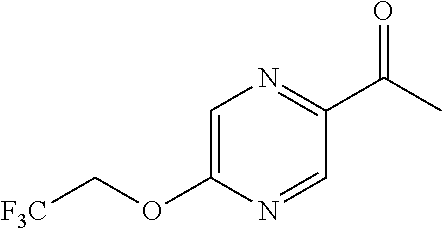


Step D: (R)—N-(5-(tert-butyl)isoxazol-3-yl)-2-(1-(2,3,5-trifluorophenyl)ethyl)-1,2,3,4-tetrahydroisoquinoline-7-sulfonamide. 1H NMR (500 MHz, CD3CN) δ (ppm): 8.68 (bs, 1H), 7.75 (dd, 1H), 7.69 (s, 1H), 7.39 (d, 1H), 7.36 (m, 1H), 7.23 (m, 1H), 6.06 (s, 1H), 7.79 (q, 1H), 4.20-4.40 (m, 2H), 3.18-3.45 (m, 4H), 1.77 (d, 3H), 1.24 (s, 9H); MS m/z 494 (M+H)+. MGAT2 Human IC50: 6 nM.

Step D: (R)—N-(5-(tert-butyl)isoxazol-3-yl)-2-(1-(phenyl)ethyl)-1,2,3,4-tetrahydroisoquinoline-7-sulfonamide. 1H NMR (500 MHz, CD3CN) δ (ppm): 7.60 (d, 1H), 7.53 (s, 1H), 7.34-7.40 (m, 5H), 7.27 (d, 1H), 6.07 (s, 1H), 3.50-3.84 (m, 3H), 2.59-2.95 (m, 4H), 1.95 (d, 3H), 1.23 (s, 9H); MS m/z 440 (M+H)+. MGAT2 Human IC50: 9 nM.


| TABLE 1 | |||
| Example | Observed | MGAT2 | |
| # | Chemical Structure | Mass | Human IC50 |
| 6 |
 |
560 [M + H]+ | 9.2 nM |
| 7 |
 |
512 [M + H]+ | 8.1 nM |
| 8 |
 |
526 [M + H]+ | 13 nM |


(R)-7-(benzylthio)-2-(1-(2-chloropyrimidin-5-yl)ethyl)-1,2,3,4-tetrahydroisoquinoline (0.94 g, 2.37 mmol) was dissolved in DMF (10 mL) and NaH (60%, 0.19 g, 4.75 mmol) and CF3CH2OH (1 mL) were added at 0° C. The mixture was heated at 80° C. for 3 h. The mixture was cooled to room temperature, quenched with saturated NH4Cl, and extracted with EtOAc. The organic phase was dried over MgSO4, and evaporated under reduced pressure. The crude material was purified by flash column (10 g SNAP, 10˜30% EtOAc in hexane) to afford the title compound. LC/MS (m/z): 460 (M+H)+.


The title compound was prepared following the procedure described in Step C of Example 20 but using commercially available methyl 2-chlorothiazole-5-carboxylate. LC/MS (m/z): 242 (M+H)+.


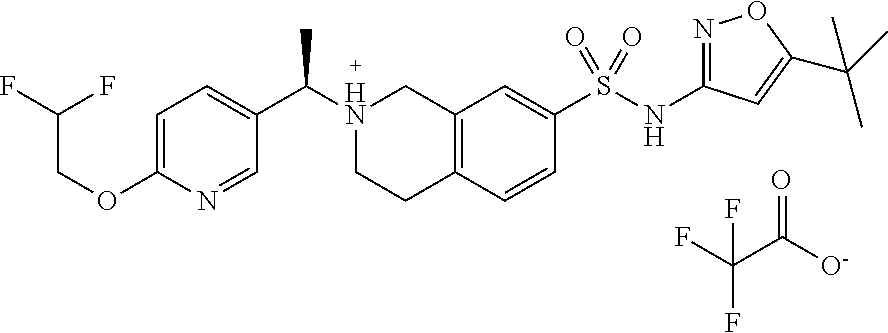


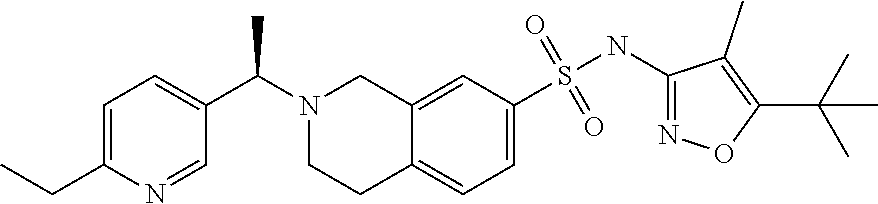


| TABLE 2 | |||
| Example | Observed | MGAT2 | |
| # | Chemical Structure | Mass | Human IC50 |
| 53 |
 |
492 [M + H]+ | 7.1 nM |
| 54 |
 |
546 [M + H]+ | 16 nM |
| 55 |
 |
504 [M + H]+ | 3.7 nM |
| 56 |
 |
492 [M + H]+ | 5.7 nM |
| 57 |
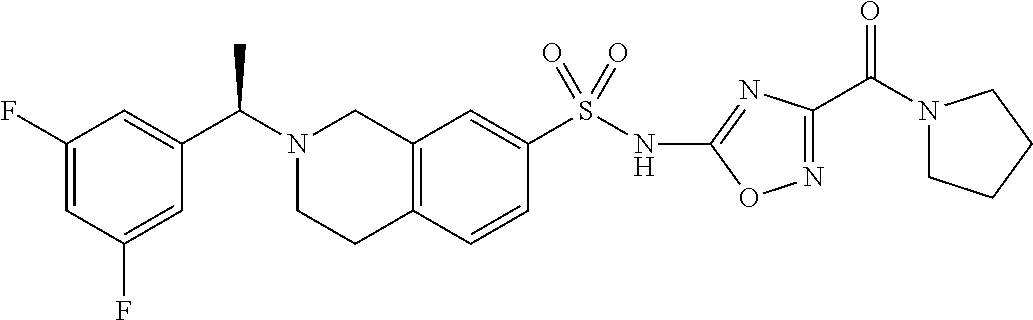 |
518 [M + H]+ | 1.6 nM |
| 58 |
 |
582 [M + H]+ | 15 nM |
Claims (14)


Priority Applications (1)
| Application Number | Priority Date | Filing Date | Title |
|---|---|---|---|
| US15/104,537 US10065945B2 (en) | 2014-01-24 | 2015-01-20 | Isoquinoline derivatives as MGAT2 inhibitors |
Applications Claiming Priority (3)
| Application Number | Priority Date | Filing Date | Title |
|---|---|---|---|
| US201461931005P | 2014-01-24 | 2014-01-24 | |
| US15/104,537 US10065945B2 (en) | 2014-01-24 | 2015-01-20 | Isoquinoline derivatives as MGAT2 inhibitors |
| PCT/US2015/011939 WO2015112465A1 (en) | 2014-01-24 | 2015-01-20 | Isoquinoline derivatives as mgat2 inhibitors |
Publications (2)
| Publication Number | Publication Date |
|---|---|
| US20180009796A1 US20180009796A1 (en) | 2018-01-11 |
| US10065945B2 true US10065945B2 (en) | 2018-09-04 |
Family
ID=53681860
Family Applications (1)
| Application Number | Title | Priority Date | Filing Date |
|---|---|---|---|
| US15/104,537 Active 2035-08-06 US10065945B2 (en) | 2014-01-24 | 2015-01-20 | Isoquinoline derivatives as MGAT2 inhibitors |
Country Status (3)
| Country | Link |
|---|---|
| US (1) | US10065945B2 (en) |
| EP (1) | EP3097101B1 (en) |
| WO (1) | WO2015112465A1 (en) |
Families Citing this family (7)
| Publication number | Priority date | Publication date | Assignee | Title |
|---|---|---|---|---|
| JP2018052818A (en) * | 2015-01-28 | 2018-04-05 | 武田薬品工業株式会社 | Sulfonamide compound |
| JPWO2017110841A1 (en) | 2015-12-21 | 2018-10-11 | 塩野義製薬株式会社 | Non-aromatic heterocyclic derivatives having MGAT2 inhibitory activity |
| TWI782056B (en) | 2017-07-14 | 2022-11-01 | 日商鹽野義製藥股份有限公司 | A fused ring derivative having a mgat2 inhibitoy activity |
| GB201810092D0 (en) | 2018-06-20 | 2018-08-08 | Ctxt Pty Ltd | Compounds |
| GB201810581D0 (en) | 2018-06-28 | 2018-08-15 | Ctxt Pty Ltd | Compounds |
| WO2020145369A1 (en) | 2019-01-11 | 2020-07-16 | 塩野義製薬株式会社 | Dihydropyrazolopyrazinone derivative having mgat2 inhibitory activity |
| PH12021553107A1 (en) | 2019-06-18 | 2022-08-01 | Ctxt Pty Ltd | Benzisoxazole sulfonamide derivatives |
Citations (7)
| Publication number | Priority date | Publication date | Assignee | Title |
|---|---|---|---|---|
| US5217976A (en) | 1991-05-31 | 1993-06-08 | Imperial Chemical Industries Plc | 1,6-naphthyridone derivatives having angiotensin ii antagonist activity |
| WO1999015526A2 (en) | 1997-09-19 | 1999-04-01 | Smithkline Beecham Plc | N-5,6,7,8-tetrahydro(1,6)naphthyridine-n'-phenylurea derivatives |
| WO2006122014A2 (en) | 2005-05-10 | 2006-11-16 | Vertex Pharmaceuticals Incorporated | Bicyclic derivatives as modulators of ion channels |
| WO2008038768A1 (en) | 2006-09-28 | 2008-04-03 | Dainippon Sumitomo Pharma Co., Ltd. | Compound having bicyclic pyrimidine structure and pharmaceutical composition comprising the compound |
| WO2009037542A2 (en) | 2007-09-20 | 2009-03-26 | Glenmark Pharmaceuticals, S.A. | Spirocyclic compounds as stearoyl coa desaturase inhibitors |
| US20090170885A1 (en) | 2007-08-01 | 2009-07-02 | Valeant Pharmaceuticals International, Inc. | Naphthyridine derivatives as potassium channel modulators |
| EP2687507A1 (en) | 2011-03-14 | 2014-01-22 | Taisho Pharmaceutical Co., Ltd. | Nitrogen-containing condensed heterocyclic compound |
Family Cites Families (19)
| Publication number | Priority date | Publication date | Assignee | Title |
|---|---|---|---|---|
| AR008789A1 (en) | 1996-07-31 | 2000-02-23 | Bayer Corp | PIRIDINES AND SUBSTITUTED BIPHENYLS |
| WO1998039342A1 (en) | 1997-03-07 | 1998-09-11 | Metabasis Therapeutics, Inc. | Novel indole and azaindole inhibitors of fructose-1,6-bisphosphatase |
| WO1998039344A1 (en) | 1997-03-07 | 1998-09-11 | Metabasis Therapeutics, Inc. | Novel purine inhibitors of fructose-1,6-bisphosphatase |
| ZA981936B (en) | 1997-03-07 | 1999-09-06 | Metabasis Therapeutics Inc | Novel benzimidazole inhibitors of fructose 1,6-bisphosphatase. |
| US6613942B1 (en) | 1997-07-01 | 2003-09-02 | Novo Nordisk A/S | Glucagon antagonists/inverse agonists |
| BR9810378A (en) | 1997-07-01 | 2000-08-29 | Novo Nordisk As | Compound, use of the same, pharmaceutical composition, and, processes of treating type i or type ii diabetes, of treating hyperglycemia, and of decreasing blood glucose in a mammal |
| WO2000014095A1 (en) | 1998-09-09 | 2000-03-16 | Metabasis Therapeutics, Inc. | Novel heteroaromatic inhibitors of fructose 1,6-bisphosphatase |
| BR0010651A (en) | 1999-05-17 | 2002-03-19 | Novo Nordisk As | Compound, use of a compound, pharmaceutical composition, and method for the treatment and / or prevention of disorders or diseases mediated by an antagonistic action of glucagon |
| JP2004513076A (en) | 2000-07-25 | 2004-04-30 | メルク エンド カムパニー インコーポレーテッド | N-substituted indoles useful in the treatment of diabetes |
| US6852738B2 (en) | 2001-01-30 | 2005-02-08 | Merck & Co., Inc. | Acyl sulfamides for treatment of obesity, diabetes and lipid disorders |
| UA74912C2 (en) | 2001-07-06 | 2006-02-15 | Merck & Co Inc | Beta-aminotetrahydroimidazo-(1,2-a)-pyrazines and tetratriazolo-(4,3-a)-pyrazines as inhibitors of dipeptylpeptidase for the treatment or prevention of diabetes |
| AR040241A1 (en) | 2002-06-10 | 2005-03-23 | Merck & Co Inc | INHIBITORS OF 11-BETA-HYDROXIESTEROID DEHYDROGRENASE 1 FOR THE TREATMENT OF DIABETES OBESITY AND DISLIPIDEMIA |
| NZ538031A (en) | 2002-08-29 | 2007-10-26 | Merck & Co Inc | Indoles having anti-diabetic activity |
| JP4340232B2 (en) | 2002-08-29 | 2009-10-07 | メルク エンド カムパニー インコーポレーテッド | Indoles having anti-diabetic activity |
| JO2397B1 (en) | 2002-12-20 | 2007-06-17 | ميرك شارب اند دوم كوربوريشن | Triazole Derivatives As Inhibitors Of 11-Beta -Hydroxysteriod Dehydrogenase-1 |
| WO2004066963A2 (en) | 2003-01-17 | 2004-08-12 | Merck & Co., Inc. | N-cyclohexylaminocarbonyl benzenesulfonamide derivatives |
| CA2691010A1 (en) | 2007-06-28 | 2008-12-31 | Merck Frosst Canada Ltd. | Substituted fused pyrimidines as antagonists of gpr105 activity |
| JP2010533712A (en) | 2007-07-19 | 2010-10-28 | メルク・シャープ・エンド・ドーム・コーポレイション | Betacarboline derivatives as antidiabetic compounds |
| WO2009042053A2 (en) | 2007-09-21 | 2009-04-02 | Merck & Co., Inc. | Neuromedin u receptor agonists and uses thereof |
-
2015
- 2015-01-20 WO PCT/US2015/011939 patent/WO2015112465A1/en not_active Ceased
- 2015-01-20 US US15/104,537 patent/US10065945B2/en active Active
- 2015-01-20 EP EP15740935.0A patent/EP3097101B1/en active Active
Patent Citations (8)
| Publication number | Priority date | Publication date | Assignee | Title |
|---|---|---|---|---|
| US5217976A (en) | 1991-05-31 | 1993-06-08 | Imperial Chemical Industries Plc | 1,6-naphthyridone derivatives having angiotensin ii antagonist activity |
| WO1999015526A2 (en) | 1997-09-19 | 1999-04-01 | Smithkline Beecham Plc | N-5,6,7,8-tetrahydro(1,6)naphthyridine-n'-phenylurea derivatives |
| WO2006122014A2 (en) | 2005-05-10 | 2006-11-16 | Vertex Pharmaceuticals Incorporated | Bicyclic derivatives as modulators of ion channels |
| WO2008038768A1 (en) | 2006-09-28 | 2008-04-03 | Dainippon Sumitomo Pharma Co., Ltd. | Compound having bicyclic pyrimidine structure and pharmaceutical composition comprising the compound |
| US8232282B2 (en) | 2006-09-28 | 2012-07-31 | Dainippon Sumitomo Pharma Co., Ltd. | Compound having bicyclic pyrimidine structure and pharmaceutical composition comprising the same |
| US20090170885A1 (en) | 2007-08-01 | 2009-07-02 | Valeant Pharmaceuticals International, Inc. | Naphthyridine derivatives as potassium channel modulators |
| WO2009037542A2 (en) | 2007-09-20 | 2009-03-26 | Glenmark Pharmaceuticals, S.A. | Spirocyclic compounds as stearoyl coa desaturase inhibitors |
| EP2687507A1 (en) | 2011-03-14 | 2014-01-22 | Taisho Pharmaceutical Co., Ltd. | Nitrogen-containing condensed heterocyclic compound |
Non-Patent Citations (13)
| Title |
|---|
| Cao, J. et al., A Predominant Role of Acyl-CoA:monoacylglycerol Acyltransferase-2 in Dietary Fat Absorption Implicated by Tissue Distribution, Subcellular Localization, and Up-regulation by High Fat Diet, The Journal of Biological Chemistry, 2004, p. 18878-18886, vol. 279, No. 18, Issue of Apr. 30. |
| Cao, J. et al., Cloning and Functional Characterization of a Mouse Intestinal Acyl-CoA:Monoacylglycerol Acyltransferase, MGAT2, The Journal of Biological Chemistry, 2003, p. 13860-13866, vol. 278, No. 16, Issue of Apr. 18. |
| Chemical Abstracts, STN Registry Database records for registry numbers: 1394628-66-0, 1394625-91-2, 1394618-42-8, 1394589-42-4, 1394530-35-8, 1394519-14-2, 1394519-03-9, 1394518-47-8, 1394498-21-5, 1394496-44-6, 1394434 44 6 and 1394394-80-9, all entered into the database on Sep. 18, 2012, 5 pp. (Year: 2012). * |
| Cheng, D. et al., Identification of Acyl Coenzyme A:Monoacylglycerol Acyltransferase 3, an Intestinal Specific Enzyme Implicated in Dietary Fat Absorption, The Journal of Biological Chemistry, 2003, p. 13611-13614, vol. 278, No. 16, Issue of Apr. 18. |
| Coleman, R. A. et al., Hepatic Monoacylglycerol Acyltransferase, The Journal of Biological Chemistry, 1984, p. 8934-8938, vol. 259, No. 14, Issue of Jul. 25. |
| Haslam; Primary Care Diabetes 2010, 4 , 105-112. (Year: 2010). * |
| International Search Report for PCT/US2015/011939 dated Jun. 24, 2015, 10 pages. |
| Iyaku, R. et al., Journal of Clinical Therapeutics & Medicines, General Collection, 2005, p. 215-225, vol. 21, No. 2. |
| Luan, Y. et al., Pathogenesis of obesity by food restriction in OLETF rats-increased intestinal monoacylglycerol acyltransferase activities may be a crucial factor, Diabetes Research and Clinical Practice, 2002, p. 75-82, vol. 57. |
| PUBCHEM, Compound Summary for CID 70788599 - AGN-PC-0J2MV3, PubChem, 2013, p. 1-10. |
| Tsuchida; Lipids in Health and Disease 2012, 11, 75, 10 pages. (Year: 2012). * |
| Yen, C. L. E. et al., Identification of a gene encoding MGAT1, a monoacylglycerol acyltransferase, PNAS, 2002, p. 8512-8517, vol. 99, No. 13. |
| Yen, C. L. E. et al., MGAT2, a Monoacylglycerol Acyltransferase Expressed in the Small Intestine, The Journal of Biological Chemistry, 2003, p. 18532-18537, vol. 278, No. 20, Issue of May 16. |
Also Published As
| Publication number | Publication date |
|---|---|
| EP3097101A1 (en) | 2016-11-30 |
| US20180009796A1 (en) | 2018-01-11 |
| WO2015112465A1 (en) | 2015-07-30 |
| EP3097101A4 (en) | 2017-06-07 |
| EP3097101B1 (en) | 2020-12-23 |
Similar Documents
| Publication | Publication Date | Title |
|---|---|---|
| EP3152214B1 (en) | Imidazo-pyrazine derivatives useful as soluble guanylate cyclase activators | |
| US10968193B2 (en) | Antidiabetic bicyclic compounds | |
| US20130040978A1 (en) | Spiro isoxazoline compounds as sstr5 antagonists | |
| US9708270B2 (en) | Substituted spiropiperidinyl compounds useful as GPR120 agonists | |
| US20180009796A1 (en) | Isoquinoline derivatives as mgat2 inhibitors | |
| US20170073355A2 (en) | Triazolo-pyrazinyl derivatives useful as soluble guanylate cyclase activators | |
| CA2804970A1 (en) | Spirocyclic compounds | |
| US20120142706A1 (en) | Substituted cyclopropyl compounds, compositions containing such compounds and methods of treatment | |
| US20190161448A1 (en) | Substituted tetrahydroisoquinoline compounds useful as gpr120 agonists | |
| US12264139B2 (en) | Aryl sulfonamides as BLT1 antagonists | |
| CA2942753A1 (en) | Substituted fused heterocycles as gpr119 modulators for the treatment of diabetes, obesity, dyslipidemia and related disorders | |
| WO2012024179A1 (en) | Substituted amide derivatives as dgat-1 inhibitors | |
| EP2760855B1 (en) | Substituted cyclopropyl compounds, compositions containing such compounds as well as their use in treating type-2 diabetes | |
| US10336733B2 (en) | Aryl acylsulfonamides as BLT1 antagonists | |
| US20120316200A1 (en) | Pyridone derivatives | |
| CA2805078A1 (en) | Imidazole derivatives | |
| US9527838B2 (en) | 2-pyridinecarboxamide derivatives, compositions containing such compounds, and methods of treatment | |
| EP3383389A1 (en) | Aryl acylsulfonamides as blt1 antagonists | |
| WO2012064569A1 (en) | Imidazole derivatives | |
| US20140088124A1 (en) | Imidazole derivatives | |
| US20150274664A1 (en) | Substituted cyclopropyl compounds, compositions containing such compounds and methods of treatment | |
| WO2012047772A2 (en) | Imidazole derivatives | |
| WO2012112364A1 (en) | Lactam derivatives as dgat-1 inhibitors | |
| US10864211B2 (en) | Hydroxy isoxazole compounds useful as GPR120 agonists | |
| WO2012122075A1 (en) | Lactam derivatives as dgat-1 inhibitors |
Legal Events
| Date | Code | Title | Description |
|---|---|---|---|
| AS | Assignment |
Owner name: MERCK SHARP & DOHME CORP., NEW JERSEY Free format text: ASSIGNMENT OF ASSIGNORS INTEREST;ASSIGNORS:BERGER, RICHARD;BLIZZARD, TIMOTHY A.;CAMPBELL, BRIAN T.;AND OTHERS;SIGNING DATES FROM 20141031 TO 20141205;REEL/FRAME:039023/0001 |
|
| STCF | Information on status: patent grant |
Free format text: PATENTED CASE |
|
| MAFP | Maintenance fee payment |
Free format text: PAYMENT OF MAINTENANCE FEE, 4TH YEAR, LARGE ENTITY (ORIGINAL EVENT CODE: M1551); ENTITY STATUS OF PATENT OWNER: LARGE ENTITY Year of fee payment: 4 |
|
| AS | Assignment |
Owner name: MERCK SHARP & DOHME LLC, NEW JERSEY Free format text: MERGER;ASSIGNOR:MERCK SHARP & DOHME CORP.;REEL/FRAME:061102/0145 Effective date: 20220407 |
|
| MAFP | Maintenance fee payment |
Free format text: PAYMENT OF MAINTENANCE FEE, 8TH YEAR, LARGE ENTITY (ORIGINAL EVENT CODE: M1552); ENTITY STATUS OF PATENT OWNER: LARGE ENTITY Year of fee payment: 8 |