US10065913B2 - Unsaturated deoxybenzoin compounds and polymers prepared therefrom - Google Patents
Unsaturated deoxybenzoin compounds and polymers prepared therefrom Download PDFInfo
- Publication number
- US10065913B2 US10065913B2 US15/286,768 US201615286768A US10065913B2 US 10065913 B2 US10065913 B2 US 10065913B2 US 201615286768 A US201615286768 A US 201615286768A US 10065913 B2 US10065913 B2 US 10065913B2
- Authority
- US
- United States
- Prior art keywords
- polyester
- group
- occurrence
- independently
- hydrogen
- Prior art date
- Legal status (The legal status is an assumption and is not a legal conclusion. Google has not performed a legal analysis and makes no representation as to the accuracy of the status listed.)
- Active, expires
Links
- OTKCEEWUXHVZQI-UHFFFAOYSA-N 1,2-diphenylethanone Chemical class C=1C=CC=CC=1C(=O)CC1=CC=CC=C1 OTKCEEWUXHVZQI-UHFFFAOYSA-N 0.000 title abstract description 18
- 229920000642 polymer Polymers 0.000 title description 54
- 229920000728 polyester Polymers 0.000 claims abstract description 111
- 150000001875 compounds Chemical class 0.000 claims abstract description 18
- BHEPBYXIRTUNPN-UHFFFAOYSA-N hydridophosphorus(.) (triplet) Chemical compound [PH] BHEPBYXIRTUNPN-UHFFFAOYSA-N 0.000 claims abstract description 9
- -1 unsaturated deoxybenzoin compound Chemical class 0.000 claims description 50
- IISBACLAFKSPIT-UHFFFAOYSA-N bisphenol A Chemical compound C=1C=C(O)C=CC=1C(C)(C)C1=CC=C(O)C=C1 IISBACLAFKSPIT-UHFFFAOYSA-N 0.000 claims description 35
- 239000001257 hydrogen Substances 0.000 claims description 34
- 229910052739 hydrogen Inorganic materials 0.000 claims description 34
- 125000004435 hydrogen atom Chemical group [H]* 0.000 claims description 32
- 125000003118 aryl group Chemical group 0.000 claims description 27
- 229920001634 Copolyester Polymers 0.000 claims description 26
- 125000000843 phenylene group Chemical group C1(=C(C=CC=C1)*)* 0.000 claims description 23
- 229910052736 halogen Inorganic materials 0.000 claims description 21
- 150000002367 halogens Chemical class 0.000 claims description 21
- 125000004169 (C1-C6) alkyl group Chemical group 0.000 claims description 20
- 238000002485 combustion reaction Methods 0.000 claims description 18
- 125000002560 nitrile group Chemical group 0.000 claims description 16
- 125000000732 arylene group Chemical group 0.000 claims description 15
- 125000002887 hydroxy group Chemical group [H]O* 0.000 claims description 13
- 125000004191 (C1-C6) alkoxy group Chemical group 0.000 claims description 12
- 230000004580 weight loss Effects 0.000 claims description 11
- 238000002411 thermogravimetry Methods 0.000 claims description 10
- 238000000197 pyrolysis Methods 0.000 claims description 9
- 125000005843 halogen group Chemical group 0.000 claims description 4
- 125000000743 hydrocarbylene group Chemical group 0.000 claims description 3
- 150000002431 hydrogen Chemical class 0.000 claims 2
- 238000002360 preparation method Methods 0.000 abstract description 3
- 0 [1*]C([2*])(C(=O)C1=C([5*])C([4*])=C(O)C(CC=C)=C1[3*])C1=C([3*])C(CC=C)=C(O)C([4*])=C1[5*].[1*]C([2*])(C(=O)C1=C([5*])C([4*])=C(O)C(CC=C)=C1[3*])C1=C([3*])C([6*])=C(O)C([4*])=C1[5*].[1*]C([2*])(C(=O)C1=C([5*])C([4*])=C(OCC#C)C([6*])=C1[3*])C1=C([3*])C([6*])=C(OCC#C)C([4*])=C1[5*] Chemical compound [1*]C([2*])(C(=O)C1=C([5*])C([4*])=C(O)C(CC=C)=C1[3*])C1=C([3*])C(CC=C)=C(O)C([4*])=C1[5*].[1*]C([2*])(C(=O)C1=C([5*])C([4*])=C(O)C(CC=C)=C1[3*])C1=C([3*])C([6*])=C(O)C([4*])=C1[5*].[1*]C([2*])(C(=O)C1=C([5*])C([4*])=C(OCC#C)C([6*])=C1[3*])C1=C([3*])C([6*])=C(OCC#C)C([4*])=C1[5*] 0.000 description 47
- ZMXDDKWLCZADIW-UHFFFAOYSA-N N,N-Dimethylformamide Chemical compound CN(C)C=O ZMXDDKWLCZADIW-UHFFFAOYSA-N 0.000 description 30
- HEDRZPFGACZZDS-MICDWDOJSA-N Trichloro(2H)methane Chemical compound [2H]C(Cl)(Cl)Cl HEDRZPFGACZZDS-MICDWDOJSA-N 0.000 description 22
- QQVIHTHCMHWDBS-UHFFFAOYSA-N isophthalic acid Chemical compound OC(=O)C1=CC=CC(C(O)=O)=C1 QQVIHTHCMHWDBS-UHFFFAOYSA-N 0.000 description 16
- 238000000034 method Methods 0.000 description 16
- OKKJLVBELUTLKV-UHFFFAOYSA-N Methanol Chemical compound OC OKKJLVBELUTLKV-UHFFFAOYSA-N 0.000 description 15
- YMWUJEATGCHHMB-UHFFFAOYSA-N Dichloromethane Chemical compound ClCCl YMWUJEATGCHHMB-UHFFFAOYSA-N 0.000 description 12
- KKEYFWRCBNTPAC-UHFFFAOYSA-N Terephthalic acid Chemical compound OC(=O)C1=CC=C(C(O)=O)C=C1 KKEYFWRCBNTPAC-UHFFFAOYSA-N 0.000 description 12
- 230000015572 biosynthetic process Effects 0.000 description 11
- 125000000325 methylidene group Chemical group [H]C([H])=* 0.000 description 11
- 238000005160 1H NMR spectroscopy Methods 0.000 description 9
- 125000003903 2-propenyl group Chemical group [H]C([*])([H])C([H])=C([H])[H] 0.000 description 9
- 239000000047 product Substances 0.000 description 9
- 229920003229 poly(methyl methacrylate) Polymers 0.000 description 8
- 229920001230 polyarylate Polymers 0.000 description 8
- 239000004926 polymethyl methacrylate Substances 0.000 description 8
- 239000000126 substance Substances 0.000 description 8
- 238000003786 synthesis reaction Methods 0.000 description 8
- IJGRMHOSHXDMSA-UHFFFAOYSA-N Atomic nitrogen Chemical group N#N IJGRMHOSHXDMSA-UHFFFAOYSA-N 0.000 description 7
- 239000000654 additive Substances 0.000 description 7
- 239000003063 flame retardant Substances 0.000 description 7
- 238000010438 heat treatment Methods 0.000 description 7
- 239000000203 mixture Substances 0.000 description 7
- 238000006116 polymerization reaction Methods 0.000 description 7
- RNFJDJUURJAICM-UHFFFAOYSA-N 2,2,4,4,6,6-hexaphenoxy-1,3,5-triaza-2$l^{5},4$l^{5},6$l^{5}-triphosphacyclohexa-1,3,5-triene Chemical compound N=1P(OC=2C=CC=CC=2)(OC=2C=CC=CC=2)=NP(OC=2C=CC=CC=2)(OC=2C=CC=CC=2)=NP=1(OC=1C=CC=CC=1)OC1=CC=CC=C1 RNFJDJUURJAICM-UHFFFAOYSA-N 0.000 description 6
- HEDRZPFGACZZDS-UHFFFAOYSA-N Chloroform Chemical compound ClC(Cl)Cl HEDRZPFGACZZDS-UHFFFAOYSA-N 0.000 description 6
- HEMHJVSKTPXQMS-UHFFFAOYSA-M Sodium hydroxide Chemical compound [OH-].[Na+] HEMHJVSKTPXQMS-UHFFFAOYSA-M 0.000 description 6
- 238000006243 chemical reaction Methods 0.000 description 6
- 125000005842 heteroatom Chemical group 0.000 description 6
- 229930185605 Bisphenol Natural products 0.000 description 5
- 238000005481 NMR spectroscopy Methods 0.000 description 5
- 229910052799 carbon Inorganic materials 0.000 description 5
- 229940126214 compound 3 Drugs 0.000 description 5
- 229910052760 oxygen Inorganic materials 0.000 description 5
- 239000004753 textile Substances 0.000 description 5
- OZAIFHULBGXAKX-UHFFFAOYSA-N 2-(2-cyanopropan-2-yldiazenyl)-2-methylpropanenitrile Chemical compound N#CC(C)(C)N=NC(C)(C)C#N OZAIFHULBGXAKX-UHFFFAOYSA-N 0.000 description 4
- ATVJXMYDOSMEPO-UHFFFAOYSA-N 3-prop-2-enoxyprop-1-ene Chemical class C=CCOCC=C ATVJXMYDOSMEPO-UHFFFAOYSA-N 0.000 description 4
- OKTJSMMVPCPJKN-UHFFFAOYSA-N Carbon Chemical compound [C] OKTJSMMVPCPJKN-UHFFFAOYSA-N 0.000 description 4
- JRXXLCKWQFKACW-UHFFFAOYSA-N biphenylacetylene Chemical group C1=CC=CC=C1C#CC1=CC=CC=C1 JRXXLCKWQFKACW-UHFFFAOYSA-N 0.000 description 4
- 229920001577 copolymer Polymers 0.000 description 4
- 150000002430 hydrocarbons Chemical group 0.000 description 4
- 239000000463 material Substances 0.000 description 4
- 229910052757 nitrogen Inorganic materials 0.000 description 4
- 229920003023 plastic Polymers 0.000 description 4
- 239000004033 plastic Substances 0.000 description 4
- BWHMMNNQKKPAPP-UHFFFAOYSA-L potassium carbonate Chemical compound [K+].[K+].[O-]C([O-])=O BWHMMNNQKKPAPP-UHFFFAOYSA-L 0.000 description 4
- 239000000243 solution Substances 0.000 description 4
- 125000001424 substituent group Chemical group 0.000 description 4
- XLYOFNOQVPJJNP-UHFFFAOYSA-N water Substances O XLYOFNOQVPJJNP-UHFFFAOYSA-N 0.000 description 4
- OWEYKIWAZBBXJK-UHFFFAOYSA-N 1,1-Dichloro-2,2-bis(4-hydroxyphenyl)ethylene Chemical group C1=CC(O)=CC=C1C(=C(Cl)Cl)C1=CC=C(O)C=C1 OWEYKIWAZBBXJK-UHFFFAOYSA-N 0.000 description 3
- HZPYKPXLYFNHFD-UHFFFAOYSA-N 1,2-bis(4-hydroxyphenyl)ethanone Chemical compound C1=CC(O)=CC=C1CC(=O)C1=CC=C(O)C=C1 HZPYKPXLYFNHFD-UHFFFAOYSA-N 0.000 description 3
- IUPQYVJJGISQFB-UHFFFAOYSA-N C=P(OCC)(OCC)C(C)(C)C.CC(C)(C)P1(=O)OC2=C(C=CC=C2)C2=C1C=CC=C2 Chemical compound C=P(OCC)(OCC)C(C)(C)C.CC(C)(C)P1(=O)OC2=C(C=CC=C2)C2=C1C=CC=C2 IUPQYVJJGISQFB-UHFFFAOYSA-N 0.000 description 3
- IAZDPXIOMUYVGZ-UHFFFAOYSA-N Dimethylsulphoxide Chemical compound CS(C)=O IAZDPXIOMUYVGZ-UHFFFAOYSA-N 0.000 description 3
- SECXISVLQFMRJM-UHFFFAOYSA-N N-Methylpyrrolidone Chemical compound CN1CCCC1=O SECXISVLQFMRJM-UHFFFAOYSA-N 0.000 description 3
- QVGXLLKOCUKJST-UHFFFAOYSA-N atomic oxygen Chemical group [O] QVGXLLKOCUKJST-UHFFFAOYSA-N 0.000 description 3
- FDQSRULYDNDXQB-UHFFFAOYSA-N benzene-1,3-dicarbonyl chloride Chemical compound ClC(=O)C1=CC=CC(C(Cl)=O)=C1 FDQSRULYDNDXQB-UHFFFAOYSA-N 0.000 description 3
- 239000004035 construction material Substances 0.000 description 3
- 150000002148 esters Chemical class 0.000 description 3
- 239000006260 foam Substances 0.000 description 3
- 238000007306 functionalization reaction Methods 0.000 description 3
- 238000005227 gel permeation chromatography Methods 0.000 description 3
- 238000005259 measurement Methods 0.000 description 3
- 239000000178 monomer Substances 0.000 description 3
- VLKZOEOYAKHREP-UHFFFAOYSA-N n-Hexane Chemical compound CCCCCC VLKZOEOYAKHREP-UHFFFAOYSA-N 0.000 description 3
- 239000001301 oxygen Chemical group 0.000 description 3
- 125000001997 phenyl group Chemical group [H]C1=C([H])C([H])=C(*)C([H])=C1[H] 0.000 description 3
- 239000002861 polymer material Substances 0.000 description 3
- 238000000425 proton nuclear magnetic resonance spectrum Methods 0.000 description 3
- 238000001228 spectrum Methods 0.000 description 3
- 229910052717 sulfur Inorganic materials 0.000 description 3
- GHYOCDFICYLMRF-UTIIJYGPSA-N (2S,3R)-N-[(2S)-3-(cyclopenten-1-yl)-1-[(2R)-2-methyloxiran-2-yl]-1-oxopropan-2-yl]-3-hydroxy-3-(4-methoxyphenyl)-2-[[(2S)-2-[(2-morpholin-4-ylacetyl)amino]propanoyl]amino]propanamide Chemical compound C1(=CCCC1)C[C@@H](C(=O)[C@@]1(OC1)C)NC([C@H]([C@@H](C1=CC=C(C=C1)OC)O)NC([C@H](C)NC(CN1CCOCC1)=O)=O)=O GHYOCDFICYLMRF-UTIIJYGPSA-N 0.000 description 2
- CSCPPACGZOOCGX-UHFFFAOYSA-N Acetone Chemical compound CC(C)=O CSCPPACGZOOCGX-UHFFFAOYSA-N 0.000 description 2
- KAEUBFBTQZOVBA-UHFFFAOYSA-N C=CCC1=CC(C(=O)CC2=CC=C(OC)C=C2)=CC=C1OC(=O)CC(C)=O.COCOC(=O)CC(C)=O Chemical compound C=CCC1=CC(C(=O)CC2=CC=C(OC)C=C2)=CC=C1OC(=O)CC(C)=O.COCOC(=O)CC(C)=O KAEUBFBTQZOVBA-UHFFFAOYSA-N 0.000 description 2
- ANTWKLHINLYNKQ-UHFFFAOYSA-N CC.CC.CCC.OC1=CC=CC=C1.OC1=CC=CC=C1 Chemical compound CC.CC.CCC.OC1=CC=CC=C1.OC1=CC=CC=C1 ANTWKLHINLYNKQ-UHFFFAOYSA-N 0.000 description 2
- CSNNHWWHGAXBCP-UHFFFAOYSA-L Magnesium sulfate Chemical compound [Mg+2].[O-][S+2]([O-])([O-])[O-] CSNNHWWHGAXBCP-UHFFFAOYSA-L 0.000 description 2
- OFOBLEOULBTSOW-UHFFFAOYSA-N Malonic acid Chemical compound OC(=O)CC(O)=O OFOBLEOULBTSOW-UHFFFAOYSA-N 0.000 description 2
- WYURNTSHIVDZCO-UHFFFAOYSA-N Tetrahydrofuran Chemical compound C1CCOC1 WYURNTSHIVDZCO-UHFFFAOYSA-N 0.000 description 2
- 239000000853 adhesive Substances 0.000 description 2
- 230000001070 adhesive effect Effects 0.000 description 2
- 125000003545 alkoxy group Chemical group 0.000 description 2
- 125000000217 alkyl group Chemical group 0.000 description 2
- BHELZAPQIKSEDF-UHFFFAOYSA-N allyl bromide Chemical compound BrCC=C BHELZAPQIKSEDF-UHFFFAOYSA-N 0.000 description 2
- 125000004429 atom Chemical group 0.000 description 2
- HTZCNXWZYVXIMZ-UHFFFAOYSA-M benzyl(triethyl)azanium;chloride Chemical compound [Cl-].CC[N+](CC)(CC)CC1=CC=CC=C1 HTZCNXWZYVXIMZ-UHFFFAOYSA-M 0.000 description 2
- PXKLMJQFEQBVLD-UHFFFAOYSA-N bisphenol F Chemical compound C1=CC(O)=CC=C1CC1=CC=C(O)C=C1 PXKLMJQFEQBVLD-UHFFFAOYSA-N 0.000 description 2
- 238000007707 calorimetry Methods 0.000 description 2
- 125000004432 carbon atom Chemical group C* 0.000 description 2
- 239000011203 carbon fibre reinforced carbon Substances 0.000 description 2
- 239000000460 chlorine Substances 0.000 description 2
- 229910052801 chlorine Inorganic materials 0.000 description 2
- 235000017168 chlorine Nutrition 0.000 description 2
- 229940125904 compound 1 Drugs 0.000 description 2
- 229940125797 compound 12 Drugs 0.000 description 2
- 229940125782 compound 2 Drugs 0.000 description 2
- 125000000753 cycloalkyl group Chemical group 0.000 description 2
- 230000007613 environmental effect Effects 0.000 description 2
- 239000000835 fiber Substances 0.000 description 2
- 230000009970 fire resistant effect Effects 0.000 description 2
- 230000036541 health Effects 0.000 description 2
- YFIBSNDOVCWPBL-UHFFFAOYSA-N hexa-1,5-diyne Chemical group C#CCCC#C YFIBSNDOVCWPBL-UHFFFAOYSA-N 0.000 description 2
- 229920001519 homopolymer Polymers 0.000 description 2
- 238000004519 manufacturing process Methods 0.000 description 2
- 238000002844 melting Methods 0.000 description 2
- 230000008018 melting Effects 0.000 description 2
- 125000002496 methyl group Chemical group [H]C([H])([H])* 0.000 description 2
- 238000004377 microelectronic Methods 0.000 description 2
- 125000002950 monocyclic group Chemical group 0.000 description 2
- KYTZHLUVELPASH-UHFFFAOYSA-N naphthalene-1,2-dicarboxylic acid Chemical class C1=CC=CC2=C(C(O)=O)C(C(=O)O)=CC=C21 KYTZHLUVELPASH-UHFFFAOYSA-N 0.000 description 2
- 125000001624 naphthyl group Chemical group 0.000 description 2
- 239000012299 nitrogen atmosphere Substances 0.000 description 2
- 238000000655 nuclear magnetic resonance spectrum Methods 0.000 description 2
- 230000036284 oxygen consumption Effects 0.000 description 2
- 239000003973 paint Substances 0.000 description 2
- AQSJGOWTSHOLKH-UHFFFAOYSA-N phosphite(3-) Chemical class [O-]P([O-])[O-] AQSJGOWTSHOLKH-UHFFFAOYSA-N 0.000 description 2
- 229910052698 phosphorus Inorganic materials 0.000 description 2
- 229910000027 potassium carbonate Inorganic materials 0.000 description 2
- 235000011181 potassium carbonates Nutrition 0.000 description 2
- 238000011160 research Methods 0.000 description 2
- 229920006395 saturated elastomer Polymers 0.000 description 2
- 150000003384 small molecules Chemical class 0.000 description 2
- 239000007787 solid Substances 0.000 description 2
- 239000002904 solvent Substances 0.000 description 2
- 150000003573 thiols Chemical class 0.000 description 2
- 125000004739 (C1-C6) alkylsulfonyl group Chemical group 0.000 description 1
- 125000004737 (C1-C6) haloalkoxy group Chemical group 0.000 description 1
- 125000000171 (C1-C6) haloalkyl group Chemical group 0.000 description 1
- 125000006652 (C3-C12) cycloalkyl group Chemical group 0.000 description 1
- 125000006654 (C3-C12) heteroaryl group Chemical group 0.000 description 1
- 125000001989 1,3-phenylene group Chemical group [H]C1=C([H])C([*:1])=C([H])C([*:2])=C1[H] 0.000 description 1
- RYHBNJHYFVUHQT-UHFFFAOYSA-N 1,4-Dioxane Chemical compound C1COCCO1 RYHBNJHYFVUHQT-UHFFFAOYSA-N 0.000 description 1
- 125000001140 1,4-phenylene group Chemical group [H]C1=C([H])C([*:2])=C([H])C([H])=C1[*:1] 0.000 description 1
- 238000001644 13C nuclear magnetic resonance spectroscopy Methods 0.000 description 1
- OXBLVCZKDOZZOJ-UHFFFAOYSA-N 2,3-Dihydrothiophene Chemical compound C1CC=CS1 OXBLVCZKDOZZOJ-UHFFFAOYSA-N 0.000 description 1
- BSYJHYLAMMJNRC-UHFFFAOYSA-N 2,4,4-trimethylpentan-2-ol Chemical compound CC(C)(C)CC(C)(C)O BSYJHYLAMMJNRC-UHFFFAOYSA-N 0.000 description 1
- GSSXLFACIJSBOM-UHFFFAOYSA-N 2h-pyran-2-ol Chemical compound OC1OC=CC=C1 GSSXLFACIJSBOM-UHFFFAOYSA-N 0.000 description 1
- HRDCVMSNCBAMAM-UHFFFAOYSA-N 3-prop-2-ynoxyprop-1-yne Chemical compound C#CCOCC#C HRDCVMSNCBAMAM-UHFFFAOYSA-N 0.000 description 1
- VPWNQTHUCYMVMZ-UHFFFAOYSA-N 4,4'-sulfonyldiphenol Chemical class C1=CC(O)=CC=C1S(=O)(=O)C1=CC=C(O)C=C1 VPWNQTHUCYMVMZ-UHFFFAOYSA-N 0.000 description 1
- WVDRSXGPQWNUBN-UHFFFAOYSA-N 4-(4-carboxyphenoxy)benzoic acid Chemical compound C1=CC(C(=O)O)=CC=C1OC1=CC=C(C(O)=O)C=C1 WVDRSXGPQWNUBN-UHFFFAOYSA-N 0.000 description 1
- NEQFBGHQPUXOFH-UHFFFAOYSA-N 4-(4-carboxyphenyl)benzoic acid Chemical compound C1=CC(C(=O)O)=CC=C1C1=CC=C(C(O)=O)C=C1 NEQFBGHQPUXOFH-UHFFFAOYSA-N 0.000 description 1
- HCUNREWMFYCWAQ-UHFFFAOYSA-N 4-[2-(4-carboxyphenyl)ethyl]benzoic acid Chemical compound C1=CC(C(=O)O)=CC=C1CCC1=CC=C(C(O)=O)C=C1 HCUNREWMFYCWAQ-UHFFFAOYSA-N 0.000 description 1
- IKHGUXGNUITLKF-UHFFFAOYSA-N Acetaldehyde Chemical compound CC=O IKHGUXGNUITLKF-UHFFFAOYSA-N 0.000 description 1
- 238000006596 Alder-ene reaction Methods 0.000 description 1
- KXRYGQURJQCETJ-UHFFFAOYSA-N C(C#C)C=1C(=C(C=CC=1)C(=O)C(C1=CC=CC=C1)(O)O)CC#C Chemical compound C(C#C)C=1C(=C(C=CC=1)C(=O)C(C1=CC=CC=C1)(O)O)CC#C KXRYGQURJQCETJ-UHFFFAOYSA-N 0.000 description 1
- 125000000882 C2-C6 alkenyl group Chemical group 0.000 description 1
- 125000003601 C2-C6 alkynyl group Chemical group 0.000 description 1
- ZFLSQEBTZVRHMX-UHFFFAOYSA-N C=CCC.C=CCC.C=CCC.CC.CC.CC.CC.COC.COC.COC(=O)CC(C)=O.COC(=O)CC(C)=O.O=C(CC1=CC=CC=C1)C1=CC=CC=C1.O=C(CC1=CC=CC=C1)C1=CC=CC=C1 Chemical compound C=CCC.C=CCC.C=CCC.CC.CC.CC.CC.COC.COC.COC(=O)CC(C)=O.COC(=O)CC(C)=O.O=C(CC1=CC=CC=C1)C1=CC=CC=C1.O=C(CC1=CC=CC=C1)C1=CC=CC=C1 ZFLSQEBTZVRHMX-UHFFFAOYSA-N 0.000 description 1
- QTBLTSZOIKJGKC-UHFFFAOYSA-N C=CCC1=CC(C(=O)CC2=CC(CC=C)=C(OC)C=C2)=CC=C1OC(=O)CC(C)=O Chemical compound C=CCC1=CC(C(=O)CC2=CC(CC=C)=C(OC)C=C2)=CC=C1OC(=O)CC(C)=O QTBLTSZOIKJGKC-UHFFFAOYSA-N 0.000 description 1
- JXWVLGJJOKBAGG-UHFFFAOYSA-N C=CCC1=CC(C(=O)CC2=CC(CC=C)=C(OC)C=C2)=CC=C1OC(=O)CC(C)=O.COCOC(=O)CC(C)=O Chemical compound C=CCC1=CC(C(=O)CC2=CC(CC=C)=C(OC)C=C2)=CC=C1OC(=O)CC(C)=O.COCOC(=O)CC(C)=O JXWVLGJJOKBAGG-UHFFFAOYSA-N 0.000 description 1
- HEYVXSOIBHADHT-UHFFFAOYSA-N C=CCC1=CC(C(=O)CC2=CC=C(OC)C=C2)=CC=C1OC(=O)CC(C)=O Chemical compound C=CCC1=CC(C(=O)CC2=CC=C(OC)C=C2)=CC=C1OC(=O)CC(C)=O HEYVXSOIBHADHT-UHFFFAOYSA-N 0.000 description 1
- HZAWPPRBCALFRN-UHFFFAOYSA-N CC1=CC=C(CC2=CC=C(C)C=C2)C=C1 Chemical compound CC1=CC=C(CC2=CC=C(C)C=C2)C=C1 HZAWPPRBCALFRN-UHFFFAOYSA-N 0.000 description 1
- NEBUPJKYROFMDD-UHFFFAOYSA-N CCc(cc(cc1)C(Cc(cc2)ccc2OC(C)(C)I)=O)c1OC([Al](C)C(C(C)(C)[IH+])=O)=O Chemical compound CCc(cc(cc1)C(Cc(cc2)ccc2OC(C)(C)I)=O)c1OC([Al](C)C(C(C)(C)[IH+])=O)=O NEBUPJKYROFMDD-UHFFFAOYSA-N 0.000 description 1
- VEXZGXHMUGYJMC-UHFFFAOYSA-M Chloride anion Chemical compound [Cl-] VEXZGXHMUGYJMC-UHFFFAOYSA-M 0.000 description 1
- ZAMOUSCENKQFHK-UHFFFAOYSA-N Chlorine atom Chemical compound [Cl] ZAMOUSCENKQFHK-UHFFFAOYSA-N 0.000 description 1
- XFXPMWWXUTWYJX-UHFFFAOYSA-N Cyanide Chemical compound N#[C-] XFXPMWWXUTWYJX-UHFFFAOYSA-N 0.000 description 1
- VEXZGXHMUGYJMC-UHFFFAOYSA-N Hydrochloric acid Chemical compound Cl VEXZGXHMUGYJMC-UHFFFAOYSA-N 0.000 description 1
- JCXJVPUVTGWSNB-UHFFFAOYSA-N Nitrogen dioxide Chemical compound O=[N]=O JCXJVPUVTGWSNB-UHFFFAOYSA-N 0.000 description 1
- OAICVXFJPJFONN-UHFFFAOYSA-N Phosphorus Chemical compound [P] OAICVXFJPJFONN-UHFFFAOYSA-N 0.000 description 1
- XUIMIQQOPSSXEZ-UHFFFAOYSA-N Silicon Chemical group [Si] XUIMIQQOPSSXEZ-UHFFFAOYSA-N 0.000 description 1
- NINIDFKCEFEMDL-UHFFFAOYSA-N Sulfur Chemical group [S] NINIDFKCEFEMDL-UHFFFAOYSA-N 0.000 description 1
- RHQDFWAXVIIEBN-UHFFFAOYSA-N Trifluoroethanol Chemical compound OCC(F)(F)F RHQDFWAXVIIEBN-UHFFFAOYSA-N 0.000 description 1
- SLGBZMMZGDRARJ-UHFFFAOYSA-N Triphenylene Natural products C1=CC=C2C3=CC=CC=C3C3=CC=CC=C3C2=C1 SLGBZMMZGDRARJ-UHFFFAOYSA-N 0.000 description 1
- 239000002253 acid Substances 0.000 description 1
- 125000002015 acyclic group Chemical group 0.000 description 1
- 230000000996 additive effect Effects 0.000 description 1
- 230000002411 adverse Effects 0.000 description 1
- 125000003342 alkenyl group Chemical group 0.000 description 1
- 125000004450 alkenylene group Chemical group 0.000 description 1
- 150000001345 alkine derivatives Chemical class 0.000 description 1
- 125000002947 alkylene group Chemical group 0.000 description 1
- 125000000304 alkynyl group Chemical group 0.000 description 1
- HSFWRNGVRCDJHI-UHFFFAOYSA-N alpha-acetylene Natural products C#C HSFWRNGVRCDJHI-UHFFFAOYSA-N 0.000 description 1
- PNEYBMLMFCGWSK-UHFFFAOYSA-N aluminium oxide Inorganic materials [O-2].[O-2].[O-2].[Al+3].[Al+3] PNEYBMLMFCGWSK-UHFFFAOYSA-N 0.000 description 1
- 125000005577 anthracene group Chemical group 0.000 description 1
- 238000013459 approach Methods 0.000 description 1
- 239000007864 aqueous solution Substances 0.000 description 1
- 150000001491 aromatic compounds Chemical class 0.000 description 1
- 238000005899 aromatization reaction Methods 0.000 description 1
- 125000004391 aryl sulfonyl group Chemical group 0.000 description 1
- 230000009286 beneficial effect Effects 0.000 description 1
- 230000008901 benefit Effects 0.000 description 1
- 125000001797 benzyl group Chemical group [H]C1=C([H])C([H])=C(C([H])=C1[H])C([H])([H])* 0.000 description 1
- 231100000693 bioaccumulation Toxicity 0.000 description 1
- 125000006267 biphenyl group Chemical group 0.000 description 1
- VCCBEIPGXKNHFW-UHFFFAOYSA-N biphenyl-4,4'-diol Chemical group C1=CC(O)=CC=C1C1=CC=C(O)C=C1 VCCBEIPGXKNHFW-UHFFFAOYSA-N 0.000 description 1
- 125000002529 biphenylenyl group Chemical group C1(=CC=CC=2C3=CC=CC=C3C12)* 0.000 description 1
- 239000012267 brine Substances 0.000 description 1
- 229910052794 bromium Inorganic materials 0.000 description 1
- 238000001460 carbon-13 nuclear magnetic resonance spectrum Methods 0.000 description 1
- 238000003763 carbonization Methods 0.000 description 1
- 230000015556 catabolic process Effects 0.000 description 1
- 238000012512 characterization method Methods 0.000 description 1
- 125000001309 chloro group Chemical class Cl* 0.000 description 1
- 239000002131 composite material Substances 0.000 description 1
- 238000001816 cooling Methods 0.000 description 1
- 230000008878 coupling Effects 0.000 description 1
- 238000010168 coupling process Methods 0.000 description 1
- 238000005859 coupling reaction Methods 0.000 description 1
- 238000004132 cross linking Methods 0.000 description 1
- 239000013078 crystal Substances 0.000 description 1
- 238000002425 crystallisation Methods 0.000 description 1
- 230000008025 crystallization Effects 0.000 description 1
- 125000004093 cyano group Chemical group *C#N 0.000 description 1
- 125000004122 cyclic group Chemical group 0.000 description 1
- 125000000392 cycloalkenyl group Chemical group 0.000 description 1
- 125000002993 cycloalkylene group Chemical group 0.000 description 1
- 239000007857 degradation product Substances 0.000 description 1
- 238000006731 degradation reaction Methods 0.000 description 1
- 230000001419 dependent effect Effects 0.000 description 1
- 238000011161 development Methods 0.000 description 1
- SULWMEGSVQCTSK-UHFFFAOYSA-N diethyl hydrogen phosphite Chemical class CCOP(O)OCC SULWMEGSVQCTSK-UHFFFAOYSA-N 0.000 description 1
- 229910001873 dinitrogen Inorganic materials 0.000 description 1
- 150000002009 diols Chemical group 0.000 description 1
- USIUVYZYUHIAEV-UHFFFAOYSA-N diphenyl ether Chemical class C=1C=CC=CC=1OC1=CC=CC=C1 USIUVYZYUHIAEV-UHFFFAOYSA-N 0.000 description 1
- 229920001971 elastomer Polymers 0.000 description 1
- 229920003247 engineering thermoplastic Polymers 0.000 description 1
- 150000002118 epoxides Chemical group 0.000 description 1
- 125000001495 ethyl group Chemical group [H]C([H])([H])C([H])([H])* 0.000 description 1
- 125000002534 ethynyl group Chemical group [H]C#C* 0.000 description 1
- 230000008020 evaporation Effects 0.000 description 1
- 238000001704 evaporation Methods 0.000 description 1
- 229910052731 fluorine Inorganic materials 0.000 description 1
- 239000003517 fume Substances 0.000 description 1
- 125000000524 functional group Chemical group 0.000 description 1
- 239000007789 gas Substances 0.000 description 1
- 150000004820 halides Chemical class 0.000 description 1
- 125000001188 haloalkyl group Chemical group 0.000 description 1
- 150000008282 halocarbons Chemical class 0.000 description 1
- 125000000592 heterocycloalkyl group Chemical group 0.000 description 1
- PYGSKMBEVAICCR-UHFFFAOYSA-N hexa-1,5-diene Chemical group C=CCCC=C PYGSKMBEVAICCR-UHFFFAOYSA-N 0.000 description 1
- 125000001183 hydrocarbyl group Chemical group 0.000 description 1
- 229910000041 hydrogen chloride Inorganic materials 0.000 description 1
- IXCSERBJSXMMFS-UHFFFAOYSA-N hydrogen chloride Substances Cl.Cl IXCSERBJSXMMFS-UHFFFAOYSA-N 0.000 description 1
- 150000004679 hydroxides Chemical group 0.000 description 1
- 238000010348 incorporation Methods 0.000 description 1
- 238000009413 insulation Methods 0.000 description 1
- 125000001449 isopropyl group Chemical group [H]C([H])([H])C([H])(*)C([H])([H])[H] 0.000 description 1
- 239000010410 layer Substances 0.000 description 1
- 229910052943 magnesium sulfate Inorganic materials 0.000 description 1
- 235000019341 magnesium sulphate Nutrition 0.000 description 1
- 238000004949 mass spectrometry Methods 0.000 description 1
- 230000007246 mechanism Effects 0.000 description 1
- 229910044991 metal oxide Inorganic materials 0.000 description 1
- 150000004706 metal oxides Chemical class 0.000 description 1
- 230000005012 migration Effects 0.000 description 1
- 238000013508 migration Methods 0.000 description 1
- 238000002156 mixing Methods 0.000 description 1
- 230000004048 modification Effects 0.000 description 1
- 238000012986 modification Methods 0.000 description 1
- 239000003607 modifier Substances 0.000 description 1
- 125000004108 n-butyl group Chemical group [H]C([H])([H])C([H])([H])C([H])([H])C([H])([H])* 0.000 description 1
- 125000004957 naphthylene group Chemical group 0.000 description 1
- 125000000449 nitro group Chemical group [O-][N+](*)=O 0.000 description 1
- 239000003921 oil Substances 0.000 description 1
- 125000000962 organic group Chemical group 0.000 description 1
- 239000012044 organic layer Substances 0.000 description 1
- 239000012074 organic phase Substances 0.000 description 1
- 239000003960 organic solvent Substances 0.000 description 1
- 125000006551 perfluoro alkylene group Chemical group 0.000 description 1
- 125000002080 perylenyl group Chemical group C1(=CC=C2C=CC=C3C4=CC=CC5=CC=CC(C1=C23)=C45)* 0.000 description 1
- 150000002989 phenols Chemical class 0.000 description 1
- OJMIONKXNSYLSR-UHFFFAOYSA-N phosphorous acid Chemical class OP(O)O OJMIONKXNSYLSR-UHFFFAOYSA-N 0.000 description 1
- 239000011574 phosphorus Substances 0.000 description 1
- 150000003022 phthalic acids Chemical class 0.000 description 1
- 229920006260 polyaryletherketone Polymers 0.000 description 1
- 229920000515 polycarbonate Polymers 0.000 description 1
- 239000004417 polycarbonate Substances 0.000 description 1
- 235000015497 potassium bicarbonate Nutrition 0.000 description 1
- 239000011736 potassium bicarbonate Substances 0.000 description 1
- 229910000028 potassium bicarbonate Inorganic materials 0.000 description 1
- TYJJADVDDVDEDZ-UHFFFAOYSA-M potassium hydrogencarbonate Chemical compound [K+].OC([O-])=O TYJJADVDDVDEDZ-UHFFFAOYSA-M 0.000 description 1
- 239000002244 precipitate Substances 0.000 description 1
- 238000001556 precipitation Methods 0.000 description 1
- YORCIIVHUBAYBQ-UHFFFAOYSA-N propargyl bromide Chemical compound BrCC#C YORCIIVHUBAYBQ-UHFFFAOYSA-N 0.000 description 1
- 125000006410 propenylene group Chemical group 0.000 description 1
- QQONPFPTGQHPMA-UHFFFAOYSA-N propylene Natural products CC=C QQONPFPTGQHPMA-UHFFFAOYSA-N 0.000 description 1
- 125000004805 propylene group Chemical group [H]C([H])([H])C([H])([*:1])C([H])([H])[*:2] 0.000 description 1
- 125000005581 pyrene group Chemical group 0.000 description 1
- 150000003254 radicals Chemical class 0.000 description 1
- 239000011541 reaction mixture Substances 0.000 description 1
- 230000008707 rearrangement Effects 0.000 description 1
- 230000009467 reduction Effects 0.000 description 1
- 238000010992 reflux Methods 0.000 description 1
- 238000009877 rendering Methods 0.000 description 1
- 230000000979 retarding effect Effects 0.000 description 1
- 238000007363 ring formation reaction Methods 0.000 description 1
- 239000005060 rubber Substances 0.000 description 1
- 238000013341 scale-up Methods 0.000 description 1
- 238000007086 side reaction Methods 0.000 description 1
- 229910052710 silicon Inorganic materials 0.000 description 1
- 239000010703 silicon Chemical group 0.000 description 1
- HPALAKNZSZLMCH-UHFFFAOYSA-M sodium;chloride;hydrate Chemical compound O.[Na+].[Cl-] HPALAKNZSZLMCH-UHFFFAOYSA-M 0.000 description 1
- 239000011343 solid material Substances 0.000 description 1
- 238000007655 standard test method Methods 0.000 description 1
- 239000007858 starting material Substances 0.000 description 1
- 238000007155 step growth polymerization reaction Methods 0.000 description 1
- 238000006467 substitution reaction Methods 0.000 description 1
- 239000011593 sulfur Chemical group 0.000 description 1
- 229920001059 synthetic polymer Polymers 0.000 description 1
- 238000012360 testing method Methods 0.000 description 1
- CZDYPVPMEAXLPK-UHFFFAOYSA-N tetramethylsilane Chemical compound C[Si](C)(C)C CZDYPVPMEAXLPK-UHFFFAOYSA-N 0.000 description 1
- 125000005031 thiocyano group Chemical group S(C#N)* 0.000 description 1
- 150000003568 thioethers Chemical group 0.000 description 1
- 125000005425 toluyl group Chemical group 0.000 description 1
- 125000002088 tosyl group Chemical group [H]C1=C([H])C(=C([H])C([H])=C1C([H])([H])[H])S(*)(=O)=O 0.000 description 1
- 231100000331 toxic Toxicity 0.000 description 1
- 230000002588 toxic effect Effects 0.000 description 1
- 231100000419 toxicity Toxicity 0.000 description 1
- 230000001988 toxicity Effects 0.000 description 1
- 150000004684 trihydrates Chemical class 0.000 description 1
- 125000005580 triphenylene group Chemical group 0.000 description 1
- 125000000391 vinyl group Chemical group [H]C([*])=C([H])[H] 0.000 description 1
Images
Classifications
-
- C—CHEMISTRY; METALLURGY
- C07—ORGANIC CHEMISTRY
- C07C—ACYCLIC OR CARBOCYCLIC COMPOUNDS
- C07C49/00—Ketones; Ketenes; Dimeric ketenes; Ketonic chelates
- C07C49/76—Ketones containing a keto group bound to a six-membered aromatic ring
- C07C49/82—Ketones containing a keto group bound to a six-membered aromatic ring containing hydroxy groups
- C07C49/835—Ketones containing a keto group bound to a six-membered aromatic ring containing hydroxy groups having unsaturation outside an aromatic ring
-
- C—CHEMISTRY; METALLURGY
- C07—ORGANIC CHEMISTRY
- C07C—ACYCLIC OR CARBOCYCLIC COMPOUNDS
- C07C49/00—Ketones; Ketenes; Dimeric ketenes; Ketonic chelates
- C07C49/76—Ketones containing a keto group bound to a six-membered aromatic ring
- C07C49/84—Ketones containing a keto group bound to a six-membered aromatic ring containing ether groups, groups, groups, or groups
-
- C—CHEMISTRY; METALLURGY
- C08—ORGANIC MACROMOLECULAR COMPOUNDS; THEIR PREPARATION OR CHEMICAL WORKING-UP; COMPOSITIONS BASED THEREON
- C08G—MACROMOLECULAR COMPOUNDS OBTAINED OTHERWISE THAN BY REACTIONS ONLY INVOLVING UNSATURATED CARBON-TO-CARBON BONDS
- C08G63/00—Macromolecular compounds obtained by reactions forming a carboxylic ester link in the main chain of the macromolecule
-
- C—CHEMISTRY; METALLURGY
- C08—ORGANIC MACROMOLECULAR COMPOUNDS; THEIR PREPARATION OR CHEMICAL WORKING-UP; COMPOSITIONS BASED THEREON
- C08G—MACROMOLECULAR COMPOUNDS OBTAINED OTHERWISE THAN BY REACTIONS ONLY INVOLVING UNSATURATED CARBON-TO-CARBON BONDS
- C08G63/00—Macromolecular compounds obtained by reactions forming a carboxylic ester link in the main chain of the macromolecule
- C08G63/02—Polyesters derived from hydroxycarboxylic acids or from polycarboxylic acids and polyhydroxy compounds
- C08G63/12—Polyesters derived from hydroxycarboxylic acids or from polycarboxylic acids and polyhydroxy compounds derived from polycarboxylic acids and polyhydroxy compounds
- C08G63/16—Dicarboxylic acids and dihydroxy compounds
- C08G63/18—Dicarboxylic acids and dihydroxy compounds the acids or hydroxy compounds containing carbocyclic rings
- C08G63/181—Acids containing aromatic rings
-
- C—CHEMISTRY; METALLURGY
- C08—ORGANIC MACROMOLECULAR COMPOUNDS; THEIR PREPARATION OR CHEMICAL WORKING-UP; COMPOSITIONS BASED THEREON
- C08G—MACROMOLECULAR COMPOUNDS OBTAINED OTHERWISE THAN BY REACTIONS ONLY INVOLVING UNSATURATED CARBON-TO-CARBON BONDS
- C08G63/00—Macromolecular compounds obtained by reactions forming a carboxylic ester link in the main chain of the macromolecule
- C08G63/02—Polyesters derived from hydroxycarboxylic acids or from polycarboxylic acids and polyhydroxy compounds
- C08G63/12—Polyesters derived from hydroxycarboxylic acids or from polycarboxylic acids and polyhydroxy compounds derived from polycarboxylic acids and polyhydroxy compounds
- C08G63/52—Polycarboxylic acids or polyhydroxy compounds in which at least one of the two components contains aliphatic unsaturation
- C08G63/54—Polycarboxylic acids or polyhydroxy compounds in which at least one of the two components contains aliphatic unsaturation the acids or hydroxy compounds containing carbocyclic rings
- C08G63/547—Hydroxy compounds containing aromatic rings
-
- C—CHEMISTRY; METALLURGY
- C08—ORGANIC MACROMOLECULAR COMPOUNDS; THEIR PREPARATION OR CHEMICAL WORKING-UP; COMPOSITIONS BASED THEREON
- C08G—MACROMOLECULAR COMPOUNDS OBTAINED OTHERWISE THAN BY REACTIONS ONLY INVOLVING UNSATURATED CARBON-TO-CARBON BONDS
- C08G63/00—Macromolecular compounds obtained by reactions forming a carboxylic ester link in the main chain of the macromolecule
- C08G63/68—Polyesters containing atoms other than carbon, hydrogen and oxygen
- C08G63/692—Polyesters containing atoms other than carbon, hydrogen and oxygen containing phosphorus
- C08G63/6924—Polyesters containing atoms other than carbon, hydrogen and oxygen containing phosphorus derived from polycarboxylic acids and polyhydroxy compounds
- C08G63/6926—Dicarboxylic acids and dihydroxy compounds
-
- C—CHEMISTRY; METALLURGY
- C08—ORGANIC MACROMOLECULAR COMPOUNDS; THEIR PREPARATION OR CHEMICAL WORKING-UP; COMPOSITIONS BASED THEREON
- C08G—MACROMOLECULAR COMPOUNDS OBTAINED OTHERWISE THAN BY REACTIONS ONLY INVOLVING UNSATURATED CARBON-TO-CARBON BONDS
- C08G63/00—Macromolecular compounds obtained by reactions forming a carboxylic ester link in the main chain of the macromolecule
- C08G63/91—Polymers modified by chemical after-treatment
Definitions
- Polymers are a mainstay of modern society, for example, widely used in fabricating textiles, upholstery, construction materials, various air, land or sea vehicles, and microelectronic devices and appliances.
- the inherent flammability of many polymers poses a significant threat, especially in enclosed or isolated spaces. Therefore, as synthetic polymers are used extensively in society as plastics, rubbers, and textiles, polymer flammability has been recognized as a safety hazard and remains an important challenge in polymer research.
- Flame retardancy of polymers is often achieved by blending polymers with flame retardant additives, such as halocarbons, including polybrominated diphenyl ether (PBDE), phosphorus, organophosphates, and metal oxides. While small molecule flame retardant additives provide a convenient means for reducing flammability of polymers, these additives can compromise safety from environmental and health perspectives. Conventional flame retardants are small molecule additives that often leach out of the polymer during their use leading to a variety of serious health and environmental problems associated with toxicity and bioaccumulation. These concerns have led to an emphasis on non-halogenated flame retardants in recent years. However, non-halogenated flame retardant additives, such as alumina trihydrate, compromise the physical and mechanical properties of polymers when loaded at high levels.
- An ideal low-flammable polymer would be halogen-free and possess high thermal stability, low heat of combustion, and a low combustion heat release rate (HRR), with minimal release of toxic fumes.
- Intrinsically fire-resistant polymers that undergo significant carbonization upon heating are highly desirable, as carbonaceous char formation effectively averts combustion by producing an insulating layer on the polymer surface. Such char formation can also be realized from composite materials in which an additive ultimately provides the desired char.
- Aromatic polyesters prepared from bisphenols and phthalic acids are important high performance engineering thermoplastics.
- Conventional bisphenol A (BPA)-containing polyarylates are well-known and widely used, but exhibit higher-than-desired flammability (e.g., BPA-polyarylates have a heat release capacity (HRC) of about 400 Joules per gram-Kelvin (J/g-K)).
- BPA-polyarylates have a heat release capacity (HRC) of about 400 Joules per gram-Kelvin (J/g-K)).
- HRC heat release capacity
- Polyarylates containing 1,1-dichloro-2,2-bis(4-hydroxyphenyl)ethylene bisphenol C, or BPC
- BPC bisphenol C, or BPC
- BPC-containing polymers are well within the “ultra fire-resistant” category (HRC ⁇ 100 J/g-K), with BPC-polyarylates and polycarbonates having reported HRC values of 21 and 29 J/g-K, respectively, and high char yields (50-55%).
- HRC ⁇ 100 J/g-K ultra fire-resistant
- BPC-polyarylates and polycarbonates having reported HRC values of 21 and 29 J/g-K, respectively, and high char yields (50-55%).
- HRC ⁇ 100 J/g-K ultra fire-resistant
- BPC derivatives can be converted to the corresponding diphenylacetylene by loss of the chlorines, followed by phenyl migration.
- this reaction represents a viable mechanism to char formation, in which the presence of chlorine sets up the rearrangement chemistry that leads to diphenylacetylene.
- diphenylacetylene-containing poly(aryl ether ketone)s showed heat release characteristics of similar magnitude to the corresponding BPC-containing polymers.
- these alkyne-containing aromatic polymers are prone to side-reactions and crosslinking even at moderately high temperatures, and have less-than-optimal processability and mechanical properties for many polymer materials applications. Accordingly, there is an ongoing search in the art for non-halogenated polymers or additives which promote charring or preclude combustion.
- PCFC Pyrolysis combustion flow calorimetry
- HRC heat release capacity
- One embodiment is an unsaturated deoxybenzoin compound having the structure (I), (II), or (III)
- R 1 and R 2 are independently at each occurrence hydrogen, a halogen, a nitrile group, a C 1-6 alkyl group, or a C 6-20 aryl group;
- R 3 , R 4 , R 5 , and R 6 are independently at each occurrence hydrogen, a halogen, a hydroxyl group, a nitrile group, a C 1-6 alkyl group, a C 1-6 alkoxy group, or a C 6-20 aryl group; and
- n is independently at each occurrence an integer from 1 to 12.
- Another embodiment is a polyester comprising repeating units having the structure (IV), (V), or a combination thereof
- Ar 1 is a divalent substituted or unsubstituted C 6-20 arylene group
- R 7 is independently at each occurrence a halogen, a hydroxyl group, a nitrile group, a C 1-6 alkyl group, a C 1-6 alkoxy group, or a C 6-20 aryl group
- m is independently at each occurrence 0, 1, 2, 3, or 4.
- Another embodiment is a polyester comprising repeating units having the structure (IX), (X), or a combination thereof
- Ar 1 is a divalent substituted or unsubstituted C 6-20 arylene group
- R 7 is independently at each occurrence a halogen, a hydroxyl group, a nitrile group, a C 1-6 alkyl group, a C 1-6 alkoxy group, or a C 6-20 aryl group
- m is independently at each occurrence 0, 1, 2, 3, or 4
- R 8 is a phosphorous-containing group.
- Another embodiment is an article comprising one or more of the above-described polyesters.
- FIG. 1 is a chemical scheme illustrating the synthesis of the diallyl ether derivative of BHDB.
- FIG. 2 is a proton nuclear magnetic resonance ( 1 H NMR) spectrum of the diallyl ether derivative of BHDB.
- FIG. 3 is a chemical scheme illustrating the synthesis of a diallyl-functionalized bisphenolic deoxybenzoin.
- FIG. 4 is a 1 H NMR spectrum of the diallyl-functionalized bisphenolic deoxybenzoin.
- FIG. 5 is a chemical scheme illustrating the polymerization of the diallyl-functionalized bisphenolic deoxybenzoin.
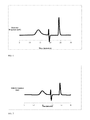
- FIG. 6 is a gel permeation chromatogram (GPC) of a polymer having repeat units derived from the diallyl-functionalized bisphenolic deoxybenzoin and bisphenol A in a 50:50 molar ratio. GPC was performed in dimethylformamide using poly(methyl methacrylate) (PMMA) standards.
- PMMA poly(methyl methacrylate)
- FIG. 7 is a gel permeation chromatogram (GPC) of a polymer having repeat units derived from the diallyl-functionalized bisphenolic deoxybenzoin and bisphenol A in a 70:30 molar ratio. GPC was performed in dimethylformamide using poly(methyl methacrylate) (PMMA) standards.
- PMMA poly(methyl methacrylate)
- FIG. 8 is a gel permeation chromatogram (GPC) of a homopolymer having repeat units derived from the diallyl-functionalized bisphenolic deoxybenzoin. GPC was performed in dimethylformamide using poly(methyl methacrylate) (PMMA) standards.
- PMMA poly(methyl methacrylate)
- FIG. 9 is a chemical scheme illustrating the synthesis of a monoallyl-functionalized bisphenolic deoxybenzoin.
- FIG. 10 is a chemical scheme illustrating the polymerization of the monoallyl-functionalized bisphenolic deoxybenzoin.
- FIG. 11 is a chemical scheme illustrating the post-polymerization functionalization of the diallyl-BHDB polyester with various phosphites.
- FIG. 12 is a chemical scheme illustrating the synthesis of a dipropargyl ether-functionalized deoxybenzoin.
- the present inventors have prepared new functionalized derivatives of deoxybenzoin containing unsaturation.
- the present inventors have prepared diallyl-, monoallyl-, and dipropargyl-containing derivatives of deoxybenzoin.
- These deoxybenzoin compounds advantageously include unsaturation, offering an opportunity for further functionalization.
- the functionalized deoxybenzoin compound can be a diallyl- or monoallyl-functionalized bisphenolic deoxybenzoin, where step growth polymerization can proceed using the phenols.
- the resulting polymer advantageously includes pendent allyl groups built into the polymer product (up to two per repeating unit).
- the pendent double bonds on the polymer chain represent reactive handles through which the polymer can be cross-linked to give a network structure, or to which the polymer can be substituted by conversion of the double bonds to other groups such as epoxides, haloalkyl groups, hydroxides, diols, or thio-ethers through the use of thiol-ene reactions.
- Other thiols, containing P—SH bonds, are candidates for reaction with the double bonds and are expected to contribute to further reduction of polymer heat release upon burning.
- phosphite compounds can be reacted with the double bonds to provide new phosphite-functionalized polyarylates.
- Polymers prepared from the allyl-functionalized bisphenolic deoxybenzoin compound can have a desirable combination of thermal properties, including reduced weight loss at elevated temperatures (e.g., 350° C. or above), low char yields, and improved heat release capacity and total heat release. Accordingly, the polymers disclosed herein represent a new class of functionalized flame retardant polymers.
- One aspect of the present disclosure is an unsaturated deoxybenzoin compound having the structure (I), (II), or (III)
- R 1 and R 2 are independently at each occurrence hydrogen, a halogen, a nitrile group, a C 1-6 alkyl group, or a C 6-20 aryl group;
- R 3 , R 4 , R 5 , and R 6 are independently at each occurrence hydrogen, a halogen, a hydroxyl group, a nitrile group, a C 1-6 alkyl group, a C 1-6 alkoxy group, or a C 6-20 aryl group; and
- n is independently at each occurrence an integer from 1 to 12 (e.g., n is independently at each occurrence 1, 2, 3, 4, 5, 6, 7, 8, 9, 10, 11, or 12).
- each occurrence of R 1 and R 2 is hydrogen.
- each occurrence of n is 1.
- each occurrence of R 3 , R 4 , R 5 , and R 6 is hydrogen.
- the unsaturated deoxybenzoin compound has the structure (I)
- the unsaturated deoxybenzoin compound has the structure (I) and each occurrence of R 1 and R 2 is hydrogen, and each occurrence of R 3 , R 4 , and R 5 is hydrogen.
- the unsaturated deoxybenzoin compound has the structure (II)
- the unsaturated deoxybenzoin compound has the structure (II) and each occurrence of R 1 and R 2 is hydrogen, and each occurrence of R 3 , R 4 , R 5 , and R 6 is hydrogen.
- the unsaturated deoxybenzoin compound has the structure (III)
- the unsaturated deoxybenzoin compound has the structure (III) and each occurrence of R 1 and R 2 is hydrogen, each occurrence of n is 1 to 12, preferably 1, and each occurrence of R 3 , R 4 , R 5 , and R 6 is hydrogen.
- Another aspect of the present disclosure is a polyester comprising repeating units having the structure (IV), (V), or a combination thereof
- Ar 1 is a divalent substituted or unsubstituted C 6-20 arylene group
- R 7 is independently at each occurrence halogen, a hydroxyl group, a nitrile group, a C 1-6 alkyl group, a C 1-6 alkoxy group, or a C 6-20 aryl group
- m is independently at each occurrence 0, 1, 2, 3, or 4, provided that the valence of the phenyl group of the deoxybenzoin is not exceeded.
- Ar 1 can include a substituted or unsubstituted phenylene group (e.g., a meta-phenylene group, a para-phenylene group, and the like), a phenylene oligomer (e.g., biphenylene, triphenylene, and the like), a naphthalene group, an anthracene group, a pyrene group, a perylene group, and the like, or a combination thereof.
- Ar 1 can be derived from a substituted or unsubstituted C 6-20 aromatic dicarboxylic acid or a derivative thereof (e.g., the corresponding acid halide).
- Ar 1 can be derived from isophthalic acid, terephthalic acid, naphthalene dicarboxylic acids, 1,2-di(p-carboxyphenyl)ethane, 4,4′-dicarboxydiphenyl ether, 4,4′-bisbenzoic acid, and combinations thereof.
- Ar 1 is derived from terephthalic acid, isophthalic acid, naphthalene dicarboxylic acids, or a combination thereof.
- Ar 1 is derived from isophthalic acid or terephthalic acid, and Ar 1 is a phenylene group.
- m is 0.
- the allyl group is preferably positioned ortho to the ester linkages of the polyester backbone.
- the polyester comprises repeating units according to structure (IV), wherein m is 0 and the allyl group is positioned ortho to the ester linkage of the polymer backbone.
- the polyester can comprise repeating units according to formula (VI)
- Ar 1 is a divalent substituted or unsubstituted C 6-20 arylene group, preferably a phenylene group.
- Ar 1 can be derived from isophthalic acid, terephthalic acid, or a combination thereof.
- Ar 1 of the polyester according to formula (VI) is a phenylene group derived from isophthalic acid, the polyester can comprise repeating units having the structure (VIA)
- the polyester comprises repeating units according to structure (V), wherein m is 0 and the allyl groups are positioned ortho to the ester linkage of the polymer backbone.
- the polyester can comprise repeating units according to formula (VIII)
- Ar 1 is a divalent substituted or unsubstituted C 6-20 arylene group, preferably a phenylene group.
- Ar 1 can be derived from isophthalic acid, terephthalic acid, or a combination thereof.
- Ar 1 of the polyester according to formula (VIII) is a phenylene group derived from isophthalic acid
- the polyester can comprise repeating units having the structure (VIIIA)
- the polyester can be a copolyester.
- the copolyester can be a random or block copolyester.
- the copolyester comprises repeating units according to structure (IV) and (V).
- the polyester can be a copolyester comprising repeating units according to structures (IV), (V), or a combination thereof, and further comprising repeating units according to structure (VII)
- Ar 1 can be as described above, and Ar 2 is a substituted or unsubstituted C 6-30 arylene group.
- exemplary Ar 2 groups can be of the formula
- R a and R b are each independently the same or different, and are a halogen atom or a monovalent C 1-6 alkyl group; p and q are each independently integers of 0 to 4 (e.g., 0, 1, 2, 3, or 4); c is 0 to 4 (e.g., 0, 1, 2, 3, or 4); and X a is a bridging group connecting the hydroxy-substituted aromatic groups, where the bridging group and the hydroxy substituent of each C 6 arylene group are disposed ortho, meta, or para (specifically para) to each other on the C 6 arylene group.
- the bridging group X a can be a single bond, —O—, —S—, —S(O)—, —S(O) 2 —, —C(O)—, or a C 1-18 organic bridging group.
- the C 1-18 organic bridging group can be cyclic or acyclic, aromatic or non-aromatic, and can further comprise heteroatoms such as halogens, oxygen, nitrogen, sulfur, silicon, or phosphorous.
- the C 1-18 organic group can be disposed such that the C 6 arylene groups connected thereto are each connected to a common alkylidene carbon or to different carbons of the C 1-18 organic bridging group.
- the group Ar 2 can be derived from the corresponding dihydroxy compound.
- a specific example of an Ar 2 group is a divalent group of the formula
- Ar 2 is a biphenyl group, for example 4,4′-dihydroxybiphenyl and the like.
- Ar 2 can be derived from a bisphenol compound, for example bisphenol A, bisphenol C, bisphenol F, bisphenol AC, and the like.
- Ar 2 is a derived from bisphenol A, such that Q in the above formula is 2,2-isopropylidene.
- exemplary Ar 2 groups can further include those of the formula
- the polyester is a copolymer further comprising repeating units derived from 2,2-bis(4-hydroxyphenyl)propane (bisphenol A).
- the copolymer can further comprise repeating units according to structure (VII) above, wherein Ar 2 is 4,4′-diphenylene isopropylidene.
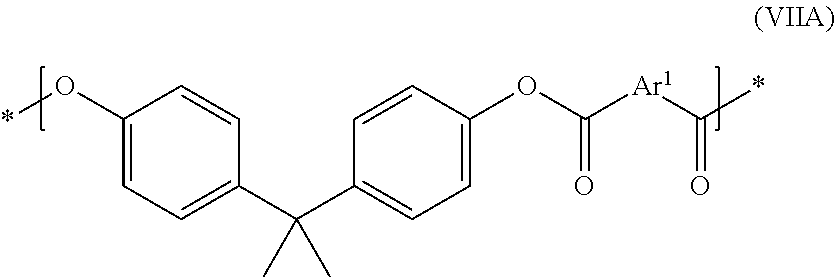
- the copolymer further comprises repeating units of the formula (VIIA)
- Ar 1 is as described above, and is preferably phenylene.
- the polyester of the present disclosure can have a number average molecular weight of 1,000 to 100,000 Daltons (Da), for example 5,000 to 75,000 Da, for example 10,000 to 50,000 Da.
- the molecular weight of the polymer can be determined according to techniques that are generally known, for example using gel permeation chromatography (GPC).
- the polyester comprises repeating units of formula (VI)
- the polyester comprises repeating units of formula (IVA)
- polyester has a number average molecular weight of 10,000 to 100,000 Daltons.
- the polyester is a copolyester comprising repeating units of formulas (VI) and (VII)
- the polyester is a copolyester comprising repeating units of formulas (VIA) and (VIIB)
- copolyester has a number average molecular weight of 10,000 to 100,000 Daltons.
- the polyester comprises repeating units of formula (VIII)
- the polyester comprises repeating units of formula (VIIIA)
- polyester has a number average molecular weight of 10,000 to 100,000 Daltons.
- the polyester is a copolyester comprising repeating units of formulas (VIII) and (VII)
- the polyester is a copolyester comprising repeating units of formulas (VIIIA) and (VIIB)
- copolyester has a number average molecular weight of 10,000 to 100,000 Daltons.
- the above-described allyl-functionalized polyesters can be particularly useful for incorporating various functional groups, for example using post-polymerization functionalization of the allyl groups.
- exemplary groups that can be incorporated to the polymer structure via reaction with the allyl groups can include, for example, phosphorous-containing compounds (e.g., phosphites).
- another aspect of the present disclosure is a copolyester comprising repeating units having the structure (IX), (X), or a combination thereof
- Ar 1 is a divalent substituted or unsubstituted C 6-20 arylene group
- R 7 is independently at each occurrence a halogen, a hydroxyl group, a nitrile group, a C 1-6 alkyl group, a C 1-6 alkoxy group, or a C 6-20 aryl group
- m is independently at each occurrence 0, 1, 2, 3, or 4
- R 8 is a phosphorous-containing group.
- the phosphorous-containing group can be, for example,
- the phosphorous-containing groups can be incorporated into the polyester via the allyl groups using methods that are generally known, for example, using thermally initiated radical coupling. An example of the preparation of such materials is further described in the working examples below.
- the polyesters described herein exhibit one or more advantageous thermal properties.
- the polyesters are stable to temperatures of at least 350° C., or at least 360° C., or at least 380° C., or at least 400° C.
- the thermal stability of the polymers can be assessed using thermogravimetric analysis, which indicates the onset of degradation (indicated by weight loss) at temperatures of at least 350° C., for example, 350 to 400° C.
- the polyester can exhibit a five percent weight loss temperature (i.e., temperature at which 5% of the initial weight of the sample is lost) of greater than or equal to 350° C., determined using thermogravimetric analysis, for example using a heating rate of 20° C. per minute.
- the five percent weight loss temperature can be greater than or equal to 370° C., as determined according to thermogravimetric analysis. In some embodiments, the five percent weight loss temperature can be greater than or equal to 400° C., as determined according to thermogravimetric analysis. In some embodiments, the polyester has a weight loss of less than or equal to five weight percent after 60 minutes at 350° C., or at 370° C., or at 400° C.
- the polyester can further have a char yield of at least 35 percent, or at least 37 percent, or least 40 percent after 60 minutes at 750° C., as determined by thermogravimetric analysis; a heat release capacity (HRC) of less than or equal to 150 joules per gram-Kelvin determined using a pyrolysis combustion flow calorimeter; and a total heat release (THR) of less than 15 kilojoules per gram determined using a pyrolysis combustion flow calorimeter.
- HRC heat release capacity
- TMR total heat release
- the polyester exhibits at least two of the foregoing thermal properties.
- the polyester exhibits at least three of the foregoing thermal properties.
- the polyester exhibits each of the foregoing thermal properties.
- THR is the total heat of complete combustion of the pyrolysis products per mass of sample used in the measurement. Lower HRC and THR values are thus good indicators of increasing the flame retarding property of the polymer.
- the polyesters of the present disclosure can be prepared using techniques that are generally known.
- the polyester can be prepared by contacting the diallyl- or monoallyl-substituted deoxybenzoin bisphenol (e.g., the deoxybenzoin compound according to structure (I) or (II)) and optionally, one or more additional dihydroxy aromatic compounds with an aromatic dicarboxylic acid, or a reactive derivative thereof (e.g., the corresponding aromatic dicarboxylic acid halide) in the presence of a solvent and under conditions effective to provide the polyester.
- Conditions effective to provide the polyester can include a temperature of 35 to 110° C. and a time of 10 minutes to 1 hour, or 15 to 45 minutes.
- An example of the preparation of the polyesters described herein is provided in the working examples below.
- the articles can be any article that can benefit from the reduced flammability of the polymer material disclosed herein.
- the article can be a fiber, a textile, a foam, a furniture component, construction materials (e.g., insulation), a vehicle component (e.g., an automobile component, a railway vehicle component, a marine vehicle component, an airplane component, and the like), an electronic component, an adhesive, a foam, paint, or a plastic.
- BHDB 4,4′-bishydroxydeoxybenzoin
- the 1 H NMR spectrum is shown as FIG. 2 .
- 13 Carbon ( 13 C) NMR spectrum (CDCl 3 , 500 megahertz (MHz)): ⁇ 196.63, 162.68, 157.65, 133.48, 132.67, 131.04, 129.95, 127.24, 118.27, 117.24, 115.01, 68.98 (O—*CH 2 —CH ⁇ CH 2 ), 44.54.
- 1,2-Bis(3-allyl-4-hydroxyphenyl)ethanone shown as compound 3 in FIG. 3 , was synthesized according to the following procedure.
- Compound 2 (10 grams, 0.032 moles) was heated to 170-190° C. for 18 hours in a nitrogen atmosphere, then cooled to ambient temperature to give a brown oil (9.5 grams, 95% yield).
- FIG. 5 A polymerization procedure for producing aromatic polyesters from diallyl-BHDB (3) is illustrated by FIG. 5 , and further described by the following Examples.
- the mixture was poured into methanol (100 milliliters) to precipitate the polymer product (shown as polymer 6).
- Isophthaloyl chloride (0.20 grams, 1.0 millimoles) was polymerized with compound 3 (0.215 grams, 0.70 millimoles) and bisphenol A (0.068 grams, 0.30 millimoles) using the same general procedure as in Example 1 to afford the polymer product as a white fibrous film (0.31 grams, 75% yield).
- Isophthaloyl chloride (0.1 grams, 0.5 millimoles) was polymerized with compound 3 (0.154 grams, 0.5 millimoles) using the same general procedure as in Example 1 to give white fibrous polymer (0.14 grams, 64% yield).
- Terepthaloyl chloride 100 milligrams, 0.50 millimoles was polymerized with compound 3 (0.154 grams, 0.50 millimoles) using the same general procedure as in Example 1 to afford a white fibrous polymer (0.20 grams, 91% yield).
- the polymer was isolated by precipitation into methanol. The resulting polymer was insoluble in DMF, THF and trifluoroethanol.
- diallyl-BHDB homopolymers and diallyl-BHDB copolymers with bisphenol A (BPA) of Examples 1-4 having varying molecular weight and compositions are shown in Table 1.
- “Feed” refers to the molar ratio of BHDB to BPA based on the total moles of bisphenol components. Incorporation of BHDB and BPA into the polymer product was characterized using proton nuclear magnetic resonance ( 1 H NMR) spectroscopy, and is reported as the molar ratio of BHDB to BPA, based on the total moles of BHDB and BPA.
- Number average molecular weight (Mn), weight average molecular weight (Mw), and polydispersity index (PDI) were determined by gel permeation chromatography (GPC) relative to poly(methyl methacrylate) (PMMA) standards eluting with dimethyl formamide (DMF). Molecular weights are reported in Daltons (Da). The 5 percent weight loss temperature (reported in ° C.) was determined using thermogravimetric analysis performed under nitrogen on a Q500 (TA Instruments) at a heating rate of 20° C. per minute. Char yields were also determined by TGA, taken from the mass residue at 750° C.
- Heat release capacity HRC, J/(g-K)
- THR total heat release
- MCC microscale combustion calorimeter
- PCFC pyrolysis combustion flow calorimeter
- the anaerobic thermal degradation products in the nitrogen gas stream were mixed with a 20 cm 3 /min stream of oxygen prior to entering the combustion furnace (900° C.).
- Heat release is quantified by standard oxygen consumption methods typical to PCFC. (See, e.g., Lyon, et al. 2004 J Anal Appl Pyrol 71(1):27-46; ASTM.
- copolyesters can be prepared having varying ratios of dially-BHDB and BPA as comonomers (Example 1 and 2). These copolyesters exhibited good solubility in DMF, dichloromethane, chloroform, and N-methyl pyrrolidone. The copolyesters advantageously exhibited five percent weight loss temperatures of 400° C. (Example 1) and 417° C. (Example 2) as determined by TGA.
- Example 3 demonstrates that polyesters can be prepared from only the diallyl-BHDB monomer as the bishydroxy component. The polyester of Example 3 exhibited a number average molecular weight of 23,800 Da, determined by GPC.
- Example 3 The polyester was also soluble in common organic solvents including DMF, NMP dichloromethane, and chloroform.
- the Example 3 polyester exhibited a five percent weight loss temperature of 395° C., a slightly increased char yield of 43% relative to the copolyesters of Examples 1 and 2 (37 and 40%, respectively). Furthermore, the heat release capacity and the total heat release of Example 3 were reduced (146 J/g-K and 13 kJ/g, respectively), compared to Examples 1 and 2.
- Example 4 demonstrates the synthesis of a homopolyester prepared from the reaction of the diallyl-BHDB monomer and terephthalic acid (compared to isophthalic acid used for Examples 1-3). This polymer of Example 4 was generally insoluble, however also exhibited beneficial thermal properties, as shown in Table 1.
- BHDB 4,4′-bishydroxydeoxybenzoin
- the monoallyl-deoxybenzoin shown as compound 8 in FIG. 9 , was synthesized by heating compound 7 to 190° C. for 18 hours in a nitrogen atmosphere, then cooling to ambient temperature.
- FIG. 10 An exemplary polymerization procedure for producing aromatic polyesters from monoallyl-BHDB (7) is illustrated by FIG. 10 .
- the dipropargyl ether of BHDB shown as compound 12 in FIG. 12 , was prepared according to the following synthetic procedure. Potassium carbonate (3.6 grams, 26 millimoles) was placed into a 500 milliliter round bottom flask, to which was added BHDB (2.00 grams, 8.76 millimoles) and dimethyl formamide (17 milliliters). The resulting mixture was cooled to 0° C. and propargyl bromide (1.98 milliters, 26.0 millimoles) was added slowly. The mixture was heated to 100° C. and kept overnight at this temperature, then cooled and extracted with chloroform and water.
- the invention includes at least the following embodiments, which are non-limiting.
- R 1 and R 2 are independently at each occurrence hydrogen, a halogen, a nitrile group, a C 1-6 alkyl group, or a C 6-20 aryl group;
- R 3 , R 4 , R 5 , and R 6 are independently at each occurrence hydrogen, a halogen, a hydroxyl group, a nitrile group, a C 1-6 alkyl group, a C 1-6 alkoxy group, or a C 6-20 aryl group; and
- n is independently at each occurrence an integer from 1 to 12.
- each occurrence of R 1 and R 2 is hydrogen; and each occurrence of R 3 , R 4 , and R 5 is hydrogen.
- each occurrence of R 1 and R 2 is hydrogen; and each occurrence of R 3 , R 4 , R 5 , and R 6 is hydrogen.
- each occurrence of R 1 and R 2 is hydrogen; each occurrence of n is 1; and each occurrence of R 3 , R 4 , R 5 , and R 6 is hydrogen.
- a polyester comprising repeating units having the structure (IV), (V), or a combination thereof
- Ar 1 is a divalent substituted or unsubstituted C 6-20 arylene group
- R 7 is independently at each occurrence a halogen, a hydroxyl group, a nitrile group, a C 1-6 alkyl group, a C 1-6 alkoxy group, or a C 6-20 aryl group
- m is independently at each occurrence 0, 1, 2, 3, or 4.
- polyester of any of embodiments 8 to 10, wherein the polyester comprises repeating units having the structure (IV).
- polyester of any of embodiments 8 to 10, wherein the polyester comprises repeating units having the structure (V).
- R a and R b are each independently a halogen atom or a C 1-6 alkyl group; p and each occurrence of q are each independently 0, 1, 2, 3, or 4; c is 0, 1, 2, 3, or 4; and X a is a single bond, —O—, —S—, —S(O)—, —SO 2 —, —C(O)—, or a C 1-18 hydrocarbylene group.
- Ar 1 is a phenylene group; and the polyester has a molecular weight of 10,000 to 100,000 Daltons.
- polyester of embodiment 8 wherein the polyester is a copolyester comprising repeating units of formulas (VI) and (VII)
- Ar 1 is phenylene
- Ar 2 is 4,4′-diphenylene isopropylidene
- the polyester has a molecular weight of 10,000 to 100,000 Daltons.
- Ar 1 is a phenylene group; and the polyester has a molecular weight of 10,000 to 100,000 Daltons.
- polyester of embodiment 8 wherein the polyester is a copolyester comprising repeating units of formulas (VIII) and (VII)
- Ar 1 is phenylene
- Ar 2 is 4,4′-diphenylene isopropylidene
- the polyester has a molecular weight of 10,000 to 100,000 Daltons.
- a polyester comprising repeating units having the structure (IX), (X), or a combination thereof
- Ar 1 is a divalent substituted or unsubstituted C 6-20 arylene group
- R 7 is independently at each occurrence a halogen, a hydroxyl group, a nitrile group, a C 1-6 alkyl group, a C 1-6 alkoxy group, or a C 6-20 aryl group
- m is independently at each occurrence 0, 1, 2, 3, or 4
- R 8 is a phosphorous-containing group.
- An article comprising the polyester of any of embodiments 8 to 22.
- hydrocarbyl and “hydrocarbylene” mean a monovalent or divalent, respectively, group containing carbon, hydrogen, and optionally one or more heteroatoms (e.g., 1, 2, 3, or 4 atoms such as halogen, O, N, S, P, or Si).
- Alkyl means a branched or straight chain, saturated, monovalent hydrocarbon group, e.g., methyl, ethyl, i-propyl, and n-butyl.
- Alkylene means a straight or branched chain, saturated, divalent hydrocarbon group (e.g., methylene (—CH 2 —) or propylene (—(CH 2 ) 3 —)).
- Alkenyl and alkenylene mean a monovalent or divalent, respectively, straight or branched chain hydrocarbon group having at least one carbon-carbon double bond (e.g., ethenyl (—HC ⁇ CH 2 ) or propenylene (—HC(CH 3 ) ⁇ CH 2 —).
- Alkynyl means a straight or branched chain, monovalent hydrocarbon group having at least one carbon-carbon triple bond (e.g., ethynyl).
- Alkoxy means an alkyl group linked via an oxygen (i.e., alkyl-O—), for example methoxy, ethoxy, and sec-butyloxy.
- Cycloalkyl and “cycloalkylene” mean a monovalent and divalent cyclic hydrocarbon group, respectively, of the formula —C n E 2n-x and —C n E 2n-2x - wherein x is the number of cyclization(s).
- Aryl means a monovalent, monocyclic or polycyclic aromatic group (e.g., phenyl or naphthyl).
- Arylene means a divalent, monocyclic or polycyclic aromatic group (e.g., phenylene or naphthylene).
- halo means a group or compound including one more halogen (F, Cl, Br, or I) substituents, which can be the same or different.
- hetero means a group or compound that includes at least one ring member that is a heteroatom (e.g., 1, 2, or 3 heteroatoms, wherein each heteroatom is independently N, O, S, or P.
- “Substituted” means that the compound or group is substituted with at least one (e.g., 1, 2, 3, or 4) substituents instead of hydrogen, where each substituent is independently nitro (—NO 2 ), cyano (—CN), hydroxy (—OH), halogen, thiol (—SH), thiocyano (—SCN), C 1-6 alkyl, C 2-6 alkenyl, C 2-6 alkynyl, C 1-6 haloalkyl, C 1-9 alkoxy, C 1-6 haloalkoxy, C 3-12 cycloalkyl, C 5-18 cycloalkenyl, C 6-12 aryl, C 7-13 arylalkylene (e.g, benzyl), C 7-12 alkylarylene (e.g, toluyl), C 4-12 heterocycloalkyl, C 3-12 heteroaryl, C 1-6 alkyl sulfonyl (—S( ⁇ O) 2 -alkyl), C 6-12 ary
Landscapes
- Chemical & Material Sciences (AREA)
- Organic Chemistry (AREA)
- Health & Medical Sciences (AREA)
- Chemical Kinetics & Catalysis (AREA)
- Medicinal Chemistry (AREA)
- Polymers & Plastics (AREA)
- General Chemical & Material Sciences (AREA)
- Polyesters Or Polycarbonates (AREA)
Abstract
Deoxybenzoin compounds including unsaturation are disclosed. The unsaturated deoxybenxoin compounds have the structure (I), (II), or (III)
wherein R1, R2, R3, R4, R5, R6, and n are defined herein. Also disclosed are polyesters including repeating units having the structure (IV), (V), or a combination thereof
Description
This invention was made with government support under grant number 14-G-012 001 awarded by the Federal Aviation Administration. The government has certain rights in the invention.
Polymers are a mainstay of modern society, for example, widely used in fabricating textiles, upholstery, construction materials, various air, land or sea vehicles, and microelectronic devices and appliances. The inherent flammability of many polymers poses a significant threat, especially in enclosed or isolated spaces. Therefore, as synthetic polymers are used extensively in society as plastics, rubbers, and textiles, polymer flammability has been recognized as a safety hazard and remains an important challenge in polymer research.
Flame retardancy of polymers is often achieved by blending polymers with flame retardant additives, such as halocarbons, including polybrominated diphenyl ether (PBDE), phosphorus, organophosphates, and metal oxides. While small molecule flame retardant additives provide a convenient means for reducing flammability of polymers, these additives can compromise safety from environmental and health perspectives. Conventional flame retardants are small molecule additives that often leach out of the polymer during their use leading to a variety of serious health and environmental problems associated with toxicity and bioaccumulation. These concerns have led to an emphasis on non-halogenated flame retardants in recent years. However, non-halogenated flame retardant additives, such as alumina trihydrate, compromise the physical and mechanical properties of polymers when loaded at high levels.
An ideal low-flammable polymer would be halogen-free and possess high thermal stability, low heat of combustion, and a low combustion heat release rate (HRR), with minimal release of toxic fumes. Intrinsically fire-resistant polymers that undergo significant carbonization upon heating are highly desirable, as carbonaceous char formation effectively averts combustion by producing an insulating layer on the polymer surface. Such char formation can also be realized from composite materials in which an additive ultimately provides the desired char.
Aromatic polyesters prepared from bisphenols and phthalic acids are important high performance engineering thermoplastics. Conventional bisphenol A (BPA)-containing polyarylates are well-known and widely used, but exhibit higher-than-desired flammability (e.g., BPA-polyarylates have a heat release capacity (HRC) of about 400 Joules per gram-Kelvin (J/g-K)). Polyarylates containing 1,1-dichloro-2,2-bis(4-hydroxyphenyl)ethylene (bisphenol C, or BPC) are transparent and processable, and exhibit excellent mechanical and dielectric properties. BPC-containing polymers are well within the “ultra fire-resistant” category (HRC<100 J/g-K), with BPC-polyarylates and polycarbonates having reported HRC values of 21 and 29 J/g-K, respectively, and high char yields (50-55%). However, the presence of halogen in BPC-containing polymers, and the evolution of hydrogen chloride gas at elevated temperatures, remain concerns, thus limiting their adoption for scale-up and manufacturing as commodity materials.
BPC derivatives can be converted to the corresponding diphenylacetylene by loss of the chlorines, followed by phenyl migration. In BPC-containing polymers, this reaction represents a viable mechanism to char formation, in which the presence of chlorine sets up the rearrangement chemistry that leads to diphenylacetylene. In fact, diphenylacetylene-containing poly(aryl ether ketone)s showed heat release characteristics of similar magnitude to the corresponding BPC-containing polymers. However, these alkyne-containing aromatic polymers are prone to side-reactions and crosslinking even at moderately high temperatures, and have less-than-optimal processability and mechanical properties for many polymer materials applications. Accordingly, there is an ongoing search in the art for non-halogenated polymers or additives which promote charring or preclude combustion.
One approach has been the use of polyarylates incorporating a deoxybenzoin moiety, e.g., 4,4′-bishydroxydeoxybenzoin (BHDB), as a bisphenolic monomer. These polymers exhibited low combustion heat release rate and total heat of combustion, which is believed to arise from the thermally-induced conversion of BHDB to diphenylacetylene moieties that char by aromatization. See, K. A. Ellzey, T. Ranganathan, J. Zilberman, E. B. Coughlin, R. J. Farris, T. Emrick, Macromolecules 2006, 39, 3553. Pyrolysis combustion flow calorimetry (PCFC), an oxygen consumption technique for measuring heat release capacity (HRC), revealed exceptionally low HRC values for the BHDB-polyarylates (<100 J/g-K). See, R. N. Walters, M. Smith, and M. R. Nyden, International SAMPE Symposium and Exhibition 2005, 50, 1118. However, the rather low solubility of such polyarylate compounds limits their molecular weight and processibility.
Despite the ongoing interest in the field of flame retardant polymer materials, there remains a continuing need for synthetic strategies toward structurally and functionally diverse flame-retardant polymers that can overcome the above-described technical limitations.
One embodiment is an unsaturated deoxybenzoin compound having the structure (I), (II), or (III)
wherein R1 and R2 are independently at each occurrence hydrogen, a halogen, a nitrile group, a C1-6 alkyl group, or a C6-20 aryl group; R3, R4, R5, and R6 are independently at each occurrence hydrogen, a halogen, a hydroxyl group, a nitrile group, a C1-6 alkyl group, a C1-6 alkoxy group, or a C6-20 aryl group; and n is independently at each occurrence an integer from 1 to 12.
Another embodiment is a polyester comprising repeating units having the structure (IV), (V), or a combination thereof
wherein Ar1 is a divalent substituted or unsubstituted C6-20 arylene group; R7 is independently at each occurrence a halogen, a hydroxyl group, a nitrile group, a C1-6 alkyl group, a C1-6 alkoxy group, or a C6-20 aryl group; and m is independently at each
Another embodiment is a polyester comprising repeating units having the structure (IX), (X), or a combination thereof
wherein Ar1 is a divalent substituted or unsubstituted C6-20 arylene group; R7 is independently at each occurrence a halogen, a hydroxyl group, a nitrile group, a C1-6 alkyl group, a C1-6 alkoxy group, or a C6-20 aryl group; m is independently at each
Another embodiment is an article comprising one or more of the above-described polyesters.
These and other embodiments are described in detail below.
The following Figures are of exemplary embodiments:
The present inventors have prepared new functionalized derivatives of deoxybenzoin containing unsaturation. In particular, the present inventors have prepared diallyl-, monoallyl-, and dipropargyl-containing derivatives of deoxybenzoin. These deoxybenzoin compounds advantageously include unsaturation, offering an opportunity for further functionalization. In a particularly valuable aspect, the functionalized deoxybenzoin compound can be a diallyl- or monoallyl-functionalized bisphenolic deoxybenzoin, where step growth polymerization can proceed using the phenols. The resulting polymer advantageously includes pendent allyl groups built into the polymer product (up to two per repeating unit). The pendent double bonds on the polymer chain represent reactive handles through which the polymer can be cross-linked to give a network structure, or to which the polymer can be substituted by conversion of the double bonds to other groups such as epoxides, haloalkyl groups, hydroxides, diols, or thio-ethers through the use of thiol-ene reactions. Other thiols, containing P—SH bonds, are candidates for reaction with the double bonds and are expected to contribute to further reduction of polymer heat release upon burning. Additionally, phosphite compounds can be reacted with the double bonds to provide new phosphite-functionalized polyarylates.
Polymers prepared from the allyl-functionalized bisphenolic deoxybenzoin compound can have a desirable combination of thermal properties, including reduced weight loss at elevated temperatures (e.g., 350° C. or above), low char yields, and improved heat release capacity and total heat release. Accordingly, the polymers disclosed herein represent a new class of functionalized flame retardant polymers.
One aspect of the present disclosure is an unsaturated deoxybenzoin compound having the structure (I), (II), or (III)
wherein R1 and R2 are independently at each occurrence hydrogen, a halogen, a nitrile group, a C1-6 alkyl group, or a C6-20 aryl group; R3, R4, R5, and R6 are independently at each occurrence hydrogen, a halogen, a hydroxyl group, a nitrile group, a C1-6 alkyl group, a C1-6 alkoxy group, or a C6-20 aryl group; and n is independently at each occurrence an integer from 1 to 12 (e.g., n is independently at each
In some embodiments, the unsaturated deoxybenzoin compound has the structure (I)
In an embodiment, the unsaturated deoxybenzoin compound has the structure (I) and each occurrence of R1 and R2 is hydrogen, and each occurrence of R3, R4, and R5 is hydrogen.
In some embodiments, the unsaturated deoxybenzoin compound has the structure (II)
In an embodiment, the unsaturated deoxybenzoin compound has the structure (II) and each occurrence of R1 and R2 is hydrogen, and each occurrence of R3, R4, R5, and R6 is hydrogen.
In some embodiments, the unsaturated deoxybenzoin compound has the structure (III)
In an embodiment, the unsaturated deoxybenzoin compound has the structure (III) and each occurrence of R1 and R2 is hydrogen, each occurrence of n is 1 to 12, preferably 1, and each occurrence of R3, R4, R5, and R6 is hydrogen.
Another aspect of the present disclosure is a polyester comprising repeating units having the structure (IV), (V), or a combination thereof
wherein Ar1 is a divalent substituted or unsubstituted C6-20 arylene group; R7 is independently at each occurrence halogen, a hydroxyl group, a nitrile group, a C1-6 alkyl group, a C1-6 alkoxy group, or a C6-20 aryl group; and m is independently at each
In some embodiments, the polyester comprises repeating units according to structure (IV), wherein m is 0 and the allyl group is positioned ortho to the ester linkage of the polymer backbone. For example, the polyester can comprise repeating units according to formula (VI)
wherein Ar1 is a divalent substituted or unsubstituted C6-20 arylene group, preferably a phenylene group. In some embodiments, Ar1 can be derived from isophthalic acid, terephthalic acid, or a combination thereof. In some embodiments, where Ar1 of the polyester according to formula (VI) is a phenylene group derived from isophthalic acid, the polyester can comprise repeating units having the structure (VIA)
In some embodiments, the polyester comprises repeating units according to structure (V), wherein m is 0 and the allyl groups are positioned ortho to the ester linkage of the polymer backbone. For example, the polyester can comprise repeating units according to formula (VIII)
wherein Ar1 is a divalent substituted or unsubstituted C6-20 arylene group, preferably a phenylene group. In some embodiments, Ar1 can be derived from isophthalic acid, terephthalic acid, or a combination thereof. In some embodiments, where Ar1 of the polyester according to formula (VIII) is a phenylene group derived from isophthalic acid, the polyester can comprise repeating units having the structure (VIIIA)
In some embodiments, the polyester can be a copolyester. The copolyester can be a random or block copolyester. In some embodiments, the copolyester comprises repeating units according to structure (IV) and (V).
In some embodiments, the polyester can be a copolyester comprising repeating units according to structures (IV), (V), or a combination thereof, and further comprising repeating units according to structure (VII)
wherein Ar1 can be as described above, and Ar2 is a substituted or unsubstituted C6-30 arylene group. In some embodiments, exemplary Ar2 groups can be of the formula
wherein Ra and Rb are each independently the same or different, and are a halogen atom or a monovalent C1-6 alkyl group; p and q are each independently integers of 0 to 4 (e.g., 0, 1, 2, 3, or 4); c is 0 to 4 (e.g., 0, 1, 2, 3, or 4); and Xa is a bridging group connecting the hydroxy-substituted aromatic groups, where the bridging group and the hydroxy substituent of each C6 arylene group are disposed ortho, meta, or para (specifically para) to each other on the C6 arylene group. The bridging group Xa can be a single bond, —O—, —S—, —S(O)—, —S(O)2—, —C(O)—, or a C1-18 organic bridging group. The C1-18 organic bridging group can be cyclic or acyclic, aromatic or non-aromatic, and can further comprise heteroatoms such as halogens, oxygen, nitrogen, sulfur, silicon, or phosphorous. The C1-18 organic group can be disposed such that the C6 arylene groups connected thereto are each connected to a common alkylidene carbon or to different carbons of the C1-18 organic bridging group. The group Ar2 can be derived from the corresponding dihydroxy compound. A specific example of an Ar2 group is a divalent group of the formula
wherein Q is —O—, —S—, —C(O)—, —SO2—, —SO—, or —CyH2y— wherein y is an integer from 1 to 5 or a halogenated derivative thereof (including a perfluoroalkylene group). In some embodiments, Ar2 is a biphenyl group, for example 4,4′-dihydroxybiphenyl and the like. In some embodiments, Ar2 can be derived from a bisphenol compound, for example bisphenol A, bisphenol C, bisphenol F, bisphenol AC, and the like. In a specific embodiment Ar2 is a derived from bisphenol A, such that Q in the above formula is 2,2-isopropylidene. In some embodiments, exemplary Ar2 groups can further include those of the formula
In some embodiments, the polyester is a copolymer further comprising repeating units derived from 2,2-bis(4-hydroxyphenyl)propane (bisphenol A). Stated another way, the copolymer can further comprise repeating units according to structure (VII) above, wherein Ar2 is 4,4′-diphenylene isopropylidene. For example, the copolymer further comprises repeating units of the formula (VIIA)
In some embodiments, the polyester of the present disclosure can have a number average molecular weight of 1,000 to 100,000 Daltons (Da), for example 5,000 to 75,000 Da, for example 10,000 to 50,000 Da. The molecular weight of the polymer can be determined according to techniques that are generally known, for example using gel permeation chromatography (GPC).
In an embodiment, the polyester comprises repeating units of formula (VI)
wherein Ar1 is a divalent phenylene group; and the polyester has a number average molecular weight of 10,000 to 100,000 Daltons. In a specific embodiment, the polyester comprises repeating units of formula (IVA)
In another embodiment, the polyester is a copolyester comprising repeating units of formulas (VI) and (VII)
wherein Ar1 is a divalent phenylene group, Ar2 is 4,4′-diphenylene isopropylidene, and the copolyester has a molecular weight of 10,000 to 100,000 Daltons. In a specific embodiment, the polyester is a copolyester comprising repeating units of formulas (VIA) and (VIIB)
In an embodiment, the polyester comprises repeating units of formula (VIII)
wherein Ar1 is a divalent phenylene group; and the polyester has a number average molecular weight of 10,000 to 100,000 Daltons. In a specific embodiment, the polyester comprises repeating units of formula (VIIIA)
In another embodiment, the polyester is a copolyester comprising repeating units of formulas (VIII) and (VII)
wherein Ar1 is a divalent phenylene group, Ar2 is 4,4′-diphenylene isopropylidene, and the copolyester has a molecular weight of 10,000 to 100,000 Daltons. In a specific embodiment, the polyester is a copolyester comprising repeating units of formulas (VIIIA) and (VIIB)
In another aspect of the present disclosure, the above-described allyl-functionalized polyesters can be particularly useful for incorporating various functional groups, for example using post-polymerization functionalization of the allyl groups. Exemplary groups that can be incorporated to the polymer structure via reaction with the allyl groups can include, for example, phosphorous-containing compounds (e.g., phosphites). Accordingly, another aspect of the present disclosure is a copolyester comprising repeating units having the structure (IX), (X), or a combination thereof
wherein Ar1 is a divalent substituted or unsubstituted C6-20 arylene group; R7 is independently at each occurrence a halogen, a hydroxyl group, a nitrile group, a C1-6 alkyl group, a C1-6 alkoxy group, or a C6-20 aryl group; m is independently at each occurrence 0, 1, 2, 3, or 4; and R8 is a phosphorous-containing group. In some embodiments, the phosphorous-containing group can be, for example,
and the like, or a combination thereof. The phosphorous-containing groups can be incorporated into the polyester via the allyl groups using methods that are generally known, for example, using thermally initiated radical coupling. An example of the preparation of such materials is further described in the working examples below.
In some embodiments, the polyesters described herein exhibit one or more advantageous thermal properties. For example, the polyesters are stable to temperatures of at least 350° C., or at least 360° C., or at least 380° C., or at least 400° C. The thermal stability of the polymers can be assessed using thermogravimetric analysis, which indicates the onset of degradation (indicated by weight loss) at temperatures of at least 350° C., for example, 350 to 400° C. For example, the polyester can exhibit a five percent weight loss temperature (i.e., temperature at which 5% of the initial weight of the sample is lost) of greater than or equal to 350° C., determined using thermogravimetric analysis, for example using a heating rate of 20° C. per minute. In some embodiments, the five percent weight loss temperature can be greater than or equal to 370° C., as determined according to thermogravimetric analysis. In some embodiments, the five percent weight loss temperature can be greater than or equal to 400° C., as determined according to thermogravimetric analysis. In some embodiments, the polyester has a weight loss of less than or equal to five weight percent after 60 minutes at 350° C., or at 370° C., or at 400° C. The polyester can further have a char yield of at least 35 percent, or at least 37 percent, or least 40 percent after 60 minutes at 750° C., as determined by thermogravimetric analysis; a heat release capacity (HRC) of less than or equal to 150 joules per gram-Kelvin determined using a pyrolysis combustion flow calorimeter; and a total heat release (THR) of less than 15 kilojoules per gram determined using a pyrolysis combustion flow calorimeter. In some embodiments, the polyester exhibits at least two of the foregoing thermal properties. In some embodiments, the polyester exhibits at least three of the foregoing thermal properties. In some embodiments, the polyester exhibits each of the foregoing thermal properties.
Describing these systems in terms of HRC eliminates the reliance on heating rate that is typical of standard flammability measurements (i.e. heat release rate), rendering it a material dependent property. THR is the total heat of complete combustion of the pyrolysis products per mass of sample used in the measurement. Lower HRC and THR values are thus good indicators of increasing the flame retarding property of the polymer.
The polyesters of the present disclosure can be prepared using techniques that are generally known. For example, the polyester can be prepared by contacting the diallyl- or monoallyl-substituted deoxybenzoin bisphenol (e.g., the deoxybenzoin compound according to structure (I) or (II)) and optionally, one or more additional dihydroxy aromatic compounds with an aromatic dicarboxylic acid, or a reactive derivative thereof (e.g., the corresponding aromatic dicarboxylic acid halide) in the presence of a solvent and under conditions effective to provide the polyester. Conditions effective to provide the polyester can include a temperature of 35 to 110° C. and a time of 10 minutes to 1 hour, or 15 to 45 minutes. An example of the preparation of the polyesters described herein is provided in the working examples below.
The compounds and materials, along with the synthetic methodologies disclosed herein can have broad impact on such diverse fields of fabricating textiles, upholstery, construction materials, various air, land or sea vehicles, and microelectronic devices and appliances. Thus, another aspect of the present disclosure is an article comprising the above-described polyester. In general the article can be any article that can benefit from the reduced flammability of the polymer material disclosed herein. In some embodiments, the article can be a fiber, a textile, a foam, a furniture component, construction materials (e.g., insulation), a vehicle component (e.g., an automobile component, a railway vehicle component, a marine vehicle component, an airplane component, and the like), an electronic component, an adhesive, a foam, paint, or a plastic.
The invention is further illustrated by the following non-limiting examples.
Experimental details for the synthesis of a diallyl-bishydroxydeoxybenzoin are provided below.
The diallyl ether of 4,4′-bishydroxydeoxybenzoin (BHDB), shown as compound 2 in FIG. 1 , was prepared according to the following procedure. BHDB (25 grams, 110 millimoles), shown as compound 1 of FIG. 1 , was dissolved in acetone (1 liter). Potassium carbonate (42.6 grams, 307 millimoles) was added, followed by allyl bromide (20 milliliters). The solution was heated to reflux for 12 hours, then allowed to cool to room temperature. Water (about 1 liter) was added until a precipitate formed. This product was filtered, dried, and recrystallized from methanol to yield off-white crystals (melting point: 83-85° C.); Proton nuclear magnetic resonance (1H-NMR) spectrum (CDCl3, 500 megahertz (MHz)): δ 7.91 (2H, d, J=9, Ar—H); 7.10 (2H, d, J=8.5, Ar—H); 6.87 (2H, d, J=9, Ar—H); 6.80 (2H, d, J=8.5, Ar—H); 5.96 (2H, m, CH═CH2); 5.36 (2H, m, CH2═CH); 5.25 (2H, m, CH2═CH); 4.52 (2H, d, J=5); 4.43 (2H, d, J=5.5); 4.09 (2H, s, Ar—CO—CH2—Ar). The 1H NMR spectrum is shown as FIG. 2 . 13Carbon (13C) NMR spectrum (CDCl3, 500 megahertz (MHz)): δ 196.63, 162.68, 157.65, 133.48, 132.67, 131.04, 129.95, 127.24, 118.27, 117.24, 115.01, 68.98 (O—*CH2—CH═CH2), 44.54.
1,2-Bis(3-allyl-4-hydroxyphenyl)ethanone, shown as compound 3 in FIG. 3 , was synthesized according to the following procedure. Compound 2 (10 grams, 0.032 moles) was heated to 170-190° C. for 18 hours in a nitrogen atmosphere, then cooled to ambient temperature to give a brown oil (9.5 grams, 95% yield). 1H-NMR (DMSO, 500 Mhz): δ 10.35 (s, 1H, OH, Ar—CO), 9.21 (s, 1H, OH—Ar—CH2), 7.74 (d, 2H), 6.86-6.91 (m, 3H, Ar—H), 6.71 (d, 1H), 5.95 (m, 2H, CH), 5.02 (m, 4H, 2-CH2), 4.05 (s, 2H, Ar—CO—CH2—Ar), 3.22-3.31 (dd, 4H, J1=7, J2=6.5, Ar—CH2). Mass spectrometry: (m/z) calculated for C20H20O3: 308.37. found 308.14. The 1H-NMR spectra of compound 3 is shown in FIG. 4 . 13C NMR spectrum (CDCl3, 500 megahertz (MHz)): δ 196.63, 162.68, 157.65, 133.48, 132.67, 131.04, 129.95, 127.24, 118.27, 117.24, 115.01, 68.98 (0-*CH2—CH═CH2), 44.54.
A polymerization procedure for producing aromatic polyesters from diallyl-BHDB (3) is illustrated by FIG. 5 , and further described by the following Examples.
In a two-neck flask, an aqueous solution of sodium hydroxide (NaOH) (2.1 millimoles) in water (3 milliliters) was combined with bisphenol A (shown as compound 4) (0.5 millimoles, 114 milligrams) and diallyl-BHDB (0.5 millimoles, 154 milligrams). To this solution was added benzyltriethylammonium chloride (2.1 millimoles) and isophthaloyl chloride (shown as compound 6) (1 millimoles, 203 milligrams) in dichloromethane (3 milliliters). The mixture was stirred vigorously for 30 minutes at room temperature, at which point the organic phase became viscous. The mixture was poured into methanol (100 milliliters) to precipitate the polymer product (shown as polymer 6). The isolated polymer was purified further by soxhlet extractor, then filtered and dried overnight in a vacuum oven at 60° C. (yield=0.330 grams, 82.9%). 1H-NMR (500 MHz, CDCl3): δ 8.93 (s, 2H, isophthaloyl aromatic), 8.35 (m, 4H, isophthaloyl aromatic), 7.92 (d, 2H, J=9.5 Hz, Ar—H), 7.60 (m, 2H, isophthaloyl aromatic), 7.02-7.28 (m, 12H, Ar—H), 5.84, (m, 2H, CH═CH2), 4.96 (m, 4H, CH2═CH), 4.22 (s, 2H, Ar—CO—CH2—Ar), 3.37 (d, 2H, J=6.5 Hz, CH2—Ar), 3.29 (d, 2H, J=6 Hz, CH2—Ar), 1.66 (s, 6H, Ar—C(CH3)2—Ar. Gel permeation chromatography (GPC): Mn=17,200 Daltons; Mw=47,100 Daltons; PDI=2.73. The GPC chromatogram is shown as FIG. 6 .
Isophthaloyl chloride (0.20 grams, 1.0 millimoles) was polymerized with compound 3 (0.215 grams, 0.70 millimoles) and bisphenol A (0.068 grams, 0.30 millimoles) using the same general procedure as in Example 1 to afford the polymer product as a white fibrous film (0.31 grams, 75% yield). 1H-NMR (500 MHz, CDCl3): δ 8.92 (s, 2H, isophthaloyl aromatic), 8.41 (m, 4H, isophthaloyl aromatic), 7.93 (d, 2H, J=9.5 Hz, Ar—H), 7.61 (m, 2H, isophthaloyl aromatic), 7.02-7.28 (m, 12H, Ar—H), 5.83, (m, 2H, CH═CH2), 4.99 (m, 4H, CH2═CH), 4.22 (s, 2H, Ar—CO—CH2—Ar), 3.39 (d, 2H, J=6.5 Hz, CH2—Ar), 3.30 (d, 2H, J=6 Hz, CH2—Ar), 1.65 (s, 6H, Ar—C(CH3)2—Ar. GPC: Mn=12,457; Mw=28,816, PDI=2.30. The GPC chromatogram is shown as FIG. 7 .
Isophthaloyl chloride (0.1 grams, 0.5 millimoles) was polymerized with compound 3 (0.154 grams, 0.5 millimoles) using the same general procedure as in Example 1 to give white fibrous polymer (0.14 grams, 64% yield). 1H-NMR (500 MHz, CDCl3): δ 8.93 (s, 1H, isophthaloyl aromatic), 8.38 (m, 2H, isophthaloyl aromatic), 7.92 (d, 2H, J=9.5 Hz, Ar—H), 7.63 (m, 1H, isophthaloyl aromatic), 7.11-7.25 (m, 4H, Ar—H), 5.82, (m, 2H, CH═CH2), 4.95 (m, 4H, CH2═CH), 4.22 (s, 2H, Ar—CO—CH2—Ar), 3.36 (d, 2H, J=6.5 Hz, CH2—Ar), 3.29 (d, 2H, J=6 Hz, CH2—Ar). GPC: Mn=23800, Mw=80500, PDI=3.38. The GPC chromatogram is shown as FIG. 8 .
Terepthaloyl chloride (100 milligrams, 0.50 millimoles) was polymerized with compound 3 (0.154 grams, 0.50 millimoles) using the same general procedure as in Example 1 to afford a white fibrous polymer (0.20 grams, 91% yield). The polymer was isolated by precipitation into methanol. The resulting polymer was insoluble in DMF, THF and trifluoroethanol.
The diallyl-BHDB homopolymers and diallyl-BHDB copolymers with bisphenol A (BPA) of Examples 1-4 having varying molecular weight and compositions are shown in Table 1. “Feed” refers to the molar ratio of BHDB to BPA based on the total moles of bisphenol components. Incorporation of BHDB and BPA into the polymer product was characterized using proton nuclear magnetic resonance (1H NMR) spectroscopy, and is reported as the molar ratio of BHDB to BPA, based on the total moles of BHDB and BPA. Number average molecular weight (Mn), weight average molecular weight (Mw), and polydispersity index (PDI) were determined by gel permeation chromatography (GPC) relative to poly(methyl methacrylate) (PMMA) standards eluting with dimethyl formamide (DMF). Molecular weights are reported in Daltons (Da). The 5 percent weight loss temperature (reported in ° C.) was determined using thermogravimetric analysis performed under nitrogen on a Q500 (TA Instruments) at a heating rate of 20° C. per minute. Char yields were also determined by TGA, taken from the mass residue at 750° C. Heat release capacity (HRC, J/(g-K)), and total heat release (THR, kJ/g) were measured on a microscale combustion calorimeter (MCC). MCC operates as a pyrolysis combustion flow calorimeter (PCFC), and was conducted from 80 to 750° C. at a heating rate of 1° C. per second in an 80 cm3/minute stream of nitrogen. The anaerobic thermal degradation products in the nitrogen gas stream were mixed with a 20 cm3/min stream of oxygen prior to entering the combustion furnace (900° C.). Heat release is quantified by standard oxygen consumption methods typical to PCFC. (See, e.g., Lyon, et al. 2004 J Anal Appl Pyrol 71(1):27-46; ASTM. Standard Test Method for Determining Flammability Characteristics of Plastics and Other Solid Materials Using Microscale Combustion calorimetry. ASTM D7309-13. West Conshohocken, Pa.: ASTM International, 2013, p. 11.) During the test, the heat release rate (HRR) is obtained from dQ/dt at each time interval, taking into account the initial sample mass (˜5 milligrams). The HRC is obtained by dividing the maximum HRR by the heating rate.
As shown in Table 1, copolyesters can be prepared having varying ratios of dially-BHDB and BPA as comonomers (Example 1 and 2). These copolyesters exhibited good solubility in DMF, dichloromethane, chloroform, and N-methyl pyrrolidone. The copolyesters advantageously exhibited five percent weight loss temperatures of 400° C. (Example 1) and 417° C. (Example 2) as determined by TGA. Example 3 demonstrates that polyesters can be prepared from only the diallyl-BHDB monomer as the bishydroxy component. The polyester of Example 3 exhibited a number average molecular weight of 23,800 Da, determined by GPC. The polyester was also soluble in common organic solvents including DMF, NMP dichloromethane, and chloroform. The Example 3 polyester exhibited a five percent weight loss temperature of 395° C., a slightly increased char yield of 43% relative to the copolyesters of Examples 1 and 2 (37 and 40%, respectively). Furthermore, the heat release capacity and the total heat release of Example 3 were reduced (146 J/g-K and 13 kJ/g, respectively), compared to Examples 1 and 2. Example 4 demonstrates the synthesis of a homopolyester prepared from the reaction of the diallyl-BHDB monomer and terephthalic acid (compared to isophthalic acid used for Examples 1-3). This polymer of Example 4 was generally insoluble, however also exhibited beneficial thermal properties, as shown in Table 1.
| TABLE 1 | |||||
| |
5% wt. | Thermal Characterization | |||
| (BHDB:BPA) | GPC | loss T | Tg | Char | HRC | THR |
| Example | Feed | Incorporated | Mn | Mw | PDI | (° C.) | (° C.) | (%) | (J/g-K) | (kJ/g) |
| 1 | 50:50 | 48.24:51.76 | 17,200 | 47,100 | 2.73 | 400 | 135 | 37 | 150 | 14 |
| 2 | 70:30 | 68.75:31.25 | 12,400 | 28,800 | 2.30 | 417 | 103 | 40 | 147 | 13 |
| 3 | 100:0 | 100 | 23,800 | 80,500 | 3.38 | 395 | 117 | 43 | 146 | 13 |
| 4 | 100:0 | 100 | 371 | 123 | 41 | 122 | 11 | |||
Experimental details for the synthesis of a monoallyl-bishydroxydeoxybenzoin are provided below.
The monoallyl ether of 4,4′-bishydroxydeoxybenzoin (BHDB), shown as compound 7 in FIG. 9 , was prepared according to the following procedure. BHDB (2 grams, 8.76 millimoles), shown as compound 1 of FIG. 9 , was dissolved in anhydrous N,N-dimethylformamide (10 milliliters). Potassium bicarbonate (8.77 grams, 87.6 millimoles) was added, followed by allyl bromide (2.12 grams, 17.5 millimoles) over a period of about 30 minutes. The resulting solution was stirred for 50 hours at room temperature (until BHDB starting material was observed to be consumed). Water (20 milliliters) was added to precipitate the product. This product was filtered and crystallized from dichloromethane/hexane (30/70) to yield an off-white solid in 70% yield (0.188 grams) having a melting point: 80-81° C.). Proton nuclear magnetic resonance (1H-NMR) spectrum (CDCl3, 500 megahertz (MHz)): δ 8.00 (2H, d, J=9 Hz), 7.05 (4H, d, J=9 Hz), 6.68 (2H, d, J=8.5 Hz), 6.05 (1H, m), 5.42-5.39 (2H, m), 4.66 (2H, d, J=8.5 Hz), 4.15 (2H, S). 13Carbon (13C) NMR spectrum (CDCl3, 500 megahertz (MHz)): δ 196.9, 162.4, 156.5, 133.5, 131.2, 130.8, 129.7, 125.7, 118.3, 115.6, 115, 68.8, 44.
The monoallyl-deoxybenzoin, shown as compound 8 in FIG. 9 , was synthesized by heating compound 7 to 190° C. for 18 hours in a nitrogen atmosphere, then cooling to ambient temperature.
An exemplary polymerization procedure for producing aromatic polyesters from monoallyl-BHDB (7) is illustrated by FIG. 10 .
Post-polymerization modification of polymer 6 was demonstrated using 9,10-Dihydro-9-oxa-10-phosphaphenanthrene 10-oxide (DOPO), as shown in FIG. 11 . Experimental details follow.
To a solution of diallyl-containing polymer (6) (Mn=16,000 Da, PDI 2.7) (0.25 grams) in dry 1,4-dioxane was added dihydro-9-oxa-10-phosphaphenathrene (DOPO) (0.5 grams, 2.2 millimoles) followed by addition of azobisisobutyronitrile (AIBN) (20 milligrams, 5 mole percent). The reaction mixture was stirred at 90° C. for 12 hours. The mixture was then cooled to room temperature and the polymer was precipitated by addition of excess methanol (3×100 milliliters). The solid was filtered then dried in a vacuum oven at 60° C. for 12 hours to provide the DOPO-functionalized polymer, shown as polymer 10 in FIG. 11 . An analogous procedure can be used to prepare the corresponding diethyl phosphite derivative, shown as polymer 11 in FIG. 11 .
Experimental details for the synthesis of a dipropargyl-bishydroxydeoxybenzoin are provided below.
The dipropargyl ether of BHDB, shown as compound 12 in FIG. 12 , was prepared according to the following synthetic procedure. Potassium carbonate (3.6 grams, 26 millimoles) was placed into a 500 milliliter round bottom flask, to which was added BHDB (2.00 grams, 8.76 millimoles) and dimethyl formamide (17 milliliters). The resulting mixture was cooled to 0° C. and propargyl bromide (1.98 milliters, 26.0 millimoles) was added slowly. The mixture was heated to 100° C. and kept overnight at this temperature, then cooled and extracted with chloroform and water. The organic layer was washed with brine and passed through magnesium sulfate, and the product was obtained following evaporation of solvent then crystallization from methanol. Compound 12 was characterized by proton (1H) and carbon (13C) NMR spectroscopy in deuterated chloroform. The chemical shifts are reported in parts per million (ppm) relative to tetramethyl silane (TMS) as a reference. 1H-NMR (300 MHz, CDCl3): δ 8.04 (d, 2H, Ar—H), 7.23 (d, 2H, Ar—H), 7.07 (d, 2H, Ar—H), 6.97 (d, 2H, Ar—H), 4.69-4.77 (m, 4H, Ar—O—CH2), 4.20 (s, 2H, Ar—CH2—CO—Ar), 2.57 (m, 2H, acetylene-H); 13C NMR (300 MHz, CDCl3): δ 196.08, 161.36, 156.44, 130.36, 127.78, 115.06, 55.81, 44.17.
The invention includes at least the following embodiments, which are non-limiting.
An unsaturated deoxybenzoin compound having the structure (I), (II), or (III)
wherein R1 and R2 are independently at each occurrence hydrogen, a halogen, a nitrile group, a C1-6 alkyl group, or a C6-20 aryl group; R3, R4, R5, and R6 are independently at each occurrence hydrogen, a halogen, a hydroxyl group, a nitrile group, a C1-6 alkyl group, a C1-6 alkoxy group, or a C6-20 aryl group; and n is independently at each occurrence an integer from 1 to 12.
The deoxybenzoin compound of embodiment 1, wherein each occurrence of R1 and R2 is hydrogen.
The deoxybenzoin compound of embodiment 1 or 2, wherein each occurrence of n is 1.
The deoxybenzoin compound of any of embodiments 1 to 3, wherein each occurrence of R3, R4, R5, and R6 is hydrogen.
The deoxybenzoin compound of any of embodiments 1 to 4, wherein the deoxybenzoin compound has the structure (I)
The deoxybenzoin compound of any of embodiments 1 to 4, wherein the deoxybenzoin compound has the structure (II)
The deoxybenzoin compound of any of embodiments 1 to 4, wherein the deoxybenzoin compound has the structure (III)
each occurrence of R1 and R2 is hydrogen; each occurrence of n is 1; and each occurrence of R3, R4, R5, and R6 is hydrogen.
A polyester comprising repeating units having the structure (IV), (V), or a combination thereof
wherein Ar1 is a divalent substituted or unsubstituted C6-20 arylene group; R7 is independently at each occurrence a halogen, a hydroxyl group, a nitrile group, a C1-6 alkyl group, a C1-6 alkoxy group, or a C6-20 aryl group; and m is independently at each
The polyester of embodiment 8, wherein Ar1 is a phenylene group.
The polyester of embodiment 8 or 9, wherein m is 0.
The polyester of any of embodiments 8 to 10, wherein the polyester comprises repeating units having the structure (IV).
The polyester of any of embodiments 8 to 10, wherein the polyester comprises repeating units having the structure (V).
The polyester of any of embodiments 8 to 12, wherein the polyester is a copolyester further comprising repeating units derived from a dihydroxy compound of the formula
wherein Ra and Rb are each independently a halogen atom or a C1-6 alkyl group; p and each occurrence of q are each independently 0, 1, 2, 3, or 4; c is 0, 1, 2, 3, or 4; and Xa is a single bond, —O—, —S—, —S(O)—, —SO2—, —C(O)—, or a C1-18 hydrocarbylene group.
The polyester of any of embodiments 8 to 13, wherein the polyester is a copolyester further comprising repeating units derived from bisphenol A.
The polyester of any of embodiments 8 to 14, wherein the polyester has a number average molecular weight of 1,000 to 100,000 Daltons.
The polyester of embodiment 8, wherein the polyester has repeating units of formula (VI)
The polyester of embodiment 8, wherein the polyester is a copolyester comprising repeating units of formulas (VI) and (VII)
Ar1 is phenylene; Ar2 is 4,4′-diphenylene isopropylidene; and the polyester has a molecular weight of 10,000 to 100,000 Daltons.
The polyester of embodiment 8, wherein the polyester has repeating units of formula (VIII)
The polyester of embodiment 8, wherein the polyester is a copolyester comprising repeating units of formulas (VIII) and (VII)
Ar1 is phenylene; Ar2 is 4,4′-diphenylene isopropylidene; and the polyester has a molecular weight of 10,000 to 100,000 Daltons.
The polyester of any of embodiments 8 to 19, wherein the polyester exhibits one or more of the following properties: a five percent weight loss temperature of greater than or equal to 350° C., as determined using thermogravimetric analysis; a char yield of at least 35 percent after 60 minutes at 750° C., as determined by thermogravimetric analysis; a heat release capacity of less than or equal to 150 joules per gram-Kelvin determined using a pyrolysis combustion flow calorimeter; and a total heat release of less than 15 kilojoules per gram determined using a pyrolysis combustion flow calorimeter.
A polyester comprising repeating units having the structure (IX), (X), or a combination thereof
wherein Ar1 is a divalent substituted or unsubstituted C6-20 arylene group; R7 is independently at each occurrence a halogen, a hydroxyl group, a nitrile group, a C1-6 alkyl group, a C1-6 alkoxy group, or a C6-20 aryl group; m is independently at each
The polyester of embodiment 21, wherein R8 is independently at each occurrence
An article comprising the polyester of any of embodiments 8 to 22.
The article of embodiment 23, wherein the article is a fiber, textile, a furniture component, an adhesive, a foam, paint, or a plastic.
This written description uses examples to disclose the invention, including the best mode, and also to enable any person skilled in the art to make and use the invention. The patentable scope of the invention is defined by the claims, and may include other examples that occur to those skilled in the art. Such other examples are intended to be within the scope of the claims if they have structural elements that do not differ from the literal language of the claims, or if they include equivalent structural elements with insubstantial differences from the literal language of the claims.
All cited patents, patent applications, and other references are incorporated herein by reference in their entirety, including priority U.S. Patent Application No. 62/238,186, filed Oct. 7, 2015. However, if a term in the present application contradicts or conflicts with a term in the incorporated reference, the term from the present application takes precedence over the conflicting term from the incorporated reference.
All ranges disclosed herein are inclusive of the endpoints, and the endpoints are independently combinable with each other. Each range disclosed herein constitutes a disclosure of any point or sub-range lying within the disclosed range.
The use of the terms “a” and “an” and “the” and similar referents in the context of describing the invention (especially in the context of the following claims) are to be construed to cover both the singular and the plural, unless otherwise indicated herein or clearly contradicted by context. “Or” means “and/or” unless clearly indicated otherwise. Further, it should further be noted that the terms “first,” “second,” and the like herein do not denote any order, quantity, or importance, but rather are used to distinguish one element from another. The modifier “about” used in connection with a quantity is inclusive of the stated value and has the meaning dictated by the context (e.g., it includes the degree of error associated with measurement of the particular quantity).
As used herein, the term “hydrocarbyl” and “hydrocarbylene” mean a monovalent or divalent, respectively, group containing carbon, hydrogen, and optionally one or more heteroatoms (e.g., 1, 2, 3, or 4 atoms such as halogen, O, N, S, P, or Si). “Alkyl” means a branched or straight chain, saturated, monovalent hydrocarbon group, e.g., methyl, ethyl, i-propyl, and n-butyl. “Alkylene” means a straight or branched chain, saturated, divalent hydrocarbon group (e.g., methylene (—CH2—) or propylene (—(CH2)3—)). “Alkenyl” and “alkenylene” mean a monovalent or divalent, respectively, straight or branched chain hydrocarbon group having at least one carbon-carbon double bond (e.g., ethenyl (—HC═CH2) or propenylene (—HC(CH3)═CH2—). “Alkynyl” means a straight or branched chain, monovalent hydrocarbon group having at least one carbon-carbon triple bond (e.g., ethynyl). “Alkoxy” means an alkyl group linked via an oxygen (i.e., alkyl-O—), for example methoxy, ethoxy, and sec-butyloxy. “Cycloalkyl” and “cycloalkylene” mean a monovalent and divalent cyclic hydrocarbon group, respectively, of the formula —CnE2n-x and —CnE2n-2x- wherein x is the number of cyclization(s). “Aryl” means a monovalent, monocyclic or polycyclic aromatic group (e.g., phenyl or naphthyl). “Arylene” means a divalent, monocyclic or polycyclic aromatic group (e.g., phenylene or naphthylene). The prefix “halo” means a group or compound including one more halogen (F, Cl, Br, or I) substituents, which can be the same or different. The prefix “hetero” means a group or compound that includes at least one ring member that is a heteroatom (e.g., 1, 2, or 3 heteroatoms, wherein each heteroatom is independently N, O, S, or P.
“Substituted” means that the compound or group is substituted with at least one (e.g., 1, 2, 3, or 4) substituents instead of hydrogen, where each substituent is independently nitro (—NO2), cyano (—CN), hydroxy (—OH), halogen, thiol (—SH), thiocyano (—SCN), C1-6 alkyl, C2-6 alkenyl, C2-6 alkynyl, C1-6 haloalkyl, C1-9 alkoxy, C1-6 haloalkoxy, C3-12 cycloalkyl, C5-18 cycloalkenyl, C6-12 aryl, C7-13 arylalkylene (e.g, benzyl), C7-12 alkylarylene (e.g, toluyl), C4-12 heterocycloalkyl, C3-12 heteroaryl, C1-6 alkyl sulfonyl (—S(═O)2-alkyl), C6-12 arylsulfonyl (—S(═O)2-aryl), or tosyl (CH3C6H4SO2—), provided that the substituted atom's normal valence is not exceeded, and that the substitution does not significantly adversely affect the manufacture, stability, or desired property of the compound. When a compound is substituted, the indicated number of carbon atoms is the total number of carbon atoms in the group, including those of the substituent(s).
Claims (20)
1. An unsaturated deoxybenzoin compound having the structure (I), (II), or (III)
wherein
R1 and R2 are independently at each occurrence hydrogen, a halogen, a nitrile group, a C1-6 alkyl group, or a C6-20 aryl group;
R3, R4, R5, and R6 are independently at each occurrence hydrogen, a halogen, a hydroxyl group, a nitrile group, a C1-6 alkyl group, a C1-6 alkoxy group, or a C6-20 aryl group; and
n is independently at each occurrence an integer from 1 to 12.
2. The deoxybenzoin compound of claim 1 , wherein each occurrence of R1 and R2 is hydrogen.
3. The deoxybenzoin compound of claim 1 , wherein each occurrence of n is 1.
4. The deoxybenzoin compound of claim 1 , wherein each occurrence of R3, R4, R5, and R6 is hydrogen.
8. A polyester comprising repeating units having the structure (IV), (V), or a combination thereof
9. The polyester of claim 8 , wherein Ar1 is a phenylene group.
10. The polyester of claim 8 , wherein m is 0.
11. The polyester of claim 8 , wherein the polyester is a copolyester further comprising repeating units derived from a dihydroxy compound of the formula
12. The polyester of claim 8 , wherein the polyester is a copolyester further comprising repeating units derived from bisphenol A.
13. The polyester of claim 8 , wherein the polyester has a number average molecular weight of 1,000 to 100,000 Daltons.
18. The polyester of claim 8 , wherein the polyester exhibits one or more of the following properties:
a five percent weight loss temperature of greater than or equal to 350° C., as determined using thermogravimetric analysis;
a char yield of at least 35 percent after 60 minutes at 750° C., as determined by thermogravimetric analysis;
a heat release capacity of less than or equal to 150 joules per gram-Kelvin determined using a pyrolysis combustion flow calorimeter; and
a total heat release of less than 15 kilojoules per gram determined using a pyrolysis combustion flow calorimeter.
19. A polyester comprising repeating units having the structure (IX), (X), or a combination thereof
wherein
Ar1 is a divalent substituted or unsubstituted C6-20 arylene group;
R7 is independently at each occurrence a halogen, a hydroxyl group, a nitrile group, a C1-6 alkyl group, a C1-6 alkoxy group, or a C6-20 aryl group;
m is independently at each occurrence 0, 1, 2, 3, or 4; and
R8 is a phosphorous-containing group.
Priority Applications (1)
| Application Number | Priority Date | Filing Date | Title |
|---|---|---|---|
| US15/286,768 US10065913B2 (en) | 2015-10-07 | 2016-10-06 | Unsaturated deoxybenzoin compounds and polymers prepared therefrom |
Applications Claiming Priority (2)
| Application Number | Priority Date | Filing Date | Title |
|---|---|---|---|
| US201562238186P | 2015-10-07 | 2015-10-07 | |
| US15/286,768 US10065913B2 (en) | 2015-10-07 | 2016-10-06 | Unsaturated deoxybenzoin compounds and polymers prepared therefrom |
Publications (2)
| Publication Number | Publication Date |
|---|---|
| US20170101361A1 US20170101361A1 (en) | 2017-04-13 |
| US10065913B2 true US10065913B2 (en) | 2018-09-04 |
Family
ID=58499664
Family Applications (1)
| Application Number | Title | Priority Date | Filing Date |
|---|---|---|---|
| US15/286,768 Active 2037-03-17 US10065913B2 (en) | 2015-10-07 | 2016-10-06 | Unsaturated deoxybenzoin compounds and polymers prepared therefrom |
Country Status (1)
| Country | Link |
|---|---|
| US (1) | US10065913B2 (en) |
Families Citing this family (1)
| Publication number | Priority date | Publication date | Assignee | Title |
|---|---|---|---|---|
| US10106630B2 (en) | 2016-04-01 | 2018-10-23 | The University Of Massachusetts | Unsaturated deoxybenzoin compound, polymer prepared therefrom, and articles comprising the polymer |
Citations (6)
| Publication number | Priority date | Publication date | Assignee | Title |
|---|---|---|---|---|
| JPH02273288A (en) | 1989-04-13 | 1990-11-07 | Kanzaki Paper Mfg Co Ltd | Thermal recording material |
| US7863400B2 (en) | 2006-08-01 | 2011-01-04 | University Of Massachusetts | Deoxybenzoin-based anti-flammable polyphosphonate and poly(arylate-phosphonate) copolymer compounds, compositions and related methods of use |
| US20110112241A1 (en) * | 2008-03-31 | 2011-05-12 | Todd Emrick | Deoxybenzoin-derived anti-flammable polymers |
| US20130102754A1 (en) | 2008-03-31 | 2013-04-25 | University Of Massachusetts | Deoxybenzoin-derived anti-flammable polymers |
| US20140155569A1 (en) | 2011-05-02 | 2014-06-05 | University Of Massachusetts | Flame-Retardant Derivatives |
| US20140357829A1 (en) | 2013-05-17 | 2014-12-04 | University Of Massachusetts | Multifunctional deoxybenzoin-based monomers and resins having reduced flammability |
-
2016
- 2016-10-06 US US15/286,768 patent/US10065913B2/en active Active
Patent Citations (7)
| Publication number | Priority date | Publication date | Assignee | Title |
|---|---|---|---|---|
| JPH02273288A (en) | 1989-04-13 | 1990-11-07 | Kanzaki Paper Mfg Co Ltd | Thermal recording material |
| US7863400B2 (en) | 2006-08-01 | 2011-01-04 | University Of Massachusetts | Deoxybenzoin-based anti-flammable polyphosphonate and poly(arylate-phosphonate) copolymer compounds, compositions and related methods of use |
| US20110112241A1 (en) * | 2008-03-31 | 2011-05-12 | Todd Emrick | Deoxybenzoin-derived anti-flammable polymers |
| US8314202B2 (en) | 2008-03-31 | 2012-11-20 | University Of Massachusetts | Deoxybenzoin-derived anti-flammable polymers |
| US20130102754A1 (en) | 2008-03-31 | 2013-04-25 | University Of Massachusetts | Deoxybenzoin-derived anti-flammable polymers |
| US20140155569A1 (en) | 2011-05-02 | 2014-06-05 | University Of Massachusetts | Flame-Retardant Derivatives |
| US20140357829A1 (en) | 2013-05-17 | 2014-12-04 | University Of Massachusetts | Multifunctional deoxybenzoin-based monomers and resins having reduced flammability |
Non-Patent Citations (3)
| Title |
|---|
| Ellzey et al., "Deoxybenzoin-Based Polyarylates as Halogen-Free Fire-Resistant Polymers" Macromolecules; 2006; 39; 3553-3558. |
| Lyon et al., "Pyrolysis combustion flow calorimetry" J. Anal. Appl. Pyrolysis; 2004; 71; 27-46. |
| Walters et al., "Comparison of Heat Release Criterion for Noncombustible Materials" International SAMPE Symposium and Exhibition; 2005; 50; 1118. |
Also Published As
| Publication number | Publication date |
|---|---|
| US20170101361A1 (en) | 2017-04-13 |
Similar Documents
| Publication | Publication Date | Title |
|---|---|---|
| JP2007146153A (en) | Polymer compound and synthesis method thereof | |
| WO2009123969A2 (en) | Deoxybenzoin-derived anti-flammable polymers | |
| US8026335B2 (en) | Baked resin product and electronic device comprising the same | |
| EP3443020B1 (en) | Polyisoindolinones, methods of manufacture, and compositions and articles formed therefrom | |
| Yu et al. | Novel thermally stable and organosoluble aromatic polyamides with main chain phenyl-1, 3, 5-triazine moieties | |
| US8158742B2 (en) | Deoxybenzoin-based anti-flammable polyphosphonate and poly(arylate-phosphonate) copolymer compounds, compositions and related methods of use | |
| US10065913B2 (en) | Unsaturated deoxybenzoin compounds and polymers prepared therefrom | |
| Yu et al. | Synthesis and characterization of soluble copoly (arylene ether sulfone phenyl-s-triazine) s containing phthalazinone moieties in the main chain | |
| US10640645B2 (en) | Polyisoindolinone compositions, methods of manufacture, and compositions and articles formed therefrom | |
| US7943722B2 (en) | Fire-retardant polyarylate resin containing dihydroxyphenylacetylene and compositions thereof | |
| US8895688B2 (en) | Halogen-free flame retarding materials based on bisphenol triazole resins and polymers | |
| Al-Muaikel et al. | Liquid crystalline polymers xiii main chain thermotropic copoly (arylidene-ether) s containing 4-teriary butyl-cyclohexanone moiety linked with polymethylene spacers | |
| US20160009854A1 (en) | Deoxybenzoin-derived anti-flammable polymers | |
| CN102627761B (en) | Phosphorus-containing fire retardant and preparation method thereof | |
| US20250122157A1 (en) | Triazole-containing deoxybenzoin compounds and polymers prepared therefrom | |
| Liaw et al. | Synthesis and characterization of novel polyaryloxydiphenylsilane derived from 2, 2′‐dimethyl‐biphenyl‐4, 4′‐diol | |
| US4031063A (en) | Polyester resin compositions | |
| Yu et al. | Synthesis of phenyl-s-triazine-based copoly (aryl ether) s derived from hydroquinone and resorcinol | |
| US3438938A (en) | Polyester resins and preparation thereof | |
| KR101147548B1 (en) | Compositions for production of fire-retardant polyarylate resin | |
| US10106630B2 (en) | Unsaturated deoxybenzoin compound, polymer prepared therefrom, and articles comprising the polymer | |
| US11174214B2 (en) | Deoxybenzoin monomers and branched polymers prepared therefrom | |
| WO2018194798A1 (en) | Poly(phenylene ether) copolymer process and compositions | |
| Al‐Shukri et al. | Thermal properties, adhesive strength, and optical transparency of cyclolinear poly (aryloxycyclotriphosphazenes) | |
| KR101109121B1 (en) | Non-halogen flame retardant polyarylate resins and compositions thereof |
Legal Events
| Date | Code | Title | Description |
|---|---|---|---|
| AS | Assignment |
Owner name: THE UNIVERSITY OF MASSACHUSETTS, MASSACHUSETTS Free format text: ASSIGNMENT OF ASSIGNORS INTEREST;ASSIGNORS:MIR, AABID A.;EMRICK, TODD;CHOUDHARY, UMESH;SIGNING DATES FROM 20161006 TO 20161019;REEL/FRAME:040083/0504 |
|
| STCF | Information on status: patent grant |
Free format text: PATENTED CASE |
|
| MAFP | Maintenance fee payment |
Free format text: PAYMENT OF MAINTENANCE FEE, 4TH YR, SMALL ENTITY (ORIGINAL EVENT CODE: M2551); ENTITY STATUS OF PATENT OWNER: SMALL ENTITY Year of fee payment: 4 |