US10061434B2 - Processing signals from a touchscreen panel - Google Patents
Processing signals from a touchscreen panel Download PDFInfo
- Publication number
- US10061434B2 US10061434B2 US15/346,696 US201615346696A US10061434B2 US 10061434 B2 US10061434 B2 US 10061434B2 US 201615346696 A US201615346696 A US 201615346696A US 10061434 B2 US10061434 B2 US 10061434B2
- Authority
- US
- United States
- Prior art keywords
- array
- values
- touch
- noise
- signal
- Prior art date
- Legal status (The legal status is an assumption and is not a legal conclusion. Google has not performed a legal analysis and makes no representation as to the accuracy of the status listed.)
- Active
Links
Images




Classifications
-
- G—PHYSICS
- G06—COMPUTING OR CALCULATING; COUNTING
- G06F—ELECTRIC DIGITAL DATA PROCESSING
- G06F3/00—Input arrangements for transferring data to be processed into a form capable of being handled by the computer; Output arrangements for transferring data from processing unit to output unit, e.g. interface arrangements
- G06F3/01—Input arrangements or combined input and output arrangements for interaction between user and computer
- G06F3/03—Arrangements for converting the position or the displacement of a member into a coded form
- G06F3/041—Digitisers, e.g. for touch screens or touch pads, characterised by the transducing means
- G06F3/0416—Control or interface arrangements specially adapted for digitisers
-
- G—PHYSICS
- G06—COMPUTING OR CALCULATING; COUNTING
- G06F—ELECTRIC DIGITAL DATA PROCESSING
- G06F3/00—Input arrangements for transferring data to be processed into a form capable of being handled by the computer; Output arrangements for transferring data from processing unit to output unit, e.g. interface arrangements
- G06F3/01—Input arrangements or combined input and output arrangements for interaction between user and computer
- G06F3/03—Arrangements for converting the position or the displacement of a member into a coded form
- G06F3/041—Digitisers, e.g. for touch screens or touch pads, characterised by the transducing means
- G06F3/044—Digitisers, e.g. for touch screens or touch pads, characterised by the transducing means by capacitive means
- G06F3/0443—Digitisers, e.g. for touch screens or touch pads, characterised by the transducing means by capacitive means using a single layer of sensing electrodes
-
- G—PHYSICS
- G06—COMPUTING OR CALCULATING; COUNTING
- G06F—ELECTRIC DIGITAL DATA PROCESSING
- G06F3/00—Input arrangements for transferring data to be processed into a form capable of being handled by the computer; Output arrangements for transferring data from processing unit to output unit, e.g. interface arrangements
- G06F3/01—Input arrangements or combined input and output arrangements for interaction between user and computer
- G06F3/03—Arrangements for converting the position or the displacement of a member into a coded form
- G06F3/041—Digitisers, e.g. for touch screens or touch pads, characterised by the transducing means
- G06F3/0416—Control or interface arrangements specially adapted for digitisers
- G06F3/0418—Control or interface arrangements specially adapted for digitisers for error correction or compensation, e.g. based on parallax, calibration or alignment
-
- G—PHYSICS
- G06—COMPUTING OR CALCULATING; COUNTING
- G06F—ELECTRIC DIGITAL DATA PROCESSING
- G06F3/00—Input arrangements for transferring data to be processed into a form capable of being handled by the computer; Output arrangements for transferring data from processing unit to output unit, e.g. interface arrangements
- G06F3/01—Input arrangements or combined input and output arrangements for interaction between user and computer
- G06F3/03—Arrangements for converting the position or the displacement of a member into a coded form
- G06F3/041—Digitisers, e.g. for touch screens or touch pads, characterised by the transducing means
- G06F3/0416—Control or interface arrangements specially adapted for digitisers
- G06F3/0418—Control or interface arrangements specially adapted for digitisers for error correction or compensation, e.g. based on parallax, calibration or alignment
- G06F3/04182—Filtering of noise external to the device and not generated by digitiser components
-
- G—PHYSICS
- G06—COMPUTING OR CALCULATING; COUNTING
- G06F—ELECTRIC DIGITAL DATA PROCESSING
- G06F3/00—Input arrangements for transferring data to be processed into a form capable of being handled by the computer; Output arrangements for transferring data from processing unit to output unit, e.g. interface arrangements
- G06F3/01—Input arrangements or combined input and output arrangements for interaction between user and computer
- G06F3/03—Arrangements for converting the position or the displacement of a member into a coded form
- G06F3/041—Digitisers, e.g. for touch screens or touch pads, characterised by the transducing means
- G06F3/0416—Control or interface arrangements specially adapted for digitisers
- G06F3/0418—Control or interface arrangements specially adapted for digitisers for error correction or compensation, e.g. based on parallax, calibration or alignment
- G06F3/04184—Synchronisation with the driving of the display or the backlighting unit to avoid interferences generated internally
-
- G—PHYSICS
- G06—COMPUTING OR CALCULATING; COUNTING
- G06F—ELECTRIC DIGITAL DATA PROCESSING
- G06F3/00—Input arrangements for transferring data to be processed into a form capable of being handled by the computer; Output arrangements for transferring data from processing unit to output unit, e.g. interface arrangements
- G06F3/01—Input arrangements or combined input and output arrangements for interaction between user and computer
- G06F3/03—Arrangements for converting the position or the displacement of a member into a coded form
- G06F3/041—Digitisers, e.g. for touch screens or touch pads, characterised by the transducing means
- G06F3/044—Digitisers, e.g. for touch screens or touch pads, characterised by the transducing means by capacitive means
-
- G—PHYSICS
- G06—COMPUTING OR CALCULATING; COUNTING
- G06F—ELECTRIC DIGITAL DATA PROCESSING
- G06F3/00—Input arrangements for transferring data to be processed into a form capable of being handled by the computer; Output arrangements for transferring data from processing unit to output unit, e.g. interface arrangements
- G06F3/01—Input arrangements or combined input and output arrangements for interaction between user and computer
- G06F3/03—Arrangements for converting the position or the displacement of a member into a coded form
- G06F3/041—Digitisers, e.g. for touch screens or touch pads, characterised by the transducing means
- G06F3/044—Digitisers, e.g. for touch screens or touch pads, characterised by the transducing means by capacitive means
- G06F3/0445—Digitisers, e.g. for touch screens or touch pads, characterised by the transducing means by capacitive means using two or more layers of sensing electrodes, e.g. using two layers of electrodes separated by a dielectric layer
-
- G—PHYSICS
- G06—COMPUTING OR CALCULATING; COUNTING
- G06F—ELECTRIC DIGITAL DATA PROCESSING
- G06F3/00—Input arrangements for transferring data to be processed into a form capable of being handled by the computer; Output arrangements for transferring data from processing unit to output unit, e.g. interface arrangements
- G06F3/01—Input arrangements or combined input and output arrangements for interaction between user and computer
- G06F3/03—Arrangements for converting the position or the displacement of a member into a coded form
- G06F3/041—Digitisers, e.g. for touch screens or touch pads, characterised by the transducing means
- G06F3/044—Digitisers, e.g. for touch screens or touch pads, characterised by the transducing means by capacitive means
- G06F3/0446—Digitisers, e.g. for touch screens or touch pads, characterised by the transducing means by capacitive means using a grid-like structure of electrodes in at least two directions, e.g. using row and column electrodes
-
- G06K9/40—
-
- G06T5/002—
-
- G—PHYSICS
- G06—COMPUTING OR CALCULATING; COUNTING
- G06T—IMAGE DATA PROCESSING OR GENERATION, IN GENERAL
- G06T5/00—Image enhancement or restoration
- G06T5/70—Denoising; Smoothing
-
- G—PHYSICS
- G06—COMPUTING OR CALCULATING; COUNTING
- G06V—IMAGE OR VIDEO RECOGNITION OR UNDERSTANDING
- G06V10/00—Arrangements for image or video recognition or understanding
- G06V10/20—Image preprocessing
- G06V10/26—Segmentation of patterns in the image field; Cutting or merging of image elements to establish the pattern region, e.g. clustering-based techniques; Detection of occlusion
-
- G—PHYSICS
- G06—COMPUTING OR CALCULATING; COUNTING
- G06V—IMAGE OR VIDEO RECOGNITION OR UNDERSTANDING
- G06V10/00—Arrangements for image or video recognition or understanding
- G06V10/20—Image preprocessing
- G06V10/30—Noise filtering
-
- H—ELECTRICITY
- H04—ELECTRIC COMMUNICATION TECHNIQUE
- H04N—PICTORIAL COMMUNICATION, e.g. TELEVISION
- H04N25/00—Circuitry of solid-state image sensors [SSIS]; Control thereof
- H04N25/60—Noise processing, e.g. detecting, correcting, reducing or removing noise
- H04N25/616—Noise processing, e.g. detecting, correcting, reducing or removing noise involving a correlated sampling function, e.g. correlated double sampling [CDS] or triple sampling
-
- H04N5/3575—
-
- G—PHYSICS
- G06—COMPUTING OR CALCULATING; COUNTING
- G06F—ELECTRIC DIGITAL DATA PROCESSING
- G06F2203/00—Indexing scheme relating to G06F3/00 - G06F3/048
- G06F2203/041—Indexing scheme relating to G06F3/041 - G06F3/045
- G06F2203/04104—Multi-touch detection in digitiser, i.e. details about the simultaneous detection of a plurality of touching locations, e.g. multiple fingers or pen and finger
Definitions
- the present invention relates to processing signals from a touchscreen panel.
- Touchscreen panels are widely used in consumer electronic devices. Resistive and capacitive touchscreen panels have widely adopted as input means for data processing devices, in particular for mobile devices such as smartphones, tablet computers and laptops. There is also growing interest in pressure sensing touchscreen panels, for example as described in US 2014/0008203 A1.
- mis-registration of user input is undesirable. For example, mis-registration of the presence or location of a user's interaction using a digit or stylus.
- Two of the main factors which influence touch registration and power consumption are noise and multi-valued offsets in the output signals from a touchscreen panel.
- Touchscreen panels are commonly arranged to record user interactions or touch events in a two dimensional grid or array arrangement.
- touch event refers to a user interacting with a touchscreen by touching or pressing the touchscreen panel using a digit/finger or a suitable stylus.
- the signals output from a touchscreen panel having a two dimensional grid or array arrangement are collated into a corresponding array or frame. Such a frame may be presented as an image to help visualise the output signals from a touchscreen panel as a whole.
- FIG. 1 illustrates noise sources in a touchscreen panel.
- regions labelled “DB” correspond to low signal levels
- regions labelled “LB” correspond to intermediate signal levels
- regions labelled “R” correspond to high signal level.
- noise signals in a touchscreen panel may come from many sources including, for example, stochastic, or random noise components 1 , deterministic, or common-mode noise components 2 and offsets 3 .
- Stochastic noise components 1 represents random noise, for example, thermal noise from the touchscreen circuitry.
- Deterministic noise components 2 represents systematic sources, for example, mains electricity pick-up at 50-60 Hz, noise generated by a display, common-mode noise including power supply spikes induced by a charger for a mobile device.
- Deterministic noise components 2 encompasses regular but unintended signals in the touchscreen panel.
- Deterministic noise components 2 may be induced by other components of a device including a touchscreen panel, or may result from the ambient environment.
- Offsets 3 may be non-uniform across the grid or array of the touchscreen panel. Offsets 3 may arise because the readout from an individual electrode, an intersection of electrodes, a sensor etc, may in general have a slightly different DC offset. Offsets 3 need not be DC, and in some touchscreen panels the offsets 3 may slowly vary or drift over time.
- Offsets 3 may result from the hardware of a device incorporating the touchscreen panel, or may result from factors in the ambient environment such as, for example, ambient temperature.
- the noise 4 combines with the offsets 3 to produce a background noise frame F 0 .
- the resulting signal frame F single is a superposition of the desired touch signals and the background noise frame F 0 .
- FIGS. 2A, 2B and 2C illustrate touchscreen signal frames F single , F multi , F 0 .
- regions labelled “DB” correspond to low signal levels
- regions labelled “LB” correspond to intermediate signal levels
- regions labelled “R” correspond to high signal level.
- the touchscreen signal frames may be single touch signal frames F single , multi-touch signal frames F multi or no-touch signal frames, such as background noise frame F 0 .
- single-touch refers to a user interaction in which a single digit of a user, or a single suitable stylus touches or presses the touchscreen panel.
- multi-touch refers to a user interaction in which two or more digits of a user, or two of more suitable styluses, or a combination of a user's digits and a stylus, touch or press the touchscreen panel concurrently.
- the signal frames F 0 , F single , F multi would register zero everywhere except at the locations of user interactions.
- almost all of the locations of a two dimensional grid or array arrangement of a touchscreen will have non-zero values, so that signals resulting from touch events must be large enough to overcome the noise 4 and offsets 3 .
- the signal-to-noise ratio (SNR) of the touchscreen panel may be compromised, resulting in failures to register touch events and/or false registration of touch events which have not actually occurred.
- the excitation power may be increased for an active touchscreen panel or the amplification gain may be increased for a passive touchscreen panel.
- increasing the excitation power or amplification gain may increase the power consumption of a touchscreen panel and shorten battery life of a device incorporating the touchscreen panel.
- the SNR may limit the resolution of analog output signals, for example, force-touch signals.
- the offset 3 of a single electrode, electrode intersection, sensor etc in a touchscreen panel may be cancelled by subtracting a fixed value or by applying a detection threshold which must be exceeded for a touch event to be registered.
- a detection threshold which must be exceeded for a touch event to be registered.
- non-uniformity of the offsets 3 across the touchscreen panel may make application of a single threshold or offset correction difficult, and may require a high threshold to avoid touch registration errors.
- FIG. 3 illustrates touch signals obtained from a number of electrodes of a touchscreen panel.
- 1 st to N th electrode of a touchscreen panel have respective offset values ⁇ 1 , ⁇ 2 , . . . , ⁇ N .
- a detection threshold for registering a touch event should be set at a level which at least exceeds the largest offset value ⁇ 1 , ⁇ 2 , . . . , ⁇ N .
- a voltage threshold V TH should be set which at least exceeds the largest voltage offset value ⁇ V 1 , ⁇ V 2 , . . . , ⁇ V N .
- Setting a detection threshold V TH according to the largest offset value ⁇ V 1 , ⁇ V 2 , . . . , ⁇ V N may increase power consumption and may also reduce the dynamic range available for using analog output signals from, for example pressure sensing touchscreen panels.
- the present invention seeks to provide improved processing output signals from a touch panel.
- a method including receiving a first array of values obtained from measuring an array of touch panel sensor areas.
- the method also includes generating a second array of values based on subtracting a reference array of values from the first array of values.
- the method also includes determining presence of at least one touch event in dependence upon the second array of value and, upon a negative determination generating a new reference array based on exponential smoothing of the reference array and the first array using a weighting factor, wherein the weighting factor is zero, and storing the new reference matrix and, upon a positive determination outputting the second array.
- the values measured from an array of touch panel sensors may be corrected to remove or reduce noise signals and offsets of the sensor areas.
- a reference array used for the correction may be dynamically updated, allowing the correction to adapt to changes in the noise environment and/or drift in the sensor area offsets.
- a touch event may include a user interacting with the touchscreen panel by touching or pressing the touchscreen panel using a digit/finger or a suitable stylus.
- a touch event may include a user interacting with the touchscreen panel by placing a digit/finger or a suitable stylus in proximity to the touchscreen panel.
- a touch event may include a user touching the sensor areas directly or touching an outer surface of one or more layer separating the user from the sensor areas.
- Each value of the first array may be obtained from a direct measurement of a voltage, current or charge signal from the respective sensor area. Each value of the first array may be obtained based on one or more parameters of a voltage, current or charge signal directly measured from the respective sensor area. Each value of the first array may be obtained based on two or more voltage, current or charge signals directly measured from the respective sensor area and one or more other sensor areas.
- the touchscreen panel may include a plurality of first electrodes extending in a first direction and a plurality of second electrodes extending in a second direction different to the first direction.
- the first and second electrodes may form a grid and each intersection of the grid may define a respective sensor areas.
- Each sensor area of the sensor array may correspond to a respective discrete sensor.
- Generating the second array may include generating a third array by subtracting the reference array from the first array, generating the second array by filtering the third array using a spatial low pass filter having a bandwidth equal to a reference bandwidth value.
- noise signals which are uncorrelated with the reference array may be reduced by the smoothing effect of spatial low pass filtering.
- the method may further include determining, based on a difference of the second array and the third array, a first amount by which values corresponding to at least one touch event are attenuated and a second amount by which values not corresponding to any touch event are attenuated, generating a new reference bandwidth value based on the first amount and the second amount, and storing the new reference bandwidth value.
- the bandwidth for spatial low pass filtering of the third array may be dynamically altered to optimise the relative attenuation of noise signals and touch signals. This may allow improved reduction of noise signals when changes occur in one or more of the ambient environment, the user of a touch panel sensor array and an input method of a user, for example from using a digit to using a stylus.
- Determining the new reference bandwidth value may include comparing the first amount to a predetermined threshold, and in dependence upon the first amount exceeding the threshold, generating the new reference bandwidth value by subtracting a bandwidth increment from the reference bandwidth value.
- the new reference bandwidth may be generated by adding the bandwidth increment to the reference bandwidth value.
- the bandwidth increment may be predetermined.
- the bandwidth increment may be dynamically determined based on the third matrix.
- Determining the new reference bandwidth value may include determining, based on a first model relating the first amount to the bandwidth value and a second model relating the second amount to the bandwidth value, an optimal bandwidth value such that the second amount is maximised without the first amount exceeding a predetermined threshold, and generating the new reference bandwidth based on the optimal bandwidth.
- the spatial low pass filter may be a linear filter.
- the spatial low pass filter may be a Gaussian filter and the reference bandwidth value for the spatial low pass filter may be a standard deviation of the Gaussian filter.
- Generating the second array by filtering the third array using a spatial low pass filter may include generating a fourth array, each entry of the fourth array calculated by summing at least three adjacent row entries of the third array including the corresponding entry of the third array, and generating the third array, each entry of the third array calculated by summing at least three adjacent column entries of the fourth array including the corresponding entry of the fourth array, and dividing by a respective scaling factor.
- the spatial low pass filter may be a non-linear filter.
- Each first array value may be based on the capacitance of the respective sensor area. Each first array value may be based on the force applied to the respective sensor area. Each entry of the first array may be a sub-array having a first value based on the capacitance of the respective sensor area and a second value based on the force applied to the respective sensor area, wherein operations performed on the first array are performed entry-wise on each sub-array.
- the method may enhance the signal-to-noise ratio for components of the output signals corresponding to touch events by 1 to 5 dB, 5 to 10 dB, 10 to 15 dB or more than 15 dB.
- the method may attenuate components of the output signals corresponding to noise signals by more 1 to 5 dB, 5 to 10 dB, 10 to 15 dB, 15 to 20 dB or more than 20 dB.
- a computer program stored on a computer readable medium which, when executed by a data processing unit, causes the data processing unit to execute the method of processing output signals from a touchscreen panel.
- a third aspect of the invention there is provided computer program product stored on a non-transitory computer readable medium which, when executed by a data processing unit, causes the data processing unit to execute the method of processing output signals from a touchscreen panel.
- apparatus including a frame reading module configured to receive a first array of values obtained from measuring an array of touch panel sensor areas.
- the apparatus also includes a correlated double sampler configured to generate a second array of values based on subtracting a reference array of values from the first array of values.
- the apparatus also includes a touch decision module configured to determine presence of at least one touch event in dependence upon the second array of values and, upon a negative determination generate a new reference array based on exponential smoothing of the reference array and the first array using a weighting factor and store the new reference matrix and, upon a positive determination output the second array.
- a touch panel system including a touch panel including a plurality of sensor areas disposed in a sensor array, each sensor area configured to provide an output signal which varies in response to a touch event, and the apparatus.
- Each given sensor area of the touch panel may be configured to provide an output signal based on the capacitance of the given sensor area.
- Each given sensor area of the touch panel may be configured to provide an output signal based on a force applied to the given sensor area.
- Each given sensor area of the touch panel may be configured to provide a single output single which is based on the capacitance of the given sensor area and the force applied to the given sensor area.
- FIG. 1 illustrates noise sources in a touchscreen panel
- FIG. 2A illustrates signal frame from a single-touch event
- FIG. 2B illustrates signal frame from a multi-touch event
- FIG. 2C illustrates signal frame in the absence of any touch event
- FIG. 3 illustrates touch signals obtained from a number of electrodes of a touchscreen panel
- FIG. 4 schematically illustrates a touchscreen system including a touchscreen panel and a touch controller
- FIG. 5A schematically illustrates an electrode arrangement of a first projected capacitance touchscreen panel
- FIG. 5B schematically illustrates an electrode arrangement of a second projected capacitance touchscreen panel
- FIG. 5C schematically illustrates an electrode arrangement of a third projected capacitance touchscreen panel
- FIG. 6A schematically illustrates a projected capacitance touchscreen panel viewed side-on
- FIG. 6B schematically illustrates a projected capacitance touchscreen panel viewed side-on during a touch event
- FIG. 7A schematically illustrates a voltage output signal from a projected capacitance touchscreen panel
- FIG. 7B schematically illustrates a correlated double sampled voltage signal from a projected capacitance touchscreen panel
- FIG. 8 schematically depicts a relationship between an improvement in signal-to-noise-ratio and sampling frequency for correlated double sampling
- FIG. 9 shows a process flow diagram for a first method of processing output signals from a touchscreen panel
- FIG. 10A illustrates a signal from a single-touch event
- FIG. 10B illustrates a signal from a single-touch event following correlated double sampling
- FIG. 10C illustrates a signal from a multi-touch event
- FIG. 10D illustrates a signal from a multi-touch event following correlated double sampling
- FIG. 11A shows a power spectral density plot of normalised noise output from experiments conducted using the first method with a projected capacitance touchscreen panel with a scan frequency of 60 Hz;
- FIG. 11B shows a power spectral density plot of normalised noise output from experiments conducted using the first method with a projected capacitance touchscreen panel with a scan frequency of 30 Hz;
- FIG. 12 illustrates spatial filtering to reduce the magnitude of noise spikes
- FIG. 13 schematically illustrate an example stack-up for a back-lit liquid crystal display incorporating a touchscreen panel viewed side-on;
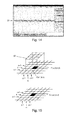
- FIG. 14 shows an oscilloscope trace of noise from an LC display detected by a copper strip placed over the LC display.
- FIG. 15 schematically illustrates applying a mask for a linear spatial low pass filter to an array of signal values
- FIGS. 16A and 16B schematically illustrate grids of signal values
- FIGS. 17A to 17D is a projection surface plot of the coefficients of a Gaussian filter mask with standard deviations of 0.5, 1, 2 and 4 respectively;
- FIG. 18 shows a process flow diagram for a second method of processing output signals from a touchscreen panel
- FIG. 19 compares normalized power spectral density plots for raw output signals, correlated double sampled signals and correlated double samples and filtered signals.
- FIGS. 20A and 20B plot noise spike attenuation and touch signal attenuation plotted against the standard deviation of a Gaussian filter mask.
- FIG. 21 is a table illustrating different cases for applying correlated double sampling to a harmonic, single frequency, signal.
- FIG. 22 is a giving details of an experimental projected capacitance touchscreen panel used for testing first and second methods of processing output signals from a touchscreen panel;
- FIG. 4 schematically illustrates a touchscreen system 5 including a touchscreen panel 6 and a touch controller 7 .
- a touchscreen panel includes a two dimensional N by M grid 8 of sensor areas I n,m , I n,m denotes the n th of N sensor areas spaced apart in a first direction d 1 and the m th of M sensor areas spaced apart in a second direction d 2 .
- the first and second directions d 1 , d 2 may be, for example, perpendicular x and y directions.
- Sensor areas I n,m have a characteristic dimension l and are spaced apart in the first and second directions d 1 , d 2 by an amount s.
- the sensor areas I n,m have an active area A s , and may or may not have the same shape in the first and second directions d 1 , d 2 .
- the sensor areas I n,m may or may not be spaced apart by the same amount s in the first and second directions, for example l 1 ⁇ l 2 .
- Each sensor area I n,m is typically defined by the overlap or intersection of an electrode X n extending in the first direction d 1 and an electrode Y m extending in the second direction d 2 , the first electrodes X 1 , . . . , X n , . . . , X N and second electrodes Y 1 , . . . , Y m , .
- each sensor area I n,m may alternatively be a discrete sensor.
- the sensor areas I n,m may produce signals indicating one or more of a capacitance, a resistance and a pressure, depending on the type of touchscreen panel 6 .
- the touch controller 7 includes a frame reading module 9 , a correlated double sampler 10 , a reference frame store x and a touch decision module 12 .
- the touch controller 7 optionally includes a spatial low pass filter 13 , a filter mask store 14 , a bandwidth decision module 15 , a signal attenuation model store 16 and a noise attenuation model store 17 .
- the frame reading module 9 , the correlated double sampler 10 , the touch decision module 12 and optionally the spatial low pass filter 13 and the bandwidth decision module 15 may be provided by one or more hardware modules, or they may be provided as modules executed by one or more data processors.
- the reference frame store 11 and optionally the filter mask store 14 , signal attenuation model store 16 and noise attenuation model store 17 may be provided by, for example, volatile or non-volatile memory (not shown) or a storage device (not shown).
- volatile or non-volatile memory not shown
- signal attenuation model store 16 and noise attenuation model store 17 are provided by a volatile memory, they may be stored in a non-volatile memory or storage device when the touchscreen system 5 is not powered.
- the frame reading module 9 reads output signals from the sensor areas I n,m and collates them as a signal frame matrix or array.
- the output signal from the sensor area I n,m is denoted F(n,m) in which the integer indices n, m denote the row and column of an entry in the frame array which stores the output signal from the sensor area I n,m .
- the output signal from a sensor area I n,m is stored a relative location in the frame F(n,m) which corresponds to the relative location of the respective sensor area I n,m in the grid 8 .
- the frame reading module 9 reads out frames F(n,m) at a scan frequency f s .
- the signals values of the first frame read out are denoted F(n,m,1) and the signal values of the kth frame read out are denoted F(n,m,k).
- F(n,m,k) When the touchscreen system 5 is initially powered up, the first frame F(n,m,k) read is stored to the reference frame store 11 as a reference frame F 0 (n,m).
- a frame F(n,m,k) can be treated in a similar way to an image, which allows touchscreen signals corresponding to a touch event to be visualised as an image, and also allows image processing methods to be applied to the signal frame F(n,m,k).
- the frame reading module 9 may scan through the sensor areas I n,m , for example a raster scan. Alternatively the frame reading module 9 may read out each sensor area I n,m simultaneously, for example, when sensor areas I n,m are discrete sensors rather than intersections of electrodes X n , Y m .
- the scan frequency f s is typically between about 20 Hz and about 200 Hz. Faster and slower scan frequencies f s are in principle possible, however, slower scan frequencies f s may result in slow response times or failures to register short touch events, and faster scan frequencies f s may be redundant given typical speeds of user interaction.
- the frame reading module 9 may be active or passive.
- excitation signals may be addressed to the sensor area I n,m being read in addition to reading an output signal.
- the frame reading module sends excitation signals to a drive electrode D n and reads output signals from a sense electrode S m .
- the frame reading module 9 is passive, the frame reading module only receives, and optionally amplifies, output signals from the sensor areas I n,m .
- the frame reading module 9 may receive and amplify charge from piezoelectric sensors in a pressure sensing touchscreen panel.
- the frame reading module 9 may combine active and passive reading of several quantities concurrently, for example, capacitance and pressure.
- F CDS (n,m,k) is a corrected signal value and F(n,m,k) is a read out signal value corresponding to the sensor area I n,m .
- the index k is used to distinguish between, for example, the presently read signal frame F(n,m,k) and the next signal frame F(n,m,k+1), and there is no upper bound for k.
- the corrected frame F CDS (n,m,k) may be represented, for each value of k, as a array or matrix in which the integer values n, m denote the row and column of an entry.
- the correlated double sampler 10 removes or reduces offsets 3 and common-mode components of the noise 4 , which may reduce the possibility of the touch decision module 12 mis-registering a touch event.
- the touch decision module 12 receives the corrected frame F CDS (n,m,k) and determines whether a touch event has occurred based on the signal values of the corrected frame F CDS (n,m,k). For example, the touch decision module 12 may apply a threshold value and register signal values F CDS (n,m,k) which exceed the threshold as corresponding to a single or multi-touch event. If the touch decision module 12 determines that a touch event has occurred, then touch information 18 characterising the touch event is determined and sent to a device central processing unit (CPU) 19 .
- the touch information 18 may include information such as, for example, the number of touch events and the location of each touch event.
- the touch information 18 provides input to an operating system or application being executed by the device CPU 19 .
- the touch information 18 may include force or pressure values. If the touch decision module 12 does not detect any touch events in the corrected frame F CDS (n,m,k), then the touch decision module 12 replaces the reference frame F 0 (n,m) with the current corrected frame F CDS (n,m,k).
- the stored reference frame F 0 is dynamically updated to reflect the most recently read frame in which no touch event occurs. This allows the touchscreen system 5 to dynamically adjust to changes in the noise 4 experienced by the touchscreen panel 6 .
- the optional spatial low pass filter 13 may receive the corrected frame F CDS (n,m,k) from the correlated double sampler 10 and provide a filtered frame F CDS (n,m,k) to the touch decision module 12 .
- the filtered frame F LPSF (n,m,k) may be represented, for each value of k, as an array or matrix in which the integer values n, m denote the row and column of an entry.
- the spatial low pass filter 13 may take the form of a linear filter such as an average or Gaussian filter, and may filter the corrected frame F CDS (n,m,k) using a mask received from the mask store 14 in the form of an matrix or array of coefficients C i,j having dimensions L by W, according to:
- i and j are indices of the filter coefficients C i,j .
- the spatial low pass filter attenuates uncorrelated noise spikes not removed by the correlated double sampler 10 , which may reduce the possibility of the touch decision module 12 mis-registering a touch event.
- the spatial low pass filter 13 has been described as a linear filter, the spatial low pass filter 13 may be a non-linear filter such as, for example, a median filter.
- the bandwidth decision module 15 receives the filtered frame F LPSF (n,m,k) and touch information 18 from the touch decision module 12 , and determines whether the bandwidth of the spatial low pass filter 13 requires adjustment.
- the bandwidth decision module 15 uses the touch information 18 to differentiate between touch signals and residual noise after correlated double sampling. For example, signal values F CDS (n,m,k), F LPSF (n,m,k) corresponding to sensors areas I n,m determined to be part of a touch event by the touch decision module are signal values, and any other non-zero signal values are residual noise.
- the bandwidth decision module 15 determines the attenuation of the touch signal and the attenuation of the residual noise, and determines whether the bandwidth of the spatial low pass filter 13 should be updated by replacing the coefficients C i,j stored in the mask store 14 .
- the bandwidth decision module 15 may tune the bandwidth of the spatial low pass filter 13 to maximise the attenuation of the residual noise whilst keeping the attenuation of the touch signals below a threshold amount.
- the bandwidth decision module 15 may update the bandwidth of the spatial low pass filter 13 by incremental amounts. Alternatively, the bandwidth decision module 15 may update the bandwidth of the spatial low pass filter 13 based on a signal attenuation model received from the signal attenuation model store 16 and a noise attenuation model received from the noise attenuation model store 17 .
- a signal attenuation model describes a relationship between the attenuation of touch signals and the bandwidth of the spatial low pass filter 13 .
- a noise attenuation model describes a relationship between the attenuation of noise signals and the bandwidth of the spatial low pass filter 13 .
- touch controller 7 For details of the touch controller 7 will be described in relation to the first and second methods of processing output signals from a touchscreen panel 6 .
- the first and second methods of processing output signals from a touchscreen panel 6 may be used with any type of touchscreen panel 6 which outputs signals corresponding to sensor areas I n,m arranged in a two dimensional grid or array arrangement 8 .
- any type of touchscreen panel 6 which outputs signals corresponding to sensor areas I n,m arranged in a two dimensional grid or array arrangement 8 .
- a suitable type of touchscreen panel 6 namely a projected capacitance touchscreen.
- Projected capacitance touchscreen panels measure changes of capacitance at electrodes to detect a touch event.
- the term projected capacitance refers to the fact that electrodes of a projected capacitance touchscreen panel need not be physically touched by a conducting object to detect a touch event.
- electrodes of a projected capacitance touchscreen panel may be located behind a screen, for example made of glass or transparent polymer.
- a conducting object such as, for example, a user's digit 22 ( FIG. 6B ) or a conductive stylus touches the screen, the electric field lines will be perturbed, thus modulating the charge distribution and hence the capacitance.
- Projected capacitance touchscreen panels may operate according to self-capacitance of individual electrodes or mutual capacitance between pairs of electrodes.
- Mutual capacitance operation supports multi-touch events, and may be less sensitive to electromagnetic interference (EMI).
- EMI electromagnetic interference
- FIGS. 5A, 5B and 5C schematically illustrate exemplary arrangements of electrodes for a projected capacitance touchscreen panels 20 , 21 , 22 using mutual capacitance.
- a first projected capacitance touchscreen panel 20 includes first electrodes X n , in the form of a number of drive electrodes D 1 , D 2 , . . . , D N and second electrodes Y m in the form of a number of sense electrode S 1 , S 2 , . . . , S M disposed on a layer of dielectric material 23 .
- the layer of dielectric material 23 extends in a plane defined by first and second perpendicular directions x, y, and has a thickness in a third direction perpendicular to the first and second directions x, y which is substantially less than any in-plane dimension of the dielectric layer 23 .
- the sense electrodes S m are disposed on a first surface of the dielectric layer 23 , for example, an upper surface, and the drive electrodes D a are disposed on a second surface of the dielectric layer 23 which is opposite to the first surface in the third direction.
- the drive electrodes D a take the form of rectangular strips of conductive material, elongated in the first direction x and oriented parallel to each other.
- the drive electrodes D n are spaced apart by an amount s in the second direction y perpendicular to the first direction x.
- the sense electrodes S m take the form of rectangular strips of conductive material, elongated in the second direction y and oriented parallel to each other.
- the sense electrodes S m are spaced apart by an amount s in the first direction x perpendicular to the second direction y.
- the dielectric material layer 23 is commonly transparent when the projected capacitance touchscreen panel 20 overlies or is incorporated into a display, for example a organic light emitted diode (OLED) or liquid crystal (LC) display.
- the dielectric material layer 23 may be glass, or may be a transparent polymer such as, for example, polyethylene terephthalate (PET) or similar plastics.
- the drive and sense electrodes, D n , S m may also be transparent when the projected capacitance touchscreen panel 20 overlies or is incorporated into a display.
- drive and second electrodes D n , S m may be formed form indium tin-oxide (ITO) or indium zinc-oxide (IZO).
- a second projected capacitance touchscreen panel 21 is the same as the first projected capacitance touchscreen panel 20 , except that the drive and sense electrodes D n , S m are different shapes.
- the drive electrodes D n take the form of a number of diamond shaped regions of conductive material 24 spaced apart in the first direction x and connected by narrow strips of conductive material 25 .
- the sense electrodes S m may take the form of a number of diamond shaped regions of conductive material 26 spaced apart in the second direction y and connected by narrow strips of conductive material 27 .
- a third projected capacitance touchscreen panel 22 is the same as the first and second projected capacitance touchscreen panels 20 , 21 , except that the drive and sense electrodes D n , S m are different shapes.
- the drive electrodes D n may take the form of rectangular strips which are elongated in the first direction x and which have a relatively greater width in the second direction y compared to the drive electrodes D n of the first projected capacitance touchscreen panel 20 .
- the sense electrodes S m may take the form of a number of relatively narrow “Z-shaped” regions of conductive material 28 spaced apart in the second direction y and connected by narrow strips of conductive material 30 .
- the drive and sense electrodes D n , S m of the third projected capacitance touchscreen panel 22 are arranged so that each Z-shaped conductive region 28 of a sense electrode S m is located overlying a corresponding drive electrode D a .
- the drive and sense electrodes D n , S m of the third projected capacitance touchscreen panel 22 are dimensioned, in particular the width of each drive electrode D n , so that no part of a Z-shaped conductive region 28 does not overlie a respective drive electrode D n . This is sometimes referred to as a “flooded” configuration.
- the sense electrodes S m need not use Z-shaped conductive regions 28 , and other narrow shapes overlying a drive electrode D n may be used such as, for example, “H-shaped” or “I-shaped” conductive material regions.
- Electrodes labelled as drive electrodes D n in the first, second and third projected capacitance touchscreen panels may alternatively be operated as sense electrodes S n and electrodes labelled as sense electrodes S m may alternatively be operated as drive electrode D m .
- electrode need not have a fixed role and may alternate between being a drive electrode and a sense electrode.
- a projected capacitance touchscreen panel need not use electrode arrangements described in relation to the first, second or third projected capacitance touchscreen panels 20 , 21 , 22 .
- any two-dimensional grid or array of electrodes suitable for measuring mutual capacitance between pairs of electrodes may be used.
- FIG. 6A shows a schematic cross-section of a projected capacitance touchscreen panel 20 , 21 , 22 .
- FIG. 6B shows a schematic cross-section of a projected capacitance touchscreen panel 20 , 21 , 22 during a touch event.
- the electrodes of a projected capacitance touchscreen panel o 20 , 21 , 22 may be covered over with a cover lens 30 .
- the cover lens 30 is generally transparent and may be formed of transparent materials such as, for example, of glass or PET.
- Each intersection of drive and sense electrodes D n , S m defines a sensor area I n,m , and each intersection I n,m may be measure individually by the frame reading module 9 of the touch controller 7 addressing the appropriate combination of drive and sense electrodes D n , S m .
- the drive electrode D n corresponding to an addressed intersection I n,m is driven by a driving signal 31 , and am output signal 32 is read out from the respective sense electrode S m of the addressed intersection I n,m .
- the driving signal 31 may take the form of a voltage signal such as, for example, a sinusoidal waveform, a square waveform, other AC/pulsed waveforms or a DC bias voltage.
- Each pairing of drive and sense electrodes D n , S m defines an intersection which provides a sensor area I n,m , and all of the intersections I n,m may be sequentially read out to measure a complete signal frame F(n,m,k) from the projected capacitance touchscreen panel 20 , 21 , 22 . In this way, both single-touch events and multi-touch events may be registered.
- the drive and second electrodes D n , S m corresponding to any given intersection I n,m define a baseline mutual capacitance, C M .
- the mutual capacitance between the drive and sense electrodes D n , S m is determined by the frame reading module 9 based on the driving signal 31 and the output signal 31 .
- the frame reading module 9 may determine the mutual capacitance between the drive and sense electrodes D n , S m using any known method such as, for example, based on a change in the amplitude, phase or frequency of the driving/output signals 31 , 32 compared to a reference signal.
- the frame reading module 9 may determine the mutual capacitance based on the time constant and/or charging/discharging times of the drive and second electrodes D n , S m .
- an additional capacitance C F couples the electrodes and the user's digit 33 or a suitable conductive stylus (not shown).
- the additional capacitance C F causes the mutual capacitance measured by the processor or touch controller to differ from the baseline mutual capacitance C M by an amount ⁇ C.
- the magnitude of the capacitive change ⁇ C during a touch event is not fixed, and may vary depending upon factors such as, for example, the contact area of the user's digit 33 or the suitable conductive stylus.
- a signal frame values F(n,m,k) read out from a projected capacitance touchscreen panel 20 , 21 , 22 is an array of the values of capacitance measured for each intersection I n,m of the drive and sense electrodes D n , S m .
- ⁇ C the amount of capacitive change ⁇ C exceeds a threshold amount, a touch event is registered.
- Noise 4 and offsets 3 will affect the measured capacitances, as previously described.
- the first and second methods of processing output signals from touchscreen panels are not limited to projected capacitance touchscreen panels 20 , 21 , 22 using mutual capacitance.
- the first and second methods of processing output signals from touchscreen panels may alternatively be used with projected capacitance touchscreen panels using self-capacitance, or with touchscreen panels based on measuring different properties such as, for example, electrical resistance or pressure.
- the first and second methods of processing output signals from touchscreen panels may alternatively be used with touchscreen panels based on optical or acoustic methods.
- the first and second methods of processing output signals from touchscreen panels may be used with any touchscreen panel 6 in which the contact area of a user's digit 33 or a stylus generates a signal from more than one sensor area I n,m .
- a touchscreen panel 6 may include a grid 8 formed by intersections between a number N of electrodes X 1 , . . . , X n , . . . X N extending in a first direction d 1 and a number M of electrodes Y 1 , . . . , Y m , . . . , Y M extending in a second direction d 2 .
- the electrodes X n , Y m may be drive and sense electrode D n , S m .
- the electrodes X n , Y m may fulfil different roles.
- the signal frame values F(n,m,k) may represent and be proportional to a capacitance or change in capacitance between the drive and sense electrodes D n , S m .
- the signal frame values F(n,m,k) may represent and be proportional to a resistance or change in resistance between the respective electrodes X n , Y m .
- the signal frame values F(n,m,k) may represent and be proportional to a pressure or force applied between the respective electrodes X n , Y m .
- the signal frame values F(n,m,k) need not correspond to the sensor areas I n,m defined by intersections between electrodes X n , Y m .
- the sensor areas I n,m may correspond to the discrete sensors so that each frame signal value F(n,m,k) corresponds to the signal obtained from a respective sensor.
- the specific physical parameter represented by the signal frame values F(n,m,k) measured from a touchscreen panel 6 varies depending on the type of touchscreen panel 6 .
- the first and second methods of processing out signals from a touchscreen panel may be applied to reduce or remove noise 4 and offsets 3 to improve the SNR and reduce mis-registrations of touch events.
- SNR Signal-to-noise ratio
- SNR is the signal to noise ratio
- P s is the signal power
- P n is the noise power
- a SNR>1 implies that the touch signal, for example F(n,m,k) exceeds the noise 4 .
- the offset 3 is not dealt with as a noise component, as it can be removed by deducting a fixed value. This is because the noise 4 typically varies rapidly, whereas the offsets 3 are typically constant or slowly varying.
- an acceptable value of the SNR may be greater than 1, greater than 2, greater than 3 or greater than 5.
- a lower SNR, for example SNR>1 may be acceptable in some applications, for example when only the registration of the presence or absence of a touch event is measured. However, for other applications, for example, for analog pressure sensing/force touch, a greater SNR may be needed to allow different levels of pressure applied by a user's interaction to be distinguished.
- FIGS. 7A and 7B schematically illustrate voltage output signals from a projected capacitance touchscreen panel 20 , 21 , 22 .
- the output signal 32 from an intersection I n,m of a projected capacitance touchscreen panel 20 , 21 , 22 may take the form of a voltage signal V(t).
- the output signal V(t) generally includes contributions from a desired touch signal, V s , from an offset 3 , V offset and from a noise signal 4 .
- the noise 4 is a superposition of stochastic or random noise 1 and deterministic or common mode noise 2 .
- the output signal V(t) may be corrected using correlated double sampling (CDS) to determine a corrected output signal V CDS (t).
- CDS correlated double sampling
- the background signal V 0 may be subtracted.
- the offset 3 and components of the noise 4 which are correlated between the output signal V(t) and the background signal V 0 may be substantially reduced or cancelled.
- the corrected output signal V CDS (t) substantially includes the desired signal V s and higher frequency uncorrelated components of the noise 4 .
- the SNR may be expressed as:
- SNR CDS is the signal to noise ratio after CDS
- P s is the signal power
- P n is the noise power before CDS
- P n ′ is the noise power after CDS
- ⁇ is a characterization factor defined as the ratio of P n to P n ′.
- CDS is applied to the frame signal values F(n,m) from each intersection In,m using an individual background reference value F 0 (n,m).
- FIG. 21 illustrates different ranges of the characterization factor ⁇ applied to a case of a harmonic, single frequency, common-mode noise signal.
- FIG. 8 schematically depicts the relationship between the characterization factor ⁇ and the scan frequency, f s .
- the characterization factor ⁇ may be considered to be inversely proportional to the scan interval 1/f s .
- FIG. 9 shows a process flow diagram of a first method of processing output signals F(n,m,k) from a touchscreen panel 6 .
- a first frame F(n,m,1) is read out by frame reading module 9 (step S 1 ).
- the first frame F(n,m,1) is read out by sequentially scanning through each intersection I n,m by addressing the corresponding drive and sense electrodes D n , S m .
- a background pattern or reference frame F 0 (n,m) is initially set equal to the first frame F(m,n,1), and stored in the reference frame store 11 (step S 2 ).
- the frame reading module 8 reads out signal frames F(n,m,k) (step S 3 ).
- the signal frame F(n,m,k) is read out by sequentially scanning through each intersection I n,m by addressing the corresponding drive and sense electrodes D n , S m .
- the read out of the signal frame F(n,m,k) may be synchronised with a display (not shown) which underlies the touchscreen panel 6 or into which the touchscreen panel 6 is embedded.
- the signal frame F(n,m,k) may be read out during a display quiet/blinking period.
- the correlated double sampler 10 receives the signal frame F(n,m,k) and applies a CDS correction by subtracting the reference frame F 0 (n,m) to generated a corrected frame F CDS (n,m,i) according to Equation 1 (step S 4 ).
- the CDS correction may be effective in reducing or removing offsets 3 because the offsets are constant or only slowly vary between reading out successive frames F(n,m,k), F(n,m,k+1).
- the CDS correction may be effective in reducing or removing low-frequency common-mode components of the noise 4 which are correlated between successive frames F(n,m,k), F(n,m,k+1).
- the touch decision module 12 receives and analyses the corrected frame F CDS (n,m,k) to determine whether a touch event, for example a single-touch event or a multi-touch event is occurring (step S 5 ). If a touch event is not occurring (step S 5 ; No), the reference frame F 0 (n,m) is updated by overwriting the reference frame F 0 (n,m) stored in the reference frame store 11 with the current signal frame F(n,m,k) (step S 8 ), and the next signal frame F(n,m,k+1) is read out by the frame reading module 9 (step S 3 ).
- the touch decision module determines and outputs the touch information 18 to the device CPU 19 (step S 6 ).
- the touch information can be used by an application of operating system being executed by the device CPU 19 to select an option, open a folder on desktop or to close a web browser application. Whilst the touchscreen system 5 continues operating (step S 7 ), the next signal frame F(n,m,k+1) is read out (step S 3 ).
- steps S 4 to S 8 are preferably conducted in less time than the scan interval 1/f s .
- the steps occurring between reading out a signal frame F(n,m,k) and reading out a subsequent signal frame F(n,m,k+1) preferably do not take longer than the interval between display quiet/blanking periods.
- CDS may be applied to signal frames read out from a touchscreen panel 6 in order to reduce or cancel offsets 3 and low frequency common-mode components of noise 4 .
- This may improve the SNR of the touchscreen system 5 and enable the excitation power and/or detection thresholds to be reduced for the touchscreen system 5 .
- This may extend the battery life of a device incorporating the touchscreen system by reducing power consumption.
- Improved SNR of the touchscreen system 5 may also improve the accuracy of a touchscreen system 5 by reducing the probability of mis-registering a touch event.
- the reference frame F 0 (n,m) is kept up to date with the most recent, and thus most accurate, background pattern of noise and offsets.
- Changes in the ambient environment may encompass changes in the number, type and proximity of sources of electromagnetic noise, changes in temperature, or changes such as plugging in or unplugging a mobile device incorporating the touchscreen system 5 from a charging cable.
- the use of the first method of processing output signals from a touchscreen panel may be illustrated with reference to experiments conducted using an example of a projected capacitance touchscreen panel.
- FIG. 22 is a table providing details of the projected capacitance touch screen panel used for testing the first method of processing output signals from a touchscreen panel.
- the experimental touchscreen panel used drive and sense electrodes D n , S m configured in a grid including relatively wide drive electrodes D n and relatively narrow sense electrodes S m deposited on the same surface and perpendicular to the drive electrodes D n .
- the drive electrodes D n tapered to a waist
- the sense electrodes S m bridges the drive electrode D n waists by means of jumpers.
- the experimental touchscreen panel was rectangular, with a diagonal dimension of 10.1 inches (25.7 cm) and had an aspect ratio of 16:9.
- the excitation voltage for the drive electrodes D n was 10 V.
- the drive electrodes D n had a width of 3 mm.
- the portions of the sense electrodes S m which overlapped the drive electrodes D n had a maximum width of 449 ⁇ m.
- Signal frames F(n,m,i) were read out at a frequency of 30 Hz or 60 Hz.
- the pixels of a display underlying the example touchscreen panel had dimensions of 56 ⁇ m by 56 ⁇ m.
- FIGS. 10A and 10B show grayscale illustrations of a single-touch event frame 34 and a corresponding CDS corrected single-touch event frame 35 .
- FIGS. 10C and 10D show grayscale illustrations of a multi-touch event frame 36 and a corresponding CDS corrected multi-touch event frame 36 .
- regions labelled “DB” correspond to low signal levels
- regions labelled “LB” correspond to intermediate signal levels
- regions labelled “R” correspond to high signal level.
- applying the first method of processing output signals from a touchscreen panel to a single-touch event frame 34 results in a significant reduction in offsets 3 and noise 4 of the corresponding CDS corrected single-touch event frame 35 .
- applying the first method of processing output signals from a touchscreen panel to a multi-touch event frame 36 results in a significant reduction in offsets 3 and noise 4 of the corresponding CDS corrected multi-touch event frame 37 .
- the contrast of the touch signals is substantially improved in the CDS corrected frames 35 , 37 processed according to the first method of processing output signals from a touchscreen panel.
- accurately determining the number and locations of touch events may be improved.
- significant offset 3 signals which could lead to false registration of touch events, for example the regions coloured red towards the upper portion of the uncorrected signal frames 34 , 36 , are removed by the processing according to the first method.
- FIGS. 11A and 11B show power spectral density (PSD) plots of the normalised noise output from the experimental touchscreen panel at 60 and 30 Hz respectively.
- Normalised noise refers to signal frames recorded without any touch events.
- the effect of the first method on the noise properties of the experimental touchscreen panel was investigated by reading out signal frames F(n,m,k) in the absence of any touch events. Without touch events, and hence without touch signals, the read out frames F(n,m,k) consist substantially of noise 4 and offsets 3 .
- the effects of the first method may be investigated by calculating and comparing the PSD of the signal frames F(n,m,k) and the corrected frames F CDS (n,m,k) in the absence of any touch events.
- the frequency range in which an improvement is observed after correction using the first method is reduced to below about 3 Hz.
- the reduced frequency range of improvements at reduced scan frequency f s may result from a relatively weaker correlation of low-frequency noise between adjacent frames at reduced sampling frequencies.
- the correlation of noise between adjacent frames may be relatively increased for higher sampling frequencies. Because the offsets 3 behave as DC, they can be cancelled regardless of sampling frequency.
- CDS may have the effect of introducing higher frequency noise within a certain bandwidth. This effect is related to the sampling frequency and will be explained with reference to the following example, in which a harmonic, single frequency, noise waveform, H(t), with a frequency f s /2, is subject to CDS correction at a scan frequency f s . The interval between two adjacent sampling times is then equal to phase of ⁇ .
- the output after CDS may be expressed as:
- H CDS is the noise signal after applying CDS
- H 0 is amplitude of the noise waveform H(t)
- ⁇ is the initial phase of the noise waveform H(t)
- t is time. Equation 5 indicates that a noise waveform, for example H(t) having a frequency f s /2 of half the CDS sampling frequency f s , the amplitude of the noise waveform H CDS after CDS is doubled. Similar analysis can be made for other ratios of noise waveform and scan frequency f s .
- the modest in noise components at higher frequencies as a result of applying the first method may be mitigated by filtering out higher frequency components. This is possible because signals corresponding to touch-events are typically low frequency, for example, user interactions with a touchscreen panel typically occur at frequencies a few Hz or less.
- the experimental results show that up to about 10% of the scan frequency f s , the SNR may be boosted by 5.9 dB and 7.6 dB when the scan frequencies f s are 30 Hz and 60 Hz, respectively. Above about 10% of the scan frequency f s , the SNR does not improve and may even be degraded.
- the first method of processing output signals from a touchscreen panel may substantially reduce common-mode components of noise 4 and offsets 3 within the frequency band containing touch signals.
- the first method of processing output signals from a touch panel may remove or reduce of offsets 3 and low frequency common-mode components of the noise 4 .
- the time taken for the repeated steps of the first method should preferably not exceed the scan interval 1/f s between reading out successive signal frames F(m,n,k), F(m,n,k+1). For example, for a scan frequency of 60 Hz, the computational time for the CDS correction of the first method should be less than 16.7 ms.
- Computational time generally depends on the complexity of an algorithm.
- the number of intersections I n,m to be scanned for the touchscreen panel 6 is N ⁇ M.
- the computational time of the first method scales as O(N ⁇ M).
- the first method may be implemented in a device incorporating a touchscreen system 5 without the need to reduce the scan frequency f s .
- the energy for measuring a signal frame value F(n,m,k) for each sensor area I n,m is given approximately by:
- a projected capacitance touchscreen panel for a typical mobile device for example a smartphone
- the capacitive touchscreen panel would have 144 electrode sensor areas/intersections In,m.
- the power consumption for measuring the whole panel once would be 0.288 mW
- the energy consumption for scanning each signal frame F(n,m,k) would be 4.8 ⁇ J.
- the power consumption for processing operations associated with the first method is given approximately by:
- E CDS N ⁇ M ⁇
- E CDS the power consumption of the CDS operation
- N and M are grid 8 dimensions
- ⁇ the power efficiency of the processor or touch controller
- Examples of currently used embedded processors for example an ARM®Cortex®A5 processor, have a power efficiency ⁇ in the range of 20 million instructions per second (MIPS)/mW.
- the power consumption ECDS may be of the order of 7.2 nW, and the computation time is of the order of 0.14 ⁇ s.
- the additional energy consumption from applying the first method is of the order of 1 fJ, which is substantially smaller than the energy consumption of commonly used processors or touch controllers.
- the first method of processing output signals from a touchscreen panel 6 may provide substantial improvements in offsets 3 and low frequency common-mode components of the noise 4 .
- the correlation between a signal frame F(n,m,k) and the noise reference frame F 0 (n,m) becomes weak, noise spikes may remain, especially at higher frequencies.
- the signal from a touch event may have a lower spatial frequency compared to the noise spikes.
- a second method of processing output signals from a touchscreen panel combines CDS correction of signal frames F(m,n,k) according to the first method with spatial filtering of the corrected frames F CDS (n,m,k) using a spatial low pass filter 13 .
- FIG. 12 illustrates spatial filtering to reduce the magnitude of a noise spike.
- regions labelled “DB” correspond to low signal levels
- regions labelled “LB” correspond to intermediate signal levels
- regions labelled “R” correspond to high signal level.
- a corrected signal frame F CDS (n,m,k) may include noise spikes 38 which result from, for example, random components of noise 4 or high frequency common mode components of noise 4 which are uncorrelated with the reference frame F 0 (n,m) used for the CDS correction.
- a noise spike 38 may take the form of, for example, an abnormally high signal value F CDS (n,m,k) at an intersection I n,m when compared to the signal values, e.g. F CDS (n+1,m,k), F CDS (n,m+1,k) etc, at surrounding intersections, e.g. I n+1,m , I n,m+1 etc.
- the corrected frame F CDS (n,m,k) may be processed using a spatial low pass filter 13 to produce a filtered frame, F LPSP (n,m,k).
- the spatial low pass filter 13 has the effect of averaging the noise spike 38 by mixing it with adjacent intersection values, resulting in a filtered spike 39 with reduced magnitude.
- Spatial filtering to touch signals has the potential to introduce unwanted effects.
- the touch signal may also be reduced by the spatial low pass filter 13 , sometimes referred to as a “smoothing effect”, which may decrease SNR and potentially increase the probability of failing to register a touch.
- the smoothing effect has the potential to distort the apparent location of a touch due to the coupling to the signal values for adjacent/nearby intersections I n,m .
- Careful design of spatial low pass filter 13 may allow noise spikes 38 to be attenuated whilst minimizing the attenuation of the touch signals and avoiding distortion of the touch location.
- digits 33 which present different contact areas to a touchscreen panel 6 .
- the same user may vary which digits 33 contact the touchscreen panel and may sometimes use a stylus (not shown) instead of a digit 33 .
- Application of a single bandwidth for the spatial low pass filter 13 may not be suitable for all possible users and/or styluses.
- the bandwidth of a spatial low pass filter 13 is dynamically tuned during use to optimise between attenuating noise spikes 38 and preserving the integrity of touch signals.
- Devices which incorporate touchscreen panels are frequently mobile devices which may operate under battery power in use.
- battery operated devices typically include rechargeable batteries, and must be periodically connected to a charging supply or charger (not shown) in order to replenish the battery. The device may still be used whilst connected to the charger.
- Chargers commonly take the form of a transformer-rectifier circuit which converts high voltage AC power from an outlet into DC power at a voltage suitable for recharging the battery of a device. In an ideal charger, the conversion would be perfect and the charger would output a constant DC voltage. In practice, a charger will produce an output including common-mode fluctuations such as, for example, residual “ripple” current/voltage, noise spikes and other artefacts
- the peak common mode noise introduced by a charger may typical vary within a range from less than 3 V to more than 40 V, depending on the quality of the charger.
- Common-mode noise from a charger may not affect the operation of a capacitive touchscreen panel 20 , 21 , 22 when it is not being touched because the difference of the charger output is maintained.
- a touch event occurs, there are broadly two scenarios. First, the device incorporating the touchscreen panel 6 may be held by a hand. Second, the device incorporating the touchscreen panel 6 may be placed on surface or in a holder, for example on a table or a stand. When the device is held, it may be sufficiently grounded to the earth so that common-mode noise charge does not escape to ground. However, if the touchscreen panel 6 is placed on a surface or in a holder, i.e. when the touch panel and the human body do not share the same ground, the touch event generated by a finger may lead to touch mis-registrations.
- AMOLED active-matric organic light-emitting diodes
- LC liquid crystal
- FIG. 13 shows an example stack-up 43 for a back-lit LC display incorporating a touchscreen panel which overlies an LC display.
- an example of an LC display stack-up 43 includes, in order moving away from a user, a cover lens 30 , a first electrode layer 44 , a layer of dielectric material 23 , a second electrode layer 45 , a touchscreen panel substrate 46 , a first polarizer filter 47 , a colour filter substrate 48 , a common electrode, V com , layer 49 , liquid crystal layer 50 , thin film transistors (TFT) 51 , pixel/sub-pixel electrodes 52 , a TFT substrate 53 , a second polarizer filter 54 , a while backlight 55 and a reflector layer 56 .
- TFT thin film transistors
- the first patterned conductive layer 44 provides, for example, a number N of electrodes X n extending in a first direction d 1 and the second patterned conductive layer 45 provides, for example, a number M of electrodes Y m extending in a second direction d 2 .
- the TFTs 51 are individual addressable and control the pixel/sub-pixel electrodes 52 to allow local re-orientation of liquid crystal molecules in the region of the liquid crystal layer 50 o between the addressed pixel/sub-pixel electrode 52 and the V com electrode 49 .
- the first capacitance C 1 couples the pixel/sub-pixel electrodes 52 and the V com layer 49 .
- the first capacitance C 1 shields the display noise because the V com layer 49 has considerable resistance.
- the V com layer 49 may be made from ITO.
- the second capacitance C 2 couples the V com layer 49 and the second electrode layer 45 .
- the second capacitance C 2 couples noise from the LC display to the touchscreen panel 6 .
- the amount of coupled noise from an LC display may be measured by detecting a voltage induced in a conducting strip stacked directly onto an LC display. For example, an experiment was conducted using a copper strip stacked directly on an LC display in the form of a Dell® e198 wfp LCD screen. The LC display noise coupled to the copper strip was measured using an Agilent®DSO-X 2024A oscilloscope. The area of the copper strip was 3 mm ⁇ 3 mm, which is a comparable area to the active area A s of a typical projected capacitance touchscreen panel 20 , 21 , 22 .
- FIG. 14 shows an oscilloscope trace of noise from an LC display detected by a copper strip placed over the LC display.
- the experimentally measured LC display noise signal 57 includes a strong deterministic component, which is expected to depend on the design of the product and to not significantly vary after the display is fabricated.
- Spatial low pass filters may be broadly characterised as linear filters or non-linear filters.
- Linear filters include filter types such as average filters and Gaussian filter.
- Non-linear filters include filter types such as median filters.
- FIG. 15 schematically illustrates applying a mask 58 for a linear spatial low pass filter 13 to an array of corrected frame values F CDS (n,m,k).
- a linear filter mask 58 is applied to an array of corrected frame values F CDS (n,m,k).
- the linear filter mask 58 has dimensions L by W, which are typically positive odd integers to ensure that a single intersection I n,m is the centre of the linear filter mask 58 .
- the filtered signal value F LPSF (n,m) obtained by filtering may be expressed as:
- the optimal linear filter mask 58 dimensions L, W and coefficients C i,j for a given touchscreen panel 6 may depend upon the both the physical characteristics of the touchscreen panel 6 and the characteristics of the touch events such as the contact area of the user's digit 33 or of a suitable stylus.
- Linear filters as described in Equations 9 and 10 are preferred in general applications due to the simplicity of implementation, low processing requirements and balanced performance between digit 33 touches and stylus touches.
- Non-linear filters involve, for example, derivation of a filtered value using statistics such as determining a median value.
- Non-linear filters may be preferred for some applications because non-linear filters may potentially provide superior attenuation of noise spikes.
- non-linear filters may excessively attenuate signals of touch events corresponding to low contact areas, for example a stylus touch.
- the touch event will include signals from whichever intersection I n,m is closest to the touch point and also from adjacent or nearby intersections, for example I n+1,m , I n,m+1 etc. In this way, the touch event has an interaction area 59 ( FIG. 16A ) which encompasses multiple intersections I n,m of the drive and sense electrodes D n , S m .
- An interaction area 59 spanning multiple intersections I n,m is not limited to projected capacitance touchscreen panel 20 , 21 , 22 types, and other types of touchscreen panel such as, for example, pressure sensing touchscreen panels, may have interaction areas 59 which encompass several intersections I n,m .
- the linear filter mask 58 dimensions L, W are larger than the interaction area 59 , then a spatial low pass filter 13 may reduce the relative strength of the touch signal, which may result in failure to register a touch event. Additionally, in order to avoid potential interference between two concurrent touch events, which may cause a skew in the registered position of a touch event, the linear filter mask 58 dimensions L, W should preferably be no larger than the typical interaction area 59 of a touch event.
- the dimensions L, W of the mask may be determined based on the typical size of a human digit 33 and the dimension l and spacing s of the active areas A s of sensor areas/intersections I n,m .
- FIGS. 16A and 16B illustrate a grid 8 of corrected frame values F CDS (n,m,k) with interaction areas 59 superimposed.
- a touch event centred on I n,m has an interaction area 59 which approximately encompasses a 3 by 3 block of intersections I n,m , i.e. n ⁇ 1, m ⁇ 1.
- F CDS (n,m,k) the central corrected frame value
- Equation 11 may be simplified to:
- F CDS ⁇ ( n + 1 , m , k ) F CDS ⁇ ( n , m , k ) ⁇ , ⁇ > 1
- F CDS ⁇ ( n + 1 , m + 1 , k ) F CDS ⁇ ( n , m , k ) ⁇ , ⁇ > 1
- ⁇ and ⁇ are scaling factors.
- the filtered signal value F LPSF (n,m,k) may be approximated as:
- the sensitivity of the filtered frame value F LPSF (n,m,k) to positional mis-registrations caused by noise spikes 38 may be evaluated by considering the conditions under which the filtered frame value of one of the nearest neighbour locations to the touch event, for example F LPSF (n,m+1), exceeds the filtered frame value F LPSF (n,m) at the touch event location.
- the filtered frame value of a nearest neighbour location F LPSF (n,m+1) may be expressed as:
- F CDS (n+1,m,k) F CDS (n,m+1,k) etc.
- the filtered frame value of a nearest neighbour location F LPSF (n,m+1,k) may be approximated as:
- F LPSF ⁇ ( n , m , k ) F CDS ⁇ ( n , m , k ) ⁇ ( ⁇ ⁇ ⁇ ⁇ + 3 ⁇ ⁇ ⁇ + 2 ⁇ ⁇ ⁇ ) + 3 ⁇ ⁇ ⁇ ⁇ ⁇ ⁇ H 9 in which ⁇ and ⁇ are scaling factors and H is a randomly distributed variable representing the noise 4 .
- F CDS ⁇ ( n , m , k ) H > 3 ⁇ ⁇ ⁇ ⁇ ⁇ 3 ⁇ ⁇ ⁇ + ⁇ should be satisfied.
- the ratio F CDS (n,m,k)/H is related to the SNR.
- Equation (17) may become dominated by the noise values H, resulting in increased probability mis-registering the location of a touch event.
- the inequality in is not specific to projected capacitance touchscreen panels 20 , 21 , 22 , and may equally apply to any touchscreen panel 6 which has an interaction area 59 for a touch event which encompasses more than one intersection I n,m .
- Signals corresponding to touch events are typically of relatively low spatial frequency compared to noise spikes, when the touch event is generated by user's digit 33 .
- some types of touch events for example touch events generated by user input via a suitable stylus, may have relatively higher spatial frequency compared to a touch event generated by user input with a digit 33 .
- a touch event generated by a stylus may have an interaction area 59 which encompasses a single intersection I n,m .
- noise spikes are typically considered to have high spatial frequency, for example to effect a single intersection I n,m , it is also possible for noise spikes to have spatial frequencies which are lower than a single intersection I n,m .
- One way to maximise attenuation of noise spikes 38 without detrimentally attenuating the desired touch signals is to dynamically tune the bandwidth of a spatial low pass filter 13 by dynamically adjusting the coefficients C i,j of a linear filter mask 58 with fixed dimensions L, W.
- a second method of processing output signals from a touchscreen panel applies a spatial low pass filter 13 using linear filter masks 58 having varying bandwidth determined by the coefficients C i,j of the linear filter mask 58 .
- a linear Gaussian filter may be represented by an array composed of coefficients C i,j expressed generally as:
- G is an amplitude
- L and W are the dimensions of the linear filter mask 58
- i and j are indices ranging from 0 ⁇ i ⁇ L ⁇ 1 and 0 ⁇ j ⁇ W ⁇ 1 respectively
- ⁇ n is a standard deviation in a first direction x
- ⁇ m is a standard deviation in a second direction y.
- the amplitude G is preferably a normalisation factor to minimise an overall increase or decrease in the average intensity of the filtered frame values F LPSF (n,m,k) compared to the corrected frame F CDS (n,m).
- a touchscreen panel 6 having a grid 8 of intersections I n,m defined by electrodes X n (e.g.
- drive electrodes D n ) in a first direction d 1 (e.g. x) and electrodes Y m (e.g. sense electrodes S m ) in a second direction d 2 (e.g. y) need not be a square grid, and the standard deviations ⁇ n , ⁇ m may be different accordingly.
- the coefficients may be expressed as:
- a small value of standard deviation a indicates relatively weak coupling between an intersection I n,m and the other intersections encompassed by the linear filter mask 58 , for example I n+1,m .
- a small value of standard deviation a therefore indicates relatively weaker attenuation of a noise spike 38 corresponding to a single intersection I n,m .
- a larger value of standard deviation a indicates stronger coupling between an intersection I n,m and the other intersections encompassed by the linear filter mask 58 , for example I n+1,m .
- a larger value of standard deviation a therefore indicates relatively stronger attenuation of a noise spike 38 corresponding to a single intersection I n,m .
- the bandwidth of a spatial low pass filter 13 may be readily adjusted according to the value of the standard deviation a used to calculate the coefficients C i,j for the a Gaussian linear filter mask 48 .
- FIG. 18 shows a process flow diagram for a second method of processing output signals from a touchscreen panel.
- a first frame F(n,m,1) is read out by the frame reading module 9 upon start-up of the touchscreen system 5 , (step S 1 ) and a background pattern or reference frame F 0 (n,m) is initially set equal to the first frame F(m,n,1) and stored to the reference frame store 11 (step S 2 ).
- the frame reading module 9 reads out signal frames F(n,m,k) at the scan frequency f s (step S 3 ), and the correlated double sampler receives and corrects the signal frames F(n,m,k) by subtracting the reference frame F 0 (n,m) to generate corresponding corrected frames F CDS (n,m,k) (step S 4 and Equation 1).
- the spatial low pass filter 13 receives the corrected frame F CDS (n,m,k) and filters it using a linear filter mask 58 to produce a filtered frame F LPSF (n,m,k) (step S 9 ).
- the initial bandwidth of the spatial low pass filter 13 may be set to a predetermined value. Alternatively the initial bandwidth may be set to the finishing value of bandwidth from a previous occasion that the touchscreen system 5 was operating.
- the spatial low pass filter 13 may be a Gaussian filter characterised by a linear filter mask 58 in the form of an array of coefficients C i,j calculated according to Equation (18) with a standard deviation a.
- the standard deviation a may be set initially set to a predetermined value ⁇ 0 . Alternatively, the standard deviation a may be set to the finishing value of standard deviation a from a previous occasion that the touchscreen system 5 was operating.
- the touch decision module analyses the filtered frame F LPSF (n,m,k) to determine whether a touch event, for example a single-touch event or a multi-touch event is occurring (step S 5 ). If a touch event is not occurring (step S 5 ; No), the reference frame F 0 (n,m) is updated by overwriting the reference frame F 0 (n,m) equal stored in the reference frame store 11 with the current signal frame F(n,m,k) (step S 8 ), and the next signal frame F(n,m,k+1) is read out by the frame reading module 7 (step S 3 ).
- the bandwidth decision module 15 decides whether the bandwidth of the spatial low pass filter 13 is optimal or whether the bandwidth of the spatial low pass filter 13 should be changed (step S 10 ).
- the bandwidth decision module 15 may evaluate the attenuation of the touch signals and the noise spikes 38 by comparing the CDS corrected frame F CDS (n,m,i) to the filtered frame F LPSF (n,m,i).
- any values of the corrected or filtered frames F CDS (n,m,k), F LPSF (n,m,k) corresponding to intersections I n,m determined to be part of a touch event by the touch decision module 12 are signal values, and any other non-zero values may be regarded as noise.
- a variety of criteria for adjusting the bandwidth of the spatial low pass filter 13 may be applied by the bandwidth decision module 15 .
- the bandwidth decision module 15 may increase or decrease the standard deviation ⁇ value to maintain the SNR at a threshold value.
- the processor or touch controller may increase or decrease the standard deviation ⁇ value to try and maximise the attenuation of noise spikes 38 whilst keeping the attenuation of touch signals above a threshold value.
- the bandwidth decision module 15 need not adjust the bandwidth incrementally, and may use predetermined signal/noise attenuation models received from the signal/noise attenuation model stores 16 , 17 .
- the bandwidth decision module 15 may select an optimal bandwidth for the spatial low pass filter 13 based on the characteristics of the noise 4 present in the frame. An example of measuring a model relating noise spike and signal attenuation to the spatial low pass filter 13 bandwidth is explained hereinafter.
- the bandwidth decision module 15 may select a value of the standard deviation a based on predetermined signal/noise attenuation models relating noise spike and signal attenuation to the value of standard deviation ⁇ .
- the bandwidth decision module 15 may use a combination of modelling and incremental alterations, for example, the processor or touch controller may employ machine learning methods or “fuzzy” methods to explore parameters close to a modelled value in order to improve the signal/noise attenuation models stored in the signal/noise attenuation model stores 16 , 17 by adding additional data points.
- the bandwidth decision module 15 determines that the bandwidth of the spatial low pass filter 13 does needs adjusting (step S 10 ; Yes)
- the bandwidth decision module 15 adjusts the bandwidth by overwriting the coefficients C i,j stored in the mask store 14 with updated coefficients C i,j (step S 11 ).
- the touch decision module 12 determines and outputs the touch information 18 to the device CPU 19 (step S 6 ). Whilst the touchscreen system 5 is operating (step S 7 ), the next signal frame F(n,m,k+1) is read out by the frame reading module 9 (step S 3 ).
- the touch decision module 12 determines and outputs the touch information 18 to the device CPU 19 (step S 6 ).
- All the steps occurring between reading out a signal frame F(n,m,k) and reading out a subsequent signal frame F(n,m,k+1) are preferably conducted in less time than the scanning interval 1/f s .
- the steps occurring between reading out a signal frame F(n,m,k) and reading out a subsequent signal frame F(n,m,i+k) preferably do not take longer than the interval between display quiet/blanking periods.
- noise spikes 38 which are not removed by the correlated double sampler 10 , for example because they are uncorrelated to the reference frame F 0 (n,m), may be attenuated by the spatial low pass filter 13 .
- This may further increase the SNR for outputs from a touchscreen panel 6 , and enable the signal thresholds and/or excitation power to be further reduced compared to CDS corrections alone.
- the second method of processing output signals from a touchscreen panel uses a spatial low pass filter 13 which is dynamically updated. This may allow the signal processing to remain optimised when different users having different sized digits 33 use the touchscreen system 5 or when a user switches between using a digit 33 and using a stylus.
- FIG. 19 shows normalized power spectral density (PSD) plots for the raw signal frames F(n,m,k), the frames after CDS correction F CDS (n,m,k) and the frames after CDS correction and spatial low pass filtering F LPSF (n,m,k).
- PSD normalized power spectral density
- the high frequency noise which may be introduced by the CDS correction, as hereinbefore described, may be suppressed by the spatial low pass filtering.
- the CDS correction and spatial low pass filtering are complementary, in that the overall improvement in SNR may be superior to that obtained by simply summing the improvements from CDS or spatial low pass filtering applied individually.
- the SNR was observed to be increased by 15.6 dB, and the signal and noise spike were observed to be attenuated by 4.51 dB and 19.25 dB respectively.
- FIG. 20A shows plots of the noise spike attenuation and the touch signal attenuation plotted against the standard deviation a of a Gaussian filter mask 58 .
- the plots were obtained from simulations based on the data from the experimental projected capacitance touchscreen panel.
- the noise spikes 38 display relatively higher attenuation compared to the touch signal following spatial low pas filtering.
- the observed relationships are specific to the experimental projected capacitance touchscreen panel, however, the same analysis may readily be applied to any other projected capacitance touchscreen panels 20 , 21 , 22 or to touchscreen panels 6 which measure different physical parameters such as, for example, pressure.
- Measured relationships between the attenuation of touch signals and noise spikes 38 may be used in to produce signal/noise attenuation models 16 , 17 for use in the second method of processing signals from a touchscreen panel, as described hereinbefore.
- the observed relationships may be used as models to determine a value of standard deviation ⁇ which preserves the SNR above a threshold value if the amplitude of noise spikes increases.
- the measured relationships may be used as models to select an initial value for the standard deviation ⁇ 0 when the touchscreen system 5 starts up. For example, if an accepted signal attenuation is 2 dB, then the initial Gaussian distribution based mask with standard deviation at 0.6 would be used to maximally attenuate noise spikes without attenuating the touch signals by an unacceptable amount.
- the complexity of the second method of processing is increased to around O(3N). Similar calculations to those performed for the first method indicate that a typical commercially available processor for a mobile device would require approximately 19.2 ⁇ s and the power consumption of the algorithm would be 21.6 nW.
- the computational time of the second method is substantially less than the interval between frame read-outs for a typical scanning rate of 60 Hz, and the power consumption of the algorithm is negligible compared to the power consumption of reading out a frame.
- the second method may be used to improve SNR and remove offsets 3 without comprising the scan frequency f s or power consumption of a touchscreen system 5 .
- a second method of processing signals from a touchscreen panel which combines CDS corrections with spatial low pass filtering.
- spatial low pass filtering may be applied directly to the signal frames F(n,m,k) read out by the frame reading module 9 to provide a modest improvement in SNR by smoothing of high frequency components of the noise 4 .
- Transparent touchscreen panels 6 of a touchscreen system 5 have been described.
- the first and second methods are not limited to transparent touchscreen panels 6 overlying or integrated into a display screen.
- the first and second methods may also be applied to a touch panel, for example an opaque touch panel for providing input to a data processing device such as a laptop computer.
- a second method of processing signals has been described in which the bandwidth of a spatial low pass filter 13 is adjusted by a bandwidth decision module.
- the bandwidth need not be variable, and in some alternative methods the CDS correction according to the first method may be combined with spatial low pass filtering using a spatial low pass filter 13 having fixed bandwidth.
- the reference frame F 0 (n,m) the most recent signal frame F(n,m,k) which does not include a touch event is stored as the reference frame F 0 (n,m).
- this may result in an unexpected ‘bad frame’, for example resulting from a temporary hardware malfunction to be stored as the reference frame, possibly leading to a deterioration of SNR in subsequent frames.
- Other methods of updating the reference frame F 0 (n,m) may be used which are able to improve the robustness of the reference frame F 0 (n,m) updating. For example, by applying exponential smoothing so that the reference frame is assigned as: F 0 ( n,m ) ⁇ F ( n,m )+(1 ⁇ ) F ( n,m,k ) in which ⁇ is a weighting factor.
- the weighting factor ⁇ can be adjusted to optimize performance. However, using exponential smoothing may weaken the correlation between adjacent frames. The trade-off between cancelling noise and robustness may depend on the application and the physical characteristics of the touchscreen panel 6 .
- the efficiency of applying a linear filter mask 58 to frame values, F(n,m,k), F CDS (n,m,k) may be improved by not performing the summation in Equation 2 directly.
- an intermediate frame may be constructed in which each pixel contains the sum of 3 pixels in the first direction d 1 , x, for example F CDS (n,m,k)+F CDS (n+1,m,k)+F CDS (n+2,m,k).
- the final filtered image F LPSF (n,m,k) may be obtained by performing the same process on the intermediate image in the second direction d 2 , y, and then dividing by a scaling constant. This process is equally valid for Gaussian-weighted filters.
- Gaussian spatial low pass filters 13 have been described.
- any spatial low pass filters having a peak and a parameter for adjusting the relative width of the peak may be used instead of a Gaussian filter.
Landscapes
- Engineering & Computer Science (AREA)
- Theoretical Computer Science (AREA)
- General Engineering & Computer Science (AREA)
- Physics & Mathematics (AREA)
- General Physics & Mathematics (AREA)
- Human Computer Interaction (AREA)
- Multimedia (AREA)
- Signal Processing (AREA)
- Position Input By Displaying (AREA)
Abstract
Description
F CDS(n,m,k)=F(n,m,k)−F 0(n,m)
in which E is the energy for measuring one sensor area In,m P is the
P total=(ENM)f s
in which P is the processor or touch controller power use, E is the energy for measuring one intersection, N and M are
In which ECDS is the power consumption of the CDS operation, N and M are
in which i and j are indices for the summation. For simplicity of analysis, if signal frame values at equal distances from the central corrected frame value FCDS(n,m,k) are taken to be equal, for example so that FCDS(n+1,m,k)=FCDS(n,m+1,k) etc, then
in which β and γ are scaling factors and H is a randomly distributed variable representing the
should be satisfied. The ratio FCDS(n,m,k)/H is related to the SNR. In a typical projected
-
- in which 0≤i≤2 and 0≤j≤2.
F 0(n,m)→δ×F(n,m)+(1−δ)F(n,m,k)
in which δ is a weighting factor.
Claims (17)
Applications Claiming Priority (2)
| Application Number | Priority Date | Filing Date | Title |
|---|---|---|---|
| GB1519948.2A GB2544307B (en) | 2015-11-12 | 2015-11-12 | Processing signals from a touchscreen panel |
| GB1519948.2 | 2015-11-12 |
Publications (2)
| Publication Number | Publication Date |
|---|---|
| US20170139527A1 US20170139527A1 (en) | 2017-05-18 |
| US10061434B2 true US10061434B2 (en) | 2018-08-28 |
Family
ID=55132673
Family Applications (1)
| Application Number | Title | Priority Date | Filing Date |
|---|---|---|---|
| US15/346,696 Active US10061434B2 (en) | 2015-11-12 | 2016-11-08 | Processing signals from a touchscreen panel |
Country Status (7)
| Country | Link |
|---|---|
| US (1) | US10061434B2 (en) |
| EP (1) | EP3374849B1 (en) |
| JP (1) | JP6873124B2 (en) |
| KR (1) | KR20180077280A (en) |
| CN (1) | CN108496148B (en) |
| GB (1) | GB2544307B (en) |
| WO (1) | WO2017081453A1 (en) |
Cited By (3)
| Publication number | Priority date | Publication date | Assignee | Title |
|---|---|---|---|---|
| US11494022B2 (en) | 2019-02-19 | 2022-11-08 | Cambridge Touch Technologies Ltd. | Force sensing touch panel |
| US11556202B2 (en) | 2019-03-13 | 2023-01-17 | Cambridge Touch Technologies Ltd. | Force sensing touch panel |
| US12315466B2 (en) | 2023-04-26 | 2025-05-27 | JoysonQuin Automotive Systems North America, LLC | Front-lit user interface |
Families Citing this family (27)
| Publication number | Priority date | Publication date | Assignee | Title |
|---|---|---|---|---|
| US10126191B2 (en) * | 2015-08-28 | 2018-11-13 | The Regents Of The University Of California | Capacitive pressure sensing using ionic film sensors |
| EP3469323A4 (en) * | 2016-06-08 | 2020-03-18 | The University of British Columbia | SURFACE SENSOR ARRAYS USING ION CONDUCTING MATERIAL |
| US10670429B2 (en) | 2017-02-09 | 2020-06-02 | The University Of British Columbia | Capacitive bending sensors |
| GB2559575B (en) * | 2017-02-09 | 2020-02-26 | Solomon Systech Ltd | Touch sensor |
| US10831319B2 (en) | 2017-02-09 | 2020-11-10 | The University Of British Columbia | Cluster sensor |
| CN110574362B (en) * | 2017-02-22 | 2022-04-05 | 泰立戴恩菲力尔有限责任公司 | Low cost and high performance bolometer circuits and methods |
| US10928955B1 (en) | 2017-09-11 | 2021-02-23 | Apple Inc. | Suppression of structured image artifacts |
| CN110132458B (en) * | 2018-02-09 | 2021-10-19 | 北京钛方科技有限责任公司 | A dynamic or quasi-dynamic force detection device and method |
| CN110554791B (en) * | 2018-06-04 | 2023-06-20 | 北京钛方科技有限责任公司 | Touch panel signal detection method and device |
| US10901529B2 (en) * | 2018-07-19 | 2021-01-26 | Stmicroelectronics S.R.L. | Double-tap event detection device, system and method |
| CN111078062A (en) * | 2018-10-18 | 2020-04-28 | 深圳市鸿合创新信息技术有限责任公司 | Capacitive touch screen detection method and device, touch screen equipment and storage medium |
| CN109724640B (en) * | 2019-01-12 | 2021-04-06 | Oppo广东移动通信有限公司 | Proximity sensor calibration method, electronic device, and computer-readable storage medium |
| JP6923573B2 (en) * | 2019-01-30 | 2021-08-18 | ファナック株式会社 | Control parameter adjuster |
| CN111160106B (en) * | 2019-12-03 | 2023-12-12 | 上海微波技术研究所(中国电子科技集团公司第五十研究所) | A method and system for feature extraction and classification of optical fiber vibration signals based on GPU |
| US11599223B1 (en) * | 2020-03-13 | 2023-03-07 | Apple Inc. | System and machine learning method for separating noise and signal in multitouch sensors |
| CN115605831B (en) | 2020-06-03 | 2025-04-08 | 谷歌有限责任公司 | Correcting touch input |
| JP7438854B2 (en) * | 2020-06-05 | 2024-02-27 | シャープ株式会社 | touch panel input device |
| US11899881B2 (en) | 2020-07-17 | 2024-02-13 | Apple Inc. | Machine learning method and system for suppressing display induced noise in touch sensors using information from display circuitry |
| US11954288B1 (en) | 2020-08-26 | 2024-04-09 | Apple Inc. | System and machine learning method for separating noise and signal in multitouch sensors |
| US11481070B1 (en) | 2020-09-25 | 2022-10-25 | Apple Inc. | System and method for touch sensor panel with display noise correction |
| CN112432308B (en) * | 2020-11-20 | 2022-07-08 | 珠海格力电器股份有限公司 | Touch interaction device, control method and device thereof and air conditioning unit |
| CA3208465A1 (en) * | 2021-03-03 | 2022-09-09 | Guardian Glass, LLC | Systems and/or methods for creating and detecting changes in electrical fields |
| KR20230026627A (en) * | 2021-08-18 | 2023-02-27 | 주식회사 엘엑스세미콘 | Apparatus and Driving Method for Touch Sensing Device |
| US11762515B1 (en) * | 2022-05-27 | 2023-09-19 | Samsung Electronics Co., Ltd. | Touch and hover sensing on single-layer segmented sheets |
| CN115407897B (en) * | 2022-08-19 | 2026-03-17 | 北京集创北方科技股份有限公司 | Filtering methods and devices, display devices, electronic devices and storage media |
| CN118363489B (en) * | 2024-04-30 | 2024-12-10 | 深圳市和圣达光电有限公司 | Capacitive sensing system and signal adjustment method thereof, and capacitive touch screen terminal |
| CN120653520A (en) * | 2025-05-26 | 2025-09-16 | 深圳市璀璨星实业有限公司 | Pressure testing method for mobile phone screen |
Citations (96)
| Publication number | Priority date | Publication date | Assignee | Title |
|---|---|---|---|---|
| US4516112A (en) | 1982-02-22 | 1985-05-07 | Eaton Corporation | Transparent touch switching system |
| US4899710A (en) | 1987-09-22 | 1990-02-13 | Nissan Motor Company, Ltd. | System and method for detecting and determining knocking in an internal combustion engine |
| US5942733A (en) | 1992-06-08 | 1999-08-24 | Synaptics, Inc. | Stylus input capacitive touchpad sensor |
| US6474164B1 (en) * | 1999-08-20 | 2002-11-05 | Slx, Inc. | Noise suppression and signal enhancement system for ultrasonic non-destructive inspection/evaluation |
| US20030223622A1 (en) * | 2002-05-31 | 2003-12-04 | Eastman Kodak Company | Method and system for enhancing portrait images |
| US20040155991A1 (en) | 2002-11-21 | 2004-08-12 | Lowles Robert J. | System and method of integrating a touchscreen within an LCD |
| US20050024344A1 (en) | 2001-12-21 | 2005-02-03 | Ralf Trachte | Flexible computer input |
| US7042288B2 (en) | 2000-12-01 | 2006-05-09 | Ngk Spark Plus Co., Ltd. | Charge amplifier for piezoelectric pressure sensor |
| US20060118729A1 (en) * | 2004-12-02 | 2006-06-08 | Chin Ken K | Multicycle integration focal plane array (MIFPA) for lock-in (LI-), gated (G-), and gated lock-in (GLI-) imaging, spectroscopy and spectroscopic imaging |
| US20060138983A1 (en) | 2004-12-23 | 2006-06-29 | Samsung Electronics Co., Ltd. | Display device and driving apparatus thereof |
| US20070040814A1 (en) | 2005-04-11 | 2007-02-22 | Samsung Electronics Co., Ltd. | Liquid crystal display device having improved touch screen |
| US20070119698A1 (en) | 2005-11-28 | 2007-05-31 | Synaptics Incorporated | Methods and systems for implementing modal changes in a device in response to proximity and force indications |
| US20070163815A1 (en) | 2005-11-29 | 2007-07-19 | Stmicroelectronics S.R.I. | Detection circuit using a differential capacitive sensor with input-common-mode control in a sense interface |
| US20070262964A1 (en) | 2006-05-12 | 2007-11-15 | Microsoft Corporation | Multi-touch uses, gestures, and implementation |
| WO2007146785A2 (en) | 2006-06-09 | 2007-12-21 | Apple Inc. | Touch screen liquid crystal display |
| US20080048995A1 (en) | 2003-02-20 | 2008-02-28 | Planar Systems, Inc. | Light sensitive display |
| US20090027353A1 (en) | 2007-07-27 | 2009-01-29 | June-Hyeok Im | Pressure sensor array apparatus and method for tactile sensing |
| US20090061823A1 (en) | 2007-08-31 | 2009-03-05 | Samsung Electronics Co., Ltd. | Mobile terminal and method of selecting lock function |
| US20090065267A1 (en) | 2007-09-11 | 2009-03-12 | Tadamitsu Sato | Input apparatus |
| US20090066663A1 (en) | 2007-09-11 | 2009-03-12 | Samsung Electronics Co., Ltd. | Apparatus and method for controlling operation of mobile terminal |
| US20090254869A1 (en) | 2008-04-06 | 2009-10-08 | Ludwig Lester F | Multi-parameter extraction algorithms for tactile images from user interface tactile sensor arrays |
| US20090309616A1 (en) | 2008-06-13 | 2009-12-17 | Sony Ericsson Mobile Communications Ab | Touch and force sensing for input devices |
| US20100013800A1 (en) | 2008-07-15 | 2010-01-21 | Elias John G | Capacitive Sensor Coupling Correction |
| US20100051354A1 (en) | 2008-08-28 | 2010-03-04 | Stmicroelectronics Asia Pacific Pte Ltd. | Capacitive touch sensor system |
| US20100066692A1 (en) | 2008-09-16 | 2010-03-18 | Sony Corporation | Contact detecting device and display device |
| US20100079384A1 (en) | 2008-09-26 | 2010-04-01 | Cypress Semiconductor Corporation | Capacitance touch screen |
| US20100110026A1 (en) | 2007-01-24 | 2010-05-06 | Attila Kis | Tactile sensor and signal processing method for a tactile sensor |
| US20100109595A1 (en) | 2006-12-13 | 2010-05-06 | Board Of Trustees Of Michigan State University | Integrated actuator sensor structure |
| US20100128002A1 (en) | 2008-11-26 | 2010-05-27 | William Stacy | Touch-sensitive display method and apparatus |
| US20100144391A1 (en) | 2008-12-05 | 2010-06-10 | Shih Chang Chang | Integrated touch panel for a TFT display |
| US20100253638A1 (en) | 2009-04-06 | 2010-10-07 | Marduke Yousefpor | Integrated Touch Sensitive Display Gate Driver |
| US20100309164A1 (en) | 2009-06-05 | 2010-12-09 | Higgstec Inc. | Micro-electrode matrix and a touch panel with a micro-electrode matrix |
| US20110001492A1 (en) | 2008-10-24 | 2011-01-06 | Advanced Silicon Sa | Circuit for capacitive touch applications |
| US20110050618A1 (en) | 2009-08-25 | 2011-03-03 | Avago Technologies Ecbu (Singapore) Pte.Ltd. | Firmware Methods and Devices for a Mutual Capacitance Touch Sensing Device |
| US20110096025A1 (en) | 2009-10-27 | 2011-04-28 | Perceptive Pixel Inc. | Projected Capacitive Touch Sensing |
| WO2011055809A1 (en) | 2009-11-03 | 2011-05-12 | Sharp Kabushiki Kaisha | Liquid crystal device comprising array of sensor circuits using a pre-charge operation |
| US20110175844A1 (en) | 2010-01-19 | 2011-07-21 | Sony Ericsson Mobile Communications Ab | Touch sensing device, touch screen device comprising the touch sensing device, mobile device, method for sensing a touch and method for manufacturing a touch sensing device |
| US20110261007A1 (en) | 2010-04-22 | 2011-10-27 | Maxim Integrated Products, Inc. | Noise cancellation technique for capacitive touchscreen controller using differential sensing |
| US20110291994A1 (en) | 2010-06-01 | 2011-12-01 | Samsung Mobile Display Co., Ltd. | Touch screen panel and display device having the same |
| US20120013572A1 (en) | 2005-10-26 | 2012-01-19 | Samsung Electronics Co., Ltd. | Liquid crystal display and method thereof |
| US20120057803A1 (en) | 2010-09-06 | 2012-03-08 | Sony Corporation | Image processing apparatus, method of the same, and program |
| US20120062508A1 (en) | 2010-09-15 | 2012-03-15 | Au Optronics Corp. | Touch sensing apparatus and touch sensing method thereof |
| WO2012031564A1 (en) | 2010-09-12 | 2012-03-15 | Shenzhen New Degree Technology Co., Ltd. | Displacement sensing touch panel and touch screen using the same |
| WO2012034715A1 (en) | 2010-09-15 | 2012-03-22 | Advanced Silicon Sa | Method for detecting an arbitrary number of touches from a multi-touch device |
| US20120105367A1 (en) | 2010-11-01 | 2012-05-03 | Impress Inc. | Methods of using tactile force sensing for intuitive user interface |
| US20120121142A1 (en) | 2009-06-09 | 2012-05-17 | Pradeep Nagesh | Ultra-low dimensional representation for face recognition under varying expressions |
| US20120242610A1 (en) | 2009-11-20 | 2012-09-27 | Sharp Kabushiki Kaisha | Flexible display panel with touch sensor function |
| US20120268416A1 (en) | 2011-04-19 | 2012-10-25 | Oleksandr Pirogov | Capacitive sensing with programmable logic for touch sense arrays |
| US20120293551A1 (en) | 2011-05-19 | 2012-11-22 | Qualcomm Incorporated | User interface elements augmented with force detection |
| US20120299868A1 (en) | 2011-05-25 | 2012-11-29 | Broadcom Corporation | High Noise Immunity and High Spatial Resolution Mutual Capacitive Touch Panel |
| US20130009905A1 (en) | 2011-07-06 | 2013-01-10 | Sharp Kabushiki Kaisha | Dual-function transducer for a touch panel |
| US20130021285A1 (en) | 2010-03-29 | 2013-01-24 | Tomohiro Kimura | Display device with touch panel function |
| US20130050130A1 (en) | 2011-08-22 | 2013-02-28 | Sharp Kabushiki Kaisha | Touch panel and display device with differential data input |
| US20130050126A1 (en) | 2010-04-21 | 2013-02-28 | Tomohiro Kimura | Display device |
| US20130076646A1 (en) | 2011-09-23 | 2013-03-28 | Christoph Horst Krah | Force sensor interface for touch controller |
| US20130076647A1 (en) | 2011-09-23 | 2013-03-28 | Marduke Yousefpor | Multi-mode voltages for touchscreens |
| US20130082970A1 (en) | 2010-06-11 | 2013-04-04 | 3M Innovative Properties Company | Positional touch sensor with force measurement |
| US20130176275A1 (en) | 2012-01-09 | 2013-07-11 | Broadcom Corporation | High-accuracy touch positioning for touch panels |
| US20130194198A1 (en) | 2012-02-01 | 2013-08-01 | David Brent GUARD | Thin Dielectric Layer For Touch Sensor Stack |
| US20130229382A1 (en) | 2012-03-03 | 2013-09-05 | Orise Technology Co., Ltd. | Low power switching mode driving and sensing method for capacitive multi-touch system |
| US20130234986A1 (en) | 2008-07-11 | 2013-09-12 | Apple Inc. | Stylus adapted for low resolution touch sensor panels |
| US20130234987A1 (en) | 2011-05-25 | 2013-09-12 | Shenzhen Huiding Technology Co., Ltd. | Method and system for updating reference data of capacitive multi-touch screen |
| US20130257769A1 (en) | 2012-04-02 | 2013-10-03 | Synaptics Incorporated | Systems and methods for dynamically modulating a user interface parameter using an input device |
| US20130257744A1 (en) | 2012-03-29 | 2013-10-03 | Intermec Technologies Corporation | Piezoelectric tactile interface |
| US20130257799A1 (en) | 2012-03-30 | 2013-10-03 | Microchip Technology Incorporated | Method and System for Multi-Touch Decoding |
| US20130257759A1 (en) | 2012-03-29 | 2013-10-03 | Intermec Technologies Corporation | Interleaved piezoelectric tactile interface |
| US20130265256A1 (en) | 2012-04-07 | 2013-10-10 | Cambridge Touch Technologies, Ltd. | Pressure sensing display device |
| US20130265239A1 (en) | 2012-04-05 | 2013-10-10 | Research In Motion Limited | Electronic device and method of controlling display of information on a touch-sensitive display |
| US20130307823A1 (en) | 2009-07-28 | 2013-11-21 | Cypress Semiconductor Corporation | Dynamic mode switching for fast touch response |
| US20140008203A1 (en) | 2012-07-05 | 2014-01-09 | Cambridge Touch Technologies, Ltd. | Pressure sensing display device |
| US20140028606A1 (en) | 2012-07-27 | 2014-01-30 | Symbol Technologies, Inc. | Enhanced user interface for pressure sensitive touch screen |
| EP2693316A1 (en) | 2012-07-31 | 2014-02-05 | BlackBerry Limited | Electronic device and method of detecting touches on a touch-sensitive display |
| US20140043289A1 (en) | 2012-08-07 | 2014-02-13 | N-Trig Ltd. | Capacitive sensor for a digitizer system |
| US20140043287A1 (en) | 2012-08-08 | 2014-02-13 | Alps Electric Co., Ltd. | Input device |
| WO2014092758A1 (en) | 2012-12-14 | 2014-06-19 | Changello Enterprise Llc | Force sensing through capacitance changes |
| WO2014098946A1 (en) | 2012-12-17 | 2014-06-26 | Changello Enterprise Llc | Force detection in touch devices using piezoelectric sensors |
| WO2014094283A1 (en) | 2012-12-20 | 2014-06-26 | Intel Corporation | Touchscreen including force sensors |
| US20140210781A1 (en) | 2013-01-27 | 2014-07-31 | N-Trig Ltd. | Digitizer system |
| WO2014129083A1 (en) | 2013-02-23 | 2014-08-28 | 日本写真印刷株式会社 | Touch panel provided with pressing force measurement |
| US20140285456A1 (en) | 2013-03-22 | 2014-09-25 | Tencent Technology (Shenzhen) Company Limited | Screen control method and the apparatus |
| WO2014192786A1 (en) | 2013-05-29 | 2014-12-04 | 株式会社村田製作所 | Touch input device and display device |
| US20140368260A1 (en) | 2013-06-12 | 2014-12-18 | Fujitsu Limited | Terminal apparatus and input correction method |
| US20150070278A1 (en) * | 2013-09-09 | 2015-03-12 | Synaptics Incorporated | Device and method for disambiguating button presses on a capacitive sensing mouse |
| WO2015046289A1 (en) | 2013-09-27 | 2015-04-02 | 株式会社村田製作所 | Touch input device |
| EP2871554A1 (en) | 2013-11-11 | 2015-05-13 | NLT Technologies, Ltd. | Piezoelectric sheet, touch panel using the same, and input-output device using them |
| WO2015077200A1 (en) | 2013-11-21 | 2015-05-28 | 3M Innovative Properties Company | Multi-layer piezoelectric polymer film devices and methods |
| EP2884373A1 (en) | 2013-12-13 | 2015-06-17 | Samsung Electronics Co., Ltd | Method of measuring frequency of coordinate indicating device, and electric apparatus thereof |
| WO2015098725A1 (en) | 2013-12-27 | 2015-07-02 | 株式会社村田製作所 | Piezoelectric sensor, and touch panel |
| EP2899615A1 (en) | 2012-09-20 | 2015-07-29 | Murata Manufacturing Co., Ltd. | Touch panel |
| US20150234446A1 (en) | 2014-02-18 | 2015-08-20 | Arokia Nathan | Dynamic switching of power modes for touch screens using force touch |
| US20150234519A1 (en) | 2014-02-14 | 2015-08-20 | Texas Instruments Incorporated | Touchscreen controller and method for charger noise reduction through noise shaping |
| US20150242050A1 (en) | 2014-02-26 | 2015-08-27 | Qualcomm Incorporated | Optimization for host based touch processing |
| US20150242054A1 (en) * | 2014-02-24 | 2015-08-27 | Marvell World Trade Ltd. | Systems and Methods for Tracking Baseline Signals for Touch Detection |
| US20150253935A1 (en) | 2014-03-05 | 2015-09-10 | Measurement Specialties, Inc. | Ultrasonic and strain dual mode sensor for contact switch |
| US20150261344A1 (en) | 2013-03-15 | 2015-09-17 | Tactual Labs Co. | Fast multi-touch sensor with user identification techniques |
| US20150302554A1 (en) | 2014-01-27 | 2015-10-22 | Tactual Labs Co. | Decimation strategies for input event processing |
Family Cites Families (11)
| Publication number | Priority date | Publication date | Assignee | Title |
|---|---|---|---|---|
| JP5042316B2 (en) * | 2007-11-12 | 2012-10-03 | 三菱電機株式会社 | Touch panel and display device including the same |
| KR100982282B1 (en) * | 2008-09-19 | 2010-09-15 | 주식회사 애트랩 | Sensor, sensor sensing method, and sensor filter |
| US8482545B2 (en) * | 2008-10-02 | 2013-07-09 | Wacom Co., Ltd. | Combination touch and transducer input system and method |
| EP2405332B1 (en) * | 2010-07-09 | 2013-05-29 | Elo Touch Solutions, Inc. | Method for determining a touch event and touch sensitive device |
| JP2014512606A (en) * | 2011-03-29 | 2014-05-22 | シナプティクス インコーポレイテッド | Capacitive touch screen interference detection and operation |
| JP2012243058A (en) * | 2011-05-19 | 2012-12-10 | Panasonic Corp | Touch panel device and plasma display device including the same |
| JP5759612B2 (en) * | 2012-03-02 | 2015-08-05 | 住友理工株式会社 | Hybrid sensor |
| KR101318447B1 (en) * | 2012-03-20 | 2013-10-16 | 엘지디스플레이 주식회사 | Touch sensing apparatus and double sampling method thereof |
| JP6312401B2 (en) * | 2012-11-30 | 2018-04-18 | キヤノン株式会社 | Image processing apparatus, image processing method, and program |
| JP6219182B2 (en) * | 2014-01-29 | 2017-10-25 | アルプス電気株式会社 | Input device |
| TWI526906B (en) * | 2014-02-27 | 2016-03-21 | 義隆電子股份有限公司 | Signal processing method |
-
2015
- 2015-11-12 GB GB1519948.2A patent/GB2544307B/en active Active
-
2016
- 2016-11-08 US US15/346,696 patent/US10061434B2/en active Active
- 2016-11-08 KR KR1020187016479A patent/KR20180077280A/en not_active Withdrawn
- 2016-11-08 EP EP16797600.0A patent/EP3374849B1/en active Active
- 2016-11-08 JP JP2018524392A patent/JP6873124B2/en not_active Expired - Fee Related
- 2016-11-08 WO PCT/GB2016/053489 patent/WO2017081453A1/en not_active Ceased
- 2016-11-08 CN CN201680072516.4A patent/CN108496148B/en active Active
Patent Citations (99)
| Publication number | Priority date | Publication date | Assignee | Title |
|---|---|---|---|---|
| US4516112A (en) | 1982-02-22 | 1985-05-07 | Eaton Corporation | Transparent touch switching system |
| US4899710A (en) | 1987-09-22 | 1990-02-13 | Nissan Motor Company, Ltd. | System and method for detecting and determining knocking in an internal combustion engine |
| US5942733A (en) | 1992-06-08 | 1999-08-24 | Synaptics, Inc. | Stylus input capacitive touchpad sensor |
| US6474164B1 (en) * | 1999-08-20 | 2002-11-05 | Slx, Inc. | Noise suppression and signal enhancement system for ultrasonic non-destructive inspection/evaluation |
| US7042288B2 (en) | 2000-12-01 | 2006-05-09 | Ngk Spark Plus Co., Ltd. | Charge amplifier for piezoelectric pressure sensor |
| US20050024344A1 (en) | 2001-12-21 | 2005-02-03 | Ralf Trachte | Flexible computer input |
| US20030223622A1 (en) * | 2002-05-31 | 2003-12-04 | Eastman Kodak Company | Method and system for enhancing portrait images |
| US20040155991A1 (en) | 2002-11-21 | 2004-08-12 | Lowles Robert J. | System and method of integrating a touchscreen within an LCD |
| US20080048995A1 (en) | 2003-02-20 | 2008-02-28 | Planar Systems, Inc. | Light sensitive display |
| US20060118729A1 (en) * | 2004-12-02 | 2006-06-08 | Chin Ken K | Multicycle integration focal plane array (MIFPA) for lock-in (LI-), gated (G-), and gated lock-in (GLI-) imaging, spectroscopy and spectroscopic imaging |
| US20060138983A1 (en) | 2004-12-23 | 2006-06-29 | Samsung Electronics Co., Ltd. | Display device and driving apparatus thereof |
| US20070040814A1 (en) | 2005-04-11 | 2007-02-22 | Samsung Electronics Co., Ltd. | Liquid crystal display device having improved touch screen |
| US20120013572A1 (en) | 2005-10-26 | 2012-01-19 | Samsung Electronics Co., Ltd. | Liquid crystal display and method thereof |
| US20070119698A1 (en) | 2005-11-28 | 2007-05-31 | Synaptics Incorporated | Methods and systems for implementing modal changes in a device in response to proximity and force indications |
| US20070163815A1 (en) | 2005-11-29 | 2007-07-19 | Stmicroelectronics S.R.I. | Detection circuit using a differential capacitive sensor with input-common-mode control in a sense interface |
| US20070262964A1 (en) | 2006-05-12 | 2007-11-15 | Microsoft Corporation | Multi-touch uses, gestures, and implementation |
| WO2007146785A2 (en) | 2006-06-09 | 2007-12-21 | Apple Inc. | Touch screen liquid crystal display |
| US20100109595A1 (en) | 2006-12-13 | 2010-05-06 | Board Of Trustees Of Michigan State University | Integrated actuator sensor structure |
| US20100110026A1 (en) | 2007-01-24 | 2010-05-06 | Attila Kis | Tactile sensor and signal processing method for a tactile sensor |
| US20090027353A1 (en) | 2007-07-27 | 2009-01-29 | June-Hyeok Im | Pressure sensor array apparatus and method for tactile sensing |
| US20090061823A1 (en) | 2007-08-31 | 2009-03-05 | Samsung Electronics Co., Ltd. | Mobile terminal and method of selecting lock function |
| US20090065267A1 (en) | 2007-09-11 | 2009-03-12 | Tadamitsu Sato | Input apparatus |
| US20090066663A1 (en) | 2007-09-11 | 2009-03-12 | Samsung Electronics Co., Ltd. | Apparatus and method for controlling operation of mobile terminal |
| US20090254869A1 (en) | 2008-04-06 | 2009-10-08 | Ludwig Lester F | Multi-parameter extraction algorithms for tactile images from user interface tactile sensor arrays |
| US20090309616A1 (en) | 2008-06-13 | 2009-12-17 | Sony Ericsson Mobile Communications Ab | Touch and force sensing for input devices |
| WO2009150498A2 (en) | 2008-06-13 | 2009-12-17 | Sony Ericsson Mobile Communications Ab | Touch and force sensing for input devices |
| US20130234986A1 (en) | 2008-07-11 | 2013-09-12 | Apple Inc. | Stylus adapted for low resolution touch sensor panels |
| US20100013800A1 (en) | 2008-07-15 | 2010-01-21 | Elias John G | Capacitive Sensor Coupling Correction |
| US20100051354A1 (en) | 2008-08-28 | 2010-03-04 | Stmicroelectronics Asia Pacific Pte Ltd. | Capacitive touch sensor system |
| US20100066692A1 (en) | 2008-09-16 | 2010-03-18 | Sony Corporation | Contact detecting device and display device |
| US20100079384A1 (en) | 2008-09-26 | 2010-04-01 | Cypress Semiconductor Corporation | Capacitance touch screen |
| US20110001492A1 (en) | 2008-10-24 | 2011-01-06 | Advanced Silicon Sa | Circuit for capacitive touch applications |
| US20100128002A1 (en) | 2008-11-26 | 2010-05-27 | William Stacy | Touch-sensitive display method and apparatus |
| US20100144391A1 (en) | 2008-12-05 | 2010-06-10 | Shih Chang Chang | Integrated touch panel for a TFT display |
| US20100253638A1 (en) | 2009-04-06 | 2010-10-07 | Marduke Yousefpor | Integrated Touch Sensitive Display Gate Driver |
| US20100309164A1 (en) | 2009-06-05 | 2010-12-09 | Higgstec Inc. | Micro-electrode matrix and a touch panel with a micro-electrode matrix |
| US20120121142A1 (en) | 2009-06-09 | 2012-05-17 | Pradeep Nagesh | Ultra-low dimensional representation for face recognition under varying expressions |
| US20130307823A1 (en) | 2009-07-28 | 2013-11-21 | Cypress Semiconductor Corporation | Dynamic mode switching for fast touch response |
| US20110050618A1 (en) | 2009-08-25 | 2011-03-03 | Avago Technologies Ecbu (Singapore) Pte.Ltd. | Firmware Methods and Devices for a Mutual Capacitance Touch Sensing Device |
| US20110096025A1 (en) | 2009-10-27 | 2011-04-28 | Perceptive Pixel Inc. | Projected Capacitive Touch Sensing |
| WO2011055809A1 (en) | 2009-11-03 | 2011-05-12 | Sharp Kabushiki Kaisha | Liquid crystal device comprising array of sensor circuits using a pre-charge operation |
| US20120242610A1 (en) | 2009-11-20 | 2012-09-27 | Sharp Kabushiki Kaisha | Flexible display panel with touch sensor function |
| US20110175844A1 (en) | 2010-01-19 | 2011-07-21 | Sony Ericsson Mobile Communications Ab | Touch sensing device, touch screen device comprising the touch sensing device, mobile device, method for sensing a touch and method for manufacturing a touch sensing device |
| US20130021285A1 (en) | 2010-03-29 | 2013-01-24 | Tomohiro Kimura | Display device with touch panel function |
| US20130050126A1 (en) | 2010-04-21 | 2013-02-28 | Tomohiro Kimura | Display device |
| US20110261007A1 (en) | 2010-04-22 | 2011-10-27 | Maxim Integrated Products, Inc. | Noise cancellation technique for capacitive touchscreen controller using differential sensing |
| US20110291994A1 (en) | 2010-06-01 | 2011-12-01 | Samsung Mobile Display Co., Ltd. | Touch screen panel and display device having the same |
| US20130082970A1 (en) | 2010-06-11 | 2013-04-04 | 3M Innovative Properties Company | Positional touch sensor with force measurement |
| US20120057803A1 (en) | 2010-09-06 | 2012-03-08 | Sony Corporation | Image processing apparatus, method of the same, and program |
| WO2012031564A1 (en) | 2010-09-12 | 2012-03-15 | Shenzhen New Degree Technology Co., Ltd. | Displacement sensing touch panel and touch screen using the same |
| US8982081B2 (en) | 2010-09-12 | 2015-03-17 | Shenzhen New Degree Technology Co., Ltd. | Displacement sensing touch panel and touch screen using the same |
| US20120062508A1 (en) | 2010-09-15 | 2012-03-15 | Au Optronics Corp. | Touch sensing apparatus and touch sensing method thereof |
| WO2012034715A1 (en) | 2010-09-15 | 2012-03-22 | Advanced Silicon Sa | Method for detecting an arbitrary number of touches from a multi-touch device |
| US20120105367A1 (en) | 2010-11-01 | 2012-05-03 | Impress Inc. | Methods of using tactile force sensing for intuitive user interface |
| US20120268416A1 (en) | 2011-04-19 | 2012-10-25 | Oleksandr Pirogov | Capacitive sensing with programmable logic for touch sense arrays |
| US20120293551A1 (en) | 2011-05-19 | 2012-11-22 | Qualcomm Incorporated | User interface elements augmented with force detection |
| US20130234987A1 (en) | 2011-05-25 | 2013-09-12 | Shenzhen Huiding Technology Co., Ltd. | Method and system for updating reference data of capacitive multi-touch screen |
| US20120299868A1 (en) | 2011-05-25 | 2012-11-29 | Broadcom Corporation | High Noise Immunity and High Spatial Resolution Mutual Capacitive Touch Panel |
| US20130009905A1 (en) | 2011-07-06 | 2013-01-10 | Sharp Kabushiki Kaisha | Dual-function transducer for a touch panel |
| US20130050130A1 (en) | 2011-08-22 | 2013-02-28 | Sharp Kabushiki Kaisha | Touch panel and display device with differential data input |
| US20130076647A1 (en) | 2011-09-23 | 2013-03-28 | Marduke Yousefpor | Multi-mode voltages for touchscreens |
| US20130076646A1 (en) | 2011-09-23 | 2013-03-28 | Christoph Horst Krah | Force sensor interface for touch controller |
| US8988384B2 (en) | 2011-09-23 | 2015-03-24 | Apple Inc. | Force sensor interface for touch controller |
| US20130176275A1 (en) | 2012-01-09 | 2013-07-11 | Broadcom Corporation | High-accuracy touch positioning for touch panels |
| US20130194198A1 (en) | 2012-02-01 | 2013-08-01 | David Brent GUARD | Thin Dielectric Layer For Touch Sensor Stack |
| US20130229382A1 (en) | 2012-03-03 | 2013-09-05 | Orise Technology Co., Ltd. | Low power switching mode driving and sensing method for capacitive multi-touch system |
| US20130257759A1 (en) | 2012-03-29 | 2013-10-03 | Intermec Technologies Corporation | Interleaved piezoelectric tactile interface |
| US20130257744A1 (en) | 2012-03-29 | 2013-10-03 | Intermec Technologies Corporation | Piezoelectric tactile interface |
| US20130257799A1 (en) | 2012-03-30 | 2013-10-03 | Microchip Technology Incorporated | Method and System for Multi-Touch Decoding |
| US20130257769A1 (en) | 2012-04-02 | 2013-10-03 | Synaptics Incorporated | Systems and methods for dynamically modulating a user interface parameter using an input device |
| US20130265239A1 (en) | 2012-04-05 | 2013-10-10 | Research In Motion Limited | Electronic device and method of controlling display of information on a touch-sensitive display |
| US20130265256A1 (en) | 2012-04-07 | 2013-10-10 | Cambridge Touch Technologies, Ltd. | Pressure sensing display device |
| US20140008203A1 (en) | 2012-07-05 | 2014-01-09 | Cambridge Touch Technologies, Ltd. | Pressure sensing display device |
| US20140028606A1 (en) | 2012-07-27 | 2014-01-30 | Symbol Technologies, Inc. | Enhanced user interface for pressure sensitive touch screen |
| EP2693316A1 (en) | 2012-07-31 | 2014-02-05 | BlackBerry Limited | Electronic device and method of detecting touches on a touch-sensitive display |
| US20140043289A1 (en) | 2012-08-07 | 2014-02-13 | N-Trig Ltd. | Capacitive sensor for a digitizer system |
| US20140043287A1 (en) | 2012-08-08 | 2014-02-13 | Alps Electric Co., Ltd. | Input device |
| EP2899615A1 (en) | 2012-09-20 | 2015-07-29 | Murata Manufacturing Co., Ltd. | Touch panel |
| WO2014092758A1 (en) | 2012-12-14 | 2014-06-19 | Changello Enterprise Llc | Force sensing through capacitance changes |
| WO2014098946A1 (en) | 2012-12-17 | 2014-06-26 | Changello Enterprise Llc | Force detection in touch devices using piezoelectric sensors |
| WO2014094283A1 (en) | 2012-12-20 | 2014-06-26 | Intel Corporation | Touchscreen including force sensors |
| US20140210781A1 (en) | 2013-01-27 | 2014-07-31 | N-Trig Ltd. | Digitizer system |
| WO2014129083A1 (en) | 2013-02-23 | 2014-08-28 | 日本写真印刷株式会社 | Touch panel provided with pressing force measurement |
| US20150261344A1 (en) | 2013-03-15 | 2015-09-17 | Tactual Labs Co. | Fast multi-touch sensor with user identification techniques |
| US20140285456A1 (en) | 2013-03-22 | 2014-09-25 | Tencent Technology (Shenzhen) Company Limited | Screen control method and the apparatus |
| WO2014192786A1 (en) | 2013-05-29 | 2014-12-04 | 株式会社村田製作所 | Touch input device and display device |
| US20140368260A1 (en) | 2013-06-12 | 2014-12-18 | Fujitsu Limited | Terminal apparatus and input correction method |
| US20150070278A1 (en) * | 2013-09-09 | 2015-03-12 | Synaptics Incorporated | Device and method for disambiguating button presses on a capacitive sensing mouse |
| WO2015046289A1 (en) | 2013-09-27 | 2015-04-02 | 株式会社村田製作所 | Touch input device |
| EP2871554A1 (en) | 2013-11-11 | 2015-05-13 | NLT Technologies, Ltd. | Piezoelectric sheet, touch panel using the same, and input-output device using them |
| WO2015077200A1 (en) | 2013-11-21 | 2015-05-28 | 3M Innovative Properties Company | Multi-layer piezoelectric polymer film devices and methods |
| EP2884373A1 (en) | 2013-12-13 | 2015-06-17 | Samsung Electronics Co., Ltd | Method of measuring frequency of coordinate indicating device, and electric apparatus thereof |
| WO2015098725A1 (en) | 2013-12-27 | 2015-07-02 | 株式会社村田製作所 | Piezoelectric sensor, and touch panel |
| US20150302554A1 (en) | 2014-01-27 | 2015-10-22 | Tactual Labs Co. | Decimation strategies for input event processing |
| US20150234519A1 (en) | 2014-02-14 | 2015-08-20 | Texas Instruments Incorporated | Touchscreen controller and method for charger noise reduction through noise shaping |
| US20150234446A1 (en) | 2014-02-18 | 2015-08-20 | Arokia Nathan | Dynamic switching of power modes for touch screens using force touch |
| US20150242054A1 (en) * | 2014-02-24 | 2015-08-27 | Marvell World Trade Ltd. | Systems and Methods for Tracking Baseline Signals for Touch Detection |
| US20150242050A1 (en) | 2014-02-26 | 2015-08-27 | Qualcomm Incorporated | Optimization for host based touch processing |
| US20150253935A1 (en) | 2014-03-05 | 2015-09-10 | Measurement Specialties, Inc. | Ultrasonic and strain dual mode sensor for contact switch |
Non-Patent Citations (7)
| Title |
|---|
| Chenchi Luo et. al. "Compressive Sensing for Sparse Touch etection on Capacitive Touch Screens", IEEE Journal on Emerging and Selected Topics in Circuits and Systems, IEEE, Sep. 1, 2012, pp. 639-648, vol. 2, No. 2, Piscataway, NJ, USA. |
| International Search Report and Written Opinion of International Searching Authority in counterpart PCT Application PCT/GB2016/053857, dated Feb. 17, 2017. |
| International Search Report of International Searching Authority in counterpart PCT Application PCT/GB2016/053489, dated Jan. 20, 2017, 3 pages. |
| Letter from UK Patent Office, dated Jul. 26, 2016 indicating no further objections to UK Priority Application No. GB 1519948.2. |
| Search Report From the UK Patent Office, dated May 12, 2016, for UK Priority Application No. GB 1519948.2. |
| United Kingdom Examination Report, dated Jul. 16, 2016, for UK Priority Application No. GB 1519948.2. |
| Written Opinion for counterpart PCT Application PCT/GB2016/053489, dated Feb. 17, 2017, 9 pages. |
Cited By (3)
| Publication number | Priority date | Publication date | Assignee | Title |
|---|---|---|---|---|
| US11494022B2 (en) | 2019-02-19 | 2022-11-08 | Cambridge Touch Technologies Ltd. | Force sensing touch panel |
| US11556202B2 (en) | 2019-03-13 | 2023-01-17 | Cambridge Touch Technologies Ltd. | Force sensing touch panel |
| US12315466B2 (en) | 2023-04-26 | 2025-05-27 | JoysonQuin Automotive Systems North America, LLC | Front-lit user interface |
Also Published As
| Publication number | Publication date |
|---|---|
| EP3374849B1 (en) | 2020-09-16 |
| GB2544307B (en) | 2018-02-07 |
| JP6873124B2 (en) | 2021-05-19 |
| GB201519948D0 (en) | 2015-12-30 |
| WO2017081453A1 (en) | 2017-05-18 |
| US20170139527A1 (en) | 2017-05-18 |
| KR20180077280A (en) | 2018-07-06 |
| JP2018537769A (en) | 2018-12-20 |
| EP3374849A1 (en) | 2018-09-19 |
| GB2544307A (en) | 2017-05-17 |
| CN108496148B (en) | 2021-04-02 |
| CN108496148A (en) | 2018-09-04 |
Similar Documents
| Publication | Publication Date | Title |
|---|---|---|
| US10061434B2 (en) | Processing signals from a touchscreen panel | |
| US10599268B2 (en) | Touchscreen panel signal processing | |
| EP3175330B1 (en) | Ungrounded user signal compensation for pixelated self-capacitance touch sensor panel | |
| US9846499B2 (en) | Touch panel and touch detection circuit | |
| EP3213173B1 (en) | Pixelated self-capacitance water rejection | |
| US11269454B2 (en) | Suppression of structured image artifacts | |
| KR101318756B1 (en) | Processing Method And Device of Touch Signal, And Flat Panel Display Using It | |
| US10175833B2 (en) | Adaptive force sensing | |
| US20140152582A1 (en) | Noise correction for stylus applications on tablets and other touch devices | |
| US9811181B2 (en) | Noise correction for a stylus touch device | |
| US9645670B2 (en) | Sensing frame averaging for cancelling display noise in simultaneous display and touch sensing | |
| US20200300900A1 (en) | Capacitive sensing active electromagnetic emission cancellation | |
| US9891774B2 (en) | Touch noise canceling for dot-inversion driving scheme | |
| US10042486B1 (en) | Dynamic demodulation waveform adjustment for tonal noise mitigation | |
| CN118057275A (en) | Capacitive detection of folding angle for foldable devices |
Legal Events
| Date | Code | Title | Description |
|---|---|---|---|
| AS | Assignment |
Owner name: CAMBRIDGE TOUCH TECHNOLOGIES LTD.,, UNITED KINGDOM Free format text: ASSIGNMENT OF ASSIGNORS INTEREST;ASSIGNORS:GAO, SHUO;NATHAN, AROKIA;LAI, JACKSON;SIGNING DATES FROM 20170303 TO 20170324;REEL/FRAME:041793/0058 |
|
| FEPP | Fee payment procedure |
Free format text: ENTITY STATUS SET TO UNDISCOUNTED (ORIGINAL EVENT CODE: BIG.); ENTITY STATUS OF PATENT OWNER: LARGE ENTITY |
|
| STCF | Information on status: patent grant |
Free format text: PATENTED CASE |
|
| FEPP | Fee payment procedure |
Free format text: PETITION RELATED TO MAINTENANCE FEES GRANTED (ORIGINAL EVENT CODE: PTGR); ENTITY STATUS OF PATENT OWNER: LARGE ENTITY |
|
| CC | Certificate of correction | ||
| MAFP | Maintenance fee payment |
Free format text: PAYMENT OF MAINTENANCE FEE, 4TH YEAR, LARGE ENTITY (ORIGINAL EVENT CODE: M1551); ENTITY STATUS OF PATENT OWNER: LARGE ENTITY Year of fee payment: 4 |
|
| MAFP | Maintenance fee payment |
Free format text: PAYMENT OF MAINTENANCE FEE, 8TH YEAR, LARGE ENTITY (ORIGINAL EVENT CODE: M1552); ENTITY STATUS OF PATENT OWNER: LARGE ENTITY Year of fee payment: 8 |