US10053453B2 - Compounds and their use as BACE inhibitors - Google Patents
Compounds and their use as BACE inhibitors Download PDFInfo
- Publication number
- US10053453B2 US10053453B2 US15/516,848 US201515516848A US10053453B2 US 10053453 B2 US10053453 B2 US 10053453B2 US 201515516848 A US201515516848 A US 201515516848A US 10053453 B2 US10053453 B2 US 10053453B2
- Authority
- US
- United States
- Prior art keywords
- compound
- indene
- cyclohexane
- oxazol
- methoxy
- Prior art date
- Legal status (The legal status is an assumption and is not a legal conclusion. Google has not performed a legal analysis and makes no representation as to the accuracy of the status listed.)
- Active
Links
- 0 [2*]C1([3*])CC2(N=C(C)O1)C1=[W]C=[Y]C=C1*C2([6*])[7*] Chemical compound [2*]C1([3*])CC2(N=C(C)O1)C1=[W]C=[Y]C=C1*C2([6*])[7*] 0.000 description 35
- JBMQTLCASMHTHZ-UHFFFAOYSA-N CC1(C2CCOCC2)CC2=CC=C(C3=CN=CN=C3)C=C2C12COC(N)=N2 Chemical compound CC1(C2CCOCC2)CC2=CC=C(C3=CN=CN=C3)C=C2C12COC(N)=N2 JBMQTLCASMHTHZ-UHFFFAOYSA-N 0.000 description 4
- ORMNRFOQVUFLJE-UHFFFAOYSA-N COC1CCC2(CC1)CC1=CC=C(Br)C=C1C2=O Chemical compound COC1CCC2(CC1)CC1=CC=C(Br)C=C1C2=O ORMNRFOQVUFLJE-UHFFFAOYSA-N 0.000 description 4
- OBTZWIJRUGOXFP-UHFFFAOYSA-N COCCC1CC2=CC=C(C3=CC(OC)=CC(C#N)=C3)C=C2C12COC(N)=N2 Chemical compound COCCC1CC2=CC=C(C3=CC(OC)=CC(C#N)=C3)C=C2C12COC(N)=N2 OBTZWIJRUGOXFP-UHFFFAOYSA-N 0.000 description 4
- GODBGNQYCZFDJN-DNQGHPNOSA-N [2H]C1([2H])OC(N)=NC12C1=CC(C3=CC(Cl)=CC(C#N)=C3)=CC=C1C[C@]21C[C@H](C)[C@@H](OC)[C@H](C)C1 Chemical compound [2H]C1([2H])OC(N)=NC12C1=CC(C3=CC(Cl)=CC(C#N)=C3)=CC=C1C[C@]21C[C@H](C)[C@@H](OC)[C@H](C)C1 GODBGNQYCZFDJN-DNQGHPNOSA-N 0.000 description 4
- GOJKVKJYEHRBFD-UHFFFAOYSA-N COCCC1(C)CC2=CC=C(C3=CC(OC)=CC(C#N)=C3)C=C2C12COC(N)=N2 Chemical compound COCCC1(C)CC2=CC=C(C3=CC(OC)=CC(C#N)=C3)C=C2C12COC(N)=N2 GOJKVKJYEHRBFD-UHFFFAOYSA-N 0.000 description 3
- SOZCNMCSTIJHQF-UHFFFAOYSA-N COCCCC1(C)CC2=CC=C(C3=CC(OC)=CC(C#N)=C3)C=C2C12COC(N)=N2 Chemical compound COCCCC1(C)CC2=CC=C(C3=CC(OC)=CC(C#N)=C3)C=C2C12COC(N)=N2 SOZCNMCSTIJHQF-UHFFFAOYSA-N 0.000 description 3
- AUUYWLJPBXIYEX-UHFFFAOYSA-N COCCCC1CC2=CC=C(C3=CC(OC)=CC(C#N)=C3)C=C2C12COC(N)=N2 Chemical compound COCCCC1CC2=CC=C(C3=CC(OC)=CC(C#N)=C3)C=C2C12COC(N)=N2 AUUYWLJPBXIYEX-UHFFFAOYSA-N 0.000 description 3
- SWOPGZQMDPXCIL-XAYDZMNWSA-N CO[C@@H]1[C@@H](C)C[C@]2(CC3=CC=C(Br)C=C3C23COC(N)=N3)C[C@H]1C Chemical compound CO[C@@H]1[C@@H](C)C[C@]2(CC3=CC=C(Br)C=C3C23COC(N)=N3)C[C@H]1C SWOPGZQMDPXCIL-XAYDZMNWSA-N 0.000 description 3
- JWYYEBDAFMKCAM-CRDCHDEXSA-N CO[C@@H]1[C@@H](C)C[C@]2(CC3=CC=C(Br)C=C3C2=O)C[C@H]1C Chemical compound CO[C@@H]1[C@@H](C)C[C@]2(CC3=CC=C(Br)C=C3C2=O)C[C@H]1C JWYYEBDAFMKCAM-CRDCHDEXSA-N 0.000 description 3
- WRBCYTPIQRFWRA-NGZATLCBSA-N CO[C@H]1CC[C@]2(CC1)CC1=CC=C(C3=CN=CC(C(F)(F)F)=C3)C=C1C21COC(N)=N1 Chemical compound CO[C@H]1CC[C@]2(CC1)CC1=CC=C(C3=CN=CC(C(F)(F)F)=C3)C=C1C21COC(N)=N1 WRBCYTPIQRFWRA-NGZATLCBSA-N 0.000 description 3
- HMMMGJMGHZBVNB-UHFFFAOYSA-N O=C1C2=CC(Br)=CC=C2CC12CCC(O)CC2 Chemical compound O=C1C2=CC(Br)=CC=C2CC12CCC(O)CC2 HMMMGJMGHZBVNB-UHFFFAOYSA-N 0.000 description 3
- VCAHUZVTAQVXQM-UHFFFAOYSA-N O=C1C2=CC(Br)=CC=C2CC1=C1CCOCC1 Chemical compound O=C1C2=CC(Br)=CC=C2CC1=C1CCOCC1 VCAHUZVTAQVXQM-UHFFFAOYSA-N 0.000 description 3
- GEDSLVVYQNJLJU-UZCHXPAWSA-N [2H]C1([2H])OC(N)=NC12C1=CC(CCC(C)C)=CC=C1C[C@]21C[C@H](C)[C@@H](OC)[C@H](C)C1 Chemical compound [2H]C1([2H])OC(N)=NC12C1=CC(CCC(C)C)=CC=C1C[C@]21C[C@H](C)[C@@H](OC)[C@H](C)C1 GEDSLVVYQNJLJU-UZCHXPAWSA-N 0.000 description 3
- JVTLEXZGVCDOJD-KOMQPUFPSA-N C=C1C2=CC(Br)=CC=C2C[C@]12CC[C@@H](OC)CC2 Chemical compound C=C1C2=CC(Br)=CC=C2C[C@]12CC[C@@H](OC)CC2 JVTLEXZGVCDOJD-KOMQPUFPSA-N 0.000 description 2
- ITMRVCFIZUSNPO-UHFFFAOYSA-N C=C1C2=CC(C3=CN=CN=C3)=CC=C2CC1C1CCOCC1 Chemical compound C=C1C2=CC(C3=CN=CN=C3)=CC=C2CC1C1CCOCC1 ITMRVCFIZUSNPO-UHFFFAOYSA-N 0.000 description 2
- PQHIRMIYOZKPBG-TYRCWPPYSA-N CC#CC1=CC(C2=CC=C3C[C@]4(CC[C@@H](OC)CC4)C4(COC(N)=N4)C3=C2)=CN=C1 Chemical compound CC#CC1=CC(C2=CC=C3C[C@]4(CC[C@@H](OC)CC4)C4(COC(N)=N4)C3=C2)=CN=C1 PQHIRMIYOZKPBG-TYRCWPPYSA-N 0.000 description 2
- UHWIMGNUGOFVJS-UHFFFAOYSA-N CC1(C2CC3=CC=C(C4=CN=CN=C4)C=C3C23COC(N)=N3)CCOCC1 Chemical compound CC1(C2CC3=CC=C(C4=CN=CN=C4)C=C3C23COC(N)=N3)CCOCC1 UHWIMGNUGOFVJS-UHFFFAOYSA-N 0.000 description 2
- XQGPIPNVJBCKAP-UHFFFAOYSA-N CC1(C2CCCCC2)CC2=CC=C(C3=CN=CN=C3)C=C2C12COC(N)=N2 Chemical compound CC1(C2CCCCC2)CC2=CC=C(C3=CN=CN=C3)C=C2C12COC(N)=N2 XQGPIPNVJBCKAP-UHFFFAOYSA-N 0.000 description 2
- YWDBTDXRRWJJOE-RGYTYGDFSA-N CC[C@H](C[C@@](Cc(cc1)c2cc1Br)(CC1)C2=O)[C@@H]1OC Chemical compound CC[C@H](C[C@@](Cc(cc1)c2cc1Br)(CC1)C2=O)[C@@H]1OC YWDBTDXRRWJJOE-RGYTYGDFSA-N 0.000 description 2
- HSHZMSMBEQWRHU-UHFFFAOYSA-N COC1=CC(C#N)=CC(C2=CC=C3CC(=C4CCOCC4)C(=O)C3=C2)=C1 Chemical compound COC1=CC(C#N)=CC(C2=CC=C3CC(=C4CCOCC4)C(=O)C3=C2)=C1 HSHZMSMBEQWRHU-UHFFFAOYSA-N 0.000 description 2
- PGYKJNCTWMNFCO-UHFFFAOYSA-N COC1=CC(C#N)=CC(C2=CC=C3CC(C)(C4CCOCC4)C(=O)C3=C2)=C1 Chemical compound COC1=CC(C#N)=CC(C2=CC=C3CC(C)(C4CCOCC4)C(=O)C3=C2)=C1 PGYKJNCTWMNFCO-UHFFFAOYSA-N 0.000 description 2
- DMMOHWLSEYPSNJ-UHFFFAOYSA-N COC1=CC(C#N)=CC(C2=CC=C3CC(C)(C4CCOCC4)C4(COC(N)=N4)C3=C2)=C1 Chemical compound COC1=CC(C#N)=CC(C2=CC=C3CC(C)(C4CCOCC4)C4(COC(N)=N4)C3=C2)=C1 DMMOHWLSEYPSNJ-UHFFFAOYSA-N 0.000 description 2
- SWCQKRRRFSBCJS-UHFFFAOYSA-N COC1=CC(C#N)=CC(C2=CC=C3CC(C4CCOCC4)C(=O)C3=C2)=C1 Chemical compound COC1=CC(C#N)=CC(C2=CC=C3CC(C4CCOCC4)C(=O)C3=C2)=C1 SWCQKRRRFSBCJS-UHFFFAOYSA-N 0.000 description 2
- KAMJZPPMIUQKTI-UHFFFAOYSA-N COC1=CC(C#N)=CC(C2=CC=C3CC(C4CCOCC4)C4(COC(N)=N4)C3=C2)=C1 Chemical compound COC1=CC(C#N)=CC(C2=CC=C3CC(C4CCOCC4)C4(COC(N)=N4)C3=C2)=C1 KAMJZPPMIUQKTI-UHFFFAOYSA-N 0.000 description 2
- VCVUTLIEKQUUKM-LMUZDAIESA-N CO[C@@H]1CC[C@]2(CC3=CC=C(Br)C=C3[C@@]23COC(N)=N3)C[C@H]1C.CO[C@H]1CC[C@@]2(CC3=CC=C(Br)C=C3[C@@]23COC(N)=N3)C[C@@H]1C Chemical compound CO[C@@H]1CC[C@]2(CC3=CC=C(Br)C=C3[C@@]23COC(N)=N3)C[C@H]1C.CO[C@H]1CC[C@@]2(CC3=CC=C(Br)C=C3[C@@]23COC(N)=N3)C[C@@H]1C VCVUTLIEKQUUKM-LMUZDAIESA-N 0.000 description 2
- MSLOCQRKBUKSDM-QVFPNOISSA-N CO[C@@H]1[C@@H](C)C[C@]2(CC3=CC=C(C4=CN=CC(C#N)=C4)C=C3[C@@]23COC(N)=N3)C[C@H]1C Chemical compound CO[C@@H]1[C@@H](C)C[C@]2(CC3=CC=C(C4=CN=CC(C#N)=C4)C=C3[C@@]23COC(N)=N3)C[C@H]1C MSLOCQRKBUKSDM-QVFPNOISSA-N 0.000 description 2
- PZAIZMQGIYIPFJ-OKHZSEBCSA-N CO[C@H]1CC[C@]2(CC1)CC1=CC=C(Br)C=C1C21COC(N)=N1 Chemical compound CO[C@H]1CC[C@]2(CC1)CC1=CC=C(Br)C=C1C21COC(N)=N1 PZAIZMQGIYIPFJ-OKHZSEBCSA-N 0.000 description 2
- QCJCYSDQMPUWPE-NGZATLCBSA-N CO[C@H]1CC[C@]2(CC1)CC1=CC=C(C#CC(C)C)C=C1C21COC(N)=N1 Chemical compound CO[C@H]1CC[C@]2(CC1)CC1=CC=C(C#CC(C)C)C=C1C21COC(N)=N1 QCJCYSDQMPUWPE-NGZATLCBSA-N 0.000 description 2
- SNHYXACILSWYKY-KTSKVTQQSA-N CO[C@H]1CC[C@]2(CC1)CC1=CC=C(C3=CC=CN=N3)C=C1C21COC(N)=N1 Chemical compound CO[C@H]1CC[C@]2(CC1)CC1=CC=C(C3=CC=CN=N3)C=C1C21COC(N)=N1 SNHYXACILSWYKY-KTSKVTQQSA-N 0.000 description 2
- HHYKQGMYFNJJRL-MYPZOXIJSA-N CO[C@H]1CC[C@]2(CC1)CC1=CC=C(C3=CC=NN=C3)C=C1C21COC(N)=N1 Chemical compound CO[C@H]1CC[C@]2(CC1)CC1=CC=C(C3=CC=NN=C3)C=C1C21COC(N)=N1 HHYKQGMYFNJJRL-MYPZOXIJSA-N 0.000 description 2
- JTQCXFMWNSFHRA-SCTJWGJOSA-N CO[C@H]1CC[C@]2(CC1)CC1=CC=C(C3=CN=CC(C#N)=C3)C=C1C21COC(N)=N1 Chemical compound CO[C@H]1CC[C@]2(CC1)CC1=CC=C(C3=CN=CC(C#N)=C3)C=C1C21COC(N)=N1 JTQCXFMWNSFHRA-SCTJWGJOSA-N 0.000 description 2
- JTQCXFMWNSFHRA-VJBMBRPKSA-N CO[C@H]1CC[C@]2(CC1)CC1=CC=C(C3=CN=CC(C#N)=C3)C=C1[C@@]21COC(N)=N1 Chemical compound CO[C@H]1CC[C@]2(CC1)CC1=CC=C(C3=CN=CC(C#N)=C3)C=C1[C@@]21COC(N)=N1 JTQCXFMWNSFHRA-VJBMBRPKSA-N 0.000 description 2
- XMEKMASQQBIQCX-SCTJWGJOSA-N CO[C@H]1CC[C@]2(CC1)CC1=CC=C(C3=CN=CC(C)=C3)C=C1C21COC(N)=N1 Chemical compound CO[C@H]1CC[C@]2(CC1)CC1=CC=C(C3=CN=CC(C)=C3)C=C1C21COC(N)=N1 XMEKMASQQBIQCX-SCTJWGJOSA-N 0.000 description 2
- XMEKMASQQBIQCX-VJBMBRPKSA-N CO[C@H]1CC[C@]2(CC1)CC1=CC=C(C3=CN=CC(C)=C3)C=C1[C@@]21COC(N)=N1 Chemical compound CO[C@H]1CC[C@]2(CC1)CC1=CC=C(C3=CN=CC(C)=C3)C=C1[C@@]21COC(N)=N1 XMEKMASQQBIQCX-VJBMBRPKSA-N 0.000 description 2
- HCULHXVLYCNDEI-MYPZOXIJSA-N CO[C@H]1CC[C@]2(CC1)CC1=CC=C(C3=CN=CN=C3)C=C1C21COC(N)=N1 Chemical compound CO[C@H]1CC[C@]2(CC1)CC1=CC=C(C3=CN=CN=C3)C=C1C21COC(N)=N1 HCULHXVLYCNDEI-MYPZOXIJSA-N 0.000 description 2
- BGSRQJNRJWGNNJ-NGZATLCBSA-N CO[C@H]1CC[C@]2(CC1)CC1=CC=C(CCC(C)C)C=C1C21COC(N)=N1 Chemical compound CO[C@H]1CC[C@]2(CC1)CC1=CC=C(CCC(C)C)C=C1C21COC(N)=N1 BGSRQJNRJWGNNJ-NGZATLCBSA-N 0.000 description 2
- IARGHGHPSBSJJC-OKHZSEBCSA-N CO[C@H]1CC[C@]2(CC1)CC1=CC=CC=C1C21COC(N)=N1 Chemical compound CO[C@H]1CC[C@]2(CC1)CC1=CC=CC=C1C21COC(N)=N1 IARGHGHPSBSJJC-OKHZSEBCSA-N 0.000 description 2
- DABHOAWRGTTYSS-VZMKCPPPSA-N C[C@H]1CC(C2CC3=CC=C(C4=CN=CN=C4)C=C3C23COC(N)=N3)C[C@@H](C)O1 Chemical compound C[C@H]1CC(C2CC3=CC=C(C4=CN=CN=C4)C=C3C23COC(N)=N3)C[C@@H](C)O1 DABHOAWRGTTYSS-VZMKCPPPSA-N 0.000 description 2
- QTGYPWVZEJMWPV-IAGOWNOFSA-N C[C@](C[C@](Cc(cc1)c2cc1Br)(CC1)C2=O)(C(OC)=O)C1=O Chemical compound C[C@](C[C@](Cc(cc1)c2cc1Br)(CC1)C2=O)(C(OC)=O)C1=O QTGYPWVZEJMWPV-IAGOWNOFSA-N 0.000 description 2
- FTXBHCIJWQWKLO-UHFFFAOYSA-N NC1=NC2(CO1)C1=CC(C3=CN=CN=C3)=CC=C1CC2C1CCOCC1 Chemical compound NC1=NC2(CO1)C1=CC(C3=CN=CN=C3)=CC=C1CC2C1CCOCC1 FTXBHCIJWQWKLO-UHFFFAOYSA-N 0.000 description 2
- CDMDNIDMJRVBKR-UHFFFAOYSA-N NC1=NC2(CO1)C1=CC(C3=CN=CN=C3)=CC=C1CC2N1CCOCC1 Chemical compound NC1=NC2(CO1)C1=CC(C3=CN=CN=C3)=CC=C1CC2N1CCOCC1 CDMDNIDMJRVBKR-UHFFFAOYSA-N 0.000 description 2
- JIRHZSDJHCPYEO-UHFFFAOYSA-N O=C1C2=CC(Br)=CC=C2CC1C1(O)CCOCC1 Chemical compound O=C1C2=CC(Br)=CC=C2CC1C1(O)CCOCC1 JIRHZSDJHCPYEO-UHFFFAOYSA-N 0.000 description 2
- VDIOUELGUBMJOF-MJLMDSDZSA-N [2H]C1([2H])CC2(N=C(N)O1)C1=CC(Br)=CC=C1C[C@]21CC[C@@H](OC)CC1 Chemical compound [2H]C1([2H])CC2(N=C(N)O1)C1=CC(Br)=CC=C1C[C@]21CC[C@@H](OC)CC1 VDIOUELGUBMJOF-MJLMDSDZSA-N 0.000 description 2
- DBXZIITYJZSBLB-MFMGXPTGSA-N [2H]C1([2H])CC2(N=C(N)O1)C1=CC(C3=CC(C#N)=CC(Cl)=C3)=CC=C1C[C@]21CC[C@@H](OC)CC1 Chemical compound [2H]C1([2H])CC2(N=C(N)O1)C1=CC(C3=CC(C#N)=CC(Cl)=C3)=CC=C1C[C@]21CC[C@@H](OC)CC1 DBXZIITYJZSBLB-MFMGXPTGSA-N 0.000 description 2
- ZAJTWSYCZIDJOS-LULIHGNJSA-N [2H]C1([2H])CC2(N=C(N)O1)C1=CC(C3=CC(C#N)=CC(OC)=C3)=CC=C1C[C@]21CC[C@@H](OC)CC1 Chemical compound [2H]C1([2H])CC2(N=C(N)O1)C1=CC(C3=CC(C#N)=CC(OC)=C3)=CC=C1C[C@]21CC[C@@H](OC)CC1 ZAJTWSYCZIDJOS-LULIHGNJSA-N 0.000 description 2
- LEECXVWUBMQPID-QMEDYLOHSA-N [2H]C1([2H])CC2(N=C(N)O1)C1=CC(C3=CC(C#N)=CN=C3)=CC=C1C[C@]21CC[C@@H](OC)CC1 Chemical compound [2H]C1([2H])CC2(N=C(N)O1)C1=CC(C3=CC(C#N)=CN=C3)=CC=C1C[C@]21CC[C@@H](OC)CC1 LEECXVWUBMQPID-QMEDYLOHSA-N 0.000 description 2
- KAOZOFGHKXCQQY-DBFHPUEZSA-N [2H]C1([2H])CC2(N=C(N)O1)C1=CC(C3=CN=CN=C3)=CC=C1C[C@]21CC[C@@H](OC)CC1 Chemical compound [2H]C1([2H])CC2(N=C(N)O1)C1=CC(C3=CN=CN=C3)=CC=C1C[C@]21CC[C@@H](OC)CC1 KAOZOFGHKXCQQY-DBFHPUEZSA-N 0.000 description 2
- CHSYFDFCZZUWNQ-AHIDDZHJSA-N [2H]C1([2H])OC(N)=NC12C1=CC(/C(C)=N/OCC)=CC=C1C[C@]21CC[C@@H](OC)CC1 Chemical compound [2H]C1([2H])OC(N)=NC12C1=CC(/C(C)=N/OCC)=CC=C1C[C@]21CC[C@@H](OC)CC1 CHSYFDFCZZUWNQ-AHIDDZHJSA-N 0.000 description 2
- MZMKHQKAQZRSLG-ILEMDNETSA-N [2H]C1([2H])OC(N)=NC12C1=CC(/C(C)=N/OCCC(F)(F)F)=CC=C1C[C@]21CC[C@@H](OC)CC1 Chemical compound [2H]C1([2H])OC(N)=NC12C1=CC(/C(C)=N/OCCC(F)(F)F)=CC=C1C[C@]21CC[C@@H](OC)CC1 MZMKHQKAQZRSLG-ILEMDNETSA-N 0.000 description 2
- XDQSOPONVXLZBC-BOBYTWFQSA-N [2H]C1([2H])OC(N)=NC12C1=CC(/C=N/OC3CCC3)=CC=C1C[C@]21CC[C@@H](OC)CC1 Chemical compound [2H]C1([2H])OC(N)=NC12C1=CC(/C=N/OC3CCC3)=CC=C1C[C@]21CC[C@@H](OC)CC1 XDQSOPONVXLZBC-BOBYTWFQSA-N 0.000 description 2
- FDDILWHFNYOPMJ-GJOGIHKGSA-N [2H]C1([2H])OC(N)=NC12C1=CC(/C=N/OCC)=CC=C1C[C@]21CC[C@@H](OC)CC1 Chemical compound [2H]C1([2H])OC(N)=NC12C1=CC(/C=N/OCC)=CC=C1C[C@]21CC[C@@H](OC)CC1 FDDILWHFNYOPMJ-GJOGIHKGSA-N 0.000 description 2
- QBOREDGPXRQBSO-LLORVPHPSA-N [2H]C1([2H])OC(N)=NC12C1=CC(/C=N/OCCC)=CC=C1C[C@]21CC[C@@H](OC)CC1 Chemical compound [2H]C1([2H])OC(N)=NC12C1=CC(/C=N/OCCC)=CC=C1C[C@]21CC[C@@H](OC)CC1 QBOREDGPXRQBSO-LLORVPHPSA-N 0.000 description 2
- SFZGDOWNOZSKOH-LTHLKRRGSA-N [2H]C1([2H])OC(N)=NC12C1=CC(Br)=CC=C1C[C@@]21CC[C@H](OC)C2(CC2)C1.[2H]C1([2H])OC(N)=NC12C1=CC(Br)=CC=C1C[C@]21CC[C@@H](OC)C2(CC2)C1 Chemical compound [2H]C1([2H])OC(N)=NC12C1=CC(Br)=CC=C1C[C@@]21CC[C@H](OC)C2(CC2)C1.[2H]C1([2H])OC(N)=NC12C1=CC(Br)=CC=C1C[C@]21CC[C@@H](OC)C2(CC2)C1 SFZGDOWNOZSKOH-LTHLKRRGSA-N 0.000 description 2
- PZAIZMQGIYIPFJ-ATGPJSDXSA-N [2H]C1([2H])OC(N)=NC12C1=CC(Br)=CC=C1C[C@]21CC[C@@H](OC)CC1 Chemical compound [2H]C1([2H])OC(N)=NC12C1=CC(Br)=CC=C1C[C@]21CC[C@@H](OC)CC1 PZAIZMQGIYIPFJ-ATGPJSDXSA-N 0.000 description 2
- SWOPGZQMDPXCIL-VAHCOTOFSA-N [2H]C1([2H])OC(N)=NC12C1=CC(Br)=CC=C1C[C@]21C[C@H](C)[C@@H](OC)[C@H](C)C1 Chemical compound [2H]C1([2H])OC(N)=NC12C1=CC(Br)=CC=C1C[C@]21C[C@H](C)[C@@H](OC)[C@H](C)C1 SWOPGZQMDPXCIL-VAHCOTOFSA-N 0.000 description 2
- FQJNFWHRRHDNQF-YBWMZQTQSA-N [2H]C1([2H])OC(N)=NC12C1=CC(C3=CC(Cl)=CC(C#N)=C3)=CC=C1C[C@]21CC[C@@H](OC)CC1 Chemical compound [2H]C1([2H])OC(N)=NC12C1=CC(C3=CC(Cl)=CC(C#N)=C3)=CC=C1C[C@]21CC[C@@H](OC)CC1 FQJNFWHRRHDNQF-YBWMZQTQSA-N 0.000 description 2
- AZCVTRRCCYXRPL-HTMNDQPMSA-N [2H]C1([2H])OC(N)=NC12C1=CC(C3=CC(Cl)=CN=C3)=CC=C1C[C@]21CC[C@@H](OC)[C@H](C)C1 Chemical compound [2H]C1([2H])OC(N)=NC12C1=CC(C3=CC(Cl)=CN=C3)=CC=C1C[C@]21CC[C@@H](OC)[C@H](C)C1 AZCVTRRCCYXRPL-HTMNDQPMSA-N 0.000 description 2
- QPSJNIYQTUXZAB-OPQARAMISA-N [2H]C1([2H])OC(N)=NC12C1=CC(C3=CC(F)=CC(F)=C3)=CC=C1C[C@@]21CC[C@H](OC)[C@@H](C)C1 Chemical compound [2H]C1([2H])OC(N)=NC12C1=CC(C3=CC(F)=CC(F)=C3)=CC=C1C[C@@]21CC[C@H](OC)[C@@H](C)C1 QPSJNIYQTUXZAB-OPQARAMISA-N 0.000 description 2
- RWMTXFYVURFLQV-RLROTUBJSA-N [2H]C1([2H])OC(N)=NC12C1=CC(C3=CC(O)=NC=C3)=CC=C1C[C@@]21CC[C@H](OC)[C@@H](C)C1 Chemical compound [2H]C1([2H])OC(N)=NC12C1=CC(C3=CC(O)=NC=C3)=CC=C1C[C@@]21CC[C@H](OC)[C@@H](C)C1 RWMTXFYVURFLQV-RLROTUBJSA-N 0.000 description 2
- DMMOHWLSEYPSNJ-DOBBINOXSA-N [2H]C1([2H])OC(N)=NC12C1=CC(C3=CC(OC)=CC(C#N)=C3)=CC=C1CC2(C)C1CCOCC1 Chemical compound [2H]C1([2H])OC(N)=NC12C1=CC(C3=CC(OC)=CC(C#N)=C3)=CC=C1CC2(C)C1CCOCC1 DMMOHWLSEYPSNJ-DOBBINOXSA-N 0.000 description 2
- MCNGMOLNVGKAII-MGYONKKRSA-N [2H]C1([2H])OC(N)=NC12C1=CC(C3=CC(OC)=CC(C#N)=C3)=CC=C1C[C@@]21CC[C@H](O)[C@@H](C)C1 Chemical compound [2H]C1([2H])OC(N)=NC12C1=CC(C3=CC(OC)=CC(C#N)=C3)=CC=C1C[C@@]21CC[C@H](O)[C@@H](C)C1 MCNGMOLNVGKAII-MGYONKKRSA-N 0.000 description 2
- HGMWSDRCFLAMIZ-HQQAGDLQSA-N [2H]C1([2H])OC(N)=NC12C1=CC(C3=CC(OC)=CC(C#N)=C3)=CC=C1C[C@]21CC[C@@H](OC)CC1 Chemical compound [2H]C1([2H])OC(N)=NC12C1=CC(C3=CC(OC)=CC(C#N)=C3)=CC=C1C[C@]21CC[C@@H](OC)CC1 HGMWSDRCFLAMIZ-HQQAGDLQSA-N 0.000 description 2
- ANMQHZOYDHBFLI-RYVNWPQZSA-N [2H]C1([2H])OC(N)=NC12C1=CC(C3=CN=CC(C)=C3)=CC=C1C[C@@]21CC[C@H](OC)[C@@H](C)C1 Chemical compound [2H]C1([2H])OC(N)=NC12C1=CC(C3=CN=CC(C)=C3)=CC=C1C[C@@]21CC[C@H](OC)[C@@H](C)C1 ANMQHZOYDHBFLI-RYVNWPQZSA-N 0.000 description 2
- XMEKMASQQBIQCX-ROMAAMQISA-N [2H]C1([2H])OC(N)=NC12C1=CC(C3=CN=CC(C)=C3)=CC=C1C[C@]21CC[C@@H](OC)CC1 Chemical compound [2H]C1([2H])OC(N)=NC12C1=CC(C3=CN=CC(C)=C3)=CC=C1C[C@]21CC[C@@H](OC)CC1 XMEKMASQQBIQCX-ROMAAMQISA-N 0.000 description 2
- HMVJROXLZQXTBF-IUTASNFOSA-N [2H]C1([2H])OC(N)=NC12C1=CC(C3=CN=CC(Cl)=C3)=CC=C1C[C@]21CC[C@@H](OC)CC1 Chemical compound [2H]C1([2H])OC(N)=NC12C1=CC(C3=CN=CC(Cl)=C3)=CC=C1C[C@]21CC[C@@H](OC)CC1 HMVJROXLZQXTBF-IUTASNFOSA-N 0.000 description 2
- WEUYFLJIIPRWIS-ZGECHWQXSA-N [2H]C1([2H])OC(N)=NC12C1=CC(C3=CN=CN=C3)=CC=C1C[C@]21C[C@H](C)[C@@H](OC)[C@H](C)C1 Chemical compound [2H]C1([2H])OC(N)=NC12C1=CC(C3=CN=CN=C3)=CC=C1C[C@]21C[C@H](C)[C@@H](OC)[C@H](C)C1 WEUYFLJIIPRWIS-ZGECHWQXSA-N 0.000 description 2
- VCVUTLIEKQUUKM-HWNLZLSVSA-N [2H]C1([2H])OC(N)=N[C@]12C1=CC(Br)=CC=C1C[C@@]21CC[C@H](OC)[C@@H](C)C1.[2H]C1([2H])OC(N)=N[C@]12C1=CC(Br)=CC=C1C[C@]21CC[C@@H](OC)[C@H](C)C1 Chemical compound [2H]C1([2H])OC(N)=N[C@]12C1=CC(Br)=CC=C1C[C@@]21CC[C@H](OC)[C@@H](C)C1.[2H]C1([2H])OC(N)=N[C@]12C1=CC(Br)=CC=C1C[C@]21CC[C@@H](OC)[C@H](C)C1 VCVUTLIEKQUUKM-HWNLZLSVSA-N 0.000 description 2
- UZYXZILEDYHVHO-AYFYRVIXSA-N [2H]C1([2H])OC(N)=N[C@]12C1=CC(C3=C(C)N=CN=C3)=CC=C1C[C@@]21CC[C@H](OC)[C@@H](C)C1 Chemical compound [2H]C1([2H])OC(N)=N[C@]12C1=CC(C3=C(C)N=CN=C3)=CC=C1C[C@@]21CC[C@H](OC)[C@@H](C)C1 UZYXZILEDYHVHO-AYFYRVIXSA-N 0.000 description 2
- ZHSSTLAHHXOTGI-LBIVGGPISA-N [2H]C1([2H])OC(N)=N[C@]12C1=CC(C3=C(C)N=CN=C3)=CC=C1C[C@]21CC[C@@H](OC)CC1 Chemical compound [2H]C1([2H])OC(N)=N[C@]12C1=CC(C3=C(C)N=CN=C3)=CC=C1C[C@]21CC[C@@H](OC)CC1 ZHSSTLAHHXOTGI-LBIVGGPISA-N 0.000 description 2
- UIDNYHVYVBYVGQ-JLIMVERESA-N [2H]C1([2H])OC(N)=N[C@]12C1=CC(C3=C(F)N=CC(F)=C3)=CC=C1C[C@]21CC[C@@H](OC)[C@H](C)C1 Chemical compound [2H]C1([2H])OC(N)=N[C@]12C1=CC(C3=C(F)N=CC(F)=C3)=CC=C1C[C@]21CC[C@@H](OC)[C@H](C)C1 UIDNYHVYVBYVGQ-JLIMVERESA-N 0.000 description 2
- ZDRFGQXCGBHOGH-PCEFTOHTSA-N [2H]C1([2H])OC(N)=N[C@]12C1=CC(C3=C(F)N=CC=C3)=CC=C1C[C@@]21CC[C@H](OC)[C@@H](C)C1 Chemical compound [2H]C1([2H])OC(N)=N[C@]12C1=CC(C3=C(F)N=CC=C3)=CC=C1C[C@@]21CC[C@H](OC)[C@@H](C)C1 ZDRFGQXCGBHOGH-PCEFTOHTSA-N 0.000 description 2
- TWATXVDZGRSBDA-HKNXANSGSA-N [2H]C1([2H])OC(N)=N[C@]12C1=CC(C3=CC(C#N)=CN=C3)=CC=C1C[C@@]21CC[C@H](OC)[C@@H](C)C1 Chemical compound [2H]C1([2H])OC(N)=N[C@]12C1=CC(C3=CC(C#N)=CN=C3)=CC=C1C[C@@]21CC[C@H](OC)[C@@H](C)C1 TWATXVDZGRSBDA-HKNXANSGSA-N 0.000 description 2
- FQJNFWHRRHDNQF-SKNBWCFCSA-N [2H]C1([2H])OC(N)=N[C@]12C1=CC(C3=CC(Cl)=CC(C#N)=C3)=CC=C1C[C@]21CC[C@@H](OC)CC1 Chemical compound [2H]C1([2H])OC(N)=N[C@]12C1=CC(C3=CC(Cl)=CC(C#N)=C3)=CC=C1C[C@]21CC[C@@H](OC)CC1 FQJNFWHRRHDNQF-SKNBWCFCSA-N 0.000 description 2
- XWBHFIPMORVAEQ-PUEJIYKDSA-N [2H]C1([2H])OC(N)=N[C@]12C1=CC(C3=CC(F)=CC(C#N)=C3)=CC=C1C[C@@]21CC[C@H](OC)[C@@H](C)C1 Chemical compound [2H]C1([2H])OC(N)=N[C@]12C1=CC(C3=CC(F)=CC(C#N)=C3)=CC=C1C[C@@]21CC[C@H](OC)[C@@H](C)C1 XWBHFIPMORVAEQ-PUEJIYKDSA-N 0.000 description 2
- XWBHFIPMORVAEQ-YGGRPHSBSA-N [2H]C1([2H])OC(N)=N[C@]12C1=CC(C3=CC(F)=CC(C#N)=C3)=CC=C1C[C@]21CC[C@@H](OC)[C@H](C)C1 Chemical compound [2H]C1([2H])OC(N)=N[C@]12C1=CC(C3=CC(F)=CC(C#N)=C3)=CC=C1C[C@]21CC[C@@H](OC)[C@H](C)C1 XWBHFIPMORVAEQ-YGGRPHSBSA-N 0.000 description 2
- UIDNYHVYVBYVGQ-NKBVFRKUSA-N [2H]C1([2H])OC(N)=N[C@]12C1=CC(C3=CC(F)=CN=C3F)=CC=C1C[C@@]21CC[C@H](OC)[C@@H](C)C1 Chemical compound [2H]C1([2H])OC(N)=N[C@]12C1=CC(C3=CC(F)=CN=C3F)=CC=C1C[C@@]21CC[C@H](OC)[C@@H](C)C1 UIDNYHVYVBYVGQ-NKBVFRKUSA-N 0.000 description 2
- SQQCUZILOKELGK-UOSQWZETSA-N [2H]C1([2H])OC(N)=N[C@]12C1=CC(C3=CC(OC)=CC(C#N)=C3)=CC=C1C[C@@]21CC[C@H](OC)[C@@H](C)C1 Chemical compound [2H]C1([2H])OC(N)=N[C@]12C1=CC(C3=CC(OC)=CC(C#N)=C3)=CC=C1C[C@@]21CC[C@H](OC)[C@@H](C)C1 SQQCUZILOKELGK-UOSQWZETSA-N 0.000 description 2
- SQQCUZILOKELGK-BDQWCYMZSA-N [2H]C1([2H])OC(N)=N[C@]12C1=CC(C3=CC(OC)=CC(C#N)=C3)=CC=C1C[C@]21CC[C@@H](OC)[C@H](C)C1 Chemical compound [2H]C1([2H])OC(N)=N[C@]12C1=CC(C3=CC(OC)=CC(C#N)=C3)=CC=C1C[C@]21CC[C@@H](OC)[C@H](C)C1 SQQCUZILOKELGK-BDQWCYMZSA-N 0.000 description 2
- IZDLGQHFYZZIEM-HKNXANSGSA-N [2H]C1([2H])OC(N)=N[C@]12C1=CC(C3=CC=CC(Cl)=C3)=CC=C1C[C@@]21CC[C@H](OC)[C@@H](C)C1 Chemical compound [2H]C1([2H])OC(N)=N[C@]12C1=CC(C3=CC=CC(Cl)=C3)=CC=C1C[C@@]21CC[C@H](OC)[C@@H](C)C1 IZDLGQHFYZZIEM-HKNXANSGSA-N 0.000 description 2
- IZDLGQHFYZZIEM-ZFWMNHHGSA-N [2H]C1([2H])OC(N)=N[C@]12C1=CC(C3=CC=CC(Cl)=C3)=CC=C1C[C@]21CC[C@@H](OC)[C@H](C)C1 Chemical compound [2H]C1([2H])OC(N)=N[C@]12C1=CC(C3=CC=CC(Cl)=C3)=CC=C1C[C@]21CC[C@@H](OC)[C@H](C)C1 IZDLGQHFYZZIEM-ZFWMNHHGSA-N 0.000 description 2
- FFQFADMLDWORMT-VYBBRVSBSA-N [2H]C1([2H])OC(N)=N[C@]12C1=CC(C3=CC=CC=N3)=CC=C1C[C@@]21CC[C@H](OC)[C@@H](C)C1 Chemical compound [2H]C1([2H])OC(N)=N[C@]12C1=CC(C3=CC=CC=N3)=CC=C1C[C@@]21CC[C@H](OC)[C@@H](C)C1 FFQFADMLDWORMT-VYBBRVSBSA-N 0.000 description 2
- GEYWBDIFOOXJFR-JPJSVPEHSA-N [2H]C1([2H])OC(N)=N[C@]12C1=CC(C3=CC=CN=C3)=CC=C1C[C@]21CC[C@@H](OC)CC1 Chemical compound [2H]C1([2H])OC(N)=N[C@]12C1=CC(C3=CC=CN=C3)=CC=C1C[C@]21CC[C@@H](OC)CC1 GEYWBDIFOOXJFR-JPJSVPEHSA-N 0.000 description 2
- ZDRFGQXCGBHOGH-QGPPQTRUSA-N [2H]C1([2H])OC(N)=N[C@]12C1=CC(C3=CC=CN=C3F)=CC=C1C[C@]21CC[C@@H](OC)[C@H](C)C1 Chemical compound [2H]C1([2H])OC(N)=N[C@]12C1=CC(C3=CC=CN=C3F)=CC=C1C[C@]21CC[C@@H](OC)[C@H](C)C1 ZDRFGQXCGBHOGH-QGPPQTRUSA-N 0.000 description 2
- MSIYPZXATFITSP-VYBBRVSBSA-N [2H]C1([2H])OC(N)=N[C@]12C1=CC(C3=CC=NC=C3)=CC=C1C[C@@]21CC[C@H](OC)[C@@H](C)C1 Chemical compound [2H]C1([2H])OC(N)=N[C@]12C1=CC(C3=CC=NC=C3)=CC=C1C[C@@]21CC[C@H](OC)[C@@H](C)C1 MSIYPZXATFITSP-VYBBRVSBSA-N 0.000 description 2
- WHZKMJQOELBEDS-QVUBVOCESA-N [2H]C1([2H])OC(N)=N[C@]12C1=CC(C3=CC=NN=C3)=CC=C1C[C@@]21CC[C@H](OC)[C@@H](C)C1 Chemical compound [2H]C1([2H])OC(N)=N[C@]12C1=CC(C3=CC=NN=C3)=CC=C1C[C@@]21CC[C@H](OC)[C@@H](C)C1 WHZKMJQOELBEDS-QVUBVOCESA-N 0.000 description 2
- BXSKVXJDUDYCJA-WQGJSPPVSA-N [2H]C1([2H])OC(N)=N[C@]12C1=CC(C3=CN=CC(C#CC)=C3)=CC=C1C[C@@]21CC[C@H](OC)[C@@H](C)C1 Chemical compound [2H]C1([2H])OC(N)=N[C@]12C1=CC(C3=CN=CC(C#CC)=C3)=CC=C1C[C@@]21CC[C@H](OC)[C@@H](C)C1 BXSKVXJDUDYCJA-WQGJSPPVSA-N 0.000 description 2
- BXSKVXJDUDYCJA-AKIXFTMFSA-N [2H]C1([2H])OC(N)=N[C@]12C1=CC(C3=CN=CC(C#CC)=C3)=CC=C1C[C@]21CC[C@@H](OC)[C@H](C)C1 Chemical compound [2H]C1([2H])OC(N)=N[C@]12C1=CC(C3=CN=CC(C#CC)=C3)=CC=C1C[C@]21CC[C@@H](OC)[C@H](C)C1 BXSKVXJDUDYCJA-AKIXFTMFSA-N 0.000 description 2
- QHMWKTBSDUCSLZ-YRGUBIEOSA-N [2H]C1([2H])OC(N)=N[C@]12C1=CC(C3=CN=CC(C(F)(F)F)=C3)=CC=C1C[C@@]21CC[C@H](OC)[C@@H](C)C1 Chemical compound [2H]C1([2H])OC(N)=N[C@]12C1=CC(C3=CN=CC(C(F)(F)F)=C3)=CC=C1C[C@@]21CC[C@H](OC)[C@@H](C)C1 QHMWKTBSDUCSLZ-YRGUBIEOSA-N 0.000 description 2
- QHMWKTBSDUCSLZ-RGRNCKIKSA-N [2H]C1([2H])OC(N)=N[C@]12C1=CC(C3=CN=CC(C(F)(F)F)=C3)=CC=C1C[C@]21CC[C@@H](OC)[C@H](C)C1 Chemical compound [2H]C1([2H])OC(N)=N[C@]12C1=CC(C3=CN=CC(C(F)(F)F)=C3)=CC=C1C[C@]21CC[C@@H](OC)[C@H](C)C1 QHMWKTBSDUCSLZ-RGRNCKIKSA-N 0.000 description 2
- ANMQHZOYDHBFLI-FELHETLZSA-N [2H]C1([2H])OC(N)=N[C@]12C1=CC(C3=CN=CC(C)=C3)=CC=C1C[C@@]21CC[C@H](OC)[C@@H](C)C1 Chemical compound [2H]C1([2H])OC(N)=N[C@]12C1=CC(C3=CN=CC(C)=C3)=CC=C1C[C@@]21CC[C@H](OC)[C@@H](C)C1 ANMQHZOYDHBFLI-FELHETLZSA-N 0.000 description 2
- ANMQHZOYDHBFLI-VLKOXIISSA-N [2H]C1([2H])OC(N)=N[C@]12C1=CC(C3=CN=CC(C)=C3)=CC=C1C[C@]21CC[C@@H](OC)[C@H](C)C1 Chemical compound [2H]C1([2H])OC(N)=N[C@]12C1=CC(C3=CN=CC(C)=C3)=CC=C1C[C@]21CC[C@@H](OC)[C@H](C)C1 ANMQHZOYDHBFLI-VLKOXIISSA-N 0.000 description 2
- UMTRAPZHINLPLT-UOSQWZETSA-N [2H]C1([2H])OC(N)=N[C@]12C1=CC(C3=CN=CC(C4CC4)=C3)=CC=C1C[C@@]21CC[C@H](OC)[C@@H](C)C1 Chemical compound [2H]C1([2H])OC(N)=N[C@]12C1=CC(C3=CN=CC(C4CC4)=C3)=CC=C1C[C@@]21CC[C@H](OC)[C@@H](C)C1 UMTRAPZHINLPLT-UOSQWZETSA-N 0.000 description 2
- AZCVTRRCCYXRPL-YRGUBIEOSA-N [2H]C1([2H])OC(N)=N[C@]12C1=CC(C3=CN=CC(Cl)=C3)=CC=C1C[C@@]21CC[C@H](OC)[C@@H](C)C1 Chemical compound [2H]C1([2H])OC(N)=N[C@]12C1=CC(C3=CN=CC(Cl)=C3)=CC=C1C[C@@]21CC[C@H](OC)[C@@H](C)C1 AZCVTRRCCYXRPL-YRGUBIEOSA-N 0.000 description 2
- AZCVTRRCCYXRPL-RGRNCKIKSA-N [2H]C1([2H])OC(N)=N[C@]12C1=CC(C3=CN=CC(Cl)=C3)=CC=C1C[C@]21CC[C@@H](OC)[C@H](C)C1 Chemical compound [2H]C1([2H])OC(N)=N[C@]12C1=CC(C3=CN=CC(Cl)=C3)=CC=C1C[C@]21CC[C@@H](OC)[C@H](C)C1 AZCVTRRCCYXRPL-RGRNCKIKSA-N 0.000 description 2
- NGMOSAHKOLTNQD-YRGUBIEOSA-N [2H]C1([2H])OC(N)=N[C@]12C1=CC(C3=CN=CC(F)=C3)=CC=C1C[C@@]21CC[C@H](OC)[C@@H](C)C1 Chemical compound [2H]C1([2H])OC(N)=N[C@]12C1=CC(C3=CN=CC(F)=C3)=CC=C1C[C@@]21CC[C@H](OC)[C@@H](C)C1 NGMOSAHKOLTNQD-YRGUBIEOSA-N 0.000 description 2
- NGMOSAHKOLTNQD-RGRNCKIKSA-N [2H]C1([2H])OC(N)=N[C@]12C1=CC(C3=CN=CC(F)=C3)=CC=C1C[C@]21CC[C@@H](OC)[C@H](C)C1 Chemical compound [2H]C1([2H])OC(N)=N[C@]12C1=CC(C3=CN=CC(F)=C3)=CC=C1C[C@]21CC[C@@H](OC)[C@H](C)C1 NGMOSAHKOLTNQD-RGRNCKIKSA-N 0.000 description 2
- IJNQUIHJZVJOLA-VYBBRVSBSA-N [2H]C1([2H])OC(N)=N[C@]12C1=CC(C3=CN=CC=C3)=CC=C1C[C@@]21CC[C@H](OC)[C@@H](C)C1 Chemical compound [2H]C1([2H])OC(N)=N[C@]12C1=CC(C3=CN=CC=C3)=CC=C1C[C@@]21CC[C@H](OC)[C@@H](C)C1 IJNQUIHJZVJOLA-VYBBRVSBSA-N 0.000 description 2
- IJNQUIHJZVJOLA-JDZVGPGPSA-N [2H]C1([2H])OC(N)=N[C@]12C1=CC(C3=CN=CC=C3)=CC=C1C[C@]21CC[C@@H](OC)[C@H](C)C1 Chemical compound [2H]C1([2H])OC(N)=N[C@]12C1=CC(C3=CN=CC=C3)=CC=C1C[C@]21CC[C@@H](OC)[C@H](C)C1 IJNQUIHJZVJOLA-JDZVGPGPSA-N 0.000 description 2
- VWWZCIOBTZWVSF-MGYAHHJASA-N [2H]C1([2H])OC(N)=N[C@]12C1=CC(C3=CN=CC=N3)=CC=C1C[C@]21CC[C@@H](OC)[C@H](C)C1 Chemical compound [2H]C1([2H])OC(N)=N[C@]12C1=CC(C3=CN=CC=N3)=CC=C1C[C@]21CC[C@@H](OC)[C@H](C)C1 VWWZCIOBTZWVSF-MGYAHHJASA-N 0.000 description 2
- LNZBKHMXPFCMOB-NIVWZPTPSA-N [2H]C1([2H])OC(N)=N[C@]12C1=CC(C3=CN=CN=C3)=CC=C1C[C@@]21CC[C@H](OC)[C@@H](C)C1 Chemical compound [2H]C1([2H])OC(N)=N[C@]12C1=CC(C3=CN=CN=C3)=CC=C1C[C@@]21CC[C@H](OC)[C@@H](C)C1 LNZBKHMXPFCMOB-NIVWZPTPSA-N 0.000 description 2
- XWPKJWXXVQEOTC-CXPDZNFNSA-N [2H]C1([2H])OC(N)=N[C@]12C1=CC(C3=CN=CN=C3)=CC=C1C[C@@]21CC[C@H](OC)[C@@H](CC)C1 Chemical compound [2H]C1([2H])OC(N)=N[C@]12C1=CC(C3=CN=CN=C3)=CC=C1C[C@@]21CC[C@H](OC)[C@@H](CC)C1 XWPKJWXXVQEOTC-CXPDZNFNSA-N 0.000 description 2
- HCULHXVLYCNDEI-QKRXBBJISA-N [2H]C1([2H])OC(N)=N[C@]12C1=CC(C3=CN=CN=C3)=CC=C1C[C@]21CC[C@@H](OC)CC1 Chemical compound [2H]C1([2H])OC(N)=N[C@]12C1=CC(C3=CN=CN=C3)=CC=C1C[C@]21CC[C@@H](OC)CC1 HCULHXVLYCNDEI-QKRXBBJISA-N 0.000 description 2
- LNZBKHMXPFCMOB-OCTYJMGUSA-N [2H]C1([2H])OC(N)=N[C@]12C1=CC(C3=CN=CN=C3)=CC=C1C[C@]21CC[C@@H](OC)[C@H](C)C1 Chemical compound [2H]C1([2H])OC(N)=N[C@]12C1=CC(C3=CN=CN=C3)=CC=C1C[C@]21CC[C@@H](OC)[C@H](C)C1 LNZBKHMXPFCMOB-OCTYJMGUSA-N 0.000 description 2
- XWPKJWXXVQEOTC-STERQVHBSA-N [2H]C1([2H])OC(N)=N[C@]12C1=CC(C3=CN=CN=C3)=CC=C1C[C@]21CC[C@@H](OC)[C@H](CC)C1 Chemical compound [2H]C1([2H])OC(N)=N[C@]12C1=CC(C3=CN=CN=C3)=CC=C1C[C@]21CC[C@@H](OC)[C@H](CC)C1 XWPKJWXXVQEOTC-STERQVHBSA-N 0.000 description 2
- RRCYKPTWBVKLPQ-MGSMQJAZSA-N [2H]C1([2H])OC(N)=N[C@]12C1=CC([N+]#[C-])=CC=C1C[C@@]21CC[C@H](OC)[C@@H](C)C1 Chemical compound [2H]C1([2H])OC(N)=N[C@]12C1=CC([N+]#[C-])=CC=C1C[C@@]21CC[C@H](OC)[C@@H](C)C1 RRCYKPTWBVKLPQ-MGSMQJAZSA-N 0.000 description 2
- RRCYKPTWBVKLPQ-GPRALQGPSA-N [2H]C1([2H])OC(N)=N[C@]12C1=CC([N+]#[C-])=CC=C1C[C@]21CC[C@@H](OC)[C@H](C)C1 Chemical compound [2H]C1([2H])OC(N)=N[C@]12C1=CC([N+]#[C-])=CC=C1C[C@]21CC[C@@H](OC)[C@H](C)C1 RRCYKPTWBVKLPQ-GPRALQGPSA-N 0.000 description 2
- KYCLASVWJLTJLC-XKKLGBLBSA-N C/C(=N\OCCC(F)(F)F)C(C)C.CC(C)/C=N/OC1CCC1.CCCO/N=C/C(C)C.CCO/N=C(\C)C(C)C.CCO/N=C/C(C)C Chemical compound C/C(=N\OCCC(F)(F)F)C(C)C.CC(C)/C=N/OC1CCC1.CCCO/N=C/C(C)C.CCO/N=C(\C)C(C)C.CCO/N=C/C(C)C KYCLASVWJLTJLC-XKKLGBLBSA-N 0.000 description 1
- UQJYNAJVLUGNGS-UHFFFAOYSA-N C=C1C2=CC(Br)=CC=C2CC1(C)CCCOC Chemical compound C=C1C2=CC(Br)=CC=C2CC1(C)CCCOC UQJYNAJVLUGNGS-UHFFFAOYSA-N 0.000 description 1
- JWXIRXGHDGFNKB-UHFFFAOYSA-N C=C1C2=CC(Br)=CC=C2CC1(C)CCOC Chemical compound C=C1C2=CC(Br)=CC=C2CC1(C)CCOC JWXIRXGHDGFNKB-UHFFFAOYSA-N 0.000 description 1
- DGXHGHACKWKHFX-UHFFFAOYSA-N C=C1C2=CC(Br)=CC=C2CC1C1(C)CCOCC1 Chemical compound C=C1C2=CC(Br)=CC=C2CC1C1(C)CCOCC1 DGXHGHACKWKHFX-UHFFFAOYSA-N 0.000 description 1
- ASNWYKHKLUYNLQ-UHFFFAOYSA-N C=C1C2=CC(Br)=CC=C2CC1CCCOC Chemical compound C=C1C2=CC(Br)=CC=C2CC1CCCOC ASNWYKHKLUYNLQ-UHFFFAOYSA-N 0.000 description 1
- MQRQFVLVPLOMND-UHFFFAOYSA-N C=C1C2=CC(Br)=CC=C2CC1CCOC Chemical compound C=C1C2=CC(Br)=CC=C2CC1CCOC MQRQFVLVPLOMND-UHFFFAOYSA-N 0.000 description 1
- DNGQIWPDBMIANF-UHFFFAOYSA-N C=C1C2=CC(Br)=CC=C2CC1N1CCOCC1 Chemical compound C=C1C2=CC(Br)=CC=C2CC1N1CCOCC1 DNGQIWPDBMIANF-UHFFFAOYSA-N 0.000 description 1
- HOKIZTWTOSCTMN-KJBGHXGOSA-N C=C1C2=CC(Br)=CC=C2C[C@@]12CC[C@H](OC)[C@@H](C)C2.C=C1C2=CC(Br)=CC=C2C[C@]12CC[C@@H](OC)[C@H](C)C2.CO[C@@H]1CC[C@]2(CC3=CC=C(Br)C=C3C2=O)C[C@H]1C.CO[C@H]1CC[C@@]2(CC3=CC=C(Br)C=C3C2=O)C[C@@H]1C Chemical compound C=C1C2=CC(Br)=CC=C2C[C@@]12CC[C@H](OC)[C@@H](C)C2.C=C1C2=CC(Br)=CC=C2C[C@]12CC[C@@H](OC)[C@H](C)C2.CO[C@@H]1CC[C@]2(CC3=CC=C(Br)C=C3C2=O)C[C@H]1C.CO[C@H]1CC[C@@]2(CC3=CC=C(Br)C=C3C2=O)C[C@@H]1C HOKIZTWTOSCTMN-KJBGHXGOSA-N 0.000 description 1
- ILLIPRHNXSTOLZ-HNPHXYKHSA-N C=C1C2=CC(Br)=CC=C2C[C@]12C[C@H](C)[C@@H](OC)[C@H](C)C2 Chemical compound C=C1C2=CC(Br)=CC=C2C[C@]12C[C@H](C)[C@@H](OC)[C@H](C)C2 ILLIPRHNXSTOLZ-HNPHXYKHSA-N 0.000 description 1
- DBBSZUKYSJAQLH-UHFFFAOYSA-N C=C1C2=CC(C3=CC(OC)=CC(C#N)=C3)=CC=C2CC1(C)C1CCOCC1 Chemical compound C=C1C2=CC(C3=CC(OC)=CC(C#N)=C3)=CC=C2CC1(C)C1CCOCC1 DBBSZUKYSJAQLH-UHFFFAOYSA-N 0.000 description 1
- LFKQPDHMRNGQIM-UHFFFAOYSA-N C=C1C2=CC(C3=CC(OC)=CC(C#N)=C3)=CC=C2CC1C1CCOCC1 Chemical compound C=C1C2=CC(C3=CC(OC)=CC(C#N)=C3)=CC=C2CC1C1CCOCC1 LFKQPDHMRNGQIM-UHFFFAOYSA-N 0.000 description 1
- JTFWJMLBFJKOSV-UHFFFAOYSA-N C=C1C2=CC(C3=CN=CN=C3)=CC=C2CC1(C)C1CCOCC1 Chemical compound C=C1C2=CC(C3=CN=CN=C3)=CC=C2CC1(C)C1CCOCC1 JTFWJMLBFJKOSV-UHFFFAOYSA-N 0.000 description 1
- KLFFKAYUTMYJCP-GDBMRWCCSA-N C=C1C2=CC(C3=CN=CN=C3)=CC=C2CC1C1C[C@H](C)O[C@H](C)C1 Chemical compound C=C1C2=CC(C3=CN=CN=C3)=CC=C2CC1C1C[C@H](C)O[C@H](C)C1 KLFFKAYUTMYJCP-GDBMRWCCSA-N 0.000 description 1
- WITAGBCHDXTVSF-UHFFFAOYSA-N CC#CC1=CN=CC(C2=CC=C3CC(N4CCCCC4)C4(COC(N)=N4)C3=C2)=C1 Chemical compound CC#CC1=CN=CC(C2=CC=C3CC(N4CCCCC4)C4(COC(N)=N4)C3=C2)=C1 WITAGBCHDXTVSF-UHFFFAOYSA-N 0.000 description 1
- IBQRCBSFMFOFFT-UHFFFAOYSA-N CC#CC1=CN=CC(C2=CC=C3CC(N4CCOCC4)C4(COC(N)=N4)C3=C2)=C1 Chemical compound CC#CC1=CN=CC(C2=CC=C3CC(N4CCOCC4)C4(COC(N)=N4)C3=C2)=C1 IBQRCBSFMFOFFT-UHFFFAOYSA-N 0.000 description 1
- IBOFPWRRLZYRAL-FXGBLAPISA-N CC(C)/C=N/OC1CCC1.CC(C)/C=N/OCCC(F)(F)F.CCCO/N=C/C(C)C.CCO/N=C(\C)C(C)C.CCO/N=C/C(C)C Chemical compound CC(C)/C=N/OC1CCC1.CC(C)/C=N/OCCC(F)(F)F.CCCO/N=C/C(C)C.CCO/N=C(\C)C(C)C.CCO/N=C/C(C)C IBOFPWRRLZYRAL-FXGBLAPISA-N 0.000 description 1
- JBMQTLCASMHTHZ-UHFFFAOYSA-O CC(Cc(c1c2)ccc2-c2cncnc2)(C2CC[OH+]CC2)C11N=C(N)OC1 Chemical compound CC(Cc(c1c2)ccc2-c2cncnc2)(C2CC[OH+]CC2)C11N=C(N)OC1 JBMQTLCASMHTHZ-UHFFFAOYSA-O 0.000 description 1
- XKNQTZYGCWHIMQ-UHFFFAOYSA-N CC1(C2CC3=CC=C(Br)C=C3C23COC(N)=N3)CCOCC1 Chemical compound CC1(C2CC3=CC=C(Br)C=C3C23COC(N)=N3)CCOCC1 XKNQTZYGCWHIMQ-UHFFFAOYSA-N 0.000 description 1
- LDUXDGAIRRLDNQ-UHFFFAOYSA-N CC1(C2CC3=CC=C(Br)C=C3C2=O)CCOCC1 Chemical compound CC1(C2CC3=CC=C(Br)C=C3C2=O)CCOCC1 LDUXDGAIRRLDNQ-UHFFFAOYSA-N 0.000 description 1
- PBLQAQUVUOIXGI-UHFFFAOYSA-N CC1(C2CC3=CC=C(C4=CN=CN=C4)C=C3C23COC(N)=N3)CCCCC1 Chemical compound CC1(C2CC3=CC=C(C4=CN=CN=C4)C=C3C23COC(N)=N3)CCCCC1 PBLQAQUVUOIXGI-UHFFFAOYSA-N 0.000 description 1
- MSFBMKXCMSITRG-UHFFFAOYSA-N CC1(C2CCOCC2)CC2=CC=C(C3=CN=CN=C3)C=C2C1=O Chemical compound CC1(C2CCOCC2)CC2=CC=C(C3=CN=CN=C3)C=C2C1=O MSFBMKXCMSITRG-UHFFFAOYSA-N 0.000 description 1
- VHGAWBNQVMDUNP-UHFFFAOYSA-N CC1CC(=C2CC3=CC=C(Br)C=C3C2=O)CC(C)O1 Chemical compound CC1CC(=C2CC3=CC=C(Br)C=C3C2=O)CC(C)O1 VHGAWBNQVMDUNP-UHFFFAOYSA-N 0.000 description 1
- GFFAUFOIDDIRTI-UHFFFAOYSA-N CC1CC(=C2CC3=CC=C(C4=CN=CN=C4)C=C3C2=O)CC(C)O1 Chemical compound CC1CC(=C2CC3=CC=C(C4=CN=CN=C4)C=C3C2=O)CC(C)O1 GFFAUFOIDDIRTI-UHFFFAOYSA-N 0.000 description 1
- QASPCNRMULOWEC-AHTYCBTKSA-N CCC1(C)CC2(CCC1=O)CC1=CC=C(Br)C=C1C2=O.CC[C@@H]1C[C@]2(CCC1=O)CC1=CC=C(Br)C=C1C2=O.CC[C@H]1C[C@@]2(CCC1=O)CC1=CC=C(Br)C=C1C2=O.O=C=O Chemical compound CCC1(C)CC2(CCC1=O)CC1=CC=C(Br)C=C1C2=O.CC[C@@H]1C[C@]2(CCC1=O)CC1=CC=C(Br)C=C1C2=O.CC[C@H]1C[C@@]2(CCC1=O)CC1=CC=C(Br)C=C1C2=O.O=C=O QASPCNRMULOWEC-AHTYCBTKSA-N 0.000 description 1
- MMJIKNHBVDHDAF-UHFFFAOYSA-N CCC1(C)CC2(CCC1=O)CC1=CC=C(Br)C=C1C2=O.O=C1CCC2=CC=C(Br)C=C12.O=C=O Chemical compound CCC1(C)CC2(CCC1=O)CC1=CC=C(Br)C=C1C2=O.O=C1CCC2=CC=C(Br)C=C12.O=C=O MMJIKNHBVDHDAF-UHFFFAOYSA-N 0.000 description 1
- LXXXJVWILAHQBA-ITPSBCEMSA-N CCOC(=O)CC1(NS(=O)C(C)(C)C)C2=CC(Br)=CC=C2C[C@]12CC[C@@H](OC)CC2 Chemical compound CCOC(=O)CC1(NS(=O)C(C)(C)C)C2=CC(Br)=CC=C2C[C@]12CC[C@@H](OC)CC2 LXXXJVWILAHQBA-ITPSBCEMSA-N 0.000 description 1
- URRNUYSSIPFCAP-FSBGKCOPSA-N CC[C@@H](C[C@](Cc(cc1)c2cc1Br)(CC1)C2=O)[C@H]1O Chemical compound CC[C@@H](C[C@](Cc(cc1)c2cc1Br)(CC1)C2=O)[C@H]1O URRNUYSSIPFCAP-FSBGKCOPSA-N 0.000 description 1
- YWDBTDXRRWJJOE-KCTSRDHCSA-N CC[C@@H](C[C@](Cc(cc1)c2cc1Br)(CC1)C2=O)[C@H]1OC Chemical compound CC[C@@H](C[C@](Cc(cc1)c2cc1Br)(CC1)C2=O)[C@H]1OC YWDBTDXRRWJJOE-KCTSRDHCSA-N 0.000 description 1
- FVWOWDBRZNDOSB-QMUSSTMLSA-N CC[C@@H]1C[C@]2(CCC1=O)CC1=CC=C(Br)C=C1C2=O.CC[C@@H]1C[C@]2(CC[C@H]1O)CC1=CC=C(Br)C=C1C2=O.CC[C@H]1C[C@@]2(CCC1=O)CC1=CC=C(Br)C=C1C2=O.CC[C@H]1C[C@@]2(CC[C@@H]1O)CC1=CC=C(Br)C=C1C2=O Chemical compound CC[C@@H]1C[C@]2(CCC1=O)CC1=CC=C(Br)C=C1C2=O.CC[C@@H]1C[C@]2(CC[C@H]1O)CC1=CC=C(Br)C=C1C2=O.CC[C@H]1C[C@@]2(CCC1=O)CC1=CC=C(Br)C=C1C2=O.CC[C@H]1C[C@@]2(CC[C@@H]1O)CC1=CC=C(Br)C=C1C2=O FVWOWDBRZNDOSB-QMUSSTMLSA-N 0.000 description 1
- BEDVLMZWSBGZQU-YSPUZIHTSA-N CC[C@@H]1C[C@]2(CC[C@H]1O)CC1=CC=C(Br)C=C1C2=O.CC[C@@H]1C[C@]2(CC[C@H]1OC)CC1=CC=C(Br)C=C1C2=O.CC[C@H]1C[C@@]2(CC[C@@H]1O)CC1=CC=C(Br)C=C1C2=O.CC[C@H]1C[C@@]2(CC[C@@H]1OC)CC1=CC=C(Br)C=C1C2=O Chemical compound CC[C@@H]1C[C@]2(CC[C@H]1O)CC1=CC=C(Br)C=C1C2=O.CC[C@@H]1C[C@]2(CC[C@H]1OC)CC1=CC=C(Br)C=C1C2=O.CC[C@H]1C[C@@]2(CC[C@@H]1O)CC1=CC=C(Br)C=C1C2=O.CC[C@H]1C[C@@]2(CC[C@@H]1OC)CC1=CC=C(Br)C=C1C2=O BEDVLMZWSBGZQU-YSPUZIHTSA-N 0.000 description 1
- UOCQBSZFIQTLHB-JWPFBWCUSA-N CC[C@@H]1C[C@]2(CC[C@H]1OC)CC1=CC=C(Br)C=C1C2=O.CC[C@H]1C[C@@]2(CC[C@@H]1OC)CC1=CC=C(Br)C=C1C2=O.[2H]C([2H])=C1C2=CC(Br)=CC=C2C[C@@]12CC[C@H](OC)[C@@H](CC)C2.[2H]C([2H])=C1C2=CC(Br)=CC=C2C[C@]12CC[C@@H](OC)[C@H](CC)C2 Chemical compound CC[C@@H]1C[C@]2(CC[C@H]1OC)CC1=CC=C(Br)C=C1C2=O.CC[C@H]1C[C@@]2(CC[C@@H]1OC)CC1=CC=C(Br)C=C1C2=O.[2H]C([2H])=C1C2=CC(Br)=CC=C2C[C@@]12CC[C@H](OC)[C@@H](CC)C2.[2H]C([2H])=C1C2=CC(Br)=CC=C2C[C@]12CC[C@@H](OC)[C@H](CC)C2 UOCQBSZFIQTLHB-JWPFBWCUSA-N 0.000 description 1
- IUXNXCWTMRLRRD-QBFSEMIESA-N CN(C)/N=C1/CCC2=CC=C(Br)C=C21 Chemical compound CN(C)/N=C1/CCC2=CC=C(Br)C=C21 IUXNXCWTMRLRRD-QBFSEMIESA-N 0.000 description 1
- ABQASBSITTUINF-AQBXPAKFSA-N COC(=O)[C@@]1(C)C[C@]2(CCC1=O)CC1=CC=C(Br)C=C1C2=O.COC(=O)[C@]1(C)C[C@@]2(CCC1=O)CC1=CC=C(Br)C=C1C2=O.C[C@@H]1C[C@]2(CCC1=O)CC1=CC=C(Br)C=C1C2=O.C[C@H]1C[C@@]2(CCC1=O)CC1=CC=C(Br)C=C1C2=O Chemical compound COC(=O)[C@@]1(C)C[C@]2(CCC1=O)CC1=CC=C(Br)C=C1C2=O.COC(=O)[C@]1(C)C[C@@]2(CCC1=O)CC1=CC=C(Br)C=C1C2=O.C[C@@H]1C[C@]2(CCC1=O)CC1=CC=C(Br)C=C1C2=O.C[C@H]1C[C@@]2(CCC1=O)CC1=CC=C(Br)C=C1C2=O ABQASBSITTUINF-AQBXPAKFSA-N 0.000 description 1
- BEVBXGVZCBYOFW-YGRVDLGVSA-N COC(=O)[C@@]1(C)C[C@]2(CCC1=O)CC1=CC=C(Br)C=C1C2=O.COC(=O)[C@]1(C)C[C@@]2(CCC1=O)CC1=CC=C(Br)C=C1C2=O.O=C1CCC2=CC=C(Br)C=C12 Chemical compound COC(=O)[C@@]1(C)C[C@]2(CCC1=O)CC1=CC=C(Br)C=C1C2=O.COC(=O)[C@]1(C)C[C@@]2(CCC1=O)CC1=CC=C(Br)C=C1C2=O.O=C1CCC2=CC=C(Br)C=C12 BEVBXGVZCBYOFW-YGRVDLGVSA-N 0.000 description 1
- IROFDLYJKNWWJW-UHFFFAOYSA-N COC1=CC(C#N)=CC(C2=CC=C3CC(C)(C4CCCCC4)C4(COC(N)=N4)C3=C2)=C1 Chemical compound COC1=CC(C#N)=CC(C2=CC=C3CC(C)(C4CCCCC4)C4(COC(N)=N4)C3=C2)=C1 IROFDLYJKNWWJW-UHFFFAOYSA-N 0.000 description 1
- VWSIFPXGBJFEGP-UHFFFAOYSA-N COC1=CC(C#N)=CC(C2=CC=C3CC(C4CCCCC4)C4(COC(N)=N4)C3=C2)=C1 Chemical compound COC1=CC(C#N)=CC(C2=CC=C3CC(C4CCCCC4)C4(COC(N)=N4)C3=C2)=C1 VWSIFPXGBJFEGP-UHFFFAOYSA-N 0.000 description 1
- CQQRENDJCIGDAT-UHFFFAOYSA-N COC1=CC(C#N)=CC(C2=CC=C3CC(N4CCCCC4)C4(COC(N)=N4)C3=C2)=C1 Chemical compound COC1=CC(C#N)=CC(C2=CC=C3CC(N4CCCCC4)C4(COC(N)=N4)C3=C2)=C1 CQQRENDJCIGDAT-UHFFFAOYSA-N 0.000 description 1
- WIAMZIJGHRZQES-UHFFFAOYSA-N COC1=CC(C#N)=CC(C2=CC=C3CC(N4CCOCC4)C4(COC(N)=N4)C3=C2)=C1 Chemical compound COC1=CC(C#N)=CC(C2=CC=C3CC(N4CCOCC4)C4(COC(N)=N4)C3=C2)=C1 WIAMZIJGHRZQES-UHFFFAOYSA-N 0.000 description 1
- AQLNAJSUXNCRIR-UHFFFAOYSA-N COCCC1(C)CC2=CC=C(Br)C=C2C12COC(N)=N2 Chemical compound COCCC1(C)CC2=CC=C(Br)C=C2C12COC(N)=N2 AQLNAJSUXNCRIR-UHFFFAOYSA-N 0.000 description 1
- NRSZFWSTJBMNBK-UHFFFAOYSA-N COCCC1(C)CC2=CC=C(Br)C=C2C1=O Chemical compound COCCC1(C)CC2=CC=C(Br)C=C2C1=O NRSZFWSTJBMNBK-UHFFFAOYSA-N 0.000 description 1
- CHWHMAVFDSURFR-UHFFFAOYSA-N COCCC1CC2=CC=C(Br)C=C2C12COC(N)=N2 Chemical compound COCCC1CC2=CC=C(Br)C=C2C12COC(N)=N2 CHWHMAVFDSURFR-UHFFFAOYSA-N 0.000 description 1
- LPZBJOIUHFGKPW-UHFFFAOYSA-N COCCC1CC2=CC=C(Br)C=C2C1=O Chemical compound COCCC1CC2=CC=C(Br)C=C2C1=O LPZBJOIUHFGKPW-UHFFFAOYSA-N 0.000 description 1
- DEFKTHILFDGNPI-UHFFFAOYSA-N COCCCC1(C)CC2=CC=C(Br)C=C2C12COC(N)=N2 Chemical compound COCCCC1(C)CC2=CC=C(Br)C=C2C12COC(N)=N2 DEFKTHILFDGNPI-UHFFFAOYSA-N 0.000 description 1
- MSXTYXYRECCDQD-UHFFFAOYSA-N COCCCC1(C)CC2=CC=C(Br)C=C2C1=O Chemical compound COCCCC1(C)CC2=CC=C(Br)C=C2C1=O MSXTYXYRECCDQD-UHFFFAOYSA-N 0.000 description 1
- RGNSQFMPEPXDNM-ICFOKQHNSA-N COCCCC1CC2=CC=C(Br)C=C2/C1=N\N(C)C Chemical compound COCCCC1CC2=CC=C(Br)C=C2/C1=N\N(C)C RGNSQFMPEPXDNM-ICFOKQHNSA-N 0.000 description 1
- RUFPZTJTNFWVHF-UHFFFAOYSA-N COCCCC1CC2=CC=C(Br)C=C2C12COC(N)=N2 Chemical compound COCCCC1CC2=CC=C(Br)C=C2C12COC(N)=N2 RUFPZTJTNFWVHF-UHFFFAOYSA-N 0.000 description 1
- YPYYUPUELGXDLC-UHFFFAOYSA-N COCCCC1CC2=CC=C(Br)C=C2C1=O Chemical compound COCCCC1CC2=CC=C(Br)C=C2C1=O YPYYUPUELGXDLC-UHFFFAOYSA-N 0.000 description 1
- QRZXJRBMYKWOHG-NVHWSHOQSA-N CO[C@@H]1CC[C@]2(CC3=CC=C(Br)C=C3C2=O)CC12CC2.CO[C@H]1CC[C@@]2(CC3=CC=C(Br)C=C3C2=O)CC12CC2.O=C1C2=CC(Br)=CC=C2C[C@@]12CC[C@H](O)C1(CC1)C2.O=C1C2=CC(Br)=CC=C2C[C@]12CC[C@@H](O)C1(CC1)C2 Chemical compound CO[C@@H]1CC[C@]2(CC3=CC=C(Br)C=C3C2=O)CC12CC2.CO[C@H]1CC[C@@]2(CC3=CC=C(Br)C=C3C2=O)CC12CC2.O=C1C2=CC(Br)=CC=C2C[C@@]12CC[C@H](O)C1(CC1)C2.O=C1C2=CC(Br)=CC=C2C[C@]12CC[C@@H](O)C1(CC1)C2 QRZXJRBMYKWOHG-NVHWSHOQSA-N 0.000 description 1
- ACPMBQUBUMRHRP-KCARUPGISA-N CO[C@@H]1CC[C@]2(CC3=CC=C(Br)C=C3C2=O)CC12CC2.CO[C@H]1CC[C@@]2(CC3=CC=C(Br)C=C3C2=O)CC12CC2.[2H]C([2H])=C1C2=CC(Br)=CC=C2C[C@@]12CC[C@H](OC)C1(CC1)C2.[2H]C([2H])=C1C2=CC(Br)=CC=C2C[C@]12CC[C@@H](OC)C1(CC1)C2 Chemical compound CO[C@@H]1CC[C@]2(CC3=CC=C(Br)C=C3C2=O)CC12CC2.CO[C@H]1CC[C@@]2(CC3=CC=C(Br)C=C3C2=O)CC12CC2.[2H]C([2H])=C1C2=CC(Br)=CC=C2C[C@@]12CC[C@H](OC)C1(CC1)C2.[2H]C([2H])=C1C2=CC(Br)=CC=C2C[C@]12CC[C@@H](OC)C1(CC1)C2 ACPMBQUBUMRHRP-KCARUPGISA-N 0.000 description 1
- FSYAULWJNXBXAS-XROZHQCYSA-N CO[C@@H]1CC[C@]2(CC3=CC=C(Br)C=C3C2=O)C[C@H]1C.CO[C@H]1CC[C@@]2(CC3=CC=C(Br)C=C3C2=O)C[C@@H]1C.C[C@@H]1C[C@]2(CC[C@H]1O)CC1=CC=C(Br)C=C1C2=O.C[C@H]1C[C@@]2(CC[C@@H]1O)CC1=CC=C(Br)C=C1C2=O Chemical compound CO[C@@H]1CC[C@]2(CC3=CC=C(Br)C=C3C2=O)C[C@H]1C.CO[C@H]1CC[C@@]2(CC3=CC=C(Br)C=C3C2=O)C[C@@H]1C.C[C@@H]1C[C@]2(CC[C@H]1O)CC1=CC=C(Br)C=C1C2=O.C[C@H]1C[C@@]2(CC[C@@H]1O)CC1=CC=C(Br)C=C1C2=O FSYAULWJNXBXAS-XROZHQCYSA-N 0.000 description 1
- HOKIZTWTOSCTMN-UWVVYLOASA-N CO[C@@H]1CC[C@]2(CC3=CC=C(Br)C=C3C2=O)C[C@H]1C.CO[C@H]1CC[C@@]2(CC3=CC=C(Br)C=C3C2=O)C[C@@H]1C.[2H]C([2H])=C1C2=CC(Br)=CC=C2C[C@@]12CC[C@H](OC)[C@@H](C)C2.[2H]C([2H])=C1C2=CC(Br)=CC=C2C[C@]12CC[C@@H](OC)[C@H](C)C2 Chemical compound CO[C@@H]1CC[C@]2(CC3=CC=C(Br)C=C3C2=O)C[C@H]1C.CO[C@H]1CC[C@@]2(CC3=CC=C(Br)C=C3C2=O)C[C@@H]1C.[2H]C([2H])=C1C2=CC(Br)=CC=C2C[C@@]12CC[C@H](OC)[C@@H](C)C2.[2H]C([2H])=C1C2=CC(Br)=CC=C2C[C@]12CC[C@@H](OC)[C@H](C)C2 HOKIZTWTOSCTMN-UWVVYLOASA-N 0.000 description 1
- LNZBKHMXPFCMOB-ZHLOCISRSA-N CO[C@@H]1CC[C@]2(CC3=CC=C(C4=CN=CN=C4)C=C3C23COC(N)=N3)C[C@H]1C Chemical compound CO[C@@H]1CC[C@]2(CC3=CC=C(C4=CN=CN=C4)C=C3C23COC(N)=N3)C[C@H]1C LNZBKHMXPFCMOB-ZHLOCISRSA-N 0.000 description 1
- LNZBKHMXPFCMOB-GYHJHTCASA-N CO[C@@H]1CC[C@]2(CC3=CC=C(C4=CN=CN=C4)C=C3[C@@]23COC(N)=N3)C[C@H]1C Chemical compound CO[C@@H]1CC[C@]2(CC3=CC=C(C4=CN=CN=C4)C=C3[C@@]23COC(N)=N3)C[C@H]1C LNZBKHMXPFCMOB-GYHJHTCASA-N 0.000 description 1
- GRQKPVADTVPUKA-SFKRXDIOSA-N CO[C@@H]1[C@@H](C)C[C@]2(CC3=CC=C(C4=CN=CC(C(F)(F)F)=C4)C=C3[C@@]23COC(N)=N3)C[C@H]1C Chemical compound CO[C@@H]1[C@@H](C)C[C@]2(CC3=CC=C(C4=CN=CC(C(F)(F)F)=C4)C=C3[C@@]23COC(N)=N3)C[C@H]1C GRQKPVADTVPUKA-SFKRXDIOSA-N 0.000 description 1
- CYXUPCYPGRRAAG-DYAXALNQSA-N CO[C@H]1CC[C@]2(CC1)CC1=CC=C(Br)C=C1/C2=N/S(=O)C(C)(C)C Chemical compound CO[C@H]1CC[C@]2(CC1)CC1=CC=C(Br)C=C1/C2=N/S(=O)C(C)(C)C CYXUPCYPGRRAAG-DYAXALNQSA-N 0.000 description 1
- ORMNRFOQVUFLJE-NNUKFRKNSA-N CO[C@H]1CC[C@]2(CC1)CC1=CC=C(Br)C=C1C2=O Chemical compound CO[C@H]1CC[C@]2(CC1)CC1=CC=C(Br)C=C1C2=O ORMNRFOQVUFLJE-NNUKFRKNSA-N 0.000 description 1
- HCULHXVLYCNDEI-YYWHXJBOSA-N CO[C@H]1CC[C@]2(CC1)CC1=CC=C(C3=CN=CN=C3)C=C1[C@@]21COC(N)=N1 Chemical compound CO[C@H]1CC[C@]2(CC1)CC1=CC=C(C3=CN=CN=C3)C=C1[C@@]21COC(N)=N1 HCULHXVLYCNDEI-YYWHXJBOSA-N 0.000 description 1
- WIAMZIJGHRZQES-UHFFFAOYSA-O COc1cc(-c2cc(C3(C(C4)N5CC[OH+]CC5)N=C(N)OC3)c4cc2)cc(C#N)c1 Chemical compound COc1cc(-c2cc(C3(C(C4)N5CC[OH+]CC5)N=C(N)OC3)c4cc2)cc(C#N)c1 WIAMZIJGHRZQES-UHFFFAOYSA-O 0.000 description 1
- AQGVCGBCRKXGOS-VFZGTOFNSA-N C[C@@H](C[C@](Cc(cc1)c2cc1Br)(CC1)C2=O)C1=O Chemical compound C[C@@H](C[C@](Cc(cc1)c2cc1Br)(CC1)C2=O)C1=O AQGVCGBCRKXGOS-VFZGTOFNSA-N 0.000 description 1
- RUNZSAMPPYZPSH-SZPGBPQISA-N C[C@@H]1CC(C2CC3=CC=C(C4=CN=CN=C4)C=C3C23COC(N)=N3)C[C@H](C)C1 Chemical compound C[C@@H]1CC(C2CC3=CC=C(C4=CN=CN=C4)C=C3C23COC(N)=N3)C[C@H](C)C1 RUNZSAMPPYZPSH-SZPGBPQISA-N 0.000 description 1
- WXBFHJHMCRJTMQ-BBBGXVJBSA-N C[C@@H]1C[C@]2(CCC1=O)CC1=CC=C(Br)C=C1C2=O.C[C@@H]1C[C@]2(CC[C@H]1O)CC1=CC=C(Br)C=C1C2=O.C[C@H]1C[C@@]2(CCC1=O)CC1=CC=C(Br)C=C1C2=O.C[C@H]1C[C@@]2(CC[C@@H]1O)CC1=CC=C(Br)C=C1C2=O Chemical compound C[C@@H]1C[C@]2(CCC1=O)CC1=CC=C(Br)C=C1C2=O.C[C@@H]1C[C@]2(CC[C@H]1O)CC1=CC=C(Br)C=C1C2=O.C[C@H]1C[C@@]2(CCC1=O)CC1=CC=C(Br)C=C1C2=O.C[C@H]1C[C@@]2(CC[C@@H]1O)CC1=CC=C(Br)C=C1C2=O WXBFHJHMCRJTMQ-BBBGXVJBSA-N 0.000 description 1
- MPCAXYHXTTZLQJ-FNUPMOQXSA-N C[C@@H]1C[C@]2(CC[C@H]1O)CC1=CC=C(Br)C=C1C2=O.C[C@@H]1C[C@]2(CC[C@H]1O[Si](C1=CC=CC=C1)(C1=CC=CC=C1)C(C)(C)C)CC1=CC=C(Br)C=C1C2=O.C[C@H]1C[C@@]2(CC[C@@H]1O)CC1=CC=C(Br)C=C1C2=O.C[C@H]1C[C@@]2(CC[C@@H]1O[Si](C1=CC=CC=C1)(C1=CC=CC=C1)C(C)(C)C)CC1=CC=C(Br)C=C1C2=O Chemical compound C[C@@H]1C[C@]2(CC[C@H]1O)CC1=CC=C(Br)C=C1C2=O.C[C@@H]1C[C@]2(CC[C@H]1O[Si](C1=CC=CC=C1)(C1=CC=CC=C1)C(C)(C)C)CC1=CC=C(Br)C=C1C2=O.C[C@H]1C[C@@]2(CC[C@@H]1O)CC1=CC=C(Br)C=C1C2=O.C[C@H]1C[C@@]2(CC[C@@H]1O[Si](C1=CC=CC=C1)(C1=CC=CC=C1)C(C)(C)C)CC1=CC=C(Br)C=C1C2=O MPCAXYHXTTZLQJ-FNUPMOQXSA-N 0.000 description 1
- FSYAULWJNXBXAS-IUQOBTRUSA-N C[C@@H]1C[C@]2(CC[C@H]1O)CC1=CC=C(Br)C=C1C2=O.C[C@H]1C[C@@]2(CC[C@@H]1O)CC1=CC=C(Br)C=C1C2=O.[2H]C([2H])([2H])O[C@@H]1CC[C@]2(CC3=CC=C(Br)C=C3C2=O)C[C@H]1C.[2H]C([2H])([2H])O[C@H]1CC[C@@]2(CC3=CC=C(Br)C=C3C2=O)C[C@@H]1C Chemical compound C[C@@H]1C[C@]2(CC[C@H]1O)CC1=CC=C(Br)C=C1C2=O.C[C@H]1C[C@@]2(CC[C@@H]1O)CC1=CC=C(Br)C=C1C2=O.[2H]C([2H])([2H])O[C@@H]1CC[C@]2(CC3=CC=C(Br)C=C3C2=O)C[C@H]1C.[2H]C([2H])([2H])O[C@H]1CC[C@@]2(CC3=CC=C(Br)C=C3C2=O)C[C@@H]1C FSYAULWJNXBXAS-IUQOBTRUSA-N 0.000 description 1
- HJPJXIGBQCVAFG-BWKWMYQKSA-N C[C@@H]1C[C@]2(CC[C@H]1O[Si](C1=CC=CC=C1)(C1=CC=CC=C1)C(C)(C)C)CC1=CC=C(Br)C=C1C2=O.C[C@H]1C[C@@]2(CC[C@@H]1O[Si](C1=CC=CC=C1)(C1=CC=CC=C1)C(C)(C)C)CC1=CC=C(Br)C=C1C2=O.[2H]C([2H])=C1C2=CC(Br)=CC=C2C[C@@]12CC[C@H](O[Si](C1=CC=CC=C1)(C1=CC=CC=C1)C(C)(C)C)[C@@H](C)C2.[2H]C([2H])=C1C2=CC(Br)=CC=C2C[C@]12CC[C@@H](O[Si](C1=CC=CC=C1)(C1=CC=CC=C1)C(C)(C)C)[C@H](C)C2 Chemical compound C[C@@H]1C[C@]2(CC[C@H]1O[Si](C1=CC=CC=C1)(C1=CC=CC=C1)C(C)(C)C)CC1=CC=C(Br)C=C1C2=O.C[C@H]1C[C@@]2(CC[C@@H]1O[Si](C1=CC=CC=C1)(C1=CC=CC=C1)C(C)(C)C)CC1=CC=C(Br)C=C1C2=O.[2H]C([2H])=C1C2=CC(Br)=CC=C2C[C@@]12CC[C@H](O[Si](C1=CC=CC=C1)(C1=CC=CC=C1)C(C)(C)C)[C@@H](C)C2.[2H]C([2H])=C1C2=CC(Br)=CC=C2C[C@]12CC[C@@H](O[Si](C1=CC=CC=C1)(C1=CC=CC=C1)C(C)(C)C)[C@H](C)C2 HJPJXIGBQCVAFG-BWKWMYQKSA-N 0.000 description 1
- QTGYPWVZEJMWPV-IRXDYDNUSA-N C[C@@](C[C@@](Cc(cc1)c2cc1Br)(CC1)C2=O)(C(OC)=O)C1=O Chemical compound C[C@@](C[C@@](Cc(cc1)c2cc1Br)(CC1)C2=O)(C(OC)=O)C1=O QTGYPWVZEJMWPV-IRXDYDNUSA-N 0.000 description 1
- AQGVCGBCRKXGOS-RFAUZJTJSA-N C[C@H](C[C@@](Cc(cc1)c2cc1Br)(CC1)C2=O)C1=O Chemical compound C[C@H](C[C@@](Cc(cc1)c2cc1Br)(CC1)C2=O)C1=O AQGVCGBCRKXGOS-RFAUZJTJSA-N 0.000 description 1
- FZXBJPDVINOGBR-OLQVQODUSA-N C[C@H]1CC(=O)C[C@@H](C)O1 Chemical compound C[C@H]1CC(=O)C[C@@H](C)O1 FZXBJPDVINOGBR-OLQVQODUSA-N 0.000 description 1
- ZKAUKQVQKMAYLK-KMNGMJPCSA-N C[C@H]1CC(C2CC3=CC=C(C4=CN=CN=C4)C=C3C2=O)C[C@@H](C)O1 Chemical compound C[C@H]1CC(C2CC3=CC=C(C4=CN=CN=C4)C=C3C2=O)C[C@@H](C)O1 ZKAUKQVQKMAYLK-KMNGMJPCSA-N 0.000 description 1
- VGHSAHAGIACVBP-ORMTXKICSA-N C[C@H]1C[C@]2(CC3=CC=C(Br)C=C3C2=O)C[C@@H](C)C1=O Chemical compound C[C@H]1C[C@]2(CC3=CC=C(Br)C=C3C2=O)C[C@@H](C)C1=O VGHSAHAGIACVBP-ORMTXKICSA-N 0.000 description 1
- DCJMZPCUBKRAFJ-PBLQSWCXSA-N C[C@H]1C[C@]2(CC3=CC=C(Br)C=C3C2=O)C[C@@H](C)[C@@H]1O Chemical compound C[C@H]1C[C@]2(CC3=CC=C(Br)C=C3C2=O)C[C@@H](C)[C@@H]1O DCJMZPCUBKRAFJ-PBLQSWCXSA-N 0.000 description 1
- YANOIEMLWDGBAH-UHFFFAOYSA-N NC1=NC2(CO1)C1=CC(Br)=CC=C1CC2N1CCOCC1 Chemical compound NC1=NC2(CO1)C1=CC(Br)=CC=C1CC2N1CCOCC1 YANOIEMLWDGBAH-UHFFFAOYSA-N 0.000 description 1
- AZUBMNZRZGJNHG-UHFFFAOYSA-N NC1=NC2(CO1)C1=CC(C3=CN=CN=C3)=CC=C1CC2C1CCCCC1 Chemical compound NC1=NC2(CO1)C1=CC(C3=CN=CN=C3)=CC=C1CC2C1CCCCC1 AZUBMNZRZGJNHG-UHFFFAOYSA-N 0.000 description 1
- IMBBDLURKLRTSU-UHFFFAOYSA-N NC1=NC2(CO1)C1=CC(C3=CN=CN=C3)=CC=C1CC2N1CCCCC1 Chemical compound NC1=NC2(CO1)C1=CC(C3=CN=CN=C3)=CC=C1CC2N1CCCCC1 IMBBDLURKLRTSU-UHFFFAOYSA-N 0.000 description 1
- KZYIZXUHEKUDQW-UHFFFAOYSA-N O=C1C2=CC(Br)=CC=C2CC1Br Chemical compound O=C1C2=CC(Br)=CC=C2CC1Br KZYIZXUHEKUDQW-UHFFFAOYSA-N 0.000 description 1
- ACFMAOHUPLTQIT-UHFFFAOYSA-N O=C1C2=CC(Br)=CC=C2CC1N1CCOCC1 Chemical compound O=C1C2=CC(Br)=CC=C2CC1N1CCOCC1 ACFMAOHUPLTQIT-UHFFFAOYSA-N 0.000 description 1
- ATCNVVFOAUNSEB-JRCUHEAQSA-N O=C1C2=CC(Br)=CC=C2C[C@@]12CC[C@H](O)C1(CC1)C2.O=C1C2=CC(Br)=CC=C2C[C@]12CC[C@@H](O)C1(CC1)C2.O=C1CC[C@@]2(CC3=CC=C(Br)C=C3C2=O)CC12CC2.O=C1CC[C@]2(CC3=CC=C(Br)C=C3C2=O)CC12CC2 Chemical compound O=C1C2=CC(Br)=CC=C2C[C@@]12CC[C@H](O)C1(CC1)C2.O=C1C2=CC(Br)=CC=C2C[C@]12CC[C@@H](O)C1(CC1)C2.O=C1CC[C@@]2(CC3=CC=C(Br)C=C3C2=O)CC12CC2.O=C1CC[C@]2(CC3=CC=C(Br)C=C3C2=O)CC12CC2 ATCNVVFOAUNSEB-JRCUHEAQSA-N 0.000 description 1
- NDEHBVKOEKXMLX-WXRNELOCSA-N O=C1C2=CC(Br)=CC=C2C[C@@]12CC[C@H](O)C1(CC1)C2.O=C1CCC2(CC1)CC1=CC=C(Br)C=C1C2=O.O=C1CC[C@]2(CC3=CC=C(Br)C=C3C2=O)CC12CC2 Chemical compound O=C1C2=CC(Br)=CC=C2C[C@@]12CC[C@H](O)C1(CC1)C2.O=C1CCC2(CC1)CC1=CC=C(Br)C=C1C2=O.O=C1CC[C@]2(CC3=CC=C(Br)C=C3C2=O)CC12CC2 NDEHBVKOEKXMLX-WXRNELOCSA-N 0.000 description 1
- YIKLJGUVIBDNHD-UHFFFAOYSA-N O=C1C2=CC(C3=CN=CN=C3)=CC=C2CC1=C1CCOCC1 Chemical compound O=C1C2=CC(C3=CN=CN=C3)=CC=C2CC1=C1CCOCC1 YIKLJGUVIBDNHD-UHFFFAOYSA-N 0.000 description 1
- RKLFLMWXBGPDBA-UHFFFAOYSA-N O=C1C2=CC(C3=CN=CN=C3)=CC=C2CC1C1CCOCC1 Chemical compound O=C1C2=CC(C3=CN=CN=C3)=CC=C2CC1C1CCOCC1 RKLFLMWXBGPDBA-UHFFFAOYSA-N 0.000 description 1
- DPXQBNIZPADHOT-UHFFFAOYSA-N O=C1CCC2(CC1)CC1=CC=C(Br)C=C1C2=O Chemical compound O=C1CCC2(CC1)CC1=CC=C(Br)C=C1C2=O DPXQBNIZPADHOT-UHFFFAOYSA-N 0.000 description 1
- SEQHEDQNODAFIU-UHFFFAOYSA-N O=C1c2cc(Br)ccc2CC1 Chemical compound O=C1c2cc(Br)ccc2CC1 SEQHEDQNODAFIU-UHFFFAOYSA-N 0.000 description 1
- MQIVGIWSDVTTJA-WIIAGBIMSA-N [2H]C([2H])(C)O[C@@H]1CC[C@]2(CC3=CC=C(C4=C(F)N=CC=C4)C=C3[C@]23N=C(N)OC3([2H])[2H])C[C@H]1C Chemical compound [2H]C([2H])(C)O[C@@H]1CC[C@]2(CC3=CC=C(C4=C(F)N=CC=C4)C=C3[C@]23N=C(N)OC3([2H])[2H])C[C@H]1C MQIVGIWSDVTTJA-WIIAGBIMSA-N 0.000 description 1
- DJRZPJHEZITFJV-BOAISXLBSA-N [2H]C([2H])(C)O[C@@H]1CC[C@]2(CC3=CC=C(C4=CC(C#N)=CN=C4)C=C3[C@]23N=C(N)OC3([2H])[2H])C[C@H]1C Chemical compound [2H]C([2H])(C)O[C@@H]1CC[C@]2(CC3=CC=C(C4=CC(C#N)=CN=C4)C=C3[C@]23N=C(N)OC3([2H])[2H])C[C@H]1C DJRZPJHEZITFJV-BOAISXLBSA-N 0.000 description 1
- INBJNGMPIVCSMA-TWPQAAOISA-N [2H]C([2H])(C)O[C@@H]1CC[C@]2(CC3=CC=C(C4=CC(Cl)=CN=C4F)C=C3[C@]23N=C(N)OC3([2H])[2H])C[C@H]1C Chemical compound [2H]C([2H])(C)O[C@@H]1CC[C@]2(CC3=CC=C(C4=CC(Cl)=CN=C4F)C=C3[C@]23N=C(N)OC3([2H])[2H])C[C@H]1C INBJNGMPIVCSMA-TWPQAAOISA-N 0.000 description 1
- VDCZIHAXIFZHKD-WILAYMPKSA-N [2H]C([2H])(C)O[C@@H]1CC[C@]2(CC3=CC=C(C4=CN=CC(F)=C4)C=C3[C@]23N=C(N)OC3([2H])[2H])C[C@H]1C Chemical compound [2H]C([2H])(C)O[C@@H]1CC[C@]2(CC3=CC=C(C4=CN=CC(F)=C4)C=C3[C@]23N=C(N)OC3([2H])[2H])C[C@H]1C VDCZIHAXIFZHKD-WILAYMPKSA-N 0.000 description 1
- UVIIEUIPNRGBQD-FVPJFGNESA-N [2H]C([2H])(C)O[C@@H]1CC[C@]2(CC3=CC=C(C4=CN=CC=C4)C=C3[C@]23N=C(N)OC3([2H])[2H])C[C@H]1C Chemical compound [2H]C([2H])(C)O[C@@H]1CC[C@]2(CC3=CC=C(C4=CN=CC=C4)C=C3[C@]23N=C(N)OC3([2H])[2H])C[C@H]1C UVIIEUIPNRGBQD-FVPJFGNESA-N 0.000 description 1
- MHSFFYMGEHEPNN-WILAYMPKSA-N [2H]C([2H])(C)O[C@@H]1CC[C@]2(CC3=CC=C(C4=CN=CC=C4F)C=C3[C@]23N=C(N)OC3([2H])[2H])C[C@H]1C Chemical compound [2H]C([2H])(C)O[C@@H]1CC[C@]2(CC3=CC=C(C4=CN=CC=C4F)C=C3[C@]23N=C(N)OC3([2H])[2H])C[C@H]1C MHSFFYMGEHEPNN-WILAYMPKSA-N 0.000 description 1
- GEPIAMQGBWTMIQ-REMSMZGJSA-N [2H]C([2H])(C)O[C@@H]1CC[C@]2(CC3=CC=C(C4=CN=CC=N4)C=C3[C@]23N=C(N)OC3([2H])[2H])C[C@H]1C Chemical compound [2H]C([2H])(C)O[C@@H]1CC[C@]2(CC3=CC=C(C4=CN=CC=N4)C=C3[C@]23N=C(N)OC3([2H])[2H])C[C@H]1C GEPIAMQGBWTMIQ-REMSMZGJSA-N 0.000 description 1
- KHZOOTXTCGGPEK-PWIMBOIASA-N [2H]C([2H])(C)O[C@@H]1CC[C@]2(CC3=CC=C(C4=CN=CN=C4)C=C3[C@]23N=C(N)OC3([2H])[2H])C[C@H]1C Chemical compound [2H]C([2H])(C)O[C@@H]1CC[C@]2(CC3=CC=C(C4=CN=CN=C4)C=C3[C@]23N=C(N)OC3([2H])[2H])C[C@H]1C KHZOOTXTCGGPEK-PWIMBOIASA-N 0.000 description 1
- DJRZPJHEZITFJV-XGDJCFKMSA-N [2H]C([2H])(C)O[C@H]1CC[C@@]2(CC3=CC=C(C4=CC(C#N)=CN=C4)C=C3[C@]23N=C(N)OC3([2H])[2H])C[C@@H]1C Chemical compound [2H]C([2H])(C)O[C@H]1CC[C@@]2(CC3=CC=C(C4=CC(C#N)=CN=C4)C=C3[C@]23N=C(N)OC3([2H])[2H])C[C@@H]1C DJRZPJHEZITFJV-XGDJCFKMSA-N 0.000 description 1
- INBJNGMPIVCSMA-NKJIUVPGSA-N [2H]C([2H])(C)O[C@H]1CC[C@@]2(CC3=CC=C(C4=CC(Cl)=CN=C4F)C=C3[C@]23N=C(N)OC3([2H])[2H])C[C@@H]1C Chemical compound [2H]C([2H])(C)O[C@H]1CC[C@@]2(CC3=CC=C(C4=CC(Cl)=CN=C4F)C=C3[C@]23N=C(N)OC3([2H])[2H])C[C@@H]1C INBJNGMPIVCSMA-NKJIUVPGSA-N 0.000 description 1
- VDCZIHAXIFZHKD-XYCRLNNKSA-N [2H]C([2H])(C)O[C@H]1CC[C@@]2(CC3=CC=C(C4=CC(F)=CN=C4)C=C3C23N=C(N)OC3([2H])[2H])C[C@@H]1C Chemical compound [2H]C([2H])(C)O[C@H]1CC[C@@]2(CC3=CC=C(C4=CC(F)=CN=C4)C=C3C23N=C(N)OC3([2H])[2H])C[C@@H]1C VDCZIHAXIFZHKD-XYCRLNNKSA-N 0.000 description 1
- MQIVGIWSDVTTJA-JMEMDWTKSA-N [2H]C([2H])(C)O[C@H]1CC[C@@]2(CC3=CC=C(C4=CC=CN=C4F)C=C3[C@]23N=C(N)OC3([2H])[2H])C[C@@H]1C Chemical compound [2H]C([2H])(C)O[C@H]1CC[C@@]2(CC3=CC=C(C4=CC=CN=C4F)C=C3[C@]23N=C(N)OC3([2H])[2H])C[C@@H]1C MQIVGIWSDVTTJA-JMEMDWTKSA-N 0.000 description 1
- MHSFFYMGEHEPNN-VGOJAZSPSA-N [2H]C([2H])(C)O[C@H]1CC[C@@]2(CC3=CC=C(C4=CN=CC=C4F)C=C3[C@]23N=C(N)OC3([2H])[2H])C[C@@H]1C Chemical compound [2H]C([2H])(C)O[C@H]1CC[C@@]2(CC3=CC=C(C4=CN=CC=C4F)C=C3[C@]23N=C(N)OC3([2H])[2H])C[C@@H]1C MHSFFYMGEHEPNN-VGOJAZSPSA-N 0.000 description 1
- KHZOOTXTCGGPEK-WEAZLEBBSA-N [2H]C([2H])(C)O[C@H]1CC[C@@]2(CC3=CC=C(C4=CN=CN=C4)C=C3[C@]23N=C(N)OC3([2H])[2H])C[C@@H]1C Chemical compound [2H]C([2H])(C)O[C@H]1CC[C@@]2(CC3=CC=C(C4=CN=CN=C4)C=C3[C@]23N=C(N)OC3([2H])[2H])C[C@@H]1C KHZOOTXTCGGPEK-WEAZLEBBSA-N 0.000 description 1
- GEPIAMQGBWTMIQ-YYDBKIORSA-N [2H]C([2H])(C)O[C@H]1CC[C@@]2(CC3=CC=C(C4=NC=CN=C4)C=C3[C@]23N=C(N)OC3([2H])[2H])C[C@@H]1C Chemical compound [2H]C([2H])(C)O[C@H]1CC[C@@]2(CC3=CC=C(C4=NC=CN=C4)C=C3[C@]23N=C(N)OC3([2H])[2H])C[C@@H]1C GEPIAMQGBWTMIQ-YYDBKIORSA-N 0.000 description 1
- GEDSLVVYQNJLJU-CFCPCTMHSA-N [2H]C([2H])(CC1=CC=C2C[C@]3(C[C@H](C)[C@@H](OC)[C@H](C)C3)C3(N=C(N)OC3([2H])[2H])C2=C1)C(C)C Chemical compound [2H]C([2H])(CC1=CC=C2C[C@]3(C[C@H](C)[C@@H](OC)[C@H](C)C3)C3(N=C(N)OC3([2H])[2H])C2=C1)C(C)C GEDSLVVYQNJLJU-CFCPCTMHSA-N 0.000 description 1
- GNXZXGPOBVHBEO-GUDUNZODSA-N [2H]C([2H])(O)CC1(N)C2=CC(Br)=CC=C2C[C@]12CC[C@@H](OC)CC2 Chemical compound [2H]C([2H])(O)CC1(N)C2=CC(Br)=CC=C2C[C@]12CC[C@@H](OC)CC2 GNXZXGPOBVHBEO-GUDUNZODSA-N 0.000 description 1
- ZRFVQSNFVLXPEO-XYGFKMTGSA-N [2H]C([2H])(O)CC1(NS(=O)C(C)(C)C)C2=CC(Br)=CC=C2C[C@]12CC[C@@H](OC)CC2 Chemical compound [2H]C([2H])(O)CC1(NS(=O)C(C)(C)C)C2=CC(Br)=CC=C2C[C@]12CC[C@@H](OC)CC2 ZRFVQSNFVLXPEO-XYGFKMTGSA-N 0.000 description 1
- VZOLEGPOKZAIEP-DMZLIICNSA-N [2H]C([2H])([2H])C1(O)C2=CC(Br)=CC=C2C[C@]12CC[C@@H](OC)CC2 Chemical compound [2H]C([2H])([2H])C1(O)C2=CC(Br)=CC=C2C[C@]12CC[C@@H](OC)CC2 VZOLEGPOKZAIEP-DMZLIICNSA-N 0.000 description 1
- QWIVEIRKUWMVAY-NNKSIAMYSA-N [2H]C([2H])([2H])O[C@@H]1CC[C@]2(CC3=CC=C(Br)C=C3C23N=C(N)OC3([2H])[2H])C[C@H]1C.[2H]C([2H])([2H])O[C@H]1CC[C@@]2(CC3=CC=C(Br)C=C3C23N=C(N)OC3([2H])[2H])C[C@@H]1C.[2H]C([2H])=C1C2=CC(Br)=CC=C2C[C@@]12CC[C@H](OC([2H])([2H])[2H])[C@@H](C)C2.[2H]C([2H])=C1C2=CC(Br)=CC=C2C[C@]12CC[C@@H](OC([2H])([2H])[2H])[C@H](C)C2 Chemical compound [2H]C([2H])([2H])O[C@@H]1CC[C@]2(CC3=CC=C(Br)C=C3C23N=C(N)OC3([2H])[2H])C[C@H]1C.[2H]C([2H])([2H])O[C@H]1CC[C@@]2(CC3=CC=C(Br)C=C3C23N=C(N)OC3([2H])[2H])C[C@@H]1C.[2H]C([2H])=C1C2=CC(Br)=CC=C2C[C@@]12CC[C@H](OC([2H])([2H])[2H])[C@@H](C)C2.[2H]C([2H])=C1C2=CC(Br)=CC=C2C[C@]12CC[C@@H](OC([2H])([2H])[2H])[C@H](C)C2 QWIVEIRKUWMVAY-NNKSIAMYSA-N 0.000 description 1
- HOKIZTWTOSCTMN-LIOKJXGWSA-N [2H]C([2H])([2H])O[C@@H]1CC[C@]2(CC3=CC=C(Br)C=C3C2=O)C[C@H]1C.[2H]C([2H])([2H])O[C@H]1CC[C@@]2(CC3=CC=C(Br)C=C3C2=O)C[C@@H]1C.[2H]C([2H])=C1C2=CC(Br)=CC=C2C[C@@]12CC[C@H](OC([2H])([2H])[2H])[C@@H](C)C2.[2H]C([2H])=C1C2=CC(Br)=CC=C2C[C@]12CC[C@@H](OC([2H])([2H])[2H])[C@H](C)C2 Chemical compound [2H]C([2H])([2H])O[C@@H]1CC[C@]2(CC3=CC=C(Br)C=C3C2=O)C[C@H]1C.[2H]C([2H])([2H])O[C@H]1CC[C@@]2(CC3=CC=C(Br)C=C3C2=O)C[C@@H]1C.[2H]C([2H])=C1C2=CC(Br)=CC=C2C[C@@]12CC[C@H](OC([2H])([2H])[2H])[C@@H](C)C2.[2H]C([2H])=C1C2=CC(Br)=CC=C2C[C@]12CC[C@@H](OC([2H])([2H])[2H])[C@H](C)C2 HOKIZTWTOSCTMN-LIOKJXGWSA-N 0.000 description 1
- VCVUTLIEKQUUKM-ZWJWPUSKSA-N [2H]C([2H])([2H])O[C@@H]1CC[C@]2(CC3=CC=C(Br)C=C3[C@]23N=C(N)OC3([2H])[2H])C[C@H]1C.[2H]C([2H])([2H])O[C@H]1CC[C@@]2(CC3=CC=C(Br)C=C3[C@]23N=C(N)OC3([2H])[2H])C[C@@H]1C Chemical compound [2H]C([2H])([2H])O[C@@H]1CC[C@]2(CC3=CC=C(Br)C=C3[C@]23N=C(N)OC3([2H])[2H])C[C@H]1C.[2H]C([2H])([2H])O[C@H]1CC[C@@]2(CC3=CC=C(Br)C=C3[C@]23N=C(N)OC3([2H])[2H])C[C@@H]1C VCVUTLIEKQUUKM-ZWJWPUSKSA-N 0.000 description 1
- ZDRFGQXCGBHOGH-DAXMMXEDSA-N [2H]C([2H])([2H])O[C@@H]1CC[C@]2(CC3=CC=C(C4=C(F)N=CC=C4)C=C3[C@]23N=C(N)OC3([2H])[2H])C[C@H]1C Chemical compound [2H]C([2H])([2H])O[C@@H]1CC[C@]2(CC3=CC=C(C4=C(F)N=CC=C4)C=C3[C@]23N=C(N)OC3([2H])[2H])C[C@H]1C ZDRFGQXCGBHOGH-DAXMMXEDSA-N 0.000 description 1
- TWATXVDZGRSBDA-QEWFUBFESA-N [2H]C([2H])([2H])O[C@@H]1CC[C@]2(CC3=CC=C(C4=CC(C#N)=CN=C4)C=C3[C@]23N=C(N)OC3([2H])[2H])C[C@H]1C Chemical compound [2H]C([2H])([2H])O[C@@H]1CC[C@]2(CC3=CC=C(C4=CC(C#N)=CN=C4)C=C3[C@]23N=C(N)OC3([2H])[2H])C[C@H]1C TWATXVDZGRSBDA-QEWFUBFESA-N 0.000 description 1
- SRMMJGBXPOWJNL-LZBGQUKESA-N [2H]C([2H])([2H])O[C@@H]1CC[C@]2(CC3=CC=C(C4=CC(Cl)=CN=C4F)C=C3[C@]23N=C(N)OC3([2H])[2H])C[C@H]1C Chemical compound [2H]C([2H])([2H])O[C@@H]1CC[C@]2(CC3=CC=C(C4=CC(Cl)=CN=C4F)C=C3[C@]23N=C(N)OC3([2H])[2H])C[C@H]1C SRMMJGBXPOWJNL-LZBGQUKESA-N 0.000 description 1
- NGMOSAHKOLTNQD-LYAMMORVSA-N [2H]C([2H])([2H])O[C@@H]1CC[C@]2(CC3=CC=C(C4=CN=CC(F)=C4)C=C3[C@]23N=C(N)OC3([2H])[2H])C[C@H]1C Chemical compound [2H]C([2H])([2H])O[C@@H]1CC[C@]2(CC3=CC=C(C4=CN=CC(F)=C4)C=C3[C@]23N=C(N)OC3([2H])[2H])C[C@H]1C NGMOSAHKOLTNQD-LYAMMORVSA-N 0.000 description 1
- IJNQUIHJZVJOLA-MDOAWZHWSA-N [2H]C([2H])([2H])O[C@@H]1CC[C@]2(CC3=CC=C(C4=CN=CC=C4)C=C3[C@]23N=C(N)OC3([2H])[2H])C[C@H]1C Chemical compound [2H]C([2H])([2H])O[C@@H]1CC[C@]2(CC3=CC=C(C4=CN=CC=C4)C=C3[C@]23N=C(N)OC3([2H])[2H])C[C@H]1C IJNQUIHJZVJOLA-MDOAWZHWSA-N 0.000 description 1
- STMIIHFUITZSCA-LYAMMORVSA-N [2H]C([2H])([2H])O[C@@H]1CC[C@]2(CC3=CC=C(C4=CN=CC=C4F)C=C3[C@]23N=C(N)OC3([2H])[2H])C[C@H]1C Chemical compound [2H]C([2H])([2H])O[C@@H]1CC[C@]2(CC3=CC=C(C4=CN=CC=C4F)C=C3[C@]23N=C(N)OC3([2H])[2H])C[C@H]1C STMIIHFUITZSCA-LYAMMORVSA-N 0.000 description 1
- VWWZCIOBTZWVSF-QGIRTGPNSA-N [2H]C([2H])([2H])O[C@@H]1CC[C@]2(CC3=CC=C(C4=CN=CC=N4)C=C3[C@]23N=C(N)OC3([2H])[2H])C[C@H]1C Chemical compound [2H]C([2H])([2H])O[C@@H]1CC[C@]2(CC3=CC=C(C4=CN=CC=N4)C=C3[C@]23N=C(N)OC3([2H])[2H])C[C@H]1C VWWZCIOBTZWVSF-QGIRTGPNSA-N 0.000 description 1
- LNZBKHMXPFCMOB-UZOJEHHLSA-N [2H]C([2H])([2H])O[C@@H]1CC[C@]2(CC3=CC=C(C4=CN=CN=C4)C=C3[C@]23N=C(N)OC3([2H])[2H])C[C@H]1C Chemical compound [2H]C([2H])([2H])O[C@@H]1CC[C@]2(CC3=CC=C(C4=CN=CN=C4)C=C3[C@]23N=C(N)OC3([2H])[2H])C[C@H]1C LNZBKHMXPFCMOB-UZOJEHHLSA-N 0.000 description 1
- TWATXVDZGRSBDA-GSJHFPQVSA-N [2H]C([2H])([2H])O[C@H]1CC[C@@]2(CC3=CC=C(C4=CC(C#N)=CN=C4)C=C3[C@]23N=C(N)OC3([2H])[2H])C[C@@H]1C Chemical compound [2H]C([2H])([2H])O[C@H]1CC[C@@]2(CC3=CC=C(C4=CC(C#N)=CN=C4)C=C3[C@]23N=C(N)OC3([2H])[2H])C[C@@H]1C TWATXVDZGRSBDA-GSJHFPQVSA-N 0.000 description 1
- SRMMJGBXPOWJNL-OUENAQBASA-N [2H]C([2H])([2H])O[C@H]1CC[C@@]2(CC3=CC=C(C4=CC(Cl)=CN=C4F)C=C3[C@]23N=C(N)OC3([2H])[2H])C[C@@H]1C Chemical compound [2H]C([2H])([2H])O[C@H]1CC[C@@]2(CC3=CC=C(C4=CC(Cl)=CN=C4F)C=C3[C@]23N=C(N)OC3([2H])[2H])C[C@@H]1C SRMMJGBXPOWJNL-OUENAQBASA-N 0.000 description 1
- NGMOSAHKOLTNQD-QSVCWJISSA-N [2H]C([2H])([2H])O[C@H]1CC[C@@]2(CC3=CC=C(C4=CC(F)=CN=C4)C=C3[C@]23N=C(N)OC3([2H])[2H])C[C@@H]1C Chemical compound [2H]C([2H])([2H])O[C@H]1CC[C@@]2(CC3=CC=C(C4=CC(F)=CN=C4)C=C3[C@]23N=C(N)OC3([2H])[2H])C[C@@H]1C NGMOSAHKOLTNQD-QSVCWJISSA-N 0.000 description 1
- ZDRFGQXCGBHOGH-IMZDTOPDSA-N [2H]C([2H])([2H])O[C@H]1CC[C@@]2(CC3=CC=C(C4=CC=CN=C4F)C=C3[C@]23N=C(N)OC3([2H])[2H])C[C@@H]1C Chemical compound [2H]C([2H])([2H])O[C@H]1CC[C@@]2(CC3=CC=C(C4=CC=CN=C4F)C=C3[C@]23N=C(N)OC3([2H])[2H])C[C@@H]1C ZDRFGQXCGBHOGH-IMZDTOPDSA-N 0.000 description 1
- STMIIHFUITZSCA-QSVCWJISSA-N [2H]C([2H])([2H])O[C@H]1CC[C@@]2(CC3=CC=C(C4=CN=CC=C4F)C=C3[C@]23N=C(N)OC3([2H])[2H])C[C@@H]1C Chemical compound [2H]C([2H])([2H])O[C@H]1CC[C@@]2(CC3=CC=C(C4=CN=CC=C4F)C=C3[C@]23N=C(N)OC3([2H])[2H])C[C@@H]1C STMIIHFUITZSCA-QSVCWJISSA-N 0.000 description 1
- LNZBKHMXPFCMOB-NTIJURAJSA-N [2H]C([2H])([2H])O[C@H]1CC[C@@]2(CC3=CC=C(C4=CN=CN=C4)C=C3[C@]23N=C(N)OC3([2H])[2H])C[C@@H]1C Chemical compound [2H]C([2H])([2H])O[C@H]1CC[C@@]2(CC3=CC=C(C4=CN=CN=C4)C=C3[C@]23N=C(N)OC3([2H])[2H])C[C@@H]1C LNZBKHMXPFCMOB-NTIJURAJSA-N 0.000 description 1
- VWWZCIOBTZWVSF-QJEFUIJBSA-N [2H]C([2H])([2H])O[C@H]1CC[C@@]2(CC3=CC=C(C4=NC=CN=C4)C=C3[C@]23N=C(N)OC3([2H])[2H])C[C@@H]1C Chemical compound [2H]C([2H])([2H])O[C@H]1CC[C@@]2(CC3=CC=C(C4=NC=CN=C4)C=C3[C@]23N=C(N)OC3([2H])[2H])C[C@@H]1C VWWZCIOBTZWVSF-QJEFUIJBSA-N 0.000 description 1
- GGCOGGGXTVVRQH-HIKPYXRVSA-N [2H]C([2H])=C1C2=CC(Br)=CC=C2C[C@@]12CC[C@H](OC)[C@@H](CC)C2.[2H]C([2H])=C1C2=CC(Br)=CC=C2C[C@]12CC[C@@H](OC)[C@H](CC)C2.[2H]C1([2H])OC(N)=N[C@]12C1=CC(Br)=CC=C1C[C@@]21CC[C@H](OC)[C@@H](CC)C1.[2H]C1([2H])OC(N)=N[C@]12C1=CC(Br)=CC=C1C[C@]21CC[C@@H](OC)[C@H](CC)C1 Chemical compound [2H]C([2H])=C1C2=CC(Br)=CC=C2C[C@@]12CC[C@H](OC)[C@@H](CC)C2.[2H]C([2H])=C1C2=CC(Br)=CC=C2C[C@]12CC[C@@H](OC)[C@H](CC)C2.[2H]C1([2H])OC(N)=N[C@]12C1=CC(Br)=CC=C1C[C@@]21CC[C@H](OC)[C@@H](CC)C1.[2H]C1([2H])OC(N)=N[C@]12C1=CC(Br)=CC=C1C[C@]21CC[C@@H](OC)[C@H](CC)C1 GGCOGGGXTVVRQH-HIKPYXRVSA-N 0.000 description 1
- FSLUQCAXBGRECC-KWLMAIGVSA-N [2H]C([2H])=C1C2=CC(Br)=CC=C2C[C@@]12CC[C@H](O[Si](C1=CC=CC=C1)(C1=CC=CC=C1)C(C)(C)C)[C@@H](C)C2.[2H]C([2H])=C1C2=CC(Br)=CC=C2C[C@]12CC[C@@H](O[Si](C1=CC=CC=C1)(C1=CC=CC=C1)C(C)(C)C)[C@H](C)C2.[2H]C1([2H])OC(N)=NC12C1=CC(Br)=CC=C1C[C@@]21CC[C@H](O[Si](C2=CC=CC=C2)(C2=CC=CC=C2)C(C)(C)C)[C@@H](C)C1.[2H]C1([2H])OC(N)=NC12C1=CC(Br)=CC=C1C[C@]21CC[C@@H](O[Si](C2=CC=CC=C2)(C2=CC=CC=C2)C(C)(C)C)[C@H](C)C1 Chemical compound [2H]C([2H])=C1C2=CC(Br)=CC=C2C[C@@]12CC[C@H](O[Si](C1=CC=CC=C1)(C1=CC=CC=C1)C(C)(C)C)[C@@H](C)C2.[2H]C([2H])=C1C2=CC(Br)=CC=C2C[C@]12CC[C@@H](O[Si](C1=CC=CC=C1)(C1=CC=CC=C1)C(C)(C)C)[C@H](C)C2.[2H]C1([2H])OC(N)=NC12C1=CC(Br)=CC=C1C[C@@]21CC[C@H](O[Si](C2=CC=CC=C2)(C2=CC=CC=C2)C(C)(C)C)[C@@H](C)C1.[2H]C1([2H])OC(N)=NC12C1=CC(Br)=CC=C1C[C@]21CC[C@@H](O[Si](C2=CC=CC=C2)(C2=CC=CC=C2)C(C)(C)C)[C@H](C)C1 FSLUQCAXBGRECC-KWLMAIGVSA-N 0.000 description 1
- JVTLEXZGVCDOJD-SYEJMSOMSA-N [2H]C([2H])=C1C2=CC(Br)=CC=C2C[C@]12CC[C@@H](OC)CC2 Chemical compound [2H]C([2H])=C1C2=CC(Br)=CC=C2C[C@]12CC[C@@H](OC)CC2 JVTLEXZGVCDOJD-SYEJMSOMSA-N 0.000 description 1
- ILLIPRHNXSTOLZ-VIHRUPPTSA-N [2H]C([2H])=C1C2=CC(Br)=CC=C2C[C@]12C[C@H](C)[C@@H](OC)[C@H](C)C2 Chemical compound [2H]C([2H])=C1C2=CC(Br)=CC=C2C[C@]12C[C@H](C)[C@@H](OC)[C@H](C)C2 ILLIPRHNXSTOLZ-VIHRUPPTSA-N 0.000 description 1
- DBBSZUKYSJAQLH-DICFDUPASA-N [2H]C([2H])=C1C2=CC(C3=CC(OC)=CC(C#N)=C3)=CC=C2CC1(C)C1CCOCC1 Chemical compound [2H]C([2H])=C1C2=CC(C3=CC(OC)=CC(C#N)=C3)=CC=C2CC1(C)C1CCOCC1 DBBSZUKYSJAQLH-DICFDUPASA-N 0.000 description 1
- ROQRXXZREIUNBV-PVKZDAJUSA-N [2H]C1([2H])CC(N)=NC12C1=CC(OCCC(F)(F)F)=CC=C1C[C@]21CC[C@@H](OC)CC1 Chemical compound [2H]C1([2H])CC(N)=NC12C1=CC(OCCC(F)(F)F)=CC=C1C[C@]21CC[C@@H](OC)CC1 ROQRXXZREIUNBV-PVKZDAJUSA-N 0.000 description 1
- ICXOOFSWUCQVPJ-SRPJGTOOSA-N [2H]C1([2H])OC(N(C(=O)OC(C)(C)C)C(=O)OC(C)(C)C)=NC12C1=CC(CCC(C)C)=CC=C1C[C@]21C[C@H](C)[C@@H](OC)[C@H](C)C1 Chemical compound [2H]C1([2H])OC(N(C(=O)OC(C)(C)C)C(=O)OC(C)(C)C)=NC12C1=CC(CCC(C)C)=CC=C1C[C@]21C[C@H](C)[C@@H](OC)[C@H](C)C1 ICXOOFSWUCQVPJ-SRPJGTOOSA-N 0.000 description 1
- PRRRQGUAAHZHAF-PNDSXJAHSA-N [2H]C1([2H])OC(N)=NC12C1=CC(Br)=CC=C1C[C@@]21CC[C@H](OC)C2(CC2)C1.[2H]C1([2H])OC(N)=NC12C1=CC(Br)=CC=C1C[C@]21CC[C@@H](OC)C2(CC2)C1.[2H]C1([2H])OC(N)=NC12C1=CC(C3=CN=CN=C3)=CC=C1C[C@@]21CC[C@H](OC)C2(CC2)C1.[2H]C1([2H])OC(N)=NC12C1=CC(C3=CN=CN=C3)=CC=C1C[C@]21CC[C@@H](OC)C2(CC2)C1 Chemical compound [2H]C1([2H])OC(N)=NC12C1=CC(Br)=CC=C1C[C@@]21CC[C@H](OC)C2(CC2)C1.[2H]C1([2H])OC(N)=NC12C1=CC(Br)=CC=C1C[C@]21CC[C@@H](OC)C2(CC2)C1.[2H]C1([2H])OC(N)=NC12C1=CC(C3=CN=CN=C3)=CC=C1C[C@@]21CC[C@H](OC)C2(CC2)C1.[2H]C1([2H])OC(N)=NC12C1=CC(C3=CN=CN=C3)=CC=C1C[C@]21CC[C@@H](OC)C2(CC2)C1 PRRRQGUAAHZHAF-PNDSXJAHSA-N 0.000 description 1
- KKWMVMDTURSGFV-MHHHTQEHSA-N [2H]C1([2H])OC(N)=NC12C1=CC(Br)=CC=C1C[C@@]21CC[C@H](O[Si](C2=CC=CC=C2)(C2=CC=CC=C2)C(C)(C)C)[C@@H](C)C1.[2H]C1([2H])OC(N)=NC12C1=CC(Br)=CC=C1C[C@]21CC[C@@H](O[Si](C2=CC=CC=C2)(C2=CC=CC=C2)C(C)(C)C)[C@H](C)C1 Chemical compound [2H]C1([2H])OC(N)=NC12C1=CC(Br)=CC=C1C[C@@]21CC[C@H](O[Si](C2=CC=CC=C2)(C2=CC=CC=C2)C(C)(C)C)[C@@H](C)C1.[2H]C1([2H])OC(N)=NC12C1=CC(Br)=CC=C1C[C@]21CC[C@@H](O[Si](C2=CC=CC=C2)(C2=CC=CC=C2)C(C)(C)C)[C@H](C)C1 KKWMVMDTURSGFV-MHHHTQEHSA-N 0.000 description 1
- CKUBJIRUXHSKMQ-JACOZIFASA-N [2H]C1([2H])OC(N)=NC12C1=CC(Br)=CC=C1C[C@]21CC[C@@H](OC)CC1.[2H]C1([2H])OC(N)=N[C@@]12C1=CC(Br)=CC=C1C[C@]21CC[C@@H](OC)CC1.[2H]C1([2H])OC(N)=N[C@]12C1=CC(Br)=CC=C1C[C@]21CC[C@@H](OC)CC1 Chemical compound [2H]C1([2H])OC(N)=NC12C1=CC(Br)=CC=C1C[C@]21CC[C@@H](OC)CC1.[2H]C1([2H])OC(N)=N[C@@]12C1=CC(Br)=CC=C1C[C@]21CC[C@@H](OC)CC1.[2H]C1([2H])OC(N)=N[C@]12C1=CC(Br)=CC=C1C[C@]21CC[C@@H](OC)CC1 CKUBJIRUXHSKMQ-JACOZIFASA-N 0.000 description 1
- VDFWPFFCSWXLKL-ZAPJKSBBSA-N [2H]C1([2H])OC(N)=NC12C1=CC(C#CC(C)C)=CC=C1C[C@@]21CC[C@H](C)[C@@H](C)C1 Chemical compound [2H]C1([2H])OC(N)=NC12C1=CC(C#CC(C)C)=CC=C1C[C@@]21CC[C@H](C)[C@@H](C)C1 VDFWPFFCSWXLKL-ZAPJKSBBSA-N 0.000 description 1
- GEDSLVVYQNJLJU-UJBFHLIDSA-N [2H]C1([2H])OC(N)=NC12C1=CC(C([2H])([2H])C([2H])([2H])C(C)C)=CC=C1C[C@]21C[C@H](C)[C@@H](OC)[C@H](C)C1 Chemical compound [2H]C1([2H])OC(N)=NC12C1=CC(C([2H])([2H])C([2H])([2H])C(C)C)=CC=C1C[C@]21C[C@H](C)[C@@H](OC)[C@H](C)C1 GEDSLVVYQNJLJU-UJBFHLIDSA-N 0.000 description 1
- IROFDLYJKNWWJW-BPPAMHLBSA-N [2H]C1([2H])OC(N)=NC12C1=CC(C3=CC(OC)=CC(C#N)=C3)=CC=C1CC2(C)C1CCCCC1 Chemical compound [2H]C1([2H])OC(N)=NC12C1=CC(C3=CC(OC)=CC(C#N)=C3)=CC=C1CC2(C)C1CCCCC1 IROFDLYJKNWWJW-BPPAMHLBSA-N 0.000 description 1
- HWQPOBLJCGYOHL-RKVLBCETSA-N [2H]C1([2H])OC(N)=NC12C1=CC(C3=CC(OC)=CC(C#N)=C3)=CC=C1C[C@]21CC[C@@H](C)[C@H](C)C1 Chemical compound [2H]C1([2H])OC(N)=NC12C1=CC(C3=CC(OC)=CC(C#N)=C3)=CC=C1C[C@]21CC[C@@H](C)[C@H](C)C1 HWQPOBLJCGYOHL-RKVLBCETSA-N 0.000 description 1
- MCNGMOLNVGKAII-CCJXHLNZSA-N [2H]C1([2H])OC(N)=NC12C1=CC(C3=CC(OC)=CC(C#N)=C3)=CC=C1C[C@]21CC[C@@H](O)[C@H](C)C1 Chemical compound [2H]C1([2H])OC(N)=NC12C1=CC(C3=CC(OC)=CC(C#N)=C3)=CC=C1C[C@]21CC[C@@H](O)[C@H](C)C1 MCNGMOLNVGKAII-CCJXHLNZSA-N 0.000 description 1
- JWERJOKSWGPDTK-GFGGMYMLSA-N [2H]C1([2H])OC(N)=NC12C1=CC(C3=CC(OC)=CC(C#N)=C3)=CC=C1C[C@]21C[C@H](C)[C@@H](OC)[C@H](C)C1 Chemical compound [2H]C1([2H])OC(N)=NC12C1=CC(C3=CC(OC)=CC(C#N)=C3)=CC=C1C[C@]21C[C@H](C)[C@@H](OC)[C@H](C)C1 JWERJOKSWGPDTK-GFGGMYMLSA-N 0.000 description 1
- ODPGOIZOAUBFOJ-NPXPUBHPSA-N [2H]C1([2H])OC(N)=NC12C1=CC(C3=CC=CN=C3)=CC=C1C[C@@]21CC[C@H](OC)C2(CC2)C1.[2H]C1([2H])OC(N)=NC12C1=CC(C3=CC=CN=C3)=CC=C1C[C@]21CC[C@@H](C)C2(CC2)C1 Chemical compound [2H]C1([2H])OC(N)=NC12C1=CC(C3=CC=CN=C3)=CC=C1C[C@@]21CC[C@H](OC)C2(CC2)C1.[2H]C1([2H])OC(N)=NC12C1=CC(C3=CC=CN=C3)=CC=C1C[C@]21CC[C@@H](C)C2(CC2)C1 ODPGOIZOAUBFOJ-NPXPUBHPSA-N 0.000 description 1
- UDZQYJQBGZTFEG-ONWWIQGWSA-N [2H]C1([2H])OC(N)=NC12C1=CC(C3=CC=CN=C3)=CC=C1C[C@@]21CC[C@H](OC)C2(CC2)C1.[2H]C1([2H])OC(N)=NC12C1=CC(C3=CC=CN=C3)=CC=C1C[C@]21CC[C@@H](OC)C2(CC2)C1 Chemical compound [2H]C1([2H])OC(N)=NC12C1=CC(C3=CC=CN=C3)=CC=C1C[C@@]21CC[C@H](OC)C2(CC2)C1.[2H]C1([2H])OC(N)=NC12C1=CC(C3=CC=CN=C3)=CC=C1C[C@]21CC[C@@H](OC)C2(CC2)C1 UDZQYJQBGZTFEG-ONWWIQGWSA-N 0.000 description 1
- UGLBYSUUIIMIRX-FYMKZVNFSA-N [2H]C1([2H])OC(N)=NC12C1=CC(C3=CC=NN=C3)=CC=C1C[C@@]21CC[C@H](C)[C@@H](C)C1 Chemical compound [2H]C1([2H])OC(N)=NC12C1=CC(C3=CC=NN=C3)=CC=C1C[C@@]21CC[C@H](C)[C@@H](C)C1 UGLBYSUUIIMIRX-FYMKZVNFSA-N 0.000 description 1
- RBEWZASCBQDPRD-AXRDHYBBSA-N [2H]C1([2H])OC(N)=NC12C1=CC(C3=CN=CN=C3)=CC=C1C[C@@]21CC[C@H](O)[C@@H](C)C1 Chemical compound [2H]C1([2H])OC(N)=NC12C1=CC(C3=CN=CN=C3)=CC=C1C[C@@]21CC[C@H](O)[C@@H](C)C1 RBEWZASCBQDPRD-AXRDHYBBSA-N 0.000 description 1
- KVXQUOFUDNGZCU-XUFSORQASA-N [2H]C1([2H])OC(N)=NC12C1=CC(C3=CN=CN=C3)=CC=C1C[C@@]21CC[C@H](OC)C2(CC2)C1.[2H]C1([2H])OC(N)=NC12C1=CC(C3=CN=CN=C3)=CC=C1C[C@]21CC[C@@H](C)C2(CC2)C1 Chemical compound [2H]C1([2H])OC(N)=NC12C1=CC(C3=CN=CN=C3)=CC=C1C[C@@]21CC[C@H](OC)C2(CC2)C1.[2H]C1([2H])OC(N)=NC12C1=CC(C3=CN=CN=C3)=CC=C1C[C@]21CC[C@@H](C)C2(CC2)C1 KVXQUOFUDNGZCU-XUFSORQASA-N 0.000 description 1
- BRBYBIFMMLSPLL-UUTBHKMASA-N [2H]C1([2H])OC(N)=NC12C1=CC(C3=CN=CN=C3)=CC=C1C[C@]21CC[C@@H](C)[C@H](C)C1 Chemical compound [2H]C1([2H])OC(N)=NC12C1=CC(C3=CN=CN=C3)=CC=C1C[C@]21CC[C@@H](C)[C@H](C)C1 BRBYBIFMMLSPLL-UUTBHKMASA-N 0.000 description 1
- RBEWZASCBQDPRD-YIQKNXKESA-N [2H]C1([2H])OC(N)=NC12C1=CC(C3=CN=CN=C3)=CC=C1C[C@]21CC[C@@H](O)[C@H](C)C1 Chemical compound [2H]C1([2H])OC(N)=NC12C1=CC(C3=CN=CN=C3)=CC=C1C[C@]21CC[C@@H](O)[C@H](C)C1 RBEWZASCBQDPRD-YIQKNXKESA-N 0.000 description 1
- GAURTZMGFKRFTH-RPWRWPKASA-N [2H]C1([2H])OC(N)=NC12C1=CC(OCCC(F)(F)F)=CC=C1C[C@]21CC[C@@H](OC)CC1 Chemical compound [2H]C1([2H])OC(N)=NC12C1=CC(OCCC(F)(F)F)=CC=C1C[C@]21CC[C@@H](OC)CC1 GAURTZMGFKRFTH-RPWRWPKASA-N 0.000 description 1
- CGANRMXEKVRNGY-HCFLYQCASA-N [2H]C1([2H])OC(N)=N[C@@]12C1=CC(Br)=CC=C1C[C@]21CC[C@@H](OC)CC1.[2H]C1([2H])OC(N)=N[C@]12C1=CC(Br)=CC=C1C[C@]21CC[C@@H](OC)CC1 Chemical compound [2H]C1([2H])OC(N)=N[C@@]12C1=CC(Br)=CC=C1C[C@]21CC[C@@H](OC)CC1.[2H]C1([2H])OC(N)=N[C@]12C1=CC(Br)=CC=C1C[C@]21CC[C@@H](OC)CC1 CGANRMXEKVRNGY-HCFLYQCASA-N 0.000 description 1
- WEZNKFAOOWLUSY-DJPIIHKVSA-N [2H]C1([2H])OC(N)=N[C@]12C1=CC(Br)=CC=C1C[C@@]21CC[C@H](OC)[C@@H](CC)C1.[2H]C1([2H])OC(N)=N[C@]12C1=CC(Br)=CC=C1C[C@]21CC[C@@H](OC)[C@H](CC)C1 Chemical compound [2H]C1([2H])OC(N)=N[C@]12C1=CC(Br)=CC=C1C[C@@]21CC[C@H](OC)[C@@H](CC)C1.[2H]C1([2H])OC(N)=N[C@]12C1=CC(Br)=CC=C1C[C@]21CC[C@@H](OC)[C@H](CC)C1 WEZNKFAOOWLUSY-DJPIIHKVSA-N 0.000 description 1
- IYGLBULXFGJXKT-ZAFWTXABSA-N [2H]C1([2H])OC(N)=N[C@]12C1=CC(C#CC(C)C)=CC=C1C[C@@]21CC[C@H](O)[C@@H](C)C1 Chemical compound [2H]C1([2H])OC(N)=N[C@]12C1=CC(C#CC(C)C)=CC=C1C[C@@]21CC[C@H](O)[C@@H](C)C1 IYGLBULXFGJXKT-ZAFWTXABSA-N 0.000 description 1
- JWERJOKSWGPDTK-QTHLAMFQSA-N [2H]C1([2H])OC(N)=N[C@]12C1=CC(C3=CC(OC)=CC(C#N)=C3)=CC=C1C[C@]21C[C@H](C)[C@@H](OC)[C@H](C)C1 Chemical compound [2H]C1([2H])OC(N)=N[C@]12C1=CC(C3=CC(OC)=CC(C#N)=C3)=CC=C1C[C@]21C[C@H](C)[C@@H](OC)[C@H](C)C1 JWERJOKSWGPDTK-QTHLAMFQSA-N 0.000 description 1
- GRQKPVADTVPUKA-SBIJXXBOSA-N [2H]C1([2H])OC(N)=N[C@]12C1=CC(C3=CN=CC(C(F)(F)F)=C3)=CC=C1C[C@]21C[C@H](C)[C@@H](OC)[C@H](C)C1 Chemical compound [2H]C1([2H])OC(N)=N[C@]12C1=CC(C3=CN=CC(C(F)(F)F)=C3)=CC=C1C[C@]21C[C@H](C)[C@@H](OC)[C@H](C)C1 GRQKPVADTVPUKA-SBIJXXBOSA-N 0.000 description 1
- UMTRAPZHINLPLT-BDQWCYMZSA-N [2H]C1([2H])OC(N)=N[C@]12C1=CC(C3=CN=CC(C4CC4)=C3)=CC=C1C[C@]21CC[C@@H](OC)[C@H](C)C1 Chemical compound [2H]C1([2H])OC(N)=N[C@]12C1=CC(C3=CN=CC(C4CC4)=C3)=CC=C1C[C@]21CC[C@@H](OC)[C@H](C)C1 UMTRAPZHINLPLT-BDQWCYMZSA-N 0.000 description 1
- VNOZSOFVGRSRGL-QTHLAMFQSA-N [2H]C1([2H])OC(N)=N[C@]12C1=CC(C3=CN=CC(C4CC4)=C3)=CC=C1C[C@]21C[C@H](C)[C@@H](OC)[C@H](C)C1 Chemical compound [2H]C1([2H])OC(N)=N[C@]12C1=CC(C3=CN=CC(C4CC4)=C3)=CC=C1C[C@]21C[C@H](C)[C@@H](OC)[C@H](C)C1 VNOZSOFVGRSRGL-QTHLAMFQSA-N 0.000 description 1
Classifications
-
- C—CHEMISTRY; METALLURGY
- C07—ORGANIC CHEMISTRY
- C07D—HETEROCYCLIC COMPOUNDS
- C07D413/00—Heterocyclic compounds containing two or more hetero rings, at least one ring having nitrogen and oxygen atoms as the only ring hetero atoms
- C07D413/02—Heterocyclic compounds containing two or more hetero rings, at least one ring having nitrogen and oxygen atoms as the only ring hetero atoms containing two hetero rings
- C07D413/04—Heterocyclic compounds containing two or more hetero rings, at least one ring having nitrogen and oxygen atoms as the only ring hetero atoms containing two hetero rings directly linked by a ring-member-to-ring-member bond
-
- A—HUMAN NECESSITIES
- A61—MEDICAL OR VETERINARY SCIENCE; HYGIENE
- A61K—PREPARATIONS FOR MEDICAL, DENTAL OR TOILETRY PURPOSES
- A61K45/00—Medicinal preparations containing active ingredients not provided for in groups A61K31/00 - A61K41/00
- A61K45/06—Mixtures of active ingredients without chemical characterisation, e.g. antiphlogistics and cardiaca
-
- A—HUMAN NECESSITIES
- A61—MEDICAL OR VETERINARY SCIENCE; HYGIENE
- A61P—SPECIFIC THERAPEUTIC ACTIVITY OF CHEMICAL COMPOUNDS OR MEDICINAL PREPARATIONS
- A61P25/00—Drugs for disorders of the nervous system
-
- A—HUMAN NECESSITIES
- A61—MEDICAL OR VETERINARY SCIENCE; HYGIENE
- A61P—SPECIFIC THERAPEUTIC ACTIVITY OF CHEMICAL COMPOUNDS OR MEDICINAL PREPARATIONS
- A61P25/00—Drugs for disorders of the nervous system
- A61P25/28—Drugs for disorders of the nervous system for treating neurodegenerative disorders of the central nervous system, e.g. nootropic agents, cognition enhancers, drugs for treating Alzheimer's disease or other forms of dementia
-
- C—CHEMISTRY; METALLURGY
- C07—ORGANIC CHEMISTRY
- C07D—HETEROCYCLIC COMPOUNDS
- C07D263/00—Heterocyclic compounds containing 1,3-oxazole or hydrogenated 1,3-oxazole rings
- C07D263/52—Heterocyclic compounds containing 1,3-oxazole or hydrogenated 1,3-oxazole rings condensed with carbocyclic rings or ring systems
-
- C—CHEMISTRY; METALLURGY
- C07—ORGANIC CHEMISTRY
- C07D—HETEROCYCLIC COMPOUNDS
- C07D263/00—Heterocyclic compounds containing 1,3-oxazole or hydrogenated 1,3-oxazole rings
- C07D263/52—Heterocyclic compounds containing 1,3-oxazole or hydrogenated 1,3-oxazole rings condensed with carbocyclic rings or ring systems
- C07D263/62—Heterocyclic compounds containing 1,3-oxazole or hydrogenated 1,3-oxazole rings condensed with carbocyclic rings or ring systems having two or more ring systems containing condensed 1,3-oxazole rings
-
- C—CHEMISTRY; METALLURGY
- C07—ORGANIC CHEMISTRY
- C07D—HETEROCYCLIC COMPOUNDS
- C07D265/00—Heterocyclic compounds containing six-membered rings having one nitrogen atom and one oxygen atom as the only ring hetero atoms
- C07D265/04—1,3-Oxazines; Hydrogenated 1,3-oxazines
- C07D265/12—1,3-Oxazines; Hydrogenated 1,3-oxazines condensed with carbocyclic rings or ring systems
-
- C—CHEMISTRY; METALLURGY
- C07—ORGANIC CHEMISTRY
- C07D—HETEROCYCLIC COMPOUNDS
- C07D413/00—Heterocyclic compounds containing two or more hetero rings, at least one ring having nitrogen and oxygen atoms as the only ring hetero atoms
- C07D413/02—Heterocyclic compounds containing two or more hetero rings, at least one ring having nitrogen and oxygen atoms as the only ring hetero atoms containing two hetero rings
- C07D413/10—Heterocyclic compounds containing two or more hetero rings, at least one ring having nitrogen and oxygen atoms as the only ring hetero atoms containing two hetero rings linked by a carbon chain containing aromatic rings
-
- C—CHEMISTRY; METALLURGY
- C07—ORGANIC CHEMISTRY
- C07B—GENERAL METHODS OF ORGANIC CHEMISTRY; APPARATUS THEREFOR
- C07B2200/00—Indexing scheme relating to specific properties of organic compounds
- C07B2200/05—Isotopically modified compounds, e.g. labelled
Definitions
- AD Alzheimer's disease
- a ⁇ amyloid ⁇ peptide
- the A ⁇ peptide is an integral fragment of the Type I protein APP (A ⁇ amyloid precursor protein), a protein ubiquitously expressed in human tissues. Since soluble A ⁇ can be found in both plasma and cerebrospinal fluid (CSF), and in the medium from cultured cells, APP has to undergo proteolysis. There are three main cleavages of APP that are relevant to the pathobiology of AD, the so-called ⁇ -, ⁇ -, and ⁇ -cleavages. The ⁇ -cleavage, which occurs roughly in the middle of the A ⁇ domain in APP, is executed by the metalloproteases ADAMI10 or ADAMI17 (the latter also known as TACE).
- ADAMI10 or ADAMI17 the latter also known as TACE
- the ⁇ -cleavage, occurring at the N terminus of A ⁇ , is generated by the transmembrane aspartyl protease Beta site APP Cleaving Enzyme 1 (BACE1).
- BACE1 transmembrane aspartyl protease Beta site APP Cleaving Enzyme 1
- the ⁇ -cleavage, generating the A ⁇ C termini and subsequent release of the peptide, is carried out by a multi-subunit aspartyl protease named ⁇ -secretase.
- ADAM10/17 cleavage followed by ⁇ -secretase cleavage results in the release of the soluble p3 peptide, an N-terminally truncated A ⁇ fragment that fails to form amyloid deposits in humans. This proteolytic route is commonly referred to as the nonamyloidogenic pathway.
- Amyloidogenic plaques and vascular amyloid angiopathy also characterize the brains of patients with Trisomy 21 (Down's Syndrome), Hereditary Cerebral Hemorrhage with Amyloidosis of the Dutch-type (HCHW A-D), and other neurodegenerative disorders. Neurofibrillary tangles also occur in other neurodegenerative disorders including dementia-inducing disorders (Varghese, J., et al, Journal of Medicinal Chemistry, 2003, 46, 4625-4630). ⁇ -amyloid deposits are predominately an aggregate of A ⁇ peptide, which in turn is a product of the proteolysis of amyloid precursor protein (APP).
- APP amyloid precursor protein
- a ⁇ peptide results from the cleavage of APP at the C-terminus by one or more ⁇ -secretases, and at the N-terminus by ⁇ -secretase enzyme (BACE), also known as aspartyl protease or Asp2 or Beta site APP Cleaving Enzyme (BACE), as part of the ⁇ -amyloidogenic pathway.
- BACE ⁇ -secretase enzyme
- BACE Beta site APP Cleaving Enzyme
- BACE activity is correlated directly to the generation of A ⁇ peptide from APP (Sinha, et al, Nature, 1999, 402, 537-540), and studies increasingly indicate that the inhibition of BACE inhibits the production of A ⁇ peptide (Roberds, S. L., et al, Human Molecular Genetics, 2001, 10, 1317-1324).
- BACE is a membrane-bound type 1 protein that is synthesized as a partially active proenzyme and is abundantly expressed in brain tissue. It is thought to represent the major ⁇ -secretase activity, and is considered to be the rate-limiting step in the production of amyloid- ⁇ -peptide (A ⁇ ).
- Drugs that reduce or block BACE activity should therefore reduce A ⁇ levels and levels of fragments of A ⁇ in the brain, or elsewhere where A ⁇ or fragments thereof deposit, and thus slow the formation of amyloid plaques and the progression of AD or other maladies involving deposition of A ⁇ or fragments thereof.
- BACE is therefore an important candidate for the development of drugs as a treatment and/or prophylaxis of A ⁇ -related pathologies such as Down's syndrome; ⁇ -amyloid angiopathy, such as but not limited to cerebral amyloid angiopathy or hereditary cerebral hemorrhage; disorders associated with cognitive impairment such as but not limited to MCI (“mild cognitive impairment”); Alzheimer's Disease; memory loss; attention deficit symptoms associated with Alzheimer's disease; neurodegeneration associated with diseases, such as Alzheimer's disease or dementia, including dementia of mixed vascular and degenerative origin, pre-senile dementia, senile dementia, and dementia associated with Parkinson's disease; progressive supranuclear palsy or cortical basal degeneration. It would therefore be useful to inhibit the deposition of A ⁇ and portions thereof by inhibiting BACE through inhibitors such as the compounds provided herein.
- the therapeutic potential of inhibiting the deposition of A ⁇ has motivated many groups to isolate and characterize secretase enzymes and to identify their potential inhibitors.
- R 2 and R 3 both represent deuterium or tritium.
- A represents CH 2 .
- X represents CR 1
- Y, Z, and W each represent CH.
- n is 0. In other embodiments, n is 1.
- the compound of formula I can be represented by formula (Ia),
- n is 1, and R 2 and R 3 are independently selected from protium, deuterium, and tritium.
- both R 2 and R 3 are deuterium or tritium.
- n is 0. In other embodiments, n is 1.
- the compound of formula I can be represented by formula (Ib),
- n is 1, and R 2 and R 3 are independently selected from protium, deuterium, and tritium.
- both R 2 and R 3 are deuterium or tritium.
- Y, Z, and W each represent CH.
- n is 0. In other embodiments, n is 1.
- the application relates to a method of inhibiting activity of BACE with a compound according to formula (I), (Ia), such as (Ia′), or (Ib), such as (Ib′), or a prodrug thereof, or a pharmaceutically acceptable salt of the compound of formula (I), (Ia), such as (Ia′), or (Ib), such as (Ib′), or its prodrug.
- the application relates to the use of a compound according to formula (I), (Ia), such as (Ia′), or (Ib), such as (Ib′), or a prodrug thereof, or a pharmaceutically acceptable salt of the compound of formula (I), (Ia), such as (Ia′), or (Ib), such as (Ib′) or its prodrug, in the manufacture of a medicament for treatment or prevention of A ⁇ -related pathologies.
- the application relates to a method of treating or preventing an A ⁇ -related pathology in a patient in need thereof, comprising administering to said patient a therapeutically effective amount of a compound of formula (I), (Ia), such as (Ia′), or (Ib), such as (Ib′), or a prodrug thereof, or a pharmaceutically acceptable salt of the compound of formula (I), (Ia), such as (Ia′), or (Ib), such as (Ib′), or its prodrug.
- a compound of formula (I), (Ia), such as (Ia′), or (Ib), such as (Ib′) such as (Ib′
- the application relates to a method of treating or preventing an A ⁇ -related pathology in a patient in need thereof, comprising administering to said patient a therapeutically effective amount of the compound of formula (I), (Ia), such as (Ia′), or (Ib), such as (Ib′), or a prodrug thereof, or a pharmaceutically acceptable salt of the compound of formula (I), (Ia), such as (Ia′), or (Ib), such as (Ib′), or its prodrug, and at least one cognitive enhancing agent, memory enhancing agent, or choline esterase inhibitor.
- a therapeutically effective amount of the compound of formula (I), (Ia), such as (Ia′), or (Ib), such as (Ib′), or a prodrug thereof or a pharmaceutically acceptable salt of the compound of formula (I), (Ia), such as (Ia′), or (Ib), such as (Ib′), or its prodrug, and at least one cognitive enhancing agent, memory enhancing agent, or choline
- said A ⁇ -related pathology is Down's syndrome, a ⁇ -amyloid angiopathy, cerebral amyloid angiopathy, hereditary cerebral hemorrhage, a disorder associated with cognitive impairment, MCI (“mild cognitive impairment”), Alzheimer's Disease, memory loss, attention deficit symptoms associated with Alzheimer's disease, neurodegeneration associated with Alzheimer's disease, dementia of mixed vascular origin, dementia of degenerative origin, pre-senile dementia, senile dementia, dementia associated with Parkinson's disease, progressive supranuclear palsy or cortical basal degeneration.
- MCI mimild cognitive impairment
- the application relates to the use of a compound according to formula (I), (Ia), such as (Ia′), or (Ib), such as (Ib′), or a prodrug thereof, or a pharmaceutically acceptable salt of the compound of formula (I), (Ia), such as (Ia′), or (Ib), such as (Ib′) or its prodrug, in the manufacture of a medicament for treatment or prevention of Alzheimer's Disease.
- a compound according to formula (I), (Ia), such as (Ia′), or (Ib), such as (Ib′), or a prodrug thereof or a pharmaceutically acceptable salt of the compound of formula (I), (Ia), such as (Ia′), or (Ib), such as (Ib′) or its prodrug, in the manufacture of a medicament for treatment or prevention of Alzheimer's Disease.
- the application relates to a method of treating or preventing Alzheimer's Disease in a patient in need thereof, comprising administering to said patient a therapeutically effective amount of the compound of formula (I), (Ia), such as (Ia′), or (Ib), such as (Ib′), or a prodrug thereof, or a pharmaceutically acceptable salt of the compound of formula (I), (Ia), such as (Ia′), or (Ib), such as (Ib′), or its prodrug.
- the application relates to a method of treating or preventing an Alzheimer's Disease in a patient in need thereof, comprising administering to said patient a therapeutically effective amount of a compound according to structure formula (I), (Ia), such as (Ia′), or (Ib), such as (Ib′), or a prodrug thereof, or a pharmaceutically acceptable salt of the compound of formula (I), (Ia), such as (Ia′), or (Ib), such as (Ib′) or its prodrug, and at least one cognitive enhancing agent, memory enhancing agent, or choline esterase inhibitor.
- a compound according to structure formula (I), (Ia), such as (Ia′), or (Ib), such as (Ib′), or a prodrug thereof or a pharmaceutically acceptable salt of the compound of formula (I), (Ia), such as (Ia′), or (Ib), such as (Ib′) or its prodrug, and at least one cognitive enhancing agent, memory enhancing agent, or choline esterase inhibitor
- R 2 and R 3 both represent deuterium or tritium.
- A represents CH 2 .
- X represents CR 1
- Y, Z, and W each represent CH.
- n is 0. In other embodiments, n is 1.
- R 6 and R 7 are independently selected from hydrogen and optionally substituted alkyl, alkoxyalkyl, cycloalkyl or heterocycloalkyl, provided that R 6 and R 7 are not simultaneously hydrogen, and further provided that when A is CH 2 CH 2 and n is 0, R 6 and R 7 are not simultaneously lower alkyl, such as methyl.
- A is CH 2 and R 6 and R 7 are independently selected from hydrogen and optionally substituted alkyl, alkoxyalkyl, cycloalkyl or heterocycloalkyl, provided that R 6 and R 7 are not simultaneously hydrogen. In certain such embodiments, R 6 and R 7 are not simultaneously lower alkyl, such as methyl.
- n is 1 and A is CH 2 .
- R 1 independently for each occurrence, is selected from optionally substituted aryl and heteroaryl, such as optionally substituted phenyl, pyridine, pyrazine, pyridazine, or pyrimidine.
- the aryl or heteroaryl is optionally substituted with one or more R 11 , wherein R 11 , independently for each occurrence, represents CN, halogen, optionally substituted alkyl (e.g., optionally substituted lower alkyl, such as methyl or 1,1,1-trifluoromethyl), cycloalkyl (e.g., optionally substituted C 1-6 cycloalkyl, such as cyclopropyl), heterocycloalkyl, alkynyl (e.g., optionally substituted C 1-6 alkynyl, such as 3-methylbut-1-yn-1-yl), alkenyl, or alkoxy, (e.g., methoxy).
- R 1 represents
- R 1 is an oxime, wherein the oxime is optionally substituted with optionally substituted alkyl or cycloalkyl. In certain embodiments, R 1 is selected from one of the following:
- R 1 independently for each occurrence, is selected from hydrogen and optionally substituted alkyl (e.g., optionally substituted lower alkyl, such as C 1-6 haloalkyl or C 1-6 deuterated alkyl), alkenyl, alkynyl, or alkoxy.
- optionally substituted alkyl e.g., optionally substituted lower alkyl, such as C 1-6 haloalkyl or C 1-6 deuterated alkyl
- alkenyl alkynyl
- alkoxy alkyl
- R 2 and R 3 are not both protium. In certain embodiments, R 2 and R 3 both represent deuterium or tritium. For example, in certain embodiments, R 2 and R 3 both represent deuterium. In other embodiments, R 2 and R 3 both represent tritium.
- n is 1, and R 2 and R 3 both represent deuterium or tritium.
- R 2 and R 3 both represent deuterium.
- R 2 and R 3 both represent tritium.
- R 6 is hydrogen and R 7 is selected from an optionally substituted alkyl (e.g., lower alkyl, such as methyl), alkoxyalkyl (e.g., 2-methoxyethyl or 3-methoxypropyl), cycloalkyl, and heterocycloalkyl.
- R 7 is an optionally substituted tetrahydropyran or morpholine.
- R 6 and R 7 together with the carbon to which they are attached, form an optionally substituted carbocyclic ring, such as an optionally substituted a 3-14 membered carbocyclic ring.
- R 6 and R 7 together with the carbon to which they are attached, form a cyclohexyl ring.
- the cyclohexyl ring is optionally substituted with one or more R 12 , wherein R 12 is selected from OH and optionally substituted alkyl (e.g., lower alkyl, such as methyl, ethyl, d 3 -methyl or trifluoromethyl) or alkoxy group (e.g., C 1-6 alkoxy, such as methoxy or d 3 -methoxy).
- R 12 is selected from OH and optionally substituted alkyl (e.g., lower alkyl, such as methyl, ethyl, d 3 -methyl or trifluoromethyl) or alkoxy group (e.g., C 1-6 alkoxy, such as methoxy or d 3 -methoxy).
- alkyl e.g., lower alkyl, such as methyl, ethyl, d 3 -methyl or trifluoromethyl
- alkoxy group e.g., C 1-6 alkoxy, such as me
- R 6 and R 7 together with the carbon to which they are attached, form a ring with the structure
- R 6 and R 7 together with the carbon to which they are attached, form a ring with the structure
- R 6 and R 7 together with the carbon to which they are attached, form a ring with the structure
- R 6 and R 7 together with the carbon to which they are attached, form a ring with the structure
- R 6 and R 7 together with the carbon to which they are attached, form a ring with the structure
- R 12 bound to the same carbon, taken together with the carbon to which they are attached, form a carbocyclic ring, for example, R 6 and R 7 form a ring with a structure
- A represents CH 2 ;
- X represents CR 1 , wherein R 1 , independently for each occurrence, is selected from halogen, CN, and optionally substituted alkyl, alkenyl, alkynyl, alkoxy, aryl, heteroaryl, or oxime;
- Y, Z, and W each represent CH;
- n is 0;
- R 2 and R 3 both represent protium;
- R 6 and R 7 together with the carbon to which they are attached to form an optionally substituted carbocyclic ring, such as a C 3-14 membered carbocyclic ring (e.g., a cyclohexyl ring).
- A represents CH 2 ;
- X represents CR 1 , wherein R 1 , independently for each occurrence, is selected from halogen, CN, and optionally substituted alkyl, alkenyl, alkynyl, alkoxy, aryl, heteroaryl, or oxime;
- Y, Z, and W each represent CH;
- n is 0;
- R 2 and R 3 both represent deuterium;
- R 6 and R 7 together with the carbon to which they are attached to form an optionally substituted carbocyclic ring, such as a C 3-14 membered carbocyclic ring (e.g., a cyclohexyl ring).
- A represents CH 2 ;
- X represents CR 1 , wherein R 1 , independently for each occurrence, is selected from halogen, CN, and optionally substituted alkyl, alkenyl, alkynyl, alkoxy, aryl, heteroaryl, or oxime;
- Y, Z, and W each represent CH;
- n is 1;
- R 2 and R 3 both represent protium; and
- R 6 and R 7 together with the carbon to which they are attached to form an optionally substituted carbocyclic ring, such as a C 3-14 membered carbocyclic ring (e.g., a cyclohexyl ring).
- A represents CH 2 ;
- X represents CR 1 , wherein R 1 , independently for each occurrence, is selected from halogen, CN, and optionally substituted alkyl, alkenyl, alkynyl, alkoxy, aryl, heteroaryl, or oxime;
- Y, Z, and W each represent CH;
- n is 1;
- R 2 and R 3 both represent deuterium; and
- R 6 and R 7 together with the carbon to which they are attached to form an optionally substituted carbocyclic ring, such as a C 3-14 membered carbocyclic ring (e.g., a cyclohexyl ring).
- the compound of formula (I) can be represented by formula (Ia),
- n is 1, and R 2 and R 3 are independently selected from protium, deuterium, and tritium.
- both R 2 and R 3 are deuterium or tritium.
- the compound of formula (I) can be represented by formula (Ib),
- n is 1, and R 2 and R 3 are independently selected from protium, deuterium, and tritium.
- both R 2 and R 3 are deuterium or tritium.
- both R 2 and R 3 are deuterium.
- both R 2 and R 3 are tritium.
- R 2 and R 3 are independently selected from protium, deuterium, and tritium, such as deuterium or tritium.
- Y, Z, and W each represent CH.
- X is CR 1 , wherein R 1 is selected from halogen, CN, and optionally substituted alkyl, alkenyl, alkynyl, alkoxy, aryl, heteroaryl, or oxime.
- n is 0. In other embodiments, n is 1.
- R 1 independently for each occurrence, is selected from optionally substituted aryl and heteroaryl, such as optionally substituted phenyl, pyrazine, pyridazine, pyridine, or pyrimidine.
- the aryl or heteroaryl is optionally substituted with one or more R 11 , wherein R 11 , independently for each occurrence, represents CN, halogen, optionally substituted alkyl (e.g., optionally substituted lower alkyl, such as methyl or 1,1,1-trifluoromethyl), cycloalkyl (e.g., optionally substituted C 1-6 cycloalkyl, such as cyclopropyl), heterocycloalkyl, alkynyl (e.g., optionally substituted C 1-6 alkynyl, such as 3-methylbut-1-yn-1-yl), alkenyl, or alkoxy, (e.g., methoxy).
- R 1 represents
- R 1 is an oxime, wherein the oxime is optionally substituted with optionally substituted C 1-6 alkyl, such as C 1-6 haloalkyl, or cycloalkyl, such as C 3-6 cycloalkyl. In certain embodiments, R 1 is selected from one of the following:
- R 1 is selected from hydrogen and optionally substituted alkyl (e.g., optionally substituted lower alkyl, such as C 1-6 haloalkyl, or C 1-6 deuterated alkyl), alkenyl, alkynyl (e.g., optionally substituted C 1-6 alkynyl, such as 3-methylbut-1-yn-1-yl) or alkoxy (e.g., optionally substituted C 1-6 alkoxy, such as 3,3,3-trifluoropropoxy).
- alkyl e.g., optionally substituted lower alkyl, such as C 1-6 haloalkyl, or C 1-6 deuterated alkyl
- alkenyl e.g., optionally substituted C 1-6 alkynyl, such as 3-methylbut-1-yn-1-yl
- alkoxy e.g., optionally substituted C 1-6 alkoxy, such as 3,3,3-trifluoropropoxy
- R 2 and R 3 both represent deuterium.
- n is 0, and R 2 and R 3 represent protium.
- n is 1, R 2 and R 3 do not represent protium. In certain such embodiments, R 2 and R 3 both represent deuterium or tritium, such as deuterium.
- Y, Z, and W each represent CH; n is 0; and R 2 and R 3 both represent protium.
- Y, Z, and W each represent CH; n is 0; and R 2 and R 3 both represent deuterium.
- Y, Z, and W each represent CH; n is 1; and R 2 and R 3 both represent protium.
- Y, Z, and W each represent CH; n is 1; and R 2 and R 3 both represent deuterium.
- alkyl, alkenyl, alkynyl, alkoxy, aryl, heteroaryl, cycloalkyl, heterocycloalkyl, or oxime are substituted, they are substituted, valency permitting, with one or more substituents selected from substituted or unsubstituted alkyl, such as perfluoroalkyl (e.g., trifluoromethyl), alkenyl, alkoxy, alkoxyalkyl, aryl, aralkyl, arylalkoxy, aryloxy, aryloxyalkyl, hydroxyl, halo, alkoxy, such as perfluoroalkoxy (e.g., trifluoromethoxy), alkoxyalkoxy, hydroxyalkyl, hydroxyalkylamino, hydroxyalkoxy, amino, aminoalkyl, alkylamino, aminoalkylalkoxy, aminoalkoxy, acylamino, acylaminoalkyl
- the term “optionally substituted” means that substitution is optional and therefore it is possible for the designated atom or moiety to be unsubstituted.
- the compound is selected from any one of compounds 1-43, 45-53, and 56-120.
- the compound is selected from compound 1, compound 2, compound 3, compound 4, compound 5, compound 6, compound 7, compound 8, compound 9, compound 10, compound 11, compound 12, compound 13, compound 14, compound 15, compound 16, compound 17, compound 18, compound 19, compound 20, compound 21, compound 22, compound 23, compound 24, compound 25, compound 26, compound 27, compound 28, compound 29, compound 30, compound 31, compound 32, compound 33, compound 34, compound 35, compound 36, compound 37, compound 38, compound 39, compound 40, compound 41, compound 42, compound 43, compound 45, compound 46, compound 47, compound 48, compound 49, compound 50, compound 51, compound 52, compound 53, compound 56, compound 57, compound 58, compound 59, compound 60, compound 61, compound 62, compound 63, compound 64, compound 65, compound 66, compound 67, compound 68, compound 69, compound 70, compound 71, compound 72, compound 73, compound 74, compound 75, compound 76, compound 77, compound 78, compound 79, compound 80
- optically active or racemic forms Compounds of the present application containing one or multiple asymmetrically substituted atoms may be isolated in optically active or racemic forms. It is well known in the art how to prepare optically active forms, such as by resolution of racemic forms, by synthesis from optically active starting materials, or by synthesis using optically active reagents.
- compounds of the application may be racemic. In certain embodiments, compounds of the application may be enriched in one enantiomer. For example, a compound of the application may have greater than 30% ee, 40% ee, 50% ee, 60% ee, 70% ee, 80% ee, 90% ee, or even 95% or greater ee.
- the therapeutic preparation may be enriched to provide predominantly one enantiomer of a compound (e.g., of formula (I), (Ia), such as (Ia′), or (Ib), such as (Ib′)).
- An enantiomerically enriched mixture may comprise, for example, at least 60 mol percent of one enantiomer, or more preferably at least 75, 90, 95, or even 99 mol percent.
- the compound enriched in one enantiomer is substantially free of the other enantiomer, wherein substantially free means that the substance in question makes up less than 10%, or less than 5%, or less than 4%, or less than 3%, or less than 2%, or less than 1% as compared to the amount of the other enantiomer, e.g., in the composition or compound mixture.
- substantially free means that the substance in question makes up less than 10%, or less than 5%, or less than 4%, or less than 3%, or less than 2%, or less than 1% as compared to the amount of the other enantiomer, e.g., in the composition or compound mixture.
- a composition or compound mixture contains 98 grams of a first enantiomer and 2 grams of a second enantiomer, it would be said to contain 98 mol percent of the first enantiomer and only 2% of the second enantiomer.
- compounds of the application may have more than one stereocenter. In certain such embodiments, compounds of the application may be enriched in one or more diastereomer. For example, a compound of the application may have greater than 30% de, 40% de, 50% de, 60% de, 70% de, 80% de, 90% de, or even 95% or greater de.
- the therapeutic preparation may be enriched to provide predominantly one diastereomer of a compound (e.g., of formula (I), (Ia), such as (Ia′), or (Ib), such as (Ib′)).
- a diastereomerically enriched mixture may comprise, for example, at least 60 mol percent of one diastereomer, or more preferably at least 75, 90, 95, or even 99 mol percent.
- a variety of compounds in the present application may exist in particular geometric or stereoisomeric forms.
- the present application takes into account all such compounds, including tautomers, cis- and trans-isomers, R- and S-enantiomers, diastereomers, (D)-isomers, (L)-isomers, the racemic mixtures thereof, and other mixtures thereof, as being covered within the scope of this application. All tautomeric forms are encompassed in the present application. Additional asymmetric carbon atoms may be present in a substituent such as an alkyl group. All such isomers, as well as mixtures thereof, are intended to be included in this application, unless the stereochemistry or isomeric form is specifically indicated.
- the present application further includes all pharmaceutically acceptable isotopically labelled compounds (e.g., of formula (I), (Ia), such as (Ia′), or (Ib), such as (Ib′)), such as (Ib′)).
- An “isotopically” or “radio-labelled” compound is a compound where one or more atoms are replaced or substituted by an atom having an atomic mass or mass number different from the atomic mass or mass number typically found in nature (i.e., naturally occurring).
- hydrogen atoms are replaced or substituted by one or more deuterium or tritium (e.g., hydrogen atoms on a C 1-6 alkyl or a C 1-6 alkoxy are replaced with deuterium, such as d 3 -methoxy or 1,1,2,2-d 4 -3-methylbutyl).
- deuterium or tritium e.g., hydrogen atoms on a C 1-6 alkyl or a C 1-6 alkoxy are replaced with deuterium, such as d 3 -methoxy or 1,1,2,2-d 4 -3-methylbutyl.
- isotopically labelled compounds e.g., of formula (I), (Ia), such as (Ia′), or (Ib), such as (Ib′)
- radioactive isotopes tritium, i.e. 3 H, and carbon 14, i.e., 14 C are particularly useful for this purpose in view of their ease of incorporation and ready means of detection.
- substitution with heavier isotopes such as deuterium, i.e., 2 H, may afford certain therapeutic advantages resulting from greater metabolic stability, for example, increased in vivo half-life or reduced dosage requirements, and hence may be preferred in some circumstances.
- Isotopically labelled compounds e.g., of formula (I), (Ia), such as (Ia′), or (Ib), such as (Ib′)
- prodrugs can generally be prepared by conventional techniques known to those skilled in the art or by processes analogous to those described in the accompanying examples using an appropriate isotopically labelled reagent in place of the non-labelled reagent previously employed.
- Suitable isotopes that may be incorporated in compounds of the present application include but are not limited to 2 H (also written as D for deuterium), 3 H (also written as T for tritium), 11 C, 13 C, 14 C, 13 N, 15 N, 15 O, 17 O, 18 O, 18 F, 35 S, 36 Cl, 82 Br, 75 Br, 76 Br, 77 Br, 123 I, 124 I, 125 I, and 131 I.
- the present application provides a pharmaceutical preparation suitable for use in a human patient, comprising any of the compounds shown above (e.g., a compound of the application, such as a compound of formula (I), (Ia), such as (Ia′), or (Ib), such as (Ib′)), and one or more pharmaceutically acceptable excipients.
- the pharmaceutical preparations may be for use in treating or preventing a condition or disease as described herein.
- the pharmaceutical preparations have a low enough pyrogen activity to be suitable for use in a human patient.
- Compounds of the present application may be administered orally, parenteral, buccal, vaginal, rectal, inhalation, insufflation, sublingually, intramuscularly, subcutaneously, topically, intranasally, intraperitoneally, intrathoracically, intravenously, epidurally, intrathecally, intracerebroventricularly and by injection into the joints.
- the dosage will depend on the route of administration, the severity of the disease, age and weight of the patient and other factors normally considered by the attending physician, when determining the individual regimen and dosage level as the most appropriate for a particular patient.
- the quantity of the compound to be administered will vary for the patient being treated and will vary from about 100 ng/kg of body weight to 100 mg/kg of body weight per day.
- dosages can be readily ascertained by those skilled in the art from this disclosure and the knowledge in the art. This, the skilled artisan can readily determine the amount of compound and optional additives, vehicles, and/or carrier in compositions and to be administered in methods of the application.
- the application relates to a compound according to formula (I), (Ia), such as (Ia′), or (Ib), such as (Ib′), or a prodrug thereof, or a pharmaceutically acceptable salt of the compound according to formula (I), (Ia), such as (Ia′), or (Ib), such as (Ib′), or its prodrug, for use as a medicament, e.g., for treatment or prevention of A ⁇ -related pathologies.
- the application relates to a compound according to formula (I), (Ia), such as (Ia′), or (Ib), such as (Ib′), or a prodrug thereof, or a pharmaceutically acceptable salt of the compound according to formula (I), (Ia), such as (Ia′), or (Ib), such as (Ib′), or its prodrug, for use as a medicament.
- the application relates to a method of inhibiting activity of BACE with a compound according to formula (I), (Ia), such as (Ia′), or (Ib), such as (Ib′), or a prodrug thereof, or a pharmaceutically acceptable salt of the compound according to formula (I), (Ia), such as (Ia′), or (Ib), such as (Ib′), or its prodrug.
- the application relates to the use of a compound according to formula (I), (Ia), such as (Ia′), or (Ib), such as (Ib′), or a prodrug thereof, or a pharmaceutically acceptable salt of the compound according to formula (I), (Ia), such as (Ia′), or (Ib), such as (Ib′), or its prodrug, in the manufacture of a medicament for treatment or prevention of A ⁇ -related pathologies.
- the application relates to the use of a compound according to formula (I), (Ia), such as (Ia′), or (Ib), such as (Ib′), or a prodrug thereof, or a pharmaceutically acceptable salt of the compound according to formula (I), (Ia), such as (Ia′), or (Ib), such as (Ib′), or its prodrug, in the manufacture of a medicament for treatment of A ⁇ -related pathologies, such as, but not limited to, Alzheimer's disease, Down's syndrome, ⁇ -amyloid angiopathy, cerebral amyloid angiopathy, hereditary cerebral hemorrhage, a disorder associated with cognitive impairment, MCI (“mild cognitive impairment”), memory loss, attention deficit symptoms associated with Alzheimer's disease, neurodegeneration associated with Alzheimer's disease, dementia of mixed vascular origin, dementia of degenerative origin, pre-senile dementia, senile dementia, dementia associated with Parkinson's disease, progressive supranuclear palsy traumatic brain injury and cort
- the application relates to a method of treating or preventing A ⁇ -related pathologies in a mammal, such as a human being, comprising administering to a mammal in need thereof a therapeutically effective amount of a compound according to formula (I), (Ia), such as (Ia′), or (Ib), such as (Ib′), or a prodrug thereof, or a pharmaceutically acceptable salt of the compound according to formula (I), (Ia), such as (Ia′), or (Ib), such as (Ib′), or its prodrug.
- a compound according to formula (I), (Ia), such as (Ia′), or (Ib), such as (Ib′), or its prodrug comprising administering to a mammal in need thereof a therapeutically effective amount of a compound according to formula (I), (Ia), such as (Ia′), or (Ib), such as (Ib′), or its prodrug.
- the application relates to a method of treating or preventing an A ⁇ -related pathology in a mammal, such as a human being, comprising administering to said patient a therapeutically effective amount of a compound according to formula (I), (Ia), such as (Ia′), or (Ib), such as (Ib′), or a prodrug thereof, or a pharmaceutically acceptable salt of the compound according to formula (I), (Ia), such as (Ia′), or (Ib), such as (Ib′), or its prodrug, and at least one cognitive enhancing agent, memory enhancing agent, or choline esterase inhibitor.
- a compound according to formula (I), (Ia), such as (Ia′), or (Ib), such as (Ib′), or a prodrug thereof or a pharmaceutically acceptable salt of the compound according to formula (I), (Ia), such as (Ia′), or (Ib), such as (Ib′), or its prodrug, and at least one cognitive enhancing agent, memory enhancing agent
- said A ⁇ -related pathology is, but not limited to, Down's syndrome, a ⁇ -amyloid angiopathy, cerebral amyloid angiopathy, hereditary cerebral hemorrhage, a disorder associated with cognitive impairment, MCI (“mild cognitive impairment”), Alzheimer's Disease, memory loss, attention deficit symptoms associated with Alzheimer's disease, neurodegeneration associated with Alzheimer's disease, dementia of mixed vascular origin, dementia of degenerative origin, pre-senile dementia, senile dementia, dementia associated with Parkinson's disease, progressive supranuclear palsy or cortical basal degeneration.
- the A ⁇ -related pathology is Alzheimer's disease.
- the application relates to a pharmaceutical composition
- a pharmaceutical composition comprising as active ingredient a therapeutically effective amount of a compound according to formula (I), (Ia), such as (Ia′), or (Ib), such as (Ib′), or a prodrug thereof, or a pharmaceutically acceptable salt of the compound according to formula (I), (Ia), such as (Ia′), or (Ib), such as (Ib′), or its prodrug, in association with at least one pharmaceutically acceptable excipient, carrier or diluent.
- the application relates to a pharmaceutical composition
- a pharmaceutical composition comprising (1) a compound according to formula (I), (Ia), such as (Ia′), or (Ib), such as (Ib′), or a prodrug thereof, or a pharmaceutically acceptable salt of the compound of formula (I), (Ia), such as (Ia′), or (Ib), such as (Ib′), or its prodrug, (2) an additional therapeutic agent, or a pharmaceutically acceptable salt thereof, and (3) pharmaceutically acceptable excipients, carriers or diluents.
- the application relates to a pharmaceutical composition
- a pharmaceutical composition comprising (1) a compound according to formula (I), (Ia), such as (Ia′), or (Ib), such as (Ib′), or a prodrug thereof, or a pharmaceutically acceptable salt of the compound of formula (I), (Ia), such as (Ia′), or (Ib), such as (Ib′), or its prodrug; (2) at least one agent selected from the group consisting of cognitive enhancing agents, memory enhancing agents and choline esterase inhibitors, and (3) pharmaceutically acceptable excipients, carriers or diluents.
- compounds of the application may be (e.g., conjointly) administered with one or more other compounds of the application.
- compounds of formula (I), (Ia), such as (Ia′), or (Ib), such as (Ib′), or a prodrug thereof, or a pharmaceutically acceptable salt of the compound of formula (I), (Ia), such as (Ia′), or (Ib), such as (Ib′), or its prodrug, or certain combinations thereof may be conjointly administered with other conventional therapeutic agents in treating one or more disease conditions referred to herein.
- compounds of the application may be used alone or conjointly administered with another type of therapeutic agent.
- the phrase “conjoint administration” refers to any form of administration of two or more different therapeutic compounds such that the second compound is administered while the previously administered therapeutic compound is still effective in the body (e.g., the two compounds are simultaneously effective in the patient, which may include synergistic effects of the two compounds).
- the different therapeutic compounds can be administered either in the same formulation or in a separate formulation, either simultaneously, sequentially, or by separate dosing of the individual components of the treatment.
- the different therapeutic compounds can be administered within one hour, 12 hours, 24 hours, 36 hours, 48 hours, 72 hours, or a week of one another.
- an individual who receives such treatment can benefit from a combined effect of different therapeutic compounds.
- conjoint administration of compounds of the application with one or more additional therapeutic agent(s) provides improved efficacy relative to each individual administration of the compound of the application (e.g., compound of formula (I), (Ia), such as (Ia′), or (Ib), such as (Ib′) or a prodrug thereof, or a pharmaceutically acceptable salt of the compound of formula (I), (Ia), such as (Ia′), or (Ib), such as (Ib′), or its prodrug) or the one or more additional therapeutic agent(s).
- the conjoint administration provides an additive effect, wherein an additive effect refers to the sum of each of the effects of individual administration of the compound of the application and the one or more additional therapeutic agent(s).
- Such conventional therapeutics may include one or more of the following categories of agents: acetyl cholinesterase inhibitors, anti-inflammatory agents, cognitive and/or memory enhancing agents or atypical antipsychotic agents.
- Cognitive enhancing agents, memory enhancing agents and acetyl choline esterase inhibitors includes, but not limited to, donepezil (ARICEPT), galantamine (REMINYL or RAzADYNE), rivastigmine (EXELON), tacrine (COGNEX) and memantine (NAMENDA, AxuRA or EBIXA).
- Atypical antipsychotic agents includes, but not limited to, olanzapine (marketed as ZYPREXA), aripiprazole (marketed as ABILIFY), risperidone (marketed as RISPERDAL), quetiapine (marketed as SEROQUEL), clozapine (marketed as CLOZARIL), ziprasidone (marketed as GEODON) and olanzapine/fluoxetine (marketed as SYMBYAX).
- ZYPREXA olanzapine
- ABILIFY aripiprazole
- RISPERDAL risperidone
- SEROQUEL quetiapine
- CLOZARIL clozapine
- ziprasidone marketed as GEODON
- olanzapine/fluoxetine marketed as SYMBYAX
- Additional conventional therapy may include one or more of the following categories of agents:
- antidepressants such as agomelatine, amitriptyline, amoxapine, bupropion, citalopram, clomipramine, desipramine, doxepin duloxetine, elzasonan, escitalopram, fluvoxamine, fluoxetine, gepirone, imipramine, ipsapirone, maprotiline, nortriptyline, nefazodone, paroxetine, phenelzine, protriptyline, ramelteon, reboxetine, robalzotan, sertraline, sibutramine, thionisoxetine, tranylcypromaine, trazodone, trimipramine, venlafaxine and equivalents and pharmaceutically active isomer(s) and metabolite(s) thereof.
- antidepressants such as agomelatine, amitriptyline, amoxapine, bupropion, citalopram, clomi
- atypical antipsychotics including: for example quetiapine and pharmaceutically active isomer(s) and metabolite(s) thereof.
- antipsychotics including: for example amisulpride, aripiprazole, asenapine, benzisoxidil, bifeprunox, carbamazepine, clozapine, chlorpromazine, debenzapine, divalproex, duloxetine, eszopiclone, haloperidol, iloperidone, lamotrigine, loxapine, mesoridazine, olanzapine, paliperidone, perlapine, perphenazine, phenothiazine, phenylbutylpiperidine, pimozide, prochlorperazine, risperidone, sertindole, sulpiride, suproclone, suriclone, thioridazine, trifluoperazine, trimetozine, valproate, valproic acid, zopiclone, zotepine, ziprasidone and equivalents
- anxiolytics including: for example alnespirone, zapirones, benzodiazepines, barbiturates such as adinazolam, alprazolam, balezepam, bentazepam, bromazepam, brotizolam, buspirone, clonazepam, clorazepate, chlordiazepoxide, cyprazepam, diazepam, diphenhydramine, estazolam, fenobam, flunitrazepam, flurazepam, fosazepam, lorazepam, lormetazepam, meprobamate, midazolam, nitrazepam, oxazepam, prazepam, quazepam, reclazepam, tracazolate, trepipam, temazepam, triazolam, uldazepam, zolazepam and equivalents and pharmaceutically active
- anticonvulsants including: for example carbamazepine, clonazepam, ethosuximide, felbamate, fosphenytoin, gabapentin, lacosamide, lamotrogine, levetiracetam, oxcarbazepine, phenobarbital, phenytoin, pregabaline, rufinamide, topiramate, valproate, vigabatrine, zonisamide and equivalents and pharmaceutically active isomer(s) and metabolite(s) thereof.
- Alzheimer's therapies including: for example donepezil, rivastigmine, galantamine, memantine, and equivalents and pharmaceutically active isomer(s) and metabolite(s) thereof.
- Parkinson's therapies including: for example deprenyl, L-dopa, Requip, Mirapex, MAOB inhibitors such as selegine and rasagiline, comP inhibitors such as Tasmar, A-2 inhibitors, dopamine reuptake inhibitors, NMDA antagonists, Nicotine agonists, Dopamine agonists and inhibitors of neuronal nitric oxide synthase and equivalents and pharmaceutically active isomer(s) and metabolite(s) thereof.
- comP inhibitors such as Tasmar, A-2 inhibitors, dopamine reuptake inhibitors, NMDA antagonists, Nicotine agonists, Dopamine agonists and inhibitors of neuronal nitric oxide synthase and equivalents and pharmaceutically active isomer(s) and metabolite(s) thereof.
- migraine therapies including: for example almotriptan, amantadine, bromocriptine, butalbital, cabergoline, dichloralphenazone, dihydroergotamine, eletriptan, frovatriptan, lisuride, naratriptan, pergolide, pizotiphen, pramipexole, rizatriptan, ropinirole, sumatriptan, zolmitriptan, zomitriptan, and equivalents and pharmaceutically active isomer(s) and metabolite(s) thereof.
- stroke therapies including: for example thrombolytic therapy with eg activase and desmoteplase, abciximab, citicoline, clopidogrel, eptifibatide, minocycline, and equivalents and pharmaceutically active isomer(s) and metabolite(s) thereof.
- urinary incontinence therapies including: for example darafenacin, falvoxate, oxybutynin, propiverine, robalzotan, solifenacin, tolterodine and equivalents and pharmaceutically active isomer(s) and metabolite(s) thereof.
- neuropathic pain therapies including: for example lidocain, capsaicin, and anticonvulsants such as gabapentin, pregabalin, and antidepressants such as duloxetine, venlafaxine, amitriptyline, klomipramine, and equivalents and pharmaceutically active isomer(s) and metabolite(s) thereof.
- nociceptive pain therapies such as paracetamol, NSAIDS and coxibs, such as celecoxib, etoricoxib, lumiracoxib, valdecoxib, parecoxib, diclofenac, loxoprofen, naproxen, ketoprofen, ibuprofen, nabumeton, meloxicam, piroxicam and opioids such as morphine, oxycodone, buprenorfin, tramadol, and equivalents and pharmaceutically active isomer(s) and metabolite(s) thereof.
- coxibs such as celecoxib, etoricoxib, lumiracoxib, valdecoxib, parecoxib, diclofenac, loxoprofen, naproxen, ketoprofen, ibuprofen, nabumeton, meloxicam, piroxicam and opioids such as morphine, oxycodone, buprenorfin
- insomnia therapies including: for example agomelatine, allobarbital, alonimid, amobarbital, benzoctamine, butabarbital, capuride, chloral, cloperidone, clorethate, dexclamol, ethchlorvynol, etomidate, glutethimide, halazepam, hydroxyzine, mecloqualone, melatonin, mephobarbital, methaqualone, midaflur, nisobamate, pentobarbital, phenobarbital, propofol, ramelteon, roletamide, triclofos, secobarbital, zaleplon, zolpidem and equivalents and pharmaceutically active isomer(s) and metabolite(s) thereof.
- mood stabilizers including: for example carbamazepine, divalproex, gabapentin, lamotrigine, lithium, olanzapine, quetiapine, valproate, valproic acid, verapamil, and equivalents and pharmaceutically active isomer(s) and metabolite(s) thereof.
- Such combination products employ the compounds of this application within the dosage range described herein and the other pharmaceutically active compound or compounds within approved dosage ranges and/or the dosage described in the publication reference.
- acyl is art-recognized and refers to a group represented by the general formula hydrocarbylC(O)—, preferably alkylC(O)—.
- acylamino is art-recognized and refers to an amino group substituted with an acyl group and may be represented, for example, by the formula hydrocarbylC(O)NH—.
- acyloxy is art-recognized and refers to a group represented by the general formula hydrocarbylC(O)O—, preferably alkylC(O)O—.
- alkoxy refers to an alkyl group, preferably a lower alkyl group, having an oxygen attached thereto.
- Representative alkoxy groups include methoxy, ethoxy, propoxy, tert-butoxy and the like.
- alkoxyalkyl refers to an alkyl group substituted with an alkoxy group and may be represented by the general formula alkyl-O-alkyl.
- alkenyl refers to an aliphatic group containing at least one double bond and is intended to include both “unsubstituted alkenyls” and “substituted alkenyls”, the latter of which refers to alkenyl moieties having substituents replacing a hydrogen on one or more carbons of the alkenyl group. Such substituents may occur on one or more carbons that are included or not included in one or more double bonds. Moreover, such substituents include all those contemplated for alkyl groups, as discussed below, except where stability is prohibitive. For example, substitution of alkenyl groups by one or more alkyl, carbocyclyl, aryl, heterocyclyl, or heteroaryl groups is contemplated.
- alkyl group or “alkane” is a straight chained or branched non-aromatic hydrocarbon which is completely saturated. Typically, a straight chained or branched alkyl group has from 1 to about 20 carbon atoms, preferably from 1 to about 10 unless otherwise defined. Examples of straight chained and branched alkyl groups include methyl, ethyl, n-propyl, iso-propyl, n-butyl, sec-butyl, tert-butyl, pentyl, hexyl, pentyl and octyl. A C 1 -C 6 straight chained or branched alkyl group is also referred to as a “lower alkyl” group.
- alkyl (or “lower alkyl”) as used throughout the specification, examples, and claims is intended to include both “unsubstituted alkyls” and “substituted alkyls”, the latter of which refers to alkyl moieties having substituents replacing a hydrogen on one or more carbons of the hydrocarbon backbone.
- Such substituents can include, for example, a halogen, a hydroxyl, a carbonyl (such as a carboxyl, an alkoxycarbonyl, a formyl, or an acyl), a thiocarbonyl (such as a thioester, a thioacetate, or a thioformate), an alkoxyl, a phosphoryl, a phosphate, a phosphonate, a phosphinate, an amino, an amido, an amidine, an imine, a cyano, a nitro, an azido, a sulfhydryl, an alkylthio, a sulfate, a sulfonate, a sulfamoyl, a sulfonamido, a sulfonyl, a heterocyclyl, an aralkyl, or an aromatic or heteroaromatic moiety.
- a halogen
- the moieties substituted on the hydrocarbon chain can themselves be substituted, if appropriate.
- the substituents of a substituted alkyl may include substituted and unsubstituted forms of amino, azido, imino, amido, phosphoryl (including phosphonate and phosphinate), sulfonyl (including sulfate, sulfonamido, sulfamoyl and sulfonate), and silyl groups, as well as ethers, alkylthios, carbonyls (including ketones, aldehydes, carboxylates, and esters), —CF 3 , —CN and the like.
- Cycloalkyls can be further substituted with alkyls, alkenyls, alkoxys, alkylthios, aminoalkyls, carbonyl-substituted alkyls, —CF 3 , —CN, and the like.
- C x-y when used in conjunction with a chemical moiety, such as, acyl, acyloxy, alkyl, alkenyl, alkynyl, or alkoxy is meant to include groups that contain from x to y carbons in the chain.
- C x-y alkyl refers to substituted or unsubstituted saturated hydrocarbon groups, including straight-chain alkyl and branched-chain alkyl groups that contain from x to y carbons in the chain, including haloalkyl groups such as trifluoromethyl and 2,2,2-trifluoroethyl, etc.
- C 0 alkyl indicates a hydrogen where the group is in a terminal position, a bond if internal.
- C 2-y alkenyl and C 2-y alkynyl refer to substituted or unsubstituted unsaturated aliphatic groups analogous in length and possible substitution to the alkyls described above, but that contain at least one double or triple bond respectively.
- alkylamino refers to an amino group substituted with at least one alkyl group.
- alkylthio refers to a thiol group substituted with an alkyl group and may be represented by the general formula alkylS—.
- alkynyl refers to an aliphatic group containing at least one triple bond and is intended to include both “unsubstituted alkynyls” and “substituted alkynyls”, the latter of which refers to alkynyl moieties having substituents replacing a hydrogen on one or more carbons of the alkynyl group. Such substituents may occur on one or more carbons that are included or not included in one or more triple bonds. Moreover, such substituents include all those contemplated for alkyl groups, as discussed above, except where stability is prohibitive. For example, substitution of alkynyl groups by one or more alkyl, carbocyclyl, aryl, heterocyclyl, or heteroaryl groups is contemplated.
- amide refers to a group
- each R 30 independently represent a hydrogen or hydrocarbyl group, or two R 30 are taken together with the N atom to which they are attached complete a heterocycle having from 4 to 8 atoms in the ring structure.
- amine and “amino” are art-recognized and refer to both unsubstituted and substituted amines and salts thereof, e.g., a moiety that can be represented by
- each R 30 independently represents a hydrogen or a hydrocarbyl group, or two R 30 are taken together with the N atom to which they are attached complete a heterocycle having from 4 to 8 atoms in the ring structure.
- aminoalkyl refers to an alkyl group substituted with an amino group.
- aralkyl refers to an alkyl group substituted with an aryl group.
- aryl as used herein include substituted or unsubstituted single-ring aromatic groups in which each atom of the ring is carbon.
- the ring is a 5- to 7-membered ring, more preferably a 6-membered ring.
- aryl also includes polycyclic ring systems having two or more cyclic rings in which two or more carbons are common to two adjoining rings wherein at least one of the rings is aromatic, e.g., the other cyclic rings can be cycloalkyls, cycloalkenyls, cycloalkynyls, aryls, heteroaryls, and/or heterocyclyls.
- Aryl groups include benzene, naphthalene, phenanthrene, phenol, aniline, and the like.
- R 29 and R 30 independently represent hydrogen or a hydrocarbyl group, such as an alkyl group, or R 29 and R 30 taken together with the intervening atom(s) complete a heterocycle having from 4 to 8 atoms in the ring structure.
- carbocycle refers to a saturated or unsaturated ring in which each atom of the ring is carbon.
- carbocycle includes both aromatic carbocycles and non-aromatic carbocycles.
- Non-aromatic carbocycles include both cycloalkane rings, in which all carbon atoms are saturated, and cycloalkene rings, which contain at least one double bond.
- Carbocycle includes 5-7 membered monocyclic and 8-12 membered bicyclic rings. Each ring of a bicyclic carbocycle may be selected from saturated, unsaturated and aromatic rings.
- Carbocycle includes bicyclic molecules in which one, two or three or more atoms are shared between the two rings.
- the term “fused carbocycle” refers to a bicyclic carbocycle in which each of the rings shares two adjacent atoms with the other ring.
- Each ring of a fused carbocycle may be selected from saturated, unsaturated and aromatic rings.
- an aromatic ring e.g., phenyl
- an aromatic ring e.g., phenyl
- a saturated or unsaturated ring e.g., cyclohexane, cyclopentane, or cyclohexene. Any combination of saturated, unsaturated and aromatic bicyclic rings, as valence permits, is included in the definition of carbocyclic.
- Exemplary “carbocycles” include cyclopentane, cyclohexane, bicyclo[2.2.1]heptane, 1,5-cyclooctadiene, 1,2,3,4-tetrahydronaphthalene, bicyclo[4.2.0]oct-3-ene, naphthalene and adamantane.
- Exemplary fused carbocycles include decalin, naphthalene, 1,2,3,4-tetrahydronaphthalene, bicyclo[4.2.0]octane, 4,5,6,7-tetrahydro-1H-indene and bicyclo[4.1.0]hept-3-ene.
- “Carbocycles” may be substituted at any one or more positions capable of bearing a hydrogen atom.
- a “cycloalkyl” group is a cyclic hydrocarbon which is completely saturated.
- “Cycloalkyl” includes monocyclic and bicyclic rings. Typically, a monocyclic cycloalkyl group has from 3 to about 10 carbon atoms, more typically 3 to 8 carbon atoms unless otherwise defined.
- the second ring of a bicyclic cycloalkyl may be selected from saturated, unsaturated and aromatic rings. Cycloalkyl includes bicyclic molecules in which one, two or three or more atoms are shared between the two rings.
- the term “fused cycloalkyl” refers to a bicyclic cycloalkyl in which each of the rings shares two adjacent atoms with the other ring.
- the second ring of a fused bicyclic cycloalkyl may be selected from saturated, unsaturated and aromatic rings.
- a “cycloalkenyl” group is a cyclic hydrocarbon containing one or more double bonds.
- Carbocyclylalkyl refers to an alkyl group substituted with a carbocycle group.
- carbonate is art-recognized and refers to a group —OCO 2 —R 30 , wherein R 30 represents a hydrocarbyl group.
- esters refers to a group —C(O)OR 30 wherein R 30 represents a hydrocarbyl group.
- ether refers to a hydrocarbyl group linked through an oxygen to another hydrocarbyl group. Accordingly, an ether substituent of a hydrocarbyl group may be hydrocarbyl-O—. Ethers may be either symmetrical or unsymmetrical. Examples of ethers include, but are not limited to, heterocycle-O-heterocycle and aryl-O-heterocycle. Ethers include “alkoxyalkyl” groups, which may be represented by the general formula alkyl-O-alkyl.
- halo and “halogen” as used herein means halogen and includes chloro, fluoro, bromo, and iodo.
- heteroalkyl and “heteroaralkyl”, as used herein, refers to an alkyl group substituted with a hetaryl group.
- heteroalkyl refers to a saturated or unsaturated chain of carbon atoms and at least one heteroatom, wherein no two heteroatoms are adjacent.
- heteroaryl and “hetaryl” include substituted or unsubstituted aromatic single ring structures, preferably 5- to 7-membered rings, more preferably 5- to 6-membered rings, whose ring structures include at least one heteroatom, preferably one to four heteroatoms, more preferably one or two heteroatoms.
- heteroaryl and “hetaryl” also include polycyclic ring systems having two or more cyclic rings in which two or more carbons are common to two adjoining rings wherein at least one of the rings is heteroaromatic, e.g., the other cyclic rings can be cycloalkyls, cycloalkenyls, cycloalkynyls, aryls, heteroaryls, and/or heterocyclyls.
- Heteroaryl groups include, for example, pyrrole, furan, thiophene, imidazole, oxazole, thiazole, pyrazole, pyridine, pyrazine, pyridazine, and pyrimidine, and the like.
- heteroatom as used herein means an atom of any element other than carbon or hydrogen.
- exemplary heteroatoms are nitrogen, oxygen, and sulfur.
- heterocyclyl refers to substituted or unsubstituted non-aromatic ring structures, preferably 3- to 10-membered rings, more preferably 3- to 7-membered rings, whose ring structures include at least one heteroatom, preferably one to four heteroatoms, more preferably one or two heteroatoms.
- heterocyclyl and “heterocyclic” also include polycyclic ring systems having two or more cyclic rings in which two or more carbons are common to two adjoining rings wherein at least one of the rings is heterocyclic, e.g., the other cyclic rings can be cycloalkyls, cycloalkenyls, cycloalkynyls, aryls, heteroaryls, and/or heterocyclyls.
- Heterocyclyl groups include, for example, piperidine, piperazine, pyrrolidine, morpholine, lactones, lactams, and the like.
- heterocyclylalkyl refers to an alkyl group substituted with a heterocycle group.
- hydrocarbyl refers to a group that is bonded through a carbon atom that does not have a ⁇ O or ⁇ OS substituent, and typically has at least one carbon-hydrogen bond and a primarily carbon backbone, but may optionally include heteroatoms.
- groups like methyl, ethoxyethyl, 2-pyridyl, and trifluoromethyl are considered to be hydrocarbyl for the purposes of this application, but substituents such as acetyl (which has a ⁇ O substituent on the linking carbon) and ethoxy (which is linked through oxygen, not carbon) are not.
- Hydrocarbyl groups include, but are not limited to aryl, heteroaryl, carbocycle, heterocyclyl, alkyl, alkenyl, alkynyl, and combinations thereof.
- hydroxyalkyl refers to an alkyl group substituted with a hydroxy group.
- lower when used in conjunction with a chemical moiety, such as, acyl, acyloxy, alkyl, alkenyl, alkynyl, or alkoxy is meant to include groups where there are ten or fewer non-hydrogen atoms in the substituent, preferably six or fewer.
- acyl, acyloxy, alkyl, alkenyl, alkynyl, or alkoxy substituents defined herein are respectively lower acyl, lower acyloxy, lower alkyl, lower alkenyl, lower alkynyl, or lower alkoxy, whether they appear alone or in combination with other substituents, such as in the recitations hydroxyalkyl and aralkyl (in which case, for example, the atoms within the aryl group are not counted when counting the carbon atoms in the alkyl substituent).
- polycyclyl refers to two or more rings (e.g., cycloalkyls, cycloalkenyls, cycloalkynyls, aryls, heteroaryls, and/or heterocyclyls) in which two or more atoms are common to two adjoining rings, e.g., the rings are “fused rings”.
- Each of the rings of the polycycle can be substituted or unsubstituted.
- each ring of the polycycle contains from 3 to 10 atoms in the ring, preferably from 5 to 7.
- sil refers to a silicon moiety with three hydrocarbyl moieties attached thereto.
- substituted refers to moieties having substituents replacing a hydrogen on one or more carbons of the backbone. It will be understood that “substitution” or “substituted with” includes the implicit proviso that such substitution is in accordance with permitted valence of the substituted atom and the substituent, and that the substitution results in a stable compound, e.g., which does not spontaneously undergo transformation such as by rearrangement, cyclization, elimination, etc. As used herein, the term “substituted” is contemplated to include all permissible substituents of organic compounds.
- the permissible substituents include acyclic and cyclic, branched and unbranched, carbocyclic and heterocyclic, aromatic and non-aromatic substituents of organic compounds.
- the permissible substituents can be one or more and the same or different for appropriate organic compounds.
- the heteroatoms such as nitrogen may have hydrogen substituents and/or any permissible substituents of organic compounds described herein which satisfy the valences of the heteroatoms.
- Substituents can include any substituents described herein, for example, a halogen, a hydroxyl, a carbonyl (such as a carboxyl, an alkoxycarbonyl, a formyl, or an acyl), a thiocarbonyl (such as a thioester, a thioacetate, or a thioformate), an alkoxyl, a phosphoryl, a phosphate, a phosphonate, a phosphinate, an amino, an amido, an amidine, an imine, a cyano, a nitro, an azido, a sulfhydryl, an alkylthio, a sulfate, a sulfonate, a sulfamoyl, a sulfonamido, a sulfonyl, a heterocyclyl, an aralkyl, or an aromatic or heteroaromatic mo
- sulfate is art-recognized and refers to the group —OSO 3 H, or a pharmaceutically acceptable salt thereof.
- R 29 and R 30 independently represents hydrogen or hydrocarbyl, such as alkyl, or R 29 and R 30 taken together with the intervening atom(s) complete a heterocycle having from 4 to 8 atoms in the ring structure.
- sulfoxide is art-recognized and refers to the group —S(O)—R 30 , wherein R 30 represents a hydrocarbyl.
- sulfonate is art-recognized and refers to the group SO 3 H, or a pharmaceutically acceptable salt thereof.
- sulfone is art-recognized and refers to the group —S(O) 2 —R 30 , wherein R 30 represents a hydrocarbyl.
- thioalkyl refers to an alkyl group substituted with a thiol group.
- thioester refers to a group —C(O)SR 30 or —SC(O)R 30 wherein R 30 represents a hydrocarbyl.
- thioether is equivalent to an ether, wherein the oxygen is replaced with a sulfur.
- urea is art-recognized and may be represented by the general formula
- R 29 and R 30 independently represent hydrogen or a hydrocarbyl, such as alkyl, or either occurrence of R 29 taken together with R 30 and the intervening atom(s) complete a heterocycle having from 4 to 8 atoms in the ring structure.
- Protecting group refers to a group of atoms that, when attached to a reactive functional group in a molecule, mask, reduce or prevent the reactivity of the functional group. Typically, a protecting group may be selectively removed as desired during the course of a synthesis. Examples of protecting groups can be found in Greene and Wuts, Protective Groups in Organic Chemistry, 3 rd Ed., 1999, John Wiley & Sons, NY and Harrison et al., Compendium of Synthetic Organic Methods, Vols. 1-8, 1971-1996, John Wiley & Sons, NY.
- nitrogen protecting groups include, but are not limited to, formyl, acetyl, trifluoroacetyl, benzyl, benzyloxycarbonyl (“CBZ”), tert-butoxycarbonyl (“Boc”), trimethylsilyl (“TMS”), 2-trimethylsilyl-ethanesulfonyl (“TES”), trityl and substituted trityl groups, allyloxycarbonyl, 9-fluorenylmethyloxycarbonyl (“FMOC”), nitro-veratryloxycarbonyl (“NVOC”) and the like.
- hydroxylprotecting groups include, but are not limited to, those where the hydroxyl group is either acylated (esterified) or alkylated such as benzyl and trityl ethers, as well as alkyl ethers, tetrahydropyranyl ethers, trialkylsilyl ethers (e.g., TMS or TIPS groups), glycol ethers, such as ethylene glycol and propylene glycol derivatives and allyl ethers.
- healthcare providers refers to individuals or organizations that provide healthcare services to a person, community, etc.
- Examples of “healthcare providers” include doctors, hospitals, continuing care retirement communities, skilled nursing facilities, subacute care facilities, clinics, multispecialty clinics, freestanding ambulatory centers, home health agencies, and HMO's.
- the present application includes prodrugs of the compounds of formulae (I), (Ia), such as (Ia′), or (Ib), such as (Ib′), or a pharmaceutically acceptable salt of the compound of formula (I), (Ia), such as (Ia′), or (Ib), such as (Ib′), or its prodrug.
- prodrug is intended to encompass compounds which, under physiologic conditions, are converted into the therapeutically active agents of the present application (e.g., a compound of formula (I), (Ia), such as (Ia′), or (Ib), such as (Ib′)).
- a common method for making a prodrug is to include one or more selected moieties which are hydrolyzed under physiologic conditions to yield the desired molecule.
- the prodrug is converted by an enzymatic activity of the host animal.
- a prodrug with a nitro group on an aromatic ring could be reduced by reductase to generate the desired amino group of the corresponding active compound in vivo.
- functional groups such as a hydroxyl, carbonate, or carboxylic acid in the parent compound are presented as an ester, which could be cleaved by esterases.
- amine groups in the parent compounds are presented in, but not limited to, carbamate, N-alkylated or N-acylated forms (Simplicio et al, “Prodrugs for Amines,” Molecules, (2008), 13:519-547).
- some or all of the compounds of formula (I), (Ia), such as (Ia′), or (Ib), such as (Ib′) in a formulation represented above can be replaced with the corresponding suitable prodrug.
- the present application includes metabolites of the compounds of formula (I), (Ia), such as (Ia′), or (Ib), such as (Ib′), or prodrugs thereof, or pharmaceutically acceptable salts of the compounds of formula (I), (Ia), such as (Ia′), or (Ib), such as (Ib′), or their prodrug.
- metabolite is intended to encompass compounds that are produced by metabolism/biochemical modification of the parent compound under physiological conditions, e.g. through certain enzymatic pathway.
- an oxidative metabolite is formed by oxidation of the parent compound during metabolism, such as the oxidation of a pyridine ring to pyridine-N-oxide.
- an oxidative metabolite is formed by demethylation of a methoxy group to result in a hydroxyl group.
- compositions and methods of the present application may be utilized to treat an individual in need thereof.
- the individual is a mammal such as a human, or a non-human mammal.
- the composition or the compound is preferably administered as a pharmaceutical composition comprising, for example, a compound of the application and a pharmaceutically acceptable carrier.
- Pharmaceutically acceptable carriers include, for example, aqueous solutions such as water or physiologically buffered saline or other solvents or vehicles such as glycols, glycerol, oils such as olive oil, or injectable organic esters.
- the aqueous solution is pyrogen-free, or substantially pyrogen-free.
- the excipients can be chosen, for example, to effect delayed release of an agent or to selectively target one or more cells, tissues or organs.
- the pharmaceutical composition can be in dosage unit form such as tablet, capsule (including sprinkle capsule and gelatin capsule), granule, lyophile for reconstitution, powder, solution, syrup, suppository, injection or the like.
- the composition can also be present in a transdermal delivery system, e.g., a skin patch.
- the composition can also be present in a solution suitable for topical administration, such as an eye drop.
- a pharmaceutically acceptable carrier can contain physiologically acceptable agents that act, for example, to stabilize, increase solubility or to increase the absorption of a compound such as a compound of the application.
- physiologically acceptable agents include, for example, carbohydrates, such as glucose, sucrose or dextrans, antioxidants, such as ascorbic acid or glutathione, chelating agents, low molecular weight proteins or other stabilizers or excipients.
- the choice of a pharmaceutically acceptable carrier, including a physiologically acceptable agent depends, for example, on the route of administration of the composition.
- the preparation or pharmaceutical composition can be a selfemulsifying drug delivery system or a selfmicroemulsifying drug delivery system.
- the pharmaceutical composition also can be a liposome or other polymer matrix, which can have incorporated therein, for example, a compound of the application.
- Liposomes for example, which comprise phospholipids or other lipids, are nontoxic, physiologically acceptable and metabolizable carriers that are relatively simple to make and administer.
- phrases “pharmaceutically acceptable” is employed herein to refer to those compounds, materials, compositions, and/or dosage forms which are, within the scope of sound medical judgment, suitable for use in contact with the tissues of human beings and animals without excessive toxicity, irritation, allergic response, or other problem or complication, commensurate with a reasonable benefit/risk ratio.
- pharmaceutically acceptable carrier means a pharmaceutically acceptable material, composition or vehicle, such as a liquid or solid filler, diluent, excipient, solvent or encapsulating material. Each carrier must be “acceptable” in the sense of being compatible with the other ingredients of the formulation and not injurious to the patient.
- materials which can serve as pharmaceutically acceptable carriers include: (1) sugars, such as lactose, glucose and sucrose; (2) starches, such as corn starch and potato starch; (3) cellulose, and its derivatives, such as sodium carboxymethyl cellulose, ethyl cellulose and cellulose acetate; (4) powdered tragacanth; (5) malt; (6) gelatin; (7) talc; (8) excipients, such as cocoa butter and suppository waxes; (9) oils, such as peanut oil, cottonseed oil, safflower oil, sesame oil, olive oil, corn oil and soybean oil; (10) glycols, such as propylene glycol; (11) polyols, such as glycerin, sorbitol, mannitol and polyethylene glycol; (12) esters, such as ethyl oleate and ethyl laurate; (13) agar; (14) buffering agents, such as magnesium hydroxide and aluminum hydroxide;
- a pharmaceutical composition can be administered to a subject by any of a number of routes of administration including, for example, orally (for example, drenches as in aqueous or non-aqueous solutions or suspensions, tablets, capsules (including sprinkle capsules and gelatin capsules), boluses, powders, granules, pastes for application to the tongue); absorption through the oral mucosa (e.g., sublingually); anally, rectally or vaginally (for example, as a pessary, cream or foam); parenterally (including intramuscularly, intravenously, subcutaneously or intrathecally as, for example, a sterile solution or suspension); nasally; intraperitoneally; subcutaneously; transdermally (for example as a patch applied to the skin); and topically (for example, as a cream, ointment or spray applied to the skin, or as an eye drop).
- routes of administration including, for example, orally (for example, drenches as in aqueous or
- the compound may also be formulated for inhalation.
- a compound may be simply dissolved or suspended in sterile water. Details of appropriate routes of administration and compositions suitable for same can be found in, for example, U.S. Pat. Nos. 6,110,973, 5,763,493, 5,731,000, 5,541,231, 5,427,798, 5,358,970 and 4,172,896, as well as in patents cited therein.
- the formulations may conveniently be presented in unit dosage form and may be prepared by any methods well known in the art of pharmacy.
- the amount of active ingredient which can be combined with a carrier material to produce a single dosage form will vary depending upon the host being treated, the particular mode of administration.
- the amount of active ingredient that can be combined with a carrier material to produce a single dosage form will generally be that amount of the compound which produces a therapeutic effect. Generally, out of one hundred percent, this amount will range from about 1 percent to about ninety-nine percent of active ingredient, preferably from about 5 percent to about 70 percent, most preferably from about 10 percent to about 30 percent.
- Methods of preparing these formulations or compositions include the step of bringing into association an active compound, such as a compound of the application, with the carrier and, optionally, one or more accessory ingredients.
- an active compound such as a compound of the application
- the formulations are prepared by uniformly and intimately bringing into association a compound of the present application with liquid carriers, or finely divided solid carriers, or both, and then, if necessary, shaping the product.
- Formulations of the application suitable for oral administration may be in the form of capsules (including sprinkle capsules and gelatin capsules), cachets, pills, tablets, lozenges (using a flavored basis, usually sucrose and acacia or tragacanth), lyophile, powders, granules, or as a solution or a suspension in an aqueous or non-aqueous liquid, or as an oil-in-water or water-in-oil liquid emulsion, or as an elixir or syrup, or as pastilles (using an inert base, such as gelatin and glycerin, or sucrose and acacia) and/or as mouth washes and the like, each containing a predetermined amount of a compound of the present application as an active ingredient.
- Compositions or compounds may also be administered as a bolus, electuary or paste.
- the active ingredient is mixed with one or more pharmaceutically acceptable carriers, such as sodium citrate or dicalcium phosphate, and/or any of the following: (1) fillers or extenders, such as starches, lactose, sucrose, glucose, mannitol, and/or silicic acid; (2) binders, such as, for example, carboxymethylcellulose, alginates, gelatin, polyvinyl pyrrolidone, sucrose and/or acacia; (3) humectants, such as glycerol; (4) disintegrating agents, such as agar-agar, calcium carbonate, potato or tapioca starch, alginic acid, certain silicates, and sodium carbonate; (5) solution retarding agents, such as paraffin; (6) absorption accelerators, such as quaternary ammonium compounds; (7) wetting agents,
- pharmaceutically acceptable carriers such as sodium citrate or dicalcium phosphate, and/or any of the following: (1) fillers or extenders, such as starches, lactose
- compositions may also comprise buffering agents.
- Solid compositions of a similar type may also be employed as fillers in soft and hard-filled gelatin capsules using such excipients as lactose or milk sugars, as well as high molecular weight polyethylene glycols and the like.
- a tablet may be made by compression or molding, optionally with one or more accessory ingredients.
- Compressed tablets may be prepared using binder (for example, gelatin or hydroxypropylmethyl cellulose), lubricant, inert diluent, preservative, disintegrant (for example, sodium starch glycolate or cross-linked sodium carboxymethyl cellulose), surface-active or dispersing agent.
- Molded tablets may be made by molding in a suitable machine a mixture of the powdered compound moistened with an inert liquid diluent.
- the tablets, and other solid dosage forms of the pharmaceutical compositions may optionally be scored or prepared with coatings and shells, such as enteric coatings and other coatings well known in the pharmaceutical-formulating art. They may also be formulated so as to provide slow or controlled release of the active ingredient therein using, for example, hydroxypropylmethyl cellulose in varying proportions to provide the desired release profile, other polymer matrices, liposomes and/or microspheres.
- compositions may be sterilized by, for example, filtration through a bacteria-retaining filter, or by incorporating sterilizing agents in the form of sterile solid compositions that can be dissolved in sterile water, or some other sterile injectable medium immediately before use.
- These compositions may also optionally contain opacifying agents and may be of a composition that they release the active ingredient(s) only, or preferentially, in a certain portion of the gastrointestinal tract, optionally, in a delayed manner.
- embedding compositions that can be used include polymeric substances and waxes.
- the active ingredient can also be in micro-encapsulated form, if appropriate, with one or more of the above-described excipients.
- Liquid dosage forms useful for oral administration include pharmaceutically acceptable emulsions, lyophiles for reconstitution, microemulsions, solutions, suspensions, syrups and elixirs.
- the liquid dosage forms may contain inert diluents commonly used in the art, such as, for example, water or other solvents, cyclodextrins and derivatives thereof, solubilizing agents and emulsifiers, such as ethyl alcohol, isopropyl alcohol, ethyl carbonate, ethyl acetate, benzyl alcohol, benzyl benzoate, propylene glycol, 1,3-butylene glycol, oils (in particular, cottonseed, groundnut, corn, germ, olive, castor and sesame oils), glycerol, tetrahydrofuryl alcohol, polyethylene glycols and fatty acid esters of sorbitan, and mixtures thereof.
- inert diluents commonly used in the art, such
- the oral compositions can also include adjuvants such as wetting agents, emulsifying and suspending agents, sweetening, flavoring, coloring, perfuming and preservative agents.
- adjuvants such as wetting agents, emulsifying and suspending agents, sweetening, flavoring, coloring, perfuming and preservative agents.
- Suspensions in addition to the active compounds, may contain suspending agents as, for example, ethoxylated isostearyl alcohols, polyoxyethylene sorbitol and sorbitan esters, microcrystalline cellulose, aluminum metahydroxide, bentonite, agar-agar and tragacanth, and mixtures thereof.
- suspending agents as, for example, ethoxylated isostearyl alcohols, polyoxyethylene sorbitol and sorbitan esters, microcrystalline cellulose, aluminum metahydroxide, bentonite, agar-agar and tragacanth, and mixtures thereof.
- Formulations of the pharmaceutical compositions for rectal, vaginal, or urethral administration may be presented as a suppository, which may be prepared by mixing one or more active compounds with one or more suitable nonirritating excipients or carriers comprising, for example, cocoa butter, polyethylene glycol, a suppository wax or a salicylate, and which is solid at room temperature, but liquid at body temperature and, therefore, will melt in the rectum or vaginal cavity and release the active compound.
- suitable nonirritating excipients or carriers comprising, for example, cocoa butter, polyethylene glycol, a suppository wax or a salicylate, and which is solid at room temperature, but liquid at body temperature and, therefore, will melt in the rectum or vaginal cavity and release the active compound.
- Formulations of the pharmaceutical compositions for administration to the mouth may be presented as a mouthwash, or an oral spray, or an oral ointment.
- compositions can be formulated for delivery via a catheter, stent, wire, or other intraluminal device. Delivery via such devices may be especially useful for delivery to the bladder, urethra, ureter, rectum, or intestine.
- Formulations which are suitable for vaginal administration also include pessaries, tampons, creams, gels, pastes, foams or spray formulations containing such carriers as are known in the art to be appropriate.
- Dosage forms for the topical or transdermal administration include powders, sprays, ointments, pastes, creams, lotions, gels, solutions, patches and inhalants.
- the active compound may be mixed under sterile conditions with a pharmaceutically acceptable carrier, and with any preservatives, buffers, or propellants that may be required.
- the ointments, pastes, creams and gels may contain, in addition to an active compound, excipients, such as animal and vegetable fats, oils, waxes, paraffins, starch, tragacanth, cellulose derivatives, polyethylene glycols, silicones, bentonites, silicic acid, talc and zinc oxide, or mixtures thereof.
- excipients such as animal and vegetable fats, oils, waxes, paraffins, starch, tragacanth, cellulose derivatives, polyethylene glycols, silicones, bentonites, silicic acid, talc and zinc oxide, or mixtures thereof.
- Powders and sprays can contain, in addition to an active compound, excipients such as lactose, talc, silicic acid, aluminum hydroxide, calcium silicates and polyamide powder, or mixtures of these substances.
- Sprays can additionally contain customary propellants, such as chlorofluorohydrocarbons and volatile unsubstituted hydrocarbons, such as butane and propane.
- Transdermal patches have the added advantage of providing controlled delivery of a compound of the present application to the body.
- dosage forms can be made by dissolving or dispersing the active compound in the proper medium.
- Absorption enhancers can also be used to increase the flux of the compound across the skin. The rate of such flux can be controlled by either providing a rate controlling membrane or dispersing the compound in a polymer matrix or gel.
- Ophthalmic formulations eye ointments, powders, solutions and the like, are also contemplated as being within the scope of this application. Exemplary ophthalmic formulations are described in U.S. Publication Nos. 2005/0080056, 2005/0059744, 2005/0031697 and 2005/004074 and U.S. Pat. No. 6,583,124, the contents of which are incorporated herein by reference. If desired, liquid ophthalmic formulations have properties similar to that of lacrimal fluids, aqueous humor or vitreous humor or are compatible with such fluids. A preferred route of administration is local administration (e.g., topical administration, such as eye drops, or administration via an implant).
- local administration e.g., topical administration, such as eye drops, or administration via an implant.
- parenteral administration and “administered parenterally” as used herein means modes of administration other than enteral and topical administration, usually by injection, and includes, without limitation, intravenous, intramuscular, intraarterial, intrathecal, intracapsular, intraorbital, intracardiac, intradermal, intraperitoneal, transtracheal, subcutaneous, subcuticular, intraarticular, subcapsular, subarachnoid, intraspinal and intrasternal injection and infusion.
- compositions suitable for parenteral administration comprise one or more active compounds in combination with one or more pharmaceutically acceptable sterile isotonic aqueous or nonaqueous solutions, dispersions, suspensions or emulsions, or sterile powders which may be reconstituted into sterile injectable solutions or dispersions just prior to use, which may contain antioxidants, buffers, bacteriostats, solutes which render the formulation isotonic with the blood of the intended recipient or suspending or thickening agents.
- aqueous and nonaqueous carriers examples include water, ethanol, polyols (such as glycerol, propylene glycol, polyethylene glycol, and the like), and suitable mixtures thereof, vegetable oils, such as olive oil, and injectable organic esters, such as ethyl oleate.
- polyols such as glycerol, propylene glycol, polyethylene glycol, and the like
- vegetable oils such as olive oil
- injectable organic esters such as ethyl oleate.
- Proper fluidity can be maintained, for example, by the use of coating materials, such as lecithin, by the maintenance of the required particle size in the case of dispersions, and by the use of surfactants.
- compositions may also contain adjuvants such as preservatives, wetting agents, emulsifying agents and dispersing agents. Prevention of the action of microorganisms may be ensured by the inclusion of various antibacterial and antifungal agents, for example, paraben, chlorobutanol, phenol sorbic acid, and the like. It may also be desirable to include isotonic agents, such as sugars, sodium chloride, and the like into the compositions. In addition, prolonged absorption of the injectable pharmaceutical form may be brought about by the inclusion of agents that delay absorption such as aluminum monostearate and gelatin.
- the absorption of the drug in order to prolong the effect of a drug, it is desirable to slow the absorption of the drug from subcutaneous or intramuscular injection. This may be accomplished by the use of a liquid suspension of crystalline or amorphous material having poor water solubility. The rate of absorption of the drug then depends upon its rate of dissolution, which, in turn, may depend upon crystal size and crystalline form. Alternatively, delayed absorption of a parenterally administered drug form is accomplished by dissolving or suspending the drug in an oil vehicle.
- Injectable depot forms are made by forming microencapsulated matrices of the subject compounds in biodegradable polymers such as polylactide-polyglycolide. Depending on the ratio of drug to polymer, and the nature of the particular polymer employed, the rate of drug release can be controlled. Examples of other biodegradable polymers include poly(orthoesters) and poly(anhydrides). Depot injectable formulations are also prepared by entrapping the drug in liposomes or microemulsions that are compatible with body tissue.
- active compounds can be given per se or as a pharmaceutical composition containing, for example, 0.1 to 99.5% (more preferably, 0.5 to 90%) of active ingredient in combination with a pharmaceutically acceptable carrier.
- Methods of introduction may also be provided by rechargeable or biodegradable devices.
- Various slow release polymeric devices have been developed and tested in vivo in recent years for the controlled delivery of drugs, including proteinacious biopharmaceuticals.
- a variety of biocompatible polymers including hydrogels, including both biodegradable and non-degradable polymers, can be used to form an implant for the sustained release of a compound at a particular target site.
- Actual dosage levels of the active ingredients in the pharmaceutical compositions may be varied so as to obtain an amount of the active ingredient that is effective to achieve the desired therapeutic response for a particular patient, composition, and mode of administration, without being toxic to the patient.
- the selected dosage level will depend upon a variety of factors including the activity of the particular compound or combination of compounds employed, or the ester, salt or amide thereof, the route of administration, the time of administration, the rate of excretion of the particular compound(s) being employed, the duration of the treatment, other drugs, compounds and/or materials used in combination with the particular compound(s) employed, the age, sex, weight, condition, general health and prior medical history of the patient being treated, and like factors well known in the medical arts.
- a physician or veterinarian having ordinary skill in the art can readily determine and prescribe the therapeutically effective amount of the pharmaceutical composition required.
- the physician or veterinarian could start doses of the pharmaceutical composition or compound at levels lower than that required in order to achieve the desired therapeutic effect and gradually increase the dosage until the desired effect is achieved.
- therapeutically effective amount is meant the concentration of a compound that is sufficient to elicit the desired therapeutic effect. It is generally understood that the effective amount of the compound will vary according to the weight, sex, age, and medical history of the subject. Other factors which influence the effective amount may include, but are not limited to, the severity of the patient's condition, the disorder being treated, the stability of the compound, and, if desired, another type of therapeutic agent being administered with the compound of the application.
- a larger total dose can be delivered by multiple administrations of the agent.
- Methods to determine efficacy and dosage are known to those skilled in the art (Isselbacher et al. (1996) Harrison's Principles of Internal Medicine 13 ed., 1814-1882, herein incorporated by reference).
- a suitable daily dose of an active compound used in the compositions and methods of the application will be that amount of the compound that is the lowest dose effective to produce a therapeutic effect. Such an effective dose will generally depend upon the factors described above.
- the effective daily dose of the active compound may be administered as one, two, three, four, five, six or more sub-doses administered separately at appropriate intervals throughout the day, optionally, in unit dosage forms.
- the active compound may be administered two or three times daily. In preferred embodiments, the active compound will be administered once daily.
- the patient receiving this treatment is any animal in need, including primates, in particular humans, and other mammals such as equines, cattle, swine and sheep; and poultry and pets in general.
- compositions and methods of the present application includes the use of pharmaceutically acceptable salts of compounds of the application in the compositions and methods of the present application.
- pharmaceutically acceptable salts includes salts of the active compounds which are prepared with relatively nontoxic acids or bases, depending on the particular substituents found on the compounds described herein.
- base addition salts can be obtained by contacting the neutral form of such compounds with a sufficient amount of the desired base, either neat or in a suitable inert solvent.
- pharmaceutically acceptable base addition salts include sodium, potassium, calcium, ammonium, organic amino, or magnesium salt, or a similar salt.
- acid addition salts can be obtained by contacting the neutral form of such compounds with a sufficient amount of the desired acid, either neat or in a suitable inert solvent.
- pharmaceutically acceptable acid addition salts include those derived from inorganic acids like hydrochloric, hydrobromic, nitric, carbonic, monohydrogencarbonic, phosphoric, monohydrogenphosphoric, dihydrogenphosphoric, sulfuric, monohydrogensulfuric, hydriodic, or phosphorous acids and the like, as well as the salts derived from relatively nontoxic organic acids like acetic, trifluoroacetic, propionic, isobutyric, maleic, malonic, benzoic, succinic, suberic, fumaric, lactic, mandelic, phthalic, benzensulfonic, p-tolylsulfonic, citric, tartaric, methanesulfonic, camphorsulfonic and the like.
- the pharmaceutically acceptable salt is a hydrochloride salt. In certain embodiments, the pharmaceutically acceptable salt is a camsylate salt. In certain embodiments, contemplated salts of the compounds include, but are not limited to, alkyl, dialkyl, trialkyl or tetra-alkyl ammonium salts.
- contemplated salts of compounds include, but are not limited to, L-arginine, benenthamine, benzathine, betaine, calcium hydroxide, choline, deanol, diethanolamine, diethylamine, 2-(diethylamino)ethanol, ethanolamine, ethylenediamine, N-methylglucamine, hydrabamine, 1H-imidazole, lithium, L-lysine, magnesium, 4-(2-hydroxyethyl)morpholine, piperazine, potassium, 1-(2-hydroxyethyl)pyrrolidine, sodium, triethanolamine, tromethamine, and zinc salts.
- contemplated salts of compounds include, but are not limited to, Li, Na, Ca, K, Mg, Zn or other metal salts. Also included are the salts of amino acids such as arginate and the like, and salts of organic acids like glucuronic or galactunoric acids and the like (see, for example, Berge et al., “Pharmaceutical Salts”, Journal of Pharmaceutical Science, 1977, 66, 1-19). Certain specific compounds of the present invention may contain both basic and acidic functionalities that allow the compounds to be converted into either base or acid addition salts.
- the neutral forms of the compounds are preferably regenerated by contacting the salt with a base or acid and isolating the parent compound in the conventional manner.
- the parent form of the compound differs from the various salt forms in certain physical properties, such as solubility in polar solvents, but otherwise the salts are equivalent to the parent form of the compound for the purposes of the present invention.
- the compounds of the application can also exist as various solvates, such as with water (also known as hydrates), methanol, ethanol, dimethylformamide, diethyl ether, acetamide, and the like. Mixtures of such solvates can also be prepared.
- the source of such solvate can be from the solvent of crystallization, inherent in the solvent of preparation or crystallization, or adventitious to such solvent.
- the compounds of the application can also exist as various polymorphs, pseudo-polymorphs, or in amorphous state.
- polymorph refers to different crystalline forms of the same compound and other solid state molecular forms including pseudo-polymorphs, such as hydrates, solvates, or salts of the same compound.
- pseudo-polymorphs such as hydrates, solvates, or salts of the same compound.
- Different crystalline polymorphs have different crystal structures due to a different packing of molecules in the lattice, as a result of changes in temperature, pressure, or variations in the crystallization process. Polymorphs differ from each other in their physical properties, such as x-ray diffraction characteristics, stability, melting points, solubility, or rates of dissolution in certain solvents.
- crystalline polymorphic forms are important aspects in the development of suitable dosage forms in pharmaceutical industry.
- wetting agents such as sodium lauryl sulfate and magnesium stearate, as well as coloring agents, release agents, coating agents, sweetening, flavoring and perfuming agents, preservatives and antioxidants can also be present in the compositions.
- antioxidants examples include: (1) water-soluble antioxidants, such as ascorbic acid, cysteine hydrochloride, sodium bisulfate, sodium metabisulfite, sodium sulfite and the like; (2) oil-soluble antioxidants, such as ascorbyl palmitate, butylated hydroxyanisole (BHA), butylated hydroxytoluene (BHT), lecithin, propyl gallate, alpha-tocopherol, and the like; and (3) metal-chelating agents, such as citric acid, ethylenediamine tetraacetic acid (EDTA), sorbitol, tartaric acid, phosphoric acid, and the like.
- water-soluble antioxidants such as ascorbic acid, cysteine hydrochloride, sodium bisulfate, sodium metabisulfite, sodium sulfite and the like
- oil-soluble antioxidants such as ascorbyl palmitate, butylated hydroxyanisole (BHA), butylated hydroxytoluene (BHT), le
- the application comprises a method for conducting a pharmaceutical business, by determining an appropriate formulation and dosage of a compound of the application for treating or preventing any of the diseases or conditions as described herein, conducting therapeutic profiling of identified formulations for efficacy and toxicity in animals, and providing a distribution network for selling an identified preparation as having an acceptable therapeutic profile.
- the method further includes providing a sales group for marketing the preparation to healthcare providers.
- the application relates to a method for conducting a pharmaceutical business by determining an appropriate formulation and dosage of a compound of the application for treating or preventing any of the disease or conditions as described herein, and licensing, to a third party, the rights for further development and sale of the formulation.
- Microwave heating was performed in a Biotage Creator, Initiator or Smith Synthesizer Single-mode microwave cavity producing continuous irradiation at 2450 MHz. It is understood that microwaves can be used for the heating of reaction mixtures.
- TLC Thin layer chromatography
- NMR spectra were recorded on a 400-600 MHz NMR spectrometer fitted with a probe of suitable configuration. Spectra were recorded at ambient temperature unless otherwise stated. Chemical shifts are given in ppm down- and upfield from TMS (0.00 ppm). The following reference signals were used in 1 H-NMR: TMS ⁇ 0.00, or the residual solvent signal of DMSO-d 6 ⁇ 2.49, CD 3 OD ⁇ 3.30, acetone-d 6 2.04 or CDCl 3 ⁇ 7.25 (unless otherwise indicated). Resonance multiplicities are denoted s, d, t, q, m, br and app for singlet, doublet, triplet, quartet, multiplet, broad and apparent, respectively. In some cases only diagnostic signals are reported.
- High pressure liquid chromatography was performed on a reversed phase (RP) column.
- a linear gradient was applied using for example mobile phase A (10 mM NH 4 OAc in 5% CH 3 OH or 5% ACN (aq.), or 0.1% NH 3 (aq.) or 0.1% formic acid (aq.)) and B (CH 3 OH or ACN).
- MS mass spectrometry analyses were performed in positive and/or negative ion mode using electrospray ionization (ESI+/ ⁇ ) and/or atmospheric pressure chemical ionization (APCI+/ ⁇ ).
- GC Gas chromatography
- MS mass spectrometer
- FID flame ionization detector
- EI electron impact
- CI chemical ionization
- DB-5MS DB-5MS, (J&W Scientific). A linear temperature gradient was applied.
- Supercritical Fluid Chromatography was performed on a straight phase column.
- a isocratic flow was applied using mobile phase A (CO 2 ) and for example mobile phase B (MeOH, EtOH or IPA).
- HPLC High pressure liquid chromatography
- Preparative chiral chromatography for separation of enantiomers was run on for example an LaPrep® system using the specified column and mobile phase system.
- 6′-Bromo-4H-spiro[cyclohexane-1,2′-indene]-1′,4(3′H)-dione (6.1 g, 20.8 mmol) was dissolved in THF (220 mL) and cooled to ⁇ 65° C. Sodium borohydride (0.354 g, 9.36 mmol) was added and the cooling bath was removed. The mixture was allowed to reach 0° C. (approx. 30 min). Water (10 mL) was added, and most of the organic solvent was removed by evaporation. The residue was partitioned between EtOAc (100 mL), and brine (50 mL).
- Step 1 (1r,4r)-6′-bromo-4-methoxy-1′-methylene-1′,3′-dihydrospiro[cyclohexane-1,2′-indene]
- Step 2 (1r,4r)-6′-bromo-4-methoxy-3′H,5′′H-dispiro[cyclohexane-1,2′-indene-1′,4′′-oxazol]-2′′-amine
- Step 1 (1r,4r)-6′-bromo-4-methoxy-1′-(trideuteriomethyl)spiro[cyclohexane-1,2′-indane]-1′-ol
- Step 2 (1r,4r)-6′-bromo-1′-(dideuteriomethylene)-4-methoxy-spiro[cyclohexane-1,2′-indane]
- Step 3 (1r,4r)-6′-bromo-4-methoxy-3′H,5′′H-dispiro[cyclohexane-1,2′-indene-1′,4′′-oxazol]-5′′,5′′-d 2 -2′′-amine
- Enantiomers were separated by SFC. For this, the material was dissolved to 50 mg/mL in MeOH. Each injection was 0.5 mL (25 mg). The column used was a Chiralpak AD 20 ⁇ 250 mm 5 um. The eluent was MeOH plus 0.2% DIEA and the flow rate was 50 mL/min.
- Step 1 Methyl(1S,5S)-6′-bromo-1-methyl-1′,2-dioxo-spiro[cyclohexane-5,2′-indane]-1-carboxylate; methyl(1R,5R)-6′-bromo-1-methyl-1′,2-dioxo-spiro[cyclohexane-5,2′-indane]-1-carboxylate
- Step 2 (1R,3R,4R)-6′-bromo-4-hydroxy-3-methyl-spiro[cyclohexane-1,2′-indane]-1′-one; (1S,3S,4S)-6′-bromo-4-hydroxy-3-methyl-spiro[cyclohexane-1,2′-indane]-1′-one
- Step 3 (1R,2R,4R)-6′-bromo-2-methyl-spiro[cyclohexane-4,2′-indane]-1,1′-diol; (1S,2S,4S)-6′-bromo-2-methyl-spiro[cyclohexane-4,2′-indane]-1,1′-diol
- Step 4 (1S,3S,4S)-6′-bromo-4-methoxy-3-methyl-spiro[cyclohexane-1,2′-indane]-1′-one; (1R,3R,4R)-6′-bromo-4-methoxy-3-methyl-spiro[cyclohexane-1,2′-indane]-1′-one
- Step 5 (1R,3R,4R)-6′-bromo-1′-(dideuteriomethylene)-3-ethyl-4-methoxy-spiro[cyclohexane-1,2′-indane]; (1S,3S,4S)-6′-bromo-1′-(dideuteriomethylene)-3-ethyl-4-methoxy-spiro[cyclohexane-1,2′-indane]
- Step 6 (1S,1′R,3S,4S)-6′-bromo-4-methoxy-3-methyl-3′H,5′′H-dispiro[cyclohexane-1,2′-indene-1′,4′′-oxazol]-5′′,5′′-d2-2′′-amine; (1R,1′R,3R,4R)-6′-bromo-4-methoxy-3-methyl-3′H,5′′H-dispiro[cyclohexane-1,2′-indene-1′,4′′-oxazol]-5′′,5′′-d 2 -2′′-amine
- the crude material was dissolved to 100 mg/mL in MeOH and purified by SFC. Each injection was 0.16 mL (16 mg).
- the column used was a Lux C4 (250 mm ⁇ 20 mm, 5 um).
- the eluent was MeOH/CO 2 (40%).
- the flow rate was 50 mL/min.
- Step 1 (1R,3R,4R)-6′-bromo-1′-(methylene)-3-ethyl-4-methoxy-spiro[cyclohexane-1,2′-indane]; (1S,3S,4S)-6′-bromo-1′-(methylene)-3-ethyl-4-methoxy-spiro[cyclohexane-1,2′-indane]
- Step 2 (1S,1′R,3S,4S)-6′-bromo-4-methoxy-3-methyl-3′H,5′′H-dispiro[cyclohexane-1,2′-indene-1′,4′′-oxazol]-2′′-amine; (1R,1′R,3R,4R)-6′-bromo-4-methoxy-3-methyl-3′H,5′′H-dispiro[cyclohexane-1,2′-indene-1′,4′′-oxazol]-2′′-amine
- the grey mixture was stirred at r.t. for 2 h, filtered through Celite, washed with THF (40 mL) and the filtrate was concentrated in vacuo to leave a yellow semi-solid.
- the solid was dissolved in THF (30 mL) and treated with sat. aq. NH 4 Cl (5 mL), stirred at r.t. for 48 h and evaporated to afford the desired product as a mixture of 4 diastereoisomers (yellow solid, 1.9 g).
- the crude material was dissolved to 100 mg/mL in MeOH and was purified by SFC. Each injection was 0.16 mL (16 mg) using a Lux C4 (250 mm x 20 mm, 5 um) column.
- the eluent was MeOH/CO 2 40% (DEA was added as a modifier).
- the flow rate was 50 mL/min.
- the final analysis for isomers 3 and 4 were performed by SFC using a Lux C4 (250 mm ⁇ 4.6 mm, 5 um) column.
- the eluent was MeOH 30% (DEA was added as a modifier).
- the flow rate was 4 mL/min. Peak 1 from the SFC was dissolved to 30 mg/mL in IPA and was then purified by HPLC. Each injection was 0.5 mL (15 mg).
- the column used was a Lux C1 (250 mm ⁇ 20 mm, 5 um).
- the eluent was HEPT/IPA in a 7:3 ratio (DEA was added as a modifier).
- the flow rate was 21 mL/min.
- Step 1 methyl(5R)-6′-bromo-1-ethyl-1′,2-dioxo-spiro[cyclohexane-5,2′-indane]-1-carboxylate
- Step 2 (2S,4S)-6′-bromo-2-ethyl-spiro[cyclohexane-4,2′-indane]-1,1′-dione; (2R,4R)-6′-bromo-2-ethyl-spiro[cyclohexane-4,2′-indane]-1,1′-dione
- Step 3 (1R,3R,4R)-6′-bromo-3-ethyl-4-hydroxy-spiro[cyclohexane-1,2′-indane]-1′-one; (1S,3S,4S)-6′-bromo-3-ethyl-4-hydroxy-spiro[cyclohexane-1,2′-indane]-1′-one
- Step 4 (1R,3R,4R)-6′-bromo-3-ethyl-4-methoxy-spiro[cyclohexane-1,2′-indane]-1′-one; (1S,3S,4S)-6′-bromo-3-ethyl-4-methoxy-spiro[cyclohexane-1,2′-indane]-1′-one
- Step 5 (1R,3R,4R)-6′-bromo-1′-(dideuteriomethylene)-3-ethyl-4-methoxy-spiro[cyclohexane-1,2′-indane]; (1S,3S,4S)-6′-bromo-1′-(dideuteriomethylene)-3-ethyl-4-methoxy-spiro[cyclohexane-1,2′-indane]
- Step 6 (1S,1′R,3S,4S)-6′-bromo-3-ethyl-4-methoxy-3′H,5′′H-dispiro[cyclohexane-1,2′-indene-1′,4′′-oxazol]-5′′,5′′-d2-2′′-amine; (1R,1′R,3R,4R)-6′-bromo-3-ethyl-4-methoxy-3′H,5′′H-dispiro[cyclohexane-1,2′-indene-1′,4′′-oxazol]-5′′,5′′-d 2 -2′′-amine
- the crude material was dissolved to 100 mg/mL in MeOH and purified by SFC. Each injection was 0.16 mL (16 mg) using a Lux C4 (250 mm ⁇ 20 mm, 5 um) column. The eluent was EtOH/CO 2 40% (DEA was added as a modifier). The flow rate was 50 mL/min. This purification gave a fraction with a mixture of isomer 1 and isomer 2, and isomers 3 and 4 individually. The mixture of isomers 1 and 2 was dissolved to 30 mg/mL in MeOH and purified by HPLC. Each injection was 2 mL (60 mg). The column used was a Lux Cl (250 mm ⁇ 20 mm, 5 um).
- the eluent was heptanes/IPA in a 7:3 ratio (DEA was added as a modifier). The flow rate was 21 mL/min.
- the final analysis of isomers 3 and 4 was performed by SFC using a Lux C4 (250 mm ⁇ 4.6 mm, 5 um).
- the eluent was EtOH/CO 2 35% (DEA was added as a modifier).
- the flow rate was 4 mL/min.
- the final analysis of isomers 1 and 2 was performed by HPLC using a Lux C1 (250 mm ⁇ 4.6 mm, 5 um).
- the eluent was heptane/IPA (DEA was added as a modifier). The flow rate was 1 mL/min.
- Step 1 (1r,3R,5S)-6′-bromo-3,5-dimethylspiro[cyclohexane-1,2′-indene]-1′,4(3′H)-dione
- Step 3 (3S,5R)-6′-bromo-4-methoxy-3,5-dimethyl-spiro[cyclohexane-1,2′-indane]-1′-one
- Step 1 (3S,5R)-6′-bromo-1′-(dideuteriomethylene)-4-methoxy-3,5-dimethyl-spiro[cyclohexane-1,2′-indane]
- Step 2 (1r,3R,4r,5S)-6′-bromo-4-methoxy-3,5-dimethyl-3′H,5′′H-dispiro[cyclohexane-1,2′-indene-1′,4′′-oxazol]-5′′,5′′-d 2 -2′′-amine
- Step 1 (1r,3R,4r,5S)-6′-bromo-4-methoxy-3,5-dimethyl-1′-methylene-1′,3′-dihydrospiro[cyclohexane-1,2′-indene]
- a suspension of triphenyl-methyl-phosphonium iodide (2.2 g) in THF (100 mL) was treated with a solution of n-BuLi (2.5 mL, 2.5 M in hexane) at ⁇ 30° C. and stirred for 45 min, dropwise treated with a solution of (1r,3R,4r,5S)-6′-bromo-4-methoxy-3,5-dimethyl-spiro[cyclohexane-1,2′-indane]-1′-one (1.2 g) in THF (15 mL) and stirred for 30 min, allowed to warm up to r.t. and stirred for 72 h.
- Step 2 (1r,3R,4r,5S)-6′-bromo-4-methoxy-3,5-dimethyl-3′H,5′′H-dispiro[cyclohexane-1,2′-indene-1′,4′′-oxazol]-2′′-amine
- Step 1 (1R,3R,4R)-6′-bromo-4-[tert-butyl(diphenyls)silyl]oxy-3-methyl-spiro[cyclohexane-1,2′-indane]-1′-one and (1S,3S,4S)-6′-bromo-4-[tert-butyl(diphenyl)silyl]oxy-3-methyl-spiro[cyclohexane-1,2′-indane]-1′-one
- Step 2 [(1S,2S,4S)-6′-bromo-1′-(dideuteriomethylene)-2-methyl-spiro[cyclohexane-4,2′-indane]-1-yl]oxy-tert-butyl-diphenyl-silane and [(1R,2R,4R)-6′-bromo-1′-(dideuteriomethylene)-2-methyl-spiro[cyclohexane-4,2′-indane]-1-yl]oxy-tert-butyl-diphenyl-silane
- Step 3 (1R,3R,4R)-6′-bromo-4-((tert-butyldiphenylsilyl)oxy)-3-methyl-3′H,5′′H-dispiro[cyclohexane-1,2′-indene-1′,4′′-oxazol]-5′′,5′′-d 2 -2′′-amine and (1S,3S,4S)-6′-bromo-4-((tert-butyldiphenylsilyl)oxy)-3-methyl-3′H,5′′H-dispiro[cyclohexane-1,2′-indene-1′,4′′-oxazol]-5′′,5′′-d 2 -2′′-amine
- Step 1 (1S,3S,4S)-6′-bromo-3-methyl-4-(trideuteriomethoxy)spiro[cyclohexane-1,2′-indane]-1′-one; (1R,3R,4R)-6′-bromo-3-methyl-4-(trideuteriomethoxy)spiro[cyclohexane-1,2′-indane]-1′-one
- Step 2 (1S,3S,4S)-6′-bromo-1′-(dideuteriomethylene)-3-methyl-4-(trideuteriomethoxy)spiro[cyclohexane-1,2′-indane]; (1R,3R,4R)-6′-bromo-1′-(dideuteriomethylene)-3-methyl-4-(trideuteriomethoxy)spiro[cyclohexane-1,2′-indane]
- Step 3 (1S,1′R,3S,4S)-6′-bromo-4-(methoxy-d3)-3-methyl-3′H,5′′H-dispiro[cyclohexane-1,2′-indene-1′,4′′-oxazol]-5′′,5′′-d 2 -2′′-amine; (1R,1′R,3R,4R)-6′-bromo-4-(methoxy-d3)-3-methyl-3′H,5′′H-dispiro[cyclohexane-1,2′-indene-1′,4′′-oxazol]-5′′,5′′-d 2 -2′′-amine
- Peak 1 which containing isomer 1 and 2 was dissolved 50 mg/mL in MeOH/IPA and purified by HPLC.
- the column used was a Lux C1 (250 mm ⁇ 20 mm, 5 um).
- the eluent was heptanes/IPA (70:30) (DEA was added as a modifier).
- the flow rate was 21 mL/min.
- Step 1 N-((1r,4r)-5′-bromo-4-methoxyspiro[cyclohexane-1,2′-inden]-3′(1H)-ylidene)-2-methylpropane-2-sulfinamide
- Titanium (IV) ethoxide (8.30 g, 36.4 mmol) was added to a solution of 2-methylpropane-2-sulfinamide (2.90 g, 23.9 mmol) and (1r,4r)-6′-bromo-4-methoxy-spiro[cyclohexane-1,2′-indane]-1′-one (5.30 g, 17.1 mmol) in THF (100 mL) under N 2 at r.t.
- Step 2 Ethyl 2-((1r,4r)-6′-bromo-1′-((tert-butylsulfinyl)amino)-4-methoxy-1′,3′-dihydrospiro[cyclohexane-1,2′-inden]-1′-yl)acetate
- Step 3 N-((1r,4r)-6′-bromo-1′-(2-hydroxyethyl-2,2-d 2 )-4-methoxy-1′,3′-dihydrospiro[cyclohexane-1,2′-inden]-1′-yl)-2-methylpropane-2-sulfinamide
- Lithium aluminium deuteride (1M THF) (10 mL, 10 mmol) was added to an ice-cooled solution of ethyl 2-((1r,4r)-6′-bromo-1′-((tert-butylsulfinyl)amino)-4-methoxy-1′,3′-dihydrospiro[cyclohexane-1,2′-inden]-1′-yl)acetate (4.20 g, 8.39 mmol) in THF (80 mL) under N 2 . The mixture was stirred for 1 h, treated with water (300 uL), 1M NaOH aq (300 uL), and water (600 uL).
- Step 4 2-((1r,4r)-1′-amino-6′-bromo-4-methoxy-1′,3′-dihydrospiro[cyclohexane-1,2′-inden]-1′-yl)ethan-1,1-d 2 -1-ol hydrochloride
- Step 5 (1r,4r)-6′-Bromo-4-methoxy-5′′,6′′-dihydro-3′H-dispiro[cyclohexane-1,2′-indene-1′,4′′-[1,3]oxazin]-6′′,6′′-d 2 -2′′-amine
- Step 1 (R)-6′′-bromodispiro[cyclopropane-1,3′-cyclohexane-1′,2′′-indene]-1′′,4′(3′′H)-dione; (S)-6′′-bromodispiro[cyclopropane-1,3′-cyclohexane-1′,2′′-indene]-1′′,4′(3′′H)-dione
- Step 2 (1′R,4′S)-6′′-bromo-4′-hydroxydispiro[cyclopropane-1,3′-cyclohexane-1′,2′′-inden]-1′′(3′′H)-one; (1′S,4′R)-6′′-bromo-4′-hydroxydispiro[cyclopropane-1,3′-cyclohexane-1′,2′′-inden]-1′′(3′′H)-one
- Step 3 (1′R,4′S)-6′′-bromo-4′-methoxydispiro[cyclopropane-1,3′-cyclohexane-1′,2′′-inden]-1′′(3′′H)-one; (1′S,4′R)-6′′-bromo-4′-methoxydispiro[cyclopropane-1,3′-cyclohexane-1′,2′′-inden]-1′′(3′′H)-one
- Step 4 (1′R,4′S)-6′′-bromo-4′-methoxy-1′′-(methylene-d 2 )-1′′,3′′-dihydrodispiro[cyclopropane-1,3′-cyclohexane-1′,2′′-indene]; (1′S,4′R)-6′′-bromo-4′-methoxy-1′′-(methylene-d 2 )-1′′,3′′-dihydrodispiro[cyclopropane-1,3′-cyclohexane-1′,2′′-indene]
- Step 5 (1′R,4′S)-6′′-bromo-4′-methoxy-3′′H,5′′′H-trispiro[cyclopropane-1,3′-cyclohexane-1′,2′′-indene-1′′,4′′′-oxazol]-5′′′,5′′′-d 2 -2′′′-amine; (1′S,4′R)-6′′-bromo-4′-methoxy-3′′H,5′′′H-trispiro[cyclopropane-1,3′-cyclohexane-1′,2′′-indene-1′′,4′′′-oxazol]-5′′′,5′′′-d 2 -2′′′-amine
- the title compound (27 mg, floculent solid) was prepared according to General Procedure 1 using (1R,1′R,3R,4R)-6′-bromo-4-methoxy-3-methyl-3′H,5′′H-dispiro[cyclohexane-1,2′-indene-1′,4′′-oxazol]-5′′,5′′-d 2 -2′′-amine (35 mg, 0.090 mmol) and (5-cyclopropyl-3-pyridyl)boronic acid (29.9 mg, 0.180 mmol).
- the title compound (26 mg, floculent solid) was prepared according to General Procedure 1 using (1R,1′R,3R,4R)-6′-bromo-4-methoxy-3-methyl-3′H,5′′H-dispiro[cyclohexane-1,2′-indene-1′,4′′-oxazol]-5′′,5′′-d 2 -2′′-amine (35 mg, 0.090 mmol) and (5-prop-1-ynyl-3-pyridyl)boronic acid (17.7 mg, 0.110 mmol).
- the title compound (24 mg, floculent solid) was prepared according to General Procedure 1 using (1R,1′R,3R,4R)-6′-bromo-4-methoxy-3-methyl-3′H,5′′H-dispiro[cyclohexane-1,2′-indene-1′,4′′-oxazol]-5′′,5′′-d 2 -2′′-amine (35 mg, 0.09 mmol) and 3-pyridylboronic acid (22.5 mg, 0.180 mmol).
- the title compound (34 mg, floculent solid) was prepared according to General Procedure 1 using (1r,4r)-6′-bromo-4-methoxy-3-methyl-3′H,5′′H-dispiro[cyclohexane-1,2′-indene-1′,4′′-oxazol]-amine (122 mg, 0.33 mmol) and (5-prop-1-ynyl-3-pyridyl)boronic acid (54 mg, 0.33 mmol).
- the title compound (21 mg, floculent solid) was prepared according to General Procedure 1 using (1R,1′R,3R,4R)-6′-bromo-4-methoxy-3-methyl-3′H,5′′H-dispiro[cyclohexane-1,2′-indene-1′,4′′-oxazol]-5′′,5′′-d 2 -2′′-amine (35 mg, 0.09 mmol) and (3-cyano-5-fluoro-phenyl)boronic acid (30 mg, 0.18 mmol).
- the title compound (30 mg, floculent solid) was prepared according to General Procedure 1 using (1R,1′R,3R,4R)-6′-bromo-4-methoxy-3-methyl-3′H,5′′H-dispiro[cyclohexane-1,2′-indene-1′,4′′-oxazol]-5′′,5′′-d 2 -2′′-amine (35 mg, 0.09 mmol) and (5-methyl-3-pyridyl)boronic acid (25 mg, 0.18 mmol).
- the title compound (26 mg, floculent solid) was prepared according to General Procedure 1 using (1R,1′R,3R,4R)-6′-bromo-4-methoxy-3-methyl-3′H,5′′H-dispiro[cyclohexane-1,2′-indene-1′,4′′-oxazol]-5′′,5′′-d 2 -2′′-amine (35 mg, 0.09 mmol) and 5-fluoropyridine-3-boronic acid (26 mg, 0.18 mmol).
- the title compound (31 mg, floculent solids) was prepared according to General Procedure 1 using (1R,1′R,3R,4R)-6′-bromo-4-methoxy-3-methyl-3′H,5′′H-dispiro[cyclohexane-1,2′-indene-1′,4′′-oxazol]-5′′,5′′-d 2 -2′′-amine (35 mg, 0.09 mmol) and 3-(4,4,5,5-tetramethyl-1,3,2-dioxaborolan-2-yl)-5-(trifluoromethyl)pyridine (50 mg, 0.18 mmol).
- the title compound (25 mg, floculent solids) was prepared according to General Procedure 1 using (1R,1′R,3R,4R)-6′-bromo-4-methoxy-3-methyl-3′H,5′′H-dispiro[cyclohexane-1,2′-indene-1′,4′′-oxazol]-5′′,5′′-d 2 -2′′-amine (35 mg, 0.09 mmol) and 3-chlorophenylboronic acid (17 mg, 0.11 mmol).
- the title compound (52 mg, floculent solids) was prepared according to General Procedure 1 using (1r,1′R,4R)-6′-bromo-4-methoxy-3-methyl-3′H,5′′H-dispiro[cyclohexane-1,2′-indene-1′,4′′-oxazol]-2′′-amine (61 mg, 0.17 mmol) and (5-cyano-3-pyridyl)boronic acid (49 mg, 0.33 mmol).
- Step 1 bis-N-tert-butoxycarbonyl- ⁇ (1r,3R,4r,5S)-6′-bromo-4-methoxy-3,5-dimethyl-3′H,5′′H-dispiro[cyclohexane-1,2′-indene-1′,4′′-oxazol]-5′′,5′′-d 2 -2′′-amine ⁇
- Step 2 bis-N-tert-butoxycarbonyl- ⁇ (1r,3R,4r,5S)-6′-isopentyl-4-methoxy-3,5-dimethyl-3′H,5′′H-dispiro[cyclohexane-1,2′-indene-1′,4′′-oxazol]-5′′,5′′-d 2 -2′′-amine ⁇
- Step 3 ⁇ (1r,3R,4r,5S)-6′-isopentyl-4-methoxy-3,5-dimethyl-3′H,5′′H-dispiro[cyclohexane-1,2′-indene-1′,4′′-oxazol]-5′′,5′′-d 2 -2′′-amine ⁇
- Step 1 3-((1S,3S,4S)-2′′-amino-4-((tert-butyldiphenylsilyl)oxy)-3-methyl-3′H,5′′H-dispiro[cyclohexane-1,2′-indene-1′,4′′-oxazol]-6′-yl-5′′,5′′-d2)-5-methoxybenzonitrile
- Step 2 Mixture of 4 diastereomers ⁇ 3-((1S,3S,4S)-2′′-amino-4-hydroxy-3-methyl-3′H,5′′H-dispiro[cyclohexane-1,2′-indene-1′,4′′-oxazol]-6′-yl-5′′,5′′-d 2 )-5-methoxybenzonitrile ⁇
- Step 1 (1R,3R,4R)-4-((tert-butyldiphenylsilyl)oxy)-3-methyl-6′-(pyrimidin-5-yl)-3′H,5′′H-dispiro[cyclohexane-1,2′-indene-1′,4′′-oxazol]-5′′,5′′-d2-2′′-amine
- Step 2 ⁇ (1R,3R,4R)-2′′-amino-3-methyl-6′-(pyrimidin-5-yl)-3′H,5′′H-dispiro[cyclohexane-1,2′-indene-1′,4′′-oxazol]-5′′,5′′-d2-4-ol ⁇
- Step 1 tert-butyl((1r,4r)-6′-(6-chloropyridazin-3-yl)-4-methoxy-3′H,5′′H-dispiro[cyclohexane-1,2′-indene-1′,4′′-oxazol]-2′′-yl)carbamate
- Step 2 (1r,4r)-4-methoxy-6′-(pyridazin-3-yl)-3′H,5′′H-dispiro[cyclohexane-1,2′-indene-1′,4′′-oxazol]-2′′-amine
- Compound 72 ⁇ (1S,1′R,3S,4S)-4-(methoxy-d 3 )-3-methyl-6′-(pyrazin-2-yl)-3′H,5′′H-dispiro[cyclohexane-1,2′-indene-1′,4′′-oxazol]-5′′,5′′-d 2 -2′′-amine ⁇
- the title compound (26 mg, floculent solid) was prepared according to General Procedure 1 using (1R,1′R,3R,4R)-6′-bromo-4-(methoxy-d3)-3-methyl-3′H,5′′H-dispiro[cyclohexane-1,2′-indene-1′,4′′-oxazol]-5′′,5′′-d2-2′′-amine (35 mg, 0.090 mmol) and 2-fluoropyridine-3-boronic acid (26 mg, 0.18 mmol).
- the title compound (25 mg, floculent solid) was prepared according to General Procedure 1 using (1R,1′R,3R,4R)-6′-bromo-4-(methoxy-d3)-3-methyl-3′H,5′′H-dispiro[cyclohexane-1,2′-indene-1′,4′′-oxazol]-5′′,5′′-d2-2′′-amine (35 mg, 0.090 mmol) and 5-fluoropyridine-3-boronic acid (26 mg, 0.18 mmol).
- the title compound (25 mg, floculent solid) was prepared according to General Procedure 1 using (1R,1′R,3R,4R)-6′-bromo-4-(methoxy-d3)-3-methyl-3′H,5′′H-dispiro[cyclohexane-1,2′-indene-1′,4′′-oxazol]-5′′,5′′-d2-2′′-amine (35 mg, 0.090 mmol) and 3-pyridylboronic acid (22 mg, 0.18 mmol).
- the title compound (24 mg, flocculent solids) was prepared according to General Procedure 1 using (1′R,4′S)-6′′-bromo-4′-methoxy-3′′H,5′′′H-trispiro[cyclopropane-1,3′-cyclohexane-1′,2′′-indene-1′′,4′′′-oxazol]-5′′′,5′′′-d 2 -2′′′-amine; (1′S,4′R)-6′′-bromo-4′-methoxy-3′′H,5′′′H-trispiro[cyclopropane-1,3′-cyclohexane-1′,2′′-indene-1′′,4′′′-oxazol]-5′′′,5′′′-d 2 -2′′′-amine (35 mg, 0.090 mmol) and 3-pyridylboronic acid (22 mg, 0.18 mmol).
- Step 2 2-(6-bromo-2-(3-methoxypropyl)-2,3-dihydro-1H-inden-1-ylidene)-1,1-dimethylhydrazine
- Step 3 6-bromo-2-(3-methoxypropyl)-2-methyl-2,3-dihydro-1H-inden-1-one
- Step 4 6-bromo-2-(3-methoxypropyl)-2-methyl-1-methylene-2,3-dihydro-1H-indene
- Step 5 6-bromo-2-(3-methoxypropyl)-2-methyl-2,3-dihydro-5′H-spiro[indene-1,4′-oxazol]-2′-amine
- Step 6 3-(2′-amino-2-(3-methoxypropyl)-2-methyl-2,3-dihydro-5′H-spiro[indene-1,4′-oxazole]-6-yl)-5-methoxybenzonitrile
- Step 3 3-methoxy-5-(3-oxo-2-(tetrahydro-4H-pyran-4-ylidene)-2,3-dihydro-1H-inden-5-yl)benzonitrile
- Step 4 3-methoxy-5-(3-oxo-2-(tetrahydro-2H-pyran-4-yl)-2,3-dihydro-1H-inden-5-yl)benzonitrile
- Step 5 3-methoxy-5-(2-methyl-3-oxo-2-(tetrahydro-2H-pyran-4-yl)-2,3-dihydro-1H-inden-5-yl)benzonitrile
- Step 6 3-methoxy-5-(2-methyl-3-(methylene-d 2 )-2-(tetrahydro-2H-pyran-4-yl)-2,3-dihydro-1H-inden-5-yl)benzonitrile
- Step 7 3-(2′-amino-2-methyl-2-(tetrahydro-2H-pyran-4-yl)-2,3-dihydro-5′H-spiro[indene-1,4′-oxazol]-6-yl-5′,5′-d 2 )-5-methoxybenzonitrile
Landscapes
- Chemical & Material Sciences (AREA)
- Organic Chemistry (AREA)
- Health & Medical Sciences (AREA)
- Medicinal Chemistry (AREA)
- Veterinary Medicine (AREA)
- Public Health (AREA)
- General Health & Medical Sciences (AREA)
- Animal Behavior & Ethology (AREA)
- Life Sciences & Earth Sciences (AREA)
- Pharmacology & Pharmacy (AREA)
- Neurology (AREA)
- Neurosurgery (AREA)
- Biomedical Technology (AREA)
- Bioinformatics & Cheminformatics (AREA)
- Engineering & Computer Science (AREA)
- General Chemical & Material Sciences (AREA)
- Nuclear Medicine, Radiotherapy & Molecular Imaging (AREA)
- Chemical Kinetics & Catalysis (AREA)
- Epidemiology (AREA)
- Psychiatry (AREA)
- Hospice & Palliative Care (AREA)
- Pharmaceuticals Containing Other Organic And Inorganic Compounds (AREA)
- Nitrogen Condensed Heterocyclic Rings (AREA)
Abstract
Description

or a prodrug thereof, or a pharmaceutically acceptable salt of the compound of formula (I) or its prodrug, wherein:
- A represents O, CH2, CH2CH2, S, or SO2;
- X, Y, Z, and W each independently represent N or CR1;
- n is 0 or 1;
- R1, independently for each occurrence, is selected from hydrogen, halogen, CN, and optionally substituted alkyl, alkenyl, alkynyl, alkoxy, aryl, heteroaryl, or oxime;
- R2 and R3 are independently selected from protium, deuterium, tritium, and optionally substituted alkyl (e.g., lower alkyl), provided that when n is 1, R2 and R3 are independently selected from protium, deuterium, and tritium; and
- R6 and R7 are independently selected from hydrogen, halogen, and optionally substituted alkyl, alkoxyalkyl, cycloalkyl, or heterocycloalkyl, provided that R6 and R7 are not simultaneously hydrogen and further provided that when A is CH2CH2 and n is 0, R6 and R7 are not simultaneously lower alkyl, such as methyl; or
- R6 and R7 together with the carbon to which they are attached, form an optionally substituted carbocyclic or heterocyclic ring, such as an optionally substituted 3-14 membered carbocyclic or heterocyclic ring.
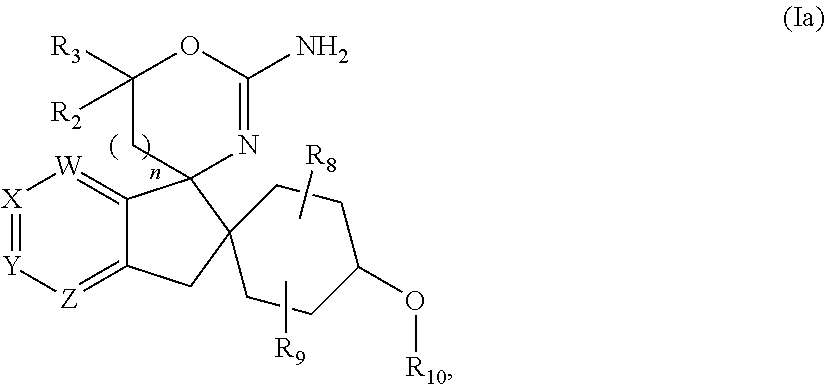
such as a compound of formula (Ia′),

or a prodrug thereof, or a pharmaceutically acceptable salt of the compound of formula (Ia) or (Ia′) or its prodrug, wherein:
- X, Y, Z, and W each independently represent N or CR1;
- n is 0 or 1;
- R1, independently for each occurrence, is selected from hydrogen, halogen, CN, and optionally substituted alkyl, alkenyl, alkynyl, alkoxy, aryl, heteroaryl, or oxime;
- R2 and R3 are independently selected from protium, deuterium, tritium, and optionally substituted alkyl (e.g., lower alkyl);
- R8 and R9, independently for each occurrence, represent hydrogen or optionally substituted alkyl (e.g., lower alkyl, such as methyl or ethyl), or R8 and R9 when bound to the same carbon, taken together with the carbon to which they are attached, form a carbocyclic ring, such as a C3-6 carbocyclic ring; and
- R10 represents hydrogen or an optionally substituted alkyl (e.g., optionally substituted lower alkyl).

such as a compound of formula (Ib′),

or a prodrug thereof, or a pharmaceutically acceptable salt of the compound of formula (Ib) or (Ib′) or its prodrug, wherein:
- Y, Z, and W each independently represent N or CR1;
- n is 0 or 1;
- R1, independently for each occurrence, is selected from hydrogen, halogen, CN, and optionally substituted alkyl, alkenyl, alkynyl, alkoxy, aryl, heteroaryl, or oxime;
- R2 and R3 are independently selected from protium, deuterium, tritium, and optionally substituted alkyl (e.g., lower alkyl);
- R8 and R9, independently for each occurrence, represent hydrogen or optionally substituted alkyl (e.g., lower alkyl, such as methyl or ethyl), or R8 and R9 when bound to the same carbon, taken together with the carbon to which they are attached, form a carbocyclic ring, such as a C3-6 carbocyclic ring (e.g., cyclopropyl ring); and
- R10 represents hydrogen or an optionally substituted alkyl (e.g., optionally substituted lower alkyl, such as methyl or d3-methyl).

or a prodrug thereof, or a pharmaceutically acceptable salt of the compound of formula (I) or its prodrug, wherein:
- A represents O, CH2, CH2CH2, S, or SO2;
- X, Y, Z, and W each independently represent N or CR1;
- n is 0 or 1;
- R1, independently for each occurrence, is selected from hydrogen, halogen, CN, and optionally substituted alkyl, alkenyl, alkynyl, alkoxy, aryl, heteroaryl, or oxime;
- R2 and R3 are independently selected from protium, deuterium, tritium, and optionally substituted alkyl (e.g., lower alkyl), provided that when n is 1, R2 and R3 are independently selected from protium, deuterium, and tritium; and
- R6 and R7 are independently selected from hydrogen, halogen, and optionally substituted alkyl, alkoxyalkyl, cycloalkyl, or heterocycloalkyl, provided that R6 and R7 are not simultaneously hydrogen, and further provided that when A is CH2CH2 and n is 0, R6 and R7 are not simultaneously lower alkyl, such as methyl; or
- R6 and R7 together with the carbon to which they are attached, form an optionally substituted carbocyclic or heterocyclic ring, such as a 3-14 membered carbocyclic or heterocyclic ring.


In certain such embodiments, R6 and R7, together with the carbon to which they are attached, form a ring with the structure


In certain such embodiments, R6 and R7, together with the carbon to which they are attached, form a ring with the structure


such as

In certain such embodiments, two occurrences of R12 bound to the same carbon, taken together with the carbon to which they are attached, form a carbocyclic ring, for example, R6 and R7 form a ring with a structure


such as a compound of formula (Ia′)

or a prodrug thereof, or a pharmaceutically acceptable salt of the compound of formula (Ia) or (Ia′) or its prodrug, wherein:
- X, Y, Z, and W each independently represent N or CR1;
- n is 0 or 1;
- R1, independently for each occurrence, is selected from hydrogen, halogen, CN, and optionally substituted alkyl, alkenyl, alkynyl, alkoxy, aryl, heteroaryl, or oxime;
- R2 and R3 are independently selected from protium, deuterium, tritium, and optionally substituted alkyl (e.g., lower alkyl);
- R8 and R9, independently for each occurrence, represent hydrogen or optionally substituted alkyl (e.g., lower alkyl, such as methyl or ethyl), or R8 and R9 when bound to the same carbon, taken together with the carbon to which they are attached, form a carbocyclic ring, such as a C3-6 carbocyclic ring (e.g., cyclopropyl ring); and
- R10 represents hydrogen or an optionally substituted alkyl (e.g., optionally substituted lower alkyl, such as methyl or d3-methyl).

such as a compound of formula (Ib′),

or a prodrug thereof, or a pharmaceutically acceptable salt of the compound of formula (Ib) or (Ib′) or its prodrug, wherein:
- Y, Z, and W each independently represent N or CR1;
- n is 0 or 1;
- R1, independently for each occurrence, is selected from hydrogen, halogen, CN, and optionally substituted alkyl, alkenyl, alkynyl, alkoxy, aryl, heteroaryl, or oxime;
- R2 and R3 are independently selected from protium, deuterium, tritium, and optionally substituted alkyl (e.g., lower alkyl);
- R8 and R9, independently for each occurrence, represent hydrogen or optionally substituted alkyl (e.g., lower alkyl, such as methyl or ethyl), or R8 and R9 when bound to the same carbon, taken together with the carbon to which they are attached, form a carbocyclic ring, such as a C3-6 carbocyclic ring (e.g., cyclopropyl ring); and
- R10 represents hydrogen or an optionally substituted alkyl (e.g., optionally substituted lower alkyl, such as methyl or d3-methyl).


wherein each R30 independently represent a hydrogen or hydrocarbyl group, or two R30 are taken together with the N atom to which they are attached complete a heterocycle having from 4 to 8 atoms in the ring structure.

wherein each R30 independently represents a hydrogen or a hydrocarbyl group, or two R30 are taken together with the N atom to which they are attached complete a heterocycle having from 4 to 8 atoms in the ring structure.

wherein R29 and R30 independently represent hydrogen or a hydrocarbyl group, such as an alkyl group, or R29 and R30 taken together with the intervening atom(s) complete a heterocycle having from 4 to 8 atoms in the ring structure.

wherein R29 and R30 independently represents hydrogen or hydrocarbyl, such as alkyl, or R29 and R30 taken together with the intervening atom(s) complete a heterocycle having from 4 to 8 atoms in the ring structure.

wherein R29 and R30 independently represent hydrogen or a hydrocarbyl, such as alkyl, or either occurrence of R29 taken together with R30 and the intervening atom(s) complete a heterocycle having from 4 to 8 atoms in the ring structure.
- ACN acetonitrile;
- aq aqueous;
- Atm atmospheric pressure;
- Boc t-butoxycarbonyl;
- Borax di-sodium tetraborate or sodium borate or sodium tetraborate;
- Cbz benzyloxycarbonyl;
- CDI 1,1′-carbonyldiimidazole;
- dba dibenzylideneacetone;
- DCM dichloromethane;
- DEA diethylamine;
- DIBAL-H diisobutylaluminium hydride;
- DIPEA diisopropylethylamine;
- DME 1,2-dimethoxyethane;
- DMF N,N-dimethyl formamide;
- DMSO dimethyl sulfoxide;
- Et2O diethyl ether;
- EtOAc ethyl acetate;
- EtOH ethanol;
- eq. or equiv. equivalent;
- h hour(s);
- HATU 2-(7-aza-1H-benzotriazole-1-yl)-1,1,3,3-tetramethyluronium hexafluorophosphate;
- HBTU O-benzotriazole-N,N,N′,N′-tetramethyluronium hexafluorophosphate
- HPLC high performance liquid chromatography;
- LCMS liquid chromatography mass spectrometry;
- LDA lithium diisopropylamide;
- LiHMDS lithium bis(trimethylsilyl)amide;
- MeOH methanol;
- min minute(s);
- MS mass spectrometry;
- MW microwave(s);
- NH4OAc ammonium acetate;
- NMR nuclear magnetic resonance;
- ox oxidation;
- Psi pounds per square inch;
- quant. quantitative;
- RCM ring closing metathesis;
- r.t. room temperature;
- sat. saturated;
- SFC supercritical fluid chromatography;
- T3P propylphosphonic anhydride;
- TFA trifluoroacetic acid;
- THF tetrahydrofuran;
- TLC thin layer chromatography;
- TMEDA tetramethylethylenediamine;
- UPLC ultra performance liquid chromatography.
Synthesis of Compounds (a)-(v)


- Isomer 1: (1r,4r)-6′-Bromo-4-hydroxyspiro[cyclohexane-1,2′-inden]-1′(3′H)-one

- Isomer 2: (1s,4s)-6′-bromo-4-hydroxyspiro[cyclohexane-1,2′-inden]-1′(3′H)-one


- Isomer 1: (1r,4r)-6′-bromo-4-methoxyspiro[cyclohexane-1,2′-inden]-1′(3′H)-one

- and Isomer 2: (1s,4s)-6′-bromo-4-methoxyspiro[cyclohexane-1,2′-inden]-1′(3′H)-one


- Isomer 1: solids (2.21 g). 1H NMR (400 MHz, CDCl3) δ ppm 1.15-1.60 (6H, m), 1.94-2.03 (2H, m), 2.67 (1H, d), 2.84 (1H, d), 3.04-3.14 (1H, m), 3.33 (3H, s), 4.35 (2H, br, s), 7.03 (1H, d), 7.28 (1H, dd), 7.33 (1H, d). LCMS: rt=2.72 min, m/z=367/369 [M+H]+, purity=99% (e=98%).
- Isomer 2: solids (2.08 g). 1H NMR (400 MHz, CDCl3) δ ppm 1.15-1.59 (6H, m), 1.92-2.03 (2H, m), 2.66 (1H, d), 2.84 (1H, d), 3.03-3.13 (1H, m), 3.33 (3H, s), 4.35 (2H, br, s), 7.02 (1H, d), 7.28 (1H, dd), 7.32 (1H, d). LCMS: rt=2.72 min, m/z=367/369 [M+H]+, purity=100% (ee=100%).


- Isomer 1: solids (410 mg). 1H NMR (400 MHz, CDCl3) δ ppm 0.96 (3H, d), 1.14-1.36 (3H, m), 1.43-1.62 (3H, m), 2.02-2.11 (1H, m), 2.60-2.73 (2H, m), 2.88 (1H, d), 3.36 (3H, s), 7.05 (1H, d), 7.31 (1H, dd), 7.34 (1H, d). LCMS: rt=3.33 min, m/z=381/383 [M+H]+, purity=99% (ee=100%).
- Isomer 2: solids (419 mg). 1H NMR (400 MHz, CDCl3) δ ppm 0.80-0.92 (4H, m), 1.05-1.58 (6H, m), 1.93-2.03 (1H, m), 2.56-2.67 (1H, m), 2.71 (2H, s), 5.91 (2H, br, s), 7.14 (1H, d), 7.19 (1H, s), 7.28 (1H, d). LCMS: rt=3.33 min, m/z=381/383 [M+H]+, purity=100% (ee=97%).
- Isomer 3: solids (398 mg). 1H NMR (400 MHz, CDCl3) δ ppm 0.89 (3H, d), 1.10-1.58 (6H, m), 1.94-2.04 (1H, m), 2.54-2.65 (2H, m), 2.78 (1H, d), 3.30 (3H, s), 6.97 (1H, d), 7.23 (1H, dd), 7.27 (1H, d). LCMS: rt=3.36 min, m/z=381/383 [M+H]+, purity=100% (ee=100%).
- Isomer 4: solids (505 mg). 1H NMR (400 MHz, CDCl3) δ ppm 0.95 (3H, d), 1.12-1.35 (3H, m), 1.41-1.61 (3H, m), 2.01-2.10 (1H, m), 2.60-2.73 (2H, m), 2.86 (1H, d), 3.35 (3H, s), 7.04 (1H, d), 7.29 (1H, dd), 7.33 (1H, d). LCMS: rt=3.35 min, m/z=381/383 [M+H]+, purity=98% (ee=98%).


- Isomer 1: solid (133 mg). 1H NMR (400 MHz, DMSO-d6) δ ppm 0.88 (3H, m), 1.06-1.25 (3H, m), 1.28-154 (3H, m), 1.94-2.03 (1H, m), 2.63 (1H, td), 2.72 (1H, s), 3.25 (3H, s), 3.98 (1H, d), 4.35 (1H, d), 5.96 (2H, br, s), 7.13 (1H, d), 7.20 (1H, s), 7.31 (1H, m). LCMS: rt=broad peak at 3.34 min, m/z=379/381 [M+H]+, purity=98% (ee=98%).
- Isomer 2: solid (78 mg). 1H NMR (400 MHz, CDCl3) δ ppm 0.90 (3H, m), 1.11-1.26 (3H, m), 1.31-1.58 (3H, m), 1.90-2.02 (1H, m), 2.54-2.66 (2H, m), 2.76 (1H, s), 3.29 (3H, s), 4.14 (1H, d), 4.53 (1H, d), 7.01 (1H, d), 7.27 (1H, dd), 7.30 (1H, d). LCMS: rt=broad peak at 3.35 min, m/z=379/381 [M+H]+, purity=99% (ee=99%).
- Isomer 3: solid (185 mg). 1H NMR (400 MHz, CDCl3) δ ppm 0.94 (3H, d), 1.14-1.28 (2H, m), 1.34-1.62 (4H, m), 2.00-2.09 (1H, m), 2.58-2.71 (2H, m), 2.84 (1H, d), 3.34 (3H, s), 4.12 (1H, d), 4.46 (1H, d), 7.02 (1H, d), 7.27 (1H, dd), 7.32 (1H, s). LCMS: rt=broad peak at 3.35 min, m/z=379/381 [M+H]+, purity=95% (ee=96%).
- Isomer 4: solid (184 mg). 1H NMR (400 MHz, DMSO-d6) δ ppm 0.88 (3H, m), 1.06-1.25 (3H, m), 1.28-154 (3H, m), 1.92-2.03 (1H, m), 2.55-2.65 (1H, m), 2.72 (2H, s), 3.25 (3H, s), 3.98 (1H, dd), 4.35 (1H, dd), 5.94 (2H, br, s), 7.13 (1H, dd), 7.19 (1H, s), 7.29 (1H, m). LCMS: rt=broad peak at 2.71 min, m/z=379/381 [M+H]+, purity=96% (ee=100%).


- Isomer 1: solids (302 mg). 1H NMR (400 MHz, CDCl3) δ ppm 0.79-0.82 (3H, m), 1.08-1.47 (6H, m), 1.62-1.77 (2H, m), 2.05-2.08 (1H, m), 2.66-2.77 (2H, m), 2.84-2.88 (1H, m), 3.05-3.70 (5H, m), 7.03 (1H, dd), 7.28-7.33 (2H, m). LCMS: rt=2.85 min, m/z=397 [M+H]+, purity=98% (ee=100%).
- Isomer 2: solids (313 mg). 1H NMR (400 MHz, CDCl3) δ ppm 0.79 (3H, t), 1.04-1.12 (1H, m), 1.17-1.27 (2H, m), 1.32-1.58 (4H, m), 1.72-1.81 (1H, m), 2.04-2.10 (1H, m), 2.64 (1H, d), 2.70-2.76 (1H, m), 2.85 (1H, d), 3.33 (3H, s), 7.03 (1H, d), 7.29 (1H, dd), 7.33 (1H, d), NH2 signals not observed. LCMS: rt=2.89 min, m/z=395 [M+H]+, purity=97.6% (ee=100%).
- Isomer 3: solids (492 mg). 1H NMR (400 MHz, CDCl3) δ ppm 0.74 (3H, t), 1.00-1.54 (7H, m), 1.66-1.77 (1H, m), 1.98-2.05 (1H, m), 2.60 (1H, d), 2.65-2.71 (1H, m), 2.79 (1H, d), 3.29 (3H, s), 6.98 (1H, d), 7.23 (1H, dd), 7.28 (1H, s), NH2 protons not observed. LCMS: rt=2.98 min, m/z=397 [M+H]+, purity=93.5% (ee=98.3%).
- Isomer 4: solids (394 mg). 1H NMR (400 MHz, CDCl3) δ ppm 0.75 (3H, t), 1.10-1.42 (6H, m), 1.58 (1H, dd), 1.65-1.75 (1H, m), 1.90-2.05 (1H, m), 2.63 (1H, d), 2.66-2.71 (1H, m), 2.80 (1H, d), 3.29 (3H, s), 6.99 (1H, d), 7.24 (1H, dd), 7.28 (1H, s), NH2 protons not observed. LCMS: rt=2.88 min, m/z=395 [M+H]+, purity=98.6% (ee=98.2%).


- Isomer 1: solids (982 mg). 1H NMR (400 MHz, DMSO-d6) δ ppm 0.88 (3H, m), 1.06-1.24 (3H, m), 1.28-1.52 (3H, m), 1.96 (1H, m), 2.55-2.65 (1H, m), 2.71 (1H, s), 5.94 (2H, br, s), 7.11-7.17 (1H, m), 7.20 (1H, s), 7.27-7.34 (1H, m). LCMS: rt=broad peak 3.36 min, m/z=384/386 [M+H]+, purity=98% (ee=100%).
- Isomer 2: solids (914 mg). 1H NMR (400 MHz, DMSO-d6) δ ppm 0.80 (4H, m), 0.99-1.12 (1H, m), 1.23 (1H, dd), 1.32-1.49 (3H, m), 1.86-1.96 (1H, m), 2.54 (1H, td), 2.66 (2H, s), 5.88 (2H, br, s), 7.07 (1H, d), 7.13 (1H, d), 7.24 (1H, dd). LCMS: rt=broad peak at 3.25 min, m/z=384/386 [M+H]+, purity=100% (ee=100%).
- Isomer 3: solids (920 mg). 1H NMR (400 MHz, DMSO-d6) δ ppm 0.80 (4H, m), 0.99-1.12 (1H, m), 1.23 (1H, dd), 1.32-1.49 (3H, m), 1.86-1.95 (1H, m), 2.54 (1H, td), 2.65 (2H, s), 5.88 (2H, br, s), 7.06 (1H, d), 7.13 (1H, d), 7.24 (1H, dd). LCMS: rt=broad peak at 3.27 min, m/z=384/386 [M+H]+, purity=97% (ee=98%).
- Isomer 4: solids (1.07 g). 1H NMR (400 MHz, DMSO-d6) δ ppm 0.88 (3H, m), 1.06-1.24 (3H, m), 1.30-1.52 (3H, m), 1.94-2.02 (1H, m), 2.62 (1H, td), 2.72 (1H, s), 5.94 (2H, br. s), 7.13 (1H, d), 7.20 (1H, d), 7.30 (1H, dd). LCMS: rt=broad peak 3.36 min, m/z=384/386 [M+H]+, purity=100% (ee=96%).


- Isomer 1: (6.0 mg, purity=98.2%, ee=100%)
- Isomer 2: (4.8 mg, purity=97.2%, ee=96%)
- Isomer 3: (9.1 mg, purity=99.4%, ee=99.7%)
- Isomer 4 (10.2 mg, purity=98.1%, ee=99.1%)


Human BACE2: the eDNA for the soluble part of the human β-Secretase2 (AA1-AA473) was cloned using BACE2(1-473)-(AVT)-Fc-pDEST12.2 mammalian expression vector. The gene was fused to the Fe domain of IgG1 (affinity tag) and stably cloned into HEK 293 cells. Purified sBACE-Fc was stored in −80° C. in 50 mM Glycine, 10 mM Tris-HCl, pH 7-8, and had a purity of ˜70%.
| TABLE 1 |
| IC50 values of compounds 1-43, 45-53, and 56- |
| 120 in cells measured with aTR-FRET assay, diluted |
| TR-FRET assay, or SAPPβ release assay. |
| Cell | BACE1 | BACE2 | |
| (sAPPβ release, | (dil. TR-FRET, | (TR-FRET, | |
| Compound | nM) | nM) | nM) |
| 1 | 5.3 | 239 | 144 |
| 2 | 0.27 | 6.2 | 17 |
| 3 | 0.20 | 1.1 | 16 |
| 4 | 0.39 | 6.8 | 37.8 |
| 5 | 1.6 | 32.5 | 888 |
| 6 | 2.2 | 54 | 99 |
| 7 | 0.45 | 11.7 | 22.7 |
| 8 | 0.76 | 54.7 | 716 |
| 9 | 0.50 | 31 | 118 |
| 10 | 0.89 | 129 | 2033 |
| 11 | 0.90 | 266 | 518.9 |
| 12 | 5.9 | 135 | 128 |
| 13 | 1.7 | 161 | 217 |
| 14 | 1.1 | 21.3 | 931 |
| 15 | 1.1 | 16 | 23 |
| 16 | 3.8 | 127.7 | 105.5 |
| 17 | 2.1 | 46.7 | 30.2 |
| 18 | 3.3 | 43.7 | 29.3 |
| 19 | 2.0 | 243.9 | 43.6 |
| 20 | 2.9 | 143 | 186 |
| 21 | 1.6 | 67 | 256 |
| 22 | 1.5 | 67 | 1348 |
| 23 | 1.5 | 7.3 | 21.4 |
| 24 | 3.2 | 18 | 18 |
| 25 | 1.8 | 27 | 135 |
| 26 | 2.6 | 19.6 | 78.4 |
| 27 | 2.8 | 12 | 24.7 |
| 28 | 1.6 | 67 | 255 |
| 29 | 2.6 | 55.7 | 79.2 |
| 30 | 11.3 | 169 | 344 |
| 31 | 2.4 | 24.3 | 90.8 |
| 32 | 2.8 | 7.3 | 26.2 |
| 33 | 2.2 | 81 | 1519 |
| 34 | 0.5 | 11.7 | 22.7 |
| 35 | 4.8 | 15.3 | 28.2 |
| 36 | 4.0 | 150 | 27 |
| 37 | 3.7 | 12.8 | 17.4 |
| 38 | 4.3 | 166 | 315 |
| 39 | 4.3 | 4.7 | 50.7 |
| 40 | 4.4 | 32.9 | 118 |
| 41 | 5.1 | 1554 | 907 |
| 42 | 7.3 | 307 | 221 |
| 43 | 7.5 | 13.6 | 193.6 |
| 45 | 7.8 | 289 | 589 |
| 46 | 8.8 | 218.7 | 300 |
| 47 | 9.1 | 151.6 | 2220 |
| 48 | 10.5 | 2106 | 1054 |
| 49 | 15.8 | 166 | 69 |
| 50 | 16 | 579 | >5000 |
| 51 | 20.6 | 188 | 306 |
| 52 | 4.3 | 4.7 | 50.7 |
| 53 | 24.8 | 664.5 | 652 |
| 56 | 57 | 1633 | 3235 |
| 57 | 94.8 | 341 | >5000 |
| 58 | 102 | 301 | 139 |
| 59 | 128 | 2249 | 4992 |
| 60 | 206 | >5000 | >5000 |
| 61 | 207 | 1964 | 3435 |
| 62 | 250 | >5000 | >5000 |
| 63 | 266 | 1461 | >5000 |
| 64 | 307 | >5000 | >5000 |
| 65 | >5000 | >5000 | >5000 |
| 66 | <0.16 | 41 | 133.7 |
| 67 | 1.7 | 55 | 736 |
| 68 | 1.9 | 63 | 2777 |
| 69 | 17 | 423 | >5000 |
| 70 | 26.6 | 1131 | >5000 |
| 71 | 1.3 | 30 | 1087 |
| 72 | 3.6 | 203 | >5000 |
| 73 | 6.1 | 223.9 | 2775 |
| 74 | 0.39 | 27 | 1051 |
| 75 | 0.9 | 46.9 | 598 |
| 76 | 0.5 | 26.9 | 230.6 |
| 77 | 7.5 | 497 | 505 |
| 78 | 1.5 | 105 | 895 |
| 79 | 2.1 | 53.5 | 207 |
| 80 | <0.16 | 45 | 600 |
| 81 | 17 | 423 | >5000 |
| 82 | 23 | 138 | 1790 |
| 83 | nd | nd | nd |
| 84 | 4.8 | 88.7 | 102.6 |
| 85 | 3.5 | 31.8 | 62.5 |
| 86 | 5.9 | 144 | 4749 |
| 87 | 4.7 | 262 | 3483 |
| 88 | 450 | 1954 | 340 |
| 89 | 889 | >5000 | >5000 |
| 90 | 715 | >5000 | >5000 |
| 91 | 330.9 | 4664 | 701.4 |
| 92 | 222.8 | 4162 | 436.8 |
| 93 | 560.7 | >5000 | 1215 |
| 94 | 330.9 | 4664 | 701.4 |
| 95 | 889.1 | >5000 | >5000 |
| 96 | 204.7 | >5000 | 1789 |
| 97 | 1418 | >5000 | >5000 |
| 98 | 1839 | >5000 | >1581 |
| 99 | 489 | 3187 | 519 |
| 100 | 2165 | >5000 | 1368 |
| 101 | 75.6 | 194 | 274 |
| 102 | 32.9 | 2191 | >5000 |
| 103 | 0.6 | 22 | 55 |
| 104 | 0.7 | 77 | 1012 |
| 105 | 0.4 | 13 | 71 |
| 106 | 2.8 | 49 | 80 |
| 107 | 1.8 | 294 | 2113 |
| 108 | 1.5 | 56 | 58 |
| 109 | 1.8 | 123 | 458 |
| 110 | 10 | 67 | 96 |
| 111 | 89 | 2163 | >5000 |
| 112 | 14 | 2031 | 4819 |
| 113 | 0.2 | 17 | 64 |
| 114 | 8 | 770 | 1840 |
| 115 | 13 | 346 | 2225 |
| 116 | 26 | 1131 | >5000 |
| 117 | 7 | 341 | 1791 |
| 118 | 6 | 287 | 2749 |
| 119 | 13 | 294 | 1090 |
| 120 | 7 | 191 | 1629 |
Claims (25)


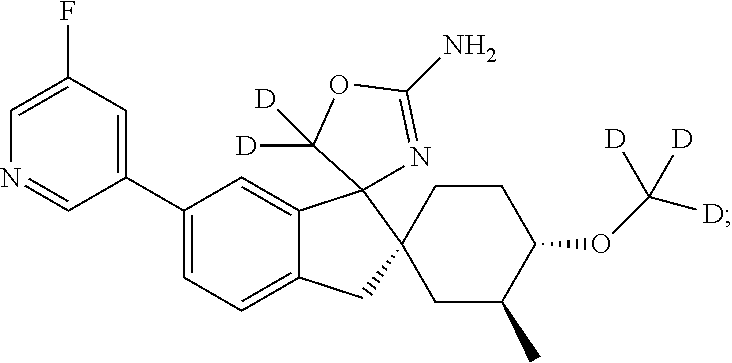


Priority Applications (1)
| Application Number | Priority Date | Filing Date | Title |
|---|---|---|---|
| US15/516,848 US10053453B2 (en) | 2014-10-07 | 2015-10-07 | Compounds and their use as BACE inhibitors |
Applications Claiming Priority (3)
| Application Number | Priority Date | Filing Date | Title |
|---|---|---|---|
| US201462060752P | 2014-10-07 | 2014-10-07 | |
| PCT/IB2015/002101 WO2016055858A1 (en) | 2014-10-07 | 2015-10-07 | Compounds and their use as bace inhibitors |
| US15/516,848 US10053453B2 (en) | 2014-10-07 | 2015-10-07 | Compounds and their use as BACE inhibitors |
Publications (2)
| Publication Number | Publication Date |
|---|---|
| US20170313686A1 US20170313686A1 (en) | 2017-11-02 |
| US10053453B2 true US10053453B2 (en) | 2018-08-21 |
Family
ID=55652644
Family Applications (1)
| Application Number | Title | Priority Date | Filing Date |
|---|---|---|---|
| US15/516,848 Active US10053453B2 (en) | 2014-10-07 | 2015-10-07 | Compounds and their use as BACE inhibitors |
Country Status (5)
| Country | Link |
|---|---|
| US (1) | US10053453B2 (en) |
| AR (1) | AR102202A1 (en) |
| TW (1) | TW201629025A (en) |
| UY (1) | UY36347A (en) |
| WO (1) | WO2016055858A1 (en) |
Families Citing this family (4)
| Publication number | Priority date | Publication date | Assignee | Title |
|---|---|---|---|---|
| WO2019122268A1 (en) | 2017-12-21 | 2019-06-27 | Astrazeneca Ab | Processes for the stereoselective preparation of bace inhibitors |
| WO2019122421A1 (en) | 2017-12-22 | 2019-06-27 | Astrazeneca Ab | Stereoselective ketone reduction using a ketoreductase enzyme |
| WO2019129750A1 (en) | 2017-12-29 | 2019-07-04 | Astrazeneca Ab | Processes for the racemization of dihydroimidazole ring systems |
| WO2019129755A1 (en) | 2017-12-29 | 2019-07-04 | Astrazeneca Ab | Ketal hydrogenation |
Citations (14)
| Publication number | Priority date | Publication date | Assignee | Title |
|---|---|---|---|---|
| WO2009064418A1 (en) | 2007-11-14 | 2009-05-22 | Amgen Inc. | Substituted hydroxyethyl amine compounds as beta-secretase modulators and methods of use |
| WO2010105179A2 (en) | 2009-03-13 | 2010-09-16 | Vitae Pharmaceuticals, Inc. | Inhibitors of beta-secretase |
| WO2011123674A1 (en) | 2010-03-31 | 2011-10-06 | Array Biopharma Inc. | Compounds for treating neurodegenerative diseases |
| US20120165347A1 (en) | 2010-12-22 | 2012-06-28 | Astrazeneca Ab | Compounds and their use as BACE Inhibitors |
| WO2012163790A1 (en) | 2011-05-27 | 2012-12-06 | F. Hoffmann-La Roche Ag | Spiro-[1,3]-oxazines and spiro-[1,4]-oxazepines as bace1 and/or bace2 inhibitors |
| WO2013044092A1 (en) | 2011-09-21 | 2013-03-28 | Amgen Inc. | Amino-oxazines and amino-dihydrothiazine compounds as beta-secretase modulators and methods of use |
| WO2013134085A1 (en) | 2012-03-05 | 2013-09-12 | Boehringer Ingelheim International Gmbh | Inhibitors of beta-secretase |
| WO2013181202A2 (en) | 2012-05-30 | 2013-12-05 | Astellas Pharma Inc. | Chromane compounds |
| US20130345272A1 (en) | 2012-06-20 | 2013-12-26 | Astrazeneca Ab | Cycloalkyl Ether Compounds and Their Use as Bace Inhibitors |
| US20130345246A1 (en) | 2012-06-20 | 2013-12-26 | Astrazeneca Ab | 2H-Imidazol-4-Amine Compounds and Their Use as Bace Inhibitors |
| US20130345247A1 (en) | 2012-06-20 | 2013-12-26 | Astrazeneca Ab | Cyclohexane-1,2'-Indene-1',2"-Imidazol Compounds and Their Use as Bace Inhibitors |
| US20130345248A1 (en) | 2012-06-20 | 2013-12-26 | Astrazeneca Ab | Cyclohexane-1,2'-Naphthalene-1',2"-Imidazol Compounds and Their Use as Bace |
| US20140031379A1 (en) | 2012-06-21 | 2014-01-30 | Astrazeneca Ab | Camsylate Salt |
| US20140288091A1 (en) | 2011-10-10 | 2014-09-25 | Astrazeneca Ab | Mono-fluoro beta-secretase inhibitors |
-
2015
- 2015-10-07 US US15/516,848 patent/US10053453B2/en active Active
- 2015-10-07 TW TW104133098A patent/TW201629025A/en unknown
- 2015-10-07 UY UY0001036347A patent/UY36347A/en not_active Application Discontinuation
- 2015-10-07 AR ARP150103240A patent/AR102202A1/en unknown
- 2015-10-07 WO PCT/IB2015/002101 patent/WO2016055858A1/en not_active Ceased
Patent Citations (17)
| Publication number | Priority date | Publication date | Assignee | Title |
|---|---|---|---|---|
| WO2009064418A1 (en) | 2007-11-14 | 2009-05-22 | Amgen Inc. | Substituted hydroxyethyl amine compounds as beta-secretase modulators and methods of use |
| WO2010105179A2 (en) | 2009-03-13 | 2010-09-16 | Vitae Pharmaceuticals, Inc. | Inhibitors of beta-secretase |
| WO2011123674A1 (en) | 2010-03-31 | 2011-10-06 | Array Biopharma Inc. | Compounds for treating neurodegenerative diseases |
| US20120165347A1 (en) | 2010-12-22 | 2012-06-28 | Astrazeneca Ab | Compounds and their use as BACE Inhibitors |
| US20130210837A1 (en) | 2010-12-22 | 2013-08-15 | Astrazeneca Intellectual Property | Compounds and Their Use as BACE Inhibitors |
| US20160184303A1 (en) | 2010-12-22 | 2016-06-30 | Astrazeneca Ab | Compounds and their use as bace inhibitors |
| US20150133471A1 (en) | 2010-12-22 | 2015-05-14 | Astrazeneca Ab | Compounds and their use as bace inhibitors |
| WO2012163790A1 (en) | 2011-05-27 | 2012-12-06 | F. Hoffmann-La Roche Ag | Spiro-[1,3]-oxazines and spiro-[1,4]-oxazepines as bace1 and/or bace2 inhibitors |
| WO2013044092A1 (en) | 2011-09-21 | 2013-03-28 | Amgen Inc. | Amino-oxazines and amino-dihydrothiazine compounds as beta-secretase modulators and methods of use |
| US20140288091A1 (en) | 2011-10-10 | 2014-09-25 | Astrazeneca Ab | Mono-fluoro beta-secretase inhibitors |
| WO2013134085A1 (en) | 2012-03-05 | 2013-09-12 | Boehringer Ingelheim International Gmbh | Inhibitors of beta-secretase |
| WO2013181202A2 (en) | 2012-05-30 | 2013-12-05 | Astellas Pharma Inc. | Chromane compounds |
| US20130345248A1 (en) | 2012-06-20 | 2013-12-26 | Astrazeneca Ab | Cyclohexane-1,2'-Naphthalene-1',2"-Imidazol Compounds and Their Use as Bace |
| US20130345247A1 (en) | 2012-06-20 | 2013-12-26 | Astrazeneca Ab | Cyclohexane-1,2'-Indene-1',2"-Imidazol Compounds and Their Use as Bace Inhibitors |
| US20130345246A1 (en) | 2012-06-20 | 2013-12-26 | Astrazeneca Ab | 2H-Imidazol-4-Amine Compounds and Their Use as Bace Inhibitors |
| US20130345272A1 (en) | 2012-06-20 | 2013-12-26 | Astrazeneca Ab | Cycloalkyl Ether Compounds and Their Use as Bace Inhibitors |
| US20140031379A1 (en) | 2012-06-21 | 2014-01-30 | Astrazeneca Ab | Camsylate Salt |
Non-Patent Citations (9)
| Title |
|---|
| Banker et al., Prodrugs, Modern Pharmaceutics, Third Edition, Revised and Expanded, pp. 451 and 596 (1996). * |
| Bundgaard, Design of Prodrugs, p. 1, 1985. * |
| Damasio, Alzheimer's Disease and related dementias, Cecil Textbook of Medicine, 20th Edition, vol. 2, pp. 1992-6, 1996. * |
| Huang, et al., "Structure- and Property-Based Design of Aminooxazoline Xanthenes as Selective, Orally Efficacious, and CNS Penetrable BACE Inhibitors for the Treatment of Alzheimer's Disease," The Journal of Medicinal Chemistry, 55, pp. 9156-9169 (2012). |
| Layzer, Degenerative Diseases of the Nervous System, Cecil Textbook of Medicine, 20th Edition, vol. 2, pp. 2050-2057, 1996. * |
| Oh et al., Maximizing the Potential of Plasma Amyloid-Beta as a Diagnostic Biomarker for Alzheimer's Disease, Neuromol Med (2008) 10:195-207. * |
| Silverman, Prodrugs and Drug Delivery Systems, The Organic Chemistry of Drug Design and Drug Action, pp. 352-399, 1992. * |
| Wolff, Some consideration for prodrug design, Burger's Medicinal Chemistry and Drug Discovery, 5th Edition, vol. 1: Principles and Practice, pp. 975-977, 1995. * |
| Zlokovic, New Therapeutic Targets in the Neurovascular Pathway in Alzheimer's Disease, Neurotherapeutics, vol. 5, No. 3, pp. 409-414 (2008). * |
Also Published As
| Publication number | Publication date |
|---|---|
| US20170313686A1 (en) | 2017-11-02 |
| WO2016055858A1 (en) | 2016-04-14 |
| TW201629025A (en) | 2016-08-16 |
| UY36347A (en) | 2016-04-01 |
| AR102202A1 (en) | 2017-02-08 |
Similar Documents
| Publication | Publication Date | Title |
|---|---|---|
| AU2019404934B2 (en) | Macrocyclic compounds and their use in the treatment of disease | |
| EP2547664B1 (en) | Morpholinylquinazolines | |
| AU2012324803B9 (en) | (hetero)aryl cyclopropylamine compounds as LSD1 inhibitors | |
| KR102220175B1 (en) | Heterocyclic glutaminase inhibitors | |
| JP5883399B2 (en) | Pyrazolopyridine, pyrazolopyrazine, pyrazolopyrimidine, pyrazolothiophene and pyrazolothiazole compounds, compositions, and methods of treating neurological dysfunction as mGluR4 allosteric potentiators | |
| US20150133471A1 (en) | Compounds and their use as bace inhibitors | |
| EP2780332B1 (en) | Morpholinylbenzotriazines for use in cancer therapy | |
| WO2017009806A1 (en) | Substituted aza compounds as irak-4 inhibitors | |
| EP2588457B1 (en) | Pyrazoloquinoline derivatives as dna-pk inhibitors | |
| JP2013526544A (en) | Heterocyclic sulfone mGluR4 allosteric enhancer, composition, and method of treating neurological dysfunction | |
| EA030631B1 (en) | 1,4-disubstituted pyridazine quinoline derivatives and methods for treating smn-deficiency-related conditions | |
| AU2018346331B2 (en) | Small molecule inhibition of transcription factor SALL4 and uses thereof | |
| JP2013510178A (en) | Aryl and heteroaryl sulfones as mGluR4 allosteric enhancers, compositions, and methods of treating neurological dysfunction | |
| JP2021519269A (en) | Piperazine azaspiro derivative | |
| JP2008531679A (en) | 1,2,4-Triazole derivatives and their use as oxytocin antagonists | |
| JP2024160326A (en) | EAAT2 activators and methods of use thereof | |
| US20090221642A1 (en) | Muscarinic receptor agonists, compositions, methods of treatment thereof, and processes for preparation thereof-176 | |
| US20170313686A1 (en) | Compounds and their use as bace inhibitors | |
| JP2021531335A (en) | Bicyclic inhibitor of histone deacetylase | |
| US11479539B2 (en) | Small molecule modulators of the BTB domain of Keap1 | |
| JP2021531336A (en) | Histone deacetylase inhibitor | |
| EP2791135B1 (en) | Anabasine derivatives targeting the nicotinic acetylcholine receptors | |
| US12479852B2 (en) | Compounds, compositions, and methods for protein degradation | |
| US20070099950A1 (en) | Pyridin-4-ylamine compounds useful in the treatment of neuropathic pain | |
| WO2023060173A1 (en) | Compounds, compositions and methods of use |
Legal Events
| Date | Code | Title | Description |
|---|---|---|---|
| AS | Assignment |
Owner name: SPRINT BIOSCIENCE, SWEDEN Free format text: ASSIGNMENT OF ASSIGNORS INTEREST;ASSIGNOR:KOLMODIN, KARIN;REEL/FRAME:043679/0586 Effective date: 20150911 Owner name: ASTRAZENECA PHARMACEUTICALS LP, DELAWARE Free format text: ASSIGNMENT OF ASSIGNORS INTEREST;ASSIGNORS:HOLENZ, JOERG;DUGGAN, MARK;REEL/FRAME:043679/0516 Effective date: 20150928 Owner name: CHARNWOOD MOLECULAR LTD., UNITED KINGDOM Free format text: ASSIGNMENT OF ASSIGNORS INTEREST;ASSIGNORS:THORNE, PHILIP VELLACOTT;MCKENZIE, MICHAEL JOHN;SIGNING DATES FROM 20150909 TO 20150911;REEL/FRAME:043679/0656 Owner name: ASTRAZENECA UK LIMITED, ENGLAND Free format text: ASSIGNMENT OF ASSIGNORS INTEREST;ASSIGNOR:MEDIMMUNE LIMITED;REEL/FRAME:043679/0716 Effective date: 20151002 Owner name: ASTRAZENECA AB, SWEDEN Free format text: ASSIGNMENT OF ASSIGNORS INTEREST;ASSIGNOR:ASTRAZENECA UK LIMITED;REEL/FRAME:043679/0804 Effective date: 20151002 Owner name: ASTRAZENECA PHARMACEUTICALS LP, DELAWARE Free format text: ASSIGNMENT OF ASSIGNORS INTEREST;ASSIGNOR:CHARNWOOD MOLECULAR LTD.;REEL/FRAME:043679/0770 Effective date: 20151001 Owner name: ASTRAZENECA UK LIMITED, ENGLAND Free format text: ASSIGNMENT OF ASSIGNORS INTEREST;ASSIGNOR:ASTRAZENECA PHARMACEUTICALS LP;REEL/FRAME:043679/0800 Effective date: 20151002 Owner name: MEDIMMUNE LIMITED, UNITED KINGDOM Free format text: ASSIGNMENT OF ASSIGNORS INTEREST;ASSIGNOR:BUERLI, ROLAND;REEL/FRAME:043923/0239 Effective date: 20150929 Owner name: ASTRAZENECA PHARMACEUTICALS LP, DELAWARE Free format text: ASSIGNMENT OF ASSIGNORS INTEREST;ASSIGNOR:SPRINT BIOSCIENCE;REEL/FRAME:043989/0917 Effective date: 20150930 Owner name: ASTRAZENECA AB, SWEDEN Free format text: ASSIGNMENT OF ASSIGNORS INTEREST;ASSIGNOR:JOHANSSON, PATRIK;REEL/FRAME:043989/0440 Effective date: 20150909 |
|
| STCF | Information on status: patent grant |
Free format text: PATENTED CASE |
|
| CC | Certificate of correction | ||
| MAFP | Maintenance fee payment |
Free format text: PAYMENT OF MAINTENANCE FEE, 4TH YEAR, LARGE ENTITY (ORIGINAL EVENT CODE: M1551); ENTITY STATUS OF PATENT OWNER: LARGE ENTITY Year of fee payment: 4 |
|
| FEPP | Fee payment procedure |
Free format text: MAINTENANCE FEE REMINDER MAILED (ORIGINAL EVENT CODE: REM.); ENTITY STATUS OF PATENT OWNER: LARGE ENTITY |