US10050721B2 - Neutrino communication system - Google Patents
Neutrino communication system Download PDFInfo
- Publication number
- US10050721B2 US10050721B2 US14/166,100 US201414166100A US10050721B2 US 10050721 B2 US10050721 B2 US 10050721B2 US 201414166100 A US201414166100 A US 201414166100A US 10050721 B2 US10050721 B2 US 10050721B2
- Authority
- US
- United States
- Prior art keywords
- neutrino
- laser
- antineutrino
- emitter
- coherent
- Prior art date
- Legal status (The legal status is an assumption and is not a legal conclusion. Google has not performed a legal analysis and makes no representation as to the accuracy of the status listed.)
- Active, expires
Links
Images




Classifications
-
- H—ELECTRICITY
- H04—ELECTRIC COMMUNICATION TECHNIQUE
- H04B—TRANSMISSION
- H04B10/00—Transmission systems employing electromagnetic waves other than radio-waves, e.g. infrared, visible or ultraviolet light, or employing corpuscular radiation, e.g. quantum communication
- H04B10/90—Non-optical transmission systems, e.g. transmission systems employing non-photonic corpuscular radiation
-
- G—PHYSICS
- G09—EDUCATION; CRYPTOGRAPHY; DISPLAY; ADVERTISING; SEALS
- G09B—EDUCATIONAL OR DEMONSTRATION APPLIANCES; APPLIANCES FOR TEACHING, OR COMMUNICATING WITH, THE BLIND, DEAF OR MUTE; MODELS; PLANETARIA; GLOBES; MAPS; DIAGRAMS
- G09B23/00—Models for scientific, medical, or mathematical purposes, e.g. full-sized devices for demonstration purposes
-
- H—ELECTRICITY
- H04—ELECTRIC COMMUNICATION TECHNIQUE
- H04B—TRANSMISSION
- H04B13/00—Transmission systems characterised by the medium used for transmission, not provided for in groups H04B3/00 - H04B11/00
-
- G—PHYSICS
- G06—COMPUTING OR CALCULATING; COUNTING
- G06Q—INFORMATION AND COMMUNICATION TECHNOLOGY [ICT] SPECIALLY ADAPTED FOR ADMINISTRATIVE, COMMERCIAL, FINANCIAL, MANAGERIAL OR SUPERVISORY PURPOSES; SYSTEMS OR METHODS SPECIALLY ADAPTED FOR ADMINISTRATIVE, COMMERCIAL, FINANCIAL, MANAGERIAL OR SUPERVISORY PURPOSES, NOT OTHERWISE PROVIDED FOR
- G06Q10/00—Administration; Management
-
- G—PHYSICS
- G21—NUCLEAR PHYSICS; NUCLEAR ENGINEERING
- G21C—NUCLEAR REACTORS
- G21C17/00—Monitoring; Testing ; Maintaining
-
- H—ELECTRICITY
- H01—ELECTRIC ELEMENTS
- H01S—DEVICES USING THE PROCESS OF LIGHT AMPLIFICATION BY STIMULATED EMISSION OF RADIATION [LASER] TO AMPLIFY OR GENERATE LIGHT; DEVICES USING STIMULATED EMISSION OF ELECTROMAGNETIC RADIATION IN WAVE RANGES OTHER THAN OPTICAL
- H01S3/00—Lasers, i.e. devices using stimulated emission of electromagnetic radiation in the infrared, visible or ultraviolet wave range
- H01S3/09—Processes or apparatus for excitation, e.g. pumping
- H01S3/091—Processes or apparatus for excitation, e.g. pumping using optical pumping
- H01S3/094—Processes or apparatus for excitation, e.g. pumping using optical pumping by coherent light
- H01S3/0941—Processes or apparatus for excitation, e.g. pumping using optical pumping by coherent light of a laser diode
Definitions
- This invention relates to the communications art and in particular to the transfer of information by means of beams of modulated coherent neutrino and antineutrino waves between an emitter and receiver (detector).
- Neutrons which are composed of a proton and an electron, might be considered for communications, but free neutrons are heavily absorbed by nuclei present in the atmosphere, and decay into a proton, electron, and neutrino within 20 minutes.
- High-energy (MeV) neutrinos which are commonly produced by the decay of particles generated in particle accelerators and fission reactors have been suggested as possible information carriers for communication, and for in-earth radiography.
- MeV neutrinos which are commonly produced by the decay of particles generated in particle accelerators and fission reactors have been suggested as possible information carriers for communication, and for in-earth radiography.
- their high production cost and their poor detectability severely limit their usefulness for communication applications.
- the present application discloses a new technique and system for the generation, modulation, and detection/demodulation of coherent monochromatic sub-MeV neutrino and antineutrino beams.
- An entirely new neutrino wireless communication system is thereby described which will alleviate some of the present crowding of the electromagnetic spectrum.
- the neutrino wireless communication system is also ideal for secure communications because it utilizes coherent directed beams whose exact location must be known for interception to be possible.
- neutrino/antineutrino beam communications may be conducted through the earth, from one side to the other if desired, through bodies of water such as oceans and lakes, or through other solid or liquid matter.
- the low-energy neutrino system herein disclosed may be utilized for radiography of the earth's interior to locate ore bodies, oil deposits, aquifers and the like.
- neutrinos may be refracted and retarded by inhomogeneities in massive bodies. This allows for probing of the earth using neutrinos. For example, by use of two neutrino beam emitters with different frequencies, and by pulsing them simultaneously while scanning over an ore body, one can determine the ore body's extent by registering small differences in arrival times or displacements at two corresponding adjacent detectors.
- Nuclear particle research has discovered three classes of neutrinos; one type is emitted in beta (electron) decay, one is emitted in muon (heavy electron) decay, and one is emitted in tauon (super-heavy electron) decay. They are labeled ⁇ e , ⁇ ⁇ , and ⁇ ⁇ . Each has a corresponding antiparticle which we label ⁇ e , ⁇ ⁇ , and ⁇ ⁇ . Most observed neutrinos are ⁇ e neutrinos, emitted by nuclear reactions in the sun, which are found to have left-handed spins 1 ⁇ 2 along their directions of motion. Neutron decay in nuclear fission reactors produces mostly antineutrinos ⁇ e , which have right-handed spins 1 ⁇ 2 along their direction of propagation.
- Neutrinos are difficult to detect.
- high-energy (MeV) anti-neutrinos emitted by nuclear reactors can be detected via “inverse beta decay” events in which a proton inside a hydrogen nucleus meets an antineutrino and converts into a neutron and a positron (high energy positive electron), written in short-hand ⁇ +p ⁇ e + +n.
- ⁇ represents an antineutrino
- p is a proton
- e + is a positron
- n is a neutron.
- nuclei are much smaller than atoms or molecules, the encounter cross-sections for such events are many millions times smaller than interactions of photons with atoms or molecules.
- the neutrons and positrons produced in these inverse-beta-decay events can therefore be detected only by surrounding tons of a hydrogen-containing material like water with thousands of scintillation detectors.
- the “inverse-beta-decay” reaction has a kinematic threshold of 1.8 MeV for anti-neutrinos, below which it can not take place.
- MeV antineutrinos can be observed.
- inverse intra-nuclear reactions employing enormous masses of chlorine or gallium are used with similar MeV cut-off energies.
- MeV energies can be observed.
- the energy spectrum of (anti)neutrinos varies continuously, and that anti-neutrinos emitted by fission reactors range from 0 to about 8 MeV.
- (anti)neutrinos below about 1 MeV are unobservable with present detection techniques.
- the stimulated photon emission (SE) by an (anti)neutrino of an excited quantum state (exciton) of a material atom or molecule is not impossible since it is of electromagnetic origin, provided its undulation frequency is resonant with that of the exciton.
- the stimulating (anti)neutrino is not absorbed, but it continues its travel while inducing the emission of a photon with the same resonant frequency.
- the fly-by (i.e. presence) of a neutrino can thus be observed by detection of the photon that is emitted in the SE process.
- the non-neutrino relation (1) is included here to show the usual photon multiplication in a lasing medium, whose probability is many orders of magnitude higher than the ⁇ ⁇ pair production probability of Eq (2a) and (2b).
- the propagation directions of interacting quanticles on both sides of the arrow signs in Eq (1) and (2a) are aligned but in (2b), ⁇ and ⁇ recoil in the opposite direction.
- ⁇ ⁇ is the de-excitation (exciton) energy in a lasable atom or molecule X*
- ⁇ ⁇ and ⁇ ⁇ are the energies of a mass-less neutrino and antineutrino
- neutrinos are assumed to propagate with left-handed spins and antineutrinos with right-handed spins. Both are mass-less neutrinos with either a left- or right-handed spin, just like photons can be circularly polarized left- or right-handedly.
- neutralinos shall refer to both neutrinos and antineutrinos unless a distinction is required for clarification.
- Detection of neutrinos and antineutrinos created in conversion reaction (2) may be achieved by the SE interactions: ⁇ right arrow over ( ⁇ ) ⁇ +Y* ⁇ right arrow over ( ⁇ ) ⁇ +Y + ⁇ right arrow over ( ⁇ ) ⁇ (Detection of neutrino ⁇ ) (4) ⁇ right arrow over ( ⁇ ) ⁇ + Y* ⁇ right arrow over ( ⁇ ) ⁇ +Y + ⁇ right arrow over ( ⁇ ) ⁇ (Detection of antineutrino ⁇ ) (5)
- laser denotes any device involving lasable media with populations of excited states from which coherent beams of photons may be extracted by stimulated emission. More specifically a device with the acronym “Raser” denotes photons at Radio-wave frequencies ranging from 1 Hz to 100 MHz; “Masers” for photons at Microwave frequencies ranging from 1 MHz to 1 THz; “Lasers” for photons at Light frequencies ranging from 1 THz to 10 6 THz; and GRasers for Gamma-Ray photons at frequencies ranging from 10 6 to 10 9 THz.
- the letters “aser” in these acronyms stands for “Amplification of Stimulated Emission of Radiation.”
- Suitable lasing materials for neutrino generation can be chosen from the large body of known gaseous, liquid, or solid laser media.
- mirror denotes the particular structure required to retro-direct and maintain the high internal standing wave flux of photons in the laser cavity.
- masers and lasers infrared, visible, and ultraviolet
- ordinary mirrors are used, but for rasers an antenna-like structure is required.
- pulsed lasers can be used to obtain high laser power levels.
- Pulsed lasers can have peak power levels that are several orders of magnitude higher than in continuous lasers, because pumped lasable excitation energy is stored between pulses and released all at once during a short pulse.
- a MW-peaked Nd laser pulse with a peak flux of 6 ⁇ 10 24 photons cm ⁇ 2 s ⁇ 1 generates a laser-beam-overlapping pulsed beam of 6 ⁇ 10 17 neutrinos cm ⁇ 2 s ⁇ 1 .
- This beam comprises a 50-50 mix of monochromatic coherent neutrinos and antineutrinos which exit unrestricted through the end mirrors of the laser.
- the probabilities governing detecting coherent resonant neutrinos via processes (4) and (5) are much more favorable than those governing generating neutrinos in a laser device.
- y ⁇ is again in Angstrom units
- ⁇ ⁇ ′ is in eV
- ⁇ ⁇ ′ is the contour width of the detection laser resonance in wave-number units of cm ⁇ 1
- a neodymium-doped yttrium-aluminum garnet (Nd:Y 3 Al 5 O 12 ) laser emitter operated at wavelength ⁇ e ⁇ 1.0615 ⁇ m can be paired with a holmium-doped erbium/thulium-yttrium-aluminum garnet (Ho:ErTmY 3 Al 5 O 12 ) detector laser, tuned to operate at ⁇ d ⁇ 2.123 ⁇ m. Detection is optimized if the holmium laser runs weakly near threshold while the neodymium emitter laser is operated with highest possible output.
- the accompanying pulsed neutrino peak output of 6 ⁇ 10 17 neutrinos cm ⁇ 2 s ⁇ 1 can be detected by a weakly lasing holmium laser aligned with the neutrino beam.
- the circulating photon flux of ⁇ 10 16 photons cm ⁇ 2 s ⁇ 1 inside a milliwatt holmium laser will be greatly perturbed and show a spiked increase followed by a spiked dip on a photo-detector.
- the photo-detector will signal the fly-through of a 6 ⁇ 10 17 neutrinos cm ⁇ 2 s ⁇ 1 flux which overwhelms the normal photon-induced SE rate of 10 16 photons cm ⁇ 2 s ⁇ 1 in the holmium laser and can thereby demodulate any modulated information imparted by the emitter on the neutrino beam.
- J represents the rotational quantum number of a CO or CO 2 molecule
- v is their vibrational quantum number, with v 1 and v 3 designating vibrational quantum numbers for the first and third vibrational mode respectively of triatomic CO 2 .
- a number of other laser lines with near-coincident ⁇ d ⁇ 2 ⁇ e can be found for the CO/CO 2 pair of lasers. Besides the CO/CO 2 and neodymium/holmium laser-empowered emitter/detector pairs, many other laser pairs with ⁇ d ⁇ 2 ⁇ e exist which can be used in neutrino communication systems.
- digitally coded information may be impressed upon the outgoing neutrino beams by pulse-duration modulation, amplitude modulation, frequency modulation, phase modulation, polarization modulation, or any other known modulation technique.
- information-carrying modulation may be impressed on it via the emitting laser's gaseous-electron-discharge current control, or (flashed) pump-lamp power, or pump-diode discharge circuitry; or it may be imposed by laser mirror alignment-misalignment modulations, or by internally placed modulated wave interrupting devices, which will modulate the internal standing-wave lasing intensity.
- the emitted neutrino beam intensity is proportional to the internal laser standing-wave intensity, thus the emitted neutrino beam intensity is modulated in turn.
- the function of the first one is to employ pump power or frequency bandwidth modulation to impart information to be transmitted, while the second laser called the amplifier laser, amplifies and maximizes laser power, and thus the modulated neutrino beam output.
- Both lasers are optically coupled and generally resonant to the same laser frequency, but they are pumped separately and may have different densities of lasable atoms or molecules so as to optimize modulation in the pilot laser and maximize the neutrino beam flux in the amplifier laser.
- the information carried by an emitted neutrino beam is retrieved by processes (4) and (5) in a beam-aligned beam-covering detector/receiver laser, in which SE-produced photons are produced and measured so as to recover the modulation of the incident neutrino beam.
- the outputs from a photo-detector that monitors the receiver are electronically amplified and all modulated information extracted and retrieved therefrom. Care must be taken that a weakly lasing receiver is well shielded from any stray photons to which it is resonant so that it only responds to fly-through resonant neutrinos.
- the receiver's photo-detector or monitor must likewise be receptive only to the receiver's internal laser photon flux and not to any stray light or induced wall-electricity noises. This may be achieved, for example, by enclosing the receiver and its photo-monitor inside a light-tight box and operating the photo-detector with isolated DC batteries.
- a neutrino frequency which is not, or at least is only minimally affected by internal earth materials that may cause refractions.
- internal earth mapping applications the opposite would be the case in that it would be preferable to employ neutrino frequencies which experience strong refraction.
- the neutrino beam emitter and receiver herein described may thus be utilized to gather information on the earth's internal composition, as well as to transmit information.
- such beams are known as Bessel, Hermite-Gaussian, and Laguerre-Gaussian laser beams.
- Bessel Hermite-Gaussian
- Laguerre-Gaussian laser beams Clearly many other valuable applications utilizing coherent monochromatic neutrino beams can be envisioned and it is appreciated that the devices and methods described in this application may be used for diverse applications.
- the improved communication system comprises a first emitter means employing a laser for generating a first coherent neutrino-antineutrino beam in a first direction, and a first receiver means employing a laser aligned with said first emitter means and in neutrino-antineutrino beam receiving relationship therewith for receiving the first coherent neutrino-antineutrino beam and generating a first detectable output signal in response thereto, and the receiver means has a laser frequency of half the frequency of the laser utilized in the emitter means.
- the first emitter means further comprises modulation means for modulating the coherent neutrino-antineutrino beam to impress predetermined information thereon
- the first receiver means further comprises a demodulation means for demodulating the neutrino-antineutrino beam and the detectable output signal contains the predetermined information.
- the modulation comprises a modulation of the class consisting of amplitude modulation, pulse duration modulation, frequency modulation; phase modulation, and polarization modulation.
- the emitter means further comprises a pair of spaced apart resonator mirrors reflectively aligned in the first direction, an emitter laser medium intermediate the pair of spaced apart resonator mirrors for generating emitter laser photons in the first direction, and the pair of resonator mirrors is substantially 100% reflective for the emitter laser photons.
- the emitter laser medium is comprised of a semiconductor diode.
- the modulation means comprises a modulated current power supply means.
- the modulation means further comprises motion producing means connected to at least one of the at least one of the pair of resonator mirrors for moving the at least one resonator mirror to provide modulation of the generated laser photons.
- the laser medium is a gas; and the system further comprises an electric discharge means for generating an electric discharge in the laser medium for pumping the laser medium, and the laser medium generating the photons in response to the electric discharge.
- the electric discharge is pulsed; and further comprises an electron beam generating means for subjecting the laser medium to an electron beam during the pumping thereof.
- the emitter laser medium is one of a gas, liquid and a solid
- the system further comprises a pumping lamp means for generating a pumping electromagnetic radiation
- the emitter laser medium is aligned in pumping electromagnetic radiation receiving relationship to the pumping lamp and generates laser photons in response to receipt of the pumping electromagnetic radiation.
- the pumping lamp means is positioned adjacent to the emitter laser medium; and further comprises elliptical, specular reflecting means around the pumping lamp and the laser medium for directing substantially all of the pumping electromagnetic radiation onto the laser medium.
- the emitter medium is selected from any atomic, ionic, or molecular lasable gas, liquid, or solid medium listed in the laser literature.
- system further comprises a pilot laser medium and an amplifier laser medium aligned therewith; and a pair of spaced apart resonator mirrors in laser photon receiving relationship to the pilot and amplifier laser media for receiving the laser photons and generating the neutrino-antineutrino pair beam in response thereto.
- the modulation means further comprises an electric field generating means for generating an electric field in regions containing one of the pilot and amplifying laser media; a power supply means for powering the electric field generating means; and a means for varying the power generated by the power supply means to thereby vary the electric field.
- the modulation means further comprises a magnetic field generating means for generating a magnetic field in regions containing one of the pilot and amplifying laser media, a power supply means for powering the magnetic field generating means; and a means for varying the power generated by the power supply means to thereby vary the magnetic field.
- pilot and amplifier laser media are selected from any atomic, ionic, or molecular lasable gas, liquid, or solid medium listed in the laser literature.
- the receiver means further comprises a pair of spaced apart aligned receiver resonator mirrors, a receiver laser medium positioned intermediate the pair of resonator mirrors for generating receiver laser photons having a predetermined flux intensity, and a first of the pair of resonator mirrors reflecting substantially all of the receiver laser photons and the second of the pair of resonator mirrors having a predetermined transmission of the receiver laser photons; and photon sensitive means connected to the demodulation means for detecting the receiver laser photons transmitted through the second of the pair of resonator mirrors.
- system further comprises a pumping means for pumping the receiver laser medium to cause generation of the receiver laser photons therefrom.
- the receiver laser medium is selected from any atomic, ionic, or molecular lasable gas, liquid, or solid medium listed in the laser literature.
- the receiver laser means is responsive to the emitter neutrino-antineutrino beam and varies the laser flux intensity of the receiver photons in response thereto.
- the lateral dimension of the receiver is larger than the lateral dimension of the emitter means.
- the path length of the receiver photons is folded in the receiver means.
- the system further comprises a second emitter means for generating a second coherent neutrino-antineutrino beam in the first direction and adjacent the first emitter means, an emitter turntable means for supporting the first and the second emitter means for rotation about a first axis substantially perpendicular to the first direction, a second receiver means aligned with the second emitter means and in neutrino-antineutrino beam receiving relationship therewith and mounted adjacent the first receiver means, for receiving the second neutrino-antineutrino beam and generating a second detectable output signal in response thereto, a receiver turntable means for supporting the first and the second receiver means for rotation about a second axis substantially perpendicular to the first direction, and the frequency of the neutrino-antineutrinos in the first neutrino-antineutrino beam is different from the frequency of the neutrino-antineutrinos in the second neutrino-antineutrino beam.
- system further comprises a second emitter means for emitting a second neutrino-antineutrino beam in a second direction substantially parallel to the first direction and mounted adjacent the first receiver means, a second receiver means for receiving the second neutrino-antineutrino beam and generating a second detectable output signal in response thereto, and the second receiver means is mounted adjacent the first emitter means.
- the first neutrino-antineutrino beam is different from the second neutrino-antineutrino beam.
- the coherent neutrino-antineutrino beam generating arrangement comprises a pair of spaced apart resonator mirrors, an emitter laser medium intermediate the pair of spaced apart resonator mirrors and aligned to emit photons in a direction aligned with the pair of resonator mirrors, a modulation means coupled to the emitter laser medium for inducing a modulated coherent beam of photons, and a modulated coherent beam of photons generating a modulated coherent neutrino-antineutrino beam, and the neutrino-antineutrinos having a second predetermined frequency, and a receiver means for detecting and demodulating the modulated coherent neutrino-antineutrino beam.
- the modulation means further comprises means for moving at least one of the pair of resonator mirrors.
- the laser medium comprises a single homogeneous medium within which the neutrino-antineutrino beam is generated.
- the laser medium comprises a pilot laser medium aligned with a separate laser amplifier medium positioned in a spaced apart relationship; and the laser amplifier medium generates substantially most neutrino-antineutrinos.
- the laser medium is selected from any ionic, atomic, molecular lasable solid, gas, or liquid material listed in the laser literature.
- the modulation means further comprises frequency modulation means.
- the modulation means further comprises amplitude modulation means.
- the modulation means further comprises polarization modulation.
- the modulation means further comprises phase modulation.
- the modulation means further comprises pulse duration modulation.
- the pulse duration modulation comprises one of pulse width modulation and pulse spacing modulation.
- the neutrino-antineutrino beam receiver arrangement comprises a pair of spaced apart aligned receiver resonator mirrors, a receiver laser medium for generating receiver photons for reflection between the pair of resonator mirrors, and a first of the pair of resonator mirrors reflective for substantially all of the receiver photons and the second of the pair of resonator mirrors having a predetermined partial transmission for the receiver photons, a photon sensitive means adjacent the second resonator mirror for detecting the receiver photons transmitted through the second resonator means, the receiver photons and the laser medium being responsive to the passage of a resonant neutrino-antineutrino beam through the laser medium; and an output signal generating means coupled to the photon sensitive means for generating a detectable output signal in response to the detected receiver photons.
- the neutrino-antineutrino beam is modulated carrying predetermined information impressed thereon; and the output signal generating means further comprises demodulation means for demodulating the detectable output signal in response to the modulated neutrino-antineutrino beam to provide the predetermined information therein.
- the receiver laser medium is operated at or near the lasing threshold level.
- a method of operating a communication system comprises the steps of generating a coherent neutrino-antineutrino beam, receiving the coherent neutrino-antineutrino beam, and generating a detectable output signal in response to the reception of the coherent neutrino-antineutrino beam by the receiver.
- the method further comprises the steps of modulating the coherent neutrino-antineutrino beam to impress predetermined information thereon, and demodulating the coherent neutrino-antineutrino beam to retrieve the information content, and generating the detectable output signal having the predetermined information content therein.
- the method further comprises the step of modulating the coherent neutrino-antineutrino beam in one of amplitude modulation, phase modulation, pulse spacing modulation, pulse duration modulation, frequency modulation and polarization modulation modes.
- the coherent neutrino-antineutrino beam is generated by a laser-powered emitter; and the coherent neutrino-antineutrino beam is received by a laser-powered receiver whose laser photon frequency equals half the photon frequency of the laser-powered emitter.
- FIG. 1 is a schematic diagram of a first embodiment of an emitter of the present application for emitting a coherent beam of neutrinos and antineutrinos;
- FIG. 1A is a schematic diagram of a second embodiment of an emitter of the present application.
- FIG. 2 is a schematic diagram of a third embodiment of an emitter of the present application.
- FIG. 3 is a schematic diagram of a fourth embodiment of an emitter of the present application.
- FIG. 4 is a schematic diagram of a fifth embodiment of an emitter of the present application.
- FIG. 5 is a schematic diagram of a sixth embodiment of an emitter of the present application.
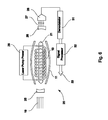
- FIG. 6 is a schematic diagram of a first embodiment of a receiver of the present application to detect a coherent beam of neutrinos and antineutrinos;
- FIG. 7 is a schematic diagram of a second embodiment of a receiver of the present application.
- FIG. 8 is a schematic diagram of a third embodiment of a receiver of the present application.
- FIG. 9 is a schematic diagram showing one application of an emitter and receiver system as presented in the present application.
- FIG. 10 is a schematic diagram showing another application of an emitter and receiver system as presented in the present application.
- FIG. 1 a schematic diagram of one embodiment of the emitter 1 of the present invention is shown.
- Emitter 1 comprises a pilot laser medium 2 and a laser amplifier medium 3 , which are aligned along the axis 50 of the laser medium 2 .
- Both the pilot laser medium 2 and the laser amplifier medium 3 are contained within suitable containers and are placed between two laser resonator mirrors 4 whose reflectivity for the laser photons is substantially 100%.
- Neutrino-antineutrino pairs are generated in both the laser media 2 and 3 through the interaction of the laser photons with pumped resonant excited states in laser media 2 and in laser media 3 , resulting in the emission of a neutrino-antineutrino beam 9 .
- Laser media 2 and 3 may be pumped separately by discharge power supplies 5 a and 5 b and the densities of lasable atoms or molecules in 2 and 3 are generally different so as to optimize the impression of modulated information-carrying signals on the laser photon flux in medium 2 and to maximize laser power generation and thus neutrino-antineutrino beam emission in medium 3 .
- the laser media 2 and 3 shown in FIG. 1 may be excited gaseous plasmas pumped by an electric discharge, and aided if desired, by an electron beam or by beta particles emitted from a radioactive wall-coating of a pure beta emitter surrounding the laser gas to improve gaseous discharge conductivity.
- One or more of the laser media 2 and 3 may be pulse-pumped or pumped continuously depending on the application.
- the pump power supplies for the discharges in laser media 2 and 3 are designated 5 a and 5 b respectively.
- the output current or voltage from pump power supply 5 a applied to laser medium 2 is modulated by the modulator 6 which is controlled by the information signal processor 7 .
- the laser medium 2 is generally pumped at low power levels and its lasing frequency line-width is controlled to optimize the impartation of modulated information, while laser medium 3 is pumped at higher excitation rates to amplify and maximize overall laser power and thereby maximize the neutrino beam output.
- Information in the form of speech (sound) or video (letters, movies, television, etc.) or general data stored on magnetic media, optical storage, solid state storage, random access memory, or any other data storage or conveyance 8 is fed to the signal processor 7 for transmission by the modulated neutrino beam. Modulation may be achieved by pulse-duration or amplitude modulation, or by any other modulation technique known in the art.
- the gaseous laser media 2 and 3 may contain one or more of the many lasable gases known in the art.
- the laser media 2 and 3 shown in FIG. 1 are both gaseous and pumped by electric discharges
- the pilot laser medium 2 instead of being gaseous, may be a solid, liquid, or diode-like laser medium operated as shown in FIGS. 2 and 3 , producing lasing photons and neutrinos of the same resonant frequency as those generated by the gaseous laser medium 3 .
- FIG. 1 a a second embodiment of the emitter 100 of the neutrino communication system is shown.
- a single laser medium 2 a is used to produce modulated neutrino beams.
- the resonator mirrors 4 are placed directly at the ends of medium 2 a .
- the pumping and modulation arrangement shown in FIG. 1 may also be utilized, as shown as information signal processor 7 , modulator 6 , and laser gas discharge pump power 5 a , in the second embodiment 100 as shown in FIG. 1A .
- the single medium 2 a shown in FIG. 1A may also be utilized in place of separate media 2 , 2 ′, 2 ′′ and 3 , 3 ′, 3 ′′ shown in the other embodiments of the neutrino beam generator described below in connection with FIGS. 2, 3, 4, 5, 6, 7, and 8 .
- FIG. 2 a third embodiment of the neutrino emitter 1 b is shown, comprising laser media 2 ′ and 3 ′.
- Laser media 2 ′ and 3 ′ comprise solid or liquid hosts in which ions or atoms are dispersed that can be excited by pump light photons emitted from surrounding pump lamps 10 and 10 ′, which in turn are enclosed by specular reflectors 11 and 11 ′ that reflect and focus pump light photons onto laser media 2 ′ and 3 ′ to be trapped and be absorbed therein.
- pump photons may alternatively be provided by laser diodes whose output beams are arranged to overlap laser media 2 ′ and 3 ′.
- Power for the pump lamps 11 and 11 ′ is supplied by power supplies 5 a ′ and 5 b ′.
- the current or voltage output in 5 a ′ for laser 2 ′ is controlled and modulated by a modulator 6 onto which information 8 is supplied by information processor 7 .
- Laser 2 ′ is generally utilized to optimize information impression on the modulated laser and neutrino fluxes, while the main function of laser media 3 ′ is to amplify the intra-cavity laser flux and thereby the emitted neutrino beam.
- Concentrations and arrangements of lasable ions or atoms in laser media 2 ′ and 3 ′ are generally different, but both produce laser photons with the same resonant frequency.
- the laser media 2 ′ and 3 ′ are generally optically aligned cylinders placed jointly inside an optical resonator cavity having resonator mirrors 4 with substantially 100% reflectivity placed at the ends of the cavity to retain lasing photons in laser media 2 ′ and 3 ′.
- the remaining components of the system are generally the same as those in the embodiment shown in FIG. 1 . While the laser media 2 ′ and 3 ′ shown in FIG.
- the pilot laser medium 2 ′ instead of being a solid or liquid, may be a gaseous or diode-like laser medium operated as shown in FIG. 1 or FIG. 3 , producing lasing photons of the same resonant frequency as those generated by the solid or liquid laser medium 2 ′.
- a single solid or liquid laser body may be used for generating neutrino beams, and in such a case one of the resonator end mirrors 4 ′ is placed at the end of a single cylindrical laser, comprising only laser media 2 ′.
- the laser medium comprises a semiconductor diode material 2 ′′, pumped by a modulated current power supply 5 a ′′.
- Laser-driven emitter 1 c may comprise a modulatable pilot laser 2 ′′ pumped by current supply 5 a ′′ and laser amplifier 3 ′′ pumped by current supply 5 b ′′, both laser bodies being aligned and placed between laser resonator mirrors (or mirrored surfaces) 4 .
- emitter 1 c may only consist of the laser medium 2 ′′ placed between resonator mirrors 4 and 4 ′.
- the semiconductor laser diode as defined here includes VCSEL (Vertical Cavity Surface Emitting Laser) lasers and other special constructions of lasable semiconductor materials.
- Materials utilized in semiconductor diode and diode-like lasers may be any laserable compound known in the art such as those listed in the extensive laser literature.
- the remaining designated components and optional arrangement variations of the emitter 1 c of FIG. 3 are essentially the same as described above in relation to FIGS. 1, 1 a , and 2 .
- FIG. 4 a fifth embodiment of the emitter 1 d is shown.
- modulation is imposed on the internal laser photon wave and thence on the emitted neutrino beam by means of rocking or oscillating one of the resonator mirrors 4 with a micro-adjustable mirror holder 12 .
- the mirror holder 12 may be rocked back and forth as designated by arrows 13 about a pivot 14 by a push-pull electromagnet designated 15 which is activated by the modulator 6 .
- FIG. 4 shows electric-discharge-pumped gaseous lasers 2 and 3 , in their place, laser media consisting of lamp- or diode-pumped solid or liquid lasers as shown in FIG. 2 , or electric-current-pumped diode lasers as shown in FIG.
- FIG. 4 shows a pilot laser medium 2 and separate amplifier laser 3 , as in the previous figures, a single laser medium 2 placed between resonator mirrors 4 and 4 ′ may be used instead.
- FIG. 5 a sixth embodiment of the emitter 1 e is shown.
- This embodiment employs still another means for imposing information modulation on the emitted neutrino beam.
- a modulated oscillatory electric field is applied to a solid, liquid, or gaseous laser medium 3 ′′, which due to the Stark Effect, causes the excited energy levels in medium 3 ′′ to shift and oscillate slightly, thereby modulating the laser frequency and thence the neutrino beam frequency.
- the modulated electric field is imposed on two capacitor plates 17 between which the laser media 3 ′′ is placed.
- a modulated magnetic field may be imposed across laser medium 3 ′′ by means of electromagnets 18 which causes Zeeman shifts of the lasing energy levels and allow frequency modulation over the width of the Zeeman splitting. Modulation induced in laser medium 3 ′′ in turn will impose modulation of the intracavity laser beam in 2 ′ and 3 ′′ and the neutrino beam 9 .
- acoustic modulation may be applied to the laser medium 3 ′′ via an electro-acoustic transducer attached to medium 3 ′′, which causes laser-active ions, atoms, or molecules to undergo controlled vibrations and modulations, which modulations are transferred to the laser and neutrino beams.
- Power for the modulated electric or magnetic fields, or for the acoustic transducer, is supplied by power supply 16 , which is controlled by modulator 6 which receives its instructions from processor 7 , as described above with respect to the first four embodiments of the emitter.
- modulation may include, but not be limited to, modulating a quarter-wave plate, a Pockels cell, or other well-known electro-optic modulating device placed internally in the resonator cavity so that the standing-wave laser photons pass through it and are modulated by it.
- pulse duration modulation as well as time duration between pulses, or a combination thereof, may be utilized as desired in particular applications.
- modulated pump photons may be supplied by a lamp, another laser, or a general light source or particle source with the appropriate energies.
- the material 3 ′′ may be chosen to possess magneto-optic or electro-optic (Kerr Effect) properties so that when the electric field is applied by means of plates 17 or the magnetic field by means of electromagnets 18 , the direction of polarization of the laser photons is rotated.
- magneto-optic or electro-optic Kerr Effect
- FIG. 6 a schematic diagram of a first embodiment of a coherent neutrino beam receiver 20 is shown.
- This embodiment 20 comprises a laser medium 21 , whose operating laser frequency generally has a value that is half that of the operating laser frequency of an emitter whose neutrino beam 19 it is configured to detect.
- Laser 21 is generally operated/pumped at or slightly below laser threshold so as to maximize the signal of an incoming resonant modulated neutrino beam 19 .
- the incoming resonant modulated neutrino beam 19 enhances the stimulated de-excitation rate of resonant lasing species in laser medium 21 and thereby the laser photon generation rate in laser medium 21 .
- Resonator mirror 25 has a reflectivity of substantially 100%, while the other resonator mirror 26 transmits partially (for example between 1% and 20%) so that the transmitted modulated laser output beam 27 can be measured and recorded by a photosensor 28 .
- the laser photon flux in receiver 20 is enhanced due to neutrino-stimulated emissions in laser medium 21 and is modulated in proportion to the modulated resonant neutrino beam 19 that passes through the receiver.
- the partially transmitted modulated laser beam 27 monitored by photosensor 28 has its impressed modulation extracted or decoded by demodulator 31 which in turn passes decoded modulation signals on to signal processor 32 for final information retrieval.
- the receiver laser 21 depicted in FIG. 6 is a solid laser pumped by a laser pump lamp 29 surrounded by a specular reflector 11 similar to the emitter laser shown and described in FIG. 2 .
- FIG. 7 a schematic diagram of a second embodiment of a coherent neutrino beam receiver 20 ′ is shown.
- This embodiment 20 ′ comprises a gaseous laser generally designated 21 ′ with a long-path intra-cavity laser beam, whose operating laser frequency generally has a value that is half that of the operating laser frequency of an emitter whose neutrino beam 19 it is configured to detect. Any one or a mixture of several of gaseous lasable gases as known in the art may be used.
- an incoming coherent modulated neutrino beam 19 (which for example may be the beam 9 shown in FIGS. 1-5 ) is spread out due to diffraction effects after leaving the emitter 1 and traversing large distances through the air, earth, mountains, or oceans.
- the neutrino beam intercept region is therefore made larger by making the lateral dimensions of the laser medium 21 ′ of the receiver 20 ′ extensive to allow overlap of as much of an incoming neutrino beam as possible.
- this is accomplished by folding the internal laser photon beam path many times via tilted resonator mirrors.
- the photon beam traverses the gaseous laser medium 21 ′ via multiple entries and exits through windows 24 , followed by reflections from a pair of external tilted mirrors.
- the tilted mirrors may also be placed inside the gaseous enclosure in direct contact with non-pumped (“dead”) regions of the otherwise discharge-excited laser gas.
- FIG. 7 shows the utilization of a laser gas to provide a large neutrino beam intercept volume
- FIG. 8 shows how a solid or liquid laser medium might be arranged to overlap a broad neutrino flux.
- laser medium 21 ′′ a series of spread-out optically coupled solid laser diodes, or a long string of diode-pumped laser fiber(s) doped with laser-active ions, atoms or molecules, are present and dispersed over a large receiver volume to cover and interact with a broad incoming neutrino beam 19 .
- a long lasable solid fiber, which is strung out three-dimensionally in volume-filling spirals in medium 21 ′′, might for example be deployed.
- Laser diodes are dispersed through the fiber maze to keep the laser fiber pumped up.
- the excited ions, atoms or molecules in laser medium 21 ′′ will sense a resonant modulated beam 19 of neutrinos and antineutrinos via enhanced stimulated de-excitations, and generate a detectable output signal in response thereto.
- This output signal will be commensurate with the sophistication of the modulation technique employed in the beam 19 and can provide a detectable output signal having all the information contained in the neutrino beam. In certain applications however, it is sufficient that the generated detectable output signal merely indicate the presence and/or intensity of the neutrino-antineutrino beam 19 without providing the full information content therein.
- Resonator end mirrors 25 and 26 are shown in FIG. 8 to be outside the laser medium 21 ′′.
- Laser sensor 28 which monitors the output from mirror 26 may accordingly be also much smaller than indicated in FIG. 8 .
- the first neutrino communications system comprises an emitter 70 , which may be similar to any of the above described emitter embodiments shown as 1 , 100 , 1 b , 1 c , and 1 d described above, and a receiver 72 which may be similar any of the above described receiver embodiments 20 , 20 ′, 20 ′′ described above.
- the receiver 72 generally employs a laser medium whose operating frequency equals half the laser operating frequency utilized in emitter 70 as discussed above.
- the emitter 70 is furthermore operated so that the frequency of the emitted neutrino beam experiences a strong retardation for certain ore bodies 38 when traveling through such inclusions in the earth 37 .
- emitter 70 ′ whose beam is detected by receiver 72 ′ (operated with a laser at half the laser frequency of 70 ′) emits a neutrino beam whose frequency is different from that utilized in emitter 70 and receiver 72 , such that it travels with less retardation through ore bodies 38 .
- the contour and extent of the mineral inclusion or ore body 38 may be determined.
- the emitters 70 and 70 ′ are mounted side by side on a turntable means 34 , which can be turned in both directions as designated by the arrow 35 about a pivot 36 in the center of the turntable means 34 .
- the two neutrino beam emitters 70 and 70 ′ thus act as a double-barreled gun and are triggered to emit pulses of coherent neutrino beams simultaneously.
- the neutrino beams 74 and 74 ′ will spread and after they have traversed a distance on the order of one earth radius they will cover the receivers 72 and 72 ′ which are mounted side by side on a second turntable means 34 ′ which can be turned in both directions as shown by the arrow 35 ′ about the pivot 36 ′.
- This second turntable means 34 ′ with the receivers 72 and 72 ′ thereon is positioned in neutrino-beam receiving relationship to the turntable means 34 having the emitters 70 and 70 ′ thereon and oriented so that a portion of the earth 37 whose composition is to be analyzed and which may contain an ore body or mineral deposit 38 , is between the emitters 70 and 70 ′ and receivers 72 and 72 ′.
- the emitted neutrino beam 74 from emitter 70 detected by receiver 72 takes a different amount of time in traveling from emitter 70 to receiver 72 than the neutrino beam 74 ′ emitted by emitter 70 ′ which is detected by the receiver 72 ′.
- the turntable 34 on which the emitters 70 and 70 ′ are mounted is rotated in the direction of the arrow 35 , while the receivers 72 and 72 ′ mounted on the second turntable 34 ′ are moved along a predetermined path as shown by arrow 75 , for example by ship, automobile, or aircraft.
- Maximum receiver signal is usually achieved when the axes of receivers 72 and 72 ′ are aligned with the axes of the emitters 70 and 70 ′ respectively. This may be utilized for initial acquisition and determination of the relative locations of the emitters 70 and 70 ′ and receivers 72 and 72 ′.
- the laser resonator mirrors of the laser media utilized in emitters 70 and 70 ′ have curvatures that promote a non-divergent intra-cavity plane wave as nearly as possible. This may be achieved by placing the resonator end mirrors some distance away from the ends of the laser-active media, or by other known techniques to promote a non-divergent intra-cavity laser beam.
- emitters 70 and 70 ′ and receivers may be mounted side by side on other movable means such that they may be rotated about more than one axis, and path 75 may include motion along more than one axis.
- FIG. 10 a second arrangement/application 80 of the neutrino emitter and receiver systems of the present invention is shown.
- This embodiment 80 is useful for ship-to-shore, aircraft-to-tower, and similar communication and/or navigation systems.
- neutrino beam emitter 82 similar to the emitter 70 described above and receiver 84 similar to the neutrino beam receiver 72 described above are mounted side by side on a steerable platform or turntable 34 at a geo-stationary location and a second system comprising a neutrino beam emitter 84 ′ and receiver 82 ′, similar to the emitter 82 and receiver 84 , respectively, are mounted side by side on a platform or turntable 34 ′ placed on for example, a moving vehicle 87 .
- the laser frequency of receiver 84 has a value equal to half the laser frequency of emitter 84 ′ and receiver 82 ′ has laser frequency equal to half the laser frequency utilized in emitter 82 .
- the emitter 82 and receiver 82 ′ of this embodiment 80 emit and detect neutrino and antineutrino beam 88 of a first frequency while the emitter 84 ′ and receiver 84 of this embodiment 80 emit and detect a neutrino and antineutrino beam 89 at a second frequency different from the first frequency.
- each of the neutrino-antineutrino beam emitters shown in FIGS. 9 and 10 may also incorporate any of the modulation structure, pumping structure, and information signal processor structures described above.
- the neutrino-antineutrino beam receivers shown in FIGS. 9 and 10 may also incorporate any of the modulation structure, pumping structure, and information signal processor structures as described above.
- more or less sophisticated information signal processing and/or modulation techniques may be employed depending on the desired application. For example, a very simple ON-OFF may be all that is required in some applications. Communication may be accomplished by any known means ranging from a Morse-code type modulation based upon relative ON-OFF times, to ultra-sophisticated encoding and decoding for communications applications.
- the axes of receivers 84 and 82 ′ are preferably long compared to their lateral widths so that both the stationary set and mobile set can sense and determine the direction of the incoming neutrino and antineutrino beam whose signals are strongest when these beams are coaxial with the receivers.
- the embodiment may employ, in addition to the emitter 82 and receiver 84 , a second emitter 92 which emits a beam of neutrinos and antineutrinos 94 having a frequency resonant to the laser used in receiver 82 ′.
- the emitter 92 is mounted on a turntable 34 a and may be rotated in the direction of the arrow 35 a .
- the emitter 92 is moved to execute a predetermined search pattern and emits the modulated neutrino and antineutrino beam 94 having information giving the earth-fixed coordinates of the emitters of neutrino beams 88 and 94 at each instant.
- the coded signals in the neutrino beam 94 from the emitter 92 can be recorded and be interpreted by the mobile station's receiver 82 ′ and its emitter beam 84 ′ turned and directed at the stationary station a few instants later. After mutual lock-on, communications can be commenced between the two stations.
Landscapes
- Physics & Mathematics (AREA)
- Engineering & Computer Science (AREA)
- Computer Networks & Wireless Communication (AREA)
- Signal Processing (AREA)
- Electromagnetism (AREA)
- Optics & Photonics (AREA)
- General Physics & Mathematics (AREA)
- Computational Mathematics (AREA)
- Algebra (AREA)
- Mathematical Analysis (AREA)
- Mathematical Optimization (AREA)
- Mathematical Physics (AREA)
- Pure & Applied Mathematics (AREA)
- Business, Economics & Management (AREA)
- Educational Administration (AREA)
- Educational Technology (AREA)
- Theoretical Computer Science (AREA)
- Lasers (AREA)
Abstract
Description

{right arrow over (γ)}+X*→X+{right arrow over (γ)}+{right arrow over (γ)}(Generation/multiplication of coherent laser photons) (1)
{right arrow over (γ)}+X*→X+{right arrow over (γ)}+{right arrow over (ν)}+ν(Generation of coherent νν pair) (2a)
{right arrow over (γ)}+X*→X+{right arrow over (γ)}+{right arrow over (ν)}+ν(Generation of coherent νν pair) (2b)
ων=ω ν =½ωγ=½∈

{right arrow over (ν)}+Y*→{right arrow over (ν)}+Y+{right arrow over (γ)}(Detection of neutrino ν) (4)
{right arrow over (ν)}+Y*→{right arrow over (ν)}+Y+{right arrow over (γ)}(Detection of antineutrino ν) (5)
ωd=½ωe=∈d/
(k νν /k γ)SE=0.94×10⁻⁷


k ν→γ=4.9×10⁻¹³
k γ→γ=4.9×10⁻¹³
Claims (20)
Priority Applications (1)
| Application Number | Priority Date | Filing Date | Title |
|---|---|---|---|
| US14/166,100 US10050721B2 (en) | 2013-02-01 | 2014-01-28 | Neutrino communication system |
Applications Claiming Priority (2)
| Application Number | Priority Date | Filing Date | Title |
|---|---|---|---|
| US201361760024P | 2013-02-01 | 2013-02-01 | |
| US14/166,100 US10050721B2 (en) | 2013-02-01 | 2014-01-28 | Neutrino communication system |
Publications (2)
| Publication Number | Publication Date |
|---|---|
| US20160226597A1 US20160226597A1 (en) | 2016-08-04 |
| US10050721B2 true US10050721B2 (en) | 2018-08-14 |
Family
ID=56554896
Family Applications (1)
| Application Number | Title | Priority Date | Filing Date |
|---|---|---|---|
| US14/166,100 Active 2035-09-25 US10050721B2 (en) | 2013-02-01 | 2014-01-28 | Neutrino communication system |
Country Status (1)
| Country | Link |
|---|---|
| US (1) | US10050721B2 (en) |
Families Citing this family (2)
| Publication number | Priority date | Publication date | Assignee | Title |
|---|---|---|---|---|
| CN111028641B (en) * | 2019-12-10 | 2021-05-28 | 西安交通大学 | A Gaussian optical comprehensive experimental teaching system and its experimental method |
| US11533101B1 (en) * | 2022-02-08 | 2022-12-20 | Quantum Valley Ideas Laboratories | Communicating information using photonic crystal masers |
Citations (38)
| Publication number | Priority date | Publication date | Assignee | Title |
|---|---|---|---|---|
| US4205268A (en) * | 1977-01-31 | 1980-05-27 | Eerkens Jozef W | Neutrino communication arrangement |
| US4303343A (en) * | 1980-02-29 | 1981-12-01 | Bell Telephone Laboratories, Incorporated | Optoacoustic spectroscopy of condensed matter in bulk form |
| US4426576A (en) * | 1981-09-08 | 1984-01-17 | Atom Sciences, Inc. | Method and apparatus for noble gas atom detection with isotopic selectivity |
| US4576777A (en) * | 1980-02-01 | 1986-03-18 | Joseph Weber | Energy detection method and apparatus |
| US4657722A (en) * | 1980-05-14 | 1987-04-14 | Bennett Willard H | Ion cluster acceleration |
| US4732728A (en) * | 1985-12-02 | 1988-03-22 | Joseph Weber | Method of and apparatus for detecting neutrinos and antineutrinos with elastic scatterers |
| US4974230A (en) * | 1988-08-23 | 1990-11-27 | The United States Of America As Represented By The Administrator Of The National Aeronautics And Space Administration | Tm,Ho:YLF laser end-pumped by a semiconductor diode laser array |
| US5276717A (en) * | 1991-03-26 | 1994-01-04 | Joseph Weber | Method of and apparatus for generating neutrinos and/or antineutrinos, a neutrino modulation method, and a neutrino beam generator |
| US6126741A (en) * | 1998-12-07 | 2000-10-03 | General Electric Company | Polycrystalline carbon conversion |
| US20020037066A1 (en) * | 1995-01-23 | 2002-03-28 | Schaefer Daniel Richard | Trapping and storage of free thermal neutrons in fullerene molecules |
| US20030053580A1 (en) * | 1998-01-16 | 2003-03-20 | Ross John R. | Process for modelling photons, protons, neutrons atoms and the universe |
| US20030226962A1 (en) * | 2001-10-24 | 2003-12-11 | Arnold Lasky | Method for generating neutrally charged stable compound particles beyond the energy range of the first family of matter |
| US20040027031A1 (en) * | 1998-07-20 | 2004-02-12 | Beckwith Robert W. | Neutrino light to photon light converting matrix |
| US20040059552A1 (en) * | 2001-07-17 | 2004-03-25 | Ross John R. | Process for modeling photons, electrons, protons, neutrons, atoms and the universe |
| US20040102939A1 (en) * | 2001-07-17 | 2004-05-27 | Ross John R. | Simplist yet process for describing the universe |
| US20050118559A1 (en) * | 2002-07-19 | 2005-06-02 | Yuly Zagyansky | Posteinstein-bohr definitive end and development of new physics with consequences as superaccelerators and direct electricity transformation into light |
| US20050182607A1 (en) * | 2001-07-17 | 2005-08-18 | Ross John R. | Process for modeling photons and everything else |
| US20050242275A1 (en) * | 2002-10-24 | 2005-11-03 | Arnold Lasky | Method for generating neutrally charged stable compound particles beyond the range of the first family of matter |
| US20060212280A1 (en) * | 2001-07-17 | 2006-09-21 | Ross John R | Ross model of the universe |
| US20070025494A1 (en) * | 2005-06-03 | 2007-02-01 | Beckwith Robert W | Neutrino telescope |
| US20090254321A1 (en) * | 2001-07-17 | 2009-10-08 | Ross John R | Process for making models of the building blocks of our universe |
| US20100260504A1 (en) * | 2009-04-10 | 2010-10-14 | Fujitsu Limited | Optical transmission system |
| US20110002689A1 (en) * | 2008-02-22 | 2011-01-06 | Nippon Telegraph And Telephone Corporation | Optical ofdm receiver, optical transmission system, subcarrier separation circuit, and subcarrier separation method |
| US20110036983A1 (en) * | 2007-11-27 | 2011-02-17 | Ford Timothy D F | Identification system and method using highly collimated source of electromagnetic radiation |
| US7893414B2 (en) * | 2005-09-09 | 2011-02-22 | Lattice Energy Llc | Apparatus and method for absorption of incident gamma radiation and its conversion to outgoing radiation at less penetrating, lower energies and frequencies |
| US20110046928A1 (en) * | 2001-07-17 | 2011-02-24 | Ross John R | Process for making models of photons, electrons, magnitism, gravity and other things |
| US20110062345A1 (en) * | 2007-09-14 | 2011-03-17 | Los Alamos National Security, Llc | Tritium sensor and method |
| US20110176815A1 (en) * | 2010-01-21 | 2011-07-21 | Frankel Michael Y | Multi-channel optical transceiver with offset quadrature amplitude modulation |
| US8113056B2 (en) * | 2008-05-15 | 2012-02-14 | Lockheed Martin Corporation | Mid-IR laser for generation of ultrasound using a CO2 laser and harmonic generation |
| US8125813B2 (en) * | 2005-06-16 | 2012-02-28 | Best Medical International, Inc. | Variance reduction simulation system, program product, and related methods |
| US20120075682A1 (en) * | 2009-12-17 | 2012-03-29 | Richard Louis Amoroso | Spacetime energy resonator: a transistor of complex dirac polarized vacuum topology |
| US20120148235A1 (en) * | 2010-12-13 | 2012-06-14 | Fujitsu Limited | Control circuit, communication system, and control method |
| US8202268B1 (en) * | 2007-03-18 | 2012-06-19 | Lockheed Martin Corporation | Method and multiple-mode device for high-power short-pulse laser ablation and CW cauterization of bodily tissues |
| US20120264024A1 (en) * | 1999-04-29 | 2012-10-18 | Pelton Walter E | Methods and apparatuses for electrochemical cell system with movable medium and non-conducting substrate |
| US8595020B2 (en) * | 2009-02-02 | 2013-11-26 | Planetary Emissions Management Inc. | System of systems for monitoring greenhouse gas fluxes |
| US20140288897A1 (en) * | 2013-03-25 | 2014-09-25 | John R. Ross | Process for making models of photons, electrons, magnitism, gravity and other things |
| US8849565B1 (en) * | 2007-06-28 | 2014-09-30 | The Boeing Company | Navigation system based on neutrino detection |
| US9309456B2 (en) * | 2011-04-15 | 2016-04-12 | Lawrence Livermore National Security, Llc | Plastic scintillator with effective pulse shape discrimination for neutron and gamma detection |
-
2014
- 2014-01-28 US US14/166,100 patent/US10050721B2/en active Active
Patent Citations (40)
| Publication number | Priority date | Publication date | Assignee | Title |
|---|---|---|---|---|
| US4205268A (en) * | 1977-01-31 | 1980-05-27 | Eerkens Jozef W | Neutrino communication arrangement |
| US4576777A (en) * | 1980-02-01 | 1986-03-18 | Joseph Weber | Energy detection method and apparatus |
| US4303343A (en) * | 1980-02-29 | 1981-12-01 | Bell Telephone Laboratories, Incorporated | Optoacoustic spectroscopy of condensed matter in bulk form |
| US4657722A (en) * | 1980-05-14 | 1987-04-14 | Bennett Willard H | Ion cluster acceleration |
| US4426576A (en) * | 1981-09-08 | 1984-01-17 | Atom Sciences, Inc. | Method and apparatus for noble gas atom detection with isotopic selectivity |
| US4732728A (en) * | 1985-12-02 | 1988-03-22 | Joseph Weber | Method of and apparatus for detecting neutrinos and antineutrinos with elastic scatterers |
| US4974230A (en) * | 1988-08-23 | 1990-11-27 | The United States Of America As Represented By The Administrator Of The National Aeronautics And Space Administration | Tm,Ho:YLF laser end-pumped by a semiconductor diode laser array |
| US5276717A (en) * | 1991-03-26 | 1994-01-04 | Joseph Weber | Method of and apparatus for generating neutrinos and/or antineutrinos, a neutrino modulation method, and a neutrino beam generator |
| US20020037066A1 (en) * | 1995-01-23 | 2002-03-28 | Schaefer Daniel Richard | Trapping and storage of free thermal neutrons in fullerene molecules |
| US20030053580A1 (en) * | 1998-01-16 | 2003-03-20 | Ross John R. | Process for modelling photons, protons, neutrons atoms and the universe |
| US6891310B2 (en) * | 1998-07-20 | 2005-05-10 | Robert W. Beckwith | Neutrino light to photon light converting matrix |
| US20040027031A1 (en) * | 1998-07-20 | 2004-02-12 | Beckwith Robert W. | Neutrino light to photon light converting matrix |
| US6126741A (en) * | 1998-12-07 | 2000-10-03 | General Electric Company | Polycrystalline carbon conversion |
| US20120264024A1 (en) * | 1999-04-29 | 2012-10-18 | Pelton Walter E | Methods and apparatuses for electrochemical cell system with movable medium and non-conducting substrate |
| US20060212280A1 (en) * | 2001-07-17 | 2006-09-21 | Ross John R | Ross model of the universe |
| US20040102939A1 (en) * | 2001-07-17 | 2004-05-27 | Ross John R. | Simplist yet process for describing the universe |
| US20050182607A1 (en) * | 2001-07-17 | 2005-08-18 | Ross John R. | Process for modeling photons and everything else |
| US20110046928A1 (en) * | 2001-07-17 | 2011-02-24 | Ross John R | Process for making models of photons, electrons, magnitism, gravity and other things |
| US20040059552A1 (en) * | 2001-07-17 | 2004-03-25 | Ross John R. | Process for modeling photons, electrons, protons, neutrons, atoms and the universe |
| US20090254321A1 (en) * | 2001-07-17 | 2009-10-08 | Ross John R | Process for making models of the building blocks of our universe |
| US20030226962A1 (en) * | 2001-10-24 | 2003-12-11 | Arnold Lasky | Method for generating neutrally charged stable compound particles beyond the energy range of the first family of matter |
| US20050118559A1 (en) * | 2002-07-19 | 2005-06-02 | Yuly Zagyansky | Posteinstein-bohr definitive end and development of new physics with consequences as superaccelerators and direct electricity transformation into light |
| US20050242275A1 (en) * | 2002-10-24 | 2005-11-03 | Arnold Lasky | Method for generating neutrally charged stable compound particles beyond the range of the first family of matter |
| US20070025494A1 (en) * | 2005-06-03 | 2007-02-01 | Beckwith Robert W | Neutrino telescope |
| US8125813B2 (en) * | 2005-06-16 | 2012-02-28 | Best Medical International, Inc. | Variance reduction simulation system, program product, and related methods |
| US7893414B2 (en) * | 2005-09-09 | 2011-02-22 | Lattice Energy Llc | Apparatus and method for absorption of incident gamma radiation and its conversion to outgoing radiation at less penetrating, lower energies and frequencies |
| US8202268B1 (en) * | 2007-03-18 | 2012-06-19 | Lockheed Martin Corporation | Method and multiple-mode device for high-power short-pulse laser ablation and CW cauterization of bodily tissues |
| US8849565B1 (en) * | 2007-06-28 | 2014-09-30 | The Boeing Company | Navigation system based on neutrino detection |
| US20110062345A1 (en) * | 2007-09-14 | 2011-03-17 | Los Alamos National Security, Llc | Tritium sensor and method |
| US20110036983A1 (en) * | 2007-11-27 | 2011-02-17 | Ford Timothy D F | Identification system and method using highly collimated source of electromagnetic radiation |
| US20110002689A1 (en) * | 2008-02-22 | 2011-01-06 | Nippon Telegraph And Telephone Corporation | Optical ofdm receiver, optical transmission system, subcarrier separation circuit, and subcarrier separation method |
| US8113056B2 (en) * | 2008-05-15 | 2012-02-14 | Lockheed Martin Corporation | Mid-IR laser for generation of ultrasound using a CO2 laser and harmonic generation |
| US8595020B2 (en) * | 2009-02-02 | 2013-11-26 | Planetary Emissions Management Inc. | System of systems for monitoring greenhouse gas fluxes |
| US9514493B2 (en) * | 2009-02-02 | 2016-12-06 | Planetary Emissions Management, Inc. | System of systems for monitoring greenhouse gas fluxes |
| US20100260504A1 (en) * | 2009-04-10 | 2010-10-14 | Fujitsu Limited | Optical transmission system |
| US20120075682A1 (en) * | 2009-12-17 | 2012-03-29 | Richard Louis Amoroso | Spacetime energy resonator: a transistor of complex dirac polarized vacuum topology |
| US20110176815A1 (en) * | 2010-01-21 | 2011-07-21 | Frankel Michael Y | Multi-channel optical transceiver with offset quadrature amplitude modulation |
| US20120148235A1 (en) * | 2010-12-13 | 2012-06-14 | Fujitsu Limited | Control circuit, communication system, and control method |
| US9309456B2 (en) * | 2011-04-15 | 2016-04-12 | Lawrence Livermore National Security, Llc | Plastic scintillator with effective pulse shape discrimination for neutron and gamma detection |
| US20140288897A1 (en) * | 2013-03-25 | 2014-09-25 | John R. Ross | Process for making models of photons, electrons, magnitism, gravity and other things |
Also Published As
| Publication number | Publication date |
|---|---|
| US20160226597A1 (en) | 2016-08-04 |
Similar Documents
| Publication | Publication Date | Title |
|---|---|---|
| US4205268A (en) | Neutrino communication arrangement | |
| US4161436A (en) | Method of energizing a material | |
| Kitching et al. | Interference-induced optical gain without population inversion in cold, trapped atoms | |
| USRE42499E1 (en) | System and method for amplifying an optical pulse and pumping laser therefor | |
| Popescu et al. | A novel approach to a Brillouin–LIDAR for remote sensing of the ocean temperature | |
| US20070145348A1 (en) | Quantum information processing device and method | |
| Allen | Essentials of lasers: the commonwealth and international library: selected readings in physics | |
| Yamamoto et al. | Enhanced and reduced absorptions via quantum interference: Solid system driven by a rf field | |
| Inoue et al. | Magneto-optical trapping of optically pumped metastable europium | |
| US10050721B2 (en) | Neutrino communication system | |
| Kalachev | Quantum storage on subradiant states in an extended atomic ensemble | |
| US4570081A (en) | Isolated pump in a double pass pump Raman oscillator and optimum conversion of pump energy in a Raman oscillator and amplifier | |
| Bonch-Bruevich et al. | Changes in absorption spectrum and dispersion of two-level system in rotating monochromatic radiation field | |
| JPH10190119A (en) | Method and device for operating laser system for free-space optical communication | |
| Zewail et al. | Incoherent resonance decay and coherent optical ringing from coherently prepared electronic states: a new technique for probing phase memory and radiationless relaxation in gases and solids | |
| Wang et al. | A stable frequency standard based on the one-color two-photon 5 S–7 S transition of rubidium at 760 nm | |
| Yang et al. | A laser pump-re-pump atomic magnetometer | |
| Zhu et al. | Multilevel dark states in an inhomogeneously broadened open atomic system | |
| Klepel et al. | Transverse optical pumping with polarization-modulated light | |
| Apolonsky et al. | Lasing on the D 2 line of sodium in a helium atmosphere due to optical pumping on the D 1 line (up-conversion) | |
| Sabooni | Efficient quantum memories based on spectral engineering of rare-earth-ion-doped solids | |
| Letokhov et al. | Resonance phenomena in saturation of absorption by laser radiation | |
| Wang et al. | Coherent population trapping and four-wave mixing via dark states in a Doppler-broadened open Rb system | |
| US3725775A (en) | Self-oscillating helium magnetometer | |
| Grynberg et al. | Multiphoton resonant processes in atoms |
Legal Events
| Date | Code | Title | Description |
|---|---|---|---|
| FEPP | Fee payment procedure |
Free format text: ENTITY STATUS SET TO MICRO (ORIGINAL EVENT CODE: MICR); ENTITY STATUS OF PATENT OWNER: MICROENTITY |
|
| STCF | Information on status: patent grant |
Free format text: PATENTED CASE |
|
| MAFP | Maintenance fee payment |
Free format text: PAYMENT OF MAINTENANCE FEE, 4TH YEAR, MICRO ENTITY (ORIGINAL EVENT CODE: M3551); ENTITY STATUS OF PATENT OWNER: MICROENTITY Year of fee payment: 4 |
|
| FEPP | Fee payment procedure |
Free format text: ENTITY STATUS SET TO MICRO (ORIGINAL EVENT CODE: MICR); ENTITY STATUS OF PATENT OWNER: MICROENTITY Free format text: ENTITY STATUS SET TO SMALL (ORIGINAL EVENT CODE: SMAL); ENTITY STATUS OF PATENT OWNER: MICROENTITY |
|
| MAFP | Maintenance fee payment |
Free format text: PAYMENT OF MAINTENANCE FEE, 8TH YEAR, MICRO ENTITY (ORIGINAL EVENT CODE: M3552); ENTITY STATUS OF PATENT OWNER: MICROENTITY Year of fee payment: 8 |