US10049615B2 - Degradation compensating device and display device having the same - Google Patents

Degradation compensating device and display device having the same Download PDF

Info

Publication number
US10049615B2
US10049615B2 US15/097,153 US201615097153A US10049615B2 US 10049615 B2 US10049615 B2 US 10049615B2 US 201615097153 A US201615097153 A US 201615097153A US 10049615 B2 US10049615 B2 US 10049615B2
Authority
US
United States
Prior art keywords
degradation
pixels
region
sensing data
compensating
Prior art date
Legal status (The legal status is an assumption and is not a legal conclusion. Google has not performed a legal analysis and makes no representation as to the accuracy of the status listed.)
Active, expires
Application number
US15/097,153
Other versions
US20170092190A1 (en
Inventor
Eun-Gyeong Choe
Current Assignee (The listed assignees may be inaccurate. Google has not performed a legal analysis and makes no representation or warranty as to the accuracy of the list.)
Samsung Display Co Ltd
Original Assignee
Samsung Display Co Ltd
Priority date (The priority date is an assumption and is not a legal conclusion. Google has not performed a legal analysis and makes no representation as to the accuracy of the date listed.)
Filing date
Publication date
Application filed by Samsung Display Co Ltd filed Critical Samsung Display Co Ltd
Assigned to SAMSUNG DISPLAY CO., LTD. reassignment SAMSUNG DISPLAY CO., LTD. ASSIGNMENT OF ASSIGNORS INTEREST (SEE DOCUMENT FOR DETAILS). Assignors: Choe, Eun-Gyeong
Publication of US20170092190A1 publication Critical patent/US20170092190A1/en
Application granted granted Critical
Publication of US10049615B2 publication Critical patent/US10049615B2/en
Active legal-status Critical Current
Adjusted expiration legal-status Critical

Links

Images

Classifications

    • GPHYSICS
    • G09EDUCATION; CRYPTOGRAPHY; DISPLAY; ADVERTISING; SEALS
    • G09GARRANGEMENTS OR CIRCUITS FOR CONTROL OF INDICATING DEVICES USING STATIC MEANS TO PRESENT VARIABLE INFORMATION
    • G09G3/00Control arrangements or circuits, of interest only in connection with visual indicators other than cathode-ray tubes
    • G09G3/20Control arrangements or circuits, of interest only in connection with visual indicators other than cathode-ray tubes for presentation of an assembly of a number of characters, e.g. a page, by composing the assembly by combination of individual elements arranged in a matrix no fixed position being assigned to or needed to be assigned to the individual characters or partial characters
    • G09G3/22Control arrangements or circuits, of interest only in connection with visual indicators other than cathode-ray tubes for presentation of an assembly of a number of characters, e.g. a page, by composing the assembly by combination of individual elements arranged in a matrix no fixed position being assigned to or needed to be assigned to the individual characters or partial characters using controlled light sources
    • G09G3/30Control arrangements or circuits, of interest only in connection with visual indicators other than cathode-ray tubes for presentation of an assembly of a number of characters, e.g. a page, by composing the assembly by combination of individual elements arranged in a matrix no fixed position being assigned to or needed to be assigned to the individual characters or partial characters using controlled light sources using electroluminescent panels
    • G09G3/32Control arrangements or circuits, of interest only in connection with visual indicators other than cathode-ray tubes for presentation of an assembly of a number of characters, e.g. a page, by composing the assembly by combination of individual elements arranged in a matrix no fixed position being assigned to or needed to be assigned to the individual characters or partial characters using controlled light sources using electroluminescent panels semiconductive, e.g. using light-emitting diodes [LED]
    • GPHYSICS
    • G09EDUCATION; CRYPTOGRAPHY; DISPLAY; ADVERTISING; SEALS
    • G09GARRANGEMENTS OR CIRCUITS FOR CONTROL OF INDICATING DEVICES USING STATIC MEANS TO PRESENT VARIABLE INFORMATION
    • G09G3/00Control arrangements or circuits, of interest only in connection with visual indicators other than cathode-ray tubes
    • G09G3/20Control arrangements or circuits, of interest only in connection with visual indicators other than cathode-ray tubes for presentation of an assembly of a number of characters, e.g. a page, by composing the assembly by combination of individual elements arranged in a matrix no fixed position being assigned to or needed to be assigned to the individual characters or partial characters
    • G09G3/22Control arrangements or circuits, of interest only in connection with visual indicators other than cathode-ray tubes for presentation of an assembly of a number of characters, e.g. a page, by composing the assembly by combination of individual elements arranged in a matrix no fixed position being assigned to or needed to be assigned to the individual characters or partial characters using controlled light sources
    • G09G3/30Control arrangements or circuits, of interest only in connection with visual indicators other than cathode-ray tubes for presentation of an assembly of a number of characters, e.g. a page, by composing the assembly by combination of individual elements arranged in a matrix no fixed position being assigned to or needed to be assigned to the individual characters or partial characters using controlled light sources using electroluminescent panels
    • G09G3/32Control arrangements or circuits, of interest only in connection with visual indicators other than cathode-ray tubes for presentation of an assembly of a number of characters, e.g. a page, by composing the assembly by combination of individual elements arranged in a matrix no fixed position being assigned to or needed to be assigned to the individual characters or partial characters using controlled light sources using electroluminescent panels semiconductive, e.g. using light-emitting diodes [LED]
    • G09G3/3208Control arrangements or circuits, of interest only in connection with visual indicators other than cathode-ray tubes for presentation of an assembly of a number of characters, e.g. a page, by composing the assembly by combination of individual elements arranged in a matrix no fixed position being assigned to or needed to be assigned to the individual characters or partial characters using controlled light sources using electroluminescent panels semiconductive, e.g. using light-emitting diodes [LED] organic, e.g. using organic light-emitting diodes [OLED]
    • G09G3/3225Control arrangements or circuits, of interest only in connection with visual indicators other than cathode-ray tubes for presentation of an assembly of a number of characters, e.g. a page, by composing the assembly by combination of individual elements arranged in a matrix no fixed position being assigned to or needed to be assigned to the individual characters or partial characters using controlled light sources using electroluminescent panels semiconductive, e.g. using light-emitting diodes [LED] organic, e.g. using organic light-emitting diodes [OLED] using an active matrix
    • GPHYSICS
    • G09EDUCATION; CRYPTOGRAPHY; DISPLAY; ADVERTISING; SEALS
    • G09GARRANGEMENTS OR CIRCUITS FOR CONTROL OF INDICATING DEVICES USING STATIC MEANS TO PRESENT VARIABLE INFORMATION
    • G09G3/00Control arrangements or circuits, of interest only in connection with visual indicators other than cathode-ray tubes
    • G09G3/006Electronic inspection or testing of displays and display drivers, e.g. of LED or LCD displays
    • GPHYSICS
    • G09EDUCATION; CRYPTOGRAPHY; DISPLAY; ADVERTISING; SEALS
    • G09GARRANGEMENTS OR CIRCUITS FOR CONTROL OF INDICATING DEVICES USING STATIC MEANS TO PRESENT VARIABLE INFORMATION
    • G09G3/00Control arrangements or circuits, of interest only in connection with visual indicators other than cathode-ray tubes
    • G09G3/20Control arrangements or circuits, of interest only in connection with visual indicators other than cathode-ray tubes for presentation of an assembly of a number of characters, e.g. a page, by composing the assembly by combination of individual elements arranged in a matrix no fixed position being assigned to or needed to be assigned to the individual characters or partial characters
    • G09G3/2003Display of colours
    • GPHYSICS
    • G09EDUCATION; CRYPTOGRAPHY; DISPLAY; ADVERTISING; SEALS
    • G09GARRANGEMENTS OR CIRCUITS FOR CONTROL OF INDICATING DEVICES USING STATIC MEANS TO PRESENT VARIABLE INFORMATION
    • G09G5/00Control arrangements or circuits for visual indicators common to cathode-ray tube indicators and other visual indicators
    • G09G5/02Control arrangements or circuits for visual indicators common to cathode-ray tube indicators and other visual indicators characterised by the way in which colour is displayed
    • G09G5/06Control arrangements or circuits for visual indicators common to cathode-ray tube indicators and other visual indicators characterised by the way in which colour is displayed using colour palettes, e.g. look-up tables
    • GPHYSICS
    • G09EDUCATION; CRYPTOGRAPHY; DISPLAY; ADVERTISING; SEALS
    • G09GARRANGEMENTS OR CIRCUITS FOR CONTROL OF INDICATING DEVICES USING STATIC MEANS TO PRESENT VARIABLE INFORMATION
    • G09G2300/00Aspects of the constitution of display devices
    • G09G2300/04Structural and physical details of display devices
    • G09G2300/0421Structural details of the set of electrodes
    • G09G2300/0426Layout of electrodes and connections
    • GPHYSICS
    • G09EDUCATION; CRYPTOGRAPHY; DISPLAY; ADVERTISING; SEALS
    • G09GARRANGEMENTS OR CIRCUITS FOR CONTROL OF INDICATING DEVICES USING STATIC MEANS TO PRESENT VARIABLE INFORMATION
    • G09G2300/00Aspects of the constitution of display devices
    • G09G2300/08Active matrix structure, i.e. with use of active elements, inclusive of non-linear two terminal elements, in the pixels together with light emitting or modulating elements
    • G09G2300/0809Several active elements per pixel in active matrix panels
    • G09G2300/0819Several active elements per pixel in active matrix panels used for counteracting undesired variations, e.g. feedback or autozeroing
    • GPHYSICS
    • G09EDUCATION; CRYPTOGRAPHY; DISPLAY; ADVERTISING; SEALS
    • G09GARRANGEMENTS OR CIRCUITS FOR CONTROL OF INDICATING DEVICES USING STATIC MEANS TO PRESENT VARIABLE INFORMATION
    • G09G2310/00Command of the display device
    • G09G2310/08Details of timing specific for flat panels, other than clock recovery
    • GPHYSICS
    • G09EDUCATION; CRYPTOGRAPHY; DISPLAY; ADVERTISING; SEALS
    • G09GARRANGEMENTS OR CIRCUITS FOR CONTROL OF INDICATING DEVICES USING STATIC MEANS TO PRESENT VARIABLE INFORMATION
    • G09G2320/00Control of display operating conditions
    • G09G2320/02Improving the quality of display appearance
    • G09G2320/0233Improving the luminance or brightness uniformity across the screen
    • GPHYSICS
    • G09EDUCATION; CRYPTOGRAPHY; DISPLAY; ADVERTISING; SEALS
    • G09GARRANGEMENTS OR CIRCUITS FOR CONTROL OF INDICATING DEVICES USING STATIC MEANS TO PRESENT VARIABLE INFORMATION
    • G09G2320/00Control of display operating conditions
    • G09G2320/02Improving the quality of display appearance
    • G09G2320/0242Compensation of deficiencies in the appearance of colours
    • GPHYSICS
    • G09EDUCATION; CRYPTOGRAPHY; DISPLAY; ADVERTISING; SEALS
    • G09GARRANGEMENTS OR CIRCUITS FOR CONTROL OF INDICATING DEVICES USING STATIC MEANS TO PRESENT VARIABLE INFORMATION
    • G09G2320/00Control of display operating conditions
    • G09G2320/02Improving the quality of display appearance
    • G09G2320/0285Improving the quality of display appearance using tables for spatial correction of display data
    • GPHYSICS
    • G09EDUCATION; CRYPTOGRAPHY; DISPLAY; ADVERTISING; SEALS
    • G09GARRANGEMENTS OR CIRCUITS FOR CONTROL OF INDICATING DEVICES USING STATIC MEANS TO PRESENT VARIABLE INFORMATION
    • G09G2320/00Control of display operating conditions
    • G09G2320/02Improving the quality of display appearance
    • G09G2320/029Improving the quality of display appearance by monitoring one or more pixels in the display panel, e.g. by monitoring a fixed reference pixel
    • GPHYSICS
    • G09EDUCATION; CRYPTOGRAPHY; DISPLAY; ADVERTISING; SEALS
    • G09GARRANGEMENTS OR CIRCUITS FOR CONTROL OF INDICATING DEVICES USING STATIC MEANS TO PRESENT VARIABLE INFORMATION
    • G09G2320/00Control of display operating conditions
    • G09G2320/04Maintaining the quality of display appearance
    • GPHYSICS
    • G09EDUCATION; CRYPTOGRAPHY; DISPLAY; ADVERTISING; SEALS
    • G09GARRANGEMENTS OR CIRCUITS FOR CONTROL OF INDICATING DEVICES USING STATIC MEANS TO PRESENT VARIABLE INFORMATION
    • G09G2320/00Control of display operating conditions
    • G09G2320/04Maintaining the quality of display appearance
    • G09G2320/043Preventing or counteracting the effects of ageing
    • GPHYSICS
    • G09EDUCATION; CRYPTOGRAPHY; DISPLAY; ADVERTISING; SEALS
    • G09GARRANGEMENTS OR CIRCUITS FOR CONTROL OF INDICATING DEVICES USING STATIC MEANS TO PRESENT VARIABLE INFORMATION
    • G09G2320/00Control of display operating conditions
    • G09G2320/04Maintaining the quality of display appearance
    • G09G2320/043Preventing or counteracting the effects of ageing
    • G09G2320/045Compensation of drifts in the characteristics of light emitting or modulating elements
    • GPHYSICS
    • G09EDUCATION; CRYPTOGRAPHY; DISPLAY; ADVERTISING; SEALS
    • G09GARRANGEMENTS OR CIRCUITS FOR CONTROL OF INDICATING DEVICES USING STATIC MEANS TO PRESENT VARIABLE INFORMATION
    • G09G2320/00Control of display operating conditions
    • G09G2320/04Maintaining the quality of display appearance
    • G09G2320/043Preventing or counteracting the effects of ageing
    • G09G2320/048Preventing or counteracting the effects of ageing using evaluation of the usage time
    • GPHYSICS
    • G09EDUCATION; CRYPTOGRAPHY; DISPLAY; ADVERTISING; SEALS
    • G09GARRANGEMENTS OR CIRCUITS FOR CONTROL OF INDICATING DEVICES USING STATIC MEANS TO PRESENT VARIABLE INFORMATION
    • G09G2320/00Control of display operating conditions
    • G09G2320/06Adjustment of display parameters
    • G09G2320/0626Adjustment of display parameters for control of overall brightness
    • GPHYSICS
    • G09EDUCATION; CRYPTOGRAPHY; DISPLAY; ADVERTISING; SEALS
    • G09GARRANGEMENTS OR CIRCUITS FOR CONTROL OF INDICATING DEVICES USING STATIC MEANS TO PRESENT VARIABLE INFORMATION
    • G09G2320/00Control of display operating conditions
    • G09G2320/06Adjustment of display parameters
    • G09G2320/0666Adjustment of display parameters for control of colour parameters, e.g. colour temperature
    • GPHYSICS
    • G09EDUCATION; CRYPTOGRAPHY; DISPLAY; ADVERTISING; SEALS
    • G09GARRANGEMENTS OR CIRCUITS FOR CONTROL OF INDICATING DEVICES USING STATIC MEANS TO PRESENT VARIABLE INFORMATION
    • G09G2320/00Control of display operating conditions
    • G09G2320/06Adjustment of display parameters
    • G09G2320/0693Calibration of display systems
    • GPHYSICS
    • G09EDUCATION; CRYPTOGRAPHY; DISPLAY; ADVERTISING; SEALS
    • G09GARRANGEMENTS OR CIRCUITS FOR CONTROL OF INDICATING DEVICES USING STATIC MEANS TO PRESENT VARIABLE INFORMATION
    • G09G2330/00Aspects of power supply; Aspects of display protection and defect management
    • G09G2330/12Test circuits or failure detection circuits included in a display system, as permanent part thereof
    • GPHYSICS
    • G09EDUCATION; CRYPTOGRAPHY; DISPLAY; ADVERTISING; SEALS
    • G09GARRANGEMENTS OR CIRCUITS FOR CONTROL OF INDICATING DEVICES USING STATIC MEANS TO PRESENT VARIABLE INFORMATION
    • G09G2340/00Aspects of display data processing
    • G09G2340/06Colour space transformation
    • GPHYSICS
    • G09EDUCATION; CRYPTOGRAPHY; DISPLAY; ADVERTISING; SEALS
    • G09GARRANGEMENTS OR CIRCUITS FOR CONTROL OF INDICATING DEVICES USING STATIC MEANS TO PRESENT VARIABLE INFORMATION
    • G09G2360/00Aspects of the architecture of display systems
    • G09G2360/16Calculation or use of calculated indices related to luminance levels in display data
    • GPHYSICS
    • G09EDUCATION; CRYPTOGRAPHY; DISPLAY; ADVERTISING; SEALS
    • G09GARRANGEMENTS OR CIRCUITS FOR CONTROL OF INDICATING DEVICES USING STATIC MEANS TO PRESENT VARIABLE INFORMATION
    • G09G3/00Control arrangements or circuits, of interest only in connection with visual indicators other than cathode-ray tubes
    • G09G3/20Control arrangements or circuits, of interest only in connection with visual indicators other than cathode-ray tubes for presentation of an assembly of a number of characters, e.g. a page, by composing the assembly by combination of individual elements arranged in a matrix no fixed position being assigned to or needed to be assigned to the individual characters or partial characters
    • G09G3/22Control arrangements or circuits, of interest only in connection with visual indicators other than cathode-ray tubes for presentation of an assembly of a number of characters, e.g. a page, by composing the assembly by combination of individual elements arranged in a matrix no fixed position being assigned to or needed to be assigned to the individual characters or partial characters using controlled light sources
    • G09G3/30Control arrangements or circuits, of interest only in connection with visual indicators other than cathode-ray tubes for presentation of an assembly of a number of characters, e.g. a page, by composing the assembly by combination of individual elements arranged in a matrix no fixed position being assigned to or needed to be assigned to the individual characters or partial characters using controlled light sources using electroluminescent panels
    • G09G3/32Control arrangements or circuits, of interest only in connection with visual indicators other than cathode-ray tubes for presentation of an assembly of a number of characters, e.g. a page, by composing the assembly by combination of individual elements arranged in a matrix no fixed position being assigned to or needed to be assigned to the individual characters or partial characters using controlled light sources using electroluminescent panels semiconductive, e.g. using light-emitting diodes [LED]
    • G09G3/3208Control arrangements or circuits, of interest only in connection with visual indicators other than cathode-ray tubes for presentation of an assembly of a number of characters, e.g. a page, by composing the assembly by combination of individual elements arranged in a matrix no fixed position being assigned to or needed to be assigned to the individual characters or partial characters using controlled light sources using electroluminescent panels semiconductive, e.g. using light-emitting diodes [LED] organic, e.g. using organic light-emitting diodes [OLED]
    • GPHYSICS
    • G09EDUCATION; CRYPTOGRAPHY; DISPLAY; ADVERTISING; SEALS
    • G09GARRANGEMENTS OR CIRCUITS FOR CONTROL OF INDICATING DEVICES USING STATIC MEANS TO PRESENT VARIABLE INFORMATION
    • G09G3/00Control arrangements or circuits, of interest only in connection with visual indicators other than cathode-ray tubes
    • G09G3/20Control arrangements or circuits, of interest only in connection with visual indicators other than cathode-ray tubes for presentation of an assembly of a number of characters, e.g. a page, by composing the assembly by combination of individual elements arranged in a matrix no fixed position being assigned to or needed to be assigned to the individual characters or partial characters
    • G09G3/22Control arrangements or circuits, of interest only in connection with visual indicators other than cathode-ray tubes for presentation of an assembly of a number of characters, e.g. a page, by composing the assembly by combination of individual elements arranged in a matrix no fixed position being assigned to or needed to be assigned to the individual characters or partial characters using controlled light sources
    • G09G3/30Control arrangements or circuits, of interest only in connection with visual indicators other than cathode-ray tubes for presentation of an assembly of a number of characters, e.g. a page, by composing the assembly by combination of individual elements arranged in a matrix no fixed position being assigned to or needed to be assigned to the individual characters or partial characters using controlled light sources using electroluminescent panels
    • G09G3/32Control arrangements or circuits, of interest only in connection with visual indicators other than cathode-ray tubes for presentation of an assembly of a number of characters, e.g. a page, by composing the assembly by combination of individual elements arranged in a matrix no fixed position being assigned to or needed to be assigned to the individual characters or partial characters using controlled light sources using electroluminescent panels semiconductive, e.g. using light-emitting diodes [LED]
    • G09G3/3208Control arrangements or circuits, of interest only in connection with visual indicators other than cathode-ray tubes for presentation of an assembly of a number of characters, e.g. a page, by composing the assembly by combination of individual elements arranged in a matrix no fixed position being assigned to or needed to be assigned to the individual characters or partial characters using controlled light sources using electroluminescent panels semiconductive, e.g. using light-emitting diodes [LED] organic, e.g. using organic light-emitting diodes [OLED]
    • G09G3/3225Control arrangements or circuits, of interest only in connection with visual indicators other than cathode-ray tubes for presentation of an assembly of a number of characters, e.g. a page, by composing the assembly by combination of individual elements arranged in a matrix no fixed position being assigned to or needed to be assigned to the individual characters or partial characters using controlled light sources using electroluminescent panels semiconductive, e.g. using light-emitting diodes [LED] organic, e.g. using organic light-emitting diodes [OLED] using an active matrix
    • G09G3/3233Control arrangements or circuits, of interest only in connection with visual indicators other than cathode-ray tubes for presentation of an assembly of a number of characters, e.g. a page, by composing the assembly by combination of individual elements arranged in a matrix no fixed position being assigned to or needed to be assigned to the individual characters or partial characters using controlled light sources using electroluminescent panels semiconductive, e.g. using light-emitting diodes [LED] organic, e.g. using organic light-emitting diodes [OLED] using an active matrix with pixel circuitry controlling the current through the light-emitting element
    • GPHYSICS
    • G09EDUCATION; CRYPTOGRAPHY; DISPLAY; ADVERTISING; SEALS
    • G09GARRANGEMENTS OR CIRCUITS FOR CONTROL OF INDICATING DEVICES USING STATIC MEANS TO PRESENT VARIABLE INFORMATION
    • G09G3/00Control arrangements or circuits, of interest only in connection with visual indicators other than cathode-ray tubes
    • G09G3/20Control arrangements or circuits, of interest only in connection with visual indicators other than cathode-ray tubes for presentation of an assembly of a number of characters, e.g. a page, by composing the assembly by combination of individual elements arranged in a matrix no fixed position being assigned to or needed to be assigned to the individual characters or partial characters
    • G09G3/22Control arrangements or circuits, of interest only in connection with visual indicators other than cathode-ray tubes for presentation of an assembly of a number of characters, e.g. a page, by composing the assembly by combination of individual elements arranged in a matrix no fixed position being assigned to or needed to be assigned to the individual characters or partial characters using controlled light sources
    • G09G3/30Control arrangements or circuits, of interest only in connection with visual indicators other than cathode-ray tubes for presentation of an assembly of a number of characters, e.g. a page, by composing the assembly by combination of individual elements arranged in a matrix no fixed position being assigned to or needed to be assigned to the individual characters or partial characters using controlled light sources using electroluminescent panels
    • G09G3/32Control arrangements or circuits, of interest only in connection with visual indicators other than cathode-ray tubes for presentation of an assembly of a number of characters, e.g. a page, by composing the assembly by combination of individual elements arranged in a matrix no fixed position being assigned to or needed to be assigned to the individual characters or partial characters using controlled light sources using electroluminescent panels semiconductive, e.g. using light-emitting diodes [LED]
    • G09G3/3208Control arrangements or circuits, of interest only in connection with visual indicators other than cathode-ray tubes for presentation of an assembly of a number of characters, e.g. a page, by composing the assembly by combination of individual elements arranged in a matrix no fixed position being assigned to or needed to be assigned to the individual characters or partial characters using controlled light sources using electroluminescent panels semiconductive, e.g. using light-emitting diodes [LED] organic, e.g. using organic light-emitting diodes [OLED]
    • G09G3/3266Details of drivers for scan electrodes
    • GPHYSICS
    • G09EDUCATION; CRYPTOGRAPHY; DISPLAY; ADVERTISING; SEALS
    • G09GARRANGEMENTS OR CIRCUITS FOR CONTROL OF INDICATING DEVICES USING STATIC MEANS TO PRESENT VARIABLE INFORMATION
    • G09G3/00Control arrangements or circuits, of interest only in connection with visual indicators other than cathode-ray tubes
    • G09G3/20Control arrangements or circuits, of interest only in connection with visual indicators other than cathode-ray tubes for presentation of an assembly of a number of characters, e.g. a page, by composing the assembly by combination of individual elements arranged in a matrix no fixed position being assigned to or needed to be assigned to the individual characters or partial characters
    • G09G3/22Control arrangements or circuits, of interest only in connection with visual indicators other than cathode-ray tubes for presentation of an assembly of a number of characters, e.g. a page, by composing the assembly by combination of individual elements arranged in a matrix no fixed position being assigned to or needed to be assigned to the individual characters or partial characters using controlled light sources
    • G09G3/30Control arrangements or circuits, of interest only in connection with visual indicators other than cathode-ray tubes for presentation of an assembly of a number of characters, e.g. a page, by composing the assembly by combination of individual elements arranged in a matrix no fixed position being assigned to or needed to be assigned to the individual characters or partial characters using controlled light sources using electroluminescent panels
    • G09G3/32Control arrangements or circuits, of interest only in connection with visual indicators other than cathode-ray tubes for presentation of an assembly of a number of characters, e.g. a page, by composing the assembly by combination of individual elements arranged in a matrix no fixed position being assigned to or needed to be assigned to the individual characters or partial characters using controlled light sources using electroluminescent panels semiconductive, e.g. using light-emitting diodes [LED]
    • G09G3/3208Control arrangements or circuits, of interest only in connection with visual indicators other than cathode-ray tubes for presentation of an assembly of a number of characters, e.g. a page, by composing the assembly by combination of individual elements arranged in a matrix no fixed position being assigned to or needed to be assigned to the individual characters or partial characters using controlled light sources using electroluminescent panels semiconductive, e.g. using light-emitting diodes [LED] organic, e.g. using organic light-emitting diodes [OLED]
    • G09G3/3275Details of drivers for data electrodes

Definitions

  • Example embodiments relate generally to a degradation compensating device, a display device having the same, a pixel, and a display device having the same.
  • FPD devices are widely used as display devices of electronic devices because FPD devices are relatively lightweight and thin compared to cathode-ray tube (CRT) display devices.
  • FPD devices are liquid crystal display (LCD) devices, field emission display (FED) devices, plasma display panel (PDP) devices, and organic light emitting diode (OLED) display devices.
  • LCD liquid crystal display
  • FED field emission display
  • PDP plasma display panel
  • OLED organic light emitting diode
  • OLED devices have been spotlighted as next-generation display devices because OLED devices have various features, such as a wide viewing angle, rapid response speed, a thin profile, low power consumption, etc.
  • a pixel in an OLED device may degrade as time passes.
  • a brightness of the pixel, which is emitted based on the data signal, may be reduced.
  • a method for detecting a degraded pixel and for compensating the degraded pixel is studied.
  • Some example embodiments provide a degradation compensating device capable of compensating a degradation of a pixel.
  • Some example embodiments provide a display device capable of compensating a degradation of a pixel.
  • a degradation compensating device may include a degradation determiner coupled to sensing lines in a display panel, the degradation determiner being configured to detect current flowing through pixels respectively coupled to the sensing lines and to detect a degradation of the pixels based on the current, a sensor configured to assign a first region including at least one of the pixels which is coupled to one of the sensing lines through which the degradation is detected, to assign a second region including ones of the pixels adjacent the first region, to sense a first sensing data of the first region, and to sense a second sensing data of the second region, a degradation calculator configured to determine whether the pixels in the first region are degraded based on the first sensing data and the second sensing data and to calculate a compensating amount of the degradation of the first region, a brightness calculator configured to calculate a brightness compensating amount, for compensating the brightness of the first region, based on the compensating amount of the degradation, a color difference calculator configured to calculate a color compensating amount, for compensating the color difference of the first region, based
  • the degradation determiner may be further configured to detect the degradation of the pixels when the current is lower than a reference current.
  • the first sensing data includes an amount of a first current which flows through the pixels in the first region, and wherein the sensor outputs the first sensing data based on the first current.
  • the second sensing data includes an amount of a second current which flows through the pixels in the second region, and wherein the sensor outputs the second sensing data based on the second current.
  • the degradation calculator may determine that the pixels in the first region are degraded when the first sensing data is lower than an average value of the second sensing data.
  • the degradation calculator may calculate the compensating amount of the degradation using a difference between the first sensing data and the average value of the second sensing data.
  • the brightness calculator may include a look up table (LUT) for storing the brightness compensating amount corresponding to the compensating amount of the degradation.
  • LUT look up table
  • the color difference calculator may include a look up table (LUT) for storing the color compensating amount corresponding to the compensating amount of the degradation.
  • LUT look up table
  • the image compensator may compensate a color coordinate of the image data for the first region based on the color compensating amount using a gamut mapping algorithm (GMA).
  • GMA gamut mapping algorithm
  • a display device may include a display panel including a plurality of pixels and sensing lines respectively coupled to the pixels, a degradation compensator configured to detect a degradation of the pixels based on a current flowing through the pixels and to compensate a brightness and a color difference of a first region including at least one of the pixels coupled to a respective one of the sensing lines, through which the degradation is detected, based on a first sensing data of the first region and a second sensing data of a second region including pixels adjacent to the pixels of the first region, a data driver configured to provide data signals to the pixels, a scan driver configured to provide scan signals to the pixels, and a timing controller configured to generate control signals which control the degradation compensator, the data driver, and the scan driver.
  • the degradation compensator may include a degradation determiner configured to detect the current flowing through the pixels and to detect the degradation of the pixels based on the current, a sensor configured to assign the first region and the second region and to sense the first sensing data and the second sensing data, a degradation calculator configured to determine whether the pixels in the first region are degraded based on the first sensing data and the second sensing data and to calculate a compensating amount of the degradation of the first region, a brightness calculator configured to calculate a brightness compensating amount for compensating the brightness of the first region based on the compensating amount of the degradation, a color difference calculator configured to calculate a color compensating amount for compensating the color difference of the first region based on the compensating amount of the degradation, and an image compensator configured to compensate image data based on the brightness compensating amount and the color compensating amount.
  • a degradation determiner configured to detect the current flowing through the pixels and to detect the degradation of the pixels based on the current
  • a sensor configured to assign the first region and the second region and to sense the first sensing
  • the degradation determiner may detect the degradation of the pixels when the current is lower than a reference current.
  • the senor may sense a first current flowing through the pixels in the first region and output the first sensing data based on the first current.
  • the senor may sense a second current flowing through the pixels in the second region and output the second sensing data based on the second current.
  • the degradation calculator may determine that the pixels in the first region are degraded when the first sensing data is lower than an average value of the second sensing data.
  • the degradation calculator may calculate the compensating amount of the degradation using a difference between the first sensing data and the average value of the second sensing data.
  • the brightness calculator may include a look up table (LUT) for storing the brightness compensating amount corresponding to the compensating amount of the degradation.
  • LUT look up table
  • the color difference calculator may include a look up table (LUT) for storing the color compensating amount corresponding to the compensating amount of the degradation.
  • LUT look up table
  • the image compensator may compensate a color coordinate of the image data for the first region based on the compensating amount of the color difference using a gamut mapping algorithm (GMA).
  • GMA gamut mapping algorithm
  • the degradation compensator may be coupled to the timing controller or located in the timing controller.
  • a degradation compensating device and a display device having the same may compensate a brightness and a color difference of image data provided to a degradation region based on an average value of sensing data detected in the degradation region and in adjacent regions to the degradation region. Therefore, the display device may display a high-quality image on the display panel.
  • FIG. 1 is a block diagram illustrating a degradation compensating device according to example embodiments.
  • FIGS. 2A through 2D are diagrams illustrating examples of a display panel coupled to the degradation compensating device of FIG. 1 .
  • FIGS. 3A and 3B are diagrams illustrating an operation of a sensor included in the degradation compensating device of FIG. 1 .
  • FIG. 4 is a graph illustrating an operation of a degradation calculator included in the degradation compensating device of FIG. 1 .
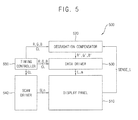
  • FIG. 5 is a block diagram illustrating a display device according to example embodiments.
  • FIG. 6 is a block diagram illustrating an electronic device which includes the display device of FIG. 5 .
  • FIG. 7 is a diagram illustrating an example embodiment in which the electronic device of FIG. 6 is implemented as a smartphone.
  • first,” “second,” “third,” etc. may be used herein to describe various elements, components, regions, layers, and/or sections, these elements, components, regions, layers, and/or sections should not be limited by these terms. These terms are used to distinguish one element, component, region, layer, or section from another element, component, region, layer, or section. Thus, a first element, component, region, layer, or section discussed below could be termed a second element, component, region, layer, or section, without departing from the spirit and scope of the present invention.
  • spatially relative terms such as “beneath,” “below,” “lower,” “under,” “above,” “upper” and the like, may be used herein for ease of description to describe one element or feature's relationship to another element(s) or feature(s) as illustrated in the figures. It will be understood that the spatially relative terms are intended to encompass different orientations of the device in use or in operation, in addition to the orientation depicted in the figures. For example, if the device in the figures is turned over, elements described as “below,” “beneath,” or “under” other elements or features would then be oriented “above” the other elements or features. Thus, the example terms “below” and “under” can encompass both an orientation of above and below. The device may be otherwise oriented (e.g., rotated 90 degrees or at other orientations) and the spatially relative descriptors used herein should be interpreted accordingly.
  • the term “and/or” includes any and all combinations of one or more of the associated listed items. Expressions such as “at least one of,” when preceding a list of elements, modify the entire list of elements and do not modify the individual elements of the list. Further, the use of “may” when describing embodiments of the present invention refers to “one or more embodiments of the present invention.” Also, the term “exemplary” is intended to refer to an example or illustration.
  • FIG. 1 is a block diagram illustrating a degradation compensating device according to example embodiments.
  • a degradation compensating device 100 may include a degradation determiner 110 , a sensor 120 , a degradation calculator 130 , a brightness calculator 140 , a color difference calculator 150 , and an image compensator 160 .
  • the degradation determiner 110 may be coupled to sensing lines formed in a display panel.
  • the degradation determiner 110 may detect current flowing through pixels coupled to each of the sensing lines, and may detect a degradation of the pixels respectively coupled to sensing lines based on the current.
  • the plurality of pixels and a plurality of the sensing lines may be formed in the display panel.
  • Each of the sensing lines may be coupled to respective ones of the pixels.
  • the sensing lines may be formed in a horizontal direction or in a vertical direction.
  • the degradation determiner 110 may detect the current flowing through the pixels coupled to each of the sensing lines when a reference image (e.g., a predetermined reference image) is provided to the pixels in the display panel from an external device.
  • the degradation determiner 110 may include an integrator coupled to the sensing line.
  • the degradation determiner 110 may detect the degradation of pixels coupled to each of the sensing lines by integrating the current flowing through the pixels coupled to each of the sensing lines using the integrator.
  • the degradation determiner 110 may detect the degradation of pixels coupled to a sensing line when the current detected through the sensing line is lower than a reference current (e.g., a predetermined reference current).
  • the degradation determiner 110 may determine that the pixels coupled to the sensing line are not degraded when the current detected through the sensing line is higher than the reference current.
  • Image data R, G, B may be directly provided to a data driver.
  • the sensor 120 may assign a first region and a second region.
  • the second region may include at least one pixel adjacent the first region.
  • the sensor 120 may sense a first sensing data SD 1 of the first region, and may sense a second sensing data SD 2 of the second region.
  • the sensor 120 may assign, or detect/determine, at least one first region that includes at least one of the pixels coupled to the sensing line through which the degradation is detected.
  • the first region may include at least one pixel. For example, when one sensing line through which the degradation is detected is coupled to 500 pixels, and when the first region includes 5 pixels, the sensor 120 may assign/detect/determine 100 first regions.
  • the sensor 120 may sense a first current flowing through the pixels in the first region, and may output the first current as the first sensing data SD 1 . For example, when the sensor 120 assigns the 100 first regions, the sensor 120 may output 100 first sensing data SD 1 .
  • the sensor 120 may assign at least one second region adjacent the first region.
  • the sensor 120 may assign pixels at an upper side of, or above, the first region, pixels at a lower side of, or below, the first region, pixels at a left side of the first region, and pixels at a right side of the first region as the second regions.
  • the number of pixels in each of the second regions may be the same as, or substantially the same as, the number of pixels in the first region.
  • each of the second regions may include 5 pixels at the upper side of the first region, 5 pixels at the lower side of the first region, 5 pixels at the left side of the first region, and 5 pixels at the right side of the first region.
  • the sensor 120 may sense the second current flowing through the pixels in each of the second regions, and may output the second current as the second sensing data SD 2 . That is, the sensor 120 may output one first sensing data SD 1 , and may output at least one second sensing data SD 2 corresponding to the first sensing data SD 1 . For example, when the sensor 120 assigns the 100 first regions, and assigns the 400 second regions, which are adjacent each of the first regions in upper, lower, left, and right directions, the sensor 120 may output the 100 first sensing data SD 1 , and may output the 400 second sensing data SD 2 corresponding to the 100 first sensing data SD 1 .
  • the degradation calculator 130 may determine whether the pixels in the first region are degraded based on the first sensing data SD 1 and the second sensing data SD 2 , and may calculate a compensating amount of a degradation DC of the first region.
  • the degradation calculator 130 may receive the first sensing data SD 1 , and may receive at least one second sensing data SD 2 corresponding to the first sensing data SD 1 .
  • the degradation calculator 130 may calculate an average value of the second sensing data SD 2 .
  • the degradation calculator 130 may determine that the pixels in the first region are degraded when the first sensing data SD 1 is lower than the average value of the second sensing data SD 2 .
  • the degradation calculator 130 may calculate the average value of the four second sensing data SD 2 , and may compare the first sensing data SD 1 to the average value of the four second sensing data SD 2 .
  • the degradation calculator 130 may determine that the pixels in the first region are degraded when the first sensing data SD 1 is lower than the average value of the four second sensing data SD 2 .
  • the degradation calculator 130 may calculate the compensating amount of the degradation DC.
  • the compensating amount of the degradation DC may be a difference between the first sensing data SD 1 and the average value of the second sensing data SD 2 .
  • the compensating amount of the degradation DC may also be a current value.
  • the brightness calculator 140 may calculate a compensating amount of a brightness BC that compensates a brightness of the first region based on the compensating amount of the degradation DC.
  • the brightness calculator 140 may include a look up table (LUT) that stores the compensating amount of the brightness BC corresponding to the compensating amount of the degradation DC (e.g., that stores a plurality of compensating amounts of the brightness BC that respectively correspond to one of a plurality of compensating amounts of the degradation DC).
  • the look up table may store brightness data, which corresponds to the difference between the current value of the first sensing data SD 1 and the average current value of the second sensing data SD 2 , as the compensating amount of the brightness BC.
  • the color difference calculator 150 may calculate a compensating amount of a color difference CC that compensates a color difference of the first region based on the compensating amount of the degradation DC.
  • the color difference calculator 150 may include a look up table that stores the compensating amount of the color difference CC corresponding to the compensating amount of the degradation DC. For example, when the first sensing data SD 1 and the second sensing data SD 2 are current values, the look up table may store color difference data, which corresponds to the difference between the current value of the first sensing data SD 1 and the average current value of the second sensing data SD 2 , as the compensating amount of the color difference CC.
  • the image compensator 160 may compensate image data R, G, B based on the compensating amount of the brightness BC and the compensating amount of the color difference CC.
  • the image compensator 160 may compensate the brightness and the color difference of the image data R, G, B provided to the first region when the image data R, G, B is provided to the image compensator 160 .
  • the image compensator 160 may compensate the brightness of the image data R, G, B based on the compensating amount of the brightness BC.
  • the image compensator 160 may compensate the image data R, G, B provided to the first region by changing a gray level value of the image data R, G, B provided to the first region based on the compensating amount of the brightness BC.
  • the image compensator 160 may compensate the image data R, G, B provided to the first region by changing a dimming value of the image data R, G, B provided to the first region based on the compensating amount of the brightness BC.
  • the image compensator 160 may compensate the color difference of the image data R, G, B based on the compensating amount of the color difference CC.
  • the image compensator 160 may compensate a color coordinate of the image data R, G, B provided to the first region using a gamut mapping algorithm (GMA) based on the compensating amount of the color difference CC.
  • GMA gamut mapping algorithm
  • one of the changing amounts of a red color coordinate, a green color coordinate, and a blue color coordinate may increase.
  • the changing amount of the blue color coordinate may be relatively increased because the human eye is more sensitive to the changing amount of the blue color coordinate by Macadam Ellipse that is formed by coupling the color coordinates that have the same, or substantially the same, color difference in a plurality of gray levels.
  • the image data R, G, B may be naturally compensated.
  • the degradation compensating device 100 may assign the first region, in which the degradation of the pixels is detected through the sensing line, and may assign the second region that includes the pixels adjacent the first region.
  • the degradation compensating device 100 may compensate the brightness and the color difference of the image data R, G, B provided to the first region based on the difference between the first sensing data SD 1 of the first region and the average value of the second sensing data SD 2 of the second regions.
  • the degradation compensating device 100 may naturally compensate the image data R, G, B provided to the first region by determining whether pixels in the first region are degraded based on the first sensing data SD 1 and the second sensing data SD 2 , and by compensating the degradation of the pixels in the first region.
  • FIGS. 2A through 2D are diagrams illustrating examples of a display panel coupled to the degradation compensating device of FIG. 1 .
  • the sensing lines SENSE_L may extend in a first direction 1ST DIRECTION.
  • Each of the sensing lines SENSE_L may be coupled to respective pixel columns PX_C.
  • 100 sensing lines SENSE_L respectively coupled to the pixel columns PX_C may be formed in the display panel 200 .
  • the degradation determiner 110 may detect the degradation of the pixel column PX_C coupled to the sensing line SENSE_L by detecting the current flowing through the pixel column PX_C coupled to the sensing line SENSE_L.
  • the sensing lines SENSE_L may extend in a second direction 2ND DIRECTION.
  • Each of the sensing lines SENSE_L may be coupled to each of pixel rows PX_R.
  • the degradation determiner 110 may detect the degradation of the pixel row PX_R coupled to the sensing line SENSE_L by detecting the current flowing through the pixel row PX_R coupled to the sensing line SENSE_L.
  • the sensing lines SENSE_L may extend in the first direction 1ST DIRECTION.
  • Each of the sensing lines SENSE_L may be coupled to 2 pixel columns PX_C (e.g., a pair of pixels in each column).
  • PX_C e.g., a pair of pixels in each column.
  • the degradation determiner 110 may detect the degradation of the pixel columns PX_C coupled to the sensing line SENSE_L by detecting the current flowing through the pixel columns PX_C coupled to the sensing line SENSE_L.
  • the sensing lines SENSE_L may extend in the second direction 2ND DIRECTION.
  • Each of the sensing lines SENSE_L may be coupled to 2 pixel rows PX_R (e.g., respective pairs of pixels, each of the pairs being located in a respective common row).
  • PX_R e.g., respective pairs of pixels, each of the pairs being located in a respective common row.
  • each of 50 sensing lines SENSE_L may be coupled to 2 pixel rows PX_R (e.g., may be coupled to a plurality of paired pixels of respective rows).
  • the degradation determiner 110 may detect the degradation of the pixel rows PX_R coupled to the sensing line SENSE_L by detecting the current flowing through the pixel rows PX_R coupled to the sensing line SENSE_L.
  • sensing lines SENSE_L coupled to one or two pixel columns PX_C or coupled to one or two pixel rows PX_R are described in FIGS. 2A through 2D , the sensing lines SENSE_L are not limited thereto.
  • each of the sensing lines SENSE_L may be coupled to more than two pixel columns PX_C and/or pixel rows PX_R.
  • FIGS. 3A and 3B are diagrams illustrating an operation of a sensor included in the degradation compensating device of FIG. 1 .
  • the sensor 120 may assign at least one first region, which includes at least one of the pixels coupled to the sensing line through which the degradation is detected.
  • the first region may include at least one pixel PX.
  • the sensor 120 may assign at least one second region adjacent the first region.
  • the sensor 120 may assign at least one second region corresponding to the first region.
  • the number of pixels in each of the second regions may be the same as, or substantially the same as, the number of pixels in the first region.
  • sensing lines 320 , 330 , 340 may extend in the first direction 1ST DIRECTION.
  • Each of the sensing lines 320 , 330 , 340 may be respectively coupled to the pixel columns PX_C 1 , PX_C 2 , PX_C 3 .
  • the sensor 120 may assign first regions 331 , 332 , 333 , 334 , which each include 3 pixels PX coupled to the second sensing line 330 .
  • the sensor 120 may sense the first current flowing through the pixels PX in each of the first regions 331 , 332 , 333 , 334 , and may output the first current as the first sensing data SD 1 for each of the first regions.
  • the sensor 120 may assign second regions 321 , 332 , 341 , which include the pixels PX that are adjacent the first region 331 (e.g., above, below, and to the right of the first region 331 ). Also, the sensor 120 may assign second regions 322 , 331 , 333 , 342 which include the pixels PX adjacent the first region 332 . The sensor 120 may also assign second regions 323 , 332 , 334 , 343 , which include the pixels PX adjacent the first region 333 . The sensor 120 may assign second regions 324 , 333 , 344 , which include the pixels PX that are adjacent the first region 334 . The sensor 120 may assign the second regions adjacent the first regions in this way, may sense the second current flowing through the pixels PX in each of the second regions, and may output the second current as the second sensing data SD 2 .
  • the sensor 120 may assign the second regions, which include the pixels PX formed in an orthogonal direction of the first region.
  • sensing lines 420 , 430 , 440 may extend in the first direction 1ST DIRECTION.
  • Each of the sensing lines 420 , 430 , 440 may be coupled to two respective pixel columns.
  • the sensor 120 may assign first regions 431 , 432 , 433 , 434 , which each include 6 pixels PX coupled to the second sensing line 430 .
  • the sensor 120 may sense the first current flowing through the pixels PX in each of the first regions 431 , 432 , 433 , 434 , and may output the first current as the first sensing data SD 1 .
  • the sensor 120 may assign second regions 421 , 432 , 441 , which include the pixels adjacent the first region 431 .
  • the sensor 120 may assign second regions 422 , 431 , 433 , 442 , which include the pixels adjacent the first region 432 .
  • the sensor 120 may assign second regions 423 , 432 , 434 , 443 , which include the pixels adjacent the first region 433 .
  • the sensor 120 may assign second regions 424 , 433 , and 444 , which include the pixels adjacent the first region 434 .
  • the sensor 120 may assign the second regions adjacent the first regions in this way.
  • the sensor 120 may sense the second current flowing through the pixels PX in each of the second regions, and may output the second current as the second sensing data SD 2 .
  • the sensor 120 may assign the second regions which include the pixels PX formed in an orthogonal direction of the first region.
  • FIG. 4 is a graph illustrating an operation of a degradation calculator included in the degradation compensating device of FIG. 1 .
  • the degradation calculator 130 may determine whether the pixels in the first region are degraded based on the first sensing data SD 1 and the second sensing data SD 2 , and may calculate the compensating amount of the degradation DC.
  • the degradation calculator 130 may receive one first sensing data SD 1 and at least one second sensing data SD 2 corresponding to the first sensing data SD 1 .
  • the degradation calculator 130 may determine whether the pixels in the first region are degraded by comparing the first sensing data SD 1 and the average value of the second sensing data SD 2 .
  • the degradation calculator 130 may calculate the average value of the second sensing data SD 2 , and may compare the first sensing data SD 1 and the average value of the second sensing data SD 2 .
  • the degradation calculator 130 may determine that the pixels in the first region are degraded when the first sensing data SD 1 is lower than the average value of the second sensing data SD 2 .
  • the degradation calculator 130 may calculate the difference between the first sensing data SD 1 and the average value of the second sensing data SD 2 , and may output the difference as the compensating amount of the degradation DC.
  • FIG. 4 is a graph illustrating the first sensing data SD 1 of the first regions, and illustrating the average value of the second sensing data SD 2 of the second regions adjacent each of the first regions.
  • the degradation determiner 110 may determine that the pixels in the first regions in P 2 , P 7 , and P 10 are degraded because the first sensing data SD 1 in the first regions in P 2 , P 7 , and P 10 are lower than the average value of the second sensing data SD 2 corresponding to the first regions P 2 , P 7 , and P 10 . That is, the degradation calculator 130 may determine that the first regions in P 2 , P 7 , and P 10 are degraded.
  • the degradation determiner 110 may output the difference D 2 between the first sensing data SD 1 and the average value of the second sensing data SD 2 as the compensating amount of the degradation DC of the first regions in P 2 .
  • the degradation determiner 110 may output the difference D 7 between the first sensing data SD 1 and the average value of the second sensing data SD 2 as the compensating amount of the degradation DC of the first regions in P 7 .
  • the degradation determiner 110 may output the difference D 10 between the first sensing data SD 1 and the average value of the second sensing data SD 2 as the compensating amount of the degradation DC of the first regions in P 10 .
  • the compensating amount of the degradation DC may be the current value when the first sensing data SD 1 and the second sensing data SD 2 are the current value.
  • FIG. 5 is a block diagram illustrating a display device according to example embodiments.
  • a display device 500 may include a display panel 510 , a degradation compensator 520 , a data driver 530 , a scan driver 540 , and a timing controller 550 .
  • the degradation compensator 520 may correspond to the degradation compensating device 100 of FIG. 1 .
  • the display panel 510 may include a plurality of pixels.
  • a plurality of scan lines SLn and a plurality of data lines DLm may be formed on the display panel 510 .
  • the pixels may be formed at respective crossing regions of the scan lines SLn and the data lines DLm.
  • each of the pixels may include a pixel circuit, a driving transistor, and an organic light emitting diode.
  • the driving transistor may control a driving current flowing through the organic light emitting diode based on the data signal.
  • the data signal may be provided to the driving transistor via the data line DLm in response to the scan signal.
  • the scan signal may be provided via the scan line SLn.
  • Sensing lines SENSE_L may be formed on the display panel 510 .
  • the sensing lines SENSE_L may be formed in a first direction or a second direction.
  • the sensing lines SENSE_L may be coupled to at least one of the pixel columns PX_C.
  • the sensing lines SENSE_L may be coupled to the degradation compensator 520 .
  • the degradation compensator 520 may detect a degradation of the pixels coupled to each of the sensing lines SENSE_L by detecting currents flowing through the pixels coupled to each of the sensing lines SENSE_L.
  • the degradation compensator 520 may assign a first region, which includes at least one of the pixels coupled to the sensing line SENSE_L through which the degradation is detected, and may assign a second region adjacent the first region.
  • the degradation compensator 520 may compensate a brightness and a color difference of the first region based on a first sensing data SD 1 of the first region and a second sensing data SD 2 of the second region.
  • the degradation compensator 520 may include a degradation determiner, a sensor, a degradation calculator, a brightness calculator, a color difference calculator, and an image compensator (e.g., see FIG. 1 ).
  • the degradation compensator 520 may detect a degradation of the pixels coupled to each of the sensing lines SENSE_L by detecting the current flowing through the pixels coupled to each of the sensing lines SENSE_L.
  • the degradation determiner may detect the current flowing through the pixels coupled to the sensing lines SENSE_L when a reference image is displayed on the display panel 510 .
  • the degradation determiner may detect the degradation of the pixels coupled to the sensing line SENSE_L when the current detected through the sensing line SENSE_L is lower than a reference current.
  • the degradation determiner may determine that the pixels coupled to the sensing line SENSE_L are not degraded when the current detected through the sensing line SENSE_L is higher than the reference current. In different embodiments, the degradation determiner may determine that the pixels are, or are not, degraded when the current detected through the sensing line SENSE_L is equal to the reference current.
  • Image data R, G, B provided from an external device may be directly provided to the data driver 530 .
  • the sensor may assign at least one first region, which includes at least one pixel, and may assign at least one second region adjacent the first region.
  • the sensor may sense the first sensing data SD 1 of the first region and the second sensing data SD 2 of the second region.
  • the sensor may assign at least one first region, which includes at least one of the pixels coupled to the sensing line SENSE_L through which the degradation is detected.
  • the first region may include at least one pixel.
  • the sensor may sense a first current flowing through the pixels in the first region, and may output the first current as the first sensing data SD 1 .
  • the sensor may assign at least one second region adjacent, or corresponding to, the first region.
  • the second region may include at least one pixel adjacent the pixel in the first region.
  • the number of pixels in each of the second regions may be the same, or substantially the same, as the number of pixels in the first region.
  • the sensor may sense a second current flowing through the pixels in the second region(s), and may output the second current as the second sensing data SD 2 . That is, the sensor may output one first sensing data SD 1 , and may output at least one second sensing data SD 2 corresponding to the first sensing data SD 1 .
  • the degradation calculator may determine whether the pixels in the first region are degraded based on the first sensing data SD 1 and the second sensing data SD 2 , and may calculate a compensating amount of the degradation DC.
  • the degradation calculator may receive the first sensing data SD 1 , and may also receive at least one second sensing data SD 2 corresponding to the first sensing data SD 1 .
  • the degradation calculator may calculate an average value of the second sensing data SD 2 .
  • the degradation calculator may determine that the pixels in the first region are degraded when the first sensing data SD 1 is lower than the average value of the second sensing data SD 2 .
  • the degradation calculator may calculate a difference between the first sensing data SD 1 and the average value of the second sensing data SD 2 as the compensating amount of the degradation DC.
  • the brightness calculator may calculate the compensating amount of the brightness BC that compensates the brightness of the pixels in the first region based on the compensating amount of the degradation DC.
  • the brightness calculator may include a look up table that stores the compensating amount of the brightness BC corresponding to the compensating amount of the degradation DC.
  • the color difference calculator may calculate a compensating amount of the color difference CC that compensates the color difference of the pixels in the first region based on the compensating amount of the degradation DC.
  • the color difference calculator may include a look up table that stores the compensating amount of the color difference CC corresponding to the compensating amount of the degradation DC.
  • the image compensator may compensate image data R, G, B based on the compensating amount of the brightness BC and based on the compensating amount of the color difference CC.
  • the image compensator may compensate the brightness and the color difference of the image data R, G, B provided to the first region.
  • the image compensator may compensate the brightness of the image data R, G, B provided to the first region based on the compensating amount of the brightness BC.
  • the image compensator may change a gray level value of the image data R, G, B provided to the first region based on the compensating amount of the brightness BC.
  • the image compensator may change a dimming value of the image data R, G, B provided to the first region based on the compensating amount of the brightness BC.
  • the image compensator may compensate the color difference of the image data R, G, B provided to the first region based on the compensating amount of the color difference CC.
  • the image compensator may compensate a color coordinate of the image data R, G, B provided to the first region based on the compensating amount of the color difference CC using a gamut mapping algorithm.
  • a user may recognize the change of the image.
  • one of the changing amounts of a red color coordinate, a green color coordinate, and a blue color coordinate may increase.
  • the changing amount of the blue color coordinate may increase because the human eye responds sensitively to the changing amount of the blue color coordinate by Macadam Ellipse that is formed by coupling the color coordinates that have the same, or substantially the same, color difference in a plurality of gray levels.
  • the image data R, G, B may be naturally compensated.
  • the compensated image data R′, G′, B′ may be provided to the data driver 530 .
  • the scan driver 540 may provide the scan signals to the pixels through the scan lines SLn.
  • the data driver 530 may provide the data signals to the pixels through the data lines DLm.
  • the timing controller 550 may generate control signals CL that control the degradation compensator 520 , the data driver 530 , and the scan driver 540 .
  • the degradation compensator 520 may be coupled to the timing controller 550 , or may be located in the timing controller 550 .
  • the display device 500 may include the degradation compensator 520 .
  • the degradation compensator 520 may detect the degradation of the pixels through the sensing lines SENSE_L formed in the display panel 510 , may assign the first region in which the degradation of the pixels is detected through the sensing lines SENSE_L, may assign the second regions adjacent the first region, and may compensate the image data R, G, B provided to the first region based on the difference between the first sensing data SD 1 of the first region and the average value of the second sensing data SD 2 of the second regions.
  • the degradation compensator 520 may naturally compensate the image data R, G, B provided to the degraded pixels by determining whether the pixels in the first region are degraded based on the first sensing data SD 1 of the first region and the second sensing data SD 2 of the second regions that is adjacent the first region, and by compensating the first region.
  • the display device 500 may display a high-quality image on the display panel 510 .
  • FIG. 6 is a block diagram illustrating an electronic device, which includes the display device of FIG. 5
  • FIG. 7 is a diagram illustrating an example embodiment in which the electronic device of FIG. 6 is implemented as a smartphone.
  • an electronic device 600 may include a processor 610 , a memory device 620 , a storage device 630 , an input/output (I/O) device 640 , a power device/power supply 650 , and a display device 660 .
  • the display device 660 may correspond to the display device 500 of FIG. 5 .
  • the electronic device 600 may further include a plurality of ports for communicating a video card, a sound card, a memory card, a universal serial bus (USB) device, other electronic devices, etc.
  • USB universal serial bus
  • the processor 610 may perform various computing functions.
  • the processor 610 may be a microprocessor, a central processing unit (CPU), etc.
  • the processor 610 may be coupled to other suitable components via an address bus, a control bus, a data bus, etc. Further, the processor 610 may be coupled to an extended bus such as a peripheral component interconnect (PCI) bus.
  • the memory device 620 may store data for operations of the electronic device 600 .
  • the memory device 620 may include at least one non-volatile memory device such as an erasable programmable read-only memory (EPROM) device, an electrically erasable programmable read-only memory (EEPROM) device, a flash memory device, a phase change random access memory (PRAM) device, a resistance random access memory (RRAM) device, a nano floating gate memory (NFGM) device, a polymer random access memory (PoRAM) device, a magnetic random access memory (MRAM) device, a ferroelectric random access memory (FRAM) device, etc., and/or at least one volatile memory device such as a dynamic random access memory (DRAM) device, a static random access memory (SRAM) device, a mobile DRAM device, etc.
  • the storage device 630 may be a solid state drive (SSD) device, a hard disk drive (HDD) device, a CD-ROM device, etc.
  • the I/O device 640 may be an input device such as a keyboard, a keypad, a touchpad, a touch-screen, a mouse, etc., and an output device such as a printer, a speaker, etc.
  • the display device 660 may be included in the I/O device 640 .
  • the power device 650 may provide power for operations of the electronic device 600 .
  • the display device 660 may communicate with other components via the buses or other suitable communication links.
  • the display device 660 may include a display panel, a degradation compensator, a data driver, a scan driver, and a timing controller.
  • the display panel may include a plurality of pixels. Sensing lines coupled to the pixels may be formed on the display panel.
  • the degradation compensator may detect the degradation of the pixels through the sensing line and compensate a brightness and a color difference of pixels in a first region based on first sensing data of the first region and second sensing data of a second region adjacent the first region.
  • the degradation compensator may include a degradation determiner, a sensor, a degradation calculator, a brightness calculator, a color difference calculator, and an image compensator.
  • the degradation determiner may detect a degradation of the pixels coupled to each of the sensing lines by detecting the current flowing through the pixels coupled to each of the sensing lines.
  • the degradation determiner may detect the degradation of the pixels coupled to the sensing line when the current detected through the sensing line is lower than a reference current.
  • the sensor may assign at least one first region which includes at least one pixel and at least one second region adjacent the first region and sense the first sensing data of the first region and the second sensing data of the second region.
  • the sensor may sense a first current flowing through the pixels in the first region and output the first current as the first sensing data.
  • the sensor may sense a second current flowing through the pixels in the second region and output the second current as the second sensing data.
  • the degradation calculator may calculate an average value of the second sensing data.
  • the degradation calculator may determine that the pixels in the first region are degraded when the first sensing data is lower than the average value.
  • the degradation calculator may calculate a difference between the first sensing data and the average value of the second sensing data as the compensating amount of the degradation.
  • the brightness calculator may calculate the compensating amount of the brightness that compensates the brightness of the pixels in the first region based on the compensating amount of the degradation.
  • the brightness calculator may include a look up table that stores the compensating amount of the brightness corresponding to the compensating amount of the degradation.
  • the color difference calculator may calculate a compensating amount of the color difference that compensates the color difference of the pixels in the first region based on the compensating amount of the degradation.
  • the color difference calculator may include a look up table that stores the compensating amount of the color difference corresponding to the compensating amount of the degradation.
  • the image compensator may compensate image data based on the compensating amount of the brightness and the compensating amount of the color difference.
  • the scan driver may provide the scan signals to the pixels through the scan lines.
  • the data driver may provide the data signals to the pixels through the data lines.
  • the timing controller may generate control signals that control the degradation compensator, the data driver, and the scan driver.
  • the electronic device 600 of FIG. 6 may naturally compensate the image data provided to the degraded pixels by including the display device 460 that detects the degradation of the pixels through the sensing line formed on the display panel, may assign the first region coupled to the sensing line through which the degradation of the pixel is detected, assigns the second regions adjacent the first region, and may compensate the image data provided to the first region based on the first sensing data of the first region and the average value of the second sensing data of the second regions.
  • the electronic device 600 which includes the display device 460 may display a high-quality image on the display panel.
  • the present inventive concept may be applied to a display device and an electronic device having a display device.
  • the present inventive concept may be applied to a computer monitor, a laptop, a digital camera, a cellular phone, a smartphone, a smart pad, a television, a personal digital assistant (PDA), a portable multimedia player (PMP), an MP3 player, a navigation system, a game console, a video phone, etc.
  • PDA personal digital assistant
  • PMP portable multimedia player
  • MP3 player MP3 player

Landscapes

  • Engineering & Computer Science (AREA)
  • Physics & Mathematics (AREA)
  • Computer Hardware Design (AREA)
  • General Physics & Mathematics (AREA)
  • Theoretical Computer Science (AREA)
  • Control Of Indicators Other Than Cathode Ray Tubes (AREA)
  • Control Of El Displays (AREA)

Abstract

A display device may include a display panel including a plurality of pixels and sensing lines respectively coupled to the pixels, a degradation compensator configured to detect a degradation of the pixels based on a current flowing through the pixels and to compensate a brightness and a color difference of a first region including at least one of the pixels coupled to a respective one of the sensing lines, through which the degradation is detected, based on a first sensing data of the first region and a second sensing data of a second region including pixels adjacent the pixels of the first region, a data driver configured to provide data signals to data lines, a scan driver configured to provide scan signals to the pixels, and a timing controller configured to generate control signals which control the degradation compensator, the data driver, and the scan driver.

Description

CROSS-REFERENCE TO RELATED APPLICATION
This application claims priority to, and the benefit of, Korean Patent Application No. 10-2015-0135601, filed on Sep. 24, 2015 in the Korean Intellectual Property Office (KIPO), the contents of which are incorporated herein in their entirety by reference.
BACKGROUND
1. Field
Example embodiments relate generally to a degradation compensating device, a display device having the same, a pixel, and a display device having the same.
2. Description of the Related Art
Flat panel display (FPD) devices are widely used as display devices of electronic devices because FPD devices are relatively lightweight and thin compared to cathode-ray tube (CRT) display devices. Examples of FPD devices are liquid crystal display (LCD) devices, field emission display (FED) devices, plasma display panel (PDP) devices, and organic light emitting diode (OLED) display devices. OLED devices have been spotlighted as next-generation display devices because OLED devices have various features, such as a wide viewing angle, rapid response speed, a thin profile, low power consumption, etc.
A pixel in an OLED device may degrade as time passes. A brightness of the pixel, which is emitted based on the data signal, may be reduced. Thus, a method for detecting a degraded pixel and for compensating the degraded pixel is studied.
SUMMARY
Some example embodiments provide a degradation compensating device capable of compensating a degradation of a pixel.
Some example embodiments provide a display device capable of compensating a degradation of a pixel.
According to an aspect of example embodiments, a degradation compensating device may include a degradation determiner coupled to sensing lines in a display panel, the degradation determiner being configured to detect current flowing through pixels respectively coupled to the sensing lines and to detect a degradation of the pixels based on the current, a sensor configured to assign a first region including at least one of the pixels which is coupled to one of the sensing lines through which the degradation is detected, to assign a second region including ones of the pixels adjacent the first region, to sense a first sensing data of the first region, and to sense a second sensing data of the second region, a degradation calculator configured to determine whether the pixels in the first region are degraded based on the first sensing data and the second sensing data and to calculate a compensating amount of the degradation of the first region, a brightness calculator configured to calculate a brightness compensating amount, for compensating the brightness of the first region, based on the compensating amount of the degradation, a color difference calculator configured to calculate a color compensating amount, for compensating the color difference of the first region, based on the compensating amount of the degradation, and an image compensator configured to compensate image data based on the brightness compensating amount and the color difference compensating amount.
In example embodiments, the degradation determiner may be further configured to detect the degradation of the pixels when the current is lower than a reference current.
In example embodiments, the first sensing data includes an amount of a first current which flows through the pixels in the first region, and wherein the sensor outputs the first sensing data based on the first current.
In example embodiments, the second sensing data includes an amount of a second current which flows through the pixels in the second region, and wherein the sensor outputs the second sensing data based on the second current.
In example embodiments, the degradation calculator may determine that the pixels in the first region are degraded when the first sensing data is lower than an average value of the second sensing data.
In example embodiments, the degradation calculator may calculate the compensating amount of the degradation using a difference between the first sensing data and the average value of the second sensing data.
In example embodiments, the brightness calculator may include a look up table (LUT) for storing the brightness compensating amount corresponding to the compensating amount of the degradation.
In example embodiments, the color difference calculator may include a look up table (LUT) for storing the color compensating amount corresponding to the compensating amount of the degradation.
In example embodiments, the image compensator may compensate a color coordinate of the image data for the first region based on the color compensating amount using a gamut mapping algorithm (GMA).
According to an aspect of example embodiments, a display device may include a display panel including a plurality of pixels and sensing lines respectively coupled to the pixels, a degradation compensator configured to detect a degradation of the pixels based on a current flowing through the pixels and to compensate a brightness and a color difference of a first region including at least one of the pixels coupled to a respective one of the sensing lines, through which the degradation is detected, based on a first sensing data of the first region and a second sensing data of a second region including pixels adjacent to the pixels of the first region, a data driver configured to provide data signals to the pixels, a scan driver configured to provide scan signals to the pixels, and a timing controller configured to generate control signals which control the degradation compensator, the data driver, and the scan driver.
In example embodiments, the degradation compensator may include a degradation determiner configured to detect the current flowing through the pixels and to detect the degradation of the pixels based on the current, a sensor configured to assign the first region and the second region and to sense the first sensing data and the second sensing data, a degradation calculator configured to determine whether the pixels in the first region are degraded based on the first sensing data and the second sensing data and to calculate a compensating amount of the degradation of the first region, a brightness calculator configured to calculate a brightness compensating amount for compensating the brightness of the first region based on the compensating amount of the degradation, a color difference calculator configured to calculate a color compensating amount for compensating the color difference of the first region based on the compensating amount of the degradation, and an image compensator configured to compensate image data based on the brightness compensating amount and the color compensating amount.
In example embodiments, the degradation determiner may detect the degradation of the pixels when the current is lower than a reference current.
In example embodiments, the sensor may sense a first current flowing through the pixels in the first region and output the first sensing data based on the first current.
In example embodiments, the sensor may sense a second current flowing through the pixels in the second region and output the second sensing data based on the second current.
In example embodiments, the degradation calculator may determine that the pixels in the first region are degraded when the first sensing data is lower than an average value of the second sensing data.
In example embodiments, the degradation calculator may calculate the compensating amount of the degradation using a difference between the first sensing data and the average value of the second sensing data.
In example embodiments, the brightness calculator may include a look up table (LUT) for storing the brightness compensating amount corresponding to the compensating amount of the degradation.
In example embodiments, the color difference calculator may include a look up table (LUT) for storing the color compensating amount corresponding to the compensating amount of the degradation.
In example embodiments, the image compensator may compensate a color coordinate of the image data for the first region based on the compensating amount of the color difference using a gamut mapping algorithm (GMA).
In example embodiments, the degradation compensator may be coupled to the timing controller or located in the timing controller.
Therefore, a degradation compensating device and a display device having the same may compensate a brightness and a color difference of image data provided to a degradation region based on an average value of sensing data detected in the degradation region and in adjacent regions to the degradation region. Therefore, the display device may display a high-quality image on the display panel.
BRIEF DESCRIPTION OF THE DRAWINGS
Illustrative, non-limiting example embodiments will be more clearly understood from the following detailed description taken in conjunction with the accompanying drawings.
FIG. 1 is a block diagram illustrating a degradation compensating device according to example embodiments.
FIGS. 2A through 2D are diagrams illustrating examples of a display panel coupled to the degradation compensating device of FIG. 1.
FIGS. 3A and 3B are diagrams illustrating an operation of a sensor included in the degradation compensating device of FIG. 1.
FIG. 4 is a graph illustrating an operation of a degradation calculator included in the degradation compensating device of FIG. 1.
FIG. 5 is a block diagram illustrating a display device according to example embodiments.
FIG. 6 is a block diagram illustrating an electronic device which includes the display device of FIG. 5.
FIG. 7 is a diagram illustrating an example embodiment in which the electronic device of FIG. 6 is implemented as a smartphone.
DETAILED DESCRIPTION
Hereinafter, the present inventive concept will be explained in detail with reference to the accompanying drawings.
It will be understood that, although the terms “first,” “second,” “third,” etc., may be used herein to describe various elements, components, regions, layers, and/or sections, these elements, components, regions, layers, and/or sections should not be limited by these terms. These terms are used to distinguish one element, component, region, layer, or section from another element, component, region, layer, or section. Thus, a first element, component, region, layer, or section discussed below could be termed a second element, component, region, layer, or section, without departing from the spirit and scope of the present invention.
Spatially relative terms, such as “beneath,” “below,” “lower,” “under,” “above,” “upper” and the like, may be used herein for ease of description to describe one element or feature's relationship to another element(s) or feature(s) as illustrated in the figures. It will be understood that the spatially relative terms are intended to encompass different orientations of the device in use or in operation, in addition to the orientation depicted in the figures. For example, if the device in the figures is turned over, elements described as “below,” “beneath,” or “under” other elements or features would then be oriented “above” the other elements or features. Thus, the example terms “below” and “under” can encompass both an orientation of above and below. The device may be otherwise oriented (e.g., rotated 90 degrees or at other orientations) and the spatially relative descriptors used herein should be interpreted accordingly.
The terminology used herein is for the purpose of describing particular embodiments and is not intended to be limiting of the present invention. As used herein, the singular forms “a” and “an” are intended to include the plural forms as well, unless the context clearly indicates otherwise. It will be further understood that the terms “comprise,” “comprises,” “comprising,” “includes,” “including,” and “include,” when used in this specification, specify the presence of stated features, integers, steps, operations, elements, and/or components, but do not preclude the presence or addition of one or more other features, integers, steps, operations, elements, components, and/or groups thereof.
As used herein, the term “and/or” includes any and all combinations of one or more of the associated listed items. Expressions such as “at least one of,” when preceding a list of elements, modify the entire list of elements and do not modify the individual elements of the list. Further, the use of “may” when describing embodiments of the present invention refers to “one or more embodiments of the present invention.” Also, the term “exemplary” is intended to refer to an example or illustration.
It will be understood that when an element or layer is referred to as being “on,” “connected to,” “coupled to,” “connected with,” “coupled with,” or “adjacent” another element or layer, it can be “directly on,” “directly connected to,” “directly coupled to,” “directly connected with,” “directly coupled with,” or “directly adjacent” the other element or layer, or one or more intervening elements or layers may be present. Furthermore “connection,” “connected,” etc. may also refer to “electrical connection,” “electrically connected,” etc. depending on the context in which such terms are used as would be understood by those skilled in the art. When an element or layer is referred to as being “directly on,” “directly connected to,” “directly coupled to,” “directly connected with,” “directly coupled with,” or “immediately adjacent” another element or layer, there are no intervening elements or layers present.
As used herein, “substantially,” “about,” and similar terms are used as terms of approximation and not as terms of degree, and are intended to account for the inherent deviations in measured or calculated values that would be recognized by those of ordinary skill in the art.
As used herein, the terms “use,” “using,” and “used” may be considered synonymous with the terms “utilize,” “utilizing,” and “utilized,” respectively.
FIG. 1 is a block diagram illustrating a degradation compensating device according to example embodiments.
Referring to FIG. 1, a degradation compensating device 100 may include a degradation determiner 110, a sensor 120, a degradation calculator 130, a brightness calculator 140, a color difference calculator 150, and an image compensator 160.
The degradation determiner 110 may be coupled to sensing lines formed in a display panel. The degradation determiner 110 may detect current flowing through pixels coupled to each of the sensing lines, and may detect a degradation of the pixels respectively coupled to sensing lines based on the current. The plurality of pixels and a plurality of the sensing lines may be formed in the display panel. Each of the sensing lines may be coupled to respective ones of the pixels. The sensing lines may be formed in a horizontal direction or in a vertical direction.
The degradation determiner 110 may detect the current flowing through the pixels coupled to each of the sensing lines when a reference image (e.g., a predetermined reference image) is provided to the pixels in the display panel from an external device. For example, the degradation determiner 110 may include an integrator coupled to the sensing line. The degradation determiner 110 may detect the degradation of pixels coupled to each of the sensing lines by integrating the current flowing through the pixels coupled to each of the sensing lines using the integrator. The degradation determiner 110 may detect the degradation of pixels coupled to a sensing line when the current detected through the sensing line is lower than a reference current (e.g., a predetermined reference current). The degradation determiner 110 may determine that the pixels coupled to the sensing line are not degraded when the current detected through the sensing line is higher than the reference current. Image data R, G, B may be directly provided to a data driver.
The sensor 120 may assign a first region and a second region. The second region may include at least one pixel adjacent the first region. The sensor 120 may sense a first sensing data SD1 of the first region, and may sense a second sensing data SD2 of the second region. The sensor 120 may assign, or detect/determine, at least one first region that includes at least one of the pixels coupled to the sensing line through which the degradation is detected. The first region may include at least one pixel. For example, when one sensing line through which the degradation is detected is coupled to 500 pixels, and when the first region includes 5 pixels, the sensor 120 may assign/detect/determine 100 first regions. The sensor 120 may sense a first current flowing through the pixels in the first region, and may output the first current as the first sensing data SD1. For example, when the sensor 120 assigns the 100 first regions, the sensor 120 may output 100 first sensing data SD1.
The sensor 120 may assign at least one second region adjacent the first region. For example, the sensor 120 may assign pixels at an upper side of, or above, the first region, pixels at a lower side of, or below, the first region, pixels at a left side of the first region, and pixels at a right side of the first region as the second regions. The number of pixels in each of the second regions may be the same as, or substantially the same as, the number of pixels in the first region. For example, when the first region includes 5 pixels, each of the second regions may include 5 pixels at the upper side of the first region, 5 pixels at the lower side of the first region, 5 pixels at the left side of the first region, and 5 pixels at the right side of the first region.
The sensor 120 may sense the second current flowing through the pixels in each of the second regions, and may output the second current as the second sensing data SD2. That is, the sensor 120 may output one first sensing data SD1, and may output at least one second sensing data SD2 corresponding to the first sensing data SD1. For example, when the sensor 120 assigns the 100 first regions, and assigns the 400 second regions, which are adjacent each of the first regions in upper, lower, left, and right directions, the sensor 120 may output the 100 first sensing data SD1, and may output the 400 second sensing data SD2 corresponding to the 100 first sensing data SD1.
The degradation calculator 130 may determine whether the pixels in the first region are degraded based on the first sensing data SD1 and the second sensing data SD2, and may calculate a compensating amount of a degradation DC of the first region. The degradation calculator 130 may receive the first sensing data SD1, and may receive at least one second sensing data SD2 corresponding to the first sensing data SD1. The degradation calculator 130 may calculate an average value of the second sensing data SD2. The degradation calculator 130 may determine that the pixels in the first region are degraded when the first sensing data SD1 is lower than the average value of the second sensing data SD2. For example, when the degradation calculator 130 receives one first sensing data SD1 and four second sensing data SD2, the degradation calculator 130 may calculate the average value of the four second sensing data SD2, and may compare the first sensing data SD1 to the average value of the four second sensing data SD2. Here, the degradation calculator 130 may determine that the pixels in the first region are degraded when the first sensing data SD1 is lower than the average value of the four second sensing data SD2. The degradation calculator 130 may calculate the compensating amount of the degradation DC. The compensating amount of the degradation DC may be a difference between the first sensing data SD1 and the average value of the second sensing data SD2. For example, when the first sensing data SD1 and the second sensing data SD2 are current values, the compensating amount of the degradation DC may also be a current value.
The brightness calculator 140 may calculate a compensating amount of a brightness BC that compensates a brightness of the first region based on the compensating amount of the degradation DC. The brightness calculator 140 may include a look up table (LUT) that stores the compensating amount of the brightness BC corresponding to the compensating amount of the degradation DC (e.g., that stores a plurality of compensating amounts of the brightness BC that respectively correspond to one of a plurality of compensating amounts of the degradation DC). For example, when the first sensing data SD1 and the second sensing data SD2 are current values, the look up table may store brightness data, which corresponds to the difference between the current value of the first sensing data SD1 and the average current value of the second sensing data SD2, as the compensating amount of the brightness BC.
The color difference calculator 150 may calculate a compensating amount of a color difference CC that compensates a color difference of the first region based on the compensating amount of the degradation DC. The color difference calculator 150 may include a look up table that stores the compensating amount of the color difference CC corresponding to the compensating amount of the degradation DC. For example, when the first sensing data SD1 and the second sensing data SD2 are current values, the look up table may store color difference data, which corresponds to the difference between the current value of the first sensing data SD1 and the average current value of the second sensing data SD2, as the compensating amount of the color difference CC.
The image compensator 160 may compensate image data R, G, B based on the compensating amount of the brightness BC and the compensating amount of the color difference CC. The image compensator 160 may compensate the brightness and the color difference of the image data R, G, B provided to the first region when the image data R, G, B is provided to the image compensator 160. The image compensator 160 may compensate the brightness of the image data R, G, B based on the compensating amount of the brightness BC. For example, the image compensator 160 may compensate the image data R, G, B provided to the first region by changing a gray level value of the image data R, G, B provided to the first region based on the compensating amount of the brightness BC. Alternatively, the image compensator 160 may compensate the image data R, G, B provided to the first region by changing a dimming value of the image data R, G, B provided to the first region based on the compensating amount of the brightness BC. The image compensator 160 may compensate the color difference of the image data R, G, B based on the compensating amount of the color difference CC. For example, the image compensator 160 may compensate a color coordinate of the image data R, G, B provided to the first region using a gamut mapping algorithm (GMA) based on the compensating amount of the color difference CC. Here, when the color coordinate is rapidly changed, a user may recognize the change of the image. To prevent, or substantially prevent, the user from recognizing the change of the image, one of the changing amounts of a red color coordinate, a green color coordinate, and a blue color coordinate may increase. For example, the changing amount of the blue color coordinate may be relatively increased because the human eye is more sensitive to the changing amount of the blue color coordinate by Macadam Ellipse that is formed by coupling the color coordinates that have the same, or substantially the same, color difference in a plurality of gray levels. As such, the image data R, G, B may be naturally compensated.
As described above, the degradation compensating device 100 may assign the first region, in which the degradation of the pixels is detected through the sensing line, and may assign the second region that includes the pixels adjacent the first region. The degradation compensating device 100 may compensate the brightness and the color difference of the image data R, G, B provided to the first region based on the difference between the first sensing data SD1 of the first region and the average value of the second sensing data SD2 of the second regions. The degradation compensating device 100 may naturally compensate the image data R, G, B provided to the first region by determining whether pixels in the first region are degraded based on the first sensing data SD1 and the second sensing data SD2, and by compensating the degradation of the pixels in the first region.
FIGS. 2A through 2D are diagrams illustrating examples of a display panel coupled to the degradation compensating device of FIG. 1.
Referring to FIG. 2A, the sensing lines SENSE_L may extend in a first direction 1ST DIRECTION. Each of the sensing lines SENSE_L may be coupled to respective pixel columns PX_C. For example, when 100 pixel columns PX_C are formed in the display panel 200, 100 sensing lines SENSE_L respectively coupled to the pixel columns PX_C may be formed in the display panel 200. The degradation determiner 110 may detect the degradation of the pixel column PX_C coupled to the sensing line SENSE_L by detecting the current flowing through the pixel column PX_C coupled to the sensing line SENSE_L.
Referring to FIG. 2B, the sensing lines SENSE_L may extend in a second direction 2ND DIRECTION. Each of the sensing lines SENSE_L may be coupled to each of pixel rows PX_R. For example, when 100 pixel rows are formed in the display panel 200, 100 sensing lines SENSE_L respectively coupled to the pixel rows PX_R may be formed in the display panel 200. The degradation determiner 110 may detect the degradation of the pixel row PX_R coupled to the sensing line SENSE_L by detecting the current flowing through the pixel row PX_R coupled to the sensing line SENSE_L.
Referring to FIG. 2C, the sensing lines SENSE_L may extend in the first direction 1ST DIRECTION. Each of the sensing lines SENSE_L may be coupled to 2 pixel columns PX_C (e.g., a pair of pixels in each column). For example, when 100 pixel columns are formed in the display panel 200, each of 50 sensing lines SENSE_L may be coupled to 2 pixel columns PX_C (e.g., may be coupled to respective pairs of pixels located in columns). The degradation determiner 110 may detect the degradation of the pixel columns PX_C coupled to the sensing line SENSE_L by detecting the current flowing through the pixel columns PX_C coupled to the sensing line SENSE_L.
Referring to FIG. 2D, the sensing lines SENSE_L may extend in the second direction 2ND DIRECTION. Each of the sensing lines SENSE_L may be coupled to 2 pixel rows PX_R (e.g., respective pairs of pixels, each of the pairs being located in a respective common row). For example, when 100 pixel rows are formed in the display panel 200, each of 50 sensing lines SENSE_L may be coupled to 2 pixel rows PX_R (e.g., may be coupled to a plurality of paired pixels of respective rows). The degradation determiner 110 may detect the degradation of the pixel rows PX_R coupled to the sensing line SENSE_L by detecting the current flowing through the pixel rows PX_R coupled to the sensing line SENSE_L.
Although the sensing lines SENSE_L coupled to one or two pixel columns PX_C or coupled to one or two pixel rows PX_R are described in FIGS. 2A through 2D, the sensing lines SENSE_L are not limited thereto. For example, each of the sensing lines SENSE_L may be coupled to more than two pixel columns PX_C and/or pixel rows PX_R.
FIGS. 3A and 3B are diagrams illustrating an operation of a sensor included in the degradation compensating device of FIG. 1.
The sensor 120 may assign at least one first region, which includes at least one of the pixels coupled to the sensing line through which the degradation is detected. Here, the first region may include at least one pixel PX. Further, the sensor 120 may assign at least one second region adjacent the first region. The sensor 120 may assign at least one second region corresponding to the first region. Here, the number of pixels in each of the second regions may be the same as, or substantially the same as, the number of pixels in the first region.
Referring to FIG. 3A, sensing lines 320, 330, 340 may extend in the first direction 1ST DIRECTION. Each of the sensing lines 320, 330, 340 may be respectively coupled to the pixel columns PX_C1, PX_C2, PX_C3. For example, when the degradation is detected in a second sensing line 330 coupled to a second pixel column PX_C2, the sensor 120 may assign first regions 331, 332, 333, 334, which each include 3 pixels PX coupled to the second sensing line 330. The sensor 120 may sense the first current flowing through the pixels PX in each of the first regions 331, 332, 333, 334, and may output the first current as the first sensing data SD1 for each of the first regions.
The sensor 120 may assign second regions 321, 332, 341, which include the pixels PX that are adjacent the first region 331 (e.g., above, below, and to the right of the first region 331). Also, the sensor 120 may assign second regions 322, 331, 333, 342 which include the pixels PX adjacent the first region 332. The sensor 120 may also assign second regions 323, 332, 334, 343, which include the pixels PX adjacent the first region 333. The sensor 120 may assign second regions 324, 333, 344, which include the pixels PX that are adjacent the first region 334. The sensor 120 may assign the second regions adjacent the first regions in this way, may sense the second current flowing through the pixels PX in each of the second regions, and may output the second current as the second sensing data SD2.
Although the second regions formed at an upper side, a lower side, a left side, and a right side of the first region are described in FIG. 3A, the second regions are not limited thereto. The sensor 120 may assign the second regions, which include the pixels PX formed in an orthogonal direction of the first region.
Referring to FIG. 3B, sensing lines 420, 430, 440 may extend in the first direction 1ST DIRECTION. Each of the sensing lines 420, 430, 440 may be coupled to two respective pixel columns. For example, when the degradation is detected in a second sensing line 430 that is coupled to a third pixel column PX_C3 and to a fourth pixel column PX_C4, the sensor 120 may assign first regions 431, 432, 433, 434, which each include 6 pixels PX coupled to the second sensing line 430. The sensor 120 may sense the first current flowing through the pixels PX in each of the first regions 431, 432, 433, 434, and may output the first current as the first sensing data SD1.
The sensor 120 may assign second regions 421, 432, 441, which include the pixels adjacent the first region 431. The sensor 120 may assign second regions 422, 431, 433, 442, which include the pixels adjacent the first region 432. The sensor 120 may assign second regions 423, 432, 434, 443, which include the pixels adjacent the first region 433. The sensor 120 may assign second regions 424, 433, and 444, which include the pixels adjacent the first region 434. The sensor 120 may assign the second regions adjacent the first regions in this way. The sensor 120 may sense the second current flowing through the pixels PX in each of the second regions, and may output the second current as the second sensing data SD2.
Although the second regions formed at an upper side, a lower side, a left side, and/or a right side of a respective first region are described in FIG. 3B, the second regions are not limited thereto. The sensor 120 may assign the second regions which include the pixels PX formed in an orthogonal direction of the first region.
FIG. 4 is a graph illustrating an operation of a degradation calculator included in the degradation compensating device of FIG. 1.
The degradation calculator 130 may determine whether the pixels in the first region are degraded based on the first sensing data SD1 and the second sensing data SD2, and may calculate the compensating amount of the degradation DC. The degradation calculator 130 may receive one first sensing data SD1 and at least one second sensing data SD2 corresponding to the first sensing data SD1. The degradation calculator 130 may determine whether the pixels in the first region are degraded by comparing the first sensing data SD1 and the average value of the second sensing data SD2. For example, when the degradation calculator 130 receives one first sensing data SD1, and receives four second sensing data SD2 corresponding to the first sensing data SD1, the degradation calculator 130 may calculate the average value of the second sensing data SD2, and may compare the first sensing data SD1 and the average value of the second sensing data SD2. The degradation calculator 130 may determine that the pixels in the first region are degraded when the first sensing data SD1 is lower than the average value of the second sensing data SD2. The degradation calculator 130 may calculate the difference between the first sensing data SD1 and the average value of the second sensing data SD2, and may output the difference as the compensating amount of the degradation DC.
FIG. 4 is a graph illustrating the first sensing data SD1 of the first regions, and illustrating the average value of the second sensing data SD2 of the second regions adjacent each of the first regions. Referring to FIG. 4, the degradation determiner 110 may determine that the pixels in the first regions in P2, P7, and P10 are degraded because the first sensing data SD1 in the first regions in P2, P7, and P10 are lower than the average value of the second sensing data SD2 corresponding to the first regions P2, P7, and P10. That is, the degradation calculator 130 may determine that the first regions in P2, P7, and P10 are degraded. The degradation determiner 110 may output the difference D2 between the first sensing data SD1 and the average value of the second sensing data SD2 as the compensating amount of the degradation DC of the first regions in P2. The degradation determiner 110 may output the difference D7 between the first sensing data SD1 and the average value of the second sensing data SD2 as the compensating amount of the degradation DC of the first regions in P7. The degradation determiner 110 may output the difference D10 between the first sensing data SD1 and the average value of the second sensing data SD2 as the compensating amount of the degradation DC of the first regions in P10. For example, the compensating amount of the degradation DC may be the current value when the first sensing data SD1 and the second sensing data SD2 are the current value.
FIG. 5 is a block diagram illustrating a display device according to example embodiments.
Referring to FIG. 5, a display device 500 may include a display panel 510, a degradation compensator 520, a data driver 530, a scan driver 540, and a timing controller 550. Here, the degradation compensator 520 may correspond to the degradation compensating device 100 of FIG. 1.
The display panel 510 may include a plurality of pixels. A plurality of scan lines SLn and a plurality of data lines DLm may be formed on the display panel 510. The pixels may be formed at respective crossing regions of the scan lines SLn and the data lines DLm. In some example embodiments, each of the pixels may include a pixel circuit, a driving transistor, and an organic light emitting diode. The driving transistor may control a driving current flowing through the organic light emitting diode based on the data signal. The data signal may be provided to the driving transistor via the data line DLm in response to the scan signal. The scan signal may be provided via the scan line SLn. Sensing lines SENSE_L may be formed on the display panel 510. The sensing lines SENSE_L may be formed in a first direction or a second direction. The sensing lines SENSE_L may be coupled to at least one of the pixel columns PX_C. The sensing lines SENSE_L may be coupled to the degradation compensator 520.
The degradation compensator 520 may detect a degradation of the pixels coupled to each of the sensing lines SENSE_L by detecting currents flowing through the pixels coupled to each of the sensing lines SENSE_L. The degradation compensator 520 may assign a first region, which includes at least one of the pixels coupled to the sensing line SENSE_L through which the degradation is detected, and may assign a second region adjacent the first region. The degradation compensator 520 may compensate a brightness and a color difference of the first region based on a first sensing data SD1 of the first region and a second sensing data SD2 of the second region.
For example, the degradation compensator 520 may include a degradation determiner, a sensor, a degradation calculator, a brightness calculator, a color difference calculator, and an image compensator (e.g., see FIG. 1). The degradation compensator 520 may detect a degradation of the pixels coupled to each of the sensing lines SENSE_L by detecting the current flowing through the pixels coupled to each of the sensing lines SENSE_L. The degradation determiner may detect the current flowing through the pixels coupled to the sensing lines SENSE_L when a reference image is displayed on the display panel 510. The degradation determiner may detect the degradation of the pixels coupled to the sensing line SENSE_L when the current detected through the sensing line SENSE_L is lower than a reference current. The degradation determiner may determine that the pixels coupled to the sensing line SENSE_L are not degraded when the current detected through the sensing line SENSE_L is higher than the reference current. In different embodiments, the degradation determiner may determine that the pixels are, or are not, degraded when the current detected through the sensing line SENSE_L is equal to the reference current.
Image data R, G, B provided from an external device may be directly provided to the data driver 530. The sensor may assign at least one first region, which includes at least one pixel, and may assign at least one second region adjacent the first region. The sensor may sense the first sensing data SD1 of the first region and the second sensing data SD2 of the second region. The sensor may assign at least one first region, which includes at least one of the pixels coupled to the sensing line SENSE_L through which the degradation is detected. The first region may include at least one pixel. The sensor may sense a first current flowing through the pixels in the first region, and may output the first current as the first sensing data SD1. The sensor may assign at least one second region adjacent, or corresponding to, the first region. The second region may include at least one pixel adjacent the pixel in the first region. The number of pixels in each of the second regions may be the same, or substantially the same, as the number of pixels in the first region. The sensor may sense a second current flowing through the pixels in the second region(s), and may output the second current as the second sensing data SD2. That is, the sensor may output one first sensing data SD1, and may output at least one second sensing data SD2 corresponding to the first sensing data SD1.
The degradation calculator may determine whether the pixels in the first region are degraded based on the first sensing data SD1 and the second sensing data SD2, and may calculate a compensating amount of the degradation DC. The degradation calculator may receive the first sensing data SD1, and may also receive at least one second sensing data SD2 corresponding to the first sensing data SD1. The degradation calculator may calculate an average value of the second sensing data SD2. The degradation calculator may determine that the pixels in the first region are degraded when the first sensing data SD1 is lower than the average value of the second sensing data SD2. The degradation calculator may calculate a difference between the first sensing data SD1 and the average value of the second sensing data SD2 as the compensating amount of the degradation DC.
The brightness calculator may calculate the compensating amount of the brightness BC that compensates the brightness of the pixels in the first region based on the compensating amount of the degradation DC. The brightness calculator may include a look up table that stores the compensating amount of the brightness BC corresponding to the compensating amount of the degradation DC. The color difference calculator may calculate a compensating amount of the color difference CC that compensates the color difference of the pixels in the first region based on the compensating amount of the degradation DC. The color difference calculator may include a look up table that stores the compensating amount of the color difference CC corresponding to the compensating amount of the degradation DC.
The image compensator may compensate image data R, G, B based on the compensating amount of the brightness BC and based on the compensating amount of the color difference CC. The image compensator may compensate the brightness and the color difference of the image data R, G, B provided to the first region. The image compensator may compensate the brightness of the image data R, G, B provided to the first region based on the compensating amount of the brightness BC. For example, the image compensator may change a gray level value of the image data R, G, B provided to the first region based on the compensating amount of the brightness BC. Alternatively, the image compensator may change a dimming value of the image data R, G, B provided to the first region based on the compensating amount of the brightness BC.
The image compensator may compensate the color difference of the image data R, G, B provided to the first region based on the compensating amount of the color difference CC. For example, the image compensator may compensate a color coordinate of the image data R, G, B provided to the first region based on the compensating amount of the color difference CC using a gamut mapping algorithm. Here, when the color coordinate is rapidly changed, a user may recognize the change of the image. To prevent, or substantially prevent, the user from recognizing the change of the image, one of the changing amounts of a red color coordinate, a green color coordinate, and a blue color coordinate may increase. For example, the changing amount of the blue color coordinate may increase because the human eye responds sensitively to the changing amount of the blue color coordinate by Macadam Ellipse that is formed by coupling the color coordinates that have the same, or substantially the same, color difference in a plurality of gray levels. The image data R, G, B may be naturally compensated. The compensated image data R′, G′, B′ may be provided to the data driver 530.
The scan driver 540 may provide the scan signals to the pixels through the scan lines SLn. The data driver 530 may provide the data signals to the pixels through the data lines DLm. The timing controller 550 may generate control signals CL that control the degradation compensator 520, the data driver 530, and the scan driver 540. The degradation compensator 520 may be coupled to the timing controller 550, or may be located in the timing controller 550.
As described above, according to example embodiments the display device 500 may include the degradation compensator 520. The degradation compensator 520 may detect the degradation of the pixels through the sensing lines SENSE_L formed in the display panel 510, may assign the first region in which the degradation of the pixels is detected through the sensing lines SENSE_L, may assign the second regions adjacent the first region, and may compensate the image data R, G, B provided to the first region based on the difference between the first sensing data SD1 of the first region and the average value of the second sensing data SD2 of the second regions. The degradation compensator 520 may naturally compensate the image data R, G, B provided to the degraded pixels by determining whether the pixels in the first region are degraded based on the first sensing data SD1 of the first region and the second sensing data SD2 of the second regions that is adjacent the first region, and by compensating the first region. Thus, the display device 500 may display a high-quality image on the display panel 510.
FIG. 6 is a block diagram illustrating an electronic device, which includes the display device of FIG. 5, and FIG. 7 is a diagram illustrating an example embodiment in which the electronic device of FIG. 6 is implemented as a smartphone.
Referring to FIGS. 6 and 7, an electronic device 600 may include a processor 610, a memory device 620, a storage device 630, an input/output (I/O) device 640, a power device/power supply 650, and a display device 660. Here, the display device 660 may correspond to the display device 500 of FIG. 5. In addition, the electronic device 600 may further include a plurality of ports for communicating a video card, a sound card, a memory card, a universal serial bus (USB) device, other electronic devices, etc. Although it is illustrated in FIG. 7 that the electronic device 600 is implemented as a smartphone 700, a type of the electronic device 600 is not limited thereto.
The processor 610 may perform various computing functions. The processor 610 may be a microprocessor, a central processing unit (CPU), etc. The processor 610 may be coupled to other suitable components via an address bus, a control bus, a data bus, etc. Further, the processor 610 may be coupled to an extended bus such as a peripheral component interconnect (PCI) bus. The memory device 620 may store data for operations of the electronic device 600. For example, the memory device 620 may include at least one non-volatile memory device such as an erasable programmable read-only memory (EPROM) device, an electrically erasable programmable read-only memory (EEPROM) device, a flash memory device, a phase change random access memory (PRAM) device, a resistance random access memory (RRAM) device, a nano floating gate memory (NFGM) device, a polymer random access memory (PoRAM) device, a magnetic random access memory (MRAM) device, a ferroelectric random access memory (FRAM) device, etc., and/or at least one volatile memory device such as a dynamic random access memory (DRAM) device, a static random access memory (SRAM) device, a mobile DRAM device, etc. The storage device 630 may be a solid state drive (SSD) device, a hard disk drive (HDD) device, a CD-ROM device, etc.
The I/O device 640 may be an input device such as a keyboard, a keypad, a touchpad, a touch-screen, a mouse, etc., and an output device such as a printer, a speaker, etc. In some example embodiments, the display device 660 may be included in the I/O device 640. The power device 650 may provide power for operations of the electronic device 600.
The display device 660 may communicate with other components via the buses or other suitable communication links. As described above, the display device 660 may include a display panel, a degradation compensator, a data driver, a scan driver, and a timing controller. The display panel may include a plurality of pixels. Sensing lines coupled to the pixels may be formed on the display panel.
The degradation compensator may detect the degradation of the pixels through the sensing line and compensate a brightness and a color difference of pixels in a first region based on first sensing data of the first region and second sensing data of a second region adjacent the first region. The degradation compensator may include a degradation determiner, a sensor, a degradation calculator, a brightness calculator, a color difference calculator, and an image compensator. The degradation determiner may detect a degradation of the pixels coupled to each of the sensing lines by detecting the current flowing through the pixels coupled to each of the sensing lines. The degradation determiner may detect the degradation of the pixels coupled to the sensing line when the current detected through the sensing line is lower than a reference current. The sensor may assign at least one first region which includes at least one pixel and at least one second region adjacent the first region and sense the first sensing data of the first region and the second sensing data of the second region. The sensor may sense a first current flowing through the pixels in the first region and output the first current as the first sensing data. The sensor may sense a second current flowing through the pixels in the second region and output the second current as the second sensing data. The degradation calculator may calculate an average value of the second sensing data. The degradation calculator may determine that the pixels in the first region are degraded when the first sensing data is lower than the average value. The degradation calculator may calculate a difference between the first sensing data and the average value of the second sensing data as the compensating amount of the degradation. The brightness calculator may calculate the compensating amount of the brightness that compensates the brightness of the pixels in the first region based on the compensating amount of the degradation. The brightness calculator may include a look up table that stores the compensating amount of the brightness corresponding to the compensating amount of the degradation. The color difference calculator may calculate a compensating amount of the color difference that compensates the color difference of the pixels in the first region based on the compensating amount of the degradation. The color difference calculator may include a look up table that stores the compensating amount of the color difference corresponding to the compensating amount of the degradation. The image compensator may compensate image data based on the compensating amount of the brightness and the compensating amount of the color difference.
The scan driver may provide the scan signals to the pixels through the scan lines. The data driver may provide the data signals to the pixels through the data lines. The timing controller may generate control signals that control the degradation compensator, the data driver, and the scan driver.
As described above, the electronic device 600 of FIG. 6 may naturally compensate the image data provided to the degraded pixels by including the display device 460 that detects the degradation of the pixels through the sensing line formed on the display panel, may assign the first region coupled to the sensing line through which the degradation of the pixel is detected, assigns the second regions adjacent the first region, and may compensate the image data provided to the first region based on the first sensing data of the first region and the average value of the second sensing data of the second regions. Thus, the electronic device 600 which includes the display device 460 may display a high-quality image on the display panel.
The present inventive concept may be applied to a display device and an electronic device having a display device. For example, the present inventive concept may be applied to a computer monitor, a laptop, a digital camera, a cellular phone, a smartphone, a smart pad, a television, a personal digital assistant (PDA), a portable multimedia player (PMP), an MP3 player, a navigation system, a game console, a video phone, etc.
The foregoing is illustrative of example embodiments of the present invention and is not to be construed as limiting thereof. Although a few example embodiments have been described, those skilled in the art will readily appreciate that many modifications are possible in the example embodiments without materially departing from the novel teachings and features of the present inventive concept. Accordingly, all such modifications are intended to be included within the scope of the present inventive concept as defined in the appended claims and their equivalents. Therefore, it is to be understood that the foregoing is illustrative of various suitable example embodiments and is not to be construed as limited to the specific example embodiments disclosed, and that modifications to the disclosed example embodiments, as well as other example embodiments, are intended to be included within the scope of the appended claims and their equivalents.

Claims (20)

What is claimed is:
1. A degradation compensating device comprising:
a degradation determiner coupled to sensing lines in a display panel, each sensing line being coupled to a plurality of pixels, the degradation determiner being configured to detect a degradation of the plurality of pixels based on a current flowing through the plurality of pixels;
a sensor configured to:
assign a first region comprising at least one of the pixels that is coupled to one of the sensing lines through which the degradation is detected;
assign a second region comprising ones of the pixels adjacent the first region;
sense a first sensing data of the first region; and
sense a second sensing data of the second region;
a degradation calculator configured to determine whether at least one of the pixels in the first region is degraded based on the first sensing data and on the second sensing data, and to calculate a compensating amount of the degradation of the first region;
a brightness calculator configured to calculate a brightness compensating amount for compensating the brightness of the first region based on the compensating amount of the degradation;
a color difference calculator configured to calculate a color compensating amount for compensating a color difference of the first region based on the compensating amount of the degradation; and
an image compensator configured to compensate image data based on the brightness compensating amount and on the color compensating amount.
2. The degradation compensating device of claim 1, wherein the degradation determiner is further configured to detect the degradation of the pixels when the current is lower than a reference current.
3. The degradation compensating device of claim 1, wherein the first sensing data corresponds to a first current that flows through the pixels in the first region, and
wherein the sensor is further configured to output the first sensing data.
4. The degradation compensating device of claim 1, wherein the second sensing data corresponds to a second current that flows through the pixels in the second region, and
wherein the sensor is further configured to output the second sensing data.
5. The degradation compensating device of claim 1, wherein the brightness calculator comprises a look up table (LUT) for storing the brightness compensating amount corresponding to the compensating amount of the degradation.
6. The degradation compensating device of claim 1, wherein the color difference calculator comprises a look up table (LUT) for storing the color compensating amount corresponding to the compensating amount of the degradation.
7. The degradation compensating device of claim 1, wherein the image compensator is further configured to compensate a color coordinate of the image data for the first region based on the color compensating amount using a gamut mapping algorithm (GMA).
8. The degradation compensating device of claim 1, wherein the degradation calculator is further configured to determine that the pixels in the first region are degraded when a value of the first sensing data is lower than an average value of the second sensing data.
9. The degradation compensating device of claim 8, wherein the degradation calculator is further configured to calculate the compensating amount of the degradation using a difference between the value of the first sensing data and the average value of the second sensing data.
10. A display device comprising:
a display panel comprising a plurality of pixels, and sensing lines respectively coupled to the pixels, each sensing line being coupled to a plurality of pixels;
a degradation compensator configured to:
detect a degradation of the plurality of pixels based on a current flowing through the plurality of pixels; and
compensate a brightness and a color difference of a first region comprising at least one of the pixels coupled to a respective one of the sensing lines, through which the degradation is detected, the degradation being detected based on a first sensing data of the first region and based on a second sensing data of a second region comprising pixels adjacent the at least one of the pixels of the first region;
a data driver configured to provide data signals to the pixels;
a scan driver configured to provide scan signals to the pixels; and
a timing controller configured to generate control signals that control the degradation compensator, the data driver, and the scan driver.
11. The display device of claim 10, wherein the degradation compensator is coupled to the timing controller, or is located in the timing controller.
12. The display device of claim 10, wherein the degradation compensator comprises:
a degradation determiner configured to detect the current flowing through the pixels, and to detect the degradation of the pixels based on the current;
a sensor configured to assign the first region and the second region, and to sense the first sensing data and the second sensing data;
a degradation calculator configured to determine whether the at least one of the pixels in the first region are degraded based on the first sensing data and on the second sensing data, and to calculate a compensating amount of the degradation of the first region;
a brightness calculator configured to calculate a brightness compensating amount for compensating the brightness of the first region based on the compensating amount of the degradation;
a color difference calculator configured to calculate a color compensating amount for compensating the color difference of the first region based on the compensating amount of the degradation; and
an image compensator configured to compensate image data based on the brightness compensating amount and the color compensating amount.
13. The display device of claim 12, wherein the degradation determiner is further configured to detect the degradation of the pixels when the current is lower than a reference current.
14. The display device of claim 12, wherein the sensor is further configured to:
sense a first current flowing through the at least one of the pixels in the first region; and
output the first sensing data based on the first current.
15. The display device of claim 12, wherein the sensor is further configured to:
sense a second current flowing through the pixels in the second region; and
output the second sensing data based on the second current.
16. The display device of claim 12, wherein the brightness calculator comprises a look up table (LUT) for storing the brightness compensating amount corresponding to the compensating amount of the degradation.
17. The display device of claim 12, wherein the color difference calculator comprises a look up table (LUT) for storing the color compensating amount corresponding to the compensating amount of the degradation.
18. The display device of claim 12, wherein the image compensator is further configured to compensate a color coordinate of the image data for the first region based on the compensating amount of the color difference using a gamut mapping algorithm (GMA).
19. The display device of claim 12, wherein the degradation calculator is further configured to determine that the pixels in the first region are degraded when a value of the first sensing data is lower than an average value of the second sensing data.
20. The display device of claim 19, wherein the degradation calculator is further configured to calculate the compensating amount of the degradation using a difference between the value of the first sensing data and the average value of the second sensing data.
US15/097,153 2015-09-24 2016-04-12 Degradation compensating device and display device having the same Active 2036-10-07 US10049615B2 (en)

Applications Claiming Priority (2)

Application Number Priority Date Filing Date Title
KR10-2015-0135601 2015-09-24
KR1020150135601A KR20170036938A (en) 2015-09-24 2015-09-24 Degradation compensation device and display device having the same

Publications (2)

Publication Number Publication Date
US20170092190A1 US20170092190A1 (en) 2017-03-30
US10049615B2 true US10049615B2 (en) 2018-08-14

Family

ID=58409827

Family Applications (1)

Application Number Title Priority Date Filing Date
US15/097,153 Active 2036-10-07 US10049615B2 (en) 2015-09-24 2016-04-12 Degradation compensating device and display device having the same

Country Status (2)

Country Link
US (1) US10049615B2 (en)
KR (2) KR20170036938A (en)

Cited By (2)

* Cited by examiner, † Cited by third party
Publication number Priority date Publication date Assignee Title
CN109119022A (en) * 2018-09-12 2019-01-01 武汉天马微电子有限公司 Luminance compensation unit and method of OLED (organic light emitting diode) pixel, display panel and device
US11182934B2 (en) * 2016-02-27 2021-11-23 Focal Sharp, Inc. Method and apparatus for color-preserving spectrum reshape

Families Citing this family (18)

* Cited by examiner, † Cited by third party
Publication number Priority date Publication date Assignee Title
CN108877651B (en) * 2017-05-12 2020-12-22 京东方科技集团股份有限公司 Display panel, display device and compensation method
CN107393469B (en) * 2017-08-29 2019-07-30 京东方科技集团股份有限公司 Pixel compensation method, pixel compensation device and display device
CN107452333B (en) * 2017-08-29 2019-07-09 京东方科技集团股份有限公司 A kind of pixel compensation method, pixel compensation device and display device
KR102417424B1 (en) * 2017-12-29 2022-07-06 엘지디스플레이 주식회사 Tiled display and luminance compensation method thereof
KR102511571B1 (en) * 2018-06-21 2023-03-16 엘지디스플레이 주식회사 Organic Light Emitting Display Apparatus
CN109036324B (en) * 2018-10-08 2020-10-09 惠科股份有限公司 Display panel and display device
KR102621010B1 (en) * 2019-01-30 2024-01-05 삼성디스플레이 주식회사 Display device, electronic device having the same and driving method of the same
KR102085516B1 (en) 2019-05-01 2020-03-05 주식회사 티엘아이 Organic light emmiting display having effective degradation compensating structure
CN110060633B (en) * 2019-05-23 2021-10-15 合肥鑫晟光电科技有限公司 A display panel, its driving method and display device
KR102310624B1 (en) 2019-12-06 2021-10-08 주식회사 티엘아이 Organic light emmiting display having degradation compensating structure
KR102793697B1 (en) * 2020-08-24 2025-04-10 삼성디스플레이 주식회사 Display apparatus and method of compensating image of display panel using the same
CN114120897A (en) * 2020-08-25 2022-03-01 深圳市万普拉斯科技有限公司 Method and device for adjusting display of display screen and terminal equipment
KR102765296B1 (en) * 2020-11-25 2025-02-07 주식회사 엘엑스세미콘 Data processing device, dispaly device and deterioration compensation method of data processing device
KR102831593B1 (en) * 2020-12-31 2025-07-07 엘지디스플레이 주식회사 Light emitting display panel and light emitting display apparatus using the same
EP4356367A4 (en) * 2021-06-17 2025-07-23 Emagin Corp OLED-BASED DISPLAY WITH PIXEL COMPENSATION AND METHOD
KR102860860B1 (en) * 2021-09-30 2025-09-16 엘지디스플레이 주식회사 Display device and method for processing compensation data thereof
CN113920908B (en) * 2021-10-28 2023-06-27 深圳市华星光电半导体显示技术有限公司 Sensing circuit and sensing signal detection method
KR20240065633A (en) * 2022-11-04 2024-05-14 삼성디스플레이 주식회사 Control device to drive display panel, display device including the same, method of operating the same

Citations (9)

* Cited by examiner, † Cited by third party
Publication number Priority date Publication date Assignee Title
US20040263538A1 (en) * 2003-06-30 2004-12-30 Fujitsu Hitachi Plasma Display Limited Display apparatus and display driving method for effectively eliminating the occurence of a moving image false contour
US20050110420A1 (en) * 2003-11-25 2005-05-26 Eastman Kodak Company OLED display with aging compensation
US20070176862A1 (en) * 2004-03-19 2007-08-02 Koninklijke Philips Electronics, N.V. Active matrix display with pixel to pixel non-uniformity improvement at low luminance level
US20070195040A1 (en) * 2006-02-07 2007-08-23 Samsung Electronics Co., Ltd. Display device and driving apparatus thereof
US20070296668A1 (en) * 2006-06-27 2007-12-27 Chang Gone Kim Liquid crystal display and driving method thereof
KR20080060890A (en) 2006-12-27 2008-07-02 엘지디스플레이 주식회사 Method for driving active organic light emitting display and driving device thereof
US20090213049A1 (en) * 2008-02-25 2009-08-27 Leadis Technology, Inc. Correction of tft non-uniformity in amoled display
US20090244055A1 (en) * 2008-03-26 2009-10-01 Sony Corporation Image displaying apparatus and image displaying method
US20150042697A1 (en) * 2013-08-12 2015-02-12 Samsung Display Co., Ltd. Organic light emitting display device and method of adjusting luminance of the same

Family Cites Families (6)

* Cited by examiner, † Cited by third party
Publication number Priority date Publication date Assignee Title
JP2006201628A (en) * 2005-01-21 2006-08-03 Sony Corp Total deterioration amount difference calculation method, burn-in phenomenon correction method, total deterioration amount difference calculation device, burn-in phenomenon correction device, self-luminous device, and program
JP4896625B2 (en) * 2005-08-26 2012-03-14 株式会社半導体エネルギー研究所 Display device
KR100882694B1 (en) * 2007-07-27 2009-02-06 삼성모바일디스플레이주식회사 Organic light emitting display
KR101894326B1 (en) * 2010-12-31 2018-10-04 엘지디스플레이 주식회사 Organic light emitting diode display device and method for driving the same
KR102136312B1 (en) * 2013-10-31 2020-07-22 엘지전자 주식회사 Apparatus for preventing image sticking in display device
KR102136263B1 (en) * 2013-12-18 2020-07-21 엘지디스플레이 주식회사 Organic light emitting display device

Patent Citations (9)

* Cited by examiner, † Cited by third party
Publication number Priority date Publication date Assignee Title
US20040263538A1 (en) * 2003-06-30 2004-12-30 Fujitsu Hitachi Plasma Display Limited Display apparatus and display driving method for effectively eliminating the occurence of a moving image false contour
US20050110420A1 (en) * 2003-11-25 2005-05-26 Eastman Kodak Company OLED display with aging compensation
US20070176862A1 (en) * 2004-03-19 2007-08-02 Koninklijke Philips Electronics, N.V. Active matrix display with pixel to pixel non-uniformity improvement at low luminance level
US20070195040A1 (en) * 2006-02-07 2007-08-23 Samsung Electronics Co., Ltd. Display device and driving apparatus thereof
US20070296668A1 (en) * 2006-06-27 2007-12-27 Chang Gone Kim Liquid crystal display and driving method thereof
KR20080060890A (en) 2006-12-27 2008-07-02 엘지디스플레이 주식회사 Method for driving active organic light emitting display and driving device thereof
US20090213049A1 (en) * 2008-02-25 2009-08-27 Leadis Technology, Inc. Correction of tft non-uniformity in amoled display
US20090244055A1 (en) * 2008-03-26 2009-10-01 Sony Corporation Image displaying apparatus and image displaying method
US20150042697A1 (en) * 2013-08-12 2015-02-12 Samsung Display Co., Ltd. Organic light emitting display device and method of adjusting luminance of the same

Cited By (2)

* Cited by examiner, † Cited by third party
Publication number Priority date Publication date Assignee Title
US11182934B2 (en) * 2016-02-27 2021-11-23 Focal Sharp, Inc. Method and apparatus for color-preserving spectrum reshape
CN109119022A (en) * 2018-09-12 2019-01-01 武汉天马微电子有限公司 Luminance compensation unit and method of OLED (organic light emitting diode) pixel, display panel and device

Also Published As

Publication number Publication date
KR102632453B1 (en) 2024-02-02
KR20170036938A (en) 2017-04-04
US20170092190A1 (en) 2017-03-30
KR20220159929A (en) 2022-12-05

Similar Documents

Publication Publication Date Title
US10049615B2 (en) Degradation compensating device and display device having the same
US9947265B2 (en) Electroluminescent display device and method of driving the same to compensate for degeneration of pixels
US9922586B2 (en) Loading effect control device and organic light emitting display device having the same
US10971065B2 (en) Display device, and method of determining a power supply voltage
US10347164B2 (en) Data compensator and display device having the same
US11037496B2 (en) Method of driving a display panel for an organic light-emitting display device
US20160240128A1 (en) Coupling compensator for display panel and display device including the same
US10535293B2 (en) Display device performing low gray single color image compensation, and method of operating the display device
US20170309230A1 (en) Pixel and a display device including the pixel
US11132948B2 (en) Display device and electronic device having the same
US10311778B2 (en) Display device including a degradation compensator and electronic device having the same
US20200211440A1 (en) Method of driving a display device and display device employing the same
US9653019B2 (en) Display device
US20160293079A1 (en) Display device
US9972247B2 (en) Power supply device and display device including the same
US10388229B2 (en) Method for compensating image information
US20160005342A1 (en) Method of detecting degradation of display panel and degradation detecting device for display panel
US11887544B2 (en) Display device and electronic device having the same
US20160133174A1 (en) Data processing device and display device having the same
US10943535B2 (en) Organic light emitting display device and method for determining gamma reference voltage thereof
US11030927B2 (en) Method of performing a sensing operation in an organic light emitting diode display device, and organic light emitting diode display device
US9842534B2 (en) Display device and display system including the same
US10803550B2 (en) Image processing device controlling scaling ratio of sub-image data and display device including the same
US10475382B2 (en) Display device having compensation for degradation of driving transistors and electronic device having the same
US20140184480A1 (en) Method of performing a multi-time progammable operation and display device employing the same

Legal Events

Date Code Title Description
AS Assignment

Owner name: SAMSUNG DISPLAY CO., LTD., KOREA, REPUBLIC OF

Free format text: ASSIGNMENT OF ASSIGNORS INTEREST;ASSIGNOR:CHOE, EUN-GYEONG;REEL/FRAME:038516/0143

Effective date: 20160225

STCF Information on status: patent grant

Free format text: PATENTED CASE

MAFP Maintenance fee payment

Free format text: PAYMENT OF MAINTENANCE FEE, 4TH YEAR, LARGE ENTITY (ORIGINAL EVENT CODE: M1551); ENTITY STATUS OF PATENT OWNER: LARGE ENTITY

Year of fee payment: 4

MAFP Maintenance fee payment

Free format text: PAYMENT OF MAINTENANCE FEE, 8TH YEAR, LARGE ENTITY (ORIGINAL EVENT CODE: M1552); ENTITY STATUS OF PATENT OWNER: LARGE ENTITY

Year of fee payment: 8