US10047181B2 - Tetrafluoroethylene copolymers - Google Patents
Tetrafluoroethylene copolymers Download PDFInfo
- Publication number
- US10047181B2 US10047181B2 US14/409,082 US201314409082A US10047181B2 US 10047181 B2 US10047181 B2 US 10047181B2 US 201314409082 A US201314409082 A US 201314409082A US 10047181 B2 US10047181 B2 US 10047181B2
- Authority
- US
- United States
- Prior art keywords
- group
- polymer
- formula
- monomer
- recurring units
- Prior art date
- Legal status (The legal status is an assumption and is not a legal conclusion. Google has not performed a legal analysis and makes no representation as to the accuracy of the status listed.)
- Active, expires
Links
- 0 CC1(C)O*(F)OC1(C)*[Y] Chemical compound CC1(C)O*(F)OC1(C)*[Y] 0.000 description 12
- OVGJOBLAICGYHY-UHFFFAOYSA-N CC(C)=O.CP(C)(C)=O.CS(C)(=O)=O Chemical compound CC(C)=O.CP(C)(C)=O.CS(C)(=O)=O OVGJOBLAICGYHY-UHFFFAOYSA-N 0.000 description 2
- ULCQWQFGOOFZIP-UHFFFAOYSA-N CC1(F)OC(F)(F)OC1(F)C#FO(F)F.CC1(F)OC(F)(F)OC1(F)C#FO(F)F Chemical compound CC1(F)OC(F)(F)OC1(F)C#FO(F)F.CC1(F)OC(F)(F)OC1(F)C#FO(F)F ULCQWQFGOOFZIP-UHFFFAOYSA-N 0.000 description 2
- FTMHOIXGENAJBF-UHFFFAOYSA-N CC1=C(C)OC(C)(C)O1 Chemical compound CC1=C(C)OC(C)(C)O1 FTMHOIXGENAJBF-UHFFFAOYSA-N 0.000 description 2
- ISMHOVLSGVCLNF-UHFFFAOYSA-N CC1(C#FO(F)F)OC(F)(F)OC1(F)F.CC1(F)OC(C)(C(F)(F)F)OC1(F)F.CC1(F)OC(F)(F)OC1(F)C#FO(F)F.CC1(F)OC(F)(F)OC1(F)F Chemical compound CC1(C#FO(F)F)OC(F)(F)OC1(F)F.CC1(F)OC(C)(C(F)(F)F)OC1(F)F.CC1(F)OC(F)(F)OC1(F)C#FO(F)F.CC1(F)OC(F)(F)OC1(F)F ISMHOVLSGVCLNF-UHFFFAOYSA-N 0.000 description 1
- FZPNAOPJFFQIEQ-UHFFFAOYSA-N CC1(C)OC(C)(C)C(C)(F)O1 Chemical compound CC1(C)OC(C)(C)C(C)(F)O1 FZPNAOPJFFQIEQ-UHFFFAOYSA-N 0.000 description 1
- CFWJKCZQRKFJFD-UHFFFAOYSA-N CC1(F)OC(C)(C(F)(F)F)OC1(F)F.CC1(F)OC(F)(F)OC1(C)C#FO(F)F.CC1(F)OC(F)(F)OC1(F)C#FO(F)F.CC1(F)OC(F)(F)OC1(F)F Chemical compound CC1(F)OC(C)(C(F)(F)F)OC1(F)F.CC1(F)OC(F)(F)OC1(C)C#FO(F)F.CC1(F)OC(F)(F)OC1(F)C#FO(F)F.CC1(F)OC(F)(F)OC1(F)F CFWJKCZQRKFJFD-UHFFFAOYSA-N 0.000 description 1
- VCIRVRVZQDTHBN-UHFFFAOYSA-N CC1(F)OC(F)(F)OC1(F)C#FO(F)F Chemical compound CC1(F)OC(F)(F)OC1(F)C#FO(F)F VCIRVRVZQDTHBN-UHFFFAOYSA-N 0.000 description 1
- GKIOVPGZMHTOPH-UHFFFAOYSA-N NC1(N)OC(N)=C(N)O1 Chemical compound NC1(N)OC(N)=C(N)O1 GKIOVPGZMHTOPH-UHFFFAOYSA-N 0.000 description 1
- YBPXOIJVMOQUIF-UHFFFAOYSA-N [H]C1(C#FO(F)F)OC(F)(F)OC1(C)F.[H]C1(F)OC(C)(C(F)(F)F)OC1(C)F.[H]C1(F)OC(F)(F)OC1(C)F Chemical compound [H]C1(C#FO(F)F)OC(F)(F)OC1(C)F.[H]C1(F)OC(C)(C(F)(F)F)OC1(C)F.[H]C1(F)OC(F)(F)OC1(C)F YBPXOIJVMOQUIF-UHFFFAOYSA-N 0.000 description 1
- QICAXIHSBBOTTB-UHFFFAOYSA-N [H]C1(C)OC(C)(C)OC1(C)C Chemical compound [H]C1(C)OC(C)(C)OC1(C)C QICAXIHSBBOTTB-UHFFFAOYSA-N 0.000 description 1
Images


Classifications
-
- C—CHEMISTRY; METALLURGY
- C08—ORGANIC MACROMOLECULAR COMPOUNDS; THEIR PREPARATION OR CHEMICAL WORKING-UP; COMPOSITIONS BASED THEREON
- C08F—MACROMOLECULAR COMPOUNDS OBTAINED BY REACTIONS ONLY INVOLVING CARBON-TO-CARBON UNSATURATED BONDS
- C08F214/00—Copolymers of compounds having one or more unsaturated aliphatic radicals, each having only one carbon-to-carbon double bond, and at least one being terminated by a halogen
- C08F214/18—Monomers containing fluorine
- C08F214/26—Tetrafluoroethene
- C08F214/262—Tetrafluoroethene with fluorinated vinyl ethers
-
- C—CHEMISTRY; METALLURGY
- C08—ORGANIC MACROMOLECULAR COMPOUNDS; THEIR PREPARATION OR CHEMICAL WORKING-UP; COMPOSITIONS BASED THEREON
- C08F—MACROMOLECULAR COMPOUNDS OBTAINED BY REACTIONS ONLY INVOLVING CARBON-TO-CARBON UNSATURATED BONDS
- C08F14/00—Homopolymers and copolymers of compounds having one or more unsaturated aliphatic radicals, each having only one carbon-to-carbon double bond, and at least one being terminated by a halogen
- C08F14/18—Monomers containing fluorine
- C08F14/26—Tetrafluoroethene
-
- C—CHEMISTRY; METALLURGY
- C08—ORGANIC MACROMOLECULAR COMPOUNDS; THEIR PREPARATION OR CHEMICAL WORKING-UP; COMPOSITIONS BASED THEREON
- C08F—MACROMOLECULAR COMPOUNDS OBTAINED BY REACTIONS ONLY INVOLVING CARBON-TO-CARBON UNSATURATED BONDS
- C08F2/00—Processes of polymerisation
- C08F2/04—Polymerisation in solution
- C08F2/10—Aqueous solvent
Definitions
- the invention pertains to certain tetrafluoroethylene copolymers, to a process for their manufacture and to their use for manufacturing shaped articles via different techniques.
- Polytetrafluoroethylene can be modified while maintaining its inherent non-melt moldability by copolymerizing tetrafluoroethylene (hereinafter referred to as “TFE”) with at least one other fluorine-containing monomer in an amount of not larger than about 2% by weight.
- TFE tetrafluoroethylene
- modified PTFE is generally intended to denote a TFE polymer modified with a small amount of a comonomer as described above.
- the particular attention which has been drawn by modified PTFE is due to the fact that this material has physical properties and/or moldability which are not found in “pure” PTFE.
- copolymerizable monomers including per(halo)fluoroolefins different from TFE, e.g. tetrafluoroethylene, chlorotrifluoroethylene, perfluoroalkylvinylethers, perfluorodioxoles have been used for manufacturing modified PTFE.
- TFE per(halo)fluoroolefins different from TFE
- tetrafluoroethylene chlorotrifluoroethylene
- perfluoroalkylvinylethers perfluorodioxoles
- a useful measure of the decrease of crystallinity in modified PTFE is provided by the Amorphous Index, as described notably in MOYNIHAN, R. E. The Molecular Structure of Perfluorocarbon Polymers. Infrared Studies on Polytetrafluoroethylene. J. Am. Chem. Soc. 1959, vol. 81, p. 1045-1050.
- the ratio between the intensity of a IR absorption band centred at about 778 cm ⁇ 1 and the intensity of another IR absorption band centred at about 2367 cm ⁇ 1 has been shown to suitably and reliably correlates to the fraction of amorphous phase in the modified PTFE materials. In other terms, this IR intensity ratio has been found to be directly proportional to the polymer chain conformational disorder content.
- FIG. 1 is a plot of amorphous index values, as determined by IR spectrometry, as a function of molar concentration of monomer (F), for TFE copolymers of the invention (black solid squares ⁇ ) obtained by emulsion polymerization in the presence of surfactant (FS) and for comparative TFE copolymers with perfluoropropylvinylether (white circles ⁇ ) obtained by emulsion polymerization in the presence of ammonium perfluorooctanoate.
- F monomer
- FS surfactant
- FIG. 1 is a plot of amorphous index values, as determined by IR spectrometry, as a function of molar concentration of monomer (F), for TFE copolymers of the invention (black solid squares ⁇ ) obtained by emulsion polymerization in the presence of surfactant (FS) and for comparative TFE copolymers with perfluoropropylvinylether (white circles ⁇ ) obtained by
- this invention pertains to a process for the manufacture of a tetrafluoroethylene (TFE) copolymer [polymer (F)] comprising recurring units derived from at least one perfluoroalkyl(oxy)vinylether of formula CF 2 ⁇ CF—O—R f , wherein R f is a C 1 -C 6 perfluoroalkyl radical possibly comprising one or more ethereal oxygen atoms [monomer (F)], in an amount of 0.005 to 0.025% moles, with respect to the total moles of the copolymer, said process comprising emulsion polymerizing TFE and said at least one monomer (F) in an aqueous medium comprising at least one surfactant [surfactant (FS)] complying with formula (IB):
- X a is a hydrogen atom, a monovalent metal, preferably an alkaline metal, or an ammonium group of formula —N(R′ n ) 4 , wherein R′ n , equal or different at each occurrence, is a hydrogen atom or a C 1 -C 6 hydrocarbon group, preferably an alkyl group.
- the invention pertains to a tetrafluoroethylene (TFE) copolymer comprising recurring units derived from at least one perfluoroalkyl(oxy)vinylether of formula CF 2 ⁇ CF—O—R f , wherein R f is a C 1 -C 6 perfluoroalkyl radical possibly comprising one or more ethereal oxygen atoms [monomer (F)], in an amount of 0.005 to 0.025% moles, with respect to the total moles of the copolymer, wherein the following inequality is satisfied: A.I.>0.0663+3.75 ⁇ [ M] wherein:
- the Applicant has surprisingly found that when polymerizing TFE in the presence of a reduced amount of monomer (F), as above detailed, in the presence of surfactant (FS), the incorporation of said monomer (F) in the modified PTFE polymer is such that a new and advantageous compromise between monomer content and amorphous index can be obtained, so as to maximize the modifying behaviour of the monomer and thus reducing its consumption, while keeping same amorphous index, and thus same advantageous properties.
- FS surfactant
- the surfactant (FS) preferably complies with formula (IIB) here below:
- the surfactant (FS) of formula (IIB) preferably complies with formula (IIIB) here below:
- X′ 1 and X′ 2 are independently a fluorine atom, a —R′ f group or a —OR′ f group, wherein R′ f is a C 1 -C 3 perfluoroalkyl group, preferably with the proviso that at least one of X′ 1 and X′ 2 are different from fluorine, and R F and X a have the same meanings as defined above.
- Compounds of formula (IV) as described above can be notably manufactured as detailed in EP 2143738 A (SOLVAY SOLEXIS SPA) 13 Jan. 2010 and WO 2010/003929 (SOLVAY SOLEXIS SPA) 14 Jan. 2010.
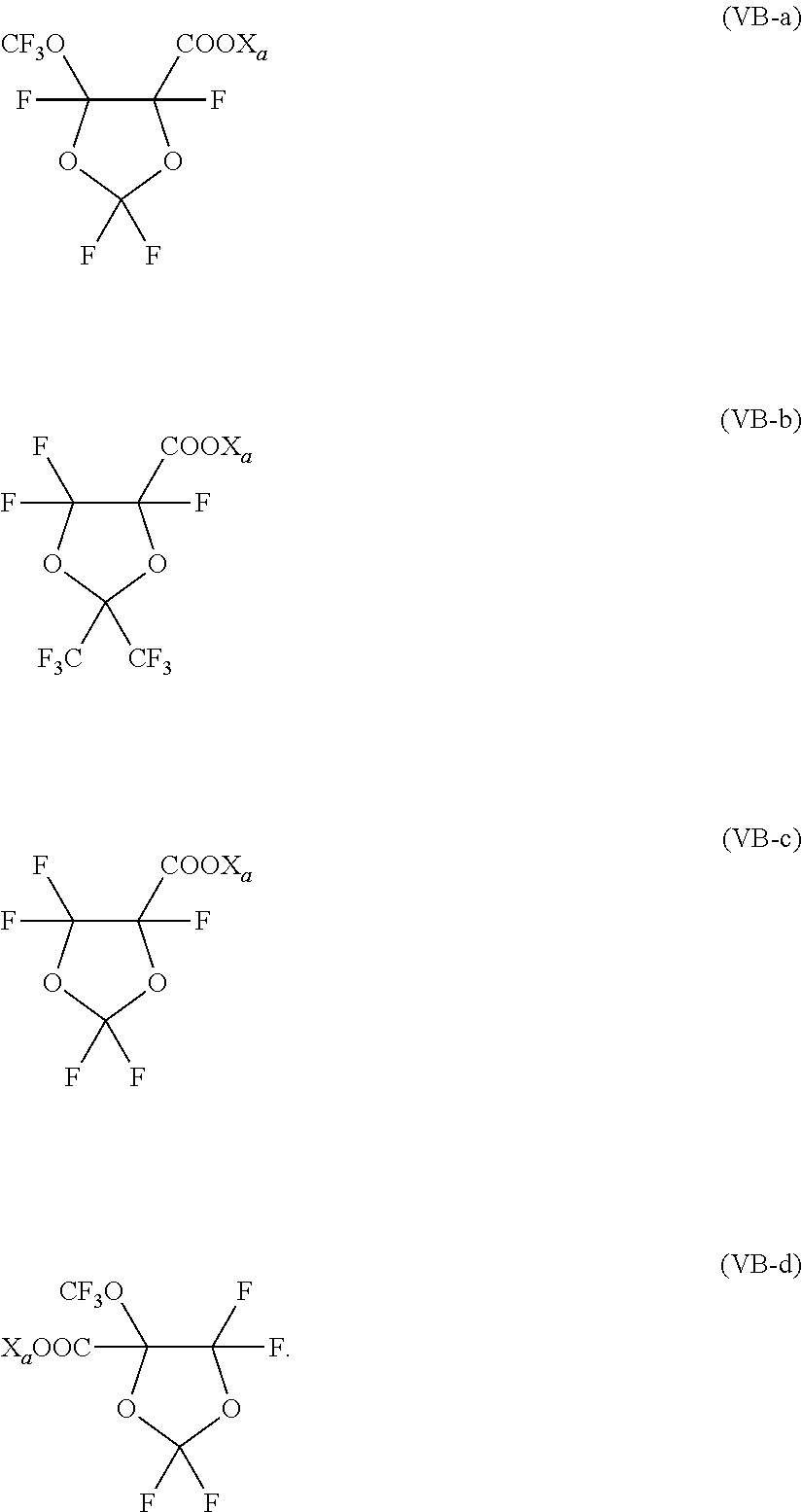
- the surfactant (FS) having formula (IVB) of the first variant preferably complies with formula (VB) here below:
- X′ 1 , X′ 2 , X′ 3 , X′ 4 are independently a fluorine atom, a —R′ f group or a —OR′ f group, wherein R′ f is a C 1 -C 3 perfluoroalkyl group.
- Non limitative examples of surfactants (FS) having formula (VB) as described above include, notably, the following:
- surfactant (FS) of formula (IIIB) can comply with formula (VIB) here below:
- X′′ 1 and X′′ 2 are independently a fluorine atom, a —R′ f group or a —OR′ f group, wherein R′ f is a C 1 -C 3 perfluoroalkyl group, and R F and X a have the same meanings as defined above.
- Compounds of formula (VIB) as described above can be notably manufactured as detailed in EP 2143738 A (SOLVAY SOLEXIS SPA) 13 Jan. 2010 and WO 2010/003929 (SOLVAY SOLEXIS SPA) 14 Jan. 2010.
- the surfactant (FS) having formula (VIB) preferably complies with formula (VIIB) here below:
- X′′ 1 , X′′ 2 , X′′ 3 , X′′ 4 are independently a fluorine atom, a —R′ f group or a —OR′ f group, wherein R′ f is a C 1 -C 3 perfluoroalkyl group.
- Non limitative examples of surfactants (FS) having formula (VIIB) as described above include, notably, the following:
- the surfactant (FS) complies with formula (VIIIB) here below:
- R F and X a have the same meanings as defined above, X* 1 and X* 2 , equal to or different from each other, are independently a fluorine atom, a —R′ f group or a —OR′ f group, wherein R′ f is a C 1 -C 3 perfluoroalkyl group, R* F is a divalent fluorinated group and k is an integer from 1 to 3.
- Compounds of formula (VIIIB) as described above can be notably manufactured as detailed in EP 2143738 A (SOLVAY SOLEXIS SPA) 13 Jan. 2010 and WO 2010/003929 (SOLVAY SOLEXIS SPA) 14 Jan. 2010.
- the surfactant (FS) of formula (VIIIB) preferably complies with formula (IXB) here below:
- R F and X a have the same meanings as defined above, X* 1 and X* 2 , equal to or different from each other, are independently a fluorine atom, a —R′ f group or a —OR′ f group, wherein R′ f is a C 1 -C 3 perfluoroalkyl group, R F 1 is a fluorine atom or a —CF 3 group and k is an integer from 1 to 3.
- surfactants having formulae (XB) and (XIB) here below:
- one or more surfactant (FS) of formula (IB) are used.
- the amount of surfactant (FS) used may vary depending on desired properties such as amount of solids, particle size etc. . . . Generally the amount of surfactant (FS) will be between 0.001% by weight and 5% by weight, based on the weight of water in the polymerization. A practical range is between 0.05% by weight and 1% by weight, based on the weight of water in the polymerization.
- aqueous emulsion fluorinated monomers and in particular monomers (F) which are liquid under the polymerization conditions may be advantageously added in the form of an aqueous emulsion.
- fluorinated monomers and in particular monomers (F) which are liquid under the polymerization conditions may be advantageously added in the form of an aqueous emulsion.
- Such emulsion of such monomers (F) is preferably prepared using surfactant (FS) as an emulsifier.
- One or more than one monomer (F) can be used in the process of the invention.
- the monomer (F) is CF 2 ⁇ CF—O—CF 2 CF 2 CF 3 , i.e. perfluoropropylvinylether.
- Polymer (F) which is the result of the process of the invention, comprises recurring units derived from monomer (F) in an amount of 0.005 to 0.025% by moles, with respect to the total moles of recurring units.
- polymer (F) comprises recurring units derived from monomer (F) in an amount of at least 0.007% by moles, preferably at least 0.008% by moles and/or in an amount of at most 0.020% by moles, preferably at most 0.019% by moles.
- polymers (F) comprising from 0.080 to 0.019% by moles of recurring units derived from monomer (F), with respect to the total moles of recurring units.
- the polymer (F) might comprise recurring units derived from one or more than one additional monomer [monomer (A)] different from TFE and monomer (F); in case such additional recurring units are present, the sum of recurring units derived from monomer (F) and recurring units derived from monomer (A) will be comprised in the range of 0.005 to 0.025% moles, with respect to the total moles of the recurring units of the copolymer.
- Monomer (A) can be selected from the group consisting of:
- each of R f3 , R f4 , R f5 , R f6 is independently a fluorine atom, a C 1 -C 6 fluoro- or per(halo)fluoroalkyl, optionally comprising one or more oxygen atom, e.g. —CF 3 , —C 2 F 5 , —C 3 F 7 , —OCF 3 , —OCF 2 CF 2 OCF 3 .
- polymer (F) consists essentially of recurring units derived from TFE and from monomer (F), as above detailed. Impurities, chain ends, defects might still be present, without their presence substantially impacting properties of the TFE copolymer.
- polymer (F) consisted essentially of recurring units derived from TFE and from 0.05 to 0.175% by moles (with respect to the total moles of recurring units) of recurring units derived from perfluoropropylvinylether.
- the aqueous emulsion polymerization may be carried out at a temperature between 10 to 150° C., preferably 20° C. to 110° C. Pressure is typically between 2 and 30 bar, in particular 5 to 20 bar.
- the reaction temperature may be varied during the polymerization e.g. for influencing the molecular weight distribution, i.e., to obtain a broad molecular weight distribution or to obtain a bimodal or multimodal molecular weight distribution.
- the pH of the aqueous medium of the polymerization may be in the range of pH 2-11, preferably 3-10, most preferably 4-10.
- the emulsion polymerization in aqueous medium is typically initiated by an initiator including any of the initiators known for initiating a free radical polymerization of fluorinated monomers.
- Suitable initiators include peroxides and azo compounds and redox based initiators.
- Specific examples of peroxide initiators include, hydrogen peroxide, sodium or barium peroxide, diacylperoxides such as diacetylperoxide, disuccinyl peroxide, dipropionylperoxide, dibutyrylperoxide, dibenzoylperoxide, benzoylacetylperoxide, diglutaric acid peroxide and dilaurylperoxide, and further per-acids and salts thereof such as e.g.
- ammonium, sodium or potassium salts examples include per-acids include peracetic acid. Esters of the peracid can be used as well and examples thereof include tert.-butylperoxyacetate and tert.-butylperoxypivalate.
- inorganic include for example ammonium-, alkali- or alkaliearth-salts of persulfates, permanganic or manganic acid or manganic acids.
- a persulfate initiator e.g. ammonium persulfate (APS), can be used on its own or may be used in combination with a reducing agent.
- Suitable reducing agents include bisulfites such as for example ammonium bisulfite or sodium metabisulfite, thiosulfates such as for example ammonium, potassium or sodium thiosulfate, hydrazines, azodicarboxylates and azodicarboxyldiamide (ADA).
- Further reducing agents that may be used include sodium formaldehyde sulfoxylate (Rongalit) or fluoroalkyl sulfinates, e.g. as disclosed in U.S. Pat. No. 5,285,002 (MINNESOTA MINING & MFG) Aug. 2, 1994.
- the reducing agent typically reduces the half-life time of the initiator.
- a metal salt catalyst such as for example copper, iron or silver salts may be added.
- the amount of initiator may be between 0.01% by weight and 1% by weight, based on the amount of polymer (F) to be produced. In one embodiment, the amount of initiator is between 0.05 and 0.5% by weight. In another embodiment, the amount may be between 0.05 and 0.3% by weight.
- aqueous emulsion polymerization can be carried out in the presence of other materials, such as notably buffers and, if desired, complex-formers or chain-transfer agents.
- chain transfer agents examples include dimethyl ether, methyl t-butyl ether, alkanes having 1 to 5 carbon atoms such as ethane, propane and n-pentane, halogenated hydrocarbons such as CCl 4 , CHCl 3 and CH 2 Cl 2 and hydrofluorocarbon compounds such as CH 2 F—CF 3 (R134a). Additionally esters like ethylacetate, malonic esters can be effective as chain transfer agent in the process of the invention.
- the aqueous emulsion polymerization process of the invention results in a dispersion of the polymer (F) in water comprising the surfactant (FS), as above detailed.
- the amount of solids of the polymer (F) in the dispersion directly resulting from the polymerization will vary between 3% by weight and about 40% by weight depending on the polymerization conditions. A typical range is between 5 and 30% by weight, for example between 10 and 25% by weight.
- the particle size (volume average diameter) of the polymer (F), as obtained from the process of the invention, is typically between 40 nm and 400 nm with a typical particle size being between 60 nm and about 350 nm.
- the total amount of surfactant (FS) in the resulting dispersion is typically between 0.001 and 5% by weight based on the amount of polymer (F) solids in the dispersion.
- a typical amount may be from 0.01 to 2% by weight or from 0.02 to 1% by weight, based on the amount of polymer (F) solids in the dispersion.
- the polymer (F) may be isolated from the dispersion by coagulation if a polymer in solid form is desired. Also, depending on the requirements of the application in which the polymer (F) is to be used, the polymer (F) may be post-fluorinated so as to convert any thermally unstable end groups into stable CF 3 — end groups.
- an aqueous dispersion of the polymer (F) might be desired and hence the polymer (F) will not need to be separated or coagulated from the dispersion.
- a polymer (F) dispersion suitable for use in coating applications such as for example in the impregnation of fabrics or in the coating of metal substrates to make for example cookware, it will generally be desired to add further stabilizing surfactants and/or to further increase the polymer (F) solids.
- non-ionic stabilizing surfactants may be added to the polymer (F) dispersion. Typically these will be added thereto in an amount of 1 to 12% by weight based on polymer (F).
- non-ionic surfactants examples include R 1 —O—[CH 2 CH 2 O] n —[R 2 O] m —R 3 (NS) wherein R 1 represents an aromatic or aliphatic hydrocarbon group having from 6 to 18 carbon atoms, R 2 represents an alkylene having 3 carbon atoms, R 3 represents hydrogen or a C 1-3 alkyl group, n has a value of 0 to 40, m has a value of 0 to 40 and the sum of n+m being at least 2. It will be understood that in the above formula (NS), the units indexed by n and m may appear as blocks or they may be present in an alternating or random configuration.
- non-ionic surfactants include alkylphenol oxy ethylates such as ethoxylated p-isooctylphenol commercially available under the brand name TRITONTM such as for example TRITONTM X 100 wherein the number of ethoxy units is about 10 or TRITONTM X 114 wherein the number of ethoxy units is about 7 to 8.
- alkylphenol oxy ethylates such as ethoxylated p-isooctylphenol commercially available under the brand name TRITONTM such as for example TRITONTM X 100 wherein the number of ethoxy units is about 10 or TRITONTM X 114 wherein the number of ethoxy units is about 7 to 8.
- R 1 in the above formula (NS) represents an alkyl group of 4 to 20 carbon atoms, m is 0 and R 3 is hydrogen.
- Non-ionic surfactants according to formula (NS) in which the hydrophilic part comprises a block-copolymer of ethoxy groups and propoxy groups may be used as well.
- Such non-ionic surfactants are commercially available from Clariant GmbH under the trade designation GENAPOL® PF 40 and GENAPOL® PF 80.
- the amount of polymer (F) in the dispersion may be up-concentrated as needed or desired to an amount between 30 and 70% by weight. Any of the known up-concentration techniques may be used including ultrafiltration and thermal up-concentration.
- TFE tetrafluoroethylene copolymer
- CF 2 perfluoroalkyl(oxy)vinylether of formula CF 2 ⁇ CF—O—R f
- R f is a C 1 -C 6 perfluoroalkyl radical possibly comprising one or more ethereal oxygen atoms [monomer (F)], in an amount of 0.005 to 0.250% moles, with respect to the total moles of the copolymer, wherein the following inequality is satisfied: A.I.>0.0663+3.75 ⁇ [M] wherein:
- the TFE copolymer of the invention can be manufactured using the process as above detailed.
- Still another aspect of the invention pertains to a method for manufacturing shaped articles comprising using the TFE copolymer of the invention as above detailed.
- said method comprises extruding the TFE copolymer of the invention in combination with a volatile liquid.
- This technique is known as ‘paste extrusion’ technique.
- the TFE copolymer of the invention is particularly suitable for being processed according to this technique.
- a compressed tablet of polymer (F) powder, made in a press under about 10 tons pressure, is submitted to FT-IR analysis using a spectrophotometer FT-IR Nicolet Impact 410, having a spectral range of 4000 to 400 cm ⁇ 1 .
- Optical density or intensity of the absorption band centred on about 773 cm ⁇ 1 , and attributed to conformational chain segments in configuration other than the helicoidally arranged crystalline chain 15/7, is determined and normalized over the optical density of the complex bad centred on 2365 cm ⁇ 1 , related to harmonic bands and combinations of stretching of C—F and C—C bonds.
- Content of perfluoropropylvinyl ether in the polymer is determined using a spectrophotometer FT-IR Nicolet Impact 410, having a spectral range of 4000 to 400 cm ⁇ 1 .
- a powder specimen of about 100 to 150 mg is introduced in a press and submitted to pressure (10 tons) for obtaining a tablet.
- a FT-IR spectrum is then recorded and the region between 950 and 1050 cm ⁇ 1 is considered, wherein optical density of the absorption band due to the normal cooperative vibration mode of the PPVE molecule, centered on about 994 cm ⁇ 1 , is determined.
- the weight content and molar content of HFP in the polymer is thus determined.
- Rheometer extrusion pressure at reduction ratio 400:1 was determined according to ASTM D 4895. This method is intended to measure the properties of modified PTFE powders in the ‘paste extrusion’ conditions, i.e. when extruded as a blend with a volatile liquid, as prescribed in the standard. Determinations have been carried out at a reduction ratio of 400:1; the reduction ratio (RR) is the ratio of a cross sectional area (S) of a cylinder in which the powder to be extruded is filled to a cross sectional area (s) of the die outlet (S/s).
- a polymerization reactor with a total volume of 90 liters equipped with an impeller agitator was charged with 52 liters of deionized water.
- the oxygen free reactor was heated up to 65° C. and the agitation system was set to 48 rpm.
- the reactor was charged with 1 kg of paraffin wax, 235 g of a cyclic surfactant of formula:
- the polymerization was initiated by addition of 0.7 g of potassium bromate (KBrO 3 ), 0.23 g of nitric acid, 4.23 g of succinic acid and sodium sulphite, fed at a rate of 880 g/h until 12.5 kg of monomer were converted into polymer; the sulphite feeding was hence stopped.
- potassium bromate KBrO 3
- nitric acid 0.23 g
- succinic acid and sodium sulphite 0.23 g of succinic acid and sodium sulphite
- the reactor was vented and then pressurized again with TFE to continue the reaction. After 120 min the feeding of 23 kg of TFE was completed, the monomer addition was stopped and the stirring interrupted. The reactor was depressurized, vented and cooled.
- a polymer dispersion was thus obtained, having a solid content of 30% w/w.
- the dispersion was diluted to 15% solids with demineralized water and after adding 0.1% (based on the weight of dispersion) of ammonium carbonate was agitated vigorously until coagulation completed, and stirred for additional 5 minutes.
- the coagulated product was dried at 150° C.
- the product so recovered was submitted to SSG determination according to ASTM D4895 standard; comonomer content by IR analysis, amorphous index and rheometer extrusion pressure at reduction ratio 400:1 were measured.
- FIG. 1 is a plot of amorphous index values, as determined by IR spectrometry, as a function of molar concentration of monomer (F), for TFE copolymers of the examples 1 to 5 (black solid squares ⁇ ) obtained by emulsion polymerization in the presence of surfactant (FS) and for comparative TFE copolymers with perfluoropropylvinylether (white circles ⁇ ) obtained by emulsion polymerization in the presence of ammonium perfluorooctanoate, from comparative examples 6C and 7C and from analogous runs.
- F monomer
Landscapes
- Chemical & Material Sciences (AREA)
- Health & Medical Sciences (AREA)
- Chemical Kinetics & Catalysis (AREA)
- Medicinal Chemistry (AREA)
- Polymers & Plastics (AREA)
- Organic Chemistry (AREA)
- Addition Polymer Or Copolymer, Post-Treatments, Or Chemical Modifications (AREA)
- Polymerisation Methods In General (AREA)
Abstract
Description

wherein:
-
- X1, X2 and X3, equal to or different from each other, are independently selected from H, F and C1-C6 (per)fluoroalkyl groups, optionally comprising one or more catenary or non-catenary oxygen atoms,
- RF represents a divalent perfluorinated C1-C3 bridging group,
- L represents a bond or a divalent group and
- Y represents an anionic functionality, preferably selected from the group consisting of:

wherein Xa is a hydrogen atom, a monovalent metal, preferably an alkaline metal, or an ammonium group of formula —N(R′n)4, wherein R′n, equal or different at each occurrence, is a hydrogen atom or a C1-C6 hydrocarbon group, preferably an alkyl group.
A.I.>0.0663+3.75×[M]
wherein:
-
- A.I. is the Amorphous Index, defined as the ratio between intensity of the waveband centered at about 778 cm−1 and intensity of the waveband centered at about 2367 cm−1, as determined by infrared spectroscopy on a specimen of the TFE copolymer,
- [M] is the % moles of recurring units derived from said monomer (F).

wherein X1, X2, X3, RF and Y have the same meaning as defined above. The surfactant (FS) of formula (IIB) preferably complies with formula (IIIB) here below:

wherein X1, X2, X3, RF and Xa have the same meaning as defined above. The surfactant (FS) of formula (IIIB) can comply with formula (IVB) here below:

wherein X′1 and X′2, equal to or different from each other, are independently a fluorine atom, a —R′f group or a —OR′f group, wherein R′f is a C1-C3 perfluoroalkyl group, preferably with the proviso that at least one of X′1 and X′2 are different from fluorine, and RF and Xa have the same meanings as defined above. Compounds of formula (IV) as described above can be notably manufactured as detailed in EP 2143738 A (SOLVAY SOLEXIS SPA) 13 Jan. 2010 and WO 2010/003929 (SOLVAY SOLEXIS SPA) 14 Jan. 2010. The surfactant (FS) having formula (IVB) of the first variant preferably complies with formula (VB) here below:

wherein X′1, X′2, X′3, X′4, equal to or different each other, are independently a fluorine atom, a —R′f group or a —OR′f group, wherein R′f is a C1-C3 perfluoroalkyl group.


wherein X″1 and X″2, equal to or different from each other, are independently a fluorine atom, a —R′f group or a —OR′f group, wherein R′f is a C1-C3 perfluoroalkyl group, and RF and Xa have the same meanings as defined above. Compounds of formula (VIB) as described above can be notably manufactured as detailed in EP 2143738 A (SOLVAY SOLEXIS SPA) 13 Jan. 2010 and WO 2010/003929 (SOLVAY SOLEXIS SPA) 14 Jan. 2010.

wherein X″1, X″2, X″3, X″4, equal to or different each other, are independently a fluorine atom, a —R′f group or a —OR′f group, wherein R′f is a C1-C3 perfluoroalkyl group.


wherein RF and Xa have the same meanings as defined above, X*1 and X*2, equal to or different from each other, are independently a fluorine atom, a —R′f group or a —OR′f group, wherein R′f is a C1-C3 perfluoroalkyl group, R*F is a divalent fluorinated group and k is an integer from 1 to 3. Compounds of formula (VIIIB) as described above can be notably manufactured as detailed in EP 2143738 A (SOLVAY SOLEXIS SPA) 13 Jan. 2010 and WO 2010/003929 (SOLVAY SOLEXIS SPA) 14 Jan. 2010.

wherein RF and Xa have the same meanings as defined above, X*1 and X*2, equal to or different from each other, are independently a fluorine atom, a —R′f group or a —OR′f group, wherein R′f is a C1-C3 perfluoroalkyl group, RF 1 is a fluorine atom or a —CF3 group and k is an integer from 1 to 3.

wherein Xa has the meaning as defined above, have been found particularly useful in the process of the invention.
-
- perfluoroalkylvinylether of formula CF2═CF—O—R′f, wherein R′f is a C1-C3 perfluoroalkyl radical selected from the group consisting of —CF3 (perfluoromethylvinylether), —CF2CF3 (perfluoroethylvinylether), —CF2CF2 CF3 (perfluoropropylvinylether);
- perfluoromethoxyalkylvinylether of formula CF2═CF—O—CF2—O—R″f, wherein R′f is a C1-C3 perfluoro(oxy)alkyl radical, preferably selected from the group consisting of —CF3, —CF2CF3, —CF2CF2—OCF3;
- mixtures thereof.
-
- C3-C8 perfluoroolefins, such as hexafluoropropene (HFP);
- chloro- and/or bromo- and/or iodo-C2-C6 perhalofluoroolefins, like chlorotrifluoroethylene (CTFE);
- fluorodioxoles, of formula:

wherein each of Rf3, Rf4, Rf5, Rf6, equal or different each other, is independently a fluorine atom, a C1-C6 fluoro- or per(halo)fluoroalkyl, optionally comprising one or more oxygen atom, e.g. —CF3, —C2F5, —C3F7, —OCF3, —OCF2CF2OCF3.
A.I.>0.0663+3.75×[M]
wherein:
-
- A.I. is the Amorphous Index, defined as the ratio between intensity of the waveband centred at about 778 cm−1 and intensity of the waveband centred at about 2367 cm−1, as determined by infrared spectroscopy on a specimen of said TFE copolymer,
- [M] is the % moles of recurring units derived from said monomer (F).
A.I.=(OD773)/(OD2365).

in water solution, 28 g of perfluoropropylvynilether (PPVE) and with TFE until reaching a pressure of 20 bar.
| TABLE 1 | |||||
| Rheometric | |||||
| PPVE fed | PPVE | Pressure | SSG | ||
| Run | (g) | (% mol) | A.I. | (MPa) | (g/cc) |
| 1 | 29 | 1.88E−02 | 0.143 | 46.7 | 2.150 |
| 2 | 20.5 | 1.28E−02 | 0.125 | 43.0 | 2.148 |
| 3 | 13.2 | 9.40E−03 | 0.119 | 45.9 | 2.145 |
| 4 | 19 | 1.35E−02 | 0.121 | 43.4 | 2.143 |
| 5 | 13.2 | 9.77E−03 | 0.115 | 42.6 | 2.147 |
| 6C | 29.4 | 1.80E−02 | 0.128 | 40.7 | 2.153 |
| 7C | 28 | 1.95E−02 | 0.113 | 44.3 | 2.147 |
Claims (20)
A.I.>0.0663+3.75×[M]




Applications Claiming Priority (4)
| Application Number | Priority Date | Filing Date | Title |
|---|---|---|---|
| EP12172830.7 | 2012-06-20 | ||
| EP12172830 | 2012-06-20 | ||
| EP12172830 | 2012-06-20 | ||
| PCT/EP2013/062246 WO2013189824A1 (en) | 2012-06-20 | 2013-06-13 | Tetrafluoroethylene copolymers |
Publications (2)
| Publication Number | Publication Date |
|---|---|
| US20150232593A1 US20150232593A1 (en) | 2015-08-20 |
| US10047181B2 true US10047181B2 (en) | 2018-08-14 |
Family
ID=48607289
Family Applications (1)
| Application Number | Title | Priority Date | Filing Date |
|---|---|---|---|
| US14/409,082 Active 2034-03-03 US10047181B2 (en) | 2012-06-20 | 2013-06-13 | Tetrafluoroethylene copolymers |
Country Status (5)
| Country | Link |
|---|---|
| US (1) | US10047181B2 (en) |
| EP (1) | EP2864376B1 (en) |
| JP (1) | JP6363071B2 (en) |
| CN (1) | CN104583246B (en) |
| WO (1) | WO2013189824A1 (en) |
Families Citing this family (85)
| Publication number | Priority date | Publication date | Assignee | Title |
|---|---|---|---|---|
| US11634514B2 (en) | 2018-02-08 | 2023-04-25 | Daikin Industries. Ltd. | Method for manufacturing fluoropolymer, surfactant for polymerization, use for surfactant, and composition |
| WO2019168183A1 (en) | 2018-03-01 | 2019-09-06 | ダイキン工業株式会社 | Method for manufacturing fluoropolymer |
| JP7193747B2 (en) | 2018-03-07 | 2022-12-21 | ダイキン工業株式会社 | Method for producing fluoropolymer |
| WO2020022355A1 (en) | 2018-07-23 | 2020-01-30 | ダイキン工業株式会社 | Polytetrafluoroethylene and stretched body |
| EP3862368A4 (en) | 2018-10-03 | 2022-06-29 | Daikin Industries, Ltd. | Polytetrafluoroethylene production method |
| CN112771087B (en) | 2018-10-03 | 2023-01-20 | 大金工业株式会社 | Process for producing polytetrafluoroethylene |
| US12195617B2 (en) | 2018-11-19 | 2025-01-14 | Daikin Industries, Ltd. | Composition and stretched body |
| JP7174272B2 (en) | 2018-11-19 | 2022-11-17 | ダイキン工業株式会社 | Method for producing modified polytetrafluoroethylene and composition |
| EP3919527B1 (en) | 2019-02-01 | 2025-12-10 | Daikin Industries, Ltd. | Method for producing polytetrafluoroethylene |
| US12643964B2 (en) | 2019-02-07 | 2026-06-02 | Daikin Industries, Ltd. | Composition, stretched body and method of manufacturing thereof |
| EP3957656A4 (en) | 2019-04-16 | 2022-12-28 | Daikin Industries, Ltd. | FLUOROPOLYMER POWDER PRODUCTION PROCESS |
| EP3960773B1 (en) | 2019-04-26 | 2025-07-16 | Daikin Industries, Ltd. | Method for producing aqueous fluoropolymer dispersion, drainage treatment method, and aqueous fluoropolymer dispersion |
| JP7417129B2 (en) | 2019-04-26 | 2024-01-18 | ダイキン工業株式会社 | Water treatment methods and compositions |
| JP7236004B2 (en) | 2019-04-26 | 2023-03-09 | ダイキン工業株式会社 | Method for producing aqueous fluoropolymer dispersion and aqueous fluoropolymer dispersion |
| WO2020218618A1 (en) | 2019-04-26 | 2020-10-29 | ダイキン工業株式会社 | Process for producing aqueous fluoropolymer dispersion |
| JP7352804B2 (en) | 2019-05-09 | 2023-09-29 | ダイキン工業株式会社 | Method for producing hollow fine particles and hollow fine particles |
| US20220267483A1 (en) | 2019-07-16 | 2022-08-25 | Daikin Industries, Ltd. | Method for producing fluorine-containing elastomer, and composition |
| JP7201948B2 (en) | 2019-07-23 | 2023-01-11 | ダイキン工業株式会社 | Method for producing fluoropolymer, polytetrafluoroethylene composition and polytetrafluoroethylene powder |
| EP4026854A4 (en) | 2019-09-05 | 2024-01-17 | Daikin Industries, Ltd. | AQUEOUS DISPERSION OF POLYTETRAFLUOROETHYLENE |
| CN114269840A (en) | 2019-09-05 | 2022-04-01 | 大金工业株式会社 | Composition and method for producing the same |
| CN114364710B (en) | 2019-09-05 | 2024-02-09 | 大金工业株式会社 | Method and composition for producing perfluoroelastomer |
| CN114514253B (en) | 2019-10-03 | 2024-12-06 | 大金工业株式会社 | Polytetrafluoroethylene and method for producing the same |
| EP4063403A4 (en) | 2019-11-19 | 2024-01-24 | Daikin Industries, Ltd. | Method for producing fluoropolymer |
| WO2021100834A1 (en) | 2019-11-19 | 2021-05-27 | ダイキン工業株式会社 | Polytetrafluoroethylene production method |
| JP7352110B2 (en) | 2019-11-19 | 2023-09-28 | ダイキン工業株式会社 | Method for producing fluoropolymer, method for producing polytetrafluoroethylene, method for producing perfluoroelastomer, and composition |
| JP6989792B2 (en) | 2019-12-25 | 2022-01-12 | ダイキン工業株式会社 | Fluoropolymer manufacturing method |
| WO2021132635A1 (en) | 2019-12-27 | 2021-07-01 | ダイキン工業株式会社 | Method for producing fluorine-containing polymer, fluorine-containing elastomer and aqueous dispersion liquid |
| WO2022019241A1 (en) | 2020-07-22 | 2022-01-27 | ダイキン工業株式会社 | Method for producing fluorine-containing elastomer aqueous dispersion and fluorine-containing elastomer aqueous dispersion |
| WO2022025111A1 (en) | 2020-07-28 | 2022-02-03 | ダイキン工業株式会社 | Method for preparing fluorine-containing elastomer aqueous dispersion, and fluorine-containing elastomer aqueous dispersion |
| JP7464882B2 (en) | 2020-07-30 | 2024-04-10 | ダイキン工業株式会社 | Method for producing aqueous fluorine-containing elastomer dispersion, fluorine-containing elastomer and aqueous dispersion |
| JP7513915B2 (en) | 2020-07-30 | 2024-07-10 | ダイキン工業株式会社 | Method for producing aqueous fluorine-containing elastomer dispersion, fluorine-containing elastomer and aqueous dispersion |
| JP7425371B2 (en) | 2020-08-05 | 2024-01-31 | ダイキン工業株式会社 | Method for producing aqueous fluorine-containing elastomer dispersion |
| CN115956091A (en) | 2020-09-07 | 2023-04-11 | 大金工业株式会社 | Modified polytetrafluoroethylene aqueous dispersion |
| EP4249517A4 (en) | 2020-11-19 | 2024-10-16 | Daikin Industries, Ltd. | Method for producing fluorine-containing elastomer aqueous dispersion, and composition |
| WO2022107888A1 (en) | 2020-11-19 | 2022-05-27 | ダイキン工業株式会社 | Fluoropolymer and method for producing same |
| WO2022107890A1 (en) | 2020-11-19 | 2022-05-27 | ダイキン工業株式会社 | Method for manufacturing perfluoroelastomer aqueous dispersion, composition, crosslinkable composition, and crosslinked product |
| JP7606110B2 (en) | 2020-11-19 | 2024-12-25 | ダイキン工業株式会社 | Method for producing polytetrafluoroethylene and composition containing polytetrafluoroethylene |
| CN116406351B (en) | 2020-11-19 | 2025-07-15 | 大金工业株式会社 | Fluorine-containing polymer and method for producing same |
| JP7674667B2 (en) | 2021-01-28 | 2025-05-12 | ダイキン工業株式会社 | Method for producing a fluoropolymer composition |
| CN116761828A (en) | 2021-01-28 | 2023-09-15 | 大金工业株式会社 | Methods for manufacturing fluoropolymer compositions |
| KR20230150868A (en) | 2021-03-10 | 2023-10-31 | 다이킨 고교 가부시키가이샤 | Paint compositions, coating films, laminates and painted articles |
| WO2022196804A1 (en) | 2021-03-18 | 2022-09-22 | ダイキン工業株式会社 | Method for producing fluororesin, fluororesin, and aqueous dispersion liquid |
| WO2022211072A1 (en) | 2021-03-31 | 2022-10-06 | ダイキン工業株式会社 | Fluorine resin composition and molded body |
| CN117043264A (en) | 2021-03-31 | 2023-11-10 | 大金工业株式会社 | Fluororesin composition and molded article |
| JP7323832B2 (en) | 2021-03-31 | 2023-08-09 | ダイキン工業株式会社 | Fluororesin composition and molded article |
| CN117136213A (en) | 2021-03-31 | 2023-11-28 | 大金工业株式会社 | Method for producing fluororesin composition, fluororesin composition and molded article |
| JP7705361B2 (en) | 2021-03-31 | 2025-07-09 | ダイキン工業株式会社 | Fluororesin composition and molded body |
| JPWO2022244785A1 (en) | 2021-05-19 | 2022-11-24 | ||
| WO2022244784A1 (en) | 2021-05-19 | 2022-11-24 | ダイキン工業株式会社 | Method for producing fluoropolymer, method for producing polytetrafluoroethylene, and composition |
| JP7741413B2 (en) | 2021-06-11 | 2025-09-18 | ダイキン工業株式会社 | Method for producing aqueous fluorine-containing elastomer dispersion, composition and aqueous dispersion |
| CN117460752A (en) | 2021-06-11 | 2024-01-26 | 大金工业株式会社 | Method for manufacturing aqueous fluoroelastomer dispersion |
| CN117500847A (en) | 2021-06-30 | 2024-02-02 | 大金工业株式会社 | Method for producing a composition containing a high-purity fluoropolymer and a composition containing a high-purity fluoropolymer |
| JP7747987B2 (en) | 2021-06-30 | 2025-10-02 | ダイキン工業株式会社 | Method for producing a fluoropolymer composition and a fluoropolymer composition |
| JP7730047B2 (en) | 2021-06-30 | 2025-08-27 | ダイキン工業株式会社 | Method for producing polytetrafluoroethylene particles |
| JPWO2023277137A1 (en) | 2021-06-30 | 2023-01-05 | ||
| JP7846411B2 (en) | 2022-03-23 | 2026-04-15 | ダイキン工業株式会社 | Fluoropolymers, aqueous solutions, coating compositions, and methods for producing fluoropolymers |
| WO2023182229A1 (en) | 2022-03-23 | 2023-09-28 | ダイキン工業株式会社 | Method for producing fluoropolymer, and composition |
| JP7785034B2 (en) | 2022-03-31 | 2025-12-12 | ダイキン工業株式会社 | Fluororesin composition and molded body |
| EP4516820A4 (en) | 2022-04-28 | 2026-04-22 | Daikin Ind Ltd | METHOD FOR PREPARING A COMPOSITION WITH FLUORINAL RESIN AND COMPOSITION WITH FLUORINAL RESIN |
| EP4516819A4 (en) | 2022-04-28 | 2026-05-06 | Daikin Ind Ltd | METHOD FOR THE PRODUCTION OF FLUORPOLYMER |
| EP4516855A4 (en) | 2022-04-28 | 2026-06-03 | Daikin Ind Ltd | FLUOROUGH RUBBER CONTAINING COMPOSITION |
| WO2024024914A1 (en) | 2022-07-27 | 2024-02-01 | ダイキン工業株式会社 | Powder containing fluoropolymer particles and manufacturing method therefor, powder coating, and liquid coating composition |
| JP7856924B2 (en) | 2022-07-27 | 2026-05-12 | ダイキン工業株式会社 | Method for producing an aqueous fluoropolymer dispersion, aqueous fluoropolymer dispersion, and paint composition |
| EP4563601A4 (en) | 2022-07-27 | 2026-07-29 | Daikin Ind Ltd | POWDER CONTAINS POLYTETRAFLUORETHYLENE WITH LOW MOLECULAR WEIGHT AND METHOD FOR PRODUCING THEM |
| WO2024024917A1 (en) | 2022-07-27 | 2024-02-01 | ダイキン工業株式会社 | Fluoropolymer aqueous dispersion liquid production method, fluoropolymer aqueous dispersion liquid, and coating composition |
| EP4600318A4 (en) | 2022-11-02 | 2026-03-11 | Daikin Ind Ltd | Electro-dip coating composition, film, coated article, coated wire and conductor board |
| KR102932815B1 (en) | 2023-01-18 | 2026-03-05 | 다이킨 고교 가부시키가이샤 | Composite self-supporting membranes, electrodes, and electrochemical devices for electrochemical devices |
| CN120642068A (en) | 2023-01-18 | 2025-09-12 | 大金工业株式会社 | Tetrafluoroethylene polymer composition, binder for electrochemical device, electrode mixture, electrode, and secondary battery |
| JP7583340B2 (en) | 2023-01-18 | 2024-11-14 | ダイキン工業株式会社 | Mixture for electrochemical device, mix sheet for electrochemical device, electrode, and electrochemical device |
| CN120530158A (en) | 2023-01-18 | 2025-08-22 | 大金工业株式会社 | Polytetrafluoroethylene composition |
| WO2024154805A1 (en) | 2023-01-18 | 2024-07-25 | ダイキン工業株式会社 | Tetrafluoroethylene polymer composition, binder for solid-state secondary battery, mixture for electrolyte layer, electrode mixture, electrode, and solid-state secondary battery |
| CN120712296A (en) | 2023-02-16 | 2025-09-26 | 大金工业株式会社 | Method for producing low molecular weight polytetrafluoroethylene aqueous dispersion |
| CN120712295A (en) | 2023-02-16 | 2025-09-26 | 大金工业株式会社 | Method for producing aqueous fluoropolymer dispersion and aqueous fluoropolymer dispersion |
| EP4711389A4 (en) | 2023-05-31 | 2026-08-12 | Daikin Ind Ltd | METHOD FOR THE PREPARATION OF AN AQUEOUS FLUORPOLYMER DISPERSION AND AQUEOUS FLUORPOLYMER DISPERSION |
| CN121420382A (en) | 2023-06-30 | 2026-01-27 | 大金工业株式会社 | Polytetrafluoroethylene compositions, adhesives for electrochemical devices, electrode compounds, electrodes and secondary batteries |
| WO2025005277A1 (en) | 2023-06-30 | 2025-01-02 | ダイキン工業株式会社 | Polytetrafluoroethylene, binder for electrochemical device, electrode mixture, electrode, and secondary battery |
| CN121712810A (en) | 2023-08-14 | 2026-03-20 | 大金工业株式会社 | Process for producing aqueous fluoropolymer dispersion and aqueous fluoropolymer dispersion |
| WO2025070826A1 (en) | 2023-09-29 | 2025-04-03 | ダイキン工業株式会社 | Method for producing polytetrafluoroethylene |
| CN121941714A (en) | 2023-09-29 | 2026-04-28 | 大金工业株式会社 | Method for producing fluorine-containing polymer |
| WO2025127120A1 (en) | 2023-12-12 | 2025-06-19 | ダイキン工業株式会社 | Tetrafluoroethylene polymer composition, binder for electrochemical device, electrode mixture, electrode, and secondary battery |
| WO2025127125A1 (en) | 2023-12-12 | 2025-06-19 | ダイキン工業株式会社 | Tetrafluoroethylene-based polymer composition, binder for electrochemical devices, electrode mixture, electrode, and secondary battery |
| WO2025126950A1 (en) | 2023-12-12 | 2025-06-19 | ダイキン工業株式会社 | Aqueous fluoropolymer dispersion |
| CN122349673A (en) | 2023-12-12 | 2026-07-07 | 大金工业株式会社 | Tetrafluoroethylene polymer composition, binder for electrochemical device, electrode mixture, electrode, and secondary battery |
| JP2025093905A (en) | 2023-12-12 | 2025-06-24 | ダイキン工業株式会社 | Tetrafluoroethylene-based polymer composition, binder for electrochemical device, electrode mixture, electrode, and secondary battery |
| WO2025127124A1 (en) | 2023-12-12 | 2025-06-19 | ダイキン工業株式会社 | Tetrafluoroethylene-based polymer composition, binder for electrochemical device, electrode mixture, electrode, and secondary battery |
Citations (6)
| Publication number | Priority date | Publication date | Assignee | Title |
|---|---|---|---|---|
| US4098875A (en) | 1976-03-16 | 1978-07-04 | Agency Of Industrial Science & Technology | Method for thermochemical production of hydrogen from water |
| US5285002A (en) * | 1993-03-23 | 1994-02-08 | Minnesota Mining And Manufacturing Company | Fluorine-containing polymers and preparation and use thereof |
| US6586626B2 (en) * | 1999-03-23 | 2003-07-01 | Asahi Glass Company, Limited | Process for producing a fluorine-containing compound by liquid phase fluorination |
| EP2143738A1 (en) * | 2008-07-08 | 2010-01-13 | Solvay Solexis S.p.A. | Method for manufacturing fluoropolymers |
| WO2010003929A1 (en) | 2008-07-08 | 2010-01-14 | Solvay Solexis S.P.A. | Method for manufacturing fluoropolymers |
| WO2011073344A1 (en) | 2009-12-18 | 2011-06-23 | Solvay Solexis S.P.A. | Method for manufacturing fluoroelastomers |
Family Cites Families (6)
| Publication number | Priority date | Publication date | Assignee | Title |
|---|---|---|---|---|
| JPS52112686A (en) * | 1976-03-18 | 1977-09-21 | Daikin Ind Ltd | Preparation of tetrafluoroethylene polymer |
| JPS62285907A (en) * | 1986-06-03 | 1987-12-11 | Asahi Glass Co Ltd | Production of tetrafluoroethylene/fluorovinyl ether copolymer |
| DE69024220T2 (en) * | 1989-08-28 | 1996-07-25 | Du Pont | METHOD FOR PRODUCING HALOGENATED 2,2-BIS (TRIFLUORMETHYL) -1,3-DIOXOLANES |
| JP2002097230A (en) * | 2000-09-22 | 2002-04-02 | Nippon Mektron Ltd | Method for producing fluorine-containing copolymer |
| JP4951970B2 (en) * | 2003-12-22 | 2012-06-13 | ダイキン工業株式会社 | Non-melt processable polytetrafluoroethylene and its fine powder |
| JPWO2007081008A1 (en) * | 2006-01-16 | 2009-06-11 | 旭硝子株式会社 | Novel fluorosurfactant and novel fluorine-containing compound |
-
2013
- 2013-06-13 WO PCT/EP2013/062246 patent/WO2013189824A1/en not_active Ceased
- 2013-06-13 CN CN201380043527.6A patent/CN104583246B/en active Active
- 2013-06-13 EP EP13728214.1A patent/EP2864376B1/en active Active
- 2013-06-13 JP JP2015517690A patent/JP6363071B2/en active Active
- 2013-06-13 US US14/409,082 patent/US10047181B2/en active Active
Patent Citations (6)
| Publication number | Priority date | Publication date | Assignee | Title |
|---|---|---|---|---|
| US4098875A (en) | 1976-03-16 | 1978-07-04 | Agency Of Industrial Science & Technology | Method for thermochemical production of hydrogen from water |
| US5285002A (en) * | 1993-03-23 | 1994-02-08 | Minnesota Mining And Manufacturing Company | Fluorine-containing polymers and preparation and use thereof |
| US6586626B2 (en) * | 1999-03-23 | 2003-07-01 | Asahi Glass Company, Limited | Process for producing a fluorine-containing compound by liquid phase fluorination |
| EP2143738A1 (en) * | 2008-07-08 | 2010-01-13 | Solvay Solexis S.p.A. | Method for manufacturing fluoropolymers |
| WO2010003929A1 (en) | 2008-07-08 | 2010-01-14 | Solvay Solexis S.P.A. | Method for manufacturing fluoropolymers |
| WO2011073344A1 (en) | 2009-12-18 | 2011-06-23 | Solvay Solexis S.P.A. | Method for manufacturing fluoroelastomers |
Non-Patent Citations (2)
| Title |
|---|
| Moynihan, R.E., "The Molecular Structure of Perfluorocarbon Polymers. Infrared Studies on Polytetrafluoroethylene", J. Am. Chem. Soc., 1959, vol. 81, pp. 1045-1050-ACS. |
| Moynihan, R.E., "The Molecular Structure of Perfluorocarbon Polymers. Infrared Studies on Polytetrafluoroethylene", J. Am. Chem. Soc., 1959, vol. 81, pp. 1045-1050—ACS. |
Also Published As
| Publication number | Publication date |
|---|---|
| JP2015520282A (en) | 2015-07-16 |
| CN104583246B (en) | 2016-08-24 |
| EP2864376B1 (en) | 2016-08-24 |
| WO2013189824A1 (en) | 2013-12-27 |
| EP2864376A1 (en) | 2015-04-29 |
| CN104583246A (en) | 2015-04-29 |
| US20150232593A1 (en) | 2015-08-20 |
| JP6363071B2 (en) | 2018-07-25 |
Similar Documents
| Publication | Publication Date | Title |
|---|---|---|
| US10889699B2 (en) | Tetrafluoroethylene copolymers | |
| US20150232593A1 (en) | Tetrafluoroethylene copolymers | |
| EP1904539B1 (en) | Aqueous emulsion polymerization of fluorinated monomers using a fluorinated surfactant | |
| US9096701B2 (en) | Aqueous tetrafluoroethylene polymer dispersion, process for producing the same, tetrafluoroethylene polymer powder, and molded tetrafluoroethylene polymer | |
| JP4746536B2 (en) | Melt-processable thermoplastic fluoropolymer with improved processing characteristics and process for its production | |
| US10377843B2 (en) | Method for the controlled polymerization of fluoromonomers | |
| US9938403B2 (en) | Highly fluorinated polymers | |
| CN106414510A (en) | Employing polyalkylene oxides for nucleation in aqueous polymerization of fluoromonomer | |
| US9714307B2 (en) | Partially fluorinated polymers | |
| CN1351616A (en) | Polymerization of fluoromonomers | |
| US20040087703A1 (en) | Emulsifier free aqueous emulsion polymerization to produce copolymers of a fluorinated olefin and hydrocarbon olefin | |
| US10982018B2 (en) | Method of making fluoropolymer dispersion |
Legal Events
| Date | Code | Title | Description |
|---|---|---|---|
| AS | Assignment |
Owner name: SOLVAY SPECIALTY POLYMERS ITALY S.P.A., ITALY Free format text: ASSIGNMENT OF ASSIGNORS INTEREST;ASSIGNORS:MUSIO, STEFANA;KAPELYUSHKO, VALERIY;MALVASI, MARCO;AND OTHERS;SIGNING DATES FROM 20130716 TO 20130718;REEL/FRAME:034565/0498 |
|
| STCF | Information on status: patent grant |
Free format text: PATENTED CASE |
|
| MAFP | Maintenance fee payment |
Free format text: PAYMENT OF MAINTENANCE FEE, 4TH YEAR, LARGE ENTITY (ORIGINAL EVENT CODE: M1551); ENTITY STATUS OF PATENT OWNER: LARGE ENTITY Year of fee payment: 4 |
|
| MAFP | Maintenance fee payment |
Free format text: PAYMENT OF MAINTENANCE FEE, 8TH YEAR, LARGE ENTITY (ORIGINAL EVENT CODE: M1552); ENTITY STATUS OF PATENT OWNER: LARGE ENTITY Year of fee payment: 8 |