US10045865B2 - Joint and digit - Google Patents

Joint and digit Download PDF

Info

Publication number
US10045865B2
US10045865B2 US15/276,753 US201615276753A US10045865B2 US 10045865 B2 US10045865 B2 US 10045865B2 US 201615276753 A US201615276753 A US 201615276753A US 10045865 B2 US10045865 B2 US 10045865B2
Authority
US
United States
Prior art keywords
hole
digit
lever
phalange
cord
Prior art date
Legal status (The legal status is an assumption and is not a legal conclusion. Google has not performed a legal analysis and makes no representation as to the accuracy of the status listed.)
Expired - Fee Related
Application number
US15/276,753
Other versions
US20170014246A1 (en
Inventor
Bradley Delton Veatch
Current Assignee (The listed assignees may be inaccurate. Google has not performed a legal analysis and makes no representation or warranty as to the accuracy of the list.)
Invisible Hand Enterprises dba ToughWare Prosthetics LLC
Invisible Hand Enterprises LLC
Original Assignee
Invisible Hand Enterprises LLC
Priority date (The priority date is an assumption and is not a legal conclusion. Google has not performed a legal analysis and makes no representation as to the accuracy of the date listed.)
Filing date
Publication date
Application filed by Invisible Hand Enterprises LLC filed Critical Invisible Hand Enterprises LLC
Priority to US15/276,753 priority Critical patent/US10045865B2/en
Assigned to Invisible Hand Enterprises, LLC dba ToughWare Prosthetics reassignment Invisible Hand Enterprises, LLC dba ToughWare Prosthetics ASSIGNMENT OF ASSIGNORS INTEREST (SEE DOCUMENT FOR DETAILS). Assignors: VEATCH, BRADLEY DELTON
Publication of US20170014246A1 publication Critical patent/US20170014246A1/en
Application granted granted Critical
Publication of US10045865B2 publication Critical patent/US10045865B2/en
Expired - Fee Related legal-status Critical Current
Anticipated expiration legal-status Critical

Links

Images

Classifications

    • AHUMAN NECESSITIES
    • A61MEDICAL OR VETERINARY SCIENCE; HYGIENE
    • A61FFILTERS IMPLANTABLE INTO BLOOD VESSELS; PROSTHESES; DEVICES PROVIDING PATENCY TO, OR PREVENTING COLLAPSING OF, TUBULAR STRUCTURES OF THE BODY, e.g. STENTS; ORTHOPAEDIC, NURSING OR CONTRACEPTIVE DEVICES; FOMENTATION; TREATMENT OR PROTECTION OF EYES OR EARS; BANDAGES, DRESSINGS OR ABSORBENT PADS; FIRST-AID KITS
    • A61F2/00Filters implantable into blood vessels; Prostheses, i.e. artificial substitutes or replacements for parts of the body; Appliances for connecting them with the body; Devices providing patency to, or preventing collapsing of, tubular structures of the body, e.g. stents
    • A61F2/50Prostheses not implantable in the body
    • A61F2/54Artificial arms or hands or parts thereof
    • A61F2/58Elbows; Wrists ; Other joints; Hands
    • A61F2/583Hands; Wrist joints
    • A61F2/586Fingers
    • AHUMAN NECESSITIES
    • A61MEDICAL OR VETERINARY SCIENCE; HYGIENE
    • A61FFILTERS IMPLANTABLE INTO BLOOD VESSELS; PROSTHESES; DEVICES PROVIDING PATENCY TO, OR PREVENTING COLLAPSING OF, TUBULAR STRUCTURES OF THE BODY, e.g. STENTS; ORTHOPAEDIC, NURSING OR CONTRACEPTIVE DEVICES; FOMENTATION; TREATMENT OR PROTECTION OF EYES OR EARS; BANDAGES, DRESSINGS OR ABSORBENT PADS; FIRST-AID KITS
    • A61F2/00Filters implantable into blood vessels; Prostheses, i.e. artificial substitutes or replacements for parts of the body; Appliances for connecting them with the body; Devices providing patency to, or preventing collapsing of, tubular structures of the body, e.g. stents
    • A61F2/50Prostheses not implantable in the body
    • A61F2/54Artificial arms or hands or parts thereof
    • A61F2/58Elbows; Wrists ; Other joints; Hands
    • A61F2/583Hands; Wrist joints
    • AHUMAN NECESSITIES
    • A61MEDICAL OR VETERINARY SCIENCE; HYGIENE
    • A61FFILTERS IMPLANTABLE INTO BLOOD VESSELS; PROSTHESES; DEVICES PROVIDING PATENCY TO, OR PREVENTING COLLAPSING OF, TUBULAR STRUCTURES OF THE BODY, e.g. STENTS; ORTHOPAEDIC, NURSING OR CONTRACEPTIVE DEVICES; FOMENTATION; TREATMENT OR PROTECTION OF EYES OR EARS; BANDAGES, DRESSINGS OR ABSORBENT PADS; FIRST-AID KITS
    • A61F2/00Filters implantable into blood vessels; Prostheses, i.e. artificial substitutes or replacements for parts of the body; Appliances for connecting them with the body; Devices providing patency to, or preventing collapsing of, tubular structures of the body, e.g. stents
    • A61F2/50Prostheses not implantable in the body
    • A61F2/68Operating or control means
    • AHUMAN NECESSITIES
    • A61MEDICAL OR VETERINARY SCIENCE; HYGIENE
    • A61FFILTERS IMPLANTABLE INTO BLOOD VESSELS; PROSTHESES; DEVICES PROVIDING PATENCY TO, OR PREVENTING COLLAPSING OF, TUBULAR STRUCTURES OF THE BODY, e.g. STENTS; ORTHOPAEDIC, NURSING OR CONTRACEPTIVE DEVICES; FOMENTATION; TREATMENT OR PROTECTION OF EYES OR EARS; BANDAGES, DRESSINGS OR ABSORBENT PADS; FIRST-AID KITS
    • A61F2/00Filters implantable into blood vessels; Prostheses, i.e. artificial substitutes or replacements for parts of the body; Appliances for connecting them with the body; Devices providing patency to, or preventing collapsing of, tubular structures of the body, e.g. stents
    • A61F2/50Prostheses not implantable in the body
    • A61F2002/5093Tendon- or ligament-replacing cables

Definitions

  • This disclosure relates to the field of prosthetics, more specifically to a pinless anthropomorphic hinge or joint, and a digit comprising one or more phalanges connected by and articulating around pinless joints, whereby the joints provide compliant movement in more than one plane.
  • This disclosure also relates to modular prosthetic systems comprising multiple digits, in particular for partial-hand replacements.
  • a fundamental challenge in the field of prosthetic device development is to find a design that balances functionality with cost.
  • the amputee desires a prosthetic device that both mimics and feels like the natural component that has been lost, for example, a finger or a hand.
  • the replacement device must also be affordable.
  • This need for cost effective prosthetic appliances is especially prevalent in poor countries and those suffering from civil war or natural disasters, such as Haiti or several African countries such as Sierra Leone, Kenya, and Kenya.
  • the human hand is an incredibly complicated feat of engineering, and very difficult to emulate. Even individual human fingers have an enormous range of motion and dexterity. This is especially evident when watching the fine motor skills of a sculptor, guitarist or surgeon. These motions are very difficult to mimic with an artificial device, especially in a cost-effective manner.
  • the engineering designs that most successfully mimic nature are also the most expensive. These designs can be described as “bionic”, usually costing thousands of dollars to manufacture and maintain, or they are destined to remain relegated to the laboratory or to be used only by the most wealthy.
  • the vast majority of people in need of affordable prosthetic devices lack the means to acquire these technologically sophisticated designs.
  • Pure engineering feats in themselves, most bionic designs are not economically viable solutions for the masses. However, the other extreme is also lacking.
  • More affordable prosthetic appliance designs tend to have short life spans, high failure rates, and are often expensive or difficult to maintain. From the amputee's perspective, these cheaper designs also tend to provide much less functionality and utility. It is one objective of the present disclosure to provide a prosthetic design that offers a balance of affordability and functionality.
  • a fundamental element of any prosthetic device that provides motion is a joint. Without one or more joints, a finger is simply a lever with severely limited functionality. Joints provide the means needed to flex or extend the digit, allowing for control to pick-up and grasp objects, ranging from such things as a hammer to a delicate wine glass.
  • pin joints do not mimic their natural counterparts, which are held together by a number of flexible ligaments. Knees, elbows, wrists, and fingers all rely upon ligaments for motion, typically biased to one plane but having some ability to move in all three spatial dimensions, including some rotational motion around an axis. Pins, on the other hand, limit motion to pure rotation, thus giving prosthetic appliances an artificial, rigid, and almost robotic motion.
  • the present disclosure relates to novel and unique prosthetic joints, and digits comprising these joints.
  • the joints are characterized by their unique lack of pins or nails to secure opposing ends of two phalanges together, and by the joint's ability to more accurately mimic the motion of a natural joint comprising ligaments, which allow some motion in all three dimensions.
  • the present disclosure secures adjacent phalanges using flexible cord that provides both mechanical integrity and strength, but also mimics natural ligaments by providing more natural movement in planes other than the primary plane defined by flexion and extension, including rotational motion around the axis defined by the extended digit.
  • This “pinless” method of securing adjacent phalanges in a way that allows motion that more accurately mimics the motion of a natural human joint is a novel and unobvious digit and/or phalanges prosthesis securement mechanism and presents a significant contribution to the field of prosthetics.
  • a digit comprises three joints and three phalanges, the adjacent phalanges being secured using a triad of ligament wraps (loops) made from high-strength, low-creep, braided, polymer filament.
  • a single filament passes through a hole in a stabilizing cylinder and a hole in each adjoining phalanx (lever), making ten (10) alternating passes around the joint, with the filament ends secured to prevent loosening or slippage. While ten alternating passes are referenced, it will be appreciated that any number of passes may be used depending on the application. Multiple filament passes form a composite bundle having a tensile strength exceeding that of the phalanx material.
  • This triad construction admits planar flexion-extension movement while limiting lateral, off-axis bending and axial twist to levels consistent with the anatomical finger. Some lateral bend and axial twist, this motion being called circumduction, are desirable as they help distribute tractive forces over the surface of objects, significantly increasing grasp quality.
  • each of the expressions “at least one of A, B and C”, “at least one of A, B, or C”, “one or more of A, B, and C”, “one or more of A, B, or C” and “A, B, and/or C” means A alone, B alone, C alone, A and B together, A and C together, B and C together, or A, B and C together.
  • each one of A, B, and C in the above expressions refers to an element, such as X, Y, and Z, or class of elements, such as X 1 -X n , Y 1 -Y m , and Z 1 -Z o
  • the phrase is intended to refer to a single element selected from X, Y, and Z, a combination of elements selected from the same class (e.g., X 1 and X 2 ) as well as a combination of elements selected from two or more classes (e.g., Y 1 and Z o .).
  • cylinder is referred to as a hollow body comprising a circular cross section with parallel sides, slightly concave sides, or slightly convex sides. Therefore, a cylinder is used herein, comprises a hole that passes through the circular cross-sectional area. In the present disclosure, a cylinder provides mechanical stabilization to the joint, and thus is also referred to as a stabilizing cylinder.
  • extension refers to when a digit is straight, under the influence of an extending force.
  • flexion refers to when any or all of the joints are rotated, putting the digit into a curl position under the influence of a flexing force.
  • loop refers to a cord, filament, cable, wire, thread, line, yarn, string, or fiber, wherein the two ends of such a cord are secured into a circular loop.
  • this cord, filament, cable, etc. may loop multiple times to form a composite loop.
  • a loop simulates a ligament in the present disclosure.
  • phalange refers to a phalangeal segment, phalanx, digit segment, or lever. So, for the example of the human finger, a “phalange” refers to the proximal, intermediate and distal bones.
  • nip refers to an empty space with its boundaries defined by the palmar or volar surfaces of two adjacent phalanges. By way of example, placing two rectangular blocks end-to-end provides no space between. However, rounding the palmar edges of the adjacent blocks
  • this space is referred to as a “nip”.
  • plastic refers to any of various organic compounds produced by polymerization, capable of being molded, extruded, cast into various shapes and films, or drawn into filaments used as textile fibers.
  • a plastic can either be a thermosetting polymer or a thermoplastic polymer.
  • the plastic can include acetals, acrylics, acrylonitrile-butadiene-styrene, alkyds, coumarone-indene, diallyl phthalate, epoxy, fluoropolymer, melamine-formal dehyde, nitrile resins, nylon, petroleum resins, phenolics, polyamide-imide, polyarylates, polybutylene, polycarbonate, polyethylene, polyimides, polyphenylene oxide, polyphenylene sulfide, polypropylene, polystyrene, polyurethanes, polyvinyl acetate, styrene acrylonitrile, styrene butadiene latexes, sulfone polymers, thermoplastic polyester, unsaturated polyester, urea-formaldehyde, hexachloroethane, or a combination thereof.
  • the plastic can include polyethylene terephthalate (PET or PETE), high-density polyethylene (HDPE), low-density polyethylene (LDPE), polypropylene (PP), polystyrene (PS), nylon, or a combination thereof.
  • PETE polyethylene terephthalate
  • HDPE high-density polyethylene
  • LDPE low-density polyethylene
  • PP polypropylene
  • PS polystyrene
  • nylon or a combination thereof.
  • the plastic can optionally include one or more additives.
  • the term “plastic” should also be understood to include additives used to enhance the behavioral characteristics of the primary constituent material. Examples include glass fibers, carbon fibers, nanomaterials, hollow spheres, pigments, foaming agents, etc.
  • thermoset refers to a polymer that solidifies or “sets” irreversibly when heated. Thermosets are valued for their durability and strength and are used primarily in automobiles and construction.
  • thermoplastic refers to a polymer in which the molecules are held together by weak secondary bonding forces that soften when exposed to heat and return to its original condition when cooled back down to room temperature. When a thermoplastic is softened by heat, it can then be shaped by extrusion, molding or pressing.
  • thermoplastics include polyethylene used in packaging, electrical insulation, milk and water bottles, packaging film, house wrap, and agricultural film; polypropylene used in carpet fibers, automotive bumpers, microwave containers, and external prostheses.
  • FIG. 1 is a front elevation view of one embodiment of the present disclosure, of a joint of a single loop.
  • FIG. 2 is a front elevation view of one embodiment of the present disclosure of a joint of three loops.
  • FIG. 3 is a front elevation view of one embodiment of the present disclosure of a digit of three levers, three hinges and a base.
  • FIG. 4 is a front elevation view of one embodiment of the present disclosure of a digit of three levers, three hinges, and a base.
  • FIG. 5 is a front elevation view of one embodiment of a digit of the present disclosure.
  • FIG. 6 is a bottom plan view of one embodiment of a digit of the present disclosure.
  • FIG. 7 is a perspective view of one embodiment of a digit of the present disclosure.
  • FIG. 8 is a perspective photograph of an actual prototype of the present disclosure, of four digits that comprise a partial hand amputation prosthetic device.
  • FIG. 9 is a perspective view photograph of an actual prototype of the present disclosure, of four digits in flexion.
  • FIG. 10 is a bottom plan view photograph of an actual prototype of the present disclosure, illustrating an actuating cord and ring for flexing the digits.
  • FIG. 11 is a front elevation view photograph of an actual prototype of the present disclosure, of four digits in flexion.
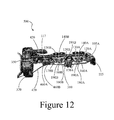
  • FIG. 12 is a front elevation view photograph of an actual prototype of the present disclosure, of a single digit in full extension.
  • FIG. 13 is a front elevation view photograph of an actual prototype of the present disclosure, of a single digit in partial flexion.
  • FIG. 14 is a front elevation view photograph of an actual prototype of the present disclosure, of a single digit in full flexion.
  • references in the specification to “one embodiment”, “an embodiment”, “an example embodiment”, etc., indicate that the embodiment described may include a particular feature, structure, or characteristic, but every embodiment may not necessarily include the particular feature, structure, or characteristic. Moreover, such phrases are not necessarily referring to the same embodiment. Further, when a particular feature, structure, or characteristic is described in connection with an embodiment, it is submitted that it is within the knowledge of one skilled in the art to affect such feature, structure, or characteristic in connection with other embodiments whether or not explicitly described.
  • the present disclosure relates to novel and unique prosthetic joints, and digits comprising these joints, as well as modular prosthetic systems comprising multiple digits, in particular for partial-hand replacements.
  • the joints are characterized by their unique lack of pins, screws or nails to secure opposing ends of two phalanges together, and by the joint's ability to more accurately mimic the motion of a natural joint comprising ligaments, which allow some motion in all three dimensions, a capability called digit circumduction.
  • the present disclosure secures adjacent phalanges using flexible cord that provides both mechanical integrity and strength, but also mimics natural ligaments by providing more natural movement in planes other than the primary plane defined by flexion and extension, including rotational motion around the axis defined by the extended digit.
  • some embodiments of the present disclosure have a digit 100 and a joint 110 comprising a distal lever 115 and a proximal lever 117 , in which the two levers ( 115 and 117 ) are aligned lengthwise along a first reference axis, the horizontal X-axis.
  • Each lever ( 115 and 117 ) comprises a proximal end and a distal end.
  • the joint 110 connects the proximal end of the distal lever 115 to the adjacent distal end of the proximal lever 117 .
  • the levers ( 115 and 117 ) are also defined by the vertical Y-axis, and the axis orthogonal to the X- and Y-axis, the Z-axis.
  • the upper surface of the levers ( 115 and 117 ), in the Y-axis, is defined as the dorsal side.
  • the lower surface of the levers ( 115 and 117 ), also in the Y-axis, is defined as the palmar side.
  • the palmar sides of the adjacent ends of the two levers ( 115 and 117 ) are both rounded, across their entire width in the Z-axis direction. Rounding these edges allows for smooth, natural movement when the joint 110 is flexed or extended.
  • Rounding the two opposing edges also forms a space on the palmar side, between the two adjacent levers ( 115 and 117 ).
  • This space referred to as a “nip” 150 has boundaries defined by the rounded edges, which form adjacent convex arcs.
  • the two opposing arcs of the nip 150 move against each other when the joint 110 flexes and extends.
  • the distal lever 115 contains a first hole 120 that passes through its width in the Z-axis direction.
  • This first hole 120 is preferably located in the proximal end and the palmar half of the distal lever 115 .
  • the proximal lever 117 has a second hole 130 , with this second hole 130 also passing through the width of the proximal lever 117 in the Z-axis direction.
  • the second hole 130 is preferably located in the distal end and the palmar half of the proximal lever 117 .
  • the two holes ( 120 and 130 ), like the two levers ( 115 and 117 ), preferably lay adjacent two each other at about the same height in the Y-axis direction.
  • the first hole 120 and the second hole 130 in conjunction with a first loop 140 , secure the adjacent levers ( 115 and 117 ) together, much like ligaments in a natural joint.
  • the first loop 140 comprising a cord, line, filament, etc., passes through the first hole 120 and the second hole 130 , forming a complete circular loop that provides the structural stability required of a joint, but also allows for the biased movement in the XY-plane for flexion and extension.
  • the first loop 140 also provides some flexibility, much like a ligament, to provide some degree of motion in the other dimensions, for example in the YZ-plane and XZ-plane, as well as some rotational motion along the X-axis.
  • the joint 110 provides biased movement in the same direction and plane as the natural appendage being replaced. So, by example, a joint for a prosthetic replacing a finger, will provide biased movement in the XY-plane, whereby flexing will pull the finger downward in the palmar direction, and extension will release the finger back in the dorsal direction.
  • the joint 110 limits motion in the XZ-plane to less than 1, 2, 3, 4, or 5 degrees. In some embodiments, the joint 110 limits motion in YZ-plane to less than 1, 2, 3, 4, or 5 degrees.
  • the joint 110 limits axial rotation around the X-axis to less than 20, 19, 18, 17, 16, 15, 14, 13, 12, 11, 10, 9, 8, 7, 6, 5, 4, 3, 2, or 1 degree in either or both the clockwise or counter-clockwise directions.
  • the distal lever 115 , the proximal lever 117 and the first loop 140 are constructed of metal, plastic, ceramic, carbon fiber or a combination thereof.
  • the materials of construction may be the same for all of the components comprising the joint, or each individual element may be constructed from its own unique material, different from the materials chosen for any other element comprising the joint.
  • the loop comprises 80# Test, Spectra® by Honeywell, or materials by Alternative Textiles, Inc., or a combination thereof.
  • the distal lever 115 and the proximal lever 117 may be plastic.
  • the levers ( 115 and 117 ) may be produced by injection molding.
  • the first loop 140 may comprise plastic, ceramic, carbon fiber, metal wire, or a combination thereof.
  • the first loop 140 comprises a single circular strand, cord, filament, etc. In some embodiments, the first loop 140 comprises more than one circular strand, cord, filament, etc., with each cord passing through both holes ( 120 and 130 ) of the joint 110 .
  • the number of passes used depends on the strength and structural requirements of the joint being designed and would be known to one skilled in the art.
  • the material of construction for the distal lever 115 and the proximal lever 117 comprises aluminum.
  • the joint 110 of a digit 100 further comprises a stabilizing cylinder 180 that is placed in the nip 150 located on the palmar side of the adjacent ends of the distal lever 115 and the proximal lever 117 .
  • This stabilizing cylinder 180 fits in the nip 150 formed by the rounded edges of the two levers ( 115 and 117 ), and lays in the Z-axis direction.
  • the width of the stabilizing cylinder 180 may be about the same as the width of the levers ( 115 and 117 ) in the Z-axis direction, but may also be a little narrower or a little wider.
  • the two ends of the stabilizing cylinder 180 may be flanged (not shown) to assist with holding the stabilizing cylinder 180 in the nip 150 (see for example the first flange 610 A and second flange 610 B shown in FIGS. 6, 7, 8, 10 and 13 ).
  • the stabilizing cylinder 180 comprises a third hole 190 that passes through the length of the stabilizing cylinder 180 in the Z-axis direction.
  • the diameter of the stabilizing cylinder 180 may be such that it provides enough mass to provide the structural support needed, but is not so large as to impede the motion of the joint 110 .
  • the stabilizing cylinder 180 is held in position by securing a second loop 160 though the first hole 120 of the distal lever 115 and the third hole 190 passing through the stabilizing cylinder 180 , as well as a third loop 170 secured through the second hole 130 of the proximal lever 117 and the hole 190 passing through the stabilizing cylinder 180 .
  • This triple system of loops ( 140 , 160 , and 170 ) and a stabilizing cylinder 180 provides additional stability to the joint 110 , in particular by limiting rotational movement around the X-axis.
  • These additional loops (second loop 160 and third loop 170 ), and the stabilizing cylinder 180 like the first loop 140 and the levers ( 115 and 117 ), are constructed of metal, plastic, ceramic, carbon fiber or a combination thereof.
  • a digit 300 comprising a distal lever 115 , a proximal lever 117 and a third lever 310 , corresponding to a distal, intermediate and proximal phalange, respectively.
  • the three levers are preferably aligned lengthwise along the X-axis, and each lever comprises a proximal end and a distal end.
  • the proximal end of the distal lever 115 is adjacent to the distal end of the third lever 310 , the proximal end of the third lever 310 is adjacent to the distal end of the proximal lever 117 , and the proximal end of the proximal lever 117 is adjacent to a base 320 .
  • a first hole 120 A of the distal lever 115 is preferably located in the proximal end of the distal lever 115
  • a second hole 130 A of the third lever 310 is preferably located in the distal end of the third lever 310
  • a first hole 120 B of the third lever 310 is preferably located in the proximal end of the third lever 310
  • a second hole 130 B of the proximal lever 117 is preferably located in the distal end of the proximal lever 170
  • a fourth hole 330 of the proximal lever 117 is preferably located in the proximal end of the proximal lever 117 .
  • All five holes are preferably located in the palmar half of their respective levers ( 115 , 117 , and 310 ), and all five holes pass through the width of their respective levers in the Z-axis direction, and all are preferably aligned at about the same height in the Y-axis direction.
  • the proximal end and palmar side in the Z-axis direction of the distal lever 115 is rounded.
  • the palmar side of both the proximal and distal ends, in the Z-axis direction, of both the proximal lever 117 and the third lever 310 are rounded.
  • the adjacent, rounded ends of the proximal end of the distal lever 115 , and distal end of the third lever 310 form a first nip 150 A, and the rounded sides of the adjacent third lever 310 and proximal lever 117 form a second nip 150 B.
  • the digit 300 forms a first joint 110 A that secures the distal lever 115 to the third lever 310 by placing a first stabilizing cylinder 180 A in the first nip 150 A and securing a first loop 140 A through the first hole 120 A of the distal lever 115 and the second hole 130 A of the third lever 310 , securing a second loop 160 A through the first hole 120 A of the distal lever 115 and the third hole 190 A of the first stabilizing cylinder 180 A, and securing a third loop 170 A through the second hole 130 A of the third lever 310 and the third hole 190 A of the stabilizing cylinder 180 A.
  • the digit 300 further comprises a second joint 110 B that secures the third lever 310 to the proximal lever 117 by placing a second stabilizing cylinder 180 B in the second nip 150 B and securing a first loop 140 B through the first hole 120 B of the third lever 310 and the second hole 130 B of the proximal lever 117 , securing a second loop 160 B through the first hole 120 B of the third lever 310 and the third hole 190 B of the second stabilizing cylinder 180 B, and securing a third loop 170 B through the second hole 130 B of the proximal lever 117 and the third hole 190 B of the second stabilizing cylinder 180 B.
  • the digit 300 further comprises a third joint 110 C that secures the proximal lever 117 to the base 320 .
  • the base 320 comprises an anchor 340 , which in some embodiments is a hole or slot that passes through the base 320 in the X-axis direction.
  • the anchor 340 is at about the same height in the Y-axis direction as the fourth hole 330 .
  • An attachment 350 secures the proximal lever 117 to the base 320 by passing the attachment 350 through the fourth hole 330 and the anchor 340 .
  • all three joints ( 110 A, 110 B, and 110 C) of FIG. 3 provide biased motion in the palmar direction in the XY-plane, and also provide some motion in the dorsal direction of the XY-plane, some motion YZ-plane, some motion in the XZ-plane, as well as rotational motion around the X-axis.
  • all three joints ( 110 A, 110 B, and 110 C) of FIG. 3 limit motion in the XZ-plane to less than 1 degree, 2, 3, 4, or 5 degrees. In some embodiments, the joints ( 110 A, 110 B, and 110 C) limit motion in the YZ-plane to less than 1 degree, 2, 3, 4, or 5 degrees.
  • the levers are plastic.
  • the levers ( 115 , 117 , and 310 ) and base 220 are produced by injection molding.
  • a tension guide 410 may comprise a notch, indentation or other suitable means located in the dorsal half of each lever ( 115 , 117 , and 310 ), wherein the tension guide 410 is oriented in the X-axis direction.
  • tension guide 410 runs a tension cord 420 , wherein the tension cord 420 is anchored on the proximal end of the digit 400 with the base 320 , by a tension restraint 430 , and wherein the tension cord 420 is anchored on the distal end of the digit 400 by securing the tension cord 420 in a tension hole 440 , this tension hole 440 located in the distal third of the distal lever 115 , also in the dorsal half of the distal lever 115 , in the Y-axis direction.
  • the tension guide 410 and the tension cord 420 run through the entire length in the X-axis direction of the third lever 310 and proximal lever 117 .
  • the tension guide 410 starts at the proximal end of the proximal lever 117 and terminates at the tension hole 440 .
  • This arrangement provides a constant force that pulls the digit 400 , via the tension cord 420 , into the fully extended position.
  • the tension cord 420 may comprise any suitable elastomer. Examples include but are not limited to elastic bands and bungee cord. The length required to provide a suitable force, is not elaborated here, and that design feature is known to one of skill in the art.
  • the tension cord 420 may also comprise a filament and spring acting in series, or a single spring.
  • a fifth hole 450 A is located about midway in the length of the third lever 310 , in the palmar half of the third lever 310 .
  • a similar fifth hole 450 B is located about midway in the length of the proximal lever 117 , also in the palmar half of the proximal lever 117 .
  • the actuator guides ( 460 A and 460 B) guide an actuator cord 470 to which the amputee applies force, against the force exerted by the tension cord 420 , to flex the digit 400 .
  • the actuator cord 470 is firmly secured through an actuator hole 480 , located in the distal end, at about midline in Y-axis direction, of the distal lever 115 .
  • the actuator cord 470 then passes over the first stabilizing cylinder 180 A of the first joint 110 A connecting the distal lever 115 to the third lever 310 , passes through the first actuator guide 460 A of the third lever 310 , over the second stabilizing cylinder 180 B of the second joint 110 B connecting the third lever 310 to the proximal lever 117 , passes through the second actuator guide 460 B of the proximal lever 117 , and finally passes through an actuator lead 490 located in the base 320 .
  • the actuator guides ( 460 A and 460 B), like the loops ( 140 , 160 , and 170 ) used to construct the joints ( 110 A, 110 B, and 110 C), may be made of plastic, carbon fiber, metal, ceramic or a combination thereof.
  • the actuator cord 470 is preferably a non-elastic cord, cable, wire, any other suitable non-elastic cord means, or a combination thereof.
  • the relative lengths of the distal lever 115 , the third lever 310 , and the proximal lever 117 match the natural proportions of a human finger.
  • FIGS. 5-14 show different views of the prosthesis of this disclosure.
  • FIGS. 5-6 are side and end views, respectively, of the prosthesis in full flexion.
  • FIG. 7 is a perspective view of the prosthesis in an extended position.
  • Flanges ( 700 A and 700 B) on each of the distal lever 115 and proximal lever 117 hold the tension cord 420 in position during digit 500 and lever ( 115 , 117 , and 310 ) movement.
  • FIG. 8 depicts four digits ( 500 A, 500 B, 500 C, and 500 D) joined using a slip ring arrangement.
  • the slip ring arrangement includes a ring 810 connected to multiple actuator cords ( 470 A, 470 B, 470 C, and 470 D), each of which independently operates a corresponding digit.
  • FIG. 9 shows four digits ( 500 A, 500 B, 500 C, and 500 D) in flexion showing bases inclined with respect to the palm to achieve spherical prehension.
  • FIG. 10 shows three digits ( 500 A, 500 B, and 500 C) joined using a slip ring engagement.
  • FIG. 11 shows three digits in flexion. The prosthesis replicates many of the elements of an anatomical hand.
  • FIG. 12 shows a biomimetic digit 500 in full extension.
  • FIG. 13 shows a biomimetic digit 500 in partial flexion.
  • FIG. 14 shows a biomimetic digit 500 in full flexion.
  • 5-14 show digits 500 having stabilizing cylinders 180 placed in nips 150 , and triangular formations of loops ( 140 , 160 , and 170 ) and holes ( 120 , 130 , and 190 ), or triads 195 , where the triads 195 secure adjacent ends of levers ( 115 , 117 , and 310 ) to form joints 110 , which allow some degree of motion in all three dimensions, including rotational movement around the digit's axis.
  • the three joints of a digit use a triad of ligament wraps (loops) made from high-strength, low-creep, braided Spectra® filament (80 lbf test>0.016′′ diameter, Innovative Textiles, Inc.) originally developed for competitive sport fishing.
  • a single filament passes through holes in the stabilizer (cylinder) and each adjoining phalanx (lever), making ten (10) alternating passes around the joint, and its ends are secured to prevent loosening or slippage.
  • This triad construction admits planar flexion-extension movement while limiting lateral, off-axis bending and axial twist to levels consistent with the anatomical finger. Some lateral bend and axial twist are desirable as they help distribute tractive forces over the surface of objects, significantly increasing grasp quality.
  • This configuration is called “digit circumduction” in the anatomical hand and not currently in use in any other existing articulating digits or multi-articulating hands—body-powered or otherwise—that allow for beneficial digit circumduction.
  • Tendon guides made from open coils of Spectra® filament (100 lbf test>0.022′′ diameter, Alternative Textiles, Inc.) attach to the proximal and middle phalanges (levers), analogous to the annular and cruciform fibrous sheaths that transfer force to the phalangeal segments in the anatomical finger. These guides also minimize frictional drag on the tendon (actuator cord) analogous to the synovial sheath. Adjusting the length and attachment locations of these “synovial coils” on each phalanx controls the sequencing of joint movements as the digit flexes.
  • the prosthesis design of this disclosure intentionally permits selection of attachment points that initiate flexion at the base of the digit and then move proximally from the distal phalanx. If an object is not encountered as the digit sweeps, it closes to establish “key grip” against an opposition thumb, one of the most important and useful prehension patterns. If an object is encountered during sweep, digit flexion begins at the distal end, curling back against the object and drawing it towards the base for strong, stable grasp.
  • At least three distinct digit lengths are needed to avoid “broom hand” (i.e., all digits mounted on a straight knuckle line and having the same length—like a broom.) These phalangeal segments permit various combinations to obtain different overall digit lengths without additional tooling cost or complexity.
  • the distal phalanx serves as digit tip with articulation on its proximal end only, along with flexor tendon and extensor attachment points; it is common to all sizes. Table 1 shows possible constructions.
  • the digit mounting means disclosed herein can better serve partial hand amputees. Instead of a single composite “rack” that forces digits into an unnaturally straight line as currently used in existing products, the digit mounting means of this disclosure can provide a more versatile strap system offering several advantages. Each digit is mounted on a single metal structural strap folded into a saddle or “taco” shape that is affixed on both the volar and dorsal aspects of a partial-hand prosthetic shell for increased strength and rigidity.
  • Each strap's ends are designed with serrations that allow it to be strongly secured using standard fiberglass or carbon fiber layup techniques commonly employed in the field; holes are provided for tinner's rivets if preferred (another common attachment method.)
  • Each strap is independently shapeable by the prosthetist to position each digit optimally on an arc within the anatomical hand space rather than forcing them into an artificial, non-optimal line.
  • the digit bases are designed to attach with a screw accessible from the front, permitting easy modular replacement if necessary.
  • the flexion plane of each digit can be oriented independently with respect to the palm for improved spherical prehension. This innovation can markedly benefit amputees having excessive scarring, adipose tissue, bulbous amputations, or where the prosthetist must orient digit movements to optimally interface with remaining anatomical digits for coordinated useful grasp.
  • Synthetic filaments can perform analogous to the ligaments, tendons, fibrous sheaths, and synovial sheaths found in the anatomical digit, achieving excellent service life while simultaneously reducing cost, weight, mechanical complexity, and eliminating the need for lubrication.
  • Allowance for limited lateral bending and axial twist enhances the digit's ability to adaptively grasp by permitting surface contact forces and joint torques to equilibrate.
  • a quasi-whiffle tree connection for multiple digit flexor tendons i.e. a slip-ring arrangement
  • the holes 120 and 130 pass along the X-axis at least substantially through the first distal lever 100 and second proximal lever 110 .
  • the looped cord passes through each of the adjoining first distal and second proximal levers rather than through the sides of the first distal and second proximal levers as shown in FIG. 1 .
  • the present disclosure in various aspects, embodiments, and configurations, includes components, methods, processes, systems and/or apparatus substantially as depicted and described herein, including various aspects, embodiments, configurations, subcombinations, and subsets thereof. Those of skill in the art will understand how to make and use the various aspects, aspects, embodiments, and configurations, after understanding the present disclosure.
  • the present disclosure in various aspects, embodiments, and configurations, includes providing devices and processes in the absence of items not depicted and/or described herein or in various aspects, embodiments, and configurations hereof, including in the absence of such items as may have been used in previous devices or processes, e.g., for improving performance, achieving ease and or reducing cost of implementation.

Landscapes

  • Health & Medical Sciences (AREA)
  • Transplantation (AREA)
  • Orthopedic Medicine & Surgery (AREA)
  • Heart & Thoracic Surgery (AREA)
  • Engineering & Computer Science (AREA)
  • Biomedical Technology (AREA)
  • Oral & Maxillofacial Surgery (AREA)
  • Vascular Medicine (AREA)
  • Life Sciences & Earth Sciences (AREA)
  • Animal Behavior & Ethology (AREA)
  • General Health & Medical Sciences (AREA)
  • Public Health (AREA)
  • Veterinary Medicine (AREA)
  • Cardiology (AREA)
  • Prostheses (AREA)

Abstract

This disclosure relates to the field of prosthetics, more specifically to a pinless anthropomorphic hinge or joint, and a digit comprising one or more phalanges connected by and articulating around pinless joints, whereby the joints provide compliant movement in more than one plane. This disclosure also relates to modular prosthetic systems comprising multiple digits, in particular for partial-hand replacements.

Description

CROSS REFERENCE TO RELATED APPLICATIONS
The present application claims the benefits of U.S. Provisional Patent Application No. 61/777,024, filed Mar. 12, 2013, of the same title, which is incorporated herein by this reference in its entirety. The present application is a divisional application of U.S. Non-provisional patent application Ser. No. 14/205,997, which has issued as U.S. Pat. No. 9,474,630.
STATEMENT REGARDING FEDERALLY SPONSORED RESEARCH OR DEVELOPMENT
The U.S. Government has a paid-up license in this invention and the right in limited circumstances to require the patent owner to license others on reasonable terms as provided for by the terms of Contract No. 1R43HD07051401 awarded by the National Institutes of Health.
TECHNICAL FIELD
This disclosure relates to the field of prosthetics, more specifically to a pinless anthropomorphic hinge or joint, and a digit comprising one or more phalanges connected by and articulating around pinless joints, whereby the joints provide compliant movement in more than one plane. This disclosure also relates to modular prosthetic systems comprising multiple digits, in particular for partial-hand replacements.
BACKGROUND
The following text should not be construed as an admission of knowledge in the prior art. Furthermore, citation or identification of any document in this application is not an admission that such document is available as prior art to the present disclosure, or that any reference forms a part of the common knowledge in the art.
A fundamental challenge in the field of prosthetic device development is to find a design that balances functionality with cost. The amputee desires a prosthetic device that both mimics and feels like the natural component that has been lost, for example, a finger or a hand. The replacement device must also be affordable. This need for cost effective prosthetic appliances is especially prevalent in poor countries and those suffering from civil war or natural disasters, such as Haiti or several African nations such as Sierra Leone, Uganda, and Kenya.
The human hand is an amazingly complicated feat of engineering, and very difficult to emulate. Even individual human fingers have an incredible range of motion and dexterity. This is especially evident when watching the fine motor skills of a sculptor, guitarist or surgeon. These motions are very difficult to mimic with an artificial device, especially in a cost-effective manner. In general, the engineering designs that most successfully mimic nature are also the most expensive. These designs can be described as “bionic”, usually costing thousands of dollars to manufacture and maintain, or they are destined to remain relegated to the laboratory or to be used only by the most wealthy. The vast majority of people in need of affordable prosthetic devices lack the means to acquire these technologically sophisticated designs. Wonderful engineering feats in themselves, most bionic designs are not economically viable solutions for the masses. However, the other extreme is also lacking. More affordable prosthetic appliance designs tend to have short life spans, high failure rates, and are often expensive or difficult to maintain. From the amputee's perspective, these cheaper designs also tend to provide much less functionality and utility. It is one objective of the present disclosure to provide a prosthetic design that offers a balance of affordability and functionality.
A fundamental element of any prosthetic device that provides motion, for example an artificial arm, hand or finger, is a joint. Without one or more joints, a finger is simply a lever with severely limited functionality. Joints provide the means needed to flex or extend the digit, allowing for control to pick-up and grasp objects, ranging from such things as a hammer to a delicate wine glass.
Despite their importance, viable prosthetic joint designs are surprisingly limited, the vast majority relying on a pin that rigidly restricts motion to revolution about a single axis. Although simple in concept, “pin joints” do not mimic their natural counterparts, which are held together by a number of flexible ligaments. Knees, elbows, wrists, and fingers all rely upon ligaments for motion, typically biased to one plane but having some ability to move in all three spatial dimensions, including some rotational motion around an axis. Pins, on the other hand, limit motion to pure rotation, thus giving prosthetic appliances an artificial, rigid, and almost robotic motion.
Nevertheless, history has shown a propensity and preference for the pin (or screw, nail, rod, peg, or pinion). U.S. Pat. No. 1,608,689 (issued in 1926), describes an artificial hand comprising fingers and a thumb. The phalanges of each digit are held to their adjacent neighbors using pins.
U.S. Pat. No. 1,742,269 (1930) resorts to the same solution for providing a pivot point between opposing phalanges: pins.
Many more modern joint and prosthetic designs also use pins as the fundamental elements for providing motion between adjacent phalanges. Examples include: U.S. Pat. No. 5,326,369; U.S. Patent Application Publication No. 2004/0054424; U.S. Pat. App. Pub. No. 2006/0212129; U.S. Pat. No. 7,361,197; U.S. Pat. No. 7,655,051; U.S. Pat. App. Pub. No 2012/0203358.
Some different approaches do exist. An example from the WWII era is U.S. Pat. No. 2,500,614 which issued in 1948. This patent discloses a “ball and socket” system for the joints in an artificial hand. However, this solution poses significant manufacturing difficulties and is decidedly more complex in operation than simple pins.
Another prosthetic joint from this era is U.S. Pat. No. 2,549,074 which issued in 1951. Instead of pins, this patent discloses a joint comprising a flat metal sheet. This sheet connects the adjacent ends of the two phalanges. A space between the two phalanges allows the finger to flex into a closed position. Although different in concept than the more prominently used pin, this sheet metal joint still poses some of the same problems as the pin; it holds the adjacent phalanges rigidly fixed in all planes except that plane defined by flexion and extension.
Other prosthetic joints posing the same problems as highlighted above include U.S. Pat. No. 4,193,139, which discloses a pin-joint concept (1980) and U.S. Pat. No. 4,944,758, which discloses a ball-and-socket concept (1990).
All of these solutions tend to either limit motion to one plane, unlike natural joints, which allow some degree of motion in all three dimensions, including rotational movement around the digit's axis, or they require potentially more complicated and costly means for manufacturing and maintenance. It is the aim of this disclosure to overcome these problems, with a design that is simple, compact, waterproof, inexpensive, and easy to maintain.
SUMMARY
The present disclosure relates to novel and unique prosthetic joints, and digits comprising these joints. The joints are characterized by their unique lack of pins or nails to secure opposing ends of two phalanges together, and by the joint's ability to more accurately mimic the motion of a natural joint comprising ligaments, which allow some motion in all three dimensions. Instead of pins, the present disclosure secures adjacent phalanges using flexible cord that provides both mechanical integrity and strength, but also mimics natural ligaments by providing more natural movement in planes other than the primary plane defined by flexion and extension, including rotational motion around the axis defined by the extended digit. This “pinless” method of securing adjacent phalanges in a way that allows motion that more accurately mimics the motion of a natural human joint, is a novel and unobvious digit and/or phalanges prosthesis securement mechanism and presents a significant contribution to the field of prosthetics.
In one example of the present disclosure, a digit comprises three joints and three phalanges, the adjacent phalanges being secured using a triad of ligament wraps (loops) made from high-strength, low-creep, braided, polymer filament. For each joint, a single filament passes through a hole in a stabilizing cylinder and a hole in each adjoining phalanx (lever), making ten (10) alternating passes around the joint, with the filament ends secured to prevent loosening or slippage. While ten alternating passes are referenced, it will be appreciated that any number of passes may be used depending on the application. Multiple filament passes form a composite bundle having a tensile strength exceeding that of the phalanx material. This triad construction admits planar flexion-extension movement while limiting lateral, off-axis bending and axial twist to levels consistent with the anatomical finger. Some lateral bend and axial twist, this motion being called circumduction, are desirable as they help distribute tractive forces over the surface of objects, significantly increasing grasp quality.
These and other advantages will be apparent from the disclosure of the aspects, embodiments, and configurations contained herein.
As used herein, “at least one”, “one or more”, and “and/or” are open-ended expressions that are both conjunctive and disjunctive in operation. For example, each of the expressions “at least one of A, B and C”, “at least one of A, B, or C”, “one or more of A, B, and C”, “one or more of A, B, or C” and “A, B, and/or C” means A alone, B alone, C alone, A and B together, A and C together, B and C together, or A, B and C together. When each one of A, B, and C in the above expressions refers to an element, such as X, Y, and Z, or class of elements, such as X1-Xn, Y1-Ym, and Z1-Zo, the phrase is intended to refer to a single element selected from X, Y, and Z, a combination of elements selected from the same class (e.g., X1 and X2) as well as a combination of elements selected from two or more classes (e.g., Y1 and Zo.).
It is to be noted that the term “a” or “an” entity refers to one or more of that entity. As such, the terms “a” (or “an”), “one or more” and “at least one” can be used interchangeably herein. It is also to be noted that the terms “comprising”, “including”, and “having” can be used interchangeably.
As used herein, “cylinder” is referred to as a hollow body comprising a circular cross section with parallel sides, slightly concave sides, or slightly convex sides. Therefore, a cylinder is used herein, comprises a hole that passes through the circular cross-sectional area. In the present disclosure, a cylinder provides mechanical stabilization to the joint, and thus is also referred to as a stabilizing cylinder.
The term “extension” refers to when a digit is straight, under the influence of an extending force. As used herein, the term “flexion” refers to when any or all of the joints are rotated, putting the digit into a curl position under the influence of a flexing force.
As used herein, “loop” refers to a cord, filament, cable, wire, thread, line, yarn, string, or fiber, wherein the two ends of such a cord are secured into a circular loop. Alternatively, this cord, filament, cable, etc., may loop multiple times to form a composite loop. A loop simulates a ligament in the present disclosure.
The term “means” as used herein shall be given its broadest possible interpretation in accordance with 35 U.S.C., Section 112, Paragraph 6. Accordingly, a claim incorporating the term “means” shall cover all structures, materials, or acts set forth herein, and all of the equivalents thereof. Further, the structures, materials or acts and the equivalents thereof shall include all those described in the summary of the invention, brief description of the drawings, detailed description, abstract, and claims themselves. As used herein, “phalange” refers to a phalangeal segment, phalanx, digit segment, or lever. So, for the example of the human finger, a “phalange” refers to the proximal, intermediate and distal bones.
As used herein, “nip” refers to an empty space with its boundaries defined by the palmar or volar surfaces of two adjacent phalanges. By way of example, placing two rectangular blocks end-to-end provides no space between. However, rounding the palmar edges of the adjacent blocks
provides space between two convex arcs. As used in the context of this disclosure, this space is referred to as a “nip”.
As used herein, “plastic” refers to any of various organic compounds produced by polymerization, capable of being molded, extruded, cast into various shapes and films, or drawn into filaments used as textile fibers. A plastic can either be a thermosetting polymer or a thermoplastic polymer. Specifically, the plastic can include acetals, acrylics, acrylonitrile-butadiene-styrene, alkyds, coumarone-indene, diallyl phthalate, epoxy, fluoropolymer, melamine-formal dehyde, nitrile resins, nylon, petroleum resins, phenolics, polyamide-imide, polyarylates, polybutylene, polycarbonate, polyethylene, polyimides, polyphenylene oxide, polyphenylene sulfide, polypropylene, polystyrene, polyurethanes, polyvinyl acetate, styrene acrylonitrile, styrene butadiene latexes, sulfone polymers, thermoplastic polyester, unsaturated polyester, urea-formaldehyde, hexachloroethane, or a combination thereof. More specifically, the plastic can include polyethylene terephthalate (PET or PETE), high-density polyethylene (HDPE), low-density polyethylene (LDPE), polypropylene (PP), polystyrene (PS), nylon, or a combination thereof. The plastic can optionally include one or more additives. The term “plastic” should also be understood to include additives used to enhance the behavioral characteristics of the primary constituent material. Examples include glass fibers, carbon fibers, nanomaterials, hollow spheres, pigments, foaming agents, etc.
As used herein, “thermoset” refers to a polymer that solidifies or “sets” irreversibly when heated. Thermosets are valued for their durability and strength and are used primarily in automobiles and construction.
As used herein, “thermoplastic” refers to a polymer in which the molecules are held together by weak secondary bonding forces that soften when exposed to heat and return to its original condition when cooled back down to room temperature. When a thermoplastic is softened by heat, it can then be shaped by extrusion, molding or pressing. Examples of thermoplastics include polyethylene used in packaging, electrical insulation, milk and water bottles, packaging film, house wrap, and agricultural film; polypropylene used in carpet fibers, automotive bumpers, microwave containers, and external prostheses.
The preceding is a simplified summary of the disclosure to provide an understanding of some aspects of the disclosure. This summary is neither an extensive nor exhaustive overview of the disclosure and its various aspects, embodiments, and configurations. It is intended neither to identify key or critical elements of the disclosure nor to delineate the scope of the disclosure but to present selected concepts of the disclosure in a simplified form as an introduction to the more detailed description presented below. As will be appreciated, other aspects, embodiments, and configurations of the disclosure are possible utilizing, alone or in combination, one or more of the features set forth above or described in detail below. Also, while the disclosure is presented in terms of exemplary embodiments, it should be appreciated that individual aspects of the disclosure can be separately claimed.
BRIEF DESCRIPTION OF DRAWINGS
The accompanying drawings are incorporated into and form a part of the specification to illustrate examples of the aspects, embodiments, or configurations disclosed herein. These drawings together with the description, explain the principle of the aspects, embodiments, or configurations. The drawings simply illustrate preferred and alternative examples of how the aspects, embodiments, or configurations can be made and used and are not to be construed as limiting the aspects, embodiments, or configurations to only the illustrated and described examples. Further features and advantages will become apparent from the following, more detailed, description of the various aspects, embodiments, or configurations, as illustrated by the drawings referenced below.
FIG. 1 is a front elevation view of one embodiment of the present disclosure, of a joint of a single loop.
FIG. 2 is a front elevation view of one embodiment of the present disclosure of a joint of three loops.
FIG. 3 is a front elevation view of one embodiment of the present disclosure of a digit of three levers, three hinges and a base.
FIG. 4 is a front elevation view of one embodiment of the present disclosure of a digit of three levers, three hinges, and a base.
FIG. 5 is a front elevation view of one embodiment of a digit of the present disclosure.
FIG. 6 is a bottom plan view of one embodiment of a digit of the present disclosure.
FIG. 7 is a perspective view of one embodiment of a digit of the present disclosure.
FIG. 8 is a perspective photograph of an actual prototype of the present disclosure, of four digits that comprise a partial hand amputation prosthetic device.
FIG. 9 is a perspective view photograph of an actual prototype of the present disclosure, of four digits in flexion.
FIG. 10 is a bottom plan view photograph of an actual prototype of the present disclosure, illustrating an actuating cord and ring for flexing the digits.
FIG. 11 is a front elevation view photograph of an actual prototype of the present disclosure, of four digits in flexion.
FIG. 12 is a front elevation view photograph of an actual prototype of the present disclosure, of a single digit in full extension.
FIG. 13 is a front elevation view photograph of an actual prototype of the present disclosure, of a single digit in partial flexion.
FIG. 14 is a front elevation view photograph of an actual prototype of the present disclosure, of a single digit in full flexion.
REFERENCE NUMERALS
  • 100 . . . digit
  • 110 . . . joint
  • 115 . . . distal lever
  • 117 . . . proximal lever
  • 120 . . . first hole
  • 130 . . . second hole
  • 140 . . . first loop
  • 150 . . . nip
  • 160 . . . second loop
  • 170 . . . third loop
  • 180 . . . cylinder
  • 190 . . . third hole
  • 195 . . . triad
  • 300 . . . digit
  • 310 . . . third lever
  • 320 . . . base
  • 330 . . . fourth hole
  • 340 . . . anchor
  • 350 . . . attachment
  • 400 . . . digit
  • 410 . . . tension guide
  • 420 . . . tension cord
  • 430 . . . tension restraint
  • 440 . . . tension hole
  • 450 . . . fifth hole
  • 460 . . . actuator guide
  • 470 . . . actuator cord
  • 480 . . . actuator hole
  • 490 . . . actuator lead
  • 500 . . . digit
  • 610 . . . flange
  • 700 . . . flange
  • 800 . . . artificial hand
  • 810 . . . ring
DETAILED DESCRIPTION
The following detailed description illustrates the disclosure by way of example and not by way of limitation. This description will clearly enable one skilled in the art to make and use the disclosure, including what is presently believed to be the best mode of carrying out the disclosure.
References in the specification to “one embodiment”, “an embodiment”, “an example embodiment”, etc., indicate that the embodiment described may include a particular feature, structure, or characteristic, but every embodiment may not necessarily include the particular feature, structure, or characteristic. Moreover, such phrases are not necessarily referring to the same embodiment. Further, when a particular feature, structure, or characteristic is described in connection with an embodiment, it is submitted that it is within the knowledge of one skilled in the art to affect such feature, structure, or characteristic in connection with other embodiments whether or not explicitly described.
The present disclosure relates to novel and unique prosthetic joints, and digits comprising these joints, as well as modular prosthetic systems comprising multiple digits, in particular for partial-hand replacements. The joints are characterized by their unique lack of pins, screws or nails to secure opposing ends of two phalanges together, and by the joint's ability to more accurately mimic the motion of a natural joint comprising ligaments, which allow some motion in all three dimensions, a capability called digit circumduction. Instead of pins, the present disclosure secures adjacent phalanges using flexible cord that provides both mechanical integrity and strength, but also mimics natural ligaments by providing more natural movement in planes other than the primary plane defined by flexion and extension, including rotational motion around the axis defined by the extended digit.
Turning to FIG. 1, some embodiments of the present disclosure have a digit 100 and a joint 110 comprising a distal lever 115 and a proximal lever 117, in which the two levers (115 and 117) are aligned lengthwise along a first reference axis, the horizontal X-axis. Each lever (115 and 117) comprises a proximal end and a distal end. The joint 110 connects the proximal end of the distal lever 115 to the adjacent distal end of the proximal lever 117. The levers (115 and 117) are also defined by the vertical Y-axis, and the axis orthogonal to the X- and Y-axis, the Z-axis. The upper surface of the levers (115 and 117), in the Y-axis, is defined as the dorsal side. The lower surface of the levers (115 and 117), also in the Y-axis, is defined as the palmar side. The palmar sides of the adjacent ends of the two levers (115 and 117) are both rounded, across their entire width in the Z-axis direction. Rounding these edges allows for smooth, natural movement when the joint 110 is flexed or extended. Rounding the two opposing edges also forms a space on the palmar side, between the two adjacent levers (115 and 117). This space, referred to as a “nip” 150 has boundaries defined by the rounded edges, which form adjacent convex arcs. The two opposing arcs of the nip 150 move against each other when the joint 110 flexes and extends.
The distal lever 115 contains a first hole 120 that passes through its width in the Z-axis direction. This first hole 120 is preferably located in the proximal end and the palmar half of the distal lever 115. Similarly, the proximal lever 117 has a second hole 130, with this second hole 130 also passing through the width of the proximal lever 117 in the Z-axis direction. The second hole 130 is preferably located in the distal end and the palmar half of the proximal lever 117. The two holes (120 and 130), like the two levers (115 and 117), preferably lay adjacent two each other at about the same height in the Y-axis direction.
The first hole 120 and the second hole 130 in conjunction with a first loop 140, secure the adjacent levers (115 and 117) together, much like ligaments in a natural joint. The first loop 140 comprising a cord, line, filament, etc., passes through the first hole 120 and the second hole 130, forming a complete circular loop that provides the structural stability required of a joint, but also allows for the biased movement in the XY-plane for flexion and extension. However, unlike pin joints, the first loop 140 also provides some flexibility, much like a ligament, to provide some degree of motion in the other dimensions, for example in the YZ-plane and XZ-plane, as well as some rotational motion along the X-axis.
In some embodiments of the present disclosure, the joint 110 provides biased movement in the same direction and plane as the natural appendage being replaced. So, by example, a joint for a prosthetic replacing a finger, will provide biased movement in the XY-plane, whereby flexing will pull the finger downward in the palmar direction, and extension will release the finger back in the dorsal direction.
In some embodiments, the joint 110 limits motion in the XZ-plane to less than 1, 2, 3, 4, or 5 degrees. In some embodiments, the joint 110 limits motion in YZ-plane to less than 1, 2, 3, 4, or 5 degrees.
In some embodiments, the joint 110 limits axial rotation around the X-axis to less than 20, 19, 18, 17, 16, 15, 14, 13, 12, 11, 10, 9, 8, 7, 6, 5, 4, 3, 2, or 1 degree in either or both the clockwise or counter-clockwise directions.
In some embodiments, the distal lever 115, the proximal lever 117 and the first loop 140 are constructed of metal, plastic, ceramic, carbon fiber or a combination thereof. The materials of construction may be the same for all of the components comprising the joint, or each individual element may be constructed from its own unique material, different from the materials chosen for any other element comprising the joint.
In some embodiments, the loop comprises 80# Test, Spectra® by Honeywell, or materials by Innovative Textiles, Inc., or a combination thereof.
In some embodiments of the present disclosure, the distal lever 115 and the proximal lever 117 may be plastic.
In some embodiments of the present disclosure, the levers (115 and 117) may be produced by injection molding.
In some embodiments of the present disclosure, the first loop 140 may comprise plastic, ceramic, carbon fiber, metal wire, or a combination thereof.
In some embodiments of the present disclosure, the first loop 140 comprises a single circular strand, cord, filament, etc. In some embodiments, the first loop 140 comprises more than one circular strand, cord, filament, etc., with each cord passing through both holes (120 and 130) of the joint 110. The number of passes used depends on the strength and structural requirements of the joint being designed and would be known to one skilled in the art.
In some embodiments, the material of construction for the distal lever 115 and the proximal lever 117 comprises aluminum.
Referring to FIG. 2, in some embodiments of the present disclosure, the joint 110 of a digit 100 further comprises a stabilizing cylinder 180 that is placed in the nip 150 located on the palmar side of the adjacent ends of the distal lever 115 and the proximal lever 117. This stabilizing cylinder 180 fits in the nip 150 formed by the rounded edges of the two levers (115 and 117), and lays in the Z-axis direction. The width of the stabilizing cylinder 180 may be about the same as the width of the levers (115 and 117) in the Z-axis direction, but may also be a little narrower or a little wider. The two ends of the stabilizing cylinder 180 may be flanged (not shown) to assist with holding the stabilizing cylinder 180 in the nip 150 (see for example the first flange 610A and second flange 610B shown in FIGS. 6, 7, 8, 10 and 13). The stabilizing cylinder 180 comprises a third hole 190 that passes through the length of the stabilizing cylinder 180 in the Z-axis direction. The diameter of the stabilizing cylinder 180 may be such that it provides enough mass to provide the structural support needed, but is not so large as to impede the motion of the joint 110.
In some embodiments, the stabilizing cylinder 180 is held in position by securing a second loop 160 though the first hole 120 of the distal lever 115 and the third hole 190 passing through the stabilizing cylinder 180, as well as a third loop 170 secured through the second hole 130 of the proximal lever 117 and the hole 190 passing through the stabilizing cylinder 180. This results in a triangular formation of loops, or triad 195, when viewing the joint 110 from the side. This triple system of loops (140, 160, and 170) and a stabilizing cylinder 180 provides additional stability to the joint 110, in particular by limiting rotational movement around the X-axis. These additional loops (second loop 160 and third loop 170), and the stabilizing cylinder 180, like the first loop 140 and the levers (115 and 117), are constructed of metal, plastic, ceramic, carbon fiber or a combination thereof.
Turning to FIG. 3, in some embodiments of the present disclosure is a digit 300 comprising a distal lever 115, a proximal lever 117 and a third lever 310, corresponding to a distal, intermediate and proximal phalange, respectively. The three levers (115, 117, and 310) are preferably aligned lengthwise along the X-axis, and each lever comprises a proximal end and a distal end. The proximal end of the distal lever 115 is adjacent to the distal end of the third lever 310, the proximal end of the third lever 310 is adjacent to the distal end of the proximal lever 117, and the proximal end of the proximal lever 117 is adjacent to a base 320. A first hole 120A of the distal lever 115 is preferably located in the proximal end of the distal lever 115, a second hole 130A of the third lever 310 is preferably located in the distal end of the third lever 310, a first hole 120B of the third lever 310 is preferably located in the proximal end of the third lever 310, a second hole 130B of the proximal lever 117 is preferably located in the distal end of the proximal lever 170, and a fourth hole 330 of the proximal lever 117 is preferably located in the proximal end of the proximal lever 117.
All five holes (120A, 120B, 130A, 130B, and 330) are preferably located in the palmar half of their respective levers (115, 117, and 310), and all five holes pass through the width of their respective levers in the Z-axis direction, and all are preferably aligned at about the same height in the Y-axis direction.
The proximal end and palmar side in the Z-axis direction of the distal lever 115 is rounded. The palmar side of both the proximal and distal ends, in the Z-axis direction, of both the proximal lever 117 and the third lever 310 are rounded.
The adjacent, rounded ends of the proximal end of the distal lever 115, and distal end of the third lever 310 form a first nip 150A, and the rounded sides of the adjacent third lever 310 and proximal lever 117 form a second nip 150B.
In some embodiments, the digit 300 forms a first joint 110A that secures the distal lever 115 to the third lever 310 by placing a first stabilizing cylinder 180A in the first nip 150A and securing a first loop 140A through the first hole 120A of the distal lever 115 and the second hole 130A of the third lever 310, securing a second loop 160A through the first hole 120A of the distal lever 115 and the third hole 190A of the first stabilizing cylinder 180A, and securing a third loop 170A through the second hole 130A of the third lever 310 and the third hole 190A of the stabilizing cylinder 180A.
The digit 300 further comprises a second joint 110B that secures the third lever 310 to the proximal lever 117 by placing a second stabilizing cylinder 180B in the second nip 150B and securing a first loop 140B through the first hole 120B of the third lever 310 and the second hole 130B of the proximal lever 117, securing a second loop 160B through the first hole 120B of the third lever 310 and the third hole 190B of the second stabilizing cylinder 180B, and securing a third loop 170B through the second hole 130B of the proximal lever 117 and the third hole 190B of the second stabilizing cylinder 180B.
Referring again to FIG. 3, in some embodiments, the digit 300 further comprises a third joint 110C that secures the proximal lever 117 to the base 320. The base 320 comprises an anchor 340, which in some embodiments is a hole or slot that passes through the base 320 in the X-axis direction. The anchor 340 is at about the same height in the Y-axis direction as the fourth hole 330. An attachment 350 secures the proximal lever 117 to the base 320 by passing the attachment 350 through the fourth hole 330 and the anchor 340.
In some embodiments, all three joints (110A, 110B, and 110C) of FIG. 3 provide biased motion in the palmar direction in the XY-plane, and also provide some motion in the dorsal direction of the XY-plane, some motion YZ-plane, some motion in the XZ-plane, as well as rotational motion around the X-axis.
In some embodiments, all three joints (110A, 110B, and 110C) of FIG. 3 limit motion in the XZ-plane to less than 1 degree, 2, 3, 4, or 5 degrees. In some embodiments, the joints (110A, 110B, and 110C) limit motion in the YZ-plane to less than 1 degree, 2, 3, 4, or 5 degrees.
In some embodiments of the present disclosure, the levers (115, 117, and 310) are plastic.
In some embodiments of the present disclosure, the levers (115, 117, and 310) and base 220 are produced by injection molding.
Turning to FIG. 4, some embodiments of a digit 400 contain a tension guide 410. This tension guide 410 may comprise a notch, indentation or other suitable means located in the dorsal half of each lever (115, 117, and 310), wherein the tension guide 410 is oriented in the X-axis direction. Through the tension guide 410, runs a tension cord 420, wherein the tension cord 420 is anchored on the proximal end of the digit 400 with the base 320, by a tension restraint 430, and wherein the tension cord 420 is anchored on the distal end of the digit 400 by securing the tension cord 420 in a tension hole 440, this tension hole 440 located in the distal third of the distal lever 115, also in the dorsal half of the distal lever 115, in the Y-axis direction. The tension guide 410 and the tension cord 420 run through the entire length in the X-axis direction of the third lever 310 and proximal lever 117. As stated, the tension guide 410 starts at the proximal end of the proximal lever 117 and terminates at the tension hole 440. This arrangement provides a constant force that pulls the digit 400, via the tension cord 420, into the fully extended position.
The tension cord 420 may comprise any suitable elastomer. Examples include but are not limited to elastic bands and bungee cord. The length required to provide a suitable force, is not elaborated here, and that design feature is known to one of skill in the art. The tension cord 420 may also comprise a filament and spring acting in series, or a single spring.
Referring to FIG. 4, in some embodiments, a fifth hole 450A is located about midway in the length of the third lever 310, in the palmar half of the third lever 310. A similar fifth hole 450B is located about midway in the length of the proximal lever 117, also in the palmar half of the proximal lever 117. Through the fifth holes (450A and 450B) are placed loops referred to as actuator guides (460A and 460B). The actuator guides (460A and 460B), guide an actuator cord 470 to which the amputee applies force, against the force exerted by the tension cord 420, to flex the digit 400. The actuator cord 470 is firmly secured through an actuator hole 480, located in the distal end, at about midline in Y-axis direction, of the distal lever 115. The actuator cord 470 then passes over the first stabilizing cylinder 180A of the first joint 110A connecting the distal lever 115 to the third lever 310, passes through the first actuator guide 460A of the third lever 310, over the second stabilizing cylinder 180B of the second joint 110B connecting the third lever 310 to the proximal lever 117, passes through the second actuator guide 460B of the proximal lever 117, and finally passes through an actuator lead 490 located in the base 320.
In some embodiments, the actuator guides (460A and 460B), like the loops (140, 160, and 170) used to construct the joints (110A, 110B, and 110C), may be made of plastic, carbon fiber, metal, ceramic or a combination thereof.
In some embodiments, the actuator cord 470 is preferably a non-elastic cord, cable, wire, any other suitable non-elastic cord means, or a combination thereof.
In some embodiments, the relative lengths of the distal lever 115, the third lever 310, and the proximal lever 117 match the natural proportions of a human finger.
FIGS. 5-14 show different views of the prosthesis of this disclosure. FIGS. 5-6 are side and end views, respectively, of the prosthesis in full flexion. FIG. 7 is a perspective view of the prosthesis in an extended position. Flanges (700A and 700B) on each of the distal lever 115 and proximal lever 117 hold the tension cord 420 in position during digit 500 and lever (115, 117, and 310) movement. FIG. 8 depicts four digits (500A, 500B, 500C, and 500D) joined using a slip ring arrangement. The slip ring arrangement includes a ring 810 connected to multiple actuator cords (470A, 470B, 470C, and 470D), each of which independently operates a corresponding digit. FIG. 9 shows four digits (500A, 500B, 500C, and 500D) in flexion showing bases inclined with respect to the palm to achieve spherical prehension. FIG. 10 shows three digits (500A, 500B, and 500C) joined using a slip ring engagement. FIG. 11 shows three digits in flexion. The prosthesis replicates many of the elements of an anatomical hand. FIG. 12 shows a biomimetic digit 500 in full extension. FIG. 13 shows a biomimetic digit 500 in partial flexion. Finally, FIG. 14 shows a biomimetic digit 500 in full flexion. FIGS. 5-14 show digits 500 having stabilizing cylinders 180 placed in nips 150, and triangular formations of loops (140, 160, and 170) and holes (120, 130, and 190), or triads 195, where the triads 195 secure adjacent ends of levers (115, 117, and 310) to form joints 110, which allow some degree of motion in all three dimensions, including rotational movement around the digit's axis.
EXPERIMENTAL
The following examples are provided to illustrate certain aspects, embodiments, and configurations of the disclosure and are not to be construed as limitations on the disclosure, as set forth in the appended claims. All parts and percentages are by weight unless otherwise specified.
In one example, the three joints of a digit use a triad of ligament wraps (loops) made from high-strength, low-creep, braided Spectra® filament (80 lbf test>0.016″ diameter, Innovative Textiles, Inc.) originally developed for competitive sport fishing. A single filament passes through holes in the stabilizer (cylinder) and each adjoining phalanx (lever), making ten (10) alternating passes around the joint, and its ends are secured to prevent loosening or slippage. Multiple filament passes form a composite bundle having a tensile strength exceeding that of the phalanx material. This triad construction admits planar flexion-extension movement while limiting lateral, off-axis bending and axial twist to levels consistent with the anatomical finger. Some lateral bend and axial twist are desirable as they help distribute tractive forces over the surface of objects, significantly increasing grasp quality. This configuration is called “digit circumduction” in the anatomical hand and not currently in use in any other existing articulating digits or multi-articulating hands—body-powered or otherwise—that allow for beneficial digit circumduction.
Two passes of nylon jacketed elastic “bungee” cord on each digit's dorsal side act as extensors (tension cord). Their tension level is adjusted to overcome cosmetic cover stiffness and flexor tendon drag to ensure full digit extension. Two passes of Spectra® cord (150 lbf test>0.025″ diameter, Ashaway, Inc.), specially braided for professional kite fighting and sporting equipment, form the flexor tendon on the digit's volar side. Entering the digit through a special low-wear ceramic textile guide in the base, this flexor tendon (tension cord) bridges the proximal and middle phalanges and attaches directly to the distal phalanx. Tendon guides (tension guides) made from open coils of Spectra® filament (100 lbf test>0.022″ diameter, Innovative Textiles, Inc.) attach to the proximal and middle phalanges (levers), analogous to the annular and cruciform fibrous sheaths that transfer force to the phalangeal segments in the anatomical finger. These guides also minimize frictional drag on the tendon (actuator cord) analogous to the synovial sheath. Adjusting the length and attachment locations of these “synovial coils” on each phalanx controls the sequencing of joint movements as the digit flexes.
The prosthesis design of this disclosure intentionally permits selection of attachment points that initiate flexion at the base of the digit and then move proximally from the distal phalanx. If an object is not encountered as the digit sweeps, it closes to establish “key grip” against an opposition thumb, one of the most important and useful prehension patterns. If an object is encountered during sweep, digit flexion begins at the distal end, curling back against the object and drawing it towards the base for strong, stable grasp.
To facilitate low-cost manufacture, strict injection molding criteria were imposed on the base and phalange designs to use standard two-part “mud” bases without expensive secondary slides. The parts are also designed for “family molding” in one injection cycle to maximize manufacturing efficiency and minimize material waste per shot. The net result is a considerable reduction in tooling and final part cost. For this effort, parts were fabricated by the FirstCut® division of ProtoMold® from Delrin® 150 acetal homopolymer (DuPont) using state-of-the-art high-speed conventional machining optimized for rapid prototype fabrication. While cost effective within the scope of this developmental work, part pricing for components fabricated this way is not viable for long-term commercial production.
At least three distinct digit lengths are needed to avoid “broom hand” (i.e., all digits mounted on a straight knuckle line and having the same length—like a broom.) These phalangeal segments permit various combinations to obtain different overall digit lengths without additional tooling cost or complexity. The distal phalanx serves as digit tip with articulation on its proximal end only, along with flexor tendon and extensor attachment points; it is common to all sizes. Table 1 shows possible constructions.
TABLE 1
Possible Overall Digit Lengths Based on Phalanx Combinations
Phalanx Length Index (2) & Ring (4) Middle (3) Small (5)
Proximal 1.13 in x1 x2
Middle 0.75 in x1 x2
Distal 0.62 in x1 x1 x1
Digit Length 2.50 in 2.88 in 2.12 in
The digit mounting means disclosed herein can better serve partial hand amputees. Instead of a single composite “rack” that forces digits into an unnaturally straight line as currently used in existing products, the digit mounting means of this disclosure can provide a more versatile strap system offering several advantages. Each digit is mounted on a single metal structural strap folded into a saddle or “taco” shape that is affixed on both the volar and dorsal aspects of a partial-hand prosthetic shell for increased strength and rigidity. Each strap's ends are designed with serrations that allow it to be strongly secured using standard fiberglass or carbon fiber layup techniques commonly employed in the field; holes are provided for tinner's rivets if preferred (another common attachment method.) Each strap is independently shapeable by the prosthetist to position each digit optimally on an arc within the anatomical hand space rather than forcing them into an artificial, non-optimal line. As the straps are rigidly integrated into the prosthetic shell and cannot be easily removed, the digit bases are designed to attach with a screw accessible from the front, permitting easy modular replacement if necessary. Moreover, the flexion plane of each digit can be oriented independently with respect to the palm for improved spherical prehension. This innovation can markedly benefit amputees having excessive scarring, adipose tissue, bulbous amputations, or where the prosthetist must orient digit movements to optimally interface with remaining anatomical digits for coordinated useful grasp.
TABLE 2
Laboratory Testing Results
Physical Moving Length 2.88 inches
Parameters Total Weight 1.0 ounce (including strap
mount
Full Curl Tendon Tension 7.5 lbf (no load, clear swing
trajectory)
Lateral Circumduction 1.4 inches (no load, clear
Angle swing trajectory)
Axial Twist Angle ±18° on axis
Laboratory Max Lift Load: “Hook Grip” 20 lbf (1.0 inch diameter
Performance handle)
Sustaining Tendon Tension 27 lbf (forward force ratio
[FFR]: 0.74)
Max Reverse Bending Load 3.1 lbf (at extreme digit tip)
Flexion Cycle Life to 1st 637K tendon failure, replaced
Failure & continued
Extended Cycle Life >1.1 MM test terminated, no
failure
To ensure “worst case” cantilever loading conditions, laboratory testing was carried out using the middle digit configuration given in Table 1; test results are outlined in Table 2. Hook and key grip prehension forces were chosen for measurement as these patterns are less subjective and 1) are relatively easy to instrument, 2) rely directly upon the digit mechanism itself, and 3) don't depend upon the object being grasped, its orientation, cosmetic cover characteristics, etc.
To perform cycle life testing, a dedicated-purpose apparatus was constructed. Destructive cycle testing showed units attaining an average of 637K grasping cycles before tendon failure. Replacing the tendon is trivial; in one case this was done and testing extended. In this case, all other structures of the digit—excluding the tendon—survived in excess of 1.1 MM cycles before testing was terminated. Measurements of lateral bending tip displacement and axial twist taken before and after cycling showed no change (0.25″ off midline and ±18° on-axis twist, respectively) indicating the ligament wrap triads did not stretch or loosen during the test. Subsequent teardown and examination in the laboratory found minor compression set but no fraying of the ligament wraps in contact with the phalanges, mild localized polishing on phalanx articulation surfaces, and some transfer of tendon material to the inside of the synovial coil guides (accounting for the tendon's failure); no other discernible wear was found.
Configured as a Gang-of-Four (a full partial-hand prosthesis), best operation was achieved joining digits as pairs and passing their common flexor tendon through a low friction slip ring. This arrangement behaves similar to a conventional whiffle tree, equilibrating flexion and grasping force, but with less excursion loss. Additional development is required to implement a commercially viable whole-hand design. Several lessons were learned during the work out lined above:
(1) Replicating structural elements of the anatomical finger to create a biomimetic prehensile digit having comparable appearance, movement, and prehension force envelope is possible.
(2) Synthetic filaments can perform analogous to the ligaments, tendons, fibrous sheaths, and synovial sheaths found in the anatomical digit, achieving excellent service life while simultaneously reducing cost, weight, mechanical complexity, and eliminating the need for lubrication.
(3) The triad ligament wrap construction described here achieves outstanding articulation stability and limits both lateral bending and axial twist to acceptable levels.
(4) Allowance for limited lateral bending and axial twist enhances the digit's ability to adaptively grasp by permitting surface contact forces and joint torques to equilibrate.
(5) Incorporating digits into assistive appliances as separate components—not grouped onto a common rack or bar—enables the prosthetist to better position the digits within the anatomical hand space for optimal grasping function and cosmesis.
(6) A quasi-whiffle tree connection for multiple digit flexor tendons (i.e. a slip-ring arrangement) provides a reasonable balance of flexor tendon excursion and force for each digit.
A number of variations and modifications of the disclosure can be used. It would be possible to provide for some features of the disclosure without providing others.
For example in one alternative embodiment, the holes 120 and 130 pass along the X-axis at least substantially through the first distal lever 100 and second proximal lever 110. In this manner, the looped cord passes through each of the adjoining first distal and second proximal levers rather than through the sides of the first distal and second proximal levers as shown in FIG. 1.
The present disclosure, in various aspects, embodiments, and configurations, includes components, methods, processes, systems and/or apparatus substantially as depicted and described herein, including various aspects, embodiments, configurations, subcombinations, and subsets thereof. Those of skill in the art will understand how to make and use the various aspects, aspects, embodiments, and configurations, after understanding the present disclosure. The present disclosure, in various aspects, embodiments, and configurations, includes providing devices and processes in the absence of items not depicted and/or described herein or in various aspects, embodiments, and configurations hereof, including in the absence of such items as may have been used in previous devices or processes, e.g., for improving performance, achieving ease and or reducing cost of implementation.
The foregoing discussion of the disclosure has been presented for purposes of illustration and description. The foregoing is not intended to limit the disclosure to the form or forms disclosed herein. In the foregoing Detailed Description for example, various features of the disclosure are grouped together in one or more, aspects, embodiments, and configurations for the purpose of streamlining the disclosure. The features of the aspects, embodiments, and configurations of the disclosure may be combined in alternate aspects, embodiments, and configurations other than those discussed above. This method of disclosure is not to be interpreted as reflecting an intention that the claimed disclosure requires more features than are expressly recited in each claim. Rather, as the following claims reflect, inventive aspects lie in less than all features of a single foregoing disclosed aspects, embodiments, and configurations. Thus, the following claims are hereby incorporated into this Detailed Description, with each claim standing on its own as a separate preferred embodiment of the disclosure.
Moreover, though the description of the disclosure has included description of one or more aspects, embodiments, or configurations and certain variations and modifications, other variations, combinations, and modifications are within the scope of the disclosure, e.g., as may be within the skill and knowledge of those in the art, after understanding the present disclosure. It is intended to obtain rights which include alternative aspects, embodiments, and configurations to the extent permitted, including alternate, interchangeable and/or equivalent structures, functions, ranges or steps to those claimed, whether or not such alternate, interchangeable and/or equivalent structures, functions, ranges or steps are disclosed herein, and without intending to publicly dedicate any patentable subject matter.

Claims (5)

What is claimed:
1. An external prosthetic biomimetic digit comprising:
a first phalange comprising a proximal end, a palmar side, a dorsal side, and a first hole positioned towards the proximal end of the palmar side of the first phalange;
a second phalange comprising a distal end, a palmar side, a dorsal side, and a second hole positioned towards the distal end of the palmar side of the second phalange; and
a stabilizing cylinder comprising a length, a diameter, and a third hole passing through the length, wherein:
the proximal end is positioned adjacent to the distal end,
the palmar side of the proximal end of the first phalange is rounded to form a first arc,
the palmar side of the distal end of the second phalange is rounded to form a second arc such that the first arc and the second arc form a nip,
the stabilizing cylinder is positioned in the nip, and
the proximal end is movably attached to the distal end by a first loop secured through the first hole and the second hole, a second loop secured through the first hole and the third hole, and a third loop secured through the second hole and the third hole such that the first loop, the second loop, and the third loop form a triangular formation.
2. The digit of claim 1, wherein the stabilizing cylinder further comprises:
a first end and a second end;
a first flange positioned at the first end; and
a second flange positioned at the second end.
3. The digit of claim 1, further comprising:
a base comprising a third hole; and
a fourth loop, wherein:
the second phalange further comprises a proximal end and a fourth hole positioned towards the proximal end of the palmar side of the second phalange, and
the proximal end of the second phalange is movably attached to the base by the fourth loop secured through the third hole and the fourth hole.
4. The digit of claim 1, further comprising:
a first tension guide positioned along the dorsal side of the first phalange;
a second tension guide positioned along the dorsal side of the second phalange; and
a tension cord comprising a first end and a second end, wherein:
the first phalange further comprises a distal end with a fifth hole positioned towards the dorsal side and the distal end of the first phalange,
the base further comprises a sixth hole,
the tension cord is positioned in the first tension guide and the second tension guide,
the first end of the tension cord is secured to the fifth hole, and
the second end of the tension cord is secured to the sixth hole.
5. The digit of claim 1, further comprising:
a cord comprising a first end and a second end, wherein:
the first phalange further comprises a seventh hole positioned towards the palmar side and the distal end of the first phalange,
the base further comprises an eighth hole,
the first end of the cord is secured to the seventh hole,
the second end of the cord is secured to the eighth hole, and
the cord passes over the stabilizing cylinder.
US15/276,753 2013-03-12 2016-09-26 Joint and digit Expired - Fee Related US10045865B2 (en)

Priority Applications (1)

Application Number Priority Date Filing Date Title
US15/276,753 US10045865B2 (en) 2013-03-12 2016-09-26 Joint and digit

Applications Claiming Priority (3)

Application Number Priority Date Filing Date Title
US201361777024P 2013-03-12 2013-03-12
US14/205,997 US9474630B2 (en) 2013-03-12 2014-03-12 Joint and digit
US15/276,753 US10045865B2 (en) 2013-03-12 2016-09-26 Joint and digit

Related Parent Applications (1)

Application Number Title Priority Date Filing Date
US14/205,997 Division US9474630B2 (en) 2013-03-12 2014-03-12 Joint and digit

Publications (2)

Publication Number Publication Date
US20170014246A1 US20170014246A1 (en) 2017-01-19
US10045865B2 true US10045865B2 (en) 2018-08-14

Family

ID=51531376

Family Applications (2)

Application Number Title Priority Date Filing Date
US14/205,997 Expired - Fee Related US9474630B2 (en) 2013-03-12 2014-03-12 Joint and digit
US15/276,753 Expired - Fee Related US10045865B2 (en) 2013-03-12 2016-09-26 Joint and digit

Family Applications Before (1)

Application Number Title Priority Date Filing Date
US14/205,997 Expired - Fee Related US9474630B2 (en) 2013-03-12 2014-03-12 Joint and digit

Country Status (1)

Country Link
US (2) US9474630B2 (en)

Cited By (5)

* Cited by examiner, † Cited by third party
Publication number Priority date Publication date Assignee Title
US10973660B2 (en) 2017-12-15 2021-04-13 Touch Bionics Limited Powered prosthetic thumb
US11083600B2 (en) 2014-02-25 2021-08-10 Touch Bionics Limited Prosthetic digit for use with touchscreen devices
US11931270B2 (en) 2019-11-15 2024-03-19 Touch Bionics Limited Prosthetic digit actuator
US12427040B2 (en) 2019-04-10 2025-09-30 Touch Bionics Limited Prosthetic digit with articulating links
US12527672B2 (en) 2019-09-18 2026-01-20 Touch Bionics Limited Prosthetic digits and actuators

Families Citing this family (10)

* Cited by examiner, † Cited by third party
Publication number Priority date Publication date Assignee Title
ITUB20160595A1 (en) * 2016-02-09 2017-08-09 Univ Degli Studi Di Siena ROBOTIC PRELIMINARY ELEMENT WEARABLE FROM A SUBJECT FOR ASSISTANCE TO THE OUTLET
EP3694448B1 (en) 2017-10-10 2021-10-06 Liberating Technologies, Inc. Prosthetic fingertips end effectors
EP3737340A4 (en) * 2018-01-09 2021-10-13 Unlimited Tomorrow, Inc. Prosthetic arm with adaptive grip
US11185427B2 (en) 2018-04-27 2021-11-30 Psyonic, Inc. Compliant four-bar linkage mechanism for a robotic finger
US11399967B2 (en) 2019-03-29 2022-08-02 Psyonic, Inc. System and method for a prosthetic hand having sensored brushless motors
WO2021034583A1 (en) 2019-08-16 2021-02-25 Unlimited Tomorrow, Inc. Socket for upper extremity prosthesis
US12440354B2 (en) 2019-09-23 2025-10-14 Psyonic, Inc. System and method for an advanced prosthetic hand
US11974857B2 (en) 2019-10-08 2024-05-07 Unlimited Tomorrow, Inc. Biometric sensor array
US12336918B2 (en) 2021-02-11 2025-06-24 Psyonic, Inc. System and method for an artificial tendon-driven prosthesis
US20240296756A1 (en) * 2023-03-03 2024-09-05 Central Connecticut State University Training Device

Citations (65)

* Cited by examiner, † Cited by third party
Publication number Priority date Publication date Assignee Title
US450476A (en) 1891-04-14 Terence sparham
US797335A (en) 1905-02-28 1905-08-15 Zachariah D Taylor Artificial hand.
US984179A (en) 1910-09-26 1911-02-14 Leonard Aydt Artificial hand.
US1225415A (en) 1916-02-09 1917-05-08 Moses E Cronemiller Artificial arm and hand.
US1277747A (en) 1917-05-24 1918-09-03 Edward L O'connor Artificial hand.
US1298502A (en) 1918-02-01 1919-03-25 Miracle Artificial Arm Co Artificial hand.
US1301575A (en) 1918-01-14 1919-04-22 John H Mathews Artificial arm.
US1304099A (en) 1919-05-20 Ends bobinson
US1377956A (en) 1920-07-14 1921-05-10 Anderson Duncan Mackenzie Artificial hand
US1380835A (en) 1919-10-23 1921-06-07 Pecorella Alberto Artificial limb
US1422714A (en) 1921-08-01 1922-07-11 Ingold Paul Alfred Jointed artificial hand
US1484913A (en) 1922-10-26 1924-02-26 Surry Cyril Meredith Artificial body member
US1501308A (en) 1923-10-08 1924-07-15 Jr Frank Burney Artificial arm
US1507680A (en) 1921-10-17 1924-09-09 Livingston Artificial Limb Com Artificial limb
US1608689A (en) 1924-08-21 1926-11-30 Livingston Artificial Limb Com Artificial limb
US1742269A (en) 1927-12-19 1930-01-07 William A Mcelroy Artificial hand
US2259911A (en) 1937-10-11 1941-10-21 William L Tancred Mechanism for operating artificial limbs
US2285885A (en) 1938-12-20 1942-06-09 Daniel B Becker Mechanical hand
US2364313A (en) 1942-09-30 1944-12-05 Benedict G Pecorella Artificial hand
US2422302A (en) 1946-09-23 1947-06-17 Horn Bernard Artificial limb construction
US2425154A (en) 1946-01-28 1947-08-05 Frank K Hibbard Artificial hand and control mechanism
US2429001A (en) 1946-12-28 1947-10-14 Axel H Stone Artificial hand
US2435614A (en) 1945-07-09 1948-02-10 Jr Garnet R Tureman Artificial hand
US2457305A (en) 1946-01-30 1948-12-28 Frank L Dale Artificial hand
US2486746A (en) 1946-03-22 1949-11-01 William I Jinkins Artificial limb
US2497493A (en) 1946-08-19 1950-02-14 Edwards Harold Theodore Artificial arm
US2500614A (en) 1948-01-14 1950-03-14 Lohmann Carl Artificial hand
US2545947A (en) 1949-06-07 1951-03-20 Felip Jeanne Artificial pneumatic hand
US2549074A (en) 1948-08-05 1951-04-17 Northrop Aircraft Inc Artificial hand with worm and gear drive to thumb
US2556524A (en) 1949-03-14 1951-06-12 William M Drennon Artificial hand
US2567066A (en) 1948-05-15 1951-09-04 Irving A Goldman Robot controlled limb
US2847678A (en) 1951-07-24 1958-08-19 Opuszenski Theodore System for controlled actuation of an artificial hand
US3090049A (en) 1960-11-28 1963-05-21 Lanteigne Lyvin Artificial hand
US3188753A (en) 1963-06-13 1965-06-15 Superior Plastics Inc Anatomical device
US3345647A (en) 1963-10-07 1967-10-10 Joseph A Gentiluomo Mechanical hand having computer-type drive mechanisms for producing numerous hand articulations similar to a human hand
US3509583A (en) 1965-09-09 1970-05-05 Bendix Corp Electro-mechanical hand having tactile sensing means
US3694021A (en) 1970-07-31 1972-09-26 James F Mullen Mechanical hand
US4193139A (en) 1978-03-08 1980-03-18 Codman & Shurtleff, Inc. Prosthetic finger joint
US4246661A (en) 1979-03-15 1981-01-27 The Boeing Company Digitally-controlled artificial hand
US4364593A (en) 1979-10-25 1982-12-21 Agency Of Industrial Science & Technology Object grasping system
US4466800A (en) 1982-08-04 1984-08-21 Karl Breiden Finger model
US4792338A (en) 1985-10-15 1988-12-20 Centri Gummifabrik Ab Artificial hand
US4834761A (en) 1985-05-09 1989-05-30 Walters David A Robotic multiple-jointed digit control system
US4865376A (en) 1987-09-25 1989-09-12 Leaver Scott O Mechanical fingers for dexterity and grasping
US4944758A (en) 1987-09-18 1990-07-31 Ngk Spark Plug Co., Ltd. Artificial finger joint
US4955918A (en) 1989-05-30 1990-09-11 University Of Southern California Artificial dexterous hand
US5062855A (en) 1987-09-28 1991-11-05 Rincoe Richard G Artifical limb with movement controlled by reversing electromagnet polarity
US5080681A (en) * 1990-09-10 1992-01-14 Calspan Corporation Hand with conformable grasp
US5200679A (en) 1990-02-22 1993-04-06 Graham Douglas F Artificial hand and digit therefor
US5245885A (en) 1992-07-13 1993-09-21 The United States Of America As Represented By The Administrator Of The National Aeronautics And Space Administration Bladder operated robotic joint
US5326369A (en) 1992-06-12 1994-07-05 Schectman Leonard A Flexible actuating screw
US5447403A (en) 1990-01-05 1995-09-05 Engler, Jr.; Charles D. Dexterous programmable robot and control system
US5647723A (en) 1995-11-13 1997-07-15 Rush; Joe A. Memory wire robotic hand
US6517132B2 (en) 2000-04-04 2003-02-11 Honda Giken Kogyo Kabushiki Kaisha Multifinger hand device
US20040054424A1 (en) 2000-12-06 2004-03-18 Hiroshi Matsuda Multi-finger hand device
US6817641B1 (en) 2002-08-30 2004-11-16 Lawrence J. Singleton, Jr. Robotic arm and hand
US6908489B2 (en) 2003-08-21 2005-06-21 Daniel Dean Didrick Articulated artificial finger assembly
US20060212129A1 (en) 2005-03-16 2006-09-21 Lake Joseph C Partial hand prosthesis
US20060224249A1 (en) * 2005-04-01 2006-10-05 Winfrey Rex C Prosthetic hand having a conformal, compliant grip and opposable, functional thumb
US20080188952A1 (en) 2007-02-05 2008-08-07 Ada Technologies, Inc. Pre-positionable prosthetic hand
US7655051B2 (en) 2004-11-12 2010-02-02 Mark Stark Artificial hand
US20110144770A1 (en) 2009-12-14 2011-06-16 Kinea Design, LLC One motor finger mechanism
US8177856B2 (en) 2009-12-28 2012-05-15 Edward Jaworski Humanlike mechanical finger for prostethic hands and massaging device with humanlike mechanical fingers
US8231158B2 (en) 2006-11-03 2012-07-31 President And Fellows Of Harvard College Robust compliant adaptive grasper and method of manufacturing same
US20120203358A1 (en) 2011-02-03 2012-08-09 Lind Randall F Mesofluidic controlled robotic or prosthetic finger

Family Cites Families (6)

* Cited by examiner, † Cited by third party
Publication number Priority date Publication date Assignee Title
US1324564A (en) * 1919-12-09 pringle
US39578A (en) * 1863-08-18 1863-08-18 Improvement in artificial limbs
US1267121A (en) * 1917-12-26 1918-05-21 Max Sakowski Artificial limb.
US2334486A (en) * 1942-12-19 1943-11-16 Badger Cut Outs Inc Toy
US2598781A (en) * 1951-02-27 1952-06-03 Gerbaud Henri Doll and the like
WO2008030419A2 (en) * 2006-09-05 2008-03-13 Mark Hunter A modular mechanical device resembling a human arm and hand

Patent Citations (67)

* Cited by examiner, † Cited by third party
Publication number Priority date Publication date Assignee Title
US1304099A (en) 1919-05-20 Ends bobinson
US450476A (en) 1891-04-14 Terence sparham
US797335A (en) 1905-02-28 1905-08-15 Zachariah D Taylor Artificial hand.
US984179A (en) 1910-09-26 1911-02-14 Leonard Aydt Artificial hand.
US1225415A (en) 1916-02-09 1917-05-08 Moses E Cronemiller Artificial arm and hand.
US1277747A (en) 1917-05-24 1918-09-03 Edward L O'connor Artificial hand.
US1301575A (en) 1918-01-14 1919-04-22 John H Mathews Artificial arm.
US1298502A (en) 1918-02-01 1919-03-25 Miracle Artificial Arm Co Artificial hand.
US1380835A (en) 1919-10-23 1921-06-07 Pecorella Alberto Artificial limb
US1377956A (en) 1920-07-14 1921-05-10 Anderson Duncan Mackenzie Artificial hand
US1422714A (en) 1921-08-01 1922-07-11 Ingold Paul Alfred Jointed artificial hand
US1507680A (en) 1921-10-17 1924-09-09 Livingston Artificial Limb Com Artificial limb
US1484913A (en) 1922-10-26 1924-02-26 Surry Cyril Meredith Artificial body member
US1501308A (en) 1923-10-08 1924-07-15 Jr Frank Burney Artificial arm
US1608689A (en) 1924-08-21 1926-11-30 Livingston Artificial Limb Com Artificial limb
US1742269A (en) 1927-12-19 1930-01-07 William A Mcelroy Artificial hand
US2259911A (en) 1937-10-11 1941-10-21 William L Tancred Mechanism for operating artificial limbs
US2285885A (en) 1938-12-20 1942-06-09 Daniel B Becker Mechanical hand
US2364313A (en) 1942-09-30 1944-12-05 Benedict G Pecorella Artificial hand
US2435614A (en) 1945-07-09 1948-02-10 Jr Garnet R Tureman Artificial hand
US2425154A (en) 1946-01-28 1947-08-05 Frank K Hibbard Artificial hand and control mechanism
US2457305A (en) 1946-01-30 1948-12-28 Frank L Dale Artificial hand
US2486746A (en) 1946-03-22 1949-11-01 William I Jinkins Artificial limb
US2497493A (en) 1946-08-19 1950-02-14 Edwards Harold Theodore Artificial arm
US2422302A (en) 1946-09-23 1947-06-17 Horn Bernard Artificial limb construction
US2429001A (en) 1946-12-28 1947-10-14 Axel H Stone Artificial hand
US2500614A (en) 1948-01-14 1950-03-14 Lohmann Carl Artificial hand
US2567066A (en) 1948-05-15 1951-09-04 Irving A Goldman Robot controlled limb
US2549074A (en) 1948-08-05 1951-04-17 Northrop Aircraft Inc Artificial hand with worm and gear drive to thumb
US2556524A (en) 1949-03-14 1951-06-12 William M Drennon Artificial hand
US2545947A (en) 1949-06-07 1951-03-20 Felip Jeanne Artificial pneumatic hand
US2847678A (en) 1951-07-24 1958-08-19 Opuszenski Theodore System for controlled actuation of an artificial hand
US3090049A (en) 1960-11-28 1963-05-21 Lanteigne Lyvin Artificial hand
US3188753A (en) 1963-06-13 1965-06-15 Superior Plastics Inc Anatomical device
US3345647A (en) 1963-10-07 1967-10-10 Joseph A Gentiluomo Mechanical hand having computer-type drive mechanisms for producing numerous hand articulations similar to a human hand
US3509583A (en) 1965-09-09 1970-05-05 Bendix Corp Electro-mechanical hand having tactile sensing means
US3694021A (en) 1970-07-31 1972-09-26 James F Mullen Mechanical hand
US4193139A (en) 1978-03-08 1980-03-18 Codman & Shurtleff, Inc. Prosthetic finger joint
US4246661A (en) 1979-03-15 1981-01-27 The Boeing Company Digitally-controlled artificial hand
US4364593A (en) 1979-10-25 1982-12-21 Agency Of Industrial Science & Technology Object grasping system
US4466800A (en) 1982-08-04 1984-08-21 Karl Breiden Finger model
US4834761A (en) 1985-05-09 1989-05-30 Walters David A Robotic multiple-jointed digit control system
US4792338A (en) 1985-10-15 1988-12-20 Centri Gummifabrik Ab Artificial hand
US4944758A (en) 1987-09-18 1990-07-31 Ngk Spark Plug Co., Ltd. Artificial finger joint
US4865376A (en) 1987-09-25 1989-09-12 Leaver Scott O Mechanical fingers for dexterity and grasping
US5062855A (en) 1987-09-28 1991-11-05 Rincoe Richard G Artifical limb with movement controlled by reversing electromagnet polarity
US4955918A (en) 1989-05-30 1990-09-11 University Of Southern California Artificial dexterous hand
US5447403A (en) 1990-01-05 1995-09-05 Engler, Jr.; Charles D. Dexterous programmable robot and control system
US5200679A (en) 1990-02-22 1993-04-06 Graham Douglas F Artificial hand and digit therefor
US5080681A (en) * 1990-09-10 1992-01-14 Calspan Corporation Hand with conformable grasp
US5326369A (en) 1992-06-12 1994-07-05 Schectman Leonard A Flexible actuating screw
US5245885A (en) 1992-07-13 1993-09-21 The United States Of America As Represented By The Administrator Of The National Aeronautics And Space Administration Bladder operated robotic joint
US5647723A (en) 1995-11-13 1997-07-15 Rush; Joe A. Memory wire robotic hand
US6517132B2 (en) 2000-04-04 2003-02-11 Honda Giken Kogyo Kabushiki Kaisha Multifinger hand device
US20040054424A1 (en) 2000-12-06 2004-03-18 Hiroshi Matsuda Multi-finger hand device
US6913627B2 (en) 2000-12-06 2005-07-05 Honda Giken Kogyo Kabushiki Kaisha Multi-finger hand device
US6817641B1 (en) 2002-08-30 2004-11-16 Lawrence J. Singleton, Jr. Robotic arm and hand
US6908489B2 (en) 2003-08-21 2005-06-21 Daniel Dean Didrick Articulated artificial finger assembly
US7655051B2 (en) 2004-11-12 2010-02-02 Mark Stark Artificial hand
US20060212129A1 (en) 2005-03-16 2006-09-21 Lake Joseph C Partial hand prosthesis
US7361197B2 (en) 2005-04-01 2008-04-22 Rex Clayton Winfrey Prosthetic hand having a conformal, compliant grip and opposable, functional thumb
US20060224249A1 (en) * 2005-04-01 2006-10-05 Winfrey Rex C Prosthetic hand having a conformal, compliant grip and opposable, functional thumb
US8231158B2 (en) 2006-11-03 2012-07-31 President And Fellows Of Harvard College Robust compliant adaptive grasper and method of manufacturing same
US20080188952A1 (en) 2007-02-05 2008-08-07 Ada Technologies, Inc. Pre-positionable prosthetic hand
US20110144770A1 (en) 2009-12-14 2011-06-16 Kinea Design, LLC One motor finger mechanism
US8177856B2 (en) 2009-12-28 2012-05-15 Edward Jaworski Humanlike mechanical finger for prostethic hands and massaging device with humanlike mechanical fingers
US20120203358A1 (en) 2011-02-03 2012-08-09 Lind Randall F Mesofluidic controlled robotic or prosthetic finger

Non-Patent Citations (3)

* Cited by examiner, † Cited by third party
Title
Barbie Legs. Science NetLinks. 1999. *
Needle and Clay. Experimental Dollmaking. May 9, 2008. *
Pauline. Funky Friends Factory Button Jointing for Beginners. Sep. 14, 2010. *

Cited By (6)

* Cited by examiner, † Cited by third party
Publication number Priority date Publication date Assignee Title
US11083600B2 (en) 2014-02-25 2021-08-10 Touch Bionics Limited Prosthetic digit for use with touchscreen devices
US10973660B2 (en) 2017-12-15 2021-04-13 Touch Bionics Limited Powered prosthetic thumb
US11786381B2 (en) 2017-12-15 2023-10-17 Touch Bionics Limited Powered prosthetic thumb
US12427040B2 (en) 2019-04-10 2025-09-30 Touch Bionics Limited Prosthetic digit with articulating links
US12527672B2 (en) 2019-09-18 2026-01-20 Touch Bionics Limited Prosthetic digits and actuators
US11931270B2 (en) 2019-11-15 2024-03-19 Touch Bionics Limited Prosthetic digit actuator

Also Published As

Publication number Publication date
US9474630B2 (en) 2016-10-25
US20170014246A1 (en) 2017-01-19
US20140277589A1 (en) 2014-09-18

Similar Documents

Publication Publication Date Title
US10045865B2 (en) Joint and digit
Faudzi et al. Index finger of a human-like robotic hand using thin soft muscles
US7361197B2 (en) Prosthetic hand having a conformal, compliant grip and opposable, functional thumb
Wilkinson et al. An extensor mechanism for an anatomical robotic hand
US10661450B2 (en) Finger mechanism, robot hand and robot hand controlling method
US20100041521A1 (en) Strengthening glove
US8337568B2 (en) Mechanical prosthetic finger device
US10219919B2 (en) Multi-grasp prosthetic hand
CN101340865B (en) Hand prosthesis and force transmission device
JP2011245575A (en) Robot hand, and robot system
Mohammadi et al. A paediatric 3D-printed soft robotic hand prosthesis for children with upper limb loss
WO2013185231A1 (en) Underactuated anthropomorphic gripping mechanism
WO2008030419A2 (en) A modular mechanical device resembling a human arm and hand
CN113524243B (en) Bionic tension-compression body two-degree-of-freedom mechanical wrist
JP2015146998A (en) Prosthetic finger flexion and extension mechanism using the remaining finger function
CN114290358B (en) Bionic four-degree-of-freedom robot finger with pulling and pressing body
Taniguchi et al. Realistic and highly functional pediatric externally powered prosthetic hand using pneumatic soft actuators
CN110271020A (en) Bionic mechanical kinematic optimization method
CA2754844A1 (en) Mechanical prosthetic finger device
JP2014213199A (en) Prosthetic hand having movable fingers
Dechev et al. Multi-segmented finger design of an experimental prosthetic hand
Hockings et al. Tendon networks for artificial ligamentous joints: methods, materials and characteristics
CN114290357A (en) Multi-degree-of-freedom dexterous hand with bionic tension-compression body
Dechev et al. Thumb design of an experimental prosthetic hand
El Kady et al. Mechanical design of an anthropomorphic prosthetic hand for shape memory alloy actuation

Legal Events

Date Code Title Description
AS Assignment

Owner name: INVISIBLE HAND ENTERPRISES, LLC DBA TOUGHWARE PROS

Free format text: ASSIGNMENT OF ASSIGNORS INTEREST;ASSIGNOR:VEATCH, BRADLEY DELTON;REEL/FRAME:040025/0069

Effective date: 20161003

STCF Information on status: patent grant

Free format text: PATENTED CASE

FEPP Fee payment procedure

Free format text: MAINTENANCE FEE REMINDER MAILED (ORIGINAL EVENT CODE: REM.); ENTITY STATUS OF PATENT OWNER: SMALL ENTITY

LAPS Lapse for failure to pay maintenance fees

Free format text: PATENT EXPIRED FOR FAILURE TO PAY MAINTENANCE FEES (ORIGINAL EVENT CODE: EXP.); ENTITY STATUS OF PATENT OWNER: SMALL ENTITY

STCH Information on status: patent discontinuation

Free format text: PATENT EXPIRED DUE TO NONPAYMENT OF MAINTENANCE FEES UNDER 37 CFR 1.362

FP Lapsed due to failure to pay maintenance fee

Effective date: 20220814