US10042778B2 - Collapsed address translation with multiple page sizes - Google Patents
Collapsed address translation with multiple page sizes Download PDFInfo
- Publication number
- US10042778B2 US10042778B2 US15/475,718 US201715475718A US10042778B2 US 10042778 B2 US10042778 B2 US 10042778B2 US 201715475718 A US201715475718 A US 201715475718A US 10042778 B2 US10042778 B2 US 10042778B2
- Authority
- US
- United States
- Prior art keywords
- tlb
- address
- guest
- domain
- entries
- Prior art date
- Legal status (The legal status is an assumption and is not a legal conclusion. Google has not performed a legal analysis and makes no representation as to the accuracy of the status listed.)
- Active
Links
Images



Classifications
-
- G—PHYSICS
- G06—COMPUTING OR CALCULATING; COUNTING
- G06F—ELECTRIC DIGITAL DATA PROCESSING
- G06F12/00—Accessing, addressing or allocating within memory systems or architectures
- G06F12/02—Addressing or allocation; Relocation
- G06F12/08—Addressing or allocation; Relocation in hierarchically structured memory systems, e.g. virtual memory systems
- G06F12/10—Address translation
- G06F12/1027—Address translation using associative or pseudo-associative address translation means, e.g. translation look-aside buffer [TLB]
- G06F12/1036—Address translation using associative or pseudo-associative address translation means, e.g. translation look-aside buffer [TLB] for multiple virtual address spaces, e.g. segmentation
-
- G—PHYSICS
- G06—COMPUTING OR CALCULATING; COUNTING
- G06F—ELECTRIC DIGITAL DATA PROCESSING
- G06F12/00—Accessing, addressing or allocating within memory systems or architectures
- G06F12/02—Addressing or allocation; Relocation
- G06F12/08—Addressing or allocation; Relocation in hierarchically structured memory systems, e.g. virtual memory systems
- G06F12/10—Address translation
- G06F12/1009—Address translation using page tables, e.g. page table structures
-
- G—PHYSICS
- G06—COMPUTING OR CALCULATING; COUNTING
- G06F—ELECTRIC DIGITAL DATA PROCESSING
- G06F9/00—Arrangements for program control, e.g. control units
- G06F9/06—Arrangements for program control, e.g. control units using stored programs, i.e. using an internal store of processing equipment to receive or retain programs
- G06F9/46—Multiprogramming arrangements
- G06F9/50—Allocation of resources, e.g. of the central processing unit [CPU]
- G06F9/5061—Partitioning or combining of resources
- G06F9/5077—Logical partitioning of resources; Management or configuration of virtualized resources
-
- G—PHYSICS
- G06—COMPUTING OR CALCULATING; COUNTING
- G06F—ELECTRIC DIGITAL DATA PROCESSING
- G06F12/00—Accessing, addressing or allocating within memory systems or architectures
- G06F12/02—Addressing or allocation; Relocation
- G06F12/08—Addressing or allocation; Relocation in hierarchically structured memory systems, e.g. virtual memory systems
- G06F12/10—Address translation
- G06F12/1027—Address translation using associative or pseudo-associative address translation means, e.g. translation look-aside buffer [TLB]
-
- G—PHYSICS
- G06—COMPUTING OR CALCULATING; COUNTING
- G06F—ELECTRIC DIGITAL DATA PROCESSING
- G06F2212/00—Indexing scheme relating to accessing, addressing or allocation within memory systems or architectures
- G06F2212/65—Details of virtual memory and virtual address translation
- G06F2212/651—Multi-level translation tables
Definitions
- virtualization is a process by which computing resources, such as a hardware platform, an operating system, or memory, are simulated by a computer system, referred to as a host machine.
- a typical host machine operates a hypervisor, which is software or hardware that creates and runs virtual machines, also referred to as guest machines.
- the hypervisor provides each guest machine with a virtual hardware operating platform.
- the guest machines access the computing resources of the host machine to execute their respective operations.
- a single host machine can support multiple operating systems or other software simultaneously through virtualization.
- the virtual operating platform is presented to the guest machines as a “real” hardware platform, meaning that the virtual nature of the hardware platform should not be discernible to the guest machines. Further, the host machine should avoid conflicts between guest machines in accessing computing resources.
- the host machine may implement a translation scheme between the guest software and the physical host resources. With regard to memory resources, for example, the host machine may support virtual address spaces that are presented to respective guest machines. The virtual address space appears, to the guest machine, as a “real” (physical) address space. However, the host machine translates between the virtual address spaces and a physical address space corresponding to the memory of the host machine. As a result, the host machine can manage memory resources for multiple guest machines.
- a circuit may include a first storage unit, such as a cache, buffer, segment register or system register, configured to store translations between address domains, where the first storage unit is addressable as a first logical portion and a second logical portion.
- the first logical portion is configured to store translations between a first address domain and a second address domain
- the second logical portion is configured to store translations between the second address domain and a third address domain.
- a second storage unit is configured to store translations between the first address domain and the third address domain based on entries in the first storage unit.
- a processor is configured to match an address request against the second storage unit and output a corresponding address result.
- the processor may be configured, in response to detecting an absence of a matching entry in the second storage unit, to match the address request against the first storage unit, where the address result corresponds to an entry in the first storage unit.
- the processor may also write an entry to the second storage unit based on entries in the first storage unit, and may further locate entries in the first and second logical portions having a common second address domain, the processor writing the entry to the second storage unit based on the located entries in the first and second logical portions.
- the second storage unit may store translations between the second address domain and the third address domain based on entries in the first storage unit.
- a page size of entries in the first logical portion are distinct (e.g., larger or smaller) from a page size of entries in the second logical portion, and the processor may calculate a page number of an entry in the second storage unit based on the entries in the first and second logical portions.
- the processor may further match an address request in the first address domain against entries in the first logical portion to determine a corresponding entry including an address in the second address domain.
- the processor may match the address in the second address domain against entries in the second logical portion to determine a corresponding entry including an address in the third address domain. In such a case, the processor may also generate an entry to the second storage unit based on the corresponding entries in the first and second logical portions.
- a register may be implemented to define a boundary portions between the first and second logical portions.
- the location of the boundary varies according to a value portions stored at the register, and a size of at least one of the first and second logical portions may vary according to the value stored at the register.
- the first address domain may be a guest virtual address domain
- the second address domain may be a guest physical address domain
- the third address domain may be a root physical address domain.
- each entry in the second storage unit includes a bit indicating whether the entry translates from the first address domain or the second address domain.
- a circuit may include a translation lookaside buffer (TLB) configured to store translations between address domains, where the TLB is addressable a guest TLB and a root TLB.
- the guest TLB may be configured to store translations between a guest virtual address (GVA) domain and a guest physical address (GPA) domain
- the root TLB may be configured to store translations between the GPA domain and a root physical address (RPA) domain.
- a collapsed TLB may be configured to store translations between the GVA domain and the RPA domain based on entries in the TLB.
- a processor may be configured to match an address request against the collapsed TLB and output a corresponding address result.
- FIG. 1 is a block diagram of a computer system implementing a merged translation lookaside buffer (MTLB) in one embodiment.
- MTLB merged translation lookaside buffer
- FIG. 2 is a block diagram of a partitioning of a MTLB.
- FIG. 3 is a block diagram of a MTLB.
- FIG. 4 is a flow diagram illustrating a process of accessing a system memory using a MTLB in one embodiment.
- FIG. 5 is a block diagram of an entry in a MTLB.
- FIG. 6 is a block diagram of a computer system implementing a MTLB and a micro-translation lookaside buffer ( ⁇ TLB).
- ⁇ TLB micro-translation lookaside buffer
- FIG. 7 is a block diagram of an entry in a ⁇ TLB.
- FIG. 8 is a flow diagram illustrating a process of accessing a system memory using a ⁇ TLB in one embodiment.
- FIGS. 9A-C are block diagrams illustrating collapsed translations entered into a ⁇ TLB.
- FIG. 10 is a block diagram illustrating a set of TLBs and virtual data cache in a further embodiment.
- FIG. 11 is a block diagram of an example data cache tag.
- FIG. 12 is a flow diagram illustrating a process of maintaining entries across multiple caches.
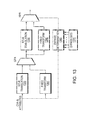
- FIG. 13 is a block diagram illustrating a selective bypass of address translation in a further embodiment.
- FIG. 14 is a flow diagram illustrating a process of selectively bypassing address translations.
- a computer system that supports virtualization may maintain multiple address spaces.
- Each guest operating system employs guest virtual addresses (GVAs), which are translated to guest physical addresses (GPAs).
- GVAs guest virtual addresses
- the GPA space refers to a partition of the physical memory allocated to the specified guest machine.
- the GVA space (rather than the GPA space) is presented to each guest machine in order to allow greater flexibility in memory allocation.
- the GVA space of a given guest machine may be larger than the physical memory partition allocated to it, and data may be stored to a hard disk when the memory partition is at capacity.
- a software system that manages one or more guest operating systems such as a hypervisor, translates GPAs to corresponding root physical addresses (RPAs).
- the RPAs also referred to as physical system addresses or machine addresses, indicate the location of the physical memory of the host computer.
- a GVA is first translated to a GPA
- the GPA is then translated to a RPA.
- addressing domains e.g. virtual address to physical address
- a translation lookaside buffer (TLB) is employed to cache such translations. Once a given translation is cached, the TLB is then accessed during future memory accesses requiring the given translation, thereby preventing the need for a further page table walk.
- a TLB may cache translations from a GVA to a RPA.
- two physical TLBs may be employed: a first TLB storing GVA-to-GPA translations, and a second TLB storing GPA-to-RPA translations.
- FIG. 1 is a block diagram of a computer system 100 implementing a merged translation lookaside buffer (MTLB) in one embodiment.
- the system 100 shown may be a portion of host machine supporting a number of guest machines through virtualization.
- a plurality of guests (i.e., guest machines) 104 a - n operate via respective guest operating platforms (not shown), which are virtual hardware platforms managed by the hypervisor 105 .
- the guests 104 a - n access the physical system memory 150 indirectly through a guest virtual address (GVA) space provided by the guest operating platforms. However, the system memory 150 is addressed through a root physical address (RPA) space.
- GVA guest virtual address
- RPA root physical address
- a GVA may be first mapped to a guest physical address (GPA), which is in turn mapped to a RPA at a partition of the system memory 150 allocated for the given guest 104 a - n .
- GPA guest physical address
- a GVA may be translated to a GPA, which is then translated to a RPA indicating an entry of the system memory 150 .
- a memory controller 108 which may include hardware and a software portion of the guest operating platform, interfaces with the guests 104 a - n to access the system memory 150 .
- the memory controller first accesses the merged translation lookaside buffer (MTLB) 110 .
- the MTLB 110 may include a single physical cache, buffer, segment register, system register, or other storage unit that is logically addressable as two distinct TLBs: a guest TLB (GTLB) 120 (a “virtual tag section”) and a root TLB (RTLB) 130 (a “physical tag section”).
- GTLB 120 stores GVA-to-GPA translations
- the RTLB 130 stores GPA-to-RPA translations.
- the MTLB 110 may therefore appear to other components as two distinct logical TLBs while sharing a single physical structure.
- the memory controller 108 may receive a GVA from a guest 104 a - n , which it then matches against entries in the GTLB 120 to determine a corresponding GPA. If a match is found, then the memory controller matches the located GPA against entries in the RTLB 130 to determine a corresponding RPA. With the matching RPA, the memory controller accesses the indicated entry of the system memory 150 for a read or write operation by the guest 104 a - n.
- Entries in the GTLB 120 may initially be added by the guests 104 a - n , which accesses the page tables 140 stored at the system memory 150 .
- the page tables 140 store relations between the GVA, GPA and RPA spaces, and may be “walked” to determine address translations between those address spaces.
- the guests 104 a - n may walk the page tables 140 to determine a GVA-to-GPA translation, and then access the GTLB 120 via a GTLB index to store the translation at the GTLB 120 .
- entries in the RTLB 130 may initially be added by the hypervisor 105 , which accesses the page tables 140 stored at the system memory 150 .
- FIG. 2 is a block diagram of a cache 206 of a MTLB 110 .
- the cache 206 may be a single physical structure (e.g., memory or other storage device) that is divided logically into two or more segments.
- the cache 206 is divided into two logical portions to accommodate the GTLB 120 and the RTLB 130 .
- a TLB partition 212 defines the division between the GTLB 120 and RTLB 130 .
- the cache 206 may be divided into additional segments to accommodate additional buffers, such as a TLB storing translations between additional address spaces.
- additional TLB partitions may be implemented to divide the cache 206 into the additional segments.
- a programmable register (not shown), stored at the MTLB 110 or external to the MTLB 110 , defines the position of the TLB partition 212 dividing the GTLB 120 and RTLB 130 . Accordingly, all entries with physical indices lower than the partition 212 comprise the RTLB 130 , and all entries with physical indices equal to or greater than the partition comprise the GTLB 120 .
- the flexible partitioning between the GTLB 120 and RTLB 130 allows a system (e.g., system 100 ) to optimize the size of these structures, given the fixed number of total translation entries.
- the size of the TLBs 120 , 130 can be changed at run-time.
- the partition 212 can be set such that the Root TLB takes up the entire MTLB cache 206 .
- a value may be reserved to represent 0 entries in the GTLB 120 .
- Software such as the hypervisor 105 and guests 104 a - n ( FIG. 1 ), may view the TLBs 120 , 130 as two logically distinct TLBs, with entries of each being indexed from 0 to the “G-Config ⁇ 1” and “R-Config ⁇ 1,” respectively, which correspond to the size of each logical TLB 120 , 130 .
- the RTLB 130 appears to the software as having entries from 0 up to R-Config ⁇ 1, which is RTLB Size ⁇ 1.
- the sequence of entries in the cache 206 may be inverted between the GTLB 120 and RTLB 130 , meaning that the GTLB 120 is ordered top-down and the RTLB 130 is ordered bottom-up.
- Such a configuration allows for easier resizing of the TLBs 120 , 130 by repositioning the TLB partition 212 , as only the terminal entries of each TLB 120 , 130 may be changed or invalidated.
- the RTLB 130 may have a size between 1 entry and the total number of entries in the MTLB cache 206 .
- the GTLB 120 may have a size between 1 and one less than the number of entries in the MTLB cache 206 , as the RTLB 130 may be required to have at least one entry.
- FIG. 3 is a block diagram of a MTLB 110 in further detail.
- the MTLB 110 may be configured as described above with reference to FIGS. 1 and 2 .
- the MTLB 110 interfaces with the memory controller 108 to provide match results of an address request (e.g., a GVA-to-GPA or GPA-to-RPA translation), and further interfaces with the guests 104 a - n and hypervisor 105 to add and revise entries in the GTLB 120 and RTLB 130 .
- the guests 104 a - n or hardware on behalf of the guests may walk page tables (e.g., page tables 140 , FIG.
- the MTLB 110 may also include a decoder 334 , which allows software (e.g., guests 104 a - n or hypervisor 105 ) to access the entries of the MTLB 110 with an index. Each entry in the MTLB 110 may be assigned such an index, and software may use the decoder 334 to read or write a particular entry.
- the decode logic may employ a physical index to identify a particular MTLB entry. Guests 104 a - n may be limited to generate guest logical indices for writing to the GTLB 120 .
- a logical index to the GTLB 120 and RTLB 130 may be configured as follows.
- the total MTLB size may a power of 2
- the root logical index may equal the physical index (i.e., the index of the physical cache) for all root logical indices less than the RTLB 130 size.
- the guest logical index may be transformed to the physical index for all guest logical indices less than the GTLB 120 size.
- a software-based read-only registers may indicate the size of the GTLB 120 and RTLB 130 , and is updated automatically after the partition between the GTLB 120 and RTLB 130 is configured.
- the MTLB 110 may be a fully associative structure. If the MTLB 110 is configured as one physical TLB with associative match logic, a search in the MTLB 110 could result in matches to either a GTLB 120 entry or a RTLB 130 entry. In order for the associative logic to distinguish between GTLB 120 and RTLB 130 entries, each entry may be tagged with a bit, referred to as a Gt bit. If the Gt bit is 1, then an entry belongs to the GTLB 120 ; if the Gt bit is zero, an entry belongs to the RTLB 130 . Thus, all RTLB 130 entries may have the Gt bit at zero, while all GTLB 120 entries may have the Gt bit at one.
- the search value (key) sent to the MTLB 110 has Gt set to zero.
- the search value sent to the MTLB 110 has Gt set to one.
- Random replacement may be utilized, as part of an algorithm handling a MTLB lookup “miss,” by using a “random register.”
- the random register may select a random entry within a portion of the selected GTLB 120 or RTLB 130 .
- random replacement may be restricted to the segment between the “wired” entries (i.e., “G-Wired,” “R-Wired”) and the terminal entry of the respective TLB.
- a conflict is found, the write is prohibited, and a machine check exception is generated.
- root software such as a hypervisor 105 ( FIG. 1 ) may program a register that defines the location of the partition 212 at run time, rather than during system configuration. Reprogramming of this register (e.g., during run-time) may automatically update the values in the architecturally-visible guest and root registers that identify the size of the GTLB 120 and RTLB 130 . In other implementations, such updates could be performed directly by root software.
- RTLB 130 grows in size and the GTLB 120 shrinks in size, some entries that used to belong to the GTLB 120 now belong to the RTLB 130 .
- Software may use TLB write index instruction to write these new entries with root mapping, or the entries can be written invalid.
- the Gt bit in each of these entries can be reset so they are properly marked as root entries. Failure to change the Gt bit could result in unpredictable behavior. Conversely, when the RTLB 130 shrinks in size and the GTLB 120 increases in size, some entries that previously belonged to the RTLB 130 now belong to GTLB 120 . Root software may use the TLB guest write index instruction to write these entries with non-conflicting guest mapping, or the TLB entry can be written to invalid. When the TLB guest write index instruction is performed, Gt bit for such entries may be set such that the entries are now properly marked as guest entries. In an alternative embodiment, hardware might be used instead of software to properly configure the Gt bit when the entries are moved between the GTLB and RTLB.
- the hypervisor 105 may be further configured to provide for bulk invalidation of entries in the GTLB 120 .
- the hypervisor 105 can quickly invalidate all GTLB 120 entries.
- a circuit or other hardware may be configured to invalidate all entries with the Gt bit set to 1.
- a guest context can be erased quickly from the MTLB 110 without affecting the root TLB entries, such as during a switch between guests.
- the current guest context is identified by a register that contains an address space identifier (also referred to as a virtual machine ID or VMID).
- the hypervisor 105 may change this value when switching the current guest context, and hardware (as described above) may automatically invalidate the guest context using the Gt bit, when software changes this value.
- FIG. 4 is a flow diagram illustrating a process 400 of accessing a system memory using a MTLB in one embodiment.
- the process 400 includes scenarios both of a successful MTLB lookup, as well as an update to the MTLB upon a lookup “miss.”
- a guest 104 a sends a memory access request (e.g., read or write to system memory) to the memory controller, with a GVA ( 405 ).
- the memory controller 108 receives the request and the GVA ( 406 ), and accesses the MTLB 110 to lookup a translation match to the GVA ( 410 ).
- the memory controller further matches the GPA to locate a corresponding RPA, and the RPA is returned ( 415 ).
- Memory controller 108 then uses the RPA to access the corresponding entry of the system memory ( 416 ), enabling the guest 104 a to perform the read or write operation to the system memory 150 .
- the MTLB 110 is updated ( 420 ).
- one or both of the guest 104 a and hypervisor 105 (or hardware on behalf of the guest 104 a or the hypervisor 105 ) access the page tables 140 of the system memory 150 .
- the guest 104 a and/or hypervisor 105 walk the page tables 140 to determine the needed GVA-to-GPA and/or GPA-to-RPA translation ( 425 ).
- the guest 104 a and/or hypervisor 105 may then write the translation(s) to the MTLB 110 ( 430 ) (e.g., as described above with reference to FIG. 3 ).
- the memory controller 108 may again perform a GVA match against the MTLB 110 and provide a memory access ( 416 ) upon returning a corresponding RPA ( 415 ).
- FIG. 5 is a block diagram of an example entry 500 in a MTLB, such as an MTLB described above with reference to FIGS. 1-4 .
- the entry may have a virtual portion 501 and a physical portion 502 , where the virtual portion 501 contains the address to be matched ( 506 ) as well as other information and the physical portion contains the resulting translated address ( 510 ) as well as other information.
- the Gt bit described above, may be an additional entry that is not visible to guest or root software.
- the virtual portion may include the following entries:
- VPN ( 506 ): Virtual page number, indicating a GVA or GPA address.
- the physical portion may include the following entries:
- RI ( 512 ): Read inhibit.
- the Read inhibit bit may be used to prevent a particular page from being read.
- Coherency attributes may be stored in the C field. These attributes can be used to determine the nature of the memory space (e.g. cacheable, uncached, coherent, non-coherent, I/O-space, etc).
- FIG. 6 is a block diagram of a computer system 600 implementing a MTLB 610 and a micro-translation lookaside buffer ( ⁇ TLB) 615 .
- the system 600 may be configured similarly to the system 100 described above with reference to FIGS. 1-5 , with the addition of the ⁇ TLB 615 .
- the addition of the ⁇ TLB 615 may provide for faster address translation by caching collapsed translations between the GVA space and the RPA space.
- the system 600 shown may be a portion of host machine supporting a number of guest machines through virtualization.
- a plurality of guests (i.e., guest machines) 604 a - n operate via respective guest operating platforms (not shown), which are virtual hardware platforms managed by the hypervisor 605 .
- the guests 604 a - n access the physical system memory 650 indirectly through a GVA space provided by the guest operating platforms.
- a GVA may be first mapped to a GPA, which is in turn mapped to a RPA at a partition of the system memory 650 allocated for the given guest 604 a - n .
- a GVA may be translated to a GPA, which is then translated to a RPA indicating an entry of the system memory 650 .
- the MTLB 610 may be configured as described above with reference to the MTLB 110 of FIGS. 1-5 .
- the MTLB 610 may include a single physical cache that is logically addressable as two distinct TLBs: a guest TLB (GTLB) 620 and a root TLB (RTLB) 630 .
- the GTLB 620 stores GVA-to-GPA translations
- the RTLB 630 stores GPA-to-RPA translations.
- the MTLB 610 may therefore appear to other components as two distinct logical TLBs while sharing a single physical structure. Entries in the GTLB 620 may initially be added by the guests 604 a - n , which accesses the page tables 640 stored at the system memory 650 .
- the page tables 640 store relations between the GVA, GPA and RPA spaces, and may be “walked” to determine address translations between those address spaces.
- the guests 604 a - n (or hardware on behalf of the guest) may walk the page tables 640 to determine a GVA-to-GPA translation, and then access the GTLB 620 via a GTLB index to store the translation at the GTLB 620 .
- entries in the RTLB 630 may initially be added by the hypervisor 605 (or hardware on behalf of the hypervisor), which accesses the page tables 640 stored at the system memory 650 .
- the hypervisor may walk the page tables 640 to determine a GPA-to-RPA translation, and then access the RTLB 630 via a RTLB index to store the translation at the RTLB 630 . Entries into the GTLB 620 and RTLB 630 may be added, as described above, in response to a reported “miss” by the memory controller 608 in a translation lookup at the GTLB 620 or RTLB 630 .
- the memory controller 608 accesses the indicated entry of the system memory 650 for a read or write operation by the guest 604 a - n . If a match is not found, then the memory controller 608 may access the MTLB to determine corresponding GVA-to-GPA and GPA-to-RPA translations. The memory controller may further collapse the two translations to a single GVA-to-RPA translation, and may populate the ⁇ TLB 615 with the collapsed translation.
- FIG. 7 is a block diagram of an example entry 700 in a ⁇ TLB, such as a ⁇ TLB 615 described above with reference to FIG. 6 .
- the entry 700 may include the following segments:
- VMID virtual machine ID
- VP Virtual page number (for a GVA, GPA, or RVA).
- Root page number This field is either copied from the Root TLB EntryLo0 or EntryLo1 or may be a concatenation of GPN (from the guest TLB) and the RP (from the root TLB).
- GRI ( 714 ): Guest read inhibit.
- RI Read Inhibit.
- GD ( 716 ): Guest Dirty bit.
- C ( 718 ) Coherency bits.
- the memory controller 608 accesses the ⁇ TLB 615 and searches for a match on the “VP” field. If a match is found, the corresponding RP contains the page number portion of the root physical address. Mask bits are used to determine which bits of the VP field are matched, and which bits of the RP are used to form the root physical address.
- hardware accesses the MTLB 610 and, depending on the type of address to be translated, performs either one (GPA-to-RPA) or two (GVA-to-GPA, GPA-to-RPA) lookups.
- each ⁇ TLB entry 700 may represent the result of up to two translations steps. Some information from each of these steps must be preserved by the ⁇ TLB.
- the mask bits 707 are determined by the smaller of the guest page size and the root page size (i.e. the guest virtual to guest physical page size or the guest physical to root physical page size).
- the G bit 708 represents the “Global” bit. Global addresses are ones where the ASID is ignored. If this is a mapping from a GVA to a RPA, the G bit is copied from the guest TLB (i.e., guest translation). If the mapping is for a GPA or RVA to a RPA, the G bit is copied from the Root TLB (i.e., root translation).
- the ASID field 709 represents the address space identifier for a virtual address.
- the ASID 709 is used to distinguish between virtual addresses belonging to different contexts. If this is a mapping from guest virtual address to root physical address, the ASID field 709 is copied from the guest TLB (i.e., guest translation). If the mapping is for a GPA to a RPA, the ASID field is copied from the root TLB (i.e., root translation).
- the Virtual page number (VP) field 710 may be formed from the virtual address being translated, and the Root page number (RP) field 713 may be formed dependent on the relative page sizes of the guest and root translations (described in further detail below, with reference to FIGS. 9A-C ).
- Read Inhibit (RI) 715 may be used to prevent a particular page from being read. Because read permission depends on both the guest and root translation's value for this bit, both the guest and root read inhibit attributes are captured in the ⁇ TLB 615 .
- the GRI Guest Read Inhibit
- the GRI may be copied from the guest TLB. If the translation is not a guest virtual address translation, then the GM bit may be disregarded, and the RI bit 715 is copied from the root TLB entry.
- the D (dirty) bit 717 indicates whether a page has previously been written to. Because the bit 717 depends on both the corresponding guest and root translations' value for this bit, both the guest and root D bit attributes are captured in the ⁇ TLB 615 .
- the C bits 718 may relate to the coherency policy for a particular page. If mapping from GVA to RPA, the CCA field 718 may be copied from the corresponding entry of the guest TLB. If the mapping is for a GPA to RPA translation, then the C field 718 may be copied from the corresponding entry of the root TLB.
- Table 1 presents the possible values of a ⁇ TLB entry, and indicates valid combinations of values, as well as combinations of values that can generate an “exception” during a ⁇ TLB lookup.
- an exception condition may occur in the guest (e.g., an instruction fetch, a load or store violation).
- the instruction may be re-executed.
- the guest permission check may pass, but a root TLB protection violation may exist.
- the exception would then be signaled to the root context.
- a ⁇ TLB exception may be considered a “miss,” and is handled as described below with reference to FIG. 8 .
- FIG. 8 is a flow diagram illustrating a process 800 of accessing a system memory using a ⁇ TLB in one embodiment.
- the process 800 includes scenarios both of a successful ⁇ TLB lookup, as well as an update to the ⁇ TLB upon a lookup “miss.”
- a guest 604 a sends a memory access request (e.g., read or write to system memory) to the memory controller 608 , with a GVA ( 805 ).
- the memory controller 608 receives the request and the GVA ( 806 ), and accesses the ⁇ TLB 615 to lookup a translation match to the GVA ( 810 ). If a match is found to a corresponding RPA, then the RPA is returned ( 815 ).
- the memory controller 608 uses the RPA to access the corresponding entry of the system memory ( 816 ), enabling the guest 604 a to perform the read or write operation to the system memory 650 .
- the ⁇ TLB 615 is updated ( 820 ).
- the memory controller 608 may operate as a ⁇ TLB “miss controller.”
- a ⁇ TLB miss controller may be configured separately from the memory controller 608 ).
- the memory controller 608 may access the MTLB 610 to retrieve corresponding GVA-to-GPA and GPA-to-RPA translations ( 825 ).
- the memory controller 608 may access only a GPA-to-RPA translation if the given ⁇ TLB entry is a GPA-to-RPA translation.) With the corresponding translations from the MTLB 610 , the memory controller generates a valid GVA-to-RPA translation, and writes the translation to the ⁇ TLB 615 ( 830 ). Once the ⁇ TLB 615 is updated, the memory controller 608 may again perform a GVA match against the ⁇ TLB 615 and provide a memory access ( 816 ) upon returning a corresponding RPA ( 815 ).
- the memory controller 608 may import from fields of entries in both the GTLB and RTLB of the MTLB 610 .
- the fields of a ⁇ TLB entry may be filled as follows:
- V 1 (hardware valid bit).
- Gt 1 (this is a guest mapping).
- GRI copied from Guest.TLB.
- RI copied from the Root.TLB.
- GD copied from the Guest.TLB.
- GXI copied from the Guest.TLB.
- ENTg[ 7 : 0 ] set to the index of the Guest.TLB entry.
- FIG. 9A illustrates a collapsed translation when root and guest entries used in the translation have the same page size.
- the generation of the VP and RP may be relatively straightforward.
- the mask is set to the appropriate page size, the VP is copied from the VPN field ( 506 ) of the GTLB, and the RP is copied from the PFN field ( 510 ) of the root TLB.
- FIG. 9B illustrates a collapsed translation when the root entry has a smaller page size than the guest entry (i.e., the GVA-to-GPA translation specifies a larger page size than that of the GPA-to-RPA translation).
- the VP may be to be generated from a combination of the GVA and the VPN field ( 506 ) of the GTLB.
- the VP is set to the GVA with the page mask of the root TLB.
- the RP may be copied from the PFN field ( 510 ) of the root TLB.
- FIG. 9C illustrates a collapsed translation when the guest entry has a smaller page size than the root entry (i.e., the GVA-to-GPA translation specifies a smaller page size than that of the GPA-to-RPA translation).
- the VP may be taken from the guest TLB's VPN field ( 506 ).
- the RP may be a concatenation of the PFN field ( 510 ) of the GTLB and the PFN field ( 510 ) of the RTLB.
- upper PA bits down to the Root page size are taken from the Root TLB's physical tag).
- the lower bits down to the Guest page size may be taken from the Guest TLB's physical tag (GPA).
- the ⁇ TLB may cache translations between any number of address domains.
- some virtualization systems may implement an additional address domain between the GVA, GPA and RPA domains, such as “secure RPA” (SPA), which may be implemented between the GPA and RPA domains.
- SPA secure RPA
- a MTLB may include three or more logical portions to store translations.
- the MTLB may include a first logical portion storing GVA-to-GPA translations, a second logical portion storing GPA-to-SPA translations, and a third logical portion storing SPA-to-RPA translations.
- the ⁇ TLB may be configured to cache translations between the GVA domain and the RPA domain, thereby collapsing translations between four address domains.
- translations may be held in any level of a multi-level translation storage hierarchy.
- Each storage level can hold direct translations (i.e., translations between two successive address domains) or collapsed translations (i.e., translations between two address domains separated by one or more intermediate address domains).
- a system may be configured for four logical domains and three storage levels. The third storage level three may hold collapsed translations from a first to a final address domain. A second level may hold direct translations from first to second logical domain and collapsed translations from second to final logical domain. Lastly, a first level may hold direct translations from first to second, second to third, and third to fourth logical domains.
- FIG. 10 is a block diagram illustrating a portion of a computer system 1000 implementing a plurality of TLBs and virtual data cache in a further embodiment.
- the system 1000 may be configured as described above with reference the computer systems 100 and 600 of FIGS. 1 and 6 , respectively.
- the memory controller 1008 , MTLB 1010 and ⁇ TLB 1015 may be configured similarly to those components described above.
- the system 1000 further includes a virtual data cache 1035 , which may be a distinct hardware cache addressable separately from the MTLB 1010 and ⁇ TLB 1015 .
- the data cache 1035 may be used to store the values represented in the system memory (such as system memories 150 , 650 ). Data are located in the data cache 1035 by means of a tag.
- any TLB entries that contained information from the previous mapping between a virtual address and a root physical address may be replaced or invalided in the TLB. This replacement may be done in either hardware or software means.
- the guest TLB may be updated.
- Both the ⁇ TLB and data cache may have used information from the previous guest TLB mapping to cache either an address translation or data value, respectively.
- any ⁇ TLB entry or data cache entry associated with the prior mapping may be invalidated. In one embodiment, this invalidation may be done by hardware, such as a memory controller.
- the ENTg and ENTr values uniquely identify the TLB entries used to form a ⁇ TLB entry or a data cache tag, and therefore may be searched when identifying matching entries.
- the memory controller 1008 or other hardware may further monitor the MTLB 1010 for changes to entries therein, such as the replacement of an entry with another entry, a deletion of an entry, or an invalidation of an entry ( 1230 ). If such a change is detected, then the memory controller 1008 may search each of the ⁇ TLB 1015 and data cache 1035 to locate entries and tags corresponding to the changed entry ( 1235 ). Upon locating such entries and tags, they may be invalidated by modifying their respective “valid” bit ( 1240 ). Example embodiments of maintaining entries across the MTLB 1010 , ⁇ TLB 1015 and data cache 1035 is described in further detail below.
- any ⁇ TLB 1015 or data cache 1035 entries that contain information derived from that entry may be required to be invalidated.
- the ENTr field may be used for such invalidation.
- a unique identifier associated with the RTLB entry may be used to find all the ⁇ TLB and data cache entries that contain information from that RTLB entry.
- the unique identifier is the physical index of a Root TLB entry.
- a search of the ⁇ TLB and data cache entries may then be performed. All entries that match on their ENTr field with the physical index of the Root TLB entry being replaced are invalidated by hardware. This search may be done sequentially or associatively or some combination of the two.
- the value of the Gt bit may be considered irrelevant because both Guest entries and Root entries may rely on a root mapping.
- removing a root TLB entry may require some other form of data cache and ⁇ TLB invalidation.
- the entire data cache and ⁇ TLB may be invalidated.
- the virtual tag may be matched for invalidation.
- invalidating guest entries with GVA tags can present further challenges. Specifically, in some embodiments, there is no reverse mapping between the GPA of a root TLB entry and the possibly multiple GVAs that map to it. Thus, in such an embodiment, a further component may be required to deduce the GVAs that map to the GPA that matches the root TLB entry being replaced.
- an unmapped address can occur as a GVA presented to the GTLB or as a GPA presented to the RTLB.
- a consequence of the multi-stage translation is that a GVA that is normally unmapped may result in a GPA that is mapped by the RTLB. Additionally, a GVA that has some particular attribute associated with it will be translated to a GPA.
- a guest operating system may specify that an address should be unmapped by the guest TLB but may have no control over the root TLB. Thus, an unmapped GVA may become a mapped GPA. Generally, this would be the appropriate because the RTLB is controlled by a hypervisor, which has final control over the RPA associated with a GPA. However, for some types of transactions, if the GVA is unmapped or has some particular attribute, it may be beneficial to bypass subsequent address translations and allow the RPA to be equal to the GPA.
- example embodiments may provide for selectively bypassing at least a portion of an address translation based on an indication in a received address.
- FIG. 13 illustrates a bypass control in one example, which may be implemented by a memory controller (e.g., memory controller 108 of FIG. 1 ) or by other hardware and/or software.
- a GTLB translation 1320 may provide a translated GPA corresponding to a GVA input, operating comparably to a GTLB lookup described above.
- a RTLB translation 1330 may provide a translated RPA corresponding to a GPA input, operating comparably to a RTLB lookup described above.
- FIG. 14 is a flow diagram illustrating a process 1400 of selectively bypassing address translations.
- Upon receiving a GVA it is determined whether the GVA is mapped to a GPA, or specifies an unmapped address space ( 1410 ).
- a memory controller (or other hardware or software) translates or transforms the GVA to a GPA ( 1430 ) dependent on this determination. If the GVA is unmapped, then a bypass bit (e.g., bypass bit 1370 of FIG. 13 ) is referenced to determine whether a bypass is enabled ( 1415 ). Which bypass bit to use may be determined by the segment of the address space to which the GVA belongs.
- an RPA may be produced being equal to the GPA (with or without transforming the GPA with an address mask) ( 1440 ). If the GVA is not unmapped, or the bypass is not enabled, then the GPA is instead translated to a RPA by accessing a RTLB ( 1435 ).
- a guest operating system may determine to bypass translation to access physical memory directly. However, a hypervisor may prohibit such direct access, and therefore continue to cause the GPA (resulting from a GTLB bypass) to be translated to a RPA.
Landscapes
- Engineering & Computer Science (AREA)
- Theoretical Computer Science (AREA)
- Physics & Mathematics (AREA)
- General Engineering & Computer Science (AREA)
- General Physics & Mathematics (AREA)
- Software Systems (AREA)
- Memory System Of A Hierarchy Structure (AREA)
Abstract
Description
| TABLE 1 |
| Comparison of valid and invalid values of a μTLB entry. |
| Operation | Mode | Gt | GRI | RI | GD | D | GXI | XI | | |
| Load | Guest | |||||||||
| 1 | 0 | 0 | x | x | x | x | OK | |||
| 1 | 1 | x | x | x | x | | Guest Exception | |||
| 1 | 0 | 1 | x | x | x | x | Root Exception | |||
| Root | 0 | x | 0 | x | x | x | x | OK | ||
| 0 | x | 1 | x | x | x | x | Root Exception | |||
| Store | Guest | 1 | x | x | 0 | x | x | x | Guest Exception | |
| 1 | x | x | 1 | 0 | x | x | Root Exception | |||
| 1 | x | x | 1 | 1 | x | x | OK | |||
| Root | 0 | x | x | x | 0 | x | x | Root Exception | ||
| 0 | x | x | x | 1 | x | x | OK | |||
| Instruction | Guest | x | x | x | x | x | 0 | 0 | OK | |
| x | x | x | x | x | 1 | x | Guest Exception | |||
| x | x | x | x | x | 0 | 1 | Root Exception | |||
| Root | x | x | x | x | x | x | 0 | OK | ||
| x | x | x | x | x | x | 1 | Root Exception | |||
Claims (17)
Priority Applications (1)
| Application Number | Priority Date | Filing Date | Title |
|---|---|---|---|
| US15/475,718 US10042778B2 (en) | 2013-09-26 | 2017-03-31 | Collapsed address translation with multiple page sizes |
Applications Claiming Priority (2)
| Application Number | Priority Date | Filing Date | Title |
|---|---|---|---|
| US14/038,189 US9645941B2 (en) | 2013-09-26 | 2013-09-26 | Collapsed address translation with multiple page sizes |
| US15/475,718 US10042778B2 (en) | 2013-09-26 | 2017-03-31 | Collapsed address translation with multiple page sizes |
Related Parent Applications (1)
| Application Number | Title | Priority Date | Filing Date |
|---|---|---|---|
| US14/038,189 Continuation US9645941B2 (en) | 2013-09-26 | 2013-09-26 | Collapsed address translation with multiple page sizes |
Publications (2)
| Publication Number | Publication Date |
|---|---|
| US20170206171A1 US20170206171A1 (en) | 2017-07-20 |
| US10042778B2 true US10042778B2 (en) | 2018-08-07 |
Family
ID=52623696
Family Applications (2)
| Application Number | Title | Priority Date | Filing Date |
|---|---|---|---|
| US14/038,189 Active 2034-07-12 US9645941B2 (en) | 2013-09-26 | 2013-09-26 | Collapsed address translation with multiple page sizes |
| US15/475,718 Active US10042778B2 (en) | 2013-09-26 | 2017-03-31 | Collapsed address translation with multiple page sizes |
Family Applications Before (1)
| Application Number | Title | Priority Date | Filing Date |
|---|---|---|---|
| US14/038,189 Active 2034-07-12 US9645941B2 (en) | 2013-09-26 | 2013-09-26 | Collapsed address translation with multiple page sizes |
Country Status (2)
| Country | Link |
|---|---|
| US (2) | US9645941B2 (en) |
| DE (1) | DE102014014076A1 (en) |
Families Citing this family (35)
| Publication number | Priority date | Publication date | Assignee | Title |
|---|---|---|---|---|
| US9639476B2 (en) | 2013-09-26 | 2017-05-02 | Cavium, Inc. | Merged TLB structure for multiple sequential address translations |
| US9645941B2 (en) | 2013-09-26 | 2017-05-09 | Cavium, Inc. | Collapsed address translation with multiple page sizes |
| US9208103B2 (en) | 2013-09-26 | 2015-12-08 | Cavium, Inc. | Translation bypass in multi-stage address translation |
| US9268694B2 (en) | 2013-09-26 | 2016-02-23 | Cavium, Inc. | Maintenance of cache and tags in a translation lookaside buffer |
| US9684606B2 (en) * | 2014-11-14 | 2017-06-20 | Cavium, Inc. | Translation lookaside buffer invalidation suppression |
| US9697137B2 (en) * | 2014-11-14 | 2017-07-04 | Cavium, Inc. | Filtering translation lookaside buffer invalidations |
| US10671419B2 (en) * | 2016-02-29 | 2020-06-02 | Red Hat Israel, Ltd. | Multiple input-output memory management units with fine grained device scopes for virtual machines |
| US10223279B2 (en) * | 2016-06-27 | 2019-03-05 | Cavium, Llc | Managing virtual-address caches for multiple memory page sizes |
| US10402355B2 (en) * | 2017-02-08 | 2019-09-03 | Texas Instruments Incorporated | Apparatus and mechanism to bypass PCIe address translation by using alternative routing |
| US10613989B2 (en) | 2017-07-14 | 2020-04-07 | Arm Limited | Fast address translation for virtual machines |
| US10592424B2 (en) | 2017-07-14 | 2020-03-17 | Arm Limited | Range-based memory system |
| US10489304B2 (en) | 2017-07-14 | 2019-11-26 | Arm Limited | Memory address translation |
| US10467159B2 (en) * | 2017-07-14 | 2019-11-05 | Arm Limited | Memory node controller |
| US10534719B2 (en) * | 2017-07-14 | 2020-01-14 | Arm Limited | Memory system for a data processing network |
| US10353826B2 (en) | 2017-07-14 | 2019-07-16 | Arm Limited | Method and apparatus for fast context cloning in a data processing system |
| US10565126B2 (en) | 2017-07-14 | 2020-02-18 | Arm Limited | Method and apparatus for two-layer copy-on-write |
| US10761751B2 (en) | 2017-11-14 | 2020-09-01 | International Business Machines Corporation | Configuration state registers grouped based on functional affinity |
| US10642757B2 (en) | 2017-11-14 | 2020-05-05 | International Business Machines Corporation | Single call to perform pin and unpin operations |
| US10496437B2 (en) | 2017-11-14 | 2019-12-03 | International Business Machines Corporation | Context switch by changing memory pointers |
| US10635602B2 (en) | 2017-11-14 | 2020-04-28 | International Business Machines Corporation | Address translation prior to receiving a storage reference using the address to be translated |
| US10698686B2 (en) | 2017-11-14 | 2020-06-30 | International Business Machines Corporation | Configurable architectural placement control |
| US10664181B2 (en) | 2017-11-14 | 2020-05-26 | International Business Machines Corporation | Protecting in-memory configuration state registers |
| US10558366B2 (en) | 2017-11-14 | 2020-02-11 | International Business Machines Corporation | Automatic pinning of units of memory |
| US10761983B2 (en) | 2017-11-14 | 2020-09-01 | International Business Machines Corporation | Memory based configuration state registers |
| US10901738B2 (en) | 2017-11-14 | 2021-01-26 | International Business Machines Corporation | Bulk store and load operations of configuration state registers |
| US10592164B2 (en) | 2017-11-14 | 2020-03-17 | International Business Machines Corporation | Portions of configuration state registers in-memory |
| US10552070B2 (en) | 2017-11-14 | 2020-02-04 | International Business Machines Corporation | Separation of memory-based configuration state registers based on groups |
| US12117940B2 (en) * | 2017-12-05 | 2024-10-15 | Red Hat, Inc. | Host address space identifier for non-uniform memory access locality in virtual machines |
| US10884850B2 (en) | 2018-07-24 | 2021-01-05 | Arm Limited | Fault tolerant memory system |
| US10846239B2 (en) * | 2018-11-29 | 2020-11-24 | Marvell Asia Pte, Ltd. | Managing translation lookaside buffer entries based on associativity and page size |
| US11074195B2 (en) | 2019-06-28 | 2021-07-27 | International Business Machines Corporation | Access to dynamic address translation across multiple spaces for operational context subspaces |
| US10970224B2 (en) * | 2019-06-28 | 2021-04-06 | International Business Machines Corporation | Operational context subspaces |
| US10891238B1 (en) | 2019-06-28 | 2021-01-12 | International Business Machines Corporation | Dynamically joining and splitting dynamic address translation (DAT) tables based on operational context |
| US12032488B1 (en) | 2022-09-14 | 2024-07-09 | Marvell Asia Pte Ltd | Circuit and method for translation lookaside buffer (TLB) implementation |
| US12455831B2 (en) | 2022-09-21 | 2025-10-28 | Advanced Micro Devices, Inc. | Address translation service management |
Citations (25)
| Publication number | Priority date | Publication date | Assignee | Title |
|---|---|---|---|---|
| US5940872A (en) * | 1996-11-01 | 1999-08-17 | Intel Corporation | Software and hardware-managed translation lookaside buffer |
| US20030065890A1 (en) | 1999-12-17 | 2003-04-03 | Lyon Terry L. | Method and apparatus for updating and invalidating store data |
| CN1567362A (en) | 2003-06-10 | 2005-01-19 | 大唐微电子技术有限公司 | IC smart card with dynamic logic sectorization and access right control function and implementing method thereof |
| US20060271760A1 (en) | 2005-05-31 | 2006-11-30 | Stmicroelectronics Sa | Translation look-aside buffer |
| US7206903B1 (en) * | 2004-07-20 | 2007-04-17 | Sun Microsystems, Inc. | Method and apparatus for releasing memory locations during transactional execution |
| CN101031893A (en) | 2004-09-30 | 2007-09-05 | 英特尔公司 | Address translation for input/output devices using hierarchical translation tables |
| US20080155168A1 (en) | 2006-12-22 | 2008-06-26 | Microsoft Corporation | Scalability of virtual TLBs for multi-processor virtual machines |
| US20080276066A1 (en) | 2007-05-01 | 2008-11-06 | Giquila Corporation | Virtual memory translation with pre-fetch prediction |
| US20090119477A1 (en) * | 2007-11-07 | 2009-05-07 | Qualcomm Incorporated | Configurable Translation Lookaside Buffer |
| US20090228667A1 (en) | 2008-03-10 | 2009-09-10 | International Business Machines Corporation | Performing a Least Recently Used (LRU) Algorithm for a Co-Processor |
| US20090327647A1 (en) | 2008-06-26 | 2009-12-31 | Qualcomm Incorporated | Memory Management Unit Directed Access to System Interfaces |
| US20100058358A1 (en) * | 2008-08-27 | 2010-03-04 | International Business Machines Corporation | Method and apparatus for managing software controlled cache of translating the physical memory access of a virtual machine between different levels of translation entities |
| CN102306126A (en) | 2011-08-24 | 2012-01-04 | 华为技术有限公司 | Memory management method, device and system |
| US20120297161A1 (en) * | 2007-12-28 | 2012-11-22 | David Champagne | Providing Metadata In A Translation Lookaside Buffer (TLB) |
| US8356158B2 (en) | 2003-07-15 | 2013-01-15 | Broadcom Corporation | Mini-translation lookaside buffer for use in memory translation |
| US20130097355A1 (en) | 2011-10-13 | 2013-04-18 | Mcafee, Inc. | System and method for kernel rootkit protection in a hypervisor environment |
| WO2013101168A1 (en) | 2011-12-30 | 2013-07-04 | Intel Corporation | Translation lookaside buffer for multiple context compute engine |
| US20130179642A1 (en) * | 2012-01-10 | 2013-07-11 | Qualcomm Incorporated | Non-Allocating Memory Access with Physical Address |
| US8543772B2 (en) | 2003-09-30 | 2013-09-24 | Intel Corporation | Invalidating translation lookaside buffer entries in a virtual machine (VM) system |
| US8595464B2 (en) | 2011-07-14 | 2013-11-26 | Oracle International Corporation | Dynamic sizing of translation lookaside buffer for power reduction |
| US20140006681A1 (en) * | 2012-06-29 | 2014-01-02 | Broadcom Corporation | Memory management in a virtualization environment |
| US20150089150A1 (en) | 2013-09-26 | 2015-03-26 | Cavium, Inc. | Translation Bypass In Multi-Stage Address Translation |
| US20150089184A1 (en) | 2013-09-26 | 2015-03-26 | Cavium, Inc. | Collapsed Address Translation With Multiple Page Sizes |
| US20150089147A1 (en) | 2013-09-26 | 2015-03-26 | Cavium, Inc. | Maintenance Of Cache And Tags In A Translation Lookaside Buffer |
| US20150089116A1 (en) | 2013-09-26 | 2015-03-26 | Cavium, Inc. | Merged TLB Structure For Multiple Sequential Address Translations |
-
2013
- 2013-09-26 US US14/038,189 patent/US9645941B2/en active Active
-
2014
- 2014-09-25 DE DE102014014076.8A patent/DE102014014076A1/en not_active Withdrawn
-
2017
- 2017-03-31 US US15/475,718 patent/US10042778B2/en active Active
Patent Citations (31)
| Publication number | Priority date | Publication date | Assignee | Title |
|---|---|---|---|---|
| US5940872A (en) * | 1996-11-01 | 1999-08-17 | Intel Corporation | Software and hardware-managed translation lookaside buffer |
| US20030065890A1 (en) | 1999-12-17 | 2003-04-03 | Lyon Terry L. | Method and apparatus for updating and invalidating store data |
| CN1567362A (en) | 2003-06-10 | 2005-01-19 | 大唐微电子技术有限公司 | IC smart card with dynamic logic sectorization and access right control function and implementing method thereof |
| US8356158B2 (en) | 2003-07-15 | 2013-01-15 | Broadcom Corporation | Mini-translation lookaside buffer for use in memory translation |
| US8543772B2 (en) | 2003-09-30 | 2013-09-24 | Intel Corporation | Invalidating translation lookaside buffer entries in a virtual machine (VM) system |
| US7206903B1 (en) * | 2004-07-20 | 2007-04-17 | Sun Microsystems, Inc. | Method and apparatus for releasing memory locations during transactional execution |
| CN101031893A (en) | 2004-09-30 | 2007-09-05 | 英特尔公司 | Address translation for input/output devices using hierarchical translation tables |
| US7444493B2 (en) * | 2004-09-30 | 2008-10-28 | Intel Corporation | Address translation for input/output devices using hierarchical translation tables |
| US20060271760A1 (en) | 2005-05-31 | 2006-11-30 | Stmicroelectronics Sa | Translation look-aside buffer |
| US20080155168A1 (en) | 2006-12-22 | 2008-06-26 | Microsoft Corporation | Scalability of virtual TLBs for multi-processor virtual machines |
| US20080276066A1 (en) | 2007-05-01 | 2008-11-06 | Giquila Corporation | Virtual memory translation with pre-fetch prediction |
| US20090119477A1 (en) * | 2007-11-07 | 2009-05-07 | Qualcomm Incorporated | Configurable Translation Lookaside Buffer |
| US20120297161A1 (en) * | 2007-12-28 | 2012-11-22 | David Champagne | Providing Metadata In A Translation Lookaside Buffer (TLB) |
| US20090228667A1 (en) | 2008-03-10 | 2009-09-10 | International Business Machines Corporation | Performing a Least Recently Used (LRU) Algorithm for a Co-Processor |
| US20090327647A1 (en) | 2008-06-26 | 2009-12-31 | Qualcomm Incorporated | Memory Management Unit Directed Access to System Interfaces |
| US20100058358A1 (en) * | 2008-08-27 | 2010-03-04 | International Business Machines Corporation | Method and apparatus for managing software controlled cache of translating the physical memory access of a virtual machine between different levels of translation entities |
| US8595464B2 (en) | 2011-07-14 | 2013-11-26 | Oracle International Corporation | Dynamic sizing of translation lookaside buffer for power reduction |
| CN102306126A (en) | 2011-08-24 | 2012-01-04 | 华为技术有限公司 | Memory management method, device and system |
| US20130097355A1 (en) | 2011-10-13 | 2013-04-18 | Mcafee, Inc. | System and method for kernel rootkit protection in a hypervisor environment |
| WO2013101168A1 (en) | 2011-12-30 | 2013-07-04 | Intel Corporation | Translation lookaside buffer for multiple context compute engine |
| US20130262816A1 (en) * | 2011-12-30 | 2013-10-03 | Ronny Ronen | Translation lookaside buffer for multiple context compute engine |
| US20130179642A1 (en) * | 2012-01-10 | 2013-07-11 | Qualcomm Incorporated | Non-Allocating Memory Access with Physical Address |
| US20140006681A1 (en) * | 2012-06-29 | 2014-01-02 | Broadcom Corporation | Memory management in a virtualization environment |
| US20150089150A1 (en) | 2013-09-26 | 2015-03-26 | Cavium, Inc. | Translation Bypass In Multi-Stage Address Translation |
| US20150089184A1 (en) | 2013-09-26 | 2015-03-26 | Cavium, Inc. | Collapsed Address Translation With Multiple Page Sizes |
| US20150089147A1 (en) | 2013-09-26 | 2015-03-26 | Cavium, Inc. | Maintenance Of Cache And Tags In A Translation Lookaside Buffer |
| US20150089116A1 (en) | 2013-09-26 | 2015-03-26 | Cavium, Inc. | Merged TLB Structure For Multiple Sequential Address Translations |
| US9208103B2 (en) | 2013-09-26 | 2015-12-08 | Cavium, Inc. | Translation bypass in multi-stage address translation |
| US9268694B2 (en) | 2013-09-26 | 2016-02-23 | Cavium, Inc. | Maintenance of cache and tags in a translation lookaside buffer |
| US9639476B2 (en) | 2013-09-26 | 2017-05-02 | Cavium, Inc. | Merged TLB structure for multiple sequential address translations |
| US9645941B2 (en) | 2013-09-26 | 2017-05-09 | Cavium, Inc. | Collapsed address translation with multiple page sizes |
Non-Patent Citations (10)
| Title |
|---|
| Final Office Action for U.S. Appl. No. 14/038,156, "Merged TLB Structure for Multiple Sequential Address Translations," dated Mar. 25, 2016. |
| Final Office Action for U.S. Appl. No. 14/038,189, "Collapsed Address Translation With Multiple Page Sizes," dated Mar. 28, 2016. |
| Final Office Action for U.S. Appl. No. 14/038,225, "Maintenance of Cache and Tags in a Translation Lookaside Buffer," dated Apr. 29, 2015. |
| Final Office Action for U.S. Appl. No. 14/038,383, "Translation Bypass in Multi-Stage Address Translation," dated Apr. 29, 2015. |
| Non-Final Office Action for U.S. Appl. No. 14/038,156, "Merged TLB Structure for Multiple Sequential Address Translations," dated Jul. 21, 2016. |
| Non-Final Office Action for U.S. Appl. No. 14/038,156, "Merged TLB Structure for Multiple Sequential Address Translations," dated Nov. 17, 2015. |
| Non-Final Office Action for U.S. Appl. No. 14/038,189, "Collapsed Address Translation With Multiple Page Sizes," dated Jul. 21, 2016. |
| Non-Final Office Action for U.S. Appl. No. 14/038,189, "Collapsed Address Translation With Multiple Page Sizes," dated Nov. 19, 2015. |
| Non-Final Office Action for U.S. Appl. No. 14/038,225, "Maintenance of Cache and Tags in a Translation Lookaside Buffer," dated Nov. 20, 2014. |
| Non-Final Office Action for U.S. Appl. No. 14/038,383, "Translation Bypass in Multi-Stage Address Translation," dated Nov. 20, 2014. |
Also Published As
| Publication number | Publication date |
|---|---|
| US9645941B2 (en) | 2017-05-09 |
| US20170206171A1 (en) | 2017-07-20 |
| DE102014014076A1 (en) | 2015-03-26 |
| US20150089184A1 (en) | 2015-03-26 |
Similar Documents
| Publication | Publication Date | Title |
|---|---|---|
| US10042778B2 (en) | Collapsed address translation with multiple page sizes | |
| US9639476B2 (en) | Merged TLB structure for multiple sequential address translations | |
| US9208103B2 (en) | Translation bypass in multi-stage address translation | |
| US9268694B2 (en) | Maintenance of cache and tags in a translation lookaside buffer | |
| US11474956B2 (en) | Memory protection unit using memory protection table stored in memory system | |
| US11853226B2 (en) | Address translation cache with use of page size information to select an invalidation lookup mode, or use of leaf-and-intermediate exclusive range-specifying invalidation request, or use of invalidation request specifying single address and page size information | |
| US10747683B2 (en) | Translation lookaside buffer switch bank | |
| US11907301B2 (en) | Binary search procedure for control table stored in memory system | |
| JP2003067357A (en) | Nonuniform memory access (numa) data processing system and method of operating the system | |
| US20160140042A1 (en) | Instruction cache translation management | |
| CN112639750A (en) | Apparatus and method for controlling memory access | |
| HK1209211B (en) | Translation bypass in multi-stage address translation |
Legal Events
| Date | Code | Title | Description |
|---|---|---|---|
| AS | Assignment |
Owner name: CAVIUM, INC., CALIFORNIA Free format text: ASSIGNMENT OF ASSIGNORS INTEREST;ASSIGNORS:MUKHERJEE, SHUBHENDU S.;CHIN, BRYAN W.;SNYDER II, WILSON P.;AND OTHERS;SIGNING DATES FROM 20140113 TO 20140115;REEL/FRAME:041811/0367 |
|
| STCF | Information on status: patent grant |
Free format text: PATENTED CASE |
|
| AS | Assignment |
Owner name: CAVIUM, LLC, CALIFORNIA Free format text: CERTIFICATE OF CONVERSION AND CERTIFICATE OF FORMATION;ASSIGNOR:CAVIUM, INC.;REEL/FRAME:047185/0422 Effective date: 20180921 |
|
| AS | Assignment |
Owner name: CAVIUM INTERNATIONAL, CAYMAN ISLANDS Free format text: ASSIGNMENT OF ASSIGNORS INTEREST;ASSIGNOR:CAVIUM, LLC;REEL/FRAME:051948/0807 Effective date: 20191231 |
|
| AS | Assignment |
Owner name: MARVELL ASIA PTE, LTD., SINGAPORE Free format text: ASSIGNMENT OF ASSIGNORS INTEREST;ASSIGNOR:CAVIUM INTERNATIONAL;REEL/FRAME:053179/0320 Effective date: 20191231 |
|
| MAFP | Maintenance fee payment |
Free format text: PAYMENT OF MAINTENANCE FEE, 4TH YEAR, LARGE ENTITY (ORIGINAL EVENT CODE: M1551); ENTITY STATUS OF PATENT OWNER: LARGE ENTITY Year of fee payment: 4 |
|
| MAFP | Maintenance fee payment |
Free format text: PAYMENT OF MAINTENANCE FEE, 8TH YEAR, LARGE ENTITY (ORIGINAL EVENT CODE: M1552); ENTITY STATUS OF PATENT OWNER: LARGE ENTITY Year of fee payment: 8 |