US10037345B2 - Clustering method and device - Google Patents

Clustering method and device Download PDF

Info

Publication number
US10037345B2
US10037345B2 US14/532,271 US201414532271A US10037345B2 US 10037345 B2 US10037345 B2 US 10037345B2 US 201414532271 A US201414532271 A US 201414532271A US 10037345 B2 US10037345 B2 US 10037345B2
Authority
US
United States
Prior art keywords
class
classes
images
inter
distance
Prior art date
Legal status (The legal status is an assumption and is not a legal conclusion. Google has not performed a legal analysis and makes no representation as to the accuracy of the status listed.)
Active, expires
Application number
US14/532,271
Other versions
US20150261845A1 (en
Inventor
Zhijun CHEN
Tao Zhang
Bo Zhang
Lin Wang
Current Assignee (The listed assignees may be inaccurate. Google has not performed a legal analysis and makes no representation or warranty as to the accuracy of the list.)
Xiaomi Inc
Original Assignee
Xiaomi Inc
Priority date (The priority date is an assumption and is not a legal conclusion. Google has not performed a legal analysis and makes no representation as to the accuracy of the date listed.)
Filing date
Publication date
Priority claimed from CN201410097422.5A external-priority patent/CN103914518B/en
Application filed by Xiaomi Inc filed Critical Xiaomi Inc
Assigned to XIAOMI INC. reassignment XIAOMI INC. ASSIGNMENT OF ASSIGNORS INTEREST (SEE DOCUMENT FOR DETAILS). Assignors: CHEN, ZHIJUN, ZHANG, BO, ZHANG, TAO, WANG, LIN
Publication of US20150261845A1 publication Critical patent/US20150261845A1/en
Application granted granted Critical
Publication of US10037345B2 publication Critical patent/US10037345B2/en
Active legal-status Critical Current
Adjusted expiration legal-status Critical

Links

Images

Classifications

    • G06F17/3028
    • GPHYSICS
    • G06COMPUTING OR CALCULATING; COUNTING
    • G06FELECTRIC DIGITAL DATA PROCESSING
    • G06F16/00Information retrieval; Database structures therefor; File system structures therefor
    • G06F16/50Information retrieval; Database structures therefor; File system structures therefor of still image data
    • G06F16/51Indexing; Data structures therefor; Storage structures

Definitions

  • the present disclosure generally relates to the field of computer technology and, more particularly, to a clustering method and device.
  • Clustering is a process of grouping a set of objects into a plurality of classes each composed of similar objects, that is, a process of classifying objects into different classes (clusters), such that objects in the same class have a relatively large similarity, and objects in different classes have a relatively large dissimilarity.
  • class and cluster have the same meaning, as used herein.
  • a conventional clustering method can be used to classify human face images, so as to classify images of a same person into one class.
  • a Rank-Order distance can be used in the conventional clustering method to measure a similarity between two human faces in images, and images of the same person can be clustered together.
  • accuracy of clustering results by the conventional clustering method can be low.
  • a clustering method for applying to a plurality of classes each including one or more images as objects, comprising: performing an iterative merge on the classes according to inter-class Rank-Order distances; obtaining an intra-class convergence degree of each class obtained by the iterative merge, based on inter-object distances in the class; grouping, for each class obtained by the iterative merge, objects in the class that have a distance smaller than the intra-class convergence degree of the class into a new class, thereby to perform an update on the classes; if a number of the classes after the update is smaller than a number of the classes before the update, repeating the performing of the iterative merge, the obtaining, and the grouping, until the numbers of the classes before and after an update are the same, to obtain a clustering result, the clustering result including one or more classes each containing a plurality of objects and one or more classes each containing a single object.
  • a clustering device for applying to a plurality of classes each including one or more images as objects, comprising: a processor; and a memory for storing instructions executable by the processor: wherein the processor is configured to: perform an iterative merge on the classes according to inter-class Rank-Order distances; obtain an intra-class convergence degree of each class obtained by the iterative merge, based on inter-object distances in the class; group, for each class obtained by the iterative merge, objects in the class that have a distance smaller than the intra-class convergence degree of the class into a new class, thereby to perform an update on the classes; if a number of the classes after the update is smaller than a number of the classes before the update, repeat the performing of the iterative merge, the obtaining, and the grouping, until the numbers of the classes before and after an update are the same, to obtain a clustering result, the clustering result including one or more classes each containing a plurality of objects and one or more
  • a non-transitory computer-readable storage medium having stored therein instructions that, when executed by a processor of a device, cause the device to perform a clustering method on a plurality of classes each including one or more images as objects, the clustering method comprising: performing an iterative merge on the classes according to inter-class Rank-Order distances; obtaining an intra-class convergence degree of each class obtained by the iterative merge based on inter-object distances in the class; grouping, for each class obtained by the iterative merge, objects in the class that have a distance smaller than the intra-class convergence degree of the class into a new class, thereby to perform an update on the classes; if a number of the classes after the update is smaller than a number of the classes before the update, repeating the performing of the iterative merge, the obtaining, and the grouping until the numbers of the classes before and after an update are the same, to obtain a clustering result, the clustering result including one or more classes each
  • FIG. 1 is a schematic view of a plurality of objects being ranked into a sequence, according to an exemplary embodiment.
  • FIG. 2 is a flowchart of a clustering method, according to an exemplary embodiment.
  • FIG. 3 is a flowchart of a clustering method, according to an exemplary embodiment.
  • FIG. 4 is a flowchart of a clustering method, according to an exemplary embodiment
  • FIG. 5 is a flowchart of a clustering method, according to an exemplary embodiment.
  • FIG. 6 is a flowchart of a clustering method, according to an exemplary embodiment.
  • FIG. 7 is a block diagram of a clustering device, according to an exemplary embodiment.
  • FIG. 8 is a block diagram of a terminal, according to an exemplary embodiment.
  • FIG. 9 is a block diagram of a server, according to an exemplary embodiment.
  • a clustering method based on distances, such as Rank-Order distances (e.g., cosine similarities, Euclidean distances, etc.,) between objects, such as images.
  • the distances are calculated to measure similarities between the objects, and the objects are ranked according to magnitudes of the distances so as to obtain a sequence. For example, assuming that there are n objects, respectively i 1 , i 2 , i 3 , i 4 , i 5 , i 6 , . . .
  • a distance between each of the other objects and the object i 1 is calculated, and the objects are ranked according to magnitudes of the distances, so as to obtain, e.g., a sequence O 1 shown in FIG. 1 .
  • a distance between each of the other objects and the object i 2 is calculated, so as to obtain, e.g., a sequence O 2 shown in FIG. 1 .
  • an asymmetric Rank-Order distance D(i 1 , i 2 ) between the objects i 1 and i 2 is calculated according to sequence numbers of the objects in the sequence O 2 that are neighbor objects between the objects i 1 and i 2 in the sequence O 1 .
  • the sequence numbers of the objects i 1 , i 3 , i 4 and i 2 in the sequence O 2 are respectively 5, 2, 4, and 0.
  • D(i 1 , i 2 ) is calculated according to equation (1) as follows:
  • O 2 (i 1 ) represents the sequence number of the object i 1 in the sequence O 2
  • O 2 (i 3 ) represents the sequence number of the object i 3 in the sequence O 2
  • O 2 (i 4 ) represents the sequence number of the object i 4 in the sequence O 2
  • O 2 (i 2 ) represents the sequence number of the object i 2 in the sequence O 2 .
  • D R (i 1 ,i 2 ) represents a normalized inter-object Rank-Order distance.
  • Calculation of an inter-class Rank-Order distance is similar to the calculation of an inter-object Rank-Order distance.
  • a class is taken as a reference class, and classes are ranked according to distances between each of other classes and the reference class.
  • C i and C j each represent a class.
  • a normalized inter-class Rank-Order distance is further calculated according to equation (4) as follows:
  • D(C i ,C j ) represents an asymmetric inter-class Rank-Order distance between the classes C i and C j ;
  • D(C j ,C i ) represents an asymmetric inter-class Rank-Order distance between the classes C j and C i ;
  • O C i (C j ) represents a sequence number of the class C j in a sequence taking C i as a reference class;
  • O C j (C i ) represents a sequence number of the class C i in a sequence taking C j as a reference class.
  • a normalized inter-class Rank-Order distance D N (C i ,C j ) between the classes C i and C j is calculated based on a distance d(C i ,C j ) according to equations (5) as follows:
  • d(C i ,C j ) represents a distance between the classes C i and C j ;
  • each human face image can be considered an object and, through the clustering method provided in the present disclosure, images of a same person can be clustered together as one cluster. Characters in a human face image are transformed into a group of vectors. Thus, inter-object distances are distances between the vectors.
  • the clustering method provided in the present disclosure may also be applied to other types of data.
  • FIG. 2 is a flowchart of a clustering method 100 , according to an exemplary embodiment.
  • the clustering method 100 is applied in a terminal.
  • the method 100 includes the following steps.
  • step S 110 the terminal iteratively merges classes according to inter-class Rank-Order distances.
  • Each of the classes includes, e.g., one or more human face images.
  • the terminal calculates Rank-Order distances between every two classes, and merges classes having a Rank-Order distance smaller than a first distance threshold.
  • the first distance threshold may be predetermined according to a type of data, or predetermined according to experimental results.
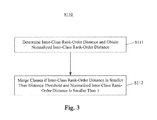
  • FIG. 3 is a flowchart of substeps in step S 110 ( FIG. 2 ) for merging two classes C i and C j , according to an exemplary embodiment.
  • step S 110 includes the following substeps.
  • substep S 111 the terminal determines an inter-class Rank-Order distance between the classes C i and C j , and normalizes the inter-class Rank-Order distance to obtain a normalized inter-class Rank-Order distance.
  • a number of human face images is N
  • each human face image is taken as one individual class
  • a number of the classes is N initially.
  • a distance threshold t and a constant K are set.
  • a Rank-Order distance D R (C i ,C j ) between the classes and a normalized Rank-Order distance D N (C i ,C j ) between the classes are obtained by calculating according to the above equations (1)-(5).
  • the number of the classes is N initially, and thus an N ⁇ N matrix of D R (C i ,C j ) and an N ⁇ N matrix of D N (C i ,C j ) are obtained.
  • each element also known as a vector, represents a Rank-Order distance between the corresponding classes.
  • C ij represents the Rank-Order distance between the classes C i and C j
  • D N C i ,C j
  • step S 112 if the inter-class Rank-Order distance is smaller than the distance threshold t, and the normalized inter-class Rank-Order distance is smaller than 1, the terminal merges the classes C i and C j .
  • D R (C i ,C j ) ⁇ t, and D N (C i ,C j ) ⁇ 1 it is determined that a similarity between the class C i and C j is large, that is, the class C i and C j are candidate classes to be merged. Also for example, if D R (C i ,C j ) ⁇ t, it indicates that a similarity between the classes C i and C j is small; and if D N (C i ,C j ) ⁇ 1, it indicates that a discrete degree between the classes C i and C j is large.
  • step S 120 the terminal obtains an intra-class convergence degree for each class obtained by the iterative merge based on inter-object distances in the class.
  • FIG. 4 is a flowchart of substeps in step S 120 ( FIG. 2 ) for obtaining an intra-class convergence degree for a class obtained by the iterative merge, according to an exemplary embodiment.
  • step S 120 includes the following substeps.
  • an inter-object distance can be calculated based on a cosine similarity, an Euclidean distance, a Jaccard distance, etc.
  • the inter-object distance when the inter-object distance is calculated based on the cosine similarity, e.g., cos ⁇ , the inter-object distance is defined as 1 ⁇ cos ⁇ .
  • substep S 122 the terminal calculates an average distance of all of the inter-object distances, to obtain an intra-class convergence degree of the class.
  • an n ⁇ n distance matrix d can be obtained according to distances between every two objects in the class.
  • each element also known as a vector, indicates a distance between two corresponding objects.
  • a vector d ij in the matrix d represents a distance between an i th object and a j th object in the class.
  • Step S 122 is performed to calculate an average d_aver of all of the vectors in the matrix d.
  • FIG. 5 is a flowchart of substeps in step S 120 ( FIG. 2 ) for calculating an intra-class convergence degree for a class obtained by the iterative merge, according to another embodiment of the present disclosure.
  • step S 120 includes the following substeps.
  • substep S 123 the terminal calculates inter-object distances of respective objects in the class.
  • substep S 124 the terminal calculates an average distance d_aver of all of the inter-object distances according to the inter-object distances.
  • substep S 125 the terminal normalizes the average distance d_aver to obtain the intra-class convergence degree of the class.
  • the average distance d_aver is inducted into a predetermined range [dleft, dright], in which dleft and dright are each a predetermined threshold.
  • dleft may be predetermined to be 0.6
  • dright may be predetermined to be 0.75.
  • the normalization may be performed according to equation (6) as follows:
  • d_aver ⁇ dleft , if ⁇ ⁇ d_aver ⁇ dleft dright , if ⁇ ⁇ d_aver > dright d_aver , if ⁇ ⁇ dleft ⁇ d_aver ⁇ dright . equation ⁇ ⁇ ( 6 )
  • the intra-class convergence degree obtained after the normalization is 0.6; if the average distance d_aver is calculated to be 0.65, the intra-class convergence degree after the normalization is 0.65; and if the average distance d_aver is calculated to be 0.78, the intra-class convergence degree after the normalization is 0.75.
  • the intra-class convergence degree is measured by a value of 1 ⁇ cos ⁇ to indicate the similarity. Therefore, the smaller the intra-class convergence degree is, the more convergent the objects within the class are and the more similar the objects within the class there are.
  • the intra-class convergence degree is normalized into a range of, for example, [0.6, 0.75]. When the intra-class convergence degree is in the range of normalization, the objects within the class are grouped according to the intra-class convergence degree. When the intra-class convergence degree is out of the range of normalization, the objects within the class are grouped according to the threshold.
  • step S 130 for each class obtained by the iterative merge, the terminal groups objects in the class that have an inter-object distance smaller than the intra-class convergence degree into a new class, thereby to update the number of the classes.
  • step S 140 For example, for each class obtained by the iterative merge according to Rank-Order distances, the class is divided according to the inter-object distances in the class and the intra-class convergence degree. Accordingly, one iteration is completed, and then step S 140 is performed.
  • FIG. 6 is a flowchart of substeps in step S 130 ( FIG. 2 ) for grouping objects in a class that have an inter-object distance smaller than an intra-class convergence degree of the class, according to an exemplary embodiment.
  • step S 130 includes the following substeps.
  • the terminal marks the objects in the class that have a distance smaller than the intra-class convergence degree with a connection mark.
  • the terminal checks whether a distance between the object and any other object within the class in the distance matrix is smaller than the intra-class convergence degree. If the inter-object distance is smaller than the intra-class convergence degree, it indicates that similarity between the corresponding objects is large, and the objects may be grouped into one class.
  • the two objects associated with the distance may be given a connection mark. For example, if a distance d ij between two human face images corresponding to an i th object and a j th object, respectively, is smaller than the intra-class convergence degree, the i h object and the j th object are connected.
  • the inter-object distance in the class is greater than the intra-class convergence degree, it indicates that similarity between the corresponding objects is small, and it is not appropriate to group the objects into one class. Therefore, the objects are not marked.
  • step S 132 the terminal determines connected components within the class according to the connection marks. For example, objects that can be connected are taken as a connected component. Thereby, the terminal determines how many connected components that all of the objects within the class can be grouped into.
  • step S 133 the terminal divides the class into new classes according to the connected components, thereby to update the number of the classes.
  • objects corresponding to each connected component are grouped into one new class, that is, the original class is divided into as many new classes as the number of the connected components contained in one class, and the number of classes increases accordingly.
  • objects that do not belong to the class may be removed from the class, that is, the discrete objects are removed from the cluster.
  • step S 140 the terminal judges whether the number of classes after the update is smaller than the number of classes before the update. If so, the process returns to step S 110 ; otherwise, step S 150 is performed.
  • the process if the number of the classes after the update is smaller than the number of the classes before the update, the process returns to step S 110 , until the numbers of the classes are the same before and after an update.
  • the classes are merged based on Rank-Order distances, and then each class obtained by the merge is divided into new classes. For example, assuming that the number of classes is 6 before a merge, and is changed into 4 after a merge based on Rank-Order distances, then the 4 classes after the merge are regrouped into 5 classes. In this embodiment, the number of the classes after the update is 5, the number of the classes before the update is 6. Therefore, the number after the update is smaller than the number before the update, and the process returns to step S 110 to repeat an iteration.
  • the iterative merge should be continually performed on the classes, and the classes after the iterative merge are further divided, until the number of the classes after the update is not greater than the number of the classes before the update.
  • the terminal obtains a clustering result.
  • the clustering result can include one or more classes each containing a plurality of objects and/or one or more classes each containing a single object.
  • the objects within a class containing a plurality of objects can be human face images of a same person.
  • the single object in a class containing the single object is a discrete object removed from a class after an iterative merge based on a Rank-Order distance.
  • the classes are merged based on Rank-Order distances, a similarity between two objects are then measured based on inter-object distances within a class, and an object with a smaller similarity (a larger dissimilarity) is further removed from the class (or form a new class).
  • the clustering method 100 can achieve an accurate clustering result.
  • Table 1 below shows exemplary clustering results of the clustering method according to the present disclosure using experimental data compared to those of the conventional method based only on Rank-Order distances.
  • P represents an accuracy rate of a clustering result
  • R represents a recall rate of a clustering result
  • CR represents an average number of human face images in each class in a clustering result.
  • the images include 2291 human faces, and 562 different persons.
  • each person corresponds to 4.07 human face images. That is, in all of the images, an average of 4.07 human face images belong to a same person.
  • the accuracy rate is 86.1%
  • the accuracy rate of the clustering method according to the present disclosure is 99.1%, which is much higher than the accuracy rate of the conventional clustering method.
  • the accuracy rates of the clustering method according to the present disclosure are also higher than the accuracies of the conventional clustering method.
  • FIG. 7 is a block diagram of a clustering device 700 , according to an exemplary embodiment.
  • the device 700 includes a merging unit 702 , an obtaining unit 704 , a dividing unit 706 , and a judging unit 708 .
  • the merging unit 702 is configured to iteratively merge classes according to inter-class Rank-Order distances.
  • the merging unit 702 includes an obtaining subunit and a merging subunit.
  • the obtaining subunit is configured to obtain inter-class Rank-Order distances and normalized inter-class Rank-Order distances.
  • the merging subunit is configured to merge the classes when an inter-class Rank-Order distance is smaller than a distance threshold and a normalized inter-class Rank-Order distance is smaller than 1.
  • the obtaining unit 704 is configured to obtain an intra-class convergence degree for each class obtained by the iterative merge based on the inter-object distances in the class.
  • the obtaining unit 702 includes an obtaining subunit and a calculating subunit.
  • the obtaining subunit is configured to obtain inter-object distances in the class.
  • the calculating subunit is configured to calculate an average distance of all of the inter-object distances in the class, to obtain the intra-class convergence degree of the class.
  • the obtaining unit 704 further includes a normalization subunit.
  • the normalization subunit is configured to normalize the average distance to obtain the intra-class convergence degree of the class.
  • the dividing unit 706 is configured to, for each class obtained by the iterative merge, group objects in the class that have an inter-object distance smaller than the intra-class convergence degree into a new class, thereby to update the number of the classes.
  • the dividing unit 706 includes a judging subunit, a marking subunit, a determining subunit, and a dividing subunit.
  • the judging subunit is configured to judge whether an inter-object distance within the class is smaller than the intra-class convergence degree.
  • the marking subunit is configured to mark the objects in the class which have an inter-object distance smaller than the intra-class convergence degree with a connection mark.
  • the determining subunit is configured to determine connected components in the class according to connection marks.
  • the dividing subunit is configured to divide the class into new classes according to the connected components, thereby to update the number of the classes.
  • the judging unit 708 is configured to judge whether the number of the classes after the update is smaller than the number of the classes before the update. If the number of the classes after the update is smaller than the number of the classes before the update, the merging unit 702 iteratively merges the classes according to inter-class Rank-Order distances, until the numbers of the classes are the same before and after an update. At this time, a clustering result is obtained, and the clustering result includes one or more classes each containing a plurality of objects and/or one or more classes each containing a single object.
  • the device 700 can achieve an accurate clustering result.
  • FIG. 8 is a block diagram of a terminal 800 , according to an exemplary embodiment.
  • the terminal 800 may be a mobile phone, a computer, a digital broadcast terminal, a message transceiver device, a game console, a tablet device, a medical equipment, fitness equipment, a personal digital assistant, and the like.
  • the terminal 800 may include one or more of the following components: a processing component 802 , a memory 804 , a power component 806 , a multimedia component 808 , an audio component 810 , an input/output (I/O) interface 812 , a sensor component 814 , and a communication component 816 .
  • the processing component 802 typically controls overall operations of the terminal 800 , such as the operations associated with display, telephone calls, data communications, camera operations, and recording operations.
  • the processing component 802 may include one or more processors 820 to execute instructions to perform all or part of the steps in the above described methods.
  • the processing component 802 may include one or more modules which facilitate the interaction between the processing component 802 and other components.
  • the processing component 802 may include a multimedia module to facilitate the interaction between the multimedia component 808 and the processing component 802 .
  • the memory 804 is configured to store various types of data to support the operation of the terminal 800 . Examples of such data include instructions for any applications or methods operated on the terminal 800 , contact data, phonebook data, messages, pictures, video, etc.
  • the memory 804 may be implemented using any type of volatile or non-volatile memory devices, or a combination thereof, such as a static random access memory (SRAM), an electrically erasable programmable read-only memory (EEPROM), an erasable programmable read-only memory (EPROM), a programmable read-only memory (PROM), a read-only memory (ROM), a magnetic memory, a flash memory, a magnetic or optical disk.
  • SRAM static random access memory
  • EEPROM electrically erasable programmable read-only memory
  • EPROM erasable programmable read-only memory
  • PROM programmable read-only memory
  • ROM read-only memory
  • magnetic memory a magnetic memory
  • flash memory a flash memory
  • magnetic or optical disk a magnetic
  • the power component 806 provides power to various components of the terminal 800 .
  • the power component 806 may include a power management system, one or more power sources, and any other components associated with the generation, management, and distribution of power in the terminal 800 .
  • the multimedia component 808 includes a screen providing an output interface between the terminal 800 and the user.
  • the screen may include a liquid crystal display (LCD) and a touch panel (TP). If the screen includes the touch panel, the screen may be implemented as a touch screen to receive input signals from the user.
  • the touch panel includes one or more touch sensors to sense touches, slips, and gestures on the touch panel. The touch sensors may not only sense a boundary of a touch or slip action, but also sense a period of time and a pressure associated with the touch or slip action.
  • the multimedia component 808 includes a front camera and/or a rear camera. The front camera and the rear camera may receive an external multimedia datum while the terminal 800 is in an operation mode, such as a photographing mode or a video mode. Each of the front camera and the rear camera may be a fixed optical lens system or have focus and optical zoom capability.
  • the audio component 810 is configured to output and/or input audio signals.
  • the audio component 810 includes a microphone (“MIC”) configured to receive an external audio signal when the terminal 800 is in an operation mode, such as a call mode, a recording mode, and a voice recognition mode.
  • the received audio signal may be further stored in the memory 804 or transmitted via the communication component 816 .
  • the audio component 810 further includes a speaker to output audio signals.
  • the I/O interface 812 provides an interface between the processing component 802 and peripheral interface modules, such as a keyboard, a click wheel, buttons, and the like.
  • the buttons may include, but are not limited to, a home button, a volume button, a starting button, and a locking button.
  • the sensor component 814 includes one or more sensors to provide status assessments of various aspects of the terminal 800 .
  • the sensor component 814 may detect an open/closed status of the terminal 800 , relative positioning of components, e.g., the display and the keypad, of the terminal 800 , a change in position of the terminal 800 or a component of the terminal 800 , a presence or absence of user contact with the terminal 800 , an orientation or an acceleration/deceleration of the terminal 800 , and a change in temperature of the terminal 800 .
  • the sensor component 814 may include a proximity sensor configured to detect the presence of nearby objects without any physical contact.
  • the sensor component 814 may also include a light sensor, such as a CMOS or CCD image sensor, for use in imaging applications.
  • the sensor component 814 may also include an accelerometer sensor, a gyroscope sensor, a magnetic sensor, a pressure sensor, or a temperature sensor.
  • the communication component 816 is configured to facilitate communication, wired or wirelessly, between the terminal 800 and other devices.
  • the terminal 800 can access a wireless network based on a communication standard, such as WiFi, 2G, or 3G, or a combination thereof.
  • the communication component 816 receives a broadcast signal or broadcast associated information from an external broadcast management system via a broadcast channel.
  • the communication component 816 further includes a near field communication (NFC) module to facilitate short-range communications.
  • the NFC module may be implemented based on a radio frequency identification (RFID) technology, an infrared data association (IrDA) technology, an ultra-wideband (UWB) technology, a Bluetooth (BT) technology, and other technologies.
  • RFID radio frequency identification
  • IrDA infrared data association
  • UWB ultra-wideband
  • BT Bluetooth
  • the terminal 800 may be implemented with one or more application specific integrated circuits (ASICs), digital signal processors (DSPs), digital signal processing devices (DSPDs), programmable logic devices (PLDs), field programmable gate arrays (FPGAs), controllers, micro-controllers, microprocessors, or other electronic components, for performing the above described methods.
  • ASICs application specific integrated circuits
  • DSPs digital signal processors
  • DSPDs digital signal processing devices
  • PLDs programmable logic devices
  • FPGAs field programmable gate arrays
  • controllers micro-controllers, microprocessors, or other electronic components, for performing the above described methods.
  • non-transitory computer-readable storage medium including instructions, such as included in the memory 804 , executable by the processor 820 in the terminal 800 , for performing the above-described methods.
  • the non-transitory computer-readable storage medium may be a ROM, a RAM, a CD-ROM, a magnetic tape, a floppy disc, an optical data storage device, and the like.
  • FIG. 9 is a block diagram of a server 900 , according to an embodiment.
  • the server 900 may include one or more of the following components: a central processing units (CPU) 922 including one or more processors, a memory 932 , a storage medium 930 , for example, one or more mass storage devices, for storing an operating system 941 , application programs 942 , and/or data 944 .
  • the application programs stored in the storage medium 930 may include one or more modules each corresponding to a set of instructions.
  • the CPU 922 is configured to communicate with the storage medium 930 and execute the set of instructions in the storage medium 930 on the server 900 .
  • the server 900 may also include a power component 926 , a wired or wireless network interface 950 , and an input/output interface 958 , and a keyboard 956 .
  • the operating system 941 can be Windows ServerTM, Mac OS XTM, UnixTM, LinuxTM, FreeBSDTM, and the like.
  • non-transitory computer-readable storage medium including instructions, such as included in the memory 932 or the storage medium 930 , executable by the processor 922 , for performing the above-described methods.
  • the non-transitory computer-readable storage medium may be a ROM, a RAM, a CD-ROM, a magnetic tape, a floppy disc, an optical data storage device, and the like.
  • the above described units/subunits can each be implemented by hardware, or software, or a combination of hardware and software.
  • One of ordinary skill in the art will also understand that multiple ones of the above described units/subunits may be combined as one unit/subunit, and each of the above described units may be further divided into a plurality of sub-units.

Landscapes

  • Engineering & Computer Science (AREA)
  • Theoretical Computer Science (AREA)
  • Software Systems (AREA)
  • Data Mining & Analysis (AREA)
  • Databases & Information Systems (AREA)
  • Physics & Mathematics (AREA)
  • General Engineering & Computer Science (AREA)
  • General Physics & Mathematics (AREA)
  • Image Analysis (AREA)
  • Information Retrieval, Db Structures And Fs Structures Therefor (AREA)

Abstract

A clustering method for applying to a plurality of classes each including one or more images as objects, includes: performing an iterative merge on the classes according to inter-class Rank-Order distances; obtaining an intra-class convergence degree of each class obtained by the iterative merge, based on inter-object distances in the class; and grouping, for each class obtained by the iterative merge, objects in the class that have a distance smaller than the intra-class convergence degree of the class into a new class, thereby to perform an update on the classes.

Description

CROSS-REFERENCE TO RELATED APPLICATIONS
This application is a continuation of International Application No. PCT/CN2014/082876, filed Jul. 24, 2014, which is based upon and claims priority to Chinese Patent Application No. CN201410097422.5, filed Mar. 14, 2014, the entire contents of all of which are incorporated herein by reference.
TECHNICAL FIELD
The present disclosure generally relates to the field of computer technology and, more particularly, to a clustering method and device.
BACKGROUND
Clustering is a process of grouping a set of objects into a plurality of classes each composed of similar objects, that is, a process of classifying objects into different classes (clusters), such that objects in the same class have a relatively large similarity, and objects in different classes have a relatively large dissimilarity. In this context, “class” and “cluster” have the same meaning, as used herein.
A conventional clustering method can be used to classify human face images, so as to classify images of a same person into one class. A Rank-Order distance can be used in the conventional clustering method to measure a similarity between two human faces in images, and images of the same person can be clustered together. However, if a number of faces contained in a group of images is relatively large, and the number of images of each person is relatively small, accuracy of clustering results by the conventional clustering method can be low.
SUMMARY
According to a first aspect of the present disclosure, there is provided a clustering method for applying to a plurality of classes each including one or more images as objects, comprising: performing an iterative merge on the classes according to inter-class Rank-Order distances; obtaining an intra-class convergence degree of each class obtained by the iterative merge, based on inter-object distances in the class; grouping, for each class obtained by the iterative merge, objects in the class that have a distance smaller than the intra-class convergence degree of the class into a new class, thereby to perform an update on the classes; if a number of the classes after the update is smaller than a number of the classes before the update, repeating the performing of the iterative merge, the obtaining, and the grouping, until the numbers of the classes before and after an update are the same, to obtain a clustering result, the clustering result including one or more classes each containing a plurality of objects and one or more classes each containing a single object.
According to a second aspect of the present disclosure, there is provided a clustering device for applying to a plurality of classes each including one or more images as objects, comprising: a processor; and a memory for storing instructions executable by the processor: wherein the processor is configured to: perform an iterative merge on the classes according to inter-class Rank-Order distances; obtain an intra-class convergence degree of each class obtained by the iterative merge, based on inter-object distances in the class; group, for each class obtained by the iterative merge, objects in the class that have a distance smaller than the intra-class convergence degree of the class into a new class, thereby to perform an update on the classes; if a number of the classes after the update is smaller than a number of the classes before the update, repeat the performing of the iterative merge, the obtaining, and the grouping, until the numbers of the classes before and after an update are the same, to obtain a clustering result, the clustering result including one or more classes each containing a plurality of objects and one or more classes each containing a single object.
According to a third aspect of the present disclosure, there is provided a non-transitory computer-readable storage medium having stored therein instructions that, when executed by a processor of a device, cause the device to perform a clustering method on a plurality of classes each including one or more images as objects, the clustering method comprising: performing an iterative merge on the classes according to inter-class Rank-Order distances; obtaining an intra-class convergence degree of each class obtained by the iterative merge based on inter-object distances in the class; grouping, for each class obtained by the iterative merge, objects in the class that have a distance smaller than the intra-class convergence degree of the class into a new class, thereby to perform an update on the classes; if a number of the classes after the update is smaller than a number of the classes before the update, repeating the performing of the iterative merge, the obtaining, and the grouping until the numbers of the classes before and after an update are the same, to obtain a clustering result, the clustering result including one or more classes each containing a plurality of objects and one or more classes each containing a single object.
It is to be understood that both the foregoing general description and the following detailed description are exemplary and explanatory only and are not restrictive of the invention, as claimed.
BRIEF DESCRIPTION OF THE DRAWINGS
The accompanying drawings, which are incorporated in and constitute a part of this specification, illustrate embodiments consistent with the invention and, together with the description, serve to explain the principles of the invention.
FIG. 1 is a schematic view of a plurality of objects being ranked into a sequence, according to an exemplary embodiment.
FIG. 2 is a flowchart of a clustering method, according to an exemplary embodiment.
FIG. 3 is a flowchart of a clustering method, according to an exemplary embodiment.
FIG. 4 is a flowchart of a clustering method, according to an exemplary embodiment;
FIG. 5 is a flowchart of a clustering method, according to an exemplary embodiment.
FIG. 6 is a flowchart of a clustering method, according to an exemplary embodiment.
FIG. 7 is a block diagram of a clustering device, according to an exemplary embodiment.
FIG. 8 is a block diagram of a terminal, according to an exemplary embodiment.
FIG. 9 is a block diagram of a server, according to an exemplary embodiment.
DETAILED DESCRIPTION
Reference will now be made in detail to exemplary embodiments, examples of which are illustrated in the accompanying drawings. The following description refers to the accompanying drawings in which the same numbers in different drawings represent the same or similar elements unless otherwise represented. The implementations set forth in the following description of exemplary embodiments do not represent all implementations consistent with the invention. Instead, they are merely examples of devices and methods consistent with aspects related to the disclosure as recited in the appended claims.
In exemplary embodiments, there is provided a clustering method based on distances, such as Rank-Order distances (e.g., cosine similarities, Euclidean distances, etc.,) between objects, such as images. The distances are calculated to measure similarities between the objects, and the objects are ranked according to magnitudes of the distances so as to obtain a sequence. For example, assuming that there are n objects, respectively i1, i2, i3, i4, i5, i6, . . . in, if the object i1 is taken as a reference object, a distance between each of the other objects and the object i1 is calculated, and the objects are ranked according to magnitudes of the distances, so as to obtain, e.g., a sequence O1 shown in FIG. 1. If the object i2 is taken as a reference object, a distance between each of the other objects and the object i2 is calculated, so as to obtain, e.g., a sequence O2 shown in FIG. 1.
In exemplary embodiments, an asymmetric Rank-Order distance D(i1, i2) between the objects i1 and i2 is calculated according to sequence numbers of the objects in the sequence O2 that are neighbor objects between the objects i1 and i2 in the sequence O1. Specifically, in the example shown in FIG. 1, the sequence numbers of the objects i1, i3, i4 and i2 in the sequence O2 are respectively 5, 2, 4, and 0. Accordingly, D(i1, i2) is calculated according to equation (1) as follows:
D ( i 1 , i 2 ) = x = 0 O 1 ( i 2 ) O 2 ( f 1 ( X ) ) = O 2 ( i 1 ) + O 2 ( i 3 ) + O 2 ( i 4 ) + O 2 ( i 2 ) = 5 + 2 + 4 + 0 = 11. equation ( 1 )
In equation (1), O2(i1) represents the sequence number of the object i1 in the sequence O2, O2(i3) represents the sequence number of the object i3 in the sequence O2, O2(i4) represents the sequence number of the object i4 in the sequence O2, and O2(i2) represents the sequence number of the object i2 in the sequence O2.
Similarly, an asymmetric Rank-Order distance D(i2, i1) between the objects i1 and i2 is calculated. Then, a normalized Rank-Order distance DR(i1,i2) between the objects i1 and i2 is calculated according to equation (2) as follows:
D R ( i 1 , i 2 ) = D ( i 1 , i 2 ) + D ( i 2 , i 1 ) min ( O 1 ( i 2 ) , O 2 ( i 1 ) ) . equation ( 2 )
DR(i1,i2) represents a normalized inter-object Rank-Order distance. Calculation of an inter-class Rank-Order distance is similar to the calculation of an inter-object Rank-Order distance. For example, a class is taken as a reference class, and classes are ranked according to distances between each of other classes and the reference class. In one exemplary embodiment, the inter-class Rank-Order distance is calculated according to equation (3) as follows:
D(C i ,C j)=min d(a,b)∀aϵC i ,bϵC j  equation (3).
In equation (3), Ci and Cj each represent a class.
A normalized inter-class Rank-Order distance is further calculated according to equation (4) as follows:
D R ( C i , C j ) = D ( C i , C j ) + D ( C j , C i ) min ( O C i ( C j ) , O C j ( C i ) ) . equation ( 4 )
In equation (4), D(Ci,Cj) represents an asymmetric inter-class Rank-Order distance between the classes Ci and Cj; D(Cj,Ci) represents an asymmetric inter-class Rank-Order distance between the classes Cj and Ci; OC i (Cj) represents a sequence number of the class Cj in a sequence taking Ci as a reference class; and OC j (Ci) represents a sequence number of the class Ci in a sequence taking Cj as a reference class.
In exemplary embodiments, a normalized inter-class Rank-Order distance DN(Ci,Cj) between the classes Ci and Cj is calculated based on a distance d(Ci,Cj) according to equations (5) as follows:
D N ( C i , C j ) = 1 ϕ ( C i , C j ) · d ( C i , C j ) , ϕ ( C i , C j ) = 1 C i + C j a C i C j 1 K k = 1 K d ( a , f a ( k ) ) . equations ( 5 )
In equations (5), d(Ci,Cj) represents a distance between the classes Ci and Cj; |Ci| and |Cj| each represent a number of objects in a class; K is a constant; fa(k) represents a kth neighbor object of an object a; and ϕ(Ci,Cj) represents an average distance between the K objects that are most close to the classes Ci or Cj.
In exemplary embodiments, each human face image can be considered an object and, through the clustering method provided in the present disclosure, images of a same person can be clustered together as one cluster. Characters in a human face image are transformed into a group of vectors. Thus, inter-object distances are distances between the vectors. The clustering method provided in the present disclosure may also be applied to other types of data.
FIG. 2 is a flowchart of a clustering method 100, according to an exemplary embodiment. In the embodiment, the clustering method 100 is applied in a terminal. Referring to FIG. 2, the method 100 includes the following steps.
In step S110, the terminal iteratively merges classes according to inter-class Rank-Order distances. Each of the classes includes, e.g., one or more human face images.
For example, the terminal calculates Rank-Order distances between every two classes, and merges classes having a Rank-Order distance smaller than a first distance threshold. The first distance threshold may be predetermined according to a type of data, or predetermined according to experimental results.
FIG. 3 is a flowchart of substeps in step S110 (FIG. 2) for merging two classes Ci and Cj, according to an exemplary embodiment. Referring to FIG. 3, step S110 includes the following substeps.
In substep S111, the terminal determines an inter-class Rank-Order distance between the classes Ci and Cj, and normalizes the inter-class Rank-Order distance to obtain a normalized inter-class Rank-Order distance.
For example, assuming that initially a number of human face images is N, and each human face image is taken as one individual class, then a number of the classes is N initially. Also, a distance threshold t and a constant K are set. For any two classes Ci and Cj, a Rank-Order distance DR(Ci,Cj) between the classes and a normalized Rank-Order distance DN(Ci,Cj) between the classes are obtained by calculating according to the above equations (1)-(5). The number of the classes is N initially, and thus an N×N matrix of DR(Ci,Cj) and an N×N matrix of DN(Ci,Cj) are obtained. In the matrix of DR(Ci,Cj), each element, also known as a vector, represents a Rank-Order distance between the corresponding classes. For example, in the matrix of DR(C1,Cj), Cij represents the Rank-Order distance between the classes Ci and Cj, and in the matrix of DN(Ci,Cj), Cij represents a normalized Rank-Order distance between the classes Ci and Cj.
In step S112, if the inter-class Rank-Order distance is smaller than the distance threshold t, and the normalized inter-class Rank-Order distance is smaller than 1, the terminal merges the classes Ci and Cj.
For example, if DR(Ci,Cj)<t, and DN(Ci,Cj)<1, it is determined that a similarity between the class Ci and Cj is large, that is, the class Ci and Cj are candidate classes to be merged. Also for example, if DR(Ci,Cj)≥t, it indicates that a similarity between the classes Ci and Cj is small; and if DN(Ci,Cj)≥1, it indicates that a discrete degree between the classes Ci and Cj is large.
Referring to back to FIG. 2, in step S120, the terminal obtains an intra-class convergence degree for each class obtained by the iterative merge based on inter-object distances in the class.
FIG. 4 is a flowchart of substeps in step S120 (FIG. 2) for obtaining an intra-class convergence degree for a class obtained by the iterative merge, according to an exemplary embodiment. Referring to FIG. 4, step S120 includes the following substeps.
Referring to FIG. 4, in substep S121, the terminal calculates inter-object distances of respective objects in the class. For example, an inter-object distance can be calculated based on a cosine similarity, an Euclidean distance, a Jaccard distance, etc.
In one exemplary embodiment, when the inter-object distance is calculated based on the cosine similarity, e.g., cos θ, the inter-object distance is defined as 1−cos θ. Thus, in the embodiment, the smaller the inter-object distance is, the larger the similarity between the objects will be.
In substep S122, the terminal calculates an average distance of all of the inter-object distances, to obtain an intra-class convergence degree of the class.
For example, assuming that there are n objects in the class, an n×n distance matrix d can be obtained according to distances between every two objects in the class. In the matrix d, each element, also known as a vector, indicates a distance between two corresponding objects. For example, a vector dij in the matrix d represents a distance between an ith object and a jth object in the class. Step S122 is performed to calculate an average d_aver of all of the vectors in the matrix d.
FIG. 5 is a flowchart of substeps in step S120 (FIG. 2) for calculating an intra-class convergence degree for a class obtained by the iterative merge, according to another embodiment of the present disclosure. Referring to FIG. 5, step S120 includes the following substeps.
In substep S123, the terminal calculates inter-object distances of respective objects in the class.
In substep S124, the terminal calculates an average distance d_aver of all of the inter-object distances according to the inter-object distances.
In substep S125, the terminal normalizes the average distance d_aver to obtain the intra-class convergence degree of the class.
By the normalization of the average distance d_aver, the average distance d_aver is inducted into a predetermined range [dleft, dright], in which dleft and dright are each a predetermined threshold. For example, dleft may be predetermined to be 0.6, and dright may be predetermined to be 0.75. In one exemplary embodiment, the normalization may be performed according to equation (6) as follows:
d_aver = { dleft , if d_aver < dleft dright , if d_aver > dright d_aver , if dleft d_aver dright . equation ( 6 )
In the above example, if the average distance d_aver is calculated to be 0.5, the intra-class convergence degree obtained after the normalization is 0.6; if the average distance d_aver is calculated to be 0.65, the intra-class convergence degree after the normalization is 0.65; and if the average distance d_aver is calculated to be 0.78, the intra-class convergence degree after the normalization is 0.75.
In exemplary embodiments, the intra-class convergence degree is measured by a value of 1−cos θ to indicate the similarity. Therefore, the smaller the intra-class convergence degree is, the more convergent the objects within the class are and the more similar the objects within the class there are. The intra-class convergence degree is normalized into a range of, for example, [0.6, 0.75]. When the intra-class convergence degree is in the range of normalization, the objects within the class are grouped according to the intra-class convergence degree. When the intra-class convergence degree is out of the range of normalization, the objects within the class are grouped according to the threshold.
Referring back to FIG. 2, in step S130, for each class obtained by the iterative merge, the terminal groups objects in the class that have an inter-object distance smaller than the intra-class convergence degree into a new class, thereby to update the number of the classes.
For example, for each class obtained by the iterative merge according to Rank-Order distances, the class is divided according to the inter-object distances in the class and the intra-class convergence degree. Accordingly, one iteration is completed, and then step S140 is performed.
FIG. 6 is a flowchart of substeps in step S130 (FIG. 2) for grouping objects in a class that have an inter-object distance smaller than an intra-class convergence degree of the class, according to an exemplary embodiment. Referring to FIG. 6, step S130 includes the following substeps.
In substep S131, the terminal marks the objects in the class that have a distance smaller than the intra-class convergence degree with a connection mark.
For example, for any object within the class, the terminal checks whether a distance between the object and any other object within the class in the distance matrix is smaller than the intra-class convergence degree. If the inter-object distance is smaller than the intra-class convergence degree, it indicates that similarity between the corresponding objects is large, and the objects may be grouped into one class. The two objects associated with the distance may be given a connection mark. For example, if a distance dij between two human face images corresponding to an ith object and a jth object, respectively, is smaller than the intra-class convergence degree, the ih object and the jth object are connected.
If the inter-object distance in the class is greater than the intra-class convergence degree, it indicates that similarity between the corresponding objects is small, and it is not appropriate to group the objects into one class. Therefore, the objects are not marked.
In step S132, the terminal determines connected components within the class according to the connection marks. For example, objects that can be connected are taken as a connected component. Thereby, the terminal determines how many connected components that all of the objects within the class can be grouped into.
In step S133, the terminal divides the class into new classes according to the connected components, thereby to update the number of the classes.
For example, objects corresponding to each connected component are grouped into one new class, that is, the original class is divided into as many new classes as the number of the connected components contained in one class, and the number of classes increases accordingly. By dividing a class according to connected components, objects that do not belong to the class may be removed from the class, that is, the discrete objects are removed from the cluster.
Referring back to FIG. 2, in step S140, the terminal judges whether the number of classes after the update is smaller than the number of classes before the update. If so, the process returns to step S110; otherwise, step S150 is performed.
In one exemplary embodiment, if the number of the classes after the update is smaller than the number of the classes before the update, the process returns to step S110, until the numbers of the classes are the same before and after an update.
In the illustrated embodiment, as one iteration, the classes are merged based on Rank-Order distances, and then each class obtained by the merge is divided into new classes. For example, assuming that the number of classes is 6 before a merge, and is changed into 4 after a merge based on Rank-Order distances, then the 4 classes after the merge are regrouped into 5 classes. In this embodiment, the number of the classes after the update is 5, the number of the classes before the update is 6. Therefore, the number after the update is smaller than the number before the update, and the process returns to step S110 to repeat an iteration.
If the number of the classes after the update is smaller than the number of the classes before the update, it indicates that the intra-class discrete degree is large, that is, the objects within the class are not sufficiently convergent. Therefore, the iterative merge should be continually performed on the classes, and the classes after the iterative merge are further divided, until the number of the classes after the update is not greater than the number of the classes before the update.
When the numbers of the classes are the same before and after an update, in step S150, the terminal obtains a clustering result. The clustering result can include one or more classes each containing a plurality of objects and/or one or more classes each containing a single object. The objects within a class containing a plurality of objects can be human face images of a same person. The single object in a class containing the single object is a discrete object removed from a class after an iterative merge based on a Rank-Order distance.
In the clustering method 100, the classes are merged based on Rank-Order distances, a similarity between two objects are then measured based on inter-object distances within a class, and an object with a smaller similarity (a larger dissimilarity) is further removed from the class (or form a new class). When a number of objects in a data set is relatively large, and a number of objects that belong to a same class is relatively small, the clustering method 100 can achieve an accurate clustering result.
Table 1 below shows exemplary clustering results of the clustering method according to the present disclosure using experimental data compared to those of the conventional method based only on Rank-Order distances.
TABLE 1
Number of Number of Clustering Results Clustering Results of
Human Different Based only on Clustering Method
Faces in Persons Rank-Order According to Present
All in All Distances Disclosure
Images Images P R CR P R CR
Case
1 2291 562 0.861 0.78 4.20 0.991 0.66 4.25
Case 2 241 35 0.84 0.76 3.95 1 0.65 3.5
Case 3 378 6 0.98 0.90 7.7 1 0.80 6.1
In Table 1, P represents an accuracy rate of a clustering result, R represents a recall rate of a clustering result, and CR represents an average number of human face images in each class in a clustering result.
It can be seen from Table 1 that, in case 1, the images include 2291 human faces, and 562 different persons. On the average, each person corresponds to 4.07 human face images. That is, in all of the images, an average of 4.07 human face images belong to a same person. Accordingly, in the clustering result using the conventional method based only on Rank-Order distances, the accuracy rate is 86.1%, and the accuracy rate of the clustering method according to the present disclosure is 99.1%, which is much higher than the accuracy rate of the conventional clustering method. In case 2 and case 3, the accuracy rates of the clustering method according to the present disclosure are also higher than the accuracies of the conventional clustering method.
FIG. 7 is a block diagram of a clustering device 700, according to an exemplary embodiment. Referring to FIG. 7, the device 700 includes a merging unit 702, an obtaining unit 704, a dividing unit 706, and a judging unit 708.
The merging unit 702 is configured to iteratively merge classes according to inter-class Rank-Order distances.
In one exemplary embodiment, the merging unit 702 includes an obtaining subunit and a merging subunit. The obtaining subunit is configured to obtain inter-class Rank-Order distances and normalized inter-class Rank-Order distances. The merging subunit is configured to merge the classes when an inter-class Rank-Order distance is smaller than a distance threshold and a normalized inter-class Rank-Order distance is smaller than 1.
The obtaining unit 704 is configured to obtain an intra-class convergence degree for each class obtained by the iterative merge based on the inter-object distances in the class.
In one exemplary embodiment, the obtaining unit 702 includes an obtaining subunit and a calculating subunit. The obtaining subunit is configured to obtain inter-object distances in the class. The calculating subunit is configured to calculate an average distance of all of the inter-object distances in the class, to obtain the intra-class convergence degree of the class.
In another embodiment, the obtaining unit 704 further includes a normalization subunit. The normalization subunit is configured to normalize the average distance to obtain the intra-class convergence degree of the class.
The dividing unit 706 is configured to, for each class obtained by the iterative merge, group objects in the class that have an inter-object distance smaller than the intra-class convergence degree into a new class, thereby to update the number of the classes.
In one exemplary embodiment, the dividing unit 706 includes a judging subunit, a marking subunit, a determining subunit, and a dividing subunit. The judging subunit is configured to judge whether an inter-object distance within the class is smaller than the intra-class convergence degree. The marking subunit is configured to mark the objects in the class which have an inter-object distance smaller than the intra-class convergence degree with a connection mark. The determining subunit is configured to determine connected components in the class according to connection marks. The dividing subunit is configured to divide the class into new classes according to the connected components, thereby to update the number of the classes.
The judging unit 708 is configured to judge whether the number of the classes after the update is smaller than the number of the classes before the update. If the number of the classes after the update is smaller than the number of the classes before the update, the merging unit 702 iteratively merges the classes according to inter-class Rank-Order distances, until the numbers of the classes are the same before and after an update. At this time, a clustering result is obtained, and the clustering result includes one or more classes each containing a plurality of objects and/or one or more classes each containing a single object.
When a number of objects in a data set is relatively large, and a number of objects that belong to a same class is relatively small, the device 700 can achieve an accurate clustering result.
In exemplary embodiments, the above described cluster methods can be used in a terminal or a server. FIG. 8 is a block diagram of a terminal 800, according to an exemplary embodiment. For example, the terminal 800 may be a mobile phone, a computer, a digital broadcast terminal, a message transceiver device, a game console, a tablet device, a medical equipment, fitness equipment, a personal digital assistant, and the like.
Referring to FIG. 8, the terminal 800 may include one or more of the following components: a processing component 802, a memory 804, a power component 806, a multimedia component 808, an audio component 810, an input/output (I/O) interface 812, a sensor component 814, and a communication component 816.
The processing component 802 typically controls overall operations of the terminal 800, such as the operations associated with display, telephone calls, data communications, camera operations, and recording operations. The processing component 802 may include one or more processors 820 to execute instructions to perform all or part of the steps in the above described methods. Moreover, the processing component 802 may include one or more modules which facilitate the interaction between the processing component 802 and other components. For instance, the processing component 802 may include a multimedia module to facilitate the interaction between the multimedia component 808 and the processing component 802.
The memory 804 is configured to store various types of data to support the operation of the terminal 800. Examples of such data include instructions for any applications or methods operated on the terminal 800, contact data, phonebook data, messages, pictures, video, etc. The memory 804 may be implemented using any type of volatile or non-volatile memory devices, or a combination thereof, such as a static random access memory (SRAM), an electrically erasable programmable read-only memory (EEPROM), an erasable programmable read-only memory (EPROM), a programmable read-only memory (PROM), a read-only memory (ROM), a magnetic memory, a flash memory, a magnetic or optical disk.
The power component 806 provides power to various components of the terminal 800. The power component 806 may include a power management system, one or more power sources, and any other components associated with the generation, management, and distribution of power in the terminal 800.
The multimedia component 808 includes a screen providing an output interface between the terminal 800 and the user. In some embodiments, the screen may include a liquid crystal display (LCD) and a touch panel (TP). If the screen includes the touch panel, the screen may be implemented as a touch screen to receive input signals from the user. The touch panel includes one or more touch sensors to sense touches, slips, and gestures on the touch panel. The touch sensors may not only sense a boundary of a touch or slip action, but also sense a period of time and a pressure associated with the touch or slip action. In some embodiments, the multimedia component 808 includes a front camera and/or a rear camera. The front camera and the rear camera may receive an external multimedia datum while the terminal 800 is in an operation mode, such as a photographing mode or a video mode. Each of the front camera and the rear camera may be a fixed optical lens system or have focus and optical zoom capability.
The audio component 810 is configured to output and/or input audio signals. For example, the audio component 810 includes a microphone (“MIC”) configured to receive an external audio signal when the terminal 800 is in an operation mode, such as a call mode, a recording mode, and a voice recognition mode. The received audio signal may be further stored in the memory 804 or transmitted via the communication component 816. In some embodiments, the audio component 810 further includes a speaker to output audio signals.
The I/O interface 812 provides an interface between the processing component 802 and peripheral interface modules, such as a keyboard, a click wheel, buttons, and the like. The buttons may include, but are not limited to, a home button, a volume button, a starting button, and a locking button.
The sensor component 814 includes one or more sensors to provide status assessments of various aspects of the terminal 800. For instance, the sensor component 814 may detect an open/closed status of the terminal 800, relative positioning of components, e.g., the display and the keypad, of the terminal 800, a change in position of the terminal 800 or a component of the terminal 800, a presence or absence of user contact with the terminal 800, an orientation or an acceleration/deceleration of the terminal 800, and a change in temperature of the terminal 800. The sensor component 814 may include a proximity sensor configured to detect the presence of nearby objects without any physical contact. The sensor component 814 may also include a light sensor, such as a CMOS or CCD image sensor, for use in imaging applications. In some embodiments, the sensor component 814 may also include an accelerometer sensor, a gyroscope sensor, a magnetic sensor, a pressure sensor, or a temperature sensor.
The communication component 816 is configured to facilitate communication, wired or wirelessly, between the terminal 800 and other devices. The terminal 800 can access a wireless network based on a communication standard, such as WiFi, 2G, or 3G, or a combination thereof. In one exemplary embodiment, the communication component 816 receives a broadcast signal or broadcast associated information from an external broadcast management system via a broadcast channel. In one exemplary embodiment, the communication component 816 further includes a near field communication (NFC) module to facilitate short-range communications. For example, the NFC module may be implemented based on a radio frequency identification (RFID) technology, an infrared data association (IrDA) technology, an ultra-wideband (UWB) technology, a Bluetooth (BT) technology, and other technologies.
In exemplary embodiments, the terminal 800 may be implemented with one or more application specific integrated circuits (ASICs), digital signal processors (DSPs), digital signal processing devices (DSPDs), programmable logic devices (PLDs), field programmable gate arrays (FPGAs), controllers, micro-controllers, microprocessors, or other electronic components, for performing the above described methods.
In exemplary embodiments, there is also provided a non-transitory computer-readable storage medium including instructions, such as included in the memory 804, executable by the processor 820 in the terminal 800, for performing the above-described methods. For example, the non-transitory computer-readable storage medium may be a ROM, a RAM, a CD-ROM, a magnetic tape, a floppy disc, an optical data storage device, and the like.
FIG. 9 is a block diagram of a server 900, according to an embodiment. Referring to FIG. 9, the server 900 may include one or more of the following components: a central processing units (CPU) 922 including one or more processors, a memory 932, a storage medium 930, for example, one or more mass storage devices, for storing an operating system 941, application programs 942, and/or data 944. The application programs stored in the storage medium 930 may include one or more modules each corresponding to a set of instructions. Further, the CPU 922 is configured to communicate with the storage medium 930 and execute the set of instructions in the storage medium 930 on the server 900.
The server 900 may also include a power component 926, a wired or wireless network interface 950, and an input/output interface 958, and a keyboard 956. The operating system 941 can be Windows Server™, Mac OS X™, Unix™, Linux™, FreeBSD™, and the like.
In exemplary embodiments, there is also provided a non-transitory computer-readable storage medium including instructions, such as included in the memory 932 or the storage medium 930, executable by the processor 922, for performing the above-described methods. For example, the non-transitory computer-readable storage medium may be a ROM, a RAM, a CD-ROM, a magnetic tape, a floppy disc, an optical data storage device, and the like.
One of ordinary skill in the art will understand that the above described units/subunits can each be implemented by hardware, or software, or a combination of hardware and software. One of ordinary skill in the art will also understand that multiple ones of the above described units/subunits may be combined as one unit/subunit, and each of the above described units may be further divided into a plurality of sub-units.
Other embodiments of the invention will be apparent to those skilled in the art from consideration of the specification and practice of the invention disclosed here. This application is intended to cover any variations, uses, or adaptations of the invention following the general principles thereof and including such departures from the present disclosure as come within known or customary practice in the art. It is intended that the specification and examples be considered as exemplary only, with a true scope and spirit of the invention being indicated by the following claims.
It will be appreciated that the present invention is not limited to the exact construction that has been described above and illustrated in the accompanying drawings, and that various modifications and changes can be made without departing from the scope thereof. It is intended that the scope of the invention only be limited by the appended claims.

Claims (13)

What is claimed is:
1. A clustering method for applying to a plurality of classes of images, comprising:
performing, by a processor of a device, an iterative merge on the classes of images according to inter-class Rank-Order distances;
obtaining, by the processor of the device, an intra-class convergence degree of each class of images obtained by the iterative merge, based on inter-object distances in the class, wherein each class of images includes one or more images as objects;
grouping, by the processor of the device and for each class of images obtained by the iterative merge, images in the class that have a distance smaller than the intra-class convergence degree of the class into a new class, thereby to perform an update on the classes;
if a number of the classes after the update is smaller than a number of the classes before the update, repeating the performing of the iterative merge, the obtaining, and the grouping, until the numbers of the classes before and after an update are the same, to obtain a clustering result, the clustering result including one or more classes each containing a plurality of images and one or more classes each containing a single image.
2. The method according to claim 1, wherein the obtaining of the intra-class convergence degree of a first class obtained by the iterative merge comprises:
obtaining inter-object distances of respective images in the first class; and
calculating an average distance of all of the inter-object distances to obtain the intra-class convergence degree of the first class.
3. The method according to claim 1, wherein the obtaining of the intra-class convergence degree of a first class obtained by the iterative merge comprises:
obtaining inter-object distances of respective images in the first class;
calculating an average distance of all of the inter-object distances; and
normalizing the average distance to obtain the intra-class convergence degree of the first class.
4. The method according to claim 2, wherein the grouping of the images for the first class comprises:
marking the images in the first class which have a distance smaller than the intra-class convergence degree with one or more connection marks;
determining connected components in the first class according to the one or more connection marks; and
dividing the first class into a plurality of new classes according to the connected components.
5. The method according to claim 3, wherein the grouping of the images for the first class comprises:
marking the images in the first class which have a distance smaller than the intra-class convergence degree with one or more connection marks;
determining connected components in the first class according to the one or more connection marks; and
dividing the first class into a plurality of new classes according to the connected components.
6. The method according to claim 1, wherein the performing of the iterative merge comprises:
obtaining an inter-class Rank-Order distance between first and second classes of the classes and obtaining a corresponding normalized inter-class Rank-Order distance; and
merging the first and second classes if the inter-class Rank-Order distance before normalization is smaller than a threshold distance and the normalized inter-class Rank-Order distance is smaller than 1.
7. A clustering device for applying to a plurality of classes of images, comprising:
a processor; and
a memory for storing instructions executable by the processor;
wherein the processor is configured to:
perform an iterative merge on the classes of images according to inter-class Rank-Order distances;
obtain an intra-class convergence degree of each class of images obtained by the iterative merge, based on inter-object distances in the class, wherein each class of images includes one or more images as objects;
group, for each class of images obtained by the iterative merge, objects images in the class that have a distance smaller than the intra-class convergence degree of the class into a new class, thereby to perform an update on the classes;
if a number of the classes after the update is smaller than a number of the classes before the update, repeat the performing of the iterative merge, the obtaining, and the grouping, until the numbers of the classes before and after an update are the same, to obtain a clustering result, the clustering result including one or more classes each containing a plurality of images and one or more classes each containing a single image.
8. The device according to claim 7, wherein the processor is further configured to:
obtain inter-object distances of respective images in a first class obtained by the iterative merge; and
calculate an average distance of all of the inter-object distances to obtain an intra-class convergence degree of the first class.
9. The device according to claim 7, wherein the processor is further configured to:
obtain inter-object distances of respective images in a first class obtained by the iterative merge;
calculate an average distance of all of the inter-object distances; and
normalize the average distance to obtain an intra-class convergence degree of the first class.
10. The device according to claim 8, wherein the processor is further configured to:
mark the images in the first class which have a distance smaller than the intra-class convergence degree with one or more connection marks;
determine connected components in the first class according to the one or more connection marks; and
divide the first class into a plurality of new classes according to the connected components.
11. The device according to claim 9, wherein the processor is further configured to:
mark the images in the first class which have a distance smaller than the intra-class convergence degree with one or more connection marks;
determine connected components in the first class according to the one or more connection marks; and
divide the first class into a plurality of new classes according to the connected components.
12. The device according to claim 7, wherein the processor is further configured to:
obtain an inter-class Rank-Order distance between first and second classes of the classes and obtain a corresponding normalized inter-class Rank-Order distance; and
merge the first and second classes if the inter-class Rank-Order distance before normalization is smaller than a threshold distance and the normalized inter-class Rank-Order distance is smaller than 1.
13. A non-transitory computer-readable storage medium having stored therein instructions that, when executed by a processor of a device, cause the device to perform a clustering method on a plurality of classes of images, the clustering method comprising:
performing an iterative merge on the classes according to inter-class Rank-Order distances;
obtaining an intra-class convergence degree of each class of images obtained by the iterative merge based on inter-object distances in the class, wherein each class of images includes one or more images as objects;
grouping, for each class of images obtained by the iterative merge, images in the class that have a distance smaller than the intra-class convergence degree of the class into a new class, thereby to perform an update on the classes;
if a number of the classes after the update is smaller than a number of the classes before the update, repeating the performing of the iterative merge, the obtaining, and the grouping until the numbers of the classes before and after an update are the same, to obtain a clustering result, the clustering result including one or more classes each containing a plurality of images and one or more classes each containing a single image.
US14/532,271 2014-03-14 2014-11-04 Clustering method and device Active 2037-02-18 US10037345B2 (en)

Applications Claiming Priority (4)

Application Number Priority Date Filing Date Title
CN201410097422 2014-03-14
CN201410097422.5A CN103914518B (en) 2014-03-14 2014-03-14 Clustering method and clustering device
CN201410097422.5 2014-03-14
PCT/CN2014/082876 WO2015135276A1 (en) 2014-03-14 2014-07-24 Clustering method and related device

Related Parent Applications (1)

Application Number Title Priority Date Filing Date
PCT/CN2014/082876 Continuation WO2015135276A1 (en) 2014-03-14 2014-07-24 Clustering method and related device

Publications (2)

Publication Number Publication Date
US20150261845A1 US20150261845A1 (en) 2015-09-17
US10037345B2 true US10037345B2 (en) 2018-07-31

Family

ID=54069124

Family Applications (1)

Application Number Title Priority Date Filing Date
US14/532,271 Active 2037-02-18 US10037345B2 (en) 2014-03-14 2014-11-04 Clustering method and device

Country Status (1)

Country Link
US (1) US10037345B2 (en)

Cited By (1)

* Cited by examiner, † Cited by third party
Publication number Priority date Publication date Assignee Title
US20200234037A1 (en) * 2017-03-10 2020-07-23 Hitachi Kokusai Electric Inc. Similar image search system

Families Citing this family (3)

* Cited by examiner, † Cited by third party
Publication number Priority date Publication date Assignee Title
US9607245B2 (en) * 2014-12-02 2017-03-28 Xerox Corporation Adapted vocabularies for matching image signatures with fisher vectors
CN113269480B (en) * 2020-02-17 2022-06-14 百度在线网络技术(北京)有限公司 Task allocation path determining method and device and electronic equipment
CN112863541B (en) * 2020-12-31 2024-02-09 福州数据技术研究院有限公司 Audio cutting method and system based on clustering and median convergence

Citations (17)

* Cited by examiner, † Cited by third party
Publication number Priority date Publication date Assignee Title
JPH10171823A (en) 1996-12-09 1998-06-26 Mitsubishi Electric Corp Automatic document classification method and apparatus
US20060251292A1 (en) 2005-05-09 2006-11-09 Salih Burak Gokturk System and method for recognizing objects from images and identifying relevancy amongst images and information
US20080063276A1 (en) * 2006-09-08 2008-03-13 Luc Vincent Shape clustering in post optical character recognition processing
US20080310759A1 (en) * 2007-06-12 2008-12-18 General Electric Company Generic face alignment via boosting
RU2345414C1 (en) 2007-08-10 2009-01-27 Общество с ограниченной ответственностью "Рекогмишн" Method of creation of system of indexing for search of objects on digital images
KR20090021809A (en) 2007-08-28 2009-03-04 인하대학교 산학협력단 Region-based Image Retrieval Using Region Filtering
US20090119585A1 (en) * 2007-11-06 2009-05-07 Hiroyuki Sakuyama Image display apparatus, image display method, image display program and recording medium
US20110150340A1 (en) * 2009-12-22 2011-06-23 Sony Corporation Information processing device, method, and program
WO2011118723A1 (en) 2010-03-26 2011-09-29 日本電気株式会社 Meaning extraction system, meaning extraction method, and recording medium
US20120294540A1 (en) * 2011-05-17 2012-11-22 Microsoft Corporation Rank order-based image clustering
US20120321193A1 (en) 2010-12-30 2012-12-20 Nokia Corporation Method, apparatus, and computer program product for image clustering
US20130070986A1 (en) * 2011-09-19 2013-03-21 Given Imaging Ltd. System and method for classification of image data items
US20130279816A1 (en) 2010-06-01 2013-10-24 Wei Zhang Clustering images
CN103473255A (en) 2013-06-06 2013-12-25 中国科学院深圳先进技术研究院 A data clustering method, system and data processing equipment
US20140032583A1 (en) * 2012-07-27 2014-01-30 Sergey Ioffe Multi-Resolution Exploration of Large Image Datasets
TW201407390A (en) 2012-08-15 2014-02-16 Acer Inc Data grouping device and method
CN103914518A (en) 2014-03-14 2014-07-09 小米科技有限责任公司 Clustering method and clustering device

Patent Citations (17)

* Cited by examiner, † Cited by third party
Publication number Priority date Publication date Assignee Title
JPH10171823A (en) 1996-12-09 1998-06-26 Mitsubishi Electric Corp Automatic document classification method and apparatus
US20060251292A1 (en) 2005-05-09 2006-11-09 Salih Burak Gokturk System and method for recognizing objects from images and identifying relevancy amongst images and information
US20080063276A1 (en) * 2006-09-08 2008-03-13 Luc Vincent Shape clustering in post optical character recognition processing
US20080310759A1 (en) * 2007-06-12 2008-12-18 General Electric Company Generic face alignment via boosting
RU2345414C1 (en) 2007-08-10 2009-01-27 Общество с ограниченной ответственностью "Рекогмишн" Method of creation of system of indexing for search of objects on digital images
KR20090021809A (en) 2007-08-28 2009-03-04 인하대학교 산학협력단 Region-based Image Retrieval Using Region Filtering
US20090119585A1 (en) * 2007-11-06 2009-05-07 Hiroyuki Sakuyama Image display apparatus, image display method, image display program and recording medium
US20110150340A1 (en) * 2009-12-22 2011-06-23 Sony Corporation Information processing device, method, and program
WO2011118723A1 (en) 2010-03-26 2011-09-29 日本電気株式会社 Meaning extraction system, meaning extraction method, and recording medium
US20130279816A1 (en) 2010-06-01 2013-10-24 Wei Zhang Clustering images
US20120321193A1 (en) 2010-12-30 2012-12-20 Nokia Corporation Method, apparatus, and computer program product for image clustering
US20120294540A1 (en) * 2011-05-17 2012-11-22 Microsoft Corporation Rank order-based image clustering
US20130070986A1 (en) * 2011-09-19 2013-03-21 Given Imaging Ltd. System and method for classification of image data items
US20140032583A1 (en) * 2012-07-27 2014-01-30 Sergey Ioffe Multi-Resolution Exploration of Large Image Datasets
TW201407390A (en) 2012-08-15 2014-02-16 Acer Inc Data grouping device and method
CN103473255A (en) 2013-06-06 2013-12-25 中国科学院深圳先进技术研究院 A data clustering method, system and data processing equipment
CN103914518A (en) 2014-03-14 2014-07-09 小米科技有限责任公司 Clustering method and clustering device

Non-Patent Citations (7)

* Cited by examiner, † Cited by third party
Title
Alexandros Nanopouls et al, "C2P: Clustering Based on Closet Pair," Proceedings of the Twenty-seventh International Conference on Very Large Data Bases, Roma, Sep. 11-14, 2011, pp. 331-340, 10 pages.
Charu C. Aggarwal: "Outlier Analysis," Jan. 1, 2013, Springer, pp. 101-133, 34 pages.
Chunhui Zhu et al., "A Rank-Order Distance Based Clustering Algorithm for Face Tagging", Computer vision and Pattern Recognition (CVPR), 2011 IEEE Conference, Jun. 20, 2011, pp. 481-488, 8 pages.
English translation of International Search Report for International Application No. PCT/CN2014/082876, dated Dec. 12, 2014, 2 pages.
European Search Report received from European Patent Office for European Application No. 14199432.7, dated Nov. 24, 2015, 13 pages.
International Search Report of PCT/CN2014/082876, mailed from the State Intellectual Property Office of China dated Dec. 22, 2014.
Markus M. Breunig et al., "LOF: Identifying Density-Based Local Outliers," Proceedings of the 2000 ACM SIGMOND Int. Conf. on Management of Data, May 16, 2000, pp. 93-104, 12 pages.

Cited By (2)

* Cited by examiner, † Cited by third party
Publication number Priority date Publication date Assignee Title
US20200234037A1 (en) * 2017-03-10 2020-07-23 Hitachi Kokusai Electric Inc. Similar image search system
US10817709B2 (en) * 2017-03-10 2020-10-27 Hitachi Kokusai Electric Inc. Similar image search system

Also Published As

Publication number Publication date
US20150261845A1 (en) 2015-09-17

Similar Documents

Publication Publication Date Title
EP2919165B1 (en) Method and device for clustering
US11244228B2 (en) Method and device for recommending video, and computer readable storage medium
US20210012523A1 (en) Pose Estimation Method and Device and Storage Medium
US10282597B2 (en) Image classification method and device
US9892314B2 (en) Method and device for determining associated user
CN109359056B (en) Application program testing method and device
US20170154221A1 (en) Video categorization method and apparatus, and storage medium
CN103902689A (en) Clustering method, incremental clustering method and related device
KR20160021737A (en) Method, apparatus and device for image segmentation
US20160029419A1 (en) Methods and devices for connecting to wireless network
US11475879B2 (en) Method and device for evaluating quality of content, electronic equipment, and storage medium
EP2913780A2 (en) Clustering method, apparatus and terminal apparatus
US9633444B2 (en) Method and device for image segmentation
US10083346B2 (en) Method and apparatus for providing contact card
EP2919136A1 (en) Method and device for clustering
US20170371506A1 (en) Method, device, and computer-readable medium for message generation
US10037345B2 (en) Clustering method and device
US11574502B2 (en) Method and device for identifying face, and computer-readable storage medium
US20200135205A1 (en) Input method, device, apparatus, and storage medium
US10297015B2 (en) Method, device and computer-readable medium for identifying feature of image
CN110738267B (en) Image classification method, device, electronic equipment and storage medium
US20170147899A1 (en) Method, device, and storage medium for image characteristic extraction
CN115203573A (en) Portrait label generating method, model training method, device, medium and chip
US20170147896A1 (en) Method, device, and storage medium for feature extraction
US10133911B2 (en) Method and device for verifying fingerprint

Legal Events

Date Code Title Description
AS Assignment

Owner name: XIAOMI INC., CHINA

Free format text: ASSIGNMENT OF ASSIGNORS INTEREST;ASSIGNORS:CHEN, ZHIJUN;ZHANG, TAO;ZHANG, BO;AND OTHERS;SIGNING DATES FROM 20141023 TO 20141027;REEL/FRAME:034105/0224

STCF Information on status: patent grant

Free format text: PATENTED CASE

MAFP Maintenance fee payment

Free format text: PAYMENT OF MAINTENANCE FEE, 4TH YEAR, LARGE ENTITY (ORIGINAL EVENT CODE: M1551); ENTITY STATUS OF PATENT OWNER: LARGE ENTITY

Year of fee payment: 4

MAFP Maintenance fee payment

Free format text: PAYMENT OF MAINTENANCE FEE, 8TH YEAR, LARGE ENTITY (ORIGINAL EVENT CODE: M1552); ENTITY STATUS OF PATENT OWNER: LARGE ENTITY

Year of fee payment: 8