US10032996B2 - Hetero-cyclic compound and organic light emitting device including the same - Google Patents

Hetero-cyclic compound and organic light emitting device including the same Download PDF

Info

Publication number
US10032996B2
US10032996B2 US14/843,636 US201514843636A US10032996B2 US 10032996 B2 US10032996 B2 US 10032996B2 US 201514843636 A US201514843636 A US 201514843636A US 10032996 B2 US10032996 B2 US 10032996B2
Authority
US
United States
Prior art keywords
group
substituted
unsubstituted
same
different
Prior art date
Legal status (The legal status is an assumption and is not a legal conclusion. Google has not performed a legal analysis and makes no representation as to the accuracy of the status listed.)
Active, expires
Application number
US14/843,636
Other versions
US20160072079A1 (en
Inventor
Seongmi CHO
Hoyong Lee
Sang Young Jeon
Hyoung Seok Kim
Current Assignee (The listed assignees may be inaccurate. Google has not performed a legal analysis and makes no representation or warranty as to the accuracy of the list.)
LG Chem Ltd
Original Assignee
LG Chem Ltd
Priority date (The priority date is an assumption and is not a legal conclusion. Google has not performed a legal analysis and makes no representation as to the accuracy of the date listed.)
Filing date
Publication date
Application filed by LG Chem Ltd filed Critical LG Chem Ltd
Assigned to LG CHEM, LTD. reassignment LG CHEM, LTD. ASSIGNMENT OF ASSIGNORS INTEREST (SEE DOCUMENT FOR DETAILS). Assignors: CHO, Seongmi, JEON, SANG YOUNG, KIM, HYOUNG SEOK, LEE, HOYONG
Publication of US20160072079A1 publication Critical patent/US20160072079A1/en
Application granted granted Critical
Publication of US10032996B2 publication Critical patent/US10032996B2/en
Active legal-status Critical Current
Adjusted expiration legal-status Critical

Links

Images

Classifications

    • H01L51/0072
    • HELECTRICITY
    • H10SEMICONDUCTOR DEVICES; ELECTRIC SOLID-STATE DEVICES NOT OTHERWISE PROVIDED FOR
    • H10KORGANIC ELECTRIC SOLID-STATE DEVICES
    • H10K85/00Organic materials used in the body or electrodes of devices covered by this subclass
    • H10K85/60Organic compounds having low molecular weight
    • H10K85/649Aromatic compounds comprising a hetero atom
    • H10K85/657Polycyclic condensed heteroaromatic hydrocarbons
    • H10K85/6572Polycyclic condensed heteroaromatic hydrocarbons comprising only nitrogen in the heteroaromatic polycondensed ring system, e.g. phenanthroline or carbazole
    • CCHEMISTRY; METALLURGY
    • C07ORGANIC CHEMISTRY
    • C07DHETEROCYCLIC COMPOUNDS
    • C07D209/00Heterocyclic compounds containing five-membered rings, condensed with other rings, with one nitrogen atom as the only ring hetero atom
    • C07D209/56Ring systems containing three or more rings
    • C07D209/80[b, c]- or [b, d]-condensed
    • C07D209/82Carbazoles; Hydrogenated carbazoles
    • C07D209/86Carbazoles; Hydrogenated carbazoles with only hydrogen atoms, hydrocarbon or substituted hydrocarbon radicals, directly attached to carbon atoms of the ring system
    • CCHEMISTRY; METALLURGY
    • C07ORGANIC CHEMISTRY
    • C07DHETEROCYCLIC COMPOUNDS
    • C07D209/00Heterocyclic compounds containing five-membered rings, condensed with other rings, with one nitrogen atom as the only ring hetero atom
    • C07D209/56Ring systems containing three or more rings
    • C07D209/80[b, c]- or [b, d]-condensed
    • C07D209/82Carbazoles; Hydrogenated carbazoles
    • C07D209/88Carbazoles; Hydrogenated carbazoles with hetero atoms or with carbon atoms having three bonds to hetero atoms with at the most one bond to halogen, e.g. ester or nitrile radicals, directly attached to carbon atoms of the ring system
    • CCHEMISTRY; METALLURGY
    • C07ORGANIC CHEMISTRY
    • C07DHETEROCYCLIC COMPOUNDS
    • C07D405/00Heterocyclic compounds containing both one or more hetero rings having oxygen atoms as the only ring hetero atoms, and one or more rings having nitrogen as the only ring hetero atom
    • C07D405/02Heterocyclic compounds containing both one or more hetero rings having oxygen atoms as the only ring hetero atoms, and one or more rings having nitrogen as the only ring hetero atom containing two hetero rings
    • C07D405/04Heterocyclic compounds containing both one or more hetero rings having oxygen atoms as the only ring hetero atoms, and one or more rings having nitrogen as the only ring hetero atom containing two hetero rings directly linked by a ring-member-to-ring-member bond
    • CCHEMISTRY; METALLURGY
    • C07ORGANIC CHEMISTRY
    • C07DHETEROCYCLIC COMPOUNDS
    • C07D405/00Heterocyclic compounds containing both one or more hetero rings having oxygen atoms as the only ring hetero atoms, and one or more rings having nitrogen as the only ring hetero atom
    • C07D405/02Heterocyclic compounds containing both one or more hetero rings having oxygen atoms as the only ring hetero atoms, and one or more rings having nitrogen as the only ring hetero atom containing two hetero rings
    • C07D405/10Heterocyclic compounds containing both one or more hetero rings having oxygen atoms as the only ring hetero atoms, and one or more rings having nitrogen as the only ring hetero atom containing two hetero rings linked by a carbon chain containing aromatic rings
    • CCHEMISTRY; METALLURGY
    • C07ORGANIC CHEMISTRY
    • C07DHETEROCYCLIC COMPOUNDS
    • C07D409/00Heterocyclic compounds containing two or more hetero rings, at least one ring having sulfur atoms as the only ring hetero atoms
    • C07D409/02Heterocyclic compounds containing two or more hetero rings, at least one ring having sulfur atoms as the only ring hetero atoms containing two hetero rings
    • C07D409/04Heterocyclic compounds containing two or more hetero rings, at least one ring having sulfur atoms as the only ring hetero atoms containing two hetero rings directly linked by a ring-member-to-ring-member bond
    • CCHEMISTRY; METALLURGY
    • C07ORGANIC CHEMISTRY
    • C07DHETEROCYCLIC COMPOUNDS
    • C07D409/00Heterocyclic compounds containing two or more hetero rings, at least one ring having sulfur atoms as the only ring hetero atoms
    • C07D409/02Heterocyclic compounds containing two or more hetero rings, at least one ring having sulfur atoms as the only ring hetero atoms containing two hetero rings
    • C07D409/10Heterocyclic compounds containing two or more hetero rings, at least one ring having sulfur atoms as the only ring hetero atoms containing two hetero rings linked by a carbon chain containing aromatic rings
    • CCHEMISTRY; METALLURGY
    • C07ORGANIC CHEMISTRY
    • C07FACYCLIC, CARBOCYCLIC OR HETEROCYCLIC COMPOUNDS CONTAINING ELEMENTS OTHER THAN CARBON, HYDROGEN, HALOGEN, OXYGEN, NITROGEN, SULFUR, SELENIUM OR TELLURIUM
    • C07F7/00Compounds containing elements of Groups 4 or 14 of the Periodic Table
    • C07F7/02Silicon compounds
    • C07F7/08Compounds having one or more C—Si linkages
    • C07F7/0803Compounds with Si-C or Si-Si linkages
    • C07F7/081Compounds with Si-C or Si-Si linkages comprising at least one atom selected from the elements N, O, halogen, S, Se or Te
    • C07F7/0812Compounds with Si-C or Si-Si linkages comprising at least one atom selected from the elements N, O, halogen, S, Se or Te comprising a heterocyclic ring
    • CCHEMISTRY; METALLURGY
    • C09DYES; PAINTS; POLISHES; NATURAL RESINS; ADHESIVES; COMPOSITIONS NOT OTHERWISE PROVIDED FOR; APPLICATIONS OF MATERIALS NOT OTHERWISE PROVIDED FOR
    • C09KMATERIALS FOR MISCELLANEOUS APPLICATIONS, NOT PROVIDED FOR ELSEWHERE
    • C09K11/00Luminescent, e.g. electroluminescent, chemiluminescent materials
    • C09K11/02Use of particular materials as binders, particle coatings or suspension media therefor
    • C09K11/025Use of particular materials as binders, particle coatings or suspension media therefor non-luminescent particle coatings or suspension media
    • H01L51/0054
    • H01L51/0058
    • H01L51/0074
    • HELECTRICITY
    • H10SEMICONDUCTOR DEVICES; ELECTRIC SOLID-STATE DEVICES NOT OTHERWISE PROVIDED FOR
    • H10KORGANIC ELECTRIC SOLID-STATE DEVICES
    • H10K85/00Organic materials used in the body or electrodes of devices covered by this subclass
    • H10K85/40Organosilicon compounds, e.g. TIPS pentacene
    • HELECTRICITY
    • H10SEMICONDUCTOR DEVICES; ELECTRIC SOLID-STATE DEVICES NOT OTHERWISE PROVIDED FOR
    • H10KORGANIC ELECTRIC SOLID-STATE DEVICES
    • H10K85/00Organic materials used in the body or electrodes of devices covered by this subclass
    • H10K85/60Organic compounds having low molecular weight
    • H10K85/615Polycyclic condensed aromatic hydrocarbons, e.g. anthracene
    • H10K85/622Polycyclic condensed aromatic hydrocarbons, e.g. anthracene containing four rings, e.g. pyrene
    • HELECTRICITY
    • H10SEMICONDUCTOR DEVICES; ELECTRIC SOLID-STATE DEVICES NOT OTHERWISE PROVIDED FOR
    • H10KORGANIC ELECTRIC SOLID-STATE DEVICES
    • H10K85/00Organic materials used in the body or electrodes of devices covered by this subclass
    • H10K85/60Organic compounds having low molecular weight
    • H10K85/615Polycyclic condensed aromatic hydrocarbons, e.g. anthracene
    • H10K85/624Polycyclic condensed aromatic hydrocarbons, e.g. anthracene containing six or more rings
    • HELECTRICITY
    • H10SEMICONDUCTOR DEVICES; ELECTRIC SOLID-STATE DEVICES NOT OTHERWISE PROVIDED FOR
    • H10KORGANIC ELECTRIC SOLID-STATE DEVICES
    • H10K85/00Organic materials used in the body or electrodes of devices covered by this subclass
    • H10K85/60Organic compounds having low molecular weight
    • H10K85/615Polycyclic condensed aromatic hydrocarbons, e.g. anthracene
    • H10K85/626Polycyclic condensed aromatic hydrocarbons, e.g. anthracene containing more than one polycyclic condensed aromatic rings, e.g. bis-anthracene
    • HELECTRICITY
    • H10SEMICONDUCTOR DEVICES; ELECTRIC SOLID-STATE DEVICES NOT OTHERWISE PROVIDED FOR
    • H10KORGANIC ELECTRIC SOLID-STATE DEVICES
    • H10K85/00Organic materials used in the body or electrodes of devices covered by this subclass
    • H10K85/60Organic compounds having low molecular weight
    • H10K85/649Aromatic compounds comprising a hetero atom
    • H10K85/657Polycyclic condensed heteroaromatic hydrocarbons
    • H10K85/6574Polycyclic condensed heteroaromatic hydrocarbons comprising only oxygen in the heteroaromatic polycondensed ring system, e.g. cumarine dyes
    • HELECTRICITY
    • H10SEMICONDUCTOR DEVICES; ELECTRIC SOLID-STATE DEVICES NOT OTHERWISE PROVIDED FOR
    • H10KORGANIC ELECTRIC SOLID-STATE DEVICES
    • H10K85/00Organic materials used in the body or electrodes of devices covered by this subclass
    • H10K85/60Organic compounds having low molecular weight
    • H10K85/649Aromatic compounds comprising a hetero atom
    • H10K85/657Polycyclic condensed heteroaromatic hydrocarbons
    • H10K85/6576Polycyclic condensed heteroaromatic hydrocarbons comprising only sulfur in the heteroaromatic polycondensed ring system, e.g. benzothiophene
    • H01L2251/308
    • H01L51/0085
    • H01L51/5016
    • HELECTRICITY
    • H10SEMICONDUCTOR DEVICES; ELECTRIC SOLID-STATE DEVICES NOT OTHERWISE PROVIDED FOR
    • H10KORGANIC ELECTRIC SOLID-STATE DEVICES
    • H10K2101/00Properties of the organic materials covered by group H10K85/00
    • H10K2101/10Triplet emission
    • HELECTRICITY
    • H10SEMICONDUCTOR DEVICES; ELECTRIC SOLID-STATE DEVICES NOT OTHERWISE PROVIDED FOR
    • H10KORGANIC ELECTRIC SOLID-STATE DEVICES
    • H10K2102/00Constructional details relating to the organic devices covered by this subclass
    • H10K2102/10Transparent electrodes, e.g. using graphene
    • H10K2102/101Transparent electrodes, e.g. using graphene comprising transparent conductive oxides [TCO]
    • H10K2102/103Transparent electrodes, e.g. using graphene comprising transparent conductive oxides [TCO] comprising indium oxides, e.g. ITO
    • HELECTRICITY
    • H10SEMICONDUCTOR DEVICES; ELECTRIC SOLID-STATE DEVICES NOT OTHERWISE PROVIDED FOR
    • H10KORGANIC ELECTRIC SOLID-STATE DEVICES
    • H10K50/00Organic light-emitting devices
    • H10K50/10OLEDs or polymer light-emitting diodes [PLED]
    • H10K50/11OLEDs or polymer light-emitting diodes [PLED] characterised by the electroluminescent [EL] layers
    • HELECTRICITY
    • H10SEMICONDUCTOR DEVICES; ELECTRIC SOLID-STATE DEVICES NOT OTHERWISE PROVIDED FOR
    • H10KORGANIC ELECTRIC SOLID-STATE DEVICES
    • H10K85/00Organic materials used in the body or electrodes of devices covered by this subclass
    • H10K85/30Coordination compounds
    • H10K85/341Transition metal complexes, e.g. Ru(II)polypyridine complexes
    • H10K85/342Transition metal complexes, e.g. Ru(II)polypyridine complexes comprising iridium

Definitions

  • the present specification relates to a hetero-cyclic compound and an organic light emitting device including the same.
  • An organic light emission phenomenon generally refers to a phenomenon converting electrical energy to light energy using an organic material.
  • An organic light emitting device using an organic light emission phenomenon normally has a structure including an anode, a cathode, and an organic material layer therebetween.
  • the organic material layer is often formed in a multilayer structure formed with different materials in order to increase efficiency and stability of the organic light emitting device, and for example, may be formed with a hole injection layer, a hole transfer layer, a light emitting layer, an electron transfer layer, an electron injection layer and the like.
  • Patent Document 1 Korean Patent Application Laid-Open Publication No. 2000-0051826
  • the present specification describes a hetero-cyclic compound and an organic light emitting device including the same.
  • X is O, S, NAr, CR 11 R 12 or SiR 13 R 14 ,
  • L 1 and L 2 are the same as or different from each other, and each independently a direct bond, substituted or unsubstituted arylene, or substituted or unsubstituted heteroarylene including one or more of O and S atoms,
  • R 1 to R 7 are the same as or different from each other, and each independently hydrogen; deuterium; a halogen group; a substituted or unsubstituted alkyl group; a substituted or unsubstituted cycloalkyl group; a substituted or unsubstituted alkenyl group; a substituted or unsubstituted aryl group; a substituted or unsubstituted hetero-cyclic group; a substituted or unsubstituted alkylamine group; a substituted or unsubstituted heteroarylamine group; or a substituted or unsubstituted arylamine group, or adjacent two or more substituents bond to each other to form a substituted or unsubstituted hydrocarbon ring or heteroring,
  • Ar is a substituted or unsubstituted aryl group or heteroaryl group
  • R 11 to R 14 are the same as or different from each other, and each independently hydrogen; deuterium; a halogen group; a substituted or unsubstituted alkyl group; a substituted or unsubstituted cycloalkyl group; a substituted or unsubstituted alkenyl group; a substituted or unsubstituted aryl group; or a substituted or unsubstituted hetero-cyclic group, or R 11 and R 12 or R 13 and R 14 bond to each other to form a substituted or unsubstituted hydrocarbon ring or heteroring,
  • a, c, e and f are the same as or different from each other, and each independently an integer of 0 to 4,
  • b, d and g are the same as or different from each other, and each independently an integer of 0 to 3,
  • r and s are the same as or different from each other, and each independently an integer of 0 to 5,
  • R 1 s are the same as or different from each other
  • R 2 s are the same as or different from each other
  • R 3 s are the same as or different from each other
  • R 4 s are the same as or different from each other
  • R 5 s are the same as or different from each other
  • R 6 s are the same as or different from each other
  • R 7 s are the same as or different from each other
  • L 1 s are the same as or different from each other, and
  • L 2 s are the same as or different from each other.
  • one embodiment of the present specification provides an organic light emitting device including a first electrode; a second electrode provided opposite to the first electrode; and one or more organic material layers provided between the first electrode and the second electrode, wherein one or more layers of the organic material layers include the compound of Chemical Formula 1.
  • FIG. 1 is a diagram showing an example of an organic light emitting device formed with a substrate ( 1 ), an anode ( 2 ), a light emitting layer ( 3 ) and a cathode ( 4 );
  • FIG. 2 is a diagram showing an example of an organic light emitting device formed with a substrate ( 1 ), an anode ( 2 ), a hole injection layer ( 5 ), a hole transfer layer ( 6 ), a light emitting layer ( 7 ), an electron transfer layer ( 8 ) and a cathode ( 4 );
  • FIG. 3 shows an MS result, a material identifying the synthesis of Chemical Formula 1-1
  • FIG. 4 shows an MS result, a material identifying the synthesis of Chemical Formula 1-2
  • FIG. 5 shows an MS result, a material identifying the synthesis of Chemical Formula 1-3
  • FIG. 6 shows an MS result, a material identifying the synthesis of Chemical Formula 1-4
  • FIG. 7 shows an MS result, a material identifying the synthesis of Chemical Formula 1-10
  • FIG. 8 shows an MS result, a material identifying the synthesis of Chemical Formula 1-13.
  • FIG. 9 shows an MS result, a material identifying the synthesis of Chemical Formula 1-14.
  • One embodiment of the present specification provides a compound represented by Chemical Formula 1.
  • substituted or unsubstituted in the present specification means being substituted with one or more substituents selected from the group consisting of deuterium; a halogen group; a nitrile group; a nitro group; a hydroxyl group; a carbonyl group; an ester group; an imide group; an amino group; a phosphine oxide group; an alkoxy group; an aryloxy group; an alkylthioxy group; an arylthioxy group; an alkylsulfoxy group; an arylsulfoxy group; a silyl group; a boron group; an alkyl group; a cycloalkyl group; an alkenyl group; an aryl group; an aralkyl group; an aralkenyl group; an alkylaryl group; an alkylamine group; an aralkylamine group; a heteroarylamine group; an arylamine group; an arylphosphin
  • an “adjacent” group may mean a substituent substituting an atom directly linking to an atom substituted by the corresponding substituent, a substituent sterically most closely positioned to the corresponding substituent, or another substituent substituting an atom substituted by the corresponding substituent.
  • two substituents substituting ortho positions in a benzene ring, and two substituents substituting the same carbon in an aliphatic ring may be interpreted as “adjacent” groups.
  • the number of carbon atoms of the carbonyl group is not particularly limited, but is preferably 1 to 40. Specifically, compounds having structures such as below may be included, but the compound is not limited thereto.
  • the oxygen of the ester group may be substituted with a linear, branched or cyclic alkyl group having 1 to 25 carbon atoms or an aryl group having 6 to 25 carbon atoms.
  • a linear, branched or cyclic alkyl group having 1 to 25 carbon atoms or an aryl group having 6 to 25 carbon atoms may be included, but the compound is not limited thereto.
  • the number of carbon atoms of the imide group is not particularly limited, but is preferably 1 to 25.
  • compounds having structures such as below may be included, but the compound is not limited thereto.
  • the silyl group specifically includes a trimethylsilyl group, a triethylsilyl group, a t-butyldimethylsilyl group, a vinyldimethylsilyl group, a propyldimethylsilyl group, a triphenylsilyl group, a diphenylsilyl group, a phenylsilyl group and the like, but is not limited thereto.
  • the boron group specifically includes a trimethylboron group, a triethylboron group, a t-butyldimethylboron group, a triphenylboron group, a phenylboron group and the like, but is not limited thereto.
  • examples of the halogen group include fluorine, chlorine, bromine or iodine.
  • the alkyl group may be linear or branched, and the number of carbon atoms is not particularly limited, but is preferably 1 to 40. According to one embodiment, the alkyl group has 1 to 20 carbon atoms. According to another embodiment, the alkyl group has 1 to 10 carbon atoms. According to another embodiment, the alkyl group has 1 to 6 carbon atoms.
  • alkyl group examples include methyl, ethyl, propyl, n-propyl, isopropyl, butyl, n-butyl, isobutyl, tert-butyl, sec-butyl, 1-methyl-butyl, 1-ethyl-butyl, pentyl, n-pentyl, isopentyl, neopentyl, tert-pentyl, hexyl, n-hexyl, 1-methylpentyl, 2-methylpentyl, 4-methyl-2-pentyl, 3,3-dimethylbutyl, 2-ethylbutyl, heptyl, n-heptyl, 1-methylhexyl, cyclopentylmethyl, cyclohexylmethyl, octyl, n-octyl, tert-octyl, 1-methylheptyl, 2-ethylhexyl, 2-
  • the alkenyl group may be linear or branched, and although not particularly limited, the number of carbon atoms is preferably 2 to 40. According to one embodiment, the alkenyl group has 2 to 20 carbon atoms. According to another embodiment, the alkenyl group has 2 to 10 carbon atoms. According to another embodiment, the alkenyl group has 2 to 6 carbon atoms.
  • Specific examples thereof include vinyl, 1-propenyl, isopropenyl, 1-butenyl, 2-butenyl, 3-butenyl, 1-pentenyl, 2-pentenyl, 3-pentenyl, 3-methyl-1-butenyl, 1,3-butadienyl, allyl, 1-phenylvinyl-1-yl, 2-phenylvinyl-1-yl, 2,2-diphenylvinyl-1-yl, 2-phenyl-2-(naphthyl-1-yl)vinyl-1-yl, 2,2-bis(diphenyl-1-yl)vinyl-1-yl, a stilbenyl group, a styrenyl group and the like, but are not limited thereto.
  • the cycloalkyl group is not particularly limited, but preferably has 3 to 60 carbon atoms, and according to one embodiment, the cycloalkyl group has 3 to 30 carbon atoms. According to another embodiment, the cycloalkyl group has 3 to 20 carbon atoms. According to another embodiment, the cycloalkyl group has 3 to 6 carbon atoms.
  • cyclopropyl examples thereof include cyclopropyl, cyclobutyl, cyclopentyl, 3-methylcyclopentyl, 2,3-dimethylcyclopentyl, cyclohexyl, 3-methylcyclohexyl, 4-methylcyclohexyl, 2,3-dimethylcyclohexyl, 3,4,5-trimethylcyclohexyl, 4-tert-butylcyclohexyl, cycloheptyl, cyclooctyl and the like, but are not limited thereto.
  • the aryl group is not particularly limited, but preferably has 6 to 60 carbon atoms, and may be a monocyclic aryl group or a multicyclic aryl group. According to one embodiment, the aryl group has 6 to 30 carbon atoms. According to one embodiment, the aryl group has 6 to 20 carbon atoms. Examples of the aryl group as a monocyclic aryl group may include a phenyl group, a biphenyl group, a terphenyl group and the like, but are not limited thereto.
  • Examples of the multicyclic aryl group may include a naphthyl group, an anthracenyl group, a phenanthryl group, a pyrenyl group, a perylenyl group, a crycenyl group, a fluorenyl group and the like, but are not limited thereto.
  • the fluorenyl group may be substituted, and two substituents may bond to each other to form a spiro structure.
  • the hetero-cyclic group is a hetero-cyclic group including one or more of O, N and S as a heteroatom, and although not particularly limited, the number of carbon atoms is preferably 2 to 60.
  • the hetero-cyclic group include a thiophene group, a furan group, a pyrrole group, an imidazole group, a thiazole group, an oxazole group, an oxadiazole group, a triazole group, a pyridyl group, a bipyridyl group, a pyrimidyl group, a triazine group, an acridyl group, a pyridazine group, a pyrazinyl group, a quinolinyl group, a quinazoline group, a quinoxalinyl group, a phthalazinyl group, a pyridopyrimidinyl group, a pyridopyrazin
  • the aryl group in the aralkyl group, the aralkenyl group, the alkylaryl group and the arylamine group is the same as the examples of the aryl group described above.
  • the alkyl group in the aralkyl group, the alkylaryl group and the alkylamine group is the same as the examples of the alkyl group described above.
  • hetero-cyclic group made above may be used for the heteroaryl in the heteroarylamine.
  • alkenyl group in the aralkenyl group is the same as the examples of the alkenyl group described above.
  • the descriptions on the aryl group made above may be used for the arylene except that the arylene is a divalent group.
  • hetero-cyclic group made above may be used for the heteroarylene except that the heteroarylene is a divalent group.
  • Ar is a substituted or unsubstituted aryl group.
  • Ar is a one-membered to five-membered substituted or unsubstituted aryl group.
  • Ar is a one-membered to three-membered substituted or unsubstituted aryl group.
  • Ar is a substituted or unsubstituted phenyl group; a substituted or unsubstituted biphenyl group; or a substituted or unsubstituted naphthyl group.
  • Chemical Formula 1 may be represented by any one of the following Chemical Formulae 2 to 4.
  • R 8 and R 9 are the same as or different from each other, and each independently hydrogen; deuterium; a halogen group; a substituted or unsubstituted alkyl group; a substituted or unsubstituted cycloalkyl group; a substituted or unsubstituted alkenyl group; a substituted or unsubstituted aryl group; a substituted or unsubstituted hetero-cyclic group; a substituted or unsubstituted alkylamine group; a substituted or unsubstituted heteroarylamine group; or a substituted or unsubstituted arylamine group, or adjacent two or more substituents bond to each other to form a substituted or unsubstituted hydrocarbon ring or heteroring,
  • t and u are the same as or different from each other, and are each an integer of 0 to 4,
  • R 8 s are the same as or different from each other, and
  • R 9 s are the same as or different from each other.
  • Chemical Formula 1 may be represented by the following Chemical Formula 5 or 6.
  • R 1 to R 7 , L 1 , L 2 , a, b, c, d, e, f, g, r and s are the same as in Chemical Formula 1.
  • Chemical Formula 1 may be represented by the following Chemical Formula 7.
  • R 1 to R 7 , L 1 , L 2 , Ar, a, b, c, d, e, f, g, r and s are the same as in Chemical Formula 1.
  • Chemical Formula 1 may be represented by the following Chemical Formula 8.
  • R 1 to R 7 , L 1 , L 2 , R 11 , R 12 , a, b, c, d, e, f, g, r and s are the same as in Chemical Formula 1.
  • Chemical Formula 1 may be represented by the following Chemical Formula 9.
  • R 1 to R 7 , L 1 , L 2 , R 13 , R 14 , a, b, c, d, e, f, g, r and s are the same as in Chemical Formula 1.
  • triphenylene group is represented by the following drawing.
  • L 2 bonds to position 2 of the triphenylene group in Chemical Formula 1.
  • Chemical Formula 1 bonds to position 2 of the triphenylene group
  • synthesis is readily carried out and electron mobility is favorable compared to other positions due to lengthened conjugation.
  • the triphenylene group is not present, electron mobility and affinity decrease in the compound, and holes and electrons are not balanced in a light emitting layer.
  • L 1 and L 2 are the same as or different from each other, and each independently a direct bond, substituted or unsubstituted arylene, or substituted or unsubstituted heteroarylene including one or more of O and S atoms.
  • L 1 and L 2 are the same as or different from each other, and are a direct bond, or substituted or unsubstituted arylene.
  • L 1 and L 2 are the same as or different from each other, and are a direct bond, substituted or unsubstituted phenylene, substituted or unsubstituted naphthylene, substituted or unsubstituted biphenylene, or substituted or unsubstituted fluorenylene.
  • L 1 and L 2 are the same as or different from each other, and are a direct bond, phenylene, naphthylene, biphenylene, or fluorenylene unsubstituted or substituted with an alkyl group.
  • L 1 and L 2 are the same as or different from each other, and are a direct bond, phenylene, naphthylene, biphenylene, or fluorenylene substituted with a methyl group.
  • L 1 and L 2 are a direct bond or phenylene.
  • L 1 and L 2 are a direct bond.
  • L 1 is phenylene
  • L 2 is a direct bond
  • L 1 is a direct bond
  • L 2 is phenylene
  • L 1 is phenylene
  • L 2 is phenylene
  • R 1 is hydrogen; deuterium; a substituted or unsubstituted alkyl group; a substituted or unsubstituted cycloalkyl group; or a substituted or unsubstituted aryl group.
  • R 1 is hydrogen; deuterium; a substituted or unsubstituted alkyl group; or a substituted or unsubstituted cycloalkyl group.
  • R 1 is hydrogen; or deuterium.
  • R 2 is hydrogen; deuterium; a substituted or unsubstituted alkyl group; a substituted or unsubstituted cycloalkyl group; or a substituted or unsubstituted aryl group.
  • R 2 is hydrogen; deuterium; a substituted or unsubstituted alkyl group; or a substituted or unsubstituted cycloalkyl group.
  • R 2 is hydrogen; or deuterium.
  • R 3 is hydrogen; deuterium; a substituted or unsubstituted alkyl group; a substituted or unsubstituted cycloalkyl group; or a substituted or unsubstituted aryl group.
  • R 3 is hydrogen; deuterium; a substituted or unsubstituted alkyl group; or a substituted or unsubstituted cycloalkyl group.
  • R 3 is hydrogen; or deuterium.
  • R 4 is hydrogen; deuterium; a substituted or unsubstituted alkyl group; a substituted or unsubstituted cycloalkyl group; or a substituted or unsubstituted aryl group.
  • R 4 is hydrogen; deuterium; a substituted or unsubstituted alkyl group; or a substituted or unsubstituted cycloalkyl group.
  • R 4 is hydrogen; or deuterium.
  • R 5 is hydrogen; deuterium; a substituted or unsubstituted alkyl group; a substituted or unsubstituted cycloalkyl group; or a substituted or unsubstituted aryl group.
  • R 5 is hydrogen; deuterium; a substituted or unsubstituted alkyl group; or a substituted or unsubstituted cycloalkyl group.
  • R 5 is hydrogen; or deuterium.
  • R 6 is hydrogen; deuterium; a substituted or unsubstituted alkyl group; a substituted or unsubstituted cycloalkyl group; or a substituted or unsubstituted aryl group.
  • R 6 is hydrogen; deuterium; a substituted or unsubstituted alkyl group; or a substituted or unsubstituted cycloalkyl group.
  • R 6 is hydrogen; or deuterium.
  • R 7 is hydrogen; deuterium; a substituted or unsubstituted alkyl group; a substituted or unsubstituted cycloalkyl group; or a substituted or unsubstituted aryl group.
  • R 7 is hydrogen; deuterium; a substituted or unsubstituted alkyl group; or a substituted or unsubstituted cycloalkyl group.
  • R 7 is hydrogen; or deuterium.
  • R 11 and R 12 are the same as or different from each other, and each independently a substituted or unsubstituted alkyl group; or a substituted or unsubstituted aryl group, or bond to each other to form a ring.
  • R 11 and R 12 are the same as or different from each other, and each independently a substituted or unsubstituted alkyl group having 1 to 6 carbon atoms; or a substituted or unsubstituted phenyl group, or bond to each other to form a substituted or unsubstituted fluorenyl group.
  • R 11 and R 12 are the same as or different from each other, and each independently an alkyl group having 1 to 6 carbon atoms; or a phenyl group, or bond to each other to form a fluorenyl group, a dimethylfluorenyl group, a diphenylfluorenyl group or a spirobifluorenyl group.
  • R 11 and R 12 are each an alkyl group having 1 to 6 carbon atoms.
  • R 11 and R 12 are each a methyl group.
  • R 13 and R 14 are the same as or different from each other, and each independently a substituted or unsubstituted alkyl group; or a substituted or unsubstituted aryl group, or bond to each other to form a ring.
  • R 13 and R 14 are the same as or different from each other, and each independently a substituted or unsubstituted alkyl group having 1 to 6 carbon atoms; or a substituted or unsubstituted phenyl group, or bond to each other to form a substituted or unsubstituted fluorenyl group.
  • R 13 and R 14 are the same as or different from each other, and each independently an alkyl group having 1 to 6 carbon atoms; or a phenyl group, or bond to each other to form a fluorenyl group, a dimethylfluorenyl group, a diphenylfluorenyl group or a spirobifluorenyl group.
  • R 13 and R 14 are each an alkyl group having 1 to 6 carbon atoms.
  • R 13 and R 14 are each a methyl group.
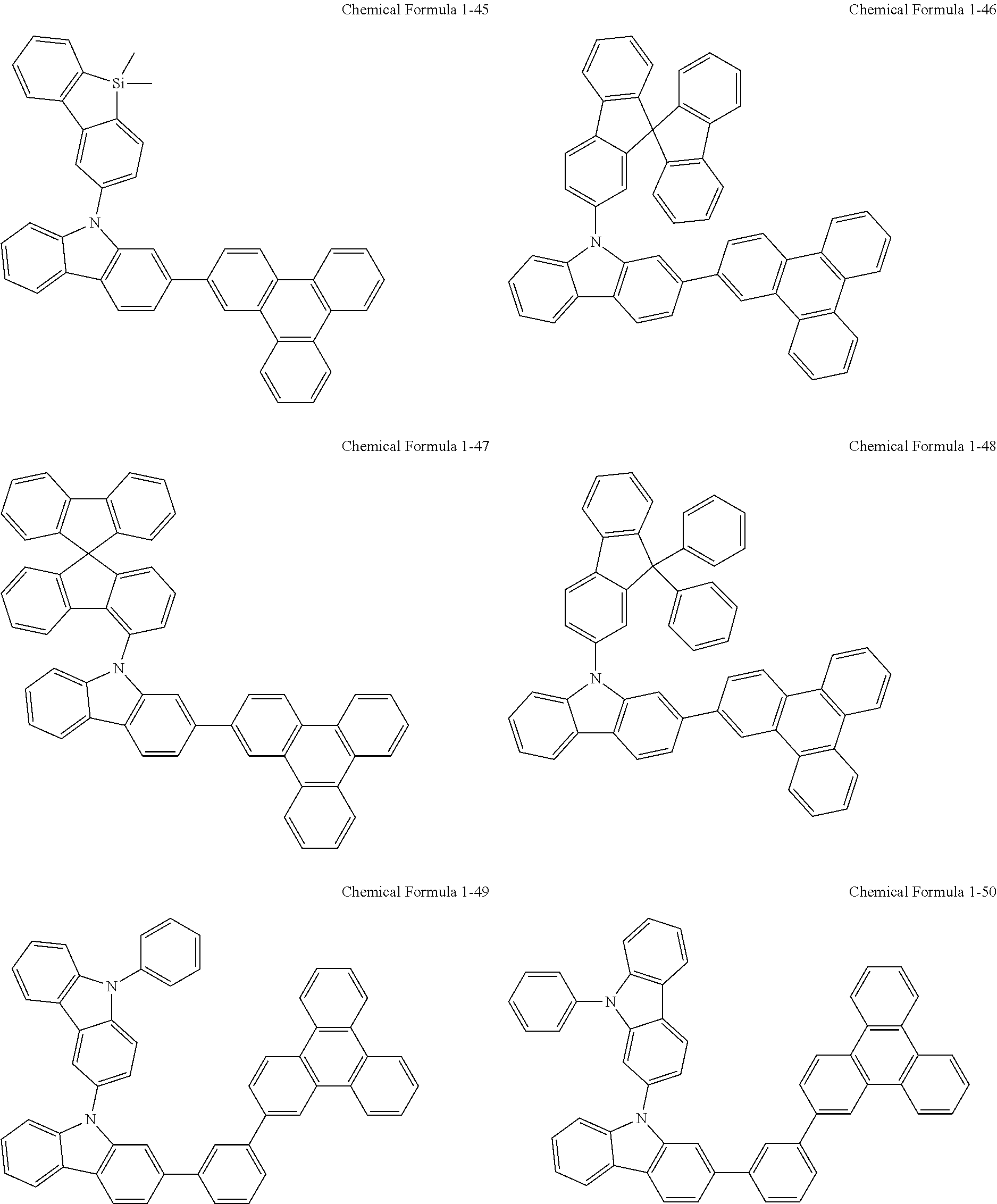
  • the compound of Chemical Formula 1 may be selected from the following structures.
  • the compound represented by Chemical Formula 1 may be prepared based on preparation examples described later. According to one embodiment, the compound represented by Chemical Formula 1 may be prepared in the same manner as in the following Reaction Formula 1.
  • Y is Br or Cl
  • R 8 and R 9 are the same as or different from each other, and each independently —OH or —OC(CH 3 ) 2 C(CH 3 ) 2 O, the carbazole intermediate is synthesized through a Suzuki reaction, and the final compound is synthesized through a Buchwald-Hartwig reaction.
  • organic light emitting device including the compound represented by Chemical Formula 1.
  • One embodiment of the present specification provides an organic light emitting device including a first electrode; a second electrode provided opposite to the first electrode; and one or more organic material layers provided between the first electrode and the second electrode, wherein one or more layers of the organic material layers include the compound of Chemical Formula 1.
  • the organic material layer of the organic light emitting device of the present specification may be formed in a monolayer structure, but may also be formed in a multilayer structure in which two or more organic material layers are laminated.
  • the organic light emitting device of the present invention may have a structure including a hole injection layer, a hole transfer layer, a light emitting layer, an electron transfer layer, an electron injection layer and the like as the organic material layer.
  • the structure of the organic light emitting device is not limited thereto, and may include less numbers of organic material layers.
  • the organic material layer includes a hole injection layer, a hole transfer layer or a layer carrying out hole injection and transfer at the same time, and the hole injection layer, the hole transfer layer, or the layer carrying out hole injection and transfer at the same time includes the compound of Chemical Formula 1.
  • the organic material layer includes a light emitting layer, and the light emitting layer includes the compound of Chemical Formula 1.
  • the organic material layer includes an electron transfer layer or an electron injection layer, and the electron transfer layer or the electron injection layer includes the compound of Chemical Formula 1.
  • the electron transfer layer, the electron injection layer or the layer carrying out electron transfer and electron injection at the same time includes the compound of Chemical Formula 1.
  • the organic material layer includes a light emitting layer and an electron transfer layer
  • the electron transfer layer includes the compound of Chemical Formula 1.
  • the organic light emitting device may be an organic light emitting device having a normal-type structure in which an anode, one or more organic material layers and a cathode are laminated in consecutive order on a substrate.
  • the organic light emitting device may be an organic light emitting device having an inverted-type structure in which a cathode, one or more organic material layers and an anode are laminated in consecutive order on a substrate.
  • FIGS. 1 and 2 the structures of an organic light emitting device according to one embodiment of the present specification are illustrated in FIGS. 1 and 2 .
  • FIG. 1 is a diagram showing an example of an organic light emitting device formed with a substrate ( 1 ), an anode ( 2 ), a light emitting layer ( 3 ) and a cathode ( 4 ).
  • the compound may be included in the light emitting layer.
  • FIG. 2 is a diagram showing an example of an organic light emitting device formed with a substrate ( 1 ), an anode ( 2 ), a hole injection layer ( 5 ), a hole transfer layer ( 6 ), a light emitting layer ( 7 ), an electron transfer layer ( 8 ) and a cathode ( 4 ).
  • the compound may be included in one or more layers of the hole injection layer, the hole transfer layer, the light emitting layer and the electron transfer layer.
  • the organic light emitting device of the present specification may be manufactured using materials and methods known in the art, except that one or more layers of organic material layers include the compound of the present specification, that is, the compound of Chemical Formula 1.
  • the organic material layers may be formed with the same material or with different materials.
  • the organic light emitting device of the present specification may be manufactured by consecutively laminating a first electrode, an organic material layer and a second electrode on a substrate.
  • the organic light emitting device may be manufactured by forming an anode on the substrate by depositing a metal, a metal oxide having conductivity, or alloys thereof using a physical vapor deposition (PVD) method such as a sputtering method or an e-beam evaporation method, forming the organic material layer including a hole injection layer, a hole transfer layer, a light emitting layer and an electron transfer layer thereon, and then depositing a material capable of being used as a cathode thereon.
  • PVD physical vapor deposition
  • the compound of Chemical Formula 1 may be formed as the organic material layer using a solution coating method as well as a vacuum deposition method when manufacturing the organic light emitting device.
  • the solution coating method means spin coating, dip coating, doctor blading, ink jet printing, screen printing, a spray method, roll coating and the like, but is not limited thereto.
  • the organic light emitting device may also be manufactured by consecutively depositing a cathode material, an organic material layer and an anode material on a substrate (International Patent Application Laid-Open Publication No. 2003/012890).
  • the manufacturing method is not limited thereto.
  • the first electrode is an anode
  • the second electrode is a cathode
  • the first electrode is a cathode
  • the second electrode is an anode
  • anode material a material having large work function is normally preferable so that hole injection to the organic material layer is smooth.
  • the anode material capable of being used in the present invention include metals such as vanadium, chromium, copper, zinc and gold, or alloys thereof; metal oxides such as zinc oxide, indium oxide, indium tin oxide (ITO) and indium zinc oxide (IZO); combinations of metals and oxides such as ZnO:Al or SnO 2 :Sb; conductive polymers such as poly(3-methylthiophene), poly[3,4-(ethylen-1,2-dioxy)thiophene] (PEDOT), polypyrrole and polyaniline, and the like, but are not limited thereto.
  • the cathode material a material having small work function is normally preferable so that electron injection to the organic material layer is smooth.
  • the cathode material include metals such as magnesium, calcium, sodium, potassium, titanium, indium, yttrium, lithium, gadolinium, aluminum, silver, tin and lead, or alloys thereof; multilayer structure materials such as LiF/Al or LiO 2 /Al, and the like, but are not limited thereto.
  • the hole injection layer is a layer that injects holes from an electrode
  • the hole injection material is preferably a compound that has an ability to transfer holes, therefore, has a hole injection effect in an anode, has an excellent hole injection effect for a light emitting layer or a light emitting material, prevents excitons generated in the light emitting layer from moving to an electron injection layer or an electron injection material, and in addition, has an excellent thin film forming ability.
  • the highest occupied molecular orbital (HOMO) of the hole injection material is preferably in between the work function of an anode material and the HOMO of surrounding organic material layers.
  • the hole injection material examples include a metal porphyrin, oligothiophene, an arylamine-based organic material, a hexanitrile hexazatriphenylene-based organic material, a quinacridone-based organic material, a perylene-based organic material, anthraquinone, and a polyaniline- and a polythiophene-based conductive polymer, and the like, but are not limited thereto.
  • the hole transfer layer is a layer that receives holes from a hole injection layer and transfers the holes to a light emitting layer
  • a hole transfer material a material capable of receiving holes from an anode or a hole injection layer, moving the holes to a light emitting layer, and having high mobility for the holes, is suitable.
  • Specific examples thereof include an arylamine-based organic material, a conductive polymer, a block copolymer having conjugated parts and non-conjugated parts together, and the like, but are not limited thereto.
  • the light emitting material is a material capable of emitting light in a visible light region by receiving holes and electrons from a hole transfer layer and an electron transfer layer, respectively, and binding the holes and the electrons, and is preferably a material having favorable quantum efficiency for fluorescence or phosphorescence.
  • Specific examples thereof include a 8-hydroxy-quinoline aluminum complex (Alq 3 ); a carbazole-based compound; a dimerized styryl compound; BAlq; a 10-hydroxybenzo quinoline-metal compound; a benzoxazole-, a benzthiazole- and a benzimidazole-based compound; a poly(p-phenylenevinylene) (PPV)-based polymer; a spiro compound; polyfluorene, rubrene, and the like, but are not limited thereto.
  • Alq 3 8-hydroxy-quinoline aluminum complex
  • a carbazole-based compound a dimerized styryl compound
  • BAlq a 10-hydroxybenzo quinoline-metal compound
  • a benzoxazole-, a benzthiazole- and a benzimidazole-based compound a poly(p-phenylenevinylene) (PPV)-based polymer
  • PPV poly(p-
  • the light emitting layer may include a host material and a dopant material.
  • the host material includes a fused aromatic ring derivative, a heteroring-containing compound or the like.
  • the fused aromatic ring derivative includes an anthracene derivative, a pyrene derivative, a naphthalene derivative, a pentacene derivative, a phenanthrene compound, a fluoranthene compound and the like
  • the heteroring-containing compound includes a carbazole derivative, a dibenzofuran derivative, a ladder-type furan compound, a pyrimidine derivative and the like, but the material is not limited thereto.
  • the dopant material includes an aromatic amine derivative, a styrylamine compound, a boron complex, a fluoranthene compound, a metal complex and the like.
  • the aromatic amine derivative is a fused aromatic ring derivative having a substituted or unsubstituted arylamino group and includes arylamino group-including pyrene, anthracene, crycene, peryflanthene and the like
  • the styrylamine compound is a compound in which substituted or unsubstituted arylamine is substituted with at least one arylvinyl group, and one, two or more substituents selected from the group consisting of an aryl group, a silyl group, an alkyl group, a cycloalkyl group and an arylamino group are substituted or unsubstituted.
  • styrylamine styryldiamine, styryltriamine, styryltetramine or the like is included, but the styrylamine compound is not limited thereto.
  • the metal complex includes an iridium complex, a platinum complex or the like, but is not limited thereto.
  • the electron transfer layer is a layer that receives electrons from an electron injection layer and transfers the electrons to a light emitting layer
  • a material capable of favorably receiving electrons from a cathode, moving the electrons to a light emitting layer, and having high mobility for the electrons is suitable.
  • Specific examples thereof include an Al complex of 8-hydroxyquinoline; a complex including Alq 3 ; an organic radical compound; a hydroxyflavon-metal complex and the like, but are not limited thereto.
  • the electron transfer layer may be used together with any desired cathode material as used according to existing technologies.
  • the suitable cathode material include common materials that have small work function, and in which an aluminum layer or a silver layer follows.
  • the cathode material includes cesium, barium, calcium, ytterbium and samarium, and in each case, an aluminum layer or a silver layer follows.
  • the electron injection layer is a layer that injects electrons from an electrode
  • the electron injection material is preferably a compound that has an ability to transfer electrons, has an electron injection effect from a cathode, has an excellent electron injection effect for a light emitting layer or a light emitting material, prevents excitons generated in the light emitting layer from moving to a hole injection layer, and in addition, has an excellent thin film forming ability.
  • fluorenone anthraquinodimethane, diphenoquinone, thiopyran dioxide, oxazole, oxadiazole, triazole, imidazole, perylene tetracarboxylic acid, fluorenylidene methane, anthrone or the like, and derivatives thereof, a metal complex compound, a nitrogen-containing 5-membered ring derivative, and the like, but are not limited thereto.
  • the metal complex compound includes 8-hydroxyquinolinato lithium, bis(8-hydroxyquinolinato)zinc, bis(8-hydroxyquinolinato)copper, bis(8-hydroxyquinolinato)manganese, tris(8-hydroxyquinolinato)aluminum, tris(2-methyl-8-hydroxyquinolinato)aluminum, tris(8-hydroxyquinolinato)gallium, bis(10-hydroxybenzo[h]quinolinato)berylium, bis(10-hydroxybenzo[h]quinolinato)zinc, bis(2-methyl-8-quinolinato)chlorogallium, bis(2-methyl-8-quinolinato)(o-cresolato)gallium, bis(2-methyl-8-quinolinato)(1-naphtholato)aluminum, bis(2-methyl-8-quinolinato)(2-naphtholato)gallium and the like, but is not limited thereto.
  • the organic light emitting device may be a top-emission type, a bottom-emission type or a dual-emission type depending on the materials used.
  • the compound of Chemical Formula 1 may be included in an organic solar cell or an organic transistor in addition to an organic light emitting device.
  • a glass substrate on which indium tin oxide (ITO) was coated as a thin film to a thickness of 1,500 ⁇ was placed in detergent-dissolved distilled water and ultrasonic cleaned.
  • ITO indium tin oxide
  • a product of Fischer Co. was used as the detergent, and as the distilled water, distilled water filtered twice with a filter manufactured by Millipore Co. was used.
  • the substrate was ultrasonic cleaned with solvents of isopropyl alcohol, acetone and methanol, then dried, and then transferred to a plasma cleaner.
  • the substrate was cleaned for 5 minutes using oxygen plasma, and then transferred to a vacuum depositor.
  • a hole injection layer was formed to a thickness of 500 ⁇ by thermal vacuum depositing hexanitrile hexaazatriphenylene (HAT) of the following Chemical Formula.
  • HAT hexanitrile hexaazatriphenylene
  • a hole transfer layer was formed on the hole injection layer to a thickness of 400 ⁇ by thermal vacuum depositing an N,N-bis-(1-naphthalenyl)-N,N-bis-phenyl-(1,1-biphenyl)-4,4-diamine (NPB) compound of the following structure.
  • NPB N,N-bis-(1-naphthalenyl)-N,N-bis-phenyl-(1,1-biphenyl)-4,4-diamine
  • a light emitting layer was formed on the hole transfer layer to a film thickness of 300 ⁇ by vacuum depositing the compound of Chemical Formula 1-1 prepared in Preparation Example 1 with an Ir(ppy) 3 dopant in a 10% concentration.
  • An electron injection and transfer layer was formed on the light emitting layer to a thickness of 200 ⁇ by vacuum depositing an electron transfer material such as below.
  • a cathode was formed on the electron injection and transfer layer by depositing lithium fluoride (LiF) to a thickness of 12 ⁇ and aluminum to a thickness of 2,000 ⁇ in consecutive order.
  • LiF lithium fluoride
  • the deposition rates of the organic materials were maintained at 0.4 to 0.7 ⁇ /sec
  • the deposition rates of the lithium fluoride and the aluminum of the cathode were maintained at 0.3 ⁇ /sec and 2 ⁇ /sec, respectively
  • the degree of vacuum when being deposited was maintained at 2 ⁇ 10 ⁇ 7 to 5 ⁇ 10 ⁇ 8 torr.
  • An organic light emitting device was manufactured in the same manner as in Example 1 except that the compound of Chemical Formula 1-2 was used instead of the compound of Chemical Formula 1-1.
  • An organic light emitting device was manufactured in the same manner as in Example 1 except that the compound of Chemical Formula 1-3 was used instead of the compound of Chemical Formula 1-1.
  • An organic light emitting device was manufactured in the same manner as in Example 1 except that the compound of Chemical Formula 1-14 was used instead of the compound of Chemical Formula 1-1.
  • An organic light emitting device was manufactured in the same manner as in Example 1 except that the compound of Chemical Formula 1-19 was used instead of the compound of Chemical Formula 1-1.
  • An organic light emitting device was manufactured in the same manner as in Example 1 except that the compound of Chemical Formula 1-26 was used instead of the compound of Chemical Formula 1-1.
  • An organic light emitting device was manufactured in the same manner as in Example 1 except that the following H1 was used instead of the compound of Chemical Formula 1-1.
  • An organic light emitting device was manufactured in the same manner as in Example 1 except that the following H2 was used instead of the compound of Chemical Formula 1-1.
  • An organic light emitting device was manufactured in the same manner as in Example 1 except that the following H3 was used instead of the compound of Chemical Formula 1-1.
  • the compounds of the present specification in Examples 1 to 6 are capable of being used as a host of a green light emitting layer, and exhibit more enhanced efficiency and a longer lifespan compared to the compounds in Comparative Examples 1 to 3.
  • Compounds described in the present specification can be used as a material of an organic material layer of an organic light emitting device.
  • Compounds according to at least one embodiment are capable of efficiency enhancement, a low driving voltage and/or lifespan property enhancement in an organic light emitting device.
  • compounds described in the present specification can be used as a material of hole injection, hole transfer, hole injection and transfer, light emission, electron transfer, or electron injection.

Landscapes

  • Chemical & Material Sciences (AREA)
  • Organic Chemistry (AREA)
  • Engineering & Computer Science (AREA)
  • Materials Engineering (AREA)
  • Physics & Mathematics (AREA)
  • Spectroscopy & Molecular Physics (AREA)
  • Electroluminescent Light Sources (AREA)
  • Plural Heterocyclic Compounds (AREA)

Abstract

The present specification provides a hetero-cyclic compound and an organic light emitting device including the same.

Description

This application claims the benefit of Korean Application No. 10-2014-0119126, filed Sep. 5, 2014, which is hereby incorporated by reference in its entirety for all purposes as if fully set forth herein.
FIELD OF THE INVENTION
The present specification relates to a hetero-cyclic compound and an organic light emitting device including the same.
BACKGROUND OF THE INVENTION
An organic light emission phenomenon generally refers to a phenomenon converting electrical energy to light energy using an organic material. An organic light emitting device using an organic light emission phenomenon normally has a structure including an anode, a cathode, and an organic material layer therebetween. Herein, the organic material layer is often formed in a multilayer structure formed with different materials in order to increase efficiency and stability of the organic light emitting device, and for example, may be formed with a hole injection layer, a hole transfer layer, a light emitting layer, an electron transfer layer, an electron injection layer and the like. When a voltage is applied between the two electrodes in such an organic light emitting device structure, holes and electrons are injected to the organic material layer from the anode and the cathode, respectively, and when the injected holes and electrons meet, excitons are formed, and light emits when these excitons fall back to the ground state.
Development of new materials for such an organic light emitting device has been continuously required.
PRIOR ART DOCUMENTS Patent Documents
(Patent Document 1) Korean Patent Application Laid-Open Publication No. 2000-0051826
SUMMARY OF THE INVENTION
The present specification describes a hetero-cyclic compound and an organic light emitting device including the same.
One embodiment of the present specification provides a compound represented by the following Chemical Formula 1:
[Chemical Formula 1]
Figure US10032996-20180724-C00001
In Chemical Formula 1,
X is O, S, NAr, CR11R12 or SiR13R14,
L1 and L2 are the same as or different from each other, and each independently a direct bond, substituted or unsubstituted arylene, or substituted or unsubstituted heteroarylene including one or more of O and S atoms,
R1 to R7 are the same as or different from each other, and each independently hydrogen; deuterium; a halogen group; a substituted or unsubstituted alkyl group; a substituted or unsubstituted cycloalkyl group; a substituted or unsubstituted alkenyl group; a substituted or unsubstituted aryl group; a substituted or unsubstituted hetero-cyclic group; a substituted or unsubstituted alkylamine group; a substituted or unsubstituted heteroarylamine group; or a substituted or unsubstituted arylamine group, or adjacent two or more substituents bond to each other to form a substituted or unsubstituted hydrocarbon ring or heteroring,
Ar is a substituted or unsubstituted aryl group or heteroaryl group,
R11 to R14 are the same as or different from each other, and each independently hydrogen; deuterium; a halogen group; a substituted or unsubstituted alkyl group; a substituted or unsubstituted cycloalkyl group; a substituted or unsubstituted alkenyl group; a substituted or unsubstituted aryl group; or a substituted or unsubstituted hetero-cyclic group, or R11 and R12 or R13 and R14 bond to each other to form a substituted or unsubstituted hydrocarbon ring or heteroring,
a, c, e and f are the same as or different from each other, and each independently an integer of 0 to 4,
b, d and g are the same as or different from each other, and each independently an integer of 0 to 3,
r and s are the same as or different from each other, and each independently an integer of 0 to 5,
when a is two or greater, R1s are the same as or different from each other,
when b is two or greater, R2s are the same as or different from each other,
when c is two or greater, R3s are the same as or different from each other,
when d is two or greater, R4s are the same as or different from each other,
when e is two or greater, R5s are the same as or different from each other,
when f is two or greater, R6s are the same as or different from each other,
when g is two or greater, R7s are the same as or different from each other,
when r is two or greater, L1s are the same as or different from each other, and
when s is two or greater, L2s are the same as or different from each other.
In addition, one embodiment of the present specification provides an organic light emitting device including a first electrode; a second electrode provided opposite to the first electrode; and one or more organic material layers provided between the first electrode and the second electrode, wherein one or more layers of the organic material layers include the compound of Chemical Formula 1.
BRIEF DESCRIPTION OF THE DRAWINGS
The objects and qualities of the present invention will become apparent from the following description of embodiments given in conjunction with the accompanying drawings, in which:
FIG. 1 is a diagram showing an example of an organic light emitting device formed with a substrate (1), an anode (2), a light emitting layer (3) and a cathode (4);
FIG. 2 is a diagram showing an example of an organic light emitting device formed with a substrate (1), an anode (2), a hole injection layer (5), a hole transfer layer (6), a light emitting layer (7), an electron transfer layer (8) and a cathode (4);
FIG. 3 shows an MS result, a material identifying the synthesis of Chemical Formula 1-1;
FIG. 4 shows an MS result, a material identifying the synthesis of Chemical Formula 1-2;
FIG. 5 shows an MS result, a material identifying the synthesis of Chemical Formula 1-3;
FIG. 6 shows an MS result, a material identifying the synthesis of Chemical Formula 1-4;
FIG. 7 shows an MS result, a material identifying the synthesis of Chemical Formula 1-10;
FIG. 8 shows an MS result, a material identifying the synthesis of Chemical Formula 1-13; and
FIG. 9 shows an MS result, a material identifying the synthesis of Chemical Formula 1-14.
    • 1: Substrate
    • 2: Anode
    • 3: Light Emitting Layer
    • 4: Cathode
    • 5: Hole Injection Layer
    • 6: Hole Transfer Layer
    • 7: Light Emitting Layer
    • 8: Electron Transfer Layer
DETAILED DESCRIPTION OF THE EMBODIMENTS
Hereinafter, the present specification will be described in more detail.
One embodiment of the present specification provides a compound represented by Chemical Formula 1.
In the present specification,
Figure US10032996-20180724-P00001
means a bond linking to other substituents.
Examples of the substituents are described below, however, the substituents are not limited thereto.
The term “substituted or unsubstituted” in the present specification means being substituted with one or more substituents selected from the group consisting of deuterium; a halogen group; a nitrile group; a nitro group; a hydroxyl group; a carbonyl group; an ester group; an imide group; an amino group; a phosphine oxide group; an alkoxy group; an aryloxy group; an alkylthioxy group; an arylthioxy group; an alkylsulfoxy group; an arylsulfoxy group; a silyl group; a boron group; an alkyl group; a cycloalkyl group; an alkenyl group; an aryl group; an aralkyl group; an aralkenyl group; an alkylaryl group; an alkylamine group; an aralkylamine group; a heteroarylamine group; an arylamine group; an arylphosphine group; or a hetero-cyclic group including one or more of N, O and S atoms, or having no substituents, or being substituted with a substituent linking two or more substituents of the substituents illustrated above, or having no substituents. For example, “a substituent linking two or more substituents” may include a biphenyl group. In other words, a biphenyl group may be interpreted as an aryl group, or as a substituent linking two phenyl groups.
In the present specification, an “adjacent” group may mean a substituent substituting an atom directly linking to an atom substituted by the corresponding substituent, a substituent sterically most closely positioned to the corresponding substituent, or another substituent substituting an atom substituted by the corresponding substituent. For example, two substituents substituting ortho positions in a benzene ring, and two substituents substituting the same carbon in an aliphatic ring may be interpreted as “adjacent” groups.
In the present specification, the number of carbon atoms of the carbonyl group is not particularly limited, but is preferably 1 to 40. Specifically, compounds having structures such as below may be included, but the compound is not limited thereto.
Figure US10032996-20180724-C00002
In the present specification, in the ester group, the oxygen of the ester group may be substituted with a linear, branched or cyclic alkyl group having 1 to 25 carbon atoms or an aryl group having 6 to 25 carbon atoms. Specifically, compounds having the following structural formulae may be included, but the compound is not limited thereto.
Figure US10032996-20180724-C00003
In the present specification, the number of carbon atoms of the imide group is not particularly limited, but is preferably 1 to 25. Specifically, compounds having structures such as below may be included, but the compound is not limited thereto.
Figure US10032996-20180724-C00004
In the present specification, the silyl group specifically includes a trimethylsilyl group, a triethylsilyl group, a t-butyldimethylsilyl group, a vinyldimethylsilyl group, a propyldimethylsilyl group, a triphenylsilyl group, a diphenylsilyl group, a phenylsilyl group and the like, but is not limited thereto.
In the present specification, the boron group specifically includes a trimethylboron group, a triethylboron group, a t-butyldimethylboron group, a triphenylboron group, a phenylboron group and the like, but is not limited thereto.
In the present specification, examples of the halogen group include fluorine, chlorine, bromine or iodine.
In the present specification, the alkyl group may be linear or branched, and the number of carbon atoms is not particularly limited, but is preferably 1 to 40. According to one embodiment, the alkyl group has 1 to 20 carbon atoms. According to another embodiment, the alkyl group has 1 to 10 carbon atoms. According to another embodiment, the alkyl group has 1 to 6 carbon atoms. Specific examples of the alkyl group include methyl, ethyl, propyl, n-propyl, isopropyl, butyl, n-butyl, isobutyl, tert-butyl, sec-butyl, 1-methyl-butyl, 1-ethyl-butyl, pentyl, n-pentyl, isopentyl, neopentyl, tert-pentyl, hexyl, n-hexyl, 1-methylpentyl, 2-methylpentyl, 4-methyl-2-pentyl, 3,3-dimethylbutyl, 2-ethylbutyl, heptyl, n-heptyl, 1-methylhexyl, cyclopentylmethyl, cyclohexylmethyl, octyl, n-octyl, tert-octyl, 1-methylheptyl, 2-ethylhexyl, 2-propylpentyl, n-nonyl, 2,2-dimethylheptyl, 1-ethyl-propyl, 1,1-dimethyl-propyl, isohexyl, 2-methylpentyl, 4-methylhexyl, 5-methylhexyl and the like, but are not limited thereto.
In the present specification, the alkenyl group may be linear or branched, and although not particularly limited, the number of carbon atoms is preferably 2 to 40. According to one embodiment, the alkenyl group has 2 to 20 carbon atoms. According to another embodiment, the alkenyl group has 2 to 10 carbon atoms. According to another embodiment, the alkenyl group has 2 to 6 carbon atoms. Specific examples thereof include vinyl, 1-propenyl, isopropenyl, 1-butenyl, 2-butenyl, 3-butenyl, 1-pentenyl, 2-pentenyl, 3-pentenyl, 3-methyl-1-butenyl, 1,3-butadienyl, allyl, 1-phenylvinyl-1-yl, 2-phenylvinyl-1-yl, 2,2-diphenylvinyl-1-yl, 2-phenyl-2-(naphthyl-1-yl)vinyl-1-yl, 2,2-bis(diphenyl-1-yl)vinyl-1-yl, a stilbenyl group, a styrenyl group and the like, but are not limited thereto.
In the present specification, the cycloalkyl group is not particularly limited, but preferably has 3 to 60 carbon atoms, and according to one embodiment, the cycloalkyl group has 3 to 30 carbon atoms. According to another embodiment, the cycloalkyl group has 3 to 20 carbon atoms. According to another embodiment, the cycloalkyl group has 3 to 6 carbon atoms. Specific examples thereof include cyclopropyl, cyclobutyl, cyclopentyl, 3-methylcyclopentyl, 2,3-dimethylcyclopentyl, cyclohexyl, 3-methylcyclohexyl, 4-methylcyclohexyl, 2,3-dimethylcyclohexyl, 3,4,5-trimethylcyclohexyl, 4-tert-butylcyclohexyl, cycloheptyl, cyclooctyl and the like, but are not limited thereto.
In the present specification, the aryl group is not particularly limited, but preferably has 6 to 60 carbon atoms, and may be a monocyclic aryl group or a multicyclic aryl group. According to one embodiment, the aryl group has 6 to 30 carbon atoms. According to one embodiment, the aryl group has 6 to 20 carbon atoms. Examples of the aryl group as a monocyclic aryl group may include a phenyl group, a biphenyl group, a terphenyl group and the like, but are not limited thereto. Examples of the multicyclic aryl group may include a naphthyl group, an anthracenyl group, a phenanthryl group, a pyrenyl group, a perylenyl group, a crycenyl group, a fluorenyl group and the like, but are not limited thereto.
In the present specification, the fluorenyl group may be substituted, and two substituents may bond to each other to form a spiro structure.
When the fluorenyl group is substituted,
Figure US10032996-20180724-C00005

and the like may be included. However, the structure is not limited thereto.
In the present specification, the hetero-cyclic group is a hetero-cyclic group including one or more of O, N and S as a heteroatom, and although not particularly limited, the number of carbon atoms is preferably 2 to 60. Examples of the hetero-cyclic group include a thiophene group, a furan group, a pyrrole group, an imidazole group, a thiazole group, an oxazole group, an oxadiazole group, a triazole group, a pyridyl group, a bipyridyl group, a pyrimidyl group, a triazine group, an acridyl group, a pyridazine group, a pyrazinyl group, a quinolinyl group, a quinazoline group, a quinoxalinyl group, a phthalazinyl group, a pyridopyrimidinyl group, a pyridopyrazinyl group, a pyrazinopyrazinyl group, an isoquinoline group, an indole group, a carbazole group, a benzoxazole group, a benzimidazole group, a benzothiazole group, a benzocarbazole group, a benzothiophene group, a dibenzothiophene group, a benzofuranyl group, a phenanthroline group, a thiazolyl group, an isoxazolyl group, an oxadiazolyl group, a thiadiazolyl group, a benzothiazolyl group, a phenothiazinyl group, a dibenzofuranyl group and the like, but are not limited thereto.
In the present specification, the aryl group in the aralkyl group, the aralkenyl group, the alkylaryl group and the arylamine group is the same as the examples of the aryl group described above.
In the present specification, the alkyl group in the aralkyl group, the alkylaryl group and the alkylamine group is the same as the examples of the alkyl group described above.
In the present specification, the descriptions on the hetero-cyclic group made above may be used for the heteroaryl in the heteroarylamine.
In the present specification, the alkenyl group in the aralkenyl group is the same as the examples of the alkenyl group described above.
In the present specification, the descriptions on the aryl group made above may be used for the arylene except that the arylene is a divalent group.
In the present specification, the descriptions on the hetero-cyclic group made above may be used for the heteroarylene except that the heteroarylene is a divalent group.
According to one embodiment of the present specification, Ar is a substituted or unsubstituted aryl group.
According to one embodiment of the present specification, Ar is a one-membered to five-membered substituted or unsubstituted aryl group.
According to one embodiment of the present specification, Ar is a one-membered to three-membered substituted or unsubstituted aryl group.
According to one embodiment of the present specification, Ar is a substituted or unsubstituted phenyl group; a substituted or unsubstituted biphenyl group; or a substituted or unsubstituted naphthyl group.
According to one embodiment of the present specification, Chemical Formula 1 may be represented by any one of the following Chemical Formulae 2 to 4.
Figure US10032996-20180724-C00006
In Chemical Formulae 2 to 4,
definitions of X, R1 to R7, L1, L2, a, b, c, d, e, f, g, r and s are the same as in Chemical Formula 1,
R8 and R9 are the same as or different from each other, and each independently hydrogen; deuterium; a halogen group; a substituted or unsubstituted alkyl group; a substituted or unsubstituted cycloalkyl group; a substituted or unsubstituted alkenyl group; a substituted or unsubstituted aryl group; a substituted or unsubstituted hetero-cyclic group; a substituted or unsubstituted alkylamine group; a substituted or unsubstituted heteroarylamine group; or a substituted or unsubstituted arylamine group, or adjacent two or more substituents bond to each other to form a substituted or unsubstituted hydrocarbon ring or heteroring,
t and u are the same as or different from each other, and are each an integer of 0 to 4,
when t is two or greater, R8s are the same as or different from each other, and
when u is two or greater, R9s are the same as or different from each other.
According to one embodiment of the present specification, Chemical Formula 1 may be represented by the following Chemical Formula 5 or 6.
Figure US10032996-20180724-C00007
In Chemical Formulae 5 and 6,
definitions of R1 to R7, L1, L2, a, b, c, d, e, f, g, r and s are the same as in Chemical Formula 1.
According to one embodiment of the present specification, Chemical Formula 1 may be represented by the following Chemical Formula 7.
Figure US10032996-20180724-C00008
In Chemical Formula 7,
definitions of R1 to R7, L1, L2, Ar, a, b, c, d, e, f, g, r and s are the same as in Chemical Formula 1.
According to one embodiment of the present specification, Chemical Formula 1 may be represented by the following Chemical Formula 8.
Figure US10032996-20180724-C00009
In Chemical Formula 8,
definitions of R1 to R7, L1, L2, R11, R12, a, b, c, d, e, f, g, r and s are the same as in Chemical Formula 1.
According to one embodiment of the present specification, Chemical Formula 1 may be represented by the following Chemical Formula 9.
Figure US10032996-20180724-C00010
In Chemical Formula 9,
definitions of R1 to R7, L1, L2, R13, R14, a, b, c, d, e, f, g, r and s are the same as in Chemical Formula 1.
In the present specification, a triphenylene group is represented by the following drawing.
Figure US10032996-20180724-C00011
According to one embodiment of the present specification, L2 bonds to position 2 of the triphenylene group in Chemical Formula 1. When the remaining structure of Chemical Formula 1 bonds to position 2 of the triphenylene group, synthesis is readily carried out and electron mobility is favorable compared to other positions due to lengthened conjugation. When the triphenylene group is not present, electron mobility and affinity decrease in the compound, and holes and electrons are not balanced in a light emitting layer.
According to one embodiment of the present specification, L1 and L2 are the same as or different from each other, and each independently a direct bond, substituted or unsubstituted arylene, or substituted or unsubstituted heteroarylene including one or more of O and S atoms.
According to one embodiment of the present specification, L1 and L2 are the same as or different from each other, and are a direct bond, or substituted or unsubstituted arylene.
According to one embodiment of the present specification, L1 and L2 are the same as or different from each other, and are a direct bond, substituted or unsubstituted phenylene, substituted or unsubstituted naphthylene, substituted or unsubstituted biphenylene, or substituted or unsubstituted fluorenylene.
According to one embodiment of the present specification, L1 and L2 are the same as or different from each other, and are a direct bond, phenylene, naphthylene, biphenylene, or fluorenylene unsubstituted or substituted with an alkyl group.
According to one embodiment of the present specification, L1 and L2 are the same as or different from each other, and are a direct bond, phenylene, naphthylene, biphenylene, or fluorenylene substituted with a methyl group.
According to one embodiment of the present specification, L1 and L2 are a direct bond or phenylene.
According to one embodiment of the present specification, L1 and L2 are a direct bond.
According to one embodiment of the present specification, L1 is phenylene, and L2 is a direct bond.
According to one embodiment of the present specification, L1 is a direct bond, and L2 is phenylene.
According to one embodiment of the present specification, L1 is phenylene, and L2 is phenylene.
According to one embodiment of the present specification, R1 is hydrogen; deuterium; a substituted or unsubstituted alkyl group; a substituted or unsubstituted cycloalkyl group; or a substituted or unsubstituted aryl group.
According to one embodiment of the present specification, R1 is hydrogen; deuterium; a substituted or unsubstituted alkyl group; or a substituted or unsubstituted cycloalkyl group.
According to one embodiment of the present specification, R1 is hydrogen; or deuterium.
According to one embodiment of the present specification, R2 is hydrogen; deuterium; a substituted or unsubstituted alkyl group; a substituted or unsubstituted cycloalkyl group; or a substituted or unsubstituted aryl group.
According to one embodiment of the present specification, R2 is hydrogen; deuterium; a substituted or unsubstituted alkyl group; or a substituted or unsubstituted cycloalkyl group.
According to one embodiment of the present specification, R2 is hydrogen; or deuterium.
According to one embodiment of the present specification, R3 is hydrogen; deuterium; a substituted or unsubstituted alkyl group; a substituted or unsubstituted cycloalkyl group; or a substituted or unsubstituted aryl group.
According to one embodiment of the present specification, R3 is hydrogen; deuterium; a substituted or unsubstituted alkyl group; or a substituted or unsubstituted cycloalkyl group.
According to one embodiment of the present specification, R3 is hydrogen; or deuterium.
According to one embodiment of the present specification, R4 is hydrogen; deuterium; a substituted or unsubstituted alkyl group; a substituted or unsubstituted cycloalkyl group; or a substituted or unsubstituted aryl group.
According to one embodiment of the present specification, R4 is hydrogen; deuterium; a substituted or unsubstituted alkyl group; or a substituted or unsubstituted cycloalkyl group.
According to one embodiment of the present specification, R4 is hydrogen; or deuterium.
According to one embodiment of the present specification, R5 is hydrogen; deuterium; a substituted or unsubstituted alkyl group; a substituted or unsubstituted cycloalkyl group; or a substituted or unsubstituted aryl group.
According to one embodiment of the present specification, R5 is hydrogen; deuterium; a substituted or unsubstituted alkyl group; or a substituted or unsubstituted cycloalkyl group.
According to one embodiment of the present specification, R5 is hydrogen; or deuterium.
According to one embodiment of the present specification, R6 is hydrogen; deuterium; a substituted or unsubstituted alkyl group; a substituted or unsubstituted cycloalkyl group; or a substituted or unsubstituted aryl group.
According to one embodiment of the present specification, R6 is hydrogen; deuterium; a substituted or unsubstituted alkyl group; or a substituted or unsubstituted cycloalkyl group.
According to one embodiment of the present specification, R6 is hydrogen; or deuterium.
According to one embodiment of the present specification, R7 is hydrogen; deuterium; a substituted or unsubstituted alkyl group; a substituted or unsubstituted cycloalkyl group; or a substituted or unsubstituted aryl group.
According to one embodiment of the present specification, R7 is hydrogen; deuterium; a substituted or unsubstituted alkyl group; or a substituted or unsubstituted cycloalkyl group.
According to one embodiment of the present specification, R7 is hydrogen; or deuterium.
According to one embodiment of the present specification, R11 and R12 are the same as or different from each other, and each independently a substituted or unsubstituted alkyl group; or a substituted or unsubstituted aryl group, or bond to each other to form a ring.
According to one embodiment of the present specification, R11 and R12 are the same as or different from each other, and each independently a substituted or unsubstituted alkyl group having 1 to 6 carbon atoms; or a substituted or unsubstituted phenyl group, or bond to each other to form a substituted or unsubstituted fluorenyl group.
According to one embodiment of the present specification, R11 and R12 are the same as or different from each other, and each independently an alkyl group having 1 to 6 carbon atoms; or a phenyl group, or bond to each other to form a fluorenyl group, a dimethylfluorenyl group, a diphenylfluorenyl group or a spirobifluorenyl group.
According to one embodiment of the present specification, R11 and R12 are each an alkyl group having 1 to 6 carbon atoms.
According to one embodiment of the present specification, R11 and R12 are each a methyl group.
According to one embodiment of the present specification, R13 and R14 are the same as or different from each other, and each independently a substituted or unsubstituted alkyl group; or a substituted or unsubstituted aryl group, or bond to each other to form a ring.
According to one embodiment of the present specification, R13 and R14 are the same as or different from each other, and each independently a substituted or unsubstituted alkyl group having 1 to 6 carbon atoms; or a substituted or unsubstituted phenyl group, or bond to each other to form a substituted or unsubstituted fluorenyl group.
According to one embodiment of the present specification, R13 and R14 are the same as or different from each other, and each independently an alkyl group having 1 to 6 carbon atoms; or a phenyl group, or bond to each other to form a fluorenyl group, a dimethylfluorenyl group, a diphenylfluorenyl group or a spirobifluorenyl group.
According to one embodiment of the present specification, R13 and R14 are each an alkyl group having 1 to 6 carbon atoms.
According to one embodiment of the present specification, R13 and R14 are each a methyl group.
According to one embodiment of the present invention, the compound of Chemical Formula 1 may be selected from the following structures.
Figure US10032996-20180724-C00012
Figure US10032996-20180724-C00013
Figure US10032996-20180724-C00014
Figure US10032996-20180724-C00015
Figure US10032996-20180724-C00016
Figure US10032996-20180724-C00017
Figure US10032996-20180724-C00018
Figure US10032996-20180724-C00019
Figure US10032996-20180724-C00020
Figure US10032996-20180724-C00021
Figure US10032996-20180724-C00022
Figure US10032996-20180724-C00023
Figure US10032996-20180724-C00024
Figure US10032996-20180724-C00025
Figure US10032996-20180724-C00026
The compound represented by Chemical Formula 1 may be prepared based on preparation examples described later. According to one embodiment, the compound represented by Chemical Formula 1 may be prepared in the same manner as in the following Reaction Formula 1.
Figure US10032996-20180724-C00027
In Reaction Formula 1,
definitions of the substituents are the same as in Chemical Formula 1,
Y is Br or Cl, and
R8 and R9 are the same as or different from each other, and each independently —OH or —OC(CH3)2C(CH3)2O, the carbazole intermediate is synthesized through a Suzuki reaction, and the final compound is synthesized through a Buchwald-Hartwig reaction.
In addition, the present specification provides an organic light emitting device including the compound represented by Chemical Formula 1.
One embodiment of the present specification provides an organic light emitting device including a first electrode; a second electrode provided opposite to the first electrode; and one or more organic material layers provided between the first electrode and the second electrode, wherein one or more layers of the organic material layers include the compound of Chemical Formula 1.
The organic material layer of the organic light emitting device of the present specification may be formed in a monolayer structure, but may also be formed in a multilayer structure in which two or more organic material layers are laminated. For example, the organic light emitting device of the present invention may have a structure including a hole injection layer, a hole transfer layer, a light emitting layer, an electron transfer layer, an electron injection layer and the like as the organic material layer. However, the structure of the organic light emitting device is not limited thereto, and may include less numbers of organic material layers.
In one embodiment of the present specification, the organic material layer includes a hole injection layer, a hole transfer layer or a layer carrying out hole injection and transfer at the same time, and the hole injection layer, the hole transfer layer, or the layer carrying out hole injection and transfer at the same time includes the compound of Chemical Formula 1.
In another embodiment, the organic material layer includes a light emitting layer, and the light emitting layer includes the compound of Chemical Formula 1.
In one embodiment of the present specification, the organic material layer includes an electron transfer layer or an electron injection layer, and the electron transfer layer or the electron injection layer includes the compound of Chemical Formula 1.
In one embodiment of the present specification, the electron transfer layer, the electron injection layer or the layer carrying out electron transfer and electron injection at the same time includes the compound of Chemical Formula 1.
In another embodiment, the organic material layer includes a light emitting layer and an electron transfer layer, and the electron transfer layer includes the compound of Chemical Formula 1.
In another embodiment, the organic light emitting device may be an organic light emitting device having a normal-type structure in which an anode, one or more organic material layers and a cathode are laminated in consecutive order on a substrate.
In another embodiment, the organic light emitting device may be an organic light emitting device having an inverted-type structure in which a cathode, one or more organic material layers and an anode are laminated in consecutive order on a substrate.
For example, the structures of an organic light emitting device according to one embodiment of the present specification are illustrated in FIGS. 1 and 2.
FIG. 1 is a diagram showing an example of an organic light emitting device formed with a substrate (1), an anode (2), a light emitting layer (3) and a cathode (4). In such a structure, the compound may be included in the light emitting layer.
FIG. 2 is a diagram showing an example of an organic light emitting device formed with a substrate (1), an anode (2), a hole injection layer (5), a hole transfer layer (6), a light emitting layer (7), an electron transfer layer (8) and a cathode (4). In such a structure, the compound may be included in one or more layers of the hole injection layer, the hole transfer layer, the light emitting layer and the electron transfer layer.
The organic light emitting device of the present specification may be manufactured using materials and methods known in the art, except that one or more layers of organic material layers include the compound of the present specification, that is, the compound of Chemical Formula 1.
When the organic light emitting device includes a plurality of organic material layers, the organic material layers may be formed with the same material or with different materials.
For example, the organic light emitting device of the present specification may be manufactured by consecutively laminating a first electrode, an organic material layer and a second electrode on a substrate. Herein, the organic light emitting device may be manufactured by forming an anode on the substrate by depositing a metal, a metal oxide having conductivity, or alloys thereof using a physical vapor deposition (PVD) method such as a sputtering method or an e-beam evaporation method, forming the organic material layer including a hole injection layer, a hole transfer layer, a light emitting layer and an electron transfer layer thereon, and then depositing a material capable of being used as a cathode thereon.—
In addition, the compound of Chemical Formula 1 may be formed as the organic material layer using a solution coating method as well as a vacuum deposition method when manufacturing the organic light emitting device. Herein, the solution coating method means spin coating, dip coating, doctor blading, ink jet printing, screen printing, a spray method, roll coating and the like, but is not limited thereto.
In addition to this method, the organic light emitting device may also be manufactured by consecutively depositing a cathode material, an organic material layer and an anode material on a substrate (International Patent Application Laid-Open Publication No. 2003/012890). However, the manufacturing method is not limited thereto.
In one embodiment of the present specification, the first electrode is an anode, and the second electrode is a cathode.
In another embodiment, the first electrode is a cathode, and the second electrode is an anode.
As the anode material, a material having large work function is normally preferable so that hole injection to the organic material layer is smooth. Specific examples of the anode material capable of being used in the present invention include metals such as vanadium, chromium, copper, zinc and gold, or alloys thereof; metal oxides such as zinc oxide, indium oxide, indium tin oxide (ITO) and indium zinc oxide (IZO); combinations of metals and oxides such as ZnO:Al or SnO2:Sb; conductive polymers such as poly(3-methylthiophene), poly[3,4-(ethylen-1,2-dioxy)thiophene] (PEDOT), polypyrrole and polyaniline, and the like, but are not limited thereto.
As the cathode material, a material having small work function is normally preferable so that electron injection to the organic material layer is smooth. Specific examples of the cathode material include metals such as magnesium, calcium, sodium, potassium, titanium, indium, yttrium, lithium, gadolinium, aluminum, silver, tin and lead, or alloys thereof; multilayer structure materials such as LiF/Al or LiO2/Al, and the like, but are not limited thereto.
The hole injection layer is a layer that injects holes from an electrode, and the hole injection material is preferably a compound that has an ability to transfer holes, therefore, has a hole injection effect in an anode, has an excellent hole injection effect for a light emitting layer or a light emitting material, prevents excitons generated in the light emitting layer from moving to an electron injection layer or an electron injection material, and in addition, has an excellent thin film forming ability. The highest occupied molecular orbital (HOMO) of the hole injection material is preferably in between the work function of an anode material and the HOMO of surrounding organic material layers. Specific examples of the hole injection material include a metal porphyrin, oligothiophene, an arylamine-based organic material, a hexanitrile hexazatriphenylene-based organic material, a quinacridone-based organic material, a perylene-based organic material, anthraquinone, and a polyaniline- and a polythiophene-based conductive polymer, and the like, but are not limited thereto.
The hole transfer layer is a layer that receives holes from a hole injection layer and transfers the holes to a light emitting layer, and as the hole transfer material, a material capable of receiving holes from an anode or a hole injection layer, moving the holes to a light emitting layer, and having high mobility for the holes, is suitable. Specific examples thereof include an arylamine-based organic material, a conductive polymer, a block copolymer having conjugated parts and non-conjugated parts together, and the like, but are not limited thereto.
The light emitting material is a material capable of emitting light in a visible light region by receiving holes and electrons from a hole transfer layer and an electron transfer layer, respectively, and binding the holes and the electrons, and is preferably a material having favorable quantum efficiency for fluorescence or phosphorescence. Specific examples thereof include a 8-hydroxy-quinoline aluminum complex (Alq3); a carbazole-based compound; a dimerized styryl compound; BAlq; a 10-hydroxybenzo quinoline-metal compound; a benzoxazole-, a benzthiazole- and a benzimidazole-based compound; a poly(p-phenylenevinylene) (PPV)-based polymer; a spiro compound; polyfluorene, rubrene, and the like, but are not limited thereto.
The light emitting layer may include a host material and a dopant material. The host material includes a fused aromatic ring derivative, a heteroring-containing compound or the like. Specifically, the fused aromatic ring derivative includes an anthracene derivative, a pyrene derivative, a naphthalene derivative, a pentacene derivative, a phenanthrene compound, a fluoranthene compound and the like, and the heteroring-containing compound includes a carbazole derivative, a dibenzofuran derivative, a ladder-type furan compound, a pyrimidine derivative and the like, but the material is not limited thereto.
The dopant material includes an aromatic amine derivative, a styrylamine compound, a boron complex, a fluoranthene compound, a metal complex and the like. Specifically, the aromatic amine derivative is a fused aromatic ring derivative having a substituted or unsubstituted arylamino group and includes arylamino group-including pyrene, anthracene, crycene, peryflanthene and the like, and the styrylamine compound is a compound in which substituted or unsubstituted arylamine is substituted with at least one arylvinyl group, and one, two or more substituents selected from the group consisting of an aryl group, a silyl group, an alkyl group, a cycloalkyl group and an arylamino group are substituted or unsubstituted. Specifically, styrylamine, styryldiamine, styryltriamine, styryltetramine or the like is included, but the styrylamine compound is not limited thereto. In addition, the metal complex includes an iridium complex, a platinum complex or the like, but is not limited thereto.
The electron transfer layer is a layer that receives electrons from an electron injection layer and transfers the electrons to a light emitting layer, and as the electron transfer material, a material capable of favorably receiving electrons from a cathode, moving the electrons to a light emitting layer, and having high mobility for the electrons, is suitable. Specific examples thereof include an Al complex of 8-hydroxyquinoline; a complex including Alq3; an organic radical compound; a hydroxyflavon-metal complex and the like, but are not limited thereto. The electron transfer layer may be used together with any desired cathode material as used according to existing technologies. Particularly, examples of the suitable cathode material include common materials that have small work function, and in which an aluminum layer or a silver layer follows. Specifically, the cathode material includes cesium, barium, calcium, ytterbium and samarium, and in each case, an aluminum layer or a silver layer follows.
The electron injection layer is a layer that injects electrons from an electrode, and the electron injection material is preferably a compound that has an ability to transfer electrons, has an electron injection effect from a cathode, has an excellent electron injection effect for a light emitting layer or a light emitting material, prevents excitons generated in the light emitting layer from moving to a hole injection layer, and in addition, has an excellent thin film forming ability. Specific examples thereof include fluorenone, anthraquinodimethane, diphenoquinone, thiopyran dioxide, oxazole, oxadiazole, triazole, imidazole, perylene tetracarboxylic acid, fluorenylidene methane, anthrone or the like, and derivatives thereof, a metal complex compound, a nitrogen-containing 5-membered ring derivative, and the like, but are not limited thereto.
The metal complex compound includes 8-hydroxyquinolinato lithium, bis(8-hydroxyquinolinato)zinc, bis(8-hydroxyquinolinato)copper, bis(8-hydroxyquinolinato)manganese, tris(8-hydroxyquinolinato)aluminum, tris(2-methyl-8-hydroxyquinolinato)aluminum, tris(8-hydroxyquinolinato)gallium, bis(10-hydroxybenzo[h]quinolinato)berylium, bis(10-hydroxybenzo[h]quinolinato)zinc, bis(2-methyl-8-quinolinato)chlorogallium, bis(2-methyl-8-quinolinato)(o-cresolato)gallium, bis(2-methyl-8-quinolinato)(1-naphtholato)aluminum, bis(2-methyl-8-quinolinato)(2-naphtholato)gallium and the like, but is not limited thereto.
The organic light emitting device according to the present specification may be a top-emission type, a bottom-emission type or a dual-emission type depending on the materials used.
In one embodiment of the present specification, the compound of Chemical Formula 1 may be included in an organic solar cell or an organic transistor in addition to an organic light emitting device.
The preparation of the compound represented by Chemical Formula 1 and the organic light emitting device including the compound will be described in detail in the following examples. However, the following examples are for illustrative purposes only, and the scope of the present specification is not limited thereto.
<Preparation Example 1> Preparation of Compound P1
Figure US10032996-20180724-C00028
2-Bromocarbazole (10.0 g, 40.6 mmol), triphenylene-2-boronic acid (13.2 g, 48.5 mmol) and potassium carbonate (17.0 g, 123 mmol) were suspended in a mixture of tetrahydrofuran (100 mL) and water (50 mL). After nitrogen packing, tetrakis(triphenylphosphine)palladium (0.9 g, 0.7 mmol) was added to the suspension. Under nitrogen, the mixture was stirred for approximately 12 hours under reflux. After the result was cooled to room temperature, the produced solids were filtered. The light yellow solids were purified using THF/EtOH to obtain white solid P1 (13 g, 81%).
MS [M+H]: 394
<Preparation Example 2> Preparation of Compound P2
Figure US10032996-20180724-C00029
White compound P2 (88%) was obtained in the same manner as in Preparation Example 1 except that compound P2 was used instead of compound P1.
MS [M+H]: 470
<Preparation Example 3> Preparation of Compound P4
Figure US10032996-20180724-C00030
Compound P1 (8.2 g, 20.8 mmol), 3-(4-bromophenyl)-9-phenyl-9H-carbazole (8.2 g, 20.5 mmol), bis(tritertiary-butylphosphine)palladium (0.1 g, 0.2 mmol) and sodium tertiary-butoxide (2.8 g, 29.1 mmol) were mixed, and the result was refluxed while being stirred for 4 hours in xylene (50 ml) under nitrogen. The temperature was lowered to room temperature and the solvent was removed under vacuum. Light yellow solids were dissolved in chloroform, the result was stirred after adding magnesium sulfate and acid clay thereto, and the result was filtered and vacuum distilled. The result was recrystallized using chloroform and ethyl acetate to obtain Chemical Formula 1-1 (9.9 g, 67%), a white solid compound.
MS [M+H]: 711
Compounds listed in the table below were each prepared according to the preparation method of Chemical Formula 1-1 of <Preparation Example 3>. The structures, forms, yields and MS were summarized in Table 1 below.
TABLE 1
Intermediate
1 Intermediate
(Px) 2 Chemical Formula Form Yield (%) MS [M + H]
Preparation Example 5 Chemical Formula 1-2 P1
Figure US10032996-20180724-C00031
Figure US10032996-20180724-C00032
White Solid 77 635
Preparation Example 6 Chemical Formula 1-3 P2
Figure US10032996-20180724-C00033
Figure US10032996-20180724-C00034
White Solid 80 787
Preparation Example 7 Chemical Formula 1-14 P1
Figure US10032996-20180724-C00035
Figure US10032996-20180724-C00036
White Solid 67 662
Preparation Example 8 Chemical Formula 1-19 P1
Figure US10032996-20180724-C00037
Figure US10032996-20180724-C00038
White Solid 81 662
Preparation Example 9 Chemical Formula 1-26 P1
Figure US10032996-20180724-C00039
Figure US10032996-20180724-C00040
White Solid 67 652
Example 1
A glass substrate on which indium tin oxide (ITO) was coated as a thin film to a thickness of 1,500 Å was placed in detergent-dissolved distilled water and ultrasonic cleaned. Herein, a product of Fischer Co. was used as the detergent, and as the distilled water, distilled water filtered twice with a filter manufactured by Millipore Co. was used. After the ITO was cleaned for 30 minutes, ultrasonic cleaning was repeated twice using distilled water for 10 minutes. After the cleaning with distilled water was finished, the substrate was ultrasonic cleaned with solvents of isopropyl alcohol, acetone and methanol, then dried, and then transferred to a plasma cleaner. In addition, the substrate was cleaned for 5 minutes using oxygen plasma, and then transferred to a vacuum depositor.
On the transparent ITO electrode prepared as above, a hole injection layer was formed to a thickness of 500 Å by thermal vacuum depositing hexanitrile hexaazatriphenylene (HAT) of the following Chemical Formula.
[HAT]
Figure US10032996-20180724-C00041
A hole transfer layer was formed on the hole injection layer to a thickness of 400 Å by thermal vacuum depositing an N,N-bis-(1-naphthalenyl)-N,N-bis-phenyl-(1,1-biphenyl)-4,4-diamine (NPB) compound of the following structure.
[NPB]
Figure US10032996-20180724-C00042
Subsequently, a light emitting layer was formed on the hole transfer layer to a film thickness of 300 Å by vacuum depositing the compound of Chemical Formula 1-1 prepared in Preparation Example 1 with an Ir(ppy)3 dopant in a 10% concentration.
An electron injection and transfer layer was formed on the light emitting layer to a thickness of 200 Å by vacuum depositing an electron transfer material such as below.
[Electron Transfer Material]
Figure US10032996-20180724-C00043
A cathode was formed on the electron injection and transfer layer by depositing lithium fluoride (LiF) to a thickness of 12 Å and aluminum to a thickness of 2,000 Å in consecutive order.
In the above-mentioned process, the deposition rates of the organic materials were maintained at 0.4 to 0.7 Å/sec, the deposition rates of the lithium fluoride and the aluminum of the cathode were maintained at 0.3 Å/sec and 2 Å/sec, respectively, and the degree of vacuum when being deposited was maintained at 2×10⁻⁷ to 5×10⁻⁸ torr.
Example 2
An organic light emitting device was manufactured in the same manner as in Example 1 except that the compound of Chemical Formula 1-2 was used instead of the compound of Chemical Formula 1-1.
Example 3
An organic light emitting device was manufactured in the same manner as in Example 1 except that the compound of Chemical Formula 1-3 was used instead of the compound of Chemical Formula 1-1.
Example 4
An organic light emitting device was manufactured in the same manner as in Example 1 except that the compound of Chemical Formula 1-14 was used instead of the compound of Chemical Formula 1-1.
Example 5
An organic light emitting device was manufactured in the same manner as in Example 1 except that the compound of Chemical Formula 1-19 was used instead of the compound of Chemical Formula 1-1.
Example 6
An organic light emitting device was manufactured in the same manner as in Example 1 except that the compound of Chemical Formula 1-26 was used instead of the compound of Chemical Formula 1-1.
Comparative Example 1
An organic light emitting device was manufactured in the same manner as in Example 1 except that the following H1 was used instead of the compound of Chemical Formula 1-1.
Figure US10032996-20180724-C00044
Comparative Example 2
An organic light emitting device was manufactured in the same manner as in Example 1 except that the following H2 was used instead of the compound of Chemical Formula 1-1.
Figure US10032996-20180724-C00045
Comparative Example 3
An organic light emitting device was manufactured in the same manner as in Example 1 except that the following H3 was used instead of the compound of Chemical Formula 1-1.
Figure US10032996-20180724-C00046
The results of devices manufactured using each compound of Examples 1 to 6 and Comparative Examples 1 to 3 as the light emitting layer are shown in Table 2.
TABLE 2
Driving Light Rela-
Doping Voltage Emission tive
Concen- (V) Effi- Life-
tration @5,000 ciency span
No. Host Dopant (%) cd/m2 (Cd/A) (T95%)
Compar- H1 Ir(ppy)3 10 5.2 32 1
ative
Example 1
Compar- H2 Ir(ppy)3 10 5.1 28 0.8
ative
Example 2
Compar- H3 Ir(ppy)3 10 5.0 36 1.8
ative
Example 3
Example 1 Chemical Ir(ppy)3 10 4.8 40 2.3
Formula
1-1
Example 2 Chemical Ir(ppy)3 10 4.9 36 2.1
Formula
1-2
Example 3 Chemical Ir(ppy)3 10 4.5 34 2.1
Formula
1-3
Example 4 Chemical Ir(ppy)3 10 4.2 38 3.9
Formula
1-14
Example 5 Chemical Ir(ppy)3 10 4.3 44 2.5
Formula
1-19
Example 6 Chemical Ir(ppy)3 10 4.6 40 2.1
Formula
1-26
As identified in Table 1, the compounds of the present specification in Examples 1 to 6 are capable of being used as a host of a green light emitting layer, and exhibit more enhanced efficiency and a longer lifespan compared to the compounds in Comparative Examples 1 to 3.
Compounds described in the present specification can be used as a material of an organic material layer of an organic light emitting device. Compounds according to at least one embodiment are capable of efficiency enhancement, a low driving voltage and/or lifespan property enhancement in an organic light emitting device. In particular, compounds described in the present specification can be used as a material of hole injection, hole transfer, hole injection and transfer, light emission, electron transfer, or electron injection.

Claims (12)

What is claimed is:
1. A compound represented by the following Chemical Formula 1:
Figure US10032996-20180724-C00047
wherein, in Chemical Formula 1,
X is O, S, NAr, CR11R12, or SiR13R14,
L1 and L2 are the same as or different from each other, and each independently a direct bond, substituted or unsubstituted arylene, or substituted or unsubstituted heteroarylene including one or more of O and S atoms,
R1 to R4 are the same as or different from each other, and each independently hydrogen; deuterium; a halogen group; a substituted or unsubstituted alkyl group; a substituted or unsubstituted cycloalkyl group; a substituted or unsubstituted alkenyl group; a substituted or unsubstituted aryl group; a substituted or unsubstituted hetero-cyclic group; a substituted or unsubstituted alkylamine group; a substituted or unsubstituted heteroarylamine group; or a substituted or unsubstituted arylamine group, or adjacent two or more substituents bond to each other to form a substituted or unsubstituted hydrocarbon ring or heteroring,
R5 to R7 are the same as or different from each other, and each independently hydrogen; deuterium; a halogen group; a substituted or unsubstituted alkyl group; a substituted or unsubstituted cycloalkyl group; a substituted or unsubstituted alkenyl group; a substituted or unsubstituted aryl group; a substituted or unsubstituted hetero-cyclic group; or a substituted or unsubstituted alkylamine group, or adjacent two or more substituents bond to each other to form a substituted or unsubstituted hydrocarbon ring or heteroring,
Ar is a substituted or unsubstituted aryl group or heteroaryl group,
R11, R12, R13 and R14 are the same as or different from each other, and each independently hydrogen; deuterium; a halogen group; a substituted or unsubstituted alkyl group; a substituted or unsubstituted cycloalkyl group; a substituted or unsubstituted alkenyl group; a substituted or unsubstituted aryl group; or a substituted or unsubstituted hetero-cyclic group, or R11 and R12 or R13 and R14 bond to each other to form a substituted or unsubstituted hydrocarbon ring or a substituted or unsubstituted heteroring,
a, c, e and f are the same as or different from each other, and each independently an integer of 0 to 4,
b, d and g are the same as or different from each other, and each independently an integer of 0 to 3,
r and s are the same as or different from each other, and each independently an integer of 1 to 3,
when a is two or greater, R1s are the same as or different from each other,
when b is two or greater, R2s are the same as or different from each other,
when c is two or greater, R3s are the same as or different from each other,
when d is two or greater, R4s are the same as or different from each other,
when e is two or greater, R5s are the same as or different from each other,
when f is two or greater, R6s are the same as or different from each other,
when g is two or greater, R7s are the same as or different from each other,
when r is two or greater, L1s are the same as or different from each other, and
when s is two or greater, L2s are the same as or different from each other;
with the proviso that when r=1, L1 is a phenylene group and X is NAr, Ar as a phenyl group is excluded.
2. The compound of claim 1, wherein Chemical Formula 1 is represented by any one of the following Chemical Formulae 2 to 4:
Figure US10032996-20180724-C00048
wherein, in Chemical Formulae 2 to 4,
definitions of X, R1 to R7, L1, L2, a, b, c, d, e, f, g, r and s are the same as in Chemical Formula 1,
R8 and R9 are the same as or different from each other, and each independently hydrogen; deuterium; a halogen group; a substituted or unsubstituted alkyl group; a substituted or unsubstituted cycloalkyl group; a substituted or unsubstituted alkenyl group; a substituted or unsubstituted aryl group; a substituted or unsubstituted hetero-cyclic group; a substituted or unsubstituted alkylamine group; a substituted or unsubstituted heteroarylamine group; or a substituted or unsubstituted arylamine group, or adjacent two or more substituents bond to each other to form a substituted or unsubstituted hydrocarbon ring or a substituted or unsubstituted heteroring,
t and u are the same as or different from each other, and are each an integer of 0 to 4,
when t is two or greater, R8s are the same as or different from each other, and
when u is two or greater, R9s are the same as or different from each other.
3. The compound of claim 1, wherein Chemical Formula 1 is represented by any one of the following Chemical Formulae 5 to 9:
Figure US10032996-20180724-C00049
Figure US10032996-20180724-C00050
wherein, in Chemical Formulae 5 to 9,
definitions of R1 to R7, L1, L2, Ar, R11 to R14, a, b, c, d, e, f, g, r and s are the same as in Chemical Formula 1.
4. The compound of claim 1, wherein L1 and L2 are the same as or different from each other, and are a direct bond, or substituted or unsubstituted arylene.
5. The compound of claim 1, wherein R11 and R12 are the same as or different from each other, and each independently hydrogen; a substituted or unsubstituted alkyl group; or a substituted or unsubstituted aryl group, or bond to each other to form a fluorenyl group.
6. The compound of claim 1, wherein R13 and R14 are the same as or different from each other, and each independently hydrogen; a substituted or unsubstituted alkyl group; or a substituted or unsubstituted aryl group, or bond to each other to form a fluorenyl group.
7. The compound of claim 1, wherein the compound of Chemical Formula 1 is selected from the following Chemical Formulae:
Figure US10032996-20180724-C00051
Figure US10032996-20180724-C00052
Figure US10032996-20180724-C00053
Figure US10032996-20180724-C00054
Figure US10032996-20180724-C00055
Figure US10032996-20180724-C00056
Figure US10032996-20180724-C00057
Figure US10032996-20180724-C00058
Figure US10032996-20180724-C00059
Figure US10032996-20180724-C00060
Figure US10032996-20180724-C00061
Figure US10032996-20180724-C00062
Figure US10032996-20180724-C00063
Figure US10032996-20180724-C00064
Figure US10032996-20180724-C00065
8. An organic light emitting device comprising:
a first electrode;
a second electrode provided opposite to the first electrode; and
one or more organic material layers provided between the first electrode and the second electrode,
wherein one or more layers of the organic material layers include the compound of claim 1.
9. The organic light emitting device of claim 8, wherein the organic material layer including the compound is a hole injection layer; a hole transfer layer; or a hole injection and transfer layer.
10. The organic light emitting device of claim 8, wherein the organic material layer including the compound is an electron injection layer; an electron transfer layer; or an electron injection and transfer layer.
11. The organic light emitting device of claim 8, wherein the organic material layer including the compound is a light emitting layer.
12. An organic light emitting device comprising:
a first electrode;
a second electrode provided opposite to the first electrode; and
one or more organic material layers provided between the first electrode and the second electrode,
wherein one or more layers of the organic material layers include the compound of claim 7.
US14/843,636 2014-09-05 2015-09-02 Hetero-cyclic compound and organic light emitting device including the same Active 2036-10-13 US10032996B2 (en)

Applications Claiming Priority (2)

Application Number Priority Date Filing Date Title
KR10-2014-0119126 2014-09-05
KR20140119126 2014-09-05

Publications (2)

Publication Number Publication Date
US20160072079A1 US20160072079A1 (en) 2016-03-10
US10032996B2 true US10032996B2 (en) 2018-07-24

Family

ID=55438333

Family Applications (1)

Application Number Title Priority Date Filing Date
US14/843,636 Active 2036-10-13 US10032996B2 (en) 2014-09-05 2015-09-02 Hetero-cyclic compound and organic light emitting device including the same

Country Status (3)

Country Link
US (1) US10032996B2 (en)
KR (1) KR101785153B1 (en)
CN (1) CN105399658B (en)

Cited By (1)

* Cited by examiner, † Cited by third party
Publication number Priority date Publication date Assignee Title
US10230056B2 (en) * 2015-08-27 2019-03-12 Lg Chem, Ltd. Heterocyclic compound and organic light emitting element comprising same

Families Citing this family (10)

* Cited by examiner, † Cited by third party
Publication number Priority date Publication date Assignee Title
KR102062953B1 (en) * 2017-05-29 2020-01-06 주식회사 엘지화학 Ink composition, organic light emitting device using the same and method of manufacturing the same
KR102115070B1 (en) * 2017-09-21 2020-05-25 주식회사 엘지화학 Compound, coating composition comprising the same, organic light emitting device using the same and method of manufacturing the same
KR102404399B1 (en) * 2018-01-08 2022-06-02 주식회사 엘지화학 Organic light emitting device
KR20190101739A (en) * 2018-02-23 2019-09-02 주식회사 엘지화학 Organic light emitting device
WO2019190230A1 (en) * 2018-03-28 2019-10-03 주식회사 엘지화학 Compound and organic light emitting diode comprising same
US12225818B2 (en) 2018-06-11 2025-02-11 Lg Chem, Ltd. Organic light-emitting device
KR102143580B1 (en) * 2019-08-23 2020-08-12 엘티소재주식회사 Organic light emitting device, manufacturing method of the same and composition for organic layer of organic light emitting device
KR102859887B1 (en) * 2020-10-16 2025-09-12 주식회사 엘지화학 Compound and organic light emitting device comprising same
CN113683599B (en) 2020-12-24 2022-07-29 陕西莱特光电材料股份有限公司 Nitrogen-containing compound, electronic element comprising same and electronic device
WO2023172112A1 (en) * 2022-03-10 2023-09-14 주식회사 엘지화학 Compound and organic light-emitting element comprising same

Citations (5)

* Cited by examiner, † Cited by third party
Publication number Priority date Publication date Assignee Title
KR20000051826A (en) 1999-01-27 2000-08-16 성재갑 New organomattalic complex molecule for the fabrication of organic light emitting diodes
JP2011241160A (en) 2010-05-17 2011-12-01 Yamamoto Chem Inc Color conversion material, composition including the material, color conversion optical part using the composition, and light-emitting element using the color conversion optical part
WO2013109045A1 (en) 2012-01-16 2013-07-25 Rohm And Haas Electronic Materials Korea Ltd. Novel organic electroluminescent compounds and organic electroluminescent device using the same
WO2014061991A1 (en) * 2012-10-17 2014-04-24 Rohm And Haas Electronic Materials Korea Ltd. Novel organic electroluminescent compounds and organic electroluminescent device containing the same
US20170077423A1 (en) * 2014-05-14 2017-03-16 Rohm And Haas Electronic Materials Korea Ltd. Multi-component host material and organic electroluminescent device comprising the same

Family Cites Families (4)

* Cited by examiner, † Cited by third party
Publication number Priority date Publication date Assignee Title
CN102421772B (en) * 2010-04-20 2015-11-25 出光兴产株式会社 Bicarbazole derivative, material for organic electroluminescent element, and organic electroluminescent element using same
WO2014030831A1 (en) * 2012-08-21 2014-02-27 제일모직 주식회사 Compound for organic optoelectric device, organic light-emitting diode including same, and display device including organic light-emitting diode
JP2015122383A (en) 2013-12-20 2015-07-02 三星ディスプレイ株式會社Samsung Display Co.,Ltd. Material for organic electroluminescence device and organic electroluminescence device using the same
WO2015182887A1 (en) 2014-05-30 2015-12-03 삼성에스디아이 주식회사 Organic photoelectric element and display device

Patent Citations (5)

* Cited by examiner, † Cited by third party
Publication number Priority date Publication date Assignee Title
KR20000051826A (en) 1999-01-27 2000-08-16 성재갑 New organomattalic complex molecule for the fabrication of organic light emitting diodes
JP2011241160A (en) 2010-05-17 2011-12-01 Yamamoto Chem Inc Color conversion material, composition including the material, color conversion optical part using the composition, and light-emitting element using the color conversion optical part
WO2013109045A1 (en) 2012-01-16 2013-07-25 Rohm And Haas Electronic Materials Korea Ltd. Novel organic electroluminescent compounds and organic electroluminescent device using the same
WO2014061991A1 (en) * 2012-10-17 2014-04-24 Rohm And Haas Electronic Materials Korea Ltd. Novel organic electroluminescent compounds and organic electroluminescent device containing the same
US20170077423A1 (en) * 2014-05-14 2017-03-16 Rohm And Haas Electronic Materials Korea Ltd. Multi-component host material and organic electroluminescent device comprising the same

Cited By (1)

* Cited by examiner, † Cited by third party
Publication number Priority date Publication date Assignee Title
US10230056B2 (en) * 2015-08-27 2019-03-12 Lg Chem, Ltd. Heterocyclic compound and organic light emitting element comprising same

Also Published As

Publication number Publication date
KR20160029689A (en) 2016-03-15
KR101785153B1 (en) 2017-10-17
CN105399658A (en) 2016-03-16
US20160072079A1 (en) 2016-03-10
CN105399658B (en) 2019-06-28

Similar Documents

Publication Publication Date Title
US10916710B2 (en) Heterocyclic compound and organic light-emitting element comprising same
US12037337B2 (en) Compound and organic light emitting device comprising the same
US10745362B2 (en) Heterocyclic compound and organic light emitting device comprising same
US10032996B2 (en) Hetero-cyclic compound and organic light emitting device including the same
US11910711B2 (en) Cyclic compound and organic light emitting device comprising same
US10435390B2 (en) Heterocyclic compound and organic light emitting device including same
US11299466B2 (en) Compound, and organic electronic element comprising same
US20180354913A1 (en) Novel heterocyclic compound and organic light emitting device comprising the same
US12453283B2 (en) Compound and organic light emitting device comprising the same
US11370782B2 (en) Compound and organic light emitting device comprising the same
US12058931B2 (en) Heterocyclic compound and organic light emitting device comprising same
US11851423B2 (en) Heterocyclic compound and organic light emitting device comprising the same
US11925113B2 (en) Heterocyclic compound and organic light emitting device comprising the same
US9972785B2 (en) Spiro-type compound and organic light emitting element comprising same
US10355225B2 (en) Heterocyclic compound and organic light emitting element comprising same
US10577355B2 (en) Hetero ring compound and organic luminescent element comprising same
US12010912B2 (en) Heterocyclic compound and organic light emitting device comprising the same
US10003030B2 (en) Heterocyclic compound and organic light emitting device comprising same
US12133459B2 (en) Heterocyclic compound and organic light emitting device comprising same
US11795161B2 (en) Compound and organic light emitting device comprising same
US9960357B2 (en) Spiro-type compound and organic light emitting element comprising same
US20220056048A1 (en) Novel compound and organic light emitting device comprising the same
US11730009B2 (en) Compound and organic light-emitting element comprising same
US20220037593A1 (en) Novel compound and organic light emitting device comprising the same
US20240292744A1 (en) Compound and organic light emitting device comprising the same

Legal Events

Date Code Title Description
AS Assignment

Owner name: LG CHEM, LTD., KOREA, REPUBLIC OF

Free format text: ASSIGNMENT OF ASSIGNORS INTEREST;ASSIGNORS:LEE, HOYONG;CHO, SEONGMI;JEON, SANG YOUNG;AND OTHERS;REEL/FRAME:036528/0322

Effective date: 20150825

STCF Information on status: patent grant

Free format text: PATENTED CASE

MAFP Maintenance fee payment

Free format text: PAYMENT OF MAINTENANCE FEE, 4TH YEAR, LARGE ENTITY (ORIGINAL EVENT CODE: M1551); ENTITY STATUS OF PATENT OWNER: LARGE ENTITY

Year of fee payment: 4

MAFP Maintenance fee payment

Free format text: PAYMENT OF MAINTENANCE FEE, 8TH YEAR, LARGE ENTITY (ORIGINAL EVENT CODE: M1552); ENTITY STATUS OF PATENT OWNER: LARGE ENTITY

Year of fee payment: 8