US10030006B2 - Coumarin based Hsp90 inhibitors with urea and ether substituents - Google Patents
Coumarin based Hsp90 inhibitors with urea and ether substituents Download PDFInfo
- Publication number
- US10030006B2 US10030006B2 US15/035,610 US201415035610A US10030006B2 US 10030006 B2 US10030006 B2 US 10030006B2 US 201415035610 A US201415035610 A US 201415035610A US 10030006 B2 US10030006 B2 US 10030006B2
- Authority
- US
- United States
- Prior art keywords
- substituted
- compound
- alkyl
- alkanediyl
- nmr
- Prior art date
- Legal status (The legal status is an assumption and is not a legal conclusion. Google has not performed a legal analysis and makes no representation as to the accuracy of the status listed.)
- Active
Links
- 0 *C.CC1=C2OC(=O)C(CC(=O)C3=CC=CC=C3)=CC2=CC=C1OC1CCN(C)CC1.[1*]C.[1*]C1=C2OC(=O)C(N([2*])C(=O)N([3*])C)=CC2=CC([4*])=C1OC.[3*]C1=C([4*])C=C(C(=O)CC2=CC3=CC=C(O*C)C(C)=C3OC2=O)C=C1 Chemical compound *C.CC1=C2OC(=O)C(CC(=O)C3=CC=CC=C3)=CC2=CC=C1OC1CCN(C)CC1.[1*]C.[1*]C1=C2OC(=O)C(N([2*])C(=O)N([3*])C)=CC2=CC([4*])=C1OC.[3*]C1=C([4*])C=C(C(=O)CC2=CC3=CC=C(O*C)C(C)=C3OC2=O)C=C1 0.000 description 48
- PCYRHVCROYSFSX-UHFFFAOYSA-N CC(C)CC1=CC2=C(C=C1)OCO2 Chemical compound CC(C)CC1=CC2=C(C=C1)OCO2 PCYRHVCROYSFSX-UHFFFAOYSA-N 0.000 description 11
- SKGLRQUJVCVHTK-UHFFFAOYSA-N CC(C)(C)CC1CCCNC1 Chemical compound CC(C)(C)CC1CCCNC1 SKGLRQUJVCVHTK-UHFFFAOYSA-N 0.000 description 4
- BHRILELMCQDVTQ-UHFFFAOYSA-N CC(C)(C)CCC1CCCCN1 Chemical compound CC(C)(C)CCC1CCCCN1 BHRILELMCQDVTQ-UHFFFAOYSA-N 0.000 description 4
- ITFRKUBTRMYQRK-UHFFFAOYSA-N CN1CCC(CC(C)(C)C)C1 Chemical compound CN1CCC(CC(C)(C)C)C1 ITFRKUBTRMYQRK-UHFFFAOYSA-N 0.000 description 4
- HBUMTYBINCNVAE-UHFFFAOYSA-N CN1CCCC(CC(C)(C)C)C1 Chemical compound CN1CCCC(CC(C)(C)C)C1 HBUMTYBINCNVAE-UHFFFAOYSA-N 0.000 description 4
- WAKNQQVWPGKEKU-UHFFFAOYSA-N CN1CCN(C(C)(C)C)CC1 Chemical compound CN1CCN(C(C)(C)C)CC1 WAKNQQVWPGKEKU-UHFFFAOYSA-N 0.000 description 4
- DWAKINODZMHPMB-UHFFFAOYSA-N CC(C)(C)C.CC(C)C Chemical compound CC(C)(C)C.CC(C)C DWAKINODZMHPMB-UHFFFAOYSA-N 0.000 description 3
- LRFSDPAZFHHGLC-UHFFFAOYSA-N CC(C)(C)CC(C1=CC=CC=C1)C1=CC=CC=C1 Chemical compound CC(C)(C)CC(C1=CC=CC=C1)C1=CC=CC=C1 LRFSDPAZFHHGLC-UHFFFAOYSA-N 0.000 description 3
- PPFYOXKDKHANSL-UHFFFAOYSA-N CC(C)(C)N(CC1=CC=CC=C1)CC1=CC=CC=C1 Chemical compound CC(C)(C)N(CC1=CC=CC=C1)CC1=CC=CC=C1 PPFYOXKDKHANSL-UHFFFAOYSA-N 0.000 description 3
- DLSOILHAKCBARI-UHFFFAOYSA-N CC(C)(C)NCC1=CC=CC=C1 Chemical compound CC(C)(C)NCC1=CC=CC=C1 DLSOILHAKCBARI-UHFFFAOYSA-N 0.000 description 3
- HBKKPKUGBRQCBA-UHFFFAOYSA-N CC(C)C.CC12CC3CC(CC(C3)C1)C2 Chemical compound CC(C)C.CC12CC3CC(CC(C3)C1)C2 HBKKPKUGBRQCBA-UHFFFAOYSA-N 0.000 description 3
- OZBBBRNRHBEANB-UHFFFAOYSA-N CC(C)C.CC1CCCC1 Chemical compound CC(C)C.CC1CCCC1 OZBBBRNRHBEANB-UHFFFAOYSA-N 0.000 description 3
- FWXQAPCXSSZHFU-UHFFFAOYSA-N CC(C)C1CCN(C)CC1 Chemical compound CC(C)C1CCN(C)CC1 FWXQAPCXSSZHFU-UHFFFAOYSA-N 0.000 description 3
- XZUSXWMBZDIECA-UHFFFAOYSA-N CC(C)CCC1=CC=C(Cl)C=C1 Chemical compound CC(C)CCC1=CC=C(Cl)C=C1 XZUSXWMBZDIECA-UHFFFAOYSA-N 0.000 description 3
- INVDVZUTHBLQOD-UHFFFAOYSA-N CC(C)CCC1=CC=C(OC2=CC=CC=C2)C=C1 Chemical compound CC(C)CCC1=CC=C(OC2=CC=CC=C2)C=C1 INVDVZUTHBLQOD-UHFFFAOYSA-N 0.000 description 3
- HVPBXDHLROLVID-UHFFFAOYSA-N CC1=C(OC2CCN(C)CC2)C=CC2=C1OC(=O)C(CC(=O)C1=CC3=C(C=C1)OC(C)(C)CC3)=C2 Chemical compound CC1=C(OC2CCN(C)CC2)C=CC2=C1OC(=O)C(CC(=O)C1=CC3=C(C=C1)OC(C)(C)CC3)=C2 HVPBXDHLROLVID-UHFFFAOYSA-N 0.000 description 3
- ZBMAUAGBSVTTLA-UHFFFAOYSA-N CC1=CC=C(CCC(C)C)C=C1 Chemical compound CC1=CC=C(CCC(C)C)C=C1 ZBMAUAGBSVTTLA-UHFFFAOYSA-N 0.000 description 3
- UWWDOXOEHZHHRR-UHFFFAOYSA-N CN(CC1=CC=CC=C1)C(C)(C)C Chemical compound CN(CC1=CC=CC=C1)C(C)(C)C UWWDOXOEHZHHRR-UHFFFAOYSA-N 0.000 description 3
- HLKLJTIAXKHOKZ-UHFFFAOYSA-N COC1=CC=C(CCC(C)C)C=C1 Chemical compound COC1=CC=C(CCC(C)C)C=C1 HLKLJTIAXKHOKZ-UHFFFAOYSA-N 0.000 description 3
- RYMYEHJJQLEOIS-UHFFFAOYSA-N C#CCOC1=C(CC=C(C)C)C=C(C(=O)CC2=CC3=C(OC2=O)C(C)=C(OC2CCN(C)CC2)C=C3)C=C1 Chemical compound C#CCOC1=C(CC=C(C)C)C=C(C(=O)CC2=CC3=C(OC2=O)C(C)=C(OC2CCN(C)CC2)C=C3)C=C1 RYMYEHJJQLEOIS-UHFFFAOYSA-N 0.000 description 2
- SNOAALGSMRWETB-SGNQUONSSA-N C.CC(=O)OC1=CC(C(C)(C)C)=CC=C1.CC(C)(C)C1=CC=CC(O)=C1.[2HH] Chemical compound C.CC(=O)OC1=CC(C(C)(C)C)=CC=C1.CC(C)(C)C1=CC=CC(O)=C1.[2HH] SNOAALGSMRWETB-SGNQUONSSA-N 0.000 description 2
- KLCNJIQZXOQYTE-UHFFFAOYSA-N C=CCC(C)(C)C Chemical compound C=CCC(C)(C)C KLCNJIQZXOQYTE-UHFFFAOYSA-N 0.000 description 2
- KQNMVRVNLWNUMZ-UHFFFAOYSA-N C=CCC1=C(O)C=CC(C(=O)CC2=CC3=C(OC2=O)C(C)=C(OC2CCN(C)CC2)C=C3)=C1 Chemical compound C=CCC1=C(O)C=CC(C(=O)CC2=CC3=C(OC2=O)C(C)=C(OC2CCN(C)CC2)C=C3)=C1 KQNMVRVNLWNUMZ-UHFFFAOYSA-N 0.000 description 2
- PYGGBZMWGGJFPF-UHFFFAOYSA-N C=CCC1=C(OC(C)=O)C=CC(C(=O)CC2=CC3=C(OC2=O)C(C)=C(OC2CCN(C)CC2)C=C3)=C1 Chemical compound C=CCC1=C(OC(C)=O)C=CC(C(=O)CC2=CC3=C(OC2=O)C(C)=C(OC2CCN(C)CC2)C=C3)=C1 PYGGBZMWGGJFPF-UHFFFAOYSA-N 0.000 description 2
- IWZHHDKILHFVPZ-UHFFFAOYSA-N CC(=O)OC1=C(Cl)C=C(C(=O)CC2=CC3=C(OC2=O)C(C)=C(OC2CCN(C)CC2)C=C3)C=C1 Chemical compound CC(=O)OC1=C(Cl)C=C(C(=O)CC2=CC3=C(OC2=O)C(C)=C(OC2CCN(C)CC2)C=C3)C=C1 IWZHHDKILHFVPZ-UHFFFAOYSA-N 0.000 description 2
- DLDBHLOXAMGKBQ-UHFFFAOYSA-N CC(=O)OC1=CC=C(C(=O)CC2=CC3=C(OC2=O)C(C)=C(OC2CCN(C)CC2)C=C3)C=C1 Chemical compound CC(=O)OC1=CC=C(C(=O)CC2=CC3=C(OC2=O)C(C)=C(OC2CCN(C)CC2)C=C3)C=C1 DLDBHLOXAMGKBQ-UHFFFAOYSA-N 0.000 description 2
- KPKPJPCZEWLPIK-UHFFFAOYSA-N CC(=O)OC1=CC=C(CC(=O)CC2=CC3=C(OC2=O)C(C)=C(OC2CCN(C)CC2)C=C3)C=C1CC=C(C)C.CC(C)=CCC1=CC(CC(=O)CC2=CC3=C(OC2=O)C(C)=C(OC2CCN(C)CC2)C=C3)=CC=C1.CC(C)=CCC1=CC(CC(=O)CC2=CC3=C(OC2=O)C(C)=C(OC2CCN(C)CC2)C=C3)=CC=C1O.CC1=C(OC2CCN(C)CC2)C=CC2=C1OC(=O)C(CC(=O)CC(=O)C1=CC=CC=C1)=C2.CC1=C(OC2CCN(C)CC2)C=CC2=C1OC(=O)C(CC(=O)CCC1=CC=C(OC3=CC=CC=C3)C=C1)=C2.CC1=C(OC2CCN(C)CC2)C=CC2=C1OC(=O)C(CC(=O)CCC1CC3CCC1C3)=C2.CC1=CC=C(CCC(=O)CC2=CC3=C(OC2=O)C(C)=C(OC2CCN(C)CC2)C=C3)C=C1.COC1=CC=C(CC(=O)CC2=CC3=C(OC2=O)C(C)=C(OC2CCN(C)CC2)C=C3)C=C1CC=C(C)C Chemical compound CC(=O)OC1=CC=C(CC(=O)CC2=CC3=C(OC2=O)C(C)=C(OC2CCN(C)CC2)C=C3)C=C1CC=C(C)C.CC(C)=CCC1=CC(CC(=O)CC2=CC3=C(OC2=O)C(C)=C(OC2CCN(C)CC2)C=C3)=CC=C1.CC(C)=CCC1=CC(CC(=O)CC2=CC3=C(OC2=O)C(C)=C(OC2CCN(C)CC2)C=C3)=CC=C1O.CC1=C(OC2CCN(C)CC2)C=CC2=C1OC(=O)C(CC(=O)CC(=O)C1=CC=CC=C1)=C2.CC1=C(OC2CCN(C)CC2)C=CC2=C1OC(=O)C(CC(=O)CCC1=CC=C(OC3=CC=CC=C3)C=C1)=C2.CC1=C(OC2CCN(C)CC2)C=CC2=C1OC(=O)C(CC(=O)CCC1CC3CCC1C3)=C2.CC1=CC=C(CCC(=O)CC2=CC3=C(OC2=O)C(C)=C(OC2CCN(C)CC2)C=C3)C=C1.COC1=CC=C(CC(=O)CC2=CC3=C(OC2=O)C(C)=C(OC2CCN(C)CC2)C=C3)C=C1CC=C(C)C KPKPJPCZEWLPIK-UHFFFAOYSA-N 0.000 description 2
- OJRGEWCCLGTFRM-UHFFFAOYSA-N CC(C)(C)CCCN1CCCC1 Chemical compound CC(C)(C)CCCN1CCCC1 OJRGEWCCLGTFRM-UHFFFAOYSA-N 0.000 description 2
- ZVSIWQHNVKJTKO-UHFFFAOYSA-N CC(C)(C)CCCN1CCCCC1 Chemical compound CC(C)(C)CCCN1CCCCC1 ZVSIWQHNVKJTKO-UHFFFAOYSA-N 0.000 description 2
- XFFNPGMGQZHSBV-UHFFFAOYSA-N CC(C)(C)CCCN1CCNCC1 Chemical compound CC(C)(C)CCCN1CCNCC1 XFFNPGMGQZHSBV-UHFFFAOYSA-N 0.000 description 2
- XEMOVVGGJCBRCN-UHFFFAOYSA-N CC(C)(C)CCCN1CCOCC1 Chemical compound CC(C)(C)CCCN1CCOCC1 XEMOVVGGJCBRCN-UHFFFAOYSA-N 0.000 description 2
- ZPXIVOJSQQPGIO-UHFFFAOYSA-N CC(C)=CCC1=C(O)C=CC(C(=O)CC2=CC3=C(OC2=O)C(C)=C(OC2CCN(C)CC2)C=C3)=C1 Chemical compound CC(C)=CCC1=C(O)C=CC(C(=O)CC2=CC3=C(OC2=O)C(C)=C(OC2CCN(C)CC2)C=C3)=C1 ZPXIVOJSQQPGIO-UHFFFAOYSA-N 0.000 description 2
- SWGNVMJGLQBUER-UHFFFAOYSA-N CC(C)=CCC1=C(OC2CCN(C)CC2)C=CC(C(=O)CC2=CC3=C(OC2=O)C(C)=C(OC2CCN(C)CC2)C=C3)=C1 Chemical compound CC(C)=CCC1=C(OC2CCN(C)CC2)C=CC(C(=O)CC2=CC3=C(OC2=O)C(C)=C(OC2CCN(C)CC2)C=C3)=C1 SWGNVMJGLQBUER-UHFFFAOYSA-N 0.000 description 2
- URDNPAOTCLOCKT-UHFFFAOYSA-N CC(C)=CCC1=C(OCCCN(C)C)C=CC(C(=O)CC2=CC3=C(OC2=O)C(C)=C(OC2CCN(C)CC2)C=C3)=C1 Chemical compound CC(C)=CCC1=C(OCCCN(C)C)C=CC(C(=O)CC2=CC3=C(OC2=O)C(C)=C(OC2CCN(C)CC2)C=C3)=C1 URDNPAOTCLOCKT-UHFFFAOYSA-N 0.000 description 2
- DDYIJLDSHIUFTO-UHFFFAOYSA-N CC(C)=CCC1=C(OCCN(C)C)C=CC(C(=O)CC2=CC3=C(OC2=O)C(C)=C(OC2CCN(C)CC2)C=C3)=C1 Chemical compound CC(C)=CCC1=C(OCCN(C)C)C=CC(C(=O)CC2=CC3=C(OC2=O)C(C)=C(OC2CCN(C)CC2)C=C3)=C1 DDYIJLDSHIUFTO-UHFFFAOYSA-N 0.000 description 2
- JCTCPPISNIQXLY-UHFFFAOYSA-N CC(C)=CCC1=CC=CC(C(=O)CC2=CC3=C(OC2=O)C(C)=C(OC2CCN(C)CC2)C=C3)=C1 Chemical compound CC(C)=CCC1=CC=CC(C(=O)CC2=CC3=C(OC2=O)C(C)=C(OC2CCN(C)CC2)C=C3)=C1 JCTCPPISNIQXLY-UHFFFAOYSA-N 0.000 description 2
- PTIGJOYLXCTMIC-UHFFFAOYSA-N CC(C)C.CC1CCCCC1 Chemical compound CC(C)C.CC1CCCCC1 PTIGJOYLXCTMIC-UHFFFAOYSA-N 0.000 description 2
- NYYCAERAPLKKSK-UHFFFAOYSA-N CC(C)C1=CC=C(C(C)C)C=C1.CC(C)C1=CC=CC(C(C)C)=C1 Chemical compound CC(C)C1=CC=C(C(C)C)C=C1.CC(C)C1=CC=CC(C(C)C)=C1 NYYCAERAPLKKSK-UHFFFAOYSA-N 0.000 description 2
- UNEATYXSUBPPKP-UHFFFAOYSA-N CC(C)C1=CC=CC(C(C)C)=C1 Chemical compound CC(C)C1=CC=CC(C(C)C)=C1 UNEATYXSUBPPKP-UHFFFAOYSA-N 0.000 description 2
- DBCXZXALQHOANV-UHFFFAOYSA-N CC1=C(OC2CCN(C)CC2)C=CC2=C1OC(=O)C(CC(=O)C1=CC(Cl)=C(O)C=C1)=C2 Chemical compound CC1=C(OC2CCN(C)CC2)C=CC2=C1OC(=O)C(CC(=O)C1=CC(Cl)=C(O)C=C1)=C2 DBCXZXALQHOANV-UHFFFAOYSA-N 0.000 description 2
- SEQDXNRHVIWMKD-UHFFFAOYSA-N CC1=C(OC2CCN(C)CC2)C=CC2=C1OC(=O)C(CC(=O)C1=CC=C(O)C=C1)=C2 Chemical compound CC1=C(OC2CCN(C)CC2)C=CC2=C1OC(=O)C(CC(=O)C1=CC=C(O)C=C1)=C2 SEQDXNRHVIWMKD-UHFFFAOYSA-N 0.000 description 2
- IVZLDWIFOAZGHL-UHFFFAOYSA-N CC1=C(OC2CCN(C)CC2)C=CC2=C1OC(=O)C(CC(=O)C1=CC=CC=C1)=C2 Chemical compound CC1=C(OC2CCN(C)CC2)C=CC2=C1OC(=O)C(CC(=O)C1=CC=CC=C1)=C2 IVZLDWIFOAZGHL-UHFFFAOYSA-N 0.000 description 2
- HTDXAXULKDYSBC-UHFFFAOYSA-N CC1=CC=C(CC(=O)CC2=CC3=C(OC2=O)C(C)=C(OC2CCN(C)CC2)C=C3)C=C1.CC1=CC=C(CC(=O)CC2=CC3=C(OC2=O)C(C)=C(OC2CCN(C)CC2)C=C3)C=C1.CC1=CC=C(CC(=O)CC2=CC3=C(OC2=O)C(C)=C(OC2CCN(C)CC2)C=C3)C=C1C.CC1=CC=C(CC(=O)CC2=CC3=C(OC2=O)C(C)=C(OCCC2CCCCN2)C=C3)C=C1 Chemical compound CC1=CC=C(CC(=O)CC2=CC3=C(OC2=O)C(C)=C(OC2CCN(C)CC2)C=C3)C=C1.CC1=CC=C(CC(=O)CC2=CC3=C(OC2=O)C(C)=C(OC2CCN(C)CC2)C=C3)C=C1.CC1=CC=C(CC(=O)CC2=CC3=C(OC2=O)C(C)=C(OC2CCN(C)CC2)C=C3)C=C1C.CC1=CC=C(CC(=O)CC2=CC3=C(OC2=O)C(C)=C(OCCC2CCCCN2)C=C3)C=C1 HTDXAXULKDYSBC-UHFFFAOYSA-N 0.000 description 2
- OZNJRQWEFBTJEP-UHFFFAOYSA-N CCCCOC1=C(CC=C(C)C)C=C(C(=O)CC2=CC3=C(OC2=O)C(C)=C(OC2CCN(C)CC2)C=C3)C=C1 Chemical compound CCCCOC1=C(CC=C(C)C)C=C(C(=O)CC2=CC3=C(OC2=O)C(C)=C(OC2CCN(C)CC2)C=C3)C=C1 OZNJRQWEFBTJEP-UHFFFAOYSA-N 0.000 description 2
- HZBWTNTVCQOKEN-UHFFFAOYSA-N CN1CCN(CCCC(C)(C)C)CC1 Chemical compound CN1CCN(CCCC(C)(C)C)CC1 HZBWTNTVCQOKEN-UHFFFAOYSA-N 0.000 description 2
- MBXUHCNNODVXFN-UHFFFAOYSA-N COC1=C(C2=CC=CC(O)=C2)C=C(C(=O)CC2=CC3=C(OC2=O)C(C)=C(OC2CCN(C)CC2)C=C3)C=C1 Chemical compound COC1=C(C2=CC=CC(O)=C2)C=C(C(=O)CC2=CC3=C(OC2=O)C(C)=C(OC2CCN(C)CC2)C=C3)C=C1 MBXUHCNNODVXFN-UHFFFAOYSA-N 0.000 description 2
- YDIAVQXSZVNZJP-UHFFFAOYSA-N COC1=C(C2=CC=CC(OC(C)=O)=C2)C=C(C(=O)CC2=CC3=C(OC2=O)C(C)=C(OC2CCN(C)CC2)C=C3)C=C1 Chemical compound COC1=C(C2=CC=CC(OC(C)=O)=C2)C=C(C(=O)CC2=CC3=C(OC2=O)C(C)=C(OC2CCN(C)CC2)C=C3)C=C1 YDIAVQXSZVNZJP-UHFFFAOYSA-N 0.000 description 2
- UPXMRYVBGUJPFS-UHFFFAOYSA-N COC1=C(CC=C(C)C)C=C(C(=O)CC2=CC3=C(OC2=O)C(C)=C(OC2CCN(C)CC2)C=C3)C=C1 Chemical compound COC1=C(CC=C(C)C)C=C(C(=O)CC2=CC3=C(OC2=O)C(C)=C(OC2CCN(C)CC2)C=C3)C=C1 UPXMRYVBGUJPFS-UHFFFAOYSA-N 0.000 description 2
- CLDYRYUYLQTZKM-UHFFFAOYSA-N COC1=CC(C2=C(O)C=CC(C(=O)CC3=CC4=C(OC3=O)C(C)=C(OC3CCN(C)CC3)C=C4)=C2)=CC=C1 Chemical compound COC1=CC(C2=C(O)C=CC(C(=O)CC3=CC4=C(OC3=O)C(C)=C(OC3CCN(C)CC3)C=C4)=C2)=CC=C1 CLDYRYUYLQTZKM-UHFFFAOYSA-N 0.000 description 2
- AACJOQMCDLMNSP-UHFFFAOYSA-N COC1=CC(C2=C(OC(C)=O)C=CC(C(=O)CC3=CC4=C(OC3=O)C(C)=C(OC3CCN(C)CC3)C=C4)=C2)=CC=C1 Chemical compound COC1=CC(C2=C(OC(C)=O)C=CC(C(=O)CC3=CC4=C(OC3=O)C(C)=C(OC3CCN(C)CC3)C=C4)=C2)=CC=C1 AACJOQMCDLMNSP-UHFFFAOYSA-N 0.000 description 2
- KWSARSUDWPZTFF-BWZBUEFSSA-N C[C@@H]1C[C@H]2CC[C@@H]1C2 Chemical compound C[C@@H]1C[C@H]2CC[C@@H]1C2 KWSARSUDWPZTFF-BWZBUEFSSA-N 0.000 description 2
- QIGSPXPODKLGRK-UHFFFAOYSA-N C#CCOC(C)(C)C Chemical compound C#CCOC(C)(C)C QIGSPXPODKLGRK-UHFFFAOYSA-N 0.000 description 1
- OKYOZPPQSRHVDE-UHFFFAOYSA-N C#CCOC1=C(CC=C(C)C)C=C(C(=O)CC2=CC3=C(OC2=O)C(C)=C(OC2CCN(C)CC2)C=C3)C=C1.CC(C)=CCC1=C(C)C=CC(C(=O)CC2=CC3=C(OC2=O)C(C)=C(OC2CCN(C)CC2)C=C3)=C1.CC(C)=CCC1=CC=CC(C(=O)CC2=CC3=C(OC2=O)C(C)=C(OC2CCN(C)CC2)C=C3)=C1.CC1=C(CCC(C)C)C=C(C(=O)CC2=CC3=C(OC2=O)C(C)=C(OC2CCN(C)CC2)C=C3)C=C1.CC1=C(OC2CCN(C)CC2)C=CC2=C1OC(=O)C(CC(=O)C1=CC(CC(C)C)=C(O)C=C1)=C2.CC1=C(OC2CCN(C)CC2)C=CC2=C1OC(=O)C(CC(=O)C1=CC=CC=C1)=C2.CC1=CC=C(C(=O)CC2=CC3=C(OC2=O)C(C)=C(OC2CCN(C)CC2)C=C3)C=C1.CC1=CC=C(C(=O)CC2=CC3=C(OC2=O)C(C)=C(OC2CCN(C)CC2)C=C3)C=C1.CCCCOC1=C(CC=C(C)C)C=C(C(=O)CC2=CC3=C(OC2=O)C(C)=C(OC2CCN(C)CC2)C=C3)C=C1 Chemical compound C#CCOC1=C(CC=C(C)C)C=C(C(=O)CC2=CC3=C(OC2=O)C(C)=C(OC2CCN(C)CC2)C=C3)C=C1.CC(C)=CCC1=C(C)C=CC(C(=O)CC2=CC3=C(OC2=O)C(C)=C(OC2CCN(C)CC2)C=C3)=C1.CC(C)=CCC1=CC=CC(C(=O)CC2=CC3=C(OC2=O)C(C)=C(OC2CCN(C)CC2)C=C3)=C1.CC1=C(CCC(C)C)C=C(C(=O)CC2=CC3=C(OC2=O)C(C)=C(OC2CCN(C)CC2)C=C3)C=C1.CC1=C(OC2CCN(C)CC2)C=CC2=C1OC(=O)C(CC(=O)C1=CC(CC(C)C)=C(O)C=C1)=C2.CC1=C(OC2CCN(C)CC2)C=CC2=C1OC(=O)C(CC(=O)C1=CC=CC=C1)=C2.CC1=CC=C(C(=O)CC2=CC3=C(OC2=O)C(C)=C(OC2CCN(C)CC2)C=C3)C=C1.CC1=CC=C(C(=O)CC2=CC3=C(OC2=O)C(C)=C(OC2CCN(C)CC2)C=C3)C=C1.CCCCOC1=C(CC=C(C)C)C=C(C(=O)CC2=CC3=C(OC2=O)C(C)=C(OC2CCN(C)CC2)C=C3)C=C1 OKYOZPPQSRHVDE-UHFFFAOYSA-N 0.000 description 1
- AJGZBZGRNNNVAM-UHFFFAOYSA-N C.CC(=O)OC1=CC=C(C(C)C)C=C1CC=C(C)C.CC(C)=CCC1=CC(C(C)C)=CC=C1O.COC1=CC=C(C(C)C)C=C1CC=C(C)C Chemical compound C.CC(=O)OC1=CC=C(C(C)C)C=C1CC=C(C)C.CC(C)=CCC1=CC(C(C)C)=CC=C1O.COC1=CC=C(C(C)C)C=C1CC=C(C)C AJGZBZGRNNNVAM-UHFFFAOYSA-N 0.000 description 1
- KAJUOPFGCDHFTJ-UHFFFAOYSA-N C.CC(C)=CCC1=CC(C(=O)CC2=CC3=C(OC2=O)C(C)=C(OC2CCN(C)CC2)C=C3)=CC=C1C.CC(C)=CCC1=CC(C(=O)CC2=CC3=C(OC2=O)C(C)=C(OC2CCN(C)CC2)C=C3)=CC=C1C.CC(C)=CCC1=CC(C(=O)CC2=CC3=C(OC2=O)C(C)=C(OC2CCN(C)CC2)C=C3)=CC=C1OC1CCN(C)CC1.CC(C)=CCC1=CC(C(=O)CC2=CC3=C(OC2=O)C(C)=C(OC2CCN(C)CC2)C=C3)=CC=C1OCCCN(C)C.CC(C)=CCC1=CC(C(=O)CC2=CC3=C(OC2=O)C(C)=C(OC2CCN(C)CC2)C=C3)=CC=C1OCCN(C)C.CC(C)=CCC1=CC(C(=O)CC2=CC3=C(OC2=O)C(C)=C(OCCCN(C)C(C)C)C=C3)=CC=C1C.CCN(C)CCCOC1=C(C)C2=C(C=C1)C=C(CC(=O)C1=CC=C(C)C(CC=C(C)C)=C1)C(=O)O2 Chemical compound C.CC(C)=CCC1=CC(C(=O)CC2=CC3=C(OC2=O)C(C)=C(OC2CCN(C)CC2)C=C3)=CC=C1C.CC(C)=CCC1=CC(C(=O)CC2=CC3=C(OC2=O)C(C)=C(OC2CCN(C)CC2)C=C3)=CC=C1C.CC(C)=CCC1=CC(C(=O)CC2=CC3=C(OC2=O)C(C)=C(OC2CCN(C)CC2)C=C3)=CC=C1OC1CCN(C)CC1.CC(C)=CCC1=CC(C(=O)CC2=CC3=C(OC2=O)C(C)=C(OC2CCN(C)CC2)C=C3)=CC=C1OCCCN(C)C.CC(C)=CCC1=CC(C(=O)CC2=CC3=C(OC2=O)C(C)=C(OC2CCN(C)CC2)C=C3)=CC=C1OCCN(C)C.CC(C)=CCC1=CC(C(=O)CC2=CC3=C(OC2=O)C(C)=C(OCCCN(C)C(C)C)C=C3)=CC=C1C.CCN(C)CCCOC1=C(C)C2=C(C=C1)C=C(CC(=O)C1=CC=C(C)C(CC=C(C)C)=C1)C(=O)O2 KAJUOPFGCDHFTJ-UHFFFAOYSA-N 0.000 description 1
- ZDPDBBZMYUZYBR-UHFFFAOYSA-N C.CC(C)C1=CC=C(O)C(C(C)C)=C1.CC1=CC=C(C(C)C)C=C1C(C)C.CC1=CC=C(C(C)C)C=C1C(C)C Chemical compound C.CC(C)C1=CC=C(O)C(C(C)C)=C1.CC1=CC=C(C(C)C)C=C1C(C)C.CC1=CC=C(C(C)C)C=C1C(C)C ZDPDBBZMYUZYBR-UHFFFAOYSA-N 0.000 description 1
- VZELHMCKZICFPG-UHFFFAOYSA-N C.CC1=C2OC(=O)C(CC(=O)CC3=CC=C(Cl)C=C3)CC2=CC=C1OCCC1CCCCN1.CC1=C2OC(=O)C(N)CC2=CC=C1OCCC1CCCCN1.N#COC1=CC=C(Cl)C=C1 Chemical compound C.CC1=C2OC(=O)C(CC(=O)CC3=CC=C(Cl)C=C3)CC2=CC=C1OCCC1CCCCN1.CC1=C2OC(=O)C(N)CC2=CC=C1OCCC1CCCCN1.N#COC1=CC=C(Cl)C=C1 VZELHMCKZICFPG-UHFFFAOYSA-N 0.000 description 1
- YAUXCCDLQGLPNX-UHFFFAOYSA-N C.CC1=CC(C2=CC(C(C)C)=CC=C2)=CC=C1.CC1=CC(C2=CC(C(C)C)=CC=C2C)=CC=C1.CC1=CC(C2=CC(C(C)C)=CC=C2C)=CC=C1.CC1=CC=C(C(C)C)C=C1C1=CC=CC=C1.COC1=CC=C(C(C)C)C=C1C1=CC=CC(C)=C1.COC1=CC=C(C(C)C)C=C1C1=CC=CC(C)=C1.COC1=CC=C(C(C)C)C=C1C1=CC=CC(C)=C1.COC1=CC=C(C(C)C)C=C1C1=CC=CC(C)=C1.COC1=CC=C(C(C)C)C=C1C1=CC=CC(C)=C1.COC1=CC=C(C(C)C)C=C1C1=CC=CC(C)=C1 Chemical compound C.CC1=CC(C2=CC(C(C)C)=CC=C2)=CC=C1.CC1=CC(C2=CC(C(C)C)=CC=C2C)=CC=C1.CC1=CC(C2=CC(C(C)C)=CC=C2C)=CC=C1.CC1=CC=C(C(C)C)C=C1C1=CC=CC=C1.COC1=CC=C(C(C)C)C=C1C1=CC=CC(C)=C1.COC1=CC=C(C(C)C)C=C1C1=CC=CC(C)=C1.COC1=CC=C(C(C)C)C=C1C1=CC=CC(C)=C1.COC1=CC=C(C(C)C)C=C1C1=CC=CC(C)=C1.COC1=CC=C(C(C)C)C=C1C1=CC=CC(C)=C1.COC1=CC=C(C(C)C)C=C1C1=CC=CC(C)=C1 YAUXCCDLQGLPNX-UHFFFAOYSA-N 0.000 description 1
- SEAKSAQPZYXDDI-UHFFFAOYSA-N C.CC1=CC(C2=CC(C(C)C)=CC=C2)=CC=C1.CC1=CC(C2=CC(C(C)C)=CC=C2C)=CC=C1.CC1=CC(C2=CC(C(C)C)=CC=C2C)=CC=C1.COC1=CC=C(C(C)C)C=C1C1=CC=CC(C)=C1.COC1=CC=C(C(C)C)C=C1C1=CC=CC(C)=C1.COC1=CC=C(C(C)C)C=C1C1=CC=CC(C)=C1.COC1=CC=C(C(C)C)C=C1C1=CC=CC(C)=C1.COC1=CC=C(C(C)C)C=C1C1=CC=CC(C)=C1.COC1=CC=C(C(C)C)C=C1C1=CC=CC(C)=C1.COC1=CC=C(C(C)C)C=C1C1=CC=CC=C1 Chemical compound C.CC1=CC(C2=CC(C(C)C)=CC=C2)=CC=C1.CC1=CC(C2=CC(C(C)C)=CC=C2C)=CC=C1.CC1=CC(C2=CC(C(C)C)=CC=C2C)=CC=C1.COC1=CC=C(C(C)C)C=C1C1=CC=CC(C)=C1.COC1=CC=C(C(C)C)C=C1C1=CC=CC(C)=C1.COC1=CC=C(C(C)C)C=C1C1=CC=CC(C)=C1.COC1=CC=C(C(C)C)C=C1C1=CC=CC(C)=C1.COC1=CC=C(C(C)C)C=C1C1=CC=CC(C)=C1.COC1=CC=C(C(C)C)C=C1C1=CC=CC(C)=C1.COC1=CC=C(C(C)C)C=C1C1=CC=CC=C1 SEAKSAQPZYXDDI-UHFFFAOYSA-N 0.000 description 1
- AWJYLZHOTQFSAO-UHFFFAOYSA-N C1=CC=CC=C1.C1=CCC=CC1.C1=CCCC=C1.C1=CCCCC1.C1CCCCC1 Chemical compound C1=CC=CC=C1.C1=CCC=CC1.C1=CCCC=C1.C1=CCCCC1.C1CCCCC1 AWJYLZHOTQFSAO-UHFFFAOYSA-N 0.000 description 1
- IHMSMNAUHHMIER-UHFFFAOYSA-N C=CCC1=C(C)C=CC(C(=O)CC2=CC3=C(OC2=O)C(C)=C(OC2CCN(C)CC2)C=C3)=C1.C=CCC1=C(C)C=CC(C(=O)CC2=CC3=C(OC2=O)C(C)=C(OC2CCN(C)CC2)C=C3)=C1.CC(=O)OC1=C(C2=CC=CC(C)=C2)C=C(C(=O)CC2=CC3=C(OC2=O)C(C)=C(OC2CCN(C)CC2)C=C3)C=C1.CC(C)=CCC1=C(C)C=CC(C(=O)CC2=CC3=C(OC2=O)C(C)=C(OCC2CCCN(C)C2)C=C3)=C1.CC1=C(Cl)C=C(C(=O)CC2=CC3=C(OC2=O)C(C)=C(OC2CCN(C)CC2)C=C3)C=C1.CC1=C(Cl)C=C(C(=O)CC2=CC3=C(OC2=O)C(C)=C(OC2CCN(C)CC2)C=C3)C=C1.CC1=CC(C2=C(O)C=CC(C(=O)CC3=CC4=C(OC3=O)C(C)=C(OC3CCN(C)CC3)C=C4)=C2)=CC=C1.COC1=C(C2=CC=CC(C)=C2)C=C(C(=O)CC2=CC3=C(OC2=O)C(C)=C(OC2CCN(C)CC2)C=C3)C=C1.COC1=C(C2=CC=CC(C)=C2)C=C(C(=O)CC2=CC3=C(OC2=O)C(C)=C(OC2CCN(C)CC2)C=C3)C=C1 Chemical compound C=CCC1=C(C)C=CC(C(=O)CC2=CC3=C(OC2=O)C(C)=C(OC2CCN(C)CC2)C=C3)=C1.C=CCC1=C(C)C=CC(C(=O)CC2=CC3=C(OC2=O)C(C)=C(OC2CCN(C)CC2)C=C3)=C1.CC(=O)OC1=C(C2=CC=CC(C)=C2)C=C(C(=O)CC2=CC3=C(OC2=O)C(C)=C(OC2CCN(C)CC2)C=C3)C=C1.CC(C)=CCC1=C(C)C=CC(C(=O)CC2=CC3=C(OC2=O)C(C)=C(OCC2CCCN(C)C2)C=C3)=C1.CC1=C(Cl)C=C(C(=O)CC2=CC3=C(OC2=O)C(C)=C(OC2CCN(C)CC2)C=C3)C=C1.CC1=C(Cl)C=C(C(=O)CC2=CC3=C(OC2=O)C(C)=C(OC2CCN(C)CC2)C=C3)C=C1.CC1=CC(C2=C(O)C=CC(C(=O)CC3=CC4=C(OC3=O)C(C)=C(OC3CCN(C)CC3)C=C4)=C2)=CC=C1.COC1=C(C2=CC=CC(C)=C2)C=C(C(=O)CC2=CC3=C(OC2=O)C(C)=C(OC2CCN(C)CC2)C=C3)C=C1.COC1=C(C2=CC=CC(C)=C2)C=C(C(=O)CC2=CC3=C(OC2=O)C(C)=C(OC2CCN(C)CC2)C=C3)C=C1 IHMSMNAUHHMIER-UHFFFAOYSA-N 0.000 description 1
- ULASVHFZQWJVHM-UHFFFAOYSA-N CC(=O)C1=CC(CC(=O)CC2=CC3=C(OC2=O)C(C)=C(OC2CCN(C)CC2)C=C3)=CC=C1 Chemical compound CC(=O)C1=CC(CC(=O)CC2=CC3=C(OC2=O)C(C)=C(OC2CCN(C)CC2)C=C3)=CC=C1 ULASVHFZQWJVHM-UHFFFAOYSA-N 0.000 description 1
- CPRQUBBYPGSOTD-UHFFFAOYSA-N CC(=O)C1=CC(CC(=O)CC2=CC3=C(OC2=O)C(C)=C(OC2CCN(C)CC2)C=C3)=CC=C1.CC(=O)C1=CC=C(CC(=O)CC2=CC3=C(OC2=O)C(C)=C(OC2CCN(C)CC2)C=C3)C=C1.CC1=C(OC2CCN(C)CC2)C=CC2=C1OC(=O)C(CC(=O)CC1=CC=C(C3=CC=CC=C3)C=C1)=C2.CC1=C(OC2CCN(C)CC2)C=CC2=C1OC(=O)C(CC(=O)CC1=CC=C(OC3=CC=CC=C3)C=C1)=C2.CC1=C(OC2CCN(C)CC2)C=CC2=C1OC(=O)C(CC(=O)CC1=CC=CC(OC3=CC=CC=C3)=C1)=C2.CC1=CC(CC(=O)CC2=CC3=C(OC2=O)C(C)=C(OC2CCN(C)CC2)C=C3)=CC=C1.CC1=CC(CC(=O)CC2=CC3=C(OC2=O)C(C)=C(OC2CCN(C)CC2)C=C3)=CC=C1Cl.CC1=CC=C(CC(=O)CC2=CC3=C(OC2=O)C(C)=C(OC2CCN(C)CC2)C=C3)C=C1.CC1=CC=C(CC(=O)CC2=CC3=C(OC2=O)C(C)=C(OC2CCN(C)CC2)C=C3)C=C1.CC1=CC=C(CC(=O)CC2=CC3=C(OC2=O)C(C)=C(OC2CCN(C)CC2)C=C3)C=C1.CC1=CC=C(CC(=O)CC2=CC3=C(OC2=O)C(C)=C(OC2CCN(C)CC2)C=C3)C=C1.CC1=CC=C(CC(=O)CC2=CC3=C(OC2=O)C(C)=C(OC2CCN(C)CC2)C=C3)C=C1 Chemical compound CC(=O)C1=CC(CC(=O)CC2=CC3=C(OC2=O)C(C)=C(OC2CCN(C)CC2)C=C3)=CC=C1.CC(=O)C1=CC=C(CC(=O)CC2=CC3=C(OC2=O)C(C)=C(OC2CCN(C)CC2)C=C3)C=C1.CC1=C(OC2CCN(C)CC2)C=CC2=C1OC(=O)C(CC(=O)CC1=CC=C(C3=CC=CC=C3)C=C1)=C2.CC1=C(OC2CCN(C)CC2)C=CC2=C1OC(=O)C(CC(=O)CC1=CC=C(OC3=CC=CC=C3)C=C1)=C2.CC1=C(OC2CCN(C)CC2)C=CC2=C1OC(=O)C(CC(=O)CC1=CC=CC(OC3=CC=CC=C3)=C1)=C2.CC1=CC(CC(=O)CC2=CC3=C(OC2=O)C(C)=C(OC2CCN(C)CC2)C=C3)=CC=C1.CC1=CC(CC(=O)CC2=CC3=C(OC2=O)C(C)=C(OC2CCN(C)CC2)C=C3)=CC=C1Cl.CC1=CC=C(CC(=O)CC2=CC3=C(OC2=O)C(C)=C(OC2CCN(C)CC2)C=C3)C=C1.CC1=CC=C(CC(=O)CC2=CC3=C(OC2=O)C(C)=C(OC2CCN(C)CC2)C=C3)C=C1.CC1=CC=C(CC(=O)CC2=CC3=C(OC2=O)C(C)=C(OC2CCN(C)CC2)C=C3)C=C1.CC1=CC=C(CC(=O)CC2=CC3=C(OC2=O)C(C)=C(OC2CCN(C)CC2)C=C3)C=C1.CC1=CC=C(CC(=O)CC2=CC3=C(OC2=O)C(C)=C(OC2CCN(C)CC2)C=C3)C=C1 CPRQUBBYPGSOTD-UHFFFAOYSA-N 0.000 description 1
- IFCPKWXQAKJXCJ-UHFFFAOYSA-N CC(=O)C1=CC(CC(=O)CC2=CC3=C(OC2=O)C(C)=C(OC2CCN(C)CC2)C=C3)=CC=C1.CC(=O)C1=CC=C(CC(=O)CC2=CC3=C(OC2=O)C(C)=C(OC2CCN(C)CC2)C=C3)C=C1.CC1=CC(CC(=O)CC2=CC3=C(OC2=O)C(C)=C(OC2CCN(C)CC2)C=C3)=CC=C1.CC1=CC(CC(=O)CC2=CC3=C(OC2=O)C(C)=C(OC2CCN(C)CC2)C=C3)=CC=C1Cl.CC1=CC=C(CC(=O)CC2=CC3=C(OC2=O)C(C)=C(OC2CCN(C)CC2)C=C3)C=C1.CC1=CC=C(CC(=O)CC2=CC3=C(OC2=O)C(C)=C(OC2CCN(C)CC2)C=C3)C=C1.CC1=CC=C(CC(=O)CC2=CC3=C(OC2=O)C(C)=C(OC2CCN(C)CC2)C=C3)C=C1.CC1=CC=C(CC(=O)CC2=CC3=C(OC2=O)C(C)=C(OC2CCN(C)CC2)C=C3)C=C1 Chemical compound CC(=O)C1=CC(CC(=O)CC2=CC3=C(OC2=O)C(C)=C(OC2CCN(C)CC2)C=C3)=CC=C1.CC(=O)C1=CC=C(CC(=O)CC2=CC3=C(OC2=O)C(C)=C(OC2CCN(C)CC2)C=C3)C=C1.CC1=CC(CC(=O)CC2=CC3=C(OC2=O)C(C)=C(OC2CCN(C)CC2)C=C3)=CC=C1.CC1=CC(CC(=O)CC2=CC3=C(OC2=O)C(C)=C(OC2CCN(C)CC2)C=C3)=CC=C1Cl.CC1=CC=C(CC(=O)CC2=CC3=C(OC2=O)C(C)=C(OC2CCN(C)CC2)C=C3)C=C1.CC1=CC=C(CC(=O)CC2=CC3=C(OC2=O)C(C)=C(OC2CCN(C)CC2)C=C3)C=C1.CC1=CC=C(CC(=O)CC2=CC3=C(OC2=O)C(C)=C(OC2CCN(C)CC2)C=C3)C=C1.CC1=CC=C(CC(=O)CC2=CC3=C(OC2=O)C(C)=C(OC2CCN(C)CC2)C=C3)C=C1 IFCPKWXQAKJXCJ-UHFFFAOYSA-N 0.000 description 1
- IWHVOUIJIFKGFL-UHFFFAOYSA-N CC(=O)CNCCCOC1=C(C)C2=C(C=C1)C=C(CC(=O)C1=CC(CC=C(C)C)=C(C)C=C1)C(=O)O2.CC(C)=CCC1=C(C)C=CC(C(=O)CC2=CC3=C(OC2=O)C(C)=C(OCCCN(C)C(C)C2=CC=CC=C2)C=C3)=C1.CC(C)=CCC1=C(C)C=CC(C(=O)CC2=CC3=C(OC2=O)C(C)=C(OCCCN(C)C2=CC=CC=C2)C=C3)=C1.CC(C)=CCC1=C(C)C=CC(C(=O)CC2=CC3=C(OC2=O)C(C)=C(OCCCN(C)C2CCCCC2)C=C3)=C1.CC(C)=CCC1=C(C)C=CC(C(=O)CC2=CC3=C(OC2=O)C(C)=C(OCCCNC(C)C2=CC=CC=C2)C=C3)=C1.CC(C)=CCC1=C(C)C=CC(C(=O)CC2=CC3=C(OC2=O)C(C)=C(OCCCNC2=CC=CC=C2)C=C3)=C1.CC(C)=CCC1=C(C)C=CC(C(=O)CC2=CC3=C(OC2=O)C(C)=C(OCCCNC2CCCCC2)C=C3)=C1.CC(C)=CCC1=C(C)C=CC(C(=O)CC2=CC3=C(OC2=O)C(C)=C(OCCCNCC(N)=O)C=C3)=C1.CC(C)=CCC1=C(C)C=CC(C(=O)CC2=CC3=C(OC2=O)C(C)=C(OCCCNCC2=CC=CC=C2)C=C3)=C1.CC(C)=CCC1=C(C)C=CC(C(=O)CC2=CC3=C(OC2=O)C(C)=C(OCCCNCCO)C=C3)=C1 Chemical compound CC(=O)CNCCCOC1=C(C)C2=C(C=C1)C=C(CC(=O)C1=CC(CC=C(C)C)=C(C)C=C1)C(=O)O2.CC(C)=CCC1=C(C)C=CC(C(=O)CC2=CC3=C(OC2=O)C(C)=C(OCCCN(C)C(C)C2=CC=CC=C2)C=C3)=C1.CC(C)=CCC1=C(C)C=CC(C(=O)CC2=CC3=C(OC2=O)C(C)=C(OCCCN(C)C2=CC=CC=C2)C=C3)=C1.CC(C)=CCC1=C(C)C=CC(C(=O)CC2=CC3=C(OC2=O)C(C)=C(OCCCN(C)C2CCCCC2)C=C3)=C1.CC(C)=CCC1=C(C)C=CC(C(=O)CC2=CC3=C(OC2=O)C(C)=C(OCCCNC(C)C2=CC=CC=C2)C=C3)=C1.CC(C)=CCC1=C(C)C=CC(C(=O)CC2=CC3=C(OC2=O)C(C)=C(OCCCNC2=CC=CC=C2)C=C3)=C1.CC(C)=CCC1=C(C)C=CC(C(=O)CC2=CC3=C(OC2=O)C(C)=C(OCCCNC2CCCCC2)C=C3)=C1.CC(C)=CCC1=C(C)C=CC(C(=O)CC2=CC3=C(OC2=O)C(C)=C(OCCCNCC(N)=O)C=C3)=C1.CC(C)=CCC1=C(C)C=CC(C(=O)CC2=CC3=C(OC2=O)C(C)=C(OCCCNCC2=CC=CC=C2)C=C3)=C1.CC(C)=CCC1=C(C)C=CC(C(=O)CC2=CC3=C(OC2=O)C(C)=C(OCCCNCCO)C=C3)=C1 IWHVOUIJIFKGFL-UHFFFAOYSA-N 0.000 description 1
- JXBJKMUQNVGSMQ-UHFFFAOYSA-N CC(=O)OC1=C(CC=C(C)C)C=C(C(=O)CC2=CC3=C(OC2=O)C(C)=C(OCCC2CCCN2C)C=C3)C=C1 Chemical compound CC(=O)OC1=C(CC=C(C)C)C=C(C(=O)CC2=CC3=C(OC2=O)C(C)=C(OCCC2CCCN2C)C=C3)C=C1 JXBJKMUQNVGSMQ-UHFFFAOYSA-N 0.000 description 1
- VHFKFAWJUJHGFA-UHFFFAOYSA-N CC(=O)OC1=C(CC=C(C)C)C=C(C(=O)CC2=CC3=CC=C(OCC4CCCN(C)C4)C(C)=C3OC2=O)C=C1 Chemical compound CC(=O)OC1=C(CC=C(C)C)C=C(C(=O)CC2=CC3=CC=C(OCC4CCCN(C)C4)C(C)=C3OC2=O)C=C1 VHFKFAWJUJHGFA-UHFFFAOYSA-N 0.000 description 1
- OHOGOVWUSYWXAB-UHFFFAOYSA-N CC(=O)OC1=C(CC=C(C)C)C=C(C(=O)CC2=CC3=CC=C(OCC4CCCNC4)C(C)=C3OC2=O)C=C1 Chemical compound CC(=O)OC1=C(CC=C(C)C)C=C(C(=O)CC2=CC3=CC=C(OCC4CCCNC4)C(C)=C3OC2=O)C=C1 OHOGOVWUSYWXAB-UHFFFAOYSA-N 0.000 description 1
- SIKNUVCFEUEUIW-UHFFFAOYSA-N CC(=O)OC1=C(CC=C(C)C)C=C(C(=O)CC2=CC3=CC=C(OCCC4CCCCN4)C(C)=C3OC2=O)C=C1 Chemical compound CC(=O)OC1=C(CC=C(C)C)C=C(C(=O)CC2=CC3=CC=C(OCCC4CCCCN4)C(C)=C3OC2=O)C=C1 SIKNUVCFEUEUIW-UHFFFAOYSA-N 0.000 description 1
- UFBAYZSJLDZVPI-UHFFFAOYSA-N CC(=O)OC1=C(CC=C(C)C)C=C(C(=O)CC2=CC3=CC=C(OCCCBr)C(C)=C3OC2=O)C=C1 Chemical compound CC(=O)OC1=C(CC=C(C)C)C=C(C(=O)CC2=CC3=CC=C(OCCCBr)C(C)=C3OC2=O)C=C1 UFBAYZSJLDZVPI-UHFFFAOYSA-N 0.000 description 1
- NTKNPCMOPVUXPL-UHFFFAOYSA-N CC(=O)OC1=C(CC=C(C)C)C=C(C(=O)Cl)C=C1.CC(C)=CCC1=C(C)C=CC(C(=O)CC2=CC3=CC=C(OCC4CCN(C)C4)C(C)=C3OC2=O)=C1.CC1=C2OC(=O)C(NC(=O)OCC3=CC=CC=C3)=CC2=CC=C1O.CC1=C2OC(=O)C(NC(=O)OCC3=CC=CC=C3)=CC2=CC=C1OCC1CCN(C)C1.CN1CCC(CO)C1 Chemical compound CC(=O)OC1=C(CC=C(C)C)C=C(C(=O)Cl)C=C1.CC(C)=CCC1=C(C)C=CC(C(=O)CC2=CC3=CC=C(OCC4CCN(C)C4)C(C)=C3OC2=O)=C1.CC1=C2OC(=O)C(NC(=O)OCC3=CC=CC=C3)=CC2=CC=C1O.CC1=C2OC(=O)C(NC(=O)OCC3=CC=CC=C3)=CC2=CC=C1OCC1CCN(C)C1.CN1CCC(CO)C1 NTKNPCMOPVUXPL-UHFFFAOYSA-N 0.000 description 1
- DRBMMWOSQNPHCB-UHFFFAOYSA-N CC(=O)OC1=CC(CC(=O)CC2=CC3=C(OC2=O)C(C)=C(OC2CCN(C)CC2)C=C3)=CC=C1 Chemical compound CC(=O)OC1=CC(CC(=O)CC2=CC3=C(OC2=O)C(C)=C(OC2CCN(C)CC2)C=C3)=CC=C1 DRBMMWOSQNPHCB-UHFFFAOYSA-N 0.000 description 1
- FUKPXJASCNGYLV-UHFFFAOYSA-N CC(=O)OC1=CC=C(CC(=O)CC2=CC3=C(OC2=O)C(C)=C(OC2CCN(C)CC2)C=C3)C=C1 Chemical compound CC(=O)OC1=CC=C(CC(=O)CC2=CC3=C(OC2=O)C(C)=C(OC2CCN(C)CC2)C=C3)C=C1 FUKPXJASCNGYLV-UHFFFAOYSA-N 0.000 description 1
- RNPQWVMQESPFHV-UHFFFAOYSA-N CC(=O)OC1=CC=C(CC(=O)CC2=CC3=C(OC2=O)C(C)=C(OC2CCN(C)CC2)C=C3)C=C1CC=C(C)C Chemical compound CC(=O)OC1=CC=C(CC(=O)CC2=CC3=C(OC2=O)C(C)=C(OC2CCN(C)CC2)C=C3)C=C1CC=C(C)C RNPQWVMQESPFHV-UHFFFAOYSA-N 0.000 description 1
- YCNZQCHRKUNNQG-UHFFFAOYSA-N CC(C)(C)C1=CC2=C(C=C1)C=CC(C(C)(C)C)=C2.CC(C)(C)C1=CC=C(C(C)(C)C)C=C1.CC(C)(C)C1=CC=C(C2=CC=C(C(C)(C)C)C=C2)C=C1.CC(C)(C)C1=CC=C(CC2=CC=C(C(C)(C)C)C=C2)C=C1.CC(C)(C)C1=CC=CC(C(C)(C)C)=C1.CC(C)(C)C1=CC=CC=C1C(C)(C)C.CC1=CC(C(C)(C)C)=CC=C1C(C)(C)C Chemical compound CC(C)(C)C1=CC2=C(C=C1)C=CC(C(C)(C)C)=C2.CC(C)(C)C1=CC=C(C(C)(C)C)C=C1.CC(C)(C)C1=CC=C(C2=CC=C(C(C)(C)C)C=C2)C=C1.CC(C)(C)C1=CC=C(CC2=CC=C(C(C)(C)C)C=C2)C=C1.CC(C)(C)C1=CC=CC(C(C)(C)C)=C1.CC(C)(C)C1=CC=CC=C1C(C)(C)C.CC1=CC(C(C)(C)C)=CC=C1C(C)(C)C YCNZQCHRKUNNQG-UHFFFAOYSA-N 0.000 description 1
- AMGDEJZZNZRVGW-UHFFFAOYSA-N CC(C)(C)C1=CC2=C(C=C1)NC(C(C)(C)C)=C2.CC(C)(C)C1=CC=C(C(C)(C)C)N=C1.CC(C)(C)C1=CN(C(C)(C)C)C=N1 Chemical compound CC(C)(C)C1=CC2=C(C=C1)NC(C(C)(C)C)=C2.CC(C)(C)C1=CC=C(C(C)(C)C)N=C1.CC(C)(C)C1=CN(C(C)(C)C)C=N1 AMGDEJZZNZRVGW-UHFFFAOYSA-N 0.000 description 1
- IBTCQHAOKZFUES-UHFFFAOYSA-N CC(C)(C)C1CCC(C(C)(C)C)CC1 Chemical compound CC(C)(C)C1CCC(C(C)(C)C)CC1 IBTCQHAOKZFUES-UHFFFAOYSA-N 0.000 description 1
- HWKGSDVWUQWUQU-UHFFFAOYSA-N CC(C)(C)C1CCC(C(C)(C)C)NC1.CC(C)(C)C1CN(C(C)(C)C)CN1.CC(C)N1CCOC(C(C)(C)C)C1 Chemical compound CC(C)(C)C1CCC(C(C)(C)C)NC1.CC(C)(C)C1CN(C(C)(C)C)CN1.CC(C)N1CCOC(C(C)(C)C)C1 HWKGSDVWUQWUQU-UHFFFAOYSA-N 0.000 description 1
- CYEKUDPFXBLGHH-UHFFFAOYSA-N CC(C)(C)c1cc(O)ccc1 Chemical compound CC(C)(C)c1cc(O)ccc1 CYEKUDPFXBLGHH-UHFFFAOYSA-N 0.000 description 1
- QWAPRPBICJAUPX-UHFFFAOYSA-N CC(C)(C)c1cc(OC(C)=O)ccc1 Chemical compound CC(C)(C)c1cc(OC(C)=O)ccc1 QWAPRPBICJAUPX-UHFFFAOYSA-N 0.000 description 1
- MFJRFCQQKNGHET-UHFFFAOYSA-N CC(C)=CCC1=C(C)C=CC(C(=O)CC2=CC3=C(OC2=O)C(C)=C(OCC2CCCN(C)C2)C=C3)=C1.CC(C)=CCC1=C(C)C=CC(C(=O)CC2=CC3=C(OC2=O)C(C)=C(OCC2CCCNC2)C=C3)=C1.CC(C)=CCC1=C(C)C=CC(C(=O)CC2=CC3=C(OC2=O)C(C)=C(OCC2CCCNC2)C=C3)=C1.CC(C)=CCC1=C(C)C=CC(C(=O)CC2=CC3=C(OC2=O)C(C)=C(OCC2CCN(C)C2)C=C3)=C1.CC(C)=CCC1=C(C)C=CC(C(=O)CC2=CC3=C(OC2=O)C(C)=C(OCC2CCN(C)C2)C=C3)=C1.CC(C)=CCC1=C(C)C=CC(C(=O)CC2=CC3=C(OC2=O)C(C)=C(OCCC2CCCCN2)C=C3)=C1.CC(C)=CCC1=C(C)C=CC(C(=O)CC2=CC3=C(OC2=O)C(C)=C(OCCC2CCCCN2)C=C3)=C1.CC(C)=CCC1=C(C)C=CC(C(=O)CC2=CC3=C(OC2=O)C(C)=C(OCCCN2CCCCC2)C=C3)=C1 Chemical compound CC(C)=CCC1=C(C)C=CC(C(=O)CC2=CC3=C(OC2=O)C(C)=C(OCC2CCCN(C)C2)C=C3)=C1.CC(C)=CCC1=C(C)C=CC(C(=O)CC2=CC3=C(OC2=O)C(C)=C(OCC2CCCNC2)C=C3)=C1.CC(C)=CCC1=C(C)C=CC(C(=O)CC2=CC3=C(OC2=O)C(C)=C(OCC2CCCNC2)C=C3)=C1.CC(C)=CCC1=C(C)C=CC(C(=O)CC2=CC3=C(OC2=O)C(C)=C(OCC2CCN(C)C2)C=C3)=C1.CC(C)=CCC1=C(C)C=CC(C(=O)CC2=CC3=C(OC2=O)C(C)=C(OCC2CCN(C)C2)C=C3)=C1.CC(C)=CCC1=C(C)C=CC(C(=O)CC2=CC3=C(OC2=O)C(C)=C(OCCC2CCCCN2)C=C3)=C1.CC(C)=CCC1=C(C)C=CC(C(=O)CC2=CC3=C(OC2=O)C(C)=C(OCCC2CCCCN2)C=C3)=C1.CC(C)=CCC1=C(C)C=CC(C(=O)CC2=CC3=C(OC2=O)C(C)=C(OCCCN2CCCCC2)C=C3)=C1 MFJRFCQQKNGHET-UHFFFAOYSA-N 0.000 description 1
- VSVBROQCZSHKOU-UHFFFAOYSA-N CC(C)=CCC1=C(C)C=CC(C(=O)CC2=CC3=C(OC2=O)C(C)=C(OCCCN(C(C)C)C(C)C)C=C3)=C1.CC(C)=CCC1=C(C)C=CC(C(=O)CC2=CC3=C(OC2=O)C(C)=C(OCCCN(C)C(C)(C)C)C=C3)=C1.CC(C)=CCC1=C(C)C=CC(C(=O)CC2=CC3=C(OC2=O)C(C)=C(OCCCNC(C)(C)C)C=C3)=C1.CC(C)=CCC1=C(C)C=CC(C(=O)CC2=CC3=C(OC2=O)C(C)=C(OCCCNC(C)C)C=C3)=C1.CC(C)=CCC1=C(C)C=CC(C(=O)CC2=CC3=C(OC2=O)C(C)=C(OCCCNCC(=O)O)C=C3)=C1.CC(C)=CCC1=C(C)C=CC(C(=O)CC2=CC3=C(OC2=O)C(C)=C(OCCCNCC(C)C)C=C3)=C1.CCCN(CCC)CCCOC1=C(C)C2=C(C=C1)C=C(CC(=O)C1=CC(CC=C(C)C)=C(C)C=C1)C(=O)O2.CCCNCCCOC1=C(C)C2=C(C=C1)C=C(CC(=O)C1=CC(CC=C(C)C)=C(C)C=C1)C(=O)O2.CCN(CC)CCCOC1=C(C)C2=C(C=C1)C=C(CC(=O)C1=CC(CC=C(C)C)=C(C)C=C1)C(=O)O2.CCNCCCOC1=C(C)C2=C(C=C1)C=C(CC(=O)C1=CC(CC=C(C)C)=C(C)C=C1)C(=O)O2 Chemical compound CC(C)=CCC1=C(C)C=CC(C(=O)CC2=CC3=C(OC2=O)C(C)=C(OCCCN(C(C)C)C(C)C)C=C3)=C1.CC(C)=CCC1=C(C)C=CC(C(=O)CC2=CC3=C(OC2=O)C(C)=C(OCCCN(C)C(C)(C)C)C=C3)=C1.CC(C)=CCC1=C(C)C=CC(C(=O)CC2=CC3=C(OC2=O)C(C)=C(OCCCNC(C)(C)C)C=C3)=C1.CC(C)=CCC1=C(C)C=CC(C(=O)CC2=CC3=C(OC2=O)C(C)=C(OCCCNC(C)C)C=C3)=C1.CC(C)=CCC1=C(C)C=CC(C(=O)CC2=CC3=C(OC2=O)C(C)=C(OCCCNCC(=O)O)C=C3)=C1.CC(C)=CCC1=C(C)C=CC(C(=O)CC2=CC3=C(OC2=O)C(C)=C(OCCCNCC(C)C)C=C3)=C1.CCCN(CCC)CCCOC1=C(C)C2=C(C=C1)C=C(CC(=O)C1=CC(CC=C(C)C)=C(C)C=C1)C(=O)O2.CCCNCCCOC1=C(C)C2=C(C=C1)C=C(CC(=O)C1=CC(CC=C(C)C)=C(C)C=C1)C(=O)O2.CCN(CC)CCCOC1=C(C)C2=C(C=C1)C=C(CC(=O)C1=CC(CC=C(C)C)=C(C)C=C1)C(=O)O2.CCNCCCOC1=C(C)C2=C(C=C1)C=C(CC(=O)C1=CC(CC=C(C)C)=C(C)C=C1)C(=O)O2 VSVBROQCZSHKOU-UHFFFAOYSA-N 0.000 description 1
- DWRPOKHHDYWZCQ-UHFFFAOYSA-N CC(C)=CCC1=C(C)C=CC(C(=O)CC2=CC3=C(OC2=O)C(C)=C(OCCCN(C)CC2=CC=CC=C2)C=C3)=C1.CC(C)=CCC1=C(C)C=CC(C(=O)CC2=CC3=C(OC2=O)C(C)=C(OCCCNC(C)(C)C2=CC=CC=C2)C=C3)=C1.CC(C)=CCC1=C(C)C=CC(C(=O)CC2=CC3=C(OC2=O)C(C)=C(OCCCNC24CCC(CC2)C4)C=C3)=C1.CC(C)=CCC1=C(O)C=CC(C(=O)CC2=CC3=C(OC2=O)C(C)=C(OCCCNC24CC5CC(CC(C5)C2)C4)C=C3)=C1 Chemical compound CC(C)=CCC1=C(C)C=CC(C(=O)CC2=CC3=C(OC2=O)C(C)=C(OCCCN(C)CC2=CC=CC=C2)C=C3)=C1.CC(C)=CCC1=C(C)C=CC(C(=O)CC2=CC3=C(OC2=O)C(C)=C(OCCCNC(C)(C)C2=CC=CC=C2)C=C3)=C1.CC(C)=CCC1=C(C)C=CC(C(=O)CC2=CC3=C(OC2=O)C(C)=C(OCCCNC24CCC(CC2)C4)C=C3)=C1.CC(C)=CCC1=C(O)C=CC(C(=O)CC2=CC3=C(OC2=O)C(C)=C(OCCCNC24CC5CC(CC(C5)C2)C4)C=C3)=C1 DWRPOKHHDYWZCQ-UHFFFAOYSA-N 0.000 description 1
- NITHXUZUPHJGPH-UHFFFAOYSA-N CC(C)=CCC1=C(C)C=CC(C(=O)CC2=CC3=C(OC2=O)C(C)=C(OCCCN2CCCC2)C=C3)=C1.CC(C)=CCC1=C(C)C=CC(C(=O)CC2=CC3=C(OC2=O)C(C)=C(OCCCN2CCCC2)C=C3)=C1.CC(C)=CCC1=C(C)C=CC(C(=O)CC2=CC3=C(OC2=O)C(C)=C(OCCCN2CCCCC2)C=C3)=C1.CC(C)=CCC1=C(C)C=CC(C(=O)CC2=CC3=C(OC2=O)C(C)=C(OCCCN2CCN(C)CC2)C=C3)=C1.CC(C)=CCC1=C(C)C=CC(C(=O)CC2=CC3=C(OC2=O)C(C)=C(OCCCN2CCN(C)CC2)C=C3)=C1.CC(C)=CCC1=C(C)C=CC(C(=O)CC2=CC3=C(OC2=O)C(C)=C(OCCCN2CCNCC2)C=C3)=C1.CC(C)=CCC1=C(C)C=CC(C(=O)CC2=CC3=C(OC2=O)C(C)=C(OCCCN2CCNCC2)C=C3)=C1.CC(C)=CCC1=C(C)C=CC(C(=O)CC2=CC3=C(OC2=O)C(C)=C(OCCCN2CCOCC2)C=C3)=C1.CC(C)=CCC1=C(C)C=CC(C(=O)CC2=CC3=C(OC2=O)C(C)=C(OCCCN2CCOCC2)C=C3)=C1 Chemical compound CC(C)=CCC1=C(C)C=CC(C(=O)CC2=CC3=C(OC2=O)C(C)=C(OCCCN2CCCC2)C=C3)=C1.CC(C)=CCC1=C(C)C=CC(C(=O)CC2=CC3=C(OC2=O)C(C)=C(OCCCN2CCCC2)C=C3)=C1.CC(C)=CCC1=C(C)C=CC(C(=O)CC2=CC3=C(OC2=O)C(C)=C(OCCCN2CCCCC2)C=C3)=C1.CC(C)=CCC1=C(C)C=CC(C(=O)CC2=CC3=C(OC2=O)C(C)=C(OCCCN2CCN(C)CC2)C=C3)=C1.CC(C)=CCC1=C(C)C=CC(C(=O)CC2=CC3=C(OC2=O)C(C)=C(OCCCN2CCN(C)CC2)C=C3)=C1.CC(C)=CCC1=C(C)C=CC(C(=O)CC2=CC3=C(OC2=O)C(C)=C(OCCCN2CCNCC2)C=C3)=C1.CC(C)=CCC1=C(C)C=CC(C(=O)CC2=CC3=C(OC2=O)C(C)=C(OCCCN2CCNCC2)C=C3)=C1.CC(C)=CCC1=C(C)C=CC(C(=O)CC2=CC3=C(OC2=O)C(C)=C(OCCCN2CCOCC2)C=C3)=C1.CC(C)=CCC1=C(C)C=CC(C(=O)CC2=CC3=C(OC2=O)C(C)=C(OCCCN2CCOCC2)C=C3)=C1 NITHXUZUPHJGPH-UHFFFAOYSA-N 0.000 description 1
- NKKLIYFYNVLSBA-UHFFFAOYSA-N CC(C)=CCC1=C(O)C=CC(C(=O)CC2=CC3=C(OC2=O)C(C)=C(OCCC2CCCN2C)C=C3)=C1 Chemical compound CC(C)=CCC1=C(O)C=CC(C(=O)CC2=CC3=C(OC2=O)C(C)=C(OCCC2CCCN2C)C=C3)=C1 NKKLIYFYNVLSBA-UHFFFAOYSA-N 0.000 description 1
- LCLZVTWMDZOZAP-UHFFFAOYSA-N CC(C)=CCC1=C(O)C=CC(C(=O)CC2=CC3=CC=C(OCC4CCCN(C)C4)C(C)=C3OC2=O)=C1 Chemical compound CC(C)=CCC1=C(O)C=CC(C(=O)CC2=CC3=CC=C(OCC4CCCN(C)C4)C(C)=C3OC2=O)=C1 LCLZVTWMDZOZAP-UHFFFAOYSA-N 0.000 description 1
- RTLFJHKWYXQEKO-UHFFFAOYSA-N CC(C)=CCC1=C(O)C=CC(C(=O)CC2=CC3=CC=C(OCC4CCCNC4)C(C)=C3OC2=O)=C1 Chemical compound CC(C)=CCC1=C(O)C=CC(C(=O)CC2=CC3=CC=C(OCC4CCCNC4)C(C)=C3OC2=O)=C1 RTLFJHKWYXQEKO-UHFFFAOYSA-N 0.000 description 1
- LEDCCSLIZVLSLO-UHFFFAOYSA-N CC(C)=CCC1=C(O)C=CC(C(=O)CC2=CC3=CC=C(OCCC4CCCCN4)C(C)=C3OC2=O)=C1 Chemical compound CC(C)=CCC1=C(O)C=CC(C(=O)CC2=CC3=CC=C(OCCC4CCCCN4)C(C)=C3OC2=O)=C1 LEDCCSLIZVLSLO-UHFFFAOYSA-N 0.000 description 1
- QEEOXLYAPYJDOZ-UHFFFAOYSA-N CC(C)=CCC1=C(O)C=CC(C(=O)CC2=CC3=CC=C(OCCCN(C(C)C)C(C)C)C(C)=C3OC2=O)=C1 Chemical compound CC(C)=CCC1=C(O)C=CC(C(=O)CC2=CC3=CC=C(OCCCN(C(C)C)C(C)C)C(C)=C3OC2=O)=C1 QEEOXLYAPYJDOZ-UHFFFAOYSA-N 0.000 description 1
- VOPAGEKJARHJDV-UHFFFAOYSA-N CC(C)=CCC1=C(O)C=CC(C(=O)CC2=CC3=CC=C(OCCCN(C)C(C)(C)C)C(C)=C3OC2=O)=C1 Chemical compound CC(C)=CCC1=C(O)C=CC(C(=O)CC2=CC3=CC=C(OCCCN(C)C(C)(C)C)C(C)=C3OC2=O)=C1 VOPAGEKJARHJDV-UHFFFAOYSA-N 0.000 description 1
- XRWRHRCTWFAIPI-UHFFFAOYSA-N CC(C)=CCC1=C(O)C=CC(C(=O)CC2=CC3=CC=C(OCCCN(C)C(C)C)C(C)=C3OC2=O)=C1 Chemical compound CC(C)=CCC1=C(O)C=CC(C(=O)CC2=CC3=CC=C(OCCCN(C)C(C)C)C(C)=C3OC2=O)=C1 XRWRHRCTWFAIPI-UHFFFAOYSA-N 0.000 description 1
- MAPKTVYNHSQQKT-UHFFFAOYSA-N CC(C)=CCC1=C(O)C=CC(C(=O)CC2=CC3=CC=C(OCCCN4CCCC4)C(C)=C3OC2=O)=C1 Chemical compound CC(C)=CCC1=C(O)C=CC(C(=O)CC2=CC3=CC=C(OCCCN4CCCC4)C(C)=C3OC2=O)=C1 MAPKTVYNHSQQKT-UHFFFAOYSA-N 0.000 description 1
- ONVKDXWUDHFIMR-UHFFFAOYSA-N CC(C)=CCC1=C(O)C=CC(C(=O)CC2=CC3=CC=C(OCCCN4CCCCC4)C(C)=C3OC2=O)=C1 Chemical compound CC(C)=CCC1=C(O)C=CC(C(=O)CC2=CC3=CC=C(OCCCN4CCCCC4)C(C)=C3OC2=O)=C1 ONVKDXWUDHFIMR-UHFFFAOYSA-N 0.000 description 1
- XAKJJJFBUJZYIV-UHFFFAOYSA-N CC(C)=CCC1=C(O)C=CC(C(=O)CC2=CC3=CC=C(OCCCN4CCOCC4)C(C)=C3OC2=O)=C1 Chemical compound CC(C)=CCC1=C(O)C=CC(C(=O)CC2=CC3=CC=C(OCCCN4CCOCC4)C(C)=C3OC2=O)=C1 XAKJJJFBUJZYIV-UHFFFAOYSA-N 0.000 description 1
- NPVOHNBYOXAXGL-UHFFFAOYSA-N CC(C)=CCC1=C(O)C=CC(C(=O)CC2=CC3=CC=C(OCCCNC(C)(C)C)C(C)=C3OC2=O)=C1 Chemical compound CC(C)=CCC1=C(O)C=CC(C(=O)CC2=CC3=CC=C(OCCCNC(C)(C)C)C(C)=C3OC2=O)=C1 NPVOHNBYOXAXGL-UHFFFAOYSA-N 0.000 description 1
- ADQSGLIPRGVTSK-UHFFFAOYSA-N CC(C)=CCC1=C(O)C=CC(C(=O)CC2=CC3=CC=C(OCCCNC(C)C)C(C)=C3OC2=O)=C1 Chemical compound CC(C)=CCC1=C(O)C=CC(C(=O)CC2=CC3=CC=C(OCCCNC(C)C)C(C)=C3OC2=O)=C1 ADQSGLIPRGVTSK-UHFFFAOYSA-N 0.000 description 1
- NUGGRWSAHGUOCK-UHFFFAOYSA-N CC(C)=CCC1=C(O)C=CC(C(=O)CC2=CC3=CC=C(OCCCNC4CCCCC4)C(C)=C3OC2=O)=C1 Chemical compound CC(C)=CCC1=C(O)C=CC(C(=O)CC2=CC3=CC=C(OCCCNC4CCCCC4)C(C)=C3OC2=O)=C1 NUGGRWSAHGUOCK-UHFFFAOYSA-N 0.000 description 1
- ZWFFMMWBICYITH-UHFFFAOYSA-N CC(C)=CCC1=C(O)C=CC(C(=O)CC2=CC3=CC=C(OCCCNCC(C)C)C(C)=C3OC2=O)=C1 Chemical compound CC(C)=CCC1=C(O)C=CC(C(=O)CC2=CC3=CC=C(OCCCNCC(C)C)C(C)=C3OC2=O)=C1 ZWFFMMWBICYITH-UHFFFAOYSA-N 0.000 description 1
- HKMLYBWOLMZICA-UHFFFAOYSA-N CC(C)=CCC1=C(O)C=CC(C(=O)CC2=CC3=CC=C(OCCCNCC4=CC=CC=C4)C(C)=C3OC2=O)=C1 Chemical compound CC(C)=CCC1=C(O)C=CC(C(=O)CC2=CC3=CC=C(OCCCNCC4=CC=CC=C4)C(C)=C3OC2=O)=C1 HKMLYBWOLMZICA-UHFFFAOYSA-N 0.000 description 1
- JDSHTCUIUUSTSK-UHFFFAOYSA-N CC(C)=CCC1=C(O)C=CC(C(=O)CC2=CC3=CC=C(OCN4CCN(C)CC4)C(C)=C3OC2=O)=C1 Chemical compound CC(C)=CCC1=C(O)C=CC(C(=O)CC2=CC3=CC=C(OCN4CCN(C)CC4)C(C)=C3OC2=O)=C1 JDSHTCUIUUSTSK-UHFFFAOYSA-N 0.000 description 1
- WTXHMEHRYWBFGM-UHFFFAOYSA-N CC(C)=CCC1=C(O)C=CC(C(=O)CC2=CC3=CC=C(OCN4CCNCC4)C(C)=C3OC2=O)=C1 Chemical compound CC(C)=CCC1=C(O)C=CC(C(=O)CC2=CC3=CC=C(OCN4CCNCC4)C(C)=C3OC2=O)=C1 WTXHMEHRYWBFGM-UHFFFAOYSA-N 0.000 description 1
- CSBRJJFKVOQCIG-UHFFFAOYSA-N CC(C)=CCC1=C(O)C=CC(C(=O)CC2=CC3=C\C=C(OCCCN(C)CC4=CC=CC=C4)/C(C)=C\3OC2=O)=C1 Chemical compound CC(C)=CCC1=C(O)C=CC(C(=O)CC2=CC3=C\C=C(OCCCN(C)CC4=CC=CC=C4)/C(C)=C\3OC2=O)=C1 CSBRJJFKVOQCIG-UHFFFAOYSA-N 0.000 description 1
- GGJLVDRGKHTLPP-RUZDIDTESA-N CC(C)=CCC1=C(O)C=CC(C(=O)CC2=CC3=C\C=C(OCCCN(C)[C@H](C)C4=CC=CC=C4)/C(C)=C\3OC2=O)=C1 Chemical compound CC(C)=CCC1=C(O)C=CC(C(=O)CC2=CC3=C\C=C(OCCCN(C)[C@H](C)C4=CC=CC=C4)/C(C)=C\3OC2=O)=C1 GGJLVDRGKHTLPP-RUZDIDTESA-N 0.000 description 1
- FSMOPKHOINZLDO-UHFFFAOYSA-N CC(C)=CCC1=C(O)C=CC(C(=O)CC2=CC3=C\C=C(OCCCNC(C)(C)C4=CC=CC=C4)/C(C)=C\3OC2=O)=C1 Chemical compound CC(C)=CCC1=C(O)C=CC(C(=O)CC2=CC3=C\C=C(OCCCNC(C)(C)C4=CC=CC=C4)/C(C)=C\3OC2=O)=C1 FSMOPKHOINZLDO-UHFFFAOYSA-N 0.000 description 1
- QFKKDYRSYOIQLD-UHFFFAOYSA-N CC(C)=CCC1=C(O)C=CC(C(=O)CC2=CC3=C\C=C(OCCCNC45CC6CC(CC(C6)C4)C5)/C(C)=C\3OC2=O)=C1 Chemical compound CC(C)=CCC1=C(O)C=CC(C(=O)CC2=CC3=C\C=C(OCCCNC45CC6CC(CC(C6)C4)C5)/C(C)=C\3OC2=O)=C1 QFKKDYRSYOIQLD-UHFFFAOYSA-N 0.000 description 1
- CGOYAWFADKTOHA-SYDXZMBCSA-N CC(C)=CCC1=C(O)C=CC(C(=O)CC2=CC3=C\C=C(OCCCNC4C[C@H]5CC[C@@H]4C5)/C(C)=C\3OC2=O)=C1 Chemical compound CC(C)=CCC1=C(O)C=CC(C(=O)CC2=CC3=C\C=C(OCCCNC4C[C@H]5CC[C@@H]4C5)/C(C)=C\3OC2=O)=C1 CGOYAWFADKTOHA-SYDXZMBCSA-N 0.000 description 1
- TXQWGOSXTNLDQR-UHFFFAOYSA-N CC(C)=CCC1=CC(C(C)(C)C)=CC=C1O.[CH2] Chemical compound CC(C)=CCC1=CC(C(C)(C)C)=CC=C1O.[CH2] TXQWGOSXTNLDQR-UHFFFAOYSA-N 0.000 description 1
- ZPRLEEJFDFSKMG-UHFFFAOYSA-N CC(C)=CCC1=CC(C(C)C)=CC=C1 Chemical compound CC(C)=CCC1=CC(C(C)C)=CC=C1 ZPRLEEJFDFSKMG-UHFFFAOYSA-N 0.000 description 1
- JZJROOGNHWUQBM-UHFFFAOYSA-N CC(C)=CCC1=CC(CC(=O)CC2=CC3=C(OC2=O)C(C)=C(OC2CCN(C)CC2)C=C3)=CC=C1 Chemical compound CC(C)=CCC1=CC(CC(=O)CC2=CC3=C(OC2=O)C(C)=C(OC2CCN(C)CC2)C=C3)=CC=C1 JZJROOGNHWUQBM-UHFFFAOYSA-N 0.000 description 1
- WKFFQRXXEFRNSI-UHFFFAOYSA-N CC(C)=CCC1=CC(CC(=O)CC2=CC3=C(OC2=O)C(C)=C(OC2CCN(C)CC2)C=C3)=CC=C1O Chemical compound CC(C)=CCC1=CC(CC(=O)CC2=CC3=C(OC2=O)C(C)=C(OC2CCN(C)CC2)C=C3)=CC=C1O WKFFQRXXEFRNSI-UHFFFAOYSA-N 0.000 description 1
- JMLRZVZXQYDPBR-UHFFFAOYSA-N CC(C)=CCc(cc(cc1)C(NC2=Cc(ccc(OCCC3N(C)CCC3)c3C)c3OC2=O)=O)c1OC(C)=O Chemical compound CC(C)=CCc(cc(cc1)C(NC2=Cc(ccc(OCCC3N(C)CCC3)c3C)c3OC2=O)=O)c1OC(C)=O JMLRZVZXQYDPBR-UHFFFAOYSA-N 0.000 description 1
- QWWKFIIFPNDTTR-UHFFFAOYSA-N CC(C)=CCc(cc(cc1)NC(NC2=Cc(ccc(OC3CCN(C)CC3)c3C)c3OC2=O)=O)c1OC Chemical compound CC(C)=CCc(cc(cc1)NC(NC2=Cc(ccc(OC3CCN(C)CC3)c3C)c3OC2=O)=O)c1OC QWWKFIIFPNDTTR-UHFFFAOYSA-N 0.000 description 1
- XEFUSHUCOSKEBG-UHFFFAOYSA-N CC(C)=CCc1cc(C(NC(C(Oc2c3C)=O)=Cc2ccc3OC2CCN(C)CC2)=O)ccc1O Chemical compound CC(C)=CCc1cc(C(NC(C(Oc2c3C)=O)=Cc2ccc3OC2CCN(C)CC2)=O)ccc1O XEFUSHUCOSKEBG-UHFFFAOYSA-N 0.000 description 1
- MZUZTVIYYMGLNB-UHFFFAOYSA-N CC(C)=CCc1cc(C(NC2=Cc(ccc(OCCCNC3CCCCC3)c3C)c3OC2=O)=O)ccc1O Chemical compound CC(C)=CCc1cc(C(NC2=Cc(ccc(OCCCNC3CCCCC3)c3C)c3OC2=O)=O)ccc1O MZUZTVIYYMGLNB-UHFFFAOYSA-N 0.000 description 1
- NNPPMTNAJDCUHE-UHFFFAOYSA-N CC(C)C Chemical compound CC(C)C NNPPMTNAJDCUHE-UHFFFAOYSA-N 0.000 description 1
- CGTNDXWHBCUGIK-UHFFFAOYSA-N CC(C)C.NC1CCCCC1 Chemical compound CC(C)C.NC1CCCCC1 CGTNDXWHBCUGIK-UHFFFAOYSA-N 0.000 description 1
- ISDSLPMQFWIUPU-UHFFFAOYSA-N CC(C)C12CC3CC(CC(C3)C1)C2 Chemical compound CC(C)C12CC3CC(CC(C3)C1)C2 ISDSLPMQFWIUPU-UHFFFAOYSA-N 0.000 description 1
- IARMPGFJJSRHOU-UHFFFAOYSA-N CC(C)C12CCC(CC1)C2 Chemical compound CC(C)C12CCC(CC1)C2 IARMPGFJJSRHOU-UHFFFAOYSA-N 0.000 description 1
- YJTLGQCHXSMIQP-UHFFFAOYSA-N CC(C)C1=CC(C2=CC=CC=C2)=CC=C1.CC(C)C1=CC=C(C2=CC=CC=C2)C=C1 Chemical compound CC(C)C1=CC(C2=CC=CC=C2)=CC=C1.CC(C)C1=CC=C(C2=CC=CC=C2)C=C1 YJTLGQCHXSMIQP-UHFFFAOYSA-N 0.000 description 1
- GBTGGYNPRGCIHR-UHFFFAOYSA-N CC(C)C1=CC=C(OC2=CC=CC=C2)C=C1.CC(C)C1=CC=CC(OC2=CC=CC=C2)=C1 Chemical compound CC(C)C1=CC=C(OC2=CC=CC=C2)C=C1.CC(C)C1=CC=CC(OC2=CC=CC=C2)=C1 GBTGGYNPRGCIHR-UHFFFAOYSA-N 0.000 description 1
- MSOOLYJBQGXIJT-UHFFFAOYSA-N CC(C)C1=CC=CC(CC2=CC=CC=C2)=C1 Chemical compound CC(C)C1=CC=CC(CC2=CC=CC=C2)=C1 MSOOLYJBQGXIJT-UHFFFAOYSA-N 0.000 description 1
- ODKWSPNUCDMUDN-UHFFFAOYSA-N CC(C)C1=CC=CC=C1.CC1=CC=CC=C1 Chemical compound CC(C)C1=CC=CC=C1.CC1=CC=CC=C1 ODKWSPNUCDMUDN-UHFFFAOYSA-N 0.000 description 1
- GNFZEYQQRJBGMB-UHFFFAOYSA-N CC(C)C1C2CC3CC(C2)CC1C3 Chemical compound CC(C)C1C2CC3CC(C2)CC1C3 GNFZEYQQRJBGMB-UHFFFAOYSA-N 0.000 description 1
- HJPIGQPYRGPZNV-UHFFFAOYSA-N CC(C)C1CCCCN1.CC(C)C1CCCN(C)C1.CC(C)C1CCCNC1.CC(C)C1CCN(C)C1.CC(C)N1CCCC1.CC(C)N1CCCCC1.CC(C)N1CCCCC1.CC(C)N1CCN(C)CC1.CC(C)N1CCOCC1 Chemical compound CC(C)C1CCCCN1.CC(C)C1CCCN(C)C1.CC(C)C1CCCNC1.CC(C)C1CCN(C)C1.CC(C)N1CCCC1.CC(C)N1CCCCC1.CC(C)N1CCCCC1.CC(C)N1CCN(C)CC1.CC(C)N1CCOCC1 HJPIGQPYRGPZNV-UHFFFAOYSA-N 0.000 description 1
- FUYHDFCORAHYRE-UHFFFAOYSA-N CC(C)CC1CC2CCC1C2 Chemical compound CC(C)CC1CC2CCC1C2 FUYHDFCORAHYRE-UHFFFAOYSA-N 0.000 description 1
- MBROYQPTQBQIPC-UHFFFAOYSA-N CC(C)CCN(C)CCC(C)C Chemical compound CC(C)CCN(C)CCC(C)C MBROYQPTQBQIPC-UHFFFAOYSA-N 0.000 description 1
- ZDVIJAUDVQQDSS-UHFFFAOYSA-N CC(C)CNCCCOc(cc1)c(C)c(OC2=O)c1C=C2NC(c(cc1)cc(CC=C(C)C)c1O)=O Chemical compound CC(C)CNCCCOc(cc1)c(C)c(OC2=O)c1C=C2NC(c(cc1)cc(CC=C(C)C)c1O)=O ZDVIJAUDVQQDSS-UHFFFAOYSA-N 0.000 description 1
- FREDXDDVABJISB-UHFFFAOYSA-N CC(C)NCCCOc(cc1)c(C)c(OC2=O)c1C=C2NC(c(cc1)cc(CC=C(C)C)c1O)=O Chemical compound CC(C)NCCCOc(cc1)c(C)c(OC2=O)c1C=C2NC(c(cc1)cc(CC=C(C)C)c1O)=O FREDXDDVABJISB-UHFFFAOYSA-N 0.000 description 1
- LAEBNTZDROUIGG-UHFFFAOYSA-N CC(Oc(c(-c1cc(OC)ccc1)c1)ccc1C(NC(C(Oc1c2C)=O)=Cc1ccc2OC1CCN(C)CC1)=O)=O Chemical compound CC(Oc(c(-c1cc(OC)ccc1)c1)ccc1C(NC(C(Oc1c2C)=O)=Cc1ccc2OC1CCN(C)CC1)=O)=O LAEBNTZDROUIGG-UHFFFAOYSA-N 0.000 description 1
- LHOACILDUINMEK-UHFFFAOYSA-N CC(Oc(c(Cl)c1)ccc1C(NC1=Cc(ccc(OC2CCN(C)CC2)c2C)c2OC1=O)=O)=O Chemical compound CC(Oc(c(Cl)c1)ccc1C(NC1=Cc(ccc(OC2CCN(C)CC2)c2C)c2OC1=O)=O)=O LHOACILDUINMEK-UHFFFAOYSA-N 0.000 description 1
- VJTXXXJLUNESHV-UHFFFAOYSA-N CC(Oc1cccc(-c(cc(cc2)C(NC3=Cc(ccc(OC4CCN(C)CC4)c4C)c4OC3=O)=O)c2OC)c1)=O Chemical compound CC(Oc1cccc(-c(cc(cc2)C(NC3=Cc(ccc(OC4CCN(C)CC4)c4C)c4OC3=O)=O)c2OC)c1)=O VJTXXXJLUNESHV-UHFFFAOYSA-N 0.000 description 1
- MUPLAPYUQISHTL-UHFFFAOYSA-N CC.CC(C)(C)C1=CC2=C(C=C1)NC=C2 Chemical compound CC.CC(C)(C)C1=CC2=C(C=C1)NC=C2 MUPLAPYUQISHTL-UHFFFAOYSA-N 0.000 description 1
- YMSRFDMBUKQHDO-UHFFFAOYSA-N CC1=C(Cl)C=C(CCC(=O)CC2=CC3=C(OC2=O)C(C)=C(OC2CCN(C)CC2)C=C3)C=C1.CC1=C(OC2CCN(C)CC2)C=CC2=C1OC(=O)C(CC(=O)CC(C1=CC=CC=C1)C1=CC=CC=C1)=C2.CC1=C(OC2CCN(C)CC2)C=CC2=C1OC(=O)C(CC(=O)CCC1=CC3=C(C=C1)OCO3)=C2.CC1=C(OC2CCN(C)CC2)C=CC2=C1OC(=O)C(CC(=O)CCC1=CC=CC=C1)=C2.CC1=C(OC2CCN(C)CC2)C=CC2=C1OC(=O)C(CC(=O)N(C)CC1=CC=CC=C1)=C2.CC1=C(OC2CCN(C)CC2)C=CC2=C1OC(=O)C(CC(=O)N(CC1=CC=CC=C1)CC1=CC=CC=C1)=C2.CC1=CC=C(CCC(=O)CC2=CC3=C(OC2=O)C(C)=C(OC2CCN(C)CC2)C=C3)C=C1.CC1=CC=C(CCC(=O)CC2=CC3=C(OC2=O)C(C)=C(OC2CCN(C)CC2)C=C3)C=C1.CC1=CC=C(CCC(=O)CC2=CC3=C(OC2=O)C(C)=C(OC2CCN(C)CC2)C=C3)C=C1 Chemical compound CC1=C(Cl)C=C(CCC(=O)CC2=CC3=C(OC2=O)C(C)=C(OC2CCN(C)CC2)C=C3)C=C1.CC1=C(OC2CCN(C)CC2)C=CC2=C1OC(=O)C(CC(=O)CC(C1=CC=CC=C1)C1=CC=CC=C1)=C2.CC1=C(OC2CCN(C)CC2)C=CC2=C1OC(=O)C(CC(=O)CCC1=CC3=C(C=C1)OCO3)=C2.CC1=C(OC2CCN(C)CC2)C=CC2=C1OC(=O)C(CC(=O)CCC1=CC=CC=C1)=C2.CC1=C(OC2CCN(C)CC2)C=CC2=C1OC(=O)C(CC(=O)N(C)CC1=CC=CC=C1)=C2.CC1=C(OC2CCN(C)CC2)C=CC2=C1OC(=O)C(CC(=O)N(CC1=CC=CC=C1)CC1=CC=CC=C1)=C2.CC1=CC=C(CCC(=O)CC2=CC3=C(OC2=O)C(C)=C(OC2CCN(C)CC2)C=C3)C=C1.CC1=CC=C(CCC(=O)CC2=CC3=C(OC2=O)C(C)=C(OC2CCN(C)CC2)C=C3)C=C1.CC1=CC=C(CCC(=O)CC2=CC3=C(OC2=O)C(C)=C(OC2CCN(C)CC2)C=C3)C=C1 YMSRFDMBUKQHDO-UHFFFAOYSA-N 0.000 description 1
- OSXFOGSWWWYTBV-UHFFFAOYSA-N CC1=C(Cl)C=C(CCC(=O)CC2=CC3=C(OC2=O)C(C)=C(OC2CCN(C)CC2)C=C3)C=C1.CC1=C(OC2CCN(C)CC2)C=CC2=C1OC(=O)C(CC(=O)CC(C1=CC=CC=C1)C1=CC=CC=C1)=C2.CC1=C(OC2CCN(C)CC2)C=CC2=C1OC(=O)C(CC(=O)N(C)CC1=CC=CC=C1)=C2.CC1=C(OC2CCN(C)CC2)C=CC2=C1OC(=O)C(CC(=O)N(CC1=CC=CC=C1)CC1=CC=CC=C1)=C2.CC1=CC=C(CCC(=O)CC2=CC3=C(OC2=O)C(C)=C(OC2CCN(C)CC2)C=C3)C=C1.CC1=CC=C(CCC(=O)CC2=CC3=C(OC2=O)C(C)=C(OC2CCN(C)CC2)C=C3)C=C1.CC1=CC=C(CCC(=O)CC2=CC3=C(OC2=O)C(C)=C(OC2CCN(C)CC2)C=C3)C=C1 Chemical compound CC1=C(Cl)C=C(CCC(=O)CC2=CC3=C(OC2=O)C(C)=C(OC2CCN(C)CC2)C=C3)C=C1.CC1=C(OC2CCN(C)CC2)C=CC2=C1OC(=O)C(CC(=O)CC(C1=CC=CC=C1)C1=CC=CC=C1)=C2.CC1=C(OC2CCN(C)CC2)C=CC2=C1OC(=O)C(CC(=O)N(C)CC1=CC=CC=C1)=C2.CC1=C(OC2CCN(C)CC2)C=CC2=C1OC(=O)C(CC(=O)N(CC1=CC=CC=C1)CC1=CC=CC=C1)=C2.CC1=CC=C(CCC(=O)CC2=CC3=C(OC2=O)C(C)=C(OC2CCN(C)CC2)C=C3)C=C1.CC1=CC=C(CCC(=O)CC2=CC3=C(OC2=O)C(C)=C(OC2CCN(C)CC2)C=C3)C=C1.CC1=CC=C(CCC(=O)CC2=CC3=C(OC2=O)C(C)=C(OC2CCN(C)CC2)C=C3)C=C1 OSXFOGSWWWYTBV-UHFFFAOYSA-N 0.000 description 1
- WDDNRCKUDSMVMM-UHFFFAOYSA-N CC1=C(OC2CCN(C)CC2)C=CC2=C1OC(=O)C(CC(=O)C1=CC(CC(C)C)=C(O)C=C1)=C2 Chemical compound CC1=C(OC2CCN(C)CC2)C=CC2=C1OC(=O)C(CC(=O)C1=CC(CC(C)C)=C(O)C=C1)=C2 WDDNRCKUDSMVMM-UHFFFAOYSA-N 0.000 description 1
- WGTUDEIYSVKQFD-UHFFFAOYSA-N CC1=C(OC2CCN(C)CC2)C=CC2=C1OC(=O)C(CC(=O)C1=CC(CCC(C)C)=C(O)C=C1)=C2 Chemical compound CC1=C(OC2CCN(C)CC2)C=CC2=C1OC(=O)C(CC(=O)C1=CC(CCC(C)C)=C(O)C=C1)=C2 WGTUDEIYSVKQFD-UHFFFAOYSA-N 0.000 description 1
- VALOOQYKGJNSJD-UHFFFAOYSA-N CC1=C(OC2CCN(C)CC2)C=CC2=C1OC(=O)C(CC(=O)CC(=O)C1=CC=CC=C1)=C2 Chemical compound CC1=C(OC2CCN(C)CC2)C=CC2=C1OC(=O)C(CC(=O)CC(=O)C1=CC=CC=C1)=C2 VALOOQYKGJNSJD-UHFFFAOYSA-N 0.000 description 1
- YQCQSQGWHMYZPN-UHFFFAOYSA-N CC1=C(OC2CCN(C)CC2)C=CC2=C1OC(=O)C(CC(=O)CC(C)(C)C)=C2 Chemical compound CC1=C(OC2CCN(C)CC2)C=CC2=C1OC(=O)C(CC(=O)CC(C)(C)C)=C2 YQCQSQGWHMYZPN-UHFFFAOYSA-N 0.000 description 1
- PMJAZELHTMRHTL-UHFFFAOYSA-N CC1=C(OC2CCN(C)CC2)C=CC2=C1OC(=O)C(CC(=O)CC(C)(C)C)=C2.CC1=C(OC2CCN(C)CC2)C=CC2=C1OC(=O)C(CC(=O)CC1=CC=CC(C3=CC=CC=C3)=C1)=C2.CC1=C(OC2CCN(C)CC2)C=CC2=C1OC(=O)C(CC(=O)CC1C3CC4CC(C3)CC1C4)=C2.CC1=C(OC2CCN(C)CC2)C=CC2=C1OC(=O)C(CC(=O)CC1CCCC1)=C2.CC1=C(OC2CCN(C)CC2)C=CC2=C1OC(=O)C(CC(=O)CC1CCCCC1)=C2.CC1=C(OC2CCN(C)CC2)C=CC2=C1OC(=O)C(CC(=O)N1CCN(C)CC1)=C2.CC1=CC=CC(C2=CC(CC(=O)CC3=CC4=C(OC3=O)C(C)=C(OC3CCN(C)CC3)C=C4)=CC=C2C)=C1.CC1=CC=CC(C2=CC(CC(=O)CC3=CC4=C(OC3=O)C(C)=C(OC3CCN(C)CC3)C=C4)=CC=C2C)=C1.COC1=CC=C(CC(=O)CC2=CC3=C(OC2=O)C(C)=C(OC2CCN(C)CC2)C=C3)C=C1C1=CC(C)=CC=C1.COC1=CC=C(CC(=O)CC2=CC3=C(OC2=O)C(C)=C(OC2CCN(C)CC2)C=C3)C=C1C1=CC(C)=CC=C1.COC1=CC=C(CC(=O)CC2=CC3=C(OC2=O)C(C)=C(OC2CCN(C)CC2)C=C3)C=C1C1=CC(C)=CC=C1 Chemical compound CC1=C(OC2CCN(C)CC2)C=CC2=C1OC(=O)C(CC(=O)CC(C)(C)C)=C2.CC1=C(OC2CCN(C)CC2)C=CC2=C1OC(=O)C(CC(=O)CC1=CC=CC(C3=CC=CC=C3)=C1)=C2.CC1=C(OC2CCN(C)CC2)C=CC2=C1OC(=O)C(CC(=O)CC1C3CC4CC(C3)CC1C4)=C2.CC1=C(OC2CCN(C)CC2)C=CC2=C1OC(=O)C(CC(=O)CC1CCCC1)=C2.CC1=C(OC2CCN(C)CC2)C=CC2=C1OC(=O)C(CC(=O)CC1CCCCC1)=C2.CC1=C(OC2CCN(C)CC2)C=CC2=C1OC(=O)C(CC(=O)N1CCN(C)CC1)=C2.CC1=CC=CC(C2=CC(CC(=O)CC3=CC4=C(OC3=O)C(C)=C(OC3CCN(C)CC3)C=C4)=CC=C2C)=C1.CC1=CC=CC(C2=CC(CC(=O)CC3=CC4=C(OC3=O)C(C)=C(OC3CCN(C)CC3)C=C4)=CC=C2C)=C1.COC1=CC=C(CC(=O)CC2=CC3=C(OC2=O)C(C)=C(OC2CCN(C)CC2)C=C3)C=C1C1=CC(C)=CC=C1.COC1=CC=C(CC(=O)CC2=CC3=C(OC2=O)C(C)=C(OC2CCN(C)CC2)C=C3)C=C1C1=CC(C)=CC=C1.COC1=CC=C(CC(=O)CC2=CC3=C(OC2=O)C(C)=C(OC2CCN(C)CC2)C=C3)C=C1C1=CC(C)=CC=C1 PMJAZELHTMRHTL-UHFFFAOYSA-N 0.000 description 1
- YPZNMVVTZWGFGH-UHFFFAOYSA-N CC1=C(OC2CCN(C)CC2)C=CC2=C1OC(=O)C(CC(=O)CC(C)(C)C)=C2.CC1=C(OC2CCN(C)CC2)C=CC2=C1OC(=O)C(CC(=O)CC1C3CC4CC(C3)CC1C4)=C2.CC1=C(OC2CCN(C)CC2)C=CC2=C1OC(=O)C(CC(=O)CC1CCCC1)=C2.CC1=C(OC2CCN(C)CC2)C=CC2=C1OC(=O)C(CC(=O)CC1CCCCC1)=C2.CC1=C(OC2CCN(C)CC2)C=CC2=C1OC(=O)C(CC(=O)CCC1=CC=CC=C1)=C2.CC1=C(OC2CCN(C)CC2)C=CC2=C1OC(=O)C(CC(=O)N1CCN(C)CC1)=C2.COC1=CC=C(CC(=O)CC2=CC3=C(OC2=O)C(C)=C(OC2CCN(C)CC2)C=C3)C=C1C1=CC(C)=CC=C1 Chemical compound CC1=C(OC2CCN(C)CC2)C=CC2=C1OC(=O)C(CC(=O)CC(C)(C)C)=C2.CC1=C(OC2CCN(C)CC2)C=CC2=C1OC(=O)C(CC(=O)CC1C3CC4CC(C3)CC1C4)=C2.CC1=C(OC2CCN(C)CC2)C=CC2=C1OC(=O)C(CC(=O)CC1CCCC1)=C2.CC1=C(OC2CCN(C)CC2)C=CC2=C1OC(=O)C(CC(=O)CC1CCCCC1)=C2.CC1=C(OC2CCN(C)CC2)C=CC2=C1OC(=O)C(CC(=O)CCC1=CC=CC=C1)=C2.CC1=C(OC2CCN(C)CC2)C=CC2=C1OC(=O)C(CC(=O)N1CCN(C)CC1)=C2.COC1=CC=C(CC(=O)CC2=CC3=C(OC2=O)C(C)=C(OC2CCN(C)CC2)C=C3)C=C1C1=CC(C)=CC=C1 YPZNMVVTZWGFGH-UHFFFAOYSA-N 0.000 description 1
- RRIPZDFXTKRGNK-UHFFFAOYSA-N CC1=C(OC2CCN(C)CC2)C=CC2=C1OC(=O)C(CC(=O)CC13CC4CC(CC(C4)C1)C3)=C2 Chemical compound CC1=C(OC2CCN(C)CC2)C=CC2=C1OC(=O)C(CC(=O)CC13CC4CC(CC(C4)C1)C3)=C2 RRIPZDFXTKRGNK-UHFFFAOYSA-N 0.000 description 1
- PHIQOPCQNUFVBJ-UHFFFAOYSA-N CC1=C(OC2CCN(C)CC2)C=CC2=C1OC(=O)C(CC(=O)CC1=CC(Cl)=CC(Cl)=C1)=C2 Chemical compound CC1=C(OC2CCN(C)CC2)C=CC2=C1OC(=O)C(CC(=O)CC1=CC(Cl)=CC(Cl)=C1)=C2 PHIQOPCQNUFVBJ-UHFFFAOYSA-N 0.000 description 1
- XGVQKRNKKKEIBD-UHFFFAOYSA-N CC1=C(OC2CCN(C)CC2)C=CC2=C1OC(=O)C(CC(=O)CC1=CC=C(Br)C=C1)=C2 Chemical compound CC1=C(OC2CCN(C)CC2)C=CC2=C1OC(=O)C(CC(=O)CC1=CC=C(Br)C=C1)=C2 XGVQKRNKKKEIBD-UHFFFAOYSA-N 0.000 description 1
- HXNBERHGUZOOBM-UHFFFAOYSA-N CC1=C(OC2CCN(C)CC2)C=CC2=C1OC(=O)C(CC(=O)CC1=CC=C(C#N)C=C1)=C2 Chemical compound CC1=C(OC2CCN(C)CC2)C=CC2=C1OC(=O)C(CC(=O)CC1=CC=C(C#N)C=C1)=C2 HXNBERHGUZOOBM-UHFFFAOYSA-N 0.000 description 1
- WFYNGEONEKGXAB-UHFFFAOYSA-N CC1=C(OC2CCN(C)CC2)C=CC2=C1OC(=O)C(CC(=O)CC1=CC=C(C(C)(C)C)C=C1)=C2 Chemical compound CC1=C(OC2CCN(C)CC2)C=CC2=C1OC(=O)C(CC(=O)CC1=CC=C(C(C)(C)C)C=C1)=C2 WFYNGEONEKGXAB-UHFFFAOYSA-N 0.000 description 1
- FMPSPHNVODFVLH-UHFFFAOYSA-N CC1=C(OC2CCN(C)CC2)C=CC2=C1OC(=O)C(CC(=O)CC1=CC=C(C(C)(C)C)C=C1)=C2.CC1=C(OC2CCN(C)CC2)C=CC2=C1OC(=O)C(CC(=O)CC1=CC=C(C(C)C)C=C1)=C2.CC1=C(OC2CCN(C)CC2)C=CC2=C1OC(=O)C(CC(=O)CC1=CC=CC=C1)=C2.CC1=CC(CC(=O)CC2=CC3=C(OC2=O)C(C)=C(OC2CCN(C)CC2)C=C3)=CC=C1.CC1=CC(CC(=O)CC2=CC3=C(OC2=O)C(C)=C(OC2CCN(C)CC2)C=C3)=CC=C1.CC1=CC=C(CC(=O)CC2=CC3=C(OC2=O)C(C)=C(OC2CCN(C)CC2)C=C3)C(C)=C1.CC1=CC=C(CC(=O)CC2=CC3=C(OC2=O)C(C)=C(OC2CCN(C)CC2)C=C3)C=C1.CC1=CC=C(CC(=O)CC2=CC3=C(OC2=O)C(C)=C(OC2CCN(C)CC2)C=C3)C=C1.CC1=CC=C(CC(=O)CC2=CC3=C(OC2=O)C(C)=C(OC2CCN(C)CC2)C=C3)C=C1C.CC1=CC=C(CC(=O)CC2=CC3=C(OC2=O)C(C)=C(OCCC2CCCCN2)C=C3)C=C1.CCC1=CC(CC(=O)CC2=CC3=C(OC2=O)C(C)=C(OC2CCN(C)CC2)C=C3)=CC=C1.CCC1=CC=C(CC(=O)CC2=CC3=C(OC2=O)C(C)=C(OC2CCN(C)CC2)C=C3)C=C1 Chemical compound CC1=C(OC2CCN(C)CC2)C=CC2=C1OC(=O)C(CC(=O)CC1=CC=C(C(C)(C)C)C=C1)=C2.CC1=C(OC2CCN(C)CC2)C=CC2=C1OC(=O)C(CC(=O)CC1=CC=C(C(C)C)C=C1)=C2.CC1=C(OC2CCN(C)CC2)C=CC2=C1OC(=O)C(CC(=O)CC1=CC=CC=C1)=C2.CC1=CC(CC(=O)CC2=CC3=C(OC2=O)C(C)=C(OC2CCN(C)CC2)C=C3)=CC=C1.CC1=CC(CC(=O)CC2=CC3=C(OC2=O)C(C)=C(OC2CCN(C)CC2)C=C3)=CC=C1.CC1=CC=C(CC(=O)CC2=CC3=C(OC2=O)C(C)=C(OC2CCN(C)CC2)C=C3)C(C)=C1.CC1=CC=C(CC(=O)CC2=CC3=C(OC2=O)C(C)=C(OC2CCN(C)CC2)C=C3)C=C1.CC1=CC=C(CC(=O)CC2=CC3=C(OC2=O)C(C)=C(OC2CCN(C)CC2)C=C3)C=C1.CC1=CC=C(CC(=O)CC2=CC3=C(OC2=O)C(C)=C(OC2CCN(C)CC2)C=C3)C=C1C.CC1=CC=C(CC(=O)CC2=CC3=C(OC2=O)C(C)=C(OCCC2CCCCN2)C=C3)C=C1.CCC1=CC(CC(=O)CC2=CC3=C(OC2=O)C(C)=C(OC2CCN(C)CC2)C=C3)=CC=C1.CCC1=CC=C(CC(=O)CC2=CC3=C(OC2=O)C(C)=C(OC2CCN(C)CC2)C=C3)C=C1 FMPSPHNVODFVLH-UHFFFAOYSA-N 0.000 description 1
- FBNQXJFMTUJQIA-UHFFFAOYSA-N CC1=C(OC2CCN(C)CC2)C=CC2=C1OC(=O)C(CC(=O)CC1=CC=C(C(C)(C)C)C=C1)=C2.CC1=C(OC2CCN(C)CC2)C=CC2=C1OC(=O)C(CC(=O)CC1=CC=C(C(C)C)C=C1)=C2.CC1=CC(CC(=O)CC2=CC3=C(OC2=O)C(C)=C(OC2CCN(C)CC2)C=C3)=CC=C1.CCC1=CC(CC(=O)CC2=CC3=C(OC2=O)C(C)=C(OC2CCN(C)CC2)C=C3)=CC=C1.CCC1=CC=C(CC(=O)CC2=CC3=C(OC2=O)C(C)=C(OC2CCN(C)CC2)C=C3)C=C1 Chemical compound CC1=C(OC2CCN(C)CC2)C=CC2=C1OC(=O)C(CC(=O)CC1=CC=C(C(C)(C)C)C=C1)=C2.CC1=C(OC2CCN(C)CC2)C=CC2=C1OC(=O)C(CC(=O)CC1=CC=C(C(C)C)C=C1)=C2.CC1=CC(CC(=O)CC2=CC3=C(OC2=O)C(C)=C(OC2CCN(C)CC2)C=C3)=CC=C1.CCC1=CC(CC(=O)CC2=CC3=C(OC2=O)C(C)=C(OC2CCN(C)CC2)C=C3)=CC=C1.CCC1=CC=C(CC(=O)CC2=CC3=C(OC2=O)C(C)=C(OC2CCN(C)CC2)C=C3)C=C1 FBNQXJFMTUJQIA-UHFFFAOYSA-N 0.000 description 1
- BDLWZCWFYYJCQF-UHFFFAOYSA-N CC1=C(OC2CCN(C)CC2)C=CC2=C1OC(=O)C(CC(=O)CC1=CC=C(C(C)C)C=C1)=C2 Chemical compound CC1=C(OC2CCN(C)CC2)C=CC2=C1OC(=O)C(CC(=O)CC1=CC=C(C(C)C)C=C1)=C2 BDLWZCWFYYJCQF-UHFFFAOYSA-N 0.000 description 1
- VVMJYFJFUAJYPG-UHFFFAOYSA-N CC1=C(OC2CCN(C)CC2)C=CC2=C1OC(=O)C(CC(=O)CC1=CC=C(C(F)(F)F)C=C1)=C2 Chemical compound CC1=C(OC2CCN(C)CC2)C=CC2=C1OC(=O)C(CC(=O)CC1=CC=C(C(F)(F)F)C=C1)=C2 VVMJYFJFUAJYPG-UHFFFAOYSA-N 0.000 description 1
- KNDKCRQLTBKEMS-UHFFFAOYSA-N CC1=C(OC2CCN(C)CC2)C=CC2=C1OC(=O)C(CC(=O)CC1=CC=C(C3=CC=CC=C3)C=C1)=C2 Chemical compound CC1=C(OC2CCN(C)CC2)C=CC2=C1OC(=O)C(CC(=O)CC1=CC=C(C3=CC=CC=C3)C=C1)=C2 KNDKCRQLTBKEMS-UHFFFAOYSA-N 0.000 description 1
- PFXZYDOWHHXHNQ-UHFFFAOYSA-N CC1=C(OC2CCN(C)CC2)C=CC2=C1OC(=O)C(CC(=O)CC1=CC=C(C3=CC=CC=C3)C=C1)=C2.CC1=C(OC2CCN(C)CC2)C=CC2=C1OC(=O)C(CC(=O)CC1=CC=C(N(C)C)C=C1)=C2.CC1=C(OC2CCN(C)CC2)C=CC2=C1OC(=O)C(CC(=O)CC1=CC=C(OC3=CC=CC=C3)C=C1)=C2.CC1=C(OC2CCN(C)CC2)C=CC2=C1OC(=O)C(CC(=O)CC1=CC=CC(OC3=CC=CC=C3)=C1)=C2.CC1=CC(CC(=O)CC2=CC3=C(OC2=O)C(C)=C(OC2CCN(C)CC2)C=C3)=CC=C1.CC1=CC(CC(=O)CC2=CC3=C(OC2=O)C(C)=C(OC2CCN(C)CC2)C=C3)=CC=C1.CC1=CC=C(CC(=O)CC2=CC3=C(OC2=O)C(C)=C(OC2CCN(C)CC2)C=C3)C=C1.COC1=C(OC)C(C)=CC(CC(=O)CC2=CC3=C(OC2=O)C(C)=C(OC2CCN(C)CC2)C=C3)=C1.COC1=CC=C(C(C)(C)C)C=C1CC(=O)CC1=CC2=C(OC1=O)C(C)=C(OC1CCN(C)CC1)C=C2 Chemical compound CC1=C(OC2CCN(C)CC2)C=CC2=C1OC(=O)C(CC(=O)CC1=CC=C(C3=CC=CC=C3)C=C1)=C2.CC1=C(OC2CCN(C)CC2)C=CC2=C1OC(=O)C(CC(=O)CC1=CC=C(N(C)C)C=C1)=C2.CC1=C(OC2CCN(C)CC2)C=CC2=C1OC(=O)C(CC(=O)CC1=CC=C(OC3=CC=CC=C3)C=C1)=C2.CC1=C(OC2CCN(C)CC2)C=CC2=C1OC(=O)C(CC(=O)CC1=CC=CC(OC3=CC=CC=C3)=C1)=C2.CC1=CC(CC(=O)CC2=CC3=C(OC2=O)C(C)=C(OC2CCN(C)CC2)C=C3)=CC=C1.CC1=CC(CC(=O)CC2=CC3=C(OC2=O)C(C)=C(OC2CCN(C)CC2)C=C3)=CC=C1.CC1=CC=C(CC(=O)CC2=CC3=C(OC2=O)C(C)=C(OC2CCN(C)CC2)C=C3)C=C1.COC1=C(OC)C(C)=CC(CC(=O)CC2=CC3=C(OC2=O)C(C)=C(OC2CCN(C)CC2)C=C3)=C1.COC1=CC=C(C(C)(C)C)C=C1CC(=O)CC1=CC2=C(OC1=O)C(C)=C(OC1CCN(C)CC1)C=C2 PFXZYDOWHHXHNQ-UHFFFAOYSA-N 0.000 description 1
- NBLHWVZODVKBKV-UHFFFAOYSA-N CC1=C(OC2CCN(C)CC2)C=CC2=C1OC(=O)C(CC(=O)CC1=CC=C(Cl)C(Cl)=C1)=C2 Chemical compound CC1=C(OC2CCN(C)CC2)C=CC2=C1OC(=O)C(CC(=O)CC1=CC=C(Cl)C(Cl)=C1)=C2 NBLHWVZODVKBKV-UHFFFAOYSA-N 0.000 description 1
- VERBUCPUCSQGCT-UHFFFAOYSA-N CC1=C(OC2CCN(C)CC2)C=CC2=C1OC(=O)C(CC(=O)CC1=CC=C(Cl)C=C1)=C2 Chemical compound CC1=C(OC2CCN(C)CC2)C=CC2=C1OC(=O)C(CC(=O)CC1=CC=C(Cl)C=C1)=C2 VERBUCPUCSQGCT-UHFFFAOYSA-N 0.000 description 1
- XHQPRCUAZUXUPM-UHFFFAOYSA-N CC1=C(OC2CCN(C)CC2)C=CC2=C1OC(=O)C(CC(=O)CC1=CC=C(Cl)C=C1)=C2.CC1=CC=C(CC(=O)CC2=CC3=C(OC2=O)C(C)=C(OC2CCN(C)CC2)C=C3)C=C1.CC1=CC=C(CC(=O)CC2=CC3=C(OC2=O)C(C)=C(OC2CCN(C)CC2)C=C3)C=C1C.CC1=CC=C(CC(=O)CC2=CC3=C(OC2=O)C(C)=C(OCCC2CCCCN2)C=C3)C=C1 Chemical compound CC1=C(OC2CCN(C)CC2)C=CC2=C1OC(=O)C(CC(=O)CC1=CC=C(Cl)C=C1)=C2.CC1=CC=C(CC(=O)CC2=CC3=C(OC2=O)C(C)=C(OC2CCN(C)CC2)C=C3)C=C1.CC1=CC=C(CC(=O)CC2=CC3=C(OC2=O)C(C)=C(OC2CCN(C)CC2)C=C3)C=C1C.CC1=CC=C(CC(=O)CC2=CC3=C(OC2=O)C(C)=C(OCCC2CCCCN2)C=C3)C=C1 XHQPRCUAZUXUPM-UHFFFAOYSA-N 0.000 description 1
- MJVIZRBKQVHWLX-UHFFFAOYSA-N CC1=C(OC2CCN(C)CC2)C=CC2=C1OC(=O)C(CC(=O)CC1=CC=C(F)C=C1)=C2 Chemical compound CC1=C(OC2CCN(C)CC2)C=CC2=C1OC(=O)C(CC(=O)CC1=CC=C(F)C=C1)=C2 MJVIZRBKQVHWLX-UHFFFAOYSA-N 0.000 description 1
- FSZPPONQUZNBDX-UHFFFAOYSA-N CC1=C(OC2CCN(C)CC2)C=CC2=C1OC(=O)C(CC(=O)CC1=CC=C(N(C)C)C=C1)=C2 Chemical compound CC1=C(OC2CCN(C)CC2)C=CC2=C1OC(=O)C(CC(=O)CC1=CC=C(N(C)C)C=C1)=C2 FSZPPONQUZNBDX-UHFFFAOYSA-N 0.000 description 1
- GDLIBJIZPASJDE-UHFFFAOYSA-N CC1=C(OC2CCN(C)CC2)C=CC2=C1OC(=O)C(CC(=O)CC1=CC=C(N(C)C)C=C1)=C2.CC1=CC(C)=CC(CC(=O)CC2=CC3=C(OC2=O)C(C)=C(OC2CCN(C)CC2)C=C3)=C1.CC1=CC(CC(=O)CC2=CC3=C(OC2=O)C(C)=C(OC2CCN(C)CC2)C=C3)=CC=C1.CC1=CC(CC(=O)CC2=CC3=C(OC2=O)C(C)=C(OC2CCN(C)CC2)C=C3)=CC=C1.CC1=CC(CC(=O)CC2=CC3=C(OC2=O)C(C)=C(OC2CCN(C)CC2)C=C3)=CC=C1.CC1=CC=C(CC(=O)CC2=CC3=C(OC2=O)C(C)=C(OC2CCN(C)CC2)C=C3)C=C1.CC1=CC=C(CC(=O)CC2=CC3=C(OC2=O)C(C)=C(OC2CCN(C)CC2)C=C3)C=C1.CC1=CC=C(CC(=O)CC2=CC3=C(OC2=O)C(C)=C(OC2CCN(C)CC2)C=C3)C=C1.CC1=CC=C(CC(=O)CC2=CC3=C(OC2=O)C(C)=C(OC2CCN(C)CC2)C=C3)C=C1.COC1=CC(CC(=O)CC2=CC3=C(OC2=O)C(C)=C(OC2CCN(C)CC2)C=C3)=CC(OC)=C1C.COC1=CC=C(C(C)(C)C)C=C1CC(=O)CC1=CC2=C(OC1=O)C(C)=C(OC1CCN(C)CC1)C=C2 Chemical compound CC1=C(OC2CCN(C)CC2)C=CC2=C1OC(=O)C(CC(=O)CC1=CC=C(N(C)C)C=C1)=C2.CC1=CC(C)=CC(CC(=O)CC2=CC3=C(OC2=O)C(C)=C(OC2CCN(C)CC2)C=C3)=C1.CC1=CC(CC(=O)CC2=CC3=C(OC2=O)C(C)=C(OC2CCN(C)CC2)C=C3)=CC=C1.CC1=CC(CC(=O)CC2=CC3=C(OC2=O)C(C)=C(OC2CCN(C)CC2)C=C3)=CC=C1.CC1=CC(CC(=O)CC2=CC3=C(OC2=O)C(C)=C(OC2CCN(C)CC2)C=C3)=CC=C1.CC1=CC=C(CC(=O)CC2=CC3=C(OC2=O)C(C)=C(OC2CCN(C)CC2)C=C3)C=C1.CC1=CC=C(CC(=O)CC2=CC3=C(OC2=O)C(C)=C(OC2CCN(C)CC2)C=C3)C=C1.CC1=CC=C(CC(=O)CC2=CC3=C(OC2=O)C(C)=C(OC2CCN(C)CC2)C=C3)C=C1.CC1=CC=C(CC(=O)CC2=CC3=C(OC2=O)C(C)=C(OC2CCN(C)CC2)C=C3)C=C1.COC1=CC(CC(=O)CC2=CC3=C(OC2=O)C(C)=C(OC2CCN(C)CC2)C=C3)=CC(OC)=C1C.COC1=CC=C(C(C)(C)C)C=C1CC(=O)CC1=CC2=C(OC1=O)C(C)=C(OC1CCN(C)CC1)C=C2 GDLIBJIZPASJDE-UHFFFAOYSA-N 0.000 description 1
- PUGHFYURVTXXGU-UHFFFAOYSA-N CC1=C(OC2CCN(C)CC2)C=CC2=C1OC(=O)C(CC(=O)CC1=CC=C(O)C=C1)=C2 Chemical compound CC1=C(OC2CCN(C)CC2)C=CC2=C1OC(=O)C(CC(=O)CC1=CC=C(O)C=C1)=C2 PUGHFYURVTXXGU-UHFFFAOYSA-N 0.000 description 1
- DHMMDXIHYFYYOR-UHFFFAOYSA-N CC1=C(OC2CCN(C)CC2)C=CC2=C1OC(=O)C(CC(=O)CC1=CC=C(OC(F)(F)F)C=C1)=C2 Chemical compound CC1=C(OC2CCN(C)CC2)C=CC2=C1OC(=O)C(CC(=O)CC1=CC=C(OC(F)(F)F)C=C1)=C2 DHMMDXIHYFYYOR-UHFFFAOYSA-N 0.000 description 1
- HSRFBEYBETUFLB-UHFFFAOYSA-N CC1=C(OC2CCN(C)CC2)C=CC2=C1OC(=O)C(CC(=O)CC1=CC=C(OC3=CC=CC=C3)C=C1)=C2 Chemical compound CC1=C(OC2CCN(C)CC2)C=CC2=C1OC(=O)C(CC(=O)CC1=CC=C(OC3=CC=CC=C3)C=C1)=C2 HSRFBEYBETUFLB-UHFFFAOYSA-N 0.000 description 1
- QJDKYGYFTJMAHI-UHFFFAOYSA-N CC1=C(OC2CCN(C)CC2)C=CC2=C1OC(=O)C(CC(=O)CC1=CC=C([N+](=O)[O-])C=C1)=C2 Chemical compound CC1=C(OC2CCN(C)CC2)C=CC2=C1OC(=O)C(CC(=O)CC1=CC=C([N+](=O)[O-])C=C1)=C2 QJDKYGYFTJMAHI-UHFFFAOYSA-N 0.000 description 1
- QEVJDUNTFIVSPH-UHFFFAOYSA-N CC1=C(OC2CCN(C)CC2)C=CC2=C1OC(=O)C(CC(=O)CC1=CC=CC(C#N)=C1)=C2 Chemical compound CC1=C(OC2CCN(C)CC2)C=CC2=C1OC(=O)C(CC(=O)CC1=CC=CC(C#N)=C1)=C2 QEVJDUNTFIVSPH-UHFFFAOYSA-N 0.000 description 1
- NQTCSXUMSTZXMB-UHFFFAOYSA-N CC1=C(OC2CCN(C)CC2)C=CC2=C1OC(=O)C(CC(=O)CC1=CC=CC(C(F)(F)F)=C1)=C2 Chemical compound CC1=C(OC2CCN(C)CC2)C=CC2=C1OC(=O)C(CC(=O)CC1=CC=CC(C(F)(F)F)=C1)=C2 NQTCSXUMSTZXMB-UHFFFAOYSA-N 0.000 description 1
- VQROMBPJOOZYNS-UHFFFAOYSA-N CC1=C(OC2CCN(C)CC2)C=CC2=C1OC(=O)C(CC(=O)CC1=CC=CC(C3=CC=CC=C3)=C1)=C2 Chemical compound CC1=C(OC2CCN(C)CC2)C=CC2=C1OC(=O)C(CC(=O)CC1=CC=CC(C3=CC=CC=C3)=C1)=C2 VQROMBPJOOZYNS-UHFFFAOYSA-N 0.000 description 1
- FOOURALEZLVSDD-UHFFFAOYSA-N CC1=C(OC2CCN(C)CC2)C=CC2=C1OC(=O)C(CC(=O)CC1=CC=CC(C3=CC=CC=C3)=C1)=C2.CC1=CC=CC(C2=CC(CC(=O)CC3=CC4=C(OC3=O)C(C)=C(OC3CCN(C)CC3)C=C4)=CC=C2)=C1.CC1=CC=CC(C2=CC(CC(=O)CC3=CC4=C(OC3=O)C(C)=C(OC3CCN(C)CC3)C=C4)=CC=C2C)=C1.CC1=CC=CC(C2=CC(CC(=O)CC3=CC4=C(OC3=O)C(C)=C(OC3CCN(C)CC3)C=C4)=CC=C2C)=C1.COC1=CC=C(CC(=O)CC2=CC3=C(OC2=O)C(C)=C(OC2CCN(C)CC2)C=C3)C=C1C1=CC(C)=CC=C1.COC1=CC=C(CC(=O)CC2=CC3=C(OC2=O)C(C)=C(OC2CCN(C)CC2)C=C3)C=C1C1=CC(C)=CC=C1.COC1=CC=C(CC(=O)CC2=CC3=C(OC2=O)C(C)=C(OC2CCN(C)CC2)C=C3)C=C1C1=CC(C)=CC=C1.COC1=CC=C(CC(=O)CC2=CC3=C(OC2=O)C(C)=C(OC2CCN(C)CC2)C=C3)C=C1C1=CC=CC=C1 Chemical compound CC1=C(OC2CCN(C)CC2)C=CC2=C1OC(=O)C(CC(=O)CC1=CC=CC(C3=CC=CC=C3)=C1)=C2.CC1=CC=CC(C2=CC(CC(=O)CC3=CC4=C(OC3=O)C(C)=C(OC3CCN(C)CC3)C=C4)=CC=C2)=C1.CC1=CC=CC(C2=CC(CC(=O)CC3=CC4=C(OC3=O)C(C)=C(OC3CCN(C)CC3)C=C4)=CC=C2C)=C1.CC1=CC=CC(C2=CC(CC(=O)CC3=CC4=C(OC3=O)C(C)=C(OC3CCN(C)CC3)C=C4)=CC=C2C)=C1.COC1=CC=C(CC(=O)CC2=CC3=C(OC2=O)C(C)=C(OC2CCN(C)CC2)C=C3)C=C1C1=CC(C)=CC=C1.COC1=CC=C(CC(=O)CC2=CC3=C(OC2=O)C(C)=C(OC2CCN(C)CC2)C=C3)C=C1C1=CC(C)=CC=C1.COC1=CC=C(CC(=O)CC2=CC3=C(OC2=O)C(C)=C(OC2CCN(C)CC2)C=C3)C=C1C1=CC(C)=CC=C1.COC1=CC=C(CC(=O)CC2=CC3=C(OC2=O)C(C)=C(OC2CCN(C)CC2)C=C3)C=C1C1=CC=CC=C1 FOOURALEZLVSDD-UHFFFAOYSA-N 0.000 description 1
- SGBYLHSAJNKDJV-UHFFFAOYSA-N CC1=C(OC2CCN(C)CC2)C=CC2=C1OC(=O)C(CC(=O)CC1=CC=CC(CC3=CC=CC=C3)=C1)=C2 Chemical compound CC1=C(OC2CCN(C)CC2)C=CC2=C1OC(=O)C(CC(=O)CC1=CC=CC(CC3=CC=CC=C3)=C1)=C2 SGBYLHSAJNKDJV-UHFFFAOYSA-N 0.000 description 1
- RPYLSPFZTCELCL-UHFFFAOYSA-N CC1=C(OC2CCN(C)CC2)C=CC2=C1OC(=O)C(CC(=O)CC1=CC=CC(CC3=CC=CC=C3)=C1)=C2.CC1=CC(CC(=O)CC2=CC3=C(OC2=O)C(C)=C(OC2CCN(C)CC2)C=C3)=CC(Cl)=C1.CC1=CC(CC(=O)CC2=CC3=C(OC2=O)C(C)=C(OC2CCN(C)CC2)C=C3)=CC=C1.CC1=CC=C(CC(=O)CC2=CC3=C(OC2=O)C(C)=C(OC2CCN(C)CC2)C=C3)C=C1C.CC1=CC=C(CC(=O)CC2=CC3=C(OC2=O)C(C)=C(OC2CCN(C)CC2)C=C3)C=C1C.CC1=CC=C(CC(=O)CC2=CC3=C(OC2=O)C(C)=C(OC2CCN(C)CC2)C=C3)C=C1C.CC1=CC=C(CC(=O)CC2=CC3=C(OC2=O)C(C)=C(OC2CCN(C)CC2)C=C3)C=C1C.COC1=CC=C(CC(=O)CC2=CC3=C(OC2=O)C(C)=C(OC2CCN(C)CC2)C=C3)C=C1C1=CC(C)=CC=C1.COC1=CC=C(CC(=O)CC2=CC3=C(OC2=O)C(C)=C(OC2CCN(C)CC2)C=C3)C=C1C1=CC(C)=CC=C1 Chemical compound CC1=C(OC2CCN(C)CC2)C=CC2=C1OC(=O)C(CC(=O)CC1=CC=CC(CC3=CC=CC=C3)=C1)=C2.CC1=CC(CC(=O)CC2=CC3=C(OC2=O)C(C)=C(OC2CCN(C)CC2)C=C3)=CC(Cl)=C1.CC1=CC(CC(=O)CC2=CC3=C(OC2=O)C(C)=C(OC2CCN(C)CC2)C=C3)=CC=C1.CC1=CC=C(CC(=O)CC2=CC3=C(OC2=O)C(C)=C(OC2CCN(C)CC2)C=C3)C=C1C.CC1=CC=C(CC(=O)CC2=CC3=C(OC2=O)C(C)=C(OC2CCN(C)CC2)C=C3)C=C1C.CC1=CC=C(CC(=O)CC2=CC3=C(OC2=O)C(C)=C(OC2CCN(C)CC2)C=C3)C=C1C.CC1=CC=C(CC(=O)CC2=CC3=C(OC2=O)C(C)=C(OC2CCN(C)CC2)C=C3)C=C1C.COC1=CC=C(CC(=O)CC2=CC3=C(OC2=O)C(C)=C(OC2CCN(C)CC2)C=C3)C=C1C1=CC(C)=CC=C1.COC1=CC=C(CC(=O)CC2=CC3=C(OC2=O)C(C)=C(OC2CCN(C)CC2)C=C3)C=C1C1=CC(C)=CC=C1 RPYLSPFZTCELCL-UHFFFAOYSA-N 0.000 description 1
- COHOSZBSBQJPLO-UHFFFAOYSA-N CC1=C(OC2CCN(C)CC2)C=CC2=C1OC(=O)C(CC(=O)CC1=CC=CC(CC3=CC=CC=C3)=C1)=C2.CC1=CC(CC(=O)CC2=CC3=C(OC2=O)C(C)=C(OC2CCN(C)CC2)C=C3)=CC(Cl)=C1.CC1=CC=C(CC(=O)CC2=CC3=C(OC2=O)C(C)=C(OC2CCN(C)CC2)C=C3)C=C1C.CC1=CC=C(CC(=O)CC2=CC3=C(OC2=O)C(C)=C(OC2CCN(C)CC2)C=C3)C=C1C.CC1=CC=C(CC(=O)CC2=CC3=C(OC2=O)C(C)=C(OC2CCN(C)CC2)C=C3)C=C1C.CC1=CC=C(CC(=O)CC2=CC3=C(OC2=O)C(C)=C(OC2CCN(C)CC2)C=C3)C=C1C.CC1=CC=C(CC(=O)CC2=CC3=C(OC2=O)C(C)=C(OC2CCN(C)CC2)C=C3)C=C1C.CC1=CC=CC(C2=CC(CC(=O)CC3=CC4=C(OC3=O)C(C)=C(OC3CCN(C)CC3)C=C4)=CC=C2C)=C1.COC1=CC=C(CC(=O)CC2=CC3=C(OC2=O)C(C)=C(OC2CCN(C)CC2)C=C3)C=C1C1=CC(C)=CC=C1.COC1=CC=C(CC(=O)CC2=CC3=C(OC2=O)C(C)=C(OC2CCN(C)CC2)C=C3)C=C1C1=CC(C)=CC=C1.COC1=CC=C(CC(=O)CC2=CC3=C(OC2=O)C(C)=C(OC2CCN(C)CC2)C=C3)C=C1C1=CC(C)=CC=C1.COC1=CC=C(CC(=O)CC2=CC3=C(OC2=O)C(C)=C(OC2CCN(C)CC2)C=C3)C=C1C1=CC=CC=C1 Chemical compound CC1=C(OC2CCN(C)CC2)C=CC2=C1OC(=O)C(CC(=O)CC1=CC=CC(CC3=CC=CC=C3)=C1)=C2.CC1=CC(CC(=O)CC2=CC3=C(OC2=O)C(C)=C(OC2CCN(C)CC2)C=C3)=CC(Cl)=C1.CC1=CC=C(CC(=O)CC2=CC3=C(OC2=O)C(C)=C(OC2CCN(C)CC2)C=C3)C=C1C.CC1=CC=C(CC(=O)CC2=CC3=C(OC2=O)C(C)=C(OC2CCN(C)CC2)C=C3)C=C1C.CC1=CC=C(CC(=O)CC2=CC3=C(OC2=O)C(C)=C(OC2CCN(C)CC2)C=C3)C=C1C.CC1=CC=C(CC(=O)CC2=CC3=C(OC2=O)C(C)=C(OC2CCN(C)CC2)C=C3)C=C1C.CC1=CC=C(CC(=O)CC2=CC3=C(OC2=O)C(C)=C(OC2CCN(C)CC2)C=C3)C=C1C.CC1=CC=CC(C2=CC(CC(=O)CC3=CC4=C(OC3=O)C(C)=C(OC3CCN(C)CC3)C=C4)=CC=C2C)=C1.COC1=CC=C(CC(=O)CC2=CC3=C(OC2=O)C(C)=C(OC2CCN(C)CC2)C=C3)C=C1C1=CC(C)=CC=C1.COC1=CC=C(CC(=O)CC2=CC3=C(OC2=O)C(C)=C(OC2CCN(C)CC2)C=C3)C=C1C1=CC(C)=CC=C1.COC1=CC=C(CC(=O)CC2=CC3=C(OC2=O)C(C)=C(OC2CCN(C)CC2)C=C3)C=C1C1=CC(C)=CC=C1.COC1=CC=C(CC(=O)CC2=CC3=C(OC2=O)C(C)=C(OC2CCN(C)CC2)C=C3)C=C1C1=CC=CC=C1 COHOSZBSBQJPLO-UHFFFAOYSA-N 0.000 description 1
- IKDZBKRJDMVEEO-UHFFFAOYSA-N CC1=C(OC2CCN(C)CC2)C=CC2=C1OC(=O)C(CC(=O)CC1=CC=CC(Cl)=C1)=C2 Chemical compound CC1=C(OC2CCN(C)CC2)C=CC2=C1OC(=O)C(CC(=O)CC1=CC=CC(Cl)=C1)=C2 IKDZBKRJDMVEEO-UHFFFAOYSA-N 0.000 description 1
- SZXQOWZJHNKKNL-UHFFFAOYSA-N CC1=C(OC2CCN(C)CC2)C=CC2=C1OC(=O)C(CC(=O)CC1=CC=CC(O)=C1)=C2 Chemical compound CC1=C(OC2CCN(C)CC2)C=CC2=C1OC(=O)C(CC(=O)CC1=CC=CC(O)=C1)=C2 SZXQOWZJHNKKNL-UHFFFAOYSA-N 0.000 description 1
- HDIBNMWJSCXUHU-UHFFFAOYSA-N CC1=C(OC2CCN(C)CC2)C=CC2=C1OC(=O)C(CC(=O)CC1=CC=CC(OC3=CC=CC=C3)=C1)=C2 Chemical compound CC1=C(OC2CCN(C)CC2)C=CC2=C1OC(=O)C(CC(=O)CC1=CC=CC(OC3=CC=CC=C3)=C1)=C2 HDIBNMWJSCXUHU-UHFFFAOYSA-N 0.000 description 1
- GCIXJTMDYYZWTK-UHFFFAOYSA-N CC1=C(OC2CCN(C)CC2)C=CC2=C1OC(=O)C(CC(=O)CC1=CC=CC=C1)=C2 Chemical compound CC1=C(OC2CCN(C)CC2)C=CC2=C1OC(=O)C(CC(=O)CC1=CC=CC=C1)=C2 GCIXJTMDYYZWTK-UHFFFAOYSA-N 0.000 description 1
- BEICTNWAURLLJS-UHFFFAOYSA-N CC1=C(OC2CCN(C)CC2)C=CC2=C1OC(=O)C(CC(=O)CC1CCCC1)=C2 Chemical compound CC1=C(OC2CCN(C)CC2)C=CC2=C1OC(=O)C(CC(=O)CC1CCCC1)=C2 BEICTNWAURLLJS-UHFFFAOYSA-N 0.000 description 1
- BIVBQLGOAORVIJ-UHFFFAOYSA-N CC1=C(OC2CCN(C)CC2)C=CC2=C1OC(=O)C(CC(=O)CC1CCCCC1)=C2 Chemical compound CC1=C(OC2CCN(C)CC2)C=CC2=C1OC(=O)C(CC(=O)CC1CCCCC1)=C2 BIVBQLGOAORVIJ-UHFFFAOYSA-N 0.000 description 1
- IXHYPXZMWDAXQQ-UHFFFAOYSA-N CC1=C(OC2CCN(C)CC2)C=CC2=C1OC(=O)C(CC(=O)CCC1=CC(Cl)=C(Cl)C=C1)=C2 Chemical compound CC1=C(OC2CCN(C)CC2)C=CC2=C1OC(=O)C(CC(=O)CCC1=CC(Cl)=C(Cl)C=C1)=C2 IXHYPXZMWDAXQQ-UHFFFAOYSA-N 0.000 description 1
- HUNROLHVRQSMOF-UHFFFAOYSA-N CC1=C(OC2CCN(C)CC2)C=CC2=C1OC(=O)C(CC(=O)CCC1=CC3=C(C=C1)OCO3)=C2 Chemical compound CC1=C(OC2CCN(C)CC2)C=CC2=C1OC(=O)C(CC(=O)CCC1=CC3=C(C=C1)OCO3)=C2 HUNROLHVRQSMOF-UHFFFAOYSA-N 0.000 description 1
- SSOJWGFMCHFTAF-UHFFFAOYSA-N CC1=C(OC2CCN(C)CC2)C=CC2=C1OC(=O)C(CC(=O)CCC1=CC=C(Cl)C=C1)=C2 Chemical compound CC1=C(OC2CCN(C)CC2)C=CC2=C1OC(=O)C(CC(=O)CCC1=CC=C(Cl)C=C1)=C2 SSOJWGFMCHFTAF-UHFFFAOYSA-N 0.000 description 1
- RVUSKHLIHWZAST-UHFFFAOYSA-N CC1=C(OC2CCN(C)CC2)C=CC2=C1OC(=O)C(CC(=O)CCC1=CC=C(OC(F)(F)F)C=C1)=C2 Chemical compound CC1=C(OC2CCN(C)CC2)C=CC2=C1OC(=O)C(CC(=O)CCC1=CC=C(OC(F)(F)F)C=C1)=C2 RVUSKHLIHWZAST-UHFFFAOYSA-N 0.000 description 1
- PBWMPLZOJLBKNE-UHFFFAOYSA-N CC1=C(OC2CCN(C)CC2)C=CC2=C1OC(=O)C(CC(=O)CCC1=CC=C(OC3=CC=CC=C3)C=C1)=C2 Chemical compound CC1=C(OC2CCN(C)CC2)C=CC2=C1OC(=O)C(CC(=O)CCC1=CC=C(OC3=CC=CC=C3)C=C1)=C2 PBWMPLZOJLBKNE-UHFFFAOYSA-N 0.000 description 1
- JDLLHWGDBYCVAF-UHFFFAOYSA-N CC1=C(OC2CCN(C)CC2)C=CC2=C1OC(=O)C(CC(=O)CCC1=CC=CC=C1)=C2 Chemical compound CC1=C(OC2CCN(C)CC2)C=CC2=C1OC(=O)C(CC(=O)CCC1=CC=CC=C1)=C2 JDLLHWGDBYCVAF-UHFFFAOYSA-N 0.000 description 1
- HYZKQTORERZHGI-UHFFFAOYSA-N CC1=C(OC2CCN(C)CC2)C=CC2=C1OC(=O)C(CC(=O)CCC1CC3CCC1C3)=C2 Chemical compound CC1=C(OC2CCN(C)CC2)C=CC2=C1OC(=O)C(CC(=O)CCC1CC3CCC1C3)=C2 HYZKQTORERZHGI-UHFFFAOYSA-N 0.000 description 1
- KLBDSTHAKFOHDE-UHFFFAOYSA-N CC1=C(OC2CCN(C)CC2)C=CC2=C1OC(=O)C(CC(=O)N(C)CC1=CC=CC=C1)=C2 Chemical compound CC1=C(OC2CCN(C)CC2)C=CC2=C1OC(=O)C(CC(=O)N(C)CC1=CC=CC=C1)=C2 KLBDSTHAKFOHDE-UHFFFAOYSA-N 0.000 description 1
- VELDMUOQWUGCTK-UHFFFAOYSA-N CC1=C(OC2CCN(C)CC2)C=CC2=C1OC(=O)C(CC(=O)N(CC1=CC=CC=C1)CC1=CC=CC=C1)=C2 Chemical compound CC1=C(OC2CCN(C)CC2)C=CC2=C1OC(=O)C(CC(=O)N(CC1=CC=CC=C1)CC1=CC=CC=C1)=C2 VELDMUOQWUGCTK-UHFFFAOYSA-N 0.000 description 1
- AXIITAKCWSVOKY-UHFFFAOYSA-N CC1=C(OC2CCN(C)CC2)C=CC2=C1OC(=O)C(CC(=O)N1CCN(C)CC1)=C2 Chemical compound CC1=C(OC2CCN(C)CC2)C=CC2=C1OC(=O)C(CC(=O)N1CCN(C)CC1)=C2 AXIITAKCWSVOKY-UHFFFAOYSA-N 0.000 description 1
- AUPHYFOVWGXHAM-UHFFFAOYSA-N CC1=C(OC2CCN(C)CC2)C=CC2=C1OC(=O)C(CC(=O)NC(C1=CC=CC=C1)C1=CC=CC=C1)=C2 Chemical compound CC1=C(OC2CCN(C)CC2)C=CC2=C1OC(=O)C(CC(=O)NC(C1=CC=CC=C1)C1=CC=CC=C1)=C2 AUPHYFOVWGXHAM-UHFFFAOYSA-N 0.000 description 1
- GYTJHCPNZSBBEC-UHFFFAOYSA-N CC1=CC(C)=CC(CC(=O)CC2=CC3=C(OC2=O)C(C)=C(OC2CCN(C)CC2)C=C3)=C1 Chemical compound CC1=CC(C)=CC(CC(=O)CC2=CC3=C(OC2=O)C(C)=C(OC2CCN(C)CC2)C=C3)=C1 GYTJHCPNZSBBEC-UHFFFAOYSA-N 0.000 description 1
- VFRKZENSAWKFPB-UHFFFAOYSA-N CC1=CC(C)=CC(CC(=O)CC2=CC3=C(OC2=O)C(C)=C(OC2CCN(C)CC2)C=C3)=C1.CC1=CC(CC(=O)CC2=CC3=C(OC2=O)C(C)=C(OC2CCN(C)CC2)C=C3)=CC=C1.CC1=CC(CC(=O)CC2=CC3=C(OC2=O)C(C)=C(OC2CCN(C)CC2)C=C3)=CC=C1.CC1=CC=C(CC(=O)CC2=CC3=C(OC2=O)C(C)=C(OC2CCN(C)CC2)C=C3)C(C)=C1.CC1=CC=C(CC(=O)CC2=CC3=C(OC2=O)C(C)=C(OC2CCN(C)CC2)C=C3)C=C1.CC1=CC=C(CC(=O)CC2=CC3=C(OC2=O)C(C)=C(OC2CCN(C)CC2)C=C3)C=C1.CC1=CC=C(CC(=O)CC2=CC3=C(OC2=O)C(C)=C(OC2CCN(C)CC2)C=C3)C=C1.COC1=CC=C(CC(=O)CC2=CC3=C(OC2=O)C(C)=C(OC2CCN(C)CC2)C=C3)C=C1 Chemical compound CC1=CC(C)=CC(CC(=O)CC2=CC3=C(OC2=O)C(C)=C(OC2CCN(C)CC2)C=C3)=C1.CC1=CC(CC(=O)CC2=CC3=C(OC2=O)C(C)=C(OC2CCN(C)CC2)C=C3)=CC=C1.CC1=CC(CC(=O)CC2=CC3=C(OC2=O)C(C)=C(OC2CCN(C)CC2)C=C3)=CC=C1.CC1=CC=C(CC(=O)CC2=CC3=C(OC2=O)C(C)=C(OC2CCN(C)CC2)C=C3)C(C)=C1.CC1=CC=C(CC(=O)CC2=CC3=C(OC2=O)C(C)=C(OC2CCN(C)CC2)C=C3)C=C1.CC1=CC=C(CC(=O)CC2=CC3=C(OC2=O)C(C)=C(OC2CCN(C)CC2)C=C3)C=C1.CC1=CC=C(CC(=O)CC2=CC3=C(OC2=O)C(C)=C(OC2CCN(C)CC2)C=C3)C=C1.COC1=CC=C(CC(=O)CC2=CC3=C(OC2=O)C(C)=C(OC2CCN(C)CC2)C=C3)C=C1 VFRKZENSAWKFPB-UHFFFAOYSA-N 0.000 description 1
- OEQOGYBYWNAJJS-UHFFFAOYSA-N CC1=CC(CC(=O)CC2=CC3=C(OC2=O)C(C)=C(OC2CCN(C)CC2)C=C3)=CC=C1 Chemical compound CC1=CC(CC(=O)CC2=CC3=C(OC2=O)C(C)=C(OC2CCN(C)CC2)C=C3)=CC=C1 OEQOGYBYWNAJJS-UHFFFAOYSA-N 0.000 description 1
- CJLLCUQJIYUBMO-UHFFFAOYSA-N CC1=CC(CC(=O)CC2=CC3=C(OC2=O)C(C)=C(OC2CCN(C)CC2)C=C3)=CC=C1Cl Chemical compound CC1=CC(CC(=O)CC2=CC3=C(OC2=O)C(C)=C(OC2CCN(C)CC2)C=C3)=CC=C1Cl CJLLCUQJIYUBMO-UHFFFAOYSA-N 0.000 description 1
- LJQBHIXOIVEMSU-UHFFFAOYSA-N CC1=CC=C(C(C)C)C=C1C(C)C.COC1=CC=C(C(C)C)C=C1C(C)C Chemical compound CC1=CC=C(C(C)C)C=C1C(C)C.COC1=CC=C(C(C)C)C=C1C(C)C LJQBHIXOIVEMSU-UHFFFAOYSA-N 0.000 description 1
- IVIBMFPOGKIMRA-UHFFFAOYSA-N CC1=CC=C(CC(=O)CC2=CC3=C(OC2=O)C(C)=C(OC2CCN(C)CC2)C=C3)C(C)=C1 Chemical compound CC1=CC=C(CC(=O)CC2=CC3=C(OC2=O)C(C)=C(OC2CCN(C)CC2)C=C3)C(C)=C1 IVIBMFPOGKIMRA-UHFFFAOYSA-N 0.000 description 1
- SSOFESSQOWZUDP-UHFFFAOYSA-N CC1=CC=C(CC(=O)CC2=CC3=C(OC2=O)C(C)=C(OC2CCN(C)CC2)C=C3)C=C1 Chemical compound CC1=CC=C(CC(=O)CC2=CC3=C(OC2=O)C(C)=C(OC2CCN(C)CC2)C=C3)C=C1 SSOFESSQOWZUDP-UHFFFAOYSA-N 0.000 description 1
- IBTQGTKYCWGJIX-UHFFFAOYSA-N CC1=CC=C(CC(=O)CC2=CC3=C(OC2=O)C(C)=C(OC2CCN(C)CC2)C=C3)C=C1.CC1=CC=C(CC(=O)CC2=CC3=C(OC2=O)C(C)=C(OC2CCN(C)CC2)C=C3)C=C1.CC1=CC=C(CC(=O)CC2=CC3=C(OC2=O)C(C)=C(OC2CCN(C)CC2)C=C3)C=C1C.CC1=CC=C(CC(=O)CC2=CC3=C(OC2=O)C(C)=C(OCCC2CCCCN2)C=C3)C=C1.COC1=CC=C(CC(=O)CC2=CC3=C(OC2=O)C(C)=C(OC2CCN(C)CC2)C=C3)C=C1C1=CC(C)=CC=C1.COC1=CC=C(CC(=O)CC2=CC3=C(OC2=O)C(C)=C(OC2CCN(C)CC2)C=C3)C=C1C1=CC(C)=CC=C1.COC1=CC=C(CC(=O)CC2=CC3=C(OC2=O)C(C)=C(OC2CCN(C)CC2)C=C3)C=C1C1=CC(C)=CC=C1 Chemical compound CC1=CC=C(CC(=O)CC2=CC3=C(OC2=O)C(C)=C(OC2CCN(C)CC2)C=C3)C=C1.CC1=CC=C(CC(=O)CC2=CC3=C(OC2=O)C(C)=C(OC2CCN(C)CC2)C=C3)C=C1.CC1=CC=C(CC(=O)CC2=CC3=C(OC2=O)C(C)=C(OC2CCN(C)CC2)C=C3)C=C1C.CC1=CC=C(CC(=O)CC2=CC3=C(OC2=O)C(C)=C(OCCC2CCCCN2)C=C3)C=C1.COC1=CC=C(CC(=O)CC2=CC3=C(OC2=O)C(C)=C(OC2CCN(C)CC2)C=C3)C=C1C1=CC(C)=CC=C1.COC1=CC=C(CC(=O)CC2=CC3=C(OC2=O)C(C)=C(OC2CCN(C)CC2)C=C3)C=C1C1=CC(C)=CC=C1.COC1=CC=C(CC(=O)CC2=CC3=C(OC2=O)C(C)=C(OC2CCN(C)CC2)C=C3)C=C1C1=CC(C)=CC=C1 IBTQGTKYCWGJIX-UHFFFAOYSA-N 0.000 description 1
- BPAWJSDQMZMMIA-UHFFFAOYSA-N CC1=CC=C(CC(=O)CC2=CC3=C(OC2=O)C(C)=C(OC2CCN(C)CC2)C=C3)C=C1Br Chemical compound CC1=CC=C(CC(=O)CC2=CC3=C(OC2=O)C(C)=C(OC2CCN(C)CC2)C=C3)C=C1Br BPAWJSDQMZMMIA-UHFFFAOYSA-N 0.000 description 1
- LCCBNNUVYXSNDP-UHFFFAOYSA-N CC1=CC=C(CC(=O)CC2=CC3=C(OC2=O)C(C)=C(OC2CCN(C)CC2)C=C3)C=C1C Chemical compound CC1=CC=C(CC(=O)CC2=CC3=C(OC2=O)C(C)=C(OC2CCN(C)CC2)C=C3)C=C1C LCCBNNUVYXSNDP-UHFFFAOYSA-N 0.000 description 1
- UBTQBUJVSKATNT-UHFFFAOYSA-N CC1=CC=C(CC(=O)CC2=CC3=C(OC2=O)C(C)=C(OC2CCN(C)CC2)C=C3)C=C1C1=CC=CC(Cl)=C1 Chemical compound CC1=CC=C(CC(=O)CC2=CC3=C(OC2=O)C(C)=C(OC2CCN(C)CC2)C=C3)C=C1C1=CC=CC(Cl)=C1 UBTQBUJVSKATNT-UHFFFAOYSA-N 0.000 description 1
- RKKYOJZBZUOBRM-UHFFFAOYSA-N CC1=CC=C(CC(=O)CC2=CC3=C(OC2=O)C(C)=C(OC2CCN(C)CC2)C=C3)C=C1Cl Chemical compound CC1=CC=C(CC(=O)CC2=CC3=C(OC2=O)C(C)=C(OC2CCN(C)CC2)C=C3)C=C1Cl RKKYOJZBZUOBRM-UHFFFAOYSA-N 0.000 description 1
- JCBGIUOFUGFHTE-UHFFFAOYSA-N CC1=CC=C(CC(=O)CC2=CC3=C(OC2=O)C(C)=C(OC2CCN(C)CC2)C=C3)C=C1I Chemical compound CC1=CC=C(CC(=O)CC2=CC3=C(OC2=O)C(C)=C(OC2CCN(C)CC2)C=C3)C=C1I JCBGIUOFUGFHTE-UHFFFAOYSA-N 0.000 description 1
- AIZPZOSKLABCKP-UHFFFAOYSA-N CC1=CC=C(CCC(=O)CC2=CC3=C(OC2=O)C(C)=C(OC2CCN(C)CC2)C=C3)C=C1 Chemical compound CC1=CC=C(CCC(=O)CC2=CC3=C(OC2=O)C(C)=C(OC2CCN(C)CC2)C=C3)C=C1 AIZPZOSKLABCKP-UHFFFAOYSA-N 0.000 description 1
- BEHIHWUOZCNCFR-UHFFFAOYSA-N CCC1=CC(CC(=O)CC2=CC3=C(OC2=O)C(C)=C(OC2CCN(C)CC2)C=C3)=CC=C1 Chemical compound CCC1=CC(CC(=O)CC2=CC3=C(OC2=O)C(C)=C(OC2CCN(C)CC2)C=C3)=CC=C1 BEHIHWUOZCNCFR-UHFFFAOYSA-N 0.000 description 1
- NXJMBWHBZDRZRP-UHFFFAOYSA-N CCC1=CC=C(CC(=O)CC2=CC3=C(OC2=O)C(C)=C(OC2CCN(C)CC2)C=C3)C=C1 Chemical compound CCC1=CC=C(CC(=O)CC2=CC3=C(OC2=O)C(C)=C(OC2CCN(C)CC2)C=C3)C=C1 NXJMBWHBZDRZRP-UHFFFAOYSA-N 0.000 description 1
- LHQSVYFUXUGMJT-UHFFFAOYSA-N CCCN(CCC)CCCOC1=CC=C2C=C(CC(=O)C3=CC(CC=C(C)C)=C(O)C=C3)C(=O)OC2=C1C Chemical compound CCCN(CCC)CCCOC1=CC=C2C=C(CC(=O)C3=CC(CC=C(C)C)=C(O)C=C3)C(=O)OC2=C1C LHQSVYFUXUGMJT-UHFFFAOYSA-N 0.000 description 1
- VCZOFSDYLPQHFK-UHFFFAOYSA-N CCCNCCCOC1=CC=C2C=C(CC(=O)C3=CC(CC=C(C)C)=C(O)C=C3)C(=O)OC2=C1C Chemical compound CCCNCCCOC1=CC=C2C=C(CC(=O)C3=CC(CC=C(C)C)=C(O)C=C3)C(=O)OC2=C1C VCZOFSDYLPQHFK-UHFFFAOYSA-N 0.000 description 1
- DDSUSAUZIDZWEJ-UHFFFAOYSA-N CCN(C)CCCOC1=CC=C2C=C(CC(=O)C3=CC(CC=C(C)C)=C(O)C=C3)C(=O)OC2=C1C Chemical compound CCN(C)CCCOC1=CC=C2C=C(CC(=O)C3=CC(CC=C(C)C)=C(O)C=C3)C(=O)OC2=C1C DDSUSAUZIDZWEJ-UHFFFAOYSA-N 0.000 description 1
- WJWIAOXGKPPQQE-UHFFFAOYSA-N CCNCCCOC1=CC=C2C=C(CC(=O)C3=CC(CC=C(C)C)=C(O)C=C3)C(=O)OC2=C1C Chemical compound CCNCCCOC1=CC=C2C=C(CC(=O)C3=CC(CC=C(C)C)=C(O)C=C3)C(=O)OC2=C1C WJWIAOXGKPPQQE-UHFFFAOYSA-N 0.000 description 1
- OAQVMNQONZQCLR-UHFFFAOYSA-N CN1CCC(C(C)(C)C)CC1 Chemical compound CN1CCC(C(C)(C)C)CC1 OAQVMNQONZQCLR-UHFFFAOYSA-N 0.000 description 1
- SSGNFUDJZOQBRL-UHFFFAOYSA-N COC1=CC(C2=CC(C(C)(C)C)=CC=C2OC)=CC=C1.[BH] Chemical compound COC1=CC(C2=CC(C(C)(C)C)=CC=C2OC)=CC=C1.[BH] SSGNFUDJZOQBRL-UHFFFAOYSA-N 0.000 description 1
- BLAVGGFFFJXTTC-UHFFFAOYSA-N COC1=CC(C2=CC(CC(=O)CC3=CC4=C(OC3=O)C(C)=C(OC3CCN(C)CC3)C=C4)=CC=C2)=CC=C1 Chemical compound COC1=CC(C2=CC(CC(=O)CC3=CC4=C(OC3=O)C(C)=C(OC3CCN(C)CC3)C=C4)=CC=C2)=CC=C1 BLAVGGFFFJXTTC-UHFFFAOYSA-N 0.000 description 1
- CGEXBDZRFCFOQD-UHFFFAOYSA-N COC1=CC(C2=CC(CC(=O)CC3=CC4=C(OC3=O)C(C)=C(OC3CCN(C)CC3)C=C4)=CC=C2C)=CC=C1 Chemical compound COC1=CC(C2=CC(CC(=O)CC3=CC4=C(OC3=O)C(C)=C(OC3CCN(C)CC3)C=C4)=CC=C2C)=CC=C1 CGEXBDZRFCFOQD-UHFFFAOYSA-N 0.000 description 1
- IORWSRVIOIWROR-UHFFFAOYSA-N COC1=CC(C2=CC(CC(=O)CC3=CC4=C(OC3=O)C(C)=C(OC3CCN(C)CC3)C=C4)=CC=C2OC)=CC=C1 Chemical compound COC1=CC(C2=CC(CC(=O)CC3=CC4=C(OC3=O)C(C)=C(OC3CCN(C)CC3)C=C4)=CC=C2OC)=CC=C1 IORWSRVIOIWROR-UHFFFAOYSA-N 0.000 description 1
- DXAUJXNODUJKLO-UHFFFAOYSA-N COC1=CC(CC(=O)CC2=CC3=C(OC2=O)C(C)=C(OC2CCN(C)CC2)C=C3)=CC(OC)=C1OC Chemical compound COC1=CC(CC(=O)CC2=CC3=C(OC2=O)C(C)=C(OC2CCN(C)CC2)C=C3)=CC(OC)=C1OC DXAUJXNODUJKLO-UHFFFAOYSA-N 0.000 description 1
- KKYLTQIHGLSCEQ-UHFFFAOYSA-N COC1=CC=C(C(C)(C)C)C=C1C1=CC=CC(O)=C1.[CH2] Chemical compound COC1=CC=C(C(C)(C)C)C=C1C1=CC=CC(O)=C1.[CH2] KKYLTQIHGLSCEQ-UHFFFAOYSA-N 0.000 description 1
- KFHZWFXHJBSSDP-UHFFFAOYSA-N COC1=CC=C(C(C)(C)C)C=C1CC(=O)CC1=CC2=C(OC1=O)C(C)=C(OC1CCN(C)CC1)C=C2 Chemical compound COC1=CC=C(C(C)(C)C)C=C1CC(=O)CC1=CC2=C(OC1=O)C(C)=C(OC1CCN(C)CC1)C=C2 KFHZWFXHJBSSDP-UHFFFAOYSA-N 0.000 description 1
- BUTNLTGWUYEDOQ-UHFFFAOYSA-N COC1=CC=C(CC(=O)CC2=CC3=C(OC2=O)C(C)=C(OC2CCN(C)CC2)C=C3)C=C1 Chemical compound COC1=CC=C(CC(=O)CC2=CC3=C(OC2=O)C(C)=C(OC2CCN(C)CC2)C=C3)C=C1 BUTNLTGWUYEDOQ-UHFFFAOYSA-N 0.000 description 1
- LBBHASUBZCHMAI-UHFFFAOYSA-N COC1=CC=C(CC(=O)CC2=CC3=C(OC2=O)C(C)=C(OC2CCN(C)CC2)C=C3)C=C1C1=CC(C)=CC=C1.COC1=CC=C(CC(=O)CC2=CC3=C(OC2=O)C(C)=C(OC2CCN(C)CC2)C=C3)C=C1C1=CC(C)=CC=C1.COC1=CC=C(CC(=O)CC2=CC3=C(OC2=O)C(C)=C(OC2CCN(C)CC2)C=C3)C=C1C1=CC(C)=CC=C1 Chemical compound COC1=CC=C(CC(=O)CC2=CC3=C(OC2=O)C(C)=C(OC2CCN(C)CC2)C=C3)C=C1C1=CC(C)=CC=C1.COC1=CC=C(CC(=O)CC2=CC3=C(OC2=O)C(C)=C(OC2CCN(C)CC2)C=C3)C=C1C1=CC(C)=CC=C1.COC1=CC=C(CC(=O)CC2=CC3=C(OC2=O)C(C)=C(OC2CCN(C)CC2)C=C3)C=C1C1=CC(C)=CC=C1 LBBHASUBZCHMAI-UHFFFAOYSA-N 0.000 description 1
- GGEHFGJWJZJILW-UHFFFAOYSA-N COC1=CC=C(CC(=O)CC2=CC3=C(OC2=O)C(C)=C(OC2CCN(C)CC2)C=C3)C=C1C1=CC=CC(O)=C1 Chemical compound COC1=CC=C(CC(=O)CC2=CC3=C(OC2=O)C(C)=C(OC2CCN(C)CC2)C=C3)C=C1C1=CC=CC(O)=C1 GGEHFGJWJZJILW-UHFFFAOYSA-N 0.000 description 1
- JODHSCFCCRUMFN-UHFFFAOYSA-N COC1=CC=C(CC(=O)CC2=CC3=C(OC2=O)C(C)=C(OC2CCN(C)CC2)C=C3)C=C1C1=CC=CC(OC(C)=O)=C1 Chemical compound COC1=CC=C(CC(=O)CC2=CC3=C(OC2=O)C(C)=C(OC2CCN(C)CC2)C=C3)C=C1C1=CC=CC(OC(C)=O)=C1 JODHSCFCCRUMFN-UHFFFAOYSA-N 0.000 description 1
- CTHXIKQDMRQOIH-UHFFFAOYSA-N COC1=CC=C(CC(=O)CC2=CC3=C(OC2=O)C(C)=C(OC2CCN(C)CC2)C=C3)C=C1C1=CC=CC=C1 Chemical compound COC1=CC=C(CC(=O)CC2=CC3=C(OC2=O)C(C)=C(OC2CCN(C)CC2)C=C3)C=C1C1=CC=CC=C1 CTHXIKQDMRQOIH-UHFFFAOYSA-N 0.000 description 1
- UQBBUIZSYXKWSS-UHFFFAOYSA-N COC1=CC=C(CC(=O)CC2=CC3=C(OC2=O)C(C)=C(OC2CCN(C)CC2)C=C3)C=C1CC=C(C)C Chemical compound COC1=CC=C(CC(=O)CC2=CC3=C(OC2=O)C(C)=C(OC2CCN(C)CC2)C=C3)C=C1CC=C(C)C UQBBUIZSYXKWSS-UHFFFAOYSA-N 0.000 description 1
- LMWSKTNVNYWOKN-UHFFFAOYSA-N COC1=CC=C(CCC(=O)CC2=CC3=C(OC2=O)C(C)=C(OC2CCN(C)CC2)C=C3)C=C1 Chemical compound COC1=CC=C(CCC(=O)CC2=CC3=C(OC2=O)C(C)=C(OC2CCN(C)CC2)C=C3)C=C1 LMWSKTNVNYWOKN-UHFFFAOYSA-N 0.000 description 1
- DWTSKSIWISXUMO-UHFFFAOYSA-N CS(C)CCC1NCCCC1 Chemical compound CS(C)CCC1NCCCC1 DWTSKSIWISXUMO-UHFFFAOYSA-N 0.000 description 1
- VREBPJOEPYKPHN-UHFFFAOYSA-N Cc(c(OC1=O)c(cc2)C=C1NC(NC(c1ccccc1)=O)=O)c2OC1CCN(C)CC1 Chemical compound Cc(c(OC1=O)c(cc2)C=C1NC(NC(c1ccccc1)=O)=O)c2OC1CCN(C)CC1 VREBPJOEPYKPHN-UHFFFAOYSA-N 0.000 description 1
- BDTSUMUSOMFAJK-UHFFFAOYSA-N Cc(c(OC1=O)c(cc2)C=C1NC(Nc1ccccc1)=O)c2OC1CCN(C)CC1 Chemical compound Cc(c(OC1=O)c(cc2)C=C1NC(Nc1ccccc1)=O)c2OC1CCN(C)CC1 BDTSUMUSOMFAJK-UHFFFAOYSA-N 0.000 description 1
- NDDVUQGPCWGKDG-UHFFFAOYSA-N Cc(c(OC1=O)c(cc2)C=C1NC(c(cc1)cc(CC=C)c1O)=O)c2OC1CCN(C)CC1 Chemical compound Cc(c(OC1=O)c(cc2)C=C1NC(c(cc1)cc(CC=C)c1O)=O)c2OC1CCN(C)CC1 NDDVUQGPCWGKDG-UHFFFAOYSA-N 0.000 description 1
- PJHWMGLUYDYJGT-UHFFFAOYSA-N Cc(c(OC1=O)c(cc2)C=C1NC(c(cc1)ccc1O)=O)c2OC1CCN(C)CC1 Chemical compound Cc(c(OC1=O)c(cc2)C=C1NC(c(cc1)ccc1O)=O)c2OC1CCN(C)CC1 PJHWMGLUYDYJGT-UHFFFAOYSA-N 0.000 description 1
- DAIUMYQJRZHLNA-UHFFFAOYSA-N Cc1ccc(CNC(NC2=Cc(ccc(OC3CCN(C)CC3)c3C)c3OC2=O)=O)cc1 Chemical compound Cc1ccc(CNC(NC2=Cc(ccc(OC3CCN(C)CC3)c3C)c3OC2=O)=O)cc1 DAIUMYQJRZHLNA-UHFFFAOYSA-N 0.000 description 1
- UHOVQNZJYSORNB-UHFFFAOYSA-N c1ccccc1 Chemical compound c1ccccc1 UHOVQNZJYSORNB-UHFFFAOYSA-N 0.000 description 1
Images


Classifications
-
- C—CHEMISTRY; METALLURGY
- C07—ORGANIC CHEMISTRY
- C07D—HETEROCYCLIC COMPOUNDS
- C07D405/00—Heterocyclic compounds containing both one or more hetero rings having oxygen atoms as the only ring hetero atoms, and one or more rings having nitrogen as the only ring hetero atom
- C07D405/02—Heterocyclic compounds containing both one or more hetero rings having oxygen atoms as the only ring hetero atoms, and one or more rings having nitrogen as the only ring hetero atom containing two hetero rings
- C07D405/12—Heterocyclic compounds containing both one or more hetero rings having oxygen atoms as the only ring hetero atoms, and one or more rings having nitrogen as the only ring hetero atom containing two hetero rings linked by a chain containing hetero atoms as chain links
-
- A—HUMAN NECESSITIES
- A61—MEDICAL OR VETERINARY SCIENCE; HYGIENE
- A61K—PREPARATIONS FOR MEDICAL, DENTAL OR TOILETRY PURPOSES
- A61K31/00—Medicinal preparations containing organic active ingredients
- A61K31/33—Heterocyclic compounds
- A61K31/335—Heterocyclic compounds having oxygen as the only ring hetero atom, e.g. fungichromin
- A61K31/35—Heterocyclic compounds having oxygen as the only ring hetero atom, e.g. fungichromin having six-membered rings with one oxygen as the only ring hetero atom
- A61K31/352—Heterocyclic compounds having oxygen as the only ring hetero atom, e.g. fungichromin having six-membered rings with one oxygen as the only ring hetero atom condensed with carbocyclic rings, e.g. methantheline
-
- A—HUMAN NECESSITIES
- A61—MEDICAL OR VETERINARY SCIENCE; HYGIENE
- A61K—PREPARATIONS FOR MEDICAL, DENTAL OR TOILETRY PURPOSES
- A61K31/00—Medicinal preparations containing organic active ingredients
- A61K31/33—Heterocyclic compounds
- A61K31/395—Heterocyclic compounds having nitrogen as a ring hetero atom, e.g. guanethidine or rifamycins
- A61K31/40—Heterocyclic compounds having nitrogen as a ring hetero atom, e.g. guanethidine or rifamycins having five-membered rings with one nitrogen as the only ring hetero atom, e.g. sulpiride, succinimide, tolmetin, buflomedil
- A61K31/4025—Heterocyclic compounds having nitrogen as a ring hetero atom, e.g. guanethidine or rifamycins having five-membered rings with one nitrogen as the only ring hetero atom, e.g. sulpiride, succinimide, tolmetin, buflomedil not condensed and containing further heterocyclic rings, e.g. cromakalim
-
- A—HUMAN NECESSITIES
- A61—MEDICAL OR VETERINARY SCIENCE; HYGIENE
- A61K—PREPARATIONS FOR MEDICAL, DENTAL OR TOILETRY PURPOSES
- A61K31/00—Medicinal preparations containing organic active ingredients
- A61K31/33—Heterocyclic compounds
- A61K31/395—Heterocyclic compounds having nitrogen as a ring hetero atom, e.g. guanethidine or rifamycins
- A61K31/435—Heterocyclic compounds having nitrogen as a ring hetero atom, e.g. guanethidine or rifamycins having six-membered rings with one nitrogen as the only ring hetero atom
- A61K31/44—Non condensed pyridines; Hydrogenated derivatives thereof
- A61K31/445—Non condensed piperidines, e.g. piperocaine
- A61K31/4523—Non condensed piperidines, e.g. piperocaine containing further heterocyclic ring systems
- A61K31/453—Non condensed piperidines, e.g. piperocaine containing further heterocyclic ring systems containing a six-membered ring with oxygen as a ring hetero atom
-
- A—HUMAN NECESSITIES
- A61—MEDICAL OR VETERINARY SCIENCE; HYGIENE
- A61K—PREPARATIONS FOR MEDICAL, DENTAL OR TOILETRY PURPOSES
- A61K31/00—Medicinal preparations containing organic active ingredients
- A61K31/33—Heterocyclic compounds
- A61K31/395—Heterocyclic compounds having nitrogen as a ring hetero atom, e.g. guanethidine or rifamycins
- A61K31/495—Heterocyclic compounds having nitrogen as a ring hetero atom, e.g. guanethidine or rifamycins having six-membered rings with two or more nitrogen atoms as the only ring heteroatoms, e.g. piperazine or tetrazines
- A61K31/496—Non-condensed piperazines containing further heterocyclic rings, e.g. rifampin, thiothixene or sparfloxacin
-
- A—HUMAN NECESSITIES
- A61—MEDICAL OR VETERINARY SCIENCE; HYGIENE
- A61K—PREPARATIONS FOR MEDICAL, DENTAL OR TOILETRY PURPOSES
- A61K31/00—Medicinal preparations containing organic active ingredients
- A61K31/33—Heterocyclic compounds
- A61K31/395—Heterocyclic compounds having nitrogen as a ring hetero atom, e.g. guanethidine or rifamycins
- A61K31/535—Heterocyclic compounds having nitrogen as a ring hetero atom, e.g. guanethidine or rifamycins having six-membered rings with at least one nitrogen and one oxygen as the ring hetero atoms, e.g. 1,2-oxazines
- A61K31/5375—1,4-Oxazines, e.g. morpholine
- A61K31/5377—1,4-Oxazines, e.g. morpholine not condensed and containing further heterocyclic rings, e.g. timolol
-
- A—HUMAN NECESSITIES
- A61—MEDICAL OR VETERINARY SCIENCE; HYGIENE
- A61K—PREPARATIONS FOR MEDICAL, DENTAL OR TOILETRY PURPOSES
- A61K45/00—Medicinal preparations containing active ingredients not provided for in groups A61K31/00 - A61K41/00
- A61K45/06—Mixtures of active ingredients without chemical characterisation, e.g. antiphlogistics and cardiaca
-
- A—HUMAN NECESSITIES
- A61—MEDICAL OR VETERINARY SCIENCE; HYGIENE
- A61P—SPECIFIC THERAPEUTIC ACTIVITY OF CHEMICAL COMPOUNDS OR MEDICINAL PREPARATIONS
- A61P35/00—Antineoplastic agents
-
- C—CHEMISTRY; METALLURGY
- C07—ORGANIC CHEMISTRY
- C07D—HETEROCYCLIC COMPOUNDS
- C07D311/00—Heterocyclic compounds containing six-membered rings having one oxygen atom as the only hetero atom, condensed with other rings
- C07D311/02—Heterocyclic compounds containing six-membered rings having one oxygen atom as the only hetero atom, condensed with other rings ortho- or peri-condensed with carbocyclic rings or ring systems
- C07D311/04—Benzo[b]pyrans, not hydrogenated in the carbocyclic ring
- C07D311/06—Benzo[b]pyrans, not hydrogenated in the carbocyclic ring with oxygen or sulfur atoms directly attached in position 2
- C07D311/08—Benzo[b]pyrans, not hydrogenated in the carbocyclic ring with oxygen or sulfur atoms directly attached in position 2 not hydrogenated in the hetero ring
- C07D311/16—Benzo[b]pyrans, not hydrogenated in the carbocyclic ring with oxygen or sulfur atoms directly attached in position 2 not hydrogenated in the hetero ring substituted in position 7
-
- C—CHEMISTRY; METALLURGY
- C07—ORGANIC CHEMISTRY
- C07D—HETEROCYCLIC COMPOUNDS
- C07D405/00—Heterocyclic compounds containing both one or more hetero rings having oxygen atoms as the only ring hetero atoms, and one or more rings having nitrogen as the only ring hetero atom
- C07D405/14—Heterocyclic compounds containing both one or more hetero rings having oxygen atoms as the only ring hetero atoms, and one or more rings having nitrogen as the only ring hetero atom containing three or more hetero rings
-
- C—CHEMISTRY; METALLURGY
- C07—ORGANIC CHEMISTRY
- C07D—HETEROCYCLIC COMPOUNDS
- C07D413/00—Heterocyclic compounds containing two or more hetero rings, at least one ring having nitrogen and oxygen atoms as the only ring hetero atoms
- C07D413/02—Heterocyclic compounds containing two or more hetero rings, at least one ring having nitrogen and oxygen atoms as the only ring hetero atoms containing two hetero rings
- C07D413/12—Heterocyclic compounds containing two or more hetero rings, at least one ring having nitrogen and oxygen atoms as the only ring hetero atoms containing two hetero rings linked by a chain containing hetero atoms as chain links
-
- G—PHYSICS
- G16—INFORMATION AND COMMUNICATION TECHNOLOGY [ICT] SPECIALLY ADAPTED FOR SPECIFIC APPLICATION FIELDS
- G16H—HEALTHCARE INFORMATICS, i.e. INFORMATION AND COMMUNICATION TECHNOLOGY [ICT] SPECIALLY ADAPTED FOR THE HANDLING OR PROCESSING OF MEDICAL OR HEALTHCARE DATA
- G16H50/00—ICT specially adapted for medical diagnosis, medical simulation or medical data mining; ICT specially adapted for detecting, monitoring or modelling epidemics or pandemics
- G16H50/50—ICT specially adapted for medical diagnosis, medical simulation or medical data mining; ICT specially adapted for detecting, monitoring or modelling epidemics or pandemics for simulation or modelling of medical disorders
Definitions
- the present invention relates generally to the fields of biology, chemistry, and medicine. More particularly, it concerns compounds, compositions and methods for the treatment and prevention of diseases such as cancer and other proliferative diseases.
- Hsp90 The 90 kDa heat shock protein
- the 90 kDa heat shock protein (Hsp90) is a highly conserved molecular chaperone that plays a pivotal role in the maintenance of protein homeostasis and sustains cell viability during cellular stress (Taipale, et al., 2010).
- Abnormal expression of Hsp90 has been implicated in a variety of disease states. In cancer, elevated Hsp90 levels are critical for the stabilization and function of oncogenic proteins distributed amongst all six hallmarks of cancer (Hanahan and Weinberg, 2011).
- R 1 and R 2 are each independently selected from hydrogen, alkyl (C ⁇ 12) , or substituted alkyl (C ⁇ 12) ;
- R 3 is hydrogen, alkyl (C ⁇ 12) , aralkyl (C ⁇ 12) , substituted alkyl (C ⁇ 12) , or substituted aralkyl (C ⁇ 12) ; or R 3 and Y 1 are taken together as defined below;
- R 4 is hydrogen, alkyl (C ⁇ 12) , alkoxy (C ⁇ 12) , substituted alkyl (C ⁇ 12) , or substituted alkoxy (C ⁇ 12) ;
- X 1 is -alkanediyl (C ⁇ 8) -heterocycloalkyl (C ⁇ 12) , -alkanediyl (C ⁇ 8) -amino (C ⁇ 12) , -alkanediyl (C ⁇ 8) -alkylamino (C ⁇ 12) , -alkanediyl
- the compound is further defined as:
- R 1 and R 2 are each independently selected from hydrogen, alkyl (C ⁇ 12) , or substituted alkyl (C ⁇ 12) ;
- R 3 is hydrogen, alkyl (C ⁇ 12) , aralkyl (C ⁇ 12) , substituted alkyl (C ⁇ 12) , or substituted aralkyl (C ⁇ 12) ; or R 3 and Y 1 are taken together as defined below;
- X 1 is -alkanediyl (C ⁇ 8) -heterocycloalkyl (C ⁇ 12) , -alkanediyl (C ⁇ 8) -amino (C ⁇ 12) , -alkanediyl (C ⁇ 8) -alkylamino (C ⁇ 12) , -alkanediyl (C ⁇ 8) -dialkylamino (C ⁇ 12) , heterocycloalkyl (C ⁇ 12) , or a substituted version of any of these groups; and Y 1 is alkyl (
- R 2 is hydrogen, alkyl (C ⁇ 12) , or substituted alkyl (C ⁇ 12)
- R 3 is hydrogen, alkyl (C ⁇ 12) , aralkyl (C ⁇ 12) , substituted alkyl (C ⁇ 12) , or substituted aralkyl (C ⁇ 12)
- R 3 and Y 1 are taken together as defined below
- X 1 is -alkanediyl (C ⁇ 8) -heterocycloalkyl (C ⁇ 12) , -alkanediyl (C ⁇ 8) -amino (C ⁇ 12) , -alkanediyl (C ⁇ 8) -alkylamino (C ⁇ 12) , -alkanediyl (C ⁇ 8) -dialkylamino (C ⁇ 12) , heterocycloalkyl (C ⁇ 12) , or a substituted version of any of these groups; and Y 1 is alkyl (C ⁇ 12) , cyclo
- R 3 is hydrogen, alkyl (C ⁇ 12) , aralkyl (C ⁇ 12) , substituted alkyl (C ⁇ 12) , or substituted aralkyl (C ⁇ 12) ; or R 3 and Y 1 are taken together as defined below;
- X 1 is -alkanediyl (C ⁇ 8) -heterocycloalkyl (C ⁇ 12) , -alkanediyl (C ⁇ 8) -amino (C ⁇ 12) , -alkanediyl (C ⁇ 8) -alkylamino (C ⁇ 12) , -alkanediyl (C ⁇ 8) -dialkylamino (C ⁇ 12) , heterocycloalkyl (C ⁇ 12) , or a substituted version of any of these groups; and Y 1 is alkyl (C ⁇ 12) , cycloalkyl (C ⁇ 12) , adamantyl (C ⁇ 18) , aryl (C
- R 3 is hydrogen. In some embodiments, R 3 is alkyl (C ⁇ 12) or substituted alkyl (C ⁇ 12) . In some embodiments, R 3 is alkyl (C ⁇ 6) or substituted alkyl (C ⁇ 6) . In some embodiments, R 3 is alkyl (C ⁇ 6) . In some embodiments, R 3 is methyl. In some embodiments, R 3 is aralkyl (C ⁇ 12) or substituted aralkyl (C ⁇ 12) . In some embodiments, R 3 is aralkyl (C ⁇ 8) or substituted aralkyl (C ⁇ 8) . In some embodiments, R 3 is aralkyl (C ⁇ 8) .
- R 3 is benzyl.
- X 1 is heterocycloalkyl (C ⁇ 8) or substituted heterocycloalkyl (C ⁇ 8) .
- X 1 is heterocycloalkyl (C ⁇ 8) .
- X 1 is:
- Y 1 is alkyl (C ⁇ 8) or substituted alkyl (C ⁇ 8) . In some embodiments, Y 1 is alkyl (C ⁇ 8) . In some embodiments, Y 1 is t-butyl. In some embodiments, Y 1 is cycloalkyl (C ⁇ 12) or substituted cycloalkyl (C ⁇ 12) . In some embodiments, Y 1 is cycloalkyl (C ⁇ 8) or substituted cycloalkyl (C ⁇ 8) . In some embodiments, Y 1 is cycloalkyl (C ⁇ 8) . In some embodiments, Y 1 is cyclopentyl or cyclohexyl.
- Y 1 is adamantyl (C ⁇ 18) or substituted adamantyl (C ⁇ 18) . In some embodiments, Y 1 is adamantyl (C ⁇ 12) or substituted adamantyl (C ⁇ 12) . In some embodiments, Y 1 is adamantyl (C ⁇ 12) . In some embodiments, Y 1 is:
- Y 1 is:
- Y 1 is aryl (C ⁇ 18) or substituted aryl (C ⁇ 18) . In some embodiments, Y 1 is aryl (C ⁇ 18) . In some embodiments, Y 1 is aryl (C ⁇ 12) . In some embodiments, Y 1 is phenyl, 4-methylphenyl, 3-methylphenyl, 4-ethylphenyl, 3-ethylphenyl, 4-isopropylphenyl, 4-t-butylphenyl, 3,4-dimethylphenyl, 2,4-dimethylphenyl, or 3,5-dimethylphenyl. In some embodiments, Y 1 is biphenyl (C ⁇ 12) .
- Y 1 is 3-biphenyl or 4-biphenyl. In some embodiments, Y 1 is substituted aryl (C ⁇ 18) . In some embodiments, Y 1 is substituted aryl (C ⁇ 12) .
- Y 1 is aralkyl (C ⁇ 18) or substituted aralkyl (C ⁇ 18) . In some embodiments, Y 1 is aralkyl (C ⁇ 12) . In some embodiments, Y 1 is benzyl, 4-methylbenzyl, and diphenylmethyl. In some embodiments, Y 1 is substituted aralkyl (C ⁇ 12) . In some embodiments, Y 1 is 4-chlorobenzyl, 4-methoxybenzyl, 4-trifluoromethoxybenzyl, 3,4-dichlorobenzyl, or benzo[d][1,3]dioxolylmethyl.
- Y 1 is acyl (C ⁇ 12) or substituted acyl (C ⁇ 12) . In some embodiments, Y 1 is acyl (C ⁇ 12) . In some embodiments, Y 1 is benzoyl. In some embodiments, Y 1 is -alkanediyl (C ⁇ 8) -cycloalkyl (C ⁇ 12) or substituted -alkanediyl (C ⁇ 8) -cycloalkyl (C ⁇ 12) . In some embodiments, Y 1 is -alkanediyl (C ⁇ 6) -cycloalkyl (C ⁇ 8) . In some embodiments, Y 1 is:
- the alkene (C ⁇ 6) of Y 1 is —CH 2 CHCH(CH 3 ) 2 . In some embodiments, Y 1 is:
- Y 1 is substituted -arenediyl (C ⁇ 8) -alkene (C ⁇ 6) . In some embodiments, the substituted arenediyl (C ⁇ 8) of Y 1 is
- the alkene (C ⁇ 6) of Y 1 is —CH 2 CHCH(CH 3 ) 2 . In some embodiments, Y 1 is:
- Y 1 is -arenediyl (C ⁇ 12) -aryl (C ⁇ 12) or substituted -arenediyl (C ⁇ 12) -aryl (C ⁇ 12) . In some embodiments, Y 1 is -arenediyl (C ⁇ 8) -aryl (C ⁇ 8) or substituted -arenediyl (C ⁇ 8) -aryl (C ⁇ 8) . In some embodiments, Y 1 is -arenediyl (C ⁇ 8) -aryl (C ⁇ 8) . In some embodiments, the arenediyl (C ⁇ 8) of Y 1 is:
- the aryl (C ⁇ 8) of Y 1 is phenyl. In some embodiments, Y 1 is:
- Y 1 is substituted -arenediyl (C ⁇ 8) -aryl (C ⁇ 8) .
- the arenediyl (C ⁇ 8) of Y 1 is:
- the substituted arenediyl (C ⁇ 8) of Y 1 is:
- Y 1 is -arenediyl (C ⁇ 12) -aralkyl (C ⁇ 12) or substituted -arenediyl (C ⁇ 12) -aralkyl (C ⁇ 12) . In some embodiments, Y 1 is -arenediyl (C ⁇ 8) -aralkyl (C ⁇ 8) . In some embodiments, Y 1 is:
- Y 1 is -arenediyl (C ⁇ 12) -aryloxy (C ⁇ 12) or substituted -arenediyl (C ⁇ 12) -aryloxy (C ⁇ 12) .
- the arenediyl (C ⁇ 8) of Y 1 is:
- Y 1 and R 3 are taken together and are alkanediyl (C ⁇ 8) , alkoxydiyl (C ⁇ 8) , alkylaminodiyl (C ⁇ 8) , or a substituted version thereof. In some embodiments, Y 1 and R 3 are taken together and are alkylaminodiyl (C ⁇ 8) or substituted alkylaminodiyl (C ⁇ 8) . In some embodiments, Y 1 and R 3 are taken together and are:
- the compound is not selected from:
- the compound is not selected from:
- the compound is further defined as:
- the compound is further defined as:
- the present disclosure provides a compound of the formula:
- R 1 is hydrogen, hydroxy, alkoxy (C ⁇ 12) , alkenyloxy (C ⁇ 12) , alkynyloxy (C ⁇ 12) , acyloxy (C ⁇ 12) , or a substituted version of any of the last four groups
- R 2 is hydrogen, halo, alkyl (C ⁇ 12) , alkenyl (C ⁇ 12) , aryl (C ⁇ 12) , or a substituted version of any of the last three groups; or
- R 3 is hydrogen, hydroxy, alkoxy (C ⁇ 12) , substituted alkoxy (C ⁇ 12) , acyloxy (C ⁇ 12) , or substituted acyloxy (C ⁇ 12) ;
- R 4 is alkyl (C ⁇ 12) , alkenyl (C ⁇ 12) , aryl (C ⁇ 12) , or a substituted version of any of these groups;
- A is alkanediyl (C ⁇ 8) or substituted alkanediyl (C ⁇ 8) ;
- Y 1 is heterocycloalkyl (C ⁇ 12) , substituted heterocycloalkyl (C ⁇ 12) , or —NR 5 R 6 ; wherein: R 5 and R 6 are each independently selected from hydrogen, alkyl (C ⁇ 12) , cycloalkyl (C ⁇ 12) , aryl (C ⁇ 12) , aralkyl (C ⁇ 12) , adamantyl (C ⁇ 18) , or a substitute
- R 1 is hydrogen, hydroxy, alkoxy (C ⁇ 12) , alkenyloxy (C ⁇ 12) , alkynyloxy (C ⁇ 12) , acyloxy (C ⁇ 12) , or a substituted version of any of the last four groups
- R 2 is hydrogen, halo, alkyl (C ⁇ 12) , alkenyl (C ⁇ 12) , aryl (C ⁇ 12) , or a substituted version of any of the last three groups; provided that R 2 is —CH 2 CHCH(CH 3 ) 2 , then R 1 is not —OH, —OCH 2 CH 2 N(CH 3 ) 2 , or —OCH 2 CH 2 CH 2 N(CH 3 ) 2 , or a pharmaceutically acceptable salt thereof.
- the compound is further defined as:
- R 3 is hydroxy, acyloxy (C ⁇ 12) , or substituted acyloxy (C ⁇ 12) ;
- A is alkanediyl (C ⁇ 8) or substituted alkanediyl (C ⁇ 8) ; and
- Y 1 is heterocycloalkyl (C ⁇ 12) , substituted heterocycloalkyl (C ⁇ 12) , or —NR 5 R 6 ; wherein: R 5 and R 6 are each independently selected from hydrogen, alkyl (C ⁇ 12) , cycloalkyl (C ⁇ 12) , aryl (C ⁇ 12) , aralkyl (C ⁇ 12) , adamantyl (C ⁇ 18) , or a substituted version of any of the last five groups; provided that when R 3 is —OH, then A is not —CH 2 CH 2 CH 2 — and Y 1 is not —N(CH 3 ) 2 , —N(CH 3 )CH 2 CH 3 , or —N(CH
- the compound is of formula IV. In some embodiments, the compound is of formula V. In some embodiments, R 1 is hydrogen. In some embodiments, R 1 is hydroxy. In some embodiments, R 1 is alkoxy (C ⁇ 12) . In some embodiments, R 1 is methoxy or n-butyloxy. In some embodiments, R 1 is alkynyloxy (C ⁇ 12) . In some embodiments, R 1 is —OCH 2 C ⁇ CH. In some embodiments, R 1 is acyloxy (C ⁇ 12) . In some embodiments, R 1 is —OAc. In some embodiments, R 2 is hydrogen. In some embodiments, R 2 is halo. In some embodiments, R 2 is chloro.
- R 2 is alkyl (C ⁇ 12) . In some embodiments, R 2 is isobutyl or isopentyl. In some embodiments, R 2 is alkenyl (C ⁇ 12) . In some embodiments, R 2 is —CH 2 CHCH 2 or —CH 2 CHCH(CH 3 ) 2 . In some embodiments, R 2 is aryl (C ⁇ 12) . In some embodiments, R 2 is phenyl. In some embodiments, R 2 is substituted aryl (C ⁇ 12) . In some embodiments, R 2 is 3-hydroxyphenyl, 3-acetoxyphenyl, or 3-methoxyphenyl. In some embodiments, R 3 is hydroxy.
- R 3 is acyloxy (C ⁇ 12) . In some embodiments, R 3 is —OAc. In some embodiments, R 4 is alkenyl (C ⁇ 12) . In some embodiments, R 4 is —CH 2 CHCH(CH 3 ) 2 . In some embodiments, A is alkanediyl (C ⁇ 12) . In some embodiments, A is —CH 2 —, —CH 2 CH 2 —, or —CH 2 CH 2 CH 2 —. In some embodiments, A is —CH 2 CH 2 CH 2 —. In some embodiments, Y 1 is heterocycloalkyl (C ⁇ 12) . In some embodiments, Y 1 is:
- Y 1 is —NR 5 R 6 ; wherein: R 5 and R 6 are each independently selected from hydrogen, alkyl (C ⁇ 12) , cycloalkyl (C ⁇ 12) , aryl (C ⁇ 12) , aralkyl (C ⁇ 12) , adamantyl (C ⁇ 18) , or a substituted version of any of the last five groups.
- R 5 is hydrogen.
- R 5 is alkyl (C ⁇ 12) or substituted alkyl (C ⁇ 12) .
- R 5 is alkyl (C ⁇ 12) .
- R 5 is methyl, ethyl, propyl, isobutyl, isopropyl, or t-butyl. In some embodiments, R 5 is substituted alkyl (C ⁇ 12) . In some embodiments, R 5 is —CH 2 CO 2 H, —CH 2 CO 2 Me, —CH 2 C(O)NH 2 , or —CH 2 CH 2 OH. In some embodiments, R 5 is cycloalkyl (C ⁇ 12) . In some embodiments, is cyclohexyl or
- R 5 is aryl (C ⁇ 12) or substituted aryl (C ⁇ 12) . In some embodiments, R 5 is phenyl. In some embodiments, R 5 is aralkyl (C ⁇ 12) or substituted aralkyl (C ⁇ 12) . In some embodiments, R 5 is benzyl, 1-methyl-1-phenylethyl, or 1-phenylmethyl. In some embodiments, R 5 is adamantyl (C ⁇ 12) or substituted adamantyl (C ⁇ 12) . In some embodiments, R 5 is adamantyl. In some embodiments, R 6 is hydrogen.
- R 6 is alkyl (C ⁇ 12) or substituted alkyl (C ⁇ 12) . In some embodiments, R 6 is alkyl (C ⁇ 12) . In some embodiments, R 6 is methyl, ethyl, propyl, or isopropyl. In some embodiments, R 5 and R 6 are not both hydrogen. In some embodiments, the compound is not selected from:
- the compound is further defined as:
- the present disclosure provides a pharmaceutical composition
- a pharmaceutical composition comprising a compound of the present disclosure and an excipient.
- the composition is formulated for administration: orally, intraadiposally, intraarterially, intraarticularly, intracranially, intradermally, intralesionally, intramuscularly, intranasally, intraocularly, intrapericardially, intraperitoneally, intrapleurally, intraprostatically, intrarectally, intrathecally, intratracheally, intratumorally, intraumbilically, intravaginally, intravenously, intravesicularlly, intravitreally, liposomally, locally, mucosally, parenterally, rectally, subconjunctival, subcutaneously, sublingually, topically, transbuccally, transdermally, vaginally, in crèmes, in lipid compositions, via a catheter, via a lavage, via continuous infusion, via infusion, via inhalation, via injection, via local delivery, or via localized perfusion
- the present disclosure provides a method for treating a disease or disorder comprising administering to a patient in need thereof a pharmaceutically acceptable amount of a compound or a pharmaceutical composition of the present disclosure.
- the disease or disorder is cancer.
- the cancer is a carcinoma, sarcoma, lymphoma, leukemia, melanoma, mesothelioma, multiple myeloma, or seminoma.
- the cancer is a cancer of the bladder, blood, bone, brain, breast, central nervous system, cervix, colon, endometrium, esophagus, gall bladder, genitalia, genitourinary tract, head, kidney, larynx, liver, lung, muscle tissue, neck, oral or nasal mucosa, ovary, pancreas, prostate, skin, spleen, small intestine, large intestine, stomach, testicle, or thyroid.
- the cancer is breast cancer, prostate cancer, head and neck cancer, or thyroid cancer.
- the method further comprises administering the compound with one or more additional therapeutic agents or modalities.
- the additional therapeutic agents or modalities are a second chemotherapeutic agent, radiotherapy, immunotherapy, or surgery.
- the method comprises administering the compound and the second therapeutic agent or modality simultaneously.
- the method comprises administering the compound and the second therapeutic agent or modality sequentially.
- the method comprises administering an amount of compound sufficient to inhibit cancer cell growth, propagation, or migration.
- the present disclosure provides a method of inhibiting Hsp90 comprising administering to a patient in need thereof an effective amount of a compound or composition of the present disclosure.
- novobiocin analog comprising: one of the following structures or derivative thereof or salt thereof or prodrug thereof:
- the present disclosure provides a novobiocin analog comprising: one of the following structures or derivative thereof or salt thereof or prodrug thereof:
- novobiocin analog comprising: one of the following structures or derivative thereof or salt thereof or prodrug thereof:
- novobiocin analog comprising: one of the following structures or derivative thereof or salt thereof or prodrug thereof:
- R 1 R 2 CH 2 CH 3 H CH 2 CH 3 CH 2 CH 3 CH 2 CH 3 H CH 2 CH 2 CH 3 CH 2 CH 3 CH 2 CH(CH 3 ) 2 H CH(CH 3 ) 2 CH(CH 3 ) 2 C(CH 3 ) 3 H C(CH 3 ) 3 CH 3 CH 2 COOMe H CH 2 COOH H CH 2 CONH 2 H CH 2 CH 2 OH H Cyclohexyl H Cyclohexyl CH 3 Phenyl H Phenyl CH 3 Benzyl H (R)-1-phenylethyl H Cumentyl H Benzyl CH 3 H Adamantyl H.
- novobiocin analog comprising: one of the following structures or derivative thereof or salt thereof or prodrug thereof:
- novobiocin analog comprising: one of the following structures or derivative thereof or salt thereof or prodrug thereof:
- novobiocin analog comprising: one of the following structures or derivative thereof or salt thereof or prodrug thereof:
- novobiocin analog comprising: one of the following structures or derivative thereof or salt thereof or prodrug thereof:
- the present disclosure provides a method of synthesizing the novobiocin analog of the present disclosure, comprising: performing a synthesis protocol with one or more reagents in order to obtain the novobiocin analog.
- the present disclosure provides a method of inhibiting Hsp90, comprising:
- the present disclosure provides a method of treating or inhibiting cancer, the method comprising:
- the present disclosure provides a method of designing a novobiocin analog, the method comprising:
- the present disclosure provides a compound of the formula:
- FIG. 1 Evolution of novobiocin core to increased activity in a variety of cancer cell lines.
- FIG. 2 Western blot analyses of MCF-7 cell lysates for Hsp90 client protein degradation after 24 h incubation. Concentrations (in ⁇ M) of 24 are indicated above each lane.
- Geldanamycin (G, 500 nM) and DMSO (D) were respectively employed as positive and negative controls.
- FIG. 3 Western blot analyses of MCF-7 cell lysates for Hsp90 client protein degradation after 24 h incubation. Concentrations (in ⁇ M) of 70j are indicated above each lane.
- FIG. 4 Different envisioned linkers between the coumarin core and the phenyl group attached to the C3 position of the coumarin core.
- Hsp90 may be used to inhibit Hsp90 in some embodiments.
- inhibition of Hsp90 may be effected by binding to the C-terminus nucleotide binding pocket of the protein.
- these compounds are useful in the treatment of a disease or disorder, including, for example, cancer.
- hydroxo means —O
- carbonyl means —C( ⁇ O)—
- carboxy means —C( ⁇ O)OH (also written as —COOH or —CO 2 H);
- halo means independently —F, —Cl, —Br or —I;
- amino means —NH 2 ;
- hydroxyamino means —NHOH;
- nitro means —NO 2 ;
- imino means ⁇ NH;
- cyano means —CN;
- isocyanate means —N ⁇ C ⁇ O;
- zido means —N 3 ; in a monovalent context “phosphate” means —OP(O)(OH) 2 or a deprotonated form thereof; in a divalent context “phosphate” means —OP(O)(OH)O— or a deprotonated form thereof; “mercapto”
- the symbol “ ” means a single bond where the group attached to the thick end of the wedge is “out of the page.”
- the symbol “ ” means a single bond where the group attached to the thick end of the wedge is “into the page”.
- the symbol “ ” means a single bond where the geometry around a double bond (e.g., either E or Z) is undefined. Both options, as well as combinations thereof are therefore intended. Any undefined valency on an atom of a structure shown in this application implicitly represents a hydrogen atom bonded to that atom. A bold dot on a carbon atom indicates that the hydrogen attached to that carbon is oriented out of the plane of the paper.
- R may replace any hydrogen atom attached to any of the ring atoms, including a depicted, implied, or expressly defined hydrogen, so long as a stable structure is formed.
- R may replace any hydrogen atom attached to any of the ring atoms, including a depicted, implied, or expressly defined hydrogen, so long as a stable structure is formed.
- R may replace any hydrogen attached to any of the ring atoms of either of the fused rings unless specified otherwise.
- Replaceable hydrogens include depicted hydrogens (e.g., the hydrogen attached to the nitrogen in the formula above), implied hydrogens (e.g., a hydrogen of the formula above that is not shown but understood to be present), expressly defined hydrogens, and optional hydrogens whose presence depends on the identity of a ring atom (e.g., a hydrogen attached to group X, when X equals —CH—), so long as a stable structure is formed.
- R may reside on either the 5-membered or the 6-membered ring of the fused ring system.
- the subscript letter “y” immediately following the group “R” enclosed in parentheses represents a numeric variable. Unless specified otherwise, this variable can be 0, 1, 2, or any integer greater than 2, only limited by the maximum number of replaceable hydrogen atoms of the ring or ring system.
- the number of carbon atoms in the group is as indicated as follows: “Cn” defines the exact number (n) of carbon atoms in the group/class. “C ⁇ n” defines the maximum number (n) of carbon atoms that can be in the group/class, with the minimum number as small as possible for the group in question, e.g., it is understood that the minimum number of carbon atoms in the group “alkenyl (C ⁇ 8) ” or the class “alkene (C ⁇ 8) ” is two. Compare with “alkoxy (C ⁇ 10) ”, which designates alkoxy groups having from 1 to 10 carbon atoms. “Cn-n′” defines both the minimum (n) and maximum number (n′) of carbon atoms in the group.
- alkyl (C2-10) Designates Those Alkyl Groups Having from 2 to 10 carbon atoms.
- the carbon number indicator follows the group it modifies, is enclosed with parentheses, and is written entirely in subscript; however, the indicator may also precede the group, or be written without parentheses, without signifying any change in meaning.
- the terms “C5 olefin”, “C5-olefin”, “olefin (C5) ”, and “olefin C5 ” are all synonymous.
- saturated when used to modify a compound or an atom means the compound or atom has no carbon-carbon double and no carbon-carbon triple bonds, except as noted below.
- one or more carbon oxygen double bond or a carbon nitrogen double bond may be present. And when such a bond is present, then carbon-carbon double bonds that may occur as part of keto-enol tautomerism or imine/enamine tautomerism are not precluded.
- saturated when used to modify a solution of a substance, it means that no more of that substance can dissolve in that solution.
- aliphatic when used without the “substituted” modifier signifies that the compound/group so modified is an acyclic or cyclic, but non-aromatic hydrocarbon compound or group.
- the carbon atoms can be joined together in straight chains, branched chains, or non-aromatic rings (alicyclic).
- Aliphatic compounds/groups can be saturated, that is joined by single carbon-carbon bonds (alkanes/alkyl), or unsaturated, with one or more carbon-carbon double bonds (alkenes/alkenyl) or with one or more carbon-carbon triple bonds (alkynes/alkynyl).
- alkyl when used without the “substituted” modifier refers to a monovalent saturated aliphatic group with a carbon atom as the point of attachment, a linear or branched acyclic structure, and no atoms other than carbon and hydrogen.
- the groups —CH 3 (Me), —CH 2 CH 3 (Et), —CH 2 CH 2 CH 3 (n-Pr or propyl), —CH(CH 3 ) 2 (i-Pr, i Pr or isopropyl), —CH 2 CH 2 CH 2 CH 3 (n-Bu), —CH(CH 3 )CH 2 CH 3 (sec-butyl), —CH 2 CH(CH 3 ) 2 (isobutyl), —C(CH 3 ) 3 (tert-butyl, t-butyl, t-Bu or t Bu), and —CH 2 C(CH 3 ) 3 (neo-pentyl) are non-limiting examples of alkyl groups.
- alkanediyl when used without the “substituted” modifier refers to a divalent saturated aliphatic group, with one or two saturated carbon atom(s) as the point(s) of attachment, a linear or branched acyclic structure, no carbon-carbon double or triple bonds, and no atoms other than carbon and hydrogen.
- the groups —CH 2 — (methylene), —CH 2 CH 2 —, —CH 2 C(CH 3 ) 2 CH 2 —, and —CH 2 CH 2 CH 2 — are non-limiting examples of alkanediyl groups.
- alkylidene when used without the “substituted” modifier refers to the divalent group ⁇ CRR′ in which R and R′ are independently hydrogen or alkyl.
- alkylidene groups include: ⁇ CH 2 , ⁇ CH(CH 2 CH 3 ), and ⁇ C(CH 3 ) 2 .
- An “alkane” refers to the compound H—R, wherein R is alkyl as this term is defined above.
- haloalkyl is a subset of substituted alkyl, in which the hydrogen atom replacement is limited to halo (i.e.
- —F, —Cl, —Br, or —I) such that no other atoms aside from carbon, hydrogen and halogen are present.
- the group, —CH 2 Cl is a non-limiting example of a haloalkyl.
- fluoroalkyl is a subset of substituted alkyl, in which the hydrogen atom replacement is limited to fluoro such that no other atoms aside from carbon, hydrogen and fluorine are present.
- the groups —CH 2 F, —CF 3 , and —CH 2 CF 3 are non-limiting examples of fluoroalkyl groups.
- cycloalkyl when used without the “substituted” modifier refers to a monovalent saturated aliphatic group with a carbon atom as the point of attachment, said carbon atom forming part of one or more non-aromatic ring structures, no carbon-carbon double or triple bonds, and no atoms other than carbon and hydrogen.
- Non-limiting examples include: —CH(CH 2 ) 2 (cyclopropyl), cyclobutyl, cyclopentyl, or cyclohexyl (Cy).
- cycloalkanediyl when used without the “substituted” modifier refers to a divalent saturated aliphatic group with two carbon atoms as points of attachment, no carbon-carbon double or triple bonds, and no atoms other than carbon and hydrogen.
- cycloalkane refers to the compound H—R, wherein R is cycloalkyl as this term is defined above.
- the group “adamantyl” is a subset of cycloalkyl wherein the cycloalkyl group is defined by the structure:
- a “substituted adamantyl” group is a group with the adamantyl carbon ring structure and one or more hydrogen has been
- alkenyl when used without the “substituted” modifier refers to an monovalent unsaturated aliphatic group with a carbon atom as the point of attachment, a linear or branched, acyclic structure, at least one nonaromatic carbon-carbon double bond, no carbon-carbon triple bonds, and no atoms other than carbon and hydrogen.
- Non-limiting examples include: —CH ⁇ CH 2 (vinyl), —CH ⁇ CHCH 3 , —CH ⁇ CHCH 2 CH 3 , —CH 2 CH ⁇ CH 2 (allyl), —CH 2 CH ⁇ CHCH 3 , and —CH ⁇ CHCH ⁇ CH 2 .
- alkenediyl when used without the “substituted” modifier refers to a divalent unsaturated aliphatic group, with two carbon atoms as points of attachment, a linear or branched, a linear or branched acyclic structure, at least one nonaromatic carbon-carbon double bond, no carbon-carbon triple bonds, and no atoms other than carbon and hydrogen.
- the groups —CH ⁇ CH—, —CH ⁇ C(CH 3 )CH 2 —, —CH ⁇ CHCH 2 —, and —CH 2 CH ⁇ CHCH 2 — are non-limiting examples of alkenediyl groups.
- alkenediyl group is aliphatic, once connected at both ends, this group is not precluded from forming part of an aromatic structure.
- alkene or “olefin” are synonymous and refer to a compound having the formula H—R, wherein R is alkenyl as this term is defined above.
- a “terminal alkene” refers to an alkene having just one carbon-carbon double bond, wherein that bond forms a vinyl group at one end of the molecule.
- alkynyl when used without the “substituted” modifier refers to a monovalent unsaturated aliphatic group with a carbon atom as the point of attachment, a linear or branched acyclic structure, at least one carbon-carbon triple bond, and no atoms other than carbon and hydrogen. As used herein, the term alkynyl does not preclude the presence of one or more non-aromatic carbon-carbon double bonds.
- the groups —C ⁇ CH, —C ⁇ CCH 3 , and —CH 2 ⁇ CCH 3 are non-limiting examples of alkynyl groups.
- An “alkyne” refers to the compound H—R, wherein R is alkynyl.
- aryl when used without the “substituted” modifier refers to a monovalent unsaturated aromatic group with an aromatic carbon atom as the point of attachment, said carbon atom forming part of a one or more six-membered aromatic ring structure, wherein the ring atoms are all carbon, and wherein the group consists of no atoms other than carbon and hydrogen. If more than one ring is present, the rings may be fused or unfused. As used herein, the term does not preclude the presence of one or more alkyl or aralkyl groups (carbon number limitation permitting) attached to the first aromatic ring or any additional aromatic ring present.
- Non-limiting examples of aryl groups include phenyl (Ph), methylphenyl, (dimethyl)phenyl, —C 6 H 4 CH 2 CH 3 (ethylphenyl), naphthyl, and a monovalent group derived from biphenyl.
- the term “arenediyl” when used without the “substituted” modifier refers to a divalent aromatic group with two aromatic carbon atoms as points of attachment, said carbon atoms forming part of one or more six-membered aromatic ring structure(s) wherein the ring atoms are all carbon, and wherein the monovalent group consists of no atoms other than carbon and hydrogen.
- the term does not preclude the presence of one or more alkyl, aryl or aralkyl groups (carbon number limitation permitting) attached to the first aromatic ring or any additional aromatic ring present. If more than one ring is present, the rings may be fused or unfused. Unfused rings may be connected via one or more of the following: a covalent bond, alkanediyl, or alkenediyl groups (carbon number limitation permitting).
- arenediyl groups include:
- arene refers to the compound H—R, wherein R is aryl as that term is defined above. Benzene and toluene are non-limiting examples of arenes.
- the term “biphenyl” is a subset of the term “aryl” wherein the group is defined by the aromatic ring structure:
- aralkyl when used without the “substituted” modifier refers to the monovalent group -alkanediyl-aryl, in which the terms alkanediyl and aryl are each used in a manner consistent with the definitions provided above.
- Non-limiting examples are: phenylmethyl (benzyl, Bn) and 2-phenyl-ethyl.
- aralkyl When the term aralkyl is used with the “substituted” modifier one or more hydrogen atom from the alkanediyl and/or the aryl group has been independently replaced by —OH, —F, —Cl, —Br, —I, —NH 2 , —NO 2 , —CO 2 H, —CO 2 CH 3 , —CN, —SH, —OCH 3 , —OCH 2 CH 3 , —C(O)CH 3 , —NHCH 3 , —NHCH 2 CH 3 , —N(CH 3 ) 2 , —C(O)NH 2 , —C(O)NHCH 3 , —C(O)N(CH 3 ) 2 , —OC(O)CH 3 , —NHC(O)CH 3 , —S(O) 2 OH, or —S(O) 2 NH 2 .
- substituted aralkyls are:
- heteroaryl when used without the “substituted” modifier refers to a monovalent aromatic group with an aromatic carbon atom or nitrogen atom as the point of attachment, said carbon atom or nitrogen atom forming part of one or more aromatic ring structures wherein at least one of the ring atoms is nitrogen, oxygen or sulfur, and wherein the heteroaryl group consists of no atoms other than carbon, hydrogen, aromatic nitrogen, aromatic oxygen and aromatic sulfur. If more than one ring is present, the rings may be fused or unfused. As used herein, the term does not preclude the presence of one or more alkyl, aryl, and/or aralkyl groups (carbon number limitation permitting) attached to the aromatic ring or aromatic ring system.
- heteroaryl groups include furanyl, imidazolyl, indolyl, indazolyl (Im), isoxazolyl, methylpyridinyl, oxazolyl, phenylpyridinyl, pyridinyl (pyridyl), pyrrolyl, pyrimidinyl, pyrazinyl, quinolyl, quinazolyl, quinoxalinyl, triazinyl, tetrazolyl, thiazolyl, thienyl, and triazolyl.
- N-heteroaryl refers to a heteroaryl group with a nitrogen atom as the point of attachment.
- heteroene refers to the compound H—R, wherein R is heteroaryl. Pyridine and quinoline are non-limiting examples of heteroarenes.
- heteroenediyl when used without the “substituted” modifier refers to an divalent aromatic group, with two aromatic carbon atoms, two aromatic nitrogen atoms, or one aromatic carbon atom and one aromatic nitrogen atom as the two points of attachment, said atoms forming part of one or more aromatic ring structure(s) wherein at least one of the ring atoms is nitrogen, oxygen or sulfur, and wherein the divalent group consists of no atoms other than carbon, hydrogen, aromatic nitrogen, aromatic oxygen and aromatic sulfur.
- the rings may be fused or unfused.
- Unfused rings may be connected via one or more of the following: a covalent bond, alkanediyl, or alkenediyl groups (carbon number limitation permitting).
- a covalent bond As used herein, the term does not preclude the presence of one or more alkyl, aryl, and/or aralkyl groups (carbon number limitation permitting) attached to the aromatic ring or aromatic ring system.
- heteroarenediyl groups include:
- one or more hydrogen atom has been independently replaced by —OH, —F, —Cl, —Br, —I, —NH 2 , —NO 2 , —CO 2 H, —CO 2 CH 3 , —CN, —SH, —OCH 3 , —OCH 2 CH 3 , —C(O)CH 3 , —NHCH 3 , —NHCH 2 CH 3 , —N(CH 3 ) 2 , —C(O)NH 2 , —C(O)NHCH 3 , —C(O)N(CH 3 ) 2 , —OC(O)CH 3 , —NHC(O)CH 3 , —S(O) 2 OH, or —S(O) 2 NH 2 .
- heterocycloalkyl when used without the “substituted” modifier refers to a monovalent non-aromatic group with a carbon atom or nitrogen atom as the point of attachment, said carbon atom or nitrogen atom forming part of one or more non-aromatic ring structures wherein at least one of the ring atoms is nitrogen, oxygen or sulfur, and wherein the heterocycloalkyl group consists of no atoms other than carbon, hydrogen, nitrogen, oxygen and sulfur. If more than one ring is present, the rings may be fused or unfused. As used herein, the term does not preclude the presence of one or more alkyl groups (carbon number limitation permitting) attached to the ring or ring system.
- heterocycloalkyl groups include aziridinyl, azetidinyl, pyrrolidinyl, piperidinyl, piperazinyl, morpholinyl, thiomorpholinyl, tetrahydrofuranyl, tetrahydrothiofuranyl, tetrahydropyranyl, pyranyl, oxiranyl, and oxetanyl.
- N-heterocycloalkyl refers to a heterocycloalkyl group with a nitrogen atom as the point of attachment.
- N-pyrrolidinyl is an example of such a group.
- heterocycloalkanediyl when used without the “substituted” modifier refers to an divalent cyclic group, with two carbon atoms, two nitrogen atoms, or one carbon atom and one nitrogen atom as the two points of attachment, said atoms forming part of one or more ring structure(s) wherein at least one of the ring atoms is nitrogen, oxygen or sulfur, and wherein the divalent group consists of no atoms other than carbon, hydrogen, nitrogen, oxygen and sulfur. If more than one ring is present, the rings may be fused or unfused.
- Unfused rings may be connected via one or more of the following: a covalent bond, alkanediyl, or alkenediyl groups (carbon number limitation permitting).
- alkanediyl or alkenediyl groups (carbon number limitation permitting).
- the term does not preclude the presence of one or more alkyl groups (carbon number limitation permitting) attached to the ring or ring system.
- the term does not preclude the presence of one or more double bonds in the ring or ring system, provided that the resulting group remains non-aromatic.
- heterocycloalkanediyl groups include:
- one or more hydrogen atom has been independently replaced by —OH, —F, —Cl, —Br, —I, —NH 2 , —NO 2 , —CO 2 H, —CO 2 CH 3 , —CN, —SH, —OCH 3 , —OCH 2 CH 3 , —C(O)CH 3 , —NHCH 3 , —NHCH 2 CH 3 , —N(CH 3 ) 2 , —C(O)NH 2 , —C(O)NHCH 3 , —C(O)N(CH 3 ) 2 , —OC(O)CH 3 , —NHC(O)CH 3 , —S(O) 2 OH, or —S(O) 2 NH 2 .
- acyl when used without the “substituted” modifier refers to the group —C(O)R, in which R is a hydrogen, alkyl, cycloalkyl, alkenyl, aryl, aralkyl or heteroaryl, as those terms are defined above.
- the groups, —CHO, —C(O)CH 3 (acetyl, Ac), —C(O)CH 2 CH 3 , —C(O)CH 2 CH 2 CH 3 , —C(O)CH(CH 3 ) 2 , —C(O)CH(CH 2 ) 2 , —C(O)C 6 H 5 , —C(O)C 6 H 4 CH 3 , —C(O)CH 2 C 6 H, —C(O)(imidazolyl) are non-limiting examples of acyl groups.
- a “thioacyl” is defined in an analogous manner, except that the oxygen atom of the group —C(O)R has been replaced with a sulfur atom, —C(S)R.
- aldehyde corresponds to an alkane, as defined above, wherein at least one of the hydrogen atoms has been replaced with a —CHO group.
- one or more hydrogen atom (including a hydrogen atom directly attached to the carbon atom of the carbonyl or thiocarbonyl group, if any) has been independently replaced by —OH, —F, —Cl, —Br, —I, —NH 2 , —NO 2 , —CO 2 H, —CO 2 CH 3 , —CN, —SH, —OCH 3 , —OCH 2 CH 3 , —C(O)CH 3 , —NHCH 3 , —NHCH 2 CH 3 , —N(CH 3 ) 2 , —C(O)NH 2 , —C(O)NHCH 3 , —C(O)N(CH 3 ) 2 , —OC(O)CH
- the groups, —C(O)CH 2 CF 3 , —CO 2 H (carboxyl), —CO 2 CH 3 (methylcarboxyl), —CO 2 CH 2 CH 3 , —C(O)NH 2 (carbamoyl), and —CON(CH 3 ) 2 are non-limiting examples of substituted acyl groups.
- alkoxy when used without the “substituted” modifier refers to the group —OR, in which R is an alkyl, as that term is defined above.
- R is an alkyl
- Non-limiting examples include: —OCH 3 (methoxy), —OCH 2 CH 3 (ethoxy), —OCH 2 CH 2 CH 3 , —OCH(CH 3 ) 2 (isopropoxy), —OC(CH 3 ) 3 (tert-butoxy), —OCH(CH 2 ) 2 , —O-cyclopentyl, and —O-cyclohexyl.
- cycloalkoxy when used without the “substituted” modifier, refers to groups, defined as —OR, in which R is cycloalkyl, alkenyl, alkynyl, aryl, aralkyl, heteroaryl, heterocycloalkyl, and acyl, respectively.
- alkylthio and “acylthio” when used without the “substituted” modifier refers to the group —SR, in which R is an alkyl and acyl, respectively.
- alcohol corresponds to an alkane, as defined above, wherein at least one of the hydrogen atoms has been replaced with a hydroxy group.
- ether corresponds to an alkane, as defined above, wherein at least one of the hydrogen atoms has been replaced with an alkoxy group.
- alkylamino when used without the “substituted” modifier refers to the group —NHR, in which R is an alkyl, as that term is defined above. Non-limiting examples include: —NHCH 3 and —NHCH 2 CH 3 .
- dialkylamino when used without the “substituted” modifier refers to the group —NRR′, in which R and R′ can be the same or different alkyl groups, or R and R′ can be taken together to represent an alkanediyl.
- dialkylamino groups include: —N(CH 3 ) 2 and —N(CH 3 )(CH 2 CH 3 ).
- cycloalkylamino when used without the “substituted” modifier, refers to groups, defined as —NHR, in which R is cycloalkyl, alkenyl, alkynyl, aryl, aralkyl, heteroaryl, heterocycloalkyl, alkoxy, and alkylsulfonyl, respectively.
- a non-limiting example of an arylamino group is —NHC 6 H 5 .
- a non-limiting example of an amido group is —NHC(O)CH 3 .
- alkylimino when used without the “substituted” modifier refers to the divalent group ⁇ NR, in which R is an alkyl, as that term is defined above.
- “effective,” as that term is used in the specification and/or claims, means adequate to accomplish a desired, expected, or intended result. “Effective amount,” “Therapeutically effective amount” or “pharmaceutically effective amount” when used in the context of treating a patient or subject with a compound means that amount of the compound which, when administered to a subject or patient for treating a disease, is sufficient to effect such treatment for the disease.
- IC 50 refers to an inhibitory dose which is 50% of the maximum response obtained. This quantitative measure indicates how much of a particular drug or other substance (inhibitor) is needed to inhibit a given biological, biochemical or chemical process (or component of a process, i.e. an enzyme, cell, cell receptor or microorganism) by half.
- An “isomer” of a first compound is a separate compound in which each molecule contains the same constituent atoms as the first compound, but where the configuration of those atoms in three dimensions differs.
- the term “patient” or “subject” refers to a living mammalian organism, such as a human, monkey, cow, sheep, goat, dog, cat, mouse, rat, guinea pig, or transgenic species thereof.
- the patient or subject is a primate.
- Non-limiting examples of human subjects are adults, juveniles, infants and fetuses.
- pharmaceutically acceptable refers to those compounds, materials, compositions, and/or dosage forms which are, within the scope of sound medical judgment, suitable for use in contact with the tissues, organs, and/or bodily fluids of human beings and animals without excessive toxicity, irritation, allergic response, or other problems or complications commensurate with a reasonable benefit/risk ratio.
- “Pharmaceutically acceptable salts” means salts of compounds of the present invention which are pharmaceutically acceptable, as defined above, and which possess the desired pharmacological activity. Such salts include acid addition salts formed with inorganic acids such as hydrochloric acid, hydrobromic acid, sulfuric acid, nitric acid, phosphoric acid, and the like; or with organic acids such as 1,2-ethanedisulfonic acid, 2-hydroxyethanesulfonic acid, 2-naphthalenesulfonic acid, 3-phenylpropionic acid, 4,4′-methylenebis(3-hydroxy-2-ene-1-carboxylic acid), 4-methylbicyclo[2.2.2]oct-2-ene-1-carboxylic acid, acetic acid, aliphatic mono- and dicarboxylic acids, aliphatic sulfuric acids, aromatic sulfuric acids, benzenesulfonic acid, benzoic acid, camphorsulfonic acid, carbonic acid, cinnamic acid, citric acid,
- Pharmaceutically acceptable salts also include base addition salts which may be formed when acidic protons present are capable of reacting with inorganic or organic bases.
- Acceptable inorganic bases include sodium hydroxide, sodium carbonate, potassium hydroxide, aluminum hydroxide and calcium hydroxide.
- Acceptable organic bases include ethanolamine, diethanolamine, triethanolamine, tromethamine, N-methylglucamine and the like. It should be recognized that the particular anion or cation forming a part of any salt of this invention is not critical, so long as the salt, as a whole, is pharmacologically acceptable. Additional examples of pharmaceutically acceptable salts and their methods of preparation and use are presented in Handbook of Pharmaceutical Salts: Properties, and Use (P. H. Stahl & C. G. Wermuth eds., Verlag Helvetica Chimica Acta, 2002).
- pharmaceutically acceptable carrier means a pharmaceutically-acceptable material, composition or vehicle, such as a liquid or solid filler, diluent, excipient, solvent or encapsulating material, involved in carrying or transporting a chemical agent.
- Prevention includes: (1) inhibiting the onset of a disease in a subject or patient which may be at risk and/or predisposed to the disease but does not yet experience or display any or all of the pathology or symptomatology of the disease, and/or (2) slowing the onset of the pathology or symptomatology of a disease in a subject or patient which may be at risk and/or predisposed to the disease but does not yet experience or display any or all of the pathology or symptomatology of the disease.
- a “stereoisomer” or “optical isomer” is an isomer of a given compound in which the same atoms are bonded to the same other atoms, but where the configuration of those atoms in three dimensions differs.
- “Enantiomers” are stereoisomers of a given compound that are mirror images of each other, like left and right hands.
- “Diastereomers” are stereoisomers of a given compound that are not enantiomers.
- Chiral molecules contain a chiral center, also referred to as a stereocenter or stereogenic center, which is any point, though not necessarily an atom, in a molecule bearing groups such that an interchanging of any two groups leads to a stereoisomer.
- the chiral center is typically a carbon, phosphorus or sulfur atom, though it is also possible for other atoms to be stereocenters in organic and inorganic compounds.
- a molecule can have multiple stereocenters, giving it many stereoisomers.
- the total number of hypothetically possible stereoisomers will not exceed 2 n , where n is the number of tetrahedral stereocenters.
- Molecules with symmetry frequently have fewer than the maximum possible number of stereoisomers.
- a 50:50 mixture of enantiomers is referred to as a racemic mixture.
- a mixture of enantiomers can be enantiomerically enriched so that one enantiomer is present in an amount greater than 50%.
- enantiomers and/or diastereomers can be resolved or separated using techniques known in the art. It is contemplated that that for any stereocenter or axis of chirality for which stereochemistry has not been defined, that stereocenter or axis of chirality can be present in its R form, S form, or as a mixture of the R and S forms, including racemic and non-racemic mixtures.
- the phrase “substantially free from other stereoisomers” means that the composition contains ⁇ 15%, more preferably ⁇ 10%, even more preferably ⁇ 5%, or most preferably ⁇ 1% of another stereoisomer(s).
- Treatment includes (1) inhibiting a disease in a subject or patient experiencing or displaying the pathology or symptomatology of the disease (e.g., arresting further development of the pathology and/or symptomatology), (2) ameliorating a disease in a subject or patient that is experiencing or displaying the pathology or symptomatology of the disease (e.g., reversing the pathology and/or symptomatology), and/or (3) effecting any measurable decrease in a disease in a subject or patient that is experiencing or displaying the pathology or symptomatology of the disease.
- Urea analogs of novobiocin are obtained by reacting an isocyanate with the amine containing coumarin core.
- 2 ⁇ 5 equivalent of an isocyanate is added to a solution of coumarin amine in dichloromethane and the resulting solution stirred at room temperature overnight.
- Solvent was evaporated under vacuum and the residue was purified by column chromatography (SiO 2 , DCM:MeOH, 10:1) to obtain the desired urea as outlined in Scheme 1, wherein R is an chemical groups as described herein.
- the group is a non-reactive group such as an alkyl, aryl, or tertiary amine group.
- the group is a protected group such as a protected amine or a protected hydroxyl group, wherein the protected group is removed after the reaction with the coumarin amine. Removal of a protecting group is described at least in Greene and Wut's Protecting Groups in Organic Chemistry , which is incorporated herein by reference.
- Compounds of the invention may contain one or more asymmetrically-substituted carbon or nitrogen atoms, and may be isolated in optically active or racemic form. Thus, all chiral, diastereomeric, racemic form, epimeric form, and all geometric isomeric forms of a chemical formula are intended, unless the specific stereochemistry or isomeric form is specifically indicated. Compounds may occur as racemates and racemic mixtures, single enantiomers, diastereomeric mixtures and individual diastereomers. In some embodiments, a single diastereomer is obtained.
- the chiral centers of the compounds of the present invention can have the S or the R configuration.
- Chemical formulas used to represent compounds of the invention will typically only show one of possibly several different tautomers. For example, many types of ketone groups are known to exist in equilibrium with corresponding enol groups. Similarly, many types of imine groups exist in equilibrium with enamine groups. Regardless of which tautomer is depicted for a given compound, and regardless of which one is most prevalent, all tautomers of a given chemical formula are intended.
- Compounds of the invention may also have the advantage that they may be more efficacious than, be less toxic than, be longer acting than, be more potent than, produce fewer side effects than, be more easily absorbed than, and/or have a better pharmacokinetic profile (e.g., higher oral bioavailability and/or lower clearance) than, and/or have other useful pharmacological, physical, or chemical properties over, compounds known in the prior art, whether for use in the indications stated herein or otherwise.
- a better pharmacokinetic profile e.g., higher oral bioavailability and/or lower clearance
- atoms making up the compounds of the present invention are intended to include all isotopic forms of such atoms.
- Isotopes include those atoms having the same atomic number but different mass numbers.
- isotopes of hydrogen include tritium and deuterium
- isotopes of carbon include 13 C and 14 C.
- Compounds of the present invention may also exist in prodrug form. Since prodrugs are known to enhance numerous desirable qualities of pharmaceuticals (e.g., solubility, bioavailability, manufacturing, etc.), the compounds employed in some methods of the invention may, if desired, be delivered in prodrug form. Thus, the invention contemplates prodrugs of compounds of the present invention as well as methods of delivering prodrugs. Prodrugs of the compounds employed in the invention may be prepared by modifying functional groups present in the compound in such a way that the modifications are cleaved, either in routine manipulation or in vivo, to the parent compound.
- prodrugs include, for example, compounds described herein in which a hydroxy, amino, or carboxy group is bonded to any group that, when the prodrug is administered to a subject, cleaves to form a hydroxy, amino, or carboxylic acid, respectively.
- Cells were maintained in a 1:1 mixture of Advanced DMEM/F12 (Gibco) supplemented with non-essential amino acids, L-glutamine (2 mM), streptomycin (500 ⁇ g/mL), penicillin (100 units/mL), and 10% FBS. Cells were grown to confluence in a humidified atmosphere (37° C., 5% CO 2 ), seeded (2000/well, 100 ⁇ L) in 96-well plates, and allowed to attach overnight. Compound at varying concentrations in DMSO (1% DMSO final concentration) was added, and cells were returned to the incubator for 72 h. At 72 h, the number of viable cells was determined using an MTS/PMS cell proliferation kit (Promega) per the manufacturer's instructions. Cells incubated in 1% DMSO were used at 100% proliferation, and values were adjusted accordingly. IC 50 values were calculated from separate experiments performed in triplicate using GraphPad Prism.
- MCF-7 cells were cultured as described above and treated with various concentrations of drug, GDA in DMSO (1% DMSO final concentration), or vehicle (DMSO) for 24 h.
- Cells were harvested in cold PBS and lysed in RIPA lysis buffer containing 1 mM PMSF, 2 mM sodium orthovanadate, and protease inhibitors on ice for 1 h. Lysates were clarified at 14000 g for 10 min at 4° C. Protein concentrations were determined using the Pierce BCA protein assay kit per the manufacturer's instructions. Equal amounts of protein (20 ⁇ g) were electrophoresed under reducing conditions, transferred to a nitrocellulose membrane, and immunoblotted with the corresponding specific antibodies. Membranes were incubated with an appropriate horseradish peroxidase-labeled secondary antibody, developed with a chemiluminescent substrate, and visualized.
- the compound of the present disclosure may be useful in the treatment of diseases or disorders with result from the unnatural proliferation of cells.
- this disease or disorder is cancer.
- the compounds of the present disclosure bind to the C terminus of the Hsp90 protein and thus prevent the binding of the natural substrate to the protein.
- the Hsp90 is a molecular chaperone protein, which in addition to assisting in protein folding, protein degration, and mitigating heat stress, is implicated in stabilizing a number of proteins associated with cancer. Inhibition of the Hsp90 protein has been shown to lead to apoptosis of the cancerous cells. Without being bound by theory, a number of different molecular pathways are implicated in the Hsp90 protein's role in cancer development and proliferation.
- the protein is implicated in stabilizing mutant oncogenic proteins such as v-Src, Bcr/Abl, and p53, stabilizing several growth factors and signaling molecules such as EGFR, PI3K, and AKT proteins which leads to growth factor signaling pathway promotion, and promotes the induction of VEGF, nitric oxide synthase, and the matrix metalloproteinase MMP2 which promote angiogenesis and metathesis of the cancerous cells.
- Many different cancer types and subtypes rely on pathways mediated by the Hsp90 protein for proliferation and tumor development thus inhibitors of the highly conserved Hsp90 protein may be used to treat a wide variety of cancers.
- the compound may be used to treat cancer cells according to the embodiments include but are not limited to cells from the bladder, blood, bone, bone marrow, brain, breast, colon, esophagus, gastrointestine, gum, head, kidney, liver, lung, nasopharynx, neck, ovary, prostate, skin, stomach, pancreas, testis, tongue, cervix, or uterus.
- the cancer may specifically be of the following histological type, though it is not limited to these: neoplasm, malignant; carcinoma; carcinoma, undifferentiated; giant and spindle cell carcinoma; small cell carcinoma; papillary carcinoma; squamous cell carcinoma; lymphoepithelial carcinoma; basal cell carcinoma; pilomatrix carcinoma; transitional cell carcinoma; papillary transitional cell carcinoma; adenocarcinoma; gastrinoma, malignant; cholangiocarcinoma; hepatocellular carcinoma; combined hepatocellular carcinoma and cholangiocarcinoma; trabecular adenocarcinoma; adenoid cystic carcinoma; adenocarcinoma in adenomatous polyp; adenocarcinoma, familial polyposis coli ; solid carcinoma; carcinoid tumor, malignant; branchiolo-alveolar adenocarcinoma; papillary adenocarcinoma; chromophobe carcinoma;
- the tumor may comprise an osteosarcoma, angiosarcoma, rhabdosarcoma, leiomyosarcoma, Ewing sarcoma, glioblastoma, neuroblastoma, or leukemia.
- the compounds of the present disclosure may be administered by a variety of methods, e.g., orally or by injection (e.g. subcutaneous, intravenous, intraperitoneal, etc.).
- the active compounds may be coated in a material to protect the compound from the action of acids and other natural conditions which may inactivate the compound. They may also be administered by continuous perfusion/infusion of a disease or wound site.
- the therapeutic compound may be administered to a patient in an appropriate carrier, for example, liposomes, or a diluent.
- suitable diluents include saline and aqueous buffer solutions.
- Liposomes include water-in-oil-in-water CGF emulsions as well as conventional liposomes (Strejan et al., 1984).
- the therapeutic compound may also be administered parenterally, intraperitoneally, intraspinally, or intracerebrally.
- Dispersions can be prepared in glycerol, liquid polyethylene glycols, and mixtures thereof and in oils. Under ordinary conditions of storage and use, these preparations may contain a preservative to prevent the growth of microorganisms.
- compositions suitable for injectable use include sterile aqueous solutions (where water soluble) or dispersions and sterile powders for the extemporaneous preparation of sterile injectable solutions or dispersion.
- the composition must be sterile and must be fluid to the extent that easy syringability exists. It must be stable under the conditions of manufacture and storage and must be preserved against the contaminating action of microorganisms such as bacteria and fungi.
- the carrier can be a solvent or dispersion medium containing, for example, water, ethanol, polyol (such as, glycerol, propylene glycol, and liquid polyethylene glycol, and the like), suitable mixtures thereof, and vegetable oils.
- the proper fluidity can be maintained, for example, by the use of a coating such as lecithin, by the maintenance of the required particle size in the case of dispersion and by the use of surfactants.
- Prevention of the action of microorganisms can be achieved by various antibacterial and antifungal agents, for example, parabens, chlorobutanol, phenol, ascorbic acid, thimerosal, and the like.
- isotonic agents for example, sugars, sodium chloride, or polyalcohols such as mannitol and sorbitol, in the composition.
- Prolonged absorption of the injectable compositions can be brought about by including in the composition an agent which delays absorption, for example, aluminum monostearate or gelatin.
- Sterile injectable solutions can be prepared by incorporating the therapeutic compound in the required amount in an appropriate solvent with one or a combination of ingredients enumerated above, as required, followed by filtered sterilization.
- dispersions are prepared by incorporating the therapeutic compound into a sterile carrier which contains a basic dispersion medium and the required other ingredients from those enumerated above.
- the preferred methods of preparation are vacuum drying and freeze-drying which yields a powder of the active ingredient (i.e., the therapeutic compound) plus any additional desired ingredient from a previously sterile-filtered solution thereof.
- the therapeutic compound can be orally administered, for example, with an inert diluent or an assimilable edible carrier.
- the therapeutic compound and other ingredients may also be enclosed in a hard or soft shell gelatin capsule, compressed into tablets, or incorporated directly into the subject's diet.
- the therapeutic compound may be incorporated with excipients and used in the form of ingestible tablets, buccal tablets, troches, capsules, elixirs, suspensions, syrups, wafers, and the like.
- the percentage of the therapeutic compound in the compositions and preparations may, of course, be varied. The amount of the therapeutic compound in such therapeutically useful compositions is such that a suitable dosage will be obtained.
- Dosage unit form refers to physically discrete units suited as unitary dosages for the subjects to be treated; each unit containing a predetermined quantity of therapeutic compound calculated to produce the desired therapeutic effect in association with the required pharmaceutical carrier.
- the specification for the dosage unit forms of the invention are dictated by and directly dependent on (a) the unique characteristics of the therapeutic compound and the particular therapeutic effect to be achieved, and (b) the limitations inherent in the art of compounding such a therapeutic compound for the treatment of a selected condition in a patient.
- the therapeutic compound may also be administered topically to the skin, eye, or mucosa. Alternatively, if local delivery to the lungs is desired the therapeutic compound may be administered by inhalation in a dry-powder or aerosol formulation.
- Active compounds are administered at a therapeutically effective dosage sufficient to treat a condition associated with a condition in a patient.
- the efficacy of a compound can be evaluated in an animal model system that may be predictive of efficacy in treating the disease in humans, such as the model systems shown in the examples and drawings.
- the actual dosage amount of a compound of the present disclosure or composition comprising a compound of the present disclosure administered to a subject may be determined by physical and physiological factors such as age, sex, body weight, severity of condition, the type of disease being treated, previous or concurrent therapeutic interventions, idiopathy of the subject and on the route of administration. These factors may be determined by a skilled artisan. The practitioner responsible for administration will typically determine the concentration of active ingredient(s) in a composition and appropriate dose(s) for the individual subject. The dosage may be adjusted by the individual physician in the event of any complication.
- An effective amount typically will vary from about 0.001 mg/kg to about 1000 mg/kg, from about 0.01 mg/kg to about 750 mg/kg, from about 100 mg/kg to about 500 mg/kg, from about 1.0 mg/kg to about 250 mg/kg, from about 10.0 mg/kg to about 150 mg/kg in one or more dose administrations daily, for one or several days (depending of course of the mode of administration and the factors discussed above).
- Other suitable dose ranges include 1 mg to 10000 mg per day, 100 mg to 10000 mg per day, 500 mg to 10000 mg per day, and 500 mg to 1000 mg per day. In some particular embodiments, the amount is less than 10,000 mg per day with a range of 750 mg to 9000 mg per day.
- the effective amount may be less than 1 mg/kg/day, less than 500 mg/kg/day, less than 250 mg/kg/day, less than 100 mg/kg/day, less than 50 mg/kg/day, less than 25 mg/kg/day or less than 10 mg/kg/day. It may alternatively be in the range of 1 mg/kg/day to 200 mg/kg/day.
- the effective dosing amount that may be used is an amount sufficient to cause greater than 10% reduction in number of cancerous cells.
- an effective dosing amount is sufficient to reduce the tumor volume by greater than 10% over a given time period compared to the volume before administration of the compound.
- the effective amount is measured based upon the treatment with the compound and one or more different pharmaceutical agents or modalities.
- a dose may also comprise from about 1 micro-gram/kg/body weight, about 5 microgram/kg/body weight, about 10 microgram/kg/body weight, about 50 microgram/kg/body weight, about 100 microgram/kg/body weight, about 200 microgram/kg/body weight, about 350 microgram/kg/body weight, about 500 microgram/kg/body weight, about 1 milligram/kg/body weight, about 5 milligram/kg/body weight, about 10 milligram/kg/body weight, about 50 milligram/kg/body weight, about 100 milligram/kg/body weight, about 200 milligram/kg/body weight, about 350 milligram/kg/body weight, about 500 milligram/kg/body weight, to about 1000 mg/kg/body weight or more per administration, and any range derivable therein.
- a range of about 5 mg/kg/body weight to about 100 mg/kg/body weight, about 5 microgram/kg/body weight to about 500 milligram/kg/body weight, etc. can be administered, based on the numbers described above.
- a pharmaceutical composition of the present disclosure may comprise, for example, at least about 0.01% of a compound of the present disclosure.
- the compound of the present disclosure may comprise between about 2% to about 75% of the weight of the unit, or between about 25% to about 60%, for example, and any range derivable therein.
- Desired time intervals for delivery of multiple doses can be determined by one of ordinary skill in the art employing no more than routine experimentation. As an example, subjects may be administered two doses daily at approximately 12 hour intervals. In some embodiments, the agent is administered once a day.
- the agent(s) may be administered on a routine schedule.
- a routine schedule refers to a predetermined designated period of time.
- the routine schedule may encompass periods of time which are identical or which differ in length, as long as the schedule is predetermined.
- the routine schedule may involve administration twice a day, every day, every two days, every three days, every four days, every five days, every six days, a weekly basis, a monthly basis or any set number of days or weeks therebetween.
- the predetermined routine schedule may involve administration on a twice daily basis for the first week, followed by a daily basis for several months, etc.
- the invention provides that the agent(s) may taken orally and that the timing of which is or is not dependent upon food intake.
- the agent can be taken every morning and/or every evening, regardless of when the subject has eaten or will eat.
- the compounds of the present disclosure may also be used in combination therapies.
- effective combination therapy is achieved with a single composition or pharmacological formulation that includes both agents, or with two distinct compositions or formulations, administered at the same time, wherein one composition includes a compound of this invention, and the other includes the second agent(s).
- the therapy precedes or follows the other agent treatment by intervals ranging from minutes to months.
- second therapies may be used in conjunction with the compounds of the present disclosure.
- Such second therapies include, but are not limited to, surgery, immunotherapy, radiotherapy, or a second chemotherapeutic agent.
- the second chemotherapeutic agent is a N-terminus Hsp90 inhibitor such as geldanamycin, radicicol, the geldanamycin derivative 17AAG, or gamitrinib.
- the anti-proliferative activity of these compounds is evaluated against two breast cancer cell lines, SKBr3 (estrogen receptor negative, Her2 over-expressing breast cancer cells) and MCF-7 (estrogen receptor positive breast cancer cells).
- SKBr3 estrogen receptor negative, Her2 over-expressing breast cancer cells
- MCF-7 estrogen receptor positive breast cancer cells.
- alkylation of the 4′-phenol (16-18) results in decreased anti-proliferative activity against both cell lines.
- Saturation of the double bond (19) produces no effect on inhibitory activity; while intramolecular cyclization (20), the removal of two terminal methyl groups on the prenyl chain (21a and 22a), and removal of the prenyl group (21b and 22b) results in decreased anti-proliferative activities.
- Compound 21c in which the phenol was removed, results in a two-fold lower activity.
- the compounds are subject to biological evaluation by measuring the anti-proliferative activity against SKBr3 (estrogen receptor negative, Her2 over-expressing breast cancer cells) and MCF-7 (estrogen receptor positive breast cancer cells) cell lines.
- SKBr3 estrogen receptor negative, Her2 over-expressing breast cancer cells
- MCF-7 estrogen receptor positive breast cancer cells
- Anti-proliferative activity manifested by these analogues is evaluated against SKBr3 and MCF-7 cell lines.
- one relatively bulky group up to 3 linear carbons, 68a, 68b, 68d, and 68f-68k except 68i
- the one bulky group can be linear (68a, 68b, and 68d) or branched alkyl chains (68f-68h, 68j and 68k).
- Diethylamine (68c) and diisopropylamine (68i) analogues exhibit decreased anti-proliferative activity against SKBr3 cells while dipropylamine amine analogue did not show any activity at the highest concentration (68e).
- Glycine analogues (68l, 68m and 68n) exhibit decreased anti-proliferative activity while the alcoholic analogue (68o) retains activity.
- Table 5 shows that cyclohexyl (70a and 70b), benzyl (70e) or substituted benzyl (70f and 70g) and three dimensional alkyls (70i and 37j) are well tolerated in the binding site.
- Aniline analogues are inactive (70c and 70d).
- Compound 70h tertiary amine analogue with a small N-methyl group, shows greatly decreased activity.
- Compound 70j containing an N-adamantyl substitution, manifests good anti-proliferative activity in both SKBr3 and MCF-7 breast cancer cell lines.
- the urea linkage manifests anti-proliferative activity in a variety of cell lines including breast, prostate, head and neck squamous cell carcinoma, triple negative breast, and thyroid cancer.
- the phenyl amide exhibits an IC 50 of 11.5 ⁇ M and 11.7 ⁇ M for SKBr3 and MCF-3, while the phenyl urea linkage exhibits an IC 50 of 0.77 ⁇ M and 0.89 ⁇ M for those two cell lines.
- the change in inhibitory concentration represents an increase in inhibition of almost 15 fold.
- the hydroxy prenyl benzamide compound exhibits an IC 50 of 0.76 ⁇ M and 1.09 ⁇ M, while the urea linkage exhibits lower inhibitory concentrations with IC 50 values of 0.39 ⁇ M and 0.37 ⁇ M for the two breast cancer cell lines which represents an approximately 2-3 fold change in inhibition.
- Triethylamine (0.1 mL) was added to a solution of 21a (18 mg, 0.037 mmol) in methanol (1 mL). The solution was stirred at room temperature overnight and concentrated. The residue was purified by column chromatography on silica by using methylene chloride and methanol (10:1) to give 22a as a white, amorphous solid (13 mg, 79%).
- Additional modifications include introducing amines onto the carbon chain of the phenyl ether.
- Three amines (2-(dimethylamino)ethanol, 3-(dimethylamino)propan-1-ol and 1-methylpiperidin-4-ol) were attached to the 4′-phenol benzamide side chain of 2 via Mitsunobu etherification to afford compounds 23-25 (Scheme 4).
- benzamide was modified into a biphenyl group and modifications were made to both rings to explore the effects of these modifications on activity.
- Suzuki coupling between 26 and phenyl boronic acid 27 gave biaryl ester 28 in good yield.
- compound 28 was converted to the corresponding acid, 29.
- Subsequent coupling of 12 with acyl chloride 31 afforded amides 32a and 32b in modest yield.
- basic solvolysis occurred upon treatment with triethylamine in methanol to give 33a or 33b.
- N-linked heterocycles (62-66) were also synthesized (Scheme 7).
- Compound 56 was regarded as a versatile intermediate and prepared in 3 steps: benzyl (7-hydroxy-8-methyl-2-oxo-2H-chromen-3-yl)carbamate reacted with 10 equivalents of 1,3-dibromopropane (54) in the presence of potassium carbonate to afford compound 55.
- Subsequent hydrogenolysis in the presence of palladium on carbon and hydrogen followed by amide coupling with acid chloride produced compound 56.
- the urea derivatives described herein are produced by reacting the aminocoumarin compound with an isocyanate in DCM to produce the urea derivative. This method is described in greater detail above. The characterization of the compounds is detailed below.
Landscapes
- Chemical & Material Sciences (AREA)
- Health & Medical Sciences (AREA)
- Organic Chemistry (AREA)
- Public Health (AREA)
- General Health & Medical Sciences (AREA)
- Epidemiology (AREA)
- Medicinal Chemistry (AREA)
- Animal Behavior & Ethology (AREA)
- Life Sciences & Earth Sciences (AREA)
- Pharmacology & Pharmacy (AREA)
- Veterinary Medicine (AREA)
- Engineering & Computer Science (AREA)
- Medical Informatics (AREA)
- Biomedical Technology (AREA)
- Databases & Information Systems (AREA)
- Data Mining & Analysis (AREA)
- Pathology (AREA)
- Primary Health Care (AREA)
- Chemical Kinetics & Catalysis (AREA)
- General Chemical & Material Sciences (AREA)
- Nuclear Medicine, Radiotherapy & Molecular Imaging (AREA)
- Pharmaceuticals Containing Other Organic And Inorganic Compounds (AREA)
- Organic Low-Molecular-Weight Compounds And Preparation Thereof (AREA)
- Acyclic And Carbocyclic Compounds In Medicinal Compositions (AREA)
Abstract

Description

wherein: R1 and R2 are each independently selected from hydrogen, alkyl(C≤12), or substituted alkyl(C≤12); R3 is hydrogen, alkyl(C≤12), aralkyl(C≤12), substituted alkyl(C≤12), or substituted aralkyl(C≤12); or R3 and Y1 are taken together as defined below; R4 is hydrogen, alkyl(C≤12), alkoxy(C≤12), substituted alkyl(C≤12), or substituted alkoxy(C≤12); X1 is -alkanediyl(C≤8)-heterocycloalkyl(C≤12), -alkanediyl(C≤8)-amino(C≤12), -alkanediyl(C≤8)-alkylamino(C≤12), -alkanediyl(C≤8)-dialkylamino(C≤12), heterocycloalkyl(C≤12), or a substituted version of any of these groups; and Y1 is alkyl(C≤12), cycloalkyl(C≤12), adamantyl(C≤18), aryl(C≤18), aralkyl(C≤18), acyl(C≤12), -alkanediyl(C≤8)-cycloalkyl(C≤12), -arenediyl(C≤12)-alkene(C≤8), -arenediyl(C≤12)-aryl(C≤12), -arenediyl(C≤12)-aralkyl(C≤12), -arenediyl(C≤12)-aryloxy(C≤12), or a substituted version of any of these groups; or R3 and Y1 are taken together and are alkanediyl(C≤8), alkylaminodiyl(C≤8), alkoxydiyl(C≤8), or a substituted version of any of these groups; or

or a pharmaceutically acceptable salt thereof. In some embodiments, the compound is further defined as:

wherein: R1 and R2 are each independently selected from hydrogen, alkyl(C≤12), or substituted alkyl(C≤12); R3 is hydrogen, alkyl(C≤12), aralkyl(C≤12), substituted alkyl(C≤12), or substituted aralkyl(C≤12); or R3 and Y1 are taken together as defined below; X1 is -alkanediyl(C≤8)-heterocycloalkyl(C≤12), -alkanediyl(C≤8)-amino(C≤12), -alkanediyl(C≤8)-alkylamino(C≤12), -alkanediyl(C≤8)-dialkylamino(C≤12), heterocycloalkyl(C≤12), or a substituted version of any of these groups; and Y1 is alkyl(C≤12), cycloalkyl(C≤12), adamantyl(C≤18), aryl(C≤18), aralkyl(C≤18), acyl(C≤12), -alkanediyl(C≤8)-cycloalkyl(C≤12), -arenediyl(C≤12)-alkene(C≤8), -arenediyl(C≤12)-aryl(C≤12), -arenediyl(C≤12)-aralkyl(C≤12), -arenediyl(C≤12)-aryloxy(C≤12), or a substituted version of any of these groups; or R3 and Y1 are taken together and are alkanediyl(C≤8), alkylaminodiyl(C≤8), alkoxydiyl(C≤8), or a substituted version of any of these groups; or

or a pharmaceutically acceptable salt thereof. In some embodiments, the compound is further defined as:

wherein: R2 is hydrogen, alkyl(C≤12), or substituted alkyl(C≤12); R3 is hydrogen, alkyl(C≤12), aralkyl(C≤12), substituted alkyl(C≤12), or substituted aralkyl(C≤12); or R3 and Y1 are taken together as defined below; X1 is -alkanediyl(C≤8)-heterocycloalkyl(C≤12), -alkanediyl(C≤8)-amino(C≤12), -alkanediyl(C≤8)-alkylamino(C≤12), -alkanediyl(C≤8)-dialkylamino(C≤12), heterocycloalkyl(C≤12), or a substituted version of any of these groups; and Y1 is alkyl(C≤12), cycloalkyl(C≤12), adamantyl(C≤18), aryl(C≤18), aralkyl(C≤18), acyl(C≤12), -alkanediyl(C≤8)-cycloalkyl(C≤12), -arenediyl(C≤12)-alkene(C≤8), -arenediyl(C≤12)-aryl(C≤12), -arenediyl(C≤12)-aralkyl(C≤12), -arenediyl(C≤12)-aryloxy(C≤12), or a substituted version of any of these groups; or R3 and Y1 are taken together and are alkanediyl(C≤8), alkylaminodiyl(C≤8), alkoxydiyl(C≤8), or a substituted version of any of these groups; or
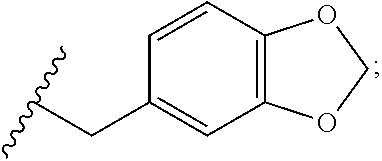
or a pharmaceutically acceptable salt thereof. In some embodiments, the compound is further defined as:

wherein: R3 is hydrogen, alkyl(C≤12), aralkyl(C≤12), substituted alkyl(C≤12), or substituted aralkyl(C≤12); or R3 and Y1 are taken together as defined below; X1 is -alkanediyl(C≤8)-heterocycloalkyl(C≤12), -alkanediyl(C≤8)-amino(C≤12), -alkanediyl(C≤8)-alkylamino(C≤12), -alkanediyl(C≤8)-dialkylamino(C≤12), heterocycloalkyl(C≤12), or a substituted version of any of these groups; and Y1 is alkyl(C≤12), cycloalkyl(C≤12), adamantyl(C≤18), aryl(C≤18), aralkyl(C≤18), acyl(C≤12), -alkanediyl(C≤8)-cycloalkyl(C≤12), -arenediyl(C≤12)-alkene(C≤8), -arenediyl(C≤12)-aryl(C≤12), -arenediyl(C≤12)-aralkyl(C≤12), -arenediyl(C≤12)-aryloxy(C≤12), or a substituted version of any of these groups; or R3 and Y1 are taken together and are alkanediyl(C≤8), alkylaminodiyl(C≤8), alkoxydiyl(C≤8), or a substituted version of any of these groups; or

or a pharmaceutically acceptable salt thereof. In some embodiments, the compound is further defined as:

wherein: R3 is hydrogen, alkyl(C≤12), substituted alkyl(C≤12), aralkyl(C≤12), or substituted aralkyl(C≤12); or R3 and Y1 are taken together as defined below; X1 is heterocycloalkyl(C≤12) or substituted heterocycloalkyl(C≤12); and Y1 is alkyl(C≤12), cycloalkyl(C≤12), adamantyl(C≤18), aryl(C≤18), aralkyl(C≤18), acyl(C≤12), -alkanediyl(C≤8)-cycloalkyl(C≤12), -arenediyl(C≤12)-alkene(C≤8), -arenediyl(C≤12)-aryl(C≤12), -arenediyl(C≤12)-aralkyl(C≤12), -arenediyl(C≤12)-aryloxy(C≤12), or a substituted version of any of these groups; or R3 and Y1 are taken together and are alkanediyl(C≤8), alkylaminodiyl(C≤8), alkoxydiyl(C≤8), or a substituted version of any of these groups; or

or a pharmaceutically acceptable salt thereof. In some embodiments, R3 is hydrogen. In some embodiments, R3 is alkyl(C≤12) or substituted alkyl(C≤12). In some embodiments, R3 is alkyl(C≤6) or substituted alkyl(C≤6). In some embodiments, R3 is alkyl(C≤6). In some embodiments, R3 is methyl. In some embodiments, R3 is aralkyl(C≤12) or substituted aralkyl(C≤12). In some embodiments, R3 is aralkyl(C≤8) or substituted aralkyl(C≤8). In some embodiments, R3 is aralkyl(C≤8). In some embodiments, R3 is benzyl. In some embodiments, X1 is heterocycloalkyl(C≤8) or substituted heterocycloalkyl(C≤8). In some embodiments, X1 is heterocycloalkyl(C≤8). In some embodiments, X1 is:

In some embodiments, Y1 is alkyl(C≤8) or substituted alkyl(C≤8). In some embodiments, Y1 is alkyl(C≤8). In some embodiments, Y1 is t-butyl. In some embodiments, Y1 is cycloalkyl(C≤12) or substituted cycloalkyl(C≤12). In some embodiments, Y1 is cycloalkyl(C≤8) or substituted cycloalkyl(C≤8). In some embodiments, Y1 is cycloalkyl(C≤8). In some embodiments, Y1 is cyclopentyl or cyclohexyl. In some embodiments, Y1 is adamantyl(C≤18) or substituted adamantyl(C≤18). In some embodiments, Y1 is adamantyl(C≤12) or substituted adamantyl(C≤12). In some embodiments, Y1 is adamantyl(C≤12). In some embodiments, Y1 is:

In some embodiments, Y1 is:

In some embodiments, Y1 is aryl(C≤18) or substituted aryl(C≤18). In some embodiments, Y1 is aryl(C≤18). In some embodiments, Y1 is aryl(C≤12). In some embodiments, Y1 is phenyl, 4-methylphenyl, 3-methylphenyl, 4-ethylphenyl, 3-ethylphenyl, 4-isopropylphenyl, 4-t-butylphenyl, 3,4-dimethylphenyl, 2,4-dimethylphenyl, or 3,5-dimethylphenyl. In some embodiments, Y1 is biphenyl(C≤12). In some embodiments, Y1 is 3-biphenyl or 4-biphenyl. In some embodiments, Y1 is substituted aryl(C≤18). In some embodiments, Y1 is substituted aryl(C≤12). In some embodiments, Y1 is 4-trifluoromethylphenyl, 3-trifluoromethylphenyl, 4-methoxyphenyl, 3-methoxyphenyl, 4-acetoxyphenyl, 3-acetoxyphenyl, 4-hydroxyphenyl, 3-hydroxyphenyl, 4-trifluoromethoxyphenyl, 2-methoxy-5-t-butylphenyl, 3,4,5-trimethoxyphenyl, 4-dimethylaminophenyl, 4-fluorophenyl, 4-chlorophenyl, 4-bromophenyl, 4-acetylphenyl, 4-nitrophenyl, 4-cyanophenyl, 3-cyanophenyl, 4-chloro-3-methylphenyl, 3-bromo-4-methylphenyl, 3-chloro-4-methylphenyl, 3-iodo-4-methylphenyl, 3-chlorophenyl, 3-acetylphenyl, 3,4-dichlorophenyl, or 3,5-dichlorophenyl. In some embodiments, Y1 is substituted biphenyl(C≤18). In some embodiments, Y1 is:

In some embodiments, Y1 is aralkyl(C≤18) or substituted aralkyl(C≤18). In some embodiments, Y1 is aralkyl(C≤12). In some embodiments, Y1 is benzyl, 4-methylbenzyl, and diphenylmethyl. In some embodiments, Y1 is substituted aralkyl(C≤12). In some embodiments, Y1 is 4-chlorobenzyl, 4-methoxybenzyl, 4-trifluoromethoxybenzyl, 3,4-dichlorobenzyl, or benzo[d][1,3]dioxolylmethyl. In some embodiments, Y1 is acyl(C≤12) or substituted acyl(C≤12). In some embodiments, Y1 is acyl(C≤12). In some embodiments, Y1 is benzoyl. In some embodiments, Y1 is -alkanediyl(C≤8)-cycloalkyl(C≤12) or substituted -alkanediyl(C≤8)-cycloalkyl(C≤12). In some embodiments, Y1 is -alkanediyl(C≤6)-cycloalkyl(C≤8). In some embodiments, Y1 is:

In some embodiments, Y1 is -arenediyl(C≤12)-alkene(C≤8) or substituted -arenediyl(C≤12)-alkene(C≤8). In some embodiments, Y1 is -arenediyl(C≤8)-alkene(C≤6). In some embodiments, the arenediyl(C≤8) of Y1 is:

In some embodiments, the alkene(C≤6) of Y1 is —CH2CHCH(CH3)2. In some embodiments, Y1 is:

In some embodiments, Y1 is substituted -arenediyl(C≤8)-alkene(C≤6). In some embodiments, the substituted arenediyl(C≤8) of Y1 is

In some embodiments, the alkene(C≤6) of Y1 is —CH2CHCH(CH3)2. In some embodiments, Y1 is:

In some embodiments, Y1 is -arenediyl(C≤12)-aryl(C≤12) or substituted -arenediyl(C≤12)-aryl(C≤12). In some embodiments, Y1 is -arenediyl(C≤8)-aryl(C≤8) or substituted -arenediyl(C≤8)-aryl(C≤8). In some embodiments, Y1 is -arenediyl(C≤8)-aryl(C≤8). In some embodiments, the arenediyl(C≤8) of Y1 is:

In some embodiments, the aryl(C≤8) of Y1 is phenyl. In some embodiments, Y1 is:

In some embodiments, Y1 is substituted -arenediyl(C≤8)-aryl(C≤8). In some embodiments, the arenediyl(C≤8) of Y1 is:

In some embodiments, the substituted arenediyl(C≤8) of Y1 is:

In some embodiments, the aryl(C≤8) of Y1 is phenyl. In some embodiments, the substituted aryl(C≤8) of Y1 is 3-methoxyphenyl, 3-acetoxyphenyl, 3-hydroxyphenyl, 3-chlorophenyl, 3-nitrophenyl, or 3-aminophenyl. In some embodiments, Y1 is:

In some embodiments, Y1 is -arenediyl(C≤12)-aralkyl(C≤12) or substituted -arenediyl(C≤12)-aralkyl(C≤12). In some embodiments, Y1 is -arenediyl(C≤8)-aralkyl(C≤8). In some embodiments, Y1 is:

In some embodiments, Y1 is -arenediyl(C≤12)-aryloxy(C≤12) or substituted -arenediyl(C≤12)-aryloxy(C≤12). In some embodiments, the arenediyl(C≤8) of Y1 is:

In some embodiments, aryloxy(C≤12) of Y1 is phenyloxy. In some embodiments, Y1 is:

In some embodiments, Y1 and R3 are taken together and are alkanediyl(C≤8), alkoxydiyl(C≤8), alkylaminodiyl(C≤8), or a substituted version thereof. In some embodiments, Y1 and R3 are taken together and are alkylaminodiyl(C≤8) or substituted alkylaminodiyl(C≤8). In some embodiments, Y1 and R3 are taken together and are:

In some embodiments, the compound is not selected from:

In some embodiments, the compound is not selected from:

In some embodiments, the compound is further defined as:


or a pharmaceutically acceptable salt thereof. In some embodiments, the compound is further defined as:

or a pharmaceutically acceptable salt thereof. In some embodiments, the compound is further defined as:

or a pharmaceutically acceptable salt thereof.

wherein: R1 is hydrogen, hydroxy, alkoxy(C≤12), alkenyloxy(C≤12), alkynyloxy(C≤12), acyloxy(C≤12), or a substituted version of any of the last four groups; R2 is hydrogen, halo, alkyl(C≤12), alkenyl(C≤12), aryl(C≤12), or a substituted version of any of the last three groups; or

wherein: R3 is hydrogen, hydroxy, alkoxy(C≤12), substituted alkoxy(C≤12), acyloxy(C≤12), or substituted acyloxy(C≤12); R4 is alkyl(C≤12), alkenyl(C≤12), aryl(C≤12), or a substituted version of any of these groups; A is alkanediyl(C≤8) or substituted alkanediyl(C≤8); and Y1 is heterocycloalkyl(C≤12), substituted heterocycloalkyl(C≤12), or —NR5R6; wherein: R5 and R6 are each independently selected from hydrogen, alkyl(C≤12), cycloalkyl(C≤12), aryl(C≤12), aralkyl(C≤12), adamantyl(C≤18), or a substituted version of any of the last five groups; provided that when R2 is meta and —CH2CHCH(CH3)2, then R1 is not —OH, —OCH2CH2N(CH3)2, or —OCH2CH2CH2N(CH3)2, and provided that when R3 is —OH and R4 is —CH2CHCH(CH3)2, then A is not —CH2CH2CH2— and Y1 is not —N(CH3)2, —N(CH3)CH2CH3, or —N(CH3)CH(CH3)2; or a pharmaceutically acceptable salt thereof. In some embodiments, the formula is further defined as:

wherein: R1 is hydrogen, hydroxy, alkoxy(C≤12), alkenyloxy(C≤12), alkynyloxy(C≤12), acyloxy(C≤12), or a substituted version of any of the last four groups; and R2 is hydrogen, halo, alkyl(C≤12), alkenyl(C≤12), aryl(C≤12), or a substituted version of any of the last three groups; provided that R2 is —CH2CHCH(CH3)2, then R1 is not —OH, —OCH2CH2N(CH3)2, or —OCH2CH2CH2N(CH3)2, or a pharmaceutically acceptable salt thereof. In some embodiments, the compound is further defined as:

wherein: R3 is hydroxy, acyloxy(C≤12), or substituted acyloxy(C≤12); A is alkanediyl(C≤8) or substituted alkanediyl(C≤8); and Y1 is heterocycloalkyl(C≤12), substituted heterocycloalkyl(C≤12), or —NR5R6; wherein: R5 and R6 are each independently selected from hydrogen, alkyl(C≤12), cycloalkyl(C≤12), aryl(C≤12), aralkyl(C≤12), adamantyl(C≤18), or a substituted version of any of the last five groups; provided that when R3 is —OH, then A is not —CH2CH2CH2— and Y1 is not —N(CH3)2, —N(CH3)CH2CH3, or —N(CH3)CH(CH3)2; or a pharmaceutically acceptable salt thereof. In some embodiments, the compound is of formula IV. In some embodiments, the compound is of formula V. In some embodiments, R1 is hydrogen. In some embodiments, R1 is hydroxy. In some embodiments, R1 is alkoxy(C≤12). In some embodiments, R1 is methoxy or n-butyloxy. In some embodiments, R1 is alkynyloxy(C≤12). In some embodiments, R1 is —OCH2C≡CH. In some embodiments, R1 is acyloxy(C≤12). In some embodiments, R1 is —OAc. In some embodiments, R2 is hydrogen. In some embodiments, R2 is halo. In some embodiments, R2 is chloro. In some embodiments, R2 is alkyl(C≤12). In some embodiments, R2 is isobutyl or isopentyl. In some embodiments, R2 is alkenyl(C≤12). In some embodiments, R2 is —CH2CHCH2 or —CH2CHCH(CH3)2. In some embodiments, R2 is aryl(C≤12). In some embodiments, R2 is phenyl. In some embodiments, R2 is substituted aryl(C≤12). In some embodiments, R2 is 3-hydroxyphenyl, 3-acetoxyphenyl, or 3-methoxyphenyl. In some embodiments, R3 is hydroxy. In some embodiments, R3 is acyloxy(C≤12). In some embodiments, R3 is —OAc. In some embodiments, R4 is alkenyl(C≤12). In some embodiments, R4 is —CH2CHCH(CH3)2. In some embodiments, A is alkanediyl(C≤12). In some embodiments, A is —CH2—, —CH2CH2—, or —CH2CH2CH2—. In some embodiments, A is —CH2CH2CH2—. In some embodiments, Y1 is heterocycloalkyl(C≤12). In some embodiments, Y1 is:

In some embodiments, Y1 is —NR5R6; wherein: R5 and R6 are each independently selected from hydrogen, alkyl(C≤12), cycloalkyl(C≤12), aryl(C≤12), aralkyl(C≤12), adamantyl(C≤18), or a substituted version of any of the last five groups. In some embodiments, R5 is hydrogen. In some embodiments, R5 is alkyl(C≤12) or substituted alkyl(C≤12). In some embodiments, R5 is alkyl(C≤12). In some embodiments, R5 is methyl, ethyl, propyl, isobutyl, isopropyl, or t-butyl. In some embodiments, R5 is substituted alkyl(C≤12). In some embodiments, R5 is —CH2CO2H, —CH2CO2Me, —CH2C(O)NH2, or —CH2CH2OH. In some embodiments, R5 is cycloalkyl(C≤12).
In some embodiments, is cyclohexyl or

In some embodiments, R5 is aryl(C≤12) or substituted aryl(C≤12). In some embodiments, R5 is phenyl. In some embodiments, R5 is aralkyl(C≤12) or substituted aralkyl(C≤12). In some embodiments, R5 is benzyl, 1-methyl-1-phenylethyl, or 1-phenylmethyl. In some embodiments, R5 is adamantyl(C≤12) or substituted adamantyl(C≤12). In some embodiments, R5 is adamantyl. In some embodiments, R6 is hydrogen. In some embodiments, R6 is alkyl(C≤12) or substituted alkyl(C≤12). In some embodiments, R6 is alkyl(C≤12). In some embodiments, R6 is methyl, ethyl, propyl, or isopropyl. In some embodiments, R5 and R6 are not both hydrogen. In some embodiments, the compound is not selected from:

In some embodiments, the compound is further defined as:


or a pharmaceutically acceptable salt thereof.
 |
| R1 | R2 |
| OCH3 | A |
| n-BuO | A |
 |
A |
| OH | iso-butyl |
| OAc |
 |
| OAc | H |
| H | A |
| H | H |
| OAc | Cl |
| OH |
 |
| OH | H |
| OH | Cl. |
 |
 |
| R1 | R2 |
| OAc | B |
| OCH3 | C |
| OH | B |
| OCH3 | D. |
 |
| R | R′ | |
 |
OAc | |
 |
OAc | |
 |
OAc | |
 |
OAc | |
 |
H | |
 |
H | |
 |
H | |
 |
H | |
 |
H | |
 |
H | |
 |
H | |
 |
H | |
 |
H. | |
 |
| R1 | R2 |
| CH2CH3 | H |
| CH2CH3 | CH2CH3 |
| CH2CH2CH3 | H |
| CH2CH2CH3 | CH2CH2CH3 |
| CH2CH(CH3)2 | H |
| CH(CH3)2 | H |
| CH(CH3)2 | CH(CH3)2 |
| C(CH3)3 | H |
| C(CH3)3 | CH3 |
| CH2COOMe | H |
| CH2COOH | H |
| CH2CONH2 | H |
| CH2CH2OH | H |
| Cyclohexyl | H |
| Cyclohexyl | CH3 |
| Phenyl | H |
| Phenyl | CH3 |
| Benzyl | H |
| (R)-1-phenylethyl | H |
| Cumentyl | H |
| Benzyl | CH3 |
 |
H |
| Adamantyl | H. |
 |
| R |
| H |
| p-CH3 |
| p-CH2CH3 |
| p-CH(CH3)2 |
| p-C(CH3)3 |
| m-CH3 |
| m-CH2CH3 |
| p-CF3 |
| m-CF3 |
| 3,4- |
| 2,4-dimethyl |
| 3,5-dimethyl |
| p-OCH3 |
| m-OCH3 |
| p-OAc |
| p-OH |
| p-OCF3 |
| m-OAc |
| m-OH |
| 2-OMe-5-t-Bu |
| 3,4,5-trimethoxyl |
| p-N-dimethylamine |
| p-phenyl |
| p-phenoxyl |
| m-phenoxyl |
| p-F |
| p-Cl |
| p-Br |
| p-NO2 |
| p-CN |
| p-COCH3 |
| m-Cl |
| m-COCH3 |
| 3,4-dichloro |
| 3,5-dichloro. |
 |
| R |
| OAc |
| OH |
| OMe |
| H. |
 |
| R1 | R2 |
| OMe | OMe |
| OMe | OAc |
| OMe | OH |
| OMe | H |
| H | OMe |
| H | H |
| CH3 | OMe |
| CH3 | Cl |
| OMe | Cl |
| OMe | NO2 |
| OMe | NH2. |
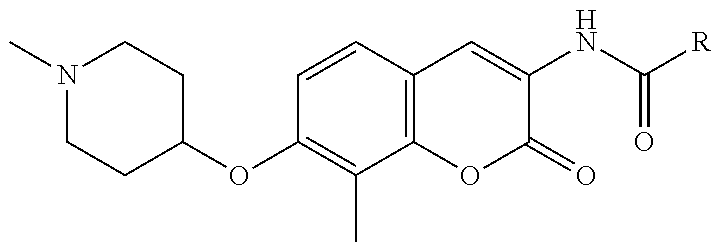 |
| R |
 |
 |
 |
 |
 |
 |
 |
 |
 |
 |
 |
 |
 |
-
- A) providing the novobiocin analog of the present disclosure; and
- B) inhibiting Hsp90 with the novobiocin analog.
-
- A) providing the novobiocin analog of the present disclosure; and
- B) administering the novobiocin analog in a therapeutically effective amount to a subject so as to treat or inhibit cancer.
-
- A) using a three-dimensional quantitative structure-activity relationship (3D-QSAR) of novobiocin and/or one or more derivatives thereof in order to determine chemical structure having a desired property or activity; and
- B) selecting a novobiocin analog to further derivatize to obtain the novobiocin analog of the present disclosure.

or a pharmaceutically acceptable salt thereof.


includes

And it is understood that no one such ring atom forms part of more than one double bond. Furthermore, it is noted that the covalent bond symbol “—”, when connecting one or two stereogenic atoms, does not indicate any preferred stereochemistry. Instead, it covers all stereoisomers as well as mixtures thereof. The symbol “


for methyl) indicates a point of attachment of the group. It is noted that the point of attachment is typically only identified in this manner for larger groups in order to assist the reader in unambiguously identifying a point of attachment. The symbol “


then R may replace any hydrogen atom attached to any of the ring atoms, including a depicted, implied, or expressly defined hydrogen, so long as a stable structure is formed. When a group “R” is depicted as a “floating group” on a fused ring system, as for example in the formula:

then R may replace any hydrogen attached to any of the ring atoms of either of the fused rings unless specified otherwise. Replaceable hydrogens include depicted hydrogens (e.g., the hydrogen attached to the nitrogen in the formula above), implied hydrogens (e.g., a hydrogen of the formula above that is not shown but understood to be present), expressly defined hydrogens, and optional hydrogens whose presence depends on the identity of a ring atom (e.g., a hydrogen attached to group X, when X equals —CH—), so long as a stable structure is formed. In the example depicted, R may reside on either the 5-membered or the 6-membered ring of the fused ring system. In the formula above, the subscript letter “y” immediately following the group “R” enclosed in parentheses, represents a numeric variable. Unless specified otherwise, this variable can be 0, 1, 2, or any integer greater than 2, only limited by the maximum number of replaceable hydrogen atoms of the ring or ring system.

is a non-limiting example of cycloalkanediyl group. A “cycloalkane” refers to the compound H—R, wherein R is cycloalkyl as this term is defined above. The group “adamantyl” is a subset of cycloalkyl wherein the cycloalkyl group is defined by the structure:

When any of these terms is used with the “substituted” modifier one or more hydrogen atom has been independently replaced by —OH, —F, —Cl, —Br, —I, —NH2, —NO2, —CO2H, —CO2CH3, —CN, —SH, —OCH3, —OCH2CH3, —C(O)CH3, —NHCH3, —NHCH2CH3, —N(CH3)2, —C(O)NH2, —C(O)NHCH3, —C(O)N(CH3)2, —OC(O)CH3, —NHC(O)CH3, —S(O)2OH, or —S(O)2NH2. A “substituted adamantyl” group is a group with the adamantyl carbon ring structure and one or more hydrogen has been replaced as defined above.

An “arene” refers to the compound H—R, wherein R is aryl as that term is defined above. Benzene and toluene are non-limiting examples of arenes. The term “biphenyl” is a subset of the term “aryl” wherein the group is defined by the aromatic ring structure:

When any of these terms are used with the “substituted” modifier one or more hydrogen atom has been independently replaced by —OH, —F, —Cl, —Br, —I, —NH2, —NO2, —CO2H, —CO2CH3, —CN, —SH, —OCH3, —OCH2CH3, —C(O)CH3, —NHCH3, —NHCH2CH3, —N(CH3)2, —C(O)NH2, —C(O)NHCH3, —C(O)N(CH3)2, —OC(O)CH3, —NHC(O)CH3, —S(O)2OH, or —S(O)2NH2.

When these terms are used with the “substituted” modifier one or more hydrogen atom has been independently replaced by —OH, —F, —Cl, —Br, —I, —NH2, —NO2, —CO2H, —CO2CH3, —CN, —SH, —OCH3, —OCH2CH3, —C(O)CH3, —NHCH3, —NHCH2CH3, —N(CH3)2, —C(O)NH2, —C(O)NHCH3, —C(O)N(CH3)2, —OC(O)CH3, —NHC(O)CH3, —S(O)2OH, or —S(O)2NH2.

When these terms are used with the “substituted” modifier one or more hydrogen atom has been independently replaced by —OH, —F, —Cl, —Br, —I, —NH2, —NO2, —CO2H, —CO2CH3, —CN, —SH, —OCH3, —OCH2CH3, —C(O)CH3, —NHCH3, —NHCH2CH3, —N(CH3)2, —C(O)NH2, —C(O)NHCH3, —C(O)N(CH3)2, —OC(O)CH3, —NHC(O)CH3, —S(O)2OH, or —S(O)2NH2.


| TABLE 1 |
| Modified Benzamide Coumarin Derivatives |
| Compound ID | Structure | SKBr3 (μM) | MCF-7 (μM) |
| 2 |
 |
0.76 ± 0.17 | 1.09 ± 0.10 |
| 16 |
 |
1.41 ± 0.20 | 1.58 ± 0.09 |
| 17 |
 |
1.40 ± 0.07 | 1.44 ± 0.05 |
| 18 |
 |
1.40 ± 0.11 | 1.12 ± 0.16 |
| 19 |
 |
0.60 ± 0.01 | 1.25 ± 0.39 |
| 20 |
 |
3.46 ± 0.02 | 5.01 ± 0.01 |
| 21a |
 |
2.26 ± 0.12 | 2.00 ± 0.18 |
| 21b |
 |
1.67 ± 0.20 | 1.62 ± 0.04 |
| 21c |
 |
1.68 ± 0.12 | 2.10 ± 0.08 |
| 21d |
 |
11.5 ± 2.0 | 11.7 ± 1.0 |
| 21e |
 |
3.50 ± 0.01 | 1.61 ± 0.16 |
| 22a |
 |
2.43 ± 0.04 | 2.17 ± 0.11 |
| 22b |
 |
0.84 ± 0.18 | 1.43 ± 0.08 |
| 22e |
 |
2.30 ± 0.57 | 1.48 ± 0.14 |
| TABLE 2 |
| Modified Benzamide and Biphenylamide Derivatives (in μM) |
 |
 |
| Compound ID | Structure | SKBr3 | MCF-7 |
| 2 |
 |
0.76 ± 0.17 | 1.09 ± 0.10 |
| 23 |
 |
0.33 ± 0.00 | 0.72 ± 0.08 |
| 24 |
 |
0.25 ± 0.02 | 0.46 ± 0.05 |
| 25 |
 |
0.21 ± 0.00 | 0.47 ± 0.081 |
| 32a |
 |
0.92 ± 0.06 | 0.91 ± 0.00 |
| 32b |
 |
0.29 ± 0.01 | 0.36 ± 0.06 |
| 33a |
 |
0.86 ± 0.16 | 0.81 ± 0.14 |
| 33b |
 |
0.31 ± 0.04 | 0.38 ± 0.08 |
| TABLE 3 |
| Anti-proliferative Activities of Cycloamine Analogues |
 |
| R | R′ | SKBr3 (μM) | MCF-7 (μM) |
 |
H | 0.76 ± 0.17 | 1.09 ± 0.10 |
 |
OAc | 0.74 ± 0.01 | 1.65 ± 0.11 |
 |
OAc | 0.88 ± 0.09 | 1.88 ± 0.45 |
 |
OAc | 0.64 ± 0.06 | 0.71 ± 0.03 |
 |
OAc | 0.62 ± 0.04 | 0.82 ± 0.07 |
 |
H | 0.64 ± 0.06 | 0.71 ± 0.03 |
 |
H | 1.30 ± 0.63 | 2.64 ± 0.45 |
 |
H | 0.60 ± 0.01 | 0.79 ± 0.10 |
 |
H | 0.92 ± 0.56 | 1.55 ± 0.04 |
 |
H | 1.01 ± 0.03 | 1.20 ± 0.12 |
 |
H | 0.82 ± 0.02 | 0.93 ± 0.21 |
 |
H | >50 | >50 |
 |
H | >50 | >50 |
 |
H | 0.72 ± 0.01 | 0.99 ± 0.04 |
| TABLE 4 |
| Anti-proliferative Activities of Alkylamino Analogues |
 |
| Com- | ||||
| pound | ||||
| ID | R1 | R2 | SKBr3 (μM) | MCF-7 (μM) |
| CH3 | CH3 | 0.44 ± 0.02 | 1.35 ± 0.38 | |
| 68a | CH2CH3 | H | 0.72 ± 0.34 | 0.98 ± 0.35 |
| 68b | CH2CH3 | CH3 | 0.73 ± 0.06 | 2.19 ± 0.50 |
| 68c | CH2CH3 | CH2CH3 | 4.90 ± 0.42 | 6.39 ± 0.04 |
| 68d | CH2CH2CH3 | H | 0.99 ± 0.03 | 0.98 ± 0.00 |
| 68e | CH2CH2CH3 | CH2CH2CH3 | >50 | >50 |
| 68f | CH2CH(CH3)2 | H | 1.03 ± 0.02 | 1.32 ± 0.06 |
| 68g | CH(CH3)2 | H | 0.75 ± 0.26 | 0.74 ± 0.16 |
| 68h | CH(CH3)2 | CH3 | 0.57 ± 0.13 | 1.05 ± 0.06 |
| 68i | CH(CH3)2 | CH(CH3)2 | 1.60 ± 0.02 | 1.31 ± 0.39 |
| 68j | C(CH3)3 | H | 0.66 ± 0.06 | 0.95 ± 0.10 |
| 68k | C(CH3)3 | CH3 | 0.88 ± 0.10 | 1.14 ± 0.11 |
| 68l | CH2COOMe | H | 1.06 ± 0.11 | 2.82 ± 0.27 |
| 68m | CH2COOH | H | 7.57 ± 2.86 | 18.11 ± 5.35 |
| 68n | CH2CONH2 | H | 2.29 ± 0.47 | 1.46 ± 0.35 |
| 68o | CH2CH2OH | H | 0.61 ± 0.06 | 1.56 ± 0.09 |
| TABLE 5 |
| Anti-proliferative Activity of Alkylether Derivatives with Cyclic |
| N-Substitutions |
| Com- | ||||
| pound | ||||
| ID | R1 | R2 | SKBr3 (μM) | MCF-7 (μM) |
| 70a | Cyclohexyl | H | 0.66 ± 0.12 | 1.07 ± 0.35 |
| 70b | Cyclohexyl | CH3 | 0.97 ± 0.03 | 1.08 ± 0.07 |
| 70c | Phenyl | H | >50 | >50 |
| 70d | Phenyl | CH3 | >50 | >50 |
| 70e | Benzyl | H | 0.47 ± 0.16 | 0.91 ± 0.01 |
| 70f | (R)-1-phenylethyl | H | 1.00 ± 0.31 | 1.45 ± 0.20 |
| 70g | Cumenyl | H | 0.96 ± 0.01 | 1.07 ± 0.01 |
| 70h | Benzyl | CH3 | 10.73 ± 0.49 | 11.52 ± 4.16 |
| 70i |
 |
H | 0.77 ± 0.13 | 1.03 ± 0.12 |
| 70j | Adamantyl | H | 0.31 ± 0.04 | 0.32 ± 0.03 |
| TABLE 6 |
| Substituted Phenyl Urea Derivatives (IC50 in μM) |
 |
| Breast Cancer | Prostate Cancer | HSNCC | Tri-Neg | Thyroid | Normal |
| R | SKBr3 | MCF-3 | HCT-116 | PC-3 | A-549 | MDA1986 | JMAR | MDAMB231 | DRO81-1 | BCPAP | MRC5 | HMLE |
| H | 0.77 ± | 0.89 ± | 0.44 ± | 0.25 ± | 0.24 ± | 1.3 | 16.6 | 2.5 | 15.1 | 3.6 | 3.7 | |
| 0.01 | 0.00 | 0.01 | 0.01 | 0.00 | ||||||||
| p-CH3 | 0.27 ± | 0.29 ± | 0.059 ± | 0.81 ± | 0.017 ± | 3.2 | 3.5 | 0.91 | 16.3 | 6.6 | 3.3 | |
| 0.04 | 0.02 | 0.010 | 0.42 | 0.001 | ||||||||
| p-CH2CH3 | 0.58 ± | 0.56 ± | 0.53 ± | 0.41 ± | 0.49 ± | 1.4 | 1.03 | 0.69 | 0.29 | 4.36 | 2.6 | 1.2 |
| 0.16 | 0.04 | 0.15 | 0.00 | 0.09 | ||||||||
| p- | 0.67 ± | 0.82 ± | 1.06 ± | 0.13 ± | 0.16 ± | 1.11 | 0.88 | 0.61 | 0.3 | 1.9 | 6.4 | |
| CH(CH3)2 | 0.12 | 0.23 | 1.18 | 0.01 | 0.03 | |||||||
| p-C(CH3)3 | 0.93 ± | 0.96 ± | 0.21 ± | 0.14 ± | 0.092 ± | 0.57 | 0.49 | 0.5 | 0.71 | 1.8 | 14.5 | |
| 0.02 | 0.08 | 0.06 | 0.01 | 0.028 | ||||||||
| m-CH3 | 0.84 ± | 0.55 ± | 1.11 ± | 0.84 ± | 1.21 ± | 2.02 | 1.8 | 3.5 | 0.54 | 3.54 | 4.3 | 3.1 |
| 0.12 | 0.06 | 0.03 | 0.09 | 0.05 | ||||||||
| m-CH2CH3 | 0.44 ± | 0.50 ± | 0.34 ± | 0.41 ± | 0.40 ± | 1.32 | 0.63 | 1.9 | 0.67 | 5.59 | 5.3 | >25 |
| 0.05 | 0.01 | 0.05 | 0.00 | 0.02 | ||||||||
| p-CF3 | 0.35 ± | 0.47 ± | 0.80 ± | 0.060 ± | 0.13 ± | 0.9 | 3.6 | 0.43 | 0.64 | 3.1 | 15.5 | |
| 0.04 | 0.03 | 0.59 | 0.012 | 0.00 | ||||||||
| m-CF3 | 0.26 ± | 0.28 ± | N/A | 0.043 ± | 0.046 | 0.15 | 1.7 | 0.55 | 7.3 | 1.6 | 16.8 | |
| 0.08 | 0.04 | 0.00 | ||||||||||
| 3,4- | 0.31 ± | 0.33 ± | 0.066 ± | 1.33 ± | 0.063 ± | 1.3 | 1.7 | 1.9 | 8.1 | 2.7 | 0.9 | |
| dimethyl | 0.09 | 0.05 | 0.019 | 0.02 | 0.028 | |||||||
| 2,4- | 3.79 ± | 1.11 ± | 0.77 ± | 0.27 ± | 0.43 ± | 1.9 | 1.1 | 2.6 | 2.3 | 3.6 | >25 | |
| dimethyl | 0.22 | 0.02 | 0.44 | 0.13 | 0.07 | |||||||
| 3,5- | 0.30 ± | 0.34 ± | 0.17 ± | 1.35 ± | 0.052 ± | 0.09 | 3.4 | 0.65 | 8.4 | 5.9 | 13.8 | |
| dimethyl | 0.03 | 0.04 | 0.04 | 0.18 | 0.002 | |||||||
| p-OCH3 | 0.86 ± | 0.96 ± | 0.25 ± | 0.52 ± | 1.09 ± | 2.6 | 8.4 | 2.4 | 29 | 2.7 | 0.74 | |
| 0.07 | 0.35 | 0.07 | 0.20 | 0.00 | ||||||||
| m-OCH3 | 1.15 ± | 0.96 ± | ||||||||||
| 0.30 | 0.01 | |||||||||||
| p-OAc | 1.48 ± | 1.72 ± | 2.61 ± | 1.15 ± | 1.51 ± | 1.98 | 3.5 | 0.85 | 3.7 | 5.53 | 15.5 | 15.9 |
| 0.16 | 0.10 | 1.14 | 0.24 | 0.24 | ||||||||
| p-OH | 1.38 ± | 1.34 ± | ||||||||||
| 0.06 | 0.14 | |||||||||||
| p-OCF3 | 0.41 ± | 0.40 ± | 0.27 ± | 0.16 ± | 0.31 ± | 0.87 | 3.6 | 0.69 | 0.23 | 0.87 | 3.3 | 4.1 |
| 0.06 | 0.16 | 0.14 | 0.02 | 0.08 | ||||||||
| m-OAc | 2.37 ± | 1.41 ± | 12.1 ± | 1.91 ± | 1.91 ± | 6.82 | 3.85 | 4.1 | 2.7 | 2.82 | >25 | 13.6 |
| 0.85 | 0.13 | 0.48 | 0.50 | 0.50 | ||||||||
| m-OH | 2.37 ± | 2.73 ± | >100 | 10.9 ± | 10.9 ± | 21.9 | 6.5 | 1.3 | >25 | 0.27 | >25 | 11.9 |
| 0.33 | 0.70 | 7.76 | 7.76 | |||||||||
| 2-OMe- | 3.87 ± | 1.53 ± | 1.24 ± | 3.82 ± | 0.84 ± | 0.09 | 3.8 | 0.91 | 6.1 | 2.65 | 6.1 | |
| 5-t-Bu | 0.04 | 0.22 | 0.01 | 0.24 | 0.47 | |||||||
| 3,4,5- | 4.26 ± | 1.30 ± | 209 | 4.50 ± | 13.0 ± | 9.1 | 1.7 | 2.9 | 14.7 | 1.32 | >25 | >25 |
| tri- | 0.39 | 0.26 | 0.50 | 0.40 | ||||||||
| methoxyl | ||||||||||||
| p-N- | 1.11 ± | 1.00 ± | 9.34 ± | 7.96 ± | 2.70 ± | 17.5 | 0.77 | 1.4 | >25 | 0.74 | 14.4 | 0.96 |
| dimethyl- | 0.23 | 0.01 | 4.81 | 9.51 | 1.51 | |||||||
| amine | ||||||||||||
| p- | 0.36 ± | 0.70 ± | 0.15 ± | 0.052 ± | 0.066 ± | 0.85 | 0.93 | 0.37 | 0.27 | 2 | 3.6 | |
| phenyl | 0.04 | 0.16 | 0.01 | 0.001 | 0.022 | |||||||
| p- | 0.40 ± | 0.70 ± | 0.24 ± | 0.15 ± | 0.18 ± | 6 | 5.3 | 2.2 | 1.8 | 11.3 | >25 | |
| phenoxyl | 0.11 | 0.16 | 0.00 | 0.00 | 0.03 | |||||||
| m- | 0.19 ± | 0.28 ± | N/A | 2.16 ± | 1.02 ± | 0.57 | 2.4 | 0.28 | 3.1 | 2.2 | 5.2 | |
| phenoxyl | 0.07 | 0.09 | 0.00 | 0.35 | ||||||||
| p-F | 0.48 ± | 0.96 ± | 0.061 ± | 3.32 ± | 1.06 ± | 0.01 | 8.6 | 0.05 | 19.9 | >25 | >25 | |
| 0.03 | 0.06 | 0.002 | 0.57 | 1.21 | ||||||||
| p-Cl | 0.17 ± | 0.36 ± | 0.42 ± | 2.30 ± | 0.16 ± | >25 | 6.1 | >25 | 15.8 | >25 | >25 | |
| 0.01 | 0.01 | 0.04 | 0.48 | 0.13 | ||||||||
| p-Br | 0.65 ± | 1.04 ± | 0.24 ± | 0.18 ± | 0.11 ± | 3.5 | 3.6 | 2.6 | 3.5 | 5.5 | 6 | |
| 0.04 | 0.04 | 0.09 | 0.05 | 0.01 | ||||||||
| p-NO2 | 0.58 ± | 4.24 ± | 2.83 ± | 1.06 ± | 0.95 ± | 6.6 | 7.3 | 2.1 | 11.5 | >25 | >25 | |
| 0.04 | 0.31 | 1.24 | 0.31 | 0.25 | ||||||||
| p-CN | 0.37 ± | 0.43 ± | 0.57 ± | 0.048 ± | 0.043 ± | 1.62 | 3.7 | 0.44 | 0.28 | 5.7 | 4 | |
| 0.08 | 0.11 | 0.70 | 0.001 | 0.003 | ||||||||
| p-COCH3 | 1.52 ± | 1.72 ± | 0.25 ± | 2.75 ± | 0.24 ± | 3.4 | 11.9 | 0.75 | 13.3 | 7.7 | 8 | |
| 0.01 | 0.03 | 0.11 | 1.53 | 0.09 | ||||||||
| m-Cl | 0.30 ± | 0.52 ± | 0.22 ± | 1.82 ± | 0.063 ± | 1.7 | 1.7 | 0.57 | 3.8 | 3.1 | 22 | |
| 0.06 | 0.02 | 0.07 | 0.57 | 0.017 | ||||||||
| m-COCH3 | 0.83 ± | 1.17 ± | 0.72 ± | 1.23 ± | 0.54 ± | 21 | 15.7 | 0.61 | 13.6 | 0.27 | >25 | 1.9 |
| 0.04 | 0.54 | 0.09 | 0.17 | 0.05 | ||||||||
| 3,4- | 0.64 ± | 1.78 ± | 17.0 ± | 2.04 ± | 1.82 ± | 2.6 | 6.7 | 2.9 | 13.2 | 2.1 | 1.5 | |
| dichloro | 0.16 | 0.62 | 6.52 | 0.00 | 0.73 | |||||||
| 3,5- | 0.51 ± | 0.49 ± | 1.21 ± | 0.16 ± | 0.20 ± | 7.5 | 6.2 | 3.6 | 0.77 | >25 | >25 | |
| dichloro | 0.02 | 0.01 | 0.35 | 0.01 | 0.04 | |||||||
| TABLE 7 |
| Prenylated Phenyl Urea Derivatives (IC50 in μM) |
 |
| Breast Cancer | Prostate Cancer | HSNCC | Tri-Neg | Thyroid | Normal |
| R | SKBr3 | MCF-3 | HCT-116 | PC-3 | A-549 | MDA1986 | JMAR | MDAMB231 | DRO81-1 | BCPAP | MRC5 | HMLE |
| H | 0.77 ± | 0.89 ± | 0.44 ± | 0.25 ± | 0.24 ± | 1.3 | 16.6 | 2.5 | 15.1 | 3.6 | 3.7 | |
| 0.01 | 0.00 | 0.01 | 0.01 | 0.00 | ||||||||
| OAc | 0.54 ± | 0.49 ± | 0.34 ± | 0.38 ± | 0.38 ± | 1.32 | 0.87 | 0.75 | 0.53 | 0.129 | 1.8 | 7.2 |
| 0.13 | 0.04 | 0.01 | 0.00 | 0.00 | ||||||||
| OH | 0.39 ± | 0.37 ± | 0.39 ± | 0.29 ± | 0.25 ± | 1.36 | 0.91 | 0.66 | 1.1 | 0.99 | 4.02 | 4.8 |
| 0.06 | 0.05 | 0.10 | 0.07 | 0.03 | ||||||||
| OMe | 0.51 ± | 0.37 ± | 0.30 ± | 0.23 ± | 0.23 ± | 0.85 | 0.8 | 0.83 | 0.21 | 1.34 | 2.64 | 6.5 |
| 0.06 | 0.08 | 0.11 | 0.00 | 0.00 | ||||||||
| H | 0.73 ± | 0.55 ± | ||||||||||
| 0.05 | 0.02 | |||||||||||
| TABLE 8 |
| Activity of Biphenyl Urea Derivatives (IC50 in μM) |
 |
| Breast Cancer | Prostate Cancer | HSNCC | Tri-Neg | Thyroid | Normal |
| R1 | R2 | SKBr3 | MCF-3 | HCT-116 | PC-3 | A-549 | MDA1986 | JMAR | MDAMB231 | DRO81-1 | BCPAP | MRC5 | HMLE |
| OMe | OMe | 0.17 ± | 0.20 ± | 0.46 ± | 0.47 ± | 0.47 ± | 1.39 | 0.5 | 0.61 | 0.48 | 0.39 | 4.3 | 1.6 |
| 0.07 | 0.03 | 0.04 | 0.08 | 0.08 | |||||||||
| OMe | OAc | 0.26 ± | 0.27 ± | 3.39 ± | 1.04 ± | 0.54 ± | 0.85 | 2.2 | 0.39 | 0.26 | 0.016 | 3.1 | 1 |
| 0.02 | 0.03 | 0.45 | 0.03 | 0.31 | |||||||||
| OMe | OH | 0.39 ± | 0.29 ± | 0.42 ± | 0.60 ± | 0.41 ± | 2.8 | 0.96 | 0.095 | 1.2 | 1.94 | 9.8 | 3.7 |
| 0.10 | 0.01 | 0.22 | 0.21 | 0.05 | |||||||||
| OMe | H | 0.45 ± | 0.93 ± | ||||||||||
| 0.02 | 0.04 | ||||||||||||
| H | OMe | 0.44 ± | 0.37 ± | ||||||||||
| 0.02 | 0.06 | ||||||||||||
| H | H | 0.38 ± | 0.32 ± | ||||||||||
| 0.06 | 0.02 | ||||||||||||
| CH3 | OMe | 0.25 ± | 0.21 ± | ||||||||||
| 0.01 | 0.04 | ||||||||||||
| CH3 | Cl | 0.44 ± | 0.50 ± | ||||||||||
| 0.02 | 0.01 | ||||||||||||
| OMe | Cl | 0.13 ± | 0.47 ± | ||||||||||
| 0.11 | 0.05 | ||||||||||||
| OMe | NO2 | 0.16 ± | 0.36 ± | ||||||||||
| 0.01 | 0.06 | ||||||||||||
| OMe | NH2 | 0.36 ± | 0.67 ± | ||||||||||
| 0.01 | 0.09 | ||||||||||||
| TABLE 9 |
| Activity in Cancer Cell of Non-Aryl Ureas (IC50 in μM) |
 |
| Breast Cancer | Prostate Cancer | HSNCC | Tri-Neg | Thyroid |
| MCF- | HCT- | A- | MDA | MDAM- | DRO81- | ||||||
| R | SKBr3 | 3 | 116 | PC-3 | 549 | 1986 | | B231 | 1 | BCPAP | |
 |
2.39 ± 0.35 | 3.83 ± 0.33 | 7.87 ± 7.97 | 2.16 ± 1.17 | 1.24 ± 0.94 | >25 | >25 | 0.65 | 8.8 | ||
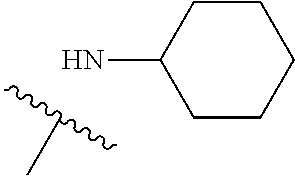 |
3.83 ± 0.33 | 3.84 ± 0.31 | 9.21 ± 6.54 | 1.67 ± 0.00 | >100 | >25 | >25 | >25 | >25 | ||
 |
0.36 ± 0.18 | 0.64 ± 0.18 | 0.082 ± 0.035 | 0.019 ± 0.003 | 0.010 ± 0.010 | 5.9 | 6.2 | 3 | 18.7 | ||
 |
3.96 ± 0.14 | 1.77 ± 0.26 | 12.1 ± 0.61 | 4.54 ± 0.46 | 4.85 ± 0.29 | 21.5 | 2.1 | 3.8 | >25 | 2.57 | |
 |
>50 | 32.10 ± 4.78 | >100 | 115 | 18.3 ± 12.0 | >25 | >25 | >25 | >25 | >25 | |
 |
0.71 ± 0.10 | 0.58 ± 0.13 | 0.66 ± 0.15 | 0.87 ± 0.33 | 0.28 ± 0.03 | 14.4 | >25 | 7.9 | 14.6 | 0.045 | |
 |
6.70 ± 0.21 | 3.80 ± 0.16 | 183 | 28.7 ± 24.6 | 138 | 13.4 | 7.5 | >25 | 19.5 | 0.0084 | |
 |
1.21 ± 0.02 | 3.36 ± 0.16 | 5.95 ± 2.92 | 1.27 ± 0.09 | 3.57 ± 0.55 | 3.65 | 0.7 | 2.8 | 1.9 | 1.81 | |
 |
0.49 ± 0.07 | 0.54 ± 0.01 | 0.96 ± 0.16 | 1.12 ± 0.05 | 0.87 ± 0.21 | 7.1 | 5.9 | 4.3 | 1.3 | 5.76 | |
 |
1.04 ± 0.07 | 1.05 ± 0.07 | |||||||||
 |
0.68 ± 0.06 | 0.65 ± 0.11 | |||||||||
 |
0.56 ± 0.07 | 0.55 ± 0.02 | |||||||||
 |
0.23 ± 0.08 | 0.38 ± 0.04 | |||||||||
| Normal |
| R | MRC5 | HMLE |
 |
>25 | >25 |
 |
>25 | >25 |
 |
3.8 | >25 |
 |
21.1 | >25 |
 |
>25 | >25 |
 |
20.9 | >25 |
 |
>25 | >25 |
 |
20.9 | 7.1 |
 |
15.5 | 1.6 |
 |
||
 |
||
 |
||
 |
||
| TABLE 10 |
| Modified Initial Novobiocin Analog Activity |
 |
 |
 |
 |
| SkBr3, IC50 [μM] | |
| 1 | 10.86 ± 0.47 |
| 2 | 0.76 ± 0.17 |
| 3 | 7.5 ± 1.0 |
| 4 | 2.9 ± 1.2 |
| 5 | 13.9 ± 1.2 |
| 6 | 1.34 ± 0.22 |
| 7 | 0.31 ± 0.00 |
| 8 | 0.17 ± 0.01 |
| 9 | 0.27 ± 0.04 |
| 10 | 0.31 ± 0.09 |
| 11 | 0.21 ± 0.06 |
   |
|


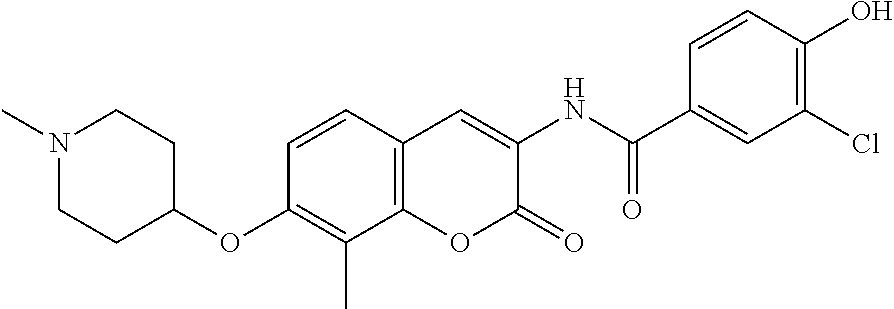


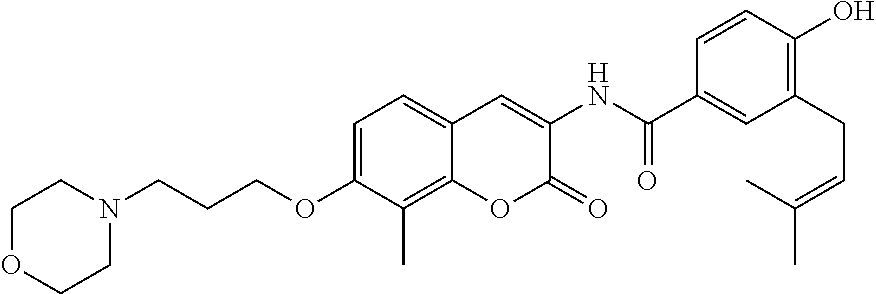


- Burlison, et al., J. Am. Chem. Soc., 128:15529, 2006.
- Burlison, et al., J. Org. Chem., 73:2130, 2008.
- Conde, et al., Biochem. Cell Biol., 87:845-851, 2009.
- Cox and Johnson, Methods Mol. Biol. (New York City, N.Y.), 787:45, 2011.
- Donnelly, et al., J. Org. Chem., 73:8901, 2008.
- Donnelly, et al., Med. Chem. Commun., 1:165, 2010.
- Eskew, et al., BMC Cancer, 11:468, 2011.
- Hanahan and Weinberg, Cell, 144:646-674, 2011.
- Handbook of Pharmaceutical Salts: Properties, and Use, Stahl and Wermuth Eds.), Verlag Helvetica Chimica Acta, 2002.
- March's Advanced Organic Chemistry: Reactions, Mechanisms, and Structure, 2007.
- Marcu, et al., J. Biol. Chem., 275:37181, 2000.
- Marcu, et al., J. Natl. Cancer Inst., 92:242-248, 2000.
- Neckers and Workman, Clin. Cancer Res., 1:64-76, 2012.
- Robson and James, Drug Discovery Today, 17:544, 2012.
- Shelton, et al., Mol. Pharmacol., 76:1314-1322, 2009.
- Taipale, et al., Nat. Rev. Mol. Cell. Biol., 11:515-528, 2010.
- Tran, et al., BMC Cancer, 10:276, 2010.
- Whitesell, et al., Curr. Mol. Med., 12:11108-1124, 2012.
- Yu, et al., J. Am. Chem. Soc., 127:12778, 2005.
- Zhang, et al., J. Proteome Research, 11:2581, 2012.
- Zhao and Blagg, ACS Med. Chem. Lett., 1:311, 2010.
- Zhao, et al., J. Med. Chem., 2011.
- Zhao, et al., Bioorg. Med. Chem. Lett., 21:2659-2664, 2011.
- Zhao, et al., ACS Med. Chem. Lett., 3:327-331, 2012.
- Zhao, et al., ACS Med. Chem. Lett., 4:57-62, 2013.
Claims (17)


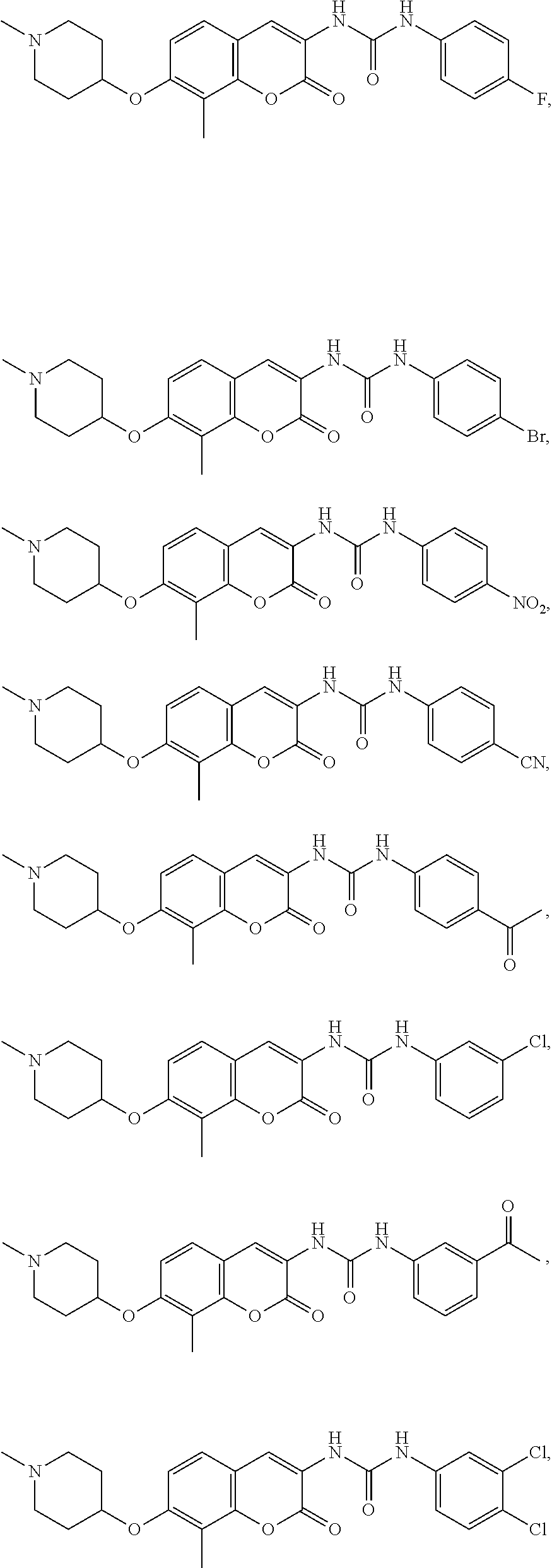


Priority Applications (1)
| Application Number | Priority Date | Filing Date | Title |
|---|---|---|---|
| US15/035,610 US10030006B2 (en) | 2013-11-11 | 2014-11-11 | Coumarin based Hsp90 inhibitors with urea and ether substituents |
Applications Claiming Priority (3)
| Application Number | Priority Date | Filing Date | Title |
|---|---|---|---|
| US201361902517P | 2013-11-11 | 2013-11-11 | |
| PCT/US2014/065059 WO2015070238A2 (en) | 2013-11-11 | 2014-11-11 | Coumarin based hsp90 inhibitors with urea and ether substituents |
| US15/035,610 US10030006B2 (en) | 2013-11-11 | 2014-11-11 | Coumarin based Hsp90 inhibitors with urea and ether substituents |
Related Parent Applications (1)
| Application Number | Title | Priority Date | Filing Date |
|---|---|---|---|
| PCT/US2014/065059 A-371-Of-International WO2015070238A2 (en) | 2013-11-11 | 2014-11-11 | Coumarin based hsp90 inhibitors with urea and ether substituents |
Related Child Applications (1)
| Application Number | Title | Priority Date | Filing Date |
|---|---|---|---|
| US16/018,439 Division US10745386B2 (en) | 2013-11-11 | 2018-06-26 | Coumarin based HSP90 inhibitors with urea and ether substituents |
Publications (2)
| Publication Number | Publication Date |
|---|---|
| US20160289217A1 US20160289217A1 (en) | 2016-10-06 |
| US10030006B2 true US10030006B2 (en) | 2018-07-24 |
Family
ID=52117970
Family Applications (2)
| Application Number | Title | Priority Date | Filing Date |
|---|---|---|---|
| US15/035,610 Active US10030006B2 (en) | 2013-11-11 | 2014-11-11 | Coumarin based Hsp90 inhibitors with urea and ether substituents |
| US16/018,439 Active US10745386B2 (en) | 2013-11-11 | 2018-06-26 | Coumarin based HSP90 inhibitors with urea and ether substituents |
Family Applications After (1)
| Application Number | Title | Priority Date | Filing Date |
|---|---|---|---|
| US16/018,439 Active US10745386B2 (en) | 2013-11-11 | 2018-06-26 | Coumarin based HSP90 inhibitors with urea and ether substituents |
Country Status (5)
| Country | Link |
|---|---|
| US (2) | US10030006B2 (en) |
| EP (2) | EP4585267A3 (en) |
| AU (1) | AU2014346368B2 (en) |
| CA (1) | CA2929243C (en) |
| WO (1) | WO2015070238A2 (en) |
Cited By (3)
| Publication number | Priority date | Publication date | Assignee | Title |
|---|---|---|---|---|
| US11224608B2 (en) | 2017-10-16 | 2022-01-18 | Dana-Farber Cancer Institute, Inc. | Compounds and methods for treating cancer |
| US11390640B2 (en) | 2012-02-09 | 2022-07-19 | University Of Kansas | C-terminal Hsp90 inhibitors |
| US11827664B2 (en) | 2018-05-14 | 2023-11-28 | Reata Pharmaceuticals, Inc | Biaryl amides with modified sugar groups for treatment of diseases associated with heat shock protein pathway |
Families Citing this family (5)
| Publication number | Priority date | Publication date | Assignee | Title |
|---|---|---|---|---|
| US11191773B2 (en) | 2017-07-17 | 2021-12-07 | President And Fellows Of Harvard College | Methods of treatment for bacterial infections |
| US11713335B2 (en) | 2018-03-12 | 2023-08-01 | President And Fellows Of Harvard College | Aminocoumarin compounds and methods of their use |
| WO2020132618A1 (en) * | 2018-12-21 | 2020-06-25 | The University Of Kansas | Photocleavable linker for catching and/or releasing of circulating tumor cells or extracellular vesicles |
| WO2021046220A1 (en) * | 2019-09-04 | 2021-03-11 | Dana-Farber Cancer Institute, Inc. | Compounds and methods for treating cancer |
| CN115403549B (en) * | 2022-08-30 | 2023-05-26 | 郑州大学 | Osthole thiourea derivatives, preparation method and application thereof |
Citations (5)
| Publication number | Priority date | Publication date | Assignee | Title |
|---|---|---|---|---|
| US3890297A (en) * | 1973-03-29 | 1975-06-17 | Upjohn Co | Process for n-acylating novenamine |
| US20090163709A1 (en) | 2004-11-03 | 2009-06-25 | Brian Blagg | Novobiocin Analogues Having Modified Sugar Moieties |
| WO2010096650A1 (en) | 2009-02-20 | 2010-08-26 | University Of Kansas | Novobiocin analogues having modified sugar moieties |
| WO2011041593A1 (en) | 2009-09-30 | 2011-04-07 | University Of Kansas | Novobiocin analogues and treatment of polycystic kidney disease |
| US20120252745A1 (en) | 2004-11-03 | 2012-10-04 | Blagg Brian S J | Novobiocin analogues having modified sugar moieties |
-
2014
- 2014-11-11 WO PCT/US2014/065059 patent/WO2015070238A2/en not_active Ceased
- 2014-11-11 AU AU2014346368A patent/AU2014346368B2/en active Active
- 2014-11-11 US US15/035,610 patent/US10030006B2/en active Active
- 2014-11-11 EP EP25158608.7A patent/EP4585267A3/en active Pending
- 2014-11-11 CA CA2929243A patent/CA2929243C/en active Active
- 2014-11-11 EP EP14815118.6A patent/EP3068778B1/en active Active
-
2018
- 2018-06-26 US US16/018,439 patent/US10745386B2/en active Active
Patent Citations (5)
| Publication number | Priority date | Publication date | Assignee | Title |
|---|---|---|---|---|
| US3890297A (en) * | 1973-03-29 | 1975-06-17 | Upjohn Co | Process for n-acylating novenamine |
| US20090163709A1 (en) | 2004-11-03 | 2009-06-25 | Brian Blagg | Novobiocin Analogues Having Modified Sugar Moieties |
| US20120252745A1 (en) | 2004-11-03 | 2012-10-04 | Blagg Brian S J | Novobiocin analogues having modified sugar moieties |
| WO2010096650A1 (en) | 2009-02-20 | 2010-08-26 | University Of Kansas | Novobiocin analogues having modified sugar moieties |
| WO2011041593A1 (en) | 2009-09-30 | 2011-04-07 | University Of Kansas | Novobiocin analogues and treatment of polycystic kidney disease |
Non-Patent Citations (27)
| Title |
|---|
| Althaus et al., Novenamines as inhibitors of two independent enzymes during DNA replication in a toluenized Escherichia coli cell system, Biochemical Pharmacology, vol. 51, Issue 10, May 17, 1996, pp. 1373-1378. * |
| Burlison et al., "Development of novobiocin analogues that manifest anti-proliferative activity against several cancer cell lines", J. Org. Chem., 73:2130, 2008. |
| Burlison et al., "Novobiocin: redesigning a DNA gyrase inhibitor for selective inhibition of hsp90", J. Am. Chem. Soc., 128:15529, 2006. |
| Cron et al, Semisynthetic antibiotics derived from coumermycin, Progr. Antimicrob. Anticancer Chemother., Proc. Int. Congr. Chemother., 6th (1970), Meeting Date 1969, vol. 2, 1069-82 Publisher: Univ. Park Press, Baltimore, Md. CODEN: 22PYAN, STN document No. 75:86843. * |
| Donnelly, et al., "Cytotoxic sugar analogues of an optimized novobiocin scaffold," MedChemComm, 1(2):165-170, 2010. |
| Huang, et al., "Molecular Design of Anticancer Drug Leads Based on Three-Dimensional Quantitative Structure-Activity Relationship," J. Chem. Info. Modeling, 51(8):1999-2006, 2011. |
| International Preliminary Report on Patentability issued in International Application No. PCT/US2014/065059, dated May 26, 2016. |
| International Search Report and Written Opinion issued in International Application No. PCT/US2014/065059, dated Jun. 1, 2015. |
| Invitation to Pay Additional Fees and Partial Search Report issued in International Application No. PCT/US2014/065059, dated Mar. 11, 2015. |
| Keil et al, Preparation of semisynthetic coumermycin A1 derivatives. IV. Aliphatic acyl and related derivatives of 3-amino-4-hydroxy-8-methyl-7-[3-0-(5-methyl-2-pyrrolylcarbonyl)noviosyloxy]coumarin, Antimicrobial Agents and Chemotherapy (1961-70) (1970), Volume Date 1969 200-8 CODEN: AACHAX; ISSN: 0074-9923, STN document No. 75:20897. * |
| Lubbers et al., Design, synthesis, and structure-activity relationship studies of ATP analogues as DNA gyrase inhibitors, Bioorganic & Medicinal Chemistry Letters (2000), 10(8), 821-826. * |
| Moroni, et al., "Exploiting Conformational Dynamics in Drug Discovery: Design of C-Terminal Inhibitors of Hsp90 with Improved Activities," J. Chem. Info. Modeling, 54(1):195-208, 2014. |
| Price et al, Semisynthetic coumermycins; structure-activity relations, Applied Microbiology (1970), 19(1), 14-26 CODEN: APMBAY; ISSN: 0003-6919, STN document No. 72:77109. * |
| PubChem Compound Accession No. CID71716931, retrieved from NIH, dated Sep. 23, 2013. |
| PubChem Compound Accession No. CID71718170, retrieved from NIH, dated Sep. 23, 2013. |
| PubChem Compound Accession No. CID71718754, retrieved from NIH, dated Sep. 23, 2013. |
| PubChem Compound Accession No. CID71720592, retrieved from NIH, dated Sep. 23, 2013. |
| Sadikot, et al., "Development of a High-Throughput Screening Cancer Cell-Based Luciferase Refolding Assay for Identifying Hsp90 Inhibitors," Assay and Drug Development Technologies, 11(8):478-488, 2013. |
| Yu et al., "Hsp90 inhibitors identified from a library of novobiocin analogues", J. Am. Chem. Soc., 127:12778, 2005. |
| Zhang, et al., "Simplified aminocoumarin analogues as anticancer agents: Amino isosteric replacement in the noviose moiety resulted in substantial enhancement of antiproliferative activity," Chinese Chemical Letters, 24(8):719-722, 2013. |
| Zhao and Blagg, "Novobiocin analogues with second-generation noviose surrogates," Bioorg & Med. Chem. Lett., 23(2):552-557, 2013. |
| Zhao et al., "Engineering an antibiotic to fight cancer: optimization of the novobiocin scaffold to produce anti-proliferative agents," Journal of Medicinal Chemistry, 54(11):3839-3853, 2011. |
| Zhao et al., "Identification and initial SAR of silybin: An Hsp90 inhibitor". Bioorg. Med. Chem. Lett., 21:2659-2664, 2011. |
| Zhao, et al., "Identification of a New Scaffold for Hsp90 C-Terminal Inhibition," ACS Med. Chem. Lett., 5(1):84-88, 2014. |
| Zhao, et al., "Synthesis and Evaluation of Noviose Replacements on Novobiocin That Manifest Antiproliferative Activity," ACS Med. Chem. Lett., 1(7):311-315, 2010. |
| Zhao, et al.,"3-Aryleoumarin Derivatives Manifest Anti-Proliferative Activity through Hsp90 Inhibition," ACS Med. Chem. Lett., 3(4):327-331, 2012. |
| Zhao, et al.,"3D-QSAR-Assisted Design, Synthesis, and Evaluation of Novobiocin Analogues," ACS Med. Chem. Lett., 4(1):57-62, 2013. |
Cited By (7)
| Publication number | Priority date | Publication date | Assignee | Title |
|---|---|---|---|---|
| US11390640B2 (en) | 2012-02-09 | 2022-07-19 | University Of Kansas | C-terminal Hsp90 inhibitors |
| US12024536B2 (en) | 2012-02-09 | 2024-07-02 | University Of Kansas | C-terminal HSP90 inhibitors |
| US12679860B2 (en) | 2012-02-09 | 2026-07-14 | University Of Kansas | C-terminal HSP90 inhibitors |
| US11224608B2 (en) | 2017-10-16 | 2022-01-18 | Dana-Farber Cancer Institute, Inc. | Compounds and methods for treating cancer |
| USRE50319E1 (en) | 2017-10-16 | 2025-03-04 | Dana-Farber Cancer Institute, Inc. | Compounds and methods for treating cancer |
| US11827664B2 (en) | 2018-05-14 | 2023-11-28 | Reata Pharmaceuticals, Inc | Biaryl amides with modified sugar groups for treatment of diseases associated with heat shock protein pathway |
| US12595278B2 (en) | 2018-05-14 | 2026-04-07 | Reata Pharmaceuticals, Inc | Biaryl amides with modified sugar groups for treatment of diseases associated with heat shock protein pathway |
Also Published As
| Publication number | Publication date |
|---|---|
| CA2929243C (en) | 2022-05-03 |
| AU2014346368A1 (en) | 2016-05-12 |
| WO2015070238A2 (en) | 2015-05-14 |
| US20190023698A1 (en) | 2019-01-24 |
| EP3068778B1 (en) | 2025-02-19 |
| AU2014346368B2 (en) | 2019-03-14 |
| WO2015070238A3 (en) | 2015-07-16 |
| EP3068778A2 (en) | 2016-09-21 |
| EP4585267A3 (en) | 2025-10-22 |
| EP4585267A2 (en) | 2025-07-16 |
| US10745386B2 (en) | 2020-08-18 |
| US20160289217A1 (en) | 2016-10-06 |
| CA2929243A1 (en) | 2015-05-14 |
Similar Documents
| Publication | Publication Date | Title |
|---|---|---|
| US10745386B2 (en) | Coumarin based HSP90 inhibitors with urea and ether substituents | |
| US11708319B2 (en) | Biphenyl amides with modified ether groups as HSP90 inhibitors and HSP70 inducers | |
| US10689344B2 (en) | Biphenylamide derivative Hsp90 inhibitors | |
| EP3154964B1 (en) | Triazole modified coumarin and biphenyl amide-based hsp90 inhibitors | |
| US9809583B2 (en) | Oxazolidine-based compound and selective androgen receptor agonist comprising same | |
| WO2026015438A1 (en) | Mdm2 targeting protacs | |
| WO2023225558A1 (en) | Inhibitors of rlip76 | |
| BR112016029672B1 (en) | BIFENYL AMIDE COMPOUND WITH MODIFIED ETHER GROUPS AS HSP90 INHIBITORS AND HSP70 INDUCERS, PHARMACEUTICAL COMPOSITION COMPRISING SAID COMPOUND, AS WELL AS THERAPEUTIC USE THEREOF |
Legal Events
| Date | Code | Title | Description |
|---|---|---|---|
| AS | Assignment |
Owner name: UNIVERSITY OF KANSAS, KANSAS Free format text: ASSIGNMENT OF ASSIGNORS INTEREST;ASSIGNORS:BLAGG, BRIAN S.J.;ZHAO, HUIPING;SIGNING DATES FROM 20151204 TO 20160205;REEL/FRAME:039550/0206 |
|
| STCF | Information on status: patent grant |
Free format text: PATENTED CASE |
|
| CC | Certificate of correction | ||
| CC | Certificate of correction | ||
| MAFP | Maintenance fee payment |
Free format text: PAYMENT OF MAINTENANCE FEE, 4TH YEAR, LARGE ENTITY (ORIGINAL EVENT CODE: M1551); ENTITY STATUS OF PATENT OWNER: LARGE ENTITY Year of fee payment: 4 |
|
| AS | Assignment |
Owner name: BIOPHARMA CREDIT PLC, UNITED KINGDOM Free format text: PATENT SECURITY AGREEMENT;ASSIGNORS:REATA PHARMACEUTICALS HOLDINGS, LLC;REATA PHARMACEUTICALS GLOBAL, INC.;REATA PHARMACEUTICALS, INC.;REEL/FRAME:063697/0461 Effective date: 20230512 |
|
| AS | Assignment |
Owner name: BIOPHARMA CREDIT PLC, UNITED KINGDOM Free format text: AMENDED AND RESTATED PATENT SECURITY AGREEMENT;ASSIGNORS:REATA PHARMACEUTICALS HOLDINGS, LLC;REATA PHARMACEUTICALS GLOBAL, INC.;REATA PHARMACEUTICALS, INC.;REEL/FRAME:064264/0557 Effective date: 20230710 |
|
| AS | Assignment |
Owner name: REATA PHARMACEUTICALS, INC., MASSACHUSETTS Free format text: RELEASE BY SECURED PARTY;ASSIGNOR:BIOPHARMA CREDIT PLC;REEL/FRAME:070793/0130 Effective date: 20250407 Owner name: REATA PHARMACEUTICALS GLOBAL, INC., MASSACHUSETTS Free format text: RELEASE BY SECURED PARTY;ASSIGNOR:BIOPHARMA CREDIT PLC;REEL/FRAME:070793/0130 Effective date: 20250407 Owner name: REATA PHARMACEUTICALS HOLDINGS, LLC, MASSACHUSETTS Free format text: RELEASE BY SECURED PARTY;ASSIGNOR:BIOPHARMA CREDIT PLC;REEL/FRAME:070793/0130 Effective date: 20250407 Owner name: REATA PHARMACEUTICALS, INC., MASSACHUSETTS Free format text: RELEASE BY SECURED PARTY;ASSIGNOR:BIOPHARMA CREDIT PLC;REEL/FRAME:070793/0228 Effective date: 20250407 Owner name: REATA PHARMACEUTICALS GLOBAL, INC., MASSACHUSETTS Free format text: RELEASE BY SECURED PARTY;ASSIGNOR:BIOPHARMA CREDIT PLC;REEL/FRAME:070793/0228 Effective date: 20250407 Owner name: REATA PHARMACEUTICALS HOLDINGS, LLC, MASSACHUSETTS Free format text: RELEASE BY SECURED PARTY;ASSIGNOR:BIOPHARMA CREDIT PLC;REEL/FRAME:070793/0228 Effective date: 20250407 Owner name: REATA PHARMACEUTICALS HOLDINGS, LLC, MASSACHUSETTS Free format text: RELEASE OF SECURITY INTEREST;ASSIGNOR:BIOPHARMA CREDIT PLC;REEL/FRAME:070793/0130 Effective date: 20250407 Owner name: REATA PHARMACEUTICALS GLOBAL, INC., MASSACHUSETTS Free format text: RELEASE OF SECURITY INTEREST;ASSIGNOR:BIOPHARMA CREDIT PLC;REEL/FRAME:070793/0130 Effective date: 20250407 Owner name: REATA PHARMACEUTICALS, INC., MASSACHUSETTS Free format text: RELEASE OF SECURITY INTEREST;ASSIGNOR:BIOPHARMA CREDIT PLC;REEL/FRAME:070793/0130 Effective date: 20250407 Owner name: REATA PHARMACEUTICALS HOLDINGS, LLC, MASSACHUSETTS Free format text: RELEASE OF SECURITY INTEREST;ASSIGNOR:BIOPHARMA CREDIT PLC;REEL/FRAME:070793/0228 Effective date: 20250407 Owner name: REATA PHARMACEUTICALS GLOBAL, INC., MASSACHUSETTS Free format text: RELEASE OF SECURITY INTEREST;ASSIGNOR:BIOPHARMA CREDIT PLC;REEL/FRAME:070793/0228 Effective date: 20250407 Owner name: REATA PHARMACEUTICALS, INC., MASSACHUSETTS Free format text: RELEASE OF SECURITY INTEREST;ASSIGNOR:BIOPHARMA CREDIT PLC;REEL/FRAME:070793/0228 Effective date: 20250407 |
|
| MAFP | Maintenance fee payment |
Free format text: PAYMENT OF MAINTENANCE FEE, 8TH YEAR, LARGE ENTITY (ORIGINAL EVENT CODE: M1552); ENTITY STATUS OF PATENT OWNER: LARGE ENTITY Year of fee payment: 8 |