US10027699B2 - Production process knowledge-based intrusion detection for industrial control systems - Google Patents

Production process knowledge-based intrusion detection for industrial control systems Download PDF

Info

Publication number
US10027699B2
US10027699B2 US15/066,289 US201615066289A US10027699B2 US 10027699 B2 US10027699 B2 US 10027699B2 US 201615066289 A US201615066289 A US 201615066289A US 10027699 B2 US10027699 B2 US 10027699B2
Authority
US
United States
Prior art keywords
cyberattack
physical
field devices
data
variable
Prior art date
Legal status (The legal status is an assumption and is not a legal conclusion. Google has not performed a legal analysis and makes no representation as to the accuracy of the status listed.)
Expired - Fee Related, expires
Application number
US15/066,289
Other versions
US20170264629A1 (en
Inventor
Dong Wei
Leandro Pfleger de Aguiar
Arquimedes Martinez Canedo
Current Assignee (The listed assignees may be inaccurate. Google has not performed a legal analysis and makes no representation or warranty as to the accuracy of the list.)
Siemens AG
Original Assignee
Siemens AG
Priority date (The priority date is an assumption and is not a legal conclusion. Google has not performed a legal analysis and makes no representation as to the accuracy of the date listed.)
Filing date
Publication date
Application filed by Siemens AG filed Critical Siemens AG
Priority to US15/066,289 priority Critical patent/US10027699B2/en
Assigned to SIEMENS CORPORATION reassignment SIEMENS CORPORATION ASSIGNMENT OF ASSIGNORS INTEREST (SEE DOCUMENT FOR DETAILS). Assignors: MARTINEZ CANEDO, ARQUIMEDES, PFLEGER DE AGUIAR, LEANDRO, WEI, DONG
Publication of US20170264629A1 publication Critical patent/US20170264629A1/en
Assigned to SIEMENS AKTIENGESELLSCHAFT reassignment SIEMENS AKTIENGESELLSCHAFT ASSIGNMENT OF ASSIGNORS INTEREST (SEE DOCUMENT FOR DETAILS). Assignors: SIEMENS CORPORATION
Application granted granted Critical
Publication of US10027699B2 publication Critical patent/US10027699B2/en
Expired - Fee Related legal-status Critical Current
Adjusted expiration legal-status Critical

Links

Images

Classifications

    • HELECTRICITY
    • H04ELECTRIC COMMUNICATION TECHNIQUE
    • H04LTRANSMISSION OF DIGITAL INFORMATION, e.g. TELEGRAPHIC COMMUNICATION
    • H04L63/00Network architectures or network communication protocols for network security
    • H04L63/14Network architectures or network communication protocols for network security for detecting or protecting against malicious traffic
    • H04L63/1433Vulnerability analysis
    • GPHYSICS
    • G05CONTROLLING; REGULATING
    • G05BCONTROL OR REGULATING SYSTEMS IN GENERAL; FUNCTIONAL ELEMENTS OF SUCH SYSTEMS; MONITORING OR TESTING ARRANGEMENTS FOR SUCH SYSTEMS OR ELEMENTS
    • G05B19/00Programme-control systems
    • G05B19/02Programme-control systems electric
    • G05B19/04Programme control other than numerical control, i.e. in sequence controllers or logic controllers
    • G05B19/05Programmable logic controllers, e.g. simulating logic interconnections of signals according to ladder diagrams or function charts
    • G05B19/058Safety, monitoring
    • GPHYSICS
    • G05CONTROLLING; REGULATING
    • G05BCONTROL OR REGULATING SYSTEMS IN GENERAL; FUNCTIONAL ELEMENTS OF SUCH SYSTEMS; MONITORING OR TESTING ARRANGEMENTS FOR SUCH SYSTEMS OR ELEMENTS
    • G05B23/00Testing or monitoring of control systems or parts thereof
    • G05B23/02Electric testing or monitoring
    • G05B23/0205Electric testing or monitoring by means of a monitoring system capable of detecting and responding to faults
    • G05B23/0218Electric testing or monitoring by means of a monitoring system capable of detecting and responding to faults characterised by the fault detection method dealing with either existing or incipient faults
    • G05B23/0224Process history based detection method, e.g. whereby history implies the availability of large amounts of data
    • G05B23/0227Qualitative history assessment, whereby the type of data acted upon, e.g. waveforms, images or patterns, is not relevant, e.g. rule based assessment; if-then decisions
    • G05B23/0232Qualitative history assessment, whereby the type of data acted upon, e.g. waveforms, images or patterns, is not relevant, e.g. rule based assessment; if-then decisions based on qualitative trend analysis, e.g. system evolution
    • GPHYSICS
    • G06COMPUTING OR CALCULATING; COUNTING
    • G06FELECTRIC DIGITAL DATA PROCESSING
    • G06F21/00Security arrangements for protecting computers, components thereof, programs or data against unauthorised activity
    • G06F21/50Monitoring users, programs or devices to maintain the integrity of platforms, e.g. of processors, firmware or operating systems
    • G06F21/55Detecting local intrusion or implementing counter-measures
    • G06F21/552Detecting local intrusion or implementing counter-measures involving long-term monitoring or reporting
    • GPHYSICS
    • G06COMPUTING OR CALCULATING; COUNTING
    • G06FELECTRIC DIGITAL DATA PROCESSING
    • G06F21/00Security arrangements for protecting computers, components thereof, programs or data against unauthorised activity
    • G06F21/50Monitoring users, programs or devices to maintain the integrity of platforms, e.g. of processors, firmware or operating systems
    • G06F21/55Detecting local intrusion or implementing counter-measures
    • G06F21/554Detecting local intrusion or implementing counter-measures involving event detection and direct action
    • HELECTRICITY
    • H04ELECTRIC COMMUNICATION TECHNIQUE
    • H04LTRANSMISSION OF DIGITAL INFORMATION, e.g. TELEGRAPHIC COMMUNICATION
    • H04L63/00Network architectures or network communication protocols for network security
    • H04L63/14Network architectures or network communication protocols for network security for detecting or protecting against malicious traffic
    • H04L63/1408Network architectures or network communication protocols for network security for detecting or protecting against malicious traffic by monitoring network traffic
    • H04L63/1416Event detection, e.g. attack signature detection

Definitions

  • the present invention relates generally to systems, methods, and apparatuses for enhancing security in industrial control systems by detecting and reacting to intrusions based on the production process information.
  • An intrusion detection system is a device or software application that monitors network or system activities for malicious activities or policy violations and produces reports to a security incident and event management station.
  • An IDS detects potential cyberattacks in different ways.
  • Host intrusion detection systems run on individual hosts or devices on the network.
  • Network intrusion detection systems detect potential cyberattacks based on the network traffic patterns.
  • a HIDS typically monitors the inbound and outbound data packets from the device only and generate alerts and sends to the user or administrator if suspicious activity is detected. It also monitors behavior of the host device, such as CPU and memory usage to detect potential cyberattacks. If the usage of memory deviates from the normal, the alert is sent to the administrator to investigate.
  • DCS distributed control systems
  • Network intrusion detection systems are connected to the network to monitor data traffic to and from all devices on the network. It performs an analysis for passing traffic on the entire subnet, works in a passive mode, and matches the traffic that is passed on the subnets to the library of known attacks. Once the attack pattern is identified, or abnormal network traffic behavior is sensed, the alert can be sent to the administrator.
  • Example of the NIDS would be installing it on the subnet where firewalls are located in order to see if someone is trying to break into the firewall.
  • Embodiments of the present invention address and overcome one or more of the above shortcomings and drawbacks, by providing methods, systems, and apparatuses related to detecting and reacting to intrusions based on the production process information.
  • the intrusion detection system described herein uses various types of process information to validate and verify the received data from sensors and command from an HMI or other devices. Three examples of such process information are described herein.
  • the state of the production system e.g., Stopped, Off, Producing and Standby
  • static limits of measurements e.g., temperature sensors and temperature setting issued by the operator via an HMI
  • dynamic limits of measurements e.g., the temperature of an oven cannot be raised by 100° C. in 3 minutes
  • a system for threat detection in an industrial production environment comprises a programmable logic controller.
  • This programmable logic controller includes a process image updated according to a scan cycle with process data associated with one or more field devices, a program configured to operate the one or more field devices using the process data, and one or more function blocks.
  • These function blocks are configured to monitor the process data in the process image during each scan cycle, and identify a possible cyberattack based on the process data.
  • the function blocks are further configured to transmit a message with information related to the possible cyberattack to one or more other production devices.
  • the system may also include a human-machine interface (HMI) configured to receive the message and display an alert indicative of the possible cyberattacks.
  • HMI human-machine interface
  • the function blocks included in the aforementioned system comprise a limit-based intrusion detection function block which is configured to identify limits of physical variables used by the programmable logic controller in execution of the program.
  • the limit-based intrusion detection function block determines current values of the physical variables based on the process data and identifies the possible cyberattacks if the current values of the physical variables exceed the limits of the physical variables.
  • the limit-based intrusion detection function block is further configured to maintain a state model indicative of a current operational state of the programmable logic controller. The limits of physical variables used by the programmable logic controller may then be based on the state model.
  • Various state models may be used including, for example, state models similar to the Organization of Machine Automation and Control's Package Machine Language State Model.
  • the function blocks included in the aforementioned system comprise a change-based intrusion detection function block configured to monitor a rate of change associated with a physical variable used by the programmable logic controller in execution of the program over a plurality of scan cycles. This change-based intrusion detection function block can then identify the possible cyberattack if the rate of change exceeds an expected rate of change for the scan cycles.
  • the function blocks included in the aforementioned system comprise a change-based intrusion detection function block configured to monitor a rate of change associated with a physical variable used by the programmable logic controller in execution of the program over a plurality of scan cycles.
  • the change-based intrusion detection function block can then identify, based on a reference curve, the possible cyberattack if the rate of change is less than an expected rate of change for the scan cycles.
  • This reference curve may be generated, for example, using a simulation-based application.
  • the possible cyberattack is generated collecting first data comprising physical byproducts of the one or more field devices and extracting behavioral information relevant to cyberattacks from the first data.
  • the behavioral information is fused with fieldbus sensor data into a synchronized time series dataset.
  • a simulation of the industrial production environment may be performed using the synchronized time series dataset to yield simulated sensor data.
  • a classification algorithm is applied to the simulated sensor data to yield a probability of cyberattack and the probability of cyberattack is contextualized with process knowledge relevant to the industrial production environment. Then, the possible cyberattack may be identified based on the contextualized probability of cyberattack.
  • the function blocks included in the aforementioned system comprise a correlation-based intrusion detection function block configured to monitor a first process information variable to yield a first variable history over a plurality of scan cycles. Additionally, this correlation-based intrusion detection function block monitors a second process information variable to yield a second variable history over the plurality of scan cycles. The correlation-based intrusion detection function block can then identify the possible cyberattacks based on a correlation between the first variable history and the second variable history.
  • a method for cyberattack detection in an industrial production environment includes a programmable logic controller updating a process image according to a scan cycle with process data associated with one or more field devices and operating the one or more field devices using the process data.
  • the programmable logic controller monitors process data in the process image during each scan cycle and identifies a possible cyberattack based on the process data.
  • the programmable logic controller may then transmit a message with information related to the possible cyberattack to one or more other production devices.
  • the method includes additional features which occur in response to identification of the possible cyberattack. These features may include, for example, reducing production speed, completing production of a current batch and thereafter stopping production, and/or performing one or more operations to stop production immediately.
  • the programmable logic controller identifies limits of physical variables used by the programmable logic controller in operating the one or more field devices. During each scan cycle, the programmable logic controller determines current values of the physical variables based on the process data and identifies the possible cyberattack if the current values of the physical variables exceed the limits of the physical variables. In other embodiments, the programmable logic controller monitors a rate of change associated with a physical variable used by the programmable logic controller in operating the one or more field devices over a plurality of scan cycles. The possible cyberattack is identified if the rate of change deviates from an expected rate of change for the scan cycles.
  • the programmable logic controller monitors a first process information variable to yield a first variable history and monitors a second process information variable to yield a second variable history. The possible cyberattack is then identified based on a correlation between the first variable history and the second variable history.
  • an article of manufacture for intrusion detection in an industrial production environment includes a non-transitory, tangible computer-readable medium holding computer-executable instructions for performing a process which includes updating a process image according to a scan cycle with process data associated with one or more field devices and operating the one or more field devices using the process data.
  • the process further includes monitoring the process data in the process image during each scan cycle; and identifying a possible cyberattack based on the process data.
  • FIG. 1 provides an illustration of an intrusion detection system 100 , according to some embodiments
  • FIG. 2 provides an example implementation of a Package Machine Language State Model, as may be applied in some embodiments;
  • FIG. 3 illustrates how a sliding window technique can be employed for intrusion detection, according to some embodiments
  • FIG. 4 illustrates how a learning technique can be employed according to some embodiments for intrusion detection where system performance is degraded over time
  • FIG. 5 shows a process 500 for intrusion detection via simulation, as it may be implemented in some embodiments.
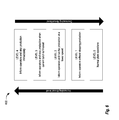
  • FIG. 6 illustrates five possible threat levels that may be used for representing alert states for automation system operations, according to some embodiments.
  • FIG. 7 provides an example process where some of the techniques described herein are applied.
  • Systems, methods, and apparatuses are described herein which relate generally to the application of production process knowledge to improve the accuracy of the intrusion detection systems for industry automation networks.
  • the techniques and associated technology described herein may be used to detect cyber intrusion that occurs on the plant floor network, such as a compromised sensor which sends a faked measurement reading to controllers or an HMI, on which a hacker sends faked command(s) to controllers.
  • Conventional intrusion detection systems employ the patterns of data packets and traffic. However, these systems may not be able to detect advanced cyberattacks aiming at industrial control systems. For instance, they are not able to detect Stuxnet-type of cyberattacks.
  • production process knowledge can be utilized to detect some cyberattacks (or sensor malfunction or wrong operation by operators) on the plant floor.
  • the disclosed production process uses knowledge-based intrusion detection which may provide a complementary solution to the existing intrusion detection solution for control systems.
  • the techniques described herein are implemented in controllers and hence enabling the controllers to react to detected cyberattacks accordingly to minimize the adverse impacts of those cyberattacks.
  • FIG. 1 provides an illustration of an intrusion detection system 100 , according to some embodiments.
  • This system 100 includes a programmable logic controller (PLC) 150 which controls a plurality of field devices 105 , 110 , and 115 .
  • the PLC 150 may be configured to operate automatically or semi-automatically based on instructions provided by an operator via a human machine interface (HMI) 155 .
  • HMI human machine interface
  • the HMI 155 communicates with the PLC 150 through an intermediate network device (such as router or switch) 145 over a network.
  • the HMI 155 and the PLC 150 may be connected by any number of intermediate network devices.
  • the HMI 155 can be connected directly to the PLC 150 .
  • Function block (FB) is just a part of application program run on a PLC.
  • the Process Simulator 160 is used to simulate the production process and generate references for control variables which are used in Function Blocks 135 and 140 .
  • the PLC 150 executes a Program 120 according to a scan cycle.
  • the Program 120 includes Program Instructions 125 and a plurality of function blocks (FBs) 130 , 135 , and 140 .
  • FBs function blocks
  • FIG. 1 is an oversimplified visualization of a PLC program which highlights functionality related to intrusion detection.
  • a real-world implementation of the PLC 150 would include many additional components directed at other aspects of controller operations.
  • FIG. 1 shows the intrusion detection functionality in one PLC to detect potential cyberattacks on itself, it can also be implemented in a way that one PLC can detect potential cyberattacks on its peer PLCs, if it is able to collect all necessary data from other PLCs.
  • the Program Instructions 125 comprise the main program executed by the PLC 150 .
  • the operation of the field devices 105 , 110 , and 115 is controlled by the Program Instructions 125 .
  • the Program Instructions 125 manages input/output, global variables, and access paths.
  • the FBs 130 , 135 , and 140 are configured to analyze these input/output, global variables, and access paths as they are received or modified to identify conditions which may indicate that a malicious intrusion is taking place.
  • the example of FIG. 1 includes three FBs directed at cyberattack: a Limit-based Intrusion Detection FB 130 , a Change-based Intrusion Detection FB 135 , and a Correlation-based Intrusion Detection FB 140 .
  • the Limit-based Intrusion Detection FB 130 examines and validates measurements collected by sensors and commands from the HMI 155 according to the limits of physical variables of the production system.
  • a potential cyberattack is identified when measurements of sensors and commands exceed the limits of physical variables of the production process.
  • conveyors of a packaging line should run forward in the speed range of 0.25 ⁇ 0.5 m/s when the production line is in the state of “Producing”, as shown in FIG. 2 (described below).
  • the controller receives a reading from the drive of conveyor which indicates the conveyor is running at 0.1 m/s, it could be a cyberattack on the control system or the drive system.
  • the controller receives a speed setting of 0.75 m/s from the HMI for the conveyor. This could be a cyberattack on the controller or the HMI is compromised by hackers. The operators should be informed when potential cyberattacks are detected.
  • the Change-based Intrusion Detection FB 135 performs intrusion detection based on the knowledge that some variables in the process environment cannot be changed in a short period of time.
  • FIG. 3 provides a plot 300 illustrating how a sliding window technique can be employed for intrusion detection in this context, according to some embodiments.
  • a wireless temperature sensor measures furnace temperature. Assume that, based on the design of a furnace, it is known that the furnace's temperature cannot be increased by 100° C. within 3 minutes. In FIG. 3 , the sliding window is moving along the time axis. A data block may be deployed to record the temperature of the furnace temperature reading in the last 3 minutes. If the temperature rises too fast (e.g., 800° C. to 850° C.
  • an alarm can be raised that a possible cyberattack is underway on one or more of the devices associated with the furnace.
  • a machine learning process is used to adjust and update the reference function curve. For instance, as shown in FIG. 4 , Curve A may be used as the reference function at one point. After several months, the heating performance degrades, and then Curve B, which is generated by the latest measurement, can be used as the reference function.
  • the Correlation-based Intrusion Detection FB 140 performs intrusion detection based on a correlation between process information variables. For example, with an industrial oven having multiple heating elements, the temperature in a certain interval in the oven depends on how many heating elements are on. Assume that a wireless sensor is used to collect temperature information of the industrial oven and there are 10 heating elements which can be operated individually. Usually, it takes 15 minutes to raise the temperature from 20° C. to 400° C. if all heating elements are on. However, if the controller detects that it took 15 minutes to raise the temperature from 20° C. to 400° C. when only 2 heating elements are on, an alarm could be raised that a possible cyberattack is underway.
  • equations (1) and (2) can be used to calculate the expected reading of every sensor at any time. The actual reading of each sensor is compared with the expected reading to decide if an alarm of abnormal behavior of control system occurred or not.
  • Functions (1) and (2) may change when the efficiency of burner changes and the isolation of the pre-heating furnace changes. Therefore, a learning process is proposed to update these functions during production, which is similar to the learning process in the last subsection.
  • Process Simulator 160 performs production process simulation offline.
  • Process Simulator 160 can be implemented in an office or even an application service provided in a computing cloud.
  • Cyberattacks either show a completely unknown behavioral pattern, or show a well-known pattern but at a much more compressed time scale (e.g., malicious attempts to mask an attack as wear and tear can be identified by their accelerated lifecycle).
  • a cyberattack is a sequence of discrete events that cause distinct behavior signatures whereas physical malfunctions tend to show preliminary continuous signs of degradation, before the breakout even happens.
  • One process for intrusion detection via simulation is described below with reference to FIG. 5 .
  • the Limit-based Intrusion Detection FB 130 the Change-based Intrusion Detection FB 135 , and the Correlation-based Intrusion Detection FB 140 may be configured in a variety of ways.
  • the FBs 130 , 135 , and 140 directly can be implemented, for example, as PC applications on PC-based PLC (such as WinAC) or an extension of main PLC application.
  • the FBs 130 , 135 , and 140 are configured to be chained together, allowing the output of one FB to be used as an input for another FB. In this way, it may be possible to create even more sophisticated intrusion detection measures.
  • the output of the Change-based Intrusion Detection FB 135 may indicate a possible intrusion on two independent devices.
  • the Correlation-based Intrusion Detection FB 140 may be configured to correlate these two intrusions to identify a specific type of attack.
  • FIG. 1 shows the intrusion detection functionality provided by FBs
  • this functionality may be implemented using other technical capabilities of the PLC, if available.
  • one or more customized software applications may be configured to perform the aforementioned intrusion detection functionality. Examples of implementing apps on PLCs are described in further detail in U.S. patent application Ser. No. 15/040,565, entitled “Extending a Programmable Logic Controller with Apps,” filed Feb. 10, 2016 and incorporated herein by reference in its entirety.
  • measurements collected by sensors and commands from HMIs are automatically examined and validated by the Program 120 according to the state of the production system.
  • a state model may be used.
  • An example state model 200 is shown in FIG. 2 , developed using the Package Machine Language State Model defined by the Organization of Machine Automation and Control may be employed as shown in FIG. 2 .
  • an alarm is raised that a possible cyberattack is underway. For example, conveyors of a packaging line should run forward when the production line is in the state of “Producing”, as shown in FIG. 2 .
  • the controller When the controller receives a signal from the drive of the conveyor which indicates that the conveyor is running backward, an alarm should be raised that the corresponding control system or drive system may be subject to a cyberattack.
  • the controller receives a command from the HMI which turns off the drive of conveyor. This could be a cyberattack on the controller or the HMI is compromised by hackers, since this command should not be issued during the state of “Producing.” In this instance, the operator(s) should be informed when potential cyberattacks are detected.
  • FIG. 5 shows a process 500 for intrusion detection via simulation, as it may be implemented in some embodiments.
  • data collection is performed.
  • the unconventional data sources are the physical byproducts of the machines (e.g., sound, vibration, heat, electro-magnetic radiation), and these sources present the novel unconventional signals to our method.
  • the traditional data sources include the fieldbus sensor data that is already an input to the ICS control algorithm to control the plant. For example, a milling-control algorithm that was designed to read and utilize the rotation speed (rpm) data to maintain a constant 500 rpm during operation.
  • rpm rotation speed
  • step 510 signal processing and data fusion is performed.
  • a technical challenge in extracting any useful information from our traditional and unconventional signals is to isolate that signal from all the noise. Having noise much larger than the audio signal is typical of industrial environments and industrial applications.
  • Signal de-noising, system identification, and source separation algorithms will be used for each of the three unconventional data sources to extract the behavioral information we believe will reveal a cyberattack.
  • Accelerometer data can be processed using a low pass filter to eliminate the noise.
  • Thermal camera images can be processed using, for example, OpenCV to perform hot spot analysis. Since the fieldbus traditional signals are directly available, they do not require signal processing other than time series analysis. This step also fuses the different data sources into a synchronized, consistent time series.
  • the production process is simulated using the processed conventional and unconventional data items.
  • Simulation models of the production process are executed in commercially available simulation software such as Siemens NX, Technomatix, Matlab/Simulink. These simulation models typically trade-off speed for accuracy. Therefore, complex processes may require fast simulation models in case near real-time intrusion detection is required. However, physical processes typically have inertia that provides a longer time window for intrusion detection. In these cases, accurate simulations can be used to validate the sensor data.
  • classification and fingerprinting is performed.
  • cyber-physical systems cyberattacks physically manifest themselves early; however, it takes a relatively long time to cause damage or malfunction. Therefore, there are two temporal scales, short and long, that will be addressed differently.
  • Short time scale classification will use a probabilistic classifier machine learning algorithm to distinguish between malfunctions and cyberattacks.
  • the choice of algorithms such as neural networks, hidden-Markov or Gaussian-mixture models will be based upon the features of the various physical by-product and fieldbus-data features (e.g., frequency features for sound analysis).
  • the long-time-scale classification can be addressed with an unsupervised learning algorithm that adapts the model according to the physical evolution of the system.
  • the fingerprints may be expected to change over time (e.g., due to wear & tear) and, therefore, the models need to be continuously updated to reflect these physical changes. For this reason, it will be necessary to eliminate the possibility of an attacker being able to predict these patterns and hide his activities using this observation.
  • Both the short and long-time-scale algorithms need the fingerprint information stored in a Fingerprint Database.
  • short term classification uses physical training data from the machine vendor
  • the long-time-scale classification uses the fingerprint models generated by the online learning algorithm.
  • a final prediction is generated using the final reference curve to detect potential cyberattacks.
  • the probability of a cyberattack from the classification and fingerprinting step 520 is a fine grain (physics-based) indicator. However, this information must be put into a higher level context to determine whether to generate an alarm or to ignore the information.
  • This step 525 uses the production process knowledge that is available in the ICS and the data generated by the simulation models to increase or decrease the confidence of a prediction.
  • the process knowledge includes the state of the production system, the limits of process variables, the rate of change on process variables, and the correlation between process variables. It is important to note that both variables sensed from the fieldbus and physical byproducts can be assessed using these metrics.
  • FIG. 6 illustrates five possible threat levels 600 that may be used for representing alert states for automation system operations, according to some embodiments. It should be noted that the five levels shown in FIG. 6 are merely an example of how threat levels may be defined in one embodiment of the present invention. The various threat levels employed may be configured and expanded to match the desired security level and criticality of the production process in question or to specific applicable standards and regulations.
  • Level 0 represents normal plant operations.
  • sensor information is normally read by a PLC or a distributed control system. Changes to the PLC may be performed in response to the executed control strategy by the controller or as a response by an operator action at, for example, a Supervisory Control and Data Acquisition (SCADA) system.
  • SCADA Supervisory Control and Data Acquisition
  • the threat level is raised to Level 1 .
  • Level 1 operators are informed (via a message on an HMI) without stopping production.
  • additional logging information may be collected by the PLC and sent to other PLCs or other computing devices in the production system (e.g., server log server or Security Incident and Event Management System).
  • the threat level is raised to Level 2 , the operators are informed again that the speed of the production line is lowered. At this level, the normal plant operations continue, albeit at a reduced speed.
  • the PLC begins a soft shut down procedure to stop production when the current production batch is complete.
  • This soft shut down procedure may include, for example, providing instructions to connected smart devices and other PLCs to ensure coordination as the procedure is executed.
  • a hard shut down procedure is executed to stop production immediately.
  • the PLC sends a signal to all devices involved in the production process to ensure that all devices immediately cease operating.
  • FIG. 7 provides an example process 700 where some of the techniques described herein are applied.
  • an engineer configures the security of the plant.
  • the configuration includes setting each the threat monitoring FBs for each PLC to an initial threat level for the plant. Additionally, during the configuration step 705 , the engineer may define rules for the PLC to automatically change threat levels in response to the detection of possible intrusions. Alternatively, the PLC may be configured to only change threat levels based on manual operations such as receipt of a message from a trusted authority.
  • the PLC operates at the current threat level. In this example, where the plant is just being initialized and no threats have been detected, the PLCs operate at the initial threat level, Level 0 .
  • the PLC detects a possible intrusion event that requires a change to the threat level.
  • the PLC associated with an oven may include a rule that the temperature of the oven cannot be raised by 100° C. in 3 minutes. If the PLC receives a reading from a temperature sensor indicating that the oven temperature raised by 100° C. in 1 minute, the PLC may then raise the threat level.
  • the PLC determines that the threat level should be increased, at 720 , the PLC performs one or more pre-configured actions corresponding to an increase in threat level (see FIG. 6 ).
  • the threat level may be automatically raised based on rules provided during configuration at step 705 .
  • the threat information may be displayed to an operator in an HMI. The operation may then manually raise the threat level to Level 1 .
  • the PLC may send a notification to other devices in the plant. Additionally, the PLC may distribute the related security information (e.g., the reason for the increase in threat level) to the other device so that they may perform additional logging and/or processing locally.
  • the process 700 returns to step 710 where the PLC operates according to the specified threat level (i.e., Level 1 ).
  • the PLC determines that the threat level should be decreased, at 725 , the PLC performs one or more pre-configured actions corresponding to a decrease in threat level.
  • the threat level may be automatically decreased based on rules provided during configuration at step 705 .
  • the threat information may be displayed to an operator who then can manually decrease the threat level to Level 0 .
  • the PLC may optionally send a notification to the other devices in the plant.
  • the process 700 returns to step 710 where the devices operate according to the specified threat level (i.e., Level 0 ). This process 700 continues as long as the PLC is operable, allowing adjustment to the threat level as new potential intrusions are detected.
  • the programmable logic controllers described herein are another example of a control layer device used in industrial automation environments.
  • a programmable logic controller is typically configured to execute software which continuously gathers data on the state of input devices to control the state of output devices.
  • a programmable logic controller typically includes three major components: a processor (which includes volatile memory), non-volatile memory comprising an application program, and one or more network components (e.g., input/output ports) for connecting to other devices in the automation system.
  • processors described herein as used by computing devices may include one or more central processing units (CPUs), graphical processing units (GPUs), or any other processor known in the art. More generally, a processor as used herein is a device for executing machine-readable instructions stored on a computer readable medium, for performing tasks and may comprise any one or combination of, hardware and firmware. A processor may also comprise memory storing machine-readable instructions executable for performing tasks. A processor acts upon information by manipulating, analyzing, modifying, converting or transmitting information for use by an executable procedure or an information device, and/or by routing the information to an output device.
  • CPUs central processing units
  • GPUs graphical processing units
  • a processor may also comprise memory storing machine-readable instructions executable for performing tasks.
  • a processor acts upon information by manipulating, analyzing, modifying, converting or transmitting information for use by an executable procedure or an information device, and/or by routing the information to an output device.
  • a processor may use or comprise the capabilities of a computer, controller or microprocessor, for example, and be conditioned using executable instructions to perform special purpose functions not performed by a general purpose computer.
  • a processor may be coupled (electrically and/or as comprising executable components) with any other processor enabling interaction and/or communication there-between.
  • a user interface processor or generator is a known element comprising electronic circuitry or software or a combination of both for generating display images or portions thereof.
  • a user interface comprises one or more display images enabling user interaction with a processor or other device.
  • Various devices described herein may include at least one computer readable medium or memory for holding instructions programmed according to embodiments of the invention and for containing data structures, tables, records, or other data described herein.
  • the term “computer readable medium” as used herein refers to any medium that participates in providing instructions to one or more processors for execution.
  • a computer readable medium may take many forms including, but not limited to, non-transitory, non-volatile media, volatile media, and transmission media.
  • Non-limiting examples of non-volatile media include optical disks, solid state drives, magnetic disks, and magneto-optical disks.
  • Non-limiting examples of volatile media include dynamic memory.
  • Non-limiting examples of transmission media include coaxial cables, copper wire, and fiber optics, including the wires that make up a system bus. Transmission media may also take the form of acoustic or light waves, such as those generated during radio wave and infrared data communications.
  • An executable application comprises code or machine readable instructions for conditioning the processor to implement predetermined functions, such as those of an operating system, a context data acquisition system or other information processing system, for example, in response to user command or input.
  • An executable procedure is a segment of code or machine readable instruction, sub-routine, or other distinct section of code or portion of an executable application for performing one or more particular processes. These processes may include receiving input data and/or parameters, performing operations on received input data and/or performing functions in response to received input parameters, and providing resulting output data and/or parameters.
  • a graphical user interface comprises one or more display images, generated by a display processor and enabling user interaction with a processor or other device and associated data acquisition and processing functions.
  • the GUI also includes an executable procedure or executable application.
  • the executable procedure or executable application conditions the display processor to generate signals representing the GUI display images. These signals are supplied to a display device which displays the image for viewing by the user.
  • the processor under control of an executable procedure or executable application, manipulates the GUI display images in response to signals received from the input devices. In this way, the user may interact with the display image using the input devices, enabling user interaction with the processor or other device.
  • An activity performed automatically is performed in response to one or more executable instructions or device operation without user direct initiation of the activity.

Landscapes

  • Engineering & Computer Science (AREA)
  • Computer Security & Cryptography (AREA)
  • General Engineering & Computer Science (AREA)
  • Computer Hardware Design (AREA)
  • Theoretical Computer Science (AREA)
  • Software Systems (AREA)
  • Signal Processing (AREA)
  • Computing Systems (AREA)
  • Computer Networks & Wireless Communication (AREA)
  • Physics & Mathematics (AREA)
  • General Physics & Mathematics (AREA)
  • Automation & Control Theory (AREA)
  • Programmable Controllers (AREA)
  • Testing And Monitoring For Control Systems (AREA)

Abstract

A system for threat detection in an industrial production environment comprises a programmable logic controller. This programmable logic controller includes a process image updated according to a scan cycle with process data associated with one or more field devices, a program configured to operate the one or more field devices using the process data, and one or more function blocks. These function blocks are configured to monitor the process data in the process image during each scan cycle, and identify a possible cyberattack based on the process data.

Description

TECHNICAL FIELD
The present invention relates generally to systems, methods, and apparatuses for enhancing security in industrial control systems by detecting and reacting to intrusions based on the production process information.
BACKGROUND
An intrusion detection system (IDS) is a device or software application that monitors network or system activities for malicious activities or policy violations and produces reports to a security incident and event management station. An IDS detects potential cyberattacks in different ways. There are host based (HIDS) and network based (NIDS) intrusion detection systems. Host intrusion detection systems run on individual hosts or devices on the network. Network intrusion detection systems detect potential cyberattacks based on the network traffic patterns.
A HIDS typically monitors the inbound and outbound data packets from the device only and generate alerts and sends to the user or administrator if suspicious activity is detected. It also monitors behavior of the host device, such as CPU and memory usage to detect potential cyberattacks. If the usage of memory deviates from the normal, the alert is sent to the administrator to investigate. An example of HIDS usage can be seen on distributed control systems (DCS) in chemical industry, in which the cycle time is not supposed to be above 100 milliseconds.
Network intrusion detection systems (NIDS) are connected to the network to monitor data traffic to and from all devices on the network. It performs an analysis for passing traffic on the entire subnet, works in a passive mode, and matches the traffic that is passed on the subnets to the library of known attacks. Once the attack pattern is identified, or abnormal network traffic behavior is sensed, the alert can be sent to the administrator. Example of the NIDS would be installing it on the subnet where firewalls are located in order to see if someone is trying to break into the firewall.
While HIDS and NIDS have been widely used for threat detection on enterprise network in an Internet Technology (IT) world, intrusion detection systems are not currently available for industrial production plants because the HIDS and NIDS technology is not easily extended to such environments. For example, most plant floor networks use heterogeneous proprietary networks and communication protocols; therefore it is not trivial to collect data traffic patterns to run a NIDS. Controllers or other legacy devices were designed for control functionalities; as a result, it is not easy to implement and deploy HIDS on those devices due to limited computational power and memory. At the same time, controllers and other production devices have access to production process information that provides a unique knowledge base not available on more generic enterprise systems. Accordingly, it is desired to apply this production process information to address the intrusion detection deficiencies in industrial production plants.
SUMMARY
Embodiments of the present invention address and overcome one or more of the above shortcomings and drawbacks, by providing methods, systems, and apparatuses related to detecting and reacting to intrusions based on the production process information. Briefly, the intrusion detection system described herein uses various types of process information to validate and verify the received data from sensors and command from an HMI or other devices. Three examples of such process information are described herein. First, the state of the production system (e.g., Stopped, Off, Producing and Standby) is gathered to get an understanding of how devices are operated. Secondly, static limits of measurements (e.g., temperature sensors and temperature setting issued by the operator via an HMI) may be used to determine ranges of valid values. Third, dynamic limits of measurements (e.g., the temperature of an oven cannot be raised by 100° C. in 3 minutes) are employed to identify unusual changes in device behavior that may be indicative of an intrusion.
According to some embodiments, a system for threat detection in an industrial production environment comprises a programmable logic controller. This programmable logic controller includes a process image updated according to a scan cycle with process data associated with one or more field devices, a program configured to operate the one or more field devices using the process data, and one or more function blocks. These function blocks are configured to monitor the process data in the process image during each scan cycle, and identify a possible cyberattack based on the process data. In some embodiments, the function blocks are further configured to transmit a message with information related to the possible cyberattack to one or more other production devices. In these embodiments, the system may also include a human-machine interface (HMI) configured to receive the message and display an alert indicative of the possible cyberattacks.
In some embodiments, the function blocks included in the aforementioned system comprise a limit-based intrusion detection function block which is configured to identify limits of physical variables used by the programmable logic controller in execution of the program. During each scan cycle, the limit-based intrusion detection function block determines current values of the physical variables based on the process data and identifies the possible cyberattacks if the current values of the physical variables exceed the limits of the physical variables. In one embodiment, the limit-based intrusion detection function block is further configured to maintain a state model indicative of a current operational state of the programmable logic controller. The limits of physical variables used by the programmable logic controller may then be based on the state model. Various state models may be used including, for example, state models similar to the Organization of Machine Automation and Control's Package Machine Language State Model.
In other embodiments, the function blocks included in the aforementioned system comprise a change-based intrusion detection function block configured to monitor a rate of change associated with a physical variable used by the programmable logic controller in execution of the program over a plurality of scan cycles. This change-based intrusion detection function block can then identify the possible cyberattack if the rate of change exceeds an expected rate of change for the scan cycles.
In other embodiments, the function blocks included in the aforementioned system comprise a change-based intrusion detection function block configured to monitor a rate of change associated with a physical variable used by the programmable logic controller in execution of the program over a plurality of scan cycles. The change-based intrusion detection function block can then identify, based on a reference curve, the possible cyberattack if the rate of change is less than an expected rate of change for the scan cycles.
This reference curve may be generated, for example, using a simulation-based application. In one embodiment, the possible cyberattack is generated collecting first data comprising physical byproducts of the one or more field devices and extracting behavioral information relevant to cyberattacks from the first data. The behavioral information is fused with fieldbus sensor data into a synchronized time series dataset. Next, a simulation of the industrial production environment may be performed using the synchronized time series dataset to yield simulated sensor data. A classification algorithm is applied to the simulated sensor data to yield a probability of cyberattack and the probability of cyberattack is contextualized with process knowledge relevant to the industrial production environment. Then, the possible cyberattack may be identified based on the contextualized probability of cyberattack.
In other embodiments, the function blocks included in the aforementioned system comprise a correlation-based intrusion detection function block configured to monitor a first process information variable to yield a first variable history over a plurality of scan cycles. Additionally, this correlation-based intrusion detection function block monitors a second process information variable to yield a second variable history over the plurality of scan cycles. The correlation-based intrusion detection function block can then identify the possible cyberattacks based on a correlation between the first variable history and the second variable history.
According to other embodiments, a method for cyberattack detection in an industrial production environment includes a programmable logic controller updating a process image according to a scan cycle with process data associated with one or more field devices and operating the one or more field devices using the process data. The programmable logic controller monitors process data in the process image during each scan cycle and identifies a possible cyberattack based on the process data. The programmable logic controller may then transmit a message with information related to the possible cyberattack to one or more other production devices. In some embodiments, the method includes additional features which occur in response to identification of the possible cyberattack. These features may include, for example, reducing production speed, completing production of a current batch and thereafter stopping production, and/or performing one or more operations to stop production immediately.
Various techniques may be used for identifying the possible cyberattack in the aforementioned method. For example, in one embodiment, the programmable logic controller identifies limits of physical variables used by the programmable logic controller in operating the one or more field devices. During each scan cycle, the programmable logic controller determines current values of the physical variables based on the process data and identifies the possible cyberattack if the current values of the physical variables exceed the limits of the physical variables. In other embodiments, the programmable logic controller monitors a rate of change associated with a physical variable used by the programmable logic controller in operating the one or more field devices over a plurality of scan cycles. The possible cyberattack is identified if the rate of change deviates from an expected rate of change for the scan cycles. In other embodiments, the programmable logic controller monitors a first process information variable to yield a first variable history and monitors a second process information variable to yield a second variable history. The possible cyberattack is then identified based on a correlation between the first variable history and the second variable history.
According to other embodiments, an article of manufacture for intrusion detection in an industrial production environment includes a non-transitory, tangible computer-readable medium holding computer-executable instructions for performing a process which includes updating a process image according to a scan cycle with process data associated with one or more field devices and operating the one or more field devices using the process data. The process further includes monitoring the process data in the process image during each scan cycle; and identifying a possible cyberattack based on the process data.
Additional features and advantages of the invention will be made apparent from the following detailed description of illustrative embodiments that proceeds with reference to the accompanying drawings.
BRIEF DESCRIPTION OF THE DRAWINGS
The foregoing and other aspects of the present invention are best understood from the following detailed description when read in connection with the accompanying drawings. For the purpose of illustrating the invention, there are shown in the drawings embodiments that are presently preferred, it being understood, however, that the invention is not limited to the specific instrumentalities disclosed. Included in the drawings are the following Figures:
FIG. 1 provides an illustration of an intrusion detection system 100, according to some embodiments;
FIG. 2 provides an example implementation of a Package Machine Language State Model, as may be applied in some embodiments;
FIG. 3 illustrates how a sliding window technique can be employed for intrusion detection, according to some embodiments;
FIG. 4 illustrates how a learning technique can be employed according to some embodiments for intrusion detection where system performance is degraded over time;
FIG. 5 shows a process 500 for intrusion detection via simulation, as it may be implemented in some embodiments.
FIG. 6 illustrates five possible threat levels that may be used for representing alert states for automation system operations, according to some embodiments; and
FIG. 7 provides an example process where some of the techniques described herein are applied.
DETAILED DESCRIPTION
Systems, methods, and apparatuses are described herein which relate generally to the application of production process knowledge to improve the accuracy of the intrusion detection systems for industry automation networks. Briefly, the techniques and associated technology described herein may be used to detect cyber intrusion that occurs on the plant floor network, such as a compromised sensor which sends a faked measurement reading to controllers or an HMI, on which a hacker sends faked command(s) to controllers. Conventional intrusion detection systems employ the patterns of data packets and traffic. However, these systems may not be able to detect advanced cyberattacks aiming at industrial control systems. For instance, they are not able to detect Stuxnet-type of cyberattacks. However, using the techniques described herein, production process knowledge can be utilized to detect some cyberattacks (or sensor malfunction or wrong operation by operators) on the plant floor. The disclosed production process uses knowledge-based intrusion detection which may provide a complementary solution to the existing intrusion detection solution for control systems. Furthermore, the techniques described herein are implemented in controllers and hence enabling the controllers to react to detected cyberattacks accordingly to minimize the adverse impacts of those cyberattacks.
FIG. 1 provides an illustration of an intrusion detection system 100, according to some embodiments. This system 100 includes a programmable logic controller (PLC) 150 which controls a plurality of field devices 105, 110, and 115. The PLC 150 may be configured to operate automatically or semi-automatically based on instructions provided by an operator via a human machine interface (HMI) 155. In the example of FIG. 1, the HMI 155 communicates with the PLC 150 through an intermediate network device (such as router or switch) 145 over a network. In principle, the HMI 155 and the PLC 150 may be connected by any number of intermediate network devices. Alternatively, the HMI 155 can be connected directly to the PLC 150. Function block (FB) is just a part of application program run on a PLC. The Process Simulator 160 is used to simulate the production process and generate references for control variables which are used in Function Blocks 135 and 140.
The PLC 150 executes a Program 120 according to a scan cycle. The Program 120 includes Program Instructions 125 and a plurality of function blocks (FBs) 130, 135, and 140. It should be noted that the Program 120 shown in FIG. 1 is an oversimplified visualization of a PLC program which highlights functionality related to intrusion detection. A real-world implementation of the PLC 150 would include many additional components directed at other aspects of controller operations. Additionally, although the example of FIG. 1 shows the intrusion detection functionality in one PLC to detect potential cyberattacks on itself, it can also be implemented in a way that one PLC can detect potential cyberattacks on its peer PLCs, if it is able to collect all necessary data from other PLCs.
The Program Instructions 125 comprise the main program executed by the PLC 150. The operation of the field devices 105, 110, and 115 is controlled by the Program Instructions 125. Additionally, the Program Instructions 125 manages input/output, global variables, and access paths. The FBs 130, 135, and 140 are configured to analyze these input/output, global variables, and access paths as they are received or modified to identify conditions which may indicate that a malicious intrusion is taking place. The example of FIG. 1 includes three FBs directed at cyberattack: a Limit-based Intrusion Detection FB 130, a Change-based Intrusion Detection FB 135, and a Correlation-based Intrusion Detection FB 140.
The Limit-based Intrusion Detection FB 130 examines and validates measurements collected by sensors and commands from the HMI 155 according to the limits of physical variables of the production system. A potential cyberattack is identified when measurements of sensors and commands exceed the limits of physical variables of the production process. For instance, conveyors of a packaging line should run forward in the speed range of 0.25˜0.5 m/s when the production line is in the state of “Producing”, as shown in FIG. 2 (described below). When the controller receives a reading from the drive of conveyor which indicates the conveyor is running at 0.1 m/s, it could be a cyberattack on the control system or the drive system. Another example is, during the state of “Producing”, the controller receives a speed setting of 0.75 m/s from the HMI for the conveyor. This could be a cyberattack on the controller or the HMI is compromised by hackers. The operators should be informed when potential cyberattacks are detected.
The Change-based Intrusion Detection FB 135 performs intrusion detection based on the knowledge that some variables in the process environment cannot be changed in a short period of time. FIG. 3 provides a plot 300 illustrating how a sliding window technique can be employed for intrusion detection in this context, according to some embodiments. In this example, a wireless temperature sensor measures furnace temperature. Assume that, based on the design of a furnace, it is known that the furnace's temperature cannot be increased by 100° C. within 3 minutes. In FIG. 3, the sliding window is moving along the time axis. A data block may be deployed to record the temperature of the furnace temperature reading in the last 3 minutes. If the temperature rises too fast (e.g., 800° C. to 850° C. in 3 minutes), an alarm can be raised that a possible cyberattack is underway on one or more of the devices associated with the furnace. In some instances, is not easy to obtain information to use for this kind of detection, or at times the curve in FIG. 3 could be changed due to wear and tear of isolation material of the furnace, thus the performance in terms of heating could be degraded, as shown in FIG. 4. In some embodiments, a machine learning process is used to adjust and update the reference function curve. For instance, as shown in FIG. 4, Curve A may be used as the reference function at one point. After several months, the heating performance degrades, and then Curve B, which is generated by the latest measurement, can be used as the reference function.
The Correlation-based Intrusion Detection FB 140 performs intrusion detection based on a correlation between process information variables. For example, with an industrial oven having multiple heating elements, the temperature in a certain interval in the oven depends on how many heating elements are on. Assume that a wireless sensor is used to collect temperature information of the industrial oven and there are 10 heating elements which can be operated individually. Usually, it takes 15 minutes to raise the temperature from 20° C. to 400° C. if all heating elements are on. However, if the controller detects that it took 15 minutes to raise the temperature from 20° C. to 400° C. when only 2 heating elements are on, an alarm could be raised that a possible cyberattack is underway.
As an example of intrusion detection by the correlation of variables, consider a pre-heating furnace with 4 zones, where the temperature in a certain interval in the furnace depends on how many heating elements (burners) are on. Assume that three sensors are used to collect temperature information of the furnace in each zone. Let S11 and T11 represent the first temperature sensor and the reading of the first sensor in Zone 1, respectively. Let B11 and P11 represent the first burner and the control of the first burner (on/off) in Zone 1, respectively. Usually, the measurement of each temperature sensor is related to each other. Therefore,
T i,j(t+Δt)=f(∀k=1,4 l=1,5 P k,l(t),Δt)  (1)
T i,j(t+Δt)=f(∀k=1,4 l=1,3(t))  (2)
Thus, equations (1) and (2) can be used to calculate the expected reading of every sensor at any time. The actual reading of each sensor is compared with the expected reading to decide if an alarm of abnormal behavior of control system occurred or not. Again, Functions (1) and (2) may change when the efficiency of burner changes and the isolation of the pre-heating furnace changes. Therefore, a learning process is proposed to update these functions during production, which is similar to the learning process in the last subsection.
Continuing with reference to FIG. 1, the Process Simulator 160 performs production process simulation offline. In some embodiments, Process Simulator 160 can be implemented in an office or even an application service provided in a computing cloud.
Complex systems exhibit a large number of behaviors. Therefore, generating a large number of reference function curves (one for each variable of interest and operating condition) may be unfeasible. An alternative to reference function curves defined a-priori is the use of multi-physics simulation to generate reference function curves during the operation. The sensor data is compared against virtual sensor data generated by the simulation and, if the behavior deviates more than a pre-defined threshold, an anomaly is detected. Note that an anomaly can be caused not only by cyberattacks but by failures in the production system. This method is based on the observation that a machine's or production's behavior created by failures, wear & tear, stress, or fatigue generates a different fingerprint than anomalies created due to cyberattacks. Cyberattacks either show a completely unknown behavioral pattern, or show a well-known pattern but at a much more compressed time scale (e.g., malicious attempts to mask an attack as wear and tear can be identified by their accelerated lifecycle). In general, a cyberattack is a sequence of discrete events that cause distinct behavior signatures whereas physical malfunctions tend to show preliminary continuous signs of degradation, before the breakout even happens. One process for intrusion detection via simulation is described below with reference to FIG. 5.
Within the PLC 150, the Limit-based Intrusion Detection FB 130, the Change-based Intrusion Detection FB 135, and the Correlation-based Intrusion Detection FB 140 may be configured in a variety of ways. For example, in some embodiments, the FBs 130, 135, and 140 directly can be implemented, for example, as PC applications on PC-based PLC (such as WinAC) or an extension of main PLC application. In some embodiments, the FBs 130, 135, and 140 are configured to be chained together, allowing the output of one FB to be used as an input for another FB. In this way, it may be possible to create even more sophisticated intrusion detection measures. For example, the output of the Change-based Intrusion Detection FB 135 may indicate a possible intrusion on two independent devices. The Correlation-based Intrusion Detection FB 140 may be configured to correlate these two intrusions to identify a specific type of attack.
Although the example of FIG. 1 shows the intrusion detection functionality provided by FBs, this functionality may be implemented using other technical capabilities of the PLC, if available. For example, in some embodiments, one or more customized software applications (or “apps”) may be configured to perform the aforementioned intrusion detection functionality. Examples of implementing apps on PLCs are described in further detail in U.S. patent application Ser. No. 15/040,565, entitled “Extending a Programmable Logic Controller with Apps,” filed Feb. 10, 2016 and incorporated herein by reference in its entirety.
In some embodiments, measurements collected by sensors and commands from HMIs (by operators) are automatically examined and validated by the Program 120 according to the state of the production system. To maintain state information on the PLC 150, a state model may be used. An example state model 200 is shown in FIG. 2, developed using the Package Machine Language State Model defined by the Organization of Machine Automation and Control may be employed as shown in FIG. 2. When the received measurements of sensors and commands are not consistent with the state of the production process, an alarm is raised that a possible cyberattack is underway. For example, conveyors of a packaging line should run forward when the production line is in the state of “Producing”, as shown in FIG. 2. When the controller receives a signal from the drive of the conveyor which indicates that the conveyor is running backward, an alarm should be raised that the corresponding control system or drive system may be subject to a cyberattack. Another example is that, during the state of “Producing”, the controller receives a command from the HMI which turns off the drive of conveyor. This could be a cyberattack on the controller or the HMI is compromised by hackers, since this command should not be issued during the state of “Producing.” In this instance, the operator(s) should be informed when potential cyberattacks are detected.
FIG. 5 shows a process 500 for intrusion detection via simulation, as it may be implemented in some embodiments. Starting at step 505, data collection is performed. There are two types of data sources that are processed by this step: unconventional and traditional. The unconventional data sources are the physical byproducts of the machines (e.g., sound, vibration, heat, electro-magnetic radiation), and these sources present the novel unconventional signals to our method. The traditional data sources include the fieldbus sensor data that is already an input to the ICS control algorithm to control the plant. For example, a milling-control algorithm that was designed to read and utilize the rotation speed (rpm) data to maintain a constant 500 rpm during operation.
Continuing with reference to FIG. 5, at step 510, signal processing and data fusion is performed. A technical challenge in extracting any useful information from our traditional and unconventional signals is to isolate that signal from all the noise. Having noise much larger than the audio signal is typical of industrial environments and industrial applications. Signal de-noising, system identification, and source separation algorithms will be used for each of the three unconventional data sources to extract the behavioral information we believe will reveal a cyberattack. Accelerometer data can be processed using a low pass filter to eliminate the noise. Thermal camera images can be processed using, for example, OpenCV to perform hot spot analysis. Since the fieldbus traditional signals are directly available, they do not require signal processing other than time series analysis. This step also fuses the different data sources into a synchronized, consistent time series.
Next, at step 515, the production process is simulated using the processed conventional and unconventional data items. Simulation models of the production process are executed in commercially available simulation software such as Siemens NX, Technomatix, Matlab/Simulink. These simulation models typically trade-off speed for accuracy. Therefore, complex processes may require fast simulation models in case near real-time intrusion detection is required. However, physical processes typically have inertia that provides a longer time window for intrusion detection. In these cases, accurate simulations can be used to validate the sensor data.
At step 520, classification and fingerprinting is performed. In cyber-physical systems, cyberattacks physically manifest themselves early; however, it takes a relatively long time to cause damage or malfunction. Therefore, there are two temporal scales, short and long, that will be addressed differently. Short time scale classification will use a probabilistic classifier machine learning algorithm to distinguish between malfunctions and cyberattacks. The choice of algorithms such as neural networks, hidden-Markov or Gaussian-mixture models will be based upon the features of the various physical by-product and fieldbus-data features (e.g., frequency features for sound analysis). The long-time-scale classification can be addressed with an unsupervised learning algorithm that adapts the model according to the physical evolution of the system. Based on typical machine prognostics, the fingerprints may be expected to change over time (e.g., due to wear & tear) and, therefore, the models need to be continuously updated to reflect these physical changes. For this reason, it will be necessary to eliminate the possibility of an attacker being able to predict these patterns and hide his activities using this observation. Both the short and long-time-scale algorithms need the fingerprint information stored in a Fingerprint Database. Conventionally, short term classification uses physical training data from the machine vendor, and the long-time-scale classification uses the fingerprint models generated by the online learning algorithm.
Finally, at step 525, a final prediction is generated using the final reference curve to detect potential cyberattacks. The probability of a cyberattack from the classification and fingerprinting step 520 is a fine grain (physics-based) indicator. However, this information must be put into a higher level context to determine whether to generate an alarm or to ignore the information. This step 525 uses the production process knowledge that is available in the ICS and the data generated by the simulation models to increase or decrease the confidence of a prediction. The process knowledge includes the state of the production system, the limits of process variables, the rate of change on process variables, and the correlation between process variables. It is important to note that both variables sensed from the fieldbus and physical byproducts can be assessed using these metrics.
FIG. 6 illustrates five possible threat levels 600 that may be used for representing alert states for automation system operations, according to some embodiments. It should be noted that the five levels shown in FIG. 6 are merely an example of how threat levels may be defined in one embodiment of the present invention. The various threat levels employed may be configured and expanded to match the desired security level and criticality of the production process in question or to specific applicable standards and regulations.
In FIG. 6, Level 0 represents normal plant operations. In this mode, sensor information is normally read by a PLC or a distributed control system. Changes to the PLC may be performed in response to the executed control strategy by the controller or as a response by an operator action at, for example, a Supervisory Control and Data Acquisition (SCADA) system. Once a threat is detected, the threat level is raised to Level 1. At Level 1, operators are informed (via a message on an HMI) without stopping production. In this mode, additional logging information may be collected by the PLC and sent to other PLCs or other computing devices in the production system (e.g., server log server or Security Incident and Event Management System). When, the threat level is raised to Level 2, the operators are informed again that the speed of the production line is lowered. At this level, the normal plant operations continue, albeit at a reduced speed.
Continuing with reference to FIG. 6, at Level 3, the PLC begins a soft shut down procedure to stop production when the current production batch is complete. This soft shut down procedure may include, for example, providing instructions to connected smart devices and other PLCs to ensure coordination as the procedure is executed. At Level 4, a hard shut down procedure is executed to stop production immediately. At this level, the PLC sends a signal to all devices involved in the production process to ensure that all devices immediately cease operating.
FIG. 7 provides an example process 700 where some of the techniques described herein are applied. Starting at 705, an engineer configures the security of the plant. The configuration includes setting each the threat monitoring FBs for each PLC to an initial threat level for the plant. Additionally, during the configuration step 705, the engineer may define rules for the PLC to automatically change threat levels in response to the detection of possible intrusions. Alternatively, the PLC may be configured to only change threat levels based on manual operations such as receipt of a message from a trusted authority. At step 710, the PLC operates at the current threat level. In this example, where the plant is just being initialized and no threats have been detected, the PLCs operate at the initial threat level, Level 0.
Continuing with reference to FIG. 7, at step 715, the PLC detects a possible intrusion event that requires a change to the threat level. For example, the PLC associated with an oven may include a rule that the temperature of the oven cannot be raised by 100° C. in 3 minutes. If the PLC receives a reading from a temperature sensor indicating that the oven temperature raised by 100° C. in 1 minute, the PLC may then raise the threat level.
If the PLC determines that the threat level should be increased, at 720, the PLC performs one or more pre-configured actions corresponding to an increase in threat level (see FIG. 6). In some embodiments, the threat level may be automatically raised based on rules provided during configuration at step 705. Alternatively, the threat information may be displayed to an operator in an HMI. The operation may then manually raise the threat level to Level 1. Once the threat level is raised, the PLC may send a notification to other devices in the plant. Additionally, the PLC may distribute the related security information (e.g., the reason for the increase in threat level) to the other device so that they may perform additional logging and/or processing locally. At this point, the process 700 returns to step 710 where the PLC operates according to the specified threat level (i.e., Level 1).
If the PLC determines that the threat level should be decreased, at 725, the PLC performs one or more pre-configured actions corresponding to a decrease in threat level. In some embodiments, the threat level may be automatically decreased based on rules provided during configuration at step 705. Alternatively, the threat information may be displayed to an operator who then can manually decrease the threat level to Level 0. Once the threat level is decreased, the PLC may optionally send a notification to the other devices in the plant. At this point, the process 700 returns to step 710 where the devices operate according to the specified threat level (i.e., Level 0). This process 700 continues as long as the PLC is operable, allowing adjustment to the threat level as new potential intrusions are detected.
The programmable logic controllers described herein are another example of a control layer device used in industrial automation environments. A programmable logic controller is typically configured to execute software which continuously gathers data on the state of input devices to control the state of output devices. A programmable logic controller typically includes three major components: a processor (which includes volatile memory), non-volatile memory comprising an application program, and one or more network components (e.g., input/output ports) for connecting to other devices in the automation system.
The processors described herein as used by computing devices (including, without limitation, programmable logic controllers) may include one or more central processing units (CPUs), graphical processing units (GPUs), or any other processor known in the art. More generally, a processor as used herein is a device for executing machine-readable instructions stored on a computer readable medium, for performing tasks and may comprise any one or combination of, hardware and firmware. A processor may also comprise memory storing machine-readable instructions executable for performing tasks. A processor acts upon information by manipulating, analyzing, modifying, converting or transmitting information for use by an executable procedure or an information device, and/or by routing the information to an output device. A processor may use or comprise the capabilities of a computer, controller or microprocessor, for example, and be conditioned using executable instructions to perform special purpose functions not performed by a general purpose computer. A processor may be coupled (electrically and/or as comprising executable components) with any other processor enabling interaction and/or communication there-between. A user interface processor or generator is a known element comprising electronic circuitry or software or a combination of both for generating display images or portions thereof. A user interface comprises one or more display images enabling user interaction with a processor or other device.
Various devices described herein (including, without limitation, production devices and related computing infrastructure) may include at least one computer readable medium or memory for holding instructions programmed according to embodiments of the invention and for containing data structures, tables, records, or other data described herein. The term “computer readable medium” as used herein refers to any medium that participates in providing instructions to one or more processors for execution. A computer readable medium may take many forms including, but not limited to, non-transitory, non-volatile media, volatile media, and transmission media. Non-limiting examples of non-volatile media include optical disks, solid state drives, magnetic disks, and magneto-optical disks. Non-limiting examples of volatile media include dynamic memory. Non-limiting examples of transmission media include coaxial cables, copper wire, and fiber optics, including the wires that make up a system bus. Transmission media may also take the form of acoustic or light waves, such as those generated during radio wave and infrared data communications.
An executable application, as used herein, comprises code or machine readable instructions for conditioning the processor to implement predetermined functions, such as those of an operating system, a context data acquisition system or other information processing system, for example, in response to user command or input. An executable procedure is a segment of code or machine readable instruction, sub-routine, or other distinct section of code or portion of an executable application for performing one or more particular processes. These processes may include receiving input data and/or parameters, performing operations on received input data and/or performing functions in response to received input parameters, and providing resulting output data and/or parameters.
A graphical user interface (GUI), as used herein, comprises one or more display images, generated by a display processor and enabling user interaction with a processor or other device and associated data acquisition and processing functions. The GUI also includes an executable procedure or executable application. The executable procedure or executable application conditions the display processor to generate signals representing the GUI display images. These signals are supplied to a display device which displays the image for viewing by the user. The processor, under control of an executable procedure or executable application, manipulates the GUI display images in response to signals received from the input devices. In this way, the user may interact with the display image using the input devices, enabling user interaction with the processor or other device.
The functions and process steps herein may be performed automatically, wholly or partially in response to user command. An activity (including a step) performed automatically is performed in response to one or more executable instructions or device operation without user direct initiation of the activity.
The system and processes of the figures are not exclusive. Other systems, processes and menus may be derived in accordance with the principles of the invention to accomplish the same objectives. Although this invention has been described with reference to particular embodiments, it is to be understood that the embodiments and variations shown and described herein are for illustration purposes only. Modifications to the current design may be implemented by those skilled in the art, without departing from the scope of the invention. As described herein, the various systems, subsystems, agents, managers and processes can be implemented using hardware components, software components, and/or combinations thereof. No claim element herein is to be construed under the provisions of 35 U.S.C. 112, sixth paragraph, unless the element is expressly recited using the phrase “means for.”

Claims (18)

We claim:
1. A system for threat detection in an industrial production environment, the system comprising:
a programmable logic controller comprising:
a program with executable instructions that control one or more field devices using process data associated with the one or more field devices, the program comprising:
collecting physical byproduct data associated with the one or more field devices;
extracting behavioral information relevant to cyberattacks from the physical byproduct data;
collecting fieldbus sensor data;
fusing the behavioral information and the fieldbus sensor data into a synchronized time series dataset;
performing a simulation of the industrial production environment using the synchronized time series dataset to yield simulated sensor data;
applying a classification algorithm to the simulated sensor data to yield a probability of cyberattack distinguishable from a malfunction; and
generating a prediction of a possible cyberattack by contextualizing the probability of cyberattack with process knowledge relevant to the industrial production environment.
2. The system of claim 1, wherein the program further comprises:
in response to the prediction, transmitting a message with information related to the possible cyberattack to one or more other field devices.
3. The system of claim 2, further comprising:
a human-machine interface (HMI) configured to receive the message and display an alert indicative of the possible cyberattack.
4. The system of claim 1, wherein the program further comprises:
identifying limits of physical variables used by the programmable logic controller in execution of the program;
determining current values of the physical variables based on the process data;
identifying the possible cyberattack if the current values of the physical variables exceed the limits of the physical variables.
5. The system of claim 4, wherein the program further comprises:
maintaining a state model indicative of a current operational state of the programmable logic controller,
wherein the limits of physical variables used by the programmable logic controller are based on the state model.
6. The system of claim 5, wherein the state model is similar to the Organization of Machine Automation and Control's Package Machine Language State Model.
7. The system of claim 1, wherein the program further comprises:
over a plurality of scan cycles, monitoring a rate of change associated with a physical variable used by the programmable logic controller in execution of the program; and
identifying the possible cyberattack if the rate of change exceeds an expected rate of change for the plurality of scan cycles.
8. The system of claim 1, wherein the program further comprises:
over a plurality of scan cycles, monitoring a rate of change associated with a physical variable used by the programmable logic controller in execution of the program; and
identifying, based on a reference curve, the possible cyberattack if the rate of change is less than an expected rate of change for the plurality of scan cycles.
9. The system of claim 8, wherein the system comprises a simulation-based application used to generate the reference curve.
10. The system of claim 1, wherein the one or more function blocks includes a correlation-based intrusion detection function block having intrusion detection functionality that comprises:
monitoring a first process information variable to yield a first variable history;
monitoring a second process information variable to yield a second variable history;
identifying the possible cyberattack based on a correlation between the first variable history and the second variable history.
11. A method for cyberattack detection in an industrial production environment, the method comprising:
operating, by the programmable logic controller, the one or more field devices using process data associated with the one or more field devices;
collecting physical byproduct data associated with the one or more field devices;
extracting behavioral information relevant to cyberattacks from the physical byproduct data;
collecting fieldbus sensor data;
fusing the behavioral information and the fieldbus sensor data into a synchronized time series dataset;
performing a simulation of the industrial production environment using the synchronized time series dataset to yield simulated sensor data;
applying a classification algorithm to the simulated sensor data to yield a probability of cyberattack distinguishable from a malfunction; and
generating a prediction of a possible cyberattack by contextualizing the probability of cyberattack with process knowledge relevant to the industrial production environment.
12. The method of claim 11, further comprising:
identifying limits of physical variables used by the programmable logic controller in operating the one or more field devices;
determining current values of the physical variables based on the process data; and
identifying the possible cyberattack if the current values of the physical variables exceed the limits of the physical variables.
13. The method of claim 11, wherein identification of the possible cyberattack comprises:
monitoring a rate of change associated with a physical variable used by the programmable logic controller in operating the one or more field devices;
identifying the possible cyberattack if the rate of change deviates from an expected rate of change.
14. The method of claim 11, wherein identification of the possible cyberattack comprises:
monitoring a first process information variable to yield a first variable history;
monitoring a second process information variable to yield a second variable history;
identifying the possible cyberattack based on a correlation between the first variable history and the second variable history.
15. The method of claim 11, further comprising:
reducing production speed in response to the prediction of the possible cyberattack.
16. The method of claim 11, further comprising:
responding to the prediction of the possible cyberattack by completing production of a current batch and thereafter stopping production.
17. The method of claim 11, further comprising:
performing one or more operations to stop production immediately in response to the prediction of the possible cyberattack.
18. An article of manufacture for intrusion detection in an industrial production environment, the article of manufacture comprising a non-transitory, tangible computer-readable medium holding computer-executable instructions for performing a process comprising:
operating the one or more field devices using process data associated with the one or more field devices;
collecting physical byproduct data associated with the one or more field devices;
extracting behavioral information relevant to cyberattacks from the physical byproduct data;
collecting fieldbus sensor data;
fusing the behavioral information and the fieldbus sensor data into a synchronized time series dataset;
performing a simulation of the industrial production environment using the synchronized time series dataset to yield simulated sensor data;
applying a classification algorithm to the simulated sensor data to yield a probability of cyberattack distinguishable from a malfunction; and
generating a prediction of a possible cyberattack by contextualizing the probability of cyberattack with process knowledge relevant to the industrial production environment.
US15/066,289 2016-03-10 2016-03-10 Production process knowledge-based intrusion detection for industrial control systems Expired - Fee Related US10027699B2 (en)

Priority Applications (1)

Application Number Priority Date Filing Date Title
US15/066,289 US10027699B2 (en) 2016-03-10 2016-03-10 Production process knowledge-based intrusion detection for industrial control systems

Applications Claiming Priority (1)

Application Number Priority Date Filing Date Title
US15/066,289 US10027699B2 (en) 2016-03-10 2016-03-10 Production process knowledge-based intrusion detection for industrial control systems

Publications (2)

Publication Number Publication Date
US20170264629A1 US20170264629A1 (en) 2017-09-14
US10027699B2 true US10027699B2 (en) 2018-07-17

Family

ID=59787329

Family Applications (1)

Application Number Title Priority Date Filing Date
US15/066,289 Expired - Fee Related US10027699B2 (en) 2016-03-10 2016-03-10 Production process knowledge-based intrusion detection for industrial control systems

Country Status (1)

Country Link
US (1) US10027699B2 (en)

Cited By (9)

* Cited by examiner, † Cited by third party
Publication number Priority date Publication date Assignee Title
US10855533B2 (en) * 2018-05-11 2020-12-01 Siemens Aktiengesellschaft System, a cloud platform, a device and a method for configuring edge devices
US10956578B2 (en) 2018-10-05 2021-03-23 General Electric Company Framework for determining resilient manifolds
US11095610B2 (en) * 2019-09-19 2021-08-17 Blue Ridge Networks, Inc. Methods and apparatus for autonomous network segmentation
US11297071B2 (en) 2020-05-12 2022-04-05 Siemens Mobility GmbH Time-stamping for industrial unidirectional communication device with data integrity management
US11399042B2 (en) * 2018-07-25 2022-07-26 George Mason University Secure overlay communication model for decentralized autonomous power grid
US11443039B2 (en) 2020-08-21 2022-09-13 Fathom5 Corporation Controller computing system for preventing malicious control of a controlled machinery system
US11627151B2 (en) * 2018-10-31 2023-04-11 General Electric Company Industrial asset cyber-attack detection algorithm verification using secure, distributed ledger
US12238120B1 (en) * 2020-12-10 2025-02-25 Board Of Trustees Of The University Of Alabama, For And On Behalf Of The University Of Alabama In Huntsville Embedded intrusion prevention system for industrial controllers
US12432223B1 (en) 2021-01-29 2025-09-30 Board of Trustees of the Univeristy of Alabama, for and on behalf of the University of Alabama in Huntsville Embedded intrusion detection system for industrial controllers

Families Citing this family (35)

* Cited by examiner, † Cited by third party
Publication number Priority date Publication date Assignee Title
WO2018052435A1 (en) * 2016-09-16 2018-03-22 Siemens Aktiengesellschaft Cyberattack-resilient control system design
US10623432B2 (en) * 2017-06-21 2020-04-14 International Business Machines Corporation Mitigating security risks utilizing continuous device image reload with data integrity
US10686806B2 (en) * 2017-08-21 2020-06-16 General Electric Company Multi-class decision system for categorizing industrial asset attack and fault types
US10505955B2 (en) 2017-08-22 2019-12-10 General Electric Company Using virtual sensors to accommodate industrial asset control systems during cyber attacks
US10242193B1 (en) * 2018-01-04 2019-03-26 The Florida International University Board Of Trustees Method of resource-limited device and device class identification using system and function call tracing techniques, performance, and statistical analysis
JP6749508B2 (en) * 2018-01-17 2020-09-02 三菱電機株式会社 Attack detection device
US10841322B2 (en) 2018-01-18 2020-11-17 General Electric Company Decision system and method for separating faults from attacks
CN108390861A (en) * 2018-01-29 2018-08-10 中国电子科技网络信息安全有限公司 A kind of threat detection method of cyberspace industry control assets
US10897470B2 (en) * 2018-01-31 2021-01-19 Hewlett Packard Enterprise Development Lp Detecting attacks on computing devices
US10931687B2 (en) * 2018-02-20 2021-02-23 General Electric Company Cyber-attack detection, localization, and neutralization for unmanned aerial vehicles
WO2019207652A1 (en) * 2018-04-24 2019-10-31 三菱電機株式会社 Attack detection device, attack detection program, and attack detection method
CA3107213A1 (en) 2018-07-20 2020-01-23 Schneider Electric Systems Usa, Inc. Low energy industrial wireless instruments network
WO2020046371A1 (en) * 2018-08-31 2020-03-05 Siemens Aktiengesellschaft Process control systems and devices resilient to digital intrusion and erroneous commands
WO2020061108A1 (en) * 2018-09-17 2020-03-26 Schneider Electric Systems Usa, Inc. Industrial system event detection and corresponding response
CN113039411A (en) 2018-11-28 2021-06-25 三菱电机株式会社 Attack removal device, attack removal method, and attack removal program
US11209795B2 (en) 2019-02-28 2021-12-28 Nanotronics Imaging, Inc. Assembly error correction for assembly lines
WO2020222845A1 (en) * 2019-05-02 2020-11-05 Siemens Aktiengesellschaft External module for network connection to programmable logic controller (plc) backplane
US11156991B2 (en) 2019-06-24 2021-10-26 Nanotronics Imaging, Inc. Predictive process control for a manufacturing process
US12069088B2 (en) 2019-08-16 2024-08-20 Abb Schweiz Ag Cyber-attack detection for networked electrical power system devices
CN110650130B (en) * 2019-09-18 2022-03-04 北京工业大学 Industrial control intrusion detection method based on multi-classification GoogLeNet-LSTM model
US11063965B1 (en) 2019-12-19 2021-07-13 Nanotronics Imaging, Inc. Dynamic monitoring and securing of factory processes, equipment and automated systems
US11100221B2 (en) 2019-10-08 2021-08-24 Nanotronics Imaging, Inc. Dynamic monitoring and securing of factory processes, equipment and automated systems
US12153408B2 (en) 2019-11-06 2024-11-26 Nanotronics Imaging, Inc. Systems, methods, and media for manufacturing processes
US12165353B2 (en) 2019-11-06 2024-12-10 Nanotronics Imaging, Inc. Systems, methods, and media for manufacturing processes
TWI760916B (en) 2019-11-06 2022-04-11 美商奈米創尼克影像公司 Manufacturing system for automatic production line in factory
TWI772976B (en) * 2019-11-20 2022-08-01 美商奈米創尼克影像公司 Manufacturing system and computer-implemented method for determining cyberattack and generating alert
EP3839668A1 (en) * 2019-12-17 2021-06-23 Siemens Aktiengesellschaft Integrity monitoring system and method for operating an integrity monitoring system and an integrity monitoring unit
US11086988B1 (en) 2020-02-28 2021-08-10 Nanotronics Imaging, Inc. Method, systems and apparatus for intelligently emulating factory control systems and simulating response data
WO2021216813A1 (en) * 2020-04-24 2021-10-28 Siemens Energy, Inc. Method of monitoring the security state of an industrial plant and means to realize such method
CN111935085A (en) * 2020-06-30 2020-11-13 物耀安全科技(杭州)有限公司 Method and system for detecting and protecting abnormal network behaviors of industrial control network
EP3975495A1 (en) * 2020-09-29 2022-03-30 Siemens Aktiengesellschaft Method and system for detecting a cyber-attack on a machine controller
US11188064B1 (en) 2021-05-04 2021-11-30 Ixden Ltd. Process flow abnormality detection system and method
US11669617B2 (en) * 2021-09-15 2023-06-06 Nanotronics Imaging, Inc. Method, systems and apparatus for intelligently emulating factory control systems and simulating response data
CN113987481B (en) * 2021-12-23 2022-05-03 浙江国利网安科技有限公司 Industrial control intrusion detection method, device, storage medium and equipment
CN116760659B (en) * 2023-08-11 2023-11-14 浙江国利信安科技有限公司 Programmable logic controller and data communication method thereof

Citations (18)

* Cited by examiner, † Cited by third party
Publication number Priority date Publication date Assignee Title
US20050015624A1 (en) * 2003-06-09 2005-01-20 Andrew Ginter Event monitoring and management
US20120198277A1 (en) * 2009-09-21 2012-08-02 Siemens Aktiengesellschaft Method for Detecting Anomalies in a Control Network
US20120284790A1 (en) * 2006-09-11 2012-11-08 Decision-Zone Inc. Live service anomaly detection system for providing cyber protection for the electric grid
US20130212669A1 (en) * 2012-02-10 2013-08-15 International Business Machines Corporation Detecting and Combating Attack In Protection System of an Industrial Control System
US20140283047A1 (en) * 2013-03-13 2014-09-18 General Electric Company Intelligent cyberphysical intrusion detection and prevention systems and methods for industrial control systems
US20140337000A1 (en) * 2013-05-09 2014-11-13 Rockwell Automation Technologies, Inc. Using cloud-based data for industrial simulation
US9009084B2 (en) * 2002-10-21 2015-04-14 Rockwell Automation Technologies, Inc. System and methodology providing automation security analysis and network intrusion protection in an industrial environment
US20150346706A1 (en) * 2014-06-01 2015-12-03 Ilan GENDELMAN Industrial control system smart hardware monitoring
US20160078365A1 (en) * 2014-03-21 2016-03-17 Philippe Baumard Autonomous detection of incongruous behaviors
US20160149944A1 (en) * 2014-11-21 2016-05-26 Abb Technology Ag Method For Intrusion Detection In Industrial Automation And Control System
US9413852B2 (en) * 2012-02-09 2016-08-09 Rockwell Automation Technologies, Inc. Time-stamping of industrial cloud data for synchronization
US20160261482A1 (en) * 2015-03-04 2016-09-08 Fisher-Rosemount Systems, Inc. Anomaly detection in industrial communications networks
US20160330225A1 (en) * 2014-01-13 2016-11-10 Brightsource Industries (Israel) Ltd. Systems, Methods, and Devices for Detecting Anomalies in an Industrial Control System
US20170061783A1 (en) * 2015-09-01 2017-03-02 Honeywell International Inc. System and method providing early prediction and forecasting of false alarms by applying statistical inference models
US20170126712A1 (en) * 2015-10-28 2017-05-04 Fractal Industries, Inc. Detection mitigation and remediation of cyberattacks employing an advanced cyber-decision platform
US20170126745A1 (en) * 2015-11-04 2017-05-04 Monico Monitoring, Inc. Industrial Network Security Translator
US20170230410A1 (en) * 2016-02-10 2017-08-10 Accenture Global Solutions Limited Telemetry Analysis System for Physical Process Anomaly Detection
US20170270295A1 (en) * 2015-06-17 2017-09-21 Mission Secure, Inc. Cyber security for physical systems

Patent Citations (18)

* Cited by examiner, † Cited by third party
Publication number Priority date Publication date Assignee Title
US9009084B2 (en) * 2002-10-21 2015-04-14 Rockwell Automation Technologies, Inc. System and methodology providing automation security analysis and network intrusion protection in an industrial environment
US20050015624A1 (en) * 2003-06-09 2005-01-20 Andrew Ginter Event monitoring and management
US20120284790A1 (en) * 2006-09-11 2012-11-08 Decision-Zone Inc. Live service anomaly detection system for providing cyber protection for the electric grid
US20120198277A1 (en) * 2009-09-21 2012-08-02 Siemens Aktiengesellschaft Method for Detecting Anomalies in a Control Network
US9413852B2 (en) * 2012-02-09 2016-08-09 Rockwell Automation Technologies, Inc. Time-stamping of industrial cloud data for synchronization
US20130212669A1 (en) * 2012-02-10 2013-08-15 International Business Machines Corporation Detecting and Combating Attack In Protection System of an Industrial Control System
US20140283047A1 (en) * 2013-03-13 2014-09-18 General Electric Company Intelligent cyberphysical intrusion detection and prevention systems and methods for industrial control systems
US20140337000A1 (en) * 2013-05-09 2014-11-13 Rockwell Automation Technologies, Inc. Using cloud-based data for industrial simulation
US20160330225A1 (en) * 2014-01-13 2016-11-10 Brightsource Industries (Israel) Ltd. Systems, Methods, and Devices for Detecting Anomalies in an Industrial Control System
US20160078365A1 (en) * 2014-03-21 2016-03-17 Philippe Baumard Autonomous detection of incongruous behaviors
US20150346706A1 (en) * 2014-06-01 2015-12-03 Ilan GENDELMAN Industrial control system smart hardware monitoring
US20160149944A1 (en) * 2014-11-21 2016-05-26 Abb Technology Ag Method For Intrusion Detection In Industrial Automation And Control System
US20160261482A1 (en) * 2015-03-04 2016-09-08 Fisher-Rosemount Systems, Inc. Anomaly detection in industrial communications networks
US20170270295A1 (en) * 2015-06-17 2017-09-21 Mission Secure, Inc. Cyber security for physical systems
US20170061783A1 (en) * 2015-09-01 2017-03-02 Honeywell International Inc. System and method providing early prediction and forecasting of false alarms by applying statistical inference models
US20170126712A1 (en) * 2015-10-28 2017-05-04 Fractal Industries, Inc. Detection mitigation and remediation of cyberattacks employing an advanced cyber-decision platform
US20170126745A1 (en) * 2015-11-04 2017-05-04 Monico Monitoring, Inc. Industrial Network Security Translator
US20170230410A1 (en) * 2016-02-10 2017-08-10 Accenture Global Solutions Limited Telemetry Analysis System for Physical Process Anomaly Detection

Non-Patent Citations (2)

* Cited by examiner, † Cited by third party
Title
Dina Hadziosmanovic et al. "Through the Eye of the PLC: Towards Semantic Monitoring for Industrial Control Systems".
Karen Scarfone; Peter Mell; "Guide to Intrusion Detection and Prevention Systems (IDPS)".

Cited By (9)

* Cited by examiner, † Cited by third party
Publication number Priority date Publication date Assignee Title
US10855533B2 (en) * 2018-05-11 2020-12-01 Siemens Aktiengesellschaft System, a cloud platform, a device and a method for configuring edge devices
US11399042B2 (en) * 2018-07-25 2022-07-26 George Mason University Secure overlay communication model for decentralized autonomous power grid
US10956578B2 (en) 2018-10-05 2021-03-23 General Electric Company Framework for determining resilient manifolds
US11627151B2 (en) * 2018-10-31 2023-04-11 General Electric Company Industrial asset cyber-attack detection algorithm verification using secure, distributed ledger
US11095610B2 (en) * 2019-09-19 2021-08-17 Blue Ridge Networks, Inc. Methods and apparatus for autonomous network segmentation
US11297071B2 (en) 2020-05-12 2022-04-05 Siemens Mobility GmbH Time-stamping for industrial unidirectional communication device with data integrity management
US11443039B2 (en) 2020-08-21 2022-09-13 Fathom5 Corporation Controller computing system for preventing malicious control of a controlled machinery system
US12238120B1 (en) * 2020-12-10 2025-02-25 Board Of Trustees Of The University Of Alabama, For And On Behalf Of The University Of Alabama In Huntsville Embedded intrusion prevention system for industrial controllers
US12432223B1 (en) 2021-01-29 2025-09-30 Board of Trustees of the Univeristy of Alabama, for and on behalf of the University of Alabama in Huntsville Embedded intrusion detection system for industrial controllers

Also Published As

Publication number Publication date
US20170264629A1 (en) 2017-09-14

Similar Documents

Publication Publication Date Title
US10027699B2 (en) Production process knowledge-based intrusion detection for industrial control systems
US10819721B1 (en) Systems and methods for monitoring traffic on industrial control and building automation system networks
US10044749B2 (en) System and method for cyber-physical security
EP3529677B1 (en) Valve service detection through data analysis
US10877465B2 (en) Process device condition and performance monitoring
US10619760B2 (en) Time-series analytics for control valve health assessment
US20160330225A1 (en) Systems, Methods, and Devices for Detecting Anomalies in an Industrial Control System
WO2016172514A1 (en) Improving control system resilience by highly coupling security functions with control
EP3607484B1 (en) Multilevel intrusion detection in automation and control systems
EP4152192A1 (en) On-chassis backplane intrusion detection system and continuous threat detection enablement platform
EP4022405B1 (en) Systems and methods for enhancing data provenance by logging kernel-level events
KR102837527B1 (en) Method, system and device for intelligently emulating a factory control system and simulating response data
US20210306356A1 (en) Hybrid unsupervised machine learning framework for industrial control system intrusion detection
CN113924570A (en) User behavior analysis for security anomaly detection in industrial control systems
WO2020046260A1 (en) Process semantic based causal mapping for security monitoring and assessment of control networks
EP4377822B1 (en) Computer-implemented method and surveillance arrangement for identifying manipulations of cyber-physical-systems as well as computer-implemented-tool and cyber-physical-system
US12432234B2 (en) Decision support for anomaly detection via impact analysis for security and safety
WO2022253540A1 (en) Computer-implemented method and surveillance arrangement for identifying manipulations of cyber-physical-systems as well as computer-implemented-tool and cyber-physical-system
EP4369228B1 (en) Anomalous event aggregation for analysis and system response
Manyfield-Donald et al. The current state of fingerprinting in operational technology environments
TWI727891B (en) A method and apparatus for network security
JP7571406B2 (en) Control system and control method

Legal Events

Date Code Title Description
AS Assignment

Owner name: SIEMENS CORPORATION, NEW JERSEY

Free format text: ASSIGNMENT OF ASSIGNORS INTEREST;ASSIGNORS:MARTINEZ CANEDO, ARQUIMEDES;PFLEGER DE AGUIAR, LEANDRO;WEI, DONG;SIGNING DATES FROM 20160311 TO 20160314;REEL/FRAME:038001/0527

AS Assignment

Owner name: SIEMENS AKTIENGESELLSCHAFT, GERMANY

Free format text: ASSIGNMENT OF ASSIGNORS INTEREST;ASSIGNOR:SIEMENS CORPORATION;REEL/FRAME:045713/0107

Effective date: 20180412

STCF Information on status: patent grant

Free format text: PATENTED CASE

FEPP Fee payment procedure

Free format text: MAINTENANCE FEE REMINDER MAILED (ORIGINAL EVENT CODE: REM.); ENTITY STATUS OF PATENT OWNER: LARGE ENTITY

LAPS Lapse for failure to pay maintenance fees

Free format text: PATENT EXPIRED FOR FAILURE TO PAY MAINTENANCE FEES (ORIGINAL EVENT CODE: EXP.); ENTITY STATUS OF PATENT OWNER: LARGE ENTITY

STCH Information on status: patent discontinuation

Free format text: PATENT EXPIRED DUE TO NONPAYMENT OF MAINTENANCE FEES UNDER 37 CFR 1.362

FP Lapsed due to failure to pay maintenance fee

Effective date: 20220717