US10027466B2 - Full duplex radio communication - Google Patents
Full duplex radio communication Download PDFInfo
- Publication number
- US10027466B2 US10027466B2 US14/888,850 US201414888850A US10027466B2 US 10027466 B2 US10027466 B2 US 10027466B2 US 201414888850 A US201414888850 A US 201414888850A US 10027466 B2 US10027466 B2 US 10027466B2
- Authority
- US
- United States
- Prior art keywords
- data
- packet
- length
- header
- packet header
- Prior art date
- Legal status (The legal status is an assumption and is not a legal conclusion. Google has not performed a legal analysis and makes no representation as to the accuracy of the status listed.)
- Expired - Fee Related, expires
Links
Images




Classifications
-
- H—ELECTRICITY
- H04—ELECTRIC COMMUNICATION TECHNIQUE
- H04L—TRANSMISSION OF DIGITAL INFORMATION, e.g. TELEGRAPHIC COMMUNICATION
- H04L5/00—Arrangements affording multiple use of the transmission path
- H04L5/14—Two-way operation using the same type of signal, i.e. duplex
-
- H—ELECTRICITY
- H04—ELECTRIC COMMUNICATION TECHNIQUE
- H04L—TRANSMISSION OF DIGITAL INFORMATION, e.g. TELEGRAPHIC COMMUNICATION
- H04L45/00—Routing or path finding of packets in data switching networks
- H04L45/74—Address processing for routing
-
- H—ELECTRICITY
- H04—ELECTRIC COMMUNICATION TECHNIQUE
- H04L—TRANSMISSION OF DIGITAL INFORMATION, e.g. TELEGRAPHIC COMMUNICATION
- H04L49/00—Packet switching elements
- H04L49/55—Prevention, detection or correction of errors
- H04L49/555—Error detection
-
- H—ELECTRICITY
- H04—ELECTRIC COMMUNICATION TECHNIQUE
- H04W—WIRELESS COMMUNICATION NETWORKS
- H04W40/00—Communication routing or communication path finding
- H04W40/24—Connectivity information management, e.g. connectivity discovery or connectivity update
-
- H04W76/023—
-
- H—ELECTRICITY
- H04—ELECTRIC COMMUNICATION TECHNIQUE
- H04L—TRANSMISSION OF DIGITAL INFORMATION, e.g. TELEGRAPHIC COMMUNICATION
- H04L5/00—Arrangements affording multiple use of the transmission path
- H04L5/0001—Arrangements for dividing the transmission path
- H04L5/0003—Two-dimensional division
- H04L5/0005—Time-frequency
- H04L5/0007—Time-frequency the frequencies being orthogonal, e.g. OFDM(A) or DMT
-
- H—ELECTRICITY
- H04—ELECTRIC COMMUNICATION TECHNIQUE
- H04W—WIRELESS COMMUNICATION NETWORKS
- H04W28/00—Network traffic management; Network resource management
- H04W28/02—Traffic management, e.g. flow control or congestion control
- H04W28/06—Optimizing the usage of the radio link, e.g. header compression, information sizing, discarding information
- H04W28/065—Optimizing the usage of the radio link, e.g. header compression, information sizing, discarding information using assembly or disassembly of packets
-
- H—ELECTRICITY
- H04—ELECTRIC COMMUNICATION TECHNIQUE
- H04W—WIRELESS COMMUNICATION NETWORKS
- H04W76/00—Connection management
- H04W76/10—Connection setup
- H04W76/14—Direct-mode setup
Definitions
- Duplex communication systems may allow two devices or two nodes to communicate with each other in opposite directions.
- Duplex communication systems may be widely used in the area of telecommunications and computer networking.
- Duplex communication systems may include a half-duplex type and a full duplex type.
- Full-duplex (also known as double-duplex) systems may allow two devices to transmit and receive data between each other, simultaneously.
- a method performed under control of a first device capable of full duplex radio communications may include receiving a first part of a first data from a second device capable of the full duplex radio communications; determining that the second device has transmitted the first data to the first device, based, at least in part, on the received first part of the first data; and transmitting a second data to the second device, while receiving a second part of the first data from the second device.
- a first device capable of full duplex radio communications may include a receiver configured to receive a first part of a first data from a second device capable of the full duplex radio communications; a data manager configured to determine that the second device has transmitted the first data to the first device, based, at least in part, on the received first part of the first data; and a transmitter configured to transmit a second data to the second device, while the receiver is receiving a second part of the first data from the second device.
- a computer-readable storage medium may store thereon computer-executable instructions that, in response to execution, cause a first device capable of full duplex radio communications to perform operations including receiving a header part of a first packet from a second device capable of the full duplex radio communications; decoding the header part of the first packet; determining that the second device has transmitted the first packet to the first device, based, at least in part, on the decoded header part of the first packet; and transmitting a second packet to the second device, while receiving a body part of the first packet from the second device.
- FIG. 1 schematically shows an illustrative example of a full duplex radio communication environment including a first device and a second device, arranged in accordance with at least some embodiments described herein;
- FIG. 2 shows an example of a data structure of first data, arranged in accordance with at least some embodiments described herein;
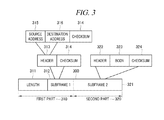
- FIG. 3 shows another example of a data structure of first data, arranged in accordance with at least some embodiments described herein;
- FIG. 4 shows a schematic block diagram illustrating an example architecture for a device, arranged in accordance with at least some embodiments described herein;
- FIG. 5 shows an example flow diagram of a process for full duplex radio communications, arranged in accordance with at least some embodiments described herein;
- FIG. 6 illustrates computer program products that may be utilized to implement full duplex radio communications, arranged in accordance with at least some embodiments described herein;
- FIG. 7 is a block diagram illustrating an example computing device that may be utilized to implement full duplex radio communications, arranged in accordance with at least some embodiments described herein.
- This disclosure is generally drawn, inter alia, to methods, apparatuses, systems, devices, and computer program products related to full duplex radio communications. Technologies are generally described for schemes for receiving and transmitting data between two devices via a single channel, simultaneously.
- a first device may be configured to receive first data from a second device. Respective one of the first device and the second device may be a device capable of full duplex radio communications.
- the first data may be a data packet.
- the first data transmitted from the second device may include at least two parts.
- a first part of the first data may be a packet header, which may include information regarding an origin of the first data, a destination of the first data, and a length of the first data.
- a second part of the first data may be a packet body, which may include actual data to be transmitted.
- the first device may be configured to receive the first data in consecutive order from the first part to the second part.
- the first device may be configured to decode the first part (e.g., packet header) of the first data. Further, the first device may be configured to determine that the destination of the first data is the first device, based on the decoded first part that may include the information regarding the destination of the first data. Then, the first device may be configured to transmit second data to the second device, while the first device is receiving the remaining second part of the first data from the second device. Thus, although a wireless communication channel is already occupied by the second device, the first device may be configured to transmit data to the second device via the same wireless communication channel simultaneously, when the destination of data which has been transmitted from the second device is the first device.
- the first part e.g., packet header
- FIG. 1 schematically shows an illustrative example of a full duplex radio communication environment 10 including a first device 110 and a second device 120 , arranged in accordance with at least some embodiments described herein.
- respective one of first device 110 and second device 120 may refer to at least one of a smart phone, a portable device, a notebook computer, a tablet device, a phablet device, a personal computer or a personal communication terminal, such as PCS (Personal Communication System), GMS (Global System for Mobile communications), PDC (Personal Digital Cellular), PDA (Personal Digital Assistant).
- respective one of first device 110 and second device 120 may be a Wi-Fi access point or a base station for a mobile telecommunications network such as a 3rd generation (3G) mobile telecommunications network or a 4th generation (4G) mobile telecommunications network.
- First device 110 and second device 120 may be capable of full duplex radio communications.
- first device 110 may be configured to receive first data from second device 120 .
- the first data transmitted from second device 120 may include at least two parts.
- first device 110 may be configured to receive the first data in consecutive order from a first part to a second part.
- the first part of the first data may be a packet header
- the second part of the first data may be a packet body.
- the packet header may include information regarding an origin of the first data and a destination of the first data.
- the packet header may include information regarding a length of the first data (e.g., a length of the packet header and a length of the packet body).
- the packet header may further include a checksum for the packet header.
- the packet body may include actual data to be transmitted and a checksum for the packet body.
- the checksum may refer to an error-detecting code, such as a cyclic redundancy check (CRC) code.
- CRC cyclic redundancy check
- first device 110 may be configured to decode the packet header of the first data, when first device 110 received the packet header of the first data. Further, first device 110 may be configured to determine that second device 120 has transmitted the first data to first device 110 based on the decoded packet header of the first data, since the packet header includes the information regarding the origin of the first data and the destination of the first data. Thus, first device 110 may be configured to determine that the origin of the first data is second device 120 and the destination of the first data is first device 110 , based on the decoded packet header.
- first device 110 may be configured to validate the decoded packet header of the first data, based on the checksum for the packet header which is included in the packet header. First device 110 may be configured to decode the packet header correctly before all of the first data is received completely.
- first device 110 may be configured to generate second data to be transmitted to second device 120 , when first device 110 received the packet header of the first data and decoded the packet header of the first data.
- first device 110 may be configured to limit a length of the second data to be shorter than the length of the first data, based on the decoded packet header of the first data, which includes the information regarding the length of the first data.
- first device 110 may be configured to generate the second data that has a length equal to or shorter than the remaining length of the first data (e.g., the length of the packet body of the first data).
- first device 110 may be configured to transmit the second data to second device 120 , while first device 110 is receiving the remaining second part of the first data transmitted from second device 120 .
- first device 110 may be configured to transmit the second data to second device 120 , while first device 110 is receiving the packet body that may include actual data of the first data.
- first device 110 may be configured to transmit the second data to second device 120 via the same wireless communication channel simultaneously, when the destination of the first data which has been transmitted from second device 120 is first device 110 and the destination of the second data which is transmitted from first device 110 is second device 120 .
- full duplex communications using a single channel between first device 110 and second device 120 may be implemented.
- FIG. 2 shows an example of a data structure of first data, arranged in accordance with at least some embodiments described herein.
- first data 200 which is transmitted from second device 120 to first device 110 may include a packet header 210 and a packet body 220 .
- packet header 210 may include a source address 211 , a destination address 212 , a length 213 that includes a length of packet header 210 and a length of packet body 220 , and a header checksum 214 .
- packet body 220 may include data 221 and a data checksum 222 .
- packet header 210 includes source address 211 , destination address 212 , length 213 and header checksum 214 , but other additional information may be included in packet header 210 .
- packet body 220 includes data 221 and data checksum 222 , but other additional information may be included in packet body 220 .
- First device 110 may be configured to receive packet header 210 from second device 120 . Further, first device 110 may be configured to decode packet header 210 , and to validate decoded packet header 210 , based at least in part on header checksum 214 . Further, first device 110 may be configured to determine that second device 120 has transmitted first data 200 to first device 110 , based on the received packet header 210 . First device 110 may be configured to determine that the source of first data 200 is second device 120 and the destination of first data 200 is first device 110 by checking source address 211 and destination address 212 included in decoded packet header 210 . Further, first device 110 may be configured to generate second data that has a length shorter than a length of first data 200 , based on length 213 included in packet header 210 . Then, first device 110 may be configured to transmit the second data to second device 120 simultaneously, while first device 110 is receiving packet body 220 of first data 200 .
- FIG. 3 shows another example of a data structure of first data, arranged in accordance with at least some embodiments described herein.
- first device 110 and second device 120 may be configured to transmit and receive data while implementing full duplex radio communications by using a frame aggregation method.
- the frame aggregation may refer to a method to increase transmission efficiency or throughput by sending two or more data frames in a single transmission.
- the frame aggregation method may refer to a mac service data unit (MSDU) aggregation method and a mac protocol data unit (MPDU) aggregation method.
- MSDU mac service data unit
- MPDU mac protocol data unit
- first data 300 which is transmitted from second device 120 to first device 110 may include a first part 310 and a second part 320 .
- first data 300 may be a frame aggregated data.
- First part 310 may include a length 311 of first data 300 and a first subframe 312 .
- second part 320 may include a second subframe 321 .
- first subframe 312 may be a first orthogonal frequency division multiplexing (OFDM) frame and second subframe 321 may be a second OFDM frame.
- OFDM orthogonal frequency division multiplexing
- first subframe 312 may include a header 313 and a checksum 314 for first subframe 312 (e.g., first OFDM frame). Further, second device 120 may be configured to set first subframe 312 to have null data. Further, header 313 may include a source address 315 that includes an origin of first data 300 and a destination address 316 . In FIG. 3 , first part 310 of first data 300 includes length 311 of first data 300 and first subframe 312 , but other additional information may be included in first part 310 of first data 300 . Further, in FIG. 3 , first subframe 312 includes header 313 and checksum 314 , but other additional information may be included in first subframe 312 . Further, in FIG. 3 , header 313 includes source address 315 and destination address 316 , but other additional information may be included in header 313 .
- second subframe 321 may include a header 322 , a body 323 that includes actual data to be transmitted and a checksum 324 for second subframe 321 (e.g., second OFDM frame).
- second subframe 321 includes header 322 , body 323 and checksum 324 , but other additional information may be included in second subframe 321 .
- First device 110 may be configured to receive first part 310 of first device 300 from second device 120 . Further, first device 110 may be configured to decode first part 310 , and to validate decoded first part 310 , based at least in part on checksum 314 . Further, first device 110 may be configured to determine that second device 120 has transmitted first data 300 to first device 110 , based on the received first part 310 . First device 110 may be configured to determine that the source of first data 300 is second device 120 and the destination of first data 300 is first device 110 by checking source address 315 and destination address 316 included in first subframe 312 . Further, first device 110 may be configured to generate second data that has a length shorter than a length of first data 300 , based on length 311 included in first part 310 .
- first device 110 may be configured to transmit the second data to second device 120 simultaneously, while first device 110 is receiving second part 320 of first data 300 .
- first device 110 may be configured to use first subframe 310 as a packet header and to use second subframe 320 as a packet body to implement full duplex radio communications.
- FIG. 4 shows a schematic block diagram illustrating an example architecture for a device, arranged in accordance with at least some embodiments described herein.
- first device 110 may include a receiver 410 , a decoder 420 , a data manager 430 and a transmitter 440 .
- various components may be divided into additional components, combined into fewer components, or eliminated altogether while being contemplated within the scope of the disclosed subject matter. It will be understood by those skilled in the art that each function and/or operation of the components may be implemented, individually and/or collectively, by a wide range of hardware, software, firmware, or virtually any combination thereof.
- one or more of receiver 410 , decoder 420 , data manager 430 and transmitter 440 may be included in an instance of an application hosted by first device 110 .
- Receiver 410 may be configured to receive a first part of first data from second device 120 which is capable of full duplex radio communications. In some embodiments, receiver 410 may be configured to receive the first part of the first data from second device 120 . In some embodiments, the first part of the first data may be a packet header. For example, but not as a limitation, the packet header may include information regarding an origin of the first data and a destination of the first data. Further, the packet header may include information regarding a length of the first data (e.g., a length of the packet header and a length of a packet body). The packet header may further include a checksum for the packet header. For example, but not as a limitation, the checksum may refer to an error-detecting code, such as a cyclic redundancy check (CRC) code.
- CRC cyclic redundancy check
- Receiver 410 may be configured to receive a second part of the first data. Receiver 410 may be configured to receive the first data in consecutive order from the first part to the second part.
- the second part of the first data may be a packet body.
- the packet body may include actual data to be transmitted to first device 110 and a checksum for the packet body.
- receiver 410 may be configured to receive the second part of the first data, while transmitter 440 is transmitting second data to second device 120 .
- the first part of the first data may include a first orthogonal frequency division multiplexing (OFDM) frame
- the second part of the first data may include a second OFDM frame.
- the first OFDM frame may include a first header that may include information regarding an origin of the first data, a destination of the first data and a checksum for the first OFDM frame.
- the first OFDM frame may have null data.
- the first part of the first data may further include length information of the first data.
- the second OFDM frame may include a second header, a body that may include actual data to be transmitted and a checksum for the second OFDM frame.
- First device 110 may be configured to use the first OFDM frame as a packet header and to use the second OFDM frame as a packet body to implement full duplex radio communications.
- decoder 420 may be configured to decode the packet header of the first data. Further, decoder 420 may be configured to validate the decoded packet header of the first data, based on the checksum for the packet header which is included in the decoded packet header. Decoder 420 may be configured to decode the packet header correctly before all of the first data is received completely, since the packet header includes the checksum for the packet header.
- decoder 420 may be configured to decode the first OFDM frame, and validate the decoded first OFDM frame of the first data, based on the checksum for the first OFDM frame.
- Data manager 430 may be configured to determine that second device 120 has transmitted the first data to first device 110 , based on the first part of the first data, which is received by receiver 410 . In some embodiments, data manager 430 may be configured to determine that second device 120 has transmitted the first data to first device 110 based on the decoded packet header of the first data, since the packet header includes the information regarding the origin of the first data and the destination of the first data. Thus, data manager 430 may be configured to determine that the origin of the first data is second device 120 and the destination of the first data is first device 110 , based on the decoded packet header.
- data manager 430 may be configured to determine that second device 120 has transmitted the first data to first device 110 based on the decoded first OFDM frame, since the decoded first OFDM frame includes the origin of the first data and the destination of the first data.
- data manager 430 may be configured to generate the second data to be transmitted to second device 120 .
- data manager 430 may be configured to limit a length of the second data to be shorter than the length of the first data, based on the decoded packet header of the first data, which includes the information regarding the length of the first data.
- data manager 430 may be configured to generate the second data that has a length equal to or shorter than the remaining length of the first data (e.g., the length of the packet body of the first data).
- Transmitter 440 may be configured to transmit the second data to second device 120 , while receiver 410 is receiving the second part of the first data transmitted from second device 120 . In some embodiments, transmitter 440 may be configured to transmit the second data to second device 120 , while receiver 410 is receiving the packet body that may include actual data of the first data. In some other embodiments, transmitter 440 may be configured to transmit the second data to second device 120 , while receiver 410 is receiving the second OFDM frame that may include actual data of the first data.
- first device 110 may be configured to transmit the second data to second device 120 via the same wireless communication channel simultaneously, when the destination of the first data which has been transmitted from second device 120 is first device 110 and the destination of the second data which is transmitted from first device 110 is second device 120 .
- full duplex communications using a single channel between first device 110 and second device 120 may be implemented.
- FIG. 5 shows an example flow diagram of a process 500 for full duplex radio communications, arranged in accordance with at least some embodiments described herein.
- the operations of process 500 may be implemented in full duplex radio communication environment 10 including first device 110 and second device 120 , as illustrated in FIG. 1 .
- Process 500 may include one or more operations, actions, or functions as illustrated by one or more blocks 510 , 520 , 530 , 540 , 550 and/or 560 . Although illustrated as discrete blocks, various blocks may be divided into additional blocks, combined into fewer blocks, or eliminated, depending on the desired implementation. Processing may begin at block 510 .
- first device 110 may receive a first part of first data from second device 120 which is capable of full duplex radio communications.
- the first part of the first data may be a packet header.
- the packet header may include information regarding an origin of the first data and a destination of the first data.
- the packet header may include information regarding a length of the first data (e.g., a length of the packet header and a length of a packet body).
- the packet header may further include a checksum for the packet header.
- the checksum may refer to an error-detecting code, such as a cyclic redundancy check (CRC) code. Processing may proceed from block 510 to block 520 .
- CRC cyclic redundancy check
- first device 110 may decode the first part of the first data, which is received at block 510 .
- first device 110 may decode the packet header of the first data.
- first device 110 may obtain the information regarding the origin of the first data, the destination of the first data, the length of the first data, and the checksum for the packet header. Processing may proceed from block 520 to block 530 .
- first device 110 may validate the decoded first part of the first data.
- first device 110 may validate the decoded packet header of the first data, based on the checksum for the packet header which is included in the decoded packet header. Processing may proceed from block 530 to block 540 .
- first device 110 may determine that second device 120 has transmitted the first data to first device 110 , based on the received first part of the first data. In some embodiments, first device 110 may determine that second device 120 has transmitted the first data to first device 110 based on the packet header decoded at block 520 , since the packet header includes the information regarding the origin of the first data and the destination of the first data. Thus, first device 110 may determine that the origin of the first data is second device 120 and the destination of the first data is first device 110 , based on the decoded packet header. Processing may proceed from block 540 to block 550 .
- first device 110 may generate second data to be transmitted to second device 120 .
- first device 110 may limit a length of the second data to be shorter than the length of the first data, based on the decoded packet header of the first data, which includes the information regarding the length of the first data.
- first device 110 may generate the second data that has a length equal to or shorter than the remaining length of the first data (e.g., the length of the packet body of the first data). Processing may proceed from block 550 to block 560 .
- first device 110 may transmit the second data generated at block 550 to second device 120 , while first device 110 is receiving the second part of the first data transmitted from second device 120 , simultaneously.
- first device 110 may transmit the second data to second device 120 , while first device 110 is receiving the packet body that may include actual data to be transmitted.
- first device 110 may be configured to transmit the second data to second device 120 via the same wireless communication channel simultaneously, when the destination of the first data which has been transmitted from second device 120 is first device 110 and the destination of the second data which is transmitted from first device 110 is second device 120 .
- full duplex communications using a single channel between first device 110 and second device 120 may be implemented.
- FIG. 6 illustrates computer program products that may be utilized to implement full duplex radio communications, arranged in accordance with at least some embodiments described herein.
- Program product 600 may include a signal bearing medium 610 .
- Signal bearing medium 610 may include one or more instructions 620 that, when executed by, for example, a processor, may provide the functionality described above with respect to FIGS. 1-5 .
- instructions 620 may include: one or more instructions for receiving a header part of a first packet from a second device capable of the full duplex radio communications; one or more instructions for decoding the header part of the first packet; one or more instructions for determining that the second device has transmitted the first packet to the first device, based, at least in part, on the decoded header part of the first packet; or one or more instructions for transmitting a second packet to the second device, while receiving a body part of the first packet from the second device.
- first device 110 may undertake one or more of the blocks shown in FIG. 5 in response to instructions 620 .
- signal bearing medium 610 may encompass a computer-readable medium 630 , such as, but not limited to, a hard disk drive, a CD, a DVD, a digital tape, memory, etc
- signal bearing medium 610 may encompass a recordable medium 640 , such as, but not limited to, memory, read/write (R/W) CDs, R/W DVDs, etc
- signal bearing medium 610 may encompass a communications medium 650 , such as, but not limited to, a digital and/or an analog communication medium (e.g., a fiber optic cable, a waveguide, a wired communications link, a wireless communication link, etc).
- program product 600 may be conveyed to one or more modules of first device 105 by an RF signal bearing medium 610 , where the signal bearing medium 610 is conveyed by a wireless communications medium 650 (e.g., a wireless communications medium conforming with the IEEE 802.11 standard).
- a wireless communications medium 650 e.g., a wireless communications medium conforming with the IEEE 802.11 standard.
- FIG. 7 is a block diagram illustrating an example computing device that may be utilized to implement full duplex radio communications, arranged in accordance with at least some embodiments described herein.
- elements of computing device 700 may be arranged or configured for a device.
- computing device 700 typically includes one or more processors 704 and a system memory 706 .
- a memory bus 708 may be used for communicating between processor 704 and system memory 706 .
- processor 704 may be of any type including but not limited to a microprocessor ( ⁇ P), a microcontroller ( ⁇ C), a digital signal processor (DSP), or any combination thereof.
- Processor 704 may include one more levels of caching, such as a level one cache 710 and a level two cache 712 , a processor core 714 , and registers 716 .
- An example processor core 714 may include an arithmetic logic unit (ALU), a floating point unit (FPU), a digital signal processing core (DSP Core), or any combination thereof.
- An example memory controller 718 may also be used with processor 704 , or in some implementations memory controller 718 may be an internal part of processor 704 .
- system memory 706 may be of any type including but not limited to volatile memory (such as RAM), non-volatile memory (such as ROM, flash memory, etc) or any combination thereof.
- System memory 706 may include an operating system 720 , an application 722 , and program data 724 .
- Application 722 may include instructions 726 that may be arranged to perform the functions as described herein including the actions described with respect to first device architecture as shown in FIG. 4 or including the actions described with respect to the flow charts shown in FIG. 5 .
- application 722 may be arranged to operate with program data 724 on an operating system 720 such that the full duplex radio communicating schemes as described herein may be provided.
- Computing device 700 may have additional features or functionality, and additional interfaces to facilitate communications between basic configuration 702 and any required devices and interfaces.
- a bus/interface controller 730 may be used to facilitate communications between basic configuration 702 and one or more data storage devices 732 via a storage interface bus 734 .
- Data storage devices 732 may be removable storage devices 736 , non-removable storage devices 738 , or a combination thereof. Examples of removable storage and non-removable storage devices include magnetic disk devices such as flexible disk drives and hard-disk drives (HDD), optical disk drives such as compact disk (CD) drives or digital versatile disk (DVD) drives, solid state drives (SSD), and tape drives to name a few.
- Example computer storage media may include volatile and nonvolatile, removable and non-removable media implemented in any method or technology for storage of information, such as computer readable instructions, data structures, program modules, or other data.
- Computer storage media includes, but is not limited to, RAM, ROM, EEPROM, flash memory or other memory technology, CD-ROM, digital versatile disks (DVD) or other optical storage, magnetic cassettes, magnetic tape, magnetic disk storage or other magnetic storage devices, or any other medium which may be used to store the desired information and which may be accessed by computing device 700 . Any such computer storage media may be part of computing device 700 .
- Computing device 700 may also include an interface bus 740 for facilitating communication from various interface devices (e.g., output interfaces 742 , peripheral interfaces 744 , and communication devices 746 ) to basic configuration 702 via bus/interface controller 730 .
- Example output devices 742 include a graphics processing unit 748 and an audio processing unit 750 , which may be configured to communicate to various external devices such as a display or speakers via one or more A/V ports 752 .
- Example peripheral interfaces 744 include a serial interface controller 754 or a parallel interface controller 756 , which may be configured to communicate with external devices such as input devices (e.g., keyboard, mouse, pen, voice input device, touch input device, etc) or other peripheral devices (e.g., printer, scanner, etc) via one or more I/O ports 758 .
- An example communication device 746 includes a network controller 760 , which may be arranged to facilitate communications with one or more other computing devices 762 over a network communication link via one or more communication ports 764 .
- the network communication link may be one example of a communication media.
- Communication media may typically be embodied by computer readable instructions, data structures, program modules, or other data in a modulated data signal, such as a carrier wave or other transport mechanism, and may include any information delivery media.
- a “modulated data signal” may be a signal that has one or more of its characteristics set or changed in such a manner as to encode information in the signal.
- communication media may include wired media such as a wired network or direct-wired connection, and wireless media such as acoustic, radio frequency (RF), microwave, infrared (IR) and other wireless media.
- RF radio frequency
- IR infrared
- the term computer readable media as used herein may include both storage media and communication media.
- Computing device 700 may be implemented as a portion of a small-form factor portable (or mobile) electronic device such as a cell phone, a personal data assistant (PDA), a personal media player device, a wireless web-watch device, a personal headset device, an application specific device, or a hybrid device that include any of the above functions.
- a small-form factor portable (or mobile) electronic device such as a cell phone, a personal data assistant (PDA), a personal media player device, a wireless web-watch device, a personal headset device, an application specific device, or a hybrid device that include any of the above functions.
- PDA personal data assistant
- Computing device 700 may also be implemented as a personal computer including both laptop computer and non-laptop computer configurations.
- a range includes each individual member.
- a group having 1-3 cells refers to groups having 1, 2, or 3 cells.
- a group having 1-5 cells refers to groups having 1, 2, 3, 4, or 5 cells, and so forth.
Landscapes
- Engineering & Computer Science (AREA)
- Signal Processing (AREA)
- Computer Networks & Wireless Communication (AREA)
- Mobile Radio Communication Systems (AREA)
Abstract
Description
Claims (18)
Applications Claiming Priority (1)
| Application Number | Priority Date | Filing Date | Title |
|---|---|---|---|
| PCT/US2014/033319 WO2015156776A1 (en) | 2014-04-08 | 2014-04-08 | Full duplex radio communication |
Publications (2)
| Publication Number | Publication Date |
|---|---|
| US20160087779A1 US20160087779A1 (en) | 2016-03-24 |
| US10027466B2 true US10027466B2 (en) | 2018-07-17 |
Family
ID=54288208
Family Applications (1)
| Application Number | Title | Priority Date | Filing Date |
|---|---|---|---|
| US14/888,850 Expired - Fee Related US10027466B2 (en) | 2014-04-08 | 2014-04-08 | Full duplex radio communication |
Country Status (2)
| Country | Link |
|---|---|
| US (1) | US10027466B2 (en) |
| WO (1) | WO2015156776A1 (en) |
Families Citing this family (4)
| Publication number | Priority date | Publication date | Assignee | Title |
|---|---|---|---|---|
| US10027466B2 (en) * | 2014-04-08 | 2018-07-17 | Empire Technology Development Llc | Full duplex radio communication |
| US9954625B2 (en) | 2014-04-15 | 2018-04-24 | Empire Technology Development Llc | Self interference cancellation |
| US12088499B2 (en) * | 2020-04-15 | 2024-09-10 | Virewirx, Inc. | System and method for reducing data packet processing false alarms |
| KR102786102B1 (en) * | 2020-05-25 | 2025-03-26 | 주식회사 엘엑스세미콘 | Data processing device, data driving device and system for driving display device |
Citations (30)
| Publication number | Priority date | Publication date | Assignee | Title |
|---|---|---|---|---|
| WO2002063786A1 (en) | 2000-11-12 | 2002-08-15 | Mobilian Corporation | Active cancellation tuning to reduce a wireless coupled transmit signal |
| US7426249B2 (en) | 2001-03-19 | 2008-09-16 | Cisco Technology, Inc. | Adaptive Viterbi decoder for a wireless data network receiver |
| US20080253490A1 (en) | 2007-04-10 | 2008-10-16 | Abdulrauf Hafeez | Method and Apparatus for Cancellation of Partially Known Interference Using Transmit Diversity Based Interference Cancellation |
| US20090180404A1 (en) | 2008-01-14 | 2009-07-16 | Samsung Electronics Co., Ltd. | Apparatus and method for interference cancellation and synchronization maintenance over interference channel estimation in communication system based on full-duplex relay |
| US20100022201A1 (en) | 2008-07-22 | 2010-01-28 | Patrick Vandenameele | Apparatus and method for reducing self-interference in a radio system |
| US20100142559A1 (en) * | 2008-12-05 | 2010-06-10 | Stmicroelectronics, Inc. | Super-frame structure for dynamic spectrum sharing in wireless networks |
| US20100220708A1 (en) | 2003-09-25 | 2010-09-02 | Qualcomm Incorporated | Hierarchical coding with multiple antennas in a wireless communication system |
| US20100232324A1 (en) | 2009-03-16 | 2010-09-16 | Microsoft Corporation | Full-Duplex Wireless Communications |
| US20100238932A1 (en) * | 2009-03-19 | 2010-09-23 | Broadcom Corporation | Method and apparatus for enhanced packet aggregation |
| US20110002232A1 (en) | 2009-07-01 | 2011-01-06 | Jaroslaw Niewczas | Multi-path timing tracking and impairment modeling for improved grake receiver performance in mobility scenarios |
| US20110013684A1 (en) | 2009-07-14 | 2011-01-20 | Nokia Corporation | Channel estimates in a SIC receiver for a multi-transmitter array transmission scheme |
| US20110243154A1 (en) * | 2010-03-30 | 2011-10-06 | International Business Machines Corporation | Using variable length packets to embed extra network control information |
| US20110286340A1 (en) | 2010-05-19 | 2011-11-24 | Dsp Group Inc. | Remote control of transmitter-side rate adaptation |
| US20120045986A1 (en) * | 2010-08-19 | 2012-02-23 | Fujitsu Limited | Wireless communication system, relay station, receiver station, and wireless communication method |
| US8204025B2 (en) | 2007-11-09 | 2012-06-19 | Zte (Usa) Inc. | Flexible OFDM/OFDMA frame structure for communication systems |
| US20120201173A1 (en) | 2011-02-03 | 2012-08-09 | Mayank Jain | Single channel full duplex wireless communications |
| US20130042162A1 (en) * | 2008-09-02 | 2013-02-14 | Kbc Research Foundation Pvt. Ltd. | Chained checksum error correction mechanism to improve tcp performance over network with wireless links |
| US8472468B2 (en) | 2004-01-09 | 2013-06-25 | Kabushiki Kaisha Toshiba | Communication apparatus, communication method, and communication system |
| US20130194984A1 (en) | 2012-01-16 | 2013-08-01 | Huawei Technologies Co., Ltd. | Method and apparatus for handling full-duplex interference |
| US8509193B2 (en) | 2009-07-21 | 2013-08-13 | Microsoft Corporation | Packet aggregation |
| US20130286903A1 (en) | 2012-04-25 | 2013-10-31 | Nec Laboratories America, Inc. | Interference Cancellation for Full-Duplex Communications |
| US20130301487A1 (en) | 2012-05-13 | 2013-11-14 | Amir Keyvan Khandani | Full Duplex Wireless Transmission with Self-Interference Cancellation |
| US20140016515A1 (en) | 2012-07-13 | 2014-01-16 | At&T Intellectual Property I, L.P. | System and method for full duplex cancellation |
| US20140059155A1 (en) | 1997-10-14 | 2014-02-27 | Alacritech, Inc. | Intelligent Network Interface System and Method for Protocol Processing |
| US20140362838A1 (en) * | 2013-06-05 | 2014-12-11 | Yang-seok Choi | Techniques for simultaneous transmitting and receiving of packets in a wireless local area network |
| US9036749B2 (en) | 2013-08-09 | 2015-05-19 | Kumu Networks, Inc. | Systems and methods for frequency independent analog self-interference cancellation |
| US20150195079A1 (en) * | 2014-01-07 | 2015-07-09 | Google Inc. | Method and Control Circuitry for Performing Full-Duplex Wireless Communication |
| US9226200B2 (en) | 2013-05-10 | 2015-12-29 | Alcatel Lucent | Network assisted interference cancellation |
| US20160087779A1 (en) * | 2014-04-08 | 2016-03-24 | Empire Technology Development Llc | Full duplex radio communication |
| US9698860B2 (en) | 2013-08-09 | 2017-07-04 | Kumu Networks, Inc. | Systems and methods for self-interference canceller tuning |
-
2014
- 2014-04-08 US US14/888,850 patent/US10027466B2/en not_active Expired - Fee Related
- 2014-04-08 WO PCT/US2014/033319 patent/WO2015156776A1/en not_active Ceased
Patent Citations (33)
| Publication number | Priority date | Publication date | Assignee | Title |
|---|---|---|---|---|
| US20140059155A1 (en) | 1997-10-14 | 2014-02-27 | Alacritech, Inc. | Intelligent Network Interface System and Method for Protocol Processing |
| WO2002063786A1 (en) | 2000-11-12 | 2002-08-15 | Mobilian Corporation | Active cancellation tuning to reduce a wireless coupled transmit signal |
| US7426249B2 (en) | 2001-03-19 | 2008-09-16 | Cisco Technology, Inc. | Adaptive Viterbi decoder for a wireless data network receiver |
| US20100220708A1 (en) | 2003-09-25 | 2010-09-02 | Qualcomm Incorporated | Hierarchical coding with multiple antennas in a wireless communication system |
| US8472468B2 (en) | 2004-01-09 | 2013-06-25 | Kabushiki Kaisha Toshiba | Communication apparatus, communication method, and communication system |
| US20080253490A1 (en) | 2007-04-10 | 2008-10-16 | Abdulrauf Hafeez | Method and Apparatus for Cancellation of Partially Known Interference Using Transmit Diversity Based Interference Cancellation |
| US8204025B2 (en) | 2007-11-09 | 2012-06-19 | Zte (Usa) Inc. | Flexible OFDM/OFDMA frame structure for communication systems |
| US20090180404A1 (en) | 2008-01-14 | 2009-07-16 | Samsung Electronics Co., Ltd. | Apparatus and method for interference cancellation and synchronization maintenance over interference channel estimation in communication system based on full-duplex relay |
| US20100022201A1 (en) | 2008-07-22 | 2010-01-28 | Patrick Vandenameele | Apparatus and method for reducing self-interference in a radio system |
| US20130042162A1 (en) * | 2008-09-02 | 2013-02-14 | Kbc Research Foundation Pvt. Ltd. | Chained checksum error correction mechanism to improve tcp performance over network with wireless links |
| US20100142559A1 (en) * | 2008-12-05 | 2010-06-10 | Stmicroelectronics, Inc. | Super-frame structure for dynamic spectrum sharing in wireless networks |
| US20100232324A1 (en) | 2009-03-16 | 2010-09-16 | Microsoft Corporation | Full-Duplex Wireless Communications |
| US20100238932A1 (en) * | 2009-03-19 | 2010-09-23 | Broadcom Corporation | Method and apparatus for enhanced packet aggregation |
| US20110002232A1 (en) | 2009-07-01 | 2011-01-06 | Jaroslaw Niewczas | Multi-path timing tracking and impairment modeling for improved grake receiver performance in mobility scenarios |
| US20110013684A1 (en) | 2009-07-14 | 2011-01-20 | Nokia Corporation | Channel estimates in a SIC receiver for a multi-transmitter array transmission scheme |
| US8509193B2 (en) | 2009-07-21 | 2013-08-13 | Microsoft Corporation | Packet aggregation |
| US20110243154A1 (en) * | 2010-03-30 | 2011-10-06 | International Business Machines Corporation | Using variable length packets to embed extra network control information |
| US20110286340A1 (en) | 2010-05-19 | 2011-11-24 | Dsp Group Inc. | Remote control of transmitter-side rate adaptation |
| US20120045986A1 (en) * | 2010-08-19 | 2012-02-23 | Fujitsu Limited | Wireless communication system, relay station, receiver station, and wireless communication method |
| US20120201173A1 (en) | 2011-02-03 | 2012-08-09 | Mayank Jain | Single channel full duplex wireless communications |
| US20120201153A1 (en) | 2011-02-03 | 2012-08-09 | Dinesh Bharadia | Adaptive techniques for full duplex communications |
| US20130194984A1 (en) | 2012-01-16 | 2013-08-01 | Huawei Technologies Co., Ltd. | Method and apparatus for handling full-duplex interference |
| US20130286903A1 (en) | 2012-04-25 | 2013-10-31 | Nec Laboratories America, Inc. | Interference Cancellation for Full-Duplex Communications |
| US20170155496A1 (en) | 2012-05-13 | 2017-06-01 | Amir Keyvan Khandani | Full duplex wireless transmission with channel phase-based encryption |
| US20130301487A1 (en) | 2012-05-13 | 2013-11-14 | Amir Keyvan Khandani | Full Duplex Wireless Transmission with Self-Interference Cancellation |
| US20140016515A1 (en) | 2012-07-13 | 2014-01-16 | At&T Intellectual Property I, L.P. | System and method for full duplex cancellation |
| US9226200B2 (en) | 2013-05-10 | 2015-12-29 | Alcatel Lucent | Network assisted interference cancellation |
| US20140362838A1 (en) * | 2013-06-05 | 2014-12-11 | Yang-seok Choi | Techniques for simultaneous transmitting and receiving of packets in a wireless local area network |
| US9036749B2 (en) | 2013-08-09 | 2015-05-19 | Kumu Networks, Inc. | Systems and methods for frequency independent analog self-interference cancellation |
| US9698860B2 (en) | 2013-08-09 | 2017-07-04 | Kumu Networks, Inc. | Systems and methods for self-interference canceller tuning |
| US9832003B2 (en) | 2013-08-09 | 2017-11-28 | Kumu Networks, Inc. | Systems and methods for self-interference canceller tuning |
| US20150195079A1 (en) * | 2014-01-07 | 2015-07-09 | Google Inc. | Method and Control Circuitry for Performing Full-Duplex Wireless Communication |
| US20160087779A1 (en) * | 2014-04-08 | 2016-03-24 | Empire Technology Development Llc | Full duplex radio communication |
Non-Patent Citations (10)
| Title |
|---|
| Bharadia, D., et al., "Full duplex radios," Proceedings of the ACM SIGCOMM 2013 conference on SIGCOMM, pp. 375-386 (Aug. 12-16, 2013). |
| Choi, J.I., et al., "Full-Duplex Wireless Design," accessed at https://web.archive.org/web/20140201025815/http://sing.stanford.edu/fullduplex/, accessed on Sep. 4, 2015, pp. 3. |
| International Search Report and Written Opinion for International Application No. PCT/US2014/034208 dated Sep. 10, 2014. |
| International Search Report and Written Opinion for International Application No. PCT/US2014/33319 dated Sep. 11, 2014. |
| Jain, M., et al., "Practical, Real-time, Full Duplex Wireless," Proceedings of the 17th annual international conference on Mobile computing and networking, pp. 301-312 (Sep. 19-23, 2011). |
| Lin, Y and Wong, V.W.S., "Frame Aggregation and Optimal Frame Size Adaptation for IEEE 802.11n WLANs," pp. 1-6 (Nov. 27, 2006-Dec. 1, 2006). |
| Sabharwal, A., "Research Areas," accessed at https://web.archive.org/web/20140314123817/http://www.ece.rice.edu/˜ashu/research.html, accessed on Sep. 15, 2015, pp. 2. |
| Sahai, A et al., "Pushing the limits of Full-duplex: Design and Real-time Implementation," pp. 1-12 (Jul. 2011). |
| Srinivasan, K., et al., "Beyond Full Duplex Wireless," Asilomar Conference on Signals, Systems and Computers, pp. 1-5 (Nov. 2012). |
| Zhou, W., et al., "RCTC: Rapid Concurrent Transmission Coordination in Full DuplexWireless Networks," IEEE International Conference on Network Protocols, pp. 1-10 (Oct. 7-10, 2013). |
Also Published As
| Publication number | Publication date |
|---|---|
| US20160087779A1 (en) | 2016-03-24 |
| WO2015156776A1 (en) | 2015-10-15 |
Similar Documents
| Publication | Publication Date | Title |
|---|---|---|
| CN102308502B (en) | Transmission of System Configuration Information in Mobile Networks | |
| US20150230096A1 (en) | Schemes for connecting to wireless network | |
| BRPI0923008B1 (en) | method and apparatus for causing a user agent to release at least one of a semi-persistent communication resource | |
| US10368304B2 (en) | Encoding and decoding data for group common control channels | |
| US10574366B2 (en) | Self interference cancellation | |
| US9107067B2 (en) | Secured communication | |
| US10027466B2 (en) | Full duplex radio communication | |
| US8520505B1 (en) | Combined hard/soft relay forwarding for hybrid-automatic repeat request (ARQ) exploitation | |
| US9661465B2 (en) | Location determining scheme | |
| US8837522B2 (en) | System and method of encoding and decoding control information in a medium access control protocol data unit | |
| CN113938259B (en) | HARQ-ACK feedback method and device | |
| US8948091B2 (en) | Push management scheme | |
| US12500800B2 (en) | Real time physical layer processing in distributed units | |
| CN116889037A (en) | Communication methods, electronic devices and storage media | |
| US20160198502A1 (en) | Schemes for providing wireless communication | |
| US9730170B2 (en) | Connection to access point | |
| CN105144813B (en) | Method and apparatus for supporting device-to-device D2D communication in a wireless communication system | |
| US9942877B2 (en) | Multicasting method and system | |
| US10425929B2 (en) | Voice over internet protocol services | |
| US10057717B2 (en) | Location determining scheme | |
| US9712566B2 (en) | Providing session identifiers | |
| US20160239313A1 (en) | Control of router in cloud system | |
| US20130139009A1 (en) | Scheduling for enhancing communication performance | |
| US20150304930A1 (en) | Wireless network handover | |
| US9591691B2 (en) | Schemes for providing wireless network |
Legal Events
| Date | Code | Title | Description |
|---|---|---|---|
| AS | Assignment |
Owner name: EMPIRE TECHNOLOGY DEVELOPMENT LLC, DELAWARE Free format text: ASSIGNMENT OF ASSIGNORS INTEREST;ASSIGNOR:LEE, HYOUNG-GON;REEL/FRAME:036949/0547 Effective date: 20140314 |
|
| STCF | Information on status: patent grant |
Free format text: PATENTED CASE |
|
| AS | Assignment |
Owner name: CRESTLINE DIRECT FINANCE, L.P., TEXAS Free format text: SECURITY INTEREST;ASSIGNOR:EMPIRE TECHNOLOGY DEVELOPMENT LLC;REEL/FRAME:048373/0217 Effective date: 20181228 |
|
| FEPP | Fee payment procedure |
Free format text: MAINTENANCE FEE REMINDER MAILED (ORIGINAL EVENT CODE: REM.); ENTITY STATUS OF PATENT OWNER: LARGE ENTITY |
|
| LAPS | Lapse for failure to pay maintenance fees |
Free format text: PATENT EXPIRED FOR FAILURE TO PAY MAINTENANCE FEES (ORIGINAL EVENT CODE: EXP.); ENTITY STATUS OF PATENT OWNER: LARGE ENTITY |
|
| STCH | Information on status: patent discontinuation |
Free format text: PATENT EXPIRED DUE TO NONPAYMENT OF MAINTENANCE FEES UNDER 37 CFR 1.362 |
|
| FP | Lapsed due to failure to pay maintenance fee |
Effective date: 20220717 |