US10026909B2 - Anthracene-based compound and organic light-emitting device comprising the same - Google Patents
Anthracene-based compound and organic light-emitting device comprising the same Download PDFInfo
- Publication number
- US10026909B2 US10026909B2 US14/314,097 US201414314097A US10026909B2 US 10026909 B2 US10026909 B2 US 10026909B2 US 201414314097 A US201414314097 A US 201414314097A US 10026909 B2 US10026909 B2 US 10026909B2
- Authority
- US
- United States
- Prior art keywords
- group
- substituted
- unsubstituted
- anthracene
- based compound
- Prior art date
- Legal status (The legal status is an assumption and is not a legal conclusion. Google has not performed a legal analysis and makes no representation as to the accuracy of the status listed.)
- Active, expires
Links
- 0 C1=CC2=C(C=C1)C=CC=C2.C1=CC=C2C=CC=CC2=C1.CC.CC.CC.CC1=C2C=CC=CC2=CC2=CC=CC=C21.CCC.[1*][Si]([2*])(C)CC Chemical compound C1=CC2=C(C=C1)C=CC=C2.C1=CC=C2C=CC=CC2=C1.CC.CC.CC.CC1=C2C=CC=CC2=CC2=CC=CC=C21.CCC.[1*][Si]([2*])(C)CC 0.000 description 30
- SMQUMQOSXUHOOD-UHFFFAOYSA-N C#C[Si](C)(C1=CC=CC(C2=CC=C(C3=C4C=CC=CC4=C(C4=CC=C5C=CC=CC5=C4)C4=CC=CC=C43)C=C2)=C1)C1=CC=C2C=CC=CC2=C1.C[Si](C)(C1=CC=C2C=CC=CC2=C1)C1=CC2=CC=C(C3=C4C=CC=CC4=C(C4=CC=CC5=C4C=CC=C5)C4=CC=CC=C43)C=C2C=C1.C[Si](C)(C1=CC=C2C=CC=CC2=C1)C1=CC=C(C2=C3C=CC=CC3=C(C3=CC=CC4=C3C=CC=C4)C3=CC=CC=C32)C2=C1C=CC=C2.C[Si](C1=CC=C(C2=C3C=CC=CC3=C(C3=CC=CC4=C3C=CC=C4)C3=CC=CC=C32)C=C1)(C1=CC=C2C=CC=CC2=C1)C1=CC2=C(C=CC=C2)C=C1.C[Si](C1=CC=C2C=CC=CC2=C1)(C1=CC=CC(C2=C3C=CC=CC3=C(C3=CC=CC4=C3C=CC=C4)C3=CC=CC=C32)=C1)C1=CC2=C(C=CC=C2)C=C1.C[Si](C1=CC=CC=C1)(C1=CC=C2C=CC=CC2=C1)C1=CC=C(C2=C3C=CC=CC3=C(C3=CC=CC4=C3C=CC=C4)C3=CC=CC=C32)C2=C1C=CC=C2.C[Si](C1=CC=CC=C1)(C1=CC=C2C=CC=CC2=C1)C1=CC=C(C2=CC=C(C3=C4C=CC=CC4=C(C4=CC=C5C=CC=CC5=C4)C4=CC=CC=C43)C=C2)C2=C1C=CC=C2.C[Si](C1=CC=CC=C1)(C1=CC=C2C=CC=CC2=C1)C1=CC=CC2=C1C=CC=C2C1=C2C=CC=CC2=C(C2=CC=CC3=C2C=CC=C3)C2=CC=CC=C21.[HH].[HH] Chemical compound C#C[Si](C)(C1=CC=CC(C2=CC=C(C3=C4C=CC=CC4=C(C4=CC=C5C=CC=CC5=C4)C4=CC=CC=C43)C=C2)=C1)C1=CC=C2C=CC=CC2=C1.C[Si](C)(C1=CC=C2C=CC=CC2=C1)C1=CC2=CC=C(C3=C4C=CC=CC4=C(C4=CC=CC5=C4C=CC=C5)C4=CC=CC=C43)C=C2C=C1.C[Si](C)(C1=CC=C2C=CC=CC2=C1)C1=CC=C(C2=C3C=CC=CC3=C(C3=CC=CC4=C3C=CC=C4)C3=CC=CC=C32)C2=C1C=CC=C2.C[Si](C1=CC=C(C2=C3C=CC=CC3=C(C3=CC=CC4=C3C=CC=C4)C3=CC=CC=C32)C=C1)(C1=CC=C2C=CC=CC2=C1)C1=CC2=C(C=CC=C2)C=C1.C[Si](C1=CC=C2C=CC=CC2=C1)(C1=CC=CC(C2=C3C=CC=CC3=C(C3=CC=CC4=C3C=CC=C4)C3=CC=CC=C32)=C1)C1=CC2=C(C=CC=C2)C=C1.C[Si](C1=CC=CC=C1)(C1=CC=C2C=CC=CC2=C1)C1=CC=C(C2=C3C=CC=CC3=C(C3=CC=CC4=C3C=CC=C4)C3=CC=CC=C32)C2=C1C=CC=C2.C[Si](C1=CC=CC=C1)(C1=CC=C2C=CC=CC2=C1)C1=CC=C(C2=CC=C(C3=C4C=CC=CC4=C(C4=CC=C5C=CC=CC5=C4)C4=CC=CC=C43)C=C2)C2=C1C=CC=C2.C[Si](C1=CC=CC=C1)(C1=CC=C2C=CC=CC2=C1)C1=CC=CC2=C1C=CC=C2C1=C2C=CC=CC2=C(C2=CC=CC3=C2C=CC=C3)C2=CC=CC=C21.[HH].[HH] SMQUMQOSXUHOOD-UHFFFAOYSA-N 0.000 description 2
- GSMXJVYEJWGUSH-UHFFFAOYSA-N C1=CC=C([Si](C2=CC=CC=C2)(C2=CC=C3C=CC=CC3=C2)C2=C3C=CC=CC3=C(C3=C4C=CC=CC4=C(C4=CC=C5C=CC=CC5=C4)C4=CC=CC=C43)C3=C2C=CC=C3)C=C1.CC1=CC([Si](C2=CC=CC=C2)(C2=CC=CC=C2)C2=CC=C3C=CC=CC3=C2)=C(C)C=C1C1=C2C=CC=CC2=C(C2=CC=C3C=CC=CC3=C2)C2=CC=CC=C21.C[Si](C)(C1=CC=C2C=CC=CC2=C1)C1=CC2=CC=C(C3=C4C=CC=CC4=C(C4=CC=C5C=CC=CC5=C4)C4=CC=CC=C43)C=C2C=C1.C[Si](C)(C1=CC=C2C=CC=CC2=C1)C1=CC=C(C2=C3C=CC=CC3=C(C3=CC=C4C=CC=CC4=C3)C3=CC=CC=C32)C2=C1C=CC=C2.C[Si](C1=CC=C(C2=C3C=CC=CC3=C(C3=CC=C4C=CC=CC4=C3)C3=CC=CC=C32)C=C1)(C1=CC=C2C=CC=CC2=C1)C1=CC2=C(C=CC=C2)C=C1.C[Si](C1=CC=C2C=CC=CC2=C1)(C1=CC=CC(C2=C3C=CC=CC3=C(C3=CC=C4C=CC=CC4=C3)C3=CC=CC=C32)=C1)C1=CC2=C(C=CC=C2)C=C1.C[Si](C1=CC=CC=C1)(C1=CC=C2C=CC=CC2=C1)C1=CC=C(C2=C3C=CC=CC3=C(C3=CC=C4C=CC=CC4=C3)C3=CC=CC=C32)C2=C1C=CC=C2.C[Si](C1=CC=CC=C1)(C1=CC=C2C=CC=CC2=C1)C1=CC=CC2=C1C=CC=C2C1=C2C=CC=CC2=C(C2=CC=C3C=CC=CC3=C2)C2=CC=CC=C21 Chemical compound C1=CC=C([Si](C2=CC=CC=C2)(C2=CC=C3C=CC=CC3=C2)C2=C3C=CC=CC3=C(C3=C4C=CC=CC4=C(C4=CC=C5C=CC=CC5=C4)C4=CC=CC=C43)C3=C2C=CC=C3)C=C1.CC1=CC([Si](C2=CC=CC=C2)(C2=CC=CC=C2)C2=CC=C3C=CC=CC3=C2)=C(C)C=C1C1=C2C=CC=CC2=C(C2=CC=C3C=CC=CC3=C2)C2=CC=CC=C21.C[Si](C)(C1=CC=C2C=CC=CC2=C1)C1=CC2=CC=C(C3=C4C=CC=CC4=C(C4=CC=C5C=CC=CC5=C4)C4=CC=CC=C43)C=C2C=C1.C[Si](C)(C1=CC=C2C=CC=CC2=C1)C1=CC=C(C2=C3C=CC=CC3=C(C3=CC=C4C=CC=CC4=C3)C3=CC=CC=C32)C2=C1C=CC=C2.C[Si](C1=CC=C(C2=C3C=CC=CC3=C(C3=CC=C4C=CC=CC4=C3)C3=CC=CC=C32)C=C1)(C1=CC=C2C=CC=CC2=C1)C1=CC2=C(C=CC=C2)C=C1.C[Si](C1=CC=C2C=CC=CC2=C1)(C1=CC=CC(C2=C3C=CC=CC3=C(C3=CC=C4C=CC=CC4=C3)C3=CC=CC=C32)=C1)C1=CC2=C(C=CC=C2)C=C1.C[Si](C1=CC=CC=C1)(C1=CC=C2C=CC=CC2=C1)C1=CC=C(C2=C3C=CC=CC3=C(C3=CC=C4C=CC=CC4=C3)C3=CC=CC=C32)C2=C1C=CC=C2.C[Si](C1=CC=CC=C1)(C1=CC=C2C=CC=CC2=C1)C1=CC=CC2=C1C=CC=C2C1=C2C=CC=CC2=C(C2=CC=C3C=CC=CC3=C2)C2=CC=CC=C21 GSMXJVYEJWGUSH-UHFFFAOYSA-N 0.000 description 2
- ZYHUQQKWJSHFCG-YWQSAXMBSA-N *.B.B.B=NS.BrC1=C2C=CC=CC2=C(C2=CC3=C(C=CC=C3)C=C2)C2=CC=CC=C21.BrC1=C2C=CC=CC2=C(C2=CC3=C(C=CC=C3)C=C2)C2=CC=CC=C21.BrC1=CC2=CC=CC=C2C=C1.BrC1=CC2=CC=CC=C2C=C1.C.C.C.C1=CC=C2C(=C1)C=C1C=CC=CC1=C2C1=CC2=C(C=CC=C2)C=C1.CC1(C)OB(C2=CC=C([Si](C)(C3=CC=C4C=CC=CC4=C3)C3=CC=C4C=CC=CC4=C3)C=C2)OC1(C)C.CC1(C)OB(C2=CC=C([Si](C)(C3=CC=C4C=CC=CC4=C3)C3=CC=C4C=CC=CC4=C3)C=C2)OC1(C)C.C[Si](C1=CC=C(Br)C=C1)(C1=CC=C2C=CC=CC2=C1)C1=CC=C2C=CC=CC2=C1.C[Si](Cl)(C1=CC=C2C=CC=CC2=C1)C1=CC=C2C=CC=CC2=C1.OB(O)C1=CC2=CC=CC=C2C=C1.[2HH] Chemical compound *.B.B.B=NS.BrC1=C2C=CC=CC2=C(C2=CC3=C(C=CC=C3)C=C2)C2=CC=CC=C21.BrC1=C2C=CC=CC2=C(C2=CC3=C(C=CC=C3)C=C2)C2=CC=CC=C21.BrC1=CC2=CC=CC=C2C=C1.BrC1=CC2=CC=CC=C2C=C1.C.C.C.C1=CC=C2C(=C1)C=C1C=CC=CC1=C2C1=CC2=C(C=CC=C2)C=C1.CC1(C)OB(C2=CC=C([Si](C)(C3=CC=C4C=CC=CC4=C3)C3=CC=C4C=CC=CC4=C3)C=C2)OC1(C)C.CC1(C)OB(C2=CC=C([Si](C)(C3=CC=C4C=CC=CC4=C3)C3=CC=C4C=CC=CC4=C3)C=C2)OC1(C)C.C[Si](C1=CC=C(Br)C=C1)(C1=CC=C2C=CC=CC2=C1)C1=CC=C2C=CC=CC2=C1.C[Si](Cl)(C1=CC=C2C=CC=CC2=C1)C1=CC=C2C=CC=CC2=C1.OB(O)C1=CC2=CC=CC=C2C=C1.[2HH] ZYHUQQKWJSHFCG-YWQSAXMBSA-N 0.000 description 1
- XXKYOZQFRYPPOA-RKKUYXDDSA-N B=NS.BrC1=C2C=CC=CC2=CC2=CC=CC=C21.BrC1=CC2=CC=CC=C2C=C1.BrC1=CC2=CC=CC=C2C=C1.C.C1=CC=C2C(=C1)C=C1C=CC=CC1=C2C1=CC2=C(C=CC=C2)C=C1.CC1(C)OB(C2=CC([Si](C)(C3=CC=C4C=CC=CC4=C3)C3=CC=C4/C=C\C=C/C4=C3)=CC=C2)OC1(C)C.CCCCCCCCCB(O)OO.C[Si](C1=CC=CC(Br)=C1)(C1=CC=C2C=CC=CC2=C1)C1=CC=C2/C=C\C=C/C2=C1.C[Si](Cl)(C1=CC=C2C=CC=CC2=C1)C1=CC=C2/C=C\C=C/C2=C1.ClC(Cl)Cl.F.OB(O)C1=CC2=CC=CC=C2C=C1.[2HH] Chemical compound B=NS.BrC1=C2C=CC=CC2=CC2=CC=CC=C21.BrC1=CC2=CC=CC=C2C=C1.BrC1=CC2=CC=CC=C2C=C1.C.C1=CC=C2C(=C1)C=C1C=CC=CC1=C2C1=CC2=C(C=CC=C2)C=C1.CC1(C)OB(C2=CC([Si](C)(C3=CC=C4C=CC=CC4=C3)C3=CC=C4/C=C\C=C/C4=C3)=CC=C2)OC1(C)C.CCCCCCCCCB(O)OO.C[Si](C1=CC=CC(Br)=C1)(C1=CC=C2C=CC=CC2=C1)C1=CC=C2/C=C\C=C/C2=C1.C[Si](Cl)(C1=CC=C2C=CC=CC2=C1)C1=CC=C2/C=C\C=C/C2=C1.ClC(Cl)Cl.F.OB(O)C1=CC2=CC=CC=C2C=C1.[2HH] XXKYOZQFRYPPOA-RKKUYXDDSA-N 0.000 description 1
- AADSPCIFCKARRD-PPQSCVLNSA-N BN=P.C1=CC=C(N(C2=CC=C(C3=CC=C(N(C4=CC=CC=C4)C4=C5C=CC=CC5=CC=C4)C=C3)C=C2)C2=CC=CC3=C2C=CC=C3)C=C1.CC1=CC=CC(N(C2=CC=CC=C2)C2=CC=C(C3=CC=C(N(C4=CC=CC=C4)C4=CC=CC(C)=C4)C=C3)C=C2)=C1.[2H]P[3H] Chemical compound BN=P.C1=CC=C(N(C2=CC=C(C3=CC=C(N(C4=CC=CC=C4)C4=C5C=CC=CC5=CC=C4)C=C3)C=C2)C2=CC=CC3=C2C=CC=C3)C=C1.CC1=CC=CC(N(C2=CC=CC=C2)C2=CC=C(C3=CC=C(N(C4=CC=CC=C4)C4=CC=CC(C)=C4)C=C3)C=C2)=C1.[2H]P[3H] AADSPCIFCKARRD-PPQSCVLNSA-N 0.000 description 1
- YRWKRUMGWDPDHU-UHFFFAOYSA-N BrC1=C2C=CC=CC2=C(C2=CC3=C(C=CC=C3)C=C2)C2=CC=CC=C21.BrC1=C2C=CC=CC2=C(C2=CC3=C(C=CC=C3)C=C2)C2=CC=CC=C21.CC1(C)OB(C2=CC([Si](C)(C3=CC=C4C=CC=CC4=C3)C3=CC=C4/C=C\C=C/C4=C3)=CC=C2)OC1(C)C.C[Si](C1=CC=CC(C2=C3C=CC=CC3=C(C3=CC4=C(C=CC=C4)C=C3)C3=C2C=CC=C3)=C1)(C1=CC2=C(C=CC=C2)C=C1)C1=CC2=C(C=CC=C2)C=C1 Chemical compound BrC1=C2C=CC=CC2=C(C2=CC3=C(C=CC=C3)C=C2)C2=CC=CC=C21.BrC1=C2C=CC=CC2=C(C2=CC3=C(C=CC=C3)C=C2)C2=CC=CC=C21.CC1(C)OB(C2=CC([Si](C)(C3=CC=C4C=CC=CC4=C3)C3=CC=C4/C=C\C=C/C4=C3)=CC=C2)OC1(C)C.C[Si](C1=CC=CC(C2=C3C=CC=CC3=C(C3=CC4=C(C=CC=C4)C=C3)C3=C2C=CC=C3)=C1)(C1=CC2=C(C=CC=C2)C=C1)C1=CC2=C(C=CC=C2)C=C1 YRWKRUMGWDPDHU-UHFFFAOYSA-N 0.000 description 1
- COCWKIZMRIKJFY-UHFFFAOYSA-N C.C1=CC=C(C2=CC=NC3=C2C=CC2=C3N=CC=C2C2=CC=CC=C2)C=C1.CBP.CC1=CC(C2=CC=CC=C2)=C2C=CC3=C(N=C(C)C=C3C3=CC=CC=C3)C2=N1 Chemical compound C.C1=CC=C(C2=CC=NC3=C2C=CC2=C3N=CC=C2C2=CC=CC=C2)C=C1.CBP.CC1=CC(C2=CC=CC=C2)=C2C=CC3=C(N=C(C)C=C3C3=CC=CC=C3)C2=N1 COCWKIZMRIKJFY-UHFFFAOYSA-N 0.000 description 1
- NUYCTQAFSYALSB-UHFFFAOYSA-N C1=CC(/N2=C3\C=CC=C\C3=C3/C=CC=CC32)=CC(N2=C3C=CC=CC3=C3C=CC=CC32)=C1.CC(C)(C)C1=CC=C(C2=NN=C(C3=CC=CC(C4=NN=C(C5=CC=C(C(C)(C)C)C=C5)O4)=C3)O2)C=C1.CCC(C)N1C2=C(C=CC=C2)C2=C/C=C/C=C\21.[K]P[V] Chemical compound C1=CC(/N2=C3\C=CC=C\C3=C3/C=CC=CC32)=CC(N2=C3C=CC=CC3=C3C=CC=CC32)=C1.CC(C)(C)C1=CC=C(C2=NN=C(C3=CC=CC(C4=NN=C(C5=CC=C(C(C)(C)C)C=C5)O4)=C3)O2)C=C1.CCC(C)N1C2=C(C=CC=C2)C2=C/C=C/C=C\21.[K]P[V] NUYCTQAFSYALSB-UHFFFAOYSA-N 0.000 description 1
- PZJMABIJOYWGNH-ODUHCDLISA-M C1=CC2=C(C=C1)[Ir]13(C4=C(C=CC=C4)C4=N1C=CC=C4)(C1=C(C=CC=C1)C1=N3C=CC=C1)N1=C2C=CC=C1.CC1=CC(C)=O[Ir]2(O1)C1=CC=CC=C1C1=N2C=CC=C1.CC1=CC2=N(C=C1)[Ir]C1=CC=CC=C12 Chemical compound C1=CC2=C(C=C1)[Ir]13(C4=C(C=CC=C4)C4=N1C=CC=C4)(C1=C(C=CC=C1)C1=N3C=CC=C1)N1=C2C=CC=C1.CC1=CC(C)=O[Ir]2(O1)C1=CC=CC=C1C1=N2C=CC=C1.CC1=CC2=N(C=C1)[Ir]C1=CC=CC=C12 PZJMABIJOYWGNH-ODUHCDLISA-M 0.000 description 1
- OZDOLGOEKYVJBJ-ACNBIFGOSA-M C1=CC=C(C(=CC2=CC=C(C3=CC=C(C=C(C4=CC=CC=C4)C4=CC=CC=C4)C=C3)C=C2)C2=CC=CC=C2)C=C1.C1=CC=C(N(C2=CC=CC=C2)C2=CC=C(/C=C/C3=CC=C(C4=CC=C(/C=C/C5=CC=C(N(C6=CC=CC=C6)C6=CC=CC=C6)C=C5)C=C4)C=C3)C=C2)C=C1.CC(C)(C)C1=CC2=CC(C(C)(C)C)=CC3=C2C(=C1)/C1=C/C(C(C)(C)C)=C\C2=C1C3=CC(C(C)(C)C)=C2.CC(C)(C)C1=O[Ir]23(O=C(C(C)(C)C)C1)(C1=C(C(F)=CC(F)=C1)C1=N2C=CC(CO)=C1)C1=C(C(F)=CC(F)=C1)C1=N3C=CC(CO)=C1.FC1=CC2=C(C(F)=C1)N1C=CC=N1[Ir]213(C2=C(C(F)=CC(F)=C2)N2=CC=CN21)C1=C(C(/F)=C\C(F)=C/1)\N1=CC=CN13.O=C1O[Ir]2(C3=CC(F)=CC(F)=C3C3=N2C=CC=C3)N2=CC=CC=C12.[2H]P([V])[BiH2] Chemical compound C1=CC=C(C(=CC2=CC=C(C3=CC=C(C=C(C4=CC=CC=C4)C4=CC=CC=C4)C=C3)C=C2)C2=CC=CC=C2)C=C1.C1=CC=C(N(C2=CC=CC=C2)C2=CC=C(/C=C/C3=CC=C(C4=CC=C(/C=C/C5=CC=C(N(C6=CC=CC=C6)C6=CC=CC=C6)C=C5)C=C4)C=C3)C=C2)C=C1.CC(C)(C)C1=CC2=CC(C(C)(C)C)=CC3=C2C(=C1)/C1=C/C(C(C)(C)C)=C\C2=C1C3=CC(C(C)(C)C)=C2.CC(C)(C)C1=O[Ir]23(O=C(C(C)(C)C)C1)(C1=C(C(F)=CC(F)=C1)C1=N2C=CC(CO)=C1)C1=C(C(F)=CC(F)=C1)C1=N3C=CC(CO)=C1.FC1=CC2=C(C(F)=C1)N1C=CC=N1[Ir]213(C2=C(C(F)=CC(F)=C2)N2=CC=CN21)C1=C(C(/F)=C\C(F)=C/1)\N1=CC=CN13.O=C1O[Ir]2(C3=CC(F)=CC(F)=C3C3=N2C=CC=C3)N2=CC=CC=C12.[2H]P([V])[BiH2] OZDOLGOEKYVJBJ-ACNBIFGOSA-M 0.000 description 1
- OGMTUPRIDCMJNW-UHFFFAOYSA-N C1=CC=C(C2=CC=C(N(C3=CC=C(C4=CC5=C(C=C4)N(C4=CC=CC=C4)C4=C5/C=C\C=C/4)C=C3)C3=CC=C4C(=C3)C(C3=CC=CC=C3)(C3=CC=CC=C3)C3=C4C=CC=C3)C=C2)C=C1.C1=CC=C(C2=CC=C(N(C3=CC=C(C4=CC5=C(C=C4)N(C4=CC=CC=C4)C4=C5/C=C\C=C/4)C=C3)C3=CC=C4C(=C3)C(C3=CC=CC=C3)(C3=CC=CC=C3)C3=C4C=CC=C3)C=C2)C=C1.CC1(C)C2=CC(N(C3=CC=CC=C3)C3=CC=C(C4=CC5=C(C=C4)N(C4=CC=C(C6=CC=CC=C6)C=C4)C4=C5/C=C\C=C/4)C=C3)=CC=C2C2=C1C=CC=C2 Chemical compound C1=CC=C(C2=CC=C(N(C3=CC=C(C4=CC5=C(C=C4)N(C4=CC=CC=C4)C4=C5/C=C\C=C/4)C=C3)C3=CC=C4C(=C3)C(C3=CC=CC=C3)(C3=CC=CC=C3)C3=C4C=CC=C3)C=C2)C=C1.C1=CC=C(C2=CC=C(N(C3=CC=C(C4=CC5=C(C=C4)N(C4=CC=CC=C4)C4=C5/C=C\C=C/4)C=C3)C3=CC=C4C(=C3)C(C3=CC=CC=C3)(C3=CC=CC=C3)C3=C4C=CC=C3)C=C2)C=C1.CC1(C)C2=CC(N(C3=CC=CC=C3)C3=CC=C(C4=CC5=C(C=C4)N(C4=CC=C(C6=CC=CC=C6)C=C4)C4=C5/C=C\C=C/4)C=C3)=CC=C2C2=C1C=CC=C2 OGMTUPRIDCMJNW-UHFFFAOYSA-N 0.000 description 1
- GWAQMFGWUPNACP-UHFFFAOYSA-N C1=CC=C(C2=CC=C(N(C3=CC=C(C4=CC=C(N(C5=CC=C(C6=CC=CC=C6)C=C5)C5=CC6=C(C=C5)N(C5=CC=CC=C5)C5=C6C=CC=C5)C=C4)C=C3)C3=CC=C4C(=C3)C3=C(C=CC=C3)N4C3=CC=CC=C3)C=C2)C=C1.C1=CC=C(C2=CC=CC(N(C3=CC=C(C4=CC=C(N(C5=CC=CC(C6=CC=CC=C6)=C5)C5=CC6=C(C=C5)N(C5=CC=CC=C5)C5=C6C=CC=C5)C=C4)C=C3)C3=CC=C4C(=C3)C3=C(C=CC=C3)N4C3=CC=CC=C3)=C2)C=C1.C1=CC=C(N2C3=CC=C(N(C4=CC=C(C5=CC=C(N(C6=CC7=C(C=C6)N(C6=CC=CC=C6)C6=C7C=CC=C6)C6=CC=CC7=C6C=CC=C7)C=C5)C=C4)C4=C5C=CC=CC5=CC=C4)C=C3C3=C2C=CC=C3)C=C1.FC1=CC=C(N2C3=CC=C(N(C4=CC=CC=C4)C4=CC=C(C5=CC=C(N(C6=CC=CC=C6)C6=CC7=C(C=C6)N(C6=CC=C(F)C=C6)C6=C7C=CC=C6)C=C5)C=C4)C=C3C3=C2C=CC=C3)C=C1 Chemical compound C1=CC=C(C2=CC=C(N(C3=CC=C(C4=CC=C(N(C5=CC=C(C6=CC=CC=C6)C=C5)C5=CC6=C(C=C5)N(C5=CC=CC=C5)C5=C6C=CC=C5)C=C4)C=C3)C3=CC=C4C(=C3)C3=C(C=CC=C3)N4C3=CC=CC=C3)C=C2)C=C1.C1=CC=C(C2=CC=CC(N(C3=CC=C(C4=CC=C(N(C5=CC=CC(C6=CC=CC=C6)=C5)C5=CC6=C(C=C5)N(C5=CC=CC=C5)C5=C6C=CC=C5)C=C4)C=C3)C3=CC=C4C(=C3)C3=C(C=CC=C3)N4C3=CC=CC=C3)=C2)C=C1.C1=CC=C(N2C3=CC=C(N(C4=CC=C(C5=CC=C(N(C6=CC7=C(C=C6)N(C6=CC=CC=C6)C6=C7C=CC=C6)C6=CC=CC7=C6C=CC=C7)C=C5)C=C4)C4=C5C=CC=CC5=CC=C4)C=C3C3=C2C=CC=C3)C=C1.FC1=CC=C(N2C3=CC=C(N(C4=CC=CC=C4)C4=CC=C(C5=CC=C(N(C6=CC=CC=C6)C6=CC7=C(C=C6)N(C6=CC=C(F)C=C6)C6=C7C=CC=C6)C=C5)C=C4)C=C3C3=C2C=CC=C3)C=C1 GWAQMFGWUPNACP-UHFFFAOYSA-N 0.000 description 1
- ZKTUYRIYOICJCT-UHFFFAOYSA-N C1=CC=C(N(C2=CC=C(C3=CC=C(N(C4=CC=CC=C4)C4=CC5=C(C=C4)N(C4=CC=CC=C4)C4=C5C=CC=C4)C=C3)C=C2)C2=CC=C3C(=C2)C2=C(C=CC=C2)N3C2=CC=CC=C2)C=C1.CC1=CC=C(N(C2=CC=C(C3=CC=C(N(C4=CC=C(C)C=C4)C4=CC5=C(C=C4)N(C4=CC=CC=C4)C4=C5C=CC=C4)C=C3)C=C2)C2=CC=C3C(=C2)C2=C(C=CC=C2)N3C2=CC=CC=C2)C=C1.FC1=CC=C(N(C2=CC=C(C3=CC=C(N(C4=CC=C(F)C=C4)C4=CC5=C(C=C4)N(C4=CC=CC=C4)C4=C5C=CC=C4)C=C3)C=C2)C2=CC=C3C(=C2)C2=C(C=CC=C2)N3C2=CC=CC=C2)C=C1.[C-]#[N+]C1=CC=C(N(C2=CC=C(C3=CC=C(N(C4=CC=C(C#N)C=C4)C4=CC5=C(C=C4)N(C4=CC=CC=C4)C4=C5C=CC=C4)C=C3)C=C2)C2=CC=C3C(=C2)C2=C(C=CC=C2)N3C2=CC=CC=C2)C=C1 Chemical compound C1=CC=C(N(C2=CC=C(C3=CC=C(N(C4=CC=CC=C4)C4=CC5=C(C=C4)N(C4=CC=CC=C4)C4=C5C=CC=C4)C=C3)C=C2)C2=CC=C3C(=C2)C2=C(C=CC=C2)N3C2=CC=CC=C2)C=C1.CC1=CC=C(N(C2=CC=C(C3=CC=C(N(C4=CC=C(C)C=C4)C4=CC5=C(C=C4)N(C4=CC=CC=C4)C4=C5C=CC=C4)C=C3)C=C2)C2=CC=C3C(=C2)C2=C(C=CC=C2)N3C2=CC=CC=C2)C=C1.FC1=CC=C(N(C2=CC=C(C3=CC=C(N(C4=CC=C(F)C=C4)C4=CC5=C(C=C4)N(C4=CC=CC=C4)C4=C5C=CC=C4)C=C3)C=C2)C2=CC=C3C(=C2)C2=C(C=CC=C2)N3C2=CC=CC=C2)C=C1.[C-]#[N+]C1=CC=C(N(C2=CC=C(C3=CC=C(N(C4=CC=C(C#N)C=C4)C4=CC5=C(C=C4)N(C4=CC=CC=C4)C4=C5C=CC=C4)C=C3)C=C2)C2=CC=C3C(=C2)C2=C(C=CC=C2)N3C2=CC=CC=C2)C=C1 ZKTUYRIYOICJCT-UHFFFAOYSA-N 0.000 description 1
- PXRVDIABGKWGTP-UHFFFAOYSA-N C1=CC=C(N2C(C3=CC=C(C4=CC5=C(C6=CC7=C(C=CC=C7)C=C6)C6=C(C=CC=C6)C(C6=CC7=C(C=CC=C7)C=C6)=C5C=C4)C=C3)=NC3=C2C=CC=C3)C=C1.CC1(C)C2=CC(N(C3=CC=C(C4=CC=CC=C4)C=C3)C3=CC=C(C4=CC=C5C(=C4)C4=C(C=CC=C4)N5C4=CC=CC=C4)C=C3)=CC=C2C2=C1C=CC=C2.C[Si](C)(C)C1=CC=C(N(C2=CC=CC=C2)C2=CC3=C(C=C2)C2=C4C=CC=CC4=C(N(C4=CC=CC=C4)C4=CC=CC=C4)C=C2C3(C2=CC=CC=C2)C2=CC=CC=C2)C=C1 Chemical compound C1=CC=C(N2C(C3=CC=C(C4=CC5=C(C6=CC7=C(C=CC=C7)C=C6)C6=C(C=CC=C6)C(C6=CC7=C(C=CC=C7)C=C6)=C5C=C4)C=C3)=NC3=C2C=CC=C3)C=C1.CC1(C)C2=CC(N(C3=CC=C(C4=CC=CC=C4)C=C3)C3=CC=C(C4=CC=C5C(=C4)C4=C(C=CC=C4)N5C4=CC=CC=C4)C=C3)=CC=C2C2=C1C=CC=C2.C[Si](C)(C)C1=CC=C(N(C2=CC=CC=C2)C2=CC3=C(C=C2)C2=C4C=CC=CC4=C(N(C4=CC=CC=C4)C4=CC=CC=C4)C=C2C3(C2=CC=CC=C2)C2=CC=CC=C2)C=C1 PXRVDIABGKWGTP-UHFFFAOYSA-N 0.000 description 1
- JXCXKAJMVDBVDX-UHFFFAOYSA-K C1=CC=C(N2C3=C(C=CC=C3)/N=C\2C2=CC=C(C3=CC4=C(C5=CC6=C(C=CC=C6)C=C5)C5=C(C=CC=C5)C(C5=CC6=C(C=CC=C6)C=C5)=C4C=C3)C=C2)C=C1.C1=CC=C2C(=C1)C(C1=CC=C3C=CC=CC3=C1)=C1C=CC(C3=CC=C(C4=CC5=C(C=CC=C5)N=C4)N=C3)=CC1=C2C1=CC=C2/C=C\C=C/C2=C1.CC(C)(C)C1=CC=C(C2=NN=C(C3=CC=C(C4=CC=CC=C4)C=C3)N2C2=CC=CC=C2)C=C1.CC1=N2C3=C(C=CC=C3C=C1)O[AlH]21(OC2=CC=C(C3=CC=CC=C3)C=C2)OC2=C3/C(=C\C=C/2)C=CC(C)=N31 Chemical compound C1=CC=C(N2C3=C(C=CC=C3)/N=C\2C2=CC=C(C3=CC4=C(C5=CC6=C(C=CC=C6)C=C5)C5=C(C=CC=C5)C(C5=CC6=C(C=CC=C6)C=C5)=C4C=C3)C=C2)C=C1.C1=CC=C2C(=C1)C(C1=CC=C3C=CC=CC3=C1)=C1C=CC(C3=CC=C(C4=CC5=C(C=CC=C5)N=C4)N=C3)=CC1=C2C1=CC=C2/C=C\C=C/C2=C1.CC(C)(C)C1=CC=C(C2=NN=C(C3=CC=C(C4=CC=CC=C4)C=C3)N2C2=CC=CC=C2)C=C1.CC1=N2C3=C(C=CC=C3C=C1)O[AlH]21(OC2=CC=C(C3=CC=CC=C3)C=C2)OC2=C3/C(=C\C=C/2)C=CC(C)=N31 JXCXKAJMVDBVDX-UHFFFAOYSA-K 0.000 description 1
- NLXFPRCJNCRAST-UHFFFAOYSA-N C1=CC=C([Si](C2=CC=C(C3=C4C=CC=CC4=C(C4=CC=C5C=CC=CC5=C4)C4=CC=CC=C43)C=C2)(C2=CC=C3C=CC=CC3=C2)C2=CC3=C(C=CC=C3)C=C2)C=C1.C1=CC=C2C(=C1)C(C1=CC=C3C=CC=CC3=C1)=C1C=CC=CC1=C2C1=CC=C2C=C([Si](C3=CC=C4C=CC=CC4=C3)(C3=CC=C4C=CC=CC4=C3)C3=CC4=C(C=CC=C4)C=C3)C=CC2=C1.C[Si](C1=CC=C(C2=CC=C(C3=C4C=CC=CC4=C(C4=CC=C5C=CC=CC5=C4)C4=CC=CC=C43)C=C2)C=C1)(C1=CC=C2C=CC=CC2=C1)C1=CC2=C(C=CC=C2)C=C1.C[Si](C1=CC=CC(C2=CC=C(C3=C4C=CC=CC4=C(C4=CC=C5C=CC=CC5=C4)C4=CC=CC=C43)C=C2)=C1)(C1=CC=C2C=CC=CC2=C1)C1=CC2=C(C=CC=C2)C=C1 Chemical compound C1=CC=C([Si](C2=CC=C(C3=C4C=CC=CC4=C(C4=CC=C5C=CC=CC5=C4)C4=CC=CC=C43)C=C2)(C2=CC=C3C=CC=CC3=C2)C2=CC3=C(C=CC=C3)C=C2)C=C1.C1=CC=C2C(=C1)C(C1=CC=C3C=CC=CC3=C1)=C1C=CC=CC1=C2C1=CC=C2C=C([Si](C3=CC=C4C=CC=CC4=C3)(C3=CC=C4C=CC=CC4=C3)C3=CC4=C(C=CC=C4)C=C3)C=CC2=C1.C[Si](C1=CC=C(C2=CC=C(C3=C4C=CC=CC4=C(C4=CC=C5C=CC=CC5=C4)C4=CC=CC=C43)C=C2)C=C1)(C1=CC=C2C=CC=CC2=C1)C1=CC2=C(C=CC=C2)C=C1.C[Si](C1=CC=CC(C2=CC=C(C3=C4C=CC=CC4=C(C4=CC=C5C=CC=CC5=C4)C4=CC=CC=C43)C=C2)=C1)(C1=CC=C2C=CC=CC2=C1)C1=CC2=C(C=CC=C2)C=C1 NLXFPRCJNCRAST-UHFFFAOYSA-N 0.000 description 1
- CUVWMCJXDXIPOD-UHFFFAOYSA-N C1=CC=C([Si](C2=CC=C(C3=C4C=CC=CC4=C(C4=CC=C5C=CC=CC5=C4)C4=CC=CC=C43)C=C2)(C2=CC=C3C=CC=CC3=C2)C2=CC3=C(C=CC=C3)C=C2)C=C1.C[Si](C1=CC=C(C2=CC=C(C3=C4C=CC=CC4=C(C4=CC=C5C=CC=CC5=C4)C4=CC=CC=C43)C=C2)C=C1)(C1=CC=C2C=CC=CC2=C1)C1=CC2=C(C=CC=C2)C=C1.C[Si](C1=CC=CC(C2=CC=C(C3=C4C=CC=CC4=C(C4=CC=C5C=CC=CC5=C4)C4=CC=CC=C43)C=C2)=C1)(C1=CC=C2C=CC=CC2=C1)C1=CC2=C(C=CC=C2)C=C1 Chemical compound C1=CC=C([Si](C2=CC=C(C3=C4C=CC=CC4=C(C4=CC=C5C=CC=CC5=C4)C4=CC=CC=C43)C=C2)(C2=CC=C3C=CC=CC3=C2)C2=CC3=C(C=CC=C3)C=C2)C=C1.C[Si](C1=CC=C(C2=CC=C(C3=C4C=CC=CC4=C(C4=CC=C5C=CC=CC5=C4)C4=CC=CC=C43)C=C2)C=C1)(C1=CC=C2C=CC=CC2=C1)C1=CC2=C(C=CC=C2)C=C1.C[Si](C1=CC=CC(C2=CC=C(C3=C4C=CC=CC4=C(C4=CC=C5C=CC=CC5=C4)C4=CC=CC=C43)C=C2)=C1)(C1=CC=C2C=CC=CC2=C1)C1=CC2=C(C=CC=C2)C=C1 CUVWMCJXDXIPOD-UHFFFAOYSA-N 0.000 description 1
- VLSNJKDOSIWHEO-UHFFFAOYSA-N C1=CC=C([Si](C2=CC=C(C3=C4C=CC=CC4=C(C4=CC=CC5=C4C=CC=C5)C4=CC=CC=C43)C=C2)(C2=CC=C3C=CC=CC3=C2)C2=CC3=C(C=CC=C3)C=C2)C=C1.C1=CC=C([Si](C2=CC=CC=C2)(C2=CC=C3C=CC=CC3=C2)C2=C3C=CC=CC3=C(C3=C4C=CC=CC4=C(C4=CC=CC5=C4C=CC=C5)C4=CC=CC=C43)C3=C2C=CC=C3)C=C1.C1=CC=C2C(=C1)C(C1=CC=CC3=C1C=CC=C3)=C1C=CC=CC1=C2C1=C2C=CC=CC2=C([Si](C2=CC=C3C=CC=CC3=C2)(C2=CC=C3C=CC=CC3=C2)C2=CC3=C(C=CC=C3)C=C2)C2=C1C=CC=C2.CC1=CC([Si](C2=CC=CC=C2)(C2=CC=CC=C2)C2=CC=C3C=CC=CC3=C2)=C(C)C=C1C1=C2C=CC=CC2=C(C2=CC=CC3=C2C=CC=C3)C2=CC=CC=C21.CC[Si](C)(C1=CC=CC(C2=CC=C(C3=C4C=CC=CC4=C(C4=CC=CC5=C4C=CC=C5)C4=CC=CC=C43)C=C2)=C1)C1=CC=C2C=CC=CC2=C1.C[Si](C1=CC=C(C2=CC=C(C3=C4C=CC=CC4=C(C4=CC=CC5=C4C=CC=C5)C4=CC=CC=C43)C=C2)C=C1)(C1=CC=C2C=CC=CC2=C1)C1=CC2=C(C=CC=C2)C=C1.C[Si](C1=CC=CC(C2=CC=C(C3=C4C=CC=CC4=C(C4=CC=CC5=C4C=CC=C5)C4=CC=CC=C43)C=C2)=C1)(C1=CC=C2C=CC=CC2=C1)C1=CC2=C(C=CC=C2)C=C1.C[Si](C1=CC=CC=C1)(C1=CC=C2C=CC=CC2=C1)C1=CC=C(C2=CC=C(C3=C4C=CC=CC4=C(C4=CC=CC5=C4C=CC=C5)C4=CC=CC=C43)C=C2)C2=C1C=CC=C2 Chemical compound C1=CC=C([Si](C2=CC=C(C3=C4C=CC=CC4=C(C4=CC=CC5=C4C=CC=C5)C4=CC=CC=C43)C=C2)(C2=CC=C3C=CC=CC3=C2)C2=CC3=C(C=CC=C3)C=C2)C=C1.C1=CC=C([Si](C2=CC=CC=C2)(C2=CC=C3C=CC=CC3=C2)C2=C3C=CC=CC3=C(C3=C4C=CC=CC4=C(C4=CC=CC5=C4C=CC=C5)C4=CC=CC=C43)C3=C2C=CC=C3)C=C1.C1=CC=C2C(=C1)C(C1=CC=CC3=C1C=CC=C3)=C1C=CC=CC1=C2C1=C2C=CC=CC2=C([Si](C2=CC=C3C=CC=CC3=C2)(C2=CC=C3C=CC=CC3=C2)C2=CC3=C(C=CC=C3)C=C2)C2=C1C=CC=C2.CC1=CC([Si](C2=CC=CC=C2)(C2=CC=CC=C2)C2=CC=C3C=CC=CC3=C2)=C(C)C=C1C1=C2C=CC=CC2=C(C2=CC=CC3=C2C=CC=C3)C2=CC=CC=C21.CC[Si](C)(C1=CC=CC(C2=CC=C(C3=C4C=CC=CC4=C(C4=CC=CC5=C4C=CC=C5)C4=CC=CC=C43)C=C2)=C1)C1=CC=C2C=CC=CC2=C1.C[Si](C1=CC=C(C2=CC=C(C3=C4C=CC=CC4=C(C4=CC=CC5=C4C=CC=C5)C4=CC=CC=C43)C=C2)C=C1)(C1=CC=C2C=CC=CC2=C1)C1=CC2=C(C=CC=C2)C=C1.C[Si](C1=CC=CC(C2=CC=C(C3=C4C=CC=CC4=C(C4=CC=CC5=C4C=CC=C5)C4=CC=CC=C43)C=C2)=C1)(C1=CC=C2C=CC=CC2=C1)C1=CC2=C(C=CC=C2)C=C1.C[Si](C1=CC=CC=C1)(C1=CC=C2C=CC=CC2=C1)C1=CC=C(C2=CC=C(C3=C4C=CC=CC4=C(C4=CC=CC5=C4C=CC=C5)C4=CC=CC=C43)C=C2)C2=C1C=CC=C2 VLSNJKDOSIWHEO-UHFFFAOYSA-N 0.000 description 1
- DFQBCMMHQWFQDK-UHFFFAOYSA-N C1=CC=C([Si](C2=CC=C(C3=C4C=CC=CC4=C(C4=CC=CC5=C4C=CC=C5)C4=CC=CC=C43)C=C2)(C2=CC=C3C=CC=CC3=C2)C2=CC3=C(C=CC=C3)C=C2)C=C1.C1=CC=C([Si](C2=CC=CC=C2)(C2=CC=C3C=CC=CC3=C2)C2=C3C=CC=CC3=C(C3=C4C=CC=CC4=C(C4=CC=CC5=C4C=CC=C5)C4=CC=CC=C43)C3=C2C=CC=C3)C=C1.CC1=CC([Si](C2=CC=CC=C2)(C2=CC=CC=C2)C2=CC=C3C=CC=CC3=C2)=C(C)C=C1C1=C2C=CC=CC2=C(C2=CC=CC3=C2C=CC=C3)C2=CC=CC=C21.CC[Si](C)(C1=CC=C2C=CC=CC2=C1)C1=CC=CC(C2C=CC(C3=C4C=CC=CC4=C(C4=CC=CC5=C4C=CC=C5)C4=CC=CC=C43)=CC2)=C1.C[Si](C1=CC=C(C2=CC=C(C3=C4C=CC=CC4=C(C4=CC=CC5=C4C=CC=C5)C4=CC=CC=C43)C=C2)C=C1)(C1=CC=C2C=CC=CC2=C1)C1=CC2=C(C=CC=C2)C=C1.C[Si](C1=CC=CC(C2=CC=C(C3=C4C=CC=CC4=C(C4=CC=CC5=C4C=CC=C5)C4=CC=CC=C43)C=C2)=C1)(C1=CC=C2C=CC=CC2=C1)C1=CC2=C(C=CC=C2)C=C1.C[Si](C1=CC=CC=C1)(C1=CC=C2C=CC=CC2=C1)C1=CC=C(C2=CC=C(C3=C4C=CC=CC4=C(C4=CC=CC5=C4C=CC=C5)C4=CC=CC=C43)C=C2)C2=C1C=CC=C2 Chemical compound C1=CC=C([Si](C2=CC=C(C3=C4C=CC=CC4=C(C4=CC=CC5=C4C=CC=C5)C4=CC=CC=C43)C=C2)(C2=CC=C3C=CC=CC3=C2)C2=CC3=C(C=CC=C3)C=C2)C=C1.C1=CC=C([Si](C2=CC=CC=C2)(C2=CC=C3C=CC=CC3=C2)C2=C3C=CC=CC3=C(C3=C4C=CC=CC4=C(C4=CC=CC5=C4C=CC=C5)C4=CC=CC=C43)C3=C2C=CC=C3)C=C1.CC1=CC([Si](C2=CC=CC=C2)(C2=CC=CC=C2)C2=CC=C3C=CC=CC3=C2)=C(C)C=C1C1=C2C=CC=CC2=C(C2=CC=CC3=C2C=CC=C3)C2=CC=CC=C21.CC[Si](C)(C1=CC=C2C=CC=CC2=C1)C1=CC=CC(C2C=CC(C3=C4C=CC=CC4=C(C4=CC=CC5=C4C=CC=C5)C4=CC=CC=C43)=CC2)=C1.C[Si](C1=CC=C(C2=CC=C(C3=C4C=CC=CC4=C(C4=CC=CC5=C4C=CC=C5)C4=CC=CC=C43)C=C2)C=C1)(C1=CC=C2C=CC=CC2=C1)C1=CC2=C(C=CC=C2)C=C1.C[Si](C1=CC=CC(C2=CC=C(C3=C4C=CC=CC4=C(C4=CC=CC5=C4C=CC=C5)C4=CC=CC=C43)C=C2)=C1)(C1=CC=C2C=CC=CC2=C1)C1=CC2=C(C=CC=C2)C=C1.C[Si](C1=CC=CC=C1)(C1=CC=C2C=CC=CC2=C1)C1=CC=C(C2=CC=C(C3=C4C=CC=CC4=C(C4=CC=CC5=C4C=CC=C5)C4=CC=CC=C43)C=C2)C2=C1C=CC=C2 DFQBCMMHQWFQDK-UHFFFAOYSA-N 0.000 description 1
- NPBQPXRLKJVQID-UHFFFAOYSA-N C1=CC=C([Si](C2=CC=CC=C2)(C2=CC=CC=C2)C2=CC=C(C3=C4C=CC=CC4=C(C4=C5C=CC=CC5=CC=C4)C4=CC=CC=C43)C=C2)C=C1 Chemical compound C1=CC=C([Si](C2=CC=CC=C2)(C2=CC=CC=C2)C2=CC=C(C3=C4C=CC=CC4=C(C4=C5C=CC=CC5=CC=C4)C4=CC=CC=C43)C=C2)C=C1 NPBQPXRLKJVQID-UHFFFAOYSA-N 0.000 description 1
- XIIBTLVERIQMRS-VZAUBMDSSA-M C1=CC=C2C(=C1)C=CN1=C2C2=CC=CC=C2[Ir]1.CC1=CC(C)=O[Ir]2(O1)C1C3=C(C=CC=C3)SC1C1=CC=CC=N12.CCC1=C2/C=C3/C(CC)=C(CC)/C4=C/C5=C(CC)C(CC)=C6/C=C7/C(CC)=C(CC)/C8=C/C(=C1CC)N2[Pt](N56)(N34)N87 Chemical compound C1=CC=C2C(=C1)C=CN1=C2C2=CC=CC=C2[Ir]1.CC1=CC(C)=O[Ir]2(O1)C1C3=C(C=CC=C3)SC1C1=CC=CC=N12.CCC1=C2/C=C3/C(CC)=C(CC)/C4=C/C5=C(CC)C(CC)=C6/C=C7/C(CC)=C(CC)/C8=C/C(=C1CC)N2[Pt](N56)(N34)N87 XIIBTLVERIQMRS-VZAUBMDSSA-M 0.000 description 1
- JSLJQIGKHNTSRC-UHFFFAOYSA-N CBP.CC1=NC2=C(C=CC3=C2N=C(C)C=C3C2=CC=CC=C2)C(C2=CC=CC=C2)=C1 Chemical compound CBP.CC1=NC2=C(C=CC3=C2N=C(C)C=C3C2=CC=CC=C2)C(C2=CC=CC=C2)=C1 JSLJQIGKHNTSRC-UHFFFAOYSA-N 0.000 description 1
- NZMJFPYDFCNDBY-UHFFFAOYSA-N CC1(C)C2=CC(N(C3=CC=C(C4=CC5=C(C=C4)N(C4=CC=CC=C4)C4=C5/C=C\C=C/4)C=C3)C3=CC=C4C(=C3)C(C)(C)C3=C4C=CC=C3)=CC=C2C2=C1C=CC=C2.CC1(C)C2=CC(N(C3=CC=C4C(=C3)C(C)(C)C3=C4C=CC=C3)C3=CC4=C(C=C3)N(C3=CC=CC=C3)C3=C4/C=C\C=C/3)=CC=C2C2=C1C=CC=C2.CC1(C)C2=CC(N(C3=CC=CC=C3)C3=CC=C(C4=CC5=C(C=C4)N(C4=CC=CC=C4)C4=C5/C=C\C=C/4)C4=C3C=CC=C4)=CC=C2C2=C1C=CC=C2 Chemical compound CC1(C)C2=CC(N(C3=CC=C(C4=CC5=C(C=C4)N(C4=CC=CC=C4)C4=C5/C=C\C=C/4)C=C3)C3=CC=C4C(=C3)C(C)(C)C3=C4C=CC=C3)=CC=C2C2=C1C=CC=C2.CC1(C)C2=CC(N(C3=CC=C4C(=C3)C(C)(C)C3=C4C=CC=C3)C3=CC4=C(C=C3)N(C3=CC=CC=C3)C3=C4/C=C\C=C/3)=CC=C2C2=C1C=CC=C2.CC1(C)C2=CC(N(C3=CC=CC=C3)C3=CC=C(C4=CC5=C(C=C4)N(C4=CC=CC=C4)C4=C5/C=C\C=C/4)C4=C3C=CC=C4)=CC=C2C2=C1C=CC=C2 NZMJFPYDFCNDBY-UHFFFAOYSA-N 0.000 description 1
- AWTZLCWHVLPJCP-UHFFFAOYSA-N CC1(C)C2=CC(N(C3=CC=C(C4=CC5=C(C=C4)N(C4=CC=CC=C4)C4=C5/C=C\C=C/4)C=C3)C3=CC=CC(C4=CC=CC=C4)=C3)=CC=C2C2=C1C=CC=C2.CC1(C)C2=CC(N(C3=CC=C(C4=CC=CC=C4)C=C3)C3=CC=C(C4=CC5=C(C=C4)N(C4=CC=CC=C4)C4=C5/C=C\C=C/4)C=C3)=CC=C2C2=C1C=CC=C2.CC1(C)C2=CC(N(C3=CC=CC=C3)C3=CC=C(C4=CC5=C(C=C4)N(C4=CC=CC=C4)C4=C5/C=C\C=C/4)C=C3)=CC=C2C2=C1C=CC=C2 Chemical compound CC1(C)C2=CC(N(C3=CC=C(C4=CC5=C(C=C4)N(C4=CC=CC=C4)C4=C5/C=C\C=C/4)C=C3)C3=CC=CC(C4=CC=CC=C4)=C3)=CC=C2C2=C1C=CC=C2.CC1(C)C2=CC(N(C3=CC=C(C4=CC=CC=C4)C=C3)C3=CC=C(C4=CC5=C(C=C4)N(C4=CC=CC=C4)C4=C5/C=C\C=C/4)C=C3)=CC=C2C2=C1C=CC=C2.CC1(C)C2=CC(N(C3=CC=CC=C3)C3=CC=C(C4=CC5=C(C=C4)N(C4=CC=CC=C4)C4=C5/C=C\C=C/4)C=C3)=CC=C2C2=C1C=CC=C2 AWTZLCWHVLPJCP-UHFFFAOYSA-N 0.000 description 1
- PXRGZACZEWWSGG-UHFFFAOYSA-N CC1(C)C2=CC(N(C3=CC=C(C4=CC5=C(C=C4)N(C4=CC=CC=C4)C4=C5/C=C\C=C/4)C=C3)C3=CC=CC(C4=CC=CN=C4)=C3)=CC=C2C2=C1C=CC=C2.CC1(C)C2=CC(N(C3=CC=C(C4=CC5=C(C=C4)N(C4=CC=CC=C4)C4=C5/C=C\C=C/4)C=C3)C3=CC=CC=N3)=CC=C2C2=C1C=CC=C2.CC1(C)C2=CC(N(C3=CC=C(C4=CN=CC=C4)C=C3)C3=CC=C(C4=CC5=C(C=C4)N(C4=CC=CC=C4)C4=C5/C=C\C=C/4)C=C3)=CC=C2C2=C1C=CC=C2 Chemical compound CC1(C)C2=CC(N(C3=CC=C(C4=CC5=C(C=C4)N(C4=CC=CC=C4)C4=C5/C=C\C=C/4)C=C3)C3=CC=CC(C4=CC=CN=C4)=C3)=CC=C2C2=C1C=CC=C2.CC1(C)C2=CC(N(C3=CC=C(C4=CC5=C(C=C4)N(C4=CC=CC=C4)C4=C5/C=C\C=C/4)C=C3)C3=CC=CC=N3)=CC=C2C2=C1C=CC=C2.CC1(C)C2=CC(N(C3=CC=C(C4=CN=CC=C4)C=C3)C3=CC=C(C4=CC5=C(C=C4)N(C4=CC=CC=C4)C4=C5/C=C\C=C/4)C=C3)=CC=C2C2=C1C=CC=C2 PXRGZACZEWWSGG-UHFFFAOYSA-N 0.000 description 1
- GPKCDOUDFACFIM-UHFFFAOYSA-N CN([Ar])[Ar].[Ar].[Ar].[Ar].[Ar].[Ar].[Ar].[Ar].[Ar].[Ar].[Ar].[Ar].[Ar].[Ar].[Ar].[Ar].[Ar].[Ar].[Ar].[Ar].[Ar].[Ar].[Ar].[Ar].[Ar].[Ar].[Ar].[Ar].[Ar].[Ar].[Ar].[Ar].[Ar].[Ar].[Ar].[Ar].[Ar].[Ar].[Ar].[Ar].[Ar].[Ar].[Ar].[Ar].[Ar].[Ar].[Ar].[Ar].[Ar].[Ar].[Ar].[Ar].[Ar].[Ar].[Ar].[Ar].[Ar].[Ar].[Ar].[Ar].[Ar].[Ar].[Ar].[Ar].[Ar].[Ar].[Ar].[Ar].[Ar].[Ar].[Ar].[Ar].[Ar].[Ar].[Ar].[Ar].[Ar].[Ar].[Ar].[Ar].[Ar].[Ar].[Ar].[Ar].[Ar].[Ar].[Ar].[Ar].[Ar].[Ar].[Ar].[Ar].[Ar].[Ar].[Ar].[Ar].[Ar].[Ar].[Ar].[Ar].[Ar].[Ar].[Ar].[Ar].[Ar].[Ar].[Ar].[Ar].[Ar].[Ar].[Ar].[Ar].[Ar].[Ar].[Ar].[Ar].[Ar].[Ar].[Ar].[Ar].[Ar].[Ar].[Ar].[Ar].[Ar].[Ar].[Ar].[Ar].[Ar].[Ar].[Ar].[Ar].[Ar].[Ar].[Ar].[Ar].[Ar].[Ar].[Ar].[Ar].[Ar].[Ar].[Ar].[Ar].[Ar].[Ar].[Ar].[Ar].[Ar].[Ar].[Ar].[Ar].[Ar].[Ar].[Ar].[Ar].[Ar].[Ar].[Ar].[Ar].[Ar].[Ar].[Ar].[Ar].[Ar].[Ar].[Ar].[Ar].[Ar].[Ar].[Ar].[Ar].[Ar].[Ar].[Ar].[Ar].[Ar].[Ar].[Ar].[Ar].[Ar].[Ar].[Ar].[Ar].[Ar].[Ar].[Ar].[Ar].[Ar].[Ar].[Ar].[Ar].[Ar].[Ar].[Ar].[Ar].[Ar].[Ar].[Ar].[Ar].[Ar].[Ar] Chemical compound CN([Ar])[Ar].[Ar].[Ar].[Ar].[Ar].[Ar].[Ar].[Ar].[Ar].[Ar].[Ar].[Ar].[Ar].[Ar].[Ar].[Ar].[Ar].[Ar].[Ar].[Ar].[Ar].[Ar].[Ar].[Ar].[Ar].[Ar].[Ar].[Ar].[Ar].[Ar].[Ar].[Ar].[Ar].[Ar].[Ar].[Ar].[Ar].[Ar].[Ar].[Ar].[Ar].[Ar].[Ar].[Ar].[Ar].[Ar].[Ar].[Ar].[Ar].[Ar].[Ar].[Ar].[Ar].[Ar].[Ar].[Ar].[Ar].[Ar].[Ar].[Ar].[Ar].[Ar].[Ar].[Ar].[Ar].[Ar].[Ar].[Ar].[Ar].[Ar].[Ar].[Ar].[Ar].[Ar].[Ar].[Ar].[Ar].[Ar].[Ar].[Ar].[Ar].[Ar].[Ar].[Ar].[Ar].[Ar].[Ar].[Ar].[Ar].[Ar].[Ar].[Ar].[Ar].[Ar].[Ar].[Ar].[Ar].[Ar].[Ar].[Ar].[Ar].[Ar].[Ar].[Ar].[Ar].[Ar].[Ar].[Ar].[Ar].[Ar].[Ar].[Ar].[Ar].[Ar].[Ar].[Ar].[Ar].[Ar].[Ar].[Ar].[Ar].[Ar].[Ar].[Ar].[Ar].[Ar].[Ar].[Ar].[Ar].[Ar].[Ar].[Ar].[Ar].[Ar].[Ar].[Ar].[Ar].[Ar].[Ar].[Ar].[Ar].[Ar].[Ar].[Ar].[Ar].[Ar].[Ar].[Ar].[Ar].[Ar].[Ar].[Ar].[Ar].[Ar].[Ar].[Ar].[Ar].[Ar].[Ar].[Ar].[Ar].[Ar].[Ar].[Ar].[Ar].[Ar].[Ar].[Ar].[Ar].[Ar].[Ar].[Ar].[Ar].[Ar].[Ar].[Ar].[Ar].[Ar].[Ar].[Ar].[Ar].[Ar].[Ar].[Ar].[Ar].[Ar].[Ar].[Ar].[Ar].[Ar].[Ar].[Ar].[Ar].[Ar].[Ar].[Ar].[Ar].[Ar].[Ar].[Ar].[Ar].[Ar] GPKCDOUDFACFIM-UHFFFAOYSA-N 0.000 description 1
- DHUFFRKZVJBOMA-UHFFFAOYSA-N C[Si](C)(C)C1=CC=C(N(C2=CC=CC=C2)C2=CC3=C(C=C2)C2=C4C=CC=CC4=C(N(C4=CC=CC=C4)C4=CC=CC=C4)C=C2C3(C2=CC=CC=C2)C2=CC=CC=C2)C=C1 Chemical compound C[Si](C)(C)C1=CC=C(N(C2=CC=CC=C2)C2=CC3=C(C=C2)C2=C4C=CC=CC4=C(N(C4=CC=CC=C4)C4=CC=CC=C4)C=C2C3(C2=CC=CC=C2)C2=CC=CC=C2)C=C1 DHUFFRKZVJBOMA-UHFFFAOYSA-N 0.000 description 1
- RKBZCHSPTHCILG-UHFFFAOYSA-N C[Si](C1=CC=C(C2=C3C=CC=CC3=C(C3=CC4=C(C=CC=C4)C=C3)C3=C2C=CC=C3)C=C1)(C1=CC=C2C=CC=CC2=C1)C1=CC=C2C=CC=CC2=C1 Chemical compound C[Si](C1=CC=C(C2=C3C=CC=CC3=C(C3=CC4=C(C=CC=C4)C=C3)C3=C2C=CC=C3)C=C1)(C1=CC=C2C=CC=CC2=C1)C1=CC=C2C=CC=CC2=C1 RKBZCHSPTHCILG-UHFFFAOYSA-N 0.000 description 1
- TZRFHJHISZAFNZ-UHFFFAOYSA-N [C-]#[N+]C([N+]#[C-])=C1C(F)=C(F)C(=C(C#N)C#N)C(F)=C1F.[C-]#[N+]C1=NC2=C(N=C1C#N)C1=C(N=C(C#N)C(C#N)=N1)C1=C2N=C([N+]#[C-])C(C#N)=N1 Chemical compound [C-]#[N+]C([N+]#[C-])=C1C(F)=C(F)C(=C(C#N)C#N)C(F)=C1F.[C-]#[N+]C1=NC2=C(N=C1C#N)C1=C(N=C(C#N)C(C#N)=N1)C1=C2N=C([N+]#[C-])C(C#N)=N1 TZRFHJHISZAFNZ-UHFFFAOYSA-N 0.000 description 1
- CIBSMFRNZTUOEN-UHFFFAOYSA-M [Li]1OC2=C(C=CC=C2)C2=N1C1=CC=CC=C1S2 Chemical compound [Li]1OC2=C(C=CC=C2)C2=N1C1=CC=CC=C1S2 CIBSMFRNZTUOEN-UHFFFAOYSA-M 0.000 description 1
Images


Classifications
-
- H—ELECTRICITY
- H10—SEMICONDUCTOR DEVICES; ELECTRIC SOLID-STATE DEVICES NOT OTHERWISE PROVIDED FOR
- H10K—ORGANIC ELECTRIC SOLID-STATE DEVICES
- H10K85/00—Organic materials used in the body or electrodes of devices covered by this subclass
- H10K85/60—Organic compounds having low molecular weight
- H10K85/615—Polycyclic condensed aromatic hydrocarbons, e.g. anthracene
-
- H01L51/0094—
-
- C—CHEMISTRY; METALLURGY
- C07—ORGANIC CHEMISTRY
- C07F—ACYCLIC, CARBOCYCLIC OR HETEROCYCLIC COMPOUNDS CONTAINING ELEMENTS OTHER THAN CARBON, HYDROGEN, HALOGEN, OXYGEN, NITROGEN, SULFUR, SELENIUM OR TELLURIUM
- C07F7/00—Compounds containing elements of Groups 4 or 14 of the Periodic Table
- C07F7/02—Silicon compounds
- C07F7/08—Compounds having one or more C—Si linkages
-
- H01L51/0058—
-
- H—ELECTRICITY
- H10—SEMICONDUCTOR DEVICES; ELECTRIC SOLID-STATE DEVICES NOT OTHERWISE PROVIDED FOR
- H10K—ORGANIC ELECTRIC SOLID-STATE DEVICES
- H10K50/00—Organic light-emitting devices
- H10K50/10—OLEDs or polymer light-emitting diodes [PLED]
- H10K50/11—OLEDs or polymer light-emitting diodes [PLED] characterised by the electroluminescent [EL] layers
-
- H—ELECTRICITY
- H10—SEMICONDUCTOR DEVICES; ELECTRIC SOLID-STATE DEVICES NOT OTHERWISE PROVIDED FOR
- H10K—ORGANIC ELECTRIC SOLID-STATE DEVICES
- H10K50/00—Organic light-emitting devices
- H10K50/10—OLEDs or polymer light-emitting diodes [PLED]
- H10K50/11—OLEDs or polymer light-emitting diodes [PLED] characterised by the electroluminescent [EL] layers
- H10K50/12—OLEDs or polymer light-emitting diodes [PLED] characterised by the electroluminescent [EL] layers comprising dopants
-
- H—ELECTRICITY
- H10—SEMICONDUCTOR DEVICES; ELECTRIC SOLID-STATE DEVICES NOT OTHERWISE PROVIDED FOR
- H10K—ORGANIC ELECTRIC SOLID-STATE DEVICES
- H10K85/00—Organic materials used in the body or electrodes of devices covered by this subclass
- H10K85/40—Organosilicon compounds, e.g. TIPS pentacene
-
- H—ELECTRICITY
- H10—SEMICONDUCTOR DEVICES; ELECTRIC SOLID-STATE DEVICES NOT OTHERWISE PROVIDED FOR
- H10K—ORGANIC ELECTRIC SOLID-STATE DEVICES
- H10K85/00—Organic materials used in the body or electrodes of devices covered by this subclass
- H10K85/60—Organic compounds having low molecular weight
- H10K85/615—Polycyclic condensed aromatic hydrocarbons, e.g. anthracene
- H10K85/626—Polycyclic condensed aromatic hydrocarbons, e.g. anthracene containing more than one polycyclic condensed aromatic rings, e.g. bis-anthracene
-
- H—ELECTRICITY
- H10—SEMICONDUCTOR DEVICES; ELECTRIC SOLID-STATE DEVICES NOT OTHERWISE PROVIDED FOR
- H10K—ORGANIC ELECTRIC SOLID-STATE DEVICES
- H10K85/00—Organic materials used in the body or electrodes of devices covered by this subclass
- H10K85/60—Organic compounds having low molecular weight
- H10K85/631—Amine compounds having at least two aryl rest on at least one amine-nitrogen atom, e.g. triphenylamine
-
- H—ELECTRICITY
- H10—SEMICONDUCTOR DEVICES; ELECTRIC SOLID-STATE DEVICES NOT OTHERWISE PROVIDED FOR
- H10K—ORGANIC ELECTRIC SOLID-STATE DEVICES
- H10K85/00—Organic materials used in the body or electrodes of devices covered by this subclass
- H10K85/60—Organic compounds having low molecular weight
- H10K85/649—Aromatic compounds comprising a hetero atom
- H10K85/657—Polycyclic condensed heteroaromatic hydrocarbons
- H10K85/6572—Polycyclic condensed heteroaromatic hydrocarbons comprising only nitrogen in the heteroaromatic polycondensed ring system, e.g. phenanthroline or carbazole
-
- H—ELECTRICITY
- H10—SEMICONDUCTOR DEVICES; ELECTRIC SOLID-STATE DEVICES NOT OTHERWISE PROVIDED FOR
- H10K—ORGANIC ELECTRIC SOLID-STATE DEVICES
- H10K85/00—Organic materials used in the body or electrodes of devices covered by this subclass
- H10K85/60—Organic compounds having low molecular weight
- H10K85/649—Aromatic compounds comprising a hetero atom
- H10K85/657—Polycyclic condensed heteroaromatic hydrocarbons
- H10K85/6574—Polycyclic condensed heteroaromatic hydrocarbons comprising only oxygen in the heteroaromatic polycondensed ring system, e.g. cumarine dyes
-
- H—ELECTRICITY
- H10—SEMICONDUCTOR DEVICES; ELECTRIC SOLID-STATE DEVICES NOT OTHERWISE PROVIDED FOR
- H10K—ORGANIC ELECTRIC SOLID-STATE DEVICES
- H10K85/00—Organic materials used in the body or electrodes of devices covered by this subclass
- H10K85/60—Organic compounds having low molecular weight
- H10K85/649—Aromatic compounds comprising a hetero atom
- H10K85/657—Polycyclic condensed heteroaromatic hydrocarbons
- H10K85/6576—Polycyclic condensed heteroaromatic hydrocarbons comprising only sulfur in the heteroaromatic polycondensed ring system, e.g. benzothiophene
-
- H01L51/5012—
Definitions
- Embodiments relate to an anthracene-based compound and an organic light-emitting device including the anthracene-based compound.
- OLEDs are self-emitting devices have advantages such as wide viewing angles, excellent contrast, quick responses, high brightness, excellent driving voltage characteristics, and provision of multicolored images.
- a typical OLED has a structure including and an anode, a hole transport layer (HTL), an emission layer (EML), an electron transport layer (ETL), and a cathode, which may be sequentially stacked in this order on a substrate.
- the HTL, the EML, and the ETL are organic thin films including one or more organic compounds.
- Embodiments are directed to an anthracene-based compound represented by Formula 1:
- Embodiments are also directed to an organic light-emitting device that includes: a first electrode; a second electrode opposite to the first electrode; and an organic layer between the first and second electrodes and including an emission layer, wherein the organic layer includes at least one anthracene-based compound of Formula 1.
- FIG. 1 illustrates a schematic view of a structure of an organic light-emitting device
- FIG. 2 illustrates a graph showing results of thermogravimetry analysis (TGA) on Compound 1;
- FIG. 3 illustrates a graph showing results of differential scanning calorimetry (DSC) on Compound 1;
- FIG. 4 illustrates a graph showing a UV absorption spectrum and a photoluminescence (PL) spectrum of Compound 1 in solution.
- FIG. 5 illustrates a graph showing a UV absorption and a PL spectrum of Compound 1 in film form.
- Ar 1 and Ar 2 may be each independently selected from a substituted or unsubstituted C 3 -C 30 cycloalkylene group, a substituted or unsubstituted C 3 -C 30 cycloalkenylene group, a substituted or unsubstituted C 6 -C 30 arylene group, a substituted or unsubstituted C 1 -C 30 heterocycloalkylene group, a substituted or unsubstituted C 1 -C 30 heterocycloalkenylene group, and a substituted or unsubstituted C 1 -C 30 heteroaryl group.
- Ar 1 and Ar 2 in Formula 1 may be each independently selected, for example, from a substituted or unsubstituted phenylene group, a substituted or unsubstituted pentalenylene group, a substituted or unsubstituted indenylene group, a substituted or unsubstituted naphthylene group, a substituted or unsubstituted azulenylene group, a substituted or unsubstituted heptalenylene group, a substituted or unsubstituted indacenylene group, a substituted or unsubstituted acenaphthylene group, a substituted or unsubstituted fluorenylene group, a substituted or unsubstituted spiro-fluorenylene group, a substituted or unsubstituted phenalenylene group, a substituted or unsubstituted phenanthrenylene group, a substituted or un
- Ar 1 and Ar 2 in Formula 1 may be each independently selected, for example, from i) a phenylene group, a naphthylene group, and an anthracenylene group; and ii) a phenylene group, a naphthylene group, and an anthracenylene group, each substituted with at least one selected from a deuterium atom, a halogen atom, a hydroxyl group, a cyano group, a nitro group, an amino group, an amidino group, a hydrazine, a hydrazone, a carboxyl group or a salt thereof, a sulfonic acid group or a salt thereof, a phosphoric acid group or a salt thereof, and a C 1 -C 30 alkyl group; a C 1 -C 30 alkyl group substituted with at least one of a deuterium atom, a halogen atom, a hydroxyl group, a cyano group,
- Ar1 and Ar2 in Formula 1 may be each independently selected, for example, from i) a phenylene group, a naphthylene group, and an anthracenylene group; and ii) a phenylene group, a naphthylene group, and an anthracenylene group, each substituted with at least one selected from a deuterium atom, a halogen atom, a hydroxyl group, a cyano group, a nitro group, a methyl group, an ethyl group, a n-propyl group, an iso-propyl group, a n-butyl group, a sec-butyl group, an iso-butyl group, and a tert-butyl group; and a methyl group, an ethyl group, a n-propyl group, an iso-propyl group, a n-butyl group, a sec-butyl group, an iso
- Ar1 and Ar2 in Formula 1 may be each independently selected, for example, from i) a phenylene group, a naphthylene group, and an anthracenylene group; and ii) a phenylene group, a naphthylene group, and an anthracenylene group, each substituted with at least one selected from a deuterium atom, a halogen atom, a hydroxyl group, a cyano group, a nitro group, a methyl group, an ethyl group, a n-propyl group, an iso-propyl group, a n-butyl group, a sec-butyl group, an iso-butyl group, and a tert-butyl group.
- n1 which indicates the number of Ar1s, may be an integer from 0 to 3
- n1 number of Ar1s may be identical to or different from each other.
- n2 which indicates the number of Ar2s, may be an integer from 0 to 3.
- n2 number of Ar2s may be identical to or different from each other.
- n1 and n2 in Formula 1 may be each independently an integer from 0 to 2.
- Other integers for n1 and n2 may be employed.
- a sum of n1 and n2 may be 1 or greater.
- At least one Ar2 may be between a Si atom and an anthracene ring, or at least one Ar1 may be between an Si atom and a naphthalene ring.
- n1 in Formula 1 may be an integer of 0, and n2 may be an integer of 1 or 2.
- Other suitable integers for n1 and n2 may be employed.
- (Ar1)n1 and (Ar2)n2 in Formula 1 may be each independently one selected from groups represented by Formulae 3-1 to 3-11:
- R1 to R5 in Formula 1 may be each independently selected from a hydrogen atom, a deuterium atom, a halogen atom, a hydroxyl group, a cyano group, a nitro group, an amino group, an amidino group, a hydrazine, a hydrazone, a carboxyl group or a salt thereof, a sulfonic acid group or a salt thereof, a phosphoric acid group or a salt thereof, a substituted or unsubstituted C 1 -C 30 alkyl group, a substituted or unsubstituted C 2 -C 30 alkenyl group, a substituted or unsubstituted C 2 -C 30 alkynyl group, a substituted or unsubstituted C 3 -C 30 cycloalky
- R1 and R2 in Formula 1 may be each independently selected from a deuterium atom, a halogen atom, a cyano group, a nitro group, a substituted or unsubstituted methyl group, a substituted or unsubstituted ethyl group, a substituted or unsubstituted n-propyl group, a substituted or unsubstituted i-propyl group, a substituted or unsubstituted n-butyl group, a substituted or unsubstituted iso-butyl group, a substituted or unsubstituted sec-butyl group, a substituted or unsubstituted tert-butyl group, a substituted or unsubstituted pentyl group, a substituted or unsubstituted hexyl group, a substituted or unsubstituted phenyl group, a substituted or unsubstituted
- R1 and R2 in Formula 1 may be each independently selected, for example, from i) a methyl group, an ethyl group, and an n-propyl group; ii) a methyl group, an ethyl group, and an n-propyl group, each substituted with a deuterium atom, a halogen atom, a cyano group, and a nitro group; iii) a phenyl group, a naphthyl group, and an anthryl group; and iv) a phenyl group, a naphthyl group, and an anthryl group, each substituted with at least one of a deuterium atom, a halogen atom, a cyano group, a nitro group, a methyl group, an ethyl group, and an n-butyl group.
- R1 and R2 in Formula 1 may be each independently selected, for example, from a methyl group, an ethyl group, a phenyl group, and 2-naphthyl group.
- R3 to R5 in Formula 1 may be each independently selected, for example, from a hydrogen atom, a deuterium atom, a halogen atom, a hydroxyl group, a cyano group, and a nitro group.
- a1 which indicates the number of R3s may be an integer from 0 to 7.
- a2 which indicates the number of R4s may be an integer from 0 to 8.
- a3 in Formula 1 when a2 in Formula 1 is 0, the anthracene ring is not substituted.
- a3 which indicates the number of R5s, may be an integer from 0 to 7.
- the naphthalene ring is not substituted.
- the anthracene-based compound of Formula 1 may be a compound represented, for example, by Formula 1a or 1b:
- Ar 1 and Ar 2 may be each independently selected from i) a phenylene group, a naphthylene group, and an anthracenylene group, and ii) a phenylene group, a naphthylene group, and an anthracenylene group, each substituted with at least one selected from a deuterium atom, a halogen atom, a hydroxyl group, a cyano group, a nitro group, a methyl group, an ethyl group, a n-propyl group, an iso-propyl group, a n-butyl group, a sec-butyl group, an iso-butyl group, and a tert-butyl group; n1 and n2 may be each independently an integer from 0 to 2; a sum of n1 and n2 may be 1 or greater; and R 1 and R 2 may be each independently selected from i) a methyl
- the anthracene-based compound of Formula 1 may be a compound represented by, for example, Formula 1a or 1b:
- (Ar1) n1 and (Ar 2 ) n2 may be each independently selected from groups represented by Formulae 3-1 to 3-11:
- R 1 and R 2 may be each independently selected from a methyl group, an ethyl group, a phenyl group, and a 2-naphthyl group
- R 3 may be selected from a hydrogen atom, a deuterium atom, a halogen atom, a hydroxyl group, a cyano group, and a nitro group
- a1 may be an integer from 0 to 7.
- the anthracene-based compound of Formula 1 may be a compound represented by, for example, one of Formulae 1c to 1f:
- Ar 2 may be selected from i) a phenylene group, a naphthylene group, and an anthracenylene group, and ii) a phenylene group, a naphthylene group, and an anthracenylene group, each substituted with at least one selected from a deuterium atom, a halogen atom, a hydroxyl group, a cyano group, a nitro group, a methyl group, an ethyl group, a n-propyl group, an iso-propyl group, a n-butyl group, a sec-butyl group, an iso-butyl group, and a tert-butyl group; n2 may be an integer of 1 or 2; and R 1 and R 2 may be each independently selected from i) a methyl group, an ethyl group, and an n-propyl group, ii) a methyl group
- the anthracene-based compound of Formula 1 may be a compound represented by, for example, one selected from Formulae 1c to 1f:
- (Ar 2 ) n2 may be a group represented by one selected from Formulae 3-1 to 3-11:
- R 1 and R 2 may be each independently selected from a methyl group, an ethyl group, a phenyl group, and a 2-naphthyl group.
- the anthracene-based compound of Formula 1 may be a compound selected from, for example, Compounds 1 to 28:
- the anthracene-based compound of Formula 1 may have the anthracene ring (e.g., linked with silicon) substituted asymmetrically.
- a maximum photoluminescence (PL) peak wavelength of the anthracene-based compound of Formula 1 may be easily controlled by using different types of substituents.
- the thermal stability, optical characteristics, and chemical characteristics of the anthracene-based compound of Formula 1 may also be controlled by introducing an appropriate type of substituent.
- An organic light-emitting device including the anthracene-based compound of Formula 1 may have a high emission efficiency and may emit blue light.
- an anthracene ring and a naphthalene ring might not form a conjugate structure due to a Si atom. Accordingly, an electron distribution of the anthracene ring may be less affected by the introduction of the naphthalene ring, and the naphthalene ring may independently serve as an emission host.
- the aromatic condensed ring having 10 or more carbon atoms is introduced to a Si atom, for example, the aromatic condensed ring may serve as an emission host.
- the anthracene-based compound of Formula 1 which includes an aromatic condensed ring having a large number of carbons, such as a naphthalene ring, introduced to a Si atom, may be more suitable for use as an emission host.
- the anthracene-based compound of Formula 1 includes a 2-naphthyl group bound at the 9-position of the anthracene ring, and thus may be electrically more stable than the anthracene-based compound with a 1-naphthyl group.
- the anthracene-based compound of Formula 1 may be synthesized using organic synthesis. A synthesis method of the anthracene-based compound of Formula 1 may be understood by one of ordinary skill in the art with reference to the examples herein.
- At least one anthracene-based compound of Formula 1 may be used between a pair of electrodes in an organic light-emitting device.
- at least one anthracene-based compound of Formula 1 may be used in an emission layer.
- at least one anthracene-based compound of Formula 1 may be used as a host in the emission layer.
- An organic light-emitting device includes a first electrode, a second electrode opposite to the first electrode, and an organic layer between the first and second electrodes, wherein the organic layer includes at least one anthracene-based compound of Formula 1.
- the organic layer) including at least one anthracene-based compound may indicate that “(the organic layer) including one of the anthracene-based compounds of Formula 1, or at least two different anthracene-based compounds of Formula 1.”
- the organic layer may include, for example, only Compound 1 as the anthracene-based compound.
- Compound 1 may be present in the hole transport layer of the organic light-emitting device.
- the organic layer may include, for example, Compounds 1 and 2 as the anthracene-based compound.
- Compound 1 and Compound 2 may be in the same layer, for example, in the emission layer, or in first and second emission layers of the organic light-emitting device.
- the organic layer may include a hole transport region between the first electrode and the emission layer, and an electron transport region between the emission layer and the second electrode, the hole transport region including at least one of a hole injection layer, a hole transport layer, a functional layer (hereinafter, an “H-functional layer”) having both hole injection and hole transport capabilities, a buffer layer, and an electron blocking layer; the electron transport region including at least one of a hole blocking layer, an electron transport layer, and an electron injection layer.
- the anthracene-based compound of Formula 1 may be present in the emission layer and/or located in another suitable location.
- the emission layer may further include a dopant.
- the anthracene-based compound of Formula 1 may serve as a host.
- the term “organic layer” as used herein may refer to a single layer and/or a plurality of layers between the first and second electrodes of the organic light-emitting device.
- FIG. 1 illustrates a schematic sectional view of an organic light-emitting device 100 .
- the organic light-emitting device 100 includes a substrate 110 , a first electrode 120 , an organic layer 130 , and a second electrode 140 .
- the substrate 110 may be any substrate suitable for use in organic light-emitting devices.
- the substrate 11 may be a glass substrate or a transparent plastic substrate with strong mechanical strength, thermal stability, transparency, surface smoothness, ease of handling, and water resistance.
- the first electrode 120 may be formed by depositing or sputtering a first electrode-forming material on the substrate 110 .
- a material having a high work function may be used as the first electrode-forming material to facilitate hole injection.
- the first electrode 120 may be a reflective electrode or a transmission electrode. Transparent and conductive materials such as ITO, IZO, SnO 2 , and ZnO may be used to form the first electrode 120 .
- the first electrode 120 may be a reflective electrode using magnesium (Mg), aluminum (Al), aluminum-lithium (Al—Li), calcium (Ca), magnesium-indium (Mg—In), magnesium-silver (Mg—Ag), or the like.
- the first electrode 120 may have a single-layer structure or a multi-layer structure including at least two layers.
- the first electrode 120 may have a three-layered structure of ITO/Ag/ITO. Other number of layers and material layers may be employed.
- the organic layer 130 may be on the first electrode 120 .
- the organic layer 130 may include a hole injection layer (HIL) 131 , a hole transport layer (HTL) 132 , a functional layer (not shown), also referred to as an H-functional layer) having both hole injection and transport capabilities, a buffer layer, an emission layer (EML) 133 , an electron transport layer (ETL) 134 , and an electron injection layer (EIL) 135 .
- HIL hole injection layer
- HTL hole transport layer
- EML emission layer
- ETL electron transport layer
- EIL electron injection layer
- the HIL 131 may be on the first electrode 120 by any of a variety of methods, for example, including vacuum deposition, spin coating, casting, Langmuir-Blodgett (LB) deposition, or the like.
- vacuum deposition conditions may vary depending on the compound that is used to form the HIL 131 , and the desired structure and thermal properties of the HIL 131 to be formed.
- vacuum deposition may be performed at a temperature of about 100° C. to about 500° C., a pressure of about 10 ⁇ 8 torr to about 10 ⁇ 3 torr, and a deposition rate of about 0.01 to about 100 ⁇ /sec. Other deposition conditions may be employed.
- the coating conditions may vary depending on the compound that is used to form the HIL 131 , and the desired structure and thermal properties of the HIL 131 to be formed.
- the coating rate may be in the range of about 2000 rpm to about 5000 rpm, and a temperature at which heat treatment is performed to remove a solvent after coating may be in the range of about 80° C. to about 200° C.
- Other coating conditions may be employed.
- a material for forming the HIL 131 may be a suitable hole injection material.
- suitable hole injection material include N,N′-diphenyl-N,N′-bis-[4-(phenyl-m-tolyl-amino)-phenyl]-biphenyl-4,4′-diamine, (DNTPD), a phthalocyanine compound such as copper phthalocyanine, 4,4′,4′′-tris(3-methylphenylphenylamino)triphenylamine (m-MTDATA), N,N′-di(1-naphthyl)-N,N′-diphenylbenzidine (NPB), 4,4′,4′′-tris(N,N-diphenylamino)triphenylamine (TDATA), 4,4′,4′′-tris[2-naphthyl(phenyl)amino]triphenylamine (2-TNATA), polyaniline/dodecylbenzenesulfonic
- the thickness of the HIL 131 may be, for example, about 100 ⁇ to about 10000 ⁇ , or, for example, from about 100 ⁇ to about 1000 ⁇ . When the thickness of the HIL 131 is within these ranges, for example, the HIL 131 may have a good hole injecting ability without a substantial increase in driving voltage.
- the HTL 132 may be formed on the HIL 131 by using any of a variety of methods, for example, vacuum deposition, spin coating, casting, LB deposition, or the like.
- the conditions for deposition and coating may be similar to those for the formation of the HIL 131 , though the conditions for the deposition and coating may vary depending on the material that is used to form the HTL 132 .
- suitable hole transport materials include carbazole derivatives, such as N-phenylcarbazole or polyvinylcarbazole, N,N′-bis(3-methylphenyl)-N,N′-diphenyl-[1,1-biphenyl]-4,4′-diamine (TPD), 4,4′,4′′-tris(N-carbazolyl)triphenylamine (TCTA), and N,N′-di(1-naphthyl)-N,N′-diphenylbenzidine) (NPB).
- carbazole derivatives such as N-phenylcarbazole or polyvinylcarbazole
- TPD N,N′-bis(3-methylphenyl)-N,N′-diphenyl-[1,1-biphenyl]-4,4′-diamine
- TCTA 4,4′,4′′-tris(N-carbazolyl)triphenylamine
- NPB N,N′-d
- the thickness of the HTL 132 may be, for example, from about 50 ⁇ to about 2000 ⁇ , or, for example, may be from about 100 ⁇ to about 1500 ⁇ . When the thickness of the HTL 132 is within these ranges, for example, the HTL 132 may have a good hole transporting ability without a substantial increase in driving voltage.
- the H-functional layer (having both hole injection and hole transport capabilities) may contain at least one material from each group of the hole injection layer materials and hole transport layer materials.
- the thickness of the H-functional layer may be, for example, from about 500 ⁇ to about 10,000 ⁇ , or, for example, may be from about 100 ⁇ to about 1,000 ⁇ . When the thickness of the H-functional layer is within these ranges, for example, the H-functional layer may have good hole injection and transport capabilities without a substantial increase in driving voltage.
- At least one of the HIL 131 , the HTL 132 , and the H-functional layer may include at least one of a compound of Formula 300 and a compound of Formula 350:
- Ar 11 and Ar 12 may be each independently selected from, for example, a substituted or unsubstituted C 3 -C 30 cycloalkylene group, a substituted or unsubstituted C 3 -C 30 cycloalkenylene group, a substituted or unsubstituted C 6 -C 30 arylene group, a substituted or unsubstituted C 1 -C 30 heterocycloalkylene group, a substituted or unsubstituted C 1 -C 30 heterocycloalkenylene group, and a substituted or unsubstituted C 1 -C 30 heteroarylene group.
- a detailed description of Ar 11 and Ar 12 may be the same as described in conjunction with Ar 1 .
- Ar 21 and Ar 22 may be each independently a substituted or unsubstituted arylene group.
- Ar 21 and Ar 22 in Formula 350 may be each independently selected from a phenylene group, a naphthylene group, an anthrylene group, and a biphenylene group; and a phenylene group, a naphthylene group, an anthrylene group, and a biphenylene group, each substituted with at least one of a deuterium atom, a halogen atom, a hydroxyl group, a cyano group, a nitro group, an amino group, an amidino group, a hydrazine, a hydrazone, a carboxyl group or a salt thereof, a sulfonic acid group or a salt thereof, a phosphoric acid group or a salt thereof, a substituted or unsub
- e and f may be each independently an integer from 0 to 5, for example, may be 0, 1, or 2.
- e may be 1, and f may be 0.
- Other integers for e and f may also be employed.
- R 51 to R 58 , R 61 to R 69 , R 71 , and R 72 may be each independently a hydrogen atom, a deuterium atom, a halogen atom, a hydroxyl group, a cyano group, a nitro group, an amino group, an amidino group, a hydrazine, a hydrazone, a carboxyl group or a salt thereof, a sulfonic acid group or a salt thereof, a phosphoric acid group or a salt thereof, a substituted or unsubstituted C 1 -C 30 alkyl group, a substituted or unsubstituted C 2 -C 30 alkenyl group, a substituted or unsubstituted C 2 -C 30 alkynyl group, a substituted or unsubstituted C 1 -C 30 alkoxy group, a substituted or unsubstituted C 3 -C 30 cycloal
- R 51 to R 58 , R 61 to R 69 , R 71 , and R 72 in Formulae 300 and 350 may be each independently selected, for example, from a hydrogen atom, a deuterium atom, a halogen atom, a hydroxyl group, a cyano group, a nitro group, an amino group, an amidino group, a hydrazine, a hydrazone, a carboxyl group or a salt thereof, a sulfonic acid group or a salt thereof, a phosphoric acid group or a salt thereof, a C 1 -C 30 alkyl group (for example, a methyl group, an ethyl group, a propyl group, a butyl group, a pentyl group, a hexyl group, and the like), and a C 1 -C 30 alkoxy group (for example, a methoxy group, an ethoxy group, a propoxy group, a
- R 59 may be selected from a phenyl group, a naphthyl group, an anthryl group, a biphenyl group, and a pyridyl group; and a phenyl group, a naphthyl group, an anthryl group, a biphenyl group, and a pyridyl group, each substituted with at least one of a deuterium atom, a halogen atom, a hydroxyl group, a cyano group, a nitro group, an amino group, an amidino group, a hydrazine, a hydrazone, a carboxyl group or a salt thereof, a sulfonic acid group or a salt thereof, a phosphoric acid group or a salt thereof, a substituted or unsubstituted C 1 -C 30 alkyl group, and a substituted or unsubstituted C 1 -C 30 alkoxy group.
- the compound of Formula 300 may be a compound, for example, represented by Formula 300A:
- At least one of the HIL 131 , the HTL 132 , and the H-functional layer may include, for example, at least one of the compounds represented by Formulae 301 to 320:
- At least one of the HIL 131 , the HTL 132 , and the H-functional layer may further include a charge-generating material to have improved conductivity, in addition to a suitable hole injecting material, hole transport material, and/or material having both hole injection and hole transport capabilities.
- the charge-generating material may be, for example, one of quinine derivatives, metal oxides, and compounds with a cyano group.
- Examples of the p-dopant include quinone derivatives such as tetracyanoquinonedimethane (TCNQ), 2,3,5,6-tetrafluoro-tetracyano-1,4-benzoquinonedimethane (F4-TCNQ), and the like; metal oxides such as tungsten oxide, molybdenum oxide, and the like; and cyano-containing compounds such as Compound 200.
- quinone derivatives such as tetracyanoquinonedimethane (TCNQ), 2,3,5,6-tetrafluoro-tetracyano-1,4-benzoquinonedimethane (F4-TCNQ), and the like
- metal oxides such as tungsten oxide, molybdenum oxide, and the like
- cyano-containing compounds such as Compound 200.
- the HIL 131 , the HTL 132 , or the H-functional layer further includes a charge-generating material
- the charge-generating material may be homogeneously dispersed or inhomogeneously distributed in the layer.
- the buffer layer may be between at least one of the HIL 131 , the HTL 132 , and the H-functional layer, and the EML 133 .
- the buffer layer may compensate for an optical resonance distance of light according to a wavelength of the light emitted from the EML 133 , and thus may increase efficiency.
- the buffer layer may include any hole injecting material or hole transporting material that is suitable.
- the buffer layer may include the same material as one of the materials included in the HIL 131 , the HTL 132 , and the H-functional layer that underlie the buffer layer.
- the EML 133 may be formed on the HTL 132 , the H-functional layer, or the buffer layer by vacuum deposition, spin coating, casting, LB deposition, or the like.
- the deposition and coating conditions may be similar to those for the formation of the HIL 131 , though the conditions for deposition and coating may vary depending on the material that is used to form the EML 133 .
- the EML 133 may include a suitable light-emitting material.
- the EML 133 may include the anthracene-based compound of Formula 1.
- the EML 133 may include a suitable host and a suitable dopant.
- Examples of a suitable host include aluminum this (8-hydroxyquinoline) (Alq 3 ), 4,4′-N,N′-dicarbazole-biphenyl (CBP), poly(n-binylcarbazole (PVK), 9,10-di(naphthalene-2-yl)anthracene (ADN), 4,4′,4′′-tris(carbazole-9-yl)triphenylamine (TCTA), 1,3,5-tris(N-phenylbenzimidazole-2-yl)benzene) (TPBI), 3-tert-butyl-9,10-di(naphth-2-yl)anthracene (TBADN), 9,9′-(1,3-phenylene)bis-9H-carbazole (mCP), and 1,3-bis[2-(4-tert-butylphenyl)-1,3,4-oxadiazo-5-yl] (OXD-7).
- Alq 3 4,4′-N,
- the phosphorescent dopant may be an organometallic complex including at least one selected from among iridium (Ir), platinum (Pt), osmium (Os), rhenium (Re), titanium (Ti), zirconium (Zr), hafnium (Hf), and a combination of at least two thereof.
- Suitable blue dopants include F 2 Irpic, (F 2 ppy) 2 Ir(tmd), Ir(dfppz) 3 , ter-fluorene, 4,4′-bis(4-diphenylaminostyryl)biphenyl (DPAVBi), 2,5,8,11-tetra-tert-butyl pherylene (TBPe), and 4,4′-bis(2,2-diphenylvinyl)-1,1′-biphenyl (DPVBi).
- DPAVBi 4,4′-bis(4-diphenylaminostyryl)biphenyl
- TBPe 2,5,8,11-tetra-tert-butyl pherylene
- DPVBi 4,4′-bis(2,2-diphenylvinyl)-1,1′-biphenyl
- red dopants examples include PtOEP, Ir(piq) 3 , and BtpIr.
- the dopant may be a dopant represented by Formula 100:
- X may be selected from a substituted or unsubstituted C 3 -C 30 cycloalkyl group, a substituted or unsubstituted C 3 -C 30 cycloalkenyl group, and a substituted or unsubstituted C 6 -C 30 aryl group;
- Ar 101 and Ar 102 may be each independently selected from a substituted or unsubstituted C 6 -C 30 aryl group and a substituted or unsubstituted C 1 -C 30 heteroaryl group; and n may be an integer from 1 to 4.
- X in Formula 100 may be selected, for example, from i) a naphthalenyl group, a phenanthrenyl group, a pyrenyl group, an anthracenyl group, a chrysenyl group, a fluorenyl group, and a benzofluorenyl group; and ii) a naphthalenyl group, a phenanthrenyl group, a pyrenyl group, an anthracenyl group, a chrysenyl group, a fluorenyl group, and a benzofluorenyl group, each substituted with at least one of a deuterium atom, a halogen atom, a hydroxyl group, a cyano group, a nitro group, an amino group, an amidino group, a hydrazine, a hydrazone, a carboxyl group or a salt thereof, a sulfonic acid group or
- X in Formula 100 may be selected, for example, from i) a fluorenyl group and a benzofluorenyl group; and ii) a fluorenyl group and a benzofluorenyl group, each substituted with at least one of a deuterium atom, —F, a cyano group, a nitro group, a methyl group, an ethyl group, a n-propyl group, an iso-propyl group, a n-butyl group, a sec-butyl group, an iso-butyl group, a tert-butyl group, and a phenyl group.
- X in Formula 100 may be selected, for example, from i) a fluorenyl group and a benzofluorenyl group; and ii) a fluorenyl group and a benzofluorenyl group, each substituted with a phenyl group.
- Ar 101 and Ar 102 may be each independently selected from i) a C 6 -C 30 aryl group; and ii) a C 6 -C 30 aryl group substituted with at least one selected from a deuterium atom, a halogen atom, a hydroxyl group, a cyano group, a nitro group, an amino group, an amidino group, a hydrazine, a hydrazone, a carboxyl group or a salt thereof, a sulfonic acid group or a salt thereof, a phosphoric acid group or a salt thereof, a C 1 -C 30 alkyl group, a C 2 -C 30 alkenyl group, a C 2 -C 30 alkynyl group, a C 1 -C 30 alkoxy group, a C 6 -C 30 aryl group, a C 1 -C 30 heteroaryl group, and —Si(Q 1 )(Q 2
- Ar101 and Ar102 in Formula 100 may be each independently selected, for example, from i) a phenyl group, a naphthyl group, and a biphenyl group; and ii) a phenyl group, a naphthyl group, and a biphenyl group, each substituted with at least one selected from a deuterium atom, —F, a cyano group, a nitro group, a methyl group, an ethyl group, a n-propyl group, an iso-propyl group, a n-butyl group, a sec-butyl group, an iso-butyl group, a tert-butyl group, a phenyl group, and —Si(Q1)(Q2)(Q3), where Q1 to Q3 may be each independently selected from a methyl group, a tert-butyl group, and a phenyl group.
- Ar101 and Ar102 in Formula 100 may be each independently selected, for example, from i) a phenyl group; and ii) a phenyl group substituted with at least one selected from —F, a methyl group, a phenyl group, and —Si(CH 3 ) 3 .
- n may be an integer of 2.
- Other integers may be employed for n.
- the dopant represented by Formula 100 may be, for example, Compound 101:
- an amount of the dopant may be from about 0.01 wt % to about 15 wt % based on 100 wt % of the EML 133 .
- Other amounts of the dopant may be employed.
- a thickness of the EML 133 may be, for example, about 200 ⁇ to about 700 ⁇ . When the thickness of the EML 133 is within these ranges, for example, the EML 133 may have a good light emitting ability without a substantial increase in driving voltage.
- the ETL 134 may be formed on the EML 133 by vacuum deposition, spin coating, casting, or the like.
- the deposition and coating conditions may be similar to those for the formation of the HIL 131 , though the deposition and coating conditions may vary depending on a compound that is used to form the ETL 134 .
- a material for forming the ETL 134 may be any suitable material that can stably transport electrons injected from an electron injecting electrode (cathode).
- Examples of materials for forming the ETL 134 include a quinoline derivative, such as tris(8-quinolinorate)aluminum (Alq3), TAZ, BAlq, beryllium bis(benzoquinolin-10-olate (Bebq2), 9,10-di(naphthalene-2-yl)anthracene (ADN), Compound 201, Compound 202, and Bphen.
- a quinoline derivative such as tris(8-quinolinorate)aluminum (Alq3), TAZ, BAlq, beryllium bis(benzoquinolin-10-olate (Bebq2), 9,10-di(naphthalene-2-yl)anthracene (ADN), Compound 201, Compound 202, and Bphen.
- the thickness of the ETL 135 may be, for example, from about 100 ⁇ to about 1,000 ⁇ , or, for example, may be from about 150 ⁇ to about 500 ⁇ . When the thickness of the ETL 135 is within these ranges, for example, the ETL 135 may have a satisfactory electron transporting ability without a substantial increase in driving voltage.
- the ETL 135 may further include a metal-containing material, in addition to any suitable electron-transporting organic compound.
- the metal-containing material may include a lithium (Li) complex. Examples of the Li complex include lithium quinolate (Liq) and Compound 203:
- the EIL 135 which facilitates injection of electrons from the cathode, may be formed on the ETL 134 .
- Any suitable electron-injecting material may be used to form the EIL 135 .
- materials for forming the EIL 135 include LiF, NaCl, CsF, Li 2 O, and BaO.
- the deposition and coating conditions for forming the EIL 135 may be similar to those for the formation of the HIL 131 , though the deposition and coating conditions may vary depending on the material that is used to form the EIL 135 .
- the thickness of the EIL 135 may be, for example, from about 1 ⁇ to about 100 ⁇ , or, for example, may be from about 3 ⁇ to about 90 ⁇ . When the thickness of the EIL 135 is within these ranges, for example, the EIL 135 may have a satisfactory electron injection ability without a substantial increase in driving voltage.
- the second electrode 140 may be on the organic layer 130 .
- the second electrode 140 may be a cathode that is an electron injection electrode.
- a material for forming the second electrode 140 may be a metal, an alloy, and an electro-conductive compound, which have a low work function, or a mixture thereof.
- the second electrode 140 may include lithium (Li), magnesium (Mg), aluminum (Al), aluminum (Al)-lithium (Li), calcium (Ca), magnesium (Mg)-indium (In), magnesium (Mg)-silver (Ag), or the like, and may a thin film type transmission electrode.
- the transmission electrode may include indium tin oxide (ITO) or indium zinc oxide (IZO).
- a HBL may be formed between the HTL 132 and the EML 133 or between the H-functional layer and the EML 133 by using vacuum deposition, spin coating, casting, LB deposition, or the like, in order to prevent diffusion of triplet excitons or holes into the ETL 135 .
- the HBL is formed using vacuum deposition or spin coating, for example, the conditions for deposition and coating may be similar to those for the formation of the HIL 131 , although the conditions for deposition and coating may vary depending on the material that is used to form the HBL. Any suitable hole-blocking material may be used. Examples of hole-blocking materials include oxadiazole derivatives, triazole derivatives, and phenanthroline derivatives.
- bathocuproine (BCP) represented by the following formula may be used as a material for forming the HBL.
- the thickness of the HBL may be, for example, from about 20 ⁇ to about 1000 ⁇ , or, for example, may be from about 30 ⁇ to about 300 ⁇ . When the thickness of the HBL is within these ranges, for example, the HBL may have improved hole blocking ability without a substantial increase in driving voltage.
- Other organic light-emitting devices besides that illustrated in FIG. 1 and described herein, or variations thereof, may be employed.
- the unsubstituted C 1 -C 30 alkyl group (or a C 1 -C 30 alkyl group) may be a linear or branched C 1 -C 30 alkyl group, such as a methyl group, an ethyl group, a propyl group, an isobutyl group, a sec-butyl group, a pentyl group, an iso-amyl groups, and a hexyl group.
- the substituted C 1 -C 60 alkyl group may be a C 1 -C 60 alkyl group of which at least one hydrogen atom is substituted with one selected from
- a C 1 -C 30 alkyl group a C 2 -C 60 alkenyl group, a C 2 -C 30 alkynyl group, and a C 1 -C 30 alkoxy group, each substituted with at least one of a deuterium atom, a halogen atom, a hydroxyl group, a cyano group, a nitro group, an amino group, an amidino group, a hydrazine, a hydrazone, a carboxyl group or a salt thereof, a sulfonic acid group or a salt thereof, and a phosphoric acid group or a salt thereof;
- Q 11 and Q 12 may be each independently a C 6 -C 30 aryl group or a C 1 -C 30 heteroaryl group
- Q 13 to Q 15 may be each independently a C 1 -C 30 alkyl group, a C 1 -C 30 alkoxy group, a C 6 -C 30 aryl group, or a C 1 -C 30 heteroaryl group.
- the unsubstituted C 1 -C 30 alkoxy group may be a group represented by —OA, wherein A is an unsubstituted C 1 -C 30 alkyl group described above.
- Examples of the unsubstituted C 1 -C 30 alkoxy group are a methoxy group, an ethoxy group, and an isopropyloxy group.
- At least one of the hydrogen atoms in the alkoxy group may be substituted with the substituents described above in conjunction with the substituted C 1 -C 30 alkyl group.
- the unsubstituted C 2 -C 30 alkenyl group (or a C 2 -C 30 alkenyl group) is a C 2 -C 30 alkyl group having at least one carbon-carbon triple bond in the center or at a terminal thereof.
- the alkenyl group are an ethenyl group, a propenyl group, a butenyl group, and the like.
- At least one hydrogen atom in the unsubstituted C 2 -C 30 alkenyl group may be substituted with those substituents described above in conjunction with the substituted C 1 -C 30 alkyl group.
- the unsubstituted C 2 -C 30 alkynyl group is a C 2 -C 30 alkyl group having at least one carbon-carbon triple bond in the center or at a terminal thereof.
- Examples of the unsubstituted C 2 -C 60 alkynyl group (or a C 2 -C 60 alkynyl group) are an ethenyl group, a propynyl group, and the like.
- At least one hydrogen atom in the alkynyl group may be substituted with those substituents described above in conjunction with the substituted C 1 -C 30 alkyl group.
- the unsubstituted C 3 -C 30 cycloalkyl group indicates a cyclic, monovalent C3-C30 saturated hydrocarbon group.
- Non-limiting examples of the unsubstituted C 3 -C 30 cycloalkyl group are a cyclopropyl group, a cyclobutyl group, a cyclopentyl group, a cyclohexyl group, and a cyclooctyl group.
- At least one hydrogen atom in the cycloalkyl group may be substituted with those substituents described above in conjunction with the substituted C 1 -C 30 alkyl group.
- the unsubstituted C 3 -C 30 cycloalkenyl group indicates a nonaromatic, cyclic unsaturated hydrocarbon group with at least one carbon-carbon double bond.
- the unsubstituted C 3 -C 30 cycloalkenyl group are a cyclopropenyl group, a cyclobutenyl group, a cyclopentenyl group, a cyclohexcenyl group, a cycloheptenyl group, a 1,3-cyclohexadienyl group, a 1,4-cyclohexadienyl group, a 2,4-cycloheptadienyl group, and a 1,5-cyclooctadienyl group.
- At least one hydrogen atom in the cycloalkenyl group may be substituted with those substituents described above in conjunction with the substituted C 1 -C 30 alkyl group.
- the unsubstituted C 30 -C 30 aryl group is a monovalent group having a carbocyclic aromatic system having 6 to 30 carbon atoms including at least one aromatic ring.
- the unsubstituted C 30 -C 60 arylene group is a divalent group having a carbocyclic aromatic system having 6 to 30 carbon atoms including at least one aromatic ring.
- the aryl group and the arylene group have at least two rings, they may be fused to each other via a single bond. At least one hydrogen atom in the aryl group and the arylene group may be substituted with those substituents described above in conjunction with the C 1 -C 30 alkyl group.
- Examples of the substituted or unsubstituted C 6 -C 30 aryl group are a phenyl group, a C 1 -C 30 alkylphenyl group (e.g., an ethylphenyl group), a C 1 -C 30 alkylbiphenyl group (e.g., an ethylbiphenyl group), a halophenyl group (e.g., an o-, m-, or p-fluorophenyl group and a dichlorophenyl group), a dicyanophenyl group, a trifluoromethoxyphenyl group, an o-, m-, or p-tolyl group, an o-, m-, or p-cumenyl group, a mesityl group, a phenoxyphenyl group, a ( ⁇ , ⁇ -dimethylbenzene)phenyl group, a (N,N′-dimethyl)
- Examples of the substituted C 6 -C 30 aryl group may be inferred based on those of the unsubstituted C 6 -C 30 aryl group and the substituted C 1 -C 30 alkyl group described above.
- Examples of the substituted or unsubstituted C 6 -C 30 arylene group may be inferred based on those examples of the substituted or unsubstituted C 6 -C 30 aryl group described above.
- the unsubstituted C 1 -C 30 heteroaryl group (or a C 1 -C 30 heteroaryl group) is a monovalent carbocyclic aromatic system having at least one aromatic ring and at least one of the heteroatoms selected from the group consisting of N, O, P, and S as a ring-forming atom.
- the unsubstituted C 1 -C 30 heteroarylene group is a divalent carbocyclic aromatic system having at least one aromatic ring and at least one of the heteroatoms selected from the group consisting of N, O, P, and S.
- the heteroaryl group and the heteroarylene group when they may be fused to each other via a single bond.
- At least one hydrogen atom in the heteroaryl group and the heteroarylene group may be substituted with those substituents described with reference to the C 1 -C 60 alkyl group.
- Examples of the unsubstituted C 1 -C 30 heteroaryl group are a pyrazolyl group, an imidazolyl group, an oxazolyl group, a thiazolyl group, a triazolyl group, a tetrazolyl group, an oxadiazolyl group, a pyridinyl group, a pyridazinyl group, a pyrimidinyl group, a triazinyl group, a carbazolyl group, an indolyl group, a quinolinyl group, an isoquinolinyl group, a benzoimidazolyl group, an imidazopyridinyl group, and an imidazopyrimidinyl group.
- Examples of the substituted or unsubstituted C 1 -C 30 heteroarylene group may be inferred based on those examples of the substituted or unsubstituted C 6 -C 30 arylene group described above.
- the substituted or unsubstituted C 6 -C 30 aryloxy group indicates —OA 2 (where A 2 is a substituted or unsubstituted C 6 -C 30 aryl group described above).
- the substituted or unsubstituted C 6 -C 30 arylthiol group indicates —SA 3 (where A 3 is a substituted or unsubstituted C 6 -C 30 aryl group described above).
- a glass substrate with deposited ITO/Ag/ITO layers (70 ⁇ /1000 ⁇ /70 ⁇ ) was cut to a size of 50 mm ⁇ 50 mm ⁇ 0.5 mm and then ultrasonicated in isopropyl alcohol and pure water each for 10 minutes, and then cleaned by irradiation of ultraviolet rays for 10 minutes and exposure to ozone.
- the resulting glass substrate was loaded into a vacuum deposition device.
- 2-TNATA was deposited on the anode to form an HIL having a thickness of about 700 ⁇ , and then Compound 311 represented by the following formula was deposited thereon to form an HTL having a thickness of about 500 ⁇ .
- Compound 1 (host) and Compound 101 (dopant) represented by the following formula were co-deposited on the HTL in a weight ratio of 200:3 to form an EML having a thickness of about 200 ⁇ .
- LiQ lithium quinolate
- An organic light-emitting device was manufactured in the same manner as in Example 1, except that Compound 2, instead of Compound 1, was used to form the EML.
- An organic light-emitting device was manufactured in the same manner as in Example 1, except that Compound X, instead of Compound 1, was used to form the EML.
- Compounds 1 and 2 were analyzed by thermo gravimetric analysis (TGA) and differential scanning calorimetry (DSC) in which the temperature was increased from about 40° C. to about 800° C. at a rate of 10° C./min in a nitrogen atmosphere.
- TGA thermo gravimetric analysis
- DSC differential scanning calorimetry
- the analysis results of Compounds 1 and 2 are shown in FIGS. 2 and 3 .
- the temperatures at which Compounds 1 and 2 had a mass loss of about 5% were about 420° C. and 440° C., respectively.
- the analysis results indicate that the anthracene-based compound of Formula 1 has high thermal stability.
- Compound 1 was dissolved at a concentration of 1 ⁇ 10 ⁇ 5 M in chloroform solvent to obtain UV and photoluminescence (PL) spectra. The results are shown in FIG. 4 . Compounds 1 had maximum peaks at about 413 nm and about 421 nm, respectively, in the PL spectra. The analysis results indicate that the PL spectra were changed depending on the position of a silyl substituent.
- the organic light-emitting device of Example 1 was found to have a higher efficiency by about 20% or more and higher thermal stability than the organic light-emitting device of Comparative Example 1.
- an anthracene-based compound of Formula 1 may have high thermal stability and improved optical and chemical characteristics, and thus a high-quality blue organic light-emitting device may be manufactured using the anthracene-based compound of Formula 1.
- an anthracene-based compound and a high-quality organic light-emitting device including the anthracene-based compound are both provided.
- Example embodiments have been disclosed herein, and although specific terms are employed, they are used and are to be interpreted in a generic and descriptive sense only and not for purpose of limitation. In some instances, as would be apparent to one of ordinary skill in the art as of the filing of the present application, features, characteristics, and/or elements described in connection with a particular embodiment may be used singly or in combination with features, characteristics, and/or elements described in connection with other embodiments unless otherwise specifically indicated.
Landscapes
- Chemical & Material Sciences (AREA)
- Physics & Mathematics (AREA)
- Engineering & Computer Science (AREA)
- Materials Engineering (AREA)
- Spectroscopy & Molecular Physics (AREA)
- Optics & Photonics (AREA)
- Organic Chemistry (AREA)
- Electroluminescent Light Sources (AREA)
- Organic Low-Molecular-Weight Compounds And Preparation Thereof (AREA)
Abstract

-
- with substituents as described herein.
Description


| TABLE 1 | |||||||
| Driving | Current | ||||||
| EML | voltage | density | Luminance | Efficiency | Tg | Emission | |
| Example | material | (V) | (mA/cm2) | (cd/m2) | (cd/A) | (° C.) | color |
| Comparative | Compound X | 4.10 | 15.3 | 600 | 3.7 | 101 | Blue |
| Example | |||||||
| Example 1 | Compound 1 | 4.00 | 14.3 | 600 | 5.5 | 189 | Blue |
| Example 2 | Compound 2 | 4.20 | 14.7 | 600 | 6.0 | — | Blue |
Claims (20)

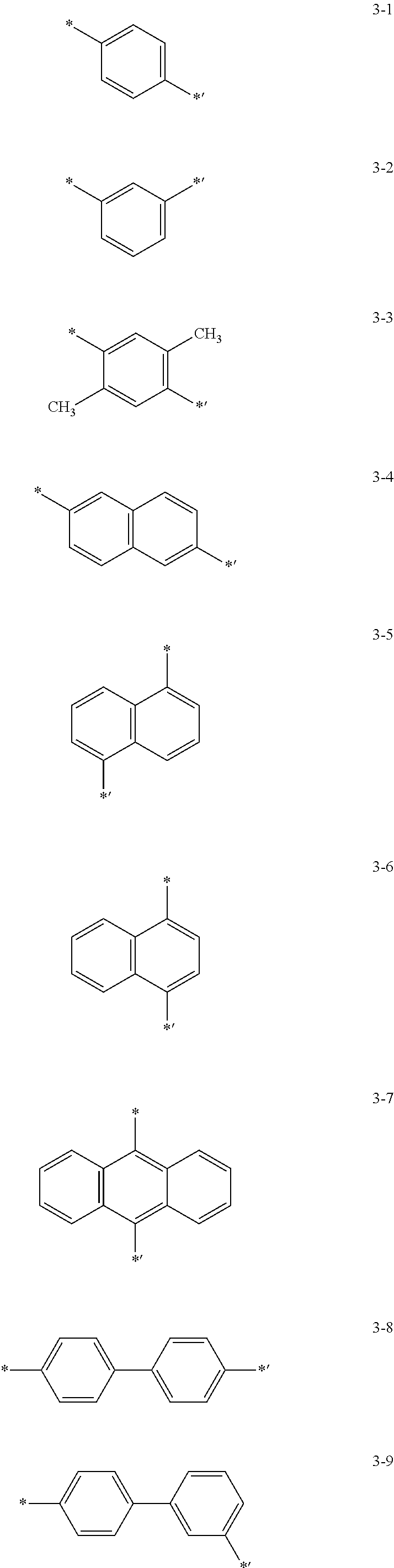


Applications Claiming Priority (2)
| Application Number | Priority Date | Filing Date | Title |
|---|---|---|---|
| KR10-2013-0099886 | 2013-08-22 | ||
| KR1020130099886A KR102100371B1 (en) | 2013-08-22 | 2013-08-22 | Anthracene-based compounds and Organic light emitting device comprising the same |
Publications (2)
| Publication Number | Publication Date |
|---|---|
| US20150053945A1 US20150053945A1 (en) | 2015-02-26 |
| US10026909B2 true US10026909B2 (en) | 2018-07-17 |
Family
ID=52479549
Family Applications (1)
| Application Number | Title | Priority Date | Filing Date |
|---|---|---|---|
| US14/314,097 Active 2036-06-27 US10026909B2 (en) | 2013-08-22 | 2014-06-25 | Anthracene-based compound and organic light-emitting device comprising the same |
Country Status (2)
| Country | Link |
|---|---|
| US (1) | US10026909B2 (en) |
| KR (1) | KR102100371B1 (en) |
Families Citing this family (2)
| Publication number | Priority date | Publication date | Assignee | Title |
|---|---|---|---|---|
| KR102379123B1 (en) | 2015-08-27 | 2022-03-24 | 엘지디스플레이 주식회사 | Organic light emitting display device and lighting apparatus for vehicles using the same |
| JP7059094B2 (en) * | 2018-04-26 | 2022-04-25 | キヤノン株式会社 | Organic EL element, display device having it, image pickup device, lighting device, mobile body |
Citations (6)
| Publication number | Priority date | Publication date | Assignee | Title |
|---|---|---|---|---|
| KR20080088109A (en) * | 2007-03-28 | 2008-10-02 | 동우 화인켐 주식회사 | Organosilane compounds, luminescent materials comprising the same, and organic electroluminescent devices |
| JP2009040765A (en) | 2007-06-28 | 2009-02-26 | Mitsubishi Chemicals Corp | Anthracene compound, charge transport material for wet film formation, charge transport material composition for wet film formation, organic electroluminescence device, and organic EL display |
| US20100237330A1 (en) * | 2007-05-21 | 2010-09-23 | Mi Ae Lee | Organic electroluminescent compound and organic ligth emitting diode using the same |
| US20100314644A1 (en) * | 2009-06-12 | 2010-12-16 | Idemitsu Kosan Co., Ltd. | Organic electroluminescent device |
| JP2012119592A (en) | 2010-12-03 | 2012-06-21 | Toyo Ink Sc Holdings Co Ltd | Material for organic electroluminescent element and use of the same |
| US20140054558A1 (en) | 2012-08-22 | 2014-02-27 | Industry-Academic Cooperation Foundation Gyeongsang National University | Cascade-type compound and organic light-emitting device including the same |
Family Cites Families (1)
| Publication number | Priority date | Publication date | Assignee | Title |
|---|---|---|---|---|
| CN103102877B (en) * | 2012-11-14 | 2015-04-15 | 吉林奥来德光电材料股份有限公司 | Silicon-containing organic luminescent material as well as preparation method and application of organic luminescent material |
-
2013
- 2013-08-22 KR KR1020130099886A patent/KR102100371B1/en active Active
-
2014
- 2014-06-25 US US14/314,097 patent/US10026909B2/en active Active
Patent Citations (7)
| Publication number | Priority date | Publication date | Assignee | Title |
|---|---|---|---|---|
| KR20080088109A (en) * | 2007-03-28 | 2008-10-02 | 동우 화인켐 주식회사 | Organosilane compounds, luminescent materials comprising the same, and organic electroluminescent devices |
| US20100237330A1 (en) * | 2007-05-21 | 2010-09-23 | Mi Ae Lee | Organic electroluminescent compound and organic ligth emitting diode using the same |
| JP2009040765A (en) | 2007-06-28 | 2009-02-26 | Mitsubishi Chemicals Corp | Anthracene compound, charge transport material for wet film formation, charge transport material composition for wet film formation, organic electroluminescence device, and organic EL display |
| US20100314644A1 (en) * | 2009-06-12 | 2010-12-16 | Idemitsu Kosan Co., Ltd. | Organic electroluminescent device |
| JP2012119592A (en) | 2010-12-03 | 2012-06-21 | Toyo Ink Sc Holdings Co Ltd | Material for organic electroluminescent element and use of the same |
| US20140054558A1 (en) | 2012-08-22 | 2014-02-27 | Industry-Academic Cooperation Foundation Gyeongsang National University | Cascade-type compound and organic light-emitting device including the same |
| KR20140026682A (en) | 2012-08-22 | 2014-03-06 | 삼성디스플레이 주식회사 | Cascade-type compound and organic light emitting diode comprising the same |
Non-Patent Citations (2)
| Title |
|---|
| Lyu et al. Adv. Mater. 2008, 20, 2720-2729. Year of publication: 2008. * |
| Machine translation of KR2008-088109. Date of publicaiton: Oct. 2, 2008. * |
Also Published As
| Publication number | Publication date |
|---|---|
| KR102100371B1 (en) | 2020-04-16 |
| US20150053945A1 (en) | 2015-02-26 |
| KR20150022270A (en) | 2015-03-04 |
Similar Documents
| Publication | Publication Date | Title |
|---|---|---|
| US9865828B2 (en) | Organic light emitting device | |
| US9583715B2 (en) | Anthracene-based compounds and organic light-emitting device including the same | |
| US9525141B2 (en) | Organic light emitting device | |
| US9590184B2 (en) | Organic light-emitting diode | |
| US9825244B2 (en) | Organic light-emitting device | |
| US10193072B2 (en) | Pyrene-based compound and organic light-emitting diode comprising the same | |
| US20190067587A1 (en) | Indenopyridine-based compound and organic light-emitting device including the same | |
| US9478752B2 (en) | Organic light-emitting diode comprising amine-based compounds and pyrene-based compounds | |
| US9209407B2 (en) | Amine-based compound and organic light-emitting device including the same | |
| US20140361259A1 (en) | Arylamine-based compound and organic light emitting diode comprising the same | |
| US9966545B2 (en) | Anthracene-based compounds and organic light-emitting device including the same | |
| US9722185B2 (en) | Heterocyclic compound and organic light-emitting device including the same | |
| US10038158B2 (en) | Organic light-emitting device | |
| US9773987B2 (en) | Silicon-based compound and organic light-emitting diode comprising the same | |
| US20130228755A1 (en) | Organic light-emitting diode | |
| US20140374717A1 (en) | Amine-based compound and organic light-emitting diode including the same | |
| US9520566B2 (en) | Condensed cyclic compound and organic light-emitting diode comprising the same | |
| US20140054558A1 (en) | Cascade-type compound and organic light-emitting device including the same | |
| US9257656B2 (en) | Organic light-emitting diodes | |
| US20150236265A1 (en) | Indene-based compounds and organic light-emitting devices comprising the same | |
| US8912548B2 (en) | Organic light-emitting diode comprising amine-based compounds and anthracene-based compounds | |
| US9698356B2 (en) | Heteroaryl-based compound and organic light-emitting diode including the same | |
| US20140346456A1 (en) | Organic light-emitting device | |
| US20150053945A1 (en) | Anthracene-based compound and organic light-emitting device comprising the same | |
| US20150048321A1 (en) | Anthracene-based compound and organic light-emitting device including the same |
Legal Events
| Date | Code | Title | Description |
|---|---|---|---|
| AS | Assignment |
Owner name: SAMSUNG DISPLAY CO., LTD., KOREA, REPUBLIC OF Free format text: ASSIGNMENT OF ASSIGNORS INTEREST;ASSIGNORS:KIM, MI-KYUNG;CHU, CHANG-WOONG;KIM, SE-HUN;AND OTHERS;REEL/FRAME:033172/0782 Effective date: 20140515 |
|
| AS | Assignment |
Owner name: GYEONGSANG NATIONAL UNIVERSITY INDUSTRY-ACADEMIC C Free format text: ASSIGNMENT OF ASSIGNORS INTEREST;ASSIGNORS:KIM, MI-KYUNG;CHU, CHANG-WOONG;KIM, SE-HUN;AND OTHERS;REEL/FRAME:033306/0990 Effective date: 20140515 Owner name: SAMSUNG DISPLAY CO., LTD., KOREA, REPUBLIC OF Free format text: ASSIGNMENT OF ASSIGNORS INTEREST;ASSIGNORS:KIM, MI-KYUNG;CHU, CHANG-WOONG;KIM, SE-HUN;AND OTHERS;REEL/FRAME:033306/0990 Effective date: 20140515 |
|
| AS | Assignment |
Owner name: INDUSTRY-ACADEMIC COOPERATION FOUNDATION GYEONGSAN Free format text: CORRECTIVE ASSIGNMENT TO CORRECT THE SECOND ASSIGNEE NAME PREVIOUSLY RECORDED AT REEL: 033306 FRAME: 0990. ASSIGNOR(S) HEREBY CONFIRMS THE ASSIGNMENT;ASSIGNORS:KIM, MI-KYUNG;CHU, CHANG-WOONG;KIM, SE-HUN;AND OTHERS;REEL/FRAME:037020/0660 Effective date: 20140515 Owner name: SAMSUNG DISPLAY CO., LTD., KOREA, REPUBLIC OF Free format text: CORRECTIVE ASSIGNMENT TO CORRECT THE SECOND ASSIGNEE NAME PREVIOUSLY RECORDED AT REEL: 033306 FRAME: 0990. ASSIGNOR(S) HEREBY CONFIRMS THE ASSIGNMENT;ASSIGNORS:KIM, MI-KYUNG;CHU, CHANG-WOONG;KIM, SE-HUN;AND OTHERS;REEL/FRAME:037020/0660 Effective date: 20140515 |
|
| STCF | Information on status: patent grant |
Free format text: PATENTED CASE |
|
| MAFP | Maintenance fee payment |
Free format text: PAYMENT OF MAINTENANCE FEE, 4TH YEAR, LARGE ENTITY (ORIGINAL EVENT CODE: M1551); ENTITY STATUS OF PATENT OWNER: LARGE ENTITY Year of fee payment: 4 |
|
| MAFP | Maintenance fee payment |
Free format text: PAYMENT OF MAINTENANCE FEE, 8TH YEAR, LARGE ENTITY (ORIGINAL EVENT CODE: M1552); ENTITY STATUS OF PATENT OWNER: LARGE ENTITY Year of fee payment: 8 |