US10026441B2 - Method and apparatus for joint adaptation of two-/multi-dimensional equalizer and partial response target - Google Patents
Method and apparatus for joint adaptation of two-/multi-dimensional equalizer and partial response target Download PDFInfo
- Publication number
- US10026441B2 US10026441B2 US15/648,985 US201715648985A US10026441B2 US 10026441 B2 US10026441 B2 US 10026441B2 US 201715648985 A US201715648985 A US 201715648985A US 10026441 B2 US10026441 B2 US 10026441B2
- Authority
- US
- United States
- Prior art keywords
- target
- equalizer
- separable
- dimensional
- partial response
- Prior art date
- Legal status (The legal status is an assumption and is not a legal conclusion. Google has not performed a legal analysis and makes no representation as to the accuracy of the status listed.)
- Active
Links
Images






Classifications
-
- G—PHYSICS
- G11—INFORMATION STORAGE
- G11B—INFORMATION STORAGE BASED ON RELATIVE MOVEMENT BETWEEN RECORD CARRIER AND TRANSDUCER
- G11B20/00—Signal processing not specific to the method of recording or reproducing; Circuits therefor
- G11B20/10—Digital recording or reproducing
- G11B20/10009—Improvement or modification of read or write signals
- G11B20/10046—Improvement or modification of read or write signals filtering or equalising, e.g. setting the tap weights of an FIR filter
-
- G—PHYSICS
- G11—INFORMATION STORAGE
- G11B—INFORMATION STORAGE BASED ON RELATIVE MOVEMENT BETWEEN RECORD CARRIER AND TRANSDUCER
- G11B20/00—Signal processing not specific to the method of recording or reproducing; Circuits therefor
- G11B20/10—Digital recording or reproducing
- G11B20/10009—Improvement or modification of read or write signals
-
- G—PHYSICS
- G11—INFORMATION STORAGE
- G11B—INFORMATION STORAGE BASED ON RELATIVE MOVEMENT BETWEEN RECORD CARRIER AND TRANSDUCER
- G11B20/00—Signal processing not specific to the method of recording or reproducing; Circuits therefor
- G11B20/10—Digital recording or reproducing
- G11B20/10009—Improvement or modification of read or write signals
- G11B20/10046—Improvement or modification of read or write signals filtering or equalising, e.g. setting the tap weights of an FIR filter
- G11B20/10055—Improvement or modification of read or write signals filtering or equalising, e.g. setting the tap weights of an FIR filter using partial response filtering when writing the signal to the medium or reading it therefrom
-
- G—PHYSICS
- G11—INFORMATION STORAGE
- G11B—INFORMATION STORAGE BASED ON RELATIVE MOVEMENT BETWEEN RECORD CARRIER AND TRANSDUCER
- G11B5/00—Recording by magnetisation or demagnetisation of a record carrier; Reproducing by magnetic means; Record carriers therefor
- G11B5/012—Recording on, or reproducing or erasing from, magnetic disks
-
- G—PHYSICS
- G11—INFORMATION STORAGE
- G11B—INFORMATION STORAGE BASED ON RELATIVE MOVEMENT BETWEEN RECORD CARRIER AND TRANSDUCER
- G11B5/00—Recording by magnetisation or demagnetisation of a record carrier; Reproducing by magnetic means; Record carriers therefor
- G11B5/02—Recording, reproducing, or erasing methods; Read, write or erase circuits therefor
- G11B5/09—Digital recording
-
- G—PHYSICS
- G11—INFORMATION STORAGE
- G11B—INFORMATION STORAGE BASED ON RELATIVE MOVEMENT BETWEEN RECORD CARRIER AND TRANSDUCER
- G11B2220/00—Record carriers by type
- G11B2220/20—Disc-shaped record carriers
- G11B2220/25—Disc-shaped record carriers characterised in that the disc is based on a specific recording technology
- G11B2220/2508—Magnetic discs
- G11B2220/2516—Hard disks
Definitions
- the present disclosure relates to the field of signal processing.
- the present disclosure relates to signal processing for multi-dimensional storage technologies such as TDMR, BPM, optical, holographic storage, 3D NAND flash, etc. where Inter-Symbol-Interference (ISI) along multiple dimensions is observed.
- ISI Inter-Symbol-Interference
- HDD Hard Disk Drives
- HAMR Heat-Assisted Magnetic Recording
- BPM Bit-Patterned Media
- the two-dimensional readback signal goes through process of equalization which shapes the readback magnetic recording signal to a specified partial response (PR), followed by Maximum Likelihood (ML) detection.
- PR partial response
- ML Maximum Likelihood
- the technique is widely used in 1D Magnetic Recording and the linear equalization allows controlled ISI called Generalized Partial Response (GPR) target.
- GPR Generalized Partial Response
- FIG. 1 illustrates a typical block diagram of non-adaptive Partial Response Maximum Likelihood (PRML) detection in case of TDMR.
- PRML Partial Response Maximum Likelihood
- the signal received from the read channel is equalized using a linear equalizer before the signal is detected using a ML detector.
- the linear equalizer reduces the extent of ISI and achieves a desired overall response called the partial response (PR). This reduces computational complexity of the ML detector with some compromise in the performance.
- the PR design techniques typically deal with minimizing the mean-squared error (MMSE) with constraints on the target such as the unit energy and the monic constraints.
- MMSE mean-squared error
- a general object of the present disclosure is to provide a method and apparatus that enables achieving bit densities higher than ⁇ 1 Tb/in 2 on conventional magnetic recording media.
- An object of the present disclosure is to provide a method and apparatus for multi-dimensional storage technologies such as TDMR, flash drives, holographic storage etc.
- An object of the present disclosure is to provide a method and apparatus for multi-dimensional recording with higher storage densities that have acceptable level of multi-dimensional Inter Symbol Interference (ISI) and noise.
- ISI Inter Symbol Interference
- Another object of the present disclosure is to provide a method and apparatus that increases bit density by optimal multi-dimensional GPR target and equalizer design.
- Another object of the present disclosure is to provide a method and apparatus that is cognizant of channel conditions.
- Yet another object of the present disclosure is to provide a method and apparatus that takes into account the time-varying nature of the channel and thus help mitigate effects of SNR variations along with ISI reduction/control.
- Still another object of the present disclosure is to provide a method and apparatus that allow low complexity detection by separable targets resulting in significant throughput gains.
- aspects of the present disclosure relate to storage and communication channels.
- it pertains to processing of multi-dimensional signal so as to control the Inter Symbol Interference (ISI) and noise within acceptable limits.
- ISI Inter Symbol Interference
- the disclosed method is based on Partial Response Maximum Likelihood (PRML) detection.
- PRML Partial Response Maximum Likelihood
- readback signal goes through a process of equalization using a linear equalizer, wherein the equalization takes care of channel condition accounting for various time varying factors such as wear & tear, temperature variations and other similar factors.
- filter coefficients of both the equalizer and the partial response (PR) target can be jointly adapted to account for the channel condition. This helps to mitigate the effects of SNR variations along with ISI reduction/control.
- the disclosed method does adaptive equalization for both separable and non-separable targets reducing signal detection complexity. This is especially helpful in reducing signal detection complexity compared to a non-separable target of the same size. It also helps in performance improvement using a larger separable PR target with the same detection complexity as that of a smaller non-separable PR target.
- the disclosed method can be used for PR target and equalizer of arbitrary shape and size such as hexagonal and other sampling geometries.
- the method can also be used to design separable 2D PR targets of polygonal shape with 2N sides using N separable 1D components.
- multidimensional separable PR targets of 2N faces can be designed using N separable 1-D components.
- the separable targets can also be designed using ⁇ N non-1D components.
- the disclosure provides a method of jointly designing the equalizer and the PR targets which adapts to the changing channel conditions mindful of hardware constraints.
- the disclosure formulates mathematical equations to implement the jointly designed equalizer and the PR targets.
- the jointly designing of separable and non-separable multi-dimensional PR targets and equalizers is done under monic and unit energy constraints using the MMSE criterion.
- the disclosure provides an apparatus that incorporates hardware for adapting targets and equalizer.
- the hardware is an adaptation engine along with the equalizer and the PR target that updates filter coefficients of both the equalizer and the PR target following the formulated mathematical equations.
- FIG. 1 illustrates block diagram depicting widely used non-adaptive technique for partial response maximum likelihood (PRML) detection in TDMR.
- PRML partial response maximum likelihood
- FIG. 2 illustrates an exemplary block diagram depicting a joint adaptation engine which can perform equalization under varying channel conditions in accordance with embodiments of the present disclosure.
- FIG. 3 illustrates an exemplary 2D hexagonal separable PR targetin accordance with an embodiment of the present disclosure.
- FIG. 4 illustrates an exemplary 5 ⁇ 5 filter showing separability of coefficients.
- FIG. 5 illustrates an exemplary block diagram showing top-level architecture of the adaptation engine along with the equalizer and the PR target in accordance with embodiments of the present disclosure.
- FIG. 6 illustrates an exemplary detailed diagram of the pipelined version of the adaptation engine along with the equalizer and the PR target in accordance with embodiments of the present disclosure.
- FIGS. 7A and 7B illustrate an exemplary 5 ⁇ 5 filter depicting polar symmetry in the coefficients in accordance with embodiments of the present disclosure.
- FIG. 8 illustrates an exemplary Q2.13 format used for representing the numeric values in accordance with embodiments of the present disclosure.
- FIG. 9 illustrates an exemplary block diagram of fixed-point adder with additional logic to avoid overflow in accordance with embodiments of the present disclosure.
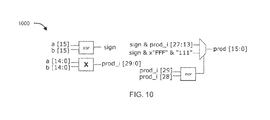
- FIG. 10 illustrates an exemplary block diagram of fixed-point multiplier with additional logic to avoid overflowin accordance with embodiments of the present disclosure.
- FIG. 11 illustrates an exemplary plot of error for adaptation on a 64 ⁇ 64 page of samples in accordance with embodiments of the present disclosure.
- FIG. 12 illustrates an exemplary squared plot of error for adaptation on a 64 ⁇ 64 page of samples in accordance with embodiments of the present disclosure.
- FIG. 13 illustrates an exemplary plot of error for adaptation on a 64 ⁇ 64 page of samples ( ⁇ 0.001) in accordance with embodiments of the present disclosure.
- FIG. 14 illustrates an exemplary plot of error for adaptation on a 64 ⁇ 64 page of samples ( ⁇ 0.01) in accordance with embodiments of the present disclosure.
- FIG. 15 illustrates an exemplary plot of error for adaptation on a 64 ⁇ 64 page of samples ( ⁇ 0.1) in accordance with embodiments of the present disclosure.
- FIGS. 17A and 17B illustrate exemplary 5 ⁇ 5 filters showing values of filter coefficients for the equalizer and the PR target respectively at the end of simulation of 64 ⁇ 64 samples in accordance with embodiments of the present disclosure.
- FIGS. 18A and 18B illustrate exemplary 5 ⁇ 5 filters showing theoretical values of optimum filter coefficients for the equalizer and the PR target respectively found using MATLAB in accordance with embodiments of the present disclosure.
- the present disclosure relates to a method and apparatus for processing of a multi-dimensional communication and storage signals that achieve controlled Inter Symbol Interference (ISI) and noise within acceptable limits. For example, this enables storage densities that are higher than 1 Tb/in 2 on conventional magnetic recording media.
- ISI Inter Symbol Interference
- the disclosed method is based on Partial Response Maximum Likelihood (PRML) detection.
- PRML Partial Response Maximum Likelihood
- Several partial response (PR) target design techniques are available for 1-D magnetic recording channels.
- the 1-D PR design techniques typically deal with minimizing the mean-squared error.
- these techniques have been extended to design separable and non-separable 2-D PR targets and equalizers under monic and unit energy constraints using the MMSE criterion for the 2-D ISI channel with additive white Gaussian noise. It is to be appreciated that though embodiments of the present disclosure have been described with reference to two-dimensional ISI channels, these can be extended to multi-dimensional ISI channels as well, and such applications are well within the scope of the present disclosure.
- Magnetic and optical recording channels are characterized as slowly time varying media due to wear and tear, temperature variations and other factors.
- the present disclosure provides a solution to this by having a linear equalizer that adapts to varying channel conditions so that the signal detection is not impacted.
- the disclosed method further helps by reducing the extent of ISI to a predefined target response as seen by the detector.
- the filter coefficients of both the equalizer and the partial response (PR) target can be jointly adapted to account for the channel condition. This helps to mitigate the effects of SNR variations along with ISI reduction/control.
- ISI inter-symbol interference
- adaptation can be done in a batch mode i.e., when the quality monitoring component of the IC flags indicates increased number of errors due to medium SNR changes or aging of the device.
- the present disclosure relates to a computer-implemented method for processing of multi-dimensional readback signal to reduce Inter Symbol Interference (ISI) and noise, said method comprising the step of: equalizing the readback signal using a linear equalizer that adapts to varying channel conditions; and designing a Partial Response (PR) target for signal detection based on Partial Response Maximum Likelihood (PRML) and the equalizer output, wherein the equalizer and the PR target are jointly adapted.
- ISI Inter Symbol Interference
- PR Partial Response
- PRML Partial Response Maximum Likelihood
- the step of equalizing enables handling of channel conditions accounting for one or more time varying factors selected from any or a combination of wear and tear, media and temperature variations.
- one or more filter coefficients for the linear equalizer and the PR target are jointly adapted to account for channel condition to help mitigate effects of SNR variations along with ISI reduction/control.
- output of the equalizer is compared with target response to obtain an error that is used to update the one or more filter coefficients.
- the equalizer is any of a separable or a non-separable equalizer.
- the PR target is any of a separable or a non-separable PR target.
- the equalizer performs equalization for both separable and non-separable PR targets.
- the present disclosure further relates to an apparatus comprising an adaptation engine, said engine being configured to, along with an equalizer and a PR target, update filter coefficients of both the equalizer and the PR target to enable processing of a multi-dimensional readback signal to reduce Inter Symbol Interference (ISI) and noise.
- the equalizer performs equalization under varying channel conditions.
- the apparatus can be disk drive having a processor configured to decode data written over a plurality of tracks of a disk, wherein the processor is coupled with a memory and configured to perform the above-mentioned features/functions.
- polar symmetry of the PR target can be used to optimize the adaptation engine.
- the PR target can be a 2D separable PR target such that the PR target is extended to polygons of 2N sides using 1D separable components, or the PR target can be a multi-dimensional separable PR target such that the PR target is extended to 2N faces using 1D separable components.
- realization of 2D and multi-dimensional separable PR targets is performed using less than N non-1D components.
- FIG. 2 illustrates an exemplary block diagram 200 of a joint adaptation engine which can perform equalization under varying channel conditions in accordance with embodiments of the present disclosure.
- readback signal which is the response of the AWGN 2-D channel is passed through the equalizer.
- Target response is compared with the equalizer output to obtain the error e i,j which is then used to provide LMS update for the filter coefficients.
- the disclosed method does adaptive equalization for both separable and non-separable targets reducing signal detection complexity. This is especially helpful in reducing signal detection complexity compared to a non-separable target of the same size in the severely restricted 2-D PR target size. It also helps in performance improvement using a larger separable PR target with the same detection complexity as that of a smaller non-separable PR target.
- the disclosed method can be used for PR target and equalizer of arbitrary shape and size such as hexagonal and other sampling geometries.
- FIG. 3 illustrates an exemplary 2D hexagonal separable PR target.
- the cells with shade A, B and C indicate the separable components.
- the PR target taps for the white cell and those with shade D can be derived using these components.
- the method can also be used to design separable 2D PR targets of 2N-polygonal shape using N separable 1D components.
- multi-dimensional separable PR targets of 2N faces can be designed using N separable 1-D components.
- the separable targets can also be designed using ⁇ N non-1D components.
- the disclosure provides a method of jointly designing the equalizer and the PR targets which adapts to the changing channel condition mindful of hardware constraints, and formulates mathematical equations to implement the jointly designed equalizer and the PR targets.
- the jointly designing of separable and non-separable 2-D PR targets and equalizers is done under monic and unit energy constraints using the MMSE criterion.
- the disclosure provides an apparatus that incorporates hardware for adapting targets and equalizer.
- the hardware is an adaptation engine along with the equalizer and the PR target that updates filter coefficients of both the equalizer and the PR target following the formulated mathematical equations.
- f i,j ⁇ circumflex over (f) ⁇ ⁇ i, ⁇ j , may write the 2-D convolution operation as:
- This 2 D ISI mask can be represented using a 2-D matrix F whose elements are f i .
- vec (.) operator to convert a 2-D matrix to a column vector by ordering the elements of the matrix in the raster scan order.
- (i, j) as a column vector obtained by similarly ordering the symbols/values a i,j relative to the position (i, j).
- a F (i,j) [a i,j a i,j+1 a i+1,j a i+1,j+1 ]
- a i , ⁇ [ ⁇ 1,1], i, j . . . , ⁇ 1, 0, 1, 2, . . . denote a plane of input symbols/bits that are written onto medium.
- y i , i, j . . . , ⁇ 1, 0, 1, 2, . . . denote the plane of discrete time samples read from the medium.
- the gradients are computed as follows:
- g r [g 0, ⁇ N . . . g 0, ⁇ 1 g 0,1 . . . g 0,N ] T
- g c [g ⁇ M,0 . . . g ⁇ 1,0 g 1,0 . . . g M,0 ] T
- ⁇ N g c g r T where we have excluded g 0,0 which will depend on the constraint imposed.
- SE squared error
- 2 ( h T y H (i,j) ⁇ a i,j g 0,0 ⁇ g T a G (i,j) ⁇ g r T a r (i,j) ⁇ g c T a c (i,j) ) 2
- the gradients are computed as follows.
- SE squared error
- g _ r g _ r ′ 1 - ⁇ g _ c ′ ⁇ 2
- g _ c ′ [ g 0 , - N ... g 0 , - 1
- LMS update equations have been formulated for the joint adaptation of the equalizer and the PR target.
- the formulated equations for the joint adaptation of the equalizer and the PR target can be implemented using a hardware which is an adaptation engine along with the equalizer and the PR target that updates filter coefficients of both the equalizer and the PR target following the formulated mathematical equations.
- FIG. 5 illustrates an exemplary block diagram 500 showing top-level architecture of the adaptation engine along with the equalizer and the PR target in accordance with embodiments of the present disclosure.
- y is the channel output which is convolved with equalizer filter coefficients h.
- a is convolved with PR target coefficients g.
- the error is computed.
- the filter coefficients of both the equalizer and the PR target are updated following the equations formulated above.
- FIG. 6 illustrates an exemplary detailed diagram 600 of the pipelined version of the adaptation engine along with the equalizer and the PR target in accordance with embodiments of the present disclosure.
- element-wise multiplication happens in the first stage and then the products are added in two stages. Since a ⁇ 1,1 ⁇ we save area by replacing multiplication with a buffer/complementer unit ( ⁇ ) which outputs g n if input is 1 and outputs complement of g n if input is ⁇ 1.
- Bold-faced signal wires in the diagram 600 represent group of elements of pertaining vector. For example, h represents all the coefficients of the equalizer response. All the elements of h are updated using similar hardware blocks. Further, g_init and h_init are the initial filter coefficients which are loaded into the registers using the load_init signal from the controller.
- the disclosed top-level architecture of the adaptation engine with the equalizer filter and the partial response (PR) target is shown in FIG. 5 and the pipelined version of the architecture is shown is FIG. 6 have been implemented in VHDL for non-separable targets under monic constraint.
- the RTL design has been synthesized and tested for Virtex-7 FPGA in Xilinx VC707 Evaluation Platform. Implementation details of the various functional units are provided below.
- the equalizer is implemented as a 5 ⁇ 5 filter and the PR target is implemented as a 3 ⁇ 3 filter.
- y 0 to y 24 represent the equalizer inputs which are the outputs of the AWGN channel.
- the filter coefficients for the equalizer are written as h 0 through h 24 .
- the filter coefficients for the PR target are written as g 0 through g 8 since a 3 ⁇ 3 filter is implemented.
- the inputs to the PR target are shown as a 0 to a 8 .
- the equalizer and the PR target are realized as a combination of multipliers and adders.
- z and ⁇ circumflex over (z) ⁇ are the output signals generated by the equalizer and the PR target respectively.
- a subtractor is used to generate the error signal from z and ⁇ circumflex over (z) ⁇
- FIGS. 7A and 7B illustrate exemplary 5 ⁇ 5 filter (symmetrical and asymmetrical respectively) depicting polar symmetry in the coefficients in accordance with embodiments of the present disclosure. Elements having same grey shade have identical values. This polar symmetry of the filter coefficients is utilized to reduce chip footprint. As can be seen from FIG. 7A , only 6 values out of a total of 25 coefficients need to be updated in case of symmetric channels with identical inter-track and intra-track spacing. Likewise for symmetrical 3 ⁇ 3 filter only 3 coefficients instead of total 9 coefficients need to be updated. In case of asymmetric channels more registers need to be updated as shown in FIG. 7B with hatched boxes.
- Fixed-point arithmetic computations are usually simpler than the floating-point arithmetic ones. They also require lesser area for implementations in comparison to their counterparts. Also, because of simpler circuitry, the fixed-point computations consume less power. Hence, fixed-point arithmetic has been chosen even though they offer low precision and low dynamic range. However, the same design can be realized using floating-point arithmetic units for higher precision at the cost of area and power.
- FIG. 8 illustrates an exemplary Q2.13 format 800 used for representing the numeric values in accordance with embodiments of the present disclosure.
- the Q2.13 format shown herein has been chosen based on MATLAB simulations for the representation of the numeric values in the disclosed design.
- This format uses one bit for sign, two bits for magnitude and 13 bits for fractional part as shown in FIG. 8 .
- the disclosure provides fixed point adder and the multiplier units to implement the disclosed architecture which take inputs in Q2.13 format and produce outputs in the same format.
- FIG. 9 illustrates an exemplary block diagram 900 of fixed-point adder with additional logic to avoid overflow (in sign-magnitude representation) where the blocks labelled ‘+’ and ‘ ⁇ ’ represent unsigned addition and subtraction respectively; a and b are the inputs to the adder with sum is output of the adder.
- FIG. 10 illustrates an exemplary block diagram 1000 of the fixed-point multiplier with additional logic to avoid overflow (in sign-magnitude representation).
- a and b are the inputs (Q2.13 format) to the multiplier
- prod is the output (Q2.13 format) of the multiplier.
- the block labelled ‘X’ represents unsigned multiplication.
- a control and timing block is required to sequence the operation of the disclosed LMS engine.
- This unit is necessary for loading the initial values of the filter coefficients as well as to start and stop the LMS engine as per channel conditions.
- This unit may well reside inside the read head controller.
- g_init and h_init represent the initial values of the filter coefficients; the controller uses the load_init signal to set the initial values of the filter coefficients.
- Table 1 shows resource utilization for the non-pipelined architecture on Virtex-7 FPGA VC-707 Evaluation Platform (Xilinx) [sign-magnitude representation]:
- FIG. 11 shows the plot of error signal for a page of 64 ⁇ 64 input samples.
- FIG. 12 shows the plot of squared error for the same simulation.
- convergence time is defined as time required for the system to reach a point where squared error ⁇ 0.001.
- initial values for the filter coefficients were 0.05 approximately.
- the choice of ⁇ has significant effect on the convergence time.
- the value of the learning parameter must be chosen with great care.
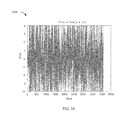
- FIG. 16 shows the error plot for the same. It can be observed that the system took only 2 cycles ( ⁇ 0.002) to reach the point where squared error ⁇ 0.001. Clearly, the loop adapted very quickly to changing SNR conditions.
- the present disclosure provides a method and apparatus that enables achieving bit densities higher than ⁇ 1 Tb/in 2 on conventional magnetic recording media as well as for optical recording and related physical data storage technologies.
- the present disclosure provides a method and apparatus for two-/three dimensional magnetic recording, holographic storage, 3D flash memories etc., which are a natural extension of 1D data recording technologies.
- the present disclosure provides a method and apparatus for multi-dimensional magnetic recording such as TDMR with higher storage densities that have an acceptable level of Inter Symbol Interference (ISI) and noise.
- ISI Inter Symbol Interference
- the present disclosure provides a method and apparatus that increases bit density through near optimal 2D/multi-dimensional signal detection adaptively choosing optimal GPR target designs.
- the present disclosure provides a method and apparatus that is cognizant of channel conditions.
- the present disclosure provides a method and apparatus that takes into account the time-varying nature of the channel, and thus helps mitigate effects of SNR variations along with ISI reduction/control.
- the present disclosure provides a method and apparatus that allow low complexity detection by separable targets resulting in significant throughput gains.
Landscapes
- Engineering & Computer Science (AREA)
- Signal Processing (AREA)
- Signal Processing For Digital Recording And Reproducing (AREA)
Abstract
Description
a F (i,j) =[a i,j a i,j+1 a i+1,j a i+1,j+1]
Using this vector notation, the 2-D ISI can be written as:
y i,j=(vec(F))T a F (i,j)
z i,j =h T y H (i,j)
[gi], i, j= . . . , −1, 0, 1, 2, . . . are the set of coefficients of the PR target. Let G be a 2-D matrix whose elements are the coefficients gi, and let g=vec (G). Using this vector notation, the ideal samples at the input of the ML detector can be written as:
{circumflex over (z)} i,j =g T a G (i,j)
Thus, the error can be written as:
e i,j =z i,j −{circumflex over (z)} i,j
Now, we may write the instantaneous squared error (SE) as:
SE=|e i,j|2=(z i,j −{circumflex over (z)} i,j)2=( h T y H (i,j) −a i,j g 0,0 −g T a G (i,j))2
Where,
-
- g0,0 is the centre tap coefficient of the PR target
g T =[g −N,−N . . . g −1 g 0,1 . . . g N,N]
- g0,0 is the centre tap coefficient of the PR target
1) Monic Constraint:
Hence, the update equations for the filter coefficients become
h←h−μΔh=h−2μe i,j y H (i,j)
g←g−μΔg=g+2μe i,j a G (i,j)
2) Unit Energy Constraint:
Hence, the update equations for the filter coefficients become
Separable Targets:
g r =[g 0,−N . . . g 0,−1 g 0,1 . . . g 0,N]T
g c =[g −M,0 . . . g −1,0 g 1,0 . . . g M,0]T
G=[g i,j]1≤|i|≤M,1≤|j|≤N =g c g r T
where we have excluded g0,0 which will depend on the constraint imposed.
We write the squared error (SE) as follows:
SE=|e i,j|2=( h T y H (i,j) −a i,j g 0,0 −g T a G (i,j) −g r T a r (i,j) −g c T a c (i,j))2
1) Monic Constraint:
Hence, the update equations for the filter coefficients become
h←h−μΔh=h−2μe i,j y H (i,j)
g r ← g r −μΔ g r = g r +2μe i,j( a g
g c ← g c −μΔ g c = g c +2μe i,j( a g
2) Unit Energy Constraint:
SE=|e i,j|2=( h T y H (i,j) −a i,j g 0,0 −g T a G (i,j) −g r T a r (i,j) −g c T a c (i,j))2
where we define
Thus, we obtain the following.
Hence, the update equations for the filter coefficients become
In this case, the coefficients g0,0, gr and gc are updated as follows.
h←h−μΔh=h−2μe i,j y H (i,j)
g←g−μΔg=g+2μe i,j a G (i,j)
| TABLE 1 |
| Resource utilization for the non-pipelined architecture |
| Resource | Without Polar Symmetry | With Polar Symmetry | ||
| Register | 578 | 153 | ||
| LUT | 5979 | 4005 | ||
| Slice | 2031 | 1426 | ||
| |
100 | 50 | ||
| TABLE 2 |
| Convergence time v/s value of the learning parameter |
| Convergence Time | Mean Squared Rrror | |
| μ | (In cycles) | (for 64 × 64 cycles) |
| 0.001 | 830 | 0.1999 |
| 0.002 | 32 | 0.1091 |
| 0.01 | 97 | 0.0318 |
| 0.1 | (diverges) | 4.4231 |
Convergence Time Vs Initial Filter Coefficients
| TABLE 3 |
| Convergence time vs. value of initial filter coefficients |
| Convergence Time | |||
| Initial Value | (In Cycles) | ||
| 0.001 | 725 | ||
| 0.01 | 358 | ||
| 0.05 | 32 | ||
| 0.1 | 6 | ||
Adaptability with Changing SNR
Claims (15)
Applications Claiming Priority (2)
| Application Number | Priority Date | Filing Date | Title |
|---|---|---|---|
| IN201641024048 | 2016-07-14 | ||
| IN201641024048 | 2016-07-14 |
Publications (2)
| Publication Number | Publication Date |
|---|---|
| US20180018997A1 US20180018997A1 (en) | 2018-01-18 |
| US10026441B2 true US10026441B2 (en) | 2018-07-17 |
Family
ID=60940216
Family Applications (1)
| Application Number | Title | Priority Date | Filing Date |
|---|---|---|---|
| US15/648,985 Active US10026441B2 (en) | 2016-07-14 | 2017-07-13 | Method and apparatus for joint adaptation of two-/multi-dimensional equalizer and partial response target |
Country Status (2)
| Country | Link |
|---|---|
| US (1) | US10026441B2 (en) |
| JP (1) | JP6931563B2 (en) |
Families Citing this family (2)
| Publication number | Priority date | Publication date | Assignee | Title |
|---|---|---|---|---|
| US10489656B2 (en) * | 2017-09-21 | 2019-11-26 | NEX Team Inc. | Methods and systems for ball game analytics with a mobile device |
| KR102707704B1 (en) * | 2023-07-17 | 2024-09-19 | 숭실대학교산학협력단 | Non linear equalization system for storage device |
Citations (1)
| Publication number | Priority date | Publication date | Assignee | Title |
|---|---|---|---|---|
| US7948699B2 (en) * | 2009-01-02 | 2011-05-24 | Lsi Corporation | Systems and methods for equalizer optimization in a storage access retry |
Family Cites Families (3)
| Publication number | Priority date | Publication date | Assignee | Title |
|---|---|---|---|---|
| JP4593959B2 (en) * | 2004-04-09 | 2010-12-08 | ソニー株式会社 | Adaptive equalization apparatus and method |
| US7158324B2 (en) * | 2004-09-20 | 2007-01-02 | Guzik Technical Enterprises | Self-adjusting PRML receiver |
| JP6167918B2 (en) * | 2013-08-14 | 2017-07-26 | ソニー株式会社 | Optical medium reproducing apparatus and optical medium reproducing method |
-
2017
- 2017-07-13 US US15/648,985 patent/US10026441B2/en active Active
- 2017-07-14 JP JP2017138388A patent/JP6931563B2/en active Active
Patent Citations (1)
| Publication number | Priority date | Publication date | Assignee | Title |
|---|---|---|---|---|
| US7948699B2 (en) * | 2009-01-02 | 2011-05-24 | Lsi Corporation | Systems and methods for equalizer optimization in a storage access retry |
Also Published As
| Publication number | Publication date |
|---|---|
| JP2018077928A (en) | 2018-05-17 |
| US20180018997A1 (en) | 2018-01-18 |
| JP6931563B2 (en) | 2021-09-08 |
Similar Documents
| Publication | Publication Date | Title |
|---|---|---|
| US7308057B1 (en) | Baseline wander compensation for perpendicular recording | |
| TWI701591B (en) | Apparatus, system, and method for regularized parameter adaptation | |
| US8175201B2 (en) | Systems and methods for adaptive equalization in recording channels | |
| US8743936B2 (en) | Systems and methods for determining noise components in a signal set | |
| US8312359B2 (en) | Branch-metric calibration using varying bandwidth values | |
| US6625235B1 (en) | Apparatus and method for noise-predictive maximum likelihood detection | |
| US7012772B1 (en) | Sampled amplitude read channel employing an adaptive non-linear correction circuit for correcting non-linear distortions in a read signal | |
| US5430661A (en) | Adaptive decision feedback equalizer apparatus for processing information stored on digital storage media | |
| CN100492513C (en) | Adaptive equalizing apparatus and method | |
| US7599450B2 (en) | Pattern-dependent equalization and detection | |
| US10026441B2 (en) | Method and apparatus for joint adaptation of two-/multi-dimensional equalizer and partial response target | |
| Sayyafan et al. | Deep neural network media noise predictor turbo-detection system for 1-D and 2-D high-density magnetic recording | |
| JP3414545B2 (en) | Apparatus and method for equalizing channels | |
| Keskinoz | Two-dimensional equalization/detection for patterned media storage | |
| CN1788416B (en) | Signal processing apparatus and method, and signal decoding apparatus and method | |
| US5946349A (en) | Method for coefficient smoothing in adaptive equalizer systems | |
| US10692527B1 (en) | Target parameter adaptation | |
| Bednarz et al. | Design, performance, and extensions of the RAM-DFE architecture | |
| US7778134B2 (en) | Waveform equalization control device | |
| JPH09167448A (en) | Method and apparatus for detecting data in data storage equipment | |
| Patapoutian | Baseline wander compensation for the perpendicular magnetic recording channel | |
| JPH09306102A (en) | Digital signal decoding device | |
| US6292816B1 (en) | Nonlinear equalizing apparatus | |
| US20050225889A1 (en) | Magnetic media read signal filter | |
| US7535955B1 (en) | Methods, algorithms, software, architectures, systems and circuitry for adaptive filtering and/or minimizing a sequence detector error rate |
Legal Events
| Date | Code | Title | Description |
|---|---|---|---|
| AS | Assignment |
Owner name: INDIAN INSTITUTE OF SCIENCE, INDIA Free format text: ASSIGNMENT OF ASSIGNORS INTEREST;ASSIGNORS:GARANI, SHAYAN SRINIVASA;MATCHA, CHAITANYA KUMAR;DEY, ARNAB;SIGNING DATES FROM 20170821 TO 20170822;REEL/FRAME:043357/0756 |
|
| STCF | Information on status: patent grant |
Free format text: PATENTED CASE |
|
| MAFP | Maintenance fee payment |
Free format text: PAYMENT OF MAINTENANCE FEE, 4TH YR, SMALL ENTITY (ORIGINAL EVENT CODE: M2551); ENTITY STATUS OF PATENT OWNER: SMALL ENTITY Year of fee payment: 4 |
|
| FEPP | Fee payment procedure |
Free format text: MAINTENANCE FEE REMINDER MAILED (ORIGINAL EVENT CODE: REM.); ENTITY STATUS OF PATENT OWNER: SMALL ENTITY |
|
| FEPP | Fee payment procedure |
Free format text: 7.5 YR SURCHARGE - LATE PMT W/IN 6 MO, SMALL ENTITY (ORIGINAL EVENT CODE: M2555); ENTITY STATUS OF PATENT OWNER: SMALL ENTITY |
|
| MAFP | Maintenance fee payment |
Free format text: PAYMENT OF MAINTENANCE FEE, 8TH YR, SMALL ENTITY (ORIGINAL EVENT CODE: M2552); ENTITY STATUS OF PATENT OWNER: SMALL ENTITY Year of fee payment: 8 |