US10025440B2 - Correlated data acquisition among different touch sensors - Google Patents

Correlated data acquisition among different touch sensors Download PDF

Info

Publication number
US10025440B2
US10025440B2 US15/208,894 US201615208894A US10025440B2 US 10025440 B2 US10025440 B2 US 10025440B2 US 201615208894 A US201615208894 A US 201615208894A US 10025440 B2 US10025440 B2 US 10025440B2
Authority
US
United States
Prior art keywords
touch
lines
data
drive
circuit
Prior art date
Legal status (The legal status is an assumption and is not a legal conclusion. Google has not performed a legal analysis and makes no representation as to the accuracy of the status listed.)
Active, expires
Application number
US15/208,894
Other versions
US20180018037A1 (en
Inventor
Kien Beng Tan
Current Assignee (The listed assignees may be inaccurate. Google has not performed a legal analysis and makes no representation or warranty as to the accuracy of the list.)
STMicroelectronics International NV
Original Assignee
STMicroelectronics Asia Pacific Pte Ltd
Priority date (The priority date is an assumption and is not a legal conclusion. Google has not performed a legal analysis and makes no representation as to the accuracy of the date listed.)
Filing date
Publication date
Application filed by STMicroelectronics Asia Pacific Pte Ltd filed Critical STMicroelectronics Asia Pacific Pte Ltd
Priority to US15/208,894 priority Critical patent/US10025440B2/en
Assigned to STMICROELECTRONICS ASIA PACIFIC PTE LTD reassignment STMICROELECTRONICS ASIA PACIFIC PTE LTD ASSIGNMENT OF ASSIGNORS INTEREST (SEE DOCUMENT FOR DETAILS). Assignors: TAN, KIEN BENG
Priority to CN201720447231.6U priority patent/CN206757583U/en
Priority to CN201710282265.9A priority patent/CN107621912B/en
Publication of US20180018037A1 publication Critical patent/US20180018037A1/en
Application granted granted Critical
Publication of US10025440B2 publication Critical patent/US10025440B2/en
Assigned to STMICROELECTRONICS INTERNATIONAL N.V. reassignment STMICROELECTRONICS INTERNATIONAL N.V. ASSIGNMENT OF ASSIGNORS INTEREST (SEE DOCUMENT FOR DETAILS). Assignors: STMICROELECTRONICS ASIA PACIFIC PTE LTD
Active legal-status Critical Current
Adjusted expiration legal-status Critical

Links

Images

Classifications

    • GPHYSICS
    • G06COMPUTING OR CALCULATING; COUNTING
    • G06FELECTRIC DIGITAL DATA PROCESSING
    • G06F3/00Input arrangements for transferring data to be processed into a form capable of being handled by the computer; Output arrangements for transferring data from processing unit to output unit, e.g. interface arrangements
    • G06F3/01Input arrangements or combined input and output arrangements for interaction between user and computer
    • G06F3/03Arrangements for converting the position or the displacement of a member into a coded form
    • G06F3/041Digitisers, e.g. for touch screens or touch pads, characterised by the transducing means
    • G06F3/0416Control or interface arrangements specially adapted for digitisers
    • G06F3/04166Details of scanning methods, e.g. sampling time, grouping of sub areas or time sharing with display driving
    • GPHYSICS
    • G06COMPUTING OR CALCULATING; COUNTING
    • G06FELECTRIC DIGITAL DATA PROCESSING
    • G06F3/00Input arrangements for transferring data to be processed into a form capable of being handled by the computer; Output arrangements for transferring data from processing unit to output unit, e.g. interface arrangements
    • G06F3/01Input arrangements or combined input and output arrangements for interaction between user and computer
    • G06F3/03Arrangements for converting the position or the displacement of a member into a coded form
    • G06F3/041Digitisers, e.g. for touch screens or touch pads, characterised by the transducing means
    • G06F3/044Digitisers, e.g. for touch screens or touch pads, characterised by the transducing means by capacitive means
    • GPHYSICS
    • G06COMPUTING OR CALCULATING; COUNTING
    • G06FELECTRIC DIGITAL DATA PROCESSING
    • G06F3/00Input arrangements for transferring data to be processed into a form capable of being handled by the computer; Output arrangements for transferring data from processing unit to output unit, e.g. interface arrangements
    • G06F3/01Input arrangements or combined input and output arrangements for interaction between user and computer
    • G06F3/03Arrangements for converting the position or the displacement of a member into a coded form
    • G06F3/041Digitisers, e.g. for touch screens or touch pads, characterised by the transducing means
    • G06F3/0414Digitisers, e.g. for touch screens or touch pads, characterised by the transducing means using force sensing means to determine a position
    • GPHYSICS
    • G06COMPUTING OR CALCULATING; COUNTING
    • G06FELECTRIC DIGITAL DATA PROCESSING
    • G06F3/00Input arrangements for transferring data to be processed into a form capable of being handled by the computer; Output arrangements for transferring data from processing unit to output unit, e.g. interface arrangements
    • G06F3/01Input arrangements or combined input and output arrangements for interaction between user and computer
    • G06F3/03Arrangements for converting the position or the displacement of a member into a coded form
    • G06F3/041Digitisers, e.g. for touch screens or touch pads, characterised by the transducing means
    • G06F3/0416Control or interface arrangements specially adapted for digitisers
    • GPHYSICS
    • G06COMPUTING OR CALCULATING; COUNTING
    • G06FELECTRIC DIGITAL DATA PROCESSING
    • G06F3/00Input arrangements for transferring data to be processed into a form capable of being handled by the computer; Output arrangements for transferring data from processing unit to output unit, e.g. interface arrangements
    • G06F3/01Input arrangements or combined input and output arrangements for interaction between user and computer
    • G06F3/03Arrangements for converting the position or the displacement of a member into a coded form
    • G06F3/041Digitisers, e.g. for touch screens or touch pads, characterised by the transducing means
    • G06F3/0416Control or interface arrangements specially adapted for digitisers
    • G06F3/0418Control or interface arrangements specially adapted for digitisers for error correction or compensation, e.g. based on parallax, calibration or alignment
    • GPHYSICS
    • G06COMPUTING OR CALCULATING; COUNTING
    • G06FELECTRIC DIGITAL DATA PROCESSING
    • G06F3/00Input arrangements for transferring data to be processed into a form capable of being handled by the computer; Output arrangements for transferring data from processing unit to output unit, e.g. interface arrangements
    • G06F3/01Input arrangements or combined input and output arrangements for interaction between user and computer
    • G06F3/03Arrangements for converting the position or the displacement of a member into a coded form
    • G06F3/041Digitisers, e.g. for touch screens or touch pads, characterised by the transducing means
    • G06F3/044Digitisers, e.g. for touch screens or touch pads, characterised by the transducing means by capacitive means
    • G06F3/0446Digitisers, e.g. for touch screens or touch pads, characterised by the transducing means by capacitive means using a grid-like structure of electrodes in at least two directions, e.g. using row and column electrodes
    • GPHYSICS
    • G06COMPUTING OR CALCULATING; COUNTING
    • G06FELECTRIC DIGITAL DATA PROCESSING
    • G06F2203/00Indexing scheme relating to G06F3/00 - G06F3/048
    • G06F2203/041Indexing scheme relating to G06F3/041 - G06F3/045
    • G06F2203/04105Pressure sensors for measuring the pressure or force exerted on the touch surface without providing the touch position
    • GPHYSICS
    • G06COMPUTING OR CALCULATING; COUNTING
    • G06FELECTRIC DIGITAL DATA PROCESSING
    • G06F2203/00Indexing scheme relating to G06F3/00 - G06F3/048
    • G06F2203/041Indexing scheme relating to G06F3/041 - G06F3/045
    • G06F2203/04111Cross over in capacitive digitiser, i.e. details of structures for connecting electrodes of the sensing pattern where the connections cross each other, e.g. bridge structures comprising an insulating layer, or vias through substrate

Definitions

  • the present disclosure generally relates to capacitive touch screen controller integrated circuits, and, more particularly, to a technique for using a touch screen controller integrated circuit to acquire touch data from different touch sensors in a correlated fashion.
  • a touch screen display is a device that can detect an object in contact therewith or in proximity thereto.
  • the touch screen display includes display layer covered with a touch-sensitive matrix that can detect a user's touch by way of a finger or stylus, for example.
  • Touch screen displays are used in various applications such as mobile phones, tablets, and smartwatches.
  • a touch screen display may enable various types of user input, such as touch selection of items or alphanumeric input via a displayed virtual keypad.
  • Touch screen displays can measure various parameters of the user's touch, such as the location, duration, pressure, etc.
  • a capacitive touch screen may include a matrix of conductive rows and columns overlaid on the display layer forming mutual capacitance sensors.
  • mutual capacitance sensors a mutual capacitance at the intersection of each row and column of the matrix may be sensed.
  • a change in mutual capacitance between a row and a column may indicate that an object, such as a finger, is touching the screen or is in proximity to the screen near the region of intersection of the row and column.
  • a capacitive touch screen may have multiple layers of mutual capacitance sensors in a stacked arrangement, with one layer being used to determine the X and Y coordinates of a touch location, and with another layer being used to determine the force or pressure with which the object making the touch presses against the capacitive touch screen.
  • These different sensing layers may contain different numbers of mutual capacitance sensors. Due to the different number of mutual capacitance sensors, the pitch of these different sensing layers is not equal, which may adversely affect the accuracy of acquired touch data, in that data of a given touch event as acquired by the different sensing layers may not be cross correlated between those different sensing layers.
  • an electronic device including a first touch circuit to be coupled to a first touch sensing unit, the first touch sensing unit having first drive lines and first sense lines intersecting the first drive lines.
  • a second touch circuit is to be coupled to a second touch sensing unit, the second touch sensing unit having second drive lines and second sense lines intersecting the second drive lines.
  • a touch force circuit is to be coupled to a touch force sensing unit, the touch force sensing unit having third drive lines and third sense lines intersecting the third drive lines.
  • the first touch circuit, second touch circuit, and touch force circuit are configured to drive the first, second, and third drive lines as a function of a synchronization signal, and acquire data from the first, second, and third sense lines as a function of the synchronization signal.
  • a method aspect disclosed herein includes generating a synchronization signal.
  • first, second, and third drive lines are driven, and data is acquired from first, second, and third sense lines intersecting the first, second, and third drive lines.
  • the synchronization signal is not a system clock signal.
  • an electronic device including a first touch circuit to be coupled to a first touch sensing unit, and a second touch circuit to be coupled to a second touch sensing unit.
  • One of the first touch circuit and the second touch integrated circuit is configured to generate a synchronization signal.
  • the first and second touch circuits are configured to, in response to receipt of the synchronization signal, synchronously acquire touch data from the first and second touch sensing units, respectively.
  • FIG. 1A illustrates a portion of a capacitive touch matrix for touch location sensing.
  • FIG. 1B illustrates a mutual capacitance intersection in the matrix.
  • FIG. 1C is a block diagram of a touch screen system for touch pressure sensing.
  • FIG. 1D is illustrates a portion of a capacitive touch matrix for touch pressure sensing.
  • FIG. 2A is a schematic block diagram of an embodiment of an electronic device capable of acquiring touch data in a correlated fashion, in accordance with this disclosure.
  • FIG. 2B is a schematic block diagram of another embodiment of an electronic device capable of acquiring touch data in a correlated fashion, in accordance with this disclosure.
  • FIG. 3 is a schematic block diagram of an embodiment of the touch and force sensors of FIGS. 2A and 2B that illustrates the different sensing layers thereof.
  • FIG. 4 is a timing diagram showing acquisition times of the touch and force sensors of FIGS. 2A and 2B in a first mode of operation.
  • FIG. 5 is a timing diagram showing acquisition times of the touch and force sensors of FIGS. 2A and 2B in a second mode of operation.
  • FIG. 6 is a timing diagram showing acquisition times of the touch and force sensors of FIGS. 2A and 2B in a third mode of operation.
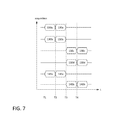
  • FIG. 7 is a timing diagram showing acquisition times of the touch and force sensors of FIGS. 2A and 2B in a fourth mode of operation.
  • FIG. 8 is a timing diagram showing acquisition times of the touch and force sensors of FIGS. 2A and 2B in a fifth mode of operation.
  • FIG. 9 is a timing diagram showing generation of drive signals for the touch and force sensors in response to a synchronization signal, when operating according to the fifth mode of operation.
  • FIG. 10 is another timing diagram showing generation of drive signals for the touch and force sensors in response to a synchronization signal, when operating according to the fourth mode of operation.
  • FIG. 1A showing a portion of a capacitive touch matrix 10 for touch location sensing comprising a plurality of conductive rows 12 and plurality of conductive columns 14 .
  • Each row 12 and column 14 is formed by a plurality of serially connected diamond shaped regions 16 forming a conductive line or trace.
  • the conductive rows 12 and the conductive columns 14 cross above or below each other at intersection points, but are not in electrical contact with one another. Because of the diamond pattern, the conductive rows 12 and the conductive columns 14 are separated from each other by capacitive gaps 18 .
  • the diamond pattern may provide decreased capacitance between conductive rows 12 and conductive columns 14 .
  • Capacitive touch matrix 10 may sense an object that modifies the fringing electric field above the capacitive gaps 18 when the object is in contact or in proximity to the matrix 10 .
  • FIG. 1B shows that when a conductive row 12 and a conductive column 14 are selected by the switch matrices 44 and 46 , the total capacitance of a capacitance sensor formed between row and column conductors is the sum of four capacitances 20 between the four adjacent diamond-shaped regions 16 of the selected row and column.
  • the mutual capacitance of the capacitance sensor between the selected row 12 and column 14 conductors can be sensed to determine whether an object is in contact with or in proximity to the matrix 10 above the region in which the four capacitances 20 are formed.
  • Each conductive row 12 and conductive column 14 of the capacitive touch matrix 10 may be selected in succession to sense the capacitances at each intersection position of the touch matrix.
  • FIG. 1D Shown in FIG. 1D is a portion of a touch screen system 100 including the capacitive touch matrix 10 (for sensing touch location), and a capacitive touch force matrix 209 (for sensing touch pressure).
  • the capacitive touch force matrix 209 includes columns and rows that are spaced apart vertically by a compressible layer but cross one another. The pressure of a user's finger on a touch screen incorporating the capacitive touch force matrix 209 changes the distance between the rows and columns, and thus changes the capacitance between the two.
  • FIG. 1C is a block diagram of a touch screen system 100 that includes the capacitive touch matrix 209 and an associated touch force IC 120 .
  • the touch force IC 120 includes a row switch matrix 244 and a column switch matrix 246 for selection of rows and columns of the capacitive touch force matrix, such selection being made to select a particular mutual capacitance within the matrix 209 for sensing.
  • the column switch matrix 246 receives a drive signal generated by a driver 248 and selectively applies the drive signal in a sequential manner to each of the columns C 1 -C 4 .
  • the row switch matrix 244 sequentially selects one or more of the rows R 1 -R 3 for connection to a capacitance-to-digital converter circuit 250 that operates to sense charge of the mutual capacitance between rows R 1 -R 3 and columns C 1 -C 4 of the capacitive touch matrix 209 and convert that sensed charge to a digital value for output.
  • the touch screen system 100 may be incorporated into any suitable electronic device, such as a smartphone, tablet, smartwatch, laptop, or vehicle infotainment system.
  • the touch screen system 100 includes a host device 102 for interfacing with the processor or system on a chip (SoC) of the electronic device, a touch location IC 110 for operating and acquiring touch location data from touch sensors 130 (which include the capacitive touch matrix 10 ), and a touch force IC 120 for operating and acquiring touch force data from touch force sensors 140 (which include a capacitive touch matrix similar to the capacitive touch force matrix 209 ).
  • SoC system on a chip
  • the touch IC 110 includes a touch screen controller 112 in bidirectional communication with the host device 102 .
  • the touch screen controller 112 operates the touch analog front end 114 , which includes the various components of the touch IC 110 described above.
  • the force IC 120 includes a force controller 122 in bidirectional communication with the host device 102 .
  • the force controller 122 operates the force analog front end 124 , which includes components similar to those described above with respect to the touch force IC 209 .
  • Either the touch controller 112 or force controller 122 of the embodiment shown in FIG. 2A in operation, generates a synchronization signal, which is fed to the other through the host 102 .
  • the function of this synchronization signal will be described in detail below.
  • FIG. 2B An alternative embodiment is shown in which the force IC 120 ′ lacks an on-chip touch controller, and instead the touch controller 112 of the touch IC itself 110 also functions as the touch controller for the force IC 120 ′.
  • the touch controller 112 generates the synchronization signal and feeds it directly to the force IC 120 ′.
  • the touch sensor 130 makes up an upper sensing layer, and illustratively includes four touch sensors or touch sensor regions 130 a - 130 d .
  • the touch force sensor 140 makes up a lower sensing layer, and illustratively includes two force sensors or force sensor regions 140 a - 140 b . It should be noted that the force sensors 140 a - 140 b are larger than the touch sensors 130 a - 130 d , meaning that the touch sensor 130 has a different pitch (which here is greater, but may in some applications possibly be less) than that of the force sensor 140 .
  • the synchronization signal can be used by the touch IC 110 and force IC 120 in a variety of operation modes to provide for data acquisition in a fashion such that data from each touch sensor 130 a - 103 d and each touch force sensor 140 a - 140 b is correlated and consistent.
  • data from the touch sensors 130 a - 130 d is each acquired in order by the touch controller 122 , beginning in response to a transition of the synchronization signal. This is shown in the timing diagram of FIG. 4 .
  • touch location data is acquired sequentially from touch sensors 130 a - 130 b , at times T 1 and T 2 , touch force data is simultaneously acquired from the force sensor 140 a (which is vertically aligned with touch sensors 130 a - 130 b ) also at times T 1 and T 2 .
  • touch location data is acquired sequentially from touch sensors 130 c - 130 d (which is vertically aligned with force sensor 140 b ), at times T 3 and T 4 , touch force data is simultaneously acquired from the force sensor 140 b (at each acquisition of touch location data), also at times T 3 and T 4 .
  • data from the touch sensors 130 a - 130 d is each acquired in order by the touch controller 122 , beginning in response to a transition of the synchronization signal. This is shown in the timing diagram of FIG. 5 .
  • touch location data is acquired from touch sensor 130 a at time T 1
  • touch force data is simultaneously acquired from the force sensor 140 a (which is vertically aligned with the touch sensor 130 a ) also at time T 1 .
  • touch force data is simultaneously acquired from the force sensor 140 b (which is vertically aligned with the touch sensor 130 c ) also at time T 3 .
  • touch force data is not acquired concurrently with touch location data acquisition at times T 2 and T 4 , provided that the rate of change of the touch location data and touch force data is substantially less than the acquisition rate thereof, accurate and correlated touch location and touch force data can be acquired this fashion while reducing power consumption due to cutting in half the number of touch force data acquisitions.
  • data from the touch sensors 130 a - 130 d is each acquired in order by the touch controller 122 , beginning in response to a transition of the synchronization signal. This is shown in the timing diagram of FIG. 6 .
  • touch location data is acquired from touch sensor 130 a and 130 b at times T 1 and T 2
  • touch force data is acquired from the force sensor 140 a during a window of time shown starting at time F 1 and running from after the start of acquisition of touch location data at T 1 to before the end of acquisition of touch location data at T 2 .
  • touch force data is simultaneously acquired from the force sensor 140 b during a window of time shown starting at time F 2 and running from after the start of acquisition of touch location data at T 3 to before the end of acquisition of touch location data at T 4 .
  • touch force data is not acquired during the entire acquisition times for the touch sensors 130 a - 130 d and force sensors 140 a - 140 b provided that the rate of change of the touch location data and touch force data is substantially less than the acquisition rate thereof, accurate and correlated touch and touch force data can be acquired this fashion while reducing power consumption due to cutting in half the number of touch force data acquisitions.
  • touch location data is acquired simultaneously from touch sensors 130 a - 130 b and force sensor 140 a at times T 1 and T 2 , and is acquired simultaneously from the touch sensors 130 c - 130 d and force sensor 140 b at times T 3 and T 4 .
  • drive signals to touch sensors 130 c - 130 d are pulsed in a synchronized fashion, and a drive signal to force sensor 140 b is pulsed (at a much lower frequency) in a synchronized fashion with the drive signals to touch sensors 130 c - 130 d.
  • each touch sensor 130 a - 130 d and each touch force sensor 140 a - 140 b are respectively operated by the touch controller 112 and force controller 122 to simultaneously acquire a frame of data.
  • the resulting acquired touch location data and touch force data is correlated, and the touch force data accurately corresponds to the pressure or force exerted by a user's finger on a display employing the touch screen system 100 .
  • the touch sensor 130 and force sensor 140 have different acquisition times, the slower acquisition time controls and the synchronization signal is generated so as to permit proper function.
  • FIG. 9 A sample timing diagram for this frame synchronization mode is shown in FIG. 9 . As shown, data is simultaneously acquired by the touch sensors 130 a - 130 d and the force sensors 140 a - 140 b at time T 1 .
  • drive signals to the touch sensors 130 a - 130 d are pulsed in a synchronized fashion, and drive signals to force sensors 140 a - 140 b are pulsed (at a much lower frequency) in a synchronized fashion with the drive signals to touch sensors 130 a - 130 d .
  • the appropriate sense lines are sensed to as to acquire the touch location data and the touch force data.

Landscapes

  • Engineering & Computer Science (AREA)
  • General Engineering & Computer Science (AREA)
  • Theoretical Computer Science (AREA)
  • Human Computer Interaction (AREA)
  • Physics & Mathematics (AREA)
  • General Physics & Mathematics (AREA)
  • Position Input By Displaying (AREA)

Abstract

Disclosed herein is an electronic device including a first touch circuit to be coupled to a first touch sensing unit, the first touch sensing unit having first drive lines and first sense lines intersecting the first drive lines. A second touch circuit is to be coupled to a second touch sensing unit, the second touch sensing unit having second drive lines and second sense lines intersecting the second drive lines. A touch force circuit is to be coupled to a touch force sensing unit, the touch force sensing unit having third drive lines and third sense lines intersecting the third drive lines. The first touch circuit, second touch circuit, and touch force circuit are configured to drive the first, second, and third drive lines as a function of a synchronization signal, and acquire data from the first, second, and third sense lines as a function of the synchronization signal.

Description

TECHNICAL FIELD
The present disclosure generally relates to capacitive touch screen controller integrated circuits, and, more particularly, to a technique for using a touch screen controller integrated circuit to acquire touch data from different touch sensors in a correlated fashion.
BACKGROUND
A touch screen display is a device that can detect an object in contact therewith or in proximity thereto. The touch screen display includes display layer covered with a touch-sensitive matrix that can detect a user's touch by way of a finger or stylus, for example. Touch screen displays are used in various applications such as mobile phones, tablets, and smartwatches. A touch screen display may enable various types of user input, such as touch selection of items or alphanumeric input via a displayed virtual keypad. Touch screen displays can measure various parameters of the user's touch, such as the location, duration, pressure, etc.
One type of touch screen display is a capacitive touch screen. A capacitive touch screen may include a matrix of conductive rows and columns overlaid on the display layer forming mutual capacitance sensors. In mutual capacitance sensors, a mutual capacitance at the intersection of each row and column of the matrix may be sensed. A change in mutual capacitance between a row and a column may indicate that an object, such as a finger, is touching the screen or is in proximity to the screen near the region of intersection of the row and column.
In some electronic devices, a capacitive touch screen may have multiple layers of mutual capacitance sensors in a stacked arrangement, with one layer being used to determine the X and Y coordinates of a touch location, and with another layer being used to determine the force or pressure with which the object making the touch presses against the capacitive touch screen. These different sensing layers may contain different numbers of mutual capacitance sensors. Due to the different number of mutual capacitance sensors, the pitch of these different sensing layers is not equal, which may adversely affect the accuracy of acquired touch data, in that data of a given touch event as acquired by the different sensing layers may not be cross correlated between those different sensing layers.
Thus, a need exists within the art for techniques by which touch data collected from different mutual capacitance sensors can be cross correlated, at the time of acquisition.
SUMMARY
This summary is provided to introduce a selection of concepts that are further described below in the detailed description. This summary is not intended to identify key or essential features of the claimed subject matter, nor is it intended to be used as an aid in limiting the scope of the claimed subject matter.
Disclosed herein is an electronic device including a first touch circuit to be coupled to a first touch sensing unit, the first touch sensing unit having first drive lines and first sense lines intersecting the first drive lines. A second touch circuit is to be coupled to a second touch sensing unit, the second touch sensing unit having second drive lines and second sense lines intersecting the second drive lines. A touch force circuit is to be coupled to a touch force sensing unit, the touch force sensing unit having third drive lines and third sense lines intersecting the third drive lines. The first touch circuit, second touch circuit, and touch force circuit are configured to drive the first, second, and third drive lines as a function of a synchronization signal, and acquire data from the first, second, and third sense lines as a function of the synchronization signal.
A method aspect disclosed herein includes generating a synchronization signal. In response to the synchronization signal, first, second, and third drive lines are driven, and data is acquired from first, second, and third sense lines intersecting the first, second, and third drive lines. The synchronization signal is not a system clock signal.
Also disclosed herein is an electronic device including a first touch circuit to be coupled to a first touch sensing unit, and a second touch circuit to be coupled to a second touch sensing unit. One of the first touch circuit and the second touch integrated circuit is configured to generate a synchronization signal. The first and second touch circuits are configured to, in response to receipt of the synchronization signal, synchronously acquire touch data from the first and second touch sensing units, respectively.
BRIEF DESCRIPTION OF THE DRAWINGS
FIG. 1A illustrates a portion of a capacitive touch matrix for touch location sensing.
FIG. 1B illustrates a mutual capacitance intersection in the matrix.
FIG. 1C is a block diagram of a touch screen system for touch pressure sensing.
FIG. 1D is illustrates a portion of a capacitive touch matrix for touch pressure sensing.
FIG. 2A is a schematic block diagram of an embodiment of an electronic device capable of acquiring touch data in a correlated fashion, in accordance with this disclosure.
FIG. 2B is a schematic block diagram of another embodiment of an electronic device capable of acquiring touch data in a correlated fashion, in accordance with this disclosure.
FIG. 3 is a schematic block diagram of an embodiment of the touch and force sensors of FIGS. 2A and 2B that illustrates the different sensing layers thereof.
FIG. 4 is a timing diagram showing acquisition times of the touch and force sensors of FIGS. 2A and 2B in a first mode of operation.
FIG. 5 is a timing diagram showing acquisition times of the touch and force sensors of FIGS. 2A and 2B in a second mode of operation.
FIG. 6 is a timing diagram showing acquisition times of the touch and force sensors of FIGS. 2A and 2B in a third mode of operation.
FIG. 7 is a timing diagram showing acquisition times of the touch and force sensors of FIGS. 2A and 2B in a fourth mode of operation.
FIG. 8 is a timing diagram showing acquisition times of the touch and force sensors of FIGS. 2A and 2B in a fifth mode of operation.
FIG. 9 is a timing diagram showing generation of drive signals for the touch and force sensors in response to a synchronization signal, when operating according to the fifth mode of operation.
FIG. 10 is another timing diagram showing generation of drive signals for the touch and force sensors in response to a synchronization signal, when operating according to the fourth mode of operation.
DETAILED DESCRIPTION
The present description is made with reference to the accompanying drawings, in which example embodiments are shown. However, many different embodiments may be used, and thus the description should not be construed as limited to the embodiments set forth herein. Rather, these embodiments are provided so that this disclosure will be thorough and complete. Like numbers refer to like elements throughout, and prime notation is used to indicate similar elements in alternative embodiments.
Reference is now made to FIG. 1A showing a portion of a capacitive touch matrix 10 for touch location sensing comprising a plurality of conductive rows 12 and plurality of conductive columns 14. Each row 12 and column 14 is formed by a plurality of serially connected diamond shaped regions 16 forming a conductive line or trace. The conductive rows 12 and the conductive columns 14 cross above or below each other at intersection points, but are not in electrical contact with one another. Because of the diamond pattern, the conductive rows 12 and the conductive columns 14 are separated from each other by capacitive gaps 18. The diamond pattern may provide decreased capacitance between conductive rows 12 and conductive columns 14. Capacitive touch matrix 10 may sense an object that modifies the fringing electric field above the capacitive gaps 18 when the object is in contact or in proximity to the matrix 10.
FIG. 1B shows that when a conductive row 12 and a conductive column 14 are selected by the switch matrices 44 and 46, the total capacitance of a capacitance sensor formed between row and column conductors is the sum of four capacitances 20 between the four adjacent diamond-shaped regions 16 of the selected row and column. The mutual capacitance of the capacitance sensor between the selected row 12 and column 14 conductors can be sensed to determine whether an object is in contact with or in proximity to the matrix 10 above the region in which the four capacitances 20 are formed. Each conductive row 12 and conductive column 14 of the capacitive touch matrix 10 may be selected in succession to sense the capacitances at each intersection position of the touch matrix.
Shown in FIG. 1D is a portion of a touch screen system 100 including the capacitive touch matrix 10 (for sensing touch location), and a capacitive touch force matrix 209 (for sensing touch pressure). The capacitive touch force matrix 209 includes columns and rows that are spaced apart vertically by a compressible layer but cross one another. The pressure of a user's finger on a touch screen incorporating the capacitive touch force matrix 209 changes the distance between the rows and columns, and thus changes the capacitance between the two.
FIG. 1C is a block diagram of a touch screen system 100 that includes the capacitive touch matrix 209 and an associated touch force IC 120. The touch force IC 120 includes a row switch matrix 244 and a column switch matrix 246 for selection of rows and columns of the capacitive touch force matrix, such selection being made to select a particular mutual capacitance within the matrix 209 for sensing. The column switch matrix 246 receives a drive signal generated by a driver 248 and selectively applies the drive signal in a sequential manner to each of the columns C1-C4. The row switch matrix 244 sequentially selects one or more of the rows R1-R3 for connection to a capacitance-to-digital converter circuit 250 that operates to sense charge of the mutual capacitance between rows R1-R3 and columns C1-C4 of the capacitive touch matrix 209 and convert that sensed charge to a digital value for output.
With additional reference to FIGS. 2A-2B, further details of the touch screen system 100 are now given. The touch screen system 100 may be incorporated into any suitable electronic device, such as a smartphone, tablet, smartwatch, laptop, or vehicle infotainment system. The touch screen system 100 includes a host device 102 for interfacing with the processor or system on a chip (SoC) of the electronic device, a touch location IC 110 for operating and acquiring touch location data from touch sensors 130 (which include the capacitive touch matrix 10), and a touch force IC 120 for operating and acquiring touch force data from touch force sensors 140 (which include a capacitive touch matrix similar to the capacitive touch force matrix 209).
The touch IC 110 includes a touch screen controller 112 in bidirectional communication with the host device 102. The touch screen controller 112 operates the touch analog front end 114, which includes the various components of the touch IC 110 described above. Similarly, the force IC 120 includes a force controller 122 in bidirectional communication with the host device 102. The force controller 122 operates the force analog front end 124, which includes components similar to those described above with respect to the touch force IC 209.
Either the touch controller 112 or force controller 122 of the embodiment shown in FIG. 2A, in operation, generates a synchronization signal, which is fed to the other through the host 102. The function of this synchronization signal will be described in detail below.
An alternative embodiment is shown in FIG. 2B in which the force IC 120′ lacks an on-chip touch controller, and instead the touch controller 112 of the touch IC itself 110 also functions as the touch controller for the force IC 120′. Here, the touch controller 112 generates the synchronization signal and feeds it directly to the force IC 120′.
The touch sensor 130, as shown in FIG. 3, makes up an upper sensing layer, and illustratively includes four touch sensors or touch sensor regions 130 a-130 d. The touch force sensor 140 makes up a lower sensing layer, and illustratively includes two force sensors or force sensor regions 140 a-140 b. It should be noted that the force sensors 140 a-140 b are larger than the touch sensors 130 a-130 d, meaning that the touch sensor 130 has a different pitch (which here is greater, but may in some applications possibly be less) than that of the force sensor 140.
The synchronization signal can be used by the touch IC 110 and force IC 120 in a variety of operation modes to provide for data acquisition in a fashion such that data from each touch sensor 130 a-103 d and each touch force sensor 140 a-140 b is correlated and consistent.
In one operation mode, which can be referred to as a cell synchronization mode, data from the touch sensors 130 a-130 d is each acquired in order by the touch controller 122, beginning in response to a transition of the synchronization signal. This is shown in the timing diagram of FIG. 4. When touch location data is acquired sequentially from touch sensors 130 a-130 b, at times T1 and T2, touch force data is simultaneously acquired from the force sensor 140 a (which is vertically aligned with touch sensors 130 a-130 b) also at times T1 and T2. Similarly, when touch location data is acquired sequentially from touch sensors 130 c-130 d (which is vertically aligned with force sensor 140 b), at times T3 and T4, touch force data is simultaneously acquired from the force sensor 140 b (at each acquisition of touch location data), also at times T3 and T4.
In an alternate cell synchronization mode, data from the touch sensors 130 a-130 d is each acquired in order by the touch controller 122, beginning in response to a transition of the synchronization signal. This is shown in the timing diagram of FIG. 5. When touch location data is acquired from touch sensor 130 a at time T1, touch force data is simultaneously acquired from the force sensor 140 a (which is vertically aligned with the touch sensor 130 a) also at time T1. Similarly, when touch location data is acquired sequentially from touch sensor 130 c at time T3, touch force data is simultaneously acquired from the force sensor 140 b (which is vertically aligned with the touch sensor 130 c) also at time T3.
While touch force data is not acquired concurrently with touch location data acquisition at times T2 and T4, provided that the rate of change of the touch location data and touch force data is substantially less than the acquisition rate thereof, accurate and correlated touch location and touch force data can be acquired this fashion while reducing power consumption due to cutting in half the number of touch force data acquisitions.
In an alternate cell synchronization mode, data from the touch sensors 130 a-130 d is each acquired in order by the touch controller 122, beginning in response to a transition of the synchronization signal. This is shown in the timing diagram of FIG. 6. When touch location data is acquired from touch sensor 130 a and 130 b at times T1 and T2, touch force data is acquired from the force sensor 140 a during a window of time shown starting at time F1 and running from after the start of acquisition of touch location data at T1 to before the end of acquisition of touch location data at T2.
Similarly, when touch location data is acquired sequentially from touch sensor 130 c and 130 d at times T3 and T4, touch force data is simultaneously acquired from the force sensor 140 b during a window of time shown starting at time F2 and running from after the start of acquisition of touch location data at T3 to before the end of acquisition of touch location data at T4.
While touch force data is not acquired during the entire acquisition times for the touch sensors 130 a-130 d and force sensors 140 a-140 b provided that the rate of change of the touch location data and touch force data is substantially less than the acquisition rate thereof, accurate and correlated touch and touch force data can be acquired this fashion while reducing power consumption due to cutting in half the number of touch force data acquisitions.
In a further cell synchronization mode shown in FIG. 7, touch location data is acquired simultaneously from touch sensors 130 a-130 b and force sensor 140 a at times T1 and T2, and is acquired simultaneously from the touch sensors 130 c-130 d and force sensor 140 b at times T3 and T4.
The matrix 10 level operation of this operation mode is now described with reference to the timing diagram shown in FIG. 10. As shown, at the falling edge of the sync signal at time T1, drive signals to touch sensors 130 a-130 b are pulsed in a synchronized fashion, and a drive signal to force sensor 140 a is pulsed (at a much lower frequency) in a synchronized fashion with the drive signals to touch sensors 130 a-130 b. Concurrent with the pulsing of these various drive signals, the appropriate sense lines are sensed to as to acquire the touch location data and the touch force data. As also shown, at the next falling edge of the sync signal at time T2, drive signals to touch sensors 130 c-130 d are pulsed in a synchronized fashion, and a drive signal to force sensor 140 b is pulsed (at a much lower frequency) in a synchronized fashion with the drive signals to touch sensors 130 c-130 d.
In a further mode shown in FIG. 8, which can be referred to as a frame synchronization mode, in response to a transition of the synchronization signal, each touch sensor 130 a-130 d and each touch force sensor 140 a-140 b are respectively operated by the touch controller 112 and force controller 122 to simultaneously acquire a frame of data. In this way, the resulting acquired touch location data and touch force data is correlated, and the touch force data accurately corresponds to the pressure or force exerted by a user's finger on a display employing the touch screen system 100. Where the touch sensor 130 and force sensor 140 have different acquisition times, the slower acquisition time controls and the synchronization signal is generated so as to permit proper function.
A sample timing diagram for this frame synchronization mode is shown in FIG. 9. As shown, data is simultaneously acquired by the touch sensors 130 a-130 d and the force sensors 140 a-140 b at time T1.
The matrix 10 level operation of this operation mode is now described with reference to the timing diagram shown in FIG. 8. As shown, at the falling edge of the sync signal at time T1, drive signals to the touch sensors 130 a-130 d are pulsed in a synchronized fashion, and drive signals to force sensors 140 a-140 b are pulsed (at a much lower frequency) in a synchronized fashion with the drive signals to touch sensors 130 a-130 d. Concurrent with the pulsing of these various drive signals, the appropriate sense lines are sensed to as to acquire the touch location data and the touch force data.
Many modifications and other embodiments will come to the mind of one skilled in the art having the benefit of the teachings presented in the foregoing descriptions and the associated drawings. Therefore, it is understood that various modifications and embodiments are intended to be included within the scope of the appended claims.

Claims (23)

The invention claimed is:
1. An electronic device, comprising:
a first touch circuit to be coupled to a first touch sensing unit, the first touch sensing unit comprising first drive lines and first sense lines intersecting the first drive lines;
a second touch circuit to be coupled to a second touch sensing unit, the second touch sensing unit comprising second drive lines and second sense lines intersecting the second drive lines;
a touch force circuit to be coupled to a touch force sensing unit, the touch force sensing unit comprising third drive lines and third sense lines intersecting the third drive lines;
wherein the first touch circuit, second touch circuit, and touch force circuit are configured to:
drive the first drive lines, second drive lines, and third drive lines as a function of a synchronization signal, and
acquire data from the first sense lines, second sense lines, and third sense lines as a function of the synchronization signal.
2. The electronic device of claim 1,
wherein the first touch circuit, second touch circuit, and touch force circuit drive the first drive lines, second drive lines and third drive lines as a function of the synchronization signal by, in response to a transition of the synchronization signal:
driving the first drive lines,
driving the second drive lines subsequent in time to driving the first drive lines, and
driving the third drive lines during driving of the first drive lines and during driving of the second drive lines;
wherein the first touch circuit, second touch circuit, and touch force circuit acquire data from the first, second, and third sense lines as a function of the synchronization signal by, in response to a transition of the synchronization signal:
acquiring data from the first and third sense lines, and
acquiring data from the second and third sense lines subsequent in time to acquiring data from the first sense lines.
3. The electronic device of claim 1,
wherein the first touch circuit, second touch circuit, and touch force circuit drive the first, second, and third drive lines as a function of the synchronization signal by, in response to a transition of the synchronization signal:
driving the first drive lines,
driving the second drive lines subsequent in time to driving the first drive lines, and
driving the third drive lines during driving of the first drive lines;
wherein the first touch circuit, second touch circuit, and touch force circuit acquire data from the first, second, and third sense lines as a function of the synchronization signal by, in response to a transition of the synchronization signal:
acquiring data from the first and third sense lines, and
acquiring data from the second sense lines subsequent in time to acquiring data from the first sense lines.
4. The electronic device of claim 1, wherein a rate of the acquiring of the data from the first, second, and third sense lines is greater than a rate of change of the data from the first, second, and third sense lines.
5. The electronic device of claim 1,
wherein the first touch circuit, second touch circuit, and touch force circuit drive the first, second, and third drive lines as a function of the synchronization signal by, in response to a transition of the synchronization signal:
driving the first drive lines,
driving the second drive lines subsequent in time to driving the first drive lines, and
driving the third drive lines in a time window beginning subsequent in time to beginning driving of the first drive lines and ending precedent in time to ending driving of the second drive lines;
wherein the first touch circuit, second touch circuit, and touch force circuit acquire data from the first, second, and third sense lines as a function of the synchronization signal by, in response to a transition of the synchronization signal:
acquiring data from the first sense lines,
acquiring data from the second sense lines subsequent in time to acquiring data from the first sense lines, and
acquiring data from the third sense lines in a time window beginning subsequent in time to beginning acquiring data from the first sense lines and ending precedent in time to ending acquiring data from the second sense lines.
6. The electronic device of claim 1, wherein the first and second touch sensing units have a first acquisition time associated therewith; wherein the touch force sensing unit has a second acquisition time associated therewith; wherein the first and second acquisition times are unequal; and wherein the synchronization signal is a function of a slower of the first and second acquisition times.
7. The electronic device of claim 1, wherein the data acquired from the first touch sensing unit by the first touch circuit comprises touch location data; wherein the data acquired from the second touch sensing unit by the second touch circuit comprises touch location data; and wherein the data acquired from the touch force sensing unit by the touch force circuit comprises touch force data.
8. The electronic device of claim 1, wherein the data acquired from the first touch sensing unit by the first touch circuit comprises touch force data.
9. The electronic device of claim 1, wherein the first and second touch circuits drive the first and second drive lines with first and second drive signals having first and second frequencies; wherein the touch force circuit drives the third drive lines with a third drive signal having a third frequency; and wherein the third frequency is less than the first and second frequencies.
10. The electronic device of claim 9, wherein the first and second frequencies are equal.
11. The electronic device of claim 1, wherein the first and second touch circuits drive the first and second drive lines with first and second drive signals having first and second frequencies; wherein the touch force circuit drives the third drive lines with a third drive signal having a third frequency; and wherein the third frequency is equal to the first and second frequencies.
12. The electronic device of claim 1, wherein the first touch circuit comprises a first touch integrated circuit; and wherein the second touch circuit comprises a second touch integrated circuit.
13. A method, comprising:
generating a synchronization signal at a host device; and
in response to the synchronization signal:
driving first, second, and third drive lines using a first touch circuit, a second touch circuit, and a touch force circuit; and
acquiring data from first, second, and third sense lines intersecting the first, second, and third drive lines using the first touch circuit, the second touch circuit, and the touch force circuit;
wherein the data acquired from the first sense lines comprises touch location data;
wherein the data acquired from the second sense lines comprises touch location
data;
wherein the data acquired from the third sense lines comprises touch force data;
wherein the synchronization signal is not a system clock signal.
14. The method of claim 13, wherein driving the first, second, and third drive lines comprises, in response to a transition of the synchronization signal:
driving the first drive lines,
driving the second drive lines subsequent in time to driving the first drive lines, and
driving the third drive lines during driving of the first and second drive lines;
wherein acquiring data from the first, second, and third sense lines comprises, in response to the transition of the synchronization signal:
acquiring data from the first sense lines,
acquiring data from the second sense lines subsequent in time to acquiring data from the first sense lines, and
acquiring data from the third sense lines during acquisition of data from the first and second sense lines.
15. The method of claim 13, wherein driving the first, second, and third drive lines comprises, in response to a transition of the synchronization signal:
driving the first drive lines,
driving the second drive lines subsequent in time to driving the first drive lines, and
driving the third drive lines during driving of the first drive lines;
wherein acquiring data from the first, second, and third sense lines comprises, in response to the transition of the synchronization signal:
acquiring data from the first and third sense lines, and
acquiring data from the second sense lines subsequent in time to acquiring data from the first sense lines.
16. The method of claim 15, wherein a rate of the acquiring of the data from the first, second, and third sense lines is greater than a rate of change of the data from the first, second, and third sense lines.
17. The method of claim 13, wherein driving the first, second, and third drive lines comprises, in response to a transition of the synchronization signal:
driving the first drive lines,
driving the second drive lines subsequent in time to driving the first drive lines, and
driving the third drive lines in a time window beginning subsequent in time to beginning driving of the first drive lines and ending precedent in time to ending driving of the second drive lines;
wherein acquiring data from the first, second, and third sense lines comprises, in response to the transition of the synchronization signal:
acquiring data from the first sense lines,
acquiring data from the second sense lines subsequent in time to acquiring data from the first sense lines, and
acquiring data from the third sense lines in a time window beginning subsequent in time to beginning acquiring data from the first drive lines and ending precedent in time to ending acquiring data from the second drive lines.
18. An electronic device, comprising:
a first touch circuit to be coupled to a first touch sensing unit;
a second touch circuit to be coupled to a second touch sensing unit;
wherein one of the first touch circuit and the second touch circuit is configured to generate a synchronization signal;
wherein the first and second touch circuits are configured to, in response to the synchronization signal, synchronously acquire data from the first and second touch sensing units, respectively.
19. The electronic device of claim 18, wherein the first touch sensing unit has a first acquisition time associated therewith; wherein the second touch sensing unit has a third acquisition time associated therewith; wherein the first and third acquisition times are unequal; and wherein the synchronization signal is a function of a slower of the first and third acquisition times.
20. The electronic device of claim 18, wherein the data acquired from the first touch sensing unit by the first touch circuit comprises touch location data.
21. The electronic device of claim 18, wherein the data acquired from the first touch sensing unit by the first touch circuit comprises touch force data.
22. The electronic device of claim 18, further comprising a touch force circuit coupled to a touch force sensing unit; wherein the touch force circuit is also configured to, in response to receipt of the synchronization signal, synchronously acquire data from the touch force sensing unit, with the data acquired from the touch force sensing unit comprises touch force data; and wherein the data acquired from the first and second touch sensing units by the first and second touch circuits comprises touch location data.
23. The electronic device of claim 18, wherein the first and second sensing unit comprise capacitive touch sensors.
US15/208,894 2016-07-13 2016-07-13 Correlated data acquisition among different touch sensors Active 2036-07-31 US10025440B2 (en)

Priority Applications (3)

Application Number Priority Date Filing Date Title
US15/208,894 US10025440B2 (en) 2016-07-13 2016-07-13 Correlated data acquisition among different touch sensors
CN201720447231.6U CN206757583U (en) 2016-07-13 2017-04-26 Electronic installation
CN201710282265.9A CN107621912B (en) 2016-07-13 2017-04-26 Correlated data acquisition between different touch sensors

Applications Claiming Priority (1)

Application Number Priority Date Filing Date Title
US15/208,894 US10025440B2 (en) 2016-07-13 2016-07-13 Correlated data acquisition among different touch sensors

Publications (2)

Publication Number Publication Date
US20180018037A1 US20180018037A1 (en) 2018-01-18
US10025440B2 true US10025440B2 (en) 2018-07-17

Family

ID=60616048

Family Applications (1)

Application Number Title Priority Date Filing Date
US15/208,894 Active 2036-07-31 US10025440B2 (en) 2016-07-13 2016-07-13 Correlated data acquisition among different touch sensors

Country Status (2)

Country Link
US (1) US10025440B2 (en)
CN (2) CN107621912B (en)

Cited By (2)

* Cited by examiner, † Cited by third party
Publication number Priority date Publication date Assignee Title
US10156936B2 (en) * 2016-10-04 2018-12-18 Egalax_Empia Technology Inc. Electronic system, host and method thereof for determining correspondences between multiple display processing apparatuses and multiple touch sensitive processing apparatuses
WO2020153784A1 (en) * 2019-01-25 2020-07-30 Samsung Electronics Co., Ltd. Systems and methods for touch detection using electric field tomography through a resistive sheet

Families Citing this family (5)

* Cited by examiner, † Cited by third party
Publication number Priority date Publication date Assignee Title
WO2017124310A1 (en) 2016-01-20 2017-07-27 Parade Technologies, Ltd. Integrated touch sensing and force sensing in a touch detection device
US10025440B2 (en) * 2016-07-13 2018-07-17 Stmicroelectronics Asia Pacific Pte Ltd Correlated data acquisition among different touch sensors
US11307755B2 (en) 2016-08-25 2022-04-19 Parade Technologies, Ltd. Determination of valid touches based on force shape
KR102639530B1 (en) * 2019-07-18 2024-02-26 삼성전자주식회사 Touch sensing system and display system including the same
FR3101717B1 (en) * 2019-10-04 2021-09-10 ISKn system for recording a trace made by a utensil on a writing surface

Citations (20)

* Cited by examiner, † Cited by third party
Publication number Priority date Publication date Assignee Title
US4680429A (en) * 1986-01-15 1987-07-14 Tektronix, Inc. Touch panel
US20030080755A1 (en) * 2001-10-31 2003-05-01 Kabushiki Kaisha Honda Denshi Giken Proximity sensor and object detecting device
US6826968B2 (en) 2000-11-28 2004-12-07 Stmicroelectronics S.R.L. Textile-like capacitive pressure sensor and method of mapping the pressure exerted at points of a surface of a flexible and pliable object, particularly of a sail
US7030860B1 (en) * 1999-10-08 2006-04-18 Synaptics Incorporated Flexible transparent touch sensing system for electronic devices
US20110187666A1 (en) * 2008-08-27 2011-08-04 Dong Jin Min Touch-sensing panel including electrode-integrated window, and manufacturing method thereof
US20110234528A1 (en) * 2010-03-26 2011-09-29 Stmicroelectronics Asia Pacific Pte Ltd. Sample and hold capacitance to digital converter
US20120112817A1 (en) * 2010-11-10 2012-05-10 Stmicroelectronics Asia Pacific Pte Ltd. Method and apparatus for capacitance sensing
US20130057507A1 (en) * 2011-09-05 2013-03-07 Lg Display Co., Ltd. Touch screen apparatus and driving method thereof
US20130069884A1 (en) * 2011-09-15 2013-03-21 Au Optronics Corporation Touch-sensing display panel
US20130069894A1 (en) * 2011-09-16 2013-03-21 Htc Corporation Electronic device and method for driving a touch sensor thereof
US20150116256A1 (en) * 2013-10-31 2015-04-30 Silicon Integrated Systems Corp Capacitive touch device and sensing method thereof
US20150346887A1 (en) * 2014-05-30 2015-12-03 Lg Display Co., Ltd. Time-division driving type touch sensing device and method for driving the same
US20160139732A1 (en) * 2013-07-05 2016-05-19 Sharp Kabushiki Kaisha Touch panel system
US20160283031A1 (en) * 2014-08-26 2016-09-29 Lg Display Co., Ltd. Apparatus for driving of touch panel
US20160306465A1 (en) * 2015-04-17 2016-10-20 Silicon Works Co., Ltd. Multi-chip touch system and control method therefor
US20160357315A1 (en) * 2015-06-03 2016-12-08 Focaltech Systems Co., Ltd. Touch sensing method and system for avoiding display noises
US20170024602A1 (en) * 2015-07-20 2017-01-26 Lg Display Co., Ltd. Fingerprint sensor integrated type touch screen device
US20170108970A1 (en) * 2015-10-20 2017-04-20 Lg Display Co., Ltd. Display Device Having Touch Sensor and Driving Method Thereof
US20170162121A1 (en) * 2015-05-04 2017-06-08 Boe Technology Group Co., Ltd. Pixel circuit and driving method thereof, array substrate and display apparatus
US20170315669A1 (en) * 2016-04-29 2017-11-02 Lg Display Co., Ltd. Apparatus for touch screen and electronic device comprising the same

Family Cites Families (3)

* Cited by examiner, † Cited by third party
Publication number Priority date Publication date Assignee Title
JP5355515B2 (en) * 2010-05-06 2013-11-27 株式会社村田製作所 Touch panel, touch input device, and control method thereof
CN102004573B (en) * 2010-07-28 2014-01-01 深圳市汇顶科技股份有限公司 A touch detection system and detection method thereof
US10025440B2 (en) * 2016-07-13 2018-07-17 Stmicroelectronics Asia Pacific Pte Ltd Correlated data acquisition among different touch sensors

Patent Citations (20)

* Cited by examiner, † Cited by third party
Publication number Priority date Publication date Assignee Title
US4680429A (en) * 1986-01-15 1987-07-14 Tektronix, Inc. Touch panel
US7030860B1 (en) * 1999-10-08 2006-04-18 Synaptics Incorporated Flexible transparent touch sensing system for electronic devices
US6826968B2 (en) 2000-11-28 2004-12-07 Stmicroelectronics S.R.L. Textile-like capacitive pressure sensor and method of mapping the pressure exerted at points of a surface of a flexible and pliable object, particularly of a sail
US20030080755A1 (en) * 2001-10-31 2003-05-01 Kabushiki Kaisha Honda Denshi Giken Proximity sensor and object detecting device
US20110187666A1 (en) * 2008-08-27 2011-08-04 Dong Jin Min Touch-sensing panel including electrode-integrated window, and manufacturing method thereof
US20110234528A1 (en) * 2010-03-26 2011-09-29 Stmicroelectronics Asia Pacific Pte Ltd. Sample and hold capacitance to digital converter
US20120112817A1 (en) * 2010-11-10 2012-05-10 Stmicroelectronics Asia Pacific Pte Ltd. Method and apparatus for capacitance sensing
US20130057507A1 (en) * 2011-09-05 2013-03-07 Lg Display Co., Ltd. Touch screen apparatus and driving method thereof
US20130069884A1 (en) * 2011-09-15 2013-03-21 Au Optronics Corporation Touch-sensing display panel
US20130069894A1 (en) * 2011-09-16 2013-03-21 Htc Corporation Electronic device and method for driving a touch sensor thereof
US20160139732A1 (en) * 2013-07-05 2016-05-19 Sharp Kabushiki Kaisha Touch panel system
US20150116256A1 (en) * 2013-10-31 2015-04-30 Silicon Integrated Systems Corp Capacitive touch device and sensing method thereof
US20150346887A1 (en) * 2014-05-30 2015-12-03 Lg Display Co., Ltd. Time-division driving type touch sensing device and method for driving the same
US20160283031A1 (en) * 2014-08-26 2016-09-29 Lg Display Co., Ltd. Apparatus for driving of touch panel
US20160306465A1 (en) * 2015-04-17 2016-10-20 Silicon Works Co., Ltd. Multi-chip touch system and control method therefor
US20170162121A1 (en) * 2015-05-04 2017-06-08 Boe Technology Group Co., Ltd. Pixel circuit and driving method thereof, array substrate and display apparatus
US20160357315A1 (en) * 2015-06-03 2016-12-08 Focaltech Systems Co., Ltd. Touch sensing method and system for avoiding display noises
US20170024602A1 (en) * 2015-07-20 2017-01-26 Lg Display Co., Ltd. Fingerprint sensor integrated type touch screen device
US20170108970A1 (en) * 2015-10-20 2017-04-20 Lg Display Co., Ltd. Display Device Having Touch Sensor and Driving Method Thereof
US20170315669A1 (en) * 2016-04-29 2017-11-02 Lg Display Co., Ltd. Apparatus for touch screen and electronic device comprising the same

Cited By (3)

* Cited by examiner, † Cited by third party
Publication number Priority date Publication date Assignee Title
US10156936B2 (en) * 2016-10-04 2018-12-18 Egalax_Empia Technology Inc. Electronic system, host and method thereof for determining correspondences between multiple display processing apparatuses and multiple touch sensitive processing apparatuses
WO2020153784A1 (en) * 2019-01-25 2020-07-30 Samsung Electronics Co., Ltd. Systems and methods for touch detection using electric field tomography through a resistive sheet
US11237687B2 (en) 2019-01-25 2022-02-01 Samsung Electronics Co., Ltd. Systems and methods for touch detection using electric field tomography through resistive sheet

Also Published As

Publication number Publication date
CN107621912B (en) 2020-10-27
US20180018037A1 (en) 2018-01-18
CN206757583U (en) 2017-12-15
CN107621912A (en) 2018-01-23

Similar Documents

Publication Publication Date Title
US10025440B2 (en) Correlated data acquisition among different touch sensors
US12340048B2 (en) Touch controller architecture
US11093055B2 (en) Stylus to host synchronization using a magnetic field
KR102014276B1 (en) Display device and driving method thereof
CN112925448B (en) Touch display panel, detection method thereof and touch display device
KR101602199B1 (en) Display device with integrated touch screen and method for driving the same
KR101404960B1 (en) Display device with integrated touch screen and method for driving the same
US9372583B2 (en) Display device having a touch screen and method of driving the same
EP3506067A1 (en) Touch display device, touch driving circuit, and touch driving method
CN110058717B (en) Touch driving circuit, touch display device and method for recognizing pen data through touch circuit
CN106997255B (en) Touch sensing system with active stylus and touch actuation device
US9268432B2 (en) Touch panel having a master and slave controller and method for driving thereof
CN112882610B (en) Driving method and driving circuit of touch display panel and touch display device
WO2017118017A1 (en) Touch-control panel, touch-control display apparatus and driving method thereof
KR20180062582A (en) Touch sensing circuit, touch display device, and touch sensing method
US10222916B2 (en) Device and method for self-capacitance touch sensing
KR20150027529A (en) Touch ic and display device integrated with touch screen using the same
KR101954731B1 (en) Liquid crystal display device and driving method thereof
KR20190070178A (en) Touch display device, touch system, touch circuit, and pen sensing method
KR102175932B1 (en) Touch sensing system and driving method thereof
US20200371626A1 (en) Pressure-sensor-embedded display
EP3073481B1 (en) Driver integrated circuit, driving method, and touch display system
US9274665B2 (en) Touch detecting method and touch detecting apparatus
CN114564122B (en) Driving method and driving circuit of touch display panel and touch display device
AU2014100859A4 (en) Touch controller architecture

Legal Events

Date Code Title Description
AS Assignment

Owner name: STMICROELECTRONICS ASIA PACIFIC PTE LTD, SINGAPORE

Free format text: ASSIGNMENT OF ASSIGNORS INTEREST;ASSIGNOR:TAN, KIEN BENG;REEL/FRAME:039145/0945

Effective date: 20160713

STCF Information on status: patent grant

Free format text: PATENTED CASE

MAFP Maintenance fee payment

Free format text: PAYMENT OF MAINTENANCE FEE, 4TH YEAR, LARGE ENTITY (ORIGINAL EVENT CODE: M1551); ENTITY STATUS OF PATENT OWNER: LARGE ENTITY

Year of fee payment: 4

AS Assignment

Owner name: STMICROELECTRONICS INTERNATIONAL N.V., SWITZERLAND

Free format text: ASSIGNMENT OF ASSIGNORS INTEREST;ASSIGNOR:STMICROELECTRONICS ASIA PACIFIC PTE LTD;REEL/FRAME:068434/0191

Effective date: 20240628

Owner name: STMICROELECTRONICS INTERNATIONAL N.V., SWITZERLAND

Free format text: ASSIGNMENT OF ASSIGNOR'S INTEREST;ASSIGNOR:STMICROELECTRONICS ASIA PACIFIC PTE LTD;REEL/FRAME:068434/0191

Effective date: 20240628