US10023705B2 - Co-ABPBI membranes and process for the preparation thereof - Google Patents

Co-ABPBI membranes and process for the preparation thereof Download PDF

Info

Publication number
US10023705B2
US10023705B2 US14/915,346 US201414915346A US10023705B2 US 10023705 B2 US10023705 B2 US 10023705B2 US 201414915346 A US201414915346 A US 201414915346A US 10023705 B2 US10023705 B2 US 10023705B2
Authority
US
United States
Prior art keywords
alkyl
arylene
abpbi
group
aryl
Prior art date
Legal status (The legal status is an assumption and is not a legal conclusion. Google has not performed a legal analysis and makes no representation as to the accuracy of the status listed.)
Active
Application number
US14/915,346
Other versions
US20160215110A1 (en
Inventor
Ulhas Kanhaiyalal Kharul
Kurungot Sreekumar
Harshal Dilip Chaudhari
Vinaya Bhagwat Ghodake
Current Assignee (The listed assignees may be inaccurate. Google has not performed a legal analysis and makes no representation or warranty as to the accuracy of the list.)
Council of Scientific and Industrial Research CSIR
Original Assignee
Council of Scientific and Industrial Research CSIR
Priority date (The priority date is an assumption and is not a legal conclusion. Google has not performed a legal analysis and makes no representation as to the accuracy of the date listed.)
Filing date
Publication date
Application filed by Council of Scientific and Industrial Research CSIR filed Critical Council of Scientific and Industrial Research CSIR
Assigned to COUNCIL OF SCIENTIFIC & INDUSTRIAL RESEARCH reassignment COUNCIL OF SCIENTIFIC & INDUSTRIAL RESEARCH ASSIGNMENT OF ASSIGNORS INTEREST (SEE DOCUMENT FOR DETAILS). Assignors: CHAUDHARI, HARSHAL DILIP, GHODAKE, VINAYA BHAGWAT, KHAURUL, ULHAS KANHAIYALAL, SREEKUMAR, KURUNGOT
Publication of US20160215110A1 publication Critical patent/US20160215110A1/en
Application granted granted Critical
Publication of US10023705B2 publication Critical patent/US10023705B2/en
Active legal-status Critical Current
Anticipated expiration legal-status Critical

Links

Images

Classifications

    • CCHEMISTRY; METALLURGY
    • C08ORGANIC MACROMOLECULAR COMPOUNDS; THEIR PREPARATION OR CHEMICAL WORKING-UP; COMPOSITIONS BASED THEREON
    • C08JWORKING-UP; GENERAL PROCESSES OF COMPOUNDING; AFTER-TREATMENT NOT COVERED BY SUBCLASSES C08B, C08C, C08F, C08G or C08H
    • C08J5/00Manufacture of articles or shaped materials containing macromolecular substances
    • C08J5/18Manufacture of films or sheets
    • BPERFORMING OPERATIONS; TRANSPORTING
    • B01PHYSICAL OR CHEMICAL PROCESSES OR APPARATUS IN GENERAL
    • B01DSEPARATION
    • B01D53/00Separation of gases or vapours; Recovering vapours of volatile solvents from gases; Chemical or biological purification of waste gases, e.g. engine exhaust gases, smoke, fumes, flue gases, aerosols
    • B01D53/22Separation of gases or vapours; Recovering vapours of volatile solvents from gases; Chemical or biological purification of waste gases, e.g. engine exhaust gases, smoke, fumes, flue gases, aerosols by diffusion
    • B01D53/228Separation of gases or vapours; Recovering vapours of volatile solvents from gases; Chemical or biological purification of waste gases, e.g. engine exhaust gases, smoke, fumes, flue gases, aerosols by diffusion characterised by specific membranes
    • BPERFORMING OPERATIONS; TRANSPORTING
    • B01PHYSICAL OR CHEMICAL PROCESSES OR APPARATUS IN GENERAL
    • B01DSEPARATION
    • B01D67/00Processes specially adapted for manufacturing semi-permeable membranes for separation processes or apparatus
    • B01D67/0002Organic membrane manufacture
    • BPERFORMING OPERATIONS; TRANSPORTING
    • B01PHYSICAL OR CHEMICAL PROCESSES OR APPARATUS IN GENERAL
    • B01DSEPARATION
    • B01D71/00Semi-permeable membranes for separation processes or apparatus characterised by the material; Manufacturing processes specially adapted therefor
    • B01D71/06Organic material
    • B01D71/58Other polymers having nitrogen in the main chain, with or without oxygen or carbon only
    • B01D71/62Polycondensates having nitrogen-containing heterocyclic rings in the main chain
    • CCHEMISTRY; METALLURGY
    • C08ORGANIC MACROMOLECULAR COMPOUNDS; THEIR PREPARATION OR CHEMICAL WORKING-UP; COMPOSITIONS BASED THEREON
    • C08GMACROMOLECULAR COMPOUNDS OBTAINED OTHERWISE THAN BY REACTIONS ONLY INVOLVING UNSATURATED CARBON-TO-CARBON BONDS
    • C08G73/00Macromolecular compounds obtained by reactions forming a linkage containing nitrogen with or without oxygen or carbon in the main chain of the macromolecule, not provided for in groups C08G12/00 - C08G71/00
    • C08G73/06Polycondensates having nitrogen-containing heterocyclic rings in the main chain of the macromolecule
    • C08G73/18Polybenzimidazoles
    • CCHEMISTRY; METALLURGY
    • C08ORGANIC MACROMOLECULAR COMPOUNDS; THEIR PREPARATION OR CHEMICAL WORKING-UP; COMPOSITIONS BASED THEREON
    • C08JWORKING-UP; GENERAL PROCESSES OF COMPOUNDING; AFTER-TREATMENT NOT COVERED BY SUBCLASSES C08B, C08C, C08F, C08G or C08H
    • C08J5/00Manufacture of articles or shaped materials containing macromolecular substances
    • C08J5/20Manufacture of shaped structures of ion-exchange resins
    • C08J5/22Films, membranes or diaphragms
    • C08J5/2206Films, membranes or diaphragms based on organic and/or inorganic macromolecular compounds
    • C08J5/2218Synthetic macromolecular compounds
    • C08J5/2256Synthetic macromolecular compounds based on macromolecular compounds obtained by reactions other than those involving carbon-to-carbon bonds, e.g. obtained by polycondensation
    • HELECTRICITY
    • H01ELECTRIC ELEMENTS
    • H01GCAPACITORS; CAPACITORS, RECTIFIERS, DETECTORS, SWITCHING DEVICES, LIGHT-SENSITIVE OR TEMPERATURE-SENSITIVE DEVICES OF THE ELECTROLYTIC TYPE
    • H01G11/00Hybrid capacitors, i.e. capacitors having different positive and negative electrodes; Electric double-layer [EDL] capacitors; Processes for the manufacture thereof or of parts thereof
    • H01G11/52Separators
    • HELECTRICITY
    • H01ELECTRIC ELEMENTS
    • H01MPROCESSES OR MEANS, e.g. BATTERIES, FOR THE DIRECT CONVERSION OF CHEMICAL ENERGY INTO ELECTRICAL ENERGY
    • H01M8/00Fuel cells; Manufacture thereof
    • H01M8/10Fuel cells with solid electrolytes
    • H01M8/1004Fuel cells with solid electrolytes characterised by membrane-electrode assemblies [MEA]
    • HELECTRICITY
    • H01ELECTRIC ELEMENTS
    • H01MPROCESSES OR MEANS, e.g. BATTERIES, FOR THE DIRECT CONVERSION OF CHEMICAL ENERGY INTO ELECTRICAL ENERGY
    • H01M8/00Fuel cells; Manufacture thereof
    • H01M8/10Fuel cells with solid electrolytes
    • H01M8/1016Fuel cells with solid electrolytes characterised by the electrolyte material
    • H01M8/1018Polymeric electrolyte materials
    • H01M8/102Polymeric electrolyte materials characterised by the chemical structure of the main chain of the ion-conducting polymer
    • H01M8/103Polymeric electrolyte materials characterised by the chemical structure of the main chain of the ion-conducting polymer having nitrogen, e.g. sulfonated polybenzimidazoles [S-PBI], polybenzimidazoles with phosphoric acid, sulfonated polyamides [S-PA] or sulfonated polyphosphazenes [S-PPh]
    • HELECTRICITY
    • H01ELECTRIC ELEMENTS
    • H01MPROCESSES OR MEANS, e.g. BATTERIES, FOR THE DIRECT CONVERSION OF CHEMICAL ENERGY INTO ELECTRICAL ENERGY
    • H01M8/00Fuel cells; Manufacture thereof
    • H01M8/10Fuel cells with solid electrolytes
    • H01M8/1016Fuel cells with solid electrolytes characterised by the electrolyte material
    • H01M8/1018Polymeric electrolyte materials
    • H01M8/1069Polymeric electrolyte materials characterised by the manufacturing processes
    • H01M8/1072Polymeric electrolyte materials characterised by the manufacturing processes by chemical reactions, e.g. in situ polymerisation or in situ crosslinking
    • HELECTRICITY
    • H01ELECTRIC ELEMENTS
    • H01MPROCESSES OR MEANS, e.g. BATTERIES, FOR THE DIRECT CONVERSION OF CHEMICAL ENERGY INTO ELECTRICAL ENERGY
    • H01M8/00Fuel cells; Manufacture thereof
    • H01M8/10Fuel cells with solid electrolytes
    • H01M8/1016Fuel cells with solid electrolytes characterised by the electrolyte material
    • H01M8/1018Polymeric electrolyte materials
    • H01M8/1069Polymeric electrolyte materials characterised by the manufacturing processes
    • H01M8/1072Polymeric electrolyte materials characterised by the manufacturing processes by chemical reactions, e.g. in situ polymerisation or in situ crosslinking
    • H01M8/1074Sol-gel processes
    • CCHEMISTRY; METALLURGY
    • C08ORGANIC MACROMOLECULAR COMPOUNDS; THEIR PREPARATION OR CHEMICAL WORKING-UP; COMPOSITIONS BASED THEREON
    • C08JWORKING-UP; GENERAL PROCESSES OF COMPOUNDING; AFTER-TREATMENT NOT COVERED BY SUBCLASSES C08B, C08C, C08F, C08G or C08H
    • C08J2379/00Characterised by the use of macromolecular compounds obtained by reactions forming in the main chain of the macromolecule a linkage containing nitrogen with or without oxygen, or carbon only, not provided for in groups C08J2361/00 - C08J2377/00
    • C08J2379/04Polycondensates having nitrogen-containing heterocyclic rings in the main chain; Polyhydrazides; Polyamide acids or similar polyimide precursors
    • HELECTRICITY
    • H01ELECTRIC ELEMENTS
    • H01MPROCESSES OR MEANS, e.g. BATTERIES, FOR THE DIRECT CONVERSION OF CHEMICAL ENERGY INTO ELECTRICAL ENERGY
    • H01M8/00Fuel cells; Manufacture thereof
    • H01M8/10Fuel cells with solid electrolytes
    • H01M8/1016Fuel cells with solid electrolytes characterised by the electrolyte material
    • H01M8/1018Polymeric electrolyte materials
    • H01M8/1069Polymeric electrolyte materials characterised by the manufacturing processes
    • H01M8/1081Polymeric electrolyte materials characterised by the manufacturing processes starting from solutions, dispersions or slurries exclusively of polymers
    • YGENERAL TAGGING OF NEW TECHNOLOGICAL DEVELOPMENTS; GENERAL TAGGING OF CROSS-SECTIONAL TECHNOLOGIES SPANNING OVER SEVERAL SECTIONS OF THE IPC; TECHNICAL SUBJECTS COVERED BY FORMER USPC CROSS-REFERENCE ART COLLECTIONS [XRACs] AND DIGESTS
    • Y02TECHNOLOGIES OR APPLICATIONS FOR MITIGATION OR ADAPTATION AGAINST CLIMATE CHANGE
    • Y02EREDUCTION OF GREENHOUSE GAS [GHG] EMISSIONS, RELATED TO ENERGY GENERATION, TRANSMISSION OR DISTRIBUTION
    • Y02E60/00Enabling technologies; Technologies with a potential or indirect contribution to GHG emissions mitigation
    • Y02E60/13Energy storage using capacitors
    • YGENERAL TAGGING OF NEW TECHNOLOGICAL DEVELOPMENTS; GENERAL TAGGING OF CROSS-SECTIONAL TECHNOLOGIES SPANNING OVER SEVERAL SECTIONS OF THE IPC; TECHNICAL SUBJECTS COVERED BY FORMER USPC CROSS-REFERENCE ART COLLECTIONS [XRACs] AND DIGESTS
    • Y02TECHNOLOGIES OR APPLICATIONS FOR MITIGATION OR ADAPTATION AGAINST CLIMATE CHANGE
    • Y02PCLIMATE CHANGE MITIGATION TECHNOLOGIES IN THE PRODUCTION OR PROCESSING OF GOODS
    • Y02P70/00Climate change mitigation technologies in the production process for final industrial or consumer products
    • Y02P70/50Manufacturing or production processes characterised by the final manufactured product
    • Y02P70/56

Definitions

  • the present invention relates to co-ABPBI membranes comprising co-ABPBI of formula I.
  • the invention discloses a sol gel process for the synthesis of membranes comprising co-ABPBI of formula I.
  • a Polybenzimidazole (PBI) membrane impregnated with phosphoric acid is a state of art of high temperature polymer electrolyte membrane for fuel cell (HT-PEMFC).
  • PBI polymer electrolyte membrane for fuel cell
  • Conventional PBI is not simple to prepare and involves immense economic inputs.
  • its monomer is a known carcinogen.
  • ABPBI is one of the best choices to be applicable as a membrane material in HT-PEMFC.
  • ABPBI is synthesized from 3,4-diaminobenzoic acid (DABA) in polyphosphoric acid (PPA) as a solvent.
  • ABPBI membranes are prepared by solution casting method (by evaporation of methane sulphonic acid, MSA at ⁇ 200° C.).
  • ABPBI based membranes can also be prepared by direct acid casting of MSA/ABPBI/H 3 PO 4 solution, refer Romero P. G. et al., JMS 241 (2004) 89; in which the polymer solution casted on the substrate is dipped into H 3 PO4.
  • ABPBI membranes were cast by Cho J. et al., from an ethanol/NaOH solution (Cho J. et al., JPS B 42 (2004) 2576). In this process, ABPBI needs to be dissolved in the alcoholic solution of caustic and then casting into a membrane is done. These membranes need to be doped with phosphoric acid for their use as membranes for fuel cell. Kim et al., prepared the ABPBI membranes from polymerized solution containing CH 3 SO 3 H and P 2 O 5 casted on glass plate, immersed in water bath and later dried under vacuum (Kim H. J. et al., Macro. Mol. rapid comm. 25 (2004) 894).
  • ABBPI copolymer with isophthalic acid based polymer was prepared by Ronghuan He's group. Membranes were prepared using DMAc as a solvent by solution casting method (He R. et al., Poly. Int. 59 (2010) 1695).
  • ABPBI copolymer with terephthalic acid was synthesized and membranes were prepared from MSA solution using casting method (Lee J. C. et al., Macromol, Mrtl. Engg. 296 (2008) 914). Both these methods involve multiple steps; viz.; (i) polymer synthesis (ii) its isolation (iii) dissolution in solvent (iv) membrane casting and then (v) doping with H 3 PO 4 .
  • the main object of the present invention is to provide co-ABPBI membranes comprising co-ABPBI of formula I.
  • Another object of the present invention is to provide an efficient process for the synthesis of co-ABPBI of formula I by copolymerizing monomer of ABPBI (3,4-diaminobenzoic acid, with rigid dicarboxylic acid and a tetramine in PPA that acts as a solvent.
  • Yet another object of the present invention is to provide a process for the preparation of co-ABPBI membranes by using sol-gel process, comprising ABPBI copolymer after the copolymerization performed in PPA, in the form of a film, having excellent mechanical strength and tunable acid content in the membranes.
  • FIG. 1 depicts sol-gel membrane of ABPBI solution in polyphosphoric acid (PPA):
  • FIG. 2 Polarization graph of MEA prepared using Co-ABPBI-2 membrane (membrane preparation given in Example 5).
  • FIG. 3 Temperature dependent ionic conductivity of Co-ABPBI-2 membrane.
  • FIG. 4 Stress-strain curve showing mechanical stability of Co-ABPBI-2 membrane.
  • Co-ABPBI membranes comprising co-ABPBI of formula I
  • R is tetraamine monomer having general formula II, comprising compounds of formula IIa, IIb, IIc, IId, IIe, IIf and FAR is fused aromatic ring derived from dicarboxylic acid of formula III a-e or its positional isomers, salts or esters.
  • R 1 , R 2 is selected form a group consisting of H, CH 3 , CF 3 , F, Cl, Br, I, NO 2 or C 1-24 containing alkyl or aryl groups; or
  • R 1 , R 2 , R 3 , R 4 is selected form a group consisting of H, CH 3 , CF 3 , F, Cl, Br, I, NO 2 or C 1-24 alkyl or aryl groups; or
  • R 1 , R 2 , R 3 , R 4 is selected form a group consisting of H, CH 3 , CF 3 , F, Cl, Br, I, NO 2 or C 1-24 alkyl or aryl groups; or
  • R 1 , R 2 , R 3 , R 4 is selected form a group consisting of H, CH 3 , CF 3 , F, Cl, Br, I, NO 2 or C 1-24 alkyl or aryl groups; or
  • R 1 , R 2 , R 3 , R 4 is selected form a group consisting of H, CH 3 , CF 3 , F, Cl, Br, I, NO 2 or C 1-24 alkyl or aryl groups and X is selected from the group consisting of —CH 2 —, —O—, —SO 2 —, —C(CH 3 ) 2 —, —C(CF 3 ) 2 —, —C(Ph) 2 -, —CH 3 C(Ph)-, —CH 3 C(isopropyl)-, —CH 3 C(t-butyl)-, —CH 3 C(n-propyl)-, —CH 3 C(ethyl)- or any other C 1-24 containing alkyl or aryl groups; or
  • FAR fused aromatic rings
  • R 1 , R 2 ⁇ H, OH, O-alkyl, CH 3 , CF 3 , F, Cl, Br, I, NO 2 or C 1-15 containing alkyl, aryl, aromatic ring, arylene, alkylene, arylene-ether or heterocyclic ring selected from group consisting of pyridine, pyrazine, furan, quinoline, thiopene groups; or
  • R 1 , R 2 , R 3 , R 4 ⁇ H, OH, O-alkyl, CH 3 , CF 3 , F, Cl, Br, I, NO 2 or C 1-15 containing alkyl, aryl, aromatic ring, arylene, alkylene, arylene-ether or heterocyclic ring selected from group pyridine, pyrazine, furan, quinoline, thiopene groups and X is selected from the group consisting of —CH 2 —, —O—, —SO 2 —, —C(CH 3 ) 2 —, —C(CF 3 ) 2 —, —C(Ph) 2 -, —CH 3 C(Ph)-, —CH 3 C(isopropyl)-, —CH 3 C(t-butyl)-, —CH 3 C(n-propyl)-, —CH 3 C(ethyl)- or C 1-15 containing alkyl or aryl groups.
  • R 1 , R 2 , R 3 , R 4 , R 5 , R 6 , R 7 , R 8 ⁇ H, OH, O-alkyl, CH 3 , CF 3 , F, Cl, Br, I, NO 2 or C 1-15 containing alkyl, aryl, aromatic ring, arylene, alkylene, arylene-ether or heterocyclic ring such as pyridine, pyrazine, furan, quinoline, thiopene groups.
  • R 1 , R 2 , R 3 , R 4 ⁇ H, OH, O-alkyl, CH 3 , CF 3 , F, Cl, Br, I, NO 2 or C 1-15 containing alkyl, aryl, aromatic ring, arylene, alkylene, arylene-ether or heterocyclic ring selected from group consisting of pyridine, pyrazine, furan, quinoline, thiopene groups
  • present invention provides a process for the preparation of Co-ABPBI membranes comprising the steps of
  • said membrane is useful for electrochemical devices including fuel cell, supercapacitor, etc. and for liquid and gas separations.
  • the present invention provides co-ABPBI membranes comprising co-ABPBI of formula I
  • the co-ABPBI is a copolymer of formula I, derived from 3,4-diaminobenzoic acid, R is tetraamine monomer having general formula II, comprising compounds of formula IIc, IId, IIe, IIf and FAR is fused aromatic ring derived from dicarboxylic acid of formula III (a)-III(e) or its positional isomers, salts or esters.
  • R 1 , R 2 is selected form a group consisting of H, CH 3 , CF 3 , F, Cl, Br, I, NO 2 or C 1-24 containing alkyl or aryl groups; or
  • R 1 , R 2 , R 3 , R 4 is selected form a group consisting of H, CH 3 , CF 3 , F, Cl, Br, I, NO 2 or C 1-24 alkyl or aryl groups; or
  • R 1 , R 2 , R 3 , R 4 is selected form a group consisting of H, CH 3 , CF 3 , F, Cl, Br, I, NO 2 or C 1-24 alkyl or aryl groups; or
  • R 1 , R 2 , R 3 , R 4 is selected form a group consisting of H, CH 3 , CF 3 , F, Cl, Br, I, NO 2 or C 1-24 alkyl or aryl groups; or
  • R 1 , R 2 , R 3 , R 4 is selected form a group consisting of H, CH 3 , CF 3 , F, Cl, Br, I, NO 2 or C 1-24 alkyl or aryl groups and X is selected from the group consisting of CH 2 —, —O—, —SO 2 —, —C(CH 3 ) 2 —, —C(CF 3 ) 2 —, —C(Ph) 2 -, —CH 3 C(Ph)-, —CH 3 C(isopropyl)-, —CH 3 C(t-butyl)-, —CH 3 C(n-propyl)-, —CH 3 C(ethyl)- or any other C 1-24 containing alkyl or aryl groups; or
  • FAR fused aromatic rings
  • dicarboxylic acid having general formula III comprising compounds of formula IIIc, IIIb, IIIc, IIId and IIIe; HOOC—(C k H m X n )—COOH
  • Formula-IIIa is dicarboxylic acid having general formula III comprising compounds of formula IIIc, IIIb, IIIc, IIId and IIIe; HOOC—(C k H m X n )—COOH
  • R 1 , R 2 ⁇ H, OH, O-alkyl, CH 3 , CF 3 , F, Cl, Br, I, NO 2 or C 1-15 containing alkyl, aryl, aromatic ring, arylene, alkylene, arylene-ether or heterocyclic ring selected from group consisting of pyridine, pyrazine, furan, quinoline, thiopene groups; or
  • R 1 , R 2 , R 3 , R 4 ⁇ H, OH, O-alkyl, CH 3 , CF 3 , F, Cl, Br, I, NO 2 or C 1-15 containing alkyl, aryl, aromatic ring, arylene, alkylene, arylene-ether or heterocyclic ring selected from group pyridine, pyrazine, furan, quinoline, thiopene groups and X is selected from the group consisting of —CH 2 —, —O—, —SO 2 —, —C(CH 3 ) 2 —, —C(CF 3 ) 2 —, —C(Ph) 2 -, —CH 3 C(Ph)-, —CH 3 C(isopropyl)-, —CH 3 C(t-butyl)-, —CH 3 C(n-propyl)-, —CH 3 C(ethyl)- or C 1-15 containing alkyl or aryl groups.
  • R 1 , R 2 , R 3 , R 4 , R 5 , R 6 , R 7 , R 8 ⁇ H, OH, O-alkyl, CH 3 , CF 3 , F, Cl, Br, I, NO 2 or C 1-15 containing alkyl, aryl, aromatic ring, arylene, alkylene, arylene-ether or heterocyclic ring such as pyridine, pyrazine, furan, quinoline, thiopene groups.
  • R 1 , R 2 , R 3 , R 4 ⁇ H, OH, O-alkyl, CH 3 , CF 3 , F, Cl, Br, I, NO 2 or C 1-15 containing alkyl, aryl, aromatic ring, arylene, alkylene, arylene-ether or heterocyclic ring selected from group consisting of pyridine, pyrazine, furan, quinoline, thiopene groups.
  • the process for the synthesis of Co-ABPBI compound of Formula I and membranes thereof comprises following steps:
  • co-ABPBI is synthesized using 3,4-diaminobenzoic acid, 3,3′-diaminobenzidine and naphthalene dicarboxylic acid (in varying proportions) in PPA as the solvent.
  • Membranes were casted from this copolymer solution on suitable substrate such gas glass plate, or glass fabric, or Teflon paper, etc. and phased out in controlled humidity and temperature conditions. The hydrolyzed membranes were then optionally vacuum dried. Due to the incorporation of rigid naphthalene following benefits/advantages were achieved:
  • the synthesized Co-ABPBI membrane is characterized by the inherent viscosity, doping level analysis, ionic conductivity, mechanical property and fuel cell performance.
  • the membrane disclosed herein finds application in various areas of filtration, fuel cells, super capacitors, Li-ion batteries and others. With reference to example 6 and FIG. 2 , it may be apparent to one skilled in the art that the membrane of the invention provides enhanced fuel cell performance.
  • a three-neck round flask equipped with a mechanical stirrer, N 2 inlet and outlet was charged with 230 g of PPA and heated with stirring above 140° C. under constant flow of nitrogen.
  • a 10 g (66 mmol) of 3,4-diaminobenzoic acid and 0.71 g (3.28 mmol) of 2,6-naphthalene dicarboxylic acid was added to the reaction mixture.
  • the temperature was slowly raised to 170° C. and maintained for 3 h and 30 min.
  • the temperature was lowered down to 140° C. and 0.70 g (3.28 mmol) of 3,3′-diaminobenzidine (DAB) was added while maintaining the temperature for 30 min.
  • DAB 3,3′-diaminobenzidine
  • the temperature was increased to 200° C. and maintained for 2 h 55 min. After polymerization, 52.5 g of phosphoric acid was added and stirred for 2 h 25 min. The solution was then degassed for 30 min to remove entrapped air.
  • the reaction mixture as prepared in Example 1 was poured on a clean surface and casted using a doctor's knife.
  • the membranes were kept in humidity chamber at 60% RH and 35° C. for 15 h for hydrolysis of PAA. Some of the hydrolyzed membranes were vacuum dried at 100° C.
  • For viscosity measurement small amount of polymer was precipitated in stirred water. The precipitated polymer was then crushed, water washed, treated with aqueous sodium hydroxide and again washed with water. It was further dried at 100° C. under vacuum for 7 days. Inherent viscosity of Co-ABPBI-1 was measured using 0.2 g/dL solution in conc. H 2 SO 4 at 35° C.
  • the viscosity of obtained polymer was 3.6 dL/g.
  • three small samples of the dried membrane were kept in 0.3 M NaOH solution for a 24 hrs.
  • the change in the concentration of NaOH was determined by 0.2N oxalic acid. These samples were vacuum dried at 100° C. for 5 days.
  • the doping level of the membrane was 8.1 mol/RU.
  • the reaction mixture as prepared in Example 1 was poured on a clean surface and casted using a doctor's knife.
  • the membranes were kept in humidity chamber at 40% RH and 27° C. for 15 h for hydrolysis of PAA. Some of the hydrolyzed membranes were vacuum dried at 100° C.
  • For viscosity measurement small amount of polymer was precipitated in stirred, water. The precipitated polymer was then crushed, water washed, treated with aqueous sodium hydroxide and again washed with water. It was further dried at 100° C. under vacuum for 7 days. Inherent viscosity of Co-ABPBI-1 was measured using 0.2 g/dL solution in conc. H 2 SO 4 at 35° C.
  • the viscosity of obtained polymer was 3.0 dL/g.
  • three small samples of the dried membrane were kept in 0.3 M NaOH solution for a 24 hrs.
  • the change, in the concentration of NaOH was determined by 0.2 N oxalic acid. These samples were vacuum dried at 100° C. for 5 days.
  • the doping level of the membrane was 25.1 mol/RU.
  • a three-neck round flask equipped with a mechanical stirrer, N 2 inlet and outlet was charged with 230 g of PPA and heated with stirring above 140° C. under constant flow of nitrogen.
  • 10 g (66 mmol) of 3,4-diaminobenzoic acid (DABA) and 1.42 g (6.56 mmol) of 2,6-naphthalene dicarboxylic acid was added to the reaction mixture.
  • the temperature was slowly raised to 170° C. and maintained for 3 h 30 min.
  • the temperature was lowered down to 140° C. and 1.4 g (6.56 mmol) of 3,3′-diaminobenzidine (DAB) was added while maintaining the temperature for 30 min.
  • the temperature was then raised to 170° C.
  • DABA 3,4-diaminobenzoic acid
  • DAB 3,3′-diaminobenzidine
  • the reaction mixture was poured on a clean surface and casted using a doctor's knife.
  • the membranes were kept in humidity chamber at 80% RH, 35° C. and 24 h for hydrolysis of PAA.
  • the hydrolyzed membranes were vacuum dried at 100° C.
  • small amount of polymer was precipitated in stirred water.
  • the precipitated polymer was then crushed, water washed, treated with aqueous sodium hydroxide and, again washed with water. It was further dried at 100° C. under vacuum for 7 days.
  • Inherent viscosity of Co-ABPBI-2 was measured using 0.2 g/dL solution in conc. H 2 SO 4 at 35° C. The viscosity of obtained polymer was 2.94 dL/g.
  • Membrane electrode assembly was made by sandwiching the membrane prepared as given in Example 5 in between two electrodes prepared with the known prior art.
  • the active area for MEA was 9 cm 2 .
  • the polarization graph is shown in FIG. 2 , which shows that the current density at 0.6 volt is 2000 mA/cm 2 and peak power density is 1512 mW/cm 2 .
  • Ionic conductivity measurements were performed by AC impedance technique, in which membrane is sandwiched between platinum electrodes. Impedance spectra were recorded over the frequency range of 1 MHz to 0.1 Hz with potential amplitude of 10 mV at different temperatures in the range of 30-150° C. The measurements were all performed in a thermo-controlled cell under anhydrous conditions.
  • the conductivity ( ⁇ ) was calculated as follows:
  • R, L, and A are the measured resistance, thickness, and cross-sectional area of the membrane, respectively.
  • the proton conductivity results are shown in Table 1 and FIG. 3 .

Landscapes

  • Chemical & Material Sciences (AREA)
  • Engineering & Computer Science (AREA)
  • Manufacturing & Machinery (AREA)
  • Chemical Kinetics & Catalysis (AREA)
  • General Chemical & Material Sciences (AREA)
  • Sustainable Energy (AREA)
  • Life Sciences & Earth Sciences (AREA)
  • Electrochemistry (AREA)
  • Sustainable Development (AREA)
  • Health & Medical Sciences (AREA)
  • Medicinal Chemistry (AREA)
  • Polymers & Plastics (AREA)
  • Organic Chemistry (AREA)
  • Power Engineering (AREA)
  • Materials Engineering (AREA)
  • Crystallography & Structural Chemistry (AREA)
  • Inorganic Chemistry (AREA)
  • Oil, Petroleum & Natural Gas (AREA)
  • Analytical Chemistry (AREA)
  • Microelectronics & Electronic Packaging (AREA)
  • Dispersion Chemistry (AREA)
  • Macromolecular Compounds Obtained By Forming Nitrogen-Containing Linkages In General (AREA)
  • Fuel Cell (AREA)
  • Separation Using Semi-Permeable Membranes (AREA)
  • Conductive Materials (AREA)
  • Organic Low-Molecular-Weight Compounds And Preparation Thereof (AREA)

Abstract

Disclosed herein is co-ABPBI membranes comprising co-ABPBI of formula (I), Invention discloses a sol gel process for the synthesis of membranes comprising co-ABPBI of formula (I).
Figure US10023705-20180717-C00001

Description

FIELD OF THE INVENTION
The present invention relates to co-ABPBI membranes comprising co-ABPBI of formula I. Particularly, the invention discloses a sol gel process for the synthesis of membranes comprising co-ABPBI of formula I.
Figure US10023705-20180717-C00002
BACKGROUND AND PRIOR ART OF THE INVENTION
A Polybenzimidazole (PBI) membrane impregnated with phosphoric acid is a state of art of high temperature polymer electrolyte membrane for fuel cell (HT-PEMFC). Conventional PBI is not simple to prepare and involves immense economic inputs. Moreover, its monomer is a known carcinogen. Among the family of PBIs, ABPBI is one of the best choices to be applicable as a membrane material in HT-PEMFC. However, less attention has been paid to this polymer due to intrinsic difficulties.
Conventional ABPBI is soluble in very few solvents like strong acids and thus difficult for membrane preparation (due to the corrosive nature and high boiling points of these acids required during casting), refer Romero P. G. et al, Fuel cell 05 (2005) 336).
Conventionally ABPBI is synthesized from 3,4-diaminobenzoic acid (DABA) in polyphosphoric acid (PPA) as a solvent.
In most of the literature on ABPBI, membranes are prepared by solution casting method (by evaporation of methane sulphonic acid, MSA at ˜200° C.). ABPBI based membranes can also be prepared by direct acid casting of MSA/ABPBI/H3PO4 solution, refer Romero P. G. et al., JMS 241 (2004) 89; in which the polymer solution casted on the substrate is dipped into H3PO4.
Recently J. A. Asensio et al. in Fuel cells 05 (2005) 336 discloses process for synthesis of ABPBI or other PBIs by self-condensation of 3,4-diaminobenzoic acid in MSA/P2O5.
Synthesis of Poly (2,2′-(1,4-phenylene) 5,5′-bibenzimidazole) (para-PBI) and Phosphoric Acid Doped Membrane for Fuel Cells is reported in Fuel cells (2009), 09318 by S. Yu.
Phosphoric acid impregnated ABPBI membranes were cast by Cho J. et al., from an ethanol/NaOH solution (Cho J. et al., JPS B 42 (2004) 2576). In this process, ABPBI needs to be dissolved in the alcoholic solution of caustic and then casting into a membrane is done. These membranes need to be doped with phosphoric acid for their use as membranes for fuel cell. Kim et al., prepared the ABPBI membranes from polymerized solution containing CH3SO3H and P2O5 casted on glass plate, immersed in water bath and later dried under vacuum (Kim H. J. et al., Macro. Mol. rapid comm. 25 (2004) 894).
ABBPI copolymer with isophthalic acid based polymer was prepared by Ronghuan He's group. Membranes were prepared using DMAc as a solvent by solution casting method (He R. et al., Poly. Int. 59 (2010) 1695).
ABPBI copolymer with terephthalic acid was synthesized and membranes were prepared from MSA solution using casting method (Lee J. C. et al., Macromol, Mrtl. Engg. 296 (2008) 914). Both these methods involve multiple steps; viz.; (i) polymer synthesis (ii) its isolation (iii) dissolution in solvent (iv) membrane casting and then (v) doping with H3PO4.
There is no literature where ABPBI reaction mixture after its synthesis is used directly to cast the membranes by sol-gel method. Further, methanesulphonic acid (MSA) is required as a solvent for membrane to be formed by solution casting method, which involves evaporation of corrosive solvent. When polymerization solvent is MSA, often P2O5 or polyphosphoric acids are also used along with MSA. Though polymerization of ABPBI is known using polyphosphoric acid (PPA) as a solvent, membrane casting by conventional sol-gel process is not reported. When the inventors attempted the same, rather than obtaining a membrane (a film), the polymer phased out in the form of powder, as shown in FIG. 1. Hence preparation of ABPBI based membranes using its solution immediately after its synthesis and possessing good mechanical strength as well as acid content tuneability is a need in the art.
In the light of above, the inventors have developed rigid aromatic moiety incorporated co-ABPBI and membrane thereof in the film form by employing sol-gel method, that obviate the cumbersome and lengthy process steps described in the prior art.
OBJECTIVE OF THE INVENTION
The main object of the present invention is to provide co-ABPBI membranes comprising co-ABPBI of formula I.
Another object of the present invention is to provide an efficient process for the synthesis of co-ABPBI of formula I by copolymerizing monomer of ABPBI (3,4-diaminobenzoic acid, with rigid dicarboxylic acid and a tetramine in PPA that acts as a solvent.
Yet another object of the present invention is to provide a process for the preparation of co-ABPBI membranes by using sol-gel process, comprising ABPBI copolymer after the copolymerization performed in PPA, in the form of a film, having excellent mechanical strength and tunable acid content in the membranes.
BRIEF DESCRIPTION OF THE DRAWINGS
FIG. 1: depicts sol-gel membrane of ABPBI solution in polyphosphoric acid (PPA):
    • a. Rather than a film, crack formation occurs, which after complete sol-gel process, turns into the powdery material.
    • b. Solution yet to undergo gelation by sol-gel process.
FIG. 2: Polarization graph of MEA prepared using Co-ABPBI-2 membrane (membrane preparation given in Example 5).
FIG. 3: Temperature dependent ionic conductivity of Co-ABPBI-2 membrane.
FIG. 4: Stress-strain curve showing mechanical stability of Co-ABPBI-2 membrane.
SUMMARY OF THE INVENTION
Accordingly, present invention provides Co-ABPBI membranes comprising co-ABPBI of formula I
Figure US10023705-20180717-C00003
wherein ‘m and n’ are repeat units; R is tetraamine monomer having general formula II, comprising compounds of formula IIa, IIb, IIc, IId, IIe, IIf and FAR is fused aromatic ring derived from dicarboxylic acid of formula III a-e or its positional isomers, salts or esters. wherein:
Figure US10023705-20180717-C00004
wherein, R1, R2 is selected form a group consisting of H, CH3, CF3, F, Cl, Br, I, NO2 or C1-24 containing alkyl or aryl groups; or
Figure US10023705-20180717-C00005
wherein, R1, R2, R3, R4 is selected form a group consisting of H, CH3, CF3, F, Cl, Br, I, NO2 or C1-24 alkyl or aryl groups; or
Figure US10023705-20180717-C00006
wherein, R1, R2, R3, R4 is selected form a group consisting of H, CH3, CF3, F, Cl, Br, I, NO2 or C1-24 alkyl or aryl groups; or
Figure US10023705-20180717-C00007
wherein, R1, R2, R3, R4 is selected form a group consisting of H, CH3, CF3, F, Cl, Br, I, NO2 or C1-24 alkyl or aryl groups; or
Figure US10023705-20180717-C00008
wherein, R1, R2, R3, R4 is selected form a group consisting of H, CH3, CF3, F, Cl, Br, I, NO2 or C1-24 alkyl or aryl groups and X is selected from the group consisting of —CH2—, —O—, —SO2—, —C(CH3)2—, —C(CF3)2—, —C(Ph)2-, —CH3C(Ph)-, —CH3C(isopropyl)-, —CH3C(t-butyl)-, —CH3C(n-propyl)-, —CH3C(ethyl)- or any other C1-24 containing alkyl or aryl groups; or
Figure US10023705-20180717-C00009
and FAR (fused aromatic rings) is dicarboxylic acid having general formula III comprising compounds of formula IIIa, IIIb, IIIc, IIId and IIIe;
HOOC—(CkHmXn)—COOH   Formula-IIIa
where, k=1-30 containing fused aromatic ring (containing phenyl, pyridine, pyrazine, furan, quinoline, thiophene or appropriate aromatic rings containing hetero-aromatic fused ring systems) substituted with alkyl, aryl, arylene, alkylene, arylene-ether or heterocyclic groups as straight chain, branched, cyclic, aromatic or combination thereof; X═O, N, S, halogen or combination thereof, n=0-10 and m=appropriate numbers of hydrogen; or
Figure US10023705-20180717-C00010
wherein; R1, R2═H, OH, O-alkyl, CH3, CF3, F, Cl, Br, I, NO2 or C1-15 containing alkyl, aryl, aromatic ring, arylene, alkylene, arylene-ether or heterocyclic ring selected from group consisting of pyridine, pyrazine, furan, quinoline, thiopene groups; or
Figure US10023705-20180717-C00011
where; R1, R2, R3, R4═H, OH, O-alkyl, CH3, CF3, F, Cl, Br, I, NO2 or C1-15 containing alkyl, aryl, aromatic ring, arylene, alkylene, arylene-ether or heterocyclic ring selected from group pyridine, pyrazine, furan, quinoline, thiopene groups and X is selected from the group consisting of —CH2—, —O—, —SO2—, —C(CH3)2—, —C(CF3)2—, —C(Ph)2-, —CH3C(Ph)-, —CH3C(isopropyl)-, —CH3C(t-butyl)-, —CH3C(n-propyl)-, —CH3C(ethyl)- or C1-15 containing alkyl or aryl groups.
Figure US10023705-20180717-C00012
where; R1, R2, R3, R4, R5, R6, R7, R8═H, OH, O-alkyl, CH3, CF3, F, Cl, Br, I, NO2 or C1-15 containing alkyl, aryl, aromatic ring, arylene, alkylene, arylene-ether or heterocyclic ring such as pyridine, pyrazine, furan, quinoline, thiopene groups.
Figure US10023705-20180717-C00013
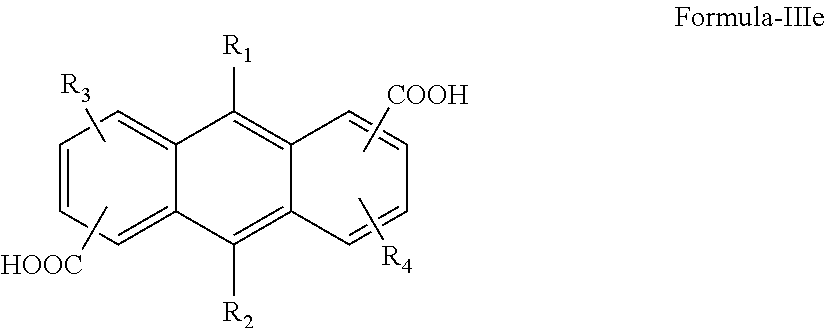
where; R1, R2, R3, R4═H, OH, O-alkyl, CH3, CF3, F, Cl, Br, I, NO2 or C1-15 containing alkyl, aryl, aromatic ring, arylene, alkylene, arylene-ether or heterocyclic ring selected from group consisting of pyridine, pyrazine, furan, quinoline, thiopene groups
In an embodiment, present invention provides a process for the preparation of Co-ABPBI membranes comprising the steps of
    • a. heating PPA with stirring at 100-140° C. under constant flow of nitrogen followed by addition of 50 to 99 mol. % of 3,4-diaminobenzoic acid (DABA) and 1 to 50 mol. % of dicarboxylic acid of formula III(a-e) to obtain the reaction mixture;
    • b. increasing the temperature of the reaction mixture obtained in step (a) slowly to 170° C. and maintaining it for 10 min to 10 hours;
    • c. lowering the temperature of reaction mixture of step (b) to 140° C. and adding 1 to 50 mol. % tetramine of formula II(a-f), while maintaining the temperature for 10 min to 5 hours and;
    • d. increasing the temperature of the reaction mixture of step (c) to 170° C., maintaining it for 10 min to 5 h, followed by raising the temperature to 190-210° C. and maintaining it for 10 min to 14 h to obtain the co-ABPBI of Formula-I.
    • e. adding water and phosphoric acid to the reaction mixture in the ratio 0:100 to 100:0 to the reaction mixture of co-ABPBI of formula-I followed by stirring for 10 min-10 h;
    • f. degassing the solution of step (e) for 5-60 min to remove entrapped air and casting it on an appropriate support such as glass plate, or glass fabric, or Teflon paper, or Polyetheretherketone (PEEK)
    • g. keeping the membranes obtained in step (f) above in humidity chamber at 20-95% RH, −10-60° C. and 1-48 h for hydrolysis of PAA to obtain the membranes; and
    • h. optionally vacuum drying the hydrolyzed membranes obtained in step (d) at 40-150° C. to obtain the desired product.
In yet another embodiment of the present invention, said membrane is useful for electrochemical devices including fuel cell, supercapacitor, etc. and for liquid and gas separations.
DETAILED DESCRIPTION OF THE INVENTION
The present invention provides co-ABPBI membranes comprising co-ABPBI of formula I
Figure US10023705-20180717-C00014
Wherein ‘m and n’ are repeat units;
The co-ABPBI is a copolymer of formula I, derived from 3,4-diaminobenzoic acid, R is tetraamine monomer having general formula II, comprising compounds of formula IIc, IId, IIe, IIf and FAR is fused aromatic ring derived from dicarboxylic acid of formula III (a)-III(e) or its positional isomers, salts or esters.
wherein:
Figure US10023705-20180717-C00015
wherein, R1, R2 is selected form a group consisting of H, CH3, CF3, F, Cl, Br, I, NO2 or C1-24 containing alkyl or aryl groups; or
Figure US10023705-20180717-C00016
wherein, R1, R2, R3, R4 is selected form a group consisting of H, CH3, CF3, F, Cl, Br, I, NO2 or C1-24 alkyl or aryl groups; or
Figure US10023705-20180717-C00017
wherein, R1, R2, R3, R4 is selected form a group consisting of H, CH3, CF3, F, Cl, Br, I, NO2 or C1-24 alkyl or aryl groups; or
Figure US10023705-20180717-C00018
wherein, R1, R2, R3, R4 is selected form a group consisting of H, CH3, CF3, F, Cl, Br, I, NO2 or C1-24 alkyl or aryl groups; or
Figure US10023705-20180717-C00019
wherein, R1, R2, R3, R4 is selected form a group consisting of H, CH3, CF3, F, Cl, Br, I, NO2 or C1-24 alkyl or aryl groups and X is selected from the group consisting of CH2—, —O—, —SO2—, —C(CH3)2—, —C(CF3)2—, —C(Ph)2-, —CH3C(Ph)-, —CH3C(isopropyl)-, —CH3C(t-butyl)-, —CH3C(n-propyl)-, —CH3C(ethyl)- or any other C1-24 containing alkyl or aryl groups; or
Figure US10023705-20180717-C00020
and FAR (fused aromatic rings) is dicarboxylic acid having general formula III comprising compounds of formula IIIc, IIIb, IIIc, IIId and IIIe;
HOOC—(CkHmXn)—COOH   Formula-IIIa
where, k=1-30 containing fused aromatic ring (containing phenyl, pyridine, pyrazine, furan, quinoline, thiophene or appropriate aromatic rings containing hetero-aromatic fused ring systems) substituted with alkyl, aryl, arylene, alkylene, arylene-ether or heterocyclic groups as straight chain, branched, cyclic, aromatic or combination thereof; X═O, N, S, halogen or combination thereof, n=0-10 and m=appropriate numbers of hydrogen; or
Figure US10023705-20180717-C00021
wherein; R1, R2═H, OH, O-alkyl, CH3, CF3, F, Cl, Br, I, NO2 or C1-15 containing alkyl, aryl, aromatic ring, arylene, alkylene, arylene-ether or heterocyclic ring selected from group consisting of pyridine, pyrazine, furan, quinoline, thiopene groups; or
Figure US10023705-20180717-C00022
where; R1, R2, R3, R4═H, OH, O-alkyl, CH3, CF3, F, Cl, Br, I, NO2 or C1-15 containing alkyl, aryl, aromatic ring, arylene, alkylene, arylene-ether or heterocyclic ring selected from group pyridine, pyrazine, furan, quinoline, thiopene groups and X is selected from the group consisting of —CH2—, —O—, —SO2—, —C(CH3)2—, —C(CF3)2—, —C(Ph)2-, —CH3C(Ph)-, —CH3C(isopropyl)-, —CH3C(t-butyl)-, —CH3C(n-propyl)-, —CH3C(ethyl)- or C1-15 containing alkyl or aryl groups.
Figure US10023705-20180717-C00023
where; R1, R2, R3, R4, R5, R6, R7, R8═H, OH, O-alkyl, CH3, CF3, F, Cl, Br, I, NO2 or C1-15 containing alkyl, aryl, aromatic ring, arylene, alkylene, arylene-ether or heterocyclic ring such as pyridine, pyrazine, furan, quinoline, thiopene groups.
Figure US10023705-20180717-C00024
where; R1, R2, R3, R4═H, OH, O-alkyl, CH3, CF3, F, Cl, Br, I, NO2 or C1-15 containing alkyl, aryl, aromatic ring, arylene, alkylene, arylene-ether or heterocyclic ring selected from group consisting of pyridine, pyrazine, furan, quinoline, thiopene groups.
The process for the synthesis of Co-ABPBI compound of Formula I and membranes thereof comprises following steps:
  • a. heating PPA with stirring at 100-140° C. under constant flow of nitrogen followed by addition of 3,4-diaminobenzoic acid (DABA) and dicarboxylic acid of formula III(a-e) to obtain the reaction mixture;
  • b. increasing the temperature of the reaction mixture obtained in step (a) slowly to 170° C. and maintaining it for 10 min to 10 hours;
  • c. lowering the temperature of reaction mixture of step (b) to 140° C. and adding tetramine of formula II(a-f), while maintaining the temperature for 10 min to 5 hours and;
  • d. increasing the temperature of the reaction mixture of step (c) to 170° C., maintaining it for 10 min to 5 h, followed by raising the temperature to 190-210° C. and maintaining it for 10 min to 14 h to obtain the co-ABPBI of Formula-I.
  • e. adding water and phosphoric acid to the reaction mixture in the ratio 0:100 to 100:0 to the reaction mixture of co-ABPBI of formula-I followed by stirring for 10 min-10 h;
  • f. degassing the solution of step (e) for 5-60 min to remove entrapped air and casting it on an appropriate support such as glass plate, or glass fabric, or Teflon paper, or Polyetheretherketone (PEEK)
  • g. keeping the membranes obtained in step (f) above in humidity chamber at 20-95% RH, −10-60° C. and 1-48 h for hydrolysis of PAA to obtain the membranes; and
  • h. optionally vacuum drying the hydrolyzed membranes obtained in step (d) at 40-150° C. to obtain the desired product.
In the instant invention, co-ABPBI is synthesized using 3,4-diaminobenzoic acid, 3,3′-diaminobenzidine and naphthalene dicarboxylic acid (in varying proportions) in PPA as the solvent. Membranes were casted from this copolymer solution on suitable substrate such gas glass plate, or glass fabric, or Teflon paper, etc. and phased out in controlled humidity and temperature conditions. The hydrolyzed membranes were then optionally vacuum dried. Due to the incorporation of rigid naphthalene following benefits/advantages were achieved:
  • a. Co-ABPBI solution in PPA could be used immediately after its synthesis for membrane preparation by sol-gel process. Thus the following are avoided: polymer isolation, its purification, re-dissolution, membrane casting involving solvent evaporation or immersing in nonsolvent such as water solution and then doping with phosphoric acid; reducing number of steps as known in the literature.
  • b. The membrane could be prepared by sol-gel method in the film form, without powder formation; as usually found without use of naphthalene dicarboxylic acid. Thus formed sol-gel membranes showed membrane forming ability possessing excellent mechanical strength of the membrane with do not tear easily.
  • c. The acid content may be tuned by varying sol-gel conditions.
The synthesized Co-ABPBI membrane is characterized by the inherent viscosity, doping level analysis, ionic conductivity, mechanical property and fuel cell performance.
In another embodiment, the membrane disclosed herein finds application in various areas of filtration, fuel cells, super capacitors, Li-ion batteries and others. With reference to example 6 and FIG. 2, it may be apparent to one skilled in the art that the membrane of the invention provides enhanced fuel cell performance.
EXAMPLES
Following examples are given by way of illustration and therefore should not be construed to limit the scope of the invention.
Example 1 Synthesis of Co-ABPBI-1
A three-neck round flask equipped with a mechanical stirrer, N2 inlet and outlet was charged with 230 g of PPA and heated with stirring above 140° C. under constant flow of nitrogen. A 10 g (66 mmol) of 3,4-diaminobenzoic acid and 0.71 g (3.28 mmol) of 2,6-naphthalene dicarboxylic acid was added to the reaction mixture. The temperature was slowly raised to 170° C. and maintained for 3 h and 30 min. The temperature was lowered down to 140° C. and 0.70 g (3.28 mmol) of 3,3′-diaminobenzidine (DAB) was added while maintaining the temperature for 30 min. The temperature was then raised to 170° C. for 1 h. Further, the temperature was increased to 200° C. and maintained for 2 h 55 min. After polymerization, 52.5 g of phosphoric acid was added and stirred for 2 h 25 min. The solution was then degassed for 30 min to remove entrapped air.
Example 2 Preparation of Membrane Using Reaction Mixture of Co-ABPBI-1
The reaction mixture as prepared in Example 1 was poured on a clean surface and casted using a doctor's knife. The membranes were kept in humidity chamber at 60% RH and 35° C. for 15 h for hydrolysis of PAA. Some of the hydrolyzed membranes were vacuum dried at 100° C. For viscosity measurement, small amount of polymer was precipitated in stirred water. The precipitated polymer was then crushed, water washed, treated with aqueous sodium hydroxide and again washed with water. It was further dried at 100° C. under vacuum for 7 days. Inherent viscosity of Co-ABPBI-1 was measured using 0.2 g/dL solution in conc. H2SO4 at 35° C. The viscosity of obtained polymer was 3.6 dL/g. For doping level analysis, three small samples of the dried membrane were kept in 0.3 M NaOH solution for a 24 hrs. The change in the concentration of NaOH was determined by 0.2N oxalic acid. These samples were vacuum dried at 100° C. for 5 days. The doping level of the membrane was 8.1 mol/RU.
Example 3 Preparation of Membrane Using Reaction Mixture of Co-ABPBI-1
The reaction mixture as prepared in Example 1 was poured on a clean surface and casted using a doctor's knife. The membranes were kept in humidity chamber at 40% RH and 27° C. for 15 h for hydrolysis of PAA. Some of the hydrolyzed membranes were vacuum dried at 100° C. For viscosity measurement, small amount of polymer was precipitated in stirred, water. The precipitated polymer was then crushed, water washed, treated with aqueous sodium hydroxide and again washed with water. It was further dried at 100° C. under vacuum for 7 days. Inherent viscosity of Co-ABPBI-1 was measured using 0.2 g/dL solution in conc. H2SO4 at 35° C. The viscosity of obtained polymer was 3.0 dL/g. For doping level analysis, three small samples of the dried membrane were kept in 0.3 M NaOH solution for a 24 hrs. The change, in the concentration of NaOH was determined by 0.2 N oxalic acid. These samples were vacuum dried at 100° C. for 5 days. The doping level of the membrane was 25.1 mol/RU.
Example 4 Synthesis of Co-ABPBI-2
A three-neck round flask equipped with a mechanical stirrer, N2 inlet and outlet was charged with 230 g of PPA and heated with stirring above 140° C. under constant flow of nitrogen. 10 g (66 mmol) of 3,4-diaminobenzoic acid (DABA) and 1.42 g (6.56 mmol) of 2,6-naphthalene dicarboxylic acid was added to the reaction mixture. The temperature was slowly raised to 170° C. and maintained for 3 h 30 min. The temperature was lowered down to 140° C. and 1.4 g (6.56 mmol) of 3,3′-diaminobenzidine (DAB) was added while maintaining the temperature for 30 min. The temperature was then raised to 170° C. for 1 h. Further, the temperature was increased to 200° C. and maintained for 5 h 15 min. After polymerization 82.4 g of phosphoric acid was added and stirred for 3 h 30 min. The solution was then degassed for 60 min to remove entrapped air.
Example 5 Preparation of Membrane Using Reaction Mixture of Co-ABPBI-2
The reaction mixture was poured on a clean surface and casted using a doctor's knife. The membranes were kept in humidity chamber at 80% RH, 35° C. and 24 h for hydrolysis of PAA. The hydrolyzed membranes were vacuum dried at 100° C. For viscosity measurement, small amount of polymer was precipitated in stirred water. The precipitated polymer was then crushed, water washed, treated with aqueous sodium hydroxide and, again washed with water. It was further dried at 100° C. under vacuum for 7 days. Inherent viscosity of Co-ABPBI-2 was measured using 0.2 g/dL solution in conc. H2SO4 at 35° C. The viscosity of obtained polymer was 2.94 dL/g. For doping level analysis, three small samples of the dried membrane were kept in 0.3 M NaOH solution for a 24 hrs. The change in the concentration of NaOH was determined by 0.2N oxalic acid. These samples were vacuum dried at 100° C. for 5 days. The doping level was estimated by both methods, titrimetry as well as gravimetry analysis. The doping level of the membrane was 6 mol/RU.
Example 6: Electrochemical Performance of Co-ABPBI-2 Membrane Based MEA (Membrane Electrode Assembly)
Membrane electrode assembly (MEA) was made by sandwiching the membrane prepared as given in Example 5 in between two electrodes prepared with the known prior art. The active area for MEA was 9 cm2. The polarization graph is shown in FIG. 2, which shows that the current density at 0.6 volt is 2000 mA/cm2 and peak power density is 1512 mW/cm2.
Example 7: Ionic Conductivity of Co-ABPBI-2 Membrane
Ionic conductivity measurements were performed by AC impedance technique, in which membrane is sandwiched between platinum electrodes. Impedance spectra were recorded over the frequency range of 1 MHz to 0.1 Hz with potential amplitude of 10 mV at different temperatures in the range of 30-150° C. The measurements were all performed in a thermo-controlled cell under anhydrous conditions. The conductivity (σ) was calculated as follows:
σ = L R × A
Where R, L, and A are the measured resistance, thickness, and cross-sectional area of the membrane, respectively. The proton conductivity results are shown in Table 1 and FIG. 3.
TABLE 1
Ionic conductivity of Co-ABPBI-2 membrane
Temperature Ionic conductivity
(° C.) (S/cm)
30 0.0150
50 0.0174
70 0.0216
90 0.0248
110 0.0275
130 0.0293
150 0.0352
Example 8: Mechanical Properties of Co-ABPBI-2 Membrane
Mechanical property analyses were performed using a micro-tensile tester at room temperature and the measurements were repeated for seven samples for reproducibility. The samples were kept between the holders, tightened up to 40 Ncm and were subsequently pulled at a speed of 100 μm s−1. Obtained stress-strain curve is shown in FIG. 4.
Advantages of the Invention
  • 1. Process for sol-gel membranes skips several steps involved in conventional solution casting of ABPBI that involves evaporation of corrosive acidic solvents.
  • 2. Membrane preparation by sol-gel has higher mechanical strength for the acid doped membranes and is due to incorporation of rigid aromatic structure.
  • 3. Invention provides ease of casting.
  • 4. The instant process allows to vary acid content in the formed membrane by merely varying sol-gel parameters.

Claims (2)

We claim:
1. A process for the preparation of a Co-ABPBI membrane comprising the steps of:
a. heating polyphosphoric acid (PPA) with stirring at 100-140° C. under constant flow of nitrogen followed by addition of 50 to 99 mol. % of 3,4-diaminobenzoic acid (DABA) and 1 to 50 mol. % of dicarboxylic acid selected from formula IIIa-e to obtain a reaction mixture; wherein formula IIIa-e are shown below:

HOOC—(CkHmXn)—COOH   Formula-IIIa
where, k=1-30 containing fused aromatic ring (containing phenyl, pyridine, pyrazine, furan, quinoline, thiophene or appropriate aromatic rings containing hetero-aromatic fused ring systems) substituted with alkyl, aryl, arylene, alkylene, arylene-ether or heterocyclic groups as straight chain, branched, cyclic, aromatic or combination thereof; X═O, N, S, halogen or combination thereof, n=0-10 and m=appropriate numbers of hydrogen; or
Figure US10023705-20180717-C00025
wherein; R1, R2═H, OH, O-alkyl, CH3, CF3, F, Cl, Br, I, NO2 or C1-15 containing alkyl, aryl, aromatic ring, arylene, alkylene, arylene-ether or heterocyclic ring selected from group consisting of pyridine, pyrazine, furan, quinoline, thiopene groups; or
Figure US10023705-20180717-C00026
where; R1, R2, R3, R4═H, OH, O-alkyl, CH3, CF3, F, Cl, Br, I, NO2 or C1-15 containing alkyl, aryl, aromatic ring, arylene, alkylene, arylene-ether or heterocyclic ring selected from group pyridine, pyrazine, furan, quinoline, thiopene groups and X is selected from the group consisting of —CH2—, —O—, —SO2—, —C(CH3)2—, —C(CF3)2—, —C(Ph)2-, —CH3C(Ph)-, —CH3C(isopropyl)-, —CH3C(t-butyl)-, —CH3C(n-propyl)-, —CH3C(ethyl)- or C1-15 containing alkyl or aryl groups
Figure US10023705-20180717-C00027
where; R1, R2, R3, R4, R5, R6, R7, R8═H, OH, O-alkyl, CH3, CF3, F, Cl, Br, I, NO2 or C1-15 containing alkyl, aryl, aromatic ring, arylene, alkylene, arylene-ether or heterocyclic ring such as pyridine, pyrazine, furan, quinoline, thiopene groups
Figure US10023705-20180717-C00028
where; R1, R2, R3, R4═H, OH, O-alkyl, CH3, CF3, F, Cl, Br, I, NO2 or C1-15 containing alkyl, aryl, aromatic ring, arylene, alkylene, arylene-ether or heterocyclic ring selected from group consisting of pyridine, pyrazine, furan, quinoline, thiopene groups;
b. increasing the temperature of the reaction mixture obtained in step (a) to 170° C. and maintaining it for 10 min to 10 hours;
c. lowering the temperature of reaction mixture of step (b) to 140° C. and adding 1 to 50 mol. % tetraamine selected from formula IIa-f, while maintaining the temperature for 10 min to 5 hours; wherein formula IIa-f are shown below:
Figure US10023705-20180717-C00029
wherein, R1, R2 is selected form a group consisting of H, CH3, CF3, F, Cl, Br, I, NO2 or C1-24 containing alkyl or aryl groups; or
Figure US10023705-20180717-C00030
wherein, R1, R2, R3, R4 is selected form a group consisting of H, CH3, CF3, F, Cl, Br, I, NO2 or C1-24 alkyl or aryl groups; or
Figure US10023705-20180717-C00031
wherein, R1, R2, R3, R4 is selected form a group consisting of H, CH3, CF3, F, Cl, Br, I, NO2 or C1-24 alkyl or aryl groups; or
Figure US10023705-20180717-C00032
wherein, R1, R2, R3, R4 is selected form a group consisting of H, CH3, CF3, F, Cl, Br, I, NO2 or C1-24 alkyl or aryl groups; or
Figure US10023705-20180717-C00033
wherein, R1, R2, R3, R4 is selected form a group consisting of H, CH3, CF3, F, Br, I, NO2 or C1-24 alkyl or aryl groups and X is selected from the group consisting of —CH2—, —O—, —SO2—, —C(CH3)2—, —C(CF3)2—, —C(Ph)2-, —CH3C(Ph)-, —CH3C(isopropyl)-, —CH3C(t-butyl)-, —CH3C(n-propyl)-, —CH3C(ethyl)- or any other C1-24 containing alkyl or aryl groups; or
Figure US10023705-20180717-C00034
d. increasing the temperature of the reaction mixture of step (c) to 170° C., maintaining it for 10 min to 5 h, followed by raising the temperature to 190-210° C. and maintaining it for 10 min to 14 h to obtain the co-ABPBI of Formula-I,
Figure US10023705-20180717-C00035
wherein m and n are repeat units; R is tetraamine monomer selected from compounds of Formula IIa-f and FAR is fused aromatic ring derived from dicarboxylic acid selected from compounds of Formula IIIa-e or its positional isomers, salts or esters;
e. adding water and phosphoric acid to the reaction mixture in the ratio 0:100 to 100:0 to the reaction mixture of co-ABPBI of formula-I followed by stirring for 10 min-10 h;
f. degassing the solution of step (e) for 5-60 min to remove entrapped air and casting it on a support to obtain a membrane;
g. keeping the membrane obtained in step (f) above in humidity chamber at 20-95% RH, −10-60° C. and 1-48 h for hydrolysis of PPA to obtain the Co-ABPBI membrane; and
h. optionally vacuum drying the Co-ABPBI membrane obtained in step (g) at 40-150° C.
2. The process of claim 1, wherein in step (f) the support is selected from glass plate, glass fabric, polytetrafluoroethylene paper, and polyetheretherketone (PEEK).
US14/915,346 2013-08-30 2014-09-01 Co-ABPBI membranes and process for the preparation thereof Active US10023705B2 (en)

Applications Claiming Priority (3)

Application Number Priority Date Filing Date Title
IN2569/DEL/2013 2013-08-30
IN2569DE2013 2013-08-30
PCT/IN2014/000559 WO2015029070A1 (en) 2013-08-30 2014-09-01 Co-abpbi membranes and process for the preparation thereof

Publications (2)

Publication Number Publication Date
US20160215110A1 US20160215110A1 (en) 2016-07-28
US10023705B2 true US10023705B2 (en) 2018-07-17

Family

ID=51753268

Family Applications (1)

Application Number Title Priority Date Filing Date
US14/915,346 Active US10023705B2 (en) 2013-08-30 2014-09-01 Co-ABPBI membranes and process for the preparation thereof

Country Status (5)

Country Link
US (1) US10023705B2 (en)
EP (1) EP3039062B1 (en)
JP (1) JP6463760B2 (en)
CA (1) CA2922667C (en)
WO (1) WO2015029070A1 (en)

Families Citing this family (2)

* Cited by examiner, † Cited by third party
Publication number Priority date Publication date Assignee Title
KR102544127B1 (en) * 2018-10-20 2023-06-15 카운슬 오브 사이언티픽 앤드 인더스트리얼 리서치 Polymer laminated hollow fiber membranes based on poly(2,5-benzimidazole), copolymers and substituted polybenzimidazoles
CN113527685B (en) * 2021-06-10 2022-12-20 中国科学院山西煤炭化学研究所 A kind of polybenzimidazole ionic solvent membrane and its preparation method and application

Citations (2)

* Cited by examiner, † Cited by third party
Publication number Priority date Publication date Assignee Title
US20070292734A1 (en) * 2002-05-10 2007-12-20 Joachim Kiefer Polymer electrolyte membrane, method for the production thereof, and application thereof in fuel cells
US20080057358A1 (en) * 2001-04-09 2008-03-06 Gordon Calundann Proton-Conducting Membrane and Use Thereof

Family Cites Families (2)

* Cited by examiner, † Cited by third party
Publication number Priority date Publication date Assignee Title
DE10133739A1 (en) * 2001-07-11 2003-01-30 Mewa Textil Service Ag & Co Man Ohg transport container
KR100644856B1 (en) * 2005-03-17 2006-11-24 한국과학기술연구원 Fuel cell membrane and its manufacturing method

Patent Citations (2)

* Cited by examiner, † Cited by third party
Publication number Priority date Publication date Assignee Title
US20080057358A1 (en) * 2001-04-09 2008-03-06 Gordon Calundann Proton-Conducting Membrane and Use Thereof
US20070292734A1 (en) * 2002-05-10 2007-12-20 Joachim Kiefer Polymer electrolyte membrane, method for the production thereof, and application thereof in fuel cells

Non-Patent Citations (14)

* Cited by examiner, † Cited by third party
Title
Asensio, J. A., et al., "Proton-Conducting Membranes Based on Poly(2,5-benzimidazole) (ABPBI) and Phosphoric Acid Prepared by Direct Acid Casting," J. Membrane Sci. 241: 89-93 (2004).
Asensio, J.A., et al., "Recent Development on Proton Conducting Poly (2,5-benzimidazole) (ABPBI) Membranes for High Temperature Polymer Electrolyte Membrane Fuel Cells," Fuel Cells 5 (3): 336-343 (2005).
Cho, J. et al., "Structure of a Poly(2,5-benzimidazole)/Phosphoric Acid Complex," Journal of Polymer Science: Part B: Polymer Physics, 42: 2576-2585 (2004).
International Search Report dated Dec. 19, 2014, issued in PCT/IN2014/000559.
Kim et al. (Macromolecular Materials and Engineering, vol. 293, pp. 914-921 (2008)). *
Kim, S, K, et al., "Cross-linked poly(2,5-benzimidazole) consisting of wholly aromatic groups for high-temperature PEM fuel ceil applications", Journal of Membrane Science, 373: 80-88 (2011). *
Kim, S. K., et al., "Cross-linked poly(2,5-benzimidazole) consisting of wholly aromatic groups for high-temperature PEM fuel cell applications," Journal of Membrane Science 373: 80-88 ( 2011).
Kim, S-K., et al., "Copolymers of Poly(2,5-benzimidazole) and Poly [2,2′-(p-phenylene)-5,5′-bibenzimidazole] for High-Temperature Fuel Cell Applicationsa," Macromolecular Materials and Engineering 293:914-921 (2008).
Kim, S-K., et al., "Copolymers of Poly(2,5-benzimidazole) and Poly[2,2′-{p-phenyiene}-5,5′-bibenzimidazole] for High-Temperature Fuel Cell Applications", Macromolecular Materials and Engineering 293: 914-921 [2008). *
Yang et al. (Polymer International, vol. 59, pp. 1695-1700 (2010)). *
Yang, J, et al., "A Copolymer of Poly[2,2′-(m-phenylene)-5,5′-bibenzimidazole] and poly (2,5-benzimidazole) for High-Temperature Proton-Conducting Membranes," Polym. Int., 59: 1695-1700 (2010). *
Yang, J. et al., "A Copolymer of Poly[2,2′-(m-phenylene)-5,5′-bibenzimidazole] and ply (2,5-benzimidazole) for High-Temperature Proton-Conducting Membranes," Polym. Int. 59: 1695-1700 (2010).
Yang, J. et al., "A copolymer of poly[2,2′-(m-phenylene)-5,5′-bibenzimidazole] and poly(2,5-benzimidazole) for high-temperature proton-conducting membranes," Polymer International 59: 1695-1700 (2010).
YU, S., et al., "Synthesis of Poly (2,2′-(1,4-phenylene) 5,5′-bibenzimidazole) (para-PBI) and Phosphoric Acid Doped Membrane for Fuels Cells," Fuel Cells 9 (4): 318-324 (2009).

Also Published As

Publication number Publication date
CA2922667A1 (en) 2015-03-05
WO2015029070A1 (en) 2015-03-05
WO2015029070A8 (en) 2015-04-30
EP3039062A1 (en) 2016-07-06
US20160215110A1 (en) 2016-07-28
EP3039062B1 (en) 2020-07-01
JP6463760B2 (en) 2019-02-06
JP2016533261A (en) 2016-10-27
CA2922667C (en) 2021-11-09
WO2015029070A4 (en) 2015-04-02

Similar Documents

Publication Publication Date Title
US7288603B2 (en) Polybenzazole compound having sulfonic acid group and/or phosphonic acid group, resin composition containing the same, resin molding, solid polymer electrolyte membrane, solid polymer electrolyte membrane/electrode assembly and method of preparing assembly
Pingitore et al. Durable high polymer content m/p-polybenzimidazole membranes for extended lifetime electrochemical devices
EP3453066B1 (en) Energy conversion devices including stable ionenes
Kim et al. High-temperature fuel cell membranes based on mechanically stable para-ordered polybenzimidazole prepared by direct casting
Dong et al. Novel hydrophilic-hydrophobic block copolymer based on cardo poly (arylene ether sulfone) s with bis-quaternary ammonium moieties for anion exchange membranes
Zhang et al. Synthesis and properties of branched sulfonated polyimides for membranes in vanadium redox flow battery application
US20200362129A1 (en) Polyphenylenes, methods, and uses thereof
JP2022501766A (en) Polybenzimidazole (PBI) membrane for redox flow batteries
WO2017141878A1 (en) Composite polymer electrolytic membrane, and membrane electrode composite and solid polymer fuel cell using same
US20110033774A1 (en) Polymer electrolyte composition and method for preparing the same, and fuel cell
Dai et al. Properties of polymer electrolyte membranes based on poly (aryl ether benzimidazole) and sulphonated poly (aryl ether benzimidazole) for high temperature PEMFCs
US10023705B2 (en) Co-ABPBI membranes and process for the preparation thereof
US20040236038A1 (en) Crosslinked sulfonated polyimide films
US8211558B2 (en) Crosslinked polymer electrolyte and method for producing same
Jiang et al. 3D Network Structural Poly (Aryl Ether Ketone)‐Polybenzimidazole Polymer for High‐Temperature Proton Exchange Membrane Fuel Cells
US7632591B2 (en) Branched multiblock polybenzimidazole-benzamide copolymer and method for preparing the same, electrolyte membrane and paste/gel prepared therefrom
Zhang et al. Ionomers based on multisulfonated perylene dianhydride: Synthesis and properties of water resistant sulfonated polyimides
JP4061522B2 (en) POLYAZOLE POLYMER COMPOSITION, FILM CONTAINING THE SAME, AND METHOD FOR MOLDING POLYAZOLE POLYMER COMPOSITION
Guan et al. Proton Conducting Membranes Based on Poly (2, 2′‐imidazole‐5, 5′‐bibenzimidazole)
JP4914311B2 (en) POLYMER ELECTROLYTE MEMBRANE, METHOD FOR PRODUCING THE SAME, AND METHOD FOR EVALUATING PROTON CONDUCTIVITY OF POLYMER ELECTROLYTE MEMBRANE
KR100738788B1 (en) Polybenzimidazole-benzamide copolymer and preparation method thereof, electrolyte membrane prepared therefrom and preparation method thereof
KR20060019492A (en) Novel sulfonated polyimide copolymer and electrolyte membrane using same
KR101987529B1 (en) Polymer electrolyte membrane and fuel cell comprising the same
Linares et al. Poly (2, 5-benzimidazole) membranes: physico-chemical characterization and high temperature PEMFC application
Chen et al. Poly (benzimidazole) s containing trifluoromethyl substituents and aryl ether linkages for high-temperature proton exchange membrane fuel cell applications

Legal Events

Date Code Title Description
AS Assignment

Owner name: COUNCIL OF SCIENTIFIC & INDUSTRIAL RESEARCH, INDIA

Free format text: ASSIGNMENT OF ASSIGNORS INTEREST;ASSIGNORS:KHAURUL, ULHAS KANHAIYALAL;SREEKUMAR, KURUNGOT;CHAUDHARI, HARSHAL DILIP;AND OTHERS;REEL/FRAME:038634/0203

Effective date: 20160422

STCF Information on status: patent grant

Free format text: PATENTED CASE

MAFP Maintenance fee payment

Free format text: PAYMENT OF MAINTENANCE FEE, 4TH YEAR, LARGE ENTITY (ORIGINAL EVENT CODE: M1551); ENTITY STATUS OF PATENT OWNER: LARGE ENTITY

Year of fee payment: 4

FEPP Fee payment procedure

Free format text: MAINTENANCE FEE REMINDER MAILED (ORIGINAL EVENT CODE: REM.); ENTITY STATUS OF PATENT OWNER: LARGE ENTITY