US10023697B2 - Condensation polymers for antimicrobial applications - Google Patents
Condensation polymers for antimicrobial applications Download PDFInfo
- Publication number
- US10023697B2 US10023697B2 US15/361,313 US201615361313A US10023697B2 US 10023697 B2 US10023697 B2 US 10023697B2 US 201615361313 A US201615361313 A US 201615361313A US 10023697 B2 US10023697 B2 US 10023697B2
- Authority
- US
- United States
- Prior art keywords
- cationic polymer
- polymer
- mol
- group
- cationic
- Prior art date
- Legal status (The legal status is an assumption and is not a legal conclusion. Google has not performed a legal analysis and makes no representation as to the accuracy of the status listed.)
- Expired - Fee Related
Links
- 0 *CC(=O)CCCCCC Chemical compound *CC(=O)CCCCCC 0.000 description 33
- YLXHAEQWBFNCBR-UHFFFAOYSA-N CNC(C)COCCOCC(C)OCC(C)N Chemical compound CNC(C)COCCOCC(C)OCC(C)N YLXHAEQWBFNCBR-UHFFFAOYSA-N 0.000 description 2
- KYFGPFOEGBZEBJ-UHFFFAOYSA-N CNCCCN(C)CCCN Chemical compound CNCCCN(C)CCCN KYFGPFOEGBZEBJ-UHFFFAOYSA-N 0.000 description 2
- VOYWKGTWELYRKW-UHFFFAOYSA-N COC(C)COCCOCC(C)C Chemical compound COC(C)COCCOCC(C)C VOYWKGTWELYRKW-UHFFFAOYSA-N 0.000 description 2
- GPPXJGVECOPHES-UHFFFAOYSA-N COCCN(C)CCO Chemical compound COCCN(C)CCO GPPXJGVECOPHES-UHFFFAOYSA-N 0.000 description 2
- BRUHXPLICCGEQW-UHFFFAOYSA-N Br.Br.C.C.CNCCC[N+](C)(CCCN)CC1=CC=CC=C1.CNCCC[N+](C)(CCCNCC1=CC=CC=C1)CC1=CC=CC=C1 Chemical compound Br.Br.C.C.CNCCC[N+](C)(CCCN)CC1=CC=CC=C1.CNCCC[N+](C)(CCCNCC1=CC=CC=C1)CC1=CC=CC=C1 BRUHXPLICCGEQW-UHFFFAOYSA-N 0.000 description 1
- NHDZESQHWMKRPE-UHFFFAOYSA-N C.C.CCC Chemical compound C.C.CCC NHDZESQHWMKRPE-UHFFFAOYSA-N 0.000 description 1
- TVQDLAGCDPSJKN-GQKRMEGESA-O C.CC.CC.CC.CC.CC(C)(C)OC(=O)NC(=N)NC(=O)OC(C)(C)C.CC(N)COCCOCC(C)OCC(C)N.CN(CCCN)CCCN.CNC(C)COCCOCC(C)OCC(C)NC(=O)NC(=N)NC(C)=O.CNC(C)COCCOCC(C)OCC(C)NC(=O)NC(=N)NC(C)=O.CNCCCN(C)CCCNC(=O)NC(=N)NC(C)=O.CNCCC[N+](C)(CCCNC(=O)NC(=N)NC(C)=O)CC1=CC=CC=C1.[2H]B[3H].[Br-] Chemical compound C.CC.CC.CC.CC.CC(C)(C)OC(=O)NC(=N)NC(=O)OC(C)(C)C.CC(N)COCCOCC(C)OCC(C)N.CN(CCCN)CCCN.CNC(C)COCCOCC(C)OCC(C)NC(=O)NC(=N)NC(C)=O.CNC(C)COCCOCC(C)OCC(C)NC(=O)NC(=N)NC(C)=O.CNCCCN(C)CCCNC(=O)NC(=N)NC(C)=O.CNCCC[N+](C)(CCCNC(=O)NC(=N)NC(C)=O)CC1=CC=CC=C1.[2H]B[3H].[Br-] TVQDLAGCDPSJKN-GQKRMEGESA-O 0.000 description 1
- ZXQJNJLLZVYVQS-GQKRMEGESA-O C.CC.CC.CC.CC.CC(N)COCCOCC(C)OCC(C)N.CCC(=O)C(C)C(=O)NCCCN(C)CCCNC.CCC(=O)C(C)C(=O)NCCC[N+](C)(CCCNC)CC1=CC=CC=C1.CCOC(=O)CCC(=O)OCC.CN(CCCN)CCCN.CNC(C)COCCOCC(C)OCC(C)NC(=O)C(C)C(C)=O.CNC(C)COCCOCC(C)OCC(C)NC(=O)C(C)C(C)=O.[2H]B[3H].[Br-] Chemical compound C.CC.CC.CC.CC.CC(N)COCCOCC(C)OCC(C)N.CCC(=O)C(C)C(=O)NCCCN(C)CCCNC.CCC(=O)C(C)C(=O)NCCC[N+](C)(CCCNC)CC1=CC=CC=C1.CCOC(=O)CCC(=O)OCC.CN(CCCN)CCCN.CNC(C)COCCOCC(C)OCC(C)NC(=O)C(C)C(C)=O.CNC(C)COCCOCC(C)OCC(C)NC(=O)C(C)C(C)=O.[2H]B[3H].[Br-] ZXQJNJLLZVYVQS-GQKRMEGESA-O 0.000 description 1
- BPMIGMIHOOZSOP-RWAVVOQQSA-N C.CC.CC.CC.CC.CI.CN(CCO)CCO.COCCN(C)CCOC(C)=O.COCC[N+](C)(C)CCOC(C)=O.O=C(OC1=CC=CC=C1)OC1=CC=CC=C1.PP(P)P(P(P)P)P(P(P(P)P)P(P)P)P(P(P(P)P)P(P)P)P(P(P(P)P)P(P)P)P(P(P)P)P(P)P.[2H]B[3H].[2H]PC.[I-] Chemical compound C.CC.CC.CC.CC.CI.CN(CCO)CCO.COCCN(C)CCOC(C)=O.COCC[N+](C)(C)CCOC(C)=O.O=C(OC1=CC=CC=C1)OC1=CC=CC=C1.PP(P)P(P(P)P)P(P(P(P)P)P(P)P)P(P(P(P)P)P(P)P)P(P(P(P)P)P(P)P)P(P(P)P)P(P)P.[2H]B[3H].[2H]PC.[I-] BPMIGMIHOOZSOP-RWAVVOQQSA-N 0.000 description 1
- LBGFSCHYBHDBRO-UHFFFAOYSA-N C.CC.CC.CN1(C)CCN(C)(C)CC1.CN1=CC=CC=C1.CN1CCN(C)(C)CC1.C[N+](C)(C)C.[CH3-].[CH3-].[CH3-].[CH3-] Chemical compound C.CC.CC.CN1(C)CCN(C)(C)CC1.CN1=CC=CC=C1.CN1CCN(C)(C)CC1.C[N+](C)(C)C.[CH3-].[CH3-].[CH3-].[CH3-] LBGFSCHYBHDBRO-UHFFFAOYSA-N 0.000 description 1
- KECNETRCUFELNX-UHFFFAOYSA-N C1=CC=NC=C1.CCC.CCN Chemical compound C1=CC=NC=C1.CCC.CCN KECNETRCUFELNX-UHFFFAOYSA-N 0.000 description 1
- JUTHYJQMEDSRSG-UHFFFAOYSA-N CC(=O)C(C)C.CC(=O)C1=C(C)C=CC=C1.CC(=O)C1=CC(C)=CC=C1.CC(=O)C1=CC=C(C)C=C1.CC(=O)C1CCC(C)CC1.CC(=O)C1CCCC(C)C1.CC(=O)C1CCCCC1C.CCC(C)=O.CCC(C)C(C)=O.CCC(C)C(C)=O.CCC(CC)C(C)=O.CCCC(C)C(C)=O.CCCC(C)C(C)=O.CCCC(CC)C(C)=O.CCCC(CC)C(C)=O.CCCCC(C)=O.CCCCC(C)C(C)=O.CCCCC(C)C(C)=O.CCCCCC(C)=O Chemical compound CC(=O)C(C)C.CC(=O)C1=C(C)C=CC=C1.CC(=O)C1=CC(C)=CC=C1.CC(=O)C1=CC=C(C)C=C1.CC(=O)C1CCC(C)CC1.CC(=O)C1CCCC(C)C1.CC(=O)C1CCCCC1C.CCC(C)=O.CCC(C)C(C)=O.CCC(C)C(C)=O.CCC(CC)C(C)=O.CCCC(C)C(C)=O.CCCC(C)C(C)=O.CCCC(CC)C(C)=O.CCCC(CC)C(C)=O.CCCCC(C)=O.CCCCC(C)C(C)=O.CCCCC(C)C(C)=O.CCCCCC(C)=O JUTHYJQMEDSRSG-UHFFFAOYSA-N 0.000 description 1
- URRYNWSZAUIGQQ-UHFFFAOYSA-N CC(=O)NC(=N)NC(=O)[Rg]=O Chemical compound CC(=O)NC(=N)NC(=O)[Rg]=O URRYNWSZAUIGQQ-UHFFFAOYSA-N 0.000 description 1
- LYUVURUGDFOLJE-UHFFFAOYSA-N CC(=O)NCNC(=O)[Rf]=O Chemical compound CC(=O)NCNC(=O)[Rf]=O LYUVURUGDFOLJE-UHFFFAOYSA-N 0.000 description 1
- OSMTVTKQNQGKBP-UHFFFAOYSA-N CC(C)(N)N.CC(C)(O)O.CCC(=N)CC Chemical compound CC(C)(N)N.CC(C)(O)O.CCC(=N)CC OSMTVTKQNQGKBP-UHFFFAOYSA-N 0.000 description 1
- HZLVAZWGIAUSIA-UHFFFAOYSA-N CC(C)(N)NC=O.CC(C)(O)OC=O.CCC(=N)NC(C)=O Chemical compound CC(C)(N)NC=O.CC(C)(O)OC=O.CCC(=N)NC(C)=O HZLVAZWGIAUSIA-UHFFFAOYSA-N 0.000 description 1
- QTEDENYUDKYHNH-UHFFFAOYSA-N CC(C)COCCOCC(C)OCC(C)N Chemical compound CC(C)COCCOCC(C)OCC(C)N QTEDENYUDKYHNH-UHFFFAOYSA-N 0.000 description 1
- NIUGMVYRJSROOS-UHFFFAOYSA-N CCC(=O)NC(C)COC(C)COCCOCC(C)NC Chemical compound CCC(=O)NC(C)COC(C)COCCOCC(C)NC NIUGMVYRJSROOS-UHFFFAOYSA-N 0.000 description 1
- FVNIMHIOIXPIQT-UHFFFAOYSA-N CCC(C)OC Chemical compound CCC(C)OC FVNIMHIOIXPIQT-UHFFFAOYSA-N 0.000 description 1
- HCPCEJNBXXOIML-UHFFFAOYSA-N CCC(C)OCC(C)N Chemical compound CCC(C)OCC(C)N HCPCEJNBXXOIML-UHFFFAOYSA-N 0.000 description 1
- XNLICIUVMPYHGG-UHFFFAOYSA-N CCCC(C)=O Chemical compound CCCC(C)=O XNLICIUVMPYHGG-UHFFFAOYSA-N 0.000 description 1
- IYTXKIXETAELAV-UHFFFAOYSA-N CCCCCCC(=O)CC Chemical compound CCCCCCC(=O)CC IYTXKIXETAELAV-UHFFFAOYSA-N 0.000 description 1
- FOIBZJBVQYLKTC-UHFFFAOYSA-N CCCCN(C)CCCN Chemical compound CCCCN(C)CCCN FOIBZJBVQYLKTC-UHFFFAOYSA-N 0.000 description 1
- WBKNTZBBWJPZOU-UHFFFAOYSA-N CCCCN1CCN(CCCN)CC1 Chemical compound CCCCN1CCN(CCCN)CC1 WBKNTZBBWJPZOU-UHFFFAOYSA-N 0.000 description 1
- VNKYTQGIUYNRMY-UHFFFAOYSA-N CCCOC Chemical compound CCCOC VNKYTQGIUYNRMY-UHFFFAOYSA-N 0.000 description 1
- HMWXCSCBUXKXSA-UHFFFAOYSA-N CCCOCCN Chemical compound CCCOCCN HMWXCSCBUXKXSA-UHFFFAOYSA-N 0.000 description 1
- XKKVGSCCZUXGMT-UHFFFAOYSA-N CNCCCN1CCN(CCCN)CC1 Chemical compound CNCCCN1CCN(CCCN)CC1 XKKVGSCCZUXGMT-UHFFFAOYSA-N 0.000 description 1
- JBLFOHRNIBCUJI-UHFFFAOYSA-N COCC[N+](C)(C)CCO.[I-] Chemical compound COCC[N+](C)(C)CCO.[I-] JBLFOHRNIBCUJI-UHFFFAOYSA-N 0.000 description 1
Images




Classifications
-
- C—CHEMISTRY; METALLURGY
- C08—ORGANIC MACROMOLECULAR COMPOUNDS; THEIR PREPARATION OR CHEMICAL WORKING-UP; COMPOSITIONS BASED THEREON
- C08G—MACROMOLECULAR COMPOUNDS OBTAINED OTHERWISE THAN BY REACTIONS ONLY INVOLVING UNSATURATED CARBON-TO-CARBON BONDS
- C08G69/00—Macromolecular compounds obtained by reactions forming a carboxylic amide link in the main chain of the macromolecule
- C08G69/48—Polymers modified by chemical after-treatment
-
- A—HUMAN NECESSITIES
- A01—AGRICULTURE; FORESTRY; ANIMAL HUSBANDRY; HUNTING; TRAPPING; FISHING
- A01N—PRESERVATION OF BODIES OF HUMANS OR ANIMALS OR PLANTS OR PARTS THEREOF; BIOCIDES, e.g. AS DISINFECTANTS, AS PESTICIDES OR AS HERBICIDES; PEST REPELLANTS OR ATTRACTANTS; PLANT GROWTH REGULATORS
- A01N37/00—Biocides, pest repellants or attractants, or plant growth regulators containing organic compounds containing a carbon atom having three bonds to hetero atoms with at the most two bonds to halogen, e.g. carboxylic acids
- A01N37/12—Biocides, pest repellants or attractants, or plant growth regulators containing organic compounds containing a carbon atom having three bonds to hetero atoms with at the most two bonds to halogen, e.g. carboxylic acids containing the group, wherein Cn means a carbon skeleton not containing a ring; Thio analogues thereof
-
- A—HUMAN NECESSITIES
- A01—AGRICULTURE; FORESTRY; ANIMAL HUSBANDRY; HUNTING; TRAPPING; FISHING
- A01N—PRESERVATION OF BODIES OF HUMANS OR ANIMALS OR PLANTS OR PARTS THEREOF; BIOCIDES, e.g. AS DISINFECTANTS, AS PESTICIDES OR AS HERBICIDES; PEST REPELLANTS OR ATTRACTANTS; PLANT GROWTH REGULATORS
- A01N37/00—Biocides, pest repellants or attractants, or plant growth regulators containing organic compounds containing a carbon atom having three bonds to hetero atoms with at the most two bonds to halogen, e.g. carboxylic acids
- A01N37/18—Biocides, pest repellants or attractants, or plant growth regulators containing organic compounds containing a carbon atom having three bonds to hetero atoms with at the most two bonds to halogen, e.g. carboxylic acids containing the group —CO—N<, e.g. carboxylic acid amides or imides; Thio analogues thereof
-
- A—HUMAN NECESSITIES
- A01—AGRICULTURE; FORESTRY; ANIMAL HUSBANDRY; HUNTING; TRAPPING; FISHING
- A01N—PRESERVATION OF BODIES OF HUMANS OR ANIMALS OR PLANTS OR PARTS THEREOF; BIOCIDES, e.g. AS DISINFECTANTS, AS PESTICIDES OR AS HERBICIDES; PEST REPELLANTS OR ATTRACTANTS; PLANT GROWTH REGULATORS
- A01N37/00—Biocides, pest repellants or attractants, or plant growth regulators containing organic compounds containing a carbon atom having three bonds to hetero atoms with at the most two bonds to halogen, e.g. carboxylic acids
- A01N37/18—Biocides, pest repellants or attractants, or plant growth regulators containing organic compounds containing a carbon atom having three bonds to hetero atoms with at the most two bonds to halogen, e.g. carboxylic acids containing the group —CO—N<, e.g. carboxylic acid amides or imides; Thio analogues thereof
- A01N37/20—Biocides, pest repellants or attractants, or plant growth regulators containing organic compounds containing a carbon atom having three bonds to hetero atoms with at the most two bonds to halogen, e.g. carboxylic acids containing the group —CO—N<, e.g. carboxylic acid amides or imides; Thio analogues thereof containing the group, wherein Cn means a carbon skeleton not containing a ring; Thio analogues thereof
-
- A—HUMAN NECESSITIES
- A01—AGRICULTURE; FORESTRY; ANIMAL HUSBANDRY; HUNTING; TRAPPING; FISHING
- A01N—PRESERVATION OF BODIES OF HUMANS OR ANIMALS OR PLANTS OR PARTS THEREOF; BIOCIDES, e.g. AS DISINFECTANTS, AS PESTICIDES OR AS HERBICIDES; PEST REPELLANTS OR ATTRACTANTS; PLANT GROWTH REGULATORS
- A01N37/00—Biocides, pest repellants or attractants, or plant growth regulators containing organic compounds containing a carbon atom having three bonds to hetero atoms with at the most two bonds to halogen, e.g. carboxylic acids
- A01N37/44—Biocides, pest repellants or attractants, or plant growth regulators containing organic compounds containing a carbon atom having three bonds to hetero atoms with at the most two bonds to halogen, e.g. carboxylic acids containing at least one carboxylic group or a thio analogue, or a derivative thereof, and a nitrogen atom attached to the same carbon skeleton by a single or double bond, this nitrogen atom not being a member of a derivative or of a thio analogue of a carboxylic group, e.g. amino-carboxylic acids
-
- A—HUMAN NECESSITIES
- A01—AGRICULTURE; FORESTRY; ANIMAL HUSBANDRY; HUNTING; TRAPPING; FISHING
- A01N—PRESERVATION OF BODIES OF HUMANS OR ANIMALS OR PLANTS OR PARTS THEREOF; BIOCIDES, e.g. AS DISINFECTANTS, AS PESTICIDES OR AS HERBICIDES; PEST REPELLANTS OR ATTRACTANTS; PLANT GROWTH REGULATORS
- A01N43/00—Biocides, pest repellants or attractants, or plant growth regulators containing heterocyclic compounds
- A01N43/34—Biocides, pest repellants or attractants, or plant growth regulators containing heterocyclic compounds having rings with one nitrogen atom as the only ring hetero atom
- A01N43/40—Biocides, pest repellants or attractants, or plant growth regulators containing heterocyclic compounds having rings with one nitrogen atom as the only ring hetero atom six-membered rings
-
- A—HUMAN NECESSITIES
- A01—AGRICULTURE; FORESTRY; ANIMAL HUSBANDRY; HUNTING; TRAPPING; FISHING
- A01N—PRESERVATION OF BODIES OF HUMANS OR ANIMALS OR PLANTS OR PARTS THEREOF; BIOCIDES, e.g. AS DISINFECTANTS, AS PESTICIDES OR AS HERBICIDES; PEST REPELLANTS OR ATTRACTANTS; PLANT GROWTH REGULATORS
- A01N43/00—Biocides, pest repellants or attractants, or plant growth regulators containing heterocyclic compounds
- A01N43/48—Biocides, pest repellants or attractants, or plant growth regulators containing heterocyclic compounds having rings with two nitrogen atoms as the only ring hetero atoms
- A01N43/58—1,2-Diazines; Hydrogenated 1,2-diazines
-
- A—HUMAN NECESSITIES
- A01—AGRICULTURE; FORESTRY; ANIMAL HUSBANDRY; HUNTING; TRAPPING; FISHING
- A01N—PRESERVATION OF BODIES OF HUMANS OR ANIMALS OR PLANTS OR PARTS THEREOF; BIOCIDES, e.g. AS DISINFECTANTS, AS PESTICIDES OR AS HERBICIDES; PEST REPELLANTS OR ATTRACTANTS; PLANT GROWTH REGULATORS
- A01N43/00—Biocides, pest repellants or attractants, or plant growth regulators containing heterocyclic compounds
- A01N43/48—Biocides, pest repellants or attractants, or plant growth regulators containing heterocyclic compounds having rings with two nitrogen atoms as the only ring hetero atoms
- A01N43/60—1,4-Diazines; Hydrogenated 1,4-diazines
-
- A—HUMAN NECESSITIES
- A01—AGRICULTURE; FORESTRY; ANIMAL HUSBANDRY; HUNTING; TRAPPING; FISHING
- A01N—PRESERVATION OF BODIES OF HUMANS OR ANIMALS OR PLANTS OR PARTS THEREOF; BIOCIDES, e.g. AS DISINFECTANTS, AS PESTICIDES OR AS HERBICIDES; PEST REPELLANTS OR ATTRACTANTS; PLANT GROWTH REGULATORS
- A01N47/00—Biocides, pest repellants or attractants, or plant growth regulators containing organic compounds containing a carbon atom not being member of a ring and having no bond to a carbon or hydrogen atom, e.g. derivatives of carbonic acid
- A01N47/02—Biocides, pest repellants or attractants, or plant growth regulators containing organic compounds containing a carbon atom not being member of a ring and having no bond to a carbon or hydrogen atom, e.g. derivatives of carbonic acid the carbon atom having no bond to a nitrogen atom
- A01N47/06—Biocides, pest repellants or attractants, or plant growth regulators containing organic compounds containing a carbon atom not being member of a ring and having no bond to a carbon or hydrogen atom, e.g. derivatives of carbonic acid the carbon atom having no bond to a nitrogen atom containing —O—CO—O— groups; Thio analogues thereof
-
- A—HUMAN NECESSITIES
- A61—MEDICAL OR VETERINARY SCIENCE; HYGIENE
- A61K—PREPARATIONS FOR MEDICAL, DENTAL OR TOILETRY PURPOSES
- A61K31/00—Medicinal preparations containing organic active ingredients
- A61K31/74—Synthetic polymeric materials
- A61K31/785—Polymers containing nitrogen
-
- A—HUMAN NECESSITIES
- A61—MEDICAL OR VETERINARY SCIENCE; HYGIENE
- A61K—PREPARATIONS FOR MEDICAL, DENTAL OR TOILETRY PURPOSES
- A61K31/00—Medicinal preparations containing organic active ingredients
- A61K31/74—Synthetic polymeric materials
- A61K31/785—Polymers containing nitrogen
- A61K31/787—Polymers containing nitrogen containing heterocyclic rings having nitrogen as a ring hetero atom
-
- A—HUMAN NECESSITIES
- A61—MEDICAL OR VETERINARY SCIENCE; HYGIENE
- A61K—PREPARATIONS FOR MEDICAL, DENTAL OR TOILETRY PURPOSES
- A61K45/00—Medicinal preparations containing active ingredients not provided for in groups A61K31/00 - A61K41/00
- A61K45/06—Mixtures of active ingredients without chemical characterisation, e.g. antiphlogistics and cardiaca
-
- A—HUMAN NECESSITIES
- A61—MEDICAL OR VETERINARY SCIENCE; HYGIENE
- A61K—PREPARATIONS FOR MEDICAL, DENTAL OR TOILETRY PURPOSES
- A61K8/00—Cosmetics or similar toiletry preparations
- A61K8/18—Cosmetics or similar toiletry preparations characterised by the composition
- A61K8/72—Cosmetics or similar toiletry preparations characterised by the composition containing organic macromolecular compounds
- A61K8/84—Cosmetics or similar toiletry preparations characterised by the composition containing organic macromolecular compounds obtained by reactions otherwise than those involving only carbon-carbon unsaturated bonds
-
- A—HUMAN NECESSITIES
- A61—MEDICAL OR VETERINARY SCIENCE; HYGIENE
- A61K—PREPARATIONS FOR MEDICAL, DENTAL OR TOILETRY PURPOSES
- A61K8/00—Cosmetics or similar toiletry preparations
- A61K8/18—Cosmetics or similar toiletry preparations characterised by the composition
- A61K8/72—Cosmetics or similar toiletry preparations characterised by the composition containing organic macromolecular compounds
- A61K8/84—Cosmetics or similar toiletry preparations characterised by the composition containing organic macromolecular compounds obtained by reactions otherwise than those involving only carbon-carbon unsaturated bonds
- A61K8/85—Polyesters
-
- A—HUMAN NECESSITIES
- A61—MEDICAL OR VETERINARY SCIENCE; HYGIENE
- A61K—PREPARATIONS FOR MEDICAL, DENTAL OR TOILETRY PURPOSES
- A61K8/00—Cosmetics or similar toiletry preparations
- A61K8/18—Cosmetics or similar toiletry preparations characterised by the composition
- A61K8/72—Cosmetics or similar toiletry preparations characterised by the composition containing organic macromolecular compounds
- A61K8/84—Cosmetics or similar toiletry preparations characterised by the composition containing organic macromolecular compounds obtained by reactions otherwise than those involving only carbon-carbon unsaturated bonds
- A61K8/86—Polyethers
-
- A—HUMAN NECESSITIES
- A61—MEDICAL OR VETERINARY SCIENCE; HYGIENE
- A61K—PREPARATIONS FOR MEDICAL, DENTAL OR TOILETRY PURPOSES
- A61K8/00—Cosmetics or similar toiletry preparations
- A61K8/18—Cosmetics or similar toiletry preparations characterised by the composition
- A61K8/72—Cosmetics or similar toiletry preparations characterised by the composition containing organic macromolecular compounds
- A61K8/84—Cosmetics or similar toiletry preparations characterised by the composition containing organic macromolecular compounds obtained by reactions otherwise than those involving only carbon-carbon unsaturated bonds
- A61K8/88—Polyamides
-
- A—HUMAN NECESSITIES
- A61—MEDICAL OR VETERINARY SCIENCE; HYGIENE
- A61Q—SPECIFIC USE OF COSMETICS OR SIMILAR TOILETRY PREPARATIONS
- A61Q11/00—Preparations for care of the teeth, of the oral cavity or of dentures; Dentifrices, e.g. toothpastes; Mouth rinses
-
- A—HUMAN NECESSITIES
- A61—MEDICAL OR VETERINARY SCIENCE; HYGIENE
- A61Q—SPECIFIC USE OF COSMETICS OR SIMILAR TOILETRY PREPARATIONS
- A61Q15/00—Anti-perspirants or body deodorants
-
- A—HUMAN NECESSITIES
- A61—MEDICAL OR VETERINARY SCIENCE; HYGIENE
- A61Q—SPECIFIC USE OF COSMETICS OR SIMILAR TOILETRY PREPARATIONS
- A61Q17/00—Barrier preparations; Preparations brought into direct contact with the skin for affording protection against external influences, e.g. sunlight, X-rays or other harmful rays, corrosive materials, bacteria or insect stings
-
- A—HUMAN NECESSITIES
- A61—MEDICAL OR VETERINARY SCIENCE; HYGIENE
- A61Q—SPECIFIC USE OF COSMETICS OR SIMILAR TOILETRY PREPARATIONS
- A61Q17/00—Barrier preparations; Preparations brought into direct contact with the skin for affording protection against external influences, e.g. sunlight, X-rays or other harmful rays, corrosive materials, bacteria or insect stings
- A61Q17/005—Antimicrobial preparations
-
- A—HUMAN NECESSITIES
- A61—MEDICAL OR VETERINARY SCIENCE; HYGIENE
- A61Q—SPECIFIC USE OF COSMETICS OR SIMILAR TOILETRY PREPARATIONS
- A61Q19/00—Preparations for care of the skin
- A61Q19/007—Preparations for dry skin
-
- A—HUMAN NECESSITIES
- A61—MEDICAL OR VETERINARY SCIENCE; HYGIENE
- A61Q—SPECIFIC USE OF COSMETICS OR SIMILAR TOILETRY PREPARATIONS
- A61Q5/00—Preparations for care of the hair
- A61Q5/02—Preparations for cleaning the hair
-
- C—CHEMISTRY; METALLURGY
- C08—ORGANIC MACROMOLECULAR COMPOUNDS; THEIR PREPARATION OR CHEMICAL WORKING-UP; COMPOSITIONS BASED THEREON
- C08G—MACROMOLECULAR COMPOUNDS OBTAINED OTHERWISE THAN BY REACTIONS ONLY INVOLVING UNSATURATED CARBON-TO-CARBON BONDS
- C08G63/00—Macromolecular compounds obtained by reactions forming a carboxylic ester link in the main chain of the macromolecule
- C08G63/91—Polymers modified by chemical after-treatment
- C08G63/914—Polymers modified by chemical after-treatment derived from polycarboxylic acids and polyhydroxy compounds
- C08G63/916—Dicarboxylic acids and dihydroxy compounds
-
- C—CHEMISTRY; METALLURGY
- C08—ORGANIC MACROMOLECULAR COMPOUNDS; THEIR PREPARATION OR CHEMICAL WORKING-UP; COMPOSITIONS BASED THEREON
- C08G—MACROMOLECULAR COMPOUNDS OBTAINED OTHERWISE THAN BY REACTIONS ONLY INVOLVING UNSATURATED CARBON-TO-CARBON BONDS
- C08G64/00—Macromolecular compounds obtained by reactions forming a carbonic ester link in the main chain of the macromolecule
- C08G64/42—Chemical after-treatment
-
- C—CHEMISTRY; METALLURGY
- C08—ORGANIC MACROMOLECULAR COMPOUNDS; THEIR PREPARATION OR CHEMICAL WORKING-UP; COMPOSITIONS BASED THEREON
- C08G—MACROMOLECULAR COMPOUNDS OBTAINED OTHERWISE THAN BY REACTIONS ONLY INVOLVING UNSATURATED CARBON-TO-CARBON BONDS
- C08G73/00—Macromolecular compounds obtained by reactions forming a linkage containing nitrogen with or without oxygen or carbon in the main chain of the macromolecule, not provided for in groups C08G12/00 - C08G71/00
- C08G73/02—Polyamines
- C08G73/0206—Polyalkylene(poly)amines
-
- C—CHEMISTRY; METALLURGY
- C08—ORGANIC MACROMOLECULAR COMPOUNDS; THEIR PREPARATION OR CHEMICAL WORKING-UP; COMPOSITIONS BASED THEREON
- C08G—MACROMOLECULAR COMPOUNDS OBTAINED OTHERWISE THAN BY REACTIONS ONLY INVOLVING UNSATURATED CARBON-TO-CARBON BONDS
- C08G73/00—Macromolecular compounds obtained by reactions forming a linkage containing nitrogen with or without oxygen or carbon in the main chain of the macromolecule, not provided for in groups C08G12/00 - C08G71/00
- C08G73/02—Polyamines
- C08G73/024—Polyamines containing oxygen in the form of ether bonds in the main chain
-
- C—CHEMISTRY; METALLURGY
- C08—ORGANIC MACROMOLECULAR COMPOUNDS; THEIR PREPARATION OR CHEMICAL WORKING-UP; COMPOSITIONS BASED THEREON
- C08G—MACROMOLECULAR COMPOUNDS OBTAINED OTHERWISE THAN BY REACTIONS ONLY INVOLVING UNSATURATED CARBON-TO-CARBON BONDS
- C08G73/00—Macromolecular compounds obtained by reactions forming a linkage containing nitrogen with or without oxygen or carbon in the main chain of the macromolecule, not provided for in groups C08G12/00 - C08G71/00
- C08G73/02—Polyamines
- C08G73/0273—Polyamines containing heterocyclic moieties in the main chain
-
- C—CHEMISTRY; METALLURGY
- C08—ORGANIC MACROMOLECULAR COMPOUNDS; THEIR PREPARATION OR CHEMICAL WORKING-UP; COMPOSITIONS BASED THEREON
- C08G—MACROMOLECULAR COMPOUNDS OBTAINED OTHERWISE THAN BY REACTIONS ONLY INVOLVING UNSATURATED CARBON-TO-CARBON BONDS
- C08G73/00—Macromolecular compounds obtained by reactions forming a linkage containing nitrogen with or without oxygen or carbon in the main chain of the macromolecule, not provided for in groups C08G12/00 - C08G71/00
- C08G73/02—Polyamines
- C08G73/028—Polyamidoamines
-
- C—CHEMISTRY; METALLURGY
- C08—ORGANIC MACROMOLECULAR COMPOUNDS; THEIR PREPARATION OR CHEMICAL WORKING-UP; COMPOSITIONS BASED THEREON
- C08G—MACROMOLECULAR COMPOUNDS OBTAINED OTHERWISE THAN BY REACTIONS ONLY INVOLVING UNSATURATED CARBON-TO-CARBON BONDS
- C08G73/00—Macromolecular compounds obtained by reactions forming a linkage containing nitrogen with or without oxygen or carbon in the main chain of the macromolecule, not provided for in groups C08G12/00 - C08G71/00
- C08G73/02—Polyamines
- C08G73/028—Polyamidoamines
- C08G73/0293—Quaternisation of polyamidoamines
-
- C—CHEMISTRY; METALLURGY
- C08—ORGANIC MACROMOLECULAR COMPOUNDS; THEIR PREPARATION OR CHEMICAL WORKING-UP; COMPOSITIONS BASED THEREON
- C08G—MACROMOLECULAR COMPOUNDS OBTAINED OTHERWISE THAN BY REACTIONS ONLY INVOLVING UNSATURATED CARBON-TO-CARBON BONDS
- C08G73/00—Macromolecular compounds obtained by reactions forming a linkage containing nitrogen with or without oxygen or carbon in the main chain of the macromolecule, not provided for in groups C08G12/00 - C08G71/00
- C08G73/06—Polycondensates having nitrogen-containing heterocyclic rings in the main chain of the macromolecule
- C08G73/0622—Polycondensates containing six-membered rings, not condensed with other rings, with nitrogen atoms as the only ring hetero atoms
- C08G73/0633—Polycondensates containing six-membered rings, not condensed with other rings, with nitrogen atoms as the only ring hetero atoms with only two nitrogen atoms in the ring
-
- C—CHEMISTRY; METALLURGY
- C11—ANIMAL OR VEGETABLE OILS, FATS, FATTY SUBSTANCES OR WAXES; FATTY ACIDS THEREFROM; DETERGENTS; CANDLES
- C11D—DETERGENT COMPOSITIONS; USE OF SINGLE SUBSTANCES AS DETERGENTS; SOAP OR SOAP-MAKING; RESIN SOAPS; RECOVERY OF GLYCEROL
- C11D3/00—Other compounding ingredients of detergent compositions covered in group C11D1/00
- C11D3/16—Organic compounds
- C11D3/37—Polymers
- C11D3/3703—Macromolecular compounds obtained otherwise than by reactions only involving carbon-to-carbon unsaturated bonds
- C11D3/3723—Polyamines or polyalkyleneimines
-
- C—CHEMISTRY; METALLURGY
- C11—ANIMAL OR VEGETABLE OILS, FATS, FATTY SUBSTANCES OR WAXES; FATTY ACIDS THEREFROM; DETERGENTS; CANDLES
- C11D—DETERGENT COMPOSITIONS; USE OF SINGLE SUBSTANCES AS DETERGENTS; SOAP OR SOAP-MAKING; RESIN SOAPS; RECOVERY OF GLYCEROL
- C11D3/00—Other compounding ingredients of detergent compositions covered in group C11D1/00
- C11D3/48—Medical, disinfecting agents, disinfecting, antibacterial, germicidal or antimicrobial compositions
-
- D—TEXTILES; PAPER
- D21—PAPER-MAKING; PRODUCTION OF CELLULOSE
- D21H—PULP COMPOSITIONS; PREPARATION THEREOF NOT COVERED BY SUBCLASSES D21C OR D21D; IMPREGNATING OR COATING OF PAPER; TREATMENT OF FINISHED PAPER NOT COVERED BY CLASS B31 OR SUBCLASS D21G; PAPER NOT OTHERWISE PROVIDED FOR
- D21H17/00—Non-fibrous material added to the pulp, characterised by its constitution; Paper-impregnating material characterised by its constitution
- D21H17/20—Macromolecular organic compounds
- D21H17/33—Synthetic macromolecular compounds
- D21H17/46—Synthetic macromolecular compounds obtained otherwise than by reactions only involving carbon-to-carbon unsaturated bonds
- D21H17/54—Synthetic macromolecular compounds obtained otherwise than by reactions only involving carbon-to-carbon unsaturated bonds obtained by reactions forming in the main chain of the macromolecule a linkage containing nitrogen
- D21H17/55—Polyamides; Polyaminoamides; Polyester-amides
-
- D—TEXTILES; PAPER
- D21—PAPER-MAKING; PRODUCTION OF CELLULOSE
- D21H—PULP COMPOSITIONS; PREPARATION THEREOF NOT COVERED BY SUBCLASSES D21C OR D21D; IMPREGNATING OR COATING OF PAPER; TREATMENT OF FINISHED PAPER NOT COVERED BY CLASS B31 OR SUBCLASS D21G; PAPER NOT OTHERWISE PROVIDED FOR
- D21H17/00—Non-fibrous material added to the pulp, characterised by its constitution; Paper-impregnating material characterised by its constitution
- D21H17/20—Macromolecular organic compounds
- D21H17/33—Synthetic macromolecular compounds
- D21H17/46—Synthetic macromolecular compounds obtained otherwise than by reactions only involving carbon-to-carbon unsaturated bonds
- D21H17/54—Synthetic macromolecular compounds obtained otherwise than by reactions only involving carbon-to-carbon unsaturated bonds obtained by reactions forming in the main chain of the macromolecule a linkage containing nitrogen
- D21H17/56—Polyamines; Polyimines; Polyester-imides
-
- D—TEXTILES; PAPER
- D21—PAPER-MAKING; PRODUCTION OF CELLULOSE
- D21H—PULP COMPOSITIONS; PREPARATION THEREOF NOT COVERED BY SUBCLASSES D21C OR D21D; IMPREGNATING OR COATING OF PAPER; TREATMENT OF FINISHED PAPER NOT COVERED BY CLASS B31 OR SUBCLASS D21G; PAPER NOT OTHERWISE PROVIDED FOR
- D21H21/00—Non-fibrous material added to the pulp, characterised by its function, form or properties; Paper-impregnating or coating material, characterised by its function, form or properties
- D21H21/14—Non-fibrous material added to the pulp, characterised by its function, form or properties; Paper-impregnating or coating material, characterised by its function, form or properties characterised by function or properties in or on the paper
- D21H21/36—Biocidal agents, e.g. fungicidal, bactericidal, insecticidal agents
-
- A—HUMAN NECESSITIES
- A61—MEDICAL OR VETERINARY SCIENCE; HYGIENE
- A61K—PREPARATIONS FOR MEDICAL, DENTAL OR TOILETRY PURPOSES
- A61K2300/00—Mixtures or combinations of active ingredients, wherein at least one active ingredient is fully defined in groups A61K31/00 - A61K41/00
-
- A—HUMAN NECESSITIES
- A61—MEDICAL OR VETERINARY SCIENCE; HYGIENE
- A61K—PREPARATIONS FOR MEDICAL, DENTAL OR TOILETRY PURPOSES
- A61K2800/00—Properties of cosmetic compositions or active ingredients thereof or formulation aids used therein and process related aspects
- A61K2800/10—General cosmetic use
-
- A—HUMAN NECESSITIES
- A61—MEDICAL OR VETERINARY SCIENCE; HYGIENE
- A61K—PREPARATIONS FOR MEDICAL, DENTAL OR TOILETRY PURPOSES
- A61K2800/00—Properties of cosmetic compositions or active ingredients thereof or formulation aids used therein and process related aspects
- A61K2800/74—Biological properties of particular ingredients
-
- C—CHEMISTRY; METALLURGY
- C08—ORGANIC MACROMOLECULAR COMPOUNDS; THEIR PREPARATION OR CHEMICAL WORKING-UP; COMPOSITIONS BASED THEREON
- C08G—MACROMOLECULAR COMPOUNDS OBTAINED OTHERWISE THAN BY REACTIONS ONLY INVOLVING UNSATURATED CARBON-TO-CARBON BONDS
- C08G2650/00—Macromolecular compounds obtained by reactions forming an ether link in the main chain of the macromolecule
- C08G2650/02—Macromolecular compounds obtained by reactions forming an ether link in the main chain of the macromolecule characterized by the type of post-polymerisation functionalisation
-
- C—CHEMISTRY; METALLURGY
- C08—ORGANIC MACROMOLECULAR COMPOUNDS; THEIR PREPARATION OR CHEMICAL WORKING-UP; COMPOSITIONS BASED THEREON
- C08G—MACROMOLECULAR COMPOUNDS OBTAINED OTHERWISE THAN BY REACTIONS ONLY INVOLVING UNSATURATED CARBON-TO-CARBON BONDS
- C08G2650/00—Macromolecular compounds obtained by reactions forming an ether link in the main chain of the macromolecule
- C08G2650/28—Macromolecular compounds obtained by reactions forming an ether link in the main chain of the macromolecule characterised by the polymer type
- C08G2650/38—Macromolecular compounds obtained by reactions forming an ether link in the main chain of the macromolecule characterised by the polymer type containing oxygen in addition to the ether group
-
- C—CHEMISTRY; METALLURGY
- C08—ORGANIC MACROMOLECULAR COMPOUNDS; THEIR PREPARATION OR CHEMICAL WORKING-UP; COMPOSITIONS BASED THEREON
- C08G—MACROMOLECULAR COMPOUNDS OBTAINED OTHERWISE THAN BY REACTIONS ONLY INVOLVING UNSATURATED CARBON-TO-CARBON BONDS
- C08G2650/00—Macromolecular compounds obtained by reactions forming an ether link in the main chain of the macromolecule
- C08G2650/28—Macromolecular compounds obtained by reactions forming an ether link in the main chain of the macromolecule characterised by the polymer type
- C08G2650/58—Ethylene oxide or propylene oxide copolymers, e.g. pluronics
-
- C—CHEMISTRY; METALLURGY
- C08—ORGANIC MACROMOLECULAR COMPOUNDS; THEIR PREPARATION OR CHEMICAL WORKING-UP; COMPOSITIONS BASED THEREON
- C08L—COMPOSITIONS OF MACROMOLECULAR COMPOUNDS
- C08L77/00—Compositions of polyamides obtained by reactions forming a carboxylic amide link in the main chain; Compositions of derivatives of such polymers
- C08L77/04—Polyamides derived from alpha-amino carboxylic acids
-
- C—CHEMISTRY; METALLURGY
- C08—ORGANIC MACROMOLECULAR COMPOUNDS; THEIR PREPARATION OR CHEMICAL WORKING-UP; COMPOSITIONS BASED THEREON
- C08L—COMPOSITIONS OF MACROMOLECULAR COMPOUNDS
- C08L79/00—Compositions of macromolecular compounds obtained by reactions forming in the main chain of the macromolecule a linkage containing nitrogen with or without oxygen or carbon only, not provided for in groups C08L61/00 - C08L77/00
- C08L79/02—Polyamines
Definitions
- This invention was made under a joint research agreement between International Business Machines Corporation and the Agency For Science, Technology and Research.
- the present invention relates to condensation polymers for antimicrobial applications, and more specifically, to cationic forms of polycondensation polymers for topical antibacterial use.
- Antimicrobial agents are commonly used in personal care products to inhibit microbial growth and infections therefrom, and product decomposition. Most antimicrobial agents used in these products are small molecules, including anilides (e.g., triclocarban), bis-phenols (e.g., triclosan), biguanides (e.g., chlorhexidine) and quaternary ammonium compounds (e.g., cetylpyridium chloride and cetrimide). Among them, triclosan is one of the most extensively used compounds.
- Triclosan is present in more than 50% of consumer products including soap, deodorant, toothpaste, mouth wash, cosmetics (e.g., Garden Botanika® Powder Foundation, Mavala Lip Base, Jason Natural Cosmetics and Movate® Skin Litening Cream HQ), cleaning supplies, kitchen utensils, children's toys, bedding, socks, shoes and trash bags. It is effective against Gram-positive bacteria, while it has little activity against P. aeruginosa (Gram-negative bacteria) and molds. At high concentrations, it is biocidal with multiple cytoplasmic and membrane targets. However, at low concentrations, it is bacteriostatic by inhibiting fatty acid synthesis. On the other hand, triclosan has cumulative and persistent effects on the skin.
- cosmetics e.g., Garden Botanika® Powder Foundation, Mavala Lip Base, Jason Natural Cosmetics and Movate® Skin Litening Cream HQ
- cleaning supplies e.g., Garden Botanika® Powder Foundation, Mavala Lip Base, Jason Natural Cosmetics and Movate
- Triclosan was found in 85 out of 139 streams and rivers in 30 states in the US, and is toxic to aquatic species. It is persistent in the environment, and was detected in sediments in a Swiss lake as far back as the 1960s. Therefore, the use of triclosan in consumer products will be banned in Europe and in the United States within 2 years.
- bacteria spores e.g., Clostridium species
- Gram-positive bacteria e.g., mycobacteria
- Gram-negative bacteria e.g., Pseudomonas aeruginosa ( P. aeruginosa )
- P. aeruginosa Pseudomonas aeruginosa
- these antimicrobial agents are not effective against biofilms.
- Serratia marcescens S. marcescens
- Burkholderia cepacia B. cepacia
- aeruginosa biofilm in iodophor antiseptics and on the interior surface of polyvinyl chloride pipes used in the production of providone-iodine antiseptics Overuse of these antimicrobial agents has led to drug resistance in microbes.
- Major concerns include cross-resistance and co-resistance with clinically used antimicrobial agents, which may present a potential public health risk.
- AMPs Antimicrobial peptides
- magainins, alamethicin, protegrins and defensins do not have a specific target in microbes. They interact with microbial membranes based on electrostatic interaction, inducing damage to the microbial membranes by forming pores in the membranes. The physical nature of this action prevents microbes from developing resistance to AMPs.
- a number of cationic polymers that mimic the facially amphiphilic structure and antimicrobial functionalities of peptides have been proposed that can be more easily prepared at low cost and on large scale compared to peptides.
- antimicrobial polynorbornene and polyacrylate derivatives, and pyridinium copolymers were synthesized either from amphiphilic monomers (homopolymers) or from cationic (hydrophilic) monomer and hydrophobic comonomer (random copolymers).
- most antimicrobial polymers reported in the literature are non-biodegradable and/or require several steps of synthesis. With the high volume of poorly degradable single-use consumer products already destined for landfills, the problem would be exacerbated by the addition of non-biodegradable antimicrobial materials that destroy bacteria and fungi responsible for slow landfill degradation.
- biodegradable, safe and cost-effective antimicrobial agents are needed for use in personal care products that can kill multidrug-resistant bacteria and fungi, remove biofilms, and prevent drug resistance.
- a cationic polymer comprising:
- W′ is a single bond or a divalent linking group having a structure *—C( ⁇ O)-L′-*, wherein L′ is divalent radical comprising 1-20 carbons and L′ is linked to carbon 1,
- L′ is a divalent radical comprising 1-20 carbons
- L a and L b are independent divalent hydrocarbon groups comprising 2-20 carbons
- Q′ is a divalent radical comprising a positive-charged nitrogen which is covalently bonded to 4 carbons
- adjacent repeat units of the cationic polymer are covalently linked in a head-to-tail arrangement, wherein nitrogen labeled 2 is designated a tail and W′ is designated a head.
- Also disclosed is a method of killing a microbe comprising contacting the microbe with an above-described cationic polymer.
- an antimicrobial composition comprising an above-described cationic polymer and at least one other chemical component.
- FIG. 1 is a 1 H NMR spectrum of cationic polymer P48a.
- FIG. 2 is a 1 H NMR spectrum of cationic polymer P48b.
- FIG. 3 is a 1 H NMR spectrum of cationic polymer P49a.
- FIG. 4 is a 1 H NMR spectrum of cationic polymer P49b.
- FIG. 5 is a bar graph showing the killing efficiency of cationic polymers P32c and P32d against Staphylococcus aureus ( S. aureus ) at polymer concentrations of 0.5MIC, 1.0MIC and 2.0MIC.
- FIG. 6 is a bar graph showing the killing efficiency of cationic polymers P32c and P32d against Pseudomonas aeruginosa ( P. aeruginosa ) at polymer concentrations of 0.5MIC, 1.0MIC and 2.0MIC.
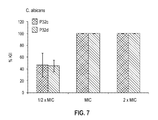
- FIG. 7 is a bar graph showing the killing efficiency of cationic polymers P32c and P32d against Candida albicans ( C. albicans ) at polymer concentrations of 0.5MIC, 1.0MIC and 2.0MIC.
- FIG. 8 is a pair of graphs showing the killing kinetics of cationic polymers P32c and P32d at respective concentrations of 1.0MIC and 2.0MIC against S. aureus.
- FIG. 9 is a series of bar charts comparing the killing efficiency of cationic polymers P48a and P49b at concentrations of 0.5MIC, 1.0MIC and 2.0MIC against S. aureus, P. aeruginosa , and C. albicans.
- FIG. 10 is a bar chart showing human dermal fibroblast (HDF) cell viability after a 6 hour treatment with various concentrations of cationic polymers P32c, P32d, P48a, P48b, P49a and P49b.
- HDF human dermal fibroblast
- the disclosed cationic polymers are biodegradable materials comprising cationic repeat units having at least one quaternary nitrogen in the polyamine backbone.
- the cationic polymers are also referred to herein as “polyamines”.
- the quaternary nitrogen is a positive-charged nitrogen covalently bonded only to carbons (3 or 4 carbons), and is ionically associated with a negative-charged counterion X ⁇ .
- X ⁇ is a free ion, which is not directly or indirectly covalently linked to the polyamine backbone.
- the polyamines comprise cationic repeat units having a backbone portion that preferably comprise amide, carbamate, and/or urea functional groups.
- the polyamines are water soluble and can be highly active against Gram-positive microbes (e.g., S. aureus ), Gram-negative microbes (e.g., Escherichia coli ( E. coli ), P. aeruginosa ), and fungi (e.g., C. albicans ).
- the polyamines can be biocompatible, biodegradable, non-hemolytic, and non-cytotoxic at concentrations above the minimum inhibitory concentration (MIC), and are therefore attractive for a wide range of consumer products such as, for example, cosmetics, skin lotions, and antibiotic drugs.
- the polyamines are capable of forming ionic complexes with anionic materials, making them potentially useful as carriers for gene and/or drug delivery applications.
- biodegradable is defined by the American Society for Testing and Materials as degradation caused by biological activity, especially by enzymatic action, leading to a significant change in the chemical structure of the material.
- a material is “biodegradable” if it undergoes 60% biodegradation within 180 days in accordance with ASTM D6400.
- a material is “enzymatically biodegradable” if the material can be degraded (e.g., depolymerized) by a reaction catalyzed by an enzyme.
- a “biocompatible” material is defined herein as a material capable of performing with an appropriate host response in a specific application.
- the polyamines are preferably linear homopolymers or linear random copolymers.
- a linear polymer has one polymer branch, and the branch has two peripheral ends (i.e., two dangling ends, as in a segment of a rope).
- the cationic repeat units have a structure according to formula (1):
- W′ is a single bond or a divalent linking group having a structure *—C( ⁇ O)-L′-*, wherein L′ is divalent radical comprising 1-20 carbons and L′ is linked to carbon 1,
- L a and L b are independent divalent hydrocarbon groups comprising 2-20 carbons
- Q′ is a divalent radical comprising a positive-charged nitrogen which is covalently bonded to 4 carbons.
- Starred bonds represent attachment points for a covalent bond, not methyl groups.
- An atomic center or group having a starred bond i.e., shown linked to an asterisk means the atomic center or group is covalently bonded to another portion of the chemical structure.
- the cationic repeat unit has a formula (1A):
- the polyamine backbone comprises a urea group.
- W′ is *—C( ⁇ O)-L′-*
- the polyamine backbone can comprise amide, carbamate, and/or urea groups.
- L′ can have any suitable structure.
- L′ can be a divalent hydrocarbon group.
- Exemplary non-limiting divalent hydrocarbon groups include methylene, 1,1-ethylene, 1,2-ethylene, 1,1-propylene, 1,2-propylene, 1,3-propylene, 1,1-butylene, 1,2-butylene, 1,3-butylene, 1,4-butylene, 1,1-pentylene, 1,2-pentylene, 1,3-pentylene, 1,4-pentylene, 1,5-pentylene, 1,2-cyclohexylene, 1,3-cyclohexylene, 1,4-cyclohexylene, 1,2-phenylene, 1,3-phenylene, and 1,4-phenylene.
- W′ can have a structure that includes those of Scheme 1, wherein carbon 1 is linked to carbonyl carbon 1 of formula (1).
- each n is an independent integer having a value of 1 to 20
- each R m is an independent hydrocarbon radical comprising 1-10 carbons, and the nitrogen or oxygen labeled 1 is linked to carbonyl carbon 1 of formula (1).
- L′ is N-(2-aminoethyl)-2-aminoethyl-N-(2-aminoethyl)-2-aminoethyl-N-(2-aminoethyl)-2-aminoethyl-N-(2-aminoethyl)-2-aminoethyl-N-(2-aminoethyl)-2-aminoethyl
- d′ is an integer having a value of 1 to 6.
- W′ is
- L′ is 1,2-ethylene and W′ is
- L a and L b can be the same or different hydrocarbon groups.
- Exemplary non-limiting L a and L b groups include 1,1-ethylene, 1,2-ethylene, 1,1-propylene, 1,3-propylene, 1,1-butylene, 1,4-butylene, and 1,1-pentylene, 1,5-pentylene, 1,2-cyclohexylene, 1,3-cyclohexylene, 1,4-cyclohexylene, 1,2-phenylene, 1,3-phenylene, and 1,4-phenylene.
- n′ is an integer having a value of 2 to 6.
- L a and L b are 1,2-ethylene.
- Exemplary non-limiting Q′ groups include structures of formulas (4)-(7):
- R a , R b , R c , R d , R e are independent monovalent hydrocarbon groups comprising 1-20 carbons, and
- each X ⁇ is an independent negative-charged counterion.
- R a , R b , R c , R d , R e monovalent hydrocarbon groups include methyl, ethyl, n-propyl, isopropyl, n-butyl, sec-butyl, tert-butyl, n-pentyl, iso-pentyl, neo-pentyl, cyclopentyl, n-hexyl, cyclohexyl, and benzyl.
- Exemplary negative-charged X ⁇ counterions include halides (e.g., fluoride, chloride, bromide, iodide), hydroxide, alkoxides, aryloxides, alkyl and aryl carboxylates (e.g., acetate, benzoate), hydrogen carbonate, alkyl and aryl sulfonates (e.g., methanesulfonate, p-toluenesulfonate), methyl sulfate, hydrogen sulfate, nitrate, dihydrogen phosphate, dialkyl and diaryl phosphates, and alkyl and aryl phosphonates.
- halides e.g., fluoride, chloride, bromide, iodide
- hydroxide e.g., alkoxides, aryloxides, alkyl and aryl carboxylates (e.g., acetate, benzoate)
- the polyamine can comprise the cationic repeat units singularly or in combination.
- More specific polyamines comprise a polymeric repeat unit of formula (8):
- W′′ is a single bond or a divalent linking group having a structure *—C( ⁇ O)-L′′-*, wherein L′′ is divalent radical comprising 1-20 carbons and L′′ is linked to carbonyl carbon 1,
- L c and L b are independent divalent linking groups selected from the group consisting of a single bond, and hydrocarbon groups comprising 1-6 carbons, and
- P′ is a divalent poly(alkylene oxide) chain.
- L′′ can be any of the above-described groups for L′
- W′′ can be any of the above-described groups for W′, where it should be understood that the atomic centers linked to carbonyl carbon 1 of formula (1) for W′ are linked to carbonyl carbon 1 of formula (8) for W′′.
- L′′ is the same as L′ and W′′ is the same as W′.
- L c and L d can be the same or different hydrocarbon groups.
- Exemplary non-limiting L and L d groups include 1,1-ethylene, 1,2-ethylene, 1,1-propylene, 1,2-propylene, 1,3-propylene, 1,1-butylene, 1,2-butylene, 1,3-butylene, 1,4-butylene, 1,1-pentylene, 1,2-pentylene, 1,3-pentylene, 1,4-pentylene, 1,5-pentylene, 1,2-cyclohexylene, 1,3-cyclohexylene, 1,4-cyclohexylene, 1,2-phenylene, 1,3-phenylene, and 1,4-phenylene.
- L c is 1,2-propylene, wherein P′ is linked to the 1 position of 1,2-propylene, and L d is a single bond.
- L is 1,2-ethylene and L d is a single bond.
- P′ is a hydrophilic poly(alkylene) oxide chain comprising ethylene oxide and/or propylene oxide repeat units.
- P′ can be a homopolymer of ethylene oxide (referred to as a PEG chain), or of propylene oxide units (referred to as a PPO chain).
- P′ can be a random copolymer comprising ethylene oxide and propylene oxide repeat units.
- P′ can be a block copolymer comprising 2 or more blocks comprising ethylene oxide and propylene oxide repeat units.
- P′ can be a diblock copolymer chain comprising a PEG block and a PPO block (denoted as *-PEG-b-PPO-*), wherein each block has an average degree of polymerization (DP) greater than 1.
- P′ can be a triblock copolymer chain (e.g., *-PPO-b-PEG-b-PPO-* or *-PEG-b-PPO-b-PEG-*).
- One or more of the blocks of the block copolymer can be a random copolymer chain comprising ethylene oxide and propylene oxide repeat units (e.g., *-PPO-b-[PPO-r-PEO]-b-PEO-*, where the center block is a random copolymer chain).
- a PEG chain has the structure:
- n has an average value greater than 1.
- a PPO chain has the structure:
- n has an average value of greater than 1.
- P′ has a triblock structure according to formula (9):
- r, s, and t represent degrees of polymerization of respective blocks of alkylene oxide repeat units enclosed in the brackets
- r, s, and t independently have average values greater than 1.
- s/(r+t) has a value of about 2 to about 12.
- P′ can have a number average molecular weight of about 500 to about 5000. More specifically, P′ can have a number average molecular weight of about 1500 to about 2500.
- More specific polymeric repeat units have a structure according to formula (10):
- W′′ is a single bond or a divalent linking group having a structure *—C( ⁇ O)-L′′-*, wherein L′′ is divalent radical comprising 1-20 carbons and L′′ is linked to carbon 1,
- r, s, and t represent average numbers of respective alkylene oxide repeat units
- r, s, and t independently have average values greater than 1.
- the polyamine can comprise the polymeric repeat units singularly or in combination.
- the polymeric repeat unit is present in an amount of more than 0 mol % to about 10 mol % based on total moles of repeat units of the polyamine, wherein molecular weight of P′ is based on number average molecular weight (Mn).
- the cationic polyamides are preferably prepared by a step-growth polymerization performed in bulk using a base organocatalyst (e.g., 1,8-diazabicycloundec-7-ene (DBU), 1,5-diazabicyclo(4.3.0)non-5-ene (DBN), 1,5,7-triazabicyclo[4.4.0]dec-5-ene (TBD)).
- a base organocatalyst e.g., 1,8-diazabicycloundec-7-ene (DBU), 1,5-diazabicyclo(4.3.0)non-5-ene (DBN), 1,5,7-triazabicyclo[4.4.0]dec-5-ene (TBD)
- the reaction mixture contains a “carbonyl monomer”.
- the carbonyl monomer can comprise a carbonate compound capable of reacting with two primary amine groups to form a urea.
- Exemplary non-limiting carbonyl monomers of this type include diethyl carbonate, diphenyl carbonate, and bis-pentafluorophenyl carbonate.
- carbonyl monomers comprise two carbonyl groups in the form of carboxylic ester groups, carbonate groups, carbamate groups, or a combination thereof.
- each of the two carbonyl groups of the carbonyl monomer is capable of reacting with a primary amine to form an amide, carbamate, or a urea group.
- the reaction mixture also contains an amine monomer comprising two primary amine groups and a tertiary amine group.
- the tertiary amine group is capable of forming positive charged quaternary ammonium group in a reaction with an alkylating agent (quaternizing agent).
- the reaction mixture also comprises a second reactive diamine comprising a poly(alkylene oxide) chain terminated at each end by a primary amine group.
- This reactant is referred to herein as the “polyether diamine”.
- the carbonyl monomer, the amine monomer, organocatalyst, and optionally the polyether diamine can be heated together without solvent at a temperature of about 100° C. to 200° C. in one or more heating stages to effect polymerization.
- the reaction time can vary from about 1 hour to about 24 hours.
- vacuum can be applied to remove alcohol byproduct and assist in driving the reaction to completion.
- the bulk polymerization generates an initial polymer that can precipitate during the reaction.
- Exemplary non-limiting amine monomers include those of formula (11):
- R a is a monovalent hydrocarbon group comprising 1-20 carbons
- j and j′ are independent integers having values of 0 to 18.
- R a is methyl, j is 1, and j′ is 1 of formula (11).
- j and j′ are independent integers having values of 0 to 18.
- j is 1 and j′ is 1 of formula (12).
- k and k′ are independent integers having values of 1 to 20.
- the amine monomers can be used singularly or in combination.
- carbonyl monomers comprising two carbonyl groups, with the proviso that the desirable properties of the cationic polyamine are not adversely affected (biodegradability, antimicrobial activity, hemolysis, and cytotoxicity) by the structure of the carbonyl monomer.
- the carbonyl monomers can be used singularly or in combination.
- Exemplary non-limiting carbonyl monomers comprising two carbamate groups include compounds of formula (13):
- n is an integer having a value of 2-20
- each R f is selected from the group consisting of methyl, ethyl, t-butyl, and phenyl.
- Each hydrogen of the methylene groups enclosed in parentheses of formula (13) can optionally be substituted with an alkyl or aryl substituent (e.g., methyl, ethyl, or phenyl).
- an alkyl or aryl substituent e.g., methyl, ethyl, or phenyl.
- each R g is selected from the group consisting of methyl, ethyl, t-butyl, and phenyl.
- each R of formula (14) is t-butyl.
- Exemplary non-limiting carbonyl monomers comprising two carbonate groups include ethylene glycol bis(2-chloro-4-nitrophenyl carbonate), propylene glycol bis(2-chloro-4-nitrophenyl carbonate), butylene glycol bis(2-chloro-4-nitrophenyl carbonate), and 1,4-butylene glycol bis(2-chloro-4-nitrophenyl carbonate), diethylene glycol bis(2-chloro-4-nitrophenyl carbonate), dipropylene glycol bis(2-chloro-4-nitrophenyl carbonate), dibutylene glycol bis(2-chloro-4-nitrophenyl carbonate), triethylene glycol bis(2-chloro-4-nitrophenyl carbonate), tripropylene glycol bis(2-chloro-4-nitrophenyl carbonate), tributylene glycol bis(2-chloro-4-nitrophenyl carbonate), tetraethylene glycol bis(2-chloro-4-nitrophenyl carbonate, tetrabutylene glycol
- the 2-chloro-4-nitrophenyl groups of each of the foregoing compounds can be replaced with any suitable activating group such as, for example, p-nitrophenyl, pentachlorophenyl, pentafluorophenyl, and the like.
- the carbonyl monomers can be used singularly or in combination.
- the polyether diamine has a structure in accordance with formula (15): H 2 N-L c -P′-L d -NH 2 (15), wherein
- P′ is a divalent poly(alkylene oxide) chain.
- P′ can be a homopolymer, random copolymer, or block copolymer comprising alkylene oxide repeat units.
- alkylene oxides units are ethylene oxide and propylene oxide.
- Exemplary non-limiting polyether diamines include diamine terminated triblock copolymers poly(propylene oxide)-block-poly(ethylene oxide)-block-poly(propylene oxide):
- n the average number of ethylene oxide repeat units
- n the average number of propylene oxide repeat units
- R is H or methyl
- the stacking of repeat units within the square brackets represents a random distribution of the repeat units in the polymer chain.
- the starred bonds of each repeat unit overlapping the left bracket can be bonded to a different repeat unit at an attachment point indicated by the starred bonds of the repeat units overlapping the right square bracket, or to the end group represented by the structure H 2 N—C(R)CH 2 —*.
- the starred bonds of the repeat units overlapping the right bracket can be bonded to a different repeat unit at an attachment point indicated by the starred bonds of the repeat units overlapping the right square bracket, or to an end group represented by *—NH 2 .
- Subscripts n and m represent independent average numbers of respective repeat units enclosed in the parentheses.
- the polyether diamines can be used singularly or in combination.
- a polyether diamine can have a number average molecular weight (Mn) of about 500 to about 5000.
- a polyether diamine can have a weight average molecular weight (Mw) of about 1000 to about 25000.
- the polyamines can have a number average molecular weight (Mn) of about 700 to about 25000.
- the polyamines can have a weight average molecular weight (Mw) of about 1000 to about 50000.
- HC20 is defined as the concentration (in mg/L) of cationic polyamine that causes 20% of mammalian red blood cells to undergo hemolysis. HC20 values of 500 mg/L or higher are desirable.
- Minimum inhibitory concentration is defined as the minimum concentration (in mg/L) of cationic polyamine required to inhibit growth of a given microbe for an 18 hour period (bacteria) or 42 hour period (fungi). A MIC less than 500 mg/L is desirable. Even more desirable is a MIC of 150 mg/L or less. A lower MIC indicates higher antimicrobial activity.
- HC50 selectivity is defined as the ratio of HC50/MIC. An HC50 selectivity of 3 or more is desirable. Higher HC50 selectivity values indicate more activity against bacterial cells and less toxicity to mammalian cells.
- HC20 selectivity is defined as the ratio of HC20/MIC. An HC20 selectivity of 3 or more is desirable.
- Non-limiting exemplary bacteria include Gram-positive Staphylococcus aureus ( S. aureus ), Gram-negative Escherichia coli ( E. coli ), fungus Candida albicans ( C. albicans ), Gram-negative Pseudomonas aeruginosa ( P. aeruginosa ), and yeasts.
- Other microbes include Gram-positive Staphylococcus epidermidis ( S. epidermidis ), Gram-positive Methicillin-resistant Staphylococcus aureus (MRSA), Gram-positive Vancomycin-resistant Enterococcus (VRE), Gram-negative Acinetobacter baumannii ( A. baumannii ), and Gram-negative Klebsiella pneumoniae ( K. pneumoniae ) and Cryptococcus neoformans ( C. neoformans ).
- the polyamines can have a minimum inhibitory concentration (MIC) of about 8 mg/L to about 500 mg/L, and more preferably about 8 mg/L to about 250 mg/L, and most preferably 8 mg/L to about 125 mg/L against a bacterium.
- the cationic polyamines can have a MIC of about 8 mg/L to about 63 mg/L against P. aeruginosa.
- the cationic polyamines can exhibit less than about 50% hemolysis at 1000 mg/L (i.e., can have an HC50 value greater than 1000 mg/L).
- the repeat unit comprising the poly(alkaline oxide) chain when present, can substantially improve skin cell viability at concentrations higher than MIC without adversely affecting microbial toxicity.
- the cationic polyamines have utility as antimicrobial components of consumer products that are used in contact with skin such as, for example, cosmetics (e.g., skin lotions, skin creams, topically applied powders, mascara, eye liners, lip glosses), soaps, shampoos, and deodorants.
- cosmetics e.g., skin lotions, skin creams, topically applied powders, mascara, eye liners, lip glosses
- soaps e.g., soaps, shampoos, and deodorants.
- the cationic polyamines also have utility as antimicrobial components of laundry detergents.
- the cationic polyamines also have utility for human and/or non-human therapeutic medical treatments.
- the polyamines can be used in the form of a stand-alone antibiotic drug and/or as a complex comprising the polyamine and an anionic form of biologically active material (e.g., genes, drugs) bound by non-covalent interactions.
- a medical composition comprising the polyamine and/or a biologically active material selected from the group consisting of genes, drugs, and combinations thereof, can be administered topically, intravenously, orally, by way of other body cavities, and/or by inhalant.
- the medical composition can have the form of a powder, a pill, a liquid, a paste, or a gel.
- the medical compositions are particularly attractive for use in injectable systems for delivery of rigid, hydrophobic biologically active materials that have low water solubility, such as the drugs paclitaxel and doxorubicin.
- a method comprises contacting a microbe with a polyamine, thereby killing the microbe.
- Another method comprises contacting a tumor cell with a complex comprising a disclosed polyamine and a tumor-treating drug, thereby killing the tumor cell.
- An antimicrobial composition comprises a disclosed polyamine and at least one other component (e.g., water, drug, gene).
- the antimicrobial composition can be applied to a human and/or non-human animal tissue, including mammalian and/or non-mammalian animal tissue.
- the general term “animal tissue” includes wound tissue, burn tissue, skin, internal organ tissue, blood, bones, cartilage, teeth, hair, eyes, nasal surfaces, oral surfaces, other body cavity surfaces, and any cell membrane surfaces.
- a method comprises contacting an animal tissue with the antimicrobial composition, thereby inhibiting, preventing, and/or eradicating a microbial infection of the tissue.
- polyamines include disinfectant washes for hands, skin, hair, bone, ear, eye, nose, throat, internal tissue, wounds, and teeth (e.g., as a mouthwash).
- a method comprises contacting a medical device with an antimicrobial composition comprising a disclosed polyamine, thereby disinfecting the medical device.
- the medical device is a catheter.
- the antimicrobial compositions are also attractive as disinfecting agents for surfaces of articles (i.e., non-living articles) such as, for example, building surfaces in homes, businesses, and particularly hospitals.
- Exemplary home and commercial building surfaces include floors, door surfaces, bed surfaces, air conditioning surfaces, bathroom surfaces, railing surfaces, kitchen surfaces, and wall surfaces.
- Other articles include medical devices, cloths, garments, and non-medical equipment. Surfaces of articles can comprise materials such as wood, paper, metal, cloth, plastic, rubber, glass, paint, leather, or combinations thereof.
- a method comprises contacting a surface of an article with an antimicrobial composition comprising a disclosed polyamine, thereby disinfecting the surface.
- the antimicrobial composition has the form of a solution.
- the antimicrobial composition is selected from the group consisting of soaps, shampoos, skin lotions, skin creams, cosmetics, mouthwashes, wound care agents, deodorants, surface cleaning agents, and laundry detergents.
- the polyamines can form a nanoparticulate complex with an anionic biologically active cargo material, bound by non-covalent interactions.
- These “loaded” complexes can have the form of a micelle that comprises a plurality of self-assembled macromolecules of the polyamine and one or more molecules of the cargo material encapsulated therein.
- a method of forming a nanoparticulate polyamine complex comprises i) forming a first solution comprising a polyamine (i.e., carrier) and water; ii) forming a second solution comprising a biologically active material (i.e., cargo) in water and/or a water miscible organic solvent; iii) combining the first and seconds solutions; and iv) removing any organic solvent (e.g., by dialysis), thereby forming an aqueous mixture comprising the complex.
- the complex can comprise the polyamine in an amount of 85.0 wt. % to 99.9 wt. %, and the biologically active material in an amount of about 15.0 wt. % to 0.1 wt. %, each based on total dry solids weight of the complex.
- loading efficiency refers to the percentage of the initial weight of the biologically active material that is incorporated into the polyamine complex.
- the loading efficiency of the biologically active material in the polyamine complex is preferably at least 10%.
- the loading efficiency of the biologically active material is in a range of 10% to 50%, and even more specifically in a range of 30% to 50%.
- Nanoparticles of the polyamine complex can have an average particle size (circular cross sectional diameter) of 10 nm to 500 nm, 10 nm to 250 nm, and preferably 25 nm to 200 nm as measured by dynamic light scattering.
- the aqueous solution can have a pH of 4.5 to 8.0, 5.0 to 7.0, or 6.0 to 7.0.
- the organic solvent, if any, used to prepare the polyamine complex is preferably miscible with water at concentrations of at least 1 microliter or more of organic solvent per 100 microliters of water.
- exemplary organic solvents include methanol, ethanol, propanol, 2-propanol, 1-butanol, 2-butanol, t-butyl alcohol, acetone, 2-butanone, dimethoxyethane, diglyme, diethyl ether, methyl t-butyl ether, methylene chloride, ethyl acetate, ethylene glycol, glycerin, dimethylsulfoxide, dimethylformamide, acetic acid, tetrahydrofuran (THF), and dioxane.
- the biologically active cargo material can be a drug.
- exemplary commercially available drugs include the following, where the generic drug is enclosed in parentheses: 13-cis-Retinoic Acid, 2-CdA (Cladribine), 2-Chlorodeoxyadenosine (Cladribine), 5-Azacitidine, 5-Fluorouracil (Fluorouracil), 5-FU (Fluorouracil), 6-Mercaptopurine, 6-MP (6-Mercaptopurine), 6-TG (Thioguanine), 6-Thioguanine (Thioguanine), ABRAXANE® (Paclitaxel protein bound), ACCUTANE® (Isotretinoin), Actinomycin-D (Dactinomycin), ADRIAMYCIN® (Doxorubicin), ADRUCIL® (Fluorouracil), AFINITOR® (Everolimus), AGRYLIN® (Anagrelide), ALA-CORT® (
- Mn is the number average molecular weight
- Mw is the weight average molecular weight
- MW is the molecular weight of one molecule.
- GPC analysis was also performed in N,N-dimethylformamide (DMF) spiked with 0.01 M LiBr using a Waters system equipped with two Agilent PolyPore columns (300 mm ⁇ 7.5 mm) connected in series, a Waters 410 differential refractometer. The system was calibrated with poly(methyl methacrylate) standards.
- GPC analysis was also performed in 54/23/23 (v/v/v %) water/methanol/acetic acid (H 2 O/MeOH/AcOH) with 0.5 M sodium acetate (NaOAc) using a Waters system equipped with two Agilent PolyPore columns (300 mm ⁇ 7.5 mm) connected in series, a Waters 410 differential refractometer. The system was calibrated with poly(ethylene oxide) standards.
- TLB Tryptic Soy Broth
- YMB Yeast Mold Broth
- MLB Muller Hinton Broth
- HDF human dermal fibroblasts
- HDF Staphylococcus aureus
- E. coli Escherichia coli
- Pseudomonas aeruginosa ATCC No. 9027, P.
- FBS Fetal bovine serum
- MTT phosphate-buffered saline
- P31a-d The P31 series of polymers, P31a-d, was prepared according to the following reaction diagram, where n represents the average number of repeat units enclosed in the parentheses.
- E′ groups of polymer I1 include MeO—* and
- E′′ groups of polymer I1 include: *—H and
- P31b was prepared by charging one of the sample vials containing polymer I1 with dimethyl sulfate (DMS, 0.5 g, 1.5 eq.) following the general procedure above for P31a.
- DMS dimethyl sulfate
- P3c was prepared by prepared by charging one of the sample vials containing polymer I1 with benzyl bromide (BnBr, 0.6 g, 1.5 eq.) following the general procedure above for P31a.
- P3 d was prepared by prepared by charging one of the sample vials containing polymer I1 with hexyl bromide (HexBr, 0.6 g, 1.5 eq.) following the general procedure above for P31a.
- Z′ and Z′′ are end groups.
- Potential Z′ groups of the P31a-d polymers include MeO—* and
- Potential Z′′ groups of the P31a-d polymers include *—H, the R group of RX, and
- E′ end groups of I5 include MeO—* and
- E′′ end groups of I5 include *—H and
- DMS dimethyl sulfate
- Potential Z′′ end groups of the P32a-d polymers include *—H, the R group of RX,
- E′ end groups of I9 include MeO—* and
- E′′ end groups of I9 include *—H and
- Potential Z′ end groups of polymers P34a-c include MeO—*,
- Potential Z′′ end groups of polymers P34a-c include *—H, the R group of RX,
- Diphenylcarbonate (DPC, 1.89 g, 0.0088 mol), N-methyldiethanolamine (MDEA, 1.05 g, 0.0088 mol) and TBD (0.05 g, 0.00035 mol) were charged in a Schlenk tube.
- the reactants were mixed by simple vortex until miscible (1-2 minutes).
- the Schlenk tube was placed in a heated sand bath (90° C.) and vacuum was applied to pull off the bi-product and shift the equilibrium towards product. The reaction was allowed to continue for 20 hours.
- the polymerization evolved phenol that eventually sublimed and clogged the valve to the vacuum.
- the intermediate polymer I12 was dissolved and isolated by filtration to remove the phenol bi-product.
- E′ groups of I12 include PhO—* and
- E′′ groups of I12 include: *—H and
- Potential Z′′ groups of polymer P38 include *—H, methyl and
- Polymers P48a-b and polymers P49a-b were prepared according to the following reaction diagram, where subscripts u and v represent mol % of the repeating unit enclosed in parentheses, and subscripts r, s, and t, represent average number of repeating units in the brackets.
- the vertical stacking of the repeat units within the square brackets indicates a random distribution of the repeat units.
- E′ end groups of intermediate polymer I13 include EtO—* and
- Potential E′′ end groups of intermediate polymer I13 include *—H and
- Potential Z′ end groups of P48a include EtO—*,
- Potential Z′′ end groups of P48a include *—H, benzyl,
- the reaction was allowed to react at room temperature for 4 hours and then the Schlenk tube was placed in a heated sand bath (80° C., 10 hours). Vacuum was applied to drive off the bi-product and shift the equilibrium towards product.
- the polymer I14 crystallized, limiting the molecular weight.
- Potential E′′ end groups of intermediate polymer I14 include those mentioned above for polymer I13.
- Potential Z′ end groups of the P48b polymer include those mentioned above for P48a, and also
- Potential Z′′ end groups of polymer P48b include those mentioned above for polymer P48a.
- E′ and E′′ end groups include those mentioned above for 114.
- Potential Z′ and Z′′ end groups of P49a include those mentioned above for P48b.
- Polymers P59a-f were prepared according to the following reaction diagram, where subscripts u and v represent mole percentages. Subscripts r, s, and t represent average degree of polymerization.
- 3,3′-Bis(3-aminopropyl)piperazine (1.10 g, 0.0055 mol) was added to the Schlenk tube, and the Schlenk tube was placed in a heated sand bath (150° C., 20 hours). Vacuum was applied to drive off the bi-product and shift the equilibrium towards product. The polymer I21 crystallized, limiting the molecular weight.
- the P60 series of polymers was made according to the following reaction diagram, where subscripts u and v represent mole percentages and subscripts r, s, and t represent average degree of polymerization.
- Polymers P73a-d were made according to the following reaction diagram, where subscripts u and v represent mole percentages and subscripts r, s, and t represent average degree of polymerization.
- the reaction was allowed to react at room temperature for 4 hours and then the Schlenk tube was placed in a heated sand bath (150° C., 20 hours). Vacuum was applied to drive off the bi-product and shift the equilibrium towards product.
- the polymer I26 solidified as a rigid, solvent swollen gel. The polymerization becomes diffusion controlled, limiting the molecular weight.
- the reaction was allowed to react at room temperature for 4 hours and then the Schlenk tube was placed in a heated sand bath (150° C., 20 hours). Vacuum was applied to drive off the bi-product and shift the equilibrium towards product.
- the polymer I27 solidified as a rigid, solvent swollen gel. The polymerization becomes diffusion controlled, limiting the molecular weight.
- the reaction was allowed to react at room temperature for 4 hours and then the Schlenk tube was placed in a heated sand bath (150° C., 20 hours). Vacuum was applied to drive off the bi-product and shift the equilibrium towards product.
- the polymer I28 solidified as a rigid, solvent swollen gel. The polymerization becomes diffusion controlled, limiting the molecular weight.
- TSB Bacterial samples were inoculated in TSB (or MHB) at 37° C., whereas fungi samples were inoculated in YMB (or MHB) at room temperature, both under constant shaking of 100 rpm (revolutions per minute). The samples were grown overnight to enter the log growth phase.
- a broth microdilution method was used to determine the respective MIC of each polymer, where 100 microliters of broth containing a polymer with a constant de-ionized (DI) water content of 20% v/v at various concentrations was placed in each well of a 96-well culture plate.
- DI de-ionized
- the concentration of the microbial solution was first adjusted to obtain an optical density (O.D.) reading of approximately 0.07 at 600 nm using a microplate reader (TECAN, Switzerland), which corresponds to the concentration of McFarland 1 solution of 3 ⁇ 10 8 colony forming units (CFU)/mL and followed by a 1000-time dilution to achieve an initial loading of 3 ⁇ 10 5 CFU/mL.
- O.D. optical density
- the 96-well plate was then incubated at 37° C. for bacterial samples and room temperature for fungi samples under constant shaking of 100 rpm for 18 hours and 42 hours, respectively.
- MIC was regarded to be the least concentration where no observable microbial growth was detected by the microplate reader after the incubation duration. Broth containing only microbes was used as the negative control. Six replicates were tested for each concentration of polymer and the control.
- TSB was used for all bacterial samples and YMB for fungi samples when assessing antimicrobial activities.
- Fresh rat red blood cells (RBCs) suspension was diluted 25 times with PBS to achieve 4% v/v blood content. Polymers were dissolved in PBS at various concentrations with a constant DI water concentration of 20% v/v. Diluted blood suspension was treated with an equal volume of polymer solution and incubated at 37° C. for 1 hour. After centrifugation of the mixtures at 1000 g-force for 5 minutes at 4° C., 100 microliters of supernatant was transferred into a 96-well culture plate, with 4 replicates for each polymer concentration. The hemoglobin released was then measured using a microplate reader (TECAN, Switzerland) at 576 nm.
- TECAN TECAN, Switzerland
- Hemolysis (%) [(O.D. 576 nm of the treated sample ⁇ O.D. 576 nm of negative control)/(O.D. 576 nm of positive control ⁇ O.D. 576 nm of negative control)] ⁇ 100% In Vitro Cytotoxicity
- Cytotoxicity of polymers was investigated by MTT assay, where HDF cells were seeded on 96-well plates at a density of 10 4 cells per well, and cultured in 100 microliters of DMEM supplemented with 10% FBS, 5% penicillin-streptomycin, 2 mM L-glutamine, 4.5 g/L D-glucose and 110 mg/L sodium pyruvate, and incubated at 37° C., 5% CO 2 for 24 hours. Polymers were dissolved in the cell culture medium at various concentrations. The prepared solution (100 microliters) was then used to substitute the medium in each well. Each condition was tested in six replicates. The plates were then incubated at 37° C., 5% CO 2 for 6 hours.
- Antimicrobial activity of the polymers was assessed against four different microbes of clinical relevance: Staphylococcus aureus, Escherichia coli, Pseudomonas aeruginosa , and Candida albicans .
- the minimum inhibitory concentrations (MICs) of all polymers were determined using the broth microdilution method, and were taken to be the lowest concentration where no observable microbial growth was detected by the microplate reader after the incubation duration with an initial microbial loading of 3 ⁇ 10 5 CFU/mL.
- Toxicity of polymers was evaluated via the hemolysis assay with fresh rat red blood cells. Both MIC and 50% hemolysis (HC 50 ) values of the respective polymers are listed in Table 3. Lower MIC and higher HC 50 values are desirable.
- polyamides of the 59 polymer series were similarly effective against the bacteria tested as compared to the polyamides of 48 and 49 series (P48a versus P59a, P49a versus P59c, P48b versus P59e).
- Polyamide P59d and polyurea P60a had low MIC values against E. coli , indicating that the urea groups in the backbone of the polymer might not adversely affect antimicrobial activity.
- Antimicrobial polymers that were synthesized by condensation polymerization and quaternized show excellent water-solubility and potent antimicrobial activity against a panel of clinically relevant microbes including multi-drug resistant P. aeruginosa .
- the polymers contain amide bonds that remain intact in aqueous solution, including weakly alkaline environments, making them attractive for personal care products due to their longer shelf-life. On the other hand, the amide bond is enzymatically degradable, which avoids eco-toxicity.
- the use of succinate monomer improved cell viability at comparable antimicrobial potency relative to the 2-methylmalonate monomer (compare P48a with P32c in FIG. 10 at 250 mg/L concentration). Further improvement in cell viability at comparable antimicrobial potency was obtained by the introduction of JEFFAMINE in an amount up to 10 mol % (compare P48a with P48b in FIG. 10 at 1000 mg/L concentration).
Landscapes
- Health & Medical Sciences (AREA)
- Life Sciences & Earth Sciences (AREA)
- Chemical & Material Sciences (AREA)
- General Health & Medical Sciences (AREA)
- Chemical Kinetics & Catalysis (AREA)
- Veterinary Medicine (AREA)
- Public Health (AREA)
- Animal Behavior & Ethology (AREA)
- Medicinal Chemistry (AREA)
- Organic Chemistry (AREA)
- Engineering & Computer Science (AREA)
- Wood Science & Technology (AREA)
- Polymers & Plastics (AREA)
- Pest Control & Pesticides (AREA)
- Epidemiology (AREA)
- Zoology (AREA)
- Environmental Sciences (AREA)
- Plant Pathology (AREA)
- Agronomy & Crop Science (AREA)
- Dentistry (AREA)
- Pharmacology & Pharmacy (AREA)
- Birds (AREA)
- Dermatology (AREA)
- Oil, Petroleum & Natural Gas (AREA)
- General Chemical & Material Sciences (AREA)
- Oral & Maxillofacial Surgery (AREA)
- Pharmaceuticals Containing Other Organic And Inorganic Compounds (AREA)
- Agricultural Chemicals And Associated Chemicals (AREA)
- Medicinal Preparation (AREA)
Abstract
Description

wherein

wherein

and the polyamine backbone comprises a urea group. When W′ is *—C(═O)-L′-*, the polyamine backbone can comprise amide, carbamate, and/or urea groups.


wherein n is an integer having a value of 1 to 20, and each Rm is an independent hydrocarbon radical comprising 1-10 carbons. Accordingly, W′ can be a divalent radical that includes those of

In

wherein d′ is an integer having a value of 1 to 6. In this instance, W′ is

wherein d′ is an integer having a value of 1 to 6, and the starred bond of the methylene carbon is linked to the

wherein

wherein n′ is an integer having a value of 2 to 6. In another embodiment, La and Lb are 1,2-ethylene.

wherein

wherein

where n has an average value greater than 1.

where n has an average value of greater than 1.

wherein

wherein

wherein

wherein j and j′ are independent integers having values of 0 to 18.

wherein k and k′ are independent integers having values of 1 to 20.

wherein

wherein
H2N-Lc-P′-Ld-NH2 (15),
wherein

diamine terminated homopolymers of propylene oxide:

diamine terminated homopolymers of ethylene oxide:

and
diamine terminated random copolymers of ethylene oxide and propylene oxide represented by formula (16):

wherein
| TABLE 1 | ||
| ABBRE- | ||
| VIATION | | SUPPLIER |
| BAPPIP | ||
| 1,4-Bis(3- | Sigma-Aldrich | |
| aminopropyl)piperazine | ||
| BnBr | Benzyl bromide | Sigma- |
| DAMDPA | ||
| 3,3′- diamino-N- | Sigma-Aldrich | |
| methyldipropylamine | ||
| DBocG | Di-boc-guanidine | Sigma-Aldrich |
| DEC | Diethyl carbonate | Sigma-Aldrich |
| DESucc | Diethyl succinate | Sigma-Aldrich |
| DMEM | Dulbecco's Modified | Invitrogen |
| Eagle Medium | ||
| DMM | Dimethyl 2-methylmalonate | Sigma-Aldrich |
| DMS | Dimethyl sulfate | Sigma-Aldrich |
| ED-2003 | Triblock copolymer O,O′- | Sigma-Aldrich |
| Bis(2-aminopropyl) polypropylene | ||
| glycol-block-polyethylene | ||
| glycol-block-polypropylene | ||
| glycol; JEFFAMINE; Mn 1900 | ||
| FBS | Fetal Bovine Serum | Invitrogen |
| HDF | Human dermal fibroblasts | ATCC, USA |
| HexBr | n-Hexyl bromide | Sigma-Aldrich |
| MDEA | N-methyldiethanolamine | Sigma-Aldrich |
| MHB | Mueller Hinton Broth | BD Diagnostics, SG |
| MTT | 3-[4,5-Dimenthylthiazol-2-yl]- | |
| 2,5-diphenyl tetrazolium | ||
| bromide | ||
| PBS | |
1st Base, |
| TBD | ||
| 1,5,7-Triazabicyclo[4.4.0]dec- | Sigma-Aldrich | |
| 5-ene | ||
| TSB | Tryptic Soy Broth | BD Diagnostics, SG |
| YMB | Yeast Mold Broth | BD Diagnostics, SG |


Potential E″ groups of polymer I1 include: *—H and


Potential Z″ groups of the P31a-d polymers include *—H, the R group of RX, and


Potential E″ end groups of I5 include *—H and


and the like.

and the like.


Potential E″ end groups of I9 include *—H and


and the like.

and the like.


Potential E″ groups of I12 include: *—H and


Potential Z″ groups of polymer P38 include *—H, methyl and


Potential E″ end groups of intermediate polymer I13 include *—H and
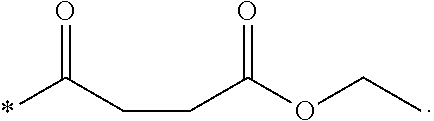

and the like.

and the like.


| TABLE 2 | |||||||||
| Amine | |||||||||
| Polymer | Carbonyl | Amine | Monomer | ED-2003 | |||||
| Example | Name | Monomer | Monomer | (mol %) | (mol %) | | Mn | PDI | |
| 1 | | DMM | MDEA | 100 | 0 | |
|||
| 2 | | DMM | MDEA | 100 | 0 | |
|||
| 3 | | DMM | MDEA | 100 | 0 | |
|||
| 4 | | DMM | MDEA | 100 | 0 | |
|||
| 5 | | DMM | DAMDPA | 100 | 0 | |
|||
| 6 | | DMM | DAMDPA | 100 | 0 | |
|||
| 7 | | DMM | DAMDPA | 100 | 0 | |
|||
| 8 | | DMM | DAMDPA | 100 | 0 | HexBr | 1,020 | 1.19 | |
| 9 | | DMM | BAPPIP | 100 | 0 | |
|||
| 10 | | DMM | BAPPIP | 100 | 0 | |
|||
| 11 | | DMM | BAPPIP | 100 | 0 | |
|||
| 12 | | DPC | MDEA | 100 | 0 | |
|||
| 13 | | DESucc | DAMDPA | 100 | 0 | BnBr | 4,510 | 2.19 | |
| 14 | P48b | DESucc | DAMDPA | 95 | 5 | BnBr | 4,670 | 1.94 | |
| 15 | P49a | DESucc | DAMDPA | 97.5 | 2.5 | BnBr | 3,100 | 1.77 | |
| 16 | P49b | DESucc | DAMDPA | 90 | 10 | BnBr | 2,270 | 1.88 | |
| 17 | | DESucc | BAPPIP | 100 | 0 | BnBr | 1,740 | 1.89 | |
| 18 | | DESucc | BAPPIP | 100 | 0 | MeI | 2,860 | 1.92 | |
| 19 | P59c | DESucc | BAPPIP | 97.5 | 2.5 | BnBr | 3,510 | 1.89 | |
| 20 | P59d | DESucc | BAPPIP | 97.5 | 2.5 | MeI | 3,000 | 1.67 | |
| 21 | P59e | DESucc | BAPPIP | 95 | 5.0 | BnBr | |||
| 22 | P59f | DESucc | BAPPIP | 95 | 5.0 | MeI | |||
| 23 | P60a | DEC | BAPPIP | 97.5 | 2.5 | MeI | |||
| 24 | P60b | DEC | BAPPIP | 97.5 | 2.5 | BnBr | |||
| 25 | | DBocG | DAMDPA | 100 | 0 | BnBr | |||
| 26 | P73b | DBocG | DAMDPA | 97.5 | 2.5 | BnBr | |||
| 27 | P73c | DBocG | DAMDPA | 95 | 5 | BnBr | |||
| 28 | P73d | DBocG | DAMDPA | 90 | 10 | BnBr | |||
| Minimum inhibitory concentration (MIC) | |||||||||
Hemolysis (%)=[(O.D.576 nm of the treated sample−O.D.576 nm of negative control)/(O.D.576 nm of positive control−O.D.576 nm of negative control)]×100%
In Vitro Cytotoxicity
| TABLE 3 | |||||
| Amine | MIC (mg/L) | ||||
| Polymer | Carbonyl | Amine | Monomer | ED-2003 | S. | E. | P. | C. | HC50 | ||
| Example | Name | Monomer | Monomer | (mol %) | (mol %) | RX | Aureus | Coli | Aeruginosa | Albicans | (mg/L) |
| 1 | P31a | DMM | MDEA | 100 | 0 | MeI | >1000 | >1000 | >1000 | 125 | >1000 |
| 2 | P31b | DMM | MDEA | 100 | 0 | DMS | Not Determined |
| 3 | P31c | DMM | MDEA | 100 | 0 | BnBr | 500 (1000) | 1000 | >1000 | 500 | >1000 |
| 4 | P31d | DMM | MDEA | 100 | 0 | HexBr | 500 (1000) | 1000 | >1000 | 500 | >1000 |
| 5 | P32a | DMM | DAMDPA | 100 | 0 | MeI | >1000 | 63 | 16 | 125 | >1000 |
| 6 | P32b | DMM | DAMDPA | 100 | 0 | DMS | >1000 | 125 | 31 | 500 | >1000 |
| 7 | P32c | DMM | DAMDPA | 100 | 0 | BnBr | 16 | 8 | 63 | 125 | >1000 |
| 8 | P32d | DMM | DAMDPA | 100 | 0 | HexBr | 8 | 8 | 31 | 125 | 875 |
| 9 | P34a | DMM | BAPPIP | 100 | 0 | MeI | ≤4 | 16 | 16 | 500 | >1000 |
| 10 | P34b | DMM | BAPPIP | 100 | 0 | DMS | 16 | 63 | 125 | 250 | >1000 |
| 11 | P34c | DMM | BAPPIP | 100 | 0 | BnBr | Insoluble |
| 12 | P38 | DPC | MDEA | 100 | 0 | MeI | Insoluble |
| 13 | P48a | DESucc | DAMDPA | 100 | 0 | BnBr | 31 | 8 | 16 | 250 | >1000 |
| 14 | P48b | DESucc | DAMDPA | 95 | 5 | BnBr | 63 | 8 | 63 | 250 | >1000 |
| 15 | P49a | DESucc | DAMDPA | 97.5 | 2.5 | BnBr | 31 | 8 | 16 | 250 | >1000 |
| 16 | P49b | DESucc | DAMDPA | 90 | 10 | BnBr | 63 | 8 | 31 | 250 | >1000 |
| 17 | P59a | DESucc | BAPPIP | 100 | 0 | BnBr | 31 | 16 | 31 | 125 | >1250 |
| 18 | P59b | DESucc | BAPPIP | 100 | 0 | MeI | 8 | 63 | 8 | 63 | >1250 |
| 19 | P59c | DESucc | BAPPIP | 97.5 | 2.5 | BnBr | 16 | 8 | 31 | 125 | >1250 |
| 20 | P59d | DESucc | BAPPIP | 97.5 | 2.5 | MeI | 8 | 31 | 8 | 250 | >1250 |
| 21 | P59e | DESucc | BAPPIP | 95 | 5.0 | BnBr | 16 | 8 | 31 | 250 | >1250 |
| 22 | P59f | DESucc | BAPPIP | 95 | 5.0 | MeI | 16 | 31 | 31 | 125 | >1000 |
| 23 | P60a | DEC | BAPPIP | 97.5 | 2.5 | MeI | 8 | 16 | 250 | 250 | >1000 |
| 24 | P60b* | DEC | BAPPIP | 97.5 | 2.5 | BnBr | 63 | 125 | 250 | 250 | 375 |
| 25 | P73a | DBocG | DAMDPA | 100 | 0 | BnBr | 16 | 63 | 63 | 250 | >1250 |
| 26 | P73b | DBocG | DAMDPA | 97.5 | 2.5 | BnBr | 63 | 32 | 250 | 500 | >1250 |
| 27 | P73c | DBocG | DAMDPA | 95 | 5 | BnBr | 125 | 63 | 250 | 500 | >1250 |
| 28 | P73d | DBocG | DAMDPA | 90 | 10 | BnBr | 63 | 63 | 500 | 500 | >1250 |
| *P60b was dissolved in DMSO (final DMSO concentration in the test vial: 1% V/V). | |||||||||||
Claims (29)


Priority Applications (1)
| Application Number | Priority Date | Filing Date | Title |
|---|---|---|---|
| US15/361,313 US10023697B2 (en) | 2015-05-06 | 2016-11-25 | Condensation polymers for antimicrobial applications |
Applications Claiming Priority (2)
| Application Number | Priority Date | Filing Date | Title |
|---|---|---|---|
| US14/705,451 US9580554B2 (en) | 2015-05-06 | 2015-05-06 | Condensation polymers for antimicrobial applications |
| US15/361,313 US10023697B2 (en) | 2015-05-06 | 2016-11-25 | Condensation polymers for antimicrobial applications |
Related Parent Applications (1)
| Application Number | Title | Priority Date | Filing Date |
|---|---|---|---|
| US14/705,451 Division US9580554B2 (en) | 2015-05-06 | 2015-05-06 | Condensation polymers for antimicrobial applications |
Publications (2)
| Publication Number | Publication Date |
|---|---|
| US20170073471A1 US20170073471A1 (en) | 2017-03-16 |
| US10023697B2 true US10023697B2 (en) | 2018-07-17 |
Family
ID=57217714
Family Applications (2)
| Application Number | Title | Priority Date | Filing Date |
|---|---|---|---|
| US14/705,451 Expired - Fee Related US9580554B2 (en) | 2015-05-06 | 2015-05-06 | Condensation polymers for antimicrobial applications |
| US15/361,313 Expired - Fee Related US10023697B2 (en) | 2015-05-06 | 2016-11-25 | Condensation polymers for antimicrobial applications |
Family Applications Before (1)
| Application Number | Title | Priority Date | Filing Date |
|---|---|---|---|
| US14/705,451 Expired - Fee Related US9580554B2 (en) | 2015-05-06 | 2015-05-06 | Condensation polymers for antimicrobial applications |
Country Status (5)
| Country | Link |
|---|---|
| US (2) | US9580554B2 (en) |
| EP (1) | EP3292165A4 (en) |
| CN (1) | CN107531897A (en) |
| SG (1) | SG11201706909UA (en) |
| WO (1) | WO2016178634A1 (en) |
Cited By (1)
| Publication number | Priority date | Publication date | Assignee | Title |
|---|---|---|---|---|
| US20210066740A1 (en) * | 2019-08-28 | 2021-03-04 | Robert Bosch Gmbh | Polymer-based electrolye materials for proton exchange membrane fuel cells |
Families Citing this family (12)
| Publication number | Priority date | Publication date | Assignee | Title |
|---|---|---|---|---|
| EP3500231A1 (en) | 2016-08-19 | 2019-06-26 | The Procter and Gamble Company | Polymeric materials and articles manufactured there from |
| US10653142B2 (en) | 2017-12-12 | 2020-05-19 | International Business Machines Corporation | Polymers with antimicrobial functionalities |
| US10687530B2 (en) | 2017-12-12 | 2020-06-23 | International Business Machines Corporation | Hydrophilic polymers with antimicrobial functionalities |
| US10743537B2 (en) * | 2017-12-12 | 2020-08-18 | International Business Machines Corporation | Monomer compositions with antimicrobial functionality |
| US10667514B2 (en) | 2017-12-12 | 2020-06-02 | International Business Machines Corporation | Antimicrobial ionene compositions with a variety of functional groups |
| US10836864B2 (en) | 2017-12-12 | 2020-11-17 | International Business Machines Corporation | Chemical compositions with antimicrobial functionality |
| US10595527B2 (en) * | 2017-12-12 | 2020-03-24 | International Business Machines Corporation | Antimicrobial polymers capable of supramolecular assembly |
| US10687528B2 (en) | 2017-12-12 | 2020-06-23 | International Business Machines Corporation | Antimicrobial polymers with enhanced functionalities |
| US20190309163A1 (en) * | 2018-04-10 | 2019-10-10 | The Procter & Gamble Company | Polymeric Materials and Articles Manufactured There From |
| US11723875B2 (en) | 2018-04-10 | 2023-08-15 | The Procter & Gamble Company | Polymeric materials and articles manufactured there from |
| US11191777B2 (en) | 2018-06-20 | 2021-12-07 | International Business Machines Corporation | Antimicrobial guanidinium macromolecules with bacteria targeting moieties |
| US10995177B2 (en) | 2018-06-20 | 2021-05-04 | Agency For Science, Technology And Research | Antimicrobial polycarbonates for multidrug resistant bacteria |
Citations (16)
| Publication number | Priority date | Publication date | Assignee | Title |
|---|---|---|---|---|
| US3124607A (en) | 1964-03-10 | Organic carbonate esters | ||
| US3329657A (en) | 1963-05-17 | 1967-07-04 | American Cyanamid Co | Water soluble cross linked cationic polyamide polyamines |
| US4201766A (en) | 1977-03-02 | 1980-05-06 | L'oreal | Hair conditioning composition and method of using the same |
| US4315087A (en) | 1975-04-28 | 1982-02-09 | Petrolite Corporation | Quaternary polyaminoamides |
| EP0086066A1 (en) | 1982-01-29 | 1983-08-17 | The Dow Chemical Company | Use of a quaternized polyamidoamines as demulsifiers |
| US4528316A (en) | 1983-10-18 | 1985-07-09 | Kimberly-Clark Corporation | Creping adhesives containing polyvinyl alcohol and cationic polyamide resins |
| US5118785A (en) | 1990-04-10 | 1992-06-02 | Texaco Chemical Company | Preparation of polyether amide from tetraethylene glycol diamine and terephthalic acid |
| JP2000265085A (en) | 1999-03-12 | 2000-09-26 | Toyobo Co Ltd | Antibacterial antifungal coating composition for automotive member |
| JP2001071411A (en) | 1999-07-01 | 2001-03-21 | Toyobo Co Ltd | Antibacterial material and antibacterial film |
| US6548590B1 (en) | 2000-03-22 | 2003-04-15 | Integument Technologies, Inc. | Polymer and inorganic-organic hybrid composites and methods for making and using same |
| US20030103929A1 (en) * | 2001-09-11 | 2003-06-05 | Mireille Maubru | Cosmetic compositions containing a methacrylic acid copolymer, a silicone and a cationic polymer, and uses thereof |
| US7883767B2 (en) | 2004-09-30 | 2011-02-08 | Mcmaster University | Composite material comprising layered hydrophilic coatings |
| US20130183262A1 (en) | 2011-10-27 | 2013-07-18 | Kenneth J. Wynne | Antimicrobial polymeric compositions |
| US8771578B2 (en) | 2007-04-17 | 2014-07-08 | Kemira Chemicals, Inc. | Acidified polyamidoamine adhesives, method of manufacture, and use for creping and ply bond applications |
| WO2014168771A2 (en) | 2013-04-09 | 2014-10-16 | International Business Machines Corporation | Antimicrobial cationic polycarbonates |
| WO2014168762A1 (en) | 2013-04-09 | 2014-10-16 | International Business Machines Corporation | Antimicrobial cationic polycarbonates |
-
2015
- 2015-05-06 US US14/705,451 patent/US9580554B2/en not_active Expired - Fee Related
-
2016
- 2016-05-06 EP EP16789698.4A patent/EP3292165A4/en not_active Withdrawn
- 2016-05-06 SG SG11201706909UA patent/SG11201706909UA/en unknown
- 2016-05-06 CN CN201680020566.8A patent/CN107531897A/en active Pending
- 2016-05-06 WO PCT/SG2016/050211 patent/WO2016178634A1/en not_active Ceased
- 2016-11-25 US US15/361,313 patent/US10023697B2/en not_active Expired - Fee Related
Patent Citations (16)
| Publication number | Priority date | Publication date | Assignee | Title |
|---|---|---|---|---|
| US3124607A (en) | 1964-03-10 | Organic carbonate esters | ||
| US3329657A (en) | 1963-05-17 | 1967-07-04 | American Cyanamid Co | Water soluble cross linked cationic polyamide polyamines |
| US4315087A (en) | 1975-04-28 | 1982-02-09 | Petrolite Corporation | Quaternary polyaminoamides |
| US4201766A (en) | 1977-03-02 | 1980-05-06 | L'oreal | Hair conditioning composition and method of using the same |
| EP0086066A1 (en) | 1982-01-29 | 1983-08-17 | The Dow Chemical Company | Use of a quaternized polyamidoamines as demulsifiers |
| US4528316A (en) | 1983-10-18 | 1985-07-09 | Kimberly-Clark Corporation | Creping adhesives containing polyvinyl alcohol and cationic polyamide resins |
| US5118785A (en) | 1990-04-10 | 1992-06-02 | Texaco Chemical Company | Preparation of polyether amide from tetraethylene glycol diamine and terephthalic acid |
| JP2000265085A (en) | 1999-03-12 | 2000-09-26 | Toyobo Co Ltd | Antibacterial antifungal coating composition for automotive member |
| JP2001071411A (en) | 1999-07-01 | 2001-03-21 | Toyobo Co Ltd | Antibacterial material and antibacterial film |
| US6548590B1 (en) | 2000-03-22 | 2003-04-15 | Integument Technologies, Inc. | Polymer and inorganic-organic hybrid composites and methods for making and using same |
| US20030103929A1 (en) * | 2001-09-11 | 2003-06-05 | Mireille Maubru | Cosmetic compositions containing a methacrylic acid copolymer, a silicone and a cationic polymer, and uses thereof |
| US7883767B2 (en) | 2004-09-30 | 2011-02-08 | Mcmaster University | Composite material comprising layered hydrophilic coatings |
| US8771578B2 (en) | 2007-04-17 | 2014-07-08 | Kemira Chemicals, Inc. | Acidified polyamidoamine adhesives, method of manufacture, and use for creping and ply bond applications |
| US20130183262A1 (en) | 2011-10-27 | 2013-07-18 | Kenneth J. Wynne | Antimicrobial polymeric compositions |
| WO2014168771A2 (en) | 2013-04-09 | 2014-10-16 | International Business Machines Corporation | Antimicrobial cationic polycarbonates |
| WO2014168762A1 (en) | 2013-04-09 | 2014-10-16 | International Business Machines Corporation | Antimicrobial cationic polycarbonates |
Non-Patent Citations (7)
| Title |
|---|
| Katsarava, et al., "Synthesis of Polyurethanes by Polycondensation of Activated Diol Biscarbonates with Diamines in Mild Conditions", Polymer Science USSR, 1987, vol. 29, p. 2268-2275. |
| Lee, et al., "Quaternized Polyamidoamine Dendrimers as Novel Gene Delivery System: Relationship between Degree of Quaternization and Their Influences," Bull. Korean Chem. Soc., 2003, vol. 24, 1637-1640. |
| Monsalve, et al., "Lipase-catalyzed synthesis and characterization of a novel linear polyamidoamine oligomer", Polymer, vol. 51, Issue 14, Jun. 24, 2010, pp. 2998-3005. |
| PCT International Search Report, WO2016178634, dated Sep. 6, 2016, international application No. PCT/SG2016/050211. |
| PCT International Written Opinion, WO2016178634, dated Sep. 6, 2016, international application No. PCT/SG2016/050211. |
| Tsai, et al., "A New Cationic Poly(ester anhydride): Synthesis, Structure Characterization, and Biological Properties", Polymer Science B, 2012, vol. 54, pp. 420-426. |
| Zhang, et al., "Step-growth polymerization of highly efficacious antimicrobial polymers for consumer care products", Abstracts of Papers, 251st ACS National Meeting & Exposition, San Diego, CA; United States, Mar. 13-17, 2016, published Feb. 25, 2016. |
Cited By (2)
| Publication number | Priority date | Publication date | Assignee | Title |
|---|---|---|---|---|
| US20210066740A1 (en) * | 2019-08-28 | 2021-03-04 | Robert Bosch Gmbh | Polymer-based electrolye materials for proton exchange membrane fuel cells |
| US11189852B2 (en) * | 2019-08-28 | 2021-11-30 | Robert Bosch Gmbh | Polymer-based electrolyte materials for proton exchange membrane fuel cells |
Also Published As
| Publication number | Publication date |
|---|---|
| WO2016178634A1 (en) | 2016-11-10 |
| SG11201706909UA (en) | 2017-09-28 |
| CN107531897A (en) | 2018-01-02 |
| EP3292165A4 (en) | 2018-12-26 |
| US20160326319A1 (en) | 2016-11-10 |
| US20170073471A1 (en) | 2017-03-16 |
| US9580554B2 (en) | 2017-02-28 |
| EP3292165A1 (en) | 2018-03-14 |
Similar Documents
| Publication | Publication Date | Title |
|---|---|---|
| US9580554B2 (en) | Condensation polymers for antimicrobial applications | |
| US9642360B2 (en) | Antimicrobial polymers formed by bulk polyaddition | |
| US11690380B2 (en) | Antimicrobial guanidinium and thiouronium functionalized polymers | |
| US9974303B2 (en) | Cationic polymers for antimicrobial applications and delivery of bioactive materials | |
| US8496946B2 (en) | Antimicrobial hydrogels, methods of preparation thereof, and articles therefrom | |
| US8642086B2 (en) | Antimicrobial compositions, methods of preparation thereof, and uses thereof | |
| US8921426B2 (en) | Cationic bis-urea compounds as effective antimicrobial agents | |
| EP3204441B1 (en) | Water soluble polycarbonates for medical applications | |
| JP6457392B2 (en) | Pharmaceutical pendant primary amine supported on polycarbonate | |
| US9901649B2 (en) | Block copolymers for therapeutic drug delivery | |
| AU2019414421A1 (en) | Nitric oxide-releasing antibacterial polymers and scaffolds fabricated therefrom and methods pertaining thereto | |
| US20190307684A1 (en) | Block copolymers and self-assembling nanoparticles formed therefrom |
Legal Events
| Date | Code | Title | Description |
|---|---|---|---|
| AS | Assignment |
Owner name: AGENCY FOR SCIENCE, TECHNOLOGY AND RESEARCH, SINGA Free format text: ASSIGNMENT OF ASSIGNORS INTEREST;ASSIGNORS:LIU, SHAOQIONG;TEO, JYE YNG;YANG, YI YAN;REEL/FRAME:040416/0933 Effective date: 20150428 Owner name: INTERNATIONAL BUSINESS MACHINES CORPORATION, NEW Y Free format text: ASSIGNMENT OF ASSIGNORS INTEREST;ASSIGNORS:BREYTA, GREGORY;CHAN, JULIAN M.W.;COADY, DANIEL J.;AND OTHERS;SIGNING DATES FROM 20150421 TO 20150505;REEL/FRAME:040416/0910 |
|
| AS | Assignment |
Owner name: INTERNATIONAL BUSINESS MACHINES CORPORATION, NEW Y Free format text: ASSIGNMENT OF ASSIGNORS INTEREST;ASSIGNORS:BREYTA, GREGORY;CHAN, JULIAN M.W.;COADY, DANIEL J.;AND OTHERS;SIGNING DATES FROM 20170220 TO 20170306;REEL/FRAME:041495/0985 Owner name: AGENCY FOR SCIENCE, TECHNOLOGY AND RESEARCH, SINGA Free format text: ASSIGNMENT OF ASSIGNORS INTEREST;ASSIGNOR:YANG, YI YAN;REEL/FRAME:041908/0880 Effective date: 20170221 |
|
| STCF | Information on status: patent grant |
Free format text: PATENTED CASE |
|
| FEPP | Fee payment procedure |
Free format text: MAINTENANCE FEE REMINDER MAILED (ORIGINAL EVENT CODE: REM.); ENTITY STATUS OF PATENT OWNER: LARGE ENTITY |
|
| LAPS | Lapse for failure to pay maintenance fees |
Free format text: PATENT EXPIRED FOR FAILURE TO PAY MAINTENANCE FEES (ORIGINAL EVENT CODE: EXP.); ENTITY STATUS OF PATENT OWNER: LARGE ENTITY |
|
| STCH | Information on status: patent discontinuation |
Free format text: PATENT EXPIRED DUE TO NONPAYMENT OF MAINTENANCE FEES UNDER 37 CFR 1.362 |
|
| FP | Lapsed due to failure to pay maintenance fee |
Effective date: 20220717 |