US10023582B2 - 6-aryl amino pyridone formamide compound crystal and preparation method therefor - Google Patents

6-aryl amino pyridone formamide compound crystal and preparation method therefor Download PDF

Info

Publication number
US10023582B2
US10023582B2 US15/329,197 US201515329197A US10023582B2 US 10023582 B2 US10023582 B2 US 10023582B2 US 201515329197 A US201515329197 A US 201515329197A US 10023582 B2 US10023582 B2 US 10023582B2
Authority
US
United States
Prior art keywords
crystal
compound
formula
solvent
temperature
Prior art date
Legal status (The legal status is an assumption and is not a legal conclusion. Google has not performed a legal analysis and makes no representation as to the accuracy of the status listed.)
Active
Application number
US15/329,197
Other versions
US20170217979A1 (en
Inventor
Lulu Wang
Xiquan Zhang
Fei Liu
Yizhong ZHU
Chao Gao
Song TANG
Bo Zhu
Jianqiu TANG
Current Assignee (The listed assignees may be inaccurate. Google has not performed a legal analysis and makes no representation or warranty as to the accuracy of the list.)
Centaurus Biopharma Co Ltd
Chia Tai Tianqing Pharmaceutical Group Co Ltd
Original Assignee
Centaurus Biopharma Co Ltd
Chia Tai Tianqing Pharmaceutical Group Co Ltd
Priority date (The priority date is an assumption and is not a legal conclusion. Google has not performed a legal analysis and makes no representation as to the accuracy of the date listed.)
Filing date
Publication date
Application filed by Centaurus Biopharma Co Ltd, Chia Tai Tianqing Pharmaceutical Group Co Ltd filed Critical Centaurus Biopharma Co Ltd
Assigned to CHIA TAI TIANQING PHARMACEUTICAL GROUP CO., LTD, CENTAURUS BIOPHARMA CO., LTD. reassignment CHIA TAI TIANQING PHARMACEUTICAL GROUP CO., LTD ASSIGNMENT OF ASSIGNORS INTEREST (SEE DOCUMENT FOR DETAILS). Assignors: GAO, CHAO, LIU, FEI, TANG, Jianqiu, TANG, Song, WANG, LULU, ZHANG, XIQUAN, ZHU, BO, ZHU, Yizhong
Publication of US20170217979A1 publication Critical patent/US20170217979A1/en
Application granted granted Critical
Publication of US10023582B2 publication Critical patent/US10023582B2/en
Active legal-status Critical Current
Anticipated expiration legal-status Critical

Links

Images

Classifications

    • CCHEMISTRY; METALLURGY
    • C07ORGANIC CHEMISTRY
    • C07DHETEROCYCLIC COMPOUNDS
    • C07D491/00Heterocyclic compounds containing in the condensed ring system both one or more rings having oxygen atoms as the only ring hetero atoms and one or more rings having nitrogen atoms as the only ring hetero atoms, not provided for by groups C07D451/00 - C07D459/00, C07D463/00, C07D477/00 or C07D489/00
    • C07D491/02Heterocyclic compounds containing in the condensed ring system both one or more rings having oxygen atoms as the only ring hetero atoms and one or more rings having nitrogen atoms as the only ring hetero atoms, not provided for by groups C07D451/00 - C07D459/00, C07D463/00, C07D477/00 or C07D489/00 in which the condensed system contains two hetero rings
    • C07D491/04Ortho-condensed systems
    • C07D491/044Ortho-condensed systems with only one oxygen atom as ring hetero atom in the oxygen-containing ring
    • C07D491/048Ortho-condensed systems with only one oxygen atom as ring hetero atom in the oxygen-containing ring the oxygen-containing ring being five-membered
    • AHUMAN NECESSITIES
    • A61MEDICAL OR VETERINARY SCIENCE; HYGIENE
    • A61KPREPARATIONS FOR MEDICAL, DENTAL OR TOILETRY PURPOSES
    • A61K31/00Medicinal preparations containing organic active ingredients
    • A61K31/33Heterocyclic compounds
    • A61K31/395Heterocyclic compounds having nitrogen as a ring hetero atom, e.g. guanethidine or rifamycins
    • A61K31/435Heterocyclic compounds having nitrogen as a ring hetero atom, e.g. guanethidine or rifamycins having six-membered rings with one nitrogen as the only ring hetero atom
    • A61K31/4353Heterocyclic compounds having nitrogen as a ring hetero atom, e.g. guanethidine or rifamycins having six-membered rings with one nitrogen as the only ring hetero atom ortho- or peri-condensed with heterocyclic ring systems
    • A61K31/4355Heterocyclic compounds having nitrogen as a ring hetero atom, e.g. guanethidine or rifamycins having six-membered rings with one nitrogen as the only ring hetero atom ortho- or peri-condensed with heterocyclic ring systems the heterocyclic ring system containing a five-membered ring having oxygen as a ring hetero atom
    • AHUMAN NECESSITIES
    • A61MEDICAL OR VETERINARY SCIENCE; HYGIENE
    • A61PSPECIFIC THERAPEUTIC ACTIVITY OF CHEMICAL COMPOUNDS OR MEDICINAL PREPARATIONS
    • A61P29/00Non-central analgesic, antipyretic or antiinflammatory agents, e.g. antirheumatic agents; Non-steroidal antiinflammatory drugs [NSAID]
    • AHUMAN NECESSITIES
    • A61MEDICAL OR VETERINARY SCIENCE; HYGIENE
    • A61PSPECIFIC THERAPEUTIC ACTIVITY OF CHEMICAL COMPOUNDS OR MEDICINAL PREPARATIONS
    • A61P35/00Antineoplastic agents
    • AHUMAN NECESSITIES
    • A61MEDICAL OR VETERINARY SCIENCE; HYGIENE
    • A61PSPECIFIC THERAPEUTIC ACTIVITY OF CHEMICAL COMPOUNDS OR MEDICINAL PREPARATIONS
    • A61P43/00Drugs for specific purposes, not provided for in groups A61P1/00-A61P41/00
    • CCHEMISTRY; METALLURGY
    • C07ORGANIC CHEMISTRY
    • C07BGENERAL METHODS OF ORGANIC CHEMISTRY; APPARATUS THEREFOR
    • C07B2200/00Indexing scheme relating to specific properties of organic compounds
    • C07B2200/13Crystalline forms, e.g. polymorphs

Definitions

  • the present invention relates to a crystal of 6-arylamino pyridone carboxamide compound and a preparation method thereof in the technical field of medicine.
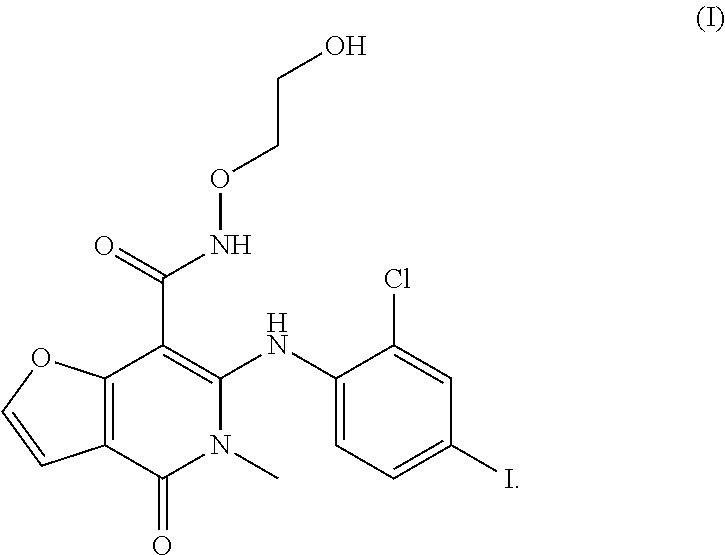
  • CN102020651A discloses a 5-arylamino pyridone carboxamide compound, whose chemical name is 6-(2-chloro-4-iodophenylamino)-N-(2-hydroxylethyoxyl)-5-methyl-4-oxo-4,5-dihydrofuro[3,2-c]pyridine-7-carboxamide, and the structural formula is represented by formula (I).
  • the compound of formula (I) is a MEK inhibitor, which can be used in a method for treating MEK-mediated conditions or disorders in a mammal (including human), such as inflammatory diseases, infections, autoimmune diseases, strokes, ischemias, noncancerous hyperproliferative diseases, tumors and the like.
  • CN102020651A discloses a preparation method of the compound of formula (I), which is obtained through a silica gel flash column chromatography.
  • the morphology of a drug plays a crucial role in improving properties of the drug and obtaining a more desired processing performance. Accordingly a research on polymorph(s) of the compound of formula (I) has a great importance for its production.
  • the present invention provides a crystal of the compound of formula (I) characterized by diffraction peaks expressed by 2 ⁇ values at 7.86°, 19.09°, 21.80°, 23.87°, 26.00°, and 28.12° in an X-ray powder diffraction spectrum; typically, diffraction peaks expressed by 2 ⁇ values at 7.86°, 9.32°, 13.25°, 15.06°, 19.09°, 21.80°, 22.46°, 22.81°, 23.87°, 26.00°, 28.12°, and 28.59° in an X-ray powder diffraction spectrum; and more typically, diffraction peaks expressed by 2 ⁇ values at 7.86°, 9.32°, 13.25°, 15.06°, 17.89°, 19.09°, 20.73°, 21.80°, 22.46°, 22.81°, 23.87°, 24.55°, 26.00°, 27.29°, 28.12°, 28.59°, 29.32°, and 30.15° in an X
  • the crystal of the compound of formula (I) according to the present invention is characterized by an X-ray powder diffraction spectrum having the positions and intensities of diffraction peaks as shown in the following table.
  • the crystal of the compound of formula (I) is characterized by an X-ray powder diffraction spectrum as shown in FIG. 1 .
  • a typical but non-limited example of the crystal of the compound of formula (I) as provided by the present invention is characterized by a differential scanning calorimetry (DSC) thermogram having an absorption peak at about 202.2° C.
  • the crystal of the compound of formula (I) is characterized by a DSC thermogram as shown in FIG. 2 .
  • the present invention provides a crystalline composition
  • a crystalline composition comprising the above crystal of the compound of formula (I) in an amount of 50% or more by weight of the crystalline composition, preferably 80% or more, more preferably 90% or more, and most preferably 95% or more.
  • the present invention provides a pharmaceutical composition comprising a therapeutically effective amount of the above crystal of the compound of formula (I) or the above crystalline composition.
  • the present invention provides a use of the above crystal of the compound of formula (I), the above crystalline composition or the above pharmaceutical composition in the preparation of a medicament for inhibiting MEK enzyme.
  • the present invention provides a use of the above crystal of the compound of formula (I), the above crystalline composition or the above pharmaceutical composition in the preparation of a medicament for treating or preventing MEK-mediated disorders or diseases.
  • the MEK-mediated disorders or diseases are MEK-mediated proliferative diseases.
  • the MEK-mediated proliferative diseases are inflammatory diseases or cancers.
  • the present invention provides a method for preparing the above crystal of the compound of formula (I) or the above crystalline composition, comprising the following steps: dissolving a crude compound of formula (I) in an aprotic polar solvent at a temperature of 80° C.-120° C.; lowering the temperature; adding a second solvent; crystallizing; filtrating and drying.
  • the aprotic polar solvent can be selected from the group consisting of DMF, DMSO and a mixed solvent thereof, preferably DMSO.
  • the second solvent is selected from the group consisting of water, alcohols and a mixed solvent thereof, preferably water, methanol, ethanol, n-propanol, isopropanol, n-butanol, isobutanol or a mixture of two or more of the above solvents, further preferably ethanol, water or a mixture of water and ethanol, and still further preferably ethanol.
  • a ratio of a mass of the crude compound of formula (I) to a volume of the aprotic polar solvent is 10 g:5 mL-10 g:25 mL, preferably 10 g:10 mL-10 g:20 mL, and still further preferably 10 g:10 mL-10 g:15 mL.
  • a temperature of the aprotic polar solvent is preferably 90° C.-110° C., and further preferably 100° C.-110° C.
  • a volume ratio of the second solvent to the aprotic polar solvent is 0.25:1-5:1, preferably 0.5:1-3:1, and still further preferably 1:1-2:1.
  • the temperature can be lowered to 30° C.-50° C., preferably 35° C.-45° C.
  • the step of lowering the temperature may be carried out by natural cooling.
  • the drying step is preferably performed under a reduced pressure, and still further preferably in vacuum at a temperature of 40° C.
  • the crude compound of formula (I) is dissolved in the aprotic polar solvent at a temperature of 80° C.-120° C.
  • the crude compound of formula (I) may be firstly mixed with the aprotic polar solvent, and then heated to a temperature of 80° C.-120° C.
  • the aprotic polar solvent may be firstly heated to a temperature of 80° C.-120° C., and then mixed with the crude compound of formula (I).
  • the crude compound of formula (I) may be obtained through a preparation method described in CN102020651A or in the examples of the present invention.
  • DMF refers to N, N-dimethylformamide
  • DMSO refers to dimethyl sulfoxide
  • DSC thermogram is measured under the following conditions: detector: Mettler Toledo DSCI; measuring condition: heating from 80° C. to 300° C. at a rate of 10° C./min; environmental condition of detection: a room temperature of 21° C. and a humidity of 50%.
  • the position of a peak may shift due to the change of a temperature, the movement of a sample or the calibration of an instrument and so on when analyzing the sample, and the measurement error of 2 ⁇ value sometimes is about ⁇ 0.2°. Accordingly, this error should be taken into consideration when identifying a crystal structure.
  • the position of a peak in XRD spectrum thereof has similarity on the whole, and accordingly the error of a relative intensity may be relatively large.
  • the error of a relative intensity may be relatively large.
  • parts of diffraction lines may be absent in identification of a mixture. At this time, even a band may be characteristic for the given crystalline form without depending upon the whole bands of a high purity sample.
  • DSC is used to measure a thermal transition temperature when absorbing or releasing heat due to the change of a crystal structure or the melting of a crystal.
  • the error of a thermal transition temperature and a melting point is typically within a range of about ⁇ 5° C. generally within a range of about ⁇ 3° C.
  • a compound with a given DSC peak or melting point means that the DSC peak or melting point may be varied within a range of ⁇ 5° C.
  • DSC provides an auxiliary method to distinguish different crystalline forms. Different crystalline forms can be identified by their characteristically different transition temperatures. It is necessary to point out that the DSC peak or melting point of a mixture will vary over a wider range. Furthermore, because of the decomposition in the melting process, the melting temperature is closely related to a heating rate.
  • the crystal of the compound of formula (I) provided by the present invention has some advantages, such as high purity and good stability, and is beneficial to the manufacture and storage of a medicament containing the same.
  • the preparation method of the crystal of the compound of formula (I) provided by the present invention has the advantage of simple and convenient operations, and is beneficial to its industrial production.
  • FIG. 1 shows X-ray powder diffraction spectrum of the crystal of the compound of formula (I) in Example 4.
  • FIG. 2 shows DSC thermogram of the crystal of the compound of formula (I) in Example 4.
  • the purity of the crystal of the compound of formula (I) was measured by high performance liquid chromatography according to the Chinese Pharmacopoeia, 2010 edition, Part II, Appendix V D.
  • Ostade-cylsilane (ODS) was used as a filler [Recommended column: Eclipse XDB-C18 (4.6 ⁇ 150 mm, 5 ⁇ m) or other chromatographic columns having a comparable performance]; water (0.01% trifluoroacetic acid solution) was used as mobile phase A; acetonitrile (0.01% trifluoroacetic acid solution) was used as mobile phase B; the flow rate was 1.0 ml/min with the linear gradient elution as shown in Table 1; the column temperature was 30° C.; the detection wavelength was 244 nm; and the theoretical plate number was no less than 2000 upon calculation based on the compound of formula (I).
  • a suitable amount of the crystal of the compound of formula (I) prepared in Example 4 was accurately weighed, and methanol was then added thereto to dissolve the crystal. It was diluted quantitatively to obtain a solution containing about 50 ⁇ g of the compound per 1 ml of the solution. 10 ⁇ l of the solution was accurately measured and injected into the liquid chromatograph, and the chromatogram was recorded.
  • a suitable amount of the compound of formula (I) was weighed as a control, and measured by the same method as described in the above. The purity was calculated through external standard method based on peak areas.
  • the purity of the crystal of the compound of formula (I) prepared in Example 4 was 99.4% as determined by HPLC.

Landscapes

  • Health & Medical Sciences (AREA)
  • Chemical & Material Sciences (AREA)
  • Organic Chemistry (AREA)
  • Life Sciences & Earth Sciences (AREA)
  • Veterinary Medicine (AREA)
  • Public Health (AREA)
  • General Health & Medical Sciences (AREA)
  • Medicinal Chemistry (AREA)
  • Animal Behavior & Ethology (AREA)
  • Pharmacology & Pharmacy (AREA)
  • Epidemiology (AREA)
  • Nuclear Medicine, Radiotherapy & Molecular Imaging (AREA)
  • General Chemical & Material Sciences (AREA)
  • Chemical Kinetics & Catalysis (AREA)
  • Bioinformatics & Cheminformatics (AREA)
  • Engineering & Computer Science (AREA)
  • Pain & Pain Management (AREA)
  • Rheumatology (AREA)
  • Pharmaceuticals Containing Other Organic And Inorganic Compounds (AREA)
  • Nitrogen Condensed Heterocyclic Rings (AREA)

Abstract

The present invention provides a crystal of 6-arylamino pyridone carboxamide compound and a preparation method thereof. The crystal is obtained by dissolving 6-(2-chloro-4-iodophenylamino)-N-(2-hydroxylethyoxyl)-5-methyl-4-oxo-4,5-dihydrofuro[3,2-c]pyridin-7-carboxamide in an aprotic polar solvent and adding a second solvent thereto. The crystallization method has the advantage of simple and convenient operations, and is beneficial to an industrial production. The resulting crystal has the advantage a high purity and good stability, and is benefit to the manufacture and storage of a medicament containing the same.

Description

TECHNICAL FIELD
The present invention relates to a crystal of 6-arylamino pyridone carboxamide compound and a preparation method thereof in the technical field of medicine.
CROSS REFERENCE TO RELATED APPLICATIONS
This application is a 371 U.S. National Phase of PCT/CN2015/086118, international filing date Aug. 5, 2015 which claims priority to Chinese Application No. 20141038354.7, filed Aug. 5, 2014, the contents of which are incorporated by reference in the entirety.
BACKGROUND ART
CN102020651A discloses a 5-arylamino pyridone carboxamide compound, whose chemical name is 6-(2-chloro-4-iodophenylamino)-N-(2-hydroxylethyoxyl)-5-methyl-4-oxo-4,5-dihydrofuro[3,2-c]pyridine-7-carboxamide, and the structural formula is represented by formula (I). The compound of formula (I) is a MEK inhibitor, which can be used in a method for treating MEK-mediated conditions or disorders in a mammal (including human), such as inflammatory diseases, infections, autoimmune diseases, strokes, ischemias, noncancerous hyperproliferative diseases, tumors and the like.
Figure US10023582-20180717-C00001
CN102020651A discloses a preparation method of the compound of formula (I), which is obtained through a silica gel flash column chromatography. The morphology of a drug plays a crucial role in improving properties of the drug and obtaining a more desired processing performance. Accordingly a research on polymorph(s) of the compound of formula (I) has a great importance for its production.
SUMMARY OF THE INVENTION
The present invention provides a crystal of the compound of formula (I) characterized by diffraction peaks expressed by 2θ values at 7.86°, 19.09°, 21.80°, 23.87°, 26.00°, and 28.12° in an X-ray powder diffraction spectrum; typically, diffraction peaks expressed by 2θ values at 7.86°, 9.32°, 13.25°, 15.06°, 19.09°, 21.80°, 22.46°, 22.81°, 23.87°, 26.00°, 28.12°, and 28.59° in an X-ray powder diffraction spectrum; and more typically, diffraction peaks expressed by 2θ values at 7.86°, 9.32°, 13.25°, 15.06°, 17.89°, 19.09°, 20.73°, 21.80°, 22.46°, 22.81°, 23.87°, 24.55°, 26.00°, 27.29°, 28.12°, 28.59°, 29.32°, and 30.15° in an X-ray powder diffraction spectrum.
In one embodiment of the present invention, the crystal of the compound of formula (I) according to the present invention is characterized by an X-ray powder diffraction spectrum having the positions and intensities of diffraction peaks as shown in the following table.
No. Diffraction peak (°) Relative intensity (%)
1 7.86 100
2 9.32 33
3 13.25 41
4 15.06 42
5 17.89 18
6 19.09 67
7 20.73 27
8 21.80 44
9 22.46 37
10 22.81 39
11 23.87 95
12 24.55 21
13 26.00 65
14 27.29 19
15 28.12 43
16 28.59 40
17 29.32 18
18 30.15 20
In one specific embodiment of the present invention, the crystal of the compound of formula (I) is characterized by an X-ray powder diffraction spectrum as shown in FIG. 1.
A typical but non-limited example of the crystal of the compound of formula (I) as provided by the present invention is characterized by a differential scanning calorimetry (DSC) thermogram having an absorption peak at about 202.2° C.
In one specific embodiment of the present invention, the crystal of the compound of formula (I) is characterized by a DSC thermogram as shown in FIG. 2.
In another aspect, the present invention provides a crystalline composition comprising the above crystal of the compound of formula (I) in an amount of 50% or more by weight of the crystalline composition, preferably 80% or more, more preferably 90% or more, and most preferably 95% or more.
In another aspect, the present invention provides a pharmaceutical composition comprising a therapeutically effective amount of the above crystal of the compound of formula (I) or the above crystalline composition.
In another aspect, the present invention provides a use of the above crystal of the compound of formula (I), the above crystalline composition or the above pharmaceutical composition in the preparation of a medicament for inhibiting MEK enzyme.
In another aspect, the present invention provides a use of the above crystal of the compound of formula (I), the above crystalline composition or the above pharmaceutical composition in the preparation of a medicament for treating or preventing MEK-mediated disorders or diseases. Preferably, the MEK-mediated disorders or diseases are MEK-mediated proliferative diseases. Preferably, the MEK-mediated proliferative diseases are inflammatory diseases or cancers.
In another aspect, the present invention provides a method for preparing the above crystal of the compound of formula (I) or the above crystalline composition, comprising the following steps: dissolving a crude compound of formula (I) in an aprotic polar solvent at a temperature of 80° C.-120° C.; lowering the temperature; adding a second solvent; crystallizing; filtrating and drying.
In the above steps, the aprotic polar solvent can be selected from the group consisting of DMF, DMSO and a mixed solvent thereof, preferably DMSO.
In the above steps, the second solvent is selected from the group consisting of water, alcohols and a mixed solvent thereof, preferably water, methanol, ethanol, n-propanol, isopropanol, n-butanol, isobutanol or a mixture of two or more of the above solvents, further preferably ethanol, water or a mixture of water and ethanol, and still further preferably ethanol.
In the above steps, a ratio of a mass of the crude compound of formula (I) to a volume of the aprotic polar solvent is 10 g:5 mL-10 g:25 mL, preferably 10 g:10 mL-10 g:20 mL, and still further preferably 10 g:10 mL-10 g:15 mL.
In the above steps, a temperature of the aprotic polar solvent is preferably 90° C.-110° C., and further preferably 100° C.-110° C.
In the above steps, a volume ratio of the second solvent to the aprotic polar solvent is 0.25:1-5:1, preferably 0.5:1-3:1, and still further preferably 1:1-2:1.
In the above steps, the temperature can be lowered to 30° C.-50° C., preferably 35° C.-45° C. The step of lowering the temperature may be carried out by natural cooling.
In the above steps, the drying step is preferably performed under a reduced pressure, and still further preferably in vacuum at a temperature of 40° C.
In the above steps, the crude compound of formula (I) is dissolved in the aprotic polar solvent at a temperature of 80° C.-120° C. The crude compound of formula (I) may be firstly mixed with the aprotic polar solvent, and then heated to a temperature of 80° C.-120° C. Alternatively, the aprotic polar solvent may be firstly heated to a temperature of 80° C.-120° C., and then mixed with the crude compound of formula (I).
In the present invention, the crude compound of formula (I) may be obtained through a preparation method described in CN102020651A or in the examples of the present invention.
In the present invention, DMF refers to N, N-dimethylformamide, and DMSO refers to dimethyl sulfoxide.
In the present invention, according to the Chinese Pharmacopoeia, 2010 edition, Appendix VIII Q, DSC thermogram is measured under the following conditions: detector: Mettler Toledo DSCI; measuring condition: heating from 80° C. to 300° C. at a rate of 10° C./min; environmental condition of detection: a room temperature of 21° C. and a humidity of 50%.
It should be noticed that in an X-ray powder diffraction spectrum (XRD) a diffraction pattern of a crystalline compound is frequently characteristic for a specific crystalline form. Relative intensities of the bands (especially at the low angle) can vary depending upon preferential orientation effects resulting from the crystallization conditions, particle size, and different measuring conditions. Therefore, relative intensities of diffraction peaks are not characteristic for a specific crystalline form. It is the relative position of peaks rather than relative intensities thereof that should be paid more attention when judging whether a crystalline form is the same as the known crystalline form. In additional, as for any given crystal, there may be a slight error in the position of a peak, which is also well known in the field of crystallography. For example, the position of a peak may shift due to the change of a temperature, the movement of a sample or the calibration of an instrument and so on when analyzing the sample, and the measurement error of 2θ value sometimes is about ±0.2°. Accordingly, this error should be taken into consideration when identifying a crystal structure. Usually, the position of a peak is expressed in terms of 2θ angle or lattice spacing d in XRD spectrum and the simple conversion relationship therebetween is d=λ/2 sin θ, wherein d represents the lattice spacing, λ represents the wavelength of incident X-ray, and θ represents the diffraction angle. For the same crystalline form of the same compound, the position of a peak in XRD spectrum thereof has similarity on the whole, and accordingly the error of a relative intensity may be relatively large. In addition, it is necessary to point out that due to some factors such as reduced contents, parts of diffraction lines may be absent in identification of a mixture. At this time, even a band may be characteristic for the given crystalline form without depending upon the whole bands of a high purity sample.
DSC is used to measure a thermal transition temperature when absorbing or releasing heat due to the change of a crystal structure or the melting of a crystal. In a continuous analysis of the same crystalline form of the same compound, the error of a thermal transition temperature and a melting point is typically within a range of about ±5° C. generally within a range of about ±3° C. A compound with a given DSC peak or melting point means that the DSC peak or melting point may be varied within a range of ±5° C. DSC provides an auxiliary method to distinguish different crystalline forms. Different crystalline forms can be identified by their characteristically different transition temperatures. It is necessary to point out that the DSC peak or melting point of a mixture will vary over a wider range. Furthermore, because of the decomposition in the melting process, the melting temperature is closely related to a heating rate.
The crystal of the compound of formula (I) provided by the present invention has some advantages, such as high purity and good stability, and is beneficial to the manufacture and storage of a medicament containing the same. The preparation method of the crystal of the compound of formula (I) provided by the present invention has the advantage of simple and convenient operations, and is beneficial to its industrial production.
BRIEF DESCRIPTION OF THE DRAWINGS
FIG. 1 shows X-ray powder diffraction spectrum of the crystal of the compound of formula (I) in Example 4.
FIG. 2 shows DSC thermogram of the crystal of the compound of formula (I) in Example 4.
DETAILED DESCRIPTION OF PREFERRED EMBODIMENTS
The following specific: examples illustrate the technical solutions of the present invention, but the scope of the present invention is not limited to the scope of the examples described herein. Reagents used in the examples are commercially available.
Example 1 Preparation of the Crude Compound of Formula (I)
5 g of compound 6-(2-chloro-4-iodophenylamino)-N-(2-ethenyloxyethyoxyl)-5-methyl-4-oxo-4,5-dihydrofuro[3,2-c]pyridine-7-carboxamide was weighed and dissolved in 50 mL of anhydrous tetrahydrofuran at room temperature. The reaction temperature was lowered to −10° C., and then about 20 mL of 6 N HCl was slowly added dropwise. After completion of the addition, the reaction was maintained at a temperature of 5-10° C. for about 2 h. After completion of the reaction, the reaction mixture was poured into an ice water, and extracted with ethyl acetate. The organic solvents were removed by evaporation. The resulting solid was slurred with ethanol, and filtrated to obtain a pale yellow solid.
Example 2 Preparation of the Crystal of the Compound of Formula (I)
10 g of the crude compound of formula (I) prepared in Example 1 was weighed and added to 5 mL of DMSO. The temperature was raised to about 110° C. such that the compound was dissolved to obtain a clear solution, and then it was naturally cooled down. 25 ml of water was added thereto when the temperature was cooled to 45° C., and stirring was continued. A large amount of off-white solid was precipitated out, filtrated and dried at a temperature of 50° C. in vacuum to obtain a white or off-white crystal.
Example 3 Preparation of the Crystal of the Compound of Formula (I)
10 g of the crude compound of formula (I) prepared in Example 1 was weighed and added to 10 mL of DMF. The temperature was raised to about 100° C. such that the compound was dissolved to obtain a clear solution, and then it was naturally cooled down. 30 ml of isopropanol was added thereto when the temperature was cooled to 45° C., and stirring was continued. A large amount of off-white solid was precipitated out, filtrated and dried at a temperature of 50° C. in vacuum to obtain a white or off-white crystal.
Example 4 Preparation of the Crystal of the Compound of Formula (I)
10 g of the crude compound of formula (I) prepared in Example 1 was weighed and added to 10 mL, of DMSO. The temperature was raised to about 100° C. such that the compound was dissolved to obtain a clear solution, and then it was naturally cooled down. 15 ml of ethanol was added thereto when the temperature was cooled to 50° C., and stirring was continued. A large amount of off-white solid was precipitated out, filtrated and dried at a temperature of 50° C. in vacuum to obtain a white or off-white crystal.
Example 5 Preparation of the Crystal of the Compound of Formula (I)
10 g of the crude compound of formula (I) prepared in Example 1 was weighed and added to 10 mL DMSO. The temperature was raised to about 120° C. such that the compound was dissolved to obtain a clear solution, and then it was naturally cooled down. 20 ml of methanol was added thereto when the temperature was cooled to 50° C., and stirring was continued. A large amount of off-white solid was precipitated out, filtrated and dried at a temperature of 50° C. in vacuum to obtain a white or off-white crystal.
Example 6 Preparation of the Crystal of the Compound of Formula (I)
10 g of the crude compound of formula (I) prepared in Example 1 was weighed and added to 15 mL of DMSO. The temperature was raised to about 110° C. such that the compound was dissolved to obtain a clear solution, and then it was naturally cooled down. 15 ml of water was added thereto when the temperature was cooled to 60° C., and stirring was continued. A large amount of off-white solid was precipitated out, filtrated and dried at a temperature of 50° C. in vacuum to obtain a white or off-white crystal.
Example 7 Preparation of the Crystal of the Compound of Formula (I)
10 g of the crude compound of formula (I) prepared in Example 1 was weighed and added to 20 mL of DMF. The temperature was raised to about 90° C. such that the compound was dissolved to obtain a clear solution, and then it was naturally cooled down. 5 ml of ethanol was added thereto when the temperature was cooled to 30° C., and stirring was continued. A large amount of off-white solid was precipitated out, filtrated and dried at a temperature of 50° C. in vacuum to obtain a white or off-white crystal.
Example 8 Preparation of the Crystal of the Compound of Formula (I)
10 g of the crude compound of formula (I) prepared in Example 1 was weighed and added to 25 mL of DMF. The temperature was raised to about 80° C. such that the compound was dissolved to obtain a clear solution, and then it was naturally cooled down. 12.5 ml of methanol was added thereto when the temperature was cooled to 35° C., and stirring was continued. A large amount of off-white solid was precipitated out, filtrated and dried at a temperature of 50° C. in vacuum to obtain a white or off-white crystal.
Example 9 Purity Determination of the Crystal of the Compound of Formula (I)
The purity of the crystal of the compound of formula (I) was measured by high performance liquid chromatography according to the Chinese Pharmacopoeia, 2010 edition, Part II, Appendix V D. Ostade-cylsilane (ODS) was used as a filler [Recommended column: Eclipse XDB-C18 (4.6×150 mm, 5 μm) or other chromatographic columns having a comparable performance]; water (0.01% trifluoroacetic acid solution) was used as mobile phase A; acetonitrile (0.01% trifluoroacetic acid solution) was used as mobile phase B; the flow rate was 1.0 ml/min with the linear gradient elution as shown in Table 1; the column temperature was 30° C.; the detection wavelength was 244 nm; and the theoretical plate number was no less than 2000 upon calculation based on the compound of formula (I).
TABLE 1
Measurement conditions of HPLC
Time (min) Mobile phase A (%) Mobile phase B (%)
0 80 20
8 40 60
11 10 90
12 80 20
20 80 20
A suitable amount of the crystal of the compound of formula (I) prepared in Example 4 was accurately weighed, and methanol was then added thereto to dissolve the crystal. It was diluted quantitatively to obtain a solution containing about 50 μg of the compound per 1 ml of the solution. 10 μl of the solution was accurately measured and injected into the liquid chromatograph, and the chromatogram was recorded. In addition, a suitable amount of the compound of formula (I) was weighed as a control, and measured by the same method as described in the above. The purity was calculated through external standard method based on peak areas.
The purity of the crystal of the compound of formula (I) prepared in Example 4 was 99.4% as determined by HPLC.
Example 10 Stability Test
Referring to the test method of influencing factors for raw materials described in the Chinese Pharmacopoeia, 2010 edition, Part II, Appendix XIX C, a high-temperature experiment (40° C.±2° C. and a relative humidity of 75%±5%) and strong light irradiation experiment (4500l×±500l×) were conducted on the crystal of the compound of formula (I) prepared in Example 4 for 10 days, respectively. Samples were taken on day 0 and day 10 to measure a total amount of impurities and determine the stability. The test results were shown in Table 2.
TABLE 2
Stability test results
The crystal of the compound of
Testing item formula (I) in Example 4
Total amount of Day 0 0.57
impurities (%) Irradiation for 10 0.68
days
At 40° C., 10 days 0.60

Claims (17)

What is claimed is:
1. A crystal of a compound of formula (I) characterized by diffraction peaks expressed by 2θ values at 7.86°, 19.09°, 21.80°, 23.87°, 26.00°, and 28.12° in an X-ray powder diffraction spectrum,
Figure US10023582-20180717-C00002
2. The crystal of claim 1, which is characterized by diffraction peaks expressed by 2θ values at 7.86°, 9.32°, 13.25°, 15.06°, 19.09°, 21.80°, 22.46°, 22.81°, 23.87°, 26.00°, 28.12°, and 28.59° in the X-ray powder diffraction spectrum.
3. The crystal of claim 2, which is characterized by diffraction peaks expressed by 2θ values at 7.86°, 9.32°, 13.25°, 15.06°, 17.89°, 19.09°, 20.73°, 21.80°, 22.46°, 22.81°, 23.87°, 24.55°, 26.00°, 27.29°, 28.12°, 28.59°, 29.32°, and 30.15° in the X-ray powder diffraction spectrum.
4. A crystalline composition, comprising the crystal of the compound of formula (I) of claim 1 in an amount of 50% or more by weight of the crystalline composition.
5. A pharmaceutical composition, comprising a therapeutically effective amount of the crystal of claim 1.
6. A method for preparing a crystal of a compound of formula (I) of claim 1 or a crystalline composition thereof, comprising the following steps: dissolving a crude compound of formula (I) in an aprotic polar solvent at a temperature of 80° C.-120° C., lowering the temperature, adding a second solvent, crystallizing, filtrating and drying.
7. The method of claim 6, wherein the aprotic polar solvent is selected from the group consisting of DMF, DMSO and a mixed solvent thereof.
8. The method of claim 6, wherein the second solvent is selected from the group consisting of water, alcohols and a mixed solvent thereof.
9. The method of claim 6, wherein a volume ratio of the second solvent to the aprotic polar solvent is 0.25:1-5:1.
10. A crystalline composition, comprising the crystal of the compound of formula (I) of claim 1 in an amount of 80% or more by weight of the crystalline composition.
11. A crystalline composition, comprising the crystal of the compound of formula (I) of claim 1 in an amount of 90% or more by weight of the crystalline composition.
12. A crystalline composition, comprising the crystal of the compound of formula (I) of claim 1 in an amount of 95% or more by weight of the crystalline composition.
13. The method of claim 7, wherein the aprotic polar solvent is DMSO.
14. The method of claim 8, wherein the second solvent is selected from the group consisting of water, methanol, ethanol, n-propanol, isopropanol, n-butanol, isobutanol, and a mixture of two or more of the above solvents.
15. The method of claim 8, wherein the second solvent is selected from the group consisting of ethanol, water, and a mixture of ethanol and water.
16. The method of claim 9, wherein a volume ratio of the second solvent to the aprotic polar solvent is 0.5:1-3:1.
17. The method of claim 9, wherein a volume ratio of the second solvent to the aprotic polar solvent is 1:1-2:1.
US15/329,197 2014-08-05 2015-08-05 6-aryl amino pyridone formamide compound crystal and preparation method therefor Active US10023582B2 (en)

Applications Claiming Priority (4)

Application Number Priority Date Filing Date Title
CN201410383541 2014-08-05
CN201410383541.7A CN105315291B (en) 2014-08-05 2014-08-05 A kind of crystallization and preparation method thereof of 6- arylamino pyridine ketone benzamide compound
CN201410383541.7 2014-08-05
PCT/CN2015/086118 WO2016019867A1 (en) 2014-08-05 2015-08-05 6-aryl amino pyridone formamide compound crystal and preparation method therefor

Publications (2)

Publication Number Publication Date
US20170217979A1 US20170217979A1 (en) 2017-08-03
US10023582B2 true US10023582B2 (en) 2018-07-17

Family

ID=55243685

Family Applications (1)

Application Number Title Priority Date Filing Date
US15/329,197 Active US10023582B2 (en) 2014-08-05 2015-08-05 6-aryl amino pyridone formamide compound crystal and preparation method therefor

Country Status (8)

Country Link
US (1) US10023582B2 (en)
EP (1) EP3178821B1 (en)
JP (1) JP6929769B2 (en)
KR (1) KR20170032476A (en)
CN (2) CN105315291B (en)
AU (1) AU2015299546B2 (en)
CA (1) CA2956404A1 (en)
WO (1) WO2016019867A1 (en)

Families Citing this family (3)

* Cited by examiner, † Cited by third party
Publication number Priority date Publication date Assignee Title
CN105315291B (en) * 2014-08-05 2019-02-01 正大天晴药业集团股份有限公司 A kind of crystallization and preparation method thereof of 6- arylamino pyridine ketone benzamide compound
CN107613978B (en) * 2015-05-28 2019-09-20 正大天晴药业集团股份有限公司 Pharmaceutical composition of MEK inhibitor and preparation method thereof
WO2025026307A1 (en) * 2023-07-31 2025-02-06 正大天晴药业集团股份有限公司 Use of pyridone carboxamide compound in treatment of diseases associated with neurofibromatosis type i

Citations (2)

* Cited by examiner, † Cited by third party
Publication number Priority date Publication date Assignee Title
CN102020651A (en) 2010-11-02 2011-04-20 北京赛林泰医药技术有限公司 6-aryl amino pyridone formamide MEK (methyl ethyl ketone) inhibitor
US20120238599A1 (en) 2011-03-17 2012-09-20 Chemizon, A Division Of Optomagic Co., Ltd. Heterocyclic compounds as mek inhibitors

Family Cites Families (1)

* Cited by examiner, † Cited by third party
Publication number Priority date Publication date Assignee Title
CN105315291B (en) * 2014-08-05 2019-02-01 正大天晴药业集团股份有限公司 A kind of crystallization and preparation method thereof of 6- arylamino pyridine ketone benzamide compound

Patent Citations (2)

* Cited by examiner, † Cited by third party
Publication number Priority date Publication date Assignee Title
CN102020651A (en) 2010-11-02 2011-04-20 北京赛林泰医药技术有限公司 6-aryl amino pyridone formamide MEK (methyl ethyl ketone) inhibitor
US20120238599A1 (en) 2011-03-17 2012-09-20 Chemizon, A Division Of Optomagic Co., Ltd. Heterocyclic compounds as mek inhibitors

Non-Patent Citations (2)

* Cited by examiner, † Cited by third party
Title
International Search Report in PCT/CN2015/086118, dated Nov. 24, 2015.
Zell et. al. "Investigation of Polymorphism in Aspartame and Neotame Using Solid-State NMR Spectroscopy." Tetrahedron 2000, 56 ,6603-6616. *

Also Published As

Publication number Publication date
CN106661040A (en) 2017-05-10
JP6929769B2 (en) 2021-09-01
JP2017523210A (en) 2017-08-17
CN106661040B (en) 2019-04-26
EP3178821B1 (en) 2020-05-06
CN105315291A (en) 2016-02-10
US20170217979A1 (en) 2017-08-03
AU2015299546A1 (en) 2017-03-16
AU2015299546B2 (en) 2019-07-11
CA2956404A1 (en) 2016-02-11
EP3178821A4 (en) 2018-01-03
WO2016019867A1 (en) 2016-02-11
KR20170032476A (en) 2017-03-22
CN105315291B (en) 2019-02-01
EP3178821A1 (en) 2017-06-14

Similar Documents

Publication Publication Date Title
US10604528B2 (en) Galunisertib crystalline form, preparation method thereof and use thereof
US20230049130A1 (en) Deucravacitinib crystal form, preparation method therefor and use thereof
US10023582B2 (en) 6-aryl amino pyridone formamide compound crystal and preparation method therefor
CN112204011A (en) New crystal form of levofloxacin mesylate and preparation method thereof
US20230039086A1 (en) Bms-986165 crystal form, preparation method therefor and use thereof
CN103554030A (en) Novel forms of bendamustine free base
WO2021000687A1 (en) Preparation method for crystal form of pac-1
US20180312472A1 (en) Quinazolin crotyl compound dimaleate crystals and preparation methods and uses thereof
CN102617437A (en) Novel crystal formations of levogyration oxiracetam and preparation method thereof
US10836783B2 (en) Inclusion compound of 3′ ,5′-cyclic diadenylic acid and manufacturing method thereof
US12030855B2 (en) Process for making amino diaryl ethers and amino diaryl ethers hydrochloride salts
KR20210138670A (en) Briaconitin D crystals, preparation method thereof, and application examples thereof
TWI724651B (en) Beraprost-314d monohydrate crystals and methods for preparation thereof
US20220153704A1 (en) Crystal form e of bulleyaconitine a, preparation method therefor and application thereof
US10301344B2 (en) L-proline complex of sodium-glucose cotransporter 2 inhibitor, monohydrate and crystal form thereof
US9458148B2 (en) Crystalline form of masitinib
EP4083027A1 (en) A solid state form of tafamidis and a process for its preparation
EP3816167B1 (en) Crystal of a benzoxazole derivative
HK1234034B (en) 6-aryl amino pyridone formamide compound crystal and preparation method therefor
JP2022553706A (en) Crystal forms of hypoxia-inducible factor-prolyl hydroxylase inhibitors
AU2019209725B2 (en) Crystal form of indole derivative and preparation method and use thereof
HK1234034A1 (en) 6-aryl amino pyridone formamide compound crystal and preparation method therefor
CN108264481A (en) Salazosulfapyridine crystal form and preparation method thereof

Legal Events

Date Code Title Description
AS Assignment

Owner name: CHIA TAI TIANQING PHARMACEUTICAL GROUP CO., LTD, C

Free format text: ASSIGNMENT OF ASSIGNORS INTEREST;ASSIGNORS:WANG, LULU;ZHANG, XIQUAN;LIU, FEI;AND OTHERS;REEL/FRAME:041084/0134

Effective date: 20170120

Owner name: CENTAURUS BIOPHARMA CO., LTD., CHINA

Free format text: ASSIGNMENT OF ASSIGNORS INTEREST;ASSIGNORS:WANG, LULU;ZHANG, XIQUAN;LIU, FEI;AND OTHERS;REEL/FRAME:041084/0134

Effective date: 20170120

STCF Information on status: patent grant

Free format text: PATENTED CASE

MAFP Maintenance fee payment

Free format text: PAYMENT OF MAINTENANCE FEE, 4TH YEAR, LARGE ENTITY (ORIGINAL EVENT CODE: M1551); ENTITY STATUS OF PATENT OWNER: LARGE ENTITY

Year of fee payment: 4

MAFP Maintenance fee payment

Free format text: PAYMENT OF MAINTENANCE FEE, 8TH YEAR, LARGE ENTITY (ORIGINAL EVENT CODE: M1552); ENTITY STATUS OF PATENT OWNER: LARGE ENTITY

Year of fee payment: 8