US10023555B2 - NSAIDs derivatives and uses thereof - Google Patents
NSAIDs derivatives and uses thereof Download PDFInfo
- Publication number
- US10023555B2 US10023555B2 US14/766,258 US201414766258A US10023555B2 US 10023555 B2 US10023555 B2 US 10023555B2 US 201414766258 A US201414766258 A US 201414766258A US 10023555 B2 US10023555 B2 US 10023555B2
- Authority
- US
- United States
- Prior art keywords
- cycloalkyl
- aryl
- alkyl
- halo
- groups
- Prior art date
- Legal status (The legal status is an assumption and is not a legal conclusion. Google has not performed a legal analysis and makes no representation as to the accuracy of the status listed.)
- Active, expires
Links
- QYLIIOGFWTWEKH-UHFFFAOYSA-N C=P1(C)OCC(C(C)(C)C)O1 Chemical compound C=P1(C)OCC(C(C)(C)C)O1 QYLIIOGFWTWEKH-UHFFFAOYSA-N 0.000 description 10
- WBGMDMDXNBPFNX-UHFFFAOYSA-M C#CCSSCCC(C)(C)C.CC(=S)CCC(NC(C)(C)C)C(=O)O.CC(=S)COC(=O)C(C)(C)C.CC(=S)COC(C)C.CC(C)(C)C(=O)CCCCC1CCSS1.CC(C)(C)C1=CC=C(P(=S)([S-])N2CCCCC2)C=C1.CC(C)(C)CCSS(C)(=O)=O.CC(C)(C)OCCCSS(C)(=O)=O.CC1=CC=C(P2(=S)SP(=S)(C3=CC=C(C(C)(C)C)C=C3)S2)C=C1.CCC(NC(=O)CC(C)C)C(=O)O.CCCS(=O)(=O)OC(C)(C)C Chemical compound C#CCSSCCC(C)(C)C.CC(=S)CCC(NC(C)(C)C)C(=O)O.CC(=S)COC(=O)C(C)(C)C.CC(=S)COC(C)C.CC(C)(C)C(=O)CCCCC1CCSS1.CC(C)(C)C1=CC=C(P(=S)([S-])N2CCCCC2)C=C1.CC(C)(C)CCSS(C)(=O)=O.CC(C)(C)OCCCSS(C)(=O)=O.CC1=CC=C(P2(=S)SP(=S)(C3=CC=C(C(C)(C)C)C=C3)S2)C=C1.CCC(NC(=O)CC(C)C)C(=O)O.CCCS(=O)(=O)OC(C)(C)C WBGMDMDXNBPFNX-UHFFFAOYSA-M 0.000 description 3
- AGWPDTXZFUTLJY-UHFFFAOYSA-N C#CCSSCCOC(=O)C(C)(C)C.C=C1C=C(C2=CC=C(C(=O)C(C)(C)C)C=C2)SS1.C=C1C=C(C2=CC=C(OC(=O)C(C)(C)C)C=C2)SS1.C=C1C=C(C2=CC=C(OCC(=O)C(C)(C)C)C=C2)SS1.C=CCSSCCC(=O)C(C)(C)C.C=CCSSCCC(C)(C)C.C=CCSSCCOC(=O)C(C)(C)C.CC(C)(C)C(=O)C1=CCC(=S)S1.CC(C)(C)C1=CC=C(C(=O)SCC(=O)C2=CC=CC=C2)C=C1 Chemical compound C#CCSSCCOC(=O)C(C)(C)C.C=C1C=C(C2=CC=C(C(=O)C(C)(C)C)C=C2)SS1.C=C1C=C(C2=CC=C(OC(=O)C(C)(C)C)C=C2)SS1.C=C1C=C(C2=CC=C(OCC(=O)C(C)(C)C)C=C2)SS1.C=CCSSCCC(=O)C(C)(C)C.C=CCSSCCC(C)(C)C.C=CCSSCCOC(=O)C(C)(C)C.CC(C)(C)C(=O)C1=CCC(=S)S1.CC(C)(C)C1=CC=C(C(=O)SCC(=O)C2=CC=CC=C2)C=C1 AGWPDTXZFUTLJY-UHFFFAOYSA-N 0.000 description 3
- VNTMIGRUSVMECA-PJNYZAJASA-N CC(=S)C1=CC=C(C(C)(C)C)C=C1.CC(=S)C1=CC=C(OC(=O)C(C)(C)C)C=C1.CC(C)(C)C1=CC=C(C2=C/C(=N\O)SS2)C=C1.CC(C)(C)C1=CC=C(C2=CC(=O)SS2)C=C1.CC(C)(C)C1=CC=C(C2=CC(=S)SS2)C=C1.CC1=CC=C(C(C)(C)C)C=C1 Chemical compound CC(=S)C1=CC=C(C(C)(C)C)C=C1.CC(=S)C1=CC=C(OC(=O)C(C)(C)C)C=C1.CC(C)(C)C1=CC=C(C2=C/C(=N\O)SS2)C=C1.CC(C)(C)C1=CC=C(C2=CC(=O)SS2)C=C1.CC(C)(C)C1=CC=C(C2=CC(=S)SS2)C=C1.CC1=CC=C(C(C)(C)C)C=C1 VNTMIGRUSVMECA-PJNYZAJASA-N 0.000 description 3
- 0 *C(C)/[N+]([O-])=N/OCC(C)(C)C.CC(=O)N(C(C)C(C)(C)ON=S)C(C)(C)C.CC1=[N+]([O-])ON=C1OC(C)(C)C.CCC(CCC(=O)C(C)(C)C)O[N+](=O)[O-].CCC(CCC(C)(C)C)(CO[N+](=O)[O-])CO[N+](=O)[O-].CCC(CCC(C)(C)C)O[N+](=O)[O-].CCCCC(=O)OC(C)(C)C.CCCCCC(=O)CC(C)(C)C.CCCCCC(=O)OC(C)(C)C.CCCCCC(C)(C)C.CCCCCS(=O)(=O)CC(=O)OC(C)(C)C Chemical compound *C(C)/[N+]([O-])=N/OCC(C)(C)C.CC(=O)N(C(C)C(C)(C)ON=S)C(C)(C)C.CC1=[N+]([O-])ON=C1OC(C)(C)C.CCC(CCC(=O)C(C)(C)C)O[N+](=O)[O-].CCC(CCC(C)(C)C)(CO[N+](=O)[O-])CO[N+](=O)[O-].CCC(CCC(C)(C)C)O[N+](=O)[O-].CCCCC(=O)OC(C)(C)C.CCCCCC(=O)CC(C)(C)C.CCCCCC(=O)OC(C)(C)C.CCCCCC(C)(C)C.CCCCCS(=O)(=O)CC(=O)OC(C)(C)C 0.000 description 2
- ABAMAZQNEYSUPW-UHFFFAOYSA-N C1=CC=CC=C1.CC.CC Chemical compound C1=CC=CC=C1.CC.CC ABAMAZQNEYSUPW-UHFFFAOYSA-N 0.000 description 2
- HXVNKZGLMKBBAS-UHFFFAOYSA-N CCOP(=O)(OCC)OCCCCOC1=CC=CC=C1C(=O)OC1=CC=C(C(N)=S)C=C1 Chemical compound CCOP(=O)(OCC)OCCCCOC1=CC=CC=C1C(=O)OC1=CC=C(C(N)=S)C=C1 HXVNKZGLMKBBAS-UHFFFAOYSA-N 0.000 description 2
- KXYYAGDBXPCLPE-UHFFFAOYSA-N CCOP(=O)(OCC)OCCSSCCCC(=O)C1=CC=CC=C1OC(C)=O.CCOP(=O)(OCC)OCCSSCCOC(=O)C1=CC=C(OC(C)=O)C=C1.CCOP(=O)(OCC)OCCSSCCOC(=O)C1=CC=CC(OC(C)=O)=C1.CCOP(=O)(OCC)OCCSSCCOC(=O)C1=CC=CC=C1O.O=C(OCCSSCCO[N+](=O)[O-])C1=CC=CC(O)=C1.O=C(OCCSSCCO[N+](=O)[O-])C1=CC=CC=C1O Chemical compound CCOP(=O)(OCC)OCCSSCCCC(=O)C1=CC=CC=C1OC(C)=O.CCOP(=O)(OCC)OCCSSCCOC(=O)C1=CC=C(OC(C)=O)C=C1.CCOP(=O)(OCC)OCCSSCCOC(=O)C1=CC=CC(OC(C)=O)=C1.CCOP(=O)(OCC)OCCSSCCOC(=O)C1=CC=CC=C1O.O=C(OCCSSCCO[N+](=O)[O-])C1=CC=CC(O)=C1.O=C(OCCSSCCO[N+](=O)[O-])C1=CC=CC=C1O KXYYAGDBXPCLPE-UHFFFAOYSA-N 0.000 description 2
- HULSMNOUPGZGCA-UJPXVJPQSA-N CCOP(=O)(OCC)OCCSSCCOC(=O)C(C)C1=CC2=CC=C(C)C=C2C=C1.CCOP(=O)(OCC)OCCSSCCOC(=O)C(C)C1=CC=C(CC(C)C)C=C1.CCOP(=O)(OCC)OCCSSCCOC(=O)C1=CC=C(O)C=C1.CCOP(=O)(OCC)OCCSSCCOC(=O)C1=CC=CC(O)=C1.CCOP(=O)(OCC)OCCSSCCOC(=O)CC1=C(C)/C(=C/C2=CC=C(S(C)=O)C=C2)C2=CC=C(F)C=C21.O=C(OCCSSCCO[N+](=O)[O-])C1=CC=C(O)C=C1 Chemical compound CCOP(=O)(OCC)OCCSSCCOC(=O)C(C)C1=CC2=CC=C(C)C=C2C=C1.CCOP(=O)(OCC)OCCSSCCOC(=O)C(C)C1=CC=C(CC(C)C)C=C1.CCOP(=O)(OCC)OCCSSCCOC(=O)C1=CC=C(O)C=C1.CCOP(=O)(OCC)OCCSSCCOC(=O)C1=CC=CC(O)=C1.CCOP(=O)(OCC)OCCSSCCOC(=O)CC1=C(C)/C(=C/C2=CC=C(S(C)=O)C=C2)C2=CC=C(F)C=C21.O=C(OCCSSCCO[N+](=O)[O-])C1=CC=C(O)C=C1 HULSMNOUPGZGCA-UJPXVJPQSA-N 0.000 description 2
- PMIMTOYKDDNHDY-UHFFFAOYSA-N CCOP(=O)(OCC)OCCSSCCOC(=O)C(C)C1=CC2=CC=C(OC(=O)C3=CC=C(C(N)=S)C=C3)C=C2C=C1 Chemical compound CCOP(=O)(OCC)OCCSSCCOC(=O)C(C)C1=CC2=CC=C(OC(=O)C3=CC=C(C(N)=S)C=C3)C=C2C=C1 PMIMTOYKDDNHDY-UHFFFAOYSA-N 0.000 description 2
- FLCGEIHPSCFPDC-UHFFFAOYSA-N CCOP(=O)(OCC)OCCSSCCOC(=O)C1=CC=C(OC(C)=O)C=C1 Chemical compound CCOP(=O)(OCC)OCCSSCCOC(=O)C1=CC=C(OC(C)=O)C=C1 FLCGEIHPSCFPDC-UHFFFAOYSA-N 0.000 description 2
- KOBDLLVJGGXBQK-UHFFFAOYSA-N CCOP(=O)(OCC)OCCSSCCOC1=CC=CC=C1C(=O)OC1=CC=C(C2=CC(=S)SS2)C=C1 Chemical compound CCOP(=O)(OCC)OCCSSCCOC1=CC=CC=C1C(=O)OC1=CC=C(C2=CC(=S)SS2)C=C1 KOBDLLVJGGXBQK-UHFFFAOYSA-N 0.000 description 2
- HHNXPQJQEPZDCV-UHFFFAOYSA-N CCOP(OC1)(OC1C(C)(C)C)=O Chemical compound CCOP(OC1)(OC1C(C)(C)C)=O HHNXPQJQEPZDCV-UHFFFAOYSA-N 0.000 description 2
- IFOXMHPFPXHTFJ-UHFFFAOYSA-N BrCCCCBr.CCCCCOC1=CC=C(C(=O)O)C=C1.CCCCCOC1=CC=C(C(=O)OC2=CC=C(C3=CC(=S)SS3)C=C2)C=C1.CCCCCOC1=CC=C(C(=O)OC2=CC=C(C3=CC(=S)SS3)C=C2)C=C1.CCCCCOC1=CC=C(C=O)C=C1.O=CC1=CC=C(O)C=C1.O=CC1=CC=C(OCCCCBr)C=C1.O=[N+]([O-])O[Ag].OC1=CC=C(C2=CC(=S)SS2)C=C1 Chemical compound BrCCCCBr.CCCCCOC1=CC=C(C(=O)O)C=C1.CCCCCOC1=CC=C(C(=O)OC2=CC=C(C3=CC(=S)SS3)C=C2)C=C1.CCCCCOC1=CC=C(C(=O)OC2=CC=C(C3=CC(=S)SS3)C=C2)C=C1.CCCCCOC1=CC=C(C=O)C=C1.O=CC1=CC=C(O)C=C1.O=CC1=CC=C(OCCCCBr)C=C1.O=[N+]([O-])O[Ag].OC1=CC=C(C2=CC(=S)SS2)C=C1 IFOXMHPFPXHTFJ-UHFFFAOYSA-N 0.000 description 1
- KOXYSKREKBXUFR-UHFFFAOYSA-N BrCCCCBr.CCCCCOC1=CC=CC(C(=O)O)=C1.CCCCCOC1=CC=CC(C(=O)OC2=CC=C(C3=CC(=S)SS3)C=C2)=C1.CCCCCOC1=CC=CC(C(=O)OC2=CC=C(C3=CC(=S)SS3)C=C2)=C1.CCCCCOC1=CC=CC(C=O)=C1.O=CC1=CC(O)=CC=C1.O=CC1=CC(OCCCCBr)=CC=C1.O=[N+]([O-])O[Ag].OC1=CC=C(C2=CC(=S)SS2)C=C1 Chemical compound BrCCCCBr.CCCCCOC1=CC=CC(C(=O)O)=C1.CCCCCOC1=CC=CC(C(=O)OC2=CC=C(C3=CC(=S)SS3)C=C2)=C1.CCCCCOC1=CC=CC(C(=O)OC2=CC=C(C3=CC(=S)SS3)C=C2)=C1.CCCCCOC1=CC=CC(C=O)=C1.O=CC1=CC(O)=CC=C1.O=CC1=CC(OCCCCBr)=CC=C1.O=[N+]([O-])O[Ag].OC1=CC=C(C2=CC(=S)SS2)C=C1 KOXYSKREKBXUFR-UHFFFAOYSA-N 0.000 description 1
- AYPGTVKWGCZXRO-UHFFFAOYSA-N BrCCCCBr.O=C(OC1=CC=C(C2=CC(=S)SS2)C=C1)C1=CC=CC=C1OCCCCO[N+](=O)[O-].O=CC1=CC=CC=C1O.O=CC1=CC=CC=C1OCCCCBr.O=CC1=CC=CC=C1OCCCCO[N+](=O)[O-].O=CC1=CC=CC=C1OCCCCO[N+](=O)[O-].O=[N+]([O-])O[Ag].OC1=CC=C(C2=CC(=S)SS2)C=C1 Chemical compound BrCCCCBr.O=C(OC1=CC=C(C2=CC(=S)SS2)C=C1)C1=CC=CC=C1OCCCCO[N+](=O)[O-].O=CC1=CC=CC=C1O.O=CC1=CC=CC=C1OCCCCBr.O=CC1=CC=CC=C1OCCCCO[N+](=O)[O-].O=CC1=CC=CC=C1OCCCCO[N+](=O)[O-].O=[N+]([O-])O[Ag].OC1=CC=C(C2=CC(=S)SS2)C=C1 AYPGTVKWGCZXRO-UHFFFAOYSA-N 0.000 description 1
- XFHNLFYCRKSQSS-UHFFFAOYSA-N C#CCSSCCC(C)(C)C.C#CCSSCCOC(=O)C(C)(C)C.C=CCSSCCC(=O)C(C)(C)C.C=CCSSCCC(C)(C)C.C=CCSSCCOC(=O)C(C)(C)C.CC(C)(C)C(=O)C1=CC=C(C2=CC(=S)SS2)C=C1.CC(C)(C)C(=O)CCCCC1CCSS1.CC(C)(C)C(=O)COC1=CC=C(C2=CC(=S)SS2)C=C1.CC(C)(C)C(=O)OC1=CC=C(C2=CC(=S)SS2)C=C1.CC(C)(C)C1=CC=C(P2(=S)SP(=S)(C3=CC=C(O)C=C3)S2)C=C1 Chemical compound C#CCSSCCC(C)(C)C.C#CCSSCCOC(=O)C(C)(C)C.C=CCSSCCC(=O)C(C)(C)C.C=CCSSCCC(C)(C)C.C=CCSSCCOC(=O)C(C)(C)C.CC(C)(C)C(=O)C1=CC=C(C2=CC(=S)SS2)C=C1.CC(C)(C)C(=O)CCCCC1CCSS1.CC(C)(C)C(=O)COC1=CC=C(C2=CC(=S)SS2)C=C1.CC(C)(C)C(=O)OC1=CC=C(C2=CC(=S)SS2)C=C1.CC(C)(C)C1=CC=C(P2(=S)SP(=S)(C3=CC=C(O)C=C3)S2)C=C1 XFHNLFYCRKSQSS-UHFFFAOYSA-N 0.000 description 1
- FKZOZJFYKXDWJU-UHFFFAOYSA-N C#CCSSCCOC(=O)C1=CC=C(OCCCCOP(=O)(OCC)OCC)C=C1 Chemical compound C#CCSSCCOC(=O)C1=CC=C(OCCCCOP(=O)(OCC)OCC)C=C1 FKZOZJFYKXDWJU-UHFFFAOYSA-N 0.000 description 1
- PAWAFACOGDDSJG-UHFFFAOYSA-N C#CCSSCCOC(=O)C1=CC=CC(OCCCCOP(=O)(OCC)OCC)=C1 Chemical compound C#CCSSCCOC(=O)C1=CC=CC(OCCCCOP(=O)(OCC)OCC)=C1 PAWAFACOGDDSJG-UHFFFAOYSA-N 0.000 description 1
- HVGZNPWTEYRRIH-UHFFFAOYSA-N C#CCSSCCOC(=O)C1=CC=CC=C1OCCCCOP(=O)(OCC)OCC Chemical compound C#CCSSCCOC(=O)C1=CC=CC=C1OCCCCOP(=O)(OCC)OCC HVGZNPWTEYRRIH-UHFFFAOYSA-N 0.000 description 1
- VVMDRCSHCJVHPG-UHFFFAOYSA-N C#CCSSCCOC1=CC=C2C=C(C(C)C(=O)OCCCCOP(=O)(OCC)OCC)C=CC2=C1 Chemical compound C#CCSSCCOC1=CC=C2C=C(C(C)C(=O)OCCCCOP(=O)(OCC)OCC)C=CC2=C1 VVMDRCSHCJVHPG-UHFFFAOYSA-N 0.000 description 1
- NXMICKUYUUQJRY-UHFFFAOYSA-N C=CCSSCCOC(=O)C(C)C1=CC2=CC=C(OCCCCOP(C)(=O)OCC)C=C2C=C1 Chemical compound C=CCSSCCOC(=O)C(C)C1=CC2=CC=C(OCCCCOP(C)(=O)OCC)C=C2C=C1 NXMICKUYUUQJRY-UHFFFAOYSA-N 0.000 description 1
- XSFAYAJCEVPMHM-UHFFFAOYSA-N C=CCSSCCOC(=O)C1=CC=C(OCCCCOP(=O)(OCC)OCC)C=C1 Chemical compound C=CCSSCCOC(=O)C1=CC=C(OCCCCOP(=O)(OCC)OCC)C=C1 XSFAYAJCEVPMHM-UHFFFAOYSA-N 0.000 description 1
- FLDYHKURUKXETK-UHFFFAOYSA-N C=CCSSCCOC(=O)C1=CC=CC(OCCCCOP(=O)(OCC)OCC)=C1 Chemical compound C=CCSSCCOC(=O)C1=CC=CC(OCCCCOP(=O)(OCC)OCC)=C1 FLDYHKURUKXETK-UHFFFAOYSA-N 0.000 description 1
- SHAIYHQELNMFFP-UHFFFAOYSA-N C=CCSSCCOC(=O)C1=CC=CC=C1OCCCCOP(=O)(OCC)OCC Chemical compound C=CCSSCCOC(=O)C1=CC=CC=C1OCCCCOP(=O)(OCC)OCC SHAIYHQELNMFFP-UHFFFAOYSA-N 0.000 description 1
- RQOGHZVGCPQXOY-UHFFFAOYSA-N C=CCSSCCOC1=CC=C2C=C(C(C)C(=O)OCCCCOP(=O)(OCC)OCC)C=CC2=C1 Chemical compound C=CCSSCCOC1=CC=C2C=C(C(C)C(=O)OCCCCOP(=O)(OCC)OCC)C=CC2=C1 RQOGHZVGCPQXOY-UHFFFAOYSA-N 0.000 description 1
- VEMYPZHWFMTOBZ-MJVSHCNMSA-N CC(=O)NC(C(=O)OC(C)C)C(C)(C)ON=S.CC(C)(C)CO/N=[N+](\[O-])N1CCCC1 Chemical compound CC(=O)NC(C(=O)OC(C)C)C(C)(C)ON=S.CC(C)(C)CO/N=[N+](\[O-])N1CCCC1 VEMYPZHWFMTOBZ-MJVSHCNMSA-N 0.000 description 1
- YWUVNOITCSMNQB-UHFFFAOYSA-N CC(=O)OC1=CC(C(=O)OCCSSCCO[N+](=O)[O-])=CC=C1 Chemical compound CC(=O)OC1=CC(C(=O)OCCSSCCO[N+](=O)[O-])=CC=C1 YWUVNOITCSMNQB-UHFFFAOYSA-N 0.000 description 1
- GQYLQTSJDQHUSS-UHFFFAOYSA-N CC(=O)OC1=CC=C(C(=O)OCCSSCCO[N+](=O)[O-])C=C1 Chemical compound CC(=O)OC1=CC=C(C(=O)OCCSSCCO[N+](=O)[O-])C=C1 GQYLQTSJDQHUSS-UHFFFAOYSA-N 0.000 description 1
- LBBCIWJZOQUIAA-UHFFFAOYSA-N CC(=O)OC1=CC=CC=C1C(=O)O.CC(=O)OC1=CC=CC=C1C(=O)OCCSSCCO.CCOP(=O)(OCC)OCCSSCCOC(=O)C1=CC=CC=C1OC(C)=O.OCCSSCCO Chemical compound CC(=O)OC1=CC=CC=C1C(=O)O.CC(=O)OC1=CC=CC=C1C(=O)OCCSSCCO.CCOP(=O)(OCC)OCCSSCCOC(=O)C1=CC=CC=C1OC(C)=O.OCCSSCCO LBBCIWJZOQUIAA-UHFFFAOYSA-N 0.000 description 1
- JLKUKDZWDADMCO-UHFFFAOYSA-N CC(C(=O)OC1=CC=C(C(N)=S)C=C1)C1=CC2=C(C=C1)C=C(OCCCCOP(C)(C)=O)C=C2 Chemical compound CC(C(=O)OC1=CC=C(C(N)=S)C=C1)C1=CC2=C(C=C1)C=C(OCCCCOP(C)(C)=O)C=C2 JLKUKDZWDADMCO-UHFFFAOYSA-N 0.000 description 1
- ASDAMDNYGQTYCN-UHFFFAOYSA-N CC(C(=O)OC[Y])C1=CC2=CC=C(CC[Y])C=C2C=C1 Chemical compound CC(C(=O)OC[Y])C1=CC2=CC=C(CC[Y])C=C2C=C1 ASDAMDNYGQTYCN-UHFFFAOYSA-N 0.000 description 1
- RGGNGPUIDCNWKU-ZMYUCNIKSA-N CC(C)(C)C(=O)C1=CSC(=S)S1.CC(C)(C)C(=O)OC1=CC=C(C(N)=S)C=C1.CC(C)(C)C1=CC=C(C(=O)SCC(=O)C2=CC=CC=C2)C=C1.CC(C)(C)C1=CC=C(C(N)=S)C=C1.CC(C)(C)C1=CC=C(C2=C/C(=N\O)SS2)C=C1.CC(C)(C)C1=CC=C(C2=CC(=O)SS2)C=C1.CC(C)(C)C1=CC=C(C2=CC(=S)SS2)C=C1.CC(C)(C)C1=CC=C(N=C=S)C=C1 Chemical compound CC(C)(C)C(=O)C1=CSC(=S)S1.CC(C)(C)C(=O)OC1=CC=C(C(N)=S)C=C1.CC(C)(C)C1=CC=C(C(=O)SCC(=O)C2=CC=CC=C2)C=C1.CC(C)(C)C1=CC=C(C(N)=S)C=C1.CC(C)(C)C1=CC=C(C2=C/C(=N\O)SS2)C=C1.CC(C)(C)C1=CC=C(C2=CC(=O)SS2)C=C1.CC(C)(C)C1=CC=C(C2=CC(=S)SS2)C=C1.CC(C)(C)C1=CC=C(N=C=S)C=C1 RGGNGPUIDCNWKU-ZMYUCNIKSA-N 0.000 description 1
- HGMSXWUMSGITHK-UHFFFAOYSA-M CC(C)(C)C(=O)OCC(N)=S.CC(C)(C)C1=CC=C(P(=S)([S-])N2CCOCC2)C=C1.CC(C)(C)CCSS(C)(=O)=O.CC(C)(C)OCCCSS(=O)(=O)O.CC(C)CC(=O)NC(CS)C(=O)O.CC(C)NC(CCC(N)=S)C(=O)O.CC(C)OCC(N)=S.CC(C)OS(=O)(=O)CCS Chemical compound CC(C)(C)C(=O)OCC(N)=S.CC(C)(C)C1=CC=C(P(=S)([S-])N2CCOCC2)C=C1.CC(C)(C)CCSS(C)(=O)=O.CC(C)(C)OCCCSS(=O)(=O)O.CC(C)CC(=O)NC(CS)C(=O)O.CC(C)NC(CCC(N)=S)C(=O)O.CC(C)OCC(N)=S.CC(C)OS(=O)(=O)CCS HGMSXWUMSGITHK-UHFFFAOYSA-M 0.000 description 1
- KDDSBZXBIYIKCK-UHFFFAOYSA-N CC(C)(C)C1=C(C(C)(C)C)C=CC=C1.CC(C)(C)C1=CC=C(C(C)(C)C)C=C1.CC(C)(C)C1=CC=CC(C(C)(C)C)=C1 Chemical compound CC(C)(C)C1=C(C(C)(C)C)C=CC=C1.CC(C)(C)C1=CC=C(C(C)(C)C)C=C1.CC(C)(C)C1=CC=CC(C(C)(C)C)=C1 KDDSBZXBIYIKCK-UHFFFAOYSA-N 0.000 description 1
- PVMMVCTZCBEDQT-UHFFFAOYSA-N CC(C)(C)C1CC(C(C)(C)C)C1.CC(C)(C)C1CCC(C(C)(C)C)C1.CC(C)(C)C1CCCC(C(C)(C)C)C1.CC(C)(C)C1CCCC1C(C)(C)C.CC(C)(C)C1CCCCC1C(C)(C)C Chemical compound CC(C)(C)C1CC(C(C)(C)C)C1.CC(C)(C)C1CCC(C(C)(C)C)C1.CC(C)(C)C1CCCC(C(C)(C)C)C1.CC(C)(C)C1CCCC1C(C)(C)C.CC(C)(C)C1CCCCC1C(C)(C)C PVMMVCTZCBEDQT-UHFFFAOYSA-N 0.000 description 1
- IKQKBPMIRDRXIX-VMJNCZNPSA-N CC1=CC=C2C=C([C@H](C)C(=O)O)C=CC2=C1.CC1=CC=C2C=C([C@H](C)C(=O)OCCSSCCO)C=CC2=C1.CCOP(=O)(OCC)OCCSSCCOC(=O)[C@@H](C)C1=CC2=CC=C(C)C=C2C=C1.OCCSSCCO Chemical compound CC1=CC=C2C=C([C@H](C)C(=O)O)C=CC2=C1.CC1=CC=C2C=C([C@H](C)C(=O)OCCSSCCO)C=CC2=C1.CCOP(=O)(OCC)OCCSSCCOC(=O)[C@@H](C)C1=CC2=CC=C(C)C=C2C=C1.OCCSSCCO IKQKBPMIRDRXIX-VMJNCZNPSA-N 0.000 description 1
- NPUNQISAGSCTBZ-UHFFFAOYSA-N CCC(CC1=CC=C(C(=O)C(C)(C)C)C=C1)O[N+](=O)[O-].CCC1=CC(C(=O)C(C)(C)C)=CC=C1.CCC1=CC(C(C)(C)C)=CC=C1.CCC1=CC(OC(C)(C)C)=CC=C1.CCC1=CC=C(C(=O)C(C)(C)C)C=C1.CCC1=CC=C(C(C)(C)C)C=C1.CCC1=CC=C(OC(C)(C)C)C=C1.CCC1=CC=CC=C1C(=O)C(C)(C)C.CCC1=CC=CC=C1C(C)(C)C.CCC1=CC=CC=C1OC(C)(C)C Chemical compound CCC(CC1=CC=C(C(=O)C(C)(C)C)C=C1)O[N+](=O)[O-].CCC1=CC(C(=O)C(C)(C)C)=CC=C1.CCC1=CC(C(C)(C)C)=CC=C1.CCC1=CC(OC(C)(C)C)=CC=C1.CCC1=CC=C(C(=O)C(C)(C)C)C=C1.CCC1=CC=C(C(C)(C)C)C=C1.CCC1=CC=C(OC(C)(C)C)C=C1.CCC1=CC=CC=C1C(=O)C(C)(C)C.CCC1=CC=CC=C1C(C)(C)C.CCC1=CC=CC=C1OC(C)(C)C NPUNQISAGSCTBZ-UHFFFAOYSA-N 0.000 description 1
- PLGCMGOJRQWGCR-UHFFFAOYSA-N CCCCC(=O)OC1=CC=C2/C=C(C(C)C(=O)OCCCCOP(=O)(OCC)OCC)\C=C/C2=C1 Chemical compound CCCCC(=O)OC1=CC=C2/C=C(C(C)C(=O)OCCCCOP(=O)(OCC)OCC)\C=C/C2=C1 PLGCMGOJRQWGCR-UHFFFAOYSA-N 0.000 description 1
- QFEAVABFEAAHNQ-UHFFFAOYSA-N CCCCCOC1=CC=C(C(=O)OC2=CC=C(C3=CC(=S)SS3)C=C2)C=C1 Chemical compound CCCCCOC1=CC=C(C(=O)OC2=CC=C(C3=CC(=S)SS3)C=C2)C=C1 QFEAVABFEAAHNQ-UHFFFAOYSA-N 0.000 description 1
- RHHOATCMQWGVGI-UHFFFAOYSA-N CCCCCOC1=CC=C2C=C(C(C)C(=O)OCCSSCCOP(=O)(OCC)OCC)C=CC2=C1 Chemical compound CCCCCOC1=CC=C2C=C(C(C)C(=O)OCCSSCCOP(=O)(OCC)OCC)C=CC2=C1 RHHOATCMQWGVGI-UHFFFAOYSA-N 0.000 description 1
- BCZWNQWFZLETLQ-UHFFFAOYSA-N CCCCCOC1=CC=CC(C(=O)OC2=CC=C(C3=CC(=S)SS3)C=C2)=C1 Chemical compound CCCCCOC1=CC=CC(C(=O)OC2=CC=C(C3=CC(=S)SS3)C=C2)=C1 BCZWNQWFZLETLQ-UHFFFAOYSA-N 0.000 description 1
- QDMJEDMCWMIOAL-QBRJPLKWSA-N CCCSSCCOC(=O)C1=CC=C(O)C=C1.CCOP(C)(=O)OCCSSCCOC(=O)C(C)C1=C/C2=CC=C(C)C=C2/C=C\1.CCOP(C)(=O)OCCSSCCOC(=O)C(C)C1=C/C2=CC=C(C)C=C2/C=C\1.CCOP(C)(=O)OCCSSCCOC(=O)C1=CC=C(O)C=C1.CCOP(C)(=O)OCCSSCCOC(=O)CC1=C(C)/C(=C/C2=CC=C(S(C)=O)C=C2)C2=CC=C(F)C=C21 Chemical compound CCCSSCCOC(=O)C1=CC=C(O)C=C1.CCOP(C)(=O)OCCSSCCOC(=O)C(C)C1=C/C2=CC=C(C)C=C2/C=C\1.CCOP(C)(=O)OCCSSCCOC(=O)C(C)C1=C/C2=CC=C(C)C=C2/C=C\1.CCOP(C)(=O)OCCSSCCOC(=O)C1=CC=C(O)C=C1.CCOP(C)(=O)OCCSSCCOC(=O)CC1=C(C)/C(=C/C2=CC=C(S(C)=O)C=C2)C2=CC=C(F)C=C21 QDMJEDMCWMIOAL-QBRJPLKWSA-N 0.000 description 1
- FHOHMYIVZKKRCP-UHFFFAOYSA-N CCCSSCCOC(=O)C1=CC=CC(O)=C1.CCCSSCCOC(=O)C1=CC=CC=C1O.CCOP(C)(=O)OCCSSCCCC(=O)C1=CC=CC=C1OC(C)=O.CCOP(C)(=O)OCCSSCCOC(=O)C1=CC=C(OC(C)=O)C=C1.CCOP(C)(=O)OCCSSCCOC(=O)C1=CC=CC(O)=C1.CCOP(C)(=O)OCCSSCCOC(=O)C1=CC=CC(OC(C)=O)=C1.CCOP(C)(=O)OCCSSCCOC(=O)C1=CC=CC=C1O Chemical compound CCCSSCCOC(=O)C1=CC=CC(O)=C1.CCCSSCCOC(=O)C1=CC=CC=C1O.CCOP(C)(=O)OCCSSCCCC(=O)C1=CC=CC=C1OC(C)=O.CCOP(C)(=O)OCCSSCCOC(=O)C1=CC=C(OC(C)=O)C=C1.CCOP(C)(=O)OCCSSCCOC(=O)C1=CC=CC(O)=C1.CCOP(C)(=O)OCCSSCCOC(=O)C1=CC=CC(OC(C)=O)=C1.CCOP(C)(=O)OCCSSCCOC(=O)C1=CC=CC=C1O FHOHMYIVZKKRCP-UHFFFAOYSA-N 0.000 description 1
- LZWZLIHWZYINPX-UHFFFAOYSA-N CCCSSCCOC1=CC=C2C=C(C(C)C(=O)OCCCCOP(=O)(OCC)OCC)C=CC2=C1 Chemical compound CCCSSCCOC1=CC=C2C=C(C(C)C(=O)OCCCCOP(=O)(OCC)OCC)C=CC2=C1 LZWZLIHWZYINPX-UHFFFAOYSA-N 0.000 description 1
- ZOJXKCVGMZRCIK-UHFFFAOYSA-N CCCS[SiH2]CCOC1=CC=C2C=C(C(C)C(=O)OC3COP(=O)(OCC)O3)C=CC2=C1 Chemical compound CCCS[SiH2]CCOC1=CC=C2C=C(C(C)C(=O)OC3COP(=O)(OCC)O3)C=CC2=C1 ZOJXKCVGMZRCIK-UHFFFAOYSA-N 0.000 description 1
- IPXABMVVUGGQFB-UHFFFAOYSA-N CCOC(=O)C(C)C1=CC2=CC=C(CC[Y])C=C2C=C1 Chemical compound CCOC(=O)C(C)C1=CC2=CC=C(CC[Y])C=C2C=C1 IPXABMVVUGGQFB-UHFFFAOYSA-N 0.000 description 1
- KPRGBMYFUOWHGA-UHFFFAOYSA-N CCOP(=O)(OCC)OCCCCOC(=O)C1=CC(OC(=O)C2=CC=C(C3=CC(=S)SS3)C=C2)=CC=C1 Chemical compound CCOP(=O)(OCC)OCCCCOC(=O)C1=CC(OC(=O)C2=CC=C(C3=CC(=S)SS3)C=C2)=CC=C1 KPRGBMYFUOWHGA-UHFFFAOYSA-N 0.000 description 1
- KRSDZYMBUXYJBO-UHFFFAOYSA-N CCOP(=O)(OCC)OCCCCOC(=O)C1=CC=CC=C1OC(=O)C1=CC=C(C2=CC(=S)SS2)C=C1 Chemical compound CCOP(=O)(OCC)OCCCCOC(=O)C1=CC=CC=C1OC(=O)C1=CC=C(C2=CC(=S)SS2)C=C1 KRSDZYMBUXYJBO-UHFFFAOYSA-N 0.000 description 1
- RDSMKIRTACQURX-UHFFFAOYSA-N CCOP(=O)(OCC)OCCCCOC1=CC(C(=O)OC2=CC=C(C(N)=S)C=C2)=CC=C1 Chemical compound CCOP(=O)(OCC)OCCCCOC1=CC(C(=O)OC2=CC=C(C(N)=S)C=C2)=CC=C1 RDSMKIRTACQURX-UHFFFAOYSA-N 0.000 description 1
- PGHTWICVLQWJKZ-UHFFFAOYSA-N CCOP(=O)(OCC)OCCCCOC1=CC(C(=O)OC2=CC=C(C3=CC(=S)SS3)C=C2)=CC=C1 Chemical compound CCOP(=O)(OCC)OCCCCOC1=CC(C(=O)OC2=CC=C(C3=CC(=S)SS3)C=C2)=CC=C1 PGHTWICVLQWJKZ-UHFFFAOYSA-N 0.000 description 1
- VJLNTVVPFUPIDK-UHFFFAOYSA-N CCOP(=O)(OCC)OCCCCOC1=CC(C(=O)OCCSSCCO[N+](=O)[O-])=CC=C1 Chemical compound CCOP(=O)(OCC)OCCCCOC1=CC(C(=O)OCCSSCCO[N+](=O)[O-])=CC=C1 VJLNTVVPFUPIDK-UHFFFAOYSA-N 0.000 description 1
- JSGPHJDJISHFHN-UHFFFAOYSA-N CCOP(=O)(OCC)OCCCCOC1=CC=C(C(=O)OC2=CC=C(C(N)=S)C=C2)C=C1 Chemical compound CCOP(=O)(OCC)OCCCCOC1=CC=C(C(=O)OC2=CC=C(C(N)=S)C=C2)C=C1 JSGPHJDJISHFHN-UHFFFAOYSA-N 0.000 description 1
- QSLVSFNXKHACFB-UHFFFAOYSA-N CCOP(=O)(OCC)OCCCCOC1=CC=C(C(=O)OC2=CC=C(C3=CC(=S)SS3)C=C2)C=C1 Chemical compound CCOP(=O)(OCC)OCCCCOC1=CC=C(C(=O)OC2=CC=C(C3=CC(=S)SS3)C=C2)C=C1 QSLVSFNXKHACFB-UHFFFAOYSA-N 0.000 description 1
- XZOZNIUHNSBMFU-UHFFFAOYSA-N CCOP(=O)(OCC)OCCCCOC1=CC=C(C(=O)OCCSSCCO[N+](=O)[O-])C=C1 Chemical compound CCOP(=O)(OCC)OCCCCOC1=CC=C(C(=O)OCCSSCCO[N+](=O)[O-])C=C1 XZOZNIUHNSBMFU-UHFFFAOYSA-N 0.000 description 1
- UPPDGYQMIDVDIG-UHFFFAOYSA-N CCOP(=O)(OCC)OCCCCOC1=CC=CC=C1C(=O)OC1=CC=C(C2=CC(=S)SS2)C=C1 Chemical compound CCOP(=O)(OCC)OCCCCOC1=CC=CC=C1C(=O)OC1=CC=C(C2=CC(=S)SS2)C=C1 UPPDGYQMIDVDIG-UHFFFAOYSA-N 0.000 description 1
- DNJJLURQVZYGIO-UHFFFAOYSA-N CCOP(=O)(OCC)OCCCCOC1=CC=CC=C1C(=O)OCCSSCCO[N+](=O)[O-] Chemical compound CCOP(=O)(OCC)OCCCCOC1=CC=CC=C1C(=O)OCCSSCCO[N+](=O)[O-] DNJJLURQVZYGIO-UHFFFAOYSA-N 0.000 description 1
- JLTSIWVUHULEEK-UHFFFAOYSA-N CCOP(=O)(OCC)OCCSSCCOC(=O)C(C)C1=CC2=CC=C(C)C=C2C=C1 Chemical compound CCOP(=O)(OCC)OCCSSCCOC(=O)C(C)C1=CC2=CC=C(C)C=C2C=C1 JLTSIWVUHULEEK-UHFFFAOYSA-N 0.000 description 1
- FRFVRCNOMUITPN-UHFFFAOYSA-N CCOP(=O)(OCC)OCCSSCCOC(=O)C(C)C1=CC2=CC=C(OC(=O)C3=CC=C(C4=CC(=S)SS4)C=C3)C=C2C=C1 Chemical compound CCOP(=O)(OCC)OCCSSCCOC(=O)C(C)C1=CC2=CC=C(OC(=O)C3=CC=C(C4=CC(=S)SS4)C=C3)C=C2C=C1 FRFVRCNOMUITPN-UHFFFAOYSA-N 0.000 description 1
- BSPRXTVPTKVOMC-UHFFFAOYSA-N CCOP(=O)(OCC)OCCSSCCOC(=O)C(C)C1=CC=C(CC(C)C)C=C1 Chemical compound CCOP(=O)(OCC)OCCSSCCOC(=O)C(C)C1=CC=C(CC(C)C)C=C1 BSPRXTVPTKVOMC-UHFFFAOYSA-N 0.000 description 1
- KRNSZYJIHTYKLQ-UHFFFAOYSA-N CCOP(=O)(OCC)OCCSSCCOC(=O)C1=CC=C(O)C=C1 Chemical compound CCOP(=O)(OCC)OCCSSCCOC(=O)C1=CC=C(O)C=C1 KRNSZYJIHTYKLQ-UHFFFAOYSA-N 0.000 description 1
- RYPUKIBKJMQBCP-UHFFFAOYSA-N CCOP(=O)(OCC)OCCSSCCOC(=O)C1=CC=CC(O)=C1 Chemical compound CCOP(=O)(OCC)OCCSSCCOC(=O)C1=CC=CC(O)=C1 RYPUKIBKJMQBCP-UHFFFAOYSA-N 0.000 description 1
- LUDIHBFQQYMLTN-UHFFFAOYSA-N CCOP(=O)(OCC)OCCSSCCOC(=O)C1=CC=CC(OC(C)=O)=C1 Chemical compound CCOP(=O)(OCC)OCCSSCCOC(=O)C1=CC=CC(OC(C)=O)=C1 LUDIHBFQQYMLTN-UHFFFAOYSA-N 0.000 description 1
- OLWUAZFDCYDYTP-UHFFFAOYSA-N CCOP(=O)(OCC)OCCSSCCOC(=O)C1=CC=CC=C1O Chemical compound CCOP(=O)(OCC)OCCSSCCOC(=O)C1=CC=CC=C1O OLWUAZFDCYDYTP-UHFFFAOYSA-N 0.000 description 1
- ZCQIYJCATCTBFQ-UHFFFAOYSA-N CCOP(=O)(OCC)OCCSSCCOC(=O)C1=CC=CC=C1OC(=O)CCCO[N+](=O)[O-] Chemical compound CCOP(=O)(OCC)OCCSSCCOC(=O)C1=CC=CC=C1OC(=O)CCCO[N+](=O)[O-] ZCQIYJCATCTBFQ-UHFFFAOYSA-N 0.000 description 1
- ZJZCMXWZPDXSND-UHFFFAOYSA-N CCOP(=O)(OCC)OCCSSCCOC(=O)C1=CC=CC=C1OC(C)=O Chemical compound CCOP(=O)(OCC)OCCSSCCOC(=O)C1=CC=CC=C1OC(C)=O ZJZCMXWZPDXSND-UHFFFAOYSA-N 0.000 description 1
- QKTVOLCTCYJGBA-UQQQWYQISA-N CCOP(=O)(OCC)OCCSSCCOC(=O)CC1=C(C)/C(=C/C2=CC=C(S(C)=O)C=C2)C2=CC=C(F)C=C21 Chemical compound CCOP(=O)(OCC)OCCSSCCOC(=O)CC1=C(C)/C(=C/C2=CC=C(S(C)=O)C=C2)C2=CC=C(F)C=C21 QKTVOLCTCYJGBA-UQQQWYQISA-N 0.000 description 1
- UFFBCEITJMWSCR-UHFFFAOYSA-N CCOP(=O)(OCC)OCCSSCCOC1=CC=C(C(=O)OC2=CC=C(C(N)=S)C=C2)C=C1 Chemical compound CCOP(=O)(OCC)OCCSSCCOC1=CC=C(C(=O)OC2=CC=C(C(N)=S)C=C2)C=C1 UFFBCEITJMWSCR-UHFFFAOYSA-N 0.000 description 1
- VRFDGYWQUWIEPZ-UHFFFAOYSA-N CCOP(=O)(OCC)OCCSSCCOC1=CC=C(C(=O)OC2=CC=C(C3=CC(=S)SS3)C=C2)C=C1 Chemical compound CCOP(=O)(OCC)OCCSSCCOC1=CC=C(C(=O)OC2=CC=C(C3=CC(=S)SS3)C=C2)C=C1 VRFDGYWQUWIEPZ-UHFFFAOYSA-N 0.000 description 1
- KJIGVCFMYVWLRR-UHFFFAOYSA-N CCOP(=O)(OCC)OCCSSCCOC1=CC=CC(C(=O)OC2=CC=C(C(N)=S)C=C2)=C1 Chemical compound CCOP(=O)(OCC)OCCSSCCOC1=CC=CC(C(=O)OC2=CC=C(C(N)=S)C=C2)=C1 KJIGVCFMYVWLRR-UHFFFAOYSA-N 0.000 description 1
- FWXMBIDERJYLLM-UHFFFAOYSA-N CCOP(=O)(OCC)OCCSSCCOC1=CC=CC(C(=O)OC2=CC=C(C3=CC(=S)SS3)C=C2)=C1 Chemical compound CCOP(=O)(OCC)OCCSSCCOC1=CC=CC(C(=O)OC2=CC=C(C3=CC(=S)SS3)C=C2)=C1 FWXMBIDERJYLLM-UHFFFAOYSA-N 0.000 description 1
- NJJJPORXBVITRA-UHFFFAOYSA-N CCOP(=O)(OCC)OCCSSCCOC1=CC=CC=C1C(=O)OC1=CC=C(C(N)=S)C=C1 Chemical compound CCOP(=O)(OCC)OCCSSCCOC1=CC=CC=C1C(=O)OC1=CC=C(C(N)=S)C=C1 NJJJPORXBVITRA-UHFFFAOYSA-N 0.000 description 1
- QMMYVHXDLLBBMZ-UHFFFAOYSA-N CCOP(C)(=O)OCCCCOC(=O)C1=CC=C(OC(=O)C2=CC=C(C3=CC(=S)SS3)C=C2)C=C1 Chemical compound CCOP(C)(=O)OCCCCOC(=O)C1=CC=C(OC(=O)C2=CC=C(C3=CC(=S)SS3)C=C2)C=C1 QMMYVHXDLLBBMZ-UHFFFAOYSA-N 0.000 description 1
- KKGDLLZJHHYODJ-UHFFFAOYSA-N CCOP(C)(=O)OCCCCOC1=CC=C2C=C(C(C)C(=O)OC3=CC=C(C(N)=S)C=C3)C=CC2=C1 Chemical compound CCOP(C)(=O)OCCCCOC1=CC=C2C=C(C(C)C(=O)OC3=CC=C(C(N)=S)C=C3)C=CC2=C1 KKGDLLZJHHYODJ-UHFFFAOYSA-N 0.000 description 1
- HBJSRXWZHLZAIH-UHFFFAOYSA-N CCOP(C)(=O)OCCCCOC1=CC=C2C=C(C(C)C(=O)OC3=CC=C(C4=CC(=S)SS4)C=C3)C=CC2=C1 Chemical compound CCOP(C)(=O)OCCCCOC1=CC=C2C=C(C(C)C(=O)OC3=CC=C(C4=CC(=S)SS4)C=C3)C=CC2=C1 HBJSRXWZHLZAIH-UHFFFAOYSA-N 0.000 description 1
- XCXWMHNTPNMAFF-UHFFFAOYSA-N CCOP(C)(=O)OCCCCOC1=CC=C2C=C(C(C)C(=O)OCCSSCCO[N+](=O)[O-])C=CC2=C1 Chemical compound CCOP(C)(=O)OCCCCOC1=CC=C2C=C(C(C)C(=O)OCCSSCCO[N+](=O)[O-])C=CC2=C1 XCXWMHNTPNMAFF-UHFFFAOYSA-N 0.000 description 1
- MQSOEURPZOMWSS-UHFFFAOYSA-N CCOP(C)(=O)OCCSSCCOC1=CC=C2C=C(C(C)C(=O)OC3=CC=C(C(N)=S)C=C3)C=CC2=C1 Chemical compound CCOP(C)(=O)OCCSSCCOC1=CC=C2C=C(C(C)C(=O)OC3=CC=C(C(N)=S)C=C3)C=CC2=C1 MQSOEURPZOMWSS-UHFFFAOYSA-N 0.000 description 1
- NHYPFTCHYQLZAE-UHFFFAOYSA-N CCOP(C)(=O)OCCSSCCOC1=CC=C2C=C(C(C)C(=O)OC3=CC=C(C4=CC(=S)SS4)C=C3)C=CC2=C1 Chemical compound CCOP(C)(=O)OCCSSCCOC1=CC=C2C=C(C(C)C(=O)OC3=CC=C(C4=CC(=S)SS4)C=C3)C=CC2=C1 NHYPFTCHYQLZAE-UHFFFAOYSA-N 0.000 description 1
- QYDKVZKBJZYXHE-FPVSGXLUSA-N CCOP1(O[C@@H](C)CO1)=O Chemical compound CCOP1(O[C@@H](C)CO1)=O QYDKVZKBJZYXHE-FPVSGXLUSA-N 0.000 description 1
- RDBBOFNEDBUGAG-UHFFFAOYSA-N O=C(CCCO[N+](=O)[O-])OC1=CC=CC=C1C(=O)OCCSSCCO[N+](=O)[O-] Chemical compound O=C(CCCO[N+](=O)[O-])OC1=CC=CC=C1C(=O)OCCSSCCO[N+](=O)[O-] RDBBOFNEDBUGAG-UHFFFAOYSA-N 0.000 description 1
- WFHQNCOUOOWSPX-UHFFFAOYSA-N O=C(OC1=CC=C(C2=CC(=S)SS2)C=C1)C1=CC=CC=C1OCCCCO[N+](=O)[O-] Chemical compound O=C(OC1=CC=C(C2=CC(=S)SS2)C=C1)C1=CC=CC=C1OCCCCO[N+](=O)[O-] WFHQNCOUOOWSPX-UHFFFAOYSA-N 0.000 description 1
- TWUJQPJZHCVJJC-UHFFFAOYSA-N O=C(OCCSSCCO[N+](=O)[O-])C1=CC=C(O)C=C1 Chemical compound O=C(OCCSSCCO[N+](=O)[O-])C1=CC=C(O)C=C1 TWUJQPJZHCVJJC-UHFFFAOYSA-N 0.000 description 1
- AEWHZNSDVVHMKZ-UHFFFAOYSA-N O=C(OCCSSCCO[N+](=O)[O-])C1=CC=CC(O)=C1 Chemical compound O=C(OCCSSCCO[N+](=O)[O-])C1=CC=CC(O)=C1 AEWHZNSDVVHMKZ-UHFFFAOYSA-N 0.000 description 1
- BVGIACUIZDSATC-UHFFFAOYSA-N O=C(OCCSSCCO[N+](=O)[O-])C1=CC=CC=C1O Chemical compound O=C(OCCSSCCO[N+](=O)[O-])C1=CC=CC=C1O BVGIACUIZDSATC-UHFFFAOYSA-N 0.000 description 1
Classifications
-
- C—CHEMISTRY; METALLURGY
- C07—ORGANIC CHEMISTRY
- C07D—HETEROCYCLIC COMPOUNDS
- C07D339/00—Heterocyclic compounds containing rings having two sulfur atoms as the only ring hetero atoms
- C07D339/02—Five-membered rings
- C07D339/04—Five-membered rings having the hetero atoms in positions 1 and 2, e.g. lipoic acid
-
- C—CHEMISTRY; METALLURGY
- C07—ORGANIC CHEMISTRY
- C07F—ACYCLIC, CARBOCYCLIC OR HETEROCYCLIC COMPOUNDS CONTAINING ELEMENTS OTHER THAN CARBON, HYDROGEN, HALOGEN, OXYGEN, NITROGEN, SULFUR, SELENIUM OR TELLURIUM
- C07F9/00—Compounds containing elements of Groups 5 or 15 of the Periodic Table
- C07F9/02—Phosphorus compounds
- C07F9/06—Phosphorus compounds without P—C bonds
- C07F9/08—Esters of oxyacids of phosphorus
- C07F9/09—Esters of phosphoric acids
-
- C—CHEMISTRY; METALLURGY
- C07—ORGANIC CHEMISTRY
- C07F—ACYCLIC, CARBOCYCLIC OR HETEROCYCLIC COMPOUNDS CONTAINING ELEMENTS OTHER THAN CARBON, HYDROGEN, HALOGEN, OXYGEN, NITROGEN, SULFUR, SELENIUM OR TELLURIUM
- C07F9/00—Compounds containing elements of Groups 5 or 15 of the Periodic Table
- C07F9/02—Phosphorus compounds
- C07F9/06—Phosphorus compounds without P—C bonds
- C07F9/08—Esters of oxyacids of phosphorus
- C07F9/09—Esters of phosphoric acids
- C07F9/091—Esters of phosphoric acids with hydroxyalkyl compounds with further substituents on alkyl
-
- C—CHEMISTRY; METALLURGY
- C07—ORGANIC CHEMISTRY
- C07F—ACYCLIC, CARBOCYCLIC OR HETEROCYCLIC COMPOUNDS CONTAINING ELEMENTS OTHER THAN CARBON, HYDROGEN, HALOGEN, OXYGEN, NITROGEN, SULFUR, SELENIUM OR TELLURIUM
- C07F9/00—Compounds containing elements of Groups 5 or 15 of the Periodic Table
- C07F9/02—Phosphorus compounds
- C07F9/547—Heterocyclic compounds, e.g. containing phosphorus as a ring hetero atom
- C07F9/6553—Heterocyclic compounds, e.g. containing phosphorus as a ring hetero atom having sulfur atoms, with or without selenium or tellurium atoms, as the only ring hetero atoms
- C07F9/655345—Heterocyclic compounds, e.g. containing phosphorus as a ring hetero atom having sulfur atoms, with or without selenium or tellurium atoms, as the only ring hetero atoms the sulfur atom being part of a five-membered ring
-
- C—CHEMISTRY; METALLURGY
- C07—ORGANIC CHEMISTRY
- C07F—ACYCLIC, CARBOCYCLIC OR HETEROCYCLIC COMPOUNDS CONTAINING ELEMENTS OTHER THAN CARBON, HYDROGEN, HALOGEN, OXYGEN, NITROGEN, SULFUR, SELENIUM OR TELLURIUM
- C07F9/00—Compounds containing elements of Groups 5 or 15 of the Periodic Table
- C07F9/02—Phosphorus compounds
- C07F9/547—Heterocyclic compounds, e.g. containing phosphorus as a ring hetero atom
- C07F9/6564—Heterocyclic compounds, e.g. containing phosphorus as a ring hetero atom having phosphorus atoms, with or without nitrogen, oxygen, sulfur, selenium or tellurium atoms, as ring hetero atoms
- C07F9/6571—Heterocyclic compounds, e.g. containing phosphorus as a ring hetero atom having phosphorus atoms, with or without nitrogen, oxygen, sulfur, selenium or tellurium atoms, as ring hetero atoms having phosphorus and oxygen atoms as the only ring hetero atoms
- C07F9/6574—Esters of oxyacids of phosphorus
- C07F9/65742—Esters of oxyacids of phosphorus non-condensed with carbocyclic rings or heterocyclic rings or ring systems
Definitions
- Non-steroidal anti-inflammatory drugs are prototypical agents for treatment of inflammatory conditions. NSAIDs may also have utility as therapeutic agents against many forms of cancers. However, long-term use of NSAIDs may lead to serious side effects affecting the gastrointestinal and renal systems.
- NO-NSAIDs and H 2 S-releasing NSAIDs have several drawbacks.
- HS-NSAIDs for example, have relatively high IC 50 s for cell growth inhibition.
- Some NO-NSAIDs can form quinone methide intermediates, raising doubts about the role of NO in their biological activity.
- Other NO-NSAIDs have high IC 50 s for cell growth inhibition.
- Hybrid dual action compounds that incorporate both NO and H 2 S donor components were found to be more potent therapeutic agents than compounds that donate only one of these groups. Such dual action compounds provide improved safety and methods of treatment of inflammatory conditions, such as cancers.
- Khosrow Kashfi and Ravinder Kodela disclosed some of these compounds in International Publication No. WO 2013/025790 (International Application No. PCT/US2012/050922), the contents of which are incorporated herein in its entirety.
- NSAID derivatives bearing moieties that provide activity against inflammatory conditions, such as cancer, rheumatoid arthritis, intestine inflammation, stomach ulcer, cardiovascular disease, and neurodegenerative disease.
- the present invention relates to compounds of the general formulas with activity towards treating diseases related to inflammation, such as, gastrointestinal diseases, cancer, and cardiovascular diseases.
- the invention relates to a compound of Formula I: R—X—Y (I) wherein:
- the invention relates to a compound of Formula II:
- the invention relates to a compound of Formula III:
- the invention in another embodiment, relates to a method of treating an inflammatory disease, comprising administering to a subject in need thereof, an effective amount of a compound of Formula I, II, or III.
- the invention relates to a pharmaceutical composition
- a pharmaceutical composition comprising a compound of Formula I, II, or III, and a pharmaceutically acceptable carrier.
- the invention relates to novel NSAID derivatives of Formulas I, II, and III and the novel NSAID derivatives shown in Table I. These NSAID derivatives can be used to treat inflammatory conditions, such as, gastrointestinal diseases, cancer, and cardiovascular diseases.
- R represents a non-steroidal anti-inflammatory drug (NSAID) or R 1 —C(O)—X 1 —.
- NSAIDs are a well known class of drugs. Some examples of NSAIDs include Aspirin, Naproxen, Sulindac, Ibuprofen, Indomethacin, Valproic acid, Fenamic acid, Flurbiprofen, Diclofenac, Diflunisal, Salsalate, Choline Magnesium Trisalicylate, Dexibuprofen, Fenoprofen, Detoprofen, Dexketoprofen, Oxaprozin, Loxoprofen, Tolmetin, Etodolac, Ketorolac, Aceclofenac, Nabumetone, Piroxicam, Meloxicam, Tenoxicam, Droxicam, Lornoxicam, Isoxicam, Mefenamic acid, Meclofenamic acid, Flufenamic acid, Tolfenamic acid, Select
- R 1 represents an alkyl, cycloalkyl, or aryl.
- Alkyl groups are branched or unbranched, saturated or unsaturated, and have 1-20 carbon atoms in their longest chain.
- suitable straight-chained, saturated alkyl groups include methyl, ethyl, n-propyl, n-butyl, n-pentyl, n-hexyl groups, dodecyl, hexadecyl, and icosyl.
- Preferred straight chain, saturated alkyl groups include methyl and ethyl.
- branched, saturated alkyl groups include iso-propyl, iso-butyl, sec-butyl, t-butyl, 1-methylbutyl, 2-methylbutyl, 3-methylbutyl (isopentyl), 1,1-dimethylpropyl, 1,2-dimethylpropyl, 2,2-dimethylpropyl (neopentyl), 1-methylpentyl, 2-methylpentyl, 3-methylpentyl, 4-methylpentyl groups, and 2-methyl, 5-ethyldecyl.
- Preferred branched, saturated alkyl groups include isopropyl and t-butyl.
- unsaturated alkyl groups include ethenyl, ethynyl, propenyl, propargyl, isopropenyl, crotyl, 1-hexenyl, and 1-octenyl.
- Cycloalkyl groups are carbocyclic or heterocyclic, fused or unfused, non-aromatic ring systems having a total of 3-16 ring members including substituent rings. Ring systems are monocyclic, bicyclic, tricyclic, or tetracyclic and can be bridged or non-bridged.
- carbocyclic alkyl groups include cyclopropanyl, cyclobutanyl, cyclopentanyl, cyclohexanyl, and cycloheptanyl.
- fused carbocyclic alkyl groups include indenyl, isoindenyl.
- Bridged groups include bicyclo[2.2.1]heptane, bicycico[5.2.0]nonane, and bicyclo[5.2.0]nonane.
- heterocyclic alkyl groups include pyrrolidinyl, piperidinyl, piperazinyl, tetrahydrofuranyl, morpholino, and oxazolidinyl.
- fused heterocyclic alkyl groups include benzomorpholino, benzopyrrolidinyl, indolinyl, and benzopiperidinyl.
- Carbocyclic aryl groups are fused or unfused ring systems having a total of 6-16 ring members including substituent rings.
- a preferred unfused carbocyclic aryl group is phenyl.
- fused carbocyclic aryl groups include naphthyl, phenanthryl, anthracenyl, triphenylenyl, chrysenyl, and pyrenyl.
- Heterocyclic aryl groups are fused or unfused ring systems having a total of 5-16 ring members including substituent rings.
- unfused heterocyclic aryl groups include thiophenyl, furyl, pyrrolyl, pyrazolyl, imidazolyl, oxazolyl, thiazolyl, pyridinyl, pyridazinyl, pyrimidinyl, and pyrazinyl.
- fused heterocyclic aryl groups include purinyl, 1,4-diazanaphthalenyl, indolyl, benzimidazolyl, 4,5-diazaphenanthrenyl, benzoxazolyl, isoindolyl, quinolinyl, isoquinolinyl, and benzofuranyl.
- Halo substituents are fluoro, chloro, and bromo.
- alkyl, cycloalkyl, and aryl may be unsubstituted or substituted with one or more substituent at any position.
- Alkyl substituents are halo, hydroxyl, OR 3 , SR 3 , NH 2 , NHR 3 , cycloalkyl, or aryl.
- Cycloalkyl substituents are halo, hydroxyl, OR 3 , SR 3 , NH 2 , NHR 3 , alkyl, cycloalkyl, or aryl.
- Aryl substituents are halo, hydroxyl, OR 3 , SR 3 , NH 2 , NHR 3 , alkyl, cycloalkyl, aryl, nitro, carboxyl, or —O—C(O)— alkyl.
- Heterocyclic alkyl and heterocyclic aryl have at least one heteroatom selected from oxygen, nitrogen, and sulfur.
- R 3 represents alkyl, cycloalkyl, aryl, or halo.
- X 1 represents O, S, or NH.
- X 1 is O.
- X is a chain represented by an alkyl, a cycloalkyl, an aryl, or —(CH 2 ) n1 —S n2 —(CH 2 ) n1 —.
- X is preferably —(CH 2 )—(CH 2 )—S—S—(CH 2 )—(CH 2 )—, —(CH 2 )—(CH 2 )—S—S—S—(CH 2 )—(CH 2 )—, —(CH 2 )—(CH 2 )—S—S—S—(CH 2 )—(CH 2 )—, or —(CH 2 ) 4 —.
- a chain is defined as a chemical moiety bonded independently at each end to another chemical moiety, e.g., to a group, or to an atom.
- X is an alkyl
- the chain could be represented by —CH 2 —CH 2 —CH 2 —CH 2 — or —CH 2 —CH 2 —CH 2 —.
- X is an aryl
- X could be represented by, for example,
- cycloalkyl chains are below:
- n2 represents 2, 3, or 4.
- n2 is 2.
- Y independently represents —OP(O)(OEt) 2 ,
- Y represents —OP(O)(OEt) 2 , an H 2 S releasing moiety, or an NO releasing moiety.
- H 2 S releasing moieties and NO releasing moieties are well known in the art.
- a H 2 S-releasing moiety refers to a moiety that can be cleaved from a parent compound to generate H 2 S under physiological conditions after the parent compound is administered to a patient.
- H 2 S releasing moieties include
- a NO-releasing moiety refers to a moiety that can be cleaved from a parent compound to generate NO under physiological conditions after the parent compound is administered to a patient.
- NO releasing moieties include —NO, —ONO 2 , —C(O)—(CH 2 ) n3 —ONO 2 , —O—(CH 2 ) n3 —ONO 2 , —(CH 2 ) n3 —ONO 2 , —C(O)—CH 2 —C(CH 3 ) 2 —SNO, —NH—CH 2 —C(CH 3 ) 2 —SNO, —CH 2 —C(CH 3 ) 2 —SNO,
- n3 represents 1, 2, 3, 4, 5, 6, or 7.
- R a represents H, C 1 -C 10 alkyl, aryl, S(O) 2 -aryl, CN, or CON(R b ) 2 .
- C 1 -C 10 alkyl groups are alkyl groups with 1-10 carbon atoms in their longest chain.
- R b independently represents H or C 1 -C 10 alkyl.
- R 2 is independently —(CH 2 ) n1 —H.
- Y 2 represents Y 3 , —C(O)—X 1 —X n4 —Y, or —X 1 —X n4 —Y.
- Y 4 represents —C(O)—X 1 —X n4 —Y or —X 1 —X n4 —Y.
- X, X 1 , Y, n1, and n2 are as described above.
- Y 3 represents an H 2 S releasing moiety or an NO releasing moiety. H 2 S releasing moieties and NO releasing moieties are described above.
- n4 represents 0 or 1.
- the members of a first group of parameters may be combined with the members of a second group of parameters, e.g., A, B, C, D, and E.
- a first group of parameters e.g., a, b, c, d, and e
- a second group of parameters e.g., A, B, C, D, and E.
- Any member of the first group or of a sub-group thereof may be combined with any member of the second group or of a sub-group thereof to form additional groups, i.e., b with C; a and c with B, D, and E, etc.
- groups of various parameters are defined (e.g. R, X, Y, etc). Each group contains multiple members.
- Y independently represents —OP(O)(OEt) 2 ,
- —OSO 2 R 2 —OSO 2 OR 2 , —OB(OR 2 ) 2 , halo, an H 2 S releasing moiety, or an NO releasing moiety.
- Each member may be combined with each other member to form additional sub-groups, e.g., —OP(O)(OEt) 2 , —OSO 2 R 2 , —OSO 2 OR 2 , and an NO releasing moiety; —OP(O)(OEt) 2 , an H 2 S releasing moiety, and an NO releasing moiety; and
- each element listed under one group may be combined with each and every element listed under any other group.
- R is identified above as representing an NSAID or R 1 —C(O)—X 1 —.
- X is identified above as being an alkyl, a cycloalkyl, an aryl, or —(CH 2 ) n1 —S n2 —(CH 2 ) n1 —.
- R an NSAID or R 1 —C(O)—X 1 —
- X an alkyl, a cycloalkyl, an aryl, or —(CH 2 ) n1 —S n2 —(CH 2 ) n1 —).
- R may be an NSAID such as aspirin and X may be methyl.
- R may be R 1 —C(O)—X 1 —, and X may be phenyl, etc.
- a third parameter is Y, in which the elements are defined as —OP(O)(OEt) 2 ,
- —OSO 2 R 2 —OSO 2 OR 2 , —OB(OR 2 ) 2 , halo, an H 2 S releasing moiety, or an NO releasing moiety.
- R is an NSAID such as ibuprofen and X is —(CH 2 ) 2 —S—S—(CH 2 ) 2 —
- Y may be —OP(O)(OEt) 2 (or any other chemical moiety within the element of Y).
- the compounds of this invention are limited to those that are chemically feasible and stable. Therefore, a combination of substituents or variables in the compounds described above is permissible only if such a combination results in a stable or chemically feasible compound.
- a stable compound or chemically feasible compound is one in which the chemical structure is not substantially altered when kept at a temperature of 40° C. or less, in the absence of moisture or other chemically reactive conditions, for at least a week.
- the present invention also relates to pharmaceutically acceptable salts of the NSAID derivatives.
- Pharmaceutically acceptable salts include pharmaceutically acceptable acid addition salts, pharmaceutically acceptable metal salts, ammonium and alkylated ammonium salts.
- Acid addition salts include salts of inorganic acids as well as organic acids. Examples of suitable inorganic acids include hydrochloric, hydrobromic, hydroiodic, phosphoric, sulfuric, sulfamic, nitric acids and the like.
- suitable organic acids include formic, acetic, trichloroacetic, trifluoroacetic, propionic, benzoic, cinnamic, citric, fumaric, glycolic, itaconic, lactic, methanesulfonic, maleic, malic, malonic, mandelic, oxalic, picric, pyruvic, salicylic, succinic, methane sulfonic, ethanesulfonic, tartaric, ascorbic, pamoic, bismethylene salicylic, ethanedisulfonic, gluconic, citraconic, aspartic, stearic, palmitic, EDTA, glycolic, p-aminobenzoic, glutamic, benzenesulfonic, p-toluenesulfonic acids, theophylline acetic acids, as well as the 8-halotheophyllines, for example 8-bromotheophylline and the like
- compositions include the pharmaceutically acceptable salts listed in J. Pharm. Sci. 1977, 66, 2, which is incorporated herein by reference.
- metal salts include lithium, sodium, potassium, magnesium salts and the like.
- ammonium and alkylated ammonium salts include ammonium, methyl-, dimethyl-, trimethyl-, ethyl-, hydroxyethyl-, diethyl-, n-butyl-, sec-butyl-, tert-butyl-, tetramethylammonium salts and the like.
- the pharmaceutically acceptable salts of the NSAID derivatives of this invention can be synthesized from the compounds of this invention which contain a basic moiety by conventional chemical methods. Generally, the salts are prepared either by ion exchange chromatography or by reacting the free base with stoichiometric amounts or with an excess of the desired salt-forming inorganic or organic acid in a suitable solvent or various combinations of solvents.
- the invention also encompasses prodrugs of the present compounds, which on administration undergo chemical conversion by metabolic processes before becoming pharmacologically active substances.
- prodrugs will be functional derivatives of the compounds of the compounds described herein, which are readily convertible in vivo into the required compound.
- Conventional procedures for the selection and preparation of suitable prodrug derivatives are described, for example, in “Design of Prodrugs”, ed. H. Bundgaard, Elsevier, 1985.
- the compounds of the invention may be synthesized by methods well known in the art.
- the POSH-NSAID compounds may be synthesized by treating an NSAID containing a carboxylic acid (a) with 2-hydroxyethyl disulfide in the presence of DCC/DMAP in DCM undergo mono esterification. The product is reacted with (b) diethyl chlorophosphate in the presence of triethyl amine and DMAP to yield the desired POSH-NSAID. See Scheme 1, below.
- the invention also relates to a method of treating an inflammatory disease in a subject in need thereof.
- the method comprises administering to the subject the compound of Formula I, II, or III or a pharmaceutically acceptable salt thereof.
- the inflammatory disease may be cancer, rheumatoid arthritis, intestine inflammation, stomach ulcer, a cardiovascular disease, or a neurodegenerative disease.
- the method and compounds of the invention may be employed alone, or in combination with other anti-inflammatory agents.
- the combination of these anti-inflammatory agents and the compounds of the invention will provide new agents for the treatment of cancer, rheumatoid arthritis, intestine inflammation, stomach ulcer, a cardiovascular disease, and neurodegenerative disease.
- the invention also relates to a pharmaceutical composition including an effective amount of a compound according to Formulas I, II, or III or a pharmaceutically acceptable salt thereof, and a pharmaceutically acceptable carrier.
- An effective amount of a compound of Formula I, II, or III or a pharmaceutically acceptable salt thereof as used herein is any amount effective to treat a patient afflicted with an inflammatory disease. Modes of administration and doses can be determined by those having skill in the art. An effective amount of the compound will vary with the group of patients (age, sex, weight, etc.), the nature and severity of the condition to be treated, the particular compound administered, and its route of administration. Amounts suitable for administration to humans are routinely determined by physicians and clinicians during clinical trials.
- the minimum dose of the compound is the lowest dose at which efficacy is observed.
- the minimum dose of the compound may be about 0.1 mg/kg/day, about 1 mg/kg/day, or about 3 mg/kg/day.
- the maximum dose of the compound is the highest dose at which efficacy is observed in a patient, and side effects are tolerable.
- the maximum dose of the compound may be about 10 mg/kg/day, about 9 mg/kg/day, or about 8 mg/kg/day. In another embodiment, the maximum dose of the compound may be up to about 50 mg/kg/day.
- a derivative useful in the methods of the present invention may be administered by any method known in the art.
- suitable modes of administration include oral and systemic administration.
- Systemic administration can be enteral or parenteral.
- Liquid or solid (e.g., tablets, gelatin capsules) formulations can be employed.
- Parenteral administration of the NSAID derivatives include, for example intravenous, intramuscular, and subcutaneous injections.
- a chemical compound may be administered to a patient by sustained release, as is known in the art.
- Sustained release administration is a method of drug delivery to achieve a certain level of the drug over a particular period of time.
- routes of administration include oral, topical, intrabronchial, and intranasal administration.
- oral administration liquid or solid formulations may be used.
- formulations suitable for oral administration include tablets, gelatin capsules, pills, troches, elixirs, suspensions, syrups, and wafers.
- Intrabronchial administration can include an inhaler spray.
- administration of a chemical compound can be accomplished by a nebulizer or liquid mist.
- the chemical compound can be formulated in a suitable pharmaceutical carrier.
- a pharmaceutical carrier is considered to be synonymous with a vehicle or an excipient as is understood by practitioners in the art.
- carriers include starch, milk, sugar, certain types of clay, gelatin, stearic acid or salts thereof, magnesium or calcium stearate, talc, vegetable fats or oils, gums and glycols.
- the chemical compound can be formulated into a composition containing one or more of the following: a stabilizer, a surfactant, preferably a nonionic surfactant, and optionally a salt and/or a buffering agent.
- the stabilizer may, for example, be an amino acid, such as for instance, glycine; or an oligosaccharide, such as for example, sucrose, tetralose, lactose or a dextran.
- the stabilizer may be a sugar alcohol, such as for instance, mannitol; or a combination thereof.
- the stabilizer or combination of stabilizers constitutes from about 0.1% to about 10% weight for weight of the chemical compound.
- the surfactant is preferably a nonionic surfactant, such as a polysorbate.
- suitable surfactants include Tween 20, Tween 80; a polyethylene glycol or a polyoxyethylene polyoxypropylene glycol, such as Pluronic F-68 at from about 0.001% (w/v) to about 10% (w/v).
- Other preferred surfactants include Solutol H-15 and Cremophore EL.
- the salt or buffering agent may be any salt or buffering agent, such as for example sodium chloride, or sodium/potassium phosphate, respectively.
- the buffering agent maintains the pH of the chemical compound formulation in the range of about 5.5 to about 7.5.
- the salt and/or buffering agent is also useful to maintain the osmolality at a level suitable for administration to a patient.
- the salt or buffering agent is present at a roughly isotonic concentration of about 150 mM to about 300 mM.
- the chemical compound can be formulated into a composition which may additionally contain one or more conventional additives.
- additives include a solubilizer such as, for example, glycerol; an antioxidant such as for example, benzalkonium chloride (a mixture of quaternary ammonium compounds, known as “quart”), benzyl alcohol, chloretone or chlorobutanol; anaesthetic agent such as, for example a morphine derivative; or an isotonic agent etc.
- a solubilizer such as, for example, glycerol
- an antioxidant such as for example, benzalkonium chloride (a mixture of quaternary ammonium compounds, known as “quart”), benzyl alcohol, chloretone or chlorobutanol
- anaesthetic agent such as, for example a morphine derivative
- the composition may be stored under nitrogen gas in vials sealed with impermeable stoppers.
- Compound 6 is further treated with diethyl chlorophosphate in the presence of triethyl amine and DMAP to yield POSH-Naproxen (7).
- pancreatic and breast cancer cells were grown in Dulbecco's modified Eagle's medium, the prostate, Jurkat, SW-480 and HCT-15 colon cells were grown in RPMI 1640 medium, the lung cells were grown in F-12 and the colon HT-29 cells were grown in McCoy 5A. All media were supplemented with 10% fetal calf serum (Invitrogen, Carlsbad, Calif.) penicillin (50 U/ml), and streptomycin (50 ⁇ g/ml) (Invitrogen, Carlsbad, Calif.). Cells were seeded on culture dishes at a density of 25 ⁇ 10 3 cells/cm 2 and incubated at 37° C. in 5% CO 2 and 90% relative humidity. Single cell suspensions were obtained by trypsinization (0.05% trypsin/EDTA), and cells were counted using a hemocytometer. Viability was determined by the trypan blue dye exclusion method.
- MTT Assay Cell growth inhibitory effect of POSH compounds were measured using a colorimetric MTT assay kit (Roche, Indianapolis, Ind.). Cancer cells were plated in 96-well plates at a density of 50,000 cells/well. The cells were incubated for 24 h with different concentrations of POSH compounds. After the indicated time, 10 ⁇ l of MTT dye (3-[4,5-dimethylthiazol-2-yl]-2,5-diphenyl tetrazolium bromide, 5 mg/ml in phosphate buffered saline), was added to each well, and the plates were incubated for 2 hours at 37° C.
- MTT dye 3-[4,5-dimethylthiazol-2-yl]-2,5-diphenyl tetrazolium bromide, 5 mg/ml in phosphate buffered saline
- the media was aspirated, and add 100 ⁇ l of the solubilization solution (10% SDS in 0.01 M HCl) was added to each well to solubilize the formant crystals.
- the absorbance of the plates was measured on an ELISA reader at a wavelength of 570 nm. Each sample was performed in triplicate, and the entire experiment was repeated three times.
- POSH-ASA POSH-aspirin
- POSH-NAP POSH-naproxen
Landscapes
- Chemical & Material Sciences (AREA)
- Organic Chemistry (AREA)
- Health & Medical Sciences (AREA)
- Life Sciences & Earth Sciences (AREA)
- Biochemistry (AREA)
- General Health & Medical Sciences (AREA)
- Molecular Biology (AREA)
- Pharmaceuticals Containing Other Organic And Inorganic Compounds (AREA)
- Acyclic And Carbocyclic Compounds In Medicinal Compositions (AREA)
- Organic Low-Molecular-Weight Compounds And Preparation Thereof (AREA)
Abstract
Description
R—X—Y (I)
wherein:
- R is a non-steroidal anti-inflammatory drug (NSAID) or R1—C(O)—X1—;
- R1 is an alkyl, cycloalkyl, or aryl;
- X1 is O, S, or NH;
- X is an alkyl, a cycloalkyl, an aryl, or —(CH2)n1—Sn2—(CH2)n1—;
- n1 is independently an integer from 1 to 20;
- n2 is 2, 3, or 4;
- Y is independently —OP(O)(OEt)2,

- —OSO2R2, —OSO2OR2, —OB(OR2)2, halo, an H2S releasing moiety, or an NO releasing moiety;
- R2 is independently —(CH2)n1—H;
- alkyl groups are branched or unbranched, saturated or unsaturated, and have 1-20 carbon atoms in their longest chain;
- aryl groups are carbocyclic or heterocyclic;
- aryl groups may be unsubstituted or substituted with one or more substituent at any position;
- cycloalkyl groups are carbocyclic or heterocyclic, fused or unfused, non-aromatic ring systems having a total of 3-16 ring members including substituent rings;
- each alkyl or cycloalkyl, independently, may be unsubstituted or substituted with one or more substituent at any position;
- alkyl substituents are halo, hydroxyl, OR3, SR3, NH2, NHR3, cycloalkyl, or aryl;
- cycloalkyl substituents are halo, hydroxyl, OR3, SR3, NH2, NHR3, alkyl, cycloalkyl, or aryl;
- aryl substituents are halo, hydroxyl, OR3, SR3, NH2, NHR3, alkyl, cycloalkyl, aryl, nitro, carboxyl, or —O—C(O)-alkyl;
- heterocyclic alkyl and aryl groups have at least one heteroatom selected from oxygen, nitrogen, and sulfur;
- R3 represents alkyl, cycloalkyl, aryl, or halo; and
- halo substituents are fluoro, chloro, or bromo.

wherein:
- Y2 is Y3, —C(O)—X1—Xn4—Y or —X1—Xn4—Y;
- Y4 is —C(O)—X1—Xn4—Y or —X1—Xn4—Y;
- R2 is —(CH2)n1—H;
- X1 is O, S, or NH;
- X is an alkyl, a cycloalkyl, an aryl, or —(CH2)n1—Sn2—(CH2)n1—;
- Y is independently —OP(O)(OEt)2,

- —OSO2R2, —OSO2OR2, —OB(OR2)2, halo, an H2S releasing moiety, or an NO releasing moiety;
- Y3 is an H2S releasing moiety or an NO releasing moiety;
- n1 is independently an integer from 1 to 20;
- n2 is 2, 3, or 4;
- n4 is 0 or 1;
- alkyl groups are branched or unbranched, saturated or unsaturated, and have 1-20 carbon atoms in their longest chain;
- aryl groups are carbocyclic or heterocyclic;
- aryl groups may be unsubstituted or substituted with one or more substituent at any position;
- cycloalkyl groups are carbocyclic or heterocyclic, fused or unfused, non-aromatic ring systems having a total of 3-16 ring members including substituent rings;
- each alkyl or cycloalkyl, independently, may be unsubstituted or substituted with one or more substituent at any position;
- alkyl substituents are halo, hydroxyl, OR3, SR3, NH2, NHR3, cycloalkyl, or aryl;
- cycloalkyl substituents are halo, hydroxyl, OR3, SR3, NH2, NHR3, alkyl, cycloalkyl, or aryl;
- aryl substituents are halo, hydroxyl, OR3, SR3, NH2, NHR3, alkyl, cycloalkyl, aryl, nitro, carboxyl, or —O—C(O)-alkyl;
- heterocyclic alkyl and aryl groups have at least one heteroatom selected from oxygen, nitrogen, and sulfur;
- R3 represents alkyl, cycloalkyl, aryl, or halo; and
- halo substituents are fluoro, chloro, or bromo.

wherein:
- X2 is O, —C(O)—O—, or —O—C(O)—;
- X is independently an alkyl, a cycloalkyl, an aryl, or —(CH2)n1—Sn2—(CH2)n1—;
- Y is independently —OP(O)(OEt)2,

- —OSO2R2, —OSO2OR2, —OB(OR2)2, halo, an H2S releasing moiety, or an NO releasing moiety;
- R2 is —(CH2)n1—H;
- n1 is independently an integer from 1 to 20;
- n2 is 2, 3, or 4;
- n4 is 0 or 1;
- alkyl groups are branched or unbranched, saturated or unsaturated, and have 1-20 carbon atoms in their longest chain;
- aryl groups are carbocyclic or heterocyclic;
- aryl groups may be unsubstituted or substituted with one or more substituent at any position;
- cycloalkyl groups are carbocyclic or heterocyclic, fused or unfused, non-aromatic ring systems having a total of 3-16 ring members including substituent rings;
- each alkyl or cycloalkyl, independently, may be unsubstituted or substituted with one or more substituent at any position;
- alkyl substituents are halo, hydroxyl, OR3, SR3, NH2, NHR3, cycloalkyl, or aryl;
- cycloalkyl substituents are halo, hydroxyl, OR3, SR3, NH2, NHR3, alkyl, cycloalkyl, or aryl;
- aryl substituents are halo, hydroxyl, OR3, SR3, NH2, NHR3, alkyl, cycloalkyl, aryl, nitro, carboxyl, or —O—C(O)-alkyl;
- heterocyclic alkyl and aryl groups have at least one heteroatom selected from oxygen, nitrogen, and sulfur;
- R3 represents alkyl, cycloalkyl, aryl, or halo; and
- halo substituents are fluoro, chloro, or bromo.
R—X—Y (I).

Some examples of cycloalkyl chains are below:


—OSO2R2, —OSO2OR2, —OB(OR2)2, halo, an H2S releasing moiety, or an NO releasing moiety. Preferably, Y represents —OP(O)(OEt)2, an H2S releasing moiety, or an NO releasing moiety.


- X2 is O or —C(O)—O—.
- X, Y, R2, n1, n2, and n4 are as described above.
| TABLE 1 |
| Structures of POSH-NSAIDs, PONO-NSAIDs, PO-NOSH-NSAIDS |
 |
 |
 |
 |
 |
 |
 |
 |
 |
 |
 |
 |
 |
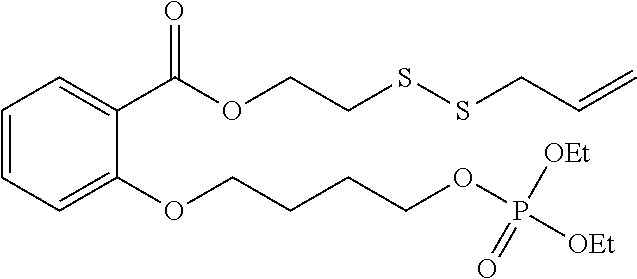 |
 |
 |
 |
 |
 |
 |
 |
 |
 |
 |
 |
 |
 |
 |
 |
 |
 |
 |
 |
 |
 |
 |
 |
 |
 |
 |
 |
 |
 |
 |
 |
 |
 |
 |
 |
 |
 |
 |
 |
 |
 |
 |
 |
 |

—OSO2R2, —OSO2OR2, —OB(OR2)2, halo, an H2S releasing moiety, or an NO releasing moiety. Each member may be combined with each other member to form additional sub-groups, e.g., —OP(O)(OEt)2, —OSO2R2, —OSO2OR2, and an NO releasing moiety; —OP(O)(OEt)2, an H2S releasing moiety, and an NO releasing moiety; and

—OSO2R2, —OSO2OR2, and —OB(OR2)2.

—OSO2R2, —OSO2OR2, —OB(OR2)2, halo, an H2S releasing moiety, or an NO releasing moiety. Each of the above embodiments may be combined with each and every element of R and X. For example, in the embodiment wherein R is an NSAID such as ibuprofen and X is —(CH2)2—S—S—(CH2)2—, Y may be —OP(O)(OEt)2 (or any other chemical moiety within the element of Y).

Uses of the Derivatives


| TABLE 2 |
| IC50 (μM) values at 24 h for cell growth inhibition in different cancer cell lines |
| Breast | Pancreas |
| Colon | MDA MB | MIAPa | Lung | Prostate | Leukemia |
| Agent | HT-29 | HCT 15 | SW480 | 231 | SKBR3 | MCF-7 | Ca2 | BxPC3 | A549 | LNCAP | Jurkat |
| ASA | >5000 in all cell lines |
| POSH- | 0.082 ± | 0.075 ± | 0.092 ± | 0.180 ± | 0.098 ± | 0.242 ± | 0.082 ± | 0.075 ± | 0.083 ± | 0.075 ± | 0.22 ± |
| ASA | 0.006 | 0.004 | 0.005 | 0.007 | 0.004 | 0.018 | 0.008 | 0.005 | 0.008 | 0.005 | 0.007 |
| Enhanced | >60,000 | >65,000 | >50,000 | >25,000 | >50,000 | >20,000 | >60,000 | >65,000 | >60,000 | >65,000 | >20,000 |
| Potency | |||||||||||
| NAP | 2800 ± | 2950 ± | 3110 ± | 2900 ± | 2890 ± | 2100 ± | 3200 ± | 2600 ± | 2650 ± | 2990 ± | 2385 ± |
| 165 | 215 | 185 | 225 | 147 | 200 | 195 | 85 | 110 | 175 | 177 | |
| POSH- | 0.15 ± | 0.12 ± | 0.18 ± | 0.15 ± | 0.13 ± | 0.19 ± | 0.088 ± | 0.10 ± | 0.16 ± | 0.13 ± | 0.17 ± |
| NAP | 0.01 | 0.008 | 0.007 | 0.01 | 0.007 | 0.008 | 0.009 | 0.02 | 0.01 | 0.02 | 0.01 |
| Enhanced | ~18,000 | ~24,000 | ~17,000 | ~19,000 | ~22,000 | ~11,000 | ~36,000 | ~26,000 | ~16,000 | ~25,000 | ~14,000 |
| Potency | |||||||||||
| Colon, breast, pancreas, lung, prostate, and leukemia cancer cell lines were treated with various concentrations of POSH-aspirin (POSH-ASA), or POSH-naproxen (POSH-NAP) and their traditional counterparts. Cell numbers were determined at 24 h from which IC50 values were calculated. The ratios of NSAID/POSH-NSAID represent fold-enhancement in potency of the POSH-NSAID over the parent compound. Results are mean ± SEM of three independent determinations. In all cell lines and for all POSH-NSAIDs P < 0.001 compared to the respective parent NSAID. | |||||||||||
Claims (12)
R—X—Y (I)


R—X—Y (I)

R—X—Y (I)


R—X—Y (I)

R—X—Y (I)


R—X—Y (I)


R—X—Y (I)
R—X—Y (I)


Priority Applications (1)
| Application Number | Priority Date | Filing Date | Title |
|---|---|---|---|
| US14/766,258 US10023555B2 (en) | 2013-02-07 | 2014-02-07 | NSAIDs derivatives and uses thereof |
Applications Claiming Priority (3)
| Application Number | Priority Date | Filing Date | Title |
|---|---|---|---|
| US201361761848P | 2013-02-07 | 2013-02-07 | |
| US14/766,258 US10023555B2 (en) | 2013-02-07 | 2014-02-07 | NSAIDs derivatives and uses thereof |
| PCT/US2014/015222 WO2014124208A1 (en) | 2013-02-07 | 2014-02-07 | NSAIDs DERIVATIVES AND USES THEREOF |
Publications (2)
| Publication Number | Publication Date |
|---|---|
| US20150376162A1 US20150376162A1 (en) | 2015-12-31 |
| US10023555B2 true US10023555B2 (en) | 2018-07-17 |
Family
ID=51300141
Family Applications (1)
| Application Number | Title | Priority Date | Filing Date |
|---|---|---|---|
| US14/766,258 Active 2034-04-28 US10023555B2 (en) | 2013-02-07 | 2014-02-07 | NSAIDs derivatives and uses thereof |
Country Status (5)
| Country | Link |
|---|---|
| US (1) | US10023555B2 (en) |
| EP (1) | EP2953627A4 (en) |
| AU (1) | AU2014214824B2 (en) |
| CA (1) | CA2900520A1 (en) |
| WO (1) | WO2014124208A1 (en) |
Families Citing this family (3)
| Publication number | Priority date | Publication date | Assignee | Title |
|---|---|---|---|---|
| US10725055B1 (en) | 2016-04-15 | 2020-07-28 | University Of Oregon | Compounds for carbonyl sulfide/carbon disulfide/hydrogen sulfide release and methods of making and using the same |
| US11236334B2 (en) * | 2017-08-22 | 2022-02-01 | National University Corporation Nagoya University | Modified polynucleotide |
| CN109998993A (en) * | 2019-04-22 | 2019-07-12 | 西南交通大学 | Drug-carrying polymer micelle and its preparation method and application for treating cardiovascular disease |
Citations (6)
| Publication number | Priority date | Publication date | Assignee | Title |
|---|---|---|---|---|
| US6482811B1 (en) | 1999-01-08 | 2002-11-19 | Marvin B. Bacaner | Bretylium compositions and kits, and their use in preventing and treating cardio-vascular conditions |
| US20050182134A1 (en) | 2003-12-31 | 2005-08-18 | Khosrow Kashfi | Compounds and compositions for treating dysproliferative diseases, and methods of use thereof |
| US20060046967A1 (en) | 2004-08-26 | 2006-03-02 | Apparao Satyam | Prodrugs containing novel bio-cleavable linkers |
| US20090099137A1 (en) | 2007-08-10 | 2009-04-16 | Basil Rigas | Anti-Inflammatory Compounds and Uses Thereof |
| WO2011130486A2 (en) | 2010-04-16 | 2011-10-20 | The Research Foundation Of State University Of New York | Combination treatments and formulations for cancer |
| US20130225529A1 (en) * | 2012-02-27 | 2013-08-29 | Basil Rigas | Phospho-ester derivatives and uses thereof |
-
2014
- 2014-02-07 US US14/766,258 patent/US10023555B2/en active Active
- 2014-02-07 AU AU2014214824A patent/AU2014214824B2/en not_active Expired - Fee Related
- 2014-02-07 CA CA2900520A patent/CA2900520A1/en not_active Abandoned
- 2014-02-07 WO PCT/US2014/015222 patent/WO2014124208A1/en not_active Ceased
- 2014-02-07 EP EP14748566.8A patent/EP2953627A4/en not_active Withdrawn
Patent Citations (7)
| Publication number | Priority date | Publication date | Assignee | Title |
|---|---|---|---|---|
| US6482811B1 (en) | 1999-01-08 | 2002-11-19 | Marvin B. Bacaner | Bretylium compositions and kits, and their use in preventing and treating cardio-vascular conditions |
| US20050182134A1 (en) | 2003-12-31 | 2005-08-18 | Khosrow Kashfi | Compounds and compositions for treating dysproliferative diseases, and methods of use thereof |
| US20060046967A1 (en) | 2004-08-26 | 2006-03-02 | Apparao Satyam | Prodrugs containing novel bio-cleavable linkers |
| US20060205674A2 (en) * | 2004-08-26 | 2006-09-14 | Nicholas Piramal India Ltd. | Prodrugs containing novel bio-cleavable linkers |
| US20090099137A1 (en) | 2007-08-10 | 2009-04-16 | Basil Rigas | Anti-Inflammatory Compounds and Uses Thereof |
| WO2011130486A2 (en) | 2010-04-16 | 2011-10-20 | The Research Foundation Of State University Of New York | Combination treatments and formulations for cancer |
| US20130225529A1 (en) * | 2012-02-27 | 2013-08-29 | Basil Rigas | Phospho-ester derivatives and uses thereof |
Non-Patent Citations (5)
| Title |
|---|
| Azema et al., "Cell Permeation of a Trypanosoma Brucei Aldolase Inhibitor: Evaluation of Different Enzyme-Labile Phosphate Protecting Groups", Bioorganic & Medicinal Chemistry Letters 16(13), 3440-3443 (2006). |
| International Search Report for corresponding PCT Application No. PCT/US2014/015222, pp. 1-3 (dated Jul. 18, 2014). |
| Nemmai et al., "NO-NSAIDs: Gastric-Sparing Nitric Oxide-Releasable Prodrugs of Non-Steroidal Anti-Inflammatory Drugs", Bioorganic & Medicinal Chemistry Letters, 19(18), 5297-5301 (2009). |
| Ohsako et al. "Modeling of Controlled Release of Aspirin Derivatives from Human Erythrocytes" Biological and Pharmaceutical Bulletin, 1995, vol. 18, No. 2, pp. 310-314. * |
| Supplemental Partial European Search Report for corresponding European Patent Application No. EP14748566, dated Oct. 28, 2015, pp. 1-7. |
Also Published As
| Publication number | Publication date |
|---|---|
| AU2014214824A1 (en) | 2015-08-27 |
| EP2953627A1 (en) | 2015-12-16 |
| WO2014124208A1 (en) | 2014-08-14 |
| CA2900520A1 (en) | 2014-08-14 |
| AU2014214824B2 (en) | 2018-11-22 |
| US20150376162A1 (en) | 2015-12-31 |
| EP2953627A4 (en) | 2017-03-29 |
Similar Documents
| Publication | Publication Date | Title |
|---|---|---|
| US11116767B2 (en) | 3,5-disubstituted pyrazoles useful as checkpoint kinase 1 (Chk1) inhibitors, and their preparations and applications | |
| ES2750199T3 (en) | Cancer treatment methods | |
| US10450260B2 (en) | NO- and H2S-releasing compounds | |
| US7629368B2 (en) | Nitroderivatives as drugs for diseases having an inflammatory basis | |
| US20070179143A1 (en) | Tricyclic derivatives or pharmaceutically acceptable salts thereof, their preparations and pharmaceutical compositions containing them | |
| US7994357B2 (en) | Cinamic compounds and derivatives therefrom for the inhibition of histone deacetylase | |
| US10023555B2 (en) | NSAIDs derivatives and uses thereof | |
| US11046715B2 (en) | Boronic derivatives of hydroxamates as anticancer agents | |
| JP2021522327A (en) | Oxadiazolopyrazine and oxadiazolopyridine useful as mitochondrial deconjugation agents | |
| WO1998022442A2 (en) | Pharmaceutical compositions comprising diaryl-cyclomethylenpyrazole compounds and their use as cyclooxygenase i (cox 1) inhibitors | |
| EP2847158A1 (en) | Compositions and methods for treatment of neuromuscular disorders and neurodegenerative disorders | |
| JP2024122966A (en) | Aromatic compounds and their medicinal uses | |
| JP2009191041A (en) | Hydroxymethyl ketone derivative | |
| KR101360579B1 (en) | New Phenyl Acetate Derivatives | |
| US9428447B2 (en) | Bis-(aryl/heteroaryl)-methylene compounds, pharmaceutical compositions containing same and their use for treating cancer | |
| GB2610815A (en) | Compounds | |
| US9522909B2 (en) | Thiazolidinedione derivatives, preparation thereof and use thereof in cancer treatment | |
| WO2021026257A1 (en) | Prodrugs of alox-15 inhibitors and methods of using the same | |
| HK1213771B (en) | Methods of treating cancer | |
| WO2012080555A1 (en) | Hydroxytyrosol ethers |
Legal Events
| Date | Code | Title | Description |
|---|---|---|---|
| AS | Assignment |
Owner name: RESEARCH FOUNDATION OF THE CITY UNIVERSITY OF NEW Free format text: ASSIGNMENT OF ASSIGNORS INTEREST;ASSIGNORS:KASHFI, KHOSROW;CHATTOPADHYAY, MITALI;KODELA, RAVINDER;SIGNING DATES FROM 20150902 TO 20150903;REEL/FRAME:036544/0682 |
|
| STCF | Information on status: patent grant |
Free format text: PATENTED CASE |
|
| FEPP | Fee payment procedure |
Free format text: MAINTENANCE FEE REMINDER MAILED (ORIGINAL EVENT CODE: REM.); ENTITY STATUS OF PATENT OWNER: SMALL ENTITY |
|
| FEPP | Fee payment procedure |
Free format text: SURCHARGE FOR LATE PAYMENT, SMALL ENTITY (ORIGINAL EVENT CODE: M2554); ENTITY STATUS OF PATENT OWNER: SMALL ENTITY |
|
| MAFP | Maintenance fee payment |
Free format text: PAYMENT OF MAINTENANCE FEE, 4TH YR, SMALL ENTITY (ORIGINAL EVENT CODE: M2551); ENTITY STATUS OF PATENT OWNER: SMALL ENTITY Year of fee payment: 4 |
|
| MAFP | Maintenance fee payment |
Free format text: PAYMENT OF MAINTENANCE FEE, 8TH YR, SMALL ENTITY (ORIGINAL EVENT CODE: M2552); ENTITY STATUS OF PATENT OWNER: SMALL ENTITY Year of fee payment: 8 |