US10021237B1 - Isolating connector module for ruggedized mobile device - Google Patents
Isolating connector module for ruggedized mobile device Download PDFInfo
- Publication number
- US10021237B1 US10021237B1 US15/422,239 US201715422239A US10021237B1 US 10021237 B1 US10021237 B1 US 10021237B1 US 201715422239 A US201715422239 A US 201715422239A US 10021237 B1 US10021237 B1 US 10021237B1
- Authority
- US
- United States
- Prior art keywords
- connector
- housing
- mobile device
- physical
- coupled
- Prior art date
- Legal status (The legal status is an assumption and is not a legal conclusion. Google has not performed a legal analysis and makes no representation as to the accuracy of the status listed.)
- Active, expires
Links
Images




Classifications
-
- H04M1/7253—
-
- H—ELECTRICITY
- H04—ELECTRIC COMMUNICATION TECHNIQUE
- H04B—TRANSMISSION
- H04B1/00—Details of transmission systems, not covered by a single one of groups H04B3/00 - H04B13/00; Details of transmission systems not characterised by the medium used for transmission
- H04B1/38—Transceivers, i.e. devices in which transmitter and receiver form a structural unit and in which at least one part is used for functions of transmitting and receiving
- H04B1/3827—Portable transceivers
- H04B1/3877—Arrangements for enabling portable transceivers to be used in a fixed position, e.g. cradles or boosters
-
- H—ELECTRICITY
- H04—ELECTRIC COMMUNICATION TECHNIQUE
- H04B—TRANSMISSION
- H04B1/00—Details of transmission systems, not covered by a single one of groups H04B3/00 - H04B13/00; Details of transmission systems not characterised by the medium used for transmission
- H04B1/38—Transceivers, i.e. devices in which transmitter and receiver form a structural unit and in which at least one part is used for functions of transmitting and receiving
- H04B1/3827—Portable transceivers
- H04B1/3888—Arrangements for carrying or protecting transceivers
-
- H—ELECTRICITY
- H04—ELECTRIC COMMUNICATION TECHNIQUE
- H04M—TELEPHONIC COMMUNICATION
- H04M1/00—Substation equipment, e.g. for use by subscribers
- H04M1/02—Constructional features of telephone sets
- H04M1/04—Supports for telephone transmitters or receivers
-
- H—ELECTRICITY
- H04—ELECTRIC COMMUNICATION TECHNIQUE
- H04M—TELEPHONIC COMMUNICATION
- H04M1/00—Substation equipment, e.g. for use by subscribers
- H04M1/02—Constructional features of telephone sets
- H04M1/18—Telephone sets specially adapted for use in ships, mines, or other places exposed to adverse environment
- H04M1/185—Improving the shock resistance of the housing, e.g. by increasing the rigidity
-
- H—ELECTRICITY
- H04—ELECTRIC COMMUNICATION TECHNIQUE
- H04M—TELEPHONIC COMMUNICATION
- H04M2250/00—Details of telephonic subscriber devices
- H04M2250/02—Details of telephonic subscriber devices including a Bluetooth® interface
Definitions
- Mobile communications devices such as tablets or smartphones, may be mounted to a dashboard or other interior surface of a vehicle for hands-free use, in the sense that a user may use the device (e.g., via a touchscreen) without the need to manually support the device.
- the vehicle interior may be subject to significant vibrations and shocks. While vibrations, e.g., while the vehicle is idling, may make it difficult for the user to make accurate contact with a desired portion of the touchscreen.
- the mobile device is connected to a network via a cable, port, or other physical link, the sustained vibrations and shocks may dislodge the link from its port or even damage both the link and the port.
- inventions of the inventive concepts disclosed herein are directed to an isolating connector module for securely connecting a ruggedized mobile communications device to a vehicle-based network.
- the connector module may include a USB or similar physical connector enclosed in a housing, the USB connector couplable to a corresponding USB port of the mobile device.
- the connector module may include a hinged panel for securing the USB connector to the USB port by attaching to an external housing of the ruggedized mobile device.
- the connector module may include an impact absorber having an annular shape and fashioned from a flexible material, for positioning between the connector module and the vehicle mount to isolate the connector module from shocks or vibrations conducted through the vehicle mount.
- inventions of the inventive concepts disclosed herein are directed to a system including a ruggedized mobile communications device and an isolating connector module for securely connecting the mobile device to a vehicle-based network.
- the mobile device may have a substantially rectangular shape, with edges, corners, and a front and rear face.
- the mobile device may be ruggedized via a rigid housing configured to enclose and reinforce the corners of the device, the rigid housing including a support bracket for supporting the mobile device via its bottom edge and pivotably connected to a mounting plate of a vehicle mount by which the device is mounted to a vehicle dashboard.
- the rigid housing may be partially enclosed in a flexible housing for reinforcing the edges of the mobile device.
- the system may include a connector module connectable to the rigid housing and including a USB or similar physical connector connectable to a USB port of the mobile device.
- the connector module may include a hinged panel for securing the USB connector to the USB port by attaching to the rigid housing of the ruggedized mobile device.
- the connector module may include an impact absorber having an annular shape and fashioned from a flexible material, for positioning between the connector module and the vehicle mount to isolate the connector module from shocks or vibrations conducted through the vehicle mount.
- FIG. 1 is a front three-quarter view of an exemplary embodiment of an apparatus for connecting a mobile device according to embodiments of the inventive concepts disclosed herein, the apparatus in a closed state;
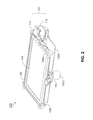
- FIG. 2 is a front three-quarter view of the apparatus of FIG. 1 in an open state
- FIG. 3 is an overhead view of the apparatus of FIG. 1 ;
- FIG. 4 is an overhead view of the apparatus of FIG. 2 ;
- FIG. 5 is an underside view of the apparatus of FIG. 1 .
- Embodiments of the inventive concepts disclosed herein are directed to an apparatus for connecting a mobile device such as a tablet, smartphone, or any other similar mobile communications or computing device to a vehicle-based network and protecting the connection and its related hardware components from vehicle-related shock and vibration.
- a system 100 may comprise a connector module 102 couplable to a mobile device 104 , such as a tablet or smartphone.
- the mobile device 104 may in turn be mounted to a vehicle (e.g., to a dashboard or other like interior surface of the vehicle, for use while inside the vehicle) via a vehicle mount 106 .
- the mobile device 104 may be ruggedized for heavy-duty use; for example, the mobile device may be enclosed in a multipart protective housing to guard against impact shock or damage to the mobile device, its touchscreen, or its components and peripherals from extreme temperatures or precipitation.
- the protective housing ( 108 ) may include a rigid component ( 108 a ) fashioned of a high-impact plastic or similar rigid material and reinforced around the corners of the mobile device.
- the rigid component 108 a may further include a support bracket ( 108 b ) for supporting the mobile device 104 by an edge while the mobile device is mounted to the vehicle interior (via the vehicle mount 106 ).
- the support bracket 108 b may further function as a handle, by which the user may direct the system 100 toward, or away from, him/herself by articulating the system 100 (provided the vehicle mount 106 is pivotably mounted to the dashboard, e.g., via a ball mount 106 a ).
- the housing 108 may include a flexible component 108 c , fashioned from a rubberized, plastic, or otherwise flexible material configured for gripping by the user.
- the flexible component 108 c may partially or fully protect the edges of the mobile device 104 , partially enclosing the rigid component 108 a.
- the vehicle mount 106 may include a mounting plate 106 b to which the support bracket 108 b and rigid component 108 a (or the housing 108 generally) may be attached. As the mounting plate 106 b , and the vehicle mount 106 generally, may be directly connected to the dashboard (via the ball mount 106 a ), the shock of any impact upon the vehicle (e.g., uneven roads or potholes) as well as vibrations associated with the operation of the vehicle may be conducted by the vehicle mount to the mobile device 104 .
- the shock of any impact upon the vehicle e.g., uneven roads or potholes
- vibrations associated with the operation of the vehicle may be conducted by the vehicle mount to the mobile device 104 .
- the mobile device 104 may establish a wireless link to a fleet-wide network based on Bluetooth or another wireless protocol (e.g., to a stronger wireless receiver located within the vehicle); if the mobile device 104 is not itself Bluetooth-compatible, the wireless link may require an external adapter connected to the mobile device via, for example, a USB port of the mobile device 104 .
- the network link may be a physical link established via the USB port. Shock and vibration may dislodge a USB-connected device from the USB port, and may even damage one or both of the USB connector and its corresponding port in the mobile device 104 .
- the connector module 102 may include a USB connector ( 110 ) encased in a protective module housing 112 .
- the module housing 112 may additionally enclose a wireless connector, such as a Bluetooth adapter, for establishing a wireless link to a mobile device 104 connected to the connector module 102 via the USB connector 110 .
- the module housing 112 may include a protective panel ( 114 ) that serves as an access door to the USB connector 110 .
- the protective panel 114 may be hinged so as to swing open or closed, the USB connector 110 being visible while the connector module 102 is in the open state.
- the USB connector 110 plugged into the corresponding USB port of the mobile device 104 , may be secured in place by closing the protective panel 114 .
- the protective panel may engage with the housing 108 of the mobile device 104 to hold the USB connector 110 in place; for example, the rigid component 108 a may include a recess ( 108 d ) configured to accept the protective panel 114 .
- the user In order to disengage the USB connector 110 from the corresponding USB port, the user must first unbuckle the protective panel 114 from the housing 108 of the mobile device 104 .
- the connector module 102 may include an impact absorber 116 .
- the impact absorber 116 may be a flexible and pliable component including multiple layers folded over themselves and positioned between the module housing 112 and the mounting plate 106 b .
- the impact absorber 116 may be configured to isolate the connector module 102 from vibrations or shocks conducted by the mounting plate 106 b by deforming in response to the vibrations or shocks.
- the impact absorber may have a substantially annular shape, comprising a ring or open-ended cylinder of rubber, or a synthetic rubberized material, having a Shore hardness between 40 A and 70 A.
- the impact absorber 116 is fashioned of material having a Shore hardness of 60 A.
- the connector module 102 may be removably attached to the housing 108 of the mobile device 104 .
- the rigid component 108 a may include an insertion slot ( 108 e ) with which the module housing 112 may slidably engage ( 112 a ) to attach or detach the connector module 102 from the housing 108 .
Landscapes
- Engineering & Computer Science (AREA)
- Signal Processing (AREA)
- Computer Networks & Wireless Communication (AREA)
- Casings For Electric Apparatus (AREA)
- Telephone Set Structure (AREA)
Abstract
An apparatus for connecting a mobile device to a vehicle-based network includes a USB or similar accessory connector enclosed in a protective housing. The connector housing may include a Bluetooth or similar wireless connector for establishing a wireless link between the mobile device and the vehicle-based network via the USB port. The connector housing may include a hinged panel allowing access to the USB connector while open, and securing the USB connector to a USB port of the mobile device while closed. The connector housing may include a flexible impact absorber for isolating the connector from shocks or vibrations conducted by the vehicle mount by which the mobile device is mounted to a dashboard or interior surface of the vehicle.
Description
The instant application claims priority under 35 U.S.C. § 119(e) to provisional U.S. patent application Ser. No. 62/289,822, filed on Feb. 1, 2016. Said provisional U.S. patent application Ser. No. 62/289,822 is herein incorporated by reference in its entirety.
Mobile communications devices, such as tablets or smartphones, may be mounted to a dashboard or other interior surface of a vehicle for hands-free use, in the sense that a user may use the device (e.g., via a touchscreen) without the need to manually support the device. However, the vehicle interior may be subject to significant vibrations and shocks. While vibrations, e.g., while the vehicle is idling, may make it difficult for the user to make accurate contact with a desired portion of the touchscreen. Furthermore, if the mobile device is connected to a network via a cable, port, or other physical link, the sustained vibrations and shocks may dislodge the link from its port or even damage both the link and the port.
In a first aspect, embodiments of the inventive concepts disclosed herein are directed to an isolating connector module for securely connecting a ruggedized mobile communications device to a vehicle-based network. The connector module may include a USB or similar physical connector enclosed in a housing, the USB connector couplable to a corresponding USB port of the mobile device. The connector module may include a hinged panel for securing the USB connector to the USB port by attaching to an external housing of the ruggedized mobile device. The connector module may include an impact absorber having an annular shape and fashioned from a flexible material, for positioning between the connector module and the vehicle mount to isolate the connector module from shocks or vibrations conducted through the vehicle mount.
In a further aspect, embodiments of the inventive concepts disclosed herein are directed to a system including a ruggedized mobile communications device and an isolating connector module for securely connecting the mobile device to a vehicle-based network. The mobile device may have a substantially rectangular shape, with edges, corners, and a front and rear face. The mobile device may be ruggedized via a rigid housing configured to enclose and reinforce the corners of the device, the rigid housing including a support bracket for supporting the mobile device via its bottom edge and pivotably connected to a mounting plate of a vehicle mount by which the device is mounted to a vehicle dashboard. The rigid housing may be partially enclosed in a flexible housing for reinforcing the edges of the mobile device. The system may include a connector module connectable to the rigid housing and including a USB or similar physical connector connectable to a USB port of the mobile device. The connector module may include a hinged panel for securing the USB connector to the USB port by attaching to the rigid housing of the ruggedized mobile device. The connector module may include an impact absorber having an annular shape and fashioned from a flexible material, for positioning between the connector module and the vehicle mount to isolate the connector module from shocks or vibrations conducted through the vehicle mount.
Implementations of the inventive concepts disclosed herein may be better understood when consideration is given to the following detailed description thereof. Such description makes reference to the included drawings, which are not necessarily to scale, and in which some features may be exaggerated and some features may be omitted or may be represented schematically in the interest of clarity. Like reference numerals in the drawings may represent and refer to the same or similar element, feature, or function. In the drawings:
Embodiments of the inventive concepts disclosed herein are directed to an apparatus for connecting a mobile device such as a tablet, smartphone, or any other similar mobile communications or computing device to a vehicle-based network and protecting the connection and its related hardware components from vehicle-related shock and vibration.
Referring to FIGS. 1 and 3 , a system 100 according to the inventive concepts disclosed herein may comprise a connector module 102 couplable to a mobile device 104, such as a tablet or smartphone. The mobile device 104 may in turn be mounted to a vehicle (e.g., to a dashboard or other like interior surface of the vehicle, for use while inside the vehicle) via a vehicle mount 106. The mobile device 104 may be ruggedized for heavy-duty use; for example, the mobile device may be enclosed in a multipart protective housing to guard against impact shock or damage to the mobile device, its touchscreen, or its components and peripherals from extreme temperatures or precipitation. The protective housing (108) may include a rigid component (108 a) fashioned of a high-impact plastic or similar rigid material and reinforced around the corners of the mobile device. The rigid component 108 a may further include a support bracket (108 b) for supporting the mobile device 104 by an edge while the mobile device is mounted to the vehicle interior (via the vehicle mount 106). The support bracket 108 b may further function as a handle, by which the user may direct the system 100 toward, or away from, him/herself by articulating the system 100 (provided the vehicle mount 106 is pivotably mounted to the dashboard, e.g., via a ball mount 106 a). The housing 108 may include a flexible component 108 c, fashioned from a rubberized, plastic, or otherwise flexible material configured for gripping by the user. For example, the flexible component 108 c may partially or fully protect the edges of the mobile device 104, partially enclosing the rigid component 108 a.
The vehicle mount 106 may include a mounting plate 106 b to which the support bracket 108 b and rigid component 108 a (or the housing 108 generally) may be attached. As the mounting plate 106 b, and the vehicle mount 106 generally, may be directly connected to the dashboard (via the ball mount 106 a), the shock of any impact upon the vehicle (e.g., uneven roads or potholes) as well as vibrations associated with the operation of the vehicle may be conducted by the vehicle mount to the mobile device 104. For example, the mobile device 104 may establish a wireless link to a fleet-wide network based on Bluetooth or another wireless protocol (e.g., to a stronger wireless receiver located within the vehicle); if the mobile device 104 is not itself Bluetooth-compatible, the wireless link may require an external adapter connected to the mobile device via, for example, a USB port of the mobile device 104. Alternatively, the network link may be a physical link established via the USB port. Shock and vibration may dislodge a USB-connected device from the USB port, and may even damage one or both of the USB connector and its corresponding port in the mobile device 104.
Referring also to FIGS. 2 and 4 , the connector module 102 may include a USB connector (110) encased in a protective module housing 112. The module housing 112 may additionally enclose a wireless connector, such as a Bluetooth adapter, for establishing a wireless link to a mobile device 104 connected to the connector module 102 via the USB connector 110. The module housing 112 may include a protective panel (114) that serves as an access door to the USB connector 110. The protective panel 114 may be hinged so as to swing open or closed, the USB connector 110 being visible while the connector module 102 is in the open state. The USB connector 110, plugged into the corresponding USB port of the mobile device 104, may be secured in place by closing the protective panel 114. Referring particularly to FIG. 3 , the protective panel may engage with the housing 108 of the mobile device 104 to hold the USB connector 110 in place; for example, the rigid component 108 a may include a recess (108 d) configured to accept the protective panel 114. In order to disengage the USB connector 110 from the corresponding USB port, the user must first unbuckle the protective panel 114 from the housing 108 of the mobile device 104.
Referring back to FIGS. 1 and 2 , the connector module 102 may include an impact absorber 116. The impact absorber 116 may be a flexible and pliable component including multiple layers folded over themselves and positioned between the module housing 112 and the mounting plate 106 b. The impact absorber 116 may be configured to isolate the connector module 102 from vibrations or shocks conducted by the mounting plate 106 b by deforming in response to the vibrations or shocks. The impact absorber may have a substantially annular shape, comprising a ring or open-ended cylinder of rubber, or a synthetic rubberized material, having a Shore hardness between 40 A and 70 A. In a preferred embodiment, the impact absorber 116 is fashioned of material having a Shore hardness of 60 A.
Referring to FIG. 5 , the connector module 102 may be removably attached to the housing 108 of the mobile device 104. For example, the rigid component 108 a may include an insertion slot (108 e) with which the module housing 112 may slidably engage (112 a) to attach or detach the connector module 102 from the housing 108.
Claims (14)
1. An apparatus for connecting a mobile device, comprising:
a physical connector enclosed in a connector housing, the physical connector couplable to a corresponding accessory port of a mobile communications device and the connector housing configured to slidably engage with a protective housing at least partially enclosing the mobile communications device;
a protective panel hingedly coupled to the connector housing and having an open state and a closed state, the protective panel configured to secure the physical connector to the accessory port in the closed state by engaging with at least one of the mobile communications device and the protective housing; and
at least one impact absorber coupled to the connector housing, the impact absorber fashioned of a flexible material and having an annular shape, the impact absorber configured to be positioned between the connector housing and a surface coupled to the mobile communications device and configured to isolate at least one of the physical connector and the connector housing from shock by deforming.
2. The apparatus of claim 1 , wherein the at least one impact absorber is fashioned of a flexible material having a Shore hardness of no less than 40 A and no more than 70 A.
3. The apparatus of claim 2 , wherein the flexible material has a Shore hardness of 60 A.
4. The apparatus of claim 1 , further comprising:
a wireless connector coupled to the physical connector, the wireless connector associated with at least one wireless protocol and configured to connect the mobile communications device to at least one network via the physical connector and the at least one wireless protocol.
5. The apparatus of claim 4 , wherein the at least one wireless protocol includes Bluetooth.
6. A system for protecting a connected, ruggedized mobile device, comprising:
a mobile communications device having one or more edges, one or more corners, a front face, and a rear face;
a first housing configured to at least partially enclose the at least one corner, the first housing fashioned of a first material and including at least one bracket configured to support the mobile communication device by an edge of the one or more edges, the bracket removably coupled to a mounting plate, the mounting plate pivotably coupled to an interior surface of a vehicle via a ball mount;
a second housing fashioned of a second material, the second housing configured to at least partially enclose the first housing and the one or more edges;
at least one connector module removably coupled to the first housing, the connector module comprising:
a physical connector enclosed in a third housing, the physical connector couplable to a corresponding accessory port of the one or more edges;
a protective panel hingedly coupled to the third housing, the protective panel configured to secure the physical connector to the accessory port; and
at least one impact absorber having an annular shape, the impact absorber configured to be positioned between the third housing and a surface coupled to the mobile communications device and to isolate at least one of the physical connector and the third housing from shock by deforming.
7. The system of claim 6 , wherein the at least one impact absorber is fashioned of rubber having a Shore hardness between 40 A and 70 A.
8. The system of claim 7 , wherein the flexible material has a Shore hardness of 60 A.
9. The system of claim 6 , wherein the first material is a rigid material and the second material is a flexible material.
10. The system of claim 6 , wherein the physical connector includes a USB connector and the accessory port includes a USB port.
11. The system of claim 6 , wherein the connector module further comprises:
a wireless connector coupled to the physical connector, the wireless connector configured to connect the mobile device to at least one network via the physical connector.
12. The system of claim 11 , wherein the wireless connector includes a Bluetooth connector.
13. The system of claim 6 , wherein the connector module is configured to slidably engage with the first housing.
14. The system of claim 6 , wherein the protective panel has an open state and a closed state, the protective panel configured to secure the physical connector to the accessory port by engaging with one or more of the first housing and the second housing.
Priority Applications (6)
| Application Number | Priority Date | Filing Date | Title |
|---|---|---|---|
| US15/422,239 US10021237B1 (en) | 2016-02-01 | 2017-02-01 | Isolating connector module for ruggedized mobile device |
| US16/029,128 US10355731B1 (en) | 2016-02-01 | 2018-07-06 | Isolating connector module for ruggedized mobile device |
| US16/511,740 US11031968B1 (en) | 2016-02-01 | 2019-07-15 | Modular customizable ruggedized protective case for mobile device |
| US17/325,686 US11456769B1 (en) | 2016-02-01 | 2021-05-20 | Modular customizable ruggedized protective case for mobile device |
| US17/325,621 US11552668B1 (en) | 2016-02-01 | 2021-05-20 | Modular customizable ruggedized protective case for mobile device |
| US18/094,844 US12451919B2 (en) | 2016-02-01 | 2023-01-09 | Modular customizable ruggedized protective case with detachable sidewall for mobile device |
Applications Claiming Priority (2)
| Application Number | Priority Date | Filing Date | Title |
|---|---|---|---|
| US201662289822P | 2016-02-01 | 2016-02-01 | |
| US15/422,239 US10021237B1 (en) | 2016-02-01 | 2017-02-01 | Isolating connector module for ruggedized mobile device |
Related Child Applications (1)
| Application Number | Title | Priority Date | Filing Date |
|---|---|---|---|
| US16/029,128 Continuation-In-Part US10355731B1 (en) | 2016-02-01 | 2018-07-06 | Isolating connector module for ruggedized mobile device |
Publications (1)
| Publication Number | Publication Date |
|---|---|
| US10021237B1 true US10021237B1 (en) | 2018-07-10 |
Family
ID=62750268
Family Applications (1)
| Application Number | Title | Priority Date | Filing Date |
|---|---|---|---|
| US15/422,239 Active 2037-02-12 US10021237B1 (en) | 2016-02-01 | 2017-02-01 | Isolating connector module for ruggedized mobile device |
Country Status (1)
| Country | Link |
|---|---|
| US (1) | US10021237B1 (en) |
Cited By (1)
| Publication number | Priority date | Publication date | Assignee | Title |
|---|---|---|---|---|
| US20220109318A1 (en) * | 2019-06-19 | 2022-04-07 | Guangdong Oppo Mobile Telecommunications Corp., Ltd. | Charging circuit, charging chip, mobile terminal, and charging system |
Citations (3)
| Publication number | Priority date | Publication date | Assignee | Title |
|---|---|---|---|---|
| US7249978B1 (en) * | 2005-10-24 | 2007-07-31 | Super Talent Electronics, Inc. | Reduced-length, low-profile USB device and card-like carrier |
| US20140152890A1 (en) * | 2012-06-01 | 2014-06-05 | Treefrog Developments, Inc. | Housing for encasing an object having a thin profile |
| US20150201723A1 (en) * | 2013-02-01 | 2015-07-23 | Treefrog Developments, Inc. | Encasements for an electronic device having a biometric scanner |
-
2017
- 2017-02-01 US US15/422,239 patent/US10021237B1/en active Active
Patent Citations (3)
| Publication number | Priority date | Publication date | Assignee | Title |
|---|---|---|---|---|
| US7249978B1 (en) * | 2005-10-24 | 2007-07-31 | Super Talent Electronics, Inc. | Reduced-length, low-profile USB device and card-like carrier |
| US20140152890A1 (en) * | 2012-06-01 | 2014-06-05 | Treefrog Developments, Inc. | Housing for encasing an object having a thin profile |
| US20150201723A1 (en) * | 2013-02-01 | 2015-07-23 | Treefrog Developments, Inc. | Encasements for an electronic device having a biometric scanner |
Cited By (1)
| Publication number | Priority date | Publication date | Assignee | Title |
|---|---|---|---|---|
| US20220109318A1 (en) * | 2019-06-19 | 2022-04-07 | Guangdong Oppo Mobile Telecommunications Corp., Ltd. | Charging circuit, charging chip, mobile terminal, and charging system |
Similar Documents
| Publication | Publication Date | Title |
|---|---|---|
| US7778023B1 (en) | Docking system for MP3 players and other portable electronic devices | |
| USD873260S1 (en) | Mount for electronic device | |
| US20140226268A1 (en) | Cases for mobile electronic devices for use with auxiliary lenses | |
| KR101601112B1 (en) | Smart phone holder for vehicle | |
| CN104369696B (en) | Vehicle-mounted bracket and vehicle-mounted bracket sound equipment | |
| CN106029447B (en) | Support for attaching a portable device to a vehicle rearview mirror | |
| US20100060532A1 (en) | Vehicle holder with wireless signal enhancement function | |
| US20200363840A1 (en) | Magnetic Keyboard Protective Device Covering | |
| CN104859504A (en) | Vehicle usb port | |
| US20120044429A1 (en) | Digital display device system | |
| KR20190030111A (en) | Smart phone multi holder | |
| US20100170926A1 (en) | Safety arrangement for bicycle apparatus carrier | |
| US10021237B1 (en) | Isolating connector module for ruggedized mobile device | |
| US20150098172A1 (en) | Method and apparatus for securing a handheld electronic device to a dashboard | |
| US20160088134A1 (en) | Customizable compact disposable smartphone vehicle mount for enhancing accessibility, viewing, communications, and safety | |
| US11059428B1 (en) | Bike rack attached to vehicle | |
| US9861001B1 (en) | Ruggedized protective case with extendable easel/kickstand for mobile device | |
| US20230163799A1 (en) | Modular customizable ruggedized protective case with detachable sidewall for mobile device | |
| US10355731B1 (en) | Isolating connector module for ruggedized mobile device | |
| US20080318517A1 (en) | Universal electronic device with hands-free module and/or with gps navigation system and bluetooth module, especially for automobile vehicles | |
| KR20160000276U (en) | Stand structures for vehicle of electronic machinesincluding smartphone | |
| CN203511499U (en) | Vehicle-mounted support and vehicle-mounted support loudspeaker box | |
| US7769163B2 (en) | Electronic device display apparatus | |
| KR200491657Y1 (en) | Exchangeable Cell Phone Case | |
| KR101538785B1 (en) | Smart safety helmet for structure safety test |
Legal Events
| Date | Code | Title | Description |
|---|---|---|---|
| STCF | Information on status: patent grant |
Free format text: PATENTED CASE |
|
| MAFP | Maintenance fee payment |
Free format text: PAYMENT OF MAINTENANCE FEE, 4TH YR, SMALL ENTITY (ORIGINAL EVENT CODE: M2551); ENTITY STATUS OF PATENT OWNER: SMALL ENTITY Year of fee payment: 4 |
|
| FEPP | Fee payment procedure |
Free format text: MAINTENANCE FEE REMINDER MAILED (ORIGINAL EVENT CODE: REM.); ENTITY STATUS OF PATENT OWNER: SMALL ENTITY |