US10019518B2 - Methods and systems relating to ranking functions for multiple domains - Google Patents
Methods and systems relating to ranking functions for multiple domains Download PDFInfo
- Publication number
- US10019518B2 US10019518B2 US12/577,045 US57704509A US10019518B2 US 10019518 B2 US10019518 B2 US 10019518B2 US 57704509 A US57704509 A US 57704509A US 10019518 B2 US10019518 B2 US 10019518B2
- Authority
- US
- United States
- Prior art keywords
- domains
- domain
- ranking functions
- ranking
- search results
- Prior art date
- Legal status (The legal status is an assumption and is not a legal conclusion. Google has not performed a legal analysis and makes no representation as to the accuracy of the status listed.)
- Expired - Fee Related, expires
Links
Images


Classifications
-
- G—PHYSICS
- G06—COMPUTING OR CALCULATING; COUNTING
- G06F—ELECTRIC DIGITAL DATA PROCESSING
- G06F16/00—Information retrieval; Database structures therefor; File system structures therefor
- G06F16/90—Details of database functions independent of the retrieved data types
- G06F16/95—Retrieval from the web
- G06F16/953—Querying, e.g. by the use of web search engines
- G06F16/9538—Presentation of query results
-
- G—PHYSICS
- G06—COMPUTING OR CALCULATING; COUNTING
- G06F—ELECTRIC DIGITAL DATA PROCESSING
- G06F16/00—Information retrieval; Database structures therefor; File system structures therefor
- G06F16/90—Details of database functions independent of the retrieved data types
- G06F16/95—Retrieval from the web
- G06F16/951—Indexing; Web crawling techniques
-
- G06F17/30864—
Definitions
- the subject matter disclosed herein relates to methods and systems relating to ranking functions.
- Databases and data repositories generally are commonly employed to contain a collection of information.
- Communication networks and computing device resources can provide access to the information stored in such data repositories.
- communication networks themselves can become data repositories.
- An example communication network is the “Internet,” which has become ubiquitous as a source of and repository for information.
- the “World Wide Web” (WWW) is a portion of the Internet, and it too continues to grow, with new information effectively being added constantly.
- tools and services are often provided that facilitate the searching of great amounts of information in a relatively efficient manner.
- service providers may enable users to search the WWW or another (e.g., local, wide-area, distributed, etc.) communication network using one or more so-called search engines.
- Similar and/or analogous tools or services may enable one or more relatively localized data repositories to be searched.
- web documents may contain text, images, videos, interactive content, combinations thereof, and so forth. These different types of web documents may pertain to different domains. Web documents can therefore be formulated in accordance with a variety of different formats.
- Example formats include, but are not limited to, a HyperText Markup Language (HTML) document, an Extensible Markup Language (XML) document, a Portable Document Format (PDF) document, H.264/AVC media-capable document, combinations thereof, and so forth.
- HTML HyperText Markup Language
- XML Extensible Markup Language
- PDF Portable Document Format
- a “web document” as used herein may refer to source code, associated data, a file accessible or identifiable through the WWW (e.g., via a search), some combination of these, and so forth, just to name a few examples.
- search tools and services may attempt to provide access to desired web documents through a search engine.
- Access to search engines is usually enabled through a search interface of a search service.
- search engine “search provider”, “search service”, “search interface”, “search application”, etc. are sometimes used interchangeably, depending on the context.)
- search engine In an example operative interaction with a search interface, a user typically submits a query.
- a search engine returns multiple search results that are considered relevant to the query in some manner.
- the search service usually ranks the multiple search results in accordance with an expected relevancy (e.g., relevancy score) to the user based on the submitted query, and possibly based on other information as well.
- an expected relevancy e.g., relevancy score
- FIG. 1 is a block diagram of an example search paradigm in which ranking functions are used to order search results that correspond to a search query according to an embodiment.
- FIG. 2 is a block diagram illustrating example domains of objects and example ranking functions corresponding thereto according to an embodiment.
- FIG. 3 is a block diagram that depicts a machine learning process in which ranking functions are trained based on inter-domain loss between and/or among two or more domains using sample items that are associated with preference data according to an embodiment.
- FIG. 4 is a flow diagram that illustrates an example method for producing ranking functions for multiple domains based on inter-domain loss according to an embodiment.
- FIG. 5 is a block diagram illustrating an example blending procedure that may be performed to produce a ranked list of search results that are provided for a search query according to an embodiment.
- FIG. 6 is a flow diagram that illustrates an example method for using ranking functions for multiple domains, which ranking functions are trained based on inter-domain loss, when blending search results from the multiple domains according to an embodiment.
- FIG. 7 is a schematic block diagram of systems, devices, and/or resources of an example computing environment, which includes an information integration system that is capable of working with ranking functions for multiple domains according to an embodiment.
- FIG. 8 is a block diagram of example devices, according to an embodiment, that may be configured into special purpose computing devices that implement aspects of one or more of the embodiments that are described herein relating to ranking functions for multiple domains.
- Certain example embodiments that are described herein relate to an electronically-realized search service that is capable of ranking relevant search results, including when the search results originate from multiple different domains.
- blending In the context of real search engine applications, a ranking problem is formulated and termed herein “blending.” With blending, different instances of ranking lists do not necessarily originate from the same feature space. Instead, they may come from multiple different domains. Consequently, the domains may or may not share features with one other. Assuming, but without loss of generality, that there is a consistent order among instances both within individual domains and across domains, a number of functions, e.g. one for each domain, are sought that can jointly rank the mixture of instances across the multiple domains.
- multiple ranking functions may be “optimized” jointly.
- the joint learning may be based on inter-domain loss in addition to intra-domain loss.
- Several specific example learning algorithms with e.g. pairwise loss realizing inter-domain loss on behalf of joint optimization are described herein below. They include two algorithms for linear models and a tree-based algorithm named “GBlend” herein. The first of the two example linear learning algorithms involves Support Vector Machines (SVM). The second utilizes correlations between heterogeneous features from different domains.
- SVM Support Vector Machines
- GBlend is a gradient boosting algorithm that “optimizes” multiple forests jointly (e.g., “simultaneously”).
- search user could type the same search query two times into both, e.g., a general search box and a question-and-answer search box and then retrieve two separate ranking lists.
- search user would likely find it easier to submit a search query but once and then receive a comprehensive list of documents from both domains that pertain to the search terms.
- An approach to addressing this situation involves blending documents from different domains into a single ranking list. Despite the variety and richness of the content included in the blended list, the included items may still be sorted by relevance into a single ranked list.
- Blending may be considered, from one perspective, to entail a ranking problem in which documents originate from more than one domain. Similar to ranking in one domain, it may be assumed, but without loss of generality, that in blending there is a partial order over documents, which is not only defined on documents within a single domain but also across different domains. Such an order may be determined in manner(s) that are similar to those for ranking within a single domain. By way of example but not limitation, preference (e.g., pairwise preference) may be inferred from click-through data in the same way as it is done for single-domain ranking. If we have preference data indications (e.g., relevance labels) for documents, a relevance order may be obtained by making an assumption that the preference data indications are consistent across multiple domains.
- preference data indications e.g., relevance labels
- FIG. 1 is a block diagram of an example search paradigm 100 in which ranking functions 110 are used to order search results that correspond to a search query according to an embodiment.
- search paradigm 100 includes multiple objects 102 , a search engine 104 , a search index 106 , and a user 108 .
- Search engine 104 includes (or at least has access to) multiple ranking functions 110 .
- Search paradigm 100 also involves a search request that includes a search query 112 and a search response that includes search results 114 .
- a given search paradigm 100 may include fewer or more such objects 102 .
- objects 102 may number in the millions, billions, or more.
- Two ranking functions 110 a and 110 n are explicitly shown as being associated with search engine 104 .
- search engine 104 may use any two or more ranking functions 110 .
- search engine 104 may consider the available objects 102 and index their contents to produce search index 106 . If search query 112 is received (e.g., as electrical digital signals that represents a search request) from user 108 , the included search terms may be applied to at least one search index 106 to produce a number of search results that are considered at least somewhat relevant to search query 112 . Search engine 104 may operate with one or more search indexes 106 , including with different search indexes 106 for different domains. Although search index 106 is shown as being separate from search engine 104 , search index 106 may alternatively be fully or partially integrated with search engine 104 .
- Search engine 104 may use ranking functions 110 to rank (e.g., order) the relevant search results relative to one another. These ranked search results are transmitted to user 108 as search results 114 (e.g., as electrical digital signals over a communication network that represent a search response). It should be noted that a search procedure may be implemented differently from these details without departing from claimed subject matter. Also, objects 102 may be any of web documents, files generally, emails, videos, images, blog entries, some combination thereof, and so forth, just to name a few examples.
- different ranking functions 110 are used for objects 102 that correspond to different domains.
- Objects 102 may have different features that affect how they are ranked when they correspond to (e.g., belong to, are associated with, originate from, etc.) different domains. Examples of different domains are described below with particular reference to FIG. 2 .
- FIG. 2 is a block diagram 200 illustrating example domains 204 of objects 102 and ranking functions 110 that correspond thereto according to an embodiment.
- block diagram 200 includes multiple domains 204 and multiple ranking functions 110 .
- Each domain 204 includes multiple objects 102 that are associated with one or more features 202 .
- “n” domains 204 a , 204 b . . . 204 n and “n” ranking functions 110 a , 110 b . . . 110 n are shown, with “n” representing a positive integer of two or greater.
- “n” domains 204 and “n” ranking functions 110 are shown, there need not be a one-to-one correspondence between domains 204 and ranking functions 110 .
- one ranking function 110 may be applied to two different domains 204 .
- domain 204 a includes at least one object 102 a .
- each domain 204 usually includes multiple, if not many, such objects 102 .
- object 102 a is associated with three features 202 a , 202 b , and 202 c .
- a given object may be associated with more or fewer such features 202 .
- at least some of the features 202 of objects 102 may be used to rank them for presentation to a user in response to a search query. Different features 202 and/or groups of features 202 may impact how objects 102 are ranked relative to one another for a given search query. Even if two objects do share one or more common features, if the objects are of different types, then the relevancy scoring and the resulting ranking may be impacted. Consequently, different ranking functions 110 are often used for different object types.
- a domain 204 may correspond to objects 102 of the same or similar type.
- each domain 204 may correspond to objects 102 with the same or similar features 202 and/or with a same or similar set of features 202 .
- Examples of different types of objects 102 and/or corresponding domains 204 include, but are not limited to, the following for an example WWW embodiment: “standard” web pages, blog pages, question-and-answer pages, images, videos, audio files, forum pages, PDFs, and so forth, just to name a few examples.
- ranking function 110 a corresponds to domain 204 a and the objects thereof
- ranking function 110 b corresponds to domain 204 b
- . . . ranking function 110 n corresponds to domain 204 n.
- a search engine determines which search results are considered to be relevant to a search query. Individual objects comprising the relevant search results are then ranked by a respective ranking function 110 that corresponds to a respective domain 204 to which each given object corresponds. For example, objects 102 that comprise blog web documents may be ranked by a particular ranking function 110 that is tuned to rank the features 202 that are typically associated with blog web documents. Similarly, objects 102 that comprise image web documents may be ranked by a particular ranking function 110 that is tuned to rank the features 202 that are typically associated with image web documents.
- Each ranking function 110 may associate a relevancy score with each object 102 . Multiple ranked lists of search results are thus produced with each object 102 of a given domain 204 having an associated relevancy score. With conventional ranking functions 110 , however, relevancy scores generated by different ranking functions 110 may not necessarily interrelate properly with relevancy scores generated by other ranking functions 110 . For instance, a blog object with a relevancy score of 0.8 (e.g., with 1.0 being most relevant) may actually be less relevant than an image object with a relevancy score of 0.6. To overcome this problem and still produce a blended set of search results, a score transformation is performed to normalize the relevancy scores. The normalized or transformed relevancy scores may interrelate so that a single ranked listing of search results from multiple different domains is produced.
- This score transformation operation consumes time and uses the resources of the search engine system.
- the score transformation operation could be omitted if the different ranking functions 110 corresponding to multiple different domains 204 were to generate relevancy scores that are sufficiently interrelated. In other words, if the relevancy scores generated by differently-tuned ranking functions 110 properly interrelated, then a single ranked listing of search results could be produced without an additional score normalization operation (e.g., with a simple sorting operation).
- Example approaches according to an embodiment for producing ranking functions 110 that enable score normalization to be omitted is described herein further below with particular reference to FIG. 3 .
- an example mathematical formulation for blending search results that are ordered by different ranking lists corresponding respectively to different domains is described below.
- a ranking order may be defined for objects using, e.g., five different grades (e.g., Perfect, Excellent, Good, Fair, and Bad).
- blending may be formulated as a machine learning problem.
- a characteristic that distinguishes blending from ranking is that blending may involve more than one domain.
- Each domain may have its own feature space and hence its own ranking function. Even if two domains were to have exactly the same set of features, separate ranking functions may be appropriate for them because the correlations between features and relevance might be very different.
- Blending pairwise loss or merely blending loss for the example mathematical descriptions, is defined as follows:
- One potential approach to addressing the blending problem involves independent optimization of the ranking functions.
- individual ranking functions are first learned independently, and then one score transformation is learned for each function (in fact, score transformations may be implemented with k ⁇ 1 transformation functions for k ranking functions).
- the transformed scores effectively normalize the scores that are generated by the individual ranking functions.
- These transformed scores that are generated by the learned transformation functions can then be used to blend the results (e.g., with a standard sorting algorithm). This approach effectively involves two phases.
- ranking functions may be optimized independently of one another.
- a ranking function may be selected to reduce or minimize a loss within its corresponding domain.
- these independent optimization methods provide only suboptimal solutions, as is evident from the following two observations.
- the optimal ranking functions for individual domains do not necessarily optimize blending loss, even if the best score transformations for the domains are obtained for the second phase. This is true especially, but not exclusively, if there are multiple queries in the blending problem.
- An example of this phenomenon is presented in the following paragraphs with reference to Tables 1A and 1B.
- the blending loss when the blending loss is zero, the intra-domain pairwise loss for each domain may also be zero. But in general, a set of functions that jointly optimize blending loss are not necessarily the optimal functions for individual domains.
- individually-optimized ranking functions may not necessarily reduce or mitigate blending loss.
- Tables 1A and 1B in which it is shown how optimal functions for individual domains do not necessarily reduce or mitigate blending loss.
- there are four documents to blend from each of two domains D 1 and D 2 ⁇ 1 , ⁇ 2 , ⁇ 3 , ⁇ 4 , and ⁇ 1 , ⁇ 2 , ⁇ 3 , ⁇ 4 , respectively.
- the eight documents can be partitioned into two ranking lists: ⁇ 1 , ⁇ 2 and ⁇ 1 , ⁇ 2 are from Q 1 , and ⁇ 3 , ⁇ 4 and ⁇ 3 , ⁇ 4 are for Q 2 .
- Tables 1A and 1B contain the data tables for D 1 and D 2 , respectively, for this example. It is given that an optimal blending list is ⁇ 1 , ⁇ 1 , ⁇ 2 , ⁇ 2 for Q 1 and ⁇ 3 , ⁇ 3 , ⁇ 4 , ⁇ 4 for Q 2 . It is also given that the relative orders of ⁇ 2 , ⁇ 2 and ⁇ 4 , ⁇ 4 do not matter.
- joint “optimization” is an alternative approach that is described herein below.
- ranking functions corresponding to different domains which ranking functions may be defined on different feature spaces, are learned substantially simultaneously. They may interact with each other through inter-domain loss (e.g., inter-domain pairwise loss) during the training process. Without considering inter-domain loss some algorithmic implementations may degenerate to independent optimization with relevancy scores that do not properly interrelate. It should be understood that the words “optimization”, “optimized”, etc.
- GBlend uses a derivative of “GBRank” for single-domain ranking functions that is adapted to handle multi-domain pairwise loss and to learn multiple forests “simultaneously”. It should be understood that the word “simultaneously” is used by way of example herein to connote situations in which multiple ranking functions corresponding to different domains may be addressed within the same iteration of an iterative machine learning algorithm.
- FIG. 3 is a block diagram 300 that depicts a machine learning process 306 in which ranking functions 110 are trained based at least on inter-domain loss 308 between and/or among two or more domains using sample items 302 that are associated with preference data 304 according to an embodiment.
- block diagram 300 includes multiple sample items 302 , preference data 304 , machine learning process 306 , inter-domain loss 308 , intra-domain loss 310 , and ranking functions 110 .
- machine learning process 306 includes intermediate versions of ranking functions 110 *, and machine learning process 306 produces trained versions of ranking functions 110 .
- machine learning process 306 is implemented in accordance with at least one machine learning algorithm. Multiple sample items 302 are supplied to machine learning process 306 . As shown, “m” sample items 302 a , 302 b , 302 c , 302 d , 302 e . . . 302 m are submitted to the process, with “m” representing a positive integer.
- a sample item 302 may be equivalent to an object (e.g., an object 102 of FIGS. 1, 2, and 5 ).
- a sample item 302 may be associated with one or more preference data 304 . Preference data 304 may be grouped together (as shown), may be separately associated with individual preference data 304 , some combination thereof, and so forth. Preference data 304 may apply a relevancy, ranking, quality, grading, etc. label to sample items 302 .
- Sample items 302 may comprise training samples for a machine learning algorithm. As such, they may be preferenced. In other words, they may be associated with preference data 304 after being subjected to one or more preferencing schemes. Preferencing schemes may be manual, such as through an editorial process in which each sample item is judged. Alternatively, preferencing schemes may be automated, such as by analyzing so-called click-through or other user-observed data. Other preferencing schemes may also be implemented to associate preference data with sample items 302 .
- machine learning process 306 may train ranking functions 110 based on inter-domain loss 308 .
- Machine learning process 306 may also train ranking functions 110 based on intra-domain loss 310 as well as inter-domain loss 308 .
- machine learning algorithms may be implemented iteratively. The different iterations produce intermediate versions of ranking functions 110 * until an acceptable level has been attained, until a predetermined criterion has been met, some combination thereof, and so forth. At each iteration, a given intermediate version of a ranking function 110 * is produced for each domain 204 (of FIG. 2 ) of interest. If machine learning process 306 is terminated, a “final” iteration produces trained versions of ranking functions 110 .
- a loss implies a failure by the learned machine. More specifically, a loss implies an improper relevancy ranking between and/or among two or more items being ranked by a given (e.g., intermediate or final trained) ranking function 110 . With conventional approaches, such losses during training are determined with respect to items that are ranked by the same ranking function within a single domain (e.g., using intra-domain loss 310 ). In contrast, inter-domain loss 308 pertains to a loss that reflects an imperfect and/or an incorrect relative ranking with respect to two or more items that are ranked by different ranking functions 110 between and/or among different domains.
- training in accordance with certain example embodiments is based on inter-domain loss that reflects when items from different domains are not ranked properly with respect to each other (including one another).
- Training in accordance with certain example embodiments may also be based on intra-domain loss that reflects when items from the same domains are not ranked properly with respect to each other (including one another).
- Inter-domain loss 308 may be formulated to reflect an incorrect ranking with respect to at least two sample items that correspond to different domains of multiple different domains.
- Examples of inter-domain loss 308 include, but are not limited to: pairwise loss, Discounted Cumulative Gain (DCG) loss, and so forth, just to name a few examples.
- DCG Discounted Cumulative Gain
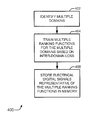
- FIG. 4 is a flow diagram 400 that illustrates an example method for producing ranking functions for multiple domains based on inter-domain loss according to an embodiment.
- flow diagram 400 includes three operations 402 - 406 .
- the operations may be performed by one or more special-purpose computing devices, examples of which are described herein below with particular reference to FIG. 8 for an embodiment. Although these operations are typically performed at least partially offline (e.g., before a search query arrives or otherwise while a user is not waiting for a response), they may alternatively be performed fully or partially online (e.g., in real-time or near real-time while a user waits for search results).
- the description below of flow diagram 400 includes references to aspects of other FIGS. (e.g., FIGS. 2 and 3 ); however, the operations may alternatively be performed by different aspects.
- multiple domains are identified. For example, two or more domains 204 may be identified.
- multiple ranking functions for the multiple domains are trained based on inter-domain loss. More specifically, the multiple ranking functions may be trained using sample items that are associated with preference data, and the inter-domain loss may relate to loss between and/or among at least two domains of the multiple domains.
- two or more ranking functions 110 may be trained based on inter-domain loss 308 .
- the two or more ranking functions 110 may be trained, for instance, using sample items 302 that are associated with preference data 304 .
- Machine learning process 306 may, for example, train two or more ranking functions 110 based also on intra-domain loss 310 .
- Inter-domain loss 308 may relate to loss (e.g., a relative incorrect ranking for two or more items) between and/or among at least two domains 204 of multiple domains 204 .
- electrical digital signals that are representative of the multiple ranking functions are stored in one or more memories.
- electrical digital signals 816 (of FIG. 8 ) that are representative of multiple ranking functions 110 may be stored in one or more memories 814 (of FIG. 8 ).
- FIG. 5 is a block diagram 500 illustrating an example blending procedure 508 that may be performed to produce a ranked list of search results 114 that are provided for a search query 112 according to an embodiment.
- block diagram 500 includes (as also shown in FIG. 1 ) a search engine 104 , a search index 106 , a user 108 , multiple ranking functions 110 a . . . 110 n , a search query 112 , and search results 114 .
- Block diagram 500 also includes relevancy scores 502 , multiple ranked lists per domain 504 , a multi-domain ranked list 506 , and blending procedure 508 . As shown, there are “n” ranked lists per domain 504 a , 504 b . . . 504 n , with “n” representing an integer greater than one. However, each domain need not have a ranked list for every search query.
- a ranked list for a domain 504 includes a list of objects 102 that are ranked in accordance with their associated relevancy scores 502 .
- a ranked list for a domain 504 may comprise search results for the corresponding domain.
- the objects 102 in a ranked list for a domain 504 each correspond to the same given domain.
- the objects 102 that are included in the multiple ranked lists per domain 504 are blended 508 to form multi-domain ranked list 506 .
- the ordering of objects 102 in multi-domain ranked list 506 may be made in accordance with relevancy scores 502 that are associated with objects 102 in the ranked lists per domain 504 without transforming the scores.
- user 108 may submit search query 112 to search engine 104 .
- search engine 104 may generate search results from multiple domains that are considered relevant to search query 112 .
- the relevant search results may be applied to multiple ranking functions 110 based on the domain to which each ranking function 110 and the domain to which each search result object correspond.
- each object that corresponds to a particular domain e.g., a question-and-answer domain
- Ranking functions 110 of search engine 104 may be trained based on inter-domain loss (and also based on intra-domain loss).
- a ranking function 110 may generate an associated relevancy score 502 for each object 102 that it is ranking.
- a respective ranking function 110 may therefore produce a respective ranked list per domain 504 . It should be noted that there may not be a one-to-one correspondence between ranking functions 110 and ranked lists per domain 504 (e.g., if no relevant objects are discovered for a particular domain).
- a ranked list per domain 504 may include an ordered list of search result objects 102 that are ranked in accordance with their associated relevancy scores 502 .
- Ranking functions 110 of search engine 104 are produced in a machine learning process and are based on inter-domain loss, relevancy scores 502 associated with objects 102 that are present on different ranked lists per domain 504 may properly interrelate with one another.
- blending procedure 508 may be effectuated without performing a relevancy score normalization. Blending procedure 508 produces multi-domain ranked list 506 that includes ordered objects 102 that are ranked in accordance with relevancy scores 502 across multiple domains. Multi-domain ranked list 506 may then be provided to user 108 as at least part of search results 114 .
- FIG. 6 is a flow diagram 600 that illustrates an example method for using ranking functions for multiple domains, which are trained based on inter-domain loss, when blending search results from the multiple domains according to an embodiment.
- flow diagram 600 includes five operations 602 - 610 .
- the operations may be performed by one or more special-purpose computing devices, examples of which are described herein below for an embodiment with particular reference to FIG. 8 . Although these operations are typically performed at least partially online (e.g., in real-time or near real-time while a user waits for search results), they may alternatively be performed fully or partially offline (e.g., at a timescale in which a user is not necessarily awaiting an “immediate” response to a search query).
- the description below of flow diagram 600 includes references to aspects of other FIGS. (e.g., FIGS. 3 and 5 ); however, the operations may alternatively be performed by different aspects.
- first electrical digital signals representative of a search query that has been submitted by a user are obtained.
- first electrical digital signals 816 which are representative of a search query 112 that has been submitted by a user 108 , may be received via a communication interface, may be retrieved from memory, some combination thereof, and so forth.
- a search that is based on the search query is performed across multiple domains to ascertain search results.
- a search that is based on the terms of search query 112 may be performed by search engine 104 across multiple domains 204 to ascertain relevant search results that correspond to the search query and that are from the multiple domains.
- search results are ranked using multiple ranking functions that have been trained based on inter-domain loss (and that may also have been trained based on intra-domain loss).
- the relevant search results which correspond to the search query, may be ranked on a per-domain basis using trained versions of ranking functions 110 to produce ranked lists per domain 504 .
- the ranking may associate respective relevancy scores 502 with respective objects 102 of the relevant search results.
- the search results from the multiple domains are blended into a single ranked list.
- the blending may be performed without normalizing the relevance scores that are associated with the search results across the multiple domains.
- objects 102 of the relevant search results may be blended 508 into a single multi-domain ranked list 506 using relevancy scores 502 that are generated by trained versions of ranking functions 110 without normalizing the relevancy scores associated with the search results across the multiple domains 204 .
- second electrical digital signals that are representative of at least a portion of the single ranked list of search results are transmitted to the user.
- second electrical digital signals 816 (of FIG. 8 ), which are representative of at least a portion of the single multi-domain ranked list 506 of the search results, may be transmitted to user 108 .
- the two linear blending algorithms include an SVM approach and an approach that uses learning feature correlations.
- the third example blending algorithm pertains to GBDT. It should be understood that any of these three example blending algorithms may be implemented in manners that differ from the specifics described herein without departing from claimed subject matter. Moreover, although these three specific example blending algorithms are described herein, other algorithms may alternatively be implemented without departing from claimed subject matter.
- Equation (2) The following quadratic programming formulation may be used to optimize blending loss, as shown in Equation (2):
- the variable ⁇ xz can be a constant one or the difference between the target values of x and z, when they are available.
- the inter-domain constraints (i ⁇ j) serve to bind the optimization of w i 's. Without these inter-domain constraints, Equation (2) devolves into being analogous to deploying SVM to individual domains.
- Equation (2) may be further simplified to a standard SVM learning formulation by concatenating different domains into a unified feature space.
- u x (0 1 , . . . ,0 i ⁇ 1 ,x, 0 i+1 , . . . ,0 k )
- 0 i is a vector of zeros of size n i (with n i representing the dimension of D i ).
- Equation (2) may be solved using a standard SVM scheme. Moreover, kernelization may be applied to facilitate nonlinear ranking functions.
- variable ⁇ in the prior distribution for w is a block-diagonal matrix, where the diagonal block of each domain is a square matrix, and the entries in off-diagonal blocks are 0.
- the correlations may be identified, as well as the best point estimation of w in the approximate posterior distribution.
- GBlend As another example blending algorithm, GBlend is described, which may be implemented in a non-linear fashion.
- a standard GBDT framework given a loss function, one regression tree is built at each iteration to fit the functional gradients.
- the final function is a forest, which is the sum of the tree outputs.
- the boosting processes of forests for different domains may be coupled at each iteration. In other words, a tree that is grown in a particular forest for a particular domain at a given iteration is based on other tree(s) that were grown in at least one previous iteration in other forest(s) for other domain(s).
- a tree that is grown in a particular forest for a particular domain at a given iteration may be based on each of the other trees that were grown in the immediately previous iteration in the other forests for the other domains of interest.
- the functional gradients of each ranking function may be influenced by other functions via inter-domain pairwise constraints.
- Equation (3) Extending Equation (3) to multiple function scenarios, the following Equation (4) results:
- Each pair of x and z contributes the negative gradient components of max ⁇ 0, f j (z) ⁇ f i (x)+ ⁇ xz ⁇ and ⁇ max ⁇ 0, f j (z) ⁇ f i (x)+ ⁇ xz ⁇ to f i (x) and f j (z), respectively.
- Another component of an example GBRank algorithm may be to use pairs of the same relevance to perform regularization.
- the following regularizer may be included as shown in Equation (5):
- x ⁇ z denotes that x has the same relevance as z.
- Each tie pair x and z contributes the negative gradient components of f j (z) ⁇ f i (x) and f i (x) ⁇ f j (z) to f i (x) and f j (z), respectively.
- Equation (4) can maximize separation among different preference grades
- Equation (5) can control the variances of documents of the same preference grade.
- the blending loss function then becomes (4)+ ⁇ (5), where ⁇ can be found using cross-validation.
- the functional gradient of f i denoted by g i , is the sum of all negative gradient components contributed by three kinds of pairs. These three kinds of pairs include those in which the counterpart z is of lower, higher, and equal relevance to x.
- Equation (6) is given by Equation (6):
- g i ⁇ ( x ) ⁇ ⁇ z ⁇ D j , x ⁇ ⁇ » ⁇ ⁇ z ⁇ max ⁇ ⁇ 0 , f j ⁇ ( z ) - f i ⁇ ( x ) + ⁇ xz ⁇ + ⁇ ⁇ z ⁇ D j , z ⁇ ⁇ » ⁇ ⁇ x ⁇ max ⁇ ⁇ 0 , f j ⁇ ( z ) - f i ⁇ ( x ) - ⁇ zx ⁇ + ⁇ ⁇ ⁇ ⁇ z ⁇ D j , z ⁇ x ⁇ ( f j ⁇ ( z ) - f i ⁇ ( x ) ) ( 6 )
- GBlend Algorithm is provided below in Table 2 using pseudo-code. As shown by the algorithm, trees of each function f i are built to fit its own functional gradients g i using data from its own domain, which is analogous to a standard GBDT algorithm. However, the computation of g i depends on the functions that share inter-domain pairwise constraints with f i . This is where interactions between functions corresponding to different domains may take place. Because of these interactions, the boosting processes of these functions are synchronized, and the relevancy scores generated by the resulting ranking functions are capable of properly interacting. Without such inter-domain pairwise constraints, GBlend can devolve into k independent GBRank instances.
- the above three example machine learning algorithms may be implemented to produce multiple ranking functions for multiple different domains.
- learning to blend may be implemented, in certain example embodiments, using SVM, Gaussian processes, and/or GBDT, just to name a few examples.
- the first two algorithms are presented herein above in linear formulations, they can alternatively be kernelized to address non-linear problems without departing from claimed subject matter.
- the second linear algorithm employing Gaussian processes, may include the inference of heterogeneous features from inter-domain observations.
- GBlend which may be considered an addition to the GBDT family, the boosting processes of multiple forests may be coupled and synchronized to optimize a single objective.
- the example formulations described above are presented in terms of pairwise learning, other loss functions may alternatively be employed on behalf of inter-domain search result blending without departing from claimed subject matter.
- FIG. 7 is a schematic block diagram of systems, devices, and/or resources of an example computing environment 700 , which includes an information integration system 702 that is capable of working with (e.g., producing, using, etc.) ranking functions for multiple domains according to an embodiment.
- computing environment 700 includes information integration system 702 , one or more communication network(s) 704 , one or more user resource(s) 706 , network resources 708 , and a user 108 .
- Information integration system 702 includes a crawler 710 , a search engine 104 , a search index 106 , a database 712 , at least one processor 714 , and ranking function production instructions 716 .
- information integration system 702 is shown as including one each of components 104 , 106 , and 710 - 716 , it may alternatively include more (or none) of such components.
- User resources 706 include at least one browser 718 , which may present user interface 720 .
- Information integration system 702 and user resources 706 may alternatively include more, fewer, and/or different components than those that are shown without deviating from claimed subject matter.
- information integration system 702 and user resources 706 may be in communication with one another via communication network 704 .
- the context in which an information integration system 702 may be implemented may vary.
- an information integration system 702 may be implemented for public or private search engines, job portals, shopping search sites, travel search sites, RSS (Really Simple Syndication)-based applications and sites, combinations thereof, and so forth, just to name a few examples.
- information integration system 702 may be implemented in the context of a WWW search system.
- information integration system 702 may be implemented in the context of private enterprise networks (e.g., intranets) and/or at least one public network formed from multiple networks (e.g., the “Internet”).
- Information integration system 702 may also operate in other contexts, such as a local hard drive and/or home network.
- information integration system 702 may be operatively coupled to network resources 708 and/or communications network 704 .
- An end user 108 may communicate with information integration system 702 via communications network 704 using user resources 706 .
- user resources 706 For example, user 108 may wish to search for web documents related to a certain topic of interest. User 108 may access a search engine website and submit a search query. User 108 may utilize user resources 706 to accomplish this search-related task.
- User resources 706 may comprise a computer (e.g., laptop, desktop, netbook, etc.), a personal digital assistant (PDA), a so-called smart phone with access to the Internet, a gaming machine (e.g., console, hand-held, etc.), an entertainment appliance (e.g., television, set-top box, e-book reader, etc.), a combination thereof, and so forth, just to name a few examples.
- a computer e.g., laptop, desktop, netbook, etc.
- PDA personal digital assistant
- smart phone with access to the Internet
- gaming machine e.g., console, hand-held, etc.
- an entertainment appliance e.g., television, set-top box, e-book reader, etc.
- User resources 706 may permit a browser 718 to be executed thereon.
- Browser 718 may be utilized to view and/or otherwise access web documents from the Internet.
- a browser 718 may be a standalone application, an application that is embedded in or forms at least part of another program or operating system, and so forth.
- User 108 may provide a search query 112 (of FIGS. 1 and 5 ) to information integration system 702 over communication network 704 from browser 718 of user resources 706 and/or directly at information integration system 702 (e.g., bypassing communication network 704 ).
- User resources 706 may also include and/or present a user interface 720 .
- User interface 720 may include, for example, an electronic display screen and/or various user input or output devices.
- User input devices may include, for example, a microphone, a mouse, a keyboard, a pointing device, a touch screen, a gesture recognition system (e.g., camera or other sensor), combinations thereof, and so forth, just to name a few examples.
- Output devices may include, for example, a display screen, speakers, tactile feedback/output systems, some combination thereof, and so forth, just to name a few examples.
- user 108 may access a website offering access to a search engine and submit a search query.
- a search query 112 (of FIGS. 1 and 5 ) may be transmitted from user resources 706 to information integration system 702 via communications network 704 .
- information integration system 702 may determine a list of web documents that is tailored based at least partly on relevance to the search query.
- Information integration system 702 may transmit such a list as search results 114 (of FIGS. 1 and 5 ) back to user resources 706 for display to user 108 , for example, on user interface 720 .
- an information integration system 702 may include a crawler 710 to access network resources 708 , which may include, for example, the Internet (e.g., the WWW) or other network(s), one or more servers, at least one data repository, combinations thereof, and so forth, just to name a few examples of sources of objects 102 (of FIGS. 1 and 5 ).
- Information integration system 702 may also include at least one database 712 and search engine 104 that is supported, for example, by search index 106 .
- Information integration system 702 may further include one or more processors 714 and/or one or more controllers to implement various modules that comprise processor-executable instructions for a special-purpose computing device.
- Ranking function production instructions 716 may produce trained versions of ranking functions when executed by a processor to thereby form a special purpose computing device.
- Ranking function production instructions 716 may be localized and executed on one device or distributed and executed on multiple devices.
- Ranking function production instructions 716 may also be partially or fully executed by user resources 706 (e.g., as part of a “desktop” or local search tool).
- crawler 710 may be adapted to locate web documents such as, for example, web documents associated with websites. Many different crawling algorithms are known and may be adopted by crawler 710 . Crawler 710 may also follow one or more hyperlinks associated with a web document to locate other web documents. Upon locating a web document, crawler 710 may, for example, store the web document's uniform resource locator (URL) and/or other information from or about the web document in database 712 and/or search index 106 . Crawler 710 may store, for instance, all or part of a web document's content (e.g., HTML or XML data, image data, video, embedded links, other objects, metadata, etc.) in database 712 .
- a web document's content e.g., HTML or XML data, image data, video, embedded links, other objects, metadata, etc.
- FIG. 8 is a block diagram 800 of example devices 802 that may be configured into special purpose computing devices that implement aspects of one or more of the embodiments that are described herein relating to ranking functions for multiple domains according to an embodiment.
- block diagram 800 includes a first device 802 a and a second device 802 b , which may be operatively coupled together through one or more networks 804 .
- Devices 802 may correspond to, implement, or otherwise realize information integration system 702 (of FIG. 7 ), user resources 706 , and so forth.
- Network 804 may correspond to communication network 704 (of FIG. 7 ).
- Block diagram 800 also illustrates at least one electrical digital signal 816 .
- first device 802 a and second device 802 b may be representative of any device, appliance, machine, combination thereof, etc. (or multiple ones thereof) that may be configurable to exchange data over network 804 .
- First device 802 a may be adapted to receive an input from a user.
- first device 802 a and/or second device 802 b may comprise: one or more computing devices and/or platforms, such as, e.g., a desktop computer, a laptop computer, a workstation, a server device, etc.; one or more personal computing or communication devices or appliances, such as, e.g., a personal digital assistant (PDA), a mobile “smart” phone, a mobile communication device, a netbook, etc.; a computing system and/or associated service provider capability, such as, e.g., a database or data storage service provider/system, a network service provider/system, an Internet or intranet service provider/system, a portal and/or search engine service provider/system, a wireless communication service provider/system; any combination thereof; and so forth, just to name a few examples.
- PDA personal digital assistant
- Network 804 is representative of one or more communication links, processes, and/or resources configurable to support the exchange of data between first device 802 a and second device 802 b .
- network 804 may include wireless and/or wired communication links, telephone or telecommunications systems, data buses or channels, optical fibers, terrestrial or satellite resources, local area networks, wide area networks, intranets, the Internet, routers or switches, public or private networks, combinations thereof, and so forth, just to name a few examples.
- second device 802 b includes a communication interface 808 , one or more processing units 810 , an interconnection 812 , and at least one memory 814 .
- Memory 814 includes primary memory 814 ( 1 ) and secondary memory 814 ( 2 ).
- Second device 802 b has access to at least one computer-readable medium 806 .
- first device 802 a may also include any of the components illustrated for second device 802 b.
- second device 802 b may include at least one processing unit 810 that is operatively coupled to memory 814 through interconnection 812 (e.g., a bus, a fibre channel, a local/storage area network, etc.).
- processing unit 810 is representative of one or more circuits configurable to perform at least a portion of a data computing procedure or process.
- processing unit 810 may include one or more processors, controllers, microprocessors, microcontrollers, application specific integrated circuits (ASICs), digital signal processors (DSPs), programmable logic devices, field programmable gate arrays (FPGAs), any combination thereof, and so forth, just to name a few examples.
- ASICs application specific integrated circuits
- DSPs digital signal processors
- FPGAs field programmable gate arrays
- Memory 814 is representative of any data storage mechanism.
- Memory 814 may include, for example, a primary memory 814 ( 1 ) and/or a secondary memory 814 ( 2 ).
- Primary memory 814 ( 1 ) may include, for example, a random access memory, a read only memory, combinations thereof, and so forth. Although illustrated in this example as being separate from processing unit 810 , it should be understood that all or a part of primary memory 814 ( 1 ) may be provided within or otherwise co-located with/coupled directly to processing unit 810 (e.g., as a cache or other tightly-coupled memory).
- Secondary memory 814 ( 2 ) may include, for example, the same or similar types of memory as the primary memory and/or one or more data storage devices or systems.
- Data storage devices and systems may include, for example, a disk drive or array thereof, an optical disc drive, a tape drive, a solid state memory drive (e.g., flash memory, phase change memory, etc.), a storage area network (SAN), combinations thereof, and so forth.
- secondary memory 814 ( 2 ) may be operatively receptive of, comprised partly of, and/or otherwise configurable to couple to computer-readable medium 806 .
- Computer-readable medium 806 may include, for example, any medium that can store, carry, and/or make accessible data, code, and/or instructions for execution by one or more of the devices in block diagram 800 .
- one or more portions of memory 814 may store signals representative of data and/or information as expressed by a particular state of memory 814 .
- an electronic signal representative of data and/or information may be “stored” in a portion of a memory device by affecting or changing the state of such portions of memory 814 to represent data and/or information as binary information (e.g., ones and zeros).
- binary information e.g., ones and zeros.
- such a change of state of the portion of memory to store a signal representative of data and/or information constitutes a transformation of memory 814 to a different state or thing.
- Second device 802 b may also include, for example, communication interface 808 that provides for or otherwise supports the operative coupling of second device 802 b to at least network 804 .
- communication interface 808 may include a network interface device or card, a modem, a router, a switch, a transceiver, combinations thereof, and so forth, just to name a few examples.
- Electrical digital signal(s) 816 may be manipulated by second device 802 b .
- electrical digital signals 816 may be received from and/or transmitted onto network 804 using communication interface 808 .
- electrical digital signals 816 may be stored to and/or read from memory 814 using interconnection 812 .
- a special purpose computer or a similar special purpose electronic computing device is capable of using at least one processing unit to manipulate or transform signals, which are typically represented as physical electronic/electrical or magnetic quantities within memories, registers, or other information storage devices; transmission devices; display devices; etc. of the special purpose computer or similar special purpose electronic computing device.
Landscapes
- Engineering & Computer Science (AREA)
- Databases & Information Systems (AREA)
- Theoretical Computer Science (AREA)
- Data Mining & Analysis (AREA)
- Physics & Mathematics (AREA)
- General Engineering & Computer Science (AREA)
- General Physics & Mathematics (AREA)
- Information Retrieval, Db Structures And Fs Structures Therefor (AREA)
Abstract
Description
where I is the indicator function. In general, when i≠j, relevance scores are used that are given by two different functions fi and fj to rank x and z. The ranking loss in such cases is termed inter-domain pairwise loss in these mathematical descriptions. When i=j, this example formula for inter-domain pairwise loss devolves to what is termed herein intra-domain pairwise loss. Losses of both kinds can be minimized by minimizing Equation (1).
Secondly, a set of transformations is learned for a second phase. They are yi:R→R to minimize the following loss:
Each yi may be constrained to be a monotonically increasing function (e.g., a linear function with positive slope) so that the transformations are order-preserving for each domain.
| TABLE 1A |
| Data for D1. |
| Features of D1 | θ1 | θ2 | θ3 | θ4 |
| A | 1 | 0 | 1 | 0 |
| |
2 | 0 | 1 | 0 |
| TABLE 1B |
| Data for D2. |
| Features of D2 | π1 | π2 | π3 | π4 |
| |
1 | 0 | 1 | 0 |
| |
1 | 0 | 2 | 0 |
where τxz>0 is a predetermined separation between x and z and C is a regularization factor. The variable τxz can be a constant one or the difference between the target values of x and z, when they are available. The inter-domain constraints (i≠j) serve to bind the optimization of wi's. Without these inter-domain constraints, Equation (2) devolves into being analogous to deploying SVM to individual domains.
u x=(01, . . . ,0i−1 ,x,0i+1, . . . ,0k)
where 0i is a vector of zeros of size ni (with ni representing the dimension of Di). The k linear functions can be concatenated into one as:
w=(w 1 ,w 2 , . . . ,w k).
p(w|{x»z})∝P({x»z}|w)p(w),
where p(w)=N(0,Σ) with Σ being the n×n covariance matrix, and P({x»z}|w) is the likelihood of observing such pairwise relations. The variable Σ in the prior distribution for w is a block-diagonal matrix, where the diagonal block of each domain is a square matrix, and the entries in off-diagonal blocks are 0. Although there is no correlation between weight variables of different domains in the prior, the observed preference of inter-domain pairs reveals the correlation. By adapting Bayesian inference techniques for model parameter optimization, such as Laplacian approximation, the correlations may be identified, as well as the best point estimation of w in the approximate posterior distribution.
where H=max(0,a), and τX1X2>0 may be defined similarly as that in the example linear algorithms that are described above. Hence, pairwise constraints can be handled with GBRank.
Each pair of x and z contributes the negative gradient components of max{0, fj(z)−fi(x)+τxz} and −max{0, fj(z)−fi(x)+τxz} to fi(x) and fj(z), respectively.
where x˜z denotes that x has the same relevance as z. Each tie pair x and z contributes the negative gradient components of fj(z)−fi(x) and fi(x)−fj(z) to fi(x) and fj(z), respectively.
| TABLE 2 | |
| GBlend Algorithm Example. | |
| Example GBlend Algorithm: | |
| for i =1 to k do |
| Initialize fi ← 0. |
| for t =1 to T do |
| for i =1 to k do |
| Compute gi using (6). | |
| Build a regression tree ti to fit gi. | |
| fi ← fi + η • ti, where η < 1 is a shrinkage factor. | |
Claims (21)
Priority Applications (1)
| Application Number | Priority Date | Filing Date | Title |
|---|---|---|---|
| US12/577,045 US10019518B2 (en) | 2009-10-09 | 2009-10-09 | Methods and systems relating to ranking functions for multiple domains |
Applications Claiming Priority (1)
| Application Number | Priority Date | Filing Date | Title |
|---|---|---|---|
| US12/577,045 US10019518B2 (en) | 2009-10-09 | 2009-10-09 | Methods and systems relating to ranking functions for multiple domains |
Publications (2)
| Publication Number | Publication Date |
|---|---|
| US20110087673A1 US20110087673A1 (en) | 2011-04-14 |
| US10019518B2 true US10019518B2 (en) | 2018-07-10 |
Family
ID=43855646
Family Applications (1)
| Application Number | Title | Priority Date | Filing Date |
|---|---|---|---|
| US12/577,045 Expired - Fee Related US10019518B2 (en) | 2009-10-09 | 2009-10-09 | Methods and systems relating to ranking functions for multiple domains |
Country Status (1)
| Country | Link |
|---|---|
| US (1) | US10019518B2 (en) |
Cited By (1)
| Publication number | Priority date | Publication date | Assignee | Title |
|---|---|---|---|---|
| US11048767B2 (en) * | 2018-11-16 | 2021-06-29 | Sap Se | Combination content search |
Families Citing this family (28)
| Publication number | Priority date | Publication date | Assignee | Title |
|---|---|---|---|---|
| US8244720B2 (en) * | 2005-09-13 | 2012-08-14 | Google Inc. | Ranking blog documents |
| US20130268522A1 (en) * | 2010-06-28 | 2013-10-10 | Thomson Licensing | System and method for content exclusion from a multi-domain search |
| US9449282B2 (en) * | 2010-07-01 | 2016-09-20 | Match.Com, L.L.C. | System for determining and optimizing for relevance in match-making systems |
| US8787454B1 (en) * | 2011-07-13 | 2014-07-22 | Google Inc. | Method and apparatus for data compression using content-based features |
| US8863014B2 (en) * | 2011-10-19 | 2014-10-14 | New Commerce Solutions Inc. | User interface for product comparison |
| CN103092856B (en) * | 2011-10-31 | 2015-09-23 | 阿里巴巴集团控股有限公司 | Search result ordering method and equipment, searching method and equipment |
| CN103975323A (en) * | 2011-11-21 | 2014-08-06 | 微软公司 | Prototype-based re-ranking of search results |
| US9619459B2 (en) * | 2012-10-01 | 2017-04-11 | Nuance Communications, Inc. | Situation aware NLU/NLP |
| US10282419B2 (en) | 2012-12-12 | 2019-05-07 | Nuance Communications, Inc. | Multi-domain natural language processing architecture |
| EP2973095B1 (en) | 2013-03-15 | 2018-05-09 | Animas Corporation | Insulin time-action model |
| US9430533B2 (en) * | 2014-03-21 | 2016-08-30 | Microsoft Technology Licensing, Llc | Machine-assisted search preference evaluation |
| US10540365B2 (en) * | 2014-05-30 | 2020-01-21 | Apple Inc. | Federated search |
| CN105718493B (en) * | 2014-12-05 | 2019-07-23 | 阿里巴巴集团控股有限公司 | Method and device for sorting search results based on decision tree |
| US10459987B2 (en) * | 2015-02-06 | 2019-10-29 | Red Hat, Inc. | Data virtualization for workflows |
| US10755032B2 (en) | 2015-06-05 | 2020-08-25 | Apple Inc. | Indexing web pages with deep links |
| US10509834B2 (en) * | 2015-06-05 | 2019-12-17 | Apple Inc. | Federated search results scoring |
| US10621189B2 (en) | 2015-06-05 | 2020-04-14 | Apple Inc. | In-application history search |
| US10592572B2 (en) | 2015-06-05 | 2020-03-17 | Apple Inc. | Application view index and search |
| US10509833B2 (en) * | 2015-06-05 | 2019-12-17 | Apple Inc. | Proximity search scoring |
| US10691746B2 (en) | 2015-07-13 | 2020-06-23 | Google Llc | Images for query answers |
| US10180968B2 (en) * | 2015-07-23 | 2019-01-15 | Netflix, Inc. | Gaussian ranking using matrix factorization |
| RU2635905C2 (en) * | 2015-09-23 | 2017-11-16 | Общество С Ограниченной Ответственностью "Яндекс" | Method and server of forecasting popularity of element content |
| CN105488024B (en) * | 2015-11-20 | 2017-10-13 | 广州神马移动信息科技有限公司 | The abstracting method and device of Web page subject sentence |
| US10482091B2 (en) * | 2016-03-18 | 2019-11-19 | Oath Inc. | Computerized system and method for high-quality and high-ranking digital content discovery |
| US11003672B2 (en) | 2016-10-28 | 2021-05-11 | Apple Inc. | Re-ranking search results using blended learning models |
| US10592542B2 (en) * | 2017-08-31 | 2020-03-17 | International Business Machines Corporation | Document ranking by contextual vectors from natural language query |
| WO2019061187A1 (en) * | 2017-09-28 | 2019-04-04 | 深圳乐信软件技术有限公司 | Credit evaluation method and apparatus and gradient boosting decision tree parameter adjustment method and apparatus |
| US10841251B1 (en) | 2020-02-11 | 2020-11-17 | Moveworks, Inc. | Multi-domain chatbot |
Citations (14)
| Publication number | Priority date | Publication date | Assignee | Title |
|---|---|---|---|---|
| US20060287980A1 (en) * | 2005-06-21 | 2006-12-21 | Microsoft Corporation | Intelligent search results blending |
| US7219090B2 (en) * | 2003-04-25 | 2007-05-15 | Overture Services, Inc. | Method and system for blending search engine results from disparate sources into one search result |
| US20070255689A1 (en) * | 2006-04-28 | 2007-11-01 | Gordon Sun | System and method for indexing web content using click-through features |
| US20080184371A1 (en) * | 2007-01-29 | 2008-07-31 | Deutsche Telekom Ag | method and system for detecting malicious behavioral patterns in a computer, using machine learning |
| US20090150309A1 (en) * | 2007-12-10 | 2009-06-11 | Yahoo! Inc. | System and method for training a multi-class support vector machine to select a common subset of features for classifying objects |
| US20090210407A1 (en) * | 2008-02-15 | 2009-08-20 | Juliana Freire | Method and system for adaptive discovery of content on a network |
| US20090248667A1 (en) * | 2008-03-31 | 2009-10-01 | Zhaohui Zheng | Learning Ranking Functions Incorporating Boosted Ranking In A Regression Framework For Information Retrieval And Ranking |
| US20100082617A1 (en) * | 2008-09-24 | 2010-04-01 | Microsoft Corporation | Pair-wise ranking model for information retrieval |
| US7734633B2 (en) * | 2007-10-18 | 2010-06-08 | Microsoft Corporation | Listwise ranking |
| US20100153315A1 (en) * | 2008-12-17 | 2010-06-17 | Microsoft Corporation | Boosting algorithm for ranking model adaptation |
| US20100158470A1 (en) * | 2008-12-24 | 2010-06-24 | Comcast Interactive Media, Llc | Identification of segments within audio, video, and multimedia items |
| US20100257167A1 (en) * | 2009-04-01 | 2010-10-07 | Microsoft Corporation | Learning to rank using query-dependent loss functions |
| US20100299336A1 (en) * | 2009-05-19 | 2010-11-25 | Microsoft Corporation | Disambiguating a search query |
| US20110071965A1 (en) * | 2009-09-24 | 2011-03-24 | Yahoo! Inc. | System and method for cross domain learning for data augmentation |
-
2009
- 2009-10-09 US US12/577,045 patent/US10019518B2/en not_active Expired - Fee Related
Patent Citations (15)
| Publication number | Priority date | Publication date | Assignee | Title |
|---|---|---|---|---|
| US7219090B2 (en) * | 2003-04-25 | 2007-05-15 | Overture Services, Inc. | Method and system for blending search engine results from disparate sources into one search result |
| US20060287980A1 (en) * | 2005-06-21 | 2006-12-21 | Microsoft Corporation | Intelligent search results blending |
| US7647314B2 (en) * | 2006-04-28 | 2010-01-12 | Yahoo! Inc. | System and method for indexing web content using click-through features |
| US20070255689A1 (en) * | 2006-04-28 | 2007-11-01 | Gordon Sun | System and method for indexing web content using click-through features |
| US20080184371A1 (en) * | 2007-01-29 | 2008-07-31 | Deutsche Telekom Ag | method and system for detecting malicious behavioral patterns in a computer, using machine learning |
| US7734633B2 (en) * | 2007-10-18 | 2010-06-08 | Microsoft Corporation | Listwise ranking |
| US20090150309A1 (en) * | 2007-12-10 | 2009-06-11 | Yahoo! Inc. | System and method for training a multi-class support vector machine to select a common subset of features for classifying objects |
| US20090210407A1 (en) * | 2008-02-15 | 2009-08-20 | Juliana Freire | Method and system for adaptive discovery of content on a network |
| US20090248667A1 (en) * | 2008-03-31 | 2009-10-01 | Zhaohui Zheng | Learning Ranking Functions Incorporating Boosted Ranking In A Regression Framework For Information Retrieval And Ranking |
| US20100082617A1 (en) * | 2008-09-24 | 2010-04-01 | Microsoft Corporation | Pair-wise ranking model for information retrieval |
| US20100153315A1 (en) * | 2008-12-17 | 2010-06-17 | Microsoft Corporation | Boosting algorithm for ranking model adaptation |
| US20100158470A1 (en) * | 2008-12-24 | 2010-06-24 | Comcast Interactive Media, Llc | Identification of segments within audio, video, and multimedia items |
| US20100257167A1 (en) * | 2009-04-01 | 2010-10-07 | Microsoft Corporation | Learning to rank using query-dependent loss functions |
| US20100299336A1 (en) * | 2009-05-19 | 2010-11-25 | Microsoft Corporation | Disambiguating a search query |
| US20110071965A1 (en) * | 2009-09-24 | 2011-03-24 | Yahoo! Inc. | System and method for cross domain learning for data augmentation |
Non-Patent Citations (4)
| Title |
|---|
| Cao et al. "Learning to Rank: From Pairwise to Listwise Approach." Proceedings of the 24th International Conference on Machine Learning, Corvallis, OR, 2007. 7 Pages. http://www.machinelearning.org/proceedings/icml2007/papers/139.pdf. * |
| Chu et al., "Preference Learning with Gaussian Processes", Appearing in Proceedings of the 22nd International Conference on Machine Learning, Bonn, Germany, 2005, 8 pages. |
| Friedman, Jerome H., "Greedy Function Approximation: A Gradient Boosting Machine", Feb. 24, 1999, 34 pages. |
| Zheng et al., "A Regression Framework for Learning Ranking Functions Using Relative Relevance Judgments", SIGIR '07, Amsterdam, The Netherlands, ACM 978-1-59593-597-7/07/0007, Jul. 23-27, 2007, 8 pages. |
Cited By (1)
| Publication number | Priority date | Publication date | Assignee | Title |
|---|---|---|---|---|
| US11048767B2 (en) * | 2018-11-16 | 2021-06-29 | Sap Se | Combination content search |
Also Published As
| Publication number | Publication date |
|---|---|
| US20110087673A1 (en) | 2011-04-14 |
Similar Documents
| Publication | Publication Date | Title |
|---|---|---|
| US20110087673A1 (en) | Methods and systems relating to ranking functions for multiple domains | |
| Ma et al. | Off-policy learning in two-stage recommender systems | |
| Fernández-Tobías et al. | Addressing the user cold start with cross-domain collaborative filtering: exploiting item metadata in matrix factorization: I. Fernández-Tobías et al. | |
| US20110055238A1 (en) | Methods and systems for generating non-overlapping facets for a query | |
| Balakrishnan et al. | Collaborative ranking | |
| US7953736B2 (en) | Relevancy rating of tags | |
| US8819003B2 (en) | Query refinement based on user selections | |
| US20110066618A1 (en) | Query term relationship characterization for query response determination | |
| US20210382944A1 (en) | Generating a Graph Data Structure that Identifies Relationships among Topics Expressed in Web Documents | |
| US20070174319A1 (en) | Method for adjusting concept-based keyword functions, and search engine employing the same | |
| Li et al. | Caesar: context-aware explanation based on supervised attention for service recommendations | |
| US20100082593A1 (en) | System and method for ranking search results using social information | |
| US9268859B2 (en) | Method and system for customizing a web site | |
| Formoso et al. | Using profile expansion techniques to alleviate the new user problem | |
| US20100011025A1 (en) | Transfer learning methods and apparatuses for establishing additive models for related-task ranking | |
| US8712991B2 (en) | Document-related representative information | |
| Kumar et al. | Semantic clustering-based cross-domain recommendation | |
| Melucci | Contextual search: A computational framework | |
| Yu et al. | TIIREC: A tensor approach for tag-driven item recommendation with sparse user generated content | |
| US20120102018A1 (en) | Ranking Model Adaptation for Domain-Specific Search | |
| Zhang et al. | A framework for diversifying recommendation lists by user interest expansion | |
| US11544767B2 (en) | Recommendation system with implicit feedback | |
| Zhang et al. | RecGPT | |
| US20100131495A1 (en) | Lightning search aggregate | |
| WO2022083596A1 (en) | Sorting method, apparatus and device, and computer storage medium |
Legal Events
| Date | Code | Title | Description |
|---|---|---|---|
| AS | Assignment |
Owner name: YAHOO! INC., A DELAWARE CORPORATION, CALIFORNIA Free format text: ASSIGNMENT OF ASSIGNORS INTEREST;ASSIGNORS:CHEN, JIANG;CHU, WEI;KOU, ZHENZHEN;AND OTHERS;SIGNING DATES FROM 20091007 TO 20091008;REEL/FRAME:023354/0593 |
|
| AS | Assignment |
Owner name: EXCALIBUR IP, LLC, CALIFORNIA Free format text: ASSIGNMENT OF ASSIGNORS INTEREST;ASSIGNOR:YAHOO! INC.;REEL/FRAME:038383/0466 Effective date: 20160418 |
|
| AS | Assignment |
Owner name: YAHOO! INC., CALIFORNIA Free format text: ASSIGNMENT OF ASSIGNORS INTEREST;ASSIGNOR:EXCALIBUR IP, LLC;REEL/FRAME:038951/0295 Effective date: 20160531 |
|
| AS | Assignment |
Owner name: EXCALIBUR IP, LLC, CALIFORNIA Free format text: ASSIGNMENT OF ASSIGNORS INTEREST;ASSIGNOR:YAHOO! INC.;REEL/FRAME:038950/0592 Effective date: 20160531 |
|
| STCF | Information on status: patent grant |
Free format text: PATENTED CASE |
|
| AS | Assignment |
Owner name: STARBOARD VALUE INTERMEDIATE FUND LP, AS COLLATERAL AGENT, NEW YORK Free format text: PATENT SECURITY AGREEMENT;ASSIGNORS:ACACIA RESEARCH GROUP LLC;AMERICAN VEHICULAR SCIENCES LLC;BONUTTI SKELETAL INNOVATIONS LLC;AND OTHERS;REEL/FRAME:052853/0153 Effective date: 20200604 |
|
| AS | Assignment |
Owner name: R2 SOLUTIONS LLC, TEXAS Free format text: ASSIGNMENT OF ASSIGNORS INTEREST;ASSIGNOR:EXCALIBUR IP, LLC;REEL/FRAME:053459/0059 Effective date: 20200428 |
|
| AS | Assignment |
Owner name: R2 SOLUTIONS LLC, TEXAS Free format text: RELEASE OF SECURITY INTEREST IN PATENTS;ASSIGNOR:STARBOARD VALUE INTERMEDIATE FUND LP;REEL/FRAME:053654/0254 Effective date: 20200630 Owner name: SAINT LAWRENCE COMMUNICATIONS LLC, TEXAS Free format text: RELEASE OF SECURITY INTEREST IN PATENTS;ASSIGNOR:STARBOARD VALUE INTERMEDIATE FUND LP;REEL/FRAME:053654/0254 Effective date: 20200630 Owner name: UNIFICATION TECHNOLOGIES LLC, TEXAS Free format text: RELEASE OF SECURITY INTEREST IN PATENTS;ASSIGNOR:STARBOARD VALUE INTERMEDIATE FUND LP;REEL/FRAME:053654/0254 Effective date: 20200630 Owner name: INNOVATIVE DISPLAY TECHNOLOGIES LLC, TEXAS Free format text: RELEASE OF SECURITY INTEREST IN PATENTS;ASSIGNOR:STARBOARD VALUE INTERMEDIATE FUND LP;REEL/FRAME:053654/0254 Effective date: 20200630 Owner name: TELECONFERENCE SYSTEMS LLC, TEXAS Free format text: RELEASE OF SECURITY INTEREST IN PATENTS;ASSIGNOR:STARBOARD VALUE INTERMEDIATE FUND LP;REEL/FRAME:053654/0254 Effective date: 20200630 Owner name: ACACIA RESEARCH GROUP LLC, NEW YORK Free format text: RELEASE OF SECURITY INTEREST IN PATENTS;ASSIGNOR:STARBOARD VALUE INTERMEDIATE FUND LP;REEL/FRAME:053654/0254 Effective date: 20200630 Owner name: LIMESTONE MEMORY SYSTEMS LLC, CALIFORNIA Free format text: RELEASE OF SECURITY INTEREST IN PATENTS;ASSIGNOR:STARBOARD VALUE INTERMEDIATE FUND LP;REEL/FRAME:053654/0254 Effective date: 20200630 Owner name: STINGRAY IP SOLUTIONS LLC, TEXAS Free format text: RELEASE OF SECURITY INTEREST IN PATENTS;ASSIGNOR:STARBOARD VALUE INTERMEDIATE FUND LP;REEL/FRAME:053654/0254 Effective date: 20200630 Owner name: CELLULAR COMMUNICATIONS EQUIPMENT LLC, TEXAS Free format text: RELEASE OF SECURITY INTEREST IN PATENTS;ASSIGNOR:STARBOARD VALUE INTERMEDIATE FUND LP;REEL/FRAME:053654/0254 Effective date: 20200630 Owner name: BONUTTI SKELETAL INNOVATIONS LLC, TEXAS Free format text: RELEASE OF SECURITY INTEREST IN PATENTS;ASSIGNOR:STARBOARD VALUE INTERMEDIATE FUND LP;REEL/FRAME:053654/0254 Effective date: 20200630 Owner name: LIFEPORT SCIENCES LLC, TEXAS Free format text: RELEASE OF SECURITY INTEREST IN PATENTS;ASSIGNOR:STARBOARD VALUE INTERMEDIATE FUND LP;REEL/FRAME:053654/0254 Effective date: 20200630 Owner name: NEXUS DISPLAY TECHNOLOGIES LLC, TEXAS Free format text: RELEASE OF SECURITY INTEREST IN PATENTS;ASSIGNOR:STARBOARD VALUE INTERMEDIATE FUND LP;REEL/FRAME:053654/0254 Effective date: 20200630 Owner name: PARTHENON UNIFIED MEMORY ARCHITECTURE LLC, TEXAS Free format text: RELEASE OF SECURITY INTEREST IN PATENTS;ASSIGNOR:STARBOARD VALUE INTERMEDIATE FUND LP;REEL/FRAME:053654/0254 Effective date: 20200630 Owner name: SUPER INTERCONNECT TECHNOLOGIES LLC, TEXAS Free format text: RELEASE OF SECURITY INTEREST IN PATENTS;ASSIGNOR:STARBOARD VALUE INTERMEDIATE FUND LP;REEL/FRAME:053654/0254 Effective date: 20200630 Owner name: MONARCH NETWORKING SOLUTIONS LLC, CALIFORNIA Free format text: RELEASE OF SECURITY INTEREST IN PATENTS;ASSIGNOR:STARBOARD VALUE INTERMEDIATE FUND LP;REEL/FRAME:053654/0254 Effective date: 20200630 Owner name: MOBILE ENHANCEMENT SOLUTIONS LLC, TEXAS Free format text: RELEASE OF SECURITY INTEREST IN PATENTS;ASSIGNOR:STARBOARD VALUE INTERMEDIATE FUND LP;REEL/FRAME:053654/0254 Effective date: 20200630 Owner name: AMERICAN VEHICULAR SCIENCES LLC, TEXAS Free format text: RELEASE OF SECURITY INTEREST IN PATENTS;ASSIGNOR:STARBOARD VALUE INTERMEDIATE FUND LP;REEL/FRAME:053654/0254 Effective date: 20200630 |
|
| AS | Assignment |
Owner name: R2 SOLUTIONS LLC, TEXAS Free format text: CORRECTIVE ASSIGNMENT TO CORRECT THE ASSIGNEE NAME PREVIOUSLY RECORDED ON REEL 053654 FRAME 0254. ASSIGNOR(S) HEREBY CONFIRMS THE RELEASE OF SECURITY INTEREST GRANTED PURSUANT TO THE PATENT SECURITY AGREEMENT PREVIOUSLY RECORDED;ASSIGNOR:STARBOARD VALUE INTERMEDIATE FUND LP;REEL/FRAME:054981/0377 Effective date: 20200630 |
|
| AS | Assignment |
Owner name: STARBOARD VALUE INTERMEDIATE FUND LP, AS COLLATERAL AGENT, NEW YORK Free format text: CORRECTIVE ASSIGNMENT TO CORRECT THE THE ASSIGNOR NAME PREVIOUSLY RECORDED AT REEL: 052853 FRAME: 0153. ASSIGNOR(S) HEREBY CONFIRMS THE ASSIGNMENT;ASSIGNOR:R2 SOLUTIONS LLC;REEL/FRAME:056832/0001 Effective date: 20200604 |
|
| FEPP | Fee payment procedure |
Free format text: MAINTENANCE FEE REMINDER MAILED (ORIGINAL EVENT CODE: REM.); ENTITY STATUS OF PATENT OWNER: LARGE ENTITY |
|
| LAPS | Lapse for failure to pay maintenance fees |
Free format text: PATENT EXPIRED FOR FAILURE TO PAY MAINTENANCE FEES (ORIGINAL EVENT CODE: EXP.); ENTITY STATUS OF PATENT OWNER: LARGE ENTITY |
|
| STCH | Information on status: patent discontinuation |
Free format text: PATENT EXPIRED DUE TO NONPAYMENT OF MAINTENANCE FEES UNDER 37 CFR 1.362 |
|
| FP | Lapsed due to failure to pay maintenance fee |
Effective date: 20220710 |