US10016498B2 - D-amino acid derivative-modified peptidoglycan and methods of use thereof - Google Patents
D-amino acid derivative-modified peptidoglycan and methods of use thereof Download PDFInfo
- Publication number
- US10016498B2 US10016498B2 US15/704,977 US201715704977A US10016498B2 US 10016498 B2 US10016498 B2 US 10016498B2 US 201715704977 A US201715704977 A US 201715704977A US 10016498 B2 US10016498 B2 US 10016498B2
- Authority
- US
- United States
- Prior art keywords
- modified
- substituted
- amino acid
- group
- groups
- Prior art date
- Legal status (The legal status is an assumption and is not a legal conclusion. Google has not performed a legal analysis and makes no representation as to the accuracy of the status listed.)
- Active
Links
- 0 C*[C@@H](N)C(=O)O Chemical compound C*[C@@H](N)C(=O)O 0.000 description 23
- SSCRGKRZPWIFIR-UHFFFAOYSA-N C1#CCCCCCC1.CCC Chemical compound C1#CCCCCCC1.CCC SSCRGKRZPWIFIR-UHFFFAOYSA-N 0.000 description 1
- COGVRIJKPTUAMN-UHFFFAOYSA-N C=C(C1=CC=C(C(=O)O)C=C1)N1CCC(F)(F)C#CC(F)(F)C1.O=C(O)CCC(=O)N1CCC#CC(F)(F)C(F)(F)C1.O=C(O)CCC(=O)N1CCC#CCCC1.O=C(O)CCC(=O)N1CCC(F)(F)C#CC(F)(F)C1 Chemical compound C=C(C1=CC=C(C(=O)O)C=C1)N1CCC(F)(F)C#CC(F)(F)C1.O=C(O)CCC(=O)N1CCC#CC(F)(F)C(F)(F)C1.O=C(O)CCC(=O)N1CCC#CCCC1.O=C(O)CCC(=O)N1CCC(F)(F)C#CC(F)(F)C1 COGVRIJKPTUAMN-UHFFFAOYSA-N 0.000 description 1
- TXAKKWLGBBCUDS-UHFFFAOYSA-N C=C(CCC(=O)O)N1CCC#CC(C)C(C)C1 Chemical compound C=C(CCC(=O)O)N1CCC#CC(C)C(C)C1 TXAKKWLGBBCUDS-UHFFFAOYSA-N 0.000 description 1
- KQZPPAYUBHTZNN-UHFFFAOYSA-N CC(C)/C1=N/C/C(C(C)C)=C2\C3CC(CC3C(C)C)C12 Chemical compound CC(C)/C1=N/C/C(C(C)C)=C2\C3CC(CC3C(C)C)C12 KQZPPAYUBHTZNN-UHFFFAOYSA-N 0.000 description 1
- AQSNCEYPBWIZNU-UHFFFAOYSA-N CC(C)C1C#CCCCCC1 Chemical compound CC(C)C1C#CCCCCC1 AQSNCEYPBWIZNU-UHFFFAOYSA-N 0.000 description 1
- RXYDMLIQCLJQIW-VIMVGGAPSA-N CC(C)C1C#CCCCCC1.[H][C@@]12CCC#CCC[C@]1(C)[C@@H]2CC(C)C.[H][C@@]12CCC#CCC[C@]1([H])[C@H]2CC(C)C Chemical compound CC(C)C1C#CCCCCC1.[H][C@@]12CCC#CCC[C@]1(C)[C@@H]2CC(C)C.[H][C@@]12CCC#CCC[C@]1([H])[C@H]2CC(C)C RXYDMLIQCLJQIW-VIMVGGAPSA-N 0.000 description 1
- XOUGORZEEWIZDU-UHFFFAOYSA-N CC(C)CC1C2CCC#CCCC21 Chemical compound CC(C)CC1C2CCC#CCCC21 XOUGORZEEWIZDU-UHFFFAOYSA-N 0.000 description 1
- BKDDJRZGLHLMPG-UHFFFAOYSA-N CC.CC.O=C1C2=C(C#CC3=CC=CC=C3N1C[Y])C=CC=C2 Chemical compound CC.CC.O=C1C2=C(C#CC3=CC=CC=C3N1C[Y])C=CC=C2 BKDDJRZGLHLMPG-UHFFFAOYSA-N 0.000 description 1
- WXLAIJQYNRILIX-IKXVZIJTSA-N CC1=CC=C(/C=C2\CCCCC#CC2(F)F)C=C1.CC1=CC=C(CC2CCCCC#CC2(F)F)C=C1.CCC1CCCCC#CC1(F)F.O=C=O.O=C=O.[H]C1=CC=C(COC2CCC#CC(C)(F)CC2)C=C1.[H]COC1CCC#CC(C)(F)CC1 Chemical compound CC1=CC=C(/C=C2\CCCCC#CC2(F)F)C=C1.CC1=CC=C(CC2CCCCC#CC2(F)F)C=C1.CCC1CCCCC#CC1(F)F.O=C=O.O=C=O.[H]C1=CC=C(COC2CCC#CC(C)(F)CC2)C=C1.[H]COC1CCC#CC(C)(F)CC1 WXLAIJQYNRILIX-IKXVZIJTSA-N 0.000 description 1
- KPBRAIVUJOREBC-UHFFFAOYSA-N CC1=CC=C(CC2(F)C#CC(F)CCCC2)C=C1 Chemical compound CC1=CC=C(CC2(F)C#CC(F)CCCC2)C=C1 KPBRAIVUJOREBC-UHFFFAOYSA-N 0.000 description 1
- QPNSEOUADCFTFL-UHFFFAOYSA-N CC1=CC=C(COC2C#CCCCCC2)C=C1.CCOC1C#CCCCCC1 Chemical compound CC1=CC=C(COC2C#CCCCCC2)C=C1.CCOC1C#CCCCCC1 QPNSEOUADCFTFL-UHFFFAOYSA-N 0.000 description 1
- YNHOTSHTMDCEEO-UHFFFAOYSA-N CCC.CCC.CCN1C(=O)C2=C(C#CC3=C1cc-cc3)cc-cc2 Chemical compound CCC.CCC.CCN1C(=O)C2=C(C#CC3=C1cc-cc3)cc-cc2 YNHOTSHTMDCEEO-UHFFFAOYSA-N 0.000 description 1
- VEBUFHZJTJDPAM-UHFFFAOYSA-N CN(C)C1=CC=CC2=C(S(=O)(=O)NCCCOCCOCCOCNC(=O)CCC(=O)CC3=CN=C(C4=NN=C(C5=CC=CC=N5)N=N4)C=C3)C=CC=C12.O=C1C=CC2=C(C3=CC=C(NC(=S)CCC(=O)NC4=CC=C(C5=NN=C(C6=CC=CC=N6)N=N5)C=N4)C=C3)C3=CC=C(O)C=C3OC2=C1 Chemical compound CN(C)C1=CC=CC2=C(S(=O)(=O)NCCCOCCOCCOCNC(=O)CCC(=O)CC3=CN=C(C4=NN=C(C5=CC=CC=N5)N=N4)C=C3)C=CC=C12.O=C1C=CC2=C(C3=CC=C(NC(=S)CCC(=O)NC4=CC=C(C5=NN=C(C6=CC=CC=N6)N=N5)C=N4)C=C3)C3=CC=C(O)C=C3OC2=C1 VEBUFHZJTJDPAM-UHFFFAOYSA-N 0.000 description 1
- CPIMCVIIYRIPRO-UHFFFAOYSA-N FC(CCCC1)C#CC1F Chemical compound FC(CCCC1)C#CC1F CPIMCVIIYRIPRO-UHFFFAOYSA-N 0.000 description 1
- ADAQGXAGBBSNOK-UHFFFAOYSA-N N#CCCN1C(=O)C2=C(C#CC3=CC=CC=C31)C=CC=C2.O=C1C2=C(C#CC3=CC=CC=C3N1CC1CC(C3=CC=C(CN4CCNCC4)C=C3)=NO1)C=CC=C2.O=C=O.[H]C1CSC(CCN2C(=O)C3=C(C#CC4=CC=CC=C42)C=CC=C3)=N1 Chemical compound N#CCCN1C(=O)C2=C(C#CC3=CC=CC=C31)C=CC=C2.O=C1C2=C(C#CC3=CC=CC=C3N1CC1CC(C3=CC=C(CN4CCNCC4)C=C3)=NO1)C=CC=C2.O=C=O.[H]C1CSC(CCN2C(=O)C3=C(C#CC4=CC=CC=C42)C=CC=C3)=N1 ADAQGXAGBBSNOK-UHFFFAOYSA-N 0.000 description 1
- HXUWIHWJHUYPJW-NVYXFLBWSA-N N.N.NC(CC1=CC=C(N2N=CN=N2)C=C1)C(=O)O.N[C@H](CCCCNC(=O)OCC1CC2C=CC1C2)C(=O)O.O=C(NC[C@@H](Cl)C(=O)O)OC1CC2C=CC1C2.O=C(NC[C@@H](Cl)C(=O)O)OC1CC2C=CC1C2 Chemical compound N.N.NC(CC1=CC=C(N2N=CN=N2)C=C1)C(=O)O.N[C@H](CCCCNC(=O)OCC1CC2C=CC1C2)C(=O)O.O=C(NC[C@@H](Cl)C(=O)O)OC1CC2C=CC1C2.O=C(NC[C@@H](Cl)C(=O)O)OC1CC2C=CC1C2 HXUWIHWJHUYPJW-NVYXFLBWSA-N 0.000 description 1
- BPIOJHYGHPDOFG-UHFFFAOYSA-N O=C(O)C1=CC=C(CC2(F)C#CCCCCC2)C=C1 Chemical compound O=C(O)C1=CC=C(CC2(F)C#CCCCCC2)C=C1 BPIOJHYGHPDOFG-UHFFFAOYSA-N 0.000 description 1
- YRFXSTHQCJKASL-UHFFFAOYSA-N O=C1C2=C(C#CC3=CC=CC=C3N1C[Y])C=CC=C2 Chemical compound O=C1C2=C(C#CC3=CC=CC=C3N1C[Y])C=CC=C2 YRFXSTHQCJKASL-UHFFFAOYSA-N 0.000 description 1
- AITACHFUUVDLTH-UHFFFAOYSA-N O=C1CCC#CCCN1C[Y] Chemical compound O=C1CCC#CCCN1C[Y] AITACHFUUVDLTH-UHFFFAOYSA-N 0.000 description 1
- LFCFQLOGENCWJG-JTEXKZNESA-N [H][C@@]12CCC#CCC[C@]1(C)[C@@H]2CC(C)C.[H][C@@]12CCC#CCC[C@]1([H])[C@H]2CC(C)C Chemical compound [H][C@@]12CCC#CCC[C@]1(C)[C@@H]2CC(C)C.[H][C@@]12CCC#CCC[C@]1([H])[C@H]2CC(C)C LFCFQLOGENCWJG-JTEXKZNESA-N 0.000 description 1
Images


Classifications
-
- A—HUMAN NECESSITIES
- A61—MEDICAL OR VETERINARY SCIENCE; HYGIENE
- A61K—PREPARATIONS FOR MEDICAL, DENTAL OR TOILETRY PURPOSES
- A61K39/00—Medicinal preparations containing antigens or antibodies
- A61K39/385—Haptens or antigens, bound to carriers
-
- A—HUMAN NECESSITIES
- A61—MEDICAL OR VETERINARY SCIENCE; HYGIENE
- A61K—PREPARATIONS FOR MEDICAL, DENTAL OR TOILETRY PURPOSES
- A61K47/00—Medicinal preparations characterised by the non-active ingredients used, e.g. carriers or inert additives; Targeting or modifying agents chemically bound to the active ingredient
- A61K47/50—Medicinal preparations characterised by the non-active ingredients used, e.g. carriers or inert additives; Targeting or modifying agents chemically bound to the active ingredient the non-active ingredient being chemically bound to the active ingredient, e.g. polymer-drug conjugates
- A61K47/51—Medicinal preparations characterised by the non-active ingredients used, e.g. carriers or inert additives; Targeting or modifying agents chemically bound to the active ingredient the non-active ingredient being chemically bound to the active ingredient, e.g. polymer-drug conjugates the non-active ingredient being a modifying agent
- A61K47/62—Medicinal preparations characterised by the non-active ingredients used, e.g. carriers or inert additives; Targeting or modifying agents chemically bound to the active ingredient the non-active ingredient being chemically bound to the active ingredient, e.g. polymer-drug conjugates the non-active ingredient being a modifying agent the modifying agent being a protein, peptide or polyamino acid
- A61K47/64—Drug-peptide, drug-protein or drug-polyamino acid conjugates, i.e. the modifying agent being a peptide, protein or polyamino acid which is covalently bonded or complexed to a therapeutically active agent
-
- A—HUMAN NECESSITIES
- A61—MEDICAL OR VETERINARY SCIENCE; HYGIENE
- A61K—PREPARATIONS FOR MEDICAL, DENTAL OR TOILETRY PURPOSES
- A61K47/00—Medicinal preparations characterised by the non-active ingredients used, e.g. carriers or inert additives; Targeting or modifying agents chemically bound to the active ingredient
- A61K47/50—Medicinal preparations characterised by the non-active ingredients used, e.g. carriers or inert additives; Targeting or modifying agents chemically bound to the active ingredient the non-active ingredient being chemically bound to the active ingredient, e.g. polymer-drug conjugates
- A61K47/51—Medicinal preparations characterised by the non-active ingredients used, e.g. carriers or inert additives; Targeting or modifying agents chemically bound to the active ingredient the non-active ingredient being chemically bound to the active ingredient, e.g. polymer-drug conjugates the non-active ingredient being a modifying agent
- A61K47/62—Medicinal preparations characterised by the non-active ingredients used, e.g. carriers or inert additives; Targeting or modifying agents chemically bound to the active ingredient the non-active ingredient being chemically bound to the active ingredient, e.g. polymer-drug conjugates the non-active ingredient being a modifying agent the modifying agent being a protein, peptide or polyamino acid
- A61K47/64—Drug-peptide, drug-protein or drug-polyamino acid conjugates, i.e. the modifying agent being a peptide, protein or polyamino acid which is covalently bonded or complexed to a therapeutically active agent
- A61K47/646—Drug-peptide, drug-protein or drug-polyamino acid conjugates, i.e. the modifying agent being a peptide, protein or polyamino acid which is covalently bonded or complexed to a therapeutically active agent the entire peptide or protein drug conjugate elicits an immune response, e.g. conjugate vaccines
-
- C—CHEMISTRY; METALLURGY
- C07—ORGANIC CHEMISTRY
- C07K—PEPTIDES
- C07K14/00—Peptides having more than 20 amino acids; Gastrins; Somatostatins; Melanotropins; Derivatives thereof
- C07K14/195—Peptides having more than 20 amino acids; Gastrins; Somatostatins; Melanotropins; Derivatives thereof from bacteria
-
- C—CHEMISTRY; METALLURGY
- C07—ORGANIC CHEMISTRY
- C07K—PEPTIDES
- C07K14/00—Peptides having more than 20 amino acids; Gastrins; Somatostatins; Melanotropins; Derivatives thereof
- C07K14/435—Peptides having more than 20 amino acids; Gastrins; Somatostatins; Melanotropins; Derivatives thereof from animals; from humans
- C07K14/46—Peptides having more than 20 amino acids; Gastrins; Somatostatins; Melanotropins; Derivatives thereof from animals; from humans from vertebrates
- C07K14/47—Peptides having more than 20 amino acids; Gastrins; Somatostatins; Melanotropins; Derivatives thereof from animals; from humans from vertebrates from mammals
- C07K14/4701—Peptides having more than 20 amino acids; Gastrins; Somatostatins; Melanotropins; Derivatives thereof from animals; from humans from vertebrates from mammals not used
- C07K14/4725—Proteoglycans, e.g. aggreccan
-
- C—CHEMISTRY; METALLURGY
- C07—ORGANIC CHEMISTRY
- C07K—PEPTIDES
- C07K9/00—Peptides having up to 20 amino acids, containing saccharide radicals and having a fully defined sequence; Derivatives thereof
-
- C—CHEMISTRY; METALLURGY
- C07—ORGANIC CHEMISTRY
- C07K—PEPTIDES
- C07K9/00—Peptides having up to 20 amino acids, containing saccharide radicals and having a fully defined sequence; Derivatives thereof
- C07K9/001—Peptides having up to 20 amino acids, containing saccharide radicals and having a fully defined sequence; Derivatives thereof the peptide sequence having less than 12 amino acids and not being part of a ring structure
-
- C—CHEMISTRY; METALLURGY
- C12—BIOCHEMISTRY; BEER; SPIRITS; WINE; VINEGAR; MICROBIOLOGY; ENZYMOLOGY; MUTATION OR GENETIC ENGINEERING
- C12N—MICROORGANISMS OR ENZYMES; COMPOSITIONS THEREOF; PROPAGATING, PRESERVING, OR MAINTAINING MICROORGANISMS; MUTATION OR GENETIC ENGINEERING; CULTURE MEDIA
- C12N1/00—Microorganisms; Compositions thereof; Processes of propagating, maintaining or preserving microorganisms or compositions thereof; Processes of preparing or isolating a composition containing a microorganism; Culture media therefor
- C12N1/20—Bacteria; Culture media therefor
-
- C—CHEMISTRY; METALLURGY
- C12—BIOCHEMISTRY; BEER; SPIRITS; WINE; VINEGAR; MICROBIOLOGY; ENZYMOLOGY; MUTATION OR GENETIC ENGINEERING
- C12Q—MEASURING OR TESTING PROCESSES INVOLVING ENZYMES, NUCLEIC ACIDS OR MICROORGANISMS; COMPOSITIONS OR TEST PAPERS THEREFOR; PROCESSES OF PREPARING SUCH COMPOSITIONS; CONDITION-RESPONSIVE CONTROL IN MICROBIOLOGICAL OR ENZYMOLOGICAL PROCESSES
- C12Q1/00—Measuring or testing processes involving enzymes, nucleic acids or microorganisms; Compositions therefor; Processes of preparing such compositions
- C12Q1/02—Measuring or testing processes involving enzymes, nucleic acids or microorganisms; Compositions therefor; Processes of preparing such compositions involving viable microorganisms
- C12Q1/025—Measuring or testing processes involving enzymes, nucleic acids or microorganisms; Compositions therefor; Processes of preparing such compositions involving viable microorganisms for testing or evaluating the effect of chemical or biological compounds, e.g. drugs, cosmetics
-
- C—CHEMISTRY; METALLURGY
- C12—BIOCHEMISTRY; BEER; SPIRITS; WINE; VINEGAR; MICROBIOLOGY; ENZYMOLOGY; MUTATION OR GENETIC ENGINEERING
- C12Q—MEASURING OR TESTING PROCESSES INVOLVING ENZYMES, NUCLEIC ACIDS OR MICROORGANISMS; COMPOSITIONS OR TEST PAPERS THEREFOR; PROCESSES OF PREPARING SUCH COMPOSITIONS; CONDITION-RESPONSIVE CONTROL IN MICROBIOLOGICAL OR ENZYMOLOGICAL PROCESSES
- C12Q1/00—Measuring or testing processes involving enzymes, nucleic acids or microorganisms; Compositions therefor; Processes of preparing such compositions
- C12Q1/02—Measuring or testing processes involving enzymes, nucleic acids or microorganisms; Compositions therefor; Processes of preparing such compositions involving viable microorganisms
- C12Q1/18—Testing for antimicrobial activity of a material
-
- A—HUMAN NECESSITIES
- A61—MEDICAL OR VETERINARY SCIENCE; HYGIENE
- A61K—PREPARATIONS FOR MEDICAL, DENTAL OR TOILETRY PURPOSES
- A61K39/00—Medicinal preparations containing antigens or antibodies
- A61K2039/60—Medicinal preparations containing antigens or antibodies characteristics by the carrier linked to the antigen
- A61K2039/6031—Proteins
- A61K2039/6068—Other bacterial proteins, e.g. OMP
-
- G—PHYSICS
- G01—MEASURING; TESTING
- G01N—INVESTIGATING OR ANALYSING MATERIALS BY DETERMINING THEIR CHEMICAL OR PHYSICAL PROPERTIES
- G01N2333/00—Assays involving biological materials from specific organisms or of a specific nature
- G01N2333/195—Assays involving biological materials from specific organisms or of a specific nature from bacteria
Definitions
- Peptidoglycan is an essential component of the bacterial cell wall.
- modified bacteria and modified peptidoglycan comprising modified D-amino acids; compositions comprising the modified bacteria or peptidoglycan; and methods of using the modified bacteria or peptidoglycan.
- modified D-amino acids include a bioorthogonal functional group such as an azide, an alkyne or a norbornene group.
- modified peptidoglycans conjugated to a molecule of interest via a linker are also provided.
- FIGS. 1A-1E depict cell surface fluorescence resulting from incubation of bacteria in azido- and alkynyl-D-alanine analogs followed by reaction with click chemistry probes.
- FIGS. 2A-2D depict incorporation of alkyne-modified D-alanine (alkDala) into L. monocytogenes PG.
- FIGS. 3A-3C depict labeling of newly synthesized L. monocytogenes PG by alkDala in vitro and in vivo.
- FIG. 4A-4B depicts cell surface fluorescence resulting from incubation of bacteria in norbornene-D-alanine (norDala) followed by conjugation with tetrazine-fluorescein.
- isolated is meant to describe a compound of interest that is in an environment different from that in which the compound naturally occurs. “Isolated” is meant to include compounds that are within samples that are substantially enriched for the compound of interest and/or in which the compound of interest is partially or substantially purified.
- substantially purified refers to a compound that is removed from its natural environment or its synthetic environment and is at least 60% free, at least 75% free, at least 90% free, at least 95% free, at least 98% free, or at least 99% free from other components with which it is naturally associated, or is at least 60% free, at least 75% free, at least 90% free, at least 95% free, at least 98% free, or at least 99% free from contaminants associated with synthesis of the compound.
- aryl as used herein means 5- and 6-membered single-aromatic radicals which may include from zero to four heteroatoms.
- Representative aryls include phenyl, thienyl, furanyl, pyridinyl, (is)oxazoyl and the like.
- lower alkyl generally means an acyclic alkyl radical containing from 1 to about 10, e.g., from 1 to about 8 carbon atoms, or from 1 to about 6 carbon atoms.
- examples of such radicals include methyl, ethyl, n-propyl, isopropyl, n-butyl, isobutyl, sec-butyl, tert-butyl, pentyl, iso-amyl, hexyl, octyl and the like.
- aliphatic group means a saturated or unsaturated linear or branched hydrocarbon group and encompasses alkyl, alkenyl, and alkynyl groups, for example.
- alkyl group means a substituted or unsubstituted, saturated linear or branched hydrocarbon group or chain (e.g., C 1 to C 8 ) including, for example, methyl, ethyl, isopropyl, tert-butyl, heptyl, iso-propyl, n-octyl, dodecyl, octadecyl, amyl, 2-ethylhexyl, and the like.
- Suitable substituents include carboxy, protected carboxy, amino, protected amino, halo, hydroxy, protected hydroxy, nitro, cyano, monosubstituted amino, protected monosubstituted amino, disubstituted amino, C 1 to C 7 alkoxy, C 1 to C 7 acyl, C 1 to C 7 acyloxy, and the like.
- substituted alkyl means the above defined alkyl group substituted from one to three times by a hydroxy, protected hydroxy, amino, protected amino, cyano, halo, trifloromethyl, mono-substituted amino, di-substituted amino, lower alkoxy, lower alkylthio, carboxy, protected carboxy, or a carboxy, amino, and/or hydroxy salt.
- substituted (cycloalkyl)alkyl and “substituted cycloalkyl” are as defined below substituted with the same groups as listed for a “substituted alkyl” group.
- alkenyl group means an unsaturated, linear or branched hydrocarbon group with one or more carbon-carbon double bonds, such as a vinyl group.
- alkynyl group means an unsaturated, linear or branched hydrocarbon group with one or more carbon-carbon triple bonds.
- cyclic group means a closed ring hydrocarbon group that is classified as an alicyclic group, aromatic group, or heterocyclic group.
- alicyclic group means a cyclic hydrocarbon group having properties resembling those of aliphatic groups.
- aromatic group or aryl group means a mono- or polycyclic aromatic hydrocarbon group, and may include one or more heteroatoms, and which are further defined below.
- heterocyclic group means a closed ring hydrocarbon in which one or more of the atoms in the ring are an element other than carbon (e.g., nitrogen, oxygen, sulfur, etc.), and are further defined below.
- halo and “halogen” refer to the fluoro, chloro, bromo or iodo groups. There can be one or more halogen, which are the same or different.
- haloalkyl refers to an alkyl group as defined above that is substituted by one or more halogen atoms. The halogen atoms may be the same or different.
- dihaloalkyl refers to an alkyl group as described above that is substituted by two halo groups, which may be the same or different.
- trihaloalkyl refers to an alkyl group as describe above that is substituted by three halo groups, which may be the same or different.
- perhaloalkyl refers to a haloalkyl group as defined above wherein each hydrogen atom in the alkyl group has been replaced by a halogen atom.
- perfluoroalkyl refers to a haloalkyl group as defined above wherein each hydrogen atom in the alkyl group has been replaced by a fluoro group.
- cycloalkyl means a mono-, bi-, or tricyclic saturated ring that is fully saturated or partially unsaturated. Examples of such a group included cyclopropyl, cyclobutyl, cyclopentyl, cyclohexyl, cycloheptyl, adamantyl, cyclooctyl, cis- or trans decalin, bicyclo[2.2.1]hept-2-ene, cyclohex-1-enyl, cyclopent-1-enyl, 1,4-cyclooctadienyl, and the like.
- (cycloalkyl)alkyl means the above-defined alkyl group substituted for one of the above cycloalkyl rings. Examples of such a group include (cyclohexyl)methyl, 3-(cyclopropyl)-n-propyl, 5-(cyclopentyl)hexyl, 6-(adamantyl)hexyl, and the like.
- substituted phenyl specifies a phenyl group substituted with one or more moieties, and in some instances one, two, or three moieties, chosen from the groups consisting of halogen, hydroxy, protected hydroxy, cyano, nitro, trifluoromethyl, C 1 to C 7 alkyl, C 1 to C 7 alkoxy, C 1 to C 7 acyl, C 1 to C 7 acyloxy, carboxy, oxycarboxy, protected carboxy, carboxymethyl, protected carboxymethyl, hydroxymethyl, protected hydroxymethyl, amino, protected amino, (monosubstituted)amino, protected (monosubstituted)amino, (disubstituted)amino, carboxamide, protected carboxamide, N—(C 1 to C 6 alkyl)carboxamide, protected N—(C 1 to C 6 alkyl)carboxamide, N,N-di(C 1 to C 6 alkyl)carboxamide, trifluor
- substituted phenyl includes a mono- or di(halo)phenyl group such as 2, 3 or 4-chlorophenyl, 2,6-dichlorophenyl, 2,5-dichlorophenyl, 3,4-dichlorophenyl, 2, 3 or 4-bromophenyl, 3,4-dibromophenyl, 3-chloro-4-fluorophenyl, 2, 3 or 4-fluorophenyl and the like; a mono or di(hydroxy)phenyl group such as 2, 3, or 4-hydroxyphenyl, 2,4-dihydroxyphenyl, the protected-hydroxy derivatives thereof and the like; a nitrophenyl group such as 2, 3, or 4-nitrophenyl; a cyanophenyl group, for example, 2, 3 or 4-cyanophenyl; a mono- or di(alkyl)phenyl group such as 2, 3, or 4-methylphenyl, 2,4-dimethylphenyl, 2, 3 or 4-(iso
- substituted phenyl represents disubstituted phenyl groups wherein the substituents are different, for example, 3-methyl-4-hydroxyphenyl, 3-chloro-4-hydroxyphenyl, 2-methoxy-4-bromophenyl, 4-ethyl-2-hydroxyphenyl, 3-hydroxy-4-nitrophenyl, 2-hydroxy-4-chlorophenyl and the like.
- (substituted phenyl)alkyl means one of the above substituted phenyl groups attached to one of the above-described alkyl groups. Examples of include such groups as 2-phenyl-1-chloroethyl, 2-(4′-methoxyphenyl)ethyl, 4-(2′,6′-dihydroxy phenyl)n-hexyl, 2-(5′-cyano-3′-methoxyphenyl)n-pentyl, 3-(2′,6′-dimethylphenyl)n-propyl, 4-chloro-3-aminobenzyl, 6-(4′-methoxyphenyl)-3-carboxy(n-hexyl), 5-(4′-aminomethylphenyl)-3-(aminomethyl)n-pentyl, 5-phenyl-3-oxo-n-pent-1-yl, (4-hydroxynapth-2-yl)methyl and the like.
- aromatic or “aryl” refers to six membered carbocyclic rings.
- heteroaryl denotes optionally substituted five-membered or six-membered rings that have 1 to 4 heteroatoms, such as oxygen, sulfur and/or nitrogen atoms, in particular nitrogen, either alone or in conjunction with sulfur or oxygen ring atoms.
- the above optionally substituted five-membered or six-membered rings can optionally be fused to an aromatic 5-membered or 6-membered ring system.
- the rings can be optionally fused to an aromatic 5-membered or 6-membered ring system such as a pyridine or a triazole system, e.g., to a benzene ring.
- heteroaryl thienyl, furyl, pyrrolyl, pyrrolidinyl, imidazolyl, isoxazolyl, triazolyl, thiadiazolyl, oxadiazolyl, tetrazolyl, thiatriazolyl, oxatriazolyl, pyridyl, pyrimidyl, pyrazinyl, pyridazinyl, oxazinyl, triazinyl, thiadiazinyl tetrazolo, 1,5-[b]pyridazinyl and purinyl, as well as benzo-fused derivatives, for example, benzoxazolyl, benzthiazolyl, benzimidazolyl and indolyl.
- Substituents for the above optionally substituted heteroaryl rings are from one to three halo, trihalomethyl, amino, protected amino, amino salts, mono-substituted amino, di-substituted amino, carboxy, protected carboxy, carboxylate salts, hydroxy, protected hydroxy, salts of a hydroxy group, lower alkoxy, lower alkylthio, alkyl, substituted alkyl, cycloalkyl, substituted cycloalkyl, (cycloalkyl)alkyl, substituted (cycloalkyl)alkyl, substituted (cycloalkyl)alkyl, phenyl, substituted phenyl, phenylalkyl, and (substituted phenyl)alkyl.
- Substituents for the heteroaryl group are as heretofore defined, or in the case of trihalomethyl, can be trifluoromethyl, trichloromethyl, tribromomethyl, or triiodomethyl.
- lower alkoxy means a C 1 to C 4 alkoxy group
- lower alkylthio means a C 1 to C 4 alkylthio group.
- (monosubstituted)amino refers to an amino group with one substituent chosen from the group consisting of phenyl, substituted phenyl, alkyl, substituted alkyl, C 1 to C 4 acyl, C 2 to C 7 alkenyl, C 2 to C 7 substituted alkenyl, C 2 to C 7 alkynyl, C 7 to C 16 alkylaryl, C 7 to C 16 substituted alkylaryl and heteroaryl group.
- the (monosubstituted) amino can additionally have an amino-protecting group as encompassed by the term “protected (monosubstituted)amino.”
- the term “(disubstituted)amino” refers to amino groups with two substituents chosen from the group consisting of phenyl, substituted phenyl, alkyl, substituted alkyl, C 1 to C 7 acyl, C 2 to C 7 alkenyl, C 2 to C 7 alkynyl, C 7 to C 16 alkylaryl, C 7 to C 16 substituted alkylaryl and heteroaryl. The two substituents can be the same or different.
- heteroaryl(alkyl) denotes an alkyl group as defined above, substituted at any position by a heteroaryl group, as above defined.
- heterocyclo group optionally mono- or di-substituted with an alkyl group means that the alkyl may, but need not, be present, and the description includes situations where the heterocyclo group is mono- or disubstituted with an alkyl group and situations where the heterocyclo group is not substituted with the alkyl group.
- isomers Compounds that have the same molecular formula but differ in the nature or sequence of bonding of their atoms or the arrangement of their atoms in space are termed “isomers.” Isomers that differ in the arrangement of their atoms in space are termed “stereoisomers.” Stereoisomers that are not mirror images of one another are termed “diastereomers” and those that are non-superimposable mirror images of each other are termed “enantiomers.” When a compound has an asymmetric center, for example, it is bonded to four different groups, a pair of enantiomers is possible.
- An enantiomer can be characterized by the absolute configuration of its asymmetric center and is described by the R- and S-sequencing rules of Cahn and Prelog, or by the manner in which the molecule rotates the plane of polarized light and designated as dextrorotatory or levorotatory (i.e., as (+) or ( ⁇ )-isomers respectively).
- a chiral compound can exist as either individual enantiomer or as a mixture thereof. A mixture containing equal proportions of the enantiomers is called a “racemic mixture.”
- the compounds of this invention may possess one or more asymmetric centers; such compounds can therefore be produced as individual (R)- or (S)-stereoisomers or as mixtures thereof.
- the description or naming of a particular compound in the specification and claims is intended to include both individual enantiomers and mixtures, racemic or otherwise, thereof.
- the methods for the determination of stereochemistry and the separation of stereoisomers are well-known in the art (see, e.g., the discussion in Chapter 4 of “Advanced Organic Chemistry”, 4th edition J. March, John Wiley and Sons, New York, 1992).
- modified bacteria and modified peptidoglycan comprising modified D-amino acids; compositions comprising the modified bacteria or peptidoglycan; and methods of using the modified bacteria or peptidoglycan.
- modified peptidoglycan comprising modified D-amino acids.
- Modified D-amino acids allow labeling of peptidoglycan modified with a bioorthogonal functional group. Any convenient bioorthogonal functional groups may be utilized in the subject modified D-amino acids and modified peptidoglycans. Bioorthogonal functional groups of interest include, but are not limited to: azide, alkyne, alkene, norbornene, trans-cyclooctene and tetrazole.
- the modified D-amino acids are azide-, alkyne-, or norbornene-modified D-amino acids.
- peptidoglycan is a polymer comprising sugars and amino acids.
- the sugar component consists of alternating residues of ⁇ -(1,4) linked N-acetylglucosamine (GlcNAc) and N-acetylmuramic acid (MurNAc).
- Attached to the MurNAc is a peptide chain of three to five amino acids.
- a subject modified PG comprises a peptide chain of four amino acids.
- a subject modified PG comprises a peptide chain of five amino acids.
- a subject modified PG comprises a peptide chain of three to five amino acids, wherein at least one of the amino acids is a modified D-amino acid, and wherein the peptide chain is linked to a MurNAc moiety in the PG polymer.
- the at least one modified D-amino acid is located at one or more of positions 2, 4, and 5.
- only one amino acid of the peptide chain is modified D-amino acid, such as an azide-, alkyne-, or norbornene-modified D-amino acid.
- a subject modified PG comprises an azide-, alkyne-, or norbornene-modified D-amino acid in position 2, i.e., the second amino acid from the MurNAc moiety.
- a subject modified PG comprises an azide-, alkyne-, or norbornene-modified D-amino acid in position 4, i.e., the fourth amino acid from the MurNAc moiety.
- a subject modified PG comprises an azide-, alkyne-, or norbornene-modified D-amino acid in position 5, i.e., the fifth amino acid from the MurNAc moiety.
- D-amino acids that can be modified to produce a modified D-amino acid include any genetically encoded or non-encoded amino acid.
- a modified D-amino acid is any one of the twenty encoded amino acids.
- a modified D-amino acid, such as an azide-modified, norbornene-modified or alkyne-modified D-amino acid, suitable for incorporation into PG to generate a modified PG is a non-canonical D-amino acid.
- a modified D-amino acid such as an azide-modified, norbornene-modified or alkyne-modified D-amino acid, suitable for incorporation into PG to generate a modified PG is D-alanine.
- D-alanine Diverse bacterial phyla produce and incorporate D-amino acids other than D-alanine into PG. See, e.g., Lam et al. (2009) Science 325:1552; and Cava et al. (2011) EMBO J. 30:3442.
- a modified D-amino acid suitable for incorporation into PG to generate a modified PG is derived from D-methionine, D-leucine, D-tyrosine, D-phenylalanine, D-cysteine, or D-threonine, or D-isoleucine.
- a modified PG can comprise an azide-modified, a norbornene-modified or an alkyne-modified D-amino acid, where the modified amino acid is a non-encoded amino acid.
- the modified D-amino acid is described by formula XXXI:
- L is an optional linker
- X is an azide, a norbornene, a tetrazole or an alkyne.
- the modified D-amino acid is described by formula XXXII:
- n is 0 or an integer from 1 to 12; Z is a linking functional group; L is an optional linker; and X is an azide, a norbornene, a tetrazole or an alkyne.
- n is 1, 2, 3, 4, 5 or 6. In certain embodiments of Formula (XXXII), n is 1. In certain embodiments of Formula (XXXII), n is 2. In certain embodiments of Formula (XXXII), n is 3. In certain embodiments of Formula (XXXII), n is 4. In certain embodiments of Formula (XXXII), n is 5. In certain embodiments of Formula (XXXII), n is 6. In certain embodiments of Formula (XXXII), n is 0.
- any convenient linking functional groups may be utilized in the subject modified D-amino acids.
- Z may be utilized in any convenient configuration as a linking functional group to connect the D-amino acid to the X group.
- Z is selected from an amido, a urethane, an ester, an ether, a thioether, a sulfonamide, a keto and an amino.
- Z is —NHC(O)—.
- Z is —NHC(O)O—.
- Z is —OCO—.
- Z is —O—.
- Z is absent.
- L includes a group selected from alkyl, substituted alkyl, alkenyl, substituted alkenyl, alkynyl, substituted alkynyl, alkoxy, substituted alkoxy, amino, substituted amino, carboxyl, carboxyl ester, acyl amino, alkylamide, substituted alkylamide, aryl, substituted aryl, heteroaryl, substituted heteroaryl, cycloalkyl, substituted cycloalkyl, heterocyclyl, and substituted heterocyclyl.
- L includes an alkyl or substituted alkyl group.
- L includes an alkenyl or substituted alkenyl group. In certain embodiments, L includes an alkynyl or substituted alkynyl group. In certain embodiments, L includes an alkoxy or substituted alkoxy group. In certain embodiments, L includes an amino or substituted amino group. In certain embodiments, L includes a carboxyl or carboxyl ester group. In certain embodiments, L includes an acyl amino group. In certain embodiments, L includes an alkylamide or substituted alkylamide group. In certain embodiments, L includes an aryl or substituted aryl group. In certain embodiments, L includes a heteroaryl or substituted heteroaryl group. In certain embodiments, L includes a cycloalkyl or substituted cycloalkyl group. In certain embodiments, L includes a heterocyclyl or substituted heterocyclyl group.
- L includes a polymer.
- the polymer may include a polyalkylene glycol and derivatives thereof, including polyethylene glycol, methoxypolyethylene glycol, polyethylene glycol homopolymers, polypropylene glycol homopolymers, copolymers of ethylene glycol with propylene glycol (e.g., where the homopolymers and copolymers are unsubstituted or substituted at one end with an alkyl group), polyvinyl alcohol, polyvinyl ethyl ethers, polyvinylpyrrolidone, combinations thereof, and the like.
- the polymer is a polyalkylene glycol.
- the polymer is a polyethylene glycol.
- Other linkers are also possible, as shown in the modified D-amino acids and reagents described in more detail below.
- X groups may be utilized in the subject D-modified amino acids.
- X may be connected to the amino acid via optional linker L via any convenient configuration and at any convenient position of X.
- XXXII is an azide-containing group.
- XXXII is —N 3 .
- X is norbornene.
- X is tetrazole.
- X is an alkyne. In certain embodiments of Formula (XXXII), X is a propargyl group.
- X is a cyclooctyne. Any convenient cyclooctyne groups may be utilized in the subject D-amino acids. Cyclooctyne groups of interest which may be adapted for use in the subject modified D-amino acids include, but are not limited to, one of the cyclooctyne groups described in the azide-reactive reagents herein. In certain embodiments, the modified D-amino acid includes a cyclooctyne groups (e.g., X) as described in one of Formulae I to XXVI herein.
- a cyclooctyne groups e.g., X
- Z is —NHC(O)O— and X-L is selected from one of the following:
- n is 1. In certain embodiments, n is 4.
- the modified D-amino acid is R-2-amino-3-azidopropanoic acid or propargylglycine. In some embodiments, the modified D-amino acid is described by one of the following:
- Analogs of such peptides include those containing residues other than naturally occurring L-amino acids, e.g., D-amino acids or non-naturally occurring synthetic amino acids (e.g., non-natural, non-encoded amino acids).
- amino acid modifications e.g., modifications to introduce a bioorthogonal functional group such as an azide, an alkyne, a norbornene, a trans-cyclooctene, or a tetrazole
- modifications to introduce a bioorthogonal functional group such as an azide, an alkyne, a norbornene, a trans-cyclooctene, or a tetrazole
- alkyl-substituted hydrophobic amino acids including alanine, leucine, isoleucine, valine, norleucine, (S)-2-aminobutyric acid, (S)-cyclohexylalanine or other simple alpha-amino acids substituted by an aliphatic side chain from C 1 -C 10 carbons including branched, cyclic and straight chain alkyl, alkenyl or alkynyl substitutions;
- aromatic-substituted hydrophobic amino acids including phenylalanine, tryptophan, tyrosine, sulfotyrosine, biphenylalanine, 1-naphthylalanine, 2-naphthylalanine, 2-benzothienylalanine, 3-benzothienylalanine, histidine, including amino, alkylamino, dialkylamino, aza, halogenated (fluoro, chloro, bromo, or iodo) or alkoxy (from C 1 -C 4 )-substituted forms of the above-listed aromatic amino acids, illustrative examples of which are: 2-, 3- or 4-aminophenylalanine, 2-, 3- or 4-chlorophenylalanine, 2-, 3- or 4-methylphenylalanine, 2-, 3- or 4-methoxyphenylalanine, 5-amino-, 5-chloro-, 5-methyl- or 5-methoxy
- amino acids containing basic side chains including arginine, lysine, histidine, ornithine, 2,3-diaminopropionic acid, homoarginine, including alkyl, alkenyl, or aryl-substituted (from C 1 -C 10 branched, linear, or cyclic) derivatives of the previous amino acids, whether the substituent is on the heteroatoms (such as the alpha nitrogen, or the distal nitrogen or nitrogens, or on the alpha carbon, in the pro-R position for example.
- heteroatoms such as the alpha nitrogen, or the distal nitrogen or nitrogens, or on the alpha carbon
- N-epsilon-isopropyl-lysine 3-(4-tetrahydropyridyl)-glycine, 3-(4-tetrahydropyridyl)-alanine, N,N-gamma, gamma′-diethyl-homoarginine.
- compounds such as alpha-methyl-arginine, alpha-methyl-2,3-diaminopropionic acid, alpha-methyl-histidine, alpha-methyl-ornithine where the alkyl group occupies the pro-R position of the alpha-carbon.
- amides formed from alkyl, aromatic, heteroaromatic where the heteroaromatic group has one or more nitrogens, oxygens or sulfur atoms singly or in combination
- carboxylic acids or any of the many well-known activated derivatives such as acid chlorides, active esters, active azolides and related derivatives
- activated derivatives such as acid chlorides, active esters, active azolides and related derivatives
- lysine, ornithine, or 2,3-diaminopropionic acid any of the many well-known activated derivatives such as acid chlorides, active esters, active azolides and related derivatives
- substitution of acidic amino acids including aspartic acid, glutamic acid, homoglutamic acid, tyrosine, alkyl, aryl, arylalkyl, and heteroaryl sulfonamides of 2,4-diaminopriopionic acid, ornithine or lysine and tetrazole-substituted alkyl amino acids;
- substitution of side chain amide residues including asparagine, glutamine, and alkyl or aromatic substituted derivatives of asparagine or glutamine;
- a subject modified PG comprises one or more naturally occurring non-genetically encoded L-amino acids, synthetic L-amino acids or D-enantiomers of an amino acid.
- a “non-naturally encoded amino acid” refers to an amino acid that is not one of the 20 common amino acids or pyrrolysine or selenocysteine.
- Other terms that may be used synonymously with the term “non-naturally encoded amino acid” are “non-natural amino acid,” “unnatural amino acid,” “non-naturally-occurring amino acid,” and variously hyphenated and non-hyphenated versions thereof.
- the modified PG or modified D-amino acid may be conjugated to any convenient reagent, such as a reagent that includes a detectable label.
- the reagent may include a compatible functional group that is capable of conjugating to the modified PG, e.g., via bioorthogonal conjugation with the bioorthogonal functional group (e.g., an azide, a norbornene or alkyne group) of a modified PG.
- bioorthogonal chemistries and reagents may be utilized in the subject modified PGs, D-amino acids and conjugation reagents, including but not limited to, Click chemistry groups and reagents (e.g., as described by Sharpless et al., (2001), “Click Chemistry: Diverse Chemical Function from a Few Good Reactions”, Angewandte Chemie International Edition 40 (11): 2004-2021), photoinduced cycloaddition chemistry groups and reagents (e.g., photo-click chemistry and groups, as described by Lin et al., “Photoinducible Bioorthogonal Chemistry: A Spatiotemporally Controllable Tool to Visualize and Perturb Proteins in Live Cells”, ACCOUNTS OF CHEMICAL RESEARCH'828-839'2011'Vol.
- Click chemistry groups and reagents e.g., as described by Sharpless et al., (2001), “Click Chemistry: Diverse Chemical Function from
- norbornene-tetrazine chemistry groups and reagents e.g., as described by Carell et al. “A Genetically Encoded Norbornene Amino Acid for the Mild and Selective Modification of Proteins in a Copper-Free Click Reaction”, Angew. Chem. Int. Ed.
- Staudinger ligation groups and reagents e.g., as described by Bertozzi et al., (2000), “Cell Surface Engineering by a Modified Staudinger Reaction”, Science 287 (5460): 2007
- bioconjugation groups and reagents e.g., as described by Hermanson, Bioconjugate Techniques, Second Edition, Academic Press, 2008.
- the reagent includes a compatible functional group selected from an azido, a phosphine (e.g., a triaryl phosphine or a trialkyl phosphine or mixtures thereof), a dithiol, an active ester, an alkynyl, an alkenyl, a tetrazine, a tetrazole, a hydrazoyl chloride, and a norbornenyl.
- a compatible functional group selected from an azido, a phosphine (e.g., a triaryl phosphine or a trialkyl phosphine or mixtures thereof), a dithiol, an active ester, an alkynyl, an alkenyl, a tetrazine, a tetrazole, a hydrazoyl chloride, and a norbornenyl.
- a phosphine e.g., a triaryl
- any convenient azide-reactive reagents may be utilized for conjugation to the subject azide-modified PGs and D-amino acids.
- Reagents reactive with azide-modified amino acids include, but are not limited to, reagents that include an alkyne functional group, such as click chemistry or copper-free click chemistry reagents.
- Alkynyl groups and chemistries may be adapted for use in the subject azido-reactive reagents.
- Alkynyl groups and chemistries of interest include, but are not limited to: the cycloalkyne and heterocycloalkyne groups described by Bertozzi et al. in U.S. patent application Ser. No. 12/049,034, filed Mar. 14, 2008; the modified cycloalkyne groups described by Jewett et al. in U.S. patent application Ser. No. 13/024,908, filed Feb. 10, 2011; the fused cyclooctyne compounds described by Van Delft et al. in WO/2011/136645, which applications are incorporated herein by reference in their entirety.
- the alkynyl reagent is a compound of the formula: X-L-Y, wherein:
- X is an alkyne group, optionally substituted with Y, and in some embodiments one or more additional groups; L is a linker; and Y is a molecule of interest, e.g., a detectable label.
- L is (T) n , where each T is a divalent moiety independently selected from alkylene, substituted alkylene, alkenylene, substituted alkenylene, alkynylene, substituted alkynylene, arylene, substituted arylene, cycloalkylene, substituted cycloalkylene, heteroarylene, substituted heteroarylene, heterocyclene, substituted heterocyclene, acyl, amido, acyloxy, urethanylene, thioester, sulfonyl, sulfonamide, sulfonyl ester, —O—, —S—, —NH—, and substituted amine; and each n is a number selected from zero to 40.
- Y is a molecule of interest, where suitable molecules of interest include, but are not limited to, a detectable label; a toxin (including cytotoxins); a peptide; a drug; a member of a specific binding pair; an epitope tag; a strained azacycloalkynone group; and the like.
- suitable molecules of interest include, but are not limited to, a detectable label; a toxin (including cytotoxins); a peptide; a drug; a member of a specific binding pair; an epitope tag; a strained azacycloalkynone group; and the like.
- X is a cycloalkyne group (e.g., a cyclooctyne group) or a heterocycloalkyne group.
- the alkynyl reagent is described by Formula I:
- Y is a molecule of interest
- R 1 is a linker (e.g., as described herein) that includes one or more of the following groups: carboxylic acid, an alkyl ester, an aryl ester, a substituted aryl ester, an aldehyde, an amide, an aryl amide, an alkyl halide, a thioester, a sulfonyl ester, an alkyl ketone, an aryl ketone, a substituted aryl ketone, a halosulfonyl, a nitrile, and a nitro.
- R 1 can be at any position on the cyclooctyne group other than at the two carbons joined by the triple bond.
- a cyclooctyne compound that may be adapted for use in the subject alkynyl reagents, is described by:
- the alkynyl reagent is of Formula I, wherein one or more of the carbon atoms in the cyclooctyne ring, other than the two carbon atoms joined by a triple bond, is substituted with one or more electron-withdrawing groups, e.g., a halo (bromo, chloro, fluoro, iodo), a nitro group, a cyano group, a sulfone group, or a sulfonic acid group.
- a subject alkynyl reagent is of Formula II:
- each of X and X′ is independently:
- halogen atoms e.g., bromo, chloro, fluoro, iodo
- n and m are each independently 1 or 2; W is O, N, S, or sulfonyl; if W is O, N, or S, then Z is nitro, cyano, or halogen; and if W is sulfonyl, then Z is H); or
- Y is a molecule of interest
- R 1 is a linker that includes one or more of the following groups: carboxylic acid, an alkyl ester, an aryl ester, a substituted aryl ester, an aldehyde, an amide, an aryl amide, an alkyl halide, a thioester, a sulfonyl ester, an alkyl ketone, an aryl ketone, a substituted aryl ketone, a halosulfonyl, a nitrile, and a nitro.
- R 1 can be at any position on the cyclooctyne group other than at the two carbons linked by the triple bond.
- a cyclooctyne compound that may be adapted for use in the subject alkynyl reagents, is described by:
- the alkynyl reagent is of Formula III:
- R 3 is optionally linked to R 4 through Y thus forming a substituted or unsubstituted cycloalkyl or substituted or unsubstituted heterocycloalkyl substituent on the cycloalkyne ring, wherein Y, if present, is C, O, N, or S; and
- each of R 1 -R 6 is optionally independently linked to a moiety that comprises a reactive group that facilitates covalent attachment of a molecule of interest; or a molecule of interest.
- R 1 is two fluoride atoms, one or more of R 2 , R 3 , R 4 , and R 5 is a fluorophore, and R 6 is —OR 7 , where —OR 7 is a leaving group with a quencher (e.g., and ester, a sulfonate, etc.).
- a quencher e.g., and ester, a sulfonate, etc.
- a cyclooctyne compound that may be adapted for use in the subject alkynyl reagents, is described by:
- R 8 is selected from H; a halogen atom (e.g., bromo, fluoro, chloro, iodo); an aliphatic group, a substituted or unsubstituted alkyl group; an alkenyl group; an alkynyl group; a carboxylic acid, an alkyl ester; an aryl ester; a substituted aryl ester; an aldehyde; an amine; a thiol; an amide; an aryl amide; an alkyl halide; a thioester; a sulfonyl ester; an alkyl ketone; an aryl ketone; a substituted aryl ketone; a halosulfonyl; a nitrile; and a nitro.
- a halogen atom e.g., bromo, fluoro, chloro, iodo
- an aliphatic group e
- the alkynyl reagent is of Formula IV:
- Y is a molecule of interest
- R 1 is a linker that includes one or more of the following groups: a carboxylic acid, an alkyl ester, an aryl ester, a substituted aryl ester, an aldehyde, an amide, an aryl amide, an alkyl halide, a thioester, a sulfonyl ester, an alkyl ketone, an aryl ketone, a substituted aryl ketone, a halosulfonyl, a nitrile, and a nitro.
- R 1 can be at any position on the cyclooctyne group other than at the two carbons linked by the triple bond.
- a cyclooctyne compound that may be adapted for use in the subject alkynyl reagents, is described by:
- the alkynyl reagent is of Formula V:
- Y is a molecule of interest
- R 1 is a linker that includes one or more of the following groups: carboxylic acid, an alkyl ester, an aryl ester, a substituted aryl ester, an aldehyde, an amide, an aryl amide, an alkyl halide, a thioester, a sulfonyl ester, an alkyl ketone, an aryl ketone, a substituted aryl ketone, a halosulfonyl, a nitrile, and a nitro.
- R 1 can be at any position on the cyclooctyne group other than at the two carbons linked by the triple bond, and other than the fluoride-substituted carbon.
- a cyclooctyne compound that may be adapted for use in the subject alkynyl reagents, is described by one of the following:
- the alkynyl reagent is of Formula VI:
- Y is a molecule of interest
- R 1 is a linker that includes one or more of the following groups: a carboxylic acid, an alkyl ester, an aryl ester, a substituted aryl ester, an aldehyde, an amide, an aryl amide, an alkyl halide, a thioester, a sulfonyl ester, an alkyl ketone, an aryl ketone, a substituted aryl ketone, a halosulfonyl, a nitrile, and a nitro.
- R 1 can be at any position on the cyclooctyne group other than at the two carbons linked by the triple bond, and other than the fluoride-substituted carbons.
- the alkynyl reagent is of Formula VII:
- X 1 -X 6 is N, O, P, or S;
- each of R 1 -R 6 is optionally independently linked to a molecule of interest.
- a cycloctyne compound that may be adapted for use in the alkynyl reagent is described by one of Formulas VIII and IX:
- a subject modified cycloalkyne is a heteroalkyne of Formula X:
- each of R 1 -R 6 is optionally independently linked to a molecule of interest.
- a cyclooctyne compound that may be adapted for use in the subject alkynyl reagents, is described by one of the following:
- the alkynyl reagent has the structure of one of Formulas XI-XVI:
- R, R 1 , R 2 , and R 3 are each independently H; one or two halogen atoms (e.g., bromo, chloro, fluoro, iodo); a carboxylic acid; a methoxy group; an alkyl ester; an aryl ester; a substituted aryl ester; an aldehyde; an amine; a thiol; an amide; an aryl amide; an alkyl halide; a thioester; a sulfonyl ester; an alkyl ketone; an aryl ketone; a substituted aryl ketone; a halosulfonyl; a nitrile; or a nitro;
- halogen atoms e.g., bromo, chloro, fluoro, iodo
- —OR is in some embodiments a leaving group with a quencher
- each R is optionally independently linked to a molecule of interest.
- the alkynyl reagent has the structure of Formula XVII:
- R 1 and R 2 are each independently H; one or two halogen atoms (e.g., bromo, chloro, fluoro, iodo); a carboxylic acid; an alkyl ester; an aryl ester; a substituted aryl ester; an aldehyde; an amine; a thiol; an amide; an aryl amide; an alkyl halide; a thioester; a sulfonyl ester; an alkyl ketone; an aryl ketone; a substituted aryl ketone; a halosulfonyl; a nitrile; or a nitro; and
- each of R 1 and R 2 is optionally independently linked to a moiety that comprises a reactive group that facilitates covalent attachment of a molecule of interest; or a molecule of interest.
- a cyclooctyne compound that may be adapted for use in the subject alkynyl reagents, is described by:
- the alkynyl reagent has the structure of Formula XVIII:
- Z is —CH 2 —CH 2 —, —CH ⁇ CH—, —CH ⁇ CH—, —Se(O)O—, —C(O)O—, —C(R 3 )(R 4 )O—, —N(R 5 )N(R 6 )—, —CH(OR 7 )CH 2 —, or —S(O)O—;
- R 1 and R 2 are each independently H; one or two halogen atoms (e.g., bromo, chloro, fluoro, iodo); a carboxylic acid; an alkyl ester; an aryl ester; a substituted aryl ester; an aldehyde; an amine; a thiol; an amide; an aryl amide; an alkyl halide; a thioester; a sulfonyl ester; an alkyl ketone; an aryl ketone; a substituted aryl ketone; a halosulfonyl; a nitrile; or a nitro;
- halogen atoms e.g., bromo, chloro, fluoro, iodo
- R 3 to R 7 is each independently selected from H; a halogen atom (e.g., bromo, fluoro, chloro, iodo); an aliphatic group, a substituted or unsubstituted alkyl group; an alkenyl group; an alkynyl group; a carboxylic acid, an alkyl ester; an aryl ester; a substituted aryl ester; an aldehyde; an amine; a thiol; an amide; an aryl amide; an alkyl halide; a thioester; a sulfonyl ester; an alkyl ketone; an aryl ketone; a substituted aryl ketone; a halosulfonyl; a nitrile; or a nitro; and
- a halogen atom e.g., bromo, fluoro, chloro, iodo
- each of R 1 and R 2 is optionally independently linked to a molecule of interest.
- the alkynyl reagent is described by the structure of one of Formulas XIX, XX, and XXI:
- R 1 and R 2 are as defined above for Formula XVIII.
- the alkynyl reagent is described by the structure of Formula XXIb:
- R1 and R2 are each independently H; one or two halogen atoms (e.g., bromo, chloro, fluoro, iodo); a carboxylic acid; an alkyl ester; an aryl ester; a substituted aryl ester; an aldehyde; an amine; a thiol; an amide; an aryl amide; an alkyl halide; a thioester; a sulfonyl ester; an alkyl ketone; an aryl ketone; a substituted aryl ketone; a halosulfonyl; a nitrile; or a nitro;
- halogen atoms e.g., bromo, chloro, fluoro, iodo
- n is independently 0, 1, or 2;
- each of R 1 and R 2 is optionally independently linked to a molecule of interest.
- the alkynyl reagent is of Formula XXIII:
- X 1 -X 6 five of X 1 -X 6 are carbons, where X 1 -X 6 may be saturated or unsaturated, substituted or unsubstituted;
- one of X 1 -X 6 is nitrogen
- At least two of X 1 -X 6 are sp 2 centers vicinal to each other;
- each L is a divalent moiety independently selected from alkylene, substituted alkylene, alkenylene, substituted alkenylene, alkynylene, substituted alkynylene, arylene, substituted arylene, cycloalkylene, substituted cycloalkylene, heteroarylene, substituted heteroarylene, heterocyclene, substituted heterocyclene, acyl, amido, acyloxy, urethanylene, thioester, sulfonyl, sulfonamide, sulfonyl ester, —O—, —S—, —NH—, and substituted amine;
- each n is a number selected from zero to 40;
- Y is a molecule of interest.
- one of X 2 —X 5 is nitrogen.
- one of X 3 and X 4 is nitrogen.
- two of X 1 -X 6 are cyclically linked to form a fused aryl ring.
- X 5 and X 6 are part of a fused phenyl ring, and/or X 1 and X 2 are part of a fused phenyl ring
- XXII in Formula XXII, at least four of X 1 -X 6 are sp 2 centers vicinal to each other. In some embodiments, in Formula XXII, X 2 and X 2 are sp 2 centers vicinal to each other. In some embodiments, in Formula XXII, X 5 and X 6 are sp 2 centers vicinal to each other. In some embodiments, in Formula XXII, X 2 and X 3 are sp 2 centers vicinal to each other.
- At least one of X 1 -X 2 is the carbon of a carbonyl group.
- at least one of X 3 and X 4 is the carbon of a carbonyl group.
- at least one of X 4 and X 5 is the carbon of a carbonyl group.
- the carbonyl group is the carbonyl of an amido group.
- the carbonyl group is the carbonyl of an urea group.
- the alkynyl reagent is of Formula XXIII:
- X 1 , X 2 , X 5 , and X 6 are sp 2 centers vicinal to each other (e.g., X 1 and X 2 , and/or X 5 and X 6 ), where X 1 and X 2 , may be cyclically linked (e.g., to form a fused a phenyl ring) and X 5 and X 6 , may be cyclically linked (e.g., to form a fused a phenyl ring);
- each L is a divalent moiety independently selected from alkylene, substituted alkylene, alkenylene, substituted alkenylene, alkynylene, substituted alkynylene, arylene, substituted arylene, cycloalkylene, substituted cycloalkylene, heteroarylene, substituted heteroarylene, heterocyclene, substituted heterocyclene, acyl, amido, acyloxy, urethanylene, thioester, sulfonyl, sulfonamide, sulfonyl ester, —O—, —S—, —NH—, and substituted amine;
- n is a integer selected from zero to 40;
- Y is a molecule of interest.
- the alkynyl reagent is of Formula XXIV:
- L is a divalent moiety selected from alkylene, substituted alkylene, alkenylene, substituted alkenylene, alkynylene, substituted alkynylene, arylene, substituted arylene, cycloalkylene, substituted cycloalkylene, heteroarylene, substituted heteroarylene, heterocyclene, substituted heterocyclene, acyl, amido, acyloxy, urethanylene, thioester, sulfonyl, sulfonamide, sulfonyl ester, —O—, —S—, —NH—, and substituted amine;
- n is an integer selected from zero to 40;
- each R is independently selected from alkyl, substituted alkyl, alkoxy, substituted alkoxy, acyl, acylamino, acyloxy, amino, substituted amino, aminoacyl, aminoacyloxy, oxyaminoacyl, azido, cyano, halogen, hydroxyl, thioketo, carboxyl, carboxylalkyl, thiol, thioalkoxy, substituted thioalkoxy, aryl, aryloxy, hydroxyamino, alkoxyamino, nitro, —SO-alkyl, —SO-substituted alkyl, —SO-aryl, —SO-heteroaryl, —SO 2 -alkyl, —SO 2 — substituted alkyl, —SO 2 -aryl and —SO 2 -heteroaryl;
- each a is an integer selected from zero to four;
- Y is a molecule of interest.
- the —(R)a may represent one or more optional aryl substituents (e.g., 1, 2, 3 or 4 aryl substituents), each R group independently attached to any suitable carbon of the aryl ring.
- the alkynyl reagent is of Formula XXV:
- X 1 -X 8 are each independently selected from carbon (e.g., CH or CR), nitrogen and silicon (e.g., Si—R);
- each L is a divalent moiety selected from alkylene, substituted alkylene, alkenylene, substituted alkenylene, alkynylene, substituted alkynylene, arylene, substituted arylene, cycloalkylene, substituted cycloalkylene, heteroarylene, substituted heteroarylene, heterocyclene, substituted heterocyclene, acyl, amido, acyloxy, urethanylene, thioester, sulfonyl, sulfonamide, sulfonyl ester, —O—, —S—, —NH—, and substituted amine;
- each n is a number independently selected from zero to 40;
- each R is independently selected from alkyl, substituted alkyl, alkoxy, substituted alkoxy, acyl, acylamino, acyloxy, amino, substituted amino, aminoacyl, aminoacyloxy, oxyaminoacyl, azido, cyano, halogen, hydroxyl, thioketo, carboxyl, carboxylalkyl, thiol, thioalkoxy, substituted thioalkoxy, aryl, aryloxy, hydroxyamino, alkoxyamino, nitro, —SO-alkyl, —SO-substituted alkyl, —SO-aryl, —SO-heteroaryl, —SO 2 -alkyl, —SO 2 — substituted alkyl, —SO 2 -aryl and —SO 2 -heteroaryl; and
- Y 1 -Y 3 are each independently selected from H and a molecule of interest.
- the alkynyl reagent is of Formula XXVI:
- L is a divalent moiety selected from alkylene, substituted alkylene, alkenylene, substituted alkenylene, alkynylene, substituted alkynylene, arylene, substituted arylene, cycloalkylene, substituted cycloalkylene, heteroarylene, substituted heteroarylene, heterocyclene, substituted heterocyclene, acyl, amido, acyloxy, urethanylene, thioester, sulfonyl, sulfonamide, sulfonyl ester, —O—, —S—, —NH—, and substituted amine;
- n is an integer selected from zero to 40;
- Y is a molecule of interest.
- the alkynyl reagent, or a precursor thereof is described by the structure of one of the following:
- R is selected from hydrogen, alkyl, sulfate, substituted alkyl, alkenyl, substituted alkenyl, alkynyl, substituted alkynyl, aryl, substituted aryl, cycloalkyl, substituted cycloalkyl, heteroaryl, substituted heteroaryl, heterocyclyl, substituted heterocyclyl, sulfonyl, sulfonamide, sulfonyl ester, amino, and substituted amino;
- a subject alkynyl reagent may be prepared using any convenient method, including but not limited to coupling a molecule of interest to a cyclooctyne group (e.g., as described herein) using any suitable method and chemistry.
- coupling can be achieved using a metal-catalyzed cross-coupling or metal-halogen exchange/nucleophilic attack method, as illustrated in the following scheme:
- R′ and R′′ are molecules of interest, and each R is independently an alkyl, a substituted alkyl, an aryl or a substituted aryl, and where optionally the R groups of the boronic ester may be cyclically linked.
- the alkynyl reagent is a DIBO, DIBAC or BARAC reagent, or derivative thereof.
- the alkynyl reagent is a DIBO, DIBAC or BARAC reagent described by one of the following:
- R includes a molecule of interest (e.g., a detectable label), connected to the cyclooctyne group via an optional linker.
- a molecule of interest e.g., a detectable label
- the alkynyl reagent is described by one of the following:
- R3 is selected from the group consisting of [(L)p-Q], hydrogen, halogen, C1-C24 alkyl groups, C6-C24 (hetero)aryl groups, C7-C24 alkyl(hetero)aryl groups and C7-C24 (hetero)arylalkyl groups, the alkyl groups optionally being interrupted by one of more hetero-atoms selected from the group consisting of O, N and S, wherein the alkyl groups, (hetero)aryl groups, alkyl(hetero)aryl groups and (hetero)arylalkyl groups are independently optionally substituted with one or more substituents independently selected from the group consisting of C1-C12 alkyl groups, C2-C12 alkenyl groups, C2-C12 alkynyl groups, C3-C12 cycloalkyl groups, C1-C12 alkoxy groups, C2-C12 alkenyloxy groups, C2-C12 alkynyloxy groups, C3-C
- L is a linking group selected from linear or branched C1-C24 alkylene groups, C2-C24 alkenylene groups, C2-C24 alkynylene groups, C3-C24 cycloalkylene groups, C5-C24 cycloalkenylene groups, C8-C24 cycloalkynylene groups, C7-C24 alkyl(hetero)arylene groups, C7-C24 (hetero)arylalkylene groups, C8-C24 (hetero)arylalkenylene groups, C9-C24 (hetero)arylalkynylene groups, the alkylene groups, alkenylene groups, alkynylene groups, cycloalkylene groups, cycloalkenylene groups, cycloalkynylene groups, alkyl(hetero)arylene groups, (hetero)arylalkylene groups, (hetero)arylalkenylene groups and (hetero)arylalkynylene groups optional
- Q is a molecule of interest or a functional group selected from the group consisting of hydrogen, halogen, R6, —CH ⁇ C(R6) 2 , —C ⁇ CR6, —[C(R6) 2 C(R6) 2 O] q —R6, wherein q is in the range of 1 to 200, —CN, —N3, —NCX, —XCN, —XR6, —N(R6)2, — + N(R6)3, —C(X)N(R6)2, —C(R6)2XR6, —C(X)R6, —C(X)XR6, —S(0)R6, —S(0)2R6, —S(0)OR6, —S(0)2OR6, —S(0)2OR6, —S(0)N(R6)2, —S(0)2N(R6)2, —OS(0)R6, —OS(0)2R6, —OS(0)OR6, —P(0)(R6)(OR6), —P(0)(OR6)2, —P(0)(OR6)2,
- R1 is a molecule of interest or is independently selected from the group consisting of hydrogen, C1-C24 alkyl groups, C6-C24 (hetero)aryl groups, C7-C24 alkyl(hetero)aryl groups and C7-C24 (hetero)arylalkyl groups; and
- R2 is a molecule of interest or is independently selected from the group consisting of halogen, —OR6, —NO 2 , —CN, —S(O) 2 R6, C1-C12 alkyl groups, C1-C12 aryl groups, C1-C12 alkylaryl groups and C1-C12 arylalkyl groups, wherein R6 is as defined above, and wherein the alkyl groups, aryl groups, alkylaryl groups and arylalkyl groups are optionally substituted.
- the azide-reactive reagent includes a phosphine functional group.
- reaction of the azido group with a phosphine reagent may lead to an iminophosphorane (aza-ylide) intermediate, which can react intramolecularly with an adjacent electrophilic group to produce a covalent amide bond.
- Azido-reactive reagents of interest include, but are not limited to, dithiols and phosphines such as, arylphosphines (e.g., a triphenyl phosphine), alkylphosphines (e.g., a trialkylphosphine such as tris(2-carboxyethyl)phosphine (TCEP)), or arylalkylphosphines.
- arylphosphines e.g., a triphenyl phosphine
- alkylphosphines e.g., a trialkylphosphine such as tris(2-carboxyethyl)phosphine (TCEP)
- TCEP tris(2-carboxyethyl)phosphine
- Alkyne-reactive reagents of interest include, but are not limited to, click chemistry or copper-free click chemistry reagents, and azide-containing reagents.
- the azide-containing reagent is described by the formula: N 3 -L-Y wherein: L is a linker; and Y is a molecule of interest, e.g., a detectable label.
- L is (T) n , where each n is a number selected from zero to 40; and where each T is a divalent moiety independently selected from alkylene, substituted alkylene, alkenylene, substituted alkenylene, alkynylene, substituted alkynylene, arylene, substituted arylene, cycloalkylene, substituted cycloalkylene, heteroarylene, substituted heteroarylene, heterocyclene, substituted heterocyclene, acyl, amido, acyloxy, urethanylene, thioester, sulfonyl, sulfonamide, sulfonyl ester, —O—, —S—, —NH—, and substituted amine.
- Exemplary azide-containing groups that may be adapted for use in the subject reagents include, but are not limited to: azidoacetylmannosamine (ManNAz), azido-derivatized sugar (e.g., fucose), 5′-diphospho-6-azido-B-L-fucopyranoside, 3-azido-7-hydroxycoumarin, 4-azido-N-ethyl-1,8-naphthalimide, azide-linked biotin, azide-labelled antibody, an azide containing amino acid or peptide (e.g., azidogylcine or azidoalanine), etc.
- ManNAz azidoacetylmannosamine
- Amin e.g., fucose
- 5′-diphospho-6-azido-B-L-fucopyranoside 3-azido-7-hydroxycoumarin
- 4-azido-N-ethyl-1,8-naphthalimide
- a subject azide-containing reagent may be prepared using any convenient method, including but not limited to conversion of the amino group of an amine-containing reagent into an azide using any suitable method and chemistry. Methods to introduce an azide group are for example disclosed in WO03/003806.
- Norbornene-reactive reagents of interest include, but are not limited to, hydrazonoyl chloride-containing reagents, photo-click reagents, tetrazole-containing reagents, tetrazine-containing reagents, reagents such as those described by Carell et al. “A Genetically Encoded Norbornene Amino Acid for the Mild and Selective Modification of Proteins in a Copper-Free Click Reaction”, Angew. Chem. Int. Ed. 1012, 51, 4466-4469.
- the norbornene-reactive reagent is described by the formula: W-L-Y wherein: L is a linker; W is a norbornene reactive functional group; and Y is a molecule of interest, e.g., a detectable label.
- L is (T) n , where each n is a number selected from zero to 40; and where each T is a divalent moiety independently selected from alkylene, substituted alkylene, alkenylene, substituted alkenylene, alkynylene, substituted alkynylene, arylene, substituted arylene, cycloalkylene, substituted cycloalkylene, heteroarylene, substituted heteroarylene, heterocyclene, substituted heterocyclene, acyl, amido, acyloxy, urethanylene, thioester, sulfonyl, sulfonamide, sulfonyl ester, —O—, —S—, —NH—, and substituted amine.
- W is selected from a tetrazine, a tetrazole, a hydrazonyl chloride or a nitrile imine.
- W is a functional group that is capable of reacting directly with a norbornene-modified D-amino acid.
- W may first be activated by contact with a stimulus, such as a light stimulus or a chemical catalyst.
- the norbornene-reactive reagent is described by one of the following structures:
- a modified PG is described by one of the following structures: PG-L-N 3 or PG-L-X
- PG is a peptidoglycan
- L is an optional linker
- X is an alkyne group, a norbornene group or a tetrazole group (e.g., as described herein)
- —N 3 is an azido group.
- PG includes a D-amino acid residue.
- the azido or the alkyne or norbornene group X is connected to the D-amino acid residue of the PG via the optional linker L.
- the D-amino acid residue may be referred to as a modified D-amino acid residue.
- the modified D-amino acid residue may be included at any convenient position of the PG sequence.
- the modified PGs may be conjugated to a reagent, e.g., as described herein, using any convenient chemistry.
- Conjugation chemistries of interest include, but are not limited to, click chemistry, photo-click chemistry, tetrazine-click chemistry, and copper-free click chemistry, e.g., conjugations that include the [3+2] cycloaddition reaction of azide and alkyne functional groups to produce a 1,2,3-triazole linkage, or a reversed-electron-demand Diers-Alder reaction of a tetrazine and a norbornene functional group, or a photoinduced 1,3-dipolar cycloaddition reaction of a tetrazole and an alkene.
- the modified PG includes an alkynyl group and the reagent includes an azido group. In other instances, the modified PG includes an azido group and the reagent includes an alkynyl group. In certain instances, the modified PG includes a norbornene group and the reagent includes a tetrazine or a tetrazole group. In certain cases, the modified PG includes a tetrazole group and the reagent includes an alkene.
- a modified PG of the present disclosure may be labeled to include a PG linked to a molecule of interest via a heterocycle-containing linker, such as a triazole linker, a linker containing the product of a reversed-electron-demand Diers-Alder reaction, e.g., a norborene-tetrazine derived heterocycle containing linker as described herein, or a pyrazoline-containing linker.
- a heterocycle-containing linker such as a triazole linker, a linker containing the product of a reversed-electron-demand Diers-Alder reaction, e.g., a norborene-tetrazine derived heterocycle containing linker as described herein, or a pyrazoline-containing linker.
- the labeled PG is described by the following formula: PG-L-Z-L 2 -Y
- PG is a modified peptidoglycan
- Y is a molecule of interest (e.g., a detectable label)
- L 1 and L 2 are independently optional linkers
- Z is a 1,2,3-triazole.
- the labeled PG may be derived from the conjugation of any convenient modified PG (e.g., as described herein) and any convenient alkynyl reagent or an azide-containing reagent (e.g., as described herein).
- Y is a detectable label.
- Z is a 1,2,3-triazole, a pyrazoline or the cycloaddition product of a norbornene and a tetrazine, a tetrazole or a hydrazonoyl chloride.
- Z is a norborene-tetrazine derived heterocycle described by the following structure:
- the labeled PG includes a detectable label (e.g., a florescent label).
- a detectable label e.g., a florescent label
- Exemplary detectable labels include, but are not necessarily limited to, fluorescent molecules (e.g., autofluorescent molecules, molecules that fluoresce upon contact with a reagent, etc.), radioactive labels (e.g., 111 In, 125 , 131 I, 212 B, 90 Y, 186 Rh, and the like); biotin (e.g., to be detected through reaction of biotin and avidin); fluorescent tags; imaging reagents (e.g., those described in U.S. Pat. No. 4,741,900 and U.S. Pat. No. 5,326,856), and the like.
- fluorescent molecules e.g., autofluorescent molecules, molecules that fluoresce upon contact with a reagent, etc.
- radioactive labels e.g., 111 In, 125 , 131 I, 212 B, 90 Y, 186 Rh, and the like
- biotin e.g., to be detected through reaction of biotin and avidin
- fluorescent tags e.g.
- Detectable labels also include peptides or polypeptides that can be detected by antibody binding, e.g., by binding of a detectably labeled antibody or by detection of bound antibody through a sandwich-type assay.
- quantum dots e.g., detectably labeled semiconductor nanocrystals, such as fluorescently labeled quantum dots, antibody-conjugated quantum dots, and the like. See, e.g., Dubertret et al. 2002 Science 298:759-1762; Chan et al. (1998) Science 281:2016-2018; U.S. Pat. No. 6,855,551; Bruchez et al. (1998) Science 281:2013-2016
- Suitable fluorescent molecules include, but are not limited to, fluorescein, fluorescein isothiocyanate, succinimidyl esters of carboxyfluorescein, succinimidyl esters of fluorescein, 5-isomer of fluorescein dichlorotriazine, caged carboxyfluorescein-alanine-carboxamide, Oregon Green 488, Oregon Green 514; Lucifer Yellow, acridine Orange, rhodamine, tetramethylrhodamine, Texas Red, propidium iodide, JC-1 (5,5′,6,6′-tetrachloro-1,1′,3,3′-tetraethylbenzimidazoylcarbocyanine iodide), tetrabromorhodamine 123, rhodamine 6G, TMRM (tetramethylrhodamine-, methyl ester), TMRE (tetramethylrhodamine,
- Suitable fluorescent proteins and chromogenic proteins include, but are not limited to, a green fluorescent protein (GFP), including, but not limited to, a GFP derived from Aequoria victoria or a derivative thereof, e.g., a “humanized” derivative such as Enhanced GFP, which is available commercially, e.g., from Clontech, Inc.; a GFP from another species such as Renilla reniformis, Renilla mulleri , or Ptilosarcus guernyi , as described in, e.g., WO 99/49019 and Peelle et al. (2001) J. Protein Chem.
- GFP green fluorescent protein
- the present disclosure provides modified bacteria having incorporated into the PG of the bacteria modified PG (PG comprising a modified D-amino acid that includes a bioorthogonal functional group such as an azide, an alkyne, or a norbornene group), as described above.
- PG comprising a modified D-amino acid that includes a bioorthogonal functional group such as an azide, an alkyne, or a norbornene group
- Bacteria that can be modified such that PG present in the bacterial cell wall and/or PG being synthesized comprises at least one modified D-amino acid include, but are not limited to, pathogenic intracellular bacteria (i.e., pathogenic bacteria that replicate in a host cell); pathogenic bacteria that do not replicate in a host cell; and non-pathogenic bacteria (e.g., non-pathogenic laboratory strains of bacteria).
- pathogenic intracellular bacteria i.e., pathogenic bacteria that replicate in a host cell
- pathogenic bacteria that do not replicate in a host cell and non-pathogenic bacteria (e.g., non-pathogenic laboratory strains of bacteria).
- Non-pathogenic bacteria include commensal bacteria (present in a host) as well as free-living bacteria (living outside a host).
- the bacterium is an obligate intracellular pathogen or a facultative intracellular pathogen.
- examples of such bacteria include, e.g., a Mycobacterium species.
- species of Mycobacterium include, but are not limited to, M. tuberculosis, M. bovis, M. bovis strain Bacillus calmette-guerin (BCG) including BCG substrains, M. avium, M. intracellulare, M. africanunum, M. kansasii, M. marinum, M. ulcerans and M. paratuberculosis .
- Examples of other obligate and facultative intracellular bacterial species include, but are not limited to, Legionella pneumophila , other Legionella species, Salmonella typhi , other Salmonella species, Shigella species, Listeria monocytogenes, Staphylococcus aureus, Staphylococcus epidermidis, Bacteroides fragilis , other Bacteroides species, Chlamydia pneumoniae, Chlamydia trachomatis, Chlamydia psittaci, Coxiella burnetii , other Rickettsial species, and Ehrlichia species.
- Suitable bacteria include, but are not limited to, Francisella tularensis; Listeria monocytogenes; Salmonella; Brucella; Legionella pneumophila; Mycobacterium (e.g., M. tuberculosis, M. leprae, M. bovis, M. avium, M. abscessus ); Nocardia (e.g., N. asteroids, N. farcinica, N. nova, N. transvalensis, N. brasiliensis, N. pseudobrasiliensis ); Rhodococcus equui; Yersinia pestis; Neisseria (e.g., N. meningitidis, N.
- Francisella tularensis Listeria monocytogenes
- Salmonella Brucella
- Mycobacterium e.g., M. tuberculosis, M. leprae, M. bovis, M. avium, M. absces
- Shigella e.g., S. dysenteriae, S. flexneri, S. boydii , and S. sonnei
- Chlamydia C. trachomatis, C. pneumoniae, C. psittaci
- Rickettsia a member of the group consisting of the group consisting of the group consisting of the group consisting of the group consisting of the group consisting of the group consisting of the gonorrhoeae .
- Shigella e.g., S. dysenteriae, S. flexneri, S. boydii , and S. sonnei
- Chlamydia C. trachomatis, C. pneumoniae, C. psittaci
- Rickettsia a member of the group consisting of the group consisting of the group consisting of the group consisting of the group consisting of the group consisting of the group consisting of the group consisting of the group consisting of
- Suitable bacteria include, e.g., pathogens such as Vibrio cholerae, Pseudomonas aeruginosa , and pathogenic Escherichia coli ; model organisms such as Escherichia coli, Bacillus subtilis , and Caulobacter cresentus ; facultative pathogens such as Streptococcal and Clostridial species; and commensals such as Bacteroides thetaiotamicron.
- pathogens such as Vibrio cholerae, Pseudomonas aeruginosa , and pathogenic Escherichia coli
- model organisms such as Escherichia coli, Bacillus subtilis , and Caulobacter cresentus
- facultative pathogens such as Streptococcal and Clostridial species
- commensals such as Bacteroides thetaiotamicron.
- the present disclosure provides methods of identifying anti-microbial agents, the methods generally involving: a) contacting a bacterial cell with a test agent; and b) determining the effect, if any, of the test agent on incorporation of a modified D-amino acid (a modified D-amino acid that includes a bioorthogonal functional group such as an azide, an alkyne, or a norbornene group, as described above) into peptidoglycan present in the bacterial cell.
- a modified D-amino acid refers to a modified D-amino acid that includes a bioorthogonal functional group such as an azide, an alkyne, or a norbornene group, as described above.
- Whether a test agent reduces incorporation of a-modified D-amino acid into PG present in a bacterial cell can be determined by contacting the bacterium with a reagent, as described above, which reacts with a modified D-amino acid present in the PG, where the reagent comprises a detectable label.
- the detectable label is a fluorescent label.
- Test agents of interest include test agents that inhibit incorporation of a modified D-amino acid into the PG of a bacterial cell by at least about 10%, at least about 20%, at least about 25%, at least about 30%, at least about 40%, at least about 50%, at least about 60%, at least about 70%, at least about 80%, or more than 80%, compared to the extent of incorporation of the modified D-amino acid into the PG in the absence of the test agent.
- Test agents that inhibit incorporation of a modified D-amino acid into the PG of a bacterial cell are considered candidate anti-microbial agents.
- the bacterium is present in a eukaryotic cell-free liquid medium, i.e., the bacterium is not present intracellularly in a eukaryotic host cell. In other cases, the bacterium is present intracellularly in a eukaryotic host cell.
- the bacterium is present intracellularly in a eukaryotic host cell.
- Suitable eukaryotic host cells include, but are not limited to, macrophages, monocytes, dendritic cells, and the like.
- Suitable cells include, e.g., eukaryotic cells, e.g., mammalian cells such as primary cells (e.g., bone marrow-derived macrophages; peripheral blood mononuclear cells; etc.).
- Suitable cells include, e.g., eukaryotic cells, e.g., mammalian cells such as human umbilical vein endothelial cells (HUVEC; e.g., American Type Culture Collection (ATCC) CRL-1730), human microvascular endothelial cells (HMEC-1; ATCC CRL-4025), PC3 cells (ATCC CRL1435), MDA-MB-231 cells (ATCC HTB26), MCF-7 cells (ATCC HTB22), HeLa cells (ATCC No. CCL-2), CHO cells (e.g., ATCC Nos. CRL9618, CCL61, CRL9096), 293 cells (e.g., ATCC No.
- eukaryotic cells e.g., mammalian cells such as human umbilical vein endothelial cells (HUVEC; e.g., American Type Culture Collection (ATCC) CRL-1730), human microvascular endothelial cells (HMEC-1; ATCC CRL-4025), PC
- the cell used is a J774 macrophage cell line.
- the cell used is the J774A. 1 macrophage cell line (American Type Culture Collection (ATCC) TIB-67).
- Suitable bacteria include, but are not limited to, facultative intracellular bacteria and obligate intracellular bacteria.
- Suitable bacteria include, but are not limited to, Francisella tularensis; Listeria monocytogenes; Salmonella; Brucella; Legionella pneumophila; Mycobacterium (e.g., M. tuberculosis, M. leprae, M. bovis, M. avium, M. abscessus ); Nocardia (e.g., N. asteroids, N. farcinica, N. nova, N. transvalensis, N. brasiliensis, N.
- pseudobrasiliensis Rhodococcus equui; Yersinia pestis; Neisseria (e.g., N. meningitidis, N. gonorrhoeae ); Shigella (e.g., S. dysenteriae, S. flexneri, S. boydii , and S. sonnei ); Chlamydia ( C. trachomatis, C. pneumoniae, C. psittaci ); Rickettsia ; and Coxsiella .
- Neisseria e.g., N. meningitidis, N. gonorrhoeae
- Shigella e.g., S. dysenteriae, S. flexneri, S. boydii , and S. sonnei
- Chlamydia C. trachomatis, C. pneumoniae, C. psittaci
- Suitable bacteria include, e.g., pathogens such as Vibrio cholerae, Pseudomonas aeruginosa , and pathogenic Escherichia coli ; model organisms such as Escherichia coli, Bacillus subtilis , and Caulobacter cresentus ; facultative pathogens such as Streptococcal and Clostridial species; and commensals such as Bacteroides thetaiotamicron.
- pathogens such as Vibrio cholerae, Pseudomonas aeruginosa , and pathogenic Escherichia coli
- model organisms such as Escherichia coli, Bacillus subtilis , and Caulobacter cresentus
- facultative pathogens such as Streptococcal and Clostridial species
- commensals such as Bacteroides thetaiotamicron.
- determining refers to both quantitative and qualitative determinations and as such, the term “determining” is used interchangeably herein with “assaying,” “measuring,” and the like.
- Candidate agents encompass numerous chemical classes, typically synthetic, semi-synthetic, or naturally-occurring inorganic or organic molecules.
- Candidate agents include those found in large libraries of synthetic or natural compounds.
- synthetic compound libraries are commercially available from Maybridge Chemical Co. (Trevillet, Cornwall, UK), ComGenex (South San Francisco, Calif.), and MicroSource (New Milford, Conn.).
- a rare chemical library is available from Aldrich (Milwaukee, Wis.).
- libraries of natural compounds in the form of bacterial, fungal, plant and animal extracts are available from Pan Labs (Bothell, Wash.) or are readily producible.
- Candidate agents may be small organic or inorganic compounds having a molecular weight of more than 50 and less than about 10,000 daltons, e.g., a candidate agent may have a molecular weight of from about 50 daltons to about 100 daltons, from about 100 daltons to about 150 daltons, from about 150 daltons to about 200 daltons, from about 200 daltons to about 500 daltons, from about 500 daltons to about 1000 daltons, from about 1,000 daltons to about 2500 daltons, from about 2500 daltons to about 5000 daltons, from about 5000 daltons to about 7500 daltons, or from about 7500 daltons to about 10,000 daltons.
- Candidate agents may comprise functional groups necessary for structural interaction with proteins, particularly hydrogen bonding, and may include at least an amine, carbonyl, hydroxyl or carboxyl group, and may contain at least two of the functional chemical groups.
- the candidate agents may comprise cyclical carbon or heterocyclic structures and/or aromatic or polyaromatic structures substituted with one or more of the above functional groups.
- Candidate agents are also found among biomolecules including peptides, saccharides, fatty acids, steroids, purines, pyrimidines, derivatives, structural analogs or combinations thereof.
- Assays of the invention include controls, where suitable controls include a sample without the test agent (e.g., a sample the bacterial cell in the absence of the test agent). Generally a plurality of assay mixtures is run in parallel with different agent concentrations to obtain a differential response to the various concentrations. Typically, one of these concentrations serves as a negative control, i.e. at zero concentration or below the level of detection.
- reagents such as salts, neutral proteins, e.g. albumin, detergents, etc., including agents that are used to facilitate optimal enzyme activity and/or reduce non-specific or background activity.
- Reagents that improve the efficiency of the assay such as protease inhibitors, etc. may be used.
- the components of the assay mixture are added in any order that provides for the requisite activity. Incubations are performed at any suitable temperature, typically between 4° C. and 40° C. Incubation periods are selected for optimum activity, but may also be optimized to facilitate rapid high-throughput screening. Typically between 0.1 hour and 1 hour will be sufficient.
- a subject immunomodulatory compound comprises a PG fragment comprising a modified D-amino acid (a modified D-amino acid that includes a bioorthogonal functional group such as an azide, an alkyne, or a norbornene group, as described above) conjugated to a second compound (e.g., a conjugate partner).
- Suitable conjugate partners include, e.g., a therapeutic agent; an antigen; an allergen; a non-PG immunomodulatory agent; and the like.
- a subject immunomodulatory compound is useful for modulating (e.g., enhancing an immune response; reducing an immune response; shifting an immune response (e.g., shifting from a Th1 lymphocyte response to a Th2 lymphocyte response; shifting toward a Th17 lymphocyte response; etc.)) in an individual.
- a “modified D-amino acid” refers to a modified D-amino acid that includes a bioorthogonal functional group such as an azide, an alkyne, or a norbornene group, as described above.
- Suitable therapeutic agents include, but are not limited to, an anti-viral agent, an anti-bacterial agent, an anti-fungal agent, a cytokine, a hormone, an antibody, etc.
- Suitable therapeutic agents include, but are not limited to, azathioprine, tacrolimus, cyclosporin methothrexate, leflunomide, corticosteroids, cyclophosphamide, cyclosporine A, cyclosporin G, mycophenolate mofetil, ascomycin, rapamycin (sirolimus), FK-506, mizoribine, deoxyspergualin, brequinar, mycophenolic acid, malononitriloamindes (e.g., leflunamide), T cell receptor modulators, and cytokine receptor modulators, peptide mimetics, and antibodies (e.g., human, humanized, chimeric, monoclonal, polyclonal, Fvs, ccFvs, Fab, single domain antibodies (nanobodies), or F(ab) 2 fragments or epitope binding fragments), nucleic acid molecules (e.g., antisense nucleic acid molecules, siRNA
- T cell receptor modulators include, but are not limited to, anti-T cell receptor antibodies (e.g., anti-CD4 antibodies (e.g., cM-T412 (Boehringer), IDEC-CE9.1TM (IDEC and SKB), mAB 4162W94, Orthoclone and OKTcdr4a (Janssen-Cilag)), anti-CD3 antibodies (such as, by way of example only, Nuvion (Product Design Labs), OKT3 (Johnson & Johnson), or Rituxan (IDEC)), anti-CD5 antibodies (e.g., an anti-CD5 ricin-linked immunoconjugate), anti-CD7 antibodies (e.g., CHH-380 (Novartis)), anti-CD8 antibodies, anti-CD40 ligand monoclonal antibodies (e.g., IDEC-131 (IDEC)), anti-CD52 antibodies (e.g., CAMPATH 1H (Ilex)), anti-CD2 antibodies, anti-CD11a antibodies (
- cytokine receptor modulators include, but are not limited to, soluble cytokine receptors (e.g., the extracellular domain of a TNF- ⁇ receptor or a fragment thereof, the extracellular domain of an IL-10 receptor or a fragment thereof, and the extracellular domain of an IL-6 receptor or a fragment thereof), cytokines or fragments thereof (e.g., interleukin (IL)-2, IL-3, IL-4, IL-5, IL-6, IL-7, IL-8, IL-9, IL-10, IL-11, IL-12, IL-15, TNF- ⁇ , interferon (IFN)- ⁇ , IFN- ⁇ , IFN- ⁇ , and GM-CSF), anti-cytokine receptor antibodies (e.g., anti-IFN receptor antibodies, anti-IL-2 receptor antibodies (e.g., Zenapax (Protein Design Labs)), anti-IL-4 receptor antibodies, anti-IL-6 receptor antibodies, anti-IL-10 receptor antibodies, and anti-IL-12 receptor antibodies), anti-
- Suitable cytokines and modulators of cytokine function include, but are not limited to, interleukin-2 (IL-2), interleukin-3 (IL-3), interleukin-4 (IL-4), interleukin-5 (IL-5), interleukin-6 (IL-6), interleukin-7 (IL-7), interleukin-9 (IL-9), interleukin-10 (IL-10), interleukin-12 (IL-12), interleukin 15 (IL-15), interleukin 18 (IL-18), platelet derived growth factor (PDGF), erythropoietin (Epo), epidermal growth factor (EGF), fibroblast growth factor (FGF), granulocyte macrophage stimulating factor (GM-CSF), granulocyte colony stimulating factor (G-CSF), macrophage colony stimulating factor (M-CSF), prolactin, alpha-, beta-, and gamma-interferon, interferon ⁇ -1a, interferon ⁇ -1b, interferon ⁇ -1, interferon
- Suitable antigens include, antigens derived from infectious agents (e.g., protozoan, bacterial, fungal (including unicellular and multicellular), and viral infectious agents); tumor antigens; and the like.
- pathogens include, but are not limited to, viruses, e.g., herpes simplex virus (HSV), hepatitis A virus, hepatitis B virus (HBV), hepatitis C virus (HCV), cytomegalovirus (CMV), dengue virus, flavivirus, Epstein-Barr virus (EBV), influenza virus, measles virus, human immunodeficiency virus (HIV), human papilloma virus (HPV), Japanese encephalitis virus, norovirus, polio virus, rotavirus, respiratory syncytial virus (RSV), ebola virus, rabies virus, Sendai virus, severe acute respiratory syndrome (SARS) coronavirus, smallpox virus, West Nile virus, yellow fever virus; bacteria,
- Suitable allergens include, but are not limited to, allergens such as reactive major dust mite allergens Der pI and Der pll; T cell epitope peptides of the Der pII allergen; Amb al ragweed pollen allergen; phospholipase A2 (bee venom) allergen and T cell epitopes; white birch pollen (Betvl); the Fel dl major domestic cat allergen; tree pollen; grass pollen; inhaled allergens (e.g., grass, weed, and tree pollens, mold spores, chemicals, cockroach calyx, dust mite excretions, animal dander, saliva); ingested allergens (e.g., food, food supplements, home remedies, medications); contact allergens (e.g., cosmetics, fragrances, plants, detergents, chemicals, metals, latex); and injected allergens (e.g., medications, insect venom).
- allergens such as reactive major
- a subject immunomodulatory compound can be administered orally as discrete dosage forms, wherein such dosage forms include, but are not limited to, capsules, gelatin capsules, caplets, tablets, chewable tablets, powders, granules, syrups, flavored syrups, solutions or suspensions in aqueous or non-aqueous liquids, edible foams or whips, and oil-in-water liquid emulsions or water-in-oil liquid emulsions.
- the capsules, gelatin capsules, caplets, tablets, chewable tablets, powders or granules, used for the oral administration of a subject immunomodulatory compound are prepared by admixing a subject immunomodulatory compound (active ingredient) together with at least one excipient using conventional pharmaceutical compounding techniques.
- excipients used in oral dosage forms described herein include, but are not limited to, binders, fillers, disintegrants, lubricants, absorbents, colorants, flavors, preservatives and sweeteners.
- Non-limiting examples of suitable binders include, but are not limited to, corn starch, potato starch, starch paste, pre-gelatinized starch, or other starches, sugars, gelatin, natural and synthetic gums such as acacia, sodium alginate, alginic acid, other alginates, tragacanth, guar gum, cellulose and its derivatives (by way of example only, ethyl cellulose, cellulose acetate, carboxymethyl cellulose calcium, sodium carboxymethylcellulose, methyl cellulose, hydroxypropyl methylcellulose and microcrystalline cellulose), magnesium aluminum silicate, polyvinyl pyrrolidone and combinations thereof.
- suitable binders include, but are not limited to, corn starch, potato starch, starch paste, pre-gelatinized starch, or other starches, sugars, gelatin, natural and synthetic gums such as acacia, sodium alginate, alginic acid, other alginates, tragacanth, guar gum, cellulose and its derivative
- Non-limiting examples of suitable fillers include, but are not limited to, talc, calcium carbonate (e.g., granules or powder), microcrystalline cellulose, powdered cellulose, dextrates, kaolin, mannitol, silicic acid, sorbitol, starch, pre-gelatinized starch, and mixtures thereof.
- the binder or filler in pharmaceutical compositions provided herein are present in from about 50 to about 99 weight percent of the pharmaceutical composition or dosage form.
- Non-limiting examples of suitable disintegrants include, but are not limited to, agar-agar, alginic acid, sodium alginate, calcium carbonate, sodium carbonate, microcrystalline cellulose, croscarmellose sodium, crospovidone, polacrilin potassium, sodium starch glycolate, potato or tapioca starch, pre-gelatinized starch, other starches, clays, other algins, other celluloses, gums, and combinations thereof.
- the amount of disintegrant used in the pharmaceutical compositions provided herein is from about 0.5 to about 15 weight percent of disintegrant, while in other embodiments the amount is from about 1 to about 5 weight percent of disintegrant.
- Non-limiting examples of suitable lubricants include, but are not limited to, sodium stearate, calcium stearate, magnesium stearate, stearic acid, mineral oil, light mineral oil, glycerin, sorbitol, mannitol, polyethylene glycol, other glycols, sodium lauryl sulfate, talc, hydrogenated vegetable oil (by way of example only, peanut oil, cottonseed oil, sunflower oil, sesame oil, olive oil, corn oil, and soybean oil), zinc stearate, sodium oleate, ethyl oleate, ethyl laureate, agar, silica, a syloid silica gel (AEROSIL 200, manufactured by W.R. Grace Co.
- AEROSIL 200 AEROSIL 200, manufactured by W.R. Grace Co.
- the amount of lubricants used in the pharmaceutical compositions provided herein is in an amount of less than about 1 weight percent of the pharmaceutical compositions or dosage forms.
- Non-limiting examples of suitable diluents include, but are not limited to, lactose, dextrose, sucrose, mannitol, sorbitol, cellulose, glycine or combinations thereof.
- a subject immunomodulatory compound is orally administered as a controlled release dosage form.
- dosage forms are used to provide slow or controlled-release of a subject immunomodulatory compound.
- Controlled release is obtained using, for example, hydroxypropylmethyl cellulose, other polymer matrices, gels, permeable membranes, osmotic systems, multilayer coatings, microparticles, liposomes, microspheres, or a combination thereof.
- a subject immunomodulatory compound as oral fluids such as solution, syrups and elixirs are prepared in unit dosage forms such that a given quantity of solution, syrups or elixirs contains a predetermined amount of a subject immunomodulatory compound.
- Syrups are prepared by dissolving the compound in a suitably flavored aqueous solution, while elixirs are prepared through the use of a non-toxic alcoholic vehicle.
- Suspensions are formulated by dispersing the compound in a non-toxic vehicle.
- excipients used in as oral fluids for oral administration include, but are not limited to, solubilizers, emulsifiers, flavoring agents, preservatives, and coloring agents.
- Non-limiting examples of solubilizers and emulsifiers include, but are not limited to, water, glycols, oils, alcohols, ethoxylated isostearyl alcohols and polyoxy ethylene sorbitol ethers.
- Non-limiting examples of preservatives include, but are not limited to, sodium benzoate.
- Non-limiting examples of flavoring agents include, but are not limited to, peppermint oil or natural sweeteners or saccharin or other artificial sweeteners.
- compositions comprising a subject immunomodulatory compound are administered parenterally by various routes including, but not limited to, subcutaneous, intravenous (including bolus injection), intramuscular, and intraarterial.
- Parenteral dosage forms are administered in the form of sterile or sterilizable injectable solutions, suspensions, dry and/or lyophylized products ready to be dissolved or suspended in a pharmaceutically acceptable vehicle for injection (reconstitutable powders) and emulsions.
- Vehicles used in such dosage forms include, but are not limited to, Water for Injection USP; aqueous vehicles such as, but not limited to, Sodium Chloride Injection, Ringer's Injection, Dextrose Injection, Dextrose and Sodium Chloride Injection, and Lactated Ringer's Injection; water-miscible vehicles such as, but not limited to, ethyl alcohol, polyethylene glycol, and polypropylene glycol; and non-aqueous vehicles such as, but not limited to, corn oil, cottonseed oil, peanut oil, sesame oil, ethyl oleate, isopropyl myristate, and benzyl benzoate.
- aqueous vehicles such as, but not limited to, Sodium Chloride Injection, Ringer's Injection, Dextrose Injection, Dextrose and Sodium Chloride Injection, and Lactated Ringer's Injection
- water-miscible vehicles such as, but not limited to, ethyl
- compositions comprising a subject immunomodulatory compound are administered transdermally.
- transdermal dosage forms include “reservoir type” or “matrix type” patches, which are applied to the skin and worn for a specific period of time to permit the penetration of a desired amount of a subject immunomodulatory compound.
- transdermal devices are in the form of a bandage comprising a backing member, a reservoir containing the compound optionally with carriers, optionally a rate controlling barrier to deliver the compound to the skin of the host at a controlled and predetermined rate over a prolonged period of time, and means to secure the device to the skin.
- matrix transdermal formulations are used.
- Formulations for transdermal delivery of a subject immunomodulatory compound include an effective amount of a subject immunomodulatory compound, a carrier and an optional diluent.
- a carrier includes, but is not limited to, absorbable pharmacologically acceptable solvents to assist passage through the skin of the host, such as water, acetone, ethanol, ethylene glycol, propylene glycol, butane-1,3-diol, isopropyl myristate, isopropyl palmitate, mineral oil, and combinations thereof.
- such transdermal delivery systems include penetration enhancers to assist in delivering a subject immunomodulatory compound to the tissue.
- penetration enhancers include, but are not limited to, acetone; various alcohols such as ethanol, oleyl, and tetrahydrofuryl; alkyl sulfoxides such as dimethyl sulfoxide; dimethyl acetamide; dimethyl formamide; polyethylene glycol; pyrrolidones such as polyvinylpyrrolidone; Kollidon grades (Povidone, Polyvidone); urea; and various water-soluble or insoluble sugar esters such as Tween 80 (polysorbate 80) and Span 60 (sorbitan monostearate).
- the pH of such a transdermal pharmaceutical composition or dosage form, or of the tissue to which the pharmaceutical composition or dosage form is applied is adjusted to improve delivery of a subject immunomodulatory compound.
- the polarity of a solvent carrier, its ionic strength, or tonicity is adjusted to improve delivery.
- compounds such as stearates are added to advantageously alter the hydrophilicity or lipophilicity of a subject immunomodulatory compound so as to improve delivery.
- such stearates serve as a lipid vehicle for the formulation, as an emulsifying agent or surfactant, and as a delivery-enhancing or penetration-enhancing agent.
- different salts, hydrates or solvates of a subject immunomodulatory compound are used to further adjust the properties of the resulting composition.
- compositions comprising a subject immunomodulatory compound are administered nasally.
- the dosage forms for nasal administration are formulated as aerosols, solutions, drops, gels or dry powders.
- pharmaceutical compositions comprising a subject immunomodulatory compound are administered rectally in the form of suppositories, enemas, ointment, creams rectal foams or rectal gels.
- suppositories are prepared from fatty emulsions or suspensions, cocoa butter or other glycerides.
- the present disclosure provides methods of modulating an immune response in an individual, the methods generally involving administering to an individual in need thereof an effective amount of an immunomodulatory compound or composition, as described above.
- an “effective amount” of a subject immunomodulatory compound or composition is an amount that, when administered to an individual in one or more doses, is effective to modulate an immune response in the individual.
- an “effective amount” of a subject immunomodulatory compound or composition is an amount that, when administered to an individual in one or more doses, is effective to increase the number of T lymphocytes (e.g., T helper cells, cytotoxic T cells, or any T cell subset) in the individual by at least about 10%, at least about 25%, at least about 50%, at least about 75%, at least about 2-fold, at least about 5-fold, at least about 10-fold, or more than 10-fold, compared to the number of T lymphocytes in the individual before administration of the subject immunomodulatory compound or composition.
- T lymphocytes e.g., T helper cells, cytotoxic T cells, or any T cell subset
- an “effective amount” of a subject immunomodulatory compound or composition is an amount that, when administered to an individual in one or more doses, is effective to increase the number of B cells in the individual by at least about 10%, at least about 25%, at least about 50%, at least about 75%, at least about 2-fold, at least about 5-fold, at least about 10-fold, or more than 10-fold, compared to the number of B cells in the individual before administration of the subject immunomodulatory compound or composition.
- an “effective amount” of a subject immunomodulatory compound or composition is an amount that, when administered to an individual in one or more doses, is effective to increase the amount of circulating immunoglobulin in the individual by at least about 10%, at least about 25%, at least about 50%, at least about 75%, at least about 2-fold, at least about 5-fold, at least about 10-fold, or more than 10-fold, compared to the level of circulating immunoglobulin in the individual before administration of the subject immunomodulatory compound or composition.
- Suitable routes of administration include, e.g., parenteral and enteral routes of administration. Suitable routes of administration include, but are not limited to, intranasal, oral, mucosal, sublingual, transdermal, and transmucosal.
- a subject immunomodulatory compound or composition can be administered via oral administration, rectal administration, parenteral, intravenous administration, intravitreal administration, intramuscular administration, inhalation, intranasal administration, topical administration, ophthalmic administration, or otic administration.
- Standard abbreviations may be used, e.g., bp, base pair(s); kb, kilobase(s); pl, picoliter(s); s or sec, second(s); min, minute(s); h or hr, hour(s); aa, amino acid(s); kb, kilobase(s); bp, base pair(s); nt, nucleotide(s); i.m., intramuscular(ly); i.p., intraperitoneal(ly); s.c., subcutaneous(ly); and the like.
- Cyclooctyne-functionalized D-amino acids are prepared from Fmoc-protected D-diaminopropionic acid, which are prepared in one step from commercially available Fmoc-D-asparagine using a procedure as described by Lau et al. (Synlett 2011, 13, 1917-1919) (Scheme 1).
- the Fmoc-protected D-diaminopropionic acid was then coupled to cyclooctynol-para-nitrophenol carbonates 24 to 26 to generate Fmoc-protected cyclooctyne D-amino acids 27 to 29 using methods as described by Plass et al. (Angew. Chem. Int. Ed.
- Labeling was observed for all three unnatural cyclooctyne analogues, with the relative labeling tracking with the kinetics of the parent cyclooctynes.
- the labeling was shown to be comparable to that used for TBTA plus the linear alkyne D-propargylglycine (alkDala), with the advantage that this labeling can occur in the absence of copper.
- Microscopy showed that labeling was limited to the cell wall, consistent with incorporation of the amino acid into peptidoglycan.
- This disclosure describes a chemical approach for probing PG in vivo via metabolic labeling and bioorthogonal chemistry.
- a wide variety of bacterial species incorporated azide and alkyne-functionalized D-alanine into their cell walls, which we visualized by covalent reaction with click chemistry probes.
- the D-alanine analogs were specifically incorporated into nascent PG of the intracellular pathogen Listeria monocytogenes both in vitro and during macrophage infection.
- Metabolic incorporation of D-alanine derivatives and click chemistry detection constitute a facile, modular platform that facilitates unprecedented spatial and temporal resolution of PG dynamics in vivo.
- Alexa Fluor 350 succiminidyl-ester (Invitrogen) was prepared exactly as described. (35) Vancomycin-BODIPY (Invitrogen) was used as a 1:1 mixture with unlabeled vancomycin at a final concentration of 1 ⁇ g/ml. D-alanine derivatives were used at 0.5-10 mM for labeling in vitro and 5-50 mM for labeling in macrophages. Analysis of PG by HPLC and mass spectrometry is included in Supporting Information. Strain-promoted cycloaddition was performed using 1 ⁇ M or 10 ⁇ M of BARAC (36) or DIFO (37) conjugates, respectively.
- CuAAC was performed on cell surfaces and lysates as described (38) using 20 ⁇ M of azide or alkyne conjugate. For cell surface labeling, we obtained the best results when bacteria were fixed with 2% formaldehyde prior to the click reactions.
- the Staudinger ligation was performed by incubating cell lysates in 500 ⁇ M phosphine-FLAG (39) overnight at 37° C.
- L. monocytogenes were grown overnight at 30° C. without shaking. The next day, the bacteria were washed in PBS then added to J774 cells growing in chamber slides at a multiplicity of infection of 10. After 30 min, the coculture was washed in PBS and incubated in fresh medium. Gentamicin was added after an additional 30 min and alkDala was added either 30 min or 3.5 h after addition of bacteria. After 4 h cells were washed in PBS then incubated 3 ⁇ 5 min in fresh, pre-warmed medium containing gentamicin but not D-alanine derivative. The coculture was washed in PBS, fixed in 4% formaldehyde and permeabilized with 1% Triton-X. The CuAAC reaction was performed with azido-fluor 488 for 30 min. The slides were mounted in Vectashield (Vector Labs) for imaging.
- the cells were then reacted with a complementary fluorescent dye using strain-promoted cycloaddition or copper-catalyzed azide-alkyne cycloaddition (CuAAC) (19) ( FIG. 1B ).
- a complementary fluorescent dye using strain-promoted cycloaddition or copper-catalyzed azide-alkyne cycloaddition (CuAAC) (19) ( FIG. 1B ).
- CuAAC copper-catalyzed azide-alkyne cycloaddition
- FIGS. 1A-E are views of FIGS. 1A-E .
- PG comprises a repeating disaccharide to which is conjugated a short peptide, termed the stem peptide ( FIG. 1A ).
- stem peptide ( FIG. 1A )
- newly synthesized PG stem peptide usually terminates in D-alanine-D-alanine, diverse bacterial phyla produce and incorporate D-amino acids other than D-alanine into those positions.
- the process is flexible; various natural and unnatural D-amino acids appear to incorporate, albeit at varying efficiencies. (16-18)
- D-alanine derivatives incorporate into PG, Escherchia coli or L.
- FIGS. 2A-D AlkDala incorporates into L. monocytogenes PG.
- A HPLC chromatograms of non-reduced muropeptides from L. monocytogenes incubated in the presence of 5 mM D-alanine (left) or alkDala (right) then reacted with azido-fluor 488. Absorbance at 204 nm, blue, and at 500 nm, red, are shown. The trace for the alkDala-treated sample is enlarged in (C). The most abundant peaks detected at 500 nm were collected and subjected to analysis by mass spectrometry, (D), to identify the chemical structure of the alkDala-containing muropeptides conjugated to azido-fluor 488, (B).
- the positional selectivity of alkDala in PG implies a biosynthetic pathway of incorporation.
- the first process is an L,D- or D,D-transpeptidation reaction that, respectively, results in a new D-amino acid at the fourth or fifth position of the PG stem peptide.
- the second process is catalyzed by intracellular ligases and results in a new D-amino acid only at the fifth position.
- L. monocytogenes naturally infects macrophages where it can escape from the phagosome and proliferate in the cytosol.
- the dal ⁇ dat ⁇ D-alanine auxotroph shows wildtype infectivity in cultured cells when D-alanine is added to the tissue culture medium. (20) This observation suggests that D-alanine and perhaps other D-amino acids are effectively taken up by macrophages at levels sufficient to support L. monocytogenes growth.
- D-alanine analogs might selectively label bacteria inside of host cells. To test this hypothesis, J774 macrophages were infected with L.
- FIGS. 3A-C are views of FIGS. 3A-C .
- A Fluorescent signals from vancomycin-BODIPY (vanc-fl) and alkDala, azido-fluor 545 (az-fl) colocalize.
- L. monocytogenes were incubated in Alexa Fluor 350 succiminidyl-ester (NHS-fl) to non-specifically label cell wall proteins then washed and resuspended in alkDala for 1 hr and vanc-fl for the last 30 min.
- B AlkDala labels intracellular L. monocytogenes . J774 cells were infected with L.
- RFP red fluorescent protein
- actA actA promoter
- Extracellular bacteria were washed away after 30 min and the infected cells were incubated in fresh medium containing gentamicin. 50 mM alkDala was added for the remaining 3.5 hrs (C) or for the last 30 minutes only (B). Infected cells were fixed, permeabilized and reacted with azido-fluor 488. Top rows, fluorescent images, bottom rows, fluorescent and brightfield merge.
- D-alanine analogs incorporate into a wide variety of bacteria and will promote investigation of diverse PG dynamics both in vitro and during infection. Furthermore, D-alanine analogs will greatly expand the scope of PG analysis. Judicious use of the ever-expanding azide and alkyne-reactive probe kit should permit integration of biochemical, genetic and cell biological data that historically have been collected and analyzed in isolation. Multi-tiered interrogation of PG in the host environment may uncover new avenues for inhibiting this well-validated drug target.
- FIG. 4 depicts labeling of C. glutamicum grown in the presence or absence of 20 mM norbornene-D-alanine (norDala) for three doublings, washed then incubated in 10 uM tetrazine-fluorescein for 1 hr prior to imaging.
- FIG. 4B C. glutamicum grown in the presence or absence of 5 mM or 20 mM norDala, detected as above then subjected to flow cytometry to quantitate fluorescence intensity. MFI, mean fluorescence intensity. Error bars, +/ ⁇ s.d.
Landscapes
- Health & Medical Sciences (AREA)
- Chemical & Material Sciences (AREA)
- Life Sciences & Earth Sciences (AREA)
- Organic Chemistry (AREA)
- Engineering & Computer Science (AREA)
- Proteomics, Peptides & Aminoacids (AREA)
- Bioinformatics & Cheminformatics (AREA)
- General Health & Medical Sciences (AREA)
- Molecular Biology (AREA)
- Medicinal Chemistry (AREA)
- Genetics & Genomics (AREA)
- Zoology (AREA)
- Biochemistry (AREA)
- Wood Science & Technology (AREA)
- Biophysics (AREA)
- Immunology (AREA)
- Microbiology (AREA)
- Biotechnology (AREA)
- Toxicology (AREA)
- General Engineering & Computer Science (AREA)
- Epidemiology (AREA)
- Veterinary Medicine (AREA)
- Public Health (AREA)
- Animal Behavior & Ethology (AREA)
- Pharmacology & Pharmacy (AREA)
- Analytical Chemistry (AREA)
- Physics & Mathematics (AREA)
- Gastroenterology & Hepatology (AREA)
- Virology (AREA)
- Mycology (AREA)
- Tropical Medicine & Parasitology (AREA)
- Biomedical Technology (AREA)
- Peptides Or Proteins (AREA)
Abstract
Description

where L is an optional linker; and X is an azide, a norbornene, a tetrazole or an alkyne.

where n is 0 or an integer from 1 to 12; Z is a linking functional group; L is an optional linker; and X is an azide, a norbornene, a tetrazole or an alkyne.


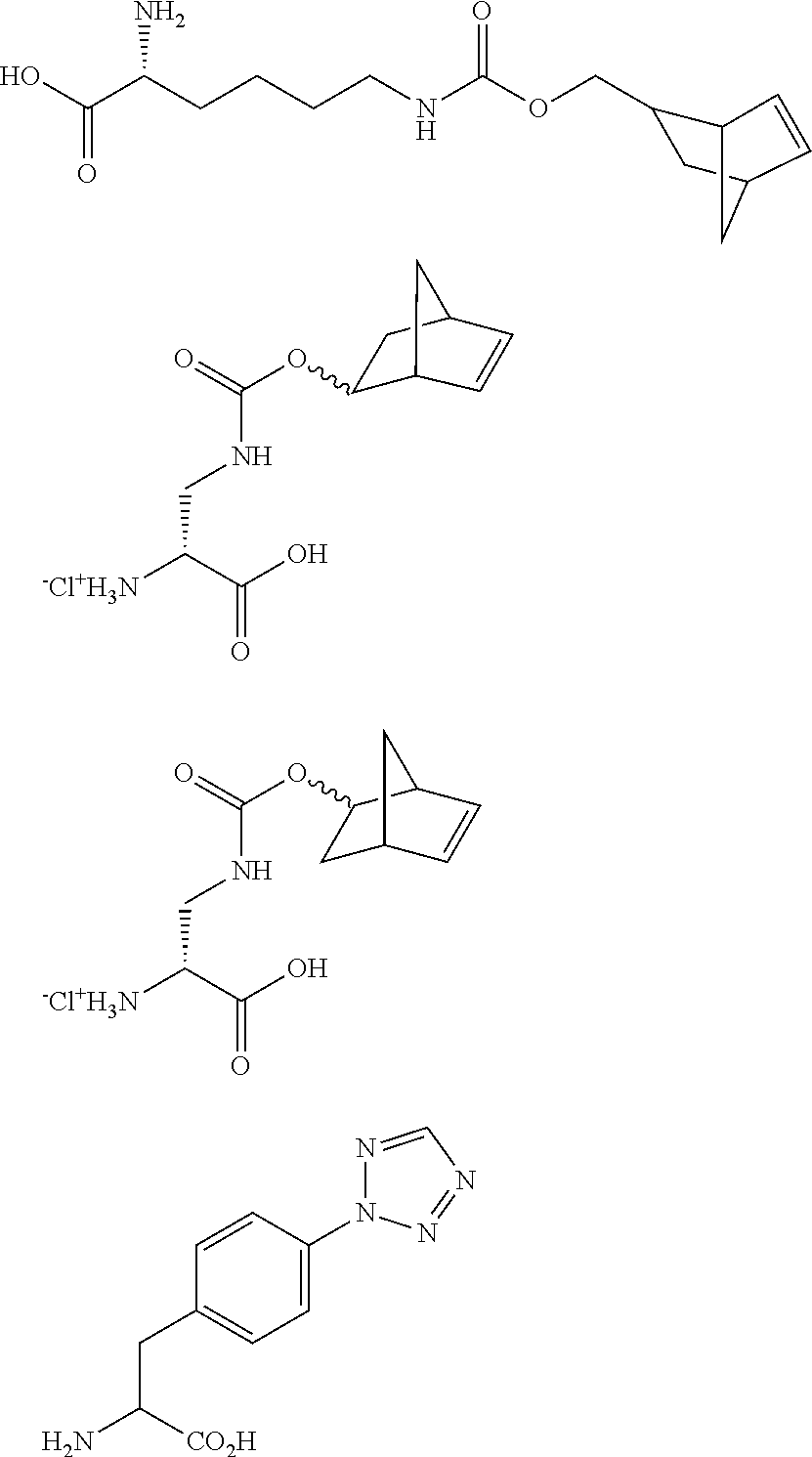
X-L-Y, wherein:

where:


where R1 and R2 are as defined above for Formula XVIII.


wherein

wherein

where

wherein


where R′ and R″ are molecules of interest, and each R is independently an alkyl, a substituted alkyl, an aryl or a substituted aryl, and where optionally the R groups of the boronic ester may be cyclically linked.

where R includes a molecule of interest (e.g., a detectable label), connected to the cyclooctyne group via an optional linker.

N3-L-Y
wherein: L is a linker; and Y is a molecule of interest, e.g., a detectable label.
W-L-Y
wherein: L is a linker; W is a norbornene reactive functional group; and Y is a molecule of interest, e.g., a detectable label.

Modified Peptidoglycan
PG-L-N3 or PG-L-X
PG-L-Z-L2-Y


- 1. Typas, A., Banzhaf, M., Gross, C. A., and Vollmer, W. (2012) From the regulation of peptidoglycan synthesis to bacterial growth and morphology,
Nat Rev Microbiol 10, 123-136. - 2. Quintela, J. C., de Pedro, M. A., Zollner, P., Allmaier, G., and Garcia-del Portillo, F. (1997) Peptidoglycan structure of Salmonella typhimurium growing within cultured mammalian cells, Mol Microbiol 23, 693-704.
- 3. Davis, K. M., and Weiser, J. N. (2011) Modifications to the peptidoglycan backbone help bacteria to establish infection, Infect Immun 79, 562-570.
- 4. Scheffers, D. J., and Pinho, M. G. (2005) Bacterial cell wall synthesis: new insights from localization studies, Microbiol Mol Biol Rev 69, 585-607.
- 5. Park, J. T., and Uehara, T. (2008) How bacteria consume their own exoskeletons (turnover and recycling of cell wall peptidoglycan), Microbiol Mol Biol Rev 72, 211-227, table of contents.
- 6. Glauner, B. (1988) Separation and quantification of muropeptides with high-performance liquid chromatography, Anal Biochem 172, 451-464.
- 7. Sizemore, R. K., Caldwell, J. J., and Kendrick, A. S. (1990) Alternate gram staining technique using a fluorescent lectin, Appl Environ Microbiol 56, 2245-2247.
- 8. Daniel, R. A., and Errington, J. (2003) Control of cell morphogenesis in bacteria: two distinct ways to make a rod-shaped cell, Cell 113, 767-776.
- 9. Tiyanont, K., Doan, T., Lazarus, M. B., Fang, X., Rudner, D. Z., and Walker, S. (2006) Imaging peptidoglycan biosynthesis in Bacillus subtilis with fluorescent antibiotics, Proc Natl Acad Sci USA 103, 11033-11038.
- 10. de Pedro, M. A., Quintela, J. C., Holtje, J. V., and Schwarz, H. (1997) Murein segregation in Escherichia coli, J Bacteriol 179, 2823-2834.
- 11. Viala, J., Chaput, C., Boneca, I. G., Cardona, A., Girardin, S. E., Moran, A. P., Athman, R., Memet, S., Huerre, M. R., Coyle, A. J., DiStefano, P. S., Sansonetti, P. J., Labigne, A., Bertin, J., Philpott, D. J., and Ferrero, R. L. (2004) Nod1 responds to peptidoglycan delivered by the Helicobacter pylori cag pathogenicity island,
Nat Immunol 5, 1166-1174. - 12. Sadamoto, R., Niikura, K., Sears, P. S., Liu, H., Wong, C. H., Suksomcheep, A., Tomita, F., Monde, K., and Nishimura, S. (2002) Cell-wall engineering of living bacteria, J Am Chem Soc 124, 9018-9019.
- 13. Nelson, J. W., Chamessian, A. G., McEnaney, P. J., Murelli, R. P., Kazmierczak, B. I., and Spiegel, D. A. (2010) A biosynthetic strategy for re-engineering the Staphylococcus aureus cell wall with non-native small molecules,
ACS Chem Biol 5, 1147-1155. - 14. Olrichs, N. K., Aarsman, M. E., Verheul, J., Arnusch, C. J., Martin, N. I., Herve, M., Vollmer, W., de Kruijff, B., Breukink, E., and den Blaauwen, T. (2011) A novel in vivo cell-wall labeling approach sheds new light on peptidoglycan synthesis in Escherichia coli, Chembiochem 12, 1124-1133.
- 15. Cabeen, M. T., and Jacobs-Wagner, C. (2005) Bacterial cell shape, Nat Rev Microbiol 3, 601-610.
- 16. Caparros, M., Pisabarro, A. G., and de Pedro, M. A. (1992) Effect of D-amino acids on structure and synthesis of peptidoglycan in Escherichia coli, J Bacteriol 174, 5549-5559.
- 17. Lam, H., Oh, D. C., Cava, F., Takacs, C. N., Clardy, J., de Pedro, M. A., and Waldor, M. K. (2009) D-amino acids govern stationary phase cell wall remodeling in bacteria, Science 325, 1552-1555.
- 18. Cava, F., de Pedro, M. A., Lam, H., Davis, B. M., and Waldor, M. K. (2011) Distinct pathways for modification of the bacterial cell wall by non-canonical D-amino acids, EMBO J 30, 3442-3453.
- 19. Sletten, E. M., and Bertozzi, C. R. (2009) Bioorthogonal chemistry: fishing for selectivity in a sea of functionality, Angew Chem Int Ed Engl 48, 6974-6998.
- 20. Thompson, R. J., Bouwer, H. G., Portnoy, D. A., and Frankel, F. R. (1998) Pathogenicity and immunogenicity of a Listeria monocytogenes strain that requires D-alanine for growth, Infect Immun 66, 3552-3561.
- 21. Kiick, K. L., Weberskirch, R., and Tirrell, D. A. (2001) Identification of an expanded set of translationally active methionine analogues in Escherichia coli, FEBS Lett 502, 25-30.
- 22. Kiick, K. L., Saxon, E., Tirrell, D. A., and Bertozzi, C. R. (2002) Incorporation of azides into recombinant proteins for chemoselective modification by the Staudinger ligation, Proc Natl Acad Sci USA 99, 19-24.
- 23. Neuhaus, F. C., and Baddiley, J. (2003) A continuum of anionic charge: structures and functions of D-alanyl-teichoic acids in gram-positive bacteria, Microbiol
Mol Biol Rev 67, 686-723. - 24. Webb, A. J., Karatsa-Dodgson, M., and Grundling, A. (2009) Two-enzyme systems for glycolipid and polyglycerolphosphate lipoteichoic acid synthesis in Listeria monocytogenes, Mol Microbiol 74, 299-314.
- 25. Kamisango, K., Fujii, H., Okumura, H., Saiki, I., Araki, Y., Yamamura, Y., and Azuma, I. (1983) Structural and immunochemical studies of teichoic acid of Listeria monocytogenes, J Biochem 93, 1401-1409.
- 26. Eugster, M. R., and Loessner, M. J. (2011) Rapid analysis of Listeria monocytogenes cell wall teichoic acid carbohydrates by ESI-MS/MS, PLoS One 6, e21500.
- 27. Lupoli, T. J., Tsukamoto, H., Doud, E. H., Wang, T. S., Walker, S., and Kahne, D. (2011) Transpeptidase-mediated incorporation of D-amino acids into bacterial peptidoglycan, J Am Chem Soc 133, 10748-10751.
- 28. Korsak, D., Markiewicz, Z., Gutkind, G. O., and Ayala, J. A. (2010) Identification of the full set of Listeria monocytogenes penicillin-binding proteins and characterization of PBPD2 (Lmo2812),
BMC Microbiol 10, 239. - 29. Korsak, D., Popowska, M., and Markiewicz, Z. (2005) Analysis of the murein of a Listeria monocytogenes EGD mutant lacking functional penicillin binding protein 5 (PBP5),
Pol J Microbiol 54, 339-342. - 30. Boneca, I. G., Dussurget, O., Cabanes, D., Nahori, M. A., Sousa, S., Lecuit, M., Psylinakis, E., Bouriotis, V., Hugot, J. P., Giovannini, M., Coyle, A., Bertin, J., Namane, A., Rousselle, J. C., Cayet, N., Prevost, M. C., Balloy, V., Chignard, M., Philpott, D. J., Cossart, P., and Girardin, S. E. (2007) A critical role for peptidoglycan N-deacetylation in Listeria evasion from the host innate immune system, Proc Natl Acad Sci USA 104, 997-1002.
- 31. Yao, J. Z., Uttamapinant, C., Poloukhtine, A., Baskin, J. M., Codelli, J. A., Sletten, E. M., Bertozzi, C. R., Popik, V. V., and Ting, A. Y. (2012) Fluorophore targeting to cellular proteins via enzyme-mediated azide ligation and strain-promoted cycloaddition, J Am Chem Soc 134, 3720-3728.
- 32. Beatty, K. E., Liu, J. C., Xie, F., Dieterich, D. C., Schuman, E. M., Wang, Q., and Tirrell, D. A. (2006) Fluorescence visualization of newly synthesized proteins in mammalian cells, Angew Chem Int Ed Engl 45, 7364-7367.
- 33. Miner, M. D., Port, G. C., and Freitag, N. E. (2008) Functional impact of mutational activation on the Listeria monocytogenes central virulence regulator PrfA, Microbiology 154, 3579-3589.
- 34. Zeldovich, V. B., Robbins, J. R., Kapidzic, M., Lauer, P., and Bakardjiev, A. I. (2011) Invasive extravillous trophoblasts restrict intracellular growth and spread of Listeria monocytogenes, PLoS Pathog 7, e1002005.
- 35. Rafelski, S. M., and Theriot, J. A. (2006) Mechanism of polarization of Listeria monocytogenes surface protein ActA, Mol Microbiol 59, 1262-1279.
- 36. Jewett, J. C., Sletten, E. M., and Bertozzi, C. R. (2010) Rapid Cu-free click chemistry with readily synthesized biarylazacyclooctynones, J Am Chem Soc 132, 3688-3690.
- 37. Baskin, J. M., Prescher, J. A., Laughlin, S. T., Agard, N. J., Chang, P. V., Miller, I. A., Lo, A., Codelli, J. A., and Bertozzi, C. R. (2007) Copper-free click chemistry for dynamic in vivo imaging, Proc Natl Acad Sci USA 104, 16793-16797.
- 38. Breidenbach, M. A., Gallagher, J. E., King, D. S., Smart, B. P., Wu, P., and Bertozzi, C. R. (2010) Targeted metabolic labeling of yeast N-glycans with unnatural sugars, Proc Natl Acad Sci USA 107, 3988-3993.
- 39. Saxon, E., and Bertozzi, C. R. (2000) Cell surface engineering by a modified Staudinger reaction, Science 287, 2007-2010.
Claims (14)
Priority Applications (1)
| Application Number | Priority Date | Filing Date | Title |
|---|---|---|---|
| US15/704,977 US10016498B2 (en) | 2012-11-30 | 2017-09-14 | D-amino acid derivative-modified peptidoglycan and methods of use thereof |
Applications Claiming Priority (4)
| Application Number | Priority Date | Filing Date | Title |
|---|---|---|---|
| US201261731986P | 2012-11-30 | 2012-11-30 | |
| US14/092,262 US9303068B2 (en) | 2012-11-30 | 2013-11-27 | D-amino acid derivative-modified peptidoglycan and methods of use thereof |
| US15/087,348 US9789180B2 (en) | 2012-11-30 | 2016-03-31 | D-amino acid derivative-modified peptidoglycan and methods of use thereof |
| US15/704,977 US10016498B2 (en) | 2012-11-30 | 2017-09-14 | D-amino acid derivative-modified peptidoglycan and methods of use thereof |
Related Parent Applications (1)
| Application Number | Title | Priority Date | Filing Date |
|---|---|---|---|
| US15/087,348 Division US9789180B2 (en) | 2012-11-30 | 2016-03-31 | D-amino acid derivative-modified peptidoglycan and methods of use thereof |
Publications (2)
| Publication Number | Publication Date |
|---|---|
| US20180000929A1 US20180000929A1 (en) | 2018-01-04 |
| US10016498B2 true US10016498B2 (en) | 2018-07-10 |
Family
ID=50931161
Family Applications (3)
| Application Number | Title | Priority Date | Filing Date |
|---|---|---|---|
| US14/092,262 Expired - Fee Related US9303068B2 (en) | 2012-11-30 | 2013-11-27 | D-amino acid derivative-modified peptidoglycan and methods of use thereof |
| US15/087,348 Active 2033-12-17 US9789180B2 (en) | 2012-11-30 | 2016-03-31 | D-amino acid derivative-modified peptidoglycan and methods of use thereof |
| US15/704,977 Active US10016498B2 (en) | 2012-11-30 | 2017-09-14 | D-amino acid derivative-modified peptidoglycan and methods of use thereof |
Family Applications Before (2)
| Application Number | Title | Priority Date | Filing Date |
|---|---|---|---|
| US14/092,262 Expired - Fee Related US9303068B2 (en) | 2012-11-30 | 2013-11-27 | D-amino acid derivative-modified peptidoglycan and methods of use thereof |
| US15/087,348 Active 2033-12-17 US9789180B2 (en) | 2012-11-30 | 2016-03-31 | D-amino acid derivative-modified peptidoglycan and methods of use thereof |
Country Status (1)
| Country | Link |
|---|---|
| US (3) | US9303068B2 (en) |
Cited By (3)
| Publication number | Priority date | Publication date | Assignee | Title |
|---|---|---|---|---|
| WO2023034954A1 (en) * | 2021-09-03 | 2023-03-09 | University Of Massachusetts | Amplifiable metabolic labeling for detection of bacterial viability, growth and antibiotic susceptibility |
| US11833526B2 (en) | 2015-06-26 | 2023-12-05 | Ancera Inc. | Background defocusing and clearing in ferrofluid-based capture assays |
| US20250059581A1 (en) * | 2021-12-29 | 2025-02-20 | Nanyang Technological University | Method of bacterial identification and testing of bacterium resistant to one or more antibiotics |
Families Citing this family (4)
| Publication number | Priority date | Publication date | Assignee | Title |
|---|---|---|---|---|
| WO2015038764A1 (en) * | 2013-09-11 | 2015-03-19 | Indiana University Research And Technology Corporation | D-ala-d-ala-based dipeptides as tools for imaging peptidoglycan biosynthesis |
| US11560384B2 (en) | 2017-05-04 | 2023-01-24 | University Of Utah Research Foundation | Benzonorbornadiene derivatives and reactions thereof |
| WO2023129822A2 (en) * | 2021-12-28 | 2023-07-06 | The Board Of Trustees Of The Leland Stanford Junior University | Chemically modified bacterial peptidoglycan compositions and uses thereof |
| CN115372341B (en) * | 2022-05-14 | 2025-04-25 | 西北工业大学深圳研究院 | Bioluminescent detection system of bacterial cell wall nascent peptidoglycan constructed by D-lysine derivatives and its application method |
Citations (1)
| Publication number | Priority date | Publication date | Assignee | Title |
|---|---|---|---|---|
| US8303966B2 (en) | 2006-01-13 | 2012-11-06 | Yisheng Biopharma (Singapore) Pte. Ltd. | Immunogenic substances comprising a polyinosinic acid—polycytidilic acid based adjuvant |
-
2013
- 2013-11-27 US US14/092,262 patent/US9303068B2/en not_active Expired - Fee Related
-
2016
- 2016-03-31 US US15/087,348 patent/US9789180B2/en active Active
-
2017
- 2017-09-14 US US15/704,977 patent/US10016498B2/en active Active
Patent Citations (1)
| Publication number | Priority date | Publication date | Assignee | Title |
|---|---|---|---|---|
| US8303966B2 (en) | 2006-01-13 | 2012-11-06 | Yisheng Biopharma (Singapore) Pte. Ltd. | Immunogenic substances comprising a polyinosinic acid—polycytidilic acid based adjuvant |
Non-Patent Citations (9)
Cited By (4)
| Publication number | Priority date | Publication date | Assignee | Title |
|---|---|---|---|---|
| US11833526B2 (en) | 2015-06-26 | 2023-12-05 | Ancera Inc. | Background defocusing and clearing in ferrofluid-based capture assays |
| WO2023034954A1 (en) * | 2021-09-03 | 2023-03-09 | University Of Massachusetts | Amplifiable metabolic labeling for detection of bacterial viability, growth and antibiotic susceptibility |
| US20250002970A1 (en) * | 2021-09-03 | 2025-01-02 | University Of Massachusetts | Amplifiable metabolic labeling for detection of bacterial viability, growth and antibiotic susceptibility |
| US20250059581A1 (en) * | 2021-12-29 | 2025-02-20 | Nanyang Technological University | Method of bacterial identification and testing of bacterium resistant to one or more antibiotics |
Also Published As
| Publication number | Publication date |
|---|---|
| US20140170183A1 (en) | 2014-06-19 |
| US9789180B2 (en) | 2017-10-17 |
| US9303068B2 (en) | 2016-04-05 |
| US20170021013A1 (en) | 2017-01-26 |
| US20180000929A1 (en) | 2018-01-04 |
Similar Documents
| Publication | Publication Date | Title |
|---|---|---|
| US10016498B2 (en) | D-amino acid derivative-modified peptidoglycan and methods of use thereof | |
| US10145848B2 (en) | Small-molecule hydrophobic tagging of fusion proteins and induced degradation of same | |
| US8940501B2 (en) | Methods for ligation and uses thereof | |
| US20130122043A1 (en) | Modified polypeptides and proteins and uses thereof | |
| US10370538B2 (en) | Probes for rapid and specific detection of mycobacteria | |
| JP2015500989A (en) | Multiplex immunoscreening assay | |
| JP6877424B2 (en) | Inhibitor of arginine gingipain | |
| FR2794865A1 (en) | METHOD OF EARLY DETECTION OF FLAVIVIRUSES AND ITS APPLICATIONS | |
| US20240058455A1 (en) | Bioorthogonal linkers and reactions | |
| JP2020523402A (en) | Pharmaceutical composition comprising glutathione disulfide and glutathione disulfide S-oxide | |
| Maculins et al. | Multiplexed proteomics of autophagy-deficient murine macrophages reveals enhanced antimicrobial immunity via the oxidative stress response | |
| US20140113817A1 (en) | Peptides with antimicrobial activity, drug compositions for the treatment and prophylaxis of animals, compositions for the treatment and prophylaxis of plants, uses of said peptides, and uses of paenibacillus elgil ourofinensis extract | |
| US20100022504A1 (en) | Methods for treating latent tuberculosis | |
| CN109641938A (en) | Derived from Arginine-rich structural domain through modified antimicrobial peptide | |
| US10047112B2 (en) | Fluorescent labeled inhibitors | |
| Rodrigues | Early events of cell autonomous response against Toxoplasma gondii in the mouse | |
| Klapper et al. | Recent Advances in Understanding the Sex Pheromone‐Mediated Communication of Diatoms | |
| US9630916B2 (en) | Organocatalysts of oxidative protein folding | |
| Shannan et al. | A Review of Antibiotic-Induced Drug Allergies: Mechanisms, Prevalence, And Future Perspectives | |
| WO2015037764A1 (en) | In vivo and ex vivo amplification of myeloid-derived immunoregulatory cell and immunoregulatory b lymphocyte by activation of gpcr19 pathway | |
| Hackenburg | Functional Characterization of Secreted L. pneumophila Proteins Involved in Early Stages of Host Infection | |
| Dornan | The Covalent Modification of Proteins: New Therapeutics and Probing Function and Mechanism | |
| Smith | Investigating the ubiquitin conjugating machinery in* Plasmodium falciparum | |
| Buchrieser et al. | Legionella | |
| Mone | Metabolic Responses to Freund’s Adjuvants and Oncolytic Viruses: Implications on Vaccines and Tumor Immunity |
Legal Events
| Date | Code | Title | Description |
|---|---|---|---|
| FEPP | Fee payment procedure |
Free format text: ENTITY STATUS SET TO UNDISCOUNTED (ORIGINAL EVENT CODE: BIG.); ENTITY STATUS OF PATENT OWNER: SMALL ENTITY |
|
| FEPP | Fee payment procedure |
Free format text: ENTITY STATUS SET TO SMALL (ORIGINAL EVENT CODE: SMAL); ENTITY STATUS OF PATENT OWNER: SMALL ENTITY |
|
| AS | Assignment |
Owner name: THE REGENTS OF THE UNIVERSITY OF CALIFORNIA, CALIF Free format text: ASSIGNMENT OF ASSIGNORS INTEREST;ASSIGNORS:BERTOZZI, CAROLYN R.;PALMORE, MARY SLOAN SIEGRIST;JEWETT, JOHN C.;AND OTHERS;SIGNING DATES FROM 20131230 TO 20140227;REEL/FRAME:044426/0657 |
|
| STCF | Information on status: patent grant |
Free format text: PATENTED CASE |
|
| MAFP | Maintenance fee payment |
Free format text: PAYMENT OF MAINTENANCE FEE, 4TH YR, SMALL ENTITY (ORIGINAL EVENT CODE: M2551); ENTITY STATUS OF PATENT OWNER: SMALL ENTITY Year of fee payment: 4 |
|
| MAFP | Maintenance fee payment |
Free format text: PAYMENT OF MAINTENANCE FEE, 8TH YR, SMALL ENTITY (ORIGINAL EVENT CODE: M2552); ENTITY STATUS OF PATENT OWNER: SMALL ENTITY Year of fee payment: 8 |