US10013477B2 - Accelerated discrete distribution clustering under wasserstein distance - Google Patents
Accelerated discrete distribution clustering under wasserstein distance Download PDFInfo
- Publication number
- US10013477B2 US10013477B2 US15/282,947 US201615282947A US10013477B2 US 10013477 B2 US10013477 B2 US 10013477B2 US 201615282947 A US201615282947 A US 201615282947A US 10013477 B2 US10013477 B2 US 10013477B2
- Authority
- US
- United States
- Prior art keywords
- clustering
- data
- algorithm
- wasserstein
- admm
- Prior art date
- Legal status (The legal status is an assumption and is not a legal conclusion. Google has not performed a legal analysis and makes no representation as to the accuracy of the status listed.)
- Active
Links
Images
Classifications
-
- G—PHYSICS
- G06—COMPUTING OR CALCULATING; COUNTING
- G06F—ELECTRIC DIGITAL DATA PROCESSING
- G06F16/00—Information retrieval; Database structures therefor; File system structures therefor
- G06F16/20—Information retrieval; Database structures therefor; File system structures therefor of structured data, e.g. relational data
- G06F16/28—Databases characterised by their database models, e.g. relational or object models
- G06F16/284—Relational databases
- G06F16/285—Clustering or classification
-
- G06F17/30598—
-
- G—PHYSICS
- G06—COMPUTING OR CALCULATING; COUNTING
- G06N—COMPUTING ARRANGEMENTS BASED ON SPECIFIC COMPUTATIONAL MODELS
- G06N20/00—Machine learning
-
- G—PHYSICS
- G06—COMPUTING OR CALCULATING; COUNTING
- G06N—COMPUTING ARRANGEMENTS BASED ON SPECIFIC COMPUTATIONAL MODELS
- G06N20/00—Machine learning
- G06N20/10—Machine learning using kernel methods, e.g. support vector machines [SVM]
-
- G06N99/005—
Definitions
- This invention relates to data clustering and, in particular, to accelerated discrete distribution (D2) clustering based on Wasserstein distance.
- Clustering is a fundamental unsupervised learning methodology for data mining and machine learning. Additionally, clustering can be used in supervised learning for building non-parametric models (Beecks et al., 2011).
- the K-means algorithm (MacQueen, 1967) is one of the most widely used clustering algorithms because of its simple yet generally accepted objective function for optimization.
- K-means has evolved recently, a fundamental limitation of K-means and those variants is that they only apply to the Euclidean space.
- the data to be processed are not vectors.
- bags of weighted vectors e.g., bags of words, bags of visual words, sparsely represented histograms
- object descriptors Choen and Wang, 2004; Pond et al., 2010
- the discrete distribution clustering algorithm also known as the D2-clustering (Li and Wang, 2008), tackles such type of data by optimizing an objective function defined in the same spirit as that used by K-means. Specifically, it minimizes the sum of squared distances between each object and its nearest centroid. D2-clustering is implemented and applied in a real-time image annotation system named ALIPR (Li and Wang, 2008).
- the metric is known as the Kantorovich-Wasserstein metric. It also has several variants, as well as names, in part due to its wide application in different fields. Readers can refer to the book by Rachev and Ruschendorf (1998) for some of these applications.
- the metric is better known as the earth mover's distance (EMD) (Rubner et al., 1998) in computer vision and the Mallows distance in statistics literature (Mallows, 1972).
- EMD earth mover's distance
- the Wasserstein distance is robust to quantization noise and efficient with sparse representations. It is proved to be an effective metric for image retrieval and annotation.
- the D2-clustering algorithm is constructed based upon this distance and has been applied successfully to image annotation. In addition, this distance is also adopted in multiple data mining and machine learning applications such as video classification and retrieval (Xu and Chang, 2008), sequence categorization (Pond et al., 2010), and document retrieval (Wan, 2007), where objects are represented by discrete distributions. As a fundamental machine learning tool to group discrete distributions with Wasserstein distance, D2-clustering can be highly valuable in these areas.
- D2-clustering A major concern in applying D2-clustering is its scalability. Because linear programming is needed in D2-clustering and the number of unknown variables grows with the number of objects in a cluster, the computational cost would normally increase polynomially with the sample size (assuming the number of clusters is roughly fixed). As a result, on a typical 2 GHz single-core CPU, ALIPR takes several minutes to learn each semantic category by performing D2-clustering on 80 images in it, but demands more than a day to complete the modeling of a semantic category containing thousands of training images.
- Both the labeling C( ⁇ ) and the centroids ⁇ right arrow over (z) ⁇ j 's are involved in the optimization. Because they interlace with each other in the optimization, they are iteratively updated in two stages. Within each iteration, C(i) is updated by assigning each ⁇ right arrow over (v) ⁇ i with the label of its closest cluster centroid and then the centroid ⁇ right arrow over (z) ⁇ j for each cluster is updated by averaging the vectors attached to the cluster. For each of the two stages the updating decreases the objective in Eq. (1) monotonically. The iteration terminates when the objective stabilizes below a certain value, as defined in the stopping criteria.
- ⁇ ⁇ , ⁇ is the matching weights between the ⁇ -th element in v and ⁇ -th element in u.
- d(v ( ⁇ ) ,u ( ⁇ ) ) is the distance between v ( ⁇ ) and u ( ⁇ ) in the sample space of the random variable.
- the random variable of a discrete distribution is sampled from an Euclidean space unless otherwise noted.
- the metric used by the sample space is not essential for the Wasserstein distance because what make the computation elaborate are the matching weights solved in the linear programming.
- D2-clustering is a clustering algorithm for any collection of discrete distributions within the same sample space.
- K-means Working in the same spirit as K-means, it also aims at minimizing the total within-cluster dispersion. Because the distances between discrete distributions are calculated using Wasserstein distance, the objective function to be minimized is the total squared Wasserstein distance between the data and the centroids.
- the D2-clustering algorithm is analogous to K-means in that it iterates the update of the partition and the update of the centroids. There are two stages within each iteration. First, the cluster label of each sample is assigned to be the label of its closest centroid; and second, centroids are updated by minimizing the within-cluster sum of squared distances. To update the partition in D2-clustering, we need to compute the Wasserstein distance between a sample and each centroid. To update the centroids, an embedded iterative procedure is needed which involves a large-scale linear programming problem in every iteration. The number of unknowns in the optimization grows with the number of samples in the cluster.
- ALGORITRM 1 Centroid Update Process of D2-Clustering Input: A collection of discrete distributions v 1 , v 2 , . . . ,v n j that belong to cluster j.
- optimization reduces to a linear programming.
- Fix p z j ( ⁇ ) 's and update z j ( ⁇ ) , ⁇ 1, . . .
- the number of constraints is 1+n j s j + ⁇ 1 n j t i ⁇ 2n j s j .
- the number of parameters in the linear program grows linearly with the size of the cluster. Because it costs polynomial time to solve the linear programming problem (Shman and Teng, 2004), D2-clustering has a much higher computational complexity than K-means algorithm.
- K-means The analysis of the time complexity of K-means remains an unsolved problem because the number of iterations for convergence is difficult to determine.
- the worst case time complexity for K-means is ⁇ (2 ⁇ square root over (n) ⁇ ) (Arthur and Vassilvitskii, 2006). Arthur et al. (2011) show recently that K-means has polynomial smoothed complexity, which reflects the fact that K-means converges in a relatively short time in real cases (although no tight upper or lower bound of time complexity has been proved).
- K-means usually converges fast, and seldom costs an exponential number of iterations.
- K-means converges in linear or even sub-linear time (Duda et al., 2012).
- Kumar et al. (2010) present a random sampling and estimation approach to guarantee K-means to compete in linear time. Although there is still a gap between the theoretical explanation and practice, we can consider K-means an algorithm with at most polynomial time.
- the discrete distribution is a well-adopted way to summarize a mass of data. It often serves as a descriptor for complex instances encountered in machine learning, e.g., images, sequences, and documents, where each instance itself is converted to a data collection instead of a vector.
- the celebrated bag of “words” data model is intrinsically a discrete distribution.
- the widely used normalized histogram is a special case of discrete distributions with a fixed set of support points across the instances. In many applications involving moderate or high dimensions, the number of bins in the histograms is enormous because of the diversity across instances, while the histogram for any individual instance is highly sparse. This is frequently observed for collections of images and text documents.
- the discrete distribution can function as a sparse representation for the histogram, where support points and their probabilities are specified in pairs, eliminating the restriction of a fixed quantization codebook across instances.
- the Wasserstein distance is a true metric for measures and can be traced back to the mass transport problem proposed by Monge in 1780s and the relaxed formulation by Kantorovich in the 1940s. Mallows used this distance to prove some theoretical results in statistics, and thus the name Mallows distance has been used by statisticians. In computer science, it is better known as the Earth Mover's Distance. In signal processing, it is closely related to the Optimal Sub-Pattern Assignment (OSPA) distance used recently for multi-target tracking.
- OSPA Optimal Sub-Pattern Assignment
- Distribution clustering can be done subject to different affinity definitions. For example, Bregman clustering pursues the minimal distortion between the cluster prototype—called the Bregman representative—and cluster members according to a certain Bregman divergence (Banerjee et al. 2005).
- D2-clustering is an extension of K-means to discrete distributions under the Wasserstein distance (Li and Wang 2008), and the cluster prototype is an approximate Wasserstein barycenter with sparse support.
- solving the cluster prototype or the centroid for discrete distributions under the Wasserstein distance is computationally challenging (Cuturi and Doucet 2014; Ye and Li 2014; Zhang, Wang, and Li 2015).
- the centroid of a collection of distributions minimizing the average pth-order power of the L p Wasserstein distance is called Wasserstein barycenter (Agueh and Carlier 2011).
- the 2nd order Wasserstein barycenter is simply referred to as a prototype or centroid; and is solved for the case of an unknown support with a pre-given cardinality.
- the existence, uniqueness, regularity and other properties of the 2nd order Wasserstein barycenter have been established mathematically for continuous measures in the Euclidean space (Agueh and Carlier 2011). But the situation is more intricate for discrete distributions, as will be explained later.
- the first strategy of fixing the support of a barycenter can yield adequate approximation quality in low dimensions (e.g. 1D/2D histogram data) (Cuturi and Doucet 2014; Benamou et al. 2015), but can face the challenge of exponentially growing support size when the dimension increases.
- the second strategy allows one to use a possibly much smaller number of support points in a barycenter to achieve the same level of accuracy (Li and Wang 2008; Zhang, Wang, and Li 2015; Ye and Li 2014; Cuturi and Doucet 2014).
- This invention resides in computationally efficient algorithms for clustering discrete distributions under the Wasserstein distance.
- This clustering problem was originally explored by Li and Wang, who coined the phrase D2-clustering in 2006, referring to both the optimization problem and their particular algorithm. Motivations for using the Wasserstein distance in practice are strongly argued by researchers and its theoretical significance by the optimal transport literature (see the seminal books of Villani).
- AD2-clustering improvescalability significantly.
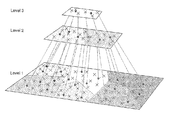
- FIG. 1 illustrates the hierarchical structure used for parallel processing, wherein input data are denoted by crossings at the bottom level (Level 1 );
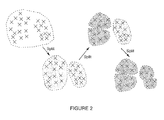
- FIG. 2 illustrates an iterative process containing a series of binary splitting
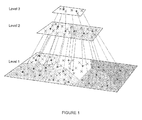
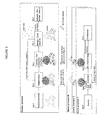
- FIG. 3 depicts a work flow
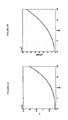
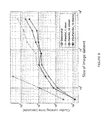
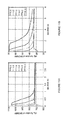
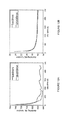
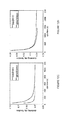
- FIG. 4A shows the relationship between the run-time T (number of CPU cycles) and the shrinking factor R, wherein T is an increasing function of R;
- FIG. 4B shows the relationship between the run-time T (number of CPU cycles) and the shrinking factor R, wherein the derivative of T over R;
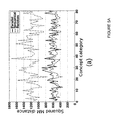
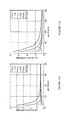
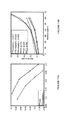
- FIG. 5A is a plot of mean-squared distances
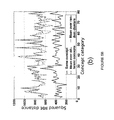
- FIG. 5B compares the clustering results using the MM distance between sets of centroids acquired by different methods
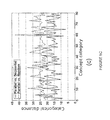
- FIG. 5C plots the categorical clustering distance between the parallel and sequential clustering results for every image concept
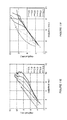
- FIG. 6 shows how the parallel algorithm scales up approximately at linearithmic rate
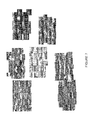
- FIG. 7 shows how images with similar color and texture are put in the same clusters
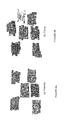
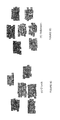
- FIGS. 8A-8D provide more clustering results for images with different concepts
- FIG. 9 shows examples of concept prediction using the models built by the sequential and parallel D2-clustering results
- FIG. 10A describes clustering centroids
- FIG. 10B and FIG. 10C show the clustering centroids generated by parallel K-means and hierarchical K-means, running on the same dataset with identical parameters;
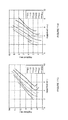
- FIGS. 11A-1H show the convergence analysis results on the four datasets
- FIGS. 13A-3B show the comparison between Kmeans++ and AD2-clustering on USPS dataset.
- Table I compares D2-clustering with several basic clustering algorithms in machine learning. D2-clustering runs on discrete distributions which K-means cannot handle. It is also more preferable over agglomerative clustering (Johnson, 1967) and spectral clustering (Ng et al., 2002) when cluster prototypes are needed.
- the main disadvantage of D2-clustering is the high time complexity.
- the parallel D2-clustering algorithm listed on the last column of the table keeps most of D2-clustering's properties with minor approximation, and improves the time complexity to a much lower order.
- centroid update for both K-means and D2-clustering is to find an optimized centroid for each cluster with the objective that the sum of squared distances from the centroid to each data point in the cluster is minimal.
- the optimized centroid for each cluster is simply the arithmetic mean of the data points in it, which can be obtained by averaging the separately computed local means of different data chunks.
- D2-clustering a linear program described by (3) has to be solved to get the optimized centroid.
- K-means' centroid update which is essentially a step of computing an average
- the computation of a centroid in D2-clustering is far more complicated than any linear combination of the data points. Instead, all the data points in the corresponding cluster play a role in the linear programming problem in Eq. (3). To the best of our knowledge, there is no mathematical equivalence of a parallel algorithm for the problem.
- centroid is exactly for a compact representation of a group of data.
- centroid computed from the local centroids should represent well the entire cluster, although some loss of accuracy is expected.
- MPI Message Passing Interface
- MapReduce MapReduce
- MapReduce MapReduce
- FIG. 1 illustrates the hierarchical structure used for parallel processing. All input data are denoted by crosses at the bottom level (Level 1 ) in FIG. 1 . Because of the large data size, these data points (each being a discrete distribution) are divided into several segments (reflected by different shadings in the figure) which are small enough to be clustered by the sequential D2-clustering. D2-clustering is performed within each segment. Data points in each segment are assigned with different cluster labels, and several cluster centroids (denoted by blue dots in the figure) are obtained. These cluster centroids are regarded as proper summarization for the original data. Each centroid approximates the effect of the data assigned to the corresponding cluster, and is taken to the next level in the hierarchy.
- the algorithm may proceed to higher levels by repeating the same process, with the number of segments decreasing level by level.
- the granularity of the data becomes coarser and coarser as the algorithm traverses through the levels of the hierarchy.
- the hierarchy terminates when the amount of data at a certain level is sufficiently small and no further clustering is needed.
- the data size at the third level is small enough for not proceeding to another level.
- the clusters at the highest level is then the final clustering result.
- FIG. 2 illustrates the iterative process containing a series of binary splitting.
- LBG algorithm which splits every segment into two parts, doubling the total number of segments in every iteration, our approach only splits one segment in each round.
- the original data are split into two groups using a binary clustering approach (to be introduced later).
- We further split the segments by the same process repetitively. Each time we split the segment containing the most data points into two clusters, so on so forth.
- the splitting process stops when all the segments are smaller than a certain size.
- this clustering step needs to be fast because it is a preparation before conducting D2-clustering in parallel.
- the method we use is a computationally reduced version of D2-clustering. It is suitable for clustering bags of weighted vectors. Additionally, it is fast because of some constraints imposed on the centroids. We refer to this version as the constrained D2-clustering.
- the constrained D2-clustering is a reduced version of D2-clustering.
- Parameters t i and s j are the numbers of support vectors in the corresponding discrete distributions v i and z j .
- C(i) ⁇ 1, . . . , k ⁇ denotes the cluster label assigned to v i .
- the D2-clustering and constrained D2-clustering algorithms are described in Algorithm 2.
- ALGORITHM 2 D2-Clustering and Constrained D2-Clustering.
- Input A collection of discrete distributions v 1 ,v 2 , . . . ,v n
- the difference between D2-clustering and constrained D2-clustering is the way to update centroids in Step 2 of Algorithm 2.
- Step 2 In the constrained D2-clustering algorithm, we replace Step 2 by Step 2* in the D2-clustering algorithm.
- ⁇ ⁇ , ⁇ (i) 's we only need to solve ⁇ ⁇ , ⁇ (i) 's.
- ⁇ ⁇ , ⁇ (i) 's can be optimized separately for different i's, which significantly reduces the number of parameters in a single linear programming problem.
- Data segments generated by the initialization step are distributed to different processors in the parallel algorithm. Within each processor, a D2-clustering is performed to cluster the segment of data. Such a process is done at different levels as illustrated in FIG. 1 .
- Clustering at a certain level usually produces unbalanced clusters containing possibly quite different numbers of data points. If we intend to keep equal contribution from each original data point, the cluster centroids passed to a higher level in the hierarchy should be weighted and the clustering method should take those weights into account. We thus extended D2-clustering to a weighted version. As will be shown next, the extension is straightforward and results in little extra computation.
- centroid is not affected when the weights are scaled by a common factor, we simply use the number of original data points assigned to each centroid as its weight.
- the weights can be computed recursively when the algorithm goes through levels in the hierarchy. At the bottom level, each original data point is assigned with weight 1 .
- the weight of a data point in a parent level is the sum of weights of its child data points.
- the parallel program runs on a computation cluster with multiple processors.
- a “master” processor that controls the flow of the program and some other “slave” processors in charge of computation for the sub-problems.
- the master processor performs the initial data segmentation at each level in the hierarchical structure specified in FIG. 1 , and then distribute the data segments to different slave processors.
- Each slave processor clusters the data it received by the weighted D2-clustering algorithm independently, and send the clustering result back to the master processor.
- the master processor receives all the local clustering results from the slave processors, it combines these results and set up the data for clustering at the next level if necessary.
- ALGORITHM 3 Master Side of Parallel D2-clustering.
- contains no more than ⁇ entries, and the corresponding weights for data in
- the current work adopts MPI for implementing the parallel program.
- MPI for implementing the parallel program.
- a processor can broadcast its local data to all others, and send data to (or receive data from) a specific processor. Being synchronized, all these operations do not return until the data transmission is completed. Further, we can block the processors until all have reached a certain blocking point. In this way, different processors are enforced to be synchronized.
- FIG. 3 illustrates the algorithms on both sides in a visualized way.
- the master processor controls the work flow and makes the clustering work in a hierarchical way as described in FIG. 1 .
- the hierarchy is constructed by the outmost loop in Algorithm 3, in which the operations in line 3-1 and line 3-2 relate the data between adjacent levels.
- the master distributes the data to slave processors and is then blocked until it gets all the clustering results from the slave processors.
- Each slave processor is also blocked until it gets the clustering request and data from the master processor. After performing D2-clustering and sending the results back to the master processor, a slave processor returns to a blocked and waiting status.
- both the master and the slave processors have a working stage to perform the computation and a blocked stage to wait for data from the other side, which is fulfilled by the synchronized communication.
- the other side is blocked and waiting for the computation results.
- ALGORITHM 4 Slave Side of Parallel D2-clustering (same process on each slave). begin
- Receive data segment id ⁇ , data in the segment V ⁇ ⁇ v ⁇ ,1 ,v ⁇ ,2 , . . . ,v ⁇ ,n ⁇ ⁇ and the
- corresponding weights W ⁇ ⁇ w ⁇ ,1 ,w ⁇ ,2 , . . . ,w ⁇ ,n ⁇ ⁇ .
- step 1 the master process runs data segmentation and distribution specified in line 1-1 and line 1-2 of Algorithm 3, and the slave processors are blocked until they hear data from the master, which is formulated in line 1-1 and line 1-2 of Algorithm 4.
- step 2 both the master and slave processor proceed to step 2, in which the master waits for the clustering result from the slaves and combines the received results from different slaves (line 2-1 to line 2-6 in Algorithm 3), and the slave processors performs local D2-clustering (line 2-1 and line 2-2 in Algorithm 4).
- the master and slave processors go back to step 1 if the condition for the hierarchy to proceed is satisfied (judged by the master processor). Otherwise the master processor terminates the program and returns the clustering result.
- the convergence of the parallel D2-clustering algorithm depends on the convergence of the processes running on both the master and slave sides as described in Algorithms 3 and 4.
- the master process distributes data to different slave nodes and constructs the hierarchical structure level by level.
- the parallel clusterings are done by the slave processes, during which time the master process is blocked and waiting for the completion of all the parallel slave tasks. Therefore, the convergence properties on both sides need to be proved in order to confirm the overall convergence.
- n data points are divided to m groups.
- k ⁇ n which means the data points in the next iteration is always less than the data in the current level.
- the condition to terminate the hierarchy (k′ ⁇ k) is satisfied within finite number of iterations.
- the slave processes terminate once they receive the termination signal from the master, which is guaranteed by LEMMA 1 if the clustering within each level terminates.
- the convergence of both the master and slave processes is accordingly determined by the convergence of (weighted) D2-clustering performed in step 2-2 of Algorithm 4.
- the D2-clustering algorithm, as well as the weighted version which is mathematically equivalent, are formulated in Algorithm 2, whose convergence is proved below.
- centroid update operation described in Algorithm 1 converges in finite time.
- Algorithm 1 operates in two steps within each iteration: first, update p z ( ⁇ ) 's and ⁇ ⁇ , ⁇ (i) 's by solving a linear programming problem; second, update z ( ⁇ ) 's by computing a weighted sum.
- the linear programming minimizes the objective function (3) with z ( ⁇ ) 's fixed, which completes in polynomial time. With all the costs and constraints in the linear program being positive, it is proved that the solution is unique (Mangasarian, 1979).
- Murty (1983) show that the solution for a linear program lies in one of the extreme points of the simplex spanned by the constraints.
- Theorem 4 The parallel D2-clustering algorithm described by Algorithms 3 (master process) and 4 (slave processes) can terminate within finite time.
- the computational complexity of updating the centroid for one cluster in one iteration is polynomial in the size of the cluster.
- the total amount of computation depends on computation within one iteration as well as the number of iterations.
- K-means clustering the relationship between the number of iterations needed for convergence and the data size is complex.
- a pre-specified number of rounds e.g. 500
- centroid update of k cluster costs O(k(N/k) ⁇ ) time in total. Assume the number of iterations is linear to N, the clustering has polynomial run-time of O(k 1 ⁇ N ⁇ +1 ).
- R ⁇ ⁇ , which is the average number of data points within each cluster. It is also a factor that the data size shrinks at a certain level. The factor (referred as the shrinking factor thereafter) is important for the total run-time of the parallel D2-clustering algorithm.
- the run-time for parallel D2-clustering is linearithmic to the total number of data points N.
- the hardware resources may be limited. At certain levels, especially lower levels of the hierarchy where the number of segments are large, not every segment can be assigned to an unique CPU core. Some segments have to share one CPU core and be clustered one by one in sequential. In such case, when there are M slave CPU cores and 1 ⁇ M ⁇ N/ ⁇ , the top log R M+1 levels are fully parallel due to small number of segments.
- T clt ⁇ O ( R ⁇ + 1 ⁇ k 2 [ log R ⁇ M + N k ⁇ ⁇ M - 1 R - 1 ] ) O ( R ⁇ + 1 ⁇ k 2 ⁇ log R ⁇ N k ) , if ⁇ ⁇ M ⁇ N kR . , if ⁇ ⁇ M ⁇ N kR , ( 9 )
- the data segmentation at each level also takes time.
- a binary splitting process is adopted to generate the segments.
- N′/ ⁇ segments are generated.
- the constrained D2-clustering algorithm for each splitting runs in a similar order of K-means because it avoids large linear programming in the centroid update stage.
- the splitting tree is balanced and constrained D2-clustering has a linear time complexity.
- the total time to complete the splitting at a certain level is 0 (N′ log N′/ ⁇ ). And the total time for data segmentation among all levels is
- T clt O ( R ⁇ + 1 ⁇ k 2 ⁇ N k - 1 R - 1 ) , which is linear to N.
- T C 1 ⁇ C 4 ⁇ R ⁇ + 1 log ⁇ ⁇ R + C 2 ⁇ R R - 1 ⁇ [ C 5 - C 6 ⁇ R ⁇ ⁇ log ⁇ ⁇ R R - 1 ] .
- dT dR C 1 ⁇ C 4 ⁇ R ⁇ ⁇ [ ( ⁇ + 1 ) ⁇ log ⁇ ⁇ R - 1 ] ( log ⁇ ⁇ R ) 2 + C 2 ⁇ C 5 - C 6 ⁇ R ( R - 1 ) 2 .
- FIGS. 4A and 4B shows the trend of T
- each image is first segmented into two sets of regions based on the color (LUV components) and texture features (Daubechies-4 wavelet (Daubechies, 1992) coefficients), respectively.
- We then use two bags of weighted vectors U and V, one for color and the other for texture, to describe an image as I (u, v).
- D ⁇ ⁇ ( I i , I j ) ( D 2 ⁇ ( u i , u j ) + D 2 ⁇ ( v i , v j ) ) 1 2 ( 12 )
- D( ⁇ , ⁇ ) is the Mallows distance. It is straightforward to extend the D2-clustering algorithm to the case of multiple discrete distributions using the combined distance defined in Eq. (12). Details are provided in (Li and Wang, 2008). The order of time complexity increases simply by a multiplicative factor equal to the number of distribution types, the so-called super-dimension.
- centroid z i (or z′ i ) is associated with a percentage p i (or p i ′) computed as the proportion of data entries assigned to the cluster of z i (or z′ i ).
- D(Z,Z′) Mallows-type ⁇ tilde over (D) ⁇ (Z,Z′) based on the element-wise distances D(z i ,z j ′), where D(z i , z j ′) is the Mallows distance between two centroids, which are both discrete distributions.
- D(Z,Z′) Mallows-type because it is also the square root of a weighted sum of squared distances between the elements in Z and Z′. The weights satisfy the same set of constraints as those in the optimization problem for computing the Mallows distance.
- the number of clusters is set to 10.
- the mean squared distance from an image signature to its closest centroid is computed based on the clustering result obtained by the parallel or sequential D2-clustering algorithm. These mean squared distances are plotted in FIG. 5A .
- the parallel and sequential algorithms obtain close values for the mean squared distances for most concepts. Typically the mean squared distance by the parallel clustering is slightly larger than that by the sequential clustering. This shows that the parallel clustering algorithm compromises the tightness of clusters slightly for speed.
- FIG. 5B compares the clustering results using the MM distance between sets of centroids acquired by different methods.
- the solid curve in FIG. 5B plots D 2 (Z i ,Z i ′) for each concept i.
- d i 2 is substantially larger than ⁇ tilde over (D) ⁇ (Z i ,Z i ′), which indicates that the set of centroids Z i derived from the parallel clustering is relatively close to Z′ i from the sequential clustering.
- Another baseline for comparison is formed using random partitions.
- FIG. 5C plots the categorical clustering distance defined by Zhou et al. (2005) between the parallel and sequential clustering results for every image concept. Again, we compute the categorical clustering distance between the result from the parallel clustering and each of 10 random partitions. The average distance is shown by the dash line in the figure. For most concepts, the clustering results from the two algorithms are closer than those from the parallel algorithm and random partition. However, for many concepts, the categorical clustering distance indicates substantial difference between the results of the parallel and sequential algorithm. This may be caused to a large extent by the lack of distinct groups of images within a concept. In summary, based on all the three measures, the clustering results by the parallel and sequential algorithms are relatively close.
- the parallel D2-clustering runs in approximately linearithmic time, while the sequential algorithm scales up poorly due to its polynomial time complexity.
- FIG. 6 shows the running time on sets of images in the concept “mountain”.
- both axes are in logarithmic scales.
- All versions of clusterings are performed on datasets with sizes 50, 100, 200, 400, 800, 1600, 3200, and 6400.
- there is only one slave CPU handling all the clustering requests sent by the master CPU i.e. there are two CPUs employed in total. All clustering requests are therefore processed sequentially by the only slave processor.
- there are 16 slave CPUs i.e. 17 CPUs in total).
- the conditions are the same to the second case, but the data segmentation is implemented by a Vector Quantization (VQ) (Gersho and Gray, 1992) approach instead of the approach described earlier.
- VQ Vector Quantization
- the original sequential D2-clustering algorithm is also tested on the same datasets.
- FIG. 6 shows the parallel algorithm scales up approximately at linearithmic rate.
- the number of slave CPUs for the parallel processing contributes a linear difference (the second term in Eq. (7)) to the run-time between the first and second parallel cases.
- N the linear difference
- the linear difference may be relatively significant and make the single CPU case much slower than the multiple CPU case. But the difference becomes less so when the dataset is large because there is a dominant linearithmic term in the run-time expression. Nevertheless, in either case, the parallel algorithm is much faster than the sequential algorithm.
- the slope of the curve on the log-log plot for the sequential algorithm is much larger than 1, indicating at least polynomial complexity with a high degree.
- the parallel algorithm with 16 slave CPUs takes 88 minutes to complete clustering on the dataset containing 6400 images, in contrast to almost 8 hours consumed by the sequential algorithm running only on the dataset of size 200. Because the time for the sequential D2-clustering grows dramatically with the data size, we can hardly test it on dataset larger than 200.
- VQ When N is small and the data segmentation is not dominant in the run-time, VQ will usually not make the clustering faster. In fact due to bad segmentation of such a coarse algorithm, the time consumed for D2-clustering within each segment might be longer. That is the reason why the parallel D2-clustering with VQ segmentation is slower than its counterpart without VQ segmentation (both have same parameters and 16 slave CPUs employed) in FIG. 6 when N is smaller than 800.
- Theoretically VQ can reduce the order of the clustering from linearithmic to linear (because T seg in Eq. (10) is reduced to a linear order). However because the quantization step loses some information, the clustering result might be less accurate. This can be reflected by the MM distance (defined in Eq. (13)) between the parallel D2-clustering with VQ segmentation and the sequential D2-clustering results on a dataset containing 200 images, which is 19.57 on average for five runs. Compared to 18.41 as the average MM distance between the original parallel D2-clustering and sequential D2-clustering results, the VQ approach makes the parallel clustering result less similar to the sequential clustering result which is regarded as the standard.
- the 1,488 images are clustered into 13 groups by the parallel D2-clustering algorithm using 873 seconds (with 30 slave CPUs).
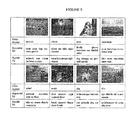
- FIG. 7 shows that images with similar color and texture are put in the same clusters.
- More clustering results for images with different concepts are shown in FIGS. 8A-8D . For all the datasets, visually similar images are grouped into the same clusters.
- the parallel algorithm has produced meaningful results.
- the D2-clustering result can be used for image concept modeling as introduced in ALIPR (Li and Wang, 2008). For images within each concept, we perform a D2-clustering. We then use the clustering result to build a Gaussian Mixture Model (GMM) for the concept by fitting each cluster to a Gaussian component in the GMM.
- GMM Gaussian Mixture Model
- the percentage size of a cluster is used as the weight for the component.
- the testing images are also crawled by keyword query, but ranked by uploading date in descending order. They are crawled several months after the downloading of the training set. Therefore, the testing set is guaranteed to be different to the training set. Because the user-generated tags on Flickr are noisy, there are many irrelevant images in each concept set. In addition, for certain abstract concepts, such as “day” and “travel”, in which no apparent objects and visual patterns exists, it is difficult even for human to judge whether an image is relevant to the concept without any non-visual context. Therefore we handpicked the testing images and only kept images with visual features confidently related to the corresponding query, which is regarded as the ground-truth labels. At last we build an testing set containing 3,325 images from 75 concepts.
- FIG. 9 presents some examples of the concept prediction experiment.
- the concept models obtained by its clustering results do not well depict the probabilistic distribution of the visual descriptors, and hence fail to generate accurate predictions.
- the concept prediction by the models from parallel D2-clustering's results have a better performance.
- the top predicted concepts are more relevant than those from the sequential models, even though sometimes the user-generated labels on Flickr are noisy. For instance, for the third image, it is crawled as an image with the concept “summer” from Flickr.
- the models obtained from the parallel clustering results successfully categorize the image to some more relevant concepts.
- the advantage of the non-parametric concept modeling approach is that it can well depict the probabilistic distribution of every concept on the feature space, at the same time be robust to noise.
- the number of training data is crucial to the estimation of the model. More training data covering more variants of a concept can help us better build the model. Therefore the models obtained by the parallel D2-clustering algorithm which runs on a larger dataset outperform the models built from the small dataset by sequential clustering. Additionally, we can observe that in the large training dataset, the images are noisy data directly crawled from Flickr, but the concept models can still get satisfactory performance for image annotation, which demonstrates the robustness of the approach.
- the tag refinement technique (Sawant et al., 2013) can be adopted to remove some (though not all) of the noise and hence further enhance the system performance.
- the parallel D2-clustering algorithm is practical in real-world image annotation applications, where training images within every single concept are variant in visual appearances, large in size, and noisy in user-generated tags.
- video classification is a complicated problem. Since our algorithm is an unsupervised clustering algorithm rather than a classification method, we cannot expect it to classify the videos with a high accuracy. In addition, though not the major concern in this paper, the visual features for segmenting and describing videos are crucial for the accuracy of the algorithm. Here we only adopt some easy-to-implement simple features for demonstration. Therefore the purpose of this experiment is not to pursue the best video classification, but to demonstrate the reasonable results of the parallel D2-clustering algorithm on videos.
- the videos' class labels which serve as the ground truth, are used as a reference to show whether similar videos can be clustered into a same group.
- Sequence clustering is a basic problem in bioinformatics.
- the protein or DNA sequences are normally huge in number and complex in distance measures. It is a trending topic on how to develop fast and efficient biological sequence clustering approaches on different metrics, e.g. (Voevodski et al., 2012; Huang et al., 2010).
- Composition-based methods for sequence clustering and classification either DNA (Kelley and Salzberg, 2010; Kislyuk et al., 2009) or protein (Garrow et al., 2005), use the frequencies of different compositions in each sequence as the signature.
- Nucleotides and amino acids are basic components of DNA and protein sequence respectively and these methods use a nucleotide or amino acid histogram to describe a sequence.
- Each protein sequence is transformed to a histogram of amino acid frequencies. There is a slight modification in the computation of the Wasserstein distance between two such histograms over the 20 amino acids.
- the squared Euclidean distance between two support vectors is replaced by a pair-wise amino acid distance provided in the PAM250 mutation matrix (Pevsner, 2003). Given any two amino acids A and B, we can get the probabilities of A mutated to B and B mutated to A from the matrix.
- the K-means algorithm is also implemented by parallel programs.
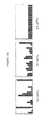
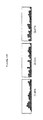
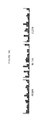
- FIGS. 10B and 10C show the clustering centroids generated by parallel K-means and hierarchical K-means, running on the same dataset with identical parameters. Apparently, none of parallel K-means' or hierarchical K-means' centroids reveals distinct patterns compared with the centroids acquired by parallel D2-clustering. In order to prove the fact objectively, we compute the Davies-Bouldin index (DBI) for all the three clustering results as the measurement of their tightness. DBI is defined as
- DBI is the average ratio of intra-cluster dispersion to inter-cluster dispersion. Lower DBI means a better clustering result with tighter clusters.
- Eq. (18) can be casted as an input optimization model, or multi-level optimization by treating w as policies/parameters and ⁇ as variables.
- W 2 (P,P (k) ) the squared distance between P and p (k) , as a function of w denoted by ⁇ tilde over (W) ⁇ (w) (k) .
- ⁇ tilde over (W) ⁇ (w) (k) is the solution to a designed optimization, but has no closed form.
- the step-size ⁇ (w) is chosen by
- the two hyper-parameters ⁇ and ⁇ trade off the convergence speed and the guaranteed decrease of the objective.
- Another hyper-parameter is ⁇ which indicates the ratio between the update frequency of weights ⁇ w i ⁇ and that of support points ⁇ x i ⁇ .
- ⁇ w i ⁇ the ratio between the update frequency of weights ⁇ w i ⁇ and that of support points ⁇ x i ⁇ .
- the centroid optimization is a linear programming in terms of ⁇ w i ⁇ , thus convex.
- the subgradient descent method converges under mild conditions on the smoothness of the solution and small step-sizes.
- the support points are also updated. Even the convexity of the problem is in question. Hence, the convergence of the method is not ensured.
- ADMM typically solves problem with two set of variables (in our case, they are 11 and w), which are only coupled in constraints, while the objective function is separable across this splitting of the two sets (in our case, w is not present in the objective function). Because problem has multiple sets of constraints including both equalities and inequalities, it is not a typical scenario to apply ADMM.
- ⁇ be a parameter to balance the objective function and the augmented Lagrangians.
- ⁇ w ((w 1 , . . . , w m )
- the scaled augmented Lagrangian L ⁇ ( ⁇ ,w, ⁇ ) as follows
- ADMM solves N QP subproblems instead of LP.
- the amount of computation in each subproblem of ADMM is thus usually higher and grows faster with the number of support points in P (k) 's. It is not clear whether the increased complexity at each iteration of ADMM is paid off by a better convergence rate (that is, a smaller number of iterations).
- the computational limitation of ADMM caused by QP motivates us to explore Bregman ADMM that avoids QP in each iteration.
- Bregman ADMM replaces the quadratic augmented Lagrangians by the Bregman divergence when updating the split variables. Similar ideas trace back at least to early 1990s.
- Bregman ADMM solves by treating the augmented Lagrangians as a conceptually designed divergence between ⁇ (k,1) and ⁇ (k,2) , adapting to the updated variables. It restructures the original problem as
- KL( ⁇ , ⁇ ) to denote the Kullback-Leibler divergence between two distributions.
- the Bregman ADMM algorithm adds the augmented Lagrangians for the last set of constraints in its updates, which yields the following equations.
- Bregman ADMM usually converges quickly to a moderate accuracy, making it a preferable choice for D2-clustering.
- N do 10: Update ⁇ (k,2) based on Eq.(39); 11: ⁇ (k) : ⁇ (k) + ⁇ ( ⁇ (k,1) ⁇ ⁇ (k,2) ); 12: until P converges 13: return P Algorithm Initialization and Implementation
- the number of support vectors in the centroid distribution is set to the average number of support vectors in the distributions in the corresponding cluster.
- m is set to the average number of support vectors in the distributions in the corresponding cluster.
- To initialize a centroid we select randomly a distribution with at least m support vectors from the cluster. If the number of support vectors in the distribution is larger than m, we will merge recursively a pair of support vectors according to an optimal criterion until the support size reaches m, similar as in linkage clustering.
- P ⁇ (w 1 ,x 1 ), . . .
- This upper bound is obtained by the transport mapping x i and x j exclusively to x and the other support vectors to themselves. To simplify computation, we instead minimize the upper bound, which is achieved by the x given above and by the pair (i,j) specified in Eq. (40).
- the Bregman ADMM method requires an initialization for ⁇ (k,2) , where k is the index for every cluster member, before starting the inner loops (see Algorithm 8).
- N is the data size (total number of distributions to be clustered); d is the dimension of the support vectors; K is the number of clusters; and ⁇ i or ⁇ o is the number of iterations in the inner or outer loop.
- the time complexity of the serial versions of the ADMM method is O( ⁇ o ⁇ i N m′′d)+O(T admm ⁇ o ⁇ i N q(m′m′′,d)), where q(m′m′′,d) is the average time to solve QPs (Eq).
- the time complexity for the subgradient descent method is O( ⁇ o ⁇ i N m′′d/ ⁇ )+O( ⁇ o ⁇ i N l(m′m′′,d))).
- the complexity of the serial Bregman ADMM is O( ⁇ o ⁇ i N m′′d/ ⁇ )+O( ⁇ o ⁇ i N m′m′′).
- the complexity for updating centroids does not depend on K, but only on data size N .
- the complexity of updating a single centroid is linear in the cluster size, which on average decreases proportionally with K at its increase.
- the communication load per iteration in the inner loop is O(T admm Km′′d) for ADMM and O(Km′′(1+d)/ ⁇ ) for the subgradient descent method and Bregman ADMM.
- Bregman ADMM requires substantially more memory than the other two methods.
- the subgradient descent method or the ADMM method can be more suitable.
- the support size is small (say less than 10)
- N data size
- d dimension of the support vectors (“symb” for symbolic data)
- m number of support vectors in a centroid
- K maximum number of clusters tested. An entry with the same value as in the previous row is indicated by “—”.
- Data N d m: K Synthetic 2,560,000 ⁇ 16 ⁇ 32 256 Image color 5,000 3 8 10 Image texture — — — — Protein sequence 1-gram 10,742 symb. 20 10 Protein sequence 3-gram — — 32 — Protein sequence 1,2,3-gram — — — — USPS digits 11,000 2 80 360 20newsgroups GV 18,774 300 64 40 20newsgroups WV — 400 100 —
- Table IV lists the basic information about the datasets used in our experiments.
- the support vectors are generated by sampling from a multivariate normal distribution and then adding a heavy-tailed noise from the student's t distribution.
- the probabilities on the support vectors are perturbed and normalized samples from Dirichlet distribution with symmetric prior. We omit details for lack of space.
- the synthetic data are only used to study the scalability of the algorithms.
- the image color or texture data are created from crawled general-purpose photographs. Local color or texture features around each pixel in an image are clustered (aka, quantized) to yield color or texture distributions.
- the protein sequence data are histograms over the amino acids (1-gram), dipeptides (2-tuples of amino acids, 2-gram), and tripeptides (3-tuples, 3-gram).
- the protein sequences are characterized each by an array of three histograms on the 1, 2, 3-gram respectively.
- the USPS digit images are treated as normalized histograms over the pixel locations covered by the digits, where the support vector is the two dimensional coordinate of a pixel and the weight corresponds to pixel intensity.
- the 20 newsgroups data we use the recommended “bydate” matlab version which includes 18,774 documents and 61,188 unique words.
- the two datasets, “20 newsgroup GV” and “20 newsgroup WV” correspond to different ways of characterizing each document.
- FIGS. 11A-11H show the convergence analysis results on the four datasets.
- the vertical axis in the plots in FIGS. 11A-11D is the objective function of Bregman ADMM, given in Eq. (18), but not the original objective function of clustering in Eq. (2).
- the running time is based on a single thread with 2.6 GHz Intel Core i7.
- the plots reveal two characteristics about the Bregman ADMM approach: 1) The algorithm achieves consistent and comparable convergence rate under a wide range of values for the hyper-parameter ⁇ 0 ⁇ 0.5,1.0,2.0,4.0,8.0,16.0 ⁇ and is numerically stable; 2) The effect of the hyper-parameter on the decreasing ratio of the dual and primal residuals follows similar patterns across the datasets.
- centroid computation algorithm solving the inner loop
- the centroid computation algorithm may behave quite differently over the outer-loop rounds. For instance, if an algorithm is highly sensitive to a hyper-parameter in optimization, the hyper-parameter chosen based on earlier rounds may yield slow convergence later or even cause the failure of convergence.
- the subgradient descent method finishes at most 2 iterations in the inner loop, while Bregman ADMM on average finishes more than 60 iterations on the color and texture data, and more than 20 iterations on the protein sequence 1-gram and 3-gram data.
- the results by the ADMM method are omitted because it cannot finish a single iteration under this time budget.
- the step-size is chosen as the value yielding the lowest clustering objective function in the first round.
- the whole image color and texture data are used.
- the clustering objective function (Eq. (16)) is shown with respect to the CPU time.
- Bregman ADMM yields good convergence on all the four datasets, while the subgradient descent method requires manually tuning the step-size ⁇ in order to achieve comparable convergence speed.
- Bregman ADMM achieves consistently lower values for the objective function across time.
- the subgradient descent method is numerically less stable.
- the step-size is fine-tuned based on the performance at the beginning, on the image color data, the objective function fluctuates noticeably in later rounds. It is difficult to strike a balance (assuming it exists) between stability and speed for the subgradient descent method.
- AD2-clustering can be both cpu-bound and memory-bound. Based on the observations from the above serial experiments, we conducted three sets of experiments to test the scalability of AD2-clustering in a multi-core environment, specifically, strong scaling efficiency, weak scaling efficiency with respect to N or m. The configuration ensures that each iteration finishes within one hour and the memory of a typical computer cluster is sufficient.
- Strong scaling efficiency is about the speed-up gained from using more and more processors when the problem is fixed in size.
- the running time on parallel CPUs is the time on a single thread divided by the number of CPUs. In practice, such a reduction in time cannot be fully achieved due to communication between CPUs and time for synchronization.
- We thus measure SSE by the ratio between the ideal and the actual amount of time.
- Table V shows the SSE values with the number of processors ranging from 32 to 512. The results show that AD2-clustering scales well in SSE when the number of processors is up to hundreds.
- WSE Weak scaling efficiency
- composition-based methods for clustering and classification of protein or DNA sequences have been well perceived in bioinformatics.
- the histogram on different compositions, e.g., nucleotides, in each sequence is used as the sequence signature.
- nucleotide or amino acid pairs or higher-order tuples are related for their molecular structures and evolutionary relationship, histograms on tuples are often incorporated in the signature as well.
- the “protein sequence 1, 2, 3-gram” dataset contains signatures of protein sequences, each being an array of three histograms on amino acids (1-gram), dipeptides (2-gram), and tripeptides (3-gram) respectively.
- the distance matrix is defined using the PAM250 similarity matrix of amino acid.
- Zhang et al. (June 2015), several state-of-the-art clustering methods have been compared with the parallel D2-clustering algorithm (PD2) in terms of efficiency and agreement with ground-truth labels as measured by ARI.
- Table VII shows that our method can achieve better clustering results than PD2 using considerably less time on the same number of CPUs.
- the document analysis community has found the mapping useful for capturing between word similarity and promoted its use.
- GV vocabulary the Glove mapping to a vector space of dimension 300 is used, while for WV, the Skip-gram model is used to train a mapping space of dimension 400 .
- the frequencies on the words are adjusted by the popular scheme of tf-idf.
- the number of different words in a document is bounded by m (its value in Table IV). If a document has more than m different words, some words are merged into hyper-words recursively until reaching m, in the same manner as the greedy merging scheme used in centroid initialization are described herein.
- the baseline methods for comparison include K-means on the raw tf-idf word frequencies, K-means on the LDA topic proportional vectors (the number of LDA topics is chosen from ⁇ 40,60,80,100 ⁇ ), K-means on the average word vectors, and the naive way of treating the 20 LDA topics as clusters.
- K-means on the raw tf-idf word frequencies K-means on the LDA topic proportional vectors (the number of LDA topics is chosen from ⁇ 40,60,80,100 ⁇ )
- K-means on the average word vectors K-means on the average word vectors
Landscapes
- Engineering & Computer Science (AREA)
- Theoretical Computer Science (AREA)
- Software Systems (AREA)
- Databases & Information Systems (AREA)
- Data Mining & Analysis (AREA)
- Physics & Mathematics (AREA)
- General Engineering & Computer Science (AREA)
- General Physics & Mathematics (AREA)
- Medical Informatics (AREA)
- Evolutionary Computation (AREA)
- Computing Systems (AREA)
- Mathematical Physics (AREA)
- Computer Vision & Pattern Recognition (AREA)
- Artificial Intelligence (AREA)
- Information Retrieval, Db Structures And Fs Structures Therefor (AREA)
Abstract
Description
ε=Σj=1 kΣi:C(i)=j ∥{right arrow over (v)} i −{right arrow over (z)} j∥2. (1)
v={(v (1) ,p v (1)), . . . ,(v (t) ,p v (t))}.
subject to:
Σα=1 tωα,β =p u (β),∀β=1, . . . ,t′,
Σβ=1 t′ωα,β =p v (α),∀α=1, . . . ,t,
ωα,β≥0,∀α=1, . . . ,t,∀β=1, . . . ,t′.
v i={(v i (1) ,p v
z j={(z j (1) ,p z
ε=Σj=1 kΣi:C(i)=j D 2(z j ,v i)
minz
where
z j={(z j (1) ,p z
v i={(v i (1) ,p v
D 2(z j ,v i)=min ωα,β (i)Σα=1 s
subject to:
p z (α)≥0,α=1, . . . ,s j,Σα=1 s
Σβ=1 t
Σr=1 s
ωα,β (i)>0,i=1, . . . ,n j,α=1, . . . ,s j,β=1, . . . ,t i.
| ALGORITRM 1: Centroid Update Process of D2-Clustering |
| Input: A collection of discrete distributions v1, v2, . . . ,vn |
| belong to cluster j. |
| Output: The centroid zj of the input discrete distributions in terms of |
| Mallows distance. |
| begin |
| | | while objective εj (defined in (3)) does not reach convergence do |
| | | | | Fix zj (α)'s update pz |
| | | | | optimization reduces to a linear programming. |
| | | | | Fix pz |
| | | | | solution of zj (α)'s to optimize (3) are simply weighted averages: |
| | | | | | | | | | | | | | | | |
|
| | | | | Calculate the objective function εj in (3) using the updated |
| | | | | zj (α)'s, pz |
| | | end |
| end | |
-
- 1. Carefully select beforehand a large and representative set of support points as an approximation to the support of the true barycenter (e.g. by K-means).
- 2. Allow the support points in a barycenter to adjust positions at every τ iterations.
| TABLE I |
| Comparison of Basic Clustering Approaches |
| K-means | Agglomerative | Spectral | Parallel | ||
| Method | Clustering | Clustering | Clustering | D2-Clustering | D2-Clustering |
| Data type | Vectors | Any type | Any type | Discrete | Discrete |
| distributions | distributions | ||||
| Provide | Yes | No | No | Yes | Yes |
| prototypes | |||||
| Based on | No | Yes | Yes | No | No |
| pair-wise | |||||
| distances | |||||
| Global | Yes | No | No | Yes | Yes, with |
| Optimization | approximation | ||||
| Time | Linear | Quadratic | Cubic | Polynomial | Linearithmic |
| Complexity | |||||
Notations
| ALGORITHM 2: D2-Clustering and Constrained D2-Clustering. |
| Input: A collection of discrete distributions v1,v2, . . . ,vn |
| Output: k centroids z1,z2, . . . ,zk (also discrete distributions), and the clustering labels |
| C(1),C(2), . . . ,C(n),C(·) ∈ {1, . . . ,k} |
| begin |
| | Initialize k centroids |
| | while objective function ε(C) does not reach convergence do |
| 1 | | Allocate a cluster label to each data point vi by selecting the nearest centroid. |
| | | C(i) = arg min D(vi,zj), |
| | | j∈{1, . . . ,k} |
| | | where D(vi,zj) is the Mallows distance between vi and zj. |
| 2 | | (For D2-clustering only) Invoke |
| | | certain zj are the discrete distributions {vi:C(i)=j} assigned to the cluster. |
| 2* | | (For constrained D2-clustering only) Keep pzj (α) = 1/sj,α = 1, . . . ,sj fixed when invoking |
| | | |
| | | into several smaller ones and runs much faster. The result of zj is a uniform weighted bag of |
| | | vectors containing support vectors at optimized locations. |
| 3 | | Calculate the with-cluster dispersion εj for each cluster j obtained by the previous label and |
| | | centroid update steps. Then sum them up to get the objective: |
| | | ε (C) = Σj=1 k εj. |
| | end |
| end |
minz
where D(zj,vi) is defined in Eq. (3).
| ALGORITHM 3: Master Side of Parallel D2-clustering. |
| Input: A collection of discrete distributions V = {v1,v2, . . . ,vN}, the desired cluster number k, and the | |
| number of slave processors M (slaves are with |
|
| Output: k centroids Z = {z1,z2, . . . ,zk} (also discrete distributions), and the clustering labels | |
| C = (C(1),C(2), . . . ,C(N)},C(·) ∈ {1, . . . ,k} | |
| begin | |
| | k′ ← N; n ← N; {tilde over (V)}← V; W = {w1,w2, . . . ,wN} ← {1,1, . . . ,1}. | |
| | while k′ > k do | |
| 1-1 | | | Segment the data objects {tilde over (V)} = {{tilde over (v)}1,{tilde over (v)}2, . . . ,{tilde over (v)}n} with weights {tilde over (W)} = {w1,w2, . . . ,wn} at current |
| | | level into m groups, V1, . . . , Vm by the constrained D2-clustering algorithm (Algorithm 2). Each Vμ | |
| | | contains no more than τ entries, and the corresponding weights for data in | |
| | | Vμ = {μ,1,vμ,2, . . . ,vμ,n |
|
| | | entries assigned to segment {tilde over (V)}μ are stored in array Lμ(·): Lμ(i′) = i if {tilde over (v)}i = vμ,i′. | |
| | | foreach data segment Vμ do | |
| 1-2 | | | | Send a clustering request signal to slave processor with index η = (μ mod M). The slave |
| | | | processor is notified with the number of data points nμ, and the desired cluster number kμ first. | |
| | | | Then Vμ and Wμ are sent to slave η. | |
| | | end | |
| 2.1 | | | Initialize loop parmeters. mc ← 0; k′ ← 0; Z ← ∅; {tilde over (C)}(i) ← 0,i = 1, . . . ,n. |
| | | while mc < m do | |
| 2-2 | | | | Wait for incoming message from any processor until getting the signal from slave η. |
| 2-3 | | | | Receive segment id μ, cluster centroids Zμ = {zμ,1, . . . ,zμ,k |
| | | | Cμ = {Cμ(1), . . . ,Cμ(nμ)} from slave η. | |
| 2-4 | | | | Merge Zμ to Z by appending centroids in Zμ to Z one by one. |
| 2-5 | | | | Update cluster labels of data points in the receive segment by (6). |
| | | | {tilde over (C)}(Lμ(i)) = Cμ(i) + k′,i = 1, . . . ,nμ . | (6) |
| 2-6 | | | | k′ ← k′ + kμ; mc ← mc + 1. |
| | | end | |
| 3-1 | | | Update the cluster label of a data entry in the original dataset (bottom level), C(i), by inheriting |
| | | label from its ancestor in {tilde over (V)}. | |
| | | C(i) = {tilde over (C)}(C(i)),i = 1, . . . ,N . | |
| 3-2 | | | Update data points and weights for the clustering at the next level: |
| | | {tilde over (V)} ← Z; | |
| | | wi ← Σα:C(α)=iwα, i = 1, . . . ,k′. | |
| | end | |
| | foreach η = 1,2, . . . ,M do | |
| | | Send TERMINATE signal to the slave processor with id η. | |
| | end | |
| | return Z and C. | |
| end | |
| ALGORITHM 4: Slave Side of Parallel D2-clustering (same process on each slave). |
| begin | |
| | while true do | |
| 1-1 | | | Wait for signal from the master processor. |
| | | if signal is TERMINATE then | |
| | | | return. | |
| | | end | |
| 1-2 | | | Receive data segment id μ, data in the segment Vμ = {vμ,1,vμ,2, . . . ,vμ,n |
| | | corresponding weights Wμ = {wμ,1,wμ,2, . . . ,wμ,n |
|
| 2.1 | | | Perform weighted D2-clustering on Vμ with weights Wμ by Algorithm 1 (using (4) and (5) when |
| | | updating centroids). | |
| 2-2 | | | Send a clustering complete signal to the master processor. Then Send μ, cluster centroids |
| | | Zμ = {zμ,1, . . . ,zμ,k |
|
| | end | |
| end | |
which is the average number of data points within each cluster. It is also a factor that the data size shrinks at a certain level. The factor (referred as the shrinking factor thereafter) is important for the total run-time of the parallel D2-clustering algorithm.
T 1 =O(R γ−1τ2 L). (7)
which is linear to N.
and C6=N−k. We rewrite Eq. (11) as
In order to plot the curve of
we use N=1000 and k=10 which are typical values in our experiment to get C4, C5, and C6. Because the data segmentation involves a constrained D2-clustering within each binary split, the constant multiplier C2 is higher C1. Without loss of generality, we set γ=3, C1=1 and C2=100.
with different values of R. In general the run-time T of the parallel D2-clustering is an increasing function of R. So a small R is favorable in terms of run-time. On the other hand, however, small R tends to create lots of parallel segments at each level of the hierarchy, and make the hierarchy with too many levels, which eventually increases the approximation error. In our implementation we set R=5, which is a moderate value that guarantees both the fast convergence of the algorithm and compactness of the hierarchical structure.
Experiments
where D(⋅,⋅) is the Mallows distance. It is straightforward to extend the D2-clustering algorithm to the case of multiple discrete distributions using the combined distance defined in Eq. (12). Details are provided in (Li and Wang, 2008). The order of time complexity increases simply by a multiplicative factor equal to the number of distribution types, the so-called super-dimension.
{tilde over (D)} 2(Z,Z′)=Σi=1 kΣj=1 k′ωi,j D 2(z i ,z j′), (13)
subject to: Σj=1 k′ωi,j=pi, Σi=1 kωi,j=p′j, ωi,j≥0,i=1, . . . , k,j=1, . . . , k′.
where c=80 is the number of concepts. We use di 2 as a baseline for comparison and plot it by the dashed line in the figure. For all the concepts, di is substantially larger than {tilde over (D)}(Zi,Zi′), which indicates that the set of centroids Zi derived from the parallel clustering is relatively close to Z′i from the sequential clustering. Another baseline for comparison is formed using random partitions. For each concept i, we create 10 sets of random clusters, and compute the average over the squared MM distances between Zi and every randomly generated clustering. Denote the average by {tilde over (d)}i 2, shown by the dashed dot line in the figure. Again comparing with {tilde over (d)}i 2, the MM distances between Zi and Z′i are relatively small for all concepts i.
the data points on the hypothetical space follow a multivariate Gaussian distribution N(z,σ2Id) with pdf
where u={tilde over (D)}2(x,z) is the squared distance from a data point x to the corresponding centroid z. The percentage size of a cluster is used as the weight for the component. As a result, we estimate the image concept model for concept ψ as fψ(x)=Σi=1 kξifψ i(x), where ξi is the percentage size for the i-th cluster with Gaussian distribution fψ i(x) estimated by HLM.
| TABLE II |
| Video clustering result by parallel D2-clustering. |
| Cluster (Size) |
| C1 | C2 | C3 | C4 | C5 | C6 | |
| (81) | (36) | (111) | (40) | (72) | (75) | |
| Soccer | 43 | 5 | 1 | 1 | 8 | 10 | |
| Tablet | 19 | 23 | 14 | 1 | 9 | 4 | |
| | 9 | 3 | 27 | 6 | 17 | 5 | |
| | 4 | 0 | 31 | 32 | 1 | 0 | |
| | 4 | 2 | 32 | 0 | 17 | 13 | |
| | 2 | 3 | 6 | 0 | 20 | 43 | |
Protein Sequence Clustering
D PAM250(A,B)=log(P(A|B)+P(B|A)).
where k is the number of clusters, zj is the centroid of cluster j, d(zj,zl) is the distance from zj to zl, and σj is the average distance from zj to all the elements in cluster j. DBI is the average ratio of intra-cluster dispersion to inter-cluster dispersion. Lower DBI means a better clustering result with tighter clusters.
| TABLE III |
| Davies-Bouldin Index For Different Clustering Results |
| Distance used | Parallel | Hierarchical | |
| In Eq. (14) | Parallel D2 | K-means | K-means |
| Squared Wasserstein | 1.55 | 2.99 | 2.01 |
| Squared L2 | 1.69 | 5.54 | 2.04 |
Evaluation with Synthetic Data
| |
| 1: procedure CENTROID ({P(k)}k=1 N) | |
| 2: repeat | |
| 3: Updates {xi} from Eq. 17; | |
| 4: Updates {wi} from solving full-batch LP (4); | |
| 5: until P converges | |
| 6: return P | |
Subgradient Descent Method
where N is the number of instances in the cluster. Note that Eq. (18) minimizes {tilde over (W)}(w) up to a constant multiplier. The minimization of {tilde over (W)} with respect to w is thus a bi-level optimization problem. In the special case when the designed problem is LP and the parameters only appear on the right hand side (RHS) of the constraints or are linear in the objective, the subgradient, specifically ∇{tilde over (W)}(w)(k) in our problem, can be solved via the same (dual) LP.

| |
| 1: | procedure CENTROID ({P(k)}k=1 N, P)  |
| 2: | repeat |
| 3: | Updates {xi} from Eq. (3) Every τ iterations; |
| 4: | for k = 1 . . . N do |
| 5: | Obtain Π(k) and Λ(k) from LP: W(P.P(k)) |
| 6: |
|
| 7: |
|
| 8: |
|
| 9: |
|
| 10: | until P converges |
| 11: | return P |
Alternating Direction Method of Multipliers

| |
| 1: procedure CENTROID ({P(k)}k=1 N, P, Π) | |
| 2: Initialize Λ0 = II0: II. | |
| 3: repeat | |
| 4: Updates {xi} from Eq. (17); | |
| 5: Reset dual coordinates Λ to zero; | |
| 6: for iter = 1, . . . , Tadmm do | |
| 7: for k = 1, . . . , N do | |
| 8: Update {πij}(k) based on QP Eq. (26); | |
| 9: Update {wi} based on QP Eq. (27) | |
| 10: Update Λ based on Eq. (25); | |
| 11: until P converges | |
| 12: return P | |
then Π(k,1)∈Δk,1 and Π(k,2)∈Δk,2(w). We introduce some extra notations:
1.
2.
3.
4. Λ={Λ(1), . . . , Λ(N)}, where Λ(k)=(Λi,j (k)), i∈
{tilde over (w)} i (k,1),n+1∝Σj=1 m(k){tilde over (π)}i,j (k,1),n+1 ,s.t.Σ i=1 m {tilde over (w)} i (k,1)n+1=1 (37)
which again has a closed form solution:
| |
| 1: procedure CENTROID ({P(k)}k=1 N, P, Π). | |
| 2: Λ := 0; | |
| 3: repeat | |
| 4: Update x from Eq.(17) per τ loops; | |
| 5: for k = 1 . . . ..N do | |
| 6: Update Π(k,1) based on Eq.(35) (36); | |
| 7: Update { | |
| 8: Update w based on Eq.(39); | |
| 9: for k =1 . . . .., N do | |
| 10: Update Π(k,2) based on Eq.(39); | |
| 11: Λ(k) := Λ(k) + ρ(Π(k,1) − Π(k,2)); | |
| 12: until P converges | |
| 13: return P | |
Algorithm Initialization and Implementation
W 2(P,P′)≤w i ∥x i −
| TABLE IV |
| Datasets in the experiments. |
| support vectors (“symb” for symbolic data), m: number |
| of support vectors in a centroid, K: maximum number of clusters |
| tested. An entry with the same value as in the previous row is |
| indicated by “—”. |
| Data | |
d | m: | K |
| Synthetic | 2,560,000 | ≥16 | ≥32 | 256 |
| Image color | 5,000 | 3 | 8 | 10 |
| Image texture | — | — | — | — |
| Protein sequence 1-gram | 10,742 | symb. | 20 | 10 |
| Protein sequence 3-gram | — | — | 32 | — |
| |
— | — | — | — |
| USPS digits | 11,000 | 2 | 80 | 360 |
| 20newsgroups GV | 18,774 | 300 | 64 | 40 |
| 20newsgroups WV | — | 400 | 100 | — |
| |
| 1: procedure PROFILE({P(k)}k=1 M, Q, K, η). | |
| 2: Start profiling: | |
| 3: T = 0: | |
| 4: repeat | |
| 5: Ta = 0; | |
| 6: Assignment Step: | |
| 7: GetElaspedCPUTime(Ta, T): | |
| 8: GetAndDisplayPerplexity(T); | |
| 9: Update Step within CPU time budget ηTa/K; | |
| 10: until T < Ttotal | |
| 11: return | |
| TABLE V |
| Scaling efficiency of AD2-clustering in parallel implementation. |
| # processors |
| 32 | 64 | 128 | 256 | 512 | ||
| SSE (%) | 93.9 | 93.4 | 92.9 | 84.8 | 84.1 | ||
| WSE on |
99 | 94.8 | 95.7 | 93.3 | 93.2 | ||
| WSE on m (%) | 96.6 | 89.4 | 83.5 | 79.0 | — | ||
| TABLE VI |
| The clustering is performed on 10,742 protein sequences from 3 classes |
| using 16 cores. The ARIs given by AD2 in 10 repeating runs range |
| in [0.224, 0.283] and [0.171, 0.179] respectively and |
| their median values are reported. |
| Runtime | Largest | Cluster | Average |
| (sec) | # clusters | cluster | ARI | Wasserstein | ||
| AD2 | 175 | 6 | 3031 | 0.237 | 7.704 |
| AD2 | 220 | 10 | 2019 | 0.174 | 7.417 |
| PD2 | 1048 | 10 | 4399 | 0.202 | 8.369 |
| Spectral | 273656 | 10 | 1259 | 0.051 | — |
| CD-HIT | 295 | 654 | 824 | 0.097 | — |
| D2 | 1415 | 10 | — | 0.176 | 7.750 |
| (900 samples) | |||||
| TABLE VII |
| Compare clustering results of AD2-clustering and several baseline methods |
| usingtwo versions of Bag-of-Words representation for the 20 newsgroups |
| data.Top panel: the data are extracted using the GV vocabulary; bottom |
| panel:WV vocabulary. AD2-clustering is performed once on 16 cores |
| with |
| (along with the total number of iterations). |
| LDA | Avg. | ||||||
| If-idf | LDA | Naïve | vector | AD2 | AD2 | AD2 | |
| GV Vocab | |||||||
| AMI | 0.447 | 0.326 | 0.329 | 0.360 | 0.418 | 0.461 | 0.446 |
| ARI | 0.151 | 0.160 | 0.187 | 0.198 | 0.260 | 0.281 | 0.284 |
| |
40 | 20 | 20 | 30 | 20 | 30 | 40 |
| Hours | 5.8 | 7.5 | 10.4 | ||||
| # iter. | 44 | 45 | 61 | ||||
| WV Vocab | |||||||
| AMI | 0.432 | 0.336 | 0.345 | 0.398 | 0.476 | 0.477 | 0.455 |
| ARI | 0.146 | 0.164 | 0.183 | 0.212 | 0.289 | 0.274 | 0.278 |
| |
20 | 25 | 20 | 20 | 20 | 30 | 40 |
| Hours | 10.0 | 11.3 | 17.1 | ||||
| # iter. | 28 | 29 | 36 | ||||
Claims (5)
Priority Applications (1)
| Application Number | Priority Date | Filing Date | Title |
|---|---|---|---|
| US15/282,947 US10013477B2 (en) | 2012-11-19 | 2016-09-30 | Accelerated discrete distribution clustering under wasserstein distance |
Applications Claiming Priority (3)
| Application Number | Priority Date | Filing Date | Title |
|---|---|---|---|
| US201261727981P | 2012-11-19 | 2012-11-19 | |
| US14/081,525 US9720998B2 (en) | 2012-11-19 | 2013-11-15 | Massive clustering of discrete distributions |
| US15/282,947 US10013477B2 (en) | 2012-11-19 | 2016-09-30 | Accelerated discrete distribution clustering under wasserstein distance |
Related Parent Applications (1)
| Application Number | Title | Priority Date | Filing Date |
|---|---|---|---|
| US14/081,525 Continuation-In-Part US9720998B2 (en) | 2012-11-19 | 2013-11-15 | Massive clustering of discrete distributions |
Publications (2)
| Publication Number | Publication Date |
|---|---|
| US20170083608A1 US20170083608A1 (en) | 2017-03-23 |
| US10013477B2 true US10013477B2 (en) | 2018-07-03 |
Family
ID=58282910
Family Applications (1)
| Application Number | Title | Priority Date | Filing Date |
|---|---|---|---|
| US15/282,947 Active US10013477B2 (en) | 2012-11-19 | 2016-09-30 | Accelerated discrete distribution clustering under wasserstein distance |
Country Status (1)
| Country | Link |
|---|---|
| US (1) | US10013477B2 (en) |
Cited By (4)
| Publication number | Priority date | Publication date | Assignee | Title |
|---|---|---|---|---|
| US20210224299A1 (en) * | 2020-01-22 | 2021-07-22 | International Institute Of Information Technology, Hyderabad | System of visualizing and querying data using data-pearls |
| US11636390B2 (en) * | 2020-03-19 | 2023-04-25 | International Business Machines Corporation | Generating quantitatively assessed synthetic training data |
| US12130864B2 (en) | 2020-08-07 | 2024-10-29 | International Business Machines Corporation | Discrete representation learning |
| US12254390B2 (en) | 2019-04-29 | 2025-03-18 | International Business Machines Corporation | Wasserstein barycenter model ensembling |
Families Citing this family (38)
| Publication number | Priority date | Publication date | Assignee | Title |
|---|---|---|---|---|
| US10013477B2 (en) * | 2012-11-19 | 2018-07-03 | The Penn State Research Foundation | Accelerated discrete distribution clustering under wasserstein distance |
| EP3188038B1 (en) * | 2015-12-31 | 2020-11-04 | Dassault Systèmes | Evaluation of a training set |
| US10416958B2 (en) * | 2016-08-01 | 2019-09-17 | Bank Of America Corporation | Hierarchical clustering |
| US10832168B2 (en) * | 2017-01-10 | 2020-11-10 | Crowdstrike, Inc. | Computational modeling and classification of data streams |
| CN107301472B (en) * | 2017-06-07 | 2020-06-26 | 天津大学 | Distributed photovoltaic planning method based on scene analysis method and voltage regulation strategy |
| US20190138931A1 (en) * | 2017-09-21 | 2019-05-09 | Sios Technology Corporation | Apparatus and method of introducing probability and uncertainty via order statistics to unsupervised data classification via clustering |
| CA3018334A1 (en) * | 2017-09-21 | 2019-03-21 | Royal Bank Of Canada | Device and method for assessing quality of visualizations of multidimensional data |
| JP6989766B2 (en) * | 2017-09-29 | 2022-01-12 | ミツミ電機株式会社 | Radar device and target detection method |
| US10740431B2 (en) | 2017-11-13 | 2020-08-11 | Samsung Electronics Co., Ltd | Apparatus and method of five dimensional (5D) video stabilization with camera and gyroscope fusion |
| US10445762B1 (en) | 2018-01-17 | 2019-10-15 | Yaoshiang Ho | Online video system, method, and medium for A/B testing of video content |
| JP6640896B2 (en) * | 2018-02-15 | 2020-02-05 | 株式会社東芝 | Data processing device, data processing method and program |
| US11086299B2 (en) * | 2018-03-26 | 2021-08-10 | Hrl Laboratories, Llc | System and method for estimating uncertainty of the decisions made by a supervised machine learner |
| US11128667B2 (en) * | 2018-11-29 | 2021-09-21 | Rapid7, Inc. | Cluster detection and elimination in security environments |
| US10586165B1 (en) * | 2018-12-14 | 2020-03-10 | Sas Institute Inc. | Distributable clustering model training system |
| EP3671574B1 (en) * | 2018-12-19 | 2024-07-10 | Robert Bosch GmbH | Device and method to improve the robustness against adversarial examples |
| KR102376709B1 (en) * | 2019-01-30 | 2022-03-18 | 바이두닷컴 타임즈 테크놀로지(베이징) 컴퍼니 리미티드 | Point cloud registration system for autonomous vehicles |
| EP3690760B1 (en) * | 2019-02-04 | 2022-10-26 | Robert Bosch GmbH | Device and method to improve the robustness against adversarial examples |
| US11169258B2 (en) * | 2019-05-09 | 2021-11-09 | The Boeing Company | Transport-based synthetic aperture radar navigation systems and methods |
| CN110907176B (en) * | 2019-09-30 | 2021-02-02 | 合肥工业大学 | Wasserstein distance-based fault diagnosis method for deep countermeasure migration network |
| CN110889431A (en) * | 2019-10-28 | 2020-03-17 | 杭州电子科技大学 | High-frequency professional skill life curve clustering method improved based on K-Means algorithm |
| CN111259962B (en) * | 2020-01-17 | 2023-06-20 | 中南大学 | Sybil account detection method for time sequence social data |
| US11454112B2 (en) | 2020-03-31 | 2022-09-27 | Saudi Arabian Oil Company | System and method of typing heterogeneous reservoir rocks |
| US12001515B2 (en) * | 2020-09-11 | 2024-06-04 | Fortinet, Inc. | Convex optimized stochastic vector sampling based representation of ground truth |
| US11921820B2 (en) * | 2020-09-11 | 2024-03-05 | Fortinet, Inc. | Real-time minimal vector labeling scheme for supervised machine learning |
| DE102020213199A1 (en) * | 2020-10-20 | 2022-04-21 | Robert Bosch Gesellschaft mit beschränkter Haftung | Procedure for validating simulation models |
| CN115474203B (en) * | 2021-06-11 | 2025-06-03 | 中国移动通信集团有限公司 | Regional point supplement planning method, device, electronic device and storage medium |
| CN113268333B (en) * | 2021-06-21 | 2024-03-19 | 成都锋卫科技有限公司 | Hierarchical clustering algorithm optimization method based on multi-core computing |
| CN114066257B (en) * | 2021-11-18 | 2024-11-05 | 广东电网有限责任公司广州供电局 | A method and device for optimizing and dispatching electric-gas integrated energy distribution |
| US12548309B2 (en) * | 2022-01-05 | 2026-02-10 | Dell Products L.P. | Label inheritance for soft label generation in information processing system |
| US11734574B1 (en) * | 2022-03-08 | 2023-08-22 | Booz Allen Hamilton Inc. | Neural Bregman divergences for distance learning |
| CN114970201B (en) * | 2022-06-17 | 2024-11-15 | 成都西南信息控制研究院有限公司 | Method for determining the probability of first-shot hit of tank guns under moving-to-moving shooting conditions |
| CN115274093B (en) * | 2022-07-26 | 2023-06-23 | 华东师范大学 | Method and system for generating benchmark pathology data set including automatically labeled files |
| CN116801380B (en) * | 2023-03-23 | 2024-05-28 | 昆明理工大学 | UWB indoor positioning method based on improved full centroid-Taylor |
| CN117459072B (en) * | 2023-12-22 | 2024-03-29 | 深圳市消防救援支队 | Data processing method for performance testing of autogenous oxygen devices |
| CN117692074B (en) * | 2024-02-01 | 2024-05-10 | 西北工业大学 | A low-frequency aliasing noise suppression method for non-steady-state underwater acoustic target signals |
| CN119580111B (en) * | 2024-05-08 | 2025-09-30 | 自然资源部东海海域海岛中心(自然资源部东海信息中心) | A detection method and detection system for offshore wind power facility targets |
| CN118690478B (en) * | 2024-05-31 | 2025-12-26 | 同济大学 | A method for generating typical automotive operating conditions based on spatiotemporal distribution optimization |
| CN119649917B (en) * | 2024-10-28 | 2025-12-02 | 汕头大学 | Cancer Single-Cell Type Identification Method Based on Optimal Transport Subspace Clustering |
Citations (38)
| Publication number | Priority date | Publication date | Assignee | Title |
|---|---|---|---|---|
| US5263120A (en) * | 1991-04-29 | 1993-11-16 | Bickel Michael A | Adaptive fast fuzzy clustering system |
| US5832182A (en) | 1996-04-24 | 1998-11-03 | Wisconsin Alumni Research Foundation | Method and system for data clustering for very large databases |
| US6374251B1 (en) | 1998-03-17 | 2002-04-16 | Microsoft Corporation | Scalable system for clustering of large databases |
| US20040117336A1 (en) | 2002-12-17 | 2004-06-17 | Jayanta Basak | Interpretable unsupervised decision trees |
| US20050271276A1 (en) * | 2004-06-07 | 2005-12-08 | Jianming Liang | System and method for toboggan-based object segmentation using distance transform |
| US20060136462A1 (en) * | 2004-12-16 | 2006-06-22 | Campos Marcos M | Data-centric automatic data mining |
| US20060259480A1 (en) | 2005-05-10 | 2006-11-16 | Microsoft Corporation | Method and system for adapting search results to personal information needs |
| US20060294101A1 (en) | 2005-06-24 | 2006-12-28 | Content Analyst Company, Llc | Multi-strategy document classification system and method |
| US20080069400A1 (en) * | 2006-07-07 | 2008-03-20 | Ying Zhu | Context adaptive approach in vehicle detection under various visibility conditions |
| US20080101678A1 (en) * | 2006-10-25 | 2008-05-01 | Agfa Healthcare Nv | Method for Segmenting Digital Medical Image |
| US20090055381A1 (en) | 2007-08-23 | 2009-02-26 | Google Inc. | Domain Dictionary Creation |
| US20090182594A1 (en) * | 2008-01-14 | 2009-07-16 | General Electric Company | System and method to manage assets of healthcare facility |
| US20090204637A1 (en) * | 2003-04-08 | 2009-08-13 | The Penn State Research Foundation | Real-time computerized annotation of pictures |
| US20090327174A1 (en) | 2008-06-30 | 2009-12-31 | Nokia Corporation | Task history user interface using a clustering algorithm |
| US20100185695A1 (en) * | 2009-01-22 | 2010-07-22 | Ron Bekkerman | System and Method for Data Clustering |
| US20100279892A1 (en) * | 2007-12-07 | 2010-11-04 | Mcweeney Shannon K | Methods to determine if a subject will respond to a bcr-abl inhibitor |
| US20100281166A1 (en) | 2007-11-09 | 2010-11-04 | Manjrasoft Pty Ltd | Software Platform and System for Grid Computing |
| US20110142335A1 (en) * | 2009-12-11 | 2011-06-16 | Bernard Ghanem | Image Comparison System and Method |
| US20110295857A1 (en) * | 2008-06-20 | 2011-12-01 | Ai Ti Aw | System and method for aligning and indexing multilingual documents |
| US20120011124A1 (en) | 2010-07-07 | 2012-01-12 | Apple Inc. | Unsupervised document clustering using latent semantic density analysis |
| US20120088525A1 (en) | 2010-10-12 | 2012-04-12 | Kddi Corporation | Estimation of significant places visited by mobile-terminal user based on communications log to base stations |
| US8285719B1 (en) * | 2008-08-08 | 2012-10-09 | The Research Foundation Of State University Of New York | System and method for probabilistic relational clustering |
| US20120268612A1 (en) | 2007-05-07 | 2012-10-25 | The Penn State Research Foundation | On-site composition and aesthetics feedback through exemplars for photographers |
| US20130073490A1 (en) * | 2011-09-16 | 2013-03-21 | International Business Machines Corporation | Choosing pattern recognition algorithms and data features |
| US20130101221A1 (en) | 2011-10-25 | 2013-04-25 | International Business Machines Corporation | Anomaly detection in images and videos |
| US20130151525A1 (en) * | 2011-12-09 | 2013-06-13 | International Business Machines Corporation | Inferring emerging and evolving topics in streaming text |
| US20130236075A1 (en) * | 2012-03-07 | 2013-09-12 | David S. Smith | Automatic detection and correction of magnetic resonance imaging data |
| US20130262465A1 (en) * | 2012-04-02 | 2013-10-03 | Xerox Corporation | Full and semi-batch clustering |
| US20130325862A1 (en) * | 2012-06-04 | 2013-12-05 | Michael D. Black | Pipelined incremental clustering algorithm |
| US20140006318A1 (en) * | 2012-06-29 | 2014-01-02 | Poe XING | Collecting, discovering, and/or sharing media objects |
| US20140143251A1 (en) * | 2012-11-19 | 2014-05-22 | The Penn State Research Foundation | Massive clustering of discrete distributions |
| US20140161348A1 (en) * | 2012-12-07 | 2014-06-12 | Realnetworks, Inc. | Method and system to detect and select best photographs |
| US20140307958A1 (en) * | 2013-04-16 | 2014-10-16 | The Penn State Research Foundation | Instance-weighted mixture modeling to enhance training collections for image annotation |
| US8909563B1 (en) | 2011-06-17 | 2014-12-09 | Google Inc. | Methods, systems, and programming for annotating an image including scoring using a plurality of trained classifiers corresponding to a plurality of clustered image groups associated with a set of weighted labels |
| US20150199960A1 (en) | 2012-08-24 | 2015-07-16 | Microsoft Corporation | I-Vector Based Clustering Training Data in Speech Recognition |
| US20150293884A1 (en) * | 2014-04-14 | 2015-10-15 | Kyoto University | Method to compute the barycenter of a set of histograms |
| US9336302B1 (en) * | 2012-07-20 | 2016-05-10 | Zuci Realty Llc | Insight and algorithmic clustering for automated synthesis |
| US20170083608A1 (en) * | 2012-11-19 | 2017-03-23 | The Penn State Research Foundation | Accelerated discrete distribution clustering under wasserstein distance |
-
2016
- 2016-09-30 US US15/282,947 patent/US10013477B2/en active Active
Patent Citations (38)
| Publication number | Priority date | Publication date | Assignee | Title |
|---|---|---|---|---|
| US5263120A (en) * | 1991-04-29 | 1993-11-16 | Bickel Michael A | Adaptive fast fuzzy clustering system |
| US5832182A (en) | 1996-04-24 | 1998-11-03 | Wisconsin Alumni Research Foundation | Method and system for data clustering for very large databases |
| US6374251B1 (en) | 1998-03-17 | 2002-04-16 | Microsoft Corporation | Scalable system for clustering of large databases |
| US20040117336A1 (en) | 2002-12-17 | 2004-06-17 | Jayanta Basak | Interpretable unsupervised decision trees |
| US20090204637A1 (en) * | 2003-04-08 | 2009-08-13 | The Penn State Research Foundation | Real-time computerized annotation of pictures |
| US20050271276A1 (en) * | 2004-06-07 | 2005-12-08 | Jianming Liang | System and method for toboggan-based object segmentation using distance transform |
| US20060136462A1 (en) * | 2004-12-16 | 2006-06-22 | Campos Marcos M | Data-centric automatic data mining |
| US20060259480A1 (en) | 2005-05-10 | 2006-11-16 | Microsoft Corporation | Method and system for adapting search results to personal information needs |
| US20060294101A1 (en) | 2005-06-24 | 2006-12-28 | Content Analyst Company, Llc | Multi-strategy document classification system and method |
| US20080069400A1 (en) * | 2006-07-07 | 2008-03-20 | Ying Zhu | Context adaptive approach in vehicle detection under various visibility conditions |
| US20080101678A1 (en) * | 2006-10-25 | 2008-05-01 | Agfa Healthcare Nv | Method for Segmenting Digital Medical Image |
| US20120268612A1 (en) | 2007-05-07 | 2012-10-25 | The Penn State Research Foundation | On-site composition and aesthetics feedback through exemplars for photographers |
| US20090055381A1 (en) | 2007-08-23 | 2009-02-26 | Google Inc. | Domain Dictionary Creation |
| US20100281166A1 (en) | 2007-11-09 | 2010-11-04 | Manjrasoft Pty Ltd | Software Platform and System for Grid Computing |
| US20100279892A1 (en) * | 2007-12-07 | 2010-11-04 | Mcweeney Shannon K | Methods to determine if a subject will respond to a bcr-abl inhibitor |
| US20090182594A1 (en) * | 2008-01-14 | 2009-07-16 | General Electric Company | System and method to manage assets of healthcare facility |
| US20110295857A1 (en) * | 2008-06-20 | 2011-12-01 | Ai Ti Aw | System and method for aligning and indexing multilingual documents |
| US20090327174A1 (en) | 2008-06-30 | 2009-12-31 | Nokia Corporation | Task history user interface using a clustering algorithm |
| US8285719B1 (en) * | 2008-08-08 | 2012-10-09 | The Research Foundation Of State University Of New York | System and method for probabilistic relational clustering |
| US20100185695A1 (en) * | 2009-01-22 | 2010-07-22 | Ron Bekkerman | System and Method for Data Clustering |
| US20110142335A1 (en) * | 2009-12-11 | 2011-06-16 | Bernard Ghanem | Image Comparison System and Method |
| US20120011124A1 (en) | 2010-07-07 | 2012-01-12 | Apple Inc. | Unsupervised document clustering using latent semantic density analysis |
| US20120088525A1 (en) | 2010-10-12 | 2012-04-12 | Kddi Corporation | Estimation of significant places visited by mobile-terminal user based on communications log to base stations |
| US8909563B1 (en) | 2011-06-17 | 2014-12-09 | Google Inc. | Methods, systems, and programming for annotating an image including scoring using a plurality of trained classifiers corresponding to a plurality of clustered image groups associated with a set of weighted labels |
| US20130073490A1 (en) * | 2011-09-16 | 2013-03-21 | International Business Machines Corporation | Choosing pattern recognition algorithms and data features |
| US20130101221A1 (en) | 2011-10-25 | 2013-04-25 | International Business Machines Corporation | Anomaly detection in images and videos |
| US20130151525A1 (en) * | 2011-12-09 | 2013-06-13 | International Business Machines Corporation | Inferring emerging and evolving topics in streaming text |
| US20130236075A1 (en) * | 2012-03-07 | 2013-09-12 | David S. Smith | Automatic detection and correction of magnetic resonance imaging data |
| US20130262465A1 (en) * | 2012-04-02 | 2013-10-03 | Xerox Corporation | Full and semi-batch clustering |
| US20130325862A1 (en) * | 2012-06-04 | 2013-12-05 | Michael D. Black | Pipelined incremental clustering algorithm |
| US20140006318A1 (en) * | 2012-06-29 | 2014-01-02 | Poe XING | Collecting, discovering, and/or sharing media objects |
| US9336302B1 (en) * | 2012-07-20 | 2016-05-10 | Zuci Realty Llc | Insight and algorithmic clustering for automated synthesis |
| US20150199960A1 (en) | 2012-08-24 | 2015-07-16 | Microsoft Corporation | I-Vector Based Clustering Training Data in Speech Recognition |
| US20140143251A1 (en) * | 2012-11-19 | 2014-05-22 | The Penn State Research Foundation | Massive clustering of discrete distributions |
| US20170083608A1 (en) * | 2012-11-19 | 2017-03-23 | The Penn State Research Foundation | Accelerated discrete distribution clustering under wasserstein distance |
| US20140161348A1 (en) * | 2012-12-07 | 2014-06-12 | Realnetworks, Inc. | Method and system to detect and select best photographs |
| US20140307958A1 (en) * | 2013-04-16 | 2014-10-16 | The Penn State Research Foundation | Instance-weighted mixture modeling to enhance training collections for image annotation |
| US20150293884A1 (en) * | 2014-04-14 | 2015-10-15 | Kyoto University | Method to compute the barycenter of a set of histograms |
Non-Patent Citations (13)
| Title |
|---|
| Julien, C. et al., Image and image-set modeling using a mixture model, COMPSTAT 2008, pp. 267-275, 2008. |
| Kantabutra, S. et al., Parallel K-means clustering algorithm on NOWs, NECTEC Technical Journal, 1(6): 243-247, 2000. |
| Kislyuk, A. et al., Unsupervised statistical clustering of environmental shotgun sequences, BMC Bioinformatics, 10(1):316-331, 2009. |
| Li, J. et al., Real-time computerized annotation of pictures, IEEE Transactions on Pattern Analysis and Machine Intelligence, 30(6):985-1002, 2008. |
| Mallows, C., A note on asymptotic joint normality, Annals of Mathematical Statistics, 42(2):508-515, 1972. |
| Park, G. et al., GPLP: a local and parallel computation toolbox for gaussian process regression, The Journal of Machine Learning Research, 13:775-779, 2012. |
| Rabin et. al., Wasserstein Barycenter and its Application to Texture Mixing, Apr. 23, 2010, Hal Archives, pp. 1-16. * |
| Spielman, D. et al., Smoothed analysis of algorithms: Why the simplex algorithm usually takes polynomial time, Journal of the ACM, 51(3):385-463, 2004. |
| U.S. Appl. No. 15/282,947, filed Sep. 30, 2016, Jianbo Ye et al. |
| Wan, X., A novel document similarity measure based on earth mover's distance, Information Sciences, 177(18):3718-3730, 2007. |
| Wang, Y., et al., PLDA: Parallel latent Dirichlet allocation for large-scale applications, In Proc. 5th International Conference on Algorithmic Aspects in Information and Management, pp. 301-314, 2009. |
| Xu, D. et al., Video event recognition using kernel methods with multilevel temporal alignment, IEEE Transactions on Pattern Analysis and Machine Intelligence, 30(11):1985-1997, 2008. |
| Zhou, D. et al., A new Mallows distance based metric for comparing clusterings, In Proc. 22nd International Conference on Machine Learning, pp. 1028-1035, 2005. |
Cited By (5)
| Publication number | Priority date | Publication date | Assignee | Title |
|---|---|---|---|---|
| US12254390B2 (en) | 2019-04-29 | 2025-03-18 | International Business Machines Corporation | Wasserstein barycenter model ensembling |
| US20210224299A1 (en) * | 2020-01-22 | 2021-07-22 | International Institute Of Information Technology, Hyderabad | System of visualizing and querying data using data-pearls |
| US11580140B2 (en) * | 2020-01-22 | 2023-02-14 | International Institute Of Information Technology, Hyderabad | System of visualizing and querying data using data-pearls |
| US11636390B2 (en) * | 2020-03-19 | 2023-04-25 | International Business Machines Corporation | Generating quantitatively assessed synthetic training data |
| US12130864B2 (en) | 2020-08-07 | 2024-10-29 | International Business Machines Corporation | Discrete representation learning |
Also Published As
| Publication number | Publication date |
|---|---|
| US20170083608A1 (en) | 2017-03-23 |
Similar Documents
| Publication | Publication Date | Title |
|---|---|---|
| US10013477B2 (en) | Accelerated discrete distribution clustering under wasserstein distance | |
| US9720998B2 (en) | Massive clustering of discrete distributions | |
| Luengo et al. | Big data preprocessing | |
| Ramírez-Gallego et al. | An information theory-based feature selection framework for big data under apache spark | |
| Zhao et al. | Massively parallel feature selection: an approach based on variance preservation | |
| Ye et al. | Fast discrete distribution clustering using Wasserstein barycenter with sparse support | |
| Nam et al. | Maximizing subset accuracy with recurrent neural networks in multi-label classification | |
| Izbicki et al. | Nonparametric conditional density estimation in a high-dimensional regression setting | |
| Ravi et al. | Large scale distributed semi-supervised learning using streaming approximation | |
| Lyu et al. | Online matrix factorization for markovian data and applications to network dictionary learning | |
| Ying et al. | Enhanced protein fold recognition through a novel data integration approach | |
| US11061935B2 (en) | Automatically inferring data relationships of datasets | |
| Xiao et al. | A survey of parallel clustering algorithms based on spark | |
| Kumari et al. | Scalable parallel algorithms for shared nearest neighbor clustering | |
| Cai et al. | An adaptive k-means clustering algorithm based on grid and domain centroid weights for digital twins in the context of digital transformation | |
| Amagata et al. | Identifying the most interactive object in spatial databases | |
| Zhang et al. | Parallel massive clustering of discrete distributions | |
| Kanimozhi et al. | An intelligent incremental filtering feature selection and clustering algorithm for effective classification | |
| Xiao | Towards parallel and distributed computing in large-scale data mining: A survey | |
| Kim et al. | Decomposition-by-normalization (DBN): leveraging approximate functional dependencies for efficient CP and tucker decompositions | |
| Sparks | End-to-end large scale machine learning with KeystoneML | |
| Zdunek et al. | Distributed geometric nonnegative matrix factorization and hierarchical alternating least squares–based nonnegative tensor factorization with the MapReduce paradigm | |
| Seshadri et al. | A distributed parallel algorithm for inferring hierarchical groups from large‐scale text corpuses | |
| Kamdar et al. | A survey: classification of huge cloud datasets with efficient map-reduce policy | |
| Levchuk et al. | Analysis of large-scale distributed knowledge sources via autonomous cooperative graph mining |
Legal Events
| Date | Code | Title | Description |
|---|---|---|---|
| AS | Assignment |
Owner name: THE PENN STATE RESEARCH FOUNDATION, PENNSYLVANIA Free format text: ASSIGNMENT OF ASSIGNORS INTEREST;ASSIGNORS:YE, JIANBO;LI, JIA;WANG, JAMES Z.;SIGNING DATES FROM 20161205 TO 20161206;REEL/FRAME:040754/0480 |
|
| STCF | Information on status: patent grant |
Free format text: PATENTED CASE |
|
| MAFP | Maintenance fee payment |
Free format text: PAYMENT OF MAINTENANCE FEE, 4TH YR, SMALL ENTITY (ORIGINAL EVENT CODE: M2551); ENTITY STATUS OF PATENT OWNER: SMALL ENTITY Year of fee payment: 4 |
|
| AS | Assignment |
Owner name: NATIONAL SCIENCE FOUNDATION, VIRGINIA Free format text: CONFIRMATORY LICENSE;ASSIGNOR:PENNSYLVANIA STATE UNIVERSITY;REEL/FRAME:070611/0079 Effective date: 20230607 |
|
| MAFP | Maintenance fee payment |
Free format text: PAYMENT OF MAINTENANCE FEE, 8TH YR, SMALL ENTITY (ORIGINAL EVENT CODE: M2552); ENTITY STATUS OF PATENT OWNER: SMALL ENTITY Year of fee payment: 8 |