US10011668B2 - Catalyst components for the polymerization of olefins - Google Patents
Catalyst components for the polymerization of olefins Download PDFInfo
- Publication number
- US10011668B2 US10011668B2 US15/560,317 US201615560317A US10011668B2 US 10011668 B2 US10011668 B2 US 10011668B2 US 201615560317 A US201615560317 A US 201615560317A US 10011668 B2 US10011668 B2 US 10011668B2
- Authority
- US
- United States
- Prior art keywords
- ethyl
- thio
- groups
- group
- catalyst component
- Prior art date
- Legal status (The legal status is an assumption and is not a legal conclusion. Google has not performed a legal analysis and makes no representation as to the accuracy of the status listed.)
- Active
Links
- 0 C=C([Y])SC.[1*]OC(C)=O Chemical compound C=C([Y])SC.[1*]OC(C)=O 0.000 description 11
- AWCIJAAFOYIFDG-UHFFFAOYSA-N CCCCCC(CC(=O)OCC)SC(C)=O Chemical compound CCCCCC(CC(=O)OCC)SC(C)=O AWCIJAAFOYIFDG-UHFFFAOYSA-N 0.000 description 3
- PHAUYGTZRBMWPP-UHFFFAOYSA-N CCCC(CC(=O)OCC)SC(C)=O Chemical compound CCCC(CC(=O)OCC)SC(C)=O PHAUYGTZRBMWPP-UHFFFAOYSA-N 0.000 description 2
- BBXDNLYGWBNUNL-UHFFFAOYSA-N CCCCOC(=O)CCSC(C)=O Chemical compound CCCCOC(=O)CCSC(C)=O BBXDNLYGWBNUNL-UHFFFAOYSA-N 0.000 description 2
- IAZBJQPJANCKDO-UHFFFAOYSA-N CCOC(=O)C(C)C(C)SC(C)=O Chemical compound CCOC(=O)C(C)C(C)SC(C)=O IAZBJQPJANCKDO-UHFFFAOYSA-N 0.000 description 2
- SIHZGXAHFFTEBL-UHFFFAOYSA-N CCOC(=O)C(C)CSC(C)=O Chemical compound CCOC(=O)C(C)CSC(C)=O SIHZGXAHFFTEBL-UHFFFAOYSA-N 0.000 description 2
- NLPXIBXNVOMOFQ-UHFFFAOYSA-N CCOC(=O)CC(C)SC(C)=O Chemical compound CCOC(=O)CC(C)SC(C)=O NLPXIBXNVOMOFQ-UHFFFAOYSA-N 0.000 description 2
- SJORUFLNXRYWRC-UHFFFAOYSA-N CCOC(=O)CC(SC(C)=O)C(C)C Chemical compound CCOC(=O)CC(SC(C)=O)C(C)C SJORUFLNXRYWRC-UHFFFAOYSA-N 0.000 description 2
- SALBEEHXVCJKGF-UHFFFAOYSA-N CCOC(=O)CCSC(C)=O Chemical compound CCOC(=O)CCSC(C)=O SALBEEHXVCJKGF-UHFFFAOYSA-N 0.000 description 2
- RMIMBFHKTKQLDF-UHFFFAOYSA-N CCCC(CC(=O)OCC)SC(=O)C1=CC=CC(Cl)=C1 Chemical compound CCCC(CC(=O)OCC)SC(=O)C1=CC=CC(Cl)=C1 RMIMBFHKTKQLDF-UHFFFAOYSA-N 0.000 description 1
- SZRZXRBBYJZTOK-UHFFFAOYSA-N CCCCCC(CC(=O)OCC)SC(=O)C1=CC=CC(Cl)=C1 Chemical compound CCCCCC(CC(=O)OCC)SC(=O)C1=CC=CC(Cl)=C1 SZRZXRBBYJZTOK-UHFFFAOYSA-N 0.000 description 1
- MSFSNNBXQLYYTB-UHFFFAOYSA-N CCCCOC(=O)CCSC(=O)C1=CC(Cl)=CC=C1 Chemical compound CCCCOC(=O)CCSC(=O)C1=CC(Cl)=CC=C1 MSFSNNBXQLYYTB-UHFFFAOYSA-N 0.000 description 1
- JBHPIEDVIUCFLW-UHFFFAOYSA-N CCCCOC(=O)CCSC(=O)C1=CC=C(CCC)C=C1 Chemical compound CCCCOC(=O)CCSC(=O)C1=CC=C(CCC)C=C1 JBHPIEDVIUCFLW-UHFFFAOYSA-N 0.000 description 1
- PVJSSHKOAGRYIB-UHFFFAOYSA-N CCOC(=O)C(C)C(C)SC(=O)C1=CC=CC(Cl)=C1 Chemical compound CCOC(=O)C(C)C(C)SC(=O)C1=CC=CC(Cl)=C1 PVJSSHKOAGRYIB-UHFFFAOYSA-N 0.000 description 1
- SUTQQNKLAMSLDR-UHFFFAOYSA-N CCOC(=O)C(C)CSC(=O)C1=CC=C(C)C=C1 Chemical compound CCOC(=O)C(C)CSC(=O)C1=CC=C(C)C=C1 SUTQQNKLAMSLDR-UHFFFAOYSA-N 0.000 description 1
- SHYCVOVNGMKRFF-UHFFFAOYSA-N CCOC(=O)C(C)SC(C)=O Chemical compound CCOC(=O)C(C)SC(C)=O SHYCVOVNGMKRFF-UHFFFAOYSA-N 0.000 description 1
- GSRZTIAXNHEJOL-UHFFFAOYSA-N CCOC(=O)CC(CC(C)C)SC(C)=O Chemical compound CCOC(=O)CC(CC(C)C)SC(C)=O GSRZTIAXNHEJOL-UHFFFAOYSA-N 0.000 description 1
- NINCRKPRBXMGGD-UHFFFAOYSA-N CCOC(=O)CC(SC(C)=O)C1=CC=CC=C1 Chemical compound CCOC(=O)CC(SC(C)=O)C1=CC=CC=C1 NINCRKPRBXMGGD-UHFFFAOYSA-N 0.000 description 1
- GPJKVQXVPABIDI-UHFFFAOYSA-N CCOC(=O)CCSC(=O)C1=CC(Cl)=CC=C1 Chemical compound CCOC(=O)CCSC(=O)C1=CC(Cl)=CC=C1 GPJKVQXVPABIDI-UHFFFAOYSA-N 0.000 description 1
- LMDGXOBKZWGIBJ-UHFFFAOYSA-N CCOC(=O)CCSC(C)=S Chemical compound CCOC(=O)CCSC(C)=S LMDGXOBKZWGIBJ-UHFFFAOYSA-N 0.000 description 1
- OEBAUBJJYHXAHH-UHFFFAOYSA-N CCOC(=O)CSC(C)=S Chemical compound CCOC(=O)CSC(C)=S OEBAUBJJYHXAHH-UHFFFAOYSA-N 0.000 description 1
- KBLPKQYETKCNON-UHFFFAOYSA-N CCOC(=O)SC1=CC=CC=C1C(=O)OCC Chemical compound CCOC(=O)SC1=CC=CC=C1C(=O)OCC KBLPKQYETKCNON-UHFFFAOYSA-N 0.000 description 1
- RUXHQWGGLGBRJS-UHFFFAOYSA-N COC(=O)CCSC(C)=O Chemical compound COC(=O)CCSC(C)=O RUXHQWGGLGBRJS-UHFFFAOYSA-N 0.000 description 1
Classifications
-
- C—CHEMISTRY; METALLURGY
- C08—ORGANIC MACROMOLECULAR COMPOUNDS; THEIR PREPARATION OR CHEMICAL WORKING-UP; COMPOSITIONS BASED THEREON
- C08F—MACROMOLECULAR COMPOUNDS OBTAINED BY REACTIONS ONLY INVOLVING CARBON-TO-CARBON UNSATURATED BONDS
- C08F4/00—Polymerisation catalysts
- C08F4/42—Metals; Metal hydrides; Metallo-organic compounds; Use thereof as catalyst precursors
- C08F4/44—Metals; Metal hydrides; Metallo-organic compounds; Use thereof as catalyst precursors selected from light metals, zinc, cadmium, mercury, copper, silver, gold, boron, gallium, indium, thallium, rare earths or actinides
- C08F4/60—Metals; Metal hydrides; Metallo-organic compounds; Use thereof as catalyst precursors selected from light metals, zinc, cadmium, mercury, copper, silver, gold, boron, gallium, indium, thallium, rare earths or actinides together with refractory metals, iron group metals, platinum group metals, manganese, rhenium technetium or compounds thereof
- C08F4/62—Refractory metals or compounds thereof
- C08F4/64—Titanium, zirconium, hafnium or compounds thereof
- C08F4/65—Pretreating the metal or compound covered by group C08F4/64 before the final contacting with the metal or compound covered by group C08F4/44
- C08F4/651—Pretreating with non-metals or metal-free compounds
-
- C—CHEMISTRY; METALLURGY
- C08—ORGANIC MACROMOLECULAR COMPOUNDS; THEIR PREPARATION OR CHEMICAL WORKING-UP; COMPOSITIONS BASED THEREON
- C08F—MACROMOLECULAR COMPOUNDS OBTAINED BY REACTIONS ONLY INVOLVING CARBON-TO-CARBON UNSATURATED BONDS
- C08F110/00—Homopolymers of unsaturated aliphatic hydrocarbons having only one carbon-to-carbon double bond
- C08F110/04—Monomers containing three or four carbon atoms
- C08F110/06—Propene
-
- C—CHEMISTRY; METALLURGY
- C08—ORGANIC MACROMOLECULAR COMPOUNDS; THEIR PREPARATION OR CHEMICAL WORKING-UP; COMPOSITIONS BASED THEREON
- C08F—MACROMOLECULAR COMPOUNDS OBTAINED BY REACTIONS ONLY INVOLVING CARBON-TO-CARBON UNSATURATED BONDS
- C08F4/00—Polymerisation catalysts
- C08F4/42—Metals; Metal hydrides; Metallo-organic compounds; Use thereof as catalyst precursors
- C08F4/44—Metals; Metal hydrides; Metallo-organic compounds; Use thereof as catalyst precursors selected from light metals, zinc, cadmium, mercury, copper, silver, gold, boron, gallium, indium, thallium, rare earths or actinides
- C08F4/60—Metals; Metal hydrides; Metallo-organic compounds; Use thereof as catalyst precursors selected from light metals, zinc, cadmium, mercury, copper, silver, gold, boron, gallium, indium, thallium, rare earths or actinides together with refractory metals, iron group metals, platinum group metals, manganese, rhenium technetium or compounds thereof
- C08F4/62—Refractory metals or compounds thereof
- C08F4/64—Titanium, zirconium, hafnium or compounds thereof
- C08F4/647—Catalysts containing a specific non-metal or metal-free compound
- C08F4/649—Catalysts containing a specific non-metal or metal-free compound organic
-
- C—CHEMISTRY; METALLURGY
- C08—ORGANIC MACROMOLECULAR COMPOUNDS; THEIR PREPARATION OR CHEMICAL WORKING-UP; COMPOSITIONS BASED THEREON
- C08F—MACROMOLECULAR COMPOUNDS OBTAINED BY REACTIONS ONLY INVOLVING CARBON-TO-CARBON UNSATURATED BONDS
- C08F4/00—Polymerisation catalysts
- C08F4/42—Metals; Metal hydrides; Metallo-organic compounds; Use thereof as catalyst precursors
- C08F4/44—Metals; Metal hydrides; Metallo-organic compounds; Use thereof as catalyst precursors selected from light metals, zinc, cadmium, mercury, copper, silver, gold, boron, gallium, indium, thallium, rare earths or actinides
- C08F4/60—Metals; Metal hydrides; Metallo-organic compounds; Use thereof as catalyst precursors selected from light metals, zinc, cadmium, mercury, copper, silver, gold, boron, gallium, indium, thallium, rare earths or actinides together with refractory metals, iron group metals, platinum group metals, manganese, rhenium technetium or compounds thereof
- C08F4/62—Refractory metals or compounds thereof
- C08F4/64—Titanium, zirconium, hafnium or compounds thereof
- C08F4/647—Catalysts containing a specific non-metal or metal-free compound
- C08F4/649—Catalysts containing a specific non-metal or metal-free compound organic
- C08F4/6495—Catalysts containing a specific non-metal or metal-free compound organic containing nitrogen
-
- C—CHEMISTRY; METALLURGY
- C08—ORGANIC MACROMOLECULAR COMPOUNDS; THEIR PREPARATION OR CHEMICAL WORKING-UP; COMPOSITIONS BASED THEREON
- C08F—MACROMOLECULAR COMPOUNDS OBTAINED BY REACTIONS ONLY INVOLVING CARBON-TO-CARBON UNSATURATED BONDS
- C08F4/00—Polymerisation catalysts
- C08F4/42—Metals; Metal hydrides; Metallo-organic compounds; Use thereof as catalyst precursors
- C08F4/44—Metals; Metal hydrides; Metallo-organic compounds; Use thereof as catalyst precursors selected from light metals, zinc, cadmium, mercury, copper, silver, gold, boron, gallium, indium, thallium, rare earths or actinides
- C08F4/60—Metals; Metal hydrides; Metallo-organic compounds; Use thereof as catalyst precursors selected from light metals, zinc, cadmium, mercury, copper, silver, gold, boron, gallium, indium, thallium, rare earths or actinides together with refractory metals, iron group metals, platinum group metals, manganese, rhenium technetium or compounds thereof
- C08F4/62—Refractory metals or compounds thereof
- C08F4/64—Titanium, zirconium, hafnium or compounds thereof
- C08F4/647—Catalysts containing a specific non-metal or metal-free compound
- C08F4/649—Catalysts containing a specific non-metal or metal-free compound organic
- C08F4/6498—Catalysts containing a specific non-metal or metal-free compound organic containing another heteroatom
-
- C—CHEMISTRY; METALLURGY
- C08—ORGANIC MACROMOLECULAR COMPOUNDS; THEIR PREPARATION OR CHEMICAL WORKING-UP; COMPOSITIONS BASED THEREON
- C08F—MACROMOLECULAR COMPOUNDS OBTAINED BY REACTIONS ONLY INVOLVING CARBON-TO-CARBON UNSATURATED BONDS
- C08F2410/00—Features related to the catalyst preparation, the catalyst use or to the deactivation of the catalyst
- C08F2410/01—Additive used together with the catalyst, excluding compounds containing Al or B
-
- C—CHEMISTRY; METALLURGY
- C08—ORGANIC MACROMOLECULAR COMPOUNDS; THEIR PREPARATION OR CHEMICAL WORKING-UP; COMPOSITIONS BASED THEREON
- C08F—MACROMOLECULAR COMPOUNDS OBTAINED BY REACTIONS ONLY INVOLVING CARBON-TO-CARBON UNSATURATED BONDS
- C08F4/00—Polymerisation catalysts
- C08F4/42—Metals; Metal hydrides; Metallo-organic compounds; Use thereof as catalyst precursors
- C08F4/44—Metals; Metal hydrides; Metallo-organic compounds; Use thereof as catalyst precursors selected from light metals, zinc, cadmium, mercury, copper, silver, gold, boron, gallium, indium, thallium, rare earths or actinides
- C08F4/60—Metals; Metal hydrides; Metallo-organic compounds; Use thereof as catalyst precursors selected from light metals, zinc, cadmium, mercury, copper, silver, gold, boron, gallium, indium, thallium, rare earths or actinides together with refractory metals, iron group metals, platinum group metals, manganese, rhenium technetium or compounds thereof
- C08F4/62—Refractory metals or compounds thereof
- C08F4/64—Titanium, zirconium, hafnium or compounds thereof
- C08F4/645—Component covered by group C08F4/64 with a metal or compound covered by group C08F4/44, not provided for in a single group of groups C08F4/642 - C08F4/643
- C08F4/6452—Component of C08F4/64 containing at least two different metals
- C08F4/6455—Component of C08F4/64 containing at least two different metals containing magnesium
-
- C—CHEMISTRY; METALLURGY
- C08—ORGANIC MACROMOLECULAR COMPOUNDS; THEIR PREPARATION OR CHEMICAL WORKING-UP; COMPOSITIONS BASED THEREON
- C08F—MACROMOLECULAR COMPOUNDS OBTAINED BY REACTIONS ONLY INVOLVING CARBON-TO-CARBON UNSATURATED BONDS
- C08F4/00—Polymerisation catalysts
- C08F4/42—Metals; Metal hydrides; Metallo-organic compounds; Use thereof as catalyst precursors
- C08F4/44—Metals; Metal hydrides; Metallo-organic compounds; Use thereof as catalyst precursors selected from light metals, zinc, cadmium, mercury, copper, silver, gold, boron, gallium, indium, thallium, rare earths or actinides
- C08F4/60—Metals; Metal hydrides; Metallo-organic compounds; Use thereof as catalyst precursors selected from light metals, zinc, cadmium, mercury, copper, silver, gold, boron, gallium, indium, thallium, rare earths or actinides together with refractory metals, iron group metals, platinum group metals, manganese, rhenium technetium or compounds thereof
- C08F4/62—Refractory metals or compounds thereof
- C08F4/64—Titanium, zirconium, hafnium or compounds thereof
- C08F4/645—Component covered by group C08F4/64 with a metal or compound covered by group C08F4/44, not provided for in a single group of groups C08F4/642 - C08F4/643
- C08F4/6452—Component of C08F4/64 containing at least two different metals
- C08F4/6457—Component of C08F4/64 containing at least two different metals containing aluminium
-
- C—CHEMISTRY; METALLURGY
- C08—ORGANIC MACROMOLECULAR COMPOUNDS; THEIR PREPARATION OR CHEMICAL WORKING-UP; COMPOSITIONS BASED THEREON
- C08F—MACROMOLECULAR COMPOUNDS OBTAINED BY REACTIONS ONLY INVOLVING CARBON-TO-CARBON UNSATURATED BONDS
- C08F4/00—Polymerisation catalysts
- C08F4/42—Metals; Metal hydrides; Metallo-organic compounds; Use thereof as catalyst precursors
- C08F4/44—Metals; Metal hydrides; Metallo-organic compounds; Use thereof as catalyst precursors selected from light metals, zinc, cadmium, mercury, copper, silver, gold, boron, gallium, indium, thallium, rare earths or actinides
- C08F4/60—Metals; Metal hydrides; Metallo-organic compounds; Use thereof as catalyst precursors selected from light metals, zinc, cadmium, mercury, copper, silver, gold, boron, gallium, indium, thallium, rare earths or actinides together with refractory metals, iron group metals, platinum group metals, manganese, rhenium technetium or compounds thereof
- C08F4/62—Refractory metals or compounds thereof
- C08F4/64—Titanium, zirconium, hafnium or compounds thereof
- C08F4/65—Pretreating the metal or compound covered by group C08F4/64 before the final contacting with the metal or compound covered by group C08F4/44
- C08F4/652—Pretreating with metals or metal-containing compounds
- C08F4/654—Pretreating with metals or metal-containing compounds with magnesium or compounds thereof
-
- C—CHEMISTRY; METALLURGY
- C08—ORGANIC MACROMOLECULAR COMPOUNDS; THEIR PREPARATION OR CHEMICAL WORKING-UP; COMPOSITIONS BASED THEREON
- C08F—MACROMOLECULAR COMPOUNDS OBTAINED BY REACTIONS ONLY INVOLVING CARBON-TO-CARBON UNSATURATED BONDS
- C08F4/00—Polymerisation catalysts
- C08F4/42—Metals; Metal hydrides; Metallo-organic compounds; Use thereof as catalyst precursors
- C08F4/44—Metals; Metal hydrides; Metallo-organic compounds; Use thereof as catalyst precursors selected from light metals, zinc, cadmium, mercury, copper, silver, gold, boron, gallium, indium, thallium, rare earths or actinides
- C08F4/60—Metals; Metal hydrides; Metallo-organic compounds; Use thereof as catalyst precursors selected from light metals, zinc, cadmium, mercury, copper, silver, gold, boron, gallium, indium, thallium, rare earths or actinides together with refractory metals, iron group metals, platinum group metals, manganese, rhenium technetium or compounds thereof
- C08F4/62—Refractory metals or compounds thereof
- C08F4/64—Titanium, zirconium, hafnium or compounds thereof
- C08F4/65—Pretreating the metal or compound covered by group C08F4/64 before the final contacting with the metal or compound covered by group C08F4/44
- C08F4/652—Pretreating with metals or metal-containing compounds
- C08F4/655—Pretreating with metals or metal-containing compounds with aluminium or compounds thereof
Definitions
- the present disclosure relates to the field of chemistry including catalyst components for the polymerization of olefins, such as propylene, comprising a magnesium (Mg) dihalide based support on which are supported Ti atoms and an electron donor selected from a specific class of mercaptoesters derivatives.
- the present disclosure further relates to catalysts obtained from these components and to their use in processes for the polymerization of olefins such as propylene.
- Catalyst components for the stereospecific polymerization of olefins have been disclosed in the art.
- Ziegler-Natta catalysts may be used for such polymerizations and can comprise a solid catalyst component a magnesium dihalide, a titanium compound an internal electron donor compound and/or an alkyl aluminum (Al-alkyl) compound.
- an external donor for example, an alkoxysilane
- Esters of phthalic acid, such as diisobutylphthalate may be used as internal electron donors in catalyst preparations.
- the phthalates may further be used as internal electron donors in combination with alkylalkoxysilanes as external electron donors.
- This catalyst system may give good performances in terms of activity, isotacticity and xylene insolubility (XI).
- acyloxyesters as described, for example in U.S. Pat. No. 7,351,778. These compounds may be obtained by the esterification of hydroxyl ester derivatives.
- the applicant has found that a particular class of donors based on mercapto derivatives can generate a wide arrange of molecules with equal or different functional groups which, when used as internal electron donors, can generate catalysts showing a good balance of activity and stereospecificity.
- the present disclosure relates to a catalyst component for the polymerization of olefins comprising Mg, Ti and an electron donor compound of the general formula (I):
- R 2 groups are selected from hydrogen or C 1 -C 20 hydrocarbon radicals, optionally containing a heteroatom selected from halogen, P, S, N, O and Si, which can be fused together to form one or more cycles;
- m is a number satisfying the valences of Z;
- n is an integer ranging from 1 to 10;
- X is O or S; and
- Y is selected from —OR 3 , —NR 4 R 5 or R 6 groups in which R 1 and R 3 are selected from C 1 -C 15 hydrocarbon groups, optionally containing a heteroatom selected from halogen, P, S, N, O, and Si, R 4 -R 5 groups, independently, are hydrogen or R 1 groups and R 6 groups have the same meaning as R 1 groups.
- Z is selected from carbon (C) and silicon (Si).
- the (ZR 2 m ) n group of formula (I) can be selected from the group consisting of aliphatic, alicyclic and aromatic bivalent radicals, optionally substituted with C 1 -C 15 hydrocarbon groups and/or with heteroatoms selected from halogen, P, S, N, O and Si, and having a bridging chain length ranging from 1 to 6 atoms, such as from 1 to 4 atoms.
- the bridging group is an aliphatic or alicyclic bridging group having a bridging chain length of 1-6 carbon atoms.
- bridging groups may include those of the formula —(CR 7 p ) s —, in which R 7 is independently hydrogen or a C 1 -C 20 hydrocarbon radical, optionally substituted with heteroatoms selected from halogen, P, S, N, O and Si, which can be fused together to form one or more cycles, p is a number satisfying the available valence of carbon, and s is a number from 1 to 6, such as from 1 to 4.
- structures in which the bridging group is an aliphatic or alicyclic bridging group are those of the formula (II):
- R 8 -R 9 groups are independently selected from hydrogen or C 1 -C 20 hydrocarbon radicals, optionally substituted with heteroatoms selected from halogen, P, S, N, O and Si, which can be fused together to form one or more cycles.
- X is O or S
- Y is an OR 3 group
- at least one of R 8 -R 9 groups is different from hydrogen, such as a C 1 -C 10 alkyl group.
- bridging group is an aliphatic or alicyclic bridging group
- Y when Y is R 6 it comprises phenyl ring(s).
- the phenyl ring is monosubstituted with a hydrocarbon group or a halogen, including C 1 -C 10 alkyl groups, C 6 -C 14 aryl groups, C 3 -C 15 cycloalkyl groups, and C 7 -C 15 arylalkyl or alkylaryl groups, and linear C 1 -C 5 alkyl groups.
- the hydrocarbon substituent(s) is/are located in the 4-position of the phenyl ring.
- Halogens for use as substituents in the phenyl ring(s) include Cl, Br and F.
- the halogens may be positioned in the meta and/or para positions.
- other positions in addition to the meta and/or para may be substituted with halogens and/or hydrocarbon groups, including the ortho position.
- structures of the formula (III) may include those in which at least one of R 10 -R 11 groups is selected from C 1 -C 20 hydrocarbon radicals, including C 1 -C 10 alkyls such as C 3 -C 10 linear alkyls.
- phenyl groups optionally substituted with halogens or C 1 -C 20 alkyl radicals are used in some embodiments.
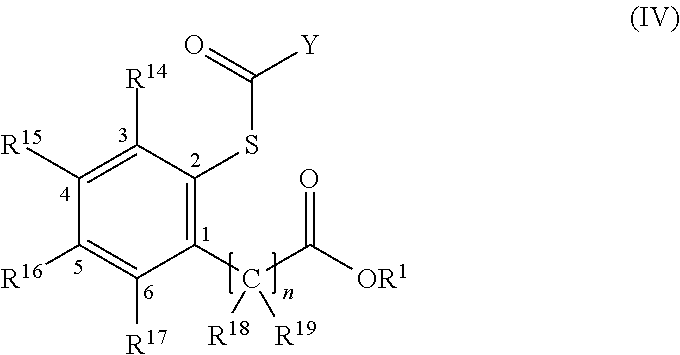
- R 18 to R 19 groups are hydrogen or C 1 -C 15 hydrocarbon groups and optionally comprise a heteroatom selected from halogen, P, S, N, O, and Si which can be fused together to form one or more cycles;
- n is an integer from 0 to 2; and
- R 14 -R 17 independently, are selected from hydrogen, halogens or C 1 -C 15 hydrocarbon groups optionally substituted with heteroatoms selected from halogen, P, S, N, O and Si.
- Y is a —OR 3 group in which R 3 is a C 1 -C 10 alkyl group, including a C 1 -C 5 linear alkyl group such as an ethyl group.
- R 3 is a C 1 -C 10 alkyl group, including a C 1 -C 5 linear alkyl group such as an ethyl group.
- n is 0,
- R 1 is a C 1 -C 10 alkyl group, and R 14 -R 17 are hydrogens.
- Non-limiting examples of the structures of formulas (I) and (II) are the following: butyl 2-(benzoylthio)propanoate, ethyl 2-((3-chlorobenzoyl)thio)-2-methylpropanoate, ethyl 2-((3-chlorobenzoyl)thio)acetate, ethyl 2-((3-chlorobenzoyl)thio)propanoate, ethyl 2-((4-butylbenzoyl)thio)-2-methylpropanoate, ethyl 2-((4-butylbenzoyl)thio)acetate, ethyl 2-((4-butylbenzoyl)thio)propanoate, ethyl 2-((4-chlorobenzoyl)thio)-2-methylpropanoate, ethyl 2-((4-chlorobenzoyl)thio)-3,3-dimethyl
- the electron donors disclosed in the present application can be prepared from commercially available mercapto-ester precursors which can be reacted with the proper reactants and reagents to form the Y derivative.
- the electron donor(s) can be prepared following the synthetic approach described in U.S. Pat. App. Pub. No. 2011/0282089, which is incorporated by reference.
- the final amount of electron donor compound in the solid catalyst component ranges from 1 to 25% by weight, such as from 3 to 20% by weight.
- the catalyst components comprise, in addition to the above described electron donors, Ti, Mg and halogen(s).
- the catalyst components comprise a titanium compound having at least one Ti-halogen bond, and the disclosed electron donor compounds are supported on a Mg-halide solid component.
- the magnesium halide is, in some embodiments, MgCl 2 in active form as disclosed in the patent literature describing supports for Ziegler-Natta catalysts.
- U.S. Pat. Nos. 4,298,718 and 4,495,338 were the first to describe the use of these compounds in Ziegler-Natta catalysis, which further describe magnesium dihalides in active form and used as a support or co-support in components of catalysts for the polymerization of olefins.
- These compounds may be characterized by X-ray spectra in which the most intense diffraction line that appears in the spectrum of the non-active halide is diminished in intensity and is replaced by a halo whose maximum intensity is displaced towards lower angles relative to that of the more intense line.
- titanium compounds used in the catalyst component of the present disclosure are TiCl 4 and TiCl 3 .
- Ti-haloalcoholates of the formula Ti(OR) m ⁇ y X y can also be used, where m is the valence of titanium, y is a number between 1 and m ⁇ 1, X is halogen and R is a hydrocarbon radical having from 1 to 10 carbon atoms.
- the amount of Ti atoms is higher than 2.5% wt, including higher than 3.0% and in the range 3.0 to 8% with respect to the total weight of the catalyst component.
- the preparation of the solid catalyst component can be carried out according to several methods.
- One method comprises the reaction between magnesium alcoholates or chloroalcoholates (including chloroalcoholates prepared according to U.S. Pat. No. 4,220,554) and an excess of TiCl 4 in the presence of the electron donor compounds at a temperature of about 80° C. to 120° C.
- the solid catalyst component can be prepared by reacting a titanium compound of the general formula Ti(OR) m ⁇ y X y , where m is the valence of titanium and y is a number between 1 and m, including TiCl 4 , with a magnesium chloride derived from an adduct of the formula MgCl 2 .pROH, where p is a number between 0.1 and 6, including from 2 to 3.5, and R is a hydrocarbon radical having 1-18 carbon atoms.
- the adduct can be prepared in spherical form by mixing alcohol and magnesium chloride in the presence of an inert hydrocarbon immiscible with the adduct under stirring conditions at the melting temperature of the adduct (about 100-130° C.). The emulsion is quickly quenched, thereby causing the solidification of the adduct in form of spherical particles. Examples of spherical adducts prepared according to this procedure are described in U.S. Pat. Nos. 4,399,054 and 4,469,648.
- the resulting adduct can be directly reacted with a Ti compound or subjected to thermal controlled dealcoholation (at a temperature of about 80-130° C.) so as to obtain an adduct in which the number of moles of alcohol is generally lower than 3, including 0.1 to 2.5.
- the reaction with the Ti compound can be carried out by suspending the adduct (optionally dealcoholated) in cold TiCl 4 (generally at a temperature of about 0° C.). The mixture is heated to 80-130° C. and kept at this temperature for 0.5-2 hours.
- the treatment with TiCl 4 can be carried out one or more times.
- the mercapto-derivative electron donor compound may be added during the treatment with TiCl 4 .
- the solid catalyst components obtained according to the above method show a surface area (as determined by the B.E.T. method) between 20 and 500 m 2 /g, including between 50 and 400 m 2 /g, and a total porosity (as determined by the B.E.T. method) higher than 0.2 cm 3 /g, such as between 0.2 and 0.6 cm 3 /g.
- the porosity (Hg method) due to pores with radii up to 10.000 ⁇ can range from 0.3 to 1.5 cm 3 /g, including from 0.45 to 1 cm 3 /g.
- the solid catalyst component has, in certain embodiments, an average particle size ranging from 5 to 120 ⁇ m, such as from 10 to 100 ⁇ m.
- the electron donor compounds can be added as such or, in an alternative way, it can be obtained in situ by using an appropriate precursor capable of being incorporated as an electron donor compound by means, for example, of suitable chemical reactions.
- the final amount of the electron donor compound of formula (I) is such that its molar ratio with respect to the Ti atoms is from 0.01 to 2, including from 0.05 to 1.2.
- the solid catalyst components according to the present disclosure are converted into catalysts for the polymerization of olefins by reacting them with organoaluminum compounds according to known methods.
- a catalyst for the polymerization of olefins of the formula CH 2 ⁇ CHR, in which R is hydrogen or a hydrocarbyl radical with 1-12 carbon atoms, is produced and comprises the product obtained by contacting:
- the alkyl-Al compound (ii) is chosen from among the trialkyl aluminum compounds such as triethylaluminum, triisobutylaluminum, tri-n-butylaluminum, tri-n-hexylaluminum, tri-n-octylaluminum. It is also possible to use alkylaluminum halides, alkylaluminum hydrides and alkylaluminum sesquichlorides, such as AlEt 2 Cl and Al 2 Et 3 Cl 3 , possibly in mixture with the above described trialkylaluminums.
- External electron-donor compounds for use in the present disclosure include silicon compounds, ethers, esters, amines, heterocyclic compounds, 2,2,6,6-tetramethylpiperidine and ketones.
- Another class of external donor compounds for use in the present disclosure is silicon compounds of the formula (R 7 ) a (R 8 ) b Si(OR 9 ) c , where a and b are integers from 0 to 2, c is an integer from 1 to 4 and the sum (a+b+c) is 4; and R 7 , R 8 , and R 9 , are radicals with 1-18 carbon atoms, optionally containing heteroatoms.
- silicon compounds in which a is 1, b is 1, c is 2, at least one of R 7 and R 8 is selected from branched alkyl, cycloalkyl or aryl groups with 3-10 carbon atoms optionally containing heteroatoms and R 9 is a C 1 -C 10 alkyl group, including methyl groups, may be used.
- silicon compounds are methylcyclohexyldimethoxysilane (C donor), diphenyldimethoxysilane, methyl-t-butyldimethoxysilane, dicyclopentyldimethoxysilane (D donor), diisopropyl dim ethoxysilane, (2-ethylpiperidinyl)t-butyldimethoxysilane, (2-ethylpiperidinyl)thexyldimethoxysilane, (3,3,3-tri fluoro-n-propyl)(2-ethylpiperidinyl)dimethoxysilane, methyl(3,3,3-trifluoro-n-propyl)dimethoxysilane, and N,N-diethylaminotriethoxysilane.
- C donor methylcyclohexyldimethoxysilane
- D donor dicyclopentyldimethoxysilane
- silicon compounds in which a is 0, c is 3, R 8 is a branched alkyl or cycloalkyl group, optionally containing heteroatoms, and R 9 is a methyl group may be used.
- silicon compounds in which a is 0, c is 3, R 8 is a branched alkyl or cycloalkyl group, optionally containing heteroatoms, and R 9 is a methyl group may be used.
- these silicon compounds are cyclohexyltrimethoxysilane, t-butyltrimethoxysilane and thexyltrimethoxysilane.
- the electron donor compound (iii) is used in such an amount as to give a molar ratio between the organoaluminum compound and the electron donor compound (iii) of from 0.1 to 500, including from 1 to 300 and from 3 to 100.
- a further embodiment relates to a process for the (co)polymerization of olefins CH 2 ⁇ CHR, in which R is hydrogen or a hydrocarbyl radical with 1-12 carbon atoms, carried out in the presence of a catalyst comprising the product of the reaction between:
- the polymerization process can be carried out according to available techniques known to the skilled artisan, for example slurry polymerization using as an inert hydrocarbon solvent as a diluent, or bulk polymerization using a liquid monomer (for example, propylene) as a reaction medium. Moreover, it is possible to carry out the polymerization process in gas-phase operating in one or more fluidized or mechanically agitated bed reactors.
- the polymerization temperature can range from 20 to 120° C., such as from 40 to 80° C.
- the operating pressure may range between 0.5 and 5 MPa, such as between 1 and 4 MPa. In bulk polymerization processes, the operating pressure may range between 1 and 8 MPa, including between 1.5 and 5 MPa.
- the content of electron donor was determined via gas chromatography.
- the solid component was dissolved in acidic water and extracted with ethyl acetate, an internal standard was added, and a sample of the organic phase was analyzed in a gas chromatograph to determine the amount of electron donor present in the starting catalyst compound.
- melt flow rate (MIL) of the polymer was determined according to ISO 1133 (230° C., 2.16 kg).
- the electron donors in the Examples 1-5, 7, 10-13, and 16-17 have been prepared from commercially available mercapto-ester precursors.
- the electron donors in the other examples have been prepared according to the synthetic approach described in U.S. Pat. App. Pub. No. 2011/0282089 and illustrated below:
- the catalyst components have been prepared according to the following procedure:
- the solid was washed with anhydrous hexane six times (6 ⁇ 100 mL) in a temperature gradient down to 60° C. and one time (100 ml) at room temperature. The resulting solid was then dried under vacuum and analyzed.
Landscapes
- Chemical & Material Sciences (AREA)
- Health & Medical Sciences (AREA)
- Chemical Kinetics & Catalysis (AREA)
- Medicinal Chemistry (AREA)
- Polymers & Plastics (AREA)
- Organic Chemistry (AREA)
- Engineering & Computer Science (AREA)
- Materials Engineering (AREA)
- Transition And Organic Metals Composition Catalysts For Addition Polymerization (AREA)
Abstract

in which Z is selected from C, Si, O, N, S or P, with the proviso that the atoms O, S, P and N are not directly linked to either the carboxylic group or the sulfur atom of formula (I), the R2 groups, equal to or different from each other, are selected from hydrogen or a C1-C20 hydrocarbon radicals, optionally containing a heteroatom selected from halogen, P, S, N, O and Si, which can be fused together to form one or more cycles, m is a number satisfying the valences of Z and n is an integer ranging from 1 to 10, X is O or S, Y is —OR3, —NR4R5) or R6 groups in which R1 and R3 are selected from C1-C15 hydrocarbon groups, optionally containing a heteroatom selected from halogen, P, S, N, O, and Si, R4-R5 groups, independently, are hydrogen or R1 groups, and R6 groups have the same composition as R1 groups.
Description

in which Z is selected from C, Si, O, N, S or P, with the proviso that the atoms O, S, P and N are not directly linked to either the carboxylic group or the sulfur atom of formula (I); the R2 groups, equal to or different from each other, are selected from hydrogen or C1-C20 hydrocarbon radicals, optionally containing a heteroatom selected from halogen, P, S, N, O and Si, which can be fused together to form one or more cycles; m is a number satisfying the valences of Z; n is an integer ranging from 1 to 10; X is O or S; and Y is selected from —OR3, —NR4R5 or R6 groups in which R1 and R3 are selected from C1-C15 hydrocarbon groups, optionally containing a heteroatom selected from halogen, P, S, N, O, and Si, R4-R5 groups, independently, are hydrogen or R1 groups and R6 groups have the same meaning as R1 groups.

in which X, Y and R1 have the same meaning previously described, and R8-R9 groups are independently selected from hydrogen or C1-C20 hydrocarbon radicals, optionally substituted with heteroatoms selected from halogen, P, S, N, O and Si, which can be fused together to form one or more cycles. In connection with the structures of formula (II), X is O or S, Y is an OR3 group, and at least one of R8-R9 groups is different from hydrogen, such as a C1-C10 alkyl group.

-
- in which Y and R1 have the same meaning previously described, R10-R13 groups are independently selected from hydrogen or a C1-C20 hydrocarbon radical, optionally substituted with heteroatoms selected from halogen, P, S, N, O and Si, which can be fused together to form one or more cycles.
- In some embodiments, Y is a —OR3 group as previously defined. In additional embodiments, R3 is a C1-C10 alkyl group such as a C1-C5 linear alkyl, including in certain embodiments an ethyl group.
- In further embodiments, Y is NR4R5, the R10-R13 groups are independently hydrogen or a C1-C5 alkyl radicals, and R1 is a C1-C5 linear alkyl group such as an ethyl group.

where Y and R1 have the meaning previously defined; R18 to R19 groups, equal to or different from each other, are hydrogen or C1-C15 hydrocarbon groups and optionally comprise a heteroatom selected from halogen, P, S, N, O, and Si which can be fused together to form one or more cycles; n is an integer from 0 to 2; and R14-R17, independently, are selected from hydrogen, halogens or C1-C15 hydrocarbon groups optionally substituted with heteroatoms selected from halogen, P, S, N, O and Si.
In certain embodiments, Y is a —OR3 group in which R3 is a C1-C10 alkyl group, including a C1-C5 linear alkyl group such as an ethyl group.
In one embodiment n is 0, R1 is a C1-C10 alkyl group, and R14-R17 are hydrogens.
-
- (i) a solid catalyst component as disclosed herein;
- (ii) an alkylaluminum compound; and optionally
- (iii) an external electron donor compound.
-
- (i) the solid catalyst component comprising Mg, Ti and an electron donor compound of formula (I);
- (ii) an alkylaluminum compound; and
- (iii) optionally an electron-donor compound (external donor).

| TABLE 1 |
| Composition and performance of exemplified catalysts |
| Catalyst composition | Polymerization |
| Internal Donor | Ti | Mileage | XI | MIL |
| Ex. | Structure/Name | % wt | % wt | kg/g | % wt | g/10′ |
| 1 |
 |
10.1 | 2.9 | 32 | 96.9 | 8.1 |
| 2 |
 |
5.0 | 4.0 | 32 | 95.2 | 6.6 |
| 3 |
 |
10.7 | 2.8 | 21 | 96.3 | 5.3 |
| 4 |
 |
15.0 | 2.6 | 18 | 98.3 | 5.5 |
| 5 |
 |
15.4 | 2.9 | 18 | 96.3 | 9.9 |
| 6 |
 |
13.3 | 3.2 | 24 | 96.0 | 8.3 |
| 7 |
 |
8.4 | 2.4 | 22 | 98.4 | 4.5 |
| 8 |
 |
10.2 | 2.4 | 29 | 97.3 | 3.7 |
| 9 |
 |
12.0 | 2.3 | 34 | 98.3 | 3.6 |
| 10 |
 |
8.7 | 2.2 | 27 | 98.3 | 4.7 |
| 11 |
 |
4.9 | 3.3 | 19 | 97.0 | 3.1 |
| 12 |
 |
11.7 | 2.6 | 27 | 97.5 | 3.7 |
| 13 |
 |
9.7 | 2.8 | 27 | 97.0 | 3.5 |
| 14 |
 |
9.9 | 2.4 | 29 | 96.6 | 3.1 |
| 15 |
 |
13.0 | 2.5 | 41 | 97.2 | 2.8 |
| 16 |
 |
n.d. | 3.1 | 22 | 96.6 | 6.2 |
| 17 |
 |
9.7 | 3.6 | 29 | 94.2 | 7.5 |
| 18 |
 |
n.d. | 3.2 | 34 | 95.9 | 9.3 |
| 19 |
 |
n.d. | 3.4 | 28 | 95.8 | 10.5 |
| 20 |
 |
18.0 | 2.6 | 42 | 97.8 | 4.8 |
| 21 |
 |
20.6 | 2.7 | 50 | 97.7 | 4.7 |
| 22 |
 |
16.1 | 2.9 | 36 | 97.1 | 4.3 |
| 23 |
 |
18.1 | 2.4 | 41 | 98.6 | 2.3 |
| 24 |
 |
15.6 | 2.8 | 24 | 98.1 | 4.4 |
| 25 |
 |
16.2 | 3.0 | 54 | 98.7 | 4.7 |
| 26 |
 |
16.4 | 2.8 | 35 | 98.1 | 5.1 |
| 27 |
 |
14.0 | 2.9 | 44 | 98.3 | 4.0 |
| 28 |
 |
12.1 | 2.7 | 47 | 97.6 | 4.6 |
| 29 |
 |
12.5 | 2.7 | 58 | 98.2 | 1.9 |
| 30 |
 |
13.1 | 3.3 | 50 | 97.0 | 5.0 |
| 31 |
 |
13.6 | 3.2 | 62 | 97.7 | 4.0 |
Claims (15)


Applications Claiming Priority (4)
| Application Number | Priority Date | Filing Date | Title |
|---|---|---|---|
| EP15162220.6 | 2015-04-01 | ||
| EP15162220 | 2015-04-01 | ||
| EP15162220 | 2015-04-01 | ||
| PCT/EP2016/057031 WO2016156473A1 (en) | 2015-04-01 | 2016-03-31 | Catalyst components for the polymerization of olefins |
Publications (2)
| Publication Number | Publication Date |
|---|---|
| US20180057622A1 US20180057622A1 (en) | 2018-03-01 |
| US10011668B2 true US10011668B2 (en) | 2018-07-03 |
Family
ID=53682473
Family Applications (1)
| Application Number | Title | Priority Date | Filing Date |
|---|---|---|---|
| US15/560,317 Active US10011668B2 (en) | 2015-04-01 | 2016-03-31 | Catalyst components for the polymerization of olefins |
Country Status (9)
| Country | Link |
|---|---|
| US (1) | US10011668B2 (en) |
| EP (1) | EP3277736B1 (en) |
| JP (1) | JP6427689B2 (en) |
| KR (1) | KR101872194B1 (en) |
| CN (1) | CN107428870B (en) |
| BR (1) | BR112017020658B1 (en) |
| ES (1) | ES2720058T3 (en) |
| RU (1) | RU2661873C1 (en) |
| WO (1) | WO2016156473A1 (en) |
Families Citing this family (3)
| Publication number | Priority date | Publication date | Assignee | Title |
|---|---|---|---|---|
| JP7100775B2 (en) * | 2019-07-03 | 2022-07-13 | バーゼル・ポリオレフィン・イタリア・ソチエタ・ア・レスポンサビリタ・リミタータ | Catalyst component for olefin polymerization |
| KR102202546B1 (en) * | 2020-12-03 | 2021-01-14 | 효성화학 주식회사 | Catalyst composition for polymerization of olefin, preparing method of the same, and process for polymerization of olefin using the same |
| CN114874121B (en) * | 2022-04-28 | 2023-10-03 | 浙江大学 | A method and product for preparing substances containing monothiocarbonate groups |
Citations (6)
| Publication number | Priority date | Publication date | Assignee | Title |
|---|---|---|---|---|
| US4211670A (en) | 1979-01-25 | 1980-07-08 | Hercules Incorporated | Titanium trichloride catalyst component for propylene polymerization |
| US20050239636A1 (en) | 2002-02-07 | 2005-10-27 | Mingzhi Gao | Solid catalyst component for polymerization of olefins, catalyst comprising the same and use thereof |
| WO2006096621A2 (en) | 2005-03-08 | 2006-09-14 | Innovene Usa Llc | Propylene polymer catalyst donor component |
| WO2011106494A1 (en) | 2010-02-26 | 2011-09-01 | Dow Global Technologies Llc | Procatalyst composition with substituted amide ester internal electron donor |
| WO2014160012A2 (en) | 2013-03-14 | 2014-10-02 | Formosa Plastics Corporation, Usa | Non-phthalate compounds as electron donors for polyolefin catalysts |
| EP2803679A1 (en) | 2013-05-17 | 2014-11-19 | Basell Poliolefine Italia S.r.l. | Catalyst components for the polymerization of olefins |
Family Cites Families (15)
| Publication number | Priority date | Publication date | Assignee | Title |
|---|---|---|---|---|
| SE363977B (en) | 1968-11-21 | 1974-02-11 | Montedison Spa | |
| YU35844B (en) | 1968-11-25 | 1981-08-31 | Montedison Spa | Process for obtaining catalysts for the polymerization of olefines |
| JPS4817672B1 (en) * | 1970-01-30 | 1973-05-31 | ||
| US3661844A (en) * | 1970-12-11 | 1972-05-09 | Cincinnati Milacron Chem | Organic acyl thioacetal and thioketal stabilizers for halogenated resins |
| JPS5615406B2 (en) * | 1973-08-02 | 1981-04-10 | ||
| GB1603724A (en) | 1977-05-25 | 1981-11-25 | Montedison Spa | Components and catalysts for the polymerisation of alpha-olefins |
| IT1096661B (en) | 1978-06-13 | 1985-08-26 | Montedison Spa | PROCEDURE FOR THE PREPARATION OF SOLID SPHEROIDAL PRODUCTS AT AMBIENT TEMPERATURE |
| IT1098272B (en) | 1978-08-22 | 1985-09-07 | Montedison Spa | COMPONENTS, CATALYSTS AND CATALYSTS FOR THE POLYMERIZATION OF ALPHA-OLEFINS |
| IT1230134B (en) | 1989-04-28 | 1991-10-14 | Himont Inc | COMPONENTS AND CATALYSTS FOR THE POLYMERIZATION OF OLEFINE. |
| IT1262934B (en) | 1992-01-31 | 1996-07-22 | Montecatini Tecnologie Srl | COMPONENTS AND CATALYSTS FOR THE POLYMERIZATION OF OLEFINE |
| IT1262935B (en) | 1992-01-31 | 1996-07-22 | Montecatini Tecnologie Srl | COMPONENTS AND CATALYSTS FOR THE POLYMERIZATION OF OLEFINE |
| IT1256648B (en) | 1992-12-11 | 1995-12-12 | Montecatini Tecnologie Srl | COMPONENTS AND CATALYSTS FOR THE POLYMERIZATION OF OLEFINS |
| AUPO591797A0 (en) | 1997-03-27 | 1997-04-24 | Commonwealth Scientific And Industrial Research Organisation | High avidity polyvalent and polyspecific reagents |
| US7351778B2 (en) | 2004-04-30 | 2008-04-01 | China Petroleum & Chemical Corporation | Catalyst component for olefin polymerization and catalyst comprising the same |
| JP5546947B2 (en) | 2010-05-13 | 2014-07-09 | 高砂香料工業株式会社 | Method for producing sulfur-containing carboxylic acid esters |
-
2016
- 2016-03-31 BR BR112017020658-7A patent/BR112017020658B1/en not_active IP Right Cessation
- 2016-03-31 JP JP2017551292A patent/JP6427689B2/en active Active
- 2016-03-31 CN CN201680020254.7A patent/CN107428870B/en active Active
- 2016-03-31 US US15/560,317 patent/US10011668B2/en active Active
- 2016-03-31 KR KR1020177029978A patent/KR101872194B1/en not_active Expired - Fee Related
- 2016-03-31 WO PCT/EP2016/057031 patent/WO2016156473A1/en not_active Ceased
- 2016-03-31 ES ES16717270T patent/ES2720058T3/en active Active
- 2016-03-31 RU RU2017135952A patent/RU2661873C1/en active
- 2016-03-31 EP EP16717270.9A patent/EP3277736B1/en active Active
Patent Citations (8)
| Publication number | Priority date | Publication date | Assignee | Title |
|---|---|---|---|---|
| US4211670A (en) | 1979-01-25 | 1980-07-08 | Hercules Incorporated | Titanium trichloride catalyst component for propylene polymerization |
| US20050239636A1 (en) | 2002-02-07 | 2005-10-27 | Mingzhi Gao | Solid catalyst component for polymerization of olefins, catalyst comprising the same and use thereof |
| RU2298014C2 (en) | 2002-02-07 | 2007-04-27 | Чайна Петролеум Энд Кемикал Корпорейшн | Solid catalytic component for polymerization of olefins, catalyst containing it, and use thereof |
| WO2006096621A2 (en) | 2005-03-08 | 2006-09-14 | Innovene Usa Llc | Propylene polymer catalyst donor component |
| WO2011106494A1 (en) | 2010-02-26 | 2011-09-01 | Dow Global Technologies Llc | Procatalyst composition with substituted amide ester internal electron donor |
| WO2014160012A2 (en) | 2013-03-14 | 2014-10-02 | Formosa Plastics Corporation, Usa | Non-phthalate compounds as electron donors for polyolefin catalysts |
| EP2803679A1 (en) | 2013-05-17 | 2014-11-19 | Basell Poliolefine Italia S.r.l. | Catalyst components for the polymerization of olefins |
| WO2014184289A1 (en) | 2013-05-17 | 2014-11-20 | Basell Poliolefine Italia S.R.L. | Catalyst components for the polymerization of olefins |
Non-Patent Citations (1)
| Title |
|---|
| International Search Report and Written Opinion dated Aug. 16, 2016 (Aug. 16, 2016) for Corresponding PCT/EP2016/057031. |
Also Published As
| Publication number | Publication date |
|---|---|
| EP3277736A1 (en) | 2018-02-07 |
| RU2661873C1 (en) | 2018-07-20 |
| JP6427689B2 (en) | 2018-11-21 |
| KR101872194B1 (en) | 2018-07-31 |
| BR112017020658B1 (en) | 2021-10-26 |
| US20180057622A1 (en) | 2018-03-01 |
| EP3277736B1 (en) | 2019-03-27 |
| ES2720058T3 (en) | 2019-07-17 |
| BR112017020658A2 (en) | 2018-07-03 |
| CN107428870A (en) | 2017-12-01 |
| JP2018510252A (en) | 2018-04-12 |
| WO2016156473A1 (en) | 2016-10-06 |
| CN107428870B (en) | 2019-06-14 |
| KR20170123706A (en) | 2017-11-08 |
Similar Documents
| Publication | Publication Date | Title |
|---|---|---|
| US9670298B2 (en) | Magnesium dichloride-ethanol adducts and catalyst component obtained therefrom | |
| US10221256B2 (en) | Catalyst components for the polymerization of olefins | |
| US10011668B2 (en) | Catalyst components for the polymerization of olefins | |
| US10030082B2 (en) | Catalyst components for the polymerization of olefins | |
| US10654946B2 (en) | Catalyst components for the polymerization of olefins | |
| US11873365B2 (en) | Catatlyst components for the polymerization of olefins | |
| US10017590B2 (en) | Catalyst components for the polymerization of olefins | |
| US10246532B2 (en) | Catalyst components for the polymerization of olefins | |
| US10113013B2 (en) | Catalyst components for the polymerization of olefins | |
| US11407844B2 (en) | Catalyst components for the polymerization of olefins |
Legal Events
| Date | Code | Title | Description |
|---|---|---|---|
| FEPP | Fee payment procedure |
Free format text: ENTITY STATUS SET TO UNDISCOUNTED (ORIGINAL EVENT CODE: BIG.); ENTITY STATUS OF PATENT OWNER: LARGE ENTITY |
|
| AS | Assignment |
Owner name: BASELL POLIOLEFINE ITALIA, S.R.L., ITALY Free format text: ASSIGNMENT OF ASSIGNORS INTEREST;ASSIGNORS:MIGNOGNA, ALESANDRO;MORINI, GIAMPIERO;KASHULIN, IGOR A.;AND OTHERS;REEL/FRAME:045832/0667 Effective date: 20170509 |
|
| AS | Assignment |
Owner name: BASELL POLIOLEFINE ITALIA, S.R.L., ITALY Free format text: CORRECTIVE ASSIGNMENT TO CORRECT THE FIRST INVENTOR'S NAME PREVIOUSLY RECORDED AT REEL: 045832 FRAME: 0667. ASSIGNOR(S) HEREBY CONFIRMS THE ASSIGNMENT;ASSIGNORS:MIGNOGNA, ALESSANDRO;MORINI, GIAMPIERO;KASHULIN, IGOR A.;AND OTHERS;REEL/FRAME:047138/0864 Effective date: 20170509 |
|
| STCF | Information on status: patent grant |
Free format text: PATENTED CASE |
|
| MAFP | Maintenance fee payment |
Free format text: PAYMENT OF MAINTENANCE FEE, 4TH YEAR, LARGE ENTITY (ORIGINAL EVENT CODE: M1551); ENTITY STATUS OF PATENT OWNER: LARGE ENTITY Year of fee payment: 4 |
|
| MAFP | Maintenance fee payment |
Free format text: PAYMENT OF MAINTENANCE FEE, 8TH YEAR, LARGE ENTITY (ORIGINAL EVENT CODE: M1552); ENTITY STATUS OF PATENT OWNER: LARGE ENTITY Year of fee payment: 8 |