US10010618B2 - Methods for treating cancer using combination therapies - Google Patents
Methods for treating cancer using combination therapies Download PDFInfo
- Publication number
- US10010618B2 US10010618B2 US14/950,268 US201514950268A US10010618B2 US 10010618 B2 US10010618 B2 US 10010618B2 US 201514950268 A US201514950268 A US 201514950268A US 10010618 B2 US10010618 B2 US 10010618B2
- Authority
- US
- United States
- Prior art keywords
- cells
- ligand
- clauses
- inhibitor
- thiol
- Prior art date
- Legal status (The legal status is an assumption and is not a legal conclusion. Google has not performed a legal analysis and makes no representation as to the accuracy of the status listed.)
- Expired - Fee Related
Links
- 0 CC[C@](CC(C1)CC[C@]2(C(OC)=O)c(c(OC)c3)cc([C@]4(CC5)[C@@]6N5CC=C[C@@]6(CC)[C@@]5O)c3N(C)[C@]4[C@]5(C(NNC(OCCSSC[C@](C(O)=O)NC([C@](CNC(CCCCCCCCO[C@](C[C@](C3)O)OC3(C(O)=O)O)=O)NC(CC[C@@](C(O)=O)NC(c(cc3)ccc3NCc(cn3)nc4c3N=C(*)NC4=O)=O)=O)=O)=O)=O)O)(CN1CCc1c2[n]c2c1cccc2)O Chemical compound CC[C@](CC(C1)CC[C@]2(C(OC)=O)c(c(OC)c3)cc([C@]4(CC5)[C@@]6N5CC=C[C@@]6(CC)[C@@]5O)c3N(C)[C@]4[C@]5(C(NNC(OCCSSC[C@](C(O)=O)NC([C@](CNC(CCCCCCCCO[C@](C[C@](C3)O)OC3(C(O)=O)O)=O)NC(CC[C@@](C(O)=O)NC(c(cc3)ccc3NCc(cn3)nc4c3N=C(*)NC4=O)=O)=O)=O)=O)=O)O)(CN1CCc1c2[n]c2c1cccc2)O 0.000 description 108
- SHJRXHUJWXANPQ-FVGYRXGTSA-N O=C=O.[H]C(CCC(=O)O)NC(=O)N[C@@H](CCCCC)C(=O)O Chemical compound O=C=O.[H]C(CCC(=O)O)NC(=O)N[C@@H](CCCCC)C(=O)O SHJRXHUJWXANPQ-FVGYRXGTSA-N 0.000 description 7
- OPSWAMILOZDCFY-DDWIOCJRSA-N O=C=O.[H]C(CCC(=O)O)NC(=O)N[C@H](C)CCC=O Chemical compound O=C=O.[H]C(CCC(=O)O)NC(=O)N[C@H](C)CCC=O OPSWAMILOZDCFY-DDWIOCJRSA-N 0.000 description 7
- HMQXNSYZIJVWHT-OGFXRTJISA-N O=C=O.[H]C(CS)NC(=O)N[C@H](C)CCC=O Chemical compound O=C=O.[H]C(CS)NC(=O)N[C@H](C)CCC=O HMQXNSYZIJVWHT-OGFXRTJISA-N 0.000 description 7
- GNKZMNRKLCTJAY-UHFFFAOYSA-N CC(c1ccc(C)cc1)=O Chemical compound CC(c1ccc(C)cc1)=O GNKZMNRKLCTJAY-UHFFFAOYSA-N 0.000 description 6
- VLPAGJTWVKSCQC-QOCCMCDASA-N CCCC(=O)OCN(C(=O)[C@@H](CC(=O)[C@H]1CCCCN1C)C(C)CC)[C@H](C[C@@H](C)C1=NC(C(=O)N[C@@H](CC2=CC=C(O)C=C2)C[C@H](C)C(=O)NNC(=O)OCCSSC[C@H](NC(=O)[C@H](CCC(=O)NC[C@H](O)[C@@H](O)[C@H](O)[C@H](O)CO)CC(=O)[C@H](CCC(=O)O)NC(=O)[C@H](CCC(=O)NC[C@H](O)[C@@H](O)[C@H](O)[C@H](O)CO)CC(=O)[C@H](CCC(=O)O)NC(=O)[C@H](CCC(=O)NC[C@H](O)[C@@H](O)[C@H](O)[C@H](O)CO)CC(=O)CC[C@H](NC(=O)C2=CC=C(NCC3=NC4=C(N=C3)N=C(N)NC4=O)C=C2)C(=O)O)C(=O)O)=CS1)C(C)C Chemical compound CCCC(=O)OCN(C(=O)[C@@H](CC(=O)[C@H]1CCCCN1C)C(C)CC)[C@H](C[C@@H](C)C1=NC(C(=O)N[C@@H](CC2=CC=C(O)C=C2)C[C@H](C)C(=O)NNC(=O)OCCSSC[C@H](NC(=O)[C@H](CCC(=O)NC[C@H](O)[C@@H](O)[C@H](O)[C@H](O)CO)CC(=O)[C@H](CCC(=O)O)NC(=O)[C@H](CCC(=O)NC[C@H](O)[C@@H](O)[C@H](O)[C@H](O)CO)CC(=O)[C@H](CCC(=O)O)NC(=O)[C@H](CCC(=O)NC[C@H](O)[C@@H](O)[C@H](O)[C@H](O)CO)CC(=O)CC[C@H](NC(=O)C2=CC=C(NCC3=NC4=C(N=C3)N=C(N)NC4=O)C=C2)C(=O)O)C(=O)O)=CS1)C(C)C VLPAGJTWVKSCQC-QOCCMCDASA-N 0.000 description 4
- ZJVUUOHKJPQRPD-QMMMGPOBSA-N CCC(NCCCC[C@@H](CO)O)=O Chemical compound CCC(NCCCC[C@@H](CO)O)=O ZJVUUOHKJPQRPD-QMMMGPOBSA-N 0.000 description 3
- KGFIPTPYOPVNJG-XMEQQBBJSA-N O=C=O.O=C=O.O=C=O.O=C=O.[H]C[C@H](CC(=O)CCC([H])NC(=O)C1=CC=C(NCC2=NC3=C(N=C2)N=C(C)NC3=O)C=C1)C(=O)N[C@@H](CCCNC(=N)N)C(=O)C[C@@H](C[H])C(=O)N[C@@H](CC(=O)O)C(=O)CC([H])CSSCCOC(=O)CNC(=O)[C@@]1(O)[C@H](O)[C@]2(CC)C=CCN3CC[C@@]4(C5=C/C([C@@]6(C(=O)OC)C[C@@H]7CN(CCC8=C6NC6=CC=CC=C68)C[C@](O)(CC)C7)=C(OC)\C=C\5N(C)[C@@]14[H])[C@@]32[H] Chemical compound O=C=O.O=C=O.O=C=O.O=C=O.[H]C[C@H](CC(=O)CCC([H])NC(=O)C1=CC=C(NCC2=NC3=C(N=C2)N=C(C)NC3=O)C=C1)C(=O)N[C@@H](CCCNC(=N)N)C(=O)C[C@@H](C[H])C(=O)N[C@@H](CC(=O)O)C(=O)CC([H])CSSCCOC(=O)CNC(=O)[C@@]1(O)[C@H](O)[C@]2(CC)C=CCN3CC[C@@]4(C5=C/C([C@@]6(C(=O)OC)C[C@@H]7CN(CCC8=C6NC6=CC=CC=C68)C[C@](O)(CC)C7)=C(OC)\C=C\5N(C)[C@@]14[H])[C@@]32[H] KGFIPTPYOPVNJG-XMEQQBBJSA-N 0.000 description 3
- BAOKBBMSJZPRSY-UFYCRDLUSA-N C=COCCSSC[C@H](NC(=O)[C@H](CC(=O)O)CC(=O)[C@H](CC(=O)O)NC(=O)CC1=CC=C(CNC=O)C=C1)C(=O)O Chemical compound C=COCCSSC[C@H](NC(=O)[C@H](CC(=O)O)CC(=O)[C@H](CC(=O)O)NC(=O)CC1=CC=C(CNC=O)C=C1)C(=O)O BAOKBBMSJZPRSY-UFYCRDLUSA-N 0.000 description 2
- MPTJCKQMOMLXCA-WLWBMYCSSA-N CC(C)C(=O)NNC(=O)OCCSSC[C@H](NC(=O)[C@H](CCC(=O)NC[C@H](O)[C@@H](O)[C@H](O)[C@H](O)CO)CC(=O)[C@H](CCC(=O)O)NC(=O)[C@H](CCC(=O)NC[C@H](O)[C@@H](O)[C@H](O)[C@H](O)CO)CC(=O)[C@H](CCC(=O)O)NC(=O)[C@H](CCC(=O)NC[C@H](O)[C@@H](O)[C@H](O)[C@H](O)CO)CC(=O)CC[C@H](NC(=O)C1=CC=C(NCC2=NC3=C(N=C2)N=C(N)NC3=O)C=C1)C(=O)O)C(=O)O.CCCC(=O)OCN(C(=O)[C@@H](CC(=O)[C@H]1CCCCN1C)C(C)CC)[C@H](C[C@@H](C)C1=NC(C(=O)N[C@H](CC)CC2=CC=C(O)C=C2)=CS1)C(C)C Chemical compound CC(C)C(=O)NNC(=O)OCCSSC[C@H](NC(=O)[C@H](CCC(=O)NC[C@H](O)[C@@H](O)[C@H](O)[C@H](O)CO)CC(=O)[C@H](CCC(=O)O)NC(=O)[C@H](CCC(=O)NC[C@H](O)[C@@H](O)[C@H](O)[C@H](O)CO)CC(=O)[C@H](CCC(=O)O)NC(=O)[C@H](CCC(=O)NC[C@H](O)[C@@H](O)[C@H](O)[C@H](O)CO)CC(=O)CC[C@H](NC(=O)C1=CC=C(NCC2=NC3=C(N=C2)N=C(N)NC3=O)C=C1)C(=O)O)C(=O)O.CCCC(=O)OCN(C(=O)[C@@H](CC(=O)[C@H]1CCCCN1C)C(C)CC)[C@H](C[C@@H](C)C1=NC(C(=O)N[C@H](CC)CC2=CC=C(O)C=C2)=CS1)C(C)C MPTJCKQMOMLXCA-WLWBMYCSSA-N 0.000 description 2
- OQXFLBIXUMNHRC-QCYCLJJXSA-N O=C=O.O=C=O.O=C=O.[H]C[C@H](CC(=O)CC[C@@H](C)NC(=O)C1=CC=C(NCC2=NC3=C(N=C2)N=C(C)NC3=O)C=C1)C(=O)N[C@@H](CCCNC(=N)N)C(=O)C[C@@H](C[H])C(=O)N[C@@H](CC(=O)O)C(=O)CC([H])CSSCCOC(=O)CNC(=O)[C@@]1(O)[C@H](O)[C@]2(CC)C=CCN3CC[C@@]4(C5=CC([C@@]6(C(=O)OC)C[C@@H]7CN(CCC8=C6NC6=CC=CC=C68)C[C@](O)(CC)C7)=C(OC)C=C5N(C)[C@@]14[H])[C@@]32[H] Chemical compound O=C=O.O=C=O.O=C=O.[H]C[C@H](CC(=O)CC[C@@H](C)NC(=O)C1=CC=C(NCC2=NC3=C(N=C2)N=C(C)NC3=O)C=C1)C(=O)N[C@@H](CCCNC(=N)N)C(=O)C[C@@H](C[H])C(=O)N[C@@H](CC(=O)O)C(=O)CC([H])CSSCCOC(=O)CNC(=O)[C@@]1(O)[C@H](O)[C@]2(CC)C=CCN3CC[C@@]4(C5=CC([C@@]6(C(=O)OC)C[C@@H]7CN(CCC8=C6NC6=CC=CC=C68)C[C@](O)(CC)C7)=C(OC)C=C5N(C)[C@@]14[H])[C@@]32[H] OQXFLBIXUMNHRC-QCYCLJJXSA-N 0.000 description 2
- KGHVDXDYSCMSED-LEJBPCCCSA-N O=C=O.[H][C@@](CCC(=O)NCCC(=O)N[C@@H](CC1=CC=CC=C1)C(=O)C[C@@H](CC1=CC=CC=C1)C(=O)NC[C@H](N)C(=O)N[C@@H](CC(=O)O)C(=O)C[C@@H](CSSCCOC(=O)NCC(=O)[C@]1(O)C2N(C)C3=CC(OC)=C([C@H](C)C4=C(CN5CCC[C@@](C)(CC)C5)C5=CC=CC=C5N4)C=C3[C@@]23CCN2CCC[C@@](CC)([C@H]1O)[C@]23[H])C(=O)O)(NC(=O)N[C@@]([H])(CCC(=O)O)OC=O)C(=O)O Chemical compound O=C=O.[H][C@@](CCC(=O)NCCC(=O)N[C@@H](CC1=CC=CC=C1)C(=O)C[C@@H](CC1=CC=CC=C1)C(=O)NC[C@H](N)C(=O)N[C@@H](CC(=O)O)C(=O)C[C@@H](CSSCCOC(=O)NCC(=O)[C@]1(O)C2N(C)C3=CC(OC)=C([C@H](C)C4=C(CN5CCC[C@@](C)(CC)C5)C5=CC=CC=C5N4)C=C3[C@@]23CCN2CCC[C@@](CC)([C@H]1O)[C@]23[H])C(=O)O)(NC(=O)N[C@@]([H])(CCC(=O)O)OC=O)C(=O)O KGHVDXDYSCMSED-LEJBPCCCSA-N 0.000 description 2
- BWXVBEQVOBGQHC-UHFFFAOYSA-N Brc1cc(Nc2c(ccnc3)c3ncn2)ccc1 Chemical compound Brc1cc(Nc2c(ccnc3)c3ncn2)ccc1 BWXVBEQVOBGQHC-UHFFFAOYSA-N 0.000 description 1
- YEPSITRQBWZONE-SPDJKUDFSA-N C#CC[C@H](NC(=O)[C@H](CC(=O)O)CC(=O)CC[C@H](NC(=O)C1=CC=C(NCC2=NC3=C(N=C2)N=C(N)NC3=O)C=C1)C(=O)O)C(=O)C[C@@H](CC(=O)O)C(=O)N[C@@H](CC(=O)O)C(=O)C[C@@H](CNC(=O)CCSSCCOC(=O)NNC(=O)[C@@H](C)C[C@H](CC1=CC=C(O)C=C1)NC(=O)C1=CSC([C@@H](C[C@H](C(C)C)N(COC(=O)CCC)C(=O)[C@@H](CC(=O)[C@H]2CCCCN2C)C(C)CC)OC(C)=O)=N1)C(=O)N[C@@H](CC(=O)O)C(=O)C[C@@H](CSSCCOC(=O)NC1CC(O[C@H]2C[C@](O)(C(=O)CO)CC3=C(O)C4=C(C(=O)C5=C(C=CC=C5OC)C4=O)C(O)=C32)OC(C)C1O)C(=O)O.O=C=O.[H]C[C@H](NC(=O)CC[C@H](NC(=O)C1=CC=C(NCC2=NC3=C(N=C2)N=C(N)NC3=O)C=C1)C(=O)O)C(=O)C[C@@H](CCCNC(=N)N)C(=O)N[C@@H](CC(=O)O)C(=O)C[C@@H](CSSCCOC(=O)[C@@H](C)C[C@H](CC1=CC([N+](=O)[O-])=C(O)C=C1)NC(=O)C1=CSC([C@H](C)C[C@H](C(C)C)C(COC(=O)CC(C)C)C(=O)[C@@H](CC(=O)[C@H]2CCCCN2C)C(C)CC)=N1)C(=O)O Chemical compound C#CC[C@H](NC(=O)[C@H](CC(=O)O)CC(=O)CC[C@H](NC(=O)C1=CC=C(NCC2=NC3=C(N=C2)N=C(N)NC3=O)C=C1)C(=O)O)C(=O)C[C@@H](CC(=O)O)C(=O)N[C@@H](CC(=O)O)C(=O)C[C@@H](CNC(=O)CCSSCCOC(=O)NNC(=O)[C@@H](C)C[C@H](CC1=CC=C(O)C=C1)NC(=O)C1=CSC([C@@H](C[C@H](C(C)C)N(COC(=O)CCC)C(=O)[C@@H](CC(=O)[C@H]2CCCCN2C)C(C)CC)OC(C)=O)=N1)C(=O)N[C@@H](CC(=O)O)C(=O)C[C@@H](CSSCCOC(=O)NC1CC(O[C@H]2C[C@](O)(C(=O)CO)CC3=C(O)C4=C(C(=O)C5=C(C=CC=C5OC)C4=O)C(O)=C32)OC(C)C1O)C(=O)O.O=C=O.[H]C[C@H](NC(=O)CC[C@H](NC(=O)C1=CC=C(NCC2=NC3=C(N=C2)N=C(N)NC3=O)C=C1)C(=O)O)C(=O)C[C@@H](CCCNC(=N)N)C(=O)N[C@@H](CC(=O)O)C(=O)C[C@@H](CSSCCOC(=O)[C@@H](C)C[C@H](CC1=CC([N+](=O)[O-])=C(O)C=C1)NC(=O)C1=CSC([C@H](C)C[C@H](C(C)C)C(COC(=O)CC(C)C)C(=O)[C@@H](CC(=O)[C@H]2CCCCN2C)C(C)CC)=N1)C(=O)O YEPSITRQBWZONE-SPDJKUDFSA-N 0.000 description 1
- JMMLEGNLOZKUKQ-FMGRJQGLSA-N C.C.CC1=NC2=C(N=C(CCC3=CC=C(C(=O)C[C@@H](CCC(=O)NCC(=O)OCCSSC[C@@H](NC(=O)CCC(=O)[C@@H](CCC(=O)O)NC(=O)[C@H](CCC(=O)NC[C@H](O)[C@@H](O)[C@H](O)[C@H](O)CO)CC(=O)[C@@H](CCC(=O)O)NC(=O)[C@H](CCC(=O)NC[C@H](O)[C@@H](O)[C@H](O)[C@H](O)CO)CC(=O)CC[C@@H](NC(=O)C4=CC=C(NCC5=NC6=C(N=C5)N=C(N)NC6=O)C=C4)C(=O)O)C(=O)O)C(=O)O)C=C3)C=N2)C(=N)N1.CCCC(=O)NC[C@H](O)[C@@H](O)[C@H](O)[C@H](O)CO.CCCC(=O)NC[C@H](O)[C@@H](O)[C@H](O)[C@H](O)CO.CCCC(=O)OCN(C(=O)[C@@H](CC(=O)[C@H]1CCCCN1C)C(C)CC)[C@H](C[C@@H](C)C1=NC(C(=O)N[C@@H](CC2=CC=C(O)C=C2)C[C@H](C)C(=O)NNC(=O)OCSSC[C@@H](NC(=O)CCC(=O)[C@@H](CCC(=O)O)NC(=O)[C@H](CCC(=O)NC[C@H](O)[C@@H](O)[C@H](O)[C@H](O)CO)CC(=O)[C@@H](CCC(=O)O)NC(=O)[C@H](CCC(=O)NC[C@H](O)[C@@H](O)[C@H](O)[C@H](O)CO)CC(=O)CC[C@@H](NC(=O)C2=CC=C(NCC3=NC4=C(N=C3)N=C(N)NC4=O)C=C2)C(=O)O)C(=O)O)=CS1)C(C)C Chemical compound C.C.CC1=NC2=C(N=C(CCC3=CC=C(C(=O)C[C@@H](CCC(=O)NCC(=O)OCCSSC[C@@H](NC(=O)CCC(=O)[C@@H](CCC(=O)O)NC(=O)[C@H](CCC(=O)NC[C@H](O)[C@@H](O)[C@H](O)[C@H](O)CO)CC(=O)[C@@H](CCC(=O)O)NC(=O)[C@H](CCC(=O)NC[C@H](O)[C@@H](O)[C@H](O)[C@H](O)CO)CC(=O)CC[C@@H](NC(=O)C4=CC=C(NCC5=NC6=C(N=C5)N=C(N)NC6=O)C=C4)C(=O)O)C(=O)O)C(=O)O)C=C3)C=N2)C(=N)N1.CCCC(=O)NC[C@H](O)[C@@H](O)[C@H](O)[C@H](O)CO.CCCC(=O)NC[C@H](O)[C@@H](O)[C@H](O)[C@H](O)CO.CCCC(=O)OCN(C(=O)[C@@H](CC(=O)[C@H]1CCCCN1C)C(C)CC)[C@H](C[C@@H](C)C1=NC(C(=O)N[C@@H](CC2=CC=C(O)C=C2)C[C@H](C)C(=O)NNC(=O)OCSSC[C@@H](NC(=O)CCC(=O)[C@@H](CCC(=O)O)NC(=O)[C@H](CCC(=O)NC[C@H](O)[C@@H](O)[C@H](O)[C@H](O)CO)CC(=O)[C@@H](CCC(=O)O)NC(=O)[C@H](CCC(=O)NC[C@H](O)[C@@H](O)[C@H](O)[C@H](O)CO)CC(=O)CC[C@@H](NC(=O)C2=CC=C(NCC3=NC4=C(N=C3)N=C(N)NC4=O)C=C2)C(=O)O)C(=O)O)=CS1)C(C)C JMMLEGNLOZKUKQ-FMGRJQGLSA-N 0.000 description 1
- GZIFFXKPPHRFJY-VSQDJYSHSA-N C.C.CC1=NC2=C(N=C(CCC3=CC=C(C(=O)C[C@@H](CCC(=O)NCC(=O)OCCSSC[C@H](NC(=O)CCC(=O)[C@H](CCC(=O)O)NC(=O)[C@H](CCC(=O)NC[C@H](O)[C@@H](O)[C@H](O)[C@H](O)CO)CC(=O)[C@H](CCC(=O)O)NC(=O)[C@H](CCC(=O)NC[C@H](O)[C@@H](O)[C@H](O)[C@H](O)CO)CC(=O)CC[C@@H](NC(=O)C4=CC=C(NCC5=NC6=C(N=C5)N=C(N)NC6=O)C=C4)C(=O)O)C(=O)O)C(=O)O)C=C3)C=N2)C(=N)N1.CC1=NC2=C(N=C(CCC3=CC=C(C(=O)C[C@@H](CCC(=O)NCC(=O)OCCSSC[C@H](NC(=O)CCC(=O)[C@H](CCC(=O)O)NC(=O)[C@H](CCC(=O)NC[C@H](O)[C@@H](O)[C@H](O)[C@H](O)CO)CC(=O)[C@H](CCC(=O)O)NC(=O)[C@H](CCC(=O)NC[C@H](O)[C@@H](O)[C@H](O)[C@H](O)CO)CC(=O)CC[C@H](NC(=O)C4=CC=C(NCC5=NC6=C(N=C5)N=C(N)NC6=O)C=C4)C(=O)O)C(=O)O)C(=O)O)C=C3)C=N2)C(=N)N1.CCCC(=O)NC[C@H](O)[C@@H](O)[C@H](O)[C@H](O)CO.CCCC(=O)NC[C@H](O)[C@@H](O)[C@H](O)[C@H](O)CO.[2HH] Chemical compound C.C.CC1=NC2=C(N=C(CCC3=CC=C(C(=O)C[C@@H](CCC(=O)NCC(=O)OCCSSC[C@H](NC(=O)CCC(=O)[C@H](CCC(=O)O)NC(=O)[C@H](CCC(=O)NC[C@H](O)[C@@H](O)[C@H](O)[C@H](O)CO)CC(=O)[C@H](CCC(=O)O)NC(=O)[C@H](CCC(=O)NC[C@H](O)[C@@H](O)[C@H](O)[C@H](O)CO)CC(=O)CC[C@@H](NC(=O)C4=CC=C(NCC5=NC6=C(N=C5)N=C(N)NC6=O)C=C4)C(=O)O)C(=O)O)C(=O)O)C=C3)C=N2)C(=N)N1.CC1=NC2=C(N=C(CCC3=CC=C(C(=O)C[C@@H](CCC(=O)NCC(=O)OCCSSC[C@H](NC(=O)CCC(=O)[C@H](CCC(=O)O)NC(=O)[C@H](CCC(=O)NC[C@H](O)[C@@H](O)[C@H](O)[C@H](O)CO)CC(=O)[C@H](CCC(=O)O)NC(=O)[C@H](CCC(=O)NC[C@H](O)[C@@H](O)[C@H](O)[C@H](O)CO)CC(=O)CC[C@H](NC(=O)C4=CC=C(NCC5=NC6=C(N=C5)N=C(N)NC6=O)C=C4)C(=O)O)C(=O)O)C(=O)O)C=C3)C=N2)C(=N)N1.CCCC(=O)NC[C@H](O)[C@@H](O)[C@H](O)[C@H](O)CO.CCCC(=O)NC[C@H](O)[C@@H](O)[C@H](O)[C@H](O)CO.[2HH] GZIFFXKPPHRFJY-VSQDJYSHSA-N 0.000 description 1
- BKNFHKXMWMDZEL-AQGQACHGSA-N C.C.CC1=NC2=C(N=C(CCC3=CC=C(C(=O)C[C@@H](CCCCCC(=O)OCCSSC[C@H](NC(=O)CCC(=O)[C@H](CCC(=O)O)NC(=O)[C@H](CCC(=O)NC[C@H](O)[C@@H](O)[C@H](O)[C@H](O)CO)CC(=O)[C@H](CCC(=O)O)NC(=O)[C@H](CCC(=O)NC[C@H](O)[C@@H](O)[C@H](O)[C@H](O)CO)CC(=O)CC[C@H](NC(=O)C4=CC=C(NCC5=NC6=C(N=C5)N=C(N)NC6=O)C=C4)C(=O)O)C(=O)O)C(=O)O)C=C3)C=N2)C(=N)N1.CC1=NC2=C(N=C(CNC3=CC=C(C(=O)N[C@@H](CCC(=O)OCCSSC[C@H](NC(=O)CCC(=O)[C@H](CCC(=O)O)NC(=O)[C@H](CCC(=O)NC[C@H](O)[C@@H](O)[C@H](O)[C@H](O)CO)CC(=O)[C@H](CCC(=O)O)NC(=O)[C@H](CCC(=O)NC[C@H](O)[C@@H](O)[C@H](O)[C@H](O)CO)CC(=O)CC[C@H](NC(=O)C4=CC=C(NCC5=NC6=C(N=C5)N=C(N)NC6=O)C=C4)C(=O)O)C(=O)O)C(=O)O)C=C3)C=N2)C(N)=N1.CCCC(=O)NC[C@H](O)[C@@H](O)[C@H](O)[C@H](O)CO.CCCC(=O)NC[C@H](O)[C@@H](O)[C@H](O)[C@H](O)CO Chemical compound C.C.CC1=NC2=C(N=C(CCC3=CC=C(C(=O)C[C@@H](CCCCCC(=O)OCCSSC[C@H](NC(=O)CCC(=O)[C@H](CCC(=O)O)NC(=O)[C@H](CCC(=O)NC[C@H](O)[C@@H](O)[C@H](O)[C@H](O)CO)CC(=O)[C@H](CCC(=O)O)NC(=O)[C@H](CCC(=O)NC[C@H](O)[C@@H](O)[C@H](O)[C@H](O)CO)CC(=O)CC[C@H](NC(=O)C4=CC=C(NCC5=NC6=C(N=C5)N=C(N)NC6=O)C=C4)C(=O)O)C(=O)O)C(=O)O)C=C3)C=N2)C(=N)N1.CC1=NC2=C(N=C(CNC3=CC=C(C(=O)N[C@@H](CCC(=O)OCCSSC[C@H](NC(=O)CCC(=O)[C@H](CCC(=O)O)NC(=O)[C@H](CCC(=O)NC[C@H](O)[C@@H](O)[C@H](O)[C@H](O)CO)CC(=O)[C@H](CCC(=O)O)NC(=O)[C@H](CCC(=O)NC[C@H](O)[C@@H](O)[C@H](O)[C@H](O)CO)CC(=O)CC[C@H](NC(=O)C4=CC=C(NCC5=NC6=C(N=C5)N=C(N)NC6=O)C=C4)C(=O)O)C(=O)O)C(=O)O)C=C3)C=N2)C(N)=N1.CCCC(=O)NC[C@H](O)[C@@H](O)[C@H](O)[C@H](O)CO.CCCC(=O)NC[C@H](O)[C@@H](O)[C@H](O)[C@H](O)CO BKNFHKXMWMDZEL-AQGQACHGSA-N 0.000 description 1
- KCAKPHLISPAXIB-QNGKOAPXSA-N C.CC1=NC2=C(N=C(CCC3=CC=C(C(=O)C[C@@H](CCC(=O)NCC(=O)OCCSSC[C@H](NC(=O)CCC(=O)[C@H](CCC(=O)O)NC(=O)[C@H](CCC(=O)NC[C@H](O)[C@@H](O)[C@H](O)[C@H](O)CO)CC(=O)[C@H](CCC(=O)O)NC(=O)[C@H](CCC(=O)NC[C@H](O)[C@@H](O)[C@H](O)[C@H](O)CO)CC(=O)CC[C@H](NC(=O)C4=CC=C(NCC5=NC6=C(N=C5)N=C(N)NC6=O)C=C4)C(=O)O)C(=O)O)C(=O)O)C=C3)C=N2)C(=N)N1.CCCC(=O)NC[C@H](O)[C@@H](O)[C@H](O)[C@H](O)CO.CO[C@@]12[C@H](COC(C)=O)C3=C(C(=O)C(C)=C(CCCSSCC(NC(=O)CCC(CC(=O)C4=CC=C(CCC5=NC6=C(N=C5)N=C(N)N=C6=O)C=C4)C(=O)O)C(=O)O)C3=O)N1C[C@@H]1N[C@@H]12.CO[C@@]12[C@H](COC(C)=O)C3=C(C(=O)C=C(CCCSSC[C@H](CC(=O)[C@H](CC(=O)O)NC(=O)[C@H](CCCNC(=N)N)CC(=O)[C@H](CC(=O)O)NC(=O)CC[C@H](NC(=O)C4=CC=C(NCC5=NC6=C(N=C5)N=C(N)NC6=O)C=C4)C(=O)O)C(=O)O)C3=O)N1C[C@@H]1N[C@@H]12 Chemical compound C.CC1=NC2=C(N=C(CCC3=CC=C(C(=O)C[C@@H](CCC(=O)NCC(=O)OCCSSC[C@H](NC(=O)CCC(=O)[C@H](CCC(=O)O)NC(=O)[C@H](CCC(=O)NC[C@H](O)[C@@H](O)[C@H](O)[C@H](O)CO)CC(=O)[C@H](CCC(=O)O)NC(=O)[C@H](CCC(=O)NC[C@H](O)[C@@H](O)[C@H](O)[C@H](O)CO)CC(=O)CC[C@H](NC(=O)C4=CC=C(NCC5=NC6=C(N=C5)N=C(N)NC6=O)C=C4)C(=O)O)C(=O)O)C(=O)O)C=C3)C=N2)C(=N)N1.CCCC(=O)NC[C@H](O)[C@@H](O)[C@H](O)[C@H](O)CO.CO[C@@]12[C@H](COC(C)=O)C3=C(C(=O)C(C)=C(CCCSSCC(NC(=O)CCC(CC(=O)C4=CC=C(CCC5=NC6=C(N=C5)N=C(N)N=C6=O)C=C4)C(=O)O)C(=O)O)C3=O)N1C[C@@H]1N[C@@H]12.CO[C@@]12[C@H](COC(C)=O)C3=C(C(=O)C=C(CCCSSC[C@H](CC(=O)[C@H](CC(=O)O)NC(=O)[C@H](CCCNC(=N)N)CC(=O)[C@H](CC(=O)O)NC(=O)CC[C@H](NC(=O)C4=CC=C(NCC5=NC6=C(N=C5)N=C(N)NC6=O)C=C4)C(=O)O)C(=O)O)C3=O)N1C[C@@H]1N[C@@H]12 KCAKPHLISPAXIB-QNGKOAPXSA-N 0.000 description 1
- WWKQDDAFPGDNPT-BUILVKRVSA-N C.CC1=NC2=C(N=C(CCC3=CC=C(C(=O)C[C@@H](CCC(=O)NCC(=O)OCCSSC[C@H](NC(=O)CCC(=O)[C@H](CCC(=O)O)NC(=O)[C@H](CCC(=O)NC[C@H](O)[C@@H](O)[C@H](O)[C@H](O)CO)CC(=O)[C@H](CCC(=O)O)NC(=O)[C@H](CCC(=O)NC[C@H](O)[C@@H](O)[C@H](O)[C@H](O)CO)CC(=O)CC[C@H](NC(=O)C4=CC=C(NCC5=NC6=C(N=C5)N=C(N)NC6=O)C=C4)C(=O)O)C(=O)O)C(=O)O)C=C3)C=N2)C(=N)N1.CCCC(=O)NC[C@H](O)[C@@H](O)[C@H](O)[C@H](O)CO.O=C=O.[H]C(CCC(=O)O)NC(=O)N[C@@H](CCCCNC(=O)NCC1=CC=C(CC(=O)N[C@@H](CC(=O)O)C(=O)C[C@@H](CC(=O)O)C(=O)N[C@@H](CSSCCOC(=O)CNC(=O)[C@@H](C)C[C@H](CC2=CC=C(O)C=C2)NC(=O)C2=CSC([C@H](C)C[C@H](C(C)C)N(COC(=O)CCC)C(=O)[C@@H](CC(=O)[C@H]3CCCCN3C)C(C)CC)=N2)C(=O)O)C=C1)C(=O)O Chemical compound C.CC1=NC2=C(N=C(CCC3=CC=C(C(=O)C[C@@H](CCC(=O)NCC(=O)OCCSSC[C@H](NC(=O)CCC(=O)[C@H](CCC(=O)O)NC(=O)[C@H](CCC(=O)NC[C@H](O)[C@@H](O)[C@H](O)[C@H](O)CO)CC(=O)[C@H](CCC(=O)O)NC(=O)[C@H](CCC(=O)NC[C@H](O)[C@@H](O)[C@H](O)[C@H](O)CO)CC(=O)CC[C@H](NC(=O)C4=CC=C(NCC5=NC6=C(N=C5)N=C(N)NC6=O)C=C4)C(=O)O)C(=O)O)C(=O)O)C=C3)C=N2)C(=N)N1.CCCC(=O)NC[C@H](O)[C@@H](O)[C@H](O)[C@H](O)CO.O=C=O.[H]C(CCC(=O)O)NC(=O)N[C@@H](CCCCNC(=O)NCC1=CC=C(CC(=O)N[C@@H](CC(=O)O)C(=O)C[C@@H](CC(=O)O)C(=O)N[C@@H](CSSCCOC(=O)CNC(=O)[C@@H](C)C[C@H](CC2=CC=C(O)C=C2)NC(=O)C2=CSC([C@H](C)C[C@H](C(C)C)N(COC(=O)CCC)C(=O)[C@@H](CC(=O)[C@H]3CCCCN3C)C(C)CC)=N2)C(=O)O)C=C1)C(=O)O WWKQDDAFPGDNPT-BUILVKRVSA-N 0.000 description 1
- MFONSKAYOKSARP-GUGHDRHBSA-N C/C1=C\C=C/[C@H](C)[C@@H](C)/C(C)=C/[C@H](C)[C@@H](O)[C@@H](C)C[C@H](C)CC2=C(CCCCCC(=O)OSSC[C@H](NC(=O)[C@H](CCC(=O)NC[C@H](O)[C@@H](O)[C@H](O)[C@H](O)CO)CC(=O)[C@H](CCC(=O)O)NC(=O)[C@H](CCC(=O)NC[C@H](O)[C@@H](O)[C@H](O)[C@H](O)CO)CC(=O)[C@H](CCC(=O)O)NC(=O)[C@H](CCC(=O)NC[C@H](O)[C@@H](O)[C@H](O)[C@H](O)CO)CC(=O)CC[C@H](NC(=O)C3=CC=C(NCC4=NC5=C(N=C4)N=C(N)NC5=O)C=C3)C(=O)O)C(=O)O)C(=O)C=C(NC1=O)C2=O.C/C1=C\C=C/[C@H](C)[C@@H](C)/C(C)=C/[C@H](C)[C@@H](O)[C@@H](C)C[C@H](C)CC2=C(CCCSSC[C@H](NC(=O)[C@H](CCC(=O)NC[C@H](O)[C@@H](O)[C@H](O)[C@H](O)CO)CC(=O)[C@H](CCC(=O)O)NC(=O)[C@H](CCC(=O)NC[C@H](O)[C@@H](O)[C@H](O)[C@H](O)CO)CC(=O)[C@H](CCC(=O)O)NC(=O)[C@H](CCC(=O)NC[C@H](O)[C@@H](O)[C@H](O)[C@H](O)CO)CC(=O)CC[C@H](NC(=O)C3=CC=C(NCC4=NC5=C(N=C4)N=C(N)NC5=O)C=C3)C(=O)O)C(=O)O)C(=O)C=C(NC1=O)C2=O Chemical compound C/C1=C\C=C/[C@H](C)[C@@H](C)/C(C)=C/[C@H](C)[C@@H](O)[C@@H](C)C[C@H](C)CC2=C(CCCCCC(=O)OSSC[C@H](NC(=O)[C@H](CCC(=O)NC[C@H](O)[C@@H](O)[C@H](O)[C@H](O)CO)CC(=O)[C@H](CCC(=O)O)NC(=O)[C@H](CCC(=O)NC[C@H](O)[C@@H](O)[C@H](O)[C@H](O)CO)CC(=O)[C@H](CCC(=O)O)NC(=O)[C@H](CCC(=O)NC[C@H](O)[C@@H](O)[C@H](O)[C@H](O)CO)CC(=O)CC[C@H](NC(=O)C3=CC=C(NCC4=NC5=C(N=C4)N=C(N)NC5=O)C=C3)C(=O)O)C(=O)O)C(=O)C=C(NC1=O)C2=O.C/C1=C\C=C/[C@H](C)[C@@H](C)/C(C)=C/[C@H](C)[C@@H](O)[C@@H](C)C[C@H](C)CC2=C(CCCSSC[C@H](NC(=O)[C@H](CCC(=O)NC[C@H](O)[C@@H](O)[C@H](O)[C@H](O)CO)CC(=O)[C@H](CCC(=O)O)NC(=O)[C@H](CCC(=O)NC[C@H](O)[C@@H](O)[C@H](O)[C@H](O)CO)CC(=O)[C@H](CCC(=O)O)NC(=O)[C@H](CCC(=O)NC[C@H](O)[C@@H](O)[C@H](O)[C@H](O)CO)CC(=O)CC[C@H](NC(=O)C3=CC=C(NCC4=NC5=C(N=C4)N=C(N)NC5=O)C=C3)C(=O)O)C(=O)O)C(=O)C=C(NC1=O)C2=O MFONSKAYOKSARP-GUGHDRHBSA-N 0.000 description 1
- XGJDQHTWQFVQSH-LVXIKYPYSA-N C=C1C=C2N(C(=O)C3=CC4=C/C(NC(=O)C5=CC6=CC(NC(=O)CCSSCC(NC(=O)[C@@H](CC(=O)O)NC(=O)[C@@H](CCCNC(=N)N)CC(=O)CC[C@@H](NC(=O)C7=CC=C(NCC8=NC9=C(N=C8)N=C(N)NC9=O)C=C7)C(=O)O)C(=O)O)=CC=C6N5)=C\C=C\4N3)CC3CC23C2=CC=CC=C12 Chemical compound C=C1C=C2N(C(=O)C3=CC4=C/C(NC(=O)C5=CC6=CC(NC(=O)CCSSCC(NC(=O)[C@@H](CC(=O)O)NC(=O)[C@@H](CCCNC(=N)N)CC(=O)CC[C@@H](NC(=O)C7=CC=C(NCC8=NC9=C(N=C8)N=C(N)NC9=O)C=C7)C(=O)O)C(=O)O)=CC=C6N5)=C\C=C\4N3)CC3CC23C2=CC=CC=C12 XGJDQHTWQFVQSH-LVXIKYPYSA-N 0.000 description 1
- RDPISOCPTQQGSW-AFQXVRMSSA-N C=C1CNC(=O)[C@@H](C(C)CC)CC(=O)CNC(=O)[C@H]2CC3=C(NC4=C3C=CC(O)=C4)S(=O)C[C@@H](N1)C(=O)N[C@@H](CC(N)=O)C(=O)N1C[C@H](O)C[C@H]1C(=O)N[C@@H]([C@H](C)[C@@H](O)COC(=O)OSSC[C@H](NC(=O)[C@H](CCC(=O)NC[C@H](O)[C@@H](O)[C@H](O)[C@H](O)CO)CC(=O)[C@H](CCC(=O)O)NC(=O)[C@H](CCC(=O)NC[C@H](O)[C@@H](O)[C@H](O)[C@H](O)CO)CC(=O)[C@H](CCC(=O)O)NC(=O)[C@H](CCC(=O)NC[C@H](O)[C@@H](O)[C@H](O)[C@H](O)CO)CC(=O)CC[C@H](NC(=O)C1=CC=C(NCC3=NC4=C(N=C3)N=C(N)NC4=O)C=C1)C(=O)O)C(=O)O)C(=O)N2.O.O=C=O.O=C=O.O=C=O.O=C=O.[H]C[C@H](NC(=O)CC[C@H](CC(=O)C1=CC=C(CCC2=NC3=C(N=C2)N=C(C)NC3=O)C=C1)C(=O)O)C(=O)C[C@@H](CCCNC(=N)N)C(=O)N[C@@H](C[H])C(=O)C[C@@H](C[H])C(=O)NC([H])CSSCCOC(=O)OC[C@H](O)[C@@H](C)[C@@H]1CC(=O)[C@@H]2C[C@@H](O)CN2C(=O)[C@H](CC(N)=O)NC(=O)[C@@H](CSC2=C(CC)C3=C(C=CC=C3)N2)NC(=O)CCC(=O)[C@H](C(C)CC)NC(=O)CNC(=O)CNC1=O Chemical compound C=C1CNC(=O)[C@@H](C(C)CC)CC(=O)CNC(=O)[C@H]2CC3=C(NC4=C3C=CC(O)=C4)S(=O)C[C@@H](N1)C(=O)N[C@@H](CC(N)=O)C(=O)N1C[C@H](O)C[C@H]1C(=O)N[C@@H]([C@H](C)[C@@H](O)COC(=O)OSSC[C@H](NC(=O)[C@H](CCC(=O)NC[C@H](O)[C@@H](O)[C@H](O)[C@H](O)CO)CC(=O)[C@H](CCC(=O)O)NC(=O)[C@H](CCC(=O)NC[C@H](O)[C@@H](O)[C@H](O)[C@H](O)CO)CC(=O)[C@H](CCC(=O)O)NC(=O)[C@H](CCC(=O)NC[C@H](O)[C@@H](O)[C@H](O)[C@H](O)CO)CC(=O)CC[C@H](NC(=O)C1=CC=C(NCC3=NC4=C(N=C3)N=C(N)NC4=O)C=C1)C(=O)O)C(=O)O)C(=O)N2.O.O=C=O.O=C=O.O=C=O.O=C=O.[H]C[C@H](NC(=O)CC[C@H](CC(=O)C1=CC=C(CCC2=NC3=C(N=C2)N=C(C)NC3=O)C=C1)C(=O)O)C(=O)C[C@@H](CCCNC(=N)N)C(=O)N[C@@H](C[H])C(=O)C[C@@H](C[H])C(=O)NC([H])CSSCCOC(=O)OC[C@H](O)[C@@H](C)[C@@H]1CC(=O)[C@@H]2C[C@@H](O)CN2C(=O)[C@H](CC(N)=O)NC(=O)[C@@H](CSC2=C(CC)C3=C(C=CC=C3)N2)NC(=O)CCC(=O)[C@H](C(C)CC)NC(=O)CNC(=O)CNC1=O RDPISOCPTQQGSW-AFQXVRMSSA-N 0.000 description 1
- UFCFPOWQOUHPMD-QFAKYPAUSA-N C=C1OCC2=C(C=C3C4=NC5=CC=C(OC(=O)OCC6=CC=C(SSC[C@H](NC(=O)[C@@H](N)CC(=O)O)C(=O)O)C=C6)C=C5C(CC)=C4CN3C2=O)[C@@]1(O)CC.NC1=NC2=C(N=C(CNC3=CC=C(C(=O)N[C@@H](CCC(=O)N[C@@H](CC(=O)O)C(=O)N[C@H](C=O)CCCNC(N)N)C(=O)O)C=C3)C=N2)C(=O)N1 Chemical compound C=C1OCC2=C(C=C3C4=NC5=CC=C(OC(=O)OCC6=CC=C(SSC[C@H](NC(=O)[C@@H](N)CC(=O)O)C(=O)O)C=C6)C=C5C(CC)=C4CN3C2=O)[C@@]1(O)CC.NC1=NC2=C(N=C(CNC3=CC=C(C(=O)N[C@@H](CCC(=O)N[C@@H](CC(=O)O)C(=O)N[C@H](C=O)CCCNC(N)N)C(=O)O)C=C3)C=N2)C(=O)N1 UFCFPOWQOUHPMD-QFAKYPAUSA-N 0.000 description 1
- VNPRUZSHTJUTTA-CHKIGTHLSA-N C=C1OCC2=C(C=C3C4=NC5=CC=C(OC(=O)OCCSSC[C@@H](CC(=O)[C@H](CC(=O)O)NC(=O)[C@H](CCCNC(=N)N)CC(=O)[C@H](CC(=O)O)NC(=O)CC[C@H](CC(=O)C6=CC=C(CCC7=NC8=C(N=C7)N=C(N)NC8=O)C=C6)C(=O)O)C(=O)O)C=C5C(CC)=C4CN3C2=O)[C@@]1(O)CC.[H][C@@]1([C@H](C)[C@@H](OC)/C(C)=C/C=C/C(C)=C/C2=COC(C)=N2)C[C@H](OC(=O)OCCSSC[C@H](CC(=O)[C@H](CC(=O)O)NC(=O)[C@H](CC(=O)O)CC(=O)[C@H](CCCNC(=N)N)NC(=O)[C@H](CC(=O)O)CC(=O)CC[C@H](NC(=O)C2=CC=C(NCC3=NC4=C(N=C3)N=C(N)NC4=O)C=C2)C(=O)O)C(=O)O)[C@@]2(C)O[C@@H]2/C=C/[C@@H](C)[C@@]2([H])C[C@]([H])(CC(=C)O2)C[C@@H]2O[C@H]2C(=O)O1 Chemical compound C=C1OCC2=C(C=C3C4=NC5=CC=C(OC(=O)OCCSSC[C@@H](CC(=O)[C@H](CC(=O)O)NC(=O)[C@H](CCCNC(=N)N)CC(=O)[C@H](CC(=O)O)NC(=O)CC[C@H](CC(=O)C6=CC=C(CCC7=NC8=C(N=C7)N=C(N)NC8=O)C=C6)C(=O)O)C(=O)O)C=C5C(CC)=C4CN3C2=O)[C@@]1(O)CC.[H][C@@]1([C@H](C)[C@@H](OC)/C(C)=C/C=C/C(C)=C/C2=COC(C)=N2)C[C@H](OC(=O)OCCSSC[C@H](CC(=O)[C@H](CC(=O)O)NC(=O)[C@H](CC(=O)O)CC(=O)[C@H](CCCNC(=N)N)NC(=O)[C@H](CC(=O)O)CC(=O)CC[C@H](NC(=O)C2=CC=C(NCC3=NC4=C(N=C3)N=C(N)NC4=O)C=C2)C(=O)O)C(=O)O)[C@@]2(C)O[C@@H]2/C=C/[C@@H](C)[C@@]2([H])C[C@]([H])(CC(=C)O2)C[C@@H]2O[C@H]2C(=O)O1 VNPRUZSHTJUTTA-CHKIGTHLSA-N 0.000 description 1
- RABJFCZHJHMNHQ-IIPIINTGSA-N C=CC[C@H](NC(=O)[C@H](CC(=O)O)CC(=O)CC[C@H](NC(=O)C1=CC=C(NCC2=NC3=C(N=C2)N=C(N)NC3=O)C=C1)C(=O)O)C(=O)C[C@@H](CC(=O)O)C(=O)N[C@H](CC[C@@H](CNC(=O)CCSCC1C2=C(C=CC=C2)C2=C1C=CC=C2)C(=O)N[C@@H](CC(=O)O)C(=O)C[C@@H](CSSCCOC(=O)NC1CC(O[C@H]2C[C@](O)(C(=O)CO)CC3=C(O)C4=C(C(=O)C5=C(C=CC=C5OC)C4=O)C(O)=C32)OC(C)C1O)C(=O)O)CC(=O)O.O=C=O.[H]C[C@H](NC(=O)CC[C@H](NC(=O)C1=CC=C(NCC2=NC3=C(N=C2)N=C(N)NC3=O)C=C1)C(=O)O)C(=O)C[C@@H](CCCNC(=N)N)C(=O)N[C@@H](CC(=O)O)C(=O)C[C@@H](CSSCCOC(=O)NNC(=O)[C@@H](C)C[C@H](CC1=CC=C(O)C=C1)NC(=O)C1=CSC([C@@H](C[C@H](C(C)C)N(COC(=O)CCC)C(=O)[C@@H](CC(=O)[C@H]2CCCCN2C)C(C)CC)OC(C)=O)=N1)C(=O)O Chemical compound C=CC[C@H](NC(=O)[C@H](CC(=O)O)CC(=O)CC[C@H](NC(=O)C1=CC=C(NCC2=NC3=C(N=C2)N=C(N)NC3=O)C=C1)C(=O)O)C(=O)C[C@@H](CC(=O)O)C(=O)N[C@H](CC[C@@H](CNC(=O)CCSCC1C2=C(C=CC=C2)C2=C1C=CC=C2)C(=O)N[C@@H](CC(=O)O)C(=O)C[C@@H](CSSCCOC(=O)NC1CC(O[C@H]2C[C@](O)(C(=O)CO)CC3=C(O)C4=C(C(=O)C5=C(C=CC=C5OC)C4=O)C(O)=C32)OC(C)C1O)C(=O)O)CC(=O)O.O=C=O.[H]C[C@H](NC(=O)CC[C@H](NC(=O)C1=CC=C(NCC2=NC3=C(N=C2)N=C(N)NC3=O)C=C1)C(=O)O)C(=O)C[C@@H](CCCNC(=N)N)C(=O)N[C@@H](CC(=O)O)C(=O)C[C@@H](CSSCCOC(=O)NNC(=O)[C@@H](C)C[C@H](CC1=CC=C(O)C=C1)NC(=O)C1=CSC([C@@H](C[C@H](C(C)C)N(COC(=O)CCC)C(=O)[C@@H](CC(=O)[C@H]2CCCCN2C)C(C)CC)OC(C)=O)=N1)C(=O)O RABJFCZHJHMNHQ-IIPIINTGSA-N 0.000 description 1
- PDHHRXDLCIWUPR-DCAQKATOSA-N C=COCCSSC[C@H](NC(=O)[C@H](CC(=O)O)CC(=O)[C@@H](N)CC(=O)O)C(=O)O Chemical compound C=COCCSSC[C@H](NC(=O)[C@H](CC(=O)O)CC(=O)[C@@H](N)CC(=O)O)C(=O)O PDHHRXDLCIWUPR-DCAQKATOSA-N 0.000 description 1
- ZLONYKLNMGAHMF-PSQLSITNSA-N CB(O)[C@H](CC(C)C)NC(=O)[C@@H](CC(=O)C1=CN=C(C)C=N1)CC1=CC=CC=C1.CSSC[C@H](NC(=O)[C@H](CCC(=O)NC[C@H](O)[C@@H](O)[C@H](O)[C@H](O)CO)CC(=O)[C@H](CCC(=O)O)NC(=O)[C@H](CCC(=O)NC[C@H](O)[C@@H](O)[C@H](O)[C@H](O)CO)CC(=O)[C@H](CCC(=O)O)NC(=O)[C@H](CCC(=O)NC[C@H](O)[C@@H](O)[C@H](O)[C@H](O)CO)CC(=O)CC[C@H](NC(=O)C1=CC=C(NCC2=NC3=C(N=C2)N=C(N)NC3=O)C=C1)C(=O)O)C(=O)O Chemical compound CB(O)[C@H](CC(C)C)NC(=O)[C@@H](CC(=O)C1=CN=C(C)C=N1)CC1=CC=CC=C1.CSSC[C@H](NC(=O)[C@H](CCC(=O)NC[C@H](O)[C@@H](O)[C@H](O)[C@H](O)CO)CC(=O)[C@H](CCC(=O)O)NC(=O)[C@H](CCC(=O)NC[C@H](O)[C@@H](O)[C@H](O)[C@H](O)CO)CC(=O)[C@H](CCC(=O)O)NC(=O)[C@H](CCC(=O)NC[C@H](O)[C@@H](O)[C@H](O)[C@H](O)CO)CC(=O)CC[C@H](NC(=O)C1=CC=C(NCC2=NC3=C(N=C2)N=C(N)NC3=O)C=C1)C(=O)O)C(=O)O ZLONYKLNMGAHMF-PSQLSITNSA-N 0.000 description 1
- FHAHVQDIEOIRAM-KCVGYOBSSA-N CC(=O)O[C@@]12CO[C@@H]1C[C@H](OC(=O)OCCSSC[C@H](NC(=O)[C@H](CC(=O)O)CC(=O)[C@H](CCCNC(=N)N)NC(=O)[C@H](CC(=O)O)CC(=O)CC[C@H](NC(=O)C1=CC=C(NCC3=NC4=C(N=C3)N=C(N)NC4=O)C=C1)C(=O)O)C(=O)O)[C@@]1(C)C(=O)[C@H](C)C3=C(C)[C@@H](OC(=O)[C@H](C)[C@@H](NC(=O)C4=CC=CC=C4)C4=CC=CC=C4)C[C@@](O)([C@@H](OC(=O)C4=CC=CC=C4)C12)C3(C)C Chemical compound CC(=O)O[C@@]12CO[C@@H]1C[C@H](OC(=O)OCCSSC[C@H](NC(=O)[C@H](CC(=O)O)CC(=O)[C@H](CCCNC(=N)N)NC(=O)[C@H](CC(=O)O)CC(=O)CC[C@H](NC(=O)C1=CC=C(NCC3=NC4=C(N=C3)N=C(N)NC4=O)C=C1)C(=O)O)C(=O)O)[C@@]1(C)C(=O)[C@H](C)C3=C(C)[C@@H](OC(=O)[C@H](C)[C@@H](NC(=O)C4=CC=CC=C4)C4=CC=CC=C4)C[C@@](O)([C@@H](OC(=O)C4=CC=CC=C4)C12)C3(C)C FHAHVQDIEOIRAM-KCVGYOBSSA-N 0.000 description 1
- XDBSFEIRPWDIOZ-ITLMJMDXSA-N CC(=O)O[C@@]12CO[C@@H]1C[C@H](OC(=O)OCCSSC[C@H](NC(=O)[C@H](CC(=O)O)NC(=O)[C@H](CC(=O)O)CC(=O)[C@H](CCCNC(=N)N)NC(=O)[C@H](CC(=O)O)CC(=O)CC[C@H](NC(=O)C1=CC=C(NCC3=NC4=C(N=C3)N=C(N)NC4=O)C=C1)C(=O)O)C(=O)O)[C@@]1(C)C(=O)[C@H](C)C3=C(C)[C@@H](OC(=O)[C@H](C)[C@@H](NC(=O)C4=CC=CC=C4)C4=CC=CC=C4)C[C@@](O)([C@@H](OC(=O)C4=CC=CC=C4)C12)C3(C)C.NC1=NC2=C(N=C(CNC3=CC=C(C(=O)NC(CCC(=O)CC(CCC(=O)NC(CCCCC(CSSCCOC(=O)OC4=CC5=C(C6=CC=CC=C46)C(CCl)CN5C(=O)C4=CC5=CC(CC(=O)C6=CC7=CC=CC=C7N6)=CC=C5N4)C(=O)O)C(=O)O)C(=O)O)C(=O)O)C=C3)C=N2)C(=O)N1 Chemical compound CC(=O)O[C@@]12CO[C@@H]1C[C@H](OC(=O)OCCSSC[C@H](NC(=O)[C@H](CC(=O)O)NC(=O)[C@H](CC(=O)O)CC(=O)[C@H](CCCNC(=N)N)NC(=O)[C@H](CC(=O)O)CC(=O)CC[C@H](NC(=O)C1=CC=C(NCC3=NC4=C(N=C3)N=C(N)NC4=O)C=C1)C(=O)O)C(=O)O)[C@@]1(C)C(=O)[C@H](C)C3=C(C)[C@@H](OC(=O)[C@H](C)[C@@H](NC(=O)C4=CC=CC=C4)C4=CC=CC=C4)C[C@@](O)([C@@H](OC(=O)C4=CC=CC=C4)C12)C3(C)C.NC1=NC2=C(N=C(CNC3=CC=C(C(=O)NC(CCC(=O)CC(CCC(=O)NC(CCCCC(CSSCCOC(=O)OC4=CC5=C(C6=CC=CC=C46)C(CCl)CN5C(=O)C4=CC5=CC(CC(=O)C6=CC7=CC=CC=C7N6)=CC=C5N4)C(=O)O)C(=O)O)C(=O)O)C(=O)O)C=C3)C=N2)C(=O)N1 XDBSFEIRPWDIOZ-ITLMJMDXSA-N 0.000 description 1
- HNMYUDRRHYCRDC-OTHFYPGISA-N CC(=O)O[C@H]1C(=O)[C@@]2(C)C(=C3(OC(C)=O)CO[C@@H]3C[C@@H]2OC(=O)CCSSCC(CC(=O)CCC(NC(=O)C2=CC=C(NCC3=NC4=C(N=C3)N=C(N)NC4=O)C=C2)C(=O)O)C(=O)O)[C@H](OC(=O)C2=CC=CC=C2)[C@]2(O)C[C@H](OC(=O)[C@H](O)[C@@H](C)C3=CC=CC=C3)C=C1C2(C)C.CC(=O)O[C@H]1C(=O)[C@@]2(C)C([C@H](C)[C@]3(O)CC(OC(=O)C(OC(=O)CCSSCC(CC(=O)CCC(NC(=O)C4=CC=C(NCC5=NC6=C(N=C5)N=C(N)NC6=O)C=C4)C(=O)O)C(=O)O)[C@@H](C)C4=CC=CC=C4)C(C)=C1C3(C)C)[C@]1(C)CO[C@@H]1C[C@@H]2C Chemical compound CC(=O)O[C@H]1C(=O)[C@@]2(C)C(=C3(OC(C)=O)CO[C@@H]3C[C@@H]2OC(=O)CCSSCC(CC(=O)CCC(NC(=O)C2=CC=C(NCC3=NC4=C(N=C3)N=C(N)NC4=O)C=C2)C(=O)O)C(=O)O)[C@H](OC(=O)C2=CC=CC=C2)[C@]2(O)C[C@H](OC(=O)[C@H](O)[C@@H](C)C3=CC=CC=C3)C=C1C2(C)C.CC(=O)O[C@H]1C(=O)[C@@]2(C)C([C@H](C)[C@]3(O)CC(OC(=O)C(OC(=O)CCSSCC(CC(=O)CCC(NC(=O)C4=CC=C(NCC5=NC6=C(N=C5)N=C(N)NC6=O)C=C4)C(=O)O)C(=O)O)[C@@H](C)C4=CC=CC=C4)C(C)=C1C3(C)C)[C@]1(C)CO[C@@H]1C[C@@H]2C HNMYUDRRHYCRDC-OTHFYPGISA-N 0.000 description 1
- LZGDVINOYSLEDP-OAHLLOKOSA-N CC(C)(C)C(=O)CC[C@@H](NC(=O)C1=CC=C(NCC2=NC3=C(N=C2)N=C(N)NC3=O)C=C1)C(=O)O Chemical compound CC(C)(C)C(=O)CC[C@@H](NC(=O)C1=CC=C(NCC2=NC3=C(N=C2)N=C(N)NC3=O)C=C1)C(=O)O LZGDVINOYSLEDP-OAHLLOKOSA-N 0.000 description 1
- XHGKKGTYRIYRHY-ZWZQDMJTSA-N CC(C)(C)C(=O)CC[C@@H](NC(=O)C1=CC=C(NCC2=NC3=C(N=C2)N=C(N)NC3=O)C=C1)C(=O)O.CC(C)(C)C(=O)CC[C@H](NC(=O)C1=CC=C(NCC2=NC3=C(N=C2)N=C(N)NC3=O)C=C1)C(=O)O Chemical compound CC(C)(C)C(=O)CC[C@@H](NC(=O)C1=CC=C(NCC2=NC3=C(N=C2)N=C(N)NC3=O)C=C1)C(=O)O.CC(C)(C)C(=O)CC[C@H](NC(=O)C1=CC=C(NCC2=NC3=C(N=C2)N=C(N)NC3=O)C=C1)C(=O)O XHGKKGTYRIYRHY-ZWZQDMJTSA-N 0.000 description 1
- LZGDVINOYSLEDP-HNNXBMFYSA-N CC(C)(C)C(=O)CC[C@H](NC(=O)C1=CC=C(NCC2=NC3=C(N=C2)N=C(N)NC3=O)C=C1)C(=O)O Chemical compound CC(C)(C)C(=O)CC[C@H](NC(=O)C1=CC=C(NCC2=NC3=C(N=C2)N=C(N)NC3=O)C=C1)C(=O)O LZGDVINOYSLEDP-HNNXBMFYSA-N 0.000 description 1
- SLSSPSAVHOWAEG-VBLZPUFASA-N CC(C)(C)[Si](C)(C)Oc1c(cccc2)c2c(C(CCl)CN2C(c3cc4cc(NC(CCSSC[C@@H](C(O)=O)NC([C@H](CC(O)=O)NC([C@H](CCCNC(N)=N)NC([C@H](CC(O)=O)NC(CC[C@@H](C(O)=O)NC(c(cc5)ccc5NCc(cn5)nc6c5N=C(N)NC6=O)=O)=O)=O)=O)=O)=O)ccc4[nH]3)=O)c2c1 Chemical compound CC(C)(C)[Si](C)(C)Oc1c(cccc2)c2c(C(CCl)CN2C(c3cc4cc(NC(CCSSC[C@@H](C(O)=O)NC([C@H](CC(O)=O)NC([C@H](CCCNC(N)=N)NC([C@H](CC(O)=O)NC(CC[C@@H](C(O)=O)NC(c(cc5)ccc5NCc(cn5)nc6c5N=C(N)NC6=O)=O)=O)=O)=O)=O)=O)ccc4[nH]3)=O)c2c1 SLSSPSAVHOWAEG-VBLZPUFASA-N 0.000 description 1
- IDNCJMIYGMXSSH-IGRUUCMRSA-N CC(C)C[C@@H](B=O)NC(=O)[C@H](CC1=CC=CC=C1)NC(=O)C1=CN=C(CSSC[C@H](CC(=O)[C@H](CC(=O)O)NC(=O)[C@H](CC(=O)O)CC(=O)[C@H](CC(=O)O)NC(=O)[C@H](CSSCC2=NC=C(C(=O)N[C@@H](CC3=CC=CC=C3)C(=O)N[C@H](B=O)CC(C)C)N=C2)CC(=O)CC[C@H](NC(=O)C2=CC=C(NCC3=NC4=C(N=C3)N=C(N)NC4=O)C=C2)C(=O)O)C(=O)O)C=N1 Chemical compound CC(C)C[C@@H](B=O)NC(=O)[C@H](CC1=CC=CC=C1)NC(=O)C1=CN=C(CSSC[C@H](CC(=O)[C@H](CC(=O)O)NC(=O)[C@H](CC(=O)O)CC(=O)[C@H](CC(=O)O)NC(=O)[C@H](CSSCC2=NC=C(C(=O)N[C@@H](CC3=CC=CC=C3)C(=O)N[C@H](B=O)CC(C)C)N=C2)CC(=O)CC[C@H](NC(=O)C2=CC=C(NCC3=NC4=C(N=C3)N=C(N)NC4=O)C=C2)C(=O)O)C(=O)O)C=N1 IDNCJMIYGMXSSH-IGRUUCMRSA-N 0.000 description 1
- BLBFNHPPOHJVTJ-UHFFFAOYSA-O CC(CCC(NC(CC(O)=O)C(NC(CCCNC(N)=N)C(NC(CC(O)=O)C(NC(CSSCCNC(C(C(C1COC([NH3+])=O)=C2N(CC3NC33)C13OC)=O)=CC2=O)C(O)=O)=O)=O)=O)=O)NC(c(cc1)ccc1NCc(cn1)nc2c1N=C(N)NC2=O)=O Chemical compound CC(CCC(NC(CC(O)=O)C(NC(CCCNC(N)=N)C(NC(CC(O)=O)C(NC(CSSCCNC(C(C(C1COC([NH3+])=O)=C2N(CC3NC33)C13OC)=O)=CC2=O)C(O)=O)=O)=O)=O)=O)NC(c(cc1)ccc1NCc(cn1)nc2c1N=C(N)NC2=O)=O BLBFNHPPOHJVTJ-UHFFFAOYSA-O 0.000 description 1
- MIFCNRKGRWXQEU-UHFFFAOYSA-O CC(CCC(NC(CCC(NCC(C(C(C(CO)O)O)O)O)=O)C(NC(CCC(O)=O)C(NC(CCC(NCC(C(C(C(CO)O)O)O)O)=O)C(NC(CCC(O)=O)C(NC(CCC(NCC(C(C(C(CO)O)O)O)O)=O)C(NC(C)CSSCCOC(NNC(CCC(C)(C(O)=O)NC(c(cc1)ccc1NCc(cn1)nc2c1N=C([NH3+])NC2=N)=O)=O)=O)=O)=O)=O)=O)=O)=O)NC(c(cc1)ccc1NCc(cn1)nc2c1N=C(N)NC2=O)=O Chemical compound CC(CCC(NC(CCC(NCC(C(C(C(CO)O)O)O)O)=O)C(NC(CCC(O)=O)C(NC(CCC(NCC(C(C(C(CO)O)O)O)O)=O)C(NC(CCC(O)=O)C(NC(CCC(NCC(C(C(C(CO)O)O)O)O)=O)C(NC(C)CSSCCOC(NNC(CCC(C)(C(O)=O)NC(c(cc1)ccc1NCc(cn1)nc2c1N=C([NH3+])NC2=N)=O)=O)=O)=O)=O)=O)=O)=O)=O)NC(c(cc1)ccc1NCc(cn1)nc2c1N=C(N)NC2=O)=O MIFCNRKGRWXQEU-UHFFFAOYSA-O 0.000 description 1
- FKGUWGCKHBDQGK-UHFFFAOYSA-O CC(OCCSSCC(C(O)=O)NC(CN(CCN(CC(NCCNC(CCC(C(O)=O)NC(c(cc1)ccc1NC(c(nc12)cnc1N=C([NH3+])NC2=O)=O)=O)=O)=O)CC(O)=O)CC(O)=O)=O)=O Chemical compound CC(OCCSSCC(C(O)=O)NC(CN(CCN(CC(NCCNC(CCC(C(O)=O)NC(c(cc1)ccc1NC(c(nc12)cnc1N=C([NH3+])NC2=O)=O)=O)=O)=O)CC(O)=O)CC(O)=O)=O)=O FKGUWGCKHBDQGK-UHFFFAOYSA-O 0.000 description 1
- JEBDTVPEZBMEIF-GYRVYMNKSA-N CC1=CC(NC2=NC=NC3=CN=C(NCCOC(=O)OCCSSC[C@H](NC(=O)[C@H](CCC(=O)NC[C@H](O)[C@@H](O)[C@H](O)[C@H](O)CO)CC(=O)[C@H](CCC(=O)O)NC(=O)[C@H](CCC(=O)NC[C@H](O)[C@@H](O)[C@H](O)[C@H](O)CO)CC(=O)[C@H](CCC(=O)O)NC(=O)[C@H](CCC(=O)NC[C@H](O)[C@@H](O)[C@H](O)[C@H](O)CO)CC(=O)CC[C@H](NC(=O)C4=CC=C(NCC5=NC6=C(N=C5)N=C(N)NC6=O)C=C4)C(=O)O)C(=O)O)C=C32)=CC=C1.CC1=CC(NC2=NC=NC3=CN=C(NCCOC(=O)OCCSSC[C@H](NC(=O)[C@H](CCC(=O)NC[C@H](O)[C@@H](O)[C@H](O)[C@H](O)CO)CC(=O)[C@H](CCC(=O)O)NC(=O)[C@H](CCC(=O)NC[C@H](O)[C@@H](O)[C@H](O)[C@H](O)CO)CC(=O)[C@H](CCC(=O)O)NC(=O)[C@H](CCC(=O)NC[C@H](O)[C@@H](O)[C@H](O)[C@H](O)CO)CC(=O)CC[C@H](NC(=O)C4=CC=C(NCC5=NC6=C(N=C5)N=C(N)NC6=O)C=C4)C(=O)O)C(=O)O)C=C32)=CC=C1 Chemical compound CC1=CC(NC2=NC=NC3=CN=C(NCCOC(=O)OCCSSC[C@H](NC(=O)[C@H](CCC(=O)NC[C@H](O)[C@@H](O)[C@H](O)[C@H](O)CO)CC(=O)[C@H](CCC(=O)O)NC(=O)[C@H](CCC(=O)NC[C@H](O)[C@@H](O)[C@H](O)[C@H](O)CO)CC(=O)[C@H](CCC(=O)O)NC(=O)[C@H](CCC(=O)NC[C@H](O)[C@@H](O)[C@H](O)[C@H](O)CO)CC(=O)CC[C@H](NC(=O)C4=CC=C(NCC5=NC6=C(N=C5)N=C(N)NC6=O)C=C4)C(=O)O)C(=O)O)C=C32)=CC=C1.CC1=CC(NC2=NC=NC3=CN=C(NCCOC(=O)OCCSSC[C@H](NC(=O)[C@H](CCC(=O)NC[C@H](O)[C@@H](O)[C@H](O)[C@H](O)CO)CC(=O)[C@H](CCC(=O)O)NC(=O)[C@H](CCC(=O)NC[C@H](O)[C@@H](O)[C@H](O)[C@H](O)CO)CC(=O)[C@H](CCC(=O)O)NC(=O)[C@H](CCC(=O)NC[C@H](O)[C@@H](O)[C@H](O)[C@H](O)CO)CC(=O)CC[C@H](NC(=O)C4=CC=C(NCC5=NC6=C(N=C5)N=C(N)NC6=O)C=C4)C(=O)O)C(=O)O)C=C32)=CC=C1 JEBDTVPEZBMEIF-GYRVYMNKSA-N 0.000 description 1
- WOFTXAAIVLNFSQ-HHOJEXDUSA-N CC1=CC2=C(C3=CC=CC=C13)C(CCl)CN2C(=O)C1=CC2=C/C(NC(=O)C3=CC4=CC(NC(=O)CCSSCC(NC(=O)[C@@H](CC(=O)O)NC(=O)[C@@H](CCCNC(=N)N)CC(=O)CC[C@@H](NC(=O)C5=CC=C(NCC6=NC7=C(N=C6)N=C(N)NC7=O)C=C5)C(=O)O)C(=O)O)=CC=C4N3)=C\C=C\2N1.O=C=O.[H]C(CCC(=O)NC(CSSCCCC1=C(C)C(=O)C2=C(C1=O)[C@@H](COC(C)=O)[C@@]1(OC)[C@@H]3[C@H](CN21)N3C)C(=O)O)NC(=O)C1=CC=C(CCC2=NC3=C(N=C2)N=C(N)NC3=O)C=C1 Chemical compound CC1=CC2=C(C3=CC=CC=C13)C(CCl)CN2C(=O)C1=CC2=C/C(NC(=O)C3=CC4=CC(NC(=O)CCSSCC(NC(=O)[C@@H](CC(=O)O)NC(=O)[C@@H](CCCNC(=N)N)CC(=O)CC[C@@H](NC(=O)C5=CC=C(NCC6=NC7=C(N=C6)N=C(N)NC7=O)C=C5)C(=O)O)C(=O)O)=CC=C4N3)=C\C=C\2N1.O=C=O.[H]C(CCC(=O)NC(CSSCCCC1=C(C)C(=O)C2=C(C1=O)[C@@H](COC(C)=O)[C@@]1(OC)[C@@H]3[C@H](CN21)N3C)C(=O)O)NC(=O)C1=CC=C(CCC2=NC3=C(N=C2)N=C(N)NC3=O)C=C1 WOFTXAAIVLNFSQ-HHOJEXDUSA-N 0.000 description 1
- RKGNNOSXZOLEPF-AFHPRRMZSA-N CC1=CC=C(C(=O)N(CCCNC(=O)OCCSSC[C@H](NC(=O)[C@H](CCC(=O)NC[C@H](O)[C@@H](O)[C@H](O)[C@H](O)CO)CC(=O)[C@H](CCC(=O)O)NC(=O)[C@H](CCC(=O)NC[C@H](O)[C@@H](O)[C@H](O)[C@H](O)CO)CC(=O)[C@H](CCC(=O)O)NC(=O)[C@H](CCC(=O)NC[C@H](O)[C@@H](O)[C@H](O)[C@H](O)CO)CC(=O)CC[C@H](NC(=O)C2=CC=C(NCC3=NC4=C(N=C3)N=C(N)NC4=O)C=C2)C(=O)O)C(=O)O)C(C2=NC3=CC(C)=CC=C3C(=O)N2CC2=CC=CC=C2)C(C)C)C=C1 Chemical compound CC1=CC=C(C(=O)N(CCCNC(=O)OCCSSC[C@H](NC(=O)[C@H](CCC(=O)NC[C@H](O)[C@@H](O)[C@H](O)[C@H](O)CO)CC(=O)[C@H](CCC(=O)O)NC(=O)[C@H](CCC(=O)NC[C@H](O)[C@@H](O)[C@H](O)[C@H](O)CO)CC(=O)[C@H](CCC(=O)O)NC(=O)[C@H](CCC(=O)NC[C@H](O)[C@@H](O)[C@H](O)[C@H](O)CO)CC(=O)CC[C@H](NC(=O)C2=CC=C(NCC3=NC4=C(N=C3)N=C(N)NC4=O)C=C2)C(=O)O)C(=O)O)C(C2=NC3=CC(C)=CC=C3C(=O)N2CC2=CC=CC=C2)C(C)C)C=C1 RKGNNOSXZOLEPF-AFHPRRMZSA-N 0.000 description 1
- WVEFDQOVCJGRHG-XNHUTEETSA-N CC1=CC=C(C[C@H]2NC(=O)/C=C/C[C@@H]([C@H](C)[C@@H](OC(=O)OCCSSC[C@@H](NC(=O)[C@@H](CC(=O)[C@H](CC(=O)O)NC(=O)[C@@H](CC(=O)[C@H](CC(=O)O)NC(=O)[C@@H](CC(=O)CC[C@H](NC(=O)C3=CC=C(NCC4=NC5=C(N=C4)N=C(N)NC5=O)C=C3)C(=O)O)[C@@H](O)[C@H](O)[C@H](O)CO)[C@@H](O)[C@H](O)[C@H](O)CO)[C@@H](O)[C@H](O)[C@H](O)CO)C(=O)O)[C@@H](Cl)C3=CC=CC=C3)OC(=O)[C@H](CC(C)C)OC(=O)C(C)(C)CNC2=O)C=C1Cl.CCC1=C2CN3C(=O)C4=C(C=C3C2=NC2=CC=C(OC(=O)OCCSSC[C@@H](NC(=O)[C@@H](CC(=O)[C@H](CC(=O)O)NC(=O)[C@@H](CC(=O)[C@H](CC(=O)O)NC(=O)[C@@H](CC(=O)[C@H](CC(=O)O)NC(=O)[C@@H](CC(=O)CC[C@H](NC(=O)C3=CC=C(NCC5=NC6=C(N=C5)N=C(N)NC6=O)C=C3)C(=O)O)[C@@H](O)[C@H](O)[C@H](O)CO)[C@@H](O)[C@H](O)[C@H](O)CO)[C@@H](O)[C@H](O)[C@H](O)CO)[C@@H](O)[C@H](O)[C@H](O)CO)C(=O)O)C=C21)[C@@](O)(CC)C(=O)CC4 Chemical compound CC1=CC=C(C[C@H]2NC(=O)/C=C/C[C@@H]([C@H](C)[C@@H](OC(=O)OCCSSC[C@@H](NC(=O)[C@@H](CC(=O)[C@H](CC(=O)O)NC(=O)[C@@H](CC(=O)[C@H](CC(=O)O)NC(=O)[C@@H](CC(=O)CC[C@H](NC(=O)C3=CC=C(NCC4=NC5=C(N=C4)N=C(N)NC5=O)C=C3)C(=O)O)[C@@H](O)[C@H](O)[C@H](O)CO)[C@@H](O)[C@H](O)[C@H](O)CO)[C@@H](O)[C@H](O)[C@H](O)CO)C(=O)O)[C@@H](Cl)C3=CC=CC=C3)OC(=O)[C@H](CC(C)C)OC(=O)C(C)(C)CNC2=O)C=C1Cl.CCC1=C2CN3C(=O)C4=C(C=C3C2=NC2=CC=C(OC(=O)OCCSSC[C@@H](NC(=O)[C@@H](CC(=O)[C@H](CC(=O)O)NC(=O)[C@@H](CC(=O)[C@H](CC(=O)O)NC(=O)[C@@H](CC(=O)[C@H](CC(=O)O)NC(=O)[C@@H](CC(=O)CC[C@H](NC(=O)C3=CC=C(NCC5=NC6=C(N=C5)N=C(N)NC6=O)C=C3)C(=O)O)[C@@H](O)[C@H](O)[C@H](O)CO)[C@@H](O)[C@H](O)[C@H](O)CO)[C@@H](O)[C@H](O)[C@H](O)CO)[C@@H](O)[C@H](O)[C@H](O)CO)C(=O)O)C=C21)[C@@](O)(CC)C(=O)CC4 WVEFDQOVCJGRHG-XNHUTEETSA-N 0.000 description 1
- SFLOCQZWAFCYTF-NCTVTTSMSA-N CC1=CC=CC(NC2=C3N=CN(C(C)C)C3=NC(C[C@@H](COC(=O)OCCSSC[C@H](NC(=O)[C@H](CCC(=O)NC[C@H](O)[C@@H](O)[C@H](O)[C@H](O)CO)CC(=O)[C@H](CCC(=O)O)NC(=O)[C@H](CCC(=O)NC[C@H](O)[C@@H](O)[C@H](O)[C@H](O)CO)CC(=O)[C@H](CCC(=O)O)NC(=O)[C@H](CCC(=O)NC[C@H](O)[C@@H](O)[C@H](O)[C@H](O)CO)CC(=O)CC[C@H](NC(=O)C3=CC=C(NCC4=NC5=C(N=C4)N=C(N)NC5=O)C=C3)C(=O)O)C(=O)O)C(C)C)=N2)=C1.O=C=O.[H][C@@]12N(C)C3=CC(OC)=C([C@@]4(C)C[C@@H]5CN(CCC6=C4CC4=CC=CC=C46)C[C@](O)(CC)C5)C=C3[C@@]13CCN1CC=C[C@@](CC)([C@@H](O)[C@]2(O)C(=O)NNC(=O)OCCSSC[C@@H](CC(=O)[C@H](CC#C)NC(=O)CC[C@H](CC(=O)C2=CC=C(CCC4=NC5=C(N=C4)N=C(C)NC5=O)C=C2)C(=O)O)C(=O)O)[C@]13[H] Chemical compound CC1=CC=CC(NC2=C3N=CN(C(C)C)C3=NC(C[C@@H](COC(=O)OCCSSC[C@H](NC(=O)[C@H](CCC(=O)NC[C@H](O)[C@@H](O)[C@H](O)[C@H](O)CO)CC(=O)[C@H](CCC(=O)O)NC(=O)[C@H](CCC(=O)NC[C@H](O)[C@@H](O)[C@H](O)[C@H](O)CO)CC(=O)[C@H](CCC(=O)O)NC(=O)[C@H](CCC(=O)NC[C@H](O)[C@@H](O)[C@H](O)[C@H](O)CO)CC(=O)CC[C@H](NC(=O)C3=CC=C(NCC4=NC5=C(N=C4)N=C(N)NC5=O)C=C3)C(=O)O)C(=O)O)C(C)C)=N2)=C1.O=C=O.[H][C@@]12N(C)C3=CC(OC)=C([C@@]4(C)C[C@@H]5CN(CCC6=C4CC4=CC=CC=C46)C[C@](O)(CC)C5)C=C3[C@@]13CCN1CC=C[C@@](CC)([C@@H](O)[C@]2(O)C(=O)NNC(=O)OCCSSC[C@@H](CC(=O)[C@H](CC#C)NC(=O)CC[C@H](CC(=O)C2=CC=C(CCC4=NC5=C(N=C4)N=C(C)NC5=O)C=C2)C(=O)O)C(=O)O)[C@]13[H] SFLOCQZWAFCYTF-NCTVTTSMSA-N 0.000 description 1
- MVJMBEAYUKCLPO-RJMRKQMHSA-N CC1=C[C@@]2(O)O[C@]3(C)CC4OC(=O)/C=C\C=C\C(=O)OCC[C@@H](C)[C@H](OC(=O)OCCSSC[C@H](NC(=O)[C@H](CCC(=O)NC[C@H](O)[C@@H](O)[C@H](O)[C@H](O)CO)CC(=O)[C@H](CCC(=O)O)NC(=O)[C@H](CCC(=O)NC[C@H](O)[C@@H](O)[C@H](O)[C@H](O)CO)CC(=O)[C@H](CCC(=O)O)NC(=O)[C@H](CCC(=O)NC[C@H](O)[C@@H](O)[C@H](O)[C@H](O)CO)CC(=O)CC[C@H](NC(=O)C5=CC=C(NCC6=NC7=C(N=C6)N=C(N)NC7=O)C=C5)C(=O)O)C(=O)O)C(=O)OC[C@@]2(CC1)[C@]4(C)[C@]31CO1 Chemical compound CC1=C[C@@]2(O)O[C@]3(C)CC4OC(=O)/C=C\C=C\C(=O)OCC[C@@H](C)[C@H](OC(=O)OCCSSC[C@H](NC(=O)[C@H](CCC(=O)NC[C@H](O)[C@@H](O)[C@H](O)[C@H](O)CO)CC(=O)[C@H](CCC(=O)O)NC(=O)[C@H](CCC(=O)NC[C@H](O)[C@@H](O)[C@H](O)[C@H](O)CO)CC(=O)[C@H](CCC(=O)O)NC(=O)[C@H](CCC(=O)NC[C@H](O)[C@@H](O)[C@H](O)[C@H](O)CO)CC(=O)CC[C@H](NC(=O)C5=CC=C(NCC6=NC7=C(N=C6)N=C(N)NC7=O)C=C5)C(=O)O)C(=O)O)C(=O)OC[C@@]2(CC1)[C@]4(C)[C@]31CO1 MVJMBEAYUKCLPO-RJMRKQMHSA-N 0.000 description 1
- YMQJALRQDFKWIJ-XCMCLHHMSA-N CC1=NC(N)=C2N=C(CCC3=CC=C(C(=O)C[C@@H](CCC(=O)OCCSSC[C@H](CC(=O)[C@H](CCC(=O)NC[C@H](O)[C@@H](O)[C@H](O)[C@H](O)CO)CC(=O)[C@H](CCC(=O)O)CC(=O)[C@H](CSSCCOC(=O)CC[C@H](NC(=O)C4=CC=C(NCC5=NC6=C(N)N=C(N)N=C6N=C5)C=C4)C(=O)O)NC(=O)[C@H](CCC(=O)NC[C@H](O)[C@@H](O)[C@H](O)[C@H](O)CO)CC(=O)[C@H](CCC(=O)O)NC(=O)[C@H](CCC(=O)NC[C@H](O)[C@@H](O)[C@H](O)[C@H](O)CO)CC(=O)CC[C@H](NC(=O)C4=CC=C(NCC5=NC6=C(N=C5)N=C(N)NC6=O)C=C4)C(=O)O)C(=O)O)C(=O)O)C=C3)C=NC2=N1 Chemical compound CC1=NC(N)=C2N=C(CCC3=CC=C(C(=O)C[C@@H](CCC(=O)OCCSSC[C@H](CC(=O)[C@H](CCC(=O)NC[C@H](O)[C@@H](O)[C@H](O)[C@H](O)CO)CC(=O)[C@H](CCC(=O)O)CC(=O)[C@H](CSSCCOC(=O)CC[C@H](NC(=O)C4=CC=C(NCC5=NC6=C(N)N=C(N)N=C6N=C5)C=C4)C(=O)O)NC(=O)[C@H](CCC(=O)NC[C@H](O)[C@@H](O)[C@H](O)[C@H](O)CO)CC(=O)[C@H](CCC(=O)O)NC(=O)[C@H](CCC(=O)NC[C@H](O)[C@@H](O)[C@H](O)[C@H](O)CO)CC(=O)CC[C@H](NC(=O)C4=CC=C(NCC5=NC6=C(N=C5)N=C(N)NC6=O)C=C4)C(=O)O)C(=O)O)C(=O)O)C=C3)C=NC2=N1 YMQJALRQDFKWIJ-XCMCLHHMSA-N 0.000 description 1
- HZRXWMNOYPMURE-ZXVIBYIASA-N CC1=NC(N)=C2N=C(CCC3=CC=C(C(=O)C[C@@H](CCC(=O)OCCSSC[C@H](CC(=O)[C@H](CCC(=O)NC[C@H](O)[C@@H](O)[C@H](O)[C@H](O)CO)NC(=O)[C@H](CCC(=O)O)CC(=O)[C@H](CSSCCOC(=O)CC[C@H](NC(=O)C4=CC=C(NCC5=NC6=C(N)N=C(N)N=C=6N=C5)C=C4)C(=O)O)NC(=O)[C@H](CCC(=O)NC[C@H](O)[C@@H](O)[C@H](O)[C@H](O)CO)CC(=O)[C@H](CCC(=O)O)NC(=O)[C@H](CCC(=O)NC[C@H](O)[C@@H](O)[C@H](O)[C@H](O)CO)CC(=O)CC[C@H](NC(=O)C4=CC=C(NCC5=NC6=C(N=C5)N=C(N)NC6=O)C=C4)C(=O)O)C(=O)O)C(=O)O)C=C3)C=NC2=N1 Chemical compound CC1=NC(N)=C2N=C(CCC3=CC=C(C(=O)C[C@@H](CCC(=O)OCCSSC[C@H](CC(=O)[C@H](CCC(=O)NC[C@H](O)[C@@H](O)[C@H](O)[C@H](O)CO)NC(=O)[C@H](CCC(=O)O)CC(=O)[C@H](CSSCCOC(=O)CC[C@H](NC(=O)C4=CC=C(NCC5=NC6=C(N)N=C(N)N=C=6N=C5)C=C4)C(=O)O)NC(=O)[C@H](CCC(=O)NC[C@H](O)[C@@H](O)[C@H](O)[C@H](O)CO)CC(=O)[C@H](CCC(=O)O)NC(=O)[C@H](CCC(=O)NC[C@H](O)[C@@H](O)[C@H](O)[C@H](O)CO)CC(=O)CC[C@H](NC(=O)C4=CC=C(NCC5=NC6=C(N=C5)N=C(N)NC6=O)C=C4)C(=O)O)C(=O)O)C(=O)O)C=C3)C=NC2=N1 HZRXWMNOYPMURE-ZXVIBYIASA-N 0.000 description 1
- BNEJBTCTOAPCEG-ZDNGBVQTSA-N CC1=NC2=C(N=C(CCC3=CC=C(C(=O)C[C@@H](CCC(=O)N[C@@](C)(CCC(=O)NC[C@H](O)[C@@H](O)[C@H](O)[C@H](O)CO)C(=O)C[C@@H](CCC(=O)O)C(=O)N[C@@H](CCC(=O)NC[C@H](O)[C@@H](O)[C@H](O)[C@H](O)CO)C(=O)C[C@@H](CCC(=O)O)C(=O)N[C@@H](CCC(=O)NC[C@H](O)[C@@H](O)[C@H](O)[C@H](O)CO)C(=O)C[C@@H](CSSCCOC(=O)CC[C@H](CC(=O)C4=CC=C(CCC5=NC6=C(N=C5)N=C(N)N=C6N)C=C4)C(=O)O)C(=O)O)C(=O)O)C=C3)C=N2)C(=O)=N1.CCC(C)[C@H](CC(=O)[C@H]1CCCCN1C)C(=O)N(COC(=O)CC(C)C)[C@H](C[C@@H](OC(C)=O)C1=NC(C(=O)N[C@@H](CC2=CC=C(O)C=C2)C[C@H](C)C(=O)NNC(=O)OCC[SH](C)SC[C@H](NC(=O)[C@H](CCC(=O)NC[C@H](O)[C@@H](O)[C@H](O)[C@H](O)CO)CC(=O)[C@H](CCC(=O)O)NC(=O)[C@H](CCC(=O)NC[C@H](O)[C@@H](O)[C@H](O)[C@H](O)CO)CC(=O)[C@H](CCC(=O)O)NC(=O)[C@H](CCC(=O)NC[C@H](O)[C@@H](O)[C@H](O)[C@H](O)CO)CC(=O)CC[C@H](NC(=O)C2=CC=C(NCC3=NC4=C(N=C3)N=C(N)NC4=O)C=C2)C(=O)O)C(=O)O)=CS1)C(C)C Chemical compound CC1=NC2=C(N=C(CCC3=CC=C(C(=O)C[C@@H](CCC(=O)N[C@@](C)(CCC(=O)NC[C@H](O)[C@@H](O)[C@H](O)[C@H](O)CO)C(=O)C[C@@H](CCC(=O)O)C(=O)N[C@@H](CCC(=O)NC[C@H](O)[C@@H](O)[C@H](O)[C@H](O)CO)C(=O)C[C@@H](CCC(=O)O)C(=O)N[C@@H](CCC(=O)NC[C@H](O)[C@@H](O)[C@H](O)[C@H](O)CO)C(=O)C[C@@H](CSSCCOC(=O)CC[C@H](CC(=O)C4=CC=C(CCC5=NC6=C(N=C5)N=C(N)N=C6N)C=C4)C(=O)O)C(=O)O)C(=O)O)C=C3)C=N2)C(=O)=N1.CCC(C)[C@H](CC(=O)[C@H]1CCCCN1C)C(=O)N(COC(=O)CC(C)C)[C@H](C[C@@H](OC(C)=O)C1=NC(C(=O)N[C@@H](CC2=CC=C(O)C=C2)C[C@H](C)C(=O)NNC(=O)OCC[SH](C)SC[C@H](NC(=O)[C@H](CCC(=O)NC[C@H](O)[C@@H](O)[C@H](O)[C@H](O)CO)CC(=O)[C@H](CCC(=O)O)NC(=O)[C@H](CCC(=O)NC[C@H](O)[C@@H](O)[C@H](O)[C@H](O)CO)CC(=O)[C@H](CCC(=O)O)NC(=O)[C@H](CCC(=O)NC[C@H](O)[C@@H](O)[C@H](O)[C@H](O)CO)CC(=O)CC[C@H](NC(=O)C2=CC=C(NCC3=NC4=C(N=C3)N=C(N)NC4=O)C=C2)C(=O)O)C(=O)O)=CS1)C(C)C BNEJBTCTOAPCEG-ZDNGBVQTSA-N 0.000 description 1
- MMGBZWOEWHFREA-HNEYXHJASA-N CC1=NC2=C(N=C(CCC3=CC=C(C(=O)C[C@@H](CCC(=O)N[C@H](C(=O)C[C@@H](CCC(=O)O)C(=O)N[C@H](C(=O)C[C@@H](CCCNC(=N)N)C(=O)N[C@H](C(=O)C[C@@H](CCC(=O)O)C(=O)N[C@H](C(=O)C[C@@H](CSSCCOC(=O)O)C(=O)O)[C@@H](O)[C@H](O)[C@H](O)CO)[C@@H](O)[C@H](O)[C@H](O)CO)[C@@H](O)[C@H](O)[C@H](O)CO)[C@@H](O)[C@H](O)[C@H](O)CO)C(=O)O)C=C3)C=N2)C(=O)N1.O=C=O.[H][C@@]12N(C)C3=CC(OC)=C([C@@]4(C(=O)OC)C[C@@H]5CN(CC/C6=C\4CC4=CC=CC=C46)CC(O)(CC)C5)C=C3[C@@]13CCN1CC=C[C@@](CC)([C@@H](O)[C@]2(O)C(=O)NCC(=O)OCCSSC[C@H](NC(=O)[C@H](CCC(=O)NC[C@H](O)[C@@H](O)[C@H](O)[C@H](O)CO)CNC(=O)[C@H](CCC(=O)NC[C@H](O)[C@@H](O)[C@H](O)[C@H](O)CO)CC(=O)[C@H](CCCNC(=N)N)NC(=O)[C@H](CCC(=O)NC[C@H](O)[C@@H](O)[C@H](O)[C@H](O)CO)CC(=O)[C@H](CCC(=O)O)NC(=O)[C@H](CCC(=O)NC[C@H](O)[C@@H](O)[C@H](O)[C@H](O)CO)CC(=O)CC[C@H](NC(=O)C2=CC=C(NCC4=NC5=C(N=C4)N=C(N)NC5=O)C=C2)C(=O)O)C(=O)O)[C@]13[H].[H][C@]12N3CC=C[C@@]1(CC)[C@@H](O)[C@](O)(ON=N)[C@]1([H])N(C)C4=CC(OC)=C([C@@]5(C)C[C@@H]6CN(CCC7=C5N/C5=C/C=C\C=C\75)C[C@](O)(CC)C6)C=C4[C@]21CC3 Chemical compound CC1=NC2=C(N=C(CCC3=CC=C(C(=O)C[C@@H](CCC(=O)N[C@H](C(=O)C[C@@H](CCC(=O)O)C(=O)N[C@H](C(=O)C[C@@H](CCCNC(=N)N)C(=O)N[C@H](C(=O)C[C@@H](CCC(=O)O)C(=O)N[C@H](C(=O)C[C@@H](CSSCCOC(=O)O)C(=O)O)[C@@H](O)[C@H](O)[C@H](O)CO)[C@@H](O)[C@H](O)[C@H](O)CO)[C@@H](O)[C@H](O)[C@H](O)CO)[C@@H](O)[C@H](O)[C@H](O)CO)C(=O)O)C=C3)C=N2)C(=O)N1.O=C=O.[H][C@@]12N(C)C3=CC(OC)=C([C@@]4(C(=O)OC)C[C@@H]5CN(CC/C6=C\4CC4=CC=CC=C46)CC(O)(CC)C5)C=C3[C@@]13CCN1CC=C[C@@](CC)([C@@H](O)[C@]2(O)C(=O)NCC(=O)OCCSSC[C@H](NC(=O)[C@H](CCC(=O)NC[C@H](O)[C@@H](O)[C@H](O)[C@H](O)CO)CNC(=O)[C@H](CCC(=O)NC[C@H](O)[C@@H](O)[C@H](O)[C@H](O)CO)CC(=O)[C@H](CCCNC(=N)N)NC(=O)[C@H](CCC(=O)NC[C@H](O)[C@@H](O)[C@H](O)[C@H](O)CO)CC(=O)[C@H](CCC(=O)O)NC(=O)[C@H](CCC(=O)NC[C@H](O)[C@@H](O)[C@H](O)[C@H](O)CO)CC(=O)CC[C@H](NC(=O)C2=CC=C(NCC4=NC5=C(N=C4)N=C(N)NC5=O)C=C2)C(=O)O)C(=O)O)[C@]13[H].[H][C@]12N3CC=C[C@@]1(CC)[C@@H](O)[C@](O)(ON=N)[C@]1([H])N(C)C4=CC(OC)=C([C@@]5(C)C[C@@H]6CN(CCC7=C5N/C5=C/C=C\C=C\75)C[C@](O)(CC)C6)C=C4[C@]21CC3 MMGBZWOEWHFREA-HNEYXHJASA-N 0.000 description 1
- FDNLICHSQFOTMC-PJOSQKOFSA-N CC1=NC2=C(N=C(CCC3=CC=C(C(=O)C[C@@H](CCCCCC(=O)OCCSSC[C@H](NC(=O)[C@H](CCC(=O)NC[C@H](O)[C@@H](O)[C@H](O)[C@H](O)CO)CC(=O)[C@H](CCC(=O)O)NC(=O)[C@H](CCC(=O)NC[C@H](O)[C@@H](O)[C@H](O)[C@H](O)CO)CC(=O)[C@H](CCC(=O)O)NC(=O)[C@H](CCC(=O)NC[C@H](O)[C@@H](O)[C@H](O)[C@H](O)CO)CC(=O)CC[C@H](NC(=O)C4=CC=C(NCC5=NC6=C(N=C5)N=C(N)NC6=O)C=C4)C(=O)O)C(=O)O)C(=O)O)C=C3)C=N2)C(N)=N1.CC1=NC2=C(N=C(CNC3=CC=C(C(=O)N[C@@H](CCSSC[C@H](NC(=O)[C@H](CCC(=O)NC[C@H](O)[C@@H](O)[C@H](O)[C@H](O)CO)CC(=O)[C@H](CCC(=O)O)NC(=O)[C@H](CCC(=O)NC[C@H](O)[C@@H](O)[C@H](O)[C@H](O)CO)CC(=O)[C@H](CCC(=O)O)NC(=O)[C@H](CCC(=O)NC[C@H](O)[C@@H](O)[C@H](O)[C@H](O)CO)CC(=O)CC[C@H](NC(=O)C4=CC=C(NCC5=NC6=C(N=C5)N=C(N)NC6=O)C=C4)C(=O)O)C(=O)O)C(=O)O)C=C3)C=N2)C(N)=N1 Chemical compound CC1=NC2=C(N=C(CCC3=CC=C(C(=O)C[C@@H](CCCCCC(=O)OCCSSC[C@H](NC(=O)[C@H](CCC(=O)NC[C@H](O)[C@@H](O)[C@H](O)[C@H](O)CO)CC(=O)[C@H](CCC(=O)O)NC(=O)[C@H](CCC(=O)NC[C@H](O)[C@@H](O)[C@H](O)[C@H](O)CO)CC(=O)[C@H](CCC(=O)O)NC(=O)[C@H](CCC(=O)NC[C@H](O)[C@@H](O)[C@H](O)[C@H](O)CO)CC(=O)CC[C@H](NC(=O)C4=CC=C(NCC5=NC6=C(N=C5)N=C(N)NC6=O)C=C4)C(=O)O)C(=O)O)C(=O)O)C=C3)C=N2)C(N)=N1.CC1=NC2=C(N=C(CNC3=CC=C(C(=O)N[C@@H](CCSSC[C@H](NC(=O)[C@H](CCC(=O)NC[C@H](O)[C@@H](O)[C@H](O)[C@H](O)CO)CC(=O)[C@H](CCC(=O)O)NC(=O)[C@H](CCC(=O)NC[C@H](O)[C@@H](O)[C@H](O)[C@H](O)CO)CC(=O)[C@H](CCC(=O)O)NC(=O)[C@H](CCC(=O)NC[C@H](O)[C@@H](O)[C@H](O)[C@H](O)CO)CC(=O)CC[C@H](NC(=O)C4=CC=C(NCC5=NC6=C(N=C5)N=C(N)NC6=O)C=C4)C(=O)O)C(=O)O)C(=O)O)C=C3)C=N2)C(N)=N1 FDNLICHSQFOTMC-PJOSQKOFSA-N 0.000 description 1
- XKCNSXPUIIBMIS-UVVRHXPLSA-N CC1=NC2=C(N=C(CCC3=CC=C(C(=O)N[C@@H](CCC(=O)N[C@H](CC(=O)N[C@@H](CCC(=O)O)C(=O)C[C@H](CC(=O)C[C@@H](CCC(=O)O)C(=O)N[C@H](CC(=O)N[C@@H](CCC(=O)O)C(=O)C[C@H](CC(=O)C[C@@H](CSSCCO)C(=O)O)[C@@H](O)[C@H](O)[C@H](O)CO)[C@@H](O)[C@H](O)[C@H](O)CO)[C@@H](O)[C@H](O)[C@H](O)CO)[C@@H](O)[C@H](O)[C@H](O)CO)C(=O)O)C=C3)C=N2)C(=O)N1.N=N=O.N=N=O.NC1=NC2=C(N=C(CCC3=CC=C(C(=O)C[C@@H](CCC(=O)N[C@@H](CCC(=O)NC[C@H](O)[C@@H](O)[C@H](O)[C@H](O)CO)C(=O)C[C@@H](CCC(=O)O)C(=O)N[C@@H](CCC(=O)NC[C@H](O)[C@@H](O)[C@H](O)[C@H](O)CO)C(=O)C[C@@H](CCC(=O)NC[C@H](O)[C@@H](O)[C@H](O)[C@H](O)CO)C(=O)N[C@@H](CSSCCO)C(=O)O)C(=O)O)C=C3)C=N2)C(=O)N1.O=C=O.O=C=O.[H][C@]12N3CC=C[C@@]1(CC)[C@@H](O)[C@](O)(OO)[C@]1([H])N(C)C4=CC(OC)=C([C@@]5(C)C[C@@H]6CN(CCC7=C5N/C5=C/C=C\C=C\75)C[C@](O)(CC)C6)C=C4[C@]21CC3.[H][C@]12N3CC=C[C@@]1(CC)[C@@H](O)[C@](O)(OO)[C@]1([H])N(C)C4=CC(OC)=C([C@@]5(C)C[C@@H]6CN(CCC7=C5N/C5=C/C=C\C=C\75)C[C@](O)(CC)C6)C=C4[C@]21CC3 Chemical compound CC1=NC2=C(N=C(CCC3=CC=C(C(=O)N[C@@H](CCC(=O)N[C@H](CC(=O)N[C@@H](CCC(=O)O)C(=O)C[C@H](CC(=O)C[C@@H](CCC(=O)O)C(=O)N[C@H](CC(=O)N[C@@H](CCC(=O)O)C(=O)C[C@H](CC(=O)C[C@@H](CSSCCO)C(=O)O)[C@@H](O)[C@H](O)[C@H](O)CO)[C@@H](O)[C@H](O)[C@H](O)CO)[C@@H](O)[C@H](O)[C@H](O)CO)[C@@H](O)[C@H](O)[C@H](O)CO)C(=O)O)C=C3)C=N2)C(=O)N1.N=N=O.N=N=O.NC1=NC2=C(N=C(CCC3=CC=C(C(=O)C[C@@H](CCC(=O)N[C@@H](CCC(=O)NC[C@H](O)[C@@H](O)[C@H](O)[C@H](O)CO)C(=O)C[C@@H](CCC(=O)O)C(=O)N[C@@H](CCC(=O)NC[C@H](O)[C@@H](O)[C@H](O)[C@H](O)CO)C(=O)C[C@@H](CCC(=O)NC[C@H](O)[C@@H](O)[C@H](O)[C@H](O)CO)C(=O)N[C@@H](CSSCCO)C(=O)O)C(=O)O)C=C3)C=N2)C(=O)N1.O=C=O.O=C=O.[H][C@]12N3CC=C[C@@]1(CC)[C@@H](O)[C@](O)(OO)[C@]1([H])N(C)C4=CC(OC)=C([C@@]5(C)C[C@@H]6CN(CCC7=C5N/C5=C/C=C\C=C\75)C[C@](O)(CC)C6)C=C4[C@]21CC3.[H][C@]12N3CC=C[C@@]1(CC)[C@@H](O)[C@](O)(OO)[C@]1([H])N(C)C4=CC(OC)=C([C@@]5(C)C[C@@H]6CN(CCC7=C5N/C5=C/C=C\C=C\75)C[C@](O)(CC)C6)C=C4[C@]21CC3 XKCNSXPUIIBMIS-UVVRHXPLSA-N 0.000 description 1
- KERJKTLZPXRTGG-RGMBRCPLSA-N CC1=NC2=C(N=C(CNC3=CC=C(C(=O)N[C@@H](CCSSC[C@H](NC(=O)[C@H](CCC(=O)NC[C@H](O)[C@@H](O)[C@H](O)[C@H](O)CO)CC(=O)[C@H](CCC(=O)O)NC(=O)[C@H](CCC(=O)NC[C@H](O)[C@@H](O)[C@H](O)[C@H](O)CO)CC(=O)[C@H](CCC(=O)O)NC(=O)[C@H](CCC(=O)NC[C@H](O)[C@@H](O)[C@H](O)[C@H](O)CO)CC(=O)CC[C@H](NC(=O)C4=CC=C(NCC5=NC6=C(N=C5)N=C(N)NC6=O)C=C4)C(=O)O)C(=O)O)C(=O)O)C=C3)C=N2)C(N)=N1 Chemical compound CC1=NC2=C(N=C(CNC3=CC=C(C(=O)N[C@@H](CCSSC[C@H](NC(=O)[C@H](CCC(=O)NC[C@H](O)[C@@H](O)[C@H](O)[C@H](O)CO)CC(=O)[C@H](CCC(=O)O)NC(=O)[C@H](CCC(=O)NC[C@H](O)[C@@H](O)[C@H](O)[C@H](O)CO)CC(=O)[C@H](CCC(=O)O)NC(=O)[C@H](CCC(=O)NC[C@H](O)[C@@H](O)[C@H](O)[C@H](O)CO)CC(=O)CC[C@H](NC(=O)C4=CC=C(NCC5=NC6=C(N=C5)N=C(N)NC6=O)C=C4)C(=O)O)C(=O)O)C(=O)O)C=C3)C=N2)C(N)=N1 KERJKTLZPXRTGG-RGMBRCPLSA-N 0.000 description 1
- GLKWCNOSHWQCLU-UFYCRDLUSA-N CCC(=O)OCCSSC[C@H](NC(=O)[C@H](CC(=O)O)CC(=O)[C@H](CC(=O)O)NC(=O)CC1=CC=C(CNC=O)C=C1)C(=O)O Chemical compound CCC(=O)OCCSSC[C@H](NC(=O)[C@H](CC(=O)O)CC(=O)[C@H](CC(=O)O)NC(=O)CC1=CC=C(CNC=O)C=C1)C(=O)O GLKWCNOSHWQCLU-UFYCRDLUSA-N 0.000 description 1
- OFWDCWPMVVFLNQ-NYCLDSDWSA-N CCC(C)[C@@H](C(N(COC(CC(C)C)=O)C(C[C@H](C[C@H](c1nc(C(N[C@H](C[C@H](C)C(NCNC(OCCSSC[C@@H](C(O)=O)NC([C@H](CCC(NC[C@@H]([C@H]([C@@H]([C@@H](CO)O)O)O)O)=O)NC([C@H](CCC(O)=O)NC([C@H](CCC(NC[C@@H]([C@H]([C@@H]([C@@H](CO)O)O)O)O)=O)NC([C@H](CCC(O)=O)NC([C@H](CCC(NC[C@@H]([C@H]([C@@H]([C@@H](CO)O)O)O)O)=O)NC(CC[C@@H](C(O)=O)NC(c(cc2)ccc2NCc(cn2)nc3c2N=C(N)NC3=O)=O)=O)=O)=O)=O)=O)=O)=O)=O)Cc(cc2)ccc2O)=O)c[s]1)O)C(C)C)=O)=O)NC([C@@H]1N(C)CCCC1)=O Chemical compound CCC(C)[C@@H](C(N(COC(CC(C)C)=O)C(C[C@H](C[C@H](c1nc(C(N[C@H](C[C@H](C)C(NCNC(OCCSSC[C@@H](C(O)=O)NC([C@H](CCC(NC[C@@H]([C@H]([C@@H]([C@@H](CO)O)O)O)O)=O)NC([C@H](CCC(O)=O)NC([C@H](CCC(NC[C@@H]([C@H]([C@@H]([C@@H](CO)O)O)O)O)=O)NC([C@H](CCC(O)=O)NC([C@H](CCC(NC[C@@H]([C@H]([C@@H]([C@@H](CO)O)O)O)O)=O)NC(CC[C@@H](C(O)=O)NC(c(cc2)ccc2NCc(cn2)nc3c2N=C(N)NC3=O)=O)=O)=O)=O)=O)=O)=O)=O)=O)Cc(cc2)ccc2O)=O)c[s]1)O)C(C)C)=O)=O)NC([C@@H]1N(C)CCCC1)=O OFWDCWPMVVFLNQ-NYCLDSDWSA-N 0.000 description 1
- SFUDGHALRJGBAR-AXULXWRQSA-N CCC(C)[C@H](CC(=O)[C@H]1CCCCN1C)C(=O)N(COC(=O)CC(C)C)C(=O)C[C@H](C[C@@H](OC(C)=O)C1=NC(C(=O)N[C@@H](CC2=CC=C(O)C=C2)C[C@H](C)C(=O)NNC(=O)OCCSSC[C@H](NC(=O)[C@H](CCC(=O)NC[C@H](O)[C@@H](O)[C@H](O)[C@H](O)CO)CC(=O)[C@H](CCC(=O)O)NC(=O)[C@H](CCC(=O)NC[C@H](O)[C@@H](O)[C@H](O)[C@H](O)CO)CC(=O)[C@H](CCC(=O)O)NC(=O)[C@H](CCC(=O)NC[C@H](O)[C@@H](O)[C@H](O)[C@H](O)CO)CC(=O)CC[C@H](NC(=O)C2=CC=C(NCC3=NC4=C(N=C3)N=C(N)NC4=O)C=C2)C(=O)O)C(=O)O)=CS1)C(C)C.O=C=O.O=C=O.O=C=O.[H]C(CCC(=O)N[C@@H](CNC(=O)CCCCCCCCOC1OC(CO)C(O)[C@H](O)[C@H]1O)C(=O)CC([H])CSSCCOC(=O)NCC(=O)[C@@]1(O)[C@H](O)[C@]2(CC)C=CCN3CC[C@@]4(C5=CC([C@@]6(C)CC[C@@H]7CN(CCC8=C6NC6=CC=CC=C68)C[C@](O)(CC)C7)=C(OC)C=C5N(C)[C@@]14[H])[C@@]32[H])CC(=O)C1=CC=C(CCC2=NC3=C(N=C2)N=C(C)NC3=O)C=C1 Chemical compound CCC(C)[C@H](CC(=O)[C@H]1CCCCN1C)C(=O)N(COC(=O)CC(C)C)C(=O)C[C@H](C[C@@H](OC(C)=O)C1=NC(C(=O)N[C@@H](CC2=CC=C(O)C=C2)C[C@H](C)C(=O)NNC(=O)OCCSSC[C@H](NC(=O)[C@H](CCC(=O)NC[C@H](O)[C@@H](O)[C@H](O)[C@H](O)CO)CC(=O)[C@H](CCC(=O)O)NC(=O)[C@H](CCC(=O)NC[C@H](O)[C@@H](O)[C@H](O)[C@H](O)CO)CC(=O)[C@H](CCC(=O)O)NC(=O)[C@H](CCC(=O)NC[C@H](O)[C@@H](O)[C@H](O)[C@H](O)CO)CC(=O)CC[C@H](NC(=O)C2=CC=C(NCC3=NC4=C(N=C3)N=C(N)NC4=O)C=C2)C(=O)O)C(=O)O)=CS1)C(C)C.O=C=O.O=C=O.O=C=O.[H]C(CCC(=O)N[C@@H](CNC(=O)CCCCCCCCOC1OC(CO)C(O)[C@H](O)[C@H]1O)C(=O)CC([H])CSSCCOC(=O)NCC(=O)[C@@]1(O)[C@H](O)[C@]2(CC)C=CCN3CC[C@@]4(C5=CC([C@@]6(C)CC[C@@H]7CN(CCC8=C6NC6=CC=CC=C68)C[C@](O)(CC)C7)=C(OC)C=C5N(C)[C@@]14[H])[C@@]32[H])CC(=O)C1=CC=C(CCC2=NC3=C(N=C2)N=C(C)NC3=O)C=C1 SFUDGHALRJGBAR-AXULXWRQSA-N 0.000 description 1
- RBJDSRNBKCCSLG-MIXXJIGBSA-N CCC(C)[C@H](CC(=O)[C@H]1CCCCN1C)C(=O)N(COC(=O)CC(C)C)[C@H](C[C@@H](OC(C)=O)C1=NC(C(=O)N[C@@H](CC2=CC=C(O)C=C2)C[C@H](C)C(=O)NNC(=O)OCCSSC[C@H](CC(=O)[C@H](CCC(=O)NC[C@H](O)[C@@H](O)[C@H](O)[C@H](O)CO)NC(=O)[C@H](CCC(=O)O)CC(=O)[C@H](CCC(=O)NC[C@H](O)[C@@H](O)[C@H](O)[C@H](O)CO)NC(=O)[C@H](CCC(=O)NC[C@H](O)[C@@H](O)[C@H](O)[C@H](O)CO)CC(=O)[C@H](CCC(=O)O)NC(=O)[C@H](CCC(=O)NC[C@H](O)[C@@H](O)[C@H](O)[C@H](O)CO)CC(=O)CC[C@H](NC(=O)C2=CC=C(NCC3=NC4=C(N=C3)N=C(N)NC4=O)C=C2)C(=O)O)C(=O)O)=CS1)C(C)C.CCCC(=O)OCN(C(=O)[C@@H](CC(=O)[C@H]1CCCCN1C)C(C)CC)[C@H](C[C@@H](OC(C)=O)C1=NC(C(=O)N[C@@H](CC2=CC=C(O)C=C2)C[C@H](C)C(=O)NNC(=O)OCCSSC[C@H](CC(=O)[C@H](CCC(=O)NC[C@H](O)[C@@H](O)[C@H](O)[C@H](O)CO)NC(=O)[C@H](CCC(=O)O)CC(=O)[C@H](CCC(=O)NC[C@H](O)[C@@H](O)[C@H](O)[C@H](O)CO)NC(=O)[C@H](CCC(=O)NC[C@H](O)[C@@H](O)[C@H](O)[C@H](O)CO)CC(=O)[C@H](CCC(=O)O)NC(=O)[C@H](CCC(=O)NC[C@H](O)[C@@H](O)[C@H](O)[C@H](O)CO)CC(=O)CC[C@H](NC(=O)C2=CC=C(NCC3=NC4=C(N=C3)N=C(N)NC4=O)C=C2)C(=O)O)C(=O)O)=CS1)C(C)C Chemical compound CCC(C)[C@H](CC(=O)[C@H]1CCCCN1C)C(=O)N(COC(=O)CC(C)C)[C@H](C[C@@H](OC(C)=O)C1=NC(C(=O)N[C@@H](CC2=CC=C(O)C=C2)C[C@H](C)C(=O)NNC(=O)OCCSSC[C@H](CC(=O)[C@H](CCC(=O)NC[C@H](O)[C@@H](O)[C@H](O)[C@H](O)CO)NC(=O)[C@H](CCC(=O)O)CC(=O)[C@H](CCC(=O)NC[C@H](O)[C@@H](O)[C@H](O)[C@H](O)CO)NC(=O)[C@H](CCC(=O)NC[C@H](O)[C@@H](O)[C@H](O)[C@H](O)CO)CC(=O)[C@H](CCC(=O)O)NC(=O)[C@H](CCC(=O)NC[C@H](O)[C@@H](O)[C@H](O)[C@H](O)CO)CC(=O)CC[C@H](NC(=O)C2=CC=C(NCC3=NC4=C(N=C3)N=C(N)NC4=O)C=C2)C(=O)O)C(=O)O)=CS1)C(C)C.CCCC(=O)OCN(C(=O)[C@@H](CC(=O)[C@H]1CCCCN1C)C(C)CC)[C@H](C[C@@H](OC(C)=O)C1=NC(C(=O)N[C@@H](CC2=CC=C(O)C=C2)C[C@H](C)C(=O)NNC(=O)OCCSSC[C@H](CC(=O)[C@H](CCC(=O)NC[C@H](O)[C@@H](O)[C@H](O)[C@H](O)CO)NC(=O)[C@H](CCC(=O)O)CC(=O)[C@H](CCC(=O)NC[C@H](O)[C@@H](O)[C@H](O)[C@H](O)CO)NC(=O)[C@H](CCC(=O)NC[C@H](O)[C@@H](O)[C@H](O)[C@H](O)CO)CC(=O)[C@H](CCC(=O)O)NC(=O)[C@H](CCC(=O)NC[C@H](O)[C@@H](O)[C@H](O)[C@H](O)CO)CC(=O)CC[C@H](NC(=O)C2=CC=C(NCC3=NC4=C(N=C3)N=C(N)NC4=O)C=C2)C(=O)O)C(=O)O)=CS1)C(C)C RBJDSRNBKCCSLG-MIXXJIGBSA-N 0.000 description 1
- NKECNQISQHHNHT-RRAZXWJUSA-N CCC(C)[C@H](CC(=O)[C@H]1CCCCN1C)C(=O)N(COC(=O)CC(C)C)[C@H](C[C@@H](OC(C)=O)C1=NC(C(=O)N[C@@H](CC2=CC=C(O)C=C2)C[C@H](C)C(=O)NNC(=O)OCCSSC[C@H](NC(=O)[C@H](CCC(=O)NC[C@H](O)[C@@H](O)[C@H](O)[C@H](O)CO)CC(=O)[C@H](CCC(=O)O)NC(=O)[C@H](CCC(=O)NC[C@H](O)[C@@H](O)[C@H](O)[C@H](O)CO)CC(=O)[C@H](CCC(=O)O)NC(=O)[C@H](CCC(=O)NC[C@H](O)[C@@H](O)[C@H](O)[C@H](O)CO)CC(=O)CC[C@H](NC(=O)C2=CC=C(NCC3=NC4=C(N=C3)N=C(N)NC4=O)C=C2)C(=O)O)C(=O)O)=CS1)C(C)C Chemical compound CCC(C)[C@H](CC(=O)[C@H]1CCCCN1C)C(=O)N(COC(=O)CC(C)C)[C@H](C[C@@H](OC(C)=O)C1=NC(C(=O)N[C@@H](CC2=CC=C(O)C=C2)C[C@H](C)C(=O)NNC(=O)OCCSSC[C@H](NC(=O)[C@H](CCC(=O)NC[C@H](O)[C@@H](O)[C@H](O)[C@H](O)CO)CC(=O)[C@H](CCC(=O)O)NC(=O)[C@H](CCC(=O)NC[C@H](O)[C@@H](O)[C@H](O)[C@H](O)CO)CC(=O)[C@H](CCC(=O)O)NC(=O)[C@H](CCC(=O)NC[C@H](O)[C@@H](O)[C@H](O)[C@H](O)CO)CC(=O)CC[C@H](NC(=O)C2=CC=C(NCC3=NC4=C(N=C3)N=C(N)NC4=O)C=C2)C(=O)O)C(=O)O)=CS1)C(C)C NKECNQISQHHNHT-RRAZXWJUSA-N 0.000 description 1
- USYHWSXDHAZZMY-UHFFFAOYSA-O CCC(CC(C1)CCC2(C(OC)=O)c(cc(C(CC3)(C4N3CC=CC4(CC)C(C3(C(NNC(OCCSSCC(C(O)=O)NC(C(CNC(CCCCCCCCOC(CC4O)OC(CO)C4O)=O)NC(CCC(C(O)=O)NC(c(cc4)ccc4NCc(cn4)nc5c4N=C([NH3+])NC5=O)=O)=O)=O)=O)=O)O)O)C3N3C)c3c3)c3OC)(CN1CCc1c2[nH]c2c1cccc2)O Chemical compound CCC(CC(C1)CCC2(C(OC)=O)c(cc(C(CC3)(C4N3CC=CC4(CC)C(C3(C(NNC(OCCSSCC(C(O)=O)NC(C(CNC(CCCCCCCCOC(CC4O)OC(CO)C4O)=O)NC(CCC(C(O)=O)NC(c(cc4)ccc4NCc(cn4)nc5c4N=C([NH3+])NC5=O)=O)=O)=O)=O)=O)O)O)C3N3C)c3c3)c3OC)(CN1CCc1c2[nH]c2c1cccc2)O USYHWSXDHAZZMY-UHFFFAOYSA-O 0.000 description 1
- PAEVQIBKFPAAEN-SDOTWDBHSA-N CCCC(=O)OCC(C(=O)[C@@H](CC(=O)[C@H]1CCCCN1C)C(C)CC)[C@H](C[C@@H](C)C1=NC(C(=O)N[C@@H](CC2=CC=C(O)C=C2)C[C@H](C)C(=O)NNC(=O)OCCSSC[C@@H](NC(=O)C(CC(=O)[C@H](CC(=O)O)NC(=O)C(CC(=O)CC[C@H](NC(=O)C2=CC=C(NCC3=NC4=C(N=C3)N=C(N)NC4=O)C=C2)C(=O)O)[C@@H](O)[C@H](O)[C@H](O)CO)[C@@H](O)[C@H](O)[C@H](O)CO)C(=O)O)=CS1)C(C)C.O=C=O.O=C=O.O=C=O.O=C=O.O=C=O.[H]C[C@H](NC(=O)CCC([H])CC(=O)C1=CC=C(CCC2=NC3=C(N=C2)N=C(C)NC3=O)C=C1)C(=O)C[C@@H](CC#C)C(=O)N[C@@H](C[H])C(=O)C[C@@H](C[H])C(=O)NC([H])CSSCCOC(=O)CNC(=O)[C@@H](C)C[C@@H](CC(=O)C1=CSC([C@@H](C[C@H](C(C)C)N(COC(=O)CCC)C(=O)[C@@H](NC(=O)[C@H]2CCCCN2C)[C@H](C)CC)OC(C)=O)=N1)CC1=CC=C(O)C=C1 Chemical compound CCCC(=O)OCC(C(=O)[C@@H](CC(=O)[C@H]1CCCCN1C)C(C)CC)[C@H](C[C@@H](C)C1=NC(C(=O)N[C@@H](CC2=CC=C(O)C=C2)C[C@H](C)C(=O)NNC(=O)OCCSSC[C@@H](NC(=O)C(CC(=O)[C@H](CC(=O)O)NC(=O)C(CC(=O)CC[C@H](NC(=O)C2=CC=C(NCC3=NC4=C(N=C3)N=C(N)NC4=O)C=C2)C(=O)O)[C@@H](O)[C@H](O)[C@H](O)CO)[C@@H](O)[C@H](O)[C@H](O)CO)C(=O)O)=CS1)C(C)C.O=C=O.O=C=O.O=C=O.O=C=O.O=C=O.[H]C[C@H](NC(=O)CCC([H])CC(=O)C1=CC=C(CCC2=NC3=C(N=C2)N=C(C)NC3=O)C=C1)C(=O)C[C@@H](CC#C)C(=O)N[C@@H](C[H])C(=O)C[C@@H](C[H])C(=O)NC([H])CSSCCOC(=O)CNC(=O)[C@@H](C)C[C@@H](CC(=O)C1=CSC([C@@H](C[C@H](C(C)C)N(COC(=O)CCC)C(=O)[C@@H](NC(=O)[C@H]2CCCCN2C)[C@H](C)CC)OC(C)=O)=N1)CC1=CC=C(O)C=C1 PAEVQIBKFPAAEN-SDOTWDBHSA-N 0.000 description 1
- PGVMLFUXZGBYHY-FPXWYFMBSA-N CCCC(=O)OCC(C(=O)[C@@H](CC(=O)[C@H]1CCCCN1C)[C@H](C)CC)[C@H](C[C@@H](OC(C)=O)C1=NC(C(=O)N[C@@H](CC2=CC=C(O)C=C2)C[C@H](C)C(=O)CNC(=O)OCCSSC[C@H](CC(=O)C[C@H](CC(=O)C[C@H](CC(=O)CN2CCN(CCNC(=O)C[C@H](NC(=O)CC[C@H](CC(=O)C3=CC=C(CCC4=N/C5=C(N=C(N)NC5=O)/N=C\4)C=C3)C(=O)O)C(=O)O)CC2)C(=O)O)C(=O)O)C(=O)O)=CS1)C(C)C.O=C=O.[H]C[C@H](NC(=O)CC[C@H](NC(=O)C1=CC=C(NCC2=NC3=C(N=C2)N=C(N)NC3=O)C=C1)C(=O)O)C(=O)C[C@@H](CCCNC(=N)N)C(=O)N[C@@H](CC(=O)O)C(=O)C[C@@H](CSSCCOC(=O)NNC(=O)[C@@H](C)C[C@H](CC1=CC=C(O)C=C1)NC(=O)C1=CSC([C@@H](C[C@H](C(C)C)N(COC(=O)CC(C)C)C(=O)[C@@H](CC(=O)[C@H]2CCCCN2C)C(C)CC)OC(C)=O)=N1)C(=O)O Chemical compound CCCC(=O)OCC(C(=O)[C@@H](CC(=O)[C@H]1CCCCN1C)[C@H](C)CC)[C@H](C[C@@H](OC(C)=O)C1=NC(C(=O)N[C@@H](CC2=CC=C(O)C=C2)C[C@H](C)C(=O)CNC(=O)OCCSSC[C@H](CC(=O)C[C@H](CC(=O)C[C@H](CC(=O)CN2CCN(CCNC(=O)C[C@H](NC(=O)CC[C@H](CC(=O)C3=CC=C(CCC4=N/C5=C(N=C(N)NC5=O)/N=C\4)C=C3)C(=O)O)C(=O)O)CC2)C(=O)O)C(=O)O)C(=O)O)=CS1)C(C)C.O=C=O.[H]C[C@H](NC(=O)CC[C@H](NC(=O)C1=CC=C(NCC2=NC3=C(N=C2)N=C(N)NC3=O)C=C1)C(=O)O)C(=O)C[C@@H](CCCNC(=N)N)C(=O)N[C@@H](CC(=O)O)C(=O)C[C@@H](CSSCCOC(=O)NNC(=O)[C@@H](C)C[C@H](CC1=CC=C(O)C=C1)NC(=O)C1=CSC([C@@H](C[C@H](C(C)C)N(COC(=O)CC(C)C)C(=O)[C@@H](CC(=O)[C@H]2CCCCN2C)C(C)CC)OC(C)=O)=N1)C(=O)O PGVMLFUXZGBYHY-FPXWYFMBSA-N 0.000 description 1
- WLTKWFOYROWXAZ-OPXXUFDJSA-N CCCC(=O)OCN(C(=O)C[C@H](C[C@@H](C)C1=NC(C(=O)N[C@@H](CC2=CC=C(O)C=C2)C[C@H](C)C(=O)NNC(=O)OCCSSC[C@@H](NC(=O)[C@@H](CC(=O)[C@@H](CCC(=O)O)NC(=O)[C@@H](CC(=O)[C@@H](CCC(=O)O)NC(=O)[C@@H](CC(=O)[C@H](CCC(=O)O)NC(=O)[C@@H](CC(=O)CC[C@H](NC(=O)C2=CC=C(NCC3=NC4=C(N=C3)N=C(N)NC4=O)C=C2)C(=O)O)[C@@H](O)[C@H](O)[C@H](O)CO)[C@@H](O)[C@H](O)[C@H](O)CO)[C@@H](O)[C@H](O)[C@H](O)CO)[C@@H](O)[C@H](O)[C@H](O)CO)C(=O)O)=CS1)C(C)C)C(=O)[C@@H](CC(=O)[C@H]1CCCCN1C)C(C)CC.CCCC(=O)OCN(C(=O)[C@@H](CC(C)[C@H]1CCCCN1C)[C@H](C)CC)[C@H](C[C@@H](OC(C)=O)C1=NC(C(=O)NC(CC2=CC=C(O)C=C2)C[C@H](C)C(=O)CNC(=O)OCCSSC[C@H](CC(=O)C[C@H](CC(=O)C[C@H](CC(=O)CN2CCN(CCNC(=O)C[C@H](NC(=O)CC[C@H](CC(=O)C3=CC=C(CCC4=NC5=C(N=C4)N=C(N)NC5=O)C=C3)C(=O)O)C(=O)O)CC2)C(=O)O)C(=O)O)C(=O)O)=CS1)C(C)C Chemical compound CCCC(=O)OCN(C(=O)C[C@H](C[C@@H](C)C1=NC(C(=O)N[C@@H](CC2=CC=C(O)C=C2)C[C@H](C)C(=O)NNC(=O)OCCSSC[C@@H](NC(=O)[C@@H](CC(=O)[C@@H](CCC(=O)O)NC(=O)[C@@H](CC(=O)[C@@H](CCC(=O)O)NC(=O)[C@@H](CC(=O)[C@H](CCC(=O)O)NC(=O)[C@@H](CC(=O)CC[C@H](NC(=O)C2=CC=C(NCC3=NC4=C(N=C3)N=C(N)NC4=O)C=C2)C(=O)O)[C@@H](O)[C@H](O)[C@H](O)CO)[C@@H](O)[C@H](O)[C@H](O)CO)[C@@H](O)[C@H](O)[C@H](O)CO)[C@@H](O)[C@H](O)[C@H](O)CO)C(=O)O)=CS1)C(C)C)C(=O)[C@@H](CC(=O)[C@H]1CCCCN1C)C(C)CC.CCCC(=O)OCN(C(=O)[C@@H](CC(C)[C@H]1CCCCN1C)[C@H](C)CC)[C@H](C[C@@H](OC(C)=O)C1=NC(C(=O)NC(CC2=CC=C(O)C=C2)C[C@H](C)C(=O)CNC(=O)OCCSSC[C@H](CC(=O)C[C@H](CC(=O)C[C@H](CC(=O)CN2CCN(CCNC(=O)C[C@H](NC(=O)CC[C@H](CC(=O)C3=CC=C(CCC4=NC5=C(N=C4)N=C(N)NC5=O)C=C3)C(=O)O)C(=O)O)CC2)C(=O)O)C(=O)O)C(=O)O)=CS1)C(C)C WLTKWFOYROWXAZ-OPXXUFDJSA-N 0.000 description 1
- YHYXTQQCNRPAFP-BQXFRTPGSA-N CCCC(=O)OCN(C(=O)C[C@H](C[C@@H](OC(C)=O)C1=NC(C(=O)N[C@@H](CC2=CC=C(O)C=C2)C[C@H](C)C(=O)NNC(=O)OCSSC[C@H](CC(=O)[C@H](CCC(=O)NC[C@H](O)[C@@H](O)[C@H](O)[C@H](O)CO)NC(=O)[C@H](CCC(=O)O)CC(=O)[C@H](CCC(=O)NC[C@H](O)[C@@H](O)[C@H](O)[C@H](O)CO)NC(=O)[C@H](CCC(=O)NC[C@H](O)[C@@H](O)[C@H](O)[C@H](O)CO)CC(=O)[C@H](CCC(=O)O)NC(=O)[C@H](CCC(=O)NC[C@H](O)[C@@H](O)[C@H](O)[C@H](O)CO)CC(=O)CC[C@H](NC(=O)C2=CC=C(NCC3=N/C4=C(N=C(N)NC4=O)/N=C\3)C=C2)C(=O)O)C(=O)O)=CS1)C(C)C)C(=O)[C@@H](CC(=O)[C@H]1CCCCN1C)C(C)CC.CCCC(=O)OCN(C(=O)C[C@H](C[C@@H](OC(C)=O)C1=NC(C(=O)N[C@@H](CC2=CC=C(O)C=C2)C[C@H](C)C(=O)NNC(=O)OSSC[C@H](NC(=O)[C@H](CCC(=O)NC[C@H](O)[C@@H](O)[C@H](O)[C@H](O)CO)CC(=O)[C@H](CCC(=O)O)NC(=O)[C@H](CCC(=O)NC[C@H](O)[C@@H](O)[C@H](O)[C@H](O)CO)CC(=O)[C@H](CCC(=O)O)NC(=O)[C@H](CCC(=O)NC[C@H](O)[C@@H](O)[C@H](O)[C@H](O)CO)CC(=O)CC[C@H](NC(=O)C2=CC=C(NCC3=N/C4=C(N=C(N)NC4=O)/N=C\3)C=C2)C(=O)O)C(=O)O)=CS1)C(C)C)C(=O)[C@@H](CC(=O)[C@H]1CCCCN1C)C(C)CC Chemical compound CCCC(=O)OCN(C(=O)C[C@H](C[C@@H](OC(C)=O)C1=NC(C(=O)N[C@@H](CC2=CC=C(O)C=C2)C[C@H](C)C(=O)NNC(=O)OCSSC[C@H](CC(=O)[C@H](CCC(=O)NC[C@H](O)[C@@H](O)[C@H](O)[C@H](O)CO)NC(=O)[C@H](CCC(=O)O)CC(=O)[C@H](CCC(=O)NC[C@H](O)[C@@H](O)[C@H](O)[C@H](O)CO)NC(=O)[C@H](CCC(=O)NC[C@H](O)[C@@H](O)[C@H](O)[C@H](O)CO)CC(=O)[C@H](CCC(=O)O)NC(=O)[C@H](CCC(=O)NC[C@H](O)[C@@H](O)[C@H](O)[C@H](O)CO)CC(=O)CC[C@H](NC(=O)C2=CC=C(NCC3=N/C4=C(N=C(N)NC4=O)/N=C\3)C=C2)C(=O)O)C(=O)O)=CS1)C(C)C)C(=O)[C@@H](CC(=O)[C@H]1CCCCN1C)C(C)CC.CCCC(=O)OCN(C(=O)C[C@H](C[C@@H](OC(C)=O)C1=NC(C(=O)N[C@@H](CC2=CC=C(O)C=C2)C[C@H](C)C(=O)NNC(=O)OSSC[C@H](NC(=O)[C@H](CCC(=O)NC[C@H](O)[C@@H](O)[C@H](O)[C@H](O)CO)CC(=O)[C@H](CCC(=O)O)NC(=O)[C@H](CCC(=O)NC[C@H](O)[C@@H](O)[C@H](O)[C@H](O)CO)CC(=O)[C@H](CCC(=O)O)NC(=O)[C@H](CCC(=O)NC[C@H](O)[C@@H](O)[C@H](O)[C@H](O)CO)CC(=O)CC[C@H](NC(=O)C2=CC=C(NCC3=N/C4=C(N=C(N)NC4=O)/N=C\3)C=C2)C(=O)O)C(=O)O)=CS1)C(C)C)C(=O)[C@@H](CC(=O)[C@H]1CCCCN1C)C(C)CC YHYXTQQCNRPAFP-BQXFRTPGSA-N 0.000 description 1
- WXDIFJSZBVTJPC-IIEWYLASSA-N CCCC(=O)OCN(C(=O)[C@@H](CC(=O)[C@H]1CCCCN1C)C(C)CC)[C@H](C[C@@H](OC(C)=O)C1=NC(C(=O)N[C@@H](CC2=CC=C(O)C=C2)C[C@H](C)C(=O)NNC(=O)OCCSSC[C@H](CC(=O)[C@H](NC(=O)[C@H](CCC(=O)NC[C@H](O)[C@@H](O)[C@H](O)[C@H](O)CO)CC(=O)[C@H](CCC(=O)O)NC(=O)[C@H](CCC(=O)NC[C@H](O)[C@@H](O)[C@H](O)[C@H](O)CO)CC(=O)[C@H](CCC(=O)O)NC(=O)[C@H](CCC(=O)NC[C@H](O)[C@@H](O)[C@H](O)[C@H](O)CO)CC(=O)CC[C@H](NC(=O)C2=CC=C(NCC3=NC4=C(N=C3)N=C(N)NC4=O)C=C2)C(=O)O)C(=O)O)C(=O)O)=CS1)C(C)C.O=C=O.[H]CC(NC(=O)CC[C@H](NC(=O)C1=CC=C(NCC2=NC3=C(N=C2)N=C(N)NC3=O)C=C1)C(=O)O)C(=O)C[C@@H](CCCNC(=N)N)C(=O)NC(CC(=O)O)C(=O)CC(CSSCCOC(=O)NNC(=O)[C@@H](C)C[C@H](CC1=CC=C(O)C=C1)NC(=O)C1=CSC([C@@H](C[C@H](C(C)C)N(COC(=O)CCC)C(=O)[C@@H](CC(=O)[C@H]2CCCCN2C)C(C)CC)OC(C)=O)=N1)C(=O)O Chemical compound CCCC(=O)OCN(C(=O)[C@@H](CC(=O)[C@H]1CCCCN1C)C(C)CC)[C@H](C[C@@H](OC(C)=O)C1=NC(C(=O)N[C@@H](CC2=CC=C(O)C=C2)C[C@H](C)C(=O)NNC(=O)OCCSSC[C@H](CC(=O)[C@H](NC(=O)[C@H](CCC(=O)NC[C@H](O)[C@@H](O)[C@H](O)[C@H](O)CO)CC(=O)[C@H](CCC(=O)O)NC(=O)[C@H](CCC(=O)NC[C@H](O)[C@@H](O)[C@H](O)[C@H](O)CO)CC(=O)[C@H](CCC(=O)O)NC(=O)[C@H](CCC(=O)NC[C@H](O)[C@@H](O)[C@H](O)[C@H](O)CO)CC(=O)CC[C@H](NC(=O)C2=CC=C(NCC3=NC4=C(N=C3)N=C(N)NC4=O)C=C2)C(=O)O)C(=O)O)C(=O)O)=CS1)C(C)C.O=C=O.[H]CC(NC(=O)CC[C@H](NC(=O)C1=CC=C(NCC2=NC3=C(N=C2)N=C(N)NC3=O)C=C1)C(=O)O)C(=O)C[C@@H](CCCNC(=N)N)C(=O)NC(CC(=O)O)C(=O)CC(CSSCCOC(=O)NNC(=O)[C@@H](C)C[C@H](CC1=CC=C(O)C=C1)NC(=O)C1=CSC([C@@H](C[C@H](C(C)C)N(COC(=O)CCC)C(=O)[C@@H](CC(=O)[C@H]2CCCCN2C)C(C)CC)OC(C)=O)=N1)C(=O)O WXDIFJSZBVTJPC-IIEWYLASSA-N 0.000 description 1
- QOSDEPHPEAOSTQ-DDFUSOCGSA-N CCCC(OCN([C@H](C[C@H](c1nc(C(N[C@H](C[C@H](C)C(NNC(OCSSC[C@H](C(O)=O)NC([C@H](CCC(NC[C@@H]([C@H]([C@@H]([C@@H](CO)O)O)O)O)=O)NC([C@@H](CCC(O)=O)NC([C@H](CCC(NC[C@@H]([C@H]([C@@H]([C@@H](CO)O)O)O)O)=O)NC([C@@H](CCC(O)=O)NC([C@H](CCC(NC[C@@H]([C@H]([C@@H]([C@@H](CO)O)O)O)O)=O)NC(CC[C@H](C(O)=O)NC(c(cc2)ccc2NCc(cn2)nc3c2N=C(N)NC3=O)=O)=O)=O)=O)=O)=O)=O)=O)=O)Cc(cc2)ccc2O)=O)c[s]1)OC(C)=O)C(C)C)C([C@H](C(C)CC)NC([C@@H]1N(C)CCCCC1)=O)=O)=O Chemical compound CCCC(OCN([C@H](C[C@H](c1nc(C(N[C@H](C[C@H](C)C(NNC(OCSSC[C@H](C(O)=O)NC([C@H](CCC(NC[C@@H]([C@H]([C@@H]([C@@H](CO)O)O)O)O)=O)NC([C@@H](CCC(O)=O)NC([C@H](CCC(NC[C@@H]([C@H]([C@@H]([C@@H](CO)O)O)O)O)=O)NC([C@@H](CCC(O)=O)NC([C@H](CCC(NC[C@@H]([C@H]([C@@H]([C@@H](CO)O)O)O)O)=O)NC(CC[C@H](C(O)=O)NC(c(cc2)ccc2NCc(cn2)nc3c2N=C(N)NC3=O)=O)=O)=O)=O)=O)=O)=O)=O)=O)Cc(cc2)ccc2O)=O)c[s]1)OC(C)=O)C(C)C)C([C@H](C(C)CC)NC([C@@H]1N(C)CCCCC1)=O)=O)=O QOSDEPHPEAOSTQ-DDFUSOCGSA-N 0.000 description 1
- BOUQFXBWPAOYGP-BFPWMQBSSA-N CCCCN(CCCl)C(=O)OCCSSCC(NC(=O)CCC(CC(=O)CCC(NC(=O)C1=CC=C(NCC2=NC3=C(N=C2)N=C(N)NC3=O)C=C1)C(=O)O)C(=O)O)C(=O)CCC(=O)O.O=C=O.O=C=O.O=C=O.O=C=O.O=C=O.[H]C[C@H](NC(=O)[C@H](C[H])CC(=O)[C@H](CCCNC(=N)N)NC(=O)[C@H](C[H])CC(=O)CCC([H])NC(=O)C1=CC=C(NCC2=NC3=C(N=C2)N=C(C)NC3=O)C=C1)C(=O)CC([H])CSC1CC(=O)N(C2=CC=C(/C(C)=N\NC(=O)[C@]3(O)[C@H](O)[C@]4(CC)C=CCN5CC[C@@]6(C7=C(/C=C(OC)\C([C@@]8(COC=O)C[C@@H]9CN(CCC%10=C8NC8=CC=CC=C8%10)C[C@](O)(CC)C9)=C/7)N(C)[C@@]36[H])[C@@]54[H])C=C2)C1=O Chemical compound CCCCN(CCCl)C(=O)OCCSSCC(NC(=O)CCC(CC(=O)CCC(NC(=O)C1=CC=C(NCC2=NC3=C(N=C2)N=C(N)NC3=O)C=C1)C(=O)O)C(=O)O)C(=O)CCC(=O)O.O=C=O.O=C=O.O=C=O.O=C=O.O=C=O.[H]C[C@H](NC(=O)[C@H](C[H])CC(=O)[C@H](CCCNC(=N)N)NC(=O)[C@H](C[H])CC(=O)CCC([H])NC(=O)C1=CC=C(NCC2=NC3=C(N=C2)N=C(C)NC3=O)C=C1)C(=O)CC([H])CSC1CC(=O)N(C2=CC=C(/C(C)=N\NC(=O)[C@]3(O)[C@H](O)[C@]4(CC)C=CCN5CC[C@@]6(C7=C(/C=C(OC)\C([C@@]8(COC=O)C[C@@H]9CN(CCC%10=C8NC8=CC=CC=C8%10)C[C@](O)(CC)C9)=C/7)N(C)[C@@]36[H])[C@@]54[H])C=C2)C1=O BOUQFXBWPAOYGP-BFPWMQBSSA-N 0.000 description 1
- SJDKHCIHGACRSM-OSPKIEJCSA-N CCCP(=O)(O)CC(CCC(=O)O)C(=O)O.O=C(O)CC(CP(=O)(O)O)C(=O)O.O=C(O)CCC(CP(=O)(O)O)C(=O)O.O=C(O)CCCC(CP(=O)(O)O)C(=O)O.O=C(O)CCP(=O)(O)O.O=COC(CCC(=O)O)CP(=O)(O)CC(CCC(=O)O)C(=O)O.O=COC(CCC1=CC=CC=C1)CP(=O)(O)CC(CCC(=O)O)C(=O)O.O=COCCP(=O)(O)CC(CCC(=O)O)C(=O)O.O=P(O)(O)O.[H][C@@](CCC(=O)O)(NC(=O)N[C@@]([H])(CCC(=O)O)OC=O)C(=O)O Chemical compound CCCP(=O)(O)CC(CCC(=O)O)C(=O)O.O=C(O)CC(CP(=O)(O)O)C(=O)O.O=C(O)CCC(CP(=O)(O)O)C(=O)O.O=C(O)CCCC(CP(=O)(O)O)C(=O)O.O=C(O)CCP(=O)(O)O.O=COC(CCC(=O)O)CP(=O)(O)CC(CCC(=O)O)C(=O)O.O=COC(CCC1=CC=CC=C1)CP(=O)(O)CC(CCC(=O)O)C(=O)O.O=COCCP(=O)(O)CC(CCC(=O)O)C(=O)O.O=P(O)(O)O.[H][C@@](CCC(=O)O)(NC(=O)N[C@@]([H])(CCC(=O)O)OC=O)C(=O)O SJDKHCIHGACRSM-OSPKIEJCSA-N 0.000 description 1
- ZFXAHFMNHHPZCO-VNSXYTEGSA-N CCCP(O)(=S)CC(CCC(=O)O)C(=O)O.O=C(O)CC(CP(O)(O)=S)C(=O)O.O=C(O)CCC(CP(O)(O)=S)C(=O)O.O=C(O)CCCC(CP(O)(O)=S)C(=O)O.O=C(O)CCP(O)(O)=S.O=C=O.OP(O)(O)=S.[H]C(CCC(=O)O)NC(=O)N[C@@H](CCCCN)C(=O)O.[H][C@@](CCC(=O)O)(NC(=O)N[C@@]([H])(CCC1=NN=NN1)OC=O)C(=O)O.[H][C@@](CCC(=O)O)(NC(=O)N[C@@]([H])(CS)OC=O)C(=O)O.[H][C@@](CCC(=O)O)(NC(=O)N[C@@]([H])(CSC(C)(C)C)OC=O)C(=O)O Chemical compound CCCP(O)(=S)CC(CCC(=O)O)C(=O)O.O=C(O)CC(CP(O)(O)=S)C(=O)O.O=C(O)CCC(CP(O)(O)=S)C(=O)O.O=C(O)CCCC(CP(O)(O)=S)C(=O)O.O=C(O)CCP(O)(O)=S.O=C=O.OP(O)(O)=S.[H]C(CCC(=O)O)NC(=O)N[C@@H](CCCCN)C(=O)O.[H][C@@](CCC(=O)O)(NC(=O)N[C@@]([H])(CCC1=NN=NN1)OC=O)C(=O)O.[H][C@@](CCC(=O)O)(NC(=O)N[C@@]([H])(CS)OC=O)C(=O)O.[H][C@@](CCC(=O)O)(NC(=O)N[C@@]([H])(CSC(C)(C)C)OC=O)C(=O)O ZFXAHFMNHHPZCO-VNSXYTEGSA-N 0.000 description 1
- GGQIPPBVQXHLDM-UHFFFAOYSA-N CCN(CC(=O)O)CC(=O)NCC(CC(=O)CCC(NC(=O)C1=CC=C(NCC2=NC3=C(N=C2)N=C(N)NC3=O)C=C1)C(=O)O)C(=O)NC(CSSCCC(=O)NC1=CC=C2NC(C(=O)NC3=CC=C4NC(C(=O)N5CC(CCl)C6=C5C=C(C)C5=CC=CC=C56)=CC4=C3)=CC2=C1)C(=O)O Chemical compound CCN(CC(=O)O)CC(=O)NCC(CC(=O)CCC(NC(=O)C1=CC=C(NCC2=NC3=C(N=C2)N=C(N)NC3=O)C=C1)C(=O)O)C(=O)NC(CSSCCC(=O)NC1=CC=C2NC(C(=O)NC3=CC=C4NC(C(=O)N5CC(CCl)C6=C5C=C(C)C5=CC=CC=C56)=CC4=C3)=CC2=C1)C(=O)O GGQIPPBVQXHLDM-UHFFFAOYSA-N 0.000 description 1
- DCXYKKFYDODEFD-ILIJCCLESA-N CC[C@]12/C=C\CN3CCC4(C5=CC(C[C@H](C(=O)OC)C6CN(CC/C7=C\NC8=CC=CC=C87)CC(C)(C)C6)=C(C)C=C5CC4[C@@](O)(C(=O)NNC(=O)OSSC[C@H](CC(=O)C[C@H](CC(=O)C[C@H](CC(=O)CN4CCN(CCNC(=O)C[C@H](NC(=O)CC[C@H](CC(=O)C5=CC=C(CCC6=NC7=C(N=C6)N=C(N)NC7=O)C=C5)C(=O)O)C(=O)O)CC4)C(=O)O)C(=O)O)C(=O)O)[C@@H]1O)C32.[H][C@@]12N(C)C3=CC(OC)=C([C@@]4(COC=O)CC[C@@H]5CN(CC/C6=C\4NC4=CC=CC=C46)C[C@](O)(CC)C5)C=C3[C@@]13CCN1C=CC[C@@](CC)([C@@H](O)[C@]2(O)NNC(=O)C(=O)OCCSSC[C@H](NC(=O)[C@H](CC(=O)[C@H](CCC(=O)O)NC(=O)[C@H](CC(=O)[C@H](CCC(=O)O)NC(=O)[C@H](CC(=O)[C@H](CCC(=O)O)NC(=O)[C@H](CC(=O)CC[C@H](NC(=O)C2=CC=C(NCC4=NC5=C(N=C4)N=C(C)NC5=O)C=C2)C(=O)O)[C@@H](O)[C@H](O)[C@H](O)CO)[C@@H](O)[C@H](O)[C@H](O)CO)[C@@H](O)[C@H](O)[C@H](O)CO)[C@@H](O)[C@H](O)[C@H](O)CO)C(=O)O)[C@]13[H] Chemical compound CC[C@]12/C=C\CN3CCC4(C5=CC(C[C@H](C(=O)OC)C6CN(CC/C7=C\NC8=CC=CC=C87)CC(C)(C)C6)=C(C)C=C5CC4[C@@](O)(C(=O)NNC(=O)OSSC[C@H](CC(=O)C[C@H](CC(=O)C[C@H](CC(=O)CN4CCN(CCNC(=O)C[C@H](NC(=O)CC[C@H](CC(=O)C5=CC=C(CCC6=NC7=C(N=C6)N=C(N)NC7=O)C=C5)C(=O)O)C(=O)O)CC4)C(=O)O)C(=O)O)C(=O)O)[C@@H]1O)C32.[H][C@@]12N(C)C3=CC(OC)=C([C@@]4(COC=O)CC[C@@H]5CN(CC/C6=C\4NC4=CC=CC=C46)C[C@](O)(CC)C5)C=C3[C@@]13CCN1C=CC[C@@](CC)([C@@H](O)[C@]2(O)NNC(=O)C(=O)OCCSSC[C@H](NC(=O)[C@H](CC(=O)[C@H](CCC(=O)O)NC(=O)[C@H](CC(=O)[C@H](CCC(=O)O)NC(=O)[C@H](CC(=O)[C@H](CCC(=O)O)NC(=O)[C@H](CC(=O)CC[C@H](NC(=O)C2=CC=C(NCC4=NC5=C(N=C4)N=C(C)NC5=O)C=C2)C(=O)O)[C@@H](O)[C@H](O)[C@H](O)CO)[C@@H](O)[C@H](O)[C@H](O)CO)[C@@H](O)[C@H](O)[C@H](O)CO)[C@@H](O)[C@H](O)[C@H](O)CO)C(=O)O)[C@]13[H] DCXYKKFYDODEFD-ILIJCCLESA-N 0.000 description 1
- IGYCWOLHNGDIRZ-WAUXKMJMSA-N COC1=CC=CC2=C1C(=O)C1=C(O)C3=C(C[C@@](O)(C(C)=O)CC3OC3CC(NC(=O)OCC4=C(SSCC(NC(=O)CCC(CC(=O)C5=CC=C(CCC6=NC7=C(N=C6)N=C(N)NC7=O)C=C5)C(=O)O)C(=O)O)C=CC=C4)C(O)C(C)O3)C(O)=C1C2=O.CO[C@]12[C@H]3N[C@H]3CN1C1=C(C(=O)C(CCCSSCCNC(=O)CC/C(C)=N/NC(=O)CCN3C(=O)CC(SC[C@H](CC(=O)[C@H](CC(=O)O)NC(=O)[C@H](CCCNC(=N)N)CC(=O)[C@H](CC(=O)O)NC(=O)CC[C@H](NC(=O)C4=CC=C(NCC5=NC6=C(N=C5)N=C(N)NC6=O)C=C4)C(=O)O)C(=O)O)C3=O)=C(C)C1=O)[C@H]2CCC(C)=O Chemical compound COC1=CC=CC2=C1C(=O)C1=C(O)C3=C(C[C@@](O)(C(C)=O)CC3OC3CC(NC(=O)OCC4=C(SSCC(NC(=O)CCC(CC(=O)C5=CC=C(CCC6=NC7=C(N=C6)N=C(N)NC7=O)C=C5)C(=O)O)C(=O)O)C=CC=C4)C(O)C(C)O3)C(O)=C1C2=O.CO[C@]12[C@H]3N[C@H]3CN1C1=C(C(=O)C(CCCSSCCNC(=O)CC/C(C)=N/NC(=O)CCN3C(=O)CC(SC[C@H](CC(=O)[C@H](CC(=O)O)NC(=O)[C@H](CCCNC(=N)N)CC(=O)[C@H](CC(=O)O)NC(=O)CC[C@H](NC(=O)C4=CC=C(NCC5=NC6=C(N=C5)N=C(N)NC6=O)C=C4)C(=O)O)C(=O)O)C3=O)=C(C)C1=O)[C@H]2CCC(C)=O IGYCWOLHNGDIRZ-WAUXKMJMSA-N 0.000 description 1
- XXWJPQAGCGPXLC-LGAFRVHFSA-N COC1=CC=CC2=C1C(=O)C1=C(O)C3=C(C[C@@](O)(C(C)=O)CC3OC3CC(NC(=O)OCCSSCC(NC(=O)CCC(CC(=O)C4=CC=C(CCC5=NC6=C(N=C5)N=C(N)NC6=O)C=C4)C(=O)O)C(=O)O)C(O)C(C)O3)C(O)=C1C2=O.O=C=O.[H]C(CCC(=O)N[C@H](CSSCCCC1=C(C)C(=O)C2=C(C1=O)[C@@H](COC(C)=O)[C@@]1(OC)[C@H]3N[C@H]3CN21)C(=O)O)NC(=O)C1=CC=C(CCC2=NC3=C(N=C2)N=C(N)NC3=O)C=C1 Chemical compound COC1=CC=CC2=C1C(=O)C1=C(O)C3=C(C[C@@](O)(C(C)=O)CC3OC3CC(NC(=O)OCCSSCC(NC(=O)CCC(CC(=O)C4=CC=C(CCC5=NC6=C(N=C5)N=C(N)NC6=O)C=C4)C(=O)O)C(=O)O)C(O)C(C)O3)C(O)=C1C2=O.O=C=O.[H]C(CCC(=O)N[C@H](CSSCCCC1=C(C)C(=O)C2=C(C1=O)[C@@H](COC(C)=O)[C@@]1(OC)[C@H]3N[C@H]3CN21)C(=O)O)NC(=O)C1=CC=C(CCC2=NC3=C(N=C2)N=C(N)NC3=O)C=C1 XXWJPQAGCGPXLC-LGAFRVHFSA-N 0.000 description 1
- ZBCACNKDPLZYKE-IMRPZJFJSA-N CO[C@@]12C(C)C3=C(C(=O)C(C)=C(NCCSSCCNC(=O)CC/C(C)=N/NC(=O)CCN4C(=O)CC(SC[C@H](CC(=O)CC[C@H](NC(=O)C5=CC=C(NCC6=NC7=C(N=C6)N=C(N)NC7=O)C=C5)C(=O)O)C(=O)O)C4=O)C3=O)N1CC1NC12 Chemical compound CO[C@@]12C(C)C3=C(C(=O)C(C)=C(NCCSSCCNC(=O)CC/C(C)=N/NC(=O)CCN4C(=O)CC(SC[C@H](CC(=O)CC[C@H](NC(=O)C5=CC=C(NCC6=NC7=C(N=C6)N=C(N)NC7=O)C=C5)C(=O)O)C(=O)O)C4=O)C3=O)N1CC1NC12 ZBCACNKDPLZYKE-IMRPZJFJSA-N 0.000 description 1
- ZUFIQGMHUZXKDV-LJSQWQOCSA-N CO[C@@]12[C@H](COC(C)=O)C3=C(C(=O)C(C)=C(CC(C)(C)CCSSC[C@H](CC(=O)[C@H](CC(=O)O)NC(=O)[C@H](CCCNC(=N)N)CC(=O)[C@H](CC(=O)O)NC(C)(C)C(=O)CC[C@H](NC(=O)C4=CC=C(NCC5=NC6=C(N=C5)N=C(N)NC6=O)C=C4)C(=O)O)C(=O)O)C3=O)N1C[C@@H]1N[C@@H]12.O=C=O.[H]C(CCC(=O)N[C@@H](CSC1CC(=O)N(CCOC2(C)CCC(C(=O)NCCSSCCCC3=C(C)C(=O)C4=C(C3=O)[C@@H](COC(C)=O)[C@@]3(OC)[C@H]5N[C@H]5CN43)CC2)C1=O)C(=O)O)NC(=O)C1=CC=C(CCC2=NC3=C(N=C2)N=C(N)NC3=O)C=C1 Chemical compound CO[C@@]12[C@H](COC(C)=O)C3=C(C(=O)C(C)=C(CC(C)(C)CCSSC[C@H](CC(=O)[C@H](CC(=O)O)NC(=O)[C@H](CCCNC(=N)N)CC(=O)[C@H](CC(=O)O)NC(C)(C)C(=O)CC[C@H](NC(=O)C4=CC=C(NCC5=NC6=C(N=C5)N=C(N)NC6=O)C=C4)C(=O)O)C(=O)O)C3=O)N1C[C@@H]1N[C@@H]12.O=C=O.[H]C(CCC(=O)N[C@@H](CSC1CC(=O)N(CCOC2(C)CCC(C(=O)NCCSSCCCC3=C(C)C(=O)C4=C(C3=O)[C@@H](COC(C)=O)[C@@]3(OC)[C@H]5N[C@H]5CN43)CC2)C1=O)C(=O)O)NC(=O)C1=CC=C(CCC2=NC3=C(N=C2)N=C(N)NC3=O)C=C1 ZUFIQGMHUZXKDV-LJSQWQOCSA-N 0.000 description 1
- WJXVDNOYJJHHPJ-RDVHUCEOSA-N CO[C@@]12[C@H](COC(C)=O)C3=C(C(=O)C(C)=C(CCCSSC[C@@H](NC(=O)[C@@H](CC(=O)O)CC(=O)[C@H](N)CCC(=O)CC[C@@H](NC(=O)C4=CC=C(NCC5=NC6=C(N=C5)N=C(N)NC6=O)C=C4)C(=O)O)C(=O)O)C3=O)N1C[C@@H]1N[C@@H]12.CO[C@@]12[C@H](COC(C)=O)C3=C(C(=O)C(C)=C(CCCSSC[C@H](NC(=O)[C@H](CC(=O)O)CC(=O)[C@@H](N)CCC(=O)CC[C@@H](NC(=O)C4=CC=C(NCC5=NC6=C(N=C5)N=C(N)NC6=O)C=C4)C(=O)O)C(=O)O)C3=O)N1C[C@@H]1N[C@@H]12.NC1=NC2=C(N=C(CCC3=CC=C(C(=O)CC(CCC(=O)NCC(N)C(=O)NC(CC(=O)O)C(=O)CC(CSSCCNC(=O)OC4=CC5=C(C6=CC=CC=C46)C(CCl)CN5C(=O)C4=CC5=CC(CC(=O)C6=CC7=CC=CC=C7N6)=CC=C5N4)C(=O)O)C(=O)O)C=C3)C=N2)C(=O)N1 Chemical compound CO[C@@]12[C@H](COC(C)=O)C3=C(C(=O)C(C)=C(CCCSSC[C@@H](NC(=O)[C@@H](CC(=O)O)CC(=O)[C@H](N)CCC(=O)CC[C@@H](NC(=O)C4=CC=C(NCC5=NC6=C(N=C5)N=C(N)NC6=O)C=C4)C(=O)O)C(=O)O)C3=O)N1C[C@@H]1N[C@@H]12.CO[C@@]12[C@H](COC(C)=O)C3=C(C(=O)C(C)=C(CCCSSC[C@H](NC(=O)[C@H](CC(=O)O)CC(=O)[C@@H](N)CCC(=O)CC[C@@H](NC(=O)C4=CC=C(NCC5=NC6=C(N=C5)N=C(N)NC6=O)C=C4)C(=O)O)C(=O)O)C3=O)N1C[C@@H]1N[C@@H]12.NC1=NC2=C(N=C(CCC3=CC=C(C(=O)CC(CCC(=O)NCC(N)C(=O)NC(CC(=O)O)C(=O)CC(CSSCCNC(=O)OC4=CC5=C(C6=CC=CC=C46)C(CCl)CN5C(=O)C4=CC5=CC(CC(=O)C6=CC7=CC=CC=C7N6)=CC=C5N4)C(=O)O)C(=O)O)C=C3)C=N2)C(=O)N1 WJXVDNOYJJHHPJ-RDVHUCEOSA-N 0.000 description 1
- OPHSAJWEBCJGPX-JTNQVMSESA-N CO[C@@]12[C@H](COC(C)=O)C3C(=O)C(NCCSSC[C@H](CC(C)[C@H](CCCNC(=N)N)NC(=O)CC[C@H](CC(=O)C4=CC=C(CCC5=NC6=C(N=C5)N=C(N)NC6=O)C=C4)C(=O)O)C(=O)N[C@@H](C)C(=O)CCC(=O)O)=C(C)C(=O)C3N1C[C@@H]1N[C@@H]12 Chemical compound CO[C@@]12[C@H](COC(C)=O)C3C(=O)C(NCCSSC[C@H](CC(C)[C@H](CCCNC(=N)N)NC(=O)CC[C@H](CC(=O)C4=CC=C(CCC5=NC6=C(N=C5)N=C(N)NC6=O)C=C4)C(=O)O)C(=O)N[C@@H](C)C(=O)CCC(=O)O)=C(C)C(=O)C3N1C[C@@H]1N[C@@H]12 OPHSAJWEBCJGPX-JTNQVMSESA-N 0.000 description 1
- QQGZXKJQFIQCTG-VKOGCVSHSA-N C[C@@H](C(O)=O)NC([C@H](CC(O)=O)NC(CNC([C@H](CC(O)=O)NC(CC[C@@H](C(O)=O)NC(c(cc1)ccc1NCc(nc12)cnc1N=C(N)NC2=O)=O)=O)=O)=O)=O Chemical compound C[C@@H](C(O)=O)NC([C@H](CC(O)=O)NC(CNC([C@H](CC(O)=O)NC(CC[C@@H](C(O)=O)NC(c(cc1)ccc1NCc(nc12)cnc1N=C(N)NC2=O)=O)=O)=O)=O)=O QQGZXKJQFIQCTG-VKOGCVSHSA-N 0.000 description 1
- AQYCMVICBNBXNA-BYPYZUCNSA-N C[C@@H](CCC(=O)O)C(=O)O Chemical compound C[C@@H](CCC(=O)O)C(=O)O AQYCMVICBNBXNA-BYPYZUCNSA-N 0.000 description 1
- CVZZASDFCQGBHL-BYPYZUCNSA-N C[C@@H](CCC(=O)O)C1=NN=NN1 Chemical compound C[C@@H](CCC(=O)O)C1=NN=NN1 CVZZASDFCQGBHL-BYPYZUCNSA-N 0.000 description 1
- MATVSQWDIJDMIV-LGQOZHMXSA-N C[C@@H](CCC([C@H](C)/C=C(\C)/[C@H]([C@H](C([C@H](C)C[C@H](C)/C=C/C=C/C=C(\C)/[C@H](C[C@H](CC[C@H]1C)OC1OC)OC)=O)O)O)=O)C[C@H](CC1)CC[C@@H]1OCCOC(OCCSSCCC(NC[C@@H](C(N[C@@H](CSSCCOC(N)=O)C(O)=O)=O)NC(CNC([C@H](CCC(O)=O)NC(CNC([C@H](CCC(O)=O)NC(CNC(CCCNC(c(cc1)ccc1NCc(nc1C(N)=O)cnc1NN)=O)=O)=O)=O)=O)=O)=O)=O)=O Chemical compound C[C@@H](CCC([C@H](C)/C=C(\C)/[C@H]([C@H](C([C@H](C)C[C@H](C)/C=C/C=C/C=C(\C)/[C@H](C[C@H](CC[C@H]1C)OC1OC)OC)=O)O)O)=O)C[C@H](CC1)CC[C@@H]1OCCOC(OCCSSCCC(NC[C@@H](C(N[C@@H](CSSCCOC(N)=O)C(O)=O)=O)NC(CNC([C@H](CCC(O)=O)NC(CNC([C@H](CCC(O)=O)NC(CNC(CCCNC(c(cc1)ccc1NCc(nc1C(N)=O)cnc1NN)=O)=O)=O)=O)=O)=O)=O)=O)=O MATVSQWDIJDMIV-LGQOZHMXSA-N 0.000 description 1
- KNYIFBKAKRPOTI-QREOIKOCSA-N C[C@H]([C@H](O)CO)[C@H](O)[C@@H](O)CNC(=O)CC[C@@H](C=O)CC(=O)[C@@H](CCC(=O)O)NC(=O)[C@H](CCC(=O)NC[C@H](O)[C@@H](O)[C@H](O)[C@H](O)CO)CC(=O)[C@@H](CCC(=O)O)NC(=O)[C@@H](N)CCC(=O)NC[C@H](O)[C@@H](O)[C@H](O)[C@H](O)CO Chemical compound C[C@H]([C@H](O)CO)[C@H](O)[C@@H](O)CNC(=O)CC[C@@H](C=O)CC(=O)[C@@H](CCC(=O)O)NC(=O)[C@H](CCC(=O)NC[C@H](O)[C@@H](O)[C@H](O)[C@H](O)CO)CC(=O)[C@@H](CCC(=O)O)NC(=O)[C@@H](N)CCC(=O)NC[C@H](O)[C@@H](O)[C@H](O)[C@H](O)CO KNYIFBKAKRPOTI-QREOIKOCSA-N 0.000 description 1
- VEDGABMNERNLKV-UHFFFAOYSA-N NC(NC1=O)=Nc2c1nc(CNc(cc1)ccc1C(NC(CCC(NC(CCC(NC(CSSCCOC(N(CCCCl)CCCl)=O)C(NCC(O)=O)=O)=O)C(O)=O)=O)C(O)=O)=O)cn2 Chemical compound NC(NC1=O)=Nc2c1nc(CNc(cc1)ccc1C(NC(CCC(NC(CCC(NC(CSSCCOC(N(CCCCl)CCCl)=O)C(NCC(O)=O)=O)=O)C(O)=O)=O)C(O)=O)=O)cn2 VEDGABMNERNLKV-UHFFFAOYSA-N 0.000 description 1
- LVORPMJXJXHOAS-UHFFFAOYSA-O NC(NC1=O)=Nc2c1nc(CNc(cc1)ccc1C(NC(CCC(NC(CCC(NCC(C(C(C(CO)O)O)O)O)=O)C(NC(CCC(O)=O)C(NC(CCC(NCC(C(C(C(CO)O)O)O)O)=O)C(NC(CCC(O)=O)C(NC(CCC(NCC(C(C(C(CO)O)O)O)O)=O)C(NC(CSSCCOC(NNC(CCC(C(O)=O)NC(c(cc1)ccc1NCc(cn1)nc3c1N=C([NH3+])NC3=N)=O)=O)=O)C(O)=O)=O)=O)=O)=O)=O)=O)C(O)=O)=O)cn2 Chemical compound NC(NC1=O)=Nc2c1nc(CNc(cc1)ccc1C(NC(CCC(NC(CCC(NCC(C(C(C(CO)O)O)O)O)=O)C(NC(CCC(O)=O)C(NC(CCC(NCC(C(C(C(CO)O)O)O)O)=O)C(NC(CCC(O)=O)C(NC(CCC(NCC(C(C(C(CO)O)O)O)O)=O)C(NC(CSSCCOC(NNC(CCC(C(O)=O)NC(c(cc1)ccc1NCc(cn1)nc3c1N=C([NH3+])NC3=N)=O)=O)=O)C(O)=O)=O)=O)=O)=O)=O)=O)C(O)=O)=O)cn2 LVORPMJXJXHOAS-UHFFFAOYSA-O 0.000 description 1
- SIOUJLDLFGLONQ-DGSFFIMOSA-N NC(NCCC[C@@H](C(N[C@@H](CC(O)=O)C(N[C@@H](CSSCCC(Nc1ccc2[nH]c(C(N3c4cc(O)c(cccc5)c5c4C(CBr)C3)=O)cc2c1)=O)C(O)=O)=O)=O)NC([C@H](CC(O)=O)NC(CC[C@@H](C(O)=O)NC(c(cc1)ccc1NCc(cn1)nc2c1N=C(N)NC2=O)=O)=O)=O)=N Chemical compound NC(NCCC[C@@H](C(N[C@@H](CC(O)=O)C(N[C@@H](CSSCCC(Nc1ccc2[nH]c(C(N3c4cc(O)c(cccc5)c5c4C(CBr)C3)=O)cc2c1)=O)C(O)=O)=O)=O)NC([C@H](CC(O)=O)NC(CC[C@@H](C(O)=O)NC(c(cc1)ccc1NCc(cn1)nc2c1N=C(N)NC2=O)=O)=O)=O)=N SIOUJLDLFGLONQ-DGSFFIMOSA-N 0.000 description 1
- NPISUDBWYLRMQY-HINSWNMSSA-N NC1=NC2N=CC(CCC3=CC=C(C(=O)CC(CCC(=O)NCC(N)C(=O)NC(CC(=O)O)C(=O)CC(CSSCCOC(=O)OC4=CC5=C(C6=CC=CC=C46)C(CCl)CN5C(=O)C4=CC5=CC(CC(=O)C6=CC7=CC=CC=C7N6)=CC=C5N4)C(=O)O)C(=O)O)C=C3)=NC2C(=O)N1.O=C=O.[H]C(CCC(=O)CC(CSSCCC(=O)C/N=C1/CC[C@H](O[C@@H]2C(C)O[C@@H](O[C@@H]3C(C)O[C@@H](O[C@@]4([H])C[C@](O)(CC)[C@H](C(=O)OC)C5=CC6=C(C(=O)C7=C(C=CC=C7O)C6=O)C(O)=C54)C[C@H]3N(C)C)C[C@H]2O)OC1C)C(=O)OO)NC(=O)C1=CC=C(NCC2=NC3=C(N=C2)N=C(N)NC3=O)C=C1 Chemical compound NC1=NC2N=CC(CCC3=CC=C(C(=O)CC(CCC(=O)NCC(N)C(=O)NC(CC(=O)O)C(=O)CC(CSSCCOC(=O)OC4=CC5=C(C6=CC=CC=C46)C(CCl)CN5C(=O)C4=CC5=CC(CC(=O)C6=CC7=CC=CC=C7N6)=CC=C5N4)C(=O)O)C(=O)O)C=C3)=NC2C(=O)N1.O=C=O.[H]C(CCC(=O)CC(CSSCCC(=O)C/N=C1/CC[C@H](O[C@@H]2C(C)O[C@@H](O[C@@H]3C(C)O[C@@H](O[C@@]4([H])C[C@](O)(CC)[C@H](C(=O)OC)C5=CC6=C(C(=O)C7=C(C=CC=C7O)C6=O)C(O)=C54)C[C@H]3N(C)C)C[C@H]2O)OC1C)C(=O)OO)NC(=O)C1=CC=C(NCC2=NC3=C(N=C2)N=C(N)NC3=O)C=C1 NPISUDBWYLRMQY-HINSWNMSSA-N 0.000 description 1
- HTLCITWVEYLCKJ-NUNKFHFFSA-N NC[C@@H]([C@H]([C@@H](C(O)=O)O)O)O Chemical compound NC[C@@H]([C@H]([C@@H](C(O)=O)O)O)O HTLCITWVEYLCKJ-NUNKFHFFSA-N 0.000 description 1
- UOARSDSCEQPRKO-UHFFFAOYSA-N O=C=O.O=C=O.O=C=O.O=C=O.O=C=O.O=C=O.O=C=O.O=C=O.O=C=O.O=C=O.[H]C(CCC(=O)O)CP(=O)(O)CC(C)CC1=CC=CC=C1.[H]C(CCC(=O)O)CP(=O)(O)CC(CCC(=O)O)C(=O)O.[H]C(CCC(=O)O)CP(=O)(O)CCC.[H]C(CCC(=O)O)CP(=O)(O)CCC(=O)O.[H]C(CCC(=O)O)CP(=O)(O)O.[H]CC([H])CP(=O)(O)O.[H]CCCC([H])CP(=O)(O)O.[H]CCP(=O)(O)O Chemical compound O=C=O.O=C=O.O=C=O.O=C=O.O=C=O.O=C=O.O=C=O.O=C=O.O=C=O.O=C=O.[H]C(CCC(=O)O)CP(=O)(O)CC(C)CC1=CC=CC=C1.[H]C(CCC(=O)O)CP(=O)(O)CC(CCC(=O)O)C(=O)O.[H]C(CCC(=O)O)CP(=O)(O)CCC.[H]C(CCC(=O)O)CP(=O)(O)CCC(=O)O.[H]C(CCC(=O)O)CP(=O)(O)O.[H]CC([H])CP(=O)(O)O.[H]CCCC([H])CP(=O)(O)O.[H]CCP(=O)(O)O UOARSDSCEQPRKO-UHFFFAOYSA-N 0.000 description 1
- FQRCRPNYFMLNER-AQZYXNIVSA-N O=C=O.O=C=O.O=C=O.O=C=O.O=C=O.O=C=O.O=C=O.O=C=O.O=C=O.O=C=O.[H]C[C@H](CC(=O)[C@H](CCCNC(=N)N)NC(=O)[C@H](C[H])CC(=O)[C@H](CCCNC(=N)N)NC(=O)CC[C@H](CC(=O)C1=CC=C(CCC2=NC3=C(N=C2)N=C(C)NC3=O)C=C1)C(=O)O)C(=O)NC([H])CSC1CC(=O)N(C2=CC=C(/C(C)=N\NC(=O)[C@@]3(O)[C@H](C)[C@]4(CC)C=CCN5CC[C@@]6(C7=C/C([C@@]8(C)C[C@@H]9CN(CCC%10=C8NC8=CC=CC=C8%10)C[C@](O)(CC)C9)=C(OC)\C=C\7N(C)[C@@]36[H])[C@@]54[H])C=C2)C1=O.[H]C[C@H](NC(=O)[C@H](C[H])CC(=O)[C@H](CCCCC(=N)N)NC(=O)[C@H](C[H])CC(=O)CCC([H])NC(=O)C1=CC=C(NCC2=NC3=C(N=C2)N=C(C)NC3=O)C=C1)C(=O)CC([H])CSC1CC(=O)N(CC/C(C)=N\NC(=O)[C@@]2(O)[C@H](C)[C@]3(CC)C=CCN4CC[C@@]5(C6=C/C([C@@]7(C)C[C@@H]8CN(CCC9=C7NC7=CC=CC=C79)C[C@](O)(CC)C8)=C(OC)\C=C\6N(C)[C@@]25[H])[C@@]43[H])C1=O Chemical compound O=C=O.O=C=O.O=C=O.O=C=O.O=C=O.O=C=O.O=C=O.O=C=O.O=C=O.O=C=O.[H]C[C@H](CC(=O)[C@H](CCCNC(=N)N)NC(=O)[C@H](C[H])CC(=O)[C@H](CCCNC(=N)N)NC(=O)CC[C@H](CC(=O)C1=CC=C(CCC2=NC3=C(N=C2)N=C(C)NC3=O)C=C1)C(=O)O)C(=O)NC([H])CSC1CC(=O)N(C2=CC=C(/C(C)=N\NC(=O)[C@@]3(O)[C@H](C)[C@]4(CC)C=CCN5CC[C@@]6(C7=C/C([C@@]8(C)C[C@@H]9CN(CCC%10=C8NC8=CC=CC=C8%10)C[C@](O)(CC)C9)=C(OC)\C=C\7N(C)[C@@]36[H])[C@@]54[H])C=C2)C1=O.[H]C[C@H](NC(=O)[C@H](C[H])CC(=O)[C@H](CCCCC(=N)N)NC(=O)[C@H](C[H])CC(=O)CCC([H])NC(=O)C1=CC=C(NCC2=NC3=C(N=C2)N=C(C)NC3=O)C=C1)C(=O)CC([H])CSC1CC(=O)N(CC/C(C)=N\NC(=O)[C@@]2(O)[C@H](C)[C@]3(CC)C=CCN4CC[C@@]5(C6=C/C([C@@]7(C)C[C@@H]8CN(CCC9=C7NC7=CC=CC=C79)C[C@](O)(CC)C8)=C(OC)\C=C\6N(C)[C@@]25[H])[C@@]43[H])C1=O FQRCRPNYFMLNER-AQZYXNIVSA-N 0.000 description 1
- IEKUKYVPALWZPJ-QQSJWTFLSA-N O=C=O.O=C=O.O=C=O.O=C=O.O=C=O.O=C=O.O=C=O.O=C=O.O=C=O.[H]C(CCC(=O)C[C@@H](CCCNC(=N)N)C(=O)N[C@@H](CC(=O)O)C(=O)C[C@@H](CSSCCC(=O)CC1=C/C=C2/NC(C(=O)CC3=CC=C4NC(C(=O)N5CC(CCl)C6=C5C=C(OC(C)=O)C5=CC=CC=C56)=CC4=C3)=C/C2=C\1)C(=O)O)NC(=O)C1=CC=C(NCC2=NC3=C(N=C2)N=C(N)NC3=O)C=C1.[H]C[C@H](CC(=O)[C@H](CCCNC(=N)N)NC(=O)[C@H](C[H])CC(=O)CCC([H])CC(=O)C1=CC=C(CCC2=NC3=C(N=C2)N=C(C)NC3=O)C=C1)C(=O)NC([H])CSSCCC(=O)NC1=C/C=C2\CC(C(=O)NC3=CC=C4NC(C(=O)N5C[C@H](CCl)C6=C5C=C(O)C5=CC=CC=C56)=CC4=C3)=C\C2=C\1.[H]C[C@H](CC(=O)[C@H](CCCNC(=N)N)NC(=O)[C@H](C[H])CC(=O)CCC([H])CC(=O)C1=CC=C(CCC2=NC3=C(N=C2)N=C(C)NC3=O)C=C1)C(=O)NC([H])CSSCCC(=O)NC1=C/C=C2\CC(C(=O)NC3=CC=C4NC(C(=O)N5C[C@H](CCl)C6=C5C=C(OC(C)=O)C5=CC=CC=C56)=CC4=C3)=C\C2=C\1 Chemical compound O=C=O.O=C=O.O=C=O.O=C=O.O=C=O.O=C=O.O=C=O.O=C=O.O=C=O.[H]C(CCC(=O)C[C@@H](CCCNC(=N)N)C(=O)N[C@@H](CC(=O)O)C(=O)C[C@@H](CSSCCC(=O)CC1=C/C=C2/NC(C(=O)CC3=CC=C4NC(C(=O)N5CC(CCl)C6=C5C=C(OC(C)=O)C5=CC=CC=C56)=CC4=C3)=C/C2=C\1)C(=O)O)NC(=O)C1=CC=C(NCC2=NC3=C(N=C2)N=C(N)NC3=O)C=C1.[H]C[C@H](CC(=O)[C@H](CCCNC(=N)N)NC(=O)[C@H](C[H])CC(=O)CCC([H])CC(=O)C1=CC=C(CCC2=NC3=C(N=C2)N=C(C)NC3=O)C=C1)C(=O)NC([H])CSSCCC(=O)NC1=C/C=C2\CC(C(=O)NC3=CC=C4NC(C(=O)N5C[C@H](CCl)C6=C5C=C(O)C5=CC=CC=C56)=CC4=C3)=C\C2=C\1.[H]C[C@H](CC(=O)[C@H](CCCNC(=N)N)NC(=O)[C@H](C[H])CC(=O)CCC([H])CC(=O)C1=CC=C(CCC2=NC3=C(N=C2)N=C(C)NC3=O)C=C1)C(=O)NC([H])CSSCCC(=O)NC1=C/C=C2\CC(C(=O)NC3=CC=C4NC(C(=O)N5C[C@H](CCl)C6=C5C=C(OC(C)=O)C5=CC=CC=C56)=CC4=C3)=C\C2=C\1 IEKUKYVPALWZPJ-QQSJWTFLSA-N 0.000 description 1
- SVSTUGCZPRNDDX-ONHJMUBDSA-N O=C=O.O=C=O.O=C=O.O=C=O.O=C=O.O=C=O.O=C=O.O=C=O.O=C=O.[H]C[C@@H](CC(=O)[C@@H](CCCNC(=N)N)NC(=O)[C@@H](C[H])CC(=O)CCC([H])NC(=O)C1=CC=C(NCC2=NC3=C(N=C2)N=C(C)NC3=O)C=C1)C(=O)N[C@H](C[H])C(=O)CC([H])CSSCCOC(=O)NNC(=O)[C@@]1(O)[C@H](O)[C@]2(CC)C=CCN3CC[C@@]4(C5=C/C([C@@]6(COC=O)C[C@@H]7CN(CCC8=C6NC6=CC=CC=C68)C[C@](O)(CC)C7)=C(OC)\C=C\5N(C)[C@@]14[H])[C@@]32[H].[H]C[C@H](NC(=O)[C@H](C[H])CC(=O)[C@H](CCCNC(=N)N)NC(=O)[C@H](C[H])CC(=O)CC[C@H](CCC(=O)O)NC(=O)C1=CC=C(NCC2=NC3=C(N=C2)N=C(C)NC3=O)C=C1)C(=O)CC([H])CSSCCOC(=O)NNC(=O)[C@@]1(O)[C@H](O)[C@]2(CC)C=CCN3CC[C@@]4(C5=C/C([C@@]6(COC=O)C[C@@H]7CN(CCC8=C6NC6=CC=CC=C68)C[C@](O)(CC)C7)=C(OC)\C=C\5N(C)[C@@]14[H])[C@@]32[H] Chemical compound O=C=O.O=C=O.O=C=O.O=C=O.O=C=O.O=C=O.O=C=O.O=C=O.O=C=O.[H]C[C@@H](CC(=O)[C@@H](CCCNC(=N)N)NC(=O)[C@@H](C[H])CC(=O)CCC([H])NC(=O)C1=CC=C(NCC2=NC3=C(N=C2)N=C(C)NC3=O)C=C1)C(=O)N[C@H](C[H])C(=O)CC([H])CSSCCOC(=O)NNC(=O)[C@@]1(O)[C@H](O)[C@]2(CC)C=CCN3CC[C@@]4(C5=C/C([C@@]6(COC=O)C[C@@H]7CN(CCC8=C6NC6=CC=CC=C68)C[C@](O)(CC)C7)=C(OC)\C=C\5N(C)[C@@]14[H])[C@@]32[H].[H]C[C@H](NC(=O)[C@H](C[H])CC(=O)[C@H](CCCNC(=N)N)NC(=O)[C@H](C[H])CC(=O)CC[C@H](CCC(=O)O)NC(=O)C1=CC=C(NCC2=NC3=C(N=C2)N=C(C)NC3=O)C=C1)C(=O)CC([H])CSSCCOC(=O)NNC(=O)[C@@]1(O)[C@H](O)[C@]2(CC)C=CCN3CC[C@@]4(C5=C/C([C@@]6(COC=O)C[C@@H]7CN(CCC8=C6NC6=CC=CC=C68)C[C@](O)(CC)C7)=C(OC)\C=C\5N(C)[C@@]14[H])[C@@]32[H] SVSTUGCZPRNDDX-ONHJMUBDSA-N 0.000 description 1
- FTEGLRLGIVJIHT-XYUCKJQJSA-N O=C=O.O=C=O.O=C=O.O=C=O.O=C=O.O=C=O.O=C=O.O=C=O.O=C=O.[H]C[C@H](NC(=O)CC[C@H](CC(=O)C1=CC=C(CCC2=NC3=C(N=C2)N=C(C)NC3=O)C=C1)C(=O)O)C(=O)C[C@@H](CCCNC(=N)N)C(=O)N[C@@H](C[H])C(=O)C[C@@H](C[H])C(=O)NC([H])CSSCCCC(=O)[C@@]1(O)[C@H](O)[C@]2(CC)C=CCN3CC[C@@]4(C5=C/C([C@@]6(C(=O)OC)C[C@@H]7CN(CCC8=C6NC6=CC=CC=C68)C[C@](O)(CC)C7)=C(OC)\C=C\5N(C)[C@@]14[H])[C@@]32[H].[H]C[C@H](NC(=O)[C@H](C[H])CC(=O)[C@H](CCCNC(=N)N)NC(=O)[C@H](C[H])CC(=O)CCC([H])NC(=O)C1=CC=C(NCC2=NC3=C(N=C2)N=C(C)NC3=O)C=C1)C(=O)CC([H])CSSC1=CC=C(COC(=O)NNC(=O)[C@@]2(O)[C@H](O)[C@]3(CC)C=CCN4CC[C@@]5(C6=C/C([C@@]7(COC=O)C[C@@H]8CN(CCC9=C7NC7=CC=CC=C79)C[C@](O)(CC)C8)=C(OC)\C=C\6N(C)[C@@]25[H])[C@@]43[H])C=C1 Chemical compound O=C=O.O=C=O.O=C=O.O=C=O.O=C=O.O=C=O.O=C=O.O=C=O.O=C=O.[H]C[C@H](NC(=O)CC[C@H](CC(=O)C1=CC=C(CCC2=NC3=C(N=C2)N=C(C)NC3=O)C=C1)C(=O)O)C(=O)C[C@@H](CCCNC(=N)N)C(=O)N[C@@H](C[H])C(=O)C[C@@H](C[H])C(=O)NC([H])CSSCCCC(=O)[C@@]1(O)[C@H](O)[C@]2(CC)C=CCN3CC[C@@]4(C5=C/C([C@@]6(C(=O)OC)C[C@@H]7CN(CCC8=C6NC6=CC=CC=C68)C[C@](O)(CC)C7)=C(OC)\C=C\5N(C)[C@@]14[H])[C@@]32[H].[H]C[C@H](NC(=O)[C@H](C[H])CC(=O)[C@H](CCCNC(=N)N)NC(=O)[C@H](C[H])CC(=O)CCC([H])NC(=O)C1=CC=C(NCC2=NC3=C(N=C2)N=C(C)NC3=O)C=C1)C(=O)CC([H])CSSC1=CC=C(COC(=O)NNC(=O)[C@@]2(O)[C@H](O)[C@]3(CC)C=CCN4CC[C@@]5(C6=C/C([C@@]7(COC=O)C[C@@H]8CN(CCC9=C7NC7=CC=CC=C79)C[C@](O)(CC)C8)=C(OC)\C=C\6N(C)[C@@]25[H])[C@@]43[H])C=C1 FTEGLRLGIVJIHT-XYUCKJQJSA-N 0.000 description 1
- BNOMXMQSXYTGSK-KOHCRSCOSA-N O=C=O.O=C=O.O=C=O.O=C=O.O=C=O.O=C=O.O=C=O.O=C=O.O=C=O.[H]C[C@H](NC(=O)CC[C@H](CC(=O)C1=CC=C(CCC2=NC3=C(N=C2)N=C(C)NC3=O)C=C1)C(=O)OC)C(=O)C[C@@H](CCCNC(=N)N)C(=O)N[C@@H](C[H])C(=O)CC([H])CSSCCOC(=O)OCCCC(=O)[C@@]1(O)[C@H](O)[C@]2(CC)C=CCN3CC[C@@]4(C5=C/C([C@@]6(C(=O)OC)C[C@@H]7CN(CCC8=C6NC6=CC=CC=C68)C[C@](O)(CC)C7)=C(OC)\C=C\5N(C)[C@@]14[H])[C@@]32[H].[H]C[C@H](NC(=O)[C@H](C[H])CC(=O)CC[C@H](NC(=O)C1=CC=C(NCC2=NC3=C(N=C2)N=C(C)NC3=O)C=C1)C(=O)O)C(=O)C[C@@H](C[H])C(=O)N[C@@H](C[H])C(=O)CC([H])CSSCCOC(=O)NNC(=O)[C@@]1(O)[C@H](O)[C@]2(CC)C=CCN3CC[C@@]4(C5=C/C([C@@]6(C)C[C@@H]7CN(CCC8=C6NC6=CC=CC=C68)C[C@](O)(CC)C7)=C(OC)\C=C\5N(C)[C@@]14[H])[C@@]32[H] Chemical compound O=C=O.O=C=O.O=C=O.O=C=O.O=C=O.O=C=O.O=C=O.O=C=O.O=C=O.[H]C[C@H](NC(=O)CC[C@H](CC(=O)C1=CC=C(CCC2=NC3=C(N=C2)N=C(C)NC3=O)C=C1)C(=O)OC)C(=O)C[C@@H](CCCNC(=N)N)C(=O)N[C@@H](C[H])C(=O)CC([H])CSSCCOC(=O)OCCCC(=O)[C@@]1(O)[C@H](O)[C@]2(CC)C=CCN3CC[C@@]4(C5=C/C([C@@]6(C(=O)OC)C[C@@H]7CN(CCC8=C6NC6=CC=CC=C68)C[C@](O)(CC)C7)=C(OC)\C=C\5N(C)[C@@]14[H])[C@@]32[H].[H]C[C@H](NC(=O)[C@H](C[H])CC(=O)CC[C@H](NC(=O)C1=CC=C(NCC2=NC3=C(N=C2)N=C(C)NC3=O)C=C1)C(=O)O)C(=O)C[C@@H](C[H])C(=O)N[C@@H](C[H])C(=O)CC([H])CSSCCOC(=O)NNC(=O)[C@@]1(O)[C@H](O)[C@]2(CC)C=CCN3CC[C@@]4(C5=C/C([C@@]6(C)C[C@@H]7CN(CCC8=C6NC6=CC=CC=C68)C[C@](O)(CC)C7)=C(OC)\C=C\5N(C)[C@@]14[H])[C@@]32[H] BNOMXMQSXYTGSK-KOHCRSCOSA-N 0.000 description 1
- HMJAHEQTIJRFDC-SLCBFFTPSA-N O=C=O.O=C=O.O=C=O.O=C=O.O=C=O.O=C=O.O=C=O.O=C=O.O=C=O.[H]C[C@H](NC(=O)[C@H](C[H])CC(=O)CCC([H])NC(=O)C1=CC=C(NCC2=NC3=C(N=C2)N=C(C)NC3=O)C=C1)C(=O)C[C@@H](CC(=O)O)C(=O)N[C@@H](CN)C(=O)CC([H])CSSCCOC(=O)NNC(=O)[C@@]1(O)[C@H](O)[C@]2(CC)CCCN3CC[C@@]4(C5=CC([C@@]6(C(=O)OC)C[C@@H]7CN(CCC8=C6NC6=CC=CC=C68)C[C@](O)(CC)C7)=C(OC)C=C5N(C)[C@@]14[H])[C@@]32[H].[H]C[C@H](NC(=O)[C@H](C[H])CC(=O)[C@H](CCCNC(=N)N)NC(=O)[C@H](C[H])CC(=O)CCC([H])NC(=O)C1=CC=C(NCC2=NC3=C(N=C2)N=C(C)NC3=O)C=C1)C(=O)CC([H])CSSCCOC(=O)NNC(=O)[C@@]1(O)[C@H](O)[C@]2(CC)C=CCN3CC[C@@]4(C5=C/C([C@@]6(COC=O)C[C@@H]7CN(CCC8=C6NC6=CC=CC=C68)C[C@](O)(CC)C7)=C(OC)\C=C\5N(C)[C@@]14[H])[C@@]32[H] Chemical compound O=C=O.O=C=O.O=C=O.O=C=O.O=C=O.O=C=O.O=C=O.O=C=O.O=C=O.[H]C[C@H](NC(=O)[C@H](C[H])CC(=O)CCC([H])NC(=O)C1=CC=C(NCC2=NC3=C(N=C2)N=C(C)NC3=O)C=C1)C(=O)C[C@@H](CC(=O)O)C(=O)N[C@@H](CN)C(=O)CC([H])CSSCCOC(=O)NNC(=O)[C@@]1(O)[C@H](O)[C@]2(CC)CCCN3CC[C@@]4(C5=CC([C@@]6(C(=O)OC)C[C@@H]7CN(CCC8=C6NC6=CC=CC=C68)C[C@](O)(CC)C7)=C(OC)C=C5N(C)[C@@]14[H])[C@@]32[H].[H]C[C@H](NC(=O)[C@H](C[H])CC(=O)[C@H](CCCNC(=N)N)NC(=O)[C@H](C[H])CC(=O)CCC([H])NC(=O)C1=CC=C(NCC2=NC3=C(N=C2)N=C(C)NC3=O)C=C1)C(=O)CC([H])CSSCCOC(=O)NNC(=O)[C@@]1(O)[C@H](O)[C@]2(CC)C=CCN3CC[C@@]4(C5=C/C([C@@]6(COC=O)C[C@@H]7CN(CCC8=C6NC6=CC=CC=C68)C[C@](O)(CC)C7)=C(OC)\C=C\5N(C)[C@@]14[H])[C@@]32[H] HMJAHEQTIJRFDC-SLCBFFTPSA-N 0.000 description 1
- DQLWNTWDEBNSST-UJQGBYILSA-N O=C=O.O=C=O.O=C=O.O=C=O.O=C=O.O=C=O.O=C=O.O=C=O.[H]C[C@H](NC(=O)CC[C@H](CC(=O)C1=CC=C(CCC2=NC3=C(N=C2)N=C(C)NC3=O)C=C1)C(=O)O)C(=O)C[C@@H](CCCNC(=N)N)C(=O)N[C@@H](C[H])C(=O)C[C@@H](C[H])C(=O)NC([H])C(C)(C)SSCCOC(=O)NNC(=O)[C@@]1(O)[C@H](O)[C@]2(CC)C=CCN3CC[C@@]4(C5=C/C([C@@]6(COC=O)C[C@@H]7CN(CCC8=C6NC6=CC=CC=C68)C[C@](O)(CC)C7)=C(OC)\C=C\5N(C)[C@@]14[H])[C@@]32[H].[H]C[C@H](NC(=O)CC[C@H](CC(=O)C1=CC=C(CCC2=NC3=C(N=C2)N=C(C)NC3=O)C=C1)C(=O)O)C(=O)C[C@@H](CCCNC(=N)N)C(=O)N[C@@H](C[H])C(=O)C[C@@H](C[H])C(=O)NC([H])CSSC(C)C(C)OC(=O)NNC(=O)[C@@]1(O)[C@H](O)[C@]2(CC)C=CCN3CC[C@@]4(C5=C/C([C@@]6(COC=O)C[C@@H]7CN(CCC8=C6NC6=CC=CC=C68)C[C@](O)(CC)C7)=C(OC)\C=C\5N(C)[C@@]14[H])[C@@]32[H] Chemical compound O=C=O.O=C=O.O=C=O.O=C=O.O=C=O.O=C=O.O=C=O.O=C=O.[H]C[C@H](NC(=O)CC[C@H](CC(=O)C1=CC=C(CCC2=NC3=C(N=C2)N=C(C)NC3=O)C=C1)C(=O)O)C(=O)C[C@@H](CCCNC(=N)N)C(=O)N[C@@H](C[H])C(=O)C[C@@H](C[H])C(=O)NC([H])C(C)(C)SSCCOC(=O)NNC(=O)[C@@]1(O)[C@H](O)[C@]2(CC)C=CCN3CC[C@@]4(C5=C/C([C@@]6(COC=O)C[C@@H]7CN(CCC8=C6NC6=CC=CC=C68)C[C@](O)(CC)C7)=C(OC)\C=C\5N(C)[C@@]14[H])[C@@]32[H].[H]C[C@H](NC(=O)CC[C@H](CC(=O)C1=CC=C(CCC2=NC3=C(N=C2)N=C(C)NC3=O)C=C1)C(=O)O)C(=O)C[C@@H](CCCNC(=N)N)C(=O)N[C@@H](C[H])C(=O)C[C@@H](C[H])C(=O)NC([H])CSSC(C)C(C)OC(=O)NNC(=O)[C@@]1(O)[C@H](O)[C@]2(CC)C=CCN3CC[C@@]4(C5=C/C([C@@]6(COC=O)C[C@@H]7CN(CCC8=C6NC6=CC=CC=C68)C[C@](O)(CC)C7)=C(OC)\C=C\5N(C)[C@@]14[H])[C@@]32[H] DQLWNTWDEBNSST-UJQGBYILSA-N 0.000 description 1
- MFHZLELGKLAYFX-ABLHEBMESA-N O=C=O.O=C=O.O=C=O.O=C=O.O=C=O.O=C=O.O=C=O.[H]C(CC(=O)CC([H])CC(=O)C1=CC=C(CCC2=NC3=C(N=C2)N=C(C)NC3=O)C=C1)CC(=O)C[C@@H](CCCNC(=N)N)C(=O)N[C@@H](CC(=O)N[C@@H](CC(=O)NC([H])CSSCCOC(=O)NNC(=O)[C@@]1(O)[C@H](O)[C@]2(CC)CCCN3CC[C@@]4(C5=CC([C@@]6(C(=O)OC)C[C@@H]7CN(CCC8=C6NC6=CC=CC=C68)C[C@](O)(CC)C7)=C(OC)C=C5N(C)[C@@]14[H])[C@@]32[H])C(=O)O)C(=O)O.[H]C[C@H](NC(=O)CC[C@H](CC(=O)C1=CC=C(CCC2=NC3=C(N=C2)N=C(C)NC3=O)C=C1)C(=O)O)C(=O)C[C@@H](CCCNC(=N)N)C(=O)NC(=O)N[C@@H](C[H])C(=O)C[C@@H](C[H])C(=O)NC([H])CSSCCOC(=O)CCC(=O)O[C@H]1[C@](O)(C(=O)OC)[C@]2([H])N(C)C3=C\C(OC)=C([C@@]4(COC=O)C[C@@H]5CN(CCC6=C4NC4=CC=CC=C46)C[C@](O)(CC)C5)/C=C\3[C@@]23CCN2CC=C[C@]1(CC)[C@]23[H] Chemical compound O=C=O.O=C=O.O=C=O.O=C=O.O=C=O.O=C=O.O=C=O.[H]C(CC(=O)CC([H])CC(=O)C1=CC=C(CCC2=NC3=C(N=C2)N=C(C)NC3=O)C=C1)CC(=O)C[C@@H](CCCNC(=N)N)C(=O)N[C@@H](CC(=O)N[C@@H](CC(=O)NC([H])CSSCCOC(=O)NNC(=O)[C@@]1(O)[C@H](O)[C@]2(CC)CCCN3CC[C@@]4(C5=CC([C@@]6(C(=O)OC)C[C@@H]7CN(CCC8=C6NC6=CC=CC=C68)C[C@](O)(CC)C7)=C(OC)C=C5N(C)[C@@]14[H])[C@@]32[H])C(=O)O)C(=O)O.[H]C[C@H](NC(=O)CC[C@H](CC(=O)C1=CC=C(CCC2=NC3=C(N=C2)N=C(C)NC3=O)C=C1)C(=O)O)C(=O)C[C@@H](CCCNC(=N)N)C(=O)NC(=O)N[C@@H](C[H])C(=O)C[C@@H](C[H])C(=O)NC([H])CSSCCOC(=O)CCC(=O)O[C@H]1[C@](O)(C(=O)OC)[C@]2([H])N(C)C3=C\C(OC)=C([C@@]4(COC=O)C[C@@H]5CN(CCC6=C4NC4=CC=CC=C46)C[C@](O)(CC)C5)/C=C\3[C@@]23CCN2CC=C[C@]1(CC)[C@]23[H] MFHZLELGKLAYFX-ABLHEBMESA-N 0.000 description 1
- GRZRLOBRPONVFV-YIHZAOELSA-N O=C=O.O=C=O.O=C=O.O=C=O.O=C=O.O=C=O.O=C=O.[H]C(CCC(=O)NC)CC(=O)C1=CC=C(CCC2=NC3=C(N=C2)N=C(C)NC3=O)C=C1.[H]C[C@H](C)C(=O)C[C@@H](CCCNC(=N)N)C(=O)N[C@@H](C[H])C(=O)CC([H])CSC1CC(=O)N(C2=CC=C(/C(C)=N\NC(=O)[C@@]3(O)[C@H](O)[C@]4(CC)C=CCN5CC[C@@]6(C7=C/C([C@@]8(COC=O)C[C@@H]9CN(CCC%10=C8NC8=CC=CC=C8%10)C[C@](O)(CC)C9)=C(OC)\C=C\7N(C)[C@@]36[H])[C@@]54[H])C=C2)C1=O.[H]C[C@H](NC(=O)CCSSCCOC(=O)CC[C@H](CC(=O)C1=CC=C(CCC2=NC3=C(N=C2)N=C(C)CC3=O)C=C1)C(=O)O)C(=O)C[C@@H](C[H])C(=O)N[C@@H](C[H])C(=O)C[C@@H](CNC(=O)CCSSCCCOC(=O)NNC(=O)[C@@]1(O)[C@H](O)[C@]2(CC)C=CCN3CC[C@@]4(C5=C/C([C@@]6(COC=O)C[C@@H]7CN(CCC8=C6NC6=CC=CC=C68)C[C@](O)(CC)C7)=C(OC)\C=C\5N(C)[C@@]14[H])[C@@]32[H])C(=O)O Chemical compound O=C=O.O=C=O.O=C=O.O=C=O.O=C=O.O=C=O.O=C=O.[H]C(CCC(=O)NC)CC(=O)C1=CC=C(CCC2=NC3=C(N=C2)N=C(C)NC3=O)C=C1.[H]C[C@H](C)C(=O)C[C@@H](CCCNC(=N)N)C(=O)N[C@@H](C[H])C(=O)CC([H])CSC1CC(=O)N(C2=CC=C(/C(C)=N\NC(=O)[C@@]3(O)[C@H](O)[C@]4(CC)C=CCN5CC[C@@]6(C7=C/C([C@@]8(COC=O)C[C@@H]9CN(CCC%10=C8NC8=CC=CC=C8%10)C[C@](O)(CC)C9)=C(OC)\C=C\7N(C)[C@@]36[H])[C@@]54[H])C=C2)C1=O.[H]C[C@H](NC(=O)CCSSCCOC(=O)CC[C@H](CC(=O)C1=CC=C(CCC2=NC3=C(N=C2)N=C(C)CC3=O)C=C1)C(=O)O)C(=O)C[C@@H](C[H])C(=O)N[C@@H](C[H])C(=O)C[C@@H](CNC(=O)CCSSCCCOC(=O)NNC(=O)[C@@]1(O)[C@H](O)[C@]2(CC)C=CCN3CC[C@@]4(C5=C/C([C@@]6(COC=O)C[C@@H]7CN(CCC8=C6NC6=CC=CC=C68)C[C@](O)(CC)C7)=C(OC)\C=C\5N(C)[C@@]14[H])[C@@]32[H])C(=O)O GRZRLOBRPONVFV-YIHZAOELSA-N 0.000 description 1
- VCGPKVHEALSWJC-QQMZROAPSA-N O=C=O.O=C=O.O=C=O.O=C=O.O=C=O.O=C=O.O=C=O.[H]C[C@H](CC(=O)CC[C@H](NC(=O)C1=CC=C(NCC2=NC3=C(N=C2)N=C(C)NC3=O)C=C1)C(=O)O)C(=O)N[C@@H](CCCNC(=N)N)C(=O)C[C@@H](C[H])C(=O)N[C@@H](CC(=O)O)C(=O)CC([H])CSSCCOC(=O)OCCCC(=O)[C@@]1(O)[C@H](O)[C@]2(CC)C=CCN3CC[C@@]4(C5=C/C([C@@]6(C(=O)OC)C[C@@H]7CN(CCC8=C6NC6=CC=CC=C68)C[C@](O)(CC)C7)=C(OC)\C=C\5N(C)[C@@]14[H])[C@@]32[H].[H]C[C@H](NC(=O)[C@H](C[H])CC(=O)CCC([H])NC(=O)C1=CC=C(NCC2=NC3=C(N=C2)N=C(C)NC3=O)C=C1)C(=O)C[C@@H](CC(=O)O)C(=O)N[C@@H](CNC(=O)CCSCC1C2=C(C=CC=C2)C2=C1C=CC=C2)C(=O)CC([H])CSSCCOC(=O)NNC(=O)[C@@]1(O)[C@H](O)[C@]2(CC)CCCN3CC[C@@]4(C5=CC([C@@]6(C(=O)OC)C[C@@H]7CN(CCC8=C6NC6=CC=CC=C68)C[C@](O)(CC)C7)=C(OC)C=C5N(C)[C@@]14[H])[C@@]32[H] Chemical compound O=C=O.O=C=O.O=C=O.O=C=O.O=C=O.O=C=O.O=C=O.[H]C[C@H](CC(=O)CC[C@H](NC(=O)C1=CC=C(NCC2=NC3=C(N=C2)N=C(C)NC3=O)C=C1)C(=O)O)C(=O)N[C@@H](CCCNC(=N)N)C(=O)C[C@@H](C[H])C(=O)N[C@@H](CC(=O)O)C(=O)CC([H])CSSCCOC(=O)OCCCC(=O)[C@@]1(O)[C@H](O)[C@]2(CC)C=CCN3CC[C@@]4(C5=C/C([C@@]6(C(=O)OC)C[C@@H]7CN(CCC8=C6NC6=CC=CC=C68)C[C@](O)(CC)C7)=C(OC)\C=C\5N(C)[C@@]14[H])[C@@]32[H].[H]C[C@H](NC(=O)[C@H](C[H])CC(=O)CCC([H])NC(=O)C1=CC=C(NCC2=NC3=C(N=C2)N=C(C)NC3=O)C=C1)C(=O)C[C@@H](CC(=O)O)C(=O)N[C@@H](CNC(=O)CCSCC1C2=C(C=CC=C2)C2=C1C=CC=C2)C(=O)CC([H])CSSCCOC(=O)NNC(=O)[C@@]1(O)[C@H](O)[C@]2(CC)CCCN3CC[C@@]4(C5=CC([C@@]6(C(=O)OC)C[C@@H]7CN(CCC8=C6NC6=CC=CC=C68)C[C@](O)(CC)C7)=C(OC)C=C5N(C)[C@@]14[H])[C@@]32[H] VCGPKVHEALSWJC-QQMZROAPSA-N 0.000 description 1
- KYPLOQJBHVORMU-TZDJGPPKSA-N O=C=O.O=C=O.O=C=O.O=C=O.O=C=O.[H]C(CCC(=O)N[C@@H](CC1=CN(CCOC2OC(C(=O)O)C(O)[C@H](O)[C@@H]2O)N=N1)C(=O)CC([H])CSSCCOC(=O)NCC(=O)[C@@]1(O)[C@H](O)[C@]2(CC)C=CCN3CC[C@@]4(C5=CC([C@@]6(C)C[C@@H]7CN(CCC8=C6CC6=CC=CC=C68)C[C@](O)(CC)C7)=C(OC)C=C5N(C)[C@@]14[H])[C@@]32[H])CC(=O)C1=CC=C(CCC2=NC3=C(C=C(C)NC3=O)N=C2)C=C1.[H]C[C@H](CC(=O)[C@H](CC#C)NC(=O)CC[C@H](CC(=O)C1=CC=C(CCC2=NC3=C(O)N=C(N)C=C3N=C2)C=C1)C(=O)O)C(=O)N[C@@H](CC#C)C(=O)C[C@@H](CSSCCOC(=O)NNC(=O)[C@@]1(O)[C@H](O)[C@]2(CC)C=CCN3CC[C@@]4(C5=CC([C@@]6(C)C[C@@H]7CN(CCC8=C6CC6=CC=CC=C68)C[C@](O)(CC)C7)=C(OC)C=C5N(C)[C@@]14[H])[C@@]32[H])C(=O)O Chemical compound O=C=O.O=C=O.O=C=O.O=C=O.O=C=O.[H]C(CCC(=O)N[C@@H](CC1=CN(CCOC2OC(C(=O)O)C(O)[C@H](O)[C@@H]2O)N=N1)C(=O)CC([H])CSSCCOC(=O)NCC(=O)[C@@]1(O)[C@H](O)[C@]2(CC)C=CCN3CC[C@@]4(C5=CC([C@@]6(C)C[C@@H]7CN(CCC8=C6CC6=CC=CC=C68)C[C@](O)(CC)C7)=C(OC)C=C5N(C)[C@@]14[H])[C@@]32[H])CC(=O)C1=CC=C(CCC2=NC3=C(C=C(C)NC3=O)N=C2)C=C1.[H]C[C@H](CC(=O)[C@H](CC#C)NC(=O)CC[C@H](CC(=O)C1=CC=C(CCC2=NC3=C(O)N=C(N)C=C3N=C2)C=C1)C(=O)O)C(=O)N[C@@H](CC#C)C(=O)C[C@@H](CSSCCOC(=O)NNC(=O)[C@@]1(O)[C@H](O)[C@]2(CC)C=CCN3CC[C@@]4(C5=CC([C@@]6(C)C[C@@H]7CN(CCC8=C6CC6=CC=CC=C68)C[C@](O)(CC)C7)=C(OC)C=C5N(C)[C@@]14[H])[C@@]32[H])C(=O)O KYPLOQJBHVORMU-TZDJGPPKSA-N 0.000 description 1
- ALVRAVRGFLSKMG-VIOXQYKDSA-N O=C=O.O=C=O.O=C=O.O=C=O.O=C=O.[H]C(CCC(=O)N[C@@H](CC1=CN(CCOS(=O)(=O)O)N=N1)C(=O)CC([H])CSSCCOC(=O)NCC(=O)[C@@]1(O)[C@H](O)[C@]2(CC)C=CCN3CC[C@@]4(C5=CC([C@@]6(C)CC[C@@H]7CN(CCC8=C6NC6=CC=CC=C68)C[C@](O)(CC)C7)=C(OC)C=C5N(C)[C@@]14[H])[C@@]32[H])CC(=O)C1=CC=C(CCC2=NC3=C(O)N=C(C)N=C3N=C2)C=C1.[H]C[C@H](CC(=O)[C@H](CC1=CN(CCOS(=O)(=O)O)N=N1)NC(=O)CC[C@H](CC(=O)C1=CC=C(CCC2=NC3=C(O)N=C(C)N=C3N=C2)C=C1)C(=O)O)C(=O)N[C@@H](CC1=CN(CCOS(=O)(=O)O)N=N1)C(=O)C[C@@H](CSSCCOC(=O)NNC(=O)[C@@]1(O)[C@H](O)[C@]2(CC)C=CCN3CC[C@@]4(C5=CC([C@@]6(C)CC[C@@H]7CN(CCC8=C6NC6=CC=CC=C68)C[C@](O)(CC)C7)=C(OC)C=C5N(C)[C@@]14[H])[C@@]32[H])C(=O)O Chemical compound O=C=O.O=C=O.O=C=O.O=C=O.O=C=O.[H]C(CCC(=O)N[C@@H](CC1=CN(CCOS(=O)(=O)O)N=N1)C(=O)CC([H])CSSCCOC(=O)NCC(=O)[C@@]1(O)[C@H](O)[C@]2(CC)C=CCN3CC[C@@]4(C5=CC([C@@]6(C)CC[C@@H]7CN(CCC8=C6NC6=CC=CC=C68)C[C@](O)(CC)C7)=C(OC)C=C5N(C)[C@@]14[H])[C@@]32[H])CC(=O)C1=CC=C(CCC2=NC3=C(O)N=C(C)N=C3N=C2)C=C1.[H]C[C@H](CC(=O)[C@H](CC1=CN(CCOS(=O)(=O)O)N=N1)NC(=O)CC[C@H](CC(=O)C1=CC=C(CCC2=NC3=C(O)N=C(C)N=C3N=C2)C=C1)C(=O)O)C(=O)N[C@@H](CC1=CN(CCOS(=O)(=O)O)N=N1)C(=O)C[C@@H](CSSCCOC(=O)NNC(=O)[C@@]1(O)[C@H](O)[C@]2(CC)C=CCN3CC[C@@]4(C5=CC([C@@]6(C)CC[C@@H]7CN(CCC8=C6NC6=CC=CC=C68)C[C@](O)(CC)C7)=C(OC)C=C5N(C)[C@@]14[H])[C@@]32[H])C(=O)O ALVRAVRGFLSKMG-VIOXQYKDSA-N 0.000 description 1
- SLIXDNVYMQWQMN-RIASKHIJSA-N O=C=O.O=C=O.O=C=O.O=C=O.O=C=O.[H]C(CCC(=O)N[C@@H](CC1=CN(CCO[C@@H]2OC(C(=O)O)[C@@H](O)[C@H](O)C2O)N=N1)C(=O)C[C@@H](CC1=CN(CCO[C@@H]2OC(C(=O)O)[C@@H](O)[C@H](O)C2O)N=N1)C(=O)NC([H])CSSCCOC(=O)NNC(=O)[C@@]1(O)C2N(C)C3=C\C(OC)=C([C@@]4(COC=O)C[C@H]5CCC(O)N(CCC6C7=CC=CC=C7NC64)C5)/C=C\3[C@@]23CCN2CC=C[C@@](CC)([C@H]1O)[C@]23[H])CC(=O)C1=CC=C(CCC2=NC3=C(N=C2)N=C(C)NC3=O)C=C1.[H]C[C@H](NC(=O)CCC([H])CC(=O)C1=CC=C(CCC2=NC3=C(N=C2)N=C(C)NC3=O)C=C1)C(=O)C[C@@H](CC1=CN(CCO[C@@H]2OC(C(=O)O)[C@@H](O)[C@H](O)C2O)N=N1)C(=O)NC([H])CSSCCOC(=O)NNC(=O)[C@]1(O)C2N(C)C3=C\C(OC)=C([C@@]4(COC=O)C[C@H]5CCC(O)N(CCC6C7=CC=CC=C7NC64)C5)/C=C\3[C@@]23CCN2CC=C[C@@](CC)([C@H]1O)[C@]23[H] Chemical compound O=C=O.O=C=O.O=C=O.O=C=O.O=C=O.[H]C(CCC(=O)N[C@@H](CC1=CN(CCO[C@@H]2OC(C(=O)O)[C@@H](O)[C@H](O)C2O)N=N1)C(=O)C[C@@H](CC1=CN(CCO[C@@H]2OC(C(=O)O)[C@@H](O)[C@H](O)C2O)N=N1)C(=O)NC([H])CSSCCOC(=O)NNC(=O)[C@@]1(O)C2N(C)C3=C\C(OC)=C([C@@]4(COC=O)C[C@H]5CCC(O)N(CCC6C7=CC=CC=C7NC64)C5)/C=C\3[C@@]23CCN2CC=C[C@@](CC)([C@H]1O)[C@]23[H])CC(=O)C1=CC=C(CCC2=NC3=C(N=C2)N=C(C)NC3=O)C=C1.[H]C[C@H](NC(=O)CCC([H])CC(=O)C1=CC=C(CCC2=NC3=C(N=C2)N=C(C)NC3=O)C=C1)C(=O)C[C@@H](CC1=CN(CCO[C@@H]2OC(C(=O)O)[C@@H](O)[C@H](O)C2O)N=N1)C(=O)NC([H])CSSCCOC(=O)NNC(=O)[C@]1(O)C2N(C)C3=C\C(OC)=C([C@@]4(COC=O)C[C@H]5CCC(O)N(CCC6C7=CC=CC=C7NC64)C5)/C=C\3[C@@]23CCN2CC=C[C@@](CC)([C@H]1O)[C@]23[H] SLIXDNVYMQWQMN-RIASKHIJSA-N 0.000 description 1
- MTFBHZCYUCWRMC-QZFUTAKCSA-N O=C=O.O=C=O.O=C=O.O=C=O.O=C=O.[H]C(CCC(=O)N[C@@H](CNC(=O)CCCCCCCCOC1C[C@@H](O)C(O)C(C(=O)O)O1)C(=O)C[C@H](CSSCCOC(=O)NCC(=O)[C@@]1(O)[C@H](O)[C@]2(CC)C=CCN3CC[C@@]4(C5=CC([C@@]6(C)CC[C@@H]7CN(CCC8=C6NC6=CC=CC=C68)C[C@](O)(CC)C7)=C(OC)C=C5N(C)[C@@]14[H])[C@@]32[H])C(=O)O)CC(=O)C1=CC=C(CCC2=NC3=C(N=C2)N=C(C)NC3=O)C=C1.[H]C[C@H](NC(=O)[C@H](C[H])CC(=O)[C@H](CNC(=O)CCOCCOCCOCCOC)NC(=O)CC[C@H](CC(=O)C1=CC=C(CCC2=NC3=C(N=C2)N=C(C)NC3=O)C=C1)C(=O)O)C(=O)CC(CSSCCOC(=O)NCC(=O)[C@@]1(O)[C@H](O)[C@]2(CC)C=CCN3CC[C@@]4(C5=CC([C@@]6(C)CC[C@@H]7CN(CCC8=C6NC6=CC=CC=C68)C[C@](O)(CC)C7)=C(OC)C=C5N(C)[C@@]14[H])[C@@]32[H])C(=O)O Chemical compound O=C=O.O=C=O.O=C=O.O=C=O.O=C=O.[H]C(CCC(=O)N[C@@H](CNC(=O)CCCCCCCCOC1C[C@@H](O)C(O)C(C(=O)O)O1)C(=O)C[C@H](CSSCCOC(=O)NCC(=O)[C@@]1(O)[C@H](O)[C@]2(CC)C=CCN3CC[C@@]4(C5=CC([C@@]6(C)CC[C@@H]7CN(CCC8=C6NC6=CC=CC=C68)C[C@](O)(CC)C7)=C(OC)C=C5N(C)[C@@]14[H])[C@@]32[H])C(=O)O)CC(=O)C1=CC=C(CCC2=NC3=C(N=C2)N=C(C)NC3=O)C=C1.[H]C[C@H](NC(=O)[C@H](C[H])CC(=O)[C@H](CNC(=O)CCOCCOCCOCCOC)NC(=O)CC[C@H](CC(=O)C1=CC=C(CCC2=NC3=C(N=C2)N=C(C)NC3=O)C=C1)C(=O)O)C(=O)CC(CSSCCOC(=O)NCC(=O)[C@@]1(O)[C@H](O)[C@]2(CC)C=CCN3CC[C@@]4(C5=CC([C@@]6(C)CC[C@@H]7CN(CCC8=C6NC6=CC=CC=C68)C[C@](O)(CC)C7)=C(OC)C=C5N(C)[C@@]14[H])[C@@]32[H])C(=O)O MTFBHZCYUCWRMC-QZFUTAKCSA-N 0.000 description 1
- KUSKMESMIWVIRQ-YWCYTXKRSA-N O=C=O.O=C=O.O=C=O.O=C=O.O=C=O.[H]C[C@H](NC(=O)[C@H](C[H])CC(=O)[C@H](CCCNC(=N)N)NC(=O)[C@H](C[H])CC(=O)CCC([H])NC(=O)C1=CC=C(NCC2=NC3=C(N=C2)N=C(C)NC3=O)C=C1)C(=O)CC([H])CSSCCOC(=O)CNC(=O)[C@@]1(O)[C@H](O)[C@]2(CC)C=CCN3CC[C@@]4(C5=CC([C@@]6(C(=O)OC)C[C@@H]7CN(CCC8=C6NC6=CC=CC=C68)C[C@](O)(CC)C7)=C(OC)C=C5N(C)[C@@]14[H])[C@@]32[H] Chemical compound O=C=O.O=C=O.O=C=O.O=C=O.O=C=O.[H]C[C@H](NC(=O)[C@H](C[H])CC(=O)[C@H](CCCNC(=N)N)NC(=O)[C@H](C[H])CC(=O)CCC([H])NC(=O)C1=CC=C(NCC2=NC3=C(N=C2)N=C(C)NC3=O)C=C1)C(=O)CC([H])CSSCCOC(=O)CNC(=O)[C@@]1(O)[C@H](O)[C@]2(CC)C=CCN3CC[C@@]4(C5=CC([C@@]6(C(=O)OC)C[C@@H]7CN(CCC8=C6NC6=CC=CC=C68)C[C@](O)(CC)C7)=C(OC)C=C5N(C)[C@@]14[H])[C@@]32[H] KUSKMESMIWVIRQ-YWCYTXKRSA-N 0.000 description 1
- IBULZWUINKRIFQ-JYMZJXSVSA-N O=C=O.O=C=O.O=C=O.O=C=O.[H]C(CSSC1=CC=C(COC(=O)N2[C@H]3CN4C5=C(C(=O)C(N)=C(C)C5=O)[C@@H](COC(C)=O)[C@@]4(OC)[C@H]32)C=C1)CC(=O)CCC([H])NC(=O)C1=CC=C(NCC2=NC3=C(C=C(C)NC3=O)N=C2)C=C1.[H]C(CSSC1=CC=C(COC(=O)N2[C@H]3CN4C5=C(C(=O)C(OC)=C(C)C5=O)[C@@H](COC(C)=O)[C@@]4(OC)[C@H]32)C=C1)CC(=O)CCC([H])NC(=O)C1=CC=C(NCC2=NC3=C(C=C(C)NC3=O)N=C2)C=C1 Chemical compound O=C=O.O=C=O.O=C=O.O=C=O.[H]C(CSSC1=CC=C(COC(=O)N2[C@H]3CN4C5=C(C(=O)C(N)=C(C)C5=O)[C@@H](COC(C)=O)[C@@]4(OC)[C@H]32)C=C1)CC(=O)CCC([H])NC(=O)C1=CC=C(NCC2=NC3=C(C=C(C)NC3=O)N=C2)C=C1.[H]C(CSSC1=CC=C(COC(=O)N2[C@H]3CN4C5=C(C(=O)C(OC)=C(C)C5=O)[C@@H](COC(C)=O)[C@@]4(OC)[C@H]32)C=C1)CC(=O)CCC([H])NC(=O)C1=CC=C(NCC2=NC3=C(C=C(C)NC3=O)N=C2)C=C1 IBULZWUINKRIFQ-JYMZJXSVSA-N 0.000 description 1
- VHGGCLZXCFPWJQ-CQZHYMFUSA-N O=C=O.O=C=O.O=C=O.O=C=O.[H]C[C@H](CC(=O)CC[C@H](NC(=O)C1=CC=C(NCC2=NC3=C(N=C2)N=C(N)NC3=O)C=C1)C(=O)O)C(=O)N[C@@H](CC(=O)O)C(=O)C[C@@H](CC(=O)O)C(=O)N[C@@H](CSSCCOC(=O)NNC(=O)[C@@]1(O)[C@H](O)[C@]2(CC)C=CCN3CC[C@@]4(C5=C/C([C@@]6(COC=O)C[C@@H]7CN(CCC8=C6NC6=CC=CC=C68)C[C@@](CC)(OC)C7)=C(OC)\C=C\5N(C)[C@@]14[H])[C@@]32[H])C(=O)C[C@@H](CCCCCC(=O)CCSSCCCC1=C(C)C(=O)C2=C(C1=O)[C@@H](COC(C)=O)[C@@]1(OC)[C@H]3N[C@H]3CN21)C(=O)O.[H]C[C@H](NC(=O)[C@H](C[H])CC(=O)CC[C@H](NC(=O)C1=CC=C(NCC2=NC3=C(N=C2)N=C(C)NC3=O)C=C1)C(=O)O)C(=O)C[C@@H](CC(=O)O)C(=O)N[C@@H](CNC(=O)CCSSCCNC1=C(C)C(=O)C2=C(C1=O)[C@@H](CNOC=O)[C@@]1(CO)[C@H]3N[C@H]3CN21)C(=O)CC([H])CSSCCOC(=O)NNC(=O)[C@@]1(O)[C@H](O)[C@]2(CC)C=CCN3CC[C@@]4(C5=CC([C@@]6(C(=O)OC)C[C@@H]7CN(CCC8=C6NC6=CC=CC=C68)C[C@](O)(CC)C7)=C(OC)C=C5N(C)[C@@]14[H])[C@@]32[H] Chemical compound O=C=O.O=C=O.O=C=O.O=C=O.[H]C[C@H](CC(=O)CC[C@H](NC(=O)C1=CC=C(NCC2=NC3=C(N=C2)N=C(N)NC3=O)C=C1)C(=O)O)C(=O)N[C@@H](CC(=O)O)C(=O)C[C@@H](CC(=O)O)C(=O)N[C@@H](CSSCCOC(=O)NNC(=O)[C@@]1(O)[C@H](O)[C@]2(CC)C=CCN3CC[C@@]4(C5=C/C([C@@]6(COC=O)C[C@@H]7CN(CCC8=C6NC6=CC=CC=C68)C[C@@](CC)(OC)C7)=C(OC)\C=C\5N(C)[C@@]14[H])[C@@]32[H])C(=O)C[C@@H](CCCCCC(=O)CCSSCCCC1=C(C)C(=O)C2=C(C1=O)[C@@H](COC(C)=O)[C@@]1(OC)[C@H]3N[C@H]3CN21)C(=O)O.[H]C[C@H](NC(=O)[C@H](C[H])CC(=O)CC[C@H](NC(=O)C1=CC=C(NCC2=NC3=C(N=C2)N=C(C)NC3=O)C=C1)C(=O)O)C(=O)C[C@@H](CC(=O)O)C(=O)N[C@@H](CNC(=O)CCSSCCNC1=C(C)C(=O)C2=C(C1=O)[C@@H](CNOC=O)[C@@]1(CO)[C@H]3N[C@H]3CN21)C(=O)CC([H])CSSCCOC(=O)NNC(=O)[C@@]1(O)[C@H](O)[C@]2(CC)C=CCN3CC[C@@]4(C5=CC([C@@]6(C(=O)OC)C[C@@H]7CN(CCC8=C6NC6=CC=CC=C68)C[C@](O)(CC)C7)=C(OC)C=C5N(C)[C@@]14[H])[C@@]32[H] VHGGCLZXCFPWJQ-CQZHYMFUSA-N 0.000 description 1
- WKXMEMLWOAURKA-QUEOAQRTSA-N O=C=O.O=C=O.O=C=O.O=C=O.[H]C[C@H](CC(=O)[C@@H](NC(=O)CC[C@H](CC(=O)C1=CC=C(CCC2=NC3=C(N=C2)N=C(N)NC3=O)C=C1)C(=O)O)[C@@H](O)[C@H](O)[C@H](O)CO)C(=O)N[C@H](C(=O)CCCN1CCN(CC(=O)N[C@H](C(=O)C[C@@H](C[H])C(=O)N[C@H](C(=O)C[C@@H](CSSCCOC(=O)NNC(=O)[C@@]2(O)[C@H](O)[C@]3(CC)C=CCN4CC[C@@]5(C6=CC([C@@]7(C(=O)OC)C[C@@H]8CN(CCC9=C7NC7=CC=CC=C79)C[C@](O)(CC)C8)=C(OC)C=C6N(C)[C@@]25[H])[C@@]43[H])C(=O)O)[C@@H](O)[C@H](O)[C@H](O)CO)[C@@H](O)[C@H](O)[C@H](O)CO)CC1)[C@@H](O)[C@H](O)[C@H](O)CO.[H]C[C@H](CC(=O)[C@@H](NC(=O)CC[C@H](CC(=O)C1=CC=C(CCC2=NC3=C(N=C2)N=C(N)NC3=O)C=C1)C(=O)O)[C@@H](O)[C@H](O)[C@H](O)CO)C(=O)N[C@H](C(=O)C[C@@H](C[H])C(=O)N[C@H](C(=O)C[C@@H](CSSCCOC(=O)NNC(=O)[C@@]1(O)[C@H](O)[C@]2(CC)C=CCN3CC[C@@]4(C5=CC([C@@]6(C(=O)OC)C[C@@H]7CN(CCC8=C6NC6=CC=CC=C68)C[C@](O)(CC)C7)=C(OC)C=C5N(C)[C@@]14[H])[C@@]32[H])C(=O)O)[C@@H](O)[C@H](O)[C@H](O)CO)[C@@H](O)[C@H](O)[C@H](O)CO Chemical compound O=C=O.O=C=O.O=C=O.O=C=O.[H]C[C@H](CC(=O)[C@@H](NC(=O)CC[C@H](CC(=O)C1=CC=C(CCC2=NC3=C(N=C2)N=C(N)NC3=O)C=C1)C(=O)O)[C@@H](O)[C@H](O)[C@H](O)CO)C(=O)N[C@H](C(=O)CCCN1CCN(CC(=O)N[C@H](C(=O)C[C@@H](C[H])C(=O)N[C@H](C(=O)C[C@@H](CSSCCOC(=O)NNC(=O)[C@@]2(O)[C@H](O)[C@]3(CC)C=CCN4CC[C@@]5(C6=CC([C@@]7(C(=O)OC)C[C@@H]8CN(CCC9=C7NC7=CC=CC=C79)C[C@](O)(CC)C8)=C(OC)C=C6N(C)[C@@]25[H])[C@@]43[H])C(=O)O)[C@@H](O)[C@H](O)[C@H](O)CO)[C@@H](O)[C@H](O)[C@H](O)CO)CC1)[C@@H](O)[C@H](O)[C@H](O)CO.[H]C[C@H](CC(=O)[C@@H](NC(=O)CC[C@H](CC(=O)C1=CC=C(CCC2=NC3=C(N=C2)N=C(N)NC3=O)C=C1)C(=O)O)[C@@H](O)[C@H](O)[C@H](O)CO)C(=O)N[C@H](C(=O)C[C@@H](C[H])C(=O)N[C@H](C(=O)C[C@@H](CSSCCOC(=O)NNC(=O)[C@@]1(O)[C@H](O)[C@]2(CC)C=CCN3CC[C@@]4(C5=CC([C@@]6(C(=O)OC)C[C@@H]7CN(CCC8=C6NC6=CC=CC=C68)C[C@](O)(CC)C7)=C(OC)C=C5N(C)[C@@]14[H])[C@@]32[H])C(=O)O)[C@@H](O)[C@H](O)[C@H](O)CO)[C@@H](O)[C@H](O)[C@H](O)CO WKXMEMLWOAURKA-QUEOAQRTSA-N 0.000 description 1
- DDAQZJWEKZSWDL-APTAYZALSA-N O=C=O.O=C=O.O=C=O.O=C=O.[H]C[C@H](NC(=O)CCC([H])NC(=O)C1=CC=C(NCC2=NC3=C(N=C2)N=C(N)NC3=O)C=C1)C(=O)C[C@@H](CCCNC(=N)N)C(=O)N[C@@H](CC(=O)O)C(=O)C[C@@H](CSSCCC(=O)CC1=C/C=C2/NC(C(=O)CC3=CC=C4NC(C(=O)N5CC(CCl)C6C7=CC=CC=C7C(OC(=O)NC)C=C65)=CC4=C3)=C/C2=C\1)C(=O)O.[H]C[C@H](NC(=O)CCC([H])NC(=O)C1=CC=C(NCC2=NC3=C(N=C2)N=C(N)NC3=O)C=C1)C(=O)C[C@@H](CCCNC(=N)N)C(=O)N[C@@H](CC(=O)O)C(=O)C[C@@H](CSSCCC(=O)CC1=C/C=C2/NC(C(=O)CC3=CC=C4NC(C(=O)N5CC6CC67C6=CC=CC=C6C(=O)C=C57)=CC4=C3)=C/C2=C\1)C(=O)O Chemical compound O=C=O.O=C=O.O=C=O.O=C=O.[H]C[C@H](NC(=O)CCC([H])NC(=O)C1=CC=C(NCC2=NC3=C(N=C2)N=C(N)NC3=O)C=C1)C(=O)C[C@@H](CCCNC(=N)N)C(=O)N[C@@H](CC(=O)O)C(=O)C[C@@H](CSSCCC(=O)CC1=C/C=C2/NC(C(=O)CC3=CC=C4NC(C(=O)N5CC(CCl)C6C7=CC=CC=C7C(OC(=O)NC)C=C65)=CC4=C3)=C/C2=C\1)C(=O)O.[H]C[C@H](NC(=O)CCC([H])NC(=O)C1=CC=C(NCC2=NC3=C(N=C2)N=C(N)NC3=O)C=C1)C(=O)C[C@@H](CCCNC(=N)N)C(=O)N[C@@H](CC(=O)O)C(=O)C[C@@H](CSSCCC(=O)CC1=C/C=C2/NC(C(=O)CC3=CC=C4NC(C(=O)N5CC6CC67C6=CC=CC=C6C(=O)C=C57)=CC4=C3)=C/C2=C\1)C(=O)O DDAQZJWEKZSWDL-APTAYZALSA-N 0.000 description 1
- NNBUVICUDNBVAI-XWPRRYBWSA-N O=C=O.O=C=O.O=C=O.O=C=O.[H]C[C@H](NC(=O)CCC([H])NC(=O)C1=CC=C(NCC2=NC3=C(N=C2)N=C(N)NC3=O)C=C1)C(=O)C[C@@H](CCCNC(=N)N)C(=O)N[C@@H](CC(=O)O)C(=O)C[C@@H](CSSCCC(=O)CC1=CC=C2NC(C(=O)N3CC(CBr)C4=C3C=C(O)C3=CC=CC=C34)=CC2=C1)C(=O)O.[H]C[C@H](NC(=O)CCC([H])NC(=O)C1=CC=C(NCC2=NC3=C(N=C2)N=C(N)NC3=O)C=C1)C(=O)C[C@@H](CCCNC(=N)N)C(=O)N[C@@H](CC(=O)O)C(=O)C[C@@H](CSSCCC(=O)CC1=CC=C2NC(C(=O)N3CC(CCl)C4=C3C=C(O[Si](C)(C)C(C)(C)C)C3=CC=CC=C34)=CC2=C1)C(=O)O Chemical compound O=C=O.O=C=O.O=C=O.O=C=O.[H]C[C@H](NC(=O)CCC([H])NC(=O)C1=CC=C(NCC2=NC3=C(N=C2)N=C(N)NC3=O)C=C1)C(=O)C[C@@H](CCCNC(=N)N)C(=O)N[C@@H](CC(=O)O)C(=O)C[C@@H](CSSCCC(=O)CC1=CC=C2NC(C(=O)N3CC(CBr)C4=C3C=C(O)C3=CC=CC=C34)=CC2=C1)C(=O)O.[H]C[C@H](NC(=O)CCC([H])NC(=O)C1=CC=C(NCC2=NC3=C(N=C2)N=C(N)NC3=O)C=C1)C(=O)C[C@@H](CCCNC(=N)N)C(=O)N[C@@H](CC(=O)O)C(=O)C[C@@H](CSSCCC(=O)CC1=CC=C2NC(C(=O)N3CC(CCl)C4=C3C=C(O[Si](C)(C)C(C)(C)C)C3=CC=CC=C34)=CC2=C1)C(=O)O NNBUVICUDNBVAI-XWPRRYBWSA-N 0.000 description 1
- CQEMGGUCSLVNEC-HDIXAPJYSA-N O=C=O.O=C=O.O=C=O.O=C=O.[H]C[C@H](NC(=O)[C@H](C[H])CC(=O)CCC([H])NC(=O)C1=CC=C(NCC2=NC3=C(N=C2)N=C(C)NC3=O)C=C1)C(=O)C[C@@H](CC(=O)O)C(=O)N[C@@H](CN)C(=O)CC([H])CSSCCOC(=O)NNC(=O)[C@@]1(O)[C@H](O)[C@]2(CC)C=CCN3CC[C@@]4(C5=CC([C@@]6(C(=O)OC)C[C@@H]7CN(CCC8=C6NC6=CC=CC=C68)C[C@](O)(CC)C7)=C(OC)C=C5N(C)[C@@]14[H])[C@@]32[H] Chemical compound O=C=O.O=C=O.O=C=O.O=C=O.[H]C[C@H](NC(=O)[C@H](C[H])CC(=O)CCC([H])NC(=O)C1=CC=C(NCC2=NC3=C(N=C2)N=C(C)NC3=O)C=C1)C(=O)C[C@@H](CC(=O)O)C(=O)N[C@@H](CN)C(=O)CC([H])CSSCCOC(=O)NNC(=O)[C@@]1(O)[C@H](O)[C@]2(CC)C=CCN3CC[C@@]4(C5=CC([C@@]6(C(=O)OC)C[C@@H]7CN(CCC8=C6NC6=CC=CC=C68)C[C@](O)(CC)C7)=C(OC)C=C5N(C)[C@@]14[H])[C@@]32[H] CQEMGGUCSLVNEC-HDIXAPJYSA-N 0.000 description 1
- IRBJWPVUVCJPCO-SGHMYXSSSA-N O=C=O.O=C=O.O=C=O.O=C=O.[H]C[C@H](NC(=O)[C@H](C[H])CC(=O)[C@H](CCCNC(=N)N)NC[C@H](C[H])CC(=O)CC[C@H](NC(=O)C1=CC=C(NCC2=NC3=C(C=C(C)NC3=O)N=C2)C=C1)C(=O)O)C(=O)CC([H])CSSCCOC(=O)O[C@@H]1/C(C)=C/[C@@H](C)C(=O)C[C@@H]([C@H](C)C[C@]2([H])CC[C@@H](O)[C@H](OC)C2)OC(=O)[C@]2([H])CCCCN2C(=O)C(=O)[C@]2(O)O[C@@]([H])(CC[C@H]2C)C[C@H](OC)/C(C)=C/C=C/C=C/[C@@H](C)C[C@@H](C)C(=O)[C@@H]1OC.[H][C@@]12N(C)C3=CC(OC)=C([C@@]4(C(=O)O)C[C@@H]5CN(CC/C6=C\4CC4=CC=CC=C46)C[C@](O)(CC)C5)C=C3C13CCN1C/C=C\[C@@](CC)([C@@H](O)[C@]2(O)C(=O)CNC(=O)OCCSSCCOC(=O)N2[C@H]4CN5C6=C(C(=O)C(CCCSSCC(CC(=O)[C@H](CC(=O)O)NC(=O)[C@H](CCCNC(=N)N)CC(=O)[C@H](CC(=O)O)NC(=O)CC[C@H](CC(=O)C7=CC=C(CCC8=N/C9=C(N=C(N)NC9=O)/N=C\8)C=C7)C(=O)O)C(=O)O)=C(C)C6=O)[C@@H](COC(N)=O)[C@@]5(OC)[C@H]42)[C@]13[H] Chemical compound O=C=O.O=C=O.O=C=O.O=C=O.[H]C[C@H](NC(=O)[C@H](C[H])CC(=O)[C@H](CCCNC(=N)N)NC[C@H](C[H])CC(=O)CC[C@H](NC(=O)C1=CC=C(NCC2=NC3=C(C=C(C)NC3=O)N=C2)C=C1)C(=O)O)C(=O)CC([H])CSSCCOC(=O)O[C@@H]1/C(C)=C/[C@@H](C)C(=O)C[C@@H]([C@H](C)C[C@]2([H])CC[C@@H](O)[C@H](OC)C2)OC(=O)[C@]2([H])CCCCN2C(=O)C(=O)[C@]2(O)O[C@@]([H])(CC[C@H]2C)C[C@H](OC)/C(C)=C/C=C/C=C/[C@@H](C)C[C@@H](C)C(=O)[C@@H]1OC.[H][C@@]12N(C)C3=CC(OC)=C([C@@]4(C(=O)O)C[C@@H]5CN(CC/C6=C\4CC4=CC=CC=C46)C[C@](O)(CC)C5)C=C3C13CCN1C/C=C\[C@@](CC)([C@@H](O)[C@]2(O)C(=O)CNC(=O)OCCSSCCOC(=O)N2[C@H]4CN5C6=C(C(=O)C(CCCSSCC(CC(=O)[C@H](CC(=O)O)NC(=O)[C@H](CCCNC(=N)N)CC(=O)[C@H](CC(=O)O)NC(=O)CC[C@H](CC(=O)C7=CC=C(CCC8=N/C9=C(N=C(N)NC9=O)/N=C\8)C=C7)C(=O)O)C(=O)O)=C(C)C6=O)[C@@H](COC(N)=O)[C@@]5(OC)[C@H]42)[C@]13[H] IRBJWPVUVCJPCO-SGHMYXSSSA-N 0.000 description 1
- VBIIEIOBWQVDBE-OVUUAKLJSA-N O=C=O.O=C=O.O=C=O.O=C=O.[H]C[C@H](NC(=O)[C@H](C[H])CC)C(=O)C[C@@H](CC(=O)O)C(=O)N[C@@H](CN)C(=O)CC([H])CSSCCOC(=O)NNC(=O)[C@@]1(O)[C@H](O)[C@]2(CC)CCCN3CC[C@@]4(C5=CC([C@@]6(C)C[C@@H]7CN(CCC8=C6NC6=CC=CC=C68)C[C@](O)(CC)C7)=C(OC)C=C5N(C)[C@@]14[H])[C@@]32[H] Chemical compound O=C=O.O=C=O.O=C=O.O=C=O.[H]C[C@H](NC(=O)[C@H](C[H])CC)C(=O)C[C@@H](CC(=O)O)C(=O)N[C@@H](CN)C(=O)CC([H])CSSCCOC(=O)NNC(=O)[C@@]1(O)[C@H](O)[C@]2(CC)CCCN3CC[C@@]4(C5=CC([C@@]6(C)C[C@@H]7CN(CCC8=C6NC6=CC=CC=C68)C[C@](O)(CC)C7)=C(OC)C=C5N(C)[C@@]14[H])[C@@]32[H] VBIIEIOBWQVDBE-OVUUAKLJSA-N 0.000 description 1
- DJQYPGTVTVDYRG-PKJKMFIHSA-N O=C=O.O=C=O.O=C=O.[H]C(CCC(=O)N[C@@H](CC1=CN(CCOC2OC(C(=O)O)C(O)[C@H](O)[C@@H]2O)N=N1)C(=O)CC([H])CSSCCOC(=O)NCC(=O)[C@@]1(O)[C@H](O)[C@]2(CC)CC=CN3CC[C@@]4(C5=CC([C@@]6(C)CC[C@@H]7CN(CCC8=C6NC6=CC=CC=C68)C[C@](O)(CC)C7)=C(OC)C=C5N(C)[C@@]14[H])[C@@]32[H])CC(=O)C1=CC=C(CCC2=NC3=C(N=C2)N=C(C)NC3=O)C=C1 Chemical compound O=C=O.O=C=O.O=C=O.[H]C(CCC(=O)N[C@@H](CC1=CN(CCOC2OC(C(=O)O)C(O)[C@H](O)[C@@H]2O)N=N1)C(=O)CC([H])CSSCCOC(=O)NCC(=O)[C@@]1(O)[C@H](O)[C@]2(CC)CC=CN3CC[C@@]4(C5=CC([C@@]6(C)CC[C@@H]7CN(CCC8=C6NC6=CC=CC=C68)C[C@](O)(CC)C7)=C(OC)C=C5N(C)[C@@]14[H])[C@@]32[H])CC(=O)C1=CC=C(CCC2=NC3=C(N=C2)N=C(C)NC3=O)C=C1 DJQYPGTVTVDYRG-PKJKMFIHSA-N 0.000 description 1
- LLKGYKKOPYLZOE-OBAAOIJASA-N O=C=O.O=C=O.O=C=O.[H]C(CCC(=O)N[C@@H](CNC(=O)CCCCCCCCOC1C[C@@H](O)C(O)C(CO)O1)C(=O)C[C@H](CSSCCOC(=O)NCC(=O)[C@@]1(O)[C@H](O)[C@]2(CC)C=CCN3CC[C@@]4(C5=CC([C@@]6(C)CC[C@@H]7CN(CCC8=C6NC6=CC=CC=C68)C[C@](O)(CC)C7)=C(OC)C=C5N(C)[C@@]14[H])[C@@]32[H])C(=O)O)CC(=O)C1=CC=C(CCC2=NC3=C(N=C2)N=C(C)NC3=O)C=C1.[H]C(CSSCCOC(=O)C(=O)NN[C@@]1(O)[C@H](O)[C@]2(CC)CC=CN3CC[C@@]4(C5=CC([C@@]6(COC=O)CC[C@@H]7CN(CC/C8=C\6NC6=CC=CC=C68)C[C@](O)(CC)C7)=C(OC)C=C5N(C)[C@@]14[H])[C@@]32[H])NC(=O)CN(CCN(CC(=O)O)CC(=O)CCCNC(=O)CC[C@@H](CC(=O)C1=CC=C(CC(=O)C2=NC3=C(N=C2)N=C(C)NC3=O)C=C1)C(=O)O)CC(=O)O Chemical compound O=C=O.O=C=O.O=C=O.[H]C(CCC(=O)N[C@@H](CNC(=O)CCCCCCCCOC1C[C@@H](O)C(O)C(CO)O1)C(=O)C[C@H](CSSCCOC(=O)NCC(=O)[C@@]1(O)[C@H](O)[C@]2(CC)C=CCN3CC[C@@]4(C5=CC([C@@]6(C)CC[C@@H]7CN(CCC8=C6NC6=CC=CC=C68)C[C@](O)(CC)C7)=C(OC)C=C5N(C)[C@@]14[H])[C@@]32[H])C(=O)O)CC(=O)C1=CC=C(CCC2=NC3=C(N=C2)N=C(C)NC3=O)C=C1.[H]C(CSSCCOC(=O)C(=O)NN[C@@]1(O)[C@H](O)[C@]2(CC)CC=CN3CC[C@@]4(C5=CC([C@@]6(COC=O)CC[C@@H]7CN(CC/C8=C\6NC6=CC=CC=C68)C[C@](O)(CC)C7)=C(OC)C=C5N(C)[C@@]14[H])[C@@]32[H])NC(=O)CN(CCN(CC(=O)O)CC(=O)CCCNC(=O)CC[C@@H](CC(=O)C1=CC=C(CC(=O)C2=NC3=C(N=C2)N=C(C)NC3=O)C=C1)C(=O)O)CC(=O)O LLKGYKKOPYLZOE-OBAAOIJASA-N 0.000 description 1
- XUNBCTQWYJXTEG-ADLRNSIWSA-N O=C=O.O=C=O.O=C=O.[H]C(CSSCCOC(=O)NNC(=O)[C@@]1(O)[C@H](O)[C@]2(CC)C=CCN3CC[C@@]4(C5=C/C([C@@]6(COC=O)C[C@@H]7CN(CCC8=C6NC6=CC=CC=C68)C[C@](O)(CC)C7)=C(OC)\C=C\5N(C)[C@@]14[H])[C@@]32[H])NC(=O)C1=CC=C(NCC2=NC3=C(N=C2)N=C(C)NC3=O)C=C1.[H]C(CSSCCOC(=O)NNC(=O)[C@]1(O)[C@H](O)[C@]2(CC)C=CCN3CC[C@@]4(C5=C/C([C@@]6(COC=O)C[C@@H]7CN(CCC8=C6NC6=CC=CC=C68)C[C@](O)(CC)C7)=C(OC)\C=C\5N(C)[C@@]14[H])[C@@]32[H])CC(=O)CCC([H])NC(=O)C1=CC=C(NCC2=NC3=C(N=C2)N=C(C)NC3=O)C=C1.[H][C@@]12N(C)C3=C\C(OC)=C([C@@]4(COC=O)C[C@@H]5CN(CCC6=C4NC4=CC=CC=C46)C[C@](O)(CC)C5)/C=C\3[C@@]13CCN1CC=C[C@@](CC)([C@@H](O)[C@]2(O)C(=O)NNC(=O)OCCSSCC(N)C(=O)NCCCC[C@H](NC(=O)CC[C@H](CC(=O)CC[C@H](NC(=O)C2=CC=C(NCC4=NC5=C(N=C4)N=C(N)NC5=O)C=C2)C(=O)O)C(=O)O)C(=O)CCC(=O)NCC(=O)C[C@@H](CCCCN)C(=O)N[C@@H](CC(=O)O)C(=O)C[C@@H](CCC(=O)O)C(=O)N[C@H](C)CC(C)C)[C@]13[H] Chemical compound O=C=O.O=C=O.O=C=O.[H]C(CSSCCOC(=O)NNC(=O)[C@@]1(O)[C@H](O)[C@]2(CC)C=CCN3CC[C@@]4(C5=C/C([C@@]6(COC=O)C[C@@H]7CN(CCC8=C6NC6=CC=CC=C68)C[C@](O)(CC)C7)=C(OC)\C=C\5N(C)[C@@]14[H])[C@@]32[H])NC(=O)C1=CC=C(NCC2=NC3=C(N=C2)N=C(C)NC3=O)C=C1.[H]C(CSSCCOC(=O)NNC(=O)[C@]1(O)[C@H](O)[C@]2(CC)C=CCN3CC[C@@]4(C5=C/C([C@@]6(COC=O)C[C@@H]7CN(CCC8=C6NC6=CC=CC=C68)C[C@](O)(CC)C7)=C(OC)\C=C\5N(C)[C@@]14[H])[C@@]32[H])CC(=O)CCC([H])NC(=O)C1=CC=C(NCC2=NC3=C(N=C2)N=C(C)NC3=O)C=C1.[H][C@@]12N(C)C3=C\C(OC)=C([C@@]4(COC=O)C[C@@H]5CN(CCC6=C4NC4=CC=CC=C46)C[C@](O)(CC)C5)/C=C\3[C@@]13CCN1CC=C[C@@](CC)([C@@H](O)[C@]2(O)C(=O)NNC(=O)OCCSSCC(N)C(=O)NCCCC[C@H](NC(=O)CC[C@H](CC(=O)CC[C@H](NC(=O)C2=CC=C(NCC4=NC5=C(N=C4)N=C(N)NC5=O)C=C2)C(=O)O)C(=O)O)C(=O)CCC(=O)NCC(=O)C[C@@H](CCCCN)C(=O)N[C@@H](CC(=O)O)C(=O)C[C@@H](CCC(=O)O)C(=O)N[C@H](C)CC(C)C)[C@]13[H] XUNBCTQWYJXTEG-ADLRNSIWSA-N 0.000 description 1
- GONHKFMHMNKSDN-XOSAMTOISA-N O=C=O.O=C=O.O=C=O.[H]C[C@H](CC(=O)CC[C@H](NC(=O)C1=CC=C(NCC2=NC3=C(N=C2)N=C(C)NC3=O)C=C1)C(=O)O)C(=O)N[C@@H](CNC(=O)CCOCCOCCOCCOC)C(=O)C[C@@H](C[H])C(=O)N[C@@H](CNC(=O)CCOCCOCCOCCOC)C(=O)CC(CSSCCOC(=O)C(=O)N(N)[C@@]1(O)[C@H](O)[C@]2(CC)CC=CN3CC[C@@]4(C5=CC([C@@]6(C)CC[C@@H]7CN(CC/C8=C\6NC6=CC=CC=C68)C[C@](O)(CC)C7)=C(OC)C=C5N(C)[C@@]14[H])[C@@]32[H])C(=O)O Chemical compound O=C=O.O=C=O.O=C=O.[H]C[C@H](CC(=O)CC[C@H](NC(=O)C1=CC=C(NCC2=NC3=C(N=C2)N=C(C)NC3=O)C=C1)C(=O)O)C(=O)N[C@@H](CNC(=O)CCOCCOCCOCCOC)C(=O)C[C@@H](C[H])C(=O)N[C@@H](CNC(=O)CCOCCOCCOCCOC)C(=O)CC(CSSCCOC(=O)C(=O)N(N)[C@@]1(O)[C@H](O)[C@]2(CC)CC=CN3CC[C@@]4(C5=CC([C@@]6(C)CC[C@@H]7CN(CC/C8=C\6NC6=CC=CC=C68)C[C@](O)(CC)C7)=C(OC)C=C5N(C)[C@@]14[H])[C@@]32[H])C(=O)O GONHKFMHMNKSDN-XOSAMTOISA-N 0.000 description 1
- BUDKKGHVLGSYSK-IOBBLAGTSA-N O=C=O.O=C=O.O=C=O.[H]C[C@H](CC(=O)[C@@H](NC(=O)CC[C@H](CC(=O)C1=CC=C(CCC2=NC3=C(N=C2)N=C(N)NC3=O)C=C1)C(=O)O)[C@@H](O)[C@H](O)[C@H](O)CO)C(=O)N[C@H](C(=O)C[C@@H](CSSCCOC(=O)NNC(=O)[C@@]1(O)[C@H](O)[C@]2(CC)C=CCN3CC[C@@]4(C5=CC([C@@]6(C)C[C@@H]7CN(CCC8=C6NC6=CC=CC=C68)C[C@](O)(CC)C7)=C(OC)C=C5N(C)[C@@]14[H])[C@@]32[H])C(=O)O)[C@@H](O)[C@H](O)[C@H](O)CO.[H][C@@]12N(C)C3=CC(OC)=C([C@@]4(C)C[C@@H]5CN(CCC6=C4NC4=CC=CC=C46)C[C@](O)(CC)C5)C=C3[C@@]13CCN1CC=C[C@@](CC)([C@@H](O)[C@]2(O)C(=O)NNC(=O)OCCSSC[C@H](CC(=O)[C@@H](NC(=O)CC[C@H](CC(=O)C2=CC=C(CCC4=NC5=C(N=C4)N=C(N)NC5=O)C=C2)C(=O)O)[C@@H](O)[C@H](O)[C@H](O)CO)C(=O)O)[C@]13[H] Chemical compound O=C=O.O=C=O.O=C=O.[H]C[C@H](CC(=O)[C@@H](NC(=O)CC[C@H](CC(=O)C1=CC=C(CCC2=NC3=C(N=C2)N=C(N)NC3=O)C=C1)C(=O)O)[C@@H](O)[C@H](O)[C@H](O)CO)C(=O)N[C@H](C(=O)C[C@@H](CSSCCOC(=O)NNC(=O)[C@@]1(O)[C@H](O)[C@]2(CC)C=CCN3CC[C@@]4(C5=CC([C@@]6(C)C[C@@H]7CN(CCC8=C6NC6=CC=CC=C68)C[C@](O)(CC)C7)=C(OC)C=C5N(C)[C@@]14[H])[C@@]32[H])C(=O)O)[C@@H](O)[C@H](O)[C@H](O)CO.[H][C@@]12N(C)C3=CC(OC)=C([C@@]4(C)C[C@@H]5CN(CCC6=C4NC4=CC=CC=C46)C[C@](O)(CC)C5)C=C3[C@@]13CCN1CC=C[C@@](CC)([C@@H](O)[C@]2(O)C(=O)NNC(=O)OCCSSC[C@H](CC(=O)[C@@H](NC(=O)CC[C@H](CC(=O)C2=CC=C(CCC4=NC5=C(N=C4)N=C(N)NC5=O)C=C2)C(=O)O)[C@@H](O)[C@H](O)[C@H](O)CO)C(=O)O)[C@]13[H] BUDKKGHVLGSYSK-IOBBLAGTSA-N 0.000 description 1
- FIDKOUKMVYLAFB-UHBNHWFGSA-N O=C=O.O=C=O.O=C=O.[H]C[C@H](CC(=O)[C@@H](NC(=O)CC[C@H](CC(=O)C1=CC=C(CCC2=NC3=C(N=C2)N=C(N)NC3=O)C=C1)C(=O)O)[C@@H](O)[C@H](O)[C@H](O)CO)C(=O)N[C@H](C(=O)C[C@@H](C[H])C(=O)N[C@H](C(=O)C[C@@H](CSSCCOC(=O)NNC(=O)[C@@]1(O)[C@H](O)[C@]2(CC)C=CCN3CC[C@@]4(C5=CC([C@@]6(C(=O)OC)C[C@@H]7CN(CCC8=C6NC6=CC=CC=C68)C[C@](O)(CC)C7)=C(OC)C=C5N(C)[C@@]14[H])[C@@]32[H])C(=O)O)[C@@H](O)[C@H](O)[C@H](O)CO)[C@@H](O)[C@H](O)[C@H](O)CO.[H]C[C@H](NC(=O)[C@@H](CC(=O)CC[C@H](NC(=O)C1=CC=C(NCC2=CC3=C(C=C2)N=C(N)NC3=O)C=C1)C(=O)O)[C@@H](O)[C@H](O)[C@H](O)CO)C(=O)C[C@H](C(=O)N[C@H](C(=O)C[C@@H](CSSCCOC(=O)NNC(=O)[C@@]1(O)[C@H](O)[C@]2(CC)C=CCN3CC[C@@]4(C5=CC([C@@]6(C(=O)OC)C[C@@H]7CN(CCC8=C6NC6=CC=CC=C68)C[C@](O)(CC)C7)=C(OC)C=C5N(C)[C@@]14[H])[C@@]32[H])C(=O)O)[C@@H](O)[C@H](O)[C@H](O)CO)[C@@H](O)[C@H](O)[C@H](O)CO Chemical compound O=C=O.O=C=O.O=C=O.[H]C[C@H](CC(=O)[C@@H](NC(=O)CC[C@H](CC(=O)C1=CC=C(CCC2=NC3=C(N=C2)N=C(N)NC3=O)C=C1)C(=O)O)[C@@H](O)[C@H](O)[C@H](O)CO)C(=O)N[C@H](C(=O)C[C@@H](C[H])C(=O)N[C@H](C(=O)C[C@@H](CSSCCOC(=O)NNC(=O)[C@@]1(O)[C@H](O)[C@]2(CC)C=CCN3CC[C@@]4(C5=CC([C@@]6(C(=O)OC)C[C@@H]7CN(CCC8=C6NC6=CC=CC=C68)C[C@](O)(CC)C7)=C(OC)C=C5N(C)[C@@]14[H])[C@@]32[H])C(=O)O)[C@@H](O)[C@H](O)[C@H](O)CO)[C@@H](O)[C@H](O)[C@H](O)CO.[H]C[C@H](NC(=O)[C@@H](CC(=O)CC[C@H](NC(=O)C1=CC=C(NCC2=CC3=C(C=C2)N=C(N)NC3=O)C=C1)C(=O)O)[C@@H](O)[C@H](O)[C@H](O)CO)C(=O)C[C@H](C(=O)N[C@H](C(=O)C[C@@H](CSSCCOC(=O)NNC(=O)[C@@]1(O)[C@H](O)[C@]2(CC)C=CCN3CC[C@@]4(C5=CC([C@@]6(C(=O)OC)C[C@@H]7CN(CCC8=C6NC6=CC=CC=C68)C[C@](O)(CC)C7)=C(OC)C=C5N(C)[C@@]14[H])[C@@]32[H])C(=O)O)[C@@H](O)[C@H](O)[C@H](O)CO)[C@@H](O)[C@H](O)[C@H](O)CO FIDKOUKMVYLAFB-UHBNHWFGSA-N 0.000 description 1
- QGMNQLKOLGYOAA-SQYOACKGSA-N O=C=O.O=C=O.O=C=O.[H]C[C@H](NC(=O)[C@H](C[H])CC(=O)CCSSCCOC(=O)CC[C@H](NC(=O)C1=CC=C(N(CC#C)CC2=CC3=C(C=C2)N=C(C)NC3=O)C=C1)C(=O)O)C(=O)C[C@@H](C[H])C(=O)N[C@@H](CNC(=O)CCSSCCOC(=O)NNC(=O)[C@@]1(O)[C@H](O)[C@]2(CC)C=CCN3CC[C@@]4(C5=CC([C@@]6(COC=O)C[C@@H]7CN(CC/C8=C\6NC6=CC=CC=C68)C[C@](O)(CC)C7)=C(OC)C=C5N(C)[C@@]14[H])[C@@]32[H])C(=O)O Chemical compound O=C=O.O=C=O.O=C=O.[H]C[C@H](NC(=O)[C@H](C[H])CC(=O)CCSSCCOC(=O)CC[C@H](NC(=O)C1=CC=C(N(CC#C)CC2=CC3=C(C=C2)N=C(C)NC3=O)C=C1)C(=O)O)C(=O)C[C@@H](C[H])C(=O)N[C@@H](CNC(=O)CCSSCCOC(=O)NNC(=O)[C@@]1(O)[C@H](O)[C@]2(CC)C=CCN3CC[C@@]4(C5=CC([C@@]6(COC=O)C[C@@H]7CN(CC/C8=C\6NC6=CC=CC=C68)C[C@](O)(CC)C7)=C(OC)C=C5N(C)[C@@]14[H])[C@@]32[H])C(=O)O QGMNQLKOLGYOAA-SQYOACKGSA-N 0.000 description 1
- PJYANTSDCGIZPZ-XTNVZELMSA-N O=C=O.O=C=O.[H]C(CCC(=O)N[C@@H](CCC(=O)NC[C@H](O)[C@@H](O)[C@H](O)[C@H](O)CO)C(=O)C[C@@H](CCC(=O)O)C(=O)N[C@@H](CCC(=O)NC[C@H](O)[C@@H](O)[C@H](O)[C@H](O)CO)C(=O)C[C@@H](CCC(=O)O)C(=O)N[C@@H](CCC(=O)NC[C@H](O)[C@@H](O)[C@H](O)[C@H](O)CO)C(=O)CC([H])CSSCCOC(=O)OCCN1CCN(C2=NC(C)=NC(NC3=NC=C(C(=O)CC4=C(C)C=CC=C4Cl)S3)=C2)CC1)CC(=O)C1=CC=C(CCC2=NC3=C(N=C2)N=C(C)NC3=O)C=C1 Chemical compound O=C=O.O=C=O.[H]C(CCC(=O)N[C@@H](CCC(=O)NC[C@H](O)[C@@H](O)[C@H](O)[C@H](O)CO)C(=O)C[C@@H](CCC(=O)O)C(=O)N[C@@H](CCC(=O)NC[C@H](O)[C@@H](O)[C@H](O)[C@H](O)CO)C(=O)C[C@@H](CCC(=O)O)C(=O)N[C@@H](CCC(=O)NC[C@H](O)[C@@H](O)[C@H](O)[C@H](O)CO)C(=O)CC([H])CSSCCOC(=O)OCCN1CCN(C2=NC(C)=NC(NC3=NC=C(C(=O)CC4=C(C)C=CC=C4Cl)S3)=C2)CC1)CC(=O)C1=CC=C(CCC2=NC3=C(N=C2)N=C(C)NC3=O)C=C1 PJYANTSDCGIZPZ-XTNVZELMSA-N 0.000 description 1
- VWQVTSJFGMRXPY-LCCMXCGNSA-N O=C=O.O=C=O.[H]C(CCC(=O)N[C@@H](CCC(=O)NC[C@H](O)[C@@H](O)[C@H](O)[C@H](O)CO)C(=O)C[C@@H](CCC(=O)O)C(=O)N[C@@H](CCC(=O)NC[C@H](O)[C@@H](O)[C@H](O)[C@H](O)CO)C(=O)C[C@@H](CCC(=O)O)C(=O)N[C@@H](CCC(=O)NC[C@H](O)[C@@H](O)[C@H](O)[C@H](O)CO)C(=O)C[C@@H](CNC(=O)CCSSCCOC(=O)OCCO[C@@H]1CC[C@@]([H])(C[C@@H](C)[C@@H]2CC(=O)[C@H](C)/C=C(\C)[C@@H](O)C(C)C(=O)[C@H](C)C[C@H](C)/C=C/C=C/C=C(\C)[C@@H](OC)C[C@]3([H])CC[C@@H](C)[C@@](O)(O3)C(=O)C(=O)N3CCCC[C@@]3([H])C(=O)O2)C[C@H]1C)C(=O)NC([H])CSSCCOC(=O)NCC(=O)[C@@]1(O)[C@H](O)[C@]2(CC)C=CCN3CC[C@@]4(C5=CC([C@@]6(COOO)C[C@@H]7CN(CCC8=C6NC6=CC=CC=C68)C[C@](O)(CC)C7)=C(OC)C=C5N(C)[C@@]14[H])[C@@]32[H])CC(=O)C1=CC=C(CCC2=NC3=C(N=C2)N=C(C)NC3=O)C=C1 Chemical compound O=C=O.O=C=O.[H]C(CCC(=O)N[C@@H](CCC(=O)NC[C@H](O)[C@@H](O)[C@H](O)[C@H](O)CO)C(=O)C[C@@H](CCC(=O)O)C(=O)N[C@@H](CCC(=O)NC[C@H](O)[C@@H](O)[C@H](O)[C@H](O)CO)C(=O)C[C@@H](CCC(=O)O)C(=O)N[C@@H](CCC(=O)NC[C@H](O)[C@@H](O)[C@H](O)[C@H](O)CO)C(=O)C[C@@H](CNC(=O)CCSSCCOC(=O)OCCO[C@@H]1CC[C@@]([H])(C[C@@H](C)[C@@H]2CC(=O)[C@H](C)/C=C(\C)[C@@H](O)C(C)C(=O)[C@H](C)C[C@H](C)/C=C/C=C/C=C(\C)[C@@H](OC)C[C@]3([H])CC[C@@H](C)[C@@](O)(O3)C(=O)C(=O)N3CCCC[C@@]3([H])C(=O)O2)C[C@H]1C)C(=O)NC([H])CSSCCOC(=O)NCC(=O)[C@@]1(O)[C@H](O)[C@]2(CC)C=CCN3CC[C@@]4(C5=CC([C@@]6(COOO)C[C@@H]7CN(CCC8=C6NC6=CC=CC=C68)C[C@](O)(CC)C7)=C(OC)C=C5N(C)[C@@]14[H])[C@@]32[H])CC(=O)C1=CC=C(CCC2=NC3=C(N=C2)N=C(C)NC3=O)C=C1 VWQVTSJFGMRXPY-LCCMXCGNSA-N 0.000 description 1
- SGGMZJXJEXFBIP-HEHSWTMRSA-N O=C=O.O=C=O.[H]C(CSC)CC(=O)[C@H](CC1=CN(CCOS(=O)(=O)O)N=N1)NC.[H]C[C@H](CC(=O)[C@H](CC1=CN(CCOS(=O)(=O)O)N=N1)NC)C(=O)N[C@@H](CC1=CN(CCOS(=O)(=O)O)N=N1)C(=O)C[C@@H](CSC)C(=O)O Chemical compound O=C=O.O=C=O.[H]C(CSC)CC(=O)[C@H](CC1=CN(CCOS(=O)(=O)O)N=N1)NC.[H]C[C@H](CC(=O)[C@H](CC1=CN(CCOS(=O)(=O)O)N=N1)NC)C(=O)N[C@@H](CC1=CN(CCOS(=O)(=O)O)N=N1)C(=O)C[C@@H](CSC)C(=O)O SGGMZJXJEXFBIP-HEHSWTMRSA-N 0.000 description 1
- NKXYRHLZASYXQC-HDKFZPKZSA-N O=C=O.O=C=O.[H]C(CSSCCOC(=O)NCC(=O)[C@@]1(O)[C@H](O)[C@]2(CC)C=CCN3CC[C@@]4(C5=CC([C@@]6(C)CC[C@@H]7CN(CC/C8=C\6NC6=CC=CC=C68)C[C@](O)(CC)C7)=C(OC)C=C5N(C)[C@@]14[H])[C@@]32[H])NC(=O)CCOCCOCCOCCOCCOCCOCCOCCOCCOCCOCCOCCOCCCC(=O)CC[C@H](NC(=O)C1=CC=C(NCC2=NC3=C(N=C2)N=C(N)N=C3O)C=C1)C(=O)O Chemical compound O=C=O.O=C=O.[H]C(CSSCCOC(=O)NCC(=O)[C@@]1(O)[C@H](O)[C@]2(CC)C=CCN3CC[C@@]4(C5=CC([C@@]6(C)CC[C@@H]7CN(CC/C8=C\6NC6=CC=CC=C68)C[C@](O)(CC)C7)=C(OC)C=C5N(C)[C@@]14[H])[C@@]32[H])NC(=O)CCOCCOCCOCCOCCOCCOCCOCCOCCOCCOCCOCCOCCCC(=O)CC[C@H](NC(=O)C1=CC=C(NCC2=NC3=C(N=C2)N=C(N)N=C3O)C=C1)C(=O)O NKXYRHLZASYXQC-HDKFZPKZSA-N 0.000 description 1
- NLASLVNVEAZVOE-ZGDRUKCSSA-N O=C=O.O=C=O.[H]C[C@H](CC(=O)CC[C@H](NC(=O)C1=CC=C(NCC2=NC3=C(N=C2)N=C(N)NC3=O)C=C1)C(=O)O)C(=O)N[C@@H](CC(=O)O)C(=O)C[C@@H](CC(=O)O)C(=O)N[C@@H](CSSCCOC(=O)NNC(=O)[C@@]1(O)[C@H](O)[C@]2(CC)C=CCN3CC[C@@]4(C5=C/C([C@@]6(COC=O)C[C@@H]7CN(CCC8=C6NC6=CC=CC=C68)C[C@@](CC)(OC)C7)=C(OC)\C=C\5N(C)[C@@]14[H])[C@@]32[H])C(=O)C[C@@H](CCCCC)C(=O)O.[H][C@@]12CN(CC/C3=C(/CC4=CC=CC=C43)[C@@](C)(C3=C(OC)C=C4C(=C3)C35CCN6CC=C[C@](CC)(C63)[C@@H](O)[C@](C)(C(=O)NCC(=O)OCC3=CC=C(SSC[C@H](NC(=O)[C@H](CC(=O)O)NC(=O)[C@H](CCCNC(N)N)NC(=O)[C@H](CCCCCC(=O)[C@H](CC(=O)O)NC(=O)CC[C@H](CC(=O)C6=CC=C(CCC7=N/C8=C(O)N=C(C)N=C8/N=C\7)C=C6)C(=O)O)CC(=O)[C@H](CC(=O)O)NC(=O)CC[C@H](CC(=O)C6=CC=C(CCC7=NC8=C(O)N=C(N)N=C8N=C7)C=C6)C(=O)O)C(=O)O)C=C3)C5N4C)C1)C[C@](O)(CC)C2 Chemical compound O=C=O.O=C=O.[H]C[C@H](CC(=O)CC[C@H](NC(=O)C1=CC=C(NCC2=NC3=C(N=C2)N=C(N)NC3=O)C=C1)C(=O)O)C(=O)N[C@@H](CC(=O)O)C(=O)C[C@@H](CC(=O)O)C(=O)N[C@@H](CSSCCOC(=O)NNC(=O)[C@@]1(O)[C@H](O)[C@]2(CC)C=CCN3CC[C@@]4(C5=C/C([C@@]6(COC=O)C[C@@H]7CN(CCC8=C6NC6=CC=CC=C68)C[C@@](CC)(OC)C7)=C(OC)\C=C\5N(C)[C@@]14[H])[C@@]32[H])C(=O)C[C@@H](CCCCC)C(=O)O.[H][C@@]12CN(CC/C3=C(/CC4=CC=CC=C43)[C@@](C)(C3=C(OC)C=C4C(=C3)C35CCN6CC=C[C@](CC)(C63)[C@@H](O)[C@](C)(C(=O)NCC(=O)OCC3=CC=C(SSC[C@H](NC(=O)[C@H](CC(=O)O)NC(=O)[C@H](CCCNC(N)N)NC(=O)[C@H](CCCCCC(=O)[C@H](CC(=O)O)NC(=O)CC[C@H](CC(=O)C6=CC=C(CCC7=N/C8=C(O)N=C(C)N=C8/N=C\7)C=C6)C(=O)O)CC(=O)[C@H](CC(=O)O)NC(=O)CC[C@H](CC(=O)C6=CC=C(CCC7=NC8=C(O)N=C(N)N=C8N=C7)C=C6)C(=O)O)C(=O)O)C=C3)C5N4C)C1)C[C@](O)(CC)C2 NLASLVNVEAZVOE-ZGDRUKCSSA-N 0.000 description 1
- DJSQNCAYZRXDAU-RPPTWSNXSA-N O=C=O.O=C=O.[H]C[C@H](CC(=O)[C@@H](NC(=O)CC[C@H](CC(=O)C1=CC=C(CCC2=NC3=C(N=C2)N=C(C)NC3=O)C=C1)C(=O)O)[C@@H](O)[C@H](O)[C@H](O)CO)C(=O)N[C@H](C(=O)C[C@H](C(=O)N[C@H](C(=O)C[C@@H](CSSCCOC(=O)N(=N)C(=O)[C@@]1(O)[C@H](O)[C@]2(CC)C=CCN3CC[C@@]4(C5=CC([C@@]6(C)C[C@@H]7CN(CCC8=C6NC6=CC=CC=C68)C[C@](O)(CC)C7)=C(OC)C=C5N(C)[C@@]14[H])[C@@]32[H])C(=O)O)[C@@H](O)[C@H](O)[C@H](O)CO)[C@@H](O)[C@H](O)[C@H](O)CO)[C@@H](O)[C@H](O)[C@H](O)CO.[H][C@@]12N(C)C3=CC(OC)=C([C@@]4(C(=O)OC)C[C@@H]5CN(CC/C6=C\4CC4=CC=CC=C46)CC(O)(CC)C5)C=C3[C@@]13CCN1CC=C[C@@](CC)([C@@H](O)[C@]2(O)C(=O)NCC(=O)OCCSSC[C@H](NC(=O)[C@H](CCC(=O)NC[C@H](O)[C@@H](O)[C@H](O)[C@H](O)CO)CC(=O)[C@H](CCC(=O)O)NC(=O)[C@H](CCC(=O)NC[C@H](O)[C@@H](O)[C@H](O)[C@H](O)CO)CC(=O)[C@H](CCC(=O)O)NC(=O)[C@H](CCC(=O)NC[C@H](O)[C@@H](O)[C@H](O)[C@H](O)CO)CC(=O)CC[C@H](NC(=O)C2=CC=C(NCC4=NC5=C(N=C4)N=C(N)NC5=O)C=C2)C(=O)O)C(=O)O)[C@]13[H] Chemical compound O=C=O.O=C=O.[H]C[C@H](CC(=O)[C@@H](NC(=O)CC[C@H](CC(=O)C1=CC=C(CCC2=NC3=C(N=C2)N=C(C)NC3=O)C=C1)C(=O)O)[C@@H](O)[C@H](O)[C@H](O)CO)C(=O)N[C@H](C(=O)C[C@H](C(=O)N[C@H](C(=O)C[C@@H](CSSCCOC(=O)N(=N)C(=O)[C@@]1(O)[C@H](O)[C@]2(CC)C=CCN3CC[C@@]4(C5=CC([C@@]6(C)C[C@@H]7CN(CCC8=C6NC6=CC=CC=C68)C[C@](O)(CC)C7)=C(OC)C=C5N(C)[C@@]14[H])[C@@]32[H])C(=O)O)[C@@H](O)[C@H](O)[C@H](O)CO)[C@@H](O)[C@H](O)[C@H](O)CO)[C@@H](O)[C@H](O)[C@H](O)CO.[H][C@@]12N(C)C3=CC(OC)=C([C@@]4(C(=O)OC)C[C@@H]5CN(CC/C6=C\4CC4=CC=CC=C46)CC(O)(CC)C5)C=C3[C@@]13CCN1CC=C[C@@](CC)([C@@H](O)[C@]2(O)C(=O)NCC(=O)OCCSSC[C@H](NC(=O)[C@H](CCC(=O)NC[C@H](O)[C@@H](O)[C@H](O)[C@H](O)CO)CC(=O)[C@H](CCC(=O)O)NC(=O)[C@H](CCC(=O)NC[C@H](O)[C@@H](O)[C@H](O)[C@H](O)CO)CC(=O)[C@H](CCC(=O)O)NC(=O)[C@H](CCC(=O)NC[C@H](O)[C@@H](O)[C@H](O)[C@H](O)CO)CC(=O)CC[C@H](NC(=O)C2=CC=C(NCC4=NC5=C(N=C4)N=C(N)NC5=O)C=C2)C(=O)O)C(=O)O)[C@]13[H] DJSQNCAYZRXDAU-RPPTWSNXSA-N 0.000 description 1
- LABPEOSYNILOJH-GCPZMCKXSA-N O=C=O.O=C=O.[H]C[C@H](CC(=O)[C@H](CC1=CN(CCOC2OC(C(=O)O)C(O)[C@H](O)[C@@H]2O)N=N1)NC(=O)CC[C@H](CC(=O)C1=CC=C(CCC2=NC3=C(N=C2)N=C(C)NC3=O)C=C1)C(=O)O)C(=O)N[C@@H](CC1=CN(CCOC2OC(C(=O)O)C(O)[C@H](O)[C@@H]2O)N=N1)C(=O)C[C@@H](CSSCCOC(=O)NCC(=O)[C@@]1(O)[C@H](O)[C@]2(CC)CC=CN3CC[C@@]4(C5=CC([C@@]6(C)CC[C@@H]7CN(CCC8=C6NC6=CC=CC=C68)C[C@](O)(CC)C7)=C(OC)C=C5N(C)[C@@]14[H])[C@@]32[H])C(=O)O Chemical compound O=C=O.O=C=O.[H]C[C@H](CC(=O)[C@H](CC1=CN(CCOC2OC(C(=O)O)C(O)[C@H](O)[C@@H]2O)N=N1)NC(=O)CC[C@H](CC(=O)C1=CC=C(CCC2=NC3=C(N=C2)N=C(C)NC3=O)C=C1)C(=O)O)C(=O)N[C@@H](CC1=CN(CCOC2OC(C(=O)O)C(O)[C@H](O)[C@@H]2O)N=N1)C(=O)C[C@@H](CSSCCOC(=O)NCC(=O)[C@@]1(O)[C@H](O)[C@]2(CC)CC=CN3CC[C@@]4(C5=CC([C@@]6(C)CC[C@@H]7CN(CCC8=C6NC6=CC=CC=C68)C[C@](O)(CC)C7)=C(OC)C=C5N(C)[C@@]14[H])[C@@]32[H])C(=O)O LABPEOSYNILOJH-GCPZMCKXSA-N 0.000 description 1
- PYLSOCQSZUMRAA-SOJMFMQQSA-N O=C=O.O=C=O.[H]C[C@H](CC(=O)[C@H](CC1=CN(CCOC2OC(C(=O)O)C(O)[C@H](O)[C@@H]2O)N=N1)NC(=O)CC[C@H](CC(=O)C1=CC=C(CCC2=NC3=C(O)N=C(C)C=C3N=C2)C=C1)C(=O)O)C(=O)N[C@@H](CC1=CN(CCOC2OC(C(=O)O)C(O)[C@H](O)[C@@H]2O)N=N1)C(=O)C[C@@H](CSSCCOC(=O)NNC(=O)[C@@]1(O)[C@H](O)[C@]2(CC)C=CCN3CC[C@@]4(C5=CC([C@@]6(C)C[C@@H]7CN(CCC8=C6CC6=CC=CC=C68)C[C@](O)(CC)C7)=C(OC)C=C5N(C)[C@@]14[H])[C@@]32[H])C(=O)O Chemical compound O=C=O.O=C=O.[H]C[C@H](CC(=O)[C@H](CC1=CN(CCOC2OC(C(=O)O)C(O)[C@H](O)[C@@H]2O)N=N1)NC(=O)CC[C@H](CC(=O)C1=CC=C(CCC2=NC3=C(O)N=C(C)C=C3N=C2)C=C1)C(=O)O)C(=O)N[C@@H](CC1=CN(CCOC2OC(C(=O)O)C(O)[C@H](O)[C@@H]2O)N=N1)C(=O)C[C@@H](CSSCCOC(=O)NNC(=O)[C@@]1(O)[C@H](O)[C@]2(CC)C=CCN3CC[C@@]4(C5=CC([C@@]6(C)C[C@@H]7CN(CCC8=C6CC6=CC=CC=C68)C[C@](O)(CC)C7)=C(OC)C=C5N(C)[C@@]14[H])[C@@]32[H])C(=O)O PYLSOCQSZUMRAA-SOJMFMQQSA-N 0.000 description 1
- UZCFFXBGLLYYDD-HWQGXZDASA-N O=C=O.O=C=O.[H]C[C@H](NC(=O)CC[C@H](NC(=O)C1=CC=C(NCC2=NC3=C(N=C2)N=C(N)NC3=O)C=C1)C(=O)O)C(=O)C[C@@H](CCCNC(=N)N)C(=O)N[C@@H](CC(=O)O)C(=O)C[C@@H](CSSCCOC(=O)NNC(=O)[C@@H](C)C[C@H](CC1=CC=C(O)C=C1)NC(=O)C1=CSC([C@H](C)C[C@H](C(C)C)C(COC)C(=O)[C@@H](CC(=O)[C@H]2CCCCN2C)C(C)CC)=N1)C(=O)O.[H]C[C@H](NC(=O)CC[C@H](NC(=O)C1=CC=C(NCC2=NC3=C(N=C2)N=C(N)NC3=O)C=C1)C(=O)O)C(=O)C[C@@H](CCCNC(=N)N)C(=O)N[C@@H](CC(=O)O)C(=O)C[C@@H](CSSCCOC(=O)[C@@H](C)C[C@H](CC1=CC=C(O)C=C1)NC(=O)C1=CSC([C@H](C)C[C@H](C(C)C)C(COC(=O)CCC)C(=O)[C@@H](CC(=O)[C@H]2CCCCN2C)C(C)CC)=N1)C(=O)O Chemical compound O=C=O.O=C=O.[H]C[C@H](NC(=O)CC[C@H](NC(=O)C1=CC=C(NCC2=NC3=C(N=C2)N=C(N)NC3=O)C=C1)C(=O)O)C(=O)C[C@@H](CCCNC(=N)N)C(=O)N[C@@H](CC(=O)O)C(=O)C[C@@H](CSSCCOC(=O)NNC(=O)[C@@H](C)C[C@H](CC1=CC=C(O)C=C1)NC(=O)C1=CSC([C@H](C)C[C@H](C(C)C)C(COC)C(=O)[C@@H](CC(=O)[C@H]2CCCCN2C)C(C)CC)=N1)C(=O)O.[H]C[C@H](NC(=O)CC[C@H](NC(=O)C1=CC=C(NCC2=NC3=C(N=C2)N=C(N)NC3=O)C=C1)C(=O)O)C(=O)C[C@@H](CCCNC(=N)N)C(=O)N[C@@H](CC(=O)O)C(=O)C[C@@H](CSSCCOC(=O)[C@@H](C)C[C@H](CC1=CC=C(O)C=C1)NC(=O)C1=CSC([C@H](C)C[C@H](C(C)C)C(COC(=O)CCC)C(=O)[C@@H](CC(=O)[C@H]2CCCCN2C)C(C)CC)=N1)C(=O)O UZCFFXBGLLYYDD-HWQGXZDASA-N 0.000 description 1
- RGUCDKRMJCPCEZ-ZREZTFIMSA-N O=C=O.O=C=O.[H]C[C@H](NC(=O)[C@@H](CC(=O)CC[C@H](NC(=O)C1=CC=C(NCC2=NC3=C(N=C2)N=C(N)NC3=O)C=C1)C(=O)O)[C@@H](O)[C@H](O)[C@H](O)CO)C(=O)C[C@H](C(=O)N[C@H](C(=O)C[C@@H](C[H])C(=O)N[C@H](C(=O)C[C@@H](CSSOC(=O)C(NNO)[C@@]1(O)[C@H](O)[C@]2(CC)C=CCN3CC[C@@]4(C5=CC([C@@]6(COC=O)C[C@@H]7CN(CC/C8=C\6CC6=CC=CC=C68)CC(O)(CC)C7)=C(OC)C=C5N(C)[C@@]14[H])[C@@]32[H])C(=O)O)[C@@H](O)[C@H](O)[C@H](O)CO)[C@@H](O)[C@H](O)[C@H](O)CO)[C@@H](O)[C@H](O)[C@H](O)CO.[H][C@@]12N(C)C3=CC(OC)=C([C@@]4(C(=O)OC)C[C@@H]5CN(CC/C6=C\4CC4=CC=CC=C46)CC(O)(CC)C5)C=C3[C@@]13CCN1CC=C[C@@](CC)([C@@H](O)[C@]2(O)C(=O)NCC(=O)OCCSSC[C@H](CC(=O)[C@@H](NC(=O)C[C@H](NC(=O)[C@@H](CC(=O)[C@@H](NC(=O)C[C@H](NC(=O)[C@@H](CC(=O)[C@H](NC(=O)C2=CC=C(NCC4=NC5=C(N=C4)N=C(N)NC5=O)C=C2)C(=O)O)[C@@H](O)[C@H](O)[C@H](O)CO)C(=O)O)[C@@H](O)[C@H](O)[C@H](O)CO)[C@@H](O)[C@H](O)[C@H](O)CO)C(=O)O)[C@@H](O)[C@H](O)[C@H](O)CO)C(=O)O)[C@]13[H] Chemical compound O=C=O.O=C=O.[H]C[C@H](NC(=O)[C@@H](CC(=O)CC[C@H](NC(=O)C1=CC=C(NCC2=NC3=C(N=C2)N=C(N)NC3=O)C=C1)C(=O)O)[C@@H](O)[C@H](O)[C@H](O)CO)C(=O)C[C@H](C(=O)N[C@H](C(=O)C[C@@H](C[H])C(=O)N[C@H](C(=O)C[C@@H](CSSOC(=O)C(NNO)[C@@]1(O)[C@H](O)[C@]2(CC)C=CCN3CC[C@@]4(C5=CC([C@@]6(COC=O)C[C@@H]7CN(CC/C8=C\6CC6=CC=CC=C68)CC(O)(CC)C7)=C(OC)C=C5N(C)[C@@]14[H])[C@@]32[H])C(=O)O)[C@@H](O)[C@H](O)[C@H](O)CO)[C@@H](O)[C@H](O)[C@H](O)CO)[C@@H](O)[C@H](O)[C@H](O)CO.[H][C@@]12N(C)C3=CC(OC)=C([C@@]4(C(=O)OC)C[C@@H]5CN(CC/C6=C\4CC4=CC=CC=C46)CC(O)(CC)C5)C=C3[C@@]13CCN1CC=C[C@@](CC)([C@@H](O)[C@]2(O)C(=O)NCC(=O)OCCSSC[C@H](CC(=O)[C@@H](NC(=O)C[C@H](NC(=O)[C@@H](CC(=O)[C@@H](NC(=O)C[C@H](NC(=O)[C@@H](CC(=O)[C@H](NC(=O)C2=CC=C(NCC4=NC5=C(N=C4)N=C(N)NC5=O)C=C2)C(=O)O)[C@@H](O)[C@H](O)[C@H](O)CO)C(=O)O)[C@@H](O)[C@H](O)[C@H](O)CO)[C@@H](O)[C@H](O)[C@H](O)CO)C(=O)O)[C@@H](O)[C@H](O)[C@H](O)CO)C(=O)O)[C@]13[H] RGUCDKRMJCPCEZ-ZREZTFIMSA-N 0.000 description 1
- DYPTZPSDLFUNSN-WRNACYJZSA-N O=C=O.O=COC(CCC(=O)O)CP(O)(=S)CC(CCC(=O)O)C(=O)O.O=COC(CCC1=CC=CC=C1)CP(O)(=S)CC(CCC(=O)O)C(=O)O.O=COCCP(O)(=S)CC(CCC(=O)O)C(=O)O.[H]C(CCC(=O)O)NC(=S)N[C@@H](CCCCN)C(=O)O.[H][C@@](CCC(=O)O)(NC(=S)N[C@@]([H])(CCC(=O)O)OC=O)C(=O)O.[H][C@@](CCC(=O)O)(NC(=S)N[C@@]([H])(CCC1=NN=NN1)OC=O)C(=O)O.[H][C@@](CCC(=O)O)(NC(=S)N[C@@]([H])(CS)OC=O)C(=O)O.[H][C@@](CCC(=O)O)(NC(=S)N[C@@]([H])(CSC(C)(C)C)OC=O)C(=O)O Chemical compound O=C=O.O=COC(CCC(=O)O)CP(O)(=S)CC(CCC(=O)O)C(=O)O.O=COC(CCC1=CC=CC=C1)CP(O)(=S)CC(CCC(=O)O)C(=O)O.O=COCCP(O)(=S)CC(CCC(=O)O)C(=O)O.[H]C(CCC(=O)O)NC(=S)N[C@@H](CCCCN)C(=O)O.[H][C@@](CCC(=O)O)(NC(=S)N[C@@]([H])(CCC(=O)O)OC=O)C(=O)O.[H][C@@](CCC(=O)O)(NC(=S)N[C@@]([H])(CCC1=NN=NN1)OC=O)C(=O)O.[H][C@@](CCC(=O)O)(NC(=S)N[C@@]([H])(CS)OC=O)C(=O)O.[H][C@@](CCC(=O)O)(NC(=S)N[C@@]([H])(CSC(C)(C)C)OC=O)C(=O)O DYPTZPSDLFUNSN-WRNACYJZSA-N 0.000 description 1
- MLTUUFJRBQWJAI-UHFFFAOYSA-N O=C=O.[H]C(C)CCC(=O)O Chemical compound O=C=O.[H]C(C)CCC(=O)O MLTUUFJRBQWJAI-UHFFFAOYSA-N 0.000 description 1
- AOMWYYAFHNNALF-UHFFFAOYSA-N O=C=O.[H]C(CCC(=O)CCC(N)C(=O)CC(CC(=O)O)C(=O)NC(CSSCCC(=O)NC1=CC=C2NC(C(=O)NC3=C/C=C4\NC(C(=O)N5CC(CCl)C6=C5C=C(C)C5=CC=CC=C56)=C\C4=C\3)=CC2=C1)C(=O)O)NC(=O)C1=CC=C(NCC2=NC3=C(N=C2)N=C(N)NC3=O)C=C1 Chemical compound O=C=O.[H]C(CCC(=O)CCC(N)C(=O)CC(CC(=O)O)C(=O)NC(CSSCCC(=O)NC1=CC=C2NC(C(=O)NC3=C/C=C4\NC(C(=O)N5CC(CCl)C6=C5C=C(C)C5=CC=CC=C56)=C\C4=C\3)=CC2=C1)C(=O)O)NC(=O)C1=CC=C(NCC2=NC3=C(N=C2)N=C(N)NC3=O)C=C1 AOMWYYAFHNNALF-UHFFFAOYSA-N 0.000 description 1
- PECWVNFEVKXVTE-YLBKPPPQSA-N O=C=O.[H]C(CCC(=O)N[C@@H](CCC(=O)NC[C@H](O)[C@@H](O)[C@H](O)[C@H](O)CO)C(=O)C[C@@H](CCC(=O)O)C(=O)N[C@@H](CCC(=O)NC[C@H](O)[C@@H](O)[C@H](O)[C@H](O)CO)C(=O)C[C@@H](CCC(=O)O)C(=O)N[C@@H](CCC(=O)NC[C@H](O)[C@@H](O)[C@H](O)[C@H](O)CO)C(=O)C[C@@H](CSSCCOC(=O)O[C@@H](C)C(=O)N1CCC[C@H]1C(=O)N(C)[C@H](CC(C)C)C(=O)N[C@@H]1C(=O)N[C@H]([C@@H](C)CC)[C@@H](O)CC(=O)O[C@@H](C(C)C)C(=O)[C@H](C)C(=O)NC(CC(C)C)C(=O)N2CCC[C@H]2C(=O)N(C)[C@@H](CC2=CC=C(OC)C=C2)C(=O)O[C@@H]1C)C(=O)O)CC(=O)C1=CC=C(CCC2=NC3=C(N=C2)N=C(C)NC3=O)C=C1.[H][C@@]12C[C@H]3OC(CC)O[C@@]3(C(=O)COC(=O)OCCSSC[C@H](NC(=O)[C@H](CCC(=O)NC[C@H](O)[C@@H](O)[C@H](O)[C@H](O)CO)CC(=O)[C@H](CCC(=O)O)NC(=O)[C@H](CCC(=O)NC[C@H](O)[C@@H](O)[C@H](O)[C@H](O)CO)CC(=O)[C@H](CCC(=O)O)NC(=O)[C@H](CCC(=O)NC[C@H](O)[C@@H](O)[C@H](O)[C@H](O)CO)CC(=O)CC[C@H](NC(=O)C3=CC=C(NCC4=NC5=C(N=C4)N=C(N)NC5=O)C=C3)C(=O)O)C(=O)O)[C@@]1(C)C[C@H](O)[C@@]1([H])[C@@]2([H])CCC2=CC(=C)C=C[C@@]21C Chemical compound O=C=O.[H]C(CCC(=O)N[C@@H](CCC(=O)NC[C@H](O)[C@@H](O)[C@H](O)[C@H](O)CO)C(=O)C[C@@H](CCC(=O)O)C(=O)N[C@@H](CCC(=O)NC[C@H](O)[C@@H](O)[C@H](O)[C@H](O)CO)C(=O)C[C@@H](CCC(=O)O)C(=O)N[C@@H](CCC(=O)NC[C@H](O)[C@@H](O)[C@H](O)[C@H](O)CO)C(=O)C[C@@H](CSSCCOC(=O)O[C@@H](C)C(=O)N1CCC[C@H]1C(=O)N(C)[C@H](CC(C)C)C(=O)N[C@@H]1C(=O)N[C@H]([C@@H](C)CC)[C@@H](O)CC(=O)O[C@@H](C(C)C)C(=O)[C@H](C)C(=O)NC(CC(C)C)C(=O)N2CCC[C@H]2C(=O)N(C)[C@@H](CC2=CC=C(OC)C=C2)C(=O)O[C@@H]1C)C(=O)O)CC(=O)C1=CC=C(CCC2=NC3=C(N=C2)N=C(C)NC3=O)C=C1.[H][C@@]12C[C@H]3OC(CC)O[C@@]3(C(=O)COC(=O)OCCSSC[C@H](NC(=O)[C@H](CCC(=O)NC[C@H](O)[C@@H](O)[C@H](O)[C@H](O)CO)CC(=O)[C@H](CCC(=O)O)NC(=O)[C@H](CCC(=O)NC[C@H](O)[C@@H](O)[C@H](O)[C@H](O)CO)CC(=O)[C@H](CCC(=O)O)NC(=O)[C@H](CCC(=O)NC[C@H](O)[C@@H](O)[C@H](O)[C@H](O)CO)CC(=O)CC[C@H](NC(=O)C3=CC=C(NCC4=NC5=C(N=C4)N=C(N)NC5=O)C=C3)C(=O)O)C(=O)O)[C@@]1(C)C[C@H](O)[C@@]1([H])[C@@]2([H])CCC2=CC(=C)C=C[C@@]21C PECWVNFEVKXVTE-YLBKPPPQSA-N 0.000 description 1
- LYKHXGMGSHSESQ-FOMCASPBSA-N O=C=O.[H]C(CCC(=O)O)NC(=O)NC(CCCCNC(=O)NCC1=CC=C(CC(=O)N[C@@H](CC(=O)O)C(=O)C[C@@H](CC(=O)O)C(=O)N[C@@H](CSSCCOC(=O)CNC(=O)[C@@H](C)C[C@H](CC2=CC=C(O)C=C2)NC(=O)C2=CSC([C@H](C)C[C@H](C(C)C)N(COC(=O)CCC)C(=O)[C@@H](CC(=O)[C@H]3CCCCN3C)C(C)CC)=N2)C(=O)O)C=C1)C(=O)O.[H][C@@](CCC(=O)N[C@@H](CCC(=O)C[C@@H](CC(=O)O)C(=O)N[C@@H](CC1=CC=CC=C1)C(=O)C[C@@H](CSSCCOC(=O)NCC(=O)[C@@H](C)C[C@H](CC1=CC=C(O)C=C1)NC(=O)C1=CSC([C@@H](C[C@H](C(C)C)N(COC(=O)CCC)C(=O)[C@@H](CC(=O)[C@H]2CCCCN2C)C(C)CC)OC(C)=O)=N1)C(=O)O)C(=O)O)(NC(=O)N[C@@]([H])(CCC(=O)O)OC=O)C(=O)O Chemical compound O=C=O.[H]C(CCC(=O)O)NC(=O)NC(CCCCNC(=O)NCC1=CC=C(CC(=O)N[C@@H](CC(=O)O)C(=O)C[C@@H](CC(=O)O)C(=O)N[C@@H](CSSCCOC(=O)CNC(=O)[C@@H](C)C[C@H](CC2=CC=C(O)C=C2)NC(=O)C2=CSC([C@H](C)C[C@H](C(C)C)N(COC(=O)CCC)C(=O)[C@@H](CC(=O)[C@H]3CCCCN3C)C(C)CC)=N2)C(=O)O)C=C1)C(=O)O.[H][C@@](CCC(=O)N[C@@H](CCC(=O)C[C@@H](CC(=O)O)C(=O)N[C@@H](CC1=CC=CC=C1)C(=O)C[C@@H](CSSCCOC(=O)NCC(=O)[C@@H](C)C[C@H](CC1=CC=C(O)C=C1)NC(=O)C1=CSC([C@@H](C[C@H](C(C)C)N(COC(=O)CCC)C(=O)[C@@H](CC(=O)[C@H]2CCCCN2C)C(C)CC)OC(C)=O)=N1)C(=O)O)C(=O)O)(NC(=O)N[C@@]([H])(CCC(=O)O)OC=O)C(=O)O LYKHXGMGSHSESQ-FOMCASPBSA-N 0.000 description 1
- UCNKQUOPLNGENP-GYVGLXGLSA-N O=C=O.[H]C(CCC(=O)O)NC(=O)N[C@@H](CCC(=O)C[C@@H](CCC(=O)N[C@@H](CC(=O)O)C(=O)C[C@@H](CC1=CC=CC=C1)C(=O)N[C@@H](CSSCCOC(=O)CNC(=O)[C@@]1(O)[C@H](O)[C@]2(CC)C=CCN3CCC4(C5=CC([C@@]6(C(=O)OC)C[C@@H]7CN(CCC8=C6CC(=C)/C8=C\C)C[C@](O)(CC)C7)=C(OC)C=C5N(C)[C@]41[H])[C@@]32[H])C(=O)O)C(=O)O)C(=O)O.[H][C@@](CCC(=O)NCCC(=O)N[C@@H](CC1=CC=CC=C1)C(=O)C[C@@H](CC1=CC=CC=C1)C(=O)NC[C@H](N)C(=O)N[C@@H](CC(=O)O)C(=O)C[C@@H](CSSCCOC(=O)O[C@]1(CC)C(=O)OC/C2=C1/C=C1/C3=NC4=CC=CC=C4C=N3CN1C2=C)C(=O)O)(NC(=O)N[C@@]([H])(CCC(=O)O)OC=O)C(=O)O Chemical compound O=C=O.[H]C(CCC(=O)O)NC(=O)N[C@@H](CCC(=O)C[C@@H](CCC(=O)N[C@@H](CC(=O)O)C(=O)C[C@@H](CC1=CC=CC=C1)C(=O)N[C@@H](CSSCCOC(=O)CNC(=O)[C@@]1(O)[C@H](O)[C@]2(CC)C=CCN3CCC4(C5=CC([C@@]6(C(=O)OC)C[C@@H]7CN(CCC8=C6CC(=C)/C8=C\C)C[C@](O)(CC)C7)=C(OC)C=C5N(C)[C@]41[H])[C@@]32[H])C(=O)O)C(=O)O)C(=O)O.[H][C@@](CCC(=O)NCCC(=O)N[C@@H](CC1=CC=CC=C1)C(=O)C[C@@H](CC1=CC=CC=C1)C(=O)NC[C@H](N)C(=O)N[C@@H](CC(=O)O)C(=O)C[C@@H](CSSCCOC(=O)O[C@]1(CC)C(=O)OC/C2=C1/C=C1/C3=NC4=CC=CC=C4C=N3CN1C2=C)C(=O)O)(NC(=O)N[C@@]([H])(CCC(=O)O)OC=O)C(=O)O UCNKQUOPLNGENP-GYVGLXGLSA-N 0.000 description 1
- QAIWYDPHWUQPIZ-YKHWOPAXSA-N O=C=O.[H]C(CCC(=O)O)NC(=O)N[C@@H](CCC(=O)C[C@@H](CCC(=O)N[C@@H](CC(=O)O)C(=O)C[C@@H](CC1=CC=CC=C1)C(=O)N[C@@H](CSSCCOC(=O)CNC(=O)[C@@]1(O)[C@H](O)[C@]2(CC)C=CCN3CCC4(C5=CC([C@@]6(C(=O)OC)C[C@@H]7CN(CCC8=C6CC6=CC=CC=C68)C[C@](O)(CC)C7)=C(OC)C=C5N(C)[C@]41[H])[C@@]32[H])C(=O)O)C(=O)O)C(=O)O.[H][C@@](CCC(=O)NCCC(=O)N[C@@H](CC1=CC=CC=C1)C(=O)C[C@@H](CC1=CC=CC=C1)C(=O)NC[C@H](N)C(=O)N[C@@H](CC(=O)O)C(=O)C[C@@H](CSSCCOC(=O)O[C@]1(CC)C(=O)OC/C2=C1/C=C1/C3=NC4=CC=CC=C4C=N3CN1C2=C)C(=O)O)(NC(=O)N[C@@]([H])(CCC(=O)O)OC=O)C(=O)O Chemical compound O=C=O.[H]C(CCC(=O)O)NC(=O)N[C@@H](CCC(=O)C[C@@H](CCC(=O)N[C@@H](CC(=O)O)C(=O)C[C@@H](CC1=CC=CC=C1)C(=O)N[C@@H](CSSCCOC(=O)CNC(=O)[C@@]1(O)[C@H](O)[C@]2(CC)C=CCN3CCC4(C5=CC([C@@]6(C(=O)OC)C[C@@H]7CN(CCC8=C6CC6=CC=CC=C68)C[C@](O)(CC)C7)=C(OC)C=C5N(C)[C@]41[H])[C@@]32[H])C(=O)O)C(=O)O)C(=O)O.[H][C@@](CCC(=O)NCCC(=O)N[C@@H](CC1=CC=CC=C1)C(=O)C[C@@H](CC1=CC=CC=C1)C(=O)NC[C@H](N)C(=O)N[C@@H](CC(=O)O)C(=O)C[C@@H](CSSCCOC(=O)O[C@]1(CC)C(=O)OC/C2=C1/C=C1/C3=NC4=CC=CC=C4C=N3CN1C2=C)C(=O)O)(NC(=O)N[C@@]([H])(CCC(=O)O)OC=O)C(=O)O QAIWYDPHWUQPIZ-YKHWOPAXSA-N 0.000 description 1
- IGMKECDZZDGJDB-UHFFFAOYSA-N O=C=O.[H]C(CCCS)CCC(=O)O Chemical compound O=C=O.[H]C(CCCS)CCC(=O)O IGMKECDZZDGJDB-UHFFFAOYSA-N 0.000 description 1
- RBNCSKRYPJPRHQ-NORUCADLSA-N O=C=O.[H]C(CSSCC1=NC=C(C(=O)N[C@@H](CC2=CC=CC=C2)C(=O)N[C@@H](CC(C)C)OBO)N=C1)NC(=O)[C@H](CCC(=O)NC[C@H](O)[C@@H](O)[C@H](O)[C@H](O)CO)NC(=O)[C@H](CCC(=O)O)CC(=O)[C@@H](CNC(=O)[C@H](CCC(=O)NC[C@H](O)[C@@H](O)[C@H](O)[C@H](O)CO)CC(=O)[C@H](CCC(=O)O)NC(=O)[C@H](CCC(=O)NC[C@H](O)[C@@H](O)[C@H](O)[C@H](O)CO)CC(=O)CC[C@H](NC(=O)C1=CC=C(NCC2=NC3=C(N=C2)N=C(N)NC3=O)C=C1)C(=O)O)CSSCC1=NC=C(C(=O)N[C@@H](CC2=CC=CC=C2)C(=O)N[C@@H](CC(C)C)OBO)N=C1 Chemical compound O=C=O.[H]C(CSSCC1=NC=C(C(=O)N[C@@H](CC2=CC=CC=C2)C(=O)N[C@@H](CC(C)C)OBO)N=C1)NC(=O)[C@H](CCC(=O)NC[C@H](O)[C@@H](O)[C@H](O)[C@H](O)CO)NC(=O)[C@H](CCC(=O)O)CC(=O)[C@@H](CNC(=O)[C@H](CCC(=O)NC[C@H](O)[C@@H](O)[C@H](O)[C@H](O)CO)CC(=O)[C@H](CCC(=O)O)NC(=O)[C@H](CCC(=O)NC[C@H](O)[C@@H](O)[C@H](O)[C@H](O)CO)CC(=O)CC[C@H](NC(=O)C1=CC=C(NCC2=NC3=C(N=C2)N=C(N)NC3=O)C=C1)C(=O)O)CSSCC1=NC=C(C(=O)N[C@@H](CC2=CC=CC=C2)C(=O)N[C@@H](CC(C)C)OBO)N=C1 RBNCSKRYPJPRHQ-NORUCADLSA-N 0.000 description 1
- VBSVDHSFRCPDGD-YDICSYGNSA-N O=C=O.[H]C(CSSCCOC(=O)NNC(=O)[C@@]1(O)[C@H](O)[C@]2(CC)C=CCN3CC[C@@]4(C5=C/C([C@@]6(COC=O)C[C@@H]7CN(CCC8=C6CC6=CC=CC=C68)C[C@](O)(CC)C7)=C(OC)\C=C\5N(C)[C@@]14[H])[C@@]32[H])NC(=O)[C@@H](CC(=O)C1=CC=C(CCC2=NC3=C(N=C2)N=C(C)NC3=O)C=C1)CC1=CN(CCO[C@@H]2OC(C(=O)O)[C@@H](O)[C@H](O)C2O)N=N1 Chemical compound O=C=O.[H]C(CSSCCOC(=O)NNC(=O)[C@@]1(O)[C@H](O)[C@]2(CC)C=CCN3CC[C@@]4(C5=C/C([C@@]6(COC=O)C[C@@H]7CN(CCC8=C6CC6=CC=CC=C68)C[C@](O)(CC)C7)=C(OC)\C=C\5N(C)[C@@]14[H])[C@@]32[H])NC(=O)[C@@H](CC(=O)C1=CC=C(CCC2=NC3=C(N=C2)N=C(C)NC3=O)C=C1)CC1=CN(CCO[C@@H]2OC(C(=O)O)[C@@H](O)[C@H](O)C2O)N=N1 VBSVDHSFRCPDGD-YDICSYGNSA-N 0.000 description 1
- RPVIEPWYQNGSAU-IJYDLSTDSA-N O=C=O.[H]C([H])(CCC(=O)O)NC(=O)N[C@@]([H])(CCC(=O)NCCCCCCCCCCCCC(=O)N[C@@H](CC1=CC=CC=C1)C(=O)C[C@@H](CC1=CC=CC=C1)C(=O)NC[C@H](N)C(=O)C[C@@H](CC(=O)O)C(=O)C[C@H](CSSCCOC(=O)NCC(=O)[C@@H](C)C[C@H](CC1=CC=C(O)C=C1)NC(=O)C1=CSC([C@@H](C[C@H](C(C)C)N(COC(=O)CCC)C(=O)[C@@H](CC(=O)[C@H]2CCCCN2C)C(C)CC)OC(C)=O)=N1)C(=O)O)C(=O)O.[H][C@@](CCC(=O)NCCC(=O)N[C@@H](CC1=CC=CC=C1)C(=O)C[C@@H](CC1=CC=CC=C1)C(=O)NC[C@H](N)C(=O)C[C@@H](CC(=O)O)C(=O)C[C@H](CSSCCOC(=O)NCC(=O)[C@@H](C)C[C@H](CC1=CC=C(O)C=C1)NC(=O)C1=CSC([C@@H](C[C@H](C(C)C)N(COC(=O)CCC)C(=O)[C@@H](CC(=O)[C@H]2CCCCN2C)C(C)CC)OC(C)=O)=N1)C(=O)O)(NC(=O)N[C@@]([H])(CCC(=O)O)OC=O)C(=O)O Chemical compound O=C=O.[H]C([H])(CCC(=O)O)NC(=O)N[C@@]([H])(CCC(=O)NCCCCCCCCCCCCC(=O)N[C@@H](CC1=CC=CC=C1)C(=O)C[C@@H](CC1=CC=CC=C1)C(=O)NC[C@H](N)C(=O)C[C@@H](CC(=O)O)C(=O)C[C@H](CSSCCOC(=O)NCC(=O)[C@@H](C)C[C@H](CC1=CC=C(O)C=C1)NC(=O)C1=CSC([C@@H](C[C@H](C(C)C)N(COC(=O)CCC)C(=O)[C@@H](CC(=O)[C@H]2CCCCN2C)C(C)CC)OC(C)=O)=N1)C(=O)O)C(=O)O.[H][C@@](CCC(=O)NCCC(=O)N[C@@H](CC1=CC=CC=C1)C(=O)C[C@@H](CC1=CC=CC=C1)C(=O)NC[C@H](N)C(=O)C[C@@H](CC(=O)O)C(=O)C[C@H](CSSCCOC(=O)NCC(=O)[C@@H](C)C[C@H](CC1=CC=C(O)C=C1)NC(=O)C1=CSC([C@@H](C[C@H](C(C)C)N(COC(=O)CCC)C(=O)[C@@H](CC(=O)[C@H]2CCCCN2C)C(C)CC)OC(C)=O)=N1)C(=O)O)(NC(=O)N[C@@]([H])(CCC(=O)O)OC=O)C(=O)O RPVIEPWYQNGSAU-IJYDLSTDSA-N 0.000 description 1
- LESDEJICTVJBGG-HKNOGSAGSA-N O=C=O.[H]C[C@H](CC(=O)CC[C@H](NC(=O)C1=CC=C(NCC2=NC3=C(N=C2)N=C(N)NC3=O)C=C1)C(=O)O)C(=O)C[C@@H](CCCNC(=N)N)C(=O)C[C@@H](CC(=O)O)C(=O)N[C@@H](CSSCC1=NC=C(C(=O)C[C@@H](CC2=CC=CC=C2)C(=O)N[C@H](B=C)CC(C)C)N=C1)C(=O)O Chemical compound O=C=O.[H]C[C@H](CC(=O)CC[C@H](NC(=O)C1=CC=C(NCC2=NC3=C(N=C2)N=C(N)NC3=O)C=C1)C(=O)O)C(=O)C[C@@H](CCCNC(=N)N)C(=O)C[C@@H](CC(=O)O)C(=O)N[C@@H](CSSCC1=NC=C(C(=O)C[C@@H](CC2=CC=CC=C2)C(=O)N[C@H](B=C)CC(C)C)N=C1)C(=O)O LESDEJICTVJBGG-HKNOGSAGSA-N 0.000 description 1
- HATMJHAVCXIGHE-OAHZQSCMSA-N O=C=O.[H][C@@](CCC(=O)NCCC(=O)N[C@@H](CC1=CC=CC=C1)C(=O)C[C@@H](CC1=CC=CC=C1)C(=O)NC[C@H](N)C(=O)N[C@@H](CC(=O)O)C(=O)C[C@@H](CSSCCOC(=O)NNC(=O)[C@]1(O)C2N(C)C3=CC(OC)=C([C@H](C)C4=C(CN5CCC[C@@](C)(CC)C5)C5=CC=CC=C5N4)C=C3[C@@]23CCN2CCC[C@@](CC)([C@H]1O)[C@]23[H])C(=O)O)(NC(=O)N[C@@]([H])(CCC(=O)O)OC=O)C(=O)O Chemical compound O=C=O.[H][C@@](CCC(=O)NCCC(=O)N[C@@H](CC1=CC=CC=C1)C(=O)C[C@@H](CC1=CC=CC=C1)C(=O)NC[C@H](N)C(=O)N[C@@H](CC(=O)O)C(=O)C[C@@H](CSSCCOC(=O)NNC(=O)[C@]1(O)C2N(C)C3=CC(OC)=C([C@H](C)C4=C(CN5CCC[C@@](C)(CC)C5)C5=CC=CC=C5N4)C=C3[C@@]23CCN2CCC[C@@](CC)([C@H]1O)[C@]23[H])C(=O)O)(NC(=O)N[C@@]([H])(CCC(=O)O)OC=O)C(=O)O HATMJHAVCXIGHE-OAHZQSCMSA-N 0.000 description 1
- PXFNGHAVUXLATN-UHFFFAOYSA-N OC(C(CCCC1)N1C(C=O)=O)=O Chemical compound OC(C(CCCC1)N1C(C=O)=O)=O PXFNGHAVUXLATN-UHFFFAOYSA-N 0.000 description 1
- BULGTSVHIUACCW-BQBZGAKWSA-N OC(CC[C@@H](C(O)=O)NC(N[C@@H](CCC=O)C(O)=O)=O)=O Chemical compound OC(CC[C@@H](C(O)=O)NC(N[C@@H](CCC=O)C(O)=O)=O)=O BULGTSVHIUACCW-BQBZGAKWSA-N 0.000 description 1
- VZTLESOCNZMRMD-QVKPIEJESA-N [H][C@@](CCC(=O)NCCC(=O)N[C@@H](CC1=CC=CC=C1)C(=O)C[C@@H](CC1=CC=CC=C1)C(=O)NC[C@H](N)C(=O)C[C@@H](CC(=O)O)C(=O)C[C@@H](CSSCCOC(=O)O[C@]1(CC)C(=O)OCC2C(=C)C3CN4=CC5=CC=CC=C5N=C4C3CC21)C(=O)O)(NC(=O)N[C@@]([H])(CCC(=O)O)OC=O)C(=O)O Chemical compound [H][C@@](CCC(=O)NCCC(=O)N[C@@H](CC1=CC=CC=C1)C(=O)C[C@@H](CC1=CC=CC=C1)C(=O)NC[C@H](N)C(=O)C[C@@H](CC(=O)O)C(=O)C[C@@H](CSSCCOC(=O)O[C@]1(CC)C(=O)OCC2C(=C)C3CN4=CC5=CC=CC=C5N=C4C3CC21)C(=O)O)(NC(=O)N[C@@]([H])(CCC(=O)O)OC=O)C(=O)O VZTLESOCNZMRMD-QVKPIEJESA-N 0.000 description 1
- XSEMDPBYCSXJHE-HPJWBVBWSA-N [H][C@@](CCC(=O)NCCC(=O)N[C@@H](CC1=CC=CC=C1)C(=O)C[C@@H](CC1=CC=CC=C1)C(=O)NC[C@H](N)C(=O)C[C@@H](CC(=O)O)C(=O)C[C@H](CSSCCOC(=O)NCC(=O)[C@@H](C)C[C@H](CC1=CC=C(O)C=C1)NC(=O)C1=CSC([C@@H](C[C@H](C(C)C)N(COC(=O)CCC)C(=O)[C@@H](CC[C@H]2CCCCN2C)C(C)CC)OC(C)=O)=N1)C(=O)O)(NC(=O)N[C@@]([H])(CCC(=O)O)OC=O)C(=O)O.[H][C@@](CCC(=O)NCCC(=O)N[C@@H](CC1=CC=CC=C1)C(=O)C[C@@H](CC1=CC=CC=C1)C(=O)NC[C@H](N)C(=O)C[C@@H](CC(=O)O)C(=O)C[C@H](CSSCCOC(=O)NCC(=O)[C@@H](C)C[C@H](CC1=CC=C(O)C=C1)NC(=O)C1=CSC([C@@H](C[C@H](C(C)C)N(COC(=O)CCC)C(=O)[C@@H](CC[C@H]2CCCCN2C)C(C)CC)OC(C)=O)=N1)C(=O)O)(NC(=O)N[C@@]([H])(CCC(=O)O)OC=O)C(=O)O Chemical compound [H][C@@](CCC(=O)NCCC(=O)N[C@@H](CC1=CC=CC=C1)C(=O)C[C@@H](CC1=CC=CC=C1)C(=O)NC[C@H](N)C(=O)C[C@@H](CC(=O)O)C(=O)C[C@H](CSSCCOC(=O)NCC(=O)[C@@H](C)C[C@H](CC1=CC=C(O)C=C1)NC(=O)C1=CSC([C@@H](C[C@H](C(C)C)N(COC(=O)CCC)C(=O)[C@@H](CC[C@H]2CCCCN2C)C(C)CC)OC(C)=O)=N1)C(=O)O)(NC(=O)N[C@@]([H])(CCC(=O)O)OC=O)C(=O)O.[H][C@@](CCC(=O)NCCC(=O)N[C@@H](CC1=CC=CC=C1)C(=O)C[C@@H](CC1=CC=CC=C1)C(=O)NC[C@H](N)C(=O)C[C@@H](CC(=O)O)C(=O)C[C@H](CSSCCOC(=O)NCC(=O)[C@@H](C)C[C@H](CC1=CC=C(O)C=C1)NC(=O)C1=CSC([C@@H](C[C@H](C(C)C)N(COC(=O)CCC)C(=O)[C@@H](CC[C@H]2CCCCN2C)C(C)CC)OC(C)=O)=N1)C(=O)O)(NC(=O)N[C@@]([H])(CCC(=O)O)OC=O)C(=O)O XSEMDPBYCSXJHE-HPJWBVBWSA-N 0.000 description 1
- NMISSFCJAJAIGO-RCOQUGMFSA-N [H][C@@](CCC(=O)NCCCCCCC(=O)N[C@@H](CC1=CC=CC=C1)C(=O)C[C@@H](CC1=CC=CC=C1)C(=O)NC[C@H](N)C(=O)C[C@@H](CC(=O)O)C(=O)C[C@@H](CSSCCOC(=O)NCC(=O)[C@@H](C)C[C@H](CC1=CC=C(O)C=C1)NC(=O)C1=CSC([C@@H](C[C@H](C(C)C)N(COC(=O)CCC)C(=O)[C@@H](CC(=O)[C@H]2CCCCN2C)C(C)CC)OC(C)=O)=N1)C(=O)O)(NC(=O)N[C@@]([H])(CCC(=O)O)OC=O)C(=O)O.[H][C@@](CCC(=O)N[C@@H](CCC(=O)C[C@@H](CC(=O)O)C(=O)N[C@H](CC1=CC=CC=C1)C(=O)C[C@H](CSSCCOC(=O)NCC(=O)[C@@H](C)C[C@H](CC1=CC=C(O)C=C1)NC(=O)C1=CSC([C@@H](C[C@H](C(C)C)N(COC(=O)CCC)C(=O)[C@@H](CC(=O)[C@H]2CCCCN2C)C(C)CC)OC(C)=O)=N1)C(=O)O)C(=O)O)(NC(=O)N[C@@]([H])(CCC(=O)O)OC=O)C(=O)O Chemical compound [H][C@@](CCC(=O)NCCCCCCC(=O)N[C@@H](CC1=CC=CC=C1)C(=O)C[C@@H](CC1=CC=CC=C1)C(=O)NC[C@H](N)C(=O)C[C@@H](CC(=O)O)C(=O)C[C@@H](CSSCCOC(=O)NCC(=O)[C@@H](C)C[C@H](CC1=CC=C(O)C=C1)NC(=O)C1=CSC([C@@H](C[C@H](C(C)C)N(COC(=O)CCC)C(=O)[C@@H](CC(=O)[C@H]2CCCCN2C)C(C)CC)OC(C)=O)=N1)C(=O)O)(NC(=O)N[C@@]([H])(CCC(=O)O)OC=O)C(=O)O.[H][C@@](CCC(=O)N[C@@H](CCC(=O)C[C@@H](CC(=O)O)C(=O)N[C@H](CC1=CC=CC=C1)C(=O)C[C@H](CSSCCOC(=O)NCC(=O)[C@@H](C)C[C@H](CC1=CC=C(O)C=C1)NC(=O)C1=CSC([C@@H](C[C@H](C(C)C)N(COC(=O)CCC)C(=O)[C@@H](CC(=O)[C@H]2CCCCN2C)C(C)CC)OC(C)=O)=N1)C(=O)O)C(=O)O)(NC(=O)N[C@@]([H])(CCC(=O)O)OC=O)C(=O)O NMISSFCJAJAIGO-RCOQUGMFSA-N 0.000 description 1
- GYYANYIUVYLYOC-HFTBLMSSSA-N [H][C@@](CCC(=O)N[C@@H](CCC(=O)C[C@@H](CC(=O)O)C(=O)N[C@@H](CC1=CC=CC=C1)C(=O)C[C@@H](CSSCCOC(=O)NCC(=O)CC[C@H](CC1=CC=C(O)C=C1)NC(=O)C1=CSC([C@@H](C[C@H](C(C)C)N(COC(=O)CCC)C(=O)[C@@H](CC[C@H]2CCCCN2C)C(C)CC)OC(C)=O)=N1)C(=O)O)C(=O)O)(NC(=O)N[C@@]([H])(CCC(=O)O)OC=O)C(=O)O.[H][C@@](CCC(=O)N[C@@H](CCC(=O)C[C@@H](CC(=O)O)C(=O)N[C@@H](CC1=CC=CC=C1)C(=O)C[C@@H](CSSCCOC(=O)O[C@H](C)C(=O)N1CCCC1C(=O)N(C)[C@H](CC(C)C)C(=O)N[C@H]1C(=O)N[C@@H]([C@H](C)CC)[C@H](O)CC(=O)C[C@H](C(C)C)C(=O)[C@@H](C)C(=O)NC(CC(C)C)C(=O)N2CCC[C@@H]2C(=O)N(C)C(CC2=CC=C(C)C=C2)C(=O)O[C@H]1C)C(=O)O)C(=O)O)(NC(=O)N[C@@]([H])(CCC(=O)O)OC=O)C(=O)O Chemical compound [H][C@@](CCC(=O)N[C@@H](CCC(=O)C[C@@H](CC(=O)O)C(=O)N[C@@H](CC1=CC=CC=C1)C(=O)C[C@@H](CSSCCOC(=O)NCC(=O)CC[C@H](CC1=CC=C(O)C=C1)NC(=O)C1=CSC([C@@H](C[C@H](C(C)C)N(COC(=O)CCC)C(=O)[C@@H](CC[C@H]2CCCCN2C)C(C)CC)OC(C)=O)=N1)C(=O)O)C(=O)O)(NC(=O)N[C@@]([H])(CCC(=O)O)OC=O)C(=O)O.[H][C@@](CCC(=O)N[C@@H](CCC(=O)C[C@@H](CC(=O)O)C(=O)N[C@@H](CC1=CC=CC=C1)C(=O)C[C@@H](CSSCCOC(=O)O[C@H](C)C(=O)N1CCCC1C(=O)N(C)[C@H](CC(C)C)C(=O)N[C@H]1C(=O)N[C@@H]([C@H](C)CC)[C@H](O)CC(=O)C[C@H](C(C)C)C(=O)[C@@H](C)C(=O)NC(CC(C)C)C(=O)N2CCC[C@@H]2C(=O)N(C)C(CC2=CC=C(C)C=C2)C(=O)O[C@H]1C)C(=O)O)C(=O)O)(NC(=O)N[C@@]([H])(CCC(=O)O)OC=O)C(=O)O GYYANYIUVYLYOC-HFTBLMSSSA-N 0.000 description 1
- NXLOHHGSUVQVAP-ZQRMKXKWSA-N [H][C@@]1(C/C(C)=C2/CC(=O)[C@H](C)/C=C(\C)[C@@H](O)[C@@H](OC)C(=O)[C@H](C)C[C@H](C)/C=C/C=C/C=C(\C)[C@@H](OC)C[C@]3([H])CC[C@@H](C)[C@@](O)(O3)C(=O)C(=O)N3CCCC[C@@]3([H])C(=O)O2)CC[C@@H](OCCCC(=O)OCCSSCCC(=O)NC[C@@H]2NC(=O)[C@@H](CC(=O)[C@H](CCC(=O)O)NC(=O)[C@H](CCC(=O)NC[C@H](O)[C@@H](O)[C@H](O)[C@H](O)CO)CC(=O)[C@H](CCC(=O)O)NC(=O)[C@H](CCC(=O)NC[C@H](O)[C@@H](O)[C@H](O)[C@H](O)CO)CC(=O)CC[C@H](NC(=O)C3=CC=C(NCC4=NC5=C(N=C4)N=C(N)NC5=O)C=C3)C(=O)O)CCC(=O)NC[C@H](O)[C@@H](O)[C@H](O)[C@H]3COB(O3)[C@H](CC(C)C)NC(=O)[C@H](CC3=CC=CC=C3)NC(=O)C3=CN=C(C=N3)CSSC[C@@H](C(=O)O)CC2=O)[C@H](OC)C1 Chemical compound [H][C@@]1(C/C(C)=C2/CC(=O)[C@H](C)/C=C(\C)[C@@H](O)[C@@H](OC)C(=O)[C@H](C)C[C@H](C)/C=C/C=C/C=C(\C)[C@@H](OC)C[C@]3([H])CC[C@@H](C)[C@@](O)(O3)C(=O)C(=O)N3CCCC[C@@]3([H])C(=O)O2)CC[C@@H](OCCCC(=O)OCCSSCCC(=O)NC[C@@H]2NC(=O)[C@@H](CC(=O)[C@H](CCC(=O)O)NC(=O)[C@H](CCC(=O)NC[C@H](O)[C@@H](O)[C@H](O)[C@H](O)CO)CC(=O)[C@H](CCC(=O)O)NC(=O)[C@H](CCC(=O)NC[C@H](O)[C@@H](O)[C@H](O)[C@H](O)CO)CC(=O)CC[C@H](NC(=O)C3=CC=C(NCC4=NC5=C(N=C4)N=C(N)NC5=O)C=C3)C(=O)O)CCC(=O)NC[C@H](O)[C@@H](O)[C@H](O)[C@H]3COB(O3)[C@H](CC(C)C)NC(=O)[C@H](CC3=CC=CC=C3)NC(=O)C3=CN=C(C=N3)CSSC[C@@H](C(=O)O)CC2=O)[C@H](OC)C1 NXLOHHGSUVQVAP-ZQRMKXKWSA-N 0.000 description 1
- VDYHJJOOJRZOFT-PVZMJXLYSA-N [H][C@@]1(C[C@@H](C)[C@@H]2CC(=O)[C@H](C)/C=C(\C)[C@@H](O)[C@@H](OC)C(=O)[C@H](C)C[C@H](C)/C=C/C=C/C=C(\C)[C@@H](OC)C[C@]3([H])CC[C@@H](C)[C@@](O)(O3)C(=O)C(=O)N3CCCC[C@@]3([H])C(=O)O2)CC[C@@H](OCCOC(=O)OCCSSC[C@H](NC(=O)[C@H](CCC(=O)NC[C@H](O)[C@@H](O)[C@H](O)[C@H](O)CO)CC(=O)[C@H](CCC(=O)O)NC(=O)[C@H](CCC(=O)NC[C@H](O)[C@@H](O)[C@H](O)[C@H](O)CO)CC(=O)[C@H](CCC(=O)O)NC(=O)[C@H](CCC(=O)NC[C@H](O)[C@@H](O)[C@H](O)[C@H](O)CO)CC(=O)CC[C@H](NC(=O)C2=CC=C(NCC3=NC4=C(N=C3)N=C(N)NC4=O)C=C2)C(=O)O)C(=O)O)[C@H](OC)C1 Chemical compound [H][C@@]1(C[C@@H](C)[C@@H]2CC(=O)[C@H](C)/C=C(\C)[C@@H](O)[C@@H](OC)C(=O)[C@H](C)C[C@H](C)/C=C/C=C/C=C(\C)[C@@H](OC)C[C@]3([H])CC[C@@H](C)[C@@](O)(O3)C(=O)C(=O)N3CCCC[C@@]3([H])C(=O)O2)CC[C@@H](OCCOC(=O)OCCSSC[C@H](NC(=O)[C@H](CCC(=O)NC[C@H](O)[C@@H](O)[C@H](O)[C@H](O)CO)CC(=O)[C@H](CCC(=O)O)NC(=O)[C@H](CCC(=O)NC[C@H](O)[C@@H](O)[C@H](O)[C@H](O)CO)CC(=O)[C@H](CCC(=O)O)NC(=O)[C@H](CCC(=O)NC[C@H](O)[C@@H](O)[C@H](O)[C@H](O)CO)CC(=O)CC[C@H](NC(=O)C2=CC=C(NCC3=NC4=C(N=C3)N=C(N)NC4=O)C=C2)C(=O)O)C(=O)O)[C@H](OC)C1 VDYHJJOOJRZOFT-PVZMJXLYSA-N 0.000 description 1
- NJACJAAUYQIMAA-BCAMEHTMSA-N [H][C@@]1(C[C@@H](C)[C@@H]2CC(=O)[C@H](C)/C=C(\C)[C@@H](OC(=O)OCCSSCCC(=O)NC[C@@H]3CC(=O)[C@@H](NC(=O)[C@H](CCC(=O)O)CC(=O)[C@H](CCC(=O)NC[C@H](O)[C@@H](O)[C@H](O)[C@H](O)CO)NC(=O)[C@H](CCC(=O)O)CC(=O)[C@H](CCC(=O)NC[C@H](O)[C@@H](O)[C@H](O)[C@H](O)CO)NC(=O)CC[C@H](CC(=O)C4=CC=C(CCC5=NC6=C(N=C5)N=C(C)NC6=O)C=C4)C(=O)O)CNC(=O)[C@H](O)[C@@H](O)[C@H](O)[C@@H]4COB(O4)[C@H](CC(C)C)NC(=O)[C@H](CC4=CC=CC=C4)NC(=O)C4=CN=C(C=N4)CSSC[C@@H](C(=O)O)NC3=O)[C@@H](OC)C(=O)[C@H](C)C[C@H](C)/C=C/C=C/C=C(\C)[C@@H](OC)C[C@]3([H])CC[C@@H](C)[C@@](O)(O3)C(=O)C(=O)N3CCCC[C@@]3([H])C(=O)O2)CC[C@@H](O)[C@H](OC)C1 Chemical compound [H][C@@]1(C[C@@H](C)[C@@H]2CC(=O)[C@H](C)/C=C(\C)[C@@H](OC(=O)OCCSSCCC(=O)NC[C@@H]3CC(=O)[C@@H](NC(=O)[C@H](CCC(=O)O)CC(=O)[C@H](CCC(=O)NC[C@H](O)[C@@H](O)[C@H](O)[C@H](O)CO)NC(=O)[C@H](CCC(=O)O)CC(=O)[C@H](CCC(=O)NC[C@H](O)[C@@H](O)[C@H](O)[C@H](O)CO)NC(=O)CC[C@H](CC(=O)C4=CC=C(CCC5=NC6=C(N=C5)N=C(C)NC6=O)C=C4)C(=O)O)CNC(=O)[C@H](O)[C@@H](O)[C@H](O)[C@@H]4COB(O4)[C@H](CC(C)C)NC(=O)[C@H](CC4=CC=CC=C4)NC(=O)C4=CN=C(C=N4)CSSC[C@@H](C(=O)O)NC3=O)[C@@H](OC)C(=O)[C@H](C)C[C@H](C)/C=C/C=C/C=C(\C)[C@@H](OC)C[C@]3([H])CC[C@@H](C)[C@@](O)(O3)C(=O)C(=O)N3CCCC[C@@]3([H])C(=O)O2)CC[C@@H](O)[C@H](OC)C1 NJACJAAUYQIMAA-BCAMEHTMSA-N 0.000 description 1
- RROAAIMYNWTNKN-ICEGGLHKSA-N [H][C@@]12CCC[C@@](O)(O1)C(=O)C(=O)N1CCCC[C@@]1([H])C(=O)O[C@H]([C@H](C)C[C@]1([H])CC[C@@H](OCCOC(=O)OCCSSCCC(=O)NC[C@H](NC(=O)[C@H](CCC(=O)NC[C@H](O)[C@@H](O)[C@H](O)[C@H](O)CO)CC(=O)[C@H](CCC(=O)O)NC(=O)[C@H](CCC(=O)NC[C@H](O)[C@@H](O)[C@H](O)[C@H](O)CO)CC(=O)[C@H](CCC(=O)O)NC(=O)[C@H](CCC(=O)NC[C@H](O)[C@@H](O)[C@H](O)[C@H](O)CO)CC(=O)CC[C@H](NC(=O)C3=CC=C(NCC4=NC5=C(N=C4)N=C(N)NC5=O)C=C3)C(=O)O)C(=O)C[C@@H](CSSCCOC(=O)OCCNC3=CC=C4C=CC=C(NC5=CC=CC(C)=C5)C4=C3)C(=O)O)[C@H](C)C1)CC(=O)[C@H](C)/C=C(\C)[C@@H](O)[C@@H](OC)C(=O)[C@H](C)C[C@H](C)/C=C/C=C/C=C(\C)[C@@H](OC)C2 Chemical compound [H][C@@]12CCC[C@@](O)(O1)C(=O)C(=O)N1CCCC[C@@]1([H])C(=O)O[C@H]([C@H](C)C[C@]1([H])CC[C@@H](OCCOC(=O)OCCSSCCC(=O)NC[C@H](NC(=O)[C@H](CCC(=O)NC[C@H](O)[C@@H](O)[C@H](O)[C@H](O)CO)CC(=O)[C@H](CCC(=O)O)NC(=O)[C@H](CCC(=O)NC[C@H](O)[C@@H](O)[C@H](O)[C@H](O)CO)CC(=O)[C@H](CCC(=O)O)NC(=O)[C@H](CCC(=O)NC[C@H](O)[C@@H](O)[C@H](O)[C@H](O)CO)CC(=O)CC[C@H](NC(=O)C3=CC=C(NCC4=NC5=C(N=C4)N=C(N)NC5=O)C=C3)C(=O)O)C(=O)C[C@@H](CSSCCOC(=O)OCCNC3=CC=C4C=CC=C(NC5=CC=CC(C)=C5)C4=C3)C(=O)O)[C@H](C)C1)CC(=O)[C@H](C)/C=C(\C)[C@@H](O)[C@@H](OC)C(=O)[C@H](C)C[C@H](C)/C=C/C=C/C=C(\C)[C@@H](OC)C2 RROAAIMYNWTNKN-ICEGGLHKSA-N 0.000 description 1
- XJAISVOUNPWAKO-FRUCXGIJSA-N [H][C@@]12CC[C@@H](C)[C@@](O)(O1)C(=O)C(=O)N1CCCC[C@@]1([H])C(=O)O[C@H]([C@H](C)C[C@]1([H])CC[C@@H](OCCOC(=O)CCCSSCCC(=O)NC[C@H](NC(=O)[C@H](CCC(=O)NC[C@H](O)[C@@H](O)[C@H](O)[C@H](O)CO)CC(=O)[C@H](CCC(=O)O)NC(=O)[C@H](CCC(=O)NC[C@H](O)[C@@H](O)[C@H](O)[C@H](O)CO)CC(=O)[C@H](CCC(=O)O)NC(=O)[C@H](CCC(=O)NC[C@H](O)[C@@H](O)[C@H](O)[C@H](O)CO)CC(=O)CC[C@H](NC(=O)C3=CC=C(NCC4=NC5=C(N=C4)N=C(N)NC5=O)C=C3)C(=O)O)C(=O)C[C@@H](CSSCCOC(=O)NCC(=O)CC[C@H](NC(=O)C3=CC=C(NCC4=NC5=C(N=C4)N=C(C)N=C5N)C=C3)C(=O)O)C(=O)O)[C@H](C)C1)CC(=O)[C@H](C)/C=C(\C)[C@@H](O)[C@@H](OC)C(=O)[C@H](C)C[C@H](C)/C=C/C=C/C=C(\C)[C@@H](OC)C2 Chemical compound [H][C@@]12CC[C@@H](C)[C@@](O)(O1)C(=O)C(=O)N1CCCC[C@@]1([H])C(=O)O[C@H]([C@H](C)C[C@]1([H])CC[C@@H](OCCOC(=O)CCCSSCCC(=O)NC[C@H](NC(=O)[C@H](CCC(=O)NC[C@H](O)[C@@H](O)[C@H](O)[C@H](O)CO)CC(=O)[C@H](CCC(=O)O)NC(=O)[C@H](CCC(=O)NC[C@H](O)[C@@H](O)[C@H](O)[C@H](O)CO)CC(=O)[C@H](CCC(=O)O)NC(=O)[C@H](CCC(=O)NC[C@H](O)[C@@H](O)[C@H](O)[C@H](O)CO)CC(=O)CC[C@H](NC(=O)C3=CC=C(NCC4=NC5=C(N=C4)N=C(N)NC5=O)C=C3)C(=O)O)C(=O)C[C@@H](CSSCCOC(=O)NCC(=O)CC[C@H](NC(=O)C3=CC=C(NCC4=NC5=C(N=C4)N=C(C)N=C5N)C=C3)C(=O)O)C(=O)O)[C@H](C)C1)CC(=O)[C@H](C)/C=C(\C)[C@@H](O)[C@@H](OC)C(=O)[C@H](C)C[C@H](C)/C=C/C=C/C=C(\C)[C@@H](OC)C2 XJAISVOUNPWAKO-FRUCXGIJSA-N 0.000 description 1
- BUQLPNCGJIOZGY-DECOYKRYSA-N [H][C@@]12CC[C@@H](C)[C@@](O)(O1)C(=O)C(=O)N1CCCC[C@@]1([H])C(=O)O[C@H]([C@H](C)C[C@]1([H])CC[C@@H](OCCOC(=O)OCCSSCCC(=O)NC[C@H](NC(=O)[C@H](CCC(=O)NC[C@H](O)[C@@H](O)[C@H](O)[C@H](O)CO)CC(=O)[C@H](CCC(=O)O)NC(=O)[C@H](CCC(=O)NC[C@H](O)[C@@H](O)[C@H](O)[C@H](O)CO)CC(=O)[C@H](CCC(=O)O)NC(=O)[C@H](CCC(=O)NC[C@H](O)[C@@H](O)[C@H](O)[C@H](O)CO)CC(=O)CC[C@H](NC(=O)C3=CC=C(NCC4=NC5=C(N=C4)N=C(N)NC5=O)C=C3)C(=O)O)C(=O)C[C@@H](CSSCCOC(=O)CNC3=NC=C4N=CN=C(NC5=CC=CC(C)=C5)C4=C3)C(=O)O)[C@H](C)C1)CC(=O)[C@H](C)/C=C(\C)[C@@H](O)[C@@H](OC)C(=O)[C@H](C)C[C@H](C)/C=C/C=C/C=C(\C)[C@@H](OC)C2 Chemical compound [H][C@@]12CC[C@@H](C)[C@@](O)(O1)C(=O)C(=O)N1CCCC[C@@]1([H])C(=O)O[C@H]([C@H](C)C[C@]1([H])CC[C@@H](OCCOC(=O)OCCSSCCC(=O)NC[C@H](NC(=O)[C@H](CCC(=O)NC[C@H](O)[C@@H](O)[C@H](O)[C@H](O)CO)CC(=O)[C@H](CCC(=O)O)NC(=O)[C@H](CCC(=O)NC[C@H](O)[C@@H](O)[C@H](O)[C@H](O)CO)CC(=O)[C@H](CCC(=O)O)NC(=O)[C@H](CCC(=O)NC[C@H](O)[C@@H](O)[C@H](O)[C@H](O)CO)CC(=O)CC[C@H](NC(=O)C3=CC=C(NCC4=NC5=C(N=C4)N=C(N)NC5=O)C=C3)C(=O)O)C(=O)C[C@@H](CSSCCOC(=O)CNC3=NC=C4N=CN=C(NC5=CC=CC(C)=C5)C4=C3)C(=O)O)[C@H](C)C1)CC(=O)[C@H](C)/C=C(\C)[C@@H](O)[C@@H](OC)C(=O)[C@H](C)C[C@H](C)/C=C/C=C/C=C(\C)[C@@H](OC)C2 BUQLPNCGJIOZGY-DECOYKRYSA-N 0.000 description 1
- HDECFDWAOBMOOR-SVBHZMOLSA-N [H][C@@]12CC[C@@H](C)[C@@](O)(O1)C(=O)C(=O)N1CCCC[C@@]1([H])C(=O)O[C@H]([C@H](C)C[C@]1([H])CC[C@@H](OCCOC(=O)OCCSSCCC(=O)NC[C@H](NC(=O)[C@H](CCC(=O)NC[C@H](O)[C@@H](O)[C@H](O)[C@H](O)CO)CC(=O)[C@H](CCC(=O)O)NC(=O)[C@H](CCC(=O)NC[C@H](O)[C@@H](O)[C@H](O)[C@H](O)CO)CC(=O)[C@H](CCC(=O)O)NC(=O)[C@H](CCC(=O)NC[C@H](O)[C@@H](O)[C@H](O)[C@H](O)CO)CC(=O)CC[C@H](NC(=O)C3=CC=C(NCC4=NC5=C(N=C4)N=C(N)NC5=O)C=C3)C(=O)O)C(=O)C[C@@H](CSSCCOC(=O)NCC(=O)CC[C@H](NC(=O)C3=CC=C(NCC4=NC5=C(N=C4)N=C(N)N=C5N)C=C3)C(=O)O)C(=O)O)[C@H](C)C1)CC(=O)[C@H](C)/C=C(\C)[C@@H](O)[C@@H](OC)C(=O)[C@H](C)C[C@H](C)/C=C/C=C/C=C(\C)[C@@H](OC)C2 Chemical compound [H][C@@]12CC[C@@H](C)[C@@](O)(O1)C(=O)C(=O)N1CCCC[C@@]1([H])C(=O)O[C@H]([C@H](C)C[C@]1([H])CC[C@@H](OCCOC(=O)OCCSSCCC(=O)NC[C@H](NC(=O)[C@H](CCC(=O)NC[C@H](O)[C@@H](O)[C@H](O)[C@H](O)CO)CC(=O)[C@H](CCC(=O)O)NC(=O)[C@H](CCC(=O)NC[C@H](O)[C@@H](O)[C@H](O)[C@H](O)CO)CC(=O)[C@H](CCC(=O)O)NC(=O)[C@H](CCC(=O)NC[C@H](O)[C@@H](O)[C@H](O)[C@H](O)CO)CC(=O)CC[C@H](NC(=O)C3=CC=C(NCC4=NC5=C(N=C4)N=C(N)NC5=O)C=C3)C(=O)O)C(=O)C[C@@H](CSSCCOC(=O)NCC(=O)CC[C@H](NC(=O)C3=CC=C(NCC4=NC5=C(N=C4)N=C(N)N=C5N)C=C3)C(=O)O)C(=O)O)[C@H](C)C1)CC(=O)[C@H](C)/C=C(\C)[C@@H](O)[C@@H](OC)C(=O)[C@H](C)C[C@H](C)/C=C/C=C/C=C(\C)[C@@H](OC)C2 HDECFDWAOBMOOR-SVBHZMOLSA-N 0.000 description 1
- GFNXBLQXJMMCGB-MLCDRUEWSA-N [H][C@@]12N(C)C3=CC(OC)=C([C@@]4(COC=O)C[C@@H]5CN(CCC6=C4CC4=CC=CC=C46)C[C@](O)(CC)C5)C=C3[C@@]13CCN1CC=C[C@@](CC)([C@@H](O)[C@]2(O)C(=O)CNC(=O)OCCSSC[C@H](CC(=O)[C@H](CCC(=O)NC[C@H](O)[C@@H](O)[C@H](O)C(=O)O)NC(=O)[C@H](CCC(=O)NC[C@H](O)[C@@H](O)[C@H](O)C(=O)O)CC(=O)[C@H](CCC(=O)NC[C@H](O)[C@@H](O)[C@H](O)C(=O)O)NC(=O)CC[C@H](CC(=O)C2=CC=C(CCC4=NC5=C(C=C(C)NC5=O)N=C4)C=C2)C(=O)O)C(=O)O)[C@]13[H] Chemical compound [H][C@@]12N(C)C3=CC(OC)=C([C@@]4(COC=O)C[C@@H]5CN(CCC6=C4CC4=CC=CC=C46)C[C@](O)(CC)C5)C=C3[C@@]13CCN1CC=C[C@@](CC)([C@@H](O)[C@]2(O)C(=O)CNC(=O)OCCSSC[C@H](CC(=O)[C@H](CCC(=O)NC[C@H](O)[C@@H](O)[C@H](O)C(=O)O)NC(=O)[C@H](CCC(=O)NC[C@H](O)[C@@H](O)[C@H](O)C(=O)O)CC(=O)[C@H](CCC(=O)NC[C@H](O)[C@@H](O)[C@H](O)C(=O)O)NC(=O)CC[C@H](CC(=O)C2=CC=C(CCC4=NC5=C(C=C(C)NC5=O)N=C4)C=C2)C(=O)O)C(=O)O)[C@]13[H] GFNXBLQXJMMCGB-MLCDRUEWSA-N 0.000 description 1
- DLYZFWPLXFPRCI-MXPHAJSDSA-N [H][C@](CCC(=O)O)(NC(=O)N[C@]([H])(CCC(=O)N[C@@H](CCC(=O)C[C@@H](CC(=O)O)C(=O)N[C@@H](CC1=CC=CC=C1)C(=O)C[C@@H](CSSCCOC(=O)O[C@H](C)C(=O)N1CCCC1C(=O)N(C)[C@H](CC(C)C)C(=O)N[C@H]1C(=O)N[C@H]([C@H](C)CC)[C@@H](O)CC(=O)C[C@H](C(C)C)C(=O)[C@@H](C)C(=O)NC(CC(C)C)C(=O)N2CCC[C@@H]2C(=O)N(C)C(CC2=CC=C(C)C=C2)C(=O)O[C@H]1C)C(=O)O)C(=O)O)C(=O)O)OC=O Chemical compound [H][C@](CCC(=O)O)(NC(=O)N[C@]([H])(CCC(=O)N[C@@H](CCC(=O)C[C@@H](CC(=O)O)C(=O)N[C@@H](CC1=CC=CC=C1)C(=O)C[C@@H](CSSCCOC(=O)O[C@H](C)C(=O)N1CCCC1C(=O)N(C)[C@H](CC(C)C)C(=O)N[C@H]1C(=O)N[C@H]([C@H](C)CC)[C@@H](O)CC(=O)C[C@H](C(C)C)C(=O)[C@@H](C)C(=O)NC(CC(C)C)C(=O)N2CCC[C@@H]2C(=O)N(C)C(CC2=CC=C(C)C=C2)C(=O)O[C@H]1C)C(=O)O)C(=O)O)C(=O)O)OC=O DLYZFWPLXFPRCI-MXPHAJSDSA-N 0.000 description 1
- YJGRYPFMDLRZOR-IBZVGADTSA-N [H][C@](CCC(=O)O)(NC(=S)N[C@]([H])(CCC(=O)N[C@@H](CCC(=O)C[C@@H](CC(=O)O)C(=O)N[C@@H](CC1=CC=CC=C1)C(=O)C[C@@H](CSSCCOC(=O)NCC(=O)[C@@H](C)C[C@H](CC1=CC=C(O)C=C1)NC(=O)C1=CSC([C@@H](C[C@H](C(C)C)N(COC(=O)CCC)C(=O)[C@@H](CC[C@H]2CCCCN2C)C(C)CC)OC(C)=O)=N1)C(=O)O)C(=O)O)C(=O)O)OC=O.[H][C@](CCC(=O)O)(NC(=S)N[C@]([H])(CCC(=O)N[C@@H](CCC(=O)C[C@@H](CC(=O)O)C(=O)N[C@@H](CC1=CC=CC=C1)C(=O)C[C@H](CSSCCOC(=O)NCC(=O)[C@@H](C)C[C@H](CC1=CC=C(O)C=C1)NC(=O)C1=CSC([C@@H](C[C@H](C(C)C)N(COC(=O)CCC)C(=O)[C@@H](CC[C@H]2CCCCN2C)C(C)CC)OC(C)=O)=N1)C(=O)O)C(=O)O)C(=O)O)OC=O Chemical compound [H][C@](CCC(=O)O)(NC(=S)N[C@]([H])(CCC(=O)N[C@@H](CCC(=O)C[C@@H](CC(=O)O)C(=O)N[C@@H](CC1=CC=CC=C1)C(=O)C[C@@H](CSSCCOC(=O)NCC(=O)[C@@H](C)C[C@H](CC1=CC=C(O)C=C1)NC(=O)C1=CSC([C@@H](C[C@H](C(C)C)N(COC(=O)CCC)C(=O)[C@@H](CC[C@H]2CCCCN2C)C(C)CC)OC(C)=O)=N1)C(=O)O)C(=O)O)C(=O)O)OC=O.[H][C@](CCC(=O)O)(NC(=S)N[C@]([H])(CCC(=O)N[C@@H](CCC(=O)C[C@@H](CC(=O)O)C(=O)N[C@@H](CC1=CC=CC=C1)C(=O)C[C@H](CSSCCOC(=O)NCC(=O)[C@@H](C)C[C@H](CC1=CC=C(O)C=C1)NC(=O)C1=CSC([C@@H](C[C@H](C(C)C)N(COC(=O)CCC)C(=O)[C@@H](CC[C@H]2CCCCN2C)C(C)CC)OC(C)=O)=N1)C(=O)O)C(=O)O)C(=O)O)OC=O YJGRYPFMDLRZOR-IBZVGADTSA-N 0.000 description 1
- UXZCTZJBOKTUES-CLMIUJLQSA-N [H][C@]12C[C@H]3OC(=O)/C=C\C=C\C(=O)OCC[C@@H](C)[C@H](OC(=O)OCCSSCC(NC(=O)[C@H](CCC(=O)NC[C@H](O)[C@@H](O)[C@H](O)[C@H](O)CO)CC(=O)[C@H](CCC(=O)O)NC(=O)[C@H](CCC(=O)NC[C@H](O)[C@@H](O)[C@H](O)[C@H](O)CO)CC(=O)CC[C@H](NC(=O)C4=CC=C(NCC5=NC6=C(N=C5)N=C(N)NC6=O)C=C4)C(=O)O)C(=O)C[C@@H](CCC(=O)O)C(=O)N[C@@H](CCC(=O)NC[C@H](O)[C@@H](O)[C@H](O)[C@H](O)CO)C(=O)C[C@@H](CSSCCOC(=O)O[C@@H]4C(=O)OC[C@]56CCC(C)=C[C@@]5([H])O[C@]5([H])CC(CC(=O)/C=C\C=C\C(=O)OCC[C@H]4C)[C@@]6(C)[C@]54CO4)C(=O)O)C(=O)OC[C@@]4(CCC(C)=C[C@@]4([H])O1)[C@]3(C)[C@@]21[H]C1 Chemical compound [H][C@]12C[C@H]3OC(=O)/C=C\C=C\C(=O)OCC[C@@H](C)[C@H](OC(=O)OCCSSCC(NC(=O)[C@H](CCC(=O)NC[C@H](O)[C@@H](O)[C@H](O)[C@H](O)CO)CC(=O)[C@H](CCC(=O)O)NC(=O)[C@H](CCC(=O)NC[C@H](O)[C@@H](O)[C@H](O)[C@H](O)CO)CC(=O)CC[C@H](NC(=O)C4=CC=C(NCC5=NC6=C(N=C5)N=C(N)NC6=O)C=C4)C(=O)O)C(=O)C[C@@H](CCC(=O)O)C(=O)N[C@@H](CCC(=O)NC[C@H](O)[C@@H](O)[C@H](O)[C@H](O)CO)C(=O)C[C@@H](CSSCCOC(=O)O[C@@H]4C(=O)OC[C@]56CCC(C)=C[C@@]5([H])O[C@]5([H])CC(CC(=O)/C=C\C=C\C(=O)OCC[C@H]4C)[C@@]6(C)[C@]54CO4)C(=O)O)C(=O)OC[C@@]4(CCC(C)=C[C@@]4([H])O1)[C@]3(C)[C@@]21[H]C1 UXZCTZJBOKTUES-CLMIUJLQSA-N 0.000 description 1
- ANBRZIANYBFLFL-SQOQQPQUSA-N [H][C@]12[C@H](OC(=O)C3=CC=CC=C3)[C@]3(O)C[C@H](OC(=O)[C@H](OC(=O)COC4=CC=C(C(=O)NNC(=O)OCCSSC[C@H](NC(=O)[C@H](CCC(=O)NC[C@H](O)[C@@H](O)[C@H](O)[C@H](O)CO)CC(=O)[C@H](CCC(=O)O)NC(=O)[C@H](CCC(=O)NC[C@H](O)[C@@H](O)[C@H](O)[C@H](O)CO)CC(=O)[C@H](CCC(=O)O)NC(=O)[C@H](CCC(=O)NC[C@H](O)[C@@H](O)[C@H](O)[C@H](O)CO)CC(=O)CC[C@H](NC(=O)C5=CC=C(NCC6=NC7=C(N=C6)N=C(N)NC7=O)C=C5)C(=O)O)C(=O)O)C=C4)[C@@H](C)C4=CC=CC=C4)C(C)=C([C@@H](C)C(=O)[C@]1(C)[C@@H](O)C[C@H]1CC[C@]12OC(C)=O)C3(C)C Chemical compound [H][C@]12[C@H](OC(=O)C3=CC=CC=C3)[C@]3(O)C[C@H](OC(=O)[C@H](OC(=O)COC4=CC=C(C(=O)NNC(=O)OCCSSC[C@H](NC(=O)[C@H](CCC(=O)NC[C@H](O)[C@@H](O)[C@H](O)[C@H](O)CO)CC(=O)[C@H](CCC(=O)O)NC(=O)[C@H](CCC(=O)NC[C@H](O)[C@@H](O)[C@H](O)[C@H](O)CO)CC(=O)[C@H](CCC(=O)O)NC(=O)[C@H](CCC(=O)NC[C@H](O)[C@@H](O)[C@H](O)[C@H](O)CO)CC(=O)CC[C@H](NC(=O)C5=CC=C(NCC6=NC7=C(N=C6)N=C(N)NC7=O)C=C5)C(=O)O)C(=O)O)C=C4)[C@@H](C)C4=CC=CC=C4)C(C)=C([C@@H](C)C(=O)[C@]1(C)[C@@H](O)C[C@H]1CC[C@]12OC(C)=O)C3(C)C ANBRZIANYBFLFL-SQOQQPQUSA-N 0.000 description 1
- ONLIDIBOPPWJAN-HVUYLRDNSA-N [H][C@]12[C@H](OC(=O)C3=CC=CC=C3)[C@]3(O)C[C@H](OC(=O)[C@H](OC(=O)COC4=CC=C(C(=O)NNC(=O)OCCSSC[C@H](NC(=O)[C@H](CCC(=O)NC[C@H](O)[C@@H](O)[C@H](O)[C@H](O)CO)CC(=O)[C@H](CCC(=O)O)NC(=O)[C@H](CCC(=O)NC[C@H](O)[C@@H](O)[C@H](O)[C@H](O)CO)CC(=O)[C@H](CCC(=O)O)NC(=O)[C@H](CCC(=O)NC[C@H](O)[C@@H](O)[C@H](O)[C@H](O)CO)CC(=O)CC[C@H](NC(=O)C5=CC=C(NCC6=NC7=C(N=C6)N=C(N)NC7=O)C=C5)C(=O)O)C(=O)O)C=C4)[C@@H](NC(=O)OC(C)(C)C)C4=CC=CC=C4)C(C)=C([C@@H](O)C(=O)[C@]1(C)[C@@H](O)C[C@H]1CC[C@]12OC(C)=O)C3(C)C Chemical compound [H][C@]12[C@H](OC(=O)C3=CC=CC=C3)[C@]3(O)C[C@H](OC(=O)[C@H](OC(=O)COC4=CC=C(C(=O)NNC(=O)OCCSSC[C@H](NC(=O)[C@H](CCC(=O)NC[C@H](O)[C@@H](O)[C@H](O)[C@H](O)CO)CC(=O)[C@H](CCC(=O)O)NC(=O)[C@H](CCC(=O)NC[C@H](O)[C@@H](O)[C@H](O)[C@H](O)CO)CC(=O)[C@H](CCC(=O)O)NC(=O)[C@H](CCC(=O)NC[C@H](O)[C@@H](O)[C@H](O)[C@H](O)CO)CC(=O)CC[C@H](NC(=O)C5=CC=C(NCC6=NC7=C(N=C6)N=C(N)NC7=O)C=C5)C(=O)O)C(=O)O)C=C4)[C@@H](NC(=O)OC(C)(C)C)C4=CC=CC=C4)C(C)=C([C@@H](O)C(=O)[C@]1(C)[C@@H](O)C[C@H]1CC[C@]12OC(C)=O)C3(C)C ONLIDIBOPPWJAN-HVUYLRDNSA-N 0.000 description 1
Images


Classifications
-
- A61K47/48107—
-
- A—HUMAN NECESSITIES
- A61—MEDICAL OR VETERINARY SCIENCE; HYGIENE
- A61K—PREPARATIONS FOR MEDICAL, DENTAL OR TOILETRY PURPOSES
- A61K31/00—Medicinal preparations containing organic active ingredients
- A61K31/33—Heterocyclic compounds
- A61K31/395—Heterocyclic compounds having nitrogen as a ring hetero atom, e.g. guanethidine or rifamycins
- A61K31/435—Heterocyclic compounds having nitrogen as a ring hetero atom, e.g. guanethidine or rifamycins having six-membered rings with one nitrogen as the only ring hetero atom
- A61K31/44—Non condensed pyridines; Hydrogenated derivatives thereof
- A61K31/445—Non condensed piperidines, e.g. piperocaine
- A61K31/4523—Non condensed piperidines, e.g. piperocaine containing further heterocyclic ring systems
- A61K31/454—Non condensed piperidines, e.g. piperocaine containing further heterocyclic ring systems containing a five-membered ring with nitrogen as a ring hetero atom, e.g. pimozide, domperidone
-
- A—HUMAN NECESSITIES
- A61—MEDICAL OR VETERINARY SCIENCE; HYGIENE
- A61K—PREPARATIONS FOR MEDICAL, DENTAL OR TOILETRY PURPOSES
- A61K47/00—Medicinal preparations characterised by the non-active ingredients used, e.g. carriers or inert additives; Targeting or modifying agents chemically bound to the active ingredient
- A61K47/50—Medicinal preparations characterised by the non-active ingredients used, e.g. carriers or inert additives; Targeting or modifying agents chemically bound to the active ingredient the non-active ingredient being chemically bound to the active ingredient, e.g. polymer-drug conjugates
- A61K47/51—Medicinal preparations characterised by the non-active ingredients used, e.g. carriers or inert additives; Targeting or modifying agents chemically bound to the active ingredient the non-active ingredient being chemically bound to the active ingredient, e.g. polymer-drug conjugates the non-active ingredient being a modifying agent
- A61K47/54—Medicinal preparations characterised by the non-active ingredients used, e.g. carriers or inert additives; Targeting or modifying agents chemically bound to the active ingredient the non-active ingredient being chemically bound to the active ingredient, e.g. polymer-drug conjugates the non-active ingredient being a modifying agent the modifying agent being an organic compound
- A61K47/55—Medicinal preparations characterised by the non-active ingredients used, e.g. carriers or inert additives; Targeting or modifying agents chemically bound to the active ingredient the non-active ingredient being chemically bound to the active ingredient, e.g. polymer-drug conjugates the non-active ingredient being a modifying agent the modifying agent being an organic compound the modifying agent being also a pharmacologically or therapeutically active agent, i.e. the entire conjugate being a codrug
- A61K47/551—Medicinal preparations characterised by the non-active ingredients used, e.g. carriers or inert additives; Targeting or modifying agents chemically bound to the active ingredient the non-active ingredient being chemically bound to the active ingredient, e.g. polymer-drug conjugates the non-active ingredient being a modifying agent the modifying agent being an organic compound the modifying agent being also a pharmacologically or therapeutically active agent, i.e. the entire conjugate being a codrug one of the codrug's components being a vitamin, e.g. niacinamide, vitamin B3, cobalamin, vitamin B12, folate, vitamin A or retinoic acid
-
- G01N33/574—
-
- G—PHYSICS
- G01—MEASURING; TESTING
- G01N—INVESTIGATING OR ANALYSING MATERIALS BY DETERMINING THEIR CHEMICAL OR PHYSICAL PROPERTIES
- G01N33/00—Investigating or analysing materials by specific methods not covered by groups G01N1/00 - G01N31/00
- G01N33/48—Biological material, e.g. blood, urine; Haemocytometers
- G01N33/50—Chemical analysis of biological material, e.g. blood, urine; Testing involving biospecific ligand binding methods; Immunological testing
- G01N33/53—Immunoassay; Biospecific binding assay; Materials therefor
- G01N33/575—Immunoassay; Biospecific binding assay; Materials therefor for cancer
-
- G—PHYSICS
- G01—MEASURING; TESTING
- G01N—INVESTIGATING OR ANALYSING MATERIALS BY DETERMINING THEIR CHEMICAL OR PHYSICAL PROPERTIES
- G01N33/00—Investigating or analysing materials by specific methods not covered by groups G01N1/00 - G01N31/00
- G01N33/48—Biological material, e.g. blood, urine; Haemocytometers
- G01N33/50—Chemical analysis of biological material, e.g. blood, urine; Testing involving biospecific ligand binding methods; Immunological testing
- G01N33/68—Chemical analysis of biological material, e.g. blood, urine; Testing involving biospecific ligand binding methods; Immunological testing involving proteins, peptides or amino acids
- G01N33/6893—Chemical analysis of biological material, e.g. blood, urine; Testing involving biospecific ligand binding methods; Immunological testing involving proteins, peptides or amino acids related to diseases not provided for elsewhere
-
- G—PHYSICS
- G01—MEASURING; TESTING
- G01N—INVESTIGATING OR ANALYSING MATERIALS BY DETERMINING THEIR CHEMICAL OR PHYSICAL PROPERTIES
- G01N2800/00—Detection or diagnosis of diseases
- G01N2800/70—Mechanisms involved in disease identification
- G01N2800/7095—Inflammation
Definitions
- the invention relates to methods, kits, and in vitro assays utilizing targeted ligand conjugates in combination with a thiol inhibitor.
- the invention also relates to methods, kits, and in vitro assays utilizing targeted ligand conjugates in combination with a system x c ⁇ inhibitor.
- a number of therapeutic agents comprising targeting ligands linked to a drug contain one or more linkers (e.g. disulfide-based linkers) placed between the targeting ligand and the therapeutically active drug.
- the targeting ligand allows for specific binding to cells that express a receptor for the ligand (e.g. cancer cells), resulting in delivery of the therapeutically active drug to the cells of interest.
- the disulfide linker allows for release of the drug inside the cell when the targeting ligand-drug conjugate is internalized and is exposed to the reducing environment inside the cells.
- specific binding of folate-drug conjugates to the folate receptor (FR) on cancer cells or inflammatory cells allows for targeted delivery and specific therapeutic activity directed to the cancer cells or to sites of inflammation.
- FR folate receptor
- Folate is a member of the B family of vitamins and plays an essential role in cell survival by participating in the biosynthesis of nucleic acids and amino acids.
- This essential vitamin is also a high affinity ligand that enhances the specificity of conjugated anti-cancer drugs by targeting, for example, FR-positive cancer cells or inflammatory cells.
- the FR a glycosylphosphatidyl-inositol anchored protein, can actively internalize bound folates and folate conjugated compounds via receptor-mediated endocytosis. It has been found that the FR is up-regulated in more than 90% of non-mucinous ovarian carcinomas, and is also found on inflammatory cells.
- FR is also found at high to moderate levels in kidney, brain, lung, and breast carcinomas while it occurs at low levels in most normal tissues. FR density appears to increase as the stage of the cancer becomes more advanced. Folate-targeted drug conjugates have been developed and are being tested in clinical trials as cancer therapeutics, and in pre-clinical testing as therapeutics for inflammatory diseases.
- the disulfide linker of targeted conjugates remains relatively stable in circulation, but rapidly breaks down once the conjugate enters the reductive endocytic process within a targeted cell.
- a disulfide linker may be broken down outside cells, resulting in release of the drug and non-specific toxicity.
- the current inventors have hypothesized that instability of the disulfide linker in targeted conjugates may contribute to non-specific toxicity, and that the presence of extracellular thiols may play a role in the instability of the disulfide linker with resulting non-specific toxicity.
- ligand conjugates and thiol inhibitors were tested together to evaluate the effects of co-treatment of cells with ligand conjugates and thiol inhibitors on the nonspecific uptake of the drug into the target cells and on non-ligand specific activity.
- ligand conjugates and system x c ⁇ inhibitors were tested together to evaluate the effects of co-treatment of cells with ligand conjugates and system x c ⁇ inhibitors on the nonspecific uptake of the drug into the target cells and on non-ligand specific activity.
- extracellular thiols e.g. cysteine
- co-administration of thiol inhibitors or system x c ⁇ inhibitors to patients along with targeted conjugates with disulfide linkers may decrease non-specific toxicity and increase efficacy of targeted therapeutics.
- a method of treatment of a disease comprises administering a ligand conjugate to a patient, wherein the ligand conjugate comprises a disulfide linkage; and administering a thiol inhibitor to the patient.
- a ligand conjugate in combination with a thiol inhibitor for the treatment of a disease wherein the disease is cancer or inflammation, and wherein the ligand conjugate comprises a disulfide linkage.
- a ligand conjugate for the manufacture of a medicament for the treatment of a disease, wherein the disease is cancer or inflammation, and wherein the treatment comprises treating a patient with the ligand conjugate in combination with a thiol inhibitor, wherein the ligand conjugate comprises a disulfide linkage.
- kits in another embodiment, comprises a ligand conjugate and one or more thiol inhibitors, wherein the ligand conjugate comprises a disulfide linkage.
- an in vitro assay for identifying a ligand conjugate suitable for co-administration with a thiol inhibitor to a patient comprises the steps of a) adding the ligand conjugate to the culture medium of a first sample of cultured cells, wherein the ligand conjugate comprises a disulfide linkage; b) adding the thiol inhibitor to the culture medium of the first sample of cultured cells to provide a test sample; c) adding the ligand conjugate to the culture medium of a second sample of cultured cells to provide a control sample; d) measuring the non-ligand-specific activity of the ligand conjugate or the nonspecific uptake of the drug in the test sample; e) measuring the non-ligand-specific activity of the ligand conjugate or the nonspecific uptake of the drug in the control sample; and f) determining that the ligand conjugate is suitable for co-administration to the patient with the thiol inhibitor if the non-ligand-specific activity of the
- a method of treatment of a disease comprises administering a ligand conjugate to a patient, wherein the ligand conjugate comprises a disulfide linkage; and administering a system x c ⁇ inhibitor to the patient.
- a ligand conjugate in combination with a system x c ⁇ inhibitor for the treatment of a disease wherein the disease is cancer or inflammation, and wherein the ligand conjugate comprises a disulfide linkage.
- a ligand conjugate for the manufacture of a medicament for the treatment of a disease wherein the disease is cancer or inflammation
- the treatment comprises treating a patient with the ligand conjugate in combination with a system x c ⁇ inhibitor, wherein the ligand conjugate comprises a disulfide linkage.
- kits in another embodiment, comprises a ligand conjugate and one or more system x c ⁇ inhibitors, wherein the ligand conjugate comprises a disulfide linkage.
- an in vitro assay for identifying a ligand conjugate suitable for co-administration to a patient with a system x c ⁇ inhibitor comprises the steps of a) adding the ligand conjugate to the culture medium of a first sample of cultured cells, wherein the ligand conjugate comprises a disulfide linkage; b) adding the system x c ⁇ inhibitor to the culture medium of the first sample of cultured cells to provide a test sample; c) adding the ligand conjugate to the culture medium of a second sample of cultured cells to provide a control sample; d) measuring the non-ligand-specific activity of the ligand conjugate or the nonspecific uptake of the drug in the test sample; e) measuring the non-ligand-specific activity of the ligand conjugate or the nonspecific uptake of the drug in the control sample; and f) determining that the ligand conjugate is suitable for co-administration to the patient with the system x c ⁇ inhibitor if the
- FIG. 1 shows the amount of extracellular thiol activity (nmol of thiol/mg of protein) per conditioning time in conditioned culture media over an 8 hour period. Data obtained for KB cells (closed circles) and A549 cells (closed squares) are shown.
- FIG. 2 shows the amount of extracellular thiol activity (nmol of thiol/mg of protein) for various cell lines, as evaluated using RPMI cell culture media and thiol-free (SH-free) RPMI cell culture media. Data obtained for each cell line shown on the X-axis incubated in RPMI medium are shown (left-hand bar in each set of two bars), and data obtained for each cell line using thiol-free RPMI cell culture media are also shown (right-hand bar in each set of two bars).
- FIG. 3 shows the correlation between the amount of extracellular thiol activity (nmol of thiol/mg of protein) and the non-specific activity of the folate conjugate EC0531 (IC 50 (nM), adjusted for tubulysin B hydrazide sensitivity) in various cell lines.
- FIG. 4 shows the specific and non-specific activity of EC0531 (% 3 H-Thymidine incorporation measured in counts per minute (CPM)) at varying concentrations of EC0531 (Log M) applied to KB cells or A549 cells.
- the specific activity of EC0531 administered to KB cells is shown (closed circles).
- the non-specific activity of EC0531 in the presence of excess folic acid administered to KB cells is also shown (open circles), along with the specific activity of EC0531 administered to A549 cells (closed squares).
- FIG. 5 shows the percent inhibition of non-FR-specific activity of EC0531 (% 3 H-Thymidine incorporation measured in counts per minute (CPM)) following co-administration of thiol inhibitors and the folate conjugate EC0531 to the culture medium of KB cells. Data obtained using the thiol inhibitors DTNB (closed circles), NCEM (closed squares), and folate-maleimide (closed triangles) are shown.
- FIG. 6 shows the lack of inhibition of non-FR-specific activity of EC0531 (% 3 H-Thymidine incorporation measured in counts per minute (CPM)) by pre-treating KB cells with thiol inhibitors prior to administration of both EC0531 and excess folic acid.
- the first bar shows data obtained with no pretreatment of KB cells with thiol inhibitors prior to administration of EC0531 and folic acid.
- the second bar shows data obtained with pretreatment of KB cells with DTNB prior to administration of EC0531 and excess folic acid.
- the third bar shows data obtained with pretreatment of KB cells with NCEM prior to administration of EC0531 and excess folic acid.
- FIG. 7 shows the amount of uptake of 3 H-EC0531 (molecules per cell ⁇ 10 6 ) at various concentrations of administered conjugates in both KB cells and A549 cells.
- FIG. 7( a ) shows the uptake of 3 H-EC0531 compared to the uptake of 3 H-folic acid in KB cells.
- FIG. 7( b ) shows the uptake of 3 H-EC0531 compared to the uptake of 3 H-folic acid in A549 cells.
- Data obtained with 3 H-EC0531 (closed squares), 3 H-EC0531 plus excess folic acid (open squares), 3 H-folic acid (closed triangles) and 3 H-folic acid plus excess folic acid (open triangles) are shown.
- FIG. 8 shows the percent uptake of 3 H-EC0531 following co-administration of thiol inhibitors and the folate conjugate EC0531 in both KB cells and A549 cells.
- Left-hand set of bars in each graph The open bars show data obtained with no thiol inhibitor administered.
- the middle bar in each set of three data points shows data obtained with co-administration of 10 ⁇ M DTNB and 3 H-EC0531.
- the last bar in each set of three data points shows data obtained with co-administration of 100 ⁇ M DTNB and 3 H-EC0531.
- Right-hand set of bars in each graph The open bars show data obtained with no thiol inhibitor administered.
- the middle bar in each set of three data points shows data obtained with co-administration of 10 ⁇ M DTNB and 3 H-folate and excess folic acid.
- the last bar in each set of three data points shows data obtained with co-administration of 100 ⁇ M DTNB and 3 H-folate and excess folic acid.
- FIG. 9 shows the percent uptake of 3 H-EC0531 following co-administration of thiol inhibitors and the folate conjugate EC0531 in KB cells (with excess folic acid for the left-hand graph) and A549 cells.
- the graphs show the percent uptake of 3 H-EC0531 following co-administration of methotrexate and EC0531 in both KB cells and A549 cells under the above-described conditions.
- FIG. 10 shows the non-FR-specific activity of EC0531 (% 3 H-Thymidine incorporation measured in counts per minute (CPM)) in KB cells following replacement of cell culture medium in the cell culture under the above-described conditions.
- the non-specific activity of EC0531 administered to KB cells is shown in the left pair of bars.
- the specific activity of EC0531 administered to KB cells in the presence of excess folic acid is shown in the right pair of bars.
- Data obtained using a two hour pulse i.e. no replacement of cell culture medium
- Data obtained using four separate 30 minute pulses i.e. four replacements of cell culture medium
- FIG. 11 shows the amount of extracellular thiol (i.e. SH concentration ( ⁇ M)) for A549 cells following addition of GSSG and/or cysteine.
- the first bar shows data obtained with thiol-free RPMI cell culture media (SH-free RPMI) with no addition of thiol.
- the second bar shows data obtained with SH-free RPMI cell culture media with addition of GSSG (1.6 ⁇ M).
- the third bar shows data obtained with SH-free RPMI cell culture media with addition of cysteine (189 ⁇ M).
- the fourth bar shows data obtained with SH-free RPMI cell culture media with addition of GSSG (1.6 ⁇ M) and cysteine (189 ⁇ M).
- the fifth bar shows data obtained with RPMI cell culture media containing thiols (SH-containing RPMI).
- FIG. 12 shows the amount of extracellular thiol (i.e. SH concentration ( ⁇ M)) in A549 cells following addition of system x c ⁇ inhibitors.
- the first bar shows data obtained with no addition of system x c ⁇ inhibitor.
- the second bar shows data obtained with addition of glutamate (5 mM).
- the third bar shows data obtained with addition of quisqualic acid (0.3 mM).
- the fourth bar shows data obtained with addition of quisqualic acid (1 mM).
- FIG. 13 shows the percent inhibition of non-specific activity of EC0531 (% 3 H-Thymidine incorporation measured in counts per minute (CPM)) following co-administration of varying concentrations of the system x c ⁇ inhibitor sulfasalazine and one concentration of the folate conjugate EC0531 along with excess folic acid to the culture medium of KB cells.
- FIG. 14 shows the percent inhibition of non-specific activity of EC0531 (% 3 H-Thymidine incorporation measured in counts per minute (CPM)) following co-administration of system x c ⁇ inhibitors and varying concentrations of the folate conjugate EC0531 to the culture medium of A549 cells.
- the specific activity of EC0531 is shown (closed squares).
- Data obtained using the system x c ⁇ inhibitors glutamate (closed triangles, uppermost line with an inhibitor) and sulfasalazine (closed triangles, lowermost line with an inhibitor) are also shown.
- FIG. 15 shows the percent uptake of 3 H-EC0531 following co-administration of the system x c ⁇ inhibitor sulfasalazine and the folate conjugate EC0531 in the presence of excess folic acid for KB cells and without excess folic acid for A549 cells.
- the figure shows the percent uptake of 3 H-EC0531 following co-administration of methotrexate (MTX) and EC0531 for both types of cells, as well as the percent uptake of 3 H-EC0531 following co-administration of probenecid and EC0531 for both types of cells.
- MTX methotrexate
- FIG. 16 shows the amount of extracellular thiol activity (percentage of UTC (nmol of thiol/mg protein)) in KB cells and in A549 cells following addition of xCT siRNA to the cell culture medium.
- the extracellular thiol activity in A549 cells is shown in the left pair of bars.
- the extracellular thiol activity for KB cells is shown in the right pair of bars.
- the first bar in each pair shows data for cells administered xCT siRNA.
- the second bar in each pair shows data for cells administered a non-specific (NS) siRNA.
- thiol inhibitor means an agent that inhibits disulfide reduction, for example by blocking free thiols.
- system x c ⁇ inhibitor means an agent that inhibits the cystine/glutamate antiporter of cells.
- any applicable combination of embodiments is contemplated. Any applicable combination of the embodiments described below is considered to be in accordance with the invention. Any combination of the embodiments described below with the embodiments described in the Summary of Invention section, including the clause list, is considered to be part of the invention.
- a method of treatment of a disease comprises administering a ligand conjugate to a patient, wherein the ligand conjugate comprises a disulfide linkage; and administering a thiol inhibitor to the patient.
- the disease can be cancer or inflammation.
- a ligand conjugate in combination with a thiol inhibitor for the treatment of a disease wherein the disease is cancer or inflammation, and wherein the ligand conjugate comprises a disulfide linkage.
- a ligand conjugate for the manufacture of a medicament for the treatment of a disease, wherein the disease is cancer or inflammation, and wherein the treatment comprises treating a patient with the ligand conjugate in combination with a thiol inhibitor, wherein the ligand conjugate comprises a disulfide linkage.
- kits in another embodiment, comprises a ligand conjugate and one or more thiol inhibitors, wherein the ligand conjugate comprises a disulfide linkage.
- the disease is inflammation.
- the disease is cancer.
- the cancer comprises a primary tumor.
- the cancer comprises metastatic tumor cells.
- the methods and uses described herein can be utilized to treat such cancers as carcinomas, sarcomas, lymphomas, Hodgekin's disease, melanomas, mesotheliomas, Burkitt's lymphoma, nasopharyngeal carcinomas, leukemias, and myelomas.
- the cancers can also be oral, thyroid, endocrine, skin, gastric, esophageal, laryngeal, pancreatic, colon, bladder, bone, ovarian, cervical, uterine, breast, testicular, prostate, rectal, kidney, liver, or lung cancers.
- the conjugates described herein can be prepared using synthetic procedures described in WO2007/022493, WO2007/022494, WO2008/101231, WO2008/112873, WO2011/069116, WO2010/033733, WO2012/047525, WO2003/097647, WO2009/002993, WO2004/069159, WO2009/026177, and WO2011/106639, the contents of each which are incorporated by reference herein in its entirety.
- Acceptable ligands include folate, folic acid, analogs of folic acid and other folate receptor-binding molecules, other vitamins, peptide ligands identified from library screens, tumor-specific peptides, tumor-specific aptamers, tumor-specific carbohydrates, antibodies, tumor-specific monoclonal or polyclonal antibodies, Fab or scFv (i.e.
- Fab fragment of an antibody small organic molecules derived from combinatorial libraries, growth factors, such as EGF, FGF, insulin, and insulin-like growth factors, and homologous polypeptides, somatostatin and its analogs, transferrin, lipoprotein complexes, bile salts, selectins, steroid hormones, Arg-Gly-Asp containing peptides, retinoids, various Galectins, ⁇ -opioid receptor ligands, cholecystokinin A receptor ligands, ligands specific for angiotensin AT1 or AT2 receptors, peroxisome proliferator-activated receptor ⁇ ligands, ⁇ -lactam antibiotics, small organic molecules including antimicrobial drugs, and other molecules that bind specifically to a receptor preferentially expressed on the surface of tumor cells or inflammatory cells, or fragments of any of these molecules.
- growth factors such as EGF, FGF, insulin, and insulin-like growth factors, and homologous
- PSMA prostate-specific membrane antigen
- PMSA is a biomarker that is overexpressed on prostate cancer.
- PSMA is also expressed on the neovasculature within many non-prostate solid tumors.
- PSMA is over-expressed in malignant prostate tissues when compared to other organs in the human body such as kidney, proximal small intestine, and salivary glands.
- a ligand conjugate of the formula BLD x can be used, wherein B is a cell surface receptor targeting ligand, D is an independently selected drug, x is an integer selected from 1, 2, 3, 4 and 5; and L is a releasable polyvalent linker comprising a thiol reactive linkage; or a pharmaceutically acceptable salt thereof.
- the thiol reactive linkage is a disulfide linkage.
- B is a folate receptor binding moiety.
- B is a folate
- B is a folate comprising D-glutamyl.
- B is folate
- B is an unnatural folate radical of the formula
- B is a folate radical of the formula
- B is a PSMA ligand.
- the PSMA ligand is a thiourea or a urea of two amino acids.
- the PSMA ligand is a urea of two amino acids.
- B is a PSMA ligand that is a thiourea or urea of lysine and glutamate.
- B is a PSMA ligand that is a urea of lysine and glutamate.
- B is a PSMA ligand that is a thiourea or urea of glutamate and glutamate.
- B is a PSMA ligand that is a urea of glutamate and glutamate.
- B is a PSMA ligand that is a thiourea or urea of cysteine and glutamate.
- B is a PSMA ligand that is a urea of cysteine and glutamate.
- B is a PSMA binding moiety
- B is a radical of the formula
- B is a radical of the formula
- B is a radical of the formula
- L comprises one or more aspartic acid diradicals.
- L comprises one or more aspartic acid diradicals.
- the aspartic acid diradicals are L-aspartic acid diradicals.
- L comprises a cysteine diradical
- L comprises a L-cysteine diradical.
- L comprises L-Asp-L-Asp-L-Cys.
- L is a releasable linker
- L comprises a disulfide
- L comprises a cysteine disulfide diradical.
- L comprises a L-cysteine disulfide diradical.
- L comprises L-Asp-L-Asp-L-Cys(S—S).
- L comprises a diradical of the formula O—C(O)—N.
- L comprises a diradical of the formula O—C(O)—NH.
- L and at least one D taken together comprise a diradical of the formula O—C(O)—N.
- L and at least one D taken together comprise a diradical of the formula O—C(O)—NH.
- L comprises a diradical of the formula S—(CH 2 ) m —O, where m is 2, 3, or 4.
- L comprises a diradical of the formula S—(CH 2 ) m —O—C(O)—N, where m is 2, 3, or 4.
- L comprises a diradical of the formula S—(CH 2 ) m —O—C(O)—NH, where m is 2, 3, or 4.
- L and at least one D taken together comprise a diradical of the formula S—(CH 2 ) m —O—C(O)—N, where m is 2, 3, or 4.
- L and at least one D taken together comprise a diradical of the formula S—(CH 2 ) m —O—C(O)—NH, where m is 2, 3, or 4.
- L comprises a chain of at least about 7 atoms, at least about 8 atoms, at least about 9 atoms, at least about 10, atoms, at least about 11, atoms, at least about 12 atoms, at least about 13 atoms, at least about 14 atoms, or at least about 15 atoms.
- L comprises a chain of at least about 16 atoms, at least about 17 atoms, at least about 18 atoms, at least about 19, atoms, at least about 20, atoms, at least about 21 atoms, at least about 22 atoms, at least about 23 atoms, at least about 24 atoms, at least about 25 atoms, or at least about 26 atoms.
- L comprises a chain of between about 7 and about 35 atoms, between about 7 and about 30 atoms, or between about 7 and about 26 atoms.
- L comprises a diradical of the formula
- L comprises a diradical of the formula
- L comprises a diradical of the formula
- L comprises a diradical of the formula
- L comprises at least one unnatural amino acid which is selected from D-alanine, D-aspartic acid, D-asparagine, D-cysteine, D-glutamic acid, D-phenylalanine, D-histidine, D-isoleucine, D-lysine, D-leucine, D-methionine, D-proline, D-glutamine, D-arginine, D-serine, D-threonine, D-valine, D-tryptophan, D-tyrosine, and D-ornithine, or a derivative thereof.
- L comprises two or more unnatural amino acids.
- L comprises three or more unnatural amino acids.
- L comprises four or more unnatural amino acids.
- L further comprises one or more disulfides.
- At least one disulfide comprises D-cysteinyl.
- L further comprises one or more divalent hydrophilic radicals.
- L further comprises two or more divalent hydrophilic radicals.
- L further comprises three or more divalent hydrophilic radicals.
- L further comprises four or more divalent hydrophilic radicals.
- L further comprises one or more divalent polyoxy radicals.
- L further comprises two or more divalent polyoxy radicals.
- L further comprises three or more divalent polyoxy radicals.
- L further comprises four or more divalent polyoxy radicals.
- L further comprises one or more divalent polyhydroxy radicals.
- L further comprises two or more divalent polyhydroxy radicals.
- L further comprises three or more divalent polyhydroxy radicals.
- L further comprises four or more divalent polyhydroxy radicals.
- At least one unnatural amino acid comprises a polyhydroxy radical.
- At least two unnatural amino acids comprise a polyhydroxy radical.
- At least three unnatural amino acids comprise a polyhydroxy radical.
- At least four unnatural amino acids comprise a polyhydroxy radical.
- At least one of the polyhydroxy radicals is of the formula CH 2 —(CH(OH)) n —CH 2 —OH where n is selected from 1, 2, 3, 4, 5, and 6.
- n is selected from 1, 2, 3, and 4.
- n is selected from 3 and 4.
- L comprises a divalent polyglutamic acid radical, where at least one glutamic acid forms an amide with an aminopolyhydroxy radical.
- L comprises a divalent polyglutamic acid radical, where at least two glutamic acids form an amide with an aminopolyhydroxy radical.
- L comprises a divalent polyglutamic acid radical, where at least three glutamic acids form an amide with an aminopolyhydroxy radical.
- L comprises a divalent polyglutamic acid radical, where at least four glutamic acids form an amide with an aminopolyhydroxy radical.
- L comprises a divalent poly(D-glutamic acid) radical, where at least one glutamic acid forms an amide with an aminopolyhydroxy radical.
- L comprises a divalent poly(D-glutamic acid) radical, where at least two glutamic acids form an amide with an aminopolyhydroxy radical.
- L comprises a divalent poly(D-glutamic acid) radical, where at least three glutamic acids form an amide with an aminopolyhydroxy radical.
- L comprises a divalent poly(D-glutamic acid) radical, where at least four glutamic acids form an amide with an aminopolyhydroxy radical.
- At least one of the aminopolyhydroxy radicals is of the formula NH—CH 2 —(CH(OH)) m —CH 2 —OH where m is selected from 1, 2, 3, 4, 5, and 6.
- L comprises a diradical of the formula
- L comprises at least one unnatural amino acid having the D-configuration.
- At least one D is a cytotoxic agent.
- At least one D is a cancer treating agent.
- At least one D is an anti-inflammatory agent.
- At least one D is a vinca alkaloid.
- At least one D is desacetylvinblastine monohydrazide.
- At least one D is a tubulysin.
- At least one D is tubulysin A.
- At least one D is tubulysin B.
- At least one D is tubulysin A hydrazide.
- At least one D is tubulysin B hydrazide.
- At least one D is an antifolate.
- At least one D is an aminopterin.
- At least one D is a rapamycin.
- At least one D is a mitomycin.
- At least one D is a taxane.
- At least one D is a doxorubicin.
- the ligand is a vitamin analog or a vitamin derivative.
- vitamin analogs and/or derivatives include folate and analogs and derivatives of folate such as folinic acid, pteropolyglutamic acid, and folate receptor-binding pteridines such as tetrahydropterins, dihydrofolates, tetrahydrofolates, and their deaza and dideaza analogs.
- folate and analogs and derivatives of folate such as folinic acid, pteropolyglutamic acid, and folate receptor-binding pteridines such as tetrahydropterins, dihydrofolates, tetrahydrofolates, and their deaza and dideaza analogs.
- deaza and “dideaza” analogs refer to the art-recognized analogs having a carbon atom substituted for one or two nitrogen atoms in the naturally occurring folic acid structure, or analog or derivative thereof.
- the deaza analogs include the 1-deaza, 3-deaza, 5-deaza, 8-deaza, and 10-deaza analogs of folate, folinic acid, pteropolyglutamic acid, and folate receptor-binding pteridines such as tetrahydropterins, dihydrofolates, and tetrahydrofolates.
- the dideaza analogs include, for example, 1,5-dideaza, 5,10-dideaza, 8,10-dideaza, and 5,8-dideaza analogs of folate, folinic acid, pteropolyglutamic acid, and folate receptor-binding pteridines such as tetrahydropterins, dihydrofolates, and tetrahydrofolates.
- folates useful as complex forming ligands for this invention are the folate receptor-binding analogs aminopterin, amethopterin (also known as methotrexate), N 10 -methylfolate, 2-deamino-hydroxyfolate, deaza analogs such as 1-deazamethopterin or 3-deazamethopterin, and 3′,5′-dichloro-4-amino-4-deoxy-N 10 -methylpteroylglutamic acid (dichloromethotrexate).
- folic acid analogs and/or derivatives are conventionally termed “folates,” reflecting their ability to bind with folate-receptors, and such ligands when conjugated with exogenous molecules are effective to enhance transmembrane transport, such as via folate-mediated endocytosis as described herein.
- the ligand is capable of binding or targeting PSMA.
- the ligand capable of binding or targeting PSMA is a phosphoric, phosphonic, or phosphinic acid or derivative thereof.
- the phosphoric, phosphonic, or phosphinic acid or derivative thereof includes one or more carboxylic acid groups.
- the phosphoric, phosphonic, or phosphinic acid or derivative thereof includes one or more thiol groups or derivatives thereof.
- the phosphoric, phosphonic, or phosphinic acid or derivative thereof includes one or more carboxylic acid bioisosteres, such as an optionally substituted tetrazole, and the like.
- the PSMA ligand is a derivative of pentanedioic acid.
- the pentanedioic acid derivative is a compound of the formula:
- X is RP(O)(OH)CH 2 — (see, e.g. U.S. Pat. No. 5,968,915 incorporated herein by reference); RP(O)(OH)N(R 1 )— (see, e.g. U.S. Pat. No. 5,863,536 incorporated herein by reference); RP(O)(OH)O— (see, e.g. U.S. Pat. No. 5,795,877 incorporated herein by reference); RN(OH)C—(O)Y— or RC(O)NH(OH)Y, wherein Y is —CR 1 R 2 —, —NR 3 — or —O— (see, e.g. U.S. Pat. No.
- R, R 1 , R 2 , and R 3 are each independently selected from hydrogen, C 1 -C 9 straight or branched chain alkyl, C 2 -C 9 straight or branched chain alkenyl, C 3 -C 8 cycloalkyl, C 5 -C 7 cycloalkenyl, and aryl.
- each of R, R 1 , R 2 , and R 3 may be optionally substituted, such as with one or more groups selected from C 3 -C 8 cycloalkyl, C 5 -C 7 cycloalkenyl, halo, hydroxy, nitro, trifluoromethyl, C 1 -C 6 straight or branched chain alkyl, C 2 -C 6 straight or branched chain alkenyl, C 1 -C 4 alkoxy, C 2 -C 4 alkenyloxy, phenoxy, benzyloxy, amino, aryl.
- aryl is selected from 1-naphthyl, 2-naphthyl, 2-indolyl, 3-indolyl, 2-furyl, 3-furyl, 2-thienyl, 3-thienyl, 2-pyridyl, 3-pyridyl, 4-pyridyl, benzyl, and phenyl, and in each case aryl may be optionally substituted with one or more, illustratively with one to three, groups selected from halo, hydroxy, nitro, trifluoromethyl, C 1 -C 6 straight or branched chain alkyl, C 2 -C 6 straight or branched chain alkenyl, C 1 -C 4 alkoxy, C 2 -C 4 alkenyloxy, phenoxy, benzyloxy, and amino.
- R is not hydrogen.
- PSMA ligands described in U.S. Pat. No. 5,968,915 include 2-[[methylhydroxyphosphinyl]methyl]pentanedioic acid; 2-[[ethylhydroxyphosphinyl]methyl]pentanedioic acid; 2-[[propylhydroxyphosphinyl]methyl]pentanedioic acid; 2-[[butylhydroxyphosphinyl]methyl]pentanedioic acid; 2-[[cyclohexylhydroxyphosphinyl]methyl]pentanedioic acid; 2-[[phenylhydroxyphosphinyl]methyl]pentanedioic acid; 2-[[[2-(tetrahydrofuranyl)hydroxyphosphinyl]methyl]pentanedioic acid; 2-[[[(2-tetrahydropyranyl)hydroxyphosphinyl]methyl]pentanedioic acid; 2-[[[((4-pyridy
- PSMA ligands described in U.S. Pat. No. 5,863,536 include N-[methylhydroxyphosphinyl]glutamic acid; N-[ethylhydroxyphosphinyl]glutamic acid; N-[propylhydroxyphosphinyl]glutamic acid; N-[butylhydroxyphosphinyl]glutamic acid; N-[phenylhydroxyphosphinyl]glutamic acid; N-[(phenylmethyl)hydroxyphosphinyl]glutamic acid; N-[((2-phenylethyl)methyl)hydroxyphosphinyl]glutamic acid; and N-methyl-N-[phenylhydroxyphosphinyl]glutamic acid.
- PSMA ligands described in U.S. Pat. No. 5,795,877 include 2-[[methylhydroxyphosphinyl]oxy]pentanedioic acid; 2-[[ethylhydroxyphosphinyl]oxy]pentanedioic acid; 2-[[propylhydroxyphosphinyl]oxy]pentanedioic acid; 2-[[butylhydroxyphosphinyl]oxy]pentanedioic acid; 2-[[phenylhydroxyphosphinyl]oxy]pentanedioic acid; 2-[[((4-pyridyl)methyl)hydroxyphosphinyl]oxy]pentanedioic acid; 2-[[((2-pyridyl)methyl)hydroxyphosphinyl]oxy]pentanedioic acid; 2-[[(phenylmethyl)hydroxyphosphinyl]oxy]pentanedioic acid; and 2[[[((2-phenyleth
- PSMA ligands described in U.S. Pat. No. 5,962,521 include 2-[[(N-hydroxy)carbamoyl]methyl]pentanedioic acid; 2-[[(N-hydroxy-N-methyl)carbamoyl]methyl]pentanedioic acid; 2-[[(N-butyl-N-hydroxy) carbamoyl]methyl]pentanedioic acid; 2-[[(N-benzyl-N-hydroxy)carbamoyl]methyl]pentanedioic acid; 2-[[(N-hydroxy-N-phenyl)carbamoyl]methyl]pentanedioic acid; 2-[[(N-hydroxy-N-2-phenylethyl)carbamoyl]methyl]pentanedioic acid; 2-[[[(N-ethyl-N-hydroxy) carbamoyl]methyl]pentanedioic acid; 2-[[[[
- PSMA ligands described in U.S. Pat. No. 5,902,817 include 2-[(sulfinyl)methyl]pentanedioic acid; 2-[(methylsulfinyl)methyl]pentanedioic acid; 2-[(ethylsulfinyl)methyl]pentanedioic acid; 2-[(propylsulfinyl)methyl]pentanedioic acid; 2-[(butylsulfinyl)methyl]pentanedioic acid; 2-[(phenylsulfinyl)methyl]pentanedioic acid; 2-[[(2-phenylethyl)sulfinyl]methyl]pentanedioic acid; 2-[[[(3-phenylpropyl)sulfinyl]methyl]pentanedioic acid; 2-[[[(4-pyridyl)sulfinyl]methyl
- Pentanedioic acid derivatives described herein have been reported to have high binding affinity at PSMA, including but not limited to the following phosphonic and phosphinic acid derivatives
- the pentanedioic acid derivative includes a thiol group, such as compounds of the following formulae:
- the PSMA ligand is a urea of two amino acids.
- the amino acids include one or more additional carboxylic acids.
- the amino acids include one or more additional phosphoric, phosphonic, phosphinic, sulfinic, sulfonic, or boronic acids.
- the amino acids include one or more thiol groups or derivatives thereof.
- the amino acids include one or more amino groups or derivatives thereof.
- the amino acids includes one or more carboxylic acid bioisosteres, such as tetrazoles and the like.
- the PSMA ligand is a aminocarbonyl derivative of pentanedioic acid.
- the aminocarbonylpentanedioic acid derivative is a compound of the formula:
- R 1 and R 2 are each selected from hydrogen, optionally substituted carboxylic acids, such as thiolacetic acids, thiolpropionic acids, and the like; malonic acids, succinic acids, glutamic acids, adipic acids, and the like; and others.
- carboxylic acids such as thiolacetic acids, thiolpropionic acids, and the like
- malonic acids succinic acids, glutamic acids, adipic acids, and the like
- succinic acids glutamic acids, adipic acids, and the like
- others are described in J. Med. Chem. 44:298-301 (2001) and J. Med. Chem. 47:1729-38 (2004), the disclosures of which are incorporated herein by reference.
- the PSMA ligand is a compound of the formula:
- urea compounds described herein may also be advantageous in the preparation of the ligands also described herein due to the sub-nanomolar potency, water solubility, and/or long term stability of these compounds.
- the urea compounds described herein may generally be prepared from commercially available starting materials as described herein.
- each of the above illustrative pentanedioic acid compounds and urea compounds there is at least one asymmetric carbon atom.
- the above illustrative formulae are intended to refer both individually and collectively to all stereoisomers as pure enantiomers, or mixtures of enantiomers and/or diastereomers, including but not limited to racemic mixtures, mixtures that include one epimer at a first asymmetric carbon but allow mixtures at other asymmetric carbons, including racemic mixtures, and the like.
- the ligand is a urea of an amino dicarboxylic acid, such as aspartic acid, glutamic acid, and the like, and another amino dicarboxylic acid, or an analog thereof, such as a ligand of the formulae
- Q is a an amino dicarboxylic acid, such as aspartic acid, glutamic acid, or an analog thereof, n and m are each selected from an integer between 1 and about 6, and (*) represents the point of attachment for the linker L.
- the ligand is a thiourea of an amino dicarboxylic acid, such as aspartic acid, glutamic acid, and the like, and another amino dicarboxylic acid, or an analog thereof, such as a ligand of the formulae
- Q is a an amino dicarboxylic acid, such as aspartic acid, glutamic acid, or an analog thereof, n and m are each selected from an integer between 1 and about 6, and (*) represents the point of attachment for the linker L.
- the PSMA ligand includes at least four carboxylic acid groups, or at least three free carboxylic acid groups after the PSMA ligand is conjugated to the ligand or linker. It is understood that as described herein, carboxylic acid groups on the PSMA ligand include bioisosteres of carboxylic acids.
- the PSMA ligand is a compound of the formulae:
- the PSMA ligand is 2-[3-(1-Carboxy-2-mercapto-ethyl)-ureido]-pentanedioic acid (MUPA) or 2-[3-(1,3-Dicarboxy-propyl)-ureido]-pentanedioic acid (DUPA).
- MUPA 2-[3-(1-Carboxy-2-mercapto-ethyl)-ureido]-pentanedioic acid
- DUPA 2-[3-(1,3-Dicarboxy-propyl)-ureido]-pentanedioic acid
- the PSMA ligand is a urea or thiourea of lysine and glutamate, or one or more carboxylic acid derivatives thereof. In another embodiment, the PSMA ligand is a urea of lysine and glutamate. In another embodiment, the PSMA ligand is a urea or thiourea of L-lysine and L-glutamate, or one or more carboxylic acid derivatives thereof. In another embodiment, the PSMA ligand is a urea of L-lysine and L-glutamate.
- PSMA ligands include peptide analogs such as quisqualic acid, aspartate glutamate (Asp-Glu), Glu-Glu, Gly-Glu, ⁇ -Glu-Glu, beta-N-acetyl-L-aspartate-L-glutamate ( ⁇ -NAAG), and the like.
- linker includes is a chain of atoms that connects two or more functional parts of a molecule to form a conjugate.
- linker refers herein, the terms “linker,” “linkers,” and “L” are used interchangeably.
- the chain of atoms is selected from C, N, O, S, Si, and P, or C, N, O, S, and P, C, N, O, and S.
- the chain of atoms covalently connects different functional capabilities of the conjugate, such as ligands and drugs.
- the linker may have a wide variety of lengths, such as in the range from about 2 to about 100 atoms in the contiguous backbone.
- the atoms used in forming the linker may be combined in all chemically relevant ways, such as chains of carbon atoms forming alkylene, alkenylene, and alkynylene groups, and the like; chains of carbon and oxygen atoms forming ethers, polyoxyalkylene groups, or when combined with carbonyl groups forming esters and carbonates, and the like; chains of carbon and nitrogen atoms forming amines, imines, polyamines, hydrazines, hydrazones, or when combined with carbonyl groups forming amides, ureas, semicarbazides, carbazides, and the like; chains of carbon, nitrogen, and oxygen atoms forming alkoxyamines, alkoxylamines, or when combined with carbonyl groups forming urethanes, amino acids, acyloxylamines, hydroxamic acids, and the like; and many others.
- the atoms forming the chain in each of the foregoing illustrative embodiments may be either saturated or unsaturated, thus forming single, double, or triple bonds, such that for example, alkanes, alkenes, alkynes, imines, and the like may be radicals that are included in the linker.
- the atoms forming the linker may also be cyclized upon each other or be part of cyclic structure to form divalent cyclic structures that form the linker, including cyclo alkanes, cyclic ethers, cyclic amines, and other heterocycles, arylenes, heteroarylenes, and the like in the linker.
- the linker length may be defined by any pathway through the one or more cyclic structures.
- the linker length is defined by the shortest pathway through the each one of the cyclic structures.
- the linkers may be optionally substituted at any one or more of the open valences along the chain of atoms, such as optional substituents on any of the carbon, nitrogen, silicon, or phosphorus atoms.
- the linker may connect the two or more functional parts of a molecule to form a conjugate at any open valence, and it is not necessary that any of the two or more functional parts of a molecule forming the conjugate are attached at any apparent end of the linker.
- heteroatom linkers can be —NR 1 R 2 —, oxygen, sulfur, and the formulae —(NHR 1 NHR 2 )—, —SO—, —(SO 2 )—, and —N(R 3 )O—, wherein R 1 , R 2 , and R 3 are each independently selected from hydrogen, alkyl, aryl, arylalkyl, substituted aryl, substituted arylalkyl, heteroaryl, substituted heteroaryl, and alkoxyalkyl.
- the releasable linkers can be methylene, 1-alkoxyalkylene, 1-alkoxycycloalkylene, 1-alkoxyalkylenecarbonyl, 1-alkoxycycloalkylenecarbonyl, carbonylarylcarbonyl, carbonyl(carboxyaryl)carbonyl, carbonyl(biscarboxyaryl)carbonyl, haloalkylenecarbonyl, alkylene(dialkylsilyl), alkylene(alkylarylsilyl), alkylene(diarylsilyl), (dialkylsilyl)aryl, (alkylarylsilyl)aryl, (diarylsilyl)aryl, oxycarbonyloxy, oxycarbonyloxyalkyl, sulfonyloxy, oxysulfonylalkyl, iminoalkylidenyl, carbonylalkylideniminyl, iminocycloalkylidenyl, carbonylcycloalkylid
- the heteroatom linker can be oxygen
- the releasable linkers can be methylene, 1-alkoxyalkylene, 1-alkoxycycloalkylene, 1-alkoxyalkylenecarbonyl, and 1-alkoxycycloalkylenecarbonyl, wherein each of the releasable linkers is optionally substituted with a substituent X 2 , as defined below, and the releasable linker is bonded to the oxygen to form an acetal or ketal.
- the heteroatom linker can be oxygen, and the releasable linker can be methylene, wherein the methylene is substituted with an optionally-substituted aryl, and the releasable linker is bonded to the oxygen to form an acetal or ketal.
- the heteroatom linker can be oxygen, and the releasable linker can be sulfonylalkyl, and the releasable linker is bonded to the oxygen to form an alkylsulfonate.
- the heteroatom linker can be nitrogen, and the releasable linkers can be iminoalkylidenyl, carbonylalkylideniminyl, iminocycloalkylidenyl, and carbonylcycloalkylideniminyl, wherein each of the releasable linkers is optionally substituted with a substituent X 2 , as defined below, and the releasable linker is bonded to the nitrogen to form an hydrazone.
- the hydrazone may be acylated with a carboxylic acid derivative, an orthoformate derivative, or a carbamoyl derivative to form various acylhydrazone releasable linkers.
- the heteroatom linker can be oxygen
- the releasable linkers can be alkylene(dialkylsilyl), alkylene(alkylarylsilyl), alkylene(diarylsilyl), (dialkylsilyl)aryl, (alkylarylsilyl)aryl, and (diarylsilyl)aryl, wherein each of the releasable linkers is optionally substituted with a substituent X 2 , as defined below, and the releasable linker is bonded to the oxygen to form a silanol.
- the drug can include a nitrogen atom
- the heteroatom linker can be nitrogen
- the releasable linkers can be carbonylarylcarbonyl, carbonyl(carboxyaryl)carbonyl, carbonyl(biscarboxyaryl)carbonyl, and the releasable linker can be bonded to the heteroatom nitrogen to form an amide, and also bonded to the drug nitrogen to form an amide.
- the drug can include an oxygen atom
- the heteroatom linker can be nitrogen
- the releasable linkers can be carbonylarylcarbonyl, carbonyl(carboxyaryl)carbonyl, carbonyl(biscarboxyaryl)carbonyl, and the releasable linker can be bonded to the heteroatom linker nitrogen to form an amide, and also bonded to the drug oxygen to form an ester.
- the substituents X 2 can be alkyl, alkoxy, alkoxyalkyl, hydroxy, hydroxyalkyl, amino, aminoalkyl, alkylaminoalkyl, dialkylaminoalkyl, halo, haloalkyl, sulfhydrylalkyl, alkylthioalkyl, aryl, substituted aryl, arylalkyl, substituted arylalkyl, heteroaryl, substituted heteroaryl, carboxy, carboxyalkyl, alkyl carboxylate, alkyl alkanoate, guanidinoalkyl, R 4 -carbonyl, R 5 -carbonylalkyl, R 6 -acylamino, and R 7 -acylaminoalkyl, wherein R 4 and R 5 are each independently selected from amino acids, amino acid derivatives, and peptides, and wherein R 6 and R 7 are each independently selected from amino acids, amino acid derivatives, and peptides.
- the heterocycles can be pyrrolidines, piperidines, oxazolidines, isoxazolidines, thiazolidines, isothiazolidines, pyrrolidinones, piperidinones, oxazolidinones, isoxazolidinones, thiazolidinones, isothiazolidinones, and succinimides.
- the polyvalent linker comprises a 3-thiosuccinimid-1-ylalkyloxymethyloxy moiety, where the methyl is optionally substituted with alkyl or substituted aryl.
- the polyvalent linker comprises a 3-thiosuccinimid-1-ylalkylcarbonyl, where the carbonyl forms an acylaziridine with the drug, or analog or derivative thereof.
- the polyvalent linker comprises a 1-alkoxycycloalkylenoxy moiety.
- the polyvalent linker comprises an alkyleneaminocarbonyl(dicarboxylarylene)carboxylate.
- the polyvalent linker comprises a dithioalkylcarbonylhydrazide, where the hydrazide forms an hydrazone with the drug, or analog or derivative thereof.
- the polyvalent linker comprises a 3-thiosuccinimid-1-ylalkylcarbonylhydrazide, where the hydrazide forms a hydrazone with the drug, or analog or derivative thereof.
- the polyvalent linker comprises a 3-thioalkylsulfonylalkyl(disubstituted silyl)oxy, where the disubstituted silyl is substituted with alkyl or optionally substituted aryl.
- the polyvalent linker comprises a plurality of spacer linkers selected from the group consisting of the naturally occurring amino acids and stereoisomers thereof.
- the polyvalent linker comprises a 2-dithioalkyloxycarbonyl, where the carbonyl forms a carbonate with the drug, or analog or derivative thereof.
- the polyvalent linker comprises a 2-dithioarylalkyloxycarbonyl, where the carbonyl forms a carbonate with the drug, or analog or derivative thereof, and the aryl is optionally substituted.
- the polyvalent linker comprises a 4-dithioarylalkyloxycarbonyl, where the carbonyl forms a carbonate with the drug, or analog or derivative thereof, and the aryl is optionally substituted.
- the polyvalent linker comprises a 3-thiosuccinimid-1-ylalkyloxyalkyloxyalkylidene, where the alkylidene forms an hydrazone with the drug, or analog or derivative thereof, each alkyl is independently selected, and the oxyalkyloxy is optionally substituted with alkyl or optionally substituted aryl.
- the polyvalent linker comprises a 2-dithioalkyloxycarbonylhydrazide.
- the polyvalent linker comprises a 2- or 3-dithioalkylamino, where the amino forms a vinylogous amide with the drug, or analog or derivative thereof.
- the polyvalent linker comprises a 2-dithioalkylamino, where the amino forms a vinylogous amide with the drug, or analog or derivative thereof, and the alkyl is ethyl.
- the polyvalent linker comprises a 2- or 3-dithioalkylaminocarbonyl, where the carbonyl forms a carbamate with the drug, or analog or derivative thereof.
- the polyvalent linker comprises a releasable linker, a spacer linker, and a releasable linker taken together to form 2-dithioalkylaminocarbonyl, where the carbonyl forms a carbamate with the drug, or analog or derivative thereof, and the alkyl is ethyl.
- the polyvalent linker comprises a 2-dithioarylalkyloxycarbonyl, where the carbonyl forms a carbamate or a carbamoylaziridine with the drug, or analog or derivative thereof.
- the polyvalent linker comprises a 4-dithioarylalkyloxycarbonyl, where the carbonyl forms a carbamate or a carbamoylaziridine with the drug, or analog or derivative thereof.
- polyvalent linkers described herein comprise divalent linkers of formulae (II)
- n is an integer selected from 1 to about 4;
- R a and R b are each independently selected from the group consisting of hydrogen and alkyl, including lower alkyl such as C 1 -C 4 alkyl that are optionally branched; or R a and R b are taken together with the attached carbon atom to form a carbocyclic ring;
- R is an optionally substituted alkyl group, an optionally substituted acyl group, or a suitably selected nitrogen protecting group; and (*) indicates points of attachment for the drug, vitamin, imaging agent, diagnostic agent, other bivalent linkers, or other parts of the conjugate.
- polyvalent linkers described herein comprise divalent linkers of formulae (III)
- R is an optionally substituted alkyl group, an optionally substituted acyl group, or a suitably selected nitrogen protecting group; and (*) indicates points of attachment for the drug, other bivalent linkers, or other parts of the conjugate.
- polyvalent linkers described herein comprise divalent linkers of formulae (IV)
- R is an optionally substituted alkyl group, an optionally substituted acyl group, or a suitably selected nitrogen protecting group; and (*) indicates points of attachment for the drug, ligand, other divalent linkers, or other parts of the conjugate.
- the polyvalent linkers described herein comprise one or more hydrophilic linkers. It is appreciated that the arrangement and/or orientation of the various hydrophilic linkers may be in a linear or branched fashion, or both.
- the hydrophilic linkers may form the backbone of the linker forming the conjugate between the binding ligand and the drug.
- the hydrophilic portion of the linker may be pendant to or attached to the backbone of the chain of atoms connecting the binding ligand B to the agent A. In this latter arrangement, the hydrophilic portion may be proximal or distal to the backbone chain of atoms.
- the linker is more or less linear, and the hydrophilic groups are arranged largely in a series to form a chain-like linker in the conjugate. Said another way, the hydrophilic groups form some or all of the backbone of the linker in this linear embodiment.
- the linker is branched with hydrophilic groups.
- the hydrophilic groups may be proximal to the backbone or distal to the backbone.
- the linker is more spherical or cylindrical in shape.
- the linker is shaped like a bottle-brush.
- the backbone of the linker is formed by a linear series of amides
- the hydrophilic portion of the linker is formed by a parallel arrangement of branching side chains, such as by connecting monosaccharides, sulfonates, and the like, and derivatives and analogs thereof.
- the linker may be neutral or ionizable under certain conditions, such as physiological conditions encountered in vivo.
- the linker may deprotonate to form a negative ion, or alternatively become protonated to form a positive ion. It is appreciated that more than one deprotonation or protonation event may occur.
- the same linker may deprotonate and protonate to form inner salts or zwitterionic compounds.
- the hydrophilic spacer linkers are neutral, i.e. under physiological conditions, the linkers do not significantly protonate nor deprotonate.
- the hydrophilic spacer linkers may be protonated to carry one or more positive charges. It is understood that the protonation capability is condition dependent. In one aspect, the conditions are physiological conditions, and the linker is protonated in vivo.
- the spacers include both regions that are neutral and regions that may be protonated to carry one or more positive charges. In another embodiment, the spacers include both regions that may be deprotonated to carry one or more negative charges and regions that may be protonated to carry one or more positive charges. It is understood that in this latter embodiment that zwitterions or inner salts may be formed.
- the regions of the linkers that may be deprotonated to carry a negative charge include carboxylic acids, such as aspartic acid, glutamic acid, and longer chain carboxylic acid groups, and sulfuric acid esters, such as alkyl esters of sulfuric acid.
- the regions of the linkers that may be protonated to carry a positive charge include amino groups, such as polyaminoalkylenes including ethylene diamines, propylene diamines, butylene diamines and the like, and/or heterocycles including pyrollidines, piperidines, piperazines, and other amino groups, each of which is optionally substituted.
- the regions of the linkers that are neutral include poly hydroxyl groups, such as sugars, carbohydrates, saccharides, inositols, and the like, and/or polyether groups, such as polyoxyalkylene groups including polyoxyethylene, polyoxypropylene, and the like.
- the hydrophilic spacer linkers described herein include are formed primarily from carbon, hydrogen, and oxygen, and have a carbon/oxygen ratio of about 3:1 or less, or of about 2:1 or less.
- the hydrophilic linkers described herein include a plurality of ether functional groups.
- the hydrophilic linkers described herein include a plurality of hydroxyl functional groups.
- Illustrative fragments that may be used to form such linkers include polyhydroxyl compounds such as carbohydrates, polyether compounds such as polyethylene glycol units, and acid groups such as carboxyl and alkyl sulfuric acids.
- oligoamide spacers, and the like may also be included in the linker.
- Illustrative carbohydrate spacers include saccharopeptides as described herein that include both a peptide feature and sugar feature; glucuronides, which may be incorporated via [2+3] Huisgen cyclization, also known as click chemistry; ⁇ -alkyl glycosides, such as of 2-deoxyhexapyranoses (2-deoxyglucose, 2-deoxyglucuronide, and the like), and ⁇ -alkyl mannopyranosides.
- Illustrative PEG groups include those of a specific length range from about 4 to about 20 PEG groups.
- Illustrative alkyl sulfuric acid esters may also be introduced with click chemistry directly into the backbone.
- Illustrative oligoamide spacers include EDTA and DTPA spacers, ⁇ -amino acids, and the like.
- hydrophilic spacer linkers described herein include a polyether, such as the linkers of the following formulae:
- m is an integer independently selected in each instance from 1 to about 8; p is an integer selected 1 to about 10; and n is an integer independently selected in each instance from 1 to about 3.
- m is independently in each instance 1 to about 3.
- n is 1 in each instance.
- p is independently in each instance about 4 to about 6.
- the corresponding polypropylene polyethers corresponding to the foregoing are contemplated herein and may be included in the conjugates as hydrophilic spacer linkers.
- mixed polyethylene and polypropylene polyethers may be included in the conjugates as hydrophilic spacer linkers.
- cyclic variations of the foregoing polyether compounds such as those that include tetrahydrofuranyl, 1,3-dioxanes, 1,4-dioxanes, and the like are contemplated herein.
- the hydrophilic spacer linkers described herein include a plurality of hydroxyl functional groups, such as linkers that incorporate monosaccharides, oligosaccharides, polysaccharides, and the like. It is to be understood that the polyhydroxyl containing spacer linkers comprises a plurality of —(CROH)— groups, where R is hydrogen or alkyl.
- the spacer linkers include one or more of the following fragments:
- R is H, alkyl, cycloalkyl, or arylalkyl; m is an integer from 1 to about 3; n is an integer from 1 to about 5, p is an integer from 1 to about 5, and r is an integer selected from 1 to about 3. In one aspect, the integer n is 3 or 4. In another aspect, the integer p is 3 or 4. In another aspect, the integer r is 1.
- the spacer linker includes one or more of the following cyclic polyhydroxyl groups:
- n is an integer from 2 to about 5
- p is an integer from 1 to about 5
- r is an integer from 1 to about 4.
- the integer n is 3 or 4.
- the integer p is 3 or 4.
- the integer r is 2 or 3.
- n is equal to or less than r, such as when r is 2 or 3, n is 1 or 2, or 1, 2, or 3, respectively.
- the spacer linker includes a polyhydroxyl compound of the following formula:
- the spacer linker includes one or more polyhydroxyl compounds of the following formulae:
- the section may be derived from ribose, xylose, glucose, mannose, galactose, or other sugar and retain the stereochemical arrangements of pendant hydroxyl and alkyl groups present on those molecules.
- the hydrophilic linkers L described herein include polyhydroxyl groups that are spaced away from the backbone of the linker.
- such carbohydrate groups or polyhydroxyl groups are connected to the back bone by a triazole group, forming triazole-linked hydrophilic spacer linkers.
- such linkers include fragments of the following formulae:
- n, m, and r are integers and are each independently selected in each instance from 1 to about 5.
- m is independently 2 or 3 in each instance.
- r is 1 in each instance.
- n is 1 in each instance.
- the group connecting the polyhydroxyl group to the backbone of the linker is a different heteroaryl group, including but not limited to, pyrrole, pyrazole, 1,2,4-triazole, furan, oxazole, isoxazole, thienyl, thiazole, isothiazole, oxadiazole, and the like.
- divalent 6-membered ring heteroaryl groups are contemplated.
- Other variations of the foregoing illustrative hydrophilic spacer linkers include oxyalkylene groups, such as the following formulae:
- n and r are integers and are each independently selected in each instance from 1 to about 5; and p is an integer selected from 1 to about 4.
- such carbohydrate groups or polyhydroxyl groups are connected to the back bone by an amide group, forming amide-linked hydrophilic spacer linkers.
- linkers include fragments of the following formulae:
- n is an integer selected from 1 to about 3, and m is an integer selected from 1 to about 22.
- n is 1 or 2.
- m is selected from about 6 to about 10, illustratively 8.
- the group connecting the polyhydroxyl group to the backbone of the linker is a different functional group, including but not limited to, esters, ureas, carbamates, acylhydrazones, and the like.
- cyclic variations are contemplated.
- Other variations of the foregoing illustrative hydrophilic spacer linkers include oxyalkylene groups, such as the following formulae:
- n and r are integers and are each independently selected in each instance from 1 to about 5; and p is an integer selected from 1 to about 4.
- the spacer linkers include one or more of the following fragments:
- R is H, alkyl, cycloalkyl, or arylalkyl; m is an independently selected integer from 1 to about 3; n is an integer from 1 to about 6, p is an integer from 1 to about 5, and r is an integer selected from 1 to about 3. In one variation, the integer n is 3 or 4. In another variation, the integer p is 3 or 4. In another variation, the integer r is 1.
- the spacer linkers include one or more of the following fragments:
- n is an integer from 1 to about 6
- p is an integer from 1 to about 5
- r is an integer selected from 1 to about 3.
- the integer n is 3 or 4.
- the integer p is 3 or 4.
- the integer r is 1.
- the spacer linkers include one or more of the following fragments:
- n is an integer from 1 to about 6
- p is an integer from 1 to about 5
- r is an integer selected from 1 to about 3.
- the integer n is 3 or 4.
- the integer p is 3 or 4.
- the integer r is 1.
- hydrophilic spacer linker is a combination of backbone and branching side motifs such as is illustrated by the following formulae
- n is an integer independently selected in each instance from 0 to about 3.
- the above formula are intended to represent 4, 5, 6, and even larger membered cyclic sugars.
- the above formula may be modified to represent deoxy sugars, where one or more of the hydroxy groups present on the formulae are replaced by hydrogen, alkyl, or amino.
- the corresponding carbonyl compounds are contemplated by the above formulae, where one or more of the hydroxyl groups is oxidized to the corresponding carbonyl.
- the pyranose includes both carboxyl and amino functional groups and (a) can be inserted into the backbone and (b) can provide synthetic handles for branching side chains in variations of this embodiment. Any of the pendant hydroxyl groups may be used to attach other chemical fragments, including additional sugars to prepare the corresponding oligosaccharides.
- Other variations of this embodiment are also contemplated, including inserting the pyranose or other sugar into the backbone at a single carbon, i.e. a spiro arrangement, at a geminal pair of carbons, and like arrangements.
- one or two ends of the linker, or the ligand may be connected to the sugar to be inserted into the backbone in a 1,1; 1,2; 1,3; 1,4; 2,3, or other arrangement.
- the hydrophilic spacer linkers described herein include are formed primarily from carbon, hydrogen, and nitrogen, and have a carbon/nitrogen ratio of about 3:1 or less, or of about 2:1 or less. In one aspect, the hydrophilic linkers described herein include a plurality of amino functional groups.
- the spacer linkers include one or more amino groups of the following formulae:
- n is an integer independently selected in each instance from 1 to about 3. In one aspect, the integer n is independently 1 or 2 in each instance. In another aspect, the integer n is 1 in each instance.
- the hydrophilic spacer linker is a sulfuric acid ester, such as an alkyl ester of sulfuric acid.
- the spacer linker is of the following formula:
- n is an integer independently selected in each instance from 1 to about 3.
- n is independently 1 or 2 in each instance.
- linkers L there are also included in some cases additional spacer linkers, and/or additional releasable linkers. Those spacer linker and releasable linkers also may include asymmetric carbon atoms. It is to be further understood that the stereochemical configurations shown herein are merely illustrative, and other stereochemical configurations are contemplated. For example in one variation, the corresponding unnatural amino acid configurations may be included in the conjugated described herein as follows:
- n is an integer from 2 to about 5
- p is an integer from 1 to about 5
- r is an integer from 1 to about 4, as described above.
- open positions such as (*) atoms are locations for attachment of the ligand or the drug.
- attachment of either or both of B and A may be direct or through an intervening linker.
- Intervening linkers include other spacer linkers and/or releasable linkers. Illustrative additional spacer linkers and releasable linkers that are included in the conjugated described herein are described in U.S. patent application Ser. No. 10/765,335, the disclosure of which is incorporated herein by reference.
- the hydrophilic spacer linker comprises one or more carbohydrate containing or polyhydroxyl group containing linkers. In another embodiment, the hydrophilic spacer linker comprises at least three carbohydrate containing or polyhydroxyl group containing linkers. In another embodiment, the hydrophilic spacer linker comprises one or more carbohydrate containing or polyhydroxyl group containing linkers, and one or more aspartic acids. In another embodiment, the hydrophilic spacer linker comprises one or more carbohydrate containing or polyhydroxyl group containing linkers, and one or more glutamic acids.
- the hydrophilic spacer linker comprises one or more carbohydrate containing or polyhydroxyl group containing linkers, one or more glutamic acids, one or more aspartic acids, and one or more beta amino alanines.
- the hydrophilic spacer linker also includes one or more cysteines.
- the hydrophilic spacer linker also includes at least one arginine.
- the hydrophilic spacer linker comprises one or more divalent 1,4-piperazines that are included in the chain of atoms connecting at least one of the ligands with at least one of the drugs.
- the hydrophilic spacer linker includes one or more carbohydrate containing or polyhydroxyl group containing linkers.
- the hydrophilic spacer linker includes one or more carbohydrate containing or polyhydroxyl group containing linkers and one or more aspartic acids.
- the hydrophilic spacer linker includes one or more carbohydrate containing or polyhydroxyl group containing linkers and one or more glutamic acids.
- the hydrophilic spacer linker also includes one or more cysteines. In another series of variations, in each of the foregoing embodiments, the hydrophilic spacer linker also includes at least one arginine.
- the hydrophilic spacer linker comprises one or more oligoamide hydrophilic spacers, such as but not limited to aminoethylpiperazinylacetamide.
- the hydrophilic spacer linker comprises one or more triazole linked carbohydrate containing or polyhydroxyl group containing linkers. In another embodiment, the hydrophilic spacer linker comprises one or more amide linked carbohydrate containing or polyhydroxyl group containing linkers. In another embodiment, the hydrophilic spacer linker comprises one or more PEG groups and one or more cysteines. In another embodiment, the hydrophilic spacer linker comprises one or more EDTE derivatives.
- a folate ligand intermediate having the following formula
- AA is an amino acid
- R 1 is hydrogen, alkyl, or a nitrogen protecting group
- drugs are optionally attached at the (*) atoms.
- AA is a naturally occurring amino acid of either the natural or unnatural configuration.
- one or more of AA is a hydrophilic amino acid.
- one or more of AA is Asp and/or Arg.
- the integer o is 1 or greater.
- the integer m is 2 or greater.
- the drugs, or analogs or derivatives thereof, and optionally additional linkers and additional ligands may be connected to the above formula at the free NH side chains of the 2, ⁇ -diaminoalkanoic acid fragments, or at the terminal carboxylate as indicated by the free valences therein.
- a folate ligand intermediate having the following formula
- m, n, q, and p are integers that are independently selected from the range of 0 to about 8;
- AA is an amino acid, R 1 is hydrogen, alkyl, or a nitrogen protecting group, and drugs are optionally attached at the (*) atoms.
- AA is as a naturally occurring amino acid of either the natural or unnatural configuration.
- one or more of AA is a hydrophilic amino acid.
- one or more of AA is Asp and/or Arg.
- the integers o and p are 1 or greater.
- the integer m is 2 or greater.
- the drugs, or analogs or derivatives thereof, and optionally additional linkers and additional ligands may be connected to the above formula at the free NH side chains of the 2, ⁇ -diaminoalkanoic acid fragments, at the cysteinyl thiol groups, or at the terminal carboxylate, as indicated by the free valences therein.
- a folate ligand intermediate having the following formula
- m, n, q, p, and r are integers that are independently selected from the range of 0 to about 8;
- AA is an amino acid, R 1 is hydrogen, alkyl, or a nitrogen protecting group, and drugs are optionally attached at the (*) atoms.
- AA is as a naturally occurring amino acid of either the natural or unnatural configuration.
- one or more of AA is a hydrophilic amino acid.
- one or more of AA is Asp and/or Arg.
- the integers o, p, and r are 1 or greater.
- the integer m is 2 or greater.
- the drugs, or analogs or derivatives thereof, and optionally additional linkers and additional ligands may be connected to the above formula at the free NH side chains of the 2, ⁇ -diaminoalkanoic acid fragments, at the cyteinyl thiol groups, at the serinyl hydroxy groups, or at the terminal carboxylate, as indicated by the free valences therein.
- any one of the embodiments described herein wherein L is a linker comprises a divalent linker of the formula
- amino acid refers to beta, gamma, and longer amino acids, such as amino acids of the formula: —N(R)—(CR′R′′) q —C(O)—
- R is hydrogen, alkyl, acyl, or a suitable nitrogen protecting group
- R′ and R′′ are hydrogen or a substituent, each of which is independently selected in each occurrence, and q is an integer such as 1, 2, 3, 4, or 5.
- R′ and/or R′′ independently correspond to, but are not limited to, hydrogen or the side chains present on naturally occurring amino acids, such as methyl, benzyl, hydroxymethyl, thiomethyl, carboxyl, carboxylmethyl, guanidinopropyl, and the like, and derivatives and protected derivatives thereof.
- the above described formula includes all stereoisomeric variations.
- the amino acid may be selected from asparagine, aspartic acid, cysteine, glutamic acid, lysine, glutamine, arginine, serine, ornitine, threonine, and the like.
- alkyl includes a chain of carbon atoms, which is optionally branched.
- alkenyl and alkynyl includes a chain of carbon atoms, which is optionally branched, and includes at least one double bond or triple bond, respectively. It is to be understood that alkynyl may also include one or more double bonds. It is to be further understood that in certain embodiments, alkyl is advantageously of limited length, including C 1 -C 24 , C 1 -C 12 , C 1 -C 8 , C 1 -C 6 , and C 1 -C 4 .
- alkenyl and/or alkynyl may each be advantageously of limited length, including C 2 -C 24 , C 2 -C 12 , C 2 -C 8 , C 2 -C 6 , and C 2 -C 4 .
- alkenyl and/or alkynyl groups including C 2 -C 8 , C 2 -C 6 , and C 2 -C 4 may be referred to as lower alkenyl and/or alkynyl.
- alkyl refers to alkyl as defined herein, and optionally lower alkyl.
- alkenyl refers to alkenyl as defined herein, and optionally lower alkenyl.
- alkynyl refers to alkynyl as defined herein, and optionally lower alkynyl.
- Illustrative alkyl, alkenyl, and alkynyl groups are, but not limited to, methyl, ethyl, n-propyl, isopropyl, n-butyl, isobutyl, sec-butyl, tert-butyl, pentyl, 2-pentyl, 3-pentyl, neopentyl, hexyl, heptyl, octyl, and the like, and the corresponding groups containing one or more double and/or triple bonds, or a combination thereof.
- alkylene includes a divalent chain of carbon atoms, which is optionally branched.
- alkenylene and alkynylene includes a divalent chain of carbon atoms, which is optionally branched, and includes at least one double bond or triple bond, respectively. It is to be understood that alkynylene may also include one or more double bonds. It is to be further understood that in certain embodiments, alkylene is advantageously of limited length, including C 1 -C 24 , C 1 -C 12 , C 1 -C 8 , C 1 -C 6 , and C 1 -C 4 .
- alkenylene and/or alkynylene may each be advantageously of limited length, including C 2 -C 24 , C 2 -C 12 , C 2 -C 8 , C 2 -C 6 , and C 2 -C 4 .
- alkenylene and/or alkynylene groups including C 2 -C 8 , C 2 -C 6 , and C 2 -C 4 may be referred to as lower alkenylene and/or alkynylene.
- alkylene, alkenylene, and/or alkynylene groups may add less lipophilicity to the compound and accordingly will have different pharmacokinetic behavior.
- alkylene, alkenylene, and alkynylene refers to alkylene, alkenylene, and alkynylene as defined herein, and optionally lower alkylene, alkenylene, and alkynylene.
- Illustrative alkyl groups are, but not limited to, methylene, ethylene, n-propylene, isopropylene, n-butylene, isobutylene, sec-butylene, pentylene, 1,2-pentylene, 1,3-pentylene, hexylene, heptylene, octylene, and the like.
- cycloalkyl includes a chain of carbon atoms, which is optionally branched, where at least a portion of the chain in cyclic. It is to be understood that cycloalkylalkyl is a subset of cycloalkyl. It is to be understood that cycloalkyl may be polycyclic. Illustrative cycloalkyl include, but are not limited to, cyclopropyl, cyclopentyl, cyclohexyl, 2-methylcyclopropyl, cyclopentyleth-2-yl, adamantyl, and the like.
- cycloalkenyl includes a chain of carbon atoms, which is optionally branched, and includes at least one double bond, where at least a portion of the chain in cyclic. It is to be understood that the one or more double bonds may be in the cyclic portion of cycloalkenyl and/or the non-cyclic portion of cycloalkenyl. It is to be understood that cycloalkenylalkyl and cycloalkylalkenyl are each subsets of cycloalkenyl. It is to be understood that cycloalkyl may be polycyclic.
- Illustrative cycloalkenyl include, but are not limited to, cyclopentenyl, cyclohexylethen-2-yl, cycloheptenylpropenyl, and the like. It is to be further understood that chain forming cycloalkyl and/or cycloalkenyl is advantageously of limited length, including C 3 -C 24 , C 3 -C 12 , C 3 -C 8 , C 3 -C 6 , and C 5 -C 6 . It is appreciated herein that shorter alkyl and/or alkenyl chains forming cycloalkyl and/or cycloalkenyl, respectively, may add less lipophilicity to the compound and accordingly will have different pharmacokinetic behavior.
- heteroalkyl includes a chain of atoms that includes both carbon and at least one heteroatom, and is optionally branched.
- Illustrative heteroatoms include nitrogen, oxygen, and sulfur. In certain variations, illustrative heteroatoms also include phosphorus, and selenium.
- cycloheteroalkyl including heterocyclyl and heterocycle, includes a chain of atoms that includes both carbon and at least one heteroatom, such as heteroalkyl, and is optionally branched, where at least a portion of the chain is cyclic.
- Illustrative heteroatoms include nitrogen, oxygen, and sulfur. In certain variations, illustrative heteroatoms also include phosphorus, and selenium.
- Illustrative cycloheteroalkyl include, but are not limited to, tetrahydrofuryl, pyrrolidinyl, tetrahydropyranyl, piperidinyl, morpholinyl, piperazinyl, homopiperazinyl, quinuclidinyl, and the like.
- aryl includes monocyclic and polycyclic aromatic carbocyclic groups, each of which may be optionally substituted.
- Illustrative aromatic carbocyclic groups described herein include, but are not limited to, phenyl, naphthyl, and the like.
- heteroaryl includes aromatic heterocyclic groups, each of which may be optionally substituted.
- Illustrative aromatic heterocyclic groups include, but are not limited to, pyridinyl, pyrimidinyl, pyrazinyl, triazinyl, tetrazinyl, quinolinyl, quinazolinyl, quinoxalinyl, thienyl, pyrazolyl, imidazolyl, oxazolyl, thiazolyl, isoxazolyl, isothiazolyl, oxadiazolyl, thiadiazolyl, triazolyl, benzimidazolyl, benzoxazolyl, benzthiazolyl, benzisoxazolyl, benzisothiazolyl, and the like.
- amino includes the group NH 2 , alkylamino, and dialkylamino, where the two alkyl groups in dialkylamino may be the same or different, i.e. alkylalkylamino.
- amino includes methylamino, ethylamino, dimethylamino, methylethylamino, and the like.
- amino modifies or is modified by another term, such as aminoalkyl, or acylamino the above variations of the term amino are included therein.
- aminoalkyl includes H 2 N-alkyl, methylaminoalkyl, ethylaminoalkyl, dimethylaminoalkyl, methylethylaminoalkyl, and the like.
- acylamino includes acylmethylamino, acylethylamino, and the like.
- amino and derivatives thereof includes amino as described herein, and alkylamino, alkenylamino, alkynylamino, heteroalkylamino, heteroalkenylamino, heteroalkynylamino, cycloalkylamino, cycloalkenylamino, cycloheteroalkylamino, cycloheteroalkenylamino, arylamino, arylalkylamino, arylalkenylamino, arylalkynylamino, heteroarylamino, heteroarylalkylamino, heteroarylalkenylamino, heteroarylalkynylamino, acylamino, and the like, each of which is optionally substituted.
- amino derivative also includes urea, carbamate, and the like.
- hydroxy and derivatives thereof includes OH, and alkyloxy, alkenyloxy, alkynyloxy, heteroalkyloxy, heteroalkenyloxy, heteroalkynyloxy, cycloalkyloxy, cycloalkenyloxy, cycloheteroalkyloxy, cycloheteroalkenyloxy, aryloxy, arylalkyloxy, arylalkenyloxy, arylalkynyloxy, heteroaryloxy, heteroarylalkyloxy, heteroarylalkenyloxy, heteroarylalkynyloxy, acyloxy, and the like, each of which is optionally substituted.
- hydroxy derivative also includes carbamate, and the like.
- thio and derivatives thereof includes SH, and alkylthio, alkenylthio, alkynylthio, heteroalkylthio, heteroalkenylthio, heteroalkynylthio, cycloalkylthio, cycloalkenylthio, cycloheteroalkylthio, cycloheteroalkenylthio, arylthio, arylalkylthio, arylalkenylthio, arylalkynylthio, heteroarylthio, heteroarylalkylthio, heteroarylalkenylthio, heteroarylalkynylthio, acylthio, and the like, each of which is optionally substituted.
- thio derivative also includes thiocarbamate, and the like.
- acyl includes formyl, and alkylcarbonyl, alkenylcarbonyl, alkynylcarbonyl, heteroalkylcarbonyl, heteroalkenylcarbonyl, heteroalkynylcarbonyl, cycloalkylcarbonyl, cycloalkenylcarbonyl, cycloheteroalkylcarbonyl, cycloheteroalkenylcarbonyl, arylcarhonyl, arylalkylcarbonyl, arylalkenylcarbonyl, arylalkynylcarbonyl, heteroarylcarbonyl, heteroarylalkylcarbonyl, heteroarylalkenylcarbonyl, heteroarylalkynylcarbonyl, acylcarbonyl, and the like, each of which is optionally substituted.
- carbonyl and derivatives thereof includes the group C(O), C(S), C(NH) and substituted amino derivatives thereof.
- carboxylic acid and derivatives thereof includes the group CO 2 H and salts thereof, and esters and amides thereof, and CN.
- sulfinic acid or a derivative thereof includes SO 2 H and salts thereof, and esters and amides thereof.
- sulfonic acid or a derivative thereof includes SO 3 H and salts thereof, and esters and amides thereof.
- sulfonyl includes alkylsulfonyl, alkenylsulfonyl, alkynylsulfonyl, heteroalkylsulfonyl, heteroalkenylsulfonyl, heteroalkynylsulfonyl, cycloalkylsulfonyl, cycloalkenylsulfonyl, cycloheteroalkylsulfonyl, cycloheteroalkenylsulfonyl, arylsulfonyl, arylalkylsulfonyl, arylalkenylsulfonyl, arylalkynylsulfonyl, heteroarylsulfonyl, heteroarylalkylsulfonyl, heteroarylalkenylsulfonyl, heteroarylalkynylsulfonyl, acylsulf
- phosphinic acid or a derivative thereof includes P(R)O 2 H and salts thereof, and esters and amides thereof, where R is alkyl, alkenyl, alkynyl, cycloalkyl, cycloalkenyl, heteroalkyl, heteroalkenyl, cycloheteroalkyl, cycloheteroalkenyl, aryl, heteroaryl, arylalkyl, or heteroarylalkyl, each of which is optionally substituted.
- phosphonic acid or a derivative thereof includes PO 3 H 2 and salts thereof, and esters and amides thereof.
- hydroxylamino and derivatives thereof includes NHOH, and alkyloxylNH alkenyloxylNH alkynyloxylNH heteroalkyloxylNH heteroalkenyloxylNH heteroalkynyloxylNH cycloalkyloxylNH cycloalkenyloxylNH cycloheteroalkyloxylNH cycloheteroalkenyloxylNH aryloxylNH arylalkyloxylNH arylalkenyloxylNH arylalkynyloxylNH heteroaryloxyloxylNH heteroarylalkyloxylNH heteroarylalkenyloxylNH heteroarylalkynyloxylNH acyloxy, and the like, each of which is optionally substituted.
- hydrozino and derivatives thereof includes alkylNHNH, alkenylNHNH, alkynylNHNH, heteroalkylNHNH, heteroalkenylNHNH, heteroalkynylNHNH, cycloalkylNHNH, cycloalkenylNHNH, cycloheteroalkylNHNH, cycloheteroalkenylNHNH, aryINHNH, arylalkylNHNH, arylalkenylNHNH, arylalkynylNHNH, heteroarylNHNH, heteroarylalkylNHNH, heteroarylalkenylNHNH, heteroarylalkynylNHNH, acylNHNH, and the like, each of which is optionally substituted.
- optionally substituted includes the replacement of hydrogen atoms with other functional groups on the radical that is optionally substituted.
- Such other functional groups illustratively include, but are not limited to, amino, hydroxyl, halo, thiol, alkyl, haloalkyl, heteroalkyl, aryl, arylalkyl, arylheteroalkyl, heteroaryl, heteroarylalkyl, heteroarylheteroalkyl, nitro, sulfonic acids and derivatives thereof, carboxylic acids and derivatives thereof, and the like.
- any of amino, hydroxyl, thiol, alkyl, haloalkyl, heteroalkyl, aryl, arylalkyl, arylheteroalkyl, heteroaryl, heteroarylalkyl, heteroarylheteroalkyl, and/or sulfonic acid is optionally substituted.
- the terms “optionally substituted aryl” and “optionally substituted heteroaryl” include the replacement of hydrogen atoms with other functional groups on the aryl or heteroaryl that is optionally substituted.
- Such other functional groups illustratively include, but are not limited to, amino, hydroxy, halo, thio, alkyl, haloalkyl, heteroalkyl, aryl, arylalkyl, arylheteroalkyl, heteroaryl, heteroarylalkyl, heteroarylheteroalkyl, nitro, sulfonic acids and derivatives thereof, carboxylic acids and derivatives thereof, and the like.
- any of amino, hydroxy, thio, alkyl, haloalkyl, heteroalkyl, aryl, arylalkyl, arylheteroalkyl, heteroaryl, heteroarylalkyl, heteroarylheteroalkyl, and/or sulfonic acid is optionally substituted.
- Illustrative substituents include, but are not limited to, a radical —(CH 2 ) x Z X , where x is an integer from 0-6 and Z X is selected from halogen, hydroxy, alkanoyloxy, including C 1 -C 6 alkanoyloxy, optionally substituted aroyloxy, alkyl, including C 1 -C 6 alkyl, alkoxy, including C 1 -C 6 alkoxy, cycloalkyl, including C 3 -C 8 cycloalkyl, cycloalkoxy, including C 3 -C 8 cycloalkoxy, alkenyl, including C 2 -C 6 alkenyl, alkynyl, including C 2 -C 6 alkynyl, haloalkyl, including C 1 -C 6 haloalkyl, haloalkoxy, including C 1 -C 6 haloalkoxy, halocycloalkyl, including C 3 -C 8
- prodrug generally refers to any compound that when administered to a biological system generates a biologically active compound as a result of one or more spontaneous chemical reaction(s), enzyme-catalyzed chemical reaction(s), and/or metabolic chemical reaction(s), or a combination thereof.
- the prodrug is typically acted upon by an enzyme (such as esterases, amidases, phosphatases, and the like), simple biological chemistry, or other process in vivo to liberate or regenerate the more pharmacologically active drug. This activation may occur through the action of an endogenous host enzyme or a non-endogenous enzyme that is administered to the host preceding, following, or during administration of the prodrug.
- prodrug use is described in U.S. Pat. No. 5,627,165; and Pathalk et al. Enzymic protecting group techniques in organic synthesis, Stereosel. Biocatal. 775-797 (2000). It is appreciated that the prodrug is advantageously converted to the original drug as soon as the goal, such as targeted delivery, safety, stability, and the like is achieved, followed by the subsequent rapid elimination of the released remains of the group forming the prodrug.
- Prodrugs may be prepared from the compounds described herein by attaching groups that ultimately cleave in vivo to one or more functional groups present on the compound, such as —OH—, —SH, —CO 2 H, —NR 2 .
- Illustrative prodrugs include but are not limited to carboxylate esters where the group is alkyl, aryl, arylalkyl, heteroaryl, heteroarylalkyl, acyloxyalkyl, alkoxycarbonyloxyalkyl as well as esters of hydroxyl, thiol and amines where the group attached is an acyl group, an alkoxycarbonyl, aminocarbonyl, phosphate or sulfate.
- esters also referred to as active esters, include but are not limited to 1-indanyl, N-oxysuccinimide; acyloxyalkyl groups such as acetoxymethyl, pivaloyloxymethyl, ⁇ -acetoxyethyl, ⁇ -pivaloyloxyethyl, 1-(cyclohexylcarbonyloxy)prop-1-yl, (1-aminoethyl)carbonyloxymethyl, and the like; alkoxycarbonyloxyalkyl groups, such as ethoxycarbonyloxymethyl, ⁇ -ethoxycarbonyloxyethyl, ⁇ -ethoxycarbonyloxyethyl, and the like; dialkylaminoalkyl groups, including di-lower alkylamino alkyl groups, such as dimethylaminomethyl, dimethylaminoethyl, diethylaminomethyl, diethylaminoethyl, and the like; 2-(alk
- Further illustrative prodrugs contain a chemical moiety, such as an amide or phosphorus group functioning to increase solubility and/or stability of the compounds described herein.
- Further illustrative prodrugs for amino groups include, but are not limited to, (C 3 -C 20 )alkanoyl; halo-(C 3 -C 20 )alkanoyl; (C 3 -C 20 )alkenoyl; (C 4 -C 7 )cycloalkanoyl; (C 3 -C 6 )-cycloalkyl(C 2 -C 16 )alkanoyl; optionally substituted aroyl, such as unsubstituted aroyl or aroyl substituted by 1 to 3 substituents selected from the group consisting of halogen, cyano, trifluoromethanesulphonyloxy, (C 1 -C 3 )alkyl and (C 1 -C 3 )alkoxy, each of which is
- prodrugs themselves may not possess significant biological activity, but instead undergo one or more spontaneous chemical reaction(s), enzyme-catalyzed chemical reaction(s), and/or metabolic chemical reaction(s), or a combination thereof after administration in vivo to produce the compound described herein that is biologically active or is a precursor of the biologically active compound.
- the prodrug is biologically active.
- prodrugs may often serves to improve drug efficacy or safety through improved oral bioavailability, pharmacodynamic half-life, and the like.
- Prodrugs also refer to derivatives of the compounds described herein that include groups that simply mask undesirable drug properties or improve drug delivery.
- one or more compounds described herein may exhibit an undesirable property that is advantageously blocked or minimized may become pharmacological, pharmaceutical, or pharmacokinetic barriers in clinical drug application, such as low oral drug absorption, lack of site specificity, chemical instability, toxicity, and poor patient acceptance (bad taste, odor, pain at injection site, and the like), and others. It is appreciated herein that a prodrug, or other strategy using reversible derivatives, can be useful in the optimization of the clinical application of a drug.
- the drug can be any molecule capable of modulating or otherwise modifying cell function, including pharmaceutically active compounds.
- Suitable molecules can include, but are not limited to: peptides, oligopeptides, retro-inverso oligopeptides, proteins, protein analogs in which at least one non-peptide linkage replaces a peptide linkage, apoproteins, glycoproteins, enzymes, coenzymes, enzyme inhibitors, amino acids and their derivatives, receptors and other membrane proteins; antigens and antibodies thereto; haptens and antibodies thereto; hormones, lipids, phospholipids, liposomes; toxins; antibiotics; analgesics; bronchodilators; beta-blockers; antimicrobial agents; antihypertensive agents; cardiovascular agents including antiarrhythmics, cardiac glycosides, antianginals and vasodilators; central nervous system agents including stimulants, psychotropics, antimanics, and depressants; antiviral agents; antihistamines; cancer
- the drug can be any drug known in the art which is cytotoxic, enhances tumor permeability, inhibits tumor cell proliferation, promotes apoptosis, decreases anti-apoptotic activity in target cells, enhances an endogenous immune response directed to the pathogenic cells, or is useful for treating a disease state caused by any type of pathogenic cell.
- Drugs suitable for use in accordance with this invention include adrenocorticoids and corticosteroids, alkylating agents, antiandrogens, antiestrogens, androgens, aclamycin and aclamycin derivatives, estrogens, antimetabolites such as cytosine arabinoside, purine analogs, pyrimidine analogs, and methotrexate, busulfan, carboplatin, chlorambucil, cisplatin and other platinum compounds, tamoxiphen, taxol, paclitaxel, paclitaxel derivatives, Taxotere®, cyclophosphamide, daunomycin, rhizoxin, T2 toxin, plant alkaloids, prednisone, hydroxyurea, teniposide, mitomycins, discodermolides, microtubule inhibitors, epothilones, tubulysins, cyclopropyl benz[e]indolone, seco-
- rapamycins such as sirolimus or everolimus, penicillins, cephalosporins, vancomycin, erythromycin, clindamycin, rifampin, chloramphenicol, aminoglycoside antibiotics, gentamicin, amphotericin B, acyclovir, trifluridine, ganciclovir, zidovudine, amantadine, ribavirin, and any other art-recognized antimicrobial compound.
- rapamycins such as sirolimus or everolimus, penicillins, cephalosporins, vancomycin, erythromycin, clindamycin, rifampin, chloramphenicol, aminoglycoside antibiotics, gentamicin, amphotericin B, acyclovir, trifluridine, ganciclovir, zidovudine, amantadine, ribavirin, and any other art-recognized antimicrobial compound.
- the drug is selected from a cryptophycin, bortezomib, thiobortezomib, a tubulysin, aminopterin, rapamycin, paclitaxel, docetaxel, doxorubicin, daunorubicin, everolimus, ⁇ -amanatin, verucarin, didemnin B, geldanomycin, purvalanol A, everolimus, ispinesib, budesonide, dasatinib, an epothilone, a maytansine, and a tyrosine kinase inhibitor, including analogs and derivatives of the foregoing.
- the ligand conjugate includes at least two drugs (D) selected illustratively from a vinca alkaloid, a cryptophycin, bortezomib, thiobortezomib, a tubulysin, aminopterin, a rapamycin, such as everolimus or sirolimus, paclitaxel, docetaxel, doxorubicin, daunorubicin, everolimus, ⁇ -amanatin, verucarin, didemnin B, geldanomycin, purvalanol A, ispinesib, budesonide, dasatinib, an epothilone, a maytansine, and a tyrosine kinase inhibitor, including analogs and derivatives of the foregoing.
- the drugs (D) are the same.
- the drugs (D) are different.
- tubulysins refer generally to tetrapeptide compounds of the formula
- n 1-3;
- V is H, OR 2 , or halo
- W is H, OR 2 , or alkyl, where R 2 is independently selected in each instance from H, alkyl, and C(O)R 3 , where R 3 is alkyl, cycloalkyl, alkenyl, aryl, or arylalkyl, each of which is optionally substituted; providing that R 2 is not H when both V and W are OR 2 ; or V and W are taken together with the attached carbon to form a carbonyl;
- X ⁇ H, C 1-4 alkyl, alkenyl, each of which is optionally substituted, or CH 2 QR 9 ; where Q is —N—, —O—, or —S—; R 9 ⁇ H, C 1-4 alkyl, alkenyl, aryl, or C(O)R 10 ; and R 10 ⁇ C 1-6 alkyl, alkenyl, aryl, or heteroaryl, each of which is optionally substituted;
- Z is alkyl and Y is O; or Z is alkyl or C(O)R 4 , and Y is absent, where R 4 is alkyl, CF 3 , or aryl;
- R 1 is H, or R 1 represents 1 to 3 substituents selected from halo, nitro, carboxylate or a derivative thereof, cyano, hydroxyl, alkyl, haloalkyl, alkoxy, haloalkoxy, and OR 6 , where R 6 is hydrogen or optionally substituted aryl, a phenol protecting group, a prodrug moiety, alkyl, arylalkyl, C(O)R 7 , P(O)(OR 8 ) 2 , or SO 3 R 8 , where R 7 and R 8 are independently selected in each instance from H, alkyl, alkenyl, cycloalkyl, heterocyclyl, aryl, and arylalkyl, each of which is optionally substituted, or R 8 is a metal cation; and R is OH or a leaving group, or R forms a carboxylic acid derivative.
- Z is methyl.
- R 1 is H.
- R 1 is OR 6 at C(4), where R 6 is H, alkyl, or COR′.
- V is H, and W is OC(O)R 3 .
- Natural tubulysins are generally linear tetrapeptides consisting of N-methyl pipecolic acid (Mep), isoleucine (Ile), an unnatural aminoacid called tubuvalin (Tuv), and either an unnatural aminoacid called tubutyrosine (Tut, an analog of tyrosine) or an unnatural aminoacid called tubuphenylalanine (Tup, an analog of phenylalanine).
- Mep N-methyl pipecolic acid
- Ile isoleucine
- Tuv an unnatural aminoacid called tubuvalin
- Tyrosine an unnatural aminoacid called tubuphenylalanine
- Tubup an analog of phenylalanine
- the drug has the formula
- Y A is OR C or OCH 2 CH 2 OR C ;
- R A , R B , or R C is a bond connected to L;
- R A , R B , and R C are independently selected in each case from the group consisting of hydrogen, optionally substituted heteroalkyl, prodrug forming group, and C(O)R D , where R D is in each instance independently selected from the group consisting of hydrogen, and alkyl, alkenyl, heteroalkyl, cycloalkyl, cycloheteroalkyl, aryl, arylalkyl, heteroaryl, and heteroarylalkyl, each of which is optionally substituted is described.
- additional drugs include, but are not limited to, peptides, oligopeptides, retro-inverso oligopeptides, proteins, protein analogs in which at least one non-peptide linkage replaces a peptide linkage, apoproteins, glycoproteins, enzymes, coenzymes, enzyme inhibitors, amino acids and their derivatives, receptors and other membrane proteins, antigens and antibodies thereto, haptens and antibodies thereto, hormones, lipids, phospholipids, liposomes, toxins, antibiotics, analgesics, bronchodilators, beta-blockers, antimicrobial agents, antihypertensive agents, cardiovascular agents including antiarrhythmics, cardiac glycosides, antianginals, vasodilators, central nervous system agents including stimulants, psychotropics, antimanics, and depressants, antiviral agents, anti
- A is N 9 —CH 3 -5-d(i)PteGlu, 5-d(i)PteGlu, IAHQ, BW1843U89, 2-NH 2 —ZD1694, ZD1694, CB3717, 5-dH 4 PteAPBA, 5-dPteHCysA, or DDATHF.
- A is N 9 —CH 3 -5-d(i)PteGlu, 5-d(i)PteGlu, IAHQ, BW1843U89, 2-NH 2 —ZD1694, ZD1694, CB3717, 5-dH 4 PteAPBA, 5-dPteHCysA, or DDATHF.
- A is N 9 —CH 3 -5-d(i)PteGlu, 5-d(i)PteGlu, IAHQ, BW1843U89, 2-NH 2 —ZD1694, ZD1694, CB3717, 5-dH 4 PteAPBA, 5-dPteHCysA, or DDATHF.
- A is N 9 —CH 3 -5-d(i)PteGlu, 5-d(i)PteGlu, IAHQ, BW1843U89, 2-NH 2 —ZD1694, ZD1694, CB3717, 5-dH 4 PteAPBA, 5-dPteHCysA, or DDATHF.
- A is N 9 —CH 3 -5-d(i)PteGlu, 5-d(i)PteGlu, IAHQ, BW1843U89, 2-NH 2 —ZD1694, ZD1694, CB3717, 5-dH 4 PteAPBA, 5-dPteHCysA, or DDATHF.
- A is N 9 —CH 3 -5-d(i)PteGlu, 5-d(i)PteGlu, IAHQ, BW1843U89, 2-NH 2 —ZD1694, ZD1694, CB3717, 5-dH 4 PteAPBA, 5-dPteHCysA, or DDATHF.
- A is N 9 —CH 3 -5-d(i)PteGlu, 5-d(i)PteGlu, IAHQ, BW1843U89, 2-NH 2 —ZD1694, ZD1694, CB3717, 5-dH 4 PteAPBA, 5-dPteHCysA, or DDATHF.
- A is N 9 —CH 3 -5-d(i)PteGlu, 5-d(i)PteGlu, IAHQ, BW1843U89, 2-NH 2 —ZD1694, ZD1694, CB3717, 5-dH 4 PteAPBA, 5-dPteHCysA, or DDATHF.
- A is N 9 —CH 3 -5-d(i)PteGlu, 5-d(i)PteGlu, IAHQ, BW1843U89, 2-NH 2 —ZD1694, ZD1694, CB3717, 5-dH 4 PteAPBA, 5-dPteHCysA, or DDATHF.
- A is N 9 —CH 3 -5-d(i)PteGlu, 5-d(i)PteGlu, IAHQ, BW1843U89, 2-NH 2 —ZD1694, ZD1694, CB3717, 5-dH 4 PteAPBA, 5-dPteHCysA, or DDATHF.
- A is N 9 —CH 3 -5-d(i)PteGlu, 5-d(i)PteGlu, IAHQ, BW1843U89, 2-NH 2 —ZD1694, ZD1694, CB3717, 5-dH 4 PteAPBA, 5-dPteHCysA, or DDATHF.
- A is N 9 —CH 3 -5-d(i)PteGlu, 5-d(i)PteGlu, IAHQ, BW1843U89, 2-NH 2 —ZD1694, ZD1694, CB3717, 5-dH 4 PteAPBA, 5-dPteHCysA, or DDATHF.
- A is N 9 —CH 3 -5-d(i)PteGlu, 5-d(i)PteGlu, IAHQ, BW1843U89, 2-NH 2 —ZD1694, ZD1694, CB3717, 5-dH 4 PteAPBA, 5-dPteHCysA, or DDATHF.
- A is N 9 —CH 3 -5-d(i)PteGlu, 5-d(i)PteGlu, IAHQ, BW1843U89, 2-NH 2 —ZD1694, ZD1694, CB3717, 5-dH 4 PteAPBA, 5-dPteHCysA, or DDATHF.
- A is N 9 —CH 3 -5-d(i)PteGlu, 5-d(i)PteGlu, IAHQ, BW1843U89, 2-NH 2 —ZD1694, ZD1694, CB3717, 5-dH 4 PteAPBA, 5-dPteHCysA, or DDATHF.
- A is N 9 —CH 3 -5-d(i)PteGlu, 5-d(i)PteGlu, IAHQ, BW1843U89, 2-NH 2 —ZD1694, ZD1694, CB3717, 5-dH 4 PteAPBA, 5-dPteHCysA, or DDATHF.
- A is N 9 —CH 3 -5-d(i)PteGlu, 5-d(i)PteGlu, IAHQ, BW1843U89, 2-NH 2 —ZD1694, ZD1694, CB3717, 5-dH 4 PteAPBA, 5-dPteHCysA, or DDATHF.
- A is N 9 —CH 3 -5-d(i)PteGlu, 5-d(i)PteGlu, IAHQ, BW1843U89, 2-NH 2 —ZD1694, ZD1694, CB3717, 5-dH 4 PteAPBA, 5-dPteHCysA, or DDATHF.
- A is N 9 —CH 3 -5-d(i)PteGlu, 5-d(i)PteGlu, IAHQ, BW1843U89, 2-NH 2 —ZD1694, ZD1694, CB3717, 5-dH 4 PteAPBA, 5-dPteHCysA, or DDATHF.
- A is N 9 —CH 3 -5-d(i)PteGlu, 5-d(i)PteGlu, IAHQ, BW1843U89, 2-NH 2 —ZD1694, ZD1694, CB3717, 5-dH 4 PteAPBA, 5-dPteHCysA, or DDATHF.
- A is N 9 —CH 3 -5-d(i)PteGlu, 5-d(i)PteGlu, IAHQ, BW1843U89, 2-NH 2 —ZD1694, ZD1694, CB3717, 5-dH 4 PteAPBA, 5-dPteHCysA, or DDATHF.
- A is N 9 —CH 3 -5-d(i)PteGlu, 5-d(i)PteGlu, IAHQ, BW1843U89, 2-NH 2 —ZD1694, ZD1694, CB3717, 5-dH 4 PteAPBA, 5-dPteHCysA, or DDATHF,
- the thiol inhibitor is selected from the group consisting of 5,5′-Dithiobis(2-nitrobenzoic acid) (DTNB); maleimides (e.g. N-maleoyl- ⁇ -alanine (N-(2-carboxyethyl) maleimide (NCEM)); p-chloromercuribenzene sulfonate (pCMBS); 4-(N—(S-glutathionylacetyl)amino) phenylarsonous acid (GSAO); 2,2′-dithio-bis-ethanesulfonate (dimesna); oxidized glutathione (GSSG); vinyl sulfone compounds (e.g.
- the thiol inhibitor is DTNB. In another embodiment, the thiol inhibitor is a maleimide. In yet another embodiment, the thiol inhibitor is NCEM. In one embodiment, the thiol inhibitor is pCMBS. In another embodiment, the thiol inhibitor is GSAO. In yet another embodiment, the thiol inhibitor is dimesna. In one embodiment, the thiol inhibitor is GSSG. In another embodiment, the thiol inhibitor is a vinyl sulfone compound.
- the thiol inhibitor is methoxy-PEG5000-vinylsulfone. In still another embodiment, the thiol inhibitor is EGCG. In another embodiment, the thiol inhibitor is AMS. Any combinations of these thiol inhibitors are contemplated in accordance with the invention.
- the ligand conjugate and the thiol inhibitor are in parenteral dosage forms and may be administered directly into the blood stream, into muscle, or into an internal organ.
- Suitable routes for such parenteral administration include intravenous, intraarterial, intraperitoneal, intrathecal, intradermal, epidural, intracerebroventricular, intraurethral, intrasternal, intracranial, intratumoral, intramuscular and subcutaneous delivery.
- Suitable means for parenteral administration include needle (including microneedle) injectors, needle-free injectors and infusion techniques.
- parenteral formulations are typically aqueous solutions which may contain carriers or excipients such as salts, carbohydrates and buffering agents (preferably at a pH of from 3 to 9), but, for some applications, they may be more suitably formulated as a sterile non-aqueous solution or as a dried form to be used in conjunction with a suitable vehicle such as sterile, pyrogen-free water.
- a suitable vehicle such as sterile, pyrogen-free water.
- any of the liquid formulations described herein may be adapted for parenteral administration of the conjugates or additional chemotherapeutic agents described herein.
- the preparation of parenteral formulations under sterile conditions for example, by lyophilization under sterile conditions, may readily be accomplished using standard pharmaceutical techniques well-known to those skilled in the art.
- the ligand conjugate is in a composition and the thiol inhibitor is in a composition and the compositions may further comprise pharmaceutically acceptable carriers.
- the carriers can be excipients.
- the pharmaceutically acceptable carriers are liquid carriers.
- the liquid carriers are independently selected from the group consisting of saline, glucose, alcohols, glycols, esters, amides, and a combination thereof.
- compositions suitable for the delivery of ligand conjugates or thiol inhibitors described herein and methods for their preparation will be readily apparent to those skilled in the art. Such compositions and methods for their preparation may be found, for example, in Remington: The Science & Practice of Pharmacy, 21st Edition (Lippincott Williams & Wilkins, 2005), incorporated herein by reference.
- the pharmaceutically acceptable carrier may be any and all solvents, dispersion media, coatings, antibacterial and antifungal agents, isotonic and absorption delaying agents, and the like, and combinations thereof, that are physiologically compatible.
- the carrier is suitable for parenteral administration.
- Pharmaceutically acceptable carriers include sterile aqueous solutions or dispersions and sterile powders for the extemporaneous preparation of sterile injectable solutions or dispersions. Supplementary active compounds can also be incorporated into compositions of the invention.
- the ligand conjugate and the thiol inhibitor are administered in therapeutically effective amounts.
- the unitary daily dosage of the ligand conjugate and the thiol inhibitor can vary significantly depending on the patient condition, the disease state being treated, the purity of the compounds and their route of administration and tissue distribution, and the possibility of co-usage of other therapeutic treatments, such as radiation therapy.
- the effective amount to be administered to a patient is based on body surface area, mass, and physician assessment of patient condition. Effective doses can range, for example, from about 1 ng/kg to about 1 mg/kg, from about 1 ⁇ g/kg to about 500 ⁇ g/kg, and from about 1 ⁇ g/kg to about 100 ⁇ g/kg. These doses are based on an average patient weight of about 70 kg, and the kg are kg of patient body weight (mass).
- the ligand conjugate and the thiol inhibitor can each be administered in a dose of from about 1.0 ng/kg to about 1000 ⁇ g/kg, from about 10 ng/kg to about 1000 ⁇ g/kg, from about 50 ng/kg to about 1000 ⁇ g/kg, from about 100 ng/kg to about 1000 ⁇ g/kg, from about 500 ng/kg to about 1000 ⁇ g/kg, from about 1 ng/kg to about 500 ⁇ g/kg, from about 1 ng/kg to about 100 ⁇ g/kg, from about 1 ⁇ g/kg to about 50 ⁇ g/kg, from about 1 ⁇ g/kg to about 10 ⁇ g/kg, from about 5 ⁇ g/kg to about 500 ⁇ g/kg, from about 10 ⁇ g/kg to about 100 ⁇ g/kg, from about 20 ⁇ g/kg to about 200 ⁇ g/kg, from about 10 ⁇ g/kg to about 500 ⁇ g/kg, or from about 50 ⁇ g/kg to about 500 ⁇ g/kg
- the total dose may be administered in single or divided doses and may, at the physician's discretion, fall outside of the typical range given herein. These dosages are based on an average patient weight of about 70 kg and the “kg” are kilograms of patient body weight. The physician will readily be able to determine doses for subjects whose weight falls outside this range, such as infants and the elderly.
- the ligand conjugate and the thiol inhibitor can each be administered in a dose of from about 1 ⁇ g/m 2 to about 500 mg/m 2 , from about 1 ⁇ g/m 2 to about 300 mg/m 2 , or from about 100 ⁇ g/m 2 to about 200 mg/m 2 .
- the ligand conjugate and the thiol inhibitor can each be administered in a dose of from about 1 mg/m 2 to about 500 mg/m 2 , from about 1 mg/m 2 to about 300 mg/m 2 , from about 1 mg/m 2 to about 200 mg/m 2 , from about 1 mg/m 2 to about 100 mg/m 2 , from about 1 mg/m 2 to about 50 mg/m 2 , or from about 1 mg/m 2 to about 600 mg/m 2 .
- the total dose may be administered in single or divided doses and may, at the physician's discretion, fall outside of the typical range given herein. These dosages are based on m 2 of body surface area.
- the ligand conjugate and the thiol inhibitor described herein may contain one or more chiral centers, or may otherwise be capable of existing as multiple stereoisomers. Accordingly, it is to be understood that the present invention includes pure stereoisomers as well as mixtures of stereoisomers, such as enantiomers, diastereomers, and enantiomerically or diastereomerically enriched mixtures.
- the ligand conjugate and the thiol inhibitor described herein may be capable of existing as geometric isomers. Accordingly, it is to be understood that the present invention includes pure geometric isomers or mixtures of geometric isomers.
- the ligand conjugate and the thiol inhibitor described herein may exist in unsolvated forms as well as solvated forms, including hydrated forms. In general, the solvated forms are equivalent to unsolvated forms and are encompassed within the scope of the present invention.
- the ligand conjugate and the thiol inhibitor described herein may exist in multiple crystalline or amorphous forms. In general, all physical forms are equivalent for the uses contemplated by the present invention and are intended to be within the scope of the present invention.
- compositions and/or dosage forms for administration of ligand conjugate and the thiol inhibitor are prepared from compounds with a purity of at least about 90%, or about 95%, or about 96%, or about 97%, or about 98%, or about 99%, or about 99.5%.
- compositions and or dosage forms for administration of ligand conjugate and the thiol inhibitor are prepared from compounds with a purity of at least 90%, or 95%, or 96%, or 97%, or 98%, or 99%, or 99.5%.
- purity determinations may be based on weight percentage, mole percentage, and the like. In addition, purity determinations may be based on the absence or substantial absence of certain predetermined components, such as, but not limited to, folic acid, disulfide containing components not containing a drug, oxidation products, disulfide components not containing a folate, and the like. It is also to be understood that purity determinations are applicable to solutions of the compounds and compositions purified by the methods described herein. In those instances, purity measurements, including weight percentage and mole percentage measurements, are related to the components of the solution exclusive of the solvent.
- the purity of the ligand conjugate and the thiol inhibitor may be measured using any conventional technique, including various chromatography or spectroscopic techniques, such as high pressure or high performance liquid chromatography (HPLC), nuclear magnetic resonance spectroscopy, TLC, UV absorbance spectroscopy, fluorescence spectroscopy, and the like.
- HPLC high pressure or high performance liquid chromatography
- TLC nuclear magnetic resonance spectroscopy
- UV absorbance spectroscopy fluorescence spectroscopy
- the ligand conjugate and the thiol inhibitor are in sterile containers or packages. In other embodiments of the methods, uses, and kits described herein, the ligand conjugate and the thiol inhibitor are in sterile, pyrogen-free aqueous solutions. In some embodiments of the uses described herein, the ligand conjugate is in the form of a reconstitutable lyophilizate.
- the methods, uses, and kits described herein can be for both human clinical medicine and veterinary applications.
- the patient can be human or, in the case of veterinary applications, can be a laboratory, agricultural, domestic, or wild animal.
- the methods, uses, and kits described herein can be applied to humans (i.e. a human patient), laboratory animals such rodents (e.g.
- mice mice, rats, hamsters, etc.
- rabbits monkeys, chimpanzees
- domestic animals such as dogs, cats, and rabbits
- agricultural animals such as cows, horses, pigs, sheep, goats, and wild animals in captivity such as hears, pandas, lions, tigers, leopards, elephants, zebras, giraffes, gorillas, dolphins, and whales.
- an in vitro assay for identifying a ligand conjugate suitable for co-administration to a patient with a thiol inhibitor comprises the steps of:
- the term “adding” refers to placing a solution comprising the ligand conjugate or the thiol inhibitor, or both, into the culture medium in which the cells are incubated. Methods of “adding,” such as pipeting, are known to a practitioner skilled in the art.
- the term “culture medium” means the extracellular medium containing the nutrients and other constituents supporting the growth of cells. Such media can be prepared in the laboratory by methods known to a skilled artisan and are also commercially available.
- the culture medium contains thiols. In other embodiments, the culture medium does not contain thiols (i.e. is thiol-free).
- the culture medium is Roswell Park Memorial Institute (RPMI) medium (Cellgro, Manassas, Va.).
- Cultured cells according to the present invention may include any cell type known in the art that can be cultured in vitro.
- the cultured cells express folate receptors on the cell surface.
- the cultured cells do not express folate receptors on the cell surface.
- the cultured cells are KB cells.
- the cultured cells are A549 cells.
- the cultured cells can be, for example, H23 cells, AN3CA cells, HepG2 cells, RAW264.7 cells, MDA-MB-468 cells, or MDA-MB-231 cells.
- the term “measuring” refers to determining the amount quantitatively, of the non-ligand-specific activity, non-specific uptake, or other activity of interest. Measuring can be done directly or indirectly. Indirect methods of measuring include measuring of cellular responses such as 3 H-thymidine incorporation as a measure of cytotoxicity, or, for example, enzymatic reaction products. Direct measuring includes such assays as measuring uptake of radiolabeled molecules into cells.
- non-ligand-specific activity refers to activity that is not the result of ligand binding to the cells of interest.
- the ligand is folate and the ligand receptor is a folate receptor (FR)
- the “non-FR-specific activity” refers to activity that is not the result of binding to folate receptors on the cell surface.
- non-ligand-specific activity is determined by measuring 3 H-thymidine incorporation as a measure of cytotoxicity.
- cytotoxicity refers to cell killing or inhibition of cell growth or division as a result of toxicity.
- nonspecific uptake refers to uptake of the drug moiety of the ligand conjugate into a cell where the uptake is not the result of ligand binding to the cells of interest.
- the “nonspecific uptake” of the drug refers to uptake that is not the result of binding of folate to the folate receptors on the cells.
- nonspecific uptake is measured using competition assays. Competition assays are known to a skilled artisan.
- the competition assay may include use of a radiolabeled ligand conjugate, and in some embodiments, the radiolabel is 3 H-thymidine.
- a non-radiolabeled ligand is also added to the assay in excess and the uptake of the radiolabeled conjugate (i.e. the drug portion of the conjugate) that is not competed by the excess non-radiolabeled ligand is non-specific uptake.
- the assay further comprises step g) administering the ligand conjugate and the thiol inhibitor to the patient.
- administering refers to any suitable means of delivering the ligand conjugate, the thiol inhibitor, or both, to the patient.
- the administration is a parenteral administration.
- Suitable routes for such parenteral administration include intravenous, intraarterial, intraperitoneal, intrathecal, intradermal, epidural, intracerebroventricular, intraurethral, intrasternal, intracranial, intratumoral, intramuscular and subcutaneous delivery.
- Suitable means for parenteral administration include needle (including microneedle) injectors, needle-free injectors and infusion techniques.
- the non-ligand-specific activity of the ligand conjugate is decreased by the thiol inhibitor. In other embodiments of the in vitro assay described herein, the non-ligand-specific activity is cytotoxicity. In various embodiments of the in vitro assay described herein, the nonspecific uptake of the drug is decreased by the thiol inhibitor. In yet other embodiments of the in vitro assay described herein, the nonspecific uptake of the ligand conjugate is measured using competition assays in the presence and absence of an excess of non-radiolabeled ligand.
- a method of treatment of a disease comprises administering a ligand conjugate to a patient, wherein the ligand conjugate comprises a disulfide linkage; and administering a system x c ⁇ inhibitor to the patient.
- the disease is cancer or inflammation.
- a ligand conjugate in combination with a system inhibitor for the treatment of a disease wherein the disease is cancer or inflammation, and wherein the ligand conjugate comprises a disulfide linkage is described.
- a ligand conjugate for the manufacture of a medicament for the treatment of a disease wherein the disease is cancer or inflammation, and wherein the treatment comprises treating a patient with the ligand conjugate in combination with a system x c ⁇ inhibitor, wherein the ligand conjugate comprises a disulfide linkage is described.
- kits in another embodiment, comprises a ligand conjugate and one or more system x c ⁇ inhibitor, wherein the ligand conjugate comprises a disulfide linkage.
- the disease is inflammation.
- the disease is cancer.
- the cancer comprises a primary tumor.
- the cancer comprises metastatic tumor cells.
- the methods and uses described herein can be utilized to treat such cancers as carcinomas, sarcomas, lymphomas, Hodgekin's disease, melanomas, mesotheliomas, Burkitt's lymphoma, nasopharyngeal carcinomas, leukemias, and myelomas.
- the cancers can also be oral, thyroid, endocrine, skin, gastric, esophageal, laryngeal, pancreatic, colon, bladder, bone, ovarian, cervical, uterine, breast, testicular, prostate, rectal, kidney, liver, or lung cancers.
- the system x c ⁇ inhibitor is selected from the group consisting of sulfasalazine, glutamate; L-quisqualate; (S)-4-carboxyphenylglycine (4-S—CPG); L- ⁇ -aminoadipic acid; and L-homocysteic acid.
- the system x c ⁇ inhibitor is sulfasalazine.
- the system x c ⁇ inhibitor is glutamate.
- the system x c ⁇ inhibitor is L-quisqualate.
- the system x c ⁇ inhibitor is 4-S—CPG.
- system x c ⁇ inhibitor is L- ⁇ -aminoadipic acid. In yet another embodiment, the system x c ⁇ inhibitor is L-homocysteic acid. Any combinations of these system x c ⁇ inhibitors are contemplated in accordance with the invention.
- the ligand conjugate and the system x c ⁇ inhibitor are in parenteral dosage forms and may be administered directly into the blood stream, into muscle, or into an internal organ.
- Suitable routes for such parenteral administration include intravenous, intraarterial, intraperitoneal, intrathecal, intradermal, epidural, intracerebroventricular, intraurethral, infrasternal, intracranial, intratumoral, intramuscular and subcutaneous delivery.
- Suitable means for parenteral administration include needle (including microneedle) injectors, needle-free injectors and infusion techniques.
- parenteral formulations are typically aqueous solutions which may contain carriers or excipients such as salts, carbohydrates and buffering agents (preferably at a pH of from 3 to 9), but, for some applications, they may be more suitably formulated as a sterile non-aqueous solution or as a dried form to be used in conjunction with a suitable vehicle such as sterile, pyrogen-free water.
- a suitable vehicle such as sterile, pyrogen-free water.
- any of the liquid formulations described herein may be adapted for parenteral administration of the conjugates or additional chemotherapeutic agents described herein.
- the preparation of parenteral formulations under sterile conditions for example, by lyophilization under sterile conditions, may readily be accomplished using standard pharmaceutical techniques well-known to those skilled in the art.
- the ligand conjugate is in a composition and the system x c ⁇ inhibitor is in a composition and the compositions may further comprise pharmaceutically acceptable carriers.
- the carriers can be excipients.
- the pharmaceutically acceptable carriers are liquid carriers.
- the liquid carriers are independently selected from the group consisting of saline, glucose, alcohols, glycols, esters, amides, and a combination thereof.
- compositions suitable for the delivery of ligand conjugates or system x c ⁇ inhibitors described herein and methods for their preparation will be readily apparent to those skilled in the art. Such compositions and methods for their preparation may be found, for example, in Remington: The Science & Practice of Pharmacy, 21st Edition (Lippincott Williams & Wilkins, 2005), incorporated herein by reference.
- the pharmaceutically acceptable carrier may be any and all solvents, dispersion media, coatings, antibacterial and antifungal agents, isotonic and absorption delaying agents, and the like, and combinations thereof, that are physiologically compatible.
- the carrier is suitable for parenteral administration.
- Pharmaceutically acceptable carriers include sterile aqueous solutions or dispersions and sterile powders for the extemporaneous preparation of sterile injectable solutions or dispersions. Supplementary active compounds can also be incorporated into compositions of the invention.
- the ligand conjugate and the system x c ⁇ inhibitor are administered in therapeutically effective amounts.
- the unitary daily dosage of the ligand conjugate and the system x c ⁇ inhibitor can vary significantly depending on the patient condition, the disease state being treated, the purity of the compounds and their route of administration and tissue distribution, and the possibility of co-usage of other therapeutic treatments, such as radiation therapy.
- the effective amount to be administered to a patient is based on body surface area, mass, and physician assessment of patient condition.
- Effective doses can range, for example, from about 1 ng/kg to about 1 mg/kg, from about 1 ⁇ g/kg to about 500 ⁇ g/kg, and from about 1 ⁇ g/kg to about 100 ⁇ g/kg. These doses are based on an average patient weight of about 70 kg, and the kg are kg of patient body weight (mass).
- the ligand conjugate and the system x c ⁇ inhibitor can each be administered in a dose of from about 1.0 ng/kg to about 1000 ⁇ g/kg, from about 10 ng/kg to about 1000 ⁇ g/kg, from about 50 ng/kg to about 1000 ⁇ g/kg, from about 100 ng/kg to about 1000 ⁇ g/kg, from about 500 ng/kg to about 1000 ⁇ g/kg, from about 1 ng/kg to about 500 ⁇ g/kg, from about 1 ng/kg to about 100 ⁇ g/kg, from about 1 ⁇ g/kg to about 50 ⁇ g/kg, from about 1 ⁇ g/kg to about 10 ⁇ g/kg, from about 5 ⁇ g/kg to about 500 ⁇ g/kg, from about 10 ⁇ g/kg to about 100 ⁇ g/kg, from about 20 ⁇ g/kg to about 200 ⁇ g/kg, from about 10 ⁇ g/kg to about 500 ⁇ g/kg, or from about 50 ⁇ g/kg to about 500 ⁇
- the total dose may be administered in single or divided doses and may, at the physician's discretion, fall outside of the typical range given herein. These dosages are based on an average patient weight of about 70 kg and the “kg” are kilograms of patient body weight. The physician will readily be able to determine doses for subjects whose weight falls outside this range, such as infants and the elderly.
- the ligand conjugate and the system x c ⁇ inhibitor can each be administered in a dose of from about 1 ⁇ g/m 2 to about 500 mg/m 2 , from about 1 ⁇ g/m 2 to about 300 mg/m 2 , or from about 100 ⁇ g/m 2 to about 200 mg/m 2 .
- the ligand conjugate and the system x c ⁇ inhibitor can each be administered in a dose of from about 1 mg/m 2 to about 500 mg/m ⁇ , from about 1 mg/m 2 to about 300 mg/m 2 , from about 1 mg/m 2 to about 200 mg/m 2 , from about 1 mg/m 2 to about 100 mg/m 2 , from about 1 mg/m 2 to about 50 mg/m 2 , or from about 1 mg/m 2 to about 600 mg/m 2 .
- the total dose may be administered in single or divided doses and may, at the physician's discretion, fall outside of the typical range given herein. These dosages are based on m 2 of body surface area.
- the ligand conjugate and the system x c ⁇ inhibitor described herein may contain one or more chiral centers, or may otherwise be capable of existing as multiple stereoisomers. Accordingly, it is to be understood that the present invention includes pure stereoisomers as well as mixtures of stereoisomers, such as enantiomers, diastereomers, and enantiomerically or diastereomerically enriched mixtures.
- the ligand conjugate and the system x c ⁇ inhibitor described herein may be capable of existing as geometric isomers. Accordingly, it is to be understood that the present invention includes pure geometric isomers or mixtures of geometric isomers.
- the ligand conjugate and the system x c ⁇ inhibitor described herein may exist in unsolvated forms as well as solvated forms, including hydrated forms. In general, the solvated forms are equivalent to unsolvated forms and are encompassed within the scope of the present invention.
- the ligand conjugate and the system x c ⁇ inhibitor described herein may exist in multiple crystalline or amorphous forms. In general, all physical forms are equivalent for the uses contemplated by the present invention and are intended to be within the scope of the present invention.
- compositions and/or dosage forms for administration of ligand conjugate and the system x c ⁇ inhibitor are prepared from compounds with a purity of at least about 90%, or about 95%, or about 96%, or about 97%, or about 98%, or about 99%, or about 99.5%.
- compositions and or dosage forms for administration of ligand conjugate and the system x c ⁇ inhibitor are prepared from compounds with a purity of at least 90%, or 95%, or 96%, or 97%, or 98%, or 99%, or 99.5%.
- purity determinations may be based on weight percentage, mole percentage, and the like. In addition, purity determinations may be based on the absence or substantial absence of certain predetermined components, such as, but not limited to, folic acid, disulfide containing components not containing a drug, oxidation products, disulfide components not containing a folate, and the like. It is also to be understood that purity determinations are applicable to solutions of the compounds and compositions purified by the methods described herein. In those instances, purity measurements, including weight percentage and mole percentage measurements, are related to the components of the solution exclusive of the solvent.
- the purity of the ligand conjugate and the system x c ⁇ inhibitor may be measured using any conventional technique, including various chromatography or spectroscopic techniques, such as high pressure or high performance liquid chromatography (HPLC), nuclear magnetic resonance spectroscopy, TLC, UV absorbance spectroscopy, fluorescence spectroscopy, and the like.
- HPLC high pressure or high performance liquid chromatography
- TLC nuclear magnetic resonance spectroscopy
- UV absorbance spectroscopy fluorescence spectroscopy
- the ligand conjugate and the system x c ⁇ inhibitor are in sterile containers or packages. In other embodiments of the methods, uses, and kits described herein, the ligand conjugate and the system x c ⁇ inhibitor are in sterile, pyrogen-free aqueous solutions. In some embodiments of the uses described herein, the ligand conjugate is in the form of a reconstitutable lyophilizate.
- the methods, uses, and kits described herein can be for both human clinical medicine and veterinary applications. Thus, the patient can be human or, in the case of veterinary applications, can be a laboratory, agricultural, domestic, or wild animal.
- the methods, uses, and kits described herein can be applied to humans (i.e. a human patient), laboratory animals such rodents (e.g. mice, rats, hamsters, etc.), rabbits, monkeys, chimpanzees, domestic animals such as dogs, cats, and rabbits, agricultural animals such as cows, horses, pigs, sheep, goats, and wild animals in captivity such as bears, pandas, lions, tigers, leopards, elephants, zebras, giraffes, gorillas, dolphins, and whales.
- rodents e.g. mice, rats, hamsters, etc.
- rabbits, monkeys, chimpanzees domestic animals
- domestic animals such as dogs, cats
- rabbits agricultural animals
- cows, horses, pigs, sheep, goats and wild animals in captivity
- an in vitro assay for identifying a ligand conjugate suitable for co-administration to a patient with a system x c ⁇ inhibitor comprises the steps of:
- the term “in vitro assay” refers to any assay that may be performed using cultured cells.
- suitable for co-administration refers to a ligand conjugate that would advantageously benefit from co-administration with a system x c ⁇ inhibitor. Such benefit can be observed via a reduction in non-ligand-specific activity of the ligand conjugate, a reduction in nonspecific uptake of the drug portion of the ligand conjugate into the cells, or any other suitable assay.
- the term “adding” refers to placing a solution comprising the ligand conjugate or the system x c ⁇ inhibitor, or both, into the culture medium in which the cells are incubated. Methods of “adding,” such as pipeting, are known to a practitioner skilled in the art.
- the term “culture medium” means the extracellular medium containing the nutrients and other constituents supporting the growth of cells. Such media can be prepared in the laboratory by methods known to a skilled artisan and are also commercially available.
- the culture medium contains thiols. In other embodiments, the culture medium does not contain thiols (i.e. is thiol-free).
- the culture medium is Roswell Park Memorial Institute (RPMI) medium (Cellgro, Manassas, Va.).
- Cultured cells according to the present invention may include any cell type known in the art that can be cultured in vitro.
- the cultured cells express folate receptors on the cell surface.
- the cultured cells do not express folate receptors on the cell surface.
- the cultured cells are KB cells.
- the cultured cells are A549 cells.
- the cultured cells can be, for example, H23 cells, AN3CA cells, HepG2 cells, RAW264.7 cells, MDA-MB-468 cells, or MDA-MB-231 cells.
- the term “measuring” refers to determining the amount quantitatively, of the non-ligand-specific activity, non-specific uptake, or other activity of interest. Measuring can be done directly or indirectly. Indirect methods of measuring include measuring of cellular responses such as 3 H-thymidine incorporation as a measure of cytotoxicity, or, for example, enzymatic reaction products. Direct measuring includes such assays as measuring uptake of radiolabeled molecules into cells.
- non-ligand-specific activity refers to activity that is not the result of ligand binding to the cells of interest.
- the ligand is folate and the ligand receptor is a folate receptor (FR)
- the “non-FR-specific activity” refers to activity that is not the result of binding to folate receptors on the cell surface.
- non-ligand-specific activity is determined by measuring 3 H-thymidine incorporation as a measure of cytotoxicity.
- cytotoxicity refers to cell killing or inhibition of cell growth or division as a result of toxicity.
- nonspecific uptake refers to uptake of the drug moiety of the ligand conjugate into a cell where the uptake is not the result of ligand binding to the cells of interest.
- the “nonspecific uptake” of the drug refers to uptake that is not the result of binding of folate to the folate receptors on the cells.
- nonspecific uptake is measured using competition assays. Competition assays are known to a skilled artisan.
- the competition assay may include use of a radiolabeled ligand conjugate, and in some embodiments, the radiolabel is 3 H-thymidine.
- a non-radiolabeled ligand is also added to the assay in excess and the uptake of the radiolabeled conjugate (i.e. the drug portion of the conjugate) that is not competed by the excess non-radiolabeled ligand is non-specific uptake.
- the assay further comprises step g) administering the ligand conjugate and the system x c ⁇ inhibitor to the patient.
- administering refers to any suitable means of delivering the ligand conjugate, the system x c ⁇ inhibitor, or both, to the patient.
- the administration is a parenteral administration.
- Suitable routes for such parenteral administration include intravenous, intraarterial, intraperitoneal, intrathecal, intradermal, epidural, intracerebroventricular, intraurethral, infrasternal, intracranial, intratumoral, intramuscular and subcutaneous delivery.
- Suitable means for parenteral administration include needle (including microneedle) injectors, needle-free injectors and infusion techniques.
- the assay further comprises step g) administering the ligand conjugate and the system x c ⁇ inhibitor to the patient.
- the cultured cells are KB cells. In other embodiments of the in vitro assay described herein, the cultured cells arA549 cells.
- the non-ligand-specific activity of the ligand conjugate is decreased by the system x c ⁇ inhibitor. In other embodiments of the in vitro assay described herein, the non-ligand-specific activity is cytotoxicity. In various embodiments of the in vitro assay described herein, the nonspecific uptake of the drug is decreased by the system x c ⁇ inhibitor. In yet other embodiments of the in vitro assay described herein, the nonspecific uptake of the ligand conjugate is measured using competition assays in the presence and absence of an excess of non-radiolabeled ligand.
- the methods, uses, compositions, pharmaceutical compositions, combinations, or kits described herein include the following examples.
- the examples further illustrate additional features of the various embodiments of the invention described herein.
- the examples are illustrative and are not to be construed as limiting other embodiments of the invention described herein.
- other variations of the examples are included in the various embodiments of the invention described herein.
- extracellular thiols can undesirably affect the activity and uptake of ligand conjugates.
- an increase in extracellular thiols in cell culture media can demonstrate such undesired effects in vitro, and an increase in extracellular thiols in interstitial fluids can have undesirable effects in vivo.
- the in vitro extracellular thiol activity can be evaluated in conditioned culture media of the KB cell line and the A549 cell line.
- Each type of cells was plated in 24-well tissue cultured-treated plates at 1 ⁇ 10 5 cells per well in folate-deficient RPMI/10% heat-inactivated fetal bovine serum (FDRPMI/HIFBS; KB cells) or in RPMI medium with folate/10% HIFBS (RPMI+FA/HIFBS; A549 cells) and the cells were allowed to attach to the plates overnight.
- the cells were rinsed one time with PBS, pH 7.4, and the time course for thiol activity was initiated by adding 500 ⁇ L of RPMI medium without phenol red (PR) or serum to each well.
- the degree of extracellular thiol activity varies among different cell lines.
- Cells from various cell lines i.e. H23, AN3CA, HepG2, RAW264.7, MDA-MB-468, MDA-MB-231, KB, and A549 cell lines
- FDRPMI/HIFBS FR+cells
- RPMI+FA/HIFBS FR ⁇ cells
- the cells were incubated for 2 h at 37° C. the solutions were removed from the cells, and absorbance was determined at a wavelength of 412 nm. Background absorbance determined from an aliquot of DTNB solution incubated in an empty well of the tissue culture plate was subtracted from each value. Thiol concentrations were calculated based on an extinction coefficient of 14,150 M ⁇ 1 cm ⁇ 1 . Protein concentrations of cell lysates were determined by the BCA Assay method (Pierce, Rockford, Ill.).
- degree of extracellular thiol activity varies among different cell lines, as evaluated using RPMI cell culture media and thiol-free RPMI cell culture media.
- A549 cells exhibit the highest amount of extracellular thiol activity.
- RAQ264.7 cells exhibit the lowest amount of extracellular thiol activity.
- removal of thiols from the culture medium virtually eliminates the extracellular release of thiols.
- the amount of thiol activity correlates with the non-ligand-specific activity of ligand conjugates.
- the non-FR-specific activity of an exemplary folate conjugate (EC0531) was investigated in MDA-MD-468, H23, AN3CA, MDA-MB-231, KB, and A549 cells.
- Extracellular thiol activity was determined using the DTNB method described above.
- Non-FR-specific activity of EC0531 was determined using a 3 H-thymidine incorporation assay. Cells were seeded in 24-well tissue culture-treated plates at 1 ⁇ 10 5 cells per well and allowed to attach overnight at 37° C. Serial dilutions of EC0531 were prepared in FDRPMI/HIFBS, and each well received 0.5 mL of EC0531 solution. To assess non-FR-targeted activity in FR+cells, 100 ⁇ M FA was included as a competitor along with the drug in the treatment solutions.
- Cells were incubated for 2 hours in the presence of drug, washed 3 times with media, and then chased in 0.5 mL of FDRPMI/HIFBS (FR+cells) or RPMI+FA/HIFBS (FR ⁇ cells) to 72 h at 37° C. Spent medium was then aspirated from the wells, and cells were incubated with 1 ⁇ Ci/mL 3 H-thymidine for 4 hours at 37° C. washed two times with PBS, pH 7.4, then treated with 0.4 mL 5% trichloroacetic acid per well. After 15 minutes, the trichloroacetic acid was aspirated from the wells, and cells were solubilized in 0.5 mL 0.25 N sodium hydroxide.
- FIG. 3 demonstrates the correlation between extracellular thiol activity and non-FR-specific activity of EC0531 (data adjusted for tubulysin B hydrazide sensitivity).
- EC0531 an exemplary folate conjugate
- the non-FR-specific activity of EC0531 was evaluated in both KB cells (cells known to be FR positive) and in A549 cells (cells known to be FR negative).
- FR-specific and non-FR-specific activity of EC0531 was determined by the 3 H-thymidine incorporation assay using the methods described in Example 3 above. As shown in FIG. 4 , the non-FR-specific activity of EC0531 is observed at concentrations of about 0.3-1 ⁇ M in both KB cells and A549 cells.
- thiol inhibitors were evaluated in this example: 1) 5,5′-dithiobis(2-nitrobenzoic acid) (DTNB); 2) N-(2-carboxyethyl)maleimide (NCEM), and 3) folate-maleimide.
- DTNB 5,5′-dithiobis(2-nitrobenzoic acid)
- NCEM N-(2-carboxyethyl)maleimide
- Each thiol inhibitor was separately co-administered with EC0531 (1 ⁇ M) and folic acid (100 ⁇ M), and the agents were incubated for 2 hours, followed by a 72 hour chase.
- the inhibition of non-FR-specific activity i.e. cytotoxicity
- DTNB As shown in FIG. 5 , DTNB, NCEM, and folate-maleimide all exhibit a dose-responsive inhibition of non-FR-specific activity in KB cells. DTNB exhibited an IC 50 of 4.6 ⁇ M, NCEM exhibited an IC 50 of 17 ⁇ M, and folate-maleimide exhibited an IC 50 of 3.5 ⁇ M.
- the presence of extracellular thiols can also affect the nonspecific uptake of ligand conjugates.
- the nonspecific uptake of an exemplary folate conjugate (EC0531; specifically 3 H-EC0531) was investigated.
- the nonspecific uptake of EC0531 was evaluated in both KB cells and in A549 cells.
- 3 H-EC0531 uptake studies cells were seeded at 2 ⁇ 10 5 cells per well of a 24-well tissue culture plate and allowed to attach to plates overnight. Increasing concentrations of 3 H-EC0531 and 3 H-FA were prepared in FFRPMI/HIFBS. To determine non-FR-targeted uptake, 100 ⁇ M FA was included in the uptake solutions. Cells were incubated with 0.5 mL of uptake solution for 2 h at 37° C. washed 3 times with ice-cold PBS, and were solubilized in 0.5 mL 1% SDS in PBS, pH 7.4.
- Cell lysates (450 ⁇ L) were added to 3 mL Ecolite+scintillation cocktail and counted in a liquid scintillation counter. Protein concentrations of the remaining lysates were determined using the BCA Protein Assay (Pierce, Rockford, Ill.). Molecules per cell were calculated based on DPM values and previously determined cellular protein conversion factors (2.82 ⁇ 10 ⁇ 7 and 2.23 ⁇ 10 ⁇ 7 mg protein per cell for KB and A549, respectively).
- DTNB exhibited the ability to reduce the nonspecific uptake of 3 H-EC0531 in KB cells and in A549 cells. In comparison, the nonspecific uptake of 3 H-folic acid was mostly unaffected.
- thiol inhibitors DTNB, NCEM, and DIDS
- a reduced folate carrier inhibitor e.g. methotrexate
- DTNB, NCEM, and DIDS reduced the nonspecific uptake of 3 H-EC0531 in KB cells and in A549 cells.
- reduced folate carrier inhibitors e.g. methotrexate
- the presence of thiols in cell culture media can affect the non-ligand-specific activity of ligand conjugates.
- the exemplary folate conjugate investigated was EC0531.
- the non-FR-specific activity of EC0531 due to the presence of thiols in cell culture media was evaluated in both KB cells and in A549 cells.
- KB cells were treated in four different types of culture media: 1) FDRPMI with no serum added; 2) FDRPMI with 10% FBS added; 3) thiol-free FDRPMI with no serum added; and 4) thiol-free FDRPMI with 10% FBS added.
- the KB cells in each type of culture media were administered two different treatments. First, EC0531 was administered to KB cells in the various culture media, and the IC 50 values were evaluated. Second, EC0531 plus folic acid was administered to KB cells in the various culture media, and the IC 50 values were evaluated.
- a modified RPMI medium (SH-free RPMI), in which glutathione (GSH) and cystine were omitted, was prepared to evaluate the activity of EC0531 in the absence of low molecular weight thiols. Additionally, the effect of high molecular weight thiols (from serum proteins) on EC0531 activity was assessed in medium containing no HIFBS.
- a dilution series of EC0531 was prepared in RPMI medium with and without 10% HIFBS or SH-free RPMI medium with and without 10% HIFBS. To assess non-FR targeted activity in the FR+KB cells, 100 ⁇ M FA was included in the solutions with EC0531.
- A549 cells were treated in four different types of culture media: 1) FDRPMI with no serum added; 2) FDRPMI with 10% FBS added; 3) thiol-free FDRPMI with no serum added; and 4) thiol-free FDRPMI with 10% FBS added.
- the non-FR-specific activity of EC0531 was subsequently evaluated in each type of culture media.
- the A549 cells in each type of culture media were administered one treatment.
- EC0531 was administered to A549 cells in the various culture media, and the 10 50 values were evaluated.
- the administration of EC0531 plus folic acid was not evaluated, as A549 cells do not have folate receptors.
- a modified RPMI medium (SH-free RPMI), in which glutathione (GSH) and cystine were omitted, was prepared to evaluate the activity of EC0531 in the absence of low molecular weight thiols. Additionally, the effect of high molecular weight thiols (from serum proteins) on EC0531 activity was assessed in medium containing no HIFBS.
- a dilution series of EC0531 was prepared in RPMI medium with and without 10% HIFBS or SH-free RPMI medium with and without 10% HIFBS. To assess non-FR targeted activity in the FR+KB cells, 100 ⁇ M FA was included in the solutions with EC0531.
- this example evaluated if the replacement of cell culture media would affect the nonspecific activity.
- the exemplary folate conjugate EC0531 was investigated in KB cells.
- KB cells were suspended in FDRPMI/HIFBS, seeded at 1 ⁇ 10 5 cells/well in 24-well tissue culture plates, and were allowed to attach overnight. The following day, cells were incubated in 500 ⁇ L of a solution containing 1 ⁇ M EC0531 plus 100 ⁇ M FA in FDRPMI/HIFBS to assess non-FR-targeted activity. The treatment solution was removed every 30 minutes and replaced with fresh medium containing 1 ⁇ M EC0531 plus 100 ⁇ M FA for a cumulative 2 hour incubation. Alternatively, one group of cells was treated with the same concentrations of EC0531 and FA continuously without media changes. Total activity of EC0531 (i.e. in the absence of excess FA) was also assessed using both pulse conditions.
- replacing the cell culture media in KB cell culture every 30 minutes eliminates the non-FR-specific activity of EC0531 following co-administration of EC0531 and folic acid.
- replacing the cell culture media in KB cell culture every 30 minutes eliminates the non-FR-specific activity of EC0531.
- the “reducing” medium is replaced with a fresh oxidized medium every 30 minutes, the non-FR-specific activity of EC0531 is diminished.
- thiols can be tested in vitro to determine their effects on extracellular thiol activity in cells.
- extracellular thiol activity of A549 cells was evaluated.
- A549 cells were incubated in five different groups: 1) SH-free RPMI medium (negative control); 2) SH-free RPMI medium plus GSSG (1.6 ⁇ M); 3) SH-free RPMI medium plus cysteine (189 ⁇ M); 4) SH-free RPMI medium plus GSSG (1.6 ⁇ M) plus cysteine (189 ⁇ M); and normal RPMI medium including SH (positive control).
- the cells underwent 2 hours of continuous incubation.
- A549 cells were plated in 24-well tissue cultured-treated plates at 2 ⁇ 10 5 cells per well in RPMI+FA/HIFBS and were allowed to attach to the plates overnight.
- a 200 ⁇ M solution of DTNB in the indicated PR-free media was prepared.
- the cells were incubated for 2 hours at 37° C.
- the solutions were then removed from the cells, and absorbance was determined at a wavelength of 412 nm. Background absorbance determined from an aliquot of DTNB solution incubated in an empty well of the tissue culture plate was subtracted from each value.
- Thiol concentrations were calculated based on an extinction coefficient of 14,150 M ⁇ 1 cm ⁇ 1 . Protein concentrations of cell lysates were determined by the BCA Assay method (Pierce, Rockford, Ill.).
- FIG. 11 shows the individual effect of GSSG (1.6 ⁇ M) and cysteine (189 ⁇ M) on the extracellular thiol activity in A549 cells, as measured by thiol (i.e. SH) concentration ( ⁇ M).
- Thiol-free RPMI cell culture media was used as a negative control, and RPMI cell culture media containing thiols was used as a positive control.
- Cysteine appears to be responsible for stimulation of the extracellular thiol activity in A549 cells, but GSSG appears to have no effect.
- cysteine is the predominant thiol released by cells, at levels reaching 11 to 42 ⁇ M (for KB and A549 cells, respectively) following only a 2 hour conditioning period at 37° C.
- Cells were plated in 24-well tissue cultured-treated plates at 2 ⁇ 10 5 cells per well in FDRPMI/HIFBS (KB cells) or RPMI+FA/HIFBS (A549 cells) and were allowed to attach to the plates overnight.
- the conditioning time course was initiated by adding 500 ⁇ L of fresh FDRPMI/HIFBS to each well. Plates were incubated at 37° C. for the indicated time periods.
- the extracted samples were injected into a UPLC/MS/MS system using an HSS T3 C18 reverse phase column implementing a mobile phase gradient. Detection was conducted by monitoring the NCEM conjugates of the thiol compounds, and quantitation was achieved using standard calibrators of the NCEM conjugates. The effects were observed independently of cell type or FR expression status.
- System x c ⁇ is a cystine/glutamate antiporter, and has been shown to be involved in regulating the extracellular redox state of the cysteine/cystine couple in vitro.
- the effect of system x c ⁇ inhibitors on extracellular thiol activity in A549 cells was evaluated.
- A549 cells were administered system x c ⁇ inhibitors in four different groups: 1) no inhibitor (negative control); 2) glutamate (5 mM); 3) quisqualic acid (0.3 mM); and 4) quisqualic acid (1 mM).
- the cells were then incubated for 2 hours at 37° C. the solutions were removed from the cells, and absorbances were determined at a wavelength of 412 nm. Background absorbance determined from an aliquot of DTNB solution incubated in an empty well of the tissue culture plate was subtracted from each value. Thiol concentrations were calculated based on an extinction coefficient of 14,150 M ⁇ 1 cm ⁇ 1 . Protein concentrations of cell lysates were determined by the BCA Assay method (Pierce, Rockford, Ill.).
- system x c ⁇ inhibitors glutamate (5 mM) and quisqualic acid significantly reduce the release of extracellular thiols in A549 cells as measured by thiol (i.e. SH) concentration ( ⁇ M).
- quisqualic acid demonstrated a dose-dependent reduction of the release of extracellular thiols.
- the presence of extracellular thiols can affect the non-ligand-specific activity of ligand conjugates.
- the non-FR-specific activity of an exemplary folate conjugate (EC0531) was investigated.
- the non-FR-specific activity of EC0531 was evaluated in KB cells.
- a dilution series of sulfasalazine was prepared in FDRPMI/HIFBS medium containing a final concentration of 1 ⁇ M EC0531 and 100 ⁇ M FA.
- Cells were incubated for 2 hours in the presence of drug, FA competitor, and inhibitor, washed 3 times with media, then chased in 0.5 mL of FDRPMI/HIFBS to 72 hours at 37° C. Cells were then treated as described above to determine 3 H-thymidine incorporation. Final results were expressed as percentage of 3 H-thymidine incorporation relative to an untreated control (non-competed groups) or FA control (competed groups).
- the system x c ⁇ inhibitor sulfasalazine exhibits a dose-responsive inhibition of non-FR-specific activity in KB cells.
- Sulfasalazine exhibited an IC 50 of 170 ⁇ M.
- sulfasalazine appears to be a more potent inhibitor than glutamate.
- the non-FR-specific activity of an exemplary folate conjugate (EC0531) was investigated.
- the non-FR-specific activity of EC0531 was evaluated in A549 cells.
- A549 cells were seeded in 24-well tissue culture-treated plates at 1 ⁇ 10 5 cells per well in RPMI+FA/HIFBS and allowed to attach overnight at 37° C. The next day, cells were treated concurrently with increasing concentrations of EC0531 and a constant concentration of inhibitor (1 mM sulfasalazine or 5 mM glutamate in FDRPMI/HIFBS). Another group received no inhibitor (i.e. EC0531 only) and was also included. Cells were incubated for 2 hours in the presence of drug and inhibitor, washed 3 times with media, and then chased in 0.5 mL of FDRPMI/HIFBS to 72 hours at 37° C.
- both sulfasalazine (1 mM) and glutamate (5 mM) inhibit the non-FR-specific activity of EC0531 in A549 cells, as measured by percentage of 3 H-Thymidine incorporated in cells (counts per minute).
- Sulfasalazine exhibited a greater inhibition of non-FR-specific activity of EC0531 in A549 cells compared to glutamate.
- the presence of extracellular thiols can affect the nonspecific uptake of ligand conjugates.
- the nonspecific uptake of an exemplary folate conjugate (EC0531; specifically 3 H-EC0531) was investigated.
- the nonspecific uptake of EC0531 was evaluated in both KB cells and in A549 cells.
- Inhibition of non-FR-targeted 3 H-EC0531 uptake was assessed by incubating 3 H-EC0531 in the presence of inhibitors.
- Cells were seeded at 4 ⁇ 10 5 cells per well of a 12-well tissue culture plate, and were treated the next day with 1 ⁇ M EC0531 plus the indicated concentrations of inhibitors in 1 mL FFRPMI/HIFBS for 2 h at 37° C.
- Wells were then washed 3 times with 1 mL of ice-cold PBS, pH 7.4 and were processed for LSC analysis as described above.
- sulfasalazine reduced the nonspecific uptake of 3 H-EC0531 in KB cells and in A549 cells.
- reduced folate carrier inhibitors e.g. methotrexate
- methotrexate were ineffective to reduce the nonspecific uptake of 3 H-EC0531 in KB cells and in A549 cells.
- xCT is known to be the functional subunit of system x c ⁇ .
- siRNA-mediated knockdown of xCT shows effects on extracellular thiol activity.
- the non-FR-specific activity of an exemplary folate conjugate (EC0531) was investigated.
- the non-FR-specific activity of EC0531 was evaluated in KB cells and in A549 cells.
- Knockdown of xCT by siRNA transfection of A549 and KB cells was achieved by incubating cells for 48 hours in the presence of xCT siRNA (Ambion).
- Transfection complexes were formed by preparing a solution of 25 nM xCT siRNA and 100 ⁇ L RNAiMAX reagent (Invitrogen) per mL Opti-MEM medium (Gibco). Additionally, a nonspecific (NS) siRNA (Ambion) was also prepared accordingly and used as a control for all assays. Transfection complexes were allowed to form for 15 min at room temperature, and then 100 ⁇ L of transfection complex (2.5 pmol siRNA and 1 ⁇ L RNAiMAX) were added per well to 24-well tissue culture-treated plates.
- Controls that received Opti-MEM medium only were also prepared.
- A549 cells and KB cells were suspended in RPMI+FA/HIFBS (A549) or FDRPMI/HIFBS (KB) and were added to the wells (5 ⁇ 10 4 cells/well). Plates were placed in an incubator at 37° C. and transfection was allowed to proceed for 48 hours. After the transfection period, wells were washed two times with FDRPMI/HIFBS, and EC0531 activity (i.e. cytotoxicity) and extracellular thiol activity (DTNB assay) were assessed as described above.
- siRNA-mediated knockdown of xCT causes a reduction of extracellular thiol activity in both KB cells and in A549 cells, as measured by percentage of UTC (nmol of thiol/mg of protein).
- the siRNA-mediated knockdown of xCT reduced non-FR-specific activity of EC0531 in both KB cells and in A549 cells.
Landscapes
- Health & Medical Sciences (AREA)
- Life Sciences & Earth Sciences (AREA)
- Engineering & Computer Science (AREA)
- Chemical & Material Sciences (AREA)
- Immunology (AREA)
- Medicinal Chemistry (AREA)
- General Health & Medical Sciences (AREA)
- Biomedical Technology (AREA)
- Hematology (AREA)
- Molecular Biology (AREA)
- Urology & Nephrology (AREA)
- Bioinformatics & Cheminformatics (AREA)
- Pharmacology & Pharmacy (AREA)
- Epidemiology (AREA)
- Veterinary Medicine (AREA)
- Public Health (AREA)
- Animal Behavior & Ethology (AREA)
- Microbiology (AREA)
- Analytical Chemistry (AREA)
- Pathology (AREA)
- Cell Biology (AREA)
- Biotechnology (AREA)
- Food Science & Technology (AREA)
- Biochemistry (AREA)
- General Physics & Mathematics (AREA)
- Physics & Mathematics (AREA)
- Proteomics, Peptides & Aminoacids (AREA)
- Pharmaceuticals Containing Other Organic And Inorganic Compounds (AREA)
- Medicines That Contain Protein Lipid Enzymes And Other Medicines (AREA)
- Hospice & Palliative Care (AREA)
- Oncology (AREA)
Abstract
Description
-
- 1. A method of treatment of a disease, the method comprising the steps of:
- administering a ligand conjugate to a patient, wherein the ligand conjugate comprises a disulfide linkage; and
- administering a thiol inhibitor to the patient.
- 2. The method of
clause 1, wherein the disease is cancer or inflammation. - 3. Use of a ligand conjugate in combination with a thiol inhibitor for the treatment of a disease wherein the disease is cancer or inflammation, and wherein the ligand conjugate comprises a disulfide linkage.
- 4. Use of a ligand conjugate for the manufacture of a medicament for the treatment of a disease wherein the disease is cancer or inflammation, and wherein the treatment comprises treating a patient with the ligand conjugate in combination with a thiol inhibitor, wherein the ligand conjugate comprises a disulfide linkage.
- 5. The method or use of any one of
clauses 1 to 4, wherein the disease is inflammation. - 6. The method or use of any one of
clauses 1 to 4, wherein the disease is cancer. - 7. The method or use of
clause 6, wherein the cancer comprises a primary tumor. - 8. The method or use of
clause 6, wherein the cancer comprises metastatic tumor cells. - 9. The method or use of any one of
clauses 1 to 8, wherein the ligand is folate. - 10. The method or use of any one of
clauses 1 to 8, wherein the ligand is an antibody. - 11. The method or use of any one of
clauses 1 to 8, wherein the ligand conjugate is of the formula BLDx, wherein B is a cell surface receptor targeting ligand, D is an independently selected drug, x is an integer selected from 1, 2, 3, 4 and 5; and L is a releasable polyvalent linker comprising a thiol reactive linkage; or a pharmaceutically acceptable salt thereof. - 12. The method or use of
clause 11, wherein B is folate. - 13. The method or use of
clause 11, wherein B is D-folate. - 14. The method or use of
clause 11, wherein B is L-folate. - 15. The method or use of
clause 11, wherein B is a PSMA binding ligand. - 16. The method or use of
clause 11, wherein B is a radical of the formula
- 1. A method of treatment of a disease, the method comprising the steps of:

-
- 17. The method or use of
clause 11, wherein B is a radical of the formula
- 17. The method or use of

-
- 18. The method or use of
clause 11, wherein B is a radical of the formula
- 18. The method or use of

-
- 19. The method or use of any one of
clauses 11 to 18, wherein the thiol reactive linkage is a disulfide linkage. - 20. The method or use of any one of
clauses 11 to 19, wherein L comprises a cysteine disulfide diradical. - 21. The method or use of any one of
clauses 11 to 20, wherein L further comprises one or more divalent hydrophilic radicals. - 22. The method or use of any one of
clauses 11 to 21, wherein D is a cytotoxic agent. - 23. The method or use of any one of
clauses 11 to 22, wherein D is a cancer treating agent. - 24. The method or use of any one of
clauses 11 to 22, wherein D is an anti-inflammatory agent. - 25. The method or use of any one of
clauses 11 to 24, wherein D is a vinca alkaloid. - 26. The method or use of any one of
clauses 11 to 24, wherein D is desacetylvinblastine monohydrazide. - 27. The method or use of any one of
clauses 11 to 24, wherein D is a tubulysin. - 28. The method or use of any one of
clauses 11 to 24, wherein D is tubulysin A. - 29. The method or use of any one of
clauses 11 to 24, wherein D is tubulysin B. - 30. The method or use of any one of
clauses 11 to 24, wherein D is tubulysin A hydrazide. - 31. The method or use of any one of
clauses 11 to 24, wherein D is tubulysin B hydrazide. - 32. The method or use of any one of
clauses 11 to 24, wherein D is an antifolate. - 33. The method or use of any one of
clauses 11 to 24, wherein D is an aminopterin. - 34. The method or use of any one of
clauses 11 to 24, wherein D is a rapamycin. - 35. The method or use of any one of
clauses 11 to 24, wherein D is a mitomycin. - 36. The method or use of any one of
clauses 11 to 24, wherein D is a taxane. - 37. The method or use of any one of
clauses 11 to 24, wherein D is a doxorubicin. - 38. The method or use of any one of
clauses 1 to 9 or 11 to 37, wherein the ligand conjugate is a folate conjugate. - 39. The method or use of clause 38, wherein the folate conjugate is
- 19. The method or use of any one of

-
- 40. The method or use of clause 38, wherein the folate conjugate is

-
- 41. The method or use of any one of
clauses 1 to 40, wherein the thiol inhibitor is selected from the group consisting of 5,5′-Dithiobis(2-nitrobenzoic acid) (DTNB); maleimides (e.g. N-maleoyl-β-alanine (N-(2-carboxyethyl) maleimide (NCEM)); p-chloromercuribenzene sulfonate (pCMBS); 4-(N—(S-glutathionylacetyl)amino) phenylarsonous acid (GSAO); 2,2′-dithio-bis-ethanesulfonate (dimesna); oxidized glutathione (GSSG); vinyl sulfone compounds (e.g. methoxy-PEG5000-vinylsulfone); epigallocatechin gallate (EGCG); and 4-acetamido-4′-maleimidylstilbene-2,2′-disulfonic acid (AMS). - 42. The method or use of any one of
clauses 1 to 41, wherein the thiol inhibitor is DTNB. - 43. The method or use of any one of
clauses 1 to 41, wherein the thiol inhibitor is a maleimide. - 44. The method or use of any one of
clauses 1 to 41, wherein the thiol inhibitor is NCEM. - 45. The method or use of any one of
clauses 1 to 41, wherein the thiol inhibitor is pCMBS. - 46. The method or use of any one of
clauses 1 to 41, wherein the thiol inhibitor is GSAO. - 47. The method or use of any one of
clauses 1 to 41, wherein the thiol inhibitor is dimesna. - 48. The method or use of any one of
clauses 1 to 41, wherein the thiol inhibitor is GSSG. - 49. The method or use of any one of
clauses 1 to 41, wherein the thiol inhibitor is a vinyl sulfone compound. - 50. The method or use of any one of
clauses 1 to 41, wherein the thiol inhibitor is methoxy-PEG5000-vinylsulfone. - 51. The method or use of any one of
clauses 1 to 41, wherein the thiol inhibitor is EGCG. - 52. The method or use of any one of
clauses 1 to 41, wherein the thiol inhibitor is AMS. - 53. The method or use of any one of
clauses 1 to 52, wherein the ligand conjugate and the thiol inhibitor are in parenteral dosage forms. - 54. The method or use of clause 53, wherein the dosage forms are independently selected from the group consisting of intradermal, subcutaneous, intramuscular, intraperitoneal, intravenous, and intrathecal.
- 55. The method or use of any one of
clauses 1 to 54, wherein the ligand conjugate is in a composition and the thiol inhibitor is in a composition and wherein the compositions further comprise pharmaceutically acceptable carriers. - 56. The method or use of clause 55, wherein the pharmaceutically acceptable carriers are liquid carriers.
- 57. The method or use of clause 56, wherein the liquid carriers are independently selected from the group consisting of saline, glucose, alcohols, glycols, esters, amides, and a combination thereof.
- 58. The method or use of any one of
clauses 1 to 57, wherein the ligand conjugate and the thiol inhibitor are administered in therapeutically effective amounts. - 59. The method or use of clause 58, wherein the effective amounts range from about 1 μg/m2 to about 500 mg/m2 of body surface area.
- 60. The method or use of clause 58, wherein the effective amounts range from about 1 μg/m2 to about 300 mg/m2 of body surface area.
- 61. The method or use of clause 58, wherein the effective amounts range from about 10 μg/kg to about 100 μg/kg of patient body weight.
- 62. The method or use of any one of
clauses 1 to 61, wherein the ligand conjugate and the thiol inhibitor are in sterile containers or packages. - 63. The method or use of any one of
clauses 1 to 62, wherein the ligand conjugate and the thiol inhibitor have a purity of at least 90% based on weight percentage. - 64. The method or use of any one of
clauses 4 to 63, wherein the ligand conjugate is in the form of a reconstitutable lyophilizate. - 65. The method or use of any one of
clauses 1 to 64, wherein the ligand conjugate and the thiol inhibitor are in sterile, pyrogen-free aqueous solutions. - 66. A kit comprising a ligand conjugate and one or more thiol inhibitors, wherein the ligand conjugate comprises a disulfide linkage.
- 67. The kit of clause 66, wherein the ligand is folate.
- 68. The kit of clause 66, wherein the ligand is an antibody.
- 69. The kit of clause 66, wherein the ligand conjugate is of the formula BLDx, wherein B is a cell surface receptor targeting ligand, D is an independently selected drug, x is an integer selected from 1, 2, 3, 4 and 5; and L is a releasable polyvalent linker comprising a thiol reactive linkage; or a pharmaceutically acceptable salt thereof.
- 70. The kit of clause 69, wherein B is folate.
- 71. The kit of clause 69, wherein B is D-folate.
- 72. The kit of clause 69, wherein B is L-folate.
- 73. The kit of clause 69, wherein B is a PSMA binding ligand.
- 74. The kit of clause 69, wherein B is a radical of the formula
- 41. The method or use of any one of

-
- 75. The kit of clause 69, wherein B is a radical of the formula

-
- 76. The kit of clause 69, wherein B is a radical of the formula

-
- 77. The kit of any one of clauses 69 to 76, wherein the thiol reactive linkage is a disulfide linkage.
- 78. The kit of any one of clauses 69 to 77, wherein L comprises a cysteine disulfide diradical.
- 79. The kit of any one of clauses 69 to 78, wherein L further comprises one or more divalent hydrophilic radicals.
- 80. The kit of any one of clauses 69 to 79, wherein D is a cytotoxic agent.
- 81. The kit of any one of clauses 69 to 80, wherein D is a cancer treating agent.
- 82. The kit of any one of clauses 69 to 80, wherein D is an anti-inflammatory agent.
- 83. The kit of any one of clauses 69 to 82, wherein D is a vinca alkaloid.
- 84. The kit of any one of clauses 69 to 82, wherein D is desacetylvinblastine monohydrazide.
- 85. The kit of any one of clauses 69 to 82, wherein D is a tubulysin.
- 86. The kit of any one of clauses 69 to 82, wherein D is tubulysin A.
- 87. The kit of any one of clauses 69 to 82, wherein D is tubulysin B.
- 88. The kit of any one of clauses 69 to 82, wherein D is tubulysin A hydrazide.
- 89. The kit of any one of clauses 69 to 82, wherein D is tubulysin B hydrazide.
- 90. The kit of any one of clauses 69 to 82, wherein D is an antifolate.
- 91. The kit of any one of clauses 69 to 82, wherein D is an aminopterin.
- 92. The kit of any one of clauses 69 to 82, wherein D is a rapamycin.
- 93. The kit of any one of clauses 69 to 82, wherein D is a mitomycin.
- 94. The kit of any one of clauses 69 to 82, wherein D is a taxane.
- 95. The kit of any one of clauses 69 to 82, wherein D is a doxorubicin.
- 96. The kit of any one of clauses 66 to 67 or 69 to 95, wherein the ligand conjugate is a folate conjugate.
- 97. The kit of clause 96, wherein the folate conjugate is

-
- 98. The kit of clause 96, wherein the folate conjugate is

-
- 99. The kit of any one of clauses 66 to 98, wherein the thiol inhibitor is selected from the group consisting of 5,5′-Dithiobis(2-nitrobenzoic acid) (DTNB); maleimides (e.g. N-maleoyl-β-alanine (N-(2-carboxyethyl) maleimide (NCEM)); p-chloromercuribenzene sulfonate (pCMBS); 4-(N—(S-glutathionylacetyl)amino) phenylarsonous acid (GSAO); 2,2′-dithio-bis-ethanesulfonate (dimesna); oxidized glutathione (GSSG); vinyl sulfone compounds (e.g. methoxy-PEG5000-vinylsulfone); epigallocatechin gallate (EGCG); and 4-acetamido-4′-maleimidylstilbene-2,2′-disulfonic acid (AMS).
- 100. The kit of any one of clauses 66 to 99, wherein the thiol inhibitor is DTNB.
- 101. The kit of any one of clauses 66 to 99, wherein the thiol inhibitor is a maleimide.
- 102. The kit of any one of clauses 66 to 99, wherein the thiol inhibitor is NCEM.
- 103. The kit of any one of clauses 66 to 99, wherein the thiol inhibitor is pCMBS.
- 104. The kit of any one of clauses 66 to 99, wherein the thiol inhibitor is GSAO.
- 105. The kit of any one of clauses 66 to 99, wherein the thiol inhibitor is dimesna.
- 106. The kit of any one of clauses 66 to 99, wherein the thiol inhibitor is GSSG.
- 107. The kit of any one of clauses 66 to 99, wherein the thiol inhibitor is a vinyl sulfone compound.
- 108. The kit of any one of clauses 66 to 99, wherein the thiol inhibitor is methoxy-PEG5000-vinylsulfone.
- 109. The kit of any one of clauses 66 to 99, wherein the thiol inhibitor is EGCG.
- 110. The kit of any one of clauses 66 to 99, wherein the thiol inhibitor is AMS.
- 111. The kit of any one of clauses 66 to 110, wherein the ligand conjugate and the thiol inhibitor are in parenteral dosage forms.
- 112. The kit of clause 111, wherein the dosage forms are independently selected from the group consisting of intradermal, subcutaneous, intramuscular, intraperitoneal, intravenous, and intrathecal.
- 113. The kit of any one of clauses 66 to 112, wherein the ligand conjugate is in a composition and the thiol inhibitor is in a composition and wherein the compositions further comprise pharmaceutically acceptable carriers.
- 114. The kit of clause 113, wherein the pharmaceutically acceptable carriers are liquid carriers.
- 115. The kit of clause 114, wherein the liquid carriers are independently selected from the group consisting of saline, glucose, alcohols, glycols, esters, amides, and a combination thereof.
- 116. The kit of any one of clauses 66 to 115, wherein the ligand conjugate and the thiol inhibitor are in therapeutically effective amounts.
- 117. The kit of any one of clauses 66 to 116, wherein the ligand conjugate and the thiol inhibitor are in sterile containers or packages.
- 118. The kit of any one of clauses 66 to 117, wherein the ligand conjugate and the thiol inhibitor have a purity of at least 90% based on weight percentage.
- 119. The kit of any one of clauses 66 to 117, wherein the ligand conjugate and the thiol inhibitor have a purity of at least 95% based on weight percentage.
- 120. The kit of any one of clauses 66 to 119, wherein the ligand conjugate is in the form of a lyophilizate.
- 121. The kit of any one of clauses 66 to 120, wherein the ligand conjugate is in the form of a reconstitutable lyophilizate.
- 122. The kit of any one of clauses 66 to 121, wherein the ligand conjugate and the thiol inhibitor are in sterile, pyrogen-free aqueous solutions.
- 123. An in vitro assay for identifying a ligand conjugate suitable for co-administration to a patient with a thiol inhibitor, the assay comprising:
- a) adding the ligand conjugate to the culture medium of a first sample of cultured cells, wherein the ligand conjugate comprises a disulfide linkage;
- b) adding the thiol inhibitor to the culture medium of the first sample of cultured cells to provide a test sample;
- c) adding the ligand conjugate to the culture medium of a second sample of cultured cells to provide a control sample;
- d) measuring the non-ligand-specific activity of the ligand conjugate or the nonspecific uptake of the drug in the test sample;
- e) measuring the non-ligand-specific activity of the ligand conjugate or the nonspecific uptake of the drug in the control sample; and
- f) determining that the ligand conjugate is suitable for co-administration to the patient with the thiol inhibitor if the non-ligand-specific activity of the ligand conjugate and/or the nonspecific uptake of the drug are decreased in the test sample relative to the control sample.
- 124. The in vitro assay of clause 123 further comprising step g) administering the ligand conjugate and the thiol inhibitor to the patient.
- 125. The in vitro assay of clause 123 or clause 124 wherein the ligand is folate.
- 126. The in vitro assay of clause 123 or clause 124 wherein the ligand is an antibody.
- 127. The in vitro assay of clause 123 or clause 124, wherein the ligand conjugate is of the formula BLDx, wherein B is a cell surface receptor targeting ligand, D is an independently selected drug, x is an integer selected from 1, 2, 3, 4 and 5; and L is a releasable polyvalent linker comprising a thiol reactive linkage; or a pharmaceutically acceptable salt thereof.
- 128. The in vitro assay of clause 127, wherein B is folate.
- 129. The in vitro assay of clause 127, wherein B is D-folate.
- 130. The in vitro assay of clause 127, wherein B is L-folate.
- 131. The in vitro assay of clause 127, wherein B is a PSMA binding ligand.
- 132. The in vitro assay of clause 127, wherein B is a radical of the formula

-
- 133. The in vitro assay of clause 127, wherein B is a radical of the formula

-
- 134. The in vitro assay of clause 127, wherein B is a radical of the formula

-
- 135. The in vitro assay of any one of clauses 127 to 134, wherein the thiol reactive linkage is a disulfide linkage.
- 136. The in vitro assay of any one of clauses 127 to 135, wherein L comprises a cysteine disulfide diradical.
- 137. The in vitro assay of any one of clauses 127 to 136, wherein L further comprises one or more divalent hydrophilic radicals.
- 138. The in vitro assay of any one of clauses 127 to 137, wherein D is a cytotoxic agent.
- 139. The in vitro assay of any one of clauses 127 to 138, wherein D is a cancer treating agent.
- 140. The in vitro assay of any one of clauses 127 to 138, wherein D is an anti-inflammatory agent.
- 141. The in vitro assay of any one of clauses 127 to 140, wherein D is a vinca alkaloid.
- 142. The in vitro assay of any one of clauses 127 to 140, wherein D is desacetylvinblastine monohydrazide.
- 143. The in vitro assay of any one of clauses 127 to 140, wherein D is a tubulysin.
- 144. The in vitro assay of any one of clauses 127 to 140, wherein D is tubulysin A.
- 145. The in vitro assay of any one of clauses 127 to 140, wherein D is tubulysin B.
- 146. The in vitro assay of any one of clauses 127 to 140, wherein D is tubulysin A hydrazide.
- 147. The in vitro assay of any one of clauses 127 to 140, wherein D is tubulysin B hydrazide.
- 148. The in vitro assay of any one of clauses 127 to 140, wherein D is an antifolate.
- 149. The in vitro assay of any one of clauses 127 to 140, wherein D is an aminopterin.
- 150. The in vitro assay of any one of clauses 127 to 140, wherein D is a rapamycin.
- 151. The in vitro assay of any one of clauses 127 to 140, wherein D is a mitomycin.
- 152. The in vitro assay of any one of clauses 127 to 140, wherein D is a taxane.
- 153. The in vitro assay of any one of clauses 127 to 140, wherein D is a doxorubicin.
- 154. The in vitro assay of any one of clauses 123 to 140, wherein the ligand conjugate is a folate conjugate.
- 155. The in vitro assay of clause 154, wherein the folate conjugate is

-
- 156. The in vitro assay of clause 154, wherein the folate conjugate is

-
- 157. The in vitro assay of any one of clauses 123 to 156, wherein the thiol inhibitor is selected from the group consisting of 5,5′-Dithiobis(2-nitrobenzoic acid) (DTNB); maleimides (e.g. N-maleoyl-β-alanine (N-(2-carboxyethyl) maleimide (NCEM)); p-chloromercuribenzene sulfonate (pCMBS); 4-(N—(S-glutathionylacetyl)amino) phenylarsonous acid (GSAO); 2,2′-dithio-bis-ethanesulfonate (dimesna); oxidized glutathione (GSSG); vinyl sulfone compounds (e.g. methoxy-PEG5000-vinylsulfone); epigallocatechin gallate (EGCG); and 4-acetamido-4′-maleimidylstilbene-2,2′-disulfonic acid (AMS).
- 158. The in vitro assay of any one of clauses 123 to 157, wherein the thiol inhibitor is DTNB.
- 159. The in vitro assay of any one of clauses 123 to 157, wherein the thiol inhibitor is a maleimide.
- 160. The in vitro assay of any one of clauses 123 to 157, wherein the thiol inhibitor is NCEM.
- 161. The in vitro assay of any one of clauses 123 to 157, wherein the thiol inhibitor is pCMBS.
- 162. The in vitro assay of any one of clauses 123 to 157, wherein the thiol inhibitor is GSAO.
- 163. The in vitro assay of any one of clauses 123 to 157, wherein the thiol inhibitor is dimesna.
- 164. The in vitro assay of any one of clauses 123 to 157, wherein the thiol inhibitor is GSSG.
- 165. The in vitro assay of any one of clauses 123 to 157, wherein the thiol inhibitor is a vinyl sulfone compound.
- 166. The in vitro assay of any one of clauses 123 to 157, wherein the thiol inhibitor is methoxy-PEG5000-vinylsulfone.
- 167. The in vitro assay of any one of clauses 123 to 157, wherein the thiol inhibitor is EGCG.
- 168. The in vitro assay of any one of clauses 123 to 157, wherein the thiol inhibitor is AMS.
- 169. The in vitro assay of any one of clauses 123 to 168, wherein the cultured cells are KB cells.
- 170. The in vitro assay of any one of clauses 123 to 168, wherein the cultured cells are A549 cells.
- 171. The in vitro assay of any one of clauses 123 to 170, wherein the non-ligand-specific activity of the ligand conjugate is decreased by the thiol inhibitor.
- 172. The in vitro assay of clause 171, wherein the non-ligand-specific activity is cytotoxicity.
- 173. The in vitro assay of any one of clauses 123 to 170, wherein the nonspecific uptake of the drug is decreased by the thiol inhibitor.
- 174. The in vitro assay of clause 173, wherein the nonspecific uptake of the drug is measured using competition assays in the presence and absence of an excess of non-radiolabeled ligand.
- 175. A method of treatment of a disease, the method comprising the steps of:
- administering a ligand conjugate to a patient, wherein the ligand conjugate comprises a disulfide linkage; and
- administering a system xc − inhibitor to the patient.
- 176. The method of clause 175, wherein the disease is cancer or inflammation.
- 177. Use of a ligand conjugate in combination with a system xc − inhibitor for the treatment of a disease wherein the disease is cancer or inflammation, and wherein the ligand conjugate comprises a disulfide linkage.
- 178. Use of a ligand conjugate for the manufacture of a medicament for the treatment of a disease wherein the disease is cancer or inflammation, and wherein the treatment comprises treating a patient with the ligand conjugate in combination with a system xc − inhibitor, wherein the ligand conjugate comprises a disulfide linkage.
- 179. The method or use of any one of clauses 175 to 178, wherein the disease is inflammation.
- 180. The method or use of any one of clauses 175 to 178, wherein the disease is cancer.
- 181. The method or use of clause 180, wherein the cancer comprises a primary tumor.
- 182. The method or use of clause 180, wherein the cancer comprises metastatic tumor cells.
- 183. The method or use of any one of clauses 175 to 182, wherein the ligand is folate.
- 184. The method or use of any one of clauses 175 to 182, wherein the ligand is an antibody.
- 185. The method or use of any one of clauses 175 to 182, wherein the ligand conjugate is of the formula BLDx, wherein B is a cell surface receptor targeting ligand, D is an independently selected drug, x is an integer selected from 1, 2, 3, 4 and 5; and L is a releasable polyvalent linker comprising a thiol reactive linkage; or a pharmaceutically acceptable salt thereof.
- 186. The method or use of clause 185, wherein B is folate.
- 187. The method or use of clause 185, wherein B is D-folate.
- 188. The method or use of clause 185, wherein B is L-folate.
- 189. The method or use of clause 185, wherein B is a PSMA binding ligand.
- 190. The method or use of clause 185, wherein B is a radical of the formula

-
- 191. The method or use of clause 185, wherein B is a radical of the formula

-
- 192. The method or use of clause 185, wherein B is a radical of the formula

-
- 193. The method or use of any one of clauses 185 to 192, wherein the thiol reactive linkage is a disulfide linkage.
- 194. The method or use of any one of clauses 185 to 193, wherein L comprises a cysteine disulfide diradical.
- 195. The method or use of any one of clauses 185 to 194, wherein L further comprises one or more divalent hydrophilic radicals.
- 196. The method or use of any one of clauses 185 to 195, wherein D is a cytotoxic agent.
- 197. The method or use of any one of clauses 185 to 196, wherein D is a cancer treating agent.
- 198. The method or use of any one of clauses 185 to 196, wherein D is an anti-inflammatory agent.
- 199. The method or use of any one of clauses 185 to 198, wherein D is a vinca alkaloid.
- 200. The method or use of any one of clauses 185 to 198, wherein D is desacetylvinblastine monohydrazide.
- 201. The method or use of any one of clauses 185 to 198, wherein D is a tubulysin.
- 202. The method or use of any one of clauses 185 to 198, wherein D is tubulysin A.
- 203. The method or use of any one of clauses 185 to 198, wherein D is tubulysin B.
- 204. The method or use of any one of clauses 185 to 198, wherein D is tubulysin A hydrazide.
- 205. The method or use of any one of clauses 185 to 198, wherein D is tubulysin B hydrazide.
- 206. The method or use of any one of clauses 185 to 198, wherein D is an antifolate.
- 207. The method or use of any one of clauses 185 to 198, wherein D is an aminopterin.
- 208. The method or use of any one of clauses 185 to 198, wherein D is a rapamycin.
- 209. The method or use of any one of clauses 185 to 198, wherein D is a mitomycin.
- 210. The method or use of any one of clauses 185 to 198, wherein D is a taxane.
- 211. The method or use of any one of clauses 185 to 198, wherein D is a doxorubicin.
- 212. The method or use of any one of clauses 175 to 183 or 185 to 211, wherein the ligand conjugate is a folate conjugate.
- 213. The method or use of clause 212, wherein the folate conjugate is

-
- 214. The method or use of clause 212, wherein the folate conjugate is

-
- 215. The method or use of any one of clauses 175 to 214, wherein the system xc − inhibitor is selected from the group consisting of sulfasalazine, glutamate; L-quisqualate; (S)-4-carboxyphenylglycine (4-S—CPG); L-α-aminoadipic acid; and L-homocysteic acid.
- 216. The method or use of any one of clauses 175 to 215, wherein the system xc − inhibitor is sulfasalazine.
- 217. The method or use of any one of clauses 175 to 215, wherein the system xc − inhibitor is glutamate.
- 218. The method or use of any one of clauses 175 to 215, wherein the system xc − inhibitor is L-quisqualate.
- 219. The method or use of any one of clauses 175 to 215, wherein the system xc − inhibitor is 4-S—CPG.
- 220. The method or use of any one of clauses 175 to 215, wherein the system xc − inhibitor is L-α-aminoadipic acid.
- 221. The method or use of any one of clauses 175 to 215, wherein the system xc − inhibitor is L-homocysteic acid.
- 222. The method or use of any one of clauses 175 to 221, wherein the ligand conjugate and the system xc − inhibitor are in parenteral dosage forms.
- 223. The method or use of clause 222, wherein the dosage forms are independently selected from the group consisting of intradermal, subcutaneous, intramuscular, intraperitoneal, intravenous, and intrathecal.
- 224. The method or use of any one of clauses 175 to 223, wherein the ligand conjugate is in a composition and the system xc − inhibitor is in a composition and wherein the compositions further comprise pharmaceutically acceptable carriers.
- 225. The method or use of clause 224, wherein the pharmaceutically acceptable carriers are liquid carriers.
- 226. The method or use of clause 225, wherein the liquid carriers are independently selected from the group consisting of saline, glucose, alcohols, glycols, esters, amides, and a combination thereof.
- 227. The method or use of any one of clauses 175 to 226, wherein the ligand conjugate and the system xc − inhibitor are administered in therapeutically effective amounts.
- 228. The method or use of clause 227, wherein the effective amounts range from about 1 μg/m2 to about 500 mg/m2 of body surface area.
- 229. The method or use of clause 227, wherein the effective amounts range from about 1 μg/m2 to about 300 mg/m2 of body surface area.
- 230. The method or use of clause 227, wherein the effective amounts range from about 10 μg/kg to about 100 μg/kg of patient body weight.
- 231. The method or use of any one of clauses 175 to 230, wherein the ligand conjugate and the system xc − inhibitor are in sterile containers or packages.
- 232. The method or use of any one of clauses 175 to 231, wherein the ligand conjugate and the system xc − inhibitor have a purity of at least 90% based on weight percentage.
- 233. The method or use of any one of clauses 178 to 232, wherein the ligand conjugate is in the form of a reconstitutable lyophilizate.
- 234. The method or use of any one of clauses 175 to 233, wherein the ligand conjugate and the system xc − inhibitor are in sterile, pyrogen-free aqueous solutions.
- 235. A kit comprising a ligand conjugate and one or more system xc − inhibitors, wherein the ligand conjugate comprises a disulfide linkage.
- 236. The kit of clause 235, wherein the ligand is folate.
- 237. The kit of clause 235, wherein the ligand is an antibody.
- 238. The kit of clause 235, wherein the ligand conjugate is of the formula BLDx, wherein B is a cell surface receptor targeting ligand, D is an independently selected drug, x is an integer selected from 1, 2, 3, 4 and 5; and L is a releasable polyvalent linker comprising a thiol reactive linkage; or a pharmaceutically acceptable salt thereof.
- 239. The kit of clause 238, wherein B is folate.
- 240. The kit of clause 238, wherein B is D-folate.
- 241. The kit of clause 238, wherein B is L-folate.
- 242. The kit of clause 238, wherein B is a PSMA binding ligand.
- 243. The kit of clause 238, wherein B is a radical of the formula

-
- 244. The kit of clause 238, wherein B is a radical of the formula

-
- 245. The kit of clause 238, wherein B is a radical of the formula

-
- 246. The kit of any one of clauses 238 to 245, wherein the thiol reactive linkage is a disulfide linkage.
- 247. The kit of any one of clauses 238 to 246, wherein L comprises a cysteine disulfide diradical.
- 248. The kit of any one of clauses 238 to 247, wherein L further comprises one or more divalent hydrophilic radicals.
- 249. The kit of any one of clauses 238 to 248, wherein D is a cytotoxic agent.
- 250. The kit of any one of clauses 238 to 249, wherein D is a cancer treating agent.
- 251. The kit of any one of clauses 238 to 249, wherein D is an anti-inflammatory agent.
- 252. The kit of any one of clauses 238 to 251, wherein D is a vinca alkaloid.
- 253. The kit of any one of clauses 238 to 251, wherein D is desacetylvinblastine monohydrazide.
- 254. The kit of any one of clauses 238 to 251, wherein D is a tubulysin.
- 255. The kit of any one of clauses 238 to 251, wherein D is tubulysin A.
- 256. The kit of any one of clauses 238 to 251, wherein D is tubulysin B.
- 257. The kit of any one of clauses 238 to 251, wherein D is tubulysin A hydrazide.
- 258. The kit of any one of clauses 238 to 251, wherein D is tubulysin B hydrazide.
- 259. The kit of any one of clauses 238 to 251, wherein D is an antifolate.
- 260. The kit of any one of clauses 238 to 251, wherein D is an aminopterin.
- 261. The kit of any one of clauses 238 to 251, wherein D is a rapamycin.
- 262. The kit of any one of clauses 238 to 251, wherein D is a mitomycin.
- 263. The kit of any one of clauses 238 to 251, wherein D is a taxane.
- 264. The kit of any one of clauses 238 to 251, wherein D is a doxorubicin.
- 265. The kit of any one of clauses 235 to 236 or 238 to 264, wherein the ligand conjugate is a folate conjugate.
- 266. The kit of clause 265, wherein the folate conjugate is

-
- 267. The kit of clause 265, wherein the folate conjugate is

-
- 268. The kit of any one of clauses 235 to 267, wherein the system xc − inhibitor is selected from the group consisting of sulfasalazine, glutamate; L-quisqualate; (S)-4-carboxyphenylglycine (4-S—CPG); L-α-aminoadipic acid; and L-homocysteic acid.
- 269. The kit of any one of clauses 235 to 268, wherein the system xc − inhibitor is sulfasalazine.
- 270. The kit of any one of clauses 235 to 268, wherein the system xc − inhibitor is glutamate.
- 271. The kit of any one of clauses 235 to 268, wherein the system xc − inhibitor is L-quisqualate.
- 272. The kit of any one of clauses 235 to 268, wherein the system xc − inhibitor is 4-S—CPG.
- 273. The kit of any one of clauses 235 to 268, wherein the system xc − inhibitor is L-α-aminoadipic acid.
- 274. The kit of any one of clauses 235 to 268, wherein the system xc − inhibitor is L-homocysteic acid.
- 275. The kit of any one of clauses 235 to 274, wherein the ligand conjugate and the system xc − inhibitor are in parenteral dosage forms.
- 276. The kit of clause 275, wherein the dosage forms are independently selected from the group consisting of intradermal, subcutaneous, intramuscular, intraperitoneal, intravenous, and intrathecal.
- 277. The kit of any one of clauses 235 to 276, wherein the ligand conjugate is in a composition and the system xc − inhibitor is in a composition and wherein the compositions further comprise pharmaceutically acceptable carriers.
- 278. The kit of clause 277, wherein the pharmaceutically acceptable carriers are liquid carriers.
- 279. The kit of clause 278, wherein the liquid carriers are independently selected from the group consisting of saline, glucose, alcohols, glycols, esters, amides, and a combination thereof.
- 280. The kit of any one of clauses 235 to 279, wherein the ligand conjugate and the system xc − inhibitor are in therapeutically effective amounts.
- 281. The kit of any one of clauses 235 to 280, wherein the ligand conjugate and the system xc − inhibitor are in sterile containers or packages.
- 282. The kit of any one of clauses 235 to 281, wherein the ligand conjugate and the system xc − inhibitor have a purity of at least 90% based on weight percentage.
- 283. The kit of any one of clauses 235 to 281, wherein the ligand conjugate and the system xc − inhibitor have a purity of at least 95% based on weight percentage.
- 284. The kit of any one of clauses 235 to 283, wherein the ligand conjugate is in the form of a lyophilizate.
- 285. The kit of any one of clauses 235 to 284, wherein the ligand conjugate is in the form of a reconstitutable lyophilizate.
- 286. The kit of any one of clauses 235 to 285, wherein the ligand conjugate and the system xc − inhibitor are in sterile, pyrogen-free aqueous solutions.
- 287. An in vitro assay for identifying a ligand conjugate suitable for co-administration to a patient with a system xc − inhibitor, the assay comprising:
- a) adding the ligand conjugate to the culture medium of a first sample of cultured cells, wherein the ligand conjugate comprises a disulfide linkage;
- b) adding the system xc − inhibitor to the culture medium of the first sample of cultured cells to provide a test sample;
- c) adding the ligand conjugate to the culture medium of a second sample of cultured cells to provide a control sample;
- d) measuring the non-ligand-specific activity of the ligand conjugate or the nonspecific uptake of the drug in the test sample;
- e) measuring the non-ligand-specific activity of the ligand conjugate or the nonspecific uptake of the drug in the control sample; and
- f) determining that the ligand conjugate is suitable for co-administration to the patient with the system xc − inhibitor if the non-ligand-specific activity of the ligand conjugate and/or the nonspecific uptake of the drug are decreased in the test sample relative to the control sample.
- 288. The in vitro assay of clause 287 further comprising step g) administering the ligand conjugate and the system xc − inhibitor to the patient.
- 289. The in vitro assay of clause 287 or clause 288 wherein the ligand is folate.
- 290. The in vitro assay of clause 287 or clause 288 wherein the ligand is an antibody.
- 291. The in vitro assay of clause 287 or clause 288, wherein the ligand conjugate is of the formula BLDx, wherein B is a cell surface receptor targeting ligand, D is an independently selected drug, x is an integer selected from 1, 2, 3, 4 and 5; and L is a releasable polyvalent linker comprising a thiol reactive linkage; or a pharmaceutically acceptable salt thereof.
- 292. The in vitro assay of clause 291, wherein B is folate.
- 293. The in vitro assay of clause 291, wherein B is D-folate.
- 294. The in vitro assay of clause 291, wherein B is L-folate.
- 295. The in vitro assay of clause 291, wherein B is a PSMA binding ligand.
- 296. The in vitro assay of clause 291, wherein B is a radical of the formula

-
- 297. The in vitro assay of clause 291, wherein B is a radical of the formula

-
- 298. The in vitro assay of clause 291, wherein B is a radical of the formula

-
- 299. The in vitro assay of any one of clauses 291 to 298, wherein the thiol reactive linkage is a disulfide linkage.
- 300. The in vitro assay of any one of clauses 291 to 299, wherein L comprises a cysteine disulfide diradical.
- 301. The in vitro assay of any one of clauses 291 to 300, wherein L further comprises one or more divalent hydrophilic radicals.
- 302. The in vitro assay of any one of clauses 291 to 301, wherein D is a cytotoxic agent.
- 303. The in vitro assay of any one of clauses 291 to 302, wherein D is a cancer treating agent.
- 304. The in vitro assay of any one of clauses 291 to 302, wherein D is an anti-inflammatory agent.
- 305. The in vitro assay of any one of clauses 291 to 304, wherein D is a vinca alkaloid.
- 306. The in vitro assay of any one of clauses 291 to 304, wherein D is desacetylvinblastine monohydrazide.
- 307. The in vitro assay of any one of clauses 291 to 304, wherein D is a tubulysin.
- 308. The in vitro assay of any one of clauses 291 to 304, wherein D is tubulysin A.
- 309. The in vitro assay of any one of clauses 291 to 304, wherein D is tubulysin B.
- 310. The in vitro assay of any one of clauses 291 to 304, wherein D is tubulysin A hydrazide.
- 311. The in vitro assay of any one of clauses 291 to 304, wherein D is tubulysin B hydrazide.
- 312. The in vitro assay of any one of clauses 291 to 304, wherein D is an antifolate.
- 313. The in vitro assay of any one of clauses 291 to 304, wherein D is an aminopterin.
- 314. The in vitro assay of any one of clauses 291 to 304, wherein D is a rapamycin.
- 315. The in vitro assay of any one of clauses 291 to 304, wherein D is a mitomycin.
- 316. The in vitro assay of any one of clauses 291 to 304, wherein D is a taxane.
- 317. The in vitro assay of any one of clauses 291 to 304, wherein D is a doxorubicin.
- 318. The in vitro assay of any one of clauses 287 to 290, wherein the ligand conjugate is a folate conjugate.
- 319. The in vitro assay of clause 318, wherein the folate conjugate is

-
- 320. The in vitro assay of clause 318, wherein the folate conjugate is

-
- 321. The in vitro assay of any one of clauses 287 to 320, wherein the system xc − inhibitor is selected from the group consisting of sulfasalazine, glutamate; L-quisqualate; (S)-4-carboxyphenylglycine (4-S—CPG); L-α-aminoadipic acid; and L-homocysteic acid.
- 322. The in vitro assay of any one of clauses 287 to 321, wherein the system xc − inhibitor is sulfasalazine.
- 323. The in vitro assay of any one of clauses 287 to 321, wherein the system xc − inhibitor is glutamate.
- 324. The in vitro assay of any one of clauses 287 to 321, wherein the system xc − inhibitor is L-quisqualate.
- 325. The in vitro assay of any one of clauses 287 to 321, wherein the system xc − inhibitor is 4-S—CPG.
- 326. The in vitro assay of any one of clauses 287 to 321, wherein the system xc − inhibitor is L-α-aminoadipic acid.
- 327. The in vitro assay of any one of clauses 287 to 321, wherein the system xc − inhibitor is L-homocysteic acid.
- 328. The in vitro assay of any one of clauses 287 to 327, wherein the cultured cells are KB cells.
- 329. The in vitro assay of any one of clauses 287 to 327, wherein the cultured cells are A549 cells.
- 330. The in vitro assay of any one of clauses 287 to 329, wherein the non-ligand-specific activity of the ligand conjugate is decreased by the system xc − inhibitor.
- 331. The in vitro assay of clause 330, wherein the non-ligand-specific activity is cytotoxicity.
- 332. The in vitro assay of any one of clauses 287 to 330, wherein the nonspecific uptake of the drug is decreased by the system xc − inhibitor.
- 333. The in vitro assay of clause 332, wherein the nonspecific uptake of the drug is measured using competition assays in the presence and absence of an excess of non-radiolabeled ligand.


CH2—(CH(OH))n—CH2—OH
where n is selected from 1, 2, 3, 4, 5, and 6.
NH—CH2—(CH(OH))m—CH2—OH
where m is selected from 1, 2, 3, 4, 5, and 6.


wherein X is RP(O)(OH)CH2— (see, e.g. U.S. Pat. No. 5,968,915 incorporated herein by reference); RP(O)(OH)N(R1)— (see, e.g. U.S. Pat. No. 5,863,536 incorporated herein by reference); RP(O)(OH)O— (see, e.g. U.S. Pat. No. 5,795,877 incorporated herein by reference); RN(OH)C—(O)Y— or RC(O)NH(OH)Y, wherein Y is —CR1R2—, —NR3— or —O— (see, e.g. U.S. Pat. No. 5,962,521 incorporated herein by reference); RS(O)Y, RSO2Y, or RS(O)(NH)Y, wherein Y is —CR1R2—, —NR3— or —O— (see, e.g. U.S. Pat. No. 5,902,817 incorporated herein by reference); and RS-alkyl, wherein R is for example hydrogen, alkyl, aryl, or arylalkyl, each of which may be optionally substituted (see, e.g. J. Med. Chem. 46:1989-1996 (2003) incorporated herein by reference).


with configuration (R,S), (R), and (S).

wherein R1 and R2 are each selected from hydrogen, optionally substituted carboxylic acids, such as thiolacetic acids, thiolpropionic acids, and the like; malonic acids, succinic acids, glutamic acids, adipic acids, and the like; and others. Illustrative aminocarbonylpentanedioic acid derivatives are described in J. Med. Chem. 44:298-301 (2001) and J. Med. Chem. 47:1729-38 (2004), the disclosures of which are incorporated herein by reference.

| R1 | |
 |
(R = H) (R = tert-Bu) |
 |
|
 |
(R = H) (R = OH) |
 |
(R = H) (R = OH) |
 |
(R = H) (R = CH2CH2CN) |
 |
|

wherein Q is a an amino dicarboxylic acid, such as aspartic acid, glutamic acid, or an analog thereof, n and m are each selected from an integer between 1 and about 6, and (*) represents the point of attachment for the linker L.

wherein Q is a an amino dicarboxylic acid, such as aspartic acid, glutamic acid, or an analog thereof, n and m are each selected from an integer between 1 and about 6, and (*) represents the point of attachment for the linker L.


where n is an integer selected from 1 to about 4; Ra and Rb are each independently selected from the group consisting of hydrogen and alkyl, including lower alkyl such as C1-C4 alkyl that are optionally branched; or Ra and Rb are taken together with the attached carbon atom to form a carbocyclic ring; R is an optionally substituted alkyl group, an optionally substituted acyl group, or a suitably selected nitrogen protecting group; and (*) indicates points of attachment for the drug, vitamin, imaging agent, diagnostic agent, other bivalent linkers, or other parts of the conjugate.

where m is an integer selected from 1 to about 4; R is an optionally substituted alkyl group, an optionally substituted acyl group, or a suitably selected nitrogen protecting group; and (*) indicates points of attachment for the drug, other bivalent linkers, or other parts of the conjugate.

where m is an integer selected from 1 to about 4; R is an optionally substituted alkyl group, an optionally substituted acyl group, or a suitably selected nitrogen protecting group; and (*) indicates points of attachment for the drug, ligand, other divalent linkers, or other parts of the conjugate.

where m is an integer independently selected in each instance from 1 to about 8; p is an integer selected 1 to about 10; and n is an integer independently selected in each instance from 1 to about 3. In one aspect, m is independently in each


wherein R is H, alkyl, cycloalkyl, or arylalkyl; m is an integer from 1 to about 3; n is an integer from 1 to about 5, p is an integer from 1 to about 5, and r is an integer selected from 1 to about 3. In one aspect, the integer n is 3 or 4. In another aspect, the integer p is 3 or 4. In another aspect, the integer r is 1.


wherein n is an integer from 2 to about 5, p is an integer from 1 to about 5, and r is an integer from 1 to about 4. In one aspect, the integer n is 3 or 4. In another aspect, the integer p is 3 or 4. In another aspect, the integer r is 2 or 3. It is understood that all stereochemical forms of such sections of the linkers are contemplated herein. For example, in the above formula, the section may be derived from ribose, xylose, glucose, mannose, galactose, or other sugar and retain the stereochemical arrangements of pendant hydroxyl and alkyl groups present on those molecules. In addition, it is to be understood that in the foregoing formulae, various deoxy compounds are also contemplated. Illustratively, compounds of the following formulae are contemplated:

wherein n is equal to or less than r, such as when r is 2 or 3, n is 1 or 2, or 1, 2, or 3, respectively.

wherein n and r are each an integer selected from 1 to about 3. In one aspect, the spacer linker includes one or more polyhydroxyl compounds of the following formulae:

It is understood that all stereochemical forms of such sections of the linkers are contemplated herein. For example, in the above formula, the section may be derived from ribose, xylose, glucose, mannose, galactose, or other sugar and retain the stereochemical arrangements of pendant hydroxyl and alkyl groups present on those molecules.

wherein n, m, and r are integers and are each independently selected in each instance from 1 to about 5. In one illustrative aspect, m is independently 2 or 3 in each instance. In another aspect, r is 1 in each instance. In another aspect, n is 1 in each instance. In one variation, the group connecting the polyhydroxyl group to the backbone of the linker is a different heteroaryl group, including but not limited to, pyrrole, pyrazole, 1,2,4-triazole, furan, oxazole, isoxazole, thienyl, thiazole, isothiazole, oxadiazole, and the like. Similarly, divalent 6-membered ring heteroaryl groups are contemplated. Other variations of the foregoing illustrative hydrophilic spacer linkers include oxyalkylene groups, such as the following formulae:

wherein n and r are integers and are each independently selected in each instance from 1 to about 5; and p is an integer selected from 1 to about 4.

wherein n is an integer selected from 1 to about 3, and m is an integer selected from 1 to about 22. In one illustrative aspect, n is 1 or 2. In another illustrative aspect, m is selected from about 6 to about 10, illustratively 8. In one variation, the group connecting the polyhydroxyl group to the backbone of the linker is a different functional group, including but not limited to, esters, ureas, carbamates, acylhydrazones, and the like. Similarly, cyclic variations are contemplated. Other variations of the foregoing illustrative hydrophilic spacer linkers include oxyalkylene groups, such as the following formulae:

wherein n and r are integers and are each independently selected in each instance from 1 to about 5; and p is an integer selected from 1 to about 4.


wherein R is H, alkyl, cycloalkyl, or arylalkyl; m is an independently selected integer from 1 to about 3; n is an integer from 1 to about 6, p is an integer from 1 to about 5, and r is an integer selected from 1 to about 3. In one variation, the integer n is 3 or 4. In another variation, the integer p is 3 or 4. In another variation, the integer r is 1.


wherein m is an independently selected integer from 1 to about 3; n is an integer from 1 to about 6, p is an integer from 1 to about 5, and r is an integer selected from 1 to about 3. In one variation, the integer n is 3 or 4. In another variation, the integer p is 3 or 4. In another variation, the integer r is 1.


wherein m is an independently selected integer from 1 to about 3; n is an integer from 1 to about 6, p is an integer from 1 to about 5, and r is an integer selected from 1 to about 3. In one variation, the integer n is 3 or 4. In another variation, the integer p is 3 or 4. In another variation, the integer r is 1.

wherein n is an integer independently selected in each instance from 0 to about 3. The above formula are intended to represent 4, 5, 6, and even larger membered cyclic sugars. In addition, it is to be understood that the above formula may be modified to represent deoxy sugars, where one or more of the hydroxy groups present on the formulae are replaced by hydrogen, alkyl, or amino. In addition, it is to be understood that the corresponding carbonyl compounds are contemplated by the above formulae, where one or more of the hydroxyl groups is oxidized to the corresponding carbonyl. In addition, in this illustrative embodiment, the pyranose includes both carboxyl and amino functional groups and (a) can be inserted into the backbone and (b) can provide synthetic handles for branching side chains in variations of this embodiment. Any of the pendant hydroxyl groups may be used to attach other chemical fragments, including additional sugars to prepare the corresponding oligosaccharides. Other variations of this embodiment are also contemplated, including inserting the pyranose or other sugar into the backbone at a single carbon, i.e. a spiro arrangement, at a geminal pair of carbons, and like arrangements. For example, one or two ends of the linker, or the ligand may be connected to the sugar to be inserted into the backbone in a 1,1; 1,2; 1,3; 1,4; 2,3, or other arrangement.

where n is an integer independently selected in each instance from 1 to about 3. In one aspect, the integer n is independently 1 or 2 in each instance. In another aspect, the integer n is 1 in each instance.

where n is an integer independently selected in each instance from 1 to about 3. Illustratively, n is independently 1 or 2 in each instance.

wherein n is an integer from 2 to about 5, p is an integer from 1 to about 5, and r is an integer from 1 to about 4, as described above.

wherein m, n, and q are integers that are independently selected from the range of u to about 8; AA is an amino acid, R1 is hydrogen, alkyl, or a nitrogen protecting group, and drugs are optionally attached at the (*) atoms. In one aspect, AA is a naturally occurring amino acid of either the natural or unnatural configuration. In another aspect, one or more of AA is a hydrophilic amino acid. In another aspect, one or more of AA is Asp and/or Arg. In another aspect, the integer o is 1 or greater. In another aspect, the integer m is 2 or greater. The drugs, or analogs or derivatives thereof, and optionally additional linkers and additional ligands may be connected to the above formula at the free NH side chains of the 2,ω-diaminoalkanoic acid fragments, or at the terminal carboxylate as indicated by the free valences therein.

wherein m, n, q, and p are integers that are independently selected from the range of 0 to about 8; AA is an amino acid, R1 is hydrogen, alkyl, or a nitrogen protecting group, and drugs are optionally attached at the (*) atoms. In one aspect, AA is as a naturally occurring amino acid of either the natural or unnatural configuration. In another aspect, one or more of AA is a hydrophilic amino acid. In another aspect, one or more of AA is Asp and/or Arg. In another aspect, the integers o and p are 1 or greater. In another aspect, the integer m is 2 or greater. The drugs, or analogs or derivatives thereof, and optionally additional linkers and additional ligands may be connected to the above formula at the free NH side chains of the 2,ω-diaminoalkanoic acid fragments, at the cysteinyl thiol groups, or at the terminal carboxylate, as indicated by the free valences therein.

wherein m, n, q, p, and r are integers that are independently selected from the range of 0 to about 8; AA is an amino acid, R1 is hydrogen, alkyl, or a nitrogen protecting group, and drugs are optionally attached at the (*) atoms. In one aspect, AA is as a naturally occurring amino acid of either the natural or unnatural configuration. In another aspect, one or more of AA is a hydrophilic amino acid. In another aspect, one or more of AA is Asp and/or Arg. In another aspect, the integers o, p, and r are 1 or greater. In another aspect, the integer m is 2 or greater. The drugs, or analogs or derivatives thereof, and optionally additional linkers and additional ligands may be connected to the above formula at the free NH side chains of the 2,ω-diaminoalkanoic acid fragments, at the cyteinyl thiol groups, at the serinyl hydroxy groups, or at the terminal carboxylate, as indicated by the free valences therein.


—N(R)—(CR′R″)q—C(O)—

and pharmaceutical salts thereof, where

and pharmaceutical salts thereof, where R, R1, and R10 are as described in the various embodiments herein. Conjugates of each of the foregoing tubulysins are described herein.

| Factor | R10 | R1 | ||
| A | (CH3)2CHCH2 | OH | ||
| B | CH3(CH2)2 | OH | ||
| C | CH3CH2 | OH | ||
| D | (CH3)2CHCH2 | H | ||
| E | CH3(CH2)2 | H | ||
| F | CH2CH3 | H | ||
| G | (CH3)2C═CH | OH | ||
| H | CH3 | H | ||
| I | CH3 | OH | ||

wherein


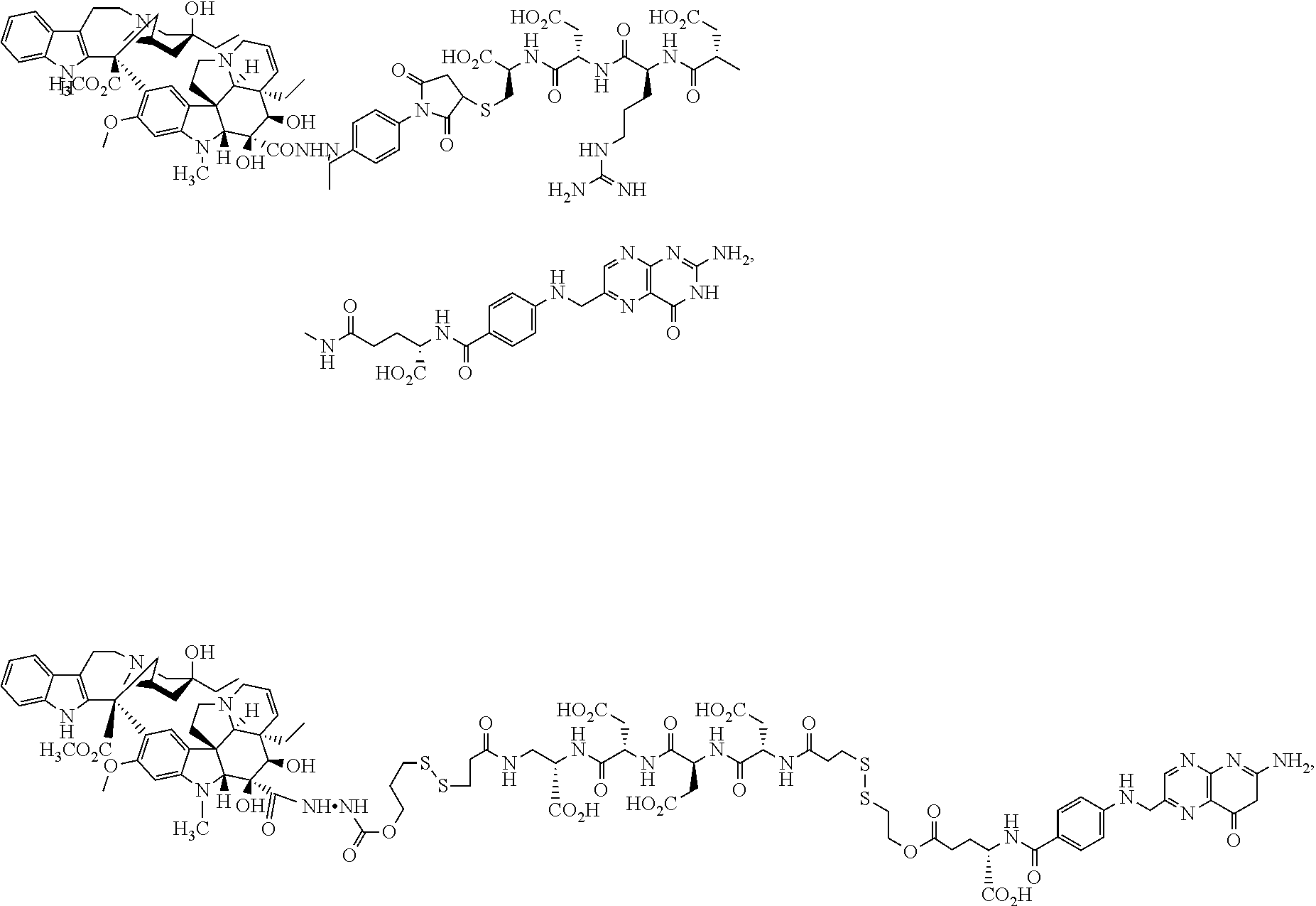


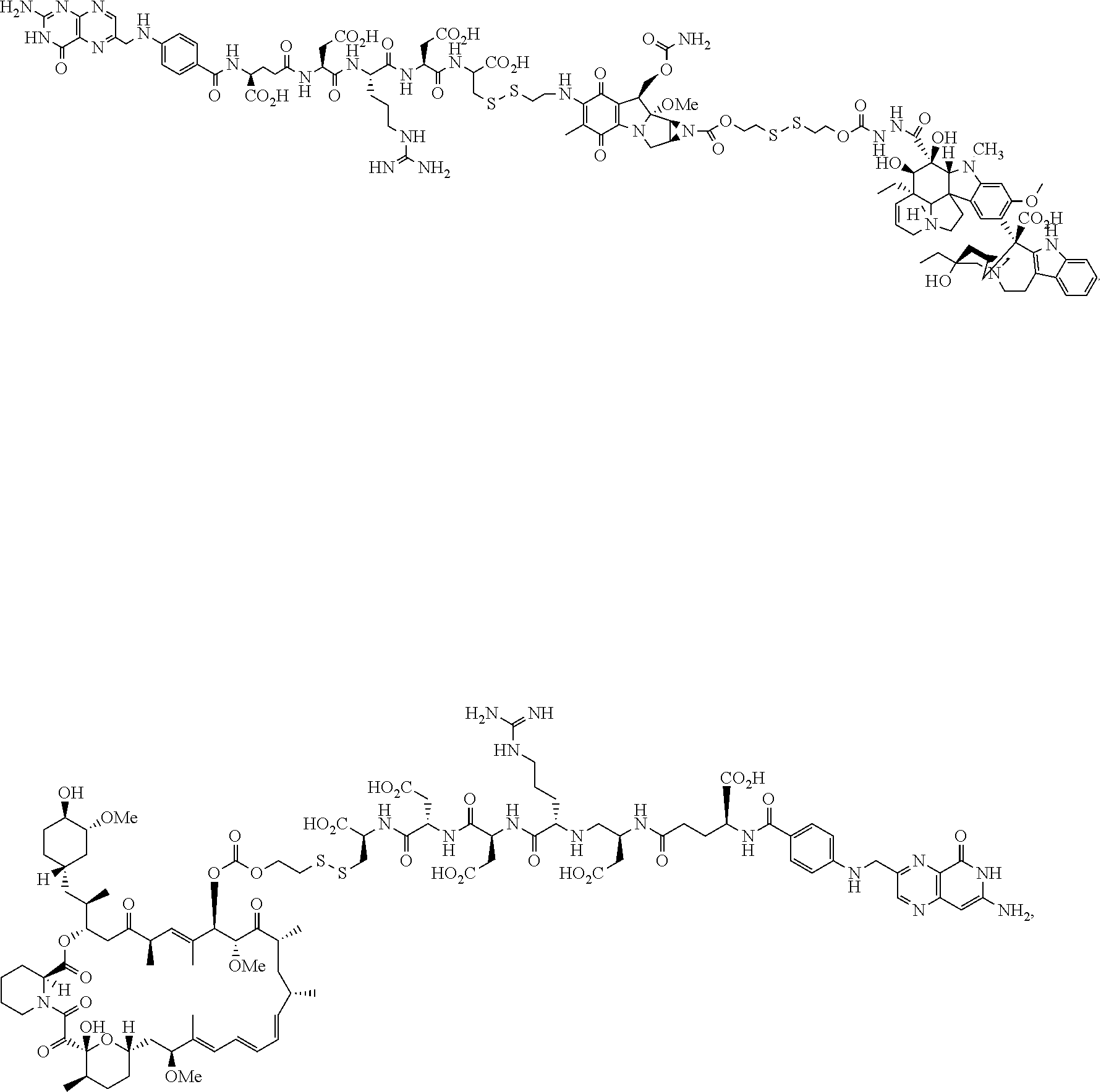


wherein A is N9—CH3-5-d(i)PteGlu, 5-d(i)PteGlu, IAHQ, BW1843U89, 2-NH2—ZD1694, ZD1694, CB3717, 5-dH4PteAPBA, 5-dPteHCysA, or DDATHF.

wherein A is N9—CH3-5-d(i)PteGlu, 5-d(i)PteGlu, IAHQ, BW1843U89, 2-NH2—ZD1694, ZD1694, CB3717, 5-dH4PteAPBA, 5-dPteHCysA, or DDATHF.

wherein A is N9—CH3-5-d(i)PteGlu, 5-d(i)PteGlu, IAHQ, BW1843U89, 2-NH2—ZD1694, ZD1694, CB3717, 5-dH4PteAPBA, 5-dPteHCysA, or DDATHF.

wherein A is N9—CH3-5-d(i)PteGlu, 5-d(i)PteGlu, IAHQ, BW1843U89, 2-NH2—ZD1694, ZD1694, CB3717, 5-dH4PteAPBA, 5-dPteHCysA, or DDATHF.

wherein A is N9—CH3-5-d(i)PteGlu, 5-d(i)PteGlu, IAHQ, BW1843U89, 2-NH2—ZD1694, ZD1694, CB3717, 5-dH4PteAPBA, 5-dPteHCysA, or DDATHF.

wherein A is N9—CH3-5-d(i)PteGlu, 5-d(i)PteGlu, IAHQ, BW1843U89, 2-NH2—ZD1694, ZD1694, CB3717, 5-dH4PteAPBA, 5-dPteHCysA, or DDATHF.

wherein A is N9—CH3-5-d(i)PteGlu, 5-d(i)PteGlu, IAHQ, BW1843U89, 2-NH2—ZD1694, ZD1694, CB3717, 5-dH4PteAPBA, 5-dPteHCysA, or DDATHF.

wherein A is N9—CH3-5-d(i)PteGlu, 5-d(i)PteGlu, IAHQ, BW1843U89, 2-NH2—ZD1694, ZD1694, CB3717, 5-dH4PteAPBA, 5-dPteHCysA, or DDATHF.

wherein A is N9—CH3-5-d(i)PteGlu, 5-d(i)PteGlu, IAHQ, BW1843U89, 2-NH2—ZD1694, ZD1694, CB3717, 5-dH4PteAPBA, 5-dPteHCysA, or DDATHF.

wherein A is N9—CH3-5-d(i)PteGlu, 5-d(i)PteGlu, IAHQ, BW1843U89, 2-NH2—ZD1694, ZD1694, CB3717, 5-dH4PteAPBA, 5-dPteHCysA, or DDATHF.

wherein A is N9—CH3-5-d(i)PteGlu, 5-d(i)PteGlu, IAHQ, BW1843U89, 2-NH2—ZD1694, ZD1694, CB3717, 5-dH4PteAPBA, 5-dPteHCysA, or DDATHF.

wherein A is N9—CH3-5-d(i)PteGlu, 5-d(i)PteGlu, IAHQ, BW1843U89, 2-NH2—ZD1694, ZD1694, CB3717, 5-dH4PteAPBA, 5-dPteHCysA, or DDATHF.

wherein A is N9—CH3-5-d(i)PteGlu, 5-d(i)PteGlu, IAHQ, BW1843U89, 2-NH2—ZD1694, ZD1694, CB3717, 5-dH4PteAPBA, 5-dPteHCysA, or DDATHF.

wherein A is N9—CH3-5-d(i)PteGlu, 5-d(i)PteGlu, IAHQ, BW1843U89, 2-NH2—ZD1694, ZD1694, CB3717, 5-dH4PteAPBA, 5-dPteHCysA, or DDATHF.

wherein A is N9—CH3-5-d(i)PteGlu, 5-d(i)PteGlu, IAHQ, BW1843U89, 2-NH2—ZD1694, ZD1694, CB3717, 5-dH4PteAPBA, 5-dPteHCysA, or DDATHF.

wherein A is N9—CH3-5-d(i)PteGlu, 5-d(i)PteGlu, IAHQ, BW1843U89, 2-NH2—ZD1694, ZD1694, CB3717, 5-dH4PteAPBA, 5-dPteHCysA, or DDATHF.

wherein A is N9—CH3-5-d(i)PteGlu, 5-d(i)PteGlu, IAHQ, BW1843U89, 2-NH2—ZD1694, ZD1694, CB3717, 5-dH4PteAPBA, 5-dPteHCysA, or DDATHF.

wherein A is N9—CH3-5-d(i)PteGlu, 5-d(i)PteGlu, IAHQ, BW1843U89, 2-NH2—ZD1694, ZD1694, CB3717, 5-dH4PteAPBA, 5-dPteHCysA, or DDATHF.

wherein A is N9—CH3-5-d(i)PteGlu, 5-d(i)PteGlu, IAHQ, BW1843U89, 2-NH2—ZD1694, ZD1694, CB3717, 5-dH4PteAPBA, 5-dPteHCysA, or DDATHF.

wherein A is N9—CH3-5-d(i)PteGlu, 5-d(i)PteGlu, IAHQ, BW1843U89, 2-NH2—ZD1694, ZD1694, CB3717, 5-dH4PteAPBA, 5-dPteHCysA, or DDATHF.

wherein A is N9—CH3-5-d(i)PteGlu, 5-d(i)PteGlu, IAHQ, BW1843U89, 2-NH2—ZD1694, ZD1694, CB3717, 5-dH4PteAPBA, 5-dPteHCysA, or DDATHF.

wherein A is N9—CH3-5-d(i)PteGlu, 5-d(i)PteGlu, IAHQ, BW1843U89, 2-NH2—ZD1694, ZD1694, CB3717, 5-dH4PteAPBA, 5-dPteHCysA, or DDATHF,


-
- a) adding the ligand conjugate to the culture medium of a first sample of cultured cells, wherein the ligand conjugate comprises a disulfide linkage;
- b) adding the thiol inhibitor to the culture medium of the first sample of cultured cells to provide a test sample;
- c) adding the ligand conjugate to the culture medium of a second sample of cultured cells to provide a control sample;
- d) measuring the non-ligand-specific activity of the ligand conjugate or the nonspecific uptake of the drug in the test sample;
- e) measuring the non-ligand-specific activity of the ligand conjugate or the nonspecific uptake of the drug in the control sample; and
- f) determining that the ligand conjugate is suitable for co-administration to the patient with the thiol inhibitor if the non-ligand-specific activity of the ligand conjugate and/or the nonspecific uptake of the drug are decreased in the test sample relative to the control sample.
- As used herein, the term “in vitro assay” refers to any assay that may be performed using cultured cells. The term “suitable for co-administration” refers to a ligand conjugate that would advantageously benefit from co-administration with a thiol inhibitor. Such benefit can be observed via a reduction in non-ligand-specific activity of the ligand conjugate, a reduction in nonspecific uptake of the drug portion of the ligand conjugate into the cells, or any other suitable assay.
-
- a) adding the ligand conjugate to the culture medium of a first sample of cultured cells, wherein the ligand conjugate comprises a disulfide linkage;
- b) adding the system xc − inhibitor to the culture medium of the first sample of cultured cells to provide a test sample;
- c) adding the ligand conjugate to the culture medium of a second sample of cultured cells to provide a control sample;
- d) measuring the non-ligand-specific activity of the ligand conjugate or the nonspecific uptake of the drug in the test sample;
- e) measuring the non-ligand-specific activity of the ligand conjugate or the nonspecific uptake of the drug in the control sample; and
- f) determining that the ligand conjugate is suitable for co-administration to the patient with the system xc − inhibitor if the non-ligand-specific activity of the ligand conjugate and/or the nonspecific uptake of the drug are decreased in the test sample relative to the control sample.
| TABLE 1 | |||
| Inhibition | |||
| Concen- | of EC0531 | ||
| tration | Nonspecific | ||
| Action | Inhibitor | (μM) | Activity |
| Membrane- | |
10 | μM | Full inhibition | |
| | NCEM | 100 | μM | Full inhibition | |
| sulfhydryl blockers | Folate- |
100 | μM | | |
| pCMBS | |||||
| 100 | μM | >50% inhibition | |||
| EC1277 (GSAO) | 3 | mm | Full inhibition | ||
| SH-reactive agents | GSSG | 10 | mm | | |
| Dimesna | |||||
| 1 | mm | Full inhibition | |||
| Methoxy- | 3 | mm | >50% inhibition | ||
| PEG5000- | |||||
| | |||||
| EGCg | |||||
| 100 | μM | >50% inhibition | |||
| | DIDS | 1 | mm | Full inhibition | |
| | BSP | 1 | mm | <50% inhibition | |
| TABLE 2 | |||
| EC0531 | EC0531 + Folic Acid | ||
| Cell Line | Treatment | IC50 (nM) | IC50 (nM) |
| KB | FDRPMI/no serum | 7.0 | 540 |
| FDRPMI/10% FBS | 6.7 | 948 | |
| SH-free FDRPMI/no | 7.8 | 830 | |
| serum | |||
| SH-free FDRPMI/ | 9.2 | 2323 | |
| 10% FBS | |||
| Conditioned | 8.3 | 57 | |
| FDRPMI/10% FBS | |||
| A549 | FDRPMI/no serum | 164 | |
| FDRPMI/10% FBS | 295 | ||
| SH-free FDRPMI/no | 575 | ||
| serum | |||
| SH-free FDRPMI/ | 1133 | ||
| 10% FBS | |||
| TABLE 3 | |||||
| Amount of | Amount of Folic | ||||
| EC0531 | Acid | ||||
| Administered | Administered | Number of | Time of Each | ||
| Group | (μM) | (μM) | | Pulse | |
| 1 | 1 | 0 | 1 | 2 |
| 2 | 1 | 0 | 4 | 30 |
| 3 | 1 | 100 | 1 | 2 |
| 4 | 1 | 100 | 4 | 30 minutes |
| TABLE 4 | |||
| EC0531 + Folic Acid | |||
| Cell Line | Treatment | EC0531 IC50 (nM) | IC50 (nM) |
| KB | No siRNA | 54.8 | 258 |
| NS siRNA | 49.6 | 434 | |
| xCT siRNA | 252 | 1775 | |
| A549 | No siRNA | 121 | |
| NS siRNA | 128 | ||
| xCT siRNA | 3797 | ||
Claims (10)

Priority Applications (1)
| Application Number | Priority Date | Filing Date | Title |
|---|---|---|---|
| US14/950,268 US10010618B2 (en) | 2012-11-30 | 2015-11-24 | Methods for treating cancer using combination therapies |
Applications Claiming Priority (4)
| Application Number | Priority Date | Filing Date | Title |
|---|---|---|---|
| US201261731561P | 2012-11-30 | 2012-11-30 | |
| US13/803,392 US20140154702A1 (en) | 2012-11-30 | 2013-03-14 | Methods For Treating Cancer Using Combination Therapies |
| US201514685181A | 2015-04-13 | 2015-04-13 | |
| US14/950,268 US10010618B2 (en) | 2012-11-30 | 2015-11-24 | Methods for treating cancer using combination therapies |
Related Parent Applications (1)
| Application Number | Title | Priority Date | Filing Date |
|---|---|---|---|
| US201514685181A Continuation | 2012-11-30 | 2015-04-13 |
Publications (2)
| Publication Number | Publication Date |
|---|---|
| US20160296630A1 US20160296630A1 (en) | 2016-10-13 |
| US10010618B2 true US10010618B2 (en) | 2018-07-03 |
Family
ID=50825795
Family Applications (2)
| Application Number | Title | Priority Date | Filing Date |
|---|---|---|---|
| US13/803,392 Abandoned US20140154702A1 (en) | 2012-11-30 | 2013-03-14 | Methods For Treating Cancer Using Combination Therapies |
| US14/950,268 Expired - Fee Related US10010618B2 (en) | 2012-11-30 | 2015-11-24 | Methods for treating cancer using combination therapies |
Family Applications Before (1)
| Application Number | Title | Priority Date | Filing Date |
|---|---|---|---|
| US13/803,392 Abandoned US20140154702A1 (en) | 2012-11-30 | 2013-03-14 | Methods For Treating Cancer Using Combination Therapies |
Country Status (2)
| Country | Link |
|---|---|
| US (2) | US20140154702A1 (en) |
| WO (1) | WO2014085575A1 (en) |
Cited By (1)
| Publication number | Priority date | Publication date | Assignee | Title |
|---|---|---|---|---|
| WO2021240152A1 (en) | 2020-05-27 | 2021-12-02 | University Of Warwick | Flow device for detection of glycans |
Families Citing this family (20)
| Publication number | Priority date | Publication date | Assignee | Title |
|---|---|---|---|---|
| CN101098854B (en) | 2004-07-23 | 2012-12-05 | 恩多塞特公司 | Bivalent linkers and conjugates thereof |
| BRPI0812970A2 (en) | 2007-06-25 | 2019-09-24 | Endocyte Inc | conjugates containing hydrophilic spacers |
| US9877965B2 (en) | 2007-06-25 | 2018-01-30 | Endocyte, Inc. | Vitamin receptor drug delivery conjugates for treating inflammation |
| DK2187965T3 (en) | 2007-08-17 | 2020-01-20 | Purdue Research Foundation | PSMA BINDING LIGAND LINKER CONJUGATES AND PROCEDURES FOR USE |
| US9951324B2 (en) | 2010-02-25 | 2018-04-24 | Purdue Research Foundation | PSMA binding ligand-linker conjugates and methods for using |
| WO2013126797A1 (en) | 2012-02-24 | 2013-08-29 | Purdue Research Foundation | Cholecystokinin b receptor targeting for imaging and therapy |
| EA201590622A1 (en) | 2012-10-16 | 2015-10-30 | Эндосайт, Инк. | CONJUGATES FOR DELIVERY OF MEDICINES CONTAINING NOT MEETING IN THE NATURE OF AMINO ACID AND METHODS OF APPLICATION |
| KR102318999B1 (en) | 2012-11-15 | 2021-10-29 | 엔도사이트, 인코포레이티드 | Conjugates for treating diseases caused by psma expressing cells |
| AU2014336638C1 (en) | 2013-10-18 | 2020-09-17 | Novartis Ag | Labeled inhibitors of prostate specific membrane antigen (PSMA), their use as imaging agents and pharmaceutical agents for the treatment of prostate cancer |
| WO2015073678A1 (en) | 2013-11-14 | 2015-05-21 | Endocyte, Inc. | Compounds for positron emission tomography |
| US10188759B2 (en) | 2015-01-07 | 2019-01-29 | Endocyte, Inc. | Conjugates for imaging |
| US20180280528A1 (en) * | 2015-05-01 | 2018-10-04 | Endocyte, Inc. | Antifolate conjugates for treating inflammation |
| US11229708B2 (en) | 2015-12-04 | 2022-01-25 | Seagen Inc. | Conjugates of quaternized tubulysin compounds |
| US11793880B2 (en) | 2015-12-04 | 2023-10-24 | Seagen Inc. | Conjugates of quaternized tubulysin compounds |
| WO2017205447A1 (en) * | 2016-05-24 | 2017-11-30 | Endocyte, Inc. | Methods of treating cancer with a psma ligand-tubulysin compound |
| MX2020010813A (en) | 2018-04-17 | 2021-01-08 | Endocyte Inc | Methods of treating cancer. |
| AU2019345320B2 (en) * | 2018-09-21 | 2025-12-11 | Endocyte, Inc. | Methods of treating cancer |
| US20220170930A1 (en) * | 2019-03-11 | 2022-06-02 | Fudan University | Method for screening compound for treating or preventing polyq-related neurodegenerative diseases |
| EP3972627A4 (en) | 2019-05-20 | 2023-06-21 | Endocyte, Inc. | METHODS FOR PRODUCTION OF PSMA CONJUGATES |
| WO2022106629A1 (en) | 2020-11-19 | 2022-05-27 | Novartis Ag | Synthesis of prostate specific membrane antigen (psma) ligands |
Citations (2)
| Publication number | Priority date | Publication date | Assignee | Title |
|---|---|---|---|---|
| US7041699B2 (en) * | 2002-01-11 | 2006-05-09 | Matthias Rath | Nutrient pharmaceutical formulation comprising polyphenols and use in treatment of cancer |
| US20100323973A1 (en) * | 2007-06-25 | 2010-12-23 | Endoctye, Inc. | Conjugates containing hydrophilic spacer linkers |
Family Cites Families (10)
| Publication number | Priority date | Publication date | Assignee | Title |
|---|---|---|---|---|
| DE602006012816D1 (en) * | 2005-03-30 | 2010-04-22 | Endocyte Inc | TIFICATION OF CELLULAR FOLAT VITAMIN RECEPTORS |
| AR062448A1 (en) * | 2006-05-25 | 2008-11-12 | Endocyte Inc | CONJUGATES OF ANALOGS OF AZIRIDINIL-EPOTILONE AND PHARMACEUTICAL COMPOSITIONS THAT INCLUDE THE SAME |
| PT2032606E (en) * | 2006-05-30 | 2014-02-05 | Genentech Inc | Antibodies and immunoconjugates and uses therefor |
| EP2297209A4 (en) * | 2008-06-03 | 2012-08-01 | Abbott Lab | Dual variable domain immunoglobulins and uses thereof |
| US20120022245A1 (en) * | 2008-10-17 | 2012-01-26 | Purdue Research Foundation | Folate targeting of nucleotides |
| US20110288152A1 (en) * | 2008-10-17 | 2011-11-24 | Purdue Research Foundation | Psma binding ligand-linker conjugates and methods for using |
| ES2549769T3 (en) * | 2009-03-25 | 2015-11-02 | Genentech, Inc. | Anti-FGFR3 antibodies and methods that employ them |
| US20120128587A1 (en) * | 2009-07-31 | 2012-05-24 | Endocyte, Inc. | Folate-targeted diagnostics and treatment |
| WO2011069116A1 (en) * | 2009-12-04 | 2011-06-09 | Endocyte, Inc. | Binding ligand linked drug delivery conjugates of tubulysins |
| US8987281B2 (en) * | 2010-11-12 | 2015-03-24 | Endocyte, Inc. | Methods of treating cancer |
-
2013
- 2013-03-14 US US13/803,392 patent/US20140154702A1/en not_active Abandoned
- 2013-11-27 WO PCT/US2013/072210 patent/WO2014085575A1/en not_active Ceased
-
2015
- 2015-11-24 US US14/950,268 patent/US10010618B2/en not_active Expired - Fee Related
Patent Citations (2)
| Publication number | Priority date | Publication date | Assignee | Title |
|---|---|---|---|---|
| US7041699B2 (en) * | 2002-01-11 | 2006-05-09 | Matthias Rath | Nutrient pharmaceutical formulation comprising polyphenols and use in treatment of cancer |
| US20100323973A1 (en) * | 2007-06-25 | 2010-12-23 | Endoctye, Inc. | Conjugates containing hydrophilic spacer linkers |
Non-Patent Citations (2)
| Title |
|---|
| Sigma catalog entry for N-Maleoy1-β-alanine, downloaded from www.sigmaaldrich.com on Mar. 27, 2017. * |
| Vlahov et al. "Engineering Folate-Drug Conjugates to Target Cancer: From Chemistry to Clinic" Bioconjugate Chem. 2012, 23, 1357-1369. * |
Cited By (1)
| Publication number | Priority date | Publication date | Assignee | Title |
|---|---|---|---|---|
| WO2021240152A1 (en) | 2020-05-27 | 2021-12-02 | University Of Warwick | Flow device for detection of glycans |
Also Published As
| Publication number | Publication date |
|---|---|
| WO2014085575A1 (en) | 2014-06-05 |
| US20140154702A1 (en) | 2014-06-05 |
| US20160296630A1 (en) | 2016-10-13 |
Similar Documents
| Publication | Publication Date | Title |
|---|---|---|
| US20160296630A1 (en) | Methods for treating cancer using combination therapies | |
| US20250170253A1 (en) | Conjugates for treating diseases caused by psma expressing cells | |
| US20240415921A1 (en) | Methods of treating cancer by targeting tumor-associated macrophages | |
| US9555139B2 (en) | Binding ligand linked drug delivery conjugates of tubulysins | |
| US20200121801A1 (en) | Drug delivery conjugates containing unnatural amino acids and methods for using | |
| US9138484B2 (en) | Conjugates containing hydrophilic spacer linkers | |
| US20130116195A1 (en) | Binding ligand linked drug delivery conjugates of tubulysins | |
| HK40058595A (en) | Psma ligand-containing conjugates for the treatment of prostate cancer | |
| HK40059888A (en) | Conjugates for treating diseases caused by psma expressing cells |
Legal Events
| Date | Code | Title | Description |
|---|---|---|---|
| STCF | Information on status: patent grant |
Free format text: PATENTED CASE |
|
| FEPP | Fee payment procedure |
Free format text: ENTITY STATUS SET TO UNDISCOUNTED (ORIGINAL EVENT CODE: BIG.); ENTITY STATUS OF PATENT OWNER: LARGE ENTITY |
|
| FEPP | Fee payment procedure |
Free format text: MAINTENANCE FEE REMINDER MAILED (ORIGINAL EVENT CODE: REM.); ENTITY STATUS OF PATENT OWNER: LARGE ENTITY |
|
| LAPS | Lapse for failure to pay maintenance fees |
Free format text: PATENT EXPIRED FOR FAILURE TO PAY MAINTENANCE FEES (ORIGINAL EVENT CODE: EXP.); ENTITY STATUS OF PATENT OWNER: LARGE ENTITY |
|
| STCH | Information on status: patent discontinuation |
Free format text: PATENT EXPIRED DUE TO NONPAYMENT OF MAINTENANCE FEES UNDER 37 CFR 1.362 |
|
| FP | Lapsed due to failure to pay maintenance fee |
Effective date: 20220703 |