US10010538B2 - Use of anthelmintic agents against Dirofilaria immitis - Google Patents
Use of anthelmintic agents against Dirofilaria immitis Download PDFInfo
- Publication number
- US10010538B2 US10010538B2 US15/324,875 US201515324875A US10010538B2 US 10010538 B2 US10010538 B2 US 10010538B2 US 201515324875 A US201515324875 A US 201515324875A US 10010538 B2 US10010538 B2 US 10010538B2
- Authority
- US
- United States
- Prior art keywords
- alkyl
- group
- alkoxy
- independently selected
- compound
- Prior art date
- Legal status (The legal status is an assumption and is not a legal conclusion. Google has not performed a legal analysis and makes no representation as to the accuracy of the status listed.)
- Expired - Fee Related
Links
- 0 [1*]C1=C(CCCCCCCC2=CC=CC=C2)C([5*])=C([4*])C([3*])=C1[2*] Chemical compound [1*]C1=C(CCCCCCCC2=CC=CC=C2)C([5*])=C([4*])C([3*])=C1[2*] 0.000 description 80
- BBCLRKSZIHSOLK-UHFFFAOYSA-N CC(C)NCC1CCN(C(C)C)CC1 Chemical compound CC(C)NCC1CCN(C(C)C)CC1 BBCLRKSZIHSOLK-UHFFFAOYSA-N 0.000 description 3
- SYBYTAAJFKOIEJ-UHFFFAOYSA-N CC(=O)C(C)C Chemical compound CC(=O)C(C)C SYBYTAAJFKOIEJ-UHFFFAOYSA-N 0.000 description 2
- CSMIWXJAUXGQCX-UHFFFAOYSA-N CC(C)C1CCN(C(C)C)CC1 Chemical compound CC(C)C1CCN(C(C)C)CC1 CSMIWXJAUXGQCX-UHFFFAOYSA-N 0.000 description 2
- SPYSPUYYEMDPBN-UHFFFAOYSA-N CC(C)C1CCN(C(C)C)CC1.CC(C)C1CCN(C(C)C)CC1.CC(C)N1CC2CC1CN2C(C)C.CC(C)N1CC2CN(C(C)C)CC2C1.CC(C)N1CCCN(C(C)C)CC1.CC(C)N1CCN(C(C)C)CC1 Chemical compound CC(C)C1CCN(C(C)C)CC1.CC(C)C1CCN(C(C)C)CC1.CC(C)N1CC2CC1CN2C(C)C.CC(C)N1CC2CN(C(C)C)CC2C1.CC(C)N1CCCN(C(C)C)CC1.CC(C)N1CCN(C(C)C)CC1 SPYSPUYYEMDPBN-UHFFFAOYSA-N 0.000 description 2
- FTRKABMDMAFVAF-UHFFFAOYSA-N CC(C)C1CCN(C(C)C)CC1.CC(C)C1CCN(C(C)C)CC1.CC(C)N1CCN(C(C)C)CC1 Chemical compound CC(C)C1CCN(C(C)C)CC1.CC(C)C1CCN(C(C)C)CC1.CC(C)N1CCN(C(C)C)CC1 FTRKABMDMAFVAF-UHFFFAOYSA-N 0.000 description 2
- MOVNUEKMORKACZ-UHFFFAOYSA-N CC(C)NCCCNC(C)C.CC(C)NCCNC(C)C Chemical compound CC(C)NCCCNC(C)C.CC(C)NCCNC(C)C MOVNUEKMORKACZ-UHFFFAOYSA-N 0.000 description 2
- CGPMAWLFSZHBBC-UHFFFAOYSA-N C1=CC=C(OCCCCSC2CCCCC2)C=C1 Chemical compound C1=CC=C(OCCCCSC2CCCCC2)C=C1 CGPMAWLFSZHBBC-UHFFFAOYSA-N 0.000 description 1
- KWOLFJPFCHCOCG-UHFFFAOYSA-N CC(=O)C1=CC=CC=C1 Chemical compound CC(=O)C1=CC=CC=C1 KWOLFJPFCHCOCG-UHFFFAOYSA-N 0.000 description 1
- CSCPPACGZOOCGX-UHFFFAOYSA-N CC(C)=O Chemical compound CC(C)=O CSCPPACGZOOCGX-UHFFFAOYSA-N 0.000 description 1
- LRDFRRGEGBBSRN-UHFFFAOYSA-N CC(C)C#N Chemical compound CC(C)C#N LRDFRRGEGBBSRN-UHFFFAOYSA-N 0.000 description 1
- HXVNBWAKAOHACI-UHFFFAOYSA-N CC(C)C(=O)C(C)C Chemical compound CC(C)C(=O)C(C)C HXVNBWAKAOHACI-UHFFFAOYSA-N 0.000 description 1
- BSMGLVDZZMBWQB-UHFFFAOYSA-N CC(C)C(=O)C1=CC=CC=C1 Chemical compound CC(C)C(=O)C1=CC=CC=C1 BSMGLVDZZMBWQB-UHFFFAOYSA-N 0.000 description 1
- BJVASRMDOMQXRQ-UHFFFAOYSA-N CC(C)C(=S)C(C)C Chemical compound CC(C)C(=S)C(C)C BJVASRMDOMQXRQ-UHFFFAOYSA-N 0.000 description 1
- HPYZBPRQUKMRAL-UHFFFAOYSA-N CC(C)C1CC2CC1CN2C(C)C.CC(C)N1CC2CC1CN2C(C)C Chemical compound CC(C)C1CC2CC1CN2C(C)C.CC(C)N1CC2CC1CN2C(C)C HPYZBPRQUKMRAL-UHFFFAOYSA-N 0.000 description 1
- PRDFGNIANBILFS-UHFFFAOYSA-N CC(C)C1CCCN(C(C)C)C1.CC(C)C1CCN(C(C)C)C1.CC(C)C1CN(C(C)C)C1 Chemical compound CC(C)C1CCCN(C(C)C)C1.CC(C)C1CCN(C(C)C)C1.CC(C)C1CN(C(C)C)C1 PRDFGNIANBILFS-UHFFFAOYSA-N 0.000 description 1
- OXKYBSUHHWRNDQ-UHFFFAOYSA-N CC(C)C1CCCN(C(C)C)C1.CC(C)C1CCN(C(C)C)CC1 Chemical compound CC(C)C1CCCN(C(C)C)C1.CC(C)C1CCN(C(C)C)CC1 OXKYBSUHHWRNDQ-UHFFFAOYSA-N 0.000 description 1
- GFURGYUGKVAWIS-UHFFFAOYSA-N CC(C)C1CCN(C(C)C)C1.CC(C)C1CN(C(C)C)C1.CC(C)N1CCN(C(C)C)CC1 Chemical compound CC(C)C1CCN(C(C)C)C1.CC(C)C1CN(C(C)C)C1.CC(C)N1CCN(C(C)C)CC1 GFURGYUGKVAWIS-UHFFFAOYSA-N 0.000 description 1
- HNFCJXSAAJCYLO-UHFFFAOYSA-N CC(C)C1CCN(C(C)C)CC1.CC(C)NC1CCN(C(C)C)CC1 Chemical compound CC(C)C1CCN(C(C)C)CC1.CC(C)NC1CCN(C(C)C)CC1 HNFCJXSAAJCYLO-UHFFFAOYSA-N 0.000 description 1
- IBZNYJURRDPTEC-UHFFFAOYSA-N CC(C)N1CC(C)N(C(C)C)CC1C Chemical compound CC(C)N1CC(C)N(C(C)C)CC1C IBZNYJURRDPTEC-UHFFFAOYSA-N 0.000 description 1
- RKLZGHCIRIOHPP-UHFFFAOYSA-N CC(C)N1CC2CC1CN2C(C)C Chemical compound CC(C)N1CC2CC1CN2C(C)C RKLZGHCIRIOHPP-UHFFFAOYSA-N 0.000 description 1
- IYKAKXHZILUWPD-UHFFFAOYSA-N CC(C)N1CC2CC1CN2C(C)C.CC(C)N1CCCN(C(C)C)CC1.CC(C)N1CCN(C(C)C)CC1.CC(C)NCCNC(C)C Chemical compound CC(C)N1CC2CC1CN2C(C)C.CC(C)N1CCCN(C(C)C)CC1.CC(C)N1CCN(C(C)C)CC1.CC(C)NCCNC(C)C IYKAKXHZILUWPD-UHFFFAOYSA-N 0.000 description 1
- JDENWUOYDNUBMH-UHFFFAOYSA-N CC(C)N1CC2CN(C(C)C)CC2C1 Chemical compound CC(C)N1CC2CN(C(C)C)CC2C1 JDENWUOYDNUBMH-UHFFFAOYSA-N 0.000 description 1
- TXHRPAKVPOEZLH-UHFFFAOYSA-N CC(C)N1CC2CN(C(C)C)CC2C1.CC(C)N1CCCN(C(C)C)CC1 Chemical compound CC(C)N1CC2CN(C(C)C)CC2C1.CC(C)N1CCCN(C(C)C)CC1 TXHRPAKVPOEZLH-UHFFFAOYSA-N 0.000 description 1
- LLOCGHSMTJLQKC-UHFFFAOYSA-N CC(C)N1CC2CN(C(C)C)CC2C1.CC(C)NC1CCN(C(C)C)CC1.CC(C)NCCCNC(C)C Chemical compound CC(C)N1CC2CN(C(C)C)CC2C1.CC(C)NC1CCN(C(C)C)CC1.CC(C)NCCCNC(C)C LLOCGHSMTJLQKC-UHFFFAOYSA-N 0.000 description 1
- RSXGRXZNMQGNJW-UHFFFAOYSA-N CC(C)N1CCC(C)(C(C)C)CC1 Chemical compound CC(C)N1CCC(C)(C(C)C)CC1 RSXGRXZNMQGNJW-UHFFFAOYSA-N 0.000 description 1
- SDJACUMREWIJDO-UHFFFAOYSA-N CC(C)N1CCCN(C(C)C)CC1 Chemical compound CC(C)N1CCCN(C(C)C)CC1 SDJACUMREWIJDO-UHFFFAOYSA-N 0.000 description 1
- RKRWDFPOUZIJID-UHFFFAOYSA-N CC(C)N1CCN(C(C)C)C(=O)C1 Chemical compound CC(C)N1CCN(C(C)C)C(=O)C1 RKRWDFPOUZIJID-UHFFFAOYSA-N 0.000 description 1
- NZIWCJIMKAWXAQ-UHFFFAOYSA-N CC(C)N1CCN(C(C)C)CC1 Chemical compound CC(C)N1CCN(C(C)C)CC1 NZIWCJIMKAWXAQ-UHFFFAOYSA-N 0.000 description 1
- PQGUMOROSLDIFW-UHFFFAOYSA-N CC(C)NC1CCN(C(C)C)CC1 Chemical compound CC(C)NC1CCN(C(C)C)CC1 PQGUMOROSLDIFW-UHFFFAOYSA-N 0.000 description 1
- ZDULHUHNYHJYKA-UHFFFAOYSA-N CC(C)S(=O)(=O)C(C)C Chemical compound CC(C)S(=O)(=O)C(C)C ZDULHUHNYHJYKA-UHFFFAOYSA-N 0.000 description 1
- WFJXYIUAMJAURQ-UHFFFAOYSA-N CC(C)S(=O)C(C)C Chemical compound CC(C)S(=O)C(C)C WFJXYIUAMJAURQ-UHFFFAOYSA-N 0.000 description 1
- VTWYQAQIXXAXOR-UHFFFAOYSA-N CC(C)S(C)(=O)=O Chemical compound CC(C)S(C)(=O)=O VTWYQAQIXXAXOR-UHFFFAOYSA-N 0.000 description 1
- YHDHZNAEGUMJKT-XKQNLNOUSA-N CC1=C(C)C(C(F)(F)F)=CC(NC2CCC(OCC(=O)N3CCN(C4=CC=CC=C4)CC3)CC2)=C1.CC1=C(NC2CCC(OCC(=O)N3CCN(C4=CC=CC=C4)CC3)CC2)C=C(C(F)(F)F)C(C)=C1C.CC1=CC(C)=C(NC2CCC(OCC(=O)N3CCN(C4=CC=CC=C4)CC3)CC2)C=C1C(F)(F)F.CC1=CC=C(C[C@@H]2CCC(OCC(=O)N3CCN(C4=CC=CC=C4)CC3)C2)C=C1C(F)(F)F.CC1=CC=C(NC2CCC(OC(C)(C)C(=O)N3CCN(C4=CC=CC=C4)CC3)CC2)C=C1C(F)(F)F.CC1=CC=C(NC2CCC(OCC(=O)N3CCN(C4=C(C)C(C)=C(C)C=C4)CC3)CC2)C=C1C(F)(F)F.CC1=CC=C(NC2CCC(OCC(=O)N3CCN(C4=CC=CC=C4)C(=O)C3)CC2)C=C1C(F)(F)F.CC1=CC=C(NC2CCC(OCC(=O)N3CCN(C4=CC=CC=C4)CC3)CC2)C=C1C(F)(F)F.CC1=CC=C(NC2CCC(OCC(=S)N3CCN(C4=CC=CC=C4)CC3)CC2)C=C1C(F)(F)F.CC1=CC=C(OC2CCC(OCC(=O)N3CCN(C4=CC=CC=C4)CC3)CC2)C=C1C(F)(F)F Chemical compound CC1=C(C)C(C(F)(F)F)=CC(NC2CCC(OCC(=O)N3CCN(C4=CC=CC=C4)CC3)CC2)=C1.CC1=C(NC2CCC(OCC(=O)N3CCN(C4=CC=CC=C4)CC3)CC2)C=C(C(F)(F)F)C(C)=C1C.CC1=CC(C)=C(NC2CCC(OCC(=O)N3CCN(C4=CC=CC=C4)CC3)CC2)C=C1C(F)(F)F.CC1=CC=C(C[C@@H]2CCC(OCC(=O)N3CCN(C4=CC=CC=C4)CC3)C2)C=C1C(F)(F)F.CC1=CC=C(NC2CCC(OC(C)(C)C(=O)N3CCN(C4=CC=CC=C4)CC3)CC2)C=C1C(F)(F)F.CC1=CC=C(NC2CCC(OCC(=O)N3CCN(C4=C(C)C(C)=C(C)C=C4)CC3)CC2)C=C1C(F)(F)F.CC1=CC=C(NC2CCC(OCC(=O)N3CCN(C4=CC=CC=C4)C(=O)C3)CC2)C=C1C(F)(F)F.CC1=CC=C(NC2CCC(OCC(=O)N3CCN(C4=CC=CC=C4)CC3)CC2)C=C1C(F)(F)F.CC1=CC=C(NC2CCC(OCC(=S)N3CCN(C4=CC=CC=C4)CC3)CC2)C=C1C(F)(F)F.CC1=CC=C(OC2CCC(OCC(=O)N3CCN(C4=CC=CC=C4)CC3)CC2)C=C1C(F)(F)F YHDHZNAEGUMJKT-XKQNLNOUSA-N 0.000 description 1
- ALCOPPLBRFCGJC-UHFFFAOYSA-N CC1=C([N+](=O)[O-])C=CC(NC2CCC(OCC(=O)N3CCC(NC4=CC=C(OC(F)(F)F)C=C4)CC3)CC2)=C1.CC1=CC(NC2CCN(C(=O)COC3CCC(NC4=CC(C)=C(C#N)C=C4)CC3)CC2)=CC=C1[N+](=O)[O-].CC1=CC(NC2CCN(C(=O)COC3CCC(NC4=CC(C)=C([N+](=O)[O-])C=C4)CC3)CC2)=CC=C1[N+](=O)[O-].CC1=CC=C(N2CCC(CN(C)C(=O)C3CCC(NC4=CC(C)=C([N+](=O)[O-])C=C4)CC3)CC2)C=C1.CC1=CC=C(N2CCN(C(=O)COC3CCC(NC4=CC(C)=C([N+](=O)[O-])C=C4)CC3)CC2)C=C1.CC1=CC=C(N2CCN(C(=S)COC3CCC(NC4=CC(C)=C([N+](=O)[O-])C=C4)CC3)CC2)C=C1.[C-]#[N+]C1=CC=C(NC2CCN(C(=O)COC3CCC(NC4=CC(C)=C(C#N)C=C4)CC3)CC2)C=C1C Chemical compound CC1=C([N+](=O)[O-])C=CC(NC2CCC(OCC(=O)N3CCC(NC4=CC=C(OC(F)(F)F)C=C4)CC3)CC2)=C1.CC1=CC(NC2CCN(C(=O)COC3CCC(NC4=CC(C)=C(C#N)C=C4)CC3)CC2)=CC=C1[N+](=O)[O-].CC1=CC(NC2CCN(C(=O)COC3CCC(NC4=CC(C)=C([N+](=O)[O-])C=C4)CC3)CC2)=CC=C1[N+](=O)[O-].CC1=CC=C(N2CCC(CN(C)C(=O)C3CCC(NC4=CC(C)=C([N+](=O)[O-])C=C4)CC3)CC2)C=C1.CC1=CC=C(N2CCN(C(=O)COC3CCC(NC4=CC(C)=C([N+](=O)[O-])C=C4)CC3)CC2)C=C1.CC1=CC=C(N2CCN(C(=S)COC3CCC(NC4=CC(C)=C([N+](=O)[O-])C=C4)CC3)CC2)C=C1.[C-]#[N+]C1=CC=C(NC2CCN(C(=O)COC3CCC(NC4=CC(C)=C(C#N)C=C4)CC3)CC2)C=C1C ALCOPPLBRFCGJC-UHFFFAOYSA-N 0.000 description 1
- GYFVDNLORMPDGK-UHFFFAOYSA-N CC1=CC(C)=C(N2CCN(C(=O)COC3CCC(NC4=CC=C(C)C(C(F)(F)F)=C4)CC3)CC2)C(C)=C1.CC1=CC=C(N2CCN(C(=O)COC3CCC(NC4=CC=C(C)C(C(F)(F)F)=C4)CC3)CC2)C(C)=C1.CC1=CC=C(N2CCN(C(=O)COC3CCC(NC4=CC=C(C)C(C(F)(F)F)=C4)CC3)CC2)C=C1.CC1=CC=C(NC2CCC(OCC(=O)N3CCN(C4=CC=C(C5=CC=CC=C5)C=C4)CC3)CC2)C=C1C(F)(F)F.CC1=CC=C(NC2CCC(OCC(=O)N3CCN(C4=CC=C(Cl)C=C4F)CC3)CC2)C=C1C(F)(F)F.CC1=CC=C(NC2CCC(OCC(=O)N3CCN(C4=CC=CC=C4)CC3)CC2)C=C1C(F)(F)F.COC1=CC(N2CCN(C(=O)COC3CCC(NC4=CC=C(C)C(C(F)(F)F)=C4)CC3)CC2)=CC=C1.COC1=CC=C(N2CCN(C(=O)COC3CCC(NC4=CC=C(C)C(C(F)(F)F)=C4)CC3)CC2)C=C1.[C-]#[N+]C1=CC=C(N2CCN(C(=O)COC3CCC(NC4=CC=C(C)C(C(F)(F)F)=C4)CC3)CC2)C=C1 Chemical compound CC1=CC(C)=C(N2CCN(C(=O)COC3CCC(NC4=CC=C(C)C(C(F)(F)F)=C4)CC3)CC2)C(C)=C1.CC1=CC=C(N2CCN(C(=O)COC3CCC(NC4=CC=C(C)C(C(F)(F)F)=C4)CC3)CC2)C(C)=C1.CC1=CC=C(N2CCN(C(=O)COC3CCC(NC4=CC=C(C)C(C(F)(F)F)=C4)CC3)CC2)C=C1.CC1=CC=C(NC2CCC(OCC(=O)N3CCN(C4=CC=C(C5=CC=CC=C5)C=C4)CC3)CC2)C=C1C(F)(F)F.CC1=CC=C(NC2CCC(OCC(=O)N3CCN(C4=CC=C(Cl)C=C4F)CC3)CC2)C=C1C(F)(F)F.CC1=CC=C(NC2CCC(OCC(=O)N3CCN(C4=CC=CC=C4)CC3)CC2)C=C1C(F)(F)F.COC1=CC(N2CCN(C(=O)COC3CCC(NC4=CC=C(C)C(C(F)(F)F)=C4)CC3)CC2)=CC=C1.COC1=CC=C(N2CCN(C(=O)COC3CCC(NC4=CC=C(C)C(C(F)(F)F)=C4)CC3)CC2)C=C1.[C-]#[N+]C1=CC=C(N2CCN(C(=O)COC3CCC(NC4=CC=C(C)C(C(F)(F)F)=C4)CC3)CC2)C=C1 GYFVDNLORMPDGK-UHFFFAOYSA-N 0.000 description 1
- OIGBBCZPVUPODX-UHFFFAOYSA-N CC1=CC(NC2CCC(CCC(=O)N3CCN(C4=CC=C(Cl)C=C4)CC3)CC2)=CC=C1C#N.CC1=CC(NC2CCC(OCC(=O)N3CCN(C4=CC=C(C(C)(C)C)C=C4)CC3)CC2)=CC=C1C#N.CC1=CC(NC2CCC(OCC(=O)N3CCN(C4=CC=C(Cl)C=C4)CC3)CC2)=CC=C1C#N.CC1=CC(NC2CCC(OCC(=O)N3CCN(C4=CC=C(OCC5=CC=CC=C5)C=C4)CC3)CC2)=CC=C1C#N.CC1=CC=C(N2CCN(C(=O)CCC3CCC(NC4=CC=C(C#N)C(C)=C4)CC3)CC2)C=C1.CC1=CC=C(N2CCN(C(=O)COC3CCC(NC4=CC=C(C#N)C(C)=C4)CC3)CC2)C=C1.CC1=CC=C(N2CCN(C(=O)COC3CCC(NC4=CC=C(C#N)C(C)=C4)CC3)CC2)C=C1.CC1=CC=C(N2CCN(C(=O)COC3CCC(NC4=CC=C(OC(F)(F)F)C(C)=C4)CC3)CC2)C=C1.CC1=CC=C(NC2CCC(CCC(=O)N3CCN(C4=CC=CC=C4)CC3)CC2)C=C1C(F)(F)F Chemical compound CC1=CC(NC2CCC(CCC(=O)N3CCN(C4=CC=C(Cl)C=C4)CC3)CC2)=CC=C1C#N.CC1=CC(NC2CCC(OCC(=O)N3CCN(C4=CC=C(C(C)(C)C)C=C4)CC3)CC2)=CC=C1C#N.CC1=CC(NC2CCC(OCC(=O)N3CCN(C4=CC=C(Cl)C=C4)CC3)CC2)=CC=C1C#N.CC1=CC(NC2CCC(OCC(=O)N3CCN(C4=CC=C(OCC5=CC=CC=C5)C=C4)CC3)CC2)=CC=C1C#N.CC1=CC=C(N2CCN(C(=O)CCC3CCC(NC4=CC=C(C#N)C(C)=C4)CC3)CC2)C=C1.CC1=CC=C(N2CCN(C(=O)COC3CCC(NC4=CC=C(C#N)C(C)=C4)CC3)CC2)C=C1.CC1=CC=C(N2CCN(C(=O)COC3CCC(NC4=CC=C(C#N)C(C)=C4)CC3)CC2)C=C1.CC1=CC=C(N2CCN(C(=O)COC3CCC(NC4=CC=C(OC(F)(F)F)C(C)=C4)CC3)CC2)C=C1.CC1=CC=C(NC2CCC(CCC(=O)N3CCN(C4=CC=CC=C4)CC3)CC2)C=C1C(F)(F)F OIGBBCZPVUPODX-UHFFFAOYSA-N 0.000 description 1
- GOUROGTWMNSNDM-UHFFFAOYSA-N CC1=CC(NC2CCC(CN(C)C(=O)C3(C)CCN(C4=CC=C(C(C)(C)C)C=C4)CC3)CC2)=CC=C1[N+](=O)[O-] Chemical compound CC1=CC(NC2CCC(CN(C)C(=O)C3(C)CCN(C4=CC=C(C(C)(C)C)C=C4)CC3)CC2)=CC=C1[N+](=O)[O-] GOUROGTWMNSNDM-UHFFFAOYSA-N 0.000 description 1
- NIOBILHIINMZMK-UHFFFAOYSA-N CC1=CC(NC2CCC(CN(C)C(=O)C3(C)CCN(C4=CC=C(Cl)C=C4)CC3)CC2)=CC=C1[N+](=O)[O-].CC1=CC(NC2CCC(CN(C)C(=O)C3(C)CCN(C4=CC=C(F)C=C4)CC3)CC2)=CC=C1[N+](=O)[O-].CC1=CC(NC2CCC(CN(C)C(=O)C3CCN(C4=CC=C(C(C)(C)C)C=C4)CC3)CC2)=CC=C1[N+](=O)[O-].CC1=CC(NC2CCC(CN(C)C(=O)C3CCN(C4=CC=C(Cl)C=C4)CC3)CC2)=CC=C1[N+](=O)[O-].CC1=CC(NC2CCC(CN(C)C(=O)C3CCN(C4=CC=C(F)C=C4)CC3)CC2)=CC=C1[N+](=O)[O-].CC1=CC(NC2CCC(CNC(=O)C3(C)CCN(C4=CC=C(F)C=C4)CC3)CC2)=CC=C1[N+](=O)[O-].CC1=CC(NC2CCC(CNC(=O)C3CCN(C4=CC=C(Cl)C=C4)CC3)CC2)=CC=C1[N+](=O)[O-].CC1=CC(NC2CCC(CNC(=O)C3CCN(C4=CC=C(F)C=C4)CC3)CC2)=CC=C1[N+](=O)[O-].CC1=CC=C(N2CCC(C(=O)N(C)CC3CCC(NC4=CC=C([N+](=O)[O-])C(C)=C4)CC3)CC2)C=C1.CC1=CC=C(N2CCC(C)(C(=O)N(C)CC3CCC(NC4=CC=C([N+](=O)[O-])C(C)=C4)CC3)CC2)C=C1 Chemical compound CC1=CC(NC2CCC(CN(C)C(=O)C3(C)CCN(C4=CC=C(Cl)C=C4)CC3)CC2)=CC=C1[N+](=O)[O-].CC1=CC(NC2CCC(CN(C)C(=O)C3(C)CCN(C4=CC=C(F)C=C4)CC3)CC2)=CC=C1[N+](=O)[O-].CC1=CC(NC2CCC(CN(C)C(=O)C3CCN(C4=CC=C(C(C)(C)C)C=C4)CC3)CC2)=CC=C1[N+](=O)[O-].CC1=CC(NC2CCC(CN(C)C(=O)C3CCN(C4=CC=C(Cl)C=C4)CC3)CC2)=CC=C1[N+](=O)[O-].CC1=CC(NC2CCC(CN(C)C(=O)C3CCN(C4=CC=C(F)C=C4)CC3)CC2)=CC=C1[N+](=O)[O-].CC1=CC(NC2CCC(CNC(=O)C3(C)CCN(C4=CC=C(F)C=C4)CC3)CC2)=CC=C1[N+](=O)[O-].CC1=CC(NC2CCC(CNC(=O)C3CCN(C4=CC=C(Cl)C=C4)CC3)CC2)=CC=C1[N+](=O)[O-].CC1=CC(NC2CCC(CNC(=O)C3CCN(C4=CC=C(F)C=C4)CC3)CC2)=CC=C1[N+](=O)[O-].CC1=CC=C(N2CCC(C(=O)N(C)CC3CCC(NC4=CC=C([N+](=O)[O-])C(C)=C4)CC3)CC2)C=C1.CC1=CC=C(N2CCC(C)(C(=O)N(C)CC3CCC(NC4=CC=C([N+](=O)[O-])C(C)=C4)CC3)CC2)C=C1 NIOBILHIINMZMK-UHFFFAOYSA-N 0.000 description 1
- ZKYZCZQXEFJIJM-MIRLHQODSA-N CC1=CC(NC2CCC(CNC(=O)C3(C)CCN(C4=CC=C(C(C)(C)C)C=C4)CC3)CC2)=CC=C1[N+](=O)[O-].CC1=CC(NC2CCC(CNC(=O)C3(C)CCN(C4=CC=C(Cl)C=C4)CC3)CC2)=CC=C1[N+](=O)[O-].CC1=CC(NC2CCC(OCC(=O)N3CCN(C4=CC=C(C(C)(C)C)C=C4)CC3)CC2)=CC=C1Cl.CC1=CC=C(N2CCC(C(=O)NCC3CCC(NC4=CC=C([N+](=O)[O-])C(C)=C4)CC3)CC2)C=C1.CC1=CC=C(N2CCC(C)(C(=O)NCC3CCC(NC4=CC=C([N+](=O)[O-])C(C)=C4)CC3)CC2)C=C1.CC1=CC=C(N2CCC(CC(F)C(=O)C3CCC(NC4=CC=C([N+](=O)[O-])C(C)=C4)CC3)CC2)C=C1.CFF.COC1=CC=C(N2CCN(C(=O)COC3CCC(NC4=CC=C(SC)C=C4)CC3)CC2)C=C1.CSC1=CC=C(NC2CCC(OCC(=O)N3CCN(C4=CC=C(C(C)(C)C)C=C4)CC3)CC2)C=C1.CSC1=CC=C(NC2CCC(OCC(=O)N3CCN(C4=CC=C(C)C=C4)CC3)CC2)C=C1 Chemical compound CC1=CC(NC2CCC(CNC(=O)C3(C)CCN(C4=CC=C(C(C)(C)C)C=C4)CC3)CC2)=CC=C1[N+](=O)[O-].CC1=CC(NC2CCC(CNC(=O)C3(C)CCN(C4=CC=C(Cl)C=C4)CC3)CC2)=CC=C1[N+](=O)[O-].CC1=CC(NC2CCC(OCC(=O)N3CCN(C4=CC=C(C(C)(C)C)C=C4)CC3)CC2)=CC=C1Cl.CC1=CC=C(N2CCC(C(=O)NCC3CCC(NC4=CC=C([N+](=O)[O-])C(C)=C4)CC3)CC2)C=C1.CC1=CC=C(N2CCC(C)(C(=O)NCC3CCC(NC4=CC=C([N+](=O)[O-])C(C)=C4)CC3)CC2)C=C1.CC1=CC=C(N2CCC(CC(F)C(=O)C3CCC(NC4=CC=C([N+](=O)[O-])C(C)=C4)CC3)CC2)C=C1.CFF.COC1=CC=C(N2CCN(C(=O)COC3CCC(NC4=CC=C(SC)C=C4)CC3)CC2)C=C1.CSC1=CC=C(NC2CCC(OCC(=O)N3CCN(C4=CC=C(C(C)(C)C)C=C4)CC3)CC2)C=C1.CSC1=CC=C(NC2CCC(OCC(=O)N3CCN(C4=CC=C(C)C=C4)CC3)CC2)C=C1 ZKYZCZQXEFJIJM-MIRLHQODSA-N 0.000 description 1
- CUWOFEYRPOLBIY-DJJFYCFISA-N CC1=CC(NC2CCC(OCC(=O)N3CCC(NC4=CC=C([N+](=O)[O-])C(C)=C4)CC3)CC2)=CC=C1C#N.CC1=CC(NC2CCN(C(=O)COC3CCC(NC4=CC=C([N+](=O)[O-])C(C(F)(F)F)=C4)CC3)CC2)=CC=C1[N+](=O)[O-].CC1=CC=C(N2CCN(C(=O)CO[C@H]3CC[C@H](NC4=CC(C(F)(F)F)=C(C)C=C4)CC3)CC2)C=C1.CC1=CC=C(N2CCN(C(=S)CO[C@H]3CC[C@H](NC4=CC(C(F)(F)F)=C(C)C=C4)CC3)CC2)C=C1 Chemical compound CC1=CC(NC2CCC(OCC(=O)N3CCC(NC4=CC=C([N+](=O)[O-])C(C)=C4)CC3)CC2)=CC=C1C#N.CC1=CC(NC2CCN(C(=O)COC3CCC(NC4=CC=C([N+](=O)[O-])C(C(F)(F)F)=C4)CC3)CC2)=CC=C1[N+](=O)[O-].CC1=CC=C(N2CCN(C(=O)CO[C@H]3CC[C@H](NC4=CC(C(F)(F)F)=C(C)C=C4)CC3)CC2)C=C1.CC1=CC=C(N2CCN(C(=S)CO[C@H]3CC[C@H](NC4=CC(C(F)(F)F)=C(C)C=C4)CC3)CC2)C=C1 CUWOFEYRPOLBIY-DJJFYCFISA-N 0.000 description 1
- YENMZBYWTJEPST-UHFFFAOYSA-N CC1=CC(NC2CCC(OCC(=O)N3CCN(C4=CC=C(C(C)(C)C)C=C4)CC3)CC2)=CC=C1Cl.CC1=CC(NC2CCC(OCC(=O)N3CCN(C4=CC=C(C(C)(C)C)C=C4)CC3)CC2)=CC=C1Cl.CC1=CC(NC2CCC(OCC(=O)N3CCN(C4=CC=C(C(C)(C)C)C=C4)CC3)CC2)=CC=C1OC(F)(F)F.CC1=CC(NC2CCC(OCC(=O)N3CCN(C4=CC=C(Cl)C=C4)CC3)CC2)=CC=C1Cl.CC1=CC(NC2CCC(OCC(=O)N3CCN(C4=CC=C(Cl)C=C4)CC3)CC2)=CC=C1OC(F)(F)F.CC1=CC(NC2CCC(OCC(=O)N3CCN(C4=CC=C(OCC5=CC=CC=C5)C=C4)CC3)CC2)=CC=C1Cl.CC1=CC=C(N2CCN(C(=O)COC3CCC(NC4=CC=C(Cl)C(C)=C4)CC3)CC2)C=C1.CC1=CC=C(N2CCN(C(=O)COC3CCC(NC4=CC=C(Cl)C(C)=C4)CC3)CC2)C=C1.CSC1=CC=C(NC2CCC(OCC(=O)N3CCN(C4=CC=C(Cl)C=C4)CC3)CC2)C=C1 Chemical compound CC1=CC(NC2CCC(OCC(=O)N3CCN(C4=CC=C(C(C)(C)C)C=C4)CC3)CC2)=CC=C1Cl.CC1=CC(NC2CCC(OCC(=O)N3CCN(C4=CC=C(C(C)(C)C)C=C4)CC3)CC2)=CC=C1Cl.CC1=CC(NC2CCC(OCC(=O)N3CCN(C4=CC=C(C(C)(C)C)C=C4)CC3)CC2)=CC=C1OC(F)(F)F.CC1=CC(NC2CCC(OCC(=O)N3CCN(C4=CC=C(Cl)C=C4)CC3)CC2)=CC=C1Cl.CC1=CC(NC2CCC(OCC(=O)N3CCN(C4=CC=C(Cl)C=C4)CC3)CC2)=CC=C1OC(F)(F)F.CC1=CC(NC2CCC(OCC(=O)N3CCN(C4=CC=C(OCC5=CC=CC=C5)C=C4)CC3)CC2)=CC=C1Cl.CC1=CC=C(N2CCN(C(=O)COC3CCC(NC4=CC=C(Cl)C(C)=C4)CC3)CC2)C=C1.CC1=CC=C(N2CCN(C(=O)COC3CCC(NC4=CC=C(Cl)C(C)=C4)CC3)CC2)C=C1.CSC1=CC=C(NC2CCC(OCC(=O)N3CCN(C4=CC=C(Cl)C=C4)CC3)CC2)C=C1 YENMZBYWTJEPST-UHFFFAOYSA-N 0.000 description 1
- NGRIRKGKKZESMP-UHFFFAOYSA-N CC1=CC(NC2CCC(OCC(=O)N3CCN(C4=CC=C(C(C)(C)C)C=C4)CC3)CC2)=CC=C1OC(F)(F)F.CC1=CC(NC2CCC(OCC(=O)N3CCN(C4=CC=C(Cl)C=C4)CC3)CC2)=CC=C1OC(F)(F)F.CC1=CC=C(N2CCN(C(=O)COC3CCC(NC4=CC=C(OC(F)(F)F)C(C)=C4)CC3)CC2)C=C1 Chemical compound CC1=CC(NC2CCC(OCC(=O)N3CCN(C4=CC=C(C(C)(C)C)C=C4)CC3)CC2)=CC=C1OC(F)(F)F.CC1=CC(NC2CCC(OCC(=O)N3CCN(C4=CC=C(Cl)C=C4)CC3)CC2)=CC=C1OC(F)(F)F.CC1=CC=C(N2CCN(C(=O)COC3CCC(NC4=CC=C(OC(F)(F)F)C(C)=C4)CC3)CC2)C=C1 NGRIRKGKKZESMP-UHFFFAOYSA-N 0.000 description 1
- IMMGALSUAWXTFC-UHFFFAOYSA-N CC1=CC(NC2CCC(OCC(=O)N3CCN(C4=CC=C(Cl)C=C4)CC3)CC2)=CC=C1Cl.CC1=CC(NC2CCC(OCC(=O)N3CCN(C4=CC=C(OCC5=CC=CC=C5)C=C4)CC3)CC2)=CC=C1OC(F)(F)F Chemical compound CC1=CC(NC2CCC(OCC(=O)N3CCN(C4=CC=C(Cl)C=C4)CC3)CC2)=CC=C1Cl.CC1=CC(NC2CCC(OCC(=O)N3CCN(C4=CC=C(OCC5=CC=CC=C5)C=C4)CC3)CC2)=CC=C1OC(F)(F)F IMMGALSUAWXTFC-UHFFFAOYSA-N 0.000 description 1
- DUWKXBMYVIYNPE-UHFFFAOYSA-N CC1=CC(NC2CCN(C(=O)COC3CCC(NC4=CC=C(C#N)C(C(F)(F)F)=C4)CC3)CC2)=CC=C1[N+](=O)[O-].CC1=CC(NC2CCN(C(=O)COC3CCC(NC4=CC=C([N+](=O)[O-])C(C(F)(F)F)=C4)CC3)CC2)=CC=C1[N+](=O)[O-].CC1=CC=C(N2CCC(CN(C)C(=O)C3CCC(NC4=CC(C(F)(F)F)=C([N+](=O)[O-])C=C4)CC3)CC2)C=C1.CC1=CC=C(N2CCN(C(=O)COC3CCC(NC4=CC(C(F)(F)F)=C([N+](=O)[O-])C=C4)CC3)CC2)C=C1.CCOC1=CC(NC2CCN(C(=O)COC3CCC(NC4=CC(C(F)(F)F)=C(C#N)C=C4)CC3)CC2)=CC=C1[N+](=O)[O-].O=C(COC1CCC(NC2=CC=C([N+](=O)[O-])C(C(F)(F)F)=C2)CC1)N1CCC(NC2=CC=C(OC(F)(F)F)C=C2)CC1.[C-]#[N+]C1=CC=C(N2CCC(NC(=O)COC3CCC(NC4=CC=C([N+](=O)[O-])C(C(F)(F)F)=C4)CC3)CC2)C=C1C.[C-]#[N+]C1=CC=C(NC2CCN(C(=O)COC3CCC(NC4=CC=C(C#N)C(C(F)(F)F)=C4)CC3)CC2)C=C1C Chemical compound CC1=CC(NC2CCN(C(=O)COC3CCC(NC4=CC=C(C#N)C(C(F)(F)F)=C4)CC3)CC2)=CC=C1[N+](=O)[O-].CC1=CC(NC2CCN(C(=O)COC3CCC(NC4=CC=C([N+](=O)[O-])C(C(F)(F)F)=C4)CC3)CC2)=CC=C1[N+](=O)[O-].CC1=CC=C(N2CCC(CN(C)C(=O)C3CCC(NC4=CC(C(F)(F)F)=C([N+](=O)[O-])C=C4)CC3)CC2)C=C1.CC1=CC=C(N2CCN(C(=O)COC3CCC(NC4=CC(C(F)(F)F)=C([N+](=O)[O-])C=C4)CC3)CC2)C=C1.CCOC1=CC(NC2CCN(C(=O)COC3CCC(NC4=CC(C(F)(F)F)=C(C#N)C=C4)CC3)CC2)=CC=C1[N+](=O)[O-].O=C(COC1CCC(NC2=CC=C([N+](=O)[O-])C(C(F)(F)F)=C2)CC1)N1CCC(NC2=CC=C(OC(F)(F)F)C=C2)CC1.[C-]#[N+]C1=CC=C(N2CCC(NC(=O)COC3CCC(NC4=CC=C([N+](=O)[O-])C(C(F)(F)F)=C4)CC3)CC2)C=C1C.[C-]#[N+]C1=CC=C(NC2CCN(C(=O)COC3CCC(NC4=CC=C(C#N)C(C(F)(F)F)=C4)CC3)CC2)C=C1C DUWKXBMYVIYNPE-UHFFFAOYSA-N 0.000 description 1
- SVVAYRGCJUZEMO-UHFFFAOYSA-N CC1=CC=C(C2CCN(C(=O)COC3CCC(NC4=CC=C(C)C(C(F)(F)F)=C4)CC3)CC2)C=C1.CC1=CC=C(N2CC(C)N(C(=O)COC3CCC(NC4=CC=C(C)C(C(F)(F)F)=C4)CC3)CC2C)C=C1.CC1=CC=C(N2CCN(C(=O)C(C)(C)OC3CCC(NC4=CC=C(C)C(C(F)(F)F)=C4)CC3)CC2)C=C1.CC1=CC=C(N2CCN(C(=O)C(C)OC3CCC(NC4=CC=C(C)C(C(F)(F)F)=C4)CC3)CC2)C=C1.CC1=CC=C(N2CCN(C(=O)COC3CCC(N(C)C4=CC=C(C)C(C(F)(F)F)=C4)CC3)CC2)C=C1.CC1=CC=C(NC2CCC(OCC(=O)N3CCC(C4=CC=C(OC5=CC=CC=C5)C=C4)CC3)CC2)C=C1C(F)(F)F.CC1=CC=C(NC2CCC(OCC(=O)N3CCN(C4=CC=C(OCC(C)C)C=C4)CC3)CC2)C=C1C(F)(F)F.COC1=CC=C(C2CCN(C(=O)COC3CCC(NC4=CC=C(C)C(C(F)(F)F)=C4)CC3)CC2)C=C1.COC1=CC=C(N2CCN(C(=O)COC3CCC(NC4=CC=C(C)C(C(F)(F)F)=C4)CC3)CC2)C(OC)=C1 Chemical compound CC1=CC=C(C2CCN(C(=O)COC3CCC(NC4=CC=C(C)C(C(F)(F)F)=C4)CC3)CC2)C=C1.CC1=CC=C(N2CC(C)N(C(=O)COC3CCC(NC4=CC=C(C)C(C(F)(F)F)=C4)CC3)CC2C)C=C1.CC1=CC=C(N2CCN(C(=O)C(C)(C)OC3CCC(NC4=CC=C(C)C(C(F)(F)F)=C4)CC3)CC2)C=C1.CC1=CC=C(N2CCN(C(=O)C(C)OC3CCC(NC4=CC=C(C)C(C(F)(F)F)=C4)CC3)CC2)C=C1.CC1=CC=C(N2CCN(C(=O)COC3CCC(N(C)C4=CC=C(C)C(C(F)(F)F)=C4)CC3)CC2)C=C1.CC1=CC=C(NC2CCC(OCC(=O)N3CCC(C4=CC=C(OC5=CC=CC=C5)C=C4)CC3)CC2)C=C1C(F)(F)F.CC1=CC=C(NC2CCC(OCC(=O)N3CCN(C4=CC=C(OCC(C)C)C=C4)CC3)CC2)C=C1C(F)(F)F.COC1=CC=C(C2CCN(C(=O)COC3CCC(NC4=CC=C(C)C(C(F)(F)F)=C4)CC3)CC2)C=C1.COC1=CC=C(N2CCN(C(=O)COC3CCC(NC4=CC=C(C)C(C(F)(F)F)=C4)CC3)CC2)C(OC)=C1 SVVAYRGCJUZEMO-UHFFFAOYSA-N 0.000 description 1
- MTOHUVZOFGFFQQ-UHFFFAOYSA-N CC1=CC=C(N2CCN(C(=O)COC3CCC(NC4=CC=C(C)C(C(F)(F)F)=C4)CC3)CC2)C=C1.CC1=CC=C(NC2CCC(OCC(=O)N3CCN(C4=CC=C(C(C)(C)C)C=C4)CC3)CC2)C=C1C(F)(F)F.CC1=CC=C(NC2CCC(OCC(=O)N3CCN(C4=CC=C(Cl)C(C(F)(F)F)=C4)CC3)CC2)C=C1C(F)(F)F.CC1=CC=C(NC2CCC(OCC(=O)N3CCN(C4=CC=C(Cl)C(Cl)=C4)CC3)CC2)C=C1C(F)(F)F.CC1=CC=C(NC2CCC(OCC(=O)N3CCN(C4=CC=C(Cl)C=C4)CC3)CC2)C=C1C(F)(F)F.CC1=CC=C(NC2CCC(OCC(=O)N3CCN(C4=CC=C(Cl)C=C4Cl)CC3)CC2)C=C1C(F)(F)F.CC1=CC=C(NC2CCC(OCC(=O)N3CCN(C4=CC=CC(C(F)(F)F)=C4)CC3)CC2)C=C1C(F)(F)F.CC1=CC=C(NC2CCC(OCC(=O)N3CCN(C4=CC=CC(Cl)=C4)CC3)CC2)C=C1C(F)(F)F.[C-]#[N+]C1=CC=C(N2CCN(C(=O)COC3CCC(NC4=CC=C(C)C(C(F)(F)F)=C4)CC3)CC2)C=C1C(F)(F)F Chemical compound CC1=CC=C(N2CCN(C(=O)COC3CCC(NC4=CC=C(C)C(C(F)(F)F)=C4)CC3)CC2)C=C1.CC1=CC=C(NC2CCC(OCC(=O)N3CCN(C4=CC=C(C(C)(C)C)C=C4)CC3)CC2)C=C1C(F)(F)F.CC1=CC=C(NC2CCC(OCC(=O)N3CCN(C4=CC=C(Cl)C(C(F)(F)F)=C4)CC3)CC2)C=C1C(F)(F)F.CC1=CC=C(NC2CCC(OCC(=O)N3CCN(C4=CC=C(Cl)C(Cl)=C4)CC3)CC2)C=C1C(F)(F)F.CC1=CC=C(NC2CCC(OCC(=O)N3CCN(C4=CC=C(Cl)C=C4)CC3)CC2)C=C1C(F)(F)F.CC1=CC=C(NC2CCC(OCC(=O)N3CCN(C4=CC=C(Cl)C=C4Cl)CC3)CC2)C=C1C(F)(F)F.CC1=CC=C(NC2CCC(OCC(=O)N3CCN(C4=CC=CC(C(F)(F)F)=C4)CC3)CC2)C=C1C(F)(F)F.CC1=CC=C(NC2CCC(OCC(=O)N3CCN(C4=CC=CC(Cl)=C4)CC3)CC2)C=C1C(F)(F)F.[C-]#[N+]C1=CC=C(N2CCN(C(=O)COC3CCC(NC4=CC=C(C)C(C(F)(F)F)=C4)CC3)CC2)C=C1C(F)(F)F MTOHUVZOFGFFQQ-UHFFFAOYSA-N 0.000 description 1
- DXSWDUHTQSZFAJ-UHFFFAOYSA-N CC1=CC=C(N2CCN(C(=S)COC3CCC(NC4=CC=C([N+](=O)[O-])C(C(F)(F)F)=C4)CC3)CC2)C=C1 Chemical compound CC1=CC=C(N2CCN(C(=S)COC3CCC(NC4=CC=C([N+](=O)[O-])C(C(F)(F)F)=C4)CC3)CC2)C=C1 DXSWDUHTQSZFAJ-UHFFFAOYSA-N 0.000 description 1
- DIPKJRYBKKOIME-UHFFFAOYSA-N CC1=CC=C(N2CCN(CCOC3CCC(NC4=CC=C(C)C(C(F)(F)F)=C4)CC3)CC2)C=C1.CC1=CC=C(N2CCN(CCOC3CCC(NC4=CC=C(C)C(C(F)(F)F)=C4)CC3)CC2)C=C1.CC1=CC=C(NC2CCC(CCC(=O)N3CCN(C4=CC=C(C(C)(C)C)C=C4)CC3)CC2)C=C1C(F)(F)F.CC1=CC=C(NC2CCC(OCC(=O)N3CCC(C4=CC=C(C(C)(C)C)C=C4)CC3)CC2)C=C1C(F)(F)F.CC1=CC=C(NC2CCC(OCC(=O)N3CCC(C4=CC=C(C5=CC=CC=C5)C=C4)CC3)CC2)C=C1C(F)(F)F.CC1=CC=C(NC2CCC(OCC(=O)N3CCC(C4=CC=C(Cl)C=C4)CC3)CC2)C=C1C(F)(F)F.CC1=CC=C(NC2CCC(OCC(=O)N3CCC(C4=CC=C(F)C=C4F)CC3)CC2)C=C1C(F)(F)F.CC1=CC=C(NC2CCC(OCCN3CCN(C4=CC=C(C(C)(C)C)C=C4)CC3)CC2)C=C1C(F)(F)F.CC1=CC=C(NC2CCC(OCCN3CCN(C4=CC=C(Cl)C=C4)CC3)CC2)C=C1C(F)(F)F.CCCC1=CC=C(C2CCN(C(=O)COC3CCC(NC4=CC=C(C)C(C(F)(F)F)=C4)CC3)CC2)C=C1 Chemical compound CC1=CC=C(N2CCN(CCOC3CCC(NC4=CC=C(C)C(C(F)(F)F)=C4)CC3)CC2)C=C1.CC1=CC=C(N2CCN(CCOC3CCC(NC4=CC=C(C)C(C(F)(F)F)=C4)CC3)CC2)C=C1.CC1=CC=C(NC2CCC(CCC(=O)N3CCN(C4=CC=C(C(C)(C)C)C=C4)CC3)CC2)C=C1C(F)(F)F.CC1=CC=C(NC2CCC(OCC(=O)N3CCC(C4=CC=C(C(C)(C)C)C=C4)CC3)CC2)C=C1C(F)(F)F.CC1=CC=C(NC2CCC(OCC(=O)N3CCC(C4=CC=C(C5=CC=CC=C5)C=C4)CC3)CC2)C=C1C(F)(F)F.CC1=CC=C(NC2CCC(OCC(=O)N3CCC(C4=CC=C(Cl)C=C4)CC3)CC2)C=C1C(F)(F)F.CC1=CC=C(NC2CCC(OCC(=O)N3CCC(C4=CC=C(F)C=C4F)CC3)CC2)C=C1C(F)(F)F.CC1=CC=C(NC2CCC(OCCN3CCN(C4=CC=C(C(C)(C)C)C=C4)CC3)CC2)C=C1C(F)(F)F.CC1=CC=C(NC2CCC(OCCN3CCN(C4=CC=C(Cl)C=C4)CC3)CC2)C=C1C(F)(F)F.CCCC1=CC=C(C2CCN(C(=O)COC3CCC(NC4=CC=C(C)C(C(F)(F)F)=C4)CC3)CC2)C=C1 DIPKJRYBKKOIME-UHFFFAOYSA-N 0.000 description 1
- PQUMOVBASHHPFV-UHFFFAOYSA-N CC1=CC=C(NC2CC(OCC(=O)N3CCN(C4=CC=CC=C4)CC3)C2)C=C1C(F)(F)F.CC1=CC=C(NC2CCC(OCC(=O)N3CC4CC3CN4C3=CC=CC=C3)CC2)C=C1C(F)(F)F.CC1=CC=C(NC2CCC(OCC(=O)N3CC4CN(C5=CC=CC=C5)CC4C3)CC2)C=C1C(F)(F)F.CC1=CC=C(NC2CCC(OCC(=O)N3CCCN(C4=CC=CC=C4)CC3)CC2)C=C1C(F)(F)F.CC1=CC=C(NC2CCC(OCC(=O)N3CCN(C4=CC=CC=C4)CC3)CC2)N=C1C(F)(F)F.CC1=CC=C(NC2CCC(OCS(=O)(=O)N3CCN(C4=CC=CC=C4)CC3)CC2)C=C1C(F)(F)F.CC1=CN=C(NC2CCC(OCC(=O)N3CCN(C4=CC=CC=C4)CC3)CC2)C=C1C(F)(F)F.CC1=CN=C(NC2CCC(OCC(=O)N3CCN(C4=CC=CC=C4)CC3)CC2)N=C1C(F)(F)F.CC1=NC=C(NC2CCC(OCC(=O)N3CCN(C4=CC=CC=C4)CC3)CC2)C=C1C(F)(F)F.CC1=NC=C(NC2CCC(OCC(=O)N3CCN(C4=CC=CC=C4)CC3)CC2)N=C1C(F)(F)F Chemical compound CC1=CC=C(NC2CC(OCC(=O)N3CCN(C4=CC=CC=C4)CC3)C2)C=C1C(F)(F)F.CC1=CC=C(NC2CCC(OCC(=O)N3CC4CC3CN4C3=CC=CC=C3)CC2)C=C1C(F)(F)F.CC1=CC=C(NC2CCC(OCC(=O)N3CC4CN(C5=CC=CC=C5)CC4C3)CC2)C=C1C(F)(F)F.CC1=CC=C(NC2CCC(OCC(=O)N3CCCN(C4=CC=CC=C4)CC3)CC2)C=C1C(F)(F)F.CC1=CC=C(NC2CCC(OCC(=O)N3CCN(C4=CC=CC=C4)CC3)CC2)N=C1C(F)(F)F.CC1=CC=C(NC2CCC(OCS(=O)(=O)N3CCN(C4=CC=CC=C4)CC3)CC2)C=C1C(F)(F)F.CC1=CN=C(NC2CCC(OCC(=O)N3CCN(C4=CC=CC=C4)CC3)CC2)C=C1C(F)(F)F.CC1=CN=C(NC2CCC(OCC(=O)N3CCN(C4=CC=CC=C4)CC3)CC2)N=C1C(F)(F)F.CC1=NC=C(NC2CCC(OCC(=O)N3CCN(C4=CC=CC=C4)CC3)CC2)C=C1C(F)(F)F.CC1=NC=C(NC2CCC(OCC(=O)N3CCN(C4=CC=CC=C4)CC3)CC2)N=C1C(F)(F)F PQUMOVBASHHPFV-UHFFFAOYSA-N 0.000 description 1
- HDXASPNGSDLLOD-UHFFFAOYSA-N CC1=CC=C(NC2CCC(OCC(=O)N3CCN(C4=CC=C(F)C=C4F)CC3)CC2)C=C1C(F)(F)F.CC1=CC=C(NC2CCC(OCC(=O)N3CCN(C4=CC=C(OCC5=CC=C(C(F)(F)F)C=C5)C=C4)CC3)CC2)C=C1C(F)(F)F.CC1=CC=C(NC2CCC(OCC(=O)N3CCN(C4=CC=C(OCC5=CC=CC=C5)C=C4)CC3)CC2)C=C1C(F)(F)F.CC1=CC=C(NC2CCC(OCC(=O)N3CCN(C4=CC=CC=C4C(F)(F)F)CC3)CC2)C=C1C(F)(F)F.CC1=CC=C(NC2CCC(OCC(=O)N3CCN(C4=CC=CC=C4C4=CC=CC=C4)CC3)CC2)C=C1C(F)(F)F.CCC1=CC=CC=C1N1CCN(C(=O)COC2CCC(NC3=CC=C(C)C(C(F)(F)F)=C3)CC2)CC1.COC1=CC=C(N2CCN(C(=O)COC3CCC(NC4=CC=C(C)C(C(F)(F)F)=C4)CC3)CC2)C=C1OC Chemical compound CC1=CC=C(NC2CCC(OCC(=O)N3CCN(C4=CC=C(F)C=C4F)CC3)CC2)C=C1C(F)(F)F.CC1=CC=C(NC2CCC(OCC(=O)N3CCN(C4=CC=C(OCC5=CC=C(C(F)(F)F)C=C5)C=C4)CC3)CC2)C=C1C(F)(F)F.CC1=CC=C(NC2CCC(OCC(=O)N3CCN(C4=CC=C(OCC5=CC=CC=C5)C=C4)CC3)CC2)C=C1C(F)(F)F.CC1=CC=C(NC2CCC(OCC(=O)N3CCN(C4=CC=CC=C4C(F)(F)F)CC3)CC2)C=C1C(F)(F)F.CC1=CC=C(NC2CCC(OCC(=O)N3CCN(C4=CC=CC=C4C4=CC=CC=C4)CC3)CC2)C=C1C(F)(F)F.CCC1=CC=CC=C1N1CCN(C(=O)COC2CCC(NC3=CC=C(C)C(C(F)(F)F)=C3)CC2)CC1.COC1=CC=C(N2CCN(C(=O)COC3CCC(NC4=CC=C(C)C(C(F)(F)F)=C4)CC3)CC2)C=C1OC HDXASPNGSDLLOD-UHFFFAOYSA-N 0.000 description 1
- HYTRYEXINDDXJK-UHFFFAOYSA-N CCC(=O)C(C)C Chemical compound CCC(=O)C(C)C HYTRYEXINDDXJK-UHFFFAOYSA-N 0.000 description 1
- WDAXFOBOLVPGLV-UHFFFAOYSA-N CCOC(=O)C(C)C Chemical compound CCOC(=O)C(C)C WDAXFOBOLVPGLV-UHFFFAOYSA-N 0.000 description 1
- OHLUUHNLEMFGTQ-UHFFFAOYSA-N CNC(C)=O Chemical compound CNC(C)=O OHLUUHNLEMFGTQ-UHFFFAOYSA-N 0.000 description 1
- CQLYXIUHVFRXLT-UHFFFAOYSA-N COCCC1=CC=CC=C1 Chemical compound COCCC1=CC=CC=C1 CQLYXIUHVFRXLT-UHFFFAOYSA-N 0.000 description 1
- PMRIULDVWZKBAN-UHFFFAOYSA-N FC(F)(F)OC1=CC=C(NC2CCNCC2)C=C1.O=C(CCl)N1CCC(NC2=CC=C(C(F)(F)F)C=C2)CC1.O=C(CCl)OC(=O)CCl Chemical compound FC(F)(F)OC1=CC=C(NC2CCNCC2)C=C1.O=C(CCl)N1CCC(NC2=CC=C(C(F)(F)F)C=C2)CC1.O=C(CCl)OC(=O)CCl PMRIULDVWZKBAN-UHFFFAOYSA-N 0.000 description 1
- PZXDVNGVDWPWHX-UHFFFAOYSA-N FC(F)(F)OC1=CC=C(OC2CCNCC2)C=C1.O=C(CCl)N1CCC(OC2=CC=C(OC(F)(F)F)C=C2)CC1.O=C(CCl)OC(=O)CCl Chemical compound FC(F)(F)OC1=CC=C(OC2CCNCC2)C=C1.O=C(CCl)N1CCC(OC2=CC=C(OC(F)(F)F)C=C2)CC1.O=C(CCl)OC(=O)CCl PZXDVNGVDWPWHX-UHFFFAOYSA-N 0.000 description 1
- RMKWDVBHZYGXQH-QGSMKTEESA-N O=C(CCl)N1CCC(NC2=CC=C(C(F)(F)F)C=C2)CC1.O=C(CO[C@H]1CC[C@H](NC2=CC(C(F)(F)F)=C([N+](=O)[O-])C=C2)CC1)N1CCC(NC2=CC=C(C(F)(F)F)C=C2)CC1.O=[N+]([O-])C1=C(C(F)(F)F)C=C(N[C@H]2CC[C@H](O)CC2)C=C1 Chemical compound O=C(CCl)N1CCC(NC2=CC=C(C(F)(F)F)C=C2)CC1.O=C(CO[C@H]1CC[C@H](NC2=CC(C(F)(F)F)=C([N+](=O)[O-])C=C2)CC1)N1CCC(NC2=CC=C(C(F)(F)F)C=C2)CC1.O=[N+]([O-])C1=C(C(F)(F)F)C=C(N[C@H]2CC[C@H](O)CC2)C=C1 RMKWDVBHZYGXQH-QGSMKTEESA-N 0.000 description 1
- FTJMKTMLPYCITO-GFSLUTGBSA-N O=C(CCl)N1CCC(OC2=CC=C(OC(F)(F)F)C=C2)CC1.O=C(CO[C@H]1CC[C@H](NC2=CC(C(F)(F)F)=C([N+](=O)[O-])C=C2)CC1)N1CCC(OC2=CC=C(OC(F)(F)F)C=C2)CC1.O=[N+]([O-])C1=C(C(F)(F)F)C=C(N[C@H]2CC[C@H](O)CC2)C=C1 Chemical compound O=C(CCl)N1CCC(OC2=CC=C(OC(F)(F)F)C=C2)CC1.O=C(CO[C@H]1CC[C@H](NC2=CC(C(F)(F)F)=C([N+](=O)[O-])C=C2)CC1)N1CCC(OC2=CC=C(OC(F)(F)F)C=C2)CC1.O=[N+]([O-])C1=C(C(F)(F)F)C=C(N[C@H]2CC[C@H](O)CC2)C=C1 FTJMKTMLPYCITO-GFSLUTGBSA-N 0.000 description 1
Classifications
-
- A—HUMAN NECESSITIES
- A61—MEDICAL OR VETERINARY SCIENCE; HYGIENE
- A61K—PREPARATIONS FOR MEDICAL, DENTAL OR TOILETRY PURPOSES
- A61K31/00—Medicinal preparations containing organic active ingredients
- A61K31/33—Heterocyclic compounds
- A61K31/395—Heterocyclic compounds having nitrogen as a ring hetero atom, e.g. guanethidine or rifamycins
- A61K31/435—Heterocyclic compounds having nitrogen as a ring hetero atom, e.g. guanethidine or rifamycins having six-membered rings with one nitrogen as the only ring hetero atom
- A61K31/44—Non condensed pyridines; Hydrogenated derivatives thereof
- A61K31/445—Non condensed piperidines, e.g. piperocaine
-
- A—HUMAN NECESSITIES
- A61—MEDICAL OR VETERINARY SCIENCE; HYGIENE
- A61K—PREPARATIONS FOR MEDICAL, DENTAL OR TOILETRY PURPOSES
- A61K31/00—Medicinal preparations containing organic active ingredients
- A61K31/33—Heterocyclic compounds
- A61K31/395—Heterocyclic compounds having nitrogen as a ring hetero atom, e.g. guanethidine or rifamycins
- A61K31/435—Heterocyclic compounds having nitrogen as a ring hetero atom, e.g. guanethidine or rifamycins having six-membered rings with one nitrogen as the only ring hetero atom
- A61K31/44—Non condensed pyridines; Hydrogenated derivatives thereof
- A61K31/445—Non condensed piperidines, e.g. piperocaine
- A61K31/451—Non condensed piperidines, e.g. piperocaine having a carbocyclic group directly attached to the heterocyclic ring, e.g. glutethimide, meperidine, loperamide, phencyclidine, piminodine
-
- A—HUMAN NECESSITIES
- A61—MEDICAL OR VETERINARY SCIENCE; HYGIENE
- A61K—PREPARATIONS FOR MEDICAL, DENTAL OR TOILETRY PURPOSES
- A61K31/00—Medicinal preparations containing organic active ingredients
- A61K31/33—Heterocyclic compounds
- A61K31/395—Heterocyclic compounds having nitrogen as a ring hetero atom, e.g. guanethidine or rifamycins
- A61K31/495—Heterocyclic compounds having nitrogen as a ring hetero atom, e.g. guanethidine or rifamycins having six-membered rings with two or more nitrogen atoms as the only ring heteroatoms, e.g. piperazine or tetrazines
- A61K31/496—Non-condensed piperazines containing further heterocyclic rings, e.g. rifampin, thiothixene or sparfloxacin
-
- A—HUMAN NECESSITIES
- A61—MEDICAL OR VETERINARY SCIENCE; HYGIENE
- A61P—SPECIFIC THERAPEUTIC ACTIVITY OF CHEMICAL COMPOUNDS OR MEDICINAL PREPARATIONS
- A61P33/00—Antiparasitic agents
- A61P33/10—Anthelmintics
Definitions
- This invention relates to compounds and salts thereof that are generally useful as agents against Dirofilaria immitis .
- This invention also relates to treatments comprising the administration of the compounds and salts thereof to animals in need of the treatments.
- Heartworm infection is caused by a filarial organism, Dirofilaria immitis . At least 70 species of mosquitoes can serve as intermediate hosts; Aedes, Anopheles and Culex are the most common genera acting as vectors. Patent infections are possible in numerous wild and companion animal species. Wild animal reservoirs include wolves, coyotes, foxes, California gray seals, sea lions, and raccoons. In companion animals, heartworm infection is diagnosed primarily in dogs and less commonly in cats and ferrets. Heartworm disease has been reported in most countries with temperate, semitropical, or tropical climates, including the USA, Canada, Australia, Latin America, and southern Europe. In companion animals, infection risk is greatest in dogs and cats housed outdoors, but any dog or cat, indoor or outdoor, is capable of being infected.
- Mosquito vector species acquire microfilaria (a neonatal larval stage) while feeding on an infected host. Once ingested by the mosquito, development of microfilariae into the first larval stage (L1) occurs. They then actively molt into the second larval stage (L2) and again to the infective third stage (L3) within the mosquito in 1 to 4 weeks, depending on environmental temperatures. When mature, the infective larvae migrate to the labium of the mosquito. As the mosquito feeds, the infective larvae erupt through the tip of the labium with a small amount of hemolymph onto the host's skin. The larvae migrate into the bite wound, beginning the mammalian portion of their life cycle.
- infective larvae In canids and other susceptible hosts, infective larvae (L3) molt into a fourth stage (L4) in 3 to 12 days. After remaining in the subcutaneous tissue, abdomen, and thorax for about 2 months, the L4 larvae undergo their final molt at day 50 to 70 into young adults, arriving in the heart and pulmonary arteries about 70 to 120 days following initial infection.
- the only available heartworm adulticide is melarsomine dihydrochloride, which is effective against mature (adult) and immature heartworms of both genders.
- Heartworm infection is preventable with macrolide prophylaxis.
- Year-round prevention is advised because of the potential for severe consequences, regardless of the housing status of the animals.
- Formulations of the macrolide preventives ivermectin, milbemycin oxime, moxidectin, and selamectin are safe and effective as prescribed for all breeds of dogs.
- Ivermectin/pyrantel pamoate (hookworms and roundworms) and milbemycin (hookworms, roundworms, and whipworms) also provide control of intestinal nematodes.
- milbemycin kills microfilariae quickly, and in the face of high microfilarial concentrations a shock reaction may occur. Thus, milbemycin should not be administered without close monitoring as a preventive in dogs with high numbers of microfilariae.
- Ivermectin for cats is safe and effective at 24 ⁇ g/kg, PO, once monthly. Formulations of selamectin and a combination of imidacloprid/moxidectin are labeled for both dogs and cats.
- this invention is related to compounds and salts thereof that can generally be used to treat an infection with Dirofilaria immitis .
- the compounds correspond in structure to Formula I:
- each of R 1 , R 2 , R 3 , R 4 , and R 5 is independently selected from the group consisting of hydrogen, halogen, cyano, alkyl, alkoxy, nitro, aminosulfonyl, alkoxycarbonyl, alkylsulfanyl, aryl, aryloxy, arylalkoxy, arylsulfanyl, arylalkylsulfanyl, heteroaryl, heteroaryloxy, heteroarylalkoxy, heteroarylsulfanyl, and heteroarylalkylsulfanyl.
- alkyl, alkoxy, aminosulfonyl, alkoxycarbonyl, alkylsulfanyl, aryl, aryloxy, arylalkoxy, arylsulfanyl, arylalkylsulfanyl, heteroaryl, heteroaryloxy, heteroarylalkoxy, heteroarylsulfanyl, and heteroarylalkylsulfanyl are optionally substituted with one or more substituents independently selected from the group consisting of halogen, cyano, alkyl, alkoxy, haloalkyl, haloalkoxy, alkylsulfanyl, and haloalkylsulfanyl.
- X 1 is selected from the group consisting of —O—, —C(O)—, —S—, —S(O)—, —S(O) 2 —, and —NH—.
- the —NH— is optionally substituted with a substituent selected from the group consisting of alkyl, alkenyl, alkynyl, alkoxyalkyl, carbocyclyl, and carbocyclylalkyl. Any such substituent is optionally substituted with one or more independently selected halogen.
- X 2 is selected from the group consisting of straight-chain C 3 -C 5 -alkyl, straight-chain C 3 -C 5 -alkenyl, straight-chain C 3 -C 5 -alkynyl, and C 4 -C 6 -carbocyclyl.
- the straight-chain C 3 -C 5 -alkyl, straight-chain C 3 -C 5 -alkenyl, straight-chain C 3 -C 5 -alkynyl, and C 4 -C 6 -carbocyclyl are optionally substituted with one or more independently selected alkyl.
- X 3 is selected from the group consisting of —CH 2 —, —O—, —C(O)—, —S—, —S(O)—, —S(O) 2 —, and —NH—.
- the —CH 2 — is optionally substituted with up to two substituents independently selected from the group consisting of alkyl and carbocyclyl.
- the —NH— is optionally substituted with a substituent selected from the group consisting of alkyl, alkenyl, alkynyl, alkoxyalkyl, carbocyclyl, and carbocyclylalkyl. Any such substituent of —NH— is optionally substituted with one or more independently selected halogen.
- X 4 is selected from the group consisting of —CH 2 — and —NH—.
- the —CH 2 — is optionally substituted with up to two substituents independently selected from the group consisting of alkyl, haloalkyl, and alkenyl.
- the —NH— is optionally substituted with a substituent selected from the group consisting of alkyl, alkenyl, alkynyl, alkoxy alkyl, carbocyclyl, and carbocyclylalkyl. Any such substituent of —NH— is optionally substituted with one or more independently selected halogen.
- X 5 is selected from the group consisting of —CH 2 —, —O—, —C(S)—, —C(O)—, —S(O)—, and —S(O) 2 —.
- the —CH 2 — is optionally substituted with up to two substituents independently selected from the group consisting of alkyl and carbocyclyl.
- X 6 is a linker.
- the linker is a hydrocarbon group, wherein: (a) the linker comprises one or more nitrogen atoms, and (b) one or more of the carbons in the hydrocarbon optionally are substituted with one or more substituents independently selected from the group consisting of oxo, thiocarbonyl, halogen, hydroxy, and alkoxy.
- the linker comprises at least one chain of from 3 to 6 atoms that bridges X 5 to X 7 . From 1 to 2 of the chain atoms are nitrogen.
- the linker has no chain of less than 3 atoms that bridges X 5 and X 7 .
- X 7 is selected from the group consisting of a bond, —O—, —C(O)—, —NH—, —S—, —S(O)—, —S(O) 2 —, —CH 2 —, —CH 2 CH 2 —, —C(O)—CH 2 —, —CH 2 —C(O)—, —O—CH 2 —, —CH 2 —O—, —NH—CH 2 —, —CH 2 —NH—, —S—CH 2 —, —CH 2 —S—, —S(O)—CH 2 —, —CH 2 —S(O)—, —S(O) 2 —CH 2 —, and —CH 2 —S(O) 2 —.
- the —NH— is optionally substituted with alkyl.
- the —CH 2 —, —CH 2 CH 2 —, —C(O)—CH 2 —, —CH 2 —C(O)—, —O—CH 2 —, —CH 2 —O—, —NH—CH 2 —, —CH 2 —NH—, —S—CH 2 —, —CH 2 —S—, —S(O)—CH 2 —, —CH 2 —S(O)—, —S(O) 2 —CH 2 —, and —CH 2 —S(O) 2 — are optionally substituted with one or more independently selected alkyl.
- Z 1 is selected from the group consisting of N and CH.
- the CH is substituted with a substituent selected from the group consisting of halogen, nitro, cyano, aminosulfonyl, alkyl, alkoxy, alkoxycarbonyl, alkylsulfanyl, alkylsulfinyl, alkylsulfonyl, aryl, arylsulfanyl, arylsulfinyl, arylsulfonyl, heteroaryl, heteroarylsulfanyl, heteroarylsulfinyl, and heteroarylsulfonyl.
- alkyl, alkoxy, alkoxycarbonyl, alkylsulfanyl, alkylsulfinyl, alkylsulfonyl, alkylsulfanyl, aryl, arylsulfanyl, arylsulfinyl, arylsulfonyl, heteroaryl, heteroarylsulfanyl, heteroarylsulfinyl, and heteroarylsulfonyl are optionally substituted with one or more substituents independently selected from the group consisting of halogen and alkyl; and the aminosulfonyl is optionally substituted with up to two independently selected alkyl.
- Z 2 is selected from the group consisting of N and CH.
- the CH is optionally substituted with a substituent selected from the group consisting of cyano, halogen, nitro, alkyl, alkoxy, haloalkyl, and haloalkylsulfanyl.
- Each of Z 3 , Z 4 , and Z 5 is independently selected from the group consisting of N and CH.
- the CH is optionally substituted with a substituent selected from the group consisting of halogen, cyano, nitro, alkyl, alkoxy, alkylsulfanyl, haloalkyl, haloalkoxy, and haloalkylsulfanyl.
- This invention also is directed, in part, to methods for treating an infection with Dirofilaria immitis in an animal, in particular a dog.
- the methods comprise administering at least one compound or salt of this invention to the animal.
- the compounds for use in the present invention may also be used to treat a helminth infection caused by one or more helminths selected from the group consisting of Anaplocephala spp.; Dipylidium spp; Diphyllobothrium spp.; Echinococcus spp.; Moniezia spp.; Taenia spp.; Dicrocoelium spp.; Fasciola spp.; Paramphistomum spp.; Schistosoma spp.; Ancylostoma spp.; Anecator spp.; Ascaridia spp.; Ascaris spp.; Brugia spp.; Bunostomum spp.; Capillaria spp.; Chabertia spp.; Cooperia spp.; Cyathostomum spp.; Cylicocyclus spp.; Cylicodontophorus spp.; Cylicostea helm
- Each of R 1 , R 2 , R 3 , R 4 , and R 5 is independently selected from the group consisting of hydrogen, halogen, cyano, alkyl, alkoxy, nitro, aminosulfonyl, alkoxycarbonyl, alkylsulfanyl, aryl, aryloxy, arylalkoxy, arylsulfanyl, arylalkylsulfanyl, heteroaryl, heteroaryloxy, heteroarylalkoxy, heteroarylsulfanyl, and heteroarylalkylsulfanyl.
- alkyl, alkoxy, aminosulfonyl, alkoxycarbonyl, alkylsulfanyl, aryl, aryloxy, arylalkoxy, arylsulfanyl, arylalkylsulfanyl, heteroaryl, heteroaryloxy, heteroarylalkoxy, heteroarylsulfanyl, and heteroarylalkylsulfanyl are optionally substituted with one or more substituents independently selected from the group consisting of halogen, cyano, alkyl, alkoxy, haloalkyl, haloalkoxy, alkylsulfanyl, and haloalkylsulfanyl.
- each of R 1 , R 2 , R 3 , R 4 , and R 5 is independently selected from the group consisting of hydrogen, halogen, cyano, alkyl, alkoxy, nitro, alkoxycarbonyl, alkylsulfanyl, aryl, aryloxy, arylalkoxy, arylsulfanyl, arylalkylsulfanyl, heteroaryl, heteroaryloxy, heteroarylalkoxy, heteroarylsulfanyl, and heteroarylalkylsulfanyl.
- alkyl, alkoxy, alkoxycarbonyl, alkylsulfanyl, aryl, aryloxy, arylalkoxy, arylsulfanyl, arylalkylsulfanyl, heteroaryl, heteroaryloxy, heteroarylalkoxy, heteroarylsulfanyl, and heteroarylalkylsulfanyl are optionally substituted with one or more substituents independently selected from the group consisting of halogen, cyano, alkyl, alkoxy, haloalkyl, haloalkoxy, alkylsulfanyl, and haloalkylsulfanyl.
- R 1 , R 2 , R 3 , R 4 , and R 5 are each independently selected from the group consisting of hydrogen, halogen, cyano, C 1 -C 6 -alkyl, C 1 -C 6 -alkoxy, nitro, C 1 -C 6 -alkoxycarbonyl, C 1 -C 6 -alkylsulfanyl, aryl, aryloxy, aryl-C 1 -C 6 -alkoxy, arylsulfanyl, aryl-C 1 -C 6 -alkylsulfanyl, heteroaryl, heteroaryloxy, heteroaryl-C 1 -C 6 -alkoxy, heteroarylsulfanyl, and heteroaryl-C 1 -C 6 -alkylsulfanyl.
- the C 1 -C 6 -alkyl, C 1 -C 6 -alkoxy, C 1 -C 6 -alkoxycarbonyl, C 1 -C 6 -alkylsulfanyl, aryl, aryloxy, aryl-C 1 -C 6 -alkoxy, arylsulfanyl, aryl-C 1 -C 6 -alkylsulfanyl, heteroaryl, heteroaryloxy, heteroaryl-C 1 -C 6 -alkoxy, heteroarylsulfanyl, and heteroaryl-C 1 -C 6 -alkylsulfanyl are optionally substituted with one or more substituents independently selected from the group consisting of halogen, cyano, C 1 -C 6 -alkyl, C 1 -C 6 -alkoxy, halo-C 1 -C 6 -alkyl, halo-C 1 -C 6 -alkoxy, C 1
- R 1 , R 2 , R 3 , R 4 , and R 5 are each independently selected from the group consisting of hydrogen, halogen, cyano, C 1 -C 6 -alkyl, C 1 -C 6 -alkoxy, phenyl, phenoxy, and benzyloxy.
- the C 1 -C 6 -alkyl, C 1 -C 6 -alkoxy, phenyl, phenoxy, and benzyloxy are optionally substituted with one or more substituents independently selected from the group consisting of halogen, cyano, C 1 -C 6 -alkyl, C 1 -C 6 -alkoxy, halo-C 1 -C 6 -alkyl, and halo-C 1 -C 6 -alkoxy.
- R 1 , R 2 , R 3 , R 4 , and R 5 are each independently selected from the group consisting of hydrogen, halogen, cyano, C 1 -C 6 -alkyl, C 1 -C 6 -alkoxy, phenyl, phenoxy, and benzyloxy.
- the C 1 -C 6 -alkyl, C 1 -C 6 -alkoxy, phenyl, phenoxy, and benzyloxy are optionally substituted with one or more substituents independently selected from the group consisting of halogen and halo-C 1 -C 6 -alkyl.
- R 1 , R 2 , R 3 , R 4 , and R 5 are each independently selected from the group consisting of hydrogen, chloro, fluoro, cyano, nitro, methyl, tert-butyl, n-propyl, trifluoromethyl, ethyl, methoxy, ethoxy, trifluoromethoxy, trifluoromethylsulfanyl, iso-butoxy, phenyl, phenoxy, benzyloxy, and 4-trifluoromethylbenzyloxy.
- R 1 , R 2 , R 3 , R 4 , and R 5 are each independently selected from the group consisting of hydrogen, halogen, cyano, and C 1 -C 6 -alkyl. In some such embodiments, R 1 , R 2 , R 3 , R 4 , and R 5 are each independently selected from the group consisting of hydrogen, fluoro, chloro, cyano, methyl, ethyl, n-propyl, and tert-butyl.
- R 1 , R 2 , R 3 , R 4 , and R 5 are each independently selected from the group consisting of hydrogen and halogen. In some such embodiments, R 1 , R 2 , R 3 , R 4 , and R 5 are each independently selected from the group consisting of hydrogen, chloro, and fluoro. In other embodiments, R 1 , R 2 , R 3 , R 4 , and R 5 are each independently selected from the group consisting of hydrogen and fluoro. In still other embodiments, R 1 , R 2 , R 3 , R 4 , and R 5 are each independently selected from the group consisting of hydrogen and chloro.
- R 1 , R 2 , R 3 , R 4 , and R 5 are each independently selected from the group consisting of hydrogen and cyano.
- R 1 , R 2 , R 3 , R 4 , and R 5 are each independently selected from the group consisting of hydrogen and trifluoromethyl.
- R 1 , R 2 , R 3 , R 4 , and R 5 are each independently selected from the group consisting of hydrogen, phenyl, and C 1 -C 6 -alkylphenyl.
- one of R 1 , R 2 , R 3 , R 4 , and R 5 is hydrogen; and the remaining four of R 1 , R 2 , R 3 , R 4 , and R 5 are each other than hydrogen.
- R 3 is one of the substituents that is other than hydrogen.
- R 1 , R 2 , R 3 , R 4 , and R 5 are each hydrogen; and the remaining three of R 1 , R 2 , R 3 , R 4 , and R 5 are each other than hydrogen.
- R 3 is one of the substituents that is other than hydrogen.
- R 2 , R 3 , and R 4 are the three substituents that are each other than hydrogen.
- R 1 , R 3 , and R 5 are the substituents that are each other than hydrogen.
- R 1 , R 3 , and R 4 are the substituents that are each other than hydrogen.
- R 1 , R 2 , R 3 , R 4 , and R 5 are each hydrogen; and the remaining one of R 1 , R 2 , R 3 , R 4 , and R 5 is other than hydrogen.
- R 3 is the substituent that is other than hydrogen.
- R 1 , R 2 , R 3 , R 4 , and R 5 are each hydrogen.
- R 3 is selected from the group consisting of halogen, cyano, alkyl, alkoxy, nitro, alkoxycarbonyl, alkylsulfanyl, aryl, aryloxy, arylalkoxy, arylsulfanyl, arylalkylsulfanyl, heteroaryl, heteroaryloxy, heteroarylalkoxy, heteroarylsulfanyl, and heteroarylalkylsulfanyl.
- alkyl, alkoxy, alkoxycarbonyl, alkylsulfanyl, aryl, aryloxy, arylalkoxy, arylsulfanyl, arylalkylsulfanyl, heteroaryl, heteroaryloxy, heteroarylalkoxy, heteroarylsulfanyl, and heteroarylalkylsulfanyl are optionally substituted with one or more substituents independently selected from the group consisting of halogen, cyano, alkyl, alkoxy, haloalkyl, haloalkoxy, alkylsulfanyl, and haloalkylsulfanyl.
- R 3 is selected from the group consisting of halogen, cyano, C 1 -C 6 -alkyl, C 1 -C 6 -alkoxy, nitro, C 1 -C 6 -alkoxycarbonyl, C 1 -C 6 -alkylsulfanyl, aryl, aryloxy, aryl-C 1 -C 6 -alkoxy, arylsulfanyl, aryl-C 1 -C 6 -alkylsulfanyl, heteroaryl, heteroaryloxy, heteroaryl-C 1 -C 6 -alkoxy, heteroarylsulfanyl, and heteroaryl-C 1 -C 6 -alkylsulfanyl.
- the C 1 -C 6 -alkyl, C 1 -C 6 -alkoxy, C 1 -C 6 -alkoxycarbonyl, C 1 -C 6 -alkylsulfanyl, aryl, aryloxy, aryl-C 1 -C 6 -alkoxy, arylsulfanyl, aryl-C 1 -C 6 -alkylsulfanyl, heteroaryl, heteroaryloxy, heteroaryl-C 1 -C 6 -alkoxy, heteroarylsulfanyl, and heteroaryl-C 1 -C 6 -alkylsulfanyl are optionally substituted with one or more substituents independently selected from the group consisting of halogen, cyano, C 1 -C 6 -alkyl, C 1 -C 6 -alkoxy, halo-C 1 -C 6 -alkyl, halo-C 1 -C 6 -alkoxy, C 1
- R 3 is selected from the group consisting of halogen, cyano, C 1 -C 6 -alkyl, C 1 -C 6 -alkoxy, phenyl, phenoxy, and benzyloxy.
- the C 1 -C 6 -alkyl, C 1 -C 6 -alkoxy, phenyl, phenoxy, and benzyloxy are optionally substituted with one or more substituents independently selected from the group consisting of halogen, cyano, C 1 -C 6 -alkyl, C 1 -C 6 -alkoxy, halo-C 1 -C 6 -alkyl, and halo-C 1 -C 6 -alkoxy.
- R 3 is selected from the group consisting of halogen, cyano, C 1 -C 6 -alkyl, C 1 -C 6 -alkoxy, phenyl, phenoxy, and benzyloxy.
- the C 1 -C 6 -alkyl, C 1 -C 6 -alkoxy, phenyl, phenoxy, and benzyloxy are optionally substituted with one or more substituents independently selected from the group consisting of halogen and halo-C 1 -C 6 -alkyl.
- R 3 is selected from the group consisting of chloro, fluoro, cyano, nitro, methyl, tert-butyl, n-propyl, trifluoromethyl, ethyl, methoxy, ethoxy, trifluoromethoxy, trifluoromethylsulfanyl, iso-butoxy, phenyl, phenoxy, benzyloxy, and 4-trifluoromethylbenzyloxy.
- R 3 is chloro
- R 3 is fluoro
- R 3 is cyano
- R 3 is methyl
- R 3 is ethyl
- R 3 is n-propyl
- R 3 is tert-butyl
- R 3 is trifluoromethyl.
- X 1 is selected from the group consisting of —O—, —C(O)—, —S—, —S(O)—, —S(O) 2 —, and —NH—.
- the —NH— is optionally substituted with a substituent selected from the group consisting of alkyl, alkenyl, alkynyl, alkoxyalkyl, carbocyclyl, and carbocyclylalkyl. Any such substituent is optionally substituted with one or more independently selected halogen.
- X 1 is selected from the group consisting of —O—, —C(O)—, —S—, —S(O)—, —S(O) 2 —, and —NH—.
- the —NH— is optionally substituted with a substituent selected from the group consisting of C 1 -C 6 -alkyl, C 2 -C 6 -alkenyl, C 2 -C 6 -alkynyl, C 1 -C 6 -alkoxy-C 1 -C 6 -alkyl, C 3 -C 6 -carbocyclyl, and C 3 -C 6 -carbocyclyl-C 1 -C 6 -alkyl. Any such substituent is optionally substituted with one or more independently selected halogen.
- X 1 is —O—.
- the compound is encompassed by the following formula:
- X 1 is —NH— optionally substituted with C 1 -C 6 -alkyl.
- X 1 is —NH—.
- the compound is encompassed by the following formula:
- X 1 is —N(CH 3 )—.
- the compound is encompassed by the following formula:
- X 2 is selected from the group consisting of straight-chain C 3 -C 5 -alkyl, straight-chain C 3 -C 5 -alkenyl, straight-chain C 3 -C 5 -alkynyl, and C 4 -C 6 -carbocyclyl.
- the straight-chain C 3 -C 5 -alkyl, straight-chain C 3 -C 5 -alkenyl, straight-chain C 3 -C 5 -alkynyl, and C 4 -C 6 -carbocyclyl are optionally substituted with one or more independently selected alkyl.
- the straight-chain C 3 -C 5 -alkyl, straight-chain C 3 -C 5 -alkenyl, straight-chain C 3 -C 5 -alkynyl, and C 4 -C 6 -carbocyclyl are optionally substituted with one or more independently selected C 1 -C 6 -alkyl.
- X 2 is selected from the group consisting of straight-chain C 3 -C 5 -alkyl, straight-chain C 3 -C 5 -alkenyl, and straight-chain C 3 -C 5 -alkynyl.
- the straight-chain C 3 -C 5 -alkyl, straight-chain C 3 -C 5 -alkenyl, straight-chain and C 3 -C 5 -alkynyl are optionally substituted with one or more independently selected C 1 -C 6 -alkyl.
- X 2 is straight-chain C 3 -C 4 -alkyl optionally substituted with one or more independently selected C 1 -C 6 -alkyl.
- X 2 is straight-chain C 3 -alkyl (i.e., n-propyl).
- the compound is encompassed by the following formula:
- X 2 is straight-chain C 4 -alkyl (i.e., n-butyl).
- the compound is encompassed by the following formula:
- X 2 is straight-chain C 3 -C 4 -alkenyl optionally substituted with one or more independently selected C 1 -C 6 -alkyl.
- X 2 is straight-chain C 3 -C 4 -alkenyl.
- X 2 is straight-chain C 3 -C 4 -alkynyl optionally substituted with one or more independently selected C 1 -C 6 -alkyl.
- X 2 is straight-chain C 3 -C 4 -alkynyl.
- X 2 is a ring structure selected from the group consisting of cyclobutyl, cyclopentyl, cyclopentenyl, cyclohexyl, and phenyl. Any such group is optionally substituted with one or more independently selected C 1 -C 6 -alkyl.
- X 2 is cyclobutyl.
- the compound is encompassed by the following formula:
- X 2 is cyclopentyl.
- the compound is encompassed by the following formula:
- X 2 is cyclohexyl.
- the compound is encompassed by the following formula:
- X 3 is selected from the group consisting of —O—, —C(O)—, —S—, —S(O)—, —S(O) 2 —, —CH 2 —, and —NH—.
- the —CH 2 — is optionally substituted with up to two substituents independently selected from the group consisting of alkyl and carbocyclyl.
- the —NH— is optionally substituted with a substituent selected from the group consisting of alkyl, alkenyl, alkynyl, alkoxyalkyl, carbocyclyl, and carbocyclylalkyl. Any such substituent of —NH— is optionally substituted with one or more independently selected halogen.
- X 3 is selected from the group consisting of —O—, —C(O)—, —S—, —S(O)—, —S(O) 2 —, —CH 2 —, and —NH—.
- the —CH 2 — is optionally substituted with up to two substituents independently selected from the group consisting of C 1 -C 6 -alkyl and cycloalkyl (e.g., C 3 -C 6 -cycloalkyl, such as cyclopropyl).
- the —NH— is optionally substituted with a substituent selected from the group consisting of C 1 -C 6 -alkyl, C 2 -C 6 -alkenyl, C 2 -C 6 -alkynyl, C 1 -C 6 -alkoxy-C 1 -C 6 -alkyl, C 3 -C 6 -carbocyclyl, and C 3 -C 6 -carbocyclyl-C 1 -C 6 -alkyl. Any such substituent of —NH— is optionally substituted with one or more independently selected halogen.
- X 3 is —O—.
- the compound is encompassed by the following formula:
- X 3 is —CH 2 —.
- the compound is encompassed by the following formula:
- X 4 is selected from the group consisting of —CH 2 — and —NH—.
- the —CH 2 — is optionally substituted with up to two substituents independently selected from the group consisting of alkyl, haloalkyl, and alkenyl.
- the —NH— is optionally substituted with a substituent selected from the group consisting of alkyl, alkenyl, alkynyl, alkoxyalkyl, carbocyclyl, and carbocyclylalkyl. Any such substituent of —NH— is optionally substituted with one or more independently selected halogen.
- X 4 is selected from the group consisting of —CH 2 — and —NH—.
- the —CH 2 — is optionally substituted with up to two substituents independently selected from the group consisting of alkyl and alkenyl.
- the —NH— is optionally substituted with a substituent selected from the group consisting of alkyl, alkenyl, alkynyl, alkoxyalkyl, carbocyclyl, and carbocyclylalkyl. Any such substituent of —NH— is optionally substituted with one or more independently selected halogen.
- X 4 is selected from the group consisting of —CH 2 — and —NH—.
- the —CH 2 — is optionally substituted with up to two substituents independently selected from the group consisting of C 1 -C 6 -alkyl and C 2 -C 6 -alkenyl.
- the —NH— is optionally substituted with a substituent selected from the group consisting of C 1 -C 6 -alkyl, C 2 -C 6 -alkenyl, C 2 -C 6 -alkynyl, C 1 -C 6 -alkoxy-C 1 -C 6 -alkyl, C 3 -C 6 -carbocyclyl, and C 3 -C 6 -carbocyclyl-C 1 -C 6 -alkyl. Any such substituent of —NH— is optionally substituted with one or more independently selected halogen.
- X 4 is —CH 2 —.
- the compound is encompassed by the following formula:
- X 4 is —CH 2 — substituted with up to two independently selected C 1 -C 6 -alkyl.
- X 4 is —CH 2 — substituted with methyl.
- the compound is encompassed by the following formula:
- X 4 is —CH 2 — substituted with two methyl groups.
- the compound is encompassed by the following formula:
- X 4 is —CH 2 — substituted with up to two independently selected C 1 -C 6 -haloalkyl.
- X 4 is —CH 2 — substituted with trifluoromethyl.
- the compound is encompassed by the following formula:
- X 4 is —CH 2 — substituted with two trifluoromethyl groups.
- the compound is encompassed by the following formula:
- X 4 is —NH— substituted with a substituent selected from the group consisting of C 1 -C 6 -alkyl, C 2 -C 6 -alkenyl, C 2 -C 6 -alkynyl, C 1 -C 6 -alkoxy-C 1 -C 6 -alkyl, C 3 -C 6 -carbocyclyl, and C 3 -C 6 -carbocyclyl-C 1 -C 6 -alkyl.
- X 4 is —NH— substituted with C 1 -C 6 -alkyl.
- X 4 is —N(CH 3 )—.
- the compound is encompassed by the following formula:
- X 3 is —C(O)—
- X 4 is —NH— substituted with a substituent selected from the group consisting of C 1 -C 6 -alkyl, C 2 -C 6 -alkenyl, C 2 -C 6 -alkynyl, C 1 -C 6 -alkoxy-C 1 -C 6 -alkyl, C 3 -C 6 -carbocyclyl, and C 3 -C 6 -carbocyclyl-C 1 -C 6 -alkyl.
- X 3 is —C(O)—
- X 4 is —NH—.
- the compound is encompassed by the following formula:
- X 5 is selected from the group consisting of —O—, —CH 2 —, —C(S)—, —C(O)—, —S(O)—, and —S(O) 2 —.
- the —CH 2 — is optionally substituted with up to two substituents independently selected from the group consisting of alkyl and carbocyclyl.
- X 5 is selected from the group consisting of —O—, —CH 2 —, —C(S)—, —C(O)—, —S(O)—, and —S(O) 2 —.
- the —CH 2 — is optionally substituted with up to two substituents independently selected from the group consisting of C 1 -C 6 -alkyl and cycloalkyl (e.g., C 3 -C 6 -cycloalkyl, such as cyclopropyl).
- X 5 is —C(O)—.
- the compound is encompassed by the following formula:
- X 5 is —C(S)—.
- the compound is encompassed by the following formula:
- X 5 is —S(O) 2 —.
- the compound is encompassed by the following formula:
- X 5 is —CH 2 —.
- the compound is encompassed by the following formula:
- X 5 is —C(O)—
- X 4 is —NH— substituted with a substituent selected from the group consisting of C 1 -C 6 -alkyl, C 2 -C 6 -alkenyl, C 2 -C 6 -alkynyl, C 1 -C 6 -alkoxy-C 1 -C 6 -alkyl, C 3 -C 6 -carbocyclyl, and C 3 -C 6 -carbocyclyl-C 1 -C 6 -alkyl.
- X 5 is —C(O)—
- X 4 is —NH—.
- the compound is encompassed by the following formula:
- X 5 is —C(O)—
- X 4 is —NH— substituted with C 1 -C 6 -alkyl.
- X 4 is —N(CH 3 )—.
- the compound is encompassed by the following formula:
- X 5 and X 3 are optionally substituted —CH 2 —.
- X 6 is a linker.
- the linker is a hydrocarbon group, wherein: (a) the linker comprises one or more nitrogen atoms, and (b) one or more of the carbons in the hydrocarbon optionally are substituted with one or more substituents independently selected from the group consisting of oxo, halogen, hydroxy, and alkoxy.
- the linker comprises at least one chain of from 3 to 6 atoms that bridges X 5 to X 7 . From 1 to 2 of the chain atoms are nitrogen.
- the linker has no chain of less than 3 atoms that bridges X 5 and X 7 .
- the linker is a hydrocarbon group, except: (a) the linker comprises one or more nitrogen atoms, and (b) one or more of the carbons in the hydrocarbon optionally are substituted with one or more substituents independently selected from the group consisting of oxo, halogen, hydroxy, and C 1 -C 6 -alkoxy.
- the linker is a hydrocarbon group, except: (a) the linker comprises one or more nitrogen atoms, and (b) one carbon in the hydrocarbon is substituted with oxo.
- the linker is a hydrocarbon group, except for comprising one or more nitrogen atoms.
- the linker comprises no greater than one nitrogen atom.
- the linker comprises no greater and no less than two nitrogen atoms.
- the linker comprises at least one 3-atom chain that bridges X 5 to X 7 .
- the following are some of the structures from Table I that exemplify such linkers:
- the linker comprises at least one 4-atom chain that bridges X 5 to X 7 .
- the following are some of the structures from Table I that exemplify such linkers:
- the linker comprises at least one 6-atom chain that bridges X 5 to X 7 .
- the following is a structure from Table I that exemplifies such a linker:
- the structures in Table I are not substituted with any C 1 -C 6 -alkyl or oxo.
- X 6 does not comprise a ring.
- X 6 is a linker selected from the group consisting of:
- Any such group is optionally substituted with one or more substituents independently selected from the group consisting of C 1 -C 6 -alkyl and oxo.
- X 6 is one of the 4- to 7-member single ring structures in Table I.
- the ring is optionally substituted with one or more substituents independently selected from the group consisting of halogen, hydroxy, C 1 -C 6 -alkyl, C 1 -C 6 -alkoxy, and oxo.
- X 6 is one of the 4- to 7-member single ring structures in Table I.
- the ring is optionally substituted with one or more substituents independently selected from the group consisting of C 1 -C 6 -alkyl and oxo.
- X 6 is:
- X 6 is:
- the compound is encompassed by the following formula:
- X 6 is:
- the compound is encompassed by the following formula:
- X 5 is —C(O)—, and the compound is encompassed by the following formula:
- X 5 is —C(O)—
- X 4 is —N(H)—
- the compound is encompassed by the following formula:
- X 5 is —C(O)—
- X 4 is —N(CH 3 )—
- the compound is encompassed by the following formula:
- X 6 is:
- the compound is encompassed by the following formula:
- X 6 is:
- the compound is encompassed by the following formula:
- X 6 is:
- the compound is encompassed by the following formula:
- X 6 is:
- the compound is encompassed by the following formula:
- X 6 is:
- the compound is encompassed by the following formula:
- one or more carbon atoms in the linker are substituted with one or two substituents independently selected from the group consisting of halogen, hydroxy, C 1 -C 6 -alkyl, C 1 -C 6 -alkoxy, oxo, and thiocarbonyl.
- one or more carbon atoms in the linker are substituted with one or two substituents independently selected from the group consisting of halogen, hydroxy, C 1 -C 6 -alkyl, C 1 -C 6 -alkoxy, and oxo.
- X 6 is one of the single- or double-ring structures in Table I, and one or two of the ring atoms in the ring structure are substituted with a substituent independently selected from the group consisting of methyl and oxo.
- a substituent independently selected from the group consisting of methyl and oxo.
- the a ring atom is substituted with an oxo substituent.
- the linker in such an instance may be, for example:
- one or two of the ring atoms are substituted with methyl.
- the linker in such an instance may be, for example:
- linker may alternatively be, for example:
- X 5 is —C(O)—.
- the compound is encompassed by the following formula:
- X 7 is selected from the group consisting of a bond, —O—, —C(O)—, —NH—, —S—, —S(O)—, —S(O) 2 —, —CH 2 —, —CH 2 CH 2 —, —C(O)—CH 2 —, —CH 2 —C(O)—, —O—CH 2 —, —CH 2 —O—, —NH—CH 2 —, —CH 2 —NH—, —S—CH 2 —, —CH 2 —S—, —S(O)—CH 2 —, —CH 2 —S(O)—, —S(O) 2 —CH 2 —, and —CH 2 —S(O) 2 —.
- the —NH— is optionally substituted with alkyl.
- the —CH 2 —, —CH 2 CH 2 —, —C(O)—CH 2 —, —CH 2 —C(O)—, —O—CH 2 —, —CH 2 —O—, —NH—CH 2 —, —CH 2 —NH—, —S—CH 2 —, —CH 2 —S—, —S(O)—CH 2 —, —CH 2 —S(O)—, —S(O) 2 —CH 2 —, and —CH 2 —S(O) 2 — are optionally substituted with one or more independently selected alkyl.
- X 7 is selected from the group consisting of a bond, —O—, —C(O)—, —NH—, —S—, —S(O)—, —S(O) 2 —, —CH 2 —, —CH 2 CH 2 —, —C(O)—CH 2 —, —CH 2 —C(O)—, —O—CH 2 —, —CH 2 —O—, —NH—CH 2 —, —CH 2 —NH—, —S—CH 2 —, —CH 2 —S—, —S(O)—CH 2 —, —CH 2 —S(O)—, —S(O) 2 —CH 2 —, and —CH 2 —S(O) 2 —.
- the —NH— is optionally substituted with C 1 -C 6 -alkyl.
- the —CH 2 —, —CH 2 CH 2 —, —C(O)—CH 2 —, —CH 2 —C(O)—, —O—CH 2 —, —CH 2 —O—, —NH—CH 2 —, —CH 2 —NH—, —S—CH 2 —, —CH 2 —S—, —S(O)—CH 2 —, —CH 2 —S(O)—, —S(O) 2 —CH 2 —, and —CH 2 —S(O) 2 — are optionally substituted with one or more independently selected C 1 -C 6 -alkyl.
- X 7 is a bond.
- the compound is encompassed by the following formula:
- Z 1 is selected from the group consisting of N and CH.
- the CH is substituted with a substituent selected from the group consisting of halogen, nitro, cyano, aminosulfonyl, alkyl, alkoxy, alkoxycarbonyl, alkylsulfanyl, alkylsulfinyl, alkylsulfonyl, aryl, arylsulfanyl, arylsulfinyl, arylsulfonyl, heteroaryl, heteroarylsulfanyl, heteroarylsulfinyl, and heteroarylsulfonyl.
- alkyl, alkoxy, alkoxycarbonyl, alkylsulfanyl, alkylsulfinyl, alkylsulfonyl, alkylsulfanyl, aryl, arylsulfanyl, arylsulfinyl, arylsulfonyl, heteroaryl, heteroarylsulfanyl, heteroarylsulfinyl, and heteroarylsulfonyl are optionally substituted with one or more substituents independently selected from the group consisting of halogen and alkyl.
- the aminosulfonyl is optionally substituted with up to two independently selected alkyl.
- Z 1 is selected from the group consisting of N and CH.
- the CH is substituted with a substituent selected from the group consisting of halogen, nitro, cyano, aminosulfonyl, C 1 -C 6 -alkyl, C 1 -C 6 -alkoxy, C 1 -C 6 -alkoxycarbonyl, C 1 -C 6 -alkylsulfanyl, C 1 -C 6 -alkylsulfinyl, C 1 -C 6 -alkylsulfonyl, aryl, arylsulfanyl, arylsulfinyl, arylsulfonyl, heteroaryl, heteroarylsulfanyl, heteroarylsulfinyl, and heteroarylsulfonyl.
- the aminosulfonyl is optionally substituted with up to two independently selected C 1 -C 6 -alkyl.
- each aryl is
- Z 1 is N.
- Such embodiments are encompassed by the following structure:
- Z 1 is CH substituted with a substituent selected from the group consisting of halogen, nitro, cyano, C 1 -C 6 -alkoxy, and C 1 -C 6 -alkylsulfanyl.
- the C 1 -C 6 -alkoxy and C 1 -C 6 -alkylsulfanyl are optionally substituted with one or more independently selected halogen.
- Z 1 is CH substituted with an electron-withdrawing substituent.
- substituents include, for example, halogen, nitro, cyano, halo-C 1 -C 6 -alkyl, halo-C 1 -C 6 -alkoxy, and halo-C 1 -C 6 -alkylsulfanyl.
- Z 1 is CH substituted with a halogen.
- Z 1 is CH substituted with chloro.
- Z 1 is CH substituted with halo-C 1 -C 6 -alkylsulfanyl.
- Z 1 is CH substituted with fluoro-C 1 -C 6 -alkylsulfanyl.
- Z 1 can be, for example, CH substituted trifluoromethylsulfanyl such that the compound is encompassed by the following structure:
- Z 2 is selected from the group consisting of N and CH.
- the CH is optionally substituted with a substituent selected from the group consisting of cyano, halogen, nitro, alkyl, alkoxy, haloalkyl, and haloalkylsulfanyl.
- Z 2 is selected from the group consisting of N and CH.
- the CH is optionally substituted with a substituent selected from the group consisting of cyano, halogen, nitro, C 1 -C 6 -alkyl, C 1 -C 6 -alkoxy, halo-C 1 -C 6 -alkyl, and halo-C 1 -C 6 -alkylsulfanyl.
- Z 2 is N.
- Such embodiments are encompassed by the following structure:
- Z 2 is CH substituted with a substituent selected from the group consisting of cyano, halogen, nitro, C 1 -C 6 -alkyl, C 1 -C 6 -alkoxy, halo-C 1 -C 6 -alkyl, and halo-C 1 -C 6 -alkylsulfanyl.
- Z 2 is CH substituted with halo-C 1 -C 6 -alkyl. In some such embodiments, for example, Z 2 is CH substituted with trifluoromethyl. Such embodiments are encompassed by the following structure:
- Each of Z 3 , Z 4 , and Z 5 is independently selected from the group consisting of N and CH.
- the CH is optionally substituted with a substituent selected from the group consisting of halogen, cyano, nitro, alkyl, alkoxy, alkylsulfanyl, haloalkyl, haloalkoxy, and haloalkylsulfanyl.
- Each of Z 3 , Z 4 , and Z 5 is independently selected from the group consisting of N and CH.
- the CH is optionally substituted with a substituent selected from the group consisting of halogen, cyano, nitro, C 1 -C 6 -alkyl, C 1 -C 6 -alkoxy, C 1 -C 6 -alkylsulfanyl, halo-C 1 -C 6 -alkyl, halo-C 1 -C 6 -alkoxy, and halo-C 1 -C 6 -alkylsulfanyl.
- one of Z 3 , Z 4 , and Z 5 is CH.
- two of Z 3 , Z 4 , and Z 5 are each independently selected from the group consisting of N and CH optionally substituted with C 1 -C 6 -alkyl.
- one of Z 3 , Z 4 , and Z 5 is CH; and the remaining two of Z 3 , Z 4 , and Z 5 are each independently selected from the group consisting of N and CH optionally substituted with C 1 -C 6 -alkyl.
- one of Z 3 , Z 4 , and Z 5 is CH; and the remaining two of Z 3 , Z 4 , and Z 5 are each independently selected from the group consisting of N, CH, and C(CH 3 ).
- two of Z 3 , Z 4 , and Z 5 are each CH.
- all of Z 3 , Z 4 , and Z 5 are each CH. Such embodiments are encompassed by the following structure:
- two of Z 1 , Z 2 , Z 3 , Z 4 , and Z 5 are each N. In other embodiments, only one of Z 1 , Z 2 , Z 3 , Z 4 , and Z 5 is N. And, in yet other embodiments, none of Z 1 , Z 2 , Z 3 , Z 4 , and Z 5 are N.
- the compound is defined as corresponding in structure to the following formula:
- the compound is defined as corresponding in structure to the following formula:
- the compound is defined as corresponding in structure to the following formula:
- the compound is defined as corresponding in structure to a formula selected from the group consisting of:
- the compound is defined as corresponding in structure to the following formula:
- the compound is defined as corresponding in structure to the following formula:
- the compound corresponds in structure to the following formula:
- the compound corresponds in structure to the following formula:
- the compound is defined as corresponding in structure to the following formula:
- the compound is defined as corresponding in structure to one of the following formulas:
- X 4 is —NH— optionally substituted with C 1 -C 6 -alkyl.
- the compound is selected from the group consisting of:
- the compound is selected from the group consisting of:
- a compound of this invention may have two or more conformational structures.
- the following compound can have a cis or trans configuration:
- this compound has the trans configuration such that the compound is encompassed by following formula:
- the compound has the cis configuration such that the compound is encompassed by the following formula:
- a compound structure that does not indicate a particular conformation is intended to encompass compositions of all the possible conformational isomers of the compound, as well as compositions comprising fewer than all the possible conformational isomers.
- the compound of this invention is a chiral compound.
- a salt of the above-described compounds may be advantageous due to one or more of the salt's physical properties, such as pharmaceutical stability in differing temperatures and humidities; crystalline properties; and/or a desirable solubility in water, oil, or other solvent.
- a salt may be used as an aid in the isolation, purification, and/or resolution of the compound.
- Acid and base salts can typically be formed by, for example, mixing the compound with an acid or base, respectively, using various known methods in the art.
- the salt preferably is pharmaceutically acceptable.
- an acid addition salt can be prepared by reacting a free base compound with an approximately stoichiometric amount of an inorganic or organic acid.
- inorganic acids for making pharmaceutically acceptable salts include hydrochloric, hydrobromic, hydroiodic, nitric, carbonic, sulfuric, and phosphoric acid.
- organic acids for making pharmaceutically acceptable salts generally include, for example, aliphatic, cycloaliphatic, aromatic, araliphatic, heterocyclic, carboxylic, and sulfonic classes of organic acids.
- organic acids include cholic, sorbic, lauric, acetic, trifluoroacetic, formic, propionic, succinic, glycolic, gluconic, digluconic, lactic, malic, tartaric acid, citric, ascorbic, glucuronic, maleic, fumaric, pyruvic, aspartic, glutamic, aryl carboxylic acid (e.g., benzoic), anthranilic acid, mesylic, stearic, salicylic, p-hydroxybenzoic, phenylacetic, mandelic, embonic (pamoic), alkylsulfonic (e.g., ethanesulfonic), arylsulfonic (e.g., benzenesulfonic), pantothenic, 2-hydroxyethanesulfonic, sulfanilic, cyclohexylaminosulfonic, ⁇ -hydroxybutyric, galactaric, galactu
- a base addition salt can be prepared by reacting a free acid compound with an approximately stoichiometric amount of an inorganic or organic base.
- base addition salts may include, for example, metallic salts and organic salts.
- Metallic salts for example, include alkali metal (group Ia) salts, alkaline earth metal (group IIa) salts, and other physiologically acceptable metal salts.
- Such salts may be made from aluminum, calcium, lithium, magnesium, potassium, sodium, and zinc.
- a free acid compound may be mixed with sodium hydroxide to form such a base addition salt.
- Organic salts may be made from amines, such as trimethylamine, diethylamine, N,N′-dibenzylethylenediamine, chloroprocaine, ethanolamine, diethanolamine, ethylenediamine, meglumine (N-methylglucamine), and procaine.
- amines such as trimethylamine, diethylamine, N,N′-dibenzylethylenediamine, chloroprocaine, ethanolamine, diethanolamine, ethylenediamine, meglumine (N-methylglucamine), and procaine.
- Basic nitrogen-containing groups may be quaternized with agents such as C 1 -C 6 -alkyl halides (e.g., methyl, ethyl, propyl, and butyl chlorides, bromides, and iodides), dialkyl sulfates (e.g., dimethyl, diethyl, dibuytl, and diamyl sulfates), long chain halides (e.g., decyl, lauryl, myristyl, and stearyl chlorides, bromides, and iodides), arylalkyl halides (e.g., benzyl and phenethyl bromides), and others.
- C 1 -C 6 -alkyl halides e.g., methyl, ethyl, propyl, and butyl chlorides, bromides, and iodides
- dialkyl sulfates e.g., dimethyl, die
- the compounds and salts of this invention may be administered orally.
- the compound or salt may be added to the intended recipient's feed, either directly or as part of a premix.
- the compound or salt alternatively may be administered as, for example, a separate solid dosage form (e.g., a tablet, a hard or soft capsule, granules, powders, etc.), paste, or liquid dosage form (e.g., a solution, suspension, syrup, etc.).
- a solid dispersion of particular use may be based on a polymer or graft copolymer, e.g. of polyethylene glycol, polyvinyl caprolactam, polyvinyl acetate and/or combinations thereof, amenable to solid dispersion techniques such as hot melt extrusion, spray drying and top spray granulation.
- the polymer may serve as a carrier for the active compound for use according to the invention.
- a mixture of such a compound (about 5 g) and of a graft copolymer amenable to solid dispersion techniques such as a polyvinyl caprolactam-polyvinyl acetate-polyethylene glycol graft copolymer (about 10 g) is homogenized for about 20 minutes.
- Extrusion of the powder mixture is then performed using an extrusion equipment preheated at about 200° C.
- the obtained extrudate is then cooled down to room temperature; is ground to a fine powder for about 30 minutes using a ball mill. About 12 g of powdered extrudate is finally isolated.
- Liquid compositions will generally comprise a solvent, such as, for example, one or more of dimethylformamide, N,N-dimethylacetamide, pyrrolidone, N-methylpyrrolidone, polyethyleneglycol, diethyleneglycolmonoethyl ester, dimethylsulfoxide, andethyl lactate.
- the solvent preferably has sufficient chemical properties and quantity to keep the compound or salt solubilized under normal storage conditions.
- the compounds and salts of this invention may alternatively be administered via non-oral routes, such as rectally, via inhalation (e.g., via a mist or aerosol), transdermally (e.g., via a transdermal patch), or parenterally (e.g., subcutaneous injection, intravenous injection, intramuscular injection, etc.).
- non-oral routes such as rectally, via inhalation (e.g., via a mist or aerosol), transdermally (e.g., via a transdermal patch), or parenterally (e.g., subcutaneous injection, intravenous injection, intramuscular injection, etc.).
- compositions of this invention are administered in a dosage form that provides a therapeutically effective amount of the compound or salt to the site of infection.
- a “therapeutically effective amount” is an amount that is sufficient to prevent, ameliorate, suppress, or eradicate a target pathogen(s) infection (which may be at any stage of the pathogen), which is equal to “treating an infection with the target pathogen”.
- a target pathogen(s) infection which may be at any stage of the pathogen
- treating an infection with Dirofilaria immitis by treating the infection, heartworm disease, i.e. any disorder arising from an infection with Dirofilaria immitis , is treated (i.e. prevented, ameliorated, suppressed or cured).
- a single administration of the compound or salt may be sufficient to treat an infection with Dirofilaria immitis . Although such a single dose is typically preferred, it is contemplated that multiple doses can be used.
- the total dose to treat an infection is generally greater than about 0.01 mg/kg (i.e., milligram of compound or salt per kilogram body weight). In some such embodiments, the total dose is from about 0.01 to about 100 mg/kg, from about 0.01 to about 50 mg/kg, from about 0.1 to about 25 mg/kg, or from about 1 to about 20 mg/kg.
- the dose is generally from about 1 to about 15 mg/kg, from about 8 to about 12 mg/kg, or about 10 mg/kg.
- the same dose range may be suitable for other routes of administration.
- the same dose range is used for subcutaneous administration.
- the desired dose may be less in some instances where the compound or salt is administered parenterally, particularly intravenously.
- the dose is from about 0.01 to about 50 mg/kg, from about 0.01 to about 15 mg/kg, or from about 0.1 to about 10 mg/kg.
- a suitable intravenous dose may be from about 0.01 to about 10 mg/kg, from about 0.1 to about 5 mg/kg, or about 1 mg/kg.
- the concentration of the compound or salt in the dosage form preferably is sufficient to provide the desired therapeutically effective amount of the compound or salt in a volume that is acceptable for parenteral administration.
- Factors affecting the preferred dosage may include, for example, the type (e.g., species and breed), age, size, sex, diet, activity, and condition of the intended recipient; the administration route; pharmacological considerations, such as the activity, efficacy, pharmacokinetic, and toxicology profiles of the particular composition administered; and whether the compound or salt is being administered as part of a combination of active ingredients.
- the preferred amount of the compound or salt can vary, and, therefore, can deviate from the typical dosages set forth above. Determining such dosage adjustments is generally within the skill of those in the art.
- This invention is also directed to combinations which are useful for pharmaceutical compositions comprising a) one or more compounds for use according to the invention with b) one or more active compounds which differ in structure from component a).
- the active compounds b) are preferably anthelmintic compounds, more preferably selected from the group consisting of avermectins (e.g., ivermectin, selamectin, doramectin, abamectin, and eprinomectin); milbemycins (moxidectin and milbemycin oxime); pro-benzimidazoles (e.g., febantel, netobimin, and thiophanate); benzimidazole derivatives, such as a thiazole benzimidazole derivative (e.g., thiabendazole and cambendazole) or a carbamate benzimidazole derivatives (e.g., fenbendazole, albendazole (oxide),
- the compounds for use according to this invention may be administered before, simultaneously, and/or after the other active ingredient(s).
- the compounds for use according to this invention may be administered in the same composition as the other active ingredient(s) and/or in a separate compositions from the other active ingredient(s).
- the compounds for use according to this invention and other active ingredient(s) may be administered via the same and/or different routes of administration.
- the compound analysis was conducted using an HPLC/MSD 1100 (Agilent, Santa Clara, Calif., USA) having a binary pump (G1312A) with a degasser (G1379A), a well plate sampler (G1367A), a column oven (G1316A), a diode array detector (G1315B), a mass detector (G1946D SL) with an ESI-source, and an evaporating light detector (Sedex 75).
- HPLC/MSD 1100 Analogenorous liquid crystals, and a binary pump
- G1379A degasser
- G1367A well plate sampler
- G1316A column oven
- G1316A diode array detector
- G1946D SL mass detector
- evaporating light detector Sedex 75
- the column used for this protocol was a Zorbax SB-C18 (Agilent), having a 4.6 mm diameter, a 30 mm length, and 3.5 ⁇ m packing.
- the column was operated at 30° C. (ambient temperature).
- the injection volume was 5.0 ⁇ L, the flow rate was 1.0 ml/min, and the run time was 8 min (equilibration included).
- Two eluents were used with the following gradients:
- Solvent A (%) Solvent B (%) Time water/formic acid, acetonitrile/formic acid, (min) 99.9/0.1 (v/v) 99.9/0.1 (v/v) 0.0 90 10 0.2 90 10 4.2 2 98 5.5 2 98
- the samples were diluted in a 1:1 mixture of solvents A and B before analysis.
- the detection methods were UV at 210 and 254 nm; ESI/MS (100-1000 m/z), positive ions; and ELSD (Sedex 75).
- the column used for this protocol was an Atlantis dC18 (Waters, Milford, Mass., USA), having a 4.6 mm diameter, a 50 mm length, and 3 ⁇ m packing.
- the column was operated at 30° C.
- the injection volume was 2.0 ⁇ L
- the flow rate was 1.0 ml/min
- the run time was 10 min (equilibration included).
- Two eluents were used with the following gradients:
- Solvent A (%) Solvent B (%) Time water/formic acid, acetonitrile/formic acid, (min) 99.9/0.1 (v/v) 99.9/0.1 (v/v) 0.0 95 5 1.0 95 5 5.0 2 98 7.0 2 98
- the samples were diluted in a 1:1 mixture of solvents A and B before analysis.
- the detection methods were UV at 210 and 254 nm; ESI/MS (100-1000 m/z), positive ions; and ELSD (Sedex 75).
- the column used for this protocol was an Atlantis dC18, having a 4.6 mm diameter, a 50 mm length, and 3 ⁇ m packing.
- the column was operated at 30° C.
- the injection volume was 2.0 ⁇ L
- the flow rate was 1.5 ml/min
- the run time was 6 min (equilibration included).
- Two eluents were used with the following gradients:
- Solvent A (%) Solvent B (%) Time water/formic acid, acetonitrile/formic acid, (min) 99.9/0.1 (v/v) 99.9/0.1 (v/v) 0.0 90 10 0.5 90 10 3.0 2 98 4.0 2 98
- the samples were diluted in a 1:1 mixture of solvents A and B before analysis.
- the detection methods were UV at 210 and 254 nm; ESI/MS (85-1000 m/z), positive ions; and ELSD (Sedex 75).
- the column used for this protocol was a Zorbax SB-C18 (Agilent), having a 4.6 mm diameter, a 30 mm length, and 3.5 ⁇ m packing.
- the column was operated at 30° C. (ambient temperature).
- the injection volume was 5.0 ⁇ L, the flow rate was 1.0 ml/min, and the run time was 8 min (equilibration included).
- Two eluents were used with the following gradients:
- Solvent A (%) Solvent B (%) Time water/formic acid, acetonitrile/formic acid, (min) 99.9/0.1 (v/v) 99.9/0.1 (v/v) 0.0 50 50 0.2 50 50 4.2 2 98 5.5 2 98
- the samples were diluted in a 1:1 mixture of solvents A and B before analysis.
- the detection methods were UV at 210 and 254 nm; ESI/MS (100-1000 m/z), positive ions; and ELSD (Sedex 75).
- the column used for this protocol was a Chromolith Fast Gradient, RP-18e, 2 mm diameter and a 50 mm length.
- the column was operated at 35° C.
- the injection volume was 1.0 ⁇ L, the flow rate was 1.2 mL/min, and the run time was 3.5 min (equilibration included).
- Two eluents were used with the following gradients:
- Solvent A (%) Solvent B (%) Time water/formic acid, acetonitrile/formic acid, (min) 99.9/0.1 (v/v) 99.9/0.1 (v/v) 0.0 98 2 2.0 2 98 2.5 2 98 3.0 98 2
- the samples were diluted in a 1:1 mixture of A and B before analysis.
- the detection methods were UV at 210 and 254 nm; ESI/MS (100-1000 m/z), positive ions; and ELSD (Sedex 75).
- the column used for this protocol was a Chromolith Fast Gradient, RP-18e, 2 mm diameter and a 50 mm length.
- the column was operated at 35° C.
- the injection volume was 1.0 ⁇ L, the flow rate was 1.2 mL/min, and the run time was 3.5 min (equilibration included).
- Two eluents were used with the following gradients:
- Solvent A (%) Solvent B (%) Time water/formic acid, acetonitrile/formic acid, (min) 99.9/0.1 (v/v) 99.9/0.1 (v/v) 0.0 90 10 2.0 0 100 2.5 0 100 3.0 90 10
- the samples were diluted in a 1:1 mixture of A and B before analysis.
- the detection methods were UV at 210 and 254 nm; ESI/MS (100-1000 m/z), positive ions; and ELSD (Sedex 75).
- the compound analysis was conducted using an LC/MSD Trap 1100 (Agilent, Santa Clara, Calif., USA) having a binary pump (G1312A) with a degasser (G1379A), a well plate sampler (G1367A), a column oven (G1316A), a diode array detector (G1315B), a mass detector (G2445D SL) with an APCI-source, and an evaporating light detector (Alltech ELSD2000).
- LC/MSD Trap 1100 Analogent, Santa Clara, Calif., USA
- a binary pump G1312A
- a degasser G1379A
- G1367A well plate sampler
- G1316A column oven
- G1316A diode array detector
- G2445D SL mass detector
- Alltech ELSD2000 evaporating light detector
- the column used for this protocol was a Zorbax SB-C18 (Agilent), having a 4.6 mm diameter, a 30 mm length, and 3.5 ⁇ m packing.
- the column was operated at 30° C.
- the injection volume was 5.0 ⁇ L
- the flow rate was 1.0 ml/min
- the run time was 8 min (equilibration included).
- Two eluents were used with the following gradients:
- Solvent A (%) Solvent B (%) Time water/formic acid, acetonitrile/formic acid, (min) 99.9/0.1 (v/v) 99.9/0.1 (v/v) 0.0 90 10 0.2 90 10 4.2 2 98 5.5 2 98
- the samples were diluted in a 1:1 mixture of solvents A and B before analysis.
- the detection methods were UV at 210 and 254 nm; and APCI/MS (80-1000 m/z), positive ions.
- the column used for this protocol was an XBridge C18 (Waters), having a 4.6 mm diameter, a 50 mm length, and 2.5 ⁇ m packing. The column was operated at 40° C. The injection volume was 2.0 ⁇ L, the flow rate was 1.0 ml/min, and the run time was 10 min (equilibration included). Two eluents were used with the following gradients:
- Solvent A (%) Time water/ammonia, Solvent B (%) (min) 99.9/0.1 (v/v) acetonitrile 0.0 75 25 5.0 0 100 7.0 0 100 7.5 75 25
- the samples were diluted in a 1:1 mixture of solvents A and B before analysis.
- the detection methods were UV at 254 and 210 nm; and APCI/MS (100-1500 m/z), positive ions.
- the column used for this protocol was a Gemini® C18 (Phenomenex Inc., CA) having a 4.6 mm diameter, a 50 mm length, and 5.0 ⁇ m packing.
- the column was operated at 35° C.
- the injection volume was 2.0 ⁇ L, and the flow rate was 1.0 ml/min.
- Two eluents were used with the following gradients:
- a first new compound (Example 266) is made as follows:
- Example 268 Determining Activity Against Dirofilaria immitis
- Microfilariae recovered from D. immitis infected dogs were plated in 96-well plates under sterile conditions.
- L3 larvae of D. immitis were recovered from infected mosquitoes and allowed to molt into L4 stages required for compound testing.
- L4 larvae were plated in 96-well plates under sterile conditions.
- DMSO solutions of the compounds were added into parasite-containing plates. After compound addition, parasites were incubated for 3 days prior to assessment of viability.
- Microfilaricidal activity is reported as a half maximal effective concentration (EC 50 ). Effects on L4 larvae are reported as the lowest doses that result in complete loss of motility (MIC 100 ).
- alkyl (alone or in combination with another term(s)) means a straight- or branched-chain saturated hydrocarbyl substituent (i.e., a substituent containing only carbon and hydrogen) typically containing from 1 to about 20 carbon atoms, more typically from 1 to about 8 carbon atoms, and even more typically from 1 to about 6 carbon atoms.
- substituents include methyl, ethyl, n-propyl, isopropyl, n-butyl, iso-butyl, sec-butyl, tert-butyl, pentyl, iso-amyl, hexyl, and octyl.
- alkenyl (alone or in combination with another term(s)) means a straight- or branched-chain hydrocarbyl substituent containing one or more double bonds and typically from 2 to about 20 carbon atoms, more typically from about 2 to about 20 carbon atoms, even more typically from about 2 to about 8 carbon atoms, and still even more typically from about 2 to about 6 carbon atoms.
- substituents include ethenyl (vinyl); 2-propenyl; 3-propenyl; 1,4-pentadienyl; 1,4-butadienyl; 1-butenyl; 2-butenyl; 3-butenyl; and decenyl.
- alkynyl (alone or in combination with another term(s)) means a straight- or branched-chain hydrocarbyl substituent containing one or more triple bonds and typically from 2 to about 20 carbon atoms, more typically from about 2 to about 8 carbon atoms, and even more typically from about 2 to about 6 carbon atoms.
- substituents include ethynyl, 2-propynyl, 3-propynyl, decynyl, 1-butynyl, 2-butynyl, and 3-butynyl.
- carbocyclyl (alone or in combination with another term(s)) means a saturated cyclic (i.e., “cycloalkyl”), partially saturated cyclic (i.e., “cycloalkenyl”), or completely unsaturated (i.e., “aryl”) hydrocarbyl substituent typically containing from 3 to 14 carbon ring atoms (“ring atoms” are the atoms bound together to form the ring or rings of a cyclic moiety).
- a carbocyclyl may be a single ring, which typically contains from 3 to 6 ring atoms.
- Examples of such single-ring carbocyclyls include cyclopropanyl, cyclobutanyl, cyclopentyl, cyclopentenyl, cyclopentadienyl, cyclohexyl, cyclohexenyl, cyclohexadienyl, and phenyl.
- a carbocyclyl alternatively may be multiple (typically 2 or 3) rings fused together, such as naphthalenyl, tetrahydronaphthalenyl (also known as “tetralinyl”), indenyl, isoindenyl, indanyl, bicyclodecanyl, anthracenyl, phenanthrene, benzonaphthenyl (also known as “phenalenyl”), fluoreneyl, decalinyl, and norpinanyl.
- cycloalkyl (alone or in combination with another term(s)) means a saturated cyclic hydrocarbyl substituent typically containing from 3 to 14 carbon ring atoms.
- a cycloalkyl may be a single carbon ring, which typically contains from 3 to 6 carbon ring atoms. Examples of single-ring cycloalkyls include cyclopropyl (or “cyclopropanyl”), cyclobutyl (or “cyclobutanyl”), cyclopentyl (or “cyclopentanyl”), and cyclohexyl (or “cyclohexanyl”).
- a cycloalkyl alternatively may be multiple (typically 2 or 3) carbon rings fused together, such as, decalinyl or norpinanyl.
- aryl (alone or in combination with another term(s)) means an aromatic carbocyclyl typically containing from 6 to 14 carbon ring atoms. Examples of aryls include phenyl, naphthalenyl, and indenyl.
- the number of carbon atoms in a hydrocarbyl group is indicated by the prefix “C x -C y -”, wherein x is the minimum and y is the maximum number of carbon atoms in the group.
- C 1 -C 6 -alkyl refers to an alkyl substituent containing from 1 to 6 carbon atoms.
- C 3 -C 6 -cycloalkyl means a saturated hydrocarbyl ring containing from 3 to 6 carbon ring atoms.
- hydrogen (alone or in combination with another term(s)) means a hydrogen radical (or “hydrido”), and may be depicted as —H.
- hydroxy (alone or in combination with another term(s)) means —OH.
- nitro (alone or in combination with another term(s)) means —NO 2 .
- cyano (alone or in combination with another term(s)) means —CN, which also may be depicted:
- oxo (alone or in combination with another term(s)) means an oxo radical, and may be depicted as:
- a non-hydrogen substituent is in the place of a hydrogen on a carbon, nitrogen, oxygen, or sulfur of the substituent.
- a substituted alkyl substituent is an alkyl substituent wherein at least one non-hydrogen substituent is in the place of a hydrogen on the alkyl substituent.
- monofluoroalkyl is alkyl substituted with a fluoro
- difluoroalkyl is alkyl substituted with two fluoros. It should be recognized that if there are more than one substitutions on a substituent, each non-hydrogen substituent may be identical or different (unless otherwise stated).
- substituent may be either (1) not substituted or (2) substituted. If a substituent is described as being optionally substituted with up to a particular number of non-hydrogen substituents, that substituent may be either (1) not substituted; or (2) substituted by up to that particular number of non-hydrogen substituents or by up to the maximum number of substitutable positions on the substituent, whichever is less. Thus, for example, if a substituent is described as a heteroaryl optionally substituted with up to 3 substituents, then any heteroaryl with less than 3 substitutable positions would be optionally substituted by up to only as many non-hydrogen substituents as the heteroaryl has substitutable positions.
- tetrazolyl (which has only one substitutable position when it is bonded to a single non-hydrogen moiety by a single bond) would be optionally substituted with up to one non-hydrogen substituent.
- an amino nitrogen is described as being optionally substituted with up to 2 non-hydrogen substituents, then a primary amino nitrogen will be optionally substituted with up to 2 non-hydrogen substituents, whereas a secondary amino nitrogen will be optionally substituted with up to only one non-hydrogen substituent.
- haloalkoxy substituents include chloromethoxy, 1-bromoethoxy, fluoromethoxy, difluoromethoxy, trifluoromethoxy (also known as “perfluoromethyloxy”), and 1,1,1,-trifluoroethoxy. It should be recognized that if a substituent is substituted by more than one halogen, the halogens may be identical or different (unless otherwise stated).
- carbonyl (alone or in combination with another term(s)) means —C(O)—, which also may be depicted as:
- This term also is intended to encompass a hydrated carbonyl substituent, i.e., —C(OH) 2 —.
- oxy (alone or in combination with another term(s)) means an ether substituent, and may be depicted as —O—.
- alkylcarbonyl (alone or in combination with another term(s)) means —C(O)-alkyl.
- ethylcarbonyl may be depicted as:
- heterocyclylcarbonyl (alone or in combination with another term(s)) means —C(O)-heterocyclyl.
- sulfanyl (alone or in combination with another term(s)) means a thiaether substituent, i.e., an ether substituent wherein a divalent sulfur atom is in the place of the ether oxygen atom. Such a substituent may be depicted as —S—.
- alkyl-sulfanyl-alkyl means alkyl-S-alkyl.
- thiol or “mercapto” (alone or in combination with another term(s)) means a sulfhydryl substituent, and may be depicted as —SH.
- thiocarbonyl (alone or in combination with another term(s)) means a carbonyl wherein a sulfur is in the place of the oxygen.
- Such a substituent may be depicted as —C(S)—, and also may be depicted as:
- alkyl-sulfonyl-alkyl means alkyl-S(O) 2 -alkyl.
- alkyl-sulfinyl-alkyl means alkyl-S(O)-alkyl.
- heterocyclyl (alone or in combination with another term(s)) means a saturated (i.e., “heterocycloalkyl”), non-aromatic partially-saturated (i.e., “heterocycloalkenyl”), or heterocyclic aromatic (i.e., “heteroaryl”) ring structure typically containing a total of 3 to 14 ring atoms. At least one of the ring atoms is a heteroatom (typically oxygen, nitrogen, or sulfur), with the remaining ring atoms generally being independently selected from the group typically consisting of carbon, oxygen, nitrogen, and sulfur.
- a heterocyclyl may be a single ring, which typically contains from 3 to 7 ring atoms, more typically from 3 to 6 ring atoms, and even more typically 5 to 6 ring atoms.
- single-ring heterocyclyls include furanyl, thienyl (also known as “thiophenyl” and “thiofuranyl”), oxazolyl, isoxazolyl, thiazolyl, isothiazolyl, thiodiazolyl, oxadiazolyl (including 1,2,3-oxadiazolyl, 1,2,4-oxadiazolyl (also known as “azoximyl”), 1,2,5-oxadiazolyl (also known as “furazanyl”), and 1,3,4-oxadiazolyl), pyrrolyl, pyrazolyl, imidazolyl, triazolyl, tetrazolyl, oxathiazolyl, oxatriazolyl (including 1,2,3,
- a heterocyclyl alternatively may be 2 or 3 rings fused together, such as, for example, indolizinyl, pyranopyrrolyl, purinyl, imidazopyrazinyl, imidazolopyridazyl, pyridopyridinyl (including pyrido[3,4-b]-pyridinyl, pyrido[3,2-b]-pyridinyl, pyrido[4,3-b]-pyridinyl, and naphthyridinyl), pteridinyl, pyridazinotetrazinyl, pyrazinotetrazinyl, pyrimidinotetrazinyl, pyrindinyl, pyrazolopyrimidinyl, pyrazolopyrazinyl, pyrazolopyridazyl, or 4H-quinolizinyl.
- indolizinyl pyranopyrrolyl
- purinyl imidazopyrazin
- the preferred multi-ring heterocyclyls are indolizinyl, pyranopyrrolyl, purinyl, pyridopyridinyl, pyrindinyl, and 4H-quinolizinyl.
- fused-ring heterocyclyls include benzo-fused heterocyclyls, such as, for example, benzofuranyl (also known as “coumaronyl”), isobenzofuranyl, benzoxazolyl, benzoisoxazolyl (also known as “indoxazinyl”), anthranilyl, benzothienyl (also known as “benzothiophenyl”, “thionaphthenyl”, and “benzothiofuranyl”), isobenzothienyl (also known as “isobenzothiophenyl”, “isothionaphthenyl”, and “isobenzothiofuranyl”), benzothiazolyl, benzoisothiazolyl, benzothiadiazolyl, benzoxadiazolyl, indolyl, isoindazolyl (also known as “benzpyrazolyl”), benzoimidazolyl, benzotriazolyl, benzazin
- the preferred benzo-fused heterocyclyls are benzofuranyl, isobenzofuranyl, benzoxazolyl, benzoisoxazolyl, anthranilyl, benzothienyl, isobenzothienyl, benzothiazolyl, benzothiadiazolyl, benzoxadiazolyl, indolyl, isoindazolyl, benzoimidazolyl, benzotriazolyl, benzazinyl, phthalazinyl, quinoxalinyl, benzodiazinyl, carbazolyl, acridinyl, isoindolyl, indoleninyl, benzodioxolyl, chromanyl, isochromanyl, thiochromanyl, benzodioxanyl, tetrahydroisoquinolinyl, benzoxazinyl, benzoisoxazinyl, and xanthen
- heterocyclyl (alone or in combination with another term(s)) means a saturated, non-aromatic partially-saturated, or heteroaryl containing two fused rings.
- heterocyclyls include, for example, benzofuranyl, isobenzofuranyl, benzoxazolyl, benzoisoxazolyl, anthranilyl, benzothienyl, isobenzothienyl, benzothiazolyl, benzoisothiazolyl, benzothiadiazolyl, indolizinyl, pyranopyrrolyl, benzoxadiazolyl, indolyl, isoindazolyl, benzoimidazolyl, benzotriazolyl, purinyl, imidazopyrazinyl, imidazolopyridazyl, quinolinyl, isoquinolinyl, pyridopyridinyl, phthalazinyl, quinoxalinyl
- preferred 2-fused-ring heterocyclyls include benzofuranyl, isobenzofuranyl, benzoxazolyl, benzoisoxazolyl, anthranilyl, benzothienyl, isobenzothienyl, benzothiazolyl, benzothiadiazolyl, indolizinyl, pyranopyrrolyl, benzoxadiazolyl, indolyl, isoindazolyl, benzoimidazolyl, benzotriazolyl, purinyl, quinolinyl, isoquinolinyl, pyridopyridinyl, phthalazinyl, quinoxalinyl, benzodiazinyl, pteridinyl, pyrindinyl, isoindolyl, indoleninyl, benzodioxolyl, benzodioxanyl, tetrahydroisoquinolinyl, 4H-
- heteroaryl (alone or in combination with another term(s)) means an aromatic heterocyclyl typically containing from 5 to 14 ring atoms.
- a heteroaryl may be a single ring or multiple (typically 2 or 3) fused rings.
- Such moieties include, for example, 5-membered rings such as furanyl, thienyl, oxazolyl, isoxazolyl, thiazolyl, isothiazolyl, thiodiazolyl, oxadiazolyl, pyrrolyl, pyrazolyl, imidazolyl, triazolyl, tetrazolyl, oxathiazolyl, and oxatriazolyl; 6-membered rings such as pyridinyl, pyrazinyl, pyrimidinyl, pyridazinyl, triazinyl, and oxathiazinyl; 7-membered rings such as oxepinyl and thiepinyl; 6/5-membered fused-ring systems such as benzofuranyl, isobenzofuranyl, benzoxazolyl, benzoisoxazolyl, anthranilyl, benzothienyl, isobenz
- the preferred 5-membered rings include furanyl, thienyl, oxazolyl, isoxazolyl, thiazolyl, isothiazolyl, oxadiazolyl, pyrazolyl, and imidazolyl;
- the preferred 6-membered rings include pyridinyl, pyrazinyl, pyrimidinyl, pyridazinyl, and triazinyl;
- the preferred 6/5-membered fused-ring systems include benzoxazolyl, benzoisoxazolyl, anthranilyl, benzothienyl, isobenzothienyl, and purinyl; and the preferred 6/6-membered fused-ring systems include quinolinyl, isoquinolinyl, and benzodiazinyl.
- a carbocyclyl or heterocyclyl can optionally be substituted with, for example, one or more substituents independently selected from the group consisting of halogen, hydroxy, carboxy, oxo, alkyl, alkoxy, alkoxyalkyl, alkylcarbonyl, aryl, arylalkyl, arylalkoxy, arylalkoxyalkyl, arylalkoxycarbonyl, cycloalkyl, cycloalkylalkyl, cycloalkylalkoxy, cycloalkylalkoxyalkyl, and cycloalkylalkoxycarbonyl.
- substituents independently selected from the group consisting of halogen, hydroxy, carboxy, oxo, alkyl, alkoxy, alkoxyalkyl, alkylcarbonyl, aryl, arylalkyl, arylalkoxy, arylalkoxyalkyl, arylalkoxycarbonyl,
- a carbocyclyl or heterocyclyl may optionally be substituted with, for example, one or more substituents independently selected from the group consisting of halogen, —OH, —C(O)—OH, oxo, C 1 -C 6 -alkyl, C 1 -C 6 -alkoxy, C 1 -C 6 -alkoxy-C 1 -C 6 -alkyl, C 1 -C 6 -alkylcarbonyl, aryl, aryl-C 1 -C 6 -alkyl, aryl-C 1 -C 6 -alkoxy, aryl-C 1 -C 6 -alkoxy-C 1 -C 6 -alkyl, aryl-C 1 -C 6 -alkoxycarbonyl, cycloalkyl, cycloalkyl-C 1 -C 6 -alkyl, cycloalkyl-C 1 -C 6 -alkoxy, cycloal
- alkyl, alkoxy, alkoxyalkyl, alkylcarbonyl, aryl, arylalkyl, arylalkoxy, arylalkoxyalkyl, or arylalkoxycarbonyl substituent(s) may further be substituted with, for example, one or more halogen.
- the aryl and cycloalkyl portions of such optional substituents are typically single-rings containing from 3 to 6 ring atoms, and more typically from 5 to 6 ring atoms.
- An aryl or heteroaryl can optionally be substituted with, for example, one or more substituents independently selected from the group consisting of halogen, —OH, —CN, —NO 2 , —SH, —C(O)—OH, amino, aminoalkyl, alkyl, alkylsulfanyl, carboxyalkylsulfanyl, alkylcarbonyloxy, alkoxy, alkoxyalkyl, alkoxycarbonylalkoxy, alkoxyalkylsulfanyl, alkoxycarbonylalkylsulfanyl, carboxyalkoxy, alkoxycarbonylalkoxy, carbocyclyl, carbocyclylalkyl, carbocyclyloxy, carbocyclylsulfanyl, carbocyclylalkylsulfanyl, carbocyclylamino, carbocyclylalkylamino, carbocyclylcarbonylamino, carbocyclylalkyl, carb
- an aryl or heteroaryl may, for example, optionally be substituted with one or more substituents independently selected from the group consisting of halogen, —OH, —CN, —NO 2 , —SH, —C(O)—OH, amino, amino-C 1 -C 6 -alkyl, C 1 -C 6 -alkyl, C 1 -C 6 -alkylsulfanyl, carboxy-C 1 -C 6 -alkylsulfanyl, C 1 -C 6 -alkylcarbonyloxy, C 1 -C 6 -alkoxy, C 1 -C 6 -alkoxy-C 1 -C 6 -alkyl, C 1 -C 6 -alkoxycarbonyl-C 1 -C 6 -alkoxy, C 1 -C 6 -alkoxy-C 1 -C 6 -alkylsulfanyl, C 1 -C 6 -alkoxycarbonyl--C
- any hydrogens bound to a carbon in any such substituent may, for example, optionally be replaced with halogen.
- any cycloalkyl, aryl, and heteroaryl portions of such optional substituents are typically single-rings containing 3 to 6 ring atoms, and more typically 5 or 6 ring atoms.
- alkylcycloalkyl contains two components: alkyl and cycloalkyl.
- the C 1 -C 6 -prefix on C 1 -C 6 -alkylcycloalkyl means that the alkyl component of the alkylcycloalkyl contains from 1 to 6 carbon atoms; the C 1 -C 6 -prefix does not describe the cycloalkyl component.
- each substituent is selected independent of the other. Each substituent, therefore, may be identical to or different from the other selected substituent(s).
- benzene substituted with cyclohexanylsulfanylbutoxy has the following structure:
- the leftmost dash of the linking component indicates the portion of the linking component that is bound to the left component in the depicted structure.
- the rightmost dash indicates the portion of the linking component that is bound to the right component in the depicted structure.
- N a tri-valent nitrogen
- CH a tri-valent carbon bonded to hydrogen
- pharmaceutically acceptable is used adjectivally to mean that the modified noun is appropriate for use in a pharmaceutical product.
- pharmaceutically acceptable when it is used, for example, to describe a salt or excipient, it characterizes the salt or excipient as being compatible with the other ingredients of the composition, and not deleterious to the intended recipient animal to the extent that the deleterious effect(s) outweighs the benefit(s) of the salt.
Landscapes
- Health & Medical Sciences (AREA)
- Veterinary Medicine (AREA)
- Chemical & Material Sciences (AREA)
- Medicinal Chemistry (AREA)
- Pharmacology & Pharmacy (AREA)
- Life Sciences & Earth Sciences (AREA)
- Animal Behavior & Ethology (AREA)
- General Health & Medical Sciences (AREA)
- Public Health (AREA)
- Epidemiology (AREA)
- Tropical Medicine & Parasitology (AREA)
- Chemical Kinetics & Catalysis (AREA)
- General Chemical & Material Sciences (AREA)
- Nuclear Medicine, Radiotherapy & Molecular Imaging (AREA)
- Organic Chemistry (AREA)
- Pharmaceuticals Containing Other Organic And Inorganic Compounds (AREA)
- Hydrogenated Pyridines (AREA)
- Medicinal Preparation (AREA)
- Acyclic And Carbocyclic Compounds In Medicinal Compositions (AREA)
Abstract
Description


The substituents in Formula (I) are defined as follows:


In other embodiments, for example, X1 is —N(CH3)—. Here, the compound is encompassed by the following formula:


In other embodiments, X4 is —CH2— substituted with two methyl groups. In such embodiments, the compound is encompassed by the following formula:


In other embodiments, X4 is —CH2— substituted with two trifluoromethyl groups. In such embodiments, the compound is encompassed by the following formula:


In other embodiments, X3 is —C(O)—, and X4 is —NH— substituted with C1-C6-alkyl. For example, in some such embodiments, X4 is —N(CH3)—. In those embodiments, the compound is encompassed by the following formula:


In other embodiments, X5 is —C(S)—. In those embodiments, the compound is encompassed by the following formula:

In still other embodiments, X5 is —S(O)2—. In those embodiments, the compound is encompassed by the following formula:

In still yet other embodiments, X5 is —CH2—. In such embodiments, the compound is encompassed by the following formula:


In other embodiments, X5 is —C(O)—, and X4 is —NH— substituted with C1-C6-alkyl. For example, in some such embodiments, X4 is —N(CH3)—. In those embodiments, the compound is encompassed by the following formula:

| TABLE I |
| Example of X6 Linkers |
 |
 |
 |
 |
 |
 |
 |
Any such group is optionally substituted with one or more substituents independently selected from the group consisting of halogen, C1-C6-alkyl, hydroxy, C1-C6-alkoxy, oxo, and thiocarbonyl.


Any such group is optionally substituted with one or more substituents independently selected from the group consisting of C1-C6-alkyl and oxo.

In those embodiments, the compound is encompassed by the following formula:


In such embodiments, the compound is encompassed by the following formula:


In such embodiments, the compound is encompassed by the following formula:

In some such embodiments, X5 is —C(O)—, and the compound is encompassed by the following formula:

In other embodiments, X5 is —C(O)—, X4 is —N(H)—, and the compound is encompassed by the following formula:

In still other embodiments, X5 is —C(O)—, X4 is —N(CH3)—, and the compound is encompassed by the following formula:


In such embodiments, the compound is encompassed by the following formula:


In such embodiments, the compound is encompassed by the following formula:


In such embodiments, the compound is encompassed by the following formula:


In such embodiments, the compound is encompassed by the following formula:


In such embodiments, the compound is encompassed by the following formula:


Here, the compound is encompassed by the following formula:

In other embodiments, for example, one or two of the ring atoms are substituted with methyl. To illustrate, the linker in such an instance may be, for example:

Here, the compound is encompassed by the following formula:

To further illustrate, the linker may alternatively be, for example:

Here, the compound is encompassed by the following formula:

In some such embodiments, for example, X5 is —C(O)—. In those embodiments, the compound is encompassed by the following formula:


In some such embodiments:
-
- Two of R1, R2, R3, R4, and R5 are each hydrogen. The remaining three of R1, R2, R3, R4, and R5 are each independently selected from the group consisting of hydrogen, halogen, cyano, C1-C6-alkyl, C1-C6-alkoxy, phenyl, phenoxy, and benzyloxy. The C1-C6-alkyl, C1-C6-alkoxy, phenyl, phenoxy, and benzyloxy are optionally substituted with one or more substituents independently selected from the group consisting of halogen and halo-C1-C6-alkyl.
- X1 is selected from the group consisting of —O and —NH—. The —NH— is optionally substituted with C1-C6-alkyl.
- X2 is selected from the group consisting of cyclobutyl, cyclopentyl, and cyclohexyl.
- X3 is selected from the group consisting of —CH2—, —O—, and —C(O)—.
- X4 is selected from the group consisting of —CH2— and —NH—. The —CH2— is optionally substituted with up to two independently selected C1-C6-alkyl. The —NH— is optionally substituted with C1-C6-alkyl.
- X5 is selected from the group consisting of —CH2—, —C(S)—, —C(O)—, and —S(O)2—.
- X6 is selected from the group of linkers consisting of:

-
- Here, any such group is optionally substituted with up to two substituents independently selected from the group consisting of C1-C6-alkyl and oxo.
- Z1 is CH substituted with a substituent selected from the group consisting of halogen, nitro, cyano, C1-C6-alkoxy, and C1-C6-alkylsulfanyl. The C1-C6-alkoxy and C1-C6-alkylsulfanyl are optionally substituted with one or more independently selected halogen.
- Z2 is CH optionally substituted with halo-C1-C6-alkyl.
- One of Z3, Z4, and Z5 is CH. The remaining two of Z3, Z4, and Z5 are independently selected from the group consisting of N and CH, wherein the CH is optionally substituted with C1-C6-alkyl.
Compounds encompassed by these embodiments include, for example:


In some such embodiments:
-
- Two of R1, R2, R3, R4, and R5 are each hydrogen. The remaining three of R1, R2, R3, R4, and R5 are each independently selected from the group consisting of hydrogen, halogen, cyano, C1-C6-alkyl, C1-C6-alkoxy, phenyl, phenoxy, and benzyloxy. The C1-C6-alkyl, C1-C6-alkoxy, phenyl, phenoxy, and benzyloxy are optionally substituted with one or more substituents independently selected from the group consisting of halogen and halo-C1-C6-alkyl.
- X1 is —NH— optionally substituted with C1-C6-alkyl.
- X3 is selected from the group consisting of —CH2—, —O—, and —C(O)—.
- X4 is selected from the group consisting of —CH2— and —NH—.
- The —CH2— is optionally substituted with up to two independently selected C1-C6-alkyl. The —NH— is optionally substituted with C1-C6-alkyl.
- X5 is selected from the group consisting of —CH2— and —C(O)—.
- X6 is selected from the group of linkers consisting of:

-
- Any such group is optionally substituted with up to two substituents independently selected from the group consisting of C1-C6-alkyl and oxo.
- Z1 is CH substituted with a substituent selected from the group consisting of halogen, nitro, cyano, C1-C6-alkoxy, and C1-C6-alkylsulfanyl. The C1-C6-alkoxy and C1-C6-alkylsulfanyl are optionally substituted with one or more independently selected halogen.
- Z2 is CH optionally substituted with halo-C1-C6-alkyl.
- Z3, Z4, and Z5 are each CH.
In some of these embodiments, X7 is a bond such that the compound corresponds in structure to the following formula:

Compounds encompassed by these embodiments include, for example:


In some such embodiments:
-
- Three of R1, R2, R3, R4, and R5 are each independently selected from the group consisting of hydrogen, chloro, fluoro, cyano, nitro, methyl, tert-butyl, n-propyl, trifluoromethyl, ethyl, methoxy, ethoxy, trifluoromethoxy, trifluoromethylsulfanyl, iso-butoxy, phenyl, phenoxy, benzyloxy, and 4-trifluoromethylbenzyloxy. The remaining two of R1, R2, R3, R4, and R5 are each hydrogen.
- X1 is selected from the group consisting of —O—, —NH—, and —N(CH3)—.
- X2 is selected from the group consisting of cyclobutyl, cyclopentyl, and cyclohexyl.
- X3 is selected from the group consisting of —CH2—, —O—, and —C(O)—.
- X4 is selected from the group consisting of —CH2—, —C(H)(CH3)—, —C(CH3)2—, —NH—, and —N(CH3)—.
- X5 is selected from the group consisting of —CH2—, —C(S)—, —C(O)—, and —S(O)2—.
- X6 is selected from the group of linkers consisting of:

-
- Any such group is optionally substituted with up to two substituents independently selected from the group consisting of methyl and oxo.
- Z1 is CH substituted with a substituent selected from the group consisting of chloro, nitro, cyano, trifluoromethoxy, and trifluoromethylsulfanyl.
- Z2 is CH optionally substituted with trifluoromethyl.
- Two of Z3, Z4, and Z5 are independently selected from the group consisting of N, CH, and C(CH3). The remaining one of Z3, Z4, and Z5 is CH.

In some such embodiments:
-
- Three of R1, R2, R3, R4, and R5 are each independently selected from the group consisting of hydrogen, chloro, fluoro, cyano, nitro, methyl, tert-butyl, n-propyl, trifluoromethyl, ethyl, methoxy, ethoxy, trifluoromethoxy, trifluoromethylsulfanyl, iso-butoxy, phenyl, phenoxy, benzyloxy, and 4-trifluoromethylbenzyloxy. The remaining two of R1, R2, R3, R4, and R5 are each hydrogen.
- X1 is selected from the group consisting of —NH— and —N(CH3)—.
- X3 is selected from the group consisting of —CH2—, —O—, and —C(O)—.
- X4 is selected from the group consisting of —CH2, —C(H)(CH3)—, —C(CH3)2—, —NH—, and —N(CH3)—.
- X5 is selected from the group consisting of —CH2— and —C(O)—.
- X6 is selected from the group of linkers consisting of:

-
- Any such group is optionally substituted with up to two methyl groups.
- Z1 is CH substituted with a substituent selected from the group consisting of chloro, nitro, cyano, trifluoromethoxy, and trifluoromethylsulfanyl.
- Z2 is CH optionally substituted with trifluoromethyl.

In some such embodiments:
-
- R3 is selected from the group consisting of halogen, cyano, C1-C6-alkyl, C1-C6-alkoxy, phenyl, phenoxy, and benzyloxy. The C1-C6-alkyl, C1-C6-alkoxy, phenyl, phenoxy, and benzyloxy are optionally substituted with one or more substituents independently selected from the group consisting of halogen, cyano, C1-C6-alkyl, C1-C6-alkoxy, halo-C1-C6-alkyl, and halo-C1-C6-alkoxy.
- At least two of R1, R2, R4, and R5 are each hydrogen. The remaining two of R1, R2, R4, and R5 are each independently selected from the group consisting of hydrogen, halogen, cyano, C1-C6-alkyl, C1-C6-alkoxy, phenyl, phenoxy, and benzyloxy. The C1-C6-alkyl, C1-C6-alkoxy, phenyl, phenoxy, and benzyloxy are optionally substituted with one or more substituents independently selected from the group consisting of halogen, cyano, C1-C6-alkyl, C1-C6-alkoxy, halo-C1-C6-alkyl, and halo-C1-C6-alkoxy.


In some such embodiments, X4 is —NH— optionally substituted with C1-C6-alkyl.


These compounds exhibited a lack undesirable toxicity levels in at least one toxicity study conducted by Applicants. In some embodiments, the compound is selected from the group consisting of:


In some embodiments, this compound has the trans configuration such that the compound is encompassed by following formula:

In other embodiments, the compound has the cis configuration such that the compound is encompassed by the following formula:

Unless otherwise stated, a compound structure that does not indicate a particular conformation is intended to encompass compositions of all the possible conformational isomers of the compound, as well as compositions comprising fewer than all the possible conformational isomers.
| Solvent A (%) | Solvent B (%) | |
| Time | water/formic acid, | acetonitrile/formic acid, |
| (min) | 99.9/0.1 (v/v) | 99.9/0.1 (v/v) |
| 0.0 | 90 | 10 |
| 0.2 | 90 | 10 |
| 4.2 | 2 | 98 |
| 5.5 | 2 | 98 |
The samples were diluted in a 1:1 mixture of solvents A and B before analysis. The detection methods were UV at 210 and 254 nm; ESI/MS (100-1000 m/z), positive ions; and ELSD (Sedex 75).
| Solvent A (%) | Solvent B (%) | |
| Time | water/formic acid, | acetonitrile/formic acid, |
| (min) | 99.9/0.1 (v/v) | 99.9/0.1 (v/v) |
| 0.0 | 95 | 5 |
| 1.0 | 95 | 5 |
| 5.0 | 2 | 98 |
| 7.0 | 2 | 98 |
The samples were diluted in a 1:1 mixture of solvents A and B before analysis. The detection methods were UV at 210 and 254 nm; ESI/MS (100-1000 m/z), positive ions; and ELSD (Sedex 75).
| Solvent A (%) | Solvent B (%) | |
| Time | water/formic acid, | acetonitrile/formic acid, |
| (min) | 99.9/0.1 (v/v) | 99.9/0.1 (v/v) |
| 0.0 | 90 | 10 |
| 0.5 | 90 | 10 |
| 3.0 | 2 | 98 |
| 4.0 | 2 | 98 |
The samples were diluted in a 1:1 mixture of solvents A and B before analysis. The detection methods were UV at 210 and 254 nm; ESI/MS (85-1000 m/z), positive ions; and ELSD (Sedex 75).
| Solvent A (%) | Solvent B (%) | |
| Time | water/formic acid, | acetonitrile/formic acid, |
| (min) | 99.9/0.1 (v/v) | 99.9/0.1 (v/v) |
| 0.0 | 50 | 50 |
| 0.2 | 50 | 50 |
| 4.2 | 2 | 98 |
| 5.5 | 2 | 98 |
The samples were diluted in a 1:1 mixture of solvents A and B before analysis. The detection methods were UV at 210 and 254 nm; ESI/MS (100-1000 m/z), positive ions; and ELSD (Sedex 75).
| Solvent A (%) | Solvent B (%) | |
| Time | water/formic acid, | acetonitrile/formic acid, |
| (min) | 99.9/0.1 (v/v) | 99.9/0.1 (v/v) |
| 0.0 | 98 | 2 |
| 2.0 | 2 | 98 |
| 2.5 | 2 | 98 |
| 3.0 | 98 | 2 |
The samples were diluted in a 1:1 mixture of A and B before analysis. The detection methods were UV at 210 and 254 nm; ESI/MS (100-1000 m/z), positive ions; and ELSD (Sedex 75).
| Solvent A (%) | Solvent B (%) | |
| Time | water/formic acid, | acetonitrile/formic acid, |
| (min) | 99.9/0.1 (v/v) | 99.9/0.1 (v/v) |
| 0.0 | 90 | 10 |
| 2.0 | 0 | 100 |
| 2.5 | 0 | 100 |
| 3.0 | 90 | 10 |
The samples were diluted in a 1:1 mixture of A and B before analysis. The detection methods were UV at 210 and 254 nm; ESI/MS (100-1000 m/z), positive ions; and ELSD (Sedex 75).
| Solvent A (%) | Solvent B (%) | |
| Time | water/formic acid, | acetonitrile/formic acid, |
| (min) | 99.9/0.1 (v/v) | 99.9/0.1 (v/v) |
| 0.0 | 90 | 10 |
| 0.2 | 90 | 10 |
| 4.2 | 2 | 98 |
| 5.5 | 2 | 98 |
The samples were diluted in a 1:1 mixture of solvents A and B before analysis. The detection methods were UV at 210 and 254 nm; and APCI/MS (80-1000 m/z), positive ions.
| Solvent A (%) | ||
| Time | water/ammonia, | Solvent B (%) |
| (min) | 99.9/0.1 (v/v) | acetonitrile |
| 0.0 | 75 | 25 |
| 5.0 | 0 | 100 |
| 7.0 | 0 | 100 |
| 7.5 | 75 | 25 |
The samples were diluted in a 1:1 mixture of solvents A and B before analysis. The detection methods were UV at 254 and 210 nm; and APCI/MS (100-1500 m/z), positive ions.
| Solvent A (%) | Solvent B (%) | |
| Time | water/formic acid, | acetonitrile/formic acid, |
| (min) | 99.9/0.1 (v/v) | 99.9/0.1 (v/v) |
| 0.0 | 98 | 2 |
| 3.5 | 2 | 98 |
| 6.0 | 2 | 98 |
The samples were diluted in a 1:1 mixture of solvents A and B before analysis. The detection methods were UV at 270 nm; and APCI/MS (100-800 m/z), positive and negative ions.


This term also is intended to encompass a hydrated carbonyl substituent, i.e., —C(OH)2—.


Similarly, the term “heterocyclylcarbonyl” (alone or in combination with another term(s)) means —C(O)-heterocyclyl.


Thus, for example, “alkyl-sulfonyl-alkyl” means alkyl-S(O)2-alkyl.


Thus, for example, “alkyl-sulfinyl-alkyl” means alkyl-S(O)-alkyl.

As can be seen, the ethyl is bound to the benzene, and the methoxy is the component of the substituent that is the component furthest from the benzene. As further illustration, benzene substituted with cyclohexanylsulfanylbutoxy has the following structure:


Claims (1)
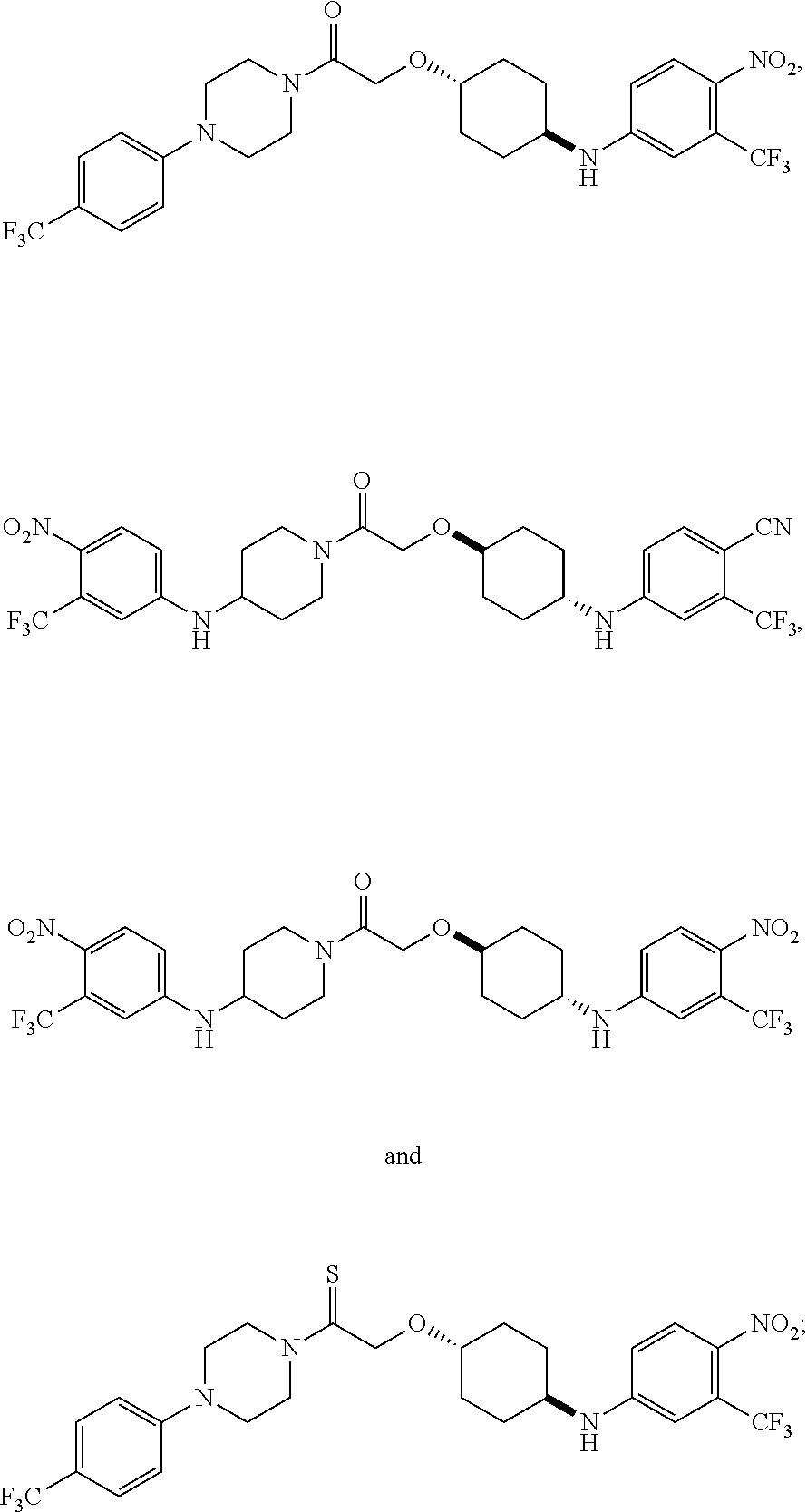
Applications Claiming Priority (4)
| Application Number | Priority Date | Filing Date | Title |
|---|---|---|---|
| EP14176733 | 2014-07-11 | ||
| EP14176733 | 2014-07-11 | ||
| EP14176733.5 | 2014-07-11 | ||
| PCT/EP2015/065868 WO2016005576A1 (en) | 2014-07-11 | 2015-07-10 | Use of anthelmintic agents against dirofilaria immitis |
Related Parent Applications (1)
| Application Number | Title | Priority Date | Filing Date |
|---|---|---|---|
| PCT/EP2015/065868 A-371-Of-International WO2016005576A1 (en) | 2014-07-11 | 2015-07-10 | Use of anthelmintic agents against dirofilaria immitis |
Related Child Applications (1)
| Application Number | Title | Priority Date | Filing Date |
|---|---|---|---|
| US15/996,951 Continuation US20180280367A1 (en) | 2014-07-11 | 2018-06-04 | Use of anthelmintic agents against dirofilaria immitis |
Publications (2)
| Publication Number | Publication Date |
|---|---|
| US20170202816A1 US20170202816A1 (en) | 2017-07-20 |
| US10010538B2 true US10010538B2 (en) | 2018-07-03 |
Family
ID=51167758
Family Applications (2)
| Application Number | Title | Priority Date | Filing Date |
|---|---|---|---|
| US15/324,875 Expired - Fee Related US10010538B2 (en) | 2014-07-11 | 2015-07-10 | Use of anthelmintic agents against Dirofilaria immitis |
| US15/996,951 Abandoned US20180280367A1 (en) | 2014-07-11 | 2018-06-04 | Use of anthelmintic agents against dirofilaria immitis |
Family Applications After (1)
| Application Number | Title | Priority Date | Filing Date |
|---|---|---|---|
| US15/996,951 Abandoned US20180280367A1 (en) | 2014-07-11 | 2018-06-04 | Use of anthelmintic agents against dirofilaria immitis |
Country Status (7)
| Country | Link |
|---|---|
| US (2) | US10010538B2 (en) |
| EP (1) | EP3177291A1 (en) |
| JP (1) | JP2017519802A (en) |
| CN (1) | CN106659720A (en) |
| AU (1) | AU2015286634A1 (en) |
| BR (1) | BR112017000398A2 (en) |
| WO (1) | WO2016005576A1 (en) |
Families Citing this family (11)
| Publication number | Priority date | Publication date | Assignee | Title |
|---|---|---|---|---|
| MA45614B1 (en) | 2017-03-20 | 2020-04-30 | Forma Therapeutics Inc | Pyrrolopyrrole compositions as pyruvate kinase (pkr) activators |
| KR102704242B1 (en) | 2017-06-20 | 2024-09-09 | 임브리아 파마슈티칼스, 인크. | Compositions and methods for increasing the efficiency of cardiac metabolism |
| CN113166060B (en) | 2018-09-19 | 2024-01-09 | 诺沃挪第克健康护理股份公司 | Treatment of sickle cell disease with pyruvate kinase-activating compounds |
| EP3852791B1 (en) | 2018-09-19 | 2024-07-03 | Novo Nordisk Health Care AG | Activating pyruvate kinase r |
| US12318382B2 (en) | 2018-10-17 | 2025-06-03 | Imbria Pharmaceuticals, Inc. | Methods of treating rheumatic diseases using trimetazidine-based compounds |
| WO2020243120A1 (en) | 2019-05-31 | 2020-12-03 | Imbria Pharmaceuticals, Inc. | Methods of treating fibrosis using compounds that promote glucose oxidation |
| CA3151612A1 (en) | 2019-09-19 | 2021-03-25 | George P. Luke | Pyruvate kinase r (pkr) activating compositions |
| US11780811B2 (en) | 2020-06-30 | 2023-10-10 | Imbria Pharmaceuticals, Inc. | Methods of synthesizing 2-[4-[(2,3,4-trimethoxyphenyl)methyl]piperazin-1-yl]ethyl pyridine-3-carboxylate |
| US11530184B2 (en) | 2020-06-30 | 2022-12-20 | Imbria Pharmaceuticals, Inc. | Crystal forms of 2-[4-[(2,3,4-trimethoxyphenyl)methyl]piperazin-1-yl]ethyl pyridine-3-carboxylate |
| US12128035B2 (en) | 2021-03-19 | 2024-10-29 | Novo Nordisk Health Care Ag | Activating pyruvate kinase R |
| US11883396B2 (en) | 2021-05-03 | 2024-01-30 | Imbria Pharmaceuticals, Inc. | Methods of treating kidney conditions using modified forms of trimetazidine |
Citations (6)
| Publication number | Priority date | Publication date | Assignee | Title |
|---|---|---|---|---|
| US5994395A (en) | 1995-02-24 | 1999-11-30 | Novartis Animal Health Us, Inc. | Composition for controlling parasites |
| WO2009077527A1 (en) | 2007-12-17 | 2009-06-25 | Intervet International B.V. | Anthelmintic agents and their use |
| WO2010115688A1 (en) | 2009-03-20 | 2010-10-14 | Intervet International B.V. | Anthelmintic agents and their use |
| WO2010146083A1 (en) | 2009-06-18 | 2010-12-23 | Intervet International B.V. | Anthelmintic agents and their use |
| EP2468096A1 (en) | 2010-12-21 | 2012-06-27 | Intervet International BV | Anthelmintic combinations |
| US20140142114A1 (en) | 2012-11-20 | 2014-05-22 | Merial Limited | Anthelmintic compounds and compositions and method of using thereof |
-
2015
- 2015-07-10 WO PCT/EP2015/065868 patent/WO2016005576A1/en not_active Ceased
- 2015-07-10 CN CN201580037656.3A patent/CN106659720A/en active Pending
- 2015-07-10 EP EP15736503.2A patent/EP3177291A1/en not_active Withdrawn
- 2015-07-10 BR BR112017000398A patent/BR112017000398A2/en not_active Application Discontinuation
- 2015-07-10 US US15/324,875 patent/US10010538B2/en not_active Expired - Fee Related
- 2015-07-10 AU AU2015286634A patent/AU2015286634A1/en not_active Abandoned
- 2015-07-10 JP JP2017500886A patent/JP2017519802A/en not_active Withdrawn
-
2018
- 2018-06-04 US US15/996,951 patent/US20180280367A1/en not_active Abandoned
Patent Citations (7)
| Publication number | Priority date | Publication date | Assignee | Title |
|---|---|---|---|---|
| US5994395A (en) | 1995-02-24 | 1999-11-30 | Novartis Animal Health Us, Inc. | Composition for controlling parasites |
| WO2009077527A1 (en) | 2007-12-17 | 2009-06-25 | Intervet International B.V. | Anthelmintic agents and their use |
| WO2010115688A1 (en) | 2009-03-20 | 2010-10-14 | Intervet International B.V. | Anthelmintic agents and their use |
| WO2010146083A1 (en) | 2009-06-18 | 2010-12-23 | Intervet International B.V. | Anthelmintic agents and their use |
| EP2468096A1 (en) | 2010-12-21 | 2012-06-27 | Intervet International BV | Anthelmintic combinations |
| US20140142114A1 (en) | 2012-11-20 | 2014-05-22 | Merial Limited | Anthelmintic compounds and compositions and method of using thereof |
| WO2014081697A2 (en) | 2012-11-20 | 2014-05-30 | Merial Limited | Anthelmintic compounds and compositions and method of using thereof |
Non-Patent Citations (7)
| Title |
|---|
| American Heartworm Society, Heartworm Life Cycle Illustration, For Pet Owners; Dog & Cat Heartworm Combined Life Cycle Posters; https://www.heartwormsociety.org/images/pdf/AHS2014HWLifeCycleCLIENTCLR.pdf; Oct. 17, 2017; p. 1. |
| Atkins, Clarke et al., Overview of Heartworm Disease, (Dirofilarosis, Dirofilariasis); Circulatory System, Heartworm Disease; http://www.merckvetmanual.com/circulatory-system/heartworm-disease/overview-of-heartworm-disease; Oct. 17, 2017, pp. 1-17. |
| Dirofilariasis Frequently Asked Questions (FAQs), Center for Disease Control and Prevention (CDC), Atlanta, USA. * |
| Extended EP search report for 14175733.5 dated Feb. 27, 2015. |
| International Search Report for PCTEP2015065868 dated Sep. 17, 2015. 4 Pages. |
| Office Action dated Apr. 20, 2018 for U.S. Appl. No. 15/324,806, 12 pages. |
| Vercruysse, Jozef et al., Benzimidazoles, Pharamacology; http://www.merckvetmanual.com/pharmacology/anthelmintics/benzimidazoles; Oct. 17, 2017, pp. 1-3. |
Also Published As
| Publication number | Publication date |
|---|---|
| BR112017000398A2 (en) | 2018-01-23 |
| AU2015286634A1 (en) | 2017-01-19 |
| JP2017519802A (en) | 2017-07-20 |
| EP3177291A1 (en) | 2017-06-14 |
| US20180280367A1 (en) | 2018-10-04 |
| WO2016005576A1 (en) | 2016-01-14 |
| US20170202816A1 (en) | 2017-07-20 |
| CN106659720A (en) | 2017-05-10 |
Similar Documents
| Publication | Publication Date | Title |
|---|---|---|
| US10010538B2 (en) | Use of anthelmintic agents against Dirofilaria immitis | |
| US20170196854A1 (en) | Use of anthelmintic agents against dirofilaria immitis | |
| US9096524B2 (en) | Anthelmintic agents and their use | |
| US8569495B2 (en) | Anthelmintic agents and their use | |
| US8507474B2 (en) | Anthelmintic agents and their use | |
| US10407390B2 (en) | Asymmetric ureas and medical uses thereof | |
| TW200529857A (en) | Chemokine CCR5 receptor modulators |
Legal Events
| Date | Code | Title | Description |
|---|---|---|---|
| AS | Assignment |
Owner name: INTERVET INC., NEW JERSEY Free format text: ASSIGNMENT OF ASSIGNORS INTEREST;ASSIGNORS:CHASSAING, CHRISTOPHE PIERRE ALAIN;LUTZ, JURGEN;HECKEROTH, ANJA REGINA;REEL/FRAME:040902/0079 Effective date: 20141001 |
|
| STCF | Information on status: patent grant |
Free format text: PATENTED CASE |
|
| FEPP | Fee payment procedure |
Free format text: MAINTENANCE FEE REMINDER MAILED (ORIGINAL EVENT CODE: REM.); ENTITY STATUS OF PATENT OWNER: LARGE ENTITY |
|
| LAPS | Lapse for failure to pay maintenance fees |
Free format text: PATENT EXPIRED FOR FAILURE TO PAY MAINTENANCE FEES (ORIGINAL EVENT CODE: EXP.); ENTITY STATUS OF PATENT OWNER: LARGE ENTITY |
|
| STCH | Information on status: patent discontinuation |
Free format text: PATENT EXPIRED DUE TO NONPAYMENT OF MAINTENANCE FEES UNDER 37 CFR 1.362 |
|
| FP | Lapsed due to failure to pay maintenance fee |
Effective date: 20220703 |