US10008335B2 - Photovoltaic device containing a dye-sensitized solar cell - Google Patents
Photovoltaic device containing a dye-sensitized solar cell Download PDFInfo
- Publication number
- US10008335B2 US10008335B2 US15/704,582 US201715704582A US10008335B2 US 10008335 B2 US10008335 B2 US 10008335B2 US 201715704582 A US201715704582 A US 201715704582A US 10008335 B2 US10008335 B2 US 10008335B2
- Authority
- US
- United States
- Prior art keywords
- dye
- biphenyl
- oxadiazol
- light absorbing
- cyanoacrylic acid
- Prior art date
- Legal status (The legal status is an assumption and is not a legal conclusion. Google has not performed a legal analysis and makes no representation as to the accuracy of the status listed.)
- Expired - Fee Related
Links
Images


Classifications
-
- H—ELECTRICITY
- H01—ELECTRIC ELEMENTS
- H01G—CAPACITORS; CAPACITORS, RECTIFIERS, DETECTORS, SWITCHING DEVICES, LIGHT-SENSITIVE OR TEMPERATURE-SENSITIVE DEVICES OF THE ELECTROLYTIC TYPE
- H01G9/00—Electrolytic capacitors, rectifiers, detectors, switching devices, light-sensitive or temperature-sensitive devices; Processes of their manufacture
- H01G9/20—Light-sensitive devices
- H01G9/2059—Light-sensitive devices comprising an organic dye as the active light absorbing material, e.g. adsorbed on an electrode or dissolved in solution
-
- H—ELECTRICITY
- H01—ELECTRIC ELEMENTS
- H01G—CAPACITORS; CAPACITORS, RECTIFIERS, DETECTORS, SWITCHING DEVICES, LIGHT-SENSITIVE OR TEMPERATURE-SENSITIVE DEVICES OF THE ELECTROLYTIC TYPE
- H01G9/00—Electrolytic capacitors, rectifiers, detectors, switching devices, light-sensitive or temperature-sensitive devices; Processes of their manufacture
- H01G9/20—Light-sensitive devices
- H01G9/2004—Light-sensitive devices characterised by the electrolyte, e.g. comprising an organic electrolyte
- H01G9/2018—Light-sensitive devices characterised by the electrolyte, e.g. comprising an organic electrolyte characterised by the ionic charge transport species, e.g. redox shuttles
-
- H—ELECTRICITY
- H01—ELECTRIC ELEMENTS
- H01G—CAPACITORS; CAPACITORS, RECTIFIERS, DETECTORS, SWITCHING DEVICES, LIGHT-SENSITIVE OR TEMPERATURE-SENSITIVE DEVICES OF THE ELECTROLYTIC TYPE
- H01G9/00—Electrolytic capacitors, rectifiers, detectors, switching devices, light-sensitive or temperature-sensitive devices; Processes of their manufacture
- H01G9/20—Light-sensitive devices
- H01G9/2027—Light-sensitive devices comprising an oxide semiconductor electrode
-
- H—ELECTRICITY
- H01—ELECTRIC ELEMENTS
- H01G—CAPACITORS; CAPACITORS, RECTIFIERS, DETECTORS, SWITCHING DEVICES, LIGHT-SENSITIVE OR TEMPERATURE-SENSITIVE DEVICES OF THE ELECTROLYTIC TYPE
- H01G9/00—Electrolytic capacitors, rectifiers, detectors, switching devices, light-sensitive or temperature-sensitive devices; Processes of their manufacture
- H01G9/20—Light-sensitive devices
- H01G9/2027—Light-sensitive devices comprising an oxide semiconductor electrode
- H01G9/2031—Light-sensitive devices comprising an oxide semiconductor electrode comprising titanium oxide, e.g. TiO2
-
- H01L51/0068—
-
- H01L51/007—
-
- H—ELECTRICITY
- H10—SEMICONDUCTOR DEVICES; ELECTRIC SOLID-STATE DEVICES NOT OTHERWISE PROVIDED FOR
- H10K—ORGANIC ELECTRIC SOLID-STATE DEVICES
- H10K85/00—Organic materials used in the body or electrodes of devices covered by this subclass
- H10K85/60—Organic compounds having low molecular weight
- H10K85/649—Aromatic compounds comprising a hetero atom
- H10K85/655—Aromatic compounds comprising a hetero atom comprising only sulfur as heteroatom
-
- H—ELECTRICITY
- H10—SEMICONDUCTOR DEVICES; ELECTRIC SOLID-STATE DEVICES NOT OTHERWISE PROVIDED FOR
- H10K—ORGANIC ELECTRIC SOLID-STATE DEVICES
- H10K85/00—Organic materials used in the body or electrodes of devices covered by this subclass
- H10K85/60—Organic compounds having low molecular weight
- H10K85/649—Aromatic compounds comprising a hetero atom
- H10K85/656—Aromatic compounds comprising a hetero atom comprising two or more different heteroatoms per ring
- H10K85/6565—Oxadiazole compounds
-
- H—ELECTRICITY
- H10—SEMICONDUCTOR DEVICES; ELECTRIC SOLID-STATE DEVICES NOT OTHERWISE PROVIDED FOR
- H10K—ORGANIC ELECTRIC SOLID-STATE DEVICES
- H10K2102/00—Constructional details relating to the organic devices covered by this subclass
- H10K2102/10—Transparent electrodes, e.g. using graphene
- H10K2102/101—Transparent electrodes, e.g. using graphene comprising transparent conductive oxides [TCO]
- H10K2102/103—Transparent electrodes, e.g. using graphene comprising transparent conductive oxides [TCO] comprising indium oxides, e.g. ITO
-
- Y—GENERAL TAGGING OF NEW TECHNOLOGICAL DEVELOPMENTS; GENERAL TAGGING OF CROSS-SECTIONAL TECHNOLOGIES SPANNING OVER SEVERAL SECTIONS OF THE IPC; TECHNICAL SUBJECTS COVERED BY FORMER USPC CROSS-REFERENCE ART COLLECTIONS [XRACs] AND DIGESTS
- Y02—TECHNOLOGIES OR APPLICATIONS FOR MITIGATION OR ADAPTATION AGAINST CLIMATE CHANGE
- Y02E—REDUCTION OF GREENHOUSE GAS [GHG] EMISSIONS, RELATED TO ENERGY GENERATION, TRANSMISSION OR DISTRIBUTION
- Y02E10/00—Energy generation through renewable energy sources
- Y02E10/50—Photovoltaic [PV] energy
- Y02E10/542—Dye sensitized solar cells
-
- Y—GENERAL TAGGING OF NEW TECHNOLOGICAL DEVELOPMENTS; GENERAL TAGGING OF CROSS-SECTIONAL TECHNOLOGIES SPANNING OVER SEVERAL SECTIONS OF THE IPC; TECHNICAL SUBJECTS COVERED BY FORMER USPC CROSS-REFERENCE ART COLLECTIONS [XRACs] AND DIGESTS
- Y02—TECHNOLOGIES OR APPLICATIONS FOR MITIGATION OR ADAPTATION AGAINST CLIMATE CHANGE
- Y02E—REDUCTION OF GREENHOUSE GAS [GHG] EMISSIONS, RELATED TO ENERGY GENERATION, TRANSMISSION OR DISTRIBUTION
- Y02E10/00—Energy generation through renewable energy sources
- Y02E10/50—Photovoltaic [PV] energy
- Y02E10/549—Organic PV cells
-
- Y—GENERAL TAGGING OF NEW TECHNOLOGICAL DEVELOPMENTS; GENERAL TAGGING OF CROSS-SECTIONAL TECHNOLOGIES SPANNING OVER SEVERAL SECTIONS OF THE IPC; TECHNICAL SUBJECTS COVERED BY FORMER USPC CROSS-REFERENCE ART COLLECTIONS [XRACs] AND DIGESTS
- Y02—TECHNOLOGIES OR APPLICATIONS FOR MITIGATION OR ADAPTATION AGAINST CLIMATE CHANGE
- Y02P—CLIMATE CHANGE MITIGATION TECHNOLOGIES IN THE PRODUCTION OR PROCESSING OF GOODS
- Y02P70/00—Climate change mitigation technologies in the production process for final industrial or consumer products
- Y02P70/50—Manufacturing or production processes characterised by the final manufactured product
Definitions
- Dye Sensitized Solar Cells developed by O'Regan and Gratzel in 1991, are third-generation photovolatic devices which offer increased photoelectric transformation efficiencies at a low monetary cost.
- DSSCs dye Sensitized Solar Cells
- the configuration of a dye sensitized solar cell separates these functions.
- Dye Sensitized Solar Cells are unique in their functions in that they mimic the naturally occurring photosynthetic process found in plants and green algae.
- DSSCs utilize chromophores, similar to a photosynthetic system's porphyrins, in order to generate photosensitive charges which convert sunlight to energy. When subjected to light of an appropriate wavelength, these chromophores, as part of a dye molecule, are photochemically excited, and serve as the basis for conversion of sunlight into electrical energy.
- the electrons trigger a series of redox reactions mediated through a redox pair which acts as an electrolyte.
- the redox pair now in a reduced form, transfers an electron to the dye, (which was held in an oxidized form), subsequently regenerating it and closing the cycle.
- D is an electron donor group (i.e. electron-rich)
- ⁇ is an unsaturated spacer having ⁇ -conjugated bonds
- A is an electron acceptor group (i.e. electron-poor group).
- the electron acceptor group is further coupled with a group which allows for the anchoring (i.e. adsorption) of the dye molecule onto a surface such as titanium dioxide.
- the D- ⁇ -A system allows for a variety of modifications to be made to the dye by varying the D, ⁇ -spacer, and/or A groups.
- HOMO-LUMO gap Eg
- HOMO-LUMO gap Eg
- HOMO-LUMO gap Eg
- the energy difference between the HOMO and LUMO levels is approximately equal to the ‘band gap energy’ as defined for collections of molecules in a thin-film.
- This difference in value given relative to the Fermi level and in units of Hartree, may serve as a measure of the excitability of a molecule. For example, the smaller the energy, the more easily the molecule will be excited. In order to be used in optoelectronics, including DSSCs, or photodynamic therapies, this band gap energy should be as low as possible.
- D- ⁇ -A new light absorbing ⁇ -conjugated molecules
- an important strategy for realizing a high photoelectric conversion efficiency is to allow for light of a long wavelength to be absorbed by the dye molecule, along with chromophore and a spacer group combinations which render a low HOMO-LUMO gap in the dye molecule as well.
- Dye energies based upon the HOMO and LUMO value, can be established experimentally by means of cyclic voltammetry (CV), X-ray photoelectron spectroscopy (XPS) or ultraviolet photoelectron spectroscopy (UPS).
- Dye energies can also be calculated by means of quantum-mechanical methods, for example, by means of dependent density functional theory and/or time-dependent density functional theory (DFT/TD-DFT).
- DFT/TD-DFT time-dependent density functional theory
- Theoretical DFT/TD-DFT can suggest which dyes will have the greatest efficiencies prior to exploration of synthesis routes. Therefore, investigation into alternative D, ⁇ -spacer, and A groups is proceeding, with both theoretical and physical approaches, in order to determine dye energies and light harvesting efficiencies of candidate dye molecules.
- DFT/TD-DFT density functional theory/time dependent density functional theory
- the DFT approach is, in principle, exact, with DFT/TD-DFT computed orbitals deemed suitable for a typical molecular orbital theoretical analysis and interpretation.
- DFT/TD-DFT fundamental scaling properties do not deteriorate when the methodological precision is increased.
- Photodynamic therapy involves a minimally invasive two-step process wherein a photosensitizer is administered and, once it has permeated a target tissue, the photosensitizer is then activated by exposure to a dose of electromagnetic (usually light) radiation at a particular wavelength.
- Photodynamic therapies have been used to treat a number of conditions including the treatment of malignant skin cells, (ie basal cell carcinoma), age-related macular degeneration, actinic keratosis and hair loss.
- One phototherapy mechanism pathway occurs via the direct energy or electron transfer from a photosensitizer to a targeted cellular component(s) thereby causing cellular death or necrosis.
- the wavelength of the light source is required to be of an appropriate wavelength so as to excite the photosensitizer dye in order to destroy any tissues which have selectively taken up the photosensitizer and have been locally exposed to light.
- Malignant and other diseased cells of the skin i.e. the epidermal, dermal and hypodermal layers
- red light has a penetration of about 1 cm in living tissues, malignant and/or diseased cells on or near the surface of the skin can most preferably be treated with this wavelength of light.
- An organic dye should also be resistant to photogdegradation, and contain a reactive group capable of binding the dye stably to a surface such as that of a semiconductor, or in the case of phototherapy, a layer of the skin, so as to facilitate the transfer of electrons.
- the present disclosure provides a light absorbing molecule, also referred to herein as a light absorbing compound, a photosensitizer, and a “dye”, of the D- ⁇ -A (Donor-spacer-Acceptor) type and a dye sensitized solar cell (DSSC) containing the light absorbing molecule.
- the dye as disclosed is an oxadiazole based photosensitizer for use, for example, in photovoltaic devices such as, but not limited to, dye-sensitized solar cells (DSSC).
- the dye provides a stable and soluble functional compound having absorption in the UV and visible wavelength regions of the solar spectrum.
- a dye as disclosed herein may be used individually, or combined with a second dye, as disclosed herein, or with other known dyes, so as to cover a broad range of the solar spectrum.
- the light absorbing molecule disclosed herein may be tuned to provide a low bandgap and favorable energy level, and can be efficiently chemisorbed to a nanoporous surface of a photoactive layer in a DSSC structure or device.
- the light absorbing molecule disclosed herein can be used in the fields of optoelectronics, photonics, and photodynamic therapies.
- the light absorbing molecule contains few atoms and absorbs in the longer wavelength regions of light thus presenting a good photodynamic therapy dye candidate. Photodynamic therapy may be useful in treating a hyperprolifertive, cancerous, or diseased tissue.
- the light absorbing molecule of the present disclosure is an organic light absorbing molecule of formula (I), including the tautomers thereof:
- a 1 is a divalent thiophene group of formula (I′)
- a 2 is at least one divalent 5-membered heterocyclic group selected from the group consisting of
- a 3 is an aromatic hydrocarbon chromophore of formula (VI′)
- organic light absorbing molecule of the present disclosure may be in the form of an (E) or (Z) configuration isomer.
- At least one of -A 1 , or at least one of -A 1 -A 2 of formula (I), forms a conjugated system with the adjacent aromatic hydrocarbon chromophore of formula (VI′).
- the organic light absorbing molecule of formula (I) comprises a cyanoacrylic acid wherein a —COOH group of the cyanoacrylic acid is covalently coupled to a solid surface, for example as a —COO ⁇ group.
- the surface is a photoactive semiconductor layer, or a layer of an animal skin selected from the group consisting of an epidermis, a dermis and a hypodermis.
- the surface is a photoactive semiconductor layer comprising titanium dioxide.
- organic light absorbing molecule of formula (I) absorbs at least one wavelength of visible light or UV light.
- the disclosure includes a dye sensitized solar sell comprising an organic light absorbing molecule of formula (I).
- the disclosure includes a dye represented by formula (II):
- chromophore is an organic moiety able to absorb UV and/or visible light when coupled with a conjugated system selected from the group consisting of:
- R 1 is H, OH, C 1 -C 6 alkyl, Cl, Br, F, or I and p is 1-3;
- conjugated system comprises a divalent thiophene group of formula (I′)
- the dye represented by formula (II) is chemisorbed to a photoactive semiconductor layer comprising titanium dioxide.
- the disclosure includes a photoelectric conversion device comprising at least one of a passive substrate, wherein the passive substrate comprises: a conductive layer;
- the target tissue including the tautomers thereof and/or a pharmaceutically acceptable conjugate thereof, and (ii) irradiating the target tissue with a light of a wavelength and intensity sufficient to activate the oxadiazole compound, so as to destroy, or decrease in size, the hyperproliferative, malignant, and/or diseased tissue, or to stimulate a hypo-proliferative tissue.
- hypo- or hyper-proliferative, malignant and/or diseased tissue is selected from the group consisting of a hyperproliferative, malignant, and/or diseased epidermal, dermal, and/or hypodermal tissue.
- FIG. 1 a - d shows the (E) structure of light absorbing compounds (Ia, IIa, IIIa, IVa) comprising an oxadiazole isomer and a thiophene group.
- FIG. 1 a shows dye (Ia);
- FIG. 1 b shows dye (IIa);
- FIG. 1 e shows dye (IIIa); and
- FIG. 1 d shows dye (IVa).
- FIG. 2 shows an absorption spectra of the (E) structure of each of light absorbing compounds (Ia, IIa, IIIa, IVa) comprising an oxadiazole isomer and a thiophene group.
- FIG. 3 shows the structure of a dye sensitized solar cell incorporating at least one light absorbing compound (Ia, IIa, IIIa, IVa) comprising an oxadiazole isomer and a thiophene group.
- light absorbing molecule as used herein is meant to be interchangable with the term ‘light absorbing compound’ and both of these terms as presented herein are meant to be interchangable with the term photosensitizer.
- anchoring group is meant to refer to any functional group that allows a covalent coupling, which may also be referred to as chemisorption of the entity to which such anchoring group belongs, to a surface, for example the surface of a nanoporous semiconductor layer within a solar cell.
- a “chromophore” as used herein is functional group within a molecular structure that is responsible for the light absorption.
- a “conjugated system” as used herein is a heteroaromatic molecule or portion of a molecule having alternating double bonds and single bonds between atom centers.
- the term “molecular structure”, as used herein, refers to the structure of a molecule.
- the “molecular structure of a dye” is the structure of the molecule of the dye.
- An “anchoring group” that is included in the molecular structure of a dye forms part of the molecular structure.
- a dye is referred to as being “chemisorbed” to a layer or surface, if the dye is covalently coupled thereto.
- covalent coupling is interchangeable with the term “chemisorption”.
- a dye including an anchoring group in its molecular structure may have more than one anchoring group(s) present within the structure.
- a molecule that is able to absorb in the wavelength range of UV and/or visible and/or IR light refers to a molecule that is able to absorb light in one or in several regions of the wavelength range(s) indicated, or furthermore, over the total regions of the given wavelength range(s). For example a molecule may absorb in the range of from 250 nm-500 nm, whereas another molecule may absorb in the range of from 700 nm-1000 nm, whereas a third molecule may absorb in the range of from 250-1000 nm.
- Each of the light absorbing compounds of the present disclosure comprises at least one an anchoring group independently selected from the group consisting of —COOH, —SO 3 H, —PO 3 H 2 , and —BO 2 H 2 , preferably —COOH.
- the anchoring group is capable of bonding to a semiconductor electrode surface of an organic solar cell;
- Each of the light absorbing compounds of the present disclosure also comprise an acceptor site selected from the group consisting of H, —CN, and —NO 2 , preferably —CN. Together, these groups advantageously form a cyanoacrylate group that attracts electrons by an inductive effect.
- the compounds of the present disclosure may also be described as a dye represented by formula (II):
- R 2 is selected from the group consisting of H, —CN, and —NO 2 , preferably —CN, and
- the light absorbing compounds and/or chromphores may simply be referred to as the compounds of the present disclosure.
- oscillator strength is defined as a dimensionless quantity that expresses the probability of absorption or emission of electromagnetic radiation in transitions between energy levels of an atom or molecule.
- E ox dye (-HOMO) is the dye ground state oxidation potential and ⁇ E is the lowest absorption energy associated with ⁇ max .
- FIG. 1 The structures of the oxadiazole-containing dyes are shown in FIG. 1 .
- a biphenyl group is designated as the electron-donating moiety
- carboxyl and cyano groups are electron acceptor and anchor groups due to their electron-withdrawing ability and bonding ability, respectively.
- Oxadiazole isomers were each individually introduced as ⁇ -conjugation groups in order to bridge the donor-acceptor systems.
- a double bond and a thiophene unit were also introduced to the t-conjugation system for the fine tuning of molecular planar configurations, and to broaden the absorption spectra of the dye molecules.
- Table 1 shows the HOMOs, LUMOs and HOMO-LUMO energy gaps of the compounds of the disclosure.
- the HOMO, LUMO, and band gap energies of photosensitizers play important roles in providing the thermodynamic driving force for electron injection.
- the LUMOs of the dye In order to obtain an efficient charge transfer, the LUMOs of the dye must be more negative than the conduction band of the semiconductor, while the HOMO level must be more positive than the redox potential of the electrolyte.
- each of the dye comprising the (E) enantiomer of the oxadiazole isomer dye further comprising a thiophene group of formula Ia, IIa, IIIa, and IVa are capable of injecting electrons into the conduction bands of TiO 2 .
- LHE and ⁇ G inject can be calculated by using equation-2 and equation-4 respectively.
- the results are tabulated in Table 3. It can be found from Table 3 that all the ⁇ G inject values calculated are negative, indicating that the conduction band edge of TiO 2 lies below the excited state of the dyes, and thus favors the electron injection. As illustrated in Table 3, there is only a slight difference in the LHE values between Dyes Ia-IVa, indicating that each of the photosensitizers as disclosed herein all generate comparable photocurrent values.
- the simulated absorption spectra of Dyes Ia-IVa are shown in FIG. 1 .
- the absorption spectra of each dye comprises two regions consisting of a first intense peak in the region of 326 nm-500 nm and second peak in the region of 472 nm-700 nm.
- the dye comprising the 1,2,3 oxadiazole bridge displays a broader peak when compared to the dyes comprising the remaining oxadiazole isomers in the series of dyes.
- the ground and excited state potential (E ox dye ), maximum absorption ( ⁇ max ), oscillation strength (f) and main transitions are all presented in Table 2.
- the DSSC of the present disclosure comprises at least one of the oxadiazole dyes, an anode, a cathode, and an electrolyte.
- the anode and cathode are arranged in a sandwich-like configuration, and the electrolyte is inserted between the two electrodes.
- a DSSC incorporating at least one of the series of light absorbing molecules, or light absorbing photosensitizers, is shown in FIG. 3 .
- the anode comprises an electrically conductive substrate, such as a transparent glass and a semiconducting layer comprising a semiconductor 33 and at least one oxadiazole-containing dye 35 adsorbed thereto.
- Materials for the semiconductor include, but are not limited to, metal oxides such as titanium oxides, niobium oxides, zinc oxides, tin oxides, tungsten oxides, TiOF 2 , and indium oxides, preferably TiO 2 , while an electrolytic solution 37 is generally based on an iodine redox couple (I ⁇ /I 3 ⁇ ).
- Light is supplied from a light source, such as the sun 31 and transformation of solar energy to electrical energy is shown by the arrow 41 ( FIG. 3 ).
- the light absorbing oxadiazole compounds as disclosed herein are preferably adsorbed onto the semiconductor via contact of the dye.
- the dye and the semiconductor surface maintain contact through a chemical bond between the anchoring group of the dye and the semiconductor material.
- any aggregation of the dye molecules may reduce the efficiency of the DSSC. Therefore, in one embodiment, it is desirable to include a bulky chemical compound in the dye solution to improve the solubility of the dye, and to prevent dye molecules from aggregating.
- Chemical groups can be selected from the group consisting of, but not limited to, the compounds of the current disclosure without their binding anchor group.
- the tuning or selection of the dye in determining the wavelength of light that the solar cell e.g., DSSC
- Any adjustment to the dye structure and/or color will influence the performance of the device.
- Many dyes reflect red light, and, when coupled with an oxide such as titanium oxide (white), appear ‘pink’.
- the series of light absorbing molecules as disclosed herein absorb light in several ranges so there exists the possibility of choosing a different coloring of the dye sensitized solar cell device in relation to the application type.
- the use of the light absorbing molecules of this disclosure as dyes in dye sensitized solar cell applications include a variety of electronic devices. These devices include energy supply devices for mobile phones, notebooks, laptops, portable audio-tape players, MP3-players, remote controls, e-cards, e-books, e-readers, portable CD players, portable DVD players, cameras, digicams, GPS devices, portable sensors, and portable solar chargers for batteries of any of the aforementioned devices. As organic dyes have high absorption coefficients, a lesser amount of dye is able to absorb the same amount of light. A lower, or lesser amount of one dye on a surface enables the use of more dyes with different absorption properties, ideally being a mixture of dyes absorbing the entire range of the solar spectrum.
- the compounds of the current disclosure may have further application in the field of photodynamic therapy.
- the light absorbing compounds disclosed herein contain few atoms and absorb in the longer wavelength regions thus providing for use in photodynamic therapies for the treatment of malignant, diseased, hypo- and/or hyper-proliferative cells and/or tissues.
- Formulations or compositions comprising at least one of the light absorbing compounds disclosed herein may act as a photopharmaceutical for treating conditions such as, but not limited to cancer, benign tumors, skin infections, and even a lack or reduction of hair growth.
- At least one of the light absorbing compounds may be supplied to an area of the body in need of treatment.
- the area is then exposed to light of a suitable frequency and intensity necessary to activate the photopharmaceutical so as to cause necrosis, or apoptosis of the targeted tissue.
- a stimulation of a hypo-proliferative tissue may occur.
- the light absorbing compounds may be administered as a topical or subcutaneous preparation, or by localized administration in the form of an intradermal injection or an implant.
- the light absorbing compounds may be administered by means including, but not limited to, topical lotions, topical creams, topical pastes, topical suspensions, or a local administration in the form of intradermal injection or an implant.
- a preferred method of administration is to apply the light absorbing compounds topically in an excipient containing a solubilizing agent.
- the concentration of the light absorbing compound in the excipient preferably ranges from about 0.001 to about 10% w/w, and more preferably from about 0.005 to about 5% w/w, and even more preferably between about 0.01 to about 1% w/w. Particularly preferred is the use of about a 0.2% w/w topical formulation.
- the dose of light absorbing compound may be determined by factors such as, but not limited to, the light absorbing compound chosen, the physical delivery system in which it is carried, the individual subject, and the target tissue to be treated.
- the dose should also be adjusted with respect to parameters, such as irradiance, duration of the light used in PDT, and time interval between administration of the dose and the therapeutic irradiation.
- parameters such as irradiance, duration of the light used in PDT, and time interval between administration of the dose and the therapeutic irradiation.
- smaller or larger doses of photosensitizers may be needed.
- the potency of the light absorbing compound also determines the dosage, with less required for highly potent light absorbing compounds, and more for light absorbing compounds with less potency.
- the concentration of the light absorbing compound in the excipient can range from about 0.001 to about 10% w/w, preferably from about 0.005 to about 5% w/w (or about 0.05 to about 1% w/w), and even more preferably between about 0.1 to about 1% w/w.
- Each light absorbing compound requires activation with an appropriate wavelength(s) of electromagnetic radiation.
- the methods of the invention may be conducted with any irradiation, preferably with light, which activates the light absorbing compound used.
- the irradiation contains one or more wavelength which is capable of penetrating the skin to activate the light absorbing compound used.
- the wavelength(s) of radiation or light useful in the invention depends on the activation range of the light absorbing compound used as part of the treatment method. In one embodiment the wavelengths range from 326-700 nanometers (nm). Depending upon the light absorbing compound and upon the desired depth of targeted tissue penetration, the preferred wavelengths range from about 500 to about 700 nm.
- the oxadiazole light absorbing compounds may be activated by a red light, as well as ambient light containing wavelengths from 326 nm-700 nm. Light having a wavelength shorter than 400 nm may be considered acceptable, but not preferred because of the potentially damaging effects of UVA light.
- any appropriate activation energy source may be used for activation.
- Preferred sources include, but are not limited to, lasers, light emitting diodes (LED), incandescent lamps, arc lamps, standard fluorescent lamps, U.V. lamps, and combinations thereof. More preferred are lasers, light emitting diodes, and combinations thereof
- any convenient source of activation energy having a component of wavelengths that are absorbed by the light absorbing compound may be used, for example, an operating room lamp, or any bright light source, including sunlight.
- Wavelengths in the ultraviolet range are not preferred as they may lead to a mutagenic event. Therefore, the activation energy used for the methods herein is not in the ultraviolet range.
- the activation energy dose administered during the PDT treatment contemplated herein can vary as necessary.
- the dosage of the light is approximately 25-200 J/cm 2 for a topically-delivered photosensitizers. It is recommended that the total dose of the irradiation should not exceed 200 J/cm 2 , more preferably not to exceed 100 J/cm 2 .
- the preferred doses can range between about 0.01 J/cm 2 to about 200 J/cm 2 , more preferably 0.1 J/cm 2 to about 100 j/cm 2 . Increases in irradiance will generally decrease the light exposure times. Generally, a higher dose of photosensitizer will also decrease the light dose required to exert a therapeutic effect.
- the intensity of the light source should not exceed about 600-1000 mW/cm 2 . Irradiances between about 10 and about 400 mW/cm 2 , are preferred; more preferably are those between about 25 and about 100 mW/cm 2 .
- the irradiation may last from about 10 seconds to about 3 hours, preferably between 1 minute and 90 minutes. Irradiation times of between 5 minutes and 10 minutes may be used.
- the irradiation or light exposure as disclosed may be directed to a small or large area of the body or scalp depending on the tissue to be treated. Treatment may be preceded with an assessment of the time of light exposure for the patient's minimal erythemal dose (MED) occurrence in order to avoid potential burning of the exposed skin.
- MED minimal erythemal dose
- the PDT may be a single treatment, but it is preferred that the treatment is repeated.
- the frequency may vary.
- the treatments may be daily, twice weekly, weekly, every two weeks, monthly, every six weeks, every two months, quarterly, twice annually, or annually, or other suitable time interval to treat or maintain a targeted tissue's prevailing condition.
- the total number of treatments of a specifically targeted tissue can range from one to twenty. In cases where hair loss is observed, maintenance treatment on a regular basis may be initiated and sustained. It is preferred that the total number of treatments in any one-month period be from 1 to 12, more preferably from 2 to 4.
- Activation energy delivery can take place at any suitable time following administration of light absorbing compound as long as there is still light absorbing compound present at the skin. Activation energy treatment within a period of about five minutes to about 5 hours after administration of the light absorbing compound is preferred, with a range of 15 minutes to 90 minutes being more preferable. Even more preferably the light is administered within a period of about 30-45 minutes after administration of the light absorbing compound.
- Light absorbing compounds that may rapidly accumulate in target tissues can be activated soon after administration. Also, light absorbing compounds that may be metabolically cleared from tissues quickly should be activated soon after accumulation in the target tissues.
- the light absorbing compounds disclosed herein may be formulated into a variety of compositions. These compositions may comprise any component that is suitable for the intended purpose, such as conventional delivery vehicles and excipients including isotonising agents, pH regulators, solvents, solubilizers, dyes, gelling agents and thickeners and buffers and combinations thereof. Suitable excipients for use with light absorbing compounds include water, saline, dextrose, glycerol and the like.
- the light absorbing compound is formulated by mixing it, at an appropriate temperature, e.g., at ambient temperatures, and at appropriate pHs, and the desired degree of purity, with one or more physiologically acceptable carriers, i.e., carriers that are nontoxic at the dosages and concentrations employed.
- the pH of the formulation preferably ranges anywhere from about 3 to about 8, preferably in the physiological range of 6.5 to 7.5.
- the formulations may comprise a skin-penetration enhancer selected from the group consisting of glycol ethers, fatty acids, fatty acid esters, glycol esters, glycerides, azones, polysorbates, alcohols, dimethylsulfoxide, and mixtures thereof.
- a skin-penetration enhancer selected from the group consisting of glycol ethers, fatty acids, fatty acid esters, glycol esters, glycerides, azones, polysorbates, alcohols, dimethylsulfoxide, and mixtures thereof.
- Solvents acceptable for use in the treatment include, but are not limited to, DMSO (dimethylsulfoxide), polyethylene glycol (PEG), ethanol, and methyl alcohol, while solubilizers such as, but not limited to titanium dioxide, polyethylene glycol, propylene glycol, polysorbates, and mixtures thereof may also be added at a percentage of 10% to 70% by weight.
- DMSO dimethylsulfoxide
- PEG polyethylene glycol
- solubilizers such as, but not limited to titanium dioxide, polyethylene glycol, propylene glycol, polysorbates, and mixtures thereof may also be added at a percentage of 10% to 70% by weight.
- the formulations have a viscosity at 20° C. of from about 50 cps to about 50000 cps, more preferably from about 500 cps to about 40000 cps, even more preferably from about 5000 cps to about 30000 cps.
- Viscosity modifiers can be selected from the group consisting of but not limited to polyethylene glycols, waxes, saturated C 8 -C 18 fatty acid glycerides, xantham gum, polyvinyl alcohol, and mixtures thereof.
Landscapes
- Engineering & Computer Science (AREA)
- Power Engineering (AREA)
- Microelectronics & Electronic Packaging (AREA)
- Chemical & Material Sciences (AREA)
- Materials Engineering (AREA)
- Physics & Mathematics (AREA)
- Spectroscopy & Molecular Physics (AREA)
- Chemical Kinetics & Catalysis (AREA)
- Electrochemistry (AREA)
- Plural Heterocyclic Compounds (AREA)
Abstract
Description

wherein A1 is a divalent thiophene group of formula (I′)

wherein R1 is H, OH, C1-C6 alkyl, Cl, Br, F, or I, and n=1-5;
A2 is at least one divalent 5-membered heterocyclic group selected from the group consisting of

wherein R1 is H, OH, C1-C6 alkyl, Cl, Br, F, or I and m=1-5;
A3 is an aromatic hydrocarbon chromophore of formula (VI′)

- (E)-3-(5-([1,1′-biphenyl]-4-yl)-1,3,4-oxadiazol-2-yl)-2-cyanoacrylic acid;
- (E)-3-(5-([1,1′-biphenyl]-4-yl)-1,2,3-oxadiazol-4-yl)-2-cyanoacrylic acid;
- (E)-3-(5-([1,1′-biphenyl]-4-yl)-1,2,4-oxadiazol-3-yl)-2-cyanoacrylic acid;
- (E)-3-(4-([1,1′-biphenyl]-4-yl)-1,2,5-oxadiazol-3-yl)-2-cyanoacrylic acid;
- (Z)-3-(5-([1,1′-biphenyl]-4-yl)-1,3,4-oxadiazol-2-yl)-2-cyanoacrylic acid;
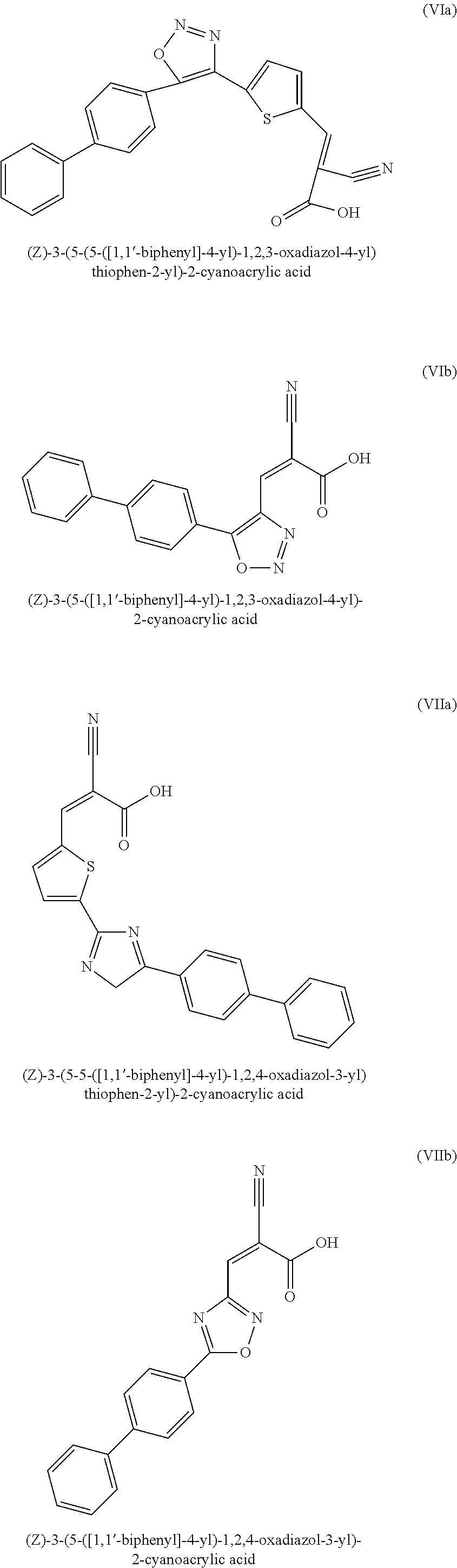
- (Z)-3-(5-([1,1′-biphenyl]-4-yl)-1,2,3-oxadiazol-4-yl)-2-cyanoacrylic acid;
- (Z)-3-(5-([1,1′-biphenyl]-4-yl)-1,2,4-oxadiazol-3-yl)-2-cyanoacrylic acid;
- (Z)-3-(4-([1,1′-biphenyl]-4-yl)-1,2,5-oxadiazol-3-yl)-2-cyanoacrylic acid;
- (E)-3-(5-(5-([1,1′-biphenyl]-4-yl)-1,3,4-oxadiazol-2-yl)thiophen-2-yl)-2-cyanoacrylic acid;
- (E)-3-(5-(5-([1,1′-biphenyl]-4-yl)-1,2,3-oxadiazol-4-yl)thiophen-2-yl)-2-cyanoacrylic acid;
- (E)-3-(5-(5-([1,1′-biphenyl]-4-yl)-1,2,4-oxadiazol-3-yl)thiophen-2-yl)-2-cyanoacrylic acid;
- (E)-3-(5-(4-([1,1′-biphenyl]-4-yl)-1,2,5-oxadiazol-3-yl)thiophen-2-yl)-2-cyanoacrylic acid; and
- (Z)-3-(5-(5-([1,1′-biphenyl]-4-yl)-1,3,4-oxadiazol-2-yl)thiophen-2-yl)-2-cyanoacrylic acid;
- (Z)-3-(5-(5-([1,1′-biphenyl]-4-yl)-1,2,3-oxadiazol-4-yl)thiophen-2-yl)-2-cyanoacrylic acid;
- (Z)-3-(5-(5-([1,1′-biphenyl]-4-yl)-1,2,4-oxadiazol-3-yl)thiophen-2-yl)-2-cyanoacrylic acid;
- (Z)-3-(5-(4-([1,1′-biphenyl]-4-yl)-1,2,5-oxadiazol-3-yl)thiophen-2-yl)-2-cyanoacrylic acid;


wherein R1 is H, OH, C1-C6 alkyl, Cl, Br, F, or I and n=0-5;

-
- further wherein the light absorbing layer preferably comprises at least one selected from the group consisting of
- (E)-3-(5-([1,1′-biphenyl]-4-yl)-1,3,4-oxadiazol-2-yl)-2-cyanoacrylic acid;
- (E)-3-(5-([1,1′-biphenyl]-4-yl)-1,2,3-oxadiazol-4-yl)-2-cyanoacrylic acid;
- (E)-3-(5-([1,1′-biphenyl]-4-yl)-1,2,4-oxadiazol-3-yl)-2-cyanoacrylic acid;
- (E)-3-(4-([1,1′-biphenyl]-4-yl)-1,2,5-oxadiazol-3-yl)-2-cyanoacrylic acid;
- (E)-3-(5-(5-([1,1′-biphenyl]-4-yl)-1,3,4-oxadiazol-2-yl)thiophen-2-yl)-2-cyanoacrylic acid,
- (E)-3-(5-(5-([1,1′-biphenyl]-4-yl)-1,2,3-oxadiazol-4-yl)thiophen-2-yl)-2-cyanoacrylic acid;
- (E)-3-(5-(5-([1,1′-biphenyl]-4-yl)-1,2,4-oxadiazol-3-yl)thiophen-2-yl)-2-cyanoacrylic acid;
- (E)-3-(5-(4-([1,1′-biphenyl]-4-yl)-1,2,5-oxadiazol-3-yl)thiophen-2-yl)-2-cyanoacrylic acid; and
- (Z)-3-(5-([1,1′-biphenyl]-4-yl)-1,3,4-oxadiazol-2-yl)-2-cyanoacrylic acid;
- (Z)-3-(5-([1,1′-biphenyl]-4-yl)-1,2,3-oxadiazol-4-yl)-2-cyanoacrylic acid;
- (Z)-3-(5-([1,1′-biphenyl]-4-yl)-1,2,4-oxadiazol-3-yl)-2-cyanoacrylic acid;
- (Z)-3-(4-([1,1′-biphenyl]-4-yl)-1,2,5-oxadiazol-3-yl)-2-cyanoacrylic acid;
- (Z)-3-(5-(5-([1,1′-biphenyl]-4-yl)-1,3,4-oxadiazol-2-yl)thiophen-2-yl)-2-cyanoacrylic acid;
- (Z)-3-(5-(5-([1,1′-biphenyl]-4-yl)-1,2,3-oxadiazol-4-yl)thiophen-2-yl)-2-cyanoacrylic acid;
- (Z)-3-(5-(5-([1,1′-biphenyl]-4-yl)-1,2,4-oxadiazol-3-yl)thiophen-2-yl)-2-cyanoacrylic acid;
- (Z)-3-(5-(4-([1,1′-biphenyl]-4-yl)-1,2,5-oxadiazol-3-yl)thiophen-2-yl)-2-cyanoacrylic acid;
- (E)-3-(5-([1,1′-biphenyl]-4-yl)-1,3,4-oxadiazol-2-yl)-2-cyanoacrylic acid;
- (E)-3-(5-([1,1′-biphenyl]-4-yl)-1,2,3-oxadiazol-4-yl)-2-cyanoacrylic acid;
- (E)-3-(5-([1,1′-biphenyl]-4-yl)-1,2,4-oxadiazol-3-yl)-2-cyanoacrylic acid;
- (E)-3-(4-([1,1′-biphenyl]-4-yl)-1,2,5-oxadiazol-3-yl)-2-cyanoacrylic acid;
- (E)-3-(5-(5-([1,1′-biphenyl]-4-yl)-1,3,4-oxadiazol-2-yl)thiophen-2-yl)-2-cyanoacrylic acid;
- (E)-3-(5-(5-([1,1′-biphenyl]-4-yl)-1,2,3-oxadiazol-4-yl)thiophen-2-yl)-2-cyanoacrylic acid;
- (E)-3-(5-(5-([1,1′-biphenyl]-4-yl)-1,2,4-oxadiazol-3-yl)thiophen-2-yl)-2-cyanoacrylic acid;
- (E)-3-(5-(4-([1,1′-biphenyl]-4-yl)-1,2,5-oxadiazol-3-yl)thiophen-2-yl)-2-cyanoacrylic acid; and
- (Z)-3-(5-([1,1′-biphenyl]-4-yl)-1,3,4-oxadiazol-2-yl)-2-cyanoacrylic acid,
- (Z)-3-(5-([1,1′-biphenyl]-4-yl)-1,2,3-oxadiazol-4-yl)-2-cyanoacrylic acid;
- (Z)-3-(5-([1,1′-biphenyl]-4-yl)-1,2,4-oxadiazol-3-yl)-2-cyanoacrylic acid;
- (Z)-3-(4-([1,1′-biphenyl]-4-yl)-1,2,5-oxadiazol-3-yl)-2-cyanoacrylic acid;
- (Z)-3-(5-(5-([1,1′-biphenyl]-4-yl)-1,3,4-oxadiazol-2-yl)thiophen-2-yl)-2-cyanoacrylic acid;
- (Z)-3-(5-(5-([1,1′-biphenyl]-4-yl)-1,2,3-oxadiazol-4-yl)thiophen-2-yl)-2-cyanoacrylic acid;
- (Z)-3-(5-(5-([1,1′-biphenyl]-4-yl)-1,2,4-oxadiazol-3-yl)thiophen-2-yl)-2-cyanoacrylic acid;
- (Z)-3-(5-(4-([1,1′-biphenyl]-4-yl)-1,2,5-oxadiazol-3-yl)thiophen-2-yl)-2-cyanoacrylic acid;
- (E)-3-(5-([1,1′-biphenyl]-4-yl)-1,3,4-oxadiazol-2-yl)-2-cyanoacrylic acid;
- (E)-3-(5-([1,1′-biphenyl]-4-yl)-1,2,3-oxadiazol-4-yl)-2-cyanoacrylic acid;
- (E)-3-(5-([1,1′-biphenyl]-4-yl)-1,2,4-oxadiazol-3-yl)-2-cyanoacrylic acid,
- (E)-3-(4-([1,1′-biphenyl]-4-yl)-1,2,5-oxadiazol-3-yl)-2-cyanoacrylic acid;
- (E)-3-(5-(5-([1,1′-biphenyl]-4-yl)-1,3,4-oxadiazol-2-yl)thiophen-2-yl)-2-cyanoacrylic acid;
- (E)-3-(5-(5-([1,1′-biphenyl]-4-yl)-1,2,3-oxadiazol-4-yl)thiophen-2-yl)-2-cyanoacrylic acid;
- (E)-3-(5-(5-([1,1′-biphenyl]-4-yl)-1,2,4-oxadiazol-3-yl)thiophen-2-yl)-2-cyanoacrylic acid;
- (E)-3-(5-(4-([1,1′-biphenyl]-4-yl)-1,2,5-oxadiazol-3-yl)thiophen-2-yl)-2-cyanoacrylic acid; and
- (Z)-3-(5-([1,1′-biphenyl]-4-yl)-1,3,4-oxadiazol-2-yl)-2-cyanoacrylic acid;
- (Z)-3-(5-([1,1′-biphenyl]-4-yl)-1,2,3-oxadiazol-4-yl)-2-cyanoacrylic acid;
- (Z)-3-(5-([1,1′-biphenyl]-4-yl)-1,2,4-oxadiazol-3-yl)-2-cyanoacrylic acid;
- (Z)-3-(4-([1,1′-biphenyl]-4-yl)-1,2,5-oxadiazol-3-yl)-2-cyanoacrylic acid;
- (Z)-3-(5-(5-([1,1′-biphenyl]-4-yl)-1,3,4-oxadiazol-2-yl)thiophen-2-yl)-2-cyanoacrylic acid;
- (Z)-3-(5-(5-([1,1′-biphenyl]-4-yl)-1,2,3-oxadiazol-4-yl)thiophen-2-yl)-2-cyanoacrylic acid;
- (Z)-3-(5-(5-([1,1′-biphenyl]-4-yl)-1,2,4-oxadiazol-3-yl)thiophen-2-yl)-2-cyanoacrylic acid;
- (Z)-3-(5-(4-([1,1′-biphenyl]-4-yi)-1,2,5-oxadiazol-3-yl)thiophen-2-yl)-2-cyanoacrylic acid;


wherein A1 is a divalent thiophene group of formula (I′)

wherein R1 is H, OH, CH3, Cl, Br, F, or I, and n=0-5, and n is preferably 1;
A2 is at least one divalent 5-membered heterocyclic group of formulas (II′), (III′), (IV′), and (V′):

wherein R1 is H, OH, CH3, Cl, Br, F, or I and m=1-5;
A3 is an aromatic hydrocarbon chromophore of formula (VI′)



IPCE=LHE×ϕinjc×ηc (1)
LHE can be calculated in the following way:
LHE=1−10−f (2)
ϕinjc αf(−ΔG inject) (3)
Eq-3 shows that the more negative ΔGinject, the greater the electron injection efficiency.
ΔGinject is the difference between the oxidation potential energy of the excited state (Eox dye*) and the reduction potential energy of the TiO2 conduction band (ECB), which can be described as:
ΔG inject =E ox dye *−E CB (4)
Similarly, Eox dye* can be calculated using the following equation:
E ox dye *=E ox dye −ΔE (5)
| TABLE 1 |
| The FMO (eV) and H-Lgap (eV) energies of Systems 1-4 |
| Dyes | LUMO | HOMO | H-LGAP | ||
| Ia | −3.867 | −5.682 | 1.815 | ||
| IIa | −3.630 | −5.508 | 1.878 | ||
| IIIa | −3.762 | −5.865 | 2.103 | ||
| IVa | −3.882 | −5.919 | 2.037 | ||
| TABLE 2 |
| The ground state potential Eox dye (eV), excited state potential |
| Eox dye* (eV), lowest absorption energy ΔE (eV), maximum absorption |
| λmax (nm), oscillating strength (f) and transition character |
| Dyes | Eox dye | Eox dye* | ΔE | λmax | f | Main Transition |
| Ia | 5.682 | 3.482 | 2.3 | 540 | 0.59 | H → L (96%) |
| IIa | 5.508 | 3.308 | 2.2 | 565 | 0.58 | H → L + 1 (60%) |
| IIIa | 5.865 | 3.765 | 2.2 | 561 | 0.72 | H − 1 → L (86%) |
| IVa | 5.919 | 3.719 | 2.2 | 563 | 0.71 | H → L (95%) |
| TABLE 3 |
| Free energy of electron injection ΔGinject |
| (eV) and Light harvesting efficiency LHE |
| Dyes | ΔGinject | LHE | ||
| Ia | −0.613 | 0.738 | ||
| IIa | −0.692 | 0.740 | ||
| IIIa | −0.335 | 0.801 | ||
| IVa | −0.281 | 0.796 | ||
Claims (12)


Priority Applications (3)
| Application Number | Priority Date | Filing Date | Title |
|---|---|---|---|
| US15/704,582 US10008335B2 (en) | 2015-05-22 | 2017-09-14 | Photovoltaic device containing a dye-sensitized solar cell |
| US15/990,364 US10163578B2 (en) | 2015-05-22 | 2018-05-25 | Photovoltaic device having an electrically conductive transparent substrate and light absorbing compound |
| US15/990,868 US10304636B2 (en) | 2015-05-22 | 2018-05-29 | Photovoltaic device with transparent glass substrate and dye-sensitized solar cell |
Applications Claiming Priority (2)
| Application Number | Priority Date | Filing Date | Title |
|---|---|---|---|
| US14/720,287 US9892864B2 (en) | 2015-05-22 | 2015-05-22 | Oxadiazole based photosensitizers for use in dye-sensitive solar cells and photodynamic therapy |
| US15/704,582 US10008335B2 (en) | 2015-05-22 | 2017-09-14 | Photovoltaic device containing a dye-sensitized solar cell |
Related Parent Applications (1)
| Application Number | Title | Priority Date | Filing Date |
|---|---|---|---|
| US14/720,287 Continuation US9892864B2 (en) | 2015-05-22 | 2015-05-22 | Oxadiazole based photosensitizers for use in dye-sensitive solar cells and photodynamic therapy |
Related Child Applications (2)
| Application Number | Title | Priority Date | Filing Date |
|---|---|---|---|
| US15/990,364 Continuation US10163578B2 (en) | 2015-05-22 | 2018-05-25 | Photovoltaic device having an electrically conductive transparent substrate and light absorbing compound |
| US15/990,868 Continuation US10304636B2 (en) | 2015-05-22 | 2018-05-29 | Photovoltaic device with transparent glass substrate and dye-sensitized solar cell |
Publications (2)
| Publication Number | Publication Date |
|---|---|
| US20180005765A1 US20180005765A1 (en) | 2018-01-04 |
| US10008335B2 true US10008335B2 (en) | 2018-06-26 |
Family
ID=57326000
Family Applications (4)
| Application Number | Title | Priority Date | Filing Date |
|---|---|---|---|
| US14/720,287 Expired - Fee Related US9892864B2 (en) | 2015-05-22 | 2015-05-22 | Oxadiazole based photosensitizers for use in dye-sensitive solar cells and photodynamic therapy |
| US15/704,582 Expired - Fee Related US10008335B2 (en) | 2015-05-22 | 2017-09-14 | Photovoltaic device containing a dye-sensitized solar cell |
| US15/990,364 Expired - Fee Related US10163578B2 (en) | 2015-05-22 | 2018-05-25 | Photovoltaic device having an electrically conductive transparent substrate and light absorbing compound |
| US15/990,868 Expired - Fee Related US10304636B2 (en) | 2015-05-22 | 2018-05-29 | Photovoltaic device with transparent glass substrate and dye-sensitized solar cell |
Family Applications Before (1)
| Application Number | Title | Priority Date | Filing Date |
|---|---|---|---|
| US14/720,287 Expired - Fee Related US9892864B2 (en) | 2015-05-22 | 2015-05-22 | Oxadiazole based photosensitizers for use in dye-sensitive solar cells and photodynamic therapy |
Family Applications After (2)
| Application Number | Title | Priority Date | Filing Date |
|---|---|---|---|
| US15/990,364 Expired - Fee Related US10163578B2 (en) | 2015-05-22 | 2018-05-25 | Photovoltaic device having an electrically conductive transparent substrate and light absorbing compound |
| US15/990,868 Expired - Fee Related US10304636B2 (en) | 2015-05-22 | 2018-05-29 | Photovoltaic device with transparent glass substrate and dye-sensitized solar cell |
Country Status (1)
| Country | Link |
|---|---|
| US (4) | US9892864B2 (en) |
Families Citing this family (2)
| Publication number | Priority date | Publication date | Assignee | Title |
|---|---|---|---|---|
| US9672990B2 (en) * | 2015-05-20 | 2017-06-06 | King Fahd University Of Petroleum And Minerals | Organic dyes incorporating the oxadiazole moiety for efficient dye-sensitized solar cells |
| TWI604622B (en) | 2016-07-14 | 2017-11-01 | 財團法人工業技術研究院 | Method for absorbing dye by electrode and device thereof |
Citations (4)
| Publication number | Priority date | Publication date | Assignee | Title |
|---|---|---|---|---|
| JPH04162045A (en) | 1990-10-25 | 1992-06-05 | Konica Corp | Electrophotographic photosensitive body |
| US20080087325A1 (en) | 2006-08-22 | 2008-04-17 | Samsung Electronics Co., Ltd. | Novel dye for photoelectronic device, photoanode comprising the dye and photoelectronic device employing the photoanode |
| US8273776B2 (en) | 2010-04-16 | 2012-09-25 | Allergan, Inc | Biphenyl oxadiazole derivatives as sphingosine-1-phosphate receptors modulators |
| US20140290748A1 (en) | 2011-11-10 | 2014-10-02 | Commissariat A L'energie Atomique Et Aux Energies Alternatives | Organic colourant and uses thereof in photovoltaic cells |
-
2015
- 2015-05-22 US US14/720,287 patent/US9892864B2/en not_active Expired - Fee Related
-
2017
- 2017-09-14 US US15/704,582 patent/US10008335B2/en not_active Expired - Fee Related
-
2018
- 2018-05-25 US US15/990,364 patent/US10163578B2/en not_active Expired - Fee Related
- 2018-05-29 US US15/990,868 patent/US10304636B2/en not_active Expired - Fee Related
Patent Citations (4)
| Publication number | Priority date | Publication date | Assignee | Title |
|---|---|---|---|---|
| JPH04162045A (en) | 1990-10-25 | 1992-06-05 | Konica Corp | Electrophotographic photosensitive body |
| US20080087325A1 (en) | 2006-08-22 | 2008-04-17 | Samsung Electronics Co., Ltd. | Novel dye for photoelectronic device, photoanode comprising the dye and photoelectronic device employing the photoanode |
| US8273776B2 (en) | 2010-04-16 | 2012-09-25 | Allergan, Inc | Biphenyl oxadiazole derivatives as sphingosine-1-phosphate receptors modulators |
| US20140290748A1 (en) | 2011-11-10 | 2014-10-02 | Commissariat A L'energie Atomique Et Aux Energies Alternatives | Organic colourant and uses thereof in photovoltaic cells |
Non-Patent Citations (3)
| Title |
|---|
| Bostrom et al., "Oxadiazoles in Medicinal Chemistry", J. Med. Chem. 2012, 55, 1517-1830. |
| Li et al.. "Theoretical Study of WS -9--Based Organic Sensitizers for Unusual Vis/NIR Absorption and Highly Efficient Dye-Sensitized Solar Cells". J. Phys. Chern. C 2015, 119, 9782-9790. |
| Mateusz Wielopolski, et al.; "Harvesting UV photons for solar energy conversion applications"; Phys. Chem. Chem. Phys.; 2014;16; 2 pp. |
Also Published As
| Publication number | Publication date |
|---|---|
| US10304636B2 (en) | 2019-05-28 |
| US9892864B2 (en) | 2018-02-13 |
| US20180277311A1 (en) | 2018-09-27 |
| US20180005765A1 (en) | 2018-01-04 |
| US10163578B2 (en) | 2018-12-25 |
| US20180277310A1 (en) | 2018-09-27 |
| US20160343516A1 (en) | 2016-11-24 |
Similar Documents
| Publication | Publication Date | Title |
|---|---|---|
| JP5882318B2 (en) | Nanocrystals in devices | |
| KR101840481B1 (en) | Therapeutic and cosmetic electroluminescent compositions | |
| JP6388900B2 (en) | Devices and methods for treatment of cells and cellular tissues | |
| Santos et al. | Injection limitations in a series of porphyrin dye-sensitized solar cells | |
| Montero et al. | Singlet fission mediated photophysics of BODIPY dimers | |
| Üçüncü et al. | BODIPY–Au (I): a photosensitizer for singlet oxygen generation and photodynamic therapy | |
| Kandavelu et al. | Novel iminocoumarin dyes as photosensitizers for dye-sensitized solar cell | |
| US20170317298A1 (en) | Organic metal complexes | |
| Zimosz et al. | New D− π–D− π–A systems based on phenothiazine derivatives with imidazole structures for photovoltaics | |
| US10115903B2 (en) | Emitter having a condensed ring system | |
| US10170250B2 (en) | Dye sensitized photoelectric conversion device | |
| US20140358198A1 (en) | Organic sensitizers for up-conversion | |
| Singh et al. | Solvent-dependent functional aggregates of unsymmetrical squaraine dyes on TiO2 surface for dye-sensitized solar cells | |
| WO2011103953A1 (en) | Fluorine-fluorine associates | |
| US10304636B2 (en) | Photovoltaic device with transparent glass substrate and dye-sensitized solar cell | |
| Xu et al. | Mono-/Bimetallic Neutral Iridium (III) Complexes Bearing Diketopyrrolopyrrole-Substituted N-Heterocyclic Carbene Ligands: Synthesis and Photophysics | |
| Singh et al. | Tandem C–S Coupling and Debrominative Cyclization Enables an Easy Access to β-Thiazole-Fused Porphyrins | |
| Ruppel et al. | Investigations of low-symmetrical tetraaryltetrabenzoporphyrins produced by mixed condensation reactions | |
| Chernyadyev et al. | Copper (II) meso-Tetraphenyl-and meso-Tetrafluorenyl Porphyrinates as Charge Carrier Transporting and Electroluminescent Compounds | |
| Nandi et al. | Ultrafast dynamics of the 9, 10-bis [(triisopropylsilyl) ethynyl] anthracene nanoaggregate and thin film: Influence of the molecular packing and sample morphology on singlet fission and excimer formation | |
| US20140091264A1 (en) | Organic electronic device | |
| KR20140015305A (en) | Organic electroluminescent device | |
| Iagatti et al. | Photophysical processes occurring in a Zn-phthalocyanine in ethanol solution and on TiO2 nanostructures | |
| Huang et al. | Room-temperature stable noncovalent charge-transfer dianion biradical to produce singlet oxygen by visible or near-infrared light photoexcitation | |
| JP6633872B2 (en) | Semiconductor materials |
Legal Events
| Date | Code | Title | Description |
|---|---|---|---|
| FEPP | Fee payment procedure |
Free format text: ENTITY STATUS SET TO UNDISCOUNTED (ORIGINAL EVENT CODE: BIG.); ENTITY STATUS OF PATENT OWNER: SMALL ENTITY |
|
| FEPP | Fee payment procedure |
Free format text: ENTITY STATUS SET TO SMALL (ORIGINAL EVENT CODE: SMAL); ENTITY STATUS OF PATENT OWNER: SMALL ENTITY |
|
| STCF | Information on status: patent grant |
Free format text: PATENTED CASE |
|
| FEPP | Fee payment procedure |
Free format text: MAINTENANCE FEE REMINDER MAILED (ORIGINAL EVENT CODE: REM.); ENTITY STATUS OF PATENT OWNER: SMALL ENTITY |
|
| LAPS | Lapse for failure to pay maintenance fees |
Free format text: PATENT EXPIRED FOR FAILURE TO PAY MAINTENANCE FEES (ORIGINAL EVENT CODE: EXP.); ENTITY STATUS OF PATENT OWNER: SMALL ENTITY |
|
| STCH | Information on status: patent discontinuation |
Free format text: PATENT EXPIRED DUE TO NONPAYMENT OF MAINTENANCE FEES UNDER 37 CFR 1.362 |
|
| FP | Lapsed due to failure to pay maintenance fee |
Effective date: 20220626 |