US10000449B2 - Bisarylsulfonamides useful in the treatment of inflammation and cancer - Google Patents
Bisarylsulfonamides useful in the treatment of inflammation and cancer Download PDFInfo
- Publication number
- US10000449B2 US10000449B2 US15/078,502 US201615078502A US10000449B2 US 10000449 B2 US10000449 B2 US 10000449B2 US 201615078502 A US201615078502 A US 201615078502A US 10000449 B2 US10000449 B2 US 10000449B2
- Authority
- US
- United States
- Prior art keywords
- amino
- alkyl
- sulfonyl
- methyl
- hydroxybenzoate
- Prior art date
- Legal status (The legal status is an assumption and is not a legal conclusion. Google has not performed a legal analysis and makes no representation as to the accuracy of the status listed.)
- Active
Links
- 238000011282 treatment Methods 0.000 title claims abstract description 103
- 206010028980 Neoplasm Diseases 0.000 title claims abstract description 64
- 201000011510 cancer Diseases 0.000 title claims abstract description 51
- 206010061218 Inflammation Diseases 0.000 title claims abstract description 18
- 230000004054 inflammatory process Effects 0.000 title claims abstract description 18
- 150000001875 compounds Chemical class 0.000 claims abstract description 466
- 208000027866 inflammatory disease Diseases 0.000 claims abstract description 10
- 125000000217 alkyl group Chemical group 0.000 claims description 263
- 238000000034 method Methods 0.000 claims description 196
- -1 5-fluoro-2-hydroxyphenyl Chemical group 0.000 claims description 183
- 125000004169 (C1-C6) alkyl group Chemical group 0.000 claims description 172
- 125000000623 heterocyclic group Chemical group 0.000 claims description 136
- 229910052736 halogen Inorganic materials 0.000 claims description 133
- 150000002367 halogens Chemical class 0.000 claims description 133
- 125000004452 carbocyclyl group Chemical group 0.000 claims description 94
- 210000004027 cell Anatomy 0.000 claims description 80
- 125000004191 (C1-C6) alkoxy group Chemical group 0.000 claims description 61
- 125000005842 heteroatom Chemical group 0.000 claims description 56
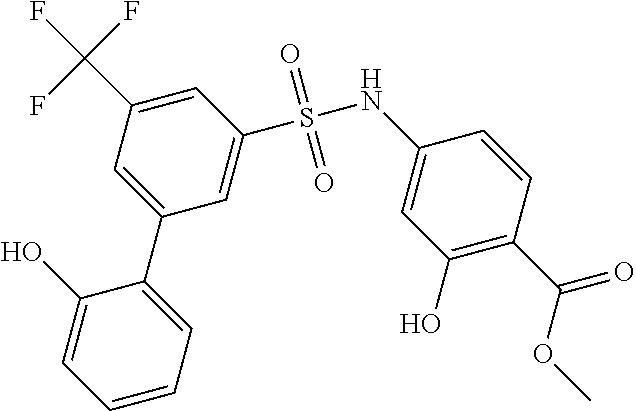
- PYFSLJVSCGXYAJ-UHFFFAOYSA-N methyl 2-hydroxy-4-[[3-(2-hydroxyphenyl)phenyl]sulfonylamino]benzoate Chemical compound C1=C(O)C(C(=O)OC)=CC=C1NS(=O)(=O)C1=CC=CC(C=2C(=CC=CC=2)O)=C1 PYFSLJVSCGXYAJ-UHFFFAOYSA-N 0.000 claims description 51
- 125000004432 carbon atom Chemical group C* 0.000 claims description 49
- 125000002924 primary amino group Chemical group [H]N([H])* 0.000 claims description 47
- 125000004454 (C1-C6) alkoxycarbonyl group Chemical group 0.000 claims description 43
- 125000003917 carbamoyl group Chemical group [H]N([H])C(*)=O 0.000 claims description 42
- 125000003806 alkyl carbonyl amino group Chemical group 0.000 claims description 38
- 125000001054 5 membered carbocyclic group Chemical group 0.000 claims description 37
- 125000004008 6 membered carbocyclic group Chemical group 0.000 claims description 37
- 125000002887 hydroxy group Chemical group [H]O* 0.000 claims description 37
- 125000001997 phenyl group Chemical group [H]C1=C([H])C([H])=C(*)C([H])=C1[H] 0.000 claims description 36
- 125000004916 (C1-C6) alkylcarbonyl group Chemical group 0.000 claims description 35
- 125000002950 monocyclic group Chemical group 0.000 claims description 30
- 125000006273 (C1-C3) alkyl group Chemical group 0.000 claims description 29
- 125000004043 oxo group Chemical group O=* 0.000 claims description 27
- 150000003839 salts Chemical class 0.000 claims description 27
- 125000004093 cyano group Chemical group *C#N 0.000 claims description 24
- 125000006274 (C1-C3)alkoxy group Chemical group 0.000 claims description 19
- 125000004739 (C1-C6) alkylsulfonyl group Chemical group 0.000 claims description 19
- 241000124008 Mammalia Species 0.000 claims description 18
- 125000005844 heterocyclyloxy group Chemical group 0.000 claims description 17
- 125000004890 (C1-C6) alkylamino group Chemical group 0.000 claims description 16
- 125000004466 alkoxycarbonylamino group Chemical group 0.000 claims description 16
- 208000037265 diseases, disorders, signs and symptoms Diseases 0.000 claims description 16
- 125000000956 methoxy group Chemical group [H]C([H])([H])O* 0.000 claims description 15
- 230000005778 DNA damage Effects 0.000 claims description 13
- 231100000277 DNA damage Toxicity 0.000 claims description 13
- 125000000449 nitro group Chemical group [O-][N+](*)=O 0.000 claims description 12
- 208000035475 disorder Diseases 0.000 claims description 11
- 125000001301 ethoxy group Chemical group [H]C([H])([H])C([H])([H])O* 0.000 claims description 11
- 125000000467 secondary amino group Chemical group [H]N([*:1])[*:2] 0.000 claims description 10
- 125000001302 tertiary amino group Chemical group 0.000 claims description 10
- 125000005194 alkoxycarbonyloxy group Chemical group 0.000 claims description 9
- 125000005196 alkyl carbonyloxy group Chemical group 0.000 claims description 8
- 125000004738 (C1-C6) alkyl sulfinyl group Chemical group 0.000 claims description 6
- 125000004845 (C1-C6) alkylsulfonylamino group Chemical group 0.000 claims description 6
- 125000006700 (C1-C6) alkylthio group Chemical group 0.000 claims description 6
- 125000006517 heterocyclyl carbonyl group Chemical group 0.000 claims description 6
- 230000001939 inductive effect Effects 0.000 claims description 6
- 125000000951 phenoxy group Chemical group [H]C1=C([H])C([H])=C(O*)C([H])=C1[H] 0.000 claims description 6
- 238000011277 treatment modality Methods 0.000 claims description 6
- 206010060862 Prostate cancer Diseases 0.000 claims description 4
- 208000000236 Prostatic Neoplasms Diseases 0.000 claims description 4
- 230000003439 radiotherapeutic effect Effects 0.000 claims description 4
- 229910052705 radium Inorganic materials 0.000 claims description 4
- 206010006187 Breast cancer Diseases 0.000 claims description 3
- 208000026310 Breast neoplasm Diseases 0.000 claims description 3
- 206010061902 Pancreatic neoplasm Diseases 0.000 claims description 3
- VUKRFJDWQHXAAV-UHFFFAOYSA-N benzyl 2-acetyloxy-4-(naphthalen-1-ylsulfonylamino)benzoate Chemical compound CC(=O)OC1=CC(NS(=O)(=O)C=2C3=CC=CC=C3C=CC=2)=CC=C1C(=O)OCC1=CC=CC=C1 VUKRFJDWQHXAAV-UHFFFAOYSA-N 0.000 claims description 3
- 210000000481 breast Anatomy 0.000 claims description 3
- 210000004696 endometrium Anatomy 0.000 claims description 3
- 210000003238 esophagus Anatomy 0.000 claims description 3
- 210000003128 head Anatomy 0.000 claims description 3
- 210000003734 kidney Anatomy 0.000 claims description 3
- 210000004185 liver Anatomy 0.000 claims description 3
- 210000001165 lymph node Anatomy 0.000 claims description 3
- 210000003739 neck Anatomy 0.000 claims description 3
- 210000001672 ovary Anatomy 0.000 claims description 3
- 229910052701 rubidium Inorganic materials 0.000 claims description 3
- 210000003491 skin Anatomy 0.000 claims description 3
- 210000000813 small intestine Anatomy 0.000 claims description 3
- 210000000952 spleen Anatomy 0.000 claims description 3
- 210000002784 stomach Anatomy 0.000 claims description 3
- 210000001550 testis Anatomy 0.000 claims description 3
- GIQYINUBWRLGDS-UHFFFAOYSA-N 1,3-diethoxypropan-2-yl 4-[[3-(5-fluoro-2-hydroxyphenyl)phenyl]sulfonylamino]-2-hydroxybenzoate Chemical compound C1=C(O)C(C(=O)OC(COCC)COCC)=CC=C1NS(=O)(=O)C1=CC=CC(C=2C(=CC=C(F)C=2)O)=C1 GIQYINUBWRLGDS-UHFFFAOYSA-N 0.000 claims description 2
- UUNAGCSIDMTWOV-UHFFFAOYSA-N 1-methoxybutan-2-yl 4-[[3-(5-fluoro-2-hydroxyphenyl)phenyl]sulfonylamino]-2-hydroxybenzoate Chemical compound C1=C(O)C(C(=O)OC(COC)CC)=CC=C1NS(=O)(=O)C1=CC=CC(C=2C(=CC=C(F)C=2)O)=C1 UUNAGCSIDMTWOV-UHFFFAOYSA-N 0.000 claims description 2
- ZDRFHQKUEJNQQF-UHFFFAOYSA-N 1-methoxypropan-2-yl 4-[[3-(5-fluoro-2-hydroxyphenyl)phenyl]sulfonylamino]-2-hydroxybenzoate Chemical compound C1=C(O)C(C(=O)OC(C)COC)=CC=C1NS(=O)(=O)C1=CC=CC(C=2C(=CC=C(F)C=2)O)=C1 ZDRFHQKUEJNQQF-UHFFFAOYSA-N 0.000 claims description 2
- UOFRKOZDWRLIMW-UHFFFAOYSA-N 2-acetyloxy-4-(naphthalen-1-ylsulfonylamino)benzoic acid Chemical compound C1=C(C(O)=O)C(OC(=O)C)=CC(NS(=O)(=O)C=2C3=CC=CC=C3C=CC=2)=C1 UOFRKOZDWRLIMW-UHFFFAOYSA-N 0.000 claims description 2
- QRDFCYMUXHUTCS-UHFFFAOYSA-N 2-hydroxyethyl 4-[[3-(5-fluoro-2-hydroxyphenyl)phenyl]sulfonylamino]-2-hydroxybenzoate Chemical compound C1=C(O)C(C(=O)OCCO)=CC=C1NS(=O)(=O)C1=CC=CC(C=2C(=CC=C(F)C=2)O)=C1 QRDFCYMUXHUTCS-UHFFFAOYSA-N 0.000 claims description 2
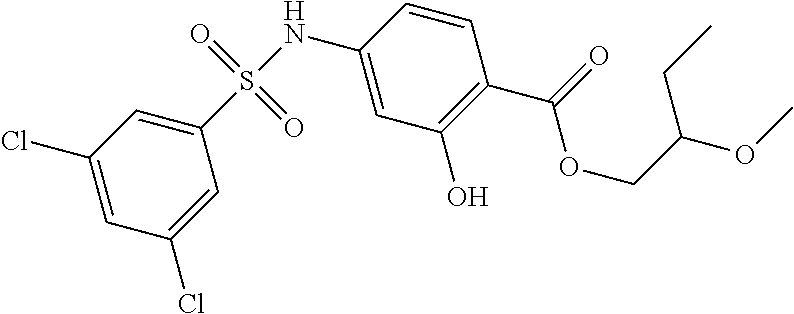
- FKKKRLJLHAHJGQ-UHFFFAOYSA-N 2-methoxybutyl 4-[[3-(5-fluoro-2-hydroxyphenyl)phenyl]sulfonylamino]-2-hydroxybenzoate Chemical compound C1=C(O)C(C(=O)OCC(CC)OC)=CC=C1NS(=O)(=O)C1=CC=CC(C=2C(=CC=C(F)C=2)O)=C1 FKKKRLJLHAHJGQ-UHFFFAOYSA-N 0.000 claims description 2
- NIPIKVMKXMFCQM-UHFFFAOYSA-N 2-methoxyethyl 4-[[3-(2,3-dihydro-1-benzofuran-5-yl)phenyl]sulfonylamino]-2-hydroxybenzoate Chemical compound C1=C(O)C(C(=O)OCCOC)=CC=C1NS(=O)(=O)C1=CC=CC(C=2C=C3CCOC3=CC=2)=C1 NIPIKVMKXMFCQM-UHFFFAOYSA-N 0.000 claims description 2
- JMQHDDJXHKQKFT-UHFFFAOYSA-N 2-methoxyethyl 4-[[3-(2,5-difluorophenyl)phenyl]sulfonylamino]-2-hydroxybenzoate Chemical compound C1=C(O)C(C(=O)OCCOC)=CC=C1NS(=O)(=O)C1=CC=CC(C=2C(=CC=C(F)C=2)F)=C1 JMQHDDJXHKQKFT-UHFFFAOYSA-N 0.000 claims description 2
- JIOPFDFIUVKOMU-UHFFFAOYSA-N 2-methoxyethyl 4-[[3-(5-fluoro-2-hydroxyphenyl)phenyl]sulfonylamino]-2-hydroxybenzoate Chemical compound C1=C(O)C(C(=O)OCCOC)=CC=C1NS(=O)(=O)C1=CC=CC(C=2C(=CC=C(F)C=2)O)=C1 JIOPFDFIUVKOMU-UHFFFAOYSA-N 0.000 claims description 2
- AASNXEHGRQIULX-UHFFFAOYSA-N 2-phenoxyethyl 4-[[3-(5-fluoro-2-hydroxyphenyl)phenyl]sulfonylamino]-2-hydroxybenzoate Chemical compound C=1C=C(C(=O)OCCOC=2C=CC=CC=2)C(O)=CC=1NS(=O)(=O)C(C=1)=CC=CC=1C1=CC(F)=CC=C1O AASNXEHGRQIULX-UHFFFAOYSA-N 0.000 claims description 2
- LJFYDJASBIVSJM-UHFFFAOYSA-N 3-hydroxypropyl 4-[[3-(5-fluoro-2-hydroxyphenyl)phenyl]sulfonylamino]-2-hydroxybenzoate Chemical compound C1=C(O)C(C(=O)OCCCO)=CC=C1NS(=O)(=O)C1=CC=CC(C=2C(=CC=C(F)C=2)O)=C1 LJFYDJASBIVSJM-UHFFFAOYSA-N 0.000 claims description 2
- SDDJSJMFFACDDN-UHFFFAOYSA-N COC(=O)c1ccc(NS(=O)(=O)c2cccc(c2)-c2cccc(c2)C(N)=O)cc1O Chemical compound COC(=O)c1ccc(NS(=O)(=O)c2cccc(c2)-c2cccc(c2)C(N)=O)cc1O SDDJSJMFFACDDN-UHFFFAOYSA-N 0.000 claims description 2
- 208000001333 Colorectal Neoplasms Diseases 0.000 claims description 2
- 206010058467 Lung neoplasm malignant Diseases 0.000 claims description 2
- 230000002489 hematologic effect Effects 0.000 claims description 2
- 201000005202 lung cancer Diseases 0.000 claims description 2
- 208000020816 lung neoplasm Diseases 0.000 claims description 2
- 201000001441 melanoma Diseases 0.000 claims description 2
- WAXJMQMVDBNGNF-UHFFFAOYSA-N methyl 2-hydroxy-4-(naphthalen-1-ylsulfonylamino)benzoate Chemical compound C1=C(O)C(C(=O)OC)=CC=C1NS(=O)(=O)C1=CC=CC2=CC=CC=C12 WAXJMQMVDBNGNF-UHFFFAOYSA-N 0.000 claims description 2
- GEIXOBJFHOOUCY-UHFFFAOYSA-N methyl 2-hydroxy-4-(naphthalen-2-ylsulfonylamino)benzoate Chemical compound C1=C(O)C(C(=O)OC)=CC=C1NS(=O)(=O)C1=CC=C(C=CC=C2)C2=C1 GEIXOBJFHOOUCY-UHFFFAOYSA-N 0.000 claims description 2
- YNNMTBWFBJSNSD-UHFFFAOYSA-N methyl 2-hydroxy-4-[(3-phenylphenyl)sulfonylamino]benzoate Chemical compound C1=C(O)C(C(=O)OC)=CC=C1NS(=O)(=O)C1=CC=CC(C=2C=CC=CC=2)=C1 YNNMTBWFBJSNSD-UHFFFAOYSA-N 0.000 claims description 2
- NMXVSFMHPVJPJJ-UHFFFAOYSA-N methyl 2-hydroxy-4-[(3-piperidin-1-ylphenyl)sulfonylamino]benzoate Chemical compound C1=C(O)C(C(=O)OC)=CC=C1NS(=O)(=O)C1=CC=CC(N2CCCCC2)=C1 NMXVSFMHPVJPJJ-UHFFFAOYSA-N 0.000 claims description 2
- DMGSGKZUBAQEJN-UHFFFAOYSA-N methyl 2-hydroxy-4-[(3-pyridin-4-ylphenyl)sulfonylamino]benzoate Chemical compound C1=C(O)C(C(=O)OC)=CC=C1NS(=O)(=O)C1=CC=CC(C=2C=CN=CC=2)=C1 DMGSGKZUBAQEJN-UHFFFAOYSA-N 0.000 claims description 2
- LCWVFEGILSXFCD-UHFFFAOYSA-N methyl 2-hydroxy-4-[(4-methylnaphthalen-1-yl)sulfonylamino]benzoate Chemical compound C1=C(O)C(C(=O)OC)=CC=C1NS(=O)(=O)C1=CC=C(C)C2=CC=CC=C12 LCWVFEGILSXFCD-UHFFFAOYSA-N 0.000 claims description 2
- TUOZMSPJDAUTKP-UHFFFAOYSA-N methyl 2-hydroxy-4-[[3-(2-hydroxyphenyl)-5-(trifluoromethyl)phenyl]sulfonylamino]benzoate Chemical compound C1=C(O)C(C(=O)OC)=CC=C1NS(=O)(=O)C1=CC(C=2C(=CC=CC=2)O)=CC(C(F)(F)F)=C1 TUOZMSPJDAUTKP-UHFFFAOYSA-N 0.000 claims description 2
- YRRWUGAEGGQOEZ-UHFFFAOYSA-N methyl 2-hydroxy-4-[[3-(2-nitrophenyl)phenyl]sulfonylamino]benzoate Chemical compound C1=C(O)C(C(=O)OC)=CC=C1NS(=O)(=O)C1=CC=CC(C=2C(=CC=CC=2)[N+]([O-])=O)=C1 YRRWUGAEGGQOEZ-UHFFFAOYSA-N 0.000 claims description 2
- YKFCIQNHIDAZTK-UHFFFAOYSA-N methyl 2-hydroxy-4-[[3-(3-methylsulfonylphenyl)phenyl]sulfonylamino]benzoate Chemical compound C1=C(O)C(C(=O)OC)=CC=C1NS(=O)(=O)C1=CC=CC(C=2C=C(C=CC=2)S(C)(=O)=O)=C1 YKFCIQNHIDAZTK-UHFFFAOYSA-N 0.000 claims description 2
- CIWGIWIELKWLFA-UHFFFAOYSA-N methyl 2-hydroxy-4-[[3-(3-propan-2-yloxycarbonylphenyl)phenyl]sulfonylamino]benzoate Chemical compound C1=C(O)C(C(=O)OC)=CC=C1NS(=O)(=O)C1=CC=CC(C=2C=C(C=CC=2)C(=O)OC(C)C)=C1 CIWGIWIELKWLFA-UHFFFAOYSA-N 0.000 claims description 2
- PASYQEXZUSDUDR-UHFFFAOYSA-N methyl 2-hydroxy-4-[[3-(4-methylsulfanylphenyl)phenyl]sulfonylamino]benzoate Chemical compound C1=C(O)C(C(=O)OC)=CC=C1NS(=O)(=O)C1=CC=CC(C=2C=CC(SC)=CC=2)=C1 PASYQEXZUSDUDR-UHFFFAOYSA-N 0.000 claims description 2
- XCBXQEKTZSUHGL-UHFFFAOYSA-N methyl 2-hydroxy-4-[[3-[2-(hydroxymethyl)phenyl]phenyl]sulfonylamino]benzoate Chemical compound C1=C(O)C(C(=O)OC)=CC=C1NS(=O)(=O)C1=CC=CC(C=2C(=CC=CC=2)CO)=C1 XCBXQEKTZSUHGL-UHFFFAOYSA-N 0.000 claims description 2
- DEYPJOSYIPCOSD-UHFFFAOYSA-N methyl 2-hydroxy-4-[[3-[4-(trifluoromethoxy)phenyl]phenyl]sulfonylamino]benzoate Chemical compound C1=C(O)C(C(=O)OC)=CC=C1NS(=O)(=O)C1=CC=CC(C=2C=CC(OC(F)(F)F)=CC=2)=C1 DEYPJOSYIPCOSD-UHFFFAOYSA-N 0.000 claims description 2
- YCGRGBKXUVDGTR-UHFFFAOYSA-N methyl 2-hydroxy-4-[[3-[4-(trifluoromethyl)phenyl]phenyl]sulfonylamino]benzoate Chemical compound C1=C(O)C(C(=O)OC)=CC=C1NS(=O)(=O)C1=CC=CC(C=2C=CC(=CC=2)C(F)(F)F)=C1 YCGRGBKXUVDGTR-UHFFFAOYSA-N 0.000 claims description 2
- OZANCPPVWKPFLH-UHFFFAOYSA-N methyl 2-hydroxy-4-[[3-phenyl-5-(trifluoromethyl)phenyl]sulfonylamino]benzoate Chemical compound C1=C(O)C(C(=O)OC)=CC=C1NS(=O)(=O)C1=CC(C=2C=CC=CC=2)=CC(C(F)(F)F)=C1 OZANCPPVWKPFLH-UHFFFAOYSA-N 0.000 claims description 2
- JFFYDPBOOFUOCD-UHFFFAOYSA-N methyl 4-(2,1,3-benzothiadiazol-4-ylsulfonylamino)-2-hydroxybenzoate Chemical compound C1=C(O)C(C(=O)OC)=CC=C1NS(=O)(=O)C1=CC=CC2=NSN=C12 JFFYDPBOOFUOCD-UHFFFAOYSA-N 0.000 claims description 2
- UWITXGASQFRWQI-UHFFFAOYSA-N methyl 4-[(4-fluoronaphthalen-1-yl)sulfonylamino]-2-hydroxybenzoate Chemical compound C1=C(O)C(C(=O)OC)=CC=C1NS(=O)(=O)C1=CC=C(F)C2=CC=CC=C12 UWITXGASQFRWQI-UHFFFAOYSA-N 0.000 claims description 2
- IZSUNTSKTPXQHK-UHFFFAOYSA-N methyl 4-[[3-(1-benzofuran-2-yl)phenyl]sulfonylamino]-2-hydroxybenzoate Chemical compound C1=C(O)C(C(=O)OC)=CC=C1NS(=O)(=O)C1=CC=CC(C=2OC3=CC=CC=C3C=2)=C1 IZSUNTSKTPXQHK-UHFFFAOYSA-N 0.000 claims description 2
- DYZNYFROQDUFFN-UHFFFAOYSA-N methyl 4-[[3-(2,3-dihydro-1-benzofuran-5-yl)-5-(trifluoromethyl)phenyl]sulfonylamino]-2-hydroxybenzoate Chemical compound C1=C(O)C(C(=O)OC)=CC=C1NS(=O)(=O)C1=CC(C=2C=C3CCOC3=CC=2)=CC(C(F)(F)F)=C1 DYZNYFROQDUFFN-UHFFFAOYSA-N 0.000 claims description 2
- ZCTNPSOBORHBEW-UHFFFAOYSA-N methyl 4-[[3-(2,3-dihydro-1-benzofuran-5-yl)phenyl]methylsulfonylamino]-2-hydroxybenzoate Chemical compound C1=C(O)C(C(=O)OC)=CC=C1NS(=O)(=O)CC1=CC=CC(C=2C=C3CCOC3=CC=2)=C1 ZCTNPSOBORHBEW-UHFFFAOYSA-N 0.000 claims description 2
- VOSZMXSLFLBABS-UHFFFAOYSA-N methyl 4-[[3-(2,3-dihydro-1-benzofuran-5-yl)phenyl]sulfonylamino]-2-hydroxybenzoate Chemical compound C1=C(O)C(C(=O)OC)=CC=C1NS(=O)(=O)C1=CC=CC(C=2C=C3CCOC3=CC=2)=C1 VOSZMXSLFLBABS-UHFFFAOYSA-N 0.000 claims description 2
- NENVTCAFNXKAEG-UHFFFAOYSA-N methyl 4-[[3-(2,5-difluorophenyl)-5-(trifluoromethyl)phenyl]sulfonylamino]-2-hydroxybenzoate Chemical compound C1=C(O)C(C(=O)OC)=CC=C1NS(=O)(=O)C1=CC(C=2C(=CC=C(F)C=2)F)=CC(C(F)(F)F)=C1 NENVTCAFNXKAEG-UHFFFAOYSA-N 0.000 claims description 2
- MBGOJOFNDCBPFA-UHFFFAOYSA-N methyl 4-[[3-(2,5-difluorophenyl)phenyl]sulfonylamino]-2-hydroxybenzoate Chemical compound C1=C(O)C(C(=O)OC)=CC=C1NS(=O)(=O)C1=CC=CC(C=2C(=CC=C(F)C=2)F)=C1 MBGOJOFNDCBPFA-UHFFFAOYSA-N 0.000 claims description 2
- KBYKYFDIRDFLDA-UHFFFAOYSA-N methyl 4-[[3-(3-acetamidophenyl)phenyl]sulfonylamino]-2-hydroxybenzoate Chemical compound C1=C(O)C(C(=O)OC)=CC=C1NS(=O)(=O)C1=CC=CC(C=2C=C(NC(C)=O)C=CC=2)=C1 KBYKYFDIRDFLDA-UHFFFAOYSA-N 0.000 claims description 2
- NTJDVDRSQJNCNV-UHFFFAOYSA-N methyl 4-[[3-(3-chlorophenyl)phenyl]sulfonylamino]-2-hydroxybenzoate Chemical compound C1=C(O)C(C(=O)OC)=CC=C1NS(=O)(=O)C1=CC=CC(C=2C=C(Cl)C=CC=2)=C1 NTJDVDRSQJNCNV-UHFFFAOYSA-N 0.000 claims description 2
- ZHMRAJJFROGHKZ-UHFFFAOYSA-N methyl 4-[[3-(3-cyanophenyl)phenyl]sulfonylamino]-2-hydroxybenzoate Chemical compound C1=C(O)C(C(=O)OC)=CC=C1NS(=O)(=O)C1=CC=CC(C=2C=C(C=CC=2)C#N)=C1 ZHMRAJJFROGHKZ-UHFFFAOYSA-N 0.000 claims description 2
- YPCFWPPXIPNGRD-UHFFFAOYSA-N methyl 4-[[3-(3-ethoxyphenyl)phenyl]sulfonylamino]-2-hydroxybenzoate Chemical compound CCOC1=CC=CC(C=2C=C(C=CC=2)S(=O)(=O)NC=2C=C(O)C(C(=O)OC)=CC=2)=C1 YPCFWPPXIPNGRD-UHFFFAOYSA-N 0.000 claims description 2
- XVZMHWRNLLCHOK-UHFFFAOYSA-N methyl 4-[[3-(4-carbamoylphenyl)phenyl]sulfonylamino]-2-hydroxybenzoate Chemical compound C1=C(O)C(C(=O)OC)=CC=C1NS(=O)(=O)C1=CC=CC(C=2C=CC(=CC=2)C(N)=O)=C1 XVZMHWRNLLCHOK-UHFFFAOYSA-N 0.000 claims description 2
- HQMRJOCOYCZRQV-UHFFFAOYSA-N methyl 4-[[3-(5-acetylthiophen-2-yl)phenyl]sulfonylamino]-2-hydroxybenzoate Chemical compound C1=C(O)C(C(=O)OC)=CC=C1NS(=O)(=O)C1=CC=CC(C=2SC(=CC=2)C(C)=O)=C1 HQMRJOCOYCZRQV-UHFFFAOYSA-N 0.000 claims description 2
- RNVFBYJOAOHLLL-UHFFFAOYSA-N methyl 4-[[3-(5-fluoro-2-hydroxyphenyl)-5-(trifluoromethyl)phenyl]sulfonylamino]-2-hydroxybenzoate Chemical compound C1=C(O)C(C(=O)OC)=CC=C1NS(=O)(=O)C1=CC(C=2C(=CC=C(F)C=2)O)=CC(C(F)(F)F)=C1 RNVFBYJOAOHLLL-UHFFFAOYSA-N 0.000 claims description 2
- FUZYUGPQHYMAAS-UHFFFAOYSA-N methyl 4-[[3-(5-fluoro-2-hydroxyphenyl)phenyl]sulfonylamino]-2-hydroxybenzoate Chemical compound C1=C(O)C(C(=O)OC)=CC=C1NS(=O)(=O)C1=CC=CC(C=2C(=CC=C(F)C=2)O)=C1 FUZYUGPQHYMAAS-UHFFFAOYSA-N 0.000 claims description 2
- CJZHGCRCMPCALP-UHFFFAOYSA-N methyl 4-[[3-[4-(dimethylcarbamoyl)phenyl]phenyl]sulfonylamino]-2-hydroxybenzoate Chemical compound C1=C(O)C(C(=O)OC)=CC=C1NS(=O)(=O)C1=CC=CC(C=2C=CC(=CC=2)C(=O)N(C)C)=C1 CJZHGCRCMPCALP-UHFFFAOYSA-N 0.000 claims description 2
- GLISAANUGRJDEL-UHFFFAOYSA-N oxolan-3-yl 4-[[3-(5-fluoro-2-hydroxyphenyl)phenyl]sulfonylamino]-2-hydroxybenzoate Chemical compound C=1C=C(C(=O)OC2COCC2)C(O)=CC=1NS(=O)(=O)C(C=1)=CC=CC=1C1=CC(F)=CC=C1O GLISAANUGRJDEL-UHFFFAOYSA-N 0.000 claims description 2
- 208000003174 Brain Neoplasms Diseases 0.000 claims 2
- 210000004369 blood Anatomy 0.000 claims 2
- 239000008280 blood Substances 0.000 claims 2
- 210000000601 blood cell Anatomy 0.000 claims 2
- 210000001185 bone marrow Anatomy 0.000 claims 2
- 230000000973 chemotherapeutic effect Effects 0.000 claims 2
- 210000001072 colon Anatomy 0.000 claims 2
- 210000004072 lung Anatomy 0.000 claims 2
- 208000015486 malignant pancreatic neoplasm Diseases 0.000 claims 2
- 210000000496 pancreas Anatomy 0.000 claims 2
- 208000008443 pancreatic carcinoma Diseases 0.000 claims 2
- 210000002307 prostate Anatomy 0.000 claims 2
- FEJXHFKURCAKBL-UHFFFAOYSA-N 3-(2,6-dimethylmorpholin-4-yl)propyl 4-[[3-(5-fluoro-2-hydroxyphenyl)phenyl]sulfonylamino]-2-hydroxybenzoate Chemical compound C1C(C)OC(C)CN1CCCOC(=O)C(C(=C1)O)=CC=C1NS(=O)(=O)C1=CC=CC(C=2C(=CC=C(F)C=2)O)=C1 FEJXHFKURCAKBL-UHFFFAOYSA-N 0.000 claims 1
- DQSRVWNGCNSDNE-UHFFFAOYSA-N 3-(pyridin-3-ylamino)propyl 4-[[3-(5-fluoro-2-hydroxyphenyl)phenyl]sulfonylamino]-2-hydroxybenzoate Chemical compound OC1=CC=C(F)C=C1C1=CC=CC(S(=O)(=O)NC=2C=C(O)C(C(=O)OCCCNC=3C=NC=CC=3)=CC=2)=C1 DQSRVWNGCNSDNE-UHFFFAOYSA-N 0.000 claims 1
- MHIGLZAPGCDAMU-UHFFFAOYSA-N 3-[(2-methylpyrazol-3-yl)amino]propyl 4-[[3-(5-fluoro-2-hydroxyphenyl)phenyl]sulfonylamino]-2-hydroxybenzoate Chemical compound CN1N=CC=C1NCCCOC(=O)C(C(=C1)O)=CC=C1NS(=O)(=O)C1=CC=CC(C=2C(=CC=C(F)C=2)O)=C1 MHIGLZAPGCDAMU-UHFFFAOYSA-N 0.000 claims 1
- LBNKWEZZLZMYDU-UHFFFAOYSA-N 3-[(5-methyl-1,2-oxazol-3-yl)amino]propyl 4-[[3-(5-fluoro-2-hydroxyphenyl)phenyl]sulfonylamino]-2-hydroxybenzoate Chemical compound O1C(C)=CC(NCCCOC(=O)C=2C(=CC(NS(=O)(=O)C=3C=C(C=CC=3)C=3C(=CC=C(F)C=3)O)=CC=2)O)=N1 LBNKWEZZLZMYDU-UHFFFAOYSA-N 0.000 claims 1
- FVPHSJRVQBPKKV-UHFFFAOYSA-N 3-morpholin-4-ylpropyl 2-hydroxy-4-[[3-(2-hydroxyphenyl)phenyl]sulfonylamino]benzoate Chemical compound C=1C=C(C(=O)OCCCN2CCOCC2)C(O)=CC=1NS(=O)(=O)C(C=1)=CC=CC=1C1=CC=CC=C1O FVPHSJRVQBPKKV-UHFFFAOYSA-N 0.000 claims 1
- QPNKJLWPDNFXJY-UHFFFAOYSA-N 3-morpholin-4-ylpropyl 4-[[3-(2,3-dihydro-1-benzofuran-5-yl)phenyl]sulfonylamino]-2-hydroxybenzoate Chemical compound OC1=CC(NS(=O)(=O)C=2C=C(C=CC=2)C=2C=C3CCOC3=CC=2)=CC=C1C(=O)OCCCN1CCOCC1 QPNKJLWPDNFXJY-UHFFFAOYSA-N 0.000 claims 1
- NZJMYHJYSLNNEK-UHFFFAOYSA-N 3-morpholin-4-ylpropyl 4-[[3-(2,5-difluorophenyl)phenyl]sulfonylamino]-2-hydroxybenzoate Chemical compound C=1C=C(C(=O)OCCCN2CCOCC2)C(O)=CC=1NS(=O)(=O)C(C=1)=CC=CC=1C1=CC(F)=CC=C1F NZJMYHJYSLNNEK-UHFFFAOYSA-N 0.000 claims 1
- SRHFEEJUYNKUQA-UHFFFAOYSA-N 3-morpholin-4-ylpropyl 4-[[3-(5-fluoro-2-hydroxyphenyl)phenyl]sulfonylamino]-2-hydroxybenzoate Chemical compound OC1=CC=C(F)C=C1C1=CC=CC(S(=O)(=O)NC=2C=C(O)C(C(=O)OCCCN3CCOCC3)=CC=2)=C1 SRHFEEJUYNKUQA-UHFFFAOYSA-N 0.000 claims 1
- JUPSOCTTWUYAEM-UHFFFAOYSA-N 4-(dimethylamino)butyl 2-hydroxy-4-[[3-(2-methyl-1,3-thiazol-4-yl)phenyl]sulfonylamino]benzoate Chemical compound C1=C(O)C(C(=O)OCCCCN(C)C)=CC=C1NS(=O)(=O)C1=CC=CC(C=2N=C(C)SC=2)=C1 JUPSOCTTWUYAEM-UHFFFAOYSA-N 0.000 claims 1
- OLHNYEASHANJGG-UHFFFAOYSA-N 4-morpholin-4-ylbutyl 4-[[3-(2,3-dihydro-1-benzofuran-5-yl)phenyl]sulfonylamino]-2-hydroxybenzoate Chemical compound OC1=CC(NS(=O)(=O)C=2C=C(C=CC=2)C=2C=C3CCOC3=CC=2)=CC=C1C(=O)OCCCCN1CCOCC1 OLHNYEASHANJGG-UHFFFAOYSA-N 0.000 claims 1
- KATKJYSVARAEBV-UHFFFAOYSA-N 4-morpholin-4-ylbutyl 4-[[3-(2,5-difluorophenyl)phenyl]sulfonylamino]-2-hydroxybenzoate Chemical compound C=1C=C(C(=O)OCCCCN2CCOCC2)C(O)=CC=1NS(=O)(=O)C(C=1)=CC=CC=1C1=CC(F)=CC=C1F KATKJYSVARAEBV-UHFFFAOYSA-N 0.000 claims 1
- CNFQHSNJBVDELE-UHFFFAOYSA-N 4-morpholin-4-ylbutyl 4-[[3-(5-fluoro-2-hydroxyphenyl)phenyl]sulfonylamino]-2-hydroxybenzoate Chemical compound OC1=CC=C(F)C=C1C1=CC=CC(S(=O)(=O)NC=2C=C(O)C(C(=O)OCCCCN3CCOCC3)=CC=2)=C1 CNFQHSNJBVDELE-UHFFFAOYSA-N 0.000 claims 1
- 206010009944 Colon cancer Diseases 0.000 claims 1
- XOCLSQPUABDBTR-UHFFFAOYSA-N methyl 2-hydroxy-4-[(3-pyridin-3-ylphenyl)sulfonylamino]benzoate Chemical compound C1=C(O)C(C(=O)OC)=CC=C1NS(=O)(=O)C1=CC=CC(C=2C=NC=CC=2)=C1 XOCLSQPUABDBTR-UHFFFAOYSA-N 0.000 claims 1
- QABCGCVMDDTBHD-UHFFFAOYSA-N methyl 2-hydroxy-4-[(3-quinolin-6-ylphenyl)sulfonylamino]benzoate Chemical compound C1=C(O)C(C(=O)OC)=CC=C1NS(=O)(=O)C1=CC=CC(C=2C=C3C=CC=NC3=CC=2)=C1 QABCGCVMDDTBHD-UHFFFAOYSA-N 0.000 claims 1
- LOPQGXIWQMISRD-UHFFFAOYSA-N methyl 4-[[3-(3-aminophenyl)phenyl]sulfonylamino]-2-hydroxybenzoate Chemical compound C1=C(O)C(C(=O)OC)=CC=C1NS(=O)(=O)C1=CC=CC(C=2C=C(N)C=CC=2)=C1 LOPQGXIWQMISRD-UHFFFAOYSA-N 0.000 claims 1
- JJDSMOLOQSWAAD-UHFFFAOYSA-N methyl 4-[[5-(dimethylamino)naphthalen-1-yl]sulfonylamino]-2-hydroxybenzoate Chemical compound C1=C(O)C(C(=O)OC)=CC=C1NS(=O)(=O)C1=CC=CC2=C(N(C)C)C=CC=C12 JJDSMOLOQSWAAD-UHFFFAOYSA-N 0.000 claims 1
- 201000002528 pancreatic cancer Diseases 0.000 claims 1
- 239000008194 pharmaceutical composition Substances 0.000 abstract description 13
- HEDRZPFGACZZDS-MICDWDOJSA-N Trichloro(2H)methane Chemical compound [2H]C(Cl)(Cl)Cl HEDRZPFGACZZDS-MICDWDOJSA-N 0.000 description 290
- 238000005160 1H NMR spectroscopy Methods 0.000 description 246
- 239000000543 intermediate Substances 0.000 description 210
- OKKJLVBELUTLKV-UHFFFAOYSA-N Methanol Chemical compound OC OKKJLVBELUTLKV-UHFFFAOYSA-N 0.000 description 189
- 239000000047 product Substances 0.000 description 166
- OKKJLVBELUTLKV-MZCSYVLQSA-N Deuterated methanol Chemical compound [2H]OC([2H])([2H])[2H] OKKJLVBELUTLKV-MZCSYVLQSA-N 0.000 description 156
- XEKOWRVHYACXOJ-UHFFFAOYSA-N Ethyl acetate Chemical compound CCOC(C)=O XEKOWRVHYACXOJ-UHFFFAOYSA-N 0.000 description 118
- JUJWROOIHBZHMG-UHFFFAOYSA-N Pyridine Chemical compound C1=CC=NC=C1 JUJWROOIHBZHMG-UHFFFAOYSA-N 0.000 description 114
- XLYOFNOQVPJJNP-UHFFFAOYSA-N water Substances O XLYOFNOQVPJJNP-UHFFFAOYSA-N 0.000 description 109
- YMWUJEATGCHHMB-UHFFFAOYSA-N Dichloromethane Chemical compound ClCCl YMWUJEATGCHHMB-UHFFFAOYSA-N 0.000 description 93
- 239000000203 mixture Substances 0.000 description 88
- CSNNHWWHGAXBCP-UHFFFAOYSA-L Magnesium sulfate Chemical compound [Mg+2].[O-][S+2]([O-])([O-])[O-] CSNNHWWHGAXBCP-UHFFFAOYSA-L 0.000 description 80
- 239000011541 reaction mixture Substances 0.000 description 78
- IAZDPXIOMUYVGZ-WFGJKAKNSA-N Dimethyl sulfoxide Chemical compound [2H]C([2H])([2H])S(=O)C([2H])([2H])[2H] IAZDPXIOMUYVGZ-WFGJKAKNSA-N 0.000 description 74
- QQOXBFUTRLDXDP-UHFFFAOYSA-N p-Aminosalicylic acid methyl ester Chemical compound COC(=O)C1=CC=C(N)C=C1O QQOXBFUTRLDXDP-UHFFFAOYSA-N 0.000 description 73
- PFKFTWBEEFSNDU-UHFFFAOYSA-N carbonyldiimidazole Chemical compound C1=CN=CN1C(=O)N1C=CN=C1 PFKFTWBEEFSNDU-UHFFFAOYSA-N 0.000 description 69
- WEVYAHXRMPXWCK-UHFFFAOYSA-N Acetonitrile Chemical compound CC#N WEVYAHXRMPXWCK-UHFFFAOYSA-N 0.000 description 65
- 150000003254 radicals Chemical class 0.000 description 61
- 235000019439 ethyl acetate Nutrition 0.000 description 59
- 238000002953 preparative HPLC Methods 0.000 description 59
- 230000002378 acidificating effect Effects 0.000 description 57
- UMJSCPRVCHMLSP-UHFFFAOYSA-N pyridine Natural products COC1=CC=CN=C1 UMJSCPRVCHMLSP-UHFFFAOYSA-N 0.000 description 57
- HEMHJVSKTPXQMS-UHFFFAOYSA-M Sodium hydroxide Chemical compound [OH-].[Na+] HEMHJVSKTPXQMS-UHFFFAOYSA-M 0.000 description 51
- 239000012074 organic phase Substances 0.000 description 51
- 239000012043 crude product Substances 0.000 description 47
- IAZDPXIOMUYVGZ-UHFFFAOYSA-N Dimethylsulphoxide Chemical compound CS(C)=O IAZDPXIOMUYVGZ-UHFFFAOYSA-N 0.000 description 44
- 239000012267 brine Substances 0.000 description 43
- HPALAKNZSZLMCH-UHFFFAOYSA-M sodium;chloride;hydrate Chemical compound O.[Na+].[Cl-] HPALAKNZSZLMCH-UHFFFAOYSA-M 0.000 description 43
- RYHBNJHYFVUHQT-UHFFFAOYSA-N 1,4-Dioxane Chemical compound C1COCCO1 RYHBNJHYFVUHQT-UHFFFAOYSA-N 0.000 description 41
- 229910052943 magnesium sulfate Inorganic materials 0.000 description 40
- 125000002496 methyl group Chemical group [H]C([H])([H])* 0.000 description 39
- JGFZNNIVVJXRND-UHFFFAOYSA-N N,N-Diisopropylethylamine (DIPEA) Chemical compound CCN(C(C)C)C(C)C JGFZNNIVVJXRND-UHFFFAOYSA-N 0.000 description 38
- 239000000243 solution Substances 0.000 description 36
- 102100022629 Fructose-2,6-bisphosphatase Human genes 0.000 description 35
- 101000823463 Homo sapiens Fructose-2,6-bisphosphatase Proteins 0.000 description 35
- 239000007787 solid Substances 0.000 description 35
- NBIIXXVUZAFLBC-UHFFFAOYSA-N Phosphoric acid Chemical compound OP(O)(O)=O NBIIXXVUZAFLBC-UHFFFAOYSA-N 0.000 description 33
- YXFVVABEGXRONW-UHFFFAOYSA-N Toluene Chemical compound CC1=CC=CC=C1 YXFVVABEGXRONW-UHFFFAOYSA-N 0.000 description 33
- IXCSERBJSXMMFS-UHFFFAOYSA-N hydrogen chloride Substances Cl.Cl IXCSERBJSXMMFS-UHFFFAOYSA-N 0.000 description 31
- 108020004459 Small interfering RNA Proteins 0.000 description 29
- 238000006243 chemical reaction Methods 0.000 description 29
- VRZIBYXKHICTGD-UHFFFAOYSA-N methyl 4-[(3-bromophenyl)sulfonylamino]-2-hydroxybenzoate Chemical compound C1=C(O)C(C(=O)OC)=CC=C1NS(=O)(=O)C1=CC=CC(Br)=C1 VRZIBYXKHICTGD-UHFFFAOYSA-N 0.000 description 29
- 230000005855 radiation Effects 0.000 description 27
- 239000002904 solvent Substances 0.000 description 27
- YNEQKRXMGFNFIG-UHFFFAOYSA-N 4-[(4,5-dichlorothiophen-2-yl)sulfonylamino]-2-hydroxybenzoic acid Chemical compound C1=C(O)C(C(=O)O)=CC=C1NS(=O)(=O)C1=CC(Cl)=C(Cl)S1 YNEQKRXMGFNFIG-UHFFFAOYSA-N 0.000 description 26
- 125000003342 alkenyl group Chemical group 0.000 description 26
- VYPSYNLAJGMNEJ-UHFFFAOYSA-N Silicium dioxide Chemical compound O=[Si]=O VYPSYNLAJGMNEJ-UHFFFAOYSA-N 0.000 description 25
- DTQVDTLACAAQTR-UHFFFAOYSA-N Trifluoroacetic acid Chemical compound OC(=O)C(F)(F)F DTQVDTLACAAQTR-UHFFFAOYSA-N 0.000 description 24
- 238000007792 addition Methods 0.000 description 24
- 125000003118 aryl group Chemical group 0.000 description 23
- 125000004122 cyclic group Chemical group 0.000 description 23
- CDBYLPFSWZWCQE-UHFFFAOYSA-L Sodium Carbonate Chemical compound [Na+].[Na+].[O-]C([O-])=O CDBYLPFSWZWCQE-UHFFFAOYSA-L 0.000 description 22
- 125000004178 (C1-C4) alkyl group Chemical group 0.000 description 21
- 239000000460 chlorine Substances 0.000 description 21
- 229910052801 chlorine Inorganic materials 0.000 description 20
- IMNFDUFMRHMDMM-UHFFFAOYSA-N N-Heptane Chemical compound CCCCCCC IMNFDUFMRHMDMM-UHFFFAOYSA-N 0.000 description 18
- 229910052731 fluorine Inorganic materials 0.000 description 18
- BWHMMNNQKKPAPP-UHFFFAOYSA-L potassium carbonate Chemical compound [K+].[K+].[O-]C([O-])=O BWHMMNNQKKPAPP-UHFFFAOYSA-L 0.000 description 18
- KEQGZUUPPQEDPF-UHFFFAOYSA-N 1,3-dichloro-5,5-dimethylimidazolidine-2,4-dione Chemical compound CC1(C)N(Cl)C(=O)N(Cl)C1=O KEQGZUUPPQEDPF-UHFFFAOYSA-N 0.000 description 17
- XTHPWXDJESJLNJ-UHFFFAOYSA-N chlorosulfonic acid Substances OS(Cl)(=O)=O XTHPWXDJESJLNJ-UHFFFAOYSA-N 0.000 description 17
- 125000000229 (C1-C4)alkoxy group Chemical group 0.000 description 16
- LFQSCWFLJHTTHZ-UHFFFAOYSA-N Ethanol Chemical compound CCO LFQSCWFLJHTTHZ-UHFFFAOYSA-N 0.000 description 16
- KDLHZDBZIXYQEI-UHFFFAOYSA-N Palladium Chemical compound [Pd] KDLHZDBZIXYQEI-UHFFFAOYSA-N 0.000 description 16
- 125000003178 carboxy group Chemical group [H]OC(*)=O 0.000 description 16
- SNRCKKQHDUIRIY-UHFFFAOYSA-L cyclopenta-1,4-dien-1-yl(diphenyl)phosphane;dichloromethane;dichloropalladium;iron(2+) Chemical compound [Fe+2].ClCCl.Cl[Pd]Cl.C1=C[CH-]C(P(C=2C=CC=CC=2)C=2C=CC=CC=2)=C1.C1=C[CH-]C(P(C=2C=CC=CC=2)C=2C=CC=CC=2)=C1 SNRCKKQHDUIRIY-UHFFFAOYSA-L 0.000 description 16
- 230000000694 effects Effects 0.000 description 16
- JNGWUWOGVCMNDV-UHFFFAOYSA-N methyl 4-[(4-bromo-5-chlorothiophen-2-yl)sulfonylamino]-2-hydroxybenzoate Chemical compound C1=C(O)C(C(=O)OC)=CC=C1NS(=O)(=O)C1=CC(Br)=C(Cl)S1 JNGWUWOGVCMNDV-UHFFFAOYSA-N 0.000 description 16
- UIIMBOGNXHQVGW-UHFFFAOYSA-M Sodium bicarbonate Chemical compound [Na+].OC([O-])=O UIIMBOGNXHQVGW-UHFFFAOYSA-M 0.000 description 15
- 239000003814 drug Substances 0.000 description 15
- 229910052760 oxygen Inorganic materials 0.000 description 15
- DDVUKRHRMBDQTD-UHFFFAOYSA-N 4-[[3-(5-fluoro-2-hydroxyphenyl)phenyl]sulfonylamino]-2-hydroxybenzoic acid Chemical compound C1=C(O)C(C(=O)O)=CC=C1NS(=O)(=O)C1=CC=CC(C=2C(=CC=C(F)C=2)O)=C1 DDVUKRHRMBDQTD-UHFFFAOYSA-N 0.000 description 14
- 125000001495 ethyl group Chemical group [H]C([H])([H])C([H])([H])* 0.000 description 14
- 239000003921 oil Substances 0.000 description 14
- 235000019198 oils Nutrition 0.000 description 14
- 238000002360 preparation method Methods 0.000 description 14
- 230000010076 replication Effects 0.000 description 14
- 229910052717 sulfur Inorganic materials 0.000 description 14
- 108020004414 DNA Proteins 0.000 description 13
- QAOWNCQODCNURD-UHFFFAOYSA-N Sulfuric acid Chemical compound OS(O)(=O)=O QAOWNCQODCNURD-UHFFFAOYSA-N 0.000 description 13
- 239000002253 acid Substances 0.000 description 13
- 238000000746 purification Methods 0.000 description 13
- 125000004448 alkyl carbonyl group Chemical group 0.000 description 12
- 230000006801 homologous recombination Effects 0.000 description 12
- 238000002744 homologous recombination Methods 0.000 description 12
- 239000003112 inhibitor Substances 0.000 description 12
- VLKZOEOYAKHREP-UHFFFAOYSA-N n-Hexane Chemical compound CCCCCC VLKZOEOYAKHREP-UHFFFAOYSA-N 0.000 description 12
- XNWFRZJHXBZDAG-UHFFFAOYSA-N 2-METHOXYETHANOL Chemical compound COCCO XNWFRZJHXBZDAG-UHFFFAOYSA-N 0.000 description 11
- WYURNTSHIVDZCO-UHFFFAOYSA-N Tetrahydrofuran Chemical group C1CCOC1 WYURNTSHIVDZCO-UHFFFAOYSA-N 0.000 description 11
- 238000001914 filtration Methods 0.000 description 11
- 238000009472 formulation Methods 0.000 description 11
- 239000007788 liquid Substances 0.000 description 11
- 230000008439 repair process Effects 0.000 description 11
- 239000000377 silicon dioxide Substances 0.000 description 11
- 229910000029 sodium carbonate Inorganic materials 0.000 description 11
- 125000002023 trifluoromethyl group Chemical group FC(F)(F)* 0.000 description 11
- VZKSLWJLGAGPIU-UHFFFAOYSA-N 3-morpholin-4-ylpropan-1-ol Chemical compound OCCCN1CCOCC1 VZKSLWJLGAGPIU-UHFFFAOYSA-N 0.000 description 10
- 230000005782 double-strand break Effects 0.000 description 10
- 150000002148 esters Chemical class 0.000 description 10
- 239000012299 nitrogen atmosphere Substances 0.000 description 10
- XHXFXVLFKHQFAL-UHFFFAOYSA-N phosphoryl trichloride Chemical compound ClP(Cl)(Cl)=O XHXFXVLFKHQFAL-UHFFFAOYSA-N 0.000 description 10
- 239000002244 precipitate Substances 0.000 description 10
- WUBBRNOQWQTFEX-UHFFFAOYSA-N 4-aminosalicylic acid Chemical compound NC1=CC=C(C(O)=O)C(O)=C1 WUBBRNOQWQTFEX-UHFFFAOYSA-N 0.000 description 9
- 125000002777 acetyl group Chemical group [H]C([H])([H])C(*)=O 0.000 description 9
- 229960004909 aminosalicylic acid Drugs 0.000 description 9
- 125000001797 benzyl group Chemical group [H]C1=C([H])C([H])=C(C([H])=C1[H])C([H])([H])* 0.000 description 9
- 229910052794 bromium Inorganic materials 0.000 description 9
- 238000002405 diagnostic procedure Methods 0.000 description 9
- 229910052739 hydrogen Inorganic materials 0.000 description 9
- 125000001449 isopropyl group Chemical group [H]C([H])([H])C([H])(*)C([H])([H])[H] 0.000 description 9
- 229910052757 nitrogen Inorganic materials 0.000 description 9
- 229910000027 potassium carbonate Inorganic materials 0.000 description 9
- ZIXLJHSFAMVHPC-UHFFFAOYSA-N 2,3-dihydro-1-benzofuran-5-ylboronic acid Chemical compound OB(O)C1=CC=C2OCCC2=C1 ZIXLJHSFAMVHPC-UHFFFAOYSA-N 0.000 description 8
- JVQVVSNNCLQCDZ-UHFFFAOYSA-N 4-[(3,5-dichlorophenyl)sulfonylamino]-2-hydroxybenzoic acid Chemical compound C1=C(O)C(C(=O)O)=CC=C1NS(=O)(=O)C1=CC(Cl)=CC(Cl)=C1 JVQVVSNNCLQCDZ-UHFFFAOYSA-N 0.000 description 8
- 102100022627 Fructose-2,6-bisphosphatase Human genes 0.000 description 8
- 101000823456 Homo sapiens Fructose-2,6-bisphosphatase Proteins 0.000 description 8
- KFZMGEQAYNKOFK-UHFFFAOYSA-N Isopropanol Chemical compound CC(C)O KFZMGEQAYNKOFK-UHFFFAOYSA-N 0.000 description 8
- 239000008346 aqueous phase Substances 0.000 description 8
- 239000002775 capsule Substances 0.000 description 8
- 238000000942 confocal micrograph Methods 0.000 description 8
- 229920000159 gelatin Polymers 0.000 description 8
- 235000019322 gelatine Nutrition 0.000 description 8
- VNDFULCMMSZEFV-UHFFFAOYSA-N methyl 4-[[3-bromo-5-(trifluoromethyl)phenyl]sulfonylamino]-2-hydroxybenzoate Chemical compound C1=C(O)C(C(=O)OC)=CC=C1NS(=O)(=O)C1=CC(Br)=CC(C(F)(F)F)=C1 VNDFULCMMSZEFV-UHFFFAOYSA-N 0.000 description 8
- 125000004108 n-butyl group Chemical group [H]C([H])([H])C([H])([H])C([H])([H])C([H])([H])* 0.000 description 8
- 125000004123 n-propyl group Chemical group [H]C([H])([H])C([H])([H])C([H])([H])* 0.000 description 8
- HXITXNWTGFUOAU-UHFFFAOYSA-N phenylboronic acid Chemical compound OB(O)C1=CC=CC=C1 HXITXNWTGFUOAU-UHFFFAOYSA-N 0.000 description 8
- 230000035484 reaction time Effects 0.000 description 8
- 238000010992 reflux Methods 0.000 description 8
- 238000002560 therapeutic procedure Methods 0.000 description 8
- YGZSJCZVJKQQDH-UHFFFAOYSA-N 2-hydroxy-4-[(2,4,5-trichlorothiophen-3-yl)sulfonylamino]benzoic acid Chemical compound C1=C(O)C(C(=O)O)=CC=C1NS(=O)(=O)C1=C(Cl)SC(Cl)=C1Cl YGZSJCZVJKQQDH-UHFFFAOYSA-N 0.000 description 7
- NKVXGWCWZFVTDT-UHFFFAOYSA-N 3-[(3-hydroxy-4-methoxycarbonylphenyl)sulfamoyl]benzoic acid Chemical compound C1=C(O)C(C(=O)OC)=CC=C1NS(=O)(=O)C1=CC=CC(C(O)=O)=C1 NKVXGWCWZFVTDT-UHFFFAOYSA-N 0.000 description 7
- PMHHHUOIFQPQRN-UHFFFAOYSA-N 4-[(4-bromo-5-chlorothiophen-2-yl)sulfonylamino]-2-hydroxybenzoic acid Chemical compound C1=C(O)C(C(=O)O)=CC=C1NS(=O)(=O)C1=CC(Br)=C(Cl)S1 PMHHHUOIFQPQRN-UHFFFAOYSA-N 0.000 description 7
- WFDIJRYMOXRFFG-UHFFFAOYSA-N Acetic anhydride Chemical compound CC(=O)OC(C)=O WFDIJRYMOXRFFG-UHFFFAOYSA-N 0.000 description 7
- RTZKZFJDLAIYFH-UHFFFAOYSA-N Diethyl ether Chemical compound CCOCC RTZKZFJDLAIYFH-UHFFFAOYSA-N 0.000 description 7
- 239000001828 Gelatine Substances 0.000 description 7
- 238000001704 evaporation Methods 0.000 description 7
- 230000008020 evaporation Effects 0.000 description 7
- 125000004029 hydroxymethyl group Chemical group [H]OC([H])([H])* 0.000 description 7
- AMZOHDGVMAYKEK-UHFFFAOYSA-N methyl 4-[(5-bromo-6-chloropyridin-3-yl)sulfonylamino]-2-hydroxybenzoate Chemical compound C1=C(O)C(C(=O)OC)=CC=C1NS(=O)(=O)C1=CN=C(Cl)C(Br)=C1 AMZOHDGVMAYKEK-UHFFFAOYSA-N 0.000 description 7
- 125000002757 morpholinyl group Chemical group 0.000 description 7
- 230000037361 pathway Effects 0.000 description 7
- 239000000546 pharmaceutical excipient Substances 0.000 description 7
- 230000002829 reductive effect Effects 0.000 description 7
- 229910000030 sodium bicarbonate Inorganic materials 0.000 description 7
- 238000003756 stirring Methods 0.000 description 7
- 125000000876 trifluoromethoxy group Chemical group FC(F)(F)O* 0.000 description 7
- KTOJGSDLJNUAEP-UHFFFAOYSA-N (2,5-difluorophenyl)boronic acid Chemical compound OB(O)C1=CC(F)=CC=C1F KTOJGSDLJNUAEP-UHFFFAOYSA-N 0.000 description 6
- KZPYGQFFRCFCPP-UHFFFAOYSA-N 1,1'-bis(diphenylphosphino)ferrocene Chemical compound [Fe+2].C1=CC=C[C-]1P(C=1C=CC=CC=1)C1=CC=CC=C1.C1=CC=C[C-]1P(C=1C=CC=CC=1)C1=CC=CC=C1 KZPYGQFFRCFCPP-UHFFFAOYSA-N 0.000 description 6
- ARXJGSRGQADJSQ-UHFFFAOYSA-N 1-methoxypropan-2-ol Chemical compound COCC(C)O ARXJGSRGQADJSQ-UHFFFAOYSA-N 0.000 description 6
- OBQMKSKMRIIKKJ-UHFFFAOYSA-N 4-[(2,5-dichlorothiophen-3-yl)sulfonylamino]-2-hydroxybenzoic acid Chemical compound C1=C(O)C(C(=O)O)=CC=C1NS(=O)(=O)C1=C(Cl)SC(Cl)=C1 OBQMKSKMRIIKKJ-UHFFFAOYSA-N 0.000 description 6
- QTBSBXVTEAMEQO-UHFFFAOYSA-N Acetic acid Chemical compound CC(O)=O QTBSBXVTEAMEQO-UHFFFAOYSA-N 0.000 description 6
- IJGRMHOSHXDMSA-UHFFFAOYSA-N Atomic nitrogen Chemical compound N#N IJGRMHOSHXDMSA-UHFFFAOYSA-N 0.000 description 6
- WVDDGKGOMKODPV-UHFFFAOYSA-N Benzyl alcohol Chemical compound OCC1=CC=CC=C1 WVDDGKGOMKODPV-UHFFFAOYSA-N 0.000 description 6
- 125000004453 alkoxycarbonyl group Chemical group 0.000 description 6
- 125000003282 alkyl amino group Chemical group 0.000 description 6
- 239000002585 base Substances 0.000 description 6
- 230000015572 biosynthetic process Effects 0.000 description 6
- 239000001257 hydrogen Substances 0.000 description 6
- 125000002883 imidazolyl group Chemical group 0.000 description 6
- 239000002777 nucleoside Substances 0.000 description 6
- 230000008569 process Effects 0.000 description 6
- 238000011321 prophylaxis Methods 0.000 description 6
- AKEJUJNQAAGONA-UHFFFAOYSA-N sulfur trioxide Chemical compound O=S(=O)=O AKEJUJNQAAGONA-UHFFFAOYSA-N 0.000 description 6
- 229940124597 therapeutic agent Drugs 0.000 description 6
- OKCHKLVHPLRMLP-UHFFFAOYSA-N 2,4,5-trichlorothiophene-3-sulfonyl chloride Chemical compound ClC=1SC(Cl)=C(S(Cl)(=O)=O)C=1Cl OKCHKLVHPLRMLP-UHFFFAOYSA-N 0.000 description 5
- VLROJECCXBBKPZ-UHFFFAOYSA-N 2-(4,4,5,5-tetramethyl-1,3,2-dioxaborolan-2-yl)phenol Chemical compound O1C(C)(C)C(C)(C)OB1C1=CC=CC=C1O VLROJECCXBBKPZ-UHFFFAOYSA-N 0.000 description 5
- 125000004200 2-methoxyethyl group Chemical group [H]C([H])([H])OC([H])([H])C([H])([H])* 0.000 description 5
- DWYIJFPECPTWFD-UHFFFAOYSA-N 3-[2-chloro-5-[(3-hydroxy-4-methoxycarbonylphenyl)sulfamoyl]thiophen-3-yl]benzoic acid Chemical compound C1=C(O)C(C(=O)OC)=CC=C1NS(=O)(=O)C1=CC(C=2C=C(C=CC=2)C(O)=O)=C(Cl)S1 DWYIJFPECPTWFD-UHFFFAOYSA-N 0.000 description 5
- XDPCNPCKDGQBAN-UHFFFAOYSA-N 3-hydroxytetrahydrofuran Chemical compound OC1CCOC1 XDPCNPCKDGQBAN-UHFFFAOYSA-N 0.000 description 5
- OPXXYQBWYFPKCN-UHFFFAOYSA-N 4-[(4-bromophenyl)methylsulfonylamino]-2-hydroxybenzoic acid Chemical compound C1=C(O)C(C(=O)O)=CC=C1NS(=O)(=O)CC1=CC=C(Br)C=C1 OPXXYQBWYFPKCN-UHFFFAOYSA-N 0.000 description 5
- XPYFBTCFUBAQLF-UHFFFAOYSA-N 4-[[5-chloro-4-(2,3-dihydro-1-benzofuran-5-yl)thiophen-2-yl]sulfonylamino]-2-hydroxybenzoic acid Chemical compound C1=C(O)C(C(=O)O)=CC=C1NS(=O)(=O)C1=CC(C=2C=C3CCOC3=CC=2)=C(Cl)S1 XPYFBTCFUBAQLF-UHFFFAOYSA-N 0.000 description 5
- 125000003830 C1- C4 alkylcarbonylamino group Chemical group 0.000 description 5
- UFHFLCQGNIYNRP-UHFFFAOYSA-N Hydrogen Chemical compound [H][H] UFHFLCQGNIYNRP-UHFFFAOYSA-N 0.000 description 5
- 229910019213 POCl3 Inorganic materials 0.000 description 5
- 150000007513 acids Chemical class 0.000 description 5
- 239000013543 active substance Substances 0.000 description 5
- 125000003545 alkoxy group Chemical group 0.000 description 5
- 229910000147 aluminium phosphate Inorganic materials 0.000 description 5
- 238000001816 cooling Methods 0.000 description 5
- 239000013078 crystal Substances 0.000 description 5
- 230000001419 dependent effect Effects 0.000 description 5
- 125000002147 dimethylamino group Chemical group [H]C([H])([H])N(*)C([H])([H])[H] 0.000 description 5
- 201000010099 disease Diseases 0.000 description 5
- 239000003480 eluent Substances 0.000 description 5
- 238000003818 flash chromatography Methods 0.000 description 5
- 238000001727 in vivo Methods 0.000 description 5
- 239000004615 ingredient Substances 0.000 description 5
- 230000005764 inhibitory process Effects 0.000 description 5
- YLYZGORJNZCDFO-UHFFFAOYSA-N methyl 4-[(4,5-dichlorothiophen-2-yl)sulfonylamino]-2-hydroxybenzoate Chemical compound C1=C(O)C(C(=O)OC)=CC=C1NS(=O)(=O)C1=CC(Cl)=C(Cl)S1 YLYZGORJNZCDFO-UHFFFAOYSA-N 0.000 description 5
- 125000001280 n-hexyl group Chemical group C(CCCCC)* 0.000 description 5
- 125000000740 n-pentyl group Chemical group [H]C([H])([H])C([H])([H])C([H])([H])C([H])([H])C([H])([H])* 0.000 description 5
- 230000007935 neutral effect Effects 0.000 description 5
- 230000006780 non-homologous end joining Effects 0.000 description 5
- 150000003833 nucleoside derivatives Chemical class 0.000 description 5
- 239000012071 phase Substances 0.000 description 5
- 239000000651 prodrug Substances 0.000 description 5
- 229940002612 prodrug Drugs 0.000 description 5
- 125000000168 pyrrolyl group Chemical group 0.000 description 5
- 238000001959 radiotherapy Methods 0.000 description 5
- 239000000523 sample Substances 0.000 description 5
- 230000009469 supplementation Effects 0.000 description 5
- 125000003718 tetrahydrofuranyl group Chemical group 0.000 description 5
- 230000004614 tumor growth Effects 0.000 description 5
- 125000004769 (C1-C4) alkylsulfonyl group Chemical group 0.000 description 4
- VZQHZWWGXSWRNZ-UHFFFAOYSA-N 4-[(3-acetylphenyl)sulfonylamino]-2-hydroxybenzoic acid Chemical compound CC(=O)C1=CC=CC(S(=O)(=O)NC=2C=C(O)C(C(O)=O)=CC=2)=C1 VZQHZWWGXSWRNZ-UHFFFAOYSA-N 0.000 description 4
- AZGBLHROZQVKNV-UHFFFAOYSA-N 4-[(4-bromo-2,5-dichlorothiophen-3-yl)sulfonylamino]-2-hydroxybenzoic acid Chemical compound C1=C(O)C(C(=O)O)=CC=C1NS(=O)(=O)C1=C(Cl)SC(Cl)=C1Br AZGBLHROZQVKNV-UHFFFAOYSA-N 0.000 description 4
- AMMLTRAKSLISQF-UHFFFAOYSA-N 4-[[3-(2,3-dihydro-1-benzofuran-5-yl)phenyl]sulfonylamino]-2-hydroxybenzoic acid Chemical compound C1=C(O)C(C(=O)O)=CC=C1NS(=O)(=O)C1=CC=CC(C=2C=C3CCOC3=CC=2)=C1 AMMLTRAKSLISQF-UHFFFAOYSA-N 0.000 description 4
- JIHTZJWEEOFGIX-UHFFFAOYSA-N 4-[[3-(2,5-difluorophenyl)phenyl]sulfonylamino]-2-hydroxybenzoic acid Chemical compound C1=C(O)C(C(=O)O)=CC=C1NS(=O)(=O)C1=CC=CC(C=2C(=CC=C(F)C=2)F)=C1 JIHTZJWEEOFGIX-UHFFFAOYSA-N 0.000 description 4
- URFFPMJFOHTCLI-UHFFFAOYSA-N 4-morpholin-4-ylbutan-1-ol Chemical compound OCCCCN1CCOCC1 URFFPMJFOHTCLI-UHFFFAOYSA-N 0.000 description 4
- QGZKDVFQNNGYKY-UHFFFAOYSA-N Ammonia Chemical compound N QGZKDVFQNNGYKY-UHFFFAOYSA-N 0.000 description 4
- KZBUYRJDOAKODT-UHFFFAOYSA-N Chlorine Chemical compound ClCl KZBUYRJDOAKODT-UHFFFAOYSA-N 0.000 description 4
- 230000033616 DNA repair Effects 0.000 description 4
- 206010021143 Hypoxia Diseases 0.000 description 4
- LQZMLBORDGWNPD-UHFFFAOYSA-N N-iodosuccinimide Chemical compound IN1C(=O)CCC1=O LQZMLBORDGWNPD-UHFFFAOYSA-N 0.000 description 4
- NQRYJNQNLNOLGT-UHFFFAOYSA-N Piperidine Chemical compound C1CCNCC1 NQRYJNQNLNOLGT-UHFFFAOYSA-N 0.000 description 4
- 102000002490 Rad51 Recombinase Human genes 0.000 description 4
- 108010068097 Rad51 Recombinase Proteins 0.000 description 4
- 239000002671 adjuvant Substances 0.000 description 4
- 125000004414 alkyl thio group Chemical group 0.000 description 4
- 125000002837 carbocyclic group Chemical group 0.000 description 4
- 230000006369 cell cycle progression Effects 0.000 description 4
- 230000003247 decreasing effect Effects 0.000 description 4
- 239000003085 diluting agent Substances 0.000 description 4
- 229940079593 drug Drugs 0.000 description 4
- 230000004190 glucose uptake Effects 0.000 description 4
- 239000008187 granular material Substances 0.000 description 4
- 230000001404 mediated effect Effects 0.000 description 4
- BDAGIHXWWSANSR-UHFFFAOYSA-N methanoic acid Natural products OC=O BDAGIHXWWSANSR-UHFFFAOYSA-N 0.000 description 4
- QSRRZKPKHJHIRB-UHFFFAOYSA-N methyl 4-[(2,5-dichloro-4-methylthiophen-3-yl)sulfonylamino]-2-hydroxybenzoate Chemical compound C1=C(O)C(C(=O)OC)=CC=C1NS(=O)(=O)C1=C(Cl)SC(Cl)=C1C QSRRZKPKHJHIRB-UHFFFAOYSA-N 0.000 description 4
- YGDGZDGRCWHDOU-UHFFFAOYSA-N methyl 4-[[5-chloro-4-(2-hydroxyphenyl)thiophen-2-yl]sulfonylamino]-2-hydroxybenzoate Chemical compound C1=C(O)C(C(=O)OC)=CC=C1NS(=O)(=O)C1=CC(C=2C(=CC=CC=2)O)=C(Cl)S1 YGDGZDGRCWHDOU-UHFFFAOYSA-N 0.000 description 4
- HGDPSZOCCFZUFQ-UHFFFAOYSA-N methyl 4-[[5-chloro-4-(5-fluoro-2-hydroxyphenyl)thiophen-2-yl]sulfonylamino]-2-hydroxybenzoate Chemical compound C1=C(O)C(C(=O)OC)=CC=C1NS(=O)(=O)C1=CC(C=2C(=CC=C(F)C=2)O)=C(Cl)S1 HGDPSZOCCFZUFQ-UHFFFAOYSA-N 0.000 description 4
- 125000004170 methylsulfonyl group Chemical group [H]C([H])([H])S(*)(=O)=O 0.000 description 4
- 125000004433 nitrogen atom Chemical group N* 0.000 description 4
- 230000001105 regulatory effect Effects 0.000 description 4
- 238000010186 staining Methods 0.000 description 4
- 125000000565 sulfonamide group Chemical group 0.000 description 4
- 230000006103 sulfonylation Effects 0.000 description 4
- 238000005694 sulfonylation reaction Methods 0.000 description 4
- YBBRCQOCSYXUOC-UHFFFAOYSA-N sulfuryl dichloride Chemical class ClS(Cl)(=O)=O YBBRCQOCSYXUOC-UHFFFAOYSA-N 0.000 description 4
- 230000004083 survival effect Effects 0.000 description 4
- 238000003786 synthesis reaction Methods 0.000 description 4
- JCKZNMSBFBPDPM-UHFFFAOYSA-N (2-fluoro-3-methoxyphenyl)boronic acid Chemical compound COC1=CC=CC(B(O)O)=C1F JCKZNMSBFBPDPM-UHFFFAOYSA-N 0.000 description 3
- TWDQSJDFXUMAOI-UHFFFAOYSA-N (5-fluoro-2-hydroxyphenyl)boronic acid Chemical compound OB(O)C1=CC(F)=CC=C1O TWDQSJDFXUMAOI-UHFFFAOYSA-N 0.000 description 3
- 125000004760 (C1-C4) alkylsulfonylamino group Chemical group 0.000 description 3
- WSLDOOZREJYCGB-UHFFFAOYSA-N 1,2-Dichloroethane Chemical compound ClCCCl WSLDOOZREJYCGB-UHFFFAOYSA-N 0.000 description 3
- CSZZMFWKAQEMPB-UHFFFAOYSA-N 1-methoxybutan-2-ol Chemical compound CCC(O)COC CSZZMFWKAQEMPB-UHFFFAOYSA-N 0.000 description 3
- IPUDBCXGMBSQGH-UHFFFAOYSA-N 2-methoxybutan-1-ol Chemical compound CCC(CO)OC IPUDBCXGMBSQGH-UHFFFAOYSA-N 0.000 description 3
- YMXIIVIQLHYKOT-UHFFFAOYSA-N 3-(4,4,5,5-tetramethyl-1,3,2-dioxaborolan-2-yl)aniline Chemical compound O1C(C)(C)C(C)(C)OB1C1=CC=CC(N)=C1 YMXIIVIQLHYKOT-UHFFFAOYSA-N 0.000 description 3
- PJGOLCXVWIYXRQ-UHFFFAOYSA-N 3-bromobenzenesulfonyl chloride Chemical compound ClS(=O)(=O)C1=CC=CC(Br)=C1 PJGOLCXVWIYXRQ-UHFFFAOYSA-N 0.000 description 3
- QOXOZONBQWIKDA-UHFFFAOYSA-N 3-hydroxypropyl Chemical group [CH2]CCO QOXOZONBQWIKDA-UHFFFAOYSA-N 0.000 description 3
- QHBXRWBCUCGBJP-UHFFFAOYSA-N 3-methyl-5-propan-2-yl-1-benzofuran-2-sulfonyl chloride Chemical compound CC(C)C1=CC=C2OC(S(Cl)(=O)=O)=C(C)C2=C1 QHBXRWBCUCGBJP-UHFFFAOYSA-N 0.000 description 3
- MNOILFUFAXUAKJ-UHFFFAOYSA-N 3-methyl-5-propan-2-yl-1-benzothiophene-2-sulfonyl chloride Chemical compound CC(C)C1=CC=C2SC(S(Cl)(=O)=O)=C(C)C2=C1 MNOILFUFAXUAKJ-UHFFFAOYSA-N 0.000 description 3
- IVTWLTRKVRJPNG-UHFFFAOYSA-N 4,5-dichlorothiophene-2-sulfonyl chloride Chemical compound ClC=1C=C(S(Cl)(=O)=O)SC=1Cl IVTWLTRKVRJPNG-UHFFFAOYSA-N 0.000 description 3
- ZJKNZMQIUFNNBE-UHFFFAOYSA-N 4-[(3-bromophenyl)sulfonylamino]-2-hydroxybenzoic acid Chemical compound C1=C(O)C(C(=O)O)=CC=C1NS(=O)(=O)C1=CC=CC(Br)=C1 ZJKNZMQIUFNNBE-UHFFFAOYSA-N 0.000 description 3
- OFGZPWSKSRQVPV-UHFFFAOYSA-N 4-[(5-bromothiophen-2-yl)sulfonylamino]-2-hydroxybenzoic acid Chemical compound C1=C(O)C(C(=O)O)=CC=C1NS(=O)(=O)C1=CC=C(Br)S1 OFGZPWSKSRQVPV-UHFFFAOYSA-N 0.000 description 3
- BCOWVSXSKHGJPD-UHFFFAOYSA-N 4-[[4-(1,3-benzodioxol-5-yl)-5-chlorothiophen-2-yl]sulfonylamino]-2-hydroxybenzoic acid Chemical compound C1=C(O)C(C(=O)O)=CC=C1NS(=O)(=O)C1=CC(C=2C=C3OCOC3=CC=2)=C(Cl)S1 BCOWVSXSKHGJPD-UHFFFAOYSA-N 0.000 description 3
- PABOKJJDABSQCK-UHFFFAOYSA-N 4-bromo-5-chlorothiophene-2-sulfonyl chloride Chemical compound ClC=1SC(S(Cl)(=O)=O)=CC=1Br PABOKJJDABSQCK-UHFFFAOYSA-N 0.000 description 3
- BOTXTRFDSZKAKX-UHFFFAOYSA-N 5-bromo-4-chlorothiophene-2-sulfonyl chloride Chemical compound ClC=1C=C(S(Cl)(=O)=O)SC=1Br BOTXTRFDSZKAKX-UHFFFAOYSA-N 0.000 description 3
- HBAQYPYDRFILMT-UHFFFAOYSA-N 8-[3-(1-cyclopropylpyrazol-4-yl)-1H-pyrazolo[4,3-d]pyrimidin-5-yl]-3-methyl-3,8-diazabicyclo[3.2.1]octan-2-one Chemical class C1(CC1)N1N=CC(=C1)C1=NNC2=C1N=C(N=C2)N1C2C(N(CC1CC2)C)=O HBAQYPYDRFILMT-UHFFFAOYSA-N 0.000 description 3
- CSCPPACGZOOCGX-UHFFFAOYSA-N Acetone Chemical compound CC(C)=O CSCPPACGZOOCGX-UHFFFAOYSA-N 0.000 description 3
- ZKHQWZAMYRWXGA-KQYNXXCUSA-N Adenosine triphosphate Chemical compound C1=NC=2C(N)=NC=NC=2N1[C@@H]1O[C@H](COP(O)(=O)OP(O)(=O)OP(O)(O)=O)[C@@H](O)[C@H]1O ZKHQWZAMYRWXGA-KQYNXXCUSA-N 0.000 description 3
- USFZMSVCRYTOJT-UHFFFAOYSA-N Ammonium acetate Chemical compound N.CC(O)=O USFZMSVCRYTOJT-UHFFFAOYSA-N 0.000 description 3
- XPDXVDYUQZHFPV-UHFFFAOYSA-N Dansyl Chloride Chemical compound C1=CC=C2C(N(C)C)=CC=CC2=C1S(Cl)(=O)=O XPDXVDYUQZHFPV-UHFFFAOYSA-N 0.000 description 3
- LYCAIKOWRPUZTN-UHFFFAOYSA-N Ethylene glycol Chemical compound OCCO LYCAIKOWRPUZTN-UHFFFAOYSA-N 0.000 description 3
- PEDCQBHIVMGVHV-UHFFFAOYSA-N Glycerine Chemical compound OCC(O)CO PEDCQBHIVMGVHV-UHFFFAOYSA-N 0.000 description 3
- LRHPLDYGYMQRHN-UHFFFAOYSA-N N-Butanol Chemical compound CCCCO LRHPLDYGYMQRHN-UHFFFAOYSA-N 0.000 description 3
- 108091000080 Phosphotransferase Proteins 0.000 description 3
- KWYUFKZDYYNOTN-UHFFFAOYSA-M Potassium hydroxide Chemical compound [OH-].[K+] KWYUFKZDYYNOTN-UHFFFAOYSA-M 0.000 description 3
- DNIAPMSPPWPWGF-UHFFFAOYSA-N Propylene glycol Chemical compound CC(O)CO DNIAPMSPPWPWGF-UHFFFAOYSA-N 0.000 description 3
- 101150085800 RPA2 gene Proteins 0.000 description 3
- 102100035525 Replication protein A 32 kDa subunit Human genes 0.000 description 3
- 210000001744 T-lymphocyte Anatomy 0.000 description 3
- 101100033868 Xenopus laevis rpa2-a gene Proteins 0.000 description 3
- 101100033871 Xenopus laevis rpa2-b gene Proteins 0.000 description 3
- 238000009825 accumulation Methods 0.000 description 3
- 239000003513 alkali Substances 0.000 description 3
- 150000001412 amines Chemical class 0.000 description 3
- 239000012298 atmosphere Substances 0.000 description 3
- 125000004429 atom Chemical group 0.000 description 3
- 125000002619 bicyclic group Chemical group 0.000 description 3
- 229910052799 carbon Inorganic materials 0.000 description 3
- 230000004663 cell proliferation Effects 0.000 description 3
- 239000003610 charcoal Substances 0.000 description 3
- 239000003153 chemical reaction reagent Substances 0.000 description 3
- 239000003795 chemical substances by application Substances 0.000 description 3
- BULLHNJGPPOUOX-UHFFFAOYSA-N chloroacetone Chemical compound CC(=O)CCl BULLHNJGPPOUOX-UHFFFAOYSA-N 0.000 description 3
- MVPPADPHJFYWMZ-UHFFFAOYSA-N chlorobenzene Chemical compound ClC1=CC=CC=C1 MVPPADPHJFYWMZ-UHFFFAOYSA-N 0.000 description 3
- KRKNYBCHXYNGOX-UHFFFAOYSA-N citric acid Chemical compound OC(=O)CC(O)(C(O)=O)CC(O)=O KRKNYBCHXYNGOX-UHFFFAOYSA-N 0.000 description 3
- MTHSVFCYNBDYFN-UHFFFAOYSA-N diethylene glycol Chemical compound OCCOCCO MTHSVFCYNBDYFN-UHFFFAOYSA-N 0.000 description 3
- 125000004786 difluoromethoxy group Chemical group [H]C(F)(F)O* 0.000 description 3
- 239000000706 filtrate Substances 0.000 description 3
- 239000012458 free base Substances 0.000 description 3
- 230000034659 glycolysis Effects 0.000 description 3
- 125000005843 halogen group Chemical group 0.000 description 3
- 238000004128 high performance liquid chromatography Methods 0.000 description 3
- 238000001990 intravenous administration Methods 0.000 description 3
- 125000005928 isopropyloxycarbonyl group Chemical group [H]C([H])([H])C([H])(OC(*)=O)C([H])([H])[H] 0.000 description 3
- 125000001160 methoxycarbonyl group Chemical group [H]C([H])([H])OC(*)=O 0.000 description 3
- BJMGYACMDOSHCW-UHFFFAOYSA-N methyl 2-hydroxy-4-[(2,4,5-trichlorothiophen-3-yl)sulfonylamino]benzoate Chemical compound C1=C(O)C(C(=O)OC)=CC=C1NS(=O)(=O)C1=C(Cl)SC(Cl)=C1Cl BJMGYACMDOSHCW-UHFFFAOYSA-N 0.000 description 3
- JMFFNAIWNCCECE-UHFFFAOYSA-N methyl 2-hydroxy-4-[(2-methylpropan-2-yl)oxycarbonylamino]benzoate Chemical compound COC(=O)C1=CC=C(NC(=O)OC(C)(C)C)C=C1O JMFFNAIWNCCECE-UHFFFAOYSA-N 0.000 description 3
- AABHHFJKEMBLLD-UHFFFAOYSA-N methyl 2-hydroxy-4-[[4-(4-oxo-3H-pyrazolo[1,5-a][1,3,5]triazin-8-yl)phenyl]sulfonylamino]benzoate Chemical compound COC(=O)c1ccc(NS(=O)(=O)c2ccc(cc2)-c2cnn3c2[nH]cnc3=O)cc1O AABHHFJKEMBLLD-UHFFFAOYSA-N 0.000 description 3
- VOBVSYLCBSSEEV-UHFFFAOYSA-N methyl 4-[[6-chloro-5-(2-fluoro-3-methoxyphenyl)pyridin-3-yl]sulfonylamino]-2-hydroxybenzoate Chemical compound C1=C(O)C(C(=O)OC)=CC=C1NS(=O)(=O)C1=CN=C(Cl)C(C=2C(=C(OC)C=CC=2)F)=C1 VOBVSYLCBSSEEV-UHFFFAOYSA-N 0.000 description 3
- 125000002816 methylsulfanyl group Chemical group [H]C([H])([H])S[*] 0.000 description 3
- QJGQUHMNIGDVPM-UHFFFAOYSA-N nitrogen group Chemical group [N] QJGQUHMNIGDVPM-UHFFFAOYSA-N 0.000 description 3
- 201000008968 osteosarcoma Diseases 0.000 description 3
- 150000002989 phenols Chemical class 0.000 description 3
- 102000020233 phosphotransferase Human genes 0.000 description 3
- 125000004193 piperazinyl group Chemical group 0.000 description 3
- 125000003386 piperidinyl group Chemical group 0.000 description 3
- NLKNQRATVPKPDG-UHFFFAOYSA-M potassium iodide Chemical compound [K+].[I-] NLKNQRATVPKPDG-UHFFFAOYSA-M 0.000 description 3
- 230000035755 proliferation Effects 0.000 description 3
- BDERNNFJNOPAEC-UHFFFAOYSA-N propan-1-ol Chemical compound CCCO BDERNNFJNOPAEC-UHFFFAOYSA-N 0.000 description 3
- 125000001436 propyl group Chemical group [H]C([*])([H])C([H])([H])C([H])([H])[H] 0.000 description 3
- 125000004076 pyridyl group Chemical group 0.000 description 3
- 125000002943 quinolinyl group Chemical group N1=C(C=CC2=CC=CC=C12)* 0.000 description 3
- 230000028617 response to DNA damage stimulus Effects 0.000 description 3
- 150000003384 small molecules Chemical class 0.000 description 3
- 239000000126 substance Substances 0.000 description 3
- 125000001424 substituent group Chemical group 0.000 description 3
- 229940124530 sulfonamide Drugs 0.000 description 3
- 150000003456 sulfonamides Chemical class 0.000 description 3
- 239000000725 suspension Substances 0.000 description 3
- 239000003826 tablet Substances 0.000 description 3
- 238000010626 work up procedure Methods 0.000 description 3
- VCGKEAIINMDLMC-UHFFFAOYSA-N (3-bromophenyl)methanesulfonyl chloride Chemical compound ClS(=O)(=O)CC1=CC=CC(Br)=C1 VCGKEAIINMDLMC-UHFFFAOYSA-N 0.000 description 2
- KNXQDJCZSVHEIW-UHFFFAOYSA-N (3-fluorophenyl)boronic acid Chemical compound OB(O)C1=CC=CC(F)=C1 KNXQDJCZSVHEIW-UHFFFAOYSA-N 0.000 description 2
- WXSSUDRHAJTESR-UHFFFAOYSA-N (3-methyl-2-nitroimidazol-4-yl)methanol Chemical compound CN1C(CO)=CN=C1[N+]([O-])=O WXSSUDRHAJTESR-UHFFFAOYSA-N 0.000 description 2
- ZWVWFWGJZPHCHF-UHFFFAOYSA-N (4-bromophenyl)methanesulfonyl chloride Chemical compound ClS(=O)(=O)CC1=CC=C(Br)C=C1 ZWVWFWGJZPHCHF-UHFFFAOYSA-N 0.000 description 2
- GNRHNKBJNUVWFZ-UHFFFAOYSA-N (4-carbamoylphenyl)boronic acid Chemical compound NC(=O)C1=CC=C(B(O)O)C=C1 GNRHNKBJNUVWFZ-UHFFFAOYSA-N 0.000 description 2
- 125000006527 (C1-C5) alkyl group Chemical group 0.000 description 2
- APWRZPQBPCAXFP-UHFFFAOYSA-N 1-(1-oxo-2H-isoquinolin-5-yl)-5-(trifluoromethyl)-N-[2-(trifluoromethyl)pyridin-4-yl]pyrazole-4-carboxamide Chemical compound O=C1NC=CC2=C(C=CC=C12)N1N=CC(=C1C(F)(F)F)C(=O)NC1=CC(=NC=C1)C(F)(F)F APWRZPQBPCAXFP-UHFFFAOYSA-N 0.000 description 2
- IANQTJSKSUMEQM-UHFFFAOYSA-N 1-benzofuran Chemical class C1=CC=C2OC=CC2=C1 IANQTJSKSUMEQM-UHFFFAOYSA-N 0.000 description 2
- FCEHBMOGCRZNNI-UHFFFAOYSA-N 1-benzothiophene Chemical class C1=CC=C2SC=CC2=C1 FCEHBMOGCRZNNI-UHFFFAOYSA-N 0.000 description 2
- 125000004484 1-methylpiperidin-4-yl group Chemical group CN1CCC(CC1)* 0.000 description 2
- HIYWOHBEPVGIQN-UHFFFAOYSA-N 1h-benzo[g]indole Chemical class C1=CC=CC2=C(NC=C3)C3=CC=C21 HIYWOHBEPVGIQN-UHFFFAOYSA-N 0.000 description 2
- AZIFHMYTYFPVMV-UHFFFAOYSA-N 2,3,5-trichlorothiophene Chemical compound ClC1=CC(Cl)=C(Cl)S1 AZIFHMYTYFPVMV-UHFFFAOYSA-N 0.000 description 2
- PAQZWJGSJMLPMG-UHFFFAOYSA-N 2,4,6-tripropyl-1,3,5,2$l^{5},4$l^{5},6$l^{5}-trioxatriphosphinane 2,4,6-trioxide Chemical compound CCCP1(=O)OP(=O)(CCC)OP(=O)(CCC)O1 PAQZWJGSJMLPMG-UHFFFAOYSA-N 0.000 description 2
- PFSFHYOUCDSGDM-UHFFFAOYSA-N 2,5-dichloro-4-methylthiophene-3-sulfonyl chloride Chemical compound CC1=C(Cl)SC(Cl)=C1S(Cl)(=O)=O PFSFHYOUCDSGDM-UHFFFAOYSA-N 0.000 description 2
- JJKSHSHZJOWSEC-UHFFFAOYSA-N 2,5-dichlorothiophene-3-sulfonyl chloride Chemical compound ClC1=CC(S(Cl)(=O)=O)=C(Cl)S1 JJKSHSHZJOWSEC-UHFFFAOYSA-N 0.000 description 2
- 125000000979 2-amino-2-oxoethyl group Chemical group [H]C([*])([H])C(=O)N([H])[H] 0.000 description 2
- YQWHHLQIUABNBI-UHFFFAOYSA-N 2-chloro-3-(2,5-difluorophenyl)thiophene Chemical compound FC1=CC=C(F)C(C2=C(SC=C2)Cl)=C1 YQWHHLQIUABNBI-UHFFFAOYSA-N 0.000 description 2
- JFWQHAPICIFSGD-UHFFFAOYSA-N 2-hydroxy-4-[(2-methylpropan-2-yl)oxycarbonylamino]benzoic acid Chemical compound CC(C)(C)OC(=O)NC1=CC=C(C(O)=O)C(O)=C1 JFWQHAPICIFSGD-UHFFFAOYSA-N 0.000 description 2
- QEDNUOQDHVMAGV-UHFFFAOYSA-N 2-hydroxy-4-[(3-methoxyphenyl)sulfonylamino]benzoic acid Chemical compound COC1=CC=CC(S(=O)(=O)NC=2C=C(O)C(C(O)=O)=CC=2)=C1 QEDNUOQDHVMAGV-UHFFFAOYSA-N 0.000 description 2
- HZJGMMUICDWYBL-UHFFFAOYSA-N 2-hydroxy-4-[(4-phenylphenyl)methylsulfonylamino]benzoic acid Chemical compound C1=C(O)C(C(=O)O)=CC=C1NS(=O)(=O)CC1=CC=C(C=2C=CC=CC=2)C=C1 HZJGMMUICDWYBL-UHFFFAOYSA-N 0.000 description 2
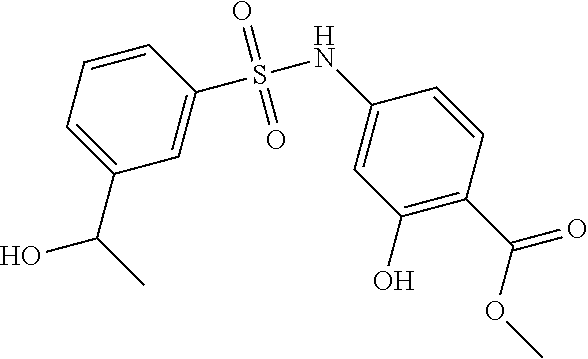
- HTBUENOSVAKXFZ-UHFFFAOYSA-N 2-hydroxy-4-[[3-(1-hydroxyethyl)phenyl]sulfonylamino]benzoic acid Chemical compound CC(O)C1=CC=CC(S(=O)(=O)NC=2C=C(O)C(C(O)=O)=CC=2)=C1 HTBUENOSVAKXFZ-UHFFFAOYSA-N 0.000 description 2
- CHICUPJPSWWMRP-UHFFFAOYSA-N 2-hydroxy-4-[[3-(2-hydroxyphenyl)-5-(trifluoromethyl)phenyl]sulfonylamino]benzoic acid Chemical compound C1=C(O)C(C(=O)O)=CC=C1NS(=O)(=O)C1=CC(C=2C(=CC=CC=2)O)=CC(C(F)(F)F)=C1 CHICUPJPSWWMRP-UHFFFAOYSA-N 0.000 description 2
- IJRMJNLDQQWTIB-UHFFFAOYSA-N 2-hydroxy-4-[[3-(2-hydroxyphenyl)phenyl]sulfonylamino]benzoic acid Chemical compound C1=C(O)C(C(=O)O)=CC=C1NS(=O)(=O)C1=CC=CC(C=2C(=CC=CC=2)O)=C1 IJRMJNLDQQWTIB-UHFFFAOYSA-N 0.000 description 2
- CDQBDMQRTXVJTJ-UHFFFAOYSA-N 2-hydroxy-4-[[3-(2-methyl-1,3-thiazol-4-yl)phenyl]sulfonylamino]benzoic acid Chemical compound S1C(C)=NC(C=2C=C(C=CC=2)S(=O)(=O)NC=2C=C(O)C(C(O)=O)=CC=2)=C1 CDQBDMQRTXVJTJ-UHFFFAOYSA-N 0.000 description 2
- NFBDFDBORIFXBI-UHFFFAOYSA-N 2-hydroxy-4-[[3-(3-propan-2-yloxycarbonylphenyl)phenyl]sulfonylamino]benzoic acid Chemical compound CC(C)OC(=O)C1=CC=CC(C=2C=C(C=CC=2)S(=O)(=O)NC=2C=C(O)C(C(O)=O)=CC=2)=C1 NFBDFDBORIFXBI-UHFFFAOYSA-N 0.000 description 2
- FZOUVCXEUKPUAR-UHFFFAOYSA-N 2-hydroxy-4-[[3-phenyl-5-(trifluoromethyl)phenyl]sulfonylamino]benzoic acid Chemical compound C1=C(O)C(C(=O)O)=CC=C1NS(=O)(=O)C1=CC(C=2C=CC=CC=2)=CC(C(F)(F)F)=C1 FZOUVCXEUKPUAR-UHFFFAOYSA-N 0.000 description 2
- CKHCNEKGKWWBNH-UHFFFAOYSA-N 2-hydroxy-4-[[4-(2-hydroxyphenyl)phenyl]methylsulfonylamino]benzoic acid Chemical compound C1=C(O)C(C(=O)O)=CC=C1NS(=O)(=O)CC1=CC=C(C=2C(=CC=CC=2)O)C=C1 CKHCNEKGKWWBNH-UHFFFAOYSA-N 0.000 description 2
- QRIAFNSSHHQLEI-UHFFFAOYSA-N 2-iodo-4-propan-2-ylphenol Chemical compound CC(C)C1=CC=C(O)C(I)=C1 QRIAFNSSHHQLEI-UHFFFAOYSA-N 0.000 description 2
- OLSYJMFARDELRE-UHFFFAOYSA-N 3,4-dibromothiophene-2-sulfonyl chloride Chemical compound ClS(=O)(=O)C=1SC=C(Br)C=1Br OLSYJMFARDELRE-UHFFFAOYSA-N 0.000 description 2
- RJSQINMKOSOUGT-UHFFFAOYSA-N 3,5-dichlorobenzenesulfonyl chloride Chemical compound ClC1=CC(Cl)=CC(S(Cl)(=O)=O)=C1 RJSQINMKOSOUGT-UHFFFAOYSA-N 0.000 description 2
- BYHQTRFJOGIQAO-GOSISDBHSA-N 3-(4-bromophenyl)-8-[(2R)-2-hydroxypropyl]-1-[(3-methoxyphenyl)methyl]-1,3,8-triazaspiro[4.5]decan-2-one Chemical compound C[C@H](CN1CCC2(CC1)CN(C(=O)N2CC3=CC(=CC=C3)OC)C4=CC=C(C=C4)Br)O BYHQTRFJOGIQAO-GOSISDBHSA-N 0.000 description 2
- RQFUZUMFPRMVDX-UHFFFAOYSA-N 3-Bromo-1-propanol Chemical compound OCCCBr RQFUZUMFPRMVDX-UHFFFAOYSA-N 0.000 description 2
- CGMBNEIGZOCPPP-UHFFFAOYSA-N 3-acetylbenzenesulfonyl chloride Chemical compound CC(=O)C1=CC=CC(S(Cl)(=O)=O)=C1 CGMBNEIGZOCPPP-UHFFFAOYSA-N 0.000 description 2
- DBVFWZMQJQMJCB-UHFFFAOYSA-N 3-boronobenzoic acid Chemical compound OB(O)C1=CC=CC(C(O)=O)=C1 DBVFWZMQJQMJCB-UHFFFAOYSA-N 0.000 description 2
- LTVLATJRJIBHDR-UHFFFAOYSA-N 3-bromo-4-methoxybenzenesulfonyl chloride Chemical compound COC1=CC=C(S(Cl)(=O)=O)C=C1Br LTVLATJRJIBHDR-UHFFFAOYSA-N 0.000 description 2
- YBUJCZFWJSUTSN-UHFFFAOYSA-N 3-bromo-5-(trifluoromethyl)benzenesulfonyl chloride Chemical compound FC(F)(F)C1=CC(Br)=CC(S(Cl)(=O)=O)=C1 YBUJCZFWJSUTSN-UHFFFAOYSA-N 0.000 description 2
- LMRKXSDOAFUINK-UHFFFAOYSA-N 3-chlorosulfonylbenzoic acid Chemical compound OC(=O)C1=CC=CC(S(Cl)(=O)=O)=C1 LMRKXSDOAFUINK-UHFFFAOYSA-N 0.000 description 2
- LYVWPJUHWBZTAY-UHFFFAOYSA-N 3-methyl-5-propan-2-yl-1-benzofuran Chemical compound CC(C)C1=CC=C2OC=C(C)C2=C1 LYVWPJUHWBZTAY-UHFFFAOYSA-N 0.000 description 2
- MTRKSXSKYOJDCO-UHFFFAOYSA-N 3-methyl-5-propan-2-yl-1-benzothiophene Chemical compound CC(C)C1=CC=C2SC=C(C)C2=C1 MTRKSXSKYOJDCO-UHFFFAOYSA-N 0.000 description 2
- SOLVEVTTXNDJTN-UHFFFAOYSA-N 3-methyl-5-propan-2-yl-1-benzothiophene-2-sulfonic acid Chemical compound CC(C)C1=CC=C2SC(S(O)(=O)=O)=C(C)C2=C1 SOLVEVTTXNDJTN-UHFFFAOYSA-N 0.000 description 2
- UOWGYMNWMDNSTL-ONEGZZNKSA-N 3PO Chemical compound C=1C=NC=CC=1C(=O)\C=C\C1=CC=CN=C1 UOWGYMNWMDNSTL-ONEGZZNKSA-N 0.000 description 2
- FWBHETKCLVMNFS-UHFFFAOYSA-N 4',6-Diamino-2-phenylindol Chemical compound C1=CC(C(=N)N)=CC=C1C1=CC2=CC=C(C(N)=N)C=C2N1 FWBHETKCLVMNFS-UHFFFAOYSA-N 0.000 description 2
- OSWFIVFLDKOXQC-UHFFFAOYSA-N 4-(3-methoxyphenyl)aniline Chemical compound COC1=CC=CC(C=2C=CC(N)=CC=2)=C1 OSWFIVFLDKOXQC-UHFFFAOYSA-N 0.000 description 2
- GWFALVUXAGYMHR-UHFFFAOYSA-N 4-(bromomethyl)-5-methyl-1,3-dioxol-2-one Chemical compound CC=1OC(=O)OC=1CBr GWFALVUXAGYMHR-UHFFFAOYSA-N 0.000 description 2
- VHYFNPMBLIVWCW-UHFFFAOYSA-N 4-Dimethylaminopyridine Chemical compound CN(C)C1=CC=NC=C1 VHYFNPMBLIVWCW-UHFFFAOYSA-N 0.000 description 2
- ZESWEOXIFLOYEB-UHFFFAOYSA-N 4-[(3-bromophenyl)methylsulfonylamino]-2-hydroxybenzoic acid Chemical compound C1=C(O)C(C(=O)O)=CC=C1NS(=O)(=O)CC1=CC=CC(Br)=C1 ZESWEOXIFLOYEB-UHFFFAOYSA-N 0.000 description 2
- DSJFKFFSMDSXMB-UHFFFAOYSA-N 4-[[3-(2,3-dihydro-1-benzofuran-5-yl)-5-(trifluoromethyl)phenyl]sulfonylamino]-2-hydroxybenzoic acid Chemical compound C1=C(O)C(C(=O)O)=CC=C1NS(=O)(=O)C1=CC(C=2C=C3CCOC3=CC=2)=CC(C(F)(F)F)=C1 DSJFKFFSMDSXMB-UHFFFAOYSA-N 0.000 description 2
- CPDHTCQYYAZGBC-UHFFFAOYSA-N 4-[[3-(2,3-dihydro-1-benzofuran-5-yl)phenyl]methylsulfonylamino]-2-hydroxybenzoic acid Chemical compound C1=C(O)C(C(=O)O)=CC=C1NS(=O)(=O)CC1=CC=CC(C=2C=C3CCOC3=CC=2)=C1 CPDHTCQYYAZGBC-UHFFFAOYSA-N 0.000 description 2
- XREWOOZZWNSMRH-UHFFFAOYSA-N 4-[[3-(2,5-difluorophenyl)-5-(trifluoromethyl)phenyl]sulfonylamino]-2-hydroxybenzoic acid Chemical compound C1=C(O)C(C(=O)O)=CC=C1NS(=O)(=O)C1=CC(C=2C(=CC=C(F)C=2)F)=CC(C(F)(F)F)=C1 XREWOOZZWNSMRH-UHFFFAOYSA-N 0.000 description 2
- IVHPBWZTKBXFEF-UHFFFAOYSA-N 4-[[3-(3-ethoxyphenyl)phenyl]sulfonylamino]-2-hydroxybenzoic acid Chemical compound CCOC1=CC=CC(C=2C=C(C=CC=2)S(=O)(=O)NC=2C=C(O)C(C(O)=O)=CC=2)=C1 IVHPBWZTKBXFEF-UHFFFAOYSA-N 0.000 description 2
- TYJAEYBBEYBHQZ-UHFFFAOYSA-N 4-[[4-(2,3-dihydro-1-benzofuran-5-yl)phenyl]methylsulfonylamino]-2-hydroxybenzoic acid Chemical compound C1=C(O)C(C(=O)O)=CC=C1NS(=O)(=O)CC1=CC=C(C=2C=C3CCOC3=CC=2)C=C1 TYJAEYBBEYBHQZ-UHFFFAOYSA-N 0.000 description 2
- VFGUMUKJZHBPPF-UHFFFAOYSA-N 4-[[4-(2,5-difluorophenyl)phenyl]methylsulfonylamino]-2-hydroxybenzoic acid Chemical compound C1=C(O)C(C(=O)O)=CC=C1NS(=O)(=O)CC1=CC=C(C=2C(=CC=C(F)C=2)F)C=C1 VFGUMUKJZHBPPF-UHFFFAOYSA-N 0.000 description 2
- KZIOKEOCXIDWBW-UHFFFAOYSA-N 4-[[5-(2,3-dihydro-1-benzofuran-5-yl)thiophen-2-yl]sulfonylamino]-2-hydroxybenzoic acid Chemical compound C1=C(O)C(C(=O)O)=CC=C1NS(=O)(=O)C1=CC=C(C=2C=C3CCOC3=CC=2)S1 KZIOKEOCXIDWBW-UHFFFAOYSA-N 0.000 description 2
- HUFXVURYQSMQIE-UHFFFAOYSA-N 4-[[5-(2,5-difluorophenyl)thiophen-2-yl]sulfonylamino]-2-hydroxybenzoic acid Chemical compound C1=C(O)C(C(=O)O)=CC=C1NS(=O)(=O)C1=CC=C(C=2C(=CC=C(F)C=2)F)S1 HUFXVURYQSMQIE-UHFFFAOYSA-N 0.000 description 2
- ROVVUNBYKMZICN-UHFFFAOYSA-N 4-[[5-chloro-4-(2-hydroxyphenyl)thiophen-2-yl]sulfonylamino]-2-hydroxybenzoic acid Chemical compound C1=C(O)C(C(=O)O)=CC=C1NS(=O)(=O)C1=CC(C=2C(=CC=CC=2)O)=C(Cl)S1 ROVVUNBYKMZICN-UHFFFAOYSA-N 0.000 description 2
- WOAZEACNYNRGOH-UHFFFAOYSA-N 4-[[5-chloro-4-(3-fluoro-4-hydroxyphenyl)thiophen-2-yl]sulfonylamino]-2-hydroxybenzoic acid Chemical compound C1=C(O)C(C(=O)O)=CC=C1NS(=O)(=O)C1=CC(C=2C=C(F)C(O)=CC=2)=C(Cl)S1 WOAZEACNYNRGOH-UHFFFAOYSA-N 0.000 description 2
- XWRGWNFXVDQGKN-UHFFFAOYSA-N 4-[[5-chloro-4-(5-fluoro-2-hydroxyphenyl)thiophen-2-yl]sulfonylamino]-2-hydroxybenzoic acid Chemical compound C1=C(O)C(C(=O)O)=CC=C1NS(=O)(=O)C1=CC(C=2C(=CC=C(F)C=2)O)=C(Cl)S1 XWRGWNFXVDQGKN-UHFFFAOYSA-N 0.000 description 2
- NAHZODWKWDZKSZ-UHFFFAOYSA-N 4-bromo-2,5-dichlorothiophene-3-sulfonyl chloride Chemical compound ClC=1SC(Cl)=C(S(Cl)(=O)=O)C=1Br NAHZODWKWDZKSZ-UHFFFAOYSA-N 0.000 description 2
- FJKROLUGYXJWQN-UHFFFAOYSA-N 4-hydroxybenzoic acid Chemical compound OC(=O)C1=CC=C(O)C=C1 FJKROLUGYXJWQN-UHFFFAOYSA-N 0.000 description 2
- YQUQWHNMBPIWGK-UHFFFAOYSA-N 4-isopropylphenol Chemical compound CC(C)C1=CC=C(O)C=C1 YQUQWHNMBPIWGK-UHFFFAOYSA-N 0.000 description 2
- 125000002373 5 membered heterocyclic group Chemical group 0.000 description 2
- RRMFMKFGHNRQPZ-UHFFFAOYSA-N 5-bromo-4-methylthiophene-2-sulfonyl chloride Chemical compound CC=1C=C(S(Cl)(=O)=O)SC=1Br RRMFMKFGHNRQPZ-UHFFFAOYSA-N 0.000 description 2
- TURGMVYIESHZBE-UHFFFAOYSA-N 5-bromo-6-chloropyridine-3-sulfonyl chloride Chemical compound ClC1=NC=C(S(Cl)(=O)=O)C=C1Br TURGMVYIESHZBE-UHFFFAOYSA-N 0.000 description 2
- WGYBIEOLAFYDEC-UHFFFAOYSA-N 5-bromothiophene-2-sulfonyl chloride Chemical compound ClS(=O)(=O)C1=CC=C(Br)S1 WGYBIEOLAFYDEC-UHFFFAOYSA-N 0.000 description 2
- LNUZRCWIMBPGIM-UHFFFAOYSA-N 5-chloro-4-(2,5-difluorophenyl)thiophene-2-sulfonyl chloride Chemical compound FC1=CC=C(F)C(C2=C(SC(=C2)S(Cl)(=O)=O)Cl)=C1 LNUZRCWIMBPGIM-UHFFFAOYSA-N 0.000 description 2
- DSTGCHNMTLFDBN-UHFFFAOYSA-N 5-chloro-4-methylthiophene-2-sulfonyl chloride Chemical compound CC=1C=C(S(Cl)(=O)=O)SC=1Cl DSTGCHNMTLFDBN-UHFFFAOYSA-N 0.000 description 2
- 125000004070 6 membered heterocyclic group Chemical group 0.000 description 2
- JRLTTZUODKEYDH-UHFFFAOYSA-N 8-methylquinoline Chemical group C1=CN=C2C(C)=CC=CC2=C1 JRLTTZUODKEYDH-UHFFFAOYSA-N 0.000 description 2
- 239000012827 ATM inhibitor Substances 0.000 description 2
- GUBGYTABKSRVRQ-XLOQQCSPSA-N Alpha-Lactose Chemical compound O[C@@H]1[C@@H](O)[C@@H](O)[C@@H](CO)O[C@H]1O[C@@H]1[C@@H](CO)O[C@H](O)[C@H](O)[C@H]1O GUBGYTABKSRVRQ-XLOQQCSPSA-N 0.000 description 2
- 229920000945 Amylopectin Polymers 0.000 description 2
- 102000002804 Ataxia Telangiectasia Mutated Proteins Human genes 0.000 description 2
- 102000036365 BRCA1 Human genes 0.000 description 2
- 108700020463 BRCA1 Proteins 0.000 description 2
- 101150072950 BRCA1 gene Proteins 0.000 description 2
- HEDRZPFGACZZDS-UHFFFAOYSA-N Chloroform Chemical compound ClC(Cl)Cl HEDRZPFGACZZDS-UHFFFAOYSA-N 0.000 description 2
- FBPFZTCFMRRESA-FSIIMWSLSA-N D-Glucitol Natural products OC[C@H](O)[C@H](O)[C@@H](O)[C@H](O)CO FBPFZTCFMRRESA-FSIIMWSLSA-N 0.000 description 2
- FBPFZTCFMRRESA-KVTDHHQDSA-N D-Mannitol Chemical compound OC[C@@H](O)[C@@H](O)[C@H](O)[C@H](O)CO FBPFZTCFMRRESA-KVTDHHQDSA-N 0.000 description 2
- FBPFZTCFMRRESA-JGWLITMVSA-N D-glucitol Chemical compound OC[C@H](O)[C@@H](O)[C@H](O)[C@H](O)CO FBPFZTCFMRRESA-JGWLITMVSA-N 0.000 description 2
- RGHNJXZEOKUKBD-SQOUGZDYSA-N D-gluconic acid Chemical compound OC[C@@H](O)[C@@H](O)[C@H](O)[C@@H](O)C(O)=O RGHNJXZEOKUKBD-SQOUGZDYSA-N 0.000 description 2
- 230000004543 DNA replication Effects 0.000 description 2
- QOSSAOTZNIDXMA-UHFFFAOYSA-N Dicylcohexylcarbodiimide Chemical compound C1CCCCC1N=C=NC1CCCCC1 QOSSAOTZNIDXMA-UHFFFAOYSA-N 0.000 description 2
- ROSDSFDQCJNGOL-UHFFFAOYSA-N Dimethylamine Chemical compound CNC ROSDSFDQCJNGOL-UHFFFAOYSA-N 0.000 description 2
- AOJJSUZBOXZQNB-TZSSRYMLSA-N Doxorubicin Chemical compound O([C@H]1C[C@@](O)(CC=2C(O)=C3C(=O)C=4C=CC=C(C=4C(=O)C3=C(O)C=21)OC)C(=O)CO)[C@H]1C[C@H](N)[C@H](O)[C@H](C)O1 AOJJSUZBOXZQNB-TZSSRYMLSA-N 0.000 description 2
- 241000792859 Enema Species 0.000 description 2
- 101710086299 Fructose-2,6-bisphosphatase Proteins 0.000 description 2
- VZCYOOQTPOCHFL-OWOJBTEDSA-N Fumaric acid Chemical compound OC(=O)\C=C\C(O)=O VZCYOOQTPOCHFL-OWOJBTEDSA-N 0.000 description 2
- 230000004668 G2/M phase Effects 0.000 description 2
- 206010061968 Gastric neoplasm Diseases 0.000 description 2
- 208000031448 Genomic Instability Diseases 0.000 description 2
- WQZGKKKJIJFFOK-GASJEMHNSA-N Glucose Natural products OC[C@H]1OC(O)[C@H](O)[C@@H](O)[C@@H]1O WQZGKKKJIJFFOK-GASJEMHNSA-N 0.000 description 2
- AEMRFAOFKBGASW-UHFFFAOYSA-N Glycolic acid Chemical compound OCC(O)=O AEMRFAOFKBGASW-UHFFFAOYSA-N 0.000 description 2
- 102100034533 Histone H2AX Human genes 0.000 description 2
- 101001067891 Homo sapiens Histone H2AX Proteins 0.000 description 2
- FBOZXECLQNJBKD-ZDUSSCGKSA-N L-methotrexate Chemical compound C=1N=C2N=C(N)N=C(N)C2=NC=1CN(C)C1=CC=C(C(=O)N[C@@H](CCC(O)=O)C(O)=O)C=C1 FBOZXECLQNJBKD-ZDUSSCGKSA-N 0.000 description 2
- JVTAAEKCZFNVCJ-UHFFFAOYSA-M Lactate Chemical compound CC(O)C([O-])=O JVTAAEKCZFNVCJ-UHFFFAOYSA-M 0.000 description 2
- GUBGYTABKSRVRQ-QKKXKWKRSA-N Lactose Natural products OC[C@H]1O[C@@H](O[C@H]2[C@H](O)[C@@H](O)C(O)O[C@@H]2CO)[C@H](O)[C@@H](O)[C@H]1O GUBGYTABKSRVRQ-QKKXKWKRSA-N 0.000 description 2
- 229930195725 Mannitol Natural products 0.000 description 2
- 241001465754 Metazoa Species 0.000 description 2
- AFVFQIVMOAPDHO-UHFFFAOYSA-N Methanesulfonic acid Chemical compound CS(O)(=O)=O AFVFQIVMOAPDHO-UHFFFAOYSA-N 0.000 description 2
- BAVYZALUXZFZLV-UHFFFAOYSA-N Methylamine Chemical compound NC BAVYZALUXZFZLV-UHFFFAOYSA-N 0.000 description 2
- AMQJEAYHLZJPGS-UHFFFAOYSA-N N-Pentanol Chemical compound CCCCCO AMQJEAYHLZJPGS-UHFFFAOYSA-N 0.000 description 2
- PCLIMKBDDGJMGD-UHFFFAOYSA-N N-bromosuccinimide Chemical compound BrN1C(=O)CCC1=O PCLIMKBDDGJMGD-UHFFFAOYSA-N 0.000 description 2
- 229910002666 PdCl2 Inorganic materials 0.000 description 2
- ISWSIDIOOBJBQZ-UHFFFAOYSA-N Phenol Chemical compound OC1=CC=CC=C1 ISWSIDIOOBJBQZ-UHFFFAOYSA-N 0.000 description 2
- 239000002202 Polyethylene glycol Substances 0.000 description 2
- LCTONWCANYUPML-UHFFFAOYSA-N Pyruvic acid Chemical compound CC(=O)C(O)=O LCTONWCANYUPML-UHFFFAOYSA-N 0.000 description 2
- 230000018199 S phase Effects 0.000 description 2
- 229930006000 Sucrose Natural products 0.000 description 2
- CZMRCDWAGMRECN-UGDNZRGBSA-N Sucrose Chemical compound O[C@H]1[C@H](O)[C@@H](CO)O[C@@]1(CO)O[C@@H]1[C@H](O)[C@@H](O)[C@H](O)[C@@H](CO)O1 CZMRCDWAGMRECN-UGDNZRGBSA-N 0.000 description 2
- 238000006069 Suzuki reaction reaction Methods 0.000 description 2
- AFHOBSCDNXGFMO-UHFFFAOYSA-N [2-(hydroxymethyl)phenyl]boronic acid Chemical compound OCC1=CC=CC=C1B(O)O AFHOBSCDNXGFMO-UHFFFAOYSA-N 0.000 description 2
- 125000000738 acetamido group Chemical group [H]C([H])([H])C(=O)N([H])[*] 0.000 description 2
- 230000004913 activation Effects 0.000 description 2
- 150000001350 alkyl halides Chemical class 0.000 description 2
- 125000004390 alkyl sulfonyl group Chemical group 0.000 description 2
- BHELZAPQIKSEDF-UHFFFAOYSA-N allyl bromide Chemical compound BrCC=C BHELZAPQIKSEDF-UHFFFAOYSA-N 0.000 description 2
- 150000001408 amides Chemical class 0.000 description 2
- 125000003277 amino group Chemical group 0.000 description 2
- 239000000538 analytical sample Substances 0.000 description 2
- 125000006615 aromatic heterocyclic group Chemical group 0.000 description 2
- 125000004618 benzofuryl group Chemical group O1C(=CC2=C1C=CC=C2)* 0.000 description 2
- WPYMKLBDIGXBTP-UHFFFAOYSA-N benzoic acid Chemical compound OC(=O)C1=CC=CC=C1 WPYMKLBDIGXBTP-UHFFFAOYSA-N 0.000 description 2
- 125000003236 benzoyl group Chemical group [H]C1=C([H])C([H])=C(C([H])=C1[H])C(*)=O 0.000 description 2
- DGDCGQDAFHJRPE-UHFFFAOYSA-N benzyl 2-acetyloxy-4-[(2-methylpropan-2-yl)oxycarbonylamino]benzoate Chemical compound CC(=O)OC1=CC(NC(=O)OC(C)(C)C)=CC=C1C(=O)OCC1=CC=CC=C1 DGDCGQDAFHJRPE-UHFFFAOYSA-N 0.000 description 2
- MUXJJLOCKWJZLG-UHFFFAOYSA-N benzyl 2-acetyloxy-4-aminobenzoate Chemical compound CC(=O)OC1=CC(N)=CC=C1C(=O)OCC1=CC=CC=C1 MUXJJLOCKWJZLG-UHFFFAOYSA-N 0.000 description 2
- PLJWDHALGQHHLA-UHFFFAOYSA-N benzyl 2-hydroxy-4-[(2-methylpropan-2-yl)oxycarbonylamino]benzoate Chemical compound OC1=CC(NC(=O)OC(C)(C)C)=CC=C1C(=O)OCC1=CC=CC=C1 PLJWDHALGQHHLA-UHFFFAOYSA-N 0.000 description 2
- 235000019445 benzyl alcohol Nutrition 0.000 description 2
- BGWGXPAPYGQALX-ARQDHWQXSA-N beta-D-fructofuranose 6-phosphate Chemical compound OC[C@@]1(O)O[C@H](COP(O)(O)=O)[C@@H](O)[C@@H]1O BGWGXPAPYGQALX-ARQDHWQXSA-N 0.000 description 2
- 230000037396 body weight Effects 0.000 description 2
- 230000022131 cell cycle Effects 0.000 description 2
- 230000030833 cell death Effects 0.000 description 2
- 230000036755 cellular response Effects 0.000 description 2
- 239000001913 cellulose Substances 0.000 description 2
- 229920002678 cellulose Polymers 0.000 description 2
- 239000007795 chemical reaction product Substances 0.000 description 2
- DQLATGHUWYMOKM-UHFFFAOYSA-L cisplatin Chemical compound N[Pt](N)(Cl)Cl DQLATGHUWYMOKM-UHFFFAOYSA-L 0.000 description 2
- 229960004316 cisplatin Drugs 0.000 description 2
- 230000008878 coupling Effects 0.000 description 2
- 238000010168 coupling process Methods 0.000 description 2
- 238000005859 coupling reaction Methods 0.000 description 2
- JHIVVAPYMSGYDF-UHFFFAOYSA-N cyclohexanone Chemical compound O=C1CCCCC1 JHIVVAPYMSGYDF-UHFFFAOYSA-N 0.000 description 2
- 230000006378 damage Effects 0.000 description 2
- 235000013681 dietary sucrose Nutrition 0.000 description 2
- 125000004598 dihydrobenzofuryl group Chemical group O1C(CC2=C1C=CC=C2)* 0.000 description 2
- XBDQKXXYIPTUBI-UHFFFAOYSA-N dimethylselenoniopropionate Natural products CCC(O)=O XBDQKXXYIPTUBI-UHFFFAOYSA-N 0.000 description 2
- 238000002330 electrospray ionisation mass spectrometry Methods 0.000 description 2
- 239000007920 enema Substances 0.000 description 2
- 229940095399 enema Drugs 0.000 description 2
- KNPRJHIGMDQJCE-UHFFFAOYSA-N ethyl 4-[(4-acetamidophenyl)sulfonylamino]-2-hydroxybenzoate Chemical compound C1=C(O)C(C(=O)OCC)=CC=C1NS(=O)(=O)C1=CC=C(NC(C)=O)C=C1 KNPRJHIGMDQJCE-UHFFFAOYSA-N 0.000 description 2
- 238000002474 experimental method Methods 0.000 description 2
- 235000019253 formic acid Nutrition 0.000 description 2
- 230000014509 gene expression Effects 0.000 description 2
- 239000008103 glucose Substances 0.000 description 2
- 230000004153 glucose metabolism Effects 0.000 description 2
- 230000012010 growth Effects 0.000 description 2
- 230000009422 growth inhibiting effect Effects 0.000 description 2
- 230000036541 health Effects 0.000 description 2
- 125000001072 heteroaryl group Chemical group 0.000 description 2
- ZSIAUFGUXNUGDI-UHFFFAOYSA-N hexan-1-ol Chemical compound CCCCCCO ZSIAUFGUXNUGDI-UHFFFAOYSA-N 0.000 description 2
- 125000001183 hydrocarbyl group Chemical group 0.000 description 2
- 230000007954 hypoxia Effects 0.000 description 2
- 230000001146 hypoxic effect Effects 0.000 description 2
- 125000000336 imidazol-5-yl group Chemical group [H]N1C([H])=NC([H])=C1[*] 0.000 description 2
- 239000012535 impurity Substances 0.000 description 2
- 238000000338 in vitro Methods 0.000 description 2
- 230000006698 induction Effects 0.000 description 2
- 230000002401 inhibitory effect Effects 0.000 description 2
- 230000000977 initiatory effect Effects 0.000 description 2
- 150000007529 inorganic bases Chemical class 0.000 description 2
- 229940030980 inova Drugs 0.000 description 2
- 238000005342 ion exchange Methods 0.000 description 2
- JVTAAEKCZFNVCJ-UHFFFAOYSA-N lactic acid Chemical compound CC(O)C(O)=O JVTAAEKCZFNVCJ-UHFFFAOYSA-N 0.000 description 2
- 239000008101 lactose Substances 0.000 description 2
- 238000011068 loading method Methods 0.000 description 2
- HQKMJHAJHXVSDF-UHFFFAOYSA-L magnesium stearate Chemical compound [Mg+2].CCCCCCCCCCCCCCCCCC([O-])=O.CCCCCCCCCCCCCCCCCC([O-])=O HQKMJHAJHXVSDF-UHFFFAOYSA-L 0.000 description 2
- 230000003211 malignant effect Effects 0.000 description 2
- 210000004962 mammalian cell Anatomy 0.000 description 2
- 239000000594 mannitol Substances 0.000 description 2
- 235000010355 mannitol Nutrition 0.000 description 2
- 238000004519 manufacturing process Methods 0.000 description 2
- 108020004999 messenger RNA Proteins 0.000 description 2
- 230000002503 metabolic effect Effects 0.000 description 2
- 230000004060 metabolic process Effects 0.000 description 2
- 229960000485 methotrexate Drugs 0.000 description 2
- WNSMSWDGOQXVTA-UHFFFAOYSA-N methyl 2-acetyloxy-4-[(2-methylpropan-2-yl)oxycarbonylamino]benzoate Chemical compound COC(=O)C1=CC=C(NC(=O)OC(C)(C)C)C=C1OC(C)=O WNSMSWDGOQXVTA-UHFFFAOYSA-N 0.000 description 2
- XAIDZIUIAZXUPM-UHFFFAOYSA-N methyl 2-acetyloxy-4-aminobenzoate Chemical compound COC(=O)C1=CC=C(N)C=C1OC(C)=O XAIDZIUIAZXUPM-UHFFFAOYSA-N 0.000 description 2
- SQNYBWMZUFSVKJ-UHFFFAOYSA-N methyl 2-hydroxy-4-[(3-methylphenyl)sulfonylamino]benzoate Chemical compound C1=C(O)C(C(=O)OC)=CC=C1NS(=O)(=O)C1=CC=CC(C)=C1 SQNYBWMZUFSVKJ-UHFFFAOYSA-N 0.000 description 2
- UYDKKQZYTWKCGZ-UHFFFAOYSA-N methyl 2-hydroxy-4-[[3-(methylcarbamoyl)phenyl]sulfonylamino]benzoate Chemical compound CNC(=O)C1=CC=CC(S(=O)(=O)NC=2C=C(O)C(C(=O)OC)=CC=2)=C1 UYDKKQZYTWKCGZ-UHFFFAOYSA-N 0.000 description 2
- FZEBQVYOKZRTOU-UHFFFAOYSA-N methyl 2-hydroxy-4-[[3-(piperidine-1-carbonyl)phenyl]sulfonylamino]benzoate Chemical compound C1=C(O)C(C(=O)OC)=CC=C1NS(=O)(=O)C1=CC=CC(C(=O)N2CCCCC2)=C1 FZEBQVYOKZRTOU-UHFFFAOYSA-N 0.000 description 2
- LFYMEVQZVCETNE-UHFFFAOYSA-N methyl 4-[(3,5-dichlorophenyl)sulfonylamino]-2-hydroxybenzoate Chemical compound C1=C(O)C(C(=O)OC)=CC=C1NS(=O)(=O)C1=CC(Cl)=CC(Cl)=C1 LFYMEVQZVCETNE-UHFFFAOYSA-N 0.000 description 2
- ZMDZXUCTSZGDOB-UHFFFAOYSA-N methyl 4-[(3-bromophenyl)methylsulfonylamino]-2-hydroxybenzoate Chemical compound C1=C(O)C(C(=O)OC)=CC=C1NS(=O)(=O)CC1=CC=CC(Br)=C1 ZMDZXUCTSZGDOB-UHFFFAOYSA-N 0.000 description 2
- LJFRLDKBBMCQQW-UHFFFAOYSA-N methyl 4-[(4-acetamidophenyl)sulfonylamino]-2-hydroxybenzoate Chemical compound C1=C(O)C(C(=O)OC)=CC=C1NS(=O)(=O)C1=CC=C(NC(C)=O)C=C1 LJFRLDKBBMCQQW-UHFFFAOYSA-N 0.000 description 2
- KPCLWGCQMAEWRC-UHFFFAOYSA-N methyl 4-[(4-tert-butylphenyl)sulfonylamino]-2-hydroxybenzoate Chemical compound C1=C(O)C(C(=O)OC)=CC=C1NS(=O)(=O)C1=CC=C(C(C)(C)C)C=C1 KPCLWGCQMAEWRC-UHFFFAOYSA-N 0.000 description 2
- GVJFBIMPMSEKJA-UHFFFAOYSA-N methyl 4-[(5-bromo-4-chlorothiophen-2-yl)sulfonylamino]-2-hydroxybenzoate Chemical compound C1=C(O)C(C(=O)OC)=CC=C1NS(=O)(=O)C1=CC(Cl)=C(Br)S1 GVJFBIMPMSEKJA-UHFFFAOYSA-N 0.000 description 2
- XXPXYIXQWXBMBF-UHFFFAOYSA-N methyl 4-[[4-(1,3-benzodioxol-5-yl)-5-chlorothiophen-2-yl]sulfonylamino]-2-hydroxybenzoate Chemical compound C1=C(O)C(C(=O)OC)=CC=C1NS(=O)(=O)C1=CC(C=2C=C3OCOC3=CC=2)=C(Cl)S1 XXPXYIXQWXBMBF-UHFFFAOYSA-N 0.000 description 2
- 150000004702 methyl esters Chemical class 0.000 description 2
- 125000000250 methylamino group Chemical group [H]N(*)C([H])([H])[H] 0.000 description 2
- 125000006606 n-butoxy group Chemical group 0.000 description 2
- DASJFYAPNPUBGG-UHFFFAOYSA-N naphthalene-1-sulfonyl chloride Chemical compound C1=CC=C2C(S(=O)(=O)Cl)=CC=CC2=C1 DASJFYAPNPUBGG-UHFFFAOYSA-N 0.000 description 2
- 125000001624 naphthyl group Chemical group 0.000 description 2
- 125000006574 non-aromatic ring group Chemical group 0.000 description 2
- 229940021182 non-steroidal anti-inflammatory drug Drugs 0.000 description 2
- 238000000655 nuclear magnetic resonance spectrum Methods 0.000 description 2
- 150000007530 organic bases Chemical class 0.000 description 2
- 125000004430 oxygen atom Chemical group O* 0.000 description 2
- 229910052763 palladium Inorganic materials 0.000 description 2
- PIBWKRNGBLPSSY-UHFFFAOYSA-L palladium(II) chloride Chemical compound Cl[Pd]Cl PIBWKRNGBLPSSY-UHFFFAOYSA-L 0.000 description 2
- ZVAKZMWUJQALGZ-UHFFFAOYSA-N phenyl 2-hydroxy-4-[(4-methylphenyl)sulfonylamino]benzoate Chemical compound C1=CC(C)=CC=C1S(=O)(=O)NC(C=C1O)=CC=C1C(=O)OC1=CC=CC=C1 ZVAKZMWUJQALGZ-UHFFFAOYSA-N 0.000 description 2
- UHZYTMXLRWXGPK-UHFFFAOYSA-N phosphorus pentachloride Chemical compound ClP(Cl)(Cl)(Cl)Cl UHZYTMXLRWXGPK-UHFFFAOYSA-N 0.000 description 2
- 230000026731 phosphorylation Effects 0.000 description 2
- 238000006366 phosphorylation reaction Methods 0.000 description 2
- 125000000587 piperidin-1-yl group Chemical group [H]C1([H])N(*)C([H])([H])C([H])([H])C([H])([H])C1([H])[H] 0.000 description 2
- 229920001223 polyethylene glycol Polymers 0.000 description 2
- 239000000843 powder Substances 0.000 description 2
- 238000012545 processing Methods 0.000 description 2
- ABMYEXAYWZJVOV-UHFFFAOYSA-N pyridin-3-ylboronic acid Chemical compound OB(O)C1=CC=CN=C1 ABMYEXAYWZJVOV-UHFFFAOYSA-N 0.000 description 2
- 125000000719 pyrrolidinyl group Chemical group 0.000 description 2
- 230000007115 recruitment Effects 0.000 description 2
- 230000003362 replicative effect Effects 0.000 description 2
- 230000004044 response Effects 0.000 description 2
- 206010039073 rheumatoid arthritis Diseases 0.000 description 2
- 229920006395 saturated elastomer Polymers 0.000 description 2
- 230000035945 sensitivity Effects 0.000 description 2
- 230000011664 signaling Effects 0.000 description 2
- 230000005783 single-strand break Effects 0.000 description 2
- 239000000600 sorbitol Substances 0.000 description 2
- 235000010356 sorbitol Nutrition 0.000 description 2
- 238000001228 spectrum Methods 0.000 description 2
- 239000007858 starting material Substances 0.000 description 2
- 229960004793 sucrose Drugs 0.000 description 2
- 235000000346 sugar Nutrition 0.000 description 2
- 239000000829 suppository Substances 0.000 description 2
- 239000006188 syrup Substances 0.000 description 2
- 235000020357 syrup Nutrition 0.000 description 2
- 230000008685 targeting Effects 0.000 description 2
- DYHSDKLCOJIUFX-UHFFFAOYSA-N tert-butoxycarbonyl anhydride Chemical compound CC(C)(C)OC(=O)OC(=O)OC(C)(C)C DYHSDKLCOJIUFX-UHFFFAOYSA-N 0.000 description 2
- VZGDMQKNWNREIO-UHFFFAOYSA-N tetrachloromethane Chemical compound ClC(Cl)(Cl)Cl VZGDMQKNWNREIO-UHFFFAOYSA-N 0.000 description 2
- 230000001225 therapeutic effect Effects 0.000 description 2
- 125000000335 thiazolyl group Chemical group 0.000 description 2
- 125000001544 thienyl group Chemical group 0.000 description 2
- FYSNRJHAOHDILO-UHFFFAOYSA-N thionyl chloride Chemical compound ClS(Cl)=O FYSNRJHAOHDILO-UHFFFAOYSA-N 0.000 description 2
- 210000001519 tissue Anatomy 0.000 description 2
- VZCYOOQTPOCHFL-UHFFFAOYSA-N trans-butenedioic acid Natural products OC(=O)C=CC(O)=O VZCYOOQTPOCHFL-UHFFFAOYSA-N 0.000 description 2
- 210000004881 tumor cell Anatomy 0.000 description 2
- 235000015112 vegetable and seed oil Nutrition 0.000 description 2
- 239000008158 vegetable oil Substances 0.000 description 2
- VCGRFBXVSFAGGA-UHFFFAOYSA-N (1,1-dioxo-1,4-thiazinan-4-yl)-[6-[[3-(4-fluorophenyl)-5-methyl-1,2-oxazol-4-yl]methoxy]pyridin-3-yl]methanone Chemical compound CC=1ON=C(C=2C=CC(F)=CC=2)C=1COC(N=C1)=CC=C1C(=O)N1CCS(=O)(=O)CC1 VCGRFBXVSFAGGA-UHFFFAOYSA-N 0.000 description 1
- GTDABJIATZHBAL-UHFFFAOYSA-N (1-methylpiperidin-4-yl) 2-hydroxy-4-[(2,4,5-trichlorothiophen-3-yl)sulfonylamino]benzoate Chemical compound C1CN(C)CCC1OC(=O)C(C(=C1)O)=CC=C1NS(=O)(=O)C1=C(Cl)SC(Cl)=C1Cl GTDABJIATZHBAL-UHFFFAOYSA-N 0.000 description 1
- RQGDLGIRBQZDMQ-UHFFFAOYSA-N (1-methylpyrrolidin-3-yl) 2-hydroxy-4-[(2,4,5-trichlorothiophen-3-yl)sulfonylamino]benzoate;2,2,2-trifluoroacetic acid Chemical compound OC(=O)C(F)(F)F.C1N(C)CCC1OC(=O)C(C(=C1)O)=CC=C1NS(=O)(=O)C1=C(Cl)SC(Cl)=C1Cl RQGDLGIRBQZDMQ-UHFFFAOYSA-N 0.000 description 1
- ZTPHFMFOKLMAAH-UHFFFAOYSA-N (2-amino-2-oxoethyl) 4-[(4,5-dichlorothiophen-2-yl)sulfonylamino]-2-hydroxybenzoate Chemical compound C1=C(O)C(C(=O)OCC(=O)N)=CC=C1NS(=O)(=O)C1=CC(Cl)=C(Cl)S1 ZTPHFMFOKLMAAH-UHFFFAOYSA-N 0.000 description 1
- SFUIGUOONHIVLG-UHFFFAOYSA-N (2-nitrophenyl)boronic acid Chemical compound OB(O)C1=CC=CC=C1[N+]([O-])=O SFUIGUOONHIVLG-UHFFFAOYSA-N 0.000 description 1
- IBTSWKLSEOGJGJ-UHFFFAOYSA-N (3-acetamidophenyl)boronic acid Chemical compound CC(=O)NC1=CC=CC(B(O)O)=C1 IBTSWKLSEOGJGJ-UHFFFAOYSA-N 0.000 description 1
- WDGWHKRJEBENCE-UHFFFAOYSA-N (3-carbamoylphenyl)boronic acid Chemical compound NC(=O)C1=CC=CC(B(O)O)=C1 WDGWHKRJEBENCE-UHFFFAOYSA-N 0.000 description 1
- SDEAGACSNFSZCU-UHFFFAOYSA-N (3-chlorophenyl)boronic acid Chemical compound OB(O)C1=CC=CC(Cl)=C1 SDEAGACSNFSZCU-UHFFFAOYSA-N 0.000 description 1
- XDBHWPLGGBLUHH-UHFFFAOYSA-N (3-cyanophenyl)boronic acid Chemical compound OB(O)C1=CC=CC(C#N)=C1 XDBHWPLGGBLUHH-UHFFFAOYSA-N 0.000 description 1
- CHCWUTJYLUBETR-UHFFFAOYSA-N (3-ethoxyphenyl)boronic acid Chemical compound CCOC1=CC=CC(B(O)O)=C1 CHCWUTJYLUBETR-UHFFFAOYSA-N 0.000 description 1
- OYNDLOJPYURCJG-UHFFFAOYSA-N (3-fluoro-4-hydroxyphenyl)boronic acid Chemical compound OB(O)C1=CC=C(O)C(F)=C1 OYNDLOJPYURCJG-UHFFFAOYSA-N 0.000 description 1
- IILGLPAJXQMKGQ-UHFFFAOYSA-N (3-fluoro-4-methoxyphenyl)boronic acid Chemical compound COC1=CC=C(B(O)O)C=C1F IILGLPAJXQMKGQ-UHFFFAOYSA-N 0.000 description 1
- IAZQAQIHUKARFL-UHFFFAOYSA-N (3-methyl-2-nitroimidazol-4-yl)methyl 4-[(4,5-dichlorothiophen-2-yl)sulfonylamino]-2-hydroxybenzoate Chemical compound N1=C([N+]([O-])=O)N(C)C(COC(=O)C=2C(=CC(NS(=O)(=O)C=3SC(Cl)=C(Cl)C=3)=CC=2)O)=C1 IAZQAQIHUKARFL-UHFFFAOYSA-N 0.000 description 1
- MXPSKMGACGAPOP-UHFFFAOYSA-N (3-methyl-2-nitroimidazol-4-yl)methyl 4-[[5-chloro-4-(2,3-dihydro-1-benzofuran-5-yl)thiophen-2-yl]sulfonylamino]-2-hydroxybenzoate Chemical compound N1=C([N+]([O-])=O)N(C)C(COC(=O)C=2C(=CC(NS(=O)(=O)C=3SC(Cl)=C(C=3)C=3C=C4CCOC4=CC=3)=CC=2)O)=C1 MXPSKMGACGAPOP-UHFFFAOYSA-N 0.000 description 1
- HZFFUMBZBGETES-UHFFFAOYSA-N (3-methylsulfonylphenyl)boronic acid Chemical compound CS(=O)(=O)C1=CC=CC(B(O)O)=C1 HZFFUMBZBGETES-UHFFFAOYSA-N 0.000 description 1
- HXVODQWMURGQMP-UHFFFAOYSA-N (3-propan-2-yloxycarbonylphenyl)boronic acid Chemical compound CC(C)OC(=O)C1=CC=CC(B(O)O)=C1 HXVODQWMURGQMP-UHFFFAOYSA-N 0.000 description 1
- VRYALKFFQXWPIH-PBXRRBTRSA-N (3r,4s,5r)-3,4,5,6-tetrahydroxyhexanal Chemical compound OC[C@@H](O)[C@@H](O)[C@H](O)CC=O VRYALKFFQXWPIH-PBXRRBTRSA-N 0.000 description 1
- MAYZWDRUFKUGGP-VIFPVBQESA-N (3s)-1-[5-tert-butyl-3-[(1-methyltetrazol-5-yl)methyl]triazolo[4,5-d]pyrimidin-7-yl]pyrrolidin-3-ol Chemical compound CN1N=NN=C1CN1C2=NC(C(C)(C)C)=NC(N3C[C@@H](O)CC3)=C2N=N1 MAYZWDRUFKUGGP-VIFPVBQESA-N 0.000 description 1
- JCIJCHSRVPSOML-UHFFFAOYSA-N (4-fluoro-3-methylphenyl)boronic acid Chemical compound CC1=CC(B(O)O)=CC=C1F JCIJCHSRVPSOML-UHFFFAOYSA-N 0.000 description 1
- WZUCSPWZHRVOSD-UHFFFAOYSA-N (4-methoxy-3,5-dimethylphenyl)boronic acid Chemical compound COC1=C(C)C=C(B(O)O)C=C1C WZUCSPWZHRVOSD-UHFFFAOYSA-N 0.000 description 1
- IVUHTLFKBDDICS-UHFFFAOYSA-N (4-methylsulfanylphenyl)boronic acid Chemical compound CSC1=CC=C(B(O)O)C=C1 IVUHTLFKBDDICS-UHFFFAOYSA-N 0.000 description 1
- DYERNBZMUOTOQW-UHFFFAOYSA-N (5-methyl-2-oxo-1,3-dioxol-4-yl)methyl 4-[(4,5-dichlorothiophen-2-yl)sulfonylamino]-2-hydroxybenzoate Chemical compound O1C(=O)OC(COC(=O)C=2C(=CC(NS(=O)(=O)C=3SC(Cl)=C(Cl)C=3)=CC=2)O)=C1C DYERNBZMUOTOQW-UHFFFAOYSA-N 0.000 description 1
- DHADXDMPEUWEAS-UHFFFAOYSA-N (6-methoxypyridin-3-yl)boronic acid Chemical compound COC1=CC=C(B(O)O)C=N1 DHADXDMPEUWEAS-UHFFFAOYSA-N 0.000 description 1
- 125000006528 (C2-C6) alkyl group Chemical group 0.000 description 1
- BJEPYKJPYRNKOW-REOHCLBHSA-N (S)-malic acid Chemical compound OC(=O)[C@@H](O)CC(O)=O BJEPYKJPYRNKOW-REOHCLBHSA-N 0.000 description 1
- UWYVPFMHMJIBHE-OWOJBTEDSA-N (e)-2-hydroxybut-2-enedioic acid Chemical compound OC(=O)\C=C(\O)C(O)=O UWYVPFMHMJIBHE-OWOJBTEDSA-N 0.000 description 1
- ZGYIXVSQHOKQRZ-COIATFDQSA-N (e)-n-[4-[3-chloro-4-(pyridin-2-ylmethoxy)anilino]-3-cyano-7-[(3s)-oxolan-3-yl]oxyquinolin-6-yl]-4-(dimethylamino)but-2-enamide Chemical compound N#CC1=CN=C2C=C(O[C@@H]3COCC3)C(NC(=O)/C=C/CN(C)C)=CC2=C1NC(C=C1Cl)=CC=C1OCC1=CC=CC=N1 ZGYIXVSQHOKQRZ-COIATFDQSA-N 0.000 description 1
- MOWXJLUYGFNTAL-DEOSSOPVSA-N (s)-[2-chloro-4-fluoro-5-(7-morpholin-4-ylquinazolin-4-yl)phenyl]-(6-methoxypyridazin-3-yl)methanol Chemical compound N1=NC(OC)=CC=C1[C@@H](O)C1=CC(C=2C3=CC=C(C=C3N=CN=2)N2CCOCC2)=C(F)C=C1Cl MOWXJLUYGFNTAL-DEOSSOPVSA-N 0.000 description 1
- UDGKZGLPXCRRAM-UHFFFAOYSA-N 1,2,5-thiadiazole Chemical compound C=1C=NSN=1 UDGKZGLPXCRRAM-UHFFFAOYSA-N 0.000 description 1
- CMHPUBKZZPSUIQ-UHFFFAOYSA-N 1,3-benzodioxol-5-ylboronic acid Chemical compound OB(O)C1=CC=C2OCOC2=C1 CMHPUBKZZPSUIQ-UHFFFAOYSA-N 0.000 description 1
- WIHIUTUAHOZVLE-UHFFFAOYSA-N 1,3-diethoxypropan-2-ol Chemical compound CCOCC(O)COCC WIHIUTUAHOZVLE-UHFFFAOYSA-N 0.000 description 1
- ZESKRVSPQJVIMH-UHFFFAOYSA-N 1,3-dimethoxypropan-2-ol Chemical compound COCC(O)COC ZESKRVSPQJVIMH-UHFFFAOYSA-N 0.000 description 1
- NFLQTPISGSKBAC-UHFFFAOYSA-N 1,3-dimethoxypropan-2-yl 4-[(3,5-dichlorophenyl)sulfonylamino]-2-hydroxybenzoate Chemical compound C1=C(O)C(C(=O)OC(COC)COC)=CC=C1NS(=O)(=O)C1=CC(Cl)=CC(Cl)=C1 NFLQTPISGSKBAC-UHFFFAOYSA-N 0.000 description 1
- ABDDQTDRAHXHOC-QMMMGPOBSA-N 1-[(7s)-5,7-dihydro-4h-thieno[2,3-c]pyran-7-yl]-n-methylmethanamine Chemical compound CNC[C@@H]1OCCC2=C1SC=C2 ABDDQTDRAHXHOC-QMMMGPOBSA-N 0.000 description 1
- RWCKBBSBRTUUHR-UHFFFAOYSA-N 1-benzofuran-2-sulfonyl chloride Chemical compound C1=CC=C2OC(S(=O)(=O)Cl)=CC2=C1 RWCKBBSBRTUUHR-UHFFFAOYSA-N 0.000 description 1
- PKRRNTJIHGOMRC-UHFFFAOYSA-N 1-benzofuran-2-ylboronic acid Chemical compound C1=CC=C2OC(B(O)O)=CC2=C1 PKRRNTJIHGOMRC-UHFFFAOYSA-N 0.000 description 1
- WYYRQMZTUXFUTC-UHFFFAOYSA-N 1-benzothiophene-3-sulfonyl chloride Chemical compound C1=CC=C2C(S(=O)(=O)Cl)=CSC2=C1 WYYRQMZTUXFUTC-UHFFFAOYSA-N 0.000 description 1
- HTDQSWDEWGSAMN-UHFFFAOYSA-N 1-bromo-2-methoxybenzene Chemical compound COC1=CC=CC=C1Br HTDQSWDEWGSAMN-UHFFFAOYSA-N 0.000 description 1
- WLXGQMVCYPUOLM-UHFFFAOYSA-N 1-hydroxyethanesulfonic acid Chemical compound CC(O)S(O)(=O)=O WLXGQMVCYPUOLM-UHFFFAOYSA-N 0.000 description 1
- GUIVUZIHEGQOEC-UHFFFAOYSA-N 1-methoxybutan-2-yl 4-[(3,5-dichlorophenyl)sulfonylamino]-2-hydroxybenzoate Chemical compound C1=C(O)C(C(=O)OC(COC)CC)=CC=C1NS(=O)(=O)C1=CC(Cl)=CC(Cl)=C1 GUIVUZIHEGQOEC-UHFFFAOYSA-N 0.000 description 1
- TUZSLEYRYGYNLC-UHFFFAOYSA-N 1-methoxybutan-2-yl 4-[(4,5-dichlorothiophen-2-yl)sulfonylamino]-2-hydroxybenzoate Chemical compound C1=C(O)C(C(=O)OC(COC)CC)=CC=C1NS(=O)(=O)C1=CC(Cl)=C(Cl)S1 TUZSLEYRYGYNLC-UHFFFAOYSA-N 0.000 description 1
- SLHXFYAOAMIOAP-UHFFFAOYSA-N 1-methoxypropan-2-yl 4-[(3,5-dichlorophenyl)sulfonylamino]-2-hydroxybenzoate Chemical compound C1=C(O)C(C(=O)OC(C)COC)=CC=C1NS(=O)(=O)C1=CC(Cl)=CC(Cl)=C1 SLHXFYAOAMIOAP-UHFFFAOYSA-N 0.000 description 1
- MFDLCINPSKIGRF-UHFFFAOYSA-N 1-methoxypropan-2-yl 4-[(4,5-dichlorothiophen-2-yl)sulfonylamino]-2-hydroxybenzoate Chemical compound C1=C(O)C(C(=O)OC(C)COC)=CC=C1NS(=O)(=O)C1=CC(Cl)=C(Cl)S1 MFDLCINPSKIGRF-UHFFFAOYSA-N 0.000 description 1
- BAUWRHPMUVYFOD-UHFFFAOYSA-N 1-methylpiperidin-4-ol Chemical compound CN1CCC(O)CC1 BAUWRHPMUVYFOD-UHFFFAOYSA-N 0.000 description 1
- FLVFPAIGVBQGET-UHFFFAOYSA-N 1-methylpyrrolidin-3-ol Chemical compound CN1CCC(O)C1 FLVFPAIGVBQGET-UHFFFAOYSA-N 0.000 description 1
- CXAICGCTHOWKPP-UHFFFAOYSA-N 2,1,3-benzothiadiazole-4-sulfonyl chloride Chemical compound ClS(=O)(=O)C1=CC=CC2=NSN=C12 CXAICGCTHOWKPP-UHFFFAOYSA-N 0.000 description 1
- PQODWTNHDKDHIW-UHFFFAOYSA-N 2,3-dichlorobenzenesulfonyl chloride Chemical compound ClC1=CC=CC(S(Cl)(=O)=O)=C1Cl PQODWTNHDKDHIW-UHFFFAOYSA-N 0.000 description 1
- WAQFYSJKIRRXLP-UHFFFAOYSA-N 2,4-dibromothiophene Chemical compound BrC1=CSC(Br)=C1 WAQFYSJKIRRXLP-UHFFFAOYSA-N 0.000 description 1
- GOPUHTXVZGIOHN-UHFFFAOYSA-N 2,4-dihydroxybenzohydrazide Chemical compound NNC(=O)C1=CC=C(O)C=C1O GOPUHTXVZGIOHN-UHFFFAOYSA-N 0.000 description 1
- BUWSFDLUTRHPBO-UHFFFAOYSA-N 2,5-dichloro-3-methylthiophene Chemical compound CC=1C=C(Cl)SC=1Cl BUWSFDLUTRHPBO-UHFFFAOYSA-N 0.000 description 1
- BXCOSWRSIISQSL-UHFFFAOYSA-N 2,5-dichlorobenzenesulfonyl chloride Chemical compound ClC1=CC=C(Cl)C(S(Cl)(=O)=O)=C1 BXCOSWRSIISQSL-UHFFFAOYSA-N 0.000 description 1
- XBVPIPOORLGFGK-UHFFFAOYSA-N 2-(1h-pyrrol-2-yl)ethanol Chemical compound OCCC1=CC=CN1 XBVPIPOORLGFGK-UHFFFAOYSA-N 0.000 description 1
- ZEMZPXWZVTUONV-UHFFFAOYSA-N 2-(2-dicyclohexylphosphanylphenyl)-n,n-dimethylaniline Chemical compound CN(C)C1=CC=CC=C1C1=CC=CC=C1P(C1CCCCC1)C1CCCCC1 ZEMZPXWZVTUONV-UHFFFAOYSA-N 0.000 description 1
- FBFQUDJTFMODRX-UHFFFAOYSA-N 2-(2-hydroxyethoxy)ethyl 4-[(2,5-dichlorothiophen-3-yl)sulfonylamino]-2-hydroxybenzoate Chemical compound C1=C(O)C(C(=O)OCCOCCO)=CC=C1NS(=O)(=O)C1=C(Cl)SC(Cl)=C1 FBFQUDJTFMODRX-UHFFFAOYSA-N 0.000 description 1
- RBHDFGBPJGEYCK-UHFFFAOYSA-N 2-(5-methyl-1h-indol-3-yl)ethylazanium;chloride Chemical compound Cl.CC1=CC=C2NC=C(CCN)C2=C1 RBHDFGBPJGEYCK-UHFFFAOYSA-N 0.000 description 1
- LBLYYCQCTBFVLH-UHFFFAOYSA-N 2-Methylbenzenesulfonic acid Chemical compound CC1=CC=CC=C1S(O)(=O)=O LBLYYCQCTBFVLH-UHFFFAOYSA-N 0.000 description 1
- MUORYJVNLAHVKL-UHFFFAOYSA-N 2-[(2-bromoacetyl)amino]ethyl dihydrogen phosphate Chemical compound OP(O)(=O)OCCNC(=O)CBr MUORYJVNLAHVKL-UHFFFAOYSA-N 0.000 description 1
- NGNBDVOYPDDBFK-UHFFFAOYSA-N 2-[2,4-di(pentan-2-yl)phenoxy]acetyl chloride Chemical compound CCCC(C)C1=CC=C(OCC(Cl)=O)C(C(C)CCC)=C1 NGNBDVOYPDDBFK-UHFFFAOYSA-N 0.000 description 1
- PUEJVAGLSYXMPY-UHFFFAOYSA-N 2-[bis(2-hydroxyethyl)amino]ethyl 4-[(2,5-dichlorothiophen-3-yl)sulfonylamino]-2-hydroxybenzoate;2,2,2-trifluoroacetic acid Chemical compound OC(=O)C(F)(F)F.C1=C(O)C(C(=O)OCCN(CCO)CCO)=CC=C1NS(=O)(=O)C1=C(Cl)SC(Cl)=C1 PUEJVAGLSYXMPY-UHFFFAOYSA-N 0.000 description 1
- UVJGXBMYXPLGQQ-UHFFFAOYSA-N 2-acetyloxy-4-[(4-methylphenyl)sulfonylamino]benzoic acid Chemical compound C1=C(C(O)=O)C(OC(=O)C)=CC(NS(=O)(=O)C=2C=CC(C)=CC=2)=C1 UVJGXBMYXPLGQQ-UHFFFAOYSA-N 0.000 description 1
- MHRHSJIWGVBMLY-UHFFFAOYSA-N 2-bromo-3-chlorothiophene Chemical compound ClC=1C=CSC=1Br MHRHSJIWGVBMLY-UHFFFAOYSA-N 0.000 description 1
- YYJBWYBULYUKMR-UHFFFAOYSA-N 2-bromo-3-methylthiophene Chemical compound CC=1C=CSC=1Br YYJBWYBULYUKMR-UHFFFAOYSA-N 0.000 description 1
- IJDKXBADDOCHCT-UHFFFAOYSA-N 2-bromo-n-(2-ethoxyethyl)acetamide Chemical class CCOCCNC(=O)CBr IJDKXBADDOCHCT-UHFFFAOYSA-N 0.000 description 1
- RLXVBFBDUXSRQW-UHFFFAOYSA-N 2-bromo-n-(2-methoxyethyl)acetamide Chemical class COCCNC(=O)CBr RLXVBFBDUXSRQW-UHFFFAOYSA-N 0.000 description 1
- MJJREPZOZWBYFR-UHFFFAOYSA-N 2-bromo-n-(3-methoxypropyl)acetamide Chemical class COCCCNC(=O)CBr MJJREPZOZWBYFR-UHFFFAOYSA-N 0.000 description 1
- KQFADYXPELMVHE-UHFFFAOYSA-N 2-chloro-3-methylthiophene Chemical compound CC=1C=CSC=1Cl KQFADYXPELMVHE-UHFFFAOYSA-N 0.000 description 1
- FCFPJKHVCHKCMP-UHFFFAOYSA-N 2-chloro-4-fluorobenzenesulfonyl chloride Chemical compound FC1=CC=C(S(Cl)(=O)=O)C(Cl)=C1 FCFPJKHVCHKCMP-UHFFFAOYSA-N 0.000 description 1
- FJVZVTWCAGCLCS-UHFFFAOYSA-N 2-chloro-6-methylbenzenesulfonyl chloride Chemical compound CC1=CC=CC(Cl)=C1S(Cl)(=O)=O FJVZVTWCAGCLCS-UHFFFAOYSA-N 0.000 description 1
- ZNQVEEAIQZEUHB-UHFFFAOYSA-N 2-ethoxyethanol Chemical compound CCOCCO ZNQVEEAIQZEUHB-UHFFFAOYSA-N 0.000 description 1
- 229940093475 2-ethoxyethanol Drugs 0.000 description 1
- GSIZAJUYWHOVLW-UHFFFAOYSA-N 2-ethoxyethyl 4-[(2,5-dichlorothiophen-3-yl)sulfonylamino]-2-hydroxybenzoate Chemical compound C1=C(O)C(C(=O)OCCOCC)=CC=C1NS(=O)(=O)C1=C(Cl)SC(Cl)=C1 GSIZAJUYWHOVLW-UHFFFAOYSA-N 0.000 description 1
- PUTFRXBJELXKSS-UHFFFAOYSA-N 2-methoxybutyl 4-[(3,5-dichlorophenyl)sulfonylamino]-2-hydroxybenzoate Chemical compound C1=C(O)C(C(=O)OCC(CC)OC)=CC=C1NS(=O)(=O)C1=CC(Cl)=CC(Cl)=C1 PUTFRXBJELXKSS-UHFFFAOYSA-N 0.000 description 1
- DBGRMCWDWHLKFD-UHFFFAOYSA-N 2-methoxybutyl 4-[(4,5-dichlorothiophen-2-yl)sulfonylamino]-2-hydroxybenzoate Chemical compound C1=C(O)C(C(=O)OCC(CC)OC)=CC=C1NS(=O)(=O)C1=CC(Cl)=C(Cl)S1 DBGRMCWDWHLKFD-UHFFFAOYSA-N 0.000 description 1
- UUAAWDSRYKZJGL-UHFFFAOYSA-N 2-methoxyethyl 2-hydroxy-4-[(2,4,5-trichlorothiophen-3-yl)sulfonylamino]benzoate Chemical compound C1=C(O)C(C(=O)OCCOC)=CC=C1NS(=O)(=O)C1=C(Cl)SC(Cl)=C1Cl UUAAWDSRYKZJGL-UHFFFAOYSA-N 0.000 description 1
- ZDOXPZDUYWDIFG-UHFFFAOYSA-N 2-methoxyethyl 4-[(2,5-dichlorothiophen-3-yl)sulfonylamino]-2-hydroxybenzoate Chemical compound C1=C(O)C(C(=O)OCCOC)=CC=C1NS(=O)(=O)C1=C(Cl)SC(Cl)=C1 ZDOXPZDUYWDIFG-UHFFFAOYSA-N 0.000 description 1
- FWQXGKBYIDNIQH-UHFFFAOYSA-N 2-methoxyethyl 4-[(3,5-dichlorophenyl)sulfonylamino]-2-hydroxybenzoate Chemical compound C1=C(O)C(C(=O)OCCOC)=CC=C1NS(=O)(=O)C1=CC(Cl)=CC(Cl)=C1 FWQXGKBYIDNIQH-UHFFFAOYSA-N 0.000 description 1
- SJUUGJAAZRKZQT-UHFFFAOYSA-N 2-methoxyethyl 4-[(4,5-dichlorothiophen-2-yl)sulfonylamino]-2-hydroxybenzoate Chemical compound C1=C(O)C(C(=O)OCCOC)=CC=C1NS(=O)(=O)C1=CC(Cl)=C(Cl)S1 SJUUGJAAZRKZQT-UHFFFAOYSA-N 0.000 description 1
- OLARIOPIYTZHCM-UHFFFAOYSA-N 2-methoxyethyl 4-[(4-bromo-2,5-dichlorothiophen-3-yl)sulfonylamino]-2-hydroxybenzoate Chemical compound C1=C(O)C(C(=O)OCCOC)=CC=C1NS(=O)(=O)C1=C(Cl)SC(Cl)=C1Br OLARIOPIYTZHCM-UHFFFAOYSA-N 0.000 description 1
- FSKISEDZPFMUKZ-UHFFFAOYSA-N 2-methoxyethyl 4-[[4-(1,3-benzodioxol-5-yl)-5-chlorothiophen-2-yl]sulfonylamino]-2-hydroxybenzoate Chemical compound C1=C(O)C(C(=O)OCCOC)=CC=C1NS(=O)(=O)C1=CC(C=2C=C3OCOC3=CC=2)=C(Cl)S1 FSKISEDZPFMUKZ-UHFFFAOYSA-N 0.000 description 1
- QUQORDRPVYQIAQ-UHFFFAOYSA-N 2-methoxyethyl 4-[[5-chloro-4-(2,3-dihydro-1-benzofuran-5-yl)thiophen-2-yl]sulfonylamino]-2-hydroxybenzoate Chemical compound C1=C(O)C(C(=O)OCCOC)=CC=C1NS(=O)(=O)C1=CC(C=2C=C3CCOC3=CC=2)=C(Cl)S1 QUQORDRPVYQIAQ-UHFFFAOYSA-N 0.000 description 1
- ZWAAMALQVVSHIY-UHFFFAOYSA-N 2-methoxyethyl 4-[[5-chloro-4-(2-hydroxyphenyl)thiophen-2-yl]sulfonylamino]-2-hydroxybenzoate Chemical compound C1=C(O)C(C(=O)OCCOC)=CC=C1NS(=O)(=O)C1=CC(C=2C(=CC=CC=2)O)=C(Cl)S1 ZWAAMALQVVSHIY-UHFFFAOYSA-N 0.000 description 1
- PIFXQHUKJBLZSQ-UHFFFAOYSA-N 2-methyl-5-(trifluoromethyl)furan-3-sulfonyl chloride Chemical compound CC=1OC(C(F)(F)F)=CC=1S(Cl)(=O)=O PIFXQHUKJBLZSQ-UHFFFAOYSA-N 0.000 description 1
- 125000004493 2-methylbut-1-yl group Chemical group CC(C*)CC 0.000 description 1
- 125000005916 2-methylpentyl group Chemical group 0.000 description 1
- QCDWFXQBSFUVSP-UHFFFAOYSA-N 2-phenoxyethanol Chemical compound OCCOC1=CC=CC=C1 QCDWFXQBSFUVSP-UHFFFAOYSA-N 0.000 description 1
- TYDCJQGDGQDASJ-UHFFFAOYSA-N 2-pyrrol-1-ylethyl 4-[(4,5-dichlorothiophen-2-yl)sulfonylamino]-2-hydroxybenzoate Chemical compound C=1C=C(C(=O)OCCN2C=CC=C2)C(O)=CC=1NS(=O)(=O)C1=CC(Cl)=C(Cl)S1 TYDCJQGDGQDASJ-UHFFFAOYSA-N 0.000 description 1
- VGKLVWTVCUDISO-UHFFFAOYSA-N 3,4-dibromothiophene Chemical compound BrC1=CSC=C1Br VGKLVWTVCUDISO-UHFFFAOYSA-N 0.000 description 1
- KSZCHVMDIOJIEF-UHFFFAOYSA-N 3,5-dibromothiophene-2-sulfonyl chloride Chemical compound ClS(=O)(=O)C=1SC(Br)=CC=1Br KSZCHVMDIOJIEF-UHFFFAOYSA-N 0.000 description 1
- 125000004211 3,5-difluorophenyl group Chemical group [H]C1=C(F)C([H])=C(*)C([H])=C1F 0.000 description 1
- HCDMJFOHIXMBOV-UHFFFAOYSA-N 3-(2,6-difluoro-3,5-dimethoxyphenyl)-1-ethyl-8-(morpholin-4-ylmethyl)-4,7-dihydropyrrolo[4,5]pyrido[1,2-d]pyrimidin-2-one Chemical compound C=1C2=C3N(CC)C(=O)N(C=4C(=C(OC)C=C(OC)C=4F)F)CC3=CN=C2NC=1CN1CCOCC1 HCDMJFOHIXMBOV-UHFFFAOYSA-N 0.000 description 1
- ZZGWJBAJNLBBRB-UHFFFAOYSA-N 3-(2-methyl-1,3-thiazol-4-yl)benzenesulfonyl chloride Chemical compound S1C(C)=NC(C=2C=C(C=CC=2)S(Cl)(=O)=O)=C1 ZZGWJBAJNLBBRB-UHFFFAOYSA-N 0.000 description 1
- LJGHYPLBDBRCRZ-UHFFFAOYSA-N 3-(3-aminophenyl)sulfonylaniline Chemical group NC1=CC=CC(S(=O)(=O)C=2C=C(N)C=CC=2)=C1 LJGHYPLBDBRCRZ-UHFFFAOYSA-N 0.000 description 1
- JKRSQNBRNIYETC-UHFFFAOYSA-N 3-(4-methylpiperazin-1-yl)propan-1-ol Chemical compound CN1CCN(CCCO)CC1 JKRSQNBRNIYETC-UHFFFAOYSA-N 0.000 description 1
- QDSOYXBUNJXQAF-UHFFFAOYSA-N 3-(4-methylpiperazin-1-yl)propyl 4-[(4,5-dichlorothiophen-2-yl)sulfonylamino]-2-hydroxybenzoate;2,2,2-trifluoroacetic acid Chemical compound OC(=O)C(F)(F)F.C1CN(C)CCN1CCCOC(=O)C(C(=C1)O)=CC=C1NS(=O)(=O)C1=CC(Cl)=C(Cl)S1 QDSOYXBUNJXQAF-UHFFFAOYSA-N 0.000 description 1
- VKSMJFRQQMGYHS-UHFFFAOYSA-N 3-(difluoromethoxy)benzenesulfonyl chloride Chemical compound FC(F)OC1=CC=CC(S(Cl)(=O)=O)=C1 VKSMJFRQQMGYHS-UHFFFAOYSA-N 0.000 description 1
- PYSGFFTXMUWEOT-UHFFFAOYSA-N 3-(dimethylamino)propan-1-ol Chemical compound CN(C)CCCO PYSGFFTXMUWEOT-UHFFFAOYSA-N 0.000 description 1
- PLDPHOKBYUAHFK-UHFFFAOYSA-N 3-(dimethylamino)propyl 4-[(4,5-dichlorothiophen-2-yl)sulfonylamino]-2-hydroxybenzoate;2,2,2-trifluoroacetic acid Chemical compound OC(=O)C(F)(F)F.C1=C(O)C(C(=O)OCCCN(C)C)=CC=C1NS(=O)(=O)C1=CC(Cl)=C(Cl)S1 PLDPHOKBYUAHFK-UHFFFAOYSA-N 0.000 description 1
- DODDSXTWDSJCDN-UHFFFAOYSA-N 3-(trifluoromethoxy)benzenesulfonyl chloride Chemical compound FC(F)(F)OC1=CC=CC(S(Cl)(=O)=O)=C1 DODDSXTWDSJCDN-UHFFFAOYSA-N 0.000 description 1
- ONCAZCNPWWQQMW-UHFFFAOYSA-N 3-(trifluoromethyl)benzenesulfonyl chloride Chemical compound FC(F)(F)C1=CC=CC(S(Cl)(=O)=O)=C1 ONCAZCNPWWQQMW-UHFFFAOYSA-N 0.000 description 1
- YZONYYUMDYXVFO-UHFFFAOYSA-N 3-[(2-methylpropan-2-yl)oxycarbonylamino]propyl 2-hydroxy-4-[(2,4,5-trichlorothiophen-3-yl)sulfonylamino]benzoate Chemical compound C1=C(O)C(C(=O)OCCCNC(=O)OC(C)(C)C)=CC=C1NS(=O)(=O)C1=C(Cl)SC(Cl)=C1Cl YZONYYUMDYXVFO-UHFFFAOYSA-N 0.000 description 1
- WNEODWDFDXWOLU-QHCPKHFHSA-N 3-[3-(hydroxymethyl)-4-[1-methyl-5-[[5-[(2s)-2-methyl-4-(oxetan-3-yl)piperazin-1-yl]pyridin-2-yl]amino]-6-oxopyridin-3-yl]pyridin-2-yl]-7,7-dimethyl-1,2,6,8-tetrahydrocyclopenta[3,4]pyrrolo[3,5-b]pyrazin-4-one Chemical compound C([C@@H](N(CC1)C=2C=NC(NC=3C(N(C)C=C(C=3)C=3C(=C(N4C(C5=CC=6CC(C)(C)CC=6N5CC4)=O)N=CC=3)CO)=O)=CC=2)C)N1C1COC1 WNEODWDFDXWOLU-QHCPKHFHSA-N 0.000 description 1
- SRVXSISGYBMIHR-UHFFFAOYSA-N 3-[3-[3-(2-amino-2-oxoethyl)phenyl]-5-chlorophenyl]-3-(5-methyl-1,3-thiazol-2-yl)propanoic acid Chemical compound S1C(C)=CN=C1C(CC(O)=O)C1=CC(Cl)=CC(C=2C=C(CC(N)=O)C=CC=2)=C1 SRVXSISGYBMIHR-UHFFFAOYSA-N 0.000 description 1
- SJGGDZCTGBKBCK-UHFFFAOYSA-N 3-acetylphenylboronic acid Chemical compound CC(=O)C1=CC=CC(B(O)O)=C1 SJGGDZCTGBKBCK-UHFFFAOYSA-N 0.000 description 1
- KSHOQKKCPJELBV-UHFFFAOYSA-N 3-bromo-2-chlorothiophene Chemical compound ClC=1SC=CC=1Br KSHOQKKCPJELBV-UHFFFAOYSA-N 0.000 description 1
- IJWGXKAPAGXFRO-UHFFFAOYSA-N 3-bromo-5-chlorothiophene-2-sulfonyl chloride Chemical compound ClC1=CC(Br)=C(S(Cl)(=O)=O)S1 IJWGXKAPAGXFRO-UHFFFAOYSA-N 0.000 description 1
- AIHNNZNZLGFLJK-UHFFFAOYSA-N 3-bromopropyl 4-[[3-(5-fluoro-2-hydroxyphenyl)phenyl]sulfonylamino]-2-hydroxybenzoate Chemical compound OC1=CC=C(F)C=C1C1=CC=CC(S(=O)(=O)NC=2C=C(O)C(C(=O)OCCCBr)=CC=2)=C1 AIHNNZNZLGFLJK-UHFFFAOYSA-N 0.000 description 1
- PDWOAONVHQTBPB-UHFFFAOYSA-N 3-bromopropyl 4-[[5-chloro-4-(5-fluoro-2-hydroxyphenyl)thiophen-2-yl]sulfonylamino]-2-hydroxybenzoate Chemical compound C1=C(C(=O)OCCCBr)C(O)=CC(NS(=O)(=O)C=2SC(Cl)=C(C=2)C=2C(=CC=C(F)C=2)O)=C1 PDWOAONVHQTBPB-UHFFFAOYSA-N 0.000 description 1
- LIRQNYQIFFLGIE-UHFFFAOYSA-N 3-chloro-2-fluorobenzenesulfonyl chloride Chemical compound FC1=C(Cl)C=CC=C1S(Cl)(=O)=O LIRQNYQIFFLGIE-UHFFFAOYSA-N 0.000 description 1
- ZSIYKAQPQRTBPF-UHFFFAOYSA-N 3-chloro-2-methylbenzenesulfonyl chloride Chemical compound CC1=C(Cl)C=CC=C1S(Cl)(=O)=O ZSIYKAQPQRTBPF-UHFFFAOYSA-N 0.000 description 1
- DXFXNSNBZNELII-UHFFFAOYSA-N 3-chloro-4-fluorobenzenesulfonyl chloride Chemical compound FC1=CC=C(S(Cl)(=O)=O)C=C1Cl DXFXNSNBZNELII-UHFFFAOYSA-N 0.000 description 1
- GNYVVCRRZRVBDD-UHFFFAOYSA-N 3-chloro-4-methylbenzenesulfonyl chloride Chemical compound CC1=CC=C(S(Cl)(=O)=O)C=C1Cl GNYVVCRRZRVBDD-UHFFFAOYSA-N 0.000 description 1
- OINWZUJVEXUHCC-UHFFFAOYSA-N 3-chlorobenzenesulfonyl chloride Chemical compound ClC1=CC=CC(S(Cl)(=O)=O)=C1 OINWZUJVEXUHCC-UHFFFAOYSA-N 0.000 description 1
- 125000004179 3-chlorophenyl group Chemical group [H]C1=C([H])C(*)=C([H])C(Cl)=C1[H] 0.000 description 1
- BHNRGBRMCNHNQD-UHFFFAOYSA-N 3-cyanobenzenesulfonyl chloride Chemical compound ClS(=O)(=O)C1=CC=CC(C#N)=C1 BHNRGBRMCNHNQD-UHFFFAOYSA-N 0.000 description 1
- 125000004180 3-fluorophenyl group Chemical group [H]C1=C([H])C(*)=C([H])C(F)=C1[H] 0.000 description 1
- FHPJOAKVMDEGSX-UHFFFAOYSA-N 3-hydroxypropyl 4-[(4,5-dichlorothiophen-2-yl)sulfonylamino]-2-hydroxybenzoate Chemical compound C1=C(O)C(C(=O)OCCCO)=CC=C1NS(=O)(=O)C1=CC(Cl)=C(Cl)S1 FHPJOAKVMDEGSX-UHFFFAOYSA-N 0.000 description 1
- RYZVYLGJZFNBND-UHFFFAOYSA-N 3-imidazol-1-ylpropan-1-ol Chemical compound OCCCN1C=CN=C1 RYZVYLGJZFNBND-UHFFFAOYSA-N 0.000 description 1
- OSUDKDUVYMWZNS-UHFFFAOYSA-N 3-imidazol-1-ylpropyl 4-[(4,5-dichlorothiophen-2-yl)sulfonylamino]-2-hydroxybenzoate;2,2,2-trifluoroacetic acid Chemical compound OC(=O)C(F)(F)F.C=1C=C(C(=O)OCCCN2C=NC=C2)C(O)=CC=1NS(=O)(=O)C1=CC(Cl)=C(Cl)S1 OSUDKDUVYMWZNS-UHFFFAOYSA-N 0.000 description 1
- JHJKSEKUZNJKGO-UHFFFAOYSA-N 3-methoxybenzenesulfonyl chloride Chemical compound COC1=CC=CC(S(Cl)(=O)=O)=C1 JHJKSEKUZNJKGO-UHFFFAOYSA-N 0.000 description 1
- PTQOMXAZTYIQPQ-UHFFFAOYSA-N 3-methyl-5-propan-2-yl-1-benzofuran-2-sulfonic acid Chemical compound CC(C)C1=CC=C2OC(S(O)(=O)=O)=C(C)C2=C1 PTQOMXAZTYIQPQ-UHFFFAOYSA-N 0.000 description 1
- KFPMLWUKHQMEBU-UHFFFAOYSA-N 3-methylbenzenesulfonyl chloride Chemical compound CC1=CC=CC(S(Cl)(=O)=O)=C1 KFPMLWUKHQMEBU-UHFFFAOYSA-N 0.000 description 1
- 125000005917 3-methylpentyl group Chemical group 0.000 description 1
- QMYJUHGGLKMRLL-UHFFFAOYSA-N 3-morpholin-4-ylpropyl 2-hydroxy-4-[(2,4,5-trichlorothiophen-3-yl)sulfonylamino]benzoate Chemical compound C=1C=C(C(=O)OCCCN2CCOCC2)C(O)=CC=1NS(=O)(=O)C1=C(Cl)SC(Cl)=C1Cl QMYJUHGGLKMRLL-UHFFFAOYSA-N 0.000 description 1
- NQJGFVKJFWWCHC-UHFFFAOYSA-N 3-morpholin-4-ylpropyl 2-hydroxy-4-[[3-(2-hydroxyphenyl)phenyl]sulfonylamino]benzoate;2,2,2-trifluoroacetic acid Chemical compound OC(=O)C(F)(F)F.OC1=CC=CC=C1C1=CC=CC(S(=O)(=O)NC=2C=C(O)C(C(=O)OCCCN3CCOCC3)=CC=2)=C1 NQJGFVKJFWWCHC-UHFFFAOYSA-N 0.000 description 1
- REPFZWJLDIYYHX-UHFFFAOYSA-N 3-morpholin-4-ylpropyl 4-[(3,5-dichlorophenyl)sulfonylamino]-2-hydroxybenzoate Chemical compound C=1C=C(C(=O)OCCCN2CCOCC2)C(O)=CC=1NS(=O)(=O)C1=CC(Cl)=CC(Cl)=C1 REPFZWJLDIYYHX-UHFFFAOYSA-N 0.000 description 1
- IJUVGTVAOXRQNZ-UHFFFAOYSA-N 3-morpholin-4-ylpropyl 4-[(4,5-dichlorothiophen-2-yl)sulfonylamino]-2-hydroxybenzoate Chemical compound C=1C=C(C(=O)OCCCN2CCOCC2)C(O)=CC=1NS(=O)(=O)C1=CC(Cl)=C(Cl)S1 IJUVGTVAOXRQNZ-UHFFFAOYSA-N 0.000 description 1
- QPFKSFWYBZSPRR-UHFFFAOYSA-N 3-morpholin-4-ylpropyl 4-[(4-bromo-2,5-dichlorothiophen-3-yl)sulfonylamino]-2-hydroxybenzoate Chemical compound C=1C=C(C(=O)OCCCN2CCOCC2)C(O)=CC=1NS(=O)(=O)C1=C(Cl)SC(Cl)=C1Br QPFKSFWYBZSPRR-UHFFFAOYSA-N 0.000 description 1
- XHMJWSPNWNGVPX-UHFFFAOYSA-N 3-morpholin-4-ylpropyl 4-[[3-(2,3-dihydro-1-benzofuran-5-yl)phenyl]sulfonylamino]-2-hydroxybenzoate;2,2,2-trifluoroacetic acid Chemical compound OC(=O)C(F)(F)F.OC1=CC(NS(=O)(=O)C=2C=C(C=CC=2)C=2C=C3CCOC3=CC=2)=CC=C1C(=O)OCCCN1CCOCC1 XHMJWSPNWNGVPX-UHFFFAOYSA-N 0.000 description 1
- IESRNNNWBAJVGG-UHFFFAOYSA-N 3-morpholin-4-ylpropyl 4-[[3-(2,5-difluorophenyl)phenyl]sulfonylamino]-2-hydroxybenzoate;2,2,2-trifluoroacetic acid Chemical compound OC(=O)C(F)(F)F.C=1C=C(C(=O)OCCCN2CCOCC2)C(O)=CC=1NS(=O)(=O)C(C=1)=CC=CC=1C1=CC(F)=CC=C1F IESRNNNWBAJVGG-UHFFFAOYSA-N 0.000 description 1
- UKCVETWYZGCGHU-UHFFFAOYSA-N 3-morpholin-4-ylpropyl 4-[[4-(1,3-benzodioxol-5-yl)-5-chlorothiophen-2-yl]sulfonylamino]-2-hydroxybenzoate Chemical compound OC1=CC(NS(=O)(=O)C=2SC(Cl)=C(C=2)C=2C=C3OCOC3=CC=2)=CC=C1C(=O)OCCCN1CCOCC1 UKCVETWYZGCGHU-UHFFFAOYSA-N 0.000 description 1
- AVSZAGZEUQPYSE-UHFFFAOYSA-N 3-morpholin-4-ylpropyl 4-[[5-chloro-4-(2,3-dihydro-1-benzofuran-5-yl)thiophen-2-yl]sulfonylamino]-2-hydroxybenzoate Chemical compound OC1=CC(NS(=O)(=O)C=2SC(Cl)=C(C=2)C=2C=C3CCOC3=CC=2)=CC=C1C(=O)OCCCN1CCOCC1 AVSZAGZEUQPYSE-UHFFFAOYSA-N 0.000 description 1
- 125000003349 3-pyridyl group Chemical group N1=C([H])C([*])=C([H])C([H])=C1[H] 0.000 description 1
- ORCXGLCMROHGOM-UHFFFAOYSA-N 3-pyrrol-1-ylpropan-1-ol Chemical compound OCCCN1C=CC=C1 ORCXGLCMROHGOM-UHFFFAOYSA-N 0.000 description 1
- NHYMVPBJYIXINJ-UHFFFAOYSA-N 3-pyrrol-1-ylpropyl 4-[(4,5-dichlorothiophen-2-yl)sulfonylamino]-2-hydroxybenzoate Chemical compound C=1C=C(C(=O)OCCCN2C=CC=C2)C(O)=CC=1NS(=O)(=O)C1=CC(Cl)=C(Cl)S1 NHYMVPBJYIXINJ-UHFFFAOYSA-N 0.000 description 1
- AOJJSUZBOXZQNB-VTZDEGQISA-N 4'-epidoxorubicin Chemical compound O([C@H]1C[C@@](O)(CC=2C(O)=C3C(=O)C=4C=CC=C(C=4C(=O)C3=C(O)C=21)OC)C(=O)CO)[C@H]1C[C@H](N)[C@@H](O)[C@H](C)O1 AOJJSUZBOXZQNB-VTZDEGQISA-N 0.000 description 1
- QYIOFABFKUOIBV-UHFFFAOYSA-N 4,5-dimethyl-1,3-dioxol-2-one Chemical compound CC=1OC(=O)OC=1C QYIOFABFKUOIBV-UHFFFAOYSA-N 0.000 description 1
- QCTOLMMTYSGTDA-UHFFFAOYSA-N 4-(dimethylamino)butan-1-ol Chemical compound CN(C)CCCCO QCTOLMMTYSGTDA-UHFFFAOYSA-N 0.000 description 1
- OZDCZHDOIBUGAJ-UHFFFAOYSA-N 4-(trifluoromethyl)benzenesulfonyl chloride Chemical compound FC(F)(F)C1=CC=C(S(Cl)(=O)=O)C=C1 OZDCZHDOIBUGAJ-UHFFFAOYSA-N 0.000 description 1
- OPUPTXSWSIRTDW-UHFFFAOYSA-N 4-[(5-chloro-4-phenylthiophen-2-yl)sulfonylamino]-2-hydroxybenzoic acid Chemical compound C1=C(O)C(C(=O)O)=CC=C1NS(=O)(=O)C1=CC(C=2C=CC=CC=2)=C(Cl)S1 OPUPTXSWSIRTDW-UHFFFAOYSA-N 0.000 description 1
- YFCIFWOJYYFDQP-PTWZRHHISA-N 4-[3-amino-6-[(1S,3S,4S)-3-fluoro-4-hydroxycyclohexyl]pyrazin-2-yl]-N-[(1S)-1-(3-bromo-5-fluorophenyl)-2-(methylamino)ethyl]-2-fluorobenzamide Chemical compound CNC[C@@H](NC(=O)c1ccc(cc1F)-c1nc(cnc1N)[C@H]1CC[C@H](O)[C@@H](F)C1)c1cc(F)cc(Br)c1 YFCIFWOJYYFDQP-PTWZRHHISA-N 0.000 description 1
- WXSKQFXQNWNGHV-UHFFFAOYSA-N 4-[[5-chloro-4-(2-fluoro-3-methoxyphenyl)thiophen-2-yl]sulfonylamino]-2-hydroxybenzoic acid Chemical compound COC1=CC=CC(C2=C(SC(=C2)S(=O)(=O)NC=2C=C(O)C(C(O)=O)=CC=2)Cl)=C1F WXSKQFXQNWNGHV-UHFFFAOYSA-N 0.000 description 1
- DOQIZRKINSRSGU-UHFFFAOYSA-N 4-[[5-chloro-4-(3-fluorophenyl)thiophen-2-yl]sulfonylamino]-2-hydroxybenzoic acid Chemical compound C1=C(O)C(C(=O)O)=CC=C1NS(=O)(=O)C1=CC(C=2C=C(F)C=CC=2)=C(Cl)S1 DOQIZRKINSRSGU-UHFFFAOYSA-N 0.000 description 1
- KVCQTKNUUQOELD-UHFFFAOYSA-N 4-amino-n-[1-(3-chloro-2-fluoroanilino)-6-methylisoquinolin-5-yl]thieno[3,2-d]pyrimidine-7-carboxamide Chemical compound N=1C=CC2=C(NC(=O)C=3C4=NC=NC(N)=C4SC=3)C(C)=CC=C2C=1NC1=CC=CC(Cl)=C1F KVCQTKNUUQOELD-UHFFFAOYSA-N 0.000 description 1
- SBMKFWMFNIEPDN-UHFFFAOYSA-N 4-bromo-2,5-difluorobenzenesulfonyl chloride Chemical compound FC1=CC(S(Cl)(=O)=O)=C(F)C=C1Br SBMKFWMFNIEPDN-UHFFFAOYSA-N 0.000 description 1
- ZLYBFBAHAQEEQQ-UHFFFAOYSA-N 4-chlorobenzenesulfonyl chloride Chemical compound ClC1=CC=C(S(Cl)(=O)=O)C=C1 ZLYBFBAHAQEEQQ-UHFFFAOYSA-N 0.000 description 1
- QEFYRYVTYJSUJE-UHFFFAOYSA-N 4-fluoronaphthalene-1-sulfonyl chloride Chemical compound C1=CC=C2C(F)=CC=C(S(Cl)(=O)=O)C2=C1 QEFYRYVTYJSUJE-UHFFFAOYSA-N 0.000 description 1
- 229940090248 4-hydroxybenzoic acid Drugs 0.000 description 1
- 125000004172 4-methoxyphenyl group Chemical group [H]C1=C([H])C(OC([H])([H])[H])=C([H])C([H])=C1* 0.000 description 1
- RHBZAIRQNOBTNS-UHFFFAOYSA-N 4-morpholin-4-ylbutan-2-ol Chemical compound CC(O)CCN1CCOCC1 RHBZAIRQNOBTNS-UHFFFAOYSA-N 0.000 description 1
- RLMPJGDYIRXQNL-UHFFFAOYSA-N 4-morpholin-4-ylbutan-2-yl 4-[(4,5-dichlorothiophen-2-yl)sulfonylamino]-2-hydroxybenzoate Chemical compound C=1C=C(NS(=O)(=O)C=2SC(Cl)=C(Cl)C=2)C=C(O)C=1C(=O)OC(C)CCN1CCOCC1 RLMPJGDYIRXQNL-UHFFFAOYSA-N 0.000 description 1
- MNAGQUFZYPYZBH-UHFFFAOYSA-N 4-morpholin-4-ylbutyl 2-hydroxy-4-[(2,4,5-trichlorothiophen-3-yl)sulfonylamino]benzoate;2,2,2-trifluoroacetic acid Chemical compound OC(=O)C(F)(F)F.C=1C=C(C(=O)OCCCCN2CCOCC2)C(O)=CC=1NS(=O)(=O)C1=C(Cl)SC(Cl)=C1Cl MNAGQUFZYPYZBH-UHFFFAOYSA-N 0.000 description 1
- SFKTXRAPCGHVQK-UHFFFAOYSA-N 4-morpholin-4-ylbutyl 4-[[3-(2,3-dihydro-1-benzofuran-5-yl)phenyl]sulfonylamino]-2-hydroxybenzoate;2,2,2-trifluoroacetic acid Chemical compound OC(=O)C(F)(F)F.OC1=CC(NS(=O)(=O)C=2C=C(C=CC=2)C=2C=C3CCOC3=CC=2)=CC=C1C(=O)OCCCCN1CCOCC1 SFKTXRAPCGHVQK-UHFFFAOYSA-N 0.000 description 1
- RQASNHIUEGHLGT-UHFFFAOYSA-N 4-morpholin-4-ylbutyl 4-[[3-(2,5-difluorophenyl)phenyl]sulfonylamino]-2-hydroxybenzoate;2,2,2-trifluoroacetic acid Chemical compound OC(=O)C(F)(F)F.C=1C=C(C(=O)OCCCCN2CCOCC2)C(O)=CC=1NS(=O)(=O)C(C=1)=CC=CC=1C1=CC(F)=CC=C1F RQASNHIUEGHLGT-UHFFFAOYSA-N 0.000 description 1
- XAUCTCIRKRGBJF-UHFFFAOYSA-N 4-morpholin-4-ylbutyl 4-[[3-(5-fluoro-2-hydroxyphenyl)phenyl]sulfonylamino]-2-hydroxybenzoate;2,2,2-trifluoroacetic acid Chemical compound OC(=O)C(F)(F)F.OC1=CC=C(F)C=C1C1=CC=CC(S(=O)(=O)NC=2C=C(O)C(C(=O)OCCCCN3CCOCC3)=CC=2)=C1 XAUCTCIRKRGBJF-UHFFFAOYSA-N 0.000 description 1
- ALBQXDHCMLLQMB-UHFFFAOYSA-N 4-phenylbenzenesulfonyl chloride Chemical compound C1=CC(S(=O)(=O)Cl)=CC=C1C1=CC=CC=C1 ALBQXDHCMLLQMB-UHFFFAOYSA-N 0.000 description 1
- APDUDRFJNCIWAG-UHFFFAOYSA-N 4-propan-2-ylbenzenethiol Chemical compound CC(C)C1=CC=C(S)C=C1 APDUDRFJNCIWAG-UHFFFAOYSA-N 0.000 description 1
- 125000000339 4-pyridyl group Chemical group N1=C([H])C([H])=C([*])C([H])=C1[H] 0.000 description 1
- YEZADZMMVHWFIY-UHFFFAOYSA-N 4-tert-butylbenzenesulfonyl chloride Chemical compound CC(C)(C)C1=CC=C(S(Cl)(=O)=O)C=C1 YEZADZMMVHWFIY-UHFFFAOYSA-N 0.000 description 1
- 125000004863 4-trifluoromethoxyphenyl group Chemical group [H]C1=C([H])C(OC(F)(F)F)=C([H])C([H])=C1* 0.000 description 1
- 125000004199 4-trifluoromethylphenyl group Chemical group [H]C1=C([H])C(=C([H])C([H])=C1*)C(F)(F)F 0.000 description 1
- VGSWVDWOXYTAPG-UHFFFAOYSA-N 5-(benzamidomethyl)thiophene-2-sulfonyl chloride Chemical compound S1C(S(=O)(=O)Cl)=CC=C1CNC(=O)C1=CC=CC=C1 VGSWVDWOXYTAPG-UHFFFAOYSA-N 0.000 description 1
- LYXZELUTRQIZBV-UHFFFAOYSA-N 5-[(3-hydroxy-4-methoxycarbonylphenyl)sulfamoyl]-2-methoxybenzoic acid Chemical compound C1=C(O)C(C(=O)OC)=CC=C1NS(=O)(=O)C1=CC=C(OC)C(C(O)=O)=C1 LYXZELUTRQIZBV-UHFFFAOYSA-N 0.000 description 1
- IRPVABHDSJVBNZ-RTHVDDQRSA-N 5-[1-(cyclopropylmethyl)-5-[(1R,5S)-3-(oxetan-3-yl)-3-azabicyclo[3.1.0]hexan-6-yl]pyrazol-3-yl]-3-(trifluoromethyl)pyridin-2-amine Chemical compound C1=C(C(F)(F)F)C(N)=NC=C1C1=NN(CC2CC2)C(C2[C@@H]3CN(C[C@@H]32)C2COC2)=C1 IRPVABHDSJVBNZ-RTHVDDQRSA-N 0.000 description 1
- GSNAPAYUOACKRN-UHFFFAOYSA-N 5-bromo-2,4-difluorobenzenesulfonyl chloride Chemical compound FC1=CC(F)=C(S(Cl)(=O)=O)C=C1Br GSNAPAYUOACKRN-UHFFFAOYSA-N 0.000 description 1
- NJCXGFKPQSFZIB-RRKCRQDMSA-N 5-chloro-1-[(2r,4s,5r)-4-hydroxy-5-(hydroxymethyl)oxolan-2-yl]pyrimidine-2,4-dione Chemical compound C1[C@H](O)[C@@H](CO)O[C@H]1N1C(=O)NC(=O)C(Cl)=C1 NJCXGFKPQSFZIB-RRKCRQDMSA-N 0.000 description 1
- XMNXVDULKLCZFG-UHFFFAOYSA-N 5-chloro-2,4-difluorobenzenesulfonyl chloride Chemical compound FC1=CC(F)=C(S(Cl)(=O)=O)C=C1Cl XMNXVDULKLCZFG-UHFFFAOYSA-N 0.000 description 1
- OZKAHSNNKADHTK-UHFFFAOYSA-N 5-chloro-2-fluorobenzenesulfonyl chloride Chemical compound FC1=CC=C(Cl)C=C1S(Cl)(=O)=O OZKAHSNNKADHTK-UHFFFAOYSA-N 0.000 description 1
- DHBNCOJCAHYKBT-UHFFFAOYSA-N 5-chloro-2-methylthiophene-3-sulfonyl chloride Chemical compound CC=1SC(Cl)=CC=1S(Cl)(=O)=O DHBNCOJCAHYKBT-UHFFFAOYSA-N 0.000 description 1
- SORSTNOXGOXWAO-UHFFFAOYSA-N 5-chlorothiophene-2-sulfonyl chloride Chemical compound ClC1=CC=C(S(Cl)(=O)=O)S1 SORSTNOXGOXWAO-UHFFFAOYSA-N 0.000 description 1
- VMFALDWCEQUFSX-UHFFFAOYSA-N 6-(4,4,5,5-tetramethyl-1,3,2-dioxaborolan-2-yl)quinoline Chemical compound O1C(C)(C)C(C)(C)OB1C1=CC=C(N=CC=C2)C2=C1 VMFALDWCEQUFSX-UHFFFAOYSA-N 0.000 description 1
- KCBWAFJCKVKYHO-UHFFFAOYSA-N 6-(4-cyclopropyl-6-methoxypyrimidin-5-yl)-1-[[4-[1-propan-2-yl-4-(trifluoromethyl)imidazol-2-yl]phenyl]methyl]pyrazolo[3,4-d]pyrimidine Chemical compound C1(CC1)C1=NC=NC(=C1C1=NC=C2C(=N1)N(N=C2)CC1=CC=C(C=C1)C=1N(C=C(N=1)C(F)(F)F)C(C)C)OC KCBWAFJCKVKYHO-UHFFFAOYSA-N 0.000 description 1
- BXJHWYVXLGLDMZ-UHFFFAOYSA-N 6-O-methylguanine Chemical compound COC1=NC(N)=NC2=C1NC=N2 BXJHWYVXLGLDMZ-UHFFFAOYSA-N 0.000 description 1
- ZCYVEMRRCGMTRW-UHFFFAOYSA-N 7553-56-2 Chemical compound [I] ZCYVEMRRCGMTRW-UHFFFAOYSA-N 0.000 description 1
- CYJRNFFLTBEQSQ-UHFFFAOYSA-N 8-(3-methyl-1-benzothiophen-5-yl)-N-(4-methylsulfonylpyridin-3-yl)quinoxalin-6-amine Chemical compound CS(=O)(=O)C1=C(C=NC=C1)NC=1C=C2N=CC=NC2=C(C=1)C=1C=CC2=C(C(=CS2)C)C=1 CYJRNFFLTBEQSQ-UHFFFAOYSA-N 0.000 description 1
- NLXLAEXVIDQMFP-UHFFFAOYSA-N Ammonia chloride Chemical class [NH4+].[Cl-] NLXLAEXVIDQMFP-UHFFFAOYSA-N 0.000 description 1
- QGZKDVFQNNGYKY-UHFFFAOYSA-O Ammonium Chemical compound [NH4+] QGZKDVFQNNGYKY-UHFFFAOYSA-O 0.000 description 1
- VHUUQVKOLVNVRT-UHFFFAOYSA-N Ammonium hydroxide Chemical compound [NH4+].[OH-] VHUUQVKOLVNVRT-UHFFFAOYSA-N 0.000 description 1
- CIWBSHSKHKDKBQ-JLAZNSOCSA-N Ascorbic acid Natural products OC[C@H](O)[C@H]1OC(=O)C(O)=C1O CIWBSHSKHKDKBQ-JLAZNSOCSA-N 0.000 description 1
- BSYNRYMUTXBXSQ-UHFFFAOYSA-N Aspirin Chemical compound CC(=O)OC1=CC=CC=C1C(O)=O BSYNRYMUTXBXSQ-UHFFFAOYSA-N 0.000 description 1
- 206010003571 Astrocytoma Diseases 0.000 description 1
- 239000005711 Benzoic acid Substances 0.000 description 1
- 239000004342 Benzoyl peroxide Substances 0.000 description 1
- OMPJBNCRMGITSC-UHFFFAOYSA-N Benzoylperoxide Chemical compound C=1C=CC=CC=1C(=O)OOC(=O)C1=CC=CC=C1 OMPJBNCRMGITSC-UHFFFAOYSA-N 0.000 description 1
- BVKZGUZCCUSVTD-UHFFFAOYSA-M Bicarbonate Chemical class OC([O-])=O BVKZGUZCCUSVTD-UHFFFAOYSA-M 0.000 description 1
- LSNNMFCWUKXFEE-UHFFFAOYSA-M Bisulfite Chemical compound OS([O-])=O LSNNMFCWUKXFEE-UHFFFAOYSA-M 0.000 description 1
- 241000283690 Bos taurus Species 0.000 description 1
- WKBOTKDWSSQWDR-UHFFFAOYSA-N Bromine atom Chemical compound [Br] WKBOTKDWSSQWDR-UHFFFAOYSA-N 0.000 description 1
- GAWIXWVDTYZWAW-UHFFFAOYSA-N C[CH]O Chemical group C[CH]O GAWIXWVDTYZWAW-UHFFFAOYSA-N 0.000 description 1
- GAGWJHPBXLXJQN-UORFTKCHSA-N Capecitabine Chemical compound C1=C(F)C(NC(=O)OCCCCC)=NC(=O)N1[C@H]1[C@H](O)[C@H](O)[C@@H](C)O1 GAGWJHPBXLXJQN-UORFTKCHSA-N 0.000 description 1
- GAGWJHPBXLXJQN-UHFFFAOYSA-N Capecitabine Natural products C1=C(F)C(NC(=O)OCCCCC)=NC(=O)N1C1C(O)C(O)C(C)O1 GAGWJHPBXLXJQN-UHFFFAOYSA-N 0.000 description 1
- 101710167800 Capsid assembly scaffolding protein Proteins 0.000 description 1
- 229920002134 Carboxymethyl cellulose Polymers 0.000 description 1
- ZAMOUSCENKQFHK-UHFFFAOYSA-N Chlorine atom Chemical compound [Cl] ZAMOUSCENKQFHK-UHFFFAOYSA-N 0.000 description 1
- 229920002261 Corn starch Polymers 0.000 description 1
- GSXOAOHZAIYLCY-UHFFFAOYSA-N D-F6P Natural products OCC(=O)C(O)C(O)C(O)COP(O)(O)=O GSXOAOHZAIYLCY-UHFFFAOYSA-N 0.000 description 1
- RGHNJXZEOKUKBD-UHFFFAOYSA-N D-gluconic acid Natural products OCC(O)C(O)C(O)C(O)C(O)=O RGHNJXZEOKUKBD-UHFFFAOYSA-N 0.000 description 1
- 230000007035 DNA breakage Effects 0.000 description 1
- 230000012746 DNA damage checkpoint Effects 0.000 description 1
- FEWJPZIEWOKRBE-JCYAYHJZSA-N Dextrotartaric acid Chemical compound OC(=O)[C@H](O)[C@@H](O)C(O)=O FEWJPZIEWOKRBE-JCYAYHJZSA-N 0.000 description 1
- 101100191383 Dictyostelium discoideum dnapkcs gene Proteins 0.000 description 1
- 239000004150 EU approved colour Substances 0.000 description 1
- 102000004190 Enzymes Human genes 0.000 description 1
- 108090000790 Enzymes Proteins 0.000 description 1
- 206010014967 Ependymoma Diseases 0.000 description 1
- HTIJFSOGRVMCQR-UHFFFAOYSA-N Epirubicin Natural products COc1cccc2C(=O)c3c(O)c4CC(O)(CC(OC5CC(N)C(=O)C(C)O5)c4c(O)c3C(=O)c12)C(=O)CO HTIJFSOGRVMCQR-UHFFFAOYSA-N 0.000 description 1
- GPZRGEIVIJSTIN-UHFFFAOYSA-N FC(C(=O)O)(F)F.FC=1C=CC(=C(C1)C1=CC(=CC=C1)S(=O)(=O)NC1=CC(=C(C(=O)OCCCN2CCOCC2)C=C1)O)O Chemical compound FC(C(=O)O)(F)F.FC=1C=CC(=C(C1)C1=CC(=CC=C1)S(=O)(=O)NC1=CC(=C(C(=O)OCCCN2CCOCC2)C=C1)O)O GPZRGEIVIJSTIN-UHFFFAOYSA-N 0.000 description 1
- DHRNBPPMYYBGNH-UHFFFAOYSA-N FC(C(=O)O)(F)F.OC1=C(C(=O)OCCCCN(C)C)C=CC(=C1)NS(=O)(=O)C1=CC(=CC=C1)C=1N=C(SC1)C Chemical compound FC(C(=O)O)(F)F.OC1=C(C(=O)OCCCCN(C)C)C=CC(=C1)NS(=O)(=O)C1=CC(=CC=C1)C=1N=C(SC1)C DHRNBPPMYYBGNH-UHFFFAOYSA-N 0.000 description 1
- GISRWBROCYNDME-PELMWDNLSA-N F[C@H]1[C@H]([C@H](NC1=O)COC1=NC=CC2=CC(=C(C=C12)OC)C(=O)N)C Chemical compound F[C@H]1[C@H]([C@H](NC1=O)COC1=NC=CC2=CC(=C(C=C12)OC)C(=O)N)C GISRWBROCYNDME-PELMWDNLSA-N 0.000 description 1
- 241000282326 Felis catus Species 0.000 description 1
- PXGOKWXKJXAPGV-UHFFFAOYSA-N Fluorine Chemical compound FF PXGOKWXKJXAPGV-UHFFFAOYSA-N 0.000 description 1
- GHASVSINZRGABV-UHFFFAOYSA-N Fluorouracil Chemical compound FC1=CNC(=O)NC1=O GHASVSINZRGABV-UHFFFAOYSA-N 0.000 description 1
- YXWOAJXNVLXPMU-ZXXMMSQZSA-N Fructose 2,6-diphosphate Chemical compound OP(=O)(O)O[C@]1(CO)O[C@H](COP(O)(O)=O)[C@@H](O)[C@@H]1O YXWOAJXNVLXPMU-ZXXMMSQZSA-N 0.000 description 1
- 230000010337 G2 phase Effects 0.000 description 1
- 101100264215 Gallus gallus XRCC6 gene Proteins 0.000 description 1
- 108010010803 Gelatin Proteins 0.000 description 1
- GVGLGOZIDCSQPN-PVHGPHFFSA-N Heroin Chemical compound O([C@H]1[C@H](C=C[C@H]23)OC(C)=O)C4=C5[C@@]12CCN(C)[C@@H]3CC5=CC=C4OC(C)=O GVGLGOZIDCSQPN-PVHGPHFFSA-N 0.000 description 1
- 102000005548 Hexokinase Human genes 0.000 description 1
- 108700040460 Hexokinases Proteins 0.000 description 1
- 108010033040 Histones Proteins 0.000 description 1
- 101000620735 Homo sapiens DNA repair protein RAD51 homolog 1 Proteins 0.000 description 1
- XQFRJNBWHJMXHO-RRKCRQDMSA-N IDUR Chemical compound C1[C@H](O)[C@@H](CO)O[C@H]1N1C(=O)NC(=O)C(I)=C1 XQFRJNBWHJMXHO-RRKCRQDMSA-N 0.000 description 1
- HEFNNWSXXWATRW-UHFFFAOYSA-N Ibuprofen Chemical compound CC(C)CC1=CC=C(C(C)C(O)=O)C=C1 HEFNNWSXXWATRW-UHFFFAOYSA-N 0.000 description 1
- 108010044467 Isoenzymes Proteins 0.000 description 1
- 208000000172 Medulloblastoma Diseases 0.000 description 1
- 241000699670 Mus sp. Species 0.000 description 1
- AYCPARAPKDAOEN-LJQANCHMSA-N N-[(1S)-2-(dimethylamino)-1-phenylethyl]-6,6-dimethyl-3-[(2-methyl-4-thieno[3,2-d]pyrimidinyl)amino]-1,4-dihydropyrrolo[3,4-c]pyrazole-5-carboxamide Chemical compound C1([C@H](NC(=O)N2C(C=3NN=C(NC=4C=5SC=CC=5N=C(C)N=4)C=3C2)(C)C)CN(C)C)=CC=CC=C1 AYCPARAPKDAOEN-LJQANCHMSA-N 0.000 description 1
- ZDZOTLJHXYCWBA-VCVYQWHSSA-N N-debenzoyl-N-(tert-butoxycarbonyl)-10-deacetyltaxol Chemical compound O([C@H]1[C@H]2[C@@](C([C@H](O)C3=C(C)[C@@H](OC(=O)[C@H](O)[C@@H](NC(=O)OC(C)(C)C)C=4C=CC=CC=4)C[C@]1(O)C3(C)C)=O)(C)[C@@H](O)C[C@H]1OC[C@]12OC(=O)C)C(=O)C1=CC=CC=C1 ZDZOTLJHXYCWBA-VCVYQWHSSA-N 0.000 description 1
- 150000001204 N-oxides Chemical group 0.000 description 1
- 238000011786 NMRI nude mouse Methods 0.000 description 1
- CMWTZPSULFXXJA-UHFFFAOYSA-N Naproxen Natural products C1=C(C(C)C(O)=O)C=CC2=CC(OC)=CC=C21 CMWTZPSULFXXJA-UHFFFAOYSA-N 0.000 description 1
- GRYLNZFGIOXLOG-UHFFFAOYSA-N Nitric acid Chemical compound O[N+]([O-])=O GRYLNZFGIOXLOG-UHFFFAOYSA-N 0.000 description 1
- IDRGFNPZDVBSSE-UHFFFAOYSA-N OCCN1CCN(CC1)c1ccc(Nc2ncc3cccc(-c4cccc(NC(=O)C=C)c4)c3n2)c(F)c1F Chemical compound OCCN1CCN(CC1)c1ccc(Nc2ncc3cccc(-c4cccc(NC(=O)C=C)c4)c3n2)c(F)c1F IDRGFNPZDVBSSE-UHFFFAOYSA-N 0.000 description 1
- 201000010133 Oligodendroglioma Diseases 0.000 description 1
- 108700020796 Oncogene Proteins 0.000 description 1
- 241000283973 Oryctolagus cuniculus Species 0.000 description 1
- 238000012879 PET imaging Methods 0.000 description 1
- 239000005662 Paraffin oil Substances 0.000 description 1
- 241001494479 Pecora Species 0.000 description 1
- 102000012435 Phosphofructokinase-1 Human genes 0.000 description 1
- 108010022684 Phosphofructokinase-1 Proteins 0.000 description 1
- 108090000608 Phosphoric Monoester Hydrolases Proteins 0.000 description 1
- 102000004160 Phosphoric Monoester Hydrolases Human genes 0.000 description 1
- 101710130420 Probable capsid assembly scaffolding protein Proteins 0.000 description 1
- OFOBLEOULBTSOW-UHFFFAOYSA-N Propanedioic acid Natural products OC(=O)CC(O)=O OFOBLEOULBTSOW-UHFFFAOYSA-N 0.000 description 1
- 241000283984 Rodentia Species 0.000 description 1
- 101710204410 Scaffold protein Proteins 0.000 description 1
- 229920002472 Starch Polymers 0.000 description 1
- KDYFGRWQOYBRFD-UHFFFAOYSA-N Succinic acid Natural products OC(=O)CCC(O)=O KDYFGRWQOYBRFD-UHFFFAOYSA-N 0.000 description 1
- NINIDFKCEFEMDL-UHFFFAOYSA-N Sulfur Chemical compound [S] NINIDFKCEFEMDL-UHFFFAOYSA-N 0.000 description 1
- 239000005864 Sulphur Substances 0.000 description 1
- 102100034107 TP53-binding protein 1 Human genes 0.000 description 1
- 101710156963 TP53-binding protein 1 Proteins 0.000 description 1
- FEWJPZIEWOKRBE-UHFFFAOYSA-N Tartaric acid Natural products [H+].[H+].[O-]C(=O)C(O)C(O)C([O-])=O FEWJPZIEWOKRBE-UHFFFAOYSA-N 0.000 description 1
- GSEJCLTVZPLZKY-UHFFFAOYSA-N Triethanolamine Chemical compound OCCN(CCO)CCO GSEJCLTVZPLZKY-UHFFFAOYSA-N 0.000 description 1
- 102100036976 X-ray repair cross-complementing protein 6 Human genes 0.000 description 1
- LXRZVMYMQHNYJB-UNXOBOICSA-N [(1R,2S,4R)-4-[[5-[4-[(1R)-7-chloro-1,2,3,4-tetrahydroisoquinolin-1-yl]-5-methylthiophene-2-carbonyl]pyrimidin-4-yl]amino]-2-hydroxycyclopentyl]methyl sulfamate Chemical compound CC1=C(C=C(S1)C(=O)C1=C(N[C@H]2C[C@H](O)[C@@H](COS(N)(=O)=O)C2)N=CN=C1)[C@@H]1NCCC2=C1C=C(Cl)C=C2 LXRZVMYMQHNYJB-UNXOBOICSA-N 0.000 description 1
- QJYYVSIRDJVQJW-UHFFFAOYSA-N [4-(dimethylcarbamoyl)phenyl]boronic acid Chemical compound CN(C)C(=O)C1=CC=C(B(O)O)C=C1 QJYYVSIRDJVQJW-UHFFFAOYSA-N 0.000 description 1
- HUOFUOCSQCYFPW-UHFFFAOYSA-N [4-(trifluoromethoxy)phenyl]boronic acid Chemical compound OB(O)C1=CC=C(OC(F)(F)F)C=C1 HUOFUOCSQCYFPW-UHFFFAOYSA-N 0.000 description 1
- ALMFIOZYDASRRC-UHFFFAOYSA-N [4-(trifluoromethyl)phenyl]boronic acid Chemical compound OB(O)C1=CC=C(C(F)(F)F)C=C1 ALMFIOZYDASRRC-UHFFFAOYSA-N 0.000 description 1
- 229940022682 acetone Drugs 0.000 description 1
- WETWJCDKMRHUPV-UHFFFAOYSA-N acetyl chloride Chemical compound CC(Cl)=O WETWJCDKMRHUPV-UHFFFAOYSA-N 0.000 description 1
- 239000012346 acetyl chloride Substances 0.000 description 1
- 229960001138 acetylsalicylic acid Drugs 0.000 description 1
- 230000000758 acidotic effect Effects 0.000 description 1
- 230000009471 action Effects 0.000 description 1
- 239000004480 active ingredient Substances 0.000 description 1
- 230000006978 adaptation Effects 0.000 description 1
- 229960001456 adenosine triphosphate Drugs 0.000 description 1
- 125000002723 alicyclic group Chemical group 0.000 description 1
- 125000001931 aliphatic group Chemical group 0.000 description 1
- 229910001854 alkali hydroxide Inorganic materials 0.000 description 1
- 229910001860 alkaline earth metal hydroxide Inorganic materials 0.000 description 1
- 238000005904 alkaline hydrolysis reaction Methods 0.000 description 1
- 239000012670 alkaline solution Substances 0.000 description 1
- 150000004703 alkoxides Chemical class 0.000 description 1
- 125000004656 alkyl sulfonylamino group Chemical group 0.000 description 1
- 230000002152 alkylating effect Effects 0.000 description 1
- 230000029936 alkylation Effects 0.000 description 1
- 238000005804 alkylation reaction Methods 0.000 description 1
- 238000005937 allylation reaction Methods 0.000 description 1
- PMMURAAUARKVCB-UHFFFAOYSA-N alpha-D-ara-dHexp Natural products OCC1OC(O)CC(O)C1O PMMURAAUARKVCB-UHFFFAOYSA-N 0.000 description 1
- BJEPYKJPYRNKOW-UHFFFAOYSA-N alpha-hydroxysuccinic acid Natural products OC(=O)C(O)CC(O)=O BJEPYKJPYRNKOW-UHFFFAOYSA-N 0.000 description 1
- 229910052782 aluminium Inorganic materials 0.000 description 1
- XAGFODPZIPBFFR-UHFFFAOYSA-N aluminium Chemical compound [Al] XAGFODPZIPBFFR-UHFFFAOYSA-N 0.000 description 1
- VZTDIZULWFCMLS-UHFFFAOYSA-N ammonium formate Chemical compound [NH4+].[O-]C=O VZTDIZULWFCMLS-UHFFFAOYSA-N 0.000 description 1
- 239000000908 ammonium hydroxide Substances 0.000 description 1
- 238000004458 analytical method Methods 0.000 description 1
- 125000002490 anilino group Chemical group [H]N(*)C1=C([H])C([H])=C([H])C([H])=C1[H] 0.000 description 1
- 229940121363 anti-inflammatory agent Drugs 0.000 description 1
- 239000002260 anti-inflammatory agent Substances 0.000 description 1
- 238000011861 anti-inflammatory therapy Methods 0.000 description 1
- 230000001028 anti-proliverative effect Effects 0.000 description 1
- 230000000692 anti-sense effect Effects 0.000 description 1
- 238000011319 anticancer therapy Methods 0.000 description 1
- 239000002246 antineoplastic agent Substances 0.000 description 1
- 229940034982 antineoplastic agent Drugs 0.000 description 1
- 230000006907 apoptotic process Effects 0.000 description 1
- 239000007864 aqueous solution Substances 0.000 description 1
- 150000004982 aromatic amines Chemical class 0.000 description 1
- 206010003246 arthritis Diseases 0.000 description 1
- 235000010323 ascorbic acid Nutrition 0.000 description 1
- 239000011668 ascorbic acid Substances 0.000 description 1
- 229960005070 ascorbic acid Drugs 0.000 description 1
- 238000003556 assay Methods 0.000 description 1
- 230000009286 beneficial effect Effects 0.000 description 1
- 230000008901 benefit Effects 0.000 description 1
- CSKNSYBAZOQPLR-UHFFFAOYSA-N benzenesulfonyl chloride Chemical compound ClS(=O)(=O)C1=CC=CC=C1 CSKNSYBAZOQPLR-UHFFFAOYSA-N 0.000 description 1
- 125000003785 benzimidazolyl group Chemical group N1=C(NC2=C1C=CC=C2)* 0.000 description 1
- 125000004244 benzofuran-2-yl group Chemical group [H]C1=C(*)OC2=C([H])C([H])=C([H])C([H])=C12 0.000 description 1
- 235000010233 benzoic acid Nutrition 0.000 description 1
- 229960004365 benzoic acid Drugs 0.000 description 1
- 125000001164 benzothiazolyl group Chemical group S1C(=NC2=C1C=CC=C2)* 0.000 description 1
- 125000004196 benzothienyl group Chemical group S1C(=CC2=C1C=CC=C2)* 0.000 description 1
- 125000004541 benzoxazolyl group Chemical group O1C(=NC2=C1C=CC=C2)* 0.000 description 1
- 229960003328 benzoyl peroxide Drugs 0.000 description 1
- 235000019400 benzoyl peroxide Nutrition 0.000 description 1
- GVBVFUMRRYJPLO-UHFFFAOYSA-N benzyl 4-[(4,5-dichlorothiophen-2-yl)sulfonylamino]-2-hydroxybenzoate Chemical compound C=1C=C(C(=O)OCC=2C=CC=CC=2)C(O)=CC=1NS(=O)(=O)C1=CC(Cl)=C(Cl)S1 GVBVFUMRRYJPLO-UHFFFAOYSA-N 0.000 description 1
- SUMDYPCJJOFFON-UHFFFAOYSA-N beta-hydroxyethanesulfonic acid Natural products OCCS(O)(=O)=O SUMDYPCJJOFFON-UHFFFAOYSA-N 0.000 description 1
- 125000002618 bicyclic heterocycle group Chemical group 0.000 description 1
- 230000001588 bifunctional effect Effects 0.000 description 1
- 230000033228 biological regulation Effects 0.000 description 1
- 230000036983 biotransformation Effects 0.000 description 1
- 210000000988 bone and bone Anatomy 0.000 description 1
- GXJABQQUPOEUTA-RDJZCZTQSA-N bortezomib Chemical compound C([C@@H](C(=O)N[C@@H](CC(C)C)B(O)O)NC(=O)C=1N=CC=NC=1)C1=CC=CC=C1 GXJABQQUPOEUTA-RDJZCZTQSA-N 0.000 description 1
- 210000004556 brain Anatomy 0.000 description 1
- GDTBXPJZTBHREO-UHFFFAOYSA-N bromine Substances BrBr GDTBXPJZTBHREO-UHFFFAOYSA-N 0.000 description 1
- 150000001649 bromium compounds Chemical class 0.000 description 1
- 230000003139 buffering effect Effects 0.000 description 1
- KDYFGRWQOYBRFD-NUQCWPJISA-N butanedioic acid Chemical compound O[14C](=O)CC[14C](O)=O KDYFGRWQOYBRFD-NUQCWPJISA-N 0.000 description 1
- WOLMPRVUNHSAGP-UHFFFAOYSA-N butyl 4-[(4,5-dichlorothiophen-2-yl)sulfonylamino]-2-hydroxybenzoate Chemical compound C1=C(O)C(C(=O)OCCCC)=CC=C1NS(=O)(=O)C1=CC(Cl)=C(Cl)S1 WOLMPRVUNHSAGP-UHFFFAOYSA-N 0.000 description 1
- CJZGTCYPCWQAJB-UHFFFAOYSA-L calcium stearate Chemical compound [Ca+2].CCCCCCCCCCCCCCCCCC([O-])=O.CCCCCCCCCCCCCCCCCC([O-])=O CJZGTCYPCWQAJB-UHFFFAOYSA-L 0.000 description 1
- 239000008116 calcium stearate Substances 0.000 description 1
- 235000013539 calcium stearate Nutrition 0.000 description 1
- 229960004117 capecitabine Drugs 0.000 description 1
- 125000005884 carbocyclylalkyl group Chemical group 0.000 description 1
- 150000004649 carbonic acid derivatives Chemical class 0.000 description 1
- 239000001768 carboxy methyl cellulose Substances 0.000 description 1
- 235000010948 carboxy methyl cellulose Nutrition 0.000 description 1
- 150000001735 carboxylic acids Chemical group 0.000 description 1
- 239000008112 carboxymethyl-cellulose Substances 0.000 description 1
- 230000018486 cell cycle phase Effects 0.000 description 1
- 238000005119 centrifugation Methods 0.000 description 1
- 238000012512 characterization method Methods 0.000 description 1
- 101150113535 chek1 gene Proteins 0.000 description 1
- 125000003636 chemical group Chemical group 0.000 description 1
- 238000005660 chlorination reaction Methods 0.000 description 1
- VXIVSQZSERGHQP-UHFFFAOYSA-N chloroacetamide Chemical compound NC(=O)CCl VXIVSQZSERGHQP-UHFFFAOYSA-N 0.000 description 1
- 125000003016 chromanyl group Chemical group O1C(CCC2=CC=CC=C12)* 0.000 description 1
- 230000008711 chromosomal rearrangement Effects 0.000 description 1
- 125000000259 cinnolinyl group Chemical group N1=NC(=CC2=CC=CC=C12)* 0.000 description 1
- 235000015165 citric acid Nutrition 0.000 description 1
- 208000029742 colonic neoplasm Diseases 0.000 description 1
- 239000012230 colorless oil Substances 0.000 description 1
- 239000013066 combination product Substances 0.000 description 1
- 229940127555 combination product Drugs 0.000 description 1
- 238000002648 combination therapy Methods 0.000 description 1
- 230000002860 competitive effect Effects 0.000 description 1
- 230000000295 complement effect Effects 0.000 description 1
- 238000007906 compression Methods 0.000 description 1
- 230000006835 compression Effects 0.000 description 1
- 238000000205 computational method Methods 0.000 description 1
- 238000007796 conventional method Methods 0.000 description 1
- 239000008120 corn starch Substances 0.000 description 1
- 239000003246 corticosteroid Substances 0.000 description 1
- 229960001334 corticosteroids Drugs 0.000 description 1
- 239000010779 crude oil Substances 0.000 description 1
- WGHKKEJHRMUKDK-UHFFFAOYSA-N cyclohexa-2,5-dien-1-one Chemical compound O=C1C=CCC=C1 WGHKKEJHRMUKDK-UHFFFAOYSA-N 0.000 description 1
- FTHDNRBKSLBLDA-UHFFFAOYSA-N cyclohexane-1,3,5-tricarboxylic acid Chemical compound OC(=O)C1CC(C(O)=O)CC(C(O)=O)C1 FTHDNRBKSLBLDA-UHFFFAOYSA-N 0.000 description 1
- 125000000596 cyclohexenyl group Chemical group C1(=CCCCC1)* 0.000 description 1
- 125000000113 cyclohexyl group Chemical group [H]C1([H])C([H])([H])C([H])([H])C([H])(*)C([H])([H])C1([H])[H] 0.000 description 1
- 230000007547 defect Effects 0.000 description 1
- 230000007812 deficiency Effects 0.000 description 1
- 230000003831 deregulation Effects 0.000 description 1
- 238000001514 detection method Methods 0.000 description 1
- 230000001627 detrimental effect Effects 0.000 description 1
- 238000011161 development Methods 0.000 description 1
- 238000003745 diagnosis Methods 0.000 description 1
- 235000005911 diet Nutrition 0.000 description 1
- 230000037213 diet Effects 0.000 description 1
- 125000005043 dihydropyranyl group Chemical group O1C(CCC=C1)* 0.000 description 1
- 125000004925 dihydropyridyl group Chemical group N1(CC=CC=C1)* 0.000 description 1
- 125000005054 dihydropyrrolyl group Chemical group [H]C1=C([H])C([H])([H])C([H])([H])N1* 0.000 description 1
- IJKVHSBPTUYDLN-UHFFFAOYSA-N dihydroxy(oxo)silane Chemical compound O[Si](O)=O IJKVHSBPTUYDLN-UHFFFAOYSA-N 0.000 description 1
- 125000000532 dioxanyl group Chemical group 0.000 description 1
- 125000005879 dioxolanyl group Chemical group 0.000 description 1
- 238000004821 distillation Methods 0.000 description 1
- 125000005883 dithianyl group Chemical group 0.000 description 1
- 125000005411 dithiolanyl group Chemical group S1SC(CC1)* 0.000 description 1
- 229960003668 docetaxel Drugs 0.000 description 1
- 239000002552 dosage form Substances 0.000 description 1
- 230000012361 double-strand break repair Effects 0.000 description 1
- 229960004679 doxorubicin Drugs 0.000 description 1
- 239000000890 drug combination Substances 0.000 description 1
- 239000012039 electrophile Substances 0.000 description 1
- 230000008030 elimination Effects 0.000 description 1
- 238000003379 elimination reaction Methods 0.000 description 1
- 229960001904 epirubicin Drugs 0.000 description 1
- 125000004185 ester group Chemical group 0.000 description 1
- 230000032050 esterification Effects 0.000 description 1
- 238000005886 esterification reaction Methods 0.000 description 1
- CCIVGXIOQKPBKL-UHFFFAOYSA-M ethanesulfonate Chemical compound CCS([O-])(=O)=O CCIVGXIOQKPBKL-UHFFFAOYSA-M 0.000 description 1
- MVPICKVDHDWCJQ-UHFFFAOYSA-N ethyl 3-pyrrolidin-1-ylpropanoate Chemical compound CCOC(=O)CCN1CCCC1 MVPICKVDHDWCJQ-UHFFFAOYSA-N 0.000 description 1
- MZLJRAJRIWRGQD-UHFFFAOYSA-N ethyl 4-[(4,5-dichlorothiophen-2-yl)sulfonylamino]-2-hydroxybenzoate Chemical compound C1=C(O)C(C(=O)OCC)=CC=C1NS(=O)(=O)C1=CC(Cl)=C(Cl)S1 MZLJRAJRIWRGQD-UHFFFAOYSA-N 0.000 description 1
- 230000029142 excretion Effects 0.000 description 1
- 235000019197 fats Nutrition 0.000 description 1
- 210000002950 fibroblast Anatomy 0.000 description 1
- 239000000796 flavoring agent Substances 0.000 description 1
- 239000011737 fluorine Substances 0.000 description 1
- 125000001153 fluoro group Chemical group F* 0.000 description 1
- 229960002949 fluorouracil Drugs 0.000 description 1
- 230000004907 flux Effects 0.000 description 1
- 235000013355 food flavoring agent Nutrition 0.000 description 1
- 239000001530 fumaric acid Substances 0.000 description 1
- JKFAIQOWCVVSKC-UHFFFAOYSA-N furazan Chemical compound C=1C=NON=1 JKFAIQOWCVVSKC-UHFFFAOYSA-N 0.000 description 1
- 125000002541 furyl group Chemical group 0.000 description 1
- 239000000499 gel Substances 0.000 description 1
- 239000008273 gelatin Substances 0.000 description 1
- 235000011852 gelatine desserts Nutrition 0.000 description 1
- 229960005277 gemcitabine Drugs 0.000 description 1
- SDUQYLNIPVEERB-QPPQHZFASA-N gemcitabine Chemical compound O=C1N=C(N)C=CN1[C@H]1C(F)(F)[C@H](O)[C@@H](CO)O1 SDUQYLNIPVEERB-QPPQHZFASA-N 0.000 description 1
- 208000005017 glioblastoma Diseases 0.000 description 1
- 239000000174 gluconic acid Substances 0.000 description 1
- 235000012208 gluconic acid Nutrition 0.000 description 1
- 229950006191 gluconic acid Drugs 0.000 description 1
- 230000002414 glycolytic effect Effects 0.000 description 1
- 238000005469 granulation Methods 0.000 description 1
- 230000003179 granulation Effects 0.000 description 1
- 125000005553 heteroaryloxy group Chemical group 0.000 description 1
- ASRVMJMKZKEQJE-UHFFFAOYSA-N hexyl 4-[(4,5-dichlorothiophen-2-yl)sulfonylamino]-2-hydroxybenzoate Chemical compound C1=C(O)C(C(=O)OCCCCCC)=CC=C1NS(=O)(=O)C1=CC(Cl)=C(Cl)S1 ASRVMJMKZKEQJE-UHFFFAOYSA-N 0.000 description 1
- 102000051623 human RAD51 Human genes 0.000 description 1
- 210000005260 human cell Anatomy 0.000 description 1
- 150000004677 hydrates Chemical group 0.000 description 1
- 150000002431 hydrogen Chemical class 0.000 description 1
- 125000004435 hydrogen atom Chemical group [H]* 0.000 description 1
- 229960001680 ibuprofen Drugs 0.000 description 1
- 125000002962 imidazol-1-yl group Chemical group [*]N1C([H])=NC([H])=C1[H] 0.000 description 1
- 125000002632 imidazolidinyl group Chemical group 0.000 description 1
- 125000002636 imidazolinyl group Chemical group 0.000 description 1
- 230000036039 immunity Effects 0.000 description 1
- 229940125721 immunosuppressive agent Drugs 0.000 description 1
- 239000003018 immunosuppressive agent Substances 0.000 description 1
- 125000003453 indazolyl group Chemical group N1N=C(C2=C1C=CC=C2)* 0.000 description 1
- 125000003387 indolinyl group Chemical group N1(CCC2=CC=CC=C12)* 0.000 description 1
- 238000002347 injection Methods 0.000 description 1
- 239000007924 injection Substances 0.000 description 1
- UEXQBEVWFZKHNB-UHFFFAOYSA-N intermediate 29 Natural products C1=CC(N)=CC=C1NC1=NC=CC=N1 UEXQBEVWFZKHNB-UHFFFAOYSA-N 0.000 description 1
- 230000003834 intracellular effect Effects 0.000 description 1
- 230000009545 invasion Effects 0.000 description 1
- 238000011835 investigation Methods 0.000 description 1
- 229910052740 iodine Inorganic materials 0.000 description 1
- 239000011630 iodine Substances 0.000 description 1
- 230000005865 ionizing radiation Effects 0.000 description 1
- 150000002500 ions Chemical class 0.000 description 1
- UWKQSNNFCGGAFS-XIFFEERXSA-N irinotecan Chemical compound C1=C2C(CC)=C3CN(C(C4=C([C@@](C(=O)OC4)(O)CC)C=4)=O)C=4C3=NC2=CC=C1OC(=O)N(CC1)CCC1N1CCCCC1 UWKQSNNFCGGAFS-XIFFEERXSA-N 0.000 description 1
- 229960004768 irinotecan Drugs 0.000 description 1
- 125000000959 isobutyl group Chemical group [H]C([H])([H])C([H])(C([H])([H])[H])C([H])([H])* 0.000 description 1
- 125000003253 isopropoxy group Chemical group [H]C([H])([H])C([H])(O*)C([H])([H])[H] 0.000 description 1
- 125000002183 isoquinolinyl group Chemical group C1(=NC=CC2=CC=CC=C12)* 0.000 description 1
- 125000001786 isothiazolyl group Chemical group 0.000 description 1
- 125000000842 isoxazolyl group Chemical group 0.000 description 1
- 150000002576 ketones Chemical class 0.000 description 1
- 101150085005 ku70 gene Proteins 0.000 description 1
- TYQCGQRIZGCHNB-JLAZNSOCSA-N l-ascorbic acid Chemical compound OC[C@H](O)[C@H]1OC(O)=C(O)C1=O TYQCGQRIZGCHNB-JLAZNSOCSA-N 0.000 description 1
- 239000004310 lactic acid Substances 0.000 description 1
- 235000014655 lactic acid Nutrition 0.000 description 1
- 230000003902 lesion Effects 0.000 description 1
- 230000000670 limiting effect Effects 0.000 description 1
- 239000012669 liquid formulation Substances 0.000 description 1
- YNESATAKKCNGOF-UHFFFAOYSA-N lithium bis(trimethylsilyl)amide Chemical compound [Li+].C[Si](C)(C)[N-][Si](C)(C)C YNESATAKKCNGOF-UHFFFAOYSA-N 0.000 description 1
- 239000000314 lubricant Substances 0.000 description 1
- 235000019359 magnesium stearate Nutrition 0.000 description 1
- 230000008531 maintenance mechanism Effects 0.000 description 1
- VZCYOOQTPOCHFL-UPHRSURJSA-N maleic acid Chemical compound OC(=O)\C=C/C(O)=O VZCYOOQTPOCHFL-UPHRSURJSA-N 0.000 description 1
- 239000011976 maleic acid Substances 0.000 description 1
- 239000001630 malic acid Substances 0.000 description 1
- 235000011090 malic acid Nutrition 0.000 description 1
- 239000003550 marker Substances 0.000 description 1
- 239000000463 material Substances 0.000 description 1
- 230000007246 mechanism Effects 0.000 description 1
- 230000001394 metastastic effect Effects 0.000 description 1
- 206010061289 metastatic neoplasm Diseases 0.000 description 1
- 229940098779 methanesulfonic acid Drugs 0.000 description 1
- HKTZGBDMIMBGPU-UHFFFAOYSA-N methyl 2-acetyloxy-4-[(4,5-dichlorothiophen-2-yl)sulfonylamino]benzoate Chemical compound C1=C(OC(C)=O)C(C(=O)OC)=CC=C1NS(=O)(=O)C1=CC(Cl)=C(Cl)S1 HKTZGBDMIMBGPU-UHFFFAOYSA-N 0.000 description 1
- HWPGNPDCAQBIGX-UHFFFAOYSA-N methyl 2-hydroxy-4-[(3-methoxyphenyl)sulfonylamino]benzoate Chemical compound C1=C(O)C(C(=O)OC)=CC=C1NS(=O)(=O)C1=CC=CC(OC)=C1 HWPGNPDCAQBIGX-UHFFFAOYSA-N 0.000 description 1
- KVDSBRGRFQHZFP-UHFFFAOYSA-N methyl 2-hydroxy-4-[(3-methyl-5-propan-2-yl-1-benzofuran-2-yl)sulfonylamino]benzoate Chemical compound C1=C(O)C(C(=O)OC)=CC=C1NS(=O)(=O)C1=C(C)C2=CC(C(C)C)=CC=C2O1 KVDSBRGRFQHZFP-UHFFFAOYSA-N 0.000 description 1
- RLKHIQUSXNUORZ-UHFFFAOYSA-N methyl 2-hydroxy-4-[(3-methyl-5-propan-2-yl-1-benzothiophen-2-yl)sulfonylamino]benzoate Chemical compound C1=C(O)C(C(=O)OC)=CC=C1NS(=O)(=O)C1=C(C)C2=CC(C(C)C)=CC=C2S1 RLKHIQUSXNUORZ-UHFFFAOYSA-N 0.000 description 1
- KVYOACJCKGOPCE-UHFFFAOYSA-N methyl 2-hydroxy-4-[(3-methylsulfonylphenyl)sulfonylamino]benzoate Chemical compound C1=C(O)C(C(=O)OC)=CC=C1NS(=O)(=O)C1=CC=CC(S(C)(=O)=O)=C1 KVYOACJCKGOPCE-UHFFFAOYSA-N 0.000 description 1
- YSVYPOLZEOQALJ-UHFFFAOYSA-N methyl 2-hydroxy-4-[(3-propan-2-yloxycarbonylphenyl)sulfonylamino]benzoate Chemical compound C1=C(O)C(C(=O)OC)=CC=C1NS(=O)(=O)C1=CC=CC(C(=O)OC(C)C)=C1 YSVYPOLZEOQALJ-UHFFFAOYSA-N 0.000 description 1
- WRLQXSAOXYANMP-UHFFFAOYSA-N methyl 2-hydroxy-4-[(3-pyridin-3-ylphenyl)sulfonylamino]benzoate;2,2,2-trifluoroacetic acid Chemical compound OC(=O)C(F)(F)F.C1=C(O)C(C(=O)OC)=CC=C1NS(=O)(=O)C1=CC=CC(C=2C=NC=CC=2)=C1 WRLQXSAOXYANMP-UHFFFAOYSA-N 0.000 description 1
- LHHAPWLYFIBDCA-UHFFFAOYSA-N methyl 2-hydroxy-4-[(3-quinolin-6-ylphenyl)sulfonylamino]benzoate;2,2,2-trifluoroacetic acid Chemical compound OC(=O)C(F)(F)F.C1=C(O)C(C(=O)OC)=CC=C1NS(=O)(=O)C1=CC=CC(C=2C=C3C=CC=NC3=CC=2)=C1 LHHAPWLYFIBDCA-UHFFFAOYSA-N 0.000 description 1
- GFDWEWBWPPVDBQ-UHFFFAOYSA-N methyl 2-hydroxy-4-[(4-methylphenyl)sulfonylamino]benzoate Chemical compound C1=C(O)C(C(=O)OC)=CC=C1NS(=O)(=O)C1=CC=C(C)C=C1 GFDWEWBWPPVDBQ-UHFFFAOYSA-N 0.000 description 1
- OSBNHRBSKYSPPA-UHFFFAOYSA-N methyl 2-hydroxy-4-[(4-phenoxyphenyl)sulfonylamino]benzoate Chemical compound C1=C(O)C(C(=O)OC)=CC=C1NS(=O)(=O)C(C=C1)=CC=C1OC1=CC=CC=C1 OSBNHRBSKYSPPA-UHFFFAOYSA-N 0.000 description 1
- LFMWZZDKJAALBB-UHFFFAOYSA-N methyl 2-hydroxy-4-[(4-phenylphenyl)methylsulfonylamino]benzoate Chemical compound C1=C(O)C(C(=O)OC)=CC=C1NS(=O)(=O)CC1=CC=C(C=2C=CC=CC=2)C=C1 LFMWZZDKJAALBB-UHFFFAOYSA-N 0.000 description 1
- GDRQSTNPWZZYNN-UHFFFAOYSA-N methyl 2-hydroxy-4-[(4-phenylphenyl)sulfonylamino]benzoate Chemical compound C1=C(O)C(C(=O)OC)=CC=C1NS(=O)(=O)C1=CC=C(C=2C=CC=CC=2)C=C1 GDRQSTNPWZZYNN-UHFFFAOYSA-N 0.000 description 1
- OTLAXVHXDQWUSC-UHFFFAOYSA-N methyl 2-hydroxy-4-[(4-propylphenyl)sulfonylamino]benzoate Chemical compound C1=CC(CCC)=CC=C1S(=O)(=O)NC1=CC=C(C(=O)OC)C(O)=C1 OTLAXVHXDQWUSC-UHFFFAOYSA-N 0.000 description 1
- UCYDPEOTXQDNSN-UHFFFAOYSA-N methyl 2-hydroxy-4-[[2-methyl-5-(trifluoromethyl)furan-3-yl]sulfonylamino]benzoate Chemical compound C1=C(O)C(C(=O)OC)=CC=C1NS(=O)(=O)C1=C(C)OC(C(F)(F)F)=C1 UCYDPEOTXQDNSN-UHFFFAOYSA-N 0.000 description 1
- WXSNSGHCOBGZFC-UHFFFAOYSA-N methyl 2-hydroxy-4-[[3-(1-hydroxyethyl)phenyl]sulfonylamino]benzoate Chemical compound C1=C(O)C(C(=O)OC)=CC=C1NS(=O)(=O)C1=CC=CC(C(C)O)=C1 WXSNSGHCOBGZFC-UHFFFAOYSA-N 0.000 description 1
- MXBQNTTUMRVYKO-UHFFFAOYSA-N methyl 2-hydroxy-4-[[3-(trifluoromethoxy)phenyl]sulfonylamino]benzoate Chemical compound C1=C(O)C(C(=O)OC)=CC=C1NS(=O)(=O)C1=CC=CC(OC(F)(F)F)=C1 MXBQNTTUMRVYKO-UHFFFAOYSA-N 0.000 description 1
- LNRPTXTVENDNSN-UHFFFAOYSA-N methyl 2-hydroxy-4-[[3-(trifluoromethyl)phenyl]sulfonylamino]benzoate Chemical compound C1=C(O)C(C(=O)OC)=CC=C1NS(=O)(=O)C1=CC=CC(C(F)(F)F)=C1 LNRPTXTVENDNSN-UHFFFAOYSA-N 0.000 description 1
- INIMMNDXKHCQSC-UHFFFAOYSA-N methyl 2-hydroxy-4-[[4-(2-hydroxyphenyl)phenyl]methylsulfonylamino]benzoate Chemical compound C1=C(O)C(C(=O)OC)=CC=C1NS(=O)(=O)CC1=CC=C(C=2C(=CC=CC=2)O)C=C1 INIMMNDXKHCQSC-UHFFFAOYSA-N 0.000 description 1
- MAXLTSYWGAXOPX-UHFFFAOYSA-N methyl 2-hydroxy-4-[[4-(trifluoromethyl)phenyl]sulfonylamino]benzoate Chemical compound C1=C(O)C(C(=O)OC)=CC=C1NS(=O)(=O)C1=CC=C(C(F)(F)F)C=C1 MAXLTSYWGAXOPX-UHFFFAOYSA-N 0.000 description 1
- SULUWYNJKVMGHH-UHFFFAOYSA-N methyl 4-(1-benzofuran-2-ylsulfonylamino)-2-hydroxybenzoate Chemical compound C1=C(O)C(C(=O)OC)=CC=C1NS(=O)(=O)C1=CC2=CC=CC=C2O1 SULUWYNJKVMGHH-UHFFFAOYSA-N 0.000 description 1
- ACFYMRHLUHALBG-UHFFFAOYSA-N methyl 4-(1-benzothiophen-3-ylsulfonylamino)-2-hydroxybenzoate Chemical compound C1=C(O)C(C(=O)OC)=CC=C1NS(=O)(=O)C1=CSC2=CC=CC=C12 ACFYMRHLUHALBG-UHFFFAOYSA-N 0.000 description 1
- CMQDTZVWGROTGL-UHFFFAOYSA-N methyl 4-[(2,3-dichlorophenyl)sulfonylamino]-2-hydroxybenzoate Chemical compound C1=C(O)C(C(=O)OC)=CC=C1NS(=O)(=O)C1=CC=CC(Cl)=C1Cl CMQDTZVWGROTGL-UHFFFAOYSA-N 0.000 description 1
- WNVBDXKXMCJYAC-UHFFFAOYSA-N methyl 4-[(2,5-dichlorophenyl)sulfonylamino]-2-hydroxybenzoate Chemical compound C1=C(O)C(C(=O)OC)=CC=C1NS(=O)(=O)C1=CC(Cl)=CC=C1Cl WNVBDXKXMCJYAC-UHFFFAOYSA-N 0.000 description 1
- WYYIYPMESYKEMH-UHFFFAOYSA-N methyl 4-[(2,5-dichlorothiophen-3-yl)sulfonylamino]-2-hydroxybenzoate Chemical compound C1=C(O)C(C(=O)OC)=CC=C1NS(=O)(=O)C1=C(Cl)SC(Cl)=C1 WYYIYPMESYKEMH-UHFFFAOYSA-N 0.000 description 1
- YRWDAJNQGMOSSI-UHFFFAOYSA-N methyl 4-[(2-chloro-4-fluorophenyl)sulfonylamino]-2-hydroxybenzoate Chemical compound C1=C(O)C(C(=O)OC)=CC=C1NS(=O)(=O)C1=CC=C(F)C=C1Cl YRWDAJNQGMOSSI-UHFFFAOYSA-N 0.000 description 1
- JHEAKSGOPFFBAJ-UHFFFAOYSA-N methyl 4-[(2-chloro-6-methylphenyl)sulfonylamino]-2-hydroxybenzoate Chemical compound C1=C(O)C(C(=O)OC)=CC=C1NS(=O)(=O)C1=C(C)C=CC=C1Cl JHEAKSGOPFFBAJ-UHFFFAOYSA-N 0.000 description 1
- ABRCSQVAFMICRE-UHFFFAOYSA-N methyl 4-[(3,4-dibromothiophen-2-yl)sulfonylamino]-2-hydroxybenzoate Chemical compound C1=C(O)C(C(=O)OC)=CC=C1NS(=O)(=O)C1=C(Br)C(Br)=CS1 ABRCSQVAFMICRE-UHFFFAOYSA-N 0.000 description 1
- MYVLNVMGASOHRD-UHFFFAOYSA-N methyl 4-[(3,5-dibromothiophen-2-yl)sulfonylamino]-2-hydroxybenzoate Chemical compound C1=C(O)C(C(=O)OC)=CC=C1NS(=O)(=O)C1=C(Br)C=C(Br)S1 MYVLNVMGASOHRD-UHFFFAOYSA-N 0.000 description 1
- RYEVTKCPLAUEQD-UHFFFAOYSA-N methyl 4-[(3-acetylphenyl)sulfonylamino]-2-hydroxybenzoate Chemical compound C1=C(O)C(C(=O)OC)=CC=C1NS(=O)(=O)C1=CC=CC(C(C)=O)=C1 RYEVTKCPLAUEQD-UHFFFAOYSA-N 0.000 description 1
- IDQXIINPPNCWBL-UHFFFAOYSA-N methyl 4-[(3-bromo-4-methoxyphenyl)sulfonylamino]-2-hydroxybenzoate Chemical compound C1=C(O)C(C(=O)OC)=CC=C1NS(=O)(=O)C1=CC=C(OC)C(Br)=C1 IDQXIINPPNCWBL-UHFFFAOYSA-N 0.000 description 1
- CFVYZMYBVSMQSO-UHFFFAOYSA-N methyl 4-[(3-bromo-5-chlorothiophen-2-yl)sulfonylamino]-2-hydroxybenzoate Chemical compound C1=C(O)C(C(=O)OC)=CC=C1NS(=O)(=O)C1=C(Br)C=C(Cl)S1 CFVYZMYBVSMQSO-UHFFFAOYSA-N 0.000 description 1
- YKFMJZGTFCVMSQ-UHFFFAOYSA-N methyl 4-[(3-chloro-2-fluorophenyl)sulfonylamino]-2-hydroxybenzoate Chemical compound C1=C(O)C(C(=O)OC)=CC=C1NS(=O)(=O)C1=CC=CC(Cl)=C1F YKFMJZGTFCVMSQ-UHFFFAOYSA-N 0.000 description 1
- VDOAPYSNADNRKU-UHFFFAOYSA-N methyl 4-[(3-chloro-2-methylphenyl)sulfonylamino]-2-hydroxybenzoate Chemical compound C1=C(O)C(C(=O)OC)=CC=C1NS(=O)(=O)C1=CC=CC(Cl)=C1C VDOAPYSNADNRKU-UHFFFAOYSA-N 0.000 description 1
- SJVMVYAXRGLLSA-UHFFFAOYSA-N methyl 4-[(3-chloro-4-fluorophenyl)sulfonylamino]-2-hydroxybenzoate Chemical compound C1=C(O)C(C(=O)OC)=CC=C1NS(=O)(=O)C1=CC=C(F)C(Cl)=C1 SJVMVYAXRGLLSA-UHFFFAOYSA-N 0.000 description 1
- PBJOEMNLALMQEA-UHFFFAOYSA-N methyl 4-[(3-chlorophenyl)sulfonylamino]-2-hydroxybenzoate Chemical compound C1=C(O)C(C(=O)OC)=CC=C1NS(=O)(=O)C1=CC=CC(Cl)=C1 PBJOEMNLALMQEA-UHFFFAOYSA-N 0.000 description 1
- HFEBOFKOWCUUSA-UHFFFAOYSA-N methyl 4-[(3-cyanophenyl)sulfonylamino]-2-hydroxybenzoate Chemical compound C1=C(O)C(C(=O)OC)=CC=C1NS(=O)(=O)C1=CC=CC(C#N)=C1 HFEBOFKOWCUUSA-UHFFFAOYSA-N 0.000 description 1
- NNBGUPKLOFHJHF-UHFFFAOYSA-N methyl 4-[(3-ethoxycarbonylphenyl)sulfonylamino]-2-hydroxybenzoate Chemical compound CCOC(=O)C1=CC=CC(S(=O)(=O)NC=2C=C(O)C(C(=O)OC)=CC=2)=C1 NNBGUPKLOFHJHF-UHFFFAOYSA-N 0.000 description 1
- SHYYKAXXPZJAGP-UHFFFAOYSA-N methyl 4-[(3-fluorophenyl)sulfonylamino]-2-hydroxybenzoate Chemical compound C1=C(O)C(C(=O)OC)=CC=C1NS(=O)(=O)C1=CC=CC(F)=C1 SHYYKAXXPZJAGP-UHFFFAOYSA-N 0.000 description 1
- XBUGGHFKPOLETI-UHFFFAOYSA-N methyl 4-[(4-bromo-2,5-dichlorothiophen-3-yl)sulfonylamino]-2-hydroxybenzoate Chemical compound C1=C(O)C(C(=O)OC)=CC=C1NS(=O)(=O)C1=C(Cl)SC(Cl)=C1Br XBUGGHFKPOLETI-UHFFFAOYSA-N 0.000 description 1
- YUEYCKQNMZQDDL-UHFFFAOYSA-N methyl 4-[(4-bromo-2,5-difluorophenyl)sulfonylamino]-2-hydroxybenzoate Chemical compound C1=C(O)C(C(=O)OC)=CC=C1NS(=O)(=O)C1=CC(F)=C(Br)C=C1F YUEYCKQNMZQDDL-UHFFFAOYSA-N 0.000 description 1
- JPGFPGKXQHHSJE-UHFFFAOYSA-N methyl 4-[(4-bromophenyl)methylsulfonylamino]-2-hydroxybenzoate Chemical compound C1=C(O)C(C(=O)OC)=CC=C1NS(=O)(=O)CC1=CC=C(Br)C=C1 JPGFPGKXQHHSJE-UHFFFAOYSA-N 0.000 description 1
- QAONAYZEQUKMDW-UHFFFAOYSA-N methyl 4-[(4-butylphenyl)sulfonylamino]-2-hydroxybenzoate Chemical compound C1=CC(CCCC)=CC=C1S(=O)(=O)NC1=CC=C(C(=O)OC)C(O)=C1 QAONAYZEQUKMDW-UHFFFAOYSA-N 0.000 description 1
- NCAKDQHRVAYRGZ-UHFFFAOYSA-N methyl 4-[(4-chlorophenyl)sulfonylamino]-2-hydroxybenzoate Chemical compound C1=C(O)C(C(=O)OC)=CC=C1NS(=O)(=O)C1=CC=C(Cl)C=C1 NCAKDQHRVAYRGZ-UHFFFAOYSA-N 0.000 description 1
- AJVDVEPVXXPECD-UHFFFAOYSA-N methyl 4-[(4-ethylphenyl)sulfonylamino]-2-hydroxybenzoate Chemical compound C1=CC(CC)=CC=C1S(=O)(=O)NC1=CC=C(C(=O)OC)C(O)=C1 AJVDVEPVXXPECD-UHFFFAOYSA-N 0.000 description 1
- CSMNGZOVSNGYQK-UHFFFAOYSA-N methyl 4-[(5-bromo-2,4-difluorophenyl)sulfonylamino]-2-hydroxybenzoate Chemical compound C1=C(O)C(C(=O)OC)=CC=C1NS(=O)(=O)C1=CC(Br)=C(F)C=C1F CSMNGZOVSNGYQK-UHFFFAOYSA-N 0.000 description 1
- ARSWNAAAPJRLPE-UHFFFAOYSA-N methyl 4-[(5-bromo-4-methylthiophen-2-yl)sulfonylamino]-2-hydroxybenzoate Chemical compound C1=C(O)C(C(=O)OC)=CC=C1NS(=O)(=O)C1=CC(C)=C(Br)S1 ARSWNAAAPJRLPE-UHFFFAOYSA-N 0.000 description 1
- WUNQVNIDBKXUAZ-UHFFFAOYSA-N methyl 4-[(5-bromothiophen-2-yl)sulfonylamino]-2-hydroxybenzoate Chemical compound C1=C(O)C(C(=O)OC)=CC=C1NS(=O)(=O)C1=CC=C(Br)S1 WUNQVNIDBKXUAZ-UHFFFAOYSA-N 0.000 description 1
- ZVPPCTPAVQYBGG-UHFFFAOYSA-N methyl 4-[(5-chloro-2,4-difluorophenyl)sulfonylamino]-2-hydroxybenzoate Chemical compound C1=C(O)C(C(=O)OC)=CC=C1NS(=O)(=O)C1=CC(Cl)=C(F)C=C1F ZVPPCTPAVQYBGG-UHFFFAOYSA-N 0.000 description 1
- KXPJKGOSLZRLOG-UHFFFAOYSA-N methyl 4-[(5-chloro-2-fluorophenyl)sulfonylamino]-2-hydroxybenzoate Chemical compound C1=C(O)C(C(=O)OC)=CC=C1NS(=O)(=O)C1=CC(Cl)=CC=C1F KXPJKGOSLZRLOG-UHFFFAOYSA-N 0.000 description 1
- GQMVPVNANISJNJ-UHFFFAOYSA-N methyl 4-[(5-chloro-2-methylthiophen-3-yl)sulfonylamino]-2-hydroxybenzoate Chemical compound C1=C(O)C(C(=O)OC)=CC=C1NS(=O)(=O)C1=C(C)SC(Cl)=C1 GQMVPVNANISJNJ-UHFFFAOYSA-N 0.000 description 1
- VIVBGRGEKDDOFU-UHFFFAOYSA-N methyl 4-[(5-chloro-4-methylthiophen-2-yl)sulfonylamino]-2-hydroxybenzoate Chemical compound C1=C(O)C(C(=O)OC)=CC=C1NS(=O)(=O)C1=CC(C)=C(Cl)S1 VIVBGRGEKDDOFU-UHFFFAOYSA-N 0.000 description 1
- IJOSXPKLXPWQAG-UHFFFAOYSA-N methyl 4-[(5-chloro-4-pyridin-3-ylthiophen-2-yl)sulfonylamino]-2-hydroxybenzoate Chemical compound C1=C(O)C(C(=O)OC)=CC=C1NS(=O)(=O)C1=CC(C=2C=NC=CC=2)=C(Cl)S1 IJOSXPKLXPWQAG-UHFFFAOYSA-N 0.000 description 1
- SCCCUUFAGDFCKC-UHFFFAOYSA-N methyl 4-[(5-chlorothiophen-2-yl)sulfonylamino]-2-hydroxybenzoate Chemical compound C1=C(O)C(C(=O)OC)=CC=C1NS(=O)(=O)C1=CC=C(Cl)S1 SCCCUUFAGDFCKC-UHFFFAOYSA-N 0.000 description 1
- LNZZHCZFWJQLRH-UHFFFAOYSA-N methyl 4-[[3-(3-aminophenyl)phenyl]sulfonylamino]-2-hydroxybenzoate;2,2,2-trifluoroacetic acid Chemical compound OC(=O)C(F)(F)F.C1=C(O)C(C(=O)OC)=CC=C1NS(=O)(=O)C1=CC=CC(C=2C=C(N)C=CC=2)=C1 LNZZHCZFWJQLRH-UHFFFAOYSA-N 0.000 description 1
- GGMWXXHBCWXPTC-UHFFFAOYSA-N methyl 4-[[3-(difluoromethoxy)phenyl]sulfonylamino]-2-hydroxybenzoate Chemical compound C1=C(O)C(C(=O)OC)=CC=C1NS(=O)(=O)C1=CC=CC(OC(F)F)=C1 GGMWXXHBCWXPTC-UHFFFAOYSA-N 0.000 description 1
- QJYQLOZCZGGTGS-UHFFFAOYSA-N methyl 4-[[4-(2,3-dihydro-1-benzofuran-5-yl)phenyl]methylsulfonylamino]-2-hydroxybenzoate Chemical compound C1=C(O)C(C(=O)OC)=CC=C1NS(=O)(=O)CC1=CC=C(C=2C=C3CCOC3=CC=2)C=C1 QJYQLOZCZGGTGS-UHFFFAOYSA-N 0.000 description 1
- FCDSEKRKDZVLLH-UHFFFAOYSA-N methyl 4-[[4-(2,5-difluorophenyl)phenyl]methylsulfonylamino]-2-hydroxybenzoate Chemical compound C1=C(O)C(C(=O)OC)=CC=C1NS(=O)(=O)CC1=CC=C(C=2C(=CC=C(F)C=2)F)C=C1 FCDSEKRKDZVLLH-UHFFFAOYSA-N 0.000 description 1
- HYWJHTJICJTFLQ-UHFFFAOYSA-N methyl 4-[[4-(3-acetylphenyl)-5-chlorothiophen-2-yl]sulfonylamino]-2-hydroxybenzoate Chemical compound C1=C(O)C(C(=O)OC)=CC=C1NS(=O)(=O)C1=CC(C=2C=C(C=CC=2)C(C)=O)=C(Cl)S1 HYWJHTJICJTFLQ-UHFFFAOYSA-N 0.000 description 1
- XFSVZFOZDUHDTA-UHFFFAOYSA-N methyl 4-[[4-(3-aminophenyl)-5-chlorothiophen-2-yl]sulfonylamino]-2-hydroxybenzoate Chemical compound C1=C(O)C(C(=O)OC)=CC=C1NS(=O)(=O)C1=CC(C=2C=C(N)C=CC=2)=C(Cl)S1 XFSVZFOZDUHDTA-UHFFFAOYSA-N 0.000 description 1
- ZROVFCPASYZMPO-UHFFFAOYSA-N methyl 4-[[4-(4-carbamoylphenyl)-5-chlorothiophen-2-yl]sulfonylamino]-2-hydroxybenzoate Chemical compound C1=C(O)C(C(=O)OC)=CC=C1NS(=O)(=O)C1=CC(C=2C=CC(=CC=2)C(N)=O)=C(Cl)S1 ZROVFCPASYZMPO-UHFFFAOYSA-N 0.000 description 1
- WRBBYLVLYPUSLN-UHFFFAOYSA-N methyl 4-[[5-(2,3-dihydro-1-benzofuran-5-yl)thiophen-2-yl]sulfonylamino]-2-hydroxybenzoate Chemical compound C1=C(O)C(C(=O)OC)=CC=C1NS(=O)(=O)C1=CC=C(C=2C=C3CCOC3=CC=2)S1 WRBBYLVLYPUSLN-UHFFFAOYSA-N 0.000 description 1
- XPYNZNAINPLVLP-UHFFFAOYSA-N methyl 4-[[5-(2,5-difluorophenyl)thiophen-2-yl]sulfonylamino]-2-hydroxybenzoate Chemical compound C1=C(O)C(C(=O)OC)=CC=C1NS(=O)(=O)C1=CC=C(C=2C(=CC=C(F)C=2)F)S1 XPYNZNAINPLVLP-UHFFFAOYSA-N 0.000 description 1
- KMKQPUYLIFSXRK-UHFFFAOYSA-N methyl 4-[[5-(2-fluoro-3-methoxyphenyl)pyridin-3-yl]sulfonylamino]-2-hydroxybenzoate Chemical compound C1=C(O)C(C(=O)OC)=CC=C1NS(=O)(=O)C1=CN=CC(C=2C(=C(OC)C=CC=2)F)=C1 KMKQPUYLIFSXRK-UHFFFAOYSA-N 0.000 description 1
- RZWYUTYCKKUBHL-UHFFFAOYSA-N methyl 4-[[5-(3-aminophenyl)-6-chloropyridin-3-yl]sulfonylamino]-2-hydroxybenzoate Chemical compound C1=C(O)C(C(=O)OC)=CC=C1NS(=O)(=O)C1=CN=C(Cl)C(C=2C=C(N)C=CC=2)=C1 RZWYUTYCKKUBHL-UHFFFAOYSA-N 0.000 description 1
- FCIMOPZNLMCVPO-UHFFFAOYSA-N methyl 4-[[5-(benzamidomethyl)thiophen-2-yl]sulfonylamino]-2-hydroxybenzoate Chemical compound C1=C(O)C(C(=O)OC)=CC=C1NS(=O)(=O)C(S1)=CC=C1CNC(=O)C1=CC=CC=C1 FCIMOPZNLMCVPO-UHFFFAOYSA-N 0.000 description 1
- JYROXIVVTBHPKX-UHFFFAOYSA-N methyl 4-[[5-(dimethylamino)naphthalen-1-yl]sulfonylamino]-2-hydroxybenzoate;2,2,2-trifluoroacetic acid Chemical compound OC(=O)C(F)(F)F.C1=C(O)C(C(=O)OC)=CC=C1NS(=O)(=O)C1=CC=CC2=C(N(C)C)C=CC=C12 JYROXIVVTBHPKX-UHFFFAOYSA-N 0.000 description 1
- LUXRQZIMWXUIRW-UHFFFAOYSA-N methyl 4-[[5-chloro-4-(2,3-dihydro-1-benzofuran-5-yl)thiophen-2-yl]sulfonylamino]-2-hydroxybenzoate Chemical compound C1=C(O)C(C(=O)OC)=CC=C1NS(=O)(=O)C1=CC(C=2C=C3CCOC3=CC=2)=C(Cl)S1 LUXRQZIMWXUIRW-UHFFFAOYSA-N 0.000 description 1
- CMUPKCNCALTPOW-UHFFFAOYSA-N methyl 4-[[5-chloro-4-(2,5-difluorophenyl)thiophen-2-yl]sulfonylamino]-2-hydroxybenzoate Chemical compound C1=C(O)C(C(=O)OC)=CC=C1NS(=O)(=O)C1=CC(C=2C(=CC=C(F)C=2)F)=C(Cl)S1 CMUPKCNCALTPOW-UHFFFAOYSA-N 0.000 description 1
- KSMLTJYWBLRRAJ-UHFFFAOYSA-N methyl 4-[[5-chloro-4-(3-fluoro-4-hydroxyphenyl)thiophen-2-yl]sulfonylamino]-2-hydroxybenzoate Chemical compound C1=C(O)C(C(=O)OC)=CC=C1NS(=O)(=O)C1=CC(C=2C=C(F)C(O)=CC=2)=C(Cl)S1 KSMLTJYWBLRRAJ-UHFFFAOYSA-N 0.000 description 1
- ILLMPYZJTUFZGQ-UHFFFAOYSA-N methyl 4-[[5-chloro-4-(3-fluoro-4-methoxyphenyl)thiophen-2-yl]sulfonylamino]-2-hydroxybenzoate Chemical compound C1=C(O)C(C(=O)OC)=CC=C1NS(=O)(=O)C1=CC(C=2C=C(F)C(OC)=CC=2)=C(Cl)S1 ILLMPYZJTUFZGQ-UHFFFAOYSA-N 0.000 description 1
- ORQPIEMQSCKYOV-UHFFFAOYSA-N methyl 4-[[5-chloro-4-(3-methoxycarbonylphenyl)thiophen-2-yl]sulfonylamino]-2-hydroxybenzoate Chemical compound COC(=O)C1=CC=CC(C2=C(SC(=C2)S(=O)(=O)NC=2C=C(O)C(C(=O)OC)=CC=2)Cl)=C1 ORQPIEMQSCKYOV-UHFFFAOYSA-N 0.000 description 1
- ZTUQONBUBIMTMQ-UHFFFAOYSA-N methyl 4-[[5-chloro-4-(3-propan-2-yloxycarbonylphenyl)thiophen-2-yl]sulfonylamino]-2-hydroxybenzoate Chemical compound C1=C(O)C(C(=O)OC)=CC=C1NS(=O)(=O)C1=CC(C=2C=C(C=CC=2)C(=O)OC(C)C)=C(Cl)S1 ZTUQONBUBIMTMQ-UHFFFAOYSA-N 0.000 description 1
- VQBADWDVMGXZCJ-UHFFFAOYSA-N methyl 4-[[5-chloro-4-(4-methoxy-3,5-dimethylphenyl)thiophen-2-yl]sulfonylamino]-2-hydroxybenzoate Chemical compound C1=C(O)C(C(=O)OC)=CC=C1NS(=O)(=O)C1=CC(C=2C=C(C)C(OC)=C(C)C=2)=C(Cl)S1 VQBADWDVMGXZCJ-UHFFFAOYSA-N 0.000 description 1
- IWNINYNXBQSIDO-UHFFFAOYSA-N methyl 4-[[5-chloro-4-(6-methoxypyridin-3-yl)thiophen-2-yl]sulfonylamino]-2-hydroxybenzoate Chemical compound C1=C(O)C(C(=O)OC)=CC=C1NS(=O)(=O)C1=CC(C=2C=NC(OC)=CC=2)=C(Cl)S1 IWNINYNXBQSIDO-UHFFFAOYSA-N 0.000 description 1
- ACIDCQILGHOMNK-UHFFFAOYSA-N methyl 4-[[5-chloro-4-[2-(hydroxymethyl)phenyl]thiophen-2-yl]sulfonylamino]-2-hydroxybenzoate Chemical compound C1=C(O)C(C(=O)OC)=CC=C1NS(=O)(=O)C1=CC(C=2C(=CC=CC=2)CO)=C(Cl)S1 ACIDCQILGHOMNK-UHFFFAOYSA-N 0.000 description 1
- DGNFREOCEKENAK-UHFFFAOYSA-N methyl 4-[[5-chloro-4-[3-(dimethylcarbamoyl)phenyl]thiophen-2-yl]sulfonylamino]-2-hydroxybenzoate Chemical compound C1=C(O)C(C(=O)OC)=CC=C1NS(=O)(=O)C1=CC(C=2C=C(C=CC=2)C(=O)N(C)C)=C(Cl)S1 DGNFREOCEKENAK-UHFFFAOYSA-N 0.000 description 1
- RNYSAFVVIBDSGL-UHFFFAOYSA-N methyl 4-[[5-chloro-4-[4-(methanesulfonamido)phenyl]thiophen-2-yl]sulfonylamino]-2-hydroxybenzoate Chemical compound C1=C(O)C(C(=O)OC)=CC=C1NS(=O)(=O)C1=CC(C=2C=CC(NS(C)(=O)=O)=CC=2)=C(Cl)S1 RNYSAFVVIBDSGL-UHFFFAOYSA-N 0.000 description 1
- PLQLTCFTEODJLO-UHFFFAOYSA-N methyl 4-[[6-chloro-5-(2,3-dihydro-1-benzofuran-5-yl)pyridin-3-yl]sulfonylamino]-2-hydroxybenzoate Chemical compound C1=C(O)C(C(=O)OC)=CC=C1NS(=O)(=O)C1=CN=C(Cl)C(C=2C=C3CCOC3=CC=2)=C1 PLQLTCFTEODJLO-UHFFFAOYSA-N 0.000 description 1
- YGJDIBCFZSYVHF-UHFFFAOYSA-N methyl 4-[[6-chloro-5-(3-fluorophenyl)pyridin-3-yl]sulfonylamino]-2-hydroxybenzoate Chemical compound C1=C(O)C(C(=O)OC)=CC=C1NS(=O)(=O)C1=CN=C(Cl)C(C=2C=C(F)C=CC=2)=C1 YGJDIBCFZSYVHF-UHFFFAOYSA-N 0.000 description 1
- JEXAZYASZMUULN-UHFFFAOYSA-N methyl 4-[[6-chloro-5-(4-fluoro-3-methylphenyl)pyridin-3-yl]sulfonylamino]-2-hydroxybenzoate Chemical compound C1=C(O)C(C(=O)OC)=CC=C1NS(=O)(=O)C1=CN=C(Cl)C(C=2C=C(C)C(F)=CC=2)=C1 JEXAZYASZMUULN-UHFFFAOYSA-N 0.000 description 1
- 125000006216 methylsulfinyl group Chemical group [H]C([H])([H])S(*)=O 0.000 description 1
- 150000007522 mineralic acids Chemical class 0.000 description 1
- 238000002156 mixing Methods 0.000 description 1
- 230000004048 modification Effects 0.000 description 1
- 238000012986 modification Methods 0.000 description 1
- 125000004573 morpholin-4-yl group Chemical group N1(CCOCC1)* 0.000 description 1
- 230000035772 mutation Effects 0.000 description 1
- BKBURBXAKNDAPN-UHFFFAOYSA-N n-(1,3-benzodioxol-5-yl)-2,3-dihydro-1,4-benzodioxine-6-sulfonamide Chemical compound O1CCOC2=CC(S(=O)(NC=3C=C4OCOC4=CC=3)=O)=CC=C21 BKBURBXAKNDAPN-UHFFFAOYSA-N 0.000 description 1
- NPSPNWPZDXQYAC-UHFFFAOYSA-N n-[4-(4,4,5,5-tetramethyl-1,3,2-dioxaborolan-2-yl)phenyl]methanesulfonamide Chemical compound O1C(C)(C)C(C)(C)OB1C1=CC=C(NS(C)(=O)=O)C=C1 NPSPNWPZDXQYAC-UHFFFAOYSA-N 0.000 description 1
- PSZYNBSKGUBXEH-UHFFFAOYSA-N naphthalene-1-sulfonic acid Chemical compound C1=CC=C2C(S(=O)(=O)O)=CC=CC2=C1 PSZYNBSKGUBXEH-UHFFFAOYSA-N 0.000 description 1
- OPECTNGATDYLSS-UHFFFAOYSA-N naphthalene-2-sulfonyl chloride Chemical compound C1=CC=CC2=CC(S(=O)(=O)Cl)=CC=C21 OPECTNGATDYLSS-UHFFFAOYSA-N 0.000 description 1
- 125000004593 naphthyridinyl group Chemical group N1=C(C=CC2=CC=CN=C12)* 0.000 description 1
- 229960002009 naproxen Drugs 0.000 description 1
- CMWTZPSULFXXJA-VIFPVBQESA-N naproxen Chemical compound C1=C([C@H](C)C(O)=O)C=CC2=CC(OC)=CC=C21 CMWTZPSULFXXJA-VIFPVBQESA-N 0.000 description 1
- 125000001971 neopentyl group Chemical group [H]C([*])([H])C(C([H])([H])[H])(C([H])([H])[H])C([H])([H])[H] 0.000 description 1
- 229910017604 nitric acid Inorganic materials 0.000 description 1
- 150000002829 nitrogen Chemical class 0.000 description 1
- 239000000041 non-steroidal anti-inflammatory agent Substances 0.000 description 1
- 230000036963 noncompetitive effect Effects 0.000 description 1
- 231100000252 nontoxic Toxicity 0.000 description 1
- 230000003000 nontoxic effect Effects 0.000 description 1
- 238000012587 nuclear overhauser effect experiment Methods 0.000 description 1
- 238000012758 nuclear staining Methods 0.000 description 1
- 238000010534 nucleophilic substitution reaction Methods 0.000 description 1
- 125000003835 nucleoside group Chemical group 0.000 description 1
- 238000011275 oncology therapy Methods 0.000 description 1
- 229940006093 opthalmologic coloring agent diagnostic Drugs 0.000 description 1
- 150000007524 organic acids Chemical class 0.000 description 1
- WCPAKWJPBJAGKN-UHFFFAOYSA-N oxadiazole Chemical compound C1=CON=N1 WCPAKWJPBJAGKN-UHFFFAOYSA-N 0.000 description 1
- 125000001715 oxadiazolyl group Chemical group 0.000 description 1
- DWAFYCQODLXJNR-BNTLRKBRSA-L oxaliplatin Chemical compound O1C(=O)C(=O)O[Pt]11N[C@@H]2CCCC[C@H]2N1 DWAFYCQODLXJNR-BNTLRKBRSA-L 0.000 description 1
- 229960001756 oxaliplatin Drugs 0.000 description 1
- 125000002971 oxazolyl group Chemical group 0.000 description 1
- 230000004783 oxidative metabolism Effects 0.000 description 1
- GYKAKBHQEZFUHW-UHFFFAOYSA-N oxolan-3-yl 4-[(2,5-dichlorothiophen-3-yl)sulfonylamino]-2-hydroxybenzoate Chemical compound C=1C=C(C(=O)OC2COCC2)C(O)=CC=1NS(=O)(=O)C=1C=C(Cl)SC=1Cl GYKAKBHQEZFUHW-UHFFFAOYSA-N 0.000 description 1
- ZVPRQTVYOXHSOR-UHFFFAOYSA-N oxolan-3-yl 4-[(3,5-dichlorophenyl)sulfonylamino]-2-hydroxybenzoate Chemical compound C=1C=C(C(=O)OC2COCC2)C(O)=CC=1NS(=O)(=O)C1=CC(Cl)=CC(Cl)=C1 ZVPRQTVYOXHSOR-UHFFFAOYSA-N 0.000 description 1
- ISMKJXXFZJXLKI-UHFFFAOYSA-N oxolan-3-yl 4-[(4,5-dichlorothiophen-2-yl)sulfonylamino]-2-hydroxybenzoate Chemical compound C=1C=C(C(=O)OC2COCC2)C(O)=CC=1NS(=O)(=O)C1=CC(Cl)=C(Cl)S1 ISMKJXXFZJXLKI-UHFFFAOYSA-N 0.000 description 1
- UTHIVYVVCUCISL-UHFFFAOYSA-N oxolan-3-yl 4-[(4-bromo-2,5-dichlorothiophen-3-yl)sulfonylamino]-2-hydroxybenzoate Chemical compound C=1C=C(C(=O)OC2COCC2)C(O)=CC=1NS(=O)(=O)C1=C(Cl)SC(Cl)=C1Br UTHIVYVVCUCISL-UHFFFAOYSA-N 0.000 description 1
- PCPUMGYALMOCHF-UHFFFAOYSA-N oxolan-3-ylmethanol Chemical compound OCC1CCOC1 PCPUMGYALMOCHF-UHFFFAOYSA-N 0.000 description 1
- RIBOTHJQUQJULM-UHFFFAOYSA-N oxolan-3-ylmethyl 4-[(4,5-dichlorothiophen-2-yl)sulfonylamino]-2-hydroxybenzoate Chemical compound C=1C=C(C(=O)OCC2COCC2)C(O)=CC=1NS(=O)(=O)C1=CC(Cl)=C(Cl)S1 RIBOTHJQUQJULM-UHFFFAOYSA-N 0.000 description 1
- WLJNZVDCPSBLRP-UHFFFAOYSA-N pamoic acid Chemical compound C1=CC=C2C(CC=3C4=CC=CC=C4C=C(C=3O)C(=O)O)=C(O)C(C(O)=O)=CC2=C1 WLJNZVDCPSBLRP-UHFFFAOYSA-N 0.000 description 1
- 238000007911 parenteral administration Methods 0.000 description 1
- HRKAIXWEZXEWFT-UHFFFAOYSA-N pentyl 4-[(4,5-dichlorothiophen-2-yl)sulfonylamino]-2-hydroxybenzoate Chemical compound C1=C(O)C(C(=O)OCCCCC)=CC=C1NS(=O)(=O)C1=CC(Cl)=C(Cl)S1 HRKAIXWEZXEWFT-UHFFFAOYSA-N 0.000 description 1
- 229940124531 pharmaceutical excipient Drugs 0.000 description 1
- 239000000825 pharmaceutical preparation Substances 0.000 description 1
- 230000000144 pharmacologic effect Effects 0.000 description 1
- 229960005323 phenoxyethanol Drugs 0.000 description 1
- XYZMFYGIAJQATN-UHFFFAOYSA-N phenyl 4-[(4,5-dichlorothiophen-2-yl)sulfonylamino]-2-hydroxybenzoate Chemical compound C=1C=C(C(=O)OC=2C=CC=CC=2)C(O)=CC=1NS(=O)(=O)C1=CC(Cl)=C(Cl)S1 XYZMFYGIAJQATN-UHFFFAOYSA-N 0.000 description 1
- KRMACHHQINXJKB-UHFFFAOYSA-N phenyl 4-[(4-chlorophenyl)sulfonylamino]-2-hydroxybenzoate Chemical compound C=1C=C(C(=O)OC=2C=CC=CC=2)C(O)=CC=1NS(=O)(=O)C1=CC=C(Cl)C=C1 KRMACHHQINXJKB-UHFFFAOYSA-N 0.000 description 1
- 229930029653 phosphoenolpyruvate Natural products 0.000 description 1
- DTBNBXWJWCWCIK-UHFFFAOYSA-N phosphoenolpyruvic acid Chemical compound OC(=O)C(=C)OP(O)(O)=O DTBNBXWJWCWCIK-UHFFFAOYSA-N 0.000 description 1
- 125000004592 phthalazinyl group Chemical group C1(=NN=CC2=CC=CC=C12)* 0.000 description 1
- 125000005936 piperidyl group Chemical group 0.000 description 1
- 230000036470 plasma concentration Effects 0.000 description 1
- 229920000137 polyphosphoric acid Polymers 0.000 description 1
- 238000012636 positron electron tomography Methods 0.000 description 1
- SCVFZCLFOSHCOH-UHFFFAOYSA-M potassium acetate Chemical compound [K+].CC([O-])=O SCVFZCLFOSHCOH-UHFFFAOYSA-M 0.000 description 1
- XAEFZNCEHLXOMS-UHFFFAOYSA-M potassium benzoate Chemical compound [K+].[O-]C(=O)C1=CC=CC=C1 XAEFZNCEHLXOMS-UHFFFAOYSA-M 0.000 description 1
- JKNKOVUBDLMEOB-UHFFFAOYSA-M potassium;3-methyl-5-propan-2-yl-1-benzofuran-2-sulfonate Chemical compound [K+].CC(C)C1=CC=C2OC(S([O-])(=O)=O)=C(C)C2=C1 JKNKOVUBDLMEOB-UHFFFAOYSA-M 0.000 description 1
- 229920001592 potato starch Polymers 0.000 description 1
- 238000012746 preparative thin layer chromatography Methods 0.000 description 1
- 230000002265 prevention Effects 0.000 description 1
- 238000004393 prognosis Methods 0.000 description 1
- 230000002250 progressing effect Effects 0.000 description 1
- NAOUBHKSJYIANB-UHFFFAOYSA-N propan-2-yl 4-[(4,5-dichlorothiophen-2-yl)sulfonylamino]-2-hydroxybenzoate Chemical compound C1=C(O)C(C(=O)OC(C)C)=CC=C1NS(=O)(=O)C1=CC(Cl)=C(Cl)S1 NAOUBHKSJYIANB-UHFFFAOYSA-N 0.000 description 1
- YPFDHNVEDLHUCE-UHFFFAOYSA-N propane-1,3-diol Chemical compound OCCCO YPFDHNVEDLHUCE-UHFFFAOYSA-N 0.000 description 1
- 235000019260 propionic acid Nutrition 0.000 description 1
- QLLFXOQKZUFNRQ-UHFFFAOYSA-N propyl 4-[(4,5-dichlorothiophen-2-yl)sulfonylamino]-2-hydroxybenzoate Chemical compound C1=C(O)C(C(=O)OCCC)=CC=C1NS(=O)(=O)C1=CC(Cl)=C(Cl)S1 QLLFXOQKZUFNRQ-UHFFFAOYSA-N 0.000 description 1
- 125000001042 pteridinyl group Chemical group N1=C(N=CC2=NC=CN=C12)* 0.000 description 1
- 125000004309 pyranyl group Chemical group O1C(C=CC=C1)* 0.000 description 1
- 125000003373 pyrazinyl group Chemical group 0.000 description 1
- 125000003072 pyrazolidinyl group Chemical group 0.000 description 1
- 125000003226 pyrazolyl group Chemical group 0.000 description 1
- 125000002098 pyridazinyl group Chemical group 0.000 description 1
- QLULGIRFKAWHOJ-UHFFFAOYSA-N pyridin-4-ylboronic acid Chemical compound OB(O)C1=CC=NC=C1 QLULGIRFKAWHOJ-UHFFFAOYSA-N 0.000 description 1
- 125000000714 pyrimidinyl group Chemical group 0.000 description 1
- INTJZENRAYCATA-UHFFFAOYSA-N pyrrol-3-one Chemical compound O=C1C=CN=C1 INTJZENRAYCATA-UHFFFAOYSA-N 0.000 description 1
- 229940107700 pyruvic acid Drugs 0.000 description 1
- 125000002294 quinazolinyl group Chemical group N1=C(N=CC2=CC=CC=C12)* 0.000 description 1
- IUVKMZGDUIUOCP-BTNSXGMBSA-N quinbolone Chemical compound O([C@H]1CC[C@H]2[C@H]3[C@@H]([C@]4(C=CC(=O)C=C4CC3)C)CC[C@@]21C)C1=CCCC1 IUVKMZGDUIUOCP-BTNSXGMBSA-N 0.000 description 1
- 125000004550 quinolin-6-yl group Chemical group N1=CC=CC2=CC(=CC=C12)* 0.000 description 1
- 125000001567 quinoxalinyl group Chemical group N1=C(C=NC2=CC=CC=C12)* 0.000 description 1
- 230000000637 radiosensitizating effect Effects 0.000 description 1
- 230000013120 recombinational repair Effects 0.000 description 1
- 238000011084 recovery Methods 0.000 description 1
- 238000001953 recrystallisation Methods 0.000 description 1
- 238000002271 resection Methods 0.000 description 1
- 239000013557 residual solvent Substances 0.000 description 1
- 238000012552 review Methods 0.000 description 1
- 238000007363 ring formation reaction Methods 0.000 description 1
- CVHZOJJKTDOEJC-UHFFFAOYSA-N saccharin Chemical compound C1=CC=C2C(=O)NS(=O)(=O)C2=C1 CVHZOJJKTDOEJC-UHFFFAOYSA-N 0.000 description 1
- 125000002914 sec-butyl group Chemical group [H]C([H])([H])C([H])([H])C([H])(*)C([H])([H])[H] 0.000 description 1
- XIIOFHFUYBLOLW-UHFFFAOYSA-N selpercatinib Chemical compound OC(COC=1C=C(C=2N(C=1)N=CC=2C#N)C=1C=NC(=CC=1)N1CC2N(C(C1)C2)CC=1C=NC(=CC=1)OC)(C)C XIIOFHFUYBLOLW-UHFFFAOYSA-N 0.000 description 1
- 230000009528 severe injury Effects 0.000 description 1
- 230000006807 siRNA silencing Effects 0.000 description 1
- XGVXKJKTISMIOW-ZDUSSCGKSA-N simurosertib Chemical compound N1N=CC(C=2SC=3C(=O)NC(=NC=3C=2)[C@H]2N3CCC(CC3)C2)=C1C XGVXKJKTISMIOW-ZDUSSCGKSA-N 0.000 description 1
- 239000011734 sodium Substances 0.000 description 1
- 239000012279 sodium borohydride Substances 0.000 description 1
- 229910000033 sodium borohydride Inorganic materials 0.000 description 1
- 229940045902 sodium stearyl fumarate Drugs 0.000 description 1
- 239000012453 solvate Chemical group 0.000 description 1
- 238000005507 spraying Methods 0.000 description 1
- 230000000087 stabilizing effect Effects 0.000 description 1
- 239000008107 starch Substances 0.000 description 1
- 235000019698 starch Nutrition 0.000 description 1
- 150000003431 steroids Chemical class 0.000 description 1
- 230000035892 strand transfer Effects 0.000 description 1
- 239000000758 substrate Substances 0.000 description 1
- 150000005846 sugar alcohols Chemical class 0.000 description 1
- 150000008163 sugars Chemical class 0.000 description 1
- 150000003460 sulfonic acids Chemical class 0.000 description 1
- 210000001258 synovial membrane Anatomy 0.000 description 1
- 230000009897 systematic effect Effects 0.000 description 1
- 239000011975 tartaric acid Substances 0.000 description 1
- 235000002906 tartaric acid Nutrition 0.000 description 1
- 125000000999 tert-butyl group Chemical group [H]C([H])([H])C(*)(C([H])([H])[H])C([H])([H])[H] 0.000 description 1
- XDJCYKMWJCYQJM-UHFFFAOYSA-N tert-butyl n-(3-hydroxypropyl)carbamate Chemical compound CC(C)(C)OC(=O)NCCCO XDJCYKMWJCYQJM-UHFFFAOYSA-N 0.000 description 1
- 238000010998 test method Methods 0.000 description 1
- 238000012360 testing method Methods 0.000 description 1
- 125000001412 tetrahydropyranyl group Chemical group 0.000 description 1
- 125000005942 tetrahydropyridyl group Chemical group 0.000 description 1
- CZDYPVPMEAXLPK-UHFFFAOYSA-N tetramethylsilane Chemical compound C[Si](C)(C)C CZDYPVPMEAXLPK-UHFFFAOYSA-N 0.000 description 1
- 125000003831 tetrazolyl group Chemical group 0.000 description 1
- VLLMWSRANPNYQX-UHFFFAOYSA-N thiadiazole Chemical compound C1=CSN=N1.C1=CSN=N1 VLLMWSRANPNYQX-UHFFFAOYSA-N 0.000 description 1
- 125000001113 thiadiazolyl group Chemical group 0.000 description 1
- 239000002562 thickening agent Substances 0.000 description 1
- 125000001166 thiolanyl group Chemical group 0.000 description 1
- 229930192474 thiophene Natural products 0.000 description 1
- 150000003577 thiophenes Chemical class 0.000 description 1
- JOXIMZWYDAKGHI-UHFFFAOYSA-N toluene-4-sulfonic acid Chemical compound CC1=CC=C(S(O)(=O)=O)C=C1 JOXIMZWYDAKGHI-UHFFFAOYSA-N 0.000 description 1
- 238000006276 transfer reaction Methods 0.000 description 1
- 125000001425 triazolyl group Chemical group 0.000 description 1
- IMFACGCPASFAPR-UHFFFAOYSA-N tributylamine Chemical compound CCCCN(CCCC)CCCC IMFACGCPASFAPR-UHFFFAOYSA-N 0.000 description 1
- 125000005455 trithianyl group Chemical group 0.000 description 1
- 238000011144 upstream manufacturing Methods 0.000 description 1
- 235000019871 vegetable fat Nutrition 0.000 description 1
- 229940099039 velcade Drugs 0.000 description 1
- OGWKCGZFUXNPDA-XQKSVPLYSA-N vincristine Chemical compound C([N@]1C[C@@H](C[C@]2(C(=O)OC)C=3C(=CC4=C([C@]56[C@H]([C@@]([C@H](OC(C)=O)[C@]7(CC)C=CCN([C@H]67)CC5)(O)C(=O)OC)N4C=O)C=3)OC)C[C@@](C1)(O)CC)CC1=C2NC2=CC=CC=C12 OGWKCGZFUXNPDA-XQKSVPLYSA-N 0.000 description 1
- 229960004528 vincristine Drugs 0.000 description 1
- OGWKCGZFUXNPDA-UHFFFAOYSA-N vincristine Natural products C1C(CC)(O)CC(CC2(C(=O)OC)C=3C(=CC4=C(C56C(C(C(OC(C)=O)C7(CC)C=CCN(C67)CC5)(O)C(=O)OC)N4C=O)C=3)OC)CN1CCC1=C2NC2=CC=CC=C12 OGWKCGZFUXNPDA-UHFFFAOYSA-N 0.000 description 1
- 238000003041 virtual screening Methods 0.000 description 1
- 239000001993 wax Substances 0.000 description 1
Images
Classifications
-
- C—CHEMISTRY; METALLURGY
- C07—ORGANIC CHEMISTRY
- C07C—ACYCLIC OR CARBOCYCLIC COMPOUNDS
- C07C311/00—Amides of sulfonic acids, i.e. compounds having singly-bound oxygen atoms of sulfo groups replaced by nitrogen atoms, not being part of nitro or nitroso groups
- C07C311/15—Sulfonamides having sulfur atoms of sulfonamide groups bound to carbon atoms of six-membered aromatic rings
- C07C311/21—Sulfonamides having sulfur atoms of sulfonamide groups bound to carbon atoms of six-membered aromatic rings having the nitrogen atom of at least one of the sulfonamide groups bound to a carbon atom of a six-membered aromatic ring
-
- A—HUMAN NECESSITIES
- A61—MEDICAL OR VETERINARY SCIENCE; HYGIENE
- A61K—PREPARATIONS FOR MEDICAL, DENTAL OR TOILETRY PURPOSES
- A61K31/00—Medicinal preparations containing organic active ingredients
- A61K31/21—Esters, e.g. nitroglycerine, selenocyanates
- A61K31/215—Esters, e.g. nitroglycerine, selenocyanates of carboxylic acids
- A61K31/235—Esters, e.g. nitroglycerine, selenocyanates of carboxylic acids having an aromatic ring attached to a carboxyl group
-
- A—HUMAN NECESSITIES
- A61—MEDICAL OR VETERINARY SCIENCE; HYGIENE
- A61K—PREPARATIONS FOR MEDICAL, DENTAL OR TOILETRY PURPOSES
- A61K31/00—Medicinal preparations containing organic active ingredients
- A61K31/275—Nitriles; Isonitriles
- A61K31/277—Nitriles; Isonitriles having a ring, e.g. verapamil
-
- A—HUMAN NECESSITIES
- A61—MEDICAL OR VETERINARY SCIENCE; HYGIENE
- A61K—PREPARATIONS FOR MEDICAL, DENTAL OR TOILETRY PURPOSES
- A61K31/00—Medicinal preparations containing organic active ingredients
- A61K31/33—Heterocyclic compounds
- A61K31/335—Heterocyclic compounds having oxygen as the only ring hetero atom, e.g. fungichromin
- A61K31/34—Heterocyclic compounds having oxygen as the only ring hetero atom, e.g. fungichromin having five-membered rings with one oxygen as the only ring hetero atom, e.g. isosorbide
- A61K31/341—Heterocyclic compounds having oxygen as the only ring hetero atom, e.g. fungichromin having five-membered rings with one oxygen as the only ring hetero atom, e.g. isosorbide not condensed with another ring, e.g. ranitidine, furosemide, bufetolol, muscarine
-
- A—HUMAN NECESSITIES
- A61—MEDICAL OR VETERINARY SCIENCE; HYGIENE
- A61K—PREPARATIONS FOR MEDICAL, DENTAL OR TOILETRY PURPOSES
- A61K31/00—Medicinal preparations containing organic active ingredients
- A61K31/33—Heterocyclic compounds
- A61K31/335—Heterocyclic compounds having oxygen as the only ring hetero atom, e.g. fungichromin
- A61K31/34—Heterocyclic compounds having oxygen as the only ring hetero atom, e.g. fungichromin having five-membered rings with one oxygen as the only ring hetero atom, e.g. isosorbide
- A61K31/343—Heterocyclic compounds having oxygen as the only ring hetero atom, e.g. fungichromin having five-membered rings with one oxygen as the only ring hetero atom, e.g. isosorbide condensed with a carbocyclic ring, e.g. coumaran, bufuralol, befunolol, clobenfurol, amiodarone
-
- A—HUMAN NECESSITIES
- A61—MEDICAL OR VETERINARY SCIENCE; HYGIENE
- A61K—PREPARATIONS FOR MEDICAL, DENTAL OR TOILETRY PURPOSES
- A61K31/00—Medicinal preparations containing organic active ingredients
- A61K31/33—Heterocyclic compounds
- A61K31/38—Heterocyclic compounds having sulfur as a ring hetero atom
- A61K31/381—Heterocyclic compounds having sulfur as a ring hetero atom having five-membered rings
-
- A—HUMAN NECESSITIES
- A61—MEDICAL OR VETERINARY SCIENCE; HYGIENE
- A61K—PREPARATIONS FOR MEDICAL, DENTAL OR TOILETRY PURPOSES
- A61K31/00—Medicinal preparations containing organic active ingredients
- A61K31/33—Heterocyclic compounds
- A61K31/395—Heterocyclic compounds having nitrogen as a ring hetero atom, e.g. guanethidine or rifamycins
- A61K31/40—Heterocyclic compounds having nitrogen as a ring hetero atom, e.g. guanethidine or rifamycins having five-membered rings with one nitrogen as the only ring hetero atom, e.g. sulpiride, succinimide, tolmetin, buflomedil
- A61K31/4025—Heterocyclic compounds having nitrogen as a ring hetero atom, e.g. guanethidine or rifamycins having five-membered rings with one nitrogen as the only ring hetero atom, e.g. sulpiride, succinimide, tolmetin, buflomedil not condensed and containing further heterocyclic rings, e.g. cromakalim
-
- A—HUMAN NECESSITIES
- A61—MEDICAL OR VETERINARY SCIENCE; HYGIENE
- A61K—PREPARATIONS FOR MEDICAL, DENTAL OR TOILETRY PURPOSES
- A61K31/00—Medicinal preparations containing organic active ingredients
- A61K31/33—Heterocyclic compounds
- A61K31/395—Heterocyclic compounds having nitrogen as a ring hetero atom, e.g. guanethidine or rifamycins
- A61K31/41—Heterocyclic compounds having nitrogen as a ring hetero atom, e.g. guanethidine or rifamycins having five-membered rings with two or more ring hetero atoms, at least one of which being nitrogen, e.g. tetrazole
- A61K31/4164—1,3-Diazoles
- A61K31/4178—1,3-Diazoles not condensed 1,3-diazoles and containing further heterocyclic rings, e.g. pilocarpine, nitrofurantoin
-
- A—HUMAN NECESSITIES
- A61—MEDICAL OR VETERINARY SCIENCE; HYGIENE
- A61K—PREPARATIONS FOR MEDICAL, DENTAL OR TOILETRY PURPOSES
- A61K31/00—Medicinal preparations containing organic active ingredients
- A61K31/33—Heterocyclic compounds
- A61K31/395—Heterocyclic compounds having nitrogen as a ring hetero atom, e.g. guanethidine or rifamycins
- A61K31/41—Heterocyclic compounds having nitrogen as a ring hetero atom, e.g. guanethidine or rifamycins having five-membered rings with two or more ring hetero atoms, at least one of which being nitrogen, e.g. tetrazole
- A61K31/425—Thiazoles
- A61K31/426—1,3-Thiazoles
-
- A—HUMAN NECESSITIES
- A61—MEDICAL OR VETERINARY SCIENCE; HYGIENE
- A61K—PREPARATIONS FOR MEDICAL, DENTAL OR TOILETRY PURPOSES
- A61K31/00—Medicinal preparations containing organic active ingredients
- A61K31/33—Heterocyclic compounds
- A61K31/395—Heterocyclic compounds having nitrogen as a ring hetero atom, e.g. guanethidine or rifamycins
- A61K31/41—Heterocyclic compounds having nitrogen as a ring hetero atom, e.g. guanethidine or rifamycins having five-membered rings with two or more ring hetero atoms, at least one of which being nitrogen, e.g. tetrazole
- A61K31/433—Thidiazoles
-
- A—HUMAN NECESSITIES
- A61—MEDICAL OR VETERINARY SCIENCE; HYGIENE
- A61K—PREPARATIONS FOR MEDICAL, DENTAL OR TOILETRY PURPOSES
- A61K31/00—Medicinal preparations containing organic active ingredients
- A61K31/33—Heterocyclic compounds
- A61K31/395—Heterocyclic compounds having nitrogen as a ring hetero atom, e.g. guanethidine or rifamycins
- A61K31/435—Heterocyclic compounds having nitrogen as a ring hetero atom, e.g. guanethidine or rifamycins having six-membered rings with one nitrogen as the only ring hetero atom
- A61K31/44—Non condensed pyridines; Hydrogenated derivatives thereof
-
- A—HUMAN NECESSITIES
- A61—MEDICAL OR VETERINARY SCIENCE; HYGIENE
- A61K—PREPARATIONS FOR MEDICAL, DENTAL OR TOILETRY PURPOSES
- A61K31/00—Medicinal preparations containing organic active ingredients
- A61K31/33—Heterocyclic compounds
- A61K31/395—Heterocyclic compounds having nitrogen as a ring hetero atom, e.g. guanethidine or rifamycins
- A61K31/435—Heterocyclic compounds having nitrogen as a ring hetero atom, e.g. guanethidine or rifamycins having six-membered rings with one nitrogen as the only ring hetero atom
- A61K31/44—Non condensed pyridines; Hydrogenated derivatives thereof
- A61K31/4427—Non condensed pyridines; Hydrogenated derivatives thereof containing further heterocyclic ring systems
- A61K31/4436—Non condensed pyridines; Hydrogenated derivatives thereof containing further heterocyclic ring systems containing a heterocyclic ring having sulfur as a ring hetero atom
-
- A—HUMAN NECESSITIES
- A61—MEDICAL OR VETERINARY SCIENCE; HYGIENE
- A61K—PREPARATIONS FOR MEDICAL, DENTAL OR TOILETRY PURPOSES
- A61K31/00—Medicinal preparations containing organic active ingredients
- A61K31/33—Heterocyclic compounds
- A61K31/395—Heterocyclic compounds having nitrogen as a ring hetero atom, e.g. guanethidine or rifamycins
- A61K31/435—Heterocyclic compounds having nitrogen as a ring hetero atom, e.g. guanethidine or rifamycins having six-membered rings with one nitrogen as the only ring hetero atom
- A61K31/44—Non condensed pyridines; Hydrogenated derivatives thereof
- A61K31/445—Non condensed piperidines, e.g. piperocaine
- A61K31/4453—Non condensed piperidines, e.g. piperocaine only substituted in position 1, e.g. propipocaine, diperodon
-
- A—HUMAN NECESSITIES
- A61—MEDICAL OR VETERINARY SCIENCE; HYGIENE
- A61K—PREPARATIONS FOR MEDICAL, DENTAL OR TOILETRY PURPOSES
- A61K31/00—Medicinal preparations containing organic active ingredients
- A61K31/33—Heterocyclic compounds
- A61K31/395—Heterocyclic compounds having nitrogen as a ring hetero atom, e.g. guanethidine or rifamycins
- A61K31/435—Heterocyclic compounds having nitrogen as a ring hetero atom, e.g. guanethidine or rifamycins having six-membered rings with one nitrogen as the only ring hetero atom
- A61K31/47—Quinolines; Isoquinolines
-
- A—HUMAN NECESSITIES
- A61—MEDICAL OR VETERINARY SCIENCE; HYGIENE
- A61K—PREPARATIONS FOR MEDICAL, DENTAL OR TOILETRY PURPOSES
- A61K31/00—Medicinal preparations containing organic active ingredients
- A61K31/33—Heterocyclic compounds
- A61K31/395—Heterocyclic compounds having nitrogen as a ring hetero atom, e.g. guanethidine or rifamycins
- A61K31/495—Heterocyclic compounds having nitrogen as a ring hetero atom, e.g. guanethidine or rifamycins having six-membered rings with two or more nitrogen atoms as the only ring heteroatoms, e.g. piperazine or tetrazines
- A61K31/496—Non-condensed piperazines containing further heterocyclic rings, e.g. rifampin, thiothixene or sparfloxacin
-
- A—HUMAN NECESSITIES
- A61—MEDICAL OR VETERINARY SCIENCE; HYGIENE
- A61K—PREPARATIONS FOR MEDICAL, DENTAL OR TOILETRY PURPOSES
- A61K31/00—Medicinal preparations containing organic active ingredients
- A61K31/33—Heterocyclic compounds
- A61K31/395—Heterocyclic compounds having nitrogen as a ring hetero atom, e.g. guanethidine or rifamycins
- A61K31/495—Heterocyclic compounds having nitrogen as a ring hetero atom, e.g. guanethidine or rifamycins having six-membered rings with two or more nitrogen atoms as the only ring heteroatoms, e.g. piperazine or tetrazines
- A61K31/4965—Non-condensed pyrazines
- A61K31/497—Non-condensed pyrazines containing further heterocyclic rings
-
- A—HUMAN NECESSITIES
- A61—MEDICAL OR VETERINARY SCIENCE; HYGIENE
- A61K—PREPARATIONS FOR MEDICAL, DENTAL OR TOILETRY PURPOSES
- A61K31/00—Medicinal preparations containing organic active ingredients
- A61K31/33—Heterocyclic compounds
- A61K31/395—Heterocyclic compounds having nitrogen as a ring hetero atom, e.g. guanethidine or rifamycins
- A61K31/535—Heterocyclic compounds having nitrogen as a ring hetero atom, e.g. guanethidine or rifamycins having six-membered rings with at least one nitrogen and one oxygen as the ring hetero atoms, e.g. 1,2-oxazines
- A61K31/5375—1,4-Oxazines, e.g. morpholine
- A61K31/5377—1,4-Oxazines, e.g. morpholine not condensed and containing further heterocyclic rings, e.g. timolol
-
- A—HUMAN NECESSITIES
- A61—MEDICAL OR VETERINARY SCIENCE; HYGIENE
- A61K—PREPARATIONS FOR MEDICAL, DENTAL OR TOILETRY PURPOSES
- A61K45/00—Medicinal preparations containing active ingredients not provided for in groups A61K31/00 - A61K41/00
- A61K45/06—Mixtures of active ingredients without chemical characterisation, e.g. antiphlogistics and cardiaca
-
- C—CHEMISTRY; METALLURGY
- C07—ORGANIC CHEMISTRY
- C07C—ACYCLIC OR CARBOCYCLIC COMPOUNDS
- C07C311/00—Amides of sulfonic acids, i.e. compounds having singly-bound oxygen atoms of sulfo groups replaced by nitrogen atoms, not being part of nitro or nitroso groups
- C07C311/01—Sulfonamides having sulfur atoms of sulfonamide groups bound to acyclic carbon atoms
- C07C311/12—Sulfonamides having sulfur atoms of sulfonamide groups bound to acyclic carbon atoms of an unsaturated carbon skeleton containing rings
- C07C311/13—Sulfonamides having sulfur atoms of sulfonamide groups bound to acyclic carbon atoms of an unsaturated carbon skeleton containing rings the carbon skeleton containing six-membered aromatic rings
-
- C—CHEMISTRY; METALLURGY
- C07—ORGANIC CHEMISTRY
- C07C—ACYCLIC OR CARBOCYCLIC COMPOUNDS
- C07C311/00—Amides of sulfonic acids, i.e. compounds having singly-bound oxygen atoms of sulfo groups replaced by nitrogen atoms, not being part of nitro or nitroso groups
- C07C311/22—Sulfonamides, the carbon skeleton of the acid part being further substituted by singly-bound oxygen atoms
- C07C311/29—Sulfonamides, the carbon skeleton of the acid part being further substituted by singly-bound oxygen atoms having the sulfur atom of at least one of the sulfonamide groups bound to a carbon atom of a six-membered aromatic ring
-
- C—CHEMISTRY; METALLURGY
- C07—ORGANIC CHEMISTRY
- C07C—ACYCLIC OR CARBOCYCLIC COMPOUNDS
- C07C311/00—Amides of sulfonic acids, i.e. compounds having singly-bound oxygen atoms of sulfo groups replaced by nitrogen atoms, not being part of nitro or nitroso groups
- C07C311/30—Sulfonamides, the carbon skeleton of the acid part being further substituted by singly-bound nitrogen atoms, not being part of nitro or nitroso groups
- C07C311/37—Sulfonamides, the carbon skeleton of the acid part being further substituted by singly-bound nitrogen atoms, not being part of nitro or nitroso groups having the sulfur atom of at least one of the sulfonamide groups bound to a carbon atom of a six-membered aromatic ring
- C07C311/38—Sulfonamides, the carbon skeleton of the acid part being further substituted by singly-bound nitrogen atoms, not being part of nitro or nitroso groups having the sulfur atom of at least one of the sulfonamide groups bound to a carbon atom of a six-membered aromatic ring having sulfur atoms of sulfonamide groups and amino groups bound to carbon atoms of six-membered rings of the same carbon skeleton
- C07C311/44—Sulfonamides, the carbon skeleton of the acid part being further substituted by singly-bound nitrogen atoms, not being part of nitro or nitroso groups having the sulfur atom of at least one of the sulfonamide groups bound to a carbon atom of a six-membered aromatic ring having sulfur atoms of sulfonamide groups and amino groups bound to carbon atoms of six-membered rings of the same carbon skeleton having the nitrogen atom of at least one of the sulfonamide groups bound to a carbon atom of a six-membered aromatic ring
-
- C—CHEMISTRY; METALLURGY
- C07—ORGANIC CHEMISTRY
- C07C—ACYCLIC OR CARBOCYCLIC COMPOUNDS
- C07C317/00—Sulfones; Sulfoxides
- C07C317/14—Sulfones; Sulfoxides having sulfone or sulfoxide groups bound to carbon atoms of six-membered aromatic rings
-
- C—CHEMISTRY; METALLURGY
- C07—ORGANIC CHEMISTRY
- C07D—HETEROCYCLIC COMPOUNDS
- C07D211/00—Heterocyclic compounds containing hydrogenated pyridine rings, not condensed with other rings
- C07D211/04—Heterocyclic compounds containing hydrogenated pyridine rings, not condensed with other rings with only hydrogen or carbon atoms directly attached to the ring nitrogen atom
- C07D211/06—Heterocyclic compounds containing hydrogenated pyridine rings, not condensed with other rings with only hydrogen or carbon atoms directly attached to the ring nitrogen atom having no double bonds between ring members or between ring members and non-ring members
-
- C—CHEMISTRY; METALLURGY
- C07—ORGANIC CHEMISTRY
- C07D—HETEROCYCLIC COMPOUNDS
- C07D213/00—Heterocyclic compounds containing six-membered rings, not condensed with other rings, with one nitrogen atom as the only ring hetero atom and three or more double bonds between ring members or between ring members and non-ring members
- C07D213/02—Heterocyclic compounds containing six-membered rings, not condensed with other rings, with one nitrogen atom as the only ring hetero atom and three or more double bonds between ring members or between ring members and non-ring members having three double bonds between ring members or between ring members and non-ring members
- C07D213/04—Heterocyclic compounds containing six-membered rings, not condensed with other rings, with one nitrogen atom as the only ring hetero atom and three or more double bonds between ring members or between ring members and non-ring members having three double bonds between ring members or between ring members and non-ring members having no bond between the ring nitrogen atom and a non-ring member or having only hydrogen or carbon atoms directly attached to the ring nitrogen atom
- C07D213/60—Heterocyclic compounds containing six-membered rings, not condensed with other rings, with one nitrogen atom as the only ring hetero atom and three or more double bonds between ring members or between ring members and non-ring members having three double bonds between ring members or between ring members and non-ring members having no bond between the ring nitrogen atom and a non-ring member or having only hydrogen or carbon atoms directly attached to the ring nitrogen atom with hetero atoms or with carbon atoms having three bonds to hetero atoms with at the most one bond to halogen, e.g. ester or nitrile radicals, directly attached to ring carbon atoms
- C07D213/62—Oxygen or sulfur atoms
- C07D213/70—Sulfur atoms
- C07D213/71—Sulfur atoms to which a second hetero atom is attached
-
- C—CHEMISTRY; METALLURGY
- C07—ORGANIC CHEMISTRY
- C07D—HETEROCYCLIC COMPOUNDS
- C07D215/00—Heterocyclic compounds containing quinoline or hydrogenated quinoline ring systems
- C07D215/02—Heterocyclic compounds containing quinoline or hydrogenated quinoline ring systems having no bond between the ring nitrogen atom and a non-ring member or having only hydrogen atoms or carbon atoms directly attached to the ring nitrogen atom
- C07D215/12—Heterocyclic compounds containing quinoline or hydrogenated quinoline ring systems having no bond between the ring nitrogen atom and a non-ring member or having only hydrogen atoms or carbon atoms directly attached to the ring nitrogen atom with substituted hydrocarbon radicals attached to ring carbon atoms
- C07D215/14—Radicals substituted by oxygen atoms
-
- C—CHEMISTRY; METALLURGY
- C07—ORGANIC CHEMISTRY
- C07D—HETEROCYCLIC COMPOUNDS
- C07D277/00—Heterocyclic compounds containing 1,3-thiazole or hydrogenated 1,3-thiazole rings
- C07D277/02—Heterocyclic compounds containing 1,3-thiazole or hydrogenated 1,3-thiazole rings not condensed with other rings
- C07D277/20—Heterocyclic compounds containing 1,3-thiazole or hydrogenated 1,3-thiazole rings not condensed with other rings having two or three double bonds between ring members or between ring members and non-ring members
- C07D277/587—Heterocyclic compounds containing 1,3-thiazole or hydrogenated 1,3-thiazole rings not condensed with other rings having two or three double bonds between ring members or between ring members and non-ring members with aliphatic hydrocarbon radicals substituted by carbon atoms having three bonds to hetero atoms with at the most one bond to halogen, e.g. ester or nitrile radicals, directly attached to ring carbon atoms, said aliphatic radicals being substituted in the alpha-position to the ring by a hetero atom, e.g. with m >= 0, Z being a singly or a doubly bound hetero atom
-
- C—CHEMISTRY; METALLURGY
- C07—ORGANIC CHEMISTRY
- C07D—HETEROCYCLIC COMPOUNDS
- C07D285/00—Heterocyclic compounds containing rings having nitrogen and sulfur atoms as the only ring hetero atoms, not provided for by groups C07D275/00 - C07D283/00
- C07D285/01—Five-membered rings
- C07D285/02—Thiadiazoles; Hydrogenated thiadiazoles
- C07D285/14—Thiadiazoles; Hydrogenated thiadiazoles condensed with carbocyclic rings or ring systems
-
- C—CHEMISTRY; METALLURGY
- C07—ORGANIC CHEMISTRY
- C07D—HETEROCYCLIC COMPOUNDS
- C07D307/00—Heterocyclic compounds containing five-membered rings having one oxygen atom as the only ring hetero atom
- C07D307/02—Heterocyclic compounds containing five-membered rings having one oxygen atom as the only ring hetero atom not condensed with other rings
- C07D307/34—Heterocyclic compounds containing five-membered rings having one oxygen atom as the only ring hetero atom not condensed with other rings having two or three double bonds between ring members or between ring members and non-ring members
- C07D307/56—Heterocyclic compounds containing five-membered rings having one oxygen atom as the only ring hetero atom not condensed with other rings having two or three double bonds between ring members or between ring members and non-ring members with hetero atoms or with carbon atoms having three bonds to hetero atoms with at the most one bond to halogen, e.g. ester or nitrile radicals, directly attached to ring carbon atoms
- C07D307/64—Sulfur atoms
-
- C—CHEMISTRY; METALLURGY
- C07—ORGANIC CHEMISTRY
- C07D—HETEROCYCLIC COMPOUNDS
- C07D307/00—Heterocyclic compounds containing five-membered rings having one oxygen atom as the only ring hetero atom
- C07D307/77—Heterocyclic compounds containing five-membered rings having one oxygen atom as the only ring hetero atom ortho- or peri-condensed with carbocyclic rings or ring systems
- C07D307/78—Benzo [b] furans; Hydrogenated benzo [b] furans
- C07D307/82—Benzo [b] furans; Hydrogenated benzo [b] furans with hetero atoms or with carbon atoms having three bonds to hetero atoms with at the most one bond to halogen, e.g. ester or nitrile radicals, directly attached to carbon atoms of the hetero ring
-
- C—CHEMISTRY; METALLURGY
- C07—ORGANIC CHEMISTRY
- C07D—HETEROCYCLIC COMPOUNDS
- C07D333/00—Heterocyclic compounds containing five-membered rings having one sulfur atom as the only ring hetero atom
- C07D333/02—Heterocyclic compounds containing five-membered rings having one sulfur atom as the only ring hetero atom not condensed with other rings
- C07D333/04—Heterocyclic compounds containing five-membered rings having one sulfur atom as the only ring hetero atom not condensed with other rings not substituted on the ring sulphur atom
- C07D333/26—Heterocyclic compounds containing five-membered rings having one sulfur atom as the only ring hetero atom not condensed with other rings not substituted on the ring sulphur atom with hetero atoms or with carbon atoms having three bonds to hetero atoms with at the most one bond to halogen, e.g. ester or nitrile radicals, directly attached to ring carbon atoms
- C07D333/30—Hetero atoms other than halogen
- C07D333/34—Sulfur atoms
-
- C—CHEMISTRY; METALLURGY
- C07—ORGANIC CHEMISTRY
- C07D—HETEROCYCLIC COMPOUNDS
- C07D333/00—Heterocyclic compounds containing five-membered rings having one sulfur atom as the only ring hetero atom
- C07D333/50—Heterocyclic compounds containing five-membered rings having one sulfur atom as the only ring hetero atom condensed with carbocyclic rings or ring systems
- C07D333/52—Benzo[b]thiophenes; Hydrogenated benzo[b]thiophenes
- C07D333/62—Benzo[b]thiophenes; Hydrogenated benzo[b]thiophenes with hetero atoms or with carbon atoms having three bonds to hetero atoms with at the most one bond to halogen, e.g. ester or nitrile radicals, directly attached to carbon atoms of the hetero ring
-
- C—CHEMISTRY; METALLURGY
- C07—ORGANIC CHEMISTRY
- C07D—HETEROCYCLIC COMPOUNDS
- C07D409/00—Heterocyclic compounds containing two or more hetero rings, at least one ring having sulfur atoms as the only ring hetero atoms
- C07D409/02—Heterocyclic compounds containing two or more hetero rings, at least one ring having sulfur atoms as the only ring hetero atoms containing two hetero rings
- C07D409/04—Heterocyclic compounds containing two or more hetero rings, at least one ring having sulfur atoms as the only ring hetero atoms containing two hetero rings directly linked by a ring-member-to-ring-member bond
-
- C—CHEMISTRY; METALLURGY
- C07—ORGANIC CHEMISTRY
- C07D—HETEROCYCLIC COMPOUNDS
- C07D409/00—Heterocyclic compounds containing two or more hetero rings, at least one ring having sulfur atoms as the only ring hetero atoms
- C07D409/02—Heterocyclic compounds containing two or more hetero rings, at least one ring having sulfur atoms as the only ring hetero atoms containing two hetero rings
- C07D409/10—Heterocyclic compounds containing two or more hetero rings, at least one ring having sulfur atoms as the only ring hetero atoms containing two hetero rings linked by a carbon chain containing aromatic rings
-
- C—CHEMISTRY; METALLURGY
- C07—ORGANIC CHEMISTRY
- C07D—HETEROCYCLIC COMPOUNDS
- C07D409/00—Heterocyclic compounds containing two or more hetero rings, at least one ring having sulfur atoms as the only ring hetero atoms
- C07D409/02—Heterocyclic compounds containing two or more hetero rings, at least one ring having sulfur atoms as the only ring hetero atoms containing two hetero rings
- C07D409/12—Heterocyclic compounds containing two or more hetero rings, at least one ring having sulfur atoms as the only ring hetero atoms containing two hetero rings linked by a chain containing hetero atoms as chain links
-
- A—HUMAN NECESSITIES
- A61—MEDICAL OR VETERINARY SCIENCE; HYGIENE
- A61K—PREPARATIONS FOR MEDICAL, DENTAL OR TOILETRY PURPOSES
- A61K2300/00—Mixtures or combinations of active ingredients, wherein at least one active ingredient is fully defined in groups A61K31/00 - A61K41/00
Definitions
- the present invention relates to novel sulfonamide derivatives, to pharmaceutical compositions comprising these derivatives, to processes for their preparation and to sulfonamide derivatives for use in a diagnostic method, profylaxis, or in therapy, e.g. for the treatment of inflammation and cancer.
- Fructose-2,6-bisphosphate plays a regulatory role in glucose metabolism by relieving ATP inhibition of phosphofructokinase-1.
- the levels of F-2,6-P 2 are regulated by the bifunctional enzyme family 6-phosphofructo-2-kinase/fructose-2,6-bisphosphatase (PFKFB1-4).
- PFKFB3 and PFKFB4 are of particular interest for playing a role in cancer.
- Anti-sense treatment against PFKFB3 was shown to reduce tumor growth rate in vivo (Chesney et al., (1999) Proc. Natl. Acad. Sci. USA 96, 3047-3052).
- a decreased anchorage independent growth was shown for siRNA treated fibroblasts (Telang et al., (2006) Oncogene 25, 7225-7234).
- PFKFB3 may prove effective as T cell immunosuppressive agents (Telang et al., (2012) Journal of Translational Medicine 2012, 10:95).
- hypoxia is a prominent feature in rheumatoid arthritis (RA) synovium and induces significant changes in the expression of PFKFB3 and PFKFB4 (Del Rey et al., (2010) Arthritis & Rheumatism 62, 3584-3594).
- the PFKFB4 protein was reported to be strongly responsive to hypoxia (Minchenko et al., (2004) FEBS Lett. 576, 14-20; Minchenko et al., (2005), Biochemie 87, 1005-1010; Bobarykina et al., (2006), Acta Biochemica Polonica 3, 789-799). US2010/0267815 A1). Minchenko et al. demonstrated an increased expression of PFKFB4 mRNA in malignant breast and colon cancers, as compared to corresponding non-malignant tissue counterparts. Recently, Telang et al. showed decreased levels of F-2,6-P 2 and lactate as well as decreased tumor growth following siRNA silencing of PFKFB4 (Telang, S.
- PFKFB3 inhibitors were shown to reduce the levels of F-2,6-P 2 , resulting in decreased tumor growth and increased cell death.
- a drug-like compound was described (Clem et al. (2008) Mol. Cancer Ther. 7, 110-120; Chesney et al. (2008) WO 2008/156783) where 3-(3-pyridinyl)-1-(4-pyridinyl)-2-propen-1-one (3PO), by computational methods, was identified as a PFKFB3 inhibitor.
- Administration of 3PO reduced the intracellular concentration of F-2,6-P 2 , glucose uptake, and growth of established tumors in vivo.
- substituted benzindoles were described as inhibitors of PFKFB3. The benzindoles were shown to inhibit proliferation in several cancer cell lines, inhibit glucose uptake as well as to reduce tumor growth in vivo in tumor models (Chand et al. (2011) WO2011/103557A1).
- Radiotherapy is one of the most efficient tools in treatment of cancer: about 50% of all patients receive ⁇ -irradiation.
- radiotherapy struggles with problems of resistance and negative side effects.
- Attractive targets for radiosensitization are factors involved in the DNA damage response since ⁇ -irradiation induces a broad range of DNA damage including modifications of bases and sugars, single-strand breaks, clustered damage and DNA double-strand breaks (DSBs) (Han, W. & Yu, K. N. F. Ionizing radiation, DNA double strand break and mutation. Adv Gen Res 4, 1-13 (2010)).
- the DNA DSB is considered as one of the most detrimental DNA lesions and can if repaired incorrectly lead to gross chromosomal rearrangements, genomic instability or cell death (oeijmakers, J. H. Genome maintenance mechanisms for preventing cancer. Nature 411, 366-374, doi:10.1038/35077232 (2001)).
- the cellular response to DSB induction involves the activation of DNA damage sensing pathways which ensure recruitment of the correct DNA repair factors and triggering of DNA damage sensing checkpoints. Formation of a DSB will result in the immediate binding of the free DNA ends by the MRN complex acting upstream of ATM, a major DNA damage sensing kinase (Rupnik, A., Lowndes, N. F. & Grenon, M.
- 53BP1 is one of the key scaffold proteins required for a proficient DSB repair response
- Schotz, L. B., Chehab, N. H., Malikzay, A. & Halazonetis, T. D. p53 binding protein 1 (53BP1) is an early participant in the cellular response to DNA double-strand breaks. J Cell Biol 151, 1381-1390 (2000); Panier, S. & Boulton, S. J. Double-strand break repair: 53BP1 comes into focus. Nat Rev Mol Cell Biol 15, 7-18, doi:10.1038/nrm3719 (2014)).
- NHEJ non-homologous end joining
- HR homologous recombination
- the NHEJ ligation requires blunting of DNA ends and in cases of extensive end-processing the repair pathway is regarded as error prone.
- HR takes place in late S and G2 phase where the sister-chromatid can be used as template for an error-free repair.
- the process is dependent on the resection of DNA ends, promoted by BRCA1, and the loading of RPA on resected over-hangs (Sleeth, K. M. et al. RPA mediates recombination repair during replication stress and is displaced from DNA by checkpoint signalling in human cells. J Mol Biol 373, 38-47, doi:10.1016/j.jmb.2007.07.068 (2007)).
- the DNA repair pathway choice is dependent on cell cycle phase and the cell cycle progression is also tightly regulated in response to DNA damage.
- the cell division cycle is controlled through phase specific checkpoints that have the ability to arrest cell cycle progression and if necessary, direct cells to undergo apoptosis (Bartek, J. & Lukas, J. DNA damage checkpoints: from initiation to recovery or adaptation. Curr Opin Cell Biol 19, 238-245, doi:10.1016/j.ceb.2007.02.009 (2007)).
- S-phase cells exhibit enhanced sensitivity to DNA damage since they are in the process of replicating the entire cell genome. Disturbance of the replicative process is collectively known as replication stress and is a major source of genomic instability.
- Collapsed replication forks are mainly a substrate for HR repair where deficiency in this repair pathway results in increased sensitivity to replication stress and accumulation of DSBs (Arnaudeau, C., Lundin, C. & Helleday, T., vide supra; Saintigny, Y. et al. vide supra).
- Factors involved in the DNA repair and replication regulation is of the highest interests as targets in cancer therapy (Helleday, T. DNA repair as treatment target. Eur J Cancer 47 Suppl 3, S333-335, doi: 10.1016/S0959-8049(11)70192-7 (2011)).
- One object of the present invention is to provide compounds for use in a diagnostic method, prophylaxis and treatment of inflammation or cancer.
- Another object of the present invention is to provide compounds for use in the inhibition of the metabolism of cancer cells and immune competent cells to modulate disease.
- Another object of the present invention is to provide a method for treatment of cancer, by administration of a compound of the invention to a mammal, in combination with a treatment modality inducing DNA damage in cancer cells of said mammal.
- Another object of the present invention is to provide compounds for use in the inhibition of the glucose metabolism of cancer cells and immune competent cells to modulate disease.
- One object of the present invention is to provide compounds affecting the F-2,6-P 2 levels in cells.
- n is 0 or 1; A is O, S, —CR 4 ⁇ CR 4 — or —CR 4 ⁇ N—; R 1 is selected from H; halogen; C1-C6 alkyl, optionally substituted with at least one halogen; and C1-C6 alkoxy, optionally substituted with at least one halogen; R 2 and R 3 are each independently selected from H; halogen; C1-C6 alkyl; C1-C6 alkoxy; carbamoyl; secondary or tertiary C1-C6 alkylamido; carbocyclylcarbonylamino-C0-C2 alkyl; 5- or 6-membered cyclic aminocarbonyl optionally containing a further heteroatom in the ring; C1-C6 alkylcarbonylamino; C1-C6 alkylsulfonyl; hydroxy-C0-C6 alkyl, C1-C6 alkylcarbonyl; carboxy; C1-C6 al
- A is O, S, —CR 4 ⁇ CR 4 — or —CR 4 ⁇ N—; and when A is —CR 4 ⁇ CR 4 — or —CR 4 ⁇ N—, one of R 2 and R 3 , e.g.
- R 2 is selected from carbocyclyl-C0-C3 alkyl; carbocyclyl-C2-C3 alkenyl; heterocyclyl-C0-C3 alkyl; and heterocyclyl-C2-C3 alkenyl; wherein any carbocyclyl or heterocyclyl is 5- or 6-membered monocyclyl or 9- or 10-membered bicyclyl; and any carbocyclyl or heterocyclyl is optionally substituted with at least one R 5 ; or R 2 and R 3 form, together with the carbon atoms to which they are attached, a 5- or 6-membered carbocyclic or heterocyclic ring, which ring is optionally substituted with at least one R 5 .
- A is O, S, —CR 4 ⁇ CR 4 — or —CR 4 ⁇ N—; and when A is O or S, R 2 and R 3 are each independently selected from H; halogen; C1-C6 alkyl; C1-C6 alkoxy; carbamoyl; secondary or tertiary C1-C6 alkylamido; carbocyclylcarbonylamino-C0-C2 alkyl; 5- or 6-membered cyclic aminocarbonyl optionally containing a further heteroatom in the ring; C1-C6 alkylcarbonylamino; C1-C6 alkylsulfonyl; hydroxy-C0-C6 alkyl, C1-C6 alkylcarbonyl; carboxy; C1-C6 alkoxycarbonyl; cyano; wherein any alkyl is optionally substituted with at least one halogen.
- R 3 is selected from H; halogen; and C1-C6 alkyl, wherein any alkyl is optionally substituted with at least one halogen; or R 2 and R 3 form, together with the carbon atoms to which they are attached, a 5- or 6-membered carbocyclic or heterocyclic ring, which ring is optionally substituted with at least one R 5 .
- R 2 is selected from H; halogen; C1-C6 alkyl; carbocyclyl-C0-C3 alkyl; carbocyclyl-C2-C3 alkenyl; heterocyclyl-C0-C3 alkyl; and heterocyclyl-C2-C3 alkenyl; wherein any alkyl is optionally substituted with at least one halogen; any carbocyclyl or heterocyclyl is 5- or 6-membered monocyclyl or 9- or 10-membered bicyclyl; and any carbocyclyl or heterocyclyl is optionally substituted with at least one R 5 ; or R 2 and R 3 form, together with the carbon atoms to which they are attached, a 5- or 6-membered carbocyclic or heterocyclic ring, which ring is optionally substituted with at least one R 5 .
- R 2 is selected from carbocyclyl-C0-C3 alkyl; carbocyclyl-C2-C3 alkenyl; heterocyclyl-C0-C3 alkyl; and heterocyclyl-C2-C3 alkenyl; wherein any alkyl is optionally substituted with at least one halogen; any carbocyclyl or heterocyclyl is 5- or 6-membered monocyclyl or 9- or 10-membered bicyclyl; and any carbocyclyl or heterocyclyl is optionally substituted with at least one R 5 ; or R 2 and R 3 form, together with the carbon atoms to which they are attached, a 5- or 6-membered carbocyclic or heterocyclic ring, which ring is optionally substituted with at least one R 5 .
- Another object of the invention is to provide a compound of formula (I) as defined herein above, for use in therapy, provided that the compound is not:
- Another object of the invention is to provide a compound of formula (I) as defined herein above, for use in the treatment of inflammation, inflammatory disorders or cancer, provided that the compound is not methyl 2-hydroxy-4-(4-(4-oxo-1,4-dihydropyrazolo[1,5-a][1,3,5]-triazin-8-yl)phenylsulfonamido)benzoate.
- composition comprising a compound as defined herein, and optionally at least one pharmaceutically acceptable excipient.
- the present invention provides a method of diagnosis, profylaxis and treatment of cancer and inflammation, by the modulation of F-2,6-P 2 levels, and a compound for use in such a method.
- the compounds of the present invention may act as modulators of F-2,6-P 2 levels.
- the compounds of the above formula can exhibit a F-2,6-P 2 level modulating activity corresponding to an IC 50 of from about 50 nM to about 25 ⁇ M; e.g., from about 100 nM to about 10 ⁇ M, from about 200 nM to about 5 ⁇ M, or from about 500 nM to about 1 ⁇ M or a lower concentration as tested in an conventional assay as will be described below.
- the compounds described herein by virtue of their F-2,6-P 2 level modulating activity, can be used, e.g., for the treatment or prevention of cancer and inflammation, and/or in treatment of disorders related to cancer and inflammation.
- tumors with elevated glucose uptake compared to normal nontumor tissues identified by for example PET studies.
- These tumors include, but are not limited to breast cancer, lung cancer, prostate cancer, colorectal cancers, pancreatic cancers, haematological cancers and melanoma.
- a further object of this invention relates to compounds of formula (I) for use as a medicament, especially for the treatment of cancer and inflammation.
- the present invention relates to a method for the treatment or prophylaxis of a disease, disorder, or condition related to undesired level of F-2,6-P 2 (e.g., inflammatory disorder and cancer).
- the method includes administering to a subject (e.g., a subject in need thereof, e.g., a mammal; e.g., a human; e.g., a human having, identified as having, at risk of having, or identified as being at risk of having one or more of the diseases or disorders described herein) an effective amount of a compound of formula I or a pharmaceutically acceptable salt or prodrug thereof.
- this invention relates to a method for the treatment or prophylaxis of cancer and inflammation, which includes administering to a subject (e.g., a subject in need of such treatment as described herein) an effective amount of a compound of formula I or a pharmaceutically acceptable salt or prodrug thereof.
- this invention relates to a method for the treatment or prophylaxis (e.g., treatment) of cancer, which includes administering to a subject (e.g., a subject in need of such treatment as described herein) an effective amount of a compound of formula I or a pharmaceutically acceptable salt or prodrug thereof.
- the subject can be a subject in need of such treatment as described herein. Identifying a subject in need of such treatment can be in the judgment of a subject or a health care professional and can be subjective (e.g. opinion) or objective (e.g. measurable by a test or diagnostic method).
- the subject can be a mammal, e.g. a non-human mammal. In certain embodiments, the mammal is a human.
- this invention relates to the use of a compound of formula I (e.g., as a medicament or) in the manufacture of a medicament containing a compound of formula I for a diagnostic method, treatment or prophylaxis (e.g., treatment) of a disease, disorder, or condition related to undesired levels of F-2,6-P 2 as described herein.
- a diagnostic method, treatment or prophylaxis e.g., treatment
- the invention relates to a compound (including a pharmaceutically acceptable salt thereof) of any of the formulae delineated herein (e.g., a compound having formula I, or subgenera thereof), including the specific compounds described herein); or a composition or formulation (e.g., a pharmaceutical composition or formulation) comprising a compound (including a pharmaceutically acceptable salt thereof) of any of the formulae delineated herein (e.g., a compound having formula I, or subgenera thereof), including the specific compounds described herein).
- the composition or formulation can further include a pharmaceutically acceptable adjuvant, carrier or diluent. Any such compound can be used in the methods described herein.
- the present invention also relates to a method for treatment of cancer, by administration of a compound of the present invention to a mammal, whereby the compound of the invention is administered in combination with radiotherapeutic treatment of the cancer or in preparation of radiotherapeutic treatment of the cancer. More generally, the present invention further relates to a method of for treatment of cancer, e.g. any of the cancers mentioned herein above, by administration of a compound of the present invention to a mammal in need thereof, whereby the compound of the invention is administered in combination with a treatment modality inducing DNA damage in cancer cells of said mammal.
- FIG. 1 is a chart representing the growth inhibitory effect of the compound of Example 27 in combination with cisplatin, on cell proliferation in the gastric tumor cell line NUGC-3 (72 h).
- FIG. 2 is a chart representing the growth inhibitory effect of the compounds of Example 27 and Example 82, respectively, on cell proliferation in the gastric tumor cell line NUGC-3 (72 h).
- FIG. 3 is a chart representing the tumour growth inhibitiory effect of the compound of Example 183 on Mia-Paca 2 xenografts in NMRI nude mice.
- FIG. 4 is a bar chart representing the unbound plasma concentration of Example 183, 30 minutes after ip administration.
- FIG. 5A is a box plot representing mRNA levels of PFKFB3 in cancer patients that are either responsive or resistant to radiotherapy, the patients having undergone (+IR) or not undergone ( ⁇ IR) radiotherapy.
- FIGS. 5B-E represent effects on PFKFB3 depletion by siRNA on homologous recombination and non-homologous recombination reporter systems in the osteosarcoma cell line U-2 OS.
- FIG. 5B shows confocal microscopy images (of cells, where merged stands for: overlay of images with nuclear staining with DAPI (4′,6-diamidino-2-phenylindole) and PFKFB3 stands for: staining with an antibody with affinity for PFKFB3) having received treatment with siRNA control and no radiation treatment, having received treatment with siRNA control and radiation treatment (siControl), having received treatment with PFKFB3 siRNA and radiation treatment (siPFKFB3 No. 1), having received treatment with PFKFB3 siRNA and radiation treatment (siPFKFB3 No. 2), having received treatment with an ATM inhibitor and radiation treatment (ATMi), having received treatment with an ATR inhibitor and radiation treatment (ATRi).
- FIG. 5C shows confocal microscopy images (of cells, where No IR stands for: control siRNA treatment and no radiation treatment, siControl stands for: control siRNA treatment and radiation treatment, siPFKFB3 stands for: PFKFB3 siRNA treatment and radiation treatment: staining with an antibody with affinity for PFKFB3) having received staining with antibodies with affinity for yH2AX, 53BP1, RPA32, RAD51 or BRCA1.
- Scatter dot plot represents the intensity of the fluorescent levels of the RAD51 antibody from cells that have received treatment with control siRNA and radiation (siCtrl) or received treatment with PFKFB3 siRNA and radiation (siCtrl) from confocal microscopy images.
- Scatter dot plot represents the intensity of the fluorescent levels of the RPA32 antibody from cells that have received treatment with control siRNA and radiation (siCtrl) or received treatment with PFKFB3 siRNA and radiation (siCtrl) from confocal microscopy images.
- FIG. 5D is a bar chart showing the homologous recombination activity in DR-GFP cells; whereby the siCtrl cells are taken as reference cells (100% activity).
- FIG. 5E is a bar chart showing the non-homologous recombination activity in EJ5-GFP cells; whereby the siCtrl cells are taken as reference cells (100% activity).
- FIG. 5F shows DNA histograms showing the cell cycle progression of cells having received no radiation treatment (No IR(0 h)) or radiation treatment (IR(24 h)) in combination with control siRNA treatment (siControl), in combination with PFKFB3 siRNA (siPFKFB3 No. 1) or in combination with PFKFB3 siRNA (PFKFB3 No. 2). Percentage numbers indicate the number of cells in the G 2 /M phase.
- FIG. 6A-E illustrates the inhibitory effect of the compound of Example 183 on the DNA damage response in the osteosarcoma cell line U-2 OS.
- FIG. 6A is a scatter dot plot representing the intensity of the fluorescent levels of the RAD51 antibody from cells that have received treatment with DMSO and radiation, received treatment with the compound of Example 183 and radiation, or received treatment with an ATM inhibitor and radiation, from confocal microscopy images; and a scatter dot plot representing the intensity of the fluorescent levels of the RPA32 antibody from cells that have received treatment with DMSO and radiation or received treatment with the compound of Example 183 and radiation from confocal microscopy images.
- FIG. 6B is a bar chart showing the homologous recombination activity in DR-GFP cells; whereby the DMSO treated cells are taken as reference cells (100% activity) and a bar chart showing the non-homologous recombination activity in EJ5-GFP cells; whereby the DMSO cells are taken as reference cells (100% activity).
- FIG. 6C shows confocal microscopy images of cells having received treatment with DMSO and radiation treatment, having received treatment with the compound of Example 183 and radiation treatment.
- Cells have been stained with an antibody with affinity for yH2AX at 2 hours post irradiation or 24 hours post irradiation.
- the bar charts show irradiation induced foci (IRIF) per cell and percentage of cells positive for yH2AX IRIF.
- FIG. 6D shows DNA histograms showing the cell cycle progression of cells having received radiation treatment (IR (24 h)) in combination with control treatment (DMSO), or in combination with the compound of Example 183. Percentage numbers indicate the number of cells in the G 2 /M phase.
- FIG. 6E shows images of colonies of cells having received treatment with DMSO and radiation treatment (DMSO), and of cells having received treatment with compound of Example 183 and radiation treatment (Ex. 183).
- the bar chart shows the surviving fraction of colonies of cells as depicted in the images and of cells having received treatment with control siRNA and radiation treatment (siCtrl) or having received treatment with PFKFB3 siRNA and radiation treatment (siPFKFB3).
- the siCtrl cells are taken as reference cells (100% survival).
- FIG. 7A represents the inhibitory effect of the compound of Example 183 on cell proliferation and DNA replication in the osteosarcoma cell line U-2 OS.
- FIG. 7A is a bar chart of cells that have received treatment with control siRNA (Ctrl), cells that have received treatment with PFKFB3 siRNA (siPFKFB3), and cells that have received treatment with the compound of Example 183 (Ex. 183), and which have been stained with Edu.
- Scatter dot plot represents the intensity of the Edu staining from cells that have received treatment with control siRNA (Ctrl), cells treated with PFKFB3 siRNA (siPFKFB3), cells treated with the compound of Example 183 from confocal microscopy images.
- FIG. 7B shows images of cells that have received treatment with control siRNA (siControl), cells that have received treatment with PFKFB3 siRNA (siPFKFB3), and cells that received treatment with PFKFB3 siRNA and nucleoside supplementation (siPKFBF3, nucleosides).
- the bar chart represents the proliferation of cells that have received treatment with control siRNA (siControl), cells that received treatment with PFKFB3 siRNA (siPFKFB3), cells that received treatment with control siRNA and nucleoside supplementation (siCtrl, Nuc): and cells received treatment with PFKFB3 siRNA and nucleoside supplementation (siPKFBF3, Nuc): whereby the siCtrl cells are taken as reference cells (100% survival).
- FIG. 7C is a bar chart that represents the replication fork speed (Kb/min) of cells that that have received treatment with DMSO (DMSO), cells that have received treatment with the compound of Example 183 (Ex. 183), cells that have received treatment with DMSO and nucleoside supplementation (DMSO, Nuc), cells that have received treatment with the compound of Example 183 and nucleoside supplementation (Ex. 183, Nuc) (where CIdU stands for: DNA stained with 5-Chloro-2′-deoxyuridine, and where Idu stands for: DNA stained with 5-Iodo-2′-deoxyuridine).
- “Pharmaceutically acceptable” means being useful in preparing a pharmaceutical composition that is generally safe, non-toxic and neither biologically nor otherwise undesirable and includes being useful for veterinary use as well as human pharmaceutical use.
- Treatment includes prophylaxis of the named disorder or condition, or amelioration or elimination of the disorder once it has been established.
- “Mammal” as used herein refers to a human or non-human mammal, e.g. a domestic animal, such as a dog or a cat, or farm animal, such as a cow, a pig, or a sheep, or a horse, a rodent, a rabbit etc.
- the mammal is a human.
- Diagnostic includes a systematic/diagnostic method used to identify the presence of an entity where multiple alternatives are possible; either to help select the patients likely to benefit from the treatment, or to help define a combination of substances/therapies likely to be beneficial for a specific patient.
- “An effective amount” refers to an amount of a compound that confers a therapeutic effect on the treated subject.
- the therapeutic effect may be objective (i.e., measurable by some test or marker) or subjective (i.e., subject gives an indication of or feels an effect).
- the term “carbocyclyl” refers to a cyclic moiety containing only carbon atoms in the ring structure, while the term “heterocyclyl” refers to a cyclic moiety containing not only carbon atoms, but also at least one other atom in the ring structure, e.g. a nitrogen, sulphur or oxygen atom.
- the terms “carbocyclyl” and “heterocyclyl” should not be construed as encompassing cyclic moieties containing an oxo group in the ring, such as in e.g. cyclohexa-2,5-dienone, cyclohexanone or 3H-pyrrol-3-one.
- the term monocyclic refers to a cyclic moiety containing only one ring.
- bicyclic refers to a cyclic moiety containing two rings, fused to each other.
- a cyclic moiety containing an oxo group in the ring comprises at least one ring carbon atom which is the carbon atom of an oxo group.
- any cyclyl may be carbocyclyl or heterocyclyl, saturated or unsaturated, and aromatic or non-aromatic.
- cyclohexyl, cyclohexenyl and phenyl are all examples of monocyclic C6 carbocyclyl.
- aromatic refers to an unsaturated cyclic (carbocyclic or heterocyclic) moiety that has an aromatic character
- non-aromatic refers to a cyclic moiety, that may be unsaturated, but that does not have an aromatic character
- the two rings, fused to each other may be both saturated or both unsaturated, e.g. both aromatic.
- the rings may also be of different degrees of saturation, and one ring may be aromatic whereas the other is non-aromatic.
- the rings also may comprise different numbers of atoms, e.g. one ring being 5-membered and the other one being 6-membered, forming together a 9-membered bicyclic ring.
- one or both of the rings may contain one or several, e.g. 1, 2, 3 or 4 heteroatoms.
- heteroatom according to the invention is meant N, O and S.
- n-membered cyclic moiety as referred to herein contains n ring (or cyclic) atoms.
- aromatic heterocyclic moieties are pyrrolyl, pyrazolyl, imidazolyl, furyl, thienyl, oxadiazolyl, thiadiazolyl, thiazolyl, oxazolyl, triazolyl, tetrazolyl, isoxazolyl, isothiazolyl, pyridyl, pyrazinyl, pyrimidinyl, pyridazinyl, benzothiazolyl, benzoxadiazolyl, benzimidazolyl, indazolyl, benzothiadizolyl, benzofuryl, benzoxazolyl, benzothienyl, isoquinolinyl, naphthyridinyl, quinolinyl, phthalazinyl, quinazolinyl, quinolinyl, quinoxalinyl, cinnolinyl, pteridinyl, etc.
- non-aromatic heterocycle or “non-aromatic heterocyclyl” refers to a non-aromatic cyclic group or radical containing one or more heteroatom(s) preferably selected from N, O and S, such as a dihydropyrrolyl, dioxolanyl, dithiolanyl, imidazolidinyl, imidazolinyl, pyrrolidinyl, pyrazolidinyl, tetrahydrofuryl, thiolanyl, dihydropyranyl, dihydropyridyl, dioxanyl, dithianyl, morpholinyl, piperidyl, piperazinyl, pyranyl, tetrahydropyranyl, tetrahydropyridyl, tetrahydro-2H-thiopyranyl, and trithianyl etc.
- N, O and S such as a dihydropyrrolyl, dioxolanyl, dithiola
- non-aromatic heterocycles are bicyclyl radicals, also including those containing one aromatic and one non-aromatic ring, e.g. indolinyl, chromanyl, thiochromanyl, dihydrobenzofuryl, 1,2,3,4-tetrahydroisoquinolyl, etc.
- Cn refers to a radical or moiety containing n carbon atoms.
- Cn-Cm where m>n, refers to a radical or moiety containing n, n+1, n+2, . . . or m carbon atoms.
- C1-C6 alkyl refers to an alkyl radical that may contain 1, 2, 3, 4, 5 or 6 carbon atoms.
- C0 alkyl refers to a covalent bond.
- carbocyclyl-C0 alkyl refers to carbocyclyl.
- An alkyl moiety according to the invention having from 1-6 C may be branched or linear, e.g. selected from methyl, ethyl, n-propyl, i-propyl, n-butyl, i-butyl, sec-butyl, tert-butyl, n-pentyl, 2-methylbutyl, 2,2-dimethylpropyl, n-hexyl, 2-methylpentyl, 3-methylpentyl, 2,2-dimethylbutyl, and 2,3-dimethylbutyl.
- Any C1-C6 alkyl according to the invention more particularly may be selected from C1-C5 alkyl, e.g. from C1-C4 alkyl, from C1-C3 alkyl, from C1-C2 alkyl, or from methyl.
- An alkenyl moiety according to the invention is a straight or branched hydrocarbyl comprising at least one double bond between any two adjacent carbon atoms, e.g. a straight or branched hydrocarbyl comprising 1 double bond.
- halogen means fluorine (F), chlorine (Cl), bromine (Br) or iodine (I).
- Any halogen according to the invention in particular may be selected from F, Cl, and Br, e.g. from F and Cl, or from F.
- carbocyclyloxy refers to a radical of the type RO—, wherein R is a carbocyclyl moiety. Phenoxy is an example of a carbocyclyloxy radical.
- phenoxy refers to the radical
- heterocyclyloxy refers to a radical of the type RO—, wherein R is a heterocyclyl moiety.
- alkoxy refers to a radical of the type RO—, wherein R is an alkyl moiety.
- C1-C6 alkoxy-C0-C3 alkyl refers to C1-C6 alkoxy (when C0-C3 alkyl is C0 alkyl) or to a C1-C3 alkyl radical substituted by a C1-C6 alkoxy.
- alkoxycarbonyl refers to a radical of the type ROC(O)—, wherein R is an alkyl moiety.
- carboxy refers to the radical HO(O)C—.
- alkylthio refers to a radical of the type RS—, wherein R is an alkyl moiety.
- amino refers to the radical H 2 N—.
- hydroxy refers to the radical HO—.
- hydroxy-C0-C6 alkyl refers to a radical selected from hydroxy (viz. hydroxy-C0 alkyl) and a C1-C6 alkyl radical substituted with a hydroxy.
- the hydroxy may be attached at any carbon atom of the alkyl radical, and the alkyl radical may be branched or linear.
- hydroxy-C1 alkyl is hydroxymethyl.
- secondary or tertiary hydroxy-C1-C6 alkylamino refers to secondary or tertiary alkylamino wherein at least one alkyl is substituted by a hydroxy group.
- hydroxy-C1-C6 alkoxy refers to a C1-C6 alkoxy wherein the alkyl moiety is substituted with a hydroxy group.
- hydroxy-C1-C6 alkoxy-C1-C6 alkyl refers to a C1-C6 alkyl substituted with a hydroxy-C1-C6 alkoxy group.
- cyano refers to the radical NC—.
- benzyl refers to the radical
- alkyl substituted with at least one halogen is meant an alkyl radical of the formula C n X p H (2n+1-p) —, wherein ⁇ p refers to p independently selected halogen atoms, re-placing p hydrogen atoms of the alkyl radical C n H 2n+1 — at the same or different carbon atoms.
- An example of an alkyl substituted with at least one halogen is trifluoromethyl.
- the alkyl substituted with at least one halogen may be a moiety forming a part of another radical, such as in trifluoromethoxy or difluoromethoxy.
- trifluoromethyl refers to the radical CF 3 —.
- trifluoromethoxy refers to the radical CF 3 O—.
- difluoromethoxy refers to the radical CHF 2 O—.
- secondary alkylamino refers to a radical of the type RHN—, wherein R is an alkyl moiety.
- tertiary alkylamino refers to a radical of the type RR′N—, wherein R and R′ are each an independently selected alkyl moiety.
- carbamoyl refers to the radical NH 2 C(O)—.
- secondary alkylamido refers to radical of the type RHNC(O)—, wherein R is an alkyl moiety.
- tertiary alkylamido refers to a radical of the type RR′NC(O)—, wherein R and R′ are each an independently selected alkyl moiety.
- alkylcarbonylamino refers to a radical of the type RC(O)NH—, wherein R is an alkyl moiety.
- alkoxylcarbonylamino refers to a radical of the type ROC(O)NH—, wherein R is an alkyl moiety.
- (C1-C6 alkoxycarbonyl)(C1-C6 alkyl)amino refers to a radical of the type
- R and R′ are independently selected C1-C6 alkyl moieties.
- (C1-C6 alkoxycarbonyl)(5- or 6-membered carbocyclyl or heterocyclyl)amino refers to a radical of the type
- R is a C1-C6 alkyl moiety and R′ is a 5- or 6-membered carbocyclyl or heterocyclyl.
- (C1-C6 alkoxycarbonyl)(phenyl)amino refers to a radical of the type
- R is a C1-C6 alkyl moiety.
- benzoyl refers to the radical
- carbocyclylcarbonylamino refers to a radical of the type RC(O)NH—, wherein R is a carbocyclic moiety, e.g. an aromatic carbocyclic moiety such as phenyl.
- carbocyclylcarbonylamino-C0-C2 alkyl refers to a radical selected from carbocyclylcarbonylamino (viz. carbocyclylcarbonylamino-C0 alkyl), carbocyclylcarbonyl-aminomethyl (viz. carbocyclylcarbonylamino-C1 alkyl) or carbocyclylcarbonylaminoethyl (viz. carbocyclylcarbonylamino-C2 alkyl).
- 5- or 6-membered carbocyclylamino refers to a radical of the type RNH—, wherein R is a carbocyclyl as defined herein above, and is 5- or 6-membered.
- R is a carbocyclyl as defined herein above, and is 5- or 6-membered.
- An example is phenylamino, i.e. the radical
- 5- or 6-membered or heterocyclylamino refers to a radical of the type RHN—, wherein R is a heterocyclyl as defined herein above, and is 5- or 6-membered.
- R is a heterocyclyl as defined herein above, and is 5- or 6-membered.
- An example is pyridinylamino.
- alkylcarbonyl refers to a radical of the type RC(O)—, wherein R is an alkyl moiety.
- acetyl refers to an alkylcarbonyl radical of formula CH 3 C(O)—.
- cyclic amino refers to a radical of the type RR′N—, wherein R and R′ together with the nitrogen atom to which they are attached form a nitrogen-containing cycle.
- An example of a cyclic amino is piperidin-1-yl.
- cyclic amino optionally containing at least one further heteroatom in the ring refers to a radical of the type RR′N—, wherein R and R′ together with the nitrogen atom to which they are attached form a nitrogen-containing cycle and wherein at least one of R and R′ contains a heteratom, e.g. O or N, that forms part of the ring.
- examples of cyclic amino containing a further heteroatom in the ring are morpholino and piperazinyl.
- the further heteroatom is nitrogen, this nitrogen may be substituted by C1-C6 alkyl, e.g. C1-C3 alkyl, e.g. methyl.
- cyclic aminocarbonyl refers to a radical of the type RR′N—C(O)—, wherein RR′N— is a cyclic amino as defined herein above.
- alkylsulfonyl refers to a radical of the type RS(O) 2 —, wherein R is an alkyl moiety.
- alkylsulfonylamino refers to a radical of the type RS(O) 2 NH—, wherein R is an alkyl moiety.
- nitro refers to the radical —NO 2 .
- carboxy-C0-C6 alkyl refers to a carboxy (i.e. carboxy-C0 alkyl) and a C1-C6 alkyl substituted with a carboxy.
- C1-C6 alkylcarbonyloxy refers to a radical of the type
- R is C1-C6 alkyl
- C1-C6 alkoxycarbonyloxy refers to a radical of the type
- R is C1-C6 alkyl
- (C1-C6 alkylcarbonyl)(C1-C6 alkyl)amino refers to a radical of the type
- R and R′ are independently selected C1-C6 alkyl moieties.
- C1-C6 alkoxycarbonylamino refers to a radical of the type
- R is C1-C6 alkyl
- phenylcarbamoyl refers to the radical
- C1-C6 alkylsulfinyl refers to the radical
- R is C1-C6 alkyl
- the present invention provides a compound of formula (I)
- R 1 , R 2 , R 3 , R a and n is as defined herein above, and
- R b is selected from H, C1-C6 alkyl, C1-C6 alkyl substituted with at least one R6; carbocyclyl-C0-C5 alkyl; and heterocyclyl-C0-C5 alkyl; wherein any carbocyclyl and heterocyclyl is 5- or 6-membered and is optionally substituted with at least one R 7 and optionally comprises at least one oxo group in the ring;
- R a and R b are not both H;
- each R 6 is independently selected from hydroxy; C1-C6 alkoxy; hydroxy-C1-C6 alkoxy; C1-C6 alkylcarbonyloxy; C1-C6 alkoxycarbonyloxy; 5- or 6-membered carbocyclylcarbonyl or heterocyclylcarbonyl; amino; secondary or tertiary C1-C6 alkylamino; secondary or tertiary hydroxy-C1-C6 alkylamino; 5- or 6-membered cyclic amino optionally containing at least one further heteroatom in the ring and wherein the ring is optionally substituted with at least one C1-C6 alkyl; C1-C6 alkylcarbonylamino; C1-C6 alkoxycarbonylamino; (C1-C6 alkoxycarbonyl)(C1-C6 alkyl)amino; (C1-C6 alkoxycarbonyl)(5- or 6-membered carbocyclyl or heterocycly
- the ring containing the moiety A (“the A-ring”) is linked to the R a O, R b OOC— disubstituted phenyl ring through a sulfonamide moiety —NHS(O) 2 (CH)n-.
- the compound of formula (I) may be represented by either formula (Ia) or (Ib):
- the compound of formula (I) is a compound of formula (Ia).
- the compound of formula (I) is a compound of formula (Ib).
- A is S and the compound of formula (I) may then be represented by formula (IA)
- the compound of formula (IA) is represented by formula (IAa)
- the compound formula (IA) is represented by formula (IAb)
- A is O and the compound of formula (I) may then be represented by formula (IB)
- the compound of formula (IB) is represented by formula (IBa)
- the compound of formula (IB) is represented by formula (IBb)
- A is CR 4 ⁇ CR 4 and the compound of formula (I) may then be represented by formula (IC)
- the compound of formula (IC) is represented by formula (ICa)
- the compound of formula (IC) is represented by formula (ICb)
- A is N ⁇ CR 4 and the compound of formula (I) may then be represented by formula (ID)
- the compound of formula (ID) is represented by formula (IDa)
- the compound of formula (ID) is represented by formula (IDb)
- the compound of formula (IE) is represented by formula (IEa)
- the compound of formula (IE) is represented by formula (IEb)
- any reference to a compound of formula (I) is meant to include a compound of any of the above formulas (la) or (Ib) or any of the embodiments of said formulas, as represented by formulas (IA), (IB), (IC), (ID) and (IE), or any of the embodiments thereof.
- the compound of formula (I) is a compound of formula (IA), (IB) or (IC). In some embodiments, the compound of formula (I) is a compound of formula (IA) or (IB), e.g. a compound of formula (IA). In still other embodiments, the compound of formula (I) is a compound of formula (IA) or (IC).
- the compound of formula (I) is a compound of formula (IC), (ID) or (IE), e.g. a compound of formula (IC) or (IE), or a compound of formula (IC).
- the compound of formula (I) is a compound of formula (ID) or (IE), in particular a compound of formula (IE).
- the compound is a compound of formula (IDb) or (IEa), in particular a compound of formula (IEa).
- the compound is a compound of formula (IDa) or (IEa).
- the compound of formula (I) is a compound of formula (IAa), (IAb), (IBa), (IBb), (ICa), (ICb), (IDa) or (IEa). In some other embodiments, the compound of formula (I) is a compound of formula (IAa), (IAb), (IBa), (IBb), (ICa), (ICb), or (IEa). In some other embodiments, the compound of formula (I) is a compound of formula (IAa), (IBa), (ICa) or (IEa). In some other embodiments, the compound of formula (I) is a compound of formula (IAa), (IBa) or (ICa). In still other embodiments, the compound of formula (I) is a compound of formula (IAa) or (ICa).
- the compound of formula (I) is a compound of formula (IAb) or (IBb).
- the moiety C that links the ring containing the moiety A (“the A ring”) to the disubstituted phenyl ring may be a moiety —NHS(O) 2 — (i.e. n is 0) or —NHS(O) 2 CH 2 — (i.e. n is 1).
- n is 0, in which case formula (I) is represented as
- n is 1, in which case formula (I) is represented as
- n 1
- n may be 1 only when the compound is a compound of formula (IC).
- n may be 1 only when the compound is a compound of formula (ICa).
- R 1 is selected from H; halogen, C1-C6 alkyl, e.g. C1-C3 alkyl, such as methyl, optionally substituted with at least one halogen; and C1-C6 alkoxy optionally substituted with at least one halogen, e.g. C1-C3 alkoxy optionally substituted with at least one halogen, e.g. methoxy or trifluoromethoxy.
- R 1 is selected from H, halogen and C1-C6 alkyl, e.g. C1-C3 alkyl, such as methyl, wherein the alkyl is optionally substituted with at least one halogen.
- R 1 may be H, halogen, CH 3 or CF 3 ; e.g. H, Cl, Br, CH 3 and CF 3 .
- R 1 is selected from H and C1-C6 alkyl, e.g. C1-C3 alkyl, such as methyl.
- R 1 may be H or methyl, e.g. H.
- R 1 is selected from H and halogen.
- R 1 is selected from halogen and C1-C6 alkyl, optionally substituted with at least one halogen; such as halogen and C1-C3 alkyl, optionally substituted with at least one halogen; e.g. Cl, Br, CH 3 , and CF 3 ; or Cl, Br, and CH 3 .
- R 1 is selected from H, F, Cl, CH 3 and CF 3 ; e.g. R 1 is H.
- R 1 is C1-C6 alkyl.
- R 2 and R 3 form, together with the carbon atoms to which they are attached, a 5- or 6-membered carbocyclic or heterocyclic ring, e.g. a benzene ring, which ring is optionally substituted with at least one R 5 .
- R 2 and R 3 are each independently selected from H; halogen; C1-C6 alkyl; C1-C6 alkoxy; carbamoyl; secondary or tertiary C1-C6 alkylamido; carbocyclylcarbonylamino-C0-C2 alkyl; 5- or 6-membered cyclic aminocarbonyl optionally containing a further heteroatom in the ring; C1-C6 alkylcarbonylamino; C1-C6 alkylsulfonyl; hydroxy-C0-C6 alkyl, C1-C6 alkylcarbonyl; carboxy; C1-C6 alkoxycarbonyl; cyano; carbocyclyloxy; heterocyclyloxy; carbocyclyl-C0-C3 alkyl; carbocyclyl-C2-C3 alkenyl; heterocyclyl-C0-C3 alkyl; and heterocyclyl-C2-C3 alkenyl; where
- R 2 and R 3 are each independently selected from H; halogen; C1-C6 alkyl; C1-C6 alkoxy; carbamoyl; carbocyclylcarbonylamino-C0-C2 alkyl; 5- or 6-membered cyclic aminocarbonyl optionally containing a further heteroatom in the ring; C1-C6 alkylcarbonylamino; C1-C6 alkylsulfonyl; hydroxy-C0-C6 alkyl, C1-C6 alkylcarbonyl; C1-C6 alkoxycarbonyl; cyano; carbocyclyloxy; heterocyclyloxy; carbocyclyl-C0-C3 alkyl; carbocyclyl-C2-C3 alkenyl; heterocyclyl-C0-C3 alkyl; and heterocyclyl-C2-C3 alkenyl; wherein any alkyl is optionally substituted with at least one halogen; any carbocyclyl or
- R 2 and R 3 may each be independently selected from H; halogen, such as F, Cl, and Br, in particular F and Cl; C1-C6 alkyl, such as C1-C4 alkyl, or C1-C3 alkyl, in particular methyl; C1-C6 alkoxy, such as C1-C4 alkoxy, or C1-C3 alkoxy, e.g. methyl; carbamoyl; secondary or tertiary C1-C6 alkylamido, e.g. secondary or tertiary C1-C4 alkylamido, such as secondary or tertiary C1-C3 alkylamido, e.g.
- carbocyclylcarbonylamino-C0-C2 alkyl e.g. carbocyclylcarbonylamino-C0-C1 alkyl, or carbocyclylcarbonylamino
- 5- or 6-membered cyclic aminocarbonyl optionally containing a further heteroatom in the ring e.g 5- or 6-membered cyclic aminocarbonyl optionally containing an oxygen atom in the ring
- C1-C6 alkylcarbonylamino e.g.
- C1-C6 alkylcarbonyl such as C1-C4 alkylcarbonyl, or C1-C3 alkylcarbonyl, e.g. acetyl
- carboxy such as C1-C6 alkoxy-carbonyl, such as C1-C4 alkoxycarbonyl, or C1-C3 alkoxycarbonyl, e.g. methoxycarbonyl
- cyano carbocyclyloxy, such as phenyloxy; heterocyclyloxy; carbocyclyl-C0-C3 alkyl, such as carbocyclyl-C0-C2 alkyl, or carbocyclyl-C0-C1 alkyl, e.g.
- phenyl or benzyl carbocyclyl-C2-C3 alkenyl; heterocyclyl-C0-C3 alkyl, such as heterocyclyl-C0-C2 alkyl, or heterocyclyl-C0-C1 alkyl, e.g. heterocyclyl; and heterocyclyl-C2-C3 alkenyl; wherein any alkyl is optionally substituted with at least one halogen, e.g. 1, 2 or 3 halogens; any carbocyclyl or heterocyclyl is 5- or 6-membered monocyclyl, e.g.
- R 5 e.g. 1-5 R 5 , or 1-4 R 5 , such as 1, 2 or 3 R 5 ; or R 2 and R 3 form, together with the carbon atoms to which they are attached, a 5- or 6-membered carbocyclic or heterocyclic ring, which ring is optionally substituted
- R 2 and R 3 are each independently selected from H; halogen; C1-C6 alkyl; C1-C6 alkoxy; carbamoyl; secondary or tertiary C1-C6 alkylamido; carbocyclylcarbonylamino-C0-C2 alkyl; 5- or 6-membered cyclic aminocarbonyl optionally containing a further heteroatom in the ring; C1-C6 alkylcarbonylamino; C1-C6 alkylsulfonyl; hydroxy-C0-C6 alkyl, C1-C6 alkylcarbonyl; carboxy; C1-C6 alkoxycarbonyl; cyano; carbocyclyloxy; heterocyclyloxy; carbocyclyl-C0-C3 alkyl; and heterocyclyl-C0-C3 alkyl; wherein any alkyl is optionally substituted with at least one halogen; any carbocyclyl or heterocyclyl is 5- or 6-
- R 2 and R 3 are each independently selected from H; halogen; C1-C6 alkyl; C1-C6 alkoxy; carbamoyl; secondary or tertiary C1-C6 alkylamido; carbocyclylcarbonylamino-C0-C1 alkyl; 6-membered cyclic aminocarbonyl optionally containing a further heteroatom in the ring; C1-C6 alkylcarbonylamino; C1-C6 alkylsulfonyl; hydroxy-C0-C6 alkyl, C1-C6 alkylcarbonyl; carboxy; C1-C6 alkoxycarbonyl; cyano; carbocyclyloxy; carbocyclyl; and heterocyclyl; wherein any alkyl is optionally substituted with at least one halogen; any carbocyclyl or heterocyclyl is 5- or 6-membered monocyclyl or 9- or 10-membered bicyclyl; and any carbo
- R 2 and R 3 are each independently selected from H; halogen; C1-C6 alkyl; C1-C6 alkoxy; carbocyclylcarbonylamino-C0-C2 alkyl; C1-C6 alkylcarbonylamino; hydroxy-C0-C6 alkyl, C1-C6 alkylcarbonyl; C1-C6 alkoxycarbonyl; cyano; carbocyclyloxy; heterocyclyloxy; carbocyclyl-C0-C3 alkyl; and heterocyclyl-C0-C3 alkyl, wherein any alkyl is optionally substituted with at least one halogen; any carbocyclyl or heterocyclyl is 5- or 6-membered monocyclyl or 9- or 10-membered bicyclyl; and any carbocyclyl or heterocyclyl is optionally substituted with at least one R 5 ; or R 2 and R 3 form, together with the carbon atoms to which they are attached, a 5-
- R 2 and R 3 are each independently selected from H; halogen; C1-C6 alkyl; C1-C6 alkoxy; carbocyclylcarbonylamino-C0-C1 alkyl; alkylcarbonylamino; hydroxy-C0-C6 alkyl, C1-C6 alkylcarbonyl; C1-C6 alkoxycarbonyl; cyano; carbocyclyloxy; heterocyclyloxy; and carbocyclyl-C0-C3 alkyl; wherein any alkyl is optionally substituted with at least one halogen; any carbocyclyl or heterocyclyl is 5- or 6-membered monocyclyl or 9- or 10-membered bicyclyl; and any carbocyclyl or heterocyclyl is optionally substituted with at least one R 5 ; or R 2 and R 3 form, together with the carbon atoms to which they are attached, a 5- or 6-membered carbocyclic or heterocyclic ring, which
- R 2 and R 3 are each independently selected from H; halogen; C1-C6 alkyl; C1-C6 alkoxy; carbamoyl; secondary or tertiary C1-C6 alkylamido; carbocyclylcarbonylamino-C0-C2 alkyl; 5- or 6-membered cyclic aminocarbonyl optionally containing a further heteroatom in the ring; C1-C6 alkylcarbonylamino; C1-C6 alkylsulfonyl; hydroxy-C0-C6 alkyl, C1-C6 alkylcarbonyl; carboxy; C1-C6 alkoxycarbonyl; cyano; carbocyclyloxy; heterocyclyloxy; wherein any alkyl is optionally substituted with at least one halogen; any carbocyclyl or heterocyclyl is 5- or 6-membered monocyclyl or 9- or 10-membered bicyclyl; and any carbocyclyl or
- R 2 and R 3 are each independently selected from H; halogen; C1-C6 alkyl; C1-C6 alkoxy; carbamoyl; secondary or tertiary C1-C6 alkylamido; C1-C6 alkylcarbonylamino; C1-C6 alkylsulfonyl; hydroxy-C0-C6 alkyl, C1-C6 alkylcarbonyl; carboxy; C1-C6 alkoxycarbonyl; cyano; wherein any alkyl is optionally substituted with at least one halogen; or R 2 and R 3 form, together with the carbon atoms to which they are attached, a 5- or 6-membered carbocyclic or heterocyclic ring, which ring is optionally substituted with at least one R 5 .
- R 2 and R 3 are each independently selected from H; halogen; C1-C6 alkyl; C1-C6 alkoxy; hydroxy-C0-C6 alkyl, C1-C6 alkylcarbonyl; C1-C6 alkoxycarbonyl; cyano; carbocyclyloxy; and carbocyclyl-C0-C3 alkyl; wherein any alkyl is optionally substituted with at least one halogen; any carbocyclyl or heterocyclyl is 5- or 6-membered monocyclyl or 9- or 10-membered bicyclyl; and any carbocyclyl or heterocyclyl is optionally substituted with at least one R 5 ; or R 2 and R 3 form, together with the carbon atoms to which they are attached, a 5- or 6-membered carbocyclic or heterocyclic ring, which ring is optionally substituted with at least one R 5 .
- R 2 and R 3 are independently selected from H, halogen, C1-C6 alkyl, C1-C6 alkoxy, carbocyclyl-C0-C3 alkyl, heterocyclyl-C0-C3 alkyl; wherein any alkyl is optionally substituted with at least one halogen; any carbocyclyl or heterocyclyl is 5- or 6-membered monocyclyl or 9- or 10-membered bicyclyl; and any carbocyclyl or heterocyclyl is optionally substituted with at least one R 5 ; or R 2 and R 3 form, together with the carbon atoms to which they are attached, a 5- or 6-membered carbocyclic or heterocyclic ring, which ring is optionally substituted with at least one R 5 .
- R 2 and R 3 are independently selected from H, halogen, C1-C6 alkyl, C1-C6 alkoxy, wherein any alkyl is optionally substituted with at least one halogen; or R 2 and R 3 form, together with the carbon atoms to which they are attached, a 5- or 6-membered carbocyclic or heterocyclic ring, which ring is optionally substituted with at least one R 5 .
- one of R 2 and R 3 is selected from carbocyclyl-C0-C3 alkyl; carbocyclyl-C2-C3 alkenyl; heterocyclyl-C0-C3 alkyl; and heterocyclyl-C2-C3 alkenyl; wherein any carbocyclyl or heterocyclyl is 5- or 6-membered monocyclyl or 9- or 10-membered bicyclyl; and any carbocyclyl or heterocyclyl is optionally substituted with at least one R 5 ; or R 2 and R 3 form, together with the carbon atoms to which they are attached, a 5- or 6-membered carbocyclic or heterocyclic ring, which ring is optionally substituted with at least one R 5 .
- the compound of formula (I) is a compound of formula (IA) or (IB), in particular a compound of formula (IA), e.g. a compound of formula (IAa) and one of R 2 and R 3 , e.g.
- R 2 is selected from carbocyclyl-C0-C3 alkyl; carbocyclyl-C2-C3 alkenyl; heterocyclyl-C0-C3 alkyl; and heterocyclyl-C2-C3 alkenyl; wherein any carbocyclyl or heterocyclyl is 5- or 6-membered monocyclyl or 9- or 10-membered bicyclyl; and any carbocyclyl or heterocyclyl is optionally substituted with at least one R 5 ; or R 2 and R 3 form, together with the carbon atoms to which they are attached, a 5- or 6-membered carbocyclic or heterocyclic ring, which ring is optionally substituted with at least one R 5 .
- the compound of formula (I) is a compound of formula (IC), (ID) or (IE), in particular a compound of formula (IC), e.g. a compound of formula (IC) and one of R 2 and R 3 , e.g.
- R 2 is selected from carbocyclyl-C0-C3 alkyl; carbocyclyl-C2-C3 alkenyl; heterocyclyl-C0-C3 alkyl; and heterocyclyl-C2-C3 alkenyl; wherein any carbocyclyl or heterocyclyl is 5- or 6-membered monocyclyl or 9- or 10-membered bicyclyl; and any carbocyclyl or heterocyclyl is optionally substituted with at least one R 5 ; or R 2 and R 3 form, together with the carbon atoms to which they are attached, a 5- or 6-membered carbocyclic or heterocyclic ring, which ring is optionally substituted with at least one R 5 .
- R 2 and R 3 are independently selected from H, halogen, and C1-C6 alkyl, wherein any alkyl is optionally substituted with at least one halogen; or R 2 and R 3 form, together with the carbon atoms to which they are attached, a 5- or 6-membered carbocyclic or heterocyclic ring, which ring is optionally substituted with at least one R 5 .
- R 2 and R 3 are independently selected from H and halogen; or R 2 and R 3 form, together with the carbon atoms to which they are attached, a 5- or 6-membered carbocyclic or heterocyclic ring, which ring is optionally substituted with at least one R 5 .
- any halogen e.g. may be selected from F, Cl and Br, or F and Cl; and any C1-C6 alkyl e.g. may be selected from C1-C4 alkyl, or C1-C3 alkyl, e.g. methyl; any C0-C3 alkyl e.g. may be selected from C0-C2 alkyl, or C0-C1 alkyl, such as C0 alkyl (i.e. a direct bond).
- any alkyl that is optionally substituted with at least one halogen may optionally be part of a radical, i.e. an alkoxy or alkylcarbonyl.
- R 2 and R 3 may be e.g. a halogenated alkyl, a halogenated alkoxy or a halogenated alkylcarbonyl etc.
- the number of halogen atoms attached to any one alkyl may be e.g. 1, 2 or 3 and may be independently selected from e.g. F and Cl.
- any alkyl may be substituted by 1, 2 or 3 halogens that are all fluoro, such as in trifluoromethyl, trifluoromethoxy or difluoromethoxy.
- any carbocyclyl or heterocyclyl as being 5- or 6-membered monocyclyl or 9- or 10-membered bicyclyl also includes the carbocyclyl and heterocyclyl, respectively, when present as a moiety of a radical such as e.g. carbocyclyloxy or carbocyclyl-C2-C3 alkenyl.
- R 2 or R 3 when either R 2 or R 3 is carbocyclyl or heterocyclyl optionally substituted by at least one R 5 , or a radical comprising a carbocyclyl or heterocyclyl moiety optionally substituted by at least one R 5 , such carbocyclyl is aromatic and/or any heterocyclyl is heteroaromatic.
- any carbocyclyl may be selected from phenyl and naphthyl
- any heterocyclyl may be selected from 5-10-membered heterocyclyl comprising one or several heteroatoms selected from N, O and S 1, 2, 3 or 4 heteroatoms selected from N, O and S, such as dihydrobenzofuryl, piperidinyl, pyridinyl, benzofuryl, thiazolyl, quinolinyl, or thienyl.
- any carbocyclyl is an aryl and any heterocyclyl is a heteroaryl.
- said bicyclic carbocyclyl or heterocyclyl comprises at least one aromatic ring, e.g. at least one phenyl ring, fused to another ring which may be aromatic or non-aromatic.
- this other ring may be phenyl or a heterocyclic, non-aromatic or aromatic 5- or 6-membered ring, e.g. comprising 1-3 heteroatoms, e.g. 1 or 2 heteroatoms selected from N, O and S, e.g. N and O.
- either R 2 or R 3 is phenyl substituted with at least one R 5 , e.g. from 1 to 4 R 5 ; or from 1 to 4 R 5 ; e.g. or 1, 2 or 3 R 5 , in particular 1 or 2 R 5 .
- R 2 or R 3 is selected from phenyl, 2-hydroxyphenyl, 2-(hydroxymethyl)phenyl, 2-nitrophenyl, 2-hydroxy-5-fluorophenyl, 3-fluorophenyl, 3-chlorophenyl, 3-aminophenyl, 3-ethoxyphenyl, 3-(isopropoxycarbonyl)phenyl, 3-acetylphenyl, 3-carbamoylphenyl, 3-acetamidophenyl, 3-cyanophenyl, 3-(methyl-sulfonyl)phenyl, 4-trifluoromethylphenyl, 4-methoxyphenyl, 4-trifluoromethoxyphenyl, 4-(methylsulfonamido)phenyl, 4-carbamoylphenyl, 4-(dimethylamino)phenyl, 4-(methylthio)phenyl, 4-(dimethylcarbamoyl)phenyl, 2-fluoro-3-methoxyphenyl
- pyridin-4-yl pyridin-3-yl, 1-piperidinyl, 6-methoxypyridin-3-yl, 6-hydroxypyridin-3-yl, 2,3-dihydrobenzofuran-5-yl, benzofuran-2-yl, and quinolin-6-yl.
- R 2 and R 3 are not both selected from a group that is cyclic (carbocyclic or heterocyclic) or comprises a cyclic moiety.
- R 2 is a radical that is or comprises a cyclic moiety, and R 3 is not such a radical, while in some other embodiments, R 3 is a radical that is or comprises a cyclic moiety and R 2 is not such a radical.
- R 2 is a radical that is or comprises a cyclic moiety and R 3 is not such a radical.
- R 3 is not (an optionally substituted) phenyl.
- R 1 , R 2 , and each R 4 when R 1 , R 2 , and each R 4 are hydrogen, R 3 is not (an optionally substituted) phenyl.
- R 1 , R 2 , and each R 4 when R 1 , R 2 , and each R 4 are hydrogen and n is 0, R 3 is not an optionally substituted phenyl.
- the A-ring is not monosubstituted in para-position with respect to the sulfonamide moiety.
- the compound when the compound is a compound of formula (IC), and n is 0, the A-ring is not monosubstituted in para-position with respect to the sulfonamide moiety.
- R 2 is as defined herein above, and R 3 is selected from H; halogen; C1-C6 alkyl; C1-C6 alkoxy; carbamoyl; secondary or tertiary C1-C6 alkylamido; carbocyclylcarbonylamino-C0-C2 alkyl; 5- or 6-membered cyclic aminocarbonyl optionally containing a further heteroatom in the ring; C1-C6 alkylcarbonylamino; C1-C6 alkylsulfonyl; hydroxy-C0-C6 alkyl, C1-C6 alkylcarbonyl; carboxy; C1-C6 alkoxycarbonyl; cyano; carbocyclyloxy; heterocyclyloxy; wherein any alkyl is optionally substituted with at least one halogen; any carbocyclyl or heterocyclyl is 5- or 6-membered monocyclyl or
- R 2 is as defined herein above, and R 3 is selected from H, halogen, C1-C6 alkyl, and carbocyclyl-C0-C3 alkyl; wherein any alkyl is optionally substituted with at least one halogen; any carbocyclyl is 5- or 6-membered monocyclyl or 9- or 10-membered bicyclyl; and any carbocyclyl is optionally substituted with at least one R 5 ; or R 2 and R 3 form, together with the carbon atoms to which they are attached, a 5- or 6-membered carbocyclic or heterocyclic ring, which ring is optionally substituted with at least one R 5 .
- R 2 is as defined herein above, and R 3 is selected from H, halogen, and C1-C6 alkyl, wherein any alkyl is optionally substituted with at least one halogen; or R 2 and R 3 form, together with the carbon atoms to which they are attached, a 5- or 6-membered carbocyclic or heterocyclic ring, which ring is optionally substituted with at least one R 5 .
- R 2 is as defined herein above, and R 3 is selected from H and halogen.
- R 2 is as defined herein above, and R 3 is H.
- R 3 is as defined herein above, and R 2 is selected from carbocyclyloxy, heterocyclyloxy, carbocyclyl-C0-C3 alkyl, carbocyclyl-C2-C3 alkenyl, heterocyclyl-C0-C3 alkyl, and heterocyclyl-C2-C3 alkenyl; in particular from carbocyclyl-C0-C3 alkyl and heterocyclyl-C0-C3 alkyl; e.g.
- R 3 e.g.
- R 3 is selected from H, halogen, C1-C6 alkyl, C1-C6 alkoxy, carbamoyl, secondary or tertiary C1-C6 alkylamido, C1-C6 alkylcarbonylamino, C1-C6 alkylsulfonyl, hydroxy-C0-C6 alkyl, C1-C6 alkylcarbonyl, carboxy, C1-C6 alkoxycarbonyl, and cyano; or from H, halogen, and C1-C6 alkyl; from H and halogen, or from H and C1-C6 alkyl.
- R 2 is as defined herein above, and R 3 is selected from H; halogen; C1-C6 alkyl; C1-C6 alkoxy; carbamoyl; secondary or tertiary C1-C6 alkylamido; carbocyclylcarbonylamino-C0-C2 alkyl; 5- or 6-membered cyclic aminocarbonyl optionally containing a further heteroatom in the ring; C1-C6 alkylcarbonylamino; C1-C6 alkylsulfonyl; hydroxy-C0-C6 alkyl, C1-C6 alkylcarbonyl; carboxy; C1-C6 alkoxycarbonyl; cyano; carbocyclyloxy; heterocyclyloxy; carbocyclyl-C0-C3 alkyl; carbocyclyl-C2-C3 alkenyl; hetero-cyclyl-C0-C
- R 2 is as defined herein above, and R 3 is selected from H; halogen; C1-C6 alkyl; C1-C6 alkoxy; carbamoyl; secondary or tertiary C1-C6 alkylamido; carbocyclylcarbonylamino-C0-C2 alkyl; 5- or 6-membered cyclic aminocarbonyl optionally containing a further heteroatom in the ring; C1-C6 alkylcarbonylamino; C1-C6 alkylsulfonyl; hydroxy-C0-C6 alkyl, C1-C6 alkylcarbonyl; carboxy; C1-C6 alkoxycarbonyl; cyano; wherein any alkyl is optionally substituted with at least one halogen; any carbocyclyl or heterocyclyl is 5- or 6-membered monocyclyl or 9- or 10-membered
- R 2 is as defined herein above, and R 3 is selected from H, halogen, C1-C6 alkyl, carbocyclylcarbonylamino-C0-C2 alkyl, and carbocyclyl-C0-C3 alkyl; wherein any alkyl is optionally substituted with at least one halogen; any carbocyclyl is 5- or 6-membered monocyclyl or 9- or 10-membered bicyclyl; and any carbocyclyl is optionally substituted with at least one R 5 ; or R 2 and R 3 form, together with the carbon atoms to which they are attached, a 5- or 6-membered carbocyclic or heterocyclic ring, which ring is optionally substituted with at least one R 5 .
- R 2 is as defined herein above, and R 3 is selected from H, halogen, and C1-C6 alkyl, wherein any alkyl is optionally substituted with at least one halogen; or R 2 and R 3 form, together with the carbon atoms to which they are attached, a 5- or 6-membered carbocyclic or heterocyclic ring, which ring is optionally substituted with at least one R 5 .
- R 2 is as defined herein above, and R 3 is selected from H and halogen.
- R 3 may be selected from H and halogen.
- R 2 and R 3 preferably should not both be H.
- R 2 is as defined herein above, but R 2 is not H.
- R 2 and R 3 are as defined herein above, but R 2 and R 3 do not form, together with the carbon atoms to which they are attached, a 5- or 6-membered carbocyclic or heterocyclic ring.
- R 2 and R 3 together with the carbon atoms to which they are attached, form a 5- or 6-membered carbocyclic or heterocyclic ring, which ring is optionally substituted with at least one R 5 .
- R 2 and R 3 together with the carbon atoms to which they are attached may form a 5- or 6-membered carbocyclic or heterocyclic aromatic ring.
- the ring formed by R 2 and R 3 is a carbocyclic aromatic ring, e.g. a benzene ring.
- the ring formed by R 2 and R 3 is a 5- or 6-membered heterocyclic, aromatic or non-aromatic ring containing 1-4, e.g. 1, 2 or 3 heteroatoms selected from N, O and S, such as a thiadiazole, e.g. a 1,2,5-thiadiazole, an oxadiazole, e.g. a 1,2,5-oxadiazole, or a tetrahydrofuran ring.
- R 2 and R 3 together with the carbon atoms to which they are attached, form a 6-membered heterocyclic ring, said ring is not pyridine.
- R 2 and R 3 together with the carbon atoms to which they are attached, form a 5- or 6-membered carbocyclic or heterocyclic ring, which ring is optionally substituted with at least one R 5 , said ring is a phenyl ring or a 5-membered heterocyclic ring.
- the compound of formula (I) is a compound of formula (IA) or (IB).
- the compound of formula (I) is a compound of formula (IC), in particular a compound of formula (ICb).
- the compound of formula (I) is a compound of formula (IC), (ID) or (IE), it comprises either one or two groups R 4 , independently selected from H; halogen, e.g. F, Cl and Br; monocyclic C3-C6 carbocyclyl, e.g. phenyl; and C1-C6 alkyl, such as C1-C4 alkyl, or C1-C3 alkyl, e.g. methyl; wherein any alkyl is optionally substituted with at least one halogen, e.g. 1, 2 or 3 halogen, such as 1, 2, or 3 F.
- R 4 independently selected from H; halogen, e.g. F, Cl and Br; monocyclic C3-C6 carbocyclyl, e.g. phenyl; and C1-C6 alkyl, such as C1-C4 alkyl, or C1-C3 alkyl, e.g. methyl; wherein any alkyl is optionally substitute
- each R 4 is selected from H, halogen, and C1-C6 alkyl, wherein any alkyl is optionally substituted with at least one halogen. In some embodiments, each R 4 is selected from H and halogen. In still other embodiments, each R 4 is selected from H and C1-C6 alkyl. In some embodiments, each R 4 is selected from H, F, Cl, Br, CH 3 and CF 3 . In some embodiments, each R 4 is H.
- R 2 and/or R 3 is a cyclic moiety or R 2 and R 3 , together with the carbon atoms to which they are attached form a cyclic moiety, such cyclic moiety may optionally be substituted with at least one R 5 , e.g. 1-5 R 5 , or 1-4 R 5 , in particular 1, 2 or 3 R 5 .
- Each R 5 is independently selected from halogen, e.g. F and Cl; C1-C6 alkyl, e.g. C1-C4 alkyl, such as methyl, ethyl, n-propyl, isopropyl and n-butyl; C1-C6 alkoxy, e.g.
- C1-C4 alkoxy such as methoxy, ethoxy, n-propoxy, isopropoxy and n-butoxy; phenoxy; amino; cyano; nitro; secondary or tertiary C1-C6 alkylamino, e.g. secondary or tertiary C1-C4 alkylamino, such as dimethylamino; 5- or 6-membered cyclic amino, optionally containing at least one further heteroatom in the ring; C1-C6 alkylcarbonylamino, such as C1-C4 alkylcarbonylamino, e.g.
- acetylamido carbamoyl; secondary or tertiary C1-C6 alkylamido, such as secondary or tertiary C1-C4 alkylamido, e.g. dimethylcarbamoyl and diisopropylcarbamoyl; 5- or 6-membered cyclic aminocarbonyl; C1-C6 alkoxycarbonylamino, such as C1-C4 alkoxycarbonylamino; hydroxy-C0-C6 alkyl e.g. hydroxy-C0-C4 alkyl, such as hydroxy and hydroxymethyl; C1-C6-alkylthio such as C1-C4 alkylthio, e.g.
- carboxy-C0-C6-alkyl e.g. carboxy-C0-C4 alkyl, such as carboxy
- C1-C6 alkoxycarbonyl such as C1-C4 alkoxycarbonyl, e.g. methoxycarbonyl and isopropoxycarbonyl
- C1-C6 alkylcarbonyl such as C1-C4 alkylcarbonyl, e.g. acetyl
- C1-C6 alkylsulfonyl such as C1-C4 alkylsulfonyl, e.g.
- methyl-sulfonyl and C1-C6 alkylsulfonylamino, such as C1-C4 alkylsulfonylamino, e.g. methylsulfonamido; wherein any alkyl is optionally substituted with at least one halogen; such as in trifluoromethyl or trifluoromethoxy.
- R 2 nor R 3 is selected from 4-hydroxypyrazolo[1,5-a]-1,3,5-triazin-8-yl and 2,4-dihydroxypyrazolo[1,5-a]-1,3,5-triazin-8-yl.
- each R 5 is independently selected from halogen; C1-C6 alkyl; C1-C6 alkoxy; phenoxy; amino; cyano; nitro; secondary or tertiary C1-C6 alkylamino; 5- or 6-membered cyclic amino, optionally containing at least one further heteroatom in the ring; C1-C6 alkylcarbonylamino; carbamoyl; 5- or 6-membered cyclic aminocarbonyl; C1-C6 alkoxycarbonylamino; hydroxy-C0-C6 alkyl; C1-C6-alkylthio; C1-C6 alkoxycarbonyl; C1-C6 alkylcarbonyl; C1-C6-alkylsulfonyl; and C1-C6 alkylsulfonylamino; wherein any alkyl is optionally substituted with at least one halogen.
- each R 5 is independently selected from halogen, e.g. F and Cl; C1-C6 alkyl, e.g. C1-C4 alkyl, such as methyl, ethyl, n-propyl, isopropyl and n-butyl; C1-C6 alkoxy, e.g. C1-C4 alkoxy, such as methoxy, ethoxy, n-propoxy, iso-propoxy and n-butoxy; amino; cyano; nitro; secondary or tertiary C1-C6 alkylamino, e.g.
- halogen e.g. F and Cl
- C1-C6 alkyl e.g. C1-C4 alkyl, such as methyl, ethyl, n-propyl, isopropyl and n-butyl
- C1-C6 alkoxy e.g. C1-C4 alkoxy, such as methoxy
- secondary or tertiary C1-C4 alkylamino such as dimethylamino; C1-C6 alkylcarbonylamino, such as C1-C4 alkylcarbonylamino, e.g. acetylamido; carbamoyl; secondary or tertiary C1-C6 alkylamido, such as secondary or tertiary C1-C4 alkylamido, e.g. dimethylcarbamoyl and diisopropylcarbamoyl; hydroxy-C0-C6 alkyl e.g.
- hydroxy-C0-C4 alkyl such as hydroxy and hydroxymethyl
- C1-C6-alkylthio such as C1-C4 alkylthio, e.g. methylthio
- C1-C6 alkoxycarbonyl such as C1-C4 alkoxycarbonyl, e.g. methoxycarbonyl and isopropoxycarbonyl
- C1-C6 alkylcarbonyl such as C1-C4 alkylcarbonyl, e.g. acetyl
- C1-C6 alkylsulfonyl such as C1-C4 alkylsulfonyl, e.g.
- methyl-sulfonyl and C1-C6 alkylsulfonylamino, such as C1-C4 alkylsulfonylamino, e.g methylsulfonamido; wherein any alkyl is optionally substituted with at least one halogen; such as in trifluoromethyl or trifluoromethoxy.
- each R 5 is independently selected from halogen, e.g. F and Cl; C1-C6 alkyl, e.g. C1-C4 alkyl, such as methyl and isopropyl; C1-C6 alkoxy, e.g. C1-C4 alkoxy, such as methoxy, ethoxy, and isopropoxy; amino; cyano; nitro; secondary or tertiary C1-C6 alkylamino, e.g. secondary or tertiary C1-C4 alkylamino, such as dimethylamino; C1-C6 alkylcarbonylamino, such as C1-C4 alkylcarbonylamino, e.g.
- halogen e.g. F and Cl
- C1-C6 alkyl e.g. C1-C4 alkyl, such as methyl and isopropyl
- C1-C6 alkoxy e.g. C1-C4
- acetylamido carbamoyl; secondary or tertiary C1-C6 alkylamido, such as secondary or tertiary C1-C4 alkylamido, e.g. dimethylcarbamoyl; hydroxy-C0-C6 alkyl e.g. hydroxy-C0-C4 alkyl, such as hydroxy and hydroxymethyl; C1-C6-alkylthio such as C1-C4 alkylthio, e.g. methylthio; C1-C6 alkoxycarbonyl, such as C1-C4 alkoxycarbonyl, e.g.
- C1-C6 alkylcarbonyl such as C1-C4 alkylcarbonyl, e.g. acetyl
- C1-C6 alkylsulfonyl such as C1-C4 alkylsulfonyl, e.g. methylsulfonyl
- C1-C6 alkylsulfonylamino such as C1-C4 alkylsulfonylamino, e.g methylsulfonamido
- any alkyl is optionally substituted with at least one halogen; such as in trifluoromethyl or trifluoromethoxy.
- each R 5 is selected from hydroxy, C1-C6 alkoxy and halogen, e.g. hydroxy, C1-C3 alkoxy and halogen, such as hydroxy, methoxy and F, in particular hydroxy and F.
- R 2 or R 3 in particular R 2
- R 2 is phenyl substituted by 1 or 2, in particular 2, of said moeities, e.g. 2 moieties selected from OH and halogen, in particular OH and F.
- R 2 or R 3 in particular R 2
- is phenyl substituted by any such R 5 in 2- and 5-position, e.g. R 2 or R 3 , in particular R 2 is 5-fluoro-2-hydroxyphenyl or 2,5-difluorophenyl, in particular 5-fluoro-2-hydroxyphenyl.
- R a is selected from H and C1-C6 alkylcarbonyl. In some embodiments, R a is selected from H and C1-C4 alkylcarbonyl. In some other embodiments, R a is selected from H and C1-C3 alkylcarbonyl, e.g from H and acetyl. In some embodiments, R a is H. In these embodiments, R b is not H.
- R a is C1-C6 alkylcarbonyl, e.g. C1-C4 alkylcarbonyl, or C1-C3 alkylcarbonyl, e.g. acetyl.
- R b may be H or different from H, e.g. R b is different from H.
- R b is selected from H, C1-C6 alkyl, C1-C6 alkyl substituted with at least one R 6 ; carbocyclyl-C0-C5 alkyl; and heterocyclyl-C0-C5 alkyl; wherein any carbocyclyl and heterocyclyl is 5- or 6-membered and is optionally substituted with at least one R 7 and optionally comprises at least one oxo group in the ring.
- R b is an alkyl substituted by at least one R 6
- said alkyl may be substituted by e.g. 1, 2 or 3 R 6 , e.g. 1 R 6 .
- R b is 5- or 6-membered carbocyclyl-C0-C5 alkyl or heterocyclyl-C0-C5 alkyl comprising at least one oxo group in the ring, it e.g. may be heterocyclyl C0-C5 alkyl comprising at least one oxo group in the ring, e.g. heterocyclyl-C0-C5 alkyl comprising one oxo group in the ring.
- R b may comprise 1 or 2 oxo groups in the ring, or 1 oxo group in the ring.
- the ring may be 2-oxo-1,3-dioxolyl.
- R b does not comprise any oxo group in the ring.
- R b is selected from C1-C6 alkyl, C1-C6 alkyl substituted with at least one R 6 ; carbocyclyl-C0-C5 alkyl; and heterocyclyl-C0-C5 alkyl; wherein any carbocyclyl and heterocyclyl is 5- or 6-membered and is optionally substituted with at least one R 7 and optionally comprises at least one oxo group in the ring.
- R b is selected from H and C1-C6 alkyl optionally substituted with at least one R 6 , e.g. C1-C6 alkyl optionally substituted with at least one R 6 .
- R b is C1-C6 alkyl or C1-C6 alkyl substituted with at least one R 6
- said C1-C6 alkyl e.g. may be C1-C4 alkyl, such as methyl, ethyl, n-propyl, isopropyl or n-butyl, e.g. C1-C3 alkyl, such as methyl or ethyl, e.g. methyl.
- R b when R b is C1-C6 alkyl, it is unsubstituted, e.g. in some embodiments, R b is C1-C6 alkyl, or C1-C4 alkyl, or C1-C3 alkyl, such as methyl.
- R b is selected from carbocyclyl-C0-C5 alkyl, e.g. phenyl-C0-C5 alkyl; heterocyclyl-C0-C5 alkyl, e.g. tetrahydrofuryl-C0-C5 alkyl, pyrrolyl-C0-C5 alkyl or imidazolyl-C0-C5 alkyl; C1-C6 alkyl; and C1-C6 alkyl substituted with at least one R 6 , e.g. 1 or 2 R 6 , e.g. one R 6 , wherein each R 6 is independently selected from C1-C6 alkoxy, e.g.
- C1-C3 alkoxy and 5- or 6-membered cyclic amino optionally containing at least one further heteroatom in the ring and wherein the ring is optionally substituted with at least one, e.g. 1 or 2, e.g. 1, substituent selected from C1-C6 alkyl, e.g. at least one C1-C3 alkyl.
- R b is selected from carbocyclyl-C0-C5 alkyl, e.g. phenyl-C0-C5 alkyl; heterocyclyl-C0-C5 alkyl, e.g. tetrahydrofuryl-C0-C5 alkyl, pyrrolyl-C0-C5 alkyl, imidazolyl-C0-C5 alkyl, pyrrolidinyl-C0-C5 alkyl, piperidinyl-C0-C5 alkyl; C1-C6 alkyl; and C1-C6 alkyl substituted with at least one R 6 , e.g. 1 or 2 R 6 , e.g.
- each R 6 is independently selected from C1-C6 alkoxy, e.g. C1-C3 alkoxy; and 5- or 6-membered cyclic amino optionally containing at least one further heteroatom in the ring and wherein the ring is optionally substituted with at least one, e.g. 1 or 2, e.g. 1, substituent selected from C1-C6 alkyl, e.g. at least one C1-C3 alkyl.
- R b is carbocyclyl-C0-C5 alkyl, optionally substituted with at least one R 7 and optionally comprising at least one oxo group in the ring, it e.g. may be carbocyclyl-C0-C4 alkyl, carbocyclyl-C0-C3 alkyl, carbocyclyl-C0-C2 alkyl, or carbocyclyl-C0-C1 alkyl substituted with at least one R 7 and optionally comprising at least one oxo group in the ring, wherein the carbocyclyl e.g. may be phenyl.
- R b when R b is carbocyclyl-C0-C5 alkyl, optionally substituted with at least one R 7 , R b is phenyl-C0-C5 alkyl, phenyl-C0-C4 alkyl, phenyl-C0-C3 alkyl, or phenyl-C0-C2 alkyl, e.g. benzyl or phenyl, wherein the phenyl ring is optionally substituted with at least one R 7 .
- R b is phenyl, optionally substituted with at least one R 7 . In some other embodiments, R b is benzyl, optionally substituted with at least one R 7 .
- R b is heterocyclyl-C0-C5 alkyl, optionally substituted with at least one R 7 and optionally comprising at least one oxo group in the ring
- it e.g. may be heterocyclyl-C0-C4 alkyl, heterocyclyl-C0-C3 alkyl, heterocyclyl-C0-C2 alkyl, or heterocyclyl-C0-C1 alkyl optionally substituted with at least one R 7 and optionally comprising at least one oxo group in the ring.
- the heterocyclyl e.g. may contain 1-4 heteroatoms, selected from N, O and S, e.g. N and O.
- the heterocyclyl may be tetrahydrofuryl, pyrrolyl, imidazolyl, or dioxolyl, optionally comprising an oxo group in the ring, such as in 2-oxo-1,3-dioxolyl.
- the heterocyclyl is selected from tetrahydrofuryl, pyrrolyl and imidazolyl.
- the hetero-cyclyl is selected from tetrahydrofuryl, pyrrolyl, imidazolyl, e.g imidazol-1-yl, pyrrolidinyl and piperidinyl.
- the heterocyclyl is selected from pyrrolyl and imidazolyl.
- the heterocyclyl is tetrahydrofuryl
- R b is 2-nitro-1H-imidazol-5-yl-C0-C3 alkyl or 2-(methylsulfinyl)-1H-imidazol-5-yl)-C0-C3 alkyl, e.g. (2-nitro-1H-imidazol-5-yl)methyl or 2-(methylsulfinyl)-1H-imidazol-5-yl)methyl.
- the 1H-imidazol-5-yl is substituted by a group R 7 in 1-position, e.g. a group R 7 selected from C1-C6 alkyl, such as a C1-C3 alkyl, e.g. methyl.
- R b may be 1-methyl-2-nitro-1H-imidazol-5-yl-C0-C3 alkyl, e.g. 1-methyl-2-nitro-1H-imidazol-5-ylmethyl.
- R b is 1H-imidazolyl. In other embodiments, R b is 1H-imidazol-5-yl.
- R b is carbocyclyl-C0-C5 alkyl or heterocyclyl-C0-C5 alkyl, optionally substituted with at least one R 7 , said cyclyl does not contain any oxo group in the ring.
- R b is selected from H, carbocyclyl-C0-C5 alkyl; and heterocyclyl-C0-C5 alkyl; wherein any carbocyclyl and heterocyclyl is optionally substituted with at least one R 7 and optionally comprises at least one oxo group in the ring.
- R b is selected from H, and carbocyclyl-C0-C5 alkyl; wherein any carbocyclyl is optionally substituted with at least one R 7 and optionally comprises at least one oxo group in the ring. In other embodiments, R b is carbocyclyl-C0-C5 alkyl; wherein any carbocyclyl is optionally substituted with at least one R 7 and optionally comprises at least one oxo group in the ring
- R b is selected from H and heterocyclyl-C0-C5 alkyl; wherein any carbocyclyl is optionally substituted with at least one R 7 and optionally comprises at least one oxo group in the ring, e.g. R b is heterocyclyl-C0-C5 alkyl. In other embodiments, R b is hetero-cyclyl-C0-C5 alkyl, e.g. R b is heterocyclyl-C0-C5 alkyl.
- R b is selected from H; C1-C6 alkyl; C1-C6 alkyl substituted with at least one moiety R 6 selected from C1-C6 alkoxy, hydroxy, hydroxy-C1-C6 alkoxy, secondary or tertiary C1-C6 alkylamino, secondary or tertiary hydroxy-C1-C6 alkylamino, 5- or 6-membered cyclic amino optionally containing at least one further heteroatom in the ring and wherein the ring is optionally substituted with at least one C1-C6 alkyl, and carbamoyl; phenyl-C0-C5 alkyl, wherein the phenyl is optionally substituted with at least one R 7 , and 5- or 6-membered heterocyclyl-C0-C5 alkyl, wherein the heterocyclyl is optionally substituted with at least one R 7 and optionally contains an oxo group in the ring.
- R b is selected from H; C1-C6 alkyl; C1-C6 alkyl substituted with at least one moiety R 6 selected from C1-C6 alkoxy, hydroxy, hydroxy-C1-C6 alkoxy, C1-C6 alkoxycarbonylamino, secondary or tertiary C1-C6 alkylamino, secondary or tertiary hydroxy-C1-C6 alkylamino, 5- or 6-membered cyclic amino optionally containing at least one further heteroatom in the ring and wherein the ring is optionally substituted with at least one C1-C6 alkyl, and carbamoyl; phenyl-C0-C5 alkyl, wherein the phenyl is optionally substituted with at least one R 7 ; 5- or 6-membered heterocyclyl-C0-C5 alkyl; 5-or-6-membered carbocyclylamino; 5-or-6-membered heterocyclylamino;
- R b may be selected from H, methyl, ethyl, n-propyl, isopropyl, n-butyl, n-pentyl, n-hexyl, 2-hydroxyetyl, 2-methoxyethyl, 2-ethoxyethyl, 3-hydroxypropyl, 2-(2-hydroxyethoxy)ethyl, tetrahydrofuran-3-yl, (tetrahydrofuran-3-yl)methyl, 3-dimethyl-aminopropyl, 4-dimethylaminobutyl, 2-amino-2-oxoethyl, 3-morpholinopropyl, 3-(4-methylpiperazin-1-yl)propyl, (5-methyl-2-oxo-1,3-dioxol-4-yl)methyl, 2-[bis(2-hydroxy-ethyl)amino]ethyl, 3-(1H-pyrrol-1-yl)propyl, 3-(
- R b may be selected from H, methyl, ethyl, n-propyl, isopropyl, n-butyl, n-pentyl, n-hexyl, 2-hydroxyetyl, 2-methoxyethyl, 2-ethoxyethyl, 3-hydroxypropyl, 2-(2-hydroxyethoxy)ethyl, tetrahydrofuran-3-yl, (tetrahydrofuran-3-yl)methyl, 3-dimethyl-aminopropyl, 4-dimethylaminobutyl, 2-amino-2-oxoethyl, 3-(tert-butoxycarbonyl)amino)propyl, 3-morpholinopropyl, 4-morpholinobutyl, 1-methyl-3-morpholinopropyl, 3-(2,6-dimethylmorpholino)propyl, 3-(4-methylpiperazin-1-yl)propyl, 1-methylpiperidin-4-yl,
- R b may be selected from methyl, ethyl, n-propyl, isopropyl, n-butyl, n-pentyl, n-hexyl, 2-methoxyethyl, 2-ethoxyethyl, tetrahydrofuran-3-yl, (tetrahydrofuran-3-yl)methyl, 3-morpholinopropyl, 3-(4-methylpiperazin-1-yl)propyl, 3-(1H-pyrrol-1-yl)propyl, 3-(1H-imidazol-1-yl)propyl, 2-(1H-pyrrol-1-yl)ethyl, phenyl, and benzyl.
- R b may be selected from methyl, ethyl, n-propyl, isopropyl, n-butyl, n-pentyl, n-hexyl, 2-hydroxyetyl, 2-methoxyethyl, 2-ethoxyethyl, 3-hydroxypropyl, tetrahydrofuran-3-yl, (tetrahydrofuran-3-yl)methyl, 3-(tert-butoxycarbonyl)amino)propyl, 3-morpholinopropyl, 4-morpholinobutyl, 1-methyl-3-morpholinopropyl, 3-(2,6-dimethylmorpholino)propyl, 3-(4-methylpiperazin-1-yl)propyl, 1-methylpiperidin-4-yl, 1-methylpyrrolidin-3-yl, 2-methoxy-1-methylethyl, 1-(methoxymethyl)propyl, 2-ethoxy-1-(ethoxymethyl)ethyl, 2-
- R b is selected from H, C1-C6 alkyl and C1-C6 alkyl substituted with C1-C6 alkoxy, e.g. H, C1-C6 alkyl and C1-C6 alkyl substituted with C1-C4 alkoxy, or with C1-C3 alkoxy, such as methoxy or ethoxy.
- R b may be selected from H, C1-C6 alkyl, such as C1-C4 alkyl, or C1-C3 alkyl, in particular methyl; and C1-C6 alkyl, such as C1-C4 alkyl, or C1-C3 alkyl, in particular ethyl, substituted with C1-C6 alkoxy, e.g. with C1-C4 alkoxy, or with C1-C3 alkoxy, e.g. methoxy or ethoxy.
- R b is selected from C1-C6 alkyl and C1-C6 alkyl substituted with C1-C6 alkoxy, e.g. H, C1-C6 alkyl and C1-C6 alkyl substituted with C1-C4 alkoxy, or with C1-C3 alkoxy, such as methoxy or ethoxy.
- R b may be selected from H, C1-C6 alkyl, such as C1-C4 alkyl, or C1-C3 alkyl, in particular methyl; and C1-C6 alkyl, such as C1-C4 alkyl, or C1-C3 alkyl, in particular ethyl, substituted with C1-C6 alkoxy, e.g. with C1-C4 alkoxy, or with C1-C3 alkoxy, e.g. methoxy or ethoxy.
- R b is selected from H and C1-C6 alkyl substituted with C1-C6 alkoxy; e.g. H and C1-C6 alkyl substituted with C1-C4 alkoxy or with C1-C3 alkoxy, such as methoxy or ethoxy.
- R b may be selected from H and C1-C6 alkyl, such as C1-C4 alkyl, or C1-C3 alkyl, e.g. ethyl, substituted with C1-C6 alkoxy, e.g. with C1-C4 alkoxy, or with C1-C3 alkoxy, e.g. methoxy or ethoxy.
- the alkyl moiety may be substituted either by one or by several alkoxy moieties, e.g. 1 or 2 alkoxy moieites.
- R b e.g. may be selected from C2-C5 alkyl, e.g. C2-C4 alkyl, substituted by 1 or 2 methoxy or ethoxy groups, such as in 2-methoxyethyl, 1-methoxypropan-2-yl, 1-methoxybutan-2-yl, 2-methoxybutyl, 1,3-di-m ethoxypropan-2-yl, 1,3-diethoxypropan-2-yl, etc.
- R b is selected from H and C1-C6 alkyl substituted with hydroxy.
- R b may be selected from H and C1-C6 alkyl, e.g. C2-C6 alkyl, such as C2-C5 alkyl, or C2-C4 alkyl, e.g. ethyl or propyl, substituted with one or several hydroxy groups, e.g. 1 or 2 hydroxy groups, in particular 1 hydroxy group.
- R b is hydroxy-C1-C6 alkyl, such as hydroxy-C2-C6 alkyl, or hydroxy-C2-C5 alkyl, e.g. hydroxy-C2-C4 alkyl, such as hydroxyethyl or hydroxypropyl.
- R b is as defined herein above, but is not H.
- R b may be selected from, C1-C6 alkyl and C1-C6 alkyl substituted with C1-C6 alkoxy, e.g. C1-C6 alkyl and C1-C6 alkyl substituted with C1-C4 alkoxy, or with C1-C3 alkoxy, such as methoxy or ethoxy.
- Rb may be selected from C1-C6 alkyl, such as C1-C4 alkyl, or C1-C3 alkyl, in particular methyl; and C1-C6 alkyl, such as C1-C4 alkyl, or C1-C3 alkyl, in particular ethyl, substituted with C1-C6 alkoxy, e.g. with C1-C4 alkoxy, or with C1-C3 alkoxy, e.g. methoxy or ethoxy.
- each R 6 is independently selected from hydroxy; C1-C6 alkoxy; hydroxy-C1-C6 alkoxy; C1-C6 alkylcarbonyloxy; C1-C6 alkoxycarbonyloxy; 5- or 6-membered carbocyclylcarbonyl or heterocyclylcarbonyl; amino; secondary or tertiary C1-C6 alkylamino; secondary or tertiary hydroxy-C1-C6 alkylamino; 5- or 6-membered cyclic amino optionally containing at least one further heteroatom in the ring and wherein the ring is optionally substituted with at least one C1-C6 alkyl; C1-C6 alkylcarbonylamino; C1-C6 alkoxycarbonylamino; (C1-C6 alkoxycarbonyl)(C1-C6 alkyl)amino; (C1-C6 alkoxycarbonyl)(5- or 6-membered carb
- each R 6 is independently selected from hydroxy; C1-C6 alkoxy; hydroxy-C1-C6 alkoxy; C1-C6 alkylcarbonyloxy; C1-C6 alkoxycarbonyloxy; 5- or 6-membered carbocyclylcarbonyl or heterocyclylcarbonyl; amino; secondary or tertiary C1-C6 alkylamino; secondary or tertiary hydroxy-C1-C6 alkylamino; 5- or 6-membered cyclic amino optionally containing at least one further heteroatom in the ring and wherein the ring is optionally substituted with at least one C1-C6 alkyl; C1-C6 alkylcarbonylamino; C1-C6 alkoxycarbonylamino; (C1-C6 alkoxycarbonyl)(C1-C6 alkyl)amino; (C1-C6 alkoxycarbonyl)(5- or 6-membered carbocyclyl)
- each R 6 is independently selected from hydroxy; C1-C6 alkoxy; hydroxy-C1-C6 alkoxy; C1-C6 alkylcarbonyloxy; C1-C6 alkoxycarbonyloxy; benzoyl wherein the phenyl is optionally substituted with at least one R 8 ; amino; secondary or tertiary C1-C6 alkylamino; secondary or tertiary hydroxy-C1-C6 alkylamino; 5- or 6-membered cyclic amino optionally containing at least one further heteroatom in the ring and wherein the ring is optionally substituted with at least one C1-C6 alkyl; C1-C6 alkylcarbonylamino; C1-C6 alkoxycarbonylamino; (C1-C6 alkoxycarbonyl)(C1-C6 alkyl)amino; (C1-C6 alkoxycarbonyl)(phenyl)amino wherein the phenyl is
- each R 6 is independently selected from carbamoyl, amino, secondary or tertiary C1-C6 alkylamino; secondary or tertiary hydroxy-C1-C6 alkylamino; 5- or 6-membered cyclic amino optionally containing at least one further heteroatom in the ring and wherein the ring is optionally substituted with at least one C1-C6 alkyl; hydroxy; C1-C6 alkoxy; hydroxy-C1-C6 alkoxy, C1-C6 alkoxycarbonylamino, (C1-C6 alkoxycarbonyl)(C1-C6 alkyl)amino, and C1-C6 alkoxycarbonyloxy.
- each R 6 is independently selected from hydroxy; C1-C6 alkoxy; hydroxy-C1-C6 alkoxy; carbamoyl, secondary or tertiary C1-C6 alkylamino; secondary or tertiary hydroxy-C1-C6 alkylamino; and 5- or 6-membered cyclic amino optionally containing at least one further heteroatom in the ring and wherein the ring is optionally substituted with at least one C1-C6 alkyl.
- each R 6 is hydroxy.
- each R 6 is independently selected from C1-C6 alkoxy, e.g. C1-C3 alkoxy; and 5- or 6-membered cyclic amino optionally containing at least one further heteroatom in the ring and wherein the ring is optionally substituted with at least one, e.g. 1 or 2, e.g. 1, substituent selected from C1-C6 alkyl, e.g. at least one C1-C3 alkyl.
- Examples of such cyclic amino groups are morpholinyl and piperazinyl.
- each R 6 is selected from C1-C6 alkylcarbonyloxy, 5- or 6-membered carbocyclylcarbonyl or heterocyclylcarbonyl; C1-C6 alkylcarbonylamino; C1-C6 alkoxy; C1-C6 alkoxycarbonylamino; (C1-C6 alkoxycarbonyl)(C1-C6 alkyl)amino; C1-C6 alkoxycarbonyloxy; and 5- or 6-membered cyclic amino optionally containing at least one further heteroatom in the ring and wherein the ring is optionally substituted with at least one C1-C6 alkyl.
- each R 6 is independently selected from hydroxy; C1-C6 alkoxy; 5- or 6-membered cyclic amino optionally containing at least one further heteroatom in the ring and wherein the ring is optionally substituted with at least one C1-C6 alkyl.
- each R 6 is independently selected from hydroxy; C1-C6 alkoxy; 5- or 6-membered cyclic amino optionally containing at least one further heteroatom in the ring and wherein the ring is optionally substituted with at least one C1-C6 alkyl; C1-C6 alkoxycarbonylamino; 5-or-6-membered carbocyclylamino or heterocyclylamino; and 5-or 6-membered carbocyclyloxy or heterocyclyloxy.
- the 5- or 6-membered cyclic amino is morpholinyl, preferably attached to R b by a bond to the nitrogen atom of the morpholinyl ring.
- R 6 is morpholinyl, preferably attached by the nitrogen atom of the morpholinyl ring, to a C1-C5 alkyl, e.g. a C2-C5 alkyl, or a C3-C5 alkyl, in particular a C3-C4 alkyl; e.g. R b is morpholino-3-propyl or morpholino-4-butyl.
- each R 6 is independently selected from C1-C6 alkylcarbonylamino; (C1-C6 alkylcarbonyl)(C1-C6 alkyl)amino; secondary or tertiary C1-C6 alkylamido wherein any alkyl is optionally substituted by OH or CONH 2 ; 5- or 6-membered carbocyclyl- or heterocyclylcarbamoyl; and 5- or 6-membered cyclic aminocarbonyl.
- each R 6 is independently selected from C1-C6 alkoxy, e.g. C1-C4 alkoxy, or C1-C3 alkoxy, such as methoxy or ethoxy.
- Each R 7 and R 8 is independently selected from C1-C6 alkyl; hydroxy-C0-C3 alkyl; C1-C6 alkoxy-C0-C3 alkyl; C1-C6 alkoxycarbonyl; carbocyclyl-C0-C4 alkyl; heterocyclyl-C0-C4 alkyl; C1-C6 alkylsulfinyl; amino; nitro; C1-C6 secondary or tertiary amino; halogen; carbamoyl; secondary or tertiary C1-C6 alkylamido-C0-C3 alkyl; C1-C6 alkylcarbonylamino; and 5- or 6-membered cyclic amino, optionally containing at least one further heteroatom in the ring and wherein the ring is optionally substituted with at least one C1-C6 alkyl; wherein any alkyl is optionally substituted with at least one halogen; wherein any carbocyclyl and heterocyclyl is 5-
- each R 7 and R 8 is independently selected from C1-C6 alkyl, such as C1-C4 alkyl, or C1-C3 alkyl, e.g. methyl; hydroxy-C0-C3 alkyl, such as hydroxy C0-C2 alkyl, e.g. hydroxy or hydroxymethyl; C1-C6 alkoxy, such as C1-C4 alkoxy, or C1-C3 alkoxy, e.g. methoxy; C1-C6 alkylsulfinyl, e.g.
- C1-C4 alkylsufinyl such as methylsulfinyl
- halogen such as F or Cl, e.g.
- C1-C6 alkylamido-C0-C3 alkyl such as secondary or tertiary C1-C4 alkyl-amido-C0-C3 alkyl, or C1-C3 alkylamido-C0-C3 alkyl, wherein the C0-C3 alkyl moiety e.g. may be a C0-C1 moiety, or C0 (i.e. a direct bond); C1-C6 alkylcarbonylamino; such as C1-C4 alkylcarbonylamino, or C1-C3 alkylcarbonylamino; e.g.
- acetamido and 5- or 6-membered cyclic amino, optionally containing at least one further heteroatom in the ring and wherein the ring is optionally substituted with at least one C1-C6 alkyl, such as piperidinyl or morpholinyl optionally substituted with at least one C1-C6 alkyl; wherein any alkyl is optionally substituted by at least one halogen.
- C1-C6 alkyl such as piperidinyl or morpholinyl optionally substituted with at least one C1-C6 alkyl
- any alkyl is optionally substituted by at least one halogen.
- R 7 or R 8 is a 5- or 6-membered cyclic amino, optionally containing at least one further heteroatom in the ring, it e.g. may contain one further heteroatom in the ring.
- the cyclic amino is substituted with at least one C1-C6 alkyl it e.g. may be substituted with 1, 2 or 3 C1-C6 alkyl, e.g. one C1-C6 alkyl, whereby any C1-C6 alkyl may be e.g. e.g. a C1-C3 alkyl, such as methyl.
- any R 7 and R 8 is independently selected from C1-C6 alkyl, such as C1-C4 alkyl, or C1-C3 alkyl, e.g. methyl; hydroxy-C0-C3 alkyl, such as hydroxy C0-C2 alkyl, e.g. hydroxy or hydroxymethyl; C1-C6 alkoxy, such as C1-C4 alkoxy, or C1-C3 alkoxy, e.g. methoxy; halogen, such as F or Cl, e.g.
- amino, and C1-C6 secondary or tertiary amino such as C1-C4 secondary or tertiary amino, or C1-C3 secondary or tertiary amino, e.g. methylamino or dimethylamino.
- any R 7 and R 8 is independently selected from C1-C6 alkyl, such as C1-C4 alkyl, or C1-C3 alkyl, e.g. methyl; hydroxy-C0-C3 alkyl, such as hydroxy C0-C2 alkyl, e.g. hydroxy or hydroxymethyl; C1-C6 alkoxy, such as C1-C4 alkoxy, or C1-C3 alkoxy, e.g. methoxy; and halogen, such as F or Cl, e.g. F.
- any R 7 and R 8 is independently is selected from halogen and C1-C6 alkyl, such as C1-C4 alkyl, or C1-C3 alkyl, e.g. methyl.
- any R 7 and R 8 is independently is selected from C1-C6 alkyl, such as C1-C4 alkyl, or C1-C3 alkyl, e.g. methyl.
- R 7 is absent. In some other embodiments, R 8 is absent. In still other embodiments, both R 7 and R 8 are absent.
- a compound is provided, selected from the compounds according to Examples 1-4, 7-21, 24-26, 28-29, 31-35, 37-137, 140-144, 146-232, or from pharmaceutically acceptable salts thereof.
- a compound is provided, selected from the compounds according to Examples 1-4, 7-21, 24-26, 28-29, 31-35, 38-49, 52-92, 94-111, 113-134, 136-137, 140, 142-143, 149-150, 152-232, or from pharmaceutically acceptable salts thereof.
- a compound for use in therapy, selected from any of the above-mentioned compounds, as well as from compounds according to Examples 5, 6, 22, 23, 27, 30, 36, 138, 139 and 145, or from pharmaceutically acceptable salts thereof.
- a compound for use in therapy, selected from any of the above-mentioned compounds, as well as from compounds according to Examples 5, 6, 22, 23, 27, 30 and 36, or from pharmaceutically acceptable salts thereof.
- the end products of formula (I) are obtained either in neutral or salt form. Both the free base and the free acid, as well as the salts of these end products are within the scope of the invention.
- Acid addition salts of the inventive compounds may in a manner known per se be transformed into the free base using basic agents such as alkali or by ion exchange.
- the free base obtained may also form salts with organic or inorganic acids.
- Alkali addition salts of the inventive compounds may in a manner known per se be transformed into the free acid by using acidic agents such as acid or by ion exchange.
- the free acid obtained may also form salts with organic or inorganic bases.
- acids or bases are used which form suitably therapeutically acceptable salts.
- acids are hydrohalogen acids, sulfuric acid, phosphoric acid, nitric acid, aliphatic, alicyclic, aromatic or heterocyclic carboxylic or sulfonic acids, such as formic acid, acetic acid, trifluoroacetic acid, propionic acid, succinic acid, fumaric acid, glycolic acid, lactic acid, malic acid, tartaric acid, citric acid, ascorbic acid, maleic acid, hydroxymaleic acid, pyruvic acid, benzoic acid, gluconic acid, p-hydroxybenzoic acid, embonic acid, methanesulfonic acid, ethanesulfonic acid, hydroxyethanesulfonic acid, halogenbenzenesulfonic acid, toluenesulfonic acid or naphthalenesulfonic acid.
- Base addition salts include those derived from inorganic bases, such as ammonium or alkali or alkaline earth metal hydroxides, carbonates, bicarbonates, and the like, and organic bases such as alkoxides, alkyl amides, alkyl and aryl amines, and the like.
- bases useful in preparing salts of the present invention include sodium hydroxide, potassium hydroxide, ammonium hydroxide, potassium carbonate, and the like.
- a given chemical formula or name shall also encompass all salts, hydrates, solvates, N-oxides and prodrug forms thereof. Further, a given chemical formula or name shall encompass all stereoisomeric forms thereof.
- Stereoisomers include enantiomers and diastereomers. Enantiomers can be present in their pure forms, or as racemic (equal) or unequal mixtures of two enantiomers. Diastereomers can be present in their pure forms, or as mixtures of diastereomers. Diastereomers also include geometric isomers, which can be present in their pure cis or trans forms or as mixtures of those.
- prodrug forms means a pharmacologically acceptable derivative, such as an ester or an amide, which derivative is biotransformed in the body to form the active drug.
- pharmacologically acceptable derivative such as an ester or an amide
- compositions are usually prepared by mixing the active substance, i.e. a compound of the invention, or a pharmaceutically acceptable salt thereof, with conventional pharmaceutical excipients.
- the formulations can be further prepared by known methods such as granulation, compression, microencapsulation, spray coating, etc.
- the formulations may be prepared by conventional methods in the dosage form of tablets, capsules, granules, powders, syrups, suspensions, suppositories or injections.
- Liquid formulations may be prepared by dissolving or suspending the active substance in water or other suitable vehicles. Tablets and granules may be coated in a conventional manner.
- the compounds of the invention are formulated into pharmaceutical formulations for oral, rectal, parenteral, intravenous or other mode of administration. These pharmaceutical preparations are a further object of the invention.
- the amount of active compounds is between 0.1-95% by weight of the preparation, preferably between 0.2-20% by weight in preparations for parenteral use and preferably between 1 and 50% by weight in preparations for oral administration.
- the dose level and frequency of dosage of the specific compound will vary depending on a variety of factors including the potency of the specific compound employed, the metabolic stability and length of action of that compound, the patient's age, body weight, general health, sex, diet, mode and time of administration, rate of excretion, drug combination, the severity of the condition to be treated, and the patient undergoing therapy.
- the daily dosage may, for example, range from about 0.001 mg to about 100 mg per kilo of body weight, administered singly or multiply in doses, e.g. from about 0.01 mg to about 25 mg each. Normally, such a dosage is given orally but parenteral, intravenous, nasal or pulmonal administration may also be chosen.
- the compound selected may be mixed with solid, powdered ingredients, such as lactose, saccharose, sorbitol, mannitol, starch, amylopectin, cellulose derivatives, gelatin, or another suitable ingredient, as well as with disintegrating agents and lubricating agents such as magnesium stearate, calcium stearate, sodium stearyl fumarate and polyethylene glycol waxes.
- solid, powdered ingredients such as lactose, saccharose, sorbitol, mannitol, starch, amylopectin, cellulose derivatives, gelatin, or another suitable ingredient, as well as with disintegrating agents and lubricating agents such as magnesium stearate, calcium stearate, sodium stearyl fumarate and polyethylene glycol waxes.
- disintegrating agents and lubricating agents such as magnesium stearate, calcium stearate, sodium stearyl fumarate and polyethylene glycol waxes.
- Soft gelatine capsules may be prepared with capsules containing a mixture of the active compound or compounds of the invention, vegetable oil, fat, or other suitable vehicle for soft gelatine capsules.
- Hard gelatine capsules may contain granules of the active compound.
- Hard gelatine capsules may also contain the active compound in combination with solid powdered ingredients such as lactose, saccharose, sorbitol, mannitol, potato starch, corn starch, amylopectin, cellulose derivatives or gelatine.
- Dosage units for rectal administration may be prepared (i) in the form of suppositories which contain the active substance mixed with a neutral fat base; (ii) in the form of a gelatine rectal capsule which contains the active substance in a mixture with a vegetable oil, paraffin oil or other suitable vehicle for gelatine rectal capsules; (iii) in the form of a ready-made micro enema; or (iv) in the form of a dry micro enema formulation to be reconstituted in a suitable solvent just prior to administration.
- Liquid preparations for oral administration may be prepared in the form of syrups or suspensions, e.g. solutions or suspensions containing from 0.2% to 20% by weight of the active ingredient and the remainder consisting of sugar or sugar alcohols and a mixture of ethanol, water, glycerol, propylene glycol and polyethylene glycol. If desired, such liquid preparations may contain colouring agents, flavouring agents, saccharine and carboxymethyl cellulose or other thickening agent.
- Liquid preparations for oral administration may also be prepared in the form of a dry powder to be reconstituted with a suitable solvent prior to use.
- Solutions for parenteral, e.g. intravenous, administration may be prepared as a solution of a compound of the invention in a pharmaceutically acceptable solvent, preferably in a concentration from 0.1% to 10% by weight. These solutions may also contain stabilizing ingredients and/or buffering ingredients and are dispensed into unit doses in the form of ampoules or vials. Solutions for parenteral administration may also be prepared as a dry preparation to be reconstituted with a suitable solvent extemporaneously before use.
- the compounds of the present invention may also be used or administered in combination with one or more additional therapeutically active agents, e.g. drugs useful in a diagnostic method, profylaxis or treatment of inflammation and inflammatory diseases or cancer.
- additional therapeutically active agents e.g. drugs useful in a diagnostic method, profylaxis or treatment of inflammation and inflammatory diseases or cancer.
- the components may be in the same formulation or in separate formulations for administration simultaneously or sequentially. Examples of combination therapies are, but not limited to;
- anti cancer therapy such as gemcitabine, cisplatin, oxaliplatin, epirubicin, methotrexate, 5-FU, capecitabine, docetaxel, vincristine, irinotecan, doxorubicin, velcade
- anti inflammatory therapy e.g. with steroids (such as methotrexate, corticosteroids) or non-steroidal anti-inflammatory drugs/NSAIDs (such as aspirin, ibuprofen, naproxen).
- steroids such as methotrexate, corticosteroids
- non-steroidal anti-inflammatory drugs/NSAIDs such as aspirin, ibuprofen, naproxen.
- (B) another therapeutic agent e.g. one that is useful in the treatment of, inflammation, inflammatory diseases, or cancer; whereby (A) and (B) is formulated in admixture with a pharmaceutically acceptable excipient.
- Such combination products provide for the administration of a compound of the invention in conjunction with the other therapeutic agent, and may thus be presented either as separate formulations, wherein at least one of those formulations comprises a compound of the invention, and at least one comprises the other therapeutic agent, or may be presented (i.e. formulated) as a combined preparation (i.e. presented as a single formulation including a compound of the invention and the other therapeutic agent).
- a pharmaceutical formulation including a compound of the invention, as hereinbefore defined, another therapeutic agent, and a pharmaceutically acceptable excipient, e.g. an adjuvant, diluent or carrier; and
- a pharmaceutical formulation including a compound of the invention, as defined herein, in admixture with a pharmaceutically acceptable excipient, e.g. an adjuvant, diluent or carrier; and
- a pharmaceutical formulation including another therapeutic agent in admixture with a pharmaceutically acceptable excipient, e.g. an adjuvant, diluent or carrier, which components (a) and (b) are each provided in a form that is suitable for administration in conjunction with the other.
- a pharmaceutically acceptable excipient e.g. an adjuvant, diluent or carrier
- the compounds of the present invention may also be used or administered in combination with other treatment such as irradiation for the treatment of cancer.
- composition comprising a compound of formula (I) as defined herein, and optionally at least one pharmaceutically acceptable excipient.
- Another object of the present invention relates to modulation of F-2,6-P 2 levels with the compounds of formula (I).
- a compound as defined herein is provided for use in a diagnostic method treatment or profylaxis of a disorder related to or mediated the F-2,6-P 2 levels.
- a compound as defined herein is provided, for use in a diagnostic method, treatment or profylaxis of cancer, inflammation or an inflammatory disorder.
- one object of the invention is to provide a method for the profylaxis or treatment of cancer, inflammation or an inflammatory disorder in a mammal in need of such treatment by administering to said mammal a compound as defined herein.
- the compounds of the invention may be prepared according to known methods for those skilled in the art.
- Other reaction schemes, as well as a variety of different solvents, temperatures and other reaction conditions, could be readily devised by those skilled in the art.
- Sulfonyl chlorides of aryl-substituted thiophenes were prepared via palladium-mediated Suzuki couplings followed by sulfonylations using chlorosulfonic acid (Scheme 4).
- the sulfonamides were, for example, synthesized from sulfonyl chlorides and methyl 4-aminosalicylate according to any of the methods illustrated in Scheme 5, wherein A corresponds to S, O, —CR 4 ⁇ CR 4 — or —CR 4 ⁇ N— according to the Formula (I).
- the intermediate acids were obtained by alkaline hydrolysis of the methyl esters (Scheme 6).
- the desired ester or amide functionalities were introduced by reacting the corresponding acids with a coupling reagent (1,1′-carbonyl-diimidazole) followed by addition of the appropriate alcohol or amine.
- a coupling reagent (1,1′-carbonyl-diimidazole)
- the desired ester was obtained by esterification using conc. H 2 SO 4 and excess of the alcohol, or via formation of the intermediate acid chloride which was reacted with the appropriate alcohol (Scheme 7).
- esters were prepared by nucleophilic substitution of the carboxylic acids using alkyl halides as the electrophiles (Scheme 11).
- NMR spectra were recorded on a Varian Inova 500 instrument equipped with a triple resonance probe, a Varian Inova 600 equipped with a triple resonance cold probe or a triple resonance probe, or a Bruker DRX400 equipped with a QNP probe. All spectra were recorded using the residual solvent proton resonance or tetramethylsilane (TMS) as internal standard.
- TMS tetramethylsilane
- Analytical HPLC was carried out on an Agilent Series 1100 system using either an ACE C8 (3 ⁇ m, 3.0 ⁇ 50 mm) column with 0.1% TFA in MilliQ water/MeCN as mobile phase (acidic system) or an XTerra (3.5 ⁇ m 3.0 ⁇ 50 mm) column with 10 mM pH10 NH 4 HCO 3 /MeCN as mobile phase (basic system).
- Electrospray mass spectrometry (ES-MS) was performed using an Agilent 1100 Series Liquid Chromatograph/Mass Selective Detector (MSD) to obtain the pseudo molecular [M+H] + ion of the target molecules.
- Preparative HPLC was performed on a Gilson 306 or Gilson 333 HPLC system using either an ACE C8 (5 ⁇ m, 21 ⁇ 50 mm) column with 0.1% TFA in MilliQ H 2 O/MeCN as mobile phase (acidic system), an XTerra Prep MS C18 (5 ⁇ m, 19 ⁇ 50 mm) column with 50 mM pH10 NH 4 HCO 3 /MeCN as mobile phase (basic system 1), a GeminiNX Prep MS C18 (5 ⁇ m, 21 ⁇ 50 mm) column with 50 mM pH10 NH 4 HCO 3 /MeCN (basic system 2) or an ACE C8 (5 ⁇ m 21 ⁇ 50 mm) column with 50 mM NH 4 OAc in water/MeCN (neutral system).
- the intermediate methyl ester was prepared from methyl 4-amino-salicylate (0.84 g, 5 mmol) and 2,3-dichlorothiophene-5-sulfonyl chloride (1.38 g, 5.5 mmol) according to the General Procedure 1, described in Intermediate 4, using toluene for the extractive workup. The residue was recrystallized from refluxing toluene/heptane, giving the intermediate methyl 4- ⁇ [(4,5-dichlorothiophen-2-yl)sulfonyl]amino ⁇ -2-hydroxybenzoate as a white solid (0.97 g).
- the product was prepared from methyl 4-amino-salicylate (401 mg, 2.4 mmol) and 3-bromo-2-chloropyridine-5-sulfonyl chloride (698 mg, 2.4 mmol) according to the General Procedure 1, described in Intermediate 4, using toluene for the extractive workup.
- the solid collected after recrystallization was refluxed in EtOAc/heptane. After cooling, a white impurity was removed by filtration. The mother liquid was concentrated to dryness giving the title compound as an off-white solid (449 mg, 44%).
- the product was prepared from 4-aminosalicylic acid (0.57 g, 3.7 mmol) and 3-bromobenzenesulfonyl chloride (0.87 g, 3.4 mmol) according to the General Procedure 2, described in Intermediate 9, using a modified reaction time (room temperature overnight).
- the title compound was obtained as a light brown solid (0.41 g, 32%).
- the filtrate was acidified with conc. HCl.
- the precipitate was collected by filtration and washed with water.
- the solid was dissolved in MeOH and filtered through a plug of silica with 10% MeOH (aq) as eluent.
- the most pure fractions were evaporated and the residue filtered through a plug of silica using 5% MeOH in CH 2 Cl 2 as eluent.
- the most pure fractions were evaporated and the residue recrystallized from CH 2 Cl 2 .
- the title compound was obtained in 29% yield (0.23 g).
- the product was prepared from methyl 4-amino-salicylate (1.3 g, 7.8 mmol) and 3-bromobenzenesulfonyl chloride (2.0 g, 7.8 mmol) as described for Intermediate 4.
- the title compound was obtained as a white solid (2.4 g, 79%).
- Methyl 4-aminosalicylate (9.1 mg, 0.054 mmol) and 3-chloro-4-methylbenzenesulfonyl chloride (8.4 mg, 0.037 mmol) were allowed to react according to the General Procedure 4, described in Example 7 giving 15.3 mg of the title compound.
- the product was prepared from methyl 4-aminosalicylate (9.1 mg, 0.054 mmol) and 5-bromothiophene-2-sulfonyl chloride (13.8 mg, 0.053 mmol) according to the General Procedure 4, described in Example 7. The title compound was obtained in 71% yield (14.7 mg).
- the product was prepared from methyl 4-aminosalicylate (9.1 mg, 0.054 mmol) and 5-bromo-6-chloropyridine-3-sulfonyl chloride (15.0 mg, 0.051 mmol) according to the General Procedure 4, described in Example 7. The title compound was obtained in 41% yield (8.9 mg).
- the 5-isopropyl-3-methyl-1-benzothiophene-2-sulfonyl chloride was prepared according to the following multistep procedure.
- a mixture of 4-isopropyl-thiophenol (5.0 g, 32.8 mmol), chloroacetone (7.0 mL, 88 mmol) and K 2 CO 3 (6.4 g, 46.3 mmol) in ace-tone (100 mL) was refluxed overnight. More K 2 CO 3 (2 g, 14.5 mmol) and chloroacetone (3.5 mL, 43 mmol) were added and the reaction mixture was heated for another 5 h. The reaction mixture was filtered and the solvent was evaporated.
- the crude product was mixed with polyphosphoric acid (15 g) and chlorobenzene (100 mL) and the reaction mixture was heated at reflux for 5 hours (Plé et al., (1988) J. Heterocyclic Chem. 25, 1271-1272).
- the reaction mixture was diluted with CH 2 Cl 2 and washed with water. The combined organic phases were dried and the solvent was evaporated.
- the crude product was purified on silica using heptane as eluent, giving 4.2 g of 5-isopropyl-3-methylbenzothiophene as a colorless oil (67% over two steps).
- the title compound was prepared from methyl 4-aminosalicylate (9.1 mg, 0.054 mmol) and 5-isopropyl-3-methyl-1-benzothiophene-2-sulfonyl chloride (15.4 mg, 0.053 mmol) according to the General Procedure 4, described in Example 7. The title compound was obtained in 70% yield (15.5 mg).
- the product was prepared from methyl 4-aminosalicylate (9.1 mg, 0.054 mmol) and 2,5-dichlorobenzenesulfonyl chloride (12.7 mg, 0.052 mmol) according to the General Procedure 4, described in Example 7.
- the title compound was obtained in 31% yield (6.0 mg).
- the product was prepared from methyl 4-aminosalicylate (9.1 mg, 0.054 mmol) and 5-chloro-2,4-difluorobenzenesulfonyl chloride (16.6 mg, 0.067 mmol) according to the General Procedure 4, described in Example 7. The title compound was obtained in 66% yield (13.5 mg).
- the product was prepared from methyl 4-aminosalicylate (9.1 mg, 0.054 mmol) and 3,5-dichlorobenzenesulfonyl chloride (15.0 mg, 0.061 mmol) according to the General Procedure 4, described in Example 7. The title compound was obtained in 70% yield (14.2 mg).
- the product was prepared from methyl 4-aminosalicylate (8.5 mg, 0.050 mmol) and 3-bromobenzylsulfonyl chloride (13.5 mg, 0.050 mmol) according to the General Procedure 4, described in Example 7. The title compound was obtained in 45% yield (9.1 mg).
- the product was prepared from methyl 4-aminosalicylate (12.0 mg, 0.072 mmol) and 4-methyl-1-naphthalenesulfonyl chloride (17.0 mg, 0.071 mmol) according to the General Procedure 4, described in Example 7. The title compound was obtained in 70% yield (18.4 mg).
- the product was prepared from methyl 4-aminosalicylate (8.3 mg, 0.050 mmol) and 2,1,3-benzothiadiazole-4-sulfonyl chloride (11.7 mg, 0.050 mmol) according to the General Procedure 4, described in Example 7. DMSO was added to the reaction mixture prior to the purification in order to dissolve precipitated material. The title compound was obtained in 27% yield (4.9 mg).
- the product was prepared from methyl 4-aminosalicylate (8.3 mg, 0.050 mmol) and 2-naphthalenesulfonyl chloride (11.3 mg, 0.050 mmol) according to the General Procedure 4, described in Example 7. The title compound was obtained in 72% yield (12.8 mg).
- the product was prepared from methyl 4-aminosalicylate (8.3 mg, 0.050 mmol) and 5-[(benzoylamino)methyl]thiophene-2-sulfonyl chloride (16.3 mg, 0.052 mmol) according to the General Procedure 4, described in Example 7, with a modified reaction volume of 800 ⁇ L.
- the title compound was obtained in 61% yield (13.7 mg).
- the title compound was prepared from methyl 4-aminosalicylate (8.5 mg, 0.050 mmol) and 5-chloro-4-(2,5-difluorophenyl)thiophene-2-sulfonyl chloride (16.5 mg, 0.050 mmol) according to the General Procedure 4, described in Example 7. The title compound was obtained in 47% yield (10.9 mg).
- the product was prepared from methyl 4-aminosalicylate (8.5 mg, 0.050 mmol) and 3-trifluoromethylbenzenesulfochloride (12.2 mg, 0.050 mmol) according to the General Procedure 4, described in Example 7. The title compound was obtained in 76% yield (14.3 mg).
- Chlorosulfonic acid (52 ⁇ L, 0.77 mmol) was added to a solution of 2,5-dichloro-3-methylthiophene (125 mg, 0.75 mmol) in CH 2 Cl 2 . After 1 h of stirring at room temperature another portion of chlorosulfonic acid (52 ⁇ L, 0.77 mmol) was added. Complete conversion to the intermediate sulfonic acid was observed after stirring at room temperature overnight. Chlorosulfonic acid (100 ⁇ L, 1.55 mmol) was added to the reaction mixture, which was then heated at 50° C. for 3 h followed by stirring at room temperature for 3 days. The reaction was quenched by slow addition of water. The product was extracted with CH 2 Cl 2 . The organic phase was dried. Removal of the solvents gave the 2,5-dichloro-4-methylthiophene-3-sulfonyl chloride as a dark oil, which was used in the following step without further purification (119 mg).
- 2,4,5-Trichlorothiophene-3-sulfonyl chloride was prepared from 2,3,5-trichlorothiophene (138 mg, 0.74 mmol) and chlorosulfonic acid (First step: 2 ⁇ 52 ⁇ L, 2 ⁇ 0.77 mmol; second step: 100 ⁇ L, 1.55 mmol) according the General Procedure 5, described in Example 53. 2,4,5-trichlorothiophene-3-sulfonyl chloride was obtained as a dark oil (165 mg).
- the intermediate 5-chloro-4-methylthiophene-2-sulfonyl chloride was prepared from 2-chloro-3-methylthiophene (13.5 mg, 0.20 mmol) and chlorosulfonic acid (47 mg, 0.40 mmol) according to the General Procedure 6, described in Example 55.
- the title compound was obtained by reacting the preformed 5-chloro-4-methylthiophene-2-sulfonyl chloride with methyl 4-aminosalicylate (16 mg, 0.100 mmol) and pyridine (15 mg, 0.200 mmol) according to the General Procedure 6.
- the title compound was obtained in 59% yield (21.4 mg).
- the intermediate 3,4-dibromothiophene-2-sulfonyl chloride was prepared from 3,4-dibromothiophene (24 mg, 0.10 mmol) and chlorosulfonic acid (47 mg, 0.40 mmol) according to the General Procedure 6, described in Example 55.
- the title compound was obtained by reacting the preformed 3,4-dibromothiophene-2-sulfonyl chloride with methyl 4-aminosalicylate (16 mg, 0.100 mmol) and pyridine (15 mg, 0.200 mmol) according to the General Procedure 6.
- the title compound was obtained in 13% yield (5.9 mg).
- the intermediate 5-bromo-4-methylthiophene-2-sulfonyl chloride was prepared from 2-bromo-3-methylthiophene (17.5 mg, 0.10 mmol) and chlorosulfonic acid (47 mg, 0.40 mmol) according to the General Procedure 6, described in Example 55.
- the title compound was obtained by reacting the preformed 5-bromo-4-methylthiophene-2-sulfonyl chloride with methyl 4-aminosalicylate (16 mg, 0.100 mmol) and pyridine (15 mg, 0.200 mmol) according to the General Procedure 6.
- the title compound was obtained in 44% yield (17.9 mg).
- the product was prepared from 4- ⁇ [(4,5-dichlorothiophen-2-yl)sulfonyl]amino ⁇ -2-hydroxybenzoic acid (18.4 mg, 0.050 mmol) (Intermediate 7), 1,1′-carbonyldiimidazole (32.5 mg, 0.200 mmol), pyridine (16 mg, 0.200 mmol) and 2-hydroxyethylpyrrole (22.4 mg, 0.200 mmol) according to the General Procedure 8, described in Example 60. The title compound was obtained in 60% yield (13.8 mg).
- the product was prepared from 4- ⁇ [(4,5-dichlorothiophen-2-yl)sulfonyl]amino ⁇ -2-hydroxybenzoic acid (18.4 mg, 0.050 mmol) (Intermediate 7), 1,1′-carbonyldiimidazole (32.5 mg, 0.200 mmol), pyridine (16 mg, 0.200 mmol) and 1-(3-hydroxypropyl)pyrrole (25.7 mg, 0.205 mmol) according to the General Procedure 8, described in Example 60. The title compound was obtained in 66% yield (15.7 mg).
- the product was prepared from 4- ⁇ [(4,5-dichlorothiophen-2-yl)sulfonyl]amino ⁇ -2-hydroxybenzoic acid (18.4 mg, 0.050 mmol) (Intermediate 7), 1,1′-carbonyldiimidazole (32.5 mg, 0.200 mmol), pyridine (16 mg, 0.200 mmol) and 4-(3-hydroxypropyl)morpholine (29.1 mg, 0.200 mmol) according to the General Procedure 8, described in Example 60. The title compound was obtained in 50% yield (15.3 mg).
- 1 H NMR 600 MHz, CD 3 OD
- the product was prepared from 4- ⁇ [(4,5-dichlorothiophen-2-yl)sulfonyl]amino ⁇ -2-hydroxybenzoic acid (18.4 mg, 0.050 mmol) (Intermediate 7), 1,1′-carbonyldiimidazole (32.5 mg, 0.200 mmol), pyridine (16 mg, 0.200 mmol) and 3-(1H-imidazol-1-yl)pro-pan-1-ol (25.9 mg, 0.205 mmol) according to the General Procedure 8, described in Example 60. The title compound was obtained in 68% yield (20.2 mg).
- the product was prepared from 4- ⁇ [(4,5-dichlorothiophen-2-yl)sulfonyl]amino ⁇ -2-hydroxybenzoic acid (18 mg, 0.50 mmol) (Intermediate 7) and tetrahydro-3-furanmethanol (50 ⁇ L, 0.519 mmol) according to the General Procedure 8, described in Example 60.
- the title compound was obtained in 72% yield (16.3 mg).
- the product was prepared from 4-( ⁇ [5-chloro-4-(2,3-dihydro-1-benzofuran-5-yl)thiophen-2-yl]sulfonyl ⁇ amino)-2-hydroxybenzoic acid (13 mg, 0.022 mmol) (Intermediate 2), 1,1′-carbonyldiimidazole (16 mg, 0.100 mmol), pyridine (8 mg, 0.100 mmol) and 2-methoxyethanol (50 ⁇ L, 0.63 mmol) according to the General Procedure 8, described in Example 60, using 0.5 mL MeCN. The title compound was obtained in 91% yield (10 mg).
- the product was prepared from 3-(2-chloro-5- ⁇ [3-hydroxy-4-(methoxycarbonyl)phenyl]sulfamoyl ⁇ thiophen-3-yl)benzoic acid (14 mg, 0.030 mmol) (Intermediate 13), 1,1′-carbonyldiimidazole (16 mg, 0.100 mmol), pyridine (8 mg, 0.100 mmol) and MeOH (100 ⁇ L, 2.49 mmol) according to the General Procedure 8, described in Example 60. The title compound was obtained in 72% yield (10.4 mg).
- the product was prepared from 3-(2-chloro-5- ⁇ [3-hydroxy-4-(methoxycarbonyl)phenyl]sulfamoyl ⁇ thiophen-3-yl)benzoic acid (14 mg, 0.030 mmol) (Intermediate 13), 1,1′-carbonyldiimidazole (16 mg, 0.100 mmol), pyridine (8 mg, 0.100 mmol) and 2-propanol (100 ⁇ L, 1.31 mmol) according to the General Procedure 8, described in Example 60. The title compound was obtained in 42% yield (6.4 mg).
- the product was prepared from methyl 4- ⁇ [(5-bromo-6-chloropyridin-3-yl)sulfonyl]amino ⁇ -2-hydroxybenzoate (Intermediate 8) (21.1 mg, 0.050 mmol) and 3-(4,4,5,5-tetramethyl-1,3,2-dioxaborolan-2-yl)aniline (12 mg, 0.055 mmol) according to the General Procedure 9, described in Example 82. The title compound was obtained in 43% yield (9.4 mg).
- the product was prepared from methyl 4- ⁇ [(5-bromo-6-chloropyridin-3-yl)sulfonyl]amino ⁇ -2-hydroxybenzoate (Intermediate 8) (21.1 mg, 0.050 mmol) and 4-fluoro-3-methylphenylboronic acid (8.5 mg, 0.055 mmol) according to the General Procedure 9, described in Example 82.
- the title compound was obtained in 38% yield (8.5 mg).
Landscapes
- Chemical & Material Sciences (AREA)
- Health & Medical Sciences (AREA)
- Organic Chemistry (AREA)
- Life Sciences & Earth Sciences (AREA)
- Pharmacology & Pharmacy (AREA)
- Epidemiology (AREA)
- Medicinal Chemistry (AREA)
- Animal Behavior & Ethology (AREA)
- General Health & Medical Sciences (AREA)
- Public Health (AREA)
- Veterinary Medicine (AREA)
- Emergency Medicine (AREA)
- Pharmaceuticals Containing Other Organic And Inorganic Compounds (AREA)
Abstract
Description
The present invention relates to novel sulfonamide derivatives, to pharmaceutical compositions comprising these derivatives, to processes for their preparation and to sulfonamide derivatives for use in a diagnostic method, profylaxis, or in therapy, e.g. for the treatment of inflammation and cancer.
In the 1920s Otto Warburg first proposed non-oxidative metabolism of glucose as a unique feature of tumors (Warburg, (1930) Ueber den stoffwechsel der tumoren (Lon-don: Constable); Warburg, (1956) Science 123, 309-314). This hypothesis has since caused significant interest and although mechanistic links are still, almost 100 years later, under investigation. A high glucose flux of tumor is today exploited clinically, using PET imaging of 18F-2-deoxyglucose uptake as a diagnostic tool for solid tumors.
Lately, energy processing of cancer cells has been given new attention (e.g. Vander Heiden, et al., 2009, Science 324, 1029). The hypoxic microenvironment and conse-quential lactate accumulation resulting from altered tumor metabolism are reported predictive for both metastatic potential and therapy resistance, and thus survival of cancer patients (Brown, (1999) Cancer Res. 59, 5863-5870; Walenta & Mueller-Klie-ser, (2004) Semin. Radiat. Oncol. 14, 267-274; Walenta et al., (2004) Curr. Med. Chem. 11, 2195-2204). Targeting of hypoxic and/or acidotic tumor areas has therefore drawn attention as a complement to anti-proliferative treatments (see e.g. Pan &Mak, (2007) Sci. STKE 381, pe14; Bache et al., (2008) Curr. Med. Chem. 15, 322-338 for reviews).
Known inhibitors of glycolysis include among others 2-deoxyglucose and 2-bromo-puruvate targeting hexokinase (Liu et al., (2001) Biochemistry 40, 5542-5547; Liu et al. (2002) Biochem. Pharmacol. 64, 1745-1751; Xu et al., (2005) Cancer Res. 65, 613-621; Ramanathan et al., (2005) Proc. Natl. Acad. Sci. USA 102, 5992-5997). Fructose-2,6-bisphosphate (F-2,6-P2) plays a regulatory role in glucose metabolism by relieving ATP inhibition of phosphofructokinase-1. The levels of F-2,6-P2 are regulated by the bifunctional enzyme family 6-phosphofructo-2-kinase/fructose-2,6-bisphosphatase (PFKFB1-4).
Out of these four isozymes, mainly PFKFB3 and PFKFB4 are of particular interest for playing a role in cancer. Anti-sense treatment against PFKFB3 was shown to reduce tumor growth rate in vivo (Chesney et al., (1999) Proc. Natl. Acad. Sci. USA 96, 3047-3052). Similarly, a decreased anchorage independent growth was shown for siRNA treated fibroblasts (Telang et al., (2006) Oncogene 25, 7225-7234). A link between inflammation and enhanced glycolysis and a possible potential for PFKFB3 inhibitors to act as a anti-inflammatory agents was indicated by a report that the IL-6-STAT3 pathway may enhance glycolysis through the induction of PFKFB3 (Ando et al. J Nippon Med Sch (2010), 77, (2), 97-105). This possibility was further supported by a re-cent study using a small molecule; 3-(3-pyridinyl)-1-(4-pyridinyl)-2-propen-1-one (3PO), previously shown to reduce F-2,6-P2 synthesis, glucose uptake and proliferation in transformed cells (see below). Telang et al. demonstrated that 3PO attenuates the activation of T cells in vitro and suppresses T cell dependent immunity in vivo, indicating that small molecule inhibitors of PFKFB3 may prove effective as T cell immunosuppressive agents (Telang et al., (2012) Journal of Translational Medicine 2012, 10:95). Moreover, hypoxia is a prominent feature in rheumatoid arthritis (RA) synovium and induces significant changes in the expression of PFKFB3 and PFKFB4 (Del Rey et al., (2010) Arthritis & Rheumatism 62, 3584-3594).
The PFKFB4 protein was reported to be strongly responsive to hypoxia (Minchenko et al., (2004) FEBS Lett. 576, 14-20; Minchenko et al., (2005), Biochemie 87, 1005-1010; Bobarykina et al., (2006), Acta Biochemica Polonica 3, 789-799). US2010/0267815 A1). Minchenko et al. demonstrated an increased expression of PFKFB4 mRNA in malignant breast and colon cancers, as compared to corresponding non-malignant tissue counterparts. Recently, Telang et al. showed decreased levels of F-2,6-P2 and lactate as well as decreased tumor growth following siRNA silencing of PFKFB4 (Telang, S. et al, (2010). Further support for PFKFB4 as a potential target for the development of antineoplastic agents came from a functional metabolic screen that identified PFKFB4 as an important regulator in prostate cancer (Ros et al. (2012) Cancer Discov. 2(4):328-43).
Only a small number of specific inhibitors of the kinase activities of PFKFB3 and PFKFB4 have been identified. In one study, an alkylating inhibitor, N-bromoacetylethanolamine phosphate, was used as a tool to investigate the binding sites of the kinase and phosphatase domains of PFKFB3 and demonstrated to irreversibly inactivate PFK-2 (Sakakibara et al. (1984), J. Bio Chem 259, 14023-14028). The compound is a competitive inhibitor of PFK-2 with respect to F6P but a non-competitive inhibitor with respect to ATP. Analogues of this compound, N-(2-methoxyethyl)-bromoacetamide, N-(2-ethoxyethyl)-bromoacetamide and N-(3-methoxypropyl)-bromoacetamide, have demonstrated in vivo activity with increased survival rate of P388 transplant BDF1 mice (Hirata et al. (2000) Biosci. Biotechnol. Biochem. 64, 2047-2052).
A crystal structure of the PFKFB3*ADP*phosphoenolpyruvate complex was described by Kim et al. (Kim et al. (2007), J. Mol. Biol. 370, 14-26). This paper also described the crystal structures of PFKFB3*AMPPCP*fructose-6 phosphate complex in which β,γ-methylene-adenosine 5′-triphosphate (AMPPCP) constituted a non-hydrolysable ATP-analogue. Recently, small molecule PFKFB3 inhibitors identified by virtual screening were described (Chrochet et al. (2011), Anal. Biochem. 418, 143-148; Seo et al., (2011), Plosone, 9, e24179 & Lee et al. (2012) US 2012/0302631). The identified PFKFB3 inhibitors were shown to reduce the levels of F-2,6-P2, resulting in decreased tumor growth and increased cell death.
A drug-like compound was described (Clem et al. (2008) Mol. Cancer Ther. 7, 110-120; Chesney et al. (2008) WO 2008/156783) where 3-(3-pyridinyl)-1-(4-pyridinyl)-2-propen-1-one (3PO), by computational methods, was identified as a PFKFB3 inhibitor. Administration of 3PO reduced the intracellular concentration of F-2,6-P2, glucose uptake, and growth of established tumors in vivo. Recently, substituted benzindoles were described as inhibitors of PFKFB3. The benzindoles were shown to inhibit proliferation in several cancer cell lines, inhibit glucose uptake as well as to reduce tumor growth in vivo in tumor models (Chand et al. (2011) WO2011/103557A1).
Radiotherapy is one of the most efficient tools in treatment of cancer: about 50% of all patients receive γ-irradiation. However, radiotherapy struggles with problems of resistance and negative side effects. To improve prognosis and minimize exposure time there is a need to specifically radiosensitize cancer cells. Attractive targets for radiosensitization are factors involved in the DNA damage response since γ-irradiation induces a broad range of DNA damage including modifications of bases and sugars, single-strand breaks, clustered damage and DNA double-strand breaks (DSBs) (Han, W. & Yu, K. N. F. Ionizing radiation, DNA double strand break and mutation. Adv Gen Res 4, 1-13 (2010)).
The DNA DSB is considered as one of the most detrimental DNA lesions and can if repaired incorrectly lead to gross chromosomal rearrangements, genomic instability or cell death (oeijmakers, J. H. Genome maintenance mechanisms for preventing cancer. Nature 411, 366-374, doi:10.1038/35077232 (2001)). The cellular response to DSB induction involves the activation of DNA damage sensing pathways which ensure recruitment of the correct DNA repair factors and triggering of DNA damage sensing checkpoints. Formation of a DSB will result in the immediate binding of the free DNA ends by the MRN complex acting upstream of ATM, a major DNA damage sensing kinase (Rupnik, A., Lowndes, N. F. & Grenon, M. MRN and the race to the break. Chromosoma 119, 115-135, doi:10.1007/s00412-009-0242-4 (2010)). Both MRN and ATM play a central role in phosphorylation of histone variant H2AX that will spread rapidly creating stretches of γH2AX, the phosphorylated form of H2AX, on both sides of the break (Bernstein, K. A. & Rothstein, R. At loose ends: resecting a double-strand break. Cell 137, 807-810, doi:10.1016/j.cell.2009.05.007 (2009)). This will result in recruitment and accumulation of DSB response factors where 53BP1 is one of the key scaffold proteins required for a proficient DSB repair response (Schultz, L. B., Chehab, N. H., Malikzay, A. & Halazonetis, T. D. p53 binding protein 1 (53BP1) is an early participant in the cellular response to DNA double-strand breaks. J Cell Biol 151, 1381-1390 (2000); Panier, S. & Boulton, S. J. Double-strand break repair: 53BP1 comes into focus. Nat Rev Mol Cell Biol 15, 7-18, doi:10.1038/nrm3719 (2014)).
Two distinct repair pathways are involved in DSB repair, non-homologous end joining (NHEJ) and homologous recombination (HR). NHEJ is the major repair pathway for DSBs, a fast and efficient repair process that is active throughout the cell cycle. Ligation of free DNA ends are promoted by 53BP1 and dependent on repair factors KU70/80, DNAPKcs and LigaseIV (Panier, S. & Boulton, S. J, vide supra; Weterings, E. & Chen, D. J. The endless tale of non-homologous end-joining. Cell Res 18, 114-124, doi:10.1038/cr.2008.3 (2008)). The NHEJ ligation requires blunting of DNA ends and in cases of extensive end-processing the repair pathway is regarded as error prone. HR takes place in late S and G2 phase where the sister-chromatid can be used as template for an error-free repair. The process is dependent on the resection of DNA ends, promoted by BRCA1, and the loading of RPA on resected over-hangs (Sleeth, K. M. et al. RPA mediates recombination repair during replication stress and is displaced from DNA by checkpoint signalling in human cells. J Mol Biol 373, 38-47, doi:10.1016/j.jmb.2007.07.068 (2007)). This initial step is required for RAD51 loading and subsequent strand invasion of the intact homologous sequence (Baumann, P., Benson, F. E. & West, S. C. Human Rad51 protein promotes ATP-dependent homologous pairing and strand transfer reactions in vitro. Cell 87, 757-766 (1996)).
The DNA repair pathway choice is dependent on cell cycle phase and the cell cycle progression is also tightly regulated in response to DNA damage. The cell division cycle is controlled through phase specific checkpoints that have the ability to arrest cell cycle progression and if necessary, direct cells to undergo apoptosis (Bartek, J. & Lukas, J. DNA damage checkpoints: from initiation to recovery or adaptation. Curr Opin Cell Biol 19, 238-245, doi:10.1016/j.ceb.2007.02.009 (2007)). S-phase cells exhibit enhanced sensitivity to DNA damage since they are in the process of replicating the entire cell genome. Disturbance of the replicative process is collectively known as replication stress and is a major source of genomic instability. Collision of progressing replication forks with DNA damage or repair intermediates can cause severe damage since stalled replication forks are prone to collapse generating DSBs (Groth, P. et al. Methylated DNA causes a physical block to replication forks independently of damage signalling, O(6)-methylguanine or DNA single-strand breaks and results in DNA damage. J Mol Biol 402, 70-82, doi:10.1016/j.jmb.2010.07.010 (2010); Arnaudeau, C., Lundin, C. & Helleday, T. DNA double-strand breaks associated with replication forks are predominantly repaired by homologous recombination involving an exchange mechanism in mammalian cells. J Mol Biol 307, 1235-1245, doi:10.1006/jmbi.2001.4564 (2001)). Similarly, exhaustion of replication factors or checkpoint defects can cause de-regulation of replication, stalled replication forks and formation of DSBs (Saintigny, Y. et al. Characterization of homologous recombination induced by replication inhibition in mammalian cells. EMBO J 20, 3861-3870, doi:10.1093/emboj/20.14.3861 (2001); Syljuasen, R. G. et al. Inhibition of human Chk1 causes increased initiation of DNA replication, phosphorylation of ATR targets, and DNA breakage. Mol Cell Biol 25, 3553-3562, doi:10.1128/MCB.25.9.3553-3562.2005 (2005)). Collapsed replication forks are mainly a substrate for HR repair where deficiency in this repair pathway results in increased sensitivity to replication stress and accumulation of DSBs (Arnaudeau, C., Lundin, C. & Helleday, T., vide supra; Saintigny, Y. et al. vide supra). Factors involved in the DNA repair and replication regulation is of the highest interests as targets in cancer therapy (Helleday, T. DNA repair as treatment target. Eur J Cancer 47 Suppl 3, S333-335, doi: 10.1016/S0959-8049(11)70192-7 (2011)).
One object of the present invention is to provide compounds for use in a diagnostic method, prophylaxis and treatment of inflammation or cancer.
Another object of the present invention is to provide compounds for use in the inhibition of the metabolism of cancer cells and immune competent cells to modulate disease.
Another object of the present invention is to provide a method for treatment of cancer, by administration of a compound of the invention to a mammal, in combination with a treatment modality inducing DNA damage in cancer cells of said mammal.
Another object of the present invention is to provide compounds for use in the inhibition of the glucose metabolism of cancer cells and immune competent cells to modulate disease.
One object of the present invention is to provide compounds affecting the F-2,6-P2 levels in cells.
Thus, according to a first aspect, there is provided a compound according to formula
wherein
n is 0 or 1;
A is O, S, —CR4═CR4— or —CR4═N—;
R1 is selected from H; halogen; C1-C6 alkyl, optionally substituted with at least one halogen; and C1-C6 alkoxy, optionally substituted with at least one halogen; R2 and R3 are each independently selected from H; halogen; C1-C6 alkyl; C1-C6 alkoxy; carbamoyl; secondary or tertiary C1-C6 alkylamido; carbocyclylcarbonylamino-C0-C2 alkyl; 5- or 6-membered cyclic aminocarbonyl optionally containing a further heteroatom in the ring; C1-C6 alkylcarbonylamino; C1-C6 alkylsulfonyl; hydroxy-C0-C6 alkyl, C1-C6 alkylcarbonyl; carboxy; C1-C6 alkoxycarbonyl; cyano; carbocyclyloxy; heterocyclyloxy; carbocyclyl-C0-C3 alkyl; carbocyclyl-C2-C3 alkenyl; heterocyclyl-C0-C3 alkyl; and heterocyclyl-C2-C3 alkenyl; wherein any alkyl is optionally substituted with at least one halogen; any carbocyclyl or heterocyclyl is 5- or 6-membered monocyclyl or 9- or 10-membered bicyclyl; and any carbocyclyl or heterocyclyl is optionally substituted with at least one R5;
or R2 and R3 form, together with the carbon atoms to which they are attached, a 5- or 6-membered carbocyclic or heterocyclic ring, which ring is optionally substituted with at least one R5;
provided that R1, R2 and R3 are not all hydrogen;
each R4 is independently selected from H, halogen, monocyclic C3-C6 carbocyclyl and C1-C6 alkyl, wherein any alkyl is optionally substituted with at least one halogen;
each R5 is independently selected from halogen; C1-C6 alkyl; C1-C6 alkoxy; phenoxy; amino; cyano; nitro; secondary or tertiary C1-C6 alkylamino; 5- or 6-membered cyclic amino, optionally containing at least one further heteroatom in the ring; C1-C6 alkylcarbonylamino; carbamoyl; secondary or tertiary C1-C6 alkylamido; 5- or 6-membered cyclic aminocarbonyl; C1-C6 alkoxycarbonylamino; hydroxy-C0-C6 alkyl; C1-C6-alkylthio; carboxy-C0-C6-alkyl; C1-C6 alkoxycarbonyl; C1-C6 alkylcarbonyl; C1-C6-alkylsulfonyl; and C1-C6 alkylsulfonylamino; wherein any alkyl is optionally substituted with at least one halogen;
Ra is selected from H and C1-C6 alkylcarbonyl;
Rb is selected from H, C1-C6 alkyl, C1-C6 alkyl substituted with at least one R6; carbocyclyl-C0-C5 alkyl; and heterocyclyl-C0-C5 alkyl; wherein any carbocyclyl and heterocyclyl is 5- or 6-membered and is optionally substituted with at least one R7 and optionally comprises at least one oxo group in the ring;
provided that Ra and Rb are not both H;
each R6 is independently selected from hydroxy; C1-C6 alkoxy; hydroxy-C1-C6 alkoxy; C1-C6 alkylcarbonyloxy; C1-C6 alkoxycarbonyloxy; 5- or 6-membered carbocyclylcarbonyl or heterocyclylcarbonyl; amino; secondary or tertiary C1-C6 alkylamino; secondary or tertiary hydroxy-C1-C6 alkylamino; 5- or 6-membered cyclic amino optionally containing at least one further heteroatom in the ring and wherein the ring is optionally substituted with at least one C1-C6 alkyl; C1-C6 alkylcarbonylamino; C1-C6 alkoxycarbonylamino; (C1-C6 alkoxycarbonyl)(C1-C6 alkyl)amino; (C1-C6 alkoxycarbonyl)(5- or 6-membered carbocyclyl or heterocyclyl)amino; (C1-C6 alkylcarbonyl)(C1-C6 alkyl)amino; carbamoyl; secondary or tertiary C1-C6 alkylamido wherein any alkyl is optionally substituted by OH or CONH2; 5- or 6-membered carbocyclyl- or heterocyclylcarbamoyl; 5- or 6-membered cyclic aminocarbonyl, optionally containing at least one further heteroatom in the ring, and wherein the ring is optionally substituted with at least one C1-C6 alkyl; 5-or-6-membered carbocyclylamino or heterocyclylamino; and 5-or-6-membered carbocyclyloxy or heterocyclyloxy; wherein any alkyl is optionally substituted with at least one halogen and any 5- or 6-membered carbocyclyl or heterocyclyl is optionally substituted with at least one R8;
each R7 and R8 is independently selected from C1-C6 alkyl; hydroxy-C0-C3 alkyl; C1-C6 alkoxy-C0-C3 alkyl; C1-C6 alkoxycarbonyl; carbocyclyl-C0-C4 alkyl; heterocyclyl-C0-C4 alkyl; C1-C6 alkylsulfinyl; amino; nitro; C1-C6 secondary or tertiary amino; halogen; carbamoyl; secondary or tertiary C1-C6 alkylamido-C0-C3 alkyl; C1-C6 alkylcarbonylamino; and 5- or 6-membered cyclic amino, optionally containing at least one further heteroatom in the ring and wherein the ring is optionally substituted with at least one C1-C6 alkyl; wherein any alkyl is optionally substituted with at least one halogen; wherein any carbocyclyl and heterocyclyl is 5- or 6-membered;
or a pharmaceutically acceptable salt of said compound,
provided that the compound is not
- 5-(N-(3-hydroxy-4-(methoxycarbonyl)phenyl)sulfamoyl)-2-methoxybenzoic acid,
- methyl 2-hydroxy-4-(4-propylphenylsulfonamido)benzoate,
- methyl 4-(4-ethylphenylsulfonamido)-2-hydroxybenzoate,
- methyl 4-(4-butylphenylsulfonamido)-2-hydroxybenzoate,
- methyl 4-(3-bromophenylsulfonamido)-2-hydroxybenzoate,
- methyl 4-(4-(tert-butyl)phenylsulfonamido)-2-hydroxybenzoate,
- methyl 4-(3,5-dichlorophenylsulfonamido)-2-hydroxybenzoate,
- methyl 2-hydroxy-4-(3-methylphenylsulfonamido)benzoate,
- methyl 4-(3-fluorophenylsulfonamido)-2-hydroxybenzoate,
- ethyl 4-(4-acetamidophenylsulfonamido)-2-hydroxybenzoate,
- methyl 4-(4-acetamidophenylsulfonamido)-2-hydroxybenzoate,
- phenyl 2-hydroxy-4-(4-methylphenylsulfonamido)benzoate,
- phenyl 4-(4-chlorophenylsulfonamido)-2-hydroxybenzoate,
- methyl 2-hydroxy-4-(4-(4-oxo-1,4-dihydropyrazolo[1,5-a][1,3,5]triazin-8-yl)phenylsulfonamido)benzoate,
- methyl 2-hydroxy-4-(4-methylphenylsulfonamido)benzoate,
- 2-acetoxy-4-(4-methylphenylsulfonamido)benzoic acid,
- methyl 2-hydroxy-4-(3-(methylcarbamoyl)phenylsulfonamido)benzoate,
- methyl 2-hydroxy-4-(3-(piperidine-1-carbonyl)phenylsulfonamido)benzoate,
- methyl 4-(3-bromo-5-(trifluoromethyl)phenylsulfonamido)-2-hydroxybenzoate,
- 3-(N-(3-hydroxy-4-(methoxycarbonyl)phenyl)sulfamoyl)benzoic acid,
- methyl 4-((3-bromophenyl)methylsulfonamido)-2-hydroxybenzoate, or
- methyl 4-(4,5-dichlorothiophene-2-sulfonamido)-2-hydroxybenzoate.
In one embodiment, A is O, S, —CR4═CR4— or —CR4═N—; and when A is —CR4═CR4— or —CR4═N—, one of R2 and R3, e.g. R2, is selected from carbocyclyl-C0-C3 alkyl; carbocyclyl-C2-C3 alkenyl; heterocyclyl-C0-C3 alkyl; and heterocyclyl-C2-C3 alkenyl; wherein any carbocyclyl or heterocyclyl is 5- or 6-membered monocyclyl or 9- or 10-membered bicyclyl; and any carbocyclyl or heterocyclyl is optionally substituted with at least one R5; or R2 and R3 form, together with the carbon atoms to which they are attached, a 5- or 6-membered carbocyclic or heterocyclic ring, which ring is optionally substituted with at least one R5.
In another embodiment, A is O, S, —CR4═CR4— or —CR4═N—; and when A is O or S, R2 and R3 are each independently selected from H; halogen; C1-C6 alkyl; C1-C6 alkoxy; carbamoyl; secondary or tertiary C1-C6 alkylamido; carbocyclylcarbonylamino-C0-C2 alkyl; 5- or 6-membered cyclic aminocarbonyl optionally containing a further heteroatom in the ring; C1-C6 alkylcarbonylamino; C1-C6 alkylsulfonyl; hydroxy-C0-C6 alkyl, C1-C6 alkylcarbonyl; carboxy; C1-C6 alkoxycarbonyl; cyano; wherein any alkyl is optionally substituted with at least one halogen.
In another embodiment, R3 is selected from H; halogen; and C1-C6 alkyl, wherein any alkyl is optionally substituted with at least one halogen; or R2 and R3 form, together with the carbon atoms to which they are attached, a 5- or 6-membered carbocyclic or heterocyclic ring, which ring is optionally substituted with at least one R5.
In another embodiment, R2 is selected from H; halogen; C1-C6 alkyl; carbocyclyl-C0-C3 alkyl; carbocyclyl-C2-C3 alkenyl; heterocyclyl-C0-C3 alkyl; and heterocyclyl-C2-C3 alkenyl; wherein any alkyl is optionally substituted with at least one halogen; any carbocyclyl or heterocyclyl is 5- or 6-membered monocyclyl or 9- or 10-membered bicyclyl; and any carbocyclyl or heterocyclyl is optionally substituted with at least one R5; or R2 and R3 form, together with the carbon atoms to which they are attached, a 5- or 6-membered carbocyclic or heterocyclic ring, which ring is optionally substituted with at least one R5.
In another embodiment, R2 is selected from carbocyclyl-C0-C3 alkyl; carbocyclyl-C2-C3 alkenyl; heterocyclyl-C0-C3 alkyl; and heterocyclyl-C2-C3 alkenyl; wherein any alkyl is optionally substituted with at least one halogen; any carbocyclyl or heterocyclyl is 5- or 6-membered monocyclyl or 9- or 10-membered bicyclyl; and any carbocyclyl or heterocyclyl is optionally substituted with at least one R5; or R2 and R3 form, together with the carbon atoms to which they are attached, a 5- or 6-membered carbocyclic or heterocyclic ring, which ring is optionally substituted with at least one R5.
The disclaimed compounds within the scope of formula (I) were found in a database search using the Internet search tool SciFinder. However, for most of these compounds, no particular use was found to be indicated; in particular, there was no indication that they had ever been used in therapy, with a few exceptions:
Therefore, another object of the invention is to provide a compound of formula (I) as defined herein above, for use in therapy, provided that the compound is not:
- ethyl 4-(4-acetamidophenylsulfonamido)-2-hydroxybenzoate,
- methyl 4-(4-acetamidophenylsulfonamido)-2-hydroxybenzoate,
- phenyl 2-hydroxy-4-(4-methylphenylsulfonamido)benzoate, or
- methyl 2-hydroxy-4-(4-(4-oxo-1,4-dihydropyrazolo[1,5-a][1,3,5]triazin-8-yl)phenyl-sulfonamido)benzoate.
Another object of the invention is to provide a compound of formula (I) as defined herein above, for use in the treatment of inflammation, inflammatory disorders or cancer, provided that the compound is not methyl 2-hydroxy-4-(4-(4-oxo-1,4-dihydropyrazolo[1,5-a][1,3,5]-triazin-8-yl)phenylsulfonamido)benzoate.
Furthermore, a pharmaceutical composition is provided, comprising a compound as defined herein, and optionally at least one pharmaceutically acceptable excipient.
Thus, the present invention provides a method of diagnosis, profylaxis and treatment of cancer and inflammation, by the modulation of F-2,6-P2 levels, and a compound for use in such a method.
The compounds of the present invention may act as modulators of F-2,6-P2 levels. In some embodiments, the compounds of the above formula can exhibit a F-2,6-P2 level modulating activity corresponding to an IC50 of from about 50 nM to about 25 μM; e.g., from about 100 nM to about 10 μM, from about 200 nM to about 5 μM, or from about 500 nM to about 1 μM or a lower concentration as tested in an conventional assay as will be described below.
While not wishing to be bound by theory, it is believed that the compounds described herein, by virtue of their F-2,6-P2 level modulating activity, can be used, e.g., for the treatment or prevention of cancer and inflammation, and/or in treatment of disorders related to cancer and inflammation.
Of particular interest are tumors with elevated glucose uptake compared to normal nontumor tissues, identified by for example PET studies. These tumors include, but are not limited to breast cancer, lung cancer, prostate cancer, colorectal cancers, pancreatic cancers, haematological cancers and melanoma.
Other cancers that may be suitably treated according to the present invention include e.g., tumors of the brain (glioblastomas, medulloblastoma, astrocytoma, oligodendroglioma, ependymomas), liver, spleen, kidney, lymph node, small intestine, stomach, endometrium, testicle, ovary, skin, head and neck, bone and esophagus.
A further object of this invention relates to compounds of formula (I) for use as a medicament, especially for the treatment of cancer and inflammation.
In a further aspect the present invention relates to a method for the treatment or prophylaxis of a disease, disorder, or condition related to undesired level of F-2,6-P2 (e.g., inflammatory disorder and cancer). The method includes administering to a subject (e.g., a subject in need thereof, e.g., a mammal; e.g., a human; e.g., a human having, identified as having, at risk of having, or identified as being at risk of having one or more of the diseases or disorders described herein) an effective amount of a compound of formula I or a pharmaceutically acceptable salt or prodrug thereof.
In one aspect, this invention relates to a method for the treatment or prophylaxis of cancer and inflammation, which includes administering to a subject (e.g., a subject in need of such treatment as described herein) an effective amount of a compound of formula I or a pharmaceutically acceptable salt or prodrug thereof.
In another aspect, this invention relates to a method for the treatment or prophylaxis (e.g., treatment) of cancer, which includes administering to a subject (e.g., a subject in need of such treatment as described herein) an effective amount of a compound of formula I or a pharmaceutically acceptable salt or prodrug thereof.
In some embodiments, the subject can be a subject in need of such treatment as described herein. Identifying a subject in need of such treatment can be in the judgment of a subject or a health care professional and can be subjective (e.g. opinion) or objective (e.g. measurable by a test or diagnostic method). In some embodiments, the subject can be a mammal, e.g. a non-human mammal. In certain embodiments, the mammal is a human.
In a further aspect, this invention relates to the use of a compound of formula I (e.g., as a medicament or) in the manufacture of a medicament containing a compound of formula I for a diagnostic method, treatment or prophylaxis (e.g., treatment) of a disease, disorder, or condition related to undesired levels of F-2,6-P2 as described herein.
In one aspect, the invention relates to a compound (including a pharmaceutically acceptable salt thereof) of any of the formulae delineated herein (e.g., a compound having formula I, or subgenera thereof), including the specific compounds described herein); or a composition or formulation (e.g., a pharmaceutical composition or formulation) comprising a compound (including a pharmaceutically acceptable salt thereof) of any of the formulae delineated herein (e.g., a compound having formula I, or subgenera thereof), including the specific compounds described herein). In some embodiments, the composition or formulation can further include a pharmaceutically acceptable adjuvant, carrier or diluent. Any such compound can be used in the methods described herein.
The present inventors have also unexpectedly found that the glycolytic enzyme PFKFB3 is highly up-regulated in patients resistant to radiotherapy both before and after treatment. In view thereof, the present invention also relates to a method for treatment of cancer, by administration of a compound of the present invention to a mammal, whereby the compound of the invention is administered in combination with radiotherapeutic treatment of the cancer or in preparation of radiotherapeutic treatment of the cancer. More generally, the present invention further relates to a method of for treatment of cancer, e.g. any of the cancers mentioned herein above, by administration of a compound of the present invention to a mammal in need thereof, whereby the compound of the invention is administered in combination with a treatment modality inducing DNA damage in cancer cells of said mammal.
Thus, FIG. 5B shows confocal microscopy images (of cells, where merged stands for: overlay of images with nuclear staining with DAPI (4′,6-diamidino-2-phenylindole) and PFKFB3 stands for: staining with an antibody with affinity for PFKFB3) having received treatment with siRNA control and no radiation treatment, having received treatment with siRNA control and radiation treatment (siControl), having received treatment with PFKFB3 siRNA and radiation treatment (siPFKFB3 No. 1), having received treatment with PFKFB3 siRNA and radiation treatment (siPFKFB3 No. 2), having received treatment with an ATM inhibitor and radiation treatment (ATMi), having received treatment with an ATR inhibitor and radiation treatment (ATRi).
The following definitions shall apply throughout the specification and the appended claims.
“Pharmaceutically acceptable” means being useful in preparing a pharmaceutical composition that is generally safe, non-toxic and neither biologically nor otherwise undesirable and includes being useful for veterinary use as well as human pharmaceutical use.
“Treatment” as used herein includes prophylaxis of the named disorder or condition, or amelioration or elimination of the disorder once it has been established.
“Mammal” as used herein refers to a human or non-human mammal, e.g. a domestic animal, such as a dog or a cat, or farm animal, such as a cow, a pig, or a sheep, or a horse, a rodent, a rabbit etc. Preferably, the mammal is a human.
“Diagnostic” as used herein includes a systematic/diagnostic method used to identify the presence of an entity where multiple alternatives are possible; either to help select the patients likely to benefit from the treatment, or to help define a combination of substances/therapies likely to be beneficial for a specific patient.
“An effective amount” refers to an amount of a compound that confers a therapeutic effect on the treated subject. The therapeutic effect may be objective (i.e., measurable by some test or marker) or subjective (i.e., subject gives an indication of or feels an effect).
Reference to compounds of “formula I” in embodiments herein also includes compounds of any of the formulae delineated herein.
The recitation of a listing of chemical groups in any definition of a variable herein includes definitions of that variable as any single group or combination of listed groups. The recitation of an embodiment for a variable herein includes that embodiment as any single embodiment or in combination with any other embodiments or portions thereof.
As used herein, the term “carbocyclyl” refers to a cyclic moiety containing only carbon atoms in the ring structure, while the term “heterocyclyl” refers to a cyclic moiety containing not only carbon atoms, but also at least one other atom in the ring structure, e.g. a nitrogen, sulphur or oxygen atom. For the purpose of the present invention and unless otherwise indicated or apparent from the context, the terms “carbocyclyl” and “heterocyclyl” should not be construed as encompassing cyclic moieties containing an oxo group in the ring, such as in e.g. cyclohexa-2,5-dienone, cyclohexanone or 3H-pyrrol-3-one.
As used herein with respect to any carbocyclyl or heterocyclyl, the term monocyclic refers to a cyclic moiety containing only one ring. The term bicyclic refers to a cyclic moiety containing two rings, fused to each other.
The term “oxo group” as used herein refers to a moiety of formula
A cyclic moiety containing an oxo group in the ring comprises at least one ring carbon atom which is the carbon atom of an oxo group.
Unless otherwise indicated or apparent from the context, any cyclyl, as referred to herein, may be carbocyclyl or heterocyclyl, saturated or unsaturated, and aromatic or non-aromatic. Thus, cyclohexyl, cyclohexenyl and phenyl are all examples of monocyclic C6 carbocyclyl.
The term “aromatic”, as used herein, refers to an unsaturated cyclic (carbocyclic or heterocyclic) moiety that has an aromatic character, while the term “non-aromatic”, as used herein, refers to a cyclic moiety, that may be unsaturated, but that does not have an aromatic character.
In a bicyclic ring system, as referred to herein, the two rings, fused to each other, may be both saturated or both unsaturated, e.g. both aromatic. The rings may also be of different degrees of saturation, and one ring may be aromatic whereas the other is non-aromatic. The rings also may comprise different numbers of atoms, e.g. one ring being 5-membered and the other one being 6-membered, forming together a 9-membered bicyclic ring.
In a bicyclic heterocyclyl (or heterocycle or heterocyclic moiety, etc.), as referred to herein, one or both of the rings may contain one or several, e.g. 1, 2, 3 or 4 heteroatoms. By heteroatom according to the invention is meant N, O and S.
An n-membered cyclic moiety as referred to herein contains n ring (or cyclic) atoms.
Examples of aromatic heterocyclic moieties according to the invention are pyrrolyl, pyrazolyl, imidazolyl, furyl, thienyl, oxadiazolyl, thiadiazolyl, thiazolyl, oxazolyl, triazolyl, tetrazolyl, isoxazolyl, isothiazolyl, pyridyl, pyrazinyl, pyrimidinyl, pyridazinyl, benzothiazolyl, benzoxadiazolyl, benzimidazolyl, indazolyl, benzothiadizolyl, benzofuryl, benzoxazolyl, benzothienyl, isoquinolinyl, naphthyridinyl, quinolinyl, phthalazinyl, quinazolinyl, quinolinyl, quinoxalinyl, cinnolinyl, pteridinyl, etc.
As used herein, and unless otherwise specified, the term “non-aromatic heterocycle” or “non-aromatic heterocyclyl” refers to a non-aromatic cyclic group or radical containing one or more heteroatom(s) preferably selected from N, O and S, such as a dihydropyrrolyl, dioxolanyl, dithiolanyl, imidazolidinyl, imidazolinyl, pyrrolidinyl, pyrazolidinyl, tetrahydrofuryl, thiolanyl, dihydropyranyl, dihydropyridyl, dioxanyl, dithianyl, morpholinyl, piperidyl, piperazinyl, pyranyl, tetrahydropyranyl, tetrahydropyridyl, tetrahydro-2H-thiopyranyl, and trithianyl etc.
Other examples of non-aromatic heterocycles are bicyclyl radicals, also including those containing one aromatic and one non-aromatic ring, e.g. indolinyl, chromanyl, thiochromanyl, dihydrobenzofuryl, 1,2,3,4-tetrahydroisoquinolyl, etc.
The term Cn refers to a radical or moiety containing n carbon atoms.
The term Cn-Cm, where m>n, refers to a radical or moiety containing n, n+1, n+2, . . . or m carbon atoms.
Thus, the term C1-C6 alkyl refers to an alkyl radical that may contain 1, 2, 3, 4, 5 or 6 carbon atoms.
The term C0 alkyl refers to a covalent bond. Thus, e.g. the term carbocyclyl-C0 alkyl refers to carbocyclyl.
An alkyl moiety according to the invention having from 1-6 C (i.e. a C1-C6 alkyl) may be branched or linear, e.g. selected from methyl, ethyl, n-propyl, i-propyl, n-butyl, i-butyl, sec-butyl, tert-butyl, n-pentyl, 2-methylbutyl, 2,2-dimethylpropyl, n-hexyl, 2-methylpentyl, 3-methylpentyl, 2,2-dimethylbutyl, and 2,3-dimethylbutyl.
Any C1-C6 alkyl according to the invention more particularly may be selected from C1-C5 alkyl, e.g. from C1-C4 alkyl, from C1-C3 alkyl, from C1-C2 alkyl, or from methyl.
An alkenyl moiety according to the invention is a straight or branched hydrocarbyl comprising at least one double bond between any two adjacent carbon atoms, e.g. a straight or branched hydrocarbyl comprising 1 double bond.
As used herein, and unless otherwise specified, the term “halogen” (or “halo”) means fluorine (F), chlorine (Cl), bromine (Br) or iodine (I).
Any halogen according to the invention in particular may be selected from F, Cl, and Br, e.g. from F and Cl, or from F.
The term carbocyclyloxy refers to a radical of the type RO—, wherein R is a carbocyclyl moiety. Phenoxy is an example of a carbocyclyloxy radical.
The term phenoxy refers to the radical
The term heterocyclyloxy refers to a radical of the type RO—, wherein R is a heterocyclyl moiety.
The term alkoxy refers to a radical of the type RO—, wherein R is an alkyl moiety.
The term C1-C6 alkoxy-C0-C3 alkyl refers to C1-C6 alkoxy (when C0-C3 alkyl is C0 alkyl) or to a C1-C3 alkyl radical substituted by a C1-C6 alkoxy.
The term alkoxycarbonyl refers to a radical of the type ROC(O)—, wherein R is an alkyl moiety.
The term carboxy refers to the radical HO(O)C—.
The term alkylthio refers to a radical of the type RS—, wherein R is an alkyl moiety.
The term amino refers to the radical H2N—.
The term hydroxy refers to the radical HO—.
The term hydroxy-C0-C6 alkyl refers to a radical selected from hydroxy (viz. hydroxy-C0 alkyl) and a C1-C6 alkyl radical substituted with a hydroxy. The hydroxy may be attached at any carbon atom of the alkyl radical, and the alkyl radical may be branched or linear. For example, hydroxy-C1 alkyl is hydroxymethyl.
The term secondary or tertiary hydroxy-C1-C6 alkylamino refers to secondary or tertiary alkylamino wherein at least one alkyl is substituted by a hydroxy group.
The term hydroxy-C1-C6 alkoxy refers to a C1-C6 alkoxy wherein the alkyl moiety is substituted with a hydroxy group.
The term hydroxy-C1-C6 alkoxy-C1-C6 alkyl refers to a C1-C6 alkyl substituted with a hydroxy-C1-C6 alkoxy group.
The term cyano refers to the radical NC—.
The term benzyl refers to the radical
By “alkyl substituted with at least one halogen” is meant an alkyl radical of the formula CnXpH(2n+1-p)—, wherein ×p refers to p independently selected halogen atoms, re-placing p hydrogen atoms of the alkyl radical CnH2n+1— at the same or different carbon atoms. An example of an alkyl substituted with at least one halogen is trifluoromethyl.
The alkyl substituted with at least one halogen may be a moiety forming a part of another radical, such as in trifluoromethoxy or difluoromethoxy.
The term trifluoromethyl refers to the radical CF3—.
The term trifluoromethoxy refers to the radical CF3O—.
The term difluoromethoxy refers to the radical CHF2O—.
The term secondary alkylamino refers to a radical of the type RHN—, wherein R is an alkyl moiety.
The term tertiary alkylamino refers to a radical of the type RR′N—, wherein R and R′ are each an independently selected alkyl moiety.
The term carbamoyl refers to the radical NH2C(O)—.
The term secondary alkylamido refers to radical of the type RHNC(O)—, wherein R is an alkyl moiety.
The term tertiary alkylamido refers to a radical of the type RR′NC(O)—, wherein R and R′ are each an independently selected alkyl moiety.
The term alkylcarbonylamino refers to a radical of the type RC(O)NH—, wherein R is an alkyl moiety.
The term alkoxylcarbonylamino refers to a radical of the type ROC(O)NH—, wherein R is an alkyl moiety.
The term (C1-C6 alkoxycarbonyl)(C1-C6 alkyl)amino refers to a radical of the type
The term (C1-C6 alkoxycarbonyl)(5- or 6-membered carbocyclyl or heterocyclyl)amino refers to a radical of the type
The term (C1-C6 alkoxycarbonyl)(phenyl)amino refers to a radical of the type
The term benzoyl refers to the radical
The term carbocyclylcarbonylamino refers to a radical of the type RC(O)NH—, wherein R is a carbocyclic moiety, e.g. an aromatic carbocyclic moiety such as phenyl.
The term carbocyclylcarbonylamino-C0-C2 alkyl refers to a radical selected from carbocyclylcarbonylamino (viz. carbocyclylcarbonylamino-C0 alkyl), carbocyclylcarbonyl-aminomethyl (viz. carbocyclylcarbonylamino-C1 alkyl) or carbocyclylcarbonylaminoethyl (viz. carbocyclylcarbonylamino-C2 alkyl).
The term 5- or 6-membered carbocyclylamino refers to a radical of the type RNH—, wherein R is a carbocyclyl as defined herein above, and is 5- or 6-membered. An example is phenylamino, i.e. the radical
The term 5- or 6-membered or heterocyclylamino refers to a radical of the type RHN—, wherein R is a heterocyclyl as defined herein above, and is 5- or 6-membered. An example is pyridinylamino.
The term alkylcarbonyl refers to a radical of the type RC(O)—, wherein R is an alkyl moiety.
The term acetyl refers to an alkylcarbonyl radical of formula CH3C(O)—.
The term cyclic amino refers to a radical of the type RR′N—, wherein R and R′ together with the nitrogen atom to which they are attached form a nitrogen-containing cycle. An example of a cyclic amino is piperidin-1-yl.
The term cyclic amino optionally containing at least one further heteroatom in the ring refers to a radical of the type RR′N—, wherein R and R′ together with the nitrogen atom to which they are attached form a nitrogen-containing cycle and wherein at least one of R and R′ contains a heteratom, e.g. O or N, that forms part of the ring. Examples of cyclic amino containing a further heteroatom in the ring are morpholino and piperazinyl. When the further heteroatom is nitrogen, this nitrogen may be substituted by C1-C6 alkyl, e.g. C1-C3 alkyl, e.g. methyl.
The term cyclic aminocarbonyl refers to a radical of the type RR′N—C(O)—, wherein RR′N— is a cyclic amino as defined herein above.
The term alkylsulfonyl refers to a radical of the type RS(O)2—, wherein R is an alkyl moiety.
The term alkylsulfonylamino refers to a radical of the type RS(O)2NH—, wherein R is an alkyl moiety.
The term nitro refers to the radical —NO2.
The term carboxy-C0-C6 alkyl refers to a carboxy (i.e. carboxy-C0 alkyl) and a C1-C6 alkyl substituted with a carboxy.
The term C1-C6 alkylcarbonyloxy refers to a radical of the type
The term C1-C6 alkoxycarbonyloxy refers to a radical of the type
The term (C1-C6 alkylcarbonyl)(C1-C6 alkyl)amino refers to a radical of the type
The term C1-C6 alkoxycarbonylamino refers to a radical of the type
The term phenylcarbamoyl refers to the radical
The term C1-C6 alkylsulfinyl refers to the radical
According to one aspect, the present invention provides a compound of formula (I)
In some embodiments, in a compound of formula (I), R1, R2, R3, Ra and n is as defined herein above, and
Rb is selected from H, C1-C6 alkyl, C1-C6 alkyl substituted with at least one R6; carbocyclyl-C0-C5 alkyl; and heterocyclyl-C0-C5 alkyl; wherein any carbocyclyl and heterocyclyl is 5- or 6-membered and is optionally substituted with at least one R7 and optionally comprises at least one oxo group in the ring;
provided that Ra and Rb are not both H;
each R6 is independently selected from hydroxy; C1-C6 alkoxy; hydroxy-C1-C6 alkoxy; C1-C6 alkylcarbonyloxy; C1-C6 alkoxycarbonyloxy; 5- or 6-membered carbocyclylcarbonyl or heterocyclylcarbonyl; amino; secondary or tertiary C1-C6 alkylamino; secondary or tertiary hydroxy-C1-C6 alkylamino; 5- or 6-membered cyclic amino optionally containing at least one further heteroatom in the ring and wherein the ring is optionally substituted with at least one C1-C6 alkyl; C1-C6 alkylcarbonylamino; C1-C6 alkoxycarbonylamino; (C1-C6 alkoxycarbonyl)(C1-C6 alkyl)amino; (C1-C6 alkoxycarbonyl)(5- or 6-membered carbocyclyl or heterocyclyl)amino; (C1-C6 alkylcarbonyl)(C1-C6 alkyl)amino; carbamoyl; secondary or tertiary C1-C6 alkylamido wherein any alkyl is optionally substituted by OH or CONH2; 5- or 6-membered carbocyclyl- or heterocyclylcarbamoyl; and 5- or 6-membered cyclic aminocarbonyl, optionally containing at least one further heteroatom in the ring, and wherein the ring is optionally substituted with at least one C1-C6 alkyl; wherein any alkyl is optionally substituted with at least one halogen and any 5- or 6-membered carbocyclyl or heterocyclyl is optionally substituted with at least one R8; and
each R7 and R8 is independently selected from C1-C6 alkyl; hydroxy-C0-C3 alkyl; C1-C6 alkoxy; C1-C6 alkylsulfinyl; amino; nitro; C1-C6 secondary or tertiary amino; halogen; carbamoyl; secondary or tertiary C1-C6 alkylamido-C0-C3 alkyl; C1-C6 alkylcarbonylamino; and 5- or 6-membered cyclic amino, optionally containing at least one further heteroatom in the ring and wherein the ring is optionally substituted with at least one C1-C6 alkyl; wherein any alkyl is optionally substituted with at least one halogen.
In a compound of formula (I), the ring containing the moiety A (“the A-ring”) is linked to the RaO, RbOOC— disubstituted phenyl ring through a sulfonamide moiety —NHS(O)2(CH)n-. Depending on the point of attachment of the sulfonamide moiety to the A-ring, the compound of formula (I) may be represented by either formula (Ia) or (Ib):
In some embodiments, the compound of formula (I) is a compound of formula (Ia).
In some other embodiments, the compound of formula (I) is a compound of formula (Ib).
In some embodiments, A is S and the compound of formula (I) may then be represented by formula (IA)
In some embodiments, the compound of formula (IA) is represented by formula (IAa)
In some other embodiments, the compound formula (IA) is represented by formula (IAb)
In some embodiments, A is O and the compound of formula (I) may then be represented by formula (IB)
In some embodiments, the compound of formula (IB) is represented by formula (IBa)
In some other embodiments, the compound of formula (IB) is represented by formula (IBb)
In some embodiments, in a compound of formula (I) as defined herein above, A is CR4═CR4 and the compound of formula (I) may then be represented by formula (IC)
In some embodiments, the compound of formula (IC) is represented by formula (ICa)
In some other embodiments, the compound of formula (IC) is represented by formula (ICb)
In some embodiments, in a compound of formula (I) as defined herein above, A is N═CR4 and the compound of formula (I) may then be represented by formula (ID)
In some embodiments, the compound of formula (ID) is represented by formula (IDa)
In some other embodiments, the compound of formula (ID) is represented by formula (IDb)
In some embodiments, the compound of formula (IE) is represented by formula (IEa)
In some other embodiments, the compound of formula (IE) is represented by formula (IEb)
It should be understood that for the purpose of the present invention, unless otherwise specified or apparent from the context, any reference to a compound of formula (I) is meant to include a compound of any of the above formulas (la) or (Ib) or any of the embodiments of said formulas, as represented by formulas (IA), (IB), (IC), (ID) and (IE), or any of the embodiments thereof.
In some embodiments, the compound of formula (I) is a compound of formula (IA), (IB) or (IC). In some embodiments, the compound of formula (I) is a compound of formula (IA) or (IB), e.g. a compound of formula (IA). In still other embodiments, the compound of formula (I) is a compound of formula (IA) or (IC).
In some other embodiments, the compound of formula (I) is a compound of formula (IC), (ID) or (IE), e.g. a compound of formula (IC) or (IE), or a compound of formula (IC). In still other embodiments, the compound of formula (I) is a compound of formula (ID) or (IE), in particular a compound of formula (IE). For example, in some embodiments, the compound is a compound of formula (IDb) or (IEa), in particular a compound of formula (IEa). In some other embodiments, the compound is a compound of formula (IDa) or (IEa).
In some embodiments, the compound of formula (I) is a compound of formula (IAa), (IAb), (IBa), (IBb), (ICa), (ICb), (IDa) or (IEa). In some other embodiments, the compound of formula (I) is a compound of formula (IAa), (IAb), (IBa), (IBb), (ICa), (ICb), or (IEa). In some other embodiments, the compound of formula (I) is a compound of formula (IAa), (IBa), (ICa) or (IEa). In some other embodiments, the compound of formula (I) is a compound of formula (IAa), (IBa) or (ICa). In still other embodiments, the compound of formula (I) is a compound of formula (IAa) or (ICa).
In some other embodiments, the compound of formula (I) is a compound of formula (IAb) or (IBb).
In formula (I), the moiety C that links the ring containing the moiety A (“the A ring”) to the disubstituted phenyl ring, may be a moiety —NHS(O)2— (i.e. n is 0) or —NHS(O)2CH2— (i.e. n is 1). Preferably, n is 0, in which case formula (I) is represented as
In some embodiments, n is 1, in which case formula (I) is represented as
For example, in some embodiments of a compound of formula (IC), such as a compound of formula (ICa), n is 1.
In some embodiments of a compound of formula (I), n may be 1 only when the compound is a compound of formula (IC).
In some embodiments of a compound of formula (I), n may be 1 only when the compound is a compound of formula (ICa).
In a compound of formula (I), R1 is selected from H; halogen, C1-C6 alkyl, e.g. C1-C3 alkyl, such as methyl, optionally substituted with at least one halogen; and C1-C6 alkoxy optionally substituted with at least one halogen, e.g. C1-C3 alkoxy optionally substituted with at least one halogen, e.g. methoxy or trifluoromethoxy.
In some embodiments, R1 is selected from H, halogen and C1-C6 alkyl, e.g. C1-C3 alkyl, such as methyl, wherein the alkyl is optionally substituted with at least one halogen. For example, R1 may be H, halogen, CH3 or CF3; e.g. H, Cl, Br, CH3 and CF3.
In some embodiments, R1 is selected from H and C1-C6 alkyl, e.g. C1-C3 alkyl, such as methyl. For example, R1 may be H or methyl, e.g. H.
In some embodiments, e.g. when A is S or O, in particular S, R1 is selected from H and halogen.
In some embodiments, e.g. when A is S or O, in particular S, R1 is selected from halogen and C1-C6 alkyl, optionally substituted with at least one halogen; such as halogen and C1-C3 alkyl, optionally substituted with at least one halogen; e.g. Cl, Br, CH3, and CF3; or Cl, Br, and CH3.
In some embodiments, e.g. when A is —CR4═CR4— or —CR4═N—, R1 is selected from H, F, Cl, CH3 and CF3; e.g. R1 is H.
In some embodiments, R1 is C1-C6 alkyl. For example, in some embodiments of a compound of formula (IA) or (IB), e.g. formula (IAa) or formula (IBa), R1 is C1-C6 alkyl; and R2 and R3 form, together with the carbon atoms to which they are attached, a 5- or 6-membered carbocyclic or heterocyclic ring, e.g. a benzene ring, which ring is optionally substituted with at least one R5.
In a compound of formula (I), R2 and R3 are each independently selected from H; halogen; C1-C6 alkyl; C1-C6 alkoxy; carbamoyl; secondary or tertiary C1-C6 alkylamido; carbocyclylcarbonylamino-C0-C2 alkyl; 5- or 6-membered cyclic aminocarbonyl optionally containing a further heteroatom in the ring; C1-C6 alkylcarbonylamino; C1-C6 alkylsulfonyl; hydroxy-C0-C6 alkyl, C1-C6 alkylcarbonyl; carboxy; C1-C6 alkoxycarbonyl; cyano; carbocyclyloxy; heterocyclyloxy; carbocyclyl-C0-C3 alkyl; carbocyclyl-C2-C3 alkenyl; heterocyclyl-C0-C3 alkyl; and heterocyclyl-C2-C3 alkenyl; wherein any alkyl is optionally substituted with at least one halogen; any carbocyclyl or heterocyclyl is 5- or 6-membered monocyclyl or 9- or 10-membered bicyclyl; and any carbocyclyl or heterocyclyl is optionally substituted with at least one R5; or R2 and R3 form, together with the carbon atoms to which they are attached, a 5- or 6-membered carbocyclic or heterocyclic ring, which ring is optionally substituted with at least one R5.
In some embodiments, R2 and R3 are each independently selected from H; halogen; C1-C6 alkyl; C1-C6 alkoxy; carbamoyl; carbocyclylcarbonylamino-C0-C2 alkyl; 5- or 6-membered cyclic aminocarbonyl optionally containing a further heteroatom in the ring; C1-C6 alkylcarbonylamino; C1-C6 alkylsulfonyl; hydroxy-C0-C6 alkyl, C1-C6 alkylcarbonyl; C1-C6 alkoxycarbonyl; cyano; carbocyclyloxy; heterocyclyloxy; carbocyclyl-C0-C3 alkyl; carbocyclyl-C2-C3 alkenyl; heterocyclyl-C0-C3 alkyl; and heterocyclyl-C2-C3 alkenyl; wherein any alkyl is optionally substituted with at least one halogen; any carbocyclyl or heterocyclyl is 5- or 6-membered monocyclyl or 9- or 10-membered bicyclyl; and any carbocyclyl or heterocyclyl is optionally substituted with at least one R5; or R2 and R3 form, together with the carbon atoms to which they are attached, a 5- or 6-membered carbocyclic or heterocyclic ring, which ring is optionally substituted with at least one R5.
For example, R2 and R3 may each be independently selected from H; halogen, such as F, Cl, and Br, in particular F and Cl; C1-C6 alkyl, such as C1-C4 alkyl, or C1-C3 alkyl, in particular methyl; C1-C6 alkoxy, such as C1-C4 alkoxy, or C1-C3 alkoxy, e.g. methyl; carbamoyl; secondary or tertiary C1-C6 alkylamido, e.g. secondary or tertiary C1-C4 alkylamido, such as secondary or tertiary C1-C3 alkylamido, e.g. methylamido or dimethylamido; carbocyclylcarbonylamino-C0-C2 alkyl, e.g. carbocyclylcarbonylamino-C0-C1 alkyl, or carbocyclylcarbonylamino; 5- or 6-membered cyclic aminocarbonyl optionally containing a further heteroatom in the ring, e.g 5- or 6-membered cyclic aminocarbonyl optionally containing an oxygen atom in the ring; C1-C6 alkylcarbonylamino, e.g. C1-C4 alkylcarbonylamino, or C1-C3 alkylcarbonylamino, such as acetamido; C1-C6 alkylsulfonyl, such as C1-C4 alkylsulfonyl, or C1-C3 alkylsulfonyl, e.g. methylsulfonyl; hydroxy-C0-C6 alkyl, such as hydroxy-C0-C4 alkyl, or hydroxy-C0-C3 alkyl, e.g. hydroxy-C0-C1 alkyl, e.g. hydroxy; C1-C6 alkylcarbonyl, such as C1-C4 alkylcarbonyl, or C1-C3 alkylcarbonyl, e.g. acetyl; carboxy; C1-C6 alkoxy-carbonyl, such as C1-C4 alkoxycarbonyl, or C1-C3 alkoxycarbonyl, e.g. methoxycarbonyl; cyano; carbocyclyloxy, such as phenyloxy; heterocyclyloxy; carbocyclyl-C0-C3 alkyl, such as carbocyclyl-C0-C2 alkyl, or carbocyclyl-C0-C1 alkyl, e.g. phenyl or benzyl; carbocyclyl-C2-C3 alkenyl; heterocyclyl-C0-C3 alkyl, such as heterocyclyl-C0-C2 alkyl, or heterocyclyl-C0-C1 alkyl, e.g. heterocyclyl; and heterocyclyl-C2-C3 alkenyl; wherein any alkyl is optionally substituted with at least one halogen, e.g. 1, 2 or 3 halogens; any carbocyclyl or heterocyclyl is 5- or 6-membered monocyclyl, e.g. phenyl or 5- or 6-membered aromatic or non-aromatic heterocyclyl; or 9- or 10-membered bicyclyl, e.g. naphthyl or 9- or 10-membered aromatic or non-aromatic heterocyclyl; and any carbocyclyl or heterocyclyl is optionally substituted with at least one R5, e.g. 1-5 R5, or 1-4 R5, such as 1, 2 or 3 R5; or R2 and R3 form, together with the carbon atoms to which they are attached, a 5- or 6-membered carbocyclic or heterocyclic ring, which ring is optionally substituted with at least one R5.
In some embodiments, R2 and R3 are each independently selected from H; halogen; C1-C6 alkyl; C1-C6 alkoxy; carbamoyl; secondary or tertiary C1-C6 alkylamido; carbocyclylcarbonylamino-C0-C2 alkyl; 5- or 6-membered cyclic aminocarbonyl optionally containing a further heteroatom in the ring; C1-C6 alkylcarbonylamino; C1-C6 alkylsulfonyl; hydroxy-C0-C6 alkyl, C1-C6 alkylcarbonyl; carboxy; C1-C6 alkoxycarbonyl; cyano; carbocyclyloxy; heterocyclyloxy; carbocyclyl-C0-C3 alkyl; and heterocyclyl-C0-C3 alkyl; wherein any alkyl is optionally substituted with at least one halogen; any carbocyclyl or heterocyclyl is 5- or 6-membered monocyclyl or 9- or 10-membered bicyclyl; and any carbocyclyl or heterocyclyl is optionally substituted with at least one R5; or R2 and R3 form, together with the carbon atoms to which they are attached, a 5- or 6-membered carbocyclic or heterocyclic ring, which ring is optionally substituted with at least one R5.
In some embodiments, R2 and R3 are each independently selected from H; halogen; C1-C6 alkyl; C1-C6 alkoxy; carbamoyl; secondary or tertiary C1-C6 alkylamido; carbocyclylcarbonylamino-C0-C1 alkyl; 6-membered cyclic aminocarbonyl optionally containing a further heteroatom in the ring; C1-C6 alkylcarbonylamino; C1-C6 alkylsulfonyl; hydroxy-C0-C6 alkyl, C1-C6 alkylcarbonyl; carboxy; C1-C6 alkoxycarbonyl; cyano; carbocyclyloxy; carbocyclyl; and heterocyclyl; wherein any alkyl is optionally substituted with at least one halogen; any carbocyclyl or heterocyclyl is 5- or 6-membered monocyclyl or 9- or 10-membered bicyclyl; and any carbocyclyl or heterocyclyl is optionally substituted with at least one R5; or R2 and R3 form, together with the carbon atoms to which they are attached, a 5- or 6-membered carbocyclic or heterocyclic ring, which ring is optionally substituted with at least one R5.
In some embodiments, R2 and R3 are each independently selected from H; halogen; C1-C6 alkyl; C1-C6 alkoxy; carbocyclylcarbonylamino-C0-C2 alkyl; C1-C6 alkylcarbonylamino; hydroxy-C0-C6 alkyl, C1-C6 alkylcarbonyl; C1-C6 alkoxycarbonyl; cyano; carbocyclyloxy; heterocyclyloxy; carbocyclyl-C0-C3 alkyl; and heterocyclyl-C0-C3 alkyl, wherein any alkyl is optionally substituted with at least one halogen; any carbocyclyl or heterocyclyl is 5- or 6-membered monocyclyl or 9- or 10-membered bicyclyl; and any carbocyclyl or heterocyclyl is optionally substituted with at least one R5; or R2 and R3 form, together with the carbon atoms to which they are attached, a 5- or 6-membered carbocyclic or heterocyclic ring, which ring is optionally substituted with at least one R5.
In some embodiments, R2 and R3 are each independently selected from H; halogen; C1-C6 alkyl; C1-C6 alkoxy; carbocyclylcarbonylamino-C0-C1 alkyl; alkylcarbonylamino; hydroxy-C0-C6 alkyl, C1-C6 alkylcarbonyl; C1-C6 alkoxycarbonyl; cyano; carbocyclyloxy; heterocyclyloxy; and carbocyclyl-C0-C3 alkyl; wherein any alkyl is optionally substituted with at least one halogen; any carbocyclyl or heterocyclyl is 5- or 6-membered monocyclyl or 9- or 10-membered bicyclyl; and any carbocyclyl or heterocyclyl is optionally substituted with at least one R5; or R2 and R3 form, together with the carbon atoms to which they are attached, a 5- or 6-membered carbocyclic or heterocyclic ring, which ring is optionally substituted with at least one R5.
In some embodiments, R2 and R3 are each independently selected from H; halogen; C1-C6 alkyl; C1-C6 alkoxy; carbamoyl; secondary or tertiary C1-C6 alkylamido; carbocyclylcarbonylamino-C0-C2 alkyl; 5- or 6-membered cyclic aminocarbonyl optionally containing a further heteroatom in the ring; C1-C6 alkylcarbonylamino; C1-C6 alkylsulfonyl; hydroxy-C0-C6 alkyl, C1-C6 alkylcarbonyl; carboxy; C1-C6 alkoxycarbonyl; cyano; carbocyclyloxy; heterocyclyloxy; wherein any alkyl is optionally substituted with at least one halogen; any carbocyclyl or heterocyclyl is 5- or 6-membered monocyclyl or 9- or 10-membered bicyclyl; and any carbocyclyl or heterocyclyl is optionally substituted with at least one R5; or R2 and R3 form, together with the carbon atoms to which they are attached, a 5- or 6-membered carbocyclic or heterocyclic ring, which ring is optionally substituted with at least one R5.
In some embodiments, R2 and R3 are each independently selected from H; halogen; C1-C6 alkyl; C1-C6 alkoxy; carbamoyl; secondary or tertiary C1-C6 alkylamido; C1-C6 alkylcarbonylamino; C1-C6 alkylsulfonyl; hydroxy-C0-C6 alkyl, C1-C6 alkylcarbonyl; carboxy; C1-C6 alkoxycarbonyl; cyano; wherein any alkyl is optionally substituted with at least one halogen; or R2 and R3 form, together with the carbon atoms to which they are attached, a 5- or 6-membered carbocyclic or heterocyclic ring, which ring is optionally substituted with at least one R5.
In some embodiments, R2 and R3 are each independently selected from H; halogen; C1-C6 alkyl; C1-C6 alkoxy; hydroxy-C0-C6 alkyl, C1-C6 alkylcarbonyl; C1-C6 alkoxycarbonyl; cyano; carbocyclyloxy; and carbocyclyl-C0-C3 alkyl; wherein any alkyl is optionally substituted with at least one halogen; any carbocyclyl or heterocyclyl is 5- or 6-membered monocyclyl or 9- or 10-membered bicyclyl; and any carbocyclyl or heterocyclyl is optionally substituted with at least one R5; or R2 and R3 form, together with the carbon atoms to which they are attached, a 5- or 6-membered carbocyclic or heterocyclic ring, which ring is optionally substituted with at least one R5.
In some embodiments, R2 and R3 are independently selected from H, halogen, C1-C6 alkyl, C1-C6 alkoxy, carbocyclyl-C0-C3 alkyl, heterocyclyl-C0-C3 alkyl; wherein any alkyl is optionally substituted with at least one halogen; any carbocyclyl or heterocyclyl is 5- or 6-membered monocyclyl or 9- or 10-membered bicyclyl; and any carbocyclyl or heterocyclyl is optionally substituted with at least one R5; or R2 and R3 form, together with the carbon atoms to which they are attached, a 5- or 6-membered carbocyclic or heterocyclic ring, which ring is optionally substituted with at least one R5.
In some embodiments, R2 and R3 are independently selected from H, halogen, C1-C6 alkyl, C1-C6 alkoxy, wherein any alkyl is optionally substituted with at least one halogen; or R2 and R3 form, together with the carbon atoms to which they are attached, a 5- or 6-membered carbocyclic or heterocyclic ring, which ring is optionally substituted with at least one R5.
In some other embodiments, one of R2 and R3, e.g. R2, is selected from carbocyclyl-C0-C3 alkyl; carbocyclyl-C2-C3 alkenyl; heterocyclyl-C0-C3 alkyl; and heterocyclyl-C2-C3 alkenyl; wherein any carbocyclyl or heterocyclyl is 5- or 6-membered monocyclyl or 9- or 10-membered bicyclyl; and any carbocyclyl or heterocyclyl is optionally substituted with at least one R5; or R2 and R3 form, together with the carbon atoms to which they are attached, a 5- or 6-membered carbocyclic or heterocyclic ring, which ring is optionally substituted with at least one R5.
In some embodiments, the compound of formula (I) is a compound of formula (IA) or (IB), in particular a compound of formula (IA), e.g. a compound of formula (IAa) and one of R2 and R3, e.g. R2, is selected from carbocyclyl-C0-C3 alkyl; carbocyclyl-C2-C3 alkenyl; heterocyclyl-C0-C3 alkyl; and heterocyclyl-C2-C3 alkenyl; wherein any carbocyclyl or heterocyclyl is 5- or 6-membered monocyclyl or 9- or 10-membered bicyclyl; and any carbocyclyl or heterocyclyl is optionally substituted with at least one R5; or R2 and R3 form, together with the carbon atoms to which they are attached, a 5- or 6-membered carbocyclic or heterocyclic ring, which ring is optionally substituted with at least one R5.
In some other embodiments, the compound of formula (I) is a compound of formula (IC), (ID) or (IE), in particular a compound of formula (IC), e.g. a compound of formula (IC) and one of R2 and R3, e.g. R2, is selected from carbocyclyl-C0-C3 alkyl; carbocyclyl-C2-C3 alkenyl; heterocyclyl-C0-C3 alkyl; and heterocyclyl-C2-C3 alkenyl; wherein any carbocyclyl or heterocyclyl is 5- or 6-membered monocyclyl or 9- or 10-membered bicyclyl; and any carbocyclyl or heterocyclyl is optionally substituted with at least one R5; or R2 and R3 form, together with the carbon atoms to which they are attached, a 5- or 6-membered carbocyclic or heterocyclic ring, which ring is optionally substituted with at least one R5.
In some other embodiments, R2 and R3 are independently selected from H, halogen, and C1-C6 alkyl, wherein any alkyl is optionally substituted with at least one halogen; or R2 and R3 form, together with the carbon atoms to which they are attached, a 5- or 6-membered carbocyclic or heterocyclic ring, which ring is optionally substituted with at least one R5.
In still some other embodiments, R2 and R3 are independently selected from H and halogen; or R2 and R3 form, together with the carbon atoms to which they are attached, a 5- or 6-membered carbocyclic or heterocyclic ring, which ring is optionally substituted with at least one R5.
With respect to R2 and R3, in any of the above embodiments, any halogen e.g. may be selected from F, Cl and Br, or F and Cl; and any C1-C6 alkyl e.g. may be selected from C1-C4 alkyl, or C1-C3 alkyl, e.g. methyl; any C0-C3 alkyl e.g. may be selected from C0-C2 alkyl, or C0-C1 alkyl, such as C0 alkyl (i.e. a direct bond).
It should be understood that for the purpose of the present invention, and unless otherwise indicated or apparent from the context, any alkyl that is optionally substituted with at least one halogen may optionally be part of a radical, i.e. an alkoxy or alkylcarbonyl. Thus, R2 and R3 may be e.g. a halogenated alkyl, a halogenated alkoxy or a halogenated alkylcarbonyl etc. The number of halogen atoms attached to any one alkyl may be e.g. 1, 2 or 3 and may be independently selected from e.g. F and Cl. For example, any alkyl may be substituted by 1, 2 or 3 halogens that are all fluoro, such as in trifluoromethyl, trifluoromethoxy or difluoromethoxy.
It also should be understood that for the purpose of the present invention, and unless otherwise indicated or apparent from the context, the reference to “any carbocyclyl or heterocyclyl” as being 5- or 6-membered monocyclyl or 9- or 10-membered bicyclyl also includes the carbocyclyl and heterocyclyl, respectively, when present as a moiety of a radical such as e.g. carbocyclyloxy or carbocyclyl-C2-C3 alkenyl.
In some embodiments, when either R2 or R3 is carbocyclyl or heterocyclyl optionally substituted by at least one R5, or a radical comprising a carbocyclyl or heterocyclyl moiety optionally substituted by at least one R5, such carbocyclyl is aromatic and/or any heterocyclyl is heteroaromatic. For example, any carbocyclyl may be selected from phenyl and naphthyl, and any heterocyclyl may be selected from 5-10-membered heterocyclyl comprising one or several heteroatoms selected from N, O and S 1, 2, 3 or 4 heteroatoms selected from N, O and S, such as dihydrobenzofuryl, piperidinyl, pyridinyl, benzofuryl, thiazolyl, quinolinyl, or thienyl. In some embodiments, any carbocyclyl is an aryl and any heterocyclyl is a heteroaryl.
In some embodiments, when either R2 or R3 is bicyclic 9- or 10-membered carbocyclyl or heterocyclyl, optionally substituted with at least one R5, said bicyclic carbocyclyl or heterocyclyl comprises at least one aromatic ring, e.g. at least one phenyl ring, fused to another ring which may be aromatic or non-aromatic. For example, this other ring may be phenyl or a heterocyclic, non-aromatic or aromatic 5- or 6-membered ring, e.g. comprising 1-3 heteroatoms, e.g. 1 or 2 heteroatoms selected from N, O and S, e.g. N and O.
In some embodiments, either R2 or R3 is phenyl substituted with at least one R5, e.g. from 1 to 4 R5; or from 1 to 4 R5; e.g. or 1, 2 or 3 R5, in particular 1 or 2 R5.
In some embodiments, either R2 or R3 is selected from phenyl, 2-hydroxyphenyl, 2-(hydroxymethyl)phenyl, 2-nitrophenyl, 2-hydroxy-5-fluorophenyl, 3-fluorophenyl, 3-chlorophenyl, 3-aminophenyl, 3-ethoxyphenyl, 3-(isopropoxycarbonyl)phenyl, 3-acetylphenyl, 3-carbamoylphenyl, 3-acetamidophenyl, 3-cyanophenyl, 3-(methyl-sulfonyl)phenyl, 4-trifluoromethylphenyl, 4-methoxyphenyl, 4-trifluoromethoxyphenyl, 4-(methylsulfonamido)phenyl, 4-carbamoylphenyl, 4-(dimethylamino)phenyl, 4-(methylthio)phenyl, 4-(dimethylcarbamoyl)phenyl, 2-fluoro-3-methoxyphenyl, 2,5-difluoro-phenyl, 5-chloro-2-methoxyphenyl, 3-fluoro-4-hydroxyphenyl, 3-fluoro-4-methoxyphenyl, 4-fluoro-3-methylphenyl, 3,5-difluorophenyl, 4-hydroxy-3,5-dimethylphenyl, 4-methoxy-3,5-dimethylphenyl, 2-methylthiazol-4-yl, 5-acetylthiophen-2-yl, pyridinyl, e.g. pyridin-4-yl, pyridin-3-yl, 1-piperidinyl, 6-methoxypyridin-3-yl, 6-hydroxypyridin-3-yl, 2,3-dihydrobenzofuran-5-yl, benzofuran-2-yl, and quinolin-6-yl.
In some embodiments, R2 and R3 are not both selected from a group that is cyclic (carbocyclic or heterocyclic) or comprises a cyclic moiety. Thus, in some embodiments, R2 is a radical that is or comprises a cyclic moiety, and R3 is not such a radical, while in some other embodiments, R3 is a radical that is or comprises a cyclic moiety and R2 is not such a radical.
For example, in some embodiments of a compound of formula (ICa), R2 is a radical that is or comprises a cyclic moiety and R3 is not such a radical. Likewise, in some embodiments of a compound of formula (IAa), R2 is a radical that is or comprises a cyclic moiety and R3 is not such a radical.
In some embodiments of a compound of formula (ICa), R3 is not (an optionally substituted) phenyl. For example, in some embodiments of a compound of formula (ICa), when R1, R2, and each R4 are hydrogen, R3 is not (an optionally substituted) phenyl. In some other embodiments of a compound of formula (ICa), when R1, R2, and each R4 are hydrogen and n is 0, R3 is not an optionally substituted phenyl. In some embodiments, when the compound is a compound of formula (IC), the A-ring is not monosubstituted in para-position with respect to the sulfonamide moiety. In some other embodiments, when the compound is a compound of formula (IC), and n is 0, the A-ring is not monosubstituted in para-position with respect to the sulfonamide moiety.
In some embodiments, e.g. in a compound of formula (ICa), R2 is as defined herein above, and R3 is selected from H; halogen; C1-C6 alkyl; C1-C6 alkoxy; carbamoyl; secondary or tertiary C1-C6 alkylamido; carbocyclylcarbonylamino-C0-C2 alkyl; 5- or 6-membered cyclic aminocarbonyl optionally containing a further heteroatom in the ring; C1-C6 alkylcarbonylamino; C1-C6 alkylsulfonyl; hydroxy-C0-C6 alkyl, C1-C6 alkylcarbonyl; carboxy; C1-C6 alkoxycarbonyl; cyano; carbocyclyloxy; heterocyclyloxy; wherein any alkyl is optionally substituted with at least one halogen; any carbocyclyl or heterocyclyl is 5- or 6-membered monocyclyl or 9- or 10-membered bicyclyl; and any carbocyclyl or heterocyclyl is optionally substituted with at least one R5; or R2 and R3 form, together with the carbon atoms to which they are attached, a 5- or 6-membered carbocyclic or heterocyclic ring, which ring is optionally substituted with at least one R5.
In some embodiments, e.g. in a compound of formula (ICa), R2 is as defined herein above, and R3 is selected from H, halogen, C1-C6 alkyl, and carbocyclyl-C0-C3 alkyl; wherein any alkyl is optionally substituted with at least one halogen; any carbocyclyl is 5- or 6-membered monocyclyl or 9- or 10-membered bicyclyl; and any carbocyclyl is optionally substituted with at least one R5; or R2 and R3 form, together with the carbon atoms to which they are attached, a 5- or 6-membered carbocyclic or heterocyclic ring, which ring is optionally substituted with at least one R5.
In some particular embodiments, e.g. in a compound of formula (ICa), R2 is as defined herein above, and R3 is selected from H, halogen, and C1-C6 alkyl, wherein any alkyl is optionally substituted with at least one halogen; or R2 and R3 form, together with the carbon atoms to which they are attached, a 5- or 6-membered carbocyclic or heterocyclic ring, which ring is optionally substituted with at least one R5.
In some embodiments, e.g. in a compound of formula (ICa), R2 is as defined herein above, and R3 is selected from H and halogen.
In some embodiments, e.g. in a compound of formula (ICa), R2 is as defined herein above, and R3 is H.
In some embodiments, e.g. in a compound of formula (ICa), R3 is as defined herein above, and R2 is selected from carbocyclyloxy, heterocyclyloxy, carbocyclyl-C0-C3 alkyl, carbocyclyl-C2-C3 alkenyl, heterocyclyl-C0-C3 alkyl, and heterocyclyl-C2-C3 alkenyl; in particular from carbocyclyl-C0-C3 alkyl and heterocyclyl-C0-C3 alkyl; e.g. from carbocyclyl alkyl and heterocyclyl; wherein any carbocyclyl or heterocyclyl is 5- or 6-membered monocyclyl or 9- or 10-membered bicyclyl; and any carbocyclyl or heterocyclyl is optionally substituted with at least one R5. In these embodiments, R3 e.g. may be selected from R3 is selected from H, halogen, C1-C6 alkyl, C1-C6 alkoxy, carbamoyl, secondary or tertiary C1-C6 alkylamido, C1-C6 alkylcarbonylamino, C1-C6 alkylsulfonyl, hydroxy-C0-C6 alkyl, C1-C6 alkylcarbonyl, carboxy, C1-C6 alkoxycarbonyl, and cyano; or from H, halogen, and C1-C6 alkyl; from H and halogen, or from H and C1-C6 alkyl.
In some embodiments of compound of formula (IA) or (IB), in particular formula (IA), R2 is as defined herein above, and R3 is selected from H; halogen; C1-C6 alkyl; C1-C6 alkoxy; carbamoyl; secondary or tertiary C1-C6 alkylamido; carbocyclylcarbonylamino-C0-C2 alkyl; 5- or 6-membered cyclic aminocarbonyl optionally containing a further heteroatom in the ring; C1-C6 alkylcarbonylamino; C1-C6 alkylsulfonyl; hydroxy-C0-C6 alkyl, C1-C6 alkylcarbonyl; carboxy; C1-C6 alkoxycarbonyl; cyano; carbocyclyloxy; heterocyclyloxy; carbocyclyl-C0-C3 alkyl; carbocyclyl-C2-C3 alkenyl; hetero-cyclyl-C0-C3 alkyl; and heterocyclyl-C2-C3 alkenyl; wherein any alkyl is optionally substituted with at least one halogen; any carbocyclyl or heterocyclyl is 5- or 6-membered monocyclyl or 9- or 10-membered bicyclyl; and any carbocyclyl or heterocyclyl is optionally substituted with at least one R5; or R2 and R3 form, together with the carbon atoms to which they are attached, a 5- or 6-membered carbocyclic or heterocyclic ring, which ring is optionally substituted with at least one R5.
In some embodiments of a compound of formula (IA) or (IB), in particular formula (IA), R2 is as defined herein above, and R3 is selected from H; halogen; C1-C6 alkyl; C1-C6 alkoxy; carbamoyl; secondary or tertiary C1-C6 alkylamido; carbocyclylcarbonylamino-C0-C2 alkyl; 5- or 6-membered cyclic aminocarbonyl optionally containing a further heteroatom in the ring; C1-C6 alkylcarbonylamino; C1-C6 alkylsulfonyl; hydroxy-C0-C6 alkyl, C1-C6 alkylcarbonyl; carboxy; C1-C6 alkoxycarbonyl; cyano; wherein any alkyl is optionally substituted with at least one halogen; any carbocyclyl or heterocyclyl is 5- or 6-membered monocyclyl or 9- or 10-membered bicyclyl; and any carbocyclyl or heterocyclyl is optionally substituted with at least one R5; or R2 and R3 form, together with the carbon atoms to which they are attached, a 5- or 6-membered carbocyclic or heterocyclic ring, which ring is optionally substituted with at least one R5.
In some embodiments of a compound of formula (IA) or (IB), in particular formula (IA), R2 is as defined herein above, and R3 is selected from H, halogen, C1-C6 alkyl, carbocyclylcarbonylamino-C0-C2 alkyl, and carbocyclyl-C0-C3 alkyl; wherein any alkyl is optionally substituted with at least one halogen; any carbocyclyl is 5- or 6-membered monocyclyl or 9- or 10-membered bicyclyl; and any carbocyclyl is optionally substituted with at least one R5; or R2 and R3 form, together with the carbon atoms to which they are attached, a 5- or 6-membered carbocyclic or heterocyclic ring, which ring is optionally substituted with at least one R5.
In still other embodiments of a compound of formula (IA) or (IB), in particular formula (IA), R2 is as defined herein above, and R3 is selected from H, halogen, and C1-C6 alkyl, wherein any alkyl is optionally substituted with at least one halogen; or R2 and R3 form, together with the carbon atoms to which they are attached, a 5- or 6-membered carbocyclic or heterocyclic ring, which ring is optionally substituted with at least one R5.
In still other embodiments of a compound of formula (IA) or (IB), in particular formula (IA), R2 is as defined herein above, and R3 is selected from H and halogen. For example, both R2 and R3 may be selected from H and halogen.
R2 and R3 preferably should not both be H. In some embodiments, R2 is as defined herein above, but R2 is not H.
In some embodiments, R2 and R3 are as defined herein above, but R2 and R3 do not form, together with the carbon atoms to which they are attached, a 5- or 6-membered carbocyclic or heterocyclic ring.
In some other embodiments, R2 and R3, together with the carbon atoms to which they are attached, form a 5- or 6-membered carbocyclic or heterocyclic ring, which ring is optionally substituted with at least one R5. For example, R2 and R3 together with the carbon atoms to which they are attached may form a 5- or 6-membered carbocyclic or heterocyclic aromatic ring. For example, in some embodiments, the ring formed by R2 and R3 is a carbocyclic aromatic ring, e.g. a benzene ring. In some other embodiments, the ring formed by R2 and R3 is a 5- or 6-membered heterocyclic, aromatic or non-aromatic ring containing 1-4, e.g. 1, 2 or 3 heteroatoms selected from N, O and S, such as a thiadiazole, e.g. a 1,2,5-thiadiazole, an oxadiazole, e.g. a 1,2,5-oxadiazole, or a tetrahydrofuran ring.
In some embodiments, when R2 and R3, together with the carbon atoms to which they are attached, form a 6-membered heterocyclic ring, said ring is not pyridine.
In some embodiments, when R2 and R3, together with the carbon atoms to which they are attached, form a 5- or 6-membered carbocyclic or heterocyclic ring, which ring is optionally substituted with at least one R5, said ring is a phenyl ring or a 5-membered heterocyclic ring.
In some embodiments, when R2 and R3, together with the carbon atoms to which they are attached, form a 5- or 6-membered carbocyclic or heterocyclic ring, the compound of formula (I) is a compound of formula (IA) or (IB).
In some other embodiments, when R2 and R3, together with the carbon atoms to which they are attached, form a 5- or 6-membered carbocyclic or heterocyclic ring, the compound of formula (I) is a compound of formula (IC), in particular a compound of formula (ICb).
When the compound of formula (I) is a compound of formula (IC), (ID) or (IE), it comprises either one or two groups R4, independently selected from H; halogen, e.g. F, Cl and Br; monocyclic C3-C6 carbocyclyl, e.g. phenyl; and C1-C6 alkyl, such as C1-C4 alkyl, or C1-C3 alkyl, e.g. methyl; wherein any alkyl is optionally substituted with at least one halogen, e.g. 1, 2 or 3 halogen, such as 1, 2, or 3 F. In some embodiments, each R4 is selected from H, halogen, and C1-C6 alkyl, wherein any alkyl is optionally substituted with at least one halogen. In some embodiments, each R4 is selected from H and halogen. In still other embodiments, each R4 is selected from H and C1-C6 alkyl. In some embodiments, each R4 is selected from H, F, Cl, Br, CH3 and CF3. In some embodiments, each R4 is H.
When R2 and/or R3 is a cyclic moiety or R2 and R3, together with the carbon atoms to which they are attached form a cyclic moiety, such cyclic moiety may optionally be substituted with at least one R5, e.g. 1-5 R5, or 1-4 R5, in particular 1, 2 or 3 R5. Each R5 is independently selected from halogen, e.g. F and Cl; C1-C6 alkyl, e.g. C1-C4 alkyl, such as methyl, ethyl, n-propyl, isopropyl and n-butyl; C1-C6 alkoxy, e.g. C1-C4 alkoxy, such as methoxy, ethoxy, n-propoxy, isopropoxy and n-butoxy; phenoxy; amino; cyano; nitro; secondary or tertiary C1-C6 alkylamino, e.g. secondary or tertiary C1-C4 alkylamino, such as dimethylamino; 5- or 6-membered cyclic amino, optionally containing at least one further heteroatom in the ring; C1-C6 alkylcarbonylamino, such as C1-C4 alkylcarbonylamino, e.g. acetylamido; carbamoyl; secondary or tertiary C1-C6 alkylamido, such as secondary or tertiary C1-C4 alkylamido, e.g. dimethylcarbamoyl and diisopropylcarbamoyl; 5- or 6-membered cyclic aminocarbonyl; C1-C6 alkoxycarbonylamino, such as C1-C4 alkoxycarbonylamino; hydroxy-C0-C6 alkyl e.g. hydroxy-C0-C4 alkyl, such as hydroxy and hydroxymethyl; C1-C6-alkylthio such as C1-C4 alkylthio, e.g. methylthio; carboxy-C0-C6-alkyl, e.g. carboxy-C0-C4 alkyl, such as carboxy; C1-C6 alkoxycarbonyl, such as C1-C4 alkoxycarbonyl, e.g. methoxycarbonyl and isopropoxycarbonyl; C1-C6 alkylcarbonyl such as C1-C4 alkylcarbonyl, e.g. acetyl; C1-C6 alkylsulfonyl, such as C1-C4 alkylsulfonyl, e.g. methyl-sulfonyl; and C1-C6 alkylsulfonylamino, such as C1-C4 alkylsulfonylamino, e.g. methylsulfonamido; wherein any alkyl is optionally substituted with at least one halogen; such as in trifluoromethyl or trifluoromethoxy.
In some embodiments, when A is CR4═CR4 and n is 0, neither R2 nor R3 is selected from 4-hydroxypyrazolo[1,5-a]-1,3,5-triazin-8-yl and 2,4-dihydroxypyrazolo[1,5-a]-1,3,5-triazin-8-yl.
In some embodiments, each R5 is independently selected from halogen; C1-C6 alkyl; C1-C6 alkoxy; phenoxy; amino; cyano; nitro; secondary or tertiary C1-C6 alkylamino; 5- or 6-membered cyclic amino, optionally containing at least one further heteroatom in the ring; C1-C6 alkylcarbonylamino; carbamoyl; 5- or 6-membered cyclic aminocarbonyl; C1-C6 alkoxycarbonylamino; hydroxy-C0-C6 alkyl; C1-C6-alkylthio; C1-C6 alkoxycarbonyl; C1-C6 alkylcarbonyl; C1-C6-alkylsulfonyl; and C1-C6 alkylsulfonylamino; wherein any alkyl is optionally substituted with at least one halogen.
In some embodiments, each R5 is independently selected from halogen, e.g. F and Cl; C1-C6 alkyl, e.g. C1-C4 alkyl, such as methyl, ethyl, n-propyl, isopropyl and n-butyl; C1-C6 alkoxy, e.g. C1-C4 alkoxy, such as methoxy, ethoxy, n-propoxy, iso-propoxy and n-butoxy; amino; cyano; nitro; secondary or tertiary C1-C6 alkylamino, e.g. secondary or tertiary C1-C4 alkylamino, such as dimethylamino; C1-C6 alkylcarbonylamino, such as C1-C4 alkylcarbonylamino, e.g. acetylamido; carbamoyl; secondary or tertiary C1-C6 alkylamido, such as secondary or tertiary C1-C4 alkylamido, e.g. dimethylcarbamoyl and diisopropylcarbamoyl; hydroxy-C0-C6 alkyl e.g. hydroxy-C0-C4 alkyl, such as hydroxy and hydroxymethyl; C1-C6-alkylthio such as C1-C4 alkylthio, e.g. methylthio; C1-C6 alkoxycarbonyl, such as C1-C4 alkoxycarbonyl, e.g. methoxycarbonyl and isopropoxycarbonyl; C1-C6 alkylcarbonyl such as C1-C4 alkylcarbonyl, e.g. acetyl; C1-C6 alkylsulfonyl, such as C1-C4 alkylsulfonyl, e.g. methyl-sulfonyl; and C1-C6 alkylsulfonylamino, such as C1-C4 alkylsulfonylamino, e.g methylsulfonamido; wherein any alkyl is optionally substituted with at least one halogen; such as in trifluoromethyl or trifluoromethoxy.
In some embodiments, each R5 is independently selected from halogen, e.g. F and Cl; C1-C6 alkyl, e.g. C1-C4 alkyl, such as methyl and isopropyl; C1-C6 alkoxy, e.g. C1-C4 alkoxy, such as methoxy, ethoxy, and isopropoxy; amino; cyano; nitro; secondary or tertiary C1-C6 alkylamino, e.g. secondary or tertiary C1-C4 alkylamino, such as dimethylamino; C1-C6 alkylcarbonylamino, such as C1-C4 alkylcarbonylamino, e.g. acetylamido; carbamoyl; secondary or tertiary C1-C6 alkylamido, such as secondary or tertiary C1-C4 alkylamido, e.g. dimethylcarbamoyl; hydroxy-C0-C6 alkyl e.g. hydroxy-C0-C4 alkyl, such as hydroxy and hydroxymethyl; C1-C6-alkylthio such as C1-C4 alkylthio, e.g. methylthio; C1-C6 alkoxycarbonyl, such as C1-C4 alkoxycarbonyl, e.g. isopropoxycarbonyl; C1-C6 alkylcarbonyl such as C1-C4 alkylcarbonyl, e.g. acetyl; C1-C6 alkylsulfonyl, such as C1-C4 alkylsulfonyl, e.g. methylsulfonyl; and C1-C6 alkylsulfonylamino, such as C1-C4 alkylsulfonylamino, e.g methylsulfonamido; wherein any alkyl is optionally substituted with at least one halogen; such as in trifluoromethyl or trifluoromethoxy.
In some embodiments, each R5 is selected from hydroxy, C1-C6 alkoxy and halogen, e.g. hydroxy, C1-C3 alkoxy and halogen, such as hydroxy, methoxy and F, in particular hydroxy and F. For example, R2 or R3, in particular R2, is phenyl substituted by 1 or 2, in particular 2, of said moeities, e.g. 2 moieties selected from OH and halogen, in particular OH and F. In some embodiments, R2 or R3, in particular R2, is phenyl substituted by any such R5 in 2- and 5-position, e.g. R2 or R3, in particular R2, is 5-fluoro-2-hydroxyphenyl or 2,5-difluorophenyl, in particular 5-fluoro-2-hydroxyphenyl.
The moiety Ra is selected from H and C1-C6 alkylcarbonyl. In some embodiments, Ra is selected from H and C1-C4 alkylcarbonyl. In some other embodiments, Ra is selected from H and C1-C3 alkylcarbonyl, e.g from H and acetyl. In some embodiments, Ra is H. In these embodiments, Rb is not H.
In some embodiments, Ra is C1-C6 alkylcarbonyl, e.g. C1-C4 alkylcarbonyl, or C1-C3 alkylcarbonyl, e.g. acetyl. In these embodiments, Rb may be H or different from H, e.g. Rb is different from H.
Rb is selected from H, C1-C6 alkyl, C1-C6 alkyl substituted with at least one R6; carbocyclyl-C0-C5 alkyl; and heterocyclyl-C0-C5 alkyl; wherein any carbocyclyl and heterocyclyl is 5- or 6-membered and is optionally substituted with at least one R7 and optionally comprises at least one oxo group in the ring.
When Rb is an alkyl substituted by at least one R6, said alkyl may be substituted by e.g. 1, 2 or 3 R6, e.g. 1 R6.
When Rb is 5- or 6-membered carbocyclyl-C0-C5 alkyl or heterocyclyl-C0-C5 alkyl comprising at least one oxo group in the ring, it e.g. may be heterocyclyl C0-C5 alkyl comprising at least one oxo group in the ring, e.g. heterocyclyl-C0-C5 alkyl comprising one oxo group in the ring. In some embodiments, Rb may comprise 1 or 2 oxo groups in the ring, or 1 oxo group in the ring. For example, the ring may be 2-oxo-1,3-dioxolyl. In some embodiments, Rb does not comprise any oxo group in the ring.
In some embodiments, Rb is selected from C1-C6 alkyl, C1-C6 alkyl substituted with at least one R6; carbocyclyl-C0-C5 alkyl; and heterocyclyl-C0-C5 alkyl; wherein any carbocyclyl and heterocyclyl is 5- or 6-membered and is optionally substituted with at least one R7 and optionally comprises at least one oxo group in the ring.
In some embodiments, Rb is selected from H and C1-C6 alkyl optionally substituted with at least one R6, e.g. C1-C6 alkyl optionally substituted with at least one R6.
When Rb is C1-C6 alkyl or C1-C6 alkyl substituted with at least one R6, said C1-C6 alkyl e.g. may be C1-C4 alkyl, such as methyl, ethyl, n-propyl, isopropyl or n-butyl, e.g. C1-C3 alkyl, such as methyl or ethyl, e.g. methyl.
In some embodiments, when Rb is C1-C6 alkyl, it is unsubstituted, e.g. in some embodiments, Rb is C1-C6 alkyl, or C1-C4 alkyl, or C1-C3 alkyl, such as methyl.
In some embodiments, Rb is selected from carbocyclyl-C0-C5 alkyl, e.g. phenyl-C0-C5 alkyl; heterocyclyl-C0-C5 alkyl, e.g. tetrahydrofuryl-C0-C5 alkyl, pyrrolyl-C0-C5 alkyl or imidazolyl-C0-C5 alkyl; C1-C6 alkyl; and C1-C6 alkyl substituted with at least one R6, e.g. 1 or 2 R6, e.g. one R6, wherein each R6 is independently selected from C1-C6 alkoxy, e.g. C1-C3 alkoxy; and 5- or 6-membered cyclic amino optionally containing at least one further heteroatom in the ring and wherein the ring is optionally substituted with at least one, e.g. 1 or 2, e.g. 1, substituent selected from C1-C6 alkyl, e.g. at least one C1-C3 alkyl.
In some embodiments, Rb is selected from carbocyclyl-C0-C5 alkyl, e.g. phenyl-C0-C5 alkyl; heterocyclyl-C0-C5 alkyl, e.g. tetrahydrofuryl-C0-C5 alkyl, pyrrolyl-C0-C5 alkyl, imidazolyl-C0-C5 alkyl, pyrrolidinyl-C0-C5 alkyl, piperidinyl-C0-C5 alkyl; C1-C6 alkyl; and C1-C6 alkyl substituted with at least one R6, e.g. 1 or 2 R6, e.g. one R6, wherein each R6 is independently selected from C1-C6 alkoxy, e.g. C1-C3 alkoxy; and 5- or 6-membered cyclic amino optionally containing at least one further heteroatom in the ring and wherein the ring is optionally substituted with at least one, e.g. 1 or 2, e.g. 1, substituent selected from C1-C6 alkyl, e.g. at least one C1-C3 alkyl.
When Rb is carbocyclyl-C0-C5 alkyl, optionally substituted with at least one R7 and optionally comprising at least one oxo group in the ring, it e.g. may be carbocyclyl-C0-C4 alkyl, carbocyclyl-C0-C3 alkyl, carbocyclyl-C0-C2 alkyl, or carbocyclyl-C0-C1 alkyl substituted with at least one R7 and optionally comprising at least one oxo group in the ring, wherein the carbocyclyl e.g. may be phenyl.
In some embodiments, when Rb is carbocyclyl-C0-C5 alkyl, optionally substituted with at least one R7, Rb is phenyl-C0-C5 alkyl, phenyl-C0-C4 alkyl, phenyl-C0-C3 alkyl, or phenyl-C0-C2 alkyl, e.g. benzyl or phenyl, wherein the phenyl ring is optionally substituted with at least one R7.
In some embodiments, Rb is phenyl, optionally substituted with at least one R7. In some other embodiments, Rb is benzyl, optionally substituted with at least one R7.
When Rb is heterocyclyl-C0-C5 alkyl, optionally substituted with at least one R7 and optionally comprising at least one oxo group in the ring, it e.g. may be heterocyclyl-C0-C4 alkyl, heterocyclyl-C0-C3 alkyl, heterocyclyl-C0-C2 alkyl, or heterocyclyl-C0-C1 alkyl optionally substituted with at least one R7 and optionally comprising at least one oxo group in the ring. In this case, the heterocyclyl e.g. may contain 1-4 heteroatoms, selected from N, O and S, e.g. N and O. For example, the heterocyclyl may be tetrahydrofuryl, pyrrolyl, imidazolyl, or dioxolyl, optionally comprising an oxo group in the ring, such as in 2-oxo-1,3-dioxolyl. In other embodiments, the heterocyclyl is selected from tetrahydrofuryl, pyrrolyl and imidazolyl. In other embodiments, the hetero-cyclyl is selected from tetrahydrofuryl, pyrrolyl, imidazolyl, e.g imidazol-1-yl, pyrrolidinyl and piperidinyl. In one particular embodiment, the heterocyclyl is selected from pyrrolyl and imidazolyl. In another particular embodiment, the heterocyclyl is tetrahydrofuryl
In some embodiments, Rb is 2-nitro-1H-imidazol-5-yl-C0-C3 alkyl or 2-(methylsulfinyl)-1H-imidazol-5-yl)-C0-C3 alkyl, e.g. (2-nitro-1H-imidazol-5-yl)methyl or 2-(methylsulfinyl)-1H-imidazol-5-yl)methyl. In some embodiments, the 1H-imidazol-5-yl is substituted by a group R7 in 1-position, e.g. a group R7 selected from C1-C6 alkyl, such as a C1-C3 alkyl, e.g. methyl. For example, Rb may be 1-methyl-2-nitro-1H-imidazol-5-yl-C0-C3 alkyl, e.g. 1-methyl-2-nitro-1H-imidazol-5-ylmethyl.
In some embodiments, Rb is 1H-imidazolyl. In other embodiments, Rb is 1H-imidazol-5-yl.
In some embodiments, when Rb is carbocyclyl-C0-C5 alkyl or heterocyclyl-C0-C5 alkyl, optionally substituted with at least one R7, said cyclyl does not contain any oxo group in the ring.
In some embodiments, Rb is selected from H, carbocyclyl-C0-C5 alkyl; and heterocyclyl-C0-C5 alkyl; wherein any carbocyclyl and heterocyclyl is optionally substituted with at least one R7 and optionally comprises at least one oxo group in the ring.
In some other embodiments, Rb is selected from H, and carbocyclyl-C0-C5 alkyl; wherein any carbocyclyl is optionally substituted with at least one R7 and optionally comprises at least one oxo group in the ring. In other embodiments, Rb is carbocyclyl-C0-C5 alkyl; wherein any carbocyclyl is optionally substituted with at least one R7 and optionally comprises at least one oxo group in the ring
In some embodiments, Rb is selected from H and heterocyclyl-C0-C5 alkyl; wherein any carbocyclyl is optionally substituted with at least one R7 and optionally comprises at least one oxo group in the ring, e.g. Rb is heterocyclyl-C0-C5 alkyl. In other embodiments, Rb is hetero-cyclyl-C0-C5 alkyl, e.g. Rb is heterocyclyl-C0-C5 alkyl.
In some embodiments, Rb is selected from H; C1-C6 alkyl; C1-C6 alkyl substituted with at least one moiety R6 selected from C1-C6 alkoxy, hydroxy, hydroxy-C1-C6 alkoxy, secondary or tertiary C1-C6 alkylamino, secondary or tertiary hydroxy-C1-C6 alkylamino, 5- or 6-membered cyclic amino optionally containing at least one further heteroatom in the ring and wherein the ring is optionally substituted with at least one C1-C6 alkyl, and carbamoyl; phenyl-C0-C5 alkyl, wherein the phenyl is optionally substituted with at least one R7, and 5- or 6-membered heterocyclyl-C0-C5 alkyl, wherein the heterocyclyl is optionally substituted with at least one R7 and optionally contains an oxo group in the ring.
In some embodiments, Rb is selected from H; C1-C6 alkyl; C1-C6 alkyl substituted with at least one moiety R6 selected from C1-C6 alkoxy, hydroxy, hydroxy-C1-C6 alkoxy, C1-C6 alkoxycarbonylamino, secondary or tertiary C1-C6 alkylamino, secondary or tertiary hydroxy-C1-C6 alkylamino, 5- or 6-membered cyclic amino optionally containing at least one further heteroatom in the ring and wherein the ring is optionally substituted with at least one C1-C6 alkyl, and carbamoyl; phenyl-C0-C5 alkyl, wherein the phenyl is optionally substituted with at least one R7; 5- or 6-membered heterocyclyl-C0-C5 alkyl; 5-or-6-membered carbocyclylamino; 5-or-6-membered heterocyclylamino; 5-or-6-membered carbocyclyloxy; and 5-or-6-membered heterocyclyloxy; wherein any carbocyclyl or heterocyclyl is optionally substituted with at least one R7 and optionally contains an oxo group in the ring.
For example, Rb may be selected from H, methyl, ethyl, n-propyl, isopropyl, n-butyl, n-pentyl, n-hexyl, 2-hydroxyetyl, 2-methoxyethyl, 2-ethoxyethyl, 3-hydroxypropyl, 2-(2-hydroxyethoxy)ethyl, tetrahydrofuran-3-yl, (tetrahydrofuran-3-yl)methyl, 3-dimethyl-aminopropyl, 4-dimethylaminobutyl, 2-amino-2-oxoethyl, 3-morpholinopropyl, 3-(4-methylpiperazin-1-yl)propyl, (5-methyl-2-oxo-1,3-dioxol-4-yl)methyl, 2-[bis(2-hydroxy-ethyl)amino]ethyl, 3-(1H-pyrrol-1-yl)propyl, 3-(1H-imidazol-1-yl)propyl, 2-(1H-pyrrol-1-yl)ethyl, phenyl, and benzyl.
For example, Rb may be selected from H, methyl, ethyl, n-propyl, isopropyl, n-butyl, n-pentyl, n-hexyl, 2-hydroxyetyl, 2-methoxyethyl, 2-ethoxyethyl, 3-hydroxypropyl, 2-(2-hydroxyethoxy)ethyl, tetrahydrofuran-3-yl, (tetrahydrofuran-3-yl)methyl, 3-dimethyl-aminopropyl, 4-dimethylaminobutyl, 2-amino-2-oxoethyl, 3-(tert-butoxycarbonyl)amino)propyl, 3-morpholinopropyl, 4-morpholinobutyl, 1-methyl-3-morpholinopropyl, 3-(2,6-dimethylmorpholino)propyl, 3-(4-methylpiperazin-1-yl)propyl, 1-methylpiperidin-4-yl, 1-methylpyrrolidin-3-yl, 2-methoxy-1-methylethyl, 1-(methoxymethyl)propyl, 2-ethoxy-1-(ethoxymethyl)ethyl, 2-methoxybutyl, 2-methoxy-1-(meth-oxymethyl)ethyl, (5-methyl-2-oxo-1,3-dioxol-4-yl)methyl, 2-[bis(2-hydroxy-ethyl)amino]ethyl, 3-(1H-pyrrol-1-yl)propyl, 3-(1H-imidazol-1-yl)propyl, 2-(1H-pyrrol-1-yl)ethyl, (1-methyl-2-nitro-1H-imidazol-5-yl)methyl, 1-benzylpyrrolidin-3-yl, 1-(tert-butoxycarbonyl)pyrrolidin-3-yl, 2-[(6-chloropyridin-3-yl)oxy]ethyl, 2-[3-(methoxymethyl)phenoxy]ethyl, 2-(3-carbamoylphenoxy)ethyl, 3-(pyridin-3-ylamino)propyl, 3-[(1-methyl-1H-pyrazol-5-yl)amino]propyl, 3-[(5-methylisoxazol-3-yl)amino]propyl, 2-phenoxyethyl, phenyl, and benzyl.
More particularly, Rb may be selected from methyl, ethyl, n-propyl, isopropyl, n-butyl, n-pentyl, n-hexyl, 2-methoxyethyl, 2-ethoxyethyl, tetrahydrofuran-3-yl, (tetrahydrofuran-3-yl)methyl, 3-morpholinopropyl, 3-(4-methylpiperazin-1-yl)propyl, 3-(1H-pyrrol-1-yl)propyl, 3-(1H-imidazol-1-yl)propyl, 2-(1H-pyrrol-1-yl)ethyl, phenyl, and benzyl.
More particularly, Rb may be selected from methyl, ethyl, n-propyl, isopropyl, n-butyl, n-pentyl, n-hexyl, 2-hydroxyetyl, 2-methoxyethyl, 2-ethoxyethyl, 3-hydroxypropyl, tetrahydrofuran-3-yl, (tetrahydrofuran-3-yl)methyl, 3-(tert-butoxycarbonyl)amino)propyl, 3-morpholinopropyl, 4-morpholinobutyl, 1-methyl-3-morpholinopropyl, 3-(2,6-dimethylmorpholino)propyl, 3-(4-methylpiperazin-1-yl)propyl, 1-methylpiperidin-4-yl, 1-methylpyrrolidin-3-yl, 2-methoxy-1-methylethyl, 1-(methoxymethyl)propyl, 2-ethoxy-1-(ethoxymethyl)ethyl, 2-m ethoxybutyl, 2-m ethoxy-1-(methoxymethyl)ethyl, 3-(1H-pyrrol-1-yl)propyl, 3-(1H-imidazol-1-yl)propyl, 2-(1H-pyrrol-1-yl)ethyl, (1-methyl-2-nitro-1H-imidazol-5-yl)methyl, 1-benzylpyrrolidin-3-yl, 1-(tert-butoxycarbonyl)pyrrolidin-3-yl, 2-[(6-chloropyridin-3-yl)oxy]ethyl, 2-[3-(methoxymethyl)phenoxy]ethyl, 2-(3-carbamoylphenoxy)ethyl, 3-(pyridin-3-ylamino)propyl, 3-[(1-methyl-1H-pyrazol-5-yl)amino]propyl, 3-[(5-methylisoxazol-3-yl)amino]propyl, 2-phenoxyethyl, phenyl, and benzyl.
In some embodiments, Rb is selected from H, C1-C6 alkyl and C1-C6 alkyl substituted with C1-C6 alkoxy, e.g. H, C1-C6 alkyl and C1-C6 alkyl substituted with C1-C4 alkoxy, or with C1-C3 alkoxy, such as methoxy or ethoxy. For example, Rb may be selected from H, C1-C6 alkyl, such as C1-C4 alkyl, or C1-C3 alkyl, in particular methyl; and C1-C6 alkyl, such as C1-C4 alkyl, or C1-C3 alkyl, in particular ethyl, substituted with C1-C6 alkoxy, e.g. with C1-C4 alkoxy, or with C1-C3 alkoxy, e.g. methoxy or ethoxy.
In some embodiments, Rb is selected from C1-C6 alkyl and C1-C6 alkyl substituted with C1-C6 alkoxy, e.g. H, C1-C6 alkyl and C1-C6 alkyl substituted with C1-C4 alkoxy, or with C1-C3 alkoxy, such as methoxy or ethoxy. For example, Rb may be selected from H, C1-C6 alkyl, such as C1-C4 alkyl, or C1-C3 alkyl, in particular methyl; and C1-C6 alkyl, such as C1-C4 alkyl, or C1-C3 alkyl, in particular ethyl, substituted with C1-C6 alkoxy, e.g. with C1-C4 alkoxy, or with C1-C3 alkoxy, e.g. methoxy or ethoxy.
In some embodiments, Rb is selected from H and C1-C6 alkyl substituted with C1-C6 alkoxy; e.g. H and C1-C6 alkyl substituted with C1-C4 alkoxy or with C1-C3 alkoxy, such as methoxy or ethoxy. For example, Rb may be selected from H and C1-C6 alkyl, such as C1-C4 alkyl, or C1-C3 alkyl, e.g. ethyl, substituted with C1-C6 alkoxy, e.g. with C1-C4 alkoxy, or with C1-C3 alkoxy, e.g. methoxy or ethoxy. In these embodiments, the alkyl moiety may be substituted either by one or by several alkoxy moieties, e.g. 1 or 2 alkoxy moieites. Thus, Rb e.g. may be selected from C2-C5 alkyl, e.g. C2-C4 alkyl, substituted by 1 or 2 methoxy or ethoxy groups, such as in 2-methoxyethyl, 1-methoxypropan-2-yl, 1-methoxybutan-2-yl, 2-methoxybutyl, 1,3-di-m ethoxypropan-2-yl, 1,3-diethoxypropan-2-yl, etc.
In some embodiments, Rb is selected from H and C1-C6 alkyl substituted with hydroxy. For example, Rb may be selected from H and C1-C6 alkyl, e.g. C2-C6 alkyl, such as C2-C5 alkyl, or C2-C4 alkyl, e.g. ethyl or propyl, substituted with one or several hydroxy groups, e.g. 1 or 2 hydroxy groups, in particular 1 hydroxy group. In some embodiments, Rb is hydroxy-C1-C6 alkyl, such as hydroxy-C2-C6 alkyl, or hydroxy-C2-C5 alkyl, e.g. hydroxy-C2-C4 alkyl, such as hydroxyethyl or hydroxypropyl.
In some embodiments, Rb is as defined herein above, but is not H.
For example, Rb may be selected from, C1-C6 alkyl and C1-C6 alkyl substituted with C1-C6 alkoxy, e.g. C1-C6 alkyl and C1-C6 alkyl substituted with C1-C4 alkoxy, or with C1-C3 alkoxy, such as methoxy or ethoxy. In particular, Rb may be selected from C1-C6 alkyl, such as C1-C4 alkyl, or C1-C3 alkyl, in particular methyl; and C1-C6 alkyl, such as C1-C4 alkyl, or C1-C3 alkyl, in particular ethyl, substituted with C1-C6 alkoxy, e.g. with C1-C4 alkoxy, or with C1-C3 alkoxy, e.g. methoxy or ethoxy.
In a compound of formula (I), each R6 is independently selected from hydroxy; C1-C6 alkoxy; hydroxy-C1-C6 alkoxy; C1-C6 alkylcarbonyloxy; C1-C6 alkoxycarbonyloxy; 5- or 6-membered carbocyclylcarbonyl or heterocyclylcarbonyl; amino; secondary or tertiary C1-C6 alkylamino; secondary or tertiary hydroxy-C1-C6 alkylamino; 5- or 6-membered cyclic amino optionally containing at least one further heteroatom in the ring and wherein the ring is optionally substituted with at least one C1-C6 alkyl; C1-C6 alkylcarbonylamino; C1-C6 alkoxycarbonylamino; (C1-C6 alkoxycarbonyl)(C1-C6 alkyl)amino; (C1-C6 alkoxycarbonyl)(5- or 6-membered carbocyclyl or heterocyclyl)amino; (C1-C6 alkylcarbonyl)(C1-C6 alkyl)amino; carbamoyl; secondary or tertiary C1-C6 alkylamido wherein any alkyl is optionally substituted by OH or CONH2; 5- or 6-membered carbocyclyl- or heterocyclylcarbamoyl; 5- or 6-membered cyclic aminocarbonyl, optionally containing at least one further heteroatom in the ring, and wherein the ring is optionally substituted with at least one C1-C6 alkyl; 5-or-6-membered carbocyclylamino or heterocyclylamino; and 5-or 6-membered carbocyclyloxy or heterocyclyloxy; wherein any alkyl is optionally substituted with at least one halogen and any 5- or 6-membered carbocyclyl or heterocyclyl is optionally substituted with at least one R8.
In some embodiments, each R6 is independently selected from hydroxy; C1-C6 alkoxy; hydroxy-C1-C6 alkoxy; C1-C6 alkylcarbonyloxy; C1-C6 alkoxycarbonyloxy; 5- or 6-membered carbocyclylcarbonyl or heterocyclylcarbonyl; amino; secondary or tertiary C1-C6 alkylamino; secondary or tertiary hydroxy-C1-C6 alkylamino; 5- or 6-membered cyclic amino optionally containing at least one further heteroatom in the ring and wherein the ring is optionally substituted with at least one C1-C6 alkyl; C1-C6 alkylcarbonylamino; C1-C6 alkoxycarbonylamino; (C1-C6 alkoxycarbonyl)(C1-C6 alkyl)amino; (C1-C6 alkoxycarbonyl)(5- or 6-membered carbocyclyl or heterocyclyl)amino; (C1-C6 alkylcarbonyl)(C1-C6 alkyl)amino; carbamoyl; secondary or tertiary C1-C6 alkylamido wherein any alkyl is optionally substituted by OH or CONH2; 5- or 6-membered carbocyclyl- or heterocyclylcarbamoyl; and 5- or 6-membered cyclic aminocarbonyl, optionally containing at least one further heteroatom in the ring, and wherein the ring is optionally substituted with at least one C1-C6 alkyl; wherein any alkyl is optionally substituted with at least one halogen and any 5- or 6-membered carbocyclyl or heterocyclyl is optionally substituted with at least one R8.
In some embodiments, each R6 is independently selected from hydroxy; C1-C6 alkoxy; hydroxy-C1-C6 alkoxy; C1-C6 alkylcarbonyloxy; C1-C6 alkoxycarbonyloxy; benzoyl wherein the phenyl is optionally substituted with at least one R8; amino; secondary or tertiary C1-C6 alkylamino; secondary or tertiary hydroxy-C1-C6 alkylamino; 5- or 6-membered cyclic amino optionally containing at least one further heteroatom in the ring and wherein the ring is optionally substituted with at least one C1-C6 alkyl; C1-C6 alkylcarbonylamino; C1-C6 alkoxycarbonylamino; (C1-C6 alkoxycarbonyl)(C1-C6 alkyl)amino; (C1-C6 alkoxycarbonyl)(phenyl)amino wherein the phenyl is optionally substituted with at least one R8; (C1-C6 alkylcarbonyl)(C1-C6 alkyl)amino; carbamoyl; secondary or tertiary C1-C6 alkylamido wherein any alkyl is optionally substituted by OH or CONH2; phenylcarbamoyl wherein the phenyl is optionally substituted with at least one R8; and 5- or 6-membered cyclic aminocarbonyl, optionally containing at least one further heteroatom in the ring, and wherein the ring is optionally substituted with at least one C1-C6 alkyl; wherein any alkyl is optionally substituted with at least one halogen.
In some embodiments, each R6 is independently selected from carbamoyl, amino, secondary or tertiary C1-C6 alkylamino; secondary or tertiary hydroxy-C1-C6 alkylamino; 5- or 6-membered cyclic amino optionally containing at least one further heteroatom in the ring and wherein the ring is optionally substituted with at least one C1-C6 alkyl; hydroxy; C1-C6 alkoxy; hydroxy-C1-C6 alkoxy, C1-C6 alkoxycarbonylamino, (C1-C6 alkoxycarbonyl)(C1-C6 alkyl)amino, and C1-C6 alkoxycarbonyloxy.
In some other embodiments, each R6 is independently selected from hydroxy; C1-C6 alkoxy; hydroxy-C1-C6 alkoxy; carbamoyl, secondary or tertiary C1-C6 alkylamino; secondary or tertiary hydroxy-C1-C6 alkylamino; and 5- or 6-membered cyclic amino optionally containing at least one further heteroatom in the ring and wherein the ring is optionally substituted with at least one C1-C6 alkyl.
In some embodiments, each R6 is hydroxy.
In some other embodiments, each R6 is independently selected from C1-C6 alkoxy, e.g. C1-C3 alkoxy; and 5- or 6-membered cyclic amino optionally containing at least one further heteroatom in the ring and wherein the ring is optionally substituted with at least one, e.g. 1 or 2, e.g. 1, substituent selected from C1-C6 alkyl, e.g. at least one C1-C3 alkyl. Examples of such cyclic amino groups are morpholinyl and piperazinyl.
In some other embodiments, each R6 is selected from C1-C6 alkylcarbonyloxy, 5- or 6-membered carbocyclylcarbonyl or heterocyclylcarbonyl; C1-C6 alkylcarbonylamino; C1-C6 alkoxy; C1-C6 alkoxycarbonylamino; (C1-C6 alkoxycarbonyl)(C1-C6 alkyl)amino; C1-C6 alkoxycarbonyloxy; and 5- or 6-membered cyclic amino optionally containing at least one further heteroatom in the ring and wherein the ring is optionally substituted with at least one C1-C6 alkyl.
In one embodiment, each R6 is independently selected from hydroxy; C1-C6 alkoxy; 5- or 6-membered cyclic amino optionally containing at least one further heteroatom in the ring and wherein the ring is optionally substituted with at least one C1-C6 alkyl.
In another embodiment, each R6 is independently selected from hydroxy; C1-C6 alkoxy; 5- or 6-membered cyclic amino optionally containing at least one further heteroatom in the ring and wherein the ring is optionally substituted with at least one C1-C6 alkyl; C1-C6 alkoxycarbonylamino; 5-or-6-membered carbocyclylamino or heterocyclylamino; and 5-or 6-membered carbocyclyloxy or heterocyclyloxy.
In some embodiments, the 5- or 6-membered cyclic amino is morpholinyl, preferably attached to Rb by a bond to the nitrogen atom of the morpholinyl ring. For example, R6 is morpholinyl, preferably attached by the nitrogen atom of the morpholinyl ring, to a C1-C5 alkyl, e.g. a C2-C5 alkyl, or a C3-C5 alkyl, in particular a C3-C4 alkyl; e.g. Rb is morpholino-3-propyl or morpholino-4-butyl.
In some other embodiments, each R6 is independently selected from C1-C6 alkylcarbonylamino; (C1-C6 alkylcarbonyl)(C1-C6 alkyl)amino; secondary or tertiary C1-C6 alkylamido wherein any alkyl is optionally substituted by OH or CONH2; 5- or 6-membered carbocyclyl- or heterocyclylcarbamoyl; and 5- or 6-membered cyclic aminocarbonyl.
In some embodiments, each R6 is independently selected from C1-C6 alkoxy, e.g. C1-C4 alkoxy, or C1-C3 alkoxy, such as methoxy or ethoxy.
Each R7 and R8 is independently selected from C1-C6 alkyl; hydroxy-C0-C3 alkyl; C1-C6 alkoxy-C0-C3 alkyl; C1-C6 alkoxycarbonyl; carbocyclyl-C0-C4 alkyl; heterocyclyl-C0-C4 alkyl; C1-C6 alkylsulfinyl; amino; nitro; C1-C6 secondary or tertiary amino; halogen; carbamoyl; secondary or tertiary C1-C6 alkylamido-C0-C3 alkyl; C1-C6 alkylcarbonylamino; and 5- or 6-membered cyclic amino, optionally containing at least one further heteroatom in the ring and wherein the ring is optionally substituted with at least one C1-C6 alkyl; wherein any alkyl is optionally substituted with at least one halogen; wherein any carbocyclyl and heterocyclyl is 5- or 6-membered.
In some embodiments, each R7 and R8 is independently selected from C1-C6 alkyl, such as C1-C4 alkyl, or C1-C3 alkyl, e.g. methyl; hydroxy-C0-C3 alkyl, such as hydroxy C0-C2 alkyl, e.g. hydroxy or hydroxymethyl; C1-C6 alkoxy, such as C1-C4 alkoxy, or C1-C3 alkoxy, e.g. methoxy; C1-C6 alkylsulfinyl, e.g. C1-C4 alkylsufinyl, such as methylsulfinyl; amino; nitro; C1-C6 secondary or tertiary amino, such as C1-C4 secondary or tertiary amino, or C1-C3 secondary or tertiary amino, e.g. methylamino or dimethylamino; halogen, such as F or Cl, e.g. F; carbamoyl; secondary or tertiary C1-C6 alkylamido-C0-C3 alkyl, such as secondary or tertiary C1-C4 alkyl-amido-C0-C3 alkyl, or C1-C3 alkylamido-C0-C3 alkyl, wherein the C0-C3 alkyl moiety e.g. may be a C0-C1 moiety, or C0 (i.e. a direct bond); C1-C6 alkylcarbonylamino; such as C1-C4 alkylcarbonylamino, or C1-C3 alkylcarbonylamino; e.g. acetamido; and 5- or 6-membered cyclic amino, optionally containing at least one further heteroatom in the ring and wherein the ring is optionally substituted with at least one C1-C6 alkyl, such as piperidinyl or morpholinyl optionally substituted with at least one C1-C6 alkyl; wherein any alkyl is optionally substituted by at least one halogen.
When R7 or R8 is a 5- or 6-membered cyclic amino, optionally containing at least one further heteroatom in the ring, it e.g. may contain one further heteroatom in the ring. When the cyclic amino is substituted with at least one C1-C6 alkyl it e.g. may be substituted with 1, 2 or 3 C1-C6 alkyl, e.g. one C1-C6 alkyl, whereby any C1-C6 alkyl may be e.g. e.g. a C1-C3 alkyl, such as methyl.
In some embodiments, any R7 and R8 is independently selected from C1-C6 alkyl, such as C1-C4 alkyl, or C1-C3 alkyl, e.g. methyl; hydroxy-C0-C3 alkyl, such as hydroxy C0-C2 alkyl, e.g. hydroxy or hydroxymethyl; C1-C6 alkoxy, such as C1-C4 alkoxy, or C1-C3 alkoxy, e.g. methoxy; halogen, such as F or Cl, e.g. F; amino, and C1-C6 secondary or tertiary amino, such as C1-C4 secondary or tertiary amino, or C1-C3 secondary or tertiary amino, e.g. methylamino or dimethylamino.
In some embodiments, any R7 and R8 is independently selected from C1-C6 alkyl, such as C1-C4 alkyl, or C1-C3 alkyl, e.g. methyl; hydroxy-C0-C3 alkyl, such as hydroxy C0-C2 alkyl, e.g. hydroxy or hydroxymethyl; C1-C6 alkoxy, such as C1-C4 alkoxy, or C1-C3 alkoxy, e.g. methoxy; and halogen, such as F or Cl, e.g. F.
In some embodiments, any R7 and R8 is independently is selected from halogen and C1-C6 alkyl, such as C1-C4 alkyl, or C1-C3 alkyl, e.g. methyl.
In some embodiments, any R7 and R8 is independently is selected from C1-C6 alkyl, such as C1-C4 alkyl, or C1-C3 alkyl, e.g. methyl.
In some embodiments, R7 is absent. In some other embodiments, R8 is absent. In still other embodiments, both R7 and R8 are absent.
In one embodiment, a compound is provided, selected from the compounds according to Examples 1-4, 7-21, 24-26, 28-29, 31-35, 37-137, 140-144, 146-232, or from pharmaceutically acceptable salts thereof.
In one embodiment, a compound is provided, selected from the compounds according to Examples 1-4, 7-21, 24-26, 28-29, 31-35, 38-49, 52-92, 94-111, 113-134, 136-137, 140, 142-143, 149-150, 152-232, or from pharmaceutically acceptable salts thereof.
In one embodiment, a compound is provided for use in therapy, selected from any of the above-mentioned compounds, as well as from compounds according to Examples 5, 6, 22, 23, 27, 30, 36, 138, 139 and 145, or from pharmaceutically acceptable salts thereof.
In one embodiment, a compound is provided for use in therapy, selected from any of the above-mentioned compounds, as well as from compounds according to Examples 5, 6, 22, 23, 27, 30 and 36, or from pharmaceutically acceptable salts thereof.
Depending on the process conditions the end products of formula (I) are obtained either in neutral or salt form. Both the free base and the free acid, as well as the salts of these end products are within the scope of the invention. Acid addition salts of the inventive compounds may in a manner known per se be transformed into the free base using basic agents such as alkali or by ion exchange. The free base obtained may also form salts with organic or inorganic acids. Alkali addition salts of the inventive compounds may in a manner known per se be transformed into the free acid by using acidic agents such as acid or by ion exchange. The free acid obtained may also form salts with organic or inorganic bases.
In the preparation of acid or base addition salts, preferably such acids or bases are used which form suitably therapeutically acceptable salts. Examples of such acids are hydrohalogen acids, sulfuric acid, phosphoric acid, nitric acid, aliphatic, alicyclic, aromatic or heterocyclic carboxylic or sulfonic acids, such as formic acid, acetic acid, trifluoroacetic acid, propionic acid, succinic acid, fumaric acid, glycolic acid, lactic acid, malic acid, tartaric acid, citric acid, ascorbic acid, maleic acid, hydroxymaleic acid, pyruvic acid, benzoic acid, gluconic acid, p-hydroxybenzoic acid, embonic acid, methanesulfonic acid, ethanesulfonic acid, hydroxyethanesulfonic acid, halogenbenzenesulfonic acid, toluenesulfonic acid or naphthalenesulfonic acid. Base addition salts include those derived from inorganic bases, such as ammonium or alkali or alkaline earth metal hydroxides, carbonates, bicarbonates, and the like, and organic bases such as alkoxides, alkyl amides, alkyl and aryl amines, and the like. Examples of bases useful in preparing salts of the present invention include sodium hydroxide, potassium hydroxide, ammonium hydroxide, potassium carbonate, and the like.
Throughout the specification and the appended claims, a given chemical formula or name shall also encompass all salts, hydrates, solvates, N-oxides and prodrug forms thereof. Further, a given chemical formula or name shall encompass all stereoisomeric forms thereof. Stereoisomers include enantiomers and diastereomers. Enantiomers can be present in their pure forms, or as racemic (equal) or unequal mixtures of two enantiomers. Diastereomers can be present in their pure forms, or as mixtures of diastereomers. Diastereomers also include geometric isomers, which can be present in their pure cis or trans forms or as mixtures of those.
The term “prodrug forms” means a pharmacologically acceptable derivative, such as an ester or an amide, which derivative is biotransformed in the body to form the active drug. Reference is made to Goodman and Gilman's, The Pharmacological basis of Therapeutics, 8th ed., McGraw-Hill, Int. Ed. 1992, “Biotransformation of Drugs”, p. 13-15.
Pharmaceutical formulations are usually prepared by mixing the active substance, i.e. a compound of the invention, or a pharmaceutically acceptable salt thereof, with conventional pharmaceutical excipients. The formulations can be further prepared by known methods such as granulation, compression, microencapsulation, spray coating, etc. The formulations may be prepared by conventional methods in the dosage form of tablets, capsules, granules, powders, syrups, suspensions, suppositories or injections. Liquid formulations may be prepared by dissolving or suspending the active substance in water or other suitable vehicles. Tablets and granules may be coated in a conventional manner.
For clinical use, the compounds of the invention are formulated into pharmaceutical formulations for oral, rectal, parenteral, intravenous or other mode of administration. These pharmaceutical preparations are a further object of the invention.
Usually the amount of active compounds is between 0.1-95% by weight of the preparation, preferably between 0.2-20% by weight in preparations for parenteral use and preferably between 1 and 50% by weight in preparations for oral administration.
The dose level and frequency of dosage of the specific compound will vary depending on a variety of factors including the potency of the specific compound employed, the metabolic stability and length of action of that compound, the patient's age, body weight, general health, sex, diet, mode and time of administration, rate of excretion, drug combination, the severity of the condition to be treated, and the patient undergoing therapy. The daily dosage may, for example, range from about 0.001 mg to about 100 mg per kilo of body weight, administered singly or multiply in doses, e.g. from about 0.01 mg to about 25 mg each. Normally, such a dosage is given orally but parenteral, intravenous, nasal or pulmonal administration may also be chosen.
In the preparation of pharmaceutical formulations containing a compound of the present invention in the form of dosage units for oral administration the compound selected may be mixed with solid, powdered ingredients, such as lactose, saccharose, sorbitol, mannitol, starch, amylopectin, cellulose derivatives, gelatin, or another suitable ingredient, as well as with disintegrating agents and lubricating agents such as magnesium stearate, calcium stearate, sodium stearyl fumarate and polyethylene glycol waxes. The mixture is then processed into granules or pressed into tablets.
Soft gelatine capsules may be prepared with capsules containing a mixture of the active compound or compounds of the invention, vegetable oil, fat, or other suitable vehicle for soft gelatine capsules. Hard gelatine capsules may contain granules of the active compound. Hard gelatine capsules may also contain the active compound in combination with solid powdered ingredients such as lactose, saccharose, sorbitol, mannitol, potato starch, corn starch, amylopectin, cellulose derivatives or gelatine.
Dosage units for rectal administration may be prepared (i) in the form of suppositories which contain the active substance mixed with a neutral fat base; (ii) in the form of a gelatine rectal capsule which contains the active substance in a mixture with a vegetable oil, paraffin oil or other suitable vehicle for gelatine rectal capsules; (iii) in the form of a ready-made micro enema; or (iv) in the form of a dry micro enema formulation to be reconstituted in a suitable solvent just prior to administration.
Liquid preparations for oral administration may be prepared in the form of syrups or suspensions, e.g. solutions or suspensions containing from 0.2% to 20% by weight of the active ingredient and the remainder consisting of sugar or sugar alcohols and a mixture of ethanol, water, glycerol, propylene glycol and polyethylene glycol. If desired, such liquid preparations may contain colouring agents, flavouring agents, saccharine and carboxymethyl cellulose or other thickening agent. Liquid preparations for oral administration may also be prepared in the form of a dry powder to be reconstituted with a suitable solvent prior to use.
Solutions for parenteral, e.g. intravenous, administration may be prepared as a solution of a compound of the invention in a pharmaceutically acceptable solvent, preferably in a concentration from 0.1% to 10% by weight. These solutions may also contain stabilizing ingredients and/or buffering ingredients and are dispensed into unit doses in the form of ampoules or vials. Solutions for parenteral administration may also be prepared as a dry preparation to be reconstituted with a suitable solvent extemporaneously before use.
The compounds of the present invention may also be used or administered in combination with one or more additional therapeutically active agents, e.g. drugs useful in a diagnostic method, profylaxis or treatment of inflammation and inflammatory diseases or cancer. The components may be in the same formulation or in separate formulations for administration simultaneously or sequentially. Examples of combination therapies are, but not limited to;
anti cancer therapy (such as gemcitabine, cisplatin, oxaliplatin, epirubicin, methotrexate, 5-FU, capecitabine, docetaxel, vincristine, irinotecan, doxorubicin, velcade), or
anti inflammatory therapy, e.g. with steroids (such as methotrexate, corticosteroids) or non-steroidal anti-inflammatory drugs/NSAIDs (such as aspirin, ibuprofen, naproxen).
Accordingly, in a further aspect of the invention, there is provided a combination product comprising:
(A) a compound of the invention, as defined herein; and
(B) another therapeutic agent, e.g. one that is useful in the treatment of, inflammation, inflammatory diseases, or cancer; whereby (A) and (B) is formulated in admixture with a pharmaceutically acceptable excipient.
Such combination products provide for the administration of a compound of the invention in conjunction with the other therapeutic agent, and may thus be presented either as separate formulations, wherein at least one of those formulations comprises a compound of the invention, and at least one comprises the other therapeutic agent, or may be presented (i.e. formulated) as a combined preparation (i.e. presented as a single formulation including a compound of the invention and the other therapeutic agent).
Thus, there is further provided:
(1) a pharmaceutical formulation including a compound of the invention, as hereinbefore defined, another therapeutic agent, and a pharmaceutically acceptable excipient, e.g. an adjuvant, diluent or carrier; and
(2) a kit of parts comprising, as components:
(a) a pharmaceutical formulation including a compound of the invention, as defined herein, in admixture with a pharmaceutically acceptable excipient, e.g. an adjuvant, diluent or carrier; and
(b) a pharmaceutical formulation including another therapeutic agent in admixture with a pharmaceutically acceptable excipient, e.g. an adjuvant, diluent or carrier, which components (a) and (b) are each provided in a form that is suitable for administration in conjunction with the other.
The compounds of the present invention may also be used or administered in combination with other treatment such as irradiation for the treatment of cancer.
Furthermore, a pharmaceutical composition is provided, comprising a compound of formula (I) as defined herein, and optionally at least one pharmaceutically acceptable excipient.
Another object of the present invention relates to modulation of F-2,6-P2 levels with the compounds of formula (I).
Thus, in one aspect, a compound as defined herein is provided for use in a diagnostic method treatment or profylaxis of a disorder related to or mediated the F-2,6-P2 levels.
In one aspect, a compound as defined herein is provided, for use in a diagnostic method, treatment or profylaxis of cancer, inflammation or an inflammatory disorder.
The use of a compound as defined herein in the manufacturing of a medicament for a diagnostic method, treatment or profylaxis of cancer, inflammation or an inflammatory disorder also is provided.
Finally, one object of the invention is to provide a method for the profylaxis or treatment of cancer, inflammation or an inflammatory disorder in a mammal in need of such treatment by administering to said mammal a compound as defined herein.
The invention will now be further illustrated by the following non-limiting Examples. The specific examples below are to be construed as merely illustrative, and not limitative of the remainder of the disclosure in any way whatsoever. Without further elaboration, it is believed that one skilled in the art can, based on the description herein, utilize the present invention to its fullest extent. The necessary starting materials for preparing the compounds of formula I are either known or may be prepared, by a person skilled in the art, in analogy with the preparation of known compounds. All references and publications cited herein are hereby incorporated by reference in their entirety.
The compounds of the invention may be prepared according to known methods for those skilled in the art. Other reaction schemes, as well as a variety of different solvents, temperatures and other reaction conditions, could be readily devised by those skilled in the art.
Substituted benzothiophenes were synthesized according to Scheme 1 as described by Plé et al. (Plé et al., (1988) J. Heterocyclic Chem. 25, 1271-1272). Alkylation of substituted thiophenols with chloroacetone, followed by PPA-mediated cyclization of the ketones gave 5-substituted 3-methylbenzothiophenes.
Substituted benzofuranes were synthesized from the corresponding phenols in three steps according to Scheme 2 (Xie et al., (2004) Tetrahedron Lett. 45, 6235-6237). lodination of the phenols with N-iodosuccinimide followed by allylation with allylbromide gave 1-allyloxy-2-iodo-benzenes as intermediates, which were transformed to the substituted benzofuranes by palladium mediated Heck couplings.
The preparation of some sulfonyl chlorides was performed by a two step procedure wherein the sulfonylation using SO3/dioxane complex or H2SO4/Ac2O (Graham et al., (1990) J. Med. Chem. 33, 749-754) was followed by chlorination with POCl3 or POCl3/PCl5. Alternatively, the sulfonylation was done using chlorosulfonic acid (Scheme 3). Regarding the handling and use of SO3/dioxane-complex see Paquette, Encyclopedia of Reagents for Organic Synthesis and references therein.
Sulfonyl chlorides of aryl-substituted thiophenes were prepared via palladium-mediated Suzuki couplings followed by sulfonylations using chlorosulfonic acid (Scheme 4).
The sulfonamides were, for example, synthesized from sulfonyl chlorides and methyl 4-aminosalicylate according to any of the methods illustrated in Scheme 5, wherein A corresponds to S, O, —CR4═CR4— or —CR4═N— according to the Formula (I).
For some of examples described below, the intermediate acids were obtained by alkaline hydrolysis of the methyl esters (Scheme 6).
For some of the examples described below, the desired ester or amide functionalities were introduced by reacting the corresponding acids with a coupling reagent (1,1′-carbonyl-diimidazole) followed by addition of the appropriate alcohol or amine. Alternatively, the desired ester was obtained by esterification using conc. H2SO4 and excess of the alcohol, or via formation of the intermediate acid chloride which was reacted with the appropriate alcohol (Scheme 7).
For some esters containing a basic moiety within the ester group an intermediate alkyl halide was prepared, which was subsequently reacted with an appropriate amine (Scheme 8). For amines with low nucleophilicity, the latter reaction was carried out in the presence of potassium iodide.
The biaryl compounds (wherein A=S, —CR4═CR4— or —CR4═N—) were prepared by Suzuki couplings at 80° C. according to a modified procedure based on the method described by Jiang et al. (Jiang et al., (2006) Tetrahedron Lett. 47, 197-200) (Scheme 9, step d). The same synthetic procedures should be applicable for biaryl compounds with A=O.
Amine substituted benzothiophene analogues were synthesized from the corresponding bromides following the procedures described by Harris et. al (Harris et al., (2001) Org. Lett 3, 21, 3417-3419) (Scheme 10).
Different esters were prepared by nucleophilic substitution of the carboxylic acids using alkyl halides as the electrophiles (Scheme 11).
Examples described herein, containing acetylated phenols, were synthesized in 3-5 steps according to Schemes 12 and 13.
Some of the starting materials used for synthesis of aryloxy- and heteroaryloxy substituted esters were prepared according to the methods described by Nilsson et. al (2002) U.S. Pat. No. 6,465,467 and Nilsson et. al. (2000) WO 2000076984.
NMR spectra were recorded on a Varian Inova 500 instrument equipped with a triple resonance probe, a Varian Inova 600 equipped with a triple resonance cold probe or a triple resonance probe, or a Bruker DRX400 equipped with a QNP probe. All spectra were recorded using the residual solvent proton resonance or tetramethylsilane (TMS) as internal standard. Analytical HPLC was carried out on an Agilent Series 1100 system using either an ACE C8 (3 μm, 3.0×50 mm) column with 0.1% TFA in MilliQ water/MeCN as mobile phase (acidic system) or an XTerra (3.5 μm 3.0×50 mm) column with 10 mM pH10 NH4HCO3/MeCN as mobile phase (basic system). Electrospray mass spectrometry (ES-MS) was performed using an Agilent 1100 Series Liquid Chromatograph/Mass Selective Detector (MSD) to obtain the pseudo molecular [M+H]+ ion of the target molecules. Preparative HPLC was performed on a Gilson 306 or Gilson 333 HPLC system using either an ACE C8 (5 μm, 21×50 mm) column with 0.1% TFA in MilliQ H2O/MeCN as mobile phase (acidic system), an XTerra Prep MS C18 (5 μm, 19×50 mm) column with 50 mM pH10 NH4HCO3/MeCN as mobile phase (basic system 1), a GeminiNX Prep MS C18 (5 μm, 21×50 mm) column with 50 mM pH10 NH4HCO3/MeCN (basic system 2) or an ACE C8 (5 μm 21×50 mm) column with 50 mM NH4OAc in water/MeCN (neutral system). Fractions were collected based on the UV-signal at 220 or 254 nm. Preparative flash chromatography was performed on Merck silica gel 60 (230-400 mesh) or YMC gel 120 Å S-150 μm. Accurate masses were measured using an Agilent MSD-TOF connected to an Agilent 1100 HPLC system. During the analyses the calibration was checked by two masses and automatically corrected when needed. Spectra were acquired in positive electrospray mode. The acquired mass range was m/z 100-1100. Profile detection of the mass peaks was used. Microwave reactions were performed with a Personal Chemistry Smith Creator using 0.5-2 mL or 2-5 mL Smith Process Vials fitted with aluminum caps and septa. The compounds were named using the software ACD Labs 6.0 or 10.0.
A mixture of 4-aminosalicylic acid (0.57 g, 3.7 mmol) and 3-bromo-2-chlorothiophene-5-sulfonyl chloride (1.0 g, 3.4 mmol) in aqueous dioxane (50 mL dioxane, 50 mL water) was stirred at room temperature for 3 days. EtOAc (100 mL) was added. The organic phase was washed with 1 M HCl (3×50 mL), water and brine and then dried with MgSO4, filtered and concentrated. The brown residue was crystallized from water/MeOH at 50° C. The precipitate was collected by filtration and dried in vacuum giving the title compound as a light brown solid (0.64 g, 43%). 1H NMR (500 MHz, DMSO-d6) δ ppm 6.71 (d, J=2.20 Hz, 1H) 6.75 (dd, J=8.55, 2.20 Hz, 1H) 7.72 (d, J=8.55 Hz, 1H) 7.80 (s, 1H) 11.26 (br. s., 1H) 11.39 (br. s., 1H). MS (ESI+) m/z 412 [M+H]+.
A mixture of 4-{[(4-bromo-5-chlorothiophen-2-yl)sulfonyl]amino}-2-hydroxybenzoic acid (Intermediate 1) (150 mg, 0.36 mmol), 2,3-dihydrobenzofuran-5-boronic acid (65 mg, 0.40 mmol), DIPEA (140 mg, 1.1 mmol) and Pd(dppf)Cl2.CH2Cl2 (15 mg, 0.018 mmol) in aqueous dioxane (5 mL dioxane, 1 mL water) was heated at 80° C. under N2 atmosphere overnight. CH2Cl2 (50 mL) followed by 1 M Na2CO3 (10 mL) were added to the reaction mixture. The aqueous phase was washed with CH2Cl2 (2×50 mL) and then acidified with conc. H3PO4. EtOAc (100 mL) was added. The organic phase was washed with 1 M HCl (2×50 mL), water and brine, and dried with MgSO4, filtered and concentrated. The crude product was purified by preparative HPLC (acidic system). The title compound was obtained as a white solid (50 mg, 31%). 1H NMR (500 MHz, CD3OD) δ ppm 3.24 (t, J=8.67 Hz, 2H) 4.58 (t, J=8.67 Hz, 2H) 6.72 (dd, J=8.55, 2.20 Hz, 1H) 6.76-6.81 (m, 2H) 7.22 (dd, J=8.18, 2.08 Hz, 1H) 7.33 (d, J=1.46 Hz, 1H) 7.54 (s, 1H) 7.78 (d, J=8.79 Hz, 1H). MS (ESI+) m/z 452 [M+H]+.
A reaction mixture with methyl 4-amino-salicylate (330 mg, 2.0 mmol), 2-chloro-3-bromothiophene-5-sulfonyl chloride (590 mg, 2.0 mmol) and pyridine (1.58 g, 20 mmol) in MeCN (100 mL) was heated at 60° C. for 3 days. After removal of the solvent under reduced pressure, EtOAc (100 mL) followed by 1 M HCl (100 mL) were added.
The organic phase was washed with 1 M HCl (3×100 mL), water and brine, then dried over MgSO4, filtered and concentrated. The residue was stirred in refluxing MeOH (50 mL). After cooling overnight the white impurity was removed by filtration. The mother-liquid was concentrated to dryness giving a solid, which was recrystallized from toluene/heptane. The title compound was obtained as a white solid (300 mg, 35%). 1H NMR (500 MHz, CDCl3) δ ppm 3.95 (s, 3H) 6.69 (dd, J=8.67, 2.32 Hz, 1H) 6.74 (d, J=2.44 Hz, 1H) 6.91 (br. s., 1H) 7.46 (s, 1H) 7.80 (d, J=8.79 Hz, 1H) 10.93 (s, 1H). MS (ESI+) m/z 426 [M+H]+.
A reaction mixture with methyl 4-amino-salicylate (1.3 g, 7.8 mmol), 3-bromobenzenesulfonyl chloride (2.0 g, 7.8 mmol) and pyridine (1.2 g, 15 mmol) in MeCN (100 mL) was stirred at 80° C. overnight. After removal of the solvent under reduced pressure, toluene (100 mL) followed by 1 M HCl (100 mL) were added. The organic phase was washed with 1 M HCl (3×100 mL), water and brine, then dried over MgSO4, filtered and concentrated to a light brown oil. The crude product was recrystallized from MeOH/water giving the title compound as white solid (2.4 g, 79%). 1H NMR (500 MHz, CDCl3) δ ppm 3.92 (s, 3H) 6.64 (dd, J=8.55, 2.20 Hz, 1H) 6.68 (d, J=2.20 Hz, 1H) 7.01 (s, 1H) 7.37 (t, J=7.93 Hz, 1H) 7.67-7.72 (m, 1H) 7.74 (d, J=8.79 Hz, 1H) 7.78-7.84 (m, 1H) 8.04 (t, J=1.83 Hz, 1H) 10.87 (s, 1H). MS (ESI+) m/z 386 [M+H]+.
A reaction mixture with methyl 4-amino-salicylate (170 mg, 1.0 mmol), 3-bromo-5-trifluoromethylbenzenesulphonyl chloride (320 mg, 1.0 mmol) and pyridine (156 mg, 2.0 mmol) in MeCN (50 mL) was heated at 70° C. overnight. After removal of the solvent under reduced pressure, EtOAc (100 mL) followed by 1 M K2CO3 (50 mL) were added. The organic phase was washed with 1 M K2CO3, 1 M HCl, water and brine, then dried over MgSO4, filtered and concentrated. The residue was recrystallized from refluxing MeOH/water. The title compound was obtained as a white solid (280 mg, 61%). 1H NMR (500 MHz, CDCl3) δ ppm 3.93 (s, 3H) 6.63-6.69 (m, 2H) 6.92 (s, 1H) 7.74-7.82 (m, 1H) 7.96 (s, 1H) 8.04 (s, 1H) 8.18 (s, 1H) 10.90 (s, 1H). MS (ESI+) m/z 454 [M+H]+.
A mixture of 4-aminosalicylic acid (1.16 g, 7.6 mmol) and 2,5-dichlorothiophene-3-sulfonyl chloride (0.95 g, 3.8 mmol) in aqueous dioxane (95 mL dioxane, 5 mL water) was stirred at room temperature for 2 weeks. The pH of the reaction mixture was adjusted to 10 by addition of 1 M Na2CO3, and then EtOAc (200 mL) followed by water (100 mL) were added. The aqueous phase was washed with EtOAc (2×100 mL) and then the pH was adjusted to 3 by addition of concentrated phosphoric acid. EtOAc (200 mL) was added and the organic phase was washed with 1 M HCl (3×100 mL) and brine, and then dried over MgSO4, filtered and concentrated. The brown residue was crystallized from water/MeOH at 60° C. The precipitate was collected by filtration and dried in vacuum giving the title compound as a light brown solid (0.58 g, 42%). 1H NMR (500 MHz, CD3OD) δ ppm 6.67 (dd, J=8.61, 2.26 Hz, 1H) 6.70 (d, J=2.26 Hz, 1H) 7.26 (s, 1H) 7.74 (d, J=8.61 Hz, 1H). MS (ESI+) m/z 368 [M+H]+.
The intermediate methyl ester was prepared from methyl 4-amino-salicylate (0.84 g, 5 mmol) and 2,3-dichlorothiophene-5-sulfonyl chloride (1.38 g, 5.5 mmol) according to the General Procedure 1, described in Intermediate 4, using toluene for the extractive workup. The residue was recrystallized from refluxing toluene/heptane, giving the intermediate methyl 4-{[(4,5-dichlorothiophen-2-yl)sulfonyl]amino}-2-hydroxybenzoate as a white solid (0.97 g). A second crop of 0.6 g was collected from the mother liquid giving a total yield of 82% (1.57 g) of the methyl 4-{[(4,5-dichlorothiophen-2-yl)sulfonyl]amino}-2-hydroxybenzoate. 1H NMR (500 MHz, CDCl3) δ ppm 3.94 (s, 3H) 6.68 (dd, J=8.67, 2.32 Hz, 1H) 6.73 (d, J=2.32 Hz, 1H) 6.83 (br. s., 1H) 7.42 (s, 1H) 7.79 (d, J=8.67 Hz, 1H) 10.92 (s, 1H). MS (ESI+) m/z 382 [M+H]+.
The methyl 4-{[(4,5-dichlorothiophen-2-yl)sulfonyl]-amino}-2-hydroxybenzoate (0.6 g, 1.6 mmol) was dissolved in 1 M NaOH (10 mL) and stirred at 60° C. for 2 h. The aqueous reaction mixture was washed with CH2Cl2 (2×50 mL) and then acidified with phosphoric acid giving a white precipitate. EtOAc (100 mL) was added. The organic phase was washed with 1 M HCl (2×50 mL), water and brine and then dried over MgSO4, filtered and concentrated. The residue was refluxed in water/MeOH. After cooling, the title compound was collected by filtration (white solid, 0.43 g, 1.2 mmol, 75%). 1H NMR (500 MHz, CD3OD) δ ppm 6.70 (dd, J=8.55, 2.20 Hz, 1H) 6.75 (d, J=1.95 Hz, 1H) 7.52 (s, 1H) 7.78 (d, J=8.55 Hz, 1H). MS (ESI+) m/z 368 [M+H]+.
The product was prepared from methyl 4-amino-salicylate (401 mg, 2.4 mmol) and 3-bromo-2-chloropyridine-5-sulfonyl chloride (698 mg, 2.4 mmol) according to the General Procedure 1, described in Intermediate 4, using toluene for the extractive workup. The solid collected after recrystallization was refluxed in EtOAc/heptane. After cooling, a white impurity was removed by filtration. The mother liquid was concentrated to dryness giving the title compound as an off-white solid (449 mg, 44%). 1H NMR (600 MHz, DMSO-d6) δ ppm 3.83 (s, 3H) 6.72 (d, J=2.20 Hz, 1H) 6.74 (dd, J=8.60, 2.20 Hz, 1H) 7.69 (d, J=8.60 Hz, 1H) 8.55 (d, J=2.20 Hz, 1H) 8.80 (d, J=2.20 Hz, 1H) 10.59 (s, 1H) 11.15 (br. s., 1H). MS (ESI+) m/z 421 [M+H]+.
A mixture of 4-aminosalicylic acid (1.16 g, 7.6 mmol) and 5-bromothiophene-2-sulfonyl chloride (1.0 g, 3.8 mmol) in aqueous dioxane (95 mL dioxane, 5 mL water) was stirred at room temperature for 7 weeks. EtOAc (100 mL) was added. The organic phase was washed with 1 M HCl (3×50 mL), water and brine and then dried over MgSO4, filtered and concentrated. The brown residue was crystallized from water/MeOH at 60° C. The precipitate was collected by filtration and dried in vacuum giving the title compound as a light brown solid (0.64 g, 45%). 1H NMR (500 MHz, DMSO-d6) δ ppm 6.70 (d, J=1.95 Hz, 1H) 6.72 (dd, J=8.55, 2.20 Hz, 1H) 7.33 (d, J=4.15 Hz, 1H) 7.52 (d, J=4.15 Hz, 1H) 7.70 (d, J=8.79 Hz, 1H) 11.11 (s, 1H). MS (ESI+) m/z 378 [M+H]+.
A mixture of methyl 4-aminosalicylate (67 mg, 0.400 mmol), 3-bromobenzylsulfonyl chloride (108 mg, 0.400 mmol) and pyridine (31 mg, 0.400 mmol) in MeCN (2 mL) was stirred at room temperature overnight. The solvent was removed and the residue was dissolved in 5 M NaOH (1 mL, 5.0 mmol) and then heated at 60° C. for 30 minutes. The reaction mixture was acidified with conc. H3PO4 and extracted with EtOAc (2×3 mL). The combined organic phases were washed with brine, dried over MgSO4, filtered and concentrated. The residue was stirred in aqueous MeOH (1 mL MeOH, 5 mL water) at 60° C. After cooling to room temperature, the solid was collected by filtration and dried in vaccum. The title compound was obtained as a white solid (24 mg, 17%). 1H NMR (500 MHz, CD3OD) δ ppm 4.50 (s, 2H) 6.65 (dd, J=8.55, 2.20 Hz, 1H) 6.73 (d, J=2.20 Hz, 1H) 7.22-7.26 (m, 2H) 7.44 (br. s., 1H) 7.47-7.52 (m, 1H) 7.77 (d, J=8.55 Hz, 1H). MS (ESI+) m/z 386 [M+H]+.
The product was prepared from methyl 4-aminosalicylate (67 mg, 0.400 mmol) and 4-bromobenzylsulfonyl chloride (108 mg, 0.400 mmol) according to the General Procedure 3, described in Intermediate 10. The title compound was obtained as a white solid (69 mg, 51%). 1H NMR (500 MHz, CD3OD) δ 4.47 (s, 2H) 6.64 (dd, J=8.79, 2.20 Hz, 1H) 6.72 (d, J=2.20 Hz, 1H) 7.15-7.22 (m, 2H) 7.45-7.53 (m, 2H) 7.77 (d, J=8.55 Hz, 1H). MS (ESI+) m/z 386 [M+H].
The product was prepared from 4-aminosalicylic acid (0.57 g, 3.7 mmol) and 3-bromobenzenesulfonyl chloride (0.87 g, 3.4 mmol) according to the General Procedure 2, described in Intermediate 9, using a modified reaction time (room temperature overnight). The title compound was obtained as a light brown solid (0.41 g, 32%). 1H NMR (500 MHz, DMSO-d6) δ ppm 6.64 (d, J=2.20 Hz, 1H) 6.69 (dd, J=8.67, 2.08 Hz, 1H) 7.56 (t, J=8.06 Hz, 1H) 7.66 (d, J=8.55 Hz, 1H) 7.81-7.84 (m, 1H) 7.86-7.91 (m, 1H) 7.96 (t, J=1.71 Hz, 1H) 10.94 (s, 1H) 11.36 (br. s., 1H). MS (ESI+) m/z 372 [M+H]+.
A reaction mixture containing methyl 4-{[(4-bromo-5-chloro-2-thienyl)sulfonyl]amino}-2-hydroxybenzoate (Intermediate 3) (128 mg, 0.30 mmol), 3-carboxyphenylboronic acid (50 mg, 0.30 mmol), DIPEA (155 mg, 1.2 mmol) and Pd(dppf)Cl2·CH2Cl2 (3 mg, 0.003 mmol) in aqueous dioxane (4 mL dioxane, 0.4 mL water) was heated at 80° C. under N2 atmosphere overnight. EtOAc (5 mL) and 0.5 M Na2CO3 (5 mL) were added to the reaction mixture. The aqueous phase was washed with EtOAc (2×5 mL) and then acidified to pH 3 by addition of conc. H3PO4. EtOAc (5 mL) was added. The organic phase was washed with 1 M H3PO4 (2×5 mL) and brine, and then dried with MgSO4, filtered and concentrated giving the title compound in 80% purity (85 mg). An analytical sample of the crude product (14 mg) was purified by preparative HPLC (acidic system) to give the title compound in 100% purity (5.3 mg, 38%). 1H NMR (600 MHz, CD3OD) δ ppm 3.91 (s, 3H) 6.76 (dd, J=8.70, 2.20 Hz, 1H) 6.82 (dd, J=2.20, 0.30 Hz, 1H) 7.57 (td, J=7.78, 0.50 Hz, 1H) 7.68 (s, 1H) 7.73 (ddd, J=7.78, 1.88, 1.18 Hz, 1H) 7.79 (dd, J=8.70, 0.30 Hz, 1H) 8.06 (ddd, J=7.78, 1.65, 1.18 Hz, 1H) 8.14 (ddd, J=1.88, 1.65, 0.50 Hz, 1H). MS (ESI+) m/z 468 [M+H]+.
Methyl 4-amino-2-hydroxybenzenecarboxylate (3.0 g, 17.9 mmol) and BOC-anhydride (3.9 g, 17.9 mmol) were mixed neat and stirred at 70° C. for 2 days. The reaction was diluted with toluene and washed with water, 1 M H2SO4 and brine. The organic phase was dried over MgSO4, filtered and concentrated. The brown oily residue was recrystallized from heptane/toluene. The title compound was obtained in 45% yield (2.13 g). 1H NMR (600 MHz, CD3OD) δ ppm 1.52 (s, 9H) 3.90 (s, 3H) 6.90 (dd, J=8.79, 2.20 Hz, 1H) 7.14 (d, J=2.20 Hz, 1H) 7.70 (d, J=8.79 Hz, 1H). MS (ESI+) m/z 268 [M+H]+.
A mixture of 3-(chlorosulfonyl)benzoic acid (0.50 g, 2.3 mmol) and methyl 4-amino-salicylate (0.38 g, 2.3 mmol) was stirred at 60° C. for 3 days. The reaction was concentrated under reduced pressure. EtOAc and 0.5 M Na2CO3 were added. The aqueous phase was washed with EtOAc and then acidified with 1 M H3PO4 until pH ˜3. EtOAc (100 mL) was added. The organic phase was washed with 1 M H3PO4 and brine, dried over MgSO4, filtered and concentrated to a light brown oil. The product was purified by flash chromatography (silica, 50% hexane in EtOAc+1% acetic acid). The title compound was obtained in 22% yield (180 mg). 1H NMR (600 MHz, CD3OD) δ ppm 3.88 (s, 3H) 6.68 (dd, J=8.70, 2.23 Hz, 1H) 6.71 (dd, J=2.23, 0.31 Hz, 1H) 7.64 (td, J=7.86, 0.55 Hz, 1H) 7.69 (dd, J=8.70, 0.31 Hz, 1H) 8.05 (ddd, J=7.86, 1.96, 1.15 Hz, 1H) 8.21 (ddd, J=7.86, 1.67, 1.15 Hz, 1H) 8.48 (ddd, J=1.96, 1.67, 0.55 Hz, 1H) MS (ESI+) m/z 352 [M+H]+.
A mixture of methyl 4-{[(3-bromophenyl)sulfonyl]amino}-2-hydroxybenzoate (Intermediate 4) (1.05 g, 2.7 mmol), 5-fluoro-2-hydroxyphenylboronic acid (0.47 g, 3.0 mmol), DIPEA (1.05 g, 8.1 mmol) and Pd(dppf)Cl2·CH2Cl2 (44 mg, 54 μmol) in aqueous dioxane (30 mL dioxane, 5 mL water) was heated at 80° C. under N2 atmosphere overnight. Water and EtOAc were added. The organic phase was washed with 1 M HCl and brine, dried over MgSO4, filtered and concentrated. To the residue was added 1 M NaOH (20 mL). The reaction was stirred at room temperature for 3 h. A spoonful of charcoal was added. The mixture was stirred for 1 h and filtered throught a pad of celite. The mother liquid was washed twice with CH2Cl2 and acidified with conc. H3PO4. EtOAc was added. The organic phase was washed with 1 M HCl and brine, dried over MgSO4, filtered and concentrated. The residue was recrystallized from water/MeOH. The title compound was obtained as a white solid (0.77 g, 70%). 1H NMR (600 MHz, CD3OD) δ ppm 6.68 (dd, J=8.85, 2.14 Hz, 1H) 6.72 (d, J=1.83 Hz, 1H) 6.86-6.90 (m, 1H) 6.92-6.99 (m, 2H) 7.56 (t, J=7.78 Hz, 1H) 7.70 (d, J=8.54 Hz, 1H) 7.78-7.82 (m, 2H) 7.81 (d, J=1.83 Hz, 1H) 8.11 (t, J=1.68 Hz, 1H). MS (ESI+) m/z 404 [M+H]+.
A mixture of methyl 4-({[4-(1,3-benzodioxol-5-yl)-5-chloro-2-thienyl]sulfonyl}amino)-2-hydroxybenzoate (Example 158) (62 mg, 0.13 mmol) in 2 ml of 1 M NaOH was stirred at 60° C. for 6 h. Water and Et2O was added. The aqueous phase was separated and acidified with conc. H3PO4. EtOAc was added. The organic phase was washed with 1 M H3PO4 and brine, dried over MgSO4, filtered and concentrated. The title compound was obtained in 85% yield (52 mg). 1H NMR (600 MHz, CD3OD) δ ppm 5.99 (s, 2H) 6.72 (dd, J=8.54, 2.14 Hz, 1H) 6.78 (d, J=2.14 Hz, 1H) 6.89 (d, J=8.24 Hz, 1H) 6.93-6.97 (m, 1H) 6.98 (d, J=1.53 Hz, 1H) 7.56 (s, 1H) 7.78 (d, J=8.54 Hz, 1H). MS (ESI+) m/z 454 [M+H]+.
Chlorosulfonic acid (285 μL, 4.3 mmol) was added to a solution of 2,3,5-trichlorothiophene (0.72 g, 3.8 mmol) in CH2Cl2. After 1 h of stirring at room temperature additional chlorosulfonic acid (1000 μL, 15.2 mmol) was added to the reaction mixture, which was then heated at reflux for 3 h followed by stirring at room temperature overnight. The reaction was quenched by slow addition of brine. The product was extracted with CH2Cl2. The organic phase was dried over MgSO4. Removal of the solvents gave the 2,4,5-trichlorothiophene-3-sulfonyl chloride as a brown oil, which was used in the following step without further purification (0.90 g, 83% yield).
A mixture of methyl 4-aminosalicylate (263 mg, 1.57 mmol), the preformed 2,4,5-trichlorothiophene-3-sulfonyl chloride (450 mg, 1.57 mmol) and pyridine (0.25 g, 3.1 mmol) in MeCN (7 mL) was heated at 60° C. for 3 days. The solvent was evaporated, and the crude product was partitioned between water and CH2Cl2. The organic phase was washed with brine, dried (MgSO4) and evaporated to yield a dark red sticky oil. The crude oil was dissolved in toluene and washed with 1 M HCl followed by brine. Evaporation gave crude oily crystals which were recrystallized from MeOH/water to yield methyl 2-hydroxy-4-{[(2,4,5-trichloro-3-thienyl)sulfonyl]amino}benzoate (257 mg, 39%) as light brown crystals. MS (ESI+) m/z 416 [M+H]+.
Methyl 2-hydroxy-4-{[(2,4,5-trichloro-3-thienyl)sulfonyl]amino}benzoate (0.26 g, 0.62 mmol) was dissolved in 1 M NaOH (4 mL). The reaction was stirred at 60° C. overnight. A few mL of water were added and the reaction mixture was washed with Et2O. The pH was adjusted to approximately 2 by addition of 1 M HCl. The formed precipitate was filtered off and dried. The filtrate was extracted with EtOAc and evaporated. The two lots were pooled to yield the title compound in 85% yield (0.21 g). MS (ESI+) m/z 402 [M+H]+.
A mixture of methyl 4-{[(3-bromophenyl)sulfonyl]amino}-2-hydroxybenzoate (Intermediate 4) (0.74 g, 2.0 mmol), 2,5-difluorophenylboronic acid (0.34 g, 2.2 mmol), DIPEA (1.1 g, 8.8 mmol) and Pd(dppf)Cl2.CH2Cl2 (66 mg, 81 μmol) in aqueous dioxane (20 mL dioxane, 3 mL water) was heated at 80° C. under N2 atmosphere overnight. Water and EtOAc were added. The organic phase was washed with 1 M H3PO4, sat. Na—HCO3 and brine, dried over MgSO4, filtered and concentrated. To the residue was added 1 M NaOH (20 mL). The reaction was stirred at room temperature for 3 h. A spoonful of charcoal was added. The mixture was stirred for 1 h and filtered throught a pad of celite. The mother liquid was washed twice with CH2Cl2 and acidified with conc. H3PO4. EtOAc was added. The organic phase was washed with 1 M H3PO4 and brine, dried over MgSO4, filtered and concentrated. The residue was recrystallized from water/MeOH. The title compound was obtained as a white solid (0.54 g, 65%). 1H NMR (600 MHz, CD3OD) δ ppm 6.66 (d, J=8.85 Hz, 1H) 6.71 (s, 1H) 7.09-7.30 (m, 3H) 7.64 (t, J=7.78 Hz, 1H) 7.70 (d, J=8.54 Hz, 1H) 7.78 (d, J=7.93 Hz, 1H) 7.89 (d, J=7.93 Hz, 1H) 8.02 (s, 1H). MS (ESI+) m/z 406 [M+H]+.
A mixture of methyl 4-{[(3-bromophenyl)sulfonyl]amino}-2-hydroxybenzoate (Intermediate 4) (0.74 g, 2.0 mmol), 2,3-dihydrobenzofuran-5-boronic acid (0.36 g, 2.2 mmol), DIPEA (1.1 g, 8.8 mmol) and Pd(dppf)Cl2.CH2Cl2 (66 mg, 81 μmol) in aqueous dioxane (20 mL dioxane, 3 mL water) was heated at 80° C. under N2 atmosphere overnight. Water and EtOAc were added. The organic phase was washed with 1 M H3PO4, sat. NaHCO3 and brine, dried over MgSO4, filtered and concentrated. To the residue was added 1 M NaOH (20 mL). The reaction was stirred at room temperature for 3 h. A spoonful of charcoal was added. The mixture was stirred for 1 h and filtered throught a pad of celite. The mother liquid was washed twice with CH2Cl2 and acidified with conc. H3PO4. EtOAc was added. The organic phase was washed with 1 M H3PO4 and brine, dried over MgSO4, filtered and concentrated. The residue was recrystallized from water/MeOH. The title compound was obtained as a white solid. 1H NMR (600 MHz, CD3OD) δ ppm 3.26 (t, J=8.70 Hz, 2H) 4.59 (t, J=8.54 Hz, 2H) 6.66 (d, J=8.54 Hz, 1H) 6.73 (s, 1H) 6.80 (d, J=8.24 Hz, 1H) 7.31 (d, J=8.24 Hz, 1H) 7.39 (s, 1H) 7.54 (t, J=7.93 Hz, 1H) 7.70 (d, J=8.85 Hz, 1H) 7.73-7.80 (m, 2H) 7.95 (s, 1H). MS (ESI+) m/z 412 [M+H]+.
A mixture of 3,5-dichlorobenzene-sulfonyl chloride (1.03 g, 4.2 mmol), methyl 4-amino-salicylate (0.65 g, 3.9 mmol) and pyridine (0.58 g, 7.3 mmol) was stirred in 50 mL of MeCN at 80° C. overnight. The solvent was removed under reduced pressure. Toluene and 1 M HCl was added. The organic phase was washed with 1 M HCl, water and brine, dried over MgSO4, filtered and concentrated. The residue was dissolved in 20 mL of 1 M NaOH. The reaction mixture was stirred at 60° C. for 2 h. Water and CH2Cl2 was added. The aqueous phase was washed twice with CH2Cl2. The alkaline solution was acidified with orto-phosphoric acid to pH 2-3 giving lots of white precipitate. The precipitate was collected and washed with water. The title compound was obtained as a white solid (1.11 g, 78%). 1H NMR (600 MHz, CD3OD) δ ppm 6.66 (dd, J=8.54, 2.14 Hz, 1H) 6.69 (d, J=2.14 Hz, 1H) 7.72 (t, J=1.83 Hz, 1H) 7.74 (d, J=8.54 Hz, 1H) 7.77 (d, J=1.83 Hz, 2H). MS (ESI+) m/z 362 [M+H]+.
A mixture of 4-aminosalicylic acid (0.15 g, 1.0 mmol) and 4-bromo-2,5-dichlorothiophene-3-sulfonyl chloride (0.33 g, 1.0 mmol) in aqueous dioxane (19 mL dioxane, 1 mL water) was stirred at room temperature for 3 weeks. Water (100 mL) and EtOAc (100 mL) were added and the pH was adjusted to about 10 by addition of 1 M Na2CO3. The aqueous phase was washed with EtOAc (2×100 mL) and then the pH was adjusted to about 2 by addition of concentrated phosphoric acid. EtOAc (100 mL) was added and the organic phase was washed with 1 M HCl (2×50 mL) and brine, and then dried over MgSO4, filtered and concentrated. The residue was crystallized from water/MeOH. The precipitate was collected by filtration and dried in vacuum giving the title compound as a light brown solid (60 mg, 13%). 1H NMR (500 MHz, CD3OD) δ ppm 6.55-6.76 (m, 2H) 7.74 (d, J=8.55 Hz, 1H). MS (ESI+) m/z 446 [M+H]+.
Chlorosulfonic acid (0.65 g, 5.6 mmol) in CH2Cl2 (10 mL) was added to a cooled solution of 2-bromo-3-chlorothiophene (1.00 g, 5.1 mmol) in CH2Cl2 (100 mL). After 20 minutes of stirring, additional chlorosulfonic acid (2.3 g, 20 mmol) was added to the reaction mixture, which was then heated at reflux overnight. The reaction was quenched by slow addition of water. The organic phase was washed with water and brine, dried over MgSO4, filtered and concentrated. The intermediate 5-bromo-4-chlorothiophene-2-sulfonyl chloride was obtained as a light green solid which was used in the following step without further purification (1.2 g, 80%). 1H NMR (600 MHz, CDCl3) δ ppm 7.68 (s, 1H).
A reaction mixture with methyl 4-amino-salicylate (0.46 g, 2.8 mmol), 5-bromo-4-chlorothiophene-2-sulfonyl chloride (0.68 g, 2.3 mmol) and pyridine (0.36 g, 4.6 mmol) in MeCN (50 mL) was heated at 60° C. for 5 days. EtOAc and water was added. The organic phase was washed with 1 M H3PO4 and brine, dried over MgSO4, filtered and concentrated. The residue was recrystallized from water/MeCN. The title compound was obtained in 61% yield (0.60 g). 1H NMR (600 MHz, CDCl3) δ ppm 3.95 (s, 3H) 6.69 (dd, J=8.70, 2.29 Hz, 1H) 6.74 (d, J=2.14 Hz, 1H) 6.83 (br. s., 1H) 7.41 (s, 1H) 7.80 (d, J=8.54 Hz, 1H) 10.93 (s, 1H). MS (ESI+) m/z 426 [M+H]+.
A reaction mixture containing methyl 4-({[5-chloro-4-(5-fluoro-2-hydroxyphenyl)-2-thienyl]sulfonyl}amino)-2-hydroxybenzoate (Example 157) (3.2 g, 7.1 mmol) in 30 mL of 1 M NaOH was stirred at room temperature for 3 days. Conc. H3PO4 was added until acidic followed by EtOAc. The organic phase was washed with 1 M H3PO4 and brine, dried over MgSO4, filtered and concentrated. The residue was recrystallized from water/MeOH. The title compound was obtained in 79% yield (2.5 g). 1H NMR (600 MHz, CD3OD) δ ppm 6.72 (dd, J=8.85, 2.14 Hz, 1H) 6.78 (d, J=2.14 Hz, 1H) 6.87 (dd, J=9.00, 4.73 Hz, 1H) 6.94-6.99 (m, 1H) 7.01 (dd, J=9.15, 3.05 Hz, 1H) 7.64 (s, 1H) 7.77 (d, J=8.54 Hz, 1H). MS (ESI+) m/z 444 [M+H]+.
A mixture of 4-{[(5′-fluoro-2′-hydroxybiphenyl-3-yl)sulfonyl]amino}-2-hydroxybenzoic acid (Intermediate 16) (60 mg, 0.15 mmol), conc. H2SO4 (15 μL) and 3-bromopropan-1-ol (0.60 mL) was heated at 85° C. overnight. The reaction mixture was diluted with MeCN and purified by preparative HPLC (acidid system). The title compound was obtained in 62% yield (48 mg). MS (ESI+) m/z 524 [M+H]+.
A mixture of 4-({[5-chloro-4-(5-fluoro-2-hydroxyphenyl)-2-thienyl]sulfonyl}amino)-2-hydroxybenzoic acid (Intermediate 24) (42 mg, 0.095 mmol), conc. H2SO4 (20 μL) and 3-bromopropan-ol (0.40 mL) was heated at 85° C. overnight. The reaction mixture was diluted with MeCN and purified by preparative HPLC (acidid system). The title product was obtained in 60% yield (32 mg). MS (ESI+) m/z 564 [M+H]+.
A mixture of 4-{[(4-bromo-5-chlorothiophen-2-yl)sulfonyl]amino}-2-hydroxybenzoic acid (Intermediate 1) (0.70 g, 1.7 mmol), phenylboronic acid (0.31 g, 2.5 mmol), sodium carbonate (0.5 M (aq), 0.90 g) and Pd(dppf)Cl2.CH2Cl2 (0.11 g, 0.14 mmol) in aqueous dioxane (35 mL dioxane, 3.5 ml water) was stirred at 80° C. overnight. The reaction mixture was concentrated. The residue was slurried in water and filtered. Conc. HCl was added to the filtrate until acidic. The precipitate was collected by filtration. The crude product was purified by preparative HPLC (acidic system). The title compound was obtained in 16% yield (0.11 g). 1H NMR (600 MHz, CD3OD) δ ppm 6.73 (dd, J=8.54, 2.14 Hz, 1H) 6.79 (d, J=2.14 Hz, 1H) 7.37-7.41 (m, 1H) 7.42-7.46 (m, 2H) 7.47-7.50 (m, 2H) 7.61 (s, 1H) 7.78 (d, J=8.85 Hz, 1H). MS (ESI+) m/z 410 [M+H]+.
A mixture of 4-{[(4-bromo-5-chlorothiophen-2-yl)sulfonyl]amino}-2-hydroxybenzoic acid (Intermediate 1) (0.50 g, 1.2 mmol), 3-fluorophenylboronic acid (0.24 g, 1.7 mmol), sodium carbonate (0.5 M (aq), 0.64 g) and Pd(dppf)Cl2.CH2Cl2 (0.079 g, 0.097 mmol) in aqueous dioxane (25 mL dioxane, 3 ml water) was stirred at 80° C. overnight. Conc. HCl was added until acidic. The reaction mixture was concentrated, redissolved in MeOH and filtered. The crude product was purified by preparative HPLC (acidic system). The title compound was obtained in 32% yield (0.17 g). 1H NMR (600 MHz, CD3OD) δ ppm 6.73 (dd, J=8.54, 2.14 Hz, 1H) 6.79 (d, J=2.14 Hz, 1H) 7.15 (td, J=8.32, 1.98 Hz, 1H) 7.28 (dt, J=9.84, 2.10 Hz, 1H) 7.31 (d, J=7.93 Hz, 1H) 7.47 (td, J=8.09, 6.10 Hz, 1H) 7.64 (s, 1H) 7.78 (d, J=8.54 Hz, 1H). MS (ESI+) m/z 428 [M+H]+.
A mixture of 4-{[(4-bromo-5-chlorothiophen-2-yl)sulfonyl]amino}-2-hydroxybenzoic acid (Intermediate 1) (0.70 g, 1.7 mmol), 2-fluoro-3-methoxyphenylboronic acid (0.35 g, 2.1 mmol), sodium carbonate (0.5 M (aq), 0.90 g) and Pd(dppf)Cl2.CH2Cl2 (0.11 g, 0.14 mmol) in aqueous dioxane (35 mL dioxane, 3.5 ml water) was stirred at 80° C. overnight. Water (50 mL) was added and the reaction mixture was filtered. The filtrate was acidified with conc. HCl. The precipitate was collected by filtration and washed with water. The solid was dissolved in MeOH and filtered through a plug of silica with 10% MeOH (aq) as eluent. The most pure fractions were evaporated and the residue filtered through a plug of silica using 5% MeOH in CH2Cl2 as eluent. The most pure fractions were evaporated and the residue recrystallized from CH2Cl2. The title compound was obtained in 29% yield (0.23 g). 1H NMR (600 MHz, CD3OD) δ ppm 3.89 (s, 3H) 6.71 (dd, J=8.55, 2.14 Hz, 1H) 6.77 (d, J=2.14 Hz, 1H) 6.89-6.93 (m, 1H) 7.12-7.19 (m, 2H) 7.53 (d, J=1.22 Hz, 1H) 7.77 (d, J=8.54 Hz, 1H). MS (ESI+) m/z 458 [M+H]+.
A solution of 4-{[(4-bromo-5-chlorothiophen-2-yl)sulfonyl]amino}-2-hydroxybenzoic acid (Intermediate 1) (40 mg, 0.097 mmol) in dioxane (2 mL) was added to a mixture of (3-fluoro-4-hydroxyphenyl)boronic acid (24 mg, 0.15 mmol), K2CO3 (40 mg, 0.29 mmol) and Pd(dppf)Cl2:CH2Cl2 (8 mg, 0.0097 mmol). Water (0.5 mL) was added and the reaction mixture was heated for 900 s at 145° C. in a microwave reactor. The reaction mixture was diluted with EtOAc. The organic phase was washed with 1 M HCl, dried and concentrated to give the crude 4-({[5-chloro-4-(3-fluoro-4-hydroxy-phenyl)thiophen-2-yl]sulfonyl}amino)-2-hydroxybenzoic acid.
H2SO4 (500 μL) was added to a solution of the crude 4-({[5-chloro-4-(3-fluoro-4-hydroxyphenyl)thiophen-2-yl]sulfonyl}amino)-2-hydroxybenzoic acid (43 mg, 0.096 mmol) in dry MeOH (20 mL). The mixture was refluxed for 24 h. The reaction mixture was diluted with EtOAc and the organic phase was washed with water, dried and concentrated. The crude product was purified by preparative HPLC (acidic system). The fractions were neutralized with aqueous NH4OAc (sat) before evaporation. The residue was dissolved in EtOAc. The organic solution was washed with diluted HCl to remove the salts, dried and concentrated. The title compound was obtained in 24% yield (10.6 mg). 1H NMR (500 MHz, DMSO-d6) δ ppm 3.83 (s, 3H) 6.74-6.81 (m, 2H) 7.03 (dd, J=9.09, 8.42 Hz, 1H) 7.22 (dd, J=8.42, 2.20 Hz, 1H) 7.40 (dd, J=12.27, 2.20 Hz, 1H) 7.71 (d, J=8.54 Hz, 1H) 7.78 (s, 1H) 10.26 (s, 1H) 10.60 (s, 1H) 11.21 (br. s., 1H). MS (ESI+) m/z 458 [M+H]+.
H2SO4 (10 μL) was added to a solution of 4-({[5-chloro-4-(2,3-dihydro-1-benzofuran-5-yl)thiophen-2-yl]sulfonyl}amino)-2-hydroxybenzoic acid (Intermediate 2) (9.5 mg, 0.021 mmol) in MeOH (1 mL). The reaction mixture was heated at 60° C. for 2 days. After cooling to room temperature, the mixture was diluted using THF (250 μL) and water (100 μL). The crude product was purified by preparative HPLC (acidic system). The title compound was obtained as a white solid (7.1 mg, 73%). 1H NMR (500 MHz, CDCl3) δ ppm 3.26 (t, J=8.79 Hz, 2H) 3.93 (s, 3H) 4.63 (t, J=8.79 Hz, 2H) 6.71 (dd, J=8.67, 2.32 Hz, 1H) 6.76 (d, J=2.20 Hz, 1H) 6.84 (d, J=8.30 Hz, 1H) 6.88 (s, 1H) 7.22 (dd, J=8.30, 1.95 Hz, 1H) 7.29-7.33 (m, 1H) 7.55 (s, 1H) 7.79 (d, J=8.79 Hz, 1H) 10.91 (s, 1H). MS (ESI+) m/z 466 [M+H]+.
A reaction mixture with methyl 4-amino-salicylate (463 mg, 2.77 mmol), 4-bromo-2,5-dichlorothiophene-3-sulfonyl chloride (913 mg, 2.76 mmol) and pyridine (450 μL, 5.58 mmol) in MeCN (20 mL) was stirred at room temperature for 5 days. After removal of the solvent under reduced pressure, the residue was dissolved in EtOAc. The organic phase was washed with 2 M HCl twice, water twice and brine, and then dried over MgSO4, filtered and concentrated. The crude product was recrystallized from MeOH (45 mL)/water (20 mL) giving the product as a white solid, which was purified further by refluxing in MeOH for 3 h. The white solid was collected, washed with MeOH and then with heptane. The title compound was obtained as a white solid (0.54 g, 42%). 1H NMR (500 MHz, DMSO-d6) δ ppm 3.83 (s, 3H) 6.62-6.70 (m, 2H) 7.69 (d, J=8.55 Hz, 1H) 10.63 (s, 1H) 11.60 (br. s., 1H). MS (ESI+) m/z 460 [M+H]+.
The product was prepared from methyl 4-amino-salicylate (330 mg, 2.0 mmol) and 2-chloro-3-bromothiophene-5-sulfonyl chloride (590 mg, 2.0 mmol) as described for Intermediate 3. The title compound was obtained as a white solid (300 mg, 35%). 1H NMR (500 MHz, CDCl3) δ ppm 3.95 (s, 3H) 6.69 (dd, J=8.67, 2.32 Hz, 1H) 6.74 (d, J=2.44 Hz, 1H) 6.91 (br. s., 1H) 7.46 (s, 1H) 7.80 (d, J=8.79 Hz, 1H) 10.93 (s, 1H). MS (ESI+) m/z 426 [M+H]+.
The product was prepared from methyl 4-amino-salicylate (1.3 g, 7.8 mmol) and 3-bromobenzenesulfonyl chloride (2.0 g, 7.8 mmol) as described for Intermediate 4. The title compound was obtained as a white solid (2.4 g, 79%). 1H NMR (500 MHz, CDCl3) δ ppm 3.92 (s, 3H) 6.64 (dd, J=8.55, 2.20 Hz, 1H) 6.68 (d, J=2.20 Hz, 1H) 7.01 (s, 1H) 7.37 (t, J=7.93 Hz, 1H) 7.67-7.72 (m, 1H) 7.74 (d, J=8.79 Hz, 1H) 7.78-7.84 (m, 1H) 8.04 (t, J=1.83 Hz, 1H) 10.87 (s, 1H). MS (ESI+) m/z 386 [M+H]+.
The product was prepared from methyl 4-amino-salicylate (170 mg, 1.0 mmol) and 3-bromo-5-trifluoromethylbenzenesulphonyl chloride (320 mg, 1.0 mmol) as described for Intermediate 5. The title compound was obtained as a white solid (280 mg, 61%). 1H NMR (500 MHz, CDCl3) δ ppm 3.93 (s, 3H) 6.63-6.69 (m, 2H) 6.92 (s, 1H) 7.74-7.82 (m, 1H) 7.96 (s, 1H) 8.04 (s, 1H) 8.18 (s, 1H) 10.90 (s, 1H). MS (ESI+) m/z 454 [M+H]+.
A mixture of methyl 4-aminosalicylate (8.5 mg, 0.050 mmol), 2-chloro-4-fluoro-benzenesulfonyl chloride (11.4 mg, 0.050 mmol) and pyridine (8 μL, 0.100 mmol) in MeCN (400 μL) was heated at 55° C. overnight. The reaction mixture was diluted with MeCN/MeOH/water. TFA (50 μL) was added and the crude product was purified by preparative HPLC (acidic system). The title compound was obtained in 48% yield (8.6 mg). 1H NMR (500 MHz, CDCl3) δ ppm 3.89 (s, 3H) 6.61 (dd, J=8.67, 2.32 Hz, 1H) 6.68 (d, J=2.32 Hz, 1H) 7.10 (ddd, J=8.87, 7.45, 2.44 Hz, 1H) 7.20 (br. s., 1H) 7.23 (dd, J=8.06, 2.44 Hz, 1H) 7.69 (d, J=8.67 Hz, 1H) 8.15 (dd, J=8.87, 5.74 Hz, 1H) 10.83 (s, 1H). MS (ESI+) m/z 360 [M+H]+.
Methyl 4-aminosalicylate (9.1 mg, 0.054 mmol) and 3-chloro-4-methylbenzenesulfonyl chloride (8.4 mg, 0.037 mmol) were allowed to react according to the General Procedure 4, described in Example 7 giving 15.3 mg of the title compound. 1H NMR (500 MHz, CDCl3) δ ppm 2.41 (s, 3H) 3.91 (s, 3H) 6.61-6.66 (m, 2H) 6.84 (s, 1H) 7.33 (d, J=8.06 Hz, 1H) 7.64 (dd, J=8.06, 1.95 Hz, 1H) 7.72 (d, J=8.79 Hz, 1H) 7.85 (d, J=1.95 Hz, 1H) 10.85 (s, 1H). MS (ESI+) m/z 356 [M+H]+.
The product was prepared from methyl 4-aminosalicylate (9.1 mg, 0.054 mmol) and 1-benzofuran-2-sulfonyl chloride (10.8 mg, 0.050 mmol) according to the General Procedure 4, described in Example 7. The title compound was obtained in 70% yield (12.1 mg). 1H NMR (500 MHz, CDCl3) δ ppm 3.89 (s, 3H) 6.69 (dd, J=8.67, 2.32 Hz, 1H) 6.79 (d, J=2.32 Hz, 1H) 7.20 (br. s., 1H) 7.32 (ddd, J=7.90, 7.16, 1.04 Hz, 1H) 7.46 (ddd, J=8.37, 7.16, 1.29 Hz, 1H) 7.51 (s, 1H) 7.51-7.53 (m, 1H) 7.66 (ddd, J=7.90, 1.29, 0.70 Hz, 1H) 7.72 (d, J=8.67 Hz, 1H) 10.85 (s, 1H). MS (ESI+) m/z 348 [M+H]+.
The product was prepared from methyl 4-aminosalicylate (9.1 mg, 0.054 mmol) and 2-methyl-5-(trifluoromethyl)-3-furansulfonyl chloride (12.4 mg, 0.054 mmol) according to the General Procedure 4, described in Example 7. The title compound was obtained in 67% yield (12.8 mg). 1H NMR (500 MHz, CDCl3) δ ppm 2.59 (s, 3H) 3.93 (s, 3H) 6.62 (dd, J=8.67, 2.20 Hz, 1H) 6.70 (d, J=2.20 Hz, 1H) 6.90-6.92 (m, 1H) 6.95 (br. s., 1H) 7.77 (d, J=8.67 Hz, 1H) 10.90 (s, 1H). MS (ESI+) m/z 380 [M+H]+.
The product was prepared from methyl 4-aminosalicylate (9.1 mg, 0.054 mmol) and 3-chloro-2-methylbenzenesulfonyl chloride (11.8 mg, 0.052 mmol) according to the General Procedure 4, described in Example 7. The title compound was obtained in 70% yield (12.9 mg). 1H NMR (500 MHz, CDCl3) δ ppm 2.73 (s, 3H) 3.90 (s, 3H) 6.54 (dd, J=8.67, 2.32 Hz, 1H) 6.60 (d, J=2.20 Hz, 1H) 7.08 (s, 1H) 7.28 (t, J=7.69 Hz, 1H) 7.59 (dd, J=8.06, 0.98 Hz, 1H) 7.70 (d, J=8.79 Hz, 1H) 8.02 (dd, J=8.06, 0.98 Hz, 1H) 10.85 (s, 1H). MS (ESI+) m/z 356 [M+H]+.
The product was prepared from methyl 4-aminosalicylate (9.1 mg, 0.054 mmol) and 5-bromothiophene-2-sulfonyl chloride (13.8 mg, 0.053 mmol) according to the General Procedure 4, described in Example 7. The title compound was obtained in 71% yield (14.7 mg). 1H NMR (500 MHz, CDCl3) δ ppm 3.93 (s, 3H) 6.68 (dd, J=8.67, 2.32 Hz, 1H) 6.73 (d, J=2.20 Hz, 1H) 6.98 (s, 1H) 7.02 (d, J=4.15 Hz, 1H) 7.40 (d, J=4.15 Hz, 1H) 7.77 (d, J=8.55 Hz, 1H) 10.90 (s, 1H). MS (ESI+) m/z 392 [M+H]+.
The product was prepared from methyl 4-aminosalicylate (9.1 mg, 0.054 mmol) and 5-chlorothiophene-2-sulfonyl chloride (10.9 mg, 0.050 mmol) according to the General Procedure 4, described in Example 7. The title compound was obtained in 76% yield (13.2 mg). 1H NMR (500 MHz, CDCl3) δ ppm 3.94 (s, 3H) 6.68 (dd, J=8.55, 2.20 Hz, 1H) 6.73 (d, J=2.20 Hz, 1H) 6.88 (br. S., 1H) 6.89 (d, J=4.15 Hz, 1H) 7.44 (d, J=4.15 Hz, 1H) 7.77 (d, J=8.55 Hz, 1H) 10.90 (s, 1H). MS (ESI+) m/z 348 [M+H]+.
The product was prepared from methyl 4-aminosalicylate (9.1 mg, 0.054 mmol) and 5-bromo-6-chloropyridine-3-sulfonyl chloride (15.0 mg, 0.051 mmol) according to the General Procedure 4, described in Example 7. The title compound was obtained in 41% yield (8.9 mg). 1H NMR (500 MHz, CDCl3) δ ppm 3.75 (s, 3H) 6.59 (dd, J=8.79, 2.20 Hz, 1H) 6.65 (d, J=2.20 Hz, 1H) 7.54 (d, J=8.79 Hz, 1H) 8.22 (d, J=2.20 Hz, 1H) 8.59 (d, J=2.20 Hz, 1H) 10.55 (s, 1H) 10.66 (s, 1H). MS (ESI+) m/z 421 [M+H]+.
The 5-isopropyl-3-methyl-1-benzothiophene-2-sulfonyl chloride was prepared according to the following multistep procedure. A mixture of 4-isopropyl-thiophenol (5.0 g, 32.8 mmol), chloroacetone (7.0 mL, 88 mmol) and K2CO3 (6.4 g, 46.3 mmol) in ace-tone (100 mL) was refluxed overnight. More K2CO3 (2 g, 14.5 mmol) and chloroacetone (3.5 mL, 43 mmol) were added and the reaction mixture was heated for another 5 h. The reaction mixture was filtered and the solvent was evaporated. The crude product was mixed with polyphosphoric acid (15 g) and chlorobenzene (100 mL) and the reaction mixture was heated at reflux for 5 hours (Plé et al., (1988) J. Heterocyclic Chem. 25, 1271-1272). The reaction mixture was diluted with CH2Cl2 and washed with water. The combined organic phases were dried and the solvent was evaporated. The crude product was purified on silica using heptane as eluent, giving 4.2 g of 5-isopropyl-3-methylbenzothiophene as a colorless oil (67% over two steps). 1H NMR (400 MHz, CDCl3) δ ppm 1.37 (d, 6H) 2.47 (d, 3H) 3.02-3.16 (m, 1H) 7.08 (s, 1H) 7.27-7.30 (m, 1H) 7.58 (d, 1H) 7.80 (d, 1H).
A solution of sulfur trioxide (580 mg, 7.24 mmol) in 1,2-dichloroethane (10 mL) was cooled on ice and dioxane (610 μL, 7.15 mmol) in 1,2-dichloroethane (1 mL) was added dropwise. The resulting white mixture was stirred for 30 minutes at 0° C. A solution of 5-isopropyl-3-methylbenzothiophene (420 mg, 2.2 mmol) in 1,2-dichloroethane (4 mL) was added and the resulting dark purple mixture was stirred at room temperature for 1 h. The mixture was poured on ice and extracted with EtOAc. The acid crystallized spontaneously in the organic phase and 265 mg (44%) of 5-isopropyl-3-methylbenzothiophene-2-sulfonic acid was collected. 1H NMR (400 MHz, CD3OD) δ ppm 1.32 (d, J=6.90 Hz, 6H) 2.64 (s, 3H) 3.05 (spt, J=6.90 Hz, 1H) 7.32 (ddd, J=8.34, 1.70, 0.44 Hz, 1H) 7.61 (dt, J=1.70, 0.70 Hz, 1H) 7.72 (dd, J=8.34, 0.70 Hz, 1H).
A mixture of 5-isopropyl-3-methylbenzothiophene-2-sulfonic acid (2.54 g, 9.4 mmol), POCl3 (10 mL) and PCl5 (4.0 g, 19.2 mmol) in CH2Cl2 (100 mL) was stirred at room temperature for 2 h. The reaction was quenched by addition of ice and water and stirred for 1 h. The organic phase was separated and dried. 1.74 g sulfonyl chloride was obtained as an oil after evaporation of the solvents. The crude product was purified on silica using CH2Cl2 as eluent giving 1.46 g (54%) of 5-isopropyl-3-methyl-1-benzothiophene-2-sulfonyl chloride.
The title compound was prepared from methyl 4-aminosalicylate (9.1 mg, 0.054 mmol) and 5-isopropyl-3-methyl-1-benzothiophene-2-sulfonyl chloride (15.4 mg, 0.053 mmol) according to the General Procedure 4, described in Example 7. The title compound was obtained in 70% yield (15.5 mg). 1H NMR (500 MHz, CDCl3) δ ppm 1.30 (d, J=6.84 Hz, 6H) 2.64 (s, 3H) 3.03 (spt, J=6.84 Hz, 1H) 3.88 (s, 3H) 6.70 (dd, J=8.55, 2.20 Hz, 1H) 6.72 (dd, J=2.20, 0.46 Hz, 1H) 7.15 (s, 1H) 7.38 (dd, J=8.42, 1.73 Hz, 1H) 7.58 (dt, J=1.73, 0.65 Hz, 1H) 7.70 (dd, J=8.55, 0.46 Hz, 1H) 7.71 (dd, J=8.42, 0.65 Hz, 1H) 10.82 (s, 1H). MS (ESI+) m/z 420 [M+H]+.
The product was prepared from methyl 4-aminosalicylate (9.1 mg, 0.054 mmol) and 4-trifluoromethylbenzenesulfonyl chloride (12.5 mg, 0.051 mmol) according to the General Procedure 4, described in Example 7. The title compound was obtained in 65% yield (12.5 mg). 1H NMR (500 MHz, CDCl3) δ ppm 3.91 (s, 3H) 6.62 (dd, J=8.67, 2.32 Hz, 1H) 6.69 (d, J=2.20 Hz, 1H) 6.98 (s, 1H) 7.72 (d, J=8.55 Hz, 1H) 7.75 (m, 2H) 8.00 (m, 2H) 10.87 (s, 1H). MS (ESI+) m/z 376 [M+H]+.
The product was prepared from methyl 4-aminosalicylate (9.1 mg, 0.054 mmol) and 3-chloro-2-fluorobenzenesulfonyl chloride (11.5 mg, 0.050 mmol) according to the General Procedure 4, described in Example 7. The title compound was obtained in 72% yield (13.0 mg). 1H NMR (500 MHz, CDCl3) δ ppm 3.60 (s, 3H) 6.43 (dd, J=8.67, 2.08 Hz, 1H) 6.48 (d, J=2.20 Hz, 1H) 6.98 (td, J=8.06, 0.98 Hz, 1H) 7.35 (ddd, J=8.12, 6.53, 1.71 Hz, 1H) 7.36 (d, J=8.79 Hz, 1H) 7.59 (ddd, J=7.87, 6.29, 1.71 Hz, 1H) 10.48 (s, 1H) 10.69 (s, 1H). MS (ESI+) m/z 360 [M+H]+.
The product was prepared from methyl 4-aminosalicylate (9.1 mg, 0.054 mmol) and 3-chlorobenzenesulfonyl chloride (11.7 mg, 0.055 mmol) according to the General Procedure 4, described in Example 7. The title compound was obtained in 75% yield (13.8 mg). 1H NMR (500 MHz, CDCl3) δ ppm 3.91 (s, 3H) 6.63 (d, J=8.55, 2.20 Hz, 1H) 6.66 (d, J=2.20 Hz, 1H) 6.86 (s, 1H) 7.42 (t, J=7.93 Hz, 1H) 7.54 (ddd, J=8.06, 2.20, 0.98 Hz, 1H) 7.73 (d, J=8.55 Hz, 1H) 7.74 (ddd, J=7.90, 1.71, 0.98 Hz, 1H) 7.86 (t, J=1.95 Hz, 1H) 10.86 (s, 1H). MS (ESI+) m/z 342 [M+H]+.
The product was prepared from methyl 4-aminosalicylate (9.1 mg, 0.054 mmol) and 2,5-dichlorobenzenesulfonyl chloride (12.7 mg, 0.052 mmol) according to the General Procedure 4, described in Example 7. The title compound was obtained in 31% yield (6.0 mg). 1H NMR (500 MHz, CDCl3) δ ppm 3.73 (s, 3H) 6.56 (dd, J=8.55, 2.20 Hz, 1H) 6.61 (d, J=2.20 Hz, 1H) 7.25 (d, J=8.55 Hz, 1H) 7.30 (dd, J=8.55, 2.44 Hz, 1H) 7.50 (d, J=8.79 Hz, 1H) 7.98 (d, J=2.44 Hz, 1H) 10.51 (s, 1H) 10.63 (s, 1H). MS (ESI+) m/z 376 [M+H]+.
The product was prepared from methyl 4-aminosalicylate (9.1 mg, 0.054 mmol) and 5-chloro-2-fluorobenzenesulfonyl chloride (16.6 mg, 0.072 mmol) according to the General Procedure 4, described in Example 7. The title compound was obtained in 68% yield (13.3 mg). 1H NMR (500 MHz, CDCl3) δ ppm 3.90 (s, 3H) 6.66 (dd, J=8.55, 2.20 Hz, 1H) 6.68 (d, J=2.20 Hz, 1H) 6.99 (s, 1H) 7.13 (t, J=9.03 Hz, 1H) 7.51 (ddd, J=8.85, 4.33, 2.69 Hz, 1H) 7.72 (d, J=8.55 Hz, 1H) 7.90 (dd, J=6.10, 2.69 Hz, 1H) 10.85 (s, 1H). MS (ESI+) m/z 360 [M+H]+.
The product was prepared from methyl 4-aminosalicylate (9.1 mg, 0.054 mmol) and 5-chloro-2,4-difluorobenzenesulfonyl chloride (16.6 mg, 0.067 mmol) according to the General Procedure 4, described in Example 7. The title compound was obtained in 66% yield (13.5 mg). 1H NMR (500 MHz, CDCl3) δ ppm 3.91 (s, 3H) 6.65 (dd, J=8.55, 2.20 Hz, 1H) 6.68 (d, J=2.20 Hz, 1H) 7.03 (dd, J=9.28, 8.30 Hz, 1H) 7.14 (s, 1H) 7.73 (d, J=8.79 Hz, 1H) 8.01 (t, J=7.57 Hz, 1H) 10.87 (s, 1H). MS (ESI+) m/z 378 [M+H]+.
The product was prepared from methyl 4-aminosalicylate (9.1 mg, 0.054 mmol) and 3,5-dichlorobenzenesulfonyl chloride (15.0 mg, 0.061 mmol) according to the General Procedure 4, described in Example 7. The title compound was obtained in 70% yield (14.2 mg). 1H NMR (500 MHz, CDCl3) δ ppm 3.92 (s, 3H) 6.65 (dd, J=8.55, 2.20 Hz, 1H) 6.66 (d, J=2.20 Hz, 1H) 7.02 (s, 1H) 7.54 (t, J=1.83 Hz, 1H) 7.73 (d, J=1.95 Hz, 2H) 7.76 (d, J=8.55 Hz, 1H) 10.88 (s, 1H). MS (ESI+) m/z 376 [M+H]+.
The product was prepared from methyl 4-aminosalicylate (8.5 mg, 0.050 mmol) and 3-bromobenzylsulfonyl chloride (13.5 mg, 0.050 mmol) according to the General Procedure 4, described in Example 7. The title compound was obtained in 45% yield (9.1 mg). 1H NMR (500 MHz, DMSO-d6:CD3OD 7:1) δ ppm 3.87 (s, 3H) 4.61 (s, 2H) 6.72 (dd, J=8.67, 2.20 Hz, 1H) 6.74 (d, J=2.20 Hz, 1H) 7.21-7.25 (m, 1H) 7.30 (td, J=7.69, 0.61 Hz, 1H) 7.44 (t, J=1.59 Hz, 1H) 7.51-7.55 (m, 1H) 7.72 (d, J=8.67 Hz, 1H). MS (ESI+) m/z 400 [M+H]+.
The product was prepared from methyl 4-aminosalicylate (8.5 mg, 0.050 mmol) and 4-bromobenzylsulfonyl chloride (13.5 mg, 0.050 mmol) according to the General Procedure 4, described in Example 7. The title compound was obtained in 63% yield (12.7 mg). 1H NMR (500 MHz, DMSO-d6:CD3OD 7:1) δ ppm 3.87 (s, 3H) 4.58 (s, 2H) 6.71 (dd, J=8.55, 2.20 Hz, 1H) 6.73 (d, J=2.20 Hz, 1H) 7.16-7.20 (m, 2H) 7.51-7.56 (m, 2H) 7.72 (d, J=8.55 Hz, 1H). MS (ESI+) m/z 400 [M+H]+.
The product was prepared from methyl 4-aminosalicylate (12.0 mg, 0.072 mmol) and 2,5-dichlorothiophene-3-sulfonyl chloride (18.0 mg, 0.072 mmol) according to the General Procedure 4, described in Example 7. The title compound was obtained in 68% yield (18.7 mg). 1H NMR (500 MHz, DMSO-d6:CD3OD 6:1) δ ppm 3.84 (s, 3H) 6.70 (d, J=2.22 Hz, 1H) 6.72 (dd, J=8.60, 2.22 Hz, 1H) 7.39 (s, 1H) 7.70 (d, J=8.60 Hz, 1H). MS (ESI+) m/z 382 [M+H]+.
The product was prepared from methyl 4-aminosalicylate (12.0 mg, 0.072 mmol) and 4-methyl-1-naphthalenesulfonyl chloride (17.0 mg, 0.071 mmol) according to the General Procedure 4, described in Example 7. The title compound was obtained in 70% yield (18.4 mg). 1H NMR (500 MHz, DMSO-d6:CD3OD 6:1) δ ppm 2.70 (d, J=1.00 Hz, 3H) 3.77 (s, 3H) 6.59 (d, J=2.20 Hz, 1H) 6.61 (dd, J=8.67, 2.20 Hz, 1H) 7.52 (dq, J=7.57, 1.00 Hz, 1H) 7.55 (d, J=8.67 Hz, 1H) 7.68 (ddd, J=8.36, 6.84, 1.28 Hz, 1H) 7.74 (ddd, J=8.48, 6.84, 1.40 Hz, 1H) 8.15 (ddd, J=8.36, 1.40, 0.70 Hz, 1H) 8.21 (d, J=7.57 Hz, 1H) 8.70 (ddd, J=8.48, 1.28, 0.70 Hz, 1H). MS (ESI+) m/z 372 [M+H]+.
The product was prepared from methyl 4-aminosalicylate (12.0 mg, 0.072 mmol) and 2,3-dichlorothiophene-5-sulfonyl chloride (18.0 mg, 0.072 mmol) according to the General Procedure 4, described in Example 7. The title compound was obtained in 60% yield (16.3 mg). 1H NMR (500 MHz, DMSO-d6:CD3OD 6:1) δ ppm 3.84 (s, 3H) 6.75 (dd, J=2.20, 0.50 Hz, 1H) 6.77 (dd, J=8.55, 2.20 Hz, 1H) 7.73 (dd, J=8.55, 0.50 Hz, 1H) 7.77 (s, 1H). MS (ESI+) m/z 382 [M+H]+.
The product was prepared from methyl 4-aminosalicylate (8.5 mg, 0.050 mmol) and 1-naphthalenesulfonyl chloride (12.0 mg, 0.053 mmol) according to the General Procedure 4, described in Example 7. The title compound was obtained in 78% yield (13.9 mg). 1H NMR (500 MHz, CDCl3) δ ppm 3.87 (s, 3H) 6.54 (dd, J=8.67, 2.20 Hz, 1H) 6.57 (d, J=2.20 Hz, 1H) 7.14 (br. s., 1H) 7.53 (dd, J=8.25, 7.42 Hz, 1H) 7.62 (ddd, J=8.19, 6.92, 1.12 Hz, 1H) 7.61 (d, J=8.67 Hz, 1H) 7.71 (ddd, J=8.65, 6.92, 1.35 Hz, 1H) 7.94 (dddd, J=8.19, 1.35, 0.62, 0.62 Hz, 1H) 8.05-8.09 (m, 1H) 8.34 (dd, J=7.42, 1.27 Hz, 1H) 8.65 (dddd, J=8.65, 1.12, 0.91, 0.62 Hz, 1H) 10.77 (s, 1H). MS (ESI+) m/z 358 [M+H]+.
The product was prepared from methyl 4-aminosalicylate (8.5 mg, 0.050 mmol) and 4-bromo-2,5-difluorobenzenesulphonyl chloride (16.1 mg, 0.055 mmol) according to the General Procedure 4, described in Example 7. The title compound was obtained in 70% yield (14.7 mg). 1H NMR (500 MHz, CDCl3) δ ppm 3.91 (s, 3H) 6.65 (dd, J=8.67, 2.32 Hz, 1H) 6.69 (d, J=2.20 Hz, 1H) 7.18 (br. s., 1H) 7.43 (dd, J=8.79, 5.13 Hz, 1H) 7.68 (dd, J=7.02, 6.04 Hz, 1H) 7.73 (d, J=8.67 Hz, 1H) 10.86 (s, 1H). MS (ESI+) m/z 422 [M+H]+.
The product was prepared from methyl 4-aminosalicylate (8.5 mg, 0.050 mmol) and 3-toluenesulfonyl chloride (9.5 mg, 0.050 mmol) according to the General Procedure 4, described in Example 7. The title compound was obtained in 88% yield (14.2 mg). 1H NMR (500 MHz, CDCl3) δ ppm 2.39 (s, 3H) 3.90 (s, 3H) 6.62 (dd, J=8.67, 2.20 Hz, 1H) 6.64 (d, J=2.20 Hz, 1H) 6.79 (br. s., 1H) 7.34-7.39 (m, 2H) 7.64-7.70 (m, 2H) 7.69 (d, J=8.67 Hz, 1H) 10.83 (s, 1H). MS (ESI+) m/z 322 [M+H]+.
The product was prepared from methyl 4-aminosalicylate (8.5 mg, 0.050 mmol) and 3-(difluoromethoxy)benzenesulfonyl chloride (12.1 mg, 0.050 mmol) according to the General Procedure 4, described in Example 7. The title compound was obtained in 78% yield (14.6 mg). 1H NMR (500 MHz, CDCl3) δ ppm 3.91 (s, 3H) 6.52 (t, J=72.63 Hz, 1H) 6.63 (dd, J=8.67, 2.32 Hz, 1H) 6.66 (d, J=2.32 Hz, 1H) 6.80 (br. s., 1H) 7.31-7.35 (m, 1H) 7.49 (dd, J=8.30, 7.89 Hz, 1H) 7.62 (dd, J=2.30, 1.78 Hz, 1H) 7.71 (ddd, J=7.89, 1.78, 0.97 Hz, 1H) 7.73 (d, J=8.67 Hz, 1H) 10.85 (s, 1H). MS (ESI+) m/z 374 [M+H]+.
The product was prepared from methyl 4-aminosalicylate (8.5 mg, 0.050 mmol) and 3-chloro-4-fluorobenzenesulfonyl chloride (11.4 mg, 0.050 mmol) according to the General Procedure 4, described in Example 7. The title compound was obtained in 82% yield (14.8 mg). 1H NMR (500 MHz, CDCl3) δ ppm 3.91 (s, 3H) 6.62 (dd, J=8.61, 2.26 Hz, 1H) 6.67 (d, J=2.26 Hz, 1H) 6.91 (br. s., 1H) 7.24 (dd, J=8.72, 8.35 Hz, 1H) 7.74 (d, J=8.61 Hz, 1H) 7.76 (ddd, J=8.72, 4.31, 2.32 Hz, 1H) 7.95 (dd, J=6.59, 2.32 Hz, 1H) 10.87 (s, 1H). MS (ESI+) m/z 360 [M+H]+.
The product was prepared from methyl 4-aminosalicylate (8.5 mg, 0.050 mmol) and 4-fluoronaphthalene-1-sulfonyl chloride (12.3 mg, 0.050 mmol) according to the General Procedure 4, described in Example 7. The title compound was obtained in 77% yield (14.4 mg). 1H NMR (500 MHz, CDCl3) δ ppm 3.86 (s, 3H) 6.51 (dd, J=8.67, 2.20 Hz, 1H) 6.55 (d, J=2.20 Hz, 1H) 7.14 (br. s., 1H) 7.18 (dd, J=9.40, 8.30 Hz, 1H) 7.61 (d, J=8.67 Hz, 1H) 7.68 (ddd, J=8.37, 6.93, 0.99 Hz, 1H) 7.77 (ddd, J=8.76, 6.93, 1.34 Hz, 1H) 8.19-8.23 (m, 1H) 8.32 (dd, J=8.30, 5.25 Hz, 1H) 8.62-8.66 (m, 1H) 10.77 (s, 1H). MS (ESI+) m/z 376 [M+H]+.
The product was prepared from methyl 4-aminosalicylate (8.5 mg, 0.050 mmol) and 2,3-dichlorobenzenesulfonyl chloride (12.4 mg, 0.050 mmol) according to the General Procedure 4, described in Example 7. The title compound was obtained in 66% yield (12.4 mg). 1H NMR (500 MHz, CDCl3) δ ppm 3.89 (s, 3H) 6.61 (dd, J=8.67, 2.20 Hz, 1H) 6.70 (d, J=2.20 Hz, 1H) 7.26 (br. s., 1H) 7.35 (t, J=8.03 Hz, 1H) 7.66 (dd, J=8.03, 1.56 Hz, 1H) 7.69 (d, J=8.67 Hz, 1H) 8.08 (dd, J=8.03, 1.56 Hz, 1H) 10.83 (s, 1H). MS (ESI+) m/z 376 [M+H]+.
The product was prepared from methyl 4-aminosalicylate (8.5 mg, 0.050 mmol) and biphenyl-4-sulfonyl chloride (12.9 mg, 0.051 mmol) according to the General Procedure 4, described in Example 7. The title compound was obtained in 56% yield (10.8 mg). 1H NMR (500 MHz, CDCl3) δ ppm 3.90 (s, 3H) 6.65 (dd, J=8.67, 2.20 Hz, 1H) 6.70 (d, J=2.20 Hz, 1H) 6.94 (br. s., 1H) 7.38-7.43 (m, 1H) 7.43-7.48 (m, 2H) 7.54-7.58 (m, 2H) 7.66-7.70 (m, 2H) 7.71 (d, J=8.67 Hz, 1H) 7.92-7.95 (m, 2H) 10.85 (s, 1H). MS (ESI+) m/z 384 [M+H]+.
The product was prepared from methyl 4-aminosalicylate (8.5 mg, 0.050 mmol) and 4-tert-butylbenzenesulfonyl chloride (12.5 mg, 0.053 mmol) according to the General Procedure 4, described in Example 7. The title compound was obtained in 96% yield (17.4 mg). 1H NMR (500 MHz, CDCl3) δ ppm 1.31 (s, 9H) 3.90 (s, 3H) 6.64 (dd, J=8.67, 2.20 Hz, 1H) 6.66 (d, J=2.32 Hz, 1H) 6.87 (br. s., 1H) 7.46-7.51 (m, 2H) 7.70 (d, J=8.67 Hz, 1H) 7.78-7.81 (m, 2H) 10.84 (s, 1H). MS (ESI+) m/z 364 [M+H]+.
The product was prepared from methyl 4-aminosalicylate (8.3 mg, 0.050 mmol) and 2,1,3-benzothiadiazole-4-sulfonyl chloride (11.7 mg, 0.050 mmol) according to the General Procedure 4, described in Example 7. DMSO was added to the reaction mixture prior to the purification in order to dissolve precipitated material. The title compound was obtained in 27% yield (4.9 mg). 1H NMR (600 MHz, CD3OD) δ ppm 3.83 (s, 3H) 6.65 (dd, J=8.75, 2.21 Hz, 1H) 6.70 (d, J=2.21 Hz, 1H) 7.58 (d, J=8.75 Hz, 1H) 7.79 (dd, J=8.85, 7.02 Hz, 1H) 8.27 (dd, J=8.85, 1.07 Hz, 1H) 8.38 (dd, J=7.02, 1.07 Hz, 1H). MS (ESI+) m/z 366 [M+H]+.
The product was prepared from methyl 4-aminosalicylate (8.3 mg, 0.050 mmol) and 4-phenoxybenzenesulfonyl chloride (13.4 mg, 0.050 mmol) according to the General Procedure 4, described in Example 7. The title compound was obtained in 78% yield (15.6 mg). 1H NMR (600 MHz, CD3OD) δ ppm 3.89 (s, 3H) 6.66 (dd, J=8.70, 2.25 Hz, 1H) 6.70 (dd, J=2.25, 0.31 Hz, 1H) 6.99-7.03 (m, 2H) 7.04-7.07 (m, 2H) 7.20-7.24 (m, 1H) 7.38-7.44 (m, 2H) 7.68 (dd, J=8.70, 0.31 Hz, 1H) 7.81-7.85 (m, 2H). MS (ESI+) m/z 400 [M+H]+.
The product was prepared from methyl 4-aminosalicylate (8.3 mg, 0.050 mmol) and 2-naphthalenesulfonyl chloride (11.3 mg, 0.050 mmol) according to the General Procedure 4, described in Example 7. The title compound was obtained in 72% yield (12.8 mg). 1H NMR (600 MHz, CD3OD) δ ppm 3.85 (s, 3H) 6.68 (dd, J=8.72, 2.21 Hz, 1H) 6.75 (dd, J=2.21, 0.31 Hz, 1H) 7.62 (ddd, J=8.09, 6.89, 1.37 Hz, 1H) 7.65 (dd, J=8.72, 0.31 Hz, 1H) 7.66 (ddd, J=8.09, 6.89, 1.40 Hz, 1H) 7.82 (dd, J=8.73, 1.93 Hz, 1H) 7.92-7.95 (m, 1H) 8.00 (d, J=8.73 Hz, 1H) 8.01-8.04 (m, 1H) 8.46-8.48 (m, 1H). MS (ESI+) m/z 358 [M+H]+.
A mixture of methyl 4-aminosalicylate (8.3 mg, 0.050 mmol), 5-dimethylaminonaphthalene-1-sulfonyl chloride (13.5 mg, 0.050 mmol) and pyridine (8 μL, 0.100 mmol) in MeCN (400 μL) was heated at 60° C. for 5 h. Due to low solubility of the reagents, MeCN (400 μL) was added and the mixture was heated at 60° C. overnight. A second portion of 5-dimethylaminonaphthalene-1-sulfonyl chloride was added (13.6 mg, 0.05 mmol) and the mixture was heated at 60° C. for another 24 h. After 2 days, additional 5-dimethylaminonaphthalene-1-sulfonyl chloride (6.7 mg, 0.025 mmol) was added and the reaction mixture was heated at 60° C. overnight. The reaction mixture was filtered and the clear solution obtained was diluted with DMSO/MeOH/water. TFA (50 μL) was added and the crude product was purified by preparative HPLC (acidic system). The title compound was obtained in 42% yield (10.9 mg). 1H NMR (600 MHz, CD3OD) δ ppm 2.95 (s, 6H) 3.84 (s, 3H) 6.57 (dd, J=8.77, 2.21 Hz, 1H) 6.61 (dd, J=2.21, 0.30 Hz, 1H) 7.40 (d, J=7.70 Hz, 1H) 7.58 (dd, J=8.77, 0.30 Hz, 1H) 7.62 (dd, J=8.54, 7.40 Hz, 1H) 7.66 (dd, J=8.54, 7.70 Hz, 1H) 8.36 (dd, J=7.40, 1.04 Hz, 1H) 8.48 (d, J=8.54 Hz, 1H) 8.53 (dt, J=8.54, 1.04 Hz, 1H). MS (ESI+) m/z 401 [M+H]+.
The product was prepared from methyl 4-aminosalicylate (8.3 mg, 0.050 mmol) and 5-[(benzoylamino)methyl]thiophene-2-sulfonyl chloride (16.3 mg, 0.052 mmol) according to the General Procedure 4, described in Example 7, with a modified reaction volume of 800 μL. The title compound was obtained in 61% yield (13.7 mg). 1H NMR (600 MHz, CD3OD) δ ppm 3.89 (s, 3H) 4.69 (d, J=0.90 Hz, 2H) 6.69 (dd, J=8.71, 2.19 Hz, 1H) 6.74 (dd, J=2.19, 0.29 Hz, 1H) 7.01 (dt, J=3.83, 0.90 Hz, 1H) 7.44-7.48 (m, 2H) 7.50 (d, J=3.83 Hz, 1H) 7.53-7.57 (m, 1H) 7.69 (dd, J=8.71, 0.29 Hz, 1H) 7.77-7.82 (m, 2H). MS (ESI+) m/z 447 [M+H]+.
The product was prepared from methyl 4-aminosalicylate (8.5 mg, 0.050 mmol) and 4-chlorobenzenesulfonyl chloride (11.6 mg, 0.050 mmol) according to the General Procedure 4, described in Example 7. The title compound was obtained in 68% yield (11.6 mg). 1H NMR (500 MHz, CDCl3) δ ppm 3.91 (s, 3H) 6.61 (dd, J=8.67, 2.26 Hz, 1H) 6.66 (d, J=2.26 Hz, 1H) 6.86 (s, 1H) 7.43-7.47 (m, 2H) 7.71 (d, J=8.67 Hz, 1H) 7.78-7.82 (m, 2H) 10.86 (s, 1H). MS (ESI+) m/z 342 [M+H]+.
The product was prepared from methyl 4-aminosalicylate (8.5 mg, 0.050 mmol) and 2-chloro-6-methylbenzenesulfonyl chloride (11.3 mg, 0.050 mmol) according to the General Procedure 4, described in Example 7. The title compound was obtained in 30% yield (5.4 mg). 1H NMR (500 MHz, CDCl3) δ ppm 2.73 (s, 3H) 3.89 (s, 3H) 6.64 (dd, J=8.67, 2.20 Hz, 1H) 6.68 (d, J=2.20 Hz, 1H) 7.17-7.20 (m, 1H) 7.29 (t, J=7.81 Hz, 1H) 7.34-7.37 (m, 1H) 7.38 (br. s., 1H) 7.69 (d, J=8.67 Hz, 1H) 10.81 (s, 1H). MS (ESI+) m/z 356 [M+H]+.
The product was prepared from methyl 4-aminosalicylate (8.5 mg, 0.050 mmol) and 3-(trifluoromethoxy)benzenesulfonyl chloride (13.0 mg, 0.050 mmol) according to the General Procedure 4, described in Example 7. The title compound was obtained in 66% yield (12.9 mg). 1H NMR (500 MHz, CDCl3) δ ppm 3.91 (s, 3H) 6.63 (dd, J=8.54, 2.20 Hz, 1H) 6.65 (d, J=2.20 Hz, 1H) 6.74 (br. s., 1H) 7.40-7.44 (m, 1H) 7.54 (dd, J=8.27, 7.92 Hz, 1H) 7.71 (br. s., 1H) 7.73 (d, J=8.54 Hz, 1H) 7.80 (ddd, J=7.92, 1.71, 0.98 Hz, 1H) 10.86 (s, 1H). MS (ESI+) m/z 392 [M+H]+.
A solution of 3-bromo-2-chlorothiophene (2.43 g, 12.3 mmol), 2,5-difluorophenylboronic acid (2.91 g, 18.4 mmol), DIPEA (4.8 g, 37 mmol) and Pd(dppf)Cl2.CH2Cl2 (300 mg, 0.37 mmol) was stirred in dioxane (100 mL) and water (10 mL) at 80° C. for two days. Toluene (100 mL) was added. The organic phase was washed with 1 M NaOH, 1 M HCl and brine, dried and concentrated to a brown oil. The brown oil was purified by distillation (twice) in a Kugelrohr apparatus at 120° C. and ˜10 mbar resulting in 0.73 g (26%) of the intermediate 2-chloro-3-(2,5-difluorophenyl)thiophene. 1H NMR (500 MHz, CDCl3) δ ppm 7.01-7.23 (m, 5H).
A solution of 2-chloro-3-(2,5-difluorophenyl)thiophene (0.73 g, 3.2 mmol) in CH2Cl2 (100 mL) was cooled on ice. Chlorosulfonic acid (0.37 g, 3.2 mmol) in CH2Cl2 (50 mL) was added dropwise over 1 h. The reaction was refluxed overnight. The reaction mixture was cooled and washed with water (2×100 mL) and brine, dried over MgSO4, filtered and concentrated to a dark brown oil. The oil was dissolved in heptane (50 mL) and stored in the fridge for 3 days. A black tar precipitated. The solution was decanted and concentrated to give the intermediate 5-chloro-4-(2,5-difluoro-phenyl)thiophene-2-sulfonyl chloride as a light brown oil (0.87 g, 21% over two steps). MS (ESI+) m/z 293 [M-Cl]+.
The title compound was prepared from methyl 4-aminosalicylate (8.5 mg, 0.050 mmol) and 5-chloro-4-(2,5-difluorophenyl)thiophene-2-sulfonyl chloride (16.5 mg, 0.050 mmol) according to the General Procedure 4, described in Example 7. The title compound was obtained in 47% yield (10.9 mg). 1H NMR (500 MHz, CDCl3) δ ppm 3.93 (s, 3H) 6.71 (dd, J=8.67, 2.32 Hz, 1H) 6.76 (d, J=2.32 Hz, 1H) 6.95 (s, 1H) 7.06-7.16 (m, 3H) 7.58 (d, J=1.95 Hz, 1H) 7.79 (d, J=8.67 Hz, 1H) 10.91 (s, 1H). MS (ESI+) m/z 460 [M+H]+.
The product was prepared from methyl 4-aminosalicylate (8.5 mg, 0.050 mmol) and 3-trifluoromethylbenzenesulfochloride (12.2 mg, 0.050 mmol) according to the General Procedure 4, described in Example 7. The title compound was obtained in 76% yield (14.3 mg). 1H NMR (500 MHz, CDCl3) δ ppm 3.91 (s, 3H) 6.64 (dd, J=8.54, 2.32 Hz, 1H) 6.66 (d, J=2.32 Hz, 1H) 6.94 (s, 1H) 7.64 (t, J=7.87 Hz, 1H) 7.73 (d, J=8.54 Hz, 1H) 7.81-7.85 (m, 1H) 8.02-8.06 (m, 1H) 8.14 (s, 1H) 10.86 (s, 1H). MS (ESI+) m/z 376 [M+H]+.
The product was prepared from methyl 4-aminosalicylate (8.5 mg, 0.050 mmol) and 3-bromo-5-chlorothiophene-2-sulfonyl chloride (15.0 mg, 0.051 mmol) according to the General Procedure 4, described in Example 7. The title compound was obtained in 37% yield (8.0 mg). 1H NMR (500 MHz, CDCl3) δ ppm 3.92 (s, 3H) 6.72 (dd, J=8.67, 2.20 Hz, 1H) 6.75 (d, J=2.20 Hz, 1H) 6.92 (s, 1H) 7.35 (br. s., 1H) 7.76 (d, J=8.67 Hz, 1H) 10.88 (s, 1H). MS (ESI+) m/z 426 [M+H]+.
The product was prepared from methyl 4-aminosalicylate (8.5 mg, 0.050 mmol) and 5-chloro-2-methylthiophene-3-sulfonyl chloride (11.5 mg, 0.050 mmol) according to the General Procedure 4, described in Example 7. The title compound was obtained in 17% yield (3.0 mg). 1H NMR (600 MHz, CDCl3) δ ppm 2.58 (s, 3H) 3.92 (s, 3H) 6.61 (dd, J=8.60, 2.26 Hz, 1H) 6.65 (d, J=2.26 Hz, 1H) 6.81 (br. s., 1H) 7.06 (s, 1H) 7.75 (d, J=8.60 Hz, 1H) 10.89 (s, 1H). MS (ESI+) m/z 362 [M+H]+.
The product was prepared from methyl 4-aminosalicylate (8.5 mg, 0.050 mmol) and 5-bromo-2,4-difluorobenzenesulfonyl chloride (14.5 mg, 0.050 mmol) according to the General Procedure 4, described in Example 7. The title compound was obtained in 66% yield (14.0 mg). 1H NMR (600 MHz, CDCl3) δ ppm 3.91 (s, 3H) 6.65 (dd, J=8.60, 2.23 Hz, 1H) 6.68 (d, J=2.23 Hz, 1H) 7.00 (dd, J=9.52, 7.69 Hz, 1H) 7.06 (br. s., 1H) 7.73 (d, J=8.60 Hz, 1H) 8.15 (t, J=7.32 Hz, 1H) 10.87 (s, 1H). MS (ESI+) m/z 422 [M+H]+.
The product was prepared from methyl 4-aminosalicylate (9.1 mg, 0.054 mmol) and 3-cyanobenzenesulfonyl chloride (10.4 mg, 0.052 mmol) according to the General Procedure 4, described in Example 7. The title compound was obtained in 64% yield (11.1 mg). 1H NMR (500 MHz, CDCl3) δ ppm 3.92 (s, 3H) 6.64 (dd, J=8.35, 2.25 Hz, 1H) 6.66 (dd, J=2.25, 0.60 Hz, 1H) 7.06 (br. s., 1H) 7.64 (ddd, J=8.04, 7.77, 0.55 Hz, 1H) 7.74 (dd, J=8.35, 0.60 Hz, 1H) 7.85 (ddd, J=7.77, 1.59, 1.16 Hz, 1H) 8.08 (ddd, J=8.04, 1.89, 1.16 Hz, 1H) 8.15 (ddd, J=1.89, 1.59, 0.55 Hz, 1H) 10.88 (s, 1H). MS (ESI+) m/z 333 [M+H]+.
The product was prepared from methyl 4-aminosalicylate (8.4 mg, 0.050 mmol) and 3-methylsulphonyl)benzenesulphonyl chloride (12.8 mg, 0.050 mmol) according to the General Procedure 4, described in Example 7. The title compound was obtained in 62% yield (11.9 mg). 1H NMR (600 MHz, CD3OD) δ ppm 3.13 (s, 3H) 3.89 (s, 3H) 6.69 (dd, J=8.70, 2.21 Hz, 1H) 6.72 (dd, J=2.21, 0.42 Hz, 1H) 7.71 (dd, J=8.70, 0.42 Hz, 1H) 7.81 (td, J=7.85, 0.55 Hz, 1H) 8.16 (ddd, J=7.85, 1.83, 1.07 Hz, 1H) 8.18 (ddd, J=7.85, 1.83, 1.07 Hz, 1H) 8.38 (td, J=1.83, 0.55 Hz, 1H). MS (ESI+) m/z 386 [M+H]+.
A mixture of methyl 4-aminosalicylate (10 mg, 0.060 mmol), 1-benzothiophene-3-sulfonyl chloride (11.5 mg, 0.049 mmol) and pyridine (50 μL) in CH2Cl2 (1 mL) was heated in a sealed tube at 60° C. overnight. The solvent was evaporated, and the crude product was purified by preparative HPLC (acidic system). The title compound was obtained in 53% yield (11.6 mg). 1H NMR (500 MHz, CD3OD) δ ppm 3.86 (s, 3H) 6.64 (dd, J=8.79, 2.20 Hz, 1H) 6.70 (d, J=2.20 Hz, 1H) 7.46 (ddd, J=8.20, 7.10, 1.20 Hz, 1H) 7.52 (ddd, J=8.10, 7.10, 1.20 Hz, 1H) 7.63 (d, J=8.79 Hz, 1H) 7.95 (ddd, J=8.10, 1.20, 0.75 Hz, 1H) 8.25 (ddd, J=8.20, 1.20, 0.75 Hz, 1H) 8.51 (s, 1H). MS (ESI+) m/z 364 [M+H]+.
Chlorosulfonic acid (52 μL, 0.77 mmol) was added to a solution of 2,5-dichloro-3-methylthiophene (125 mg, 0.75 mmol) in CH2Cl2. After 1 h of stirring at room temperature another portion of chlorosulfonic acid (52 μL, 0.77 mmol) was added. Complete conversion to the intermediate sulfonic acid was observed after stirring at room temperature overnight. Chlorosulfonic acid (100 μL, 1.55 mmol) was added to the reaction mixture, which was then heated at 50° C. for 3 h followed by stirring at room temperature for 3 days. The reaction was quenched by slow addition of water. The product was extracted with CH2Cl2. The organic phase was dried. Removal of the solvents gave the 2,5-dichloro-4-methylthiophene-3-sulfonyl chloride as a dark oil, which was used in the following step without further purification (119 mg).
A mixture of methyl 4-aminosalicylate (10 mg, 0.060 mmol), the preformed 2,5-dichloro-4-methylthiophene-3-sulfonyl chloride (13 mg, 0.049 mmol) and pyridine (50 μL) in CH2Cl2 (1 mL) was heated in a sealed tube at 50° C. overnight. The solvent was evaporated, and the crude product was purified by preparative HPLC (acidic system). The title compound was obtained in 18% yield (3.5 mg). 1H NMR (500 MHz, CD3OD) δ ppm 2.37 (s, 3H) 3.90 (s, 3H) 6.63 (dd, J=8.67, 2.26 Hz, 1H) 6.68 (d, J=2.26 Hz, 1H) 7.72 (d, J=8.67 Hz, 1H). MS (ESI+) m/z 396 [M+H]+.
2,4,5-Trichlorothiophene-3-sulfonyl chloride was prepared from 2,3,5-trichlorothiophene (138 mg, 0.74 mmol) and chlorosulfonic acid (First step: 2×52 μL, 2×0.77 mmol; second step: 100 μL, 1.55 mmol) according the General Procedure 5, described in Example 53. 2,4,5-trichlorothiophene-3-sulfonyl chloride was obtained as a dark oil (165 mg).
The title compound was obtained by reacting the preformed 2,4,5-trichlorothiophene-3-sulfonyl chloride (14 mg, 0.049 mmol) with methyl 4-aminosalicylate (10 mg, 0.060 mmol) according to the General Procedure 5, described in Example 53. The title compound was obtained in 16% yield (3.2 mg). 1H NMR (500 MHz, CD3OD) δ ppm 3.90 (s, 3H) 6.66 (dd, J=8.67, 2.20 Hz, 1H) 6.71 (d, J=2.20 Hz, 1H) 7.72 (d, J=8.67 Hz, 1H). MS (ESI+) m/z 416 [M+H]+.
A solution of 2,4-dibromothiophene (24 mg, 0.100 mmol) in CH2Cl2 (1.5 mL) was cooled to −20° C. and a cold solution of chlorosulfonic acid (12 mg, 0.100 mmol) in CH2Cl2 (0.5 mL) was added. The reaction was allowed to reach room temperature over 2 h, after which more chlorosulfonic acid was added (35 mg, 0.300 mmol). The reaction mixture was stirred at 35° C. overnight and was then passed through a column loaded with hydromatrix (3 g) and water (1 mL). The column was eluted with CH2Cl2 (2 mL). The eluate was concentrated to dryness under vacuum to give 3,5-dibromothiophene-2-sulfonyl chloride, which was dissolved in MeCN (0.5 mL) together with methyl 4-aminosalicylate (16 mg, 0.100 mmol) and pyridine (15 mg, 0.200 mmol). The reaction mixture was allowed to react at 60° C. overnight. The crude product was diluted with water/MeCN. TFA (50 μL) was added and the product was purified by preparative HPLC (acidic system). The title compound was obtained in 37% yield (17.5 mg). 1H NMR (500 MHz, CDCl3) δ ppm 3.92 (s, 3H) 6.72 (dd, J=8.61, 2.20 Hz, 1H) 6.75 (d, J=2.20 Hz, 1H) 7.04 (s, 1H) 7.32 (br. s., 1H) 7.76 (d, J=8.61 Hz, 1H) 10.88 (s, 1H). MS (ESI+) m/z 470 [M+H]+.
The intermediate 5-chloro-4-methylthiophene-2-sulfonyl chloride was prepared from 2-chloro-3-methylthiophene (13.5 mg, 0.20 mmol) and chlorosulfonic acid (47 mg, 0.40 mmol) according to the General Procedure 6, described in Example 55. The title compound was obtained by reacting the preformed 5-chloro-4-methylthiophene-2-sulfonyl chloride with methyl 4-aminosalicylate (16 mg, 0.100 mmol) and pyridine (15 mg, 0.200 mmol) according to the General Procedure 6. The title compound was obtained in 59% yield (21.4 mg). 1H NMR (500 MHz, CDCl3) δ ppm 2.16 (d, J=0.40 Hz, 3H) 3.92 (s, 3H) 6.67 (dd, J=8.67, 2.20 Hz, 1H) 6.72 (d, J=2.20 Hz, 1H) 6.90 (br. s., 1H) 7.34 (q, J=0.40 Hz, 1H) 7.76 (d, J=8.67 Hz, 1H) 10.89 (s, 1H). MS (ESI+) m/z 362 [M+H]+.
The intermediate 3,4-dibromothiophene-2-sulfonyl chloride was prepared from 3,4-dibromothiophene (24 mg, 0.10 mmol) and chlorosulfonic acid (47 mg, 0.40 mmol) according to the General Procedure 6, described in Example 55. The title compound was obtained by reacting the preformed 3,4-dibromothiophene-2-sulfonyl chloride with methyl 4-aminosalicylate (16 mg, 0.100 mmol) and pyridine (15 mg, 0.200 mmol) according to the General Procedure 6. The title compound was obtained in 13% yield (5.9 mg). 1H NMR (500 MHz, CDCl3:DMSO-d6 6:1) δ ppm 3.58 (s, 3H) 6.45 (dd, J=8.67, 2.20 Hz, 1H) 6.51 (d, J=2.20 Hz, 1H) 7.36 (d, J=8.67 Hz, 1H) 7.43 (s, 1H) 10.47 (s, 1H) 10.85 (s, 1H). MS (ESI+) m/z 470 [M+H]+.
The intermediate 5-bromo-4-methylthiophene-2-sulfonyl chloride was prepared from 2-bromo-3-methylthiophene (17.5 mg, 0.10 mmol) and chlorosulfonic acid (47 mg, 0.40 mmol) according to the General Procedure 6, described in Example 55. The title compound was obtained by reacting the preformed 5-bromo-4-methylthiophene-2-sulfonyl chloride with methyl 4-aminosalicylate (16 mg, 0.100 mmol) and pyridine (15 mg, 0.200 mmol) according to the General Procedure 6. The title compound was obtained in 44% yield (17.9 mg). 1H NMR (500 MHz, CDCl3) δ ppm 2.16 (d, J=0.43 Hz, 3H) 3.92 (s, 3H) 6.67 (dd, J=8.67, 2.20 Hz, 1H) 6.72 (d, J=2.20 Hz, 1H) 6.91 (br. s., 1H) 7.32 (q, J=0.43 Hz, 1H) 7.76 (d, J=8.67 Hz, 1H) 10.89 (s, 1H). MS (ESI+) m/z 406 [M+H]+.
A reaction mixture containing 4-{[(2,5-dichlorothiophen-3-yl)sulfonyl]amino}-2-hydroxybenzoic acid (18 mg, 0.050 mmol) (Intermediate 6), 1,1′-carbonyldiimidazole (16 mg, 0.100 mmol) and pyridine (8 mg, 0.100 mmol) in MeCN (0.5 mL) was stirred at room temperature for 45 min, and then 2-methoxyethanol (7.6 mg, 0.100 mmol) was added. The reaction mixture was stirred at room temperature overnight, then acidified with TFA and diluted with MeCN/MeOH/water. The crude product was purified by preparative HPLC (acidic system). The title compound was obtained in 66% yield (14 mg). 1H NMR (500 MHz, DMSO-d6: CD3OD 6:1) δ ppm 3.29 (s, 3H) 3.61-3.65 (m, 2H) 4.36-4.41 (m, 2H) 6.70 (d, J=2.20 Hz, 1H) 6.74 (dd, J=8.67, 2.20 Hz, 1H) 7.40 (s, 1H) 7.71 (d, J=8.67 Hz, 1H). MS (ESI+) m/z 426 [M+H]+.
A reaction mixture containing 4-{[(4,5-dichlorothiophen-2-yl)sulfonyl]amino}-2-hydroxybenzoic acid (18 mg, 0.050 mmol) (Intermediate 7), 1,1′-carbonyldiimidazole (16 mg, 0.100 mmol) and pyridine (8 mg, 0.100 mmol) in MeCN (0.7 mL) was stirred at room temperature for 30 min, and then EtOH (50 μL, 0.858 mmol) was added. The reaction mixture was stirred at 55° C. for overnight, then acidified with TFA and diluted with MeCN/MeOH/water. The crude product was purified by preparative HPLC (acidic system). The title compound was obtained in 70% yield (13.9 mg). 1H NMR (500 MHz, CDCl3) δ ppm 1.40 (t, J=7.14 Hz, 3H) 4.39 (q, J=7.14 Hz, 2H) 6.69 (dd, J=8.61, 2.26 Hz, 1H) 6.74 (d, J=2.26 Hz, 1H) 7.23 (br. s., 1H) 7.41 (s, 1H) 7.80 (d, J=8.61 Hz, 1H) 11.01 (s, 1H). MS (ESI+) m/z 396 [M+H]+.
The product was prepared from 4-{[(4,5-dichlorothiophen-2-yl)sulfonyl]amino}-2-hydroxybenzoic acid (18.4 mg, 0.050 mmol) (Intermediate 7), 1,1′-carbonyldiimidazole (32.5 mg, 0.200 mmol), pyridine (16 mg, 0.200 mmol) and 2-hydroxyethylpyrrole (22.4 mg, 0.200 mmol) according to the General Procedure 8, described in Example 60. The title compound was obtained in 60% yield (13.8 mg). 1H NMR (600 MHz, CD3OD) δ ppm 4.28 (t, J=5.34 Hz, 2H) 4.54 (t, J=5.34 Hz, 2H) 6.05 (t, J=2.14 Hz, 2H) 6.71 (dd, J=8.70, 2.20 Hz, 1H) 6.74 (t, J=2.14 Hz, 2H) 6.76 (d, J=2.20 Hz, 1H) 7.52 (s, 1H) 7.74 (d, J=8.70 Hz, 1H). MS (ESI+) m/z 461 [M+H]+.
The product was prepared from 4-{[(4,5-dichlorothiophen-2-yl)sulfonyl]amino}-2-hydroxybenzoic acid (18.4 mg, 0.050 mmol) (Intermediate 7), 1,1′-carbonyldiimidazole (32.5 mg, 0.200 mmol), pyridine (16 mg, 0.200 mmol) and 1-(3-hydroxypropyl)pyrrole (25.7 mg, 0.205 mmol) according to the General Procedure 8, described in Example 60. The title compound was obtained in 66% yield (15.7 mg). 1H NMR (600 MHz, CD3OD) δ ppm 2.16-2.24 (m, 2H) 4.08 (t, J=6.64 Hz, 2H) 4.26 (t, J=6.10 Hz, 2H) 6.03 (t, J=2.14 Hz, 2H) 6.69 (t, J=2.14 Hz, 2H) 6.74 (dd, J=8.69, 2.21 Hz, 1H) 6.77 (dd, J=2.21, 0.31 Hz, 1H) 7.54 (s, 1H) 7.77 (dd, J=8.70, 0.31 Hz, 1H). MS (ESI+) m/z 475 [M+H]+.
The product was prepared from 4-{[(4,5-dichlorothiophen-2-yl)sulfonyl]amino}-2-hydroxybenzoic acid (18.4 mg, 0.050 mmol) (Intermediate 7), 1,1′-carbonyldiimidazole (32.5 mg, 0.200 mmol), pyridine (16 mg, 0.200 mmol) and 4-(3-hydroxypropyl)morpholine (29.1 mg, 0.200 mmol) according to the General Procedure 8, described in Example 60. The title compound was obtained in 50% yield (15.3 mg). 1H NMR (600 MHz, CD3OD) δ ppm 2.20-2.27 (m, 2H) 3.32 (br. m., 2H) 3.31-3.35 (m, 2H) 3.47 (br. m., 2H) 3.79 (br. m., 2H) 4.04 (br. m., 2H) 4.46 (t, J=6.03 Hz, 2H) 6.76-6.79 (m, 2H) 7.54 (s, 1H) 7.82-7.85 (m, 1H). MS (ESI+) m/z 495 [M+H]+.
The product was prepared from 4-{[(4,5-dichlorothiophen-2-yl)sulfonyl]amino}-2-hydroxybenzoic acid (18.4 mg, 0.050 mmol) (Intermediate 7), 1,1′-carbonyldiimidazole (32.5 mg, 0.200 mmol), pyridine (16 mg, 0.200 mmol) and 3-(1H-imidazol-1-yl)pro-pan-1-ol (25.9 mg, 0.205 mmol) according to the General Procedure 8, described in Example 60. The title compound was obtained in 68% yield (20.2 mg). 1H NMR (600 MHz, CD3OD) δ ppm 2.36-2.43 (m, 2H) 4.43 (t, J=5.85 Hz, 2H) 4.44 (t, J=7.02 Hz, 2H) 6.75-6.78 (m, 2H) 7.55 (s, 1H) 7.56 (t, J=1.64 Hz, 1H) 7.72 (t, J=1.64 Hz, 1H) 7.72-7.75 (m, 1H) 8.99 (s, 1H). MS (ESI+) m/z 476 [M+H]+.
The product was prepared from 4-{[(4,5-dichlorothiophen-2-yl)sulfonyl]amino}-2-hydroxybenzoic acid (18.4 mg, 0.050 mmol) (Intermediate 7), 1,1′-carbonyldiimidazole (32.5 mg, 0.200 mmol), pyridine (16 mg, 0.200 mmol) and 1-(3-hydroxypropyl)-4-methylpiperazine (32.6 mg, 0.206 mmol) according to the General Procedure 8, described in Example 60. The title compound was obtained in 47% yield (14.6 mg). 1H NMR (600 MHz, CD3OD) δ ppm 1.99-2.06 (m, 2H) 2.50-3.25 (br. m., 4H) 2.74 (t, J=7.02 Hz, 2H) 2.83 (s, 3H) 3.21 (br. m., 4H) 4.43 (t, J=6.33 Hz, 2H) 6.76 (dd, J=8.54, 2.14 Hz, 1H) 6.77 (dd, J=2.14, 0.31 Hz, 1H) 7.54 (s, 1H) 7.80 (dd, J=8.54, 0.31 Hz, 1H). MS (ESI+) m/z 508 [M+H]+.
The product was prepared from 4-{[(2,5-dichlorothiophen-3-yl)sulfonyl]amino}-2-hydroxybenzoic acid (18 mg, 0.50 mmol) (Intermediate 6) and 2-ethoxyethanol (8 mg, 0.105 mmol) according to the General Procedure 7, described in Example 59. The title compound was obtained in 15% yield (3.4 mg). 1H NMR (500 MHz, CDCl3) δ ppm 1.23 (t, J=7.08 Hz, 3H) 3.58 (q, J=7.00 Hz, 2H) 3.73-3.78 (m, 2H) 4.44-4.49 (m, 2H) 6.67 (dd, J=8.55, 2.20 Hz, 1H) 6.71 (d, J=2.20 Hz, 1H) 7.17 (s, 1H) 7.48 (s, 1H) 7.81 (d, J=8.79 Hz, 1H) 10.84 (s, 1H). MS (ESI+) m/z 440 [M+H]+.
The product was prepared from 4-{[(2,5-dichlorothiophen-3-yl)sulfonyl]amino}-2-hydroxybenzoic acid (18 mg, 0.50 mmol) (Intermediate 6) and 3-hydroxytetrahydrofuran (9 mg, 0.102 mmol) according to the General Procedure 7, described in Example 59. The title compound was obtained in 64% yield (14.0 mg). 1H NMR (500 MHz, DMSO-d6) δ ppm 2.01-2.09 (m, 1H) 2.17-2.26 (m, 1H) 3.75 (td, J=8.30, 4.52 Hz, 1H) 3.80-3.88 (m, 2H) 3.86 (dd, J=10.50, 4.27 Hz, 1H) 5.43-5.47 (m, 1H) 6.69 (d, J=2.20 Hz, 1H) 6.72 (dd, J=8.67, 2.20 Hz, 1H) 7.40 (s, 1H) 7.71 (d, J=8.67 Hz, 1H). MS (ESI+) m/z 438 [M+H]+.
The product was prepared from 4-{[(4,5-dichlorothiophen-2-yl)sulfonyl]amino}-2-hydroxybenzoic acid (18 mg, 0.50 mmol) (Intermediate 7) and 2-propanol (50 μL, 0.654 mmol) according to the General Procedure 8, described in Example 60. The title compound was obtained in 80% yield (16.4 mg). 1H NMR (500 MHz, CDCl3) δ ppm 1.38 (d, J=6.23 Hz, 6H) 5.27 (spt, J=6.27 Hz, 1H) 6.67 (dd, J=8.67, 2.20 Hz, 1H) 6.72 (d, J=2.20 Hz, 1H) 6.95 (br. s., 1H) 7.41 (s, 1H) 7.79 (d, J=8.67 Hz, 1H) 11.10 (s, 1H). MS (ESI+) m/z 410 [M+H]+.
The product was prepared from 4-{[(4,5-dichlorothiophen-2-yl)sulfonyl]amino}-2-hydroxybenzoic acid (18 mg, 0.50 mmol) (Intermediate 7) and 2-methoxyethanol (50 μL, 0.634 mmol) according to the General Procedure 8, described in Example 60. The title compound was obtained in 68% yield (14.6 mg). 1H NMR (500 MHz, CDCl3) δ ppm 3.42 (s, 3H) 3.70-3.74 (m, 2H) 4.47-4.50 (m, 2H) 6.68 (dd, J=8.67, 2.32 Hz, 1H) 6.73 (d, J=2.32 Hz, 1H) 6.91 (br. s., 1H) 7.41 (s, 1H) 7.84 (d, J=8.67 Hz, 1H) 10.86 (s, 1H). MS (ESI+) m/z 426 [M+H]+.
The product was prepared from 4-{[(4,5-dichlorothiophen-2-yl)sulfonyl]amino}-2-hydroxybenzoic acid (18 mg, 0.50 mmol) (Intermediate 7) and 1-butanol (50 μL, 0.546 mmol) according to the General Procedure 8, described in Example 60. The title compound was obtained in 60% yield (12.8 mg). 1H NMR (500 MHz, CDCl3) δ ppm 0.98 (t, J=7.45 Hz, 3H) 1.43-1.51 (m, 2H) 1.71-1.79 (m, 2H) 4.34 (t, J=6.65 Hz, 2H) 6.68 (dd, J=8.61, 2.26 Hz, 1H) 6.72 (d, J=2.26 Hz, 1H) 6.87 (br. s., 1H) 7.42 (s, 1H) 7.80 (d, J=8.61 Hz, 1H) 11.02 (s, 1H). MS (ESI+) m/z 424 [M+H]+.
The product was prepared from 4-{[(4,5-dichlorothiophen-2-yl)sulfonyl]amino}-2-hydroxybenzoic acid (18 mg, 0.50 mmol) (Intermediate 7) and benzyl alcohol (50 μL, 0.483 mmol) according to the General Procedure 8, described in Example 60. The title compound was obtained in 55% yield (12.7 mg). 1H NMR (500 MHz, CDCl3) δ ppm 5.37 (s, 2H) 6.67 (dd, J=8.67, 2.20 Hz, 1H) 6.75 (d, J=2.20 Hz, 1H) 7.03 (br. s., 1H) 7.35-7.46 (m, 5H) 7.42 (s, 1H) 7.84 (d, J=8.67 Hz, 1H) 10.92 (s, 1H). MS (ESI+) m/z 458 [M+H]+.
The product was prepared from 4-{[(4,5-dichlorothiophen-2-yl)sulfonyl]amino}-2-hydroxybenzoic acid (18 mg, 0.50 mmol) (Intermediate 7) and 1-hexanol (50 μL, 0.398 mmol) according to the General Procedure 8, described in Example 60. The title compound was obtained in 71% yield (16.0 mg). 1H NMR (500 MHz, CDCl3) δ ppm 0.87-0.94 (m, 3H) 1.29-1.38 (m, 4H) 1.38-1.47 (m, 2H) 1.72-1.80 (m, 2H) 4.32 (t, J=6.71 Hz, 2H) 6.68 (dd, J=8.61, 2.26 Hz, 1H) 6.72 (d, J=2.26 Hz, 1H) 6.87 (br. s., 1H) 7.41 (s, 1H) 7.79 (d, J=8.61 Hz, 1H) 11.02 (s, 1H). MS (ESI+) m/z 452 [M+H]+.
The product was prepared from 4-{[(4,5-dichlorothiophen-2-yl)sulfonyl]amino}-2-hydroxybenzoic acid (18 mg, 0.50 mmol) (Intermediate 7) and phenol (50 μL, 0.568 mmol) according to the General Procedure 8, described in Example 60. The title compound was obtained in 75% yield (16.7 mg). 1H NMR (500 MHz, CDCl3) δ ppm 6.78 (dd, J=8.67, 2.20 Hz, 1H) 6.81 (d, J=2.20 Hz, 1H) 7.17-7.21 (m, 2H) 7.29-7.34 (m, 1H) 7.33 (br. s., 1H) 7.42-7.47 (m, 2H) 7.45 (s, 1H) 8.03 (d, J=8.67 Hz, 1H) 10.66 (s, 1H). MS (ESI+) m/z 444 [M+H]+.
The product was prepared from 4-{[(4,5-dichlorothiophen-2-yl)sulfonyl]amino}-2-hydroxybenzoic acid (18 mg, 0.50 mmol) (Intermediate 7) and 3-hydroxytetrahydrofuran (50 μL, 0.619 mmol) according to the General Procedure 8, described in Example 60. The title compound was obtained in 78% yield (17.0 mg). 1H NMR (500 MHz, CDCl3) δ ppm 2.12-2.19 (m, 1H) 2.25-2.34 (m, 1H) 3.92 (td, J=8.48, 4.39 Hz, 1H) 3.95-4.03 (m, 3H) 5.55 (dddd, J=6.27, 4.27, 2.01, 1.89 Hz, 1H) 6.68 (dd, J=8.67, 2.32 Hz, 1H) 6.75 (d, J=2.32 Hz, 1H) 7.14 (br. s., 1H) 7.42 (s, 1H) 7.78 (d, J=8.67 Hz, 1H) 10.85 (s, 1H). MS (ESI+) m/z 438 [M+H]+.
The product was prepared from 4-{[(4,5-dichlorothiophen-2-yl)sulfonyl]amino}-2-hydroxybenzoic acid (18 mg, 0.50 mmol) (Intermediate 7) and tetrahydro-3-furanmethanol (50 μL, 0.519 mmol) according to the General Procedure 8, described in Example 60. The title compound was obtained in 72% yield (16.3 mg). 1H NMR (500 MHz, CDCl3) δ ppm 1.72 (dddd, J=12.68, 7.95, 6.95, 5.83 Hz, 1H) 2.12 (dddd, J=12.68, 8.40, 7.73, 5.44 Hz, 1H) 2.67-2.77 (m, 1H) 3.68 (dd, J=8.97, 5.25 Hz, 1H) 3.79 (ddd, J=8.58, 7.73, 6.95 Hz, 1H) 3.89 (dd, J=8.97, 7.07 Hz, 1H) 3.92 (ddd, J=8.58, 7.95, 5.44 Hz, 1H) 4.25 (dd, J=10.86, 7.81 Hz, 1H) 4.34 (dd, J=10.86, 6.47 Hz, 1H) 6.69 (dd, J=8.67, 2.26 Hz, 1H) 6.74 (d, J=2.26 Hz, 1H) 7.09 (br. s., 1H) 7.42 (s, 1H) 7.77 (d, J=8.67 Hz, 1H) 10.88 (s, 1H). MS (ESI+) m/z 452 [M+H]+.
The product was prepared from 4-({[5-chloro-4-(2,3-dihydro-1-benzofuran-5-yl)thiophen-2-yl]sulfonyl}amino)-2-hydroxybenzoic acid (13 mg, 0.022 mmol) (Intermediate 2), 1,1′-carbonyldiimidazole (16 mg, 0.100 mmol), pyridine (8 mg, 0.100 mmol) and 2-methoxyethanol (50 μL, 0.63 mmol) according to the General Procedure 8, described in Example 60, using 0.5 mL MeCN. The title compound was obtained in 91% yield (10 mg). 1H NMR (500 MHz, CDCl3) δ ppm 3.25 (t, J=8.73 Hz, 2H) 3.41 (s, 3H) 3.69-3.73 (m, 2H) 4.45-4.49 (m, 2H) 4.62 (t, J=8.73 Hz, 2H) 6.71 (dd, J=8.67, 2.32 Hz, 1H) 6.75 (d, J=2.32 Hz, 1H) 6.83 (d, J=8.30 Hz, 1H) 7.06 (s, 1H) 7.19-7.23 (m, 1H) 7.29-7.31 (m, 1H) 7.54 (s, 1H) 7.82 (d, J=8.67 Hz, 1H) 10.84 (s, 1H). MS (ESI+) m/z 510 [M+H]+.
The product was prepared from 3-(2-chloro-5-{[3-hydroxy-4-(methoxycarbonyl)phenyl]sulfamoyl}thiophen-3-yl)benzoic acid (14 mg, 0.030 mmol) (Intermediate 13), 1,1′-carbonyldiimidazole (16 mg, 0.100 mmol), pyridine (8 mg, 0.100 mmol) and MeOH (100 μL, 2.49 mmol) according to the General Procedure 8, described in Example 60. The title compound was obtained in 72% yield (10.4 mg). 1H NMR (600 MHz, CDCl3) δ ppm 3.92 (s, 3H) 3.94 (s, 3H) 6.72 (dd, J=8.70, 2.29 Hz, 1H) 6.76 (d, J=2.29 Hz, 1H) 6.99 (br. s., 1H) 7.52 (td, J=7.77, 0.57 Hz, 1H) 7.61 (s, 1H) 7.67 (ddd, J=7.77, 1.90, 1.21 Hz, 1H) 7.79 (d, J=8.70 Hz, 1H) 8.06 (ddd, J=7.77, 1.67, 1.21 Hz, 1H) 8.13 (ddd, J=1.90, 1.67, 0.57 Hz, 1H) 10.91 (s, 1H). MS (ESI+) m/z 482 [M+H]+.
The product was prepared from 3-(2-chloro-5-{[3-hydroxy-4-(methoxycarbonyl)phenyl]sulfamoyl}thiophen-3-yl)benzoic acid (14 mg, 0.030 mmol) (Intermediate 13), 1,1′-carbonyldiimidazole (16 mg, 0.100 mmol), pyridine (8 mg, 0.100 mmol) and 2-propanol (100 μL, 1.31 mmol) according to the General Procedure 8, described in Example 60. The title compound was obtained in 42% yield (6.4 mg). 1H NMR (600 MHz, CDCl3) δ ppm 1.38 (d, J=6.26 Hz, 6H) 3.92 (s, 3H) 5.27 (spt, J=6.26 Hz, 1H) 6.72 (dd, J=8.62, 2.25 Hz, 1H) 6.77 (d, J=2.25 Hz, 1H) 7.02 (br. s., 1H) 7.51 (td, J=7.77, 0.55 Hz, 1H) 7.62 (s, 1H) 7.65 (ddd, J=7.77, 1.90, 1.18 Hz, 1H) 7.79 (d, J=8.62 Hz, 1H) 8.06 (ddd-, J=7.77, 1.65, 1.18 Hz, 1H) 8.11 (ddd, J=1.90, 1.65, 0.55 Hz, 1H) 10.91 (s, 1H). MS (ESI+) m/z 510 [M+H]+.
The product was prepared from 4-{[(4,5-dichlorothiophen-2-yl)sulfonyl]amino}-2-hydroxybenzoic acid (18 mg, 0.050 mmol) (Intermediate 7) and 1-propanediol (158 mg, 2.1 mmol) according to the General Procedure 8, described in Example 60. The title compound was obtained in 59% yield (12 mg). 1H NMR (600 MHz, CDCl3) δ ppm 2.03 (quin, J=6.10 Hz, 2H) 3.80 (t, J=5.95 Hz, 2H) 4.52 (t, J=6.26 Hz, 2H) 6.69 (dd, J=8.70, 2.29 Hz, 1H) 6.74 (d, J=2.14 Hz, 1H) 6.77 (br. s., 1H) 7.43 (s, 1H) 7.80 (d, J=8.55 Hz, 1H) 10.91 (s, 1H). MS (ESI+) m/z 426 [M+H]+.
A solution of 4-{[(4,5-dichlorothiophen-2-yl)sulfonyl]amino}-2-hydroxybenzoic acid (Intermediate 7) (18 mg, 0.050 mmol), pyridine (8 mg, 0.10 mmol) and 1,1′-carbonyldiimidazole (16 mg, 0.10 mmol) in 700 μL of MeCN was prepared. After 30 minutes was 3-dimethylamino-1-propanol (50 μL, excess) added. The reaction was shaken at 50° C. overnight. The reaction was acidified by addition of TFA, diluted with wa-ter/MeCN and purified by preparative HPLC (acidic system). The title compound was obtained in 56% yield (15.8 mg). 1H NMR (500 MHz, CDCl3) δ ppm 2.26-2.35 (m, 2H) 2.87 (s, 6H) 3.15-3.23 (m, 2H) 4.42 (t, J=6.10 Hz, 2H) 6.68 (dd, J=8.67, 2.26 Hz, 1H) 6.78 (d, J=2.26 Hz, 1H) 7.43 (s, 1H) 7.56 (br. s., 1H) 7.73 (d, J=8.67 Hz, 1H) 10.71 (br. s., 1H). MS (ESI+) m/z 453 [M+H]+.
A mixture of methyl 4-{[(5-bromo-6-chloropyridin-3-yl)sulfonyl]amino}-2-hydroxybenzoate (Intermediate 8) (21.1 mg, 0.050 mmol), 2-fluoro-3-methoxyphenylboronic acid (9.7 mg, 0.055 mmol), DIPEA (35 μL, 0.200 mmol) and Pd(dppf)Cl2.CH2Cl2 (2 mg, 0.002 mmol) in aqueous dioxane (1 mL, 9:1 dioxane/water) was heated at 80° C. under nitrogen atmosphere for 1 day. The reaction mixture was acidified by addition of TFA (50 μL). After being allowed to settle overnight the reaction mixture was filtered, diluted with MeOH and purified by preparative HPLC (acidic system). The product was further purified by preparative HPLC (Basic system 2) to give the title compound in 7% yield (1.6 mg). 1H NMR (600 MHz, CDCl3) δ ppm 3.93 (s, 3H) 3.94 (s, 3H) 6.65 (dd, J=8.68, 2.25 Hz, 1H) 6.72 (d, J=2.25 Hz, 1H) 6.82 (ddd, J=7.76, 6.08, 1.57 Hz, 1H) 6.93 (br. s., 1H) 7.09 (td, J=8.12, 1.57 Hz, 1H) 7.18 (ddd, J=8.12, 7.76, 1.45 Hz, 1H) 7.76 (d, J=8.68 Hz, 1H) 8.08 (d, J=2.44 Hz, 1H) 8.84 (d, J=2.44 Hz, 1H) 10.89 (s, 1H). MS (ESI+) m/z 467 [M+H]+.
A mixture of methyl 4-{[(3-bromophenyl)sulfonyl]amino}-2-hydroxybenzoate (Intermediate 4) (19 mg, 0.050 mmol), 2-(4,4,5,5-tetramethyl-1,3,2-dioxaborolan-2-yl)phenol (12.1 mg, 0.055 mmol), DIPEA (26 mg, 0.200 mmol) and Pd(dppf)Cl2.CH2Cl2 (2 mg, 0.002 mmol) in aqueous dioxane (0.8 mL, 9:1 dioxane/water) was heated at 80° C. under nitrogen atmosphere for 1 day. The reaction mixture was acidified by addition of TFA (50 μL). The reaction mixture was filtered, diluted with MeOH/MeCN/water and purified by preparative HPLC (acidic system). The title compound was obtained in 82% yield (16.2 mg). 1H NMR (500 MHz, CDCl3) δ ppm 3.90 (s, 3H) 5.22 (br. s., 1H) 6.64 (dd, J=8.67, 2.20 Hz, 1H) 6.73 (d, J=2.20 Hz, 1H) 6.93 (d, J=8.09 Hz, 1H) 7.01 (ddd, J=7.69, 7.50, 0.55 Hz, 1H) 7.06 (s, 1H) 7.23 (dd, J=7.69, 1.59 Hz, 1H) 7.27 (ddd, J=8.09, 7.50, 1.59 Hz, 1H) 7.56 (dd, J=7.98, 7.74 Hz, 1H) 7.70 (d, J=8.67 Hz, 1H) 7.73 (ddd, J=7.74, 1.40, 1.19 Hz, 1H) 7.85 (ddd, J=7.98, 1.89, 1.19 Hz, 1H) 8.11 (dd, J=1.89, 1.40 Hz, 1H) 10.86 (s, 1H). MS (ESI+) m/z 400 [M+H]+.
The product was prepared from methyl 4-{[(5-bromo-6-chloropyridin-3-yl)sulfonyl]amino}-2-hydroxybenzoate (Intermediate 8) (21.1 mg, 0.050 mmol) and 3-fluorobenzeneboronic acid (7.7 mg, 0.055 mmol) according to the General Procedure 9, described in Example 82. The title compound was obtained in 29% yield (6.4 mg). 1H NMR (600 MHz, CDCl3) δ ppm 3.93 (s, 3H) 6.67 (dd, J=8.66, 2.20 Hz, 1H) 6.71 (d, J=2.20 Hz, 1H) 6.97 (br. s., 1H) 7.09 (ddd, J=9.28, 2.55, 1.68 Hz, 1H) 7.16 (ddd, J=7.68, 1.68, 0.98 Hz, 1H) 7.17 (tdd, J=8.45, 2.55, 0.98 Hz, 1H) 7.45 (ddd, J=8.45, 7.68, 5.80 Hz, 1H) 7.77 (d, J=8.66 Hz, 1H) 8.04 (d, J=2.44 Hz, 1H) 8.82 (d, J=2.44 Hz, 1H) 10.91 (s, 1H). MS (ESI+) m/z 437 [M+H]+.
The product was prepared from methyl 4-{[(5-bromo-6-chloropyridin-3-yl)sulfonyl]amino}-2-hydroxybenzoate (Intermediate 8) (21.1 mg, 0.050 mmol) and 3-(4,4,5,5-tetramethyl-1,3,2-dioxaborolan-2-yl)aniline (12 mg, 0.055 mmol) according to the General Procedure 9, described in Example 82. The title compound was obtained in 43% yield (9.4 mg). 1H NMR (600 MHz, CD3OD) δ ppm 3.91 (s, 3H) 6.72 (dd, J=8.70, 2.29 Hz, 1H) 6.76 (d, J=2.29 Hz, 1H) 7.14-7.17 (m, 1H) 7.17-7.18 (m, 1H) 7.21 (ddd, J=8.12, 2.21, 0.75 Hz, 1H) 7.48 (dd, J=8.12, 7.70 Hz, 1H) 7.76 (d, J=8.70 Hz, 1H) 8.13 (d, J=2.44 Hz, 1H) 8.80 (d, J=2.44 Hz, 1H). MS (ESI+) m/z 434 [M+H]+.
The product was prepared from methyl 4-{[(5-bromo-6-chloropyridin-3-yl)sulfonyl]amino}-2-hydroxybenzoate (Intermediate 8) (21.1 mg, 0.050 mmol) and 4-fluoro-3-methylphenylboronic acid (8.5 mg, 0.055 mmol) according to the General Procedure 9, described in Example 82. The title compound was obtained in 38% yield (8.5 mg). 1H NMR (600 MHz, CDCl3) δ ppm 2.33 (d, J=1.91 Hz, 3H) 3.93 (s, 3H) 6.67 (dd, J=8.65, 2.26 Hz, 1H) 6.71 (d, J=2.26 Hz, 1H) 7.03 (br. s., 1H) 7.10 (dd, J=9.20, 8.30 Hz, 1H) 7.16-7.19 (m, 1H) 7.20 (dddd, J=8.30, 4.76, 2.44, 0.59 Hz, 1 H) 7.77 (d, J=8.65 Hz, 1H) 8.02 (d, J=2.48 Hz, 1H) 8.79 (d, J=2.48 Hz, 1H) 10.92 (s, 1H). MS (ESI+) m/z 451 [M+H]+.
The product was prepared from methyl 4-{[(3-bromophenyl)sulfonyl]amino}-2-hydroxybenzoate (Intermediate 4) (19 mg, 0.050 mmol) and (3-chlorophenyl)boronic acid (8.6 mg, 0.055 mmol) according to the General Procedure 9, described in Example 82. The title compound was obtained in 70% yield (15 mg). 1H NMR (500 MHz, CDCl3) δ ppm 3.90 (s, 3H) 6.66 (dd, J=8.61, 2.20 Hz, 1H) 6.70 (d, J=2.20 Hz, 1H) 6.98 (br. s., 1H) 7.36-7.43 (m, 3H) 7.47-7.49 (m, 1H) 7.56 (td, J=7.82, 0.47 Hz, 1H) 7.72 (d, J=8.61 Hz, 1H) 7.74 (ddd, J=7.82, 1.86, 1.07 Hz, 1H) 7.86 (ddd, J=7.82, 1.91, 1.04 Hz, 1H) 8.03 (ddd, J=1.91, 1.86, 0.47 Hz, 1H) 10.85 (s, 1H). MS (ESI+) m/z 418 [M+H]+.
The product was prepared from methyl 4-{[(3-bromophenyl)sulfonyl]amino}-2-hydroxybenzoate (Intermediate 4) (19 mg, 0.050 mmol) and phenylboronic acid (6.7 mg, 0.055 mmol) according to the General Procedure 9, described in Example 82. The title compound was obtained in 70% yield (13 mg). 1H NMR (500 MHz, CDCl3) δ ppm 3.89 (s, 3H) 6.65 (dd, J=8.67, 2.20 Hz, 1H) 6.70 (d, J=2.20 Hz, 1H) 6.94 (s, 1H) 7.37-7.43 (m, 1H) 7.44-7.48 (m, 2H) 7.52-7.55 (m, 2H) 7.55 (ddd, J=7.87, 7.78, 0.46 Hz, 1H) 7.71 (d, J=8.67 Hz, 1H) 7.78 (ddd, J=7.78, 1.74, 1.10 Hz, 1H) 7.83 (ddd, J=7.87, 1.89, 1.10 Hz, 1H) 8.09 (ddd, J=1.89, 1.74, 0.46 Hz, 1H) 10.84 (s, 1H). MS (ESI+) m/z 384 [M+H]+.
The product was prepared from methyl 4-{[(3-bromophenyl)sulfonyl]amino}-2-hydroxybenzoate (Intermediate 4) (19 mg, 0.050 mmol) and pyridin-3-ylboronic acid (6.8 mg, 0.055 mmol) according to the General Procedure 9, described in Example 82. The title compound was obtained in 69% yield (17 mg). 1H NMR (500 MHz, CDCl3) δ ppm 3.90 (s, 3H) 6.68 (dd, J=8.67, 2.20 Hz, 1H) 6.71 (d, J=2.20 Hz, 1H) 7.30 (br. s., 1H) 7.43 (ddd, J=7.95, 4.87, 0.80 Hz, 1H) 7.61 (dd, J=7.90, 7.80 Hz, 1H) 7.72 (d, J=8.67 Hz, 1H) 7.78 (ddd, J=7.80, 1.83, 1.07 Hz, 1H) 7.86 (ddd, J=7.95, 2.40, 1.60 Hz, 1H) 7.91 (ddd, J=7.90, 1.90, 1.07 Hz, 1H) 8.07 (dd, J=1.90, 1.83 Hz, 1H) 8.67 (dd, J=4.87, 1.60 Hz, 1H) 8.81 (dd, J=2.40, 0.80 Hz, 1H) 10.85 (s, 1H). MS (ESI+) m/z 385 [M+H]+.
The product was prepared from methyl 4-{[(3-bromophenyl)sulfonyl]amino}-2-hydroxybenzoate (Intermediate 4) (19 mg, 0.050 mmol) and pyridin-4-ylboronic acid (6.8 mg, 0.055 mmol) according to the General Procedure 9, described in Example 82. The title compound was obtained in 73% yield (18 mg). 1H NMR (500 MHz, CDCl3) δ ppm 3.80 (s, 3H) 6.73 (dd, J=2.20, 0.53 Hz, 1H) 6.74 (dd, J=8.49, 2.20 Hz, 1H) 7.65 (dd, J=8.49, 0.53 Hz, 1H) 7.70-7.73 (m, 2H) 7.75 (dd, J=7.91, 7.81 Hz, 1H) 7.92 (ddd, J=7.91, 1.85, 1.04 Hz, 1H) 8.08 (ddd, J=7.81, 1.85, 1.04 Hz, 1H) 8.19 (t, J=1.85 Hz, 1H) 8.68-8.73 (m, 2H) 10.55 (s, 1H) 10.94 (s, 1H). MS (ESI+) m/z 385 [M+H]+.
The product was prepared from methyl 4-{[(3-bromophenyl)sulfonyl]amino}-2-hydroxybenzoate (Intermediate 4) (19 mg, 0.050 mmol) and 1-benzofuran-2-ylboronic acid (8.9 mg, 0.055 mmol) according to the General Procedure 9, described in Example 82. The title compound was obtained in 72% yield (15 mg). 1H NMR (500 MHz, CDCl3) 5 ppm 3.88 (s, 3H) 6.67 (dd, J=8.67, 2.20 Hz, 1H) 6.72 (d, J=2.20 Hz, 1H) 7.06 (br. s., 1H) 7.11 (d, J=0.92 Hz, 1H) 7.26 (ddd, J=7.72, 7.26, 0.98 Hz, 1H) 7.33 (ddd, J=8.21, 7.26, 1.35 Hz, 1H) 7.53 (dddd, J=8.21, 0.98, 0.92, 0.77 Hz, 1H) 7.55 (t, J=7.85 Hz, 1H) 7.61 (ddd, J=7.72, 1.35, 0.77 Hz, 1H) 7.71 (d, J=8.67 Hz, 1H) 7.81 (ddd, J=7.85, 1.88, 1.05 Hz, 1H) 8.02 (ddd, J=7.85, 1.66, 1.05 Hz, 1H) 8.36 (dd, J=1.88, 1.66 Hz, 1H) 10.84 (s, 1H). MS (ESI+) m/z 424 [M+H]+.
The product was prepared from methyl 4-{[(3-bromophenyl)sulfonyl]amino}-2-hydroxybenzoate (Intermediate 4) (19 mg, 0.050 mmol) and 6-(4,4,5,5-tetramethyl-1,3,2-dioxaborolan-2-yl)quinoline (14 mg, 0.055 mmol) according to the General Procedure 9, described in Example 82. The title compound was obtained in 58% yield (16 mg). 1H NMR (500 MHz, CDCl3:DMSO-d6 6:1) δ ppm 3.57 (s, 3H) 6.46 (dd, J=8.75, 2.14 Hz, 1H) 6.55 (d, J=2.14 Hz, 1H) 7.20 (dd, J=8.26, 4.20 Hz, 1H) 7.32 (t, J=7.82 Hz, 1H) 7.36 (d, J=8.75 Hz, 1H) 7.59 (ddd, J=7.82, 1.86, 1.04 Hz, 1H) 7.61 (ddd, J=7.82, 1.86, 1.04 Hz, 1H) 7.64 (dd, J=8.76, 2.14 Hz, 1H) 7.73 (d, J=2.14 Hz, 1H) 7.87 (d, J=8.76 Hz, 1H) 7.94 (t, J=1.86 Hz, 1H) 7.96-8.00 (m, 1H) 8.64 (dd, J=4.20, 1.73 Hz, 1H) 10.23 (s, 1H) 10.48 (s, 1H). MS (ESI+) m/z 435 [M+H]+.
The product was prepared from methyl 4-{[(3-bromophenyl)sulfonyl]amino}-2-hydroxybenzoate (Intermediate 4) (19 mg, 0.050 mmol) and (3-(4,4,5,5-tetramethyl-1,3,2-dioxaborolan-2-yl)aniline (11 mg, 0.050 mmol) according to the General Procedure 9, described in Example 82. The title compound was obtained in 80% yield (21 mg). 1H NMR (600 MHz, CDCl3) δ ppm 3.78 (br. s., 2H) 3.90 (s, 3H) 6.63 (dd, J=8.65, 2.23 Hz, 1H) 6.70 (d, J=2.23 Hz, 1H) 6.72 (ddd, J=7.96, 2.29, 0.92 Hz, 1H) 6.80 (br. s., 1H) 6.82 (dd, J=2.29, 1.72 Hz, 1H) 6.91 (ddd, J=7.65, 1.72, 0.92 Hz, 1H) 7.23 (dd, J=7.96, 7.65 Hz, 1H) 7.52 (t, J=7.86 Hz, 1H) 7.71 (d, J=8.65 Hz, 1H) 7.74 (ddd, J=7.86, 1.86, 1.07 Hz, 1H) 7.81 (ddd, J=7.86, 1.86, 1.07 Hz, 1H) 8.04 (t, J=1.86 Hz, 1H) 10.85 (s, 1H). MS (ESI+) m/z 399 [M+H]+.
The product was prepared from methyl 4-{[(3-bromophenyl)sulfonyl]amino}-2-hydroxybenzoate (Intermediate 4) (19 mg, 0.050 mmol) and 3-acetamidobenzeneboronic acid (9 mg, 0.050 mmol) according to the General Procedure 9, described in Example 82. The title compound was obtained in 79% yield (17 mg). 1H NMR (600 MHz, CDCl3) δ ppm 2.22 (s, 3H) 3.89 (s, 3H) 6.63 (dd, J=8.70, 2.14 Hz, 1H) 6.75 (d, J=2.14 Hz, 1H) 6.96 (br. s., 1H) 7.26-7.30 (m, 1H) 7.40 (t, J=7.94 Hz, 1H) 7.53 (t, J=7.78 Hz, 1H) 7.52-7.55 (m, 1H) 7.68-7.71 (m, 1H) 7.71 (d, J=8.70 Hz, 1H) 7.77 (ddd, J=7.78, 1.78, 0.99 Hz, 1H) 7.83 (d, J=7.78 Hz, 1H) 8.07 (t, J=1.78 Hz, 1H) 10.88 (s, 1H). MS (ESI+) m/z 441 [M+H]+.
The product was prepared from methyl 4-{[(3-bromophenyl)sulfonyl]amino}-2-hydroxybenzoate (Intermediate 4) (19 mg, 0.050 mmol) and 2-nitrobenzeneboronic acid (8 mg, 0.050 mmol) according to the General Procedure 9, described in Example 82. The title compound was obtained in 64% yield (14 mg). 1H NMR (600 MHz, CDCl3) δ ppm 3.91 (s, 3H) 6.62 (dd, J=8.70, 2.29 Hz, 1H) 6.72 (d, J=2.29 Hz, 1H) 6.81 (br. s., 1H) 7.36 (dd, J=7.55, 1.40 Hz, 1H) 7.49 (ddd, J=7.78, 1.82, 1.27 Hz, 1H) 7.53 (t, J=7.78 Hz, 1H) 7.56 (ddd, J=8.13, 7.55, 1.40 Hz, 1H) 7.66 (td, J=7.55, 1.36 Hz, 1H) 7.73 (d, J=8.70 Hz, 1H) 7.83 (t, J=1.82 Hz, 1H) 7.87 (ddd, J=7.78, 1.82, 1.27 Hz, 1H) 7.97 (dd, J=8.13, 1.36 Hz, 1H) 10.86 (s, 1H). MS (ESI+) m/z 429 [M+H]+.
The product was prepared from methyl 4-{[(3-bromophenyl)sulfonyl]amino}-2-hydroxybenzoate (Intermediate 4) (19 mg, 0.050 mmol) and 5-acetyl-2-thiopheneboronic acid (8 mg, 0.050 mmol) according to the General Procedure 9, described in Example 82. The title compound was obtained in 66% yield (14 mg). 1H NMR (600 MHz, CDCl3) δ ppm 2.58 (s, 3H) 3.90 (s, 3H) 6.66 (dd, J=8.62, 2.21 Hz, 1H) 6.69 (d, J=2.21 Hz, 1H) 6.90 (br. s., 1H) 7.36 (d, J=3.97 Hz, 1H) 7.54 (t, J=7.88 Hz, 1H) 7.67 (d, J=3.97 Hz, 1H) 7.73 (d, J=8.62 Hz, 1H) 7.81 (ddd, J=7.88, 1.79, 0.99 Hz, 1H) 7.83 (ddd, J=7.88, 1.68, 0.99 Hz, 1H) 8.12 (dd, J=1.79, 1.68 Hz, 1H) 10.85 (s, 1H). MS (ESI+) m/z 432 [M+H]+.
The product was prepared from methyl 4-{[(3-bromophenyl)sulfonyl]amino}-2-hydroxybenzoate (Intermediate 4) (19 mg, 0.050 mmol) and 2-hydroxymethylphenyl-boronic acid (8 mg, 0.050 mmol) according to the General Procedure 9, described in Example 82. The title compound was obtained in 83% yield (17 mg). 1H NMR (600 MHz, CDCl3) δ ppm 2.00 (br. s., 1H) 3.91 (s, 3H) 4.45 (br. s., 2H) 6.62 (dd, J=8.70, 2.24 Hz, 1H) 6.77 (d, J=2.24 Hz, 1H) 7.03 (br. s., 1H) 7.23 (dd, J=7.49, 1.35 Hz, 1H) 7.38 (td, J=7.49, 1.35 Hz, 1H) 7.43 (td, J=7.49, 1.35 Hz, 1H) 7.55 (dd, J=7.86, 7.64 Hz, 1H) 7.56 (dd, J=7.49, 1.35 Hz, 1H) 7.60 (ddd, J=7.64, 1.66, 1.20 Hz, 1H) 7.71 (d, J=8.70 Hz, 1H) 7.88 (ddd, J=7.86, 1.85, 1.20 Hz, 1H) 8.05 (dd, J=1.85, 1.66 Hz, 1H) 10.93 (s, 1H). MS (ESI+) m/z 396 [M-OH]+.
The product was prepared from methyl 4-{[(3-bromophenyl)sulfonyl]amino}-2-hydroxybenzoate (Intermediate 4) (19 mg, 0.050 mmol) and 3-cyanophenylboronic acid (7 mg, 0.050 mmol) according to the General Procedure 9, described in Example 82. The title compound was obtained in 59% yield (12 mg). 1H NMR (600 MHz, CDCl3) δ ppm 3.91 (s, 3H) 6.67 (dd, J=8.62, 2.21 Hz, 1H) 6.69 (d, J=2.21 Hz, 1H) 6.90 (br. s., 1H) 7.59 (td, J=7.70, 0.61 Hz, 1H) 7.61 (t, J=7.81 Hz, 1H) 7.70 (ddd, J=7.72, 1.50, 1.20 Hz, 1H) 7.74 (d, J=8.62 Hz, 1H) 7.74-7.79 (m, 3H) 7.91 (ddd, J=7.86, 1.83, 1.11 Hz, 1H) 8.04 (t, J=1.83 Hz, 1H) 10.87 (s, 1H). MS (ESI+) m/z 409 [M+H]+.
The product was prepared from methyl 4-{[(3-bromophenyl)sulfonyl]amino}-2-hydroxybenzoate (Intermediate 4) (19 mg, 0.050 mmol) and (4-methylthio)phenylboronic acid (8 mg, 0.050 mmol) according to the General Procedure 9, described in Example 82. The title compound was obtained in 62% yield (13 mg). 1H NMR (600 MHz, CDCl3) δ ppm 2.53 (s, 3H) 3.90 (s, 3H) 6.65 (dd, J=8.70, 2.20 Hz, 1H) 6.69 (d, J=2.20 Hz, 1H) 6.82 (br. s., 1H) 7.31-7.35 (m, 2H) 7.44-7.48 (m, 2H) 7.53 (dd, J=7.92, 7.82 Hz, 1H) 7.71 (d, J=8.70 Hz, 1H) 7.75 (ddd, J=7.82, 1.85, 1.06 Hz, 1H) 7.81 (ddd, J=7.92, 1.85, 1.06 Hz, 1H) 8.05 (t, J=1.85 Hz, 1H) 10.84 (s, 1H). MS (ESI+) m/z 430 [M+H]+.
The product was prepared from methyl 4-{[(3-bromophenyl)sulfonyl]amino}-2-hydroxybenzoate (Intermediate 4) (19 mg, 0.050 mmol) and 4-(trifluoromethoxy)benzeneboronic acid (10 mg, 0.050 mmol) according to the General Procedure 9, described in Example 82. The title compound was obtained in 73% yield (17 mg). 1H NMR (600 MHz, CDCl3) (ppm 3.90 (s, 3H) 6.65 (dd, J=8.70, 2.20 Hz, 1H) 6.69 (d, J=2.20 Hz, 1H) 6.83 (br. s., 1H) 7.29-7.34 (m, 2H) 7.53-7.57 (m, 2H) 7.57 (dd, J=7.89, 7.79 Hz, 1H) 7.72 (d, J=8.70 Hz, 1H) 7.75 (ddd, J=7.79, 1.83, 1.10 Hz, 1H) 7.86 (ddd, J=7.89, 1.83, 1.10 Hz, 1H) 8.05 (t, J=1.83 Hz, 1H) 10.85 (s, 1H). MS (ESI+) m/z 468 [M+H]+.
The product was prepared from methyl 4-{[(3-bromophenyl)sulfonyl]amino}-2-hydroxybenzoate (Intermediate 4) (19 mg, 0.050 mmol) and 4-(trifluoromethyl)benzeneboronic acid (9 mg, 0.050 mmol) according to the General Procedure 9, described in Example 82. The title compound was obtained in 77% yield (17 mg). 1H NMR (600 MHz, CDCl3) δ ppm 3.90 (s, 3H) 6.66 (dd, J=8.70, 2.25 Hz, 1H) 6.70 (d, J=2.25 Hz, 1H) 6.86 (br. s., 1H) 7.59 (dd, J=7.89, 7.78 Hz, 1H) 7.62-7.66 (m, 2H) 7.70-7.74 (m, 2H) 7.72 (d, J=8.70 Hz, 1H) 7.79 (ddd, J=7.78, 1.85, 1.10 Hz, 1H) 7.89 (ddd, J=7.89, 1.85, 1.10 Hz, 1H) 8.09 (t, J=1.85 Hz, 1H) 10.86 (s, 1H). MS (ESI+) m/z 452 [M+H]+.
The product was prepared from methyl 4-{[(3-bromophenyl)sulfonyl]amino}-2-hydroxybenzoate (Intermediate 4) (19 mg, 0.050 mmol) and [4-(N,N-dimethylaminocarbonyl)phenyl]boronic acid (10 mg, 0.050 mmol) according to the General Procedure 9, described in Example 82. The title compound was obtained in 77% yield (17 mg). 1H NMR (600 MHz, CDCl3) δ ppm 3.03 (br. s., 3H) 3.15 (br. s., 3H) 3.90 (s, 3H) 6.67 (dd, J=8.70, 2.25 Hz, 1H) 6.71 (d, J=2.25 Hz, 1H) 7.14 (br. s., 1H) 7.49-7.53 (m, 2H) 7.53-7.57 (m, 2H) 7.56 (dd, J=7.90, 7.78 Hz, 1H) 7.71 (d, J=8.70 Hz, 1H) 7.77 (ddd, J=7.78, 1.85, 1.10 Hz, 1H) 7.86 (ddd, J=7.90, 1.85, 1.10 Hz, 1H) 8.07 (t, J=1.85 Hz, 1H) 10.85 (s, 1H). MS (ESI+) m/z 455 [M+H]+.
The product was prepared from methyl 4-{[(3-bromophenyl)sulfonyl]amino}-2-hydroxybenzoate (Intermediate 4) (19 mg, 0.050 mmol) and (4-aminocarbonylphenyl)boronic acid (8 mg, 0.050 mmol) according to the General Procedure 9, described in Example 82. The title compound was obtained in 72% yield (15 mg). 1H NMR (600 MHz, CDCl3) δ ppm 3.90 (s, 3H) 5.70 (br. s., 1H) 6.12 (br. s., 1H) 6.69 (dd, J=8.70, 2.21 Hz, 1H) 6.73 (d, J=2.21 Hz, 1H) 7.32 (br. s., 1H) 7.58 (dd, J=7.89, 7.78 Hz, 1H) 7.59-7.63 (m, 2H) 7.72 (d, J=8.70 Hz, 1H) 7.79 (ddd, J=7.78, 1.83, 1.07 Hz, 1H) 7.89 (ddd, J=7.89, 1.83, 1.07 Hz, 1H) 7.88-7.91 (m, 2H) 8.10 (t, J=1.83 Hz, 1H) 10.85 (s, 1H). MS (ESI+) m/z 427 [M+H]+.
The product was prepared from methyl 4-{[(4-bromo-5-chloro-2-thienyl)sulfonyl]amino}-2-hydroxybenzoate (Intermediate 3) (21 mg, 0.050 mmol) and 4-methoxy-3,5-dimethylbenzeneboronic acid (9 mg, 0.050 mmol) according to the General Procedure 9, described in Example 82. The title compound was obtained in 44% yield (10.6 mg). 1H NMR (600 MHz, CDCl3) δ ppm 2.31 (s, 6H) 3.75 (s, 3H) 3.92 (s, 3H) 6.70 (dd, J=8.62, 2.21 Hz, 1H) 6.75 (d, J=2.21 Hz, 1H) 6.90 (br. s., 1H) 7.11 (s, 2H) 7.54 (s, 1H) 7.78 (d, J=8.62 Hz, 1H) 10.90 (s, 1H). MS (ESI+) m/z 482 [M+H]+.
The product was prepared from methyl 4-{[(4-bromo-5-chloro-2-thienyl)sulfonyl]amino}-2-hydroxybenzoate (Intermediate 3) (21 mg, 0.050 mmol) and 3-acetylphenylboronic acid (8 mg, 0.050 mmol) according to the General Procedure 9, described in Example 82. The title compound was obtained in 21% yield (4.9 mg). 1H NMR (600 MHz, CD3OD) δ ppm 2.63 (s, 3H) 3.91 (s, 3H) 6.77 (dd, J=8.70, 2.20 Hz, 1H) 6.82 (d, J=2.20 Hz, 1H) 7.60 (t, J=7.78 Hz, 1H) 7.70 (s, 1H) 7.75 (ddd, J=7.63, 1.83, 1.22 Hz, 1H) 7.78 (d, J=8.70 Hz, 1H) 8.03 (ddd, J=7.93, 1.83, 1.22 Hz, 1H) 8.08 (td, J=1.83, 0.61 Hz, 1H). MS (ESI+) m/z 466 [M+H]+.
The product was prepared from methyl 4-{[(4-bromo-5-chloro-2-thienyl)sulfonyl]amino}-2-hydroxybenzoate (Intermediate 3) (21 mg, 0.050 mmol) and 2-hydroxymethylphenylboronic acid (8 mg, 0.050 mmol) according to the General Procedure 9, described in Example 82. The title compound was obtained in 52% yield (11.9 mg). 1H NMR (600 MHz, CDCl3) δ ppm 1.98 (t, J=4.27 Hz, 1H) 3.94 (s, 3H) 4.38 (d, J=4.27 Hz, 2H) 6.66 (dd, J=8.62, 2.21 Hz, 1H) 6.82 (d, J=2.21 Hz, 1H) 7.05 (br. s., 1H) 7.24 (dd, J=7.55, 1.37 Hz, 1H) 7.37 (td, J=7.55, 1.37 Hz, 1H) 7.44 (td, J=7.55, 1.37 Hz, 1H) 7.54-7.57 (m, 1H) 7.67 (s, 1H) 7.79 (d, J=8.62 Hz, 1H) 11.02 (s, 1H). MS (ESI+) m/z 436 [M-OH]+.
The product was prepared from methyl 4-{[(4-bromo-5-chloro-2-thienyl)sulfonyl]amino}-2-hydroxybenzoate (Intermediate 3) (21 mg, 0.050 mmol) and 6-meth-oxypyridine-3-boronic acid (8 mg, 0.050 mmol) according to the General Procedure 9, described in Example 82. The product was further purified by preparative TLC (silica, 20% EtOAc in hexane). The title compound was obtained in 28% yield (6.4 mg). 1H NMR (600 MHz, CD3OD) δ ppm 3.91 (s, 3H) 3.94 (s, 3H) 6.75 (dd, J=8.70, 2.20 Hz, 1H) 6.80 (d, J=2.20 Hz, 1H) 6.88 (dd, J=8.62, 0.72 Hz, 1H) 7.66 (s, 1H) 7.77 (d, J=8.70 Hz, 1H) 7.83 (dd, J=8.62, 2.52 Hz, 1H) 8.28 (dd, J=2.52, 0.72 Hz, 1H). MS (ESI+) m/z 455 [M+H]+.
The product was prepared from methyl 4-{[(4-bromo-5-chloro-2-thienyl)sulfonyl]amino}-2-hydroxybenzoate (Intermediate 3) (21 mg, 0.050 mmol) and 3-(4,4,5,5-tetramethyl-1,3,2-dioxaborolan-2-yl)aniline (11 mg, 0.050 mmol) according to the General Procedure 9, described in Example 82. The title compound was obtained in 25% yield (6.8 mg). 1H NMR (600 MHz, CD3OD) δ ppm 3.90 (s, 3H) 6.73 (dd, J=8.70, 2.20 Hz, 1H) 6.73 (ddd, J=8.08, 2.29, 0.95 Hz, 1H) 6.76 (ddd, J=7.64, 1.71, 0.95 Hz, 1H) 6.79 (d, J=2.20 Hz, 1H) 6.83 (ddd, J=2.29, 1.71, 0.45 Hz, 1H) 7.15 (ddd, J=8.08, 7.64, 0.45 Hz, 1H) 7.54 (s, 1H) 7.75 (d, J=8.70 Hz, 1H). MS (ESI+) m/z 439 [M+H]+.
The product was prepared from methyl 4-{[(4-bromo-5-chloro-2-thienyl)sulfonyl]amino}-2-hydroxybenzoate (Intermediate 3) (21 mg, 0.050 mmol) and 4-methanesulfonylaminophenylboronic acid pinacol ester (15 mg, 0.050 mmol) according to the General Procedure 9, described in Example 82. The title compound was obtained in 6% yield (1.6 mg). 1H NMR (600 MHz, CD3OD) δ ppm 3.00 (s, 3H) 3.91 (s, 3H) 6.74 (dd, J=8.70, 2.20 Hz, 1H) 6.80 (d, J=2.20 Hz, 1H) 7.30-7.35 (m, 2H) 7.48-7.51 (m, 2H) 7.62 (s, 1H) 7.76 (d, J=8.70 Hz, 1H). MS (ESI+) m/z 517[M+H]+.
The product was prepared from methyl 4-{[(4-bromo-5-chloro-2-thienyl)sulfonyl]amino}-2-hydroxybenzoate (Intermediate 3) (21 mg, 0.050 mmol) and (4-aminocarbonylphenyl)boronic acid (8 mg, 0.050 mmol) according to the General Procedure 9, described in Example 82. The title compound was obtained in 36% yield (8.4 mg). 1H NMR (600 MHz, CD3OD) δ ppm 3.91 (s, 3H) 6.75 (dd, J=8.70, 2.20 Hz, 1H) 6.81 (d, J=2.20 Hz, 1H) 7.60-7.65 (m, 2H) 7.68 (s, 1H) 7.77 (d, J=8.70 Hz, 1H) 7.94-7.97 (m, 2H). MS (ESI+) m/z 467 [M+H]+.
The product was prepared from methyl 4-{[(4-bromo-5-chloro-2-thienyl)sulfonyl]amino}-2-hydroxybenzoate (Intermediate 3) (21 mg, 0.050 mmol) and 3-fluoro-4-methoxyphenylboronic acid (8 mg, 0.050 mmol) according to the General Procedure 9, described in Example 82. The title compound was obtained in 38% yield (9 mg). 1H (600 MHz, CD3OD) δ ppm 3.91 (s, 3H) 3.91 (s, 3H) 6.74 (dd, J=8.70, 2.20 Hz, 1H) 6.80 (d, J=2.20 Hz, 1H) 7.17 (t, J=8.47 Hz, 1H) 7.25-7.31 (m, 2H) 7.60 (s, 1H) 7.77 (d, J=8.70 Hz, 1H). MS (ESI+) m/z 472 [M+H]+.
The product was prepared from methyl 4-{[(4-bromo-5-chloro-2-thienyl)sulfonyl]amino}-2-hydroxybenzoate (Intermediate 3) (21 mg, 0.050 mmol) and pyridin-3-ylboronic acid (6 mg, 0.049 mmol) according to the General Procedure 9, described in Example 82. The title compound was obtained in 16% yield (3.4 mg). 1H NMR (600 MHz, CDCl3) δ ppm 3.93 (s, 3H) 6.73 (dd, J=8.60, 2.24 Hz, 1H) 6.76 (d, J=2.24 Hz, 1H) 7.00 (br. s., 1H) 7.39 (ddd, J=7.90, 4.88, 0.87 Hz, 1H) 7.59 (s, 1H) 7.80 (d, J=8.60 Hz, 1H) 7.81 (ddd, J=7.90, 2.28, 1.68 Hz, 1H) 8.64 (dd, J=4.88, 1.68 Hz, 1H) 8.72 (dd, J=2.28, 0.87 Hz, 1H) 10.93 (s, 1H). MS (ESI+) m/z 425 [M+H]+.
The product was prepared from methyl 4-{[(3-bromophenyl)sulfonyl]amino}-2-hydroxybenzoate (Intermediate 4) (21 mg, 0.050 mmol) and (3-methylsulphonyl)phenylboronic acid (10 mg, 0.050 mmol) according to the General Procedure 9, described in Example 82. The title compound was obtained in 75% yield (17.2 mg). 1H NMR (600 MHz, CD3OD) δ ppm 3.18 (s, 3H) 3.88 (s, 3H) 6.71 (dd, J=8.70, 2.20 Hz, 1H) 6.76 (d, J=2.20 Hz, 1H) 7.68 (td, J=7.85, 0.45 Hz, 1H) 7.71 (d, J=8.70 Hz, 1H) 7.76 (td, J=7.85, 0.45 Hz, 1H) 7.92 (ddd, J=7.85, 1.82, 1.05 Hz, 1H) 7.94 (ddd, J=7.85, 1.87, 1.05 Hz, 1H) 7.96 (ddd, J=7.85, 1.87, 1.05 Hz, 1H) 8.01 (ddd, J=7.85, 1.82, 1.05 Hz, 1H) 8.11 (td, J=1.82, 0.45 Hz, 1H) 8.11 (td, J=1.85, 0.45 Hz, 1H). MS (ESI+) m/z 462 [M+H]+.
The product was prepared from methyl 4-{[(3-bromophenyl)sulfonyl]amino}-2-hydroxybenzoate (Intermediate 4) (21 mg, 0.050 mmol) and (3-carbamoylphenylboronic acid (8 mg, 0.050 mmol) according to the General Procedure 9, described in Example 82. The title compound was obtained in 43% yield (9.1 mg). 1H NMR (600 MHz, CD3OD) δ ppm 3.88 (s, 3H) 6.70 (dd, J=8.70, 2.20 Hz, 1H) 6.75 (d, J=2.20 Hz, 1H) 7.59 (td, J=7.78, 0.45 Hz, 1H) 7.64 (ddd, J=7.87, 7.78, 0.45 Hz, 1H) 7.70 (d, J=8.70 Hz, 1H) 7.79 (ddd, J=7.78, 1.91, 1.06 Hz, 1H) 7.88 (ddd, J=7.87, 1.87, 1.06 Hz, 1H) 7.91 (ddd, J=7.78, 1.72, 1.06 Hz, 1H) 7.92 (ddd, J=7.78, 1.87, 1.07 Hz, 1H) 8.12 (td, J=1.84, 0.45 Hz, 1H) 8.15 (td, J=1.89, 0.45 Hz, 1H). MS (ESI+) m/z 427 [M+H]+.
The product was synthesized from methyl 4-({[3-bromo-5 (trifluoromethyl)phenyl]sulfonyl}amino)-2-hydroxybenzoate (Intermediate 5) (23 mg, 0.050 mmol) and phenylboronic acid (7 mg, 0.06 mmol) according to the General Procedure 9, described in Example 82, but without purification. The ester intermediate was treated with 1 M NaOH (300 μL) at 60° C. overnight. The crude product was purified by preparative HPLC (acidic system) and 2-hydroxy-4-({[5-(trifluoromethyl)biphenyl-3-yl]sulfonyl}amino)benzoic acid was obtained in 73% yield over two steps (15.9 mg). 1H NMR (500 MHz, CD3OD) δ ppm 6.69 (dd, J=8.64, 2.20 Hz, 1H) 6.74 (d, J=2.20 Hz, 1H) 7.43-7.48 (m, 1H) 7.48-7.53 (m, 2H) 7.58-7.63 (m, 2H) 7.74 (d, J=8.64 Hz, 1H) 8.06 (dq, J=1.73, 0.75 Hz, 1H) 8.11 (dq, J=1.73, 0.75 Hz, 1H) 8.24 (t, J=1.73 Hz, 1H). MS (ESI+) m/z 437 [M+H]+.
The title compound was prepared from 2-hydroxy-4-({[5-(trifluoromethyl)biphenyl-3-yl]sulfonyl}amino)benzoic acid (14.2 mg, 0.032 mmol), 1,1′-carbonyldiimidazole (16 mg, 0.100 mmol), MeOH (20 μL, 0.5 mmol) and pyridine (8 mg, 0.100 mmol) in MeCN, according to the General Procedure 7, described in Example 59. The title compound was obtained in 56% yield (8.2 mg)1H NMR (600 MHz, CDCl3) δ ppm 3.91 (s, 3H) 6.68 (dd, J=8.66, 2.20 Hz, 1H) 6.70 (d, J=2.20 Hz, 1H) 7.05 (br. s., 1H) 7.44-7.47 (m, 1H) 7.47-7.52 (m, 2H) 7.52-7.55 (m, 2H) 7.74 (d, J=8.66 Hz, 1H) 7.99-8.01 (m, 1H) 8.06-8.09 (m, 1H) 8.23 (t, J=1.59 Hz, 1H) 10.88 (s, 1H). MS (ESI+) m/z 452 [M+H]+.
The product was synthesized from methyl 4-({[3-bromo-5-(trifluoromethyl)phenyl]sulfonyl}amino)-2-hydroxybenzoate (Intermediate 5) (23 mg, 0.050 mmol) and 2,5-difluorophenylboronic acid (9 mg, 0.06 mmol) according to the General Procedure 9, described in Example 82, but without purification. The ester intermediate was treated with 1 M NaOH (300 μL) at 60° C. overnight. The crude product was purified by preparative HPLC (acidic system) and 4-({[2′,5′-difluoro-5-(trifluoromethyl)biphenyl-3-yl]sulfonyl}amino)-2-hydroxybenzoic acid was obtained in 81% yield over two steps (19.2 mg). 1H NMR (500 MHz, CD3OD) δ ppm 6.68 (dd, J=8.67, 2.20 Hz, 1H) 6.72 (d, J=2.20 Hz, 1H) 7.20-7.30 (m, 2H) 7.30 (td, J=9.40, 4.52 Hz, 1H) 7.74 (d, J=8.67 Hz, 1H) 8.08 (br. s., 1H) 8.13 (br. s., 1H) 8.21-8.23 (m, 1H). MS (ESI+) m/z 474 [M+H]+.
The title compound was prepared from 4-({[2′,5′-difluoro-5-(trifluoromethyl)biphenyl-3-yl]sulfonyl}amino)-2-hydroxybenzoic acid (17.8 mg, 0.038 mmol), 1,1′-carbonyldiimidazole (16 mg, 0.100 mmol), MeOH (20 μL, 0.5 mmol) and pyridine (8 mg, 0.100 mmol) in MeCN, according to the General Procedure 7 described in Example 59. The title compound was obtained in 62% yield (11.3 mg). 1H NMR (600 MHz, CDCl3) δ ppm 3.91 (s, 3H) 6.67-6.71 (m, 2H) 7.06 (ddd, J=8.41, 5.95, 3.12 Hz, 1H) 7.11 (dddd, J=9.11, 7.30, 3.80, 3.12 Hz, 1H) 7.13 (br. s., 1H) 7.17 (ddd, J=9.50, 9.11, 4.46 Hz, 1H) 7.73-7.78 (m, 1H) 7.95-7.97 (m, 1H) 8.12-8.14 (m, 1H) 8.17-8.19 (m, 1H) 10.88 (s, 1H). MS (ESI+) m/z 488 [M+H]+.
The product was synthesized from methyl 4-({[3-bromo-5-(trifluoromethyl)phenyl]sulfonyl}amino)-2-hydroxybenzoate (Intermediate 5) (23 mg, 0.050 mmol) and 2,3-dihydrobenzofuran-5-boronic acid (10 mg, 0.06 mmol) according to the General Procedure 9, described in Example 82, but without purification. The ester intermediate was treated with 1 M NaOH (300 μL) at 60° C. overnight. The crude product was purified by preparative HPLC (acidic system) and 4-({[3-(2,3-dihydro-1-benzofuran-5-yl)-5-(tri-fluoromethyl)phenyl]sulfonyl}amino)-2-hydroxybenzoic acid was obtained in 83% yield (19.8 mg) over two steps. 1H NMR (500 MHz, CD3OD) δ ppm 3.27 (t, J=8.76 Hz, 2H) 4.61 (t, J=8.76 Hz, 2H) 6.68 (dd, J=8.67, 2.20 Hz, 1H) 6.74 (d, J=2.20 Hz, 1H) 6.84 (d, J=8.30 Hz, 1H) 7.35 (ddt, J=8.30, 2.14, 0.70 Hz, 1H) 7.42 (dt, J=2.14, 1.20 Hz, 1H) 7.74 (d, J=8.67 Hz, 1H) 7.98 (dq, J=1.68, 0.74 Hz, 1H) 8.03 (dq, J=1.68, 0.74 Hz, 1H) 8.14 (t, J=1.68 Hz, 1H). MS (ESI+) m/z 480 [M+H]+.
The title compound was prepared from 4-({[3-(2,3-dihydro-1-benzofuran-5-yl)-5-(tri-fluoromethyl)phenyl]sulfonyl}amino)-2-hydroxybenzoic acid (18.5 mg, 0.039 mmol), 1,1′-carbonyldiimidazole (16 mg, 0.100 mmol), MeOH (20 μL, 0.5 mmol) and pyridine (8 mg, 0.100 mmol) in MeCN, according to the General Procedure 7, described in Example 59. The title compound was obtained in 40% yield (7.6 mg). 1H NMR (600 MHz, CDCl3) δ ppm 3.28 (t, J=8.79 Hz, 2H) 3.90 (s, 3H) 4.65 (t, J=8.79 Hz, 2H) 6.67 (dd, J=8.66, 2.20 Hz, 1H) 6.71 (d, J=2.20 Hz, 1H) 6.87 (d, J=8.30 Hz, 1H) 7.10 (br. s., 1H) 7.28-7.31 (ddt, J=8.30, 2.11, 0.70 Hz, 1H) 7.36 (dq, J=2.11, 0.45 Hz, 1H) 7.73 (d, J=8.66 Hz, 1H) 7.91-7.94 (m, 1H) 7.99-8.01 (m, 1H) 8.15 (t, J=1.78 Hz, 1H) 10.87 (s, 1H). MS (ESI+) m/z 494 [M+H]+.
The product was synthesized from methyl 4-({[3-bromo-5-(trifluoromethyl)phenyl]sulfonyl}amino)-2-hydroxybenzoate (Intermediate 5) (23 mg, 0.050 mmol) and 2-hydroxyphenylboronic acid pinacol ester (13 mg, 0.06 mmol) according to the General Procedure 9, described in Example 82, but without purification. The ester intermediate was treated with 1 M NaOH (300 μL) at 60° C. overnight. The crude product was purified by preparative HPLC (acidic system) and 2-hydroxy-4-({[2′-hydroxy-5-(trifluoro-methyl)biphenyl-3-yl]sulfonyl}amino)benzoic acid was obtained in 72% yield over two steps (16.3 mg). 1H NMR (500 MHz, CD3OD) δ ppm 6.69 (dd, J=8.67, 2.18 Hz, 1H) 6.73 (d, J=2.18 Hz, 1H) 6.92-6.96 (m, 2H) 7.22-7.27 (m, 2H) 7.73 (d, J=8.67 Hz, 1H) 8.00 (dq, J=1.76, 0.75 Hz, 1H) 8.11 (dq, J=1.67, 0.78 Hz, 1H) 8.29 (t, J=1.67 Hz, 1H). MS (ESI+) m/z 454 [M+H]+.
The title compound was prepared from 2-hydroxy-4-({[2′-hydroxy-5-(trifluoromethyl)biphenyl-3-yl]sulfonyl}amino)benzoic acid (15.8 mg, 0.035 mmol), 1,1′-carbonyldiimidazole (16 mg, 0.100 mmol), MeOH (20 μL, 0.5 mmol) and pyridine (8 mg, 0.100 mmol) in MeCN, according to the General Procedure 7, described in Example 59. The title compound was obtained in 45% yield (7.4 mg). 1H NMR (600 MHz, CDCl3) δ ppm 3.91 (s, 3H) 5.51 (br. s., 1H) 6.64 (dd, J=8.66, 2.26 Hz, 1H) 6.76 (d, J=2.26 Hz, 1H) 6.91 (dd, J=8.06, 1.12 Hz, 1H) 7.04 (ddd, J=7.66, 7.38, 1.12 Hz, 1H) 7.12 (br. s., 1H) 7.28 (dd, J=7.66, 1.67 Hz, 1H) 7.30 (ddd, J=8.06, 7.38, 1.67 Hz, 1H) 7.73 (d, J=8.66 Hz, 1H) 7.99-8.01 (m, 1H) 8.06-8.07 (m, 1H) 8.36 (t, J=1.70 Hz, 1H) 10.92 (s, 1H). MS (ESI+) m/z 468 [M+H]+.
The product was synthesized from 4-{[(5-bromothiophen-2-yl)sulfonyl]amino}-2-hydroxybenzoic acid (Intermediate 9) (19 mg, 0.050 mmol) and 2,5-difluorophenylboronic acid (9 mg, 0.06 mmol) according to the General Procedure 9, described in Example 82. The crude product was purified by preparative HPLC (acidic system) and 4-({[5-(2,5-difluorophenyl)thiophen-2-yl]sulfonyl}amino)-2-hydroxybenzoic acid was obtained in 74% yield (15.3 mg). 1H NMR (500 MHz, CD3OD) δ ppm 6.72 (dd, J=8.63, 2.17 Hz, 1H) 6.78 (d, J=2.17 Hz, 1H) 7.15 (dddd, J=9.15, 7.53, 3.86, 3.16 Hz, 1H) 7.27 (ddd, J=10.54, 9.15, 4.58 Hz, 1H) 7.53 (ddd, J=9.15, 5.99, 3.16 Hz, 1H) 7.52 (d, J=4.02 Hz, 1H) 7.63 (dd, J=4.02, 1.40 Hz, 1H) 7.75 (d, J=8.63 Hz, 1H). MS (ESI+) m/z 412 [M+H]+.
The title compound was prepared from 4-({[5-(2,5-difluorophenyl)thiophen-2-yl]sulfonyl}amino)-2-hydroxybenzoic acid (13.9 mg, 0.034 mmol), 1,1′-carbonyldiimidazole (16 mg, 0.100 mmol), MeOH (20 μL, 0.5 mmol) and pyridine (8 mg, 0.100 mmol) in MeCN, according to the General Procedure 7, described in Example 59. The title compound was obtained in 57% yield (8.2 mg). 1H NMR (600 MHz, CDCl3) δ ppm 3.91 (s, 3H) 6.71 (dd, J=8.66, 2.26 Hz, 1H) 6.75 (d, J=2.26 Hz, 1H) 6.96 (br. s., 1H) 7.03 (dddd, J=9.13, 7.32, 3.84, 3.09 Hz, 1H) 7.14 (ddd, J=10.14, 9.13, 4.55 Hz, 1H) 7.26 (ddd, J=8.80, 5.74, 3.09 Hz, 1H) 7.35 (dd, J=4.04, 0.74 Hz, 1H) 7.63 (dd, J=4.04, 1.07 Hz, 1H) 7.76 (d, J=8.66 Hz, 1H) 10.88 (s, 1H). MS (ESI+) m/z 426 [M+H]+.
The product was synthesized from 4-{[(5-bromothiophen-2-yl)sulfonyl]amino}-2-hydroxybenzoic acid (Intermediate 9) (19 mg, 0.050 mmol) and 2,3-dihydrobenzofuran-5-boronic acid (10 mg, 0.06 mmol) according to the General Procedure 9, described in Example 82. The crude product was purified by preparative HPLC (acidic system) and 4-({[5-(2,3-dihydro-1-benzofuran-5-yl)thiophen-2-yl]sulfonyl}amino)-2-hydroxybenzoic acid was obtained in 73% yield (15.2 mg). 1H NMR (500 MHz, CD3OD) δ ppm 3.23 (t, J=8.73 Hz, 2H) 4.58 (t, J=8.73 Hz, 2H) 6.70 (dd, J=8.67, 2.14 Hz, 1H) 6.75 (d, J=8.31 Hz, 1H) 6.78 (d, J=2.14 Hz, 1H) 7.19 (d, J=4.03 Hz, 1H) 7.37 (ddt, J=8.31, 2.08, 0.70 Hz, 1H) 7.48 (dt, J=2.08, 1.15 Hz, 1H) 7.54 (d, J=4.03 Hz, 1H) 7.74 (d, J=8.67 Hz, 1H). MS (ESI+) m/z 418 [M+H]+.
The title compound was prepared from 4-({[5-(2,3-dihydro-1-benzofuran-5-yl)thiophen-2-yl]sulfonyl}amino)-2-hydroxybenzoic acid (14.4 mg, 0.034 mmol), 1,1′-carbonyldiimidazole (16 mg, 0.100 mmol), MeOH (20 μL, 0.5 mmol) and pyridine (8 mg, 0.100 mmol) in MeCN, according to the General Procedure 7, described in Example 59. The title compound was obtained in 52% yield (7.8 mg). 1H NMR (600 MHz, CDCl3) δ ppm 3.24 (t, J=8.73 Hz, 2H) 3.91 (s, 3H) 4.62 (t, J=8.73 Hz, 2H) 6.69 (dd, J=8.66, 2.20 Hz, 1H) 6.75 (d, J=2.20 Hz, 1H) 6.79 (d, J=8.30 Hz, 1H) 6.91 (br. s., 1H) 7.04 (d, J=4.03 Hz, 1H) 7.29-7.32 (ddt, J=8.30, 2.08, 0.74 Hz, 1H) 7.37 (dq, J=2.08, 0.51 Hz, 1H) 7.57 (d, J=4.03 Hz, 1H) 7.74 (d, J=8.66 Hz, 1H) 10.87 (s, 1H). MS (ESI+) m/z 432 [M+H]+.
The intermediate 4-{[(3-acetylphenyl)sulfonyl]amino}-2-hydroxybenzoic acid was synthesized in 21% yield (71 mg) from 3-acetylbenzenesulfonyl chloride (220 mg, 1.0 mmol) and 4-aminosalicylic acid (150 mg, 1.0 mmol) according to the General Procedure 4, described in Example 7. 1H NMR (500 MHz, CD3OD) δ ppm 2.61 (s, 3H) 6.66 (dd, J=8.55, 2.20 Hz, 1H) 6.69 (d, J=2.20 Hz, 1H) 7.68 (td, J=7.84, 0.54 Hz, 1H) 7.69 (d, J=8.55 Hz, 1H) 8.07 (ddd, J=7.87, 1.96, 1.10 Hz, 1H) 8.20 (ddd, J=7.81, 1.69, 1.10 Hz, 1H) 8.42 (ddd, J=1.96, 1.69, 0.54 Hz, 1H). MS (ESI+) m/z 336 [M+H]+.
A mixture of 4-{[(3-acetylphenyl)sulfonyl]amino}-2-hydroxybenzoic acid (12 mg, 0.036 mmol) and NaBH4 (5 mg, 0.132 mmol) in MeOH (1 mL) was stirred at room temperature for 1 h. The reaction was quenched with 1 M HCl (2 mL) and the product was extracted with EtOAc. The organic phase was concentrated and the crude product was purified by preparative HPLC (acidic system) and 2-hydroxy-4-({[3-(1-hydroxy-ethyl)phenyl]sulfonyl}amino)benzoic acid was obtained in 70% yield (8.5 mg). 1H NMR (500 MHz, CD3OD) δ ppm 1.39 (d, J=6.47 Hz, 3H) 4.83-4.89 (m, 1H) 6.63 (dd, J=8.64, 2.18 Hz, 1H) 6.66 (dd, J=2.18, 0.36 Hz, 1H) 7.49 (ddd, J=7.81, 7.74, 0.57 Hz, 1H) 7.59 (dddd, J=7.74, 1.72, 1.16, 0.63 Hz, 1H) 7.67 (dd, J=8.64, 0.36 Hz, 1H) 7.74 (ddd, J=7.81, 1.93, 1.16 Hz, 1H) 7.89 (dddd, J=1.93, 1.72, 0.57, 0.57 Hz, 1H). MS (ESI+) m/z 338 [M+H]+.
The title compound was prepared from 2-hydroxy-4-({[3-(1-hydroxyethyl)phenyl]sulfonyl}amino)benzoic acid (7.7 mg, 0.023 mmol), 1,1′-carbonyldiimidazole (16 mg, 0.100 mmol), MeOH (20 μL, 0.5 mmol) and pyridine (8 mg, 0.100 mmol) in MeCN, according to the General Procedure 7, described in Example 59. The title compound was obtained in 34% yield (2.7 mg). 1H NMR (600 MHz, CDCl3) δ ppm 1.47 (d, J=6.47 Hz, 3H) 3.90 (s, 3H) 4.94 (q, J=6.47 Hz, 1H) 6.63 (dd, J=8.51, 2.27 Hz, 1H) 6.64 (dd, J=2.27, 0.55 Hz, 1H) 6.82 (br. s., 1H) 7.46 (ddd, J=7.87, 7.71, 0.48 Hz, 1 H) 7.58 (dddd, J=7.71, 1.72, 1.11, 0.61 Hz, 1H) 7.70 (dd, J=8.51, 0.55 Hz, 1H) 7.77 (ddd, J=7.87, 1.98, 1.11 Hz, 1H) 7.89 (dddd, J=1.98, 1.72, 0.57, 0.48 Hz, 1H) 10.83 (s, 1H). MS (ESI+) m/z 334 [M-OH]+.
The intermediate 2-hydroxy-4-{[(3-methoxyphenyl)sulfonyl]amino}benzoic acid was synthesized in 25% yield (81 mg) from 3-methoxybenzenesulfonyl chloride (210 mg, 1.0 mmol) and 4-aminosalicylic acid (150 mg, 1.0 mmol) according to the General Procedure 4, described in Example 7. 1H NMR (500 MHz, CD3OD) δ ppm 3.81 (s, 3H) 6.64 (dd, J=8.67, 2.20 Hz, 1H) 6.69 (d, J=2.20 Hz, 1H) 7.12-7.17 (m, 1H) 7.35-7.37 (m, 1H) 7.41-7.45 (m, 2H) 7.69 (d, J=8.67 Hz, 1H). MS (ESI+) m/z 324 [M+H]+.
The title compound was prepared from 2-hydroxy-4-{[(3-methoxyphenyl)sulfonyl]amino}benzoic acid (12.0 mg, 0.037 mmol), 1,1′-carbonyldiimidazole (16 mg, 0.100 mmol), MeOH (20 μL, 0.5 mmol) and pyridine (8 mg, 0.100 mmol) in MeCN, according to the General Procedure 7, described in Example 59. The title compound was obtained in 77% yield (9.6 mg). 1H NMR (600 MHz, CDCl3) δ ppm 3.81 (s, 3H) 3.90 (s, 3H) 6.63 (dd, J=8.66, 2.25 Hz, 1H) 6.66 (d, J=2.25 Hz, 1H) 6.77 (br. s., 1H) 7.08 (ddd, J=8.28, 2.59, 1.00 Hz, 1H) 7.36 (ddd, J=2.59, 1.70, 0.36 Hz, 1H) 7.38 (ddd, J=8.28, 7.77, 0.36 Hz, 1H) 7.44 (ddd, J=7.77, 1.70, 1.00 Hz, 1H) 7.71 (d, J=8.66 Hz, 1H) 10.84 (s, 1H). MS (ESI+) m/z 338 [M+H]+.
4-{[(3-Bromobenzyl)sulfonyl]amino}-2-hydroxybenzoic acid (Intermediate 10) (12 mg, 0.030 mmol), 2,3-dihydrobenzofuran-5-boronic acid (6 mg, 0.036 mmol), DIPEA (15 mg, 0.12 mmol) and Pd(dppf)Cl2.CH2Cl2 (1 mg, 0.0012 mmol) were allowed to react according to the General Procedure 9, described in Example 82. The crude product was purified by preparative HPLC (acidic system) and 4-({[3-(2,3-dihydro-1-benzofuran-5-yl)benzyl]sulfonyl}amino)-2-hydroxybenzoic acid was obtained in 72% yield (9.2 mg). 1H NMR (500 MHz, CD3OD) δ ppm 3.23 (t, J=8.70 Hz, 2H) 4.57 (t, J=8.70 Hz, 2H) 4.56 (s, 2H) 6.65 (dd, J=8.67, 2.20 Hz, 1H) 6.70 (d, J=2.20 Hz, 1H) 6.74 (d, J=8.30 Hz, 1H) 7.20-7.25 (m, 2H) 7.27-7.29 (m, 1H) 7.31 (t, J=1.47 Hz, 1H) 7.36 (t, J=7.80 Hz, 1H) 7.50 (ddd, J=7.80, 1.47, 1.05 Hz, 1H) 7.73 (d, J=8.67 Hz, 1H). (ESI+) m/z 426 [M+H]+.
The title compound was prepared from 4-({[3-(2,3-dihydro-1-benzofuran-5-yl)benzyl]sulfonyl}amino)-2-hydroxybenzoic acid (6.1 mg, 0.014 mmol), 1,1′-carbonyldiimidazole (16 mg, 0.100 mmol), MeOH (20 μL, 0.5 mmol) and pyridine (8 mg, 0.100 mmol) in MeCN, according to the General Procedure 7, described in Example 59. The title compound was obtained in 24% yield (1.5 mg). 1H NMR (600 MHz, CDCl3) δ ppm 3.26 (t, J=8.73 Hz, 2H) 3.95 (s, 3H) 4.47 (s, 2H) 4.62 (t, J=8.73 Hz, 2H) 6.53 (br. s., 1H) 6.64 (dd, J=8.66, 2.26 Hz, 1H) 6.73 (d, J=2.26 Hz, 1H) 6.82 (d, J=8.30 Hz, 1H) 7.13-7.17 (m, 1H) 7.23-7.26 (m, 1H) 7.30-7.32 (m, 1H) 7.33 (t, J=1.85 Hz, 1H) 7.38 (t, J=7.77 Hz, 1H) 7.53 (ddd, J=7.77, 1.85, 1.10 Hz, 1H) 7.78 (d, J=8.66 Hz, 1H) 10.95 (s, 1H). MS (ESI+) m/z 440 [M+H]+.
4-{[(4-Bromobenzyl)sulfonyl]amino}-2-hydroxybenzoic acid (Intermediate 11) (12 mg, 0.030 mmol), 2,5-difluorophenylboronic acid (6 mg, 0.036 mmol), DIPEA (15 mg, 0.12 mmol) and Pd(dppf)Cl2.CH2Cl2 (1 mg, 0.0012 mmol) were allowed to react according to the General Procedure 9, described in Example 82. The crude product was purified by preparative HPLC (acidic system) and 4-({[(2′,5′-difluorobiphenyl-4-yl)methyl]sulfonyl}amino)-2-hydroxybenzoic acid was obtained in 95% yield (11.9 mg). 1H NMR (500 MHz, CD3OD) δ ppm 4.56 (s, 2H) 6.66 (dd, J=8.50, 2.00 Hz, 1H) 6.73 (br. s., 1H) 7.07-7.13 (m, 1H).17-7.23 (m, 2H) 7.36-7.41 (m, 2H) 7.48-7.52 (m, 2H) 7.76 (d, J=8.50 Hz, 1H). MS (ESI+) m/z 420 [M+H]+.
The title compound was prepared from 4-({[(2′,5′-difluorobiphenyl-4-yl)methyl]sulfonyl}amino)-2-hydroxybenzoic acid (9.5 mg, 0.023 mmol), 1,1′-carbonyldiimidazole (16 mg, 0.100 mmol), MeOH (20 μL, 0.5 mmol) and pyridine (8 mg, 0.100 mmol) in MeCN, according to the General Procedure 7, described in Example 59. The title compound was obtained in 52% yield (5.1 mg). 1H NMR (600 MHz, CDCl3) δ ppm 3.95 (s, 3H) 4.47 (s, 2H) 6.53 (br. s., 1H) 6.61 (dd, J=8.66, 2.26 Hz, 1H) 6.75 (d, J=2.26 Hz, 1H) 7.00-7.05 (m, 1H) 7.08-7.12 (m, 1H) 7.12 (td, J=9.33, 4.52 Hz, 1H) 7.30-7.34 (m, 2H) 7.49-7.53 (m, 2H) 7.79 (d, J=8.66 Hz, 1H) 10.95 (s, 1H). MS (ESI+) m/z 434 [M+H]+.
4-{[(4-Bromobenzyl)sulfonyl]amino}-2-hydroxybenzoic acid (Intermediate 11) (12 mg, 0.030 mmol), 2,3-dihydrobenzofuran-5-boronic acid (6 mg, 0.036 mmol), DIPEA (15 mg, 0.12 mmol) and Pd(dppf)Cl2.CH2Cl2 (1 mg, 0.0012 mmol) were allowed to react according to the General Procedure 9, described in Example 82. The crude product was purified by preparative HPLC (acidic system) and 4-({[4-(2,3-dihydro-1-benzofuran-5-yl)benzyl]sulfonyl}amino)-2-hydroxybenzoic acid was obtained in 96% yield (12.2 mg). 1H NMR (500 MHz, CD3OD) δ ppm 3.25 (t, J=8.70 Hz, 2H) 4.51 (s, 2H) 4.58 (t, J=8.70 Hz, 2H) 6.65 (dd, J=8.67, 2.14 Hz, 1H) 6.72 (d, J=2.14 Hz, 1H) 6.77 (d, J=8.18 Hz, 1H) 7.27-7.31 (m, 2H) 7.30 (dd, J=8.18, 1.83 Hz, 1H) 7.42 (d, J=1.83 Hz, 1H) 7.45-7.50 (m, 2H) 7.74 (d, J=8.67 Hz, 1H). MS (ESI+) m/z 426 [M+H]+.
The title compound was prepared from 4-({[4-(2,3-dihydro-1-benzofuran-5-yl)benzyl]sulfonyl}amino)-2-hydroxybenzoic acid (10.4 mg, 0.024 mmol), 1,1′-carbonyldiimidazole (16 mg, 0.100 mmol), MeOH (20 μL, 0.5 mmol) and pyridine (8 mg, 0.100 mmol) in MeCN, according to the General Procedure 7, described in Example 59. The title compound was obtained in 27% yield (2.9 mg). 1H NMR (600 MHz, CDCl3) δ ppm 3.27 (t, J=8.66 Hz, 2H) 3.95 (s, 3H) 4.45 (s, 2H) 4.63 (t, J=8.66 Hz, 2H) 6.47 (br. s., 1H) 6.63 (dd, J=8.66, 2.26 Hz, 1H) 6.75 (d, J=2.26 Hz, 1H) 6.85 (d, J=8.25 Hz, 1H) 7.24-7.27 (m, 2H) 7.29-7.33 (ddt, J=8.30, 2.07, 0.71 Hz, 1H) 7.39-7.41 (m, 1H) 7.48-7.52 (m, 2H) 7.79 (d, J=8.66 Hz, 1H) 10.95 (s, 1H). MS (ESI+) m/z 440 [M+H]+.
4-{[(4-Bromobenzyl)sulfonyl]amino}-2-hydroxybenzoic acid (Intermediate 11) (12 mg, 0.030 mmol), phenylboronic acid (4 mg, 0.036 mmol), DIPEA (15 mg, 0.12 mmol) and Pd(dppf)Cl2.CH2Cl2 (1 mg, 0.0012 mmol) were allowed to react according to the General Procedure 9, described in Example 82. The crude product was purified by preparative HPLC (acidic system) and 4-{[(biphenyl-4-ylmethyl)sulfonyl]amino}-2-hydroxybenzoic acid was obtained in 90% yield (10.3 mg). 1H NMR (500 MHz, CD3OD) δ ppm 4.54 (s, 2H) 6.67 (dd, J=8.67, 1.83 Hz, 1H) 6.74 (br. s., 1H) 7.31-7.37 (m, 1H) 7.33-7.37 (m, 2H) 7.40-7.45 (m, 2H) 7.54-7.58 (m, 2H) 7.56-7.59 (m, 2H) 7.76 (d, J=8.67 Hz, 1H). MS (ESI+) m/z 384 [M+H]+.
The title compound was prepared from 4-{[(biphenyl-4-ylmethyl)sulfonyl]amino}-2-hydroxybenzoic acid (8.4 mg, 0.022 mmol), 1,1′-carbonyldiimidazole (16 mg, 0.100 mmol), MeOH (20 μL, 0.5 mmol) and pyridine (8 mg, 0.100 mmol) in MeCN, according to the General Procedure 7, described in Example 59. The title compound was obtained in 49% yield (4.3 mg). 1H NMR (600 MHz, CDCl3) δ ppm 3.95 (s, 3H) 4.47 (s, 2H) 6.47 (br. s., 1H) 6.62 (dd, J=8.66, 2.26 Hz, 1H) 6.76 (d, J=2.26 Hz, 1H) 7.28-7.33 (m, 2H) 7.36-7.40 (m, 1H) 7.43-7.47 (m, 2H) 7.54-7.59 (m, 4H) 7.79 (d, J=8.66 Hz, 1H) 10.95 (s, 1H). MS (ESI+) m/z 398 [M+H]+.
4-{[(4-Bromobenzyl)sulfonyl]amino}-2-hydroxybenzoic acid (Intermediate 11) (12 mg, 0.030 mmol), 2-hydroxyphenylboronic acid pinacol ester (8 mg, 0.036 mmol), DIPEA (15 mg, 0.12 mmol) and Pd(dppf)Cl2.CH2Cl2 (1 mg, 0.0012 mmol) were allowed to react according to the General Procedure 9, described in Example 82. The crude product was purified by preparative HPLC (acidic system) giving 2-hydroxy-4-({[(2′-hydroxybiphenyl-4-yl)methyl]sulfonyl}amino)benzoic acid (12.8 mg). 1H NMR (500 MHz, CD3OD) δ ppm 4.52 (s, 2H) 6.69 (dd, J=8.67, 2.20 Hz, 1H) 6.77 (d, J=2.20 Hz, 1H) 6.86-6.90 (m, 2H) 7.13-7.17 (m, 1H) 7.18-7.21 (m, 1H) 7.26-7.31 (m, 2H) 7.49-7.53 (m, 2H) 7.78 (d, J=8.67 Hz, 1H). MS (ESI+) m/z 400 [M+H]+.
The title compound was prepared from 2-hydroxy-4-({[(2′-hydroxybiphenyl-4-yl)methyl]sulfonyl}amino)benzoic acid (11.7 mg, 0.029 mmol), 1,1′-carbonyldiimidazole (16 mg, 0.100 mmol), MeOH (20 μL, 0.5 mmol) and pyridine (8 mg, 0.100 mmol) in MeCN, according to the General Procedure 7, described in Example 59. The title compound was obtained in 45% yield (5.5 mg). 1H NMR (600 MHz, CDCl3) δ ppm 3.94 (s, 3H) 4.48 (s, 2H) 5.22 (s, 1H) 6.60 (dd, J=8.66, 2.26 Hz, 1H) 6.68 (br. s., 1H) 6.68 (d, J=2.26 Hz, 1H) 6.97 (dd, J=8.11, 1.20 Hz, 1H) 7.00 (ddd, J=7.58, 7.37, 1.20 Hz, 1H) 7.21 (dd, J=7.58, 1.71 Hz, 1H) 7.27 (ddd, J=8.11, 7.37, 1.71 Hz, 1H) 7.33-7.37 (m, 2H) 7.45-7.50 (m, 2H) 7.78 (d, J=8.66 Hz, 1H) 10.94 (s, 1H). MS (ESI+) m/z 414 [M+H]+.
A mixture of 4-{[(3-bromophenyl)sulfonyl]amino}-2-hydroxybenzoic acid (Intermediate 12) (18.7 mg, 0.05 mmol), 3-ethoxyphenylboronic acid (11.6 mg, 0.07 mmol), K2CO3 (20.7 mg, 0.15 mmol) and Pd(dppf)C12:CH2Cl2 (4 mg, 0.005 mmol) in dioxane (3.2 mL) and water (800 μL) was heated at 145° C. for 900 s in a microwave reactor. The reaction mixture was concentrated and the crude product was purified by preparative HPLC (neutral method) to give 4-{[(3′-ethoxybiphenyl-3-yl)sulfonyl]amino}-2-hydroxybenzoic acid in 80% yield (16.6 mg). MS (ESI+) calcd mass for C21H19NO6S 413.093308, found 413.094308.
The title compound was prepared from 4-{[(3′-ethoxybiphenyl-3-yl)sulfonyl]amino}-2-hydroxybenzoic acid (9.9 mg, 0.024 mmol), 1,1′-carbonyldiimidazole (16 mg, 0.100 mmol), MeOH (20 μL, 0.5 mmol) and pyridine (8 mg, 0.100 mmol) in MeCN, according to the General Procedure 7, described in Example 59. The title compound was obtained in 41% yield (4.2 mg). 1H NMR (600 MHz, CDCl3) δ ppm 1.45 (t, J=7.03 Hz, 3H) 3.89 (s, 3H) 4.09 (q, J=7.03 Hz, 2H) 6.65 (dd, J=8.66, 2.26 Hz, 1H) 6.69 (d, J=2.26 Hz, 1H) 6.84 (br. s., 1H) 6.93 (ddd, J=8.26, 2.54, 0.93 Hz, 1H) 7.04 (dd, J=2.54, 1.78 Hz, 1H) 7.10 (ddd, J=7.64, 1.78, 0.93 Hz, 1H) 7.36 (dd, J=8.26, 7.64 Hz, 1H) 7.53 (td, J=7.81, 0.50 Hz, 1H) 7.71 (d, J=8.66 Hz, 1H) 7.76 (ddd, J=7.81, 1.83, 1.08 Hz, 1H) 7.83 (ddd, J=7.81, 1.92, 1.08 Hz, 1H) 8.07 (ddd, J=1.92, 1.83, 0.50 Hz, 1H) 10.84 (s, 1H). MS (ESI+) m/z 428 [M+H]+.
A mixture of 4-{[(3-bromophenyl)sulfonyl]amino}-2-hydroxybenzoic acid (Intermediate 12) (18.7 mg, 0.05 mmol), 3-isopropoxycarbonylphenylboronic acid (14.5 mg, 0.07 mmol), K2CO3 (20.7 mg, 0.15 mmol) and Pd(dppf)Cl2:CH2Cl2 (4 mg, 0.005 mmol) in dioxane (3.2 mL) and water (800 μL) was heated at 145° C. for 900 s in a microwave reactor. The reaction mixture was concentrated and the crude product was purified by preparative HPLC (neutral method) to give 2-hydroxy-4-[({3′-[(1-methylethoxy)carbonyl]biphenyl-3-yl}sulfonyl)amino]benzoic acid in 35% yield (8 mg). MS (ESI+) calcd for C23H21NO7S 455.103873, found 455.104263.
The title compound was prepared from 2-hydroxy-4-[({3′-[(1-methylethoxy)carbonyl]biphenyl-3-yl}sulfonyl)amino]benzoic acid (3.9 mg, 0.009 mmol), 1,1′-carbonyldiimidazole (16 mg, 0.100 mmol), MeOH (20 μL, 0.5 mmol) and pyridine (8 mg, 0.100 mmol) in MeCN, according to the General Procedure 7, described in Example 59. The title compound was obtained in 40% yield (1.6 mg). 1H NMR (600 MHz, CDCl3) δ ppm 1.40 (d, J=6.22 Hz, 6H) 3.89 (s, 3H) 5.29 (spt, J=6.22 Hz, 1H) 6.66 (dd, J=8.66, 2.25 Hz, 1H) 6.69 (d, J=2.25 Hz, 1H) 6.91 (br. s., 1H) 7.53 (td, J=7.73, 0.50 Hz, 1H) 7.58 (ddd, J=7.81, 7.75, 0.45 Hz, 1H) 7.71 (ddd, J=7.73, 1.96, 1.15 Hz, 1H) 7.72 (d, J=8.66 Hz, 1H) 7.81 (ddd, J=7.75, 1.85, 1.05 Hz, 1H) 7.87 (ddd, J=7.87, 1.85, 1.05 Hz, 1H) 8.07 (ddd, J=7.73, 1.67, 1.15 Hz, 1H) 8.10 (td, J=1.85, 0.45 Hz, 1H) 8.19 (ddd, J=1.96, 1.67, 0.50 Hz, 1H) 10.84 (s, 1H). MS (ESI+) m/z 470 [M+H]+.
A mixture of 3-acetylbenzenesulfonyl chloride (109 mg, 0.5 mmol), 4-aminosalicylic acid (153 mg, 1 mmol) and pyridine (0.4 mL, 5 mmol) in CH2Cl2 (10 mL) was stirred at 60° C. for 2 h. The reaction mixture was diluted with EtOAc and the organic phase was washed with 1 M HCl, dried and concentrated. The residue was purified by preparative HPLC (acidic system) giving 155 mg of the intermediate 4-{[(3-acetylphenyl)sulfonyl]amino}-2-hydroxybenzoic acid. MS (ESI+) calcd for C15H13NO6S 335.046358, found 335.045738.
H2SO4 (170 μL) was added to a solution of 4-{[(3-acetylphenyl)sulfonyl]amino}-2-hydroxybenzoic acid (22 mg, 0.065 mmol) in dry MeOH (2.1 mL). The mixture was heated at 60° C. for 3 days. The reaction mixture was diluted with EtOAc and the organic phase was washed with water, dried and concentrated. The crude product was purified by preparative HPLC (acidic system). The fractions were neutralized with aqueous NH4OAc (sat) before evaporation. The residue was dissolved in EtOAc. The organic solution was washed with diluted HCl to remove the salts, dried and concentrated to give the title compound in 31% yield (7.1 mg). MS (ESI+) calcd for C16H15NO6S 349.062008, found 349.062218.
A mixture of methyl 4-{[(5-bromo-6-chloropyridin-3-yl)sulfonyl]amino}-2-hydroxybenzoate (Intermediate 8) (42 mg, 0.100 mmol), 2-fluoro-3-methoxyphenylboronic acid (19.4 mg, 0.110 mmol), DIPEA (70 μL, 0.400 mmol) and Pd(dppf)Cl2.CH2Cl2 (4 mg, 0.005 mmol) in aqueous dioxane (2 mL, 9:1 dioxane/water) was heated at 80° C. under nitrogen atmosphere for 1 day. After additional 2 days stirring at room temperature, the solvent was removed by evaporation giving the intermediate methyl 4-({[6-chloro-5-(2-fluoro-3-methoxyphenyl)pyridin-3-yl]sulfonyl}amino)-2-hydroxybenzoate.
The methyl 4-({[6-chloro-5-(2-fluoro-3-methoxyphenyl)pyridin-3-yl]sulfonyl}amino)-2-hydroxybenzoate together with a spatula of Pd/C (10%) were slurried in MeOH. The tube was sealed and a hydrogen atmosphere was applied with a balloon. The reaction mixture was stirred at room temperature overnight. More Pd/C (10%) was added and the reaction was stirred under hydrogen atmosphere for additional 3 days. The reaction mixture was filtered and the crude product was purified by preparative HPLC (acidic system). The title compound was obtained in 6% yield (2.6 mg). 1H NMR (600 MHz, CDCl3) δ ppm 3.91 (s, 3H) 3.94 (s, 3H) 6.68 (dd, J=8.66, 2.20 Hz, 1H) 6.72 (d, J=2.20 Hz, 1H) 6.95 (ddd, J=8.02, 6.46, 1.46 Hz, 1H) 7.06 (td, J=8.02, 1.46 Hz, 1H) 7.20 (td, J=8.02, 1.46 Hz, 1H) 7.21 (br. s., 1H) 7.74 (d, J=8.66 Hz, 1H) 8.30-8.35 (m, 1H) 8.95 (s, 1H) 9.04 (s, 1H) 10.86 (s, 1H). MS (ESI+) m/z 433 [M+H]+.
The intermediate 5-isopropyl-3-methylbenzofuran-2-sulfonyl chloride was prepared according to the following multistep procedure. A solution of 4-isopropylphenol (500 mg, 3.67 mmol), N-iodosuccinimide (838 mg, 3.72 mmol) and p-TsOH (70 mg, 0.37 mmol) in CH2Cl2 (25 mL) was stirred at room temperature overnight. The reaction mixture was diluted with CH2Cl2 and washed with water. The organic phase was dried and evaporated to give 820 mg of 2-iodo-4-isopropylphenol (85%). 1H NMR (400 MHz, CDCl3) δ ppm 1.22 (d, J=7.03 Hz, 6H) 2.82 (spt, J=7.03 Hz, 1H) 6.92 (d, J=8.53 Hz, 1H) 7.11 (dd, J=8.28, 2.01 Hz, 1H) 7.50 (d, J=2.01 Hz, 1H).
A mixture of 2-iodo-4-isopropylphenol (820 mg, 3.13 mmol), allylbromide (800 μL, 9.46 mmol) and K2CO3 (530 mg, 3.83 mmol) in THF (40 mL) was refluxed for 24 h and then stirred at room temperature for 48 h. The reaction mixture was diluted with CH2Cl2. The organic phase was washed with water followed by aqueous NaHCO3 (sat) and then dried. Evaporation of the solvent gave allyl-2-iodo-4-isopropylphenyl ether (892 mg) which was used without further purification. MS (ESI+) m/z 303 [M+H]+.
According to the method described by Xie et al. (Xie et al., (2004) Tetrahedron Lett. 45, 6235-6237) a mixture of allyl-2-iodo-4-isopropylphenyl ether (300 mg, 0.99 mmol), NBu3 (350 μL, 1.49 mmol), ammonium formate (65 mg, 1.03 mmol) and PdCl2 (10 mg, 0.06 mmol) in 1-butyl-3-metylimidazolium tetrafluoroborate (1.5 mL) was heated at 60° C. for 2 days. A second portion of PdCl2 (24 mg) was added and the mixture was heated at 60° C. additional 5 h. The reaction mixture was extracted with Et2O. Evaporation of the solvent afforded 220 mg of crude product, which was purified on silica using heptane as eluent giving the 5-isopropyl-3-methylbenzofuran in 30% yield (55 mg). 1H NMR (400 MHz, CDCl3) δ ppm 1.31 (d, J=6.90 Hz, 6H) 2.24 (d, J=1.25 Hz, 3H) 3.03 (spt, J=6.90 Hz, 1H) 7.17 (dd, J=8.34, 1.94 Hz, 1H) 7.34-7.39 (m, 3H). The synthesis was repeated on a larger scale before the sulfonylation step was carried out.
The 5-isopropyl-3-methylbenzofuran (8.7 g, 50 mmol) was dissolved in EtOAc (100 mL) and Ac2O (14 mL, 148 mmol) was added. Conc. H2SO4 (3 mL, 53 mmol) was added dropwise. The mixture was stirred at room temperature for 1 h. The product was precipitated by the dropwise addition of KOAc (5.0 g) in EtOH (50 mL) and separated by centrifugation. The solvent was decanted giving 5.02 g of potassium 5-isopropyl-3-methylbenzofuran-2-sulfonate (39%). 1H NMR (400 MHz, DMSO-d6) δ ppm 1.25 (d, J=7.03 Hz, 6H) 2.33 (s, 3H) 3.00 (spt, J=7.03 Hz, 1H) 7.21 (dd, J=8.66, 1.38 Hz, 1H) 7.36-7.41 (m, 2H). The NMR spectra showed 2.7 equiv of EtOH in the crystals.
The potassium salt of 5-isopropyl-3-methylbenzofuran-2-sulfonic acid (100 mg, 0.34 mmol) was mixed with POCl3 (5 mL) and the reaction mixture was heated at 60° C. overnight. The POCl3 was evaporated and the crude product was dissolved in CH2Cl2 and passed through a short plug of silica to give the 5-isopropyl-3-methylbenzofuran-2-sulfonyl chloride (30 mg, 33%).
The title compound was prepared from methyl 4-aminosalicylate (22 mg, 0.132 mmol) and 5-isopropyl-3-methylbenzofuran-2-sulfonyl chloride (50 mg, 0.183 mmol) according to the General Procedure 4, described in Example 7. The title compound was obtained in 13% yield (5.2 mg). 1H NMR (500 MHz, CD3OD) δ ppm 1.28 (d, J=6.96 Hz, 6H) 2.54 (s, 3H) 3.02 (spt, J=6.96 Hz, 1H) 3.87 (s, 3H) 6.69 (dd, J=8.67, 2.20 Hz, 1H) 6.77 (d, J=2.20 Hz, 1H) 7.37 (dd, J=8.68, 1.65 Hz, 1H) 7.38 (dd, J=8.68, 0.82 Hz, 1H) 7.50 (dt, J=1.65, 0.82 Hz, 1H) 7.69 (d, J=8.67 Hz, 1H). MS (ESI+) m/z 404 [M+H]+.
A mixture of methyl 4-[(tert-butoxycarbonyl)amino]-2-hydroxybenzoate (Intermediate 14) (150 mg, 0.56 mmol), pyridine (49 mg, 0.62 mmol) and acetic anhydride (65 mg, 0.64 mmol) was stirred in MeCN (5 mL) at 70° C. for 2 weeks. The solvent was removed under vacuum. The residue was dissolved in EtOAc, washed with 1 M HCl, water and brine. The solution was dried (MgSO4) and concentrated under vacuum. The crude, methyl 2-(acetyloxy)-4-[(tert-butoxycarbonyl)amino]benzoate, was obtained as an oil (191 mg) and was used without further purification in the next step. 1H NMR (600 MHz, CDCl3) δ ppm 1.51 (s, 9H) 2.33 (s, 3H) 3.84 (s, 3H) 6.71 (s, 1H) 7.11 (dd, J=8.66, 2.20 Hz, 1H) 7.37 (br. s., 1H) 7.94 (d, J=8.66 Hz, 1H). MS (ESI+) m/z 327 [M+NH4]+. The position of the acetyl group was confirmed by DPFGSE-NOE experiments.
A solution of methyl 2-(acetyloxy)-4-[(tert-butoxycarbonyl)amino]benzoate (87 mg, 0.28 mmol) and TFA (230 mg, 2.0 mmol) in CH2Cl2 (1.3 mL) was stirred overnight at room temperature. The solution was diluted with more CH2Cl2, washed with saturated NaHCO3 and brine, dried over MgSO4, filtered and concentrated. The product, methyl 2-(acetyloxy)-4-aminobenzoate, was obtained in 69% yield (41 mg). MS (ESI+) m/z 210 [M+H]+.
A mixture of methyl 2-(acetyloxy)-4-aminobenzoate (15 mg, 0.072 mmol), 2,3-dichlorothiophene-5-sulfonyl chloride (29 mg, 0.115 mmol) and pyridine (29 mg, 0.37 mmol) in MeCN (0.7 mL) was shaken at room temperature for 1 day. The solvent was removed under vacuum and the residue dissolved in DMSO. The sample was purified by preparative HPLC (acidic system). The title compound was obtained in 47% yield (20.1 mg). 1H NMR (600 MHz, CDCl3) δ ppm 2.36 (s, 3H) 3.85 (s, 3H) 6.97 (d, J=2.14 Hz, 1H) 7.01 (dd, J=8.54, 2.14 Hz, 1H) 7.02 (br.s., 1H) 7.38 (s, 1H) 7.98 (d, J=8.54 Hz, 1H). MS (ESI+) m/z 441 [M+NH4]+.
A mixture of 4-{[(4-bromo-5-chlorothiophen-2-yl)sulfonyl]amino}-2-hydroxybenzoic acid (Intermediate 1) (150 mg, 0.36 mmol), 2-(4,4,5,5-tetramethyl-1,3,2-dioxaborolan-2-yl)phenol (87 mg, 0.40 mmol), DIPEA (140 mg, 1.1 mmol) and Pd(dppf)Cl2.CH2Cl2 (15 mg, 0.018 mmol) in aqueous dioxane (5 mL dioxane, 1 mL water) was heated at 80° C. under N2 atmosphere overnight. CH2Cl2 (50 mL) followed by 1 M Na2CO3 (10 mL) were added to the reaction mixture. The aqueous phase was washed with CH2Cl2 (2×50 mL) and then acidified with conc. H3PO4. EtOAc (100 mL) was added. The organic phase was washed with 1 M HCl (2×50 mL) and brine, dried over MgSO4, filtered and concentrated. The crude product was dissolved in water/MeOH and purified by preparative HPLC (acidic system) to give 4-({[5-chloro-4-(2-hydroxy-phenyl)thiophen-2-yl]sulfonyl}amino)-2-hydroxybenzoic acid as a white solid (37 mg, 24%). 1H NMR (500 MHz, CD3OD) δ ppm 6.72 (dd, J=8.55, 2.20 Hz, 1H) 6.78 (d, J=1.95 Hz, 1H) 6.85-6.91 (m, 2H) 7.19-7.24 (m, 2H) 7.61 (s, 1H) 7.77 (d, J=8.55 Hz, 1H). MS (ESI+) m/z 426 [M+H]+.
A reaction mixture containing 4-({[5-chloro-4-(2-hydroxyphenyl)thiophen-2-yl]sulfonyl}amino)-2-hydroxybenzoic acid (5 mg, 0.011 mmol), 1,1′-carbonyldiimidazole (16 mg, 0.100 mmol) and pyridine (8 mg, 0.100 mmol) in MeCN (0.5 mL) was stirred at room temperature for 30 min, and then 2-methoxyethanol (7.6 mg, 0.100 mmol) was added. The reaction mixture was stirred at room temperature overnight, then acidified with TFA and diluted with MeOH. The crude product was purified by preparative HPLC (acidic system). The title compound was obtained in 39% yield (2.1 mg). 1H NMR (500 MHz, CDCl3) δ ppm 3.44 (s, 3H) 3.72-3.79 (m, 2H) 4.45-4.54 (m, 2H) 5.25 (br. s., 1H) 6.70 (dd, J=8.67, 2.32 Hz, 1H) 6.77 (d, J=2.20 Hz, 1H) 6.90 (d, J=8.06 Hz, 1H) 6.95 (br. s., 1H) 6.96-7.01 (m, 1H) 7.25 (dd, J=7.69, 1.59 Hz, 1H) 7.28-7.32 (m, 1H) 7.59 (s, 1H) 7.83 (d, J=8.55 Hz, 1H) 10.83 (s, 1H). MS (ESI+) m/z 484 [M+H]+.
A reaction mixture containing 4-{[(5′-fluoro-2′-hydroxybiphenyl-3-yl)sulfonyl]amino}-2-hydroxybenzoic acid (Intermediate 16) (15 mg, 0.037 mmol), 1,1′-carbonyldiimidazole (16 mg, 0.100 mmol), pyridine (8 mg, 0.100 mmol) and MeOH (20 μL, 0.5 mmol) in MeCN (1 mL) was heated at 60° C. overnight. The mixture was acidified with TFA (30 μL) and diluted with MeOH/water. The crude product was purified by preparative HPLC (acidic system). The title compound was obtained in 27% yield (4.3 mg). 1H NMR (600 MHz, CD3OD) δ ppm 3.88 (s, 3H) 6.70 (dd, J=8.70, 2.20 Hz, 1H) 6.74 (d, J=2.20 Hz, 1H) 6.88 (ddd, J=8.54, 4.73, 0.82 Hz, 1H) 6.91-6.97 (m, 2H) 7.55 (td, J=7.85, 0.45 Hz, 1H) 7.69 (d, J=8.70 Hz, 1H) 7.78-7.82 (m, 2H) 8.10 (td, J=1.82, 0.45 Hz, 1H). MS (ESI+) m/z 418 [M+H]+.
The compound was prepared from methyl 4-{[(4-bromo-5-chloro-2-thienyl)sulfonyl]amino}-2-hydroxybenzoate (Intermediate 3) (128 mg, 0.30 mmol) and 3-carboxyphenylboronic acid (50 mg, 0.30 mmol) as described for Intermediate 13. An analytical sample of the crude product (14 mg) was purified by preparative HPLC (acidic system) to give the title compound in 100% purity (5.3 mg, 38%). 1H NMR (600 MHz, CD3OD) δ ppm 3.91 (s, 3H) 6.76 (dd, J=8.70, 2.20 Hz, 1H) 6.82 (dd, J=2.20, 0.30 Hz, 1H) 7.57 (td, J=7.78, 0.50 Hz, 1H) 7.68 (s, 1H) 7.73 (ddd, J=7.78, 1.88, 1.18 Hz, 1H) 7.79 (dd, J=8.70, 0.30 Hz, 1H) 8.06 (ddd, J=7.78, 1.65, 1.18 Hz, 1H) 8.14 (ddd, J=1.88, 1.65, 0.50 Hz, 1H). MS (ESI+) m/z 468 [M+H]+.
A solution of 3-({[3-hydroxy-4-(methoxycarbonyl)phenyl]amino}sulfonyl)benzoic acid (Intermediate 15) (18 mg, 0.050 mmol), pyridine (8 mg, 0.10 mmol) and 1,1′-carbonyldiimidazole (16 mg, 0.10 mmol) in MeCN (700 μL) was prepared. After 30 minutes EtOH (100 μL, excess) was added. The reaction mixture was shaken at 60° C. for 3 days. The reaction was acidified by addition of TFA (30 μL), diluted with water/MeOH and purified by preparative HPLC (acidic system). The title compound was obtained in 57% yield (11 mg). 1H NMR (600 MHz, DMSO-d6) δ ppm 1.32 (t, J=7.17 Hz, 3H) 3.81 (s, 3H) 4.34 (q, J=7.17 Hz, 2H) 6.67 (br. s., 2H) 7.63 (d, J=8.09 Hz, 1H) 7.74 (t, J=7.85 Hz, 1H) 8.07 (d, J=7.85 Hz, 1H) 8.17 (d, J=7.85 Hz, 1H) 8.35 (t, J=1.60 Hz, 1H) 10.56 (s, 1H) 11.02 (br. s., 1H). MS (ESI+) m/z 380 [M+H]+.
A solution of 3-({[3-hydroxy-4-(methoxycarbonyl)phenyl]amino}sulfonyl)benzoic acid (Intermediate 15) (18 mg, 0.050 mmol), pyridine (8 mg, 0.10 mmol) and 1,1′-carbonyldiimidazole (16 mg, 0.10 mmol) in MeCN (700 μL) was prepared. After 30 minutes isopropanol (100 μL, excess) was added. The reaction mixture was shaken at 60° C. for 3 days. The reaction was acidified by addition of TFA (30 μL), diluted with wa-ter/MeOH and purified by preparative HPLC (acidic system). The title compound was obtained in 61% yield (12 mg). 1H NMR (600 MHz, CDCl3) δ ppm 1.37 (d, J=6.26 Hz, 6H) 3.90 (s, 3H) 5.26 (spt, J=6.26 Hz, 1H) 6.64 (dd, J=8.65, 2.25 Hz, 1H) 6.67 (d, J=2.25 Hz, 1H) 6.86 (br. s., 1H) 7.56 (t, J=7.85 Hz, 1H) 7.71 (d, J=8.65 Hz, 1H) 8.03 (ddd, J=7.85, 1.91, 1.22 Hz, 1H) 8.23 (ddd, J=7.85, 1.51, 1.20 Hz, 1H) 8.50 (dd, J=1.91, 1.51 Hz, 1H) 10.84 (s, 1H). MS (ESI+) m/z 394 [M+H]+.
A solution of 3-({[3-hydroxy-4-(methoxycarbonyl)phenyl]amino}sulfonyl)benzoic acid (Intermediate 15) (18 mg, 0.050 mmol), DIPEA (10 mg, 0.075 mmol) and propanephosphonic acid cyclic anhydride (50% in EtOAc, 45 μL, 0.075 mmol) in MeCN (700 μL) was prepared. After 30 minutes was methylamine, 33% in EtOH (100 μL, excess) added. The reaction was shaken at room temperature for 3 days. The reaction mixture was diluted with water/MeOH and purified by preparative HPLC (acidic system). The title compound was obtained in 49% yield (9 mg). 1H NMR (600 MHz, CD3OD) δ ppm 2.92 (s, 3H) 3.88 (s, 3H) 6.67 (dd, J=8.70, 2.20 Hz, 1H) 6.70 (d, J=2.20 Hz, 1H) 7.62 (td, J=7.93, 0.53 Hz, 1H) 7.68 (d, J=8.70 Hz, 1H) 7.98-8.02 (m, 2H) 8.33 (td, J=1.83, 0.53 Hz, 1H). MS (ESI+) m/z 365 [M+H]+.
A solution of 3-({[3-hydroxy-4-(methoxycarbonyl)phenyl]amino}sulfonyl)benzoic acid (Intermediate 15) (18 mg, 0.050 mmol), diisopropylethylamine (10 mg, 0.075 mmol) and propanephosphonic acid cyclic anhydride (50% in EtOAc, 45 μL, 0.075 mmol) in MeCN (700 μL) was prepared. After 30 minutes was piperidine (100 μL, excess) added. The reaction mixture was shaken at room temperature for 3 days. The reaction was diluted with water/MeOH and purified by preparative HPLC (acidic system). The title compound was obtained in 53% yield (11.1 mg). 1H NMR (600 MHz, CD3OD) δ ppm 1.38-1.49 (m, 2H) 1.61-1.69 (m, 2H) 1.66-1.72 (m, 2H) 3.13-3.21 (m, 2H) 3.65-3.73 (m, 2H) 3.89 (s, 3H) 6.67 (dd, J=8.70, 2.20 Hz, 1H) 6.70 (d, J=2.20 Hz, 1H) 7.61 (ddd, J=7.63, 1.60, 1.50 Hz, 1H) 7.64 (ddd, J=7.63, 7.50, 0.59 Hz, 1H) 7.69 (d, J=8.70 Hz, 1H) 7.81 (ddd, J=1.96, 1.50, 0.59 Hz, 1H) 7.96 (ddd, J=7.50, 1.96, 1.60 Hz, 1H). MS (ESI+) m/z 419 [M+H]+.
A mixture of methyl 4-[(tert-butoxycarbonyl)amino]-2-hydroxybenzoate (Intermediate 14) (200 mg, 0.75 mmol) in 1 M NaOH (4 mL) and dioxane (2 mL) was stirred at 40° C. overnight. The reaction mixture was first washed with Et2O and then acidified with conc. H3PO4 to pH ˜3. EtOAc was added. The organic phase was washed with brine, dried over MgSO4, filtered and concentrated. The 4-[(tert-butoxycarbonyl)amino]-2-hydroxybenzoic acid was obtained in 99% yield (187 mg). MS (ESI+) m/z 254 [M+H]+.
A solution of 4-[(tert-butoxycarbonyl)amino]-2-hydroxybenzoic acid (187 mg, 0.74 mmol), 1,1′-carbonyldiimidazole (162 mg, 1.0 mmol) and pyridine (79 mg, 1.0 mmol) in MeCN (5 mL) was prepared. After 30 minutes benzyl alcohol (108 mg, 1.0 mmol) was added. The reaction mixture was stirred at 50° C. overnight. EtOAc (20 mL) and water (20 mL) was added. The organic phase was washed with 1 M H3PO4 and brine, dried over MgSO4, filtered and concentrated. The residue was purified by flash chromatography (silica, 20% EtOAc in hexane). The benzyl 4-[(tert-butoxycar-bonyl)amino]-2-hydroxybenzoate was obtained in 31% yield (72 mg). MS (ESI+) m/z 288 [M-tBu]+.
A mixture of benzyl 4-[(tert-butoxycarbonyl)amino]-2-hydroxybenzoate (72 mg, 0.23 mmol), DIPEA (89 mg, 0.69 mmol) and acetyl chloride (54 mg, 0.69 mmol) in MeCN (4 mL) was stirred overnight. To the reaction mixture was added water and EtOAc. The organic phase was washed with 1 M H3PO4, water, sat. NaHCO3 and brine, dried over MgSO4, filtered and concentrated. The benzyl 2-acetoxy-4-[(tert-butoxycarbonyl)amino]benzoate was obtained in 78% yield (70 mg). MS (ESI+) m/z 403 [M+NH4]+.
A mixture of benzyl 2-acetoxy-4-[(tert-butoxycarbonyl)amino]benzoate (70 mg, 0.18 mmol) and TFA (500 μL) in 2 mL of dichloromethane was stirred for 1 h. Water (2 mL) was added. The organic phase was washed with sat. NaHCO3 and brine, dried over MgSO4, filtered and concentrated. The benzyl 2-acetoxy-4-aminobenzoate was obtained in 89% yield (46 mg). MS (ESI+) m/z 286 [M+H]+.
A mixture of benzyl 2-acetoxy-4-aminobenzoate (46 mg, 0.16 mmol), pyridine (25 mg, 0.32 mmol) and 1-naphthalenesulfonyl chloride (54 mg, 0.24 mmol) in MeCN (2 mL) was shaken at 60° C. for 2 h. The reaction mixture was acidified with TFA (100 μL) and purified by preparative HPLC (acidic system). The title compound was obtained in 39% yield (30 mg). 1H NMR (600 MHz, CDCl3) δ ppm 2.05 (s, 3H) 5.20 (s, 2H) 6.81-6.84 (m, 2H) 7.30-7.38 (m, 5H) 7.50 (dd, J=8.21, 7.40 Hz, 1H) 7.60 (ddd, J=8.17, 6.88, 1.07 Hz, 1H) 7.69 (ddd, J=8.68, 6.88, 1.32 Hz, 1H) 7.81-7.84 (m, 1H) 7.91-7.95 (m, 1H) 8.05 (d, J=8.21 Hz, 1H) 8.26 (dd, J=7.40, 1.07 Hz, 1H) 8.63 (dq, J=8.68, 1.07 Hz, 1H). MS (ESI+) m/z 476 [M+H]+.
A mixture of benzyl 2-acetoxy-4-[(1-naphthylsulfonyl)amino]benzoate (Example 140) (20 mg, 0.042 mmol) and palladium on charcoal (10%, 5 mg) in EtOAc (3 mL) was stirred in an atmosphere of hydrogen for 2 hours. The reaction mixture was filtered and purified by preparative HPLC (acidic system). The title compound was obtained in 48% yield (7.7 mg). 1H NMR (600 MHz, CD3OD) δ ppm 2.21 (s, 3H) 6.84 (dd, J=2.25, 0.31 Hz, 1H) 6.95 (dd, J=8.70, 2.25 Hz, 1H) 7.57 (dd, J=8.25, 7.37 Hz, 1H) 7.62 (ddd, J=8.23, 6.93, 1.00 Hz, 1H) 7.71 (ddd, J=8.69, 6.93, 1.38 Hz, 1H) 7.77 (dd, J=8.70, 0.31 Hz, 1H) 7.98-8.01 (m, 1H) 8.12-8.16 (m, 1H) 8.31 (dd, J=7.37, 1.22 Hz, 1H) 8.72 (dq, J=8.69, 1.00 Hz, 1H). MS (ESI+) m/z 386 [M+H]+. A 15N-gHMBC experiment support the position of the acetyl group.
A mixture of methyl 4-{[(3-bromophenyl)sulfonyl]amino}-2-hydroxybenzoate (Intermediate 4) (40 mg, 0.10 mmol), piperidine (14 μL, 0.14 mmol), Pd2(dba)3 (8 mg, 0.009 mmol) and 2′-(dicyclohexylphosphino)-N,N-dimethyl[1, 1′-biphenyl]-2-amine (8 mg, 0.02 mmol) was weighed out in a tube, flushed with N2 and capped. Dry THF (2 mL) was added, followed by lithium bis(trimethylsilyl)amide (0.5 mL, 1 M in THF). The vial was heated for 30 minutes in a microwave reactor at 100° C. The reaction was quenched with saturated NH4Cl (1 mL) and the organic phase was separated. The solvent was evaporated and the residue was dissolved in MeOH together with 2 drops of TFA. The crude product was purified by preparative HPLC (basic system) and the title compound was obtained in 40% yield (7.6 mg). 1H NMR (600 MHz, CDCl3) δ ppm 1.56-1.62 (m, 2H) 1.63-1.70 (m, 4H) 3.15-3.21 (m, 4H) 3.90 (s, 3H) 6.62 (dd, J=8.66, 2.26 Hz, 1H) 6.66 (d, J=2.26 Hz, 1H) 6.68 (br. s., 1H) 7.04 (ddd, J=8.39, 2.50, 0.91 Hz, 1H) 7.21 (ddd, J=7.72, 1.74, 0.91 Hz, 1H) 7.29 (dd, J=8.39, 7.72 Hz, 1H) 7.32 (dd, J=2.50, 1.74 Hz, 1H) 7.69 (d, J=8.66 Hz, 1H) 10.82 (s, 1H). MS (ESI+) m/z 391 [M+H]+.
A solution of 3-(2-chloro-5-{[3-hydroxy-4-(methoxycarbonyl)phenyl]sulfamoyl}thiophen-3-yl)benzoic acid (Intermediate 13) (14 mg, 0.030 mmol), pyridine (8 mg, 0.10 mmol) and 1,1′-carbonyldiimidazole (16 mg, 0.10 mmol) in MeCN (700 μL) was prepared. After 30 minutes dimethylamine (40% in water, 100 μL, excess) was added. The reaction mixture was shaken at 60° C. overnight. The reaction was acidified with TFA (30 μL), diluted with water/MeOH and purified by preparative HPLC (acidic system). The title compound was obtained in 14% yield (2.1 mg). 1H NMR (600 MHz, CDCl3) δ ppm 3.01 (br. s., 3H) 3.13 (br. s., 3H) 3.92 (s, 3H) 6.72 (dd, J=8.62, 2.25 Hz, 1H) 6.76 (d, J=2.25 Hz, 1H) 7.14 (br. s., 1H) 7.44 (ddd, J=6.90, 2.10, 1.75 Hz, 1H) 7.46-7.50 (m, 2H) 7.51 (td, J=1.70, 0.72 Hz, 1H) 7.55 (s, 1H) 7.78 (d, J=8.62 Hz, 1H) 10.91 (s, 1H). MS (ESI+) m/z 495 [M+H]+.
A mixture of 4,5-dimethyl-1,3-dioxol-2-one (1.0 g, 8.8 mmol), benzoylperoxide (60 mg, 0.25 mmol) and N-bromosuccinimide (1.6 g, 9.0 mmol) in carbon tetrachloride (10 mL) was heated at reflux for 2 h. The solid was removed from the reaction mixture by filtration. The mother liquid was washed with sat. NaHCO3 and brine, dried over MgSO4 and concentrated. The crude product, 4-(bromomethyl)-5-methyl-1,3-dioxol-2-one, was obtained as a yellow oil (1.7 g) and was used without further purification in the next step.
A mixture of 4-(bromomethyl)-5-methyl-1,3-dioxol-2-one (10 mg, 0.052 mmol), 4-{[(4,5-dichloro-2-thienyl)sulfonyl]amino}-2-hydroxybenzoic acid (Intermediate 7, 14 mg, 0.037 mmol) and NaHCO3 (2.8 mg, 0.033 mmol) in DMF (0.4 mL) was shaken at room temperature overnight. The reaction mixture was acidified by addition of TFA (50 μL), diluted with water/MeCN and purified by preparative HPLC (acidic system). The title compound was obtained in 38% yield (6.8 mg). 1H NMR (600 MHz, CD3OD) δ ppm 2.23 (s, 3H) 5.19 (s, 2H) 6.74 (dd, J=8.70, 2.20 Hz, 1H) 6.79 (d, J=2.20 Hz, 1H) 7.54 (s, 1H) 7.79 (d, J=8.70 Hz, 1H). MS (ESI+) m/z 497 [M+NH4]+. 13C-gHSQC and 13C-gHMBC experiments support the structure.
The product was prepared from 3-(chlorosulfonyl)benzoic acid (0.50 g, 2.3 mmol) and methyl 4-aminosalicylate (0.38 g, 2.3 mmol) as described for Intermediate 15. The title compound was obtained in 22% yield (180 mg). 1H NMR (600 MHz, CD3OD) δ ppm 3.88 (s, 3H) 6.68 (dd, J=8.70, 2.23 Hz, 1H) 6.71 (dd, J=2.23, 0.31 Hz, 1H) 7.64 (td, J=7.86, 0.55 Hz, 1H) 7.69 (dd, J=8.70, 0.31 Hz, 1H) 8.05 (ddd, J=7.86, 1.96, 1.15 Hz, 1H) 8.21 (ddd, J=7.86, 1.67, 1.15 Hz, 1H) 8.48 (ddd, J=1.96, 1.67, 0.55 Hz, 1H). MS (ESI+) m/z 352 [M+H]+.
A mixture of 4-{[(4,5-dichlorothiophen-2-yl)sulfonyl]amino}-2-hydroxybenzoic acid (Intermediate 7) (25 mg, 0.068 mmol), chloroacetamide (5.8 mg, 0.062 mmol), NaHCO3 (5.5 mg, 0.065 mmol) and NaI (0.5 mg, 0.003 mmol) in DMF (500 μL) was shaken at 50° C. overnight. The crude product was purified by preparative HPLC (basic system) and the title product was obtained in 29% yield (8.4 mg). 1H NMR (600 MHz, DMSO-d6) δ ppm 4.66 (s, 2H) 6.72-6.76 (m, 1H) 6.76 (d, J=8.64 Hz, 1H) 7.35 (br. s., 1H) 7.56 (br. s., 1H) 7.77-7.82 (m, 1H) 7.81 (d, J=8.64 Hz, 1H) 10.49 (s, 1H) 11.31 (br. s., 1H). MS (ESI+) m/z 425 [M+H]+.
A mixture of 4-{[(2,5-dichlorothiophen-3-yl)sulfonyl]amino}-2-hydroxybenzoic acid (Intermediate 6) (18 mg, 0.050 mmol), pyridine (8 mg, 0.10 mmol), carbonyldiimidazole (16 mg, 0.10 mmol) and triethanolamine (15 mg, 0.10 mmol) in 500 μL of MeCN was shaken overnight. The reaction mixture was acidified by addition of TFA, diluted with water/MeOH and purified by preparative HPLC (acidic system). The title compound was obtained in 58% yield (17.9 mg). 1H NMR (500 MHz, CDCl3) δ ppm 3.41-3.52 (m, 4H) 3.71-3.81 (m, 2H) 3.88-3.94 (m, 4H) 4.68-4.74 (m, 2H) 6.72-6.76 (m, 2H) 7.27 (s, 1H) 7.86 (m, 1H). MS (ESI+) m/z 499 [M+H]+.
A mixture of 4-{[(2,5-dichlorothiophen-3-yl)sulfonyl]amino}-2-hydroxybenzoic acid (Intermediate 6) (18 mg, 0.050 mmol), pyridine (8 mg, 0.10 mmol), 1,1′-carbonyldiimidazole (16 mg, 0.10 mmol) and diethylene glycol (11 mg, 0.10 mmol) in MeCN (500 μL) was shaken overnight. The reaction mixture was acidified by addition of TFA, diluted with water/MeOH and purified by preparative HPLC (acidic system). The title compound was obtained in 25% yield (5.6 mg). 1H NMR (500 MHz, DMSO-d6:CD3OD 6:2) δ ppm 3.46-3.52 (m, 4H) 3.71-3.74 (m, 2H) 4.36-4.40 (m, 2H) 6.69 (d, J=2.20 Hz, 1H) 6.72 (dd, J=8.67, 2.20 Hz, 1H) 7.37 (s, 1H) 7.72 (d, J=8.67 Hz, 1H). MS (ESI+) m/z 456 [M+H]+.
The product was prepared from 4-{[(4,5-dichlorothiophen-2-yl)sulfonyl]amino}-2-hydroxybenzoic acid (18 mg, 0.50 mmol) (Intermediate 7) and 1-pentanol (50 μL, excess) according to the General Procedure 8, described in Example 60. The title compound was obtained in 71% yield (15.5 mg). 1H NMR (500 MHz, CDCl3) δ ppm 0.93 (t, J=7.08 Hz, 3H) 1.35-1.46 (m, 4H) 1.73-1.81 (m, 2H) 4.33 (t, J=6.71 Hz, 2H) 6.68 (dd, J=8.67, 2.26 Hz, 1H) 6.73 (d, J=2.26 Hz, 1H) 6.88 (br. s., 1H) 7.42 (s, 1H) 7.80 (d, J=8.67 Hz, 1H) 11.02 (s, 1H). MS (ESI+) m/z 438 [M+H]+.
The product was prepared from 4-{[(4,5-dichlorothiophen-2-yl)sulfonyl]amino}-2-hydroxybenzoic acid (18 mg, 0.50 mmol) (Intermediate 7) and 1-propanol (50 μL, excess) according to the General Procedure 8, described in Example 60. The title compound was obtained in 61% yield (12.6 mg). 1H NMR (500 MHz, CDCl3) δ ppm 1.03 (t, J=7.45 Hz, 3H) 1.75-1.84 (m, 2H) 4.29 (t, J=6.65 Hz, 2H) 6.68 (dd, J=8.67, 2.26 Hz, 1H) 6.73 (d, J=2.26 Hz, 1H) 6.92 (br. s., 1H) 7.41 (s, 1H) 7.81 (d, J=8.67 Hz, 1H) 11.01 (s, 1H). MS (ESI+) m/z 410 [M+H]+.
A mixture of 3-(2-methyl-1,3-thiazol-4-yl)benzenesulfonyl chloride (137 mg, 0.5 mmol), 4-aminosalicylic acid (153 mg, 1 mmol) and pyridine (396 mg, 5 mmol) in CH2Cl2 (20 mL) was stirred at room temperature overnight and at 50° C. for 2 h. The reaction was diluted with EtOAc, washed with 1 M HCl, dried and concentrated. The residue was purified by flash chromatography (silica, CHCl3+0.5% formic acid). The intermediate, 2-hydroxy-4-({[3-(2-methyl-1,3-thiazol-4-yl)phenyl]sulfonyl}amino)benzoic acid, was obtained in 41% yield (80 mg). MS (ESI+) m/z 391 [M+H]+.
A mixture of 2-hydroxy-4-({[3-(2-methyl-1,3-thiazol-4-yl)phenyl]sulfonyl}amino)benzoic acid (26 mg, 67 μmol), 4-(dimethylamino)-1-butanol (78 mg, 0.67 mmol), 4-dimethylamino-pyridine (2.4 mg, 20 μmol) and N,N′-dicyclohexylcarbodiimide (41 mg, 0.20 mmol) was stirred in THF (1 ml) overnight at room temperature and further at 60° C. for 3 h. The solvent was evaporated and the residue dissolved on MeOH. The compound was purified by preparative HPLC (acidic system). The title compound was obtained in 6% yield (2.5 mg). MS (ESI+) calcd for C23H27N3O5S2: 489.139212, found 489.140522.
The product was prepared from methyl 4-({[3-bromo-5-(trifluoromethyl)phenyl]sulfonyl}amino)-2-hydroxybenzoate (Intermediate 5) (0.023 g, 0.050 mmol) and (5-fluoro-2-hydroxyphenyl)boronic acid (0.008 g, 0.050 mmol) according to the General Procedure 9, described in Example 82. The title compound was obtained in 79% yield (19.1 mg). 1H NMR (600 MHz, CDCl3) δ ppm 3.91 (s, 3H) 5.51 (br. s., 1H) 6.65 (dd, J=8.70, 2.22 Hz, 1H) 6.76 (d, J=2.22 Hz, 1H) 6.87 (dd, J=8.85, 4.51 Hz, 1H) 6.96 (dd, J=8.77, 3.05 Hz, 1H) 7.00 (ddd, J=8.85, 7.74, 3.05 Hz, 1H) 7.09 (br. s., 1H) 7.74 (d, J=8.70 Hz, 1H) 7.97-8.00 (m, 1H) 8.07-8.11 (m, 1H) 8.32 (t, J=1.69 Hz, 1H) 10.92 (s, 1H). MS (ESI+) m/z 486 [M+H]+.
The product was prepared from methyl 4-{[(3-bromophenyl)sulfonyl]amino}-2-hydroxybenzoate (Intermediate 4) (0.019 g, 0.050 mmol) and 2,5-difluorophenylboronic acid (0.008 g, 0.050 mmol) according to the General Procedure 9, described in Example 82. The title compound was obtained in 72% yield (15.2 mg). 1H NMR (600 MHz, CDCl3) δ ppm 3.90 (s, 3H) 6.66 (dd, J=8.60, 2.25 Hz, 1H) 6.69 (d, J=2.25 Hz, 1H) 6.84 (br. s., 1H) 7.03-7.09 (m, 2H) 7.10-7.17 (m, 1H) 7.57 (dd, J=7.94, 7.81 Hz, 1H) 7.73 (d, J=8.60 Hz, 1H) 7.72-7.75 (ddt, J=7.81, 1.66, 1.12 Hz, 1H) 7.89 (ddd, J=7.94, 1.95, 1.10 Hz, 1H) 8.01-8.04 (m, 1H) 10.86 (s, 1H). MS (ESI+) m/z 420 [M+H]+.
The product was prepared from methyl 4-{[(3-bromophenyl)sulfonyl]amino}-2-hydroxybenzoate (Intermediate 4) (0.019 g, 0.050 mmol) and 2,3-dihydrobenzofuran-5-boronic acid (0.008 g, 0.050 mmol) according to the General Procedure 9, described in Example 82. The title compound was obtained in 82% yield (17.4 mg). 1H NMR (600 MHz, CDCl3) δ ppm 3.27 (t, J=8.70 Hz, 2H) 3.89 (s, 3H) 4.63 (t, J=8.70 Hz, 2H) 6.64 (dd, J=8.70, 2.20 Hz, 1H) 6.69 (d, J=2.20 Hz, 1H) 6.83 (br. s., 1H) 6.85 (d, J=8.24 Hz, 1H) 7.26-7.31 (m, 1H) 7.34-7.38 (m, 1H) 7.49 (t, J=7.83 Hz, 1H) 7.70 (d, J=8.70 Hz, 1H) 7.70 (ddd, J=7.83, 1.87, 1.06 Hz, 1H) 7.76 (ddd, J=7.83, 1.87, 1.06 Hz, 1H) 8.00 (t, J=1.87 Hz, 1H) 10.84 (s, 1H). MS (ESI+) m/z 426 [M+H]+.
The product was prepared from methyl 4-{[(5-bromo-6-chloropyridin-3-yl)sulfonyl]amino}-2-hydroxybenzoate (Intermediate 8) (0.021 g, 0.050 mmol) and 2,3-dihydrobenzofuran-5-boronic acid (0.008 g, 0.050 mmol) according to the General Procedure 9, described in Example 82. The title compound was obtained in 39% yield (9.0 mg). 1H NMR (600 MHz, CDCl3) δ ppm 3.28 (t, J=8.77 Hz, 2H) 3.93 (s, 3H) 4.66 (t, J=8.77 Hz, 2H) 6.67 (dd, J=8.70, 2.25 Hz, 1H) 6.72 (d, J=2.25 Hz, 1H) 6.86 (d, J=8.24 Hz, 1H) 7.09 (br. s., 1H) 7.12-7.15 (ddt, J=8.24, 2.07, 0.77 Hz, 1H) 7.21-7.23 (m, 1H) 7.76 (d, J=8.70 Hz, 1H) 8.03 (d, J=2.50 Hz, 1H) 8.75 (d, J=2.50 Hz, 1H) 10.90 (s, 1H). MS (ESI+) m/z 461 [M+H]+.
A mixture of methyl 4-{[(4-bromo-5-chloro-2-thienyl)sulfonyl]amino}-2-hydroxybenzoate (Intermediate 3) (0.21 g, 0.50 mmol), 2-(4,4,5,5-tetramethyl-1,3,2-dioxaborolan-2-yl)phenol (0.11 g, 0.50 mmol), DIPEA (0.26 g, 2.0 mmol) and Pd(dppf)C12.CH2Cl2 (8 mg, 0.010 mmol) in aqueous dioxane (5 mL dioxane, 0.7 mL water) was heated at 80° C. under N2 atmosphere for 3 days. EtOAc and water were added to the reaction mixture. The organic phase was washed with 1 M H3PO4, water and brine, dried with MgSO4, filtered and concentrated. The crude product was purified by flash chromatography (silica, 20-40% EtOAc in hexane). The title compound was obtained as an off-white solid (0.12 g, 56%). 1H NMR (600 MHz, CDCl3) δ ppm 2.64 (s, 1H) 3.94 (s, 3H) 5.00 (br. s., 1H) 6.71 (dd, J=8.70, 2.29 Hz, 1H) 6.78 (d, J=2.44 Hz, 1H) 6.92 (dd, J=8.09, 0.76 Hz, 1H) 6.97-7.02 (m, 1H) 7.26 (dd, J=7.63, 1.53 Hz, 1H) 7.28-7.32 (m, 1H) 7.65 (s, 1H) 7.79 (d, J=8.54 Hz, 1H) 10.93 (s, 1H). MS (ESI+) m/z 440 [M+H]+.
The product was prepared from methyl 4-{[(4-bromo-5-chloro-2-thienyl)sulfonyl]amino}-2-hydroxybenzoate (Intermediate 3) (0.21 g, 0.50 mmol) and (5-fluoro-2-hydroxyphenyl)boronic acid (0.078 g, 0.50 mmol) according to the General Procedure 10, described in Example 156, with a modified reaction time (1 day). The crude product was purified by preparative HPLC (acidic system). The title compound was obtained in 44% yield (0.10 g). 1H NMR (600 MHz, CDCl3) δ ppm 3.93 (s, 3H) 5.07 (br. s., 1H) 6.70 (dd, J=8.67, 2.21 Hz, 1H) 6.77 (d, J=2.21 Hz, 1H) 6.84-6.90 (m, 1H) 6.96-7.02 (m, 2H) 7.06 (br. s., 1H) 7.64 (s, 1H) 7.78 (d, J=8.67 Hz, 1H) 10.92 (s, 1H). MS (ESI+) m/z 458 [M+H]+.
The product was prepared from methyl 4-{[(4-bromo-5-chloro-2-thienyl)sulfonyl]amino}-2-hydroxybenzoate (Intermediate 3) (0.21 g, 0.50 mmol) and 3,4-methylenedioxybenzeneboronic acid (0.083 g, 0.50 mmol) according to the General Procedure 10, described in Example 156, with a modified reaction time (1 day). The crude product was purified by preparative HPLC (acidic system). The title compound was obtained in 36% yield (0.085 g). 1H NMR (600 MHz, CDCl3) δ ppm 3.92 (s, 3H) 6.01 (s, 2H) 6.71 (dd, J=8.70, 2.25 Hz, 1H) 6.75 (d, J=2.25 Hz, 1H) 6.86 (d, J=8.05 Hz, 1H) 6.92 (dd, J=8.05, 1.80 Hz, 1H) 6.94 (br. s., 1H) 6.94 (d, J=1.80 Hz, 1H) 7.53 (s, 1H) 7.78 (d, J=8.70 Hz, 1H) 10.90 (s, 1H). MS (ESI+) m/z 468 [M+H]+.
A mixture of methyl 2-hydroxy-4-{[(2′-hydroxybiphenyl-3-yl)sulfonyl]amino}benzoate (Example 82) (0.14 g, 0.35 mmol) in 1 M NaOH (2 ml) was stirred at 60° C. for 6 h. The aqueous solution was washed with Et2O, acidified with conc. H3PO4 and extracted with EtOAc. The organic phase was washed with water and brine, dried over MgSO4, filtered and concentrated. The residue was recrystallized from water/MeOH yielding 2-hydroxy-4-{[(2′-hydroxybiphenyl-3-yl)sulfonyl]amino}benzoic acid (83 mg, 63%). 1H NMR (600 MHz, CD3OD) δ ppm 6.68 (dd, J=8.70, 2.29 Hz, 1H) 6.72 (d, J=2.14 Hz, 1H) 6.87-6.93 (m, 2H) 7.16-7.23 (m, 2H) 7.54 (t, J=7.63 Hz, 1H) 7.70 (d, J=8.54 Hz, 1H) 7.75-7.79 (m, 1H) 7.79-7.83 (m, 1H) 8.10 (t, J=1.68 Hz, 1H). MS (ESI+) m/z 386 [M+H]+.
The product was prepared from 2-hydroxy-4-{[(2′-hydroxybiphenyl-3-yl)sulfonyl]amino}benzoic acid (0.019 g, 0.050 mmol) and 4-(3-hydroxypropyl)-morpholine (15 mg, 0.10 mmol) according to the General Procedure 7, described in Example 59. The title compound was obtained in 32% yield (9.8 mg). MS (ESI+) m/z 513 [M+H]+.
The product was prepared from 4-{[(5′-fluoro-2′-hydroxybiphenyl-3-yl)sulfonyl]amino}-2-hydroxybenzoic acid (Intermediate 16) (0.020 g, 0.050 mmol) and 4-(3-hydroxypropyl)-morpholine (15 mg, 0.10 mmol) according to the General Procedure 7, described in Example 59. The title compound was obtained in 26% yield (8.1 mg). MS (ESI+) m/z 531 [M+H]+.
The product was prepared from 4-({[4-(1,3-benzodioxol-5-yl)-5-chloro-2-thienyl]sulfonyl}amino)-2-hydroxybenzoic acid (Intermediate 17) (0.023 g, 0.050 mmol) and methoxyethanol (8 mg, 0.10 mmol) according to the General Procedure 7, described in Example 59. The title compound was obtained in 39% yield (9.9 mg). 1H NMR (600 MHz, CDCl3) δ ppm 3.42 (s, 3H) 3.70-3.74 (m, 2H) 4.46-4.50 (m, 2H) 6.02 (s, 2H) 6.71 (dd, J=8.70, 2.29 Hz, 1H) 6.76 (d, J=2.14 Hz, 1H) 6.88 (d, J=7.93 Hz, 1H) 6.93 (dd, J=8.24, 1.83 Hz, 1H) 6.96 (d, J=1.53 Hz, 1H) 7.54 (s, 1H) 7.84 (d, J=8.54 Hz, 1H) 10.86 (s, 1H). MS (ESI+) m/z 512 [M+H]+.
The product was prepared from 4-({[4-(1,3-benzodioxol-5-yl)-5-chloro-2-thienyl]sulfonyl}amino)-2-hydroxybenzoic acid (Intermediate 17) (0.023 g, 0.050 mmol) and 4-(3-hydroxypropyl)-morpholine (15 mg, 0.10 mmol) according to the General Procedure 7, described in Example 59. The title compound was obtained in 28% yield (9.9 mg). 1H NMR (600 MHz, CDCl3) δ ppm 2.24 (br. s., 2H) 2.83 (br. s., 2H) 3.07 (br. s., 2H) 3.53 (br. s., 2H) 3.95 (br. s., 4H) 4.41 (t, J=6.10 Hz, 2H) 6.02 (s, 2H) 6.71 (dd, J=8.70, 2.29 Hz, 1H) 6.80 (d, J=2.14 Hz, 1H) 6.88 (d, J=7.93 Hz, 1H) 6.94 (dd, J=7.43, 1.83 Hz, 1H) 6.96 (d, J=1.53 Hz, 1H) 7.55 (s, 1H) 7.75 (d, J=8.85 Hz, 1H) 10.75 (br. s., 1H). MS (ESI+) m/z 581 [M+H]+.
The product was prepared from 4-({[5-chloro-4-(2,3-dihydro-1-benzofuran-5-yl)thiophen-2-yl]sulfonyl}amino)-2-hydroxybenzoic acid (Intermediate 2) (0.023 g, 0.050 mmol) and 4-(3-hydroxypropyl)-morpholine (15 mg, 0.10 mmol) according to the General Procedure 7, described in Example 59. The title compound was obtained in 29% yield (10 mg). 1H NMR (600 MHz, CDCl3) δ ppm 2.24 (br. s., 2H) 2.83 (br. s., 2H) 3.08 (br. s., 2H) 3.26 (t, J=8.70 Hz, 2H) 3.52 (br. s., 2H) 3.96 (br. s., 4H) 4.40 (t, J=6.10 Hz, 2H) 4.63 (t, J=8.70 Hz, 2H) 6.71 (dd, J=8.70, 2.29 Hz, 1H) 6.80 (d, J=2.14 Hz, 1H) 6.84 (d, J=8.24 Hz, 1H) 7.23 (dd, J=8.24, 1.83 Hz, 1H) 7.31-7.33 (m, 1H) 7.57 (s, 1H) 7.75 (d, J=8.85 Hz, 1H) 10.75 (br. s., 1H). MS (ESI+) m/z 579 [M+H]+.
The product was prepared from 2-hydroxy-4-{[(2,4,5-trichloro-3-thienyl)sulfonyl]amino}benzoic acid (Intermediate 18) (0.019 g, 0.048 mmol) and 4-(3-hydroxy-propyl)-morpholine (41 mg, 0.28 mmol) according to the General Procedure 7, described in Example 59. After purification the compound was dissolved in EtOAc and washed with Na2CO3 (aq. sat.). Concentration of the organic phase gave the title compound in 35% yield (10 mg). 1H NMR (600 MHz, CDCl3) δ ppm 1.87-2.07 (m, 2H) 2.19-2.75 (m, 6H) 3.55-3.90 (m, 4H) 4.39 (t, J=6.33 Hz, 2H) 6.67 (dd, J=8.70, 2.21 Hz, 1H) 6.71 (d, J=2.21 Hz, 1H) 7.75 (d, J=8.70 Hz, 1H) 10.89 (br. s., 1H). MS (ESI+) m/z 529 [M+H]+.
The product was prepared from 2-hydroxy-4-{[(2,4,5-trichloro-3-thienyl)sulfonyl]amino}benzoic acid (Intermediate 18) (0.019 g, 0.048 mmol) and methoxy-ethanol (22 mg, 0.28 mmol) according to the General Procedure 7, described in Example 59. The title compound was obtained in 38% yield (8.4 mg). 1H NMR (600 MHz, CDCl3) δ ppm 3.41 (s, 3H) 3.68-3.73 (m, 2H) 4.45-4.48 (m, 2H) 6.67 (dd, J=8.70, 2.29 Hz, 1H) 6.70 (d, J=2.29 Hz, 1H) 7.82 (d, J=8.70 Hz, 1H) 10.83 (s, 1H). MS (ESI+) m/z 460 [M+H]+.
The product was prepared from 2-hydroxy-4-{[(2,4,5-trichloro-3-thienyl)sulfonyl]amino}benzoic acid (Intermediate 18) (0.019 g, 0.048 mmol) and tert-butyl (3-hydroxypropyl)carbamate (59 mg, 0.34 mmol) according to the General Procedure 7, described in Example 59. The title compound was obtained in 40% yield (11 mg). 1H NMR (600 MHz, CDCl3) δ ppm 1.44 (s, 9H) 1.96 (quin, J=6.33 Hz, 2H) 3.28 (q, J=6.10 Hz, 2H) 4.40 (t, J=6.10 Hz, 2H) 4.69 (br. s., 1H) 6.67 (dd, J=8.54, 2.14 Hz, 1H) 6.72 (d, J=2.14 Hz, 1H) 7.19 (s, 1H) 7.77 (d, J=8.85 Hz, 1H) 10.90 (s, 1H). MS (ESI+) m/z 581 [M+Na]+.
The product was prepared from 2-hydroxy-4-{[(2,4,5-trichloro-3-thienyl)sulfonyl]amino}benzoic acid (Intermediate 18) (0.019 g, 0.048 mmol) and 1-methylpiperidin-4-ol (32 mg, 0.28 mmol) according to the General Procedure 7, described in Example 59. After purification the compound was dissolved in EtOAc and washed with Na2CO3 (aq. sat.). Concentration of the organic phase gave the title compound in 15% yield (3.6 mg). 1H NMR (600 MHz, CDCl3) δ ppm 1.81-1.93 (m, 2H) 1.96-2.07 (m, 2H) 2.26-2.42 (m, 5H) 2.63-2.73 (m, 2H) 5.00-5.13 (m, 1H) 6.68 (dd, J=8.70, 1.98 Hz, 1H) 6.72 (d, J=1.83 Hz, 1H) 7.78 (d, J=8.54 Hz, 1H) 10.99 (br. s., 1H). MS (ESI+) m/z 499 [M+H]+.
The product was prepared from 2-hydroxy-4-{[(2,4,5-trichloro-3-thienyl)sulfonyl]amino}benzoic acid (Intermediate 18) (0.020 g, 0.050 mmol) and 4-morpholin-4-ylbutan-1-ol (48 mg, 0.30 mmol) according to the General Procedure 7, described in Example 59. The title compound was obtained in 65% yield (18 mg). 1H NMR (600 MHz, CDCl3) δ ppm 1.79-1.86 (m, 2H) 1.92 (br. s., 2H) 2.77 (br. s., 2H) 3.00 (br. s., 2H) 3.46 (br. s., 2H) 3.97 (br. s., 4H) 4.29-4.38 (m, 2H) 6.64 (dd, J=8.70, 2.29 Hz, 1H) 6.73 (d, J=2.14 Hz, 1H) 7.18 (br. s., 1H) 7.71 (d, J=8.54 Hz, 1H) 10.82 (s, 1H). MS (ESI+) m/z 543 [M+H]+.
The product was prepared from 2-hydroxy-4-{[(2,4,5-trichloro-3-thienyl)sulfonyl]amino}benzoic acid (Intermediate 18) (0.020 g, 0.050 mmol) and 1-methylpyrrolidin-3-ol (30 mg, 0.30 mmol) according to the General Procedure 7, described in Example 59. The title compound was obtained in 49% yield (12 mg). 1H NMR (600 MHz, CD3OD) δ ppm 2.27-2.39 (m, 1H) 2.50-2.68 (m, 1H) 2.95 (br. s., 3H) 3.44-3.86 (m, 4H) 5.61-5.66 (m, 1H) 6.71-6.75 (m, 2H) 7.80-7.85 (m, 1H). MS (ESI+) m/z 485 [M+H]+.
A mixture of 4-{[(5′-fluoro-2′-hydroxybiphenyl-3-yl)sulfonyl]amino}-2-hydroxybenzoic acid (Intermediate 16) (20 mg, 0.050 mmol) and thionyl chloride (18 mg, 0.15 mmol) in MeCN (2 mL) was stirred at room temperature for 20 minutes. The reaction mixture was concentrated to half the volume with a stream of nitrogen and a solution of 4-morpholin-4-ylbutan-1-ol (40 mg, 0.25 mmol) in MeCN (1 mL) was added. The reaction mixture was stirred at room temperature for 3 days, and purified by preparative HPLC (acidic system). The title compound was obtained in 31% yield (10.2 mg). MS (ESI+) m/z 545 [M+H]+.
The product was prepared from 4-{[(2′,5′-difluorobiphenyl-3-yl)sulfonyl]amino}-2-hydroxybenzoic acid (Intermediate 19) (20 mg, 0.050 mmol) and 4-(3-hydroxypropyl)-morpholine (36 mg, 0.25 mmol) according to the General Procedure 11, described in Example 170. The title compound was obtained in 73% yield (24 mg). 1H NMR (600 MHz, DMSO-d6) δ ppm 2.04 (br. s., 2H) 2.93-3.26 (m, 4H) 3.40-3.69 (m, 4H) 3.97 (br. s., 2H) 4.30 (t, J=5.95 Hz, 2H) 6.71-6.77 (m, 2H) 7.30-7.38 (m, 1H) 7.40-7.50 (m, 2H) 7.69 (d, J=8.24 Hz, 1H) 7.73 (t, J=7.93 Hz, 1H) 7.84-7.92 (m, 2H) 8.00-8.06 (m, 1H) 9.51 (br. s., 1H) 10.56 (br. s., 1H) 10.98 (br. s., 1H). MS (ESI+) m/z 533 [M+H]+.
The product was prepared from 4-{[(2′,5′-difluorobiphenyl-3-yl)sulfonyl]amino}-2-hydroxybenzoic acid (Intermediate 19) (20 mg, 0.050 mmol) and methoxyethanol (19 mg, 0.25 mmol) according to the General Procedure 11, described in Example 170. The title compound was obtained in 76% yield (18 mg). 1H NMR (600 MHz, DMSO-d6) δ ppm 3.27 (s, 3H) 3.58-3.64 (m, 2H) 4.32-4.39 (m, 2H) 6.71 (d, J=1.83 Hz, 1H) 6.74 (dd, J=8.70, 1.98 Hz, 1H) 7.29-7.38 (m, 1H) 7.40-7.49 (m, 2H) 7.65 (d, J=8.54 Hz, 1H) 7.72 (t, J=7.78 Hz, 1H) 7.87 (d, J=7.63 Hz, 1H) 7.89 (d, J=7.93 Hz, 1H) 8.00-8.05 (m, 1H) 10.55 (s, 1H) 10.96 (br. s., 1H). MS (ESI+) m/z 464 [M+H]+.
The product was prepared from 4-{[(2′,5′-difluorobiphenyl-3-yl)sulfonyl]amino}-2-hydroxybenzoic acid (Intermediate 19) (20 mg, 0.050 mmol) and 4-morpholin-4-ylbutan-1-ol (40 mg, 0.25 mmol) according to the General Procedure 11, described in Example 170. The title compound was obtained in 60% yield (20 mg). MS (ESI+) m/z 547 [M+H]+.
The product was prepared from 4-({[3-(2,3-dihydro-1-benzofuran-5-yl)phenyl]sulfonyl}amino)-2-hydroxybenzoic acid (Intermediate 20) (21 mg, 0.050 mmol) and 4-(3-hydroxypropyl)-morpholine (36 mg, 0.25 mmol) according to the General Procedure 11, described in Example 170. The title compound was obtained in 69% yield (22 mg). 1H NMR (600 MHz, DMSO-d6) δ ppm 3.25 (t, J=8.85 Hz, 2H) 4.29 (t, J=5.95 Hz, 2H) 4.59 (t, J=8.70 Hz, 2H) 6.71-6.77 (m, 2H) 6.88 (d, J=8.24 Hz, 1H) 7.39 (dd, J=8.24, 2.14 Hz, 1H) 7.53 (s, 1H) 7.62 (t, J=7.78 Hz, 1H) 7.69 (d, J=9.15 Hz, 1H) 7.73 (d, J=8.54 Hz, 1H) 7.87 (d, J=7.93 Hz, 1H) 8.00 (s, 1H) 9.50 (br. s., 1H) 10.56 (br. s., 1H) 10.89 (br. s., 1H). MS (ESI+) m/z 539 [M+H]+.
The product was prepared from 4-({[3-(2,3-dihydro-1-benzofuran-5-yl)phenyl]sulfonyl}amino)-2-hydroxybenzoic acid (Intermediate 20) (21 mg, 0.050 mmol) and methoxyethanol (19 mg, 0.25 mmol) according to the General Procedure 11, described in Example 170. The title compound was obtained in 41% yield (9.7 mg). 1H NMR (600 MHz, DMSO-d6) δ ppm 3.24 (t, J=8.85 Hz, 2H) 3.26 (s, 3H) 3.57-3.64 (m, 2H) 4.32-4.39 (m, 2H) 4.59 (t, J=8.70 Hz, 2H) 6.70-6.73 (m, 1H) 6.74 (d, J=8.85 Hz, 1H) 6.88 (d, J=8.24 Hz, 1H) 7.38 (dd, J=8.24, 2.14 Hz, 1H) 7.49-7.53 (m, 1H) 7.62 (t, J=7.78 Hz, 1H) 7.65 (d, J=8.85 Hz, 1H) 7.73 (d, J=7.93 Hz, 1H) 7.86 (d, J=7.93 Hz, 1H) 7.98 (t, J=1.68 Hz, 1H) 10.54 (s, 1H) 10.86 (br. s., 1H). MS (ESI+) m/z 470 [M+H]+.
The product was prepared from 4-({[3-(2,3-dihydro-1-benzofuran-5-yl)phenyl]sulfonyl}amino)-2-hydroxybenzoic acid (Intermediate 20) (21 mg, 0.050 mmol) and 4-morpholin-4-ylbutan-1-ol (40 mg, 0.25 mmol) according to the General Procedure 11, described in Example 170. The title compound was obtained in 69% yield (23 mg). MS (ESI+) m/z 553 [M+H]+.
A solution of 2-bromoanisole (5.00 g, 26.7 mmol) in CH2Cl2 (100 mL) was cooled on ice. Chlorosulfonic acid (9.3 g, 80 mmol) in CH2Cl2 (100 mL) was added dropwise at 0° C. The reaction mixture was allowed to reach room temperature overnight and was then added slowly to a stirred solution of brine. The organic phase was separated and washed with brine, dried over MgSO4, filtered and concentrated. The intermediate 3-bromo-4-methoxybenzenesulfonyl chloride was obtained in 97% yield (7.33 g). 1H NMR (600 MHz, CDCl3) δ ppm 4.03 (s, 3H) 7.04 (d, J=8.85 Hz, 1H) 7.99 (dd, J=8.85, 2.44 Hz, 1H) 8.22 (d, J=2.44 Hz, 1H). MS (ESI+) m/z 249 [M-Cl]+.
A mixture of 3-bromo-4-methoxybenzenesulfonyl chloride (2.86 g, 10 mmol), methyl 4-amino-salicylate (1.84 g, 11 mmol) and pyridine (0.87 g, 11 mmol) in MeCN (100 mL) was stirred at 80° C. for 1 day. Water and EtOAc were added. The organic phase was washed with 1 M HCl, water and brine, dried over MgSO4, filtered and concentrated. The residue was recrystallized from toluene/heptane. The title compound was obtained in 78% yield (3.26 g). 1H NMR (600 MHz, DMSO-d6) δ ppm 3.82 (s, 3H) 3.91 (s, 3H) 6.66-6.73 (m, 2H) 7.28 (d, J=8.85 Hz, 1H) 7.66 (d, J=8.85 Hz, 1H) 7.81 (dd, J=8.70, 2.29 Hz, 1H) 7.96 (d, J=2.14 Hz, 1H) 10.58 (s, 1H) 10.81 (s, 1H). MS (ESI+) m/z 416 [M+H]+.
A mixture of 4-{[(5′-fluoro-2′-hydroxybiphenyl-3-yl)sulfonyl]amino}-2-hydroxybenzoic acid (Intermediate 16) (0.020 g, 0.050 mmol), 1-methoxy-2-propanol (400 μL) and conc. sulfuric acid (40 μL) was stirred at 80° C. for 1 week. The reaction mixture was diluted with MeCN and purified by preparative HPLC (acidic system). The title compound was obtained in 33% yield (7.8 mg). 1H NMR (600 MHz, DMSO-d6) δ ppm 1.23 (d, J=6.41 Hz, 3H) 3.25 (s, 3H) 3.42-3.52 (m, 2H) 5.16-5.21 (m, 1H) 6.70 (d, J=2.14 Hz, 1H) 6.74 (dd, J=8.85, 2.14 Hz, 1H) 6.96 (dd, J=9.00, 5.03 Hz, 1H) 7.04-7.09 (m, 1H) 7.11 (dd, J=9.61, 3.20 Hz, 1H) 7.60-7.65 (m, 2H) 7.78 (d, J=8.85 Hz, 1H) 7.83 (d, J=7.93 Hz, 1H) 8.10 (t, J=1.83 Hz, 1H) 9.82 (s, 1H) 10.62 (s, 1H) 10.91 (s, 1H). MS (ESI+) m/z 476 [M+H]+.
The product was prepared from 4-{[(5′-fluoro-2′-hydroxybiphenyl-3-yl)sulfonyl]amino}-2-hydroxybenzoic acid (Intermediate 16) (0.020 g, 0.050 mmol) and 3-hydroxytetrahydrofuran (400 μL) according to the General Procedure 12, described in Example 178. The title compound was obtained in 30% yield (7.2 mg). 1H NMR (600 MHz, DMSO-d6) δ ppm 1.98-2.05 (m, 1H) 2.15-2.23 (m, 1H) 3.71-3.76 (m, 1H) 3.78-3.86 (m, 3H) 5.40-5.44 (m, 1H) 6.70 (d, J=1.83 Hz, 1H) 6.73 (dd, J=8.54, 2.14 Hz, 1H) 6.96 (dd, J=8.85, 4.88 Hz, 1H) 7.04-7.09 (m, 1H) 7.11 (dd, J=9.46, 3.05 Hz, 1H) 7.59-7.66 (m, 2H) 7.75-7.80 (m, 1H) 7.81-7.86 (m, 1H) 8.10 (t, J=1.83 Hz, 1H) 9.82 (s, 1H) 10.56 (s, 1H) 10.91 (s, 1H). MS (ESI+) m/z 474 [M+H]+.
The product was prepared from 4-{[(5′-fluoro-2′-hydroxybiphenyl-3-yl)sulfonyl]amino}-2-hydroxybenzoic acid (Intermediate 16) (0.020 g, 0.050 mmol) and 1-methoxy-2-butanol (400 μL) according to the General Procedure 12, described in Example 178. The title compound was obtained in 18% yield (4.3 mg). 1H NMR (600 MHz, DMSO-d6) δ ppm 0.86 (t, J=7.48 Hz, 3H) 1.56-1.70 (m, 2H) 3.24 (s, 3H) 3.45-3.49 (m, 1H) 3.49-3.55 (m, 1H) 5.06-5.12 (m, 1H) 6.71 (d, J=2.14 Hz, 1H) 6.74 (dd, J=8.85, 2.14 Hz, 1H) 6.96 (dd, J=8.85, 4.88 Hz, 1H) 7.03-7.09 (m, 1H) 7.11 (dd, J=9.46, 3.36 Hz, 1H) 7.58-7.68 (m, 2H) 7.75-7.80 (m, 1H) 7.82-7.86 (m, 1H) 8.11 (t, J=1.83 Hz, 1H) 9.82 (s, 1H) 10.63 (s, 1H) 10.92 (s, 1H). MS (ESI+) m/z 490 [M+H]+.
The product was prepared from 4-{[(5′-fluoro-2′-hydroxybiphenyl-3-yl)sulfonyl]amino}-2-hydroxybenzoic acid (Intermediate 16) (0.020 g, 0.050 mmol) and 1,3-diethoxy-2-propanol (400 μL) according to the General Procedure 12, described in Example 178. The title compound was obtained in 17% yield (4.6 mg). 1H NMR (600 MHz, DMSO-d6) δ ppm 1.05 (t, J=7.02 Hz, 6H) 3.37-3.50 (m, 4H) 3.53-3.61 (m, 4H) 5.18-5.27 (m, 1H) 6.71 (d, J=2.14 Hz, 1H) 6.74 (dd, J=8.54, 2.14 Hz, 1H) 6.96 (dd, J=8.85, 4.88 Hz, 1H) 7.02-7.10 (m, 1H) 7.11 (dd, J=9.46, 3.05 Hz, 1H) 7.59-7.68 (m, 2H) 7.78 (d, J=8.85 Hz, 1H) 7.84 (d, J=7.63 Hz, 1H) 8.11 (t, J=1.83 Hz, 1H) 9.82 (s, 1H) 10.53 (s, 1H) 10.93 (s, 1H). MS (ESI+) m/z 534 [M+H]+.
The product was prepared from 4-{[(5′-fluoro-2′-hydroxybiphenyl-3-yl)sulfonyl]amino}-2-hydroxybenzoic acid (Intermediate 16) (0.020 g, 0.050 mmol) and 2-methoxy-1-butanol (400 μL) according to the General Procedure 12, described in Example 178. The title compound was obtained in 57% yield (14 mg). 1H NMR (600 MHz, DMSO-d6) δ ppm 0.88 (t, J=7.48 Hz, 3H) 1.46-1.55 (m, 2H) 3.30 (s, 3H) 3.36-3.42 (m, 1H) 4.18 (dd, J=11.75, 5.65 Hz, 1H) 4.34 (dd, J=11.75, 3.81 Hz, 1H) 6.71 (d, J=2.14 Hz, 1H) 6.74 (dd, J=8.85, 2.14 Hz, 1H) 6.96 (dd, J=8.85, 4.88 Hz, 1H) 7.04-7.09 (m, 1H) 7.11 (dd, J=9.46, 3.36 Hz, 1H) 7.59-7.69 (m, 2H) 7.79 (d, J=8.54 Hz, 1H) 7.84 (d, J=7.93 Hz, 1H) 8.11 (t, J=1.68 Hz, 1H) 9.82 (s, 1H) 10.56 (s, 1H) 10.92 (s, 1H). MS (ESI+) m/z 490 [M+H]+.
The product was prepared from 4-{[(5′-fluoro-2′-hydroxybiphenyl-3-yl)sulfonyl]amino}-2-hydroxybenzoic acid (Intermediate 16) (0.020 g, 0.050 mmol) and ethylene glycol (400 μL) according to the General Procedure 12, described in Example 178 with a modified reaction time of 1 day. The title compound was obtained in 100% yield (22 mg). 1H NMR (600 MHz, DMSO-d6) δ ppm 3.60-3.70 (m, 2H) 4.23-4.29 (m, 2H) 4.90 (t, J=5.65 Hz, 1H) 6.70 (d, J=2.14 Hz, 1H) 6.73 (dd, J=8.70, 1.98 Hz, 1H) 6.96 (dd, J=9.15, 4.88 Hz, 1H) 7.03-7.09 (m, 1H) 7.12 (dd, J=9.46, 3.05 Hz, 1H) 7.63 (t, J=7.93 Hz, 1H) 7.71 (d, J=8.54 Hz, 1H) 7.78 (d, J=8.85 Hz, 1H) 7.83 (d, J=7.63 Hz, 1H) 8.11 (t, J=1.68 Hz, 1H) 9.82 (s, 1H) 10.60 (s, 1H) 10.91 (s, 1H). MS (ESI+) m/z 448 [M+H]+.
Example 183 was also prepared on an 6-g scale according to a similar protocol with some minor changes, such as a lower temperature (50° C. for 1 week) and extractive workup (EtOAc).
The product was prepared from 4-{[(5′-fluoro-2′-hydroxybiphenyl-3-yl)sulfonyl]amino}-2-hydroxybenzoic acid (Intermediate 16) (0.020 g, 0.050 mmol) and 1,3-propandiol (400 μL) according to the General Procedure 12, described in Example 178 with a modified reaction time of 1 day. The title compound was obtained in 70% yield (16 mg). 1H NMR (600 MHz, DMSO-d6) δ ppm 1.77-1.86 (m, 2H) 3.46-3.55 (m, 2H) 4.30 (t, J=6.41 Hz, 2H) 4.57 (t, J=5.03 Hz, 1H) 6.70 (d, J=2.14 Hz, 1H) 6.73 (dd, J=8.85, 2.14 Hz, 1H) 6.96 (dd, J=8.85, 4.88 Hz, 1H) 7.04-7.09 (m, 1H) 7.11 (dd, J=9.46, 3.36 Hz, 1H) 7.63 (t, J=7.78 Hz, 1H) 7.65 (d, J=8.54 Hz, 1H) 7.75-7.80 (m, 1H) 7.82-7.86 (m, 1H) 8.10 (t, J=1.68 Hz, 1H) 9.82 (s, 1H) 10.62 (s, 1H) 10.90 (s, 1H). MS (ESI+) m/z 462 [M+H]+.
The product was prepared from 4-{[(5′-fluoro-2′-hydroxybiphenyl-3-yl)sulfonyl]amino}-2-hydroxybenzoic acid (Intermediate 16) (0.040 g, 0.10 mmol) and methoxyethanol (0.038 g, 0.5 mmol) according to the General Procedure 11, described in Example 170, with a modified reaction time (1 h). The title compound was obtained in 74% yield (34 mg). 1H NMR (600 MHz, CDCl3) δ ppm 3.42 (s, 3H) 3.69-3.75 (m, 2H) 4.42-4.52 (m, 2H) 4.99 (br. s., 1H) 6.62 (d, J=8.54 Hz, 1H) 6.71-6.75 (m, 1H) 6.82 (s, 1H) 6.86 (dd, J=8.85, 4.58 Hz, 1H) 6.93 (dd, J=8.70, 2.90 Hz, 1H) 6.95-7.01 (m, 1H) 7.58 (t, J=7.93 Hz, 1H) 7.71 (d, J=6.71 Hz, 1H) 7.77 (d, J=8.54 Hz, 1H) 7.88 (d, J=7.93 Hz, 1H) 8.06 (s, 1H) 10.82 (s, 1H). MS (ESI+) m/z 462 [M+H]+.
The product was prepared from 4-{[(3,5-dichlorophenyl)sulfonyl]amino}-2-hydroxybenzoic acid (Intermediate 21) (0.018 g, 0.050 mmol) and 2-methoxyethanol (15 mg, 0.20 mmol) according to the General Procedure 8, described in Example 60. The title compound was obtained in 58% yield (12 mg). 1H NMR (600 MHz, CDCl3) δ ppm 3.41 (s, 3H) 3.69-3.72 (m, 2H) 4.45-4.49 (m, 2H) 6.63 (dd, J=8.54, 2.44 Hz, 1H) 6.65 (d, J=2.14 Hz, 1H) 6.74 (br. s., 1H) 7.54 (t, J=1.83 Hz, 1H) 7.73 (d, J=1.83 Hz, 2H) 7.81 (d, J=8.54 Hz, 1H) 10.83 (s, 1H). MS (ESI+) m/z 420 [M+H]+.
The product was prepared from 4-{[(3,5-dichlorophenyl)sulfonyl]amino}-2-hydroxybenzoic acid (Intermediate 21) (0.018 g, 0.050 mmol) and 4-(3-hydroxypropyl)morpholine (29 mg, 0.20 mmol) according to the General Procedure 8, described in Example 60. The title compound was obtained in 65% yield (19 mg). 1H NMR (600 MHz, CDCl3) δ ppm 2.21-2.35 (m, 2H) 2.74-2.99 (m, 2H) 3.11-3.22 (m, 2H) 3.45-3.67 (m, 2H) 3.90-4.09 (m, 4H) 4.39 (t, J=5.95 Hz, 2H) 6.62 (dd, J=8.70, 2.29 Hz, 1H) 6.70 (d, J=2.14 Hz, 1H) 7.17 (br. s., 1H) 7.54 (t, J=1.83 Hz, 1H) 7.70 (d, J=8.54 Hz, 1H) 7.74 (d, J=1.83 Hz, 2H) 10.68 (br. s., 1H). MS (ESI+) m/z 489 [M+H]+.
The product was prepared from 4-{[(3,5-dichlorophenyl)sulfonyl]amino}-2-hydroxybenzoic acid (Intermediate 21) (0.018 g, 0.050 mmol) and 3-hydroxytetrahydrofuran (18 mg, 0.20 mmol) according to the General Procedure 8, described in Example 60. The title compound was obtained in 67% yield (14 mg). 1H NMR (600 MHz, CDCl3) δ ppm 2.11-2.18 (m, 1H) 2.25-2.32 (m, 1H) 3.90 (td, J=8.47, 4.42 Hz, 1H) 3.93-4.01 (m, 3H) 5.53 (dddd, J=6.37, 4.31, 1.98, 1.68 Hz, 1H) 6.63 (dd, J=8.70, 2.29 Hz, 1H) 6.66 (d, J=2.14 Hz, 1H) 6.75 (br. s., 1H) 7.55 (t, J=1.83 Hz, 1H) 7.73 (d, J=1.83 Hz, 2H) 7.75 (d, J=8.85 Hz, 1H) 10.83 (s, 1H). MS (ESI+) m/z 432 [M+H]+.
The product was prepared from 4-{[(3,5-dichlorophenyl)sulfonyl]amino}-2-hydroxybenzoic acid (Intermediate 21) (0.018 g, 0.050 mmol) and 1-methoxy-2-butanol (21 mg, 0.20 mmol) according to the General Procedure 8, described in Example 60. The title compound was obtained in 60% yield (13 mg). 1H NMR (600 MHz, CDCl3) δ ppm 0.96 (t, J=7.48 Hz, 3H) 1.73 (quin, J=7.25 Hz, 2H) 3.36 (s, 3H) 3.53 (dd, J=10.68, 3.66 Hz, 1H) 3.57 (dd, J=10.68, 6.10 Hz, 1H) 5.18-5.23 (m, 1H) 6.63 (dd, J=8.54, 2.44 Hz, 1H) 6.65 (d, J=1.83 Hz, 1H) 6.73 (br. s., 1H) 7.55 (t, J=1.83 Hz, 1H) 7.73 (d, J=1.83 Hz, 2H) 7.79 (d, J=8.85 Hz, 1H) 10.96 (s, 1H). MS (ESI+) m/z 448 [M+H]+.
The product was prepared from 4-{[(3,5-dichlorophenyl)sulfonyl]amino}-2-hydroxybenzoic acid (Intermediate 21) (0.018 g, 0.050 mmol) and 2-methoxy-1-butanol (21 mg, 0.20 mmol) according to the General Procedure 8, described in Example 60. The title compound was obtained in 70% yield (16 mg). 1H NMR (600 MHz, CDCl3) δ ppm 0.98 (t, J=7.48 Hz, 3H) 1.62 (qd, J=7.07, 2.59 Hz, 2H) 3.39-3.43 (m, 1H) 3.43 (s, 3H) 4.27 (dd, J=11.60, 5.80 Hz, 1H) 4.41 (dd, J=11.75, 3.81 Hz, 1H) 6.63 (dd, J=8.54, 2.44 Hz, 1H) 6.66 (d, J=2.14 Hz, 1H) 6.73 (br. s., 1H) 7.55 (t, J=1.83 Hz, 1H) 7.73 (d, J=1.83 Hz, 2H) 7.78 (d, J=8.85 Hz, 1H) 10.86 (s, 1H). MS (ESI+) m/z 448 [M+H]+.
The product was prepared from 4-{[(3,5-dichlorophenyl)sulfonyl]amino}-2-hydroxybenzoic acid (Intermediate 21) (0.018 g, 0.050 mmol) and 1,3-dimethoxypropan-2-ol (24 mg, 0.20 mmol) according to the General Procedure 8, described in Example 60. The title compound was obtained in 71% yield (16 mg). 1H NMR (600 MHz, CDCl3) δ ppm 3.37 (s, 6H) 3.64 (dd, J=10.68, 4.30 Hz, 2H) 3.66 (dd, J=10.68, 5.80 Hz, 2H) 5.35-5.41 (m, 1H) 6.63 (dd, J=8.54, 2.14 Hz, 1H) 6.65 (d, J=2.14 Hz, 1H) 6.71 (s, 1H) 7.55 (t, J=1.83 Hz, 1H) 7.73 (d, J=1.83 Hz, 2H) 7.81 (d, J=8.85 Hz, 1H) 10.83 (s, 1H). MS (ESI+) m/z 464 [M+H]+.
The product was prepared from 4-{[(3,5-dichlorophenyl)sulfonyl]amino}-2-hydroxybenzoic acid (Intermediate 21) (0.018 g, 0.050 mmol) and 1-methoxy-2-propanol (18 mg, 0.20 mmol) according to the General Procedure 8, described in Example 60. The title compound was obtained in 82% yield (18 mg). 1H NMR (600 MHz, CDCl3) δ ppm 1.34 (d, J=6.41 Hz, 3H) 3.38 (s, 3H) 3.50 (dd, J=10.68, 3.66 Hz, 1H) 3.56 (dd, J=10.68, 6.41 Hz, 1H) 5.29-5.38 (m, 1H) 6.63 (d, J=8.54, 2.14 Hz, 1H) 6.64 (d, J=2.14 Hz, 1H) 6.71 (br. s., 1H) 7.54 (t, J=1.98 Hz, 1H) 7.73 (d, J=1.83 Hz, 2H) 7.78 (d, J=8.54 Hz, 1H) 10.94 (s, 1H). MS (ESI+) m/z 434 [M+H]+.
The product was prepared from 4-{[(4,5-dichlorothiophen-2-yl)sulfonyl]amino}-2-hydroxybenzoic acid (Intermediate 7) (0.018 g, 0.050 mmol) and 4-(morpholin-4-yl)butan-2-ol (16 mg, 0.10 mmol) according to the General Procedure 8, described in Example 60. The title compound was obtained in 56% yield (17 mg). 1H NMR (600 MHz, CDCl3) δ ppm 1.41 (d, J=6.10 Hz, 3H) 2.07-2.29 (m, 2H) 2.73-2.92 (m, 2H) 2.99-3.17 (m, 2H) 3.47-3.62 (m, 2H) 3.92-4.04 (m, 4H) 5.16-5.22 (m, 1H) 6.65 (dd, J=8.54, 2.14 Hz, 1H) 6.77 (d, J=2.14 Hz, 1H) 6.94 (br. s., 1H) 7.43 (s, 1H) 7.76 (d, J=8.54 Hz, 1H) 10.80 (br. s., 1H). MS (ESI+) m/z 509 [M+H]+.
The product was prepared from 4-{[(4,5-dichlorothiophen-2-yl)sulfonyl]amino}-2-hydroxybenzoic acid (Intermediate 7) (0.018 g, 0.050 mmol) and 1-methoxy-2-propanol (18 mg, 0.20 mmol) according to the General Procedure 8, described in Example 60. The title compound was obtained in 77% yield (17 mg). 1H NMR (600 MHz, CDCl3) δ ppm 1.36 (d, J=6.41 Hz, 3H) 3.39 (s, 3H) 3.51 (dd, J=10.68, 3.97 Hz, 1H) 3.57 (dd, J=10.68, 6.41 Hz, 1H) 5.30-5.37 (m, 1H) 6.66 (dd, J=8.70, 2.29 Hz, 1H) 6.71 (d, J=2.14 Hz, 1H) 6.74 (br. s., 1H) 7.41 (s, 1H) 7.81 (d, J=8.54 Hz, 1H) 10.97 (s, 1H). MS (ESI+) m/z 440 [M+H]+.
The product was prepared from 4-{[(4,5-dichlorothiophen-2-yl)sulfonyl]amino}-2-hydroxybenzoic acid (18.4 mg, 0.050 mmol) (Intermediate 7) and 1-methoxy-2-butanol (23 μL, 0.20 mmol) according to the General Procedure 8, described in Example 60. The title compound was obtained in 39% yield (8.8 mg). 1H NMR (600 MHz, DMSO-d6:CD3OD 6:1) δ ppm 0.88 (t, J=7.48 Hz, 3H) 1.59-1.69 (m, 1H) 1.65-1.73 (m, 1H) 3.26 (s, 3H) 3.49 (dd, J=10.99, 3.67 Hz, 1H) 3.53 (dd, J=10.99, 6.54 Hz, 1H) 5.13 (dddd, J=7.50, 6.54, 5.44, 3.67 Hz, 1H) 6.74 (d, J=2.14 Hz, 1H) 6.79 (dd, J=8.70, 2.14 Hz, 1H) 7.74 (d, J=8.70 Hz, 1H) 7.78 (s, 1H). MS (ESI+) m/z 454 [M+H]+.
The product was prepared from 4-{[(4,5-dichlorothiophen-2-yl)sulfonyl]amino}-2-hydroxybenzoic acid (18.4 mg, 0.050 mmol) (Intermediate 7) and 2-methoxy-1-butanol (23 μL, 0.20 mmol) according to the General Procedure 8, described in Example 60. The title compound was obtained in 77% yield (17.4 mg). 1H NMR (600 MHz, DMSO-d6:CD3OD 6:1) δ ppm 0.90 (t, J=7.40 Hz, 3H) 1.48-1.59 (m, 2H) 3.32 (s, 3H) 3.41 (tdd, J=6.40, 5.72, 3.66 Hz, 1H) 4.21 (dd, J=11.67, 5.72 Hz, 1H) 4.38 (dd, J=11.67, 3.66 Hz, 1H) 6.75 (d, J=2.21 Hz, 1H) 6.79 (dd, J=8.62, 2.21 Hz, 1H) 7.74 (d, J=8.70 Hz, 1H) 7.78 (s, 1H). MS (ESI+) m/z 454 [M+H]+.
The product was prepared from 4-{[(4-bromo-2,5-dichlorothiophen-3-yl)sulfonyl]amino}-2-hydroxybenzoic acid (19.3 mg, 0.043 mmol) (Intermediate 22) and 2-methoxy-ethanol (14 μL, 0.172 mmol) according to the General Procedure 8, described in Example 60. The title compound was obtained in 37% yield (8.1 mg). 1H NMR (600 MHz, DMSO-d6:CD3OD 6:1) δ ppm 3.28 (s, 3H) 3.61-3.65 (m, 2H) 4.36-4.40 (m, 2H) 6.67 (d, J=2.14 Hz, 1H) 6.69 (dd, J=8.70, 2.14 Hz, 1H) 7.71 (d, J=8.70 Hz, 1H). MS (ESI+) m/z 504 [M+H]+.
The product was prepared from 4-{[(4-bromo-2,5-dichlorothiophen-3-yl)sulfonyl]amino}-2-hydroxybenzoic acid (19.3 mg, 0.043 mmol) (Intermediate 22) and 3-hydroxytetrahydrofuran (14 μL, 0.172 mmol) according to the General Procedure 8, described in Example 60. The title compound was obtained in 45% yield (10.1 mg). 1H NMR (600 MHz, DMSO-d6:CD3OD 6:1) δ ppm 2.01-2.08 (m, 1H) 2.17-2.25 (m, 1H) 3.75 (td, J=8.35, 4.50 Hz, 1H) 3.80-3.87 (m, 3H) 5.43-5.47 (m, 1H) 6.66 (d, J=2.14 Hz, 1H) 6.68 (dd, J=8.54, 2.14 Hz, 1H) 7.71 (d, J=8.54 Hz, 1H). MS (ESI+) m/z 516 [M+H]+.
The product was prepared from 4-{[(4-bromo-2,5-dichlorothiophen-3-yl)sulfonyl]amino}-2-hydroxybenzoic acid (19.3 mg, 0.043 mmol) (Intermediate 22) and 4-(3-hydroxypropyl)morpholine (24 μL, 0.172 mmol) according to the General Procedure 8, described in Example 60 with a modified reaction time (2 days). The title compound was obtained in 41% yield (12.0 mg). 1H NMR (600 MHz, CDCl3) δ ppm 2.24-2.32 (m, 2H) 2.81-2.94 (m, 2H) 3.14-3.22 (m, 2H) 3.54-3.65 (m, 2H) 3.90-4.08 (m, 4H) 4.40 (t, J=5.95 Hz, 2H) 6.67 (dd, J=8.70, 2.29 Hz, 1H) 6.74 (d, J=2.29 Hz, 1H) 7.37 (s, 1H) 7.73 (d, J=8.70 Hz, 1H) 10.67 (br. s., 1H) 13.54 (s, 1H). MS (ESI+) m/z 573 [M+H]+.
The product was prepared from methyl 4-amino-salicylate (0.46 g, 2.8 mmol) and 5-bromo-4-chlorothiophene-2-sulfonyl chloride (0.68 g, 2.3 mmol) as described for Intermediate 23. The title compound was obtained in 61% yield (0.60 g). 1H NMR (600 MHz, CDCl3) δ ppm 3.95 (s, 3H) 6.69 (dd, J=8.70, 2.29 Hz, 1H) 6.74 (d, J=2.14 z, 1H) 6.83 (br. s., 1H) 7.41 (s, 1H) 7.80 (d, J=8.54 Hz, 1H) 10.93 (s, 1H). MS (ESI+) m/z 426 [M+H]+.
The product was prepared from 4-({[5-chloro-4-(2,3-dihydro-1-benzofuran-5-yl)thiophen-2-yl]sulfonyl}amino)-2-hydroxybenzoic acid (Intermediate 2) (0.023 g, 0.050 mmol) and (3-methyl-2-nitro-3H-imidazol-4-yl)-methanol (16 mg, 0.10 mmol) according to the General Procedure 8, described in Example 60. The title compound was obtained in 31% yield (9.2 mg). 1H NMR (600 MHz, DMSO-d6) δ ppm 3.21 (t, J=8.70 Hz, 2H) 3.97 (s, 3H) 4.57 (t, J=8.70 Hz, 2H) 5.44 (s, 2H) 6.76 (dd, J=8.85, 1.83 Hz, 1H) 6.80 (d, J=1.83 Hz, 1H) 6.84 (d, J=8.54 Hz, 1H) 7.28 (dd, J=8.39, 1.68 Hz, 1H) 7.33 (s, 1H) 7.42 (s, 1H) 7.68-7.75 (m, 2H) 10.48 (s, 1H) 11.20 (br. s., 1H). MS (ESI+) m/z 591 [M+H]+.
The product was prepared from 4-{[(4,5-dichlorothiophen-2-yl)sulfonyl]amino}-2-hydroxybenzoic acid (Intermediate 7) (0.018 g, 0.050 mmol) and (3-methyl-2-nitro-3H-imidazol-4-yl)-methanol (16 mg, 0.10 mmol) according to the General Procedure 8, described in Example 60. The title compound was obtained in 56% yield (14 mg). 1H NMR (600 MHz, DMSO-d6) δ ppm 3.98 (s, 3H) 5.45 (s, 2H) 6.74 (dd, J=8.85, 2.14 Hz, 1H) 6.77 (d, J=2.14 Hz, 1H) 7.34 (s, 1H) 7.73 (d, J=8.85 Hz, 1H) 7.82 (s, 1H) 10.50 (s, 1H) 11.31 (br. s., 1H). MS (ESI+) m/z 507 [M+H]+.
The product was prepared from 4-{[(5′-fluoro-2′-hydroxybiphenyl-3-yl)sulfonyl]amino}-2-hydroxybenzoic acid (Intermediate 16) (0.020 g, 0.050 mmol) and 2-phenoxyethanol (400 μL) according to the General Procedure 12, described in Example 178 with a modified reaction time (1 day). The title compound was obtained in 59% yield (15 mg). 1H NMR (600 MHz, DMSO-d6) δ ppm 4.25-4.33 (m, 2H) 4.52-4.62 (m, 2H) 6.67-6.74 (m, 2H) 6.89-6.99 (m, 4H) 7.03-7.09 (m, 1H) 7.11 (dd, J=9.61, 3.20 Hz, 1H) 7.23-7.32 (m, 2H) 7.56-7.66 (m, 2H) 7.77 (d, J=7.93 Hz, 1H) 7.83 (d, J=7.63 Hz, 1H) 8.10 (s, 1H) 9.81 (s, 1H) 10.52 (s, 1H) 10.91 (s, 1H). MS (ESI+) m/z 524 [M+H]+.
The product was prepared from 2-hydroxy-4-{[(2,4,5-trichloro-3-thienyl)sulfonyl]amino}benzoic acid (Intermediate 18) (0.019 g, 0.048 mmol) and 1-benzylpyrrolidin-3-ol (50 mg, 0.28 mmol) according to the General Procedure 7, described in Example 59. After preparative chromatography the compound was dissolved in EtOAc and washed with Na2CO3 (aq. sat.). Removal of the solvents gave the title compound in 17% yield (4.7 mg). 1H NMR (600 MHz, CDCl3) δ ppm 1.95-2.04 (m, 1H) 2.32-2.41 (m, 1H) 2.49-2.57 (m, 1H) 2.73-2.80 (m, 1H) 2.80-2.87 (m, 1H) 2.88-2.94 (m, 1H) 3.64 (d, J=12.21 Hz, 1H) 3.70 (d, J=12.21 Hz, 1H) 5.36-5.45 (m, 1H) 6.68 (d, J=8.85 Hz, 1H) 6.70 (s, 1H) 7.31-7.38 (m, 5H) 7.78 (d, J=7.63 Hz, 1H) 10.91 (br. s., 1H). MS (ESI+) m/z 561 [M+H]+.
The product was prepared from 2-hydroxy-4-{[(2,4,5-trichloro-3-thienyl)sulfonyl]amino}benzoic acid (Intermediate 18) (0.019 g, 0.048 mmol) and tert-butyl 3-hydroxypyrrolidine-1-carboxylate (53 mg, 0.28 mmol) according to the General Procedure 7, described in Example 59. The title compound was obtained in 35% yield (10 mg). 1H NMR (600 MHz, CDCl3) δ ppm 1.47 (s, 9H) 2.12-2.23 (m, 2H) 3.41-3.60 (m, 2H) 3.60-3.68 (m, 2H) 5.49-5.53 (m, 1H) 6.67 (dd, J=8.70, 2.29 Hz, 1H) 6.72 (d, J=2.29 Hz, 1H) 7.72 (d, J=8.70 Hz, 1H) 10.81 (s, 1H). MS (ESI+) m/z 593 [M+Na]+.
The product was prepared from methyl 4-{[(5-bromo-4-chloro-2-thienyl)sulfonyl]amino}-2-hydroxybenzoate (Intermediate 23) (21 mg, 0.050 mmol) and 2-hydroxybenzeneboronic acid (10 mg, 0.075 mmol) according to the General Procedure 9, described in Example 82. The title compound was obtained in 50% yield (11 mg). 1H NMR (600 MHz, DMSO-d6) δ ppm 3.84 (s, 3H) 6.77-6.82 (m, 2H) 6.89 (td, J=7.55, 1.07 Hz, 1H) 6.97 (dd, J=8.24, 0.92 Hz, 1H) 7.27-7.32 (m, 1H) 7.43 (dd, J=7.63, 1.53 Hz, 1H) 7.71-7.75 (m, 2H) 10.34 (s, 1H) 10.63 (s, 1H) 11.23 (s, 1H). MS (ESI+) m/z 440 [M+H]+.
The product was prepared from methyl 4-{[(5-bromo-4-chloro-2-thienyl)sulfonyl]amino}-2-hydroxybenzoate (Intermediate 23) (21 mg, 0.050 mmol) and 2-methoxyphenylboronic acid (11 mg, 0.075 mmol) according to the General Procedure 9, described in Example 82. The title compound was obtained in 42% yield (10 mg). 1H NMR (600 MHz, DMSO-d6) δ ppm 3.79 (s, 3H) 3.84 (s, 3H) 6.78-6.83 (m, 2H) 7.05 (td, J=7.55, 1.07 Hz, 1H) 7.18 (d, J=7.93 Hz, 1H) 7.45 (dd, J=7.63, 1.83 Hz, 1H) 7.47-7.51 (m, 1H) 7.69-7.75 (m, 1H) 7.75 (s, 1H) 10.63 (s, 1H) 11.25 (s, 1H). MS (ESI+) m/z 454 [M+H]+.
The product was prepared from 4-({[5-chloro-4-(5-fluoro-2-hydroxyphenyl)-2-thienyl]sulfonyl}amino)-2-hydroxybenzoic acid (Intermediate 24) (22 mg, 0.050 mmol) and 2-methoxyethanol (200 μL) according to the General Procedure 12, described in Example 178 with a modified reaction temperature of 60° C. The title compound was obtained in 81% yield (20 mg). 1H NMR (600 MHz, DMSO-d6) δ ppm 3.28 (s, 3H) 3.60-3.66 (m, 2H) 4.34-4.42 (m, 2H) 6.77 (d, J=2.14 Hz, 1H) 6.80 (dd, J=8.54, 2.14 Hz, 1H) 6.94 (dd, J=9.00, 4.73 Hz, 1H) 7.06-7.15 (m, 2H) 7.68-7.75 (m, 2H) 9.90 (s, 1H) 10.60 (s, 1H) 11.25 (s, 1H). MS (ESI+) m/z 502 [M+H].
The product was prepared from 4-({[5-chloro-4-(5-fluoro-2-hydroxyphenyl)-2-thienyl]sulfonyl}amino)-2-hydroxybenzoic acid (Intermediate 24) (22 mg, 0.050 mmol) and 3-hydroxytetrahydrofuran (200 μL) according to the General Procedure 12, described in Example 178 with a modified reaction temperature of 60° C. The title compound was obtained in 39% yield (9.9 mg). 1H NMR (600 MHz, DMSO-d6) δ ppm 2.01-2.07 (m, 1H) 2.18-2.25 (m, 1H) 3.72-3.78 (m, 1H) 3.80-3.88 (m, 3H) 5.43-5.47 (m, 1H) 6.74-6.77 (m, 1H) 6.78-6.81 (m, 1H) 6.94 (dd, J=8.85, 4.88 Hz, 1H) 7.06-7.15 (m, 2H) 7.71 (s, 1H) 7.72 (d, J=8.54 Hz, 1H) 9.91 (s, 1H) 10.61 (s, 1H) 11.24 (s, 1H). MS (ESI+) m/z 514 [M+H]+.
The product was prepared from 4-({[5-chloro-4-(5-fluoro-2-hydroxyphenyl)-2-thienyl]sulfonyl}amino)-2-hydroxybenzoic acid (Intermediate 24) (22 mg, 0.050 mmol) and 2-methoxy-1-butanol (200 μL) according to the General Procedure 12, described in Example 178 with a modified reaction temperature of 60° C. The title compound was obtained in 76% yield (20 mg). 1H NMR (600 MHz, DMSO-d6) δ ppm 0.89 (t, J=7.48 Hz, 3H) 1.50-1.57 (m, 2H) 3.31 (s, 3H) 4.21 (m, 1H) 4.37 (dd, J=11.60, 3.66 Hz, 1H) 6.78 (d, J=2.14 Hz, 1H) 6.80 (dd, J=8.85, 2.14 Hz, 1H) 6.94 (dd, J=8.85, 4.88 Hz, 1H) 7.07-7.14 (m, 2H) 7.72 (s, 1H) 7.73 (d, J=8.85 Hz, 1H) 9.90 (s, 1H) 10.61 (s, 1H) 11.25 (s, 1H). MS (ESI+) m/z 530 [M+H]+.
The product was prepared from 4-({[5-chloro-4-(5-fluoro-2-hydroxyphenyl)-2-thienyl]sulfonyl}amino)-2-hydroxybenzoic acid (Intermediate 24) (22 mg, 0.050 mmol) and ethanol (200 μL) according to the General Procedure 12, described in Example 178 with a modified reaction temperature of 60° C. The title compound was obtained in 92% yield (22 mg). 1H NMR (600 MHz, DMSO-d6) δ ppm 1.30 (t, J=7.02 Hz, 3H) 4.31 (q, J=7.02 Hz, 2H) 6.76 (d, J=2.14 Hz, 1H) 6.79 (dd, J=8.70, 2.29 Hz, 1H) 6.94 (dd, J=8.85, 4.88 Hz, 1H) 7.06-7.15 (m, 2H) 7.70 (s, 1H) 7.72 (d, J=8.85 Hz, 1H) 9.90 (s, 1H) 10.70 (s, 1H) 11.23 (s, 1H). MS (ESI+) m/z 472 [M+H]+.
A mixture of 3-bromopropyl 4-{[(5′-fluoro-2′-hydroxybiphenyl-3-yl)sulfonyl]amino}-2-hydroxybenzoate (Intermediate 25) (14 mg, 0.027 mmol) and cis-2,6-dimethylmorpholine (23 mg, 0.20 mmol) in MeCN (0.4 mL) was heated at 60° C. overnight. The crude product was purified by preparative HPLC (acidic system). The title compound was obtained in 46% yield (8.3 mg). 1H NMR (600 MHz, CDCl3) δ ppm 1.23 (d, J=6.41 Hz, 6H) 2.23-2.30 (m, 2H) 2.37 (t, J=10.99 Hz, 2H) 3.09-3.21 (m, 2H) 3.52 (d, J=11.29 Hz, 2H) 4.01-4.09 (m, 2H) 4.31-4.37 (m, 2H) 6.46 (d, J=2.14 Hz, 1H) 6.80 (dd, J=8.85, 4.88 Hz, 1H) 6.85-6.90 (m, 1H) 6.91 (s, 1H) 6.97-7.02 (m, 2H) 7.54-7.58 (m, 1H) 7.59-7.63 (m, 1H) 7.74 (d, J=8.85 Hz, 1H) 7.81-7.88 (m, 1H) 8.45 (t, J=1.68 Hz, 1H). MS (ESI+) m/z 559 [M+H]+.
The product was prepared from 3-bromopropyl 4-({[5-chloro-4-(5-fluoro-2-hydroxy-phenyl)-2-thienyl]sulfonyl}amino)-2-hydroxybenzoate (Intermediate 26) (16 mg, 0.029 mmol) and morpholine (23 mg, 0.27 mmol) according to the General Procedure 13, described in Example 212. The title compound was obtained in 74% yield (15 mg). 1H NMR (600 MHz, CDCl3) δ ppm 2.29 (br. s., 2H) 2.90 (br. s., 2H) 3.14-3.26 (m, 2H) 3.58 (br. s., 2H) 3.99 (br. s., 2H) 4.07 (br. s., 2H) 4.33-4.44 (m, 2H) 6.58 (d, J=2.14 Hz, 1H) 6.76 (dd, J=9.16, 4.58 Hz, 1H) 6.86-6.93 (m, 3H) 7.08-7.12 (m, 1H) 7.74 (d, J=8.85 Hz, 1H) 7.85 (s, 1H). MS (ESI+) m/z 571 [M+H]+.
The product was prepared from 3-bromopropyl 4-({[5-chloro-4-(5-fluoro-2-hydroxy-phenyl)-2-thienyl]sulfonyl}amino)-2-hydroxybenzoate (Intermediate 26) (16 mg, 0.029 mmol) and cis-2,6-dimethylmorpholine (23 mg, 0.20 mmol) according to the General Procedure 13, described in Example 212. The title compound was obtained in 77% yield (16 mg). 1H NMR (600 MHz, CDCl3) δ ppm 1.25 (d, J=6.41 Hz, 6H) 2.24-2.33 (m, 2H) 2.39 (t, J=11.75 Hz, 2H) 3.11-3.21 (m, 2H) 3.52 (d, J=11.29 Hz, 2H) 4.05 (br. s., 2H) 4.36-4.43 (m, 2H) 6.58 (d, J=2.14 Hz, 1H) 6.75 (dd, J=9.16, 4.58 Hz, 1H) 6.84-6.93 (m, 3H) 7.11 (dd, J=8.85, 3.05 Hz, 1H) 7.74 (d, J=8.85 Hz, 1H) 7.86 (s, 1H). MS (ESI+) m/z 599 [M+H]+.
The product was prepared from 4-{[(5-chloro-4-phenyl-2-thienyl)sulfonyl]amino}-2-hydroxybenzoic acid (Intermediate 27) (16 mg, 0.040 mmol) and 1-methoxy-2-butanol (21 mg, 0.2 mmol) according to the General Procedure 8, described in Example 60. The title compound was obtained in 59% yield (12 mg). 1H NMR (600 MHz, CDCl3) δ ppm 0.98 (t, J=7.48 Hz, 3H) 1.72-1.79 (m, 2H) 3.37 (s, 3H) 3.52-3.56 (m, 1H) 3.57-3.61 (m, 1H) 5.19-5.26 (m, 1H) 6.71 (dd, J=8.70, 2.29 Hz, 1H) 6.76 (d, J=2.14 Hz, 1H) 6.77 (s, 1H) 7.38-7.50 (m, 5H) 7.61 (s, 1H) 7.83 (d, J=8.85 Hz, 1H) 10.99 (s, 1H). MS (ESI+) m/z 496 [M+H]+.
The product was prepared from 4-{[(5-chloro-4-phenyl-2-thienyl)sulfonyl]amino}-2-hydroxybenzoic acid (Intermediate 27) (16 mg, 0.040 mmol) and 1-methoxy-2-propanol (18 mg, 0.2 mmol) according to the General Procedure 8, described in Example 60. The title compound was obtained in 69% yield (13 mg). 1H NMR (600 MHz, CDCl3) δ ppm 1.36 (d, J=6.41 Hz, 3H) 3.39 (s, 3H) 3.48-3.54 (m, 1H) 3.55-3.61 (m, 1H) 5.32-5.38 (m, 1H) 6.71 (dd, J=8.55, 2.14 Hz, 1H) 6.75 (d, J=2.14 Hz, 1H) 6.77 (s, 1H) 7.37-7.51 (m, 5H) 7.60 (s, 1H) 7.82 (d, J=8.85 Hz, 1H) 10.96 (s, 1H). MS (ESI+) m/z 482 [M+H]+.
The product was prepared from 4-{[(5-chloro-4-phenyl-2-thienyl)sulfonyl]amino}-2-hydroxybenzoic acid (Intermediate 27) (16 mg, 0.040 mmol) and ethylene glycol (110 mg, 1.8 mmol) according to the General Procedure 8, described in Example 60 using preparative HPLC (basic system 2) as purification method. The title compound was obtained in 64% yield (12 mg). 1H NMR (600 MHz, CDCl3) δ ppm 1.81 (t, J=6.10 Hz, 1H) 3.93-4.02 (m, 2H) 4.43-4.52 (m, 2H) 6.73 (dd, J=8.70, 2.29 Hz, 1H) 6.77 (d, J=2.44 Hz, 1H) 6.80 (br. s., 1H) 7.37-7.52 (m, 5H) 7.61 (s, 1H) 7.84 (d, J=8.54 Hz, 1H) 10.83 (s, 1H). MS (ESI+) m/z 454 [M+H]+.
The product was prepared from 4-({[5-chloro-4-(3-fluorophenyl)-2-thienyl]sulfonyl}amino)-2-hydroxybenzoic acid (Intermediate 28) (17 mg, 0.040 mmol) and 1-methoxy-2-butanol (21 mg, 0.2 mmol) according to the General Procedure 8, described in Example 60. The title compound was obtained in 62% yield (13 mg). 1H NMR (600 MHz, CDCl3) δ ppm 0.98 (t, J=7.48 Hz, 3H) 1.70-1.79 (m, 2H) 3.37 (s, 3H) 3.51-3.56 (m, 1H) 3.57-3.63 (m, 1H) 5.18-5.26 (m, 1H) 6.71 (dd, J=8.70, 2.29 Hz, 1H) 6.76 (d, J=2.44 Hz, 1H) 6.78 (s, 1H) 7.07-7.13 (m, 1H) 7.21 (ddd, J=9.61, 1.98, 1.83 Hz, 1H) 7.24-7.26 (m, 1H) 7.39-7.46 (m, 1H) 7.59 (s, 1H) 7.84 (d, J=8.54 Hz, 1H) 10.99 (s, 1H). MS (ESI+) m/z 514 [M+H]+.
The product was prepared from 4-({[5-chloro-4-(3-fluorophenyl)-2-thienyl]sulfonyl}amino)-2-hydroxybenzoic acid (Intermediate 28) (17 mg, 0.040 mmol) and ethylene glycol (110 mg, 1.8 mmol) according to the General Procedure 8, described in Example 60, using preparative HPLC (basic system 2) as purification method. The title compound was obtained in 58% yield (11 mg). 1H NMR (600 MHz, CDCl3) δ ppm 1.81 (t, J=5.95 Hz, 1H) 3.94-4.01 (m, 2H) 4.45-4.51 (m, 2H) 6.73 (dd, J=8.70, 2.29 Hz, 1H) 6.77 (d, J=2.14 Hz, 1H) 6.80 (br. s., 1H) 7.08-7.13 (m, 1H) 7.21 (dt, J=9.69, 2.02 Hz, 1H) 7.24-7.26 (m, 1H) 7.38-7.46 (m, 1H) 7.59 (s, 1H) 7.85 (d, J=8.55 Hz, 1H) 10.84 (s, 1H). MS (ESI+) m/z 472 [M+H]+.
The product was prepared from 4-({[5-chloro-4-(3-fluorophenyl)-2-thienyl]sulfonyl}amino)-2-hydroxybenzoic acid (Intermediate 28) (17 mg, 0.040 mmol) and 2-methoxyethanol (15 mg, 0.2 mmol) according to the General Procedure 8, described in Example 60. The title compound was obtained in 69% yield (13 mg). 1H NMR (600 MHz, CDCl3) δ ppm 3.41 (s, 3H) 3.67-3.73 (m, 2H) 4.45-4.51 (m, 2H) 6.70 (dd, J=8.55, 2.44 Hz, 1H) 6.75 (d, J=2.44 Hz, 1H) 6.77 (s, 1H) 7.06-7.12 (m, 1H) 7.20 (dt, J=9.69, 2.02 Hz, 1H) 7.22-7.25 (m, 1H) 7.37-7.45 (m, 1H) 7.57 (s, 1H) 7.84 (d, J=8.55 Hz, 1H) 10.85 (s, 1H). MS (ESI+) m/z 486 [M+H]*.
The product was prepared from 4-({[5-chloro-4-(3-fluorophenyl)-2-thienyl]sulfonyl}amino)-2-hydroxybenzoic acid (Intermediate 28) (17 mg, 0.040 mmol) and 4-(3-hydroxypropyl)morpholine (29 mg, 0.2 mmol) according to the General Procedure 8, described in Example 60. The title compound was obtained in 65% yield (17 mg). 1H NMR (600 MHz, CDCl3) δ ppm 2.30 (br. s., 2H) 2.88 (br. s., 2H) 3.14-3.21 (m, 2H) 3.59 (br. s., 2H) 4.02 (br. s., 4H) 4.41 (t, J=5.95 Hz, 2H) 6.70 (dd, J=8.70, 2.29 Hz, 1H) 6.81 (d, J=2.14 Hz, 1H) 7.07-7.14 (m, 2H) 7.20 (dt, J=9.54, 2.10 Hz, 1H) 7.24-7.27 (m, 1H) 7.42 (td, J=8.16, 6.26 Hz, 1H) 7.59 (s, 1H) 7.76 (d, J=8.55 Hz, 1H). MS (ESI+) m/z 555 [M+H]+.
The product was prepared from 4-({[5-chloro-4-(3-fluorophenyl)-2-thienyl]sulfonyl}amino)-2-hydroxybenzoic acid (Intermediate 28) (17 mg, 0.040 mmol) and 1,3-dimethoxypropan-2-ol (24 mg, 0.2 mmol) according to the General Procedure 8, described in Example 60. The title compound was obtained in 48% yield (10 mg). 1H NMR (600 MHz, CDCl3) δ ppm 3.39 (s, 6H) 3.61-3.71 (m, 4H) 5.36-5.44 (m, 1H) 6.71 (dd, J=8.70, 2.29 Hz, 1H) 6.76 (d, J=2.14 Hz, 1H) 6.79 (s, 1H) 7.07-7.13 (m, 1H) 7.21 (dt, J=9.54, 2.10 Hz, 1H) 7.24-7.26 (m, 1H) 7.42 (td, J=8.09, 6.10 Hz, 1H) 7.59 (s, 1H) 7.85 (d, J=8.55 Hz, 1H) 10.86 (s, 1H). MS (ESI+) m/z 530 [M+H]+.
The product was prepared from 4-({[5-chloro-4-(3-fluorophenyl)-2-thienyl]sulfonyl}amino)-2-hydroxybenzoic acid (Intermediate 28) (17 mg, 0.040 mmol) and 2-phenoxyethanol (28 mg, 0.2 mmol) according to the General Procedure 8, described in Example 60. The title compound was obtained in 67% yield (15 mg). 1H NMR (600 MHz, CDCl3) δ ppm 4.27-4.35 (m, 2H) 4.64-4.71 (m, 2H) 6.69 (dd, J=8.70, 2.29 Hz, 1H) 6.78 (d, J=2.44 Hz, 1H) 6.79 (s, 1H) 6.90-6.96 (m, 2H) 6.97-7.02 (m, 1H) 7.06-7.13 (m, 1H) 7.21 (dt, J=9.69, 2.02 Hz, 1H) 7.23-7.26 (m, 1H) 7.28-7.34 (m, 2H) 7.38-7.45 (m, 1H) 7.58 (s, 1H) 7.82 (d, J=8.55 Hz, 1H) 10.83 (s, 1H). MS (ESI+) m/z 548 [M+H]+.
The product was prepared from methyl 4-{[(4-bromo-5-chloro-2-thienyl)sulfonyl]amino}-2-hydroxybenzoate (Intermediate 3) (21 mg, 0.050 mmol) and 5-fluoro-2-methoxyphenyl boronic acid (8 mg, 0.050 mmol) according to the General Procedure 9, described in Example 82. The title compound was obtained in 50% yield (12 mg). 1H NMR (600 MHz, CDCl3) δ ppm 3.75 (s, 3H) 3.92 (s, 3H) 6.67 (dd, J=8.70, 2.29 Hz, 1H) 6.77 (d, J=2.14 Hz, 1H) 6.80 (s, 1H) 6.89 (dd, J=8.85, 4.27 Hz, 1H) 7.02-7.09 (m, 2H) 7.63 (s, 1H) 7.78 (d, J=8.54 Hz, 1H) 10.91 (s, 1H). MS (ESI+) m/z 472 [M+H]+
The product was prepared from 4-{[(4,5-dichlorothiophen-2-yl)sulfonyl]amino}-2-hydroxybenzoic acid (18 mg, 0.050 mmol) (Intermediate 7) and 1-phenoxyethanol (28 mg, 0.20 mmol) according to the General Procedure 8, described in Example 60. The title compound was obtained in 62% yield (15 mg). 1H NMR (600 MHz, CDCl3) δ ppm 4.27-4.35 (m, 2H) 4.63-4.72 (m, 2H) 6.66 (dd, J=8.70, 2.29 Hz, 1H) 6.75 (d, J=2.14 Hz, 1H) 6.76 (br. s., 1H) 6.91-6.96 (m, 2H) 6.97-7.03 (m, 1H) 7.29-7.35 (m, 2H) 7.43 (s, 1H) 7.82 (d, J=8.55 Hz, 1H) 10.84 (s, 1H). MS (ESI+) m/z 488 [M+H]+.
The product was prepared from 4-{[(4,5-dichlorothiophen-2-yl)sulfonyl]amino}-2-hydroxybenzoic acid (18 mg, 0.050 mmol) (Intermediate 7) and 2-[(6-chloropyridin-3-yl)oxy]ethanol (40 mg, 0.20 mmol) according to the General Procedure 8, described in Example 60. The title compound was obtained in 65% yield (17 mg). 1H NMR (600 MHz, DMSO-d6) δ ppm 4.38-4.45 (m, 2H) 4.55-4.64 (m, 2H) 6.68-6.77 (m, 2H) 7.43 (d, J=8.55 Hz, 1H) 7.55 (dd, J=8.70, 3.20 Hz, 1H) 7.65 (d, J=9.16 Hz, 1H) 7.77 (s, 1H) 8.17 (d, J=3.05 Hz, 1H) 10.53 (s, 1H). MS (ESI+) m/z 523 [M+H]+.
The product was prepared from 4-{[(4,5-dichlorothiophen-2-yl)sulfonyl]amino}-2-hydroxybenzoic acid (18 mg, 0.050 mmol) (Intermediate 7) and 2-[3-(methoxymethyl)phenoxy]ethanol (36 mg, 0.20 mmol) according to the General Procedure 8, described in Example 60. The title compound was obtained in 66% yield (17 mg). 1H NMR (600 MHz, CDCl3) δ ppm 3.40 (s, 3H) 4.29-4.35 (m, 2H) 4.44 (s, 2H) 4.64-4.72 (m, 2H) 6.66 (dd, J=8.70, 2.29 Hz, 1H) 6.75 (d, J=2.14 Hz, 1H) 6.77 (br. s., 1H) 6.84-6.89 (m, 1H) 6.92-6.98 (m, 2H) 7.28 (t, J=8.24 Hz, 1H) 7.43 (s, 1H) 7.82 (d, J=8.55 Hz, 1H) 10.84 (s, 1H). MS (ESI+) m/z 549 [M+NH4]+.
The product was prepared from 4-({[5-chloro-4-(2-fluoro-3-methoxyphenyl)-2-thienyl]sulfonyl}amino)-2-hydroxybenzoic acid (Intermediate 29) (18 mg, 0.040 mmol) and 3-(2-hydroxyethoxy)benzamide (35 mg, 0.20 mmol) according to the General Procedure 8, described in Example 60. The title compound was obtained in 53% yield (13 mg). 1H NMR (600 MHz, CDCl3) δ ppm 3.92 (s, 3H) 4.34-4.42 (m, 2H) 4.64-4.73 (m, 2H) 6.70 (dd, J=8.70, 2.29 Hz, 1H) 6.80 (d, J=2.14 Hz, 1H) 6.93 (ddd, J=7.86, 6.18, 1.53 Hz, 1H) 7.02 (td, J=8.09, 1.22 Hz, 1H) 7.09-7.15 (m, 2H) 7.18 (br. s., 1H) 7.33-7.40 (m, 2H) 7.45-7.48 (m, 1H) 7.59 (d, J=1.53 Hz, 1H) 7.80 (d, J=8.54 Hz, 1H) 10.79 (s, 1H). MS (ESI+) m/z 621 [M+H]+.
The product was prepared from 4-({[5-chloro-4-(2-fluoro-3-methoxyphenyl)-2-thienyl]sulfonyl}amino)-2-hydroxybenzoic acid (Intermediate 29) (18 mg, 0.040 mmol) and 1,3-propanediol (158 mg, 2.1 mmol) according to the General Procedure 8, described in Example 60 with a modified purification method (basic system 2). The title compound was obtained in 42% yield (8.7 mg). 1H NMR (600 MHz, DMSO-d6) δ ppm 1.83 (quin, J=6.33 Hz, 2H) 3.53 (q, J=5.80 Hz, 2H) 3.87 (s, 3H) 4.32 (t, J=6.41 Hz, 2H) 4.60 (t, J=5.19 Hz, 1H) 6.66-6.79 (m, 2H) 6.98 (t, J=6.71 Hz, 1H) 7.19-7.30 (m, 2H) 7.61-7.75 (m, 2H) 10.65 (s, 1H). MS (ESI+) m/z 516 [M+H]+.
A mixture of 3-bromopropyl 4-{[(5′-fluoro-2′-hydroxybiphenyl-3-yl)sulfonyl]amino}-2-hydroxybenzoate (Intermediate 25) (16 mg, 0.031 mmol), potassium iodide (10 mg, 0.060 mmol) and 3-aminopyridine (15 mg, 0.16 mmol) in MeCN (0.4 mL) was heated at 60° C. overnight. The crude product was purified by preparative HPLC (acidic system). The title compound was obtained in 55% yield (11 mg). 1H NMR (600 MHz, DMSO-d6) δ ppm 2.30 (dq, J=6.56, 6.36 Hz, 2H) 4.29 (t, J=5.80 Hz, 2H) 4.55 (t, J=7.17 Hz, 2H) 6.61 (br. s., 2H) 6.69-6.78 (m, 2H) 6.97 (dd, J=8.85, 4.88 Hz, 1H) 7.03-7.09 (m, 1H) 7.11 (dd, J=9.46, 3.05 Hz, 1H) 7.53 (dd, J=8.55, 1.83 Hz, 1H) 7.59 (d, J=8.55 Hz, 1H) 7.62-7.70 (m, 2H) 7.79 (d, J=8.54 Hz, 1H) 7.85 (d, J=7.63 Hz, 1H) 8.10 (d, J=7.93 Hz, 2H) 8.14 (d, J=5.80 Hz, 1H) 9.89 (s, 1H) 10.55 (s, 1H) 10.95 (s, 1H). MS (ESI+) m/z 538 [M+H]+.
The product was prepared from 3-bromopropyl 4-{[(5′-fluoro-2′-hydroxybiphenyl-3-yl)sulfonyl]amino}-2-hydroxybenzoate (Intermediate 25) (16 mg, 0.031 mmol) and 1-methyl-1H-pyrazol-5-ylamine (15 mg, 0.15 mmol) according to the General Procedure 14, described in Example 230, but heating at 80° C. for 2 days. The title compound was obtained in 41% yield (8.0 mg). 1H NMR (600 MHz, DMSO-d6) δ ppm 2.07-2.14 (m, 2H) 3.68 (s, 3H) 4.21 (t, J=5.95 Hz, 2H) 4.29 (t, J=6.87 Hz, 2H) 5.77 (d, J=3.36 Hz, 1H) 6.71 (d, J=2.14 Hz, 1H) 6.73 (dd, J=8.85, 2.14 Hz, 1H) 6.96 (dd, J=8.85, 4.88 Hz, 1H) 7.04-7.13 (m, 2H) 7.16 (br. s., 2H) 7.63 (t, J=7.78 Hz, 1H) 7.67 (d, J=8.85 Hz, 1H) 7.79 (d, J=8.85 Hz, 1H) 7.85 (d, J=7.63 Hz, 1H) 8.03 (d, J=3.36 Hz, 1H) 8.10 (s, 1H) 9.85 (s, 1H) 10.56 (s, 1H) 10.93 (s, 1H). MS (ESI+) m/z 541 [M+H]+.
The product was prepared from 3-bromopropyl 4-{[(5′-fluoro-2′-hydroxybiphenyl-3-yl)sulfonyl]amino}-2-hydroxybenzoate (Intermediate 25) (16 mg, 0.031 mmol) and 3-amino-5-methyl-isoxazole (23 mg, 0.23 mmol) according to the General Procedure 14, described in Example 230, but heating at 80° C. for 3 days. The title compound was obtained in 44% yield (8.6 mg). 1H NMR (600 MHz, DMSO-d6) δ ppm 2.17 (quin, J=6.26 Hz, 2H) 2.28 (s, 3H) 4.30 (t, J=5.95 Hz, 2H) 4.35 (t, J=6.56 Hz, 2H) 6.20 (s, 1H) 6.69-6.72 (m, 1H) 6.73 (dd, J=8.70, 1.98 Hz, 1H) 6.96 (dd, J=8.85, 4.88 Hz, 1H) 7.04-7.14 (m, 2H) 7.57-7.68 (m, 2H) 7.79 (d, J=8.24 Hz, 1H) 7.85 (d, J=7.93 Hz, 1H) 8.10 (s, 1H) 8.56 (br. s., 2H) 9.85 (s, 1H) 10.54 (s, 1H) 10.94 (s, 1H). MS (ESI+) m/z 542 [M+H]+.
6-phosphofructo-2-kinase/fructose-2,6-bisphosphatase (PFK-2/BPase-2) is a bi-functional enzyme that catalyses the formation and degradation of fructose-2,6-bisphosphate (F-2,6-P2) (For reviews see e.g. Pilkis et al., (1995) Annu. Rev. Biochem. 64, 799-835; and Okar et al., (2001) Trends Biochem. Sci. 26, 30-5). The relative kinase (formation) and phosphatase (degradation) activities of the bi-functional enzymes PFKFB3 and PFKFB4 control the intracellular levels of this regulator (F-2,6-P2), which acts as an allosteric activator of glycolysis. Both the relative activities as well as the kinase to phosphatase ratios differ between the isoforms of the bi-functional enzymes, referred to as PFKFB1, PFKFB2, PFKFB3 and PFKFB4. Intracellular F-2,6-P2 levels are consequently controlled by variable tissue expression of these isoforms, including splice variants or post-translational modifications (see e.g. Rider et al. (2007) Biochem J. 381, 561-579).
Method for Quantification of F-2,6-P2 in Six Different Cancer Cell Lines
A method for quantification of F-2,6-P2 has been described by Van Schaftingen et al. (1982) Eur. J. Biochem. 129, 191-5. This sensitive assay is based on the potent activation of pyrophosphate dependent phosphofructokinase-1 (PPi-PFK) from potato tubers by F-2,6-P2. The use of a series of coupled enzymes leads to a consumption of NADH (nicotinamide adenine dinucleotide) that can be followed spectrophotometrically (an updated protocol is available in Van Schaftingen, (1984) Methods of Enzymatic Analysis (Bergmeyer, H. U., ed.), 3rd edn., vol. 6, pp. 335-341, Verlag Chemie, Weinheim). A protocol for measurements in 96-well microtiter plate format is also available (Bruni et al., (1989) Anal. Biochem. 178, 324-6).
The levels of F-2,6-P2 have been determined using the van Shaftingen assay as described in the protocol below, in six different cancer cell lines endogenously expressing varying levels of the different isoforms of PFK-2/BPase-2 (MCF-7, PANC-1, NUGC-3, SW480, SW620 and MIA PaCa-2). All reagents were purchased from commercial sources or prepared in-house.
Cell Line A (MCF-7, Human Breast Adenocarcinoma Cell Line):
MCF-7 cells (ATCC-HTB-22), lot. no. 58469417. Growth medium: Eagle's Minimum Essential Medium (EMEM), Sigma-Aldrich #M5650, 500 ml; 10% FBS, Invitrogen, 10106-169; 5 mL 200 mM L-glutamine, Invitrogen 25030024; 5 mL 100 mM Sodium Pyruvate, Invitrogen 11360039; 0.5 mL 10 mg/ml Bovine Insulin, Sigma-Aldrich 10516. Cells were seeded at a concentration of 450 000 cells/mL in 100 μL growth medium (˜45 000 cells/well).
Cell Line B (PANC-1, Human Pancreatic Carcinoma Cell Line):
PANC-1 cells (ATCC-CRL-1469), lot. no. 58564651. Cells were seeded at a concentration of ˜250 000 cells/mL in 100 μL growth medium (˜25 000 cells/well).
Cell Line C (NUGC-3, Human Gastric Cancer Cell Line):
NUGC-3 cells (JCRB0822), lot no. 04272009. Growth medium: RPMI1640, #R8758, Sigma-Aldrich; 10% FBS, Invitrogen, 10270-106 or Dulbecco's Modified Eagle's Medium, DMEM, VWR, LONZ12-604F; 10% FBS, Invitrogen, 10270-106. Cells were seeded at a concentration of ˜350 000 cells/mL in 100 μL growth medium (˜35 000 cells/well).
Cell Line D (SW480, Human Colorectal Adenocarcinoma):
SW480 cells (ATCC-CCL-228), lot. no. 58471880. Cells were seeded at a concentration of ˜350 000 cells/mL in 100 μL growth medium (˜35 000 cells/well).
Cell Line E (SW620, Human Colorectal Adenocarcinoma):
SW620 cells (ATCC-CCL-227), lot. no. 58483168. Cells were seeded at a concentration of ˜350 000 cells/mL in 100 μL growth medium (˜35 000 cells/well).
Cell Line F (MIA PaCa-2, Human Pancreatic Carcinoma):
MIA PaCa-2 cells (ATCC-CRL-1420), lot. no. 59270201. Cells were seeded at a concentration of ˜250 000 cells/mL in 100 μL growth medium (˜25 000 cells/well).
Growth Medium (Cell Lines B-F):
Dulbecco's Modified Eagle's Medium, DMEM, VWR, LONZ12-604F; 10% FBS, Invitrogen, 10270-106.
Starvation Medium (Cell Lines A-F):
DMEM/F12 without phenol red and glucose free, SVA, 991373; 0.25% FBS, Invitrogen, 10270-106.
Induction Medium (Cell Lines A-F):
DMEM/F12 without phenol red and glucose free, SVA, 991373; 0.25% FBS, Invitrogen, 10270-106 (same as starvation medium).
Cells were seeded in 96-well Corning Costar tissue culture plates (CLS3595, Sigma-Aldrich) using the concentrations specified above for the different cell lines A-F and incubated over night at 37° C. and 5% CO2. Row A in the plate was left empty and the cell lines added to rows B-H. Next day the growth medium was discarded and replaced with 100 μL starvation medium. The plates were incubated for 18 h at 37° C. and 5% CO2. After 18 h of starvation the cells were induced with 100 μL compound or control solutions. Compounds were either tested in two concentrations (50 μM and 10 μM) or in dose response curves starting from 50 μM. The final DMSO concentration in assay plates was 0.5%. Also a dose response curve of a reference inhibitor was included in row H on each plate. All compounds were tested in duplicate plates. Compounds (in 96 well CLS 3365, Sigma-Aldrich plates) were serial diluted in DMSO from 10 mM compound DMSO stock solutions with Janus (automated liquid handling workstation from PerkinElmer). Five μL were transferred to a Greiner deep well plate (736-0155, VWR) with 495 μL starvation medium. The final start concentration of compounds in the dilution plate was 100 μM, 1% DMSO. For compounds tested as single points, 10 mM compound solutions were diluted five fold in DMSO to 2 mM, followed by the transfer of 5 μL to separate dilution plates with 495 μL starvation medium. The final concentrations of compounds in these dilution plates were 100 or 20 μM, respectively, and final concentration of DMSO was 1%. The plates were incubated at 37° C. and 5% CO2 for 1 h, followed by the addition of 10 μL 20 mM D-glucose in starvation medium. Controls, with and without 1 mM glucose, were included in row B. The final assay volume was 210 μL per well. After 2 h of incubation at 37° C. and 5% CO2, the supernatants were discarded and the cells lysed by the addition of μL 250 mM NaOH. The plates were incubated at 37° C. and 5% CO2 for 5 min followed by an addition of 75 μL MilliQ dH2O. The supernatants were further diluted with 210 μL MilliQ dH2O to a final concentration of 20 mM NaOH. 200 μL were transferred to NUNC 96-well plates (7322661, VWR) and the plates were sealed and stored at −20° C. until analysis.
A few compounds were also tested, in parallel in NUGC-3 (9 000 cells/well) and PANC-1 (25 000 cells/well), under hypoxic conditions with oxygen O2 levels set to 1%. During the addition of compounds and glucose the O2 levels were ˜0.6%. All additions were done manually.
The amount of F-2,6-P2 was quantified based on the coupled enzymatic reaction described by Van Schaftingen. If necessary the samples were further diluted in 20 mM NaOH before quantification. Plates stored at −20° C. were thawed and the F-2,6-P2 quantification was initiated by transferring 40 μL from each well of the NUNC plate to the corresponding position in a transparent 96-well SpectraPlate-MB (6005649, PerkinElmer). In order to ensure that all F-2,6-P2 measured values were within the linear range of response (between 0-1 nM final concentration of F-2,6-P2 as described by Van Schaftingen), the same sample volume (40 μL) of an in-house produced F-2,6-P2 standard was included on each plate in row A.
The procedure described below involved consecutive additions of three solutions with the following premixed components:
-
- Assay-mix (40 μL): Tris-acetate at pH 8.0, NADH and Mg(OAc)2
- Substrate-mix (80 μL): Pyrophosphate and F6P
- Enzyme-mix (40 μL): Tris-acetate at pH 8.0, aldolase, triose phosphate isomerase, glycerol-3-phosphate dehydrogenase, pyrophosphate-dependent phosphofructokinase from potato tubers and bovine serum albumin (BSA)
The final concentrations of all reagents in a total assay volume of 200 μL per well were: 50 mM Tris-acetate at pH 8.0; 0.15 mM NADH; 2 mM Mg(OAc)2; 1 mM F6P (acid treated and then neutralized to remove any contaminating F-2,6-P2; see Van Schaftingen, 1984 in Methods of Enzymatic Analysis (Bergmeyer, H. U., ed.), 3rd edn., vol. 6, pp. 335-341, Verlag Chemie, Weinheim); 0.5 mM pyrophosphate; 0.45 U/mL aldolase; 5 U/mL triose phosphate isomerase; 1.7 U/mL glycerol-3-phosphate dehydrogenase; 0.01 U/mL pyrophosphate-dependent phosphofructokinase from potato tubers; 0.2 mg/mL BSA & Test samples containing variable concentrations of F-2,6-P2 diluted in NaOH.
The coupled enzymatic reaction was allowed to proceed for 45 minutes at room temperature and the absorbance at 340 nm was continuously measured every 30 seconds (SpectraMax plate reader, Molecular Devices). The measured absorbance is proportional to the concentration of NADH, which in turn is proportional to the levels of F-2,6-P2 within the linear range. This was defined by the 0 to 1.0 nM F-2,6-P2 controls in row A of the SpectraPlate. The IC50 values for test compounds were calculated using a four-parameter model (model 205) in XLfit (Excel) and in XLfit (IDBS ActivityBase).
Examples included herein have IC50 values in the range 100 nM to 25 μM (see Table I for exemplary data) or ≥50% inhibition at 12.5-50 μM as measured using the above described assay. Examples 23, 31, 35, 36, 42, 43, 64, 65, 73, 77, 83, 98, 100, 121, 129, 130, 140, 207, 226 and 227 are representative examples with ≤50% inhibition at 12.5-50 μM in PANC-1 cells.
| TABLE I |
| IC50 values for representative Examples in different |
| cell lines based on quantification of F-2,6-P2 |
| Example | IC50 (μM) | Cell line | ||
| 5 | 12.3 | PANC-1 | ||
| 9 | 19.6 | PANC-1 | ||
| 10 | 6.7 | PANC-1 | ||
| 14 | 1.9 | PANC-1 | ||
| 16 | 4.6 | PANC-1 | ||
| 22 | 1.7 | PANC-1 | ||
| 24 | 10.4 | PANC-1 | ||
| 25 | 2.3 | PANC-1 | ||
| 27 | 0.8 | PANC-1 | ||
| 27 | 0.9 | NUGC-3 | ||
| 32 | 4.8 | PANC-1 | ||
| 33 | 3.6 | PANC-1 | ||
| 40 | 2.1 | PANC-1 | ||
| 41 | 19.0 | PANC-1 | ||
| 44 | 5.8 | PANC-1 | ||
| 49 | 5.7 | PANC-1 | ||
| 52 | 10.8 | PANC-1 | ||
| 53 | 3.1 | PANC-1 | ||
| 57 | 5.7 | PANC-1 | ||
| 58 | 5.6 | PANC-1 | ||
| 61 | 0.6 | PANC-1 | ||
| 63 | 4.0 | PANC-1 | ||
| 66 | 5.7 | PANC-1 | ||
| 67 | 5.2 | PANC-1 | ||
| 70 | 0.2 | PANC-1 | ||
| 71 | 0.8 | PANC-1 | ||
| 76 | 0.9 | MCF-7 | ||
| 82 | 1.08* | NUGC-3 | ||
| 82 | 6.2 | SW480 | ||
| 87 | 1.6 | PANC-1 | ||
| 89 | 6.7 | PANC-1 | ||
| 91 | 4.5 | PANC-1 | ||
| 95 | 1.7 | PANC-1 | ||
| 99 | 2.4 | PANC-1 | ||
| 101 | 8.4 | PANC-1 | ||
| 107 | 2.8 | PANC-1 | ||
| 108 | 7.7 | PANC-1 | ||
| 111 | 4.6 | PANC-1 | ||
| 113 | 5.4 | PANC-1 | ||
| 116 | 1.7 | PANC-1 | ||
| 118 | 2.0 | PANC-1 | ||
| 122 | 5.9 | PANC-1 | ||
| 126 | 1.4 | PANC-1 | ||
| 128 | 13.3 | PANC-1 | ||
| 132 | 1.5 | PANC-1 | ||
| 133 | 1.2 | PANC-1 | ||
| 137 | 11.1 | PANC-1 | ||
| 142 | 1.5 | PANC-1 | ||
| 143 | 2.4 | PANC-1 | ||
| 153 | 5.1 | NUGC-3 | ||
| 155 | 4.9 | PANC-1 | ||
| 156 | 2.8 | SW620 | ||
| 157 | 2.0 | MIA PaCa-2 | ||
| 162 | 2.8 | NUGC-3 | ||
| 164 | 5.4 | SW480 | ||
| 175 | 0.7 | PANC-1 | ||
| 183 | 0.2 | MIA PaCa-2 | ||
| 187 | 6.8 | PANC-1 | ||
| 191 | 1.4 | NUGC-3 | ||
| 193 | 1.2 | NUGC-3 | ||
| 194 | 0.8 | SW620 | ||
| 197 | 3.5 | PANC-1 | ||
| 202 | 5.6# | NUGC-3 | ||
| 204 | 1.8 | PANC-1 | ||
| 206 | 8.9 | PANC-1 | ||
| 213 | 0.6 | PANC-1 | ||
| 217 | 1.4 | PANC-1 | ||
| 222 | 2.0 | PANC-1 | ||
| 230 | 1.9 | PANC-1 | ||
| 232 | 0.8 | PANC-1 | ||
| *The cells were seeded at a concentration of 25 000 cells/well. | ||||
| #The experiment was carried out under hypoxia (0.6-1% O2) | ||||
Method for Measurement of Inhibition of Cancer Cell Proliferation
To assess the antiproliferative response elicited by the compounds of the present invention in different tumour cell lines, total cellular protein in samples was quantified using the Sulphorhodamine B kit, TOX6, (Sigma-Aldrich). The protocol is based on quantitation of total cellular protein after indicated treatments and incubation times using the Sulphorhodamine B kit, TOX6, (Sigma-Aldrich).
Briefly, after protein precipitation using TCA according to the manufacturer's instructions, the sulphorhodamine dye (80 μL/well) was added to the air-dried wells. After 20 min incubation at room temperature, the dye was discarded and the samples were gently rinsed with 1% HOAc until clear. After air drying, bound dye was solubilised in 200 μL 10 mM Tris base, and the absorbance of dye was measured at 565 nm. To quantify growth, samples were collected also at t=0 h, and the resulting absorbance was set to 100%.
To assess the chemotherapy-potentiating, antiproliferative and anti-outgrowth effects elicited by Example 27 in combination with the standard chemotherapeutic agent cisplatin, the following protocol was applied:
The gastric cancer cell line NUGC3 was cultured at 37° C., 5% CO2, in DMEM/F12 medium with 10% FBS and penicillin/streptomycin. Cells were plated at a density of 6,000 cells/well and allowed to attach overnight. Cellular protein in five or more wells was quantitated using the Sulphorhodamine B kit, in order to create a to value from which to calculate subsequent growth. From all other samples, media supernatants were then replaced with either fresh medium, or cisplatin or Example 27 diluted in cell culture medium to indicated concentrations, and to a maximal DMSO concentration of 0.1%. Combination treatments with cisplatin and Example 27 at the indicated concentrations were also prepared. All treatments were in quadruplicate.
After 48 h, the media were removed from all samples. In one complete set of samples, the total cellular protein in each well was quantitated. In another complete set, post-treatment capacity for regrowth was assessed by allowing the cells to recuperate in fresh drug-free medium for another 48 h, after which time cellular protein was quantitated. Results (growth) are expressed as fold increase in cellular protein compared to the level at t=0.
For experiments studying the effect of the herein described compounds per se, i.e. without combination treatment with cisplatin, the above protocol was applied with the following modifications. See Table II for details for each specific cell line. Briefly, cells were plated at a density of 6,000 cells/well 96-well Corning Costar tissue culture plates (CLS3596, Sigma-Aldrich) in assay medium and allowed to attach over night at 37° C., 5% CO2. Day 2 the compounds were diluted 1/2 in dose response curve mode in 100% DMSO, required volume was transferred to assay medium to a maximal DMSO concentration of 0.1%. The diluted compounds were added to the cells with a starting dose response concentration of 100 μM. All compounds were tested in duplicate plates. After a total of 72 h, the measured effect on cancer cell proliferation was quantified as the ratio between 72 h value and the 0 h value in percent, and this value was subsequently divided with the 72 h 0.1% DMSO control sample in percent demonstrating the growth-inhibitory effect.
After protein precipitation using TCA according to the manufacturer's instructions, the sulforhodamine B dye (50 μL/well) was added to the air-dried wells. After 20 min incubation at room temperature, the dye was discarded and the samples were gently rinsed with 1% HOAc until clear. After air drying, bound dye was solubilised in 100 μL 10 mM Tris base, and the absorbance of dye was measured at 530 nm and a background absorbance (subtract from the measurement at 530 nm) at 690 nm. To quantify growth, samples were collected also at t=0 h.
| TABLE II |
| Experimental conditions for different cell lines used |
| for determination of total cellular protein upon treatment |
| with Examples of the present invention. |
| Cell line | Growth medium | Assay medium | Cell density |
| NUGC3 | RPMI 1640 Sigma- | DMEM/F12 | 6000 |
| Aldrich R8758, 10% | SVA991373, | cells/well | |
| |
5% FBS Invitrogen | (100 μL) | |
| #10106-169 | #10270106, 5.5 mM | ||
| glucose BDH-AnalaR | |||
| B17673 | |||
| MIA PaCa- | DMEM LONZ12- | DMEM/F12 | 6000 |
| 2, PANC1, | 604F, 10% FBS | SVA991373, | cells/well |
| SW620 and | |
5% FBS Invitrogen | (100 μL) |
| SW480 | #10270106 | #10270106, 5.5 mM | |
| glucose BDH-AnalaR | |||
| B17673 | |||
Examples demonstrating the growth-inhibitory effect on different tumour cell lines are illustrated in FIGS. 1 and 2 . In brief, Example 27 and cisplatin were added at the indicated concentrations (FIG. 1 ). After a total of 72 h, the measured effect on cancer cell proliferation was quantified as described above. FIG. 2 is a chart representing the effect of the compounds of Example 27 and Example 82 per se on cell proliferation in NUGC-3 cells.
Examples demonstrating effects on cell viability in different tumour cell lines are shown in Table III.
| TABLE III |
| IC50 values for representative Examples in different cell lines |
| based on quantitation of total cellular protein after treatment |
| Example | IC50 (μM) | | ||
| 45 | 22.5 | NUGC-3 | ||
| 68 | 15.6 | PANC-1 | ||
| 132 | 11.8 | SW620 | ||
| 134 | 13.0 | NUGC-3 | ||
| 156 | 16.1 | PANC-1 | ||
| 163 | 30.2 | PANC-1 | ||
| 172 | 15.9 | SW480 | ||
| 189 | 16.4 | NUGC-3 | ||
| 192 | 22.3 | SW480 | ||
| 195 | 20.4 | SW480 | ||
| 199 | 20.6 | PANC-1 | ||
| 203 | 6.8 | NUGC-3 | ||
Method for Measurement of Cell Toxicity
The CellTiter-Blue® Cell Viability Assay provides a homogeneous, fluorometric method for estimating the number of viable cells present in multi-well plates. It uses the indicator dye resazurin to measure the metabolic capacity of cells. Viable cells retain the ability to reduce resazurin into resorufin, which is highly fluorescent. Nonviable cells rapidly lose metabolic capacity, do not reduce the indicator dye, and thus do not generate a fluorescent signal.
Stock solutions (10 or 100 mM in DMSO) of compounds were serially diluted 1:2 in 11 concentrations. 25 nL/well (100 mM stock) or 50 nL/well (10 mM stock) were acoustically dispensed in assay plates with EDC acoustic dispenser. Final starting conc. in assay was 20 μM (0.2% DMSO) or 100 μM (0.1% DMSO) for test compounds.
Cells (MIA-PaCa-2; pancreatic carcinoma) were seeded in assay plates (384-well black/clear, Greiner #781091) pre-dispensed with compounds, 25 μL/well, and cultured for 72 h. The cell concentration was 750 cells/well. After 72 h culture, Celltiter Blue reagent was added (5 μL/well) and the plates were incubated for 2 h. The plates were read in an Envision fluorescence reader with Ex544 nm/Em590 nm. Results were calculated as % cytotoxicity compared to background (cells treated with 0.2% DMSO).
Examples demonstrating effects on cell toxicity in different tumour cell lines are illustrated in Table IV.
| TABLE IV |
| IC50 values for representative Examples based |
| on cell toxicity in Mia PaCa-2 cells after treatment |
| with compounds of the present invention. |
| Example | IC50 (μM) | Cell line | ||
| 75 | 25.3 | MIA PaCa-2 | ||
| 160 | 3.6 | MIA PaCa-2 | ||
| 182 | 6.3 | MIA PaCa-2 | ||
| 183 | 2.6 | MIA PaCa-2 | ||
| 205 | 17.7 | MIA PaCa-2 | ||
In Vitro Metabolic Stability in Human Liver Microsomes
Pooled human liver microsomes (final protein conc 0.5 mg/ml), 0.1 M phosphate buffer (pH 7.4) and NADPH (final conc 1 mM) were pre-incubated at 37° C. Example 183 (final conc 3 μM) was added to initiate the reaction. A control incubation where 0.1 M phosphate buffer (pH 7.4) was added instead of NADPH was done as a parallel experiment. After incubation for 0, 5, 10, 30 and 45 min with NADPH (for 45 min in the control incubation), MeCN containing internal standard was added to stop the reactions. The samples were centrifuged at 2500 rpm for 20 min at 4° C. before analysis using LC-MS/MS. The in vitro half life of Example 183 was found 55 min and the intrinsic clearance was 25 μL/min/mg.
In Vivo Tolerance, Plasma Exposure and Inhibition of Tumour Growth
In vivo tolerance was tested in NMRI mice using Examples 157 and 183 in 2 doses (25 and 45 mg/kg), following intraperitoneal injections daily for seven days. Macro observations during and after treatment showed no sign of abnormal behavior or health problem during and after treatment. Specific lesions consistent with toxic damage were not observed in histological examinations of adrenal gland, brain, cerebellum, heart, intestines, kidneys, liver, lungs, mesenteric lymph node, pancreas and spleen.
NMRI nude mice were injected subcutaneously with MIA PaCa-2 cells. At an average tumor size of around 100 mm3 mice were selected and randomized into treated (injected with substance) and control (vehicle treated) groups. Example 183 was administered at two doses, 25 mg/kg and 45 mg/kg, twice a day with 12 hours between ad-ministrations. From the day of inoculation the tumors were scored or measured three times a week using a digital caliper, and the body weights were determined at the same time points. The dose of injected substance was adjusted to the actual body weight of each animal. The dosing of the animals was in a period of 3 weeks. Treatment with Example 183 at 45 mg/kg caused a significant inhibition (p<0.01) of the tumor growth compared to a vehicle treated group.
In a related study using the same dosing schedule in NMRI nude mice, blood samples were drawn 0.5 h after last injection (day 21) to determine exposure of Example 183. Plasma, prepared by centrifugation of the blood, was frozen and kept at −20° C. Thawed plasma samples were precipitated with MeCN, centrifuged and the supernatants were analyzed by LC-MSMS. Standard samples, prepared by spiking blank plasma with Example 183, were used for quantification. The exposure of unbound Example 183 exceeded the in vitro IC50 value (MIA PaCa-2 cells) in animals dosed with 45 mg/kg (FIG. 4 ).
PFKFB3 mRNA Expression is Elevated in Radiotherapy-Resistant Patients, Re-Cruited Upon Irradiation and Needed for Successful DNA Repair
By analysis of publically available microarray data sets the present inventors unexpectedly found the glycolytic enzyme PFKFB3 to be highly up-regulated in patients resistant to radiotherapy both before and after treatment (FIG. 5A ).
To show the role of PFKFB3 in the DDR response, U-2 OS cells were irradiated and a focal accumulation of PFKFB3 was observed in the nuclei within 1 hour post irradiation. The accumulation was decreased upon pre-treating the cells with and ATM but not ATR inhibitor. The PFKFB3 staining was specific as it was abolished with two different siRNAs targeting PFKFB3 (FIG. 5B ).
Further, PFKFB3 was shown to affect recruitment of DNA repair proteins to irradiation induced DNA breaks. Thus, transfection with siRNA targeting PFKFB3 abolished recruitment of the repair factors RPA32, RAD51 and BRCA1 to the DSB induced by irradiation while recruitment of the upstream factors 53BP1 and yH2AX remained unaffected (FIG. 5C ).
The involvement of PFKFB3 in DSB repair was further investigated using GFP reporter assays for the HR and NHEJ repair pathways. The HR assay is based on U-2 OS cells carrying the DR-GFP construct, in which expression of exogenous I-Scel introduced a single DSB. A functional GFP gene is created by repair by HR, and its expression level correlates with HR efficiency. HR repair was decreased to 40% upon knockdown of PFKFB3 with two different siRNAs, unexpectedly this was to the same level as knockdown of the well-known key repair factor RAD51 (FIG. 5D ). The NHEJ reporter system works in a similar way as the DR-GFP assay except for that GFP reporter (EJ5-GFP) with two I-Scel sites flanking a puro gene. Following I-Scel cleavage, the puro gene is removed, and repair of these DSBs by NHEJ places a promoter adjacent to the GFP gene and allows expression of GFP. The efficiency of the repair was remarkably decreased to 25% upon PFKFB3 depletion with siRNA (FIG. 5E ).
Irradiation is known to delay cell cycle progression in order to allow for DNA repair of DSB. The role for PFKFB3 in DNA repair of irradiation induced DNA breaks was further confirmed by investigating the effect on the cell cycle distribution, of PFKFB3 depletion in combination with irradiation. While non-irradiated cells displayed a normal G2/M population upon PFKFB3 depletion, irradiated cells showed a delayed G2/M phase arrest (FIG. 5F ), suggesting delayed recovery due to defective DNA repair when PFKFB3 is absent.
PFKFB3 Kinase Activity is Needed for Effective DNA Repair.
In view of the above findings, the compound of Example 183, viz. 2-hydroxyethyl 4-{[(5′-fluoro-2′-hydroxybiphenyl-3-yl)sulfonyl]amino}-2-hydroxybenzoate (Ex. 183), was used in combination with irradiation. Irradiation-induced recruitment of RPA32 and RAD51 to DNA breaks was attenuated upon inhibition of PFKFB3 kinase activity with Ex. 183 (FIG. 6A, 6B ), which is consistent with the results with PFKFB3 depletion by siRNA. Furthermore, the GFP reporter systems were used to assay HR and NHEJ repair activity. Treatment of U-2 OS cells with Exz. 183 decreased HR activity to 10% and to the same extent as inhibition of ATR, a key component in HR repair (FIG. 6B ). Also NHEJ activity decreased to the same extent as inhibition of the key NHEJ factor DNA-PK (FIG. 6B ).
Resistance to radiotherapy is marked by increased ability to repair irradiation-induced DNA breaks, which can be measured by quantifying focal accumulation (foci) of the DNA damage marker γH2AX upon irradiation. The focal accumulation of γH2AX was quantified 2 and 24 hrs post irradiation in combination with PFKFB3 inhibition, strikingly the number of foci as well as the percentage of γH2AX-positive cells was significantly higher in PFKFB3 inhibited cells (FIG. 6C ), indicative of delayed repair of DNA breaks. This was also confirmed by a delay in the G2/M phase in U-2 OS cells upon irradiation in combination with PFKFB3 inhibition (FIG. 6D ).
Furthermore, colony forming assays using U-2 OS cells were performed, wherein cells pre-treated with either Ex. 183 or siRNA targeting PFKFB3 before irradiation showed a decreased ability to form colonies at 10 days treatments (FIG. 6E ). Altogether the data show that inhibition of PFKFB3 kinase activity by Ex. 183 inhibits recruitment of DDR factors to irradiation induced DNA breaks, which delays DNA repair and cell cycle progression and, in the long-term, cancer cell proliferation.
PFKFB3 Kinase Activity is Needed for DNA Synthesis.
The nuclear role of PFKFB3 kinase activity is not entirely clear, as glycolysis is known to be a cytosolic process. However, a decrease in the amount of U-2 OS cells that incorporated the thymidine analogue 5-ethynyl-2′-deoxyuridine (Edu) was observed following treatment with Ex. 183 as well as PFKFB3 depletion by siRNA (FIG. 7A ).
In support of this surprising finding, inhibition of cell proliferation by PFKFB3 depletion could be rescued by supplementation of nucleosides (FIG. 7B ). While not wishing to be bound to any theory, it is hypothesized that PFKFB3 may support local dNTP production upon induction of DSBs, as efficient repair of irradiation induced DNA breaks requires dNTPs (Hakansson, P., Hofer, A. & Thelander, L. Regulation of mammalian ribonucleotide reduction and dNTP pools after DNA damage and in resting cells. J Biol Chem 281, 7834-7841, doi:10.1074/jbc.M512894200 (2006)). The RRM2 subunit of the ribonucleotide reductase localizes to the nuclei upon irradiation to support local dNTP production to allow efficient repair (Hakansson, P., Hofer, A. & Thelander, L., vide supra). To test the hypothesis that PFKFB3 supports local dNTP production upon DSB induction, it was investigated whether PFKFB3 localizes to the IR-induced sub-nuclear structure of dNTP production by assaying protein-protein co-localization with RRM2. Indeed, upon irradiation PFKFB3 and RRM2 co-localized and Ex. 183 and ATM inhibition inhibited this co-localization (FIG. 7C ), thus ATM signaling and PFKFB3 kinase activity is needed for PFKFB3 to co-localize to subnuclear patterns supporting local dNTP production upon irradiation.
An adequate supply of dNTPs is important for both repair and replication of DNA, and therefore the potential effect on DNA replication upon inhibition of PFKFB3 kinase activity with Ex. 183 was investigated. Replication fork speed was assayed using the DNA fiber method in which DNA is sequentially labeled with CIdU and Idu during 20 min each. The DNA is then combed on slides and imaged using confocal microscopy, the track length of each DNA fiber in combination with the labeling time is then used to calculate the replication fork speed. Strikingly, inhibition of PFKFB3 activity with Ex. 183 severely decreased replication fork speed and this effect could be rescued by nucleoside supplementation (FIG. 7D ). Altogether, the present data shows that PFKFB3 supports DNA repair and replication via dNTP production and that the compounds of the invention, which are PFKFB3 inhibitors, may be used to effectively reduce such PFKFB3-supported DNA repair and replication in cancer cells undergoing irradiation therapy.
Materials and Methods
Gene Expression.
Expression profiling of PFKFB3 mRNA levels (GEP accession number GSE13280) in mononuclear cells isolated from bone marrow samples from pediatric B-precursor ALL patients responsive to radiotherapy before (n=11) and after (n=11) radiotherapy, pediatric ALL patients resistant to radiotherapy before (n=11) and after (n=11) radiotherapy. Tukey's multiple comparisons test was used to calculate significance (GraphPad Prism).
Cells and Culture Conditions.
U-2 OS (Human Bone Osteosarcoma Cells) (ATCC) and U-2 OS (DR-GFP and EJ5-GFP) cells were maintained in Dulbecco's modified Eagle medium (DMEM) supplemented with 10% fetal bovine serum (FBS) and antibiotics at 37° C. in 5% CO2 humidified incubators.
Clonogenic Survival.
Cells were treated with indicated inhibitors, irradiated with 2γ and allowed to recover for 4 h. Five-hundred U-2 OS cells were then seeded into 6-well plates and after 10 days colonies were fixed and stained with 4% methylene blue in MeOH. Colonies were counted manually.
IR.
γ-Irradiation was performed with a 137Cs source (Scanditronix) at the Karolinska Institutet, Stockholm, at a photon dose rate of 0.5 Gy/min. Dosimetry was done with an ionization chamber as well as with ferro-sulphate.
Immunofluorescence Microscopy.
Cells were grown on sterilized coverslips and fixed with 4% paraformaldehyde (PFA) and 2% sucrose for 15 min at room temperature. They were then permeabilized with 0.2% NP-40 for 10 min at room temperature followed by 30 min of blocking in blocking buffer (2% BSA, 5% glycerol, 0.2% Tween20). Coverslips were subsequently incubated for 2 hrs in primary antibody and 40 min in secondary antibody diluted in blocking buffer, DNA was stained with DAPI for 5 min. The coverslips were mounted with Prolonged Gold mounting medium. Images were acquired with a Zeiss LSM 780 microscope using a 40× or 63× oil immersion lens and processed in ImageJ and CellProfiler.
Pre-Extraction
To visualize PFKFB3 and RRM2 IRIF, the cells were first washed with PBS; incubated for 5 min at room temperature with cytoskeleton (CSK) buffer containing 10 mM pipes (pH 7.0), 100 mM NaCl, 300 mM sucrose, 3 mM MgCl2, and 0.7% Triton
X-100; After these treatments, the cells were washed once again with PBS and then fixed in 4% PFA with 2% sucrose.
Antibodies.
The following antibodies were used in immunofluorescence, and Western blots: rabbit anti-PFKFB3 (Proteintech, catalog no. 13763-1-AP). mouse anti-γ-H2AX (Millipore, catalog no. 05-636), rabbit anti-53BP1 (Novus Biologicals, catalog no. NB100-904), mouse anti-BRCA1 (Santa Cruz Biotechnology, catalog no. sc-6954), rabbit anti-RAD51 (Santa Cruz Biotechnology, catalog no. sc-8349), rat anti-RPA p-Ser-33 (Novus Biologicals, catalog no. NB100-544) and goat anti-RRM2 (Santa Cruz, catalog no. sc-10844). The secondary antibodies goat anti-rabbit Alexa Fluor 488 (Invitrogen, catalog no. A11008), goat anti-mouse Alexa Fluor 488 (Invitrogen, catalog no. A11029), donkey anti-mouse Alexa Fluor 488 (Invitrogen, catalog no. A-21202), goat anti-rat Alexa Fluor 555 (Invitrogen, catalog no. A-21434) and donkey anti-goat Alexa Fluor 555 (Invitrogen, catalog no. A-21432) and Alexa Fluor 633 (Invitrogen, catalog no. A-21082).
siRNA Transfections.
The siRNA oligonucleotides used were siPFKFB3#1 (Ambion, 4390824, ID:s10357), siPFKFB3#2 (Ambion, 4390824, ID:s10358) and siControl (Dharmacon). siRNA (10 nM) was transfected into cells using INTERFERin (Polyplus transfections) transfection reagent in accordance with the supplier's recommendations.
Treatment with Small-Molecule Inhibitors and Metabolites.
ATM (KU55933) and DNA-PK (NU7441) inhibitors were obtained from TOCRIS bioscience. The ATR inhibitor (VE-821) was obtained from Axon MedChem (catalog no. Axon 1893). Where appropriate, 10 mM ATM inhibitor, 2 mM DNA-PK inhibitor, and 2.5 mM ATR inhibitor were added to the culture medium 6 h prior to IR. A 30 mM nucleoside mix containing adenosine, cytidine, guanosine and uridine (Sigma Aldrich) was prepared fresh before each experiment and added to a final concentration of 30 μM at the same time as siRNA transfections or inhibitor treatments.
Flow Cytometry.
For cell cycle analysis, cells were treated or transfected with siRNA as described above and harvested at the indicated time points with trypsin. For studies using γ-irradiation, cells were irradiated with 2 Gy, and harvested at the indicated time points with trypsin. The cells were washed in PBS and fixed with 70% ethanol in PBS at 4° C. for 1 h and then stored at −20° C. until staining. Ethanol was removed by centrifugation and cells were then washed in PBS before staining DNA with propidium iodide (PI) solution containing 40 μg/mL PI, 100 μg/mL RNAse A and 0.1% Triton X-100 (Sigma Aldrich). Cells were analyzed by flow cytometry on a FACSNavios (Becton Dickinson) using Kaluza software.
DR-GFP (HR) and EJ5-GFP (NHEJ) Assays.
5×10⁴ U2OS (DR-GFP) and U2OS (EJ5-GFP) cells were seeded into 12-well plates, 24 h later cells were treated with the indicated siRNAs or inhibitors and, 24 h later, transfected with 1 ug of an I-Scel vector using JetPRIME (Polyplus transfections). The next day, the medium was changed; 24 h after this, cells were harvested by trypsination and washed with PBS, and the GFP signal was measured by flow cytometry on a FACSNavios (as described above). The frequency of repair in cells transfected with the various siRNAs was calculated relative to cells transfected with control siRNA.
DNA Fibre Assay.
1×10⁵ cells were seeded into 6-well plates, 24 h later cells were treated with the indicated inhibitors or nucleosides, and 24 h later DNA was labeled with 25 μM CIdU (Sigma, C6891) in pre-warmed DMEM for 20 min, washed and then labeled with 250 μM IdU (Sigma 17125) in pre-warmed DMEM for 20 min, before harvesting by scraping in cold PBS. Harvested cells were diluted to 106 cells/ml, spreading and staining was performed as described previously described11. Fluorescence images were captured using a XXX inverted confocal microscope using a 63×1.4 oil immersion objective, excitation wavelengths of 488 and 555 nm, and analysed using the ImageJ software. At least 300 unidirectional forks labelled with both CIdU and IdU were measured for every condition.
In view of the above findings, there also is provided a method of treating a mammal by adminstering to said mammal a compound of the invention in combination with another treatment for inducing damage of DNA in cancer cells.
In some embodiments, there is provided a method of treating a mammal by adminstering to said mammal a compound of the invention in combination with radiotherapeutic treatment of said mammal.
Furthermore, also provided herein is a radiosensitization method to treat cancer in a mammal, comprising administering to said mammal a compound of formula (I) or a pharmaceutically acceptable salt thereof.
In some particular embodiments of the above described method, the compound administered in combination with a DNA damaging treatment modality, as described herein above, is a compound of formula (IC) or a pharmaceutically acceptable salt thereof, e.g. a compound of formula (ICa) or a pharmaceutically acceptable salt thereof.
In some other particular embodiments of the above described method, the compound administered in combination with a DNA damaging treatment modality, as described herein above, is a compound of formula (IA) or a pharmaceutically acceptable salt thereof.
In some other particular embodiments of the above described method, the compound administered in combination with a DNA damaging treatment modality, as described herein above, is a compound of formula (IB) or a pharmaceutically acceptable salt thereof.
In some other particular embodiments of the above described method, the compound administered in combination with a DNA damaging treatment modality, as described herein above, is a compound of formula (ID) or a pharmaceutically acceptable salt thereof.
In some other particular embodiments of the above described method, the compound administered in combination with a DNA damaging treatment modality, as described herein above, is a compound of formula (IE) or a pharmaceutically acceptable salt thereof.
In a further embodiment, the present invention provides methods for rendering cancer (tumor) cells more susceptible to radiation therapy, to reduce the capability of tumor cells to recover from potentially lethal damage of DNA after radiation therapy.
In a further embodiment, the present invention provides methods for rendering cancer (tumor) cells more susceptible to chemotherapy, to reduce the capability of tumor cells to recover from potentially lethal damage of DNA after chemotherapy.
In a further embodiment, the present invention provides methods for rendering cancer (tumor) cells more susceptible to radiochemotherapy, i.e. a use of radiation therapy and chemotherapy, to reduce the capability of tumor cells to recover from potentially lethal damage of DNA after radiochemotherapy.
In some aspects, thus, a method of treatment of a mammal is provided wherein the inventive compound is administered in combination with ionizing radiation and/or another chemotherapeutic agent in the treatment of cancer to provide a therapeutic effect, in terms of reduced cancer mass or metastatic potential, which is enhanced over that obtained with administration of the inventive compound and/or the radiation and/or the other chemotherapeutic agent alone.
In some aspects, a method of inhibiting the growth of a tumor cell comprising contacting said tumor cell with a dose of a compound of the invention, and a second growth inhibiting mode of treatment selected from a dose of ionizing radiation or a chemotherapeutic agent or combination of said radiation and chemotherapeutic agent, wherein the dose of the inventive compound, when combined with the second growth inhibiting mode of treatment, is effective to inhibit growth of said tumor cell.
In one embodiment, the invention further provides a method of treating cancer in a human patient comprising administering a compound of the invention to the human patient together with a dose of ionizing radiation and/or a chemotherapeutic agent, wherein the dose of the compound of the invention, when combined with the dose of ionizing radiation and/or chemotherapeutic agent, is effective to treat the cancer.
In the above mentioned method, the chemotherapeutic agent preferably is one capable of inducing damage to DNA in a cancer cell, but the chemotherapeutic agent includes all conventional cytotoxic and cytostatic agents used in cancer treatment and prevention e.g. tubulin interactive agents, DNA-interactive agents, ornithine decarboxylase inhibitors, etc. In some embodiments, the other chemotherapeutic agent is DNA-interactive agent.
By administration of a compound according to the present invention in combination with another treatment mode or modality, selected from radiotherapy and/or another chemoetherapeutic agent, a method of treatment presenting less toxicity and/or ad-verse side effects to the patient is provided, since the dosage and/or intensity of the treatment can be reduced as a result of the combined effects of the inventive compound and the other treatment modality.
In the present invention, the term “ionizing radiation” means radiation that has sufficient energy or can produce sufficient energy via nuclear interactions to produce ionization (gain or loss of electrons), e.g. X-ray radiation, gamma radiation, and charged particles radiation. The radiation may be delivered by a machine outside the body (external-beam radiation therapy), or from radioactive material introduced near a tumor site in the body of the patient (internal radiation therapy, or brachytherapy), or using radioactive substances, such as radioactive iodine, that are carried by the systemic circulation to the target site.
The type of radiation therapy selected, the dosage and frequency of treatment, etc. depend on various factors, e.g. the type of cancer, the size and place of the tumor, the general health of the patient, etc., and are determined by the treating physician or team of treating physicians.
Tumors that can be suitably treated with the methods of the present invention include; but are not limited to, tumors of the brain (glioblastomas, medulloblastoma, astrocytoma, oligodendroglioma, ependymomas), lung, liver, spleen, kidney, lymph node, small intestine, pancreas, blood cells, colon, stomach, breast, endometrium, prostate, testicle, ovary, skin, head and neck, esophagus, bone marrow, blood and other tissue. The tumor may be distinguished as metastatic and non-metastatic. The tumor may be a solid tumor, e.g. a prostate or breast tumor. In some particular embodiments, the tumor is a tumor in pancreas. In some other particular embodiments, the tumor is a tumor in the prostate. In some other particular embodiments, the tumor is a breast tumor.
In some other embodiments, the cancer is leukemia, e.g. chronic or acute, lymphocytic or myeloid leukemia, such as acute lymphocytic leukemia (ALL) or acute myeloid leukemia (AML). In some embodiments, the leukemia is ALL.”
The treatment with the compound of the invention may precede or follow irradiation and/or chemotherapy by intervals ranging from seconds to days or even weeks and/or may be concomitant. Generally, however, the period of time between administration of the inventive compound and the other treatment mode (radiotherapy and/or further chemotherapy) should be sufficiently short to provide the desired combination effect on the cancer cell. For example, a time of about 1 minute to about 12 hours may elapse between the time of administration of the inventive compound and the other treatment mode(s), e.g. from 5 minutes to 6 hours, of from 10 minutes to 3 hours, e.g. about 1-2 hours.
In some embodiments, the inventive compound is administered to the patient, e.g. a patient about to undergo another treatment, e.g. radiotherapy, regularly for a period of time of e.g. 1-3 months, or 1-2 months, e.g. 1-4 weeks, before the radiotherapy treatment is undertaken, and/or for a period of time after this other treatment, e.g. 1-3 months, or 1-2 months, e.g. 1-4 weeks after the treatment, and optionally also during the other treatment.
In some embodiments, the inventive compound is administered to the patient, e.g. a patient about having undergone another treatment, e.g. radiotherapy, within a period of time following the other treatment, e.g. within 24 hours after the other treatment, e.g. within 12 hours after the other treatment, or within 6 hours after the other treatment, or within 3 hours after the other treatment, e.g. within 1-2 hours after the other treatment.
It should be realized that the compounds of the invention not only may have an activity to potentiate the effect of another treatment, e.g. by radiotherapy, but that they further may have an anti-cancer activity of their own. Thus, in some embodiments, a compound of the invention is administered to patient in need thereof as an anticancer agent, and the same or another compound of the present invention is administered to the patient to enhance the effect of any other cancer treatment, e.g. irradiation treatment.
Very advantageously, the combined use of a compound of the present invention and a treatment modality inducing DNA damage, will enhance the efficacity of the DNA damaging treatment. This enhanced efficacity will allow for a reduction of the amount of such DNA damaging treatment, thereby allowing for a reduction of undesirable side effects and discomfort. For example, it is contemplated that by the combined use of a compound of the present invention and radiotherapy for the treatment of cancer, it may be possible to reduce the number of treatment sessions and/or the irradiation dosis at each session and/or the frequency of the treatment sessions.
Claims (23)
1. A method for the treatment of a disorder associated with modulation of F-2,6-P2 levels in a mammal, selected from cancer, inflammation or an inflammatory disorder, by administering, to a mammal having such disorder, a compound of formula (I)
wherein
n is 0 or 1;
A is —CR4═CR4—;
R1 is selected from H; halogen; C1-C6 alkyl, optionally substituted with at least one halogen; and C1-C6 alkoxy, optionally substituted with at least one halogen;
R2 is selected from carbocyclyl-C0-C3 alkyl and heterocyclyl-C0-C3 alkyl; wherein any alkyl is optionally substituted with at least one halogen; any carbocyclyl or heterocyclyl is 5- or 6-membered monocyclyl or 9- or 10-membered bicyclyl; and any carbocyclyl or heterocyclyl is optionally substituted with at least one R5;
R3 is selected from H; halogen; C1-C6 alkyl; C1-C6 alkoxy; C1-C6 alkylcarbonylamino; hydroxy-C0-C6 alkyl, C1-C6 alkylcarbonyl; C1-C6 alkoxycarbonyl; and cyano; wherein any alkyl is optionally substituted with at least one halogen;
or R2 and R3 form, together with the carbon atoms to which they are attached, a 5- or 6-membered carbocyclic or heterocyclic ring, which ring is optionally substituted with at least one R5;
each R4 is independently selected from H, halogen, monocyclic C3-C6 carbocyclyl and C1-C6 alkyl, wherein any alkyl is optionally substituted with at least one halogen;
each R5 is independently selected from halogen; C1-C6 alkyl; C1-C6 alkoxy; phenoxy; amino; cyano; nitro; secondary or tertiary C1-C6 alkylamino; 5- or 6-membered cyclic amino, optionally containing at least one further heteroatom in the ring; C1-C6 alkylcarbonylamino; carbamoyl; secondary or tertiary C1-C6 alkylamido; 5- or 6-membered cyclic aminocarbonyl; C1-C6 alkoxycarbonylamino; hydroxy-C0-C6 alkyl; C1-C6-alkylthio; carboxy-C0-C6-alkyl; C1-C6 alkoxycarbonyl; C1-C6 alkylcarbonyl; C1-C6-alkylsulfonyl; and C1-C6 alkylsulfonylamino; wherein any alkyl is optionally substituted with at least one halogen;
Ra is selected from H and C1-C6 alkylcarbonyl;
Rb is selected from H, C1-C6 alkyl, C1-C6 alkyl substituted with at least one R6; carbocyclyl-C0-C5 alkyl; and heterocyclyl-C0-C5 alkyl; wherein any carbocyclyl and heterocyclyl is 5- or 6-membered and is optionally substituted with at least one R7 and optionally comprises at least one oxo group in the ring;
provided that Ra and Rb are not both H;
each R6 is independently selected from hydroxy; C1-C6 alkoxy; hydroxy-C1-C6 alkoxy; C1-C6 alkylcarbonyloxy; C1-C6 alkoxycarbonyloxy; 5- or 6-membered carbocyclylcarbonyl or heterocyclylcarbonyl; amino; secondary or tertiary C1-C6 alkylamino; secondary or tertiary hydroxy-C1-C6 alkylamino; 5- or 6-membered cyclic amino optionally containing at least one further heteroatom in the ring and wherein the ring is optionally substituted with at least one C1-C6 alkyl; C1-C6 alkylcarbonylamino; C1-C6 alkoxycarbonylamino; (C1-C6 alkoxycarbonyl)(C1-C6 alkyl)amino; (C1-C6 alkoxycarbonyl)(5- or 6-membered carbocyclyl or heterocyclyl)amino; (C1-C6 alkylcarbonyl)(C1-C6 alkyl)amino; carbamoyl; secondary or tertiary C1-C6 alkylamido wherein any alkyl is optionally substituted by OH or CONH2; 5- or 6-membered carbocyclyl- or heterocyclylcarbamoyl; 5- or 6-membered cyclic aminocarbonyl, optionally containing at least one further heteroatom in the ring, and wherein the ring is optionally substituted with at least one C1-C6 alkyl; 5-or-6-membered carbocyclylamino or heterocyclylamino; and 5-or-6-membered carbocyclyloxy or heterocyclyloxy; wherein any alkyl is optionally substituted with at least one halogen and any 5- or 6-membered carbocyclyl or heterocyclyl is optionally substituted with at least one R8;
each R7 and R8 is independently selected from C1-C6 alkyl; hydroxy-C0-C3 alkyl; C1-C6 alkoxy-C0-C3 alkyl; C1-C6 alkoxycarbonyl; carbocyclyl-C0-C4 alkyl; heterocyclyl-C0-C4 alkyl; C1-C6 alkylsulfinyl; amino; nitro; C1-C6 secondary or tertiary amino; halogen; carbamoyl; secondary or tertiary C1-C6 alkylamido-C0-C3 alkyl; C1-C6 alkylcarbonylamino; and 5- or 6-membered cyclic amino, optionally containing at least one further heteroatom in the ring and wherein the ring is optionally substituted with at least one C1-C6 alkyl; wherein any alkyl is optionally substituted with at least one halogen; wherein any carbocyclyl and heterocyclyl is 5- or 6-membered;
or a pharmaceutically acceptable salt thereof.
2. The method of claim 1 , wherein the disorder is cancer.
3. The method of claim 2 , wherein the compound is administered in combination with a treatment modality inducing DNA damage in cancer cells of said mammal.
4. The method of claim 3 , wherein the treatment modality inducing DNA damage to cancer cells in said mammal comprises a radiotherapeutic treatment.
5. The method of claim 3 , wherein the treatment modality inducing DNA damage to cancer cells in said mammal comprises a chemotherapeutic treatment.
6. The method of claim 3 , wherein the treatment modality inducing DNA damage to cancer cells in said mammal comprises a radiotherapeutic and a chemotherapeutic treatment.
7. The method of claim 2 , wherein the cancer is selected from cancer of the brain, lung, liver, spleen, kidney, lymph node, small intestine, pancreas, blood cells, colon, stomach, breast, endometrium, prostate, testicle, ovary, skin, head and neck, esophagus, bone marrow, and blood.
8. The method of claim 7 , wherein the cancer is selected from breast cancer, lung cancer, prostate cancer, colorectal cancer, pancreatic cancer, haematological cancer and melanoma.
9. The method of claim 8 , wherein the cancer is selected from pancreas cancer, prostate cancer and breast cancer.
10. The method of claim 3 , wherein the cancer is selected from cancer of the brain, lung, liver, spleen, kidney, lymph node, small intestine, pancreas, blood cells, colon, stomach, breast, endometrium, prostate, testicle, ovary, skin, head and neck, esophagus, bone marrow, and blood.
11. The method of claim 1 , wherein R1 is selected from H and C1-C3 alkyl.
12. The method of claim 1 , wherein each R4 is H.
13. The method of claim 1 , wherein R3 is selected from H; halogen; and C1-C6 alkyl, wherein any alkyl is optionally substituted with at least one halogen.
14. The method of claim 1 , wherein n is 0.
15. The method of claim 1 , wherein Ra is H.
17. The method of claim 1 , wherein R2 is phenyl substituted with 1 or 2 moieties R5; and each R5 is independently selected from hydroxy, C1-C3 alkoxy and halogen.
18. The method of claim 1 , wherein R2 is 5-fluoro-2-hydroxyphenyl.
19. The method of claim 1 , wherein Rb is C2-C4 alkyl, substituted by 1 or 2 moieties selected from methoxy and ethoxy.
20. The method of claim 1 , wherein Rb is hydroxy-C2-C4 alkyl.
21. The method of claim 1 , wherein Rb is tetrahydrofuryl-C1-C0 alkyl.
22. The method of claim 1 , wherein the compound is selected from
methyl 2-hydroxy-4-{[(4-methyl-1-naphthyl)sulfonyl]amino}benzoate,
methyl 2-hydroxy-4-[(1-naphthylsulfonyl)amino]benzoate,
methyl 4-{[(4-fluoro-1-naphthyl)sulfonyl]amino}-2-hydroxybenzoate,
methyl 4-[(2,1,3-benzothiadiazol-4-ylsulfonyl)amino]-2-hydroxybenzoate,
methyl 2-hydroxy-4-[(naphthalen-2-ylsulfonyl)amino]benzoate,
methyl 4-({[5-(dimethylamino)naphthalen-1-yl]sulfonyl}amino)-2-hydroxybenzoate,
methyl 2-hydroxy-4-{[(2′-hydroxybiphenyl-3-yl)sulfonyl]amino}benzoate,
methyl 4-{[(3′-chlorobiphenyl-3-yl)sulfonyl]amino}-2-hydroxybenzoate,
methyl 4-[(biphenyl-3-ylsulfonyl)amino]-2-hydroxybenzoate,
methyl 2-hydroxy-4-{[(3-pyridin-3-ylphenyl)sulfonyl]amino}benzoate,
methyl 2-hydroxy-4-{[(3-pyridin-4-ylphenyl)sulfonyl]amino}benzoate,
methyl 4-({[3-(1-benzofuran-2-yl)phenyl]sulfonyl}amino)-2-hydroxybenzoate,
methyl 2-hydroxy-4-{[(3-quinolin-6-ylphenyl)sulfonyl]amino}benzoate,
methyl 4-{[(3′-aminobiphenyl-3-yl)sulfonyl]amino}-2-hydroxybenzoate,
methyl 4-{[(3′-acetamidobiphenyl-3-yl)sulfonyl]amino}-2-hydroxybenzoate,
methyl 2-hydroxy-4-{[(2′-nitrobiphenyl-3-yl)sulfonyl]amino}benzoate,
methyl 4-({[3-(5-acetyl-2-thienyl)phenyl]sulfonyl}amino)-2-hydroxybenzoate,
methyl 2-hydroxy-4-({[2′-(hydroxymethyl)biphenyl-3-yl]sulfonyl}amino)benzoate,
methyl 4-{[(3′-cyanobiphenyl-3-yl)sulfonyl]amino}-2-hydroxybenzoate,
methyl 2-hydroxy-4-({[4′-(methylsulfanyl)biphenyl-3-yl]sulfonyl}amino)benzoate,
methyl 2-hydroxy-4-({[4′-(trifluoromethoxy)biphenyl-3-yl]sulfonyl}amino)benzoate,
methyl 2-hydroxy-4-({[4′-(trifluoromethyl)biphenyl-3-yl]sulfonyl}amino)benzoate,
methyl 4-({[4′-(dimethylcarbamoyl)biphenyl-3-yl]sulfonyl}amino)-2-hydroxybenzoate,
methyl 4-{[(4′-carbamoylbiphenyl-3-yl)sulfonyl]amino}-2-hydroxybenzoate,
methyl 2-hydroxy-4-({[3′-(methylsulfonyl)biphenyl-3-yl]sulfonyl}amino)benzoate,
methyl 4-{[(3′-carbamoylbiphenyl-3-yl)sulfonyl]amino}-2-hydroxybenzoate,
methyl 2-hydroxy-4-({[5-(trifluoromethyl)biphenyl-3-yl]sulfonyl}amino)benzoate,
methyl 4-({[2′,5′-difluoro-5-(trifluoromethyl)biphenyl-3-yl]sulfonyl}amino)-2-hydroxybenzoate,
methyl 4-({[3-(2,3-dihydro-1-benzofuran-5-yl)-5-(trifluoromethyl)phenyl]sulfonyl}amino)-2-hydroxybenzoate,
methyl 2-hydroxy-4-({[2′-hydroxy-5-(trifluoromethyl)biphenyl-3-yl]sulfonyl}amino)benzoate,
methyl 4-({[3-(2,3-dihydro-1-benzofuran-5-yl)benzyl]sulfonyl}amino)-2-hydroxybenzoate,
methyl 4-{[(3′-ethoxybiphenyl-3-yl)sulfonyl]amino}-2-hydroxybenzoate,
1-methylethyl 3′-{[3-hydroxy-4-(methoxycarbonyl)phenyl]sulfamoyl}biphenyl-3-carboxylate,
methyl 4-{[(5′-fluoro-2′-hydroxybiphenyl-3-yl)sulfonyl]amino}-2-hydroxybenzoate,
benzyl 2-acetoxy-4-[(1-naphthylsulfonyl)amino]benzoate,
2-acetoxy-4-[(1-naphthylsulfonyl)amino]benzoic acid,
methyl 2-hydroxy-4-({[3-(piperidin-1-yl)phenyl]sulfonyl}amino)benzoate,
4-(dimethylamino)butyl 2-hydroxy-4-({[3-(2-methyl-1,3-thiazol-4-yl)phenyl]sulfonyl}amino)benzoate,
methyl 4-({[5′-fluoro-2′-hydroxy-5-(trifluoromethyl)biphenyl-3-yl]sulfonyl}amino)-2-hydroxybenzoate,
methyl 4-{[(2′,5′-difluorobiphenyl-3-yl)sulfonyl]amino}-2-hydroxybenzoate,
methyl 4-({[3-(2,3-dihydro-1-benzofuran-5-yl)phenyl]sulfonyl}amino)-2-hydroxybenzoate,
3-morpholin-4-ylpropyl 2-hydroxy-4-{[(2′-hydroxybiphenyl-3-yl)sulfonyl]amino}benzoate,
3-morpholin-4-ylpropyl 4-{[(5′-fluoro-2′-hydroxybiphenyl-3-yl)sulfonyl]amino}-2-hydroxybenzoate,
4-morpholin-4-ylbutyl 4-{[(5′-fluoro-2′-hydroxybiphenyl-3-yl)sulfonyl]amino}-2-hydroxybenzoate,
3-morpholin-4-ylpropyl 4-{[(2′,5′-difluorobiphenyl-3-yl)sulfonyl]amino}-2-hydroxybenzoate,
2-methoxyethyl 4-{[(2′,5′-difluorobiphenyl-3-yl)sulfonyl]amino}-2-hydroxybenzoate,
4-morpholin-4-ylbutyl 4-{[(2′,5′-difluorobiphenyl-3-yl)sulfonyl]amino}-2-hydroxybenzoate,
3-morpholin-4-ylpropyl 4-({[3-(2,3-dihydro-1-benzofuran-5-yl)phenyl]sulfonyl}amino)-2-hydroxybenzoate,
2-methoxyethyl 4-({[3-(2,3-dihydro-1-benzofuran-5-yl)phenyl]sulfonyl}amino)-2-hydroxybenzoate,
4-morpholin-4-ylbutyl 4-({[3-(2,3-dihydro-1-benzofuran-5-yl)phenyl]sulfonyl}amino)-2-hydroxybenzoate,
2-methoxy-1-methylethyl 4-{[(5′-fluoro-2′-hydroxybiphenyl-3-yl)sulfonyl]amino}-2-hydroxybenzoate,
tetrahydrofuran-3-yl 4-{[(5′-fluoro-2′-hydroxybiphenyl-3-yl)sulfonyl]amino}-2-hydroxybenzoate,
1-(methoxymethyl)propyl 4-{[(5′-fluoro-2′-hydroxybiphenyl-3-yl)sulfonyl]amino}-2-hydroxybenzoate,
2-ethoxy-1-(ethoxymethyl)ethyl 4-{[(5′-fluoro-2′-hydroxybiphenyl-3-yl)sulfonyl]amino}-2-hydroxybenzoate,
2-methoxybutyl 4-{[(5′-fluoro-2′-hydroxybiphenyl-3-yl)sulfonyl]amino}-2-hydroxybenzoate,
2-hydroxyethyl 4-{[(5′-fluoro-2′-hydroxybiphenyl-3-yl)sulfonyl]amino}-2-hydroxybenzoate,
3-hydroxypropyl 4-{[(5′-fluoro-2′-hydroxybiphenyl-3-yl)sulfonyl]amino}-2-hydroxybenzoate,
2-methoxyethyl 4-{[(5′-fluoro-2′-hydroxybiphenyl-3-yl)sulfonyl]amino}-2-hydroxybenzoate,
2-phenoxyethyl 4-{[(5′-fluoro-2′-hydroxybiphenyl-3-yl)sulfonyl]amino}-2-hydroxybenzoate,
3-(2,6-dimethylmorpholin-4-yl)propyl 4-{[(5′-fluoro-2′-hydroxybiphenyl-3-yl)sulfonyl]amino}-2-hydroxybenzoate,
3-(pyridin-3-ylamino)propyl 4-{[(5′-fluoro-2′-hydroxybiphenyl-3-yl)sulfonyl]amino}-2-hydroxybenzoate,
3-[(1-methyl-1H-pyrazol-5-yl)amino]propyl 4-{[(5′-fluoro-2′-hydroxybiphenyl-3-yl)sulfonyl]amino}-2-hydroxybenzoate,
3-[(5-methylisoxazol-3-yl)amino]propyl 4-{[(5′-fluoro-2′-hydroxybiphenyl-3-yl)sulfonyl]amino}-2-hydroxybenzoate,
or a pharmaceutically acceptable salt thereof.
23. The method of claim 1 , wherein the disorder is inflammation or an inflammatory disorder.
Priority Applications (1)
| Application Number | Priority Date | Filing Date | Title |
|---|---|---|---|
| US15/078,502 US10000449B2 (en) | 2011-12-22 | 2016-03-23 | Bisarylsulfonamides useful in the treatment of inflammation and cancer |
Applications Claiming Priority (10)
| Application Number | Priority Date | Filing Date | Title |
|---|---|---|---|
| US201161579360P | 2011-12-22 | 2011-12-22 | |
| EP11195456 | 2011-12-22 | ||
| EP11195456.6 | 2011-12-22 | ||
| EP11195456 | 2011-12-22 | ||
| EP11195962 | 2011-12-28 | ||
| EP11195962.3 | 2011-12-28 | ||
| EP11195962 | 2011-12-28 | ||
| PCT/EP2012/076836 WO2013093095A1 (en) | 2011-12-22 | 2012-12-21 | Bisarylsulfonamides useful in the treatment of inflammation and cancer |
| US201414367643A | 2014-06-20 | 2014-06-20 | |
| US15/078,502 US10000449B2 (en) | 2011-12-22 | 2016-03-23 | Bisarylsulfonamides useful in the treatment of inflammation and cancer |
Related Parent Applications (2)
| Application Number | Title | Priority Date | Filing Date |
|---|---|---|---|
| US14/367,643 Continuation-In-Part US9718809B2 (en) | 2011-12-22 | 2012-12-21 | Bisarylsulfonamides useful in the treatment of inflammation and cancer |
| PCT/EP2012/076836 Continuation-In-Part WO2013093095A1 (en) | 2011-12-22 | 2012-12-21 | Bisarylsulfonamides useful in the treatment of inflammation and cancer |
Publications (2)
| Publication Number | Publication Date |
|---|---|
| US20160221938A1 US20160221938A1 (en) | 2016-08-04 |
| US10000449B2 true US10000449B2 (en) | 2018-06-19 |
Family
ID=56552838
Family Applications (1)
| Application Number | Title | Priority Date | Filing Date |
|---|---|---|---|
| US15/078,502 Active US10000449B2 (en) | 2011-12-22 | 2016-03-23 | Bisarylsulfonamides useful in the treatment of inflammation and cancer |
Country Status (1)
| Country | Link |
|---|---|
| US (1) | US10000449B2 (en) |
Families Citing this family (1)
| Publication number | Priority date | Publication date | Assignee | Title |
|---|---|---|---|---|
| CN115068463B (en) * | 2022-07-21 | 2023-11-03 | 上海交通大学医学院附属第九人民医院 | Application of specific metabolic kinase PFKFB3 inhibitor in improving intervertebral disc degeneration product |
Citations (10)
| Publication number | Priority date | Publication date | Assignee | Title |
|---|---|---|---|---|
| EP0269859A2 (en) | 1986-10-31 | 1988-06-08 | Otsuka Pharmaceutical Co., Ltd. | Pyrazolotriazine compounds |
| US20040167128A1 (en) | 2002-10-08 | 2004-08-26 | Comess Kenneth M. | Sulfonamides having antiangiogenic and anticancer activity |
| WO2005060963A1 (en) | 2003-12-19 | 2005-07-07 | Pfizer Inc. | Benzenesulfonylamino-pyridin-2-yl derivatives and related compounds as inhibitors of 11-beta-hydroxysteroid dehydrogenase type 1 (11-beta-hsd-1) for the treatment of diabetes and obesity |
| WO2007114022A1 (en) | 2006-03-30 | 2007-10-11 | Pioneer Corporation | Image data managing device and image data managing method |
| WO2008156783A2 (en) | 2007-06-18 | 2008-12-24 | University Of Louisville Research Foundation, Inc. | Family of pfkfb3 inhibitors with anti-neoplastic activities |
| WO2010076034A1 (en) | 2008-12-30 | 2010-07-08 | European Molecular Biology Laboratory (Embl) | Toluidine sulfonamides and their use as-inhibitors |
| CN101817767A (en) | 2009-02-26 | 2010-09-01 | 中国科学院上海药物研究所 | Substituted sulphonamide compound and preparation method, medicine composition and application thereof |
| US20100267815A1 (en) | 2009-04-17 | 2010-10-21 | University Of Louisville Research Foundation, Inc. | PFKFB4 Inhibitors And Methods Of Using The Same |
| WO2011103557A1 (en) | 2010-02-22 | 2011-08-25 | Advanced Cancer Therapeutics, Llc | Small molecule inhibitors of pfkfb3 and glycolytic flux and their methods of use as anti-cancer therapeutics |
| WO2011161201A1 (en) | 2010-06-22 | 2011-12-29 | Kancera Ab | Bisarylsulfonamides useful as kinase inhibitors in the treatment of inflammation and cancer |
-
2016
- 2016-03-23 US US15/078,502 patent/US10000449B2/en active Active
Patent Citations (10)
| Publication number | Priority date | Publication date | Assignee | Title |
|---|---|---|---|---|
| EP0269859A2 (en) | 1986-10-31 | 1988-06-08 | Otsuka Pharmaceutical Co., Ltd. | Pyrazolotriazine compounds |
| US20040167128A1 (en) | 2002-10-08 | 2004-08-26 | Comess Kenneth M. | Sulfonamides having antiangiogenic and anticancer activity |
| WO2005060963A1 (en) | 2003-12-19 | 2005-07-07 | Pfizer Inc. | Benzenesulfonylamino-pyridin-2-yl derivatives and related compounds as inhibitors of 11-beta-hydroxysteroid dehydrogenase type 1 (11-beta-hsd-1) for the treatment of diabetes and obesity |
| WO2007114022A1 (en) | 2006-03-30 | 2007-10-11 | Pioneer Corporation | Image data managing device and image data managing method |
| WO2008156783A2 (en) | 2007-06-18 | 2008-12-24 | University Of Louisville Research Foundation, Inc. | Family of pfkfb3 inhibitors with anti-neoplastic activities |
| WO2010076034A1 (en) | 2008-12-30 | 2010-07-08 | European Molecular Biology Laboratory (Embl) | Toluidine sulfonamides and their use as-inhibitors |
| CN101817767A (en) | 2009-02-26 | 2010-09-01 | 中国科学院上海药物研究所 | Substituted sulphonamide compound and preparation method, medicine composition and application thereof |
| US20100267815A1 (en) | 2009-04-17 | 2010-10-21 | University Of Louisville Research Foundation, Inc. | PFKFB4 Inhibitors And Methods Of Using The Same |
| WO2011103557A1 (en) | 2010-02-22 | 2011-08-25 | Advanced Cancer Therapeutics, Llc | Small molecule inhibitors of pfkfb3 and glycolytic flux and their methods of use as anti-cancer therapeutics |
| WO2011161201A1 (en) | 2010-06-22 | 2011-12-29 | Kancera Ab | Bisarylsulfonamides useful as kinase inhibitors in the treatment of inflammation and cancer |
Non-Patent Citations (69)
Also Published As
| Publication number | Publication date |
|---|---|
| US20160221938A1 (en) | 2016-08-04 |
Similar Documents
| Publication | Publication Date | Title |
|---|---|---|
| US9290450B2 (en) | Compounds and methods for treating inflammatory and fibrotic disorders | |
| ES2289349T3 (en) | DERIVATIVES OF HETEROARIL-PYRIMIDINE AS JAK INHIBITORS. | |
| ES2817700T3 (en) | 2- (Pyrimidin-5-yl) -thiopyrimidine derivatives as modulators of Hsp70 and Hsc70 for the treatment of proliferative disorders | |
| ES2292753T3 (en) | INHIBITORS OF N-TERMINAL KINASES C-JUN (JNK) AND OTHER KINASE PROTEINS. | |
| US20230047816A1 (en) | Pfkfb3 inhibitors and their uses | |
| TWI466871B (en) | Novel uracil derivative having human deoxyuridine triphosphatase inhibitory activity or salt thereof | |
| RU2584986C2 (en) | Agonists of protein tyrosine phosphatase-1 containing homology-2 src domain, and methods of treating using said agonists | |
| CN110898067A (en) | cancer treatment | |
| AU2017367086A1 (en) | Compounds containing a sulfonic group as KAT inhibitors | |
| EP3010903A1 (en) | Olefin substituted oxindoles having ampk activity | |
| US20160130226A1 (en) | Spiro-substituted oxindole derivatives having ampk activity | |
| US7049313B2 (en) | ATM inhibitors | |
| US9718809B2 (en) | Bisarylsulfonamides useful in the treatment of inflammation and cancer | |
| JPH11269140A (en) | Differentiation-inducing agent | |
| US11242346B2 (en) | Mechanistic target of rapamycin signaling pathway inhibitors and therapeutic applications thereof | |
| US10000449B2 (en) | Bisarylsulfonamides useful in the treatment of inflammation and cancer | |
| US7105518B2 (en) | Thiopyrane-4-ones as DNA protein kinase inhibitors | |
| CN111247137A (en) | Pyrimidine compound, preparation method and medical application thereof | |
| CN103044460A (en) | 3,5,7-triphenyl-5H-thiazolo[3,2-a]pyrimidin derivatives and application thereof | |
| HK1203430B (en) | Bisarylsulfonamides useful in the treatment of inflammation and cancer | |
| NZ626950B2 (en) | Bisarylsulfonamides useful in the treatment of inflammation and cancer | |
| Rasheed | Design, synthesis and study of thymidine phosphorylase inhibitors | |
| HK40019956A (en) | Pyrimidine compound, preparation method therefor and medical use thereof |
Legal Events
| Date | Code | Title | Description |
|---|---|---|---|
| AS | Assignment |
Owner name: KANCERA AB, SWEDEN Free format text: ASSIGNMENT OF ASSIGNORS INTEREST;ASSIGNORS:GUSTAFSSON SHEPPARD, NINA;HELLEDAY, THOMAS;GROTH, PETRA;REEL/FRAME:038098/0721 Effective date: 20160323 |
|
| STCF | Information on status: patent grant |
Free format text: PATENTED CASE |
|
| MAFP | Maintenance fee payment |
Free format text: PAYMENT OF MAINTENANCE FEE, 4TH YR, SMALL ENTITY (ORIGINAL EVENT CODE: M2551); ENTITY STATUS OF PATENT OWNER: SMALL ENTITY Year of fee payment: 4 |