RU2648200C1 - Musical instrument jew's harp with the mechanism of changing tonality - Google Patents
Musical instrument jew's harp with the mechanism of changing tonality Download PDFInfo
- Publication number
- RU2648200C1 RU2648200C1 RU2017117260A RU2017117260A RU2648200C1 RU 2648200 C1 RU2648200 C1 RU 2648200C1 RU 2017117260 A RU2017117260 A RU 2017117260A RU 2017117260 A RU2017117260 A RU 2017117260A RU 2648200 C1 RU2648200 C1 RU 2648200C1
- Authority
- RU
- Russia
- Prior art keywords
- tongue
- base
- housing
- tonality
- clamp
- Prior art date
Links
- 230000007246 mechanism Effects 0.000 title claims abstract description 33
- 230000008859 change Effects 0.000 abstract description 5
- 230000000694 effects Effects 0.000 abstract description 2
- 239000000126 substance Substances 0.000 abstract 1
- 230000007935 neutral effect Effects 0.000 description 7
- 102100021243 G-protein coupled receptor 182 Human genes 0.000 description 4
- 101710101415 G-protein coupled receptor 182 Proteins 0.000 description 4
- XEEYBQQBJWHFJM-UHFFFAOYSA-N Iron Chemical compound [Fe] XEEYBQQBJWHFJM-UHFFFAOYSA-N 0.000 description 4
- 210000003811 finger Anatomy 0.000 description 4
- 238000004519 manufacturing process Methods 0.000 description 4
- 238000010276 construction Methods 0.000 description 3
- 229910052751 metal Inorganic materials 0.000 description 3
- 239000002184 metal Substances 0.000 description 3
- 238000000034 method Methods 0.000 description 3
- 238000000605 extraction Methods 0.000 description 2
- 229910052742 iron Inorganic materials 0.000 description 2
- 210000000867 larynx Anatomy 0.000 description 2
- 210000000214 mouth Anatomy 0.000 description 2
- 244000052769 pathogen Species 0.000 description 2
- 230000001717 pathogenic effect Effects 0.000 description 2
- 238000003825 pressing Methods 0.000 description 2
- 230000008569 process Effects 0.000 description 2
- 230000001105 regulatory effect Effects 0.000 description 2
- 230000029058 respiratory gaseous exchange Effects 0.000 description 2
- RYGMFSIKBFXOCR-UHFFFAOYSA-N Copper Chemical compound [Cu] RYGMFSIKBFXOCR-UHFFFAOYSA-N 0.000 description 1
- 244000089486 Phragmites australis subsp australis Species 0.000 description 1
- 235000014676 Phragmites communis Nutrition 0.000 description 1
- 229910000831 Steel Inorganic materials 0.000 description 1
- 229910052782 aluminium Inorganic materials 0.000 description 1
- XAGFODPZIPBFFR-UHFFFAOYSA-N aluminium Chemical compound [Al] XAGFODPZIPBFFR-UHFFFAOYSA-N 0.000 description 1
- 210000000988 bone and bone Anatomy 0.000 description 1
- 238000010835 comparative analysis Methods 0.000 description 1
- 230000001276 controlling effect Effects 0.000 description 1
- 229910052802 copper Inorganic materials 0.000 description 1
- 239000010949 copper Substances 0.000 description 1
- 238000010586 diagram Methods 0.000 description 1
- 210000005069 ears Anatomy 0.000 description 1
- 210000005224 forefinger Anatomy 0.000 description 1
- 239000003292 glue Substances 0.000 description 1
- 239000000463 material Substances 0.000 description 1
- 230000010355 oscillation Effects 0.000 description 1
- 230000008439 repair process Effects 0.000 description 1
- 239000010959 steel Substances 0.000 description 1
- 210000003813 thumb Anatomy 0.000 description 1
- 230000007704 transition Effects 0.000 description 1
- 239000002023 wood Substances 0.000 description 1
Images
Classifications
-
- G—PHYSICS
- G10—MUSICAL INSTRUMENTS; ACOUSTICS
- G10D—STRINGED MUSICAL INSTRUMENTS; WIND MUSICAL INSTRUMENTS; ACCORDIONS OR CONCERTINAS; PERCUSSION MUSICAL INSTRUMENTS; AEOLIAN HARPS; SINGING-FLAME MUSICAL INSTRUMENTS; MUSICAL INSTRUMENTS NOT OTHERWISE PROVIDED FOR
- G10D17/00—Aeolian harps; Singing-flame musical instruments
Landscapes
- Physics & Mathematics (AREA)
- Engineering & Computer Science (AREA)
- Acoustics & Sound (AREA)
- Multimedia (AREA)
- Auxiliary Devices For Music (AREA)
Abstract
Description
Изобретение относится к изготовлению музыкальных инструментов, в частности конструированию национального якутского музыкального инструмента - хомус.The invention relates to the manufacture of musical instruments, in particular the construction of a national Yakut musical instrument - khomus.
Якутский хомус является разновидностью варгана, получившего широкое распространение с древнейших времен до сегодняшнего дня. Известны два основных вида варгана – пластинчатый и дугообразный, изготовленные из различного материала (камыша, кости, дерева и железа). Хомус состоит из корпуса в виде подковообразного (кольцеобразного) железного ободка с удлиненными щечками. К подкове прикреплена стальная пластинка (язычок) в виде ножки с загнутым тонким концом. Играют на нем, прижимая слегка щечки к зубам и посредством нанесения небольших ударов по язычку пальцем руки. Регулируют звуки губами и языком, гортанью и дыханием (вдох и выдох), изменяя объем полости рта языком (см. http://rus.ilkhomus.com/?p=293).The Yakut khomus is a type of harp, which was widely used from ancient times to the present day. Two main types of harp are known - lamellar and arched, made of various material (reeds, bones, wood and iron). The khomus consists of a body in the form of a horseshoe-shaped (ring-shaped) iron rim with elongated cheeks. A steel plate (tongue) in the form of a leg with a curved thin end is attached to the horseshoe. They play on it, pressing cheeks slightly to the teeth and by applying small strokes to the tongue with the finger of the hand. Sounds are regulated by lips and tongue, larynx and breathing (inhale and exhale), changing the volume of the oral cavity with the tongue (see http://rus.ilkhomus.com/?p=293).
Известно, что содержание музыки представляет собой совокупность множества впечатлений, мыслей и чувств, выраженных с помощью звуков (см. Вахромеев В.А. Элементарная теория музыки. - М.: Изд-во «Музыка». 2007). При этом согласно теории музыки, эти звуки могут восприниматься человеком как музыка, только если они подчиняются определенным закономерностям соотношений своих выразительных средств. Они регламентируются правилами, которые сложились в результате многовековой народной и классической музыкальной практики. It is known that the content of music is a combination of many impressions, thoughts and feelings expressed with the help of sounds (see Vakhromeev V.A. Elementary theory of music. - M .: Publishing house "Music". 2007). Moreover, according to the theory of music, these sounds can be perceived by a person as music only if they obey certain laws of the correlation of their expressive means. They are governed by the rules that have developed as a result of centuries-old folk and classical music practice.
Практически все распространенные инструменты состоят из двух основных частей: возбудителя акустических колебаний (например, язычок хомуса), фиксированного или изменяющего ступенчато свои параметры и, как правило, одного резонатора с постоянными акустическими параметрами. Таким образом, язычок имеет свою определённую ноту, и данный тип считают классическим типом музыкальных инструментов (см. https://www.oberton.pro).Almost all common instruments consist of two main parts: the pathogen of acoustic vibrations (for example, the tongue of a khomus), fixed or stepwise changing its parameters and, as a rule, one resonator with constant acoustic parameters. Thus, the tongue has its own specific note, and this type is considered the classic type of musical instrument (see https://www.oberton.pro).
Резонатором в хомусе является его корпус, а язычок (язычки) - генератором первичного звука и одновременно инструментом управления процессом звукоизвлечения из него. Изменяя частоту и амплитуду колебания язычка, пользователь заставляет возбуждаться в резонаторе инструмента стоячие волны соответствующей тональности и интенсивности, а также их обертонов. Принципиальное отличие музыкального инструмента хомус от классических типов инструментов заключается в том, что на этом инструменте процесс звукоизвлечения управляется изменением акустических свойств резонатора, а акустические параметры возбудителя изначального звука – язычка остаются неизменными.The resonator in the khomus is its body, and the tongue (s) is the primary sound generator and at the same time a tool for controlling the process of sound extraction from it. By changing the frequency and amplitude of the oscillation of the tongue, the user forces the standing waves of the corresponding tonality and intensity, as well as their overtones, to be excited in the resonator of the instrument. The fundamental difference between a khomus musical instrument and classical types of instruments is that on this instrument the sound extraction process is controlled by a change in the acoustic properties of the resonator, and the acoustic parameters of the pathogen of the original sound — the tongue — remain unchanged.
Из якутских хомусов известны инструменты, отличающиеся конструкцией корпуса и язычка, выдающие различные качества звучания и музыкальные свойства, характерные для конкретной ноты.Of the Yakut khomuses, instruments are known that differ in the construction of the body and tongue, which produce various sound qualities and musical properties characteristic of a particular note.
Например, известен музыкальный инструмент хомус (см. SU №234849, МПК G10D, опубл. 10.01.1969), состоящий из кольцеобразного основания с ромбовидной шейкой и язычка, при этом для повышения исполнительских возможностей дополнительно содержит полукольцо с ушками и опорную пластину для удобства удерживания инструмента.For example, a khomus musical instrument is known (see SU No. 234849, IPC G10D, publ. 10.01.1969), consisting of a ring-shaped base with a diamond-shaped neck and tongue, while additionally containing a ring with ears and a support plate for better holding performance for easier holding tool.
Хомус известного технического решения имеет ограниченный диапазон звучания. Кроме того, некоторая сложность конструкции не способствует надежности устройства при использовании.The khomus of a known technical solution has a limited sound range. In addition, some design complexity does not contribute to the reliability of the device in use.
Известны устройства хомуса (см. SU №1571649, МПК G10D 7/12, опубл. 05.04.1988; RU №160750, МПК G10D 17/00, опубл. 27.03.2016), характеризующиеся способами крепления язычка к корпусу и конструкцией самого корпуса инструмента. Known khomus devices (see SU No. 1571649, IPC G10D 7/12, publ. 04/05/1988; RU No. 160750, IPC
Недостатками известных устройств также являются ограниченный диапазон звучания и сложность изготовления инструмента, обусловленная, главным образом, трудностью регулировки и подгона рабочего зазора между щечками и язычком хомуса при его установке.The disadvantages of the known devices are also the limited range of sound and the complexity of manufacturing the instrument, due mainly to the difficulty of adjusting and adjusting the working gap between the cheeks and tongue of the khomus when installing it.
При этом известны «нотированные хомусы» для получения звучания разной октавы, представленные в виде набора инструментов разной тональности, содержащие, в среднем, от 9 до 12 хомусов (см. www.ilkhomus.com, сайт «Музея и Центра хомуса народов мира» в г. Якутске), что не всегда удобно для пользователя. Кроме того, подобные наборы инструментов характерны высокой стоимостью и, зачастую, требуют особых навыков игры от музыканта.At the same time, “notated khomuses” are known for obtaining sounds of different octaves, presented as a set of instruments of different tones, containing, on average, from 9 to 12 khomuses (see www.ilkhomus.com, the website of the Museum and Center of the Khomus of the World’s Nations in Yakutsk), which is not always convenient for the user. In addition, such tool sets are characterized by high cost and often require special playing skills from the musician.
Известен музыкальный хомус (см. RU №2100847, МПК G10D 17/00, опубл. 27.12.1997), в котором с целью регулирования зазора между щечками от кольцеобразного основания и язычком для получения различных режимов звучания крепление язычка к корпусу выполнено посредством регулировочного болта. При регулировании болтом осуществляется незначительное перемещение язычка вдоль продольной оси инструмента, что может способствовать некоторому изменению тональности звучания хомуса.A well-known musical khomus (see RU No. 2100847, IPC
Однако, известный инструмент характеризуется минимальным изменением диапазона тональности. Кроме того, при изготовлении хомуса необходимо достигать согласованности работы симметричных частей, только при соблюдении которой возможно достижение улучшенных музыкальных качеств данного инструмента.However, a well-known instrument is characterized by a minimal change in key range. In addition, in the manufacture of a khomus, it is necessary to achieve the consistency of the work of symmetrical parts, only with which it is possible to achieve improved musical qualities of this instrument.
Задачей, на решение которой направлено заявляемое изобретение, является создание музыкального инструмента хомуса несложной конструкции с возможностью изменения тональности звучания в широком диапазоне.The problem to which the invention is directed is to create a musical instrument of a khomus of simple construction with the ability to change the tonality of the sound in a wide range.
Технический эффект, получаемый при решении поставленной задачи, выражается в конструкции музыкального инструмента хомуса, удобного в использовании и способствующего повышению исполнительских возможностей за счет многотональности звучания.The technical effect obtained by solving the problem is expressed in the design of the musical instrument of the khomus, convenient to use and contributing to an increase in performing capabilities due to the multi-tonality of the sound.
Для решения поставленной задачи музыкальный инструмент хомус с механизмом изменения тональности, корпус которого состоит из удлиненного кольцеобразного основания, переходящего в щечки, между которыми расположен язычок, причем для удобства удерживания инструмента основание снаружи содержит ручку в виде фигурного полукольца, отличается тем, что узел крепления язычка к корпусу выполнен в виде бороздка в верхней части основания, закрепляемого съемными накладками по обе стороны корпуса посредством разъемного соединения, и дополнительно содержит механизм регулирования тональности звучания, выполненный с возможностью перемещения вдоль продольной оси инструмента по пластине язычка и внутренней поверхности, образованной в основании корпуса, для этого корпус подвижного механизма имеет наружные боковые продольные бороздки, служащие направляющими, и внутренний сквозной канал для прохода язычка, включает внутренний цилиндрический прижим-фиксатор язычка, содержащий с внешней стороны рычаг регулировки с ручкой-кнопкой и возвратное устройство рычага с упругим элементом и упором-ограничителем поворота, а с внутренней стороны - фигурный канал для прохода пластинки язычка, сопоставляемый с внутренним каналом в корпусе подвижного механизма, причем внутри фигурного канала выполнена поверхность с поперечным углом, образованным двумя пересекающимися плоскостями, которая при повороте прижима-фиксатора плотно прилегает одной стороной к пластине язычка, при этом на тыльной стороне механизма закреплено возвратное устройство фиксатора, включающее упругий элемент на продольном направляющем, установленном другим концом на тыльной стороне накладки основания корпуса.To solve this problem, a musical instrument is a khomus with a tonality changing mechanism, the body of which consists of an elongated ring-shaped base passing into the cheeks, between which there is a tongue, and for the convenience of holding the instrument, the base on the outside contains a handle in the form of a figured half-ring, characterized in that the tongue mount to the housing is made in the form of a groove in the upper part of the base, fixed by removable overlays on both sides of the housing by means of a detachable connection, and additionally contains a tone control mechanism arranged to move along the longitudinal axis of the instrument along the tongue plate and the inner surface formed at the base of the housing, for this the housing of the movable mechanism has external lateral longitudinal grooves serving as guides, and an internal through channel for the passage of the tongue includes an internal a cylindrical clamp-tab of the tongue, containing from the outside the adjustment lever with a button handle and a lever return device with an elastic element and a pore-limiter of rotation, and on the inside, a figured channel for the passage of the tongue plate, comparable with the internal channel in the housing of the movable mechanism, and inside the figured channel, a surface with a transverse angle formed by two intersecting planes is made, which fits tightly against one side to the plate of the tongue, while on the back of the mechanism is fixed return device of the latch, including an elastic element on a longitudinal guide mounted by another end on the back of the base plate.
Сопоставительный анализ признаков заявленного решения с признаками аналога свидетельствует о соответствии заявленного решения критерию «новизна».A comparative analysis of the features of the claimed solution with the characteristics of the analogue indicates the conformity of the claimed solution to the criterion of "novelty."
Совокупность признаков изобретения обеспечивает решение заявленной технической задачи, а именно создание надежного и удобного инструмента несложной конструкции, позволяющего регулировать тональность в широком диапазоне звучания.The combination of features of the invention provides a solution to the claimed technical problem, namely the creation of a reliable and convenient instrument of simple design, which allows you to adjust the tonality in a wide range of sound.
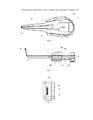
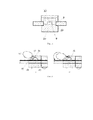
Заявленное устройство иллюстрируется чертежами, где на фигуре 1 схематично показан общий вид инструмента, фигуре 2 – общий вид инструмента сбоку с разрезом, фигуре 3 – схема крепления язычка в основании корпуса, фигуре 4 – вид поперечного разреза по механизму регулирования тональности, фигуре 5 – принцип работы прижима-фиксатора язычка: а – в нейтральном, б – рабочем положениях рычага фиксатора.The claimed device is illustrated by drawings, where figure 1 schematically shows a general view of the instrument, figure 2 is a general side view of the instrument with a cut, figure 3 is a diagram of the fastening of the tongue at the base of the body, figure 4 is a cross-sectional view of the tonality control mechanism, figure 5 is a principle the work of the clamp-clamp of the tongue: a - in neutral, b - the working positions of the lever of the clamp.
Музыкальный инструмент хомус с механизмом изменения тональности (см. фиг. 1, 2) содержит кольцеобразное основание 1 корпуса удлиненной формы, переходящее в щечки 2. Для удобства удерживания инструмента основание 1 может содержать снаружи ручку в виде фигурного полукольца 3.A khomus musical instrument with a tonality changing mechanism (see Figs. 1, 2) contains an annular base 1 of an elongated body, turning into cheeks 2. For the convenience of holding the instrument, the base 1 can contain a handle in the form of a figured half ring 3.
В верхней части основания 1 выбран бороздок 5, в котором размещается язычок 4 для крепления к корпусу инструмента съемными накладками 6 по обе стороны корпуса посредством разъемного соединения 7, например при помощи винтов (см. фиг. 3). Накладки 6 изготавливаются, преимущественно, из металла. При этом для уплотнения соединения и обеспечения неподвижности, надежности крепления дополнительно используется прокладка 8 из мягкого металла (медь, алюминий и др.), устанавливаемая, например, на клею. Подобное соединение способствует технологичности при изготовлении, регулировке и ремонте инструмента либо при необходимости замены на язычок с другими параметрами.In the upper part of the base 1, a groove 5 is selected, in which a tongue 4 is placed for fastening to the tool body with removable overlays 6 on both sides of the body by means of a detachable connection 7, for example, with screws (see Fig. 3). Slips 6 are made mainly of metal. At the same time, to seal the connection and ensure immobility, reliability of fastening, an additional pad 8 of soft metal (copper, aluminum, etc.) is used, installed, for example, on glue. Such a connection contributes to manufacturability in the manufacture, adjustment and repair of the tool or, if necessary, replacement with a tongue with other parameters.
Многотональность звучания хомуса заявленного устройства обеспечивается за счет изменения длины подвижной части язычка 4. Для этого в инструменте предусмотрен механизм регулирования тональности с прижимом-фиксатором 14, выполненный с возможностью перемещения вдоль продольной оси хомуса по пластине язычка 4 и внутренней поверхности 9, образованной в удлиненном основании 1 корпуса (см. фиг. 1, 2). The multi-tonality of the sound of the khomus of the claimed device is ensured by changing the length of the movable part of the tongue 4. For this, the instrument has a tonality control mechanism with a clamp-clamp 14, made with the ability to move along the longitudinal axis of the khomus along the tongue plate 4 and the inner surface 9 formed in an elongated base 1 housing (see Fig. 1, 2).
Корпус механизма регулирования тональности состоит из лицевого 10 и тыльного 11 полукорпусов, изготовленных, например, из металла. В собранном виде корпус механизма содержит внутреннюю цилиндрическую полость для свободного размещения прижима-фиксатора 14 и внутренний сквозной канал 20 для прохода язычка 4, наружные боковые продольные бороздки 13, служащие направляющими при перемещении механизма по внутренней поверхности 9 основания 1 корпуса (см. фиг. 4). Ширина канала 20 должна соответствовать ширине пластинки язычка 4, а ширина продольных бороздок 13 – толщине пластины корпуса инструмента таким образом, чтобы обеспечить точное и плотное прилегание деталей друг к другу, но и четкое и свободное движение механизма регулирования тональности по направляющим. При сборке корпуса крепление деталей осуществляется на разъемном соединении, например на винтах 22.The body of the tonality control mechanism consists of a front 10 and a rear 11 half-bodies made, for example, of metal. In assembled form, the mechanism case contains an internal cylindrical cavity for free placement of the clamp-clamp 14 and an internal through
Прижим-фиксатор 14 имеет цилиндрическую форму, при этом с одной стороны (обращаемой при установке в сторону пластины язычка 4) посередине выбран сквозной фигурный канал 12, сопоставляемый при установке на пластину язычка 4 с внутренним каналом 20 в корпусе подвижного механизма. Со стороны поверхности цилиндрического прижима 14, обращенной наружу инструмента, установлены рычаг регулировки 15 с ручкой-кнопкой 16 и устройство с упругим элементом 17 и упором-ограничителем 18 для возврата рычага 15 в нейтральное положение. При этом для удобства пользования ручка-кнопка 16 может быть выполнена эргономичной формы, причем перемещение механизма регулирования тональности на необходимое положение в корпусе инструмента осуществляется при расклинивании фиксатора 14 в режиме нейтрального положения рычага 15 (см. фиг. 5а). The clip-clamp 14 has a cylindrical shape, while on the one hand (facing when installing the tongue plate 4), a through figured
Внутренняя поверхность фигурного канала 12 в цилиндре прижима-фиксатора 14 выполнена с поперечным углом, обращенным в сторону пластины язычка 4 и образованным двумя пересекающимися плоскостями 19. При нейтральном положении рычага 15 прижим-фиксатор 14 контактирует с пластиной язычка 4 только через поперечный угол от плоскостей 19 и подвижный механизм легко перемещается по направляющим – пластине язычка 4 и внутренней поверхности 9 корпуса инструмента (см. фиг. 5а). При нажатии пальцем на рычаг 15 через ручку-кнопку 16 (рабочее положение рычага) цилиндр прижима-фиксатора 14 проворачивается вокруг своей оси до упора на ограничителе 18 (см. фиг. 5б). В рабочем положении рычага 15 происходит надавливание язычка 4 плоскостью поперечного угла в цилиндре прижима-фиксатора 14. При этом язычок 4 фиксируется в заданном уровне относительно корпуса хомуса. Расклинивание и переход рычага 15 в нейтральное положение осуществляется посредством возвратного устройства 17.The inner surface of the figured
Величина угла фиксатора между плоскостями 19 подбирается таким образом, чтобы обеспечить оптимальный угол перемещения рычага 15 относительно корпуса инструмента и плотное прилегание плоскости к пластине язычка 4 при рабочем положении прижима-фиксатора 14. Автором установлено, что оптимальный угол составляет в пределах 170-175 градусов, которое формируется в процессе наладки инструмента.The value of the angle of the latch between the planes 19 is selected in such a way as to ensure the optimal angle of movement of the lever 15 relative to the tool body and a snug fit of the plane to the plate of the tongue 4 with the working position of the clamp-clamp 14. The author found that the optimal angle is in the range of 170-175 degrees, which is formed in the process of setting up the tool.
На тыльной стороне 11 корпуса механизма регулирования тональности закреплено возвратное устройство 21 фиксатора на продольном направляющем с упругим элементом, установленном другим концом на тыльной стороне накладки 6 основания 1 корпуса. Таким образом, возврат механизма в исходное положение на корпусе инструмента осуществляется посредством упругого элемента устройства 21, например пружины, при нейтральном положении рычага 15 (см. фиг. 2).On the back side 11 of the body of the tonality control mechanism, a
Работа заявленного музыкального инструмента хомуса с устройством изменения тональности заключается в следующем.The operation of the claimed khomus musical instrument with a key changing device is as follows.
Как правило, музыкантом хомус обхватывается за основание 1 корпуса большим и указательным пальцами левой руки, при этом средний палец ложится на ручку-кнопку 16 рычага 15 и им можно осуществить движение прижима-фиксатора 14 вдоль продольной оси инструмента по язычку 4 (рычаг 15 в нейтральном положении). Обратный ход фиксатора 14 выполняется при помощи возвратного устройства 21. По достижении определенного места на нужной длине язычка 4 пользователь нажимает с некоторым усилием на ручку-кнопку 16, при этом рычаг 15 переходит в рабочее положение, и механизм регулирования тональности останавливается в результате надавливания плоскостью поперечного угла в цилиндрическом прижиме 14 на язычок 4, который фиксируется на заданном уровне относительно корпуса хомуса. Далее играют на инструменте, прижимая слегка щечки 2 к зубам, и посредством нанесения небольших ударов по язычку 4 пальцем руки. Регулируют звуки губами и языком, гортанью и дыханием (вдох и выдох), изменяя объем полости рта языком, а также передвигая механизм регулирования тональности по направляющим инструмента. As a rule, the musician grabs the khomus around the base 1 of the body with the thumb and forefinger of his left hand, while the middle finger rests on the button-
В зависимости от мастерства музыканта заявленное решение может обеспечить работу музыкального инструмента хомуса в большом диапазоне звучания. Относительно длинный ход фиксатора по длине язычка позволяет регулировать тональность звучания в широких пределах и получать новые мелодии при помощи одного инструмента.Depending on the skill of the musician, the claimed solution can ensure the operation of the khomus musical instrument in a wide sound range. The relatively long stroke of the lock along the length of the tongue allows you to adjust the tonality of the sound over a wide range and get new melodies with one tool.
Claims (1)
Priority Applications (1)
| Application Number | Priority Date | Filing Date | Title |
|---|---|---|---|
| RU2017117260A RU2648200C1 (en) | 2017-05-18 | 2017-05-18 | Musical instrument jew's harp with the mechanism of changing tonality |
Applications Claiming Priority (1)
| Application Number | Priority Date | Filing Date | Title |
|---|---|---|---|
| RU2017117260A RU2648200C1 (en) | 2017-05-18 | 2017-05-18 | Musical instrument jew's harp with the mechanism of changing tonality |
Publications (1)
| Publication Number | Publication Date |
|---|---|
| RU2648200C1 true RU2648200C1 (en) | 2018-03-22 |
Family
ID=61708151
Family Applications (1)
| Application Number | Title | Priority Date | Filing Date |
|---|---|---|---|
| RU2017117260A RU2648200C1 (en) | 2017-05-18 | 2017-05-18 | Musical instrument jew's harp with the mechanism of changing tonality |
Country Status (1)
| Country | Link |
|---|---|
| RU (1) | RU2648200C1 (en) |
Citations (5)
| Publication number | Priority date | Publication date | Assignee | Title |
|---|---|---|---|---|
| US3433113A (en) * | 1965-10-22 | 1969-03-18 | Bernard A Portnoy | Ligatures or reed-holders for single-reed musical wind instruments |
| SU1234876A1 (en) * | 1984-11-29 | 1986-05-30 | Zagretdinov Robert A | Musical instrument |
| RU2100847C1 (en) * | 1996-02-22 | 1997-12-27 | Иннокентий Никитич Готовцев | Yakut musical instrument |
| CN203311829U (en) * | 2013-07-03 | 2013-11-27 | 佳木斯大学 | Hezhe-style double-reed khomus |
| RU160750U1 (en) * | 2015-02-24 | 2016-03-27 | Николай Николаевич Бурцев | MUSICAL INSTRUMENT HOMUS |
-
2017
- 2017-05-18 RU RU2017117260A patent/RU2648200C1/en not_active IP Right Cessation
Patent Citations (5)
| Publication number | Priority date | Publication date | Assignee | Title |
|---|---|---|---|---|
| US3433113A (en) * | 1965-10-22 | 1969-03-18 | Bernard A Portnoy | Ligatures or reed-holders for single-reed musical wind instruments |
| SU1234876A1 (en) * | 1984-11-29 | 1986-05-30 | Zagretdinov Robert A | Musical instrument |
| RU2100847C1 (en) * | 1996-02-22 | 1997-12-27 | Иннокентий Никитич Готовцев | Yakut musical instrument |
| CN203311829U (en) * | 2013-07-03 | 2013-11-27 | 佳木斯大学 | Hezhe-style double-reed khomus |
| RU160750U1 (en) * | 2015-02-24 | 2016-03-27 | Николай Николаевич Бурцев | MUSICAL INSTRUMENT HOMUS |
Similar Documents
| Publication | Publication Date | Title |
|---|---|---|
| Duncan | The art of classical guitar playing | |
| US9255815B2 (en) | Fingertip slides for guitar playing | |
| US10971119B2 (en) | Double-layer dumb drum with sand belt adjusting function | |
| Dahl et al. | Is the player more influenced by the auditory than the tactile feedback from the instrument | |
| EP2615606A2 (en) | Speaker unit for musical instrument | |
| US3386325A (en) | Slide bar for hawaiian guitar | |
| US10410611B2 (en) | Guitar playing accessory | |
| EP1005014A2 (en) | Electronic keyboard instrument with halved key travel | |
| US766027A (en) | Musical instrument. | |
| US1576903A (en) | fontanella | |
| Horvath | An orchestra musician’s perspective on 20 years of performing arts medicine | |
| RU2620043C2 (en) | Musical instrument khomus | |
| US2687059A (en) | Musical instrument | |
| JP3225343U (en) | Wind instrument with holding head tube | |
| Law et al. | ‘Dubro’Resophonic Guitar: Glissando Gestures | |
| JP3243778U (en) | acoustic improvement equipment | |
| RU2140102C1 (en) | Electronic musical instrument kubyz (wargan) | |
| RU2249859C2 (en) | Finger-board electromusical instrument, tune oscillator and opto-isolator loudness pedal | |
| Petrovich | Analog-to-digital converter from a historical point of view | |
| KR20130124720A (en) | Saxophone tone resonator | |
| US1312614A (en) | Musical instrument | |
| JP4264597B2 (en) | Chord generator | |
| Llanos-Vazquez et al. | Controllable pitch-bending effects in the accordion playing | |
| US364609A (en) | John f | |
| JP6640475B2 (en) | Shoulder keyboard |
Legal Events
| Date | Code | Title | Description |
|---|---|---|---|
| MM4A | The patent is invalid due to non-payment of fees |
Effective date: 20200519 |