RU2237454C1 - Method for treating stoop, kyphosis, kyphotic-concave back, asymmetric body posture - Google Patents
Method for treating stoop, kyphosis, kyphotic-concave back, asymmetric body posture Download PDFInfo
- Publication number
- RU2237454C1 RU2237454C1 RU2003113829/14A RU2003113829A RU2237454C1 RU 2237454 C1 RU2237454 C1 RU 2237454C1 RU 2003113829/14 A RU2003113829/14 A RU 2003113829/14A RU 2003113829 A RU2003113829 A RU 2003113829A RU 2237454 C1 RU2237454 C1 RU 2237454C1
- Authority
- RU
- Russia
- Prior art keywords
- chest
- patient
- stoop
- force
- load
- Prior art date
Links
Images
Landscapes
- Orthopedics, Nursing, And Contraception (AREA)
Abstract
Description
Изобретение относился к медицине, а именно к ортопедии.The invention relates to medicine, namely to orthopedics.
Известны способы лечения сутуловатости, круглой спины, кругловогнутой спины, асимметричной осанки, включающие:Known methods of treating stoop, round back, round concave back, asymmetric posture, including:
1) способ обучения больного поддержанию правильной осанки, 2) способ, основанный на выполнении физических упражнений, направленных на тренировку мышц-разгибателей спины, мышц брюшного пресса больного, 3) способ, основанный на выполнении массажа спины, груди, брюшного пресса, 4) гидрокинезотерапию, 5) способ, основанный на выполнении с использованием тренажеров физических упражнений, направленных на тренировку мышц-разгибателей спины, мышц брюшного пресса больного (Физическая реабилитация: Учебник для академий и институтов физической культуры /Под общей ред. проф. С.Н.Попова. - Ростов н/Д: Изд-во “Феникс”, 1999, стр.209-214).1) a method of training a patient to maintain correct posture, 2) a method based on physical exercises aimed at training the extensor muscles of the patient’s abdominals, 3) a method based on massage of the back, chest, abdominal muscles, 4) hydrokinesis therapy , 5) a method based on the use of simulators of physical exercises aimed at training the extensor muscles of the back, the abdominal muscles of the patient (Physical rehabilitation: Textbook for academies and institutes of physical cult . Ry / Under the general editorship of Prof. S.N.Popova - Rostov n / D:.. Publishing house "Phoenix", 1999, str.209-214).
Недостатками вышеперечисленных способов лечения сутуловатости, круглой спины, кругловогнутой спины, асимметричной осанки являются длительность лечения и недостаточно высокая эффективность.The disadvantages of the above methods for the treatment of stoop, round back, round concave, asymmetric posture are the duration of treatment and not high enough efficiency.
Наиболее близким способом предлагаемому в качестве изобретения способу является комплекс физических упражнений для тренировки мышц-корректоров осанки, предложенный А.В.Леоньтьевым. Данный способ взят мной в качестве прототипа.The closest method to the proposed invention as a method is a set of physical exercises for training posture-correcting muscles proposed by A.V. Leontiev. This method is taken by me as a prototype.
Способ-прототип заключается в выполнении следующих упражнений:The prototype method consists in performing the following exercises:
1. Лягте на живот, выдвинув верхнюю часть туловища за край стола; ноги зафиксированы. Удерживаете туловище в горизонтальной плоскости.1. Lie on your stomach, sliding the upper body over the edge of the table; legs are fixed. Hold your torso horizontally.
2. Лягте на живот, выдвинув ноги за край стола, руками держитесь за край стола, фиксируя туловище. Удерживайте ноги в горизонтальной плоскости.2. Lie on your stomach, extending your legs over the edge of the table, with your hands hold on the edge of the table, fixing the torso. Keep your legs horizontal.
3. Лягте на бок, выдвинув верхнюю часть туловища за край стола, удерживайте туловище в горизонтальной плоскости.3. Lie on your side, pushing the upper body over the edge of the table, hold the body in a horizontal plane.
4. Лягте на спину и, используя навыки самовыравнивания, осуществляйте саморастяжение - самовыравнивание тела, при котором напрягаются все мышцы, удерживающие туловище в правильном положении.4. Lie on your back and, using the skills of self-alignment, exercise self-extension - self-alignment of the body, in which all the muscles that hold the body in the correct position are strained.
5. Лягте на спину, согнув ноги в коленях и тазобедренных суставах. Поднимайте туловище, не отрывая стопы от пола и не фиксируя их. Подъем туловища выполняется плавно, без рывков (Леоньтьев А.В. Болит спина: что делать? (Физкультура нового поколения для больных остеохондрозом). - СПб.: “Невский проспект”, 2001, стр.139-142).5. Lie on your back with your legs bent at the knees and hips. Raise your torso without lifting your feet off the floor or fixing them. The lifting of the body is performed smoothly, without jerking (Leontyev A.V. Backache: what to do? (Physical education of a new generation for patients with osteochondrosis). - St. Petersburg: “Nevsky Prospect”, 2001, pp. 139-142).
Недостатками прототипа являются длительность и недостаточно высокая эффективность лечения.The disadvantages of the prototype are the duration and insufficiently high efficiency of treatment.
Целью настоящего изобретения является эффективное лечение сутуловатости, круглой спины, кругловогнутой спины, асимметричной осанки.The aim of the present invention is an effective treatment for stoop, round back, round concave, asymmetric posture.
Сущность изобретения включает в себя: выполнение упражнений, включающих: 1) приложение силы, величиной от 10 до 400 ньютон, к любому участку грудной клетки больного, 2) выполнение больным вдоха с расширением грудной клетки, 3) выполнение больным выдоха с возвращением грудной клетки в исходное состояние немедленно или после удержания грудной клетки в расширенном состоянии в течение промежутка времени длительностью до 90 минут.The essence of the invention includes: performing exercises, including: 1) the application of force, ranging from 10 to 400 Newton, to any part of the patient’s chest, 2) the patient breathing in with the expansion of the chest, 3) the patient exhaling with the return of the chest to initial state immediately or after holding the chest in an expanded state for a period of time up to 90 minutes.
Физиологический механизм лечения сутуловатости, круглой спины, кругловогнутой спины, асимметричной осанки по предлагаемому способу изложен ниже. 1) Выполнение вдоха с расширением грудной клетки осуществляется дыхательными мышцами грудной клетки. 2) Неоднократное выполнение вдоха с расширением грудной клетки при приложенной силе к поверхности грудной клетки приводит к увеличению массы, силы, выносливости дыхательных мышц грудной клетки. 3) В соответствии с биомеханикой дыхания при выполнении больным вдоха с расширением грудной клетки происходит выпрямление грудного отдела позвоночника. 4) Увеличение массы, силы, выносливости дыхательных мышц грудной клетки приводит к увеличению их тяги в ненагруженном состоянии, а значит поддержанию грудного отдела позвоночника в выпрямленном состоянии.The physiological mechanism for the treatment of stoop, round back, round concave, asymmetric posture by the proposed method is described below. 1) Inhalation with expansion of the chest is carried out by the respiratory muscles of the chest. 2) Repeated inspiration with the expansion of the chest with the applied force to the surface of the chest leads to an increase in mass, strength, and endurance of the respiratory muscles of the chest. 3) In accordance with the biomechanics of breathing, when a patient performs inspiration with expansion of the chest, the thoracic spine is straightened. 4) An increase in the mass, strength, and endurance of the respiratory muscles of the chest leads to an increase in their traction in an unloaded state, which means maintaining the thoracic spine in a straightened state.
Для приложения силы к участку грудной клетки больного может использоваться груз, тренировочное устройство, резиновая лента или любые иные средства. Нижняя поверхность груза может быть покрыта слоем резины для уменьшения болевых ощущений у больного.To apply force to the area of the patient’s chest, a load, a training device, a rubber band or any other means can be used. The lower surface of the load can be covered with a layer of rubber to reduce pain in the patient.
Вдох должен выполняться с обязательным расширением грудной клетки.Inhalation should be performed with mandatory expansion of the chest.
Больной может выполнять диафрагмальное дыхание во время удержания грудной клетки в расширенном состоянии.The patient may perform diaphragmatic breathing while holding the chest in an expanded state.
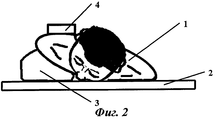
Изобретение иллюстрировано на фиг.1 и 2, где поз.1 - больной, поз.2 - кушетка, поз.3 - подушечка, поз.4 - груз.The invention is illustrated in figures 1 and 2, where
Примеры конкретного выполнения способа.Examples of specific performance of the method.
Пример 1Example 1
Больной А., 17 лет. Поступил с жалобами на утомляемость, боли в спине, чувство неполного вдоха. Объективно: голова сильно наклонена вперед, плечи приведены, лопатки значительно отстают, несимметричны, западание грудной клетки резко выражено, мышцы грудной клетки и спины атрофированы, угол реберной дуги составляет 40 градусов, остистые отростки отклонены от вертикального положения на расстояние до 2 см, принятие правильной осанки невозможно, экскурсия грудной клетки на вдохе составляет 0,5 см. Выставлен диагноз: круглая спина, тяжелой степени; асимметричная осанка.Patient A., 17 years old. He was admitted with complaints of fatigue, back pain, a feeling of incomplete inspiration. Objectively: the head is strongly inclined forward, the shoulders are brought forward, the shoulder blades are significantly behind, asymmetrical, chest retraction is pronounced, the muscles of the chest and back are atrophied, the angle of the costal arch is 40 degrees, the spinous processes are deviated from the vertical position by a distance of 2 cm, adoption is correct posture is impossible, chest excursion on inspiration is 0.5 cm. Diagnosed with round back, severe; asymmetric posture.
Укладывание больного для выполнения упражнений с приложением силы к участку на задней стенке грудной клетки показано на фиг.1 и 2, где поз.1 - больной, поз.2 - кушетка, поз.3 - подушечка, поз.4 - груз. Больного 1 укладывали на кушетку 2 на живот, подушечку 3 подкладывали под одну из сторон передней стенки грудной клетки, груз 4 располагали на одноименной стороне задней стенки грудной клетки.Laying the patient to perform exercises with the application of force to the area on the rear wall of the chest is shown in Figs. 1 and 2, where pos. 1 - patient, pos. 2 - couch, pos. 3 - pillow, pos. 4 - load.
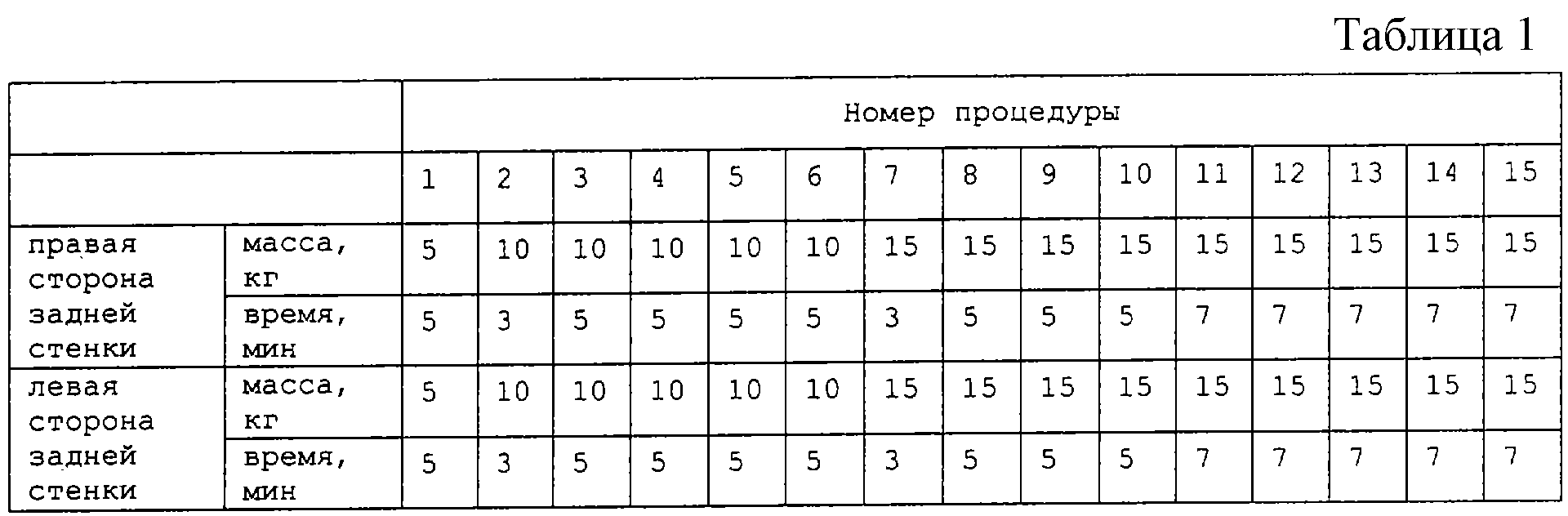
Больной выполнил 15 процедур с выполнением упражнений с приложением силы к участкам на левой и правой стороне задней грудной стенки. Процедуры выполнялись через день.The patient performed 15 procedures with exercises with the application of force to the areas on the left and right side of the posterior chest wall. Procedures were performed every other day.
Масса груза, использованного для приложения силы, в килограммах, и время удержания грудной клетки в расширенном состоянии, в минутах, указаны в таблице 1.The mass of the cargo used for the application of force, in kilograms, and the retention time of the chest in the expanded state, in minutes, are shown in table 1.
После выполнения 15 процедур жалоб на утомляемость, боли в спине, чувство неполного вдоха нет. Объективно: голова расположена вертикально, плечи близки к расправлению, лопатки незначительно отстают, симметричны, западания грудной клетки нет, угол реберной дуги составляет 70 градусов, остистые отростки расположены вертикально, экскурсия грудной клетки на вдохе составляет 2 см.After completing 15 procedures, there were no complaints of fatigue, back pain, a feeling of incomplete inspiration. Objectively: the head is located vertically, the shoulders are close to straightening, the shoulder blades are slightly behind, symmetrical, there is no retraction of the chest, the angle of the costal arch is 70 degrees, the spinous processes are vertical, the excursion of the chest on inhalation is 2 cm.
Пример 2Example 2
Больной М., 54 года. Поступил с жалобами на утомляемость, головные боли, боли в спине, невозможность длительного сидения с прямой осанкой. Объективно: голова наклонена вперед, плечи приведены, лопатки отстают, имеется западание грудной клетки, мышцы грудной клетки и спины ослаблены, угол реберной дуги составляет 70 градусов, принятие правильной осанки возможно на непродолжительное время, экскурсия грудной клетки на вдохе составляет 1 см. Выставлен диагноз: круглая спина, средней степени тяжести.Patient M., 54 years old. He was admitted with complaints of fatigue, headaches, back pain, the impossibility of prolonged sitting with direct posture. Objectively: the head is tilted forward, the shoulders are pulled back, the shoulder blades are behind, there is a retraction of the chest, the muscles of the chest and back are weakened, the angle of the costal arch is 70 degrees, taking correct posture is possible for a short time, chest excursion on inhalation is 1 cm. Diagnosed : round back, moderate.
Укладывание больного для выполнения упражнений с приложением силы к участку на задней стенке грудной клетки показано на фиг.1 и 2, где поз.1 - больной, поз.2 - кушетка, поз.3 - подушечка, поз.4 - груз. Больного 1 укладывали на кушетку 2 на живот, подушечку 3 подкладывали под одну из сторон передней стенки грудной клетки, груз 4 располагали на одноименной стороне задней стенки грудной клетки.Laying the patient to perform exercises with the application of force to the area on the rear wall of the chest is shown in Figs. 1 and 2, where pos. 1 - patient, pos. 2 - couch, pos. 3 - pillow, pos. 4 - load.
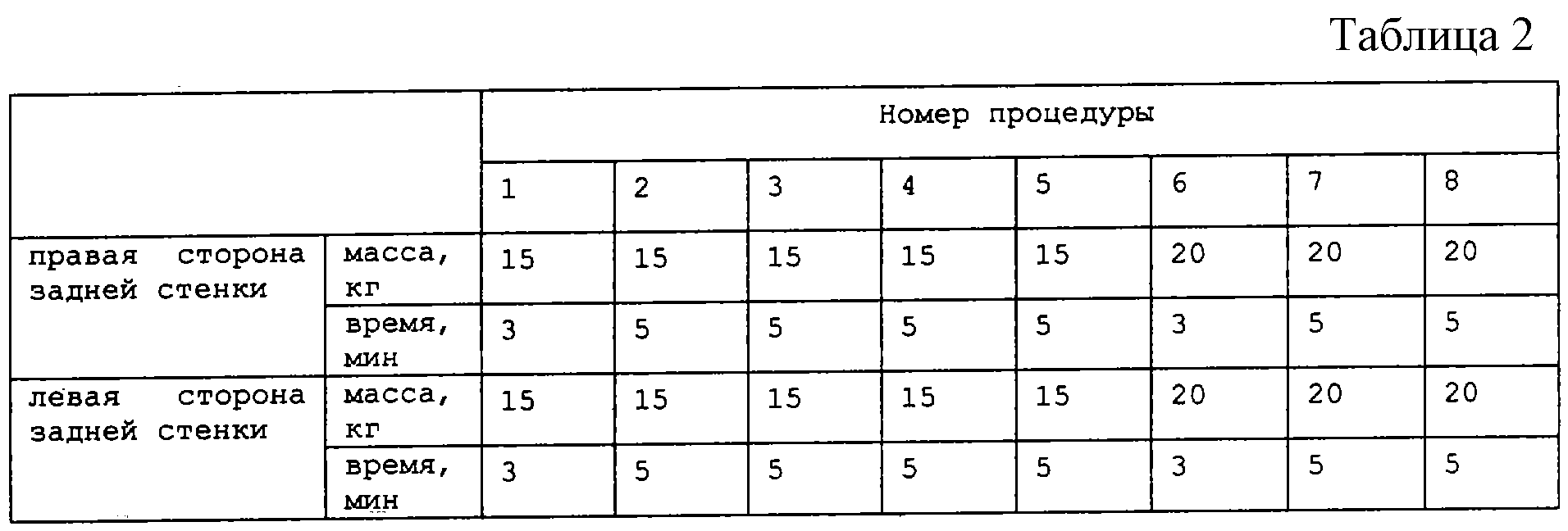
Больной выполнил 8 процедур с выполнением упражнений с приложением силы к участкам на левой и правой стороне задней грудной стенки. Процедуры выполнялись через день.The patient performed 8 procedures with exercises with the application of force to the areas on the left and right side of the posterior chest wall. Procedures were performed every other day.
Масса груза, использованного для приложения силы, в килограммах, и время удержания грудной клетки в расширенном состоянии, в минутах, указаны в таблице 2.The mass of the cargo used for the application of force, in kilograms, and the retention time of the chest in the expanded state, in minutes, are shown in table 2.
После выполнения 8 процедур жалоб на утомляемость, головные боли, боли в спине, невозможность длительного сидения с прямой осанкой нет. Объективно: голова расположена вертикально, плечи расправлены, западание грудной клетки отсутствует, угол реберной дуги составляет 90 градусов, экскурсия грудной клетки на вдохе составляет 4 см.After performing 8 procedures, there were no complaints of fatigue, headaches, back pain, and the impossibility of prolonged sitting with direct posture. Objectively: the head is located vertically, the shoulders are straightened, there is no retraction of the chest, the angle of the costal arch is 90 degrees, the chest excursion on inspiration is 4 cm.
Пример 3Example 3
Больная М., 20 лет. Поступила с жалобами на утомляемость, боли в спине, склонность к сутулости. Объективно: голова наклонена вперед, плечи приведены, лопатки отстают, имеется западание грудной клетки, мышцы грудной клетки и спины ослаблены, угол реберной дуги составляет 60 градусов, принятие правильной осанки возможно на непродолжительное время, экскурсия грудной клетки на вдохе составляет 0,5 см. Выставлен диагноз: круглая спина, средней степени тяжести.Patient M., 20 years old. Received with complaints of fatigue, back pain, tendency to stoop. Objectively: the head is tilted forward, the shoulders are lowered, the shoulder blades are behind, there is a retraction of the chest, the muscles of the chest and back are weakened, the angle of the costal arch is 60 degrees, taking correct posture is possible for a short time, chest excursion on inhalation is 0.5 cm. Diagnosed with round back, moderate.
Укладывание больной для выполнения упражнений с приложением силы к участку на задней стенке заключалось в следующем: больную укладывали на кушетку на живот, мягкую подушечку подкладывали под одну из сторон передней стенки грудной клетки, груз располагали на одноименной стороне задней стенки грудной клетки.Laying the patient to perform exercises with the application of force to the area on the back wall was as follows: the patient was placed on a couch on the stomach, a soft pillow was placed under one of the sides of the front wall of the chest, the load was placed on the same side of the back wall of the chest.
Больная выполнила 8 процедур с выполнением упражнений с приложением силы к участкам на левой и правой стороне задней грудной стенки. Процедуры выполнялись через день.The patient performed 8 procedures with exercises with the application of force to the areas on the left and right side of the posterior chest wall. Procedures were performed every other day.
Масса груза, использованного для приложения силы, в килограммах, и время удержания грудной клетки в расширенном состоянии, в минутах, указаны в таблице 3.The mass of the cargo used for the application of force, in kilograms, and the time of holding the chest in the expanded state, in minutes, are shown in table 3.

После выполнения 8 процедур жалоб на утомляемость, боли в спине, склонность к сутулости нет. Объективно: голова расположена вертикально, плечи расправлены, западание грудной клетки отсутствует, угол реберной дуги составляет 80 градусов, экскурсия грудной клетки на вдохе составляет 3 см.After performing 8 procedures, there were no complaints of fatigue, back pain, tendency to stoop. Objectively: the head is located vertically, the shoulders are straightened, there is no retraction of the chest, the angle of the costal arch is 80 degrees, the chest excursion on inhalation is 3 cm.
Положительный эффект от использования способа заключается в эффективном лечении сутуловатости, круглой спины, кругловогнутой спины, асимметричной осанки.The positive effect of using the method is the effective treatment of stoop, round back, round concave, asymmetric posture.
ЛитератураLiterature
1. Леоньтьев А.В. Болит спина: что делать? (Физкультура нового поколения для больных остеохондрозом). - СПб.: “Невский проспект”, 2001, стр. 139-142 - прототип.1. Leontyev A.V. Backache: what to do? (A new generation of physical education for patients with osteochondrosis). - St. Petersburg: “Nevsky Prospect”, 2001, p. 139-142 - prototype.
Claims (4)
Priority Applications (1)
| Application Number | Priority Date | Filing Date | Title |
|---|---|---|---|
| RU2003113829/14A RU2237454C1 (en) | 2003-05-12 | 2003-05-12 | Method for treating stoop, kyphosis, kyphotic-concave back, asymmetric body posture |
Applications Claiming Priority (1)
| Application Number | Priority Date | Filing Date | Title |
|---|---|---|---|
| RU2003113829/14A RU2237454C1 (en) | 2003-05-12 | 2003-05-12 | Method for treating stoop, kyphosis, kyphotic-concave back, asymmetric body posture |
Publications (2)
| Publication Number | Publication Date |
|---|---|
| RU2237454C1 true RU2237454C1 (en) | 2004-10-10 |
| RU2003113829A RU2003113829A (en) | 2004-12-27 |
Family
ID=33537975
Family Applications (1)
| Application Number | Title | Priority Date | Filing Date |
|---|---|---|---|
| RU2003113829/14A RU2237454C1 (en) | 2003-05-12 | 2003-05-12 | Method for treating stoop, kyphosis, kyphotic-concave back, asymmetric body posture |
Country Status (1)
| Country | Link |
|---|---|
| RU (1) | RU2237454C1 (en) |
Cited By (3)
| Publication number | Priority date | Publication date | Assignee | Title |
|---|---|---|---|---|
| WO2016114682A1 (en) * | 2015-01-12 | 2016-07-21 | Виктор Владимирович АРШИН | Method of correcting scoliosis and postural disorders |
| RU2593047C1 (en) * | 2015-05-27 | 2016-07-27 | Общество с ограниченной ответственностью "Уральский центр кинезиотерапии" | Method of treating locomotor diseases |
| RU2826167C1 (en) * | 2023-11-09 | 2024-09-05 | Государственное автономное учреждение здравоохранения города Москвы "Московский научно-практический центр медицинской реабилитации, восстановительной и спортивной медицины имени С.И. Спасокукоцкого Департамента здравоохранения города Москвы" (ГАУЗ МНПЦ МРВСМ им. С.И. Спасокукоцкого ДЗМ) | Method of treating musculoskeletal non-specific lower back pain |
Citations (4)
| Publication number | Priority date | Publication date | Assignee | Title |
|---|---|---|---|---|
| RU2108080C1 (en) * | 1996-12-19 | 1998-04-10 | Российская медицинская академия последипломного образования Министерства здравоохранения РФ | Method to treat scoliotic disease of i and ii stages in children |
| RU2124878C1 (en) * | 1998-01-05 | 1999-01-20 | Богач Юрий Павлович | Corrector-exerciser |
| RU2178322C2 (en) * | 1999-11-03 | 2002-01-20 | Российский научный центр восстановительной медицины и курортологии | Elastic breathing exercising apparatus |
| RU2212875C2 (en) * | 2001-03-01 | 2003-09-27 | Чувашский государственный университет им. И.Н. Ульянова | Method for performing posture correction |
-
2003
- 2003-05-12 RU RU2003113829/14A patent/RU2237454C1/en not_active IP Right Cessation
Patent Citations (4)
| Publication number | Priority date | Publication date | Assignee | Title |
|---|---|---|---|---|
| RU2108080C1 (en) * | 1996-12-19 | 1998-04-10 | Российская медицинская академия последипломного образования Министерства здравоохранения РФ | Method to treat scoliotic disease of i and ii stages in children |
| RU2124878C1 (en) * | 1998-01-05 | 1999-01-20 | Богач Юрий Павлович | Corrector-exerciser |
| RU2178322C2 (en) * | 1999-11-03 | 2002-01-20 | Российский научный центр восстановительной медицины и курортологии | Elastic breathing exercising apparatus |
| RU2212875C2 (en) * | 2001-03-01 | 2003-09-27 | Чувашский государственный университет им. И.Н. Ульянова | Method for performing posture correction |
Non-Patent Citations (1)
| Title |
|---|
| Руководство по ортопедии и травматологии. Т.1, - М.: Медицина, 1967, с.182-190. Травматология и ортопедия. /Под ред. Х.А.Мусалатова. - М.: Медицина, 1995, с.22-23, 488-492. * |
Cited By (3)
| Publication number | Priority date | Publication date | Assignee | Title |
|---|---|---|---|---|
| WO2016114682A1 (en) * | 2015-01-12 | 2016-07-21 | Виктор Владимирович АРШИН | Method of correcting scoliosis and postural disorders |
| RU2593047C1 (en) * | 2015-05-27 | 2016-07-27 | Общество с ограниченной ответственностью "Уральский центр кинезиотерапии" | Method of treating locomotor diseases |
| RU2826167C1 (en) * | 2023-11-09 | 2024-09-05 | Государственное автономное учреждение здравоохранения города Москвы "Московский научно-практический центр медицинской реабилитации, восстановительной и спортивной медицины имени С.И. Спасокукоцкого Департамента здравоохранения города Москвы" (ГАУЗ МНПЦ МРВСМ им. С.И. Спасокукоцкого ДЗМ) | Method of treating musculoskeletal non-specific lower back pain |
Similar Documents
| Publication | Publication Date | Title |
|---|---|---|
| Kim et al. | Effects of Swiss ball exercise and resistance exercise on respiratory function and trunk control ability in patients with scoliosis | |
| RU2347551C1 (en) | Method for development of locomotive functions in patients with tetraparesis | |
| RU2539164C1 (en) | Method for rehabilitation treatment of patients suffering vertebral-spinal injury | |
| RU2471466C2 (en) | Method of rehabilitating patients with infantile cerebral paralysis | |
| RU2748116C1 (en) | Recreational gymnastics method | |
| Kwon et al. | Effects of task-specific movement patterns during resistance exercise on the respiratory functions and thickness of abdominal muscles of children with cerebral palsy: randomized placebo-controlled double-blinded clinical trial | |
| RU2166922C2 (en) | Method for treating scoliosis of the i-ii degree | |
| RU2740428C1 (en) | Method of human functional state correction | |
| Yoo | Effect of modified leg-raising exercise on the pain and pelvic angle of a patient with back pain and excessive lordosis | |
| VIZITIU et al. | Dorsalgia rehabilitation in static disorders of the spine by therapeutic swimming in young adults | |
| RU2800254C1 (en) | Method of rehabilitation of patients with diseases of the joints of the lower extremities | |
| RU2308928C2 (en) | Method for curative-sanitizing impact upon a human being | |
| RU2804216C1 (en) | Method for correcting idiopathic scoliosis of lumbar spine in girls 11-15 years old | |
| RU2808350C1 (en) | Method of correcting idiopathic scoliosis of lumbar spine in girls of 11-15 years of age | |
| RU2682813C1 (en) | Method for correction of movement pattern in children with brittle bone disease | |
| RU2851311C1 (en) | Method for correcting posture | |
| RU2266093C2 (en) | Method of sanitation gymnastics | |
| RU2845182C1 (en) | Method for complex correction of human locomotor system | |
| RU2799125C1 (en) | Methods of leveling the pelvis, strengthening the abdominal wall, leveling the spine, leveling the shoulders, treatment of scoliose, as well as means for pushing the quad muscle of the lumbar and iliopsoas muscle | |
| RU2830407C1 (en) | Method for correction of motor disorders in children with infantile cerebral paralysis | |
| RU2848407C1 (en) | Facial gymnastics | |
| RU2821772C1 (en) | Method for medical rehabilitation of patients with spastic paraplegia due to spinal cord injury at thoracic and thoracolumbar level | |
| RU2793214C9 (en) | Recreative gymnastics for back | |
| RU2305534C1 (en) | Method of recovery of vertical position for handicapped persons suffering from affection in central nervous system | |
| RU2793214C1 (en) | Recreative gymnastics for back |
Legal Events
| Date | Code | Title | Description |
|---|---|---|---|
| MM4A | The patent is invalid due to non-payment of fees |
Effective date: 20060513 |