KR20180135749A - Fermented liquid of plant having flavour, beverage comprising the same and method for making the same - Google Patents
Fermented liquid of plant having flavour, beverage comprising the same and method for making the same Download PDFInfo
- Publication number
- KR20180135749A KR20180135749A KR1020170074414A KR20170074414A KR20180135749A KR 20180135749 A KR20180135749 A KR 20180135749A KR 1020170074414 A KR1020170074414 A KR 1020170074414A KR 20170074414 A KR20170074414 A KR 20170074414A KR 20180135749 A KR20180135749 A KR 20180135749A
- Authority
- KR
- South Korea
- Prior art keywords
- plant
- fermentation
- fermentation broth
- temperature
- leaves
- Prior art date
- Legal status (The legal status is an assumption and is not a legal conclusion. Google has not performed a legal analysis and makes no representation as to the accuracy of the status listed.)
- Ceased
Links
Images
Classifications
-
- A—HUMAN NECESSITIES
- A23—FOODS OR FOODSTUFFS; TREATMENT THEREOF, NOT COVERED BY OTHER CLASSES
- A23L—FOODS, FOODSTUFFS OR NON-ALCOHOLIC BEVERAGES, NOT OTHERWISE PROVIDED FOR; PREPARATION OR TREATMENT THEREOF
- A23L19/00—Products from fruits or vegetables; Preparation or treatment thereof
-
- A—HUMAN NECESSITIES
- A23—FOODS OR FOODSTUFFS; TREATMENT THEREOF, NOT COVERED BY OTHER CLASSES
- A23C—DAIRY PRODUCTS, e.g. MILK, BUTTER OR CHEESE; MILK OR CHEESE SUBSTITUTES; PREPARATION THEREOF
- A23C9/00—Milk preparations; Milk powder or milk powder preparations
- A23C9/12—Fermented milk preparations; Treatment using microorganisms or enzymes
- A23C9/13—Fermented milk preparations; Treatment using microorganisms or enzymes using additives
- A23C9/133—Fruit or vegetables
-
- A—HUMAN NECESSITIES
- A23—FOODS OR FOODSTUFFS; TREATMENT THEREOF, NOT COVERED BY OTHER CLASSES
- A23L—FOODS, FOODSTUFFS OR NON-ALCOHOLIC BEVERAGES, NOT OTHERWISE PROVIDED FOR; PREPARATION OR TREATMENT THEREOF
- A23L2/00—Non-alcoholic beverages; Dry compositions or concentrates therefor; Preparation or treatment thereof
- A23L2/38—Other non-alcoholic beverages
- A23L2/382—Other non-alcoholic beverages fermented
-
- A—HUMAN NECESSITIES
- A23—FOODS OR FOODSTUFFS; TREATMENT THEREOF, NOT COVERED BY OTHER CLASSES
- A23L—FOODS, FOODSTUFFS OR NON-ALCOHOLIC BEVERAGES, NOT OTHERWISE PROVIDED FOR; PREPARATION OR TREATMENT THEREOF
- A23L29/00—Foods or foodstuffs containing additives; Preparation or treatment thereof
- A23L29/30—Foods or foodstuffs containing additives; Preparation or treatment thereof containing carbohydrate syrups; containing sugars; containing sugar alcohols, e.g. xylitol; containing starch hydrolysates, e.g. dextrin
-
- A—HUMAN NECESSITIES
- A23—FOODS OR FOODSTUFFS; TREATMENT THEREOF, NOT COVERED BY OTHER CLASSES
- A23V—INDEXING SCHEME RELATING TO FOODS, FOODSTUFFS OR NON-ALCOHOLIC BEVERAGES AND LACTIC OR PROPIONIC ACID BACTERIA USED IN FOODSTUFFS OR FOOD PREPARATION
- A23V2002/00—Food compositions, function of food ingredients or processes for food or foodstuffs
-
- A—HUMAN NECESSITIES
- A23—FOODS OR FOODSTUFFS; TREATMENT THEREOF, NOT COVERED BY OTHER CLASSES
- A23V—INDEXING SCHEME RELATING TO FOODS, FOODSTUFFS OR NON-ALCOHOLIC BEVERAGES AND LACTIC OR PROPIONIC ACID BACTERIA USED IN FOODSTUFFS OR FOOD PREPARATION
- A23V2200/00—Function of food ingredients
- A23V2200/15—Flavour affecting agent
Landscapes
- Life Sciences & Earth Sciences (AREA)
- Chemical & Material Sciences (AREA)
- Engineering & Computer Science (AREA)
- Food Science & Technology (AREA)
- Polymers & Plastics (AREA)
- Health & Medical Sciences (AREA)
- Nutrition Science (AREA)
- Microbiology (AREA)
- Molecular Biology (AREA)
- Seasonings (AREA)
- Non-Alcoholic Beverages (AREA)
Abstract
본 발명은 향이 있는 식물의 발효액, 이를 포함하는 음료 및 그 제조방법에 관한 것으로, 보다 구체적으로 향이 있는 식물을 발효 및 열건조한 후 설탕 및 우유를 혼합하고 최적의 온도에서 저온가열하고 급속냉각한 다음, 최적의 발효 온도 및 시간에서 발효하여 발효액을 제조할 경우, 식물 원료 고유의 향과 맛이 살아 있어 식품에 첨가 시 보다 풍부한 풍미를 느낄 수 있음을 확인하였으므로, 본 발명의 방법을 식물의 향과 맛을 유지하면서 유익한 발효균을 포함하는 발효액 제조에 유용하게 사용될 수 있다.The present invention relates to a fermentation broth of a plant having fragrance, a beverage containing the same, and a method for producing the same. More specifically, the plant having the fragrance is fermented and thermally dried, then sugar and milk are mixed, It has been found that when the fermentation broth is fermented at an optimum fermentation temperature and time, the original flavor and taste of the plant raw material is alive and the rich flavor can be felt when added to the food. Therefore, It can be usefully used for manufacturing a fermentation broth containing beneficial fermenting bacteria while maintaining the taste.
Description
본 발명은 향이 있는 식물의 발효액, 이를 포함하는 음료 및 그 제조방법에 관한 것으로, 보다 구체적으로 깻잎 등의 식물 고유의 향과 맛이 살아있고, 유산균이 풍부한 식물 발효액, 이를 포함하는 음료 조성물 및 이의 제조방법에 관한 것이다.
The present invention relates to a fermentation broth of a plant having fragrance, a beverage containing the same, and a method for producing the same, more specifically, to a plant fermentation broth rich in lactic acid bacteria, a beverage composition containing the same, And a manufacturing method thereof.
의학 및 과학기술이 발전하면서 과거에 비해 수명이 길어지게 되었지만 그만큼 많은 질병에 노출되어 있어, 질병으로부터 자유롭고 건강한 삶을 지속하기 위한 설계가 필요하다. 질병에 크게 영향을 미칠 수 있는 요인으로 운동과 함께 식품을 들 수 있다. 지난 2006년 미국의 건강 전문 월간지 'HEALTH'에서 세계 5대 건강식품을 선정한 바 있는데, 여기에 한국의 김치, 일본의 낫또, 스페인의 올리브유, 그리스의 요구르트, 인도의 렌틸 콩이 포함되었다. 상기 5개의 식품 중 김치, 낫또, 요구르트는 모두 발효식품으로 '발효' 과정을 거친 식품은 우리 인체에 주요한 기능을 기대할 수 있어 오늘날 이를 제품화하기 위한 기술개발과 연구가 많이 이루어지고 있다.
As medicine and science and technology develop, life expectancy has become longer than in the past, but it is exposed to so many diseases, and it is necessary to design for continuing disease free and healthy life. As a factor that can greatly affect disease, exercise can be considered as food. In 2006, health food magazine HEALTH in the United States selected the world's top five health foods, including Korean kimchi, Japanese natto, Spanish olive oil, Greek yogurt, and Indian lentils. Among the five foods mentioned above, kimchi, natto, and yogurt are fermented foods, and fermented foods are expected to have major functions in the human body.
발효는 미생물이 자신의 효소로 유기물을 분해 또는 변화시켜 특유한 최종산물을 만들어내는 현상을 말하며, 특유한 맛, 향 및 저장성을 증진시키기 위해 이용되어 왔다. 특히, 식물체를 당과 함께 섞어 일정기간 발효시킨 후 원료를 여과하여 얻은 액을 의미하는 식물 발효액은 최근 건강에 대한 국민적 관심 증대와 기능성 효과의 기대감으로 주목을 받고 있다. 식물 발효액은 일부 논문 및 특허문헌에서 기능성 검정 및 그 기능성을 이용한 제품이 제시된 것처럼 과학적 근거 마련과 함께 이를 기초로 한 산업화가 병행 추진되고 있다. 예컨대 정지숙 (감귤과즙을 이용한 산형음료 발효 및 발효음료의 향균효과, 2009), 양철영 (강황 발효액이 고지방 섭취 흰쥐의 비만에 미치는 효과, 2011), 이영준 (산야초 발효액의 항산화 활성, 2012) 등의 연구논문에는 식물 발효액의 항산화성, 항균성, 항비만, 항암, 항당뇨 등에 관한 효과가 제시되어 있고, 한국특허출원번호 제2012-0027135호, 제2011-0115679호, 제2011-0006641호 등에는 식물 발효액을 이용한 음료, 화장품, 액비, 세정제 등의 제품이 공지되어 있다.
Fermentation is a phenomenon in which microorganisms decompose or change organisms with their own enzymes to produce a unique end product, which has been used to enhance distinctive flavor, aroma and shelf life. In particular, plant fermentation broth, which means a solution obtained by mixing plant with sugar and fermenting it for a certain period of time and then filtering the raw material, is recently attracting attention as a public interest in health and expectation of functional effect. In some papers and patent literature, the plant fermentation liquid has been promoted in parallel with the establishment of a scientific basis as well as the industrialization based on the functional evaluation and the products using the functionality. (Antimicrobial effect of acid fermented beverage fermentation and fermented beverage using citrus fruit juice, 2009), Yang Cheolyoung (Effect of turmeric fermentation broth on obesity in high fat intake rats, 2011), Lee Young- Antimicrobial activity, antimicrobial activity, anti-obesity, anticancer, anti-diabetic effect of plant fermentation broth have been suggested. Korean Patent Application Nos. 2012-0027135, 2011-0115679, 2011-0006641, Such as beverages, cosmetics, liquids, and detergents, are known.
식물 발효액은 이를 제조하는 업체의 영세성 및 위생·안정성 문제 등의 위험요소가 병존하고는 있으나, 제품화 과정이 용이하다는 장점과 함께 최근 일반식품으로 품목이 변화됨으로써 향후 그 활용도는 다양할 것으로 기대된다. 이러한 기대를 반영하듯, 최근 당의 첨가량, 발효기간, 당의 농도, 원료 배합 등 식물 발효액의 품질 또는 기능에 미치는 영향을 규명하기 위한 연구가 증가하는 추세이다. 그러나 발효 시 식물 원료 자체의 맛과 향을 살리기 위한 조건에 대한 연구는 부족한 실정이다. 특히, 맛을 향상시키기 위해 장시간 발효할 경우, 원치 않은 미생물에 오염되어 이취나 부패가 일어날 수 있어 맛과 향이 모두 저하되는 문제가 발생할 수 있다. 따라서, 식물 원료 자체의 맛과 향을 유지할 수 있는 발효 과정 및 발효 조건에 대한 연구가 필요하다.
Plant fermented liquids are expected to have a variety of applications in the future due to the fact that they are easy to commercialize and have recently been changed to general food items, although the risk factors such as the smallness and hygiene and stability problems of the manufacturers of the plant coexist. Recently, there is an increasing trend to investigate the effects of sugar content, fermentation period, sugar concentration, and raw material composition on the quality or function of plant fermentation broth. However, there is a lack of research on the conditions for utilizing the taste and aroma of the plant material itself during fermentation. In particular, when the fermentation is performed for a long time in order to improve the taste, it may be contaminated with undesired microorganisms, resulting in bad odor or corruption, which may result in a problem that both taste and flavor are lowered. Therefore, it is necessary to study the fermentation process and the fermentation conditions that can maintain the taste and flavor of the plant raw material itself.
이에, 본 발명자들은 향이 있는 식물의 향을 유지하면서 맛이 우수하고, 장 내 유익한 유산균이 포함된 식물 발효액을 개발하기 위해 노력한 결과, 향이 있는 식물을 발효 및 열건조한 후 설탕 및 우유를 혼합하고 최적의 온도에서 저온가열하고 급속냉각한 다음, 최적의 발효 온도 및 시간에서 저온발효하여 발효액, 또는 음료를 제조할 경우, 식물 원료 고유의 향과 맛이 살아 있어 보다 풍부한 풍미를 느낄 수 있음을 확인하고, 본 발명을 완성하였다.
Thus, the present inventors have made efforts to develop a plant fermentation broth containing a beneficial lactic acid bacterium with excellent flavor while maintaining the fragrance of the plant having the fragrance. As a result, The fermentation liquid or the beverage is fermented at a low fermentation temperature and time at an optimal fermentation temperature and time, and the flavor and taste inherent to the plant raw material is alive and feels a richer flavor , Thereby completing the present invention.
본 발명은 향이 있는 식물의 향과 맛이 살아있고, 유산균이 풍부한 식물 발효액, 이를 포함하는 음료 조성물 및 이의 제조방법에 관한 것이다.
The present invention relates to a plant fermentation broth rich in lactic acid bacteria, a beverage composition containing the same, and a process for producing the same.
상기 목적을 달성하기 위하여, 본 발명은In order to achieve the above object,
1) 식물을 설탕 및 우유와 혼합하여 식물 혼합액을 제조하는 단계;1) preparing plant mixture by mixing plant with sugar and milk;
2) 상기 단계 1)의 식물 혼합액을 가열하는 단계;2) heating the plant mixture of step 1);
3) 상기 단계 2)의 가열한 식물 혼합액을 냉각하는 단계; 및3) cooling the heated plant mixture in step 2); And
4) 상기 단계 3)의 냉각한 식물 혼합액을 발효하는 단계를 포함하는, 향이 있는 식물의 발효액 제조방법을 제공한다.4) fermenting the cooled plant mixture in step 3).
또한, 본 발명은 본 발명의 방법으로 제조된, 식물의 향과 맛이 살아있고, 유산균이 풍부한 식물 발효액 및 이를 포함하는 음료 조성물을 제공한다.
The present invention also provides a plant fermentation broth prepared by the method of the present invention, which is rich in the flavor and taste of plants and is rich in lactic acid bacteria, and a beverage composition containing the same.
본 발명은 향이 있는 식물의 향과 맛을 유지하면서 유익한 발효균을 포함하는 식물 발효액 제조 방법, 및 상기 방법으로 제조된 식물 발효액 및 이를 포함하는 음료 조성물에 관한 것으로, 향이 있는 식물을 발효 및 열건조한 후 설탕 및 우유를 혼합하고 최적의 온도에서 저온가열하고 급속냉각한 다음, 최적의 발효 온도 및 시간에서 저온발효하여 발효액을 제조할 경우, 식물 원료 고유의 향과 맛이 살아 있어 풍부한 풍미를 느낄 수 있다는 이점을 가진다.
The present invention relates to a method for producing a plant fermentation broth containing beneficial fermenting bacteria while maintaining the flavor and taste of the plant with fragrance, and to a fermentation broth prepared by the method and a beverage composition containing the same, Sugar and milk are mixed and cooled at a low temperature at an optimal temperature and rapidly cooled. When the fermentation liquid is produced by low-temperature fermentation at an optimal fermentation temperature and time, the original flavor and taste of the plant raw material can be alive and the rich flavor can be felt .
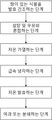
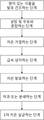
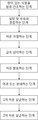
도 1 내지 도 3은 본 발명의 향이 있는 식물의 발효액 제조방법을 나타낸 도이다.BRIEF DESCRIPTION OF THE DRAWINGS FIG. 1 to FIG. 3 are diagrams showing a method for producing a fermentation broth of a plant having fragrance according to the present invention.
이하, 본 발명을 보다 상세히 설명한다.
Hereinafter, the present invention will be described in more detail.
본 발명은The present invention
1) 식물을 설탕 및 우유와 혼합하여 식물 혼합액을 제조하는 단계;1) preparing plant mixture by mixing plant with sugar and milk;
2) 상기 단계 1)의 식물 혼합액을 가열하는 단계;2) heating the plant mixture of step 1);
3) 상기 단계 2)의 가열한 식물 혼합액을 냉각하는 단계; 및3) cooling the heated plant mixture in step 2); And
4) 상기 단계 3)의 냉각한 식물 혼합액을 발효하는 단계를 포함하는, 향이 있는 식물의 발효액 제조방법을 제공한다(도 1).4) fermenting the cooled plant mixture in step 3) (Fig. 1).
또한, 본 발명은 상기 방법으로 제조된 식물 발효액을 제공하다.The present invention also provides a plant fermentation broth prepared by the above method.
아울러, 본 발명은 상기 식물 발효액을 포함하는 음료 조성물을 제공한다.In addition, the present invention provides a beverage composition comprising the plant fermentation broth.
본 발명에 있어서, 상기 단계 1)에서 식물은 발효된 것일 수 있고, 상기 발효는 예를 들어, 자연발효, 당발효 또는 건조발효일 수 있으나, 이에 한정되는 것은 아니다. 또한, 상기 자연발효는 상온에서 1 내지 5일 동안 방치하여 자연 발효시키는 것이 바람직하나 이에 한정되는 것은 아니다.In the present invention, in the step 1), the plant may be fermented, and the fermentation may be, for example, natural fermentation, sugar fermentation or dry fermentation, but is not limited thereto. The natural fermentation is preferably carried out at room temperature for 1 to 5 days to naturally ferment, but is not limited thereto.
상기 단계 1)에서 식물은 향이 있는 식물인 것이 바람직하고, 상기 향이 있는 식물은 향미가 풍부한 부위가 상이할 수 있으므로, 식물에 따라 향미가 풍부한 부위, 예를 들어 잎, 줄기, 열매 또는 뿌리를 선별하거나 또는 이들을 조합하여 이용할 수 있다. 상기 향이 있는 식물은 예를 들어 깻잎, 쑥잎, 쑥갓, 녹차잎, 허브잎, 고수잎, 아스파라거스잎, 인삼, 은행잎, 솔잎, 감나무잎, 밤나무잎, 귤나무잎, 측백나무잎, 삽나무잎, 녹나무잎, 배추잎, 감자잎, 고구마잎, 고추잎, 돌나물, 부추, 마늘, 양파, 버섯 또는 이들의 조합일 수 있으나, 이에 한정되는 것은 아니며, 식물 발효액의 용도에 맞게 향이 있는 식물을 선택할 수 있다.In step 1), the plant is preferably a plant having a fragrance. Since the plant having the fragrance may have a different flavor-rich region, it is preferable to select a region rich in flavor, for example, a leaf, stem, Or a combination thereof. The above-mentioned fragrant plants include, for example, leaves, leaves, herb leaves, asparagus leaves, ginseng, ginkgo leaf, pine needles, persimmon leaves, chestnut leaves, mandarin leaves, But are not limited to, camphor leaf, cabbage leaf, potato leaf, sweet potato leaf, pepper leaf, crass, leek, leek, garlic, onion, mushroom or a combination thereof. have.
또한, 상기 단계 1)에서 식물의 수분 함량은 5% 미만인 것이 바람직하다. 상기 식물의 수분 함량이 5% 이상일 경우 식물에 포함된 수분으로 인해 발효시 이취가 발생하여 식물 고유의 향을 재현할 수 없는 단점이 있다.In addition, it is preferable that the water content of the plant in step 1) is less than 5%. If the moisture content of the plant is 5% or more, there is a disadvantage in that it can not reproduce the intrinsic flavor of the plant because of the moisture contained in the plant, resulting in the offense during fermentation.
상기 단계 1)에서 식물 혼합액은 식물 0.8 내지 5 중량부, 설탕 1 내지 8 중량부, 우유 80 내지 95 중량부를 포함하는 것이 바람직하다. 상기 식물을 0.8 중량부 미만으로 포함할 경우, 식물 고유의 향 및 맛이 미미할 수 있다. 또한, 상기 식물을 5 중량부 초과하여 포함할 경우, 식물의 향이 너무 강해 거부감을 느낄 수 있다. In the step 1), the plant mixture preferably contains 0.8 to 5 parts by weight of plant, 1 to 8 parts by weight of sugar, and 80 to 95 parts by weight of milk. When the plant is contained in an amount of less than 0.8 part by weight, the inherent flavor and taste of the plant may be insignificant. In addition, if the plant contains more than 5 parts by weight of the plant, the fragrance of the plant may be too strong to feel rejection.
또한, 상기 우유는 살균 우유인 것이 바람직하다. 상기 우유가 비살균 우유일 경우 저온발효 시 발효균이 급속도로 성장하여 발효액의 향과 맛을 변질시킬 수 있다.In addition, the milk is preferably sterilized milk. When the milk is non-sterilized milk, the fermentation bacteria grow rapidly during low-temperature fermentation, and the flavor and taste of the fermentation broth can be altered.
상기 단계 2)에서 식물 혼합액의 가열 온도는 26 내지 41℃ 온도인 것이 바람직하다. 상기 가열 온도가 26℃ 미만인 경우 유익한 발효균의 성장속도가 느려 발효 시간이 길어질 수 있고, 이로 인해 식물 고유의 향 및 맛이 저감될 수 있다. 또한, 상기 가열 온도가 41℃를 초과하는 경우 발효균이 급속도로 성장하여 유해한 균의 성장을 촉진할 수 있고, 향이 변할 수 있다.The heating temperature of the plant mixture in step 2) is preferably 26 to 41 ° C. If the heating temperature is lower than 26 ° C, the fermentation time may be prolonged due to a slow growth rate of the beneficial fermenting bacteria, thereby reducing the inherent flavor and taste of the plant. In addition, when the heating temperature exceeds 41 캜, the fermentation bacteria grow rapidly, the growth of harmful bacteria can be promoted, and the flavor can be changed.
상기 단계 3)에서 냉각은 -10 내지 5℃ 온도에서 수행하는 것이 바람직하다. 상기 냉각 온도가 -10℃ 미만인 경우 냉각 시간이 지연되어 유익한 발효균이 파괴되고, 식물 고유의 향 및 맛이 저감될 수 있다. 또한, 상기 냉각 온도가 5℃를 초과하는 경우 발효균이 급속도로 성장하는 것을 저해하지 못하여 발효액 내에 유해한 균이 과다하게 포함될 수 있고, 발효균에 의해 발효액의 향과 맛이 변질될 수 있다.The cooling in step 3) is preferably carried out at a temperature of -10 to 5 ° C. If the cooling temperature is lower than -10 ° C, the cooling time is delayed, and the beneficial fermenting bacteria are destroyed, and the inherent flavor and taste of the plant can be reduced. If the cooling temperature is higher than 5 ° C, the fermentation microorganism can not inhibit rapid growth of the fermentation broth, so that harmful microorganisms can be contained in the fermentation broth excessively, and the flavor and taste of the fermentation broth can be altered by the fermentation bacteria.
상기 단계 4)에서 발효는 -3 내지 15℃ 온도에서 12 내지 72시간 동안 수행하는 것이 바람직하다. 보다 구체적으로, 발효 온도가 -3 내지 6℃ 온도인 경우 48 내지 72시간 동안 수행하는 것이 바람직하고, 발효 온도가 6 내지 15℃ 온도인 경우 12 내지 48시간 동안 수행하는 것이 바람직하나, 이에 한정되는 것은 아니며, 상기 발효 온도 및 시간 범위에서 발효액 내에 발효균이 급속도로 성장하지 않는 온도 및 시간을 조절하여 설정할 수 있다. 그러나, 상기 발효 온도가 낮을수록 발효 시간을 길게 설정하고, 상기 발효 온도가 높을수록 발효 시간을 짧게 설정할수록 발효균이 급속도로 성장하는 것을 막을 수 있다. In the step 4), the fermentation is preferably performed at a temperature of -3 to 15 DEG C for 12 to 72 hours. More specifically, the fermentation is preferably performed for 48 to 72 hours when the fermentation temperature is -3 to 6 ° C, and preferably 12 to 48 hours when the fermentation temperature is 6 to 15 ° C. And the temperature and time at which the fermentation bacteria do not grow rapidly in the fermentation broth can be controlled by adjusting the fermentation temperature and time range. However, the lower the fermentation temperature is, the longer the fermentation time is set, and the faster the fermentation temperature, the shorter the fermentation time is set, the more rapid growth of the fermentation bacteria can be prevented.
또한, 상기 발효 온도가 -3℃ 미만인 경우 발효균의 성장이 저해되어 충분한 발효가 이루어지지 않아 발효액 내의 식물 원료의 풍미가 저감될 수 있다. 또한, 상기 발효 온도가 15℃를 초과하는 경우 발효균이 급속도로 성장하여 발효액 내의 식물 원료의 풍미를 변질시킬 수 있고, 유해한 균이 과다하게 포함될 수 있다.If the fermentation temperature is lower than -3 ° C, the growth of the fermentation microorganism is inhibited and sufficient fermentation is not performed, so that the flavor of the plant material in the fermentation broth can be reduced. If the fermentation temperature is higher than 15 ° C, the fermentation bacteria may grow rapidly, altering the flavor of the plant material in the fermentation broth and excessively contain harmful bacteria.
상기 단계 4)에서 제조한 발효액은 그 용도 및 소비자의 기호에 맞게 여과 또는 분쇄할 수 있다. The fermentation broth prepared in the step 4) can be filtered or pulverized according to its use and consumers' preferences.
또한, 상기 단계 4)에서 제조한 발효액을 60 내지 75℃ 온도에서 30 내지 60분 동안 1차 저온 살균하는 단계를 더 포함할 수 있다(도 2).In addition, the method may further include a step of first pasteurizing the fermentation broth prepared in step 4) at a temperature of 60 to 75 ° C for 30 to 60 minutes (FIG. 2).
상기 1차 저온 살균을 통해 발효액의 유통기한을 늘릴 수 있으며, 발효액 내의 유익한 균의 사멸을 최소화하기 위하여 60 내지 75℃ 온도에서 30 내지 60분 동안 저온 살균하는 것이 바람직하다.The shelf life of the fermentation broth can be increased through the first pasteurization and it is preferable to pasteurize the fermentation broth at 60 to 75 ° C for 30 to 60 minutes in order to minimize the occurrence of beneficial bacteria in the fermentation broth.
또한, 상기 1차 저온 살균한 발효액을 60 내지 75℃ 온도에서 30 내지 60분 동안 2차 저온 살균하는 단계를 더 포함할 수 있다(도 3).In addition, the method may further include a second pasteurization of the first pasteurized fermentation broth at a temperature of 60 to 75 ° C for 30 to 60 minutes (FIG. 3).
상기 2차 저온 살균을 통해 1차 저온 살균을 통해 제조된 발효액보다 유통기한을 더 늘릴 수 있으며, 발효액 내의 유익한 균의 사멸을 최소화하기 위하여 60 내지 75℃ 온도에서 30 내지 60분 동안 저온 살균하는 것이 바람직하다.
It is possible to further increase the shelf-life of the fermentation broth through the above-mentioned second pasteurization and to sterilize the fermentation broth at a temperature of 60 to 75 ° C for 30 to 60 minutes in order to minimize the occurrence of beneficial bacteria in the fermentation broth desirable.
또한, 본 발명은 In addition,
a) 상기 단계 1) 내지 단계 4)를 거쳐 제조한 발효액에 식물을 첨가한 후 혼합 또는 분쇄하는 단계;a) adding a plant to the fermentation broth prepared through steps 1) to 4), and then mixing or pulverizing the plant;
b) 상기 단계 a)의 분쇄한 발효액을 가열하는 단계;b) heating the pulverized fermentation broth of step a);
c) 상기 단계 b)의 가열한 발효액을 발효하는 단계; 및c) fermenting the heated fermentation broth of step b); And
d) 상기 단계 c)의 발효액을 상기 단계 1) 내지 단계 4)를 거쳐 제조한 발효액, 추가적으로 1차 저온 살균하여 제조한 발효액 및 추가적으로 2차 저온 살균하여 제조한 발효액과 각각 혼합하는 단계를 포함하는, 향이 있는 식물의 발효액 제조방법을 제공한다.d) mixing the fermentation broth of step c) with a fermentation broth prepared through steps 1) to 4), a fermentation broth prepared by further primary pasteurization, and a fermentation broth prepared by further secondary pasteurization, respectively And a method for producing a fermentation broth of a plant having a fragrance.
또한, 본 발명은 상기 방법으로 제조된 식물 발효액으로서, 식물 향 및 맛이 보다 진한 발효액을 제공한다.In addition, the present invention provides a fermentation broth prepared by the above method, wherein the fermentation broth has a higher plant flavor and taste.
아울러, 본 발명은 상기 식물 발효액을 포함하는 음료 조성물을 제공한다.In addition, the present invention provides a beverage composition comprising the plant fermentation broth.
본 발명의 제조방법에 있어서, 상기 단계 a)에서 식물은 발효된 것일 수 있고, 상기 발효는 예를 들어, 자연발효, 당발효 또는 건조발효일 수 있으나, 이에 한정되는 것은 아니다. 또한, 상기 자연발효는 상온에서 1 내지 5일 동안 방치하여 자연 발효시키는 것이 바람직하나 이에 한정되는 것은 아니다.In the method of the present invention, the plant may be fermented in step a), and the fermentation may be, for example, natural fermentation, sugar fermentation or dry fermentation, but is not limited thereto. The natural fermentation is preferably carried out at room temperature for 1 to 5 days to naturally ferment, but is not limited thereto.
상기 단계 a)에서 식물은 향이 있는 식물인 것이 바람직하고, 상기 향이 있는 식물은 향미가 풍부한 부위가 상이할 수 있으므로, 식물에 따라 향미가 풍부한 부위, 예를 들어 잎, 줄기, 열매 또는 뿌리를 선별하거나 또는 이들을 조합하여 이용할 수 있다. 상기 향이 있는 식물은 예를 들어 깻잎, 쑥잎, 쑥갓, 녹차잎, 허브잎, 고수잎, 아스파라거스잎, 인삼, 은행잎, 솔잎, 감나무잎, 밤나무잎, 귤나무잎, 측백나무잎, 삽나무잎, 녹나무잎, 배추잎, 감자잎, 고구마잎, 고추잎, 돌나물, 부추, 마늘, 양파, 버섯 또는 이들의 조합일 수 있으나, 이에 한정되는 것은 아니며, 식물 발효액의 용도에 맞게 향이 있는 식물을 선택할 수 있다.In step a), the plant is preferably a plant having a fragrance. Since the fragrant plant may have a different flavor-rich region, it is preferable to select a region rich in flavor, for example, a leaf, stem, Or a combination thereof. The above-mentioned fragrant plants include, for example, leaves, leaves, herb leaves, asparagus leaves, ginseng, ginkgo leaf, pine needles, persimmon leaves, chestnut leaves, mandarin leaves, But are not limited to, camphor leaf, cabbage leaf, potato leaf, sweet potato leaf, pepper leaf, crass, leek, leek, garlic, onion, mushroom or a combination thereof. have.
상기 단계 b)에서 가열 온도는 26 내지 41℃ 온도인 것이 바람직하다.In the step b), the heating temperature is preferably 26 to 41 ° C.
상기 단계 c)에서 발효는 -3 내지 15℃ 온도에서 12 내지 72시간 동안 수행하는 것이 바람직하다. 보다 구체적으로, 발효 온도가 -3 내지 6℃ 온도인 경우 48 내지 72시간 동안 수행하는 것이 바람직하고, 저온발효 온도가 6 내지 15℃ 온도인 경우 12 내지 48시간 동안 수행하는 것이 바람직하나, 이에 한정되는 것은 아니며, 상기 저온발효 온도 및 시간 범위에서 발효액 내에 발효균이 급속도로 성장하지 않는 온도 및 시간을 조절하여 설정할 수 있다. 그러나, 상기 저온발효 온도가 낮을수록 발효 시간을 길게 설정하고, 상기 저온발효 온도가 높을수록 발효 시간을 짧게 설정할수록 발효균이 급속도로 성장하는 것을 막을 수 있다.In the step c), the fermentation is preferably performed at a temperature of -3 to 15 ° C for 12 to 72 hours. More preferably, the fermentation is carried out for 48 to 72 hours at a fermentation temperature of -3 to 6 ° C, and for 12 to 48 hours at a fermentation temperature of 6 to 15 ° C, And the temperature and the time at which the fermentation bacteria do not grow rapidly in the fermentation broth can be controlled at the low temperature fermentation temperature and time range. However, the fermentation time is set to be longer as the low temperature fermentation temperature is lower, and as the fermentation time is set shorter as the lower temperature fermentation temperature is higher, rapid growth of the fermentation bacteria can be prevented.
상기 단계 d)에서 각각의 발효액 음료는 그 용도에 맞게 식물 원료 고유의 향 및 맛을 조절하기 위해 배합비를 달리할 수 있으며, 예를 들어 각각의 발효액을 동일한 배합비로 혼합할 수 있다.
In step d), each of the fermentation liquid beverages may be mixed at different mixing ratios to adjust the flavor and taste inherent to the fermentation liquid beverage. For example, the fermentation liquid may be mixed at the same mixing ratio.
본 발명의 구체적인 실시예에서, 본 발명자들은 본 발명의 원료 준비 단계, 혼합 단계, 저온가열 단계, 급속냉각 단계, 저온발효 단계 및 여과 또는 분쇄 단계를 거쳐 향이 있는 식물의 발효액을 제조하고, 상기 발효액을 추가적으로 1차 저온 살균 및 2차 저온 살균한 발효액을 제조하였다. 또한, 상기 발효액을 발효 건조한 식물과 혼합하여 풍미 추가 단계를 거쳐 향과 맛이 보다 풍부한 발효액을 제조하였다(도 1 내지 도 3). In a specific embodiment of the present invention, the present inventors prepared fermented liquids of fragrant plants through a raw material preparing step, a mixing step, a low temperature heating step, a rapid cooling step, a low temperature fermentation step and a filtration or grinding step of the present invention, Was further subjected to a first pasteurization and a second pasteurization to produce a fermentation broth. The fermentation broth was mixed with a fermented and dried plant to produce a fermentation broth rich in flavor and taste through flavor addition steps (FIGS. 1 to 3).
또한, 본 발명자들은 상기 단계 1)에서 발효 건조된 식물 원료의 함량을 상이하게 하여 본 발명의 방법으로 제조한 식물 발효액에 대해 관능평가를 수행한 결과, 식물 원료를 0.8 내지 5 중량부로 포함하는 경우 식물 고유의 향, 맛 및 종합적 기호도가 우수함을 확인하였다(표 1 및 표 2).The present inventors also conducted sensory evaluation on the fermentation broth prepared by the method of the present invention by varying the content of the fermented and dried plant material in the above step 1). As a result, when the plant raw material was contained in an amount of 0.8 to 5 parts by weight It was confirmed that the inherent flavor, taste and overall acceptability of the plant were excellent (Table 1 and Table 2).
또한, 본 발명자들은 상기 단계 2)에서 가열 온도를 상이하게 하여 본 발명의 방법으로 제조한 식물 발효액에 대해 관능평가를 수행한 결과, 26 내지 41℃ 온도에서 저온가열을 거친 발효액에서 식물 고유의 향 및 맛이 유지되고, 종합적 기호도가 우수함을 확인하였다. 한편, 저온가열 단계를 거치지 않은 발효액 및 저온가열 온도가 26 내지 41℃ 온도 범위를 벗어난 경우, 발효액 내 발효균의 성장이 제대로 이루어지지 않아 발효액 내의 식물의 풍미를 저감하는 것을 확인하였다(표 3 및 표 4).The inventors of the present invention conducted a sensory evaluation of the plant fermentation broth prepared by the method of the present invention at different heating temperatures in the step 2). As a result, it was found that the fermentation broth heated at a temperature of 26 to 41 ° C, And the taste was maintained, and it was confirmed that the overall acceptability was excellent. On the other hand, it was confirmed that the fermentation broth without the low-temperature heating step and the fermentation broth in the fermentation broth did not grow properly when the low-temperature heating temperature was out of the temperature range of 26 to 41 ° C, 4).
또한, 본 발명자들은 상기 단계 3)에서 냉각 온도를 상이하게 하여 본 발명의 방법으로 제조한 식물 발효액에 대해 관능평가를 수행한 결과, -10 내지 5℃ 온도에서 냉각을 거친 발효액에서 식물 고유의 향 및 맛이 유지되고, 종합적 기호도가 우수함을 확인하였다. 한편, 냉각 단계를 거치지 않은 발효액 및 냉각 온도가 -10 내지 5℃ 온도 범위를 벗어난 경우, 발효액 내 발효균의 성장이 제어되지 않아 발효액 내의 식물의 풍미가 저감되는 것을 확인하였다(표 5 및 표 6).In addition, the inventors of the present invention conducted a sensory evaluation on the fermentation broth prepared by the method of the present invention at different cooling temperatures in the above step 3). As a result, it was found that the fermentation broth cooled at a temperature of -10 to 5 [ And the taste was maintained, and it was confirmed that the overall acceptability was excellent. On the other hand, it was confirmed that the fermentation broth without the cooling step and the cooling temperature outside the temperature range of -10 to 5 ° C did not control the growth of the fermentation broth in the fermentation broth, thereby reducing the flavor of the plants in the fermentation broth (Tables 5 and 6) .
또한, 본 발명자들은 상기 단계 4)에서 발효 온도 또는 시간을 상이하게 하여 본 발명의 방법으로 제조한 식물 발효액에 대해 관능평가를 수행한 결과, -3 내지 15℃ 온도에서 12 내지 72시간 동안 저온발효를 거친 발효액에서 식물 고유의 향 및 맛이 유지되고, 종합적 기호도가 우수함을 확인하였다. 한편, 발효 온도가 낮을수록 발효 시간을 길게 설정하고, 온도가 높을수록 발효 시간을 짧게 설정하는 것이 발효균의 급속 성장을 막아 발효액 내의 식물의 풍미를 유지할 수 있음을 확인하였다(표 7 및 표 10).The inventors of the present invention conducted a sensory evaluation of the plant fermentation broth prepared by the method of the present invention by varying the fermentation temperature or time at the above step 4) The flavor and taste of the plant was maintained in the fermented broth and it was confirmed that the overall acceptability was excellent. Meanwhile, it was confirmed that setting the fermentation time to be longer as the fermentation temperature was lower, and setting the fermentation time to be shorter as the temperature was higher, it was confirmed that the rapid growth of the fermentation bacteria was prevented and the flavor of the plants in the fermentation broth could be maintained (Table 7 and Table 10) .
따라서, 향이 있는 식물을 발효 건조하고, 설탕 및 우유와 최적 비율로 배합하여 저온가열한 다음, 급속냉각하고 저온발효하여 발효액을 제조할 경우, 식물 원료 고유의 향과 맛이 유지되므로, 본 발명의 방법은 식물의 향과 맛이 살아있고 유익한 발효균이 포함된 발효액 및 음료의 제조에 유용하게 사용될 수 있다.
Therefore, when a fermented broth is fermented and dried, blended with an optimal ratio of sugar and milk, and then subjected to low-temperature heating, followed by rapid cooling and low-temperature fermentation, the inherent flavor and taste of the plant material is maintained. The method can be useful for the production of fermentation broth and beverages containing a fermenting microorganism which is alive and beneficial for the flavor and taste of the plant.
이하 본 발명을 실시예, 비교예 및 실험예에 의해 상세히 설명한다.Hereinafter, the present invention will be described in detail with reference to Examples, Comparative Examples and Experimental Examples.
단, 하기 실시예, 비교예 및 실험예는 본 발명을 예시하는 것일 뿐, 본 발명의 내용이 하기 실시예, 비교예 및 실험예에 한정되는 것은 아니다.
However, the following Examples, Comparative Examples and Experimental Examples are merely illustrative of the present invention, and the content of the present invention is not limited to the following Examples, Comparative Examples and Experimental Examples.
<< 실시예Example 1> 향이 있는 식물을 이용한 발효액의 제조 1> Preparation of fermentation broth using incense plants
향이 있는 식물을 이용한 발효액을 제조하기 위하여, 원료 준비 단계, 혼합 단계, 저온가열 단계, 급속냉각 단계, 저온발효 단계, 여과 또는 분쇄 단계를 수행하여, 본 발명의 발효액을 제조하였다(도 1).
The fermentation broth of the present invention was prepared by preparing raw materials, mixing, low temperature heating, rapid cooling, low temperature fermentation, filtration or pulverization in order to produce a fermentation broth using plants with fragrance (FIG. 1).
<1-1> 원료 준비 단계<1-1> Preparation of raw materials
향이 있는 식물로 깻잎 및 쑥잎을 채취하여 깨끗한 물로 세척하고, 햇빛과 그늘에서 수분이 60 내지 70%가 되도록 자연건조한 후, 자연건조된 잎을 으깨거나 비벼서 식물이 갖고 있는 즙과 잎의 성분이 섞이도록 하였다. 즙과 잎의 성분이 섞인 상태 그대로 자연 발효시킨 후 80℃의 열로 수분이 5%미만이 되도록 건조하였다.
It is a plant with fragrance. It is collected with sesame leaves and wormwood leaves, washed with clean water, naturally dried to 60-70% moisture in sunlight and shade, crushed or rubbed naturally dried leaves, and mixed with juice and leaf components Respectively. After natural fermentation in the state of mixture of juice and leaf, it was dried at 80 ℃ for less than 5% moisture.
<1-2> 혼합 단계<1-2> Mixing step
상기 실시예 <1-1>에서 발효 건조한 깻잎 또는 쑥잎 35 g, 설탕 65 g, 우유 900 g이 되도록 혼합하였다. 이 때, 상기 우유는 발효 단계에서 균이 급속도로 증가하는 것을 방지하기 위하여 살균된 우유를 사용하였다.
In Example <1-1>, 35 g of fermented and dried sesame leaves or wormwood, 65 g of sugar, and 900 g of milk were mixed. At this time, the milk used sterilized milk to prevent the bacteria from rapidly increasing in the fermentation step.
<1-3> 저온가열 단계≪ 1-3 > Low temperature heating step
상기 실시예 <1-2>에서 제조한 깻잎 혼합액 또는 쑥잎 혼합액을 33℃가 되도록 저온가열하여 깻잎 혼합액 또는 쑥잎 혼합액 내에 포함된 발효균이 성장하기 좋은 온도를 조성한 후 설탕 65 g을 첨가하였다.
The sesame leaf mixture or mugwort mixture prepared in Example <1-2> was heated at 33 ° C at a low temperature to give a temperature sufficient for the growth of the fermenting bacteria contained in the sesame leaf mixture or mugwort mixture, and then 65 g of sugar was added.
<1-4> 급속냉각 단계<1-4> Rapid cooling step
상기 실시예 <1-3>에서 저온가열한 깻잎 혼합액 또는 쑥잎 혼합액의 발효균의 성장을 제어하기 위하여 -5℃에 입고하여 급속냉각하였다.
In order to control the growth of the fermentation broth of the sesame leaf mixture mixture or the mugwort mixed liquor heated at low temperature in the above Example <1-3>, it was rapidly cooled by wearing at -5 ° C.
<1-5> 저온발효 단계<1-5> Low temperature fermentation step
상기 실시예 <1-4>에서 급속냉각한 깻잎 혼합액 또는 쑥잎 혼합액의 풍미를 살리고, 유익한 발효균이 성장할 수 있도록 6℃에서 48시간 동안 저온발효하여, 깻잎 또는 쑥잎 고유의 풍미가 살아있고, 유익한 발효균이 포함된 발효액을 획득하였다.
The flavor of the rapidly-cooled safflower mixture or wormwood mixture was rapidly cooled in the above Example <1-4> and fermented at 6 ° C for 48 hours at a low temperature so that a beneficial fermenter could grow, Was obtained.
<1-6> 여과 또는 분쇄 단계≪ 1-6 > Filtration or pulverization step
상기 실시예 <1-5>에서 획득한 발효액을 거름망을 이용하여 여과 또는 분쇄기를 이용하여 분쇄하여 발효액 용도에 맞게 형태를 조정하여 발효액을 제조하였다. 그 다음, 상기 발효액을 용기에 충진한 후 4℃에서 냉장 보관하였다.
The fermentation broth obtained in Example <1-5> was pulverized using a filtering or grinding machine using a sieve, and the fermentation broth was prepared by adjusting the shape according to the use of the fermentation broth. Then, the fermentation broth was filled in a container and then stored in a refrigerator at 4 ° C.
<< 실시예Example 2> 유통기한을 늘린, 향이 있는 식물을 이용한 발효액의 제조 2> Production of fermented liquid using incense plants with increased shelf life
<2-1> 1차 살균 단계<2-1> Primary sterilization step
상기 <실시예 1>에서 제조한 발효액에 포함된 대장균 및 콜레라균 등의 생균을 사멸하여 발효액의 안전성을 높이고, 유통기한을 늘리기 위하여 68℃ 온도에서 45분 동안 살균하여 1차 살균된 발효액을 제조하였다(도 2).
In order to increase the safety of the fermentation broth by killing the live bacteria such as Escherichia coli and cholera contained in the fermentation broth prepared in Example 1 and sterilization at 68 ° C for 45 minutes in order to increase the shelf life, (Fig. 2).
<2-2> 2차 살균 단계<2-2> Second sterilization step
상기 <실시예 1>에서 제조한 발효액에 포함된 대장균 및 콜레라균 등의 생균을 사멸하여 발효액의 안전성을 높이고, 유통기한을 늘리기 위하여 상기 실시예 <2-1>에서 제조한 1차 살균된 발효액을 상기 실시예 <2-1>에 기재된 방법과 동일한 방법으로 살균하여 2차 살균된 발효액을 제조하였다(도 3).
In order to increase the safety of the fermentation broth and to increase the shelf-life of the fermentation broth of the fermentation broth prepared in Example 1, the fermentation broth of the first sterilized fermentation broth prepared in Example <2-1> Was sterilized in the same manner as described in Example <2-1> to prepare a second sterilized fermentation broth (FIG. 3).
<< 실시예Example 3> 풍미가 보다 진한, 향이 있는 식물을 이용한 발효액의 제조 3> Preparation of fermented liquid with more flavorful, fragrant plant
<3-1> 풍미 추가 단계<3-1> Adding flavor step
상기 <실시예 1>에서 제조한 발효액의 맛 및 향을 보다 증진하기 위하여 상기 실시예 <1-1>에서 발효 건조한 깻잎 또는 쑥잎 35 g을 상기 <실시예 1>에서 제조한 발효액에 첨가하고 분쇄하였다. 그 다음, 상기 실시예 <1-3> 및 <1-5>에 기재된 방법과 동일한 방법으로 저온가열 단계 및 저온발효 단계를 수행한 후, 상기 실시예 <1-6>에 기재된 방법과 동일한 방법으로 여과하여 발효액을 제조하였다.
To further enhance the taste and flavor of the fermentation broth prepared in Example 1, 35 g of a perilla or wormwood obtained by fermenting and drying in Example <1-1> was added to the fermentation broth prepared in Example 1, Respectively. Next, the low-temperature heating step and the low-temperature fermentation step were carried out in the same manner as in the methods described in Examples <1-3> and <1-5>, and then the same method as described in Example <1-6> To obtain a fermentation broth.
<3-2> 발효액 혼합 단계≪ 3-2 > Fermentation liquid mixing step
상기 실시예 <3-1>에서 제조한 발효액, 상기 <실시예 1>에서 제조한 발효액, 상기 실시예 <2-1>에서 제조한 발효액 및 실시예 <2-2>에서 제조한 발효액을 동량으로 혼합하여 맛 및 향이 보다 증진된 발효액을 제조하였다.
The fermentation broth prepared in Example <3-1>, the fermentation broth prepared in Example 1, the fermentation broth prepared in Example <2-1> and the fermentation broth prepared in Example <2-2> To prepare a fermentation broth having improved taste and flavor.
<< 비교예Comparative Example 1> 저온 가열 단계를 거치지 않은 식물 발효액의 제조 1> Preparation of plant fermentation broth without undergoing low-temperature heating step
상기 <실시예 1>의 식물 발효액 제조방법에 있어서, 실시예 <1-3>의 저온가열 단계를 생략한 것을 제외하고는 본 발명의 <실시예 1>의 식물 발효액 제조방법과 동일한 방법으로 발효액을 제조하였다.
In the method for producing a plant fermentation broth of Example 1 above, except that the low temperature heating step of Example <1-3> was omitted, the same procedure as in Example 1 of the present invention for producing a plant fermentation broth was conducted, .
<< 비교예Comparative Example 2> 급속냉각 단계를 거치지 않은 식물 발효액의 제조 2> Preparation of plant fermentation broth without rapid cooling step
상기 <실시예 1>의 식물 발효액 제조방법에 있어서, 실시예 <1-4>의 급속냉각 단계를 생략한 것을 제외하고는 본 발명의 <실시예 1>의 식물 발효액 제조방법과 동일한 방법으로 발효액을 제조하였다.
In the method for producing a plant fermentation broth of Example 1 above, except that the rapid cooling step of Example <1-4> was omitted, the same procedure as in Example 1 for preparing the plant fermentation broth of the present invention was conducted, .
<< 비교예Comparative Example 3> 저온 가열 단계 및 급속냉각 단계를 거치지 않은 발효액의 제조 3> Preparation of fermentation broth without low-temperature heating and rapid cooling
상기 <실시예 1>의 식물 발효액 제조방법에 있어서, 실시예 <1-3>의 저온가열 단계 및 실시예 <1-4>의 급속냉각 단계를 생략한 것을 제외하고는 본 발명의 <실시예 1>의 식물 발효액 제조방법과 동일한 방법으로 발효액을 제조하였다.
In the method for producing a plant fermentation broth of Example 1, the low temperature heating step of Example <1-3> and the rapid cooling step of Example <1-4> are omitted, The fermentation broth was prepared in the same manner as in the method for producing the fermentation broth of <1>.
<< 실험예Experimental Example 1> 관능평가 1> Sensory evaluation
본 발명에서 제조한 식물 발효액 및 상기 <비교예 1> 내지 <비교예 3>에서 제조한 발효액에 대하여, 관능평가를 수행하였다.Sensory evaluation was performed on the fermented broth produced in the present invention and the fermentation broth prepared in the above-mentioned Comparative Examples 1 to 3.
구체적으로, 관능평가는 발효액의 향, 맛 및 전체적인 기호도 등을 충분히 훈련된 전문관능시험요원 20명이 시식하여, 양호(5), 약간 양호(4), 보통(3), 약간 불량(2), 불량(1)으로 평가하고 5단계로 평가한 후, 그 평균점으로 판정하였다.Specifically, the sensory evaluation was carried out by 20 well-trained professional sensory test personnel with good taste (5), slightly good (4), moderate (3), slightly poor (2) (1), evaluated in five stages, and then determined as the average point.
판정기준은 다음과 같다.The criteria are as follows.
양호: 4.6 ~ 5.0 점;Good: 4.6 to 5.0 points;
약간 양호: 3.6~4.5 점;Slightly good: 3.6 to 4.5 points;
보통: 2.6 ~ 3.5 점;Average: 2.6 to 3.5 points;
약간 불량: 1.6 ~ 2.5 점; 및Slightly defective: 1.6 to 2.5 points; And
불량: 1.0 ~ 1.5 점.
Bad: 1.0 ~ 1.5 points.
<1-1> 식물 발효액 원료의 함량이 상이한 발효액에 대한 관능평가<1-1> Sensory evaluation of fermentation broth with different contents of plant fermentation broth
식물 발효액 내 식물 원료의 함량에 따른 식물 고유의 향, 맛 및 종합적 기호도를 알아보기 위하여, 상기 실시예 <1-2>의 혼합 단계에서 발효 건조한 깻잎 또는 쑥잎의 함량을 상이하게 하여 본 발명의 방법으로 제조한 식물 발효액에 대하여 관능평가를 수행하였다.In order to investigate the inherent flavor, taste and overall preference of the plant according to the content of the plant material in the fermentation broth of the plant, the content of the perilla or wormwood in the mixing step of Example <1-2> Were subjected to sensory evaluation.
그 결과, 하기 표 1 및 표 2에 나타낸 바와 같이, 발효 건조한 깻잎 또는 쑥잎을 8 내지 50 g으로 포함하는 발효액은 깻잎 또는 쑥잎 고유의 향 및 맛을 잘 유지하고 있으며, 발효액으로서의 종합적 기호도가 우수함을 확인하였다(표 1 및 표 2).
As a result, as shown in the following Tables 1 and 2, the fermentation broth containing fermentation-dried sesame leaves or mugwort leaves in an amount of 8 to 50 g maintained the inherent flavor and taste of the sesame leaves or wormwood leaves, (Table 1 and Table 2).
incense
flavor
Comprehensive likelihood
65
65
900
900
incense
flavor
Comprehensive likelihood
65
65
900
900
<1-2> 가열 온도가 상이한 발효액에 대한 관능평가<1-2> Sensory evaluation of fermentation broth with different heating temperature
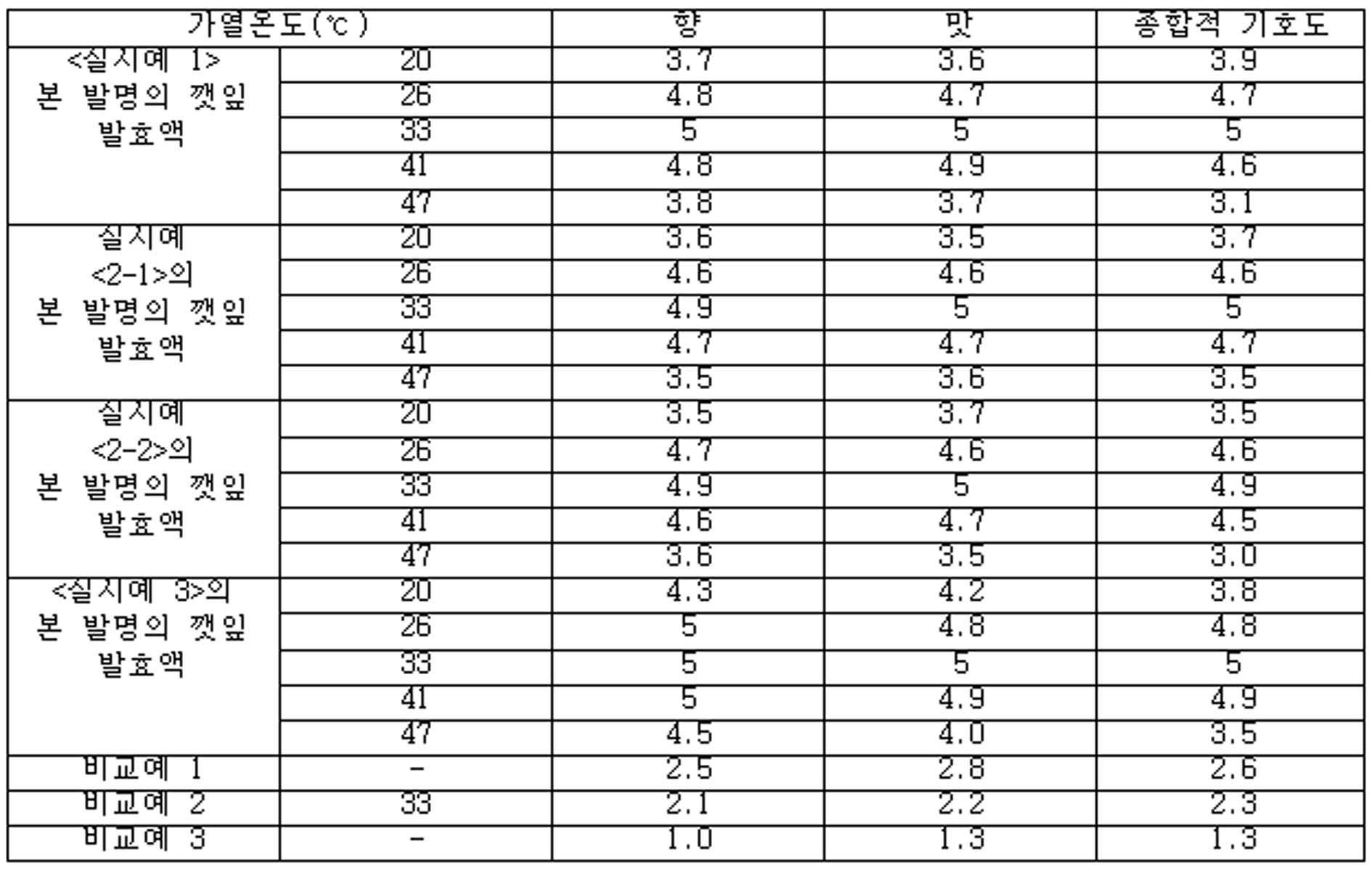
가열 온도에 따른 식물 고유의 향, 맛 및 종합적 기호도를 알아보기 위하여, 상기 실시예 <1-3>의 저온가열 온도를 상이하게 하여 본 발명의 방법으로 제조한 식물 발효액에 대하여 관능평가를 수행하였다. 한편, 대조군으로 상기 <비교예 1> 내지 <비교예 3>에서 제조한 식물 발효액과 비교하였다.In order to investigate the inherent flavor, taste and overall acceptability of the plant according to the heating temperature, the sensory evaluation was carried out on the plant fermentation broth prepared by the method of the present invention by varying the heating temperature at low temperature in Example <1-3> . On the other hand, the control was compared with the plant fermentation broths prepared in <Comparative Examples 1 to 3>.
그 결과, 하기 표 3 및 표 4에 나타낸 바와 같이 본 발명의 26 내지 41℃ 온도에서 가열 단계를 거친 발효액은 깻잎 또는 쑥잎 고유의 향 및 맛을 유지하고 있으며, 발효액으로서의 종합적 기호도가 우수함을 확인하였다. 또한, 추가적으로 1차 살균 단계 및 2차 살균 단계를 거치더라도 잎 자체의 향 및 맛이 변질되지 않고 소비자의 기호에 부합됨을 확인하였다. 아울러, 풍미 추가 단계를 거친 발효액에서는 보다 진한 향 및 맛을 느낄 수 있음을 확인하였다(표 3 및 표 4).
As a result, as shown in Tables 3 and 4, the fermentation broth after heating at 26 to 41 캜 according to the present invention retained the flavor and taste inherent to the sesame leaf or wormwood, and it was confirmed that the fermentation broth as the fermentation broth had excellent overall acceptability . In addition, it was confirmed that even if the first sterilization step and the second sterilization step were carried out, the fragrance and taste of the leaves themselves did not deteriorate, and they were in accordance with consumers' preferences. In addition, it was confirmed that the fermented broth after the flavor addition step can feel a stronger flavor and taste (Table 3 and Table 4).
본 발명의 쑥잎
발효액≪ Example 1 >
According to the present invention,
Fermentation liquid
<2-1>의
본 발명의 쑥잎
발효액Example
In <2-1>
According to the present invention,
Fermentation liquid
<2-2>의
본 발명의 쑥잎
발효액Example
<2-2>
According to the present invention,
Fermentation liquid
본 발명의 쑥잎
발효액≪ Example 3 >
According to the present invention,
Fermentation liquid
<1-3> 냉각 온도가 상이한 발효액에 대한 관능평가<1-3> Sensory evaluation of fermentation broth with different cooling temperature
냉각 온도에 따른 식물 고유의 향, 맛 및 종합적 기호도를 알아보기 위하여, 상기 실시예 <1-4>의 냉각 온도를 상이하게 하여 본 발명의 방법으로 제조한 식물 발효액에 대하여 관능평가를 수행하였다. 한편, 대조군으로 상기 <비교예 1> 내지 <비교예 3>에서 제조한 식물 발효액과 비교하였다.In order to examine the inherent flavor, taste and overall acceptability of the plant according to the cooling temperature, the sensory evaluation was carried out on the plant fermentation broth prepared by the method of the present invention at different cooling temperatures in the above Example <1-4>. On the other hand, the control was compared with the plant fermentation broths prepared in <Comparative Examples 1 to 3>.
그 결과, 하기 표 5 및 표 6에 나타낸 바와 같이, 본 발명의 -10 내지 5℃ 온도에서 급속냉각 단계를 거친 발효액은 깻잎 또는 쑥잎 고유의 향 및 맛을 잘 유지하고 있으며, 발효액으로서 종합적 기호도가 우수함을 확인하였다. 또한, 추가적으로 1차 살균 단계 및 2차 살균 단계를 거치더라도 잎 자체의 향 및 맛이 변질되지 않고 소비자의 기호에 부합됨을 확인하였다. 아울러, 풍미 추가 단계를 거친 발효액에서는 보다 진한 향 및 맛을 느낄 수 있음을 확인하였다(표 5 및 표 6).
As a result, as shown in the following Tables 5 and 6, the fermentation broth having undergone the rapid cooling step at the temperature of -10 to 5 ° C of the present invention maintained the inherent flavor and taste of the sesame leaf or wormwood, . In addition, it was confirmed that even if the first sterilization step and the second sterilization step were carried out, the fragrance and taste of the leaves themselves did not deteriorate, and they were in accordance with consumers' preferences. In addition, it was confirmed that the fermented liquid after the flavor addition step can feel a stronger flavor and taste (Table 5 and Table 6).
본 발명의 깻잎
발효액≪ Example 1 >
The sesame leaf of the present invention
Fermentation liquid
<2-1>의
본 발명의 깻잎
발효액Example
In <2-1>
The sesame leaf of the present invention
Fermentation liquid
<2-2>의
본 발명의 깻잎
발효액Example
<2-2>
The sesame leaf of the present invention
Fermentation liquid
본 발명의 깻잎
발효액≪ Example 3 >
The sesame leaf of the present invention
Fermentation liquid
본 발명의 쑥잎
발효액≪ Example 1 >
According to the present invention,
Fermentation liquid
<2-1>의
본 발명의 쑥잎
발효액Example
In <2-1>
According to the present invention,
Fermentation liquid
<2-2>의
본 발명의 쑥잎
발효액Example
<2-2>
According to the present invention,
Fermentation liquid
본 발명의 쑥잎
발효액≪ Example 3 >
According to the present invention,
Fermentation liquid
<1-4> 발효 온도가 상이한 발효액에 대한 관능평가<1-4> Sensory evaluation of fermentation broth with different fermentation temperature
발효 온도에 따른 식물 고유의 향, 맛 및 종합적 기호도를 알아보기 위하여, 상기 실시예 <1-5>의 저온발효 단계에서 발효 온도를 상이하게 하여 본 발명의 방법으로 제조한 식물 발효액에 대하여 관능평가를 수행하였다.In order to examine the inherent flavor, taste and overall preference of the plant according to the fermentation temperature, the fermentation temperature of the fermentation broth prepared by the method of the present invention was varied in the low temperature fermentation step of Example <1-5> Respectively.
그 결과, 하기 표 7 및 표 8에 나타낸 바와 같이, 본 발명의 -3 내지 15℃ 온도에서 저온발효 단계를 거친 발효액은 깻잎 또는 쑥잎 고유의 향 및 맛을 잘 유지하고 있으며, 발효액으로서 종합적 기호도가 우수함을 확인하였다(표 7 및 표 8).
As a result, as shown in the following Tables 7 and 8, the fermentation broth of the present invention having undergone the low temperature fermentation step at a temperature of -3 to 15 ° C maintained the flavor and taste inherent to the sesame leaf or wormwood, (Table 7 and Table 8).
<1-5> 발효 시간이 상이한 발효액에 대한 관능평가<1-5> Sensory evaluation of fermentation broth with different fermentation time
발효 시간에 따른 식물 고유의 향, 맛 및 종합적 기호도를 알아보기 위하여, 상기 실시예 <1-5>의 저온발효 단계에서 발효 시간을 상이하게 하여 본 발명의 방법으로 제조한 식물 발효액에 대하여 관능평가를 수행하였다. 이 때, 발효 온도는 상기 실험예 <1-4>에서 향, 맛 및 종합적 기호도가 가장 우수한 발효 온도인 6℃에서 수행하였다.In order to investigate the inherent flavor, taste and general preference of the plant according to the fermentation time, the fermentation time of the fermentation broth prepared by the method of the present invention was varied in the low temperature fermentation step of Example <1-5> Respectively. At this time, the fermentation temperature was carried out at 6 ° C, which is the highest fermentation temperature in the above Experimental Example <1-4>.
그 결과, 하기 표 9 및 표 10에 나타낸 바와 같이, 본 발명의 12 내지 72시간 범위에서 저온발효 단계를 거친 발효액이 깻잎 또는 쑥잎 고유의 향 및 맛을 잘 유지하고 있으며, 발효액으로서 종합적 기호도가 우수함을 확인하였다(표 9 및 표 10).
As a result, as shown in Tables 9 and 10 below, the fermentation broth having undergone the low-temperature fermentation step in the range of 12 to 72 hours of the present invention maintains the inherent flavor and taste of the sesame leaf or wormwood, and has excellent overall acceptability as a fermentation broth (Table 9 and Table 10).
Claims (15)
2) 상기 단계 1)의 식물 혼합액을 가열하는 단계;
3) 상기 단계 2)의 가열한 식물 혼합액을 냉각하는 단계; 및
4) 상기 단계 3)의 냉각한 식물 혼합액을 발효하는 단계를 포함하는, 향이 있는 식물의 발효액 제조방법.
1) preparing plant mixture by mixing plant with sugar and milk;
2) heating the plant mixture of step 1);
3) cooling the heated plant mixture in step 2); And
4) fermenting the cooled plant mixture in step 3).
The method according to claim 1, wherein the plant is fermented in step 1).
[3] The method according to claim 2, wherein the fermentation is any one selected from the group consisting of natural fermentation, sugar fermentation, and dry fermentation.
The method according to claim 1, wherein the plant in step 1) is a plant having a fragrance.
[5] The method according to claim 4, wherein the scented plant is any one or more selected from the group consisting of leaves, stem, fruit and roots of a plant having a fragrance.
The method according to claim 4, wherein the fragrant plant is selected from the group consisting of leaves, leaves, leaves, herb leaves, coriander leaves, asparagus leaves, ginseng, ginkgo leaf, pine needles, persimmon leaves, chestnut leaves, A method for producing a fermented liquid of a fragrant plant characterized by comprising at least one selected from the group consisting of tree leaves, camphor leaf, cabbage leaf, potato leaf, sweet potato leaf, pepper leaf, crushed stone, leek, garlic, onion and mushroom.
[2] The method according to claim 1, wherein the plant mixture of step 1) comprises 0.8 to 5 parts by weight of plant, 1 to 8 parts by weight of sugar, and 80 to 95 parts by weight of milk.
The method according to claim 1, wherein the heating in step 2) is carried out at a temperature of 26 to 41 캜.
The method according to claim 1, wherein the cooling in step 3) is carried out at a temperature of -10 to 5 占 폚.
The method according to claim 1, wherein the fermentation in step 4) is carried out at a temperature of -3 to 15 캜 for 12 to 72 hours.
The method according to claim 1, further comprising the step of first pasteurizing the fermentation broth of step 4) at a temperature of 60 to 75 캜 for 30 to 60 minutes.
12. The method of claim 11, further comprising a second pasteurization of the first pasteurized fermentation broth at a temperature of 60 to 75 DEG C for 30 to 60 minutes.
b) 상기 단계 a)의 분쇄한 발효액을 가열하는 단계;
c) 상기 단계 b)의 가열한 발효액을 발효하는 단계; 및
d) 상기 단계 c)의 발효액을 제 1항, 제 11항 및 제 12항에서 제조한 발효액과 각각 혼합하는 단계를 포함하는, 향이 있는 식물의 발효액 제조방법.
a) adding a plant to the fermentation broth of claim 1, and mixing or grinding the same;
b) heating the pulverized fermentation broth of step a);
c) fermenting the heated fermentation broth of step b); And
d) mixing the fermentation broth of step c) with the fermentation broths of claims 1, 11 and 12, respectively.
A plant fermentation broth produced by the method according to any one of claims 1 to 13.
A beverage composition comprising the plant fermentation liquid of claim 14.
Priority Applications (1)
| Application Number | Priority Date | Filing Date | Title |
|---|---|---|---|
| KR1020170074414A KR20180135749A (en) | 2017-06-13 | 2017-06-13 | Fermented liquid of plant having flavour, beverage comprising the same and method for making the same |
Applications Claiming Priority (1)
| Application Number | Priority Date | Filing Date | Title |
|---|---|---|---|
| KR1020170074414A KR20180135749A (en) | 2017-06-13 | 2017-06-13 | Fermented liquid of plant having flavour, beverage comprising the same and method for making the same |
Publications (1)
| Publication Number | Publication Date |
|---|---|
| KR20180135749A true KR20180135749A (en) | 2018-12-21 |
Family
ID=64959992
Family Applications (1)
| Application Number | Title | Priority Date | Filing Date |
|---|---|---|---|
| KR1020170074414A Ceased KR20180135749A (en) | 2017-06-13 | 2017-06-13 | Fermented liquid of plant having flavour, beverage comprising the same and method for making the same |
Country Status (1)
| Country | Link |
|---|---|
| KR (1) | KR20180135749A (en) |
Cited By (1)
| Publication number | Priority date | Publication date | Assignee | Title |
|---|---|---|---|---|
| KR20230014571A (en) | 2021-07-21 | 2023-01-30 | 주보정 | Manufacturing method of perilla leaf latte, perilla leaf latte produced by this |
-
2017
- 2017-06-13 KR KR1020170074414A patent/KR20180135749A/en not_active Ceased
Cited By (1)
| Publication number | Priority date | Publication date | Assignee | Title |
|---|---|---|---|---|
| KR20230014571A (en) | 2021-07-21 | 2023-01-30 | 주보정 | Manufacturing method of perilla leaf latte, perilla leaf latte produced by this |
Similar Documents
| Publication | Publication Date | Title |
|---|---|---|
| KR101348449B1 (en) | Paste fermented red pepper composition used as various cuisine sauces, composition for condiments comprising the same and method for preparing the same | |
| KR101693668B1 (en) | The manufacturing method of Functional Korean hot pepper paste from the Berries of Korean Cudrania tricuspidata | |
| KR101189893B1 (en) | Manufacturing method of chicken broth with herb fermented juicy and chicken broth thereof | |
| KR101627299B1 (en) | Kimchi seasoning containing perilla seed oil, method for manufacturing kimchi using the same, and kimchi prepared by using the same | |
| CN105462762B (en) | Violet cabbage fermented wine | |
| KR101818991B1 (en) | the manufacturing method of soy sauce with black garlic | |
| KR100693458B1 (en) | Herb Ssamjang and its Manufacturing Method | |
| KR101185961B1 (en) | Manufacturing method of chicken broth including fermented herb juicy with red ginseng juicy and chicken broth thereof | |
| CN106879898A (en) | A method for increasing the content of flavonoids and polyphenols in lactic acid fermented beverages | |
| KR101455172B1 (en) | Preparing method of sweet and sour pork using citrus fruit | |
| KR102549244B1 (en) | Manufacturing method of hallabong bread and hallabong bread manufactured by the same | |
| KR101819286B1 (en) | the manufacturing method of soy sauce with Japanes apricot | |
| KR101773118B1 (en) | Production method of fermentation vinegar using wild plants | |
| KR100666301B1 (en) | Health drink mainly made from Cheonggukjang and its manufacturing method | |
| KR20180048106A (en) | Preparation method of Opuntia humifusa beverage fermented by Kimchi lactic acid bacteria | |
| KR102005982B1 (en) | A method of making low-salt dongchimi to aid digestion using the fermenting liquid of fruit | |
| KR100893975B1 (en) | Manufacturing method of organic selenium-containing rice using the situation mushroom | |
| KR101745180B1 (en) | Fermanted foods manufacturing method with cultivating and ripening of using Galwha extracts | |
| KR102762249B1 (en) | Manufacturing method for fig leaves powder increased functionality using gaba | |
| KR101818993B1 (en) | the manufacturing method of soy sauce with edible chrysanthemun | |
| KR100641274B1 (en) | Method of Making Herbal Yogurt | |
| KR101701809B1 (en) | Red ginseng milk beverage containing black garlic and method for preparing thereof | |
| KR101795682B1 (en) | Method for manufacturing bracken fermantation kimchi and bracken fermantation kimchi manufactured by the same | |
| CN109588522A (en) | A kind of stevia rebaudianum black tea and its processing and utilize method | |
| KR100840725B1 (en) | New Cheongguk Doenjang Preparation |
Legal Events
| Date | Code | Title | Description |
|---|---|---|---|
| A201 | Request for examination | ||
| PA0109 | Patent application |
Patent event code: PA01091R01D Comment text: Patent Application Patent event date: 20170613 |
|
| PA0201 | Request for examination | ||
| E902 | Notification of reason for refusal | ||
| PE0902 | Notice of grounds for rejection |
Comment text: Notification of reason for refusal Patent event date: 20181010 Patent event code: PE09021S01D |
|
| PG1501 | Laying open of application | ||
| E601 | Decision to refuse application | ||
| PE0601 | Decision on rejection of patent |
Patent event date: 20181226 Comment text: Decision to Refuse Application Patent event code: PE06012S01D Patent event date: 20181010 Comment text: Notification of reason for refusal Patent event code: PE06011S01I |