JP2025508416A - Method for isolating supercoiled plasmid DNA - Google Patents
Method for isolating supercoiled plasmid DNA Download PDFInfo
- Publication number
- JP2025508416A JP2025508416A JP2024548455A JP2024548455A JP2025508416A JP 2025508416 A JP2025508416 A JP 2025508416A JP 2024548455 A JP2024548455 A JP 2024548455A JP 2024548455 A JP2024548455 A JP 2024548455A JP 2025508416 A JP2025508416 A JP 2025508416A
- Authority
- JP
- Japan
- Prior art keywords
- pdna
- chromatographic
- supercoiled
- ligand
- chromatographic material
- Prior art date
- Legal status (The legal status is an assumption and is not a legal conclusion. Google has not performed a legal analysis and makes no representation as to the accuracy of the status listed.)
- Pending
Links
Classifications
-
- C—CHEMISTRY; METALLURGY
- C12—BIOCHEMISTRY; BEER; SPIRITS; WINE; VINEGAR; MICROBIOLOGY; ENZYMOLOGY; MUTATION OR GENETIC ENGINEERING
- C12N—MICROORGANISMS OR ENZYMES; COMPOSITIONS THEREOF; PROPAGATING, PRESERVING, OR MAINTAINING MICROORGANISMS; MUTATION OR GENETIC ENGINEERING; CULTURE MEDIA
- C12N15/00—Mutation or genetic engineering; DNA or RNA concerning genetic engineering, vectors, e.g. plasmids, or their isolation, preparation or purification; Use of hosts therefor
- C12N15/09—Recombinant DNA-technology
- C12N15/10—Processes for the isolation, preparation or purification of DNA or RNA
- C12N15/1003—Extracting or separating nucleic acids from biological samples, e.g. pure separation or isolation methods; Conditions, buffers or apparatuses therefor
- C12N15/1006—Extracting or separating nucleic acids from biological samples, e.g. pure separation or isolation methods; Conditions, buffers or apparatuses therefor by means of a solid support carrier, e.g. particles, polymers
- C12N15/101—Extracting or separating nucleic acids from biological samples, e.g. pure separation or isolation methods; Conditions, buffers or apparatuses therefor by means of a solid support carrier, e.g. particles, polymers by chromatography, e.g. electrophoresis, ion-exchange, reverse phase
-
- A—HUMAN NECESSITIES
- A61—MEDICAL OR VETERINARY SCIENCE; HYGIENE
- A61K—PREPARATIONS FOR MEDICAL, DENTAL OR TOILETRY PURPOSES
- A61K39/00—Medicinal preparations containing antigens or antibodies
- A61K39/12—Viral antigens
-
- A—HUMAN NECESSITIES
- A61—MEDICAL OR VETERINARY SCIENCE; HYGIENE
- A61P—SPECIFIC THERAPEUTIC ACTIVITY OF CHEMICAL COMPOUNDS OR MEDICINAL PREPARATIONS
- A61P31/00—Antiinfectives, i.e. antibiotics, antiseptics, chemotherapeutics
- A61P31/12—Antivirals
-
- B—PERFORMING OPERATIONS; TRANSPORTING
- B01—PHYSICAL OR CHEMICAL PROCESSES OR APPARATUS IN GENERAL
- B01D—SEPARATION
- B01D15/00—Separating processes involving the treatment of liquids with solid sorbents; Apparatus therefor
- B01D15/08—Selective adsorption, e.g. chromatography
- B01D15/10—Selective adsorption, e.g. chromatography characterised by constructional or operational features
- B01D15/18—Selective adsorption, e.g. chromatography characterised by constructional or operational features relating to flow patterns
- B01D15/1864—Selective adsorption, e.g. chromatography characterised by constructional or operational features relating to flow patterns using two or more columns
- B01D15/1871—Selective adsorption, e.g. chromatography characterised by constructional or operational features relating to flow patterns using two or more columns placed in series
-
- B—PERFORMING OPERATIONS; TRANSPORTING
- B01—PHYSICAL OR CHEMICAL PROCESSES OR APPARATUS IN GENERAL
- B01D—SEPARATION
- B01D15/00—Separating processes involving the treatment of liquids with solid sorbents; Apparatus therefor
- B01D15/08—Selective adsorption, e.g. chromatography
- B01D15/26—Selective adsorption, e.g. chromatography characterised by the separation mechanism
- B01D15/36—Selective adsorption, e.g. chromatography characterised by the separation mechanism involving ionic interaction, e.g. ion-exchange, ion-pair, ion-suppression or ion-exclusion
- B01D15/361—Ion-exchange
- B01D15/363—Anion-exchange
-
- B—PERFORMING OPERATIONS; TRANSPORTING
- B01—PHYSICAL OR CHEMICAL PROCESSES OR APPARATUS IN GENERAL
- B01D—SEPARATION
- B01D15/00—Separating processes involving the treatment of liquids with solid sorbents; Apparatus therefor
- B01D15/08—Selective adsorption, e.g. chromatography
- B01D15/26—Selective adsorption, e.g. chromatography characterised by the separation mechanism
- B01D15/38—Selective adsorption, e.g. chromatography characterised by the separation mechanism involving specific interaction not covered by one or more of groups B01D15/265 and B01D15/30 - B01D15/36, e.g. affinity, ligand exchange or chiral chromatography
- B01D15/3804—Affinity chromatography
-
- B—PERFORMING OPERATIONS; TRANSPORTING
- B01—PHYSICAL OR CHEMICAL PROCESSES OR APPARATUS IN GENERAL
- B01J—CHEMICAL OR PHYSICAL PROCESSES, e.g. CATALYSIS OR COLLOID CHEMISTRY; THEIR RELEVANT APPARATUS
- B01J41/00—Anion exchange; Use of material as anion exchangers; Treatment of material for improving the anion exchange properties
- B01J41/04—Processes using organic exchangers
- B01J41/05—Processes using organic exchangers in the strongly basic form
-
- B—PERFORMING OPERATIONS; TRANSPORTING
- B01—PHYSICAL OR CHEMICAL PROCESSES OR APPARATUS IN GENERAL
- B01J—CHEMICAL OR PHYSICAL PROCESSES, e.g. CATALYSIS OR COLLOID CHEMISTRY; THEIR RELEVANT APPARATUS
- B01J41/00—Anion exchange; Use of material as anion exchangers; Treatment of material for improving the anion exchange properties
- B01J41/04—Processes using organic exchangers
- B01J41/07—Processes using organic exchangers in the weakly basic form
-
- B—PERFORMING OPERATIONS; TRANSPORTING
- B01—PHYSICAL OR CHEMICAL PROCESSES OR APPARATUS IN GENERAL
- B01J—CHEMICAL OR PHYSICAL PROCESSES, e.g. CATALYSIS OR COLLOID CHEMISTRY; THEIR RELEVANT APPARATUS
- B01J41/00—Anion exchange; Use of material as anion exchangers; Treatment of material for improving the anion exchange properties
- B01J41/20—Anion exchangers for chromatographic processes
-
- B—PERFORMING OPERATIONS; TRANSPORTING
- B01—PHYSICAL OR CHEMICAL PROCESSES OR APPARATUS IN GENERAL
- B01J—CHEMICAL OR PHYSICAL PROCESSES, e.g. CATALYSIS OR COLLOID CHEMISTRY; THEIR RELEVANT APPARATUS
- B01J47/00—Ion-exchange processes in general; Apparatus therefor
- B01J47/016—Modification or after-treatment of ion-exchangers
-
- C—CHEMISTRY; METALLURGY
- C12—BIOCHEMISTRY; BEER; SPIRITS; WINE; VINEGAR; MICROBIOLOGY; ENZYMOLOGY; MUTATION OR GENETIC ENGINEERING
- C12N—MICROORGANISMS OR ENZYMES; COMPOSITIONS THEREOF; PROPAGATING, PRESERVING, OR MAINTAINING MICROORGANISMS; MUTATION OR GENETIC ENGINEERING; CULTURE MEDIA
- C12N15/00—Mutation or genetic engineering; DNA or RNA concerning genetic engineering, vectors, e.g. plasmids, or their isolation, preparation or purification; Use of hosts therefor
- C12N15/09—Recombinant DNA-technology
- C12N15/10—Processes for the isolation, preparation or purification of DNA or RNA
- C12N15/1003—Extracting or separating nucleic acids from biological samples, e.g. pure separation or isolation methods; Conditions, buffers or apparatuses therefor
- C12N15/1017—Extracting or separating nucleic acids from biological samples, e.g. pure separation or isolation methods; Conditions, buffers or apparatuses therefor by filtration, e.g. using filters, frits, membranes
-
- A—HUMAN NECESSITIES
- A61—MEDICAL OR VETERINARY SCIENCE; HYGIENE
- A61K—PREPARATIONS FOR MEDICAL, DENTAL OR TOILETRY PURPOSES
- A61K39/00—Medicinal preparations containing antigens or antibodies
- A61K2039/51—Medicinal preparations containing antigens or antibodies comprising whole cells, viruses or DNA/RNA
- A61K2039/53—DNA (RNA) vaccination
Landscapes
- Chemical & Material Sciences (AREA)
- Health & Medical Sciences (AREA)
- Engineering & Computer Science (AREA)
- Life Sciences & Earth Sciences (AREA)
- Organic Chemistry (AREA)
- Biomedical Technology (AREA)
- Genetics & Genomics (AREA)
- Analytical Chemistry (AREA)
- Chemical Kinetics & Catalysis (AREA)
- Wood Science & Technology (AREA)
- Biotechnology (AREA)
- General Engineering & Computer Science (AREA)
- Zoology (AREA)
- Bioinformatics & Cheminformatics (AREA)
- General Health & Medical Sciences (AREA)
- Microbiology (AREA)
- Biochemistry (AREA)
- Molecular Biology (AREA)
- Biophysics (AREA)
- Physics & Mathematics (AREA)
- Crystallography & Structural Chemistry (AREA)
- Plant Pathology (AREA)
- Animal Behavior & Ethology (AREA)
- Virology (AREA)
- Veterinary Medicine (AREA)
- Medicinal Chemistry (AREA)
- Public Health (AREA)
- Pharmacology & Pharmacy (AREA)
- Epidemiology (AREA)
- Mycology (AREA)
- Immunology (AREA)
- Communicable Diseases (AREA)
- Oncology (AREA)
- General Chemical & Material Sciences (AREA)
- Nuclear Medicine, Radiotherapy & Molecular Imaging (AREA)
- Treatment Of Liquids With Adsorbents In General (AREA)
- Medicines Containing Antibodies Or Antigens For Use As Internal Diagnostic Agents (AREA)
- Pharmaceuticals Containing Other Organic And Inorganic Compounds (AREA)
Abstract
本開示は、液体試料から超らせんプラスミドDNA(pDNA)を分離するための方法であって、
(a)pDNAを含む液体試料を、(i)pDNAに結合するための陰イオン交換クロマトグラフィーリガンド及び(ii)第一のクロマトグラフィー材を通した対流を可能にする支持材を含む第一のクロマトグラフィー材に加え、当該液体試料が、細胞培養収集物に由来し、工程(a)の前にRNAを除去する工程に供されている、工程、(b)第一のクロマトグラフィー材から、超らせんpDNAと開環状pDNAとの精製された混合物を含む液体試料を溶出させる工程、(c)工程(b)由来の液体試料を、pDNAに結合し、開環状pDNAからの超らせんpDNAの選択的分離を可能にするリガンドを含む、第二のクロマトグラフィー材に加える工程、(d)精製された超らせんpDNAを、第二のクロマトグラフィー材から溶出させる工程を含み、工程(d)で溶出した超らせんpDNAが、当該第一及び第二のクロマトグラフィー材以外にいかなる更なるクロマトグラフィー材を使用することなく、少なくとも95%の純度を有する、方法を提供する。工程(a)~(d)及びあらゆる中間の工程は、5時間以内に完了され得る。当該分離方法によって得られた超らせんpDNAの使用が、更に開示される。
The present disclosure provides a method for isolating supercoiled plasmid DNA (pDNA) from a liquid sample, comprising:
The present invention provides a method for separating pDNA from pDNA comprising the steps of: (a) applying a liquid sample containing pDNA to a first chromatographic material comprising (i) an anion exchange chromatographic ligand for binding pDNA and (ii) a support material allowing convection through the first chromatographic material, the liquid sample being derived from a cell culture harvest and having been subjected to a step of removing RNA prior to step (a); (b) eluting the liquid sample from the first chromatographic material comprising a purified mixture of supercoiled pDNA and open circular pDNA; (c) applying the liquid sample from step (b) to a second chromatographic material comprising a ligand that binds pDNA and allows selective separation of supercoiled pDNA from open circular pDNA; and (d) eluting the purified supercoiled pDNA from the second chromatographic material, the supercoiled pDNA eluted in step (d) having a purity of at least 95% without the use of any additional chromatographic material beyond the first and second chromatographic materials. Steps (a)-(d) and any intermediate steps can be completed within 5 hours. Uses of the supercoiled pDNA obtained by the separation method are further disclosed.
Description
本開示は、プラスミドDNA(pDNA)の分離の分野に関し、pDNAを含む精製された組成物を生成するための方法、及び細胞培養収集物(cell culture harvest)から超らせんpDNAを分離するための方法を対象とする。当該方法によって得られた超らせんpDNAの使用が、更に開示される。 The present disclosure relates to the field of plasmid DNA (pDNA) isolation and is directed to methods for producing purified compositions containing pDNA and for isolating supercoiled pDNA from cell culture harvests. Uses of the supercoiled pDNA obtained by the methods are further disclosed.
プラスミドは、染色体DNAから物理的に分離している、小さいDNA分子である。それらは、細菌中で独立して複製する、小さな環状の二本鎖DNA分子である。 Plasmids are small DNA molecules that are physically separate from chromosomal DNA. They are small, circular, double-stranded DNA molecules that replicate independently in bacteria.
プラスミドDNA(pDNA)は、遺伝学及びバイオテクノロジーの研究室において、遺伝子をクローン化及び増幅又は発現させるために使用される、重要な遺伝子工学的ツールである。ウイルスベクター及びmRNAの生成は、pDNAに依存する。これは、mRNA製造のための鋳型として使用でき、ベクターベースのDNAワクチンを生産するためのウイルスベクターを製造するために使用できるか、又は細胞治療及び遺伝子療法に適用できる。医薬品及び医薬部外品の製造管理及び品質管理規則(GMP)グレードのpDNAは、直接DNAワクチンとして、遺伝子療法において、及び、例えば組換えタンパク質生成におけるエクスビボ適用において、使用し得る。 Plasmid DNA (pDNA) is an important genetic engineering tool used in genetics and biotechnology laboratories to clone and amplify or express genes. The production of viral vectors and mRNA relies on pDNA. It can be used as a template for mRNA production, to manufacture viral vectors for producing vector-based DNA vaccines, or applied in cell and gene therapy. Good Manufacturing Practice (GMP) grade pDNA can be used as direct DNA vaccines, in gene therapy, and in ex vivo applications, e.g., in recombinant protein production.
プラスミドの供給及び質は、ウイルスベクター、mRNA、及びDNAワクチンの製造のために極めて重要である。pDNAのGMP製造のための方法は、生産高及び質の必要性を満たすよう設計しなければならない。異なるプラスミド及び適用(異なる療法等)は、異なる要件を有する。pDNAは、各適用の収率及び純度の目標を満たす、高い収率及び力価で発現及び精製される必要がある。 Plasmid supply and quality are critical for the production of viral vectors, mRNA, and DNA vaccines. Methods for GMP production of pDNA must be designed to meet production volume and quality needs. Different plasmids and applications (e.g., different therapies) have different requirements. pDNA needs to be expressed and purified at high yields and titers to meet the yield and purity goals of each application.
5~20kb対(kbp)の範囲の超らせん(SC)プラスミドは、バイオプロセスでの適用において、最も一般的である。超らせんプラスミドの精製のための、既に知られた方法は、例えば、Lemmens et al (2003)、Sandberg et al (2004)、及びHitchcock et al (2010)に記載されている。更に、アプリケーションノート28-4094-85 AA (Cytiva社、スウェーデン)は、1)サイズ排除クロマトグラフィーレジンでの群分離、2)SC pDNAの捕捉及び選択的脱離、並びに3)強陰イオン交換リガンドでの硬質ビーズクロマトグラフィーレジンを使用した研磨を伴う3工程の方法を提案している。 Supercoiled (SC) plasmids in the range of 5-20 kbp are the most common in bioprocessing applications. Already known methods for the purification of supercoiled plasmids are described, for example, in Lemmens et al (2003), Sandberg et al (2004), and Hitchcock et al (2010). Furthermore, Application Note 28-4094-85 AA (Cytiva, Sweden) proposes a three-step method involving 1) population separation on a size-exclusion chromatography resin, 2) capture and selective desorption of SC pDNA, and 3) polishing using a hard bead chromatography resin with a strong anion exchange ligand.
しかしながら、例えば、pDNAの精製のための大規模な方法の、生産性及び持続可能性を上げるための、新しい精製戦略が常に必要とされている。 However, new purification strategies are constantly needed to increase the productivity and sustainability of large-scale methods for, for example, pDNA purification.
本開示は、従来技術の欠点を克服するか、又は少なくとも部分的に緩和することを目指している。 The present disclosure seeks to overcome or at least partially alleviate the shortcomings of the prior art.
したがって、本開示の目的は、超らせんpDNAを分離するための、より生産性の高い方法を提供するである。 Therefore, it is an object of the present disclosure to provide a more productive method for isolating supercoiled pDNA.
一態様では、本開示は、
(a)pDNAを含む液体試料を、(i)pDNAに結合するための陰イオン交換クロマトグラフィーリガンド及び(ii)第一のクロマトグラフィー材を通した対流を可能にする支持材を含む第一のクロマトグラフィー材に加える工程であって、
当該液体試料が、細胞培養収集物に由来し、工程(a)の前にRNAを除去する工程に供されている、工程、
(b)第一のクロマトグラフィー材から、超らせんpDNAと開環状pDNAとの精製された混合物を含む液体試料を溶出させる工程、
(c)工程(b)由来の液体試料を、pDNAに結合し、開環状pDNAからの超らせんpDNAの選択的分離を可能にするリガンドを含む、第二のクロマトグラフィー材に加える工程、
(d)精製された超らせんpDNAを、第二のクロマトグラフィー材から溶出させる工程
を含み、工程(d)で溶出した超らせんpDNAが、当該第一及び第二のクロマトグラフィー材以外にいかなる更なるクロマトグラフィー材を使用することなく、少なくとも95%の純度を有する、液体試料から超らせんプラスミドDNA(pDNA)を分離するための方法方法を提供する。
In one aspect, the present disclosure provides a method for producing a method for manufacturing a semiconductor device comprising:
(a) applying a liquid sample containing pDNA to a first chromatographic material comprising (i) an anion exchange chromatographic ligand for binding to the pDNA and (ii) a support material that allows for convection flow through the first chromatographic material;
the liquid sample is derived from a cell culture harvest and has been subjected to a step of removing RNA prior to step (a);
(b) eluting the liquid sample comprising the purified mixture of supercoiled pDNA and open circular pDNA from the first chromatographic material;
(c) applying the liquid sample from step (b) to a second chromatographic material that contains a ligand that binds pDNA and allows for the selective separation of supercoiled pDNA from open circular pDNA;
(d) eluting the purified supercoiled pDNA from a second chromatographic material, wherein the supercoiled pDNA eluted in step (d) has a purity of at least 95% without the use of any additional chromatographic materials other than the first and second chromatographic materials.
工程(a)の前に、液体試料を前処置する工程(a1)があってもよく、当該前処置する工程は、細胞培養収集物を細胞溶解に供する工程、RNA沈殿剤の存在下でRNAを沈殿させる工程、清澄化、及び濾過の少なくとも1つを含む。 Step (a) may be preceded by a step (a1) of pretreating the liquid sample, the pretreatment step comprising at least one of subjecting the cell culture harvest to cell lysis, precipitating RNA in the presence of an RNA precipitant, clarification, and filtration.
スタティックミキサーを使用して細胞培養収集物を溶解液と混合することによって、細胞培養収集物を細胞溶解に供する工程を行ってもよい。細胞培養収集物を当該溶解液と接触させて組合せ組成物(combined composition)を形成し、次いで当該組合せ組成物を、当該スタティックミキサーに流して、その混合を達成してもよい。 The step of subjecting the cell culture harvest to cell lysis may be performed by mixing the cell culture harvest with a lysis solution using a static mixer. The cell culture harvest may be contacted with the lysis solution to form a combined composition, and the combined composition may then be passed through the static mixer to achieve mixing.
当該工程(a1)は、RNA沈殿剤の存在下でRNAを沈殿させることによって、RNA除去の当該工程を提供してもよい。RNA沈殿剤は、塩化カルシウム、塩化リチウム、及びクエン酸三カリウムからなる群から選択され得、好ましくは塩化カルシウムである。 Step (a1) may provide for the step of RNA removal by precipitating RNA in the presence of an RNA precipitant. The RNA precipitant may be selected from the group consisting of calcium chloride, lithium chloride, and tripotassium citrate, preferably calcium chloride.
別の態様では、本開示は、
(I)スラリーの形態の、pDNA産生細胞を含む細胞培養収集物を提供する工程、
(II)当該細胞培養収集物を溶解液と接触させて、溶解組成物を形成する工程、
(III)スタティックミキサーを使用して溶解組成物を混合して、細胞溶解物を形成する工程、
(IV)中和溶液を細胞溶解物に加える工程、
(V)場合により、RNA沈殿剤の作用によって細胞溶解物中のRNAを沈殿させる工程
(VI)細胞溶解物を清澄化する工程、
(VII)細胞溶解物を濾過して、プラスミドDNA(pDNA)を含む溶液を得る工程、
(VIII)当該pDNAを含む溶液を、少なくとも1つのクロマトグラフィー工程に供して、pDNAを含む、精製された組成物を提供する、工程
を含む、
pDNAを含む組成物を生成するための方法を提供する。
In another aspect, the present disclosure provides a method for producing a method for manufacturing a pharmaceutical composition comprising:
(I) providing a cell culture harvest comprising pDNA producing cells in the form of a slurry;
(II) contacting the cell culture harvest with a lysis solution to form a lysis composition;
(III) mixing the lysis composition using a static mixer to form a cell lysate;
(IV) adding a neutralizing solution to the cell lysate;
(V) optionally precipitating RNA in the cell lysate by the action of an RNA precipitant.
(VI) clarifying the cell lysate;
(VII) filtering the cell lysate to obtain a solution containing plasmid DNA (pDNA);
(VIII) subjecting the solution containing the pDNA to at least one chromatography step to provide a purified composition containing the pDNA;
Methods for producing compositions comprising pDNA are provided.
工程(I)~(VIII)は、連続的に行ってもよく、使い捨て器具を使用してもよい。当該方法は、高速で、容易に制御可能である。 Steps (I)-(VIII) may be performed continuously or using disposable equipment. The method is fast and easily controllable.
少なくとも1つのクロマトグラフィー工程は、pDNAを捕捉するための、少なくとも1つの結合-溶出クロマトグラフィー工程を含んでもよく、特に、本明細書に記載されるようなクロマトグラフィー工程(a)~(d)を含んでもよい。 The at least one chromatography step may include at least one bind-elute chromatography step to capture pDNA, and may in particular include chromatography steps (a)-(d) as described herein.
本明細書に開示される方法は、典型的には、群分離等のサイズ排除クロマトグラフィー工程を含まない。よって、第一又は第二の態様の方法は、サイズ排除クロマトグラフィーレジンの使用なしに行われ得る。 The methods disclosed herein typically do not include a size exclusion chromatography step such as group separation. Thus, the methods of the first or second aspects can be performed without the use of a size exclusion chromatography resin.
サイズ排除クロマトグラフィーと対照的に、本方法の工程(a)は、高い負荷能力(loading capacity)を提供し、所定の処理体積に対して全体的な処理時間の短縮に大きく貢献する。例えば、工程(a)~(d)及びあらゆる中間の工程は、5時間以内に完了され得る。更に、実施例で証明されるように、硫酸アンモニウム消費の実質的な減少が達成され得る。当該方法は、GMPグレードのpDNAの産業の受入基準を満たす。 In contrast to size exclusion chromatography, step (a) of the present method offers high loading capacity, which contributes significantly to reducing the overall processing time for a given processing volume. For example, steps (a)-(d) and any intermediate steps can be completed within 5 hours. Furthermore, as demonstrated in the examples, a substantial reduction in ammonium sulfate consumption can be achieved. The method meets the industry acceptance criteria for GMP grade pDNA.
よって、本明細書で開示される2工程のクロマトグラフィー方法は、高純度の超らせんpDNAを提供し、より高い生産性を可能にする。また、本方法はまた、以前の方法と比較して、バッファー消費を減少させ、そのため、pDNA分離のための、より持続可能な方法が提供される。 Thus, the two-step chromatography method disclosed herein provides highly pure supercoiled pDNA and allows for higher productivity. The method also reduces buffer consumption compared to previous methods, thus providing a more sustainable method for pDNA isolation.
上記で開示された方法は、工程(d)で溶出した超らせんpDNAを、下記の工程:
(e1)超らせんpDNAを、薬学的に適切な用量まで濃縮する工程、
(e2)上述の方法の工程(d)で適用されたバッファーを、薬学的に許容され得るバッファーで置換する工程、及び/又は
(e3)超らせんpDNAを滅菌する工程
の1つ又は複数に供する工程を更に含み得、それによって医薬品グレードの超らせんpDNAを含む組成物を得て、場合により当該組成物は、医薬品グレードの超らせんpDNAを含む医薬組成物又は医薬品有効成分である、方法である。
The method disclosed above comprises subjecting the supercoiled pDNA eluted in step (d) to the following steps:
(e1) concentrating the supercoiled pDNA to a pharma- ceutically relevant dose;
(e2) replacing the buffer applied in step (d) of the above method with a pharma- ceutically acceptable buffer, and/or
(e3) The method may further comprise subjecting the supercoiled pDNA to one or more of the steps of sterilization, thereby obtaining a composition comprising pharmaceutical grade supercoiled pDNA, optionally the composition being a pharmaceutical composition or active pharmaceutical ingredient comprising pharmaceutical grade supercoiled pDNA.
本開示は、対象に、本明細書で開示される分離方法を行うことによって得られた医薬品グレードの超らせんpDNAを含む医薬組成物又は医薬品有効成分を投与する工程を含み、場合により当該医薬品有効成分がDNAワクチンの形態で投与され、予防される疾患又は障害が、SARS-CoV-2、ジカ、インフルエンザA型、黄熱病ウイルス、又はヒト免疫不全ウイルス(HIV)等のウイルスによる感染によって引き起こされる、対象における疾患又は障害を予防又は処置するための方法を更に提供する。 The present disclosure further provides a method for preventing or treating a disease or disorder in a subject, comprising administering to the subject a pharmaceutical composition or active pharmaceutical ingredient comprising pharmaceutical grade supercoiled pDNA obtained by performing the isolation method disclosed herein, optionally wherein the active pharmaceutical ingredient is administered in the form of a DNA vaccine, wherein the disease or disorder being prevented is caused by infection with a virus, such as SARS-CoV-2, Zika, influenza A, yellow fever virus, or human immunodeficiency virus (HIV).
別の態様では、本開示は、本明細書で開示される分離方法を行うことによって得られた医薬品グレードの超らせんpDNAを含む組成物で細胞をインビトロでトランスフェクトする工程を含み、それによってウイルスベクターの生成を可能にし、場合により当該ウイルスベクターは、医薬品有効成分としての使用のためである、ウイルスベクターを生成するための方法を対象とする。 In another aspect, the present disclosure is directed to a method for producing a viral vector comprising transfecting a cell in vitro with a composition comprising pharmaceutical grade supercoiled pDNA obtained by performing the isolation method disclosed herein, thereby allowing for the production of a viral vector, optionally the viral vector for use as an active pharmaceutical ingredient.
更なる態様では、本開示はまた、本明細書で開示される分離方法を行うことによって得られた医薬品グレードの超らせんpDNAを含む組成物を、RNAを生成するための鋳型として使用する工程を含み、場合により当該RNAが医薬品有効成分としての使用のためである、RNAを生成するための方法を提供する。 In a further aspect, the present disclosure also provides a method for producing RNA, comprising using a composition comprising pharmaceutical grade supercoiled pDNA obtained by performing the isolation method disclosed herein as a template to produce RNA, optionally wherein the RNA is for use as an active pharmaceutical ingredient.
本開示の好ましい態様は、下記で、詳細な説明及び従属項において説明される。本発明は特許請求の範囲で列挙される特徴の全ての可能な組合せに関することに留意されたい。 Preferred aspects of the present disclosure are described below in the detailed description and in the dependent claims. It should be noted that the present invention relates to all possible combinations of the features recited in the claims.
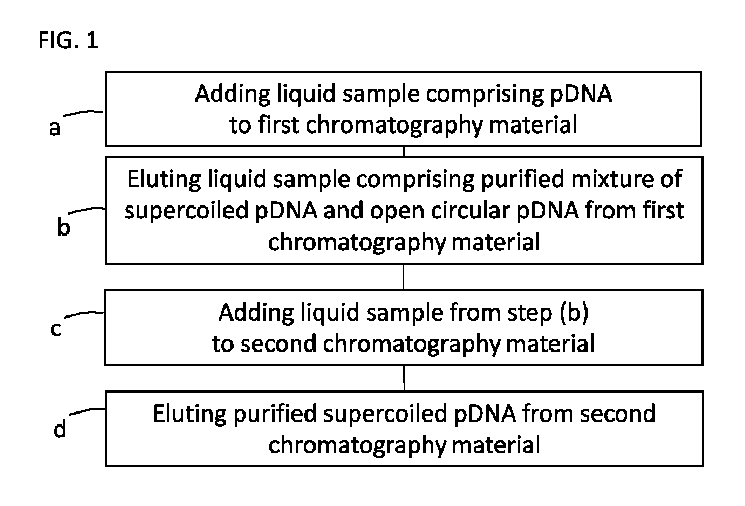
本開示は、図1で説明されるように、
(a)pDNAを含む液体試料を、(i)pDNAに結合するための陰イオン交換クロマトグラフィーリガンド及び(ii)第一のクロマトグラフィー材を通した対流を可能にする支持材を含む第一のクロマトグラフィー材に加える工程であって、
当該液体試料が、細胞培養収集物に由来し、工程(a)の前にRNAを除去する工程に供されている、工程、
(b)第一のクロマトグラフィー材から、超らせんpDNAと開環状pDNAとの精製された混合物を含む液体試料を溶出させる工程、
(c)工程(b)由来の液体試料を、pDNAに結合し、開環状pDNAからの超らせんpDNAの選択的分離を可能にするリガンドを含む、第二のクロマトグラフィー材に加える工程、
(d)精製された超らせんpDNAを、第二のクロマトグラフィー材から溶出させる工程
を含み、工程(d)で溶出した超らせんpDNAが、当該第一及び第二のクロマトグラフィー材以外にいかなる更なるクロマトグラフィー材を使用することなく、少なくとも95%の純度を有する、液体試料から超らせんプラスミドDNA(pDNA)を分離するための方法を提供することによって、超らせんプラスミドDNA(pDNA)を分離するための既存の方法に関連する問題を解決するか、又は少なくとも軽減する。
The present disclosure relates to a method for manufacturing a semiconductor device, comprising:
(a) applying a liquid sample containing pDNA to a first chromatographic material comprising (i) an anion exchange chromatographic ligand for binding to the pDNA and (ii) a support material that allows for convection flow through the first chromatographic material;
the liquid sample is derived from a cell culture harvest and has been subjected to a step of removing RNA prior to step (a);
(b) eluting the liquid sample comprising the purified mixture of supercoiled pDNA and open circular pDNA from the first chromatographic material;
(c) applying the liquid sample from step (b) to a second chromatographic material that contains a ligand that binds pDNA and allows for the selective separation of supercoiled pDNA from open circular pDNA;
The present invention solves or at least alleviates problems associated with existing methods for isolating supercoiled plasmid DNA (pDNA) by providing a method for isolating supercoiled plasmid DNA (pDNA) from a liquid sample, comprising the step of (d) eluting the purified supercoiled pDNA from a second chromatographic material, wherein the supercoiled pDNA eluted in step (d) has a purity of at least 95% without the use of any additional chromatographic materials other than the first and second chromatographic materials.
2つだけのクロマトグラフィー工程を含む、ここで開示された方法の有意な利点としては、下流処理のための生産時間が80%減少し、硫酸アンモニウム消費が50%減少して、高純度(少なくとも95%)の超らせんpDNAが得られ、それによって、アプリケーションノート28-4094-85 AA (Cytiva社、スウェーデン)に記載されている、既に知られたpDNA精製のための3工程の方法と比較して、持続可能性の増大がもたらされることが挙げられる。 Significant advantages of the method disclosed herein, which involves only two chromatographic steps, include an 80% reduction in production time for downstream processing, a 50% reduction in ammonium sulfate consumption, and high purity (at least 95%) supercoiled pDNA, thereby resulting in increased sustainability compared to the previously known three-step method for pDNA purification described in Application Note 28-4094-85 AA (Cytiva, Sweden).
本明細書で使用される場合、「液体試料」という用語は、細胞培養物から、又は細胞培養物に由来する流体から得ることができるあらゆるタイプの試料を包含し、当該流体は、分離及び精製のあらゆる手段によって、少なくとも部分的に精製されることが理解されるべきである。 As used herein, the term "liquid sample" should be understood to encompass any type of sample that can be obtained from a cell culture or from a fluid derived from a cell culture, the fluid being at least partially purified by any means of separation and purification.
「超らせんpDNA」という用語は、コイル状形態を有する閉ループの形態のプラスミドDNAをいう。DNAは、正の超らせん又は負の超らせんであり得る。例えば、超らせんプラスミドDNAは、末端にループのある二条の(two-start)右巻きのらせんを形成し得る。 The term "supercoiled pDNA" refers to plasmid DNA in the form of a closed loop having a coiled morphology. The DNA can be positively or negatively supercoiled. For example, supercoiled plasmid DNA can form a two-start right-handed helix with loops at the ends.
「開環状pDNA」という用語は、プラスミドが超らせん立体配置をとる原因となる、二重らせんの鎖(strain)の少なくとも一部が遊離した影響によって、DNA二重らせんの一方の鎖が壊れたプラスミドDNAをいう。それによって、開環状pDNAは、コイル状でないが環状形態を維持する、閉ループを形成する。 The term "open circular pDNA" refers to plasmid DNA in which one strand of the DNA double helix has been broken by the effect of releasing at least a portion of the double helix strain, which causes the plasmid to adopt a superhelical configuration. Open circular pDNA thereby forms a closed loop that is not coiled but maintains a circular form.
超らせんプラスミドDNAに関する「純度」という用語は、プラスミドDNAの総量に関する、超らせんプラスミドDNAの含量をいう。「プラスミドDNA」としては、一般に、超らせんプラスミドDNA、開環状プラスミドDNA、及び存在する場合には直鎖状プラスミドDNAが挙げられる。したがって、95%の純度の超らせんpDNAは、超らせんpDNAが全pDNAの95%を構成することを意味する。 The term "purity" with respect to supercoiled plasmid DNA refers to the content of supercoiled plasmid DNA with respect to the total amount of plasmid DNA. "Plasmid DNA" generally includes supercoiled plasmid DNA, open circular plasmid DNA, and linear plasmid DNA, if present. Thus, 95% pure supercoiled pDNA means that supercoiled pDNA constitutes 95% of the total pDNA.
「分離マトリックス」という用語は、本明細書で、官能基を含む1つ又は複数のリガンドが結合している支持材を含む材料を意味するよう使用される。リガンドの官能基は、液体試料から分離される、及び/又は液体試料中に存在する他の化合物から分離される、本明細書で分析物とも呼ばれる化合物に結合する。分離マトリックスは、リガンドを支持材に結合させる化合物を更に含んでもよい。「リンカー」及び「エクステンダー」という用語は、かかる化合物を説明するために使用され得る。「レジン」という用語は、この分野における分離マトリックスのために使用される場合がある。「クロマトグラフィー材」及び「クロマトグラフィーマトリックス」という用語は、本明細書で、分離マトリックスの一種を意味するよう使用される。 The term "separation matrix" is used herein to mean a material comprising a support material to which one or more ligands containing functional groups are attached. The functional groups of the ligands bind to compounds, also referred to herein as analytes, to be separated from the liquid sample and/or from other compounds present in the liquid sample. The separation matrix may further comprise compounds that bind the ligands to the support material. The terms "linker" and "extender" may be used to describe such compounds. The term "resin" is sometimes used for separation matrices in the art. The terms "chromatographic material" and "chromatographic matrix" are used herein to mean a type of separation matrix.
一般に、分離マトリックスは、あらゆるタイプの分離装置に含まれ得る。「分離装置」という用語は、バイオプロセスの分野における、その従来の意味を有し、化合物の生成の副産物を含む流体からの化合物の分離及び精製をすることができ、分離及び精製に適した、あらゆるタイプの分離装置を包含すると理解されるべきである。分離装置は、上記で定義されるような分離マトリックスを含み得る。分離装置の非限定的な例としては、本明細書の他の部分で更に説明されるような、クロマトグラフィーカラム及び膜装置が挙げられる。非限定的な例によれば、多孔質粒子の形態のクロマトグラフィー材が、クロマトグラフィーカラムに含まれるクロマトグラフィー材に液体試料を加える前に、クロマトグラフィーカラムに詰められ得る。別の非限定的な例によれば、膜状構造の形態のクロマトグラフィー材が、膜装置に含まれ得る。 In general, the separation matrix may be included in any type of separation device. The term "separation device" has its conventional meaning in the field of bioprocessing and should be understood to encompass any type of separation device capable of and suitable for the separation and purification of compounds from fluids, including by-products of the production of the compounds. The separation device may include a separation matrix as defined above. Non-limiting examples of separation devices include chromatography columns and membrane devices, as further described elsewhere herein. According to a non-limiting example, a chromatography material in the form of porous particles may be packed into the chromatography column prior to adding a liquid sample to the chromatography material contained in the chromatography column. According to another non-limiting example, a chromatography material in the form of a membrane-like structure may be included in the membrane device.
この文脈において、「リガンド」は、所定の分析物に対する既知又は未知の親和性を有する分子であり、その表面に固定されたあらゆる官能基、又は捕捉剤が含まれるが、「分析物」は、リガンドに対するあらゆる特異的結合パートナーを含む。「リガンド」という用語は、本明細書で、「特異的結合分子」「特異的結合パートナー」「捕捉分子」及び「捕捉剤」という用語と互換可能に使用され得る。本明細書で、リガンドと相互作用する、液体試料中の分子は、「分析物」と呼ばれる。本開示の目的の分析物は、超らせんpDNAである。結果として、本明細書で、「分析物」及び「超らせんpDNA」という用語は、互換可能に使用され得る。 In this context, a "ligand" is a molecule with a known or unknown affinity for a given analyte, including any functional group immobilized on its surface, or a capture agent, while an "analyte" includes any specific binding partner for a ligand. The term "ligand" may be used interchangeably herein with the terms "specific binding molecule," "specific binding partner," "capture molecule," and "capture agent." The molecule in the liquid sample that interacts with the ligand is referred to herein as the "analyte." The analyte for purposes of this disclosure is supercoiled pDNA. As a result, the terms "analyte" and "supercoiled pDNA" may be used interchangeably herein.
本明細書で開示される方法に適用されるクロマトグラフィー材は、リガンドが結合した支持材を含む。 The chromatography material applied in the methods disclosed herein includes a support material to which a ligand is attached.
上述のように、第一のクロマトグラフィー材の支持材は、第一のクロマトグラフィー材を通した対流を可能にする支持材である。「対流を可能にする支持材」という用語は、支持材の流入と流出との間の水圧差の適用によって支持材を灌流させ、実質的に、支持材への、又は支持材からの、物質の対流輸送を達成する、支持材を意味するよう意図される。 As mentioned above, the support of the first chromatographic material is a support that allows for convection through the first chromatographic material. The term "support that allows for convection" is intended to mean a support that perfuses the support by application of a hydraulic pressure difference between the inflow and outflow of the support, substantially achieving convective transport of material to or from the support.
対流を可能にする支持材の非限定的な例は、ナノファイバー、モノリス、膜状構造物、及びエクステンダーが結合した粒子である。 Non-limiting examples of support materials that allow convection are nanofibers, monoliths, membranous structures, and particles with attached extenders.
第一のクロマトグラフィー材の支持材がナノファイバーを含む場合、かかるナノファイバーは、例えば、電界紡糸高分子ナノファイバーを含み得る。使用時に、かかるナノファイバーは、移動相が浸透し得る複数の孔を含む、固定相を形成する。 When the support material of the first chromatographic material comprises nanofibers, such nanofibers may comprise, for example, electrospun polymeric nanofibers. In use, such nanofibers form a stationary phase that includes a plurality of pores through which the mobile phase can permeate.
本明細書で、「モノリス」及び「モノリシック構造」という用語は、バイオプロセスの分野における、それらの従来の意味を有する。モノリスは、単一ユニットの構造であると説明され得る。バイオプロセスの適用において使用されるモノリスは、孔を含むスポンジ様構造を有する。第一のクロマトグラフィー材の支持材がモノリシック構造を含む場合、当業者は、液体試料からpDNAを分離する目的に適した孔径を有するモノリシック構造を選択することができる。 As used herein, the terms "monolith" and "monolithic structure" have their conventional meaning in the field of bioprocessing. A monolith may be described as a single unit structure. Monoliths used in bioprocessing applications have a sponge-like structure that includes pores. When the support material of the first chromatographic material includes a monolithic structure, one of skill in the art can select a monolithic structure that has a pore size appropriate for the purpose of isolating pDNA from a liquid sample.
第一のクロマトグラフィー材のモノリシック支持材の非限定的な例は、CIMマルタス(商標)DEAE (Sartorius社)等のConvective Interaction Media (CIM(商標)モノリス(BIA Separations社))である。 A non-limiting example of a monolithic support material for the first chromatography material is Convective Interaction Media (CIM™ Monolith (BIA Separations)), such as CIM Maltus™ DEAE (Sartorius).
第一のクロマトグラフィー材の支持材は、単一の膜、重なった膜又はフィルター等の、膜状構造物を含んでもよい。膜は、吸着性の膜であってもよい。クロマトグラフィー材の支持材が膜状構造物を含む場合、当業者は、液体試料からpDNAを分離する目的に適した孔径を有する膜状構造物を選択し得る。クロマトグラフィー材が膜状構造物を含む場合、かかる膜状構造物、例えば、高分子ナノファイバーの不織ウェブを含んでもよい。 The support material of the first chromatographic material may comprise a membranous structure, such as a single membrane, stacked membranes, or a filter. The membrane may be an adsorptive membrane. When the support material of the chromatographic material comprises a membranous structure, one skilled in the art may select a membranous structure having a pore size suitable for the purpose of separating pDNA from a liquid sample. When the chromatographic material comprises a membranous structure, such a membranous structure may comprise, for example, a nonwoven web of polymeric nanofibers.
適切なポリマーの非限定的な例は、ポリスルホン、ポリエーテルスルホン、ポリアミド、ナイロン、ポリアクリル酸、ポリメタクリル酸、ポリアクリロニトリル、ポリスチレン、及びポリエチレンオキシド、並びにそれらの混合物から選択され得る。 Non-limiting examples of suitable polymers may be selected from polysulfone, polyethersulfone, polyamide, nylon, polyacrylic acid, polymethacrylic acid, polyacrylonitrile, polystyrene, and polyethylene oxide, and mixtures thereof.
或いは、ポリマーは、セルロース及びセルロースの部分的な誘導体、特にセルロースエステル、架橋セルロース、グラフト型セルロース又はリガンド結合型セルロース(ligand-coupled cellulose)からなる群から選択されるようなセルロース系ポリマーであってもよい。セルロースファイバークロマトグラフィー(Fibroクロマトグラフィーとして公知;Cytiva社、スウェーデン)は、短い処理時間及び高い生産性のための超高速クロマトグラフィー精製であり、高流速及び高能力のセルロースファイバーを利用する。 Alternatively, the polymer may be a cellulosic polymer such as cellulose and partial derivatives of cellulose, in particular cellulose esters, crosslinked cellulose, grafted cellulose or ligand-coupled cellulose. Cellulose fiber chromatography (also known as Fibro chromatography; Cytiva, Sweden) is an ultrafast chromatographic purification method for short processing times and high productivity, utilizing the high flow rates and high capacity of cellulose fibers.
適切な膜状構造物の非限定的な例は、強化セルロースを含む。 Non-limiting examples of suitable membranous structures include reinforced cellulose.
適切な膜状構造物の別の非限定的な例は、ナイロンを含む。 Another non-limiting example of a suitable membranous structure includes nylon.
適切な膜状構造物の別の非限定的な例は、ポリエーテルスルホン、例えばMustang(商標)Q(Pall社)を含む。 Another non-limiting example of a suitable membranous structure includes polyethersulfone, such as Mustang™ Q (Pall Corporation).
本明細書で開示される分離方法の工程(a)で適用される第一のクロマトグラフィー材の非限定的な例は、本明細書の他の部分で詳細に説明されるように、陰イオン交換クロマトグラフィーリガンド、及びセルロース又はセルロースの部分的な誘導体を含む膜状構造を有する支持材を含む。 Non-limiting examples of the first chromatographic material applied in step (a) of the separation method disclosed herein include an anion exchange chromatographic ligand and a support material having a membranous structure comprising cellulose or a partial derivative of cellulose, as described in detail elsewhere in this specification.
第一のクロマトグラフィー材の膜状支持材の別の非限定的な例は、Sartobind(登録商標)Q膜吸着剤(Sartorius社)であり、これは>3μmの孔径のマクロ多孔質構造を有する。第四級アンモニウムリガンドは、膜の完全な内面に共有結合する。 Another non-limiting example of a membrane support for the first chromatographic material is Sartobind® Q membrane sorber (Sartorius), which has a macroporous structure with pore sizes >3 μm. Quaternary ammonium ligands are covalently bound to the complete inner surface of the membrane.
「膜クロマトグラフィー」という用語は、バイオプロセスの分野における、その従来の意味を有する。膜クロマトグラフィーには、流体に接触した固相の表面への、流体の成分、例えば個々の分子、結合(associates)又は粒子の結合がある。固相の表面活性は、対流輸送による分子に到達可能である。充填されたクロマトグラフィーカラムにまさる、膜吸着剤の利点は、より高い流速で流されることへの適切さである。これはまた、対流ベースのクロマトグラフィーとも呼ばれる。対流ベースのクロマトグラフィーマトリックスとしては、マトリックスの流入と流出との間の水圧差の適用によってマトリックスを灌流させ、非常に迅速に高流速でもたらされる、実質的に、マトリックスへの、又はマトリックスからの、物質の対流輸送を達成する、あらゆるマトリックスが挙げられる。対流ベースのクロマトグラフィー及び膜吸着剤は、例えば、全体が参照によって本明細書に組み込まれている、US20140296464A1、US20160288089A1、WO2018011600A1、WO2018037244A1、WO2013068741A1、WO2015052465A1、US7867784B2に記載されている。 The term "membrane chromatography" has its conventional meaning in the field of bioprocessing. Membrane chromatography involves the binding of components of a fluid, such as individual molecules, associates or particles, to the surface of a solid phase in contact with the fluid. The surface activity of the solid phase makes it accessible to the molecules by convective transport. The advantage of membrane sorbers over packed chromatography columns is their suitability for flow at higher flow rates. This is also called convection-based chromatography. Convection-based chromatography matrices include any matrix in which the application of a hydraulic pressure difference between the inflow and outflow of the matrix perfuses the matrix, achieving substantially convective transport of substances into or out of the matrix very rapidly, resulting in high flow rates. Convection-based chromatography and membrane sorbents are described, for example, in US20140296464A1, US20160288089A1, WO2018011600A1, WO2018037244A1, WO2013068741A1, WO2015052465A1, US7867784B2, which are incorporated herein by reference in their entireties.
第一のクロマトグラフィー材の支持材は、実質的に球状の粒子、細長い粒子、又は不規則に形成された粒子等の、粒子の形態であってもよい。 The support material of the first chromatographic material may be in the form of particles, such as substantially spherical particles, elongated particles, or irregularly shaped particles.
適切な粒径は、5~500μmの粒径範囲であってもよい。実質的に球状の粒子の場合、平均粒径は、5~1000μmの範囲であってもよい。当業者は、使用される方法に依存して、適切な粒径及び多孔性を選択し得る。例えば、大規模な方法については、経済的な理由で、特に捕捉工程について、大容量の処理を可能にするために、より多孔質であるが厳密な支持体が好ましくあり得る。クロマトグラフィーにおいて、カラムのサイズ及び形状等のプロセスパラメータは、選択に影響を及ぼすであろう。エクスパンデッドベッド方法で、マトリックスは、一般に、高密度の充填剤、好ましくはステンレス鋼充填剤を含む。他の方法については、他の基準がマトリックスの性質に影響を及ぼし得る。 A suitable particle size may be in the range of 5-500 μm. For substantially spherical particles, the average particle size may be in the range of 5-1000 μm. The skilled person may select the appropriate particle size and porosity depending on the method used. For example, for large-scale methods, a more porous but rigid support may be preferred for economic reasons and to allow for large volume processing, especially for the capture step. In chromatography, process parameters such as column size and shape will influence the selection. In expanded bed methods, the matrix generally comprises a dense packing material, preferably a stainless steel packing. For other methods, other criteria may influence the nature of the matrix.
支持材は、有機又は無機の材料から作成され得、多孔質又は非多孔質であり得る。一実施形態では、支持材は、架橋炭水化物材料、例えばアガロース、寒天、セルロース、デキストラン、キトサン、コンニャク、カラゲナン、ジェラン、アルギン酸塩、ペクチン、デンプン等の、天然のポリマーから調製される。天然のポリマーの支持材は容易に調製され、場合により、逆相懸濁ゲル化(inverse suspension gelation)(S Hjerten: Biochim Biophys Acta 79(2)、393~398頁(1964))等の標準的な方法に従って架橋される。特に有利な実施形態では、支持材は、一種の、比較的厳密だが多孔質のアガロースであり、これはその流動性を増強する方法によって調製され、例えばUS6,602,990(Berg)を参照されたい。代替的な実施形態では、支持材は、架橋合成ポリマー、例えばスチレン又はスチレン誘導体、ジビニルベンゼン、アクリルアミド、アクリル酸エステル、メタクリル酸エステル、ビニルエステル、ビニルアミド等の合成ポリマー又はコポリマーから調製される。かかる合成ポリマーは容易に調製され、場合により標準的な方法に従って架橋され、例えば「Styrene based polymer supports developed by suspension polymerization」(R Arshady: Chimica e L'Industria 70(9)、70~75頁(1988))を参照されたい。天然又は合成のポリマー支持材はまた、Cytiva社、スウェーデン等の商業的供給源からも、例えば多孔質粒子の形態で、入手可能である。更に代替的な実施形態では、支持材は、シリカ等の無機ポリマーから調製される。無機多孔質及び非多孔質支持体は当該分野で周知であり、標準的な方法に従って容易に調製される。 The support material may be made of organic or inorganic materials and may be porous or non-porous. In one embodiment, the support material is prepared from natural polymers such as cross-linked carbohydrate materials, e.g. agarose, agar, cellulose, dextran, chitosan, konjac, carrageenan, gellan, alginate, pectin, starch, etc. Natural polymer supports are easily prepared and optionally cross-linked according to standard methods such as inverse suspension gelation (S Hjerten: Biochim Biophys Acta 79(2), pp. 393-398 (1964)). In a particularly advantageous embodiment, the support material is a type of relatively rigid but porous agarose, which is prepared by methods that enhance its fluidity, see for example US 6,602,990 (Berg). In an alternative embodiment, the support material is prepared from a cross-linked synthetic polymer, such as a synthetic polymer or copolymer of styrene or styrene derivatives, divinylbenzene, acrylamide, acrylic acid esters, methacrylic acid esters, vinyl esters, vinyl amides, and the like. Such synthetic polymers are easily prepared and optionally cross-linked according to standard methods, see for example "Styrene based polymer supports developed by suspension polymerization" (R Arshady: Chimica e L'Industria 70(9), pp. 70-75 (1988)). Natural or synthetic polymeric support materials are also available from commercial sources, such as Cytiva, Sweden, for example in the form of porous particles. In yet another alternative embodiment, the support material is prepared from an inorganic polymer, such as silica. Inorganic porous and non-porous supports are well known in the art and are easily prepared according to standard methods.
本明細書に開示される、超らせんpDNAを分離するための方法において、第一のクロマトグラフィー材が粒子の形態の支持材を含む場合、リガンドは、エクステンダーとしても公知の、より長いリンカー分子を介して支持材に結合する。エクステンダーは当該分野で周知であり、一般に、リガンドと支持体との間の距離を立体的に増大させるために使用される。エクステンダーは、テンタクル(tentacle)又はフレキシブルアームを意味する場合もある。可能な化学構造の、より詳細な説明については、例えば、参照によって本明細書に含まれるUS6,428,707を参照されたい。手短にいえば、エクステンダーは、ホモポリマー又はコポリマー等のポリマーの形態であってもよい。親水性ポリマー性エクステンダーは、合成由来であってもよく、即ち、合成骨格を有してもよく、又は生体由来であってもよく、即ち、天然起源の骨格を有するバイオポリマーであってもよい。典型的な合成ポリマーは、ポリビニルアルコール、ポリアクリルアミド及びポリメタクリルアミド、ポリビニルエーテル等である。典型的なバイオポリマーは、デンプン、セルロース、デキストラン、アガロース等の多糖である。 In the method for separating supercoiled pDNA disclosed herein, when the first chromatographic material comprises a support material in the form of particles, the ligand is attached to the support material via a longer linker molecule, also known as an extender. Extenders are well known in the art and are generally used to sterically increase the distance between the ligand and the support. Extenders may also refer to tentacles or flexible arms. For a more detailed description of possible chemical structures, see, for example, US 6,428,707, which is incorporated herein by reference. Briefly, the extender may be in the form of a polymer, such as a homopolymer or copolymer. The hydrophilic polymeric extender may be of synthetic origin, i.e., have a synthetic backbone, or may be of biological origin, i.e., be a biopolymer with a backbone of natural origin. Typical synthetic polymers are polyvinyl alcohol, polyacrylamide and polymethacrylamide, polyvinyl ethers, etc. Typical biopolymers are polysaccharides, such as starch, cellulose, dextran, agarose, etc.
第一のクロマトグラフィー材の粒子ベースの支持材の非限定的な例は、機能性リガンドに共有結合した線状ポリマー鎖のテンタクルを有する合成メタクリル酸ベースのポリマービーズからなるFractogel(商標)(Merck Millipore社)である。 A non-limiting example of a particle-based support for the first chromatographic material is Fractogel™ (Merck Millipore), which consists of synthetic methacrylic acid-based polymer beads with tentacles of linear polymer chains covalently bonded to functional ligands.
第一のクロマトグラフィー材の陰イオン交換クロマトグラフィーリガンドは、強陰イオン交換クロマトグラフィーリガンドであってもよい。強陰イオン交換クロマトグラフィーリガンドは、例えば、第四級アミン基又は第四級アミノエチル基を含んでもよい。 The anion exchange chromatography ligand of the first chromatographic material may be a strong anion exchange chromatography ligand. The strong anion exchange chromatography ligand may, for example, include a quaternary amine group or a quaternary aminoethyl group.
或いは、第一のクロマトグラフィー材の陰イオン交換クロマトグラフィーリガンドは、弱陰イオン交換クロマトグラフィーリガンドであってもよい。弱陰イオン交換クロマトグラフィーリガンドは、例えば、ジエチルアミノエチル(DEAE)基、トリメチルアミノエチル(TMAE)基、ジメチルアミノエチル(DMAE)基、又はトリメチルヒドロキシプロピル(QA)基を含んでもよい。 Alternatively, the anion exchange chromatography ligand of the first chromatographic material may be a weak anion exchange chromatography ligand. The weak anion exchange chromatography ligand may include, for example, a diethylaminoethyl (DEAE) group, a trimethylaminoethyl (TMAE) group, a dimethylaminoethyl (DMAE) group, or a trimethylhydroxypropyl (QA) group.
本明細書の実施例で使用される第一のクロマトグラフィー材は、Mustang(商標)Q(Pall社)であり、これは、第一のクロマトグラフィー材を通した対流を可能にする膜状構造物の形態の支持材、及び第四級アミン基を有する強陰イオン交換リガンドを含み、このリガンドは支持材に共有結合している。 The first chromatographic material used in the examples herein is Mustang™ Q (Pall), which includes a support in the form of a membranous structure that allows convection through the first chromatographic material, and a strong anion exchange ligand having a quaternary amine group, which is covalently attached to the support.
第二のクロマトグラフィー材は、リガンドが結合した支持材を含み、この支持材は、ナノファイバー、モノリス、膜状構造物、又は粒子を含む。 The second chromatographic material includes a support material having a ligand attached thereto, the support material including a nanofiber, a monolith, a membrane-like structure, or a particle.
第一のクロマトグラフィー材の支持材に関して上記で見られる、ナノファイバー、モノリス、膜状構造物及び粒子の詳細な説明は、第二のクロマトグラフィー材の支持材に関するナノファイバー、モノリス、膜状構造物及び粒子に同様に適用可能である。 The detailed descriptions of the nanofibers, monoliths, membranous structures and particles found above with respect to the support material of the first chromatographic material are equally applicable to the nanofibers, monoliths, membranous structures and particles with respect to the support material of the second chromatographic material.
しかしながら、第一のクロマトグラフィー材の支持材と比較した相違は、第二のクロマトグラフィー材の支持材は、必ずしも対流を可能にする支持材である必要はない点である。 However, a difference compared to the support material of the first chromatography material is that the support material of the second chromatography material does not necessarily have to be a support material that allows convection.
したがって、使用される第二のクロマトグラフィー材の支持材が粒子である場合、粒子はエクステンダーを含む必要はないが、それらは場合により、リガンドを支持体に連結させるリンカーを含んでもよく、即ち、支持材へのリガンドの結合は、支持材とリガンドとの間にリンカーを導入することによって提供され得る。結合は、エピクロロヒドリン;エピブロモヒドリン;アリルグリシジルエーテル;ブタンジオールジグリシジルエーテル等のビスエポキシド;ジクロロプロパノール等のハロゲン置換脂肪族物質;及びジビニルスルホンの使用によるような、あらゆる従来の共有結合方法に従って行われ得る。適切なリンカーの、他の非限定的な例は、2~6個の炭素原子を有するポリエチレングリコール(PEG)、3~6個の炭素原子を有する炭水化物、及び3~6個の炭素原子を有するポリアルコールである。これらの方法は全て当該分野で周知であり、当業者によって容易に行われる。更に上記で詳細に説明されるように、場合により、リンカーはエクステンダーである。 Thus, when the support material of the second chromatographic material used is a particle, the particles do not need to contain an extender, but they may optionally contain a linker connecting the ligand to the support, i.e., the binding of the ligand to the support material can be provided by introducing a linker between the support material and the ligand. The binding can be performed according to any conventional covalent bonding method, such as by using epichlorohydrin; epibromohydrin; allyl glycidyl ether; bis-epoxides such as butanediol diglycidyl ether; halogen-substituted aliphatic substances such as dichloropropanol; and divinyl sulfone. Other non-limiting examples of suitable linkers are polyethylene glycols (PEGs) having 2 to 6 carbon atoms, carbohydrates having 3 to 6 carbon atoms, and polyalcohols having 3 to 6 carbon atoms. All these methods are well known in the art and are easily performed by the skilled artisan. Optionally, the linker is an extender, as further explained in detail above.
更に上記で言及されるように、第二のクロマトグラフィー材は、pDNAに結合して開環状pDNAからの超らせんpDNAの選択的分離を可能にするリガンドを含む。選択的分離は、超らせんpDNAとの結合相互作用が開環状pDNAとの結合相互作用と比較して増大し得ること(超らせんpDNAが開環状pDNAより強く第二のクロマトグラフィー材のリガンドに結合することを意味する)によって、又は開環状pDNAとの結合相互作用が超らせんpDNAとの結合相互作用と比較して増大し得ること(開環状pDNAが超らせんpDNAより強く第二のクロマトグラフィー材のリガンドに結合することを意味する)によって、第二のクロマトグラフィー材のリガンドによって達成され得る。 As further mentioned above, the second chromatographic material includes a ligand that binds to pDNA to allow selective separation of supercoiled pDNA from open circular pDNA. Selective separation can be achieved by the ligand of the second chromatographic material either by increasing the binding interaction with supercoiled pDNA compared to the binding interaction with open circular pDNA (meaning that supercoiled pDNA binds stronger to the ligand of the second chromatographic material than open circular pDNA) or by increasing the binding interaction with open circular pDNA compared to the binding interaction with supercoiled pDNA (meaning that open circular pDNA binds stronger to the ligand of the second chromatographic material than supercoiled pDNA).
第二のクロマトグラフィー材のリガンドは、pDNAへの塩促進性(salt-promoted)親和性結合及び/又は親硫黄性芳香族吸着結合を可能にし得る。 The ligand of the second chromatographic material may enable salt-promoted affinity binding and/or sulfophilic aromatic adsorptive binding to pDNA.
第二のクロマトグラフィー材のリガンドは、例えば、親硫黄基、好ましくは2-メルカプトピリジン基を含み得る。 The ligand of the second chromatographic material may, for example, comprise a sulfur-philic group, preferably a 2-mercaptopyridine group.
本明細書の実施例で使用される第二のクロマトグラフィー材は、Capto(商標)PlasmidSelect(Cytiva社、スウェーデン)であり、これは多孔質アガロース粒子(累積体積分布(d50V)の中央粒径が36~44μm)の形態の支持材、及び2-メルカプトピリジン基を含む親硫黄性芳香族吸着リガンドを含む。このリガンドは、開環状pDNAとの結合相互作用と比較して、超らせんpDNAとの結合相互作用を増大させ得る。 The second chromatographic material used in the examples herein is Capto™ PlasmidSelect (Cytiva, Sweden), which contains a support in the form of porous agarose particles (with a cumulative volume distribution (d50V) median particle size of 36-44 μm) and a sulfophilic aromatic adsorption ligand containing 2-mercaptopyridine groups. This ligand may increase the binding interaction with supercoiled pDNA compared to the binding interaction with open circular pDNA.
第二のクロマトグラフィー材の別の非限定的な例は、PlasmidSelect Xtra(Cytiva社、スウェーデン)であり、これは多孔質アガロース粒子(累積体積分布(d50V)の中央粒径がおよそ34μm)の形態の支持材、及び2-メルカプトピリジン基を含む親硫黄性芳香族吸着リガンドを含む。 Another non-limiting example of a second chromatographic material is PlasmidSelect Xtra (Cytiva, Sweden), which comprises a support in the form of porous agarose particles (with a cumulative volume distribution (d50V) median particle size of approximately 34 μm) and a sulfophilic aromatic adsorption ligand containing 2-mercaptopyridine groups.
「表面」という用語は、本明細書で、全ての外面(external surface)を意味し、多孔質支持材の場合、外表面(outer surface)及び細孔表面を含む。 The term "surface" is used herein to mean all external surfaces, and in the case of porous supports, includes the outer surfaces and pore surfaces.
「溶出液」という用語は、当該分野における従来の意味で使用され、即ち、分離マトリックスから1つ又は複数の化合物を遊離させるための適切なpH及び/又はイオン強度のバッファーである。 The term "elution solution" is used in its conventional sense in the art, i.e., a buffer of appropriate pH and/or ionic strength to release one or more compounds from the separation matrix.
「溶出液」という用語は、当該分野における従来の意味で使用され、即ち、液体試料を分離マトリックスに加えた後に分離マトリックスから溶出する液体試料の一部である。 The term "eluate" is used in its conventional sense in the art, i.e., the portion of a liquid sample that elutes from a separation matrix after the liquid sample is applied to the separation matrix.
上述のように、超らせんpDNAを分離するための方法において、液体試料は細胞培養収集物に由来する。 As described above, in the method for isolating supercoiled pDNA, the liquid sample is derived from a cell culture harvest.
本明細書で、「細胞培養物」という用語は、細胞の培養物又は培養されている細胞の群をいい、ここで細胞は、細菌細胞、ウイルス細胞、真菌細胞、昆虫細胞、又は哺乳動物細胞等のあらゆるタイプの細胞であり得る。細胞培養物は、清澄化されていなくてもよく、即ち、細胞を含んでもよく、又は細胞除去されていてもよく、即ち、細胞を全く含まないか、若しくは少ししか含まないが、細胞を除去する前に細胞から放出された生体分子を含む、培養物であってもよい。更に、清澄化されていない細胞培養物は、完全細胞、破砕された細胞、細胞ホモジネート、及び/又は細胞溶解物を含んでもよい。 As used herein, the term "cell culture" refers to a culture of cells or a group of cells in culture, where the cells can be any type of cell, such as bacterial cells, viral cells, fungal cells, insect cells, or mammalian cells. A cell culture can be unclarified, i.e., contain cells, or can be decellularized, i.e., cultures that contain no or few cells but contain biomolecules released from the cells prior to cell decellularization. Additionally, unclarified cell cultures can include whole cells, disrupted cells, cell homogenates, and/or cell lysates.
「細胞培養収集物」という用語は、本明細書で、細胞が培養されていた容器又は器具から収集及び除去された細胞培養物を意味するよう使用される。 The term "cell culture harvest" is used herein to mean a cell culture that has been collected and removed from the container or device in which the cells were cultured.
上述のように、上述の分離方法の工程(a)で第一のクロマトグラフィー材に加えられた液体試料は、細胞培養収集物に由来し、工程(a)の前にRNAを除去する工程に供される。 As mentioned above, the liquid sample applied to the first chromatographic material in step (a) of the above separation method originates from a cell culture harvest and is subjected to a step to remove RNA prior to step (a).
当業者は、細胞培養収集物に由来する液体試料が、精製方法のある時点で除去される必要のある、RNAを含む多くの異なるタイプの生体化合物を含むことを理解する。 Those skilled in the art will appreciate that liquid samples derived from cell culture harvests contain many different types of biological compounds, including RNA, that need to be removed at some point in the purification process.
本明細書で、「RNAを除去する」という用語は、液体試料中に存在するRNAの量を減少させることを意味するよう意図される。現在開示される方法の文脈において、RNAは捕捉工程、即ち第一のクロマトグラフィー材への結合においてpDNAと競合するので、RNAを除去する工程は、工程(a)の前に行われる。よって、工程(a)の前にRNAを除去して、工程(a)で適用される第一のクロマトグラフィー材のpDNA結合能を向上させることは有利である。好ましくは、工程(a)の前のRNAの除去は、液体試料中のRNAの量の有意な減少をもたらす。 In this specification, the term "removing RNA" is intended to mean reducing the amount of RNA present in the liquid sample. In the context of the presently disclosed method, the step of removing RNA is performed before step (a), since RNA competes with pDNA in the capture step, i.e., binding to the first chromatographic material. It is therefore advantageous to remove RNA before step (a) to improve the pDNA binding capacity of the first chromatographic material applied in step (a). Preferably, the removal of RNA before step (a) results in a significant reduction in the amount of RNA in the liquid sample.
工程(a)で第一のクロマトグラフィー材に加えられる液体試料は、このように、前処置された液体試料であってもよい。 The liquid sample applied to the first chromatography material in step (a) may thus be a pretreated liquid sample.
したがって、上述の方法は、図2に示されるように、工程(a)の前に工程(a1)を更に含んでもよく、工程(a1)は、液体試料を前処置する工程を含み、場合により当該前処置する工程は、細胞培養収集物を、細胞溶解、RNA沈殿剤の存在下でのRNAの沈殿、清澄化、及び濾過の1つ又は複数に供する工程を含む。好ましくは、当該前処置する工程は、少なくとも、細胞溶解、RNA沈殿剤の存在下でのRNAの沈殿、及び清澄化を含む。沈殿したRNAは、濾過によって除去し得る。 Thus, the above-mentioned method may further comprise step (a1) prior to step (a) as shown in FIG. 2, where step (a1) comprises pretreating the liquid sample, optionally comprising subjecting the cell culture harvest to one or more of cell lysis, precipitation of RNA in the presence of an RNA precipitant, clarification, and filtration. Preferably, the pretreatment comprises at least cell lysis, precipitation of RNA in the presence of an RNA precipitant, and clarification. The precipitated RNA may be removed by filtration.
細胞溶解を行うための種々の技術は当該分野で周知である。一般に、収集された細胞は、アルカリ溶解液と混合されて、細胞溶解物とも呼ばれる、溶解された細胞の組成物を形成する。溶解は、その後、細胞溶解物への中和溶液の添加によって中断され、次いで、断片化された細胞を含む細胞片、宿主細胞タンパク質及び宿主細胞ゲノムDNAが除去され得る。 Various techniques for performing cell lysis are well known in the art. Generally, harvested cells are mixed with an alkaline lysis solution to form a composition of lysed cells, also called a cell lysate. Lysis is then halted by the addition of a neutralizing solution to the cell lysate, and then cellular debris, including fragmented cells, host cell proteins, and host cell genomic DNA, can be removed.
例えば、細胞培養物は、国際特許出願第PCT/EP2022/077388号に記載されるように、アルカリ溶解、中和、及び/又は清澄化に供され得る。例えば、細胞培養物は、当該細胞のアルカリ溶解のために、使い捨てバッグ等の使い捨て容器中で、アルカリ溶解液と接触させ得、ここで使い捨て容器は、一体型ミキサー(integrated mixer)を含み、細胞培養物は、アルカリ溶解液と混合される。溶解は、細胞培養物への中和溶液の添加によって中断し得る。 For example, the cell culture may be subjected to alkaline lysis, neutralization, and/or clarification as described in International Patent Application No. PCT/EP2022/077388. For example, the cell culture may be contacted with an alkaline lysis solution in a disposable container, such as a disposable bag, for alkaline lysis of the cells, where the disposable container includes an integrated mixer and the cell culture is mixed with the alkaline lysis solution. Lysis may be interrupted by the addition of a neutralizing solution to the cell culture.
或いは、液体試料中に存在する収集された細胞(例えば、スラリーの形態で)は、スタティックミキサーによってアルカリ溶解液と混合され得る。そのようなスタティックミキサーは公知である。この文脈において有用なスタティックミキサーは、管状部材を通過する流体の流路を部分的に妨害するよう管状部材の内部に配置された複数の隔壁を含む細長い管状部材であってもよい。スタティックミキサーは、このように、通過する流体の成分の混合を提供する、混濁した流れを達成する。スタティックミキサーの隔壁は、丸い形を有してもよい。かかる形状で、細胞溶解物及び遊離プラスミドを含む流体の流れは、プラスミドへの損傷を避けて、穏やかに向け直される。 Alternatively, the collected cells present in the liquid sample (e.g., in the form of a slurry) can be mixed with the alkaline lysis solution by means of a static mixer. Such static mixers are known. A static mixer useful in this context may be an elongated tubular member comprising a number of septa arranged inside the tubular member so as to partially obstruct the flow path of the fluid passing through the tubular member. The static mixer thus achieves a turbid flow that provides mixing of the components of the passing fluid. The septa of the static mixer may have a round shape. With such a shape, the flow of the fluid containing the cell lysate and the free plasmids is gently redirected, avoiding damage to the plasmids.
収集された細胞のスラリーをアルカリ溶解液と混合するために、アルカリ溶解液は、流体入口を介して、細胞スラリーを含む容器又は管に加えてもよく、次いで、組合せ組成物は、スタティックミキサーへ送られ(例えばポンプで)、スタティックミキサーを通り得る。例えば、細胞スラリーは、1つの入口を介して接合部に提供してもよく、アルカリ溶解液は、別の入口を介して当該接合部に提供してもよい。接合物はY字分岐接合部(Y joint)であってもよい。混合物は、スタティックミキサーを通して、継続的に一定の流速でポンプによって送られ得る。 To mix the harvested cell slurry with the alkaline lysis solution, the alkaline lysis solution may be added to a vessel or tube containing the cell slurry through a fluid inlet, and the combined composition may then be delivered (e.g., pumped) to and through a static mixer. For example, the cell slurry may be provided to a junction through one inlet, and the alkaline lysis solution may be provided to the junction through another inlet. The junction may be a Y joint. The mixture may be pumped through the static mixer at a continuous, constant flow rate.
場合によりスタティックミキサーを使用して、混合した後、アルカリ溶解液は、細胞溶解が十分な程度、好ましくは完全に進行するのに十分な時間、細胞スラリーと接触し続ける。接触時間は1分間から10分間までの範囲であってもよく、2~3分間等の、2~5分間の間であってもよい。接触時間が長い程、プラスミドDNAの一部も分解されるリスクが高くなる。そのため、10分間より短い接触時間が好ましい。 After mixing, optionally using a static mixer, the alkaline lysis solution is kept in contact with the cell slurry for a sufficient time for cell lysis to proceed to a sufficient extent, preferably complete. The contact time may range from 1 minute to 10 minutes, and may be between 2 and 5 minutes, such as 2 to 3 minutes. The longer the contact time, the higher the risk that some of the plasmid DNA will also be degraded. Therefore, contact times shorter than 10 minutes are preferred.
溶解反応は、得られた細胞溶解物を上述のように中和溶液と混合することによって中断される。 The lysis reaction is stopped by mixing the resulting cell lysate with a neutralizing solution as described above.
中和溶液の添加は、アルカリ溶解の間に使用されたのと同じ使い捨て容器であってもよい、使い捨て容器中で起こってもよく、又は、別の使い捨て容器であってもよく、これはスタティックミキサーが上述のように使用される場合である。細胞溶解物が中和溶液と接触する使い捨て容器は、一体型ミキサーを含んでもよい。 The addition of the neutralizing solution may be to the same disposable vessel used during alkaline lysis, may occur in the disposable vessel, or may be in a separate disposable vessel, which is the case when a static mixer is used as described above. The disposable vessel in which the cell lysate contacts the neutralizing solution may include an integral mixer.
細胞スラリー及びアルカリ溶解液を混合するためにスタティックミキサーが使用される場合、スタティックミキサーの後(下流)に配置された流体入口を介して中和溶液を細胞溶解物に加えてもよく、次いで、中和された細胞溶解物を、RNA沈殿、清澄化及び/又は濾過等の更なる処理が起こり得る容器に移してもよい。溶解及び中和の後、細胞溶解物を、場合により、RNA沈殿剤を使用したRNA沈殿に供してもよい。RNA沈殿剤は、塩化カルシウム(CaCl2)、塩化リチウム(LiCl)、及びクエン酸三カリウム(C6H5K3O7)からなる群から選択され得、好ましくは塩化カルシウムであり得る。 If a static mixer is used to mix the cell slurry and the alkaline lysis solution, a neutralization solution may be added to the cell lysate via a fluid inlet located after (downstream of) the static mixer, and the neutralized cell lysate may then be transferred to a vessel where further processing, such as RNA precipitation, clarification and/or filtration, may occur. After lysis and neutralization, the cell lysate may optionally be subjected to RNA precipitation using an RNA precipitant. The RNA precipitant may be selected from the group consisting of calcium chloride ( CaCl2 ), lithium chloride (LiCl), and tripotassium citrate ( C6H5K3O7 ) , and may preferably be calcium chloride.
溶解及び中和の後、細胞溶解物を、清澄化及び/又は濾過に供してもよい。当業者は、細胞培養収集物に由来する液体試料の、種々の清澄化のための方法及び濾過のための方法の知識を有する。例えば、細胞溶解物は、本質的に、PCT/EP2022/077388に記載されるように、
- 溶解を中断するために中和溶液を添加した後、場合により細胞溶解物を、使い捨ての混合バッグ等の使い捨て容器に移す工程、
- 凝集物を取り除く薬剤(flocculate lifting agent)を使い捨て容器に加えることによって使い捨て容器内で細胞溶解物を清澄化させ、それによって使い捨て容器内で少なくとも2つの相が分離し、それによって当該相の一方が中和及び清澄化された、プラスミドDNAを含むアルカリ性溶液である、工程、
- 使い捨て容器から、中和及び清澄化されたアルカリ性溶液を除去する工程、
- 中和及び清澄化されたアルカリ性溶液を濾過する工程
によって、清澄化し得る。
After lysis and neutralization, the cell lysate may be subjected to clarification and/or filtration. The skilled artisan is knowledgeable of various methods for clarification and filtration of liquid samples derived from cell culture harvests. For example, the cell lysate may be essentially clarified and/or filtrated as described in PCT/EP2022/077388.
- adding a neutralizing solution to interrupt the lysis, and then optionally transferring the cell lysate to a disposable container, such as a disposable mixing bag;
- clarifying the cell lysate in the disposable container by adding a flocculate lifting agent to the disposable container, whereby at least two phases separate in the disposable container, whereby one of the phases is a neutralized and clarified alkaline solution containing the plasmid DNA;
- removing the neutralized and clarified alkaline solution from the disposable container;
The neutralized and clarified alkaline solution may be clarified by a process of filtering.
清澄化が行われる使い捨て容器は、一体型ミキサーを含んでもよい。清澄化工程の使い捨て容器は、可撓性プラスチックバッグ等の使い捨てバッグであってもよい。 The disposable container in which clarification takes place may include an integrated mixer. The disposable container for the clarification step may be a disposable bag, such as a flexible plastic bag.
本明細書に記載される工程段階の1つ又は複数は、好ましくは使い捨てバッグ、管及びミキサー等の使い捨て器具を使用して、連続的な方法の一部として行われ得る。例えば、上述のようなスタティックミキサーを使用した細胞溶解と、その後の中和は、連続的な方法で行われ得る。有利なことに、かかる方法は、細胞収集物スラリー、溶解液及び中和溶液の流速を制御する1つ又は複数のポンプの設置を調節することによって容易に制御し得る。 One or more of the process steps described herein may be performed as part of a continuous process, preferably using disposable equipment such as disposable bags, tubing, and mixers. For example, cell lysis using a static mixer as described above, followed by neutralization, may be performed in a continuous process. Advantageously, such a process may be easily controlled by adjusting the installation of one or more pumps that control the flow rates of the cell harvest slurry, lysis solution, and neutralization solution.
連続的でない場合、工程は、バッチ式で行われる。例えば、細胞溶解及び中和は、連続的に行われ得、その後にバッチ式のRNA沈殿、清澄化及び濾過が行われ得る。しかしながら、全ての工程がバッチ式で行われ得ることも考えられる。更に、連続的又はバッチ式のいずれで行われても、上述のようなスタティックミキサーを使用した細胞溶解と、その後の中和、RNA沈殿、清澄化及び濾過を伴うプラスミドDNAの精製のための方法は、その後に、本明細書で上述されるようなクロマトグラフィー工程、又は他のクロマトグラフィー及び/若しくは濾過技術が続き得る。 If not continuous, the steps are performed in a batch mode. For example, cell lysis and neutralization may be performed continuously, followed by batch RNA precipitation, clarification, and filtration. However, it is contemplated that all steps may be performed in a batch mode. Additionally, whether performed continuously or batchwise, the method for purification of plasmid DNA involving cell lysis using a static mixer as described above, followed by neutralization, RNA precipitation, clarification, and filtration may be followed by a chromatography step as described herein above, or other chromatography and/or filtration techniques.
上述のように、工程(d)で溶出した超らせんpDNAは、当該第一及び第二のクロマトグラフィー材以外にいかなる更なるクロマトグラフィー材を使用することなく、96%、97%、98%、99%、又は99.5%等の、少なくとも95%の純度を有する。したがって、現在開示されている、超らせんpDNAを分離するための方法は、2つだけのクロマトグラフィー工程を採用することによって、優れた程度の精製を達成する。少なくとも95%の純度を有する超らせんpDNAを得るために、更なるクロマトグラフィー工程は必要ない。 As mentioned above, the supercoiled pDNA eluted in step (d) has a purity of at least 95%, such as 96%, 97%, 98%, 99%, or 99.5%, without the use of any additional chromatographic materials other than the first and second chromatographic materials. Thus, the presently disclosed method for isolating supercoiled pDNA achieves an excellent degree of purification by employing only two chromatographic steps. No additional chromatographic steps are required to obtain supercoiled pDNA having a purity of at least 95%.
上述の方法は、工程(b)と工程(c)との間に工程(c1)を含み得、工程(c1)は、工程(b)で溶出した液体試料を、液体試料対希釈剤が1:3、1:4又は1:5等の少なくとも1:2の体積比で、希釈剤で希釈する工程を含む。希釈剤は塩を含む。現在好ましい塩は、硫酸アンモニウム((NH4)2SO4)である。現在好ましい体積比は、液体試料対硫酸アンモニウムが1:4である。現在好ましい硫酸アンモニウムの濃度は、3Mである。ホーフマイスター系列に従って硫酸アンモニウムと同様の特性を有する他の塩が、硫酸アンモニウムの代わりの使用に適し得ることが考えられる。ホーフマイスター系列は、タンパク質を塩析又は塩溶する能力の順位の、イオンの分類である。希釈剤は、場合により、緩衝剤として作用し得る。 The above method may comprise a step (c1) between steps (b) and (c), which comprises diluting the liquid sample eluted in step (b) with a diluent in a volume ratio of at least 1:2, such as 1:3, 1:4 or 1:5 liquid sample to diluent. The diluent comprises a salt. A currently preferred salt is ammonium sulfate (( NH4 ) 2SO4 ). A currently preferred volume ratio is 1:4 liquid sample to ammonium sulfate. A currently preferred concentration of ammonium sulfate is 3M. It is believed that other salts having similar properties to ammonium sulfate according to the Hofmeister series may be suitable for use in place of ammonium sulfate. The Hofmeister series is a classification of ions in order of their ability to salt out or salt out proteins. The diluent may optionally act as a buffer.
上述の方法は、工程(c)と工程(d)との間に工程(d1)を含み得、工程(d1)は、第二のクロマトグラフィー材から開環状pDNAを溶出させる工程を含む。一部の処理条件下で、開環状pDNAは、第二のクロマトグラフィー材に結合し、この場合は第二のクロマトグラフィー材から溶出させる必要がある。更に上記で説明されたように、第二のクロマトグラフィー材は、開環状pDNAからの超らせんpDNAの選択的分離を可能にする。第二のクロマトグラフィー材が、超らせんpDNAとの結合相互作用を開環状pDNAとの結合相互作用と比較して増大させることができる場合、超らせんpDNAが開環状pDNAより強く第二のクロマトグラフィー材に結合する。それによって、開環状pDNAは、超らせんpDNAよりも、より容易に第二のクロマトグラフィー材から溶出するようになる。この場合、工程(d1)は工程(d)の前に行われる。 The above method may include a step (d1) between steps (c) and (d), which step (d1) includes eluting the open circular pDNA from the second chromatographic material. Under some process conditions, the open circular pDNA binds to the second chromatographic material and in this case needs to be eluted from the second chromatographic material. As further explained above, the second chromatographic material allows for selective separation of the supercoiled pDNA from the open circular pDNA. If the second chromatographic material is capable of increasing the binding interaction with the supercoiled pDNA compared to the binding interaction with the open circular pDNA, the supercoiled pDNA will bind to the second chromatographic material more strongly than the open circular pDNA. Thereby, the open circular pDNA will be more easily eluted from the second chromatographic material than the supercoiled pDNA. In this case, step (d1) is performed before step (d).
更に上記で言及されるように、本明細書で開示される方法の利点の1つは、下流の処理での生産時間の有意な減少である。実際、本明細書で開示される、超らせんpDNAを分離するための方法は、工程(a)~(d)及びあらゆる中間の工程が5時間以内に完了し得るように最適化されている。これは、上述の特徴の組合せの結果である。より具体的には、工程(a)の前に液体試料を、RNAを除去する工程に供していること、対流を可能にする支持材を含む第一のクロマトグラフィー材、及び開環状pDNAからの超らせんpDNAの選択的分離を可能にするリガンドを含む第二のクロマトグラフィー材の組合せによって、上述の工程(a)、(b)、(c)、及び(d)、並びに上述の工程(c1)及び(d1)等のあらゆる中間の工程が5時間以内に完了することが可能になる。 As further mentioned above, one of the advantages of the method disclosed herein is the significant reduction in production time for downstream processing. Indeed, the method disclosed herein for isolating supercoiled pDNA has been optimized such that steps (a)-(d) and any intermediate steps can be completed within 5 hours. This is the result of the combination of the features described above. More specifically, the combination of subjecting the liquid sample to a step of removing RNA prior to step (a), a first chromatographic material comprising a support material that allows convection, and a second chromatographic material comprising a ligand that allows selective separation of supercoiled pDNA from open circular pDNA allows the above steps (a), (b), (c), and (d), as well as any intermediate steps such as the above steps (c1) and (d1), to be completed within 5 hours.
工程(a)~(d)及びあらゆる中間の工程に必要な、上述の「5時間以内」という時間枠は、上述の工程(a1)等の、工程(a)の前に行われるいかなる工程も含まず、後述の工程(e1)、(e2)、(e3)等の、工程(d)の後に行われるいかなる工程も含まない。 The above-mentioned time frame of "within 5 hours" required for steps (a)-(d) and any intermediate steps does not include any steps that occur prior to step (a), such as step (a1) above, nor does it include any steps that occur after step (d), such as steps (e1), (e2), and (e3) below.
本明細書で開示される、超らせんpDNAを分離するための方法は、図3に示されるように、工程(d)で溶出した超らせんpDNAを、下記の工程:
(e1)超らせんpDNAを、薬学的に適切な用量まで濃縮する工程、
(e2)上述の方法の工程(d)で適用されたバッファーを、薬学的に許容され得るバッファーで置換する工程、及び/又は
(e3)超らせんpDNAを滅菌する工程
の1つ又は複数に供する工程を更に含み得、それによって医薬品グレードの超らせんpDNAを含む組成物を得て、場合により当該組成物は、医薬品グレードの超らせんpDNAを含む医薬組成物又は医薬品有効成分である。
The method disclosed herein for isolating supercoiled pDNA, as shown in FIG. 3, comprises subjecting the supercoiled pDNA eluted in step (d) to the following steps:
(e1) concentrating the supercoiled pDNA to a pharma- ceutically relevant dose;
(e2) replacing the buffer applied in step (d) of the above method with a pharma- ceutically acceptable buffer, and/or
(e3) The method may further comprise subjecting the supercoiled pDNA to one or more of the steps of sterilization, thereby obtaining a composition comprising pharmaceutical grade supercoiled pDNA, optionally the composition being a pharmaceutical composition or active pharmaceutical ingredient comprising pharmaceutical grade supercoiled pDNA.
当業者は、薬学的に適切な用量は、限定されないが、処置される疾患又は障害、並びに医薬組成物又は医薬品有効成分で処置される対象の体重及び状態等の種々の要因に依存することを理解する。 Those skilled in the art will appreciate that a pharma- ceutically appropriate dose will depend on a variety of factors, including, but not limited to, the disease or disorder being treated, and the weight and condition of the subject being treated with the pharmaceutical composition or active pharmaceutical ingredient.
薬学的に許容され得るバッファーは当該分野で周知であり、当業者によって容易に選択され得る。 Pharmaceutically acceptable buffers are well known in the art and can be readily selected by one of skill in the art.
得られた組成物が、医薬組成物及び医薬品有効成分についての全ての法的規制を満たすために、通常、上述の3つの工程e1~e3の全てが行われなければならない。 In order for the resulting composition to meet all legal regulations for pharmaceutical compositions and active pharmaceutical ingredients, all three steps e1 to e3 described above must usually be carried out.
本開示は、対象における疾患又は障害を予防又は処置するための方法であって、当該対象に、(上記で詳細に説明されるように)工程e1~e3の1つ又は複数を含む上記で開示された分離方法を行うことによって得られた医薬品グレードの超らせんpDNAを含む医薬組成物又は医薬品有効成分を投与する工程を含む、方法を更に提供する。 The present disclosure further provides a method for preventing or treating a disease or disorder in a subject, comprising administering to the subject a pharmaceutical composition or active pharmaceutical ingredient comprising pharmaceutical grade supercoiled pDNA obtained by carrying out the above disclosed isolation method comprising one or more of steps e1 to e3 (as described in detail above).
当該医薬品有効成分はDNAワクチンの形態で投与され得、予防される疾患又は障害は、SARS-CoV-2、ジカ、インフルエンザA型、黄熱病ウイルス、又はヒト免疫不全ウイルス(HIV)等のウイルスによる感染によって引き起こされる。 The active pharmaceutical ingredient may be administered in the form of a DNA vaccine, where the disease or disorder to be prevented is caused by infection with a virus, such as SARS-CoV-2, Zika, influenza A, yellow fever virus, or human immunodeficiency virus (HIV).
本開示はまた、インビトロで、細胞を、工程e1~e3の1つ又は複数を含む上記で開示された分離方法を行うことによって得られた医薬品グレードの超らせんpDNAを含む組成物でトランスフェクトする工程を含み、それによってウイルスベクターの生成を可能にする、ウイルスベクターを生成するための方法を提供する。 The present disclosure also provides a method for producing a viral vector, comprising transfecting a cell in vitro with a composition comprising pharmaceutical grade supercoiled pDNA obtained by carrying out the above disclosed isolation method comprising one or more of steps e1 to e3, thereby enabling the production of the viral vector.
ウイルスベクターは、医薬品有効成分としての使用のためであってもよい。当該ウイルスベクターは、治療上適切な、医薬品グレードの超らせんpDNAに由来する遺伝子材料を含み得ることが理解されるべきである。医薬品有効成分は、ウイルスによる感染によって引き起こされる疾患又は障害を予防する方法における使用のための、ウイルスベクターワクチンの形態であってもよい。医薬品有効成分は、細胞治療、遺伝子療法又は腫瘍溶解療法の方法における使用のためであってもよい。腫瘍溶解療法は、乳癌、肺癌、卵巣癌又は白血病等の癌の処置を含んでもよい。医薬品有効成分は、嚢胞性線維症、レーバー先天性黒内障、又は脊髄性筋萎縮症等の疾患又は障害を処置又は予防するための方法における使用のためであってもよい。 The viral vector may be for use as an active pharmaceutical ingredient. It should be understood that the viral vector may comprise genetic material derived from therapeutically relevant, pharmaceutical grade supercoiled pDNA. The active pharmaceutical ingredient may be in the form of a viral vector vaccine for use in a method for preventing a disease or disorder caused by infection with a virus. The active pharmaceutical ingredient may be for use in a method of cell therapy, gene therapy or oncolytic therapy. Oncolytic therapy may include the treatment of cancer, such as breast cancer, lung cancer, ovarian cancer or leukemia. The active pharmaceutical ingredient may be for use in a method for treating or preventing a disease or disorder, such as cystic fibrosis, Leber's congenital amaurosis, or spinal muscular atrophy.
本開示は、工程e1~e3の1つ又は複数を含む上記で開示された分離方法を行うことによって得られた医薬品グレードの超らせんpDNAを含む組成物を、RNAを生成するための鋳型として使用する工程を含む方法を更に提供する。 The present disclosure further provides a method comprising using a composition comprising pharmaceutical grade supercoiled pDNA obtained by carrying out the above disclosed separation method comprising one or more of steps e1 to e3 as a template for producing RNA.
場合により、このようにして生成されたRNAは、医薬品有効成分としての使用のためであってもよい。当該RNAは、治療上適切な、医薬品グレードの超らせんpDNAに由来する遺伝子材料を含み得ることが理解されるべきである。医薬品有効成分は、SARS-CoV-2、ジカ、インフルエンザA型、ヒト免疫不全ウイルス(HIV)、又は狂犬病ウイルス等のウイルスによる感染によって引き起こされる疾患又は障害を予防する方法における使用のための、RNAワクチンの形態であってもよい。医薬品有効成分は、遺伝子療法、腫瘍溶解療法、又は個別化医療の方法における使用のためであってもよく、又は、希少疾患、嚢胞性線維症、レーバー先天性黒内障、又は脊髄性筋萎縮症等の疾患又は障害を処置又は予防するためであってもよい。腫瘍溶解療法は、乳癌、肺癌、卵巣癌又は白血病等の癌の処置を含んでもよい。 Optionally, the RNA so produced may be for use as an active pharmaceutical ingredient. It should be understood that the RNA may include genetic material derived from therapeutically relevant, pharmaceutical grade supercoiled pDNA. The active pharmaceutical ingredient may be in the form of an RNA vaccine for use in methods of preventing a disease or disorder caused by infection with a virus, such as SARS-CoV-2, Zika, influenza A, human immunodeficiency virus (HIV), or rabies virus. The active pharmaceutical ingredient may be for use in methods of gene therapy, oncolytic therapy, or personalized medicine, or for treating or preventing a disease or disorder, such as rare diseases, cystic fibrosis, Leber's congenital amaurosis, or spinal muscular atrophy. Oncolytic therapy may include the treatment of cancer, such as breast cancer, lung cancer, ovarian cancer, or leukemia.
当業者は、医薬組成物又は医薬品有効成分が、所望の薬効を達成するために、薬学的に有効な量又は用量で対象に投与されなければならないことを理解する。薬学的に有効な量及び用量は、限定されないが、処置又は予防される疾患又は障害、並びに処置される対象の体重及び状態等の種々の要因に依存する。 Those skilled in the art will appreciate that a pharmaceutical composition or active pharmaceutical ingredient must be administered to a subject in a pharma- ceutical amount or dose to achieve the desired pharmacological effect. The pharma- ceutical effective amount and dose will depend on various factors, including, but not limited to, the disease or disorder being treated or prevented, and the weight and condition of the subject being treated.
1つ又は複数の列挙される成分を「含む」装置又は組成物はまた、特に列挙されていない他の成分も含み得る。「含む」という用語は、サブセットとして、装置又は組成物が、他の特徴又は成分の存在なしで、列挙される成分を有することを意味する、「から実質的になる」を含む。同様に、1つ又は複数の列挙される工程を「含む」方法はまた、特に列挙されていない他の工程を含み得る。 A device or composition that "comprises" one or more recited components may also include other components not specifically recited. The term "comprising" includes, as a subset, "consisting essentially of," which means that the device or composition has the recited components in the absence of other features or components. Similarly, a method that "comprises" one or more recited steps may also include other steps not specifically recited.
単数形「a」及び「an」は、複数形も含むと解釈されるべきである。 The singular forms "a" and "an" should be construed to include the plural as well.
細胞培養収集物からの超らせんpDNAの分離
方法及び材料
7.3kbpのサイズを有するプラスミドDNA(pDNA)を含む大腸菌(E.coli)細胞(クローンDH5α)を、15L撹拌槽反応器での流加プロセスからの発酵液の遠心分離によって収集した。発酵条件は、pH=7.2±0.2、溶存酸素(DO)=30%、及び温度=37℃を含んだ。供給プロファイルは、0.25時間-1の特定の増殖速度を維持した。標的とされる最終的なODは、45~50であった。プロセスは、16.5時間後に終了させた。
Methods and materials for isolating supercoiled pDNA from cell culture harvests
E. coli cells (clone DH5α) containing plasmid DNA (pDNA) with a size of 7.3 kbp were harvested by centrifugation of the fermentation broth from a fed-batch process in a 15 L stirred tank reactor. Fermentation conditions included pH=7.2±0.2, dissolved oxygen (DO)=30%, and temperature=37°C. The feed profile maintained a specific growth rate of 0.25 h -1 . The targeted final OD was 45-50. The process was terminated after 16.5 h.
それによって得られた大腸菌細胞収集物をアルカリ溶解に供して細胞を破壊し、その後得られた液体試料を中和に供し、即ち、pHを約5に調節した。 The E. coli cell collection thereby obtained was subjected to alkaline lysis to disrupt the cells, and the resulting liquid sample was then subjected to neutralization, i.e., the pH was adjusted to about 5.
その後、当該液体試料へのCaCl2の添加によってRNAを沈殿させた。その後の捕捉クロマトグラフィー工程において、クロマトグラフィー材への結合で、RNAはpDNAと競合するので、捕捉工程の前にRNAを除去して、クロマトグラフィー材へのpDNAの結合能を向上させることが有利である。図4は、RNA沈殿剤としてCaCl2を加えることによって液体試料中のRNAの量が有意に減少することを示す。図4:レーン(1)1M CaCl2、レーン(2)0.75M CaCl2、レーン(3)0.5M CaCl2、及びレーン(4)CaCl2の添加なし。 RNA was then precipitated by the addition of CaCl2 to the liquid sample. Since RNA competes with pDNA for binding to the chromatographic material in the subsequent capture chromatography step, it is advantageous to remove RNA prior to the capture step to improve the binding capacity of pDNA to the chromatographic material. Figure 4 shows that the amount of RNA in the liquid sample is significantly reduced by adding CaCl2 as an RNA precipitant. Figure 4: Lane (1) 1M CaCl2, lane (2) 0.75M CaCl2 , lane (3) 0.5M CaCl2 , and lane (4) no CaCl2 added.
その後、液体試料を、凝集物を取り除く工程と、その後の濾過工程に供し、それによってRNA沈殿物及び凝集物を液体試料から除去することによって、清澄化した。条件:デプス濾過(PDP8、Pall社):流速100LMH(L/m2/時間)、投入量220L/m2限外濾過/ダイアフィルトレーション(UF/DF):せん断速度6000秒-1、膜間圧(TMP)0.07MPa(0.7バール、10.2psi)、投入量70L/m2。
全量濾過(NFF)(NFFフィルター、Pall社):流速600LMH(L/m2/時間)、投入量180L/m2。
The liquid sample was then clarified by subjecting it to a deaggregation step followed by a filtration step, whereby RNA precipitates and aggregates were removed from the liquid sample.Conditions: Depth filtration (PDP8, Pall): flow rate 100 LMH (L/ m2 /hr), input volume 220 L/ m2Ultrafiltration /Diafiltration (UF/DF): shear rate 6000 sec -1 , transmembrane pressure (TMP) 0.07 MPa (0.7 bar, 10.2 psi), input volume 70 L/ m2 .
Dead end filtration (NFF) (NFF filter, Pall): flow rate 600 LMH (L/m 2 /hour), input volume 180 L/m 2 .
得られた、前処置された液体試料を、次いで、下記で詳細に説明される2つのクロマトグラフィー工程に供し、それによって、95%より高い純度で超らせんpDNAを得た。 The resulting pretreated liquid sample was then subjected to two chromatographic steps, described in detail below, thereby obtaining supercoiled pDNA with a purity of greater than 95%.
第一のクロマトグラフィー工程
pDNAに結合することができる陰イオン交換クロマトグラフィーリガンドを含む第一のクロマトグラフィー材の使用による、pDNAの捕捉、即ち、前処置された液体試料からのpDNAの分離。
First Chromatography Step
Capture of pDNA, i.e., separation of pDNA from the pretreated liquid sample, by use of a first chromatographic material that contains an anion exchange chromatographic ligand capable of binding pDNA.
第一のクロマトグラフィー材:第四級アミン基を含むリガンドを有するMustang(商標)Q膜(Pall社)。
Mustang(商標)QXT5(5mL)膜カプセルを使用した。
First chromatographic material: Mustang™ Q membrane (Pall) with ligands containing quaternary amine groups.
Mustang™ QXT5 (5 mL) membrane capsules were used.
分離条件:
それぞれ150mL(サイクル1)、200mL(サイクル2)、及び200mL(サイクル3)の液体試料を投入して、Mustang(商標)Q膜上で3回サイクルを行った。
投入量12mg pDNA/膜体積(MV)
500mM NaCl、50mM Tris、pH8.0での結合
3M NaCl、50mM Tris、pH8.0での溶出
流速5MV/分
収率の増大のために、UV増大で30分間溶出を停止する。
CIP洗浄(CIP)1M NaOH
再生1M NaCl、0.1M NaOH
Separation conditions:
Liquid samples were loaded with 150 mL (cycle 1), 200 mL (cycle 2), and 200 mL (cycle 3) and cycled three times on the Mustang™ Q membrane.
Input amount 12mg pDNA/membrane volume (MV)
Binding in 500 mM NaCl, 50 mM Tris, pH 8.0
Elution flow rate 5MV/min with 3M NaCl, 50 mM Tris, pH 8.0. Elution is stopped with UV enhancement for 30 minutes to increase yield.
CIP cleaning (CIP) 1M NaOH
Regenerated 1M NaCl, 0.1M NaOH
第二のクロマトグラフィー工程
pDNAに結合し、開環状pDNAからの超らせんpDNAの選択的分離を可能にするリガンドを含む第二のクロマトグラフィー材の使用による、開環状pDNAからの超らせんpDNAの分離。
Second Chromatography Step
Separation of supercoiled pDNA from open circular pDNA by use of a second chromatographic material that contains a ligand that binds to pDNA and allows for selective separation of supercoiled pDNA from open circular pDNA.
第二のクロマトグラフィー材:2-メルカプトピリジン基を含むリガンドを有するCapto(商標)PlasmidSelectレジン(Cytiva社、スウェーデン)。
レジンをHiScale(商標)16(20mL)カラム、10cm層高に充填した。
Second chromatographic material: Capto™ Plasmid Select resin with a ligand containing a 2-mercaptopyridine group (Cytiva, Sweden).
The resin was packed in a HiScale™ 16 (20 mL) column, 10 cm bed height.
分離条件:
投入量2mg pDNA/mLレジン
溶出液希釈3M(NH4)2SO4中1+4
2.25M(NH4)2SO4での結合
流速:平衡及び投入220cm/時間、溶出120cm/時間
水に対する直線勾配による溶出、11カラム体積(CV)、55%
Separation conditions:
Input 2mg pDNA/mL Resin eluate diluted 1+4 in 3M ( NH4 ) 2SO4
Binding flow rate with 2.25 M ( NH4 ) 2SO4 : equilibration and loading 220 cm/hr, elution 120 cm/hr, elution with a linear gradient to water, 11 column volumes (CV), 55%
結果及び結論
第一のクロマトグラフィー工程
図5は、Mustang Q(商標)膜での、再現可能で迅速なサイクル、及び異なる投入量での一貫性を示す。図5のクロマトグラムにおいて、下部の実線は、サイクル1(150mL試料)を表し、中央の破線はサイクル2(200mL試料)を表し、上部の点線はサイクル3(200mL試料)を表す。左側のピークは、pDNA(超らせんpDNAと開環状pDNAとの混合物)の溶出を表し、中央のピークはCIPを表し、右側のピークは膜の再生を表す。
Results and Conclusions First Chromatography Step Figure 5 shows the reproducible and fast cycles and consistency at different input volumes with the Mustang Q™ membrane. In the chromatograms in Figure 5, the bottom solid line represents cycle 1 (150 mL sample), the middle dashed line represents cycle 2 (200 mL sample), and the top dotted line represents cycle 3 (200 mL sample). The peak on the left represents the elution of pDNA (a mixture of supercoiled and open circular pDNA), the middle peak represents CIP, and the peak on the right represents membrane regeneration.
第二のクロマトグラフィー工程
図6は、Capto(商標)PlasmidSelectレジンを使用した、開環状pDNAから分離した超らせんpDNAの精製の成功を示す。図6のクロマトグラムにおいて、開環状pDNAが最初に溶出し(左側の小さいピーク)、その後に超らせんpDNAが溶出する(大きいピーク)といえる。超らせんpDNAの後の勾配の終わりに、RNA及びエンドトキシン等の不純物が溶出する。不純物ピークはまた、pDNAの工程収量低下を含む。「Conc B」と呼ばれる点線は、純水に対する溶出バッファーの塩勾配(減少する塩濃度)を示す。最後の限外濾過/ダイアフィルトレーションの後、得られた超らせんpDNAの純度は、著しく高かった(99.3%)。アガロースゲル電気泳動(AGE)及び毛管ゲル電気泳動(CGE)によって、超らせんpDNAの分離の成功が確認された(図示せず)。
Second Chromatography Step Figure 6 shows the successful purification of supercoiled pDNA separated from open circular pDNA using Capto™ PlasmidSelect resin. In the chromatogram of Figure 6, it can be seen that the open circular pDNA elutes first (small peak on the left) followed by the supercoiled pDNA (large peak). At the end of the gradient after the supercoiled pDNA, impurities such as RNA and endotoxins elute. The impurity peak also contains the step yield loss of pDNA. The dotted line called "Conc B" shows the salt gradient (decreasing salt concentration) of the elution buffer against pure water. After the final ultrafiltration/diafiltration, the purity of the supercoiled pDNA obtained was remarkably high (99.3%). The successful separation of the supercoiled pDNA was confirmed by agarose gel electrophoresis (AGE) and capillary gel electrophoresis (CGE) (not shown).
Table 1(表1)は、この実施例に記載される分離方法の各工程の後の、超らせん(SC)pDNAの純度及び開環状(OC)pDNAの含量を示す。 Table 1 shows the purity of supercoiled (SC) pDNA and the content of open circular (OC) pDNA after each step of the isolation method described in this example.
Table 2(表2)は、上記の実施例に従った200L規模の方法(「新しい方法」)についての、及びアプリケーションノート28-4094-85 AA(Cytiva社)に開示される方法(「従来技術の方法」)と比較した、硫酸アンモニウムバッファー消費の計算を示す。 Table 2 shows the calculation of ammonium sulfate buffer consumption for the 200 L scale method according to the above example ("new method") and compared to the method disclosed in Application Note 28-4094-85 AA (Cytiva) ("prior art method").
3つのクロマトグラフィー工程を含む、超らせんpDNAの精製のための、既に知られた方法(アプリケーションノート28-4094-85 AA、Cytiva社、スウェーデン)と比較して、下流の処理のための生産時間の80%の減少、及び硫酸アンモニウム消費の50%の減少が達成された。 Compared to a previously known method for purification of supercoiled pDNA, involving three chromatographic steps (Application Note 28-4094-85 AA, Cytiva, Sweden), an 80% reduction in production time for downstream processing and a 50% reduction in ammonium sulfate consumption were achieved.
本開示は、上述の、その例示的な実施形態に制限されないこと、及び本開示のいくつかの考えられる改変が添付の特許請求の範囲内で可能であることが、理解されるべきである。 It should be understood that the present disclosure is not limited to its exemplary embodiments described above, and that several possible modifications of the present disclosure are possible within the scope of the appended claims.
(参考文献)

Claims (33)
(b)第一のクロマトグラフィー材から、超らせんpDNAと開環状pDNAとの精製された混合物を含む液体試料を溶出させる工程、
(c)工程(b)由来の液体試料を、pDNAに結合し、開環状pDNAからの超らせんpDNAの選択的分離を可能にするリガンドを含む、第二のクロマトグラフィー材に加える工程、
(d)精製された超らせんpDNAを、第二のクロマトグラフィー材から溶出させる工程
を含み、
工程(d)で溶出した超らせんpDNAが、前記第一及び第二のクロマトグラフィー材以外にいかなる更なるクロマトグラフィー材を使用することなく、少なくとも95%の純度を有する、
液体試料から超らせんプラスミドDNA(pDNA)を分離するための方法。 (a) applying a liquid sample comprising pDNA to a first chromatographic material comprising (i) an anion exchange chromatographic ligand for binding to the pDNA and (ii) a support material that allows for convection flow through the first chromatographic material, the liquid sample being derived from a cell culture harvest and having been subjected to a step of removing RNA prior to step (a);
(b) eluting the liquid sample comprising the purified mixture of supercoiled pDNA and open circular pDNA from the first chromatographic material;
(c) applying the liquid sample from step (b) to a second chromatographic material that contains a ligand that binds pDNA and allows for the selective separation of supercoiled pDNA from open circular pDNA;
(d) eluting the purified supercoiled pDNA from the second chromatographic material;
the supercoiled pDNA eluted in step (d) has a purity of at least 95% without the use of any additional chromatographic materials other than said first and second chromatographic materials;
A method for isolating supercoiled plasmid DNA (pDNA) from a liquid sample.
(a1-a)細胞培養収集物を細胞溶解に供すること、
(a1-b)RNA沈殿剤の存在下でRNAを沈殿させること、及び
(a1-c)清澄化
を含む、請求項15に記載の方法。 Step (a1)
(a1-a) subjecting the cell culture harvest to cell lysis;
(a1-b) precipitating RNA in the presence of an RNA precipitant; and
16. The method of claim 15, comprising (a1-c) clarification.
(II)前記細胞培養収集物を溶解液と接触させて、溶解組成物を形成する工程、
(III)スタティックミキサーを使用して溶解組成物を混合して、細胞溶解物を形成する工程、
(IV)中和溶液を細胞溶解物に加える工程、
(V)場合により、RNA沈殿剤の作用によって細胞溶解物中のRNAを沈殿させる工程
(VI)細胞溶解物を清澄化する工程、
(VII)細胞溶解物を濾過して、プラスミドDNA(pDNA)を含む溶液を得る工程、
(VIII)前記pDNAを含む溶液を、少なくとも1つのクロマトグラフィー精製工程に供して、pDNAを含む、精製された組成物を提供する、工程
を含む、pDNAを含む、精製された組成物を生成するための方法。 (I) providing a cell culture harvest comprising pDNA-producing cells;
(II) contacting the cell culture harvest with a lysis solution to form a lysis composition;
(III) mixing the lysis composition using a static mixer to form a cell lysate;
(IV) adding a neutralizing solution to the cell lysate;
(V) optionally precipitating RNA in the cell lysate by the action of an RNA precipitant.
(VI) clarifying the cell lysate;
(VII) filtering the cell lysate to obtain a solution containing plasmid DNA (pDNA);
(VIII) A method for producing a purified composition comprising pDNA, comprising the step of subjecting the solution comprising pDNA to at least one chromatographic purification step to provide a purified composition comprising pDNA.
(a)pDNAを含む溶液を、(i)pDNAに結合するための陰イオン交換クロマトグラフィーリガンド及び(ii)第一のクロマトグラフィー材を通した対流を可能にする支持材を含む第一のクロマトグラフィー材に加える工程、
(b)第一のクロマトグラフィー材から、超らせんpDNAと開環状pDNAとの精製された混合物を含む液体試料を溶出させる工程、
(c)工程(VIII-b)からの液体試料を、pDNAに結合し、開環状pDNAからの超らせんpDNAの選択的分離を可能にするリガンドを含む、第二のクロマトグラフィー材に加える工程、
(d)精製された超らせんpDNAを、第二のクロマトグラフィー材から溶出させる工程
を含み、
工程(d)で溶出した超らせんpDNAが、前記第一及び第二のクロマトグラフィー材以外にいかなる更なるクロマトグラフィー材を使用することなく、少なくとも95%の純度を有する、
請求項20から24のいずれか一項に記載の方法。 Step (V) is carried out, and step (VIII) is carried out.
(a) applying a solution containing pDNA to a first chromatographic material comprising (i) an anion exchange chromatographic ligand for binding to the pDNA and (ii) a support material that allows for convection flow through the first chromatographic material;
(b) eluting the liquid sample comprising the purified mixture of supercoiled pDNA and open circular pDNA from the first chromatographic material;
(c) applying the liquid sample from step (VIII-b) to a second chromatographic material that contains a ligand that binds pDNA and allows for the selective separation of supercoiled pDNA from open circular pDNA;
(d) eluting the purified supercoiled pDNA from the second chromatographic material;
the supercoiled pDNA eluted in step (d) has a purity of at least 95% without the use of any additional chromatographic materials other than said first and second chromatographic materials;
25. The method according to any one of claims 20 to 24.
(e1)超らせんpDNAを、薬学的に適切な用量まで濃縮する工程、
(e2)請求項1の工程(d)で適用されたバッファーを、薬学的に許容され得るバッファーで置換する工程、及び/又は
(e3)超らせんpDNAを滅菌する工程
の1つ又は複数に供する工程を更に含み、それによって医薬品グレードの超らせんpDNAを含む組成物を得て、場合により前記組成物が、医薬品グレードの超らせんpDNAを含む医薬組成物又は医薬品有効成分である、
請求項1から19又は25から29のいずれか一項に記載の方法。 The supercoiled pDNA eluted in step (d) is subjected to the following steps:
(e1) concentrating the supercoiled pDNA to a pharma- ceutically relevant dose;
(e2) replacing the buffer applied in step (d) of claim 1 with a pharma- ceutically acceptable buffer; and/or
(e3) subjecting the supercoiled pDNA to one or more of the steps of sterilization, thereby obtaining a composition comprising pharmaceutical grade supercoiled pDNA, optionally said composition being a pharmaceutical composition or active pharmaceutical ingredient comprising pharmaceutical grade supercoiled pDNA.
30. The method of any one of claims 1 to 19 or 25 to 29.
Applications Claiming Priority (3)
| Application Number | Priority Date | Filing Date | Title |
|---|---|---|---|
| GB2202777.5 | 2022-03-01 | ||
| GBGB2202777.5A GB202202777D0 (en) | 2022-03-01 | 2022-03-01 | A method for separating supercoiled plasmid DNA |
| PCT/EP2023/054159 WO2023165831A1 (en) | 2022-03-01 | 2023-02-20 | A method for separating supercoiled plasmid dna |
Publications (1)
| Publication Number | Publication Date |
|---|---|
| JP2025508416A true JP2025508416A (en) | 2025-03-26 |
Family
ID=81075697
Family Applications (1)
| Application Number | Title | Priority Date | Filing Date |
|---|---|---|---|
| JP2024548455A Pending JP2025508416A (en) | 2022-03-01 | 2023-02-20 | Method for isolating supercoiled plasmid DNA |
Country Status (7)
| Country | Link |
|---|---|
| US (1) | US20250066757A1 (en) |
| EP (1) | EP4486886A1 (en) |
| JP (1) | JP2025508416A (en) |
| KR (1) | KR20240152327A (en) |
| CN (1) | CN118765323A (en) |
| GB (1) | GB202202777D0 (en) |
| WO (1) | WO2023165831A1 (en) |
Families Citing this family (2)
| Publication number | Priority date | Publication date | Assignee | Title |
|---|---|---|---|---|
| WO2024194157A1 (en) * | 2023-03-20 | 2024-09-26 | Cytiva Bioprocess R&D Ab | Chromatography medium and process |
| WO2025149349A1 (en) * | 2024-01-09 | 2025-07-17 | Cytiva Bioprocess R&D Ab | Method for separating nucleic acid molecules |
Family Cites Families (11)
| Publication number | Priority date | Publication date | Assignee | Title |
|---|---|---|---|---|
| SE9601368D0 (en) | 1996-04-11 | 1996-04-11 | Pharmacia Biotech Ab | Process for the production of a porous cross-linked polysaccharide gel |
| US7026468B2 (en) * | 1996-07-19 | 2006-04-11 | Valentis, Inc. | Process and equipment for plasmid purification |
| SE9700383D0 (en) | 1997-02-04 | 1997-02-04 | Pharmacia Biotech Ab | An adsorption / separation method and a medium for adsorption / separation |
| SE9703532D0 (en) * | 1997-09-30 | 1997-09-30 | Pharmacia Biotech Ab | A process for the purification of plasmid DNA |
| WO2004060277A2 (en) * | 2002-12-23 | 2004-07-22 | Vical Incorporated | Process for purification of plasmid dna |
| KR101243425B1 (en) | 2004-10-21 | 2013-03-13 | 지이 헬스케어 바이오-사이언시스 에이비 | A method of antibody purification |
| GB201119192D0 (en) | 2011-11-07 | 2011-12-21 | Ucl Business Plc | Chromatography medium |
| WO2015052460A1 (en) | 2013-10-09 | 2015-04-16 | Ucl Business Plc | Chromatography medium |
| CN106884011B (en) * | 2015-12-16 | 2020-11-17 | 固安鼎泰海规生物科技有限公司 | Combined liquid chromatography separation method for large-scale plasmid purification |
| JP7055538B2 (en) | 2016-07-14 | 2022-04-18 | ピュリディファイ リミテッド | A functionalized chromatographic medium containing polymer nanofibers and a method for producing the same. |
| WO2018037244A1 (en) | 2016-08-26 | 2018-03-01 | Puridify Ltd. | Chromatography system |
-
2022
- 2022-03-01 GB GBGB2202777.5A patent/GB202202777D0/en not_active Ceased
-
2023
- 2023-02-20 EP EP23707299.6A patent/EP4486886A1/en active Pending
- 2023-02-20 KR KR1020247028926A patent/KR20240152327A/en active Pending
- 2023-02-20 JP JP2024548455A patent/JP2025508416A/en active Pending
- 2023-02-20 CN CN202380023866.1A patent/CN118765323A/en active Pending
- 2023-02-20 WO PCT/EP2023/054159 patent/WO2023165831A1/en not_active Ceased
- 2023-02-20 US US18/719,120 patent/US20250066757A1/en active Pending
Also Published As
| Publication number | Publication date |
|---|---|
| GB202202777D0 (en) | 2022-04-13 |
| CN118765323A (en) | 2024-10-11 |
| KR20240152327A (en) | 2024-10-21 |
| EP4486886A1 (en) | 2025-01-08 |
| WO2023165831A1 (en) | 2023-09-07 |
| US20250066757A1 (en) | 2025-02-27 |
Similar Documents
| Publication | Publication Date | Title |
|---|---|---|
| Urthaler et al. | Improved downstream process for the production of plasmid DNA for gene therapy | |
| US20100273254A1 (en) | Process for purification of plasmid dna | |
| JP2012050463A (en) | Method of dna purification and purified dna | |
| CN109456963B (en) | Method for large-scale purification of plasmid DNA | |
| CN114456940B (en) | Method for improving plasmid stability in escherichia coli cracking process | |
| JP2024527602A (en) | Method for isolating adeno-associated virus capsids, compositions obtained thereby and uses thereof | |
| US8093373B2 (en) | Plasmid purification | |
| US20250066757A1 (en) | A method for separating supercoiled plasmid dna | |
| US20040002081A1 (en) | Method and device for isolating and purifying a polynucleotide of interest on a manufacturing scale | |
| Sousa et al. | Biomedical application of plasmid DNA in gene therapy: A new challenge for chromatography | |
| EP1321176A1 (en) | Method and device for isolating and purifying a polynucleotide of interest on a manufacturing scale | |
| US6953686B1 (en) | Methods of DNA purification and purified DNA | |
| US20250207149A1 (en) | A pre-screening method and a methods for separating adeno-associated virus capsids | |
| CN116940583A (en) | Method for purifying target protein | |
| KR20250132496A (en) | Purification of biological particles |
Legal Events
| Date | Code | Title | Description |
|---|---|---|---|
| A621 | Written request for application examination |
Free format text: JAPANESE INTERMEDIATE CODE: A621 Effective date: 20260120 |