【0001】
【発明の属する技術分野】
本発明は、重合性原料を連続的に重合して板状製品(板状重合物)を製造する方法に関する。
【0002】
【従来の技術】
メタクリル酸メチルを主原料として得られる板状重合物は、その優れた特性を活かして、看板、建材用途、バス等のサニタリー用途、照明用途、その他幅広い分野で用いられている。また、近年、液晶ディスプレイのような表示装置の導光板としても用いられるようになり、世界的なIT化の流れも追い風となって、その需要は急激に増している。
【0003】
そのような導光板には、材料として高い光学特性が求められるのは勿論であるが、さらにディスプレイの輝度分布が出来ないように、従来用途と比較して非常に高い厚み方向の寸法精度(以下「板厚精度」と略記することがある)も求められる。
【0004】
一方、板状重合物を連続製造する方法として、ベルト式連続製板装置を用いた連続キャスティング法がある。このベルト式連続製板装置は、水平方向に同一速度で走行する上下に位置した2個のエンドレスベルトの相対するベルト間に、一方より重合性原料を供給し、エンドレスベルトの移動と共に加熱等の方法で重合させ、他方より板状重合物を得る装置である。このような装置においては、重合性原料の漏洩防止のために、2個のエンドレスベルトの両側辺部に連続したガスケットを挟みこんでいる。このガスケットは重合性原料の漏洩防止はもちろんのこと、得られた板状製品の板厚精度を高くするために重要なものである。
【0005】
このようなガスケットとしては、例えば特許文献1に示されるような重合温度において目的とする板厚にまで圧縮された時の圧縮強度が0.01〜0.5kg/cmであるガスケットが挙げられる。
【0006】
【特許文献1】
特公昭47−49823号公報
【0007】
【発明が解決しようとする課題】
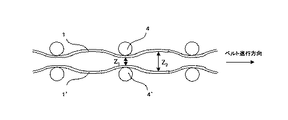
しかしながら、特許文献1の実施例に記載されている厚さ3mmの板状製品を製造する際に設定された±0.3mmという板厚精度のレベルでは近年求められている用途に対しては不十分な場合が多かった。また本発明者らの検討によると特許文献1に記載された圧縮強度を満たすガスケットであっても、場合によっては原料のガスケット外部への漏洩が起こることが判明した。この漏洩が起きる原因としては、図3に示すように加熱ゾーン内の上下ベルト面間距離が、ベルト面保持のために配設された上下ロール対の直下(Z1)とロール対間(Z2)とで異なるために、ガスケットとベルト面との密着部に周期的にずり応力がかかるためであると予想された。
【0008】
ところが、このような漏洩を防止するための手段として高い圧縮強度のガスケットを用いてガスケットとベルト面との密着性向上を高めようとしても、原料内液がベルト面を押す液圧に比べてガスケットがベルト面を押す反発力だけが極端に高くなり、結果的に得られた板状製品の幅方向における両端部が極端に厚くなることがあった。
【0009】
以上のように、近年求められるような極めて高い板厚精度を要求される用途の板状製品に対して、原料の漏洩防止と極めて高い板厚精度とを両立し得る板状製品の製造方法が望まれていた。
【0010】
本発明は、前述の課題を解決することを目的とする。
【0011】
【課題を解決するための手段】
本発明の要旨は、相対するベルト面が同方向へ同一速度で走行するように配設された2個のエンドレスベルトの相対するベルト面と、それらの両側辺部にあるベルト面で挟まれた状態で走行する連続したガスケットとで囲まれた空間に、その一端より重合性原料を供給し、加熱ゾーン内でベルトの走行と共に重合性原料を固化させ、その他端より板状重合物を取り出す板状製品の製造方法において、加熱温度にて板状製品の厚みまで圧縮した際の圧縮強度が0.5N/mm以下であり、且つ、加熱温度にて板状製品の厚みまで圧縮した際のベルト面とガスケット外面との接触幅が8mm以上であるガスケットを用いることを特徴とする板状製品の製造方法にある。
【0012】
ガスケットが中空構造であって、中空ガスケットの中空部に空気又は不活性ガスを吹き込んでガスケット中空部圧力を調整することが好ましい。
【0013】
【発明の実施の形態】
図1は、本発明の製造方法に用いるベルト式連続製板装置の一例を示す模式的断面図である。
【0014】
この図に示す装置において、2個のエンドレスベルト(ステンレスベルト等)1、1’はそれぞれ主プーリ2、3、2’、3’で張力が与えられ、かつ主プーリ3’で下側ベルト1’が起動され、走行する。重合性化合物を含む液状の重合性原料は定量ポンプ5で送液され、ノズル6から下側ベルト面上に供給される。エンドレスベルト1、1’の幅は500mm〜5000mmが好ましく、厚みは0.1mm〜3mmが好ましい。エンドレスベルト1、1’に与えられる張力は、走行方向と垂直な断面積あたり1.0×10⁷Pa〜1.5×10⁸Paの範囲内であることが好ましい。張力が低すぎるとベルトが大きく撓んで好ましくない。
張力が高すぎると、装置の剛性を必要以上に高くする必要が生じて好ましくない。
【0015】
エンドレスベルト1は、後述するガスケットや板状重合物を介して摩擦力によってエンドレスベルト1’と同方向へ同一速度で走行する。その走行速度は、0.1m/min〜10m/minが好ましく、生産する板厚や品種切替のタイミング等の事情に応じて適宜変更が可能である。
【0016】
ベルト面間の両側辺部は、加熱温度にて板状製品の厚みまで圧縮した際の圧縮強度が0.5N/mm以下であるガスケット7でシールされる。ガスケット7は連続製板装置のさらに上流に位置するボビン11から供給され、ボビンからはガスケット端部12が外部にむき出しになっていることが好ましい。
【0017】
ガスケットの材質としては、混合する可塑剤の割合を変えることで任意の弾性率に調整できることから、従来から用いられている軟質ポリ塩化ビニルが好ましい。ポリ塩化ビニルに混合する可塑剤としては、フタル酸ジブチルやフタル酸ジ2−エチルヘキシル、その他ポリ塩化ビニルに一般的に用いられているものを使用することができる。例えば可塑剤としてフタル酸ジブチルやフタル酸ジ2−エチルヘキシルを用いる場合は、本発明において好ましい圧縮強度を有するガスケットを製造するためにポリ塩化ビニル100質量部に対して20〜60質量部の割合で混合することが好ましい。その他、熱安定剤、酸化防止剤などを適宜混合することもできる。
【0018】
軟質ポリ塩化ビニル以外でガスケットに好ましい材質としては、例えば、ポリエチレン、その他可撓性を有するプラスチックの発泡体などが挙げられる。これらは成形時の発泡倍率を調整する事で、任意の弾性率に調整することができる。
さらに、天然ゴム、その他のゴム等従来一般に用いられているゴム類も、加硫度を変えることで弾性率の調整が可能であるため使用することができる。
【0019】
ガスケットの外形状としては円形、楕円形、長方形、正方形のものなど種々の形状が上げられる。長方形、正方形などの場合は平滑部のたわみに加えて角部のひずみが圧縮強度に影響するため、均一な圧縮強度を発現するためには円形または楕円形のガスケットが好ましい。その構造としては断面の内部が空洞部になっている中空構造が好ましい。
【0020】
ガスケットの大きさとしては、断面の外周部における周長が20mm以上あることが好ましく、30mm以上であることがより好ましい。加熱温度にて板状製品の厚みまで圧縮した際のベルト面とガスケット外面との接触幅を8mm以上とするためには、断面の外周部における周長が下記(1)式で示す値Kよりも必ず大きくなければならないが、周長はKの値よりも2mm以上大きく設定することが好ましい。
【0021】
K[mm]=2×(目的とする板厚[mm])+16 ・・・(1)
ガスケット断面の外周部における周長が400mmを越えると必然的に製品当たりのガスケット使用量が大きくなり、製造コストの面から好ましくない。
【0022】
中空構造のガスケットの場合、その肉厚は0.1mm〜4mmの範囲が好ましい。中空部に空気又は不活性ガスを吹き込む場合は、中空部の気道確保のため、肉厚を板状製品の厚みの45%以下に設定することが好ましく、且つ、板状製品の厚みまで圧縮した時の中空部断面積が少なくとも1mm2以上になるように設定することが好ましい。
【0023】
ガスケット断面の寸法は、加熱温度にて板状製品の厚み、即ち、加熱温度にて目的とする製品厚みまで圧縮した際の圧縮強度が0.5N/mmであり、且つ、加熱温度にて板状製品の厚みまで圧縮した際の、図2に示すようなガスケット外面とベルト面との接触幅Aの値が8mm以上であれば特に限定はないが、0.005N/mmよりも低い値であると断面形状の維持ができなくなり、製板装置への安定したガスケット供給が困難になってしまうため好ましくない。接触幅Aが8mm未満になると、原料液がガスケット外部へ漏洩する頻度が増し、また幅方向においてガスケットの反発力が狭い範囲でベルト面へと作用するため板厚が厚くなってしまい好ましくない。また接触幅が150mmを越えると、限られたエンドレスベルト幅に対して製品の占める割合を著しく下げることになり、生産性の面から好ましくない。
【0024】
また中空構造のガスケットの中空部に空気又は不活性ガスを所望の圧力になるように吹き込む場合は、ガスケットの見かけの圧縮強度を自在に調節することができるため、極めて肉薄の低弾性ガスケットを用いることも可能である。
【0025】
空気又は不活性ガスは、製板装置に供給される前のボビンに巻かれた状態のガスケットの端部とガスラインとを接続して吹き込んでも良く、逆に連続製板装置から剥離された後の板端部につながったガスケットとガスラインとを接続して吹き込んでも良いが、前者の方が好ましい。
【0026】
中空構造のガスケットの中空部圧力は、ゲージ圧0〜3.0×10⁴Paの範囲内に調整することが好ましい。中空部圧力が高すぎると原料の内液圧に比べてガスケットの反発力が極端に大きくなるため板厚精度の低下を招いて好ましくない。またガスケットの膨張が激しくなりベルト面とガスケットとの接触幅を十分に確保することができないため好ましくない。
【0027】
重合性原料はエンドレスベルト1、1’の走行に従い、加熱ゾーン内で固化される。加熱ゾーンとしては、例えば温水スプレー8、8’で加熱されるゾーンが挙げられる。加熱ゾーン内で重合が進行し、ある位置で重合発熱による温度ピークを迎える。その後、例えば遠赤外線ヒータ9、9’で熱処理されて重合を完結し、板状製品(板状重合物)10が取り出される。温水スプレー8、8’の区間は50〜100℃の温度範囲、遠赤外線ヒータ9、9’の区間は100℃〜150℃の温度範囲であることが好ましい。また、両区間ともに熱風等、他の加熱方式を用いても良い。
【0028】
エンドレスベルト1、1’の加熱ゾーン内におけるベルト面保持機構としては、上側ベルトの上面に接する上ロールと下側ベルトの下面に接する下ロールとからなり、それぞれの軸がベルト走行方向と直交する上下ロール対4、4’が用いられることが好ましい。そして、加熱ゾーンのうち、上流の加熱開始位置から原料の重合が進み実質的に流動不能な状態になるまでの帯域における複数配設されているロール対の配列間隔は800mm以下であることが好ましい。配列間隔が広すぎると、板厚精度が悪化する。配列間隔は120mm以上であることが好ましい。
【0029】
なお、実質的に流動不能な状態とは、B型粘度計により測定した粘度の値が2.0×10³Pa・sを越えるような状態のことをいう。
【0030】
この上下ロール対4、4’のロール胴部外径としては、100mm〜500mmの範囲内であることが好ましい。
【0031】
上下ロール対4、4’に使用するロールの胴部の材質に関して、例えば、ステンレス、鉄、アルミニウム等の種々の金属類からなるロール胴部を用いても良いし、カーボンロール等の炭素系複合材料からなるロール胴部を用いても良い。また、接触によるステンレスベルト表面へのダメージを軽減する目的で、ロール胴部の表面にゴムを被覆しても良い。また、ゴム被覆後の最外径がクラウン形状になるような構造にしても良い。
【0032】
板状重合物の原料は、目的とする板状重合物によって、適宜、選択することができる。本発明の連続製板装置は、特にメタクリル酸メチルを主原料とするメタクリル樹脂板の製造に好適である。メタクリル樹脂板を製造する際には、メタクリル酸メチルを50質量%以上含む重合性原料を用いることが好ましい。代表的には、メタクリル酸メチル単独、もしくはメタクリル酸メチルと共重合可能な他の単量体との混合物が挙げられる。さらに、メタクリル酸メチル系重合体をメタクリル酸メチルまたはその混合物に溶解させたシラップや、メタクリル酸メチルまたはその混合物の一部を予め重合したシラップも挙げられる。
【0033】
共重合可能な他の単量体としては、例えば、アクリル酸メチル、アクリル酸エチル、アクリル酸n−ブチル、アクリル酸2−エチルヘキシル等のアクリル酸エステル;メタクリル酸エチル、メタクリル酸n−ブチル、メタクリル酸2−エチルヘキシル等のメタクリル酸メチル以外のメタクリル酸エステル;酢酸ビニル、アクリロニトリル、メタクリロニトリル、スチレン等が挙げられる。シラップの場合は重合性原料の流動性を考慮し、重合体含有率を50質量%以下に調製することが好ましい。
【0034】
重合性原料には、必要に応じて連鎖移動剤を添加することもできる。連鎖移動剤としては、例えば、アルキル基または置換アルキル基を有する第1級、第2級または第3級のメルカプタン等を使用できる。その具体例としては、n−ブチルメルカプタン、i−ブチルメルカプタン、n−オクチルメルカプタン、n−ドデシルメルカプタン、s−ブチルメルカプタン、s−ドデシルメルカプタン、t−ブチルメルカプタン等が挙げられる。
【0035】
また、重合性原料には、通常、重合開始剤を添加する。その具体例としては、tert−ヘキシルパーオキシピバレ−ト、tert−ヘキシルパーオキシ−2−エチルヘキサノエート、ジ−イソプロピルパーオキシジカーボネート、tert−ブチルネオデカノエート、tert−ブチルパーオキシピバレート、ラウロイルパーオキサイド、ベンゾイルパーオキサイド、tert−ブチルパーオキシイソプロピルカーボネート、tert−ブチルパーオキシベンゾエート、ジクミルパーオキサイド、ジ−tert−ブチルパーオキサイド等の有機過酸化物;2,2’−アゾビス(2,4−ジメチルバレロニトリル)、2,2’−アゾビスイソブチロニトリル、1−1’−アゾビス(1−シクロヘキサンカルボニトリル)、2,2’−アゾビス(2,4,4−トリメチルペンタン)等のアゾ化合物;が挙げられる。
【0036】
その他、必要に応じて各種の添加剤、例えば紫外線吸収剤、光安定剤、酸化安定剤、可塑剤、染料、顔料、離型剤、アクリル系多層ゴム等を原料に添加することもできる。
【0037】
本発明により製造される板状重合物(メタクリル樹脂板)の厚みは、0.3〜20mm程度であることが好ましい。
【0038】
【実施例】
以下、本発明を実施例により更に詳しく説明するが、これらは本発明を限定するものではない。なお「質量%」を略して「%」と、「質量部」を略して「部」と記載する。
【0039】
<実施例1>
重合率20%のメタクリル酸メチルシラップ(粘度1Pa・s、20℃)100部に、重合開始剤としてtert−ヘキシルパーオキシピバレート(日本油脂(株)製、商品名:パーヘキシルPV)0.35部、離型剤としてジオクチルスルホコハク酸ナトリウム0.005部を加えて均一に混合し、液状の重合性原料を得た。この重合性原料を真空容器内で脱泡し、図1の装置を用いて、厚さ2mm、幅1800mmの板状製品1を製造した。
【0040】
本実施例に用いた図1の装置は、全長10mであり、2個のステンレス製エンドレスベルト1、1’は厚さ1.5mm、幅が2mであり、油圧により上下共3.0×10⁷Paの張力を与えた。
【0041】
ガスケット7として、ポリ塩化ビニル100部に対し、可塑剤としてフタル酸ジブチル(協和発酵(株)製)45部、さらに担体として炭酸カルシウム10部(白石工業(株)製)、熱安定剤としてエポキシ化大豆油(大日本インキ化学(株)製、商品名:エポサイザーW100EL)4部、カルボン酸金属塩(大日本インキ化学(株)製、商品名:グレックML508C)1部を均一に混合しながら外径15mm、肉厚0.8mmの外形状は円形であり、且つ、断面を中空構造に熱成形したものを用いた。そのガスケットを80℃にて2mm厚みまで圧縮した際の圧縮強度は0.15N/mm、ガスケット外面とベルト面との接触幅Aは15mmであった。
【0042】
装置前半は、80℃の温水スプレー8、8’による加熱ゾーンを5m分有している。この加熱ゾーン内には、上下ロール対4、4’が、ロール対の配列間隔Pが410mmとなるよう等間隔に合計12対配列されている。これら上下ロール対4、4’の最外径は180mmである。
【0043】
この温水スプレー8、8’による加熱ゾーンの後には、遠赤外線ヒータ9、9’による加熱処理する区間を2m分有している。
【0044】
エンドレスベルト1、1’の走行速度は、200mm/minで6日間運転した。
【0045】
6日間の連続運転において、原料液がガスケット外部に漏洩するトラブルは皆無であり、また得られた板状製品1は幅方向の板厚振れが2mm±0.09mmと高い板厚精度を有していた。
【0046】
<実施例2>
2個のエンドレスベルトの張力を5.0×10⁶Paにしたこと以外は実施例1と同様にして厚さ2mmの板状製品2を製造した。
【0047】
6日間の連続運転において、原料液がガスケット外部に漏洩するトラブルは皆無であり、また得られた板状製品2は幅方向の板厚振れが2mm±0.13mmであった。
【0048】
<実施例3>
加熱ゾーン内に配設された上下ロール対の配列間隔を820mmとなるように等間隔に計6対配列したこと以外は実施例1と同様にして厚さ2mmの板状製品3を得た。
【0049】
6日間の連続運転において、原料液がガスケット外部に漏洩するトラブルは皆無であり、得られた板状製品3は幅方向の板厚振れが2mm±0.14mmであった。
【0050】
<実施例4>
重合率20%のメタクリル酸メチルシラップ(粘度1Pa・s、20℃)100部に、重合開始剤としてtert−ヘキシルパーオキシピバレート(日本油脂(株)製、商品名:パーヘキシルPV)0.13部、離型剤としてジオクチルスルホコハク酸ナトリウム0.005部を加えて均一に混合し、液状の重合性原料を得た。この重合性原料を真空容器内で脱泡し、実施例1と同一の装置を用いて、厚さ6mm、幅1800mmの板状製品4を製造した。油圧により上下共1.0×10⁷Paの張力を与えた。
【0051】
ガスケット7として、可塑剤であるフタル酸ジブチル(協和発酵(株)製)を40部にしたこと以外は実施例1と同一の原料を用いて外径16mm、肉厚1.0mmの外形状は円形であり、且つ、断面を中空構造に熱成形したものを用いた。そのガスケットを76℃にて6mm厚みまで圧縮した際の圧縮強度は0.1N/mm、ガスケット外面とベルト面との接触幅Aは18mmであった。
【0052】
装置前半は、76℃の温水スプレー8、8’による加熱ゾーンを5m分有している。
【0053】
エンドレスベルト1、1’の走行速度は、150mm/minで12日間運転した。
【0054】
また、後半6日間は左右ガスケットの中空部にゲージ圧4.0×10³Paとなるよう空気を吹き込んで運転した。
【0055】
12日間の連続運転において、原料液がガスケット外部に漏洩するトラブルは皆無であり、また得られた板状製品4はガスケットへの空気吹き込みが無い前半6日間においては幅方向の板厚振れが6mm±0.11mm、空気吹き込みを実施した後半6日間においては幅方向の板厚振れが6mm±0.07mmと極めて高い板厚精度を有していた。
【0056】
<比較例1>
ガスケットの原料組成をポリ塩化ビニル100部に対しフタル酸ジブチルが35部、炭酸カルシウム10部、エポキシ化大豆油4部、カルボン酸金属塩1部にすることによって外径5mm、肉厚1.5mmの外形状は円形であり、且つ、断面を中空構造に熱成形したガスケットであって、80℃にて2mm厚みまで圧縮した際の圧縮強度が0.19N/mm、ガスケット外面とベルト面との接触幅Aが5.5mmであるガスケットを用いたこと以外は実施例1と同様にして厚さ2mmの板状製品5を製造した。
【0057】
6日間の運転において、原料液がガスケット外部に大量に漏洩するトラブルが2回発生し、設備復旧の期間を差し引くと正味3日間しか製品を作る事ができなかった。また、上記2回以外にもガスケット外部に少量の原料が漏洩していた様子がしばしばうかがえ、得られた板状製品5は幅方向の板厚振れが2mm±0.40mmと板厚精度の悪いものであった。
【0058】
<比較例2>
ガスケットの原料組成をポリ塩化ビニル100部に対しフタル酸ジブチルが22部、炭酸カルシウム10部、エポキシ化大豆油4部、カルボン酸金属塩1部にすることによって外径15mm、肉厚0.9mmの外形状は円形であり、且つ、断面を中空構造に熱成形したガスケットであって、80℃にて2mm厚みまで圧縮した際の圧縮強度が0.8N/mm、ガスケット外面とベルト面との接触幅Aが15.5mmであるガスケットを用いたこと以外は実施例1と同様にして厚さ2mmの板状製品6を製造した。
【0059】
6日間の連続運転において、原料液がガスケット外部に漏洩するトラブルは皆無であったが、得られた板状製品6は幅方向の板厚振れが2mm±0.32mmと板厚精度の悪いものであった。
【0060】
<実施例5>
ガスケット中空部内圧をゲージ圧4.0×10⁴Paに調整したこと以外は実施例4と同様にして厚さ6mmの板状製品7を造した。
【0061】
12日間の連続運転において、原料液がガスケット外部に漏洩するトラブルは皆無であったが、得られた板状製品7は幅方向の板厚振れが6mm±0.13mmであった。
【0062】
【発明の効果】
加熱温度にて目的とする製品厚みまで圧縮されたガスケット外面とベルト面との接触幅を特定値以上にすることによってガスケットとベルト面との密着性が飛躍的に向上し、またガスケットの反発力も十分な幅の接触部の中で分散されるため、本発明によって、高い板厚精度を有する板状製品をベルト式製板装置を用いて長期にわたり安全に製造することができる。
【図面の簡単な説明】
【図1】本発明で用いるベルト式連続製板装置の一例を示す模式的断面図である。
【図2】上下エンドレスベルト面とガスケット外面との接触部をベルト走行方向と垂直な断面で表わした拡大図である。
【図3】上下エンドレスベルトのベルト面間距離と上下ロール対との関係を側面から見た模式図である。
【符号の説明】
1、1’ エンドレスベルト
2、2’ 主プーリ
3、3’ 主プーリ
4、4’ 上下ロール対
5 定量ポンプ
6 ノズル
7 ガスケット
8、8’ 温水スプレー
9、9’ 遠赤外線ヒータ
10 板状製品
11 ガスケットボビン
12 ガスケット端部[0001]
TECHNICAL FIELD OF THE INVENTION
The present invention relates to a method for producing a plate-like product (plate-like polymer) by continuously polymerizing a polymerizable raw material.
[0002]
[Prior art]
A plate-like polymer obtained by using methyl methacrylate as a main raw material is used in signboards, building materials, sanitary applications such as buses, lighting applications, and a wide variety of other fields by utilizing its excellent properties. In recent years, it has also been used as a light guide plate of a display device such as a liquid crystal display, and the worldwide trend of IT has been a tailwind, and the demand has been rapidly increasing.
[0003]
Such a light guide plate is, of course, required to have high optical properties as a material, but also has a very high dimensional accuracy in the thickness direction (hereinafter, referred to as a conventional one) so that the luminance distribution of the display cannot be performed. "Sheet thickness accuracy" may be abbreviated).
[0004]
On the other hand, as a method for continuously producing a plate-like polymer, there is a continuous casting method using a belt-type continuous plate-making apparatus. This belt-type continuous plate-making apparatus supplies a polymerizable material from one of two endless belts located at the top and bottom which run at the same speed in the horizontal direction, and performs heating and the like together with the movement of the endless belt. It is a device that polymerizes by the method and obtains a plate-like polymer from the other. In such an apparatus, a continuous gasket is sandwiched between both end portions of two endless belts in order to prevent leakage of the polymerizable material. This gasket is important not only for preventing leakage of the polymerizable raw material, but also for increasing the thickness accuracy of the obtained plate-like product.
[0005]
As such a gasket, for example, a gasket having a compressive strength of 0.01 to 0.5 kg / cm when compressed to a target plate thickness at a polymerization temperature as shown in Patent Document 1 is exemplified.
[0006]
[Patent Document 1]
Japanese Patent Publication No. 47-49823
[Problems to be solved by the invention]
However, the level of plate thickness accuracy of ± 0.3 mm set when manufacturing a plate-like product having a thickness of 3 mm described in the example of Patent Document 1 is not suitable for recently required applications. Often enough. According to the study by the present inventors, it has been found that even in the case of the gasket satisfying the compressive strength described in Patent Document 1, the raw material may leak to the outside of the gasket in some cases. As a cause of this leakage, as shown in FIG. 3, the distance between the upper and lower belt surfaces in the heating zone is determined to be immediately below the pair of upper and lower rolls (Z 1 ) provided for holding the belt surface and between the pair of rolls (Z 2 ), it was expected that shear stress was periodically applied to the contact portion between the gasket and the belt surface.
[0008]
However, as a means for preventing such leakage, a gasket having a high compressive strength is used to improve the adhesion between the gasket and the belt surface. However, only the repulsive force pressing the belt surface becomes extremely high, and both ends in the width direction of the resulting plate-like product may become extremely thick.
[0009]
As described above, for a plate product for an application requiring extremely high plate thickness accuracy as required in recent years, a method of manufacturing a plate product that can achieve both prevention of raw material leakage and extremely high plate thickness accuracy has been developed. Was desired.
[0010]
An object of the present invention is to solve the above-mentioned problems.
[0011]
[Means for Solving the Problems]
The gist of the present invention is that the two endless belts arranged so that the opposing belt surfaces run at the same speed in the same direction are sandwiched between the opposing belt surfaces and the belt surfaces on both sides. In a space surrounded by a continuous gasket running in a state, a polymerizable material is supplied from one end of the space, the polymerizable material is solidified with running of the belt in the heating zone, and a plate-like polymer is taken out from the other end. In the method for producing a plate-shaped product, the compression strength when compressed to the thickness of the plate-shaped product at the heating temperature is 0.5 N / mm or less, and the belt when compressed to the thickness of the plate-shaped product at the heating temperature. A gasket having a contact width between the surface and the outer surface of the gasket of 8 mm or more is used.
[0012]
Preferably, the gasket has a hollow structure, and air or an inert gas is blown into the hollow portion of the hollow gasket to adjust the gasket hollow portion pressure.
[0013]
BEST MODE FOR CARRYING OUT THE INVENTION
FIG. 1 is a schematic sectional view showing an example of a belt-type continuous plate making apparatus used in the production method of the present invention.
[0014]
In the apparatus shown in this figure, two endless belts (stainless steel belts, etc.) 1 and 1 'are respectively tensioned by main pulleys 2, 3, 2' and 3 ', and lower belt 1 is pulled by main pulley 3'. 'Start and run. The liquid polymerizable raw material containing the polymerizable compound is fed by the metering pump 5 and supplied from the nozzle 6 onto the lower belt surface. The width of the endless belts 1 and 1 'is preferably from 500 mm to 5000 mm, and the thickness is preferably from 0.1 mm to 3 mm. The tension applied to the endless belts 1 and 1 ′ is preferably in a range of 1.0 × 10 7 Pa to 1.5 × 10 8 Pa per sectional area perpendicular to the running direction. If the tension is too low, the belt is greatly bent, which is not preferable.
If the tension is too high, it is necessary to increase the rigidity of the device more than necessary, which is not preferable.
[0015]
The endless belt 1 travels in the same direction and at the same speed as the endless belt 1 'by frictional force via a gasket or a plate-like polymer described later. The traveling speed is preferably 0.1 m / min to 10 m / min, and can be changed as appropriate according to circumstances such as the thickness of the plate to be produced and the timing of switching the type.
[0016]
Both side portions between the belt surfaces are sealed with a gasket 7 having a compressive strength of 0.5 N / mm or less when compressed to the thickness of the plate-shaped product at a heating temperature. The gasket 7 is supplied from a bobbin 11 located further upstream of the continuous plate making apparatus, and the gasket end 12 is preferably exposed to the outside from the bobbin.
[0017]
As the material of the gasket, a conventionally used soft polyvinyl chloride is preferable because the elasticity can be adjusted to an arbitrary value by changing the ratio of the plasticizer to be mixed. As the plasticizer to be mixed with polyvinyl chloride, dibutyl phthalate, di-2-ethylhexyl phthalate, and other plasticizers generally used for polyvinyl chloride can be used. For example, when using dibutyl phthalate or di-2-ethylhexyl phthalate as a plasticizer, in order to produce a gasket having a preferable compressive strength in the present invention, a ratio of 20 to 60 parts by mass with respect to 100 parts by mass of polyvinyl chloride. Mixing is preferred. In addition, a heat stabilizer, an antioxidant, and the like can be appropriately mixed.
[0018]
Preferred materials for the gasket other than soft polyvinyl chloride include, for example, polyethylene and other flexible plastic foams. These can be adjusted to an arbitrary elastic modulus by adjusting the expansion ratio at the time of molding.
Further, conventionally used rubbers such as natural rubber and other rubbers can also be used because the elastic modulus can be adjusted by changing the degree of vulcanization.
[0019]
As the outer shape of the gasket, various shapes such as a circular shape, an elliptical shape, a rectangular shape, and a square shape are available. In the case of a rectangle, a square, or the like, the distortion of the corners in addition to the deflection of the smooth portion affects the compressive strength. Therefore, a circular or oval gasket is preferable to exhibit uniform compressive strength. As the structure, a hollow structure in which the inside of the cross section is a hollow portion is preferable.
[0020]
Regarding the size of the gasket, the peripheral length at the outer peripheral portion of the cross section is preferably 20 mm or more, and more preferably 30 mm or more. In order to make the contact width between the belt surface and the outer surface of the gasket 8 mm or more when compressed to the thickness of the plate-like product at the heating temperature, the circumferential length at the outer peripheral portion of the cross section should be larger than the value K shown in the following equation (1). Must always be larger, but it is preferable to set the circumference to be 2 mm or more larger than the value of K.
[0021]
K [mm] = 2 × (target plate thickness [mm]) + 16 (1)
If the circumference at the outer peripheral portion of the gasket cross section exceeds 400 mm, the amount of gasket used per product inevitably increases, which is not preferable in terms of manufacturing cost.
[0022]
In the case of a gasket having a hollow structure, its thickness is preferably in the range of 0.1 mm to 4 mm. When air or an inert gas is blown into the hollow portion, it is preferable to set the thickness to 45% or less of the thickness of the plate-like product in order to secure the airway of the hollow portion, and to compress the thickness to the thickness of the plate-like product. It is preferable that the cross-sectional area of the hollow portion is set so as to be at least 1 mm 2 or more.
[0023]
The dimensions of the gasket cross section are as follows: the thickness of the plate-shaped product at the heating temperature, that is, the compression strength when compressed to the target product thickness at the heating temperature is 0.5 N / mm, and the plate at the heating temperature There is no particular limitation as long as the value of the contact width A between the gasket outer surface and the belt surface as shown in FIG. 2 when compressed to the thickness of the shaped product is 8 mm or more, but it is a value lower than 0.005 N / mm. If it is, the cross-sectional shape cannot be maintained, and it becomes difficult to stably supply the gasket to the plate making apparatus, which is not preferable. If the contact width A is less than 8 mm, the frequency of the raw material liquid leaking to the outside of the gasket increases, and the thickness of the gasket acts on the belt surface in a narrow range in the width direction. On the other hand, if the contact width exceeds 150 mm, the ratio of the product to the limited endless belt width is significantly reduced, which is not preferable from the viewpoint of productivity.
[0024]
When air or an inert gas is blown into the hollow portion of the gasket having a hollow structure so as to have a desired pressure, the apparent compressive strength of the gasket can be freely adjusted. It is also possible.
[0025]
The air or the inert gas may be blown by connecting the end of the gasket wound on the bobbin before being supplied to the plate making apparatus and the gas line, and conversely after being separated from the continuous plate making apparatus. The gasket connected to the end of the plate and the gas line may be connected and blown, but the former is preferred.
[0026]
The pressure in the hollow portion of the gasket having a hollow structure is preferably adjusted within a range of a gauge pressure of 0 to 3.0 × 10 4 Pa. If the pressure in the hollow portion is too high, the repulsive force of the gasket becomes extremely large as compared with the internal liquid pressure of the raw material, which undesirably causes a reduction in plate thickness accuracy. Further, the expansion of the gasket becomes so severe that a sufficient contact width between the belt surface and the gasket cannot be secured, which is not preferable.
[0027]
The polymerizable raw material is solidified in the heating zone as the endless belts 1, 1 'run. Examples of the heating zone include a zone heated by the hot water sprays 8 and 8 '. The polymerization proceeds in the heating zone, and reaches a temperature peak at a certain position due to the heat generated by the polymerization. Thereafter, for example, heat treatment is performed by far-infrared heaters 9 and 9 'to complete the polymerization, and the plate-like product (plate-like polymer) 10 is taken out. It is preferable that the section of the hot water sprays 8 and 8 'has a temperature range of 50 to 100 ° C, and the section of the far infrared heaters 9 and 9' has a temperature range of 100 to 150 ° C. Further, another heating method such as hot air may be used for both sections.
[0028]
The belt surface holding mechanism in the heating zone of the endless belts 1 and 1 'includes an upper roll contacting the upper surface of the upper belt and a lower roll contacting the lower surface of the lower belt, and their axes are orthogonal to the belt running direction. Preferably, upper and lower roll pairs 4, 4 'are used. In the heating zone, the arrangement interval of the plurality of roll pairs arranged in a zone from the upstream heating start position to the point where the polymerization of the raw material proceeds and becomes substantially incapable of flowing is preferably 800 mm or less. . If the arrangement interval is too wide, the plate thickness accuracy will deteriorate. The arrangement interval is preferably 120 mm or more.
[0029]
In addition, the substantially non-flowable state refers to a state in which the value of the viscosity measured by a B-type viscometer exceeds 2.0 × 10 3 Pa · s.
[0030]
The outer diameter of the roll body of the upper and lower roll pairs 4, 4 'is preferably in the range of 100 mm to 500 mm.
[0031]
Regarding the material of the body of the roll used for the upper and lower roll pairs 4 and 4 ', for example, a roll body made of various metals such as stainless steel, iron and aluminum may be used, or a carbon-based composite such as a carbon roll may be used. A roll body made of a material may be used. Further, in order to reduce damage to the stainless belt surface due to contact, the surface of the roll body may be coated with rubber. Further, the outermost diameter after rubber coating may be a crown shape.
[0032]
The raw material of the platy polymer can be appropriately selected depending on the intended platy polymer. The continuous plate making apparatus of the present invention is particularly suitable for producing a methacrylic resin plate containing methyl methacrylate as a main raw material. When producing a methacrylic resin plate, it is preferable to use a polymerizable raw material containing 50% by mass or more of methyl methacrylate. Typically, methyl methacrylate alone or a mixture with other monomers copolymerizable with methyl methacrylate is exemplified. Further, a syrup obtained by dissolving a methyl methacrylate-based polymer in methyl methacrylate or a mixture thereof, and a syrup obtained by previously polymerizing a part of methyl methacrylate or a mixture thereof are also included.
[0033]
Other copolymerizable monomers include, for example, acrylates such as methyl acrylate, ethyl acrylate, n-butyl acrylate, 2-ethylhexyl acrylate; ethyl methacrylate, n-butyl methacrylate, methacryl Methacrylic esters other than methyl methacrylate such as 2-ethylhexyl acid; vinyl acetate, acrylonitrile, methacrylonitrile, styrene and the like. In the case of syrup, the polymer content is preferably adjusted to 50% by mass or less in consideration of the fluidity of the polymerizable raw material.
[0034]
If necessary, a chain transfer agent can be added to the polymerizable raw material. As the chain transfer agent, for example, primary, secondary or tertiary mercaptan having an alkyl group or a substituted alkyl group can be used. Specific examples thereof include n-butyl mercaptan, i-butyl mercaptan, n-octyl mercaptan, n-dodecyl mercaptan, s-butyl mercaptan, s-dodecyl mercaptan, t-butyl mercaptan, and the like.
[0035]
Further, a polymerization initiator is usually added to the polymerizable raw material. Specific examples thereof include tert-hexylperoxypivalate, tert-hexylperoxy-2-ethylhexanoate, di-isopropylperoxydicarbonate, tert-butyl neodecanoate, and tert-butylperoxy. Organic peroxides such as pivalate, lauroyl peroxide, benzoyl peroxide, tert-butylperoxyisopropyl carbonate, tert-butylperoxybenzoate, dicumyl peroxide, di-tert-butyl peroxide; 2,2′- Azobis (2,4-dimethylvaleronitrile), 2,2′-azobisisobutyronitrile, 1-1′-azobis (1-cyclohexanecarbonitrile), 2,2′-azobis (2,4,4- Azo compounds such as trimethylpentane); Can be
[0036]
In addition, various additives such as an ultraviolet absorber, a light stabilizer, an oxidation stabilizer, a plasticizer, a dye, a pigment, a release agent, an acrylic multilayer rubber, and the like can be added to the raw material as needed.
[0037]
The thickness of the platy polymer (methacrylic resin plate) produced by the present invention is preferably about 0.3 to 20 mm.
[0038]
【Example】
Hereinafter, the present invention will be described in more detail with reference to Examples, but these do not limit the present invention. Note that “% by mass” is abbreviated as “%”, and “mass part” is abbreviated as “part”.
[0039]
<Example 1>
As a polymerization initiator, tert-hexyl peroxypivalate (manufactured by NOF Corporation, trade name: Perhexyl PV) 0.35 in 100 parts of methyl methacrylate syrup (viscosity 1 Pa · s, 20 ° C.) having a polymerization rate of 20% And 0.005 part of sodium dioctylsulfosuccinate as a release agent were added and mixed uniformly to obtain a liquid polymerizable raw material. This polymerizable raw material was defoamed in a vacuum vessel, and a plate-shaped product 1 having a thickness of 2 mm and a width of 1800 mm was produced using the apparatus shown in FIG.
[0040]
The apparatus of FIG. 1 used in this embodiment has a total length of 10 m, and the two stainless steel endless belts 1 and 1 ′ have a thickness of 1.5 mm and a width of 2 m. A tension of 7 Pa was applied.
[0041]
As gasket 7, 100 parts of polyvinyl chloride, 45 parts of dibutyl phthalate (manufactured by Kyowa Hakko Co., Ltd.) as a plasticizer, 10 parts of calcium carbonate (manufactured by Shiraishi Industry Co., Ltd.) as a carrier, and epoxy as a heat stabilizer While uniformly mixing 4 parts of chemical soybean oil (manufactured by Dainippon Ink and Chemicals, Inc., trade name: Eposizer W100EL) and 1 part of metal carboxylate (manufactured by Dainippon Ink and Chemicals, Inc., trade name: GREC ML508C) The outer shape having an outer diameter of 15 mm and a wall thickness of 0.8 mm was circular and the cross section was thermoformed into a hollow structure. The compression strength when the gasket was compressed to a thickness of 2 mm at 80 ° C. was 0.15 N / mm, and the contact width A between the outer surface of the gasket and the belt surface was 15 mm.
[0042]
The first half of the apparatus has a heating zone for 5 m with a hot water spray 8, 8 'at 80 ° C. In this heating zone, a total of 12 pairs of upper and lower rolls 4, 4 'are arranged at equal intervals so that the arrangement interval P between the roll pairs is 410 mm. The outermost diameter of these upper and lower roll pairs 4, 4 'is 180 mm.
[0043]
After the heating zone by the hot water sprays 8 and 8 ', a section for heating by the far infrared heaters 9 and 9' is provided for 2 m.
[0044]
The running speed of the endless belts 1 and 1 'was operated at 200 mm / min for 6 days.
[0045]
In the continuous operation for 6 days, there is no trouble that the raw material liquid leaks out of the gasket, and the obtained plate-like product 1 has a high thickness accuracy of 2 mm ± 0.09 mm in the thickness direction in the width direction. I was
[0046]
<Example 2>
A plate-like product 2 having a thickness of 2 mm was manufactured in the same manner as in Example 1 except that the tension of the two endless belts was set to 5.0 × 10 6 Pa.
[0047]
In the continuous operation for 6 days, there was no trouble that the raw material liquid leaked out of the gasket, and the obtained plate-like product 2 had a thickness fluctuation in the width direction of 2 mm ± 0.13 mm.
[0048]
<Example 3>
A plate-like product 3 having a thickness of 2 mm was obtained in the same manner as in Example 1 except that a total of six pairs of upper and lower rolls arranged in the heating zone were arranged at equal intervals so that the arrangement interval became 820 mm.
[0049]
In the continuous operation for 6 days, there was no trouble that the raw material liquid leaked to the outside of the gasket, and the obtained plate-shaped product 3 had a thickness fluctuation in the width direction of 2 mm ± 0.14 mm.
[0050]
<Example 4>
0.13 of tert-hexyl peroxypivalate (manufactured by NOF Corporation, trade name: perhexyl PV) as a polymerization initiator in 100 parts of methyl methacrylate methacrylate having a polymerization rate of 20% (viscosity 1 Pa · s, 20 ° C.) And 0.005 part of sodium dioctylsulfosuccinate as a release agent were added and mixed uniformly to obtain a liquid polymerizable raw material. This polymerizable raw material was defoamed in a vacuum vessel, and a plate-shaped product 4 having a thickness of 6 mm and a width of 1800 mm was produced using the same apparatus as in Example 1. A tension of 1.0 × 10 7 Pa was applied to both upper and lower sides by hydraulic pressure.
[0051]
As the gasket 7, the same raw material as in Example 1 was used except that 40 parts of dibutyl phthalate (manufactured by Kyowa Hakko Co., Ltd.) as a plasticizer was used. The one having a circular shape and having a cross section thermoformed into a hollow structure was used. When the gasket was compressed at 76 ° C. to a thickness of 6 mm, the compressive strength was 0.1 N / mm, and the contact width A between the outer surface of the gasket and the belt surface was 18 mm.
[0052]
The first half of the apparatus has a heating zone with hot water sprays 8 and 8 'of 76 ° C for 5m.
[0053]
The running speed of the endless belts 1 and 1 ′ was operated at 150 mm / min for 12 days.
[0054]
During the latter six days, air was blown into the hollow portions of the left and right gaskets so that the gauge pressure was 4.0 × 10 3 Pa.
[0055]
In the continuous operation for 12 days, there was no trouble that the raw material liquid leaked to the outside of the gasket, and the obtained plate-shaped product 4 had a thickness fluctuation in the width direction of 6 mm in the first six days without air blowing into the gasket. The thickness deviation in the width direction was extremely high at ± 0.11 mm and 6 mm ± 0.07 mm in the latter six days of the air blowing.
[0056]
<Comparative Example 1>
The raw material composition of the gasket is 35 parts of dibutyl phthalate, 10 parts of calcium carbonate, 4 parts of epoxidized soybean oil, and 1 part of metal carboxylate with respect to 100 parts of polyvinyl chloride. Is a gasket whose outer shape is circular and whose cross section is thermoformed into a hollow structure. The gasket has a compression strength of 0.19 N / mm when compressed to a thickness of 2 mm at 80 ° C. A plate-like product 5 having a thickness of 2 mm was manufactured in the same manner as in Example 1 except that a gasket having a contact width A of 5.5 mm was used.
[0057]
During the six-day operation, the trouble that the raw material liquid leaked out of the gasket in large quantities occurred twice, and the product could be manufactured only for three net days if the period of equipment restoration was deducted. In addition to the above two times, it is often observed that a small amount of raw material has leaked to the outside of the gasket, and the obtained plate-like product 5 has poor thickness accuracy in the width direction of 2 mm ± 0.40 mm, which is poor. Was something.
[0058]
<Comparative Example 2>
The raw material composition of the gasket is 22 parts dibutyl phthalate, 10 parts calcium carbonate, 4 parts epoxidized soybean oil, and 1 part metal carboxylate per 100 parts of polyvinyl chloride to make the outer diameter 15 mm and the wall thickness 0.9 mm. Is a gasket whose outer shape is circular and whose cross section is thermoformed into a hollow structure. The gasket has a compressive strength of 0.8 N / mm when compressed to a thickness of 2 mm at 80 ° C. A plate-like product 6 having a thickness of 2 mm was manufactured in the same manner as in Example 1 except that a gasket having a contact width A of 15.5 mm was used.
[0059]
In the continuous operation for 6 days, there was no trouble that the raw material liquid leaked to the outside of the gasket, but the obtained plate-like product 6 had a thickness deviation in the width direction of 2 mm ± 0.32 mm and the plate thickness accuracy was poor. Met.
[0060]
<Example 5>
A plate product 7 having a thickness of 6 mm was produced in the same manner as in Example 4 except that the internal pressure of the gasket hollow portion was adjusted to a gauge pressure of 4.0 × 10 4 Pa.
[0061]
In the continuous operation for 12 days, there was no trouble that the raw material liquid leaked to the outside of the gasket, but the obtained plate-like product 7 had a thickness fluctuation in the width direction of 6 mm ± 0.13 mm.
[0062]
【The invention's effect】
By increasing the contact width between the outer surface of the gasket and the belt surface compressed to the target product thickness at the heating temperature to a specified value or more, the adhesion between the gasket and the belt surface is dramatically improved, and the repulsive force of the gasket is also improved. According to the present invention, a plate-shaped product having high plate thickness accuracy can be safely manufactured for a long period of time by using a belt-type plate-making apparatus because it is dispersed in a contact portion having a sufficient width.
[Brief description of the drawings]
FIG. 1 is a schematic sectional view showing an example of a belt-type continuous plate making apparatus used in the present invention.
FIG. 2 is an enlarged view showing a contact portion between an upper and lower endless belt surface and a gasket outer surface in a cross section perpendicular to a belt running direction.
FIG. 3 is a schematic view of a relationship between a belt surface distance of upper and lower endless belts and a pair of upper and lower rolls as viewed from a side.
[Explanation of symbols]
1, 1 'Endless belt 2, 2' Main pulley 3, 3 'Main pulley 4, 4' Vertical roll pair 5 Metering pump 6 Nozzle 7 Gasket 8, 8 'Hot water spray 9, 9' Far infrared heater 10 Plate product 11 Gasket bobbin 12 Gasket end