ES2927609T3 - Apparatus - Google Patents
Apparatus Download PDFInfo
- Publication number
- ES2927609T3 ES2927609T3 ES14868882T ES14868882T ES2927609T3 ES 2927609 T3 ES2927609 T3 ES 2927609T3 ES 14868882 T ES14868882 T ES 14868882T ES 14868882 T ES14868882 T ES 14868882T ES 2927609 T3 ES2927609 T3 ES 2927609T3
- Authority
- ES
- Spain
- Prior art keywords
- subject
- drug
- dose
- adrenaline
- particulate
- Prior art date
- Legal status (The legal status is an assumption and is not a legal conclusion. Google has not performed a legal analysis and makes no representation as to the accuracy of the status listed.)
- Active
Links
- 239000003814 drug Substances 0.000 claims abstract description 225
- 229940079593 drug Drugs 0.000 claims abstract description 183
- 238000004891 communication Methods 0.000 claims abstract description 28
- 239000012530 fluid Substances 0.000 claims abstract description 24
- UCTWMZQNUQWSLP-UHFFFAOYSA-N adrenaline Chemical compound CNCC(O)C1=CC=C(O)C(O)=C1 UCTWMZQNUQWSLP-UHFFFAOYSA-N 0.000 claims description 115
- 208000010496 Heart Arrest Diseases 0.000 claims description 26
- 210000004072 lung Anatomy 0.000 claims description 20
- 239000011859 microparticle Substances 0.000 claims description 18
- 229930182837 (R)-adrenaline Natural products 0.000 claims description 17
- 229960005139 epinephrine Drugs 0.000 claims description 17
- UCTWMZQNUQWSLP-VIFPVBQESA-N (R)-adrenaline Chemical compound CNC[C@H](O)C1=CC=C(O)C(O)=C1 UCTWMZQNUQWSLP-VIFPVBQESA-N 0.000 claims description 15
- 206010002198 Anaphylactic reaction Diseases 0.000 claims description 6
- 230000036783 anaphylactic response Effects 0.000 claims description 6
- 208000003455 anaphylaxis Diseases 0.000 claims description 6
- 230000029058 respiratory gaseous exchange Effects 0.000 claims description 4
- 210000002345 respiratory system Anatomy 0.000 abstract description 19
- 238000013519 translation Methods 0.000 abstract description 3
- 239000007789 gas Substances 0.000 description 85
- 238000000034 method Methods 0.000 description 39
- 238000010586 diagram Methods 0.000 description 36
- 238000012545 processing Methods 0.000 description 32
- 238000002680 cardiopulmonary resuscitation Methods 0.000 description 31
- 241001465754 Metazoa Species 0.000 description 16
- 239000012528 membrane Substances 0.000 description 16
- 230000004083 survival effect Effects 0.000 description 13
- 238000001990 intravenous administration Methods 0.000 description 12
- WQZGKKKJIJFFOK-GASJEMHNSA-N Glucose Natural products OC[C@H]1OC(O)[C@H](O)[C@@H](O)[C@@H]1O WQZGKKKJIJFFOK-GASJEMHNSA-N 0.000 description 11
- 238000007906 compression Methods 0.000 description 11
- 230000006835 compression Effects 0.000 description 11
- 230000007246 mechanism Effects 0.000 description 11
- 239000008103 glucose Substances 0.000 description 9
- 210000004369 blood Anatomy 0.000 description 8
- 239000008280 blood Substances 0.000 description 8
- 230000000747 cardiac effect Effects 0.000 description 8
- 210000000038 chest Anatomy 0.000 description 8
- 239000002245 particle Substances 0.000 description 8
- 238000009423 ventilation Methods 0.000 description 8
- 238000012549 training Methods 0.000 description 7
- 230000009286 beneficial effect Effects 0.000 description 6
- 230000008901 benefit Effects 0.000 description 6
- 239000000843 powder Substances 0.000 description 6
- 210000003462 vein Anatomy 0.000 description 6
- 206010019280 Heart failures Diseases 0.000 description 5
- 241001494479 Pecora Species 0.000 description 5
- 230000004087 circulation Effects 0.000 description 5
- 230000000694 effects Effects 0.000 description 5
- 230000002218 hypoglycaemic effect Effects 0.000 description 5
- 239000007788 liquid Substances 0.000 description 5
- 208000013016 Hypoglycemia Diseases 0.000 description 4
- 230000007423 decrease Effects 0.000 description 4
- 230000004064 dysfunction Effects 0.000 description 4
- 210000005003 heart tissue Anatomy 0.000 description 4
- 238000001802 infusion Methods 0.000 description 4
- 208000010125 myocardial infarction Diseases 0.000 description 4
- 238000004393 prognosis Methods 0.000 description 4
- 230000033764 rhythmic process Effects 0.000 description 4
- 238000001694 spray drying Methods 0.000 description 4
- 230000009471 action Effects 0.000 description 3
- 208000029028 brain injury Diseases 0.000 description 3
- 230000000994 depressogenic effect Effects 0.000 description 3
- 238000012377 drug delivery Methods 0.000 description 3
- 238000005516 engineering process Methods 0.000 description 3
- 238000010253 intravenous injection Methods 0.000 description 3
- 238000011068 loading method Methods 0.000 description 3
- 239000003094 microcapsule Substances 0.000 description 3
- 239000004005 microsphere Substances 0.000 description 3
- DDLIGBOFAVUZHB-UHFFFAOYSA-N midazolam Chemical compound C12=CC(Cl)=CC=C2N2C(C)=NC=C2CN=C1C1=CC=CC=C1F DDLIGBOFAVUZHB-UHFFFAOYSA-N 0.000 description 3
- 229960003793 midazolam Drugs 0.000 description 3
- DUHUCHOQIDJXAT-OLVMNOGESA-N 3-hydroxy-(3-α,5-α)-Pregnane-11,20-dione Chemical compound C([C@@H]1CC2)[C@H](O)CC[C@]1(C)[C@@H]1[C@@H]2[C@@H]2CC[C@H](C(=O)C)[C@@]2(C)CC1=O DUHUCHOQIDJXAT-OLVMNOGESA-N 0.000 description 2
- 229930003347 Atropine Natural products 0.000 description 2
- 206010010071 Coma Diseases 0.000 description 2
- GVGLGOZIDCSQPN-PVHGPHFFSA-N Heroin Chemical compound O([C@H]1[C@H](C=C[C@H]23)OC(C)=O)C4=C5[C@@]12CCN(C)[C@@H]3CC5=CC=C4OC(C)=O GVGLGOZIDCSQPN-PVHGPHFFSA-N 0.000 description 2
- RKUNBYITZUJHSG-UHFFFAOYSA-N Hyosciamin-hydrochlorid Natural products CN1C(C2)CCC1CC2OC(=O)C(CO)C1=CC=CC=C1 RKUNBYITZUJHSG-UHFFFAOYSA-N 0.000 description 2
- 206010039897 Sedation Diseases 0.000 description 2
- FAPWRFPIFSIZLT-UHFFFAOYSA-M Sodium chloride Chemical compound [Na+].[Cl-] FAPWRFPIFSIZLT-UHFFFAOYSA-M 0.000 description 2
- 208000003443 Unconsciousness Diseases 0.000 description 2
- 230000004913 activation Effects 0.000 description 2
- 230000002411 adverse Effects 0.000 description 2
- NDAUXUAQIAJITI-UHFFFAOYSA-N albuterol Chemical compound CC(C)(C)NCC(O)C1=CC=C(O)C(CO)=C1 NDAUXUAQIAJITI-UHFFFAOYSA-N 0.000 description 2
- 229960003305 alfaxalone Drugs 0.000 description 2
- 239000001961 anticonvulsive agent Substances 0.000 description 2
- 230000004872 arterial blood pressure Effects 0.000 description 2
- QVGXLLKOCUKJST-UHFFFAOYSA-N atomic oxygen Chemical compound [O] QVGXLLKOCUKJST-UHFFFAOYSA-N 0.000 description 2
- RKUNBYITZUJHSG-SPUOUPEWSA-N atropine Chemical compound O([C@H]1C[C@H]2CC[C@@H](C1)N2C)C(=O)C(CO)C1=CC=CC=C1 RKUNBYITZUJHSG-SPUOUPEWSA-N 0.000 description 2
- 229960000396 atropine Drugs 0.000 description 2
- 229940049706 benzodiazepine Drugs 0.000 description 2
- 238000003339 best practice Methods 0.000 description 2
- 230000017531 blood circulation Effects 0.000 description 2
- 230000036772 blood pressure Effects 0.000 description 2
- 230000037396 body weight Effects 0.000 description 2
- 210000004556 brain Anatomy 0.000 description 2
- 238000000576 coating method Methods 0.000 description 2
- 230000008878 coupling Effects 0.000 description 2
- 238000010168 coupling process Methods 0.000 description 2
- 238000005859 coupling reaction Methods 0.000 description 2
- 230000034994 death Effects 0.000 description 2
- 231100000517 death Toxicity 0.000 description 2
- 230000001934 delay Effects 0.000 description 2
- 206010012601 diabetes mellitus Diseases 0.000 description 2
- 229960002069 diamorphine Drugs 0.000 description 2
- 238000002474 experimental method Methods 0.000 description 2
- 230000001815 facial effect Effects 0.000 description 2
- 230000006870 function Effects 0.000 description 2
- 238000002695 general anesthesia Methods 0.000 description 2
- 238000012423 maintenance Methods 0.000 description 2
- 238000002483 medication Methods 0.000 description 2
- 238000012544 monitoring process Methods 0.000 description 2
- 210000000056 organ Anatomy 0.000 description 2
- 239000001301 oxygen Substances 0.000 description 2
- 229910052760 oxygen Inorganic materials 0.000 description 2
- 210000002381 plasma Anatomy 0.000 description 2
- 238000003825 pressing Methods 0.000 description 2
- 230000008569 process Effects 0.000 description 2
- 210000003456 pulmonary alveoli Anatomy 0.000 description 2
- 238000005086 pumping Methods 0.000 description 2
- 238000011084 recovery Methods 0.000 description 2
- 230000036387 respiratory rate Effects 0.000 description 2
- 229960002052 salbutamol Drugs 0.000 description 2
- 238000007789 sealing Methods 0.000 description 2
- 230000036280 sedation Effects 0.000 description 2
- 230000035939 shock Effects 0.000 description 2
- 239000011780 sodium chloride Substances 0.000 description 2
- 239000000243 solution Substances 0.000 description 2
- 210000003437 trachea Anatomy 0.000 description 2
- 230000002485 urinary effect Effects 0.000 description 2
- SNICXCGAKADSCV-JTQLQIEISA-N (-)-Nicotine Chemical compound CN1CCC[C@H]1C1=CC=CN=C1 SNICXCGAKADSCV-JTQLQIEISA-N 0.000 description 1
- SVUOLADPCWQTTE-UHFFFAOYSA-N 1h-1,2-benzodiazepine Chemical compound N1N=CC=CC2=CC=CC=C12 SVUOLADPCWQTTE-UHFFFAOYSA-N 0.000 description 1
- 241000251468 Actinopterygii Species 0.000 description 1
- 206010001052 Acute respiratory distress syndrome Diseases 0.000 description 1
- 206010002091 Anaesthesia Diseases 0.000 description 1
- 101100243025 Arabidopsis thaliana PCO2 gene Proteins 0.000 description 1
- 208000031872 Body Remains Diseases 0.000 description 1
- 208000002381 Brain Hypoxia Diseases 0.000 description 1
- 206010010904 Convulsion Diseases 0.000 description 1
- 208000003870 Drug Overdose Diseases 0.000 description 1
- 206010015548 Euthanasia Diseases 0.000 description 1
- YQEZLKZALYSWHR-UHFFFAOYSA-N Ketamine Chemical compound C=1C=CC=C(Cl)C=1C1(NC)CCCCC1=O YQEZLKZALYSWHR-UHFFFAOYSA-N 0.000 description 1
- 208000012488 Opiate Overdose Diseases 0.000 description 1
- 206010033296 Overdoses Diseases 0.000 description 1
- CXOFVDLJLONNDW-UHFFFAOYSA-N Phenytoin Chemical compound N1C(=O)NC(=O)C1(C=1C=CC=CC=1)C1=CC=CC=C1 CXOFVDLJLONNDW-UHFFFAOYSA-N 0.000 description 1
- 239000008156 Ringer's lactate solution Substances 0.000 description 1
- 206010047700 Vomiting Diseases 0.000 description 1
- 210000001015 abdomen Anatomy 0.000 description 1
- 239000004480 active ingredient Substances 0.000 description 1
- 201000000028 adult respiratory distress syndrome Diseases 0.000 description 1
- 230000037005 anaesthesia Effects 0.000 description 1
- 230000003444 anaesthetic effect Effects 0.000 description 1
- 238000004458 analytical method Methods 0.000 description 1
- 239000003242 anti bacterial agent Substances 0.000 description 1
- 229940088710 antibiotic agent Drugs 0.000 description 1
- 210000001367 artery Anatomy 0.000 description 1
- 208000006673 asthma Diseases 0.000 description 1
- 238000000889 atomisation Methods 0.000 description 1
- 230000004888 barrier function Effects 0.000 description 1
- 150000001557 benzodiazepines Chemical class 0.000 description 1
- WQZGKKKJIJFFOK-VFUOTHLCSA-N beta-D-glucose Chemical compound OC[C@H]1O[C@@H](O)[C@H](O)[C@@H](O)[C@@H]1O WQZGKKKJIJFFOK-VFUOTHLCSA-N 0.000 description 1
- 210000000601 blood cell Anatomy 0.000 description 1
- 230000036770 blood supply Effects 0.000 description 1
- 210000000988 bone and bone Anatomy 0.000 description 1
- 230000003925 brain function Effects 0.000 description 1
- RMRJXGBAOAMLHD-IHFGGWKQSA-N buprenorphine Chemical compound C([C@]12[C@H]3OC=4C(O)=CC=C(C2=4)C[C@@H]2[C@]11CC[C@]3([C@H](C1)[C@](C)(O)C(C)(C)C)OC)CN2CC1CC1 RMRJXGBAOAMLHD-IHFGGWKQSA-N 0.000 description 1
- 206010061592 cardiac fibrillation Diseases 0.000 description 1
- 230000015556 catabolic process Effects 0.000 description 1
- 210000004027 cell Anatomy 0.000 description 1
- 230000003788 cerebral perfusion Effects 0.000 description 1
- 239000011248 coating agent Substances 0.000 description 1
- 238000011109 contamination Methods 0.000 description 1
- 230000006378 damage Effects 0.000 description 1
- 230000003247 decreasing effect Effects 0.000 description 1
- 238000006731 degradation reaction Methods 0.000 description 1
- 238000002716 delivery method Methods 0.000 description 1
- 230000000881 depressing effect Effects 0.000 description 1
- 230000006866 deterioration Effects 0.000 description 1
- 238000001647 drug administration Methods 0.000 description 1
- 231100000725 drug overdose Toxicity 0.000 description 1
- 238000001035 drying Methods 0.000 description 1
- 230000007613 environmental effect Effects 0.000 description 1
- 230000007717 exclusion Effects 0.000 description 1
- PJMPHNIQZUBGLI-UHFFFAOYSA-N fentanyl Chemical compound C=1C=CC=CC=1N(C(=O)CC)C(CC1)CCN1CCC1=CC=CC=C1 PJMPHNIQZUBGLI-UHFFFAOYSA-N 0.000 description 1
- OFBIFZUFASYYRE-UHFFFAOYSA-N flumazenil Chemical compound C1N(C)C(=O)C2=CC(F)=CC=C2N2C=NC(C(=O)OCC)=C21 OFBIFZUFASYYRE-UHFFFAOYSA-N 0.000 description 1
- 229960004381 flumazenil Drugs 0.000 description 1
- 238000009472 formulation Methods 0.000 description 1
- 238000000227 grinding Methods 0.000 description 1
- 230000010247 heart contraction Effects 0.000 description 1
- 208000008025 hordeolum Diseases 0.000 description 1
- 230000009524 hypoxic brain injury Effects 0.000 description 1
- 238000011065 in-situ storage Methods 0.000 description 1
- 208000019016 inability to swallow Diseases 0.000 description 1
- 230000006698 induction Effects 0.000 description 1
- 230000003601 intercostal effect Effects 0.000 description 1
- 238000010255 intramuscular injection Methods 0.000 description 1
- 239000007927 intramuscular injection Substances 0.000 description 1
- 230000002427 irreversible effect Effects 0.000 description 1
- 238000010902 jet-milling Methods 0.000 description 1
- 210000004731 jugular vein Anatomy 0.000 description 1
- 229960003299 ketamine Drugs 0.000 description 1
- 210000005240 left ventricle Anatomy 0.000 description 1
- 238000002690 local anesthesia Methods 0.000 description 1
- 238000004519 manufacturing process Methods 0.000 description 1
- 238000005259 measurement Methods 0.000 description 1
- 238000005399 mechanical ventilation Methods 0.000 description 1
- 230000002503 metabolic effect Effects 0.000 description 1
- 229910052751 metal Inorganic materials 0.000 description 1
- 239000002184 metal Substances 0.000 description 1
- 229940071648 metered dose inhaler Drugs 0.000 description 1
- 239000000203 mixture Substances 0.000 description 1
- 238000003032 molecular docking Methods 0.000 description 1
- 229960004127 naloxone Drugs 0.000 description 1
- UZHSEJADLWPNLE-GRGSLBFTSA-N naloxone Chemical compound O=C([C@@H]1O2)CC[C@@]3(O)[C@H]4CC5=CC=C(O)C2=C5[C@@]13CCN4CC=C UZHSEJADLWPNLE-GRGSLBFTSA-N 0.000 description 1
- 239000002088 nanocapsule Substances 0.000 description 1
- 239000002105 nanoparticle Substances 0.000 description 1
- 239000002077 nanosphere Substances 0.000 description 1
- 238000002663 nebulization Methods 0.000 description 1
- 229960002715 nicotine Drugs 0.000 description 1
- SNICXCGAKADSCV-UHFFFAOYSA-N nicotine Natural products CN1CCCC1C1=CC=CN=C1 SNICXCGAKADSCV-UHFFFAOYSA-N 0.000 description 1
- 229940005483 opioid analgesics Drugs 0.000 description 1
- 238000006213 oxygenation reaction Methods 0.000 description 1
- 244000144985 peep Species 0.000 description 1
- 229960001412 pentobarbital Drugs 0.000 description 1
- WEXRUCMBJFQVBZ-UHFFFAOYSA-N pentobarbital Chemical compound CCCC(C)C1(CC)C(=O)NC(=O)NC1=O WEXRUCMBJFQVBZ-UHFFFAOYSA-N 0.000 description 1
- 230000010412 perfusion Effects 0.000 description 1
- 230000002093 peripheral effect Effects 0.000 description 1
- 229960002036 phenytoin Drugs 0.000 description 1
- 230000002035 prolonged effect Effects 0.000 description 1
- 230000001681 protective effect Effects 0.000 description 1
- 210000001147 pulmonary artery Anatomy 0.000 description 1
- 230000002685 pulmonary effect Effects 0.000 description 1
- 238000001953 recrystallisation Methods 0.000 description 1
- 230000002829 reductive effect Effects 0.000 description 1
- 238000010992 reflux Methods 0.000 description 1
- 238000011160 research Methods 0.000 description 1
- 238000007790 scraping Methods 0.000 description 1
- 238000009987 spinning Methods 0.000 description 1
- 229940021506 stye Drugs 0.000 description 1
- 238000012360 testing method Methods 0.000 description 1
- 230000001225 therapeutic effect Effects 0.000 description 1
- 210000000779 thoracic wall Anatomy 0.000 description 1
- 210000001519 tissue Anatomy 0.000 description 1
- 238000012546 transfer Methods 0.000 description 1
- 208000003663 ventricular fibrillation Diseases 0.000 description 1
- 206010047302 ventricular tachycardia Diseases 0.000 description 1
- 230000008673 vomiting Effects 0.000 description 1
- XLYOFNOQVPJJNP-UHFFFAOYSA-N water Substances O XLYOFNOQVPJJNP-UHFFFAOYSA-N 0.000 description 1
Classifications
-
- A—HUMAN NECESSITIES
- A61—MEDICAL OR VETERINARY SCIENCE; HYGIENE
- A61M—DEVICES FOR INTRODUCING MEDIA INTO, OR ONTO, THE BODY; DEVICES FOR TRANSDUCING BODY MEDIA OR FOR TAKING MEDIA FROM THE BODY; DEVICES FOR PRODUCING OR ENDING SLEEP OR STUPOR
- A61M16/00—Devices for influencing the respiratory system of patients by gas treatment, e.g. ventilators; Tracheal tubes
- A61M16/10—Preparation of respiratory gases or vapours
- A61M16/14—Preparation of respiratory gases or vapours by mixing different fluids, one of them being in a liquid phase
-
- A—HUMAN NECESSITIES
- A61—MEDICAL OR VETERINARY SCIENCE; HYGIENE
- A61H—PHYSICAL THERAPY APPARATUS, e.g. DEVICES FOR LOCATING OR STIMULATING REFLEX POINTS IN THE BODY; ARTIFICIAL RESPIRATION; MASSAGE; BATHING DEVICES FOR SPECIAL THERAPEUTIC OR HYGIENIC PURPOSES OR SPECIFIC PARTS OF THE BODY
- A61H31/00—Artificial respiration by a force applied to the chest; Heart stimulation, e.g. heart massage
-
- A—HUMAN NECESSITIES
- A61—MEDICAL OR VETERINARY SCIENCE; HYGIENE
- A61K—PREPARATIONS FOR MEDICAL, DENTAL OR TOILETRY PURPOSES
- A61K31/00—Medicinal preparations containing organic active ingredients
- A61K31/13—Amines
- A61K31/135—Amines having aromatic rings, e.g. ketamine, nortriptyline
- A61K31/137—Arylalkylamines, e.g. amphetamine, epinephrine, salbutamol, ephedrine or methadone
-
- A—HUMAN NECESSITIES
- A61—MEDICAL OR VETERINARY SCIENCE; HYGIENE
- A61K—PREPARATIONS FOR MEDICAL, DENTAL OR TOILETRY PURPOSES
- A61K31/00—Medicinal preparations containing organic active ingredients
- A61K31/33—Heterocyclic compounds
- A61K31/395—Heterocyclic compounds having nitrogen as a ring hetero atom, e.g. guanethidine or rifamycins
- A61K31/41—Heterocyclic compounds having nitrogen as a ring hetero atom, e.g. guanethidine or rifamycins having five-membered rings with two or more ring hetero atoms, at least one of which being nitrogen, e.g. tetrazole
- A61K31/4164—1,3-Diazoles
- A61K31/4166—1,3-Diazoles having oxo groups directly attached to the heterocyclic ring, e.g. phenytoin
-
- A—HUMAN NECESSITIES
- A61—MEDICAL OR VETERINARY SCIENCE; HYGIENE
- A61K—PREPARATIONS FOR MEDICAL, DENTAL OR TOILETRY PURPOSES
- A61K31/00—Medicinal preparations containing organic active ingredients
- A61K31/33—Heterocyclic compounds
- A61K31/395—Heterocyclic compounds having nitrogen as a ring hetero atom, e.g. guanethidine or rifamycins
- A61K31/435—Heterocyclic compounds having nitrogen as a ring hetero atom, e.g. guanethidine or rifamycins having six-membered rings with one nitrogen as the only ring hetero atom
- A61K31/47—Quinolines; Isoquinolines
- A61K31/485—Morphinan derivatives, e.g. morphine, codeine
-
- A—HUMAN NECESSITIES
- A61—MEDICAL OR VETERINARY SCIENCE; HYGIENE
- A61K—PREPARATIONS FOR MEDICAL, DENTAL OR TOILETRY PURPOSES
- A61K31/00—Medicinal preparations containing organic active ingredients
- A61K31/33—Heterocyclic compounds
- A61K31/395—Heterocyclic compounds having nitrogen as a ring hetero atom, e.g. guanethidine or rifamycins
- A61K31/55—Heterocyclic compounds having nitrogen as a ring hetero atom, e.g. guanethidine or rifamycins having seven-membered rings, e.g. azelastine, pentylenetetrazole
- A61K31/551—Heterocyclic compounds having nitrogen as a ring hetero atom, e.g. guanethidine or rifamycins having seven-membered rings, e.g. azelastine, pentylenetetrazole having two nitrogen atoms, e.g. dilazep
- A61K31/5513—1,4-Benzodiazepines, e.g. diazepam or clozapine
- A61K31/5517—1,4-Benzodiazepines, e.g. diazepam or clozapine condensed with five-membered rings having nitrogen as a ring hetero atom, e.g. imidazobenzodiazepines, triazolam
-
- A—HUMAN NECESSITIES
- A61—MEDICAL OR VETERINARY SCIENCE; HYGIENE
- A61K—PREPARATIONS FOR MEDICAL, DENTAL OR TOILETRY PURPOSES
- A61K31/00—Medicinal preparations containing organic active ingredients
- A61K31/70—Carbohydrates; Sugars; Derivatives thereof
- A61K31/7004—Monosaccharides having only carbon, hydrogen and oxygen atoms
-
- A—HUMAN NECESSITIES
- A61—MEDICAL OR VETERINARY SCIENCE; HYGIENE
- A61K—PREPARATIONS FOR MEDICAL, DENTAL OR TOILETRY PURPOSES
- A61K9/00—Medicinal preparations characterised by special physical form
- A61K9/0012—Galenical forms characterised by the site of application
- A61K9/007—Pulmonary tract; Aromatherapy
- A61K9/0073—Sprays or powders for inhalation; Aerolised or nebulised preparations generated by other means than thermal energy
- A61K9/0075—Sprays or powders for inhalation; Aerolised or nebulised preparations generated by other means than thermal energy for inhalation via a dry powder inhaler [DPI], e.g. comprising micronized drug mixed with lactose carrier particles
-
- A—HUMAN NECESSITIES
- A61—MEDICAL OR VETERINARY SCIENCE; HYGIENE
- A61M—DEVICES FOR INTRODUCING MEDIA INTO, OR ONTO, THE BODY; DEVICES FOR TRANSDUCING BODY MEDIA OR FOR TAKING MEDIA FROM THE BODY; DEVICES FOR PRODUCING OR ENDING SLEEP OR STUPOR
- A61M11/00—Sprayers or atomisers specially adapted for therapeutic purposes
- A61M11/02—Sprayers or atomisers specially adapted for therapeutic purposes operated by air or other gas pressure applied to the liquid or other product to be sprayed or atomised
-
- A—HUMAN NECESSITIES
- A61—MEDICAL OR VETERINARY SCIENCE; HYGIENE
- A61M—DEVICES FOR INTRODUCING MEDIA INTO, OR ONTO, THE BODY; DEVICES FOR TRANSDUCING BODY MEDIA OR FOR TAKING MEDIA FROM THE BODY; DEVICES FOR PRODUCING OR ENDING SLEEP OR STUPOR
- A61M11/00—Sprayers or atomisers specially adapted for therapeutic purposes
- A61M11/06—Sprayers or atomisers specially adapted for therapeutic purposes of the injector type
-
- A—HUMAN NECESSITIES
- A61—MEDICAL OR VETERINARY SCIENCE; HYGIENE
- A61M—DEVICES FOR INTRODUCING MEDIA INTO, OR ONTO, THE BODY; DEVICES FOR TRANSDUCING BODY MEDIA OR FOR TAKING MEDIA FROM THE BODY; DEVICES FOR PRODUCING OR ENDING SLEEP OR STUPOR
- A61M15/00—Inhalators
- A61M15/0028—Inhalators using prepacked dosages, one for each application, e.g. capsules to be perforated or broken-up
- A61M15/003—Inhalators using prepacked dosages, one for each application, e.g. capsules to be perforated or broken-up using capsules, e.g. to be perforated or broken-up
- A61M15/0031—Inhalators using prepacked dosages, one for each application, e.g. capsules to be perforated or broken-up using capsules, e.g. to be perforated or broken-up by bursting or breaking the package, i.e. without cutting or piercing
-
- A—HUMAN NECESSITIES
- A61—MEDICAL OR VETERINARY SCIENCE; HYGIENE
- A61M—DEVICES FOR INTRODUCING MEDIA INTO, OR ONTO, THE BODY; DEVICES FOR TRANSDUCING BODY MEDIA OR FOR TAKING MEDIA FROM THE BODY; DEVICES FOR PRODUCING OR ENDING SLEEP OR STUPOR
- A61M15/00—Inhalators
- A61M15/0028—Inhalators using prepacked dosages, one for each application, e.g. capsules to be perforated or broken-up
- A61M15/0045—Inhalators using prepacked dosages, one for each application, e.g. capsules to be perforated or broken-up using multiple prepacked dosages on a same carrier, e.g. blisters
- A61M15/0046—Inhalators using prepacked dosages, one for each application, e.g. capsules to be perforated or broken-up using multiple prepacked dosages on a same carrier, e.g. blisters characterized by the type of carrier
- A61M15/0048—Inhalators using prepacked dosages, one for each application, e.g. capsules to be perforated or broken-up using multiple prepacked dosages on a same carrier, e.g. blisters characterized by the type of carrier the dosages being arranged in a plane, e.g. on diskettes
-
- A—HUMAN NECESSITIES
- A61—MEDICAL OR VETERINARY SCIENCE; HYGIENE
- A61M—DEVICES FOR INTRODUCING MEDIA INTO, OR ONTO, THE BODY; DEVICES FOR TRANSDUCING BODY MEDIA OR FOR TAKING MEDIA FROM THE BODY; DEVICES FOR PRODUCING OR ENDING SLEEP OR STUPOR
- A61M15/00—Inhalators
- A61M15/0028—Inhalators using prepacked dosages, one for each application, e.g. capsules to be perforated or broken-up
- A61M15/0045—Inhalators using prepacked dosages, one for each application, e.g. capsules to be perforated or broken-up using multiple prepacked dosages on a same carrier, e.g. blisters
- A61M15/0046—Inhalators using prepacked dosages, one for each application, e.g. capsules to be perforated or broken-up using multiple prepacked dosages on a same carrier, e.g. blisters characterized by the type of carrier
- A61M15/0051—Inhalators using prepacked dosages, one for each application, e.g. capsules to be perforated or broken-up using multiple prepacked dosages on a same carrier, e.g. blisters characterized by the type of carrier the dosages being arranged on a tape, e.g. strips
-
- A—HUMAN NECESSITIES
- A61—MEDICAL OR VETERINARY SCIENCE; HYGIENE
- A61M—DEVICES FOR INTRODUCING MEDIA INTO, OR ONTO, THE BODY; DEVICES FOR TRANSDUCING BODY MEDIA OR FOR TAKING MEDIA FROM THE BODY; DEVICES FOR PRODUCING OR ENDING SLEEP OR STUPOR
- A61M15/00—Inhalators
- A61M15/0065—Inhalators with dosage or measuring devices
-
- A—HUMAN NECESSITIES
- A61—MEDICAL OR VETERINARY SCIENCE; HYGIENE
- A61M—DEVICES FOR INTRODUCING MEDIA INTO, OR ONTO, THE BODY; DEVICES FOR TRANSDUCING BODY MEDIA OR FOR TAKING MEDIA FROM THE BODY; DEVICES FOR PRODUCING OR ENDING SLEEP OR STUPOR
- A61M16/00—Devices for influencing the respiratory system of patients by gas treatment, e.g. ventilators; Tracheal tubes
- A61M16/0048—Mouth-to-mouth respiration
-
- A—HUMAN NECESSITIES
- A61—MEDICAL OR VETERINARY SCIENCE; HYGIENE
- A61M—DEVICES FOR INTRODUCING MEDIA INTO, OR ONTO, THE BODY; DEVICES FOR TRANSDUCING BODY MEDIA OR FOR TAKING MEDIA FROM THE BODY; DEVICES FOR PRODUCING OR ENDING SLEEP OR STUPOR
- A61M16/00—Devices for influencing the respiratory system of patients by gas treatment, e.g. ventilators; Tracheal tubes
- A61M16/0057—Pumps therefor
- A61M16/0084—Pumps therefor self-reinflatable by elasticity, e.g. resuscitation squeeze bags
-
- A—HUMAN NECESSITIES
- A61—MEDICAL OR VETERINARY SCIENCE; HYGIENE
- A61M—DEVICES FOR INTRODUCING MEDIA INTO, OR ONTO, THE BODY; DEVICES FOR TRANSDUCING BODY MEDIA OR FOR TAKING MEDIA FROM THE BODY; DEVICES FOR PRODUCING OR ENDING SLEEP OR STUPOR
- A61M16/00—Devices for influencing the respiratory system of patients by gas treatment, e.g. ventilators; Tracheal tubes
- A61M16/04—Tracheal tubes
-
- A—HUMAN NECESSITIES
- A61—MEDICAL OR VETERINARY SCIENCE; HYGIENE
- A61M—DEVICES FOR INTRODUCING MEDIA INTO, OR ONTO, THE BODY; DEVICES FOR TRANSDUCING BODY MEDIA OR FOR TAKING MEDIA FROM THE BODY; DEVICES FOR PRODUCING OR ENDING SLEEP OR STUPOR
- A61M16/00—Devices for influencing the respiratory system of patients by gas treatment, e.g. ventilators; Tracheal tubes
- A61M16/06—Respiratory or anaesthetic masks
-
- A—HUMAN NECESSITIES
- A61—MEDICAL OR VETERINARY SCIENCE; HYGIENE
- A61M—DEVICES FOR INTRODUCING MEDIA INTO, OR ONTO, THE BODY; DEVICES FOR TRANSDUCING BODY MEDIA OR FOR TAKING MEDIA FROM THE BODY; DEVICES FOR PRODUCING OR ENDING SLEEP OR STUPOR
- A61M16/00—Devices for influencing the respiratory system of patients by gas treatment, e.g. ventilators; Tracheal tubes
- A61M16/08—Bellows; Connecting tubes ; Water traps; Patient circuits
- A61M16/0816—Joints or connectors
-
- A—HUMAN NECESSITIES
- A61—MEDICAL OR VETERINARY SCIENCE; HYGIENE
- A61M—DEVICES FOR INTRODUCING MEDIA INTO, OR ONTO, THE BODY; DEVICES FOR TRANSDUCING BODY MEDIA OR FOR TAKING MEDIA FROM THE BODY; DEVICES FOR PRODUCING OR ENDING SLEEP OR STUPOR
- A61M16/00—Devices for influencing the respiratory system of patients by gas treatment, e.g. ventilators; Tracheal tubes
- A61M16/20—Valves specially adapted to medical respiratory devices
- A61M16/208—Non-controlled one-way valves, e.g. exhalation, check, pop-off non-rebreathing valves
-
- A—HUMAN NECESSITIES
- A61—MEDICAL OR VETERINARY SCIENCE; HYGIENE
- A61P—SPECIFIC THERAPEUTIC ACTIVITY OF CHEMICAL COMPOUNDS OR MEDICINAL PREPARATIONS
- A61P3/00—Drugs for disorders of the metabolism
-
- A—HUMAN NECESSITIES
- A61—MEDICAL OR VETERINARY SCIENCE; HYGIENE
- A61P—SPECIFIC THERAPEUTIC ACTIVITY OF CHEMICAL COMPOUNDS OR MEDICINAL PREPARATIONS
- A61P37/00—Drugs for immunological or allergic disorders
-
- A—HUMAN NECESSITIES
- A61—MEDICAL OR VETERINARY SCIENCE; HYGIENE
- A61P—SPECIFIC THERAPEUTIC ACTIVITY OF CHEMICAL COMPOUNDS OR MEDICINAL PREPARATIONS
- A61P9/00—Drugs for disorders of the cardiovascular system
- A61P9/04—Inotropic agents, i.e. stimulants of cardiac contraction; Drugs for heart failure
-
- A—HUMAN NECESSITIES
- A61—MEDICAL OR VETERINARY SCIENCE; HYGIENE
- A61M—DEVICES FOR INTRODUCING MEDIA INTO, OR ONTO, THE BODY; DEVICES FOR TRANSDUCING BODY MEDIA OR FOR TAKING MEDIA FROM THE BODY; DEVICES FOR PRODUCING OR ENDING SLEEP OR STUPOR
- A61M15/00—Inhalators
- A61M15/0001—Details of inhalators; Constructional features thereof
- A61M15/0021—Mouthpieces therefor
-
- A—HUMAN NECESSITIES
- A61—MEDICAL OR VETERINARY SCIENCE; HYGIENE
- A61M—DEVICES FOR INTRODUCING MEDIA INTO, OR ONTO, THE BODY; DEVICES FOR TRANSDUCING BODY MEDIA OR FOR TAKING MEDIA FROM THE BODY; DEVICES FOR PRODUCING OR ENDING SLEEP OR STUPOR
- A61M15/00—Inhalators
- A61M15/0028—Inhalators using prepacked dosages, one for each application, e.g. capsules to be perforated or broken-up
- A61M15/003—Inhalators using prepacked dosages, one for each application, e.g. capsules to be perforated or broken-up using capsules, e.g. to be perforated or broken-up
- A61M15/0043—Non-destructive separation of the package, e.g. peeling
-
- A—HUMAN NECESSITIES
- A61—MEDICAL OR VETERINARY SCIENCE; HYGIENE
- A61M—DEVICES FOR INTRODUCING MEDIA INTO, OR ONTO, THE BODY; DEVICES FOR TRANSDUCING BODY MEDIA OR FOR TAKING MEDIA FROM THE BODY; DEVICES FOR PRODUCING OR ENDING SLEEP OR STUPOR
- A61M16/00—Devices for influencing the respiratory system of patients by gas treatment, e.g. ventilators; Tracheal tubes
- A61M16/0057—Pumps therefor
- A61M16/0078—Breathing bags
-
- A—HUMAN NECESSITIES
- A61—MEDICAL OR VETERINARY SCIENCE; HYGIENE
- A61M—DEVICES FOR INTRODUCING MEDIA INTO, OR ONTO, THE BODY; DEVICES FOR TRANSDUCING BODY MEDIA OR FOR TAKING MEDIA FROM THE BODY; DEVICES FOR PRODUCING OR ENDING SLEEP OR STUPOR
- A61M16/00—Devices for influencing the respiratory system of patients by gas treatment, e.g. ventilators; Tracheal tubes
- A61M16/04—Tracheal tubes
- A61M16/0488—Mouthpieces; Means for guiding, securing or introducing the tubes
- A61M16/049—Mouthpieces
-
- A—HUMAN NECESSITIES
- A61—MEDICAL OR VETERINARY SCIENCE; HYGIENE
- A61M—DEVICES FOR INTRODUCING MEDIA INTO, OR ONTO, THE BODY; DEVICES FOR TRANSDUCING BODY MEDIA OR FOR TAKING MEDIA FROM THE BODY; DEVICES FOR PRODUCING OR ENDING SLEEP OR STUPOR
- A61M2202/00—Special media to be introduced, removed or treated
- A61M2202/02—Gases
- A61M2202/0208—Oxygen
-
- A—HUMAN NECESSITIES
- A61—MEDICAL OR VETERINARY SCIENCE; HYGIENE
- A61M—DEVICES FOR INTRODUCING MEDIA INTO, OR ONTO, THE BODY; DEVICES FOR TRANSDUCING BODY MEDIA OR FOR TAKING MEDIA FROM THE BODY; DEVICES FOR PRODUCING OR ENDING SLEEP OR STUPOR
- A61M2202/00—Special media to be introduced, removed or treated
- A61M2202/06—Solids
- A61M2202/064—Powder
-
- A—HUMAN NECESSITIES
- A61—MEDICAL OR VETERINARY SCIENCE; HYGIENE
- A61M—DEVICES FOR INTRODUCING MEDIA INTO, OR ONTO, THE BODY; DEVICES FOR TRANSDUCING BODY MEDIA OR FOR TAKING MEDIA FROM THE BODY; DEVICES FOR PRODUCING OR ENDING SLEEP OR STUPOR
- A61M2205/00—General characteristics of the apparatus
- A61M2205/50—General characteristics of the apparatus with microprocessors or computers
-
- A—HUMAN NECESSITIES
- A61—MEDICAL OR VETERINARY SCIENCE; HYGIENE
- A61M—DEVICES FOR INTRODUCING MEDIA INTO, OR ONTO, THE BODY; DEVICES FOR TRANSDUCING BODY MEDIA OR FOR TAKING MEDIA FROM THE BODY; DEVICES FOR PRODUCING OR ENDING SLEEP OR STUPOR
- A61M2206/00—Characteristics of a physical parameter; associated device therefor
- A61M2206/10—Flow characteristics
- A61M2206/14—Static flow deviators in tubes disturbing laminar flow in tubes, e.g. archimedes screws
-
- A—HUMAN NECESSITIES
- A61—MEDICAL OR VETERINARY SCIENCE; HYGIENE
- A61M—DEVICES FOR INTRODUCING MEDIA INTO, OR ONTO, THE BODY; DEVICES FOR TRANSDUCING BODY MEDIA OR FOR TAKING MEDIA FROM THE BODY; DEVICES FOR PRODUCING OR ENDING SLEEP OR STUPOR
- A61M2209/00—Ancillary equipment
- A61M2209/06—Packaging for specific medical equipment
-
- A—HUMAN NECESSITIES
- A61—MEDICAL OR VETERINARY SCIENCE; HYGIENE
- A61M—DEVICES FOR INTRODUCING MEDIA INTO, OR ONTO, THE BODY; DEVICES FOR TRANSDUCING BODY MEDIA OR FOR TAKING MEDIA FROM THE BODY; DEVICES FOR PRODUCING OR ENDING SLEEP OR STUPOR
- A61M2230/00—Measuring parameters of the user
- A61M2230/04—Heartbeat characteristics, e.g. ECG, blood pressure modulation
- A61M2230/06—Heartbeat rate only
-
- A—HUMAN NECESSITIES
- A61—MEDICAL OR VETERINARY SCIENCE; HYGIENE
- A61M—DEVICES FOR INTRODUCING MEDIA INTO, OR ONTO, THE BODY; DEVICES FOR TRANSDUCING BODY MEDIA OR FOR TAKING MEDIA FROM THE BODY; DEVICES FOR PRODUCING OR ENDING SLEEP OR STUPOR
- A61M2230/00—Measuring parameters of the user
- A61M2230/40—Respiratory characteristics
- A61M2230/42—Rate
Landscapes
- Health & Medical Sciences (AREA)
- Engineering & Computer Science (AREA)
- Life Sciences & Earth Sciences (AREA)
- Veterinary Medicine (AREA)
- Public Health (AREA)
- General Health & Medical Sciences (AREA)
- Animal Behavior & Ethology (AREA)
- Heart & Thoracic Surgery (AREA)
- Pulmonology (AREA)
- Hematology (AREA)
- Anesthesiology (AREA)
- Biomedical Technology (AREA)
- Emergency Medicine (AREA)
- Bioinformatics & Cheminformatics (AREA)
- Pharmacology & Pharmacy (AREA)
- Medicinal Chemistry (AREA)
- Chemical & Material Sciences (AREA)
- Epidemiology (AREA)
- Cardiology (AREA)
- Nuclear Medicine, Radiotherapy & Molecular Imaging (AREA)
- Chemical Kinetics & Catalysis (AREA)
- General Chemical & Material Sciences (AREA)
- Organic Chemistry (AREA)
- Critical Care (AREA)
- Biophysics (AREA)
- Pain & Pain Management (AREA)
- Physical Education & Sports Medicine (AREA)
- Rehabilitation Therapy (AREA)
- Obesity (AREA)
- Molecular Biology (AREA)
- Diabetes (AREA)
- Immunology (AREA)
- Otolaryngology (AREA)
- Hospice & Palliative Care (AREA)
- Pharmaceuticals Containing Other Organic And Inorganic Compounds (AREA)
- Medicinal Preparation (AREA)
Abstract
Un aparato para usar en la administración de un medicamento en partículas a las vías respiratorias de un sujeto biológico, el aparato que incluye una entrada que en uso está en comunicación fluida con un suministro de gas a presión positiva, una salida que en uso está en comunicación fluida con las vías respiratorias del sujeto para suministrar el gas a presión positiva al mismo y un suministro de medicamento que proporciona una dosis de medicamento en partículas para que el medicamento en partículas sea arrastrado en un flujo de gas desde la entrada hasta la salida, suministrando así el medicamento en partículas a las vías respiratorias del sujeto. (Traducción automática con Google Translate, sin valor legal)An apparatus for use in administering a particulate medicament to the respiratory tract of a biological subject, the apparatus including an inlet that in use is in fluid communication with a positive pressure gas supply, an outlet that in use is in fluid communication with the subject's airways for delivering the positive pressure gas thereto and a drug supply that provides a dose of particulate drug so that the particulate drug is entrained in a flow of gas from inlet to outlet, thereby delivering the particulate medicament to the airways of the subject. (Automatic translation with Google Translate, without legal value)
Description
DESCRIPCIÓNDESCRIPTION
AparatoApparatus
Antecedentes de la invenciónBackground of the invention
[0001] La presente invención se refiere a un aparato configurado para administrar micropartículas de adrenalina a los pulmones de un sujeto biológi [0001] The present invention relates to an apparatus configured to deliver adrenaline microparticles to the lungs of a biological subject.
Descripción del estado de la técnicaDescription of the state of the art
[0002] La referencia en esta especificación a cualquier publicación anterior (o información derivada de ella), o a cualquier asunto que se conozca, no es, y no debe tomarse como un reconocimiento o admisión o cualquier forma de sugerencia de que la publicación anterior (o la información derivada de ella) o el asunto conocido forman parte del conocimiento general común en el campo de actividad al que se refiere esta especificación. [0002] Reference in this specification to any prior publication (or information derived from it), or to any matter that is known, is not, and should not be taken as an acknowledgment or admission or any form of suggestion that the prior publication ( or the information derived from it) or the known matter are part of the common general knowledge in the field of activity to which this specification refers.
[0003] El paro cardíaco es una causa importante de mortalidad, con hasta 500.000 muertes notificadas en los EE. UU. cada año y casi el 90% de los casos se producen en el hogar o en la comunidad. Los supervivientes suelen tener una lesión cerebral devastadora debido al período variable de hipoxia cerebral sufrido. Los datos actuales muestran que la supervivencia después de un paro cardíaco es del 24 % al 40 % en el hospital frente al 9 % de supervivencia en la comunidad. La "supervivencia" no es un resultado aceptable; debe ser una supervivencia útil. La diferencia se atribuye en gran medida a los retrasos en el retorno de la perfusión cerebral. A diferencia de la mayoría de los demás órganos, el cerebro tiene una reserva metabólica mínima o la capacidad de generar energía de forma anaeróbica y, por lo tanto, el daño irreversible comienza segundos después del paro cardíaco. Se estima que si las nuevas estrategias pudieran reducir la mortalidad por paro cardíaco en un 10%, esto reduciría el costo incurrido por los paros cardíacos en $75 mil millones. [0003] Cardiac arrest is a major cause of mortality, with up to 500,000 deaths reported in the US each year and nearly 90% of cases occurring in the home or community. Survivors often have devastating brain injury due to the variable period of cerebral hypoxia suffered. Current data shows that survival after cardiac arrest is 24-40% in the hospital versus 9% survival in the community. "Survival" is not an acceptable result; It must be useful survival. The difference is largely attributed to delays in the return of cerebral perfusion. Unlike most other organs, the brain has minimal metabolic reserve or the ability to generate energy anaerobically, and therefore irreversible damage begins within seconds of cardiac arrest. It is estimated that if the new strategies could reduce cardiac arrest mortality by 10%, this would reduce the cost incurred by cardiac arrests by $75 billion.
[0004] Es conocida la administración de fármacos tales como adrenalina y atropina a sujetos en paro cardíaco, y en particular durante la reanimación cardiopulmonar (RCP). [0004] The administration of drugs such as adrenaline and atropine to subjects in cardiac arrest, and in particular during cardiopulmonary resuscitation (CPR), is known.
[0005] La RCP convencional es una técnica conocida que implica realizar compresiones torácicas y suministrar respiraciones artificiales (también conocidas como respiraciones de rescate) al sujeto. En este sentido, el Australian Resuscitation Council recomienda que la RCP se realice utilizando una relación de compresión a ventilación de 30:2 con interrupciones mínimas. El Consejo recomienda además que se administre 1 mg de adrenalina a sujetos con un ritmo cardíaco susceptible de descarga después de cada segunda descarga y cada dos bucles de RCP a partir de entonces. Para sujetos con ritmos cardíacos no desfibrilables, se recomienda que se administre 1 mg de adrenalina inmediatamente y cada dos bucles de RCP a partir de entonces. Sin embargo, estas dosis pueden estar sujetas a variación. [0005] Conventional CPR is a known technique that involves performing chest compressions and delivering artificial breaths (also known as rescue breaths) to the subject. In this regard, the Australian Resuscitation Council recommends that CPR be performed using a compression to ventilation ratio of 30:2 with minimal interruptions. The Board further recommends that 1 mg epinephrine be administered to subjects with a shockable heart rhythm after every second shock and every other loop of CPR thereafter. For subjects with nonshockable heart rhythms, it is recommended that 1 mg of epinephrine be administered immediately and every other loop of CPR thereafter. However, these doses may be subject to variation.
[0006] A este respecto, la RCP mantiene temporalmente el flujo de sangre al cerebro, preservando así la función cerebral mientras se busca tratamiento médico. Se sabe que la administración adicional de adrenalina fortalece las contracciones cardíacas, aumenta la presión macrocirculatoria y, por lo tanto, aumenta las tasas de supervivencia y, en particular, aumenta la calidad de vida de los sujetos después de la reanimación, por ejemplo, al disminuir el riesgo de discapacidad permanente grave después de la reanimación. [0006] In this regard, CPR temporarily maintains blood flow to the brain, thus preserving brain function while medical treatment is sought. The additional administration of adrenaline is known to strengthen cardiac contractions, increase macrocirculatory pressure and thus increase survival rates and, in particular, increase the quality of life of subjects after resuscitation, for example by decrease the risk of severe permanent disability after resuscitation.
[0007] Sin embargo, la administración de adrenalina normalmente implica una inyección intravenosa o la administración de una dosis de adrenalina líquida en la tráquea del sujeto. En este sentido, si un solo operador está realizando RCP en un sujeto, será necesario interrumpir las compresiones y la ventilación para administrar la adrenalina, lo que es contrario a las mejores prácticas descritas anteriormente y puede afectar negativamente al sujeto. Además, la administración de adrenalina utilizando cualquiera de los métodos mencionados anteriormente requiere una formación médica considerable y, por lo tanto, normalmente no se puede realizar en circunstancias en las que no hay personal médico capacitado presente, lo que afecta gravemente las posibilidades de recuperación del sujeto y una mejor calidad de vida después de la reanimación. Ambos métodos también tienen una serie de desventajas adicionales. [0007] However, administration of adrenaline typically involves intravenous injection or administration of a dose of liquid adrenaline into the subject's trachea. In this regard, if a single operator is performing CPR on a subject, it will be necessary to interrupt compressions and ventilation to deliver adrenaline, which is contrary to the best practices described above and may adversely affect the subject. In addition, the administration of adrenaline using any of the methods mentioned above requires considerable medical training and therefore cannot normally be performed in circumstances where no trained medical personnel are present, severely affecting the chances of recovery from the patient. subject and a better quality of life after resuscitation. Both methods also have a number of additional disadvantages.
[0008] El primer método requiere acceso a una vena para inyectar la adrenalina, lo que puede ser particularmente problemático para sujetos con disfunción cardíaca, donde las venas son de difícil acceso debido a la poca o ninguna circulación sanguínea. En el caso de que sea posible acceder a una vena, la falta de circulación también evita que la adrenalina inyectada viaje al tejido cardíaco y, como resultado, normalmente es necesario administrar más solución salina intravenosa para estimular la circulación del fármaco. Además, puede ser particularmente difícil acceder a una vena si el sujeto es un niño o un bebé. [0008] The first method requires access to a vein to inject the adrenaline, which can be particularly problematic for subjects with cardiac dysfunction, where the veins are difficult to access due to little or no blood circulation. In the event that access to a vein is possible, the lack of circulation also prevents the injected adrenaline from traveling to the cardiac tissue, and as a result, it is usually necessary to administer more intravenous saline to stimulate circulation of the drug. Also, it can be particularly difficult to access a vein if the subject is a child or infant.
[0009] La última técnica normalmente implica verter una dosis de adrenalina líquida en la tráquea del sujeto. Sin embargo, este método normalmente da como resultado que se suministre menos ingrediente activo al sujeto, ya que solo una pequeña proporción de la dosis fluye hacia los alvéolos, donde puede ser absorbida posteriormente. [0009] The latter technique typically involves pouring a dose of liquid adrenaline into the subject's trachea. However, this method typically results in less active ingredient being delivered to the subject, as only a small proportion of the dose flows into the alveoli, where it can be subsequently absorbed.
[0010] Además, se recomienda que la adrenalina se administre inmediatamente en caso de paro cardíaco, y además que la adrenalina se administre hasta que se restablezca un ritmo normal de acuerdo con las pautas de práctica mencionadas anteriormente. En este sentido, cualquier tiempo dedicado a encontrar una vena adecuada y esperar a que la sangre circule hacia el corazón bajo la influencia de la solución salina, o esperar a que una dosis líquida fluya hacia los alvéolos, perfunda en el torrente sanguíneo y viaje al corazón, puede afectar negativamente el resultado esperado de un sujeto. [0010] In addition, it is recommended that epinephrine be administered immediately in the event of cardiac arrest, and further that epinephrine be administered until a normal rhythm is restored in accordance with the practice guidelines mentioned above. In this sense, any time spent finding a suitable vein and waiting for blood circulating to the heart under the influence of saline, or waiting for a liquid dose to flow into the alveoli, perfuse into the bloodstream, and travel to the heart, may adversely affect a subject's expected outcome.
[0011] Otros métodos de administración de adrenalina incluyen la infusión intraósea, la administración a través de una vía central y similares. Sin embargo, estos métodos normalmente requieren una formación médica avanzada y un aparato especializado. [0011] Other methods of administration of adrenaline include intraosseous infusion, administration through a central line, and the like. However, these methods usually require advanced medical training and specialized equipment.
[0012] El suministro de adrenalina en forma de polvo seco a los pulmones de un sujeto usando un flujo de gas a presión positiva se conoce por los documentos EP 0826386 A2, WO 97/37708 A1 y US 2012/0111324 A1 para el tratamiento del paro cardíaco. Entrega de adrenalina en forma de polvo seco para los pulmones de un sujeto para el tratamiento de la anafilaxia se conoce a partir del documento US 2013/0253065 A1. Otro dispositivo para el suministro de adrenalina en forma de polvo seco a los pulmones de un sujeto se conoce por el documento WO 2007/093310 A2. [0012] The delivery of adrenaline in the form of a dry powder to the lungs of a subject using a positive pressure gas flow is known from EP 0826386 A2, WO 97/37708 A1 and US 2012/0111324 A1 for the treatment of heart attack. Delivery of adrenaline in dry powder form to the lungs of a subject for the treatment of anaphylaxis is known from US 2013/0253065 A1 . Another device for the delivery of adrenaline in dry powder form to the lungs of a subject is known from WO 2007/093310 A2.
Resumen de la presente invenciónSummary of the present invention
[0013] La presente invención busca mejorar uno o más de los problemas asociados con la técnica anterior. [0013] The present invention seeks to ameliorate one or more of the problems associated with the prior art.
[0014] La invención se define por el objeto de la reivindicación 1. [0014] The invention is defined by the subject matter of claim 1.
Breve descripción de los dibujosBrief description of the drawings
[0015] A continuación se describirá un ejemplo de la presente invención con referencia a los dibujos adjuntos, en los que: [0015] An example of the present invention will now be described with reference to the accompanying drawings, in which:
Figura 1A es un esquema diagrama de una vista frontal de un primer ejemplo de un aparato para uso en la administración de un medicamento en partículas a las vías respiratorias de un sujeto;Figure 1A is a schematic diagram of a front view of a first example of an apparatus for use in delivering a particulate medicament to the respiratory tract of a subject;
Figura 1B es un diagrama esquemático de una vista trasera del aparato de la Figura 1A;Figure 1B is a schematic diagram of a rear view of the apparatus of Figure 1A;
Figura 1C es un diagrama esquemático de una vista lateral del aparato de la Figura 1A;Figure 1C is a schematic diagram of a side view of the apparatus of Figure 1A;
Figura 1D es un diagrama esquemático de una vista en perspectiva del aparato de la Figura 1A;Figure 1D is a schematic diagram of a perspective view of the apparatus of Figure 1A;
Figura 2A es un diagrama esquemático de una vista en perspectiva de un segundo ejemplo de un aparato para usar en la administración de un medicamento en partículas a las vías respiratorias de un sujeto;Figure 2A is a schematic diagram of a perspective view of a second example of an apparatus for use in delivering a particulate medicament to the respiratory tract of a subject;
Figura 2B es un diagrama esquemático de una vista frontal del aparato de la Figura 2A;Figure 2B is a schematic diagram of a front view of the apparatus of Figure 2A;
Figura 2C es un diagrama esquemático de una vista lateral del aparato de la Figura 2A;Figure 2C is a schematic diagram of a side view of the apparatus of Figure 2A;
Figura 2D es un diagrama esquemático de una vista en planta del aparato de la Figura 2A;Figure 2D is a schematic diagram of a plan view of the apparatus of Figure 2A;
Figura 2E es un diagrama esquemático de una vista inferior del aparato de la Figura 2A;Figure 2E is a schematic diagram of a bottom view of the apparatus of Figure 2A;
Figura 3A es un diagrama esquemático de una vista lateral del aparato de la Figura 2A, en uso;Figure 3A is a schematic diagram of a side view of the apparatus of Figure 2A, in use;
Figura 3B es un diagrama esquemático de una vista lateral del aparato de la Figura 2A, en uso;Figure 3B is a schematic diagram of a side view of the apparatus of Figure 2A, in use;
Figura 4A es un diagrama esquemático de una vista en perspectiva de otro ejemplo de un aparato para usar en la administración de un medicamento en partículas a las vías respiratorias de un sujeto;Figure 4A is a schematic diagram of a perspective view of another example of an apparatus for use in delivering a particulate medicament to the respiratory tract of a subject;
Figura 4B es un diagrama esquemático de una vista en planta del aparato de la Figura 4A;Figure 4B is a schematic diagram of a plan view of the apparatus of Figure 4A;
Figura 4C es un diagrama esquemático de una vista lateral del aparato de la Figura 4A;Figure 4C is a schematic diagram of a side view of the apparatus of Figure 4A;
Figura 4D es un diagrama esquemático de una vista frontal del aparato de la Figura 4A;Figure 4D is a schematic diagram of a front view of the apparatus of Figure 4A;
Figura 5A es un diagrama esquemático de una vista en planta de otro ejemplo de un aparato para usar en la administración de un medicamento en partículas a las vías respiratorias de un sujeto;Figure 5A is a schematic diagram of a plan view of another example of an apparatus for use in delivering a particulate medicament to the respiratory tract of a subject;
Figura 5B es un diagrama esquemático de una vista lateral del aparato de la Figura 5A;Figure 5B is a schematic diagram of a side view of the apparatus of Figure 5A;
Figura 5C es un diagrama esquemático de una vista en perspectiva del aparato de la Figura 5A;Figure 5C is a schematic diagram of a perspective view of the apparatus of Figure 5A;
Figura 6A es un diagrama esquemático de una vista en planta de otro ejemplo de un aparato para usar en la administración de un medicamento en partículas a las vías respiratorias de un sujeto;Figure 6A is a schematic diagram of a plan view of another example of an apparatus for use in delivering a particulate medicament to the respiratory tract of a subject;
Figura 6B es un diagrama esquemático de una vista lateral del aparato de la Figura 6A;Figure 6B is a schematic diagram of a side view of the apparatus of Figure 6A;
Figura 6C es un diagrama esquemático de una vista en perspectiva del aparato de la Figura 6A;Figure 6C is a schematic diagram of a perspective view of the apparatus of Figure 6A;
Figura 7A es un diagrama esquemático de una vista en planta de otro ejemplo de un aparato para usar en la administración de un medicamento en partículas a las vías respiratorias de un sujeto;Figure 7A is a schematic diagram of a plan view of another example of an apparatus for use in delivering a particulate medicament to the respiratory tract of a subject;
Figura 7B es un diagrama esquemático de una vista lateral del aparato de la Figura 7A;Figure 7B is a schematic diagram of a side view of the apparatus of Figure 7A;
Figura 7C es un diagrama esquemático de una vista en perspectiva del aparato de la Figura 7A;Figure 7C is a schematic diagram of a perspective view of the apparatus of Figure 7A;
Figura 7D es un diagrama esquemático de una vista de extremo del aparato de la Figura 7A;Figure 7D is a schematic diagram of an end view of the apparatus of Figure 7A;
Figura 7E es un diagrama esquemático de una vista en despiece ordenado del aparato de la Figura 7A;Figure 7E is a schematic diagram of an exploded view of the apparatus of Figure 7A;
Figura 7F es un diagrama esquemático de una vista en corte del aparato de la Figura 7A a lo largo de la línea A-A';Figure 7F is a schematic diagram of a sectional view of the apparatus of Figure 7A along the line A-A';
Figura 7G es un diagrama esquemático de una vista en corte del aparato de la Figura 7A a lo largo de la línea B-B';Figure 7G is a schematic diagram of a sectional view of the apparatus of Figure 7A along the line B-B';
Figura 7H es un diagrama esquemático de una vista en corte del aparato de la Figura 7A en la posición de carga; Figura 7I es un diagrama esquemático de una vista en corte del aparato de la Figura 7A en la posición de dispensación;Figure 7H is a schematic diagram of a sectional view of the apparatus of Figure 7A in the loading position; Figure 7I is a schematic diagram of a sectional view of the apparatus of Figure 7A in the dispensing position;
Figura 8A es un diagrama esquemático de una vista final de otro ejemplo de un aparato para usar en la administración de un medicamento en partículas a las vías respiratorias de un sujeto;Figure 8A is a schematic diagram of an end view of another example of an apparatus for use in delivering a particulate medicament to the respiratory tract of a subject;
Figura 8B es un diagrama esquemático de una vista lateral del aparato de la Figura 8A; Figure 8B is a schematic diagram of a side view of the apparatus of Figure 8A;
Figura 8C es un diagrama esquemático de una vista en planta del aparato de la Figura 8A;Figure 8C is a schematic diagram of a plan view of the apparatus of Figure 8A;
Figura 8D es un diagrama esquemático de una vista en perspectiva del aparato de la Figura 8A;Figure 8D is a schematic diagram of a perspective view of the apparatus of Figure 8A;
Figura 8E es un diagrama esquemático de una vista en corte del aparato de la Figura 8A a lo largo de la línea C C'; yFigure 8E is a schematic diagram of a sectional view of the apparatus of Figure 8A along line C C'; Y
Figura 8F es un diagrama esquemático de una vista en corte del aparato de la Figura 8A a lo largo de la línea D-D'; yFigure 8F is a schematic diagram of a sectional view of the apparatus of Figure 8A along the line D-D'; Y
Figuras 9A a 9C son gráficos que muestran el efecto del suministro de adrenalina en partículas a ovejas sobre la Presión Sanguínea Ambulatoria (ABP), Frecuencia Cardíaca (HR) y Presión Arterial Pulmonar (PAP), respectivamente.Figures 9A to 9C are graphs showing the effect of feeding particulate adrenaline to sheep on Ambulatory Blood Pressure (ABP), Heart Rate (HR) and Pulmonary Arterial Pressure (PAP), respectively.
Descripción detallada de las formas de realización preferidasDetailed Description of the Preferred Embodiments
[0016] Un ejemplo de un aparato (que puede estar de acuerdo con la invención si tiene todas las características de la reivindicación 1) para ahora se describirá el uso para administrar un medicamento en partículas a las vías respiratorias del sujeto con referencia a la Figura 1. [0016] An example of an apparatus (which may be in accordance with the invention if it has all the features of claim 1) for use in delivering a particulate medicament to the respiratory tract of the subject will now be described with reference to Figure 1.
[0017] En este ejemplo, el aparato 100 incluye una entrada 120 que, en uso, está en comunicación fluida con un suministro de gas G a presión positiva, y una salida 130 que, en uso, está en comunicación fluida con las vías respiratorias del sujeto para suministrarle el gas a presión positiva. En este sentido, el suministro de gas a presión positiva G puede ser proporcionado por cualquier mecanismo adecuado, por ejemplo, una bolsa-válvula-mascarilla (BVM), una bolsa Ambu, un resucitador manual, un operador que exhala en comunicación fluida con la entrada y /o una boquilla o máscara en comunicación con la entrada, un ventilador, una bomba de oxígeno, un suministro de gas comprimido o similar. [0017] In this example, the apparatus 100 includes an inlet 120 which, in use, is in fluid communication with a positive pressure gas supply G, and an outlet 130 which, in use, is in fluid communication with the airway. of the subject to deliver the gas at positive pressure. In this sense, the positive pressure gas supply G can be provided by any suitable mechanism, for example, a bag-valve-mask (BVM), an Ambu bag, a manual resuscitator, an exhaling operator in fluid communication with the inlet and/or a mouthpiece or mask in communication with the inlet, a fan, an oxygen pump, a compressed gas supply or the like.
[0018] El aparato 100 incluye además un suministro de medicamento que proporciona una dosis de medicamento en partículas para que las partículas el medicamento es arrastrado en un flujo de gas desde la entrada hasta la salida, suministrando así el medicamento en partículas a las vías respiratorias del sujeto. [0018] The apparatus 100 further includes a drug delivery that provides a dose of particulate drug so that the drug particles are entrained in a gas flow from the inlet to the outlet, thereby delivering the particulate drug to the airways. of the subject.
[0019] En el ejemplo actual, esto incluye uno o más recipientes de medicamento 110 que contienen una o más dosis de medicamento en partículas, estando el recipiente de medicamento 110 en comunicación fluida con la entrada y/o la salida de modo que a medida que el gas G fluye desde la entrada a la salida, el medicamento en partículas se arrastra en el flujo de gas y se administra a las vías respiratorias del sujeto. A este respecto, el contenedor de medicamento 110 puede incluir cualquier disposición adecuada para contener el medicamento en partículas, como un compartimento, un canal, una superficie o similar, y esto se analizará más adelante. [0019] In the current example, this includes one or more medication containers 110 containing one or more doses of particulate medication, the medication container 110 being in fluid communication with the inlet and/or outlet such that as As gas G flows from the inlet to the outlet, the particulate drug is entrained in the gas flow and is delivered to the subject's airways. In this regard, the drug container 110 may include any suitable arrangement to contain the particulate drug, such as a compartment, a channel, a surface, or the like, and this will be discussed later.
[0020] El medicamento en partículas puede incluir cualquier medicamento adecuado para administrar en las vías respiratorias del sujeto, dependiendo de la condición del sujeto y los requisitos médicos. Por ejemplo, el medicamento en partículas puede incluir cualquiera o más de adrenalina (según la invención), glucosa o similares. En un ejemplo, el medicamento en partículas incluye micropartículas (según la invención), nanopartículas, microcápsulas, nanocápsulas, microesferas y/o nanoesferas de adrenalina y/o atropina para el tratamiento de insuficiencia cardíaca, disfunción cardíaca, anafilaxia por paro cardíaco o similares. y en otro ejemplo, el medicamento en partículas incluye glucosa en partículas para el tratamiento de hipoglucemia, coma inducido por diabetes o similares. También se apreciará que la técnica se puede utilizar para una amplia gama de otros medicamentos tales como fármacos para la sobredosis de benzodiazepinas o opiáceos tales como naloxona o flumazenil, fármacos antiepilépticos tales como fenitoína o similares. [0020] The particulate medicament may include any medicament suitable for delivery into the respiratory tract of the subject, depending on the subject's condition and medical requirements. For example, the particulate medicament may include any one or more of adrenaline (according to the invention), glucose, or the like. In one example, the particulate medicament includes microparticles (according to the invention), nanoparticles, microcapsules, nanocapsules, microspheres, and/or nanospheres of adrenaline and/or atropine for the treatment of heart failure, cardiac dysfunction, anaphylaxis from cardiac arrest, or the like. and in another example, the particulate medicament includes particulate glucose for the treatment of hypoglycemia, diabetic-induced coma, or the like. It will also be appreciated that the technique can be used for a wide range of other drugs such as benzodiazepine or opioid overdose drugs such as naloxone or flumazenil, antiepileptic drugs such as phenytoin or the like.
[0021] Por lo tanto, esto se puede usar para administrar un medicamento en partículas a un sujeto biológico generando un flujo de gas usando gas a presión positiva, arrastrando una dosis de medicamento en partículas en el flujo de gas y entregando el flujo de gas, incluido el medicamento en partículas arrastrado, a las vías respiratorias de cuerpo del sujeto. Se apreciará que, de acuerdo con la invención, el flujo de gas suministra medicamento en partículas a los pulmones del sujeto sin que sea necesario que el sujeto inhale. [0021] Thus, this can be used to deliver a particulate drug to a biological subject by generating a gas flow using positive pressure gas, entraining a dose of particulate drug in the gas flow, and delivering the gas flow , including entrained particulate drug, into the respiratory tract of the subject's body. It will be appreciated that, in accordance with the invention, the flow of gas delivers particulate medicament to the subject's lungs without the subject being required to inhale.
[0022] Esta disposición ofrece una serie de ventajas significativas. [0022] This arrangement offers a number of significant advantages.
[0023] En particular, el aparato 100 proporciona un mecanismo de suministro muy rápido para administrar un medicamento a un sujeto, que puede mejorar significativamente los resultados del sujeto. Por ejemplo, para sujetos con disfunción cardíaca, la capacidad de administrar adrenalina más rápidamente, particularmente en comparación con los métodos tradicionales como la administración intravenosa, aumenta significativamente las tasas de supervivencia y disminuye el riesgo de discapacidad grave posterior a la reanimación. [0023] In particular, apparatus 100 provides a very rapid delivery mechanism for administering a drug to a subject, which can significantly improve subject outcomes. For example, for subjects with cardiac dysfunction, the ability to deliver epinephrine more rapidly, particularly compared to traditional methods such as intravenous administration, significantly increases survival rates and decreases the risk of severe post-resuscitation disability.
[0024] De manera similar, en el caso de hipoglucemia y comas inducidos por diabetes, es importante administrar la glucosa lo más rápido posible, mientras que esto a menudo no es posible por vía oral debido a la incapacidad del sujeto para tragar, así como la presencia de vómito o similares, mientras que el sujeto a menudo no puede inhalar, lo que significa que se requiere una administración positiva del medicamento. En el caso de sobredosis de drogas, como opiáceos, benzodiazepinas o heroína, la administración rápida de los medicamentos apropiados reduce el riesgo de que los pacientes sufran una lesión cerebral hipóxica, mientras que la aspiración con fármacos antiepilépticos puede utilizarse para detener las convulsiones y reduce el riesgo de lesión cerebral. al tiempo que reduce la dificultad de administrar medicamentos a un paciente adecuado. [0024] Similarly, in the case of diabetes-induced hypoglycemia and comas, it is important to administer glucose as quickly as possible, whereas this is often not possible orally due to the subject's inability to swallow, as well as the presence of vomiting or the like, while the subject often cannot inhale, which means that a positive administration of the drug is required. In the case of drug overdose, such as opioids, benzodiazepines, or heroin, prompt administration of appropriate medications reduces the risk of patients suffering from hypoxic brain injury, while aspiration with antiepileptic drugs can be used to stop seizures and reduce the risk of brain injury. while reducing the difficulty of administering drugs to a suitable patient.
[0025] La administración de un medicamento en partículas a las vías respiratorias del sujeto también elimina la necesidad de utilizar equipos de nebulización grandes, complejos y costosos para aerosolizar cualquier medicamento líquido. Por lo general, dicho equipo solo está disponible en hospitales e instalaciones médicas especializadas y requiere personal capacitado para configurar y operar el sistema. Por el contrario, el aparato 100 es suficientemente ligero, portátil y económico para estar disponible para su uso en muchos entornos, como hogares, centros comerciales, oficinas y similares. Además, el aparato 100 se puede usar con cualquier suministro de gas G a presión positiva como se mencionó anteriormente, como una bolsa-válvula-máscara (BVM), una bolsa Ambu, una boquilla o simplemente un operador que exhala, lo que aumenta aún más su portabilidad y facilidad de uso.[0025] Delivery of a particulate drug to the subject's airways also eliminates the need to use large, complex, and expensive nebulization equipment to aerosolize any liquid drugs. Such equipment is typically only available in hospitals and specialized medical facilities and requires trained personnel to set up and operate the system. Rather, the apparatus 100 is light, portable, and inexpensive enough to be available for use in many settings, such as homes, shopping malls, offices, and the like. In addition, the apparatus 100 can be used with any positive pressure G -gas supply as mentioned above, such as a Bag-Valve-Mask (BVM), Ambu bag, mouthpiece, or simply an exhaling operator, further increasing plus its portability and ease of use.
[0026] Además, en esta disposición un operador puede utilizar el aparato 100 con poca o ninguna formación especializada. A este respecto, el aparato 100 podría estar ampliamente disponible y utilizarse fácilmente.[0026] Furthermore, in this arrangement an operator can use the apparatus 100 with little or no specialized training. In this regard, apparatus 100 could be widely available and easily used.
[0027] Como consecuencia, esto permite administrar la adrenalina, por ejemplo, como parte de un procedimiento de RCP, teniendo como consecuencia resultados de los sujetos significativamente mejorados. Por ejemplo, para sujetos en paro cardíaco, insuficiencia cardíaca o anafilaxia, donde el sujeto no está ubicado en un hospital o centro médico especializado, la capacidad de tener adrenalina en partículas disponible y fácilmente administrada usando el aparato 100 durante las etapas iniciales de la condición sería tienen un impacto significativo en los resultados posteriores a la reanimación y la calidad de vida, como se discutió anteriormente. En este sentido, dado que es fundamental administrar RCP y adrenalina de forma inmediata en caso de parada cardiaca, la disponibilidad inmediata, la sencillez y la portabilidad del aparato 100 aumenta la probabilidad de supervivencia y disminuye el riesgo de discapacidad grave posterior a la reanimación.[0027] As a consequence, this allows adrenaline to be administered, for example, as part of a CPR procedure, resulting in significantly improved subject outcomes. For example, for subjects in cardiac arrest, heart failure, or anaphylaxis, where the subject is not located in a hospital or specialized medical center, the ability to have particulate adrenaline available and easily administered using the apparatus 100 during the initial stages of the condition would have a significant impact on post-resuscitation outcomes and quality of life, as discussed above. In this sense, since it is essential to administer CPR and adrenaline immediately in the event of cardiac arrest, the immediate availability, simplicity and portability of the device 100 increases the probability of survival and decreases the risk of severe disability after resuscitation.
[0028] Además, el uso de gas G a presión positiva es particularmente beneficioso cuando un sujeto no responde, está inconsciente o similar, que suele ser el caso de sujetos con hipoglucemia, insuficiencia cardíaca o paro cardíaco. A este respecto, el aparato 100 no se basa en la capacidad del sujeto para inhalar, o responder de otro modo, para administrar el medicamento a las vías respiratorias y alvéolos del sujeto. Más bien, el gas de presión positiva G arrastra y empuja el medicamento en partículas hacia las vías respiratorias, donde se absorbe en el torrente sanguíneo y circula rápidamente hacia el tejido cardíaco. Por lo tanto, el aparato 100 es adecuado para el tratamiento de la insuficiencia cardíaca y, en un ejemplo, el aparato 100 puede usarse durante la administración de RCP.[0028] Furthermore, the use of positive pressure G-gas is particularly beneficial when a subject is unresponsive, unconscious, or the like, which is often the case with subjects with hypoglycemia, heart failure, or cardiac arrest. In this regard, the apparatus 100 does not rely on the subject's ability to inhale, or otherwise respond, to deliver the medicament to the subject's airways and alveoli. Rather, the positive pressure gas G entrains and pushes the particulate drug into the airways, where it is absorbed into the bloodstream and rapidly circulates to cardiac tissue. Therefore, the apparatus 100 is suitable for the treatment of heart failure and, in one example, the apparatus 100 can be used during the administration of CPR.
[0029] A continuación se describirá un método (no según la invención) para administrar RCP a un sujeto biológico. En particular, el método incluye realizar al menos una compresión torácica en el sujeto y suministrar al menos una respiración medicada. A este respecto, en el aparato según la invención, el aliento medicado incluye un gas a presión positiva en una cantidad correspondiente a un aliento artificial, y una dosis arrastrada de medicamento en partículas. El medicamento en partículas puede incluir cualquier medicamento adecuado dependiendo del sujeto y su condición, tal como cualquiera de los medicamentos discutidos anteriormente, y en un ejemplo (según la invención) incluye micropartículas de adrenalina.[0029] A method (not according to the invention) for administering CPR to a biological subject will now be described. In particular, the method includes performing at least one chest compression on the subject and delivering at least one medicated breath. In this regard, in the apparatus according to the invention, the medicated breath includes a positive pressure gas in an amount corresponding to an artificial breath, and an entrained dose of particulate medicament. The particulate medicament may include any suitable medicament depending on the subject and their condition, such as any of the medicaments discussed above, and in one example (according to the invention) includes adrenaline microparticles.
[0030] Además, se apreciará que la cantidad de gas correspondiente a una respiración artificial es una cantidad que se conoce en la técnica y normalmente depende del tamaño y la naturaleza del sujeto. Por ejemplo, la cantidad correspondiente a una respiración artificial para un infante es menor en volumen que para un sujeto biológico adulto. Además, la cantidad normalmente también corresponde a una cantidad de gas suministrada durante una respiración de ventilación, también denominada respiración de rescate, proporcionada durante la RCP convencional y, por lo tanto, sería bien conocida por el experto en la materia.[0030] Furthermore, it will be appreciated that the amount of gas corresponding to an artificial respiration is an amount that is known in the art and normally depends on the size and nature of the subject. For example, the amount corresponding to an artificial breath for an infant is less in volume than for an adult biological subject. In addition, the amount typically also corresponds to an amount of gas delivered during a ventilation breath, also called a rescue breath, delivered during conventional CPR and would therefore be well known to the person skilled in the art.
[0031] En particular, este método de administrar RCP ofrece una serie de ventajas significativas.[0031] In particular, this method of administering CPR offers a number of significant advantages.
[0032] Por ejemplo, las respiraciones medicadas permiten que el sujeto sea ventilado y medicado simultáneamente, por lo que un operador no necesita interrumpir la RCP para administrar el medicamento, y esto mejoraría significativamente el pronóstico del sujeto. Además, a medida que el medicamento en partículas se administra mientras se arrastra en el flujo de gas a presión positiva, fluirá rápidamente a través de las vías respiratorias del sujeto hacia los alvéolos, donde se absorberá rápidamente en el torrente sanguíneo y circulará hacia los órganos diana.[0032] For example, medicated breaths allow the subject to be ventilated and medicated simultaneously, so an operator does not need to interrupt CPR to deliver the medication, and this would significantly improve the subject's prognosis. In addition, as the particulate drug is delivered while entrained in the positive pressure gas flow, it will rapidly flow through the subject's airways into the alveoli, where it will be rapidly absorbed into the bloodstream and circulated to the organs. Diana.
[0033] En los casos en los que el sujeto ha sufrido un paro cardíaco, realizar RCP, incluido el suministro de respiraciones medicadas, proporciona un mecanismo para administrar rápidamente adrenalina al torrente sanguíneo del sujeto, a través de los pulmones y desde el torrente sanguíneo al tejido cardíaco. Además, el sujeto puede ser ventilado y medicado con adrenalina simultáneamente, lo que permite que un solo operador realice ambas funciones sin tener que interrumpir la RCP, lo que a su vez aumenta las posibilidades de supervivencia del sujeto y reduce el riesgo de discapacidad grave después de la reanimación.[0033] In cases where the subject has suffered cardiac arrest, performing CPR, including the delivery of medicated breaths, provides a mechanism to rapidly deliver adrenaline into the subject's bloodstream, through the lungs, and from the bloodstream to heart tissue. In addition, the subject can be ventilated and epinephrine medicated simultaneously, allowing a single operator to perform both functions without having to interrupt CPR, which in turn increases the subject's chances of survival and reduces the risk of severe disability afterward. of resuscitation.
[0034] Además, se puede administrar al sujeto una pluralidad de dosis de adrenalina en partículas a través de múltiples respiraciones medicadas durante la RCP. A este respecto, como una respiración medicada normalmente corresponde a una dosis de adrenalina en partículas, a medida que se suministran más respiraciones medicadas a las vías respiratorias del sujeto, se administran más dosis de adrenalina al tejido cardíaco y, por lo tanto, el pronóstico del sujeto mejora significativamente. Por lo tanto, el método puede incluir la realización de compresiones torácicas y el suministro de respiraciones medicadas en cualquier proporción adecuada, por ejemplo, una proporción cualquiera de 30:2, 30:1 y 60:1, o cualquier otra cantidad adecuada según las mejores prácticas actuales. [0034] In addition, a plurality of doses of particulate epinephrine may be administered to the subject through multiple medicated breaths during CPR. In this regard, since one medicated breath typically corresponds to one dose of particulate adrenaline, as more medicated breaths are delivered to the subject's airways, more doses of adrenaline are delivered to cardiac tissue and thus the prognosis. of the subject improves significantly. Therefore, the method may include performing chest compressions and delivering medicated breaths in any suitable ratio, for example, any ratio of 30:2, 30:1, and 60:1, or any other suitable amount depending on the current best practices.
[0035] Sin embargo, se apreciará que el método también puede incluir una o más respiraciones no medicadas, por ejemplo, suministrando gas a presión positiva en una cantidad correspondiente a una respiración artificial sin una dosis arrastrada de medicamento en partículas, similar a la ventilación conocida. respiraciones proporcionadas durante la RCP convencional. En este sentido, el método de realizar la RCP puede incluir realizar 30 compresiones torácicas, administrar dos respiraciones no medicadas, realizar 30 compresiones torácicas, administrar una respiración medicada y una respiración no medicada, y repetir los pasos anteriores. Sin embargo, esto no es esencial y se puede realizar cualquier combinación de realizar compresiones torácicas y suministrar respiraciones medicadas y no medicadas. [0035] However, it will be appreciated that the method may also include one or more non-medicated breaths, for example, delivering positive pressure gas in an amount corresponding to one artificial breath without a carryover dose of particulate medication, similar to ventilation known. breaths delivered during conventional CPR. In this regard, the method of performing CPR may include giving 30 chest compressions, giving two non-medicated breaths, giving 30 chest compressions, giving one medicated breath and one non-medicated breath, and repeating the steps above. However, this is not essential and any combination of performing chest compressions and delivering medicated and non-medicated breaths can be done.
[0036] Además, el método se puede realizar utilizando el aparato 100, 200 de cualquiera de los ejemplos proporcionados en este documento. En este sentido, un operador no requiere capacitación especializada y, además, el aparato es lo suficientemente simple y relativamente pequeño para estar disponible en cualquier entorno fuera de los centros médicos especializados, como en el hogar, ambulancia, centros comerciales, edificios públicos, y similares. Por lo tanto, al realizar este método, cualquier sujeto que requiera RCP fuera de un hospital o centro médico tendrá un pronóstico mucho mejor en términos de supervivencia y calidad de vida posterior a la reanimación. [0036] Furthermore, the method can be performed using the apparatus 100, 200 of any of the examples provided herein. In this sense, an operator does not require specialized training and, furthermore, the apparatus is simple and relatively small enough to be available in any setting outside of specialized medical centers, such as at home, ambulance, shopping malls, public buildings, and Similar. Therefore, by performing this method, any subject requiring CPR outside of a hospital or medical facility will have a much better prognosis in terms of survival and post-resuscitation quality of life.
[0037] Ahora se describirán una serie de características adicionales. [0037] A number of additional features will now be described.
[0038] En un ejemplo, el aparato 100 puede administrar diferentes dosis de medicamento particulado, dependiendo de una o más características del sujeto, por ejemplo, si el sujeto es un adulto, un niño, un bebé, un hombre, una mujer, el peso corporal del sujeto y similares. Esto se puede lograr de cualquier manera adecuada y, en un ejemplo, el aparato 100 puede incluir una serie de contenedores de medicamento 110, cada uno con una dosis diferente, de modo que el operador selecciona manualmente un contenedor de medicamento 110 que incluye la dosis adecuada para administrar en función de una o más de las características del sujeto. En otro ejemplo, el aparato 100 puede administrar selectivamente una dosis de medicamento en partículas de acuerdo con las características del sujeto, por ejemplo, usando un dispositivo de procesamiento electrónico, y esto se discutirá más adelante. A este respecto, el dispositivo de procesamiento electrónico puede determinar automáticamente las características del sujeto o, alternativamente, un operador puede seleccionar las características utilizando un dispositivo de entrada. [0038] In one example, the apparatus 100 may deliver different doses of particulate medication, depending on one or more characteristics of the subject, for example, whether the subject is an adult, a child, an infant, a man, a woman, the subject's body weight and the like. This can be accomplished in any suitable manner and, in one example, the apparatus 100 may include a series of medication containers 110, each with a different dose, such that the operator manually selects a medication container 110 that includes the dose. appropriate to administer based on one or more of the characteristics of the subject. In another example, the apparatus 100 may selectively deliver a dose of particulate medicament according to characteristics of the subject, eg, using an electronic processing device, and this will be discussed below. In this regard, the electronic processing device may automatically determine the characteristics of the subject or, alternatively, an operator may select the characteristics using an input device.
[0039] Alternativamente, se puede proporcionar una serie de diferentes aparatos 100, cada uno de los cuales incluye recipientes de medicamento 110 que incluyen una dosis de medicamento en partículas correspondiente a las características predeterminadas del Sujeto. Por ejemplo, se puede proporcionar un modelo de aparato 100 para adultos, niños y bebés donde cada modelo incluye una o más dosis apropiadas para un adulto, un niño y un bebé, respectivamente. En otro ejemplo, los diferentes modelos de aparato 100 pueden proporcionarse en base a rangos de peso corporal. [0039] Alternatively, a number of different apparatus 100 may be provided, each of which includes drug containers 110 that include a dose of particulate drug corresponding to the subject's predetermined characteristics. For example, an adult, child, and infant model of apparatus 100 may be provided where each model includes one or more doses appropriate for an adult, child, and infant, respectively. In another example, different models of apparatus 100 may be provided based on ranges of body weight.
[0040] En un ejemplo, el contenedor de medicamento 110 del aparato 100 puede incluir al menos una membrana rompible que, cuando se rompe, permite que el gas fluya a través del contenedor de medicamento 110 para arrastrar así el medicamento en partículas. A este respecto, la membrana rompible puede formar al menos una porción de una o más paredes del recipiente de medicamento 110. Además, la membrana rompible puede romperse, en uso, de cualquier manera adecuada, como bajo la influencia del gas G a presión positiva, la actuación de un perforador miembro o miembro de pelado antes o durante el suministro del gas, o similar, y esto se discutirá más adelante. Alternativamente, el recipiente de medicamento 110 podría sellarse utilizando cualquier medio de sellado liberable que pueda accionarse por presión, como válvulas o aletas accionadas por presión, o similares. [0040] In one example, drug container 110 of apparatus 100 may include at least one rupturable membrane that, when ruptured, allows gas to flow through drug container 110 to thereby entrain particulate drug. In this regard, the rupturable membrane may form at least a portion of one or more walls of the medicament container 110. Furthermore, the rupturable membrane may rupture, in use, in any suitable manner, such as under the influence of positive pressure gas G. , the performance of a piercing member or stripping member before or during the supply of the gas, or the like, and this will be discussed later. Alternatively, the medication container 110 could be sealed using any releasable sealing means that can be pressure actuated, such as pressure actuated valves or flaps, or the like.
[0041] En particular, la membrana rompible ofrece una serie de ventajas, que incluyen sellar el medicamento en partículas del entorno externo hasta que el medicamento se administre al sujeto. Esto disminuye el riesgo de contaminación o degradación del entorno externo y garantiza que el medicamento se pueda transportar y almacenar de forma segura durante un período de tiempo predeterminado. Además, la membrana rompible proporciona la conveniencia y la facilidad de uso de permitir que el medicamento se dispense desde el recipiente del medicamento luego de la ruptura de la membrana, en lugar de requerir que un operador localice y mida el medicamento por separado y luego proporcione la dosis correcta en el aparato 100. Además, la membrana rompible ahorra tiempo, lo que permite administrar rápidamente una dosis de medicamento a un sujeto, lo que a su vez puede mejorar significativamente los resultados del sujeto. [0041] In particular, the rupturable membrane offers a number of advantages, including sealing the drug in particles from the external environment until the drug is delivered to the subject. This decreases the risk of contamination or degradation from the external environment and ensures that the drug can be safely transported and stored for a predetermined period of time. In addition, the rupturable membrane provides the convenience and ease of use of allowing medication to be dispensed from the medication container upon rupture of the membrane, rather than requiring an operator to locate and measure the medication separately and then dispense the correct dose in the apparatus 100. In addition, the rupturable membrane saves time, allowing a dose of drug to be rapidly administered to a subject, which in turn can significantly improve subject outcomes.
[0042] Sin embargo, la membrana rompible no es esencial y, en otro ejemplo, el contenedor de medicamento 110 puede incluir uno o más canales en los que el medicamento en partículas se proporciona en una superficie interna del canal o se une a ella. Por lo tanto, cuando el gas a presión positiva fluye a través del canal, el medicamento de la superficie interna es arrastrado por el flujo de gas y administrado a las vías respiratorias del sujeto, y esto se analiza más adelante. Alternativamente, el contenedor de medicamento 110 puede incluir una superficie que incluye el medicamento donde el gas fluye junto a la superficie para arrastrar de ese modo el medicamento, o cualquier otra disposición adecuada. [0042] However, the rupturable membrane is not essential and, in another example, drug container 110 may include one or more channels in which particulate drug is provided on or attached to an internal surface of the channel. Thus, when positive pressure gas flows through the channel, drug on the inner surface is entrained by the gas flow and delivered to the subject's airways, and this is discussed below. Alternatively, the drug container 110 may include a drug-enclosed surface where gas flows past the surface to thereby entrain the drug, or any other suitable arrangement.
[0043] En otro ejemplo, el contenedor de medicamento 110 incluye dos membranas rompibles intercaladas entre la entrada 120, el contenedor de medicamento 110 y la salida 130. En este sentido, las membranas rompibles forman una parte de las paredes del contenedor de medicamento 110 y están en comunicación fluida con la entrada 120 y/o la salida 130. [0043] In another example, drug container 110 includes two rupturable membranes sandwiched between inlet 120, drug container 110, and outlet 130. In this regard, rupturable membranes form a part of the walls of drug container 110 and are in fluid communication with input 120 and/or output 130.
[0044] Además, el aparato 100 puede incluir uno o más adaptadores. A este respecto, un adaptador de entrada puede acoplarse al aparato 100 y en comunicación fluida con la entrada 120 y/o un adaptador de salida puede acoplarse al aparato 100 y en comunicación fluida con la salida 130. A este respecto, el adaptador de entrada puede ser para acoplar el aparato 100 a uno o más de una bolsa-válvula-mascarilla (BVM), una bolsa Ambu, un ventilador, una bomba de oxígeno, un suministro de gas comprimido, un resucitador manual, una boquilla o similar. Adicional o alternativamente, el adaptador de salida puede ser para acoplar el aparato 100 a una máscara, un tubo endotraqueal o similar. Sin embargo, esto no es esencial y en otros ejemplos el aparato 100 se puede acoplar directamente y/o unir permanentemente a cualquiera de los componentes anteriores sin el uso de un adaptador de entrada y/o salida. Alternativamente, la salida puede incorporar una boquilla que permita colocarla directamente en la boca del sujeto. [0044] In addition, apparatus 100 may include one or more adapters. In this regard, an input adapter may be attached to the apparatus 100 and in fluid communication with the input 120 and/or an output adapter may be attached to the apparatus 100 and in fluid communication with outlet 130. In this regard, the inlet adapter may be for coupling apparatus 100 to one or more of a bag-valve-mask (BVM), an Ambu bag, a ventilator, a pump of oxygen, a compressed gas supply, a manual resuscitator, a mouthpiece or the like. Additionally or alternatively, the outlet adapter may be for attaching the apparatus 100 to a mask, endotracheal tube, or the like. However, this is not essential and in other examples the apparatus 100 can be directly coupled and/or permanently attached to any of the above components without the use of an input and/or output adapter. Alternatively, the outlet may incorporate a mouthpiece allowing it to be placed directly into the subject's mouth.
[0045] En particular, el adaptador de entrada y/o salida puede incluir un adaptador universal o conector universal. Esto es particularmente beneficioso ya que permite que el aparato 100 esté provisto de uno o más adaptadores universales ya acoplados. A este respecto, en uso, el operador puede seleccionar rápida y fácilmente el suministro de gas G de presión positiva más apropiado para acoplarlo al aparato 100 a través del adaptador de entrada universal. Adicional o alternativamente, el operador puede seleccionar el dispositivo más apropiado para acoplarlo al aparato a través del adaptador de salida universal. En particular, la selección del operador dependerá de las circunstancias, el entorno, la condición del sujeto y similares. Por ejemplo, en un entorno doméstico o no hospitalario, el gas de presión positiva G puede suministrarse simplemente a través de la exhalación del operador o un BVM, mientras que en un entorno hospitalario el operador puede tener acceso a un ventilador o a un suministro de gas a presión positivo más complejo o costoso. [0045] In particular, the input and/or output adapter may include a universal adapter or universal connector. This is particularly beneficial as it allows the apparatus 100 to be provided with one or more universal adapters already attached. In this regard, in use, the operator can quickly and easily select the most appropriate positive pressure gas supply G for coupling to apparatus 100 via the universal inlet adapter. Additionally or alternatively, the operator can select the most appropriate device to attach to the apparatus via the universal outlet adapter. In particular, the selection of the operator will depend on the circumstances, the environment, the condition of the subject and the like. For example, in a home or non-hospital setting, the positive pressure gas G may be delivered simply through the operator's exhalation or a BVM, whereas in a hospital setting the operator may have access to a ventilator or gas supply. more complex or expensive positive pressure.
[0046] El aparato 100 puede incluir cualquier número de recipientes de medicamento 110 y, en un ejemplo, el aparato 100 incluye una pluralidad de recipientes de medicamento 110, cada recipiente de medicamento 110 contiene una dosis de medicamento en partículas, y cada recipiente 110 puede conectarse selectivamente a al menos una de la entrada 120 y la salida 130. A este respecto, el aparato 100 puede permitir que el operador administre una pluralidad de dosis al sujeto. Por ejemplo, los sujetos con insuficiencia cardíaca o en paro cardíaco pueden requerir múltiples dosis de medicamento durante un período de tiempo para aumentar la eficacia. Por lo tanto, el aparato 100 se puede usar para administrar múltiples dosis, aumentando así la conveniencia, la facilidad de uso y los resultados del sujeto, y esto se discutirá más adelante. [0046] Apparatus 100 may include any number of medication containers 110 and, in one example, apparatus 100 includes a plurality of medication containers 110, each medication container 110 containing a dose of particulate medication, and each container 110 it may be selectively connected to at least one of input 120 and output 130. In this regard, apparatus 100 may allow the operator to administer a plurality of doses to the subject. For example, subjects with heart failure or in cardiac arrest may require multiple doses of medication over a period of time to increase efficacy. Therefore, apparatus 100 can be used to administer multiple doses, thereby increasing convenience, ease of use, and subject outcomes, and this will be discussed later.
[0047] El aparato 100 se puede proporcionar en varios modelos diferentes para diferentes aplicaciones. Por ejemplo, un aparato 100 que incluye una pluralidad de contenedores de medicamentos 110 puede ser para uso en hospitales, centros médicos y similares, y un aparato 100 que incluye un solo contenedor de medicamentos 110 puede proporcionarse en un kit, como un botiquín de primeros auxilios., para uso en viviendas, oficinas, centros comerciales, etc. Sin embargo, esta característica no es esencial. [0047] The apparatus 100 can be provided in a number of different models for different applications. For example, an appliance 100 that includes a plurality of medication containers 110 may be for use in hospitals, medical centers, and the like, and an appliance 100 that includes a single medication container 110 may be provided in a kit, such as a first aid kit. aids., For use in homes, offices, shopping centers, etc. However, this feature is not essential.
[0048] En un ejemplo, la entrada 120 y la salida 130 están montadas en una carcasa, y el aparato 100 incluye un cartucho giratorio montado de forma giratoria en la carcasa, en el que el cartucho giratorio incluye la pluralidad de recipientes de medicamento 110, siendo los recipientes de medicamento 110 posicionables selectivamente en una posición de entrega en la que el contenedor de medicamento 110 está en comunicación fluida con al menos una de las entradas 120 y salida 130. En un ejemplo, la entrada 120 y la salida 130 están separadas con el contenedor de medicamento 110 provisto entre ellas, y por lo tanto en comunicación fluida tanto con la entrada 120 como con la salida 130. Sin embargo, esto no es esencial y en otro ejemplo, el aparato 100 puede incluir una constricción Venturi, donde el medicamento en partículas es arrastrado hacia el flujo de gas a presión positiva en o cerca de la constricción y, por lo tanto, el contenedor del medicamento está en comunicación fluida con solo una de las entradas 120 o salidas 130, y esto se analiza con más detalle a continuación. [0048] In one example, inlet 120 and outlet 130 are mounted to a housing, and apparatus 100 includes a rotating cartridge rotatably mounted to the housing, wherein the rotating cartridge includes the plurality of medication containers 110 the medication containers 110 being selectively positionable in a delivery position in which the medication container 110 is in fluid communication with at least one of inlet 120 and outlet 130. In one example, inlet 120 and outlet 130 are separated with the medication container 110 provided between them, and therefore in fluid communication with both inlet 120 and outlet 130. However, this is not essential and in another example, apparatus 100 may include a Venturi constriction, where the particulate drug is entrained into the positive pressure gas flow at or near the constriction and thus the drug container is in fluid communication with only one of the inputs 120 or outputs 130, and this is discussed in more detail below.
[0049] En otro ejemplo, en uso, el gas bajo presión negativa hace girar el cartucho giratorio para proporcionar un siguiente contenedor de medicamento 110 en la posición de entrega. Por ejemplo, se puede suministrar gas a presión negativa cuando se vuelve a inflar un BVM, o similar. Esta disposición es particularmente beneficiosa ya que el avance de los recipientes de medicamento 110 es automático y, por lo tanto, se puede proporcionar una dosis de medicamento en partículas con cada suministro de una cantidad de gas a presión positiva, por ejemplo, como respiraciones medicadas. Por lo tanto, el operador puede administrar al sujeto una pluralidad de dosis de medicamento de forma sencilla, cómoda y sencilla, al mismo tiempo que garantiza que se administre al sujeto un número suficiente de dosis dentro del marco de tiempo requerido para mejorar su resultado posterior a la reanimación. [0049] In another example, in use, gas under negative pressure rotates the rotating cartridge to provide a next medication container 110 in the delivery position. For example, negative pressure gas can be supplied when reinflating a BVM, or the like. This arrangement is particularly beneficial as the advancement of the drug containers 110 is automatic and therefore a dose of particulate drug can be delivered with each delivery of a quantity of positive pressure gas, for example, as medicated breaths. . Thus, the operator can easily, comfortably and easily administer a plurality of doses of medication to the subject, while ensuring that a sufficient number of doses are administered to the subject within the required time frame to improve their subsequent outcome. to resuscitation.
[0050] Sin embargo, esto no es esencial y la rotación del cartucho giratorio se puede lograr de cualquier manera adecuada, como la rotación manual por parte del operador, o la rotación provocada por el operador accionando un actuador, por ejemplo, un botón que acciona la rotación. Por ejemplo, estas disposiciones pueden ser más preferibles en situaciones en las que no es posible, práctico y/o seguro proporcionar gas a presión negativa, como cuando el gas a presión positiva se suministra a través de la exhalación de un operador. Por lo tanto, el aparato 100 puede incluir múltiples mecanismos para hacer girar el cartucho giratorio, por ejemplo, de modo que el cartucho gire bajo la influencia de la presión negativa cuando el aparato 100 se usa con un BVM y, además, el cartucho gira al accionar un botón o otro accionador cuando el aparato 100 recibe la exhalación de un operador. [0050] However, this is not essential and the rotation of the rotating cartridge can be achieved in any suitable way, such as manual rotation by the operator, or rotation caused by the operator operating an actuator, for example a button that drives rotation. For example, these arrangements may be more preferable in situations where it is not possible, practical and/or safe to provide gas at negative pressure, such as when gas at positive pressure is delivered via an operator's exhalation. Therefore, the apparatus 100 may include multiple mechanisms to rotate the rotating cartridge, for example, so that the cartridge rotates under the influence of negative pressure when the apparatus 100 is used with a BVM and, in addition, the cartridge rotates. by actuating a button or other actuator when the apparatus 100 receives an exhalation from an operator.
[0051] Además, el accionamiento de la rotación del cartucho rotativo se puede lograr de cualquier manera adecuada, tal como usando uno o más engranajes, cables, paletas y similares. En un ejemplo, el aparato 100 incluye un trinquete y un trinquete. A este respecto, el cartucho giratorio gira de acuerdo con la rotación del trinquete, que a su vez está controlado por el trinquete desviado. Así, el gas de presión negativa que incide en una paleta en comunicación fluida con la entrada 120 y/o la salida 130 puede usarse para liberar el trinquete desviado, permitiendo así la rotación del trinquete y, por lo tanto, del cartucho rotatorio. Adicional o alternativamente, la activación de un botón por parte del operador puede liberar el trinquete desviado. Sin embargo, esto no es esencial y se puede utilizar cualquier mecanismo de rotación adecuado. [0051] Furthermore, driving the rotation of the rotary cartridge can be accomplished in any suitable manner, such as using one or more gears, cables, paddles, and the like. In one example, apparatus 100 includes a ratchet and ratchet. In this regard, the rotating cartridge rotates in accordance with the rotation of the ratchet, which in turn is controlled by the deflected ratchet. Thus, negative pressure gas impinging on a vane in fluid communication with inlet 120 and/or outlet 130 can be used to release the deflected pawl, thus allowing rotation of the pawl and thus the rotating cartridge. Additionally or alternatively, activation of a button by the operator can release the deflected pawl. However, this is not essential and any suitable rotation mechanism may be used.
[0052] En otros ejemplos, los recipientes de medicamento 110 pueden posicionarse selectivamente en una posición de entrega utilizando otras disposiciones adecuadas, por ejemplo, trasladando manual o automáticamente un recipiente de medicamento 110 a la posición de entrega. Por ejemplo, los contenedores de medicamento 110 pueden trasladarse linealmente a una posición de entrega, por ejemplo moviendo un cartucho alargado que contiene los contenedores de medicamento 110 linealmente con respecto a la entrada 120 y/o la salida 130, y esto se discutirá más adelante. [0052] In other examples, medication containers 110 may be selectively positioned in a delivery position using other suitable arrangements, for example, manually or automatically moving a medication container 110 to the delivery position. For example, medication containers 110 can be linearly translated into a delivery position, for example by moving an elongated cartridge containing medication containers 110 linearly with respect to inlet 120 and/or outlet 130, and this will be discussed later. .
[0053] Los recipientes de medicamento 110 se pueden colocar en cualquier disposición adecuada entre sí. Por ejemplo, los recipientes de medicamento 110 se pueden colocar a una distancia suficiente entre sí de modo que al menos un recipiente de medicamento 110 esté al menos parcialmente en comunicación fluida con la entrada y/o la salida durante la traslación. Se apreciará que esto permitirá que el gas fluya hacia la salida del aparato 100 incluso en el caso de que el aparato 100 se atasque o bloquee durante la traslación y, por lo tanto, un operador puede continuar ventilando al sujeto. Sin embargo, esta característica no es esencial. [0053] The medication containers 110 can be placed in any suitable arrangement relative to one another. For example, medication containers 110 can be positioned at a sufficient distance from each other so that at least one medication container 110 is at least partially in fluid communication with the inlet and/or outlet during translation. It will be appreciated that this will allow gas to flow to the outlet of the apparatus 100 even in the event that the apparatus 100 becomes clogged or blocked during translation and therefore an operator can continue to ventilate the subject. However, this feature is not essential.
[0054] En otro ejemplo, puede ser deseable proporcionar una o más respiraciones no medicadas intercaladas con una o más respiraciones medicadas, tal como se describe anteriormente. En este sentido, las respiraciones medicadas y no medicadas se pueden proporcionar mientras se realiza la RCP. Así, en un ejemplo, el aparato 100 puede suministrar una o más respiraciones no medicadas después del suministro de una respiración medicada. Esto se puede lograr de cualquier manera adecuada y, en un ejemplo, la rotación del cartucho giratorio no se activa después de cada respiración medicada, de modo que un recipiente de medicamento gastado permanece en la posición de suministro durante una o más respiraciones no medicadas. En este sentido, como se suministra gas a presión positiva al aparato 100 con un contenedor de medicamento gastado en la posición de entrega, el medicamento en partículas no se arrastra en el flujo de gas y, por lo tanto, el gas se entrega a las vías respiratorias del sujeto como una respiración no medicada. [0054] In another example, it may be desirable to provide one or more non-medicated breaths interspersed with one or more medicated breaths, as described above. In this regard, both medicated and non-medicated breaths can be delivered while performing CPR. Thus, in one example, apparatus 100 may deliver one or more non-medicated breaths after delivery of a medicated breath. This can be accomplished in any suitable manner and, in one example, rotation of the rotating cartridge is not activated after each medicated breath, so that a spent medicament container remains in the delivery position for one or more non-medicated breaths. In this regard, since positive pressure gas is supplied to the apparatus 100 with a spent drug container in the delivery position, the particulate drug is not entrained in the gas flow, and therefore the gas is delivered to the subject's airway as a non-medicated breath.
[0055] Como se mencionó anteriormente, el aparato incluye (según la invención) incluye un canal que se extiende al menos parcialmente entre la entrada y la salida para permitir que el gas fluya a través del mismo. Esto puede formar parte del contenedor de medicamento como se describe anteriormente y/o puede estar definido por una carcasa del aparato. [0055] As mentioned above, the apparatus includes (according to the invention) includes a channel that extends at least partially between the inlet and the outlet to allow gas to flow therethrough. This may form part of the medicament container as described above and/or may be defined by a casing of the apparatus.
[0056] El canal puede incluir una superficie receptora de medicamentos que recibe el medicamento en partículas antes de las partículas de medicamento arrastradas en el flujo de gas. Esto se puede realizar durante la fabricación o mediante la entrega del medicamento desde un suministro en uso. La superficie de recepción del medicamento se define típicamente por una forma del canal, como una curvatura del canal, un rebaje dentro del canal o similar. Además y/o alternativamente, esto podría definirse por las propiedades superficiales de al menos parte de la superficie de un canal. Por ejemplo, la superficie podría incluir microestructuras y/o revestimientos para retener el medicamento en partículas en su lugar hasta que un flujo de gas pase a través del canal. De acuerdo con la invención, el canal incluye al menos un deflector para generar un flujo de gas turbulento dentro del canal. [0056] The channel may include a drug-receiving surface that receives the particulate drug prior to the drug particles entrained in the gas flow. This can be done during manufacture or by delivery of the medicament from an in-use supply. The drug receiving surface is typically defined by a shape of the channel, such as a curvature of the channel, a recess within the channel, or the like. Additionally and/or alternatively, this could be defined by the surface properties of at least part of the surface of a channel. For example, the surface could include microstructures and/or coatings to hold the particulate drug in place until a gas flow passes through the channel. In accordance with the invention, the channel includes at least one baffle for generating turbulent gas flow within the channel.
[0057] Según la invención, el aparato incluye un accionador para suministrar selectivamente una dosis de medicamento en partículas al flujo de gas, por ejemplo suministrando la dosis de medicamento en partículas en un canal que se extiende al menos parcialmente entre la entrada y la salida. El accionador podría tener cualquier forma adecuada y podría incluir un botón para que un operador lo active. Esto permite que un operador controle cuándo se proporciona el medicamento al sujeto, lo que puede usarse en el control de la dosificación, aunque esto no es esencial y podrían usarse otros arreglos. [0057] According to the invention, the apparatus includes an actuator for selectively delivering a particulate drug dose to the gas flow, for example by delivering the particulate drug dose into a channel extending at least partially between the inlet and the outlet . The actuator could have any suitable shape and could include a button for activation by an operator. This allows an operator to control when the drug is delivered to the subject, which can be used in dosing control, although this is not essential and other arrangements could be used.
[0058] El accionador incluye (según la invención) un pistón para empujar el medicamento en partículas hacia el canal. En un ejemplo, esto se puede usar para administrar una dosis única o, alternativamente, se puede usar para administrar de forma selectiva un medicamento en partículas desde un recipiente de medicamento. En este caso, el accionador puede incluir un sistema de dosificación que recibe una dosis de medicamento en partículas desde el contenedor de medicamento y transfiere la dosis de medicamento en partículas al canal, controlando así la cantidad de medicamento particular entregado. [0058] The actuator includes (according to the invention) a piston for pushing the particulate medicament into the channel. In one example, this can be used to deliver a single dose or, alternatively, can be used to selectively deliver a particulate drug from a drug container. In this case, the actuator may include a dosing system that receives a particulate drug dose from the drug container and transfers the particulate drug dose to the channel, thus controlling the amount of particular drug delivered.
[0059] En otro ejemplo, el aparato 100 incluye un sistema de procesamiento. Por ejemplo, un sistema de procesamiento adecuado incluye un dispositivo de procesamiento electrónico, como al menos un microprocesador, una memoria, un dispositivo de entrada/salida, como una o más teclas/botones de entrada y/o un teclado y/o pantalla, y un Interfaz externa interconectada a través de un bus. En este ejemplo, la interfaz externa se puede utilizar para conectar el sistema de procesamiento a uno o más sensores y/o el cartucho rotatorio u otro cartucho de dosis múltiple, o uno o más dispositivos periféricos, como un desfibrilador externo automático (DEA), redes de comunicaciones, o similar. [0059] In another example, apparatus 100 includes a processing system. For example, a suitable processing system includes an electronic processing device, such as at least one microprocessor, a memory, an input/output device, such as one or more input keys/buttons and/or a keyboard and/or display, and an external interface interconnected through a bus. In this example, the external interface can be used to connect the processing system to one or more sensors and/or the rotating cartridge or other multidose cartridge, or one or more peripheral devices, such as an automated external defibrillator (AED), communication networks, or similar.
[0060] En uso, el microprocesador ejecuta instrucciones en forma de software de aplicaciones almacenado en la memoria para realizar los procesos requeridos, como para provocar la rotación del cartucho giratorio. Por lo tanto, las acciones realizadas por un sistema de procesamiento son realizadas por el procesador de acuerdo con las instrucciones almacenadas como software de aplicaciones en la memoria y/o los comandos de entrada recibidos a través del dispositivo de E/S, o los comandos recibidos de otros sistemas de procesamiento, como de un sistema de procesamiento en el DEA. [0060] In use, the microprocessor executes instructions in the form of application software stored in memory to perform required processes, such as to cause the spinning cartridge to rotate. Therefore, the actions performed by a processing system are performed by the processor in accordance with instructions stored as application software in memory and/or input commands received through the I/O device, or commands received from other processing systems, such as from a processing system in the DEA.
El software de aplicaciones puede incluir uno o más módulos de software y puede ejecutarse en un entorno de ejecución adecuado, como un entorno de sistema operativo o similar.The application software may include one or more software modules and may run in a suitable execution environment, such as an operating system environment or the like.
[0061] En consecuencia, se apreciará que el sistema de procesamiento puede estar formado por cualquier sistema de procesamiento adecuado, tal como un controlador adecuadamente programado, microprocesador, procesador de microchip, configuración de puerta lógica, firmware asociado opcionalmente con lógica de implementación tal como una FPGA (matriz de puerta programable en campo), o similar. Sin embargo, también se entenderá que el sistema de procesamiento podría ser o podría incluir cualquier dispositivo de procesamiento electrónico, como una tableta, un teléfono inteligente, una computadora o cualquier otro dispositivo, sistema o arreglo electrónico. [0061] Accordingly, it will be appreciated that the processing system may be formed by any suitable processing system, such as a suitably programmed controller, microprocessor, microchip processor, logic gate configuration, firmware optionally associated with implementation logic such as an FPGA (field programmable gate array), or the like. However, it will also be understood that the processing system could be or could include any electronic processing device, such as a tablet, smartphone, computer or any other electronic device, system or arrangement.
[0062] En particular, el sistema de procesamiento puede automatizar el aparato 100 de modo que se solicite al operador que realice al menos algunos de los pasos del método mencionado anteriormente para realizar la RCP utilizando el aparato 100. Por ejemplo, el sistema de procesamiento puede solicitar al operador que realice al menos una compresión torácica en el sujeto, por ejemplo, utilizando la pantalla y/o una alarma/alerta. A este respecto, la pantalla puede ser cualquier pantalla adecuada que incluya una pantalla y/o una luz indicadora, o similar. Además y/o alternativamente, el sistema de procesamiento puede solicitar al operador que realice el suministro de al menos una respiración medicada y/o no medicada a las vías respiratorias del sujeto. [0062] In particular, the processing system may automate the apparatus 100 such that the operator is required to perform at least some of the steps of the aforementioned method of performing CPR using the apparatus 100. For example, the processing system you can request the operator to perform at least one chest compression on the subject, for example, using the display and/or an alarm/alert. In this regard, the display may be any suitable display including a display and/or an indicator light, or the like. Additionally and/or alternatively, the processing system may request the operator to deliver at least one medicated and/or non-medicated breath into the subject's airways.
[0063] Opcionalmente, el sistema de procesamiento puede interactuar con uno o más sensores, por ejemplo, para detectar señales indicativas de signos vitales del sujeto, tales como latidos cardíacos, frecuencia respiratoria y similares. Adicionalmente o alternativamente, los sensores pueden detectar señales indicativas de una o más funciones del aparato 100, tales como la administración de una respiración medicada y/o no medicada, el suministro de un gas de presión positiva o presión negativa al aparato 100, o similar. Por lo tanto, las señales pueden ser utilizadas por el sistema de procesamiento para garantizar que el aparato 100 se esté utilizando de acuerdo con el método deseado y/o para solicitar al operador que realice el siguiente paso del método deseado. [0063] Optionally, the processing system may interact with one or more sensors, for example, to detect signals indicative of the subject's vital signs, such as heartbeat, respiratory rate, and the like. Additionally or alternatively, the sensors may detect signals indicative of one or more functions of the apparatus 100, such as the delivery of a medicated and/or non-medicated breath, the delivery of a positive pressure or negative pressure gas to the apparatus 100, or the like. . Therefore, the signals may be used by the processing system to ensure that the apparatus 100 is being used in accordance with the desired method and/or to prompt the operator to perform the next desired method step.
[0064] Por ejemplo, en el caso de que el sistema de procesamiento determine que el sujeto está experimentando una fibrilación cardíaca, el sistema de procesamiento puede indicarle al operador a través de la pantalla/alarma que comience a realizar la RCP y/o el momento y la duración de las compresiones torácicas, las respiraciones medicadas y no medicadas. Alternativamente, en caso de que el sistema de procesamiento determine que se ha restablecido un ritmo cardíaco normal, el sistema de procesamiento puede solicitar al operador a través de la pantalla/alarma que deje de realizar RCP en el sujeto. [0064] For example, in the event that the processing system determines that the subject is experiencing cardiac fibrillation, the processing system may prompt the operator via display/alarm to begin CPR and/or timing and duration of chest compressions, medicated and non-medicated breaths. Alternatively, should the processing system determine that a normal heart rhythm has been restored, the processing system may request the operator via the display/alarm to stop performing CPR on the subject.
[0065] Como se discutió anteriormente, el sistema de procesamiento puede administrar selectivamente una o más dosis apropiadas de medicamento en partículas de acuerdo con una o más características del sujeto. Por ejemplo, un bebé o un niño puede requerir una dosis más pequeña o menos dosis que un adulto. En este sentido, las características del sujeto pueden detectarse a través de uno o más sensores, o alternativamente pueden ser ingresadas por el operador, y el sistema de procesamiento puede seleccionar el recipiente de medicamento apropiado 110 que contiene la dosis deseada, o alternativamente provocar la dosificación de una dosis apropiada, para la administración al sujeto basándose en las características del sujeto. [0065] As discussed above, the processing system can selectively deliver one or more appropriate doses of particulate medicament according to one or more characteristics of the subject. For example, an infant or child may require a smaller dose or fewer doses than an adult. In this regard, the characteristics of the subject may be detected through one or more sensors, or alternatively may be entered by the operator, and the processing system may select the appropriate drug container 110 containing the desired dose, or alternatively cause the dosing of an appropriate dose, for administration to the subject based on the characteristics of the subject.
[0066] Además, el sistema de procesamiento puede estar en comunicación con un AED, o cualquier otro equipo médico adecuado. En este sentido, el sistema de procesamiento puede interactuar con un sistema de procesamiento asociado con el AED para coordinar la administración de descargas de desfibrilación en el sujeto usando el DEA y la realización de RCP en el sujeto usando el aparato 100. Alternativamente, un solo el sistema de procesamiento puede usarse para controlar tanto el AED como el aparato 100. [0066] Furthermore, the processing system may be in communication with an AED, or any other suitable medical equipment. In this regard, the processing system may interface with a processing system associated with the AED to coordinate the delivery of defibrillation shocks to the subject using the AED and the performance of CPR on the subject using the apparatus 100. Alternatively, a single the processing system can be used to control both the AED and the apparatus 100.
[0067] En otro ejemplo, el sistema de procesamiento puede controlar la rotación del cartucho rotatorio de acuerdo con el método de realizar RCP en el sujeto biológico. A este respecto, el sistema de procesamiento puede hacer girar el cartucho de acuerdo con el número de respiraciones no medicadas a realizar entre cada respiración medicada. Por lo tanto, el sistema de procesamiento puede determinar, por ejemplo, utilizando señales detectadas a través de los sensores, cuándo se suministran respiraciones artificiales de gas a presión positiva al aparato 100 y, por lo tanto, girar el cartucho giratorio después de cero o más respiraciones no medicadas, automatizando así la relación de respiraciones medicadas a no medicadas. Esta disposición es particularmente beneficiosa ya que el operador no necesita contar o registrar manualmente cada vez que se administra una respiración medicada y/o no medicada al sujeto, lo que elimina el riesgo de un recuento incorrecto que puede conducir a una dosis excesiva o insuficiente perjudicial. [0067] In another example, the processing system may control the rotation of the rotating cartridge in accordance with the method of performing CPR on the biological subject. In this regard, the processing system may rotate the cartridge according to the number of non-medicated breaths to be taken between each medicated breath. Thus, the processing system can determine, for example, using signals detected through the sensors, when positive pressure gas breaths are delivered to the apparatus 100 and thereby rotate the rotating cartridge past zero or plus unmedicated breaths, thus automating the ratio of medicated to unmedicated breaths. This arrangement is particularly beneficial as the operator does not need to manually count or record each time a medicated and/or non-medicated breath is delivered to the subject, thus eliminating the risk of miscounting that can lead to harmful over- or under-dosing. .
[0068] El aparato 100 también puede incluir un mecanismo de reflujo, como una válvula unidireccional, o similar, para evitar que el medicamento en partículas se transfiera a través de la entrada 120. El mecanismo de reflujo evita así que el medicamento fluya fuera del entrada 120, que luego podría transferirse al operador, por ejemplo, en caso de que la exhalación del operador esté proporcionando el gas de presión positiva al aparato 100. Además, el mecanismo de reflujo también puede garantizar que sustancialmente la dosis completa se administre a las vías respiratorias del sujeto y no se disipa ni se pierde, por ejemplo, en el entorno externo. [0068] Apparatus 100 may also include a backflow mechanism, such as a one-way valve, or the like, to prevent particulate drug from being transferred through inlet 120. The backflow mechanism thus prevents drug from flowing out of the apparatus. inlet 120, which could then be transferred to the operator, for example, in the event that the operator's exhalation is providing the positive pressure gas to the apparatus 100. In addition, the reflux mechanism can also ensure that substantially the entire dose is delivered to the subject's respiratory tract and is not dissipated or lost, for example, to the external environment.
[0069] En otro ejemplo, el aparato 100 puede ser desechable después de que una o más dosis de medicamento en partículas se consuman, caduquen o similar. Esto es beneficioso ya que permite que el operador simplemente deseche y reemplace el aparato 100 según sea necesario, en lugar de tener que recargar, desmontar/volver a montar el aparato 100 para reemplazar cualquier dosis gastada de medicamento. Sin embargo, esto no es esencial, y en otros ejemplos el contenedor de medicamento 110 puede ser desmontable, desechable y reemplazable, o alternativamente el cartucho que contiene más de un contenedor de medicamento 110 puede ser desmontable, desechable y reemplazable. [0069] In another example, apparatus 100 may be disposable after one or more doses of particulate medicament are consumed, expired, or the like. This is beneficial as it allows the operator to simply discard and replace apparatus 100 as needed, rather than having to recharge, disassemble/reassemble apparatus 100 to replace any spent doses of medication. However, this is not essential, and in other examples the medication container 110 may be removable, disposable and replaceable, or alternatively the cartridge containing more than one medication container 110 may be removable, disposable and replaceable.
[0070] En algunos casos, es preferible suministrar el gas G a presión positiva de acuerdo con la respiración artificial del sujeto. A este respecto, el gas G puede suministrarse (según la invención) en cantidades correspondientes a "respiraciones" artificiales, administrando así el medicamento en partículas y respirando artificialmente al sujeto al mismo tiempo, y esto se discutirá más adelante. [0070] In some cases, it is preferable to deliver the gas G under positive pressure in accordance with the artificial respiration of the subject. In this regard, gas G can be delivered (according to the invention) in amounts corresponding to artificial "breaths", thus delivering the particulate medicament and artificially respiring the subject at the same time, and this will be discussed below.
[0071] En las Figuras 2A a 2E se muestra un segundo ejemplo de un aparato para uso en la administración de un medicamento en partículas a las vías respiratorias de un sujeto biológico. A las características similares a las del ejemplo descrito anteriormente se les han asignado números de referencia correspondientemente similares. [0071] A second example of an apparatus for use in delivering a particulate medicament to the respiratory tract of a biological subject is shown in Figures 2A through 2E. Features similar to those of the example described above have been assigned correspondingly similar reference numerals.
[0072] En este ejemplo particular, el aparato 200 es para administrar micropartículas de adrenalina. Típicamente, las micropartículas tienen un diámetro entre 1 y 20 gm, más típicamente entre 1,5 y 10 gm, y más típicamente entre 2 y 5 gm. A este respecto, las micropartículas pueden fabricarse utilizando cualquier técnica de micropartículas conocida. Alternativamente, la adrenalina se puede fabricar como microesferas y/o microcápsulas, también usando cualquier técnica conocida de microesferas y/o microcápsulas. [0072] In this particular example, apparatus 200 is for administering microparticles of adrenaline. Typically, the microparticles are between 1 and 20 gm in diameter, more typically between 1.5 and 10 gm, and most typically between 2 and 5 gm. In this regard, the microparticles can be made using any known microparticle technique. Alternatively, adrenaline can be manufactured as microspheres and/or microcapsules, also using any known microsphere and/or microcapsule technique.
[0073] El aparato 200 incluye una entrada 220 y una salida 230 montadas en una carcasa 201. El aparato incluye además un cartucho giratorio 240 que está montado de forma giratoria en la carcasa e incluye ocho contenedores de medicamento 210, 211,212, 213, 214, 215, 216, 217 que se pueden posicionar selectivamente en una posición de entrega en la que el contenedor de medicamento 210 está en comunicación fluida con la entrada 220 y la salida 230. Sin embargo, como se discutió anteriormente, esto no es esencial y el aparato 200 puede incluir cualquier número de contenedores de medicamentos. En una forma de realización, el número de contenedores de medicamento 210, 211,212, 213, 214, 215, 216, 217 corresponde al número recomendado de dosis de adrenalina en partículas para un sujeto con paro cardíaco. Cada contenedor de medicamento 210, 211, 212, 213, 214, 215, 216, 217 incluye una dosis de micropartículas de adrenalina. Las Figuras 2A y 2B muestran el contenedor de medicamento 210 en una posición de entrega, colocado entre la entrada 220 y la salida 230 separadas. [0073] The apparatus 200 includes an inlet 220 and an outlet 230 mounted to a housing 201. The apparatus further includes a rotating cartridge 240 that is rotatably mounted to the housing and includes eight medication containers 210, 211, 212, 213, 214 , 215, 216, 217 which can be selectively positioned in a dispensing position in which medication container 210 is in fluid communication with inlet 220 and outlet 230. However, as discussed above, this is not essential and apparatus 200 may include any number of medication containers. In one embodiment, the number of drug containers 210, 211, 212, 213, 214, 215, 216, 217 corresponds to the recommended number of particulate adrenaline doses for a subject in cardiac arrest. Each medication container 210, 211, 212, 213, 214, 215, 216, 217 includes a dose of adrenaline microparticles. Figures 2A and 2B show medication container 210 in a delivery position, positioned between separate inlet 220 and outlet 230.
[0074] La entrada 220 y la salida 230 están en comunicación fluida con el contenedor de medicamento 210 en la posición de entrega, por lo que que en uso, se suministra un gas G a presión positiva a las vías respiratorias del sujeto a través del recipiente de medicamento 210 para arrastrar las micropartículas de adrenalina en el gas, y así suministrar el medicamento arrastrado a las vías respiratorias del sujeto. [0074] Inlet 220 and outlet 230 are in fluid communication with drug container 210 in the delivery position, whereby in use, a positive pressure gas G is delivered to the subject's airway through the drug container 210 to entrain the adrenaline microparticles in the gas, thereby delivering the entrained drug to the subject's airways.
[0075] En este sentido, cada contenedor de medicamento 210, 211,212, 213, 214, 215, 216, 217 incluye dos membranas rompibles que, en la posición de entrega, corresponden en gran medida a la forma de la entrada 220 y la salida 230, como se muestra en la Figura 2B. Sin embargo, esto no es esencial y las membranas rompibles pueden tener cualquier forma adecuada. [0075] In this sense, each medication container 210, 211,212, 213, 214, 215, 216, 217 includes two rupturable membranes that, in the delivery position, largely correspond to the shape of the inlet 220 and the outlet 230, as shown in Figure 2B. However, this is not essential and the rupturable membranes can be of any suitable shape.
[0076] A medida que se suministra gas G a presión positiva a la entrada 220, las membranas rompibles del recipiente de medicamento 210 en la posición de entrega se rompen bajo la influencia del gas. Posteriormente, las micropartículas de adrenalina se arrastran en el flujo de gas G desde la entrada 220 hasta la salida 230 y, por tanto, el gas G y las micropartículas de adrenalina se suministran a las vías respiratorias del sujeto. [0076] As positive pressure gas G is supplied to the inlet 220, the rupturable membranes of the drug container 210 in the delivery position rupture under the influence of the gas. Subsequently, the adrenaline microparticles are entrained in the flow of G -gas from inlet 220 to outlet 230, and thus the G -gas and adrenaline microparticles are delivered to the subject's airways.
[0077] El aparato 200 incluye además un adaptador de entrada 250 y un adaptador de salida 260. En uso, el operador puede usar el adaptador de entrada 250 para acoplar el aparato 200 a cualquier suministro de gas de presión positiva adecuado, como se describe anteriormente. Adicional o alternativamente, el operador puede usar el adaptador de salida 260 para acoplar el aparato 200 a cualquier dispositivo de salida adecuado tal como una máscara y/o un tubo endotraqueal. En este sentido, la Figura 3A muestra un ejemplo del aparato 200 acoplado a un BVM B a través del adaptador de entrada 250 para suministrar gas al aparato 200, y acoplado a una máscara M a través del adaptador de salida 260 donde la máscara es para colocar sobre el boca del sujeto. La Figura 3B muestra un ejemplo del aparato 200 acoplado a una boquilla P a través del adaptador de entrada 250, donde un operador puede usar la boquilla P para suministrar gas a presión positiva a la entrada del aparato 200. El aparato 200 en la Figura 3A también está acoplado a una máscara M a través del adaptador de salida, como se explicó anteriormente. [0077] The apparatus 200 further includes an inlet adapter 250 and an outlet adapter 260. In use, the operator may use the inlet adapter 250 to couple the apparatus 200 to any suitable positive pressure gas supply, as described previously. Additionally or alternatively, the operator may use outlet adapter 260 to couple apparatus 200 to any suitable outlet device such as a mask and/or endotracheal tube. In this sense, Figure 3A shows an example of the apparatus 200 coupled to a BVM B through the inlet adapter 250 to supply gas to the apparatus 200, and coupled to a mask M through the outlet adapter 260 where the mask is for Place over subject's mouth. Figure 3B shows an example of apparatus 200 coupled to a P nozzle via inlet adapter 250, where an operator can use the P nozzle to supply positive pressure gas to the inlet of apparatus 200. The apparatus 200 in Figure 3A it is also coupled to an M skin via the output adapter, as explained above.
[0078] El operador puede usar alternativamente el adaptador de entrada 250 como una boquilla para exhalar con el fin de suministrar gas. Adicional o alternativamente, el adaptador de salida 260 puede insertarse o colocarse sobre la boca del sujeto de manera que las partículas de adrenalina arrastradas se suministren a las vías respiratorias del sujeto a través del adaptador de salida 260. [0078] The operator may alternatively use the inlet adapter 250 as an exhalation mouthpiece to deliver gas. Additionally or alternatively, outlet adapter 260 may be inserted or placed over the subject's mouth such that entrained adrenaline particles are delivered to the subject's airway through outlet adapter 260.
[0079] El gas bajo presión negativa hace girar el cartucho giratorio, proporcionando así un siguiente contenedor de medicamento en la posición de entrega entre la entrada 220 y la salida 230. Así, el inflado del BVM o similar hace que el cartucho giratorio avance y proporciona el siguiente contenedor de medicamento listo para administrar al sujeto. Esto asegura que el aparato 200 sea particularmente fácil de usar y que las dosis de adrenalina puedan administrarse en rápida sucesión. [0079] Gas under negative pressure rotates the rotating cartridge, thus providing a next drug container at the delivery position between inlet 220 and outlet 230. Thus, inflation of the BVM or the like causes the rotating cartridge to advance and provides the next container of medication ready to administer to the subject. This ensures that the apparatus 200 is particularly easy to use and that adrenaline doses can be delivered quickly. succession.
[0080] Por lo tanto, se apreciará que el aparato 200 puede usarse cuando se realiza RCP, o cualquier otro tipo de respiración artificial, en un sujeto. A este respecto, el gas se suministra en cantidades correspondientes a las respiraciones artificiales, de modo que la adrenalina en partículas se entrega al sujeto cuando el operador administra la respiración al sujeto, por ejemplo, a través de la exhalación del operador en la entrada 220, o utilizando un BVM en comunicación fluida con la entrada 220, o similar. Además, el operador no requiere ningún entrenamiento especializado en la administración de la adrenalina, ya que el siguiente contenedor de medicamento avanza automáticamente a la posición de entrega, por ejemplo, cuando el operador inhala o el BVM se vuelve a inflar. Por tanto, el aparato 200 permite la administración in situ de adrenalina a un sujeto que sufre un paro cardíaco, lo que a su vez mejora la esperanza de vida y los resultados posteriores a la reanimación. [0080] Therefore, it will be appreciated that the apparatus 200 may be used when performing CPR, or any other type of artificial respiration, on a subject. In this regard, the gas is delivered in amounts corresponding to artificial breaths, such that particulate adrenaline is delivered to the subject when the operator delivers the breath to the subject, for example, through the operator's exhalation at the inlet 220 , or using a BVM in fluent communication with input 220, or similar. In addition, the operator does not require any specialized training in administering the adrenaline, as the next medication container is automatically advanced to the delivery position, for example, when the operator inhales or the BVM is reinflated. Thus, the apparatus 200 allows for the in situ administration of adrenaline to a subject in cardiac arrest, which in turn improves life expectancy and post-resuscitation outcomes.
[0081] En las Figuras 4A a 4D se muestra otro ejemplo de un aparato para usar en la administración de un medicamento en partículas a las vías respiratorias de un sujeto biológico. A las características similares a las del ejemplo descrito anteriormente se les han asignado números de referencia correspondientemente similares. [0081] Another example of an apparatus for use in delivering a particulate medicament to the respiratory tract of a biological subject is shown in Figures 4A through 4D. Features similar to those of the example described above have been assigned correspondingly similar reference numerals.
[0082] En este ejemplo, el aparato 400 incluye un contenedor de medicamento 410 en comunicación fluida con la entrada 420 y la salida 430. En particular, el contenedor de medicamento 410 incluye un canal, donde el medicamento en partículas se proporciona al menos parcialmente en una superficie interna de el canal. Normalmente, el recipiente de medicamento 410 incluye una sola dosis de medicamento en partículas, y esta disposición tiene la ventaja de reducir el riesgo de sobredosis al sujeto. Sin embargo, en algunos ejemplos, el recipiente 410 puede contener más de una dosis, por ejemplo, proporcionando un recubrimiento más grueso de medicamento sobre la superficie interior del canal. [0082] In this example, apparatus 400 includes a drug container 410 in fluid communication with inlet 420 and outlet 430. In particular, drug container 410 includes a channel, where particulate drug is provided at least partially on an inner surface of the channel. Typically, medication container 410 includes a single dose of particulate medication, and this arrangement has the advantage of reducing the risk of overdose to the subject. However, in some examples, container 410 can hold more than one dose, for example, by providing a thicker coating of medication on the interior surface of the channel.
[0083] Se apreciará que la simplicidad de este aparato 400 es particularmente ventajosa para su provisión en botiquines de primeros auxilios y para viajes, en el hogar, la oficina o similares. A este respecto, en uso, un operador simplemente coloca la salida 430 en comunicación fluida con las vías respiratorias de un sujeto, y exhala en la entrada 420 administrando así el medicamento. Sin embargo, esto no es esencial y el aparato 400 puede usarse en cualquier entorno adecuado, incluso con un BVM, máscara, boquilla o similar. [0083] It will be appreciated that the simplicity of this apparatus 400 is particularly advantageous for provision in first aid kits and for travel, in the home, office or the like. In this regard, in use, an operator simply places outlet 430 in fluid communication with a subject's airway, and exhales into inlet 420 thereby delivering medication. However, this is not essential and the apparatus 400 may be used in any suitable environment, including with a BVM, mask, mouthpiece, or the like.
[0084] En un ejemplo, el aparato 400 incluye un mecanismo de contención que evita que el medicamento se disperse en el entorno circundante cuando el aparato 400 no está en uso. Se apreciará que el mecanismo de contención puede incluir cualquier disposición para sellar sustancialmente el recipiente de medicamento 410 cuando no esté en uso, como una o más tapas despegables, membranas rompibles, tapas removibles, válvulas operadas a presión o similares. [0084] In one example, apparatus 400 includes a containment mechanism that prevents medication from dispersing into the surrounding environment when apparatus 400 is not in use. It will be appreciated that the containment mechanism may include any arrangement to substantially seal the medication container 410 when not in use, such as one or more peelable lids, rupturable membranes, removable lids, pressure-operated valves, or the like.
[0085] En las Figuras 5A a 5C se muestra otro ejemplo de un aparato para usar en la administración de un medicamento en partículas a las vías respiratorias de un sujeto biológico. A las características similares a las del ejemplo descrito anteriormente se les han asignado números de referencia correspondientemente similares. [0085] Another example of an apparatus for use in delivering a particulate medicament to the respiratory tract of a biological subject is shown in Figures 5A to 5C. Features similar to those of the example described above have been assigned correspondingly similar reference numerals.
[0086] El aparato 500 en este ejemplo incluye una entrada 520 y una salida 530 montadas en una carcasa 501. El aparato incluye además un cartucho alargado 540 que está montado de forma móvil en la carcasa e incluye cinco contenedores de medicamento 510, 511,512, 513, 514 que se pueden posicionar selectivamente en una posición de entrega, en la que el contenedor de medicamento 510 está en comunicación fluida con la entrada 520 y la salida 530. Cada contenedor de medicamento 510, 511,512, 513, 514 incluye una dosis de medicamento en partículas. Las Figuras 5A, 5B y 5C muestran el contenedor de medicamento 510 en una posición de entrega, colocado entre la entrada 520 y la salida 530 separadas. [0086] The apparatus 500 in this example includes an inlet 520 and an outlet 530 mounted in a housing 501. The apparatus further includes an elongated cartridge 540 that is movably mounted in the housing and includes five medication containers 510, 511,512, 513, 514 that can be selectively positioned in a delivery position, in which medication container 510 is in fluid communication with inlet 520 and outlet 530. Each medication container 510, 511, 512, 513, 514 includes a dose of particulate drug. Figures 5A, 5B, and 5C show medication container 510 in a dispensing position, positioned between separate inlet 520 and outlet 530.
[0087] La entrada 520 y la salida 530 están en comunicación fluida con el contenedor de medicamento 510 en la posición de entrega, de modo que, en uso, se suministra un gas G a presión positiva a las vías respiratorias del sujeto a través del recipiente de medicamento 510 para arrastrar el medicamento en partículas en el gas, y así entregar el medicamento arrastrado a las vías respiratorias del sujeto. [0087] Inlet 520 and outlet 530 are in fluid communication with drug container 510 in the delivery position, so that, in use, a positive pressure gas G is delivered to the subject's airway through the drug container 510 for entraining the particulate drug in the gas, thereby delivering the entrained drug to the subject's airways.
[0088] Como se describe en otros ejemplos anteriores, cada contenedor de medicamento 510, 511,512, 513, 514 incluye dos membranas rompibles que, en la posición de entrega, corresponden en gran medida a la forma de la entrada 520 y la salida 530. Como presión positiva se suministra gas G a la entrada 520, las membranas rompibles del recipiente de medicamento 510 en la posición de suministro se rompen bajo la influencia del gas. Posteriormente, el medicamento se arrastra en el flujo de gas G y se administra a las vías respiratorias del sujeto. [0088] As described in other previous examples, each drug container 510, 511, 512, 513, 514 includes two rupturable membranes which, in the dispensed position, largely correspond to the shape of the inlet 520 and outlet 530. As positive pressure gas G is supplied to the inlet 520, the rupturable membranes of the drug container 510 in the supply position rupture under the influence of the gas. Subsequently, the drug is entrained in the flow of gas G and delivered to the subject's airways.
[0089] El cartucho alargado 540 puede moverse de tal manera que, por lo tanto, el siguiente contenedor de medicamento se coloca en la posición de entrega, y esto puede lograrse de cualquier manera adecuada incluso automáticamente bajo la influencia de presión negativa. Alternativamente, el operador puede mover manualmente el cartucho alargado 540 con respecto a la carcasa 501, por ejemplo, deslizando el cartucho 540. El movimiento del cartucho 540 también puede ser controlado por un sistema de procesamiento, como el descrito anteriormente. [0089] The elongated cartridge 540 can be moved in such a way that the next medicament container is therefore placed in the delivery position, and this can be achieved in any suitable way including automatically under the influence of negative pressure. Alternatively, the operator can manually move elongated cartridge 540 relative to housing 501, for example, by sliding cartridge 540. Movement of cartridge 540 can also be controlled by a processing system, such as that described above.
[0090] Los recipientes de medicamento 510, 511, 512, 513, 514 también pueden ser extraíbles y/o reemplazables, de modo que el operador pueda administrar rápida y fácilmente más dosis de medicamento reemplazando los recipientes de medicamento individuales 510, 511, 512, 513, 514. Alternativamente, el cartucho alargado 540 puede ser extraíble/reemplazable para administrar rápidamente cualquier cantidad de dosis al sujeto, por ejemplo, deslizando el cartucho 540 desde la carcasa y deslizando un nuevo cartucho dentro de la carcasa. Sin embargo, esto no es esencial y en otros ejemplos el aparato 500 puede ser desechable. [0090] Medication containers 510, 511, 512, 513, 514 may also be removable and/or replaceable so that the operator can quickly and easily deliver more medication doses by replacing individual medication containers 510, 511, 512 , 513, 514. Alternatively, the elongated cartridge 540 may be removable/replaceable to rapidly deliver any number of doses to the subject, for example, by sliding the 540 cartridge from the casing and sliding a new cartridge into the casing. However, this is not essential and in other examples the apparatus 500 may be disposable.
[0091] En las Figuras 6A a 6C se muestra otro ejemplo de un aparato para usar en la administración de un medicamento en partículas a las vías respiratorias de un sujeto biológico. A las características similares a las del ejemplo descrito anteriormente se les han asignado números de referencia correspondientemente similares. [0091] Another example of an apparatus for use in delivering a particulate medicament to the respiratory tract of a biological subject is shown in Figures 6A to 6C. Features similar to those of the example described above have been assigned correspondingly similar reference numerals.
[0092] En este ejemplo, el aparato 600 incluye un contenedor de medicamento 610 en comunicación fluida con una carcasa 601 que incluye una entrada 620 y una salida 630. El contenedor de medicamento 610 puede incluir una sola dosis de medicamento en partículas, sin embargo, normalmente incluye varios dosis. [0092] In this example, the apparatus 600 includes a medication container 610 in fluid communication with a housing 601 that includes an inlet 620 and an outlet 630. The medication container 610 may include a single dose of particulate medication, however , usually includes several doses.
[0093] En uso, en un ejemplo a medida que el gas a presión positiva fluye desde la entrada 620 a la salida 630, el operador puede accionar el contenedor de medicamento 610 para liberar una dosis de medicamento en el flujo de gas para así arrastrar el medicamento y administrarlo a las vías respiratorias del sujeto. A este respecto, el contenedor 610 se puede accionar de cualquier manera adecuada para liberar una dosis de medicamento, por ejemplo, presionando el contenedor 610, de forma similar al bote de un inhalador de dosis medida, o accionando un botón, o similar. Alternativamente, cuando el gas a presión positiva fluye desde la entrada 620 hasta la salida 630, una dosis de medicamento puede ser arrastrada al flujo de gas a través del efecto Venturi, como se describe anteriormente. [0093] In use, in one example as positive pressure gas flows from inlet 620 to outlet 630, the operator may actuate drug container 610 to release a dose of drug into the gas flow to thereby entrain the medicament and administering it to the airways of the subject. In this regard, container 610 may be actuated in any suitable manner to release a dose of medication, for example, by depressing container 610, similar to the barrel of a metered dose inhaler, or by operating a button, or the like. Alternatively, as positive pressure gas flows from inlet 620 to outlet 630, a dose of drug can be drawn into the gas flow through the Venturi effect, as described above.
[0094] A este respecto, el aparato 600 proporciona un dispositivo pequeño y simple para administrar rápidamente un medicamento a las vías respiratorias de un sujeto, donde el contenedor de medicamento 610 puede retirarse y reemplazarse rápidamente cuando sea necesario. Además, el aparato 600 es lo suficientemente portátil para incluirse en pequeños botiquines de primeros auxilios, o como un dispositivo independiente en bolsos de mano, mochilas escolares o similares. Además, como se discutió anteriormente, el aparato 600 se puede usar con un BVM, una boquilla, una máscara o similar, proporcionando así una disposición portátil y versátil. [0094] In this regard, apparatus 600 provides a small and simple device for rapidly delivering a medication into a subject's airway, where the medication container 610 can be quickly removed and replaced when necessary. Additionally, the 600 device is portable enough to be included in small first aid kits, or as a stand-alone device in handbags, school bags, or the like. Additionally, as discussed above, apparatus 600 can be used with a BVM, mouthpiece, mask, or the like, thus providing a versatile and portable arrangement.
[0095] Se apreciará que el aparato 600 se puede usar con varios medicamentos en partículas diferentes, por ejemplo, de modo que se puede usar un recipiente de medicamento 610 que contiene adrenalina con el aparato 600 para sujetos con disfunción cardíaca o anafilaxia, o un recipiente 610 que contiene glucosa puede usarse con el mismo aparato 600 en caso de que un sujeto sea hipoglucémico. Por lo tanto, el aparato 600 se puede proporcionar en un kit con varios recipientes 610 de medicamentos diferentes que contienen diferentes medicamentos, de manera que el operador o el sujeto pueden seleccionar el recipiente 610 apropiado dependiendo de la condición del sujeto. [0095] It will be appreciated that apparatus 600 can be used with a number of different particulate medications, for example, so that a medication container 610 containing adrenaline can be used with apparatus 600 for subjects with cardiac dysfunction or anaphylaxis, or a glucose-containing container 610 can be used with the same apparatus 600 in case a subject is hypoglycemic. Thus, apparatus 600 can be provided in a kit with several different drug containers 610 containing different drugs, so that the operator or subject can select the appropriate container 610 depending on the subject's condition.
[0096] En un ejemplo, el contenedor de medicamento 610 incluye un medicamento en partículas que se comprime al menos parcialmente. En este sentido, el contenedor de medicamento 610 se puede proporcionar por separado al aparato 600 y, en uso, el operador posiciona y/o presiona el contenedor 610 en el aparato 600, lo que hace que el contenedor de medicamento 610 se abra de tal manera que el medicamento en partículas al menos se dispersa parcialmente en la carcasa 601. En este sentido, el contenedor de medicamento 610 puede abrirse de cualquier manera adecuada y, en un ejemplo, el contenedor 610 incluye un tapón que es desplazado por el aparato 600 al acoplarlo y/o al hundir el contenedor 610 contra la carcasa 601. [0096] In one example, medication container 610 includes a particulate medication that is at least partially compressed. In this regard, medication container 610 can be provided separately to apparatus 600 and, in use, the operator positions and/or presses container 610 on apparatus 600, causing medication container 610 to open thereby such that the particulate medication is at least partially dispersed in the housing 601. In this regard, the medication container 610 may be opened in any suitable manner and, in one example, the container 610 includes a stopper that is displaced by the apparatus 600 when docking it and/or when sinking the container 610 against the casing 601.
[0097] Por tanto, a medida que se suministra gas a presión positiva al aparato 600, el medicamento que se ha dispersado en la carcasa 601 se arrastra en el flujo de gas y se administra a las vías respiratorias del sujeto. A este respecto, el grado de compresión del medicamento en el recipiente de medicamento 610 puede influir al menos parcialmente en la dosis administrada al sujeto. A este respecto, el contenedor de medicamento 610 puede incluir una sola dosis que está altamente comprimida y, por lo tanto, se dispersa rápidamente en la carcasa 601, o múltiples dosis que están parcialmente comprimidas y, por lo tanto, se liberan lentamente en la carcasa 601 para administrar al sujeto a través de múltiples respiraciones artificiales. En las Figuras 7A a 7I se muestra otro ejemplo de un aparato para usar en la administración de un medicamento en partículas a las vías respiratorias de un sujeto biológico. [0097] Thus, as positive pressure gas is supplied to apparatus 600, drug that has been dispersed in housing 601 is entrained in the gas flow and is delivered to the subject's airway. In this regard, the degree of compression of the drug in the drug container 610 can at least partially influence the dose delivered to the subject. In this regard, the medication container 610 can include a single dose that is highly compressed and therefore rapidly disperses in the housing 601, or multiple doses that are partially compressed and therefore slowly released into the casing. housing 601 for delivering the subject through multiple artificial breaths. Another example of an apparatus for use in delivering a particulate medicament to the respiratory tract of a biological subject is shown in Figures 7A to 7I.
[0098] A las características similares a las del ejemplo descrito anteriormente se les han asignado números de referencia correspondientemente similares. [0098] Features similar to the example described above have been assigned correspondingly similar reference numerals.
[0099] En este ejemplo, el aparato 700 incluye una carcasa 701 que define una entrada 720 y una salida 730 interconectadas a través de un canal en forma de "S" 702 de modo que que la entrada 720 y la salida 730 están desplazadas lateralmente. El aparato también incluye un contenedor de medicamento en forma de depósito 710 colocado encima y en comunicación fluida con el canal 702 a través de una salida de depósito 711. Se proporciona un accionador 770 para abrir selectivamente la salida de depósito 711 para así controlar la dispensación de medicamento en el canal 702. [0099] In this example, the apparatus 700 includes a housing 701 that defines an inlet 720 and an outlet 730 interconnected via an "S" shaped channel 702 such that the inlet 720 and outlet 730 are laterally offset . The apparatus also includes a reservoir-shaped medication container 710 positioned above and in fluid communication with channel 702 through reservoir outlet 711. An actuator 770 is provided to selectively open reservoir outlet 711 to control dispensing. of medication on channel 702.
[0100] En este sentido, el actuador 770 se proporciona incluyendo un brazo 771 acoplado a un miembro de dosificación 772, a través de un conector 773. El miembro de dosificación 772 incluye una copa 772.1 y está montado pivotantemente a un soporte 774 a través de un sujetador, como un perno 775, que permite que el miembro de dosificación 772 pivote entre las posiciones de carga y distribución que se muestran en las Figuras 7H y 7I, respectivamente. [0100] In this regard, the actuator 770 is provided including an arm 771 coupled to a dispensing member 772, via a connector 773. The dispensing member 772 includes a cup 772.1 and is pivotally mounted to a bracket 774 via of a fastener, such as a bolt 775, that allows the metering member 772 to pivot between the loading and dispensing positions shown in Figures 7H and 7I, respectively.
[0101] En uso, el miembro de dosificación es presionado por un resorte u otro miembro de empuje (no mostrado) en la posición de carga, con la tapa 772.1 cerrando la salida del depósito 711 de modo que la copa se llene con el medicamento particulado del depósito 710. Un extremo del brazo 771 sobresale hacia fuera desde la carcasa 701 para formar un botón 771.1, de modo que cuando el usuario presiona el botón, el miembro de dosificación 772 pivota a la posición de dispensación. Cuando esto ocurre, la copa 772.1 gira, con la salida del depósito 711 raspando el exceso de partículas de medicamento de la copa 772.1, dispensando así un volumen definido de medicamento en el canal 701. [0101] In use, the metering member is biased by a spring or other bias member (not shown) in the loading position, with cap 772.1 closing the outlet of reservoir 711 so that the cup is filled with particulate medicament from reservoir 710. One end of arm 771 protrudes out from housing 701 to form a button 771.1, so that when the user presses the button, the dispensing member 772 pivots to the dispensing position. When this occurs, cup 772.1 rotates, with the reservoir outlet 711 scraping excess drug particles from cup 772.1, thus dispensing a defined volume of drug into channel 701.
[0102] El elemento de dosificación 772 se coloca en una superficie superior de una porción de canal 702.1 que se extiende lateralmente del canal 702, y se coloca además por encima de un rebaje 703 para que el medicamento se suministre al rebaje 703 de la porción de canal 702.1 en uso. Esto asegura que el medicamento descanse dentro del rebaje 703 y no caiga directamente fuera de la salida 730 y dentro de la salida del depósito del sujeto en uso. [0102] The dosing element 772 is placed on an upper surface of a channel portion 702.1 that extends laterally of the channel 702, and is further placed above a recess 703 so that the drug is delivered to the recess 703 of the portion of 702.1 channel in use. This ensures that the medicament rests within the recess 703 and does not fall directly out of the outlet 730 and into the outlet of the subject reservoir in use.
[0103] En consecuencia, en uso, la salida 730 normalmente se colocaría en el soporte del sujeto y el botón 771.1 se presionaría para dispensar el medicamento en partículas en el hueco 703 dentro del canal 702. A continuación, se aplica presión de gas positiva a la entrada 720, generando así un flujo de gas a través del canal 701, con turbulencias en las proximidades del rebaje 703 que hacen que el medicamento en partículas sea arrastrado dentro del flujo de gas, suministrando así el medicamento a los pulmones del sujeto. [0103] Accordingly, in use, outlet 730 would normally be placed on the subject's holder and button 771.1 would be depressed to dispense the particulate drug into gap 703 within channel 702. Positive gas pressure is then applied to inlet 720, thus generating a flow of gas through channel 701, with turbulence in the vicinity of recess 703 causing particulate drug to be entrained within the gas flow, thus delivering drug to the subject's lungs.
[0104] El aparato puede interactuar directamente con el valor de salida de la bolsa Ambu y del depósito de pescado a través de la entrada del dispositivo, y permite dosis medidas que están "selladas" hasta la entrega. La configuración de entrega requiere una acción de presionar un botón antes de bombear la bolsa Ambu. El sistema se configura inmediatamente para la siguiente administración de dosis. El dispositivo es compacto y puede contener docenas de ddosis, con múltiples opciones de dosificación disponibles mediante el uso de brazos de diferentes tamaños. Además, la disposición proporciona una vía aérea sin obstrucciones independientemente de si se administra o no el medicamento. [0104] The apparatus can directly interface with the output value of the Ambu bag and fish tank through the input of the device, and allows metered doses that are "sealed" until delivery. The delivery setting requires a push button action prior to pumping the Ambu bag. The system is immediately set up for the next dose delivery. The device is compact and can hold dozens of doses, with multiple dosing options available through the use of different sized arms. Furthermore, the arrangement provides an unobstructed airway regardless of whether or not the drug is administered.
[0105] En las Figuras 8A a 8F se muestra otro ejemplo de un aparato para usar en la administración de un medicamento en partículas a las vías respiratorias de un sujeto biológico. A las características similares a las del ejemplo descrito anteriormente se les han asignado números de referencia correspondientemente similares. [0105] Another example of an apparatus for use in delivering a particulate medicament to the respiratory tract of a biological subject is shown in Figures 8A to 8F. Features similar to those of the example described above have been assigned correspondingly similar reference numerals.
[0106] En este ejemplo, el aparato 800 incluye una carcasa 801 que define una entrada 820 y una salida 830 interconectadas a través de un canal en forma de "S" 802 formado por un tubo dentro de la carcasa 801, de modo que la entrada 820 y la salida 830 están desplazadas lateralmente. El aparato también incluye un contenedor de medicamento en forma de tubo 810 que se extiende lateralmente desde el canal 802. El tubo incluye un accionador 870 que incluye un brazo 871 que se extiende desde el extremo del tubo 810 para formar un botón 871.1. Un anillo de pistón 872 y un tapón 873 están montados separados en el brazo 871, para definir una cavidad anular entre ellos para contener el medicamento en partículas. En uso, al presionar el botón 871.1, el medicamento en partículas sale del tubo 810 y entra en el canal 802, mientras que el tapón 873 se acopla al interior del canal 802 evitando que se mueva más el brazo 871. [0106] In this example, the apparatus 800 includes a casing 801 that defines an inlet 820 and an outlet 830 interconnected through an "S"-shaped channel 802 formed by a tube within the casing 801, such that the inlet 820 and outlet 830 are laterally offset. The apparatus also includes a tube-shaped medication container 810 that extends laterally from channel 802. The tube includes an actuator 870 that includes an arm 871 that extends from the end of tube 810 to form a button 871.1. A piston ring 872 and a plug 873 are mounted spaced apart on the arm 871, to define an annular cavity between them to contain the particulate medicament. In use, pressing button 871.1 causes particulate medication to exit tube 810 and enter channel 802, while plug 873 engages the interior of channel 802 preventing arm 871 from moving further.
[0107] En este ejemplo, el aparato además incluye un tubo de cubierta 880 y una tapa 881, que protegen el botón 871.1 y evitan el accionamiento accidental. En uso, la tapa 881 se puede quitar permitiendo que el botón se presione según se requiera. [0107] In this example, the apparatus further includes a cover tube 880 and a cap 881, which protect the button 871.1 and prevent accidental actuation. In use, the 881 cap can be removed allowing the button to be depressed as required.
[0108] En este ejemplo, al presionar el botón se libera una dosis única de medicamento en partículas retenida dentro del tubo 810. Sin embargo, se apreciará que también podría usarse una disposición de dosificación para colocar una dosis única de medicamento en partículas dentro del tubo 810 desde un depósito, lo que permite proporcionar una configuración multidosis. Alternativamente, se podrían definir múltiples cavidades a lo largo del brazo utilizando múltiples anillos separados 872. En este caso, el botón se presionaría hasta que se enganche un pestillo, para liberar la primera dosis de medicamento, y se usarían presiones adicionales para liberar más dosis según sea necesario. [0108] In this example, pressing the button releases a single dose of particulate medication held within the tube 810. However, it will be appreciated that a dosing arrangement could also be used to place a single dose of particulate medication within the tube 810. 810 tube from a reservoir, allowing a multi-dose configuration to be provided. Alternatively, multiple cavities could be defined along the arm using multiple separate rings 872. In this case, the button would be depressed until a latch engages, to release the first dose of medication, and additional pressures would be used to release more doses. as necessary.
[0109] También se apreciará que en el ejemplo anterior, el contenedor de medicamento 610 podría cerrarse selectivamente para evitar que se dispense medicación adicional cuando no se necesite, o alternativamente podría intercambiarse por un contenedor vacío. [0109] It will also be appreciated that in the example above, medication container 610 could be selectively closed to prevent additional medication from being dispensed when not needed, or alternatively could be exchanged for an empty container.
[0110] En un ejemplo, el aparato 100, 200, 400, 500, 600, 700, 800 de cualquiera de los ejemplos anteriores se puede proporcionar en un kit, que además incluye uno o más de una máscara, un BVM, una bolsa Ambu, un desfibrilador, diferentes modelos del aparato, aparatos adicionales y/o contenedores de medicamentos de repuesto y/o cartuchos rotativos de repuesto, y similares. [0110] In one example, the apparatus 100, 200, 400, 500, 600, 700, 800 of any of the above examples may be provided in a kit, further including one or more of a mask, a BVM, a bag Ambu, a defibrillator, different models of the device, additional devices and/or spare medication containers and/or spare rotating cartridges, and the like.
[0111] Se apreciará que el aparato 100, 200, 400, 500, 600, 700, 800 de cualquiera de los ejemplos anteriores también se puede usar (no según la invención) con gas a presión negativa, tal que como gas bajo flujos de presión negativa desde la entrada hasta la salida, el medicamento en partículas se arrastra en el flujo de gas y se administra a las vías respiratorias del sujeto. En particular, el gas a presión negativa puede ser suministrado por el sujeto, y esto es especialmente adecuado para situaciones en las que el sujeto está consciente y responde. Por ejemplo, un sujeto que sufre anafilaxia o hipoglucemia puede utilizar el aparato 100, 200, 400, 500, 600, 700, 800 rápida y eficazmente para administrarse rápidamente una o más dosis de adrenalina o glucosa, respectivamente, para tratar su condición y evitar un mayor deterioro. [0111] It will be appreciated that the apparatus 100, 200, 400, 500, 600, 700, 800 of any of the above examples can also be used (not according to the invention) with gas at negative pressure, such as gas under flows of Negative pressure from inlet to outlet, particulate drug is entrained in the gas flow and delivered to the subject's airways. In particular, the negative pressure gas can be supplied by the subject, and this is especially suitable for situations where the subject is conscious and responsive. For example, a subject suffering from anaphylaxis or hypoglycemia can use the 100, 200, 400, 500, 600, 700, 800 apparatus quickly and efficiently to rapidly administer one or more doses of adrenaline or glucose, respectively, to treat his condition and prevent further deterioration.
[0112] Además, el aparato 100, 200, 400, 500, 600, 700, 800 es altamente portátil, de modo que un sujeto propenso a cualquiera de las condiciones anteriores podría llevar el aparato consigo, por ejemplo, en un bolsillo, bolso, monedero, mochila escolar o similar. Además, dado que los aparatos 100, 200, 400, 500, 600, 700, 800 pueden usarse con presión positiva o negativa, en caso de que un sujeto se deteriore hasta un estado de insensibilidad, un operador puede usar los aparatos 100, 200, 400, 500, 600, 700, 800 para administrar dosis adicionales del medicamento. [0112] Furthermore, the apparatus 100, 200, 400, 500, 600, 700, 800 is highly portable, such that a subject prone to any of the above conditions could carry the apparatus with them, for example, in a pocket, purse , purse, school bag or similar. In addition, since the appliances 100, 200, 400, 500, 600, 700, 800 can be used with positive or negative pressure, in the event that a subject deteriorates to a state of insensibility, an operator can use the appliances 100, 200 , 400, 500, 600, 700, 800 to administer additional doses of the drug.
[0113] Por lo tanto, se apreciará que los ejemplos mencionados anteriormente incluyen un método (no según la invención) y un aparato para usar en la administración de un medicamento en partículas a las vías respiratorias de un sujeto biológico, y un método para realizar RCP en un sujeto biológico, que incluyen ventajas tales como portabilidad, menor coste, anulan la necesidad de formación especializada y ahorran tiempo, mejorando así en gran medida el pronóstico del sujeto. [0113] Therefore, it will be appreciated that the aforementioned examples include a method (not according to the invention) and apparatus for use in delivering a particulate medicament to the respiratory tract of a biological subject, and a method for performing CPR on a biological subject, including advantages such as portability, lower cost, negating the need for specialized training, and saving time, thus greatly improving the subject's prognosis.
ExperimentalExperimental
[0114] La eficacia de las técnicas descritas anteriormente para administrar adrenalina se probó usando un modelo de oveja. El procedimiento del experimento será el siguiente. [0114] The efficacy of the techniques described above for administering epinephrine was tested using a sheep model. The procedure of the experiment will be as follows.
1. El animal se inmoviliza y se lleva a la sala de preparación en una jaula de cabestrillo para permitir el acceso intravenoso.1. The animal is immobilized and brought to the prep room in a sling cage to allow intravenous access.
2. Se afeitan la cara, el cuello y la pared torácica y el abdomen izquierdos del animal.2. The face, neck, and left chest wall and abdomen of the animal are shaved.
3. Se insertan un catéter venoso central multilumen y una vaina 8G en la vena yugular izquierda del animal bajo anestesia local y se suturan en su lugar.3. A multilumen central venous catheter and 8G sheath are inserted into the animal's left jugular vein under local anesthesia and sutured in place.
4. Incrementos de midazolam (5 mg) se administran por vía central o inyección intramuscular para mantener la comodidad de las ovejas durante el procedimiento prolongado, evitando al mismo tiempo una sedación excesiva. El animal debe ser capaz de mantener sus propias vías respiratorias.4. Increments of midazolam (5 mg) are administered by central route or intramuscular injection to maintain sheep comfort during the prolonged procedure while avoiding excessive sedation. The animal must be able to maintain its own airway.
5. Se administra una dosis de inducción anestésica de buprenofina 0,01 mg/kg, midazolam 0,5 mg/kg y alfaxalona 3 mg/kg. Es a partir de este momento que el animal permanece inconsciente y bajo anestesia general hasta el final del período de estudio.5. An anesthetic induction dose of buprenophine 0.01 mg/kg, midazolam 0.5 mg/kg, and alfaxalone 3 mg/kg is administered. It is from this moment that the animal remains unconscious and under general anesthesia until the end of the study period.
6. El animal se intuba con un tubo orotraqueal del tamaño apropiado (#8,0, 9,0 o 10,0) y luego se lo lleva al quirófano y se lo traslada a la mesa de operaciones. Posicionamiento de ovejas en posición lateral izquierda.6. The animal is intubated with an appropriate size orotracheal tube (#8.0, 9.0, or 10.0) and then brought into the operating room and transferred to the operating table. Sheep positioning in left lateral position.
7. Se inicia la ventilación mecánica. Frecuencia respiratoria: 12 respiraciones/min, volúmenes corrientes de 10 ml/kg, PEEP de 10 cmH2O, Pkp <35 y FiO2 de 0,21: la configuración del ventilador se ajustará para mantener la PCO2 entre 35 y 45 y la PaO2 >70. La capnografía se monitorea con ventilación.7. Mechanical ventilation is started. Respiratory Rate: 12 breaths/min, tidal volumes 10 mL/kg, PEEP 10 cmH2O, Pkp <35, and FiO2 0.21: Ventilator settings will be adjusted to maintain PCO2 between 35 and 45 and PaO2 >70 . Capnography is monitored with ventilation.
8. A continuación, se inicia la anestesia de mantenimiento con una infusión de alfaxalona 6 mg/kg/h, midazolam 0,7 mg/kg/h, fentanilo 50 mcg/kg/h y ketamina 8 mg/kg/h. Este se ajusta según parámetros biológicos (PA, FC, PVC y sedación) para asegurar un plano quirúrgico constante durante todo el periodo de estudio hasta la eutanasia.8. Maintenance anesthesia is then started with an infusion of alfaxalone 6 mg/kg/h, midazolam 0.7 mg/kg/h, fentanyl 50 mcg/kg/h, and ketamine 8 mg/kg/h. This is adjusted according to biological parameters (BP, HR, CVP, and sedation) to ensure a constant surgical plan throughout the study period until euthanasia.
9. Se iniciará una infusión de solución de Hartmann a través de la vía venosa central a 10 ml/kg/h para mantenimiento.9. An infusion of Hartmann's solution will be started through the central venous line at 10 ml/kg/h for maintenance.
10. Comience el monitoreo.10. Start monitoring.
i. Se utiliza un oxímetro de pulso para controlar la SpO2.Yo. A pulse oximeter is used to monitor SpO 2 .
ii. Se adjunta un ECG.ii. An ECG is attached.
11. Se inserta un catéter de arteria pulmonar, que puede facilitar la estimulación cardíaca, en la vaina IJ izquierda.11. A pulmonary artery catheter, which can facilitate cardiac pacing, is inserted into the left IJ sheath.
12. Se inserta un catéter urinario y se conecta a una bolsa de catéter urinario.12. A urinary catheter is inserted and connected to a urinary catheter bag.
13. Se inserta una sonda orogástrica (Salem Sump 14Fr), se sutura al labio y se coloca drenaje libre.13. An orogastric tube (Salem Sump 14Fr) is inserted, sutured to the lip, and a free drain is placed.
14. Se identifica la arteria facial, se diseca y se canula con un catéter Vygon de 20G. La monitorización de la presión sanguínea arterial se inicia a través de esta línea.14. The facial artery is identified, dissected, and cannulated with a 20G Vygon catheter. Arterial blood pressure monitoring is initiated through this line.
15. Los parámetros de referencia se miden y registran.15. Reference parameters are measured and recorded.
i. Se atiende a un seguimiento continuo de los parámetros fisiológicos durante todo el protocolo. Esto incluye la configuración del ventilador, ETCO2 , Hr , BP, CVP, PAP, gasto cardíaco, SpO2 , temperatura, BSL y 15 minutos de gases en sangre arterial.Yo. Physiological parameters are continuously monitored throughout the protocol. This includes ventilator settings, ETCO 2 , Hr , BP, CVP, PAP, cardiac output, SpO 2 , temperature, BSL, and 15 minute arterial blood gases.
16. Las muestras de sangre se toman a través de la línea arterial facial.16. Blood samples are taken through the facial arterial line.
17. Continuará la ventilación de protección pulmonar (ARDS-Net). Mantenga la configuración estándar del ventilador y titule solo para lograr los parámetros de intercambio de gases PCO235-45 y PaO2 >70.17. Lung protective ventilation (ARDS-Net) will continue. Maintain standard ventilator settings and titrate only to achieve gas exchange parameters PCO235-45 and PaO2 >70.
18. Realice una toracotomía izquierda, en el quinto espacio intercostal, exponiendo la pared libre del ventrículo izquierdo.18. Perform a left thoracotomy, in the fifth intercostal space, exposing the free wall of the left ventricle.
19. Inserte los cables de marcapasos epicárdicos.19. Insert the epicardial pacing leads.
20. El paro cardíaco es inducido por un fibrilador especialmente diseñado.20. Cardiac arrest is induced by a specially designed fibrillator.
21. Taquicardia ventricular seguida de fibrilación ventricular, finalmente el corazón descenderá en asistolia. 22. En el momento en que el animal se vuelve asistólico, comienza el soporte vital avanzado según el algoritmo de soporte vital avanzado del Australian Resuscitation Council.21. Ventricular tachycardia followed by ventricular fibrillation, finally the heart will descend into asystole. 22. At the time the animal becomes asystolic, advanced life support is started according to the Australian Resuscitation Council advanced life support algorithm.
23. Se retira al animal del ventilador y se iniciará la oxigenación y el inflado manual con una bolsa ambu, según el procedimiento clínico estándar para un paciente clínico (humano) con parada. 23. The animal is removed from the ventilator and oxygenation and manual inflation will be started with an ambu bag, according to standard clinical procedure for a clinical (human) patient in arrest.
24. TRATAMIENTO ENDOBRONQUIAL ANIMAL- La adrenalina se administra a través del tubo endotraqueal (adrenalina en forma líquida inyectada en ETT) - después de un retraso de 5 minutos. Esto se repite cada dos (2) minutos según el algoritmo ALS durante tres (3) ciclos: dosis de 2,5 mg/ciclo (una dosis por ciclo).24. ANIMAL ENDOBRONCHIAL TREATMENT- Epinephrine is administered via endotracheal tube (Epinephrine in liquid form injected into ETT) - after a 5 minute delay. This is repeated every two (2) minutes according to the ALS algorithm for three (3) cycles: 2.5 mg/cycle dose (one dose per cycle).
25. ANIMAL DE TRATAMIENTO PARA EL SISTEMA ACTUAL- El respule de adrenalina se adjunta y se administra a través del tubo endotraqueal - esto se repite cada dos (2) minutos según el algoritmo a Ls durante tres (3) ciclos - dosis de estudio de dosis baja de 2,5 mg y dosis alta de 10 mg orzuelo (una dosis por ciclo). 26. TRATAMIENTO ANIMAL INTRAVENOS - La adrenalina se administra por vía intravenosa a través de la vía venosa central - después de un retraso de 5 minutos. Esto se repite cada dos (2) minutos según el algoritmo ALS durante tres (3) ciclos: dosifique 1 mg en cada ciclo de acuerdo con la práctica actual.25. TREATMENT ANIMAL FOR CURRENT SYSTEM- Epinephrine respule is attached and administered via endotracheal tube - this is repeated every two (2) minutes per algorithm at L s for three (3) cycles - study dose low-dose 2.5 mg and high-dose 10 mg stye (one dose per cycle). 26. INTRAVENOUS ANIMAL TREATMENT - Adrenaline is administered intravenously through the central venous line - after a 5 minute delay. This is repeated every two (2) minutes according to the ALS algorithm for three (3) cycles: dose 1 mg each cycle according to current practice.
27. ANIMALES DE CONTROL: la RCP y la ventilación manual continúan durante el período de estudio sin ninguna administración de adrenalina. Transcurrirán 5 minutos de RCP seguidos de x3 ciclos de 2 minutos. 28. ANIMAL FALSO - Instrumentación solamente. No se administró ningún paro cardíaco. Animal ventilado y sedado durante todo el período de estudio.27. CONTROL ANIMALS: CPR and manual ventilation continue during the study period without any administration of adrenaline. 5 minutes of CPR will be followed by x3 2 minute cycles. 28. FAKE ANIMAL - Instrumentation only. No cardiac arrest was administered. Animal ventilated and sedated throughout the study period.
29. Se atienden muestras de sangre seriadas a intervalos de 1 minuto para medir los niveles de adrenalina: 30. Se continúa con la anestesia general en infusión continua según las tasas mencionadas anteriormente, tituladas al efecto. Los animales se mantuvieron cómodos en todo momento.29. Serial blood samples are taken at 1-minute intervals to measure adrenaline levels: 30. General anesthesia is continued in continuous infusion according to the aforementioned rates, titled for that purpose. Animals were kept comfortable at all times.
31. Al finalizar el experimento (después de tres ciclos de soporte vital avanzado), los animales se sacrifican sin crueldad con pentobarbital sódico 295 mg/ml, 0,5 ml/kg.31. At the end of the experiment (after three cycles of advanced life support), animals are humanely euthanized with sodium pentobarbital 295 mg/ml, 0.5 ml/kg.
32. La pérdida de actividad eléctrica en el corazón, la pérdida de presión arterial y la pérdida del gasto cardíaco confirmarán la muerte.32. Loss of electrical activity in the heart, loss of blood pressure, and loss of cardiac output will confirm death.
[0015] Los resultados del análisis de plasma sanguíneo se muestran en las Tablas 1 a 6 a continuación. La Tabla 1 muestra el uso del dispositivo con n=3 y una dosis de adrenalina de 10 mg, la Tabla 2 muestra el uso del dispositivo con n=3 y una dosis de adrenalina de 2,5 mg, la Tabla 3 muestra el uso de administración intravenosa con n=3 y una dosis de adrenalina dosis de 1 mg, la Tabla 4 muestra el uso de administración endobroncial con n=3 y una dosis de adrenalina de 2,5 mg, la Tabla 5 muestra controles con n=2 y sin adrenalina y la Tabla 6 muestra animales simulados n=2 sin adrenalina y sin parada cardiaca inducida. [0015] The results of the blood plasma analysis are shown in Tables 1 to 6 below. Table 1 shows the use of the device with n=3 and an adrenaline dose of 10 mg, Table 2 shows the use of the device with n=3 and an adrenaline dose of 2.5 mg, Table 3 shows the use of intravenous administration with n=3 and a dose of adrenaline dose of 1 mg, Table 4 shows the use of endobrontial administration with n=3 and a dose of adrenaline of 2.5 mg, Table 5 shows controls with n=2 and without epinephrine and Table 6 shows simulated animals n=2 without epinephrine and without induced cardiac arrest.
Tabla 1Table 1
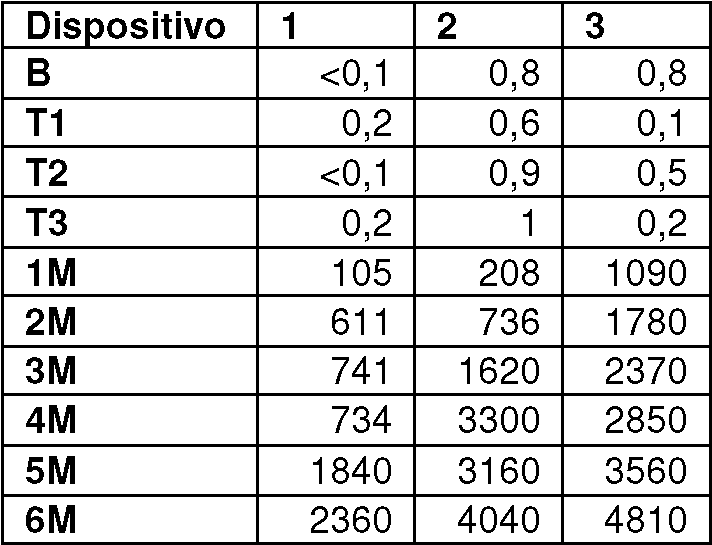
Tabla 2Table 2

Tabla 3Table 3

Tabla 4Table 4

Tabla 5Table 5

Tabla 6Table 6

[0116] Los resultados muestran un marcado aumento en los niveles de adrenalina en plasma sanguíneo utilizando el dispositivo, mejor que el obtenido para la administración endobronquial. Si bien el aumento no fue tan marcado como con la inyección intravenosa, fue el esperado y, en cualquier caso, evita los inconvenientes de la inyección intravenosa. [0116] The results show a marked increase in blood plasma adrenaline levels using the device, better than that obtained for endobronchial administration. Although the increase was not as marked as with intravenous injection, was as expected and, in any case, avoided the drawbacks of intravenous injection.
[0117] Se realizó una prueba adicional que implicaba la medición de parámetros sanguíneos, incluidos ABP, HR y PAP durante la administración secuencial de 2,5 mg, 5 mg, 10 mg y 20 mg de adrenalina en partículas a una oveja. Los gráficos de los resultados se muestran en las Figuras 9A a 9C, que destacan el aumento de ABP, HR y PAP inmediatamente después del parto, destacando la capacidad de las técnicas para producir beneficios inmediatos para un paciente. [0117] An additional test involving the measurement of blood parameters including ABP, HR, and PAP was performed during sequential administration of 2.5 mg, 5 mg, 10 mg, and 20 mg particulate epinephrine to a sheep. Graphs of the results are shown in Figures 9A to 9C, which highlight the increase in ABP, HR and PAP immediately after delivery, highlighting the ability of the techniques to produce immediate benefits for a patient.
[0118] Para demostrar la capacidad de administrar glucosa, es necesario poder crear partículas de glucosa de dimensiones adecuadas para administrar a través de las vías respiratorias. [0118] To demonstrate the ability to deliver glucose, it is necessary to be able to create glucose particles of suitable dimensions for delivery through the airways.
[0119] Un intento de lograr esto a través del secado por aspersión implicó crear una solución de D-glucosa en agua (15 mg/ml) secarla por aspersión en una disposición de circuito abierto (aire como gas de secado) a una velocidad de alimentación de 2 ml/min., tasa de aspiración de 38 m3/h y tasa de atomización de 819 NL/h. Las temperaturas de entrada y salida fueron de 80°C y 56°C, respectivamente. La recristalización del polvo tuvo lugar instantáneamente en el recipiente de recogida durante el proceso de secado por pulverización. Por lo tanto, no se puede preparar una formulación estable de glucosa en polvo mediante secado directo por aspersión de la solución de glucosa. [0119] An attempt to achieve this through spray drying involved creating a solution of D-glucose in water (15 mg/ml) and spray drying it in an open loop arrangement (air as drying gas) at a rate of 2 ml/min feed, 38 m3/h aspiration rate and 819 NL/h atomization rate. The inlet and outlet temperatures were 80°C and 56°C, respectively. The recrystallization of the powder took place instantaneously in the collection vessel during the spray drying process. Therefore, a stable powdered glucose formulation cannot be prepared by direct spray drying of the glucose solution.
[0120] Como alternativa, se propuso la molienda por chorro con D-glucosa en polvo siendo molida a una presión de alimentación de 4-5 bar y una presión de molienda de 3-4 bar con un ajuste de velocidad de alimentación del 10%. El tamaño de partícula medido por la técnica de difracción láser, que se muestra en la Tabla 7 a continuación, indica que el polvo molido se ha reducido significativamente en tamaño y ahora se encuentra en el rango respirable. En este sentido, todo lo que tenga un tamaño inferior a 5 micrómetros puede llegar al alvéolo y, por lo tanto, ser absorbido por la sangre. [0120] As an alternative, jet milling with D-glucose powder being milled at a feed pressure of 4-5 bar and a grinding pressure of 3-4 bar with a feed rate setting of 10% was proposed. . The particle size measured by the laser diffraction technique, shown in Table 7 below, indicates that the ground powder has been significantly reduced in size and is now in the respirable range. In this sense, everything that is smaller than 5 micrometers can reach the alveolus and, therefore, be absorbed by the blood.
Tabla 7Table 7

[0121] En consecuencia, la disposición descrita anteriormente proporciona un mecanismo para administrar medicación en partículas directamente a los pulmones de un sujeto, incluso en el caso de que el sujeto no sea capaz de inhalar por sí mismo. En este sentido, el pulmón tiene un gran suministro de sangre y se ha utilizado para la administración de fármacos, por ejemplo, salbutamol y, más recientemente, para algunos antibióticos para maximizar la administración de la dosis al pulmón. Solo hay una barrera de 2 células desde el alvéolo y el compartimento sanguíneo en la red capilar masiva que existe en los pulmones de los mamíferos. La eficacia de esta vía de administración del fármaco se puede observar fácilmente cuando se evalúa la rapidez del inicio de la acción del salbutamol en un asmático enfermo (si puede mover suficiente aire). Tal vez sea más obvio observar el efecto de la nicotina o la heroína cuando se fuma o se inhala. Por lo tanto, está claro que el pulmón es una vía de administración de fármacos eficaz. [0121] Accordingly, the arrangement described above provides a mechanism for delivering particulate medication directly into the lungs of a subject, even in the event that the subject is not capable of inhaling on their own. In this regard, the lung has a large blood supply and has been used for drug delivery, eg salbutamol and more recently for some antibiotics to maximize dose delivery to the lung. There is only a 2-cell barrier from the alveolus and blood compartment in the massive capillary network that exists in mammalian lungs. The efficacy of this route of drug administration can be easily seen when assessing the rapidity of onset of action of salbutamol in a sick asthmatic (if he can move enough air). It is perhaps most obvious to look at the effect of nicotine or heroin when smoked or inhaled. Thus, it is clear that the lung is an effective drug delivery route.
[0122] La administración de adrenalina en micropartículas a través de la inhalación forzada permite que este fármaco que salva vidas se administre más fácilmente y no requiere un entrenamiento especializado para su administración. Debido a la gran perfusión alveolar y la proximidad de los vasos alveolares a la circulación cardíaca central, con solo dos células entre el contenido alveolar y las células sanguíneas, la inhalación de adrenalina reduce drásticamente la latencia desde la administración hasta los niveles terapéuticos. [0122] The administration of microparticle adrenaline through forced inhalation allows this life-saving drug to be administered more easily and does not require specialized training for its administration. Due to the large alveolar perfusion and the proximity of the alveolar vessels to the central cardiac circulation, with only two cells between the alveolar contents and the blood cells, epinephrine inhalation dramatically reduces latency from administration to therapeutic levels.
[0123] El impacto potencial de esta investigación es de largo alcance. Este dispositivo se puede colocar en ubicaciones clave (p. ej., escuelas y ambulancias), lo que permite el suministro inmediato de adrenalina en la comunidad, incluidas las áreas rurales con un mínimo de personal de atención médica profesional, militares y centros comerciales, etc. [0123] The potential impact of this research is far reaching. This device can be placed in key locations (eg, schools and ambulances), allowing for immediate delivery of adrenaline in the community, including rural areas with minimal professional healthcare personnel, military, and shopping centers, etc.
[0124] Los datos actuales demuestran malos resultados en paros en la comunidad en comparación con los paros cardíacos que ocurren en el hospital. Lograr un acceso intravenoso en el campo, particularmente en un paro cardíaco, es extremadamente difícil debido a la falta de circulación y factores ambientales, por ejemplo, la luz, la posición del paciente, etc. Como tal, esta tecnología puede dar como resultado que una proporción significativamente mayor de estos pacientes haya recibido tratamiento oportuno antes. a la presentación al hospital, y con un mayor porcentaje de estos pacientes que sobreviven al alta. En el futuro, esta tecnología podría usarse para estudiar muchas otras intervenciones destinadas a la administración temprana sin los retrasos o riesgos asociados con el establecimiento de un acceso intravenoso. [0124] Current data demonstrates poor outcomes in arrests in the community compared to cardiac arrests occurring in the hospital. Achieving intravenous access in the field, particularly in cardiac arrest, is extremely difficult due to lack of circulation and environmental factors, eg light, patient position, etc. As such, this technology may result in a significantly higher proportion of these patients receiving timely treatment earlier. at presentation to the hospital, and with a higher percentage of these patients surviving to discharge. In the future, this technology could be used to study many other interventions intended for early administration without the delays or risks associated with establishing intravenous access.
[0125] Los datos recientes de Seattle mostraron una tendencia creciente de supervivencia de paro cardíaco en Seattle y el condado de King, con hasta un 55 % de los paros cardíacos que sobrevivieron al alta en 2012. Esto contrasta marcadamente con los datos locales, que muestran que las tasas de supervivencia por paro cardíaco disminuyeron del 12,3 % en 2004-2005 al 10,2 % en 2009-2010 en Nueva Gales del Sur, y una tasa de supervivencia media del 5 % en los paros extrahospitalarios de Queensland. Esta discrepancia se puede atribuir principalmente al éxito con el que se ejecuta el ciclo de atención en la comunidad (reconocimiento y notificación tempranos, RCP temprana, desfibrilación temprana y atención posterior a la reanimación). Un dispositivo no invasivo y fácil de usar que permita la administración de adrenalina podría ayudar a mejorar las tasas de supervivencia locales. También liberará a los miembros capacitados del equipo para que se concentren en la desfibrilación y otros asuntos, en lugar de enfocarse en encontrar un acceso intravenoso. [0125] Recent data from Seattle showed an increasing trend of cardiac arrest survival in Seattle and King County, with up to 55% of cardiac arrests surviving to discharge in 2012. This is in stark contrast to local data, which show that survival rates from cardiac arrest decreased from 12.3% in 2004-2005 to 10.2% in 2009-2010 in New South Wales, and a median survival rate of 5% in Queensland out-of-hospital arrests. This discrepancy can be mainly attributed to the success with which the care cycle is delivered in the community (early recognition and notification, early CPR, early defibrillation and post-resuscitation care). A non-invasive and easy-to-use device that allows for the administration of adrenaline could help improve local survival rates. It will also free trained team members to to focus on defibrillation and other issues, instead of focusing on finding IV access.
[0126] Además, hay circunstancias en las que hay un retraso en el establecimiento del acceso intravenoso incluso en el servicio de urgencias. En estas situaciones, esta tecnología podría proporcionar a las ambulancias y los departamentos de emergencia un método de administración alternativo que puede iniciarse en el momento en que llega el paciente. Esto contrasta con las alternativas actuales de administración intraósea y endobroquial, que normalmente se reserva como "último recurso" debido a que ambas son más invasivas. Por lo tanto, es probable que ambos métodos alternativos de administración de adrenalina solo ocurran después de varios minutos de intentar el acceso intravenoso; el método de inhalación/ventilación podría administrarse mientras se realiza el primer intento de acceso intravenoso. Puede aumentar la circulación hasta el punto de facilitar el acceso intravenoso, lo que en sí mismo es un resultado útil y clínicamente beneficioso. [0126] Furthermore, there are circumstances where there is a delay in establishing intravenous access even in the emergency department. In these situations, this technology could provide ambulances and emergency departments with an alternate delivery method that can be started the moment the patient arrives. This is in contrast to the current alternatives of intraosseous and endobrochial administration, which are usually reserved as "last resort" because both are more invasive. Therefore, both alternative methods of epinephrine administration are likely to only occur after several minutes of attempting intravenous access; the inhalation/ventilation method could be administered while the first attempt at intravenous access is being made. It can increase circulation to the point of facilitating intravenous access, which in itself is a useful and clinically beneficial result.
[0127] En consecuencia, la técnica descrita anteriormente proporciona un dispositivo con el potencial para la administración rápida y segura de un fármaco que salva vidas (adrenalina) sin necesidad de poner un goteo (pequeño tubo de plástico que se coloca en una vena) o verter fármacos en los pulmones o colocando una aguja de metal directamente en el hueso, que son métodos alternativos cuando no se puede insertar un goteo. El dispositivo permite la entrega rápida de partículas muy pequeñas de adrenalina directamente a los pulmones con cada respiración. Esta entrega rápida de adrenalina a los pulmones se absorbe a través del tejido pulmonar a la sangre y luego al corazón y puede ayudar durante un ataque cardíaco a volver al bombeo normal del corazón. La intervención temprana durante un ataque al corazón podría salvar más vidas y evitar una mala recuperación de un ataque al corazón que a veces incluye una lesión cerebral. Es excepcionalmente simple de usar y podría aplicarse en escuelas, instalaciones deportivas y de entretenimiento, ambulancias y hospitales, entre otras áreas. El dispositivo podría ser utilizado por una sola persona, como un padre, un maestro o un paramédico, para revivir a un paciente arrestado. El dispositivo de administración rápida de adrenalina promete brindar un tratamiento mejorado y rápido, y esto puede traducirse en mejores resultados para los pacientes de toda la comunidad. [0127] Accordingly, the technique described above provides a device with the potential for rapid and safe delivery of a life-saving drug (adrenaline) without the need for a drip (small plastic tube that is placed into a vein) or pouring drugs into the lungs or placing a metal needle directly into the bone, which are alternative methods when a drip cannot be inserted. The device allows for the rapid delivery of very small particles of adrenaline directly into the lungs with each breath. This rapid delivery of adrenaline to the lungs is absorbed through the lung tissue into the blood and then to the heart and can help return the heart to normal pumping during a heart attack. Early intervention during a heart attack could save more lives and prevent poor recovery from a heart attack that sometimes includes brain injury. It is exceptionally simple to use and could be applied in schools, sports and entertainment facilities, ambulances and hospitals, among other areas. The device could be used by a single person, such as a parent, teacher, or paramedic, to revive an arrested patient. The Rapid Adrenaline Delivery Device promises to provide faster and improved treatment, and this can translate into better outcomes for patients throughout the community.
[0128] A lo largo de esta especificación y las reivindicaciones que siguen, a menos que el contexto requiera lo contrario, la palabra "comprende", y variaciones tales como "comprende" o "que comprende", se entenderá que implica la inclusión de un número entero o grupo de números enteros establecidos o pasos, pero no la exclusión de cualquier otro número entero o grupo de números enteros. [0128] Throughout this specification and the claims that follow, unless the context otherwise requires, the word "comprising", and variations such as "comprising" or "comprising", shall be understood to imply the inclusion of a stated integer or group of integers or steps, but not to the exclusion of any other integer or group of integers.
Claims (1)
Applications Claiming Priority (2)
| Application Number | Priority Date | Filing Date | Title |
|---|---|---|---|
| AU2013904823A AU2013904823A0 (en) | 2013-12-11 | Medicament apparatus and method | |
| PCT/AU2014/050406 WO2015085362A1 (en) | 2013-12-11 | 2014-12-10 | Medicament apparatus and method |
Publications (1)
| Publication Number | Publication Date |
|---|---|
| ES2927609T3 true ES2927609T3 (en) | 2022-11-08 |
Family
ID=53370370
Family Applications (1)
| Application Number | Title | Priority Date | Filing Date |
|---|---|---|---|
| ES14868882T Active ES2927609T3 (en) | 2013-12-11 | 2014-12-10 | Apparatus |
Country Status (12)
| Country | Link |
|---|---|
| US (1) | US20160339198A1 (en) |
| EP (1) | EP3079743B1 (en) |
| AU (1) | AU2014361743B2 (en) |
| CA (1) | CA2932159C (en) |
| DK (1) | DK3079743T3 (en) |
| ES (1) | ES2927609T3 (en) |
| HU (1) | HUE059911T2 (en) |
| PL (1) | PL3079743T3 (en) |
| PT (1) | PT3079743T (en) |
| RS (1) | RS63629B1 (en) |
| SG (1) | SG11201604626VA (en) |
| WO (1) | WO2015085362A1 (en) |
Families Citing this family (13)
| Publication number | Priority date | Publication date | Assignee | Title |
|---|---|---|---|---|
| US10695264B2 (en) * | 2014-05-07 | 2020-06-30 | Jolife Ab | CPR chest compression system with rate-based patient tranquility mode |
| US11247001B2 (en) | 2016-09-30 | 2022-02-15 | De Motu Cordis Pty Ltd | Delivery device with cantilever structure and associated method of use |
| US10864338B2 (en) * | 2017-05-19 | 2020-12-15 | Austere Medical Group, Llc | Rescue breathing apparatus |
| WO2020088984A1 (en) * | 2018-10-30 | 2020-05-07 | Chiesi Farmaceutici S.P.A. | Apparatus to administer drugs to mechanically ventilated patients |
| CA3134943A1 (en) | 2019-03-26 | 2020-10-01 | Pocket Naloxone Corp. | Devices and methods for delivering pharmaceutical compositions |
| CN110947063B (en) * | 2019-11-27 | 2020-11-17 | 吉林大学 | Anti-bite type ventilation catheter for cardiovascular internal medicine nursing |
| US11278709B1 (en) | 2021-03-12 | 2022-03-22 | Pocket Naloxone Corp. | Drug delivery device and methods for using same |
| CN114849003B (en) * | 2022-06-13 | 2023-12-01 | 四川大学华西医院 | Artificial airway air bag pressure regulating system for breathing machine and application method thereof |
| US11844900B1 (en) * | 2023-06-08 | 2023-12-19 | Microneb Tech Holdings, Inc. | Apparatus, methods, and systems for administering a medication to a patient from a capsule using an atomizer |
| US12171938B1 (en) | 2023-01-06 | 2024-12-24 | Microneb Tech Holdings, Inc. | Apparatus, methods, and systems for delivery and administration of pharmaceutical, therapeutic and cosmetic substances to users |
| US12156966B2 (en) | 2023-01-06 | 2024-12-03 | Microneb Tech Holdings, Inc. | Methods and systems for delivering formulations to users using modular device having removable cartridge |
| US11850356B1 (en) * | 2023-06-08 | 2023-12-26 | Microneb Tech Holdings, Inc. | Apparatus, methods, and systems for administering a medication to a patient from a capsule using an atomizer |
| WO2024254545A1 (en) * | 2023-06-08 | 2024-12-12 | Microneb Tech Holdings, Inc. | Apparatus, methods, and systems for atomized delivery of a composition to a patient |
Family Cites Families (26)
| Publication number | Priority date | Publication date | Assignee | Title |
|---|---|---|---|---|
| US6055980A (en) * | 1991-05-20 | 2000-05-02 | Dura Pharmaceuticals, Inc. | Dry powder inhaler |
| EP0601071B1 (en) * | 1991-08-26 | 1999-10-20 | Minnesota Mining And Manufacturing Company | Powder dispenser |
| US5349947A (en) * | 1993-07-15 | 1994-09-27 | Newhouse Michael T | Dry powder inhaler and process that explosively discharges a dose of powder and gas from a soft plastic pillow |
| US5415162A (en) * | 1994-01-18 | 1995-05-16 | Glaxo Inc. | Multi-dose dry powder inhalation device |
| US5875776A (en) * | 1996-04-09 | 1999-03-02 | Vivorx Pharmaceuticals, Inc. | Dry powder inhaler |
| US6003512A (en) * | 1997-11-13 | 1999-12-21 | Lovelace Respiratory Research Institute | Dust gun-aerosol generator and generation |
| US7171965B2 (en) * | 2000-02-01 | 2007-02-06 | Valois S.A.S. | Breath actuated dry powder inhaler and tape dose strip |
| SE518397C2 (en) * | 2001-04-05 | 2002-10-01 | Microdrug Ag | Method and apparatus for releasing powder and inhaler device for administering medical powder |
| EP1531794B1 (en) * | 2002-06-28 | 2017-05-10 | Civitas Therapeutics, Inc. | Inhalable epinephrine |
| EP1560631A1 (en) * | 2002-11-15 | 2005-08-10 | Medi-Stream Pty Ltd. | Drug delivery device and method |
| GB0313604D0 (en) * | 2003-06-12 | 2003-07-16 | Britannia Pharmaceuticals Ltd | Delivery device for powdered medicament |
| GB2405799A (en) * | 2003-09-15 | 2005-03-16 | Vectura Ltd | Dry powder inhaler incorporating a valve which is opened and closed by pressurized gas |
| KR101137052B1 (en) * | 2003-11-17 | 2012-04-24 | 노바르티스 아게 | Efficient introduction of an aerosol into a ventilator circuit |
| WO2005065756A2 (en) * | 2003-12-30 | 2005-07-21 | Oriel Therapeutics, Inc. | Dry powder nebulizers and associated methods of dispensing dry powders |
| WO2006009607A2 (en) * | 2004-06-16 | 2006-01-26 | The General Hospital Corporation D/B/A Massachusetts General Hospital | Methods and devices for assisting drug delivery to the lungs |
| JP2006130143A (en) * | 2004-11-08 | 2006-05-25 | Hitachi Ltd | Inhalation-type dispenser and drug cartridge |
| GB0500677D0 (en) * | 2005-01-14 | 2005-02-23 | Britannia Pharmaceuticals Ltd | Dry powder inhaler |
| GB0602897D0 (en) * | 2006-02-13 | 2006-03-22 | Jagotec Ag | Improvements In Or Relating To Dry Powder Inhaler Devices |
| WO2007093010A1 (en) * | 2006-02-17 | 2007-08-23 | Resmed Ltd | Method and apparatus for monitoring the condition of a patient with diabetes |
| GB0623728D0 (en) * | 2006-11-28 | 2007-01-10 | Optinose As | Delivery devices |
| HUE034380T2 (en) * | 2007-04-30 | 2018-02-28 | Sun Pharma Advanced Res Co Ltd | Inhalation device |
| WO2009088553A1 (en) * | 2007-10-22 | 2009-07-16 | Board Of Regents, The University Of Texas System | Dry powder drug delivery formulations, methods of use, and devices therefore |
| EP2432531B1 (en) * | 2009-05-18 | 2019-03-06 | Boehringer Ingelheim International GmbH | Adapter, inhalation device and nebulizer |
| ES2666676T3 (en) * | 2009-12-26 | 2018-05-07 | Inspiro Medical Ltd | Dry Powder Management Device |
| US20130118485A1 (en) * | 2010-04-07 | 2013-05-16 | Kast Silicone Ltd. | Means and method for administering medicaments to infants |
| US10463815B2 (en) * | 2012-02-21 | 2019-11-05 | Respira Therapeutics, Inc. | Inhaler to deliver substances for prophylaxis or prevention of disease or injury caused by the inhalation of biological or chemical agents |
-
2014
- 2014-12-10 PT PT148688823T patent/PT3079743T/en unknown
- 2014-12-10 EP EP14868882.3A patent/EP3079743B1/en active Active
- 2014-12-10 US US15/103,785 patent/US20160339198A1/en not_active Abandoned
- 2014-12-10 RS RS20220941A patent/RS63629B1/en unknown
- 2014-12-10 WO PCT/AU2014/050406 patent/WO2015085362A1/en not_active Ceased
- 2014-12-10 CA CA2932159A patent/CA2932159C/en active Active
- 2014-12-10 DK DK14868882.3T patent/DK3079743T3/en active
- 2014-12-10 HU HUE14868882A patent/HUE059911T2/en unknown
- 2014-12-10 ES ES14868882T patent/ES2927609T3/en active Active
- 2014-12-10 PL PL14868882.3T patent/PL3079743T3/en unknown
- 2014-12-10 SG SG11201604626VA patent/SG11201604626VA/en unknown
- 2014-12-10 AU AU2014361743A patent/AU2014361743B2/en active Active
Also Published As
| Publication number | Publication date |
|---|---|
| CA2932159A1 (en) | 2015-06-18 |
| AU2014361743B2 (en) | 2019-09-26 |
| NZ720924A (en) | 2021-04-30 |
| PT3079743T (en) | 2022-11-11 |
| AU2014361743A1 (en) | 2016-06-23 |
| DK3079743T3 (en) | 2022-10-17 |
| US20160339198A1 (en) | 2016-11-24 |
| EP3079743A1 (en) | 2016-10-19 |
| WO2015085362A1 (en) | 2015-06-18 |
| HUE059911T2 (en) | 2023-01-28 |
| PL3079743T3 (en) | 2023-02-06 |
| RS63629B1 (en) | 2022-10-31 |
| EP3079743B1 (en) | 2022-08-03 |
| CA2932159C (en) | 2021-01-05 |
| EP3079743A4 (en) | 2018-02-28 |
| SG11201604626VA (en) | 2016-07-28 |
Similar Documents
| Publication | Publication Date | Title |
|---|---|---|
| EP3079743B1 (en) | Apparatus | |
| ES2666676T3 (en) | Dry Powder Management Device | |
| AU678711B2 (en) | Resuscitator | |
| ES2379120T3 (en) | CO2 CONTROLLED F F? RMACOS INFUSION SYSTEM. | |
| CN105722551B (en) | Systems for controlled defibrillation and ventilation | |
| CN104955509B (en) | System and method for providing Nicht-invasive Beatmung | |
| JP2013526982A5 (en) | ||
| EP2347781A1 (en) | Gas mist inhaler | |
| CN106456914A (en) | Active dry powder inhaler | |
| ES2637924T3 (en) | Protocol and procedure for the administration of a pulsatile drug | |
| US12171938B1 (en) | Apparatus, methods, and systems for delivery and administration of pharmaceutical, therapeutic and cosmetic substances to users | |
| US12194037B2 (en) | Apparatus, methods, and systems for providing pharmaceutical compositions and administering medications to patients | |
| Nagesh et al. | Caffeine poisoning treated by hemoperfusion | |
| US11944742B1 (en) | Apparatus, methods, and systems for administering a medication to an animal | |
| US11925748B1 (en) | Apparatus, methods, and systems for administering a medication to a patient from a capsule using an atomizer | |
| WO2024254545A1 (en) | Apparatus, methods, and systems for atomized delivery of a composition to a patient | |
| HK1230115A1 (en) | Apparatus | |
| HK1230115B (en) | Apparatus | |
| NZ720924B2 (en) | Apparatus and use thereof in delivering a particulate medicament to an unconscious patient | |
| SWARTS | Propoxyphene (Darvon) Poisoning: A Nearly Fatal Case With Coma, Convulsions, and Severe Respiratory Depression, Successfully Treated With Nalorphine | |
| CN105126213A (en) | Portable first-aid inhalation drug delivery system | |
| US12156966B2 (en) | Methods and systems for delivering formulations to users using modular device having removable cartridge | |
| US20250108046A1 (en) | Apparatus, methods, and systems for providing pharmaceutical compositions in the form of droplets for aerosol administration and inhalation delivery | |
| Epinephrine et al. | Manual Resuscitation Techniques/Emergency Respiratory Care 73 | |
| CN209378230U (en) | Physiotherapy device for department of respiration |