EP4583498A1 - Electronic device including solenoid type sensing substrate - Google Patents
Electronic device including solenoid type sensing substrate Download PDFInfo
- Publication number
- EP4583498A1 EP4583498A1 EP23875108.5A EP23875108A EP4583498A1 EP 4583498 A1 EP4583498 A1 EP 4583498A1 EP 23875108 A EP23875108 A EP 23875108A EP 4583498 A1 EP4583498 A1 EP 4583498A1
- Authority
- EP
- European Patent Office
- Prior art keywords
- pcb
- electronic device
- pen
- type substrate
- solenoid type
- Prior art date
- Legal status (The legal status is an assumption and is not a legal conclusion. Google has not performed a legal analysis and makes no representation as to the accuracy of the status listed.)
- Pending
Links
Images







Classifications
-
- G—PHYSICS
- G06—COMPUTING OR CALCULATING; COUNTING
- G06F—ELECTRIC DIGITAL DATA PROCESSING
- G06F3/00—Input arrangements for transferring data to be processed into a form capable of being handled by the computer; Output arrangements for transferring data from processing unit to output unit, e.g. interface arrangements
- G06F3/01—Input arrangements or combined input and output arrangements for interaction between user and computer
- G06F3/03—Arrangements for converting the position or the displacement of a member into a coded form
- G06F3/033—Pointing devices displaced or positioned by the user, e.g. mice, trackballs, pens or joysticks; Accessories therefor
- G06F3/0354—Pointing devices displaced or positioned by the user, e.g. mice, trackballs, pens or joysticks; Accessories therefor with detection of two-dimensional [2D] relative movements between the device, or an operating part thereof, and a plane or surface, e.g. 2D mice, trackballs, pens or pucks
- G06F3/03545—Pens or stylus
-
- G—PHYSICS
- G06—COMPUTING OR CALCULATING; COUNTING
- G06F—ELECTRIC DIGITAL DATA PROCESSING
- G06F1/00—Details not covered by groups G06F3/00 - G06F13/00 and G06F21/00
- G06F1/16—Constructional details or arrangements
- G06F1/1613—Constructional details or arrangements for portable computers
- G06F1/1626—Constructional details or arrangements for portable computers with a single-body enclosure integrating a flat display, e.g. Personal Digital Assistants [PDAs]
-
- G—PHYSICS
- G06—COMPUTING OR CALCULATING; COUNTING
- G06F—ELECTRIC DIGITAL DATA PROCESSING
- G06F1/00—Details not covered by groups G06F3/00 - G06F13/00 and G06F21/00
- G06F1/16—Constructional details or arrangements
- G06F1/1613—Constructional details or arrangements for portable computers
- G06F1/1633—Constructional details or arrangements of portable computers not specific to the type of enclosures covered by groups G06F1/1615 - G06F1/1626
- G06F1/1656—Details related to functional adaptations of the enclosure, e.g. to provide protection against EMI, shock, water, or to host detachable peripherals like a mouse or removable expansions units like PCMCIA cards, or to provide access to internal components for maintenance or to removable storage supports like CDs or DVDs, or to mechanically mount accessories
-
- G—PHYSICS
- G06—COMPUTING OR CALCULATING; COUNTING
- G06F—ELECTRIC DIGITAL DATA PROCESSING
- G06F1/00—Details not covered by groups G06F3/00 - G06F13/00 and G06F21/00
- G06F1/26—Power supply means, e.g. regulation thereof
- G06F1/266—Arrangements to supply power to external peripherals either directly from the computer or under computer control, e.g. supply of power through the communication port, computer controlled power-strips
-
- H—ELECTRICITY
- H02—GENERATION; CONVERSION OR DISTRIBUTION OF ELECTRIC POWER
- H02J—ELECTRIC POWER NETWORKS; CIRCUIT ARRANGEMENTS OR SYSTEMS FOR SUPPLYING OR DISTRIBUTING ELECTRIC POWER; SYSTEMS FOR STORING ELECTRIC ENERGY
- H02J50/00—Circuit arrangements or systems for wireless supply or distribution of electric power
- H02J50/10—Circuit arrangements or systems for wireless supply or distribution of electric power using inductive coupling
-
- H—ELECTRICITY
- H02—GENERATION; CONVERSION OR DISTRIBUTION OF ELECTRIC POWER
- H02J—ELECTRIC POWER NETWORKS; CIRCUIT ARRANGEMENTS OR SYSTEMS FOR SUPPLYING OR DISTRIBUTING ELECTRIC POWER; SYSTEMS FOR STORING ELECTRIC ENERGY
- H02J7/00—Circuit arrangements for charging or discharging batteries or for supplying loads from batteries
- H02J7/34—Parallel operation in networks using both storage and other DC sources, e.g. providing buffering
- H02J7/342—The other DC source being a battery actively interacting with the first one, i.e. battery to battery charging
-
- H—ELECTRICITY
- H02—GENERATION; CONVERSION OR DISTRIBUTION OF ELECTRIC POWER
- H02J—ELECTRIC POWER NETWORKS; CIRCUIT ARRANGEMENTS OR SYSTEMS FOR SUPPLYING OR DISTRIBUTING ELECTRIC POWER; SYSTEMS FOR STORING ELECTRIC ENERGY
- H02J7/00—Circuit arrangements for charging or discharging batteries or for supplying loads from batteries
- H02J7/70—Circuit arrangements for charging or discharging batteries or for supplying loads from batteries characterised by the mechanical construction
- H02J7/731—Circuit arrangements for charging or discharging batteries or for supplying loads from batteries characterised by the mechanical construction specially adapted for holding portable devices containing batteries
-
- H—ELECTRICITY
- H05—ELECTRIC TECHNIQUES NOT OTHERWISE PROVIDED FOR
- H05K—PRINTED CIRCUITS; CASINGS OR CONSTRUCTIONAL DETAILS OF ELECTRIC APPARATUS; MANUFACTURE OF ASSEMBLAGES OF ELECTRICAL COMPONENTS
- H05K9/00—Screening of apparatus or components against electric or magnetic fields
- H05K9/0007—Casings
-
- G—PHYSICS
- G06—COMPUTING OR CALCULATING; COUNTING
- G06F—ELECTRIC DIGITAL DATA PROCESSING
- G06F2200/00—Indexing scheme relating to G06F1/04 - G06F1/32
- G06F2200/16—Indexing scheme relating to G06F1/16 - G06F1/18
- G06F2200/163—Indexing scheme relating to constructional details of the computer
- G06F2200/1632—Pen holder integrated in the computer
-
- H—ELECTRICITY
- H05—ELECTRIC TECHNIQUES NOT OTHERWISE PROVIDED FOR
- H05K—PRINTED CIRCUITS; CASINGS OR CONSTRUCTIONAL DETAILS OF ELECTRIC APPARATUS; MANUFACTURE OF ASSEMBLAGES OF ELECTRICAL COMPONENTS
- H05K1/00—Printed circuits
- H05K1/16—Printed circuits incorporating printed electric components, e.g. printed resistors, capacitors or inductors
- H05K1/165—Printed circuits incorporating printed electric components, e.g. printed resistors, capacitors or inductors incorporating printed inductors
Definitions
- an electronic device for example, an electronic device including a solenoid type sensing substrate.
- an electronic device may include a base plate 481, a side frame 482 connected to the base plate, a front cover 491 covering a surface of the base plate, a back cover 494 covering a surface of the side frame, and provided opposite to the front cover with respect to the side frame, a pen housing 470 arranged on the base plate and configured to accommodate a digital pen 501, and a solenoid type substrate assembly 420 provided between the side frame and the pen housing, and configured to determine whether the digital pen is provided inside the pen housing and electrically charge the digital pen.
- an electronic device may include a base plate 481, a side frame 482 connected to the base plate, a front cover 491 covering a surface of the base plate, a back cover 494 covering a surface of the side frame, and provided opposite to the front cover with respect to the side frame, a pen housing 470 arranged on the base plate and configured to accommodate a digital pen 501, and a solenoid type substrate assembly 420 provided between the side frame and the pen housing, and configured to generate one of a first magnetic field that determines whether the digital pen is provided inside the pen housing and a second magnetic field that electrically charges the digital pen.
- an electronic device may include a pen housing 470 configured to accommodate a digital pen 501, and a solenoid type substrate assembly 420 provided between the side frame and the pen housing, and configured to determine whether the digital pen is provided inside the pen housing and electrically charge the digital pen, wherein, the solenoid type substrate assembly 420 may include a plurality of PCBs 421, 422, 423 stacked in a direction parallel to a direction from the side frame toward the pen housing.
- FIG. 1 is a block diagram illustrating an electronic device 101 in a network environment 100 according to various embodiments.
- FIG. 6 is a cross-sectional view along line VI-VI of FIG. 5 .
- the electronic device 101 in the network environment 100 may communicate with an electronic device 102 via a first network 198 (e.g., a short-range wireless communication network), or at least one of an electronic device 104 or a server 108 via a second network 199 (e.g., a long-range wireless communication network).
- a first network 198 e.g., a short-range wireless communication network
- a second network 199 e.g., a long-range wireless communication network
- the electronic device 101 may communicate with the electronic device 104 via the server 108.
- the input module 150 may receive a command or data to be used by another component (e.g., the processor 120) of the electronic device 101, from the outside (e.g., a user) of the electronic device 101.
- the input module 150 may include, for example, a microphone, a mouse, a keyboard, a key (e.g., a button), or a digital pen (e.g., a stylus pen).
- the camera module 180 may capture a still image and moving images. According to an embodiment, the camera module 180 may include one or more lenses, image sensors, ISPs, or flashes.
- the power management module 188 may manage power supplied to the electronic device 101.
- the power management module 188 may be implemented as, for example, at least a part of a power management integrated circuit (PMIC).
- PMIC power management integrated circuit
- the battery 189 may supply power to at least one component of the electronic device 101.
- the battery 189 may include, for example, a primary cell which is not rechargeable, a secondary cell which is rechargeable, or a fuel cell.
- the communication module 190 may support establishing a direct (e.g., wired) communication channel or a wireless communication channel between the electronic device 101 and the external electronic device (e.g., the electronic device 102, the electronic device 104, or the server 108) and performing communication via the established communication channel.
- the communication module 190 may include one or more communication processors that are operable independently of the processor 120 (e.g., an AP) and that support a direct (e.g., wired) communication or a wireless communication.
- the communication module 190 may include a wireless communication module 192 (e.g., a cellular communication module, a short-range wireless communication module, or a global navigation satellite system (GNSS) communication module) or a wired communication module 194 (e.g., a local region network (LAN) communication module, or a power line communication (PLC) module).
- a wireless communication module 192 e.g., a cellular communication module, a short-range wireless communication module, or a global navigation satellite system (GNSS) communication module
- GNSS global navigation satellite system
- wired communication module 194 e.g., a local region network (LAN) communication module, or a power line communication (PLC) module.
- LAN local region network
- PLC power line communication
- the wireless communication module 192 may support a 5G network after a 4G network, and a next-generation communication technology, e.g., a new radio (NR) access technology.
- the NR access technology may support enhanced mobile broadband (eMBB), massive machine type communications (mMTC), or ultra-reliable and low-latency communications (URLLC).
- eMBB enhanced mobile broadband
- mMTC massive machine type communications
- URLLC ultra-reliable and low-latency communications
- the wireless communication module 192 may support a high-frequency band (e.g., a mmWave band) to achieve, e.g., a high data transmission rate.
- a high-frequency band e.g., a mmWave band
- the wireless communication module 192 may support various technologies for securing performance on a high-frequency band, such as, e.g., beamforming, massive multiple-input and multiple-output (MIMO), full dimensional MIMO (FD-MIMO), an array antenna, analog beam-forming, or a large scale antenna.
- MIMO massive multiple-input and multiple-output
- FD-MIMO full dimensional MIMO
- the wireless communication module 192 may support various requirements specified in the electronic device 101, an external electronic device (e.g., the electronic device 104), or a network system (e.g., the second network 199).
- the wireless communication module 192 may support a peak data rate (e.g., 20 Gbps or more) for implementing eMBB, loss coverage (e.g., 164 dB or less) for implementing mMTC, or U-plane latency (e.g., 0.5 ms or less for each of downlink (DL) and uplink (UL), or a round trip of 1 ms or less) for implementing URLLC.
- a peak data rate e.g., 20 Gbps or more
- loss coverage e.g., 164 dB or less
- U-plane latency e.g., 0.5 ms or less for each of downlink (DL) and uplink (UL), or a round trip of 1 ms or less
- the antenna module 197 may transmit or receive a signal or power to or from the outside (e.g., the external electronic device) of the electronic device 101.
- the antenna module 197 may include an antenna including a radiating element including a conductive material or a conductive pattern formed in or on a substrate (e.g., a printed circuit board (PCB)).
- the antenna module 197 may include a plurality of antennas (e.g., array antennas). In such a case, at least one antenna appropriate for a communication scheme used in a communication network, such as the first network 198 or the second network 199, may be selected by, for example, the communication module 190 from the plurality of antennas.
- At least some of the above-described components may be coupled mutually and communicate signals (e.g., commands or data) therebetween via an inter-peripheral communication scheme (e.g., a bus, general purpose input and output (GPIO), serial peripheral interface (SPI), or mobile industry processor interface (MIPI)).
- an inter-peripheral communication scheme e.g., a bus, general purpose input and output (GPIO), serial peripheral interface (SPI), or mobile industry processor interface (MIPI)
- commands or data may be transmitted or received between the electronic device 101 and the external electronic device 104 via the server 108 coupled with the second network 199.
- Each of the external electronic devices 102 or 104 may be a device of the same type as or a different type from the electronic device 101.
- all or some of operations to be executed by the electronic device 101 may be executed at one or more external electronic devices (e.g., the external devices 102 and 104, and the server 108).
- the electronic device 101 may request one or more external electronic devices to perform at least a portion of the function or the service.
- the one or more external electronic devices receiving the request may perform the at least part of the function or the service requested, or an additional function or an additional service related to the request, and may transfer an outcome of the performing to the electronic device 101.
- the electronic device 101 may provide the outcome, with or without further processing of the outcome, as at least part of a reply to the request.
- a cloud computing, distributed computing, mobile edge computing (MEC), or client-server computing technology may be used, for example.
- the electronic device 101 may provide ultra low-latency services using, e.g., distributed computing or MEC.
- the external electronic device 104 may include an Internet-of-things (IoT) device.
- the server 108 may be an intelligent server using machine learning and/or a neural network.
- the external electronic device 104 or the server 108 may be included in the second network 199.
- the electronic device 101 may be applied to intelligent services (e.g., smart home, smart city, smart car, or healthcare) based on 5G communication technology or IoT-related technology.
- the electronic device may be one of various types of electronic devices.
- the electronic devices may include, for example, a portable communication device (e.g., a smartphone), a computer device, a portable multimedia device, a portable medical device, a camera, a wearable device, or a home appliance.
- a portable communication device e.g., a smartphone
- a computer device e.g., a laptop, a desktop, a tablet, or a portable multimedia device
- a portable medical device e.g., a portable medical device
- camera e.g., a camera
- a wearable device e.g., a portable medical device
- a home appliance e.g., a portable medical device, a portable medical device, a camera, a wearable device, or a home appliance.
- the electronic device is not limited to those described above.
- each of such phrases as “A or B”, “at least one of A and B”, “at least one of A or B”, “A, B or C”, “at least one of A, B and C”, and “at least one of A, B, or C”, may include any one of, or all possible combinations of the items enumerated together in a corresponding one of the phrases.
- such terms as “1 st “ and “2 nd ,” or “first” and “second” may be used to simply distinguish a corresponding component from another, and does not limit the components in other aspects (e.g., importance or order).
- a component e.g., a first component
- operatively or “communicatively”, as “coupled with”, “coupled to”, “connected with”, or “connected to” another component
- the component may be coupled with the other component directly (e.g., by wire), wirelessly, or via a third component.
- module may include a unit implemented in hardware, software, or firmware, and may interchangeably be used with other terms, for example, “logic”, “logic block”, “part”, or “circuitry”.
- a module may be a single integral component, or a minimum unit or part thereof, adapted to perform one or more functions.
- the module may be implemented in a form of an application-specific integrated circuit (ASIC).
- ASIC application-specific integrated circuit
- Embodiments as set forth herein may be implemented as software (e.g., the program 140) including one or more instructions that are stored in a storage medium (e.g., an internal memory 136 or an external memory 138) that is readable by a machine (e.g., the electronic device 101).
- a processor e.g., the processor 120
- the one or more instructions may include code generated by a compiler or code executable by an interpreter.
- the machine-readable storage medium may be provided in the form of a non-transitory storage medium.
- non-transitory simply means that the storage medium is a tangible device, and does not include a signal (e.g., an electromagnetic wave), but this term does not differentiate between where data is semi-permanently stored in the storage medium and where the data is temporarily stored in the storage medium.
- a method according to embodiments of the disclosure may be included and provided in a computer program product.
- the computer program product may be traded as a product between a seller and a buyer.
- the computer program product may be distributed in the form of a machine-readable storage medium (e.g., compact disc read-only memory (CD-ROM)), or be distributed (e.g., downloaded or uploaded) online via an application store (e.g., PlayStore TM ), or between two user devices (e.g., smartphones) directly. If distributed online, at least part of the computer program product may be temporarily generated or at least temporarily stored in the machine-readable storage medium, such as a memory of the manufacturer's server, a server of the application store, or a relay server.
- CD-ROM compact disc read-only memory
- an application store e.g., PlayStore TM
- two user devices e.g., smartphones
- each component e.g., a module or a program of the above-described components may include a single entity or multiple entities, and some of the multiple entities may be separately disposed in different components. According to embodiments, one or more of the above-described components or operations may be omitted, or one or more other components or operations may be added. Alternatively or additionally, a plurality of components (e.g., modules or programs) may be integrated into a single component. In such a case, according to embodiments, the integrated component may still perform one or more functions of each of the plurality of components in the same or similar manner as they are performed by a corresponding one of the plurality of components before the integration.
- operations performed by the module, the program, or another component may be carried out sequentially, in parallel, repeatedly, or heuristically, or one or more of the operations may be executed in a different order or omitted, or one or more other operations may be added.
- the electronic device 101 may include the components shown in FIG. 1 , and may have a structure into which a digital pen 201 (e.g., a stylus pen) may be inserted.
- the electronic device 101 may include a housing 110, and may include a hole 111 in a portion, e.g., a portion of a side surface 110C, of the housing 110.
- the electronic device 101 may include a receiving space 112 connected with the hole 111, and the digital pen 201 may be inserted into the receiving space 112.
- the digital pen 201 may include a pressable button 201a at an end to be easily pulled out of the receiving space 112 of the electronic device 101. When the button 201a is pressed, a repulsive mechanism (e.g., at least one spring) configured in association with the button 201a may be operated to allow the digital pen 201 to be removed from the receiving space 112.
- a repulsive mechanism e.g., at least one spring
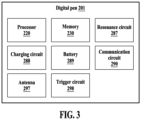
- the digital pen 201 may include a processor 220, a memory 230, a resonance circuit 287, a charging circuit 288, a battery 289, a communication circuit 290, an antenna 297, and/or a trigger circuit 298.
- the processor 220, at least a portion of the resonance circuit 287, and/or at least a portion of the communication circuit 290 of the digital pen 201 may be configured in the form of a chip or on a PCB.
- the processor 220, the resonance circuit 287, and/or the communication circuit 290 may be electrically connected with the memory 230, the charging circuit 288, the battery 289, the antenna 297, or the trigger circuit 298.
- the digital pen 201 may be composed of only a resonance circuit and a button.
- the processor 220 may include a customized hardware module or a generic processor configured to execute software (e.g., an application program).
- the processor may include a hardware component (function) or software element (program) including at least one of a communication module or a module to manage the state or environment of the digital pen 201, an input/output interface, a data measuring module, and various sensors provided in the digital pen 201.
- the processor 220 may include one of, for example, hardware, software, or firmware, or a combination of two or more thereof.
- the processor 220 may receive a proximate signal corresponding to an electromagnetic signal generated from a digitizer (e.g., the display module 160) of the electronic device 101 through the resonance circuit 287. When the proximate signal is identified, the processor 220 may control the resonance circuit 287 to transmit an electromagnetic resonance (EMR) input signal to the electronic device 101.
- EMR electromagnetic resonance
- the memory 230 may store information related to an operation of the digital pen 201.
- the information may include information for communicating with the electronic device 101 and frequency information related to an input operation of the digital pen 201.
- the resonance circuit 287 may include at least one of a coil, an inductor, or a capacitor.
- the resonance circuit 287 of the digital pen 201 may generate a signal having a resonance frequency.
- the digital pen 201 may use at least one of an EMR scheme, an active electrostatic (AES) scheme, or an electrically coupled resonance (ECR) scheme.
- EMR electrically coupled resonance
- the digital pen 201 may generate a signal having a resonance frequency based on an electromagnetic field generated from the inductive panel of the electronic device 101.
- the digital pen 201 transmits signals via the AES scheme
- the digital pen 201 may generate a signal using a capacitive coupling with the electronic device 101.
- the digital pen 201 may generate a signal having a resonance frequency based on an electric field generated from a capacitive device of the electronic device.
- the resonance circuit 287 may be used to vary the frequency or strength of an electromagnetic field according to a user's manipulation state.
- the resonance circuit 287 may provide a frequency to recognize a hovering input, drawing input, button input, or erasing input.
- the charging circuit 288 may rectify a resonance signal generated from the resonance circuit 287 into a direct current (DC) signal and provide the DC signal to the battery 289.
- the digital pen 201 may identify whether the digital pen 201 is inserted in the electronic device 101 using a voltage level of a DC signal sensed by the charging circuit 288.
- the battery 289 may be configured to store the power required to operate the digital pen 201.
- the battery may include, for example, a lithium-ion battery or a capacitor and may be recharged or replaced. According to an embodiment, the battery 289 may be charged with power (e.g., DC signal (DC power)) received from the charging circuit 288.
- power e.g., DC signal (DC power)
- the communication circuit 290 may be configured to perform wireless communication between the digital pen 201 and the communication module 190 of the electronic device 101. According to an embodiment, the communication circuit 290 may transmit input information and state information about the digital pen 201 to the electronic device 101 using a short-range communication scheme. For example, the communication circuit 290 may transmit direction information (e.g., motion sensor data) about the digital pen 201 obtained through the trigger circuit 298, voice information entered through a microphone, or remaining power information about the battery 289 to the electronic device 101.
- the short-range communication scheme may include at least one of Bluetooth, Bluetooth low energy (BLE), or wireless local area network (WLAN).
- the antenna 297 may be used to transmit signals or power to the outside (e.g., the electronic device 101) or receive signals or power from the outside.
- the digital pen 201 may include a plurality of antennas 297 and select at least one antenna 297 appropriate for a communication scheme from among the plurality of antennas.
- the communication circuit 290 may exchange signals or power with an external electronic device through the at least one selected antenna 297.
- the trigger circuit 298 may include at least one button or sensor circuit.
- the processor 220 may identify an input scheme (e.g., touch or press) or type (e.g., EMR button or BLE button) of the button of the digital pen 201.
- the sensor circuit may generate an electrical signal or data value corresponding to an internal operating state or external environmental state of the digital pen 201.
- the sensor circuit may include at least one of a motion sensor, a remaining battery sensor, a pressure sensor, a light sensor, a temperature sensor, a geomagnetic sensor, or a biometric sensor.
- the trigger circuit 298 may transmit a trigger signal to the electronic device 101 using a signal through a sensor or a button input signal.
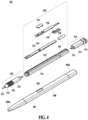
- the digital pen 201 may include a pen housing 300 that makes up the exterior of the digital pen 201 and an inner assembly inside the pen housing 300.
- the inner assembly including all of the components to be mounted inside the pen, may be inserted into the pen housing 300 in a single assembly operation.
- the pen housing 300 may have a long shape extended between a first end portion 300a and a second end portion 300b, and may include the receiving space 112 therein.
- the pen housing 300 may have an elliptical cross-section with a long axis and a short axis, and may be formed overall in the shape of an elliptical pillar.
- a receiving space 301 of the electronic device 101 may also be formed with an elliptical cross-section corresponding to the shape of the pen housing 300.
- the pen housing 300 may include a synthetic resin (e.g., plastic) and/or a metallic material (e.g., aluminum).
- the second end portion 300b of the pen housing 300 may be made of synthetic resin material.
- the inner assembly may have a long, extended shape corresponding to the shape of the pen housing 300.
- the inner assembly may be broadly divided into three components along the longitudinal direction.
- the inner assembly may include an ejection member 310 arranged at a position corresponding to the first end portion 300a of the pen housing 300, a coil portion 320 arranged at a position corresponding to the second end portion 300b of the pen housing 300, and a circuit board portion 330 arranged at a position corresponding to the body of the housing.
- the ejection member 310 may include a component for removing the digital pen 201 from the receiving space 112 of the electronic device 101.
- the ejection member 310 may be arranged around a shaft 311 and may include an ejection body 312 and a button portion 313 that form the overall outer shape of the ejection member 310.
- the portion including the shaft 311 and the ejection body 312 may be surrounded by the first end portion 300a of the pen housing 300, and the button portion 313 (e.g., 201a in FIG. 2 ) may be exposed to the outside of the first end portion 300a.
- a plurality of parts not shown, for example, cam members or elastic members, may be disposed within the ejection body 312 to form a push-pull structure.
- the button portion 313 may be substantially coupled with the shaft 311 to perform a linear reciprocating motion with respect to the ejection body 312.
- the button portion 313 may include a button having a catch structure formed such that a user may pull out the digital pen 201 using a fingernail.
- the digital pen 201 may provide another input scheme by including a sensor that detects a linear reciprocating motion of the shaft 311.
- the coil portion 320 may include a pen tip 321, which is exposed to the outside of the second end portion 300b when the internal assembly is fully inserted into the pen housing 300, a packing ring 322, a multi-turn coil 323 and/or a pressure sensing portion 324 for obtaining a change in pressure according to the pressurization of the pen tip 321.
- the packing ring 322 may include epoxy, rubber, urethane, or silicone.
- the packing ring 322 may be provided for waterproofing and dustproofing purposes, and may protect the coil portion 320 and the circuit board portion 330 from submersion or dust.
- the coil 323 may form a resonant frequency in a set frequency band (e.g., 500 kHz), and may be combined with at least one element (e.g., a capacitive element) to adjust the resonant frequency formed by the coil 323 within a predetermined range.
- a set frequency band e.g. 500 kHz
- at least one element e.g., a capacitive element
- the circuit board portion 330 may include a PCB 332, a base 331 surrounding at least a surface of the PCB 332, and an antenna.
- a substrate seating portion 333 on which the PCB 332 is arranged may be formed on an upper surface of the base 331, and the PCB 332 may be fixed while seated on the substrate seating portion 333.
- the PCB 332 may include an upper surface and a lower surface, and a variable capacitor or switch 334 connected to the coil 323 may be arranged on the upper surface, and a charging circuit, a battery, or a communication circuit may be arranged on the lower surface.
- the battery may include an electric double layer capacitor (EDLC).
- the charging circuit may be arranged between the coil 323 and the battery, and may include a voltage detector circuitry and a rectifier.
- the antenna may include an antenna structure 339 such as the example illustrated in FIG. 4 and/or an antenna embedded in the PCB 332.
- the switch 334 may be provided on the PCB 332.
- a side button 337 provided in the digital pen 201 may be used to press the switch 334, and may be exposed to the outside via a side opening 302 of the pen housing 300.
- the side button 337 may be supported by a supporting member 338, and when there is no external force acting on the side button 337, the supporting member 338 may provide elastic restoring force to restore or maintain the side button 337 in a predetermined position.
- the circuit board portion 330 may include another packing ring such as an O-ring.
- an O-ring made of elastic material may be arranged on both ends of the base 331 such that a sealing structure may be formed between the base 331 and the pen housing 300.
- the supporting member 338 may partially form a sealing structure by closely contacting an inner wall of the pen housing 300 around the side opening 302.
- the circuit board portion 330 may also form a waterproofing/dustproofing structure similar to that of the packing ring 322 of the coil portion 320.
- the digital pen 201 may include a battery seating portion 335 in which a battery 336 is arranged on the upper surface of the base 331.
- the battery 336 that may be mounted on the battery seating portion 335 may include, for example, a cylinder type battery.
- the digital pen 201 may include a microphone (not shown).
- the microphone may be directly connected to the PCB 332, or connected to a separate flexible printed circuit board (FPCB) (not shown) connected to the PCB 332.
- the microphone may be arranged in a position parallel to the side button 337 in a longitudinal direction of the digital pen 201.
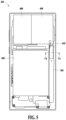
- FIG. 5 is a front view schematically showing an internal appearance of an electronic device according to an embodiment.
- FIG. 6 is a cross-sectional view along line VI-VI of FIG. 5 .
- an electronic device 401 may accommodate various components therein.
- the electronic device 401 may include a processor 490, a camera module 480, and a battery 489.
- the electronic device 401 may accommodate a digital pen 501 (e.g., the digital pen 201 of FIG. 2 ).
- the electronic device 401 may provide a space to accommodate the digital pen 501.
- a receiving space of the electronic device 401 may be provided at a side portion of the battery 489. The position of the receiving space is only an example and is not limited thereto.
- the electronic device 401 may include a base plate 481, a side frame 482, a front cover 491, a front connecting member 492, a display 493, a back cover 494, a back connecting member 495, a pen housing 470, and a solenoid type substrate assembly 420.
- the base plate 481, the side frame 482, the front cover 491, and the back cover 494 may also be referred to as a housing (e.g., the housing 110 of FIG. 2 ).
- the thickness of the electronic device 401 may correspond to a distance between an outer surface of the front cover 491 and an outer surface of the back cover 494. As the distance between the front cover 491 and the back cover 494 becomes relatively narrower, the overall thickness of the electronic device 401 may be thinner.
- the electronic device 401 may be implemented with a thinner thickness by arranging the solenoid type substrate assembly 420 on the side portion of the pen housing 470.
- the solenoid type substrate assembly 420 may be arranged on the side portion of the pen housing 470 and may have a thinner thickness than the pen housing 470.
- the base plate 481 may have a flat plate shape. A surface of the base plate 481 may face the front cover 491, and the other surface of the base plate 481 may face the back cover 494.
- the base plate 481 may support the pen housing 470.
- the side frame 482 may be connected to the base plate 481.
- the side frame 482 may be formed to extend in a -y direction from the base plate 481 to secure a receiving space on the base plate 481.
- the height in a y-axis direction of the side frame 482 may correspond to the height of the receiving space.
- An outer surface of the side frame 482 may be exposed to the outside.
- a +z-axis direction end of the side frame 482 may be exposed to the outside.
- the +z-axis direction end of the side frame 482 may be rounded.
- the front cover 491 may cover a surface of the base plate 481.
- the front cover 491 may cover a surface of the base plate 481 facing a +y direction.
- the front cover 491 may include a plurality of PCBs (not shown).
- the front cover 491 may support the display 493.
- the front connecting member 492 may connect the front cover 491 and the base plate 481.
- the front connecting member 492 may be an adhesive layer.
- the display 493 may be arranged on the front cover 491.
- the display 493 may receive an electrical signal through the processor 490 and the front cover 491.
- the display 493 may externally display an image that is identifiable to a user's naked eye.
- the back cover 494 may be connected to the side frame 482.
- the back cover 494 may protect the components arranged on the base plate 481.
- the back connecting member 495 may connect the back cover 494 and the side frame 482.
- the back connecting member 495 may be an adhesive layer.
- the pen housing 470 may accommodate the digital pen 501 (e.g., the digital pen 201 of FIG. 2 ).
- the pen housing 470 may guide the digital pen 501 to move in an x-axis direction.
- the pen housing 470 may include a housing frame 471, a housing guide 472, a pen cover 473, and a pen connecting member 474.
- the housing frame 471 may be arranged on the base plate 481.
- the housing guide 472 may be provided inside the base plate 481, and may guide the movement of the digital pen 501.
- the pen cover 473 may be arranged on the housing frame 471 and the housing guide 472.
- the pen cover 473 may cover a surface of the digital pen 501.
- the pen connecting member 474 may connect the pen cover 473 to the housing frame 471 and the housing guide 472.
- the solenoid type substrate assembly 420 may determine whether the digital pen 501 is inserted into the pen housing 470, and may charge the digital pen 501.
- the solenoid type substrate assembly 420 may generate two different magnetic fields to perform their respective functions.
- the solenoid type substrate assembly 420 may generate a first signal and a second signal having different frequencies.
- the solenoid type substrate assembly 420 may have two output ends. Depending on which of the two output ends the current flowing in the solenoid type substrate assembly 420 exits through, the magnetic field generated in the solenoid type substrate assembly 420 may be determined.
- the solenoid type substrate assembly 420 may determine whether the digital pen 501 is inserted by generating one of the first signal and the second signal.
- the solenoid type substrate assembly 420 may charge the digital pen 501 by generating the other one of the first signal and the second signal.
- the solenoid type substrate assembly 420 may be provided between the side frame 482 and the pen housing 470.
- the solenoid type substrate assembly 420 may be provided at a position spaced apart from the pen cover 473.
- the solenoid type substrate assembly 420 may be arranged in a manner intersecting the pen cover 473.
- the solenoid type substrate assembly 420 and the pen cover 473 may not be provided in parallel.
- the solenoid type substrate assembly 420 and the pen cover 473 may not overlap each other in the y-axis direction.
- a thickness d of an upper space of the pen housing 470 may be relatively greater compared to a state in which the solenoid type substrate assembly 420 is arranged parallel to the pen cover 473.
- other components may be arranged therein, or the electronic device 401 may be made slimmer.
- FIG. 7 is a cross-sectional view schematically showing a pen housing and a solenoid type substrate assembly according to an embodiment.
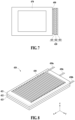
- FIG. 8 is a perspective view of a solenoid type substrate assembly according to an embodiment.
- the solenoid type substrate assembly 420 may be connected to a side surface of the pen housing 470.
- the solenoid type substrate assembly 420 may be connected to the pen housing 470 by a connecting layer 450.
- the connecting layer 450 may be an adhesive layer.
- the solenoid type substrate assembly 420 may include a plurality of PCBs 421, 422, and 423 stacked in a direction parallel to the direction from a side frame (e.g., the side frame 482 of FIG. 6 ) toward the pen housing 470.
- the plurality of PCBs 421, 422, and 423 may be FPCBs.
- the solenoid type substrate assembly 420 may include the coil 430 wound on the plurality of PCBs 421, 422, and 423.
- the solenoid type substrate assembly 420 may generate a magnetic field.
- the solenoid type substrate assembly 420 may generate two different types of magnetic fields.
- the solenoid type substrate assembly 420 may adjust the frequency by selecting an output end of the current flowing through the coil 430.
- the magnetic field generated in the solenoid type substrate assembly 420 may be determined by the frequency.
- the solenoid type substrate assembly 420 may include the plurality of PCBs 421, 422, and 423 stacked in a z-axis direction. The normal direction of the plurality of PCBs 421, 422, and 423 may be parallel to the z-axis direction.
- the solenoid type substrate assembly 420 may include the coil 430 wound on the plurality of PCBs 421, 422, and 423.
- the coil 430 may include one input end 430a and two output ends 430b and 430c. The current flowing along the coil 430 may flow outward through either of the two output ends.
- a processor e.g., the processor 120 of FIG. 1
- a path of the current flowing along the coil 430 may be determined.
- the path of the current flowing along the coil 430 may be provided equal to the number of output ends. For example, when there are two output ends, there may be two paths for the current. Depending on the length of the current path, the frequency may be determined differently.
- FIG. 9 is a front view of a first PCB according to an embodiment.
- FIG. 10 is a front view of a second PCB according to an embodiment.
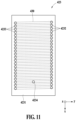
- FIG. 11 is a front view of a third PCB according to an embodiment.
- FIG. 12 is a cross-sectional view of a solenoid type substrate assembly according to an embodiment.
- FIG. 13 is a cross-sectional view of a solenoid type substrate assembly, illustrating a state in which current flows to one of two output ends, according to an embodiment.
- FIG. 14 is a cross-sectional view of a solenoid type substrate assembly, illustrating a state in which current flows to the other output end of the two output ends, according to an embodiment.
- the first PCB 421 may include a first PCB body 4211, a first right side via 4212, and a first left side via 4213.
- the first right side via 4212 and the first left side via 4213 may be formed to penetrate the first PCB body 4211.
- the first right side via 4212 may be arranged in a row spaced apart from each other in an x-axis direction on the right side of the first PCB body 4211.
- the first left side via 4213 may be arranged in a row in the x-axis direction on the left side of the first PCB body 4211.
- the first right side via 4212 and the first left side via 4213 may be provided spaced apart in a y-axis direction.
- the second PCB 422 may include a second PCB body 4221, a second right side via 4222, and a second left side via 4223.
- the second right side via 4222 and the second left side via 4223 may be formed to penetrate the second PCB body 4221.
- the second right side via 4222 may be arranged in a row spaced apart from each other in the x-axis direction on the right side of the second PCB body 4221.
- the second left side via 4223 may be arranged in a row in the x-axis direction on the left side of the second PCB body 4221.
- the second right side via 4222 and the second left side via 4223 may be provided spaced apart in the y-axis direction.
- the second PCB 422 may include an output via 4224.
- the output via 4224 may guide a portion of the coil 430 to one (e.g., the output end 430c) of the output ends.
- the second right side via 4222 or the second left side via 4223 may guide a portion of the coil 430 to the other one (e.g., the output end 430b) of the output ends.
- the third PCB 423 may include a third PCB body 4231, a third right side via 4232, and a third left side via 4233.
- the third right side via 4232 and the third left side via 4233 may be formed to penetrate the third PCB body 4231.
- the third right side via 4232 may be arranged in a row spaced apart from each other in the x-axis direction on the right side of the third PCB body 4231.
- the third left side via 4233 may be arranged in a row in the x-axis direction on the left side of the third PCB body 4231.
- the third right side via 4232 and the third left side via 4233 may be provided spaced apart in the y-axis direction.
- the third PCB 423 may include an output via 4234.
- the output via 4234 may guide a portion of the coil 430 to one (e.g., the output end 430c) of the output ends.
- the third right side via 4232 or the third left side via 4233 may guide a portion of the coil 430 to the other one (e.g., the output end 430b) of the output ends.
- the path through which the current flows may be determined, and the magnetic field generated by the solenoid type substrate assembly may be determined.
- FIG. 15 is a cross-sectional view of an electronic device according to an embodiment.
- the digital pen 501 may move along the pen housing 470.
- the digital pen 501 may include a pen housing 500, a pen tip 521, a pen core 522, a pen coil 523, and a pen magnet 524.
- the pen housing 500 may form the external shape of the pen.
- the pen core 522 may be provided inside the pen housing 500.
- the pen core 522 may be provided along the center of the pen housing 500.
- the pen tip 521 may be provided at an end of the pen core 522.
- the pen magnet 524 may surround the pen core 522.
- the pen coil 523 may be wound around the pen magnet 524.
- a solenoid type substrate assembly 600 may include a plurality of PCBs.
- the solenoid type substrate assembly 600 may include three PCBs.
- the solenoid type substrate assembly 600 may include a first PCB module 610 and a second PCB module 620.
- the first PCB module 610 and the second PCB module 620 may each include at least one PCB.
- the first PCB module 610 may include a first PCB (e.g., the first PCB 421 of FIG. 8 )
- the second PCB module 620 may include a second PCB (e.g., the second PCB 422 of FIG. 8 ) and a third PCB (e.g., the third PCB 423 of FIG. 8 ).
- the first PCB module 610 may include the first PCB (e.g., the first PCB 421 of FIG. 8 ) and the second PCB (e.g., the second PCB 422 of FIG. 8 ), and the second PCB module 620 may include the third PCB (e.g., the third PCB 423 of FIG. 8 ).
- the solenoid type substrate assembly 600 may include an induction module 700 to induce a generated magnetic field toward the digital pen 501.
- the induction module 700 may include a magnetic layer 710 and a shield layer 720.
- the magnetic layer 710 may strengthen a magnetic field generated in the solenoid type substrate assembly 600.
- the magnetic layer 710 may strengthen the magnetic flux of the magnetic field passing through the digital pen 501.
- the pen magnet 524 may attract the magnetic field generated in the solenoid type substrate assembly 600, thereby inducing more magnetic flux to gather around the pen coil 523.
- an induced electromotive force may be generated in the pen coil 523.
- a charging operation of the digital pen 501 may be implemented.
- the shield layer 720 may induce magnetic flux to not leak in a direction other than the pen coil 523.
- the shield layer 720 may block a magnetic field leaking in the opposite direction so that the magnetic field generated in the solenoid type substrate assembly 600 may be induced toward the pen coil 523.
- FIG. 16 is a cross-sectional view of an electronic device according to an embodiment.
- the digital pen 501 may move along the pen housing 470.
- the digital pen 501 may include the pen housing 500, the pen tip 521, the pen core 522, the pen coil 523, and the pen magnet 524.
- the solenoid type substrate assembly 600 may include a plurality of PCBs.
- the solenoid type substrate assembly 600 may include three PCBs.
- the solenoid type substrate assembly 600 may include the first PCB module 610 and the second PCB module 620.
- the first PCB module 610 and the second PCB module 620 may each include at least one PCB.
- the first PCB module 610 may include a first PCB (e.g., the first PCB 421 of FIG. 8 )
- the second PCB module 620 may include a second PCB (e.g., the second PCB 422 of FIG. 8 ) and a third PCB (e.g., the third PCB 423 of FIG. 8 ).
- the first PCB module 610 may include the first PCB (e.g., the first PCB 421 of FIG. 8 ) and the second PCB (e.g., the second PCB 422 of FIG. 8 ), and the second PCB module 620 may include the third PCB (e.g., the third PCB 423 of FIG. 8 ).
- the solenoid type substrate assembly 600 may include an induction module 800 to induce a generated magnetic field toward the digital pen 501.
- the induction module 800 may include an adhesive layer 810 and a shield layer 820.
- the adhesive layer 810 may connect the first PCB module 610 and the second PCB module 620.
- the adhesive layer 810 may not be magnetic.
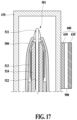
- FIG. 17 is a cross-sectional view of an electronic device according to an embodiment.
- the digital pen 501 may move along the pen housing 470.
- the digital pen 501 may include the pen housing 500, the pen tip 521, the pen core 522, the pen coil 523, and the pen magnet 524.
- the solenoid type substrate assembly 600 may include a plurality of PCBs.
- the solenoid type substrate assembly 600 may include three PCBs.
- the solenoid type substrate assembly 600 may include the first PCB module 610 and the second PCB module 620.
- the first PCB module 610 and the second PCB module 620 may each include at least one PCB.
- the first PCB module 610 may include a first PCB (e.g., the first PCB 421 of FIG. 8 )
- the second PCB module 620 may include a second PCB (e.g., the second PCB 422 of FIG. 8 ) and a third PCB (e.g., the third PCB 423 of FIG. 8 ).
- the first PCB module 610 may include the first PCB (e.g., the first PCB 421 of FIG. 8 ) and the second PCB (e.g., the second PCB 422 of FIG. 8 ), and the second PCB module 620 may include the third PCB (e.g., the third PCB 423 of FIG. 8 ).
- the solenoid type substrate assembly 600 may include an induction module 900 to induce a generated magnetic field toward the digital pen 501.
- the induction module 900 may include a magnet.
- the induction module 900 may strengthen a magnetic field generated in the solenoid type substrate assembly 600.
- induction module 900 may strengthen the magnetic flux of the magnetic field passing through the digital pen 501.
- the pen magnet 524 may attract the magnetic field generated in the solenoid type substrate assembly 600, thereby inducing more magnetic flux to gather around the pen coil 523.
- an induced electromotive force may be generated in the pen coil 523.
- a charging operation of the digital pen 501 may be implemented.
- an electronic device may include a base plate 481, a side frame 482 connected to the base plate, a front cover 491 covering a surface of the base plate, a back cover 494 covering a surface of the side frame, and provided opposite to the front cover with respect to the side frame, a pen housing 470 arranged on the base plate and configured to accommodate a digital pen 501, and a solenoid type substrate assembly 420 provided between the side frame and the pen housing, and configured to determine whether the digital pen is provided inside the pen housing and electrically charge the digital pen.
- the solenoid type substrate assembly 420 may include a plurality of PCBs 421, 422, 423 stacked in a direction parallel to a direction from the side frame toward the pen housing.
- the pen housing 470 may include a housing frame 471 arranged on the base plate, and a pen cover 472 arranged on the housing frame and provided parallel to the back cover.
- the solenoid type substrate assembly 420 may be provided at a position spaced apart from the pen cover 470.
- the pen cover 470 may be arranged to face a rear surface of the digital pen 501, and the solenoid type substrate assembly 420 may be arranged to face a side surface of the digital pen 501.
- the solenoid type substrate assembly 420 may be configured to generate two different magnetic fields.
- the solenoid type substrate assembly 420 may be configured to generate one of a first magnetic field for identifying a position of the digital pen and a second magnetic field for charging the digital pen.
- the solenoid type substrate assembly 420 may include a first PCB 421, a second PCB 422, and a third PCB 423 sequentially stacked in a direction parallel to the direction from the side frame toward the pen housing, and a coil 430 wound on the first PCB, the second PCB, and the third PCB.
- the first PCB 421, the second PCB 422, and the third PCB 423 may each include a PCB body and a plurality of side vias formed penetrating the PCB body.
- the coil 430 may include one input end arranged on the first PCB and two output ends arranged on the second PCB.
- a current flowing along the coil may enter the coil through the input end and exit the coil through one of the two output ends.
- one of the first PCB and the third PCB may further include an output via formed penetrating the PCB body and provided at a position spaced apart from the side via.
- the solenoid type substrate assembly 420 may further include a magnetic layer 710 having magnetism and arranged between two adjacent PCBs among the first PCB, the second PCB, and the third PCB.
- the solenoid type substrate assembly 420 may further include a shield layer 720 provided opposite to the pen housing with respect to the first PCB, the second PCB, and the third PCB.
- the base plate 481 and the side frame 482 may be formed integrally.
- an electronic device may include a base plate 481, a side frame 482 connected to the base plate, a front cover 491 covering a surface of the base plate, a back cover 494 covering a surface of the side frame, and provided opposite to the front cover with respect to the side frame, a pen housing 470 arranged on the base plate and configured to accommodate a digital pen 501, and a solenoid type substrate assembly 420 provided between the side frame and the pen housing, and configured to generate one of a first magnetic field that determines whether the digital pen is provided inside the pen housing and a second magnetic field that electrically charges the digital pen.
- the solenoid type substrate assembly 420 may include a plurality of PCBs 421, 422, 423 stacked in a direction parallel to a direction from the side frame toward the pen housing.
- the solenoid type substrate assembly 420 may include a first PCB 421, a second PCB 422, and a third PCB 423 sequentially stacked in a direction parallel to the direction from the side frame toward the pen housing, and a coil 430 wound on the first PCB, the second PCB, and the third PCB.
- the coil 430 may include one input end arranged on the first PCB and two output ends arranged on the second PCB.
- an electronic device may include a pen housing 470 configured to accommodate a digital pen 501, and a solenoid type substrate assembly 420 provided between the side frame and the pen housing, and configured to determine whether the digital pen is provided inside the pen housing and electrically charge the digital pen, wherein, the solenoid type substrate assembly 420 may include a plurality of PCBs 421, 422, 423 stacked in a direction parallel to a direction from the side frame toward the pen housing.
Landscapes
- Engineering & Computer Science (AREA)
- Theoretical Computer Science (AREA)
- General Engineering & Computer Science (AREA)
- Physics & Mathematics (AREA)
- General Physics & Mathematics (AREA)
- Computer Hardware Design (AREA)
- Human Computer Interaction (AREA)
- Power Engineering (AREA)
- Microelectronics & Electronic Packaging (AREA)
- Computer Networks & Wireless Communication (AREA)
- Telephone Function (AREA)
- Power Sources (AREA)
Abstract
Description
- Various embodiments of the present disclosure relate to an electronic device, for example, an electronic device including a solenoid type sensing substrate.
- Recently, digital technology has been developing. Various types of electronic devices such as mobile communication terminals, smartphones, tablets, laptops, wearable devices, and digital cameras are being widely used.
- According to embodiments, an electronic device may include a
base plate 481, aside frame 482 connected to the base plate, afront cover 491 covering a surface of the base plate, aback cover 494 covering a surface of the side frame, and provided opposite to the front cover with respect to the side frame, apen housing 470 arranged on the base plate and configured to accommodate adigital pen 501, and a solenoidtype substrate assembly 420 provided between the side frame and the pen housing, and configured to determine whether the digital pen is provided inside the pen housing and electrically charge the digital pen. - According to embodiments, an electronic device may include a
base plate 481, aside frame 482 connected to the base plate, afront cover 491 covering a surface of the base plate, aback cover 494 covering a surface of the side frame, and provided opposite to the front cover with respect to the side frame, apen housing 470 arranged on the base plate and configured to accommodate adigital pen 501, and a solenoidtype substrate assembly 420 provided between the side frame and the pen housing, and configured to generate one of a first magnetic field that determines whether the digital pen is provided inside the pen housing and a second magnetic field that electrically charges the digital pen. - According to embodiments, an electronic device may include a
pen housing 470 configured to accommodate adigital pen 501, and a solenoidtype substrate assembly 420 provided between the side frame and the pen housing, and configured to determine whether the digital pen is provided inside the pen housing and electrically charge the digital pen, wherein, the solenoidtype substrate assembly 420 may include a plurality ofPCBs -
-
FIG. 1 is a block diagram illustrating an electronic device according to an embodiment. -
FIG. 2 is a perspective view of a front side of an electronic device according to an embodiment. -
FIG. 3 is a perspective view of a rear side of the electronic device ofFIG. 2 . -
FIG. 4 is an exploded perspective view of the electronic device ofFIG. 2 . -
FIG. 5 is a front view schematically showing an internal appearance of an electronic device according to an embodiment. -
FIG. 6 is a cross-sectional view along line VI-VI ofFIG. 5 . -
FIG. 7 is a cross-sectional view schematically showing a pen housing and a solenoid type substrate assembly according to an embodiment. -
FIG. 8 is a perspective view of a solenoid type substrate assembly according to an embodiment. -
FIG. 9 is a front view of a first printed circuit board according to an embodiment. -
FIG. 10 is a front view of a second printed circuit board according to an embodiment. -
FIG. 11 is a front view of a third printed circuit board according to an embodiment. -
FIG. 12 is a cross-sectional view of a solenoid type substrate assembly according to an embodiment. -
FIG. 13 is a cross-sectional view of a solenoid type substrate assembly, illustrating a state in which current flows to one of two output ends, according to an embodiment. -
FIG. 14 is a cross-sectional view of a solenoid type substrate assembly, illustrating a state in which current flows to the other output end of the two output ends, according to an embodiment. -
FIG. 15 is a cross-sectional view of an electronic device according to an embodiment. -
FIG. 16 is a cross-sectional view of an electronic device according to an embodiment. -
FIG. 17 is a cross-sectional view of an electronic device according to an embodiment. - Hereinafter, embodiments will be described in detail with reference to the accompanying drawings. When describing the embodiments with reference to the accompanying drawings, like reference numerals refer to like elements and a repeated description related thereto will be omitted.
-
FIG. 1 is a block diagram illustrating anelectronic device 101 in anetwork environment 100 according to various embodiments. -
FIG. 6 is a cross-sectional view along line VI-VI ofFIG. 5 . -
FIG. 7 is a cross-sectional view schematically showing a pen housing and a solenoid type substrate assembly according to an embodiment. -
FIG. 8 is a perspective view of a solenoid type substrate assembly according to an embodiment. -
FIG. 9 is a front view of a first printed circuit board according to an embodiment. -
FIG. 10 is a front view of a second printed circuit board according to an embodiment. -
FIG. 11 is a front view of a third printed circuit board according to an embodiment. -
FIG. 12 is a cross-sectional view of a solenoid type substrate assembly according to an embodiment. -
FIG. 13 is a cross-sectional view of a solenoid type substrate assembly, illustrating a state in which current flows to one of two output ends, according to an embodiment. -
FIG. 14 is a cross-sectional view of a solenoid type substrate assembly, illustrating a state in which current flows to the other output end of the two output ends, according to an embodiment. -
FIG. 15 is a cross-sectional view of an electronic device according to an embodiment. -
FIG. 16 is a cross-sectional view of an electronic device according to an embodiment. -
FIG. 17 is a cross-sectional view of an electronic device according to an embodiment. - Referring to
FIG. 1 , theelectronic device 101 in thenetwork environment 100 may communicate with anelectronic device 102 via a first network 198 (e.g., a short-range wireless communication network), or at least one of anelectronic device 104 or aserver 108 via a second network 199 (e.g., a long-range wireless communication network). According to an embodiment, theelectronic device 101 may communicate with theelectronic device 104 via theserver 108. According to an embodiment, theelectronic device 101 may include aprocessor 120, amemory 130, aninput module 150, asound output module 155, adisplay module 160, anaudio module 170, asensor module 176, aninterface 177, a connectingterminal 178, ahaptic module 179, acamera module 180, apower management module 188, abattery 189, acommunication module 190, a subscriber identification module (SIM) 196, or anantenna module 197. In some embodiments, at least one (e.g., the connecting terminal 178) of the above components may be omitted from theelectronic device 101, or one or more other components may be added in theelectronic device 101. In some embodiments, some of the components (e.g., thesensor module 176, thecamera module 180, or the antenna module 197) may be integrated as a single component (e.g., the display module 160). - The
processor 120 may execute, for example, software (e.g., a program 140) to control at least one other component (e.g., a hardware or software component) of theelectronic device 101 connected to theprocessor 120, and may perform various data processing or computation. According to an embodiment, as at least a portion of data processing or computation, theprocessor 120 may store a command or data received from another component (e.g., thesensor module 176 or the communication module 190) in avolatile memory 132, process the command or the data stored in thevolatile memory 132, and store resulting data in anon-volatile memory 134. According to an embodiment, theprocessor 120 may include a main processor 121 (e.g., a central processing unit (CPU) or an application processor (AP)), or an auxiliary processor 123 (e.g., a graphics processing unit (GPU), a neural processing unit (NPU), an image signal processor (ISP), a sensor hub processor, or a communication processor (CP)) that is operable independently from, or in conjunction with themain processor 121. For example, when theelectronic device 101 includes themain processor 121 and theauxiliary processor 123, theauxiliary processor 123 may be adapted to consume less power than themain processor 121 or to be specific to a specified function. Theauxiliary processor 123 may be implemented separately from themain processor 121 or as a part of themain processor 121. - The
auxiliary processor 123 may control at least some of functions or states related to at least one (e.g., thedisplay module 160, thesensor module 176, or the communication module 190) of the components of theelectronic device 101, instead of themain processor 121 while themain processor 121 is in an inactive (e.g., sleep) state or along with themain processor 121 while themain processor 121 is in an active state (e.g., executing an application). According to an embodiment, the auxiliary processor 123 (e.g., an ISP or a CP) may be implemented as a portion of another component (e.g., thecamera module 180 or the communication module 190) that is functionally related to theauxiliary processor 123. According to an embodiment, the auxiliary processor 123 (e.g., an NPU) may include a hardware structure specified for artificial intelligence (AI) model processing. The AI model may be generated by machine learning. Such learning may be performed by, for example, theelectronic device 101 in which artificial intelligence is performed, or performed via a separate server (e.g., the server 108). Learning algorithms may include, but are not limited to, for example, supervised learning, unsupervised learning, semi-supervised learning, or reinforcement learning. The AI model may include a plurality of artificial neural network layers. An artificial neural network may include, for example, a deep neural network (DNN), a convolutional neural network (CNN), a recurrent neural network (RNN), a restricted Boltzmann machine (RBM), a deep belief network (DBN), and a bidirectional recurrent deep neural network (BRDNN), a deep Q-network, or a combination of two or more thereof, but is not limited thereto. The AI model may additionally or alternatively include a software structure other than the hardware structure. - The
memory 130 may store various pieces of data used by at least one component (e.g., theprocessor 120 or the sensor module 176) of theelectronic device 101. The various data may include, for example, software (e.g., the program 140) and input data or output data for a command related thereto. Thememory 130 may include thevolatile memory 132 or thenon-volatile memory 134. - The
program 140 may be stored as software in thememory 130, and may include, for example, an operating system (OS) 142,middleware 144, or anapplication 146. - The
input module 150 may receive a command or data to be used by another component (e.g., the processor 120) of theelectronic device 101, from the outside (e.g., a user) of theelectronic device 101. Theinput module 150 may include, for example, a microphone, a mouse, a keyboard, a key (e.g., a button), or a digital pen (e.g., a stylus pen). - The
sound output module 155 may output a sound signal to the outside of theelectronic device 101. Thesound output module 155 may include, for example, a speaker or a receiver. The speaker may be used for general purposes, such as playing multimedia or playing record. The receiver may be used to receive an incoming call. According to an embodiment, the receiver may be implemented separately from the speaker or as a part of the speaker. - The
display module 160 may visually provide information to the outside (e.g., a user) of theelectronic device 101. Thedisplay module 160 may include, for example, a display, a hologram device, or a projector and control circuitry to control a corresponding one of the display, the hologram device, or the projector. According to an embodiment, thedisplay module 160 may include a touch sensor adapted to sense a touch, or a pressure sensor adapted to measure an intensity of a force incurred by the touch. - The
audio module 170 may convert a sound into an electric signal or vice versa. According to an embodiment, theaudio module 170 may obtain the sound via theinput module 150 or output the sound via thesound output module 155 or an external electronic device (e.g., anelectronic device 102 such as a speaker or a headphone) directly or wirelessly connected to theelectronic device 101. - The
sensor module 176 may detect an operational state (e.g., power or temperature) of theelectronic device 101 or an environmental state (e.g., a state of a user) external to theelectronic device 101, and generate an electric signal or data value corresponding to the detected state. According to an embodiment, thesensor module 176 may include, for example, a gesture sensor, a gyro sensor, an atmospheric pressure sensor, a magnetic sensor, an acceleration sensor, a grip sensor, a proximity sensor, a color sensor, an infrared (IR) sensor, a biometric sensor, a temperature sensor, a humidity sensor, or an illuminance sensor. - The
interface 177 may support one or more specified protocols to be used for theelectronic device 101 to be coupled with the external electronic device (e.g., the electronic device 102) directly (e.g., by wire) or wirelessly. According to an embodiment, theinterface 177 may include, for example, a high-definition multimedia interface (HDMI), a universal serial bus (USB) interface, a secure digital (SD) card interface, or an audio interface. - The connecting
terminal 178 may include a connector via which theelectronic device 101 may be physically connected to an external electronic device (e.g., the electronic device 102). According to an embodiment, the connectingterminal 178 may include, for example, an HDMI connector, a USB connector, an SD card connector, or an audio connector (e.g., a headphone connector). - The
haptic module 179 may convert an electric signal into a mechanical stimulus (e.g., a vibration or a movement) or an electrical stimulus which may be recognized by a user via his or her tactile sensation or kinesthetic sensation. According to an embodiment, thehaptic module 179 may include, for example, a motor, a piezoelectric element, or an electric stimulator. - The
camera module 180 may capture a still image and moving images. According to an embodiment, thecamera module 180 may include one or more lenses, image sensors, ISPs, or flashes. - The
power management module 188 may manage power supplied to theelectronic device 101. According to an embodiment, thepower management module 188 may be implemented as, for example, at least a part of a power management integrated circuit (PMIC). - The
battery 189 may supply power to at least one component of theelectronic device 101. According to an embodiment, thebattery 189 may include, for example, a primary cell which is not rechargeable, a secondary cell which is rechargeable, or a fuel cell. - The
communication module 190 may support establishing a direct (e.g., wired) communication channel or a wireless communication channel between theelectronic device 101 and the external electronic device (e.g., theelectronic device 102, theelectronic device 104, or the server 108) and performing communication via the established communication channel. Thecommunication module 190 may include one or more communication processors that are operable independently of the processor 120 (e.g., an AP) and that support a direct (e.g., wired) communication or a wireless communication. According to an embodiment, thecommunication module 190 may include a wireless communication module 192 (e.g., a cellular communication module, a short-range wireless communication module, or a global navigation satellite system (GNSS) communication module) or a wired communication module 194 (e.g., a local region network (LAN) communication module, or a power line communication (PLC) module). A corresponding one of these communication modules may communicate with the externalelectronic device 104 via the first network 198 (e.g., a short-range communication network, such as Bluetooth™, wireless-fidelity (Wi-Fi) direct, or infrared data association (IrDA)) or the second network 199 (e.g., a long-range communication network, such as a legacy cellular network, a 5G network, a next-generation communication network, the Internet, or a computer network (e.g., a LAN or a wide region network (WAN)). These various types of communication modules may be implemented as a single component (e.g., a single chip), or may be implemented as multi components (e.g., multiple chips) separate from each other. Thewireless communication module 192 may identify and authenticate theelectronic device 101 in a communication network, such as thefirst network 198 or thesecond network 199, using subscriber information (e.g., international mobile subscriber identity (IMSI)) stored in theSIM 196. - The
wireless communication module 192 may support a 5G network after a 4G network, and a next-generation communication technology, e.g., a new radio (NR) access technology. The NR access technology may support enhanced mobile broadband (eMBB), massive machine type communications (mMTC), or ultra-reliable and low-latency communications (URLLC). Thewireless communication module 192 may support a high-frequency band (e.g., a mmWave band) to achieve, e.g., a high data transmission rate. Thewireless communication module 192 may support various technologies for securing performance on a high-frequency band, such as, e.g., beamforming, massive multiple-input and multiple-output (MIMO), full dimensional MIMO (FD-MIMO), an array antenna, analog beam-forming, or a large scale antenna. Thewireless communication module 192 may support various requirements specified in theelectronic device 101, an external electronic device (e.g., the electronic device 104), or a network system (e.g., the second network 199). According to an embodiment, thewireless communication module 192 may support a peak data rate (e.g., 20 Gbps or more) for implementing eMBB, loss coverage (e.g., 164 dB or less) for implementing mMTC, or U-plane latency (e.g., 0.5 ms or less for each of downlink (DL) and uplink (UL), or a round trip of 1 ms or less) for implementing URLLC. - The
antenna module 197 may transmit or receive a signal or power to or from the outside (e.g., the external electronic device) of theelectronic device 101. According to an embodiment, theantenna module 197 may include an antenna including a radiating element including a conductive material or a conductive pattern formed in or on a substrate (e.g., a printed circuit board (PCB)). According to an embodiment, theantenna module 197 may include a plurality of antennas (e.g., array antennas). In such a case, at least one antenna appropriate for a communication scheme used in a communication network, such as thefirst network 198 or thesecond network 199, may be selected by, for example, thecommunication module 190 from the plurality of antennas. The signal or the power may be transmitted or received between thecommunication module 190 and the external electronic device via the at least one selected antenna. According to an embodiment, another component (e.g., a radio frequency integrated circuit (RFIC)) other than the radiating element may be additionally formed as a portion of theantenna module 197. - According to an embodiment, the
antenna module 197 may form a mmWave antenna module. According to an embodiment, the mmWave antenna module may include a PCB, an RFIC disposed on a first surface (e.g., a bottom surface) of the PCB or adjacent to the first surface and capable of supporting a designated a high-frequency band (e.g., the mmWave band), and a plurality of antennas (e.g., array antennas) disposed on a second surface (e.g., a top or a side surface) of the PCB, or adjacent to the second surface and capable of transmitting or receiving signals in the designated high-frequency band. - At least some of the above-described components may be coupled mutually and communicate signals (e.g., commands or data) therebetween via an inter-peripheral communication scheme (e.g., a bus, general purpose input and output (GPIO), serial peripheral interface (SPI), or mobile industry processor interface (MIPI)).
- According to an embodiment, commands or data may be transmitted or received between the
electronic device 101 and the externalelectronic device 104 via theserver 108 coupled with thesecond network 199. Each of the externalelectronic devices electronic device 101. According to an embodiment, all or some of operations to be executed by theelectronic device 101 may be executed at one or more external electronic devices (e.g., theexternal devices electronic device 101 needs to perform a function or a service automatically, or in response to a request from a user or another device, theelectronic device 101, instead of, or in addition to, executing the function or the service, may request one or more external electronic devices to perform at least a portion of the function or the service. The one or more external electronic devices receiving the request may perform the at least part of the function or the service requested, or an additional function or an additional service related to the request, and may transfer an outcome of the performing to theelectronic device 101. Theelectronic device 101 may provide the outcome, with or without further processing of the outcome, as at least part of a reply to the request. To that end, a cloud computing, distributed computing, mobile edge computing (MEC), or client-server computing technology may be used, for example. Theelectronic device 101 may provide ultra low-latency services using, e.g., distributed computing or MEC. In an embodiment, the externalelectronic device 104 may include an Internet-of-things (IoT) device. Theserver 108 may be an intelligent server using machine learning and/or a neural network. According to an embodiment, the externalelectronic device 104 or theserver 108 may be included in thesecond network 199. Theelectronic device 101 may be applied to intelligent services (e.g., smart home, smart city, smart car, or healthcare) based on 5G communication technology or IoT-related technology. - The electronic device according to the embodiments disclosed herein may be one of various types of electronic devices. The electronic devices may include, for example, a portable communication device (e.g., a smartphone), a computer device, a portable multimedia device, a portable medical device, a camera, a wearable device, or a home appliance. According to an embodiment of the disclosure, the electronic device is not limited to those described above.
- It should be appreciated that embodiments of the disclosure and the terms used therein are not intended to limit the technological features set forth herein to particular embodiments and include various changes, equivalents, or replacements for a corresponding embodiment. With regard to the description of the drawings, similar reference numerals may be used to refer to similar or related elements. It is to be understood that a singular form of a noun corresponding to an item may include one or more of the things, unless the relevant context clearly indicates otherwise. As used herein, each of such phrases as "A or B", "at least one of A and B", "at least one of A or B", "A, B or C", "at least one of A, B and C", and "at least one of A, B, or C", may include any one of, or all possible combinations of the items enumerated together in a corresponding one of the phrases. As used herein, such terms as "1st" and "2nd," or "first" and "second" may be used to simply distinguish a corresponding component from another, and does not limit the components in other aspects (e.g., importance or order). It is to be understood that if a component (e.g., a first component) is referred to, with or without the term "operatively" or "communicatively", as "coupled with", "coupled to", "connected with", or "connected to" another component (e.g., a second component), it means that the component may be coupled with the other component directly (e.g., by wire), wirelessly, or via a third component.
- As used in connection with embodiments of the disclosure, the term "module" may include a unit implemented in hardware, software, or firmware, and may interchangeably be used with other terms, for example, "logic", "logic block", "part", or "circuitry". A module may be a single integral component, or a minimum unit or part thereof, adapted to perform one or more functions. For example, according to an embodiment, the module may be implemented in a form of an application-specific integrated circuit (ASIC).
- Embodiments as set forth herein may be implemented as software (e.g., the program 140) including one or more instructions that are stored in a storage medium (e.g., an
internal memory 136 or an external memory 138) that is readable by a machine (e.g., the electronic device 101). For example, a processor (e.g., the processor 120) of the machine (e.g., the electronic device 101) may invoke at least one of the one or more instructions stored in the storage medium, and execute it. This allows the machine to be operated to perform at least one function according to the at least one instruction invoked. The one or more instructions may include code generated by a compiler or code executable by an interpreter. The machine-readable storage medium may be provided in the form of a non-transitory storage medium. Here, the term "non-transitory" simply means that the storage medium is a tangible device, and does not include a signal (e.g., an electromagnetic wave), but this term does not differentiate between where data is semi-permanently stored in the storage medium and where the data is temporarily stored in the storage medium. - According to an embodiment, a method according to embodiments of the disclosure may be included and provided in a computer program product. The computer program product may be traded as a product between a seller and a buyer. The computer program product may be distributed in the form of a machine-readable storage medium (e.g., compact disc read-only memory (CD-ROM)), or be distributed (e.g., downloaded or uploaded) online via an application store (e.g., PlayStore™), or between two user devices (e.g., smartphones) directly. If distributed online, at least part of the computer program product may be temporarily generated or at least temporarily stored in the machine-readable storage medium, such as a memory of the manufacturer's server, a server of the application store, or a relay server.
- According to embodiments, each component (e.g., a module or a program) of the above-described components may include a single entity or multiple entities, and some of the multiple entities may be separately disposed in different components. According to embodiments, one or more of the above-described components or operations may be omitted, or one or more other components or operations may be added. Alternatively or additionally, a plurality of components (e.g., modules or programs) may be integrated into a single component. In such a case, according to embodiments, the integrated component may still perform one or more functions of each of the plurality of components in the same or similar manner as they are performed by a corresponding one of the plurality of components before the integration. According to embodiments, operations performed by the module, the program, or another component may be carried out sequentially, in parallel, repeatedly, or heuristically, or one or more of the operations may be executed in a different order or omitted, or one or more other operations may be added.
- Referring to
FIG. 2 , according to an embodiment, theelectronic device 101 may include the components shown inFIG. 1 , and may have a structure into which a digital pen 201 (e.g., a stylus pen) may be inserted. Theelectronic device 101 may include ahousing 110, and may include ahole 111 in a portion, e.g., a portion of aside surface 110C, of thehousing 110. Theelectronic device 101 may include a receivingspace 112 connected with thehole 111, and thedigital pen 201 may be inserted into the receivingspace 112. In the embodiment shown, thedigital pen 201 may include apressable button 201a at an end to be easily pulled out of the receivingspace 112 of theelectronic device 101. When thebutton 201a is pressed, a repulsive mechanism (e.g., at least one spring) configured in association with thebutton 201a may be operated to allow thedigital pen 201 to be removed from the receivingspace 112. - Referring to
FIG. 3 , according to an embodiment, thedigital pen 201 may include aprocessor 220, amemory 230, aresonance circuit 287, a chargingcircuit 288, abattery 289, acommunication circuit 290, anantenna 297, and/or atrigger circuit 298. According to an embodiment, theprocessor 220, at least a portion of theresonance circuit 287, and/or at least a portion of thecommunication circuit 290 of thedigital pen 201 may be configured in the form of a chip or on a PCB. Theprocessor 220, theresonance circuit 287, and/or thecommunication circuit 290 may be electrically connected with thememory 230, the chargingcircuit 288, thebattery 289, theantenna 297, or thetrigger circuit 298. According to an embodiment, thedigital pen 201 may be composed of only a resonance circuit and a button. - The
processor 220 may include a customized hardware module or a generic processor configured to execute software (e.g., an application program). The processor may include a hardware component (function) or software element (program) including at least one of a communication module or a module to manage the state or environment of thedigital pen 201, an input/output interface, a data measuring module, and various sensors provided in thedigital pen 201. Theprocessor 220 may include one of, for example, hardware, software, or firmware, or a combination of two or more thereof. According to an embodiment, theprocessor 220 may receive a proximate signal corresponding to an electromagnetic signal generated from a digitizer (e.g., the display module 160) of theelectronic device 101 through theresonance circuit 287. When the proximate signal is identified, theprocessor 220 may control theresonance circuit 287 to transmit an electromagnetic resonance (EMR) input signal to theelectronic device 101. - The
memory 230 may store information related to an operation of thedigital pen 201. For example, the information may include information for communicating with theelectronic device 101 and frequency information related to an input operation of thedigital pen 201. - The
resonance circuit 287 may include at least one of a coil, an inductor, or a capacitor. Theresonance circuit 287 of thedigital pen 201 may generate a signal having a resonance frequency. For example, to generate the signal, thedigital pen 201 may use at least one of an EMR scheme, an active electrostatic (AES) scheme, or an electrically coupled resonance (ECR) scheme. When thedigital pen 201 transmits signals via the EMR scheme, thedigital pen 201 may generate a signal having a resonance frequency based on an electromagnetic field generated from the inductive panel of theelectronic device 101. When thedigital pen 201 transmits signals via the AES scheme, thedigital pen 201 may generate a signal using a capacitive coupling with theelectronic device 101. When thedigital pen 201 transmits signals via the ECR scheme, thedigital pen 201 may generate a signal having a resonance frequency based on an electric field generated from a capacitive device of the electronic device. According to an embodiment, theresonance circuit 287 may be used to vary the frequency or strength of an electromagnetic field according to a user's manipulation state. For example, theresonance circuit 287 may provide a frequency to recognize a hovering input, drawing input, button input, or erasing input. - When connected with the
resonance circuit 287 based on a switching circuit, the chargingcircuit 288 may rectify a resonance signal generated from theresonance circuit 287 into a direct current (DC) signal and provide the DC signal to thebattery 289. According to an embodiment, thedigital pen 201 may identify whether thedigital pen 201 is inserted in theelectronic device 101 using a voltage level of a DC signal sensed by the chargingcircuit 288. - The
battery 289 may be configured to store the power required to operate thedigital pen 201. The battery may include, for example, a lithium-ion battery or a capacitor and may be recharged or replaced. According to an embodiment, thebattery 289 may be charged with power (e.g., DC signal (DC power)) received from the chargingcircuit 288. - The
communication circuit 290 may be configured to perform wireless communication between thedigital pen 201 and thecommunication module 190 of theelectronic device 101. According to an embodiment, thecommunication circuit 290 may transmit input information and state information about thedigital pen 201 to theelectronic device 101 using a short-range communication scheme. For example, thecommunication circuit 290 may transmit direction information (e.g., motion sensor data) about thedigital pen 201 obtained through thetrigger circuit 298, voice information entered through a microphone, or remaining power information about thebattery 289 to theelectronic device 101. As an example, the short-range communication scheme may include at least one of Bluetooth, Bluetooth low energy (BLE), or wireless local area network (WLAN). - The
antenna 297 may be used to transmit signals or power to the outside (e.g., the electronic device 101) or receive signals or power from the outside. According to an embodiment, thedigital pen 201 may include a plurality ofantennas 297 and select at least oneantenna 297 appropriate for a communication scheme from among the plurality of antennas. Thecommunication circuit 290 may exchange signals or power with an external electronic device through the at least one selectedantenna 297. - The
trigger circuit 298 may include at least one button or sensor circuit. According to an embodiment, theprocessor 220 may identify an input scheme (e.g., touch or press) or type (e.g., EMR button or BLE button) of the button of thedigital pen 201. According to an embodiment, the sensor circuit may generate an electrical signal or data value corresponding to an internal operating state or external environmental state of thedigital pen 201. For example, the sensor circuit may include at least one of a motion sensor, a remaining battery sensor, a pressure sensor, a light sensor, a temperature sensor, a geomagnetic sensor, or a biometric sensor. According to an embodiment, thetrigger circuit 298 may transmit a trigger signal to theelectronic device 101 using a signal through a sensor or a button input signal. - Referring to
FIG. 4 , thedigital pen 201 may include apen housing 300 that makes up the exterior of thedigital pen 201 and an inner assembly inside thepen housing 300. In the embodiment shown, the inner assembly, including all of the components to be mounted inside the pen, may be inserted into thepen housing 300 in a single assembly operation. - The
pen housing 300 may have a long shape extended between afirst end portion 300a and asecond end portion 300b, and may include the receivingspace 112 therein. Thepen housing 300 may have an elliptical cross-section with a long axis and a short axis, and may be formed overall in the shape of an elliptical pillar. A receivingspace 301 of theelectronic device 101 may also be formed with an elliptical cross-section corresponding to the shape of thepen housing 300. Thepen housing 300 may include a synthetic resin (e.g., plastic) and/or a metallic material (e.g., aluminum). According to an embodiment, thesecond end portion 300b of thepen housing 300 may be made of synthetic resin material. - The inner assembly may have a long, extended shape corresponding to the shape of the
pen housing 300. The inner assembly may be broadly divided into three components along the longitudinal direction. For example, the inner assembly may include anejection member 310 arranged at a position corresponding to thefirst end portion 300a of thepen housing 300, acoil portion 320 arranged at a position corresponding to thesecond end portion 300b of thepen housing 300, and acircuit board portion 330 arranged at a position corresponding to the body of the housing. - The
ejection member 310 may include a component for removing thedigital pen 201 from the receivingspace 112 of theelectronic device 101. According to an embodiment, theejection member 310 may be arranged around ashaft 311 and may include anejection body 312 and abutton portion 313 that form the overall outer shape of theejection member 310. When the inner assembly is fully inserted into thepen housing 300, the portion including theshaft 311 and theejection body 312 may be surrounded by thefirst end portion 300a of thepen housing 300, and the button portion 313 (e.g., 201a inFIG. 2 ) may be exposed to the outside of thefirst end portion 300a. A plurality of parts not shown, for example, cam members or elastic members, may be disposed within theejection body 312 to form a push-pull structure. In an embodiment, thebutton portion 313 may be substantially coupled with theshaft 311 to perform a linear reciprocating motion with respect to theejection body 312. According to embodiments, thebutton portion 313 may include a button having a catch structure formed such that a user may pull out thedigital pen 201 using a fingernail. According to an embodiment, thedigital pen 201 may provide another input scheme by including a sensor that detects a linear reciprocating motion of theshaft 311. - The
coil portion 320 may include apen tip 321, which is exposed to the outside of thesecond end portion 300b when the internal assembly is fully inserted into thepen housing 300, apacking ring 322, amulti-turn coil 323 and/or apressure sensing portion 324 for obtaining a change in pressure according to the pressurization of thepen tip 321. Thepacking ring 322 may include epoxy, rubber, urethane, or silicone. Thepacking ring 322 may be provided for waterproofing and dustproofing purposes, and may protect thecoil portion 320 and thecircuit board portion 330 from submersion or dust. According to an embodiment, thecoil 323 may form a resonant frequency in a set frequency band (e.g., 500 kHz), and may be combined with at least one element (e.g., a capacitive element) to adjust the resonant frequency formed by thecoil 323 within a predetermined range. - The
circuit board portion 330 may include aPCB 332, abase 331 surrounding at least a surface of thePCB 332, and an antenna. According to an embodiment, asubstrate seating portion 333 on which thePCB 332 is arranged may be formed on an upper surface of thebase 331, and thePCB 332 may be fixed while seated on thesubstrate seating portion 333. According to an embodiment, thePCB 332 may include an upper surface and a lower surface, and a variable capacitor or switch 334 connected to thecoil 323 may be arranged on the upper surface, and a charging circuit, a battery, or a communication circuit may be arranged on the lower surface. The battery may include an electric double layer capacitor (EDLC). The charging circuit may be arranged between thecoil 323 and the battery, and may include a voltage detector circuitry and a rectifier. - The antenna may include an
antenna structure 339 such as the example illustrated inFIG. 4 and/or an antenna embedded in thePCB 332. According to embodiments, theswitch 334 may be provided on thePCB 332. Aside button 337 provided in thedigital pen 201 may be used to press theswitch 334, and may be exposed to the outside via aside opening 302 of thepen housing 300. Theside button 337 may be supported by a supportingmember 338, and when there is no external force acting on theside button 337, the supportingmember 338 may provide elastic restoring force to restore or maintain theside button 337 in a predetermined position. - The
circuit board portion 330 may include another packing ring such as an O-ring. For example, an O-ring made of elastic material may be arranged on both ends of the base 331 such that a sealing structure may be formed between the base 331 and thepen housing 300. In an embodiment, the supportingmember 338 may partially form a sealing structure by closely contacting an inner wall of thepen housing 300 around theside opening 302. For example, thecircuit board portion 330 may also form a waterproofing/dustproofing structure similar to that of thepacking ring 322 of thecoil portion 320. - The
digital pen 201 may include abattery seating portion 335 in which abattery 336 is arranged on the upper surface of thebase 331. Thebattery 336 that may be mounted on thebattery seating portion 335 may include, for example, a cylinder type battery. - The
digital pen 201 may include a microphone (not shown). The microphone may be directly connected to thePCB 332, or connected to a separate flexible printed circuit board (FPCB) (not shown) connected to thePCB 332. According to embodiments, the microphone may be arranged in a position parallel to theside button 337 in a longitudinal direction of thedigital pen 201. -
FIG. 5 is a front view schematically showing an internal appearance of an electronic device according to an embodiment.FIG. 6 is a cross-sectional view along line VI-VI ofFIG. 5 . - Referring to
FIGS. 5 and6 , an electronic device 401 (e.g., theelectronic device 101 ofFIG. 1 ) may accommodate various components therein. For example, theelectronic device 401 may include a processor 490, acamera module 480, and abattery 489. Theelectronic device 401 may accommodate a digital pen 501 (e.g., thedigital pen 201 ofFIG. 2 ). Theelectronic device 401 may provide a space to accommodate thedigital pen 501. For example, a receiving space of theelectronic device 401 may be provided at a side portion of thebattery 489. The position of the receiving space is only an example and is not limited thereto. - The
electronic device 401 may include abase plate 481, aside frame 482, afront cover 491, afront connecting member 492, adisplay 493, aback cover 494, aback connecting member 495, apen housing 470, and a solenoidtype substrate assembly 420. As used herein, thebase plate 481, theside frame 482, thefront cover 491, and theback cover 494 may also be referred to as a housing (e.g., thehousing 110 ofFIG. 2 ). The thickness of theelectronic device 401 may correspond to a distance between an outer surface of thefront cover 491 and an outer surface of theback cover 494. As the distance between thefront cover 491 and theback cover 494 becomes relatively narrower, the overall thickness of theelectronic device 401 may be thinner. - The
electronic device 401 may be implemented with a thinner thickness by arranging the solenoidtype substrate assembly 420 on the side portion of thepen housing 470. The solenoidtype substrate assembly 420 may be arranged on the side portion of thepen housing 470 and may have a thinner thickness than thepen housing 470. - The
base plate 481 may have a flat plate shape. A surface of thebase plate 481 may face thefront cover 491, and the other surface of thebase plate 481 may face theback cover 494. Thebase plate 481 may support thepen housing 470. - The
side frame 482 may be connected to thebase plate 481. Theside frame 482 may be formed to extend in a -y direction from thebase plate 481 to secure a receiving space on thebase plate 481. The height in a y-axis direction of theside frame 482 may correspond to the height of the receiving space. An outer surface of theside frame 482 may be exposed to the outside. A +z-axis direction end of theside frame 482 may be exposed to the outside. The +z-axis direction end of theside frame 482 may be rounded. - The
front cover 491 may cover a surface of thebase plate 481. Thefront cover 491 may cover a surface of thebase plate 481 facing a +y direction. Thefront cover 491 may include a plurality of PCBs (not shown). Thefront cover 491 may support thedisplay 493. The front connectingmember 492 may connect thefront cover 491 and thebase plate 481. For example, thefront connecting member 492 may be an adhesive layer. - The
display 493 may be arranged on thefront cover 491. Thedisplay 493 may receive an electrical signal through the processor 490 and thefront cover 491. Thedisplay 493 may externally display an image that is identifiable to a user's naked eye. - The
back cover 494 may be connected to theside frame 482. Theback cover 494 may protect the components arranged on thebase plate 481. Theback connecting member 495 may connect theback cover 494 and theside frame 482. For example, theback connecting member 495 may be an adhesive layer. - The
pen housing 470 may accommodate the digital pen 501 (e.g., thedigital pen 201 ofFIG. 2 ). Thepen housing 470 may guide thedigital pen 501 to move in an x-axis direction. Thepen housing 470 may include ahousing frame 471, ahousing guide 472, apen cover 473, and apen connecting member 474. - The
housing frame 471 may be arranged on thebase plate 481. - The
housing guide 472 may be provided inside thebase plate 481, and may guide the movement of thedigital pen 501. - The
pen cover 473 may be arranged on thehousing frame 471 and thehousing guide 472. Thepen cover 473 may cover a surface of thedigital pen 501. Thepen connecting member 474 may connect thepen cover 473 to thehousing frame 471 and thehousing guide 472. - The solenoid
type substrate assembly 420 may determine whether thedigital pen 501 is inserted into thepen housing 470, and may charge thedigital pen 501. The solenoidtype substrate assembly 420 may generate two different magnetic fields to perform their respective functions. The solenoidtype substrate assembly 420 may generate a first signal and a second signal having different frequencies. The solenoidtype substrate assembly 420 may have two output ends. Depending on which of the two output ends the current flowing in the solenoidtype substrate assembly 420 exits through, the magnetic field generated in the solenoidtype substrate assembly 420 may be determined. The solenoidtype substrate assembly 420 may determine whether thedigital pen 501 is inserted by generating one of the first signal and the second signal. The solenoidtype substrate assembly 420 may charge thedigital pen 501 by generating the other one of the first signal and the second signal. - The solenoid
type substrate assembly 420 may be provided between theside frame 482 and thepen housing 470. The solenoidtype substrate assembly 420 may be provided at a position spaced apart from thepen cover 473. The solenoidtype substrate assembly 420 may be arranged in a manner intersecting thepen cover 473. The solenoidtype substrate assembly 420 and thepen cover 473 may not be provided in parallel. The solenoidtype substrate assembly 420 and thepen cover 473 may not overlap each other in the y-axis direction. Since the solenoidtype substrate assembly 420 is spaced apart from thepen cover 473, a thickness d of an upper space of thepen housing 470 may be relatively greater compared to a state in which the solenoidtype substrate assembly 420 is arranged parallel to thepen cover 473. When there is room in the upper space of thepen housing 470, other components may be arranged therein, or theelectronic device 401 may be made slimmer. -
FIG. 7 is a cross-sectional view schematically showing a pen housing and a solenoid type substrate assembly according to an embodiment.FIG. 8 is a perspective view of a solenoid type substrate assembly according to an embodiment. - Referring to
FIGS. 7 and 8 , the solenoidtype substrate assembly 420 may be connected to a side surface of thepen housing 470. The solenoidtype substrate assembly 420 may be connected to thepen housing 470 by a connectinglayer 450. For example, the connectinglayer 450 may be an adhesive layer. - The solenoid
type substrate assembly 420 may include a plurality ofPCBs side frame 482 ofFIG. 6 ) toward thepen housing 470. For example, the plurality ofPCBs type substrate assembly 420 may include thecoil 430 wound on the plurality ofPCBs type substrate assembly 420 may generate a magnetic field. The solenoidtype substrate assembly 420 may generate two different types of magnetic fields. The solenoidtype substrate assembly 420 may adjust the frequency by selecting an output end of the current flowing through thecoil 430. The magnetic field generated in the solenoidtype substrate assembly 420 may be determined by the frequency. - The solenoid
type substrate assembly 420 may include the plurality ofPCBs PCBs type substrate assembly 420 may include thecoil 430 wound on the plurality ofPCBs coil 430 may include oneinput end 430a and two output ends 430b and 430c. The current flowing along thecoil 430 may flow outward through either of the two output ends. For example, a processor (e.g., theprocessor 120 ofFIG. 1 ) may determine the output end of thecoil 430. By the output end, a path of the current flowing along thecoil 430 may be determined. The path of the current flowing along thecoil 430 may be provided equal to the number of output ends. For example, when there are two output ends, there may be two paths for the current. Depending on the length of the current path, the frequency may be determined differently. -
FIG. 9 is a front view of a first PCB according to an embodiment.FIG. 10 is a front view of a second PCB according to an embodiment.FIG. 11 is a front view of a third PCB according to an embodiment. -
FIG. 12 is a cross-sectional view of a solenoid type substrate assembly according to an embodiment.FIG. 13 is a cross-sectional view of a solenoid type substrate assembly, illustrating a state in which current flows to one of two output ends, according to an embodiment.FIG. 14 is a cross-sectional view of a solenoid type substrate assembly, illustrating a state in which current flows to the other output end of the two output ends, according to an embodiment. - Referring to
FIGS. 9 to 14 , thefirst PCB 421 may include afirst PCB body 4211, a first right side via 4212, and a first left side via 4213. The first right side via 4212 and the first left side via 4213 may be formed to penetrate thefirst PCB body 4211. The first right side via 4212 may be arranged in a row spaced apart from each other in an x-axis direction on the right side of thefirst PCB body 4211. The first left side via 4213 may be arranged in a row in the x-axis direction on the left side of thefirst PCB body 4211. The first right side via 4212 and the first left side via 4213 may be provided spaced apart in a y-axis direction. - The
second PCB 422 may include asecond PCB body 4221, a second right side via 4222, and a second left side via 4223. The second right side via 4222 and the second left side via 4223 may be formed to penetrate thesecond PCB body 4221. The second right side via 4222 may be arranged in a row spaced apart from each other in the x-axis direction on the right side of thesecond PCB body 4221. The second left side via 4223 may be arranged in a row in the x-axis direction on the left side of thesecond PCB body 4221. The second right side via 4222 and the second left side via 4223 may be provided spaced apart in the y-axis direction. Thesecond PCB 422 may include an output via 4224. The output via 4224 may guide a portion of thecoil 430 to one (e.g., theoutput end 430c) of the output ends. The second right side via 4222 or the second left side via 4223 may guide a portion of thecoil 430 to the other one (e.g., theoutput end 430b) of the output ends. - The
third PCB 423 may include athird PCB body 4231, a third right side via 4232, and a third left side via 4233. The third right side via 4232 and the third left side via 4233 may be formed to penetrate thethird PCB body 4231. The third right side via 4232 may be arranged in a row spaced apart from each other in the x-axis direction on the right side of thethird PCB body 4231. The third left side via 4233 may be arranged in a row in the x-axis direction on the left side of thethird PCB body 4231. The third right side via 4232 and the third left side via 4233 may be provided spaced apart in the y-axis direction. Thethird PCB 423 may include an output via 4234. The output via 4234 may guide a portion of thecoil 430 to one (e.g., theoutput end 430c) of the output ends. The third right side via 4232 or the third left side via 4233 may guide a portion of thecoil 430 to the other one (e.g., theoutput end 430b) of the output ends. - Depending on the output end through which the current flows, the path through which the current flows may be determined, and the magnetic field generated by the solenoid type substrate assembly may be determined.
-
FIG. 15 is a cross-sectional view of an electronic device according to an embodiment. - Referring to
FIG. 15 , thedigital pen 501 may move along thepen housing 470. Thedigital pen 501 may include apen housing 500, apen tip 521, apen core 522, apen coil 523, and apen magnet 524. Thepen housing 500 may form the external shape of the pen. Thepen core 522 may be provided inside thepen housing 500. Thepen core 522 may be provided along the center of thepen housing 500. Thepen tip 521 may be provided at an end of thepen core 522. Thepen magnet 524 may surround thepen core 522. Thepen coil 523 may be wound around thepen magnet 524. - A solenoid
type substrate assembly 600 may include a plurality of PCBs. For example, the solenoidtype substrate assembly 600 may include three PCBs. The solenoidtype substrate assembly 600 may include afirst PCB module 610 and asecond PCB module 620. Thefirst PCB module 610 and thesecond PCB module 620 may each include at least one PCB. For example, thefirst PCB module 610 may include a first PCB (e.g., thefirst PCB 421 ofFIG. 8 ), and thesecond PCB module 620 may include a second PCB (e.g., thesecond PCB 422 ofFIG. 8 ) and a third PCB (e.g., thethird PCB 423 ofFIG. 8 ). For example, thefirst PCB module 610 may include the first PCB (e.g., thefirst PCB 421 ofFIG. 8 ) and the second PCB (e.g., thesecond PCB 422 ofFIG. 8 ), and thesecond PCB module 620 may include the third PCB (e.g., thethird PCB 423 ofFIG. 8 ). - The solenoid
type substrate assembly 600 may include aninduction module 700 to induce a generated magnetic field toward thedigital pen 501. For example, theinduction module 700 may include amagnetic layer 710 and ashield layer 720. - The
magnetic layer 710 may strengthen a magnetic field generated in the solenoidtype substrate assembly 600. For example, themagnetic layer 710 may strengthen the magnetic flux of the magnetic field passing through thedigital pen 501. Thepen magnet 524 may attract the magnetic field generated in the solenoidtype substrate assembly 600, thereby inducing more magnetic flux to gather around thepen coil 523. When the magnetic flux passes through thepen coil 523, an induced electromotive force may be generated in thepen coil 523. When the induced electromotive force is generated in thepen coil 523, a charging operation of thedigital pen 501 may be implemented. - The
shield layer 720 may induce magnetic flux to not leak in a direction other than thepen coil 523. Theshield layer 720 may block a magnetic field leaking in the opposite direction so that the magnetic field generated in the solenoidtype substrate assembly 600 may be induced toward thepen coil 523. -
FIG. 16 is a cross-sectional view of an electronic device according to an embodiment. - Referring to
FIG. 16 , thedigital pen 501 may move along thepen housing 470. Thedigital pen 501 may include thepen housing 500, thepen tip 521, thepen core 522, thepen coil 523, and thepen magnet 524. - The solenoid
type substrate assembly 600 may include a plurality of PCBs. For example, the solenoidtype substrate assembly 600 may include three PCBs. The solenoidtype substrate assembly 600 may include thefirst PCB module 610 and thesecond PCB module 620. Thefirst PCB module 610 and thesecond PCB module 620 may each include at least one PCB. For example, thefirst PCB module 610 may include a first PCB (e.g., thefirst PCB 421 ofFIG. 8 ), and thesecond PCB module 620 may include a second PCB (e.g., thesecond PCB 422 ofFIG. 8 ) and a third PCB (e.g., thethird PCB 423 ofFIG. 8 ). For example, thefirst PCB module 610 may include the first PCB (e.g., thefirst PCB 421 ofFIG. 8 ) and the second PCB (e.g., thesecond PCB 422 ofFIG. 8 ), and thesecond PCB module 620 may include the third PCB (e.g., thethird PCB 423 ofFIG. 8 ). - The solenoid
type substrate assembly 600 may include aninduction module 800 to induce a generated magnetic field toward thedigital pen 501. For example, theinduction module 800 may include anadhesive layer 810 and ashield layer 820. - The
adhesive layer 810 may connect thefirst PCB module 610 and thesecond PCB module 620. Theadhesive layer 810 may not be magnetic. -
FIG. 17 is a cross-sectional view of an electronic device according to an embodiment. - Referring to
FIG. 17 , thedigital pen 501 may move along thepen housing 470. Thedigital pen 501 may include thepen housing 500, thepen tip 521, thepen core 522, thepen coil 523, and thepen magnet 524. - The solenoid
type substrate assembly 600 may include a plurality of PCBs. For example, the solenoidtype substrate assembly 600 may include three PCBs. The solenoidtype substrate assembly 600 may include thefirst PCB module 610 and thesecond PCB module 620. Thefirst PCB module 610 and thesecond PCB module 620 may each include at least one PCB. For example, thefirst PCB module 610 may include a first PCB (e.g., thefirst PCB 421 ofFIG. 8 ), and thesecond PCB module 620 may include a second PCB (e.g., thesecond PCB 422 ofFIG. 8 ) and a third PCB (e.g., thethird PCB 423 ofFIG. 8 ). For example, thefirst PCB module 610 may include the first PCB (e.g., thefirst PCB 421 ofFIG. 8 ) and the second PCB (e.g., thesecond PCB 422 ofFIG. 8 ), and thesecond PCB module 620 may include the third PCB (e.g., thethird PCB 423 ofFIG. 8 ). - The solenoid
type substrate assembly 600 may include aninduction module 900 to induce a generated magnetic field toward thedigital pen 501. Theinduction module 900 may include a magnet. Theinduction module 900 may strengthen a magnetic field generated in the solenoidtype substrate assembly 600. For example,induction module 900 may strengthen the magnetic flux of the magnetic field passing through thedigital pen 501. Thepen magnet 524 may attract the magnetic field generated in the solenoidtype substrate assembly 600, thereby inducing more magnetic flux to gather around thepen coil 523. When the magnetic flux passes through thepen coil 523, an induced electromotive force may be generated in thepen coil 523. When the induced electromotive force is generated in thepen coil 523, a charging operation of thedigital pen 501 may be implemented. - According to embodiments, an electronic device may include a
base plate 481, aside frame 482 connected to the base plate, afront cover 491 covering a surface of the base plate, aback cover 494 covering a surface of the side frame, and provided opposite to the front cover with respect to the side frame, apen housing 470 arranged on the base plate and configured to accommodate adigital pen 501, and a solenoidtype substrate assembly 420 provided between the side frame and the pen housing, and configured to determine whether the digital pen is provided inside the pen housing and electrically charge the digital pen. - According to embodiments, the solenoid
type substrate assembly 420 may include a plurality ofPCBs - According to embodiments, the
pen housing 470 may include ahousing frame 471 arranged on the base plate, and apen cover 472 arranged on the housing frame and provided parallel to the back cover. - According to embodiments, the solenoid
type substrate assembly 420 may be provided at a position spaced apart from thepen cover 470. - According to embodiments, the
pen cover 470 may be arranged to face a rear surface of thedigital pen 501, and the solenoidtype substrate assembly 420 may be arranged to face a side surface of thedigital pen 501. - According to embodiments, the solenoid
type substrate assembly 420 may be configured to generate two different magnetic fields. - According to embodiments, the solenoid
type substrate assembly 420 may be configured to generate one of a first magnetic field for identifying a position of the digital pen and a second magnetic field for charging the digital pen. - According to embodiments, the solenoid
type substrate assembly 420 may include afirst PCB 421, asecond PCB 422, and athird PCB 423 sequentially stacked in a direction parallel to the direction from the side frame toward the pen housing, and acoil 430 wound on the first PCB, the second PCB, and the third PCB. - According to embodiments, the
first PCB 421, thesecond PCB 422, and thethird PCB 423 may each include a PCB body and a plurality of side vias formed penetrating the PCB body. - According to embodiments, the
coil 430 may include one input end arranged on the first PCB and two output ends arranged on the second PCB. - According to embodiments, a current flowing along the coil may enter the coil through the input end and exit the coil through one of the two output ends.
- According to embodiments, one of the first PCB and the third PCB may further include an output via formed penetrating the PCB body and provided at a position spaced apart from the side via.
- According to embodiments, the solenoid
type substrate assembly 420 may further include amagnetic layer 710 having magnetism and arranged between two adjacent PCBs among the first PCB, the second PCB, and the third PCB. - According to embodiments, the solenoid
type substrate assembly 420 may further include ashield layer 720 provided opposite to the pen housing with respect to the first PCB, the second PCB, and the third PCB. - According to embodiments, the
base plate 481 and theside frame 482 may be formed integrally. - According to embodiments, an electronic device may include a
base plate 481, aside frame 482 connected to the base plate, afront cover 491 covering a surface of the base plate, aback cover 494 covering a surface of the side frame, and provided opposite to the front cover with respect to the side frame, apen housing 470 arranged on the base plate and configured to accommodate adigital pen 501, and a solenoidtype substrate assembly 420 provided between the side frame and the pen housing, and configured to generate one of a first magnetic field that determines whether the digital pen is provided inside the pen housing and a second magnetic field that electrically charges the digital pen. - According to embodiments, the solenoid
type substrate assembly 420 may include a plurality ofPCBs - According to embodiments, the solenoid
type substrate assembly 420 may include afirst PCB 421, asecond PCB 422, and athird PCB 423 sequentially stacked in a direction parallel to the direction from the side frame toward the pen housing, and acoil 430 wound on the first PCB, the second PCB, and the third PCB. - According to embodiments, the
coil 430 may include one input end arranged on the first PCB and two output ends arranged on the second PCB. - According to embodiments, an electronic device may include a
pen housing 470 configured to accommodate adigital pen 501, and a solenoidtype substrate assembly 420 provided between the side frame and the pen housing, and configured to determine whether the digital pen is provided inside the pen housing and electrically charge the digital pen, wherein, the solenoidtype substrate assembly 420 may include a plurality ofPCBs
Claims (15)
- An electronic device comprising a solenoid type substrate assembly, comprising:a base plate 481;a side frame 482 connected to the base plate;a front cover 491 covering a surface of the base plate;a back cover 494 covering a surface of the side frame, and provided opposite to the front cover with respect to the side frame;a pen housing 470 arranged on the base plate and configured to accommodate a digital pen 501; anda solenoid type substrate assembly 420 provided between the side frame and the pen housing, and configured to determine whether the digital pen is provided inside the pen housing and electrically charge the digital pen.
- The electronic device of claim 1, wherein
the solenoid type substrate assembly 420 comprises a plurality of printed circuit boards (PCBs) 421, 422, 423 stacked in a direction parallel to a direction from the side frame toward the pen housing. - The electronic device of claims 1 or 2, wherein
the pen housing 470 comprises:a housing frame 471 arranged on the base plate; anda pen cover 472 arranged on the housing frame and provided parallel to the back cover. - The electronic device of any one of claims 1 to 3, wherein
the solenoid type substrate assembly 420 is provided at a position spaced apart from the pen cover 470. - The electronic device of any one of claims 1 to 4, wherein
the pen cover 470 is arranged to face a rear surface of the digital pen 501, and the solenoid type substrate assembly 420 is arranged to face a side surface of the digital pen 501. - The electronic device of any one of claims 1 to 5, wherein
the solenoid type substrate assembly 420 is configured to generate two different magnetic fields. - The electronic device of any one of claims 1 to 6, wherein
the solenoid type substrate assembly 420 is configured to generate one of a first magnetic field for identifying a position of the digital pen and a second magnetic field for charging the digital pen. - The electronic device of any one of claims 1 to 7, wherein
the solenoid type substrate assembly 420 comprises:a first PCB 421, a second PCB 422, and a third PCB 423 sequentially stacked in a direction parallel to the direction from the side frame toward the pen housing; anda coil 430 wound on the first PCB, the second PCB, and the third PCB. - The electronic device of any one of claims 1 to 8, wherein
the first PCB 421, the second PCB 422, and the third PCB 423 each comprise a PCB body and a plurality of side vias formed penetrating the PCB body. - The electronic device of any one of claims 1 to 9, wherein
the coil 430 comprises one input end arranged on the first PCB and two output ends arranged on the second PCB. - The electronic device of any one of claims 1 to 10, wherein
a current flowing along the coil enters the coil through the input end and exits the coil through one of the two output ends. - The electronic device of any one of claims 1 to 11, wherein
one of the first PCB and the third PCB further comprises
an output via formed penetrating the PCB body and provided at a position spaced apart from the side via. - The electronic device of any one of claims 1 to 12, wherein
the solenoid type substrate assembly 420 further comprises
a magnetic layer 710 having magnetism and arranged between two adjacent PCBs among the first PCB, the second PCB, and the third PCB. - The electronic device of any one of claims 1 to 13, wherein
the solenoid type substrate assembly 420 further comprises
a shield layer 720 provided opposite to the pen housing with respect to the first PCB, the second PCB, and the third PCB. - The electronic device of any one of claims 1 to 14, wherein
the base plate 481 and the side frame 482 are formed integrally.
Applications Claiming Priority (3)
| Application Number | Priority Date | Filing Date | Title |
|---|---|---|---|
| KR20220126426 | 2022-10-04 | ||
| KR1020220168887A KR20240047279A (en) | 2022-10-04 | 2022-12-06 | Electronic device comprising board assembly |
| PCT/KR2023/014009 WO2024076040A1 (en) | 2022-10-04 | 2023-09-18 | Electronic device including solenoid type sensing substrate |
Publications (2)
| Publication Number | Publication Date |
|---|---|
| EP4583498A1 true EP4583498A1 (en) | 2025-07-09 |
| EP4583498A4 EP4583498A4 (en) | 2025-12-10 |
Family
ID=90608709
Family Applications (1)
| Application Number | Title | Priority Date | Filing Date |
|---|---|---|---|
| EP23875108.5A Pending EP4583498A4 (en) | 2022-10-04 | 2023-09-18 | ELECTRONIC DEVICE COMPRISING A SOLENOID-TYPE DETECTION SUBSTRATE |
Country Status (3)
| Country | Link |
|---|---|
| US (1) | US20250244837A1 (en) |
| EP (1) | EP4583498A4 (en) |
| WO (1) | WO2024076040A1 (en) |
Family Cites Families (10)
| Publication number | Priority date | Publication date | Assignee | Title |
|---|---|---|---|---|
| JP6306288B2 (en) * | 2013-05-13 | 2018-04-04 | 日東電工株式会社 | Coil printed wiring board, power receiving module, battery unit and power receiving communication module |
| KR102460543B1 (en) * | 2016-08-01 | 2022-10-31 | 삼성전자주식회사 | Electronic device including electronic pen and method for recognizing insertion of the electronic pen therein |
| KR102465076B1 (en) * | 2018-06-20 | 2022-11-09 | 삼성전자주식회사 | Electronic device including an antenna structure |
| KR102553585B1 (en) * | 2018-07-27 | 2023-07-11 | 삼성전자 주식회사 | Electronic device and method for charging stylus pen thereof |
| KR102475781B1 (en) * | 2018-08-09 | 2022-12-09 | 삼성전자주식회사 | Digital pen for charging battery and method for operating thefeof |
| KR20210016924A (en) * | 2019-08-06 | 2021-02-17 | 삼성전자주식회사 | Structure of digital pen comprising antenna |
| KR102734609B1 (en) * | 2019-08-06 | 2024-11-27 | 삼성전자주식회사 | Stylus pen and electronic device for recognizing stylus pen and method for operating thereof |
| CN211718858U (en) * | 2020-01-15 | 2020-10-20 | 联宝(合肥)电子科技有限公司 | Touch control device |
| KR102878127B1 (en) * | 2020-07-20 | 2025-10-30 | 삼성전자주식회사 | Cover of electronic device for storage of electronic pen |
| KR20220017323A (en) * | 2020-08-04 | 2022-02-11 | 삼성전자주식회사 | Electronic device |
-
2023
- 2023-09-18 WO PCT/KR2023/014009 patent/WO2024076040A1/en not_active Ceased
- 2023-09-18 EP EP23875108.5A patent/EP4583498A4/en active Pending
-
2025
- 2025-03-14 US US19/080,183 patent/US20250244837A1/en active Pending
Also Published As
| Publication number | Publication date |
|---|---|
| EP4583498A4 (en) | 2025-12-10 |
| US20250244837A1 (en) | 2025-07-31 |
| WO2024076040A1 (en) | 2024-04-11 |
Similar Documents
| Publication | Publication Date | Title |
|---|---|---|
| US20230187971A1 (en) | Electronic device | |
| EP4297546A1 (en) | Shielding member and electronic device comprising shielding member | |
| EP4239797A1 (en) | Electronic device including coil antenna | |
| KR102880887B1 (en) | Wireless charging device for providging touch pad and haptic | |
| KR102922449B1 (en) | Apparatus and method for wireless charge | |
| EP4293474A1 (en) | Electronic apparatus comprising flexible display | |
| EP4250484A1 (en) | Electronic device including multiple pcbs and antennas printed on pcbs | |
| EP4283962B1 (en) | Electronic device comprising microphone module | |
| US20250008672A1 (en) | Slidable electronic device | |
| US12210698B2 (en) | Electronic device including stylus pen and operation method therefor | |
| EP4199306B1 (en) | Electronic apparatus having improved wireless charging efficiency | |
| EP4583498A1 (en) | Electronic device including solenoid type sensing substrate | |
| KR20240023362A (en) | Metal sheet layer and electronic device with the same | |
| KR102848346B1 (en) | Electronic device to improve the efficiency of wireless charging | |
| US20250343852A1 (en) | Electronic device comprising key assembly | |
| EP4277250B1 (en) | Electronic device comprising dual vibration motors | |
| US12386395B2 (en) | Electronic device comprising electronic pen storage structure, and electronic pen | |
| EP4550083A1 (en) | Electronic device having digital pen placed thereon | |
| EP4622231A1 (en) | Rollable electronic device comprising sensing circuit | |
| US20250208655A1 (en) | Electronic apparatus comprising frame detachably coupled to housing | |
| EP4738646A1 (en) | Electronic device for charging wearable device | |
| US20260129774A1 (en) | Digital pen and electronic device comprising same | |
| EP4718204A1 (en) | Digital pen and electronic device comprising same | |
| US20250318060A1 (en) | Electronic device for controlling driving module on basis of detection of fall, and control method therefor | |
| KR20240047279A (en) | Electronic device comprising board assembly |
Legal Events
| Date | Code | Title | Description |
|---|---|---|---|
| STAA | Information on the status of an ep patent application or granted ep patent |
Free format text: STATUS: THE INTERNATIONAL PUBLICATION HAS BEEN MADE |
|
| PUAI | Public reference made under article 153(3) epc to a published international application that has entered the european phase |
Free format text: ORIGINAL CODE: 0009012 |
|
| STAA | Information on the status of an ep patent application or granted ep patent |
Free format text: STATUS: REQUEST FOR EXAMINATION WAS MADE |
|
| 17P | Request for examination filed |
Effective date: 20250403 |
|
| AK | Designated contracting states |
Kind code of ref document: A1 Designated state(s): AL AT BE BG CH CY CZ DE DK EE ES FI FR GB GR HR HU IE IS IT LI LT LU LV MC ME MK MT NL NO PL PT RO RS SE SI SK SM TR |
|
| A4 | Supplementary search report drawn up and despatched |
Effective date: 20251112 |
|
| RIC1 | Information provided on ipc code assigned before grant |
Ipc: H04M 1/02 20060101AFI20251106BHEP Ipc: H05K 5/03 20060101ALI20251106BHEP Ipc: H02J 50/10 20160101ALI20251106BHEP Ipc: H05K 1/11 20060101ALI20251106BHEP Ipc: H05K 1/14 20060101ALI20251106BHEP Ipc: G06F 3/0354 20130101ALI20251106BHEP Ipc: G06F 1/16 20060101ALI20251106BHEP Ipc: H02J 7/00 20060101ALI20251106BHEP Ipc: G06F 1/26 20060101ALI20251106BHEP |
|
| DAV | Request for validation of the european patent (deleted) | ||
| DAX | Request for extension of the european patent (deleted) |