EP4582428A1 - Pyrazolopyrimidine compound and pharmaceutical use thereof - Google Patents
Pyrazolopyrimidine compound and pharmaceutical use thereof Download PDFInfo
- Publication number
- EP4582428A1 EP4582428A1 EP23860281.7A EP23860281A EP4582428A1 EP 4582428 A1 EP4582428 A1 EP 4582428A1 EP 23860281 A EP23860281 A EP 23860281A EP 4582428 A1 EP4582428 A1 EP 4582428A1
- Authority
- EP
- European Patent Office
- Prior art keywords
- disease
- compound
- pharmaceutically acceptable
- group
- acceptable salt
- Prior art date
- Legal status (The legal status is an assumption and is not a legal conclusion. Google has not performed a legal analysis and makes no representation as to the accuracy of the status listed.)
- Pending
Links
Classifications
-
- A—HUMAN NECESSITIES
- A61—MEDICAL OR VETERINARY SCIENCE; HYGIENE
- A61K—PREPARATIONS FOR MEDICAL, DENTAL OR TOILETRY PURPOSES
- A61K31/00—Medicinal preparations containing organic active ingredients
- A61K31/33—Heterocyclic compounds
- A61K31/395—Heterocyclic compounds having nitrogen as a ring hetero atom, e.g. guanethidine or rifamycins
- A61K31/495—Heterocyclic compounds having nitrogen as a ring hetero atom, e.g. guanethidine or rifamycins having six-membered rings with two or more nitrogen atoms as the only ring heteroatoms, e.g. piperazine or tetrazines
- A61K31/505—Pyrimidines; Hydrogenated pyrimidines, e.g. trimethoprim
- A61K31/519—Pyrimidines; Hydrogenated pyrimidines, e.g. trimethoprim ortho- or peri-condensed with heterocyclic rings
-
- A—HUMAN NECESSITIES
- A61—MEDICAL OR VETERINARY SCIENCE; HYGIENE
- A61K—PREPARATIONS FOR MEDICAL, DENTAL OR TOILETRY PURPOSES
- A61K31/00—Medicinal preparations containing organic active ingredients
- A61K31/33—Heterocyclic compounds
- A61K31/395—Heterocyclic compounds having nitrogen as a ring hetero atom, e.g. guanethidine or rifamycins
- A61K31/535—Heterocyclic compounds having nitrogen as a ring hetero atom, e.g. guanethidine or rifamycins having six-membered rings with at least one nitrogen and one oxygen as the ring hetero atoms, e.g. 1,2-oxazines
- A61K31/5375—1,4-Oxazines, e.g. morpholine
- A61K31/5383—1,4-Oxazines, e.g. morpholine ortho- or peri-condensed with heterocyclic ring systems
-
- A—HUMAN NECESSITIES
- A61—MEDICAL OR VETERINARY SCIENCE; HYGIENE
- A61K—PREPARATIONS FOR MEDICAL, DENTAL OR TOILETRY PURPOSES
- A61K9/00—Medicinal preparations characterised by special physical form
- A61K9/20—Pills, tablets, discs, rods
- A61K9/2004—Excipients; Inactive ingredients
- A61K9/2013—Organic compounds, e.g. phospholipids, fats
- A61K9/2018—Sugars, or sugar alcohols, e.g. lactose, mannitol; Derivatives thereof, e.g. polysorbates
-
- A—HUMAN NECESSITIES
- A61—MEDICAL OR VETERINARY SCIENCE; HYGIENE
- A61K—PREPARATIONS FOR MEDICAL, DENTAL OR TOILETRY PURPOSES
- A61K9/00—Medicinal preparations characterised by special physical form
- A61K9/20—Pills, tablets, discs, rods
- A61K9/2004—Excipients; Inactive ingredients
- A61K9/2022—Organic macromolecular compounds
- A61K9/205—Polysaccharides, e.g. alginate, gums; Cyclodextrin
- A61K9/2054—Cellulose; Cellulose derivatives, e.g. hydroxypropyl methylcellulose
-
- A—HUMAN NECESSITIES
- A61—MEDICAL OR VETERINARY SCIENCE; HYGIENE
- A61K—PREPARATIONS FOR MEDICAL, DENTAL OR TOILETRY PURPOSES
- A61K9/00—Medicinal preparations characterised by special physical form
- A61K9/20—Pills, tablets, discs, rods
- A61K9/2004—Excipients; Inactive ingredients
- A61K9/2022—Organic macromolecular compounds
- A61K9/205—Polysaccharides, e.g. alginate, gums; Cyclodextrin
- A61K9/2059—Starch, including chemically or physically modified derivatives; Amylose; Amylopectin; Dextrin
-
- A—HUMAN NECESSITIES
- A61—MEDICAL OR VETERINARY SCIENCE; HYGIENE
- A61K—PREPARATIONS FOR MEDICAL, DENTAL OR TOILETRY PURPOSES
- A61K9/00—Medicinal preparations characterised by special physical form
- A61K9/48—Preparations in capsules, e.g. of gelatin, of chocolate
- A61K9/4816—Wall or shell material
- A61K9/4825—Proteins, e.g. gelatin
-
- A—HUMAN NECESSITIES
- A61—MEDICAL OR VETERINARY SCIENCE; HYGIENE
- A61K—PREPARATIONS FOR MEDICAL, DENTAL OR TOILETRY PURPOSES
- A61K9/00—Medicinal preparations characterised by special physical form
- A61K9/48—Preparations in capsules, e.g. of gelatin, of chocolate
- A61K9/4841—Filling excipients; Inactive ingredients
- A61K9/4858—Organic compounds
-
- A—HUMAN NECESSITIES
- A61—MEDICAL OR VETERINARY SCIENCE; HYGIENE
- A61K—PREPARATIONS FOR MEDICAL, DENTAL OR TOILETRY PURPOSES
- A61K9/00—Medicinal preparations characterised by special physical form
- A61K9/48—Preparations in capsules, e.g. of gelatin, of chocolate
- A61K9/4841—Filling excipients; Inactive ingredients
- A61K9/4866—Organic macromolecular compounds
-
- A—HUMAN NECESSITIES
- A61—MEDICAL OR VETERINARY SCIENCE; HYGIENE
- A61P—SPECIFIC THERAPEUTIC ACTIVITY OF CHEMICAL COMPOUNDS OR MEDICINAL PREPARATIONS
- A61P1/00—Drugs for disorders of the alimentary tract or the digestive system
-
- A—HUMAN NECESSITIES
- A61—MEDICAL OR VETERINARY SCIENCE; HYGIENE
- A61P—SPECIFIC THERAPEUTIC ACTIVITY OF CHEMICAL COMPOUNDS OR MEDICINAL PREPARATIONS
- A61P1/00—Drugs for disorders of the alimentary tract or the digestive system
- A61P1/04—Drugs for disorders of the alimentary tract or the digestive system for ulcers, gastritis or reflux esophagitis, e.g. antacids, inhibitors of acid secretion, mucosal protectants
-
- A—HUMAN NECESSITIES
- A61—MEDICAL OR VETERINARY SCIENCE; HYGIENE
- A61P—SPECIFIC THERAPEUTIC ACTIVITY OF CHEMICAL COMPOUNDS OR MEDICINAL PREPARATIONS
- A61P1/00—Drugs for disorders of the alimentary tract or the digestive system
- A61P1/16—Drugs for disorders of the alimentary tract or the digestive system for liver or gallbladder disorders, e.g. hepatoprotective agents, cholagogues, litholytics
-
- A—HUMAN NECESSITIES
- A61—MEDICAL OR VETERINARY SCIENCE; HYGIENE
- A61P—SPECIFIC THERAPEUTIC ACTIVITY OF CHEMICAL COMPOUNDS OR MEDICINAL PREPARATIONS
- A61P19/00—Drugs for skeletal disorders
- A61P19/02—Drugs for skeletal disorders for joint disorders, e.g. arthritis, arthrosis
-
- A—HUMAN NECESSITIES
- A61—MEDICAL OR VETERINARY SCIENCE; HYGIENE
- A61P—SPECIFIC THERAPEUTIC ACTIVITY OF CHEMICAL COMPOUNDS OR MEDICINAL PREPARATIONS
- A61P19/00—Drugs for skeletal disorders
- A61P19/06—Antigout agents, e.g. antihyperuricemic or uricosuric agents
-
- A—HUMAN NECESSITIES
- A61—MEDICAL OR VETERINARY SCIENCE; HYGIENE
- A61P—SPECIFIC THERAPEUTIC ACTIVITY OF CHEMICAL COMPOUNDS OR MEDICINAL PREPARATIONS
- A61P21/00—Drugs for disorders of the muscular or neuromuscular system
- A61P21/02—Muscle relaxants, e.g. for tetanus or cramps
-
- A—HUMAN NECESSITIES
- A61—MEDICAL OR VETERINARY SCIENCE; HYGIENE
- A61P—SPECIFIC THERAPEUTIC ACTIVITY OF CHEMICAL COMPOUNDS OR MEDICINAL PREPARATIONS
- A61P25/00—Drugs for disorders of the nervous system
-
- A—HUMAN NECESSITIES
- A61—MEDICAL OR VETERINARY SCIENCE; HYGIENE
- A61P—SPECIFIC THERAPEUTIC ACTIVITY OF CHEMICAL COMPOUNDS OR MEDICINAL PREPARATIONS
- A61P25/00—Drugs for disorders of the nervous system
- A61P25/14—Drugs for disorders of the nervous system for treating abnormal movements, e.g. chorea, dyskinesia
-
- A—HUMAN NECESSITIES
- A61—MEDICAL OR VETERINARY SCIENCE; HYGIENE
- A61P—SPECIFIC THERAPEUTIC ACTIVITY OF CHEMICAL COMPOUNDS OR MEDICINAL PREPARATIONS
- A61P25/00—Drugs for disorders of the nervous system
- A61P25/14—Drugs for disorders of the nervous system for treating abnormal movements, e.g. chorea, dyskinesia
- A61P25/16—Anti-Parkinson drugs
-
- A—HUMAN NECESSITIES
- A61—MEDICAL OR VETERINARY SCIENCE; HYGIENE
- A61P—SPECIFIC THERAPEUTIC ACTIVITY OF CHEMICAL COMPOUNDS OR MEDICINAL PREPARATIONS
- A61P25/00—Drugs for disorders of the nervous system
- A61P25/28—Drugs for disorders of the nervous system for treating neurodegenerative disorders of the central nervous system, e.g. nootropic agents, cognition enhancers, drugs for treating Alzheimer's disease or other forms of dementia
-
- A—HUMAN NECESSITIES
- A61—MEDICAL OR VETERINARY SCIENCE; HYGIENE
- A61P—SPECIFIC THERAPEUTIC ACTIVITY OF CHEMICAL COMPOUNDS OR MEDICINAL PREPARATIONS
- A61P29/00—Non-central analgesic, antipyretic or antiinflammatory agents, e.g. antirheumatic agents; Non-steroidal antiinflammatory drugs [NSAID]
-
- A—HUMAN NECESSITIES
- A61—MEDICAL OR VETERINARY SCIENCE; HYGIENE
- A61P—SPECIFIC THERAPEUTIC ACTIVITY OF CHEMICAL COMPOUNDS OR MEDICINAL PREPARATIONS
- A61P3/00—Drugs for disorders of the metabolism
- A61P3/06—Antihyperlipidemics
-
- A—HUMAN NECESSITIES
- A61—MEDICAL OR VETERINARY SCIENCE; HYGIENE
- A61P—SPECIFIC THERAPEUTIC ACTIVITY OF CHEMICAL COMPOUNDS OR MEDICINAL PREPARATIONS
- A61P37/00—Drugs for immunological or allergic disorders
- A61P37/02—Immunomodulators
-
- A—HUMAN NECESSITIES
- A61—MEDICAL OR VETERINARY SCIENCE; HYGIENE
- A61P—SPECIFIC THERAPEUTIC ACTIVITY OF CHEMICAL COMPOUNDS OR MEDICINAL PREPARATIONS
- A61P37/00—Drugs for immunological or allergic disorders
- A61P37/02—Immunomodulators
- A61P37/06—Immunosuppressants, e.g. drugs for graft rejection
-
- A—HUMAN NECESSITIES
- A61—MEDICAL OR VETERINARY SCIENCE; HYGIENE
- A61P—SPECIFIC THERAPEUTIC ACTIVITY OF CHEMICAL COMPOUNDS OR MEDICINAL PREPARATIONS
- A61P43/00—Drugs for specific purposes, not provided for in groups A61P1/00-A61P41/00
-
- A—HUMAN NECESSITIES
- A61—MEDICAL OR VETERINARY SCIENCE; HYGIENE
- A61P—SPECIFIC THERAPEUTIC ACTIVITY OF CHEMICAL COMPOUNDS OR MEDICINAL PREPARATIONS
- A61P9/00—Drugs for disorders of the cardiovascular system
-
- A—HUMAN NECESSITIES
- A61—MEDICAL OR VETERINARY SCIENCE; HYGIENE
- A61P—SPECIFIC THERAPEUTIC ACTIVITY OF CHEMICAL COMPOUNDS OR MEDICINAL PREPARATIONS
- A61P9/00—Drugs for disorders of the cardiovascular system
- A61P9/10—Drugs for disorders of the cardiovascular system for treating ischaemic or atherosclerotic diseases, e.g. antianginal drugs, coronary vasodilators, drugs for myocardial infarction, retinopathy, cerebrovascula insufficiency, renal arteriosclerosis
-
- C—CHEMISTRY; METALLURGY
- C07—ORGANIC CHEMISTRY
- C07D—HETEROCYCLIC COMPOUNDS
- C07D231/00—Heterocyclic compounds containing 1,2-diazole or hydrogenated 1,2-diazole rings
- C07D231/02—Heterocyclic compounds containing 1,2-diazole or hydrogenated 1,2-diazole rings not condensed with other rings
- C07D231/10—Heterocyclic compounds containing 1,2-diazole or hydrogenated 1,2-diazole rings not condensed with other rings having two or three double bonds between ring members or between ring members and non-ring members
- C07D231/12—Heterocyclic compounds containing 1,2-diazole or hydrogenated 1,2-diazole rings not condensed with other rings having two or three double bonds between ring members or between ring members and non-ring members with only hydrogen atoms, hydrocarbon or substituted hydrocarbon radicals, directly attached to ring carbon atoms
-
- C—CHEMISTRY; METALLURGY
- C07—ORGANIC CHEMISTRY
- C07D—HETEROCYCLIC COMPOUNDS
- C07D263/00—Heterocyclic compounds containing 1,3-oxazole or hydrogenated 1,3-oxazole rings
- C07D263/02—Heterocyclic compounds containing 1,3-oxazole or hydrogenated 1,3-oxazole rings not condensed with other rings
- C07D263/30—Heterocyclic compounds containing 1,3-oxazole or hydrogenated 1,3-oxazole rings not condensed with other rings having two or three double bonds between ring members or between ring members and non-ring members
- C07D263/32—Heterocyclic compounds containing 1,3-oxazole or hydrogenated 1,3-oxazole rings not condensed with other rings having two or three double bonds between ring members or between ring members and non-ring members with only hydrogen atoms, hydrocarbon or substituted hydrocarbon radicals, directly attached to ring carbon atoms
-
- C—CHEMISTRY; METALLURGY
- C07—ORGANIC CHEMISTRY
- C07D—HETEROCYCLIC COMPOUNDS
- C07D487/00—Heterocyclic compounds containing nitrogen atoms as the only ring hetero atoms in the condensed system, not provided for by groups C07D451/00 - C07D477/00
- C07D487/02—Heterocyclic compounds containing nitrogen atoms as the only ring hetero atoms in the condensed system, not provided for by groups C07D451/00 - C07D477/00 in which the condensed system contains two hetero rings
- C07D487/04—Ortho-condensed systems
-
- C—CHEMISTRY; METALLURGY
- C07—ORGANIC CHEMISTRY
- C07D—HETEROCYCLIC COMPOUNDS
- C07D519/00—Heterocyclic compounds containing more than one system of two or more relevant hetero rings condensed among themselves or condensed with a common carbocyclic ring system not provided for in groups C07D453/00 or C07D455/00
Definitions
- the present invention relates to pyrazolopyrimidine compounds, or pharmaceutically acceptable salts thereof, having NLRP3 inflammasome inhibitory activity, pharmaceutical compositions comprising the same, and medical use thereof, etc.
- NLRP3 (NOD-, LRR-, and pyrin domain-containing protein 3) is a pattern recognition receptor that belongs to an NLR (NOD-like receptors) family, and is also expressed in non-immune cells such as glomerular epithelial cells and tubular epithelial cells as well as phagocytes such as macrophage and microglia.
- NLR NOD-like receptors
- NLRP3 recognizes DAMPs (Danger Associated Molecular Patterns) which are a molecular pattern specific to cellular damage factors, such as ATP, HMGB1, S100, urate crystals, and silica, and PAMPs (Pathogen Associated Molecular Patterns) which are a molecular pattern specific to pathogenic microorganisms, such as viruses, bacteria, and fungi, and binds to these molecules to be activated.
- DAMPs Dannger Associated Molecular Patterns
- PAMPs Pathogen Associated Molecular Patterns
- Activated NLRP3 associates with an adaptor protein, ASC (Apoptosis-associated speck-like protein containing a caspase recruitment domain), and a cysteine protease, caspase 1, by protein-protein interaction to form an NLRP3 inflammasome, which is a cellular protein complex.
- ASC Apoptosis-associated speck-like protein containing a caspase recruitment domain
- a cysteine protease caspase 1
- the formation of an NLRP3 inflammasome converts caspase 1 in the complex into its activated form, and the activated caspase 1 converts proIL-1 ⁇ , which is a precursor of a proinflammatory cytokine, IL-1 ⁇ , into an activated form of IL-1 ⁇ , while it also converts proIL-18, which is a precursor of IL-18, into an activated form of IL-18.
- the activated IL-1 ⁇ secreted outside the cell induces proinflammatory cytokine-chemokine
- Non Patent Literature 1 In multiple sclerosis patients, the increase of the amount of DAMPs was observed in the brain and cerebral spinal fluid (Non Patent Literature 1), and the increase of the expression level of caspase 1 in involved sites and the increase of the amount of IL-1 ⁇ in cerebral spinal fluid were also observed (Non Patent Literature 2). It has been reported that activated microglia was present in involved sites during the chronic progressive phase of this disease (Non Patent Literature 3), and the activated microglia stimulated by DAMPs produced proinflammatory cytokine such as IL-1 ⁇ , which induced nerve inflammation and nerve disorder (Non Patent Literature 4). Thus, an NLRP3 inflammasome is considered to get involved in the expression of disease states of multiple sclerosis.
- MOG 35-55 EAE model mice prepared by sensitization of Myelin Oligodendrocyte Glycoprotein (MOG) expressed impairment of motor function as seen in multiple sclerosis. The onset of the impairment of motor function was inhibited in NLRP3-knockout mice in the MOG 35-55 EAE model (Non Patent Literature 5). Demyelination of central nerve as seen in multiple sclerosis was expressed in cuprizone-model mice prepared by administration of a copper-chelate compound, cuprizone, to mice, while the progress of demyelination was delayed in NLRP3-knockout mice in the cuprizone model (Non Patent Literature 6).
- Non Patent Literatures 8, 9 The increase of the expression of NLRP3 inflammasome-related genes has been reported in the kidney of patients suffering from chronic kidney disease. Further, the inhibitory activity of proteinuria and tubulointerstitial fibrosis by NLRP3-knockout has been reported in a non-clinical chronic kidney disease model, i.e., a 5/6 kidney-enucleated model (Non Patent Literature 10). Accordingly, an NLRP3 inflammasome inhibitor is considered to become a drug for treating chronic kidney disease.
- Non Patent Literature 11 The increase of the expression of NLRP3 inflammasome-related genes has been reported in the intestine of patients suffering from inflammatory bowel disease (for example, ulcerative colitis and Crohn's disease) (Non Patent Literature 11). It has been reported that IL-1 ⁇ produced by the activation of NLRP 3 was increased in the intestinal mucosa of IBD patients, and that the increased IL-1 ⁇ secretion from the colonic region was positively correlated with the deterioration of the disease state (Non Patent Literature 11).
- Non Patent Literature 12 It has also been reported that the dysfunction of CARD8, which negatively regulates inflammasome activity, increases susceptibility to Crohn's disease, and that the activation of NLRP3 inflammasome enhances IL-1 ⁇ production from monocytes (Non Patent Literature 12). The suppression of intestinal pathology by NLRP3 deficiency has been reported in TNBS-induced colitis model, a colitis model (Non Patent Literature 13). Accordingly, an NLRP3 inflammasome inhibitor is considered to become a drug for treating inflammatory bowel disease.
- Non Patent Literature 14 The increase of the expression of NLRP3 inflammasome-related genes has been reported in the arteriosclerotic region of coronary arteries of patients suffering from myocardial infarction.
- Non Patent Literature 15 the suppressed lesion formation by NLRP3-knockout has been reported in low-density lipoprotein receptor (LDL) receptor-deficient mice fed high-fat diet, an arteriosclerosis model (Non Patent Literature 15). Accordingly, an NLRP3 inflammasome inhibitor is considered to become a drug for treating arteriosclerosis.
- LDL low-density lipoprotein receptor
- ⁇ -synuclein PFF pre-formed fibril
- MCC950 an NLRP3 inhibitor
- an NLRP3 inhibitor inhibits NLRP3 activation in the substantia nigra and suppresses neuronal death of dopamine neurons in the substantia nigra
- an NLRP3 inflammasome inhibitor is considered to become a drug for treating Parkinson's disease.
- Non Patent Literature 53 In patients with Huntington's disease, cerebrospinal fluid levels of IL-1 ⁇ , an NLRP3 inflammasome-associated cytokine, are increased (Non Patent Literature 53).
- the expression level of NLRP3 inflammasome is increased in the striatum of R6/2 mice, a model of Huntington's disease (Non Patent Literature 54).
- MCC950 an NLRP3 inhibitor, inhibits NLRP3 inflammasome activation in the striatum of R6/2 mice, suppresses neuronal death in the striatum, and suppresses symptom progression (Non Patent Literature 55).
- an NLRP3 inflammasome inhibitor is considered to become a drug for treating Huntington's disease.
- MCAO middle cerebral artery occlusion mice
- IL-1 ⁇ IL-1 ⁇
- IL-18 intracerebral bleeding model rats
- MCC950 an NLRP 3 inhibitor
- an NLRP3 inflammasome inhibitor is considered to become a drug for treating cerebral infarct and intracerebral bleeding.
- NLRP inflammasome expression is increased in brain tissue of patients with temporal lobe epilepsy and in Pilocarpine-induced epileptic model mice (Non Patent Literatures 65 and 66).
- NLRP3 inflammasome deficiency and administration of MCC950, an NLRP3 inhibitor suppress apoptosis of hippocampal neurons, which causes the development of epilepsy (Non Patent Literature 66).
- an NLRP3 inflammasome inhibitor is considered to become a drug for treating epilepsy.
- Non Patent Literature 67 In peripheral blood of depressive illness patients, the expression level of NLRP3 inflammasome, the IL-1 ⁇ level, and the IL-18 level are increased, and the IL-1 ⁇ level correlates with the depression symptom score (Non Patent Literature 67).
- LPS-induced model a chronic stress-induced model, or a social defeat model, which are pathological models of depressive illness
- the expression level of NLRP3 inflammasome, IL-1 ⁇ , or IL-18 in brain tissue is increased, and NLRP3 inflammasome is activated (Non Patent Literatures 68, 69 and 70).
- NLRP3 inflammasome expression and IL-1 ⁇ and IL-18 levels are increased in peripheral blood of patients with autism spectrum disorder (ASD) (Non Patent Literature 71).
- ASD autism spectrum disorder
- MIA maternal immune activation
- MCC950 an NLRP 3 inhibitor
- an NLRP3 inflammasome inhibitor is considered to become a drug for treating ASD.
- Non Patent Literatures 73 and 74 In the spinal cord of mice with spinal cord injury, NLRP3 inflammasome or IL-1 ⁇ expression is increased and NLRP3 activation is observed (Non Patent Literatures 73 and 74).
- MCC950 an NLRP3 inhibitor
- NLRP3 activation and IL-1 ⁇ expression in the spinal cord are suppressed, and the recovery of motor function is promoted (Non Patent Literature 73).
- an NLRP3 inflammasome inhibitor is considered to become a drug for treating spinal cord injury.
- Non Patent Literatures 75 and 76 In an intestinal perforation model, an animal model of sepsis, increased expression and activation of NLRP3 inflammasome or IL-1 ⁇ occur in the brain, resulting in damage to hippocampal neurons and memory impairment, a symptom of septic encephalopathy (Non Patent Literatures 75 and 76).
- MCC950 an NLRP3 inhibitor
- NLRP3 inflammasome activation is suppressed and the memory impairment is improved
- an NLRP3 inflammasome inhibitor is considered to become a drug for treating septic encephalopathy.
- Non Patent Literature 77 In a chronic constriction injury (CCI) model, an animal model of neuropathic pain, the expression levels of IL-1 ⁇ and NLRP3 inflammasome-related molecules are increased in glial cells and neurons in the spinal cord (Non Patent Literature 77). In a paclitaxel-induced pain model, a neuropathic pain model of anticancer drug-induced neuropathy, the expression level of NLRP3 inflammasome-related molecules is increased in the dorsal root ganglion and sciatic nerve (Non Patent Literature 78).
- CCI chronic constriction injury
- NLRP3 inflammasome inhibitor In a trigeminal neuralgia model animal, the expression level of NLRP3 inflammasome in the spinal cord dorsal horn is increased, and silencing NLRP3 in the spinal cord inhibits the NLRP3 inflammasome activation in the spinal cord and mechanical allodynia (Non Patent Literature 79). Thus, an NLRP3 inflammasome inhibitor is considered to become a drug for treating neuropathic pain.
- mice infected with SARS-CoV-2 show the increased expression levels of IL-1 ⁇ and NLRP3 inflammasome-related molecules in lung tissue.
- NLRP3 knockout mice do not show an increase in their expression levels and the severe respiratory inflammation caused by SARS-CoV-2 is reduced.
- administration of the NLRP3 inhibitor MCC950 to mice infected with SARS-CoV-2 inhibits NLRP3 inflammasome activation in the lung and suppresses the dysregulated immune response (Non Patent Literature 80).
- an NLRP3 inflammasome inhibitor is considered to become a drug for treating COVID-19 caused by SARS-CoV-2.
- Non Patent Literature 81 Increases of the ASC domain of NLRP3 inflammasome and matured IL-1 ⁇ protein have been reported in the cerebral cortex of patients with frontotemporal dementia having mutations in protein tau. Increases of the ASC domain of NLRP3 inflammasome and post-truncation caspase 1 have also been reported in the cerebral cortex of a frontotemporal dementia model, Tau22 mice which are human-mutant tau protein-expressed mice, which indicated that knockout of NLRP3 inhibited formation of tau pathologies and cognitive function decline (Non Patent Literature 81). These results suggest that an NLRP3 inflammasome inhibitor is considered to become a drug for treating frontotemporal dementia.
- a possible causative substance, drusen, that is considered to develop age-related macular degeneration (AMD) was confirmed to be formed in patients with NLRP3-associated autoinflammatory disease (NLRP3-AID) caused by activation mutation in the NLRP3 gene (Non Patent Literature 82).
- An NLRP3 inhibitor also suppressed degeneration of retinal pigment epithelial cells in one of models of age-related macular degeneration, a model with Alu RNA-induced degeneration in retinal pigment epithelial cells (Non Patent Literature 83).
- An NLRP3 inhibitor suppressed neoangiogenesis in another model of age-related macular degeneration, a model with laser-induced choroidal neovascularization (Non Patent Literature 83).
- Non Patent Literature 84 Diabetes increases retinal vascular permeability in patients with diabetic macular edema, which results in leak of blood ingredients into retina.
- An NLRP3 inhibitor, MCC950 alleviated increased vascular permeability in STZ-induced diabetic mice (Non Patent Literature 85).
- an NLRP3 inflammasome inhibitor is considered to become a drug for treating diabetic macular edema.
- Hereditary transient corneal endotheliitis is one of Cryopyrin-associated periodic syndromes that is occurred by activation mutation in the NLRP3 gene (Non Patent Literature 86).
- an NLRP3 inflammasome inhibitor is considered to become a drug for treating hereditary transient corneal endotheliitis.
- the present invention provides pyrazolopyrimidine compounds, or pharmaceutically acceptable salts thereof, having NLRP3 inflammasome inhibitory activity, pharmaceutical compositions comprising the same, and medical use thereof, etc.
- the present invention includes the embodiments illustrated as follows.
- a compound of Formula [I]: or a pharmaceutically acceptable salt thereof (herein “a compound of Formula [I] or a pharmaceutically acceptable salt thereof” is also referred to as “Compound [I]”), wherein a bond represented by:
- the method according to Item 11, wherein the Cryopyrin-associated periodic syndrome is familial cold autoinflammatory syndrome, Muckle-Wells syndrome, chronic infantile neurologic cutaneous and articular syndrome, or neonatal onset multisystem inflammatory disease.
- a disease selected from the group consisting of multiple sclerosis, chronic kidney disease, inflammatory bowel disease (for example, ulcerative colitis and Crohn's disease), arteriosclerosis, Cryopyrin-associated periodic syndrome (for example, familial cold autoinflammatory syndrome, Muckle-Wells syndrome, chronic infantile neurologic cutaneous and articular syndrome, and neonatal onset multisystem inflammatory disease), nonalcoholic steatohepatitis, gout, gouty arthritis, rheumatoid arthritis, contact dermatitis, dry eye, ischemic heart disease (for example, acute myocardial infarction), systemic lupus erythematosus, systemic juvenile idiopathic arthritis, recurrent pericarditis, adult onset Still's disease (for example, hemophagocytic lymphohistiocytosis and macrophage activation syndrome),
- a disease selected from the group consisting of multiple sclerosis, chronic kidney disease, inflammatory bowel disease (for example, ulcerative co
- Cryopyrin-associated periodic syndrome is familial cold autoinflammatory syndrome, Muckle-Wells syndrome, chronic infantile neurologic cutaneous and articular syndrome, or neonatal onset multisystem inflammatory disease.
- a package for commercial use comprising the pharmaceutical composition according to Item 5 and a written document associated with the pharmaceutical composition, the document describing that the composition may be used for treating or preventing a disease selected from the group consisting of multiple sclerosis, chronic kidney disease, inflammatory bowel disease (for example, ulcerative colitis and Crohn's disease), arteriosclerosis, Cryopyrin-associated periodic syndrome (for example, familial cold autoinflammatory syndrome, Muckle-Wells syndrome, chronic infantile neurologic cutaneous and articular syndrome, and neonatal onset multisystem inflammatory disease), nonalcoholic steatohepatitis, gout, gouty arthritis, rheumatoid arthritis, contact dermatitis, dry eye, ischemic heart disease (for example, acute myocardial infarction), systemic lupus erythematosus, systemic juvenile idiopathic arthritis, recurrent pericarditis, adult onset Still's disease (for example, hemophagocytic lymphohistiocytosis
- a kit for commercial use comprising the pharmaceutical composition according to Item 5 and a written document associated with the pharmaceutical composition, the document describing that the composition may be used for treating or preventing a disease selected from the group consisting of multiple sclerosis, chronic kidney disease, inflammatory bowel disease (for example, ulcerative colitis and Crohn's disease), arteriosclerosis, Cryopyrin-associated periodic syndrome (for example, familial cold autoinflammatory syndrome, Muckle-Wells syndrome, chronic infantile neurologic cutaneous and articular syndrome, and neonatal onset multisystem inflammatory disease), nonalcoholic steatohepatitis, gout, gouty arthritis, rheumatoid arthritis, contact dermatitis, dry eye, ischemic heart disease (for example, acute myocardial infarction), systemic lupus erythematosus, systemic juvenile idiopathic arthritis, recurrent pericarditis, adult onset Still's disease (for example, hemophagocytic lymphohistiocytosis
- a compound of Formula [IA]: or a pharmaceutically acceptable salt thereof (herein “a compound of Formula [IA] or a pharmaceutically acceptablt salt thereof” is also referred to as “Compound [IA])
- a disease selected from the group consisting of multiple sclerosis, chronic kidney disease, inflammatory bowel disease (for example, ulcerative colitis and Crohn's disease), arteriosclerosis, Cryopyrin-associated periodic syndrome (for example, familial cold autoinflammatory syndrome, Muckle-Wells syndrome, chronic infantile neurologic cutaneous and articular syndrome, and neonatal onset multisystem inflammatory disease), nonalcoholic steatohepatitis, gout, gouty arthritis, rheumatoid arthritis, contact dermatitis, dry eye, ischemic heart disease (for example, acute myocardial infarction), systemic lupus erythematosus, systemic juvenile idiopathic arthritis, recurrent pericarditis, adult onset Still's disease (for example, hemophagocytic lymphohistiocytosis and macrophage
- a disease selected from the group consisting of multiple sclerosis, chronic kidney disease, inflammatory bowel disease (for example, ulcerative colitis and Crohn
- Cryopyrin-associated periodic syndrome is familial cold autoinflammatory syndrome, Muckle-Wells syndrome, chronic infantile neurologic cutaneous and articular syndrome, or neonatal onset multisystem inflammatory disease.
- the disease is selected from the group consisting of multiple sclerosis, dry eye, diabetic retinopathy, Alzheimer's disease, mild cognitive impairment, Parkinson's disease, Huntington's disease, amyotrophic lateral sclerosis, traumatic brain injury, cerebral infarct, intracerebral bleeding, epilepsy, depressive illness, autism spectrum disorder, spinal cord injury, septic encephalopathy, neuropathic pain, frontotemporal dementia, age-related macular degeneration, diabetic macular edema, and hereditary transient corneal endotheliitis.
- the disease is selected from the group consisting of multiple sclerosis, dry eye, diabetic retinopathy, Alzheimer's disease, mild cognitive impairment, Parkinson's disease, Huntington's disease, amyotrophic lateral sclerosis, traumatic brain injury, cerebral infarct, intracerebral bleeding, epilepsy, depressive illness, autism spectrum disorder, spinal cord injury, septic encephalopathy, neuropathic pain, frontotemporal dementia,
- the compound, or a pharmaceutically acceptable salt thereof, for use according to Item 31A wherein the disease is selected from the group consisting of multiple sclerosis, dry eye, diabetic retinopathy, Alzheimer's disease, mild cognitive impairment, Parkinson's disease, Huntington's disease, amyotrophic lateral sclerosis, traumatic brain injury, cerebral infarct, intracerebral bleeding, epilepsy, depressive illness, autism spectrum disorder, spinal cord injury, septic encephalopathy, neuropathic pain, frontotemporal dementia, age-related macular degeneration, diabetic macular edema, and hereditary transient corneal endotheliitis.
- the disease is selected from the group consisting of multiple sclerosis, dry eye, diabetic retinopathy, Alzheimer's disease, mild cognitive impairment, Parkinson's disease, Huntington's disease, amyotrophic lateral sclerosis, traumatic brain injury, cerebral infarct, intracerebral bleeding, epilepsy, depressive illness, autism spectrum disorder, spinal cord
- a package for commercial use comprising the pharmaceutical composition according to Item 14A and a written document associated with the pharmaceutical composition, the document describing that the composition may be used for treating or preventing a disease selected from the group consisting of multiple sclerosis, chronic kidney disease, inflammatory bowel disease (for example, ulcerative colitis and Crohn's disease), arteriosclerosis, Cryopyrin-associated periodic syndrome (for example, familial cold autoinflammatory syndrome, Muckle-Wells syndrome, chronic infantile neurologic cutaneous and articular syndrome, and neonatal onset multisystem inflammatory disease), nonalcoholic steatohepatitis, gout, gouty arthritis, rheumatoid arthritis, contact dermatitis, dry eye, ischemic heart disease (for example, acute myocardial infarction), systemic lupus erythematosus, systemic juvenile idiopathic arthritis, recurrent pericarditis, adult onset Still's disease (for example, hemophagocytic lymphohistiocytos
- a kit for commercial use comprising the pharmaceutical composition according to Item 14A and a written document associated with the pharmaceutical composition, the document describing that the composition may be used for treating or preventing a disease selected from the group consisting of multiple sclerosis, chronic kidney disease, inflammatory bowel disease (for example, ulcerative colitis and Crohn's disease), arteriosclerosis, Cryopyrin-associated periodic syndrome (for example, familial cold autoinflammatory syndrome, Muckle-Wells syndrome, chronic infantile neurologic cutaneous and articular syndrome, and neonatal onset multisystem inflammatory disease), nonalcoholic steatohepatitis, gout, gouty arthritis, rheumatoid arthritis, contact dermatitis, dry eye, ischemic heart disease (for example, acute myocardial infarction), systemic lupus erythematosus, systemic juvenile idiopathic arthritis, recurrent pericarditis, adult onset Still's disease (for example, hemophagocytic lymphohistiocytos
- C 1-4 alkyl refers to a straight- or branched-chain saturated hydrocarbon group having 1 to 4 carbon atoms.
- C 1-4 alkyl includes methyl, ethyl, n-propyl, isopropyl, n-butyl, sec-butyl, isobutyl, and tert-butyl.
- methyl and ethyl are included. More preferably, methyl is included.
- C 1-6 alkyl refers to a straight- or branched-chain saturated hydrocarbon group having 1 to 6 carbon atoms.
- C 1-6 alkyl includes, for example, methyl, ethyl, n-propyl, isopropyl, n-butyl, sec-butyl, isobutyl, tert-butyl, n-pentyl, isopentyl, neopentyl, 2-methylbutyl, 1,1-dimethylpropyl, 1-ethylpropyl, n-hexyl, isohexyl, 1,1-dimethylbutyl, 2,2-dimethylbutyl, 3,3-dimethylbutyl, and 2-ethylbutyl.
- methyl and ethyl are included. More preferably, methyl is included.
- C 2-5 alkynyl refers to a straight- or branched-chain unsaturated hydrocarbon group having 2 to 5 carbon atoms and comprising at least one triple bond.
- C 2-5 alkynyl includes, for example, ethynyl, 1-propynyl, 2-propynyl, 1-butynyl, 2-butynyl, 3-butynyl, and 2-pentynyl.
- 4- to 6-membered heterocycloalkyl comprising 1 or 2 heteroatoms independently selected from the group consisting of nitrogen and oxygen atom refers to a 4- to 6-membered monocyclic saturated heterocyclic group comprising one or two heteroatoms independently selected from the group consisting of nitrogen and oxygen atom, besides carbon atoms, as a ring-constituting atom.
- Compound [I] or Compound [IA] may have one or more asymmetric carbon atoms. In that case, Compound [I] or Compound [IA] may exist as a single enantiomer, a single diastereomer, a mixture of enantiomers, or a mixture of diastereomers.
- Compound [I] or Compound [IA] may simultaneously have multiple structural features that can provide the above isomers.
- Compound [I] or Compound [IA] may also contain the above isomers in any ratios.
- Diastereomer mixtures may be isolated into each diastereomer by a conventional method such as chromatography and crystallization. Each diastereomer may be also prepared by using a starting material which is a single isomer in terms of stereochemistry or by a synthetic method using a stereoselective reaction.
- a mixture of enantiomers may be isolated into each single enantiomer by a well-known method in the art.
- a mixture of enantiomers may be reacted with a substantially pure enantiomer which is known as a chiral auxiliary to form a mixture of diastereomers, which may be then isolated into a diastereomer with an enhanced isomeric ratio or a substantially pure single diastereomer by a common method such as fractionated crystallization or chromatography.
- the isolated diastereomer may be converted into a desirable enantiomer by removing the added chiral auxiliary under a cleavage reaction.
- a mixture of enantiomers may also be directly separated by chromatography well known in the art using a chiral stationary phase.
- either of enantiomers may also be obtained by using a substantially pure and optically active starting material or a stereoselective synthesis (i.e., asymmetric induction) from a prochiral intermediate with a chiral auxiliary or asymmetric catalyst.
- An absolute configuration may be determined by X-ray crystallographic analysis of a crystalline product or intermediate.
- the crystalline product or intermediate may be, if needed, induced by an agent having an asymmetric center with a known configuration.
- Compound [I] or Compound [IA] may be labeled with an isotope atom such as 2 H (D), 3 H, 11 C, 13 C, 14 C, 13 N, 15 N, 15 O, 18 O, 18 F, 35 S, and 123 I.
- an isotope atom such as 2 H (D), 3 H, 11 C, 13 C, 14 C, 13 N, 15 N, 15 O, 18 O, 18 F, 35 S, and 123 I.
- the methyl group may be replaced with a -CD 3 group.
- the compound thus obtained is also encompassed in the present invention.
- a compound of Formula [I] or Formula [IA] that is labeled with an isotope atom may be useful for medicines, pharmacokinetic studies, in vitro and/or in vivo assays, and/or diagnostics such as positron emission tomography (PET) and single photon emission computed tomography (SPECT).
- PET positron emission tomography
- SPECT single photon emission computed tomography
- a compound of Formula [I] or Formula [IA] that is labeled with an isotope atom may be prepared using an isotope-labeled compound, instead of a corresponding non-labeled compound, according to known methods or the methods described herein.
- Compound [I] or Compound [IA] is preferably a substantially purified Compound [I] or Compound [IA]. A more preferable one is Compound [I] or Compound [IA] purified in an 80% or more purity.
- a pharmaceutical composition in the present invention may be prepared by optionally mixing Compound [I] or Compound [IA] with at least one or more pharmaceutically acceptable carrier(s) in a certain amount according to known methods in the art of pharmaceutical formulations.
- the content of Compound [I] or Compound [IA] in the pharmaceutical composition varies depending on dosage forms and doses, and is for example 0.1 to 100% by weight of the composition.
- a dosage form of Compound [I] or Compound [IA] includes oral preparations such as tablets, capsules, granules, powders, lozenges, syrups, emulsions, and suspensions; and parenteral preparations such as external preparations, suppositories, injections, eye drops, nasal preparations, and pulmonary preparations.
- pharmaceutically acceptable carrier used herein includes various organic or inorganic carrier substances which are conventionally used for a component of a formulation. Such substances include, for example, excipients, disintegrants, binders, fluidizers, and lubricants for solid preparations; solvents, solubilization agents, suspending agents, tonicity agents, buffering agents, and soothing agents for liquid preparations; and bases, emulsifying agents, wetting agents, stabilizers, stabilizing agents, dispersing agents, plasticizing agents, pH adjusters, absorption promoters, gelators, antiseptic agents, bulking agents, solubilizers, solubilization agents, and suspending agents for semisolid preparations. Additives such as preserving agents, antioxidant agents, coloring agents, and sweetening agents may be further used, if needed.
- excipients include, for example, lactose, white soft sugar, D-mannitol, D-sorbitol, corn starch, dextrin, microcrystalline cellulose, crystalline cellulose, carmellose, carmellose calcium, sodium carboxymethylstarch, low-substituted hydroxypropylcellulose, and gum arabic.
- Such binders include, for example, hydroxypropylcellulose, hydroxypropylmethyl cellulose, povidone, crystalline cellulose, white soft sugar, dextrin, starch, gelatin, carmellose sodium, and gum arabic.
- Such solvents include, for example, purified water, ethanol, propylene glycol, macrogol, sesame oil, corn oil, and olive oil.
- room temperature refers to a temperature that has not been controlled and includes 1°C to 40°C as one embodiment.
- Compound [A1-4] or a salt thereof is commercially available, or may be prepared from commercially available products according to known methods.
- the acid includes, for example, trifluoroacetic acid, sulfuric acid, hydrochloric acid, and triethylsilyl trifluoromethanesulfonate.
- the acid is preferably trifluoroacetic acid.
- the reaction temperature ranges, for example, from - 78°C to 60°C, preferably from 0°C to 40°C.
- Compound [A1-7] or a salt thereof may be prepared by reacting Compound [A1-6] or a salt thereof in a solvent in the presence of a base.
- the base includes, for example, sodium hydroxide and potassium hydroxide.
- the base is preferably sodium hydroxide.
- the reaction temperature ranges, for example, from 0°C to 150°C, preferably from 50°C to 100°C.
- Compound [I] or a salt thereof may be prepared by reacting Compound [A1-7] or a salt thereof with Compound [A1-8] or a salt thereof in a solvent in the presence of a catalyst and a base.
- the catalyst includes, for example, [1,1'-bis(di-phenylphosphino)ferrocene]palladium (II) dichloride dichloromethane adduct, tetrakis(triphenylphosphine)palladium (0), [1,1'-bis(di-tert-butylphosphino)ferrocene]palladium (II) dichloride, and bis(di-tert-butyl(4-dimethylaminophenyl)phosphine)dichloropalladium (II).
- the catalyst is preferably [1,1'-bis(di-phenylphosphino)ferrocene]palladium (II) dichloride dichloromethane adduct.
- the base includes, for example, tripotassium phosphate, cesium carbonate, potassium carbonate, and lithium chloride.
- the base is preferably tripotassium phosphate.
- the solvent includes, for example, water, toluene, 1,2-dimethoxyethane, 1,4-dioxane, N,N-dimethylacetamide, and a mixed solvent thereof.
- the solvent is preferably a mixed solvent of toluene and water.
- the solvent includes, for example, toluene, N,N-dimethylacetamide, N,N-dimethylformamide, and dimethylsulfoxide.
- the solvent is preferably N,N-dimethylacetamide.
- Compound [A1-8] or a salt thereof is commercially available, or may be prepared from commercially available products according to known methods.
- the Preparation method may be carried out, instead of Compound [A1-4] or a salt thereof, with a hydrazine compound, or a salt thereof, that is substituted with a phenyl group having L A41 , as mentioned below, to give a compound corresponding to Compound [I], i.e., Compound [I-A], or a salt thereof, followed by conversion of L A41 into Ring Cy A41 according to Preparation method A4 to give Compound [I-B] or a salt thereof.
- Preparation method A1A Preparation method of Compound [IA] or a salt thereof
- Compound [IA] or a salt thereof may be prepared in accordance with Preparation method A1 using Compound [A1A-4] or a salt thereof instead of Compound [A1-4] or a salt thereof, and Compound [A1A-8] or a salt thereof instead of Compound [A1-8] or a salt thereof.
- each symbol is as defined above.
- Compound [A1A-4] or a salt thereof is commercially available, or may be prepared from commercially available products according to known methods.
- Compound [A1A-8] or a salt thereof is commercially available, or may be prepared from commercially available products according to known methods.
- the Preparation method may be carried out, instead of Compound [A1A-4] or a salt thereof, with a compound, or a salt thereof, having on a benzene ring a functional group or a protected substituent that may be converted into various substituents by known reactions to give a compound corresponding to Compound [IA], or a salt thereof, followed by conversion of the functional group or the protected substituent into the various substituents to give Compound [IA] or a salt thereof.
- the Preparation method may be carried out, instead of Compound [A1A-4] or a salt thereof, with a hydrazine compound, or a salt thereof, that is substituted with a phenyl group having L A41 , as mentioned below, to give a compound corresponding to Compound [IA], i.e., Compound [IA-A], or a salt thereof, followed by conversion of L A41 into Ring Cy A41A according to Preparation method A4A to give Compound [IA-B] or a salt thereof.
- Preparation method A2 Preparation method of Compound [I] or a salt thereof
- the alcohol includes, for example, benzyl alcohol, 4-methoxybenzyl alcohol, and 2-methoxybenzyl alcohol.
- the alcohol is preferably benzyl alcohol.
- the base includes, for example, sodium hydride, potassium tert-butoxide, and sodium tert-butoxide.
- the base is preferably sodium hydride.
- the solvent includes, for example, tetrahydrofuran, N,N-dimethylformamide, and a mixed solvent thereof.
- the solvent is preferably tetrahydrofuran.
- the catalyst includes, for example, [1,1'-bis(di-phenylphosphino)ferrocene]palladium (II) dichloride dichloromethane adduct, tetrakis(triphenylphosphine)palladium (0), [1,1'-bis(di-tert-butylphosphino)ferrocene]palladium (II) dichloride, and bis(di-tert-butyl(4-dimethylaminophenyl)phosphine)dichloropalladium (II).
- the catalyst is preferably [1,1'-bis(di-tert-butylphosphino)ferrocene]palladium (II) dichloride or bis(di-tert-butyl(4-dimethylaminophenyl)phosphine)dichloropalladium (II).
- the base includes, for example, tripotassium phosphate, cesium carbonate, potassium carbonate, and lithium chloride.
- the base is preferably tripotassium phosphate or lithium chloride.
- the solvent includes, for example, toluene, N,N-dimethylacetamide, N,N-dimethylformamide, and dimethylsulfoxide.
- the solvent is preferably N,N-dimethylacetamide.
- the reaction temperature ranges, for example, from 10°C to 200°C, preferably from 50°C to 150°C.
- Compound [I] or a salt thereof may be prepared by reacting Compound [A2-2] or a salt thereof in the presence of an acid.
- the acid includes, for example, formic acid, trifluoroacetic acid, and hydrochloric acid.
- the acid is preferably formic acid.
- the reaction temperature ranges, for example, from 0°C to 120°C, preferably from 10°C to 100°C.
- Preparation method A2A Preparation method of Compound [IA] or a salt thereof
- Compound [IA] or a salt thereof may also be prepared by, for example, Preparation method A2A as follows.
- each symbol is as defined above.
- Compound [IA] or a salt thereof may be prepared by removing R A21 from Compound [A2A-2] or a salt thereof under a deprotection reaction.
- the deprotection reaction may be carried out under a suitable condition depending on R A21 .
- R A21 is benzyl
- Compound [IA] or a salt thereof may be prepared by reacting Compound [A2A-2] or a salt thereof in the presence of an acid.
- a solvent may be optionally added in the reaction.
- the solvent includes, for example, toluene, tetrahydrofuran, and 1,4-dioxane.
- the reaction temperature ranges, for example, from 0°C to 120°C, preferably from 10°C to 100°C.
- Preparation method A3 Preparation method of Compound [I] or a salt thereof
- Compound [I] or a salt thereof may also be prepared by, for example, Preparation method A3 as follows.
- R 1 , R 2 , R 3 , R 4 , R 5 , R 6 , X 1 , X 2 , X 3 , X 4 , X 5 , m, and n are as defined above,
- Compound [A3-3] or a salt thereof may be prepared by reacting Compound [A3-1] or a salt thereof with Compound [A3-2] or a salt thereof in a solvent in the presence of an oxidizing agent, acid, and additive.
- the acid includes, for example, concentrated hydrochloric acid, concentrated sulfuric acid, and nitric acid.
- the acid is preferably concentrated hydrochloric acid.
- the solvent includes, for example, ethanol, methanol, butanol, water, and a mixed solvent thereof.
- the solvent is preferably a mixed solvent of ethanol and water.
- Compound [A3-2] or a salt thereof is commercially available, or may be prepared from commercially available products according to known methods.
- Compound [A3-5] or a salt thereof may be prepared by reacting Compound [A3-3] or a salt thereof with Compound [A3-4] in a solvent in the presence of a base.
- the solvent includes, for example, chloroform, 1,2-dichloroethane, dichloromethane, and a mixed solvent thereof.
- the solvent is preferably chloroform.
- Compound [A3-4] is commercially available.
- Compound [A3-6] or a salt thereof may be prepared by reacting Compound [A3-5] or a salt thereof in a solvent in the presence of a base.
- the base includes, for example, sodium hydroxide, potassium hydroxide, lithium hydroxide, and calcium hydroxide.
- the base is preferably sodium hydroxide.
- the solvent includes, for example, ethanol, methanol, butanol, tetrahydrofuran, water, and a mixed solvent thereof.
- the solvent is preferably a mixed solvent of ethanol and water.
- the reaction temperature ranges, for example, from 0°C to 100°C, preferably from 5°C to 50°C.
- Compound [A3-7] or a salt thereof may be prepared by reacting Compound [A3-6] or a salt thereof in a solvent in the presence of a reactant and a base.
- the reactant includes, for example, sodium azide and diphenylphosphoryl azide.
- the reactant is preferably diphenylphosphoryl azide.
- the base includes, for example, triethylamine, N,N-diisopropylethylamine, and 1,8-diazabicyclo[5,4,0]-7-undecene.
- the base is preferably triethylamine.
- the solvent includes, for example, tert-butanol, benzyl alcohol, tetrahydrofuran, and a mixed solvent thereof.
- the solvent is preferably tert-butanol.
- the reaction temperature ranges, for example, from 0°C to 150°C, preferably from 50°C to 120°C.
- Compound [A3-8] or a salt thereof may be prepared by reacting Compound [A3-7] or a salt thereof in a solvent in the presence of an oxidizing agent and a base.
- the oxidizing agent includes, for example, hydrogen peroxide solution, triiron tetraoxide, and manganese dioxide.
- the oxidizing agent is preferably hydrogen peroxide solution.
- the base includes, for example, sodium hydroxide, potassium hydroxide, and barium hydroxide.
- the base is preferably sodium hydroxide.
- the solvent includes, for example, ethanol, dimethylsulfoxide, water, and a mixed solvent thereof.
- the solvent is preferably a mixed solvent of ethanol, dimethylsulfoxide, and water.
- the reaction temperature ranges, for example, from - 20°C to 50°C, preferably from 10°C to 40°C.
- Compound [A3-9] or a salt thereof may be prepared by removing R A32 from Compound [A3-8] or a salt thereof under a deprotection reaction.
- the deprotection reaction may be carried out under a suitable condition depending on R A32 .
- the acid includes, for example, hydrogen chloride, trifluoroacetic acid, and sulfuric acid.
- the acid is preferably hydrogen chloride.
- the solvent includes, for example, ethyl acetate, cyclopentyl methyl ether, and a mixed solvent thereof.
- the solvent is preferably ethyl acetate.
- the reaction temperature ranges, for example, from 0°C to 80°C, preferably from 10°C to 50°C.
- Compound [A3-9] or a salt thereof may also be prepared by reversing the order of Steps A3-5 and A3-6.
- Compound [A3-11] or a salt thereof may be prepared by reacting Compound [A3-9] or a salt thereof with Compound [A3-10] or a salt thereof in a solvent in the presence of a condensing agent and a base.
- the condensing agent includes, for example, HATU, WSC, and propylphosphonic acid anhydride.
- the condensing agent is preferably HATU.
- the base includes, for example, sodium methoxide, triethylamine, N,N-diisopropylethylamine, potassium tert-butoxide, and 1,8-diazabicyclo[5,4,0]-7-undecene.
- the base is preferably N,N-diisopropylethylamine.
- the solvent includes, for example, methanol, N-methylpyrrolidone, N,N-dimethylacetamide, and a mixed solvent thereof.
- the solvent is preferably N-methylpyrrolidone.
- the reaction temperature ranges, for example, from 0°C to 120°C, preferably from 50°C to 100°C.
- Compound [A3-10] or a salt thereof is commercially available, or may be prepared from commercially available products according to known methods.
- Compound [I] or a salt thereof may be prepared by reacting Compound [A3-11] or a salt thereof in a solvent in the presence of a base.
- the base includes, for example, sodium methoxide, sodium tert-butoxide, and 1,8-diazabicyclo[5,4,0]-7-undecene.
- the base is preferably 1,8-diazabicyclo[5,4,0]-7-undecene.
- the solvent includes, for example, ethanol, methanol, butanol, water, and a mixed solvent thereof.
- the solvent is preferably a mixed solvent of ethanol and water.
- the reaction temperature ranges, for example, from 0°C to 180°C, preferably from 50°C to 150°C.
- the Preparation method may be carried out, instead of Compound [A3-1] or a salt thereof, with a compound, or a salt thereof, having an amino group and L A41 , as mentioned below, on the benzene ring to give a compound corresponding to Compound [I], i.e., Compound [I-A], or a salt thereof, followed by conversion of L A41 into Ring Cy A41 according to Preparation method A4 to give Compound [I-B] or a salt thereof.
- the Preparation method may be carried out, instead of Compound [A3-1] or a salt thereof, with a compound, or a salt thereof, having on a benzene ring a functional group or a protected substituent that may be converted into various substituents by known reactions to give a compound corresponding to Compound [A3-9], or a salt thereof, followed by conversion of the functional group or the protected substituent into the various substituents to give Compound [A3-9] or a salt thereof.
- the Preparation method may be carried out, instead of Compound [A3-1] or a salt thereof, with a compound, or a salt thereof, having an amino group and L A41 , as mentioned below, on the benzene ring to give a compound corresponding to Compound [A3-9], i.e., Compound [A3-9-A], or a salt thereof, followed by conversion of L A41 into Ring Cy A41 according to Preparation method A5 to give Compound [A3-9-B] or a salt thereof.
- R 1 , R 2 , R 3A , R 4A , R 5A , R 6A , R A31 , R A33 , X 1 , X 2 , X 3 , X 4 , X 5 , m, and n are as defined above, and R A32A is a protecting group of hydrogen or amino group (for example, tert-butoxycarbonyl).
- Compound [A3A-3] or a salt thereof may be prepared in accordance with Step A3-1 using Compound [A3A-1] or a salt thereof instead of Compound [A3-1] or a salt thereof.
- Compound [A3A-1] or a salt thereof is commercially available, or may be prepared from commercially available products according to known methods.
- Compound [A3A-5] or a salt thereof may be prepared in accordance with Step A3-2 using Compound [A3A-3] or a salt thereof instead of Compound [A3-3] or a salt thereof.
- Compound [A3A-6] or a salt thereof may be prepared in accordance with Step A3-3 using Compound [A3A-5] or a salt thereof instead of Compound [A3-5] or a salt thereof.
- Compound [A3A-7] or a salt thereof may be prepared in accordance with Step A3-4 using Compound [A3A-6] or a salt thereof instead of Compound [A3-6] or a salt thereof.
- Compound [A3A-8] or a salt thereof may be prepared in accordance with Step A3-5 using Compound [A3A-7] or a salt thereof instead of Compound [A3-7] or a salt thereof.
- Compound [A3A-9] or a salt thereof may be prepared by removing R A32A from Compound [A3A-8] or a salt thereof under a deprotection reaction.
- the deprotection reaction may be carried out under a suitable condition depending on R A32A .
- Compound [A3A-9] or a salt thereof may be prepared by reacting Compound [A3A-8] or a salt thereof in a solvent in the presence of an acid.
- the acid includes, for example, hydrogen chloride, trifluoroacetic acid, and sulfuric acid.
- the acid is preferably hydrogen chloride.
- the base includes, for example, tripotassium phosphate, cesium carbonate, and potassium carbonate.
- the base is preferably tripotassium phosphate.
- Preparation method A4A Preparation method of Compound [IA-B] or a salt thereof
- Compound [IA-B] or a salt thereof may be prepared in accordance with Preparation method A4 using Compound [IA-A] or a salt thereof instead of Compound [I-A] or a salt thereof, and Compound [A4A-1] or a salt thereof instead of Compound [A4-1] or a salt thereof.
- R 6A , L A41 , X 1 , X 2 , X 3 , X 4 , X 5 , m, and n are as defined above, and
- Cy A41A is C 3-6 cycloalkyl, wherein the cycloalkyl may be optionally substituted with 1 to 3 substituents independently selected from the group consisting of:
- Compound [IA-A] or a salt thereof may be prepared from commercially available products according to known methods.
- Compound [IA-A] or a salt thereof may be prepared by, for example, the above-mentioned Preparation methods.
- Compound [A4A-1] or a derivative thereof is commercially available, or may be prepared from commercially available products according to known methods.
- Preparation method A5 Preparation method of Compound [A3-9-B] or a salt thereof
- Compound [A3-9-B] or a salt thereof may be prepared by, for example, Preparation method A5 as follows.
- each symbol is as defined above.
- Compound [A3-9-B] or a salt thereof may be prepared by reacting Compound [A3-9-A] or a salt thereof with Compound [A4-1] or a derivative thereof (for example, cyclopropylboronic acid pinacol ester and potassium cyclopropyltrifluoroborate) in a solvent in the presence of a catalyst and a base.
- Compound [A4-1] or a derivative thereof for example, cyclopropylboronic acid pinacol ester and potassium cyclopropyltrifluoroborate
- the catalyst includes, for example, [1,1'-bis(di-phenylphosphino)ferrocene]palladium (II) dichloride dichloromethane adduct, tetrakis(triphenylphosphine)palladium (0), and [1,1'-bis(di-tert-butylphosphino)ferrocene]palladium (II) dichloride.
- the catalyst is preferably [1,1'-bis(di-tert-butylphosphino)ferrocene]palladium (II) dichloride.
- the base includes, for example, tripotassium phosphate, cesium carbonate, and potassium carbonate.
- the base is preferably tripotassium phosphate.
- the solvent includes, for example, water, toluene, 1,2-dimethoxyethane, 1,4-dioxane, and a mixed solvent thereof.
- the solvent is preferably a mixed solvent of toluene and water.
- the reaction temperature ranges, for example, from 10°C to 200°C, preferably from 50°C to 150°C.
- Compound [A3-9-A] or a salt thereof may be prepared from commercially available products according to known methods.
- Compound [A3-9-A] or a salt thereof may be prepared by, for example, the above-mentioned Preparation methods.
- Preparation method A5A Preparation method of Compound [A3A-8-B] or a salt thereof
- Compound [A3A-8-B] or a salt thereof may be prepared by, for example, Preparation method A5A as follows.
- each symbol is as defined above.
- Compound [A3A-8-B] or a salt thereof may be prepared by reacting Compound [A3A-8-A] or a salt thereof with Compound [A4A-1] or a derivative thereof (for example, cyclopropylboronic acid pinacol ester and potassium cyclopropyltrifluoroborate) in a solvent in the presence of a catalyst and a base.
- Compound [A4A-1] or a derivative thereof for example, cyclopropylboronic acid pinacol ester and potassium cyclopropyltrifluoroborate
- the catalyst includes, for example, [1,1'-bis(di-phenylphosphino)ferrocene]palladium (II) dichloride dichloromethane adduct, tetrakis(triphenylphosphine)palladium (0), and [1,1'-bis(di-tert-butylphosphino)ferrocene]palladium (II) dichloride.
- the catalyst is preferably [1,1'-bis(di-tert-butylphosphino)ferrocene]palladium (II) dichloride.
- the solvent includes, for example, water, toluene, 1,2-dimethoxyethane, 1,4-dioxane, and a mixed solvent thereof.
- the solvent is preferably a mixed solvent of toluene and water.
- the reaction temperature ranges, for example, from 10°C to 200°C, preferably from 50°C to 150°C.
- the solvent includes, for example, methanol, tetrahydrofuran, 1,4-dioxane, and a mixed solvent thereof.
- the solvent is preferably tetrahydrofuran.
- Compound [A6-3] or a salt thereof is commercially available, or may be prepared from commercially available products according to known methods.
- Compound [A6-5] or a salt thereof may be prepared by reacting Compound [A6-4] or a salt thereof in a solvent in the presence of the Vilsmeier reagent, followed by addition of phosphorus oxychloride and heating; the reaction temperature is, for example, 80°C.
- the solvent includes, for example, N,N-dimethylformamide, toluene, benzene, and a mixed solvent thereof.
- the solvent is preferably a mixed solvent of N,N-dimethylformamide and toluene.
- the reaction temperature ranges, for example, from - 20°C to 100°C, preferably from -10°C to 90°C.
- the base includes, for example, triethylamine, N,N-diisopropylethylamine, and 1,8-diazabicyclo[5,4,0]-7-undecene.
- the base is preferably triethylamine.
- the solvent includes, for example, methanol, ethanol, tetrahydrofuran, toluene, cyclopentyl methyl ether, acetonitrile, water, and a mixed solvent thereof.
- the solvent is preferably a mixed solvent of tetrahydrofuran and water.
- the acid includes, for example, formic acid, trifluoroacetic acid, and hydrochloric acid.
- the acid is preferably trifluoroacetic acid.
- the solvent includes, for example, water, acetonitrile, tetrahydrofuran, and a mixed solvent thereof.
- the solvent is preferably a mixed solvent of acetonitrile and water.
- the reaction temperature ranges, for example, from 0°C to 100°C, preferably 50°C to 70°C.
- the Preparation method may be carried out, instead of Compound [A6-6] or a salt thereof, with a compound, or a salt thereof, having on a benzene ring a functional group or a protected substituent that may be converted into various substituents by known reactions to give a compound corresponding to Compound [IA], or a salt thereof, followed by conversion of the functional group or the protected substituent into the various substituents to give Compound [IA] or a salt thereof.
- the Preparation method may be carried out, instead of Compound [A6-6] or a salt thereof, with a hydrazine compound, or a salt thereof, that is substituted with a phenyl group having L A41 to give a compound corresponding to Compound [IA], i.e., Compound [IA-A], or a salt thereof, followed by conversion of L A41 into Ring Cy A41A according to Preparation method A4A to give Compound [IA-B] or a salt thereof.
- Preparation methods of a compound of formula [I], or a pharmaceutically acceptable salt thereof, or a compound of formula [IA], or a pharmaceutically acceptable salt thereof are described specifically in the following Preparation examples. However, preparation methods of a compound of formula [I], or a pharmaceutically acceptable salt thereof, or a compound of formula [IA], or a pharmaceutically acceptable salt thereof, are not intended to be limited thereto.
- % refers to weight %, unless otherwise specified.
- the ratio recited in a mixed solvent refers to a volume ratio, unless otherwise specified.
- Step 1-1 Benzyl 2-(4-bromo-2,6-dimethylphenyl)hydrazine-1-carboxylate
- Step 1-2 Benzyl 2-(4-cyclopropyl-2,6-dimethylphenyl)hydrazine-1-carboxylate
- tripotassium phosphate (190 g) was dissolved in water (357 mL), and then thereto were added toluene (715 mL), benzyl 2-(4-bromo-2,6-dimethylphenyl)hydrazine-1-carboxylate (89.3 g), cyclopropylboronic acid (61.7 g), and [1,1'-bis(di-phenylphosphino)ferrocene]palladium (II) dichloride dichloromethane adduct (4.18 g), and the mixture was stirred at 105°C for 4 hours.
- Step 1-3 (4-Cyclopropyl-2,6-dimethylphenyl)hydrazine hydrochloride
- Step 1-4 2,4,6-Trichloro-5-(dimethoxymethyl)pyrimidine
- Step 1-5 4,6-Dichloro-2-(4-cyclopropyl-2,6-dimethylphenyl)-2H-pyrazolo[3,4-d]pyrimidine
- Step 2-2 2-Bromo-5-(1,1-difluoroethyl)-1,3-dimethylbenzene
- Step 2-3 Di-tert-butyl 1- ⁇ 4-(1,1-difluoroethyl)-2,6-dimethylphenyl ⁇ hydrazine-1,2-dicarboxylate
- Step 2-4 ⁇ 4-(1,1-Difluoroethyl)-2, 6-dimethylphenyl ⁇ hydrazine hydrochloride
- Step 2-5 2,4-Dichloro-6-[2- ⁇ 4-(1,1-difluoroethyl)-2,6-dimethylphenyl ⁇ hydrazinyl]-5-(dimethoxymethyl)pyrimidine
- Step 2-6 4,6-Dichloro-2- ⁇ 4-(1,1-difluoroethyl)-2,6-dimethylphenyl ⁇ -2H-pyrazolo[3,4-d]pyrimidine
- Step 2-7 6-Chloro-2- ⁇ 4-(1,1-difluoroethyl)-2,6-dimethylphenyl ⁇ -2,5-dihydro-4H-pyrazolo[3,4-d]pyrimidin-4-one
- Step 2-8 2- ⁇ 4-(1,1-Difluoroethyl)-2,6-dimethylphenyl ⁇ -6-(1-methyl-1H-pyrazol-3-yl)-2,5-dihydro-4H-pyrazolo[3,4-d]pyrimidin-4-one
- reaction mixture was let cool to room temperature, and 2M hydrochloric acid was added dropwise and slowly thereto. Then, the reaction mixture was extracted with ethyl acetate. The resulted organic layer was washed with brine and dried over anhydrous magnesium sulfate, and then the solvent was removed under reduced pressure.
- Step 3-1 Benzyl 2-(4-bromo-2,6-dimethylphenyl)hydrazine-1-carboxylate
- Step 3-2 Benzyl 2-(4-cyclopropyl-2,6-dimethylphenyl)hydrazine-1-carboxylate
- tripotassium phosphate (380 g) was dissolved in water (710 mL), and then thereto were added toluene (1400 mL), benzyl 2-(4-bromo-2,6-dimethylphenyl)hydrazine-1-carboxylate (180 g), cyclopropylboronic acid (110 g), and [1,1'-bis(diphenylphosphino)ferrocene]palladium (II) dichloride dichloromethane adduct (8.3 g). The mixture was stirred at 110°C for 5 hours. The reaction mixture was let cool to room temperature, and then thereto was added 6 M hydrochloric acid (600 mL).
- Step 3-3 (4-Cyclopropyl-2,6-dimethylphenyl)hydrazine hydrochloride
- Step 3-4 4,6-Dichloro-2-(4-cyclopropyl-2,6-dimethylphenyl)-2H-pyrazolo[3,4-d]pyrimidine
- Step 3-5 4-(Benzyloxy)-6-chloro-2-(4-cyclopropyl-2,6-dimethylphenyl)-2H-pyrazolo[3,4-d]pyrimidine
- Step 3-6 A mixture of 4-(benzyloxy)-2-(4-cyclopropyl-2,6-dimethylphenyl)-6-(1-methyl-1H-imidazol-4-yl)-2H-pyrazolo[3,4-d]pyrimidine and 2-(4-cyclopropyl-2,6-dimethylphenyl)-6-(1-methyl-1H-imidazol-4-yl)-2,5-dihydro-4H-pyrazolo[3,4-d]pyrimidin-4-one
- reaction mixture was purified by column chromatography (Developing solvent: methanol/ethyl acetate) to give a mixture (110 mg) of 4-(benzyloxy)-2-(4-cyclopropyl-2,6-dimethylphenyl)-6-(1-methyl-1H-imidazol-4-yl)-2H-pyrazolo[3,4-d]pyrimidine and 2-(4-cyclopropyl-2,6-dimethylphenyl)-6-(1-methyl-1H-imidazol-4-yl)-2,5-dihydro-4H-pyrazolo[3,4-d]pyrimidin-4-one.
- Step 3-7 2-(4-Cyclopropyl-2,6-dimethylphenyl)-6-(1-methyl-1H-imidazol-4-yl)-2,5-dihydro-4H-pyrazolo[3,4-d]pyrimidin-4-one
- Step 4-1 tert-Butyl(4-iodo-2,6-dimethylphenyl)carbamate
- Step 4-2 Ethyl 2-[4- ⁇ (tert-butoxycarbonyl)amino) ⁇ -3,5-dimethylphenyl]-2,2-difluoroacetate
- Step 4-3 tert-Butyl ⁇ 4-(1,1-difluoro-2-hydroxyethyl)-2,6-dimethylphenyl ⁇ carbamate
- Step 4-4 2-[4- ⁇ (tert-Butoxycarbonyl)amino ⁇ -3,5-dimethylphenyl]-2,2-difluoroethyl trifluoromethanesulfonate
- Step 4-5 tert-Butyl ⁇ 4-(1,1-difluoroethyl)-2,6-dimethylphenyl ⁇ carbamate
- Step 4-6 4-(1,1-Difluoroethyl)-2,6-dimethylaniline hydrochloride
- Step 4-7 ⁇ 4-(1,1-Difluoroethyl)-2,6-dimethylphenyl ⁇ hydrazine hydrochloride
- Step 4-8 2,4-Dichloro-6-[2- ⁇ 4-(1,1-difluoroethyl)-2,6-dimethylphenyl ⁇ hydrazinyl]-5-(dimethoxymethyl)pyrimidine
- Step 4-9 4,6-Dichloro-2- ⁇ 4-(1,1-difluoroethyl)-2,6-dimethylphenyl ⁇ -2H-pyrazolo[3,4-d]pyrimidine
- Step 4-10 4-(Benzyloxy)-6-chloro-2- ⁇ 4-(1,1-difluoroethyl)-2,6-dimethylphenyl ⁇ -2H-pyrazolo[3,4-d]pyrimidine
- Step 4-11 2- ⁇ 4-(1,1-Difluoroethyl)-2,6-dimethylphenyl ⁇ -6-(1-methyl-1H-imidazol-4-yl)-2,5-dihydro-4H-pyrazolo[3,4-d]pyrimidin-4-one
- Step 5-1 Methyl 2- ⁇ 2-(4-bromo-2,6-dimethylphenyl)hydrazinylidene ⁇ -2-chloroacetate
- Step 5-2 Methyl 1-(4-bromo-2,6-dimethylphenyl)-4-cyano-1H-pyrazole-3-carboxylate
- Step 5-3 1-(4-Bromo-2,6-dimethylphenyl)-4-cyano-1H-pyrazole-3-carboxylic acid
- Step 5-6 N-(1-(4-Bromo-2,6-dimethylphenyl)-4-carbamoyl-1H-pyrazol-3-yl)pyrimidine-4-carboxamide
- Step 5-7 2-(4-Bromo-2,6-dimethylphenyl)-6-(pyrimidine-4-yl)-2,5-dihydro-4H-pyrazolo[3,4-d]pyrimidin-4-one
- Step 6-1 (6-Chloro-2,3-dihydro-1H-inden-5-yl)hydrazine hydrochloride
- Step 6-2 Lithium 6-hydroxy-2-(1-methyl-1H-pyrazol-3-yl)pyrimidin-4-olate
- Step 6-3 4,6-Dichloro-2-(1-methyl-1H-pyrazol-3-yl)pyrimidine-5-carbaldehyde
- Step 6-4 4-Chloro-2-(6-chloro-2,3-dihydro-1H-inden-5-yl)-6-(1-methyl-1H-pyrazol-3-yl)-2H-pyrazolo[3,4-d]pyrimidine
- Step 6-5 2-(6-Chloro-2,3-dihydro-1H-inden-5-yl)-6-(1-methyl-1H-pyrazol-3-yl)-2,5-dihydro-4H-pyrazolo[3,4-d]pyrimidin-4-one
- Example compounds in addition to those described above were obtained in a similar manner to the above Preparation methods and Preparation examples, or if necessary, by known methods.
- the structure and physical property data of each Example compound are shown in the following tables.
- Test example 1 Evaluation of NLRP3 inflammasome inhibitory activity
- the NLRP3 inflammasome inhibitory activity of test compounds were evaluated on the basis of the inhibitory activity of the IL-1 ⁇ production in THP1-Null cells (Product Number: thp-null, InvivoGen).
- Cells were maintained for culture in RPMI-1640 media containing 10% (v/v) fetal bovine serum, 25 mmol/L HEPES, 100 U/mL penicillin, 100 ⁇ g/mL streptomycin, 100 ⁇ g/mL normocin, and 200 ⁇ g/mL hygromycin B (set at 37°C, 5% CO 2 /95% air).
- Cells were suspended with media for assay containing 0.5 ⁇ mol/L PMA (RPMI-1640 media containing 10% (v/v) fetal bovine serum, 100 U/mL penicillin, and 100 ⁇ g/mL streptomycin), and the suspended cells were seeded on Corning (registered trademark) 384-well Flat Clear Bottom Black Polystyrene TC-treated Microplates (25,000 cells/25 ⁇ L/well), followed by incubation (set at 37°C, 5% CO 2 /95% air) overnight.
- PMA RPMI-1640 media containing 10% (v/v) fetal bovine serum, 100 U/mL penicillin, and 100 ⁇ g/mL streptomycin
- the supernatant of the culture was removed, and thereto was added media for assay (25 ⁇ L/well) containing 1 ⁇ g/mL Lipopolysaccharides (Product Number: L2654, Sigma-Aldrich (registered trademark)). Then, the culture was further incubated for 3 hours (set at 37°C, 5% CO 2 /95% air). The supernatant of the culture was removed. Then, a vehicle solution prepared from Opti-MEM (trademark) medium (Product Number: 31985-070, Invitrogen) was added to blank-setting wells and control-setting wells (20 ⁇ L/well), followed by incubation for 15 minutes (set at 37°C, 5% CO 2 /95% air).
- Example No. 1 The amount of IL-1 ⁇ in the culture supernatant was quantitated with AlphaLISA (registered trademark) Human IL-1 ⁇ Detection Kit (Product Number: AL220C, Perkin Elmer). Fluorescence intensity was measured with a microplate reader EnSpier (Model number: 2300-00J, Perkin Elmer) or EnSight (Model number: HH34000000, Perkin Elmer) according to procedure manuals attached thereto. Inhibition rates of the test compound-setting wells were calculated on the basis of 100% for the blank-setting wells and 0% for the control-setting wells. IC 50 values (i.e., 50% inhibitory concentrations) of the test compounds were calculated by logistic regression analysis. The result of each Example compound is shown in the following tables. Example No.
- Formulation examples of the present invention include the following formulations, but are not intended to be limited thereto.
- Example 1 A compound of Example 1 30 mg (2) Microcrystalline cellulose 10 mg (3) Lactose 19 mg (4) Magnesium stearate 1 mg
- Ingredients (1), (2), (3), and (4) are mixed to be filled in a gelatin capsule.
- Example 1 A compound of Example 1 10 g (2) Lactose 50 g (3) Cornstarch 15 g (4) Carmellose calcium 44 g (5) Magnesium stearate 1 g
- a compound of Formula [I], or a pharmaceutically acceptable salt thereof, or a compound of Formula [IA], or a pharmaceutically acceptable salt thereof has an NLRP3 inflammasome inhibitory activity, and thus is expected to be useful for treating or preventing a disease selected from the group consisting of multiple sclerosis, chronic kidney disease, inflammatory bowel disease (for example, ulcerative colitis and Crohn's disease), arteriosclerosis, Cryopyrin-associated periodic syndrome (for example, familial cold autoinflammatory syndrome, Muckle-Wells syndrome, chronic infantile neurologic cutaneous and articular syndrome, and Neonatal onset multisystem inflammatory disease), nonalcoholic steatohepatitis, gout, gouty arthritis, rheumatoid arthritis, contact dermatitis, dry eye, ischemic heart disease (for example, acute myocardial infarction), systemic lupus erythematosus, systemic juvenile idiopathic arthritis, recurrent pericarditis, adult onset Still's disease
Landscapes
- Health & Medical Sciences (AREA)
- Chemical & Material Sciences (AREA)
- Organic Chemistry (AREA)
- Life Sciences & Earth Sciences (AREA)
- Veterinary Medicine (AREA)
- Animal Behavior & Ethology (AREA)
- Public Health (AREA)
- General Health & Medical Sciences (AREA)
- Pharmacology & Pharmacy (AREA)
- Medicinal Chemistry (AREA)
- Engineering & Computer Science (AREA)
- Bioinformatics & Cheminformatics (AREA)
- Nuclear Medicine, Radiotherapy & Molecular Imaging (AREA)
- Chemical Kinetics & Catalysis (AREA)
- General Chemical & Material Sciences (AREA)
- Epidemiology (AREA)
- Neurology (AREA)
- Neurosurgery (AREA)
- Biomedical Technology (AREA)
- Immunology (AREA)
- Pain & Pain Management (AREA)
- Rheumatology (AREA)
- Physical Education & Sports Medicine (AREA)
- Heart & Thoracic Surgery (AREA)
- Cardiology (AREA)
- Orthopedic Medicine & Surgery (AREA)
- Psychology (AREA)
- Hospice & Palliative Care (AREA)
- Psychiatry (AREA)
- Urology & Nephrology (AREA)
- Vascular Medicine (AREA)
- Biophysics (AREA)
- Transplantation (AREA)
- Molecular Biology (AREA)
- Diabetes (AREA)
- Obesity (AREA)
- Hematology (AREA)
- Gastroenterology & Hepatology (AREA)
- Pharmaceuticals Containing Other Organic And Inorganic Compounds (AREA)
- Nitrogen Condensed Heterocyclic Rings (AREA)
Abstract
Description
- The present invention relates to pyrazolopyrimidine compounds, or pharmaceutically acceptable salts thereof, having NLRP3 inflammasome inhibitory activity, pharmaceutical compositions comprising the same, and medical use thereof, etc.
- NLRP3 (NOD-, LRR-, and pyrin domain-containing protein 3) is a pattern recognition receptor that belongs to an NLR (NOD-like receptors) family, and is also expressed in non-immune cells such as glomerular epithelial cells and tubular epithelial cells as well as phagocytes such as macrophage and microglia.
- NLRP3 recognizes DAMPs (Danger Associated Molecular Patterns) which are a molecular pattern specific to cellular damage factors, such as ATP, HMGB1, S100, urate crystals, and silica, and PAMPs (Pathogen Associated Molecular Patterns) which are a molecular pattern specific to pathogenic microorganisms, such as viruses, bacteria, and fungi, and binds to these molecules to be activated.
- Activated NLRP3 associates with an adaptor protein, ASC (Apoptosis-associated speck-like protein containing a caspase recruitment domain), and a cysteine protease, caspase 1, by protein-protein interaction to form an NLRP3 inflammasome, which is a cellular protein complex. The formation of an NLRP3 inflammasome converts caspase 1 in the complex into its activated form, and the activated caspase 1 converts proIL-1β, which is a precursor of a proinflammatory cytokine, IL-1β, into an activated form of IL-1β, while it also converts proIL-18, which is a precursor of IL-18, into an activated form of IL-18. The activated IL-1β secreted outside the cell induces proinflammatory cytokine-chemokine production by surrounding cells, and activates immune cells such as T cells, which causes inflammatory reactions.
- In multiple sclerosis patients, the increase of the amount of DAMPs was observed in the brain and cerebral spinal fluid (Non Patent Literature 1), and the increase of the expression level of caspase 1 in involved sites and the increase of the amount of IL-1β in cerebral spinal fluid were also observed (Non Patent Literature 2). It has been reported that activated microglia was present in involved sites during the chronic progressive phase of this disease (Non Patent Literature 3), and the activated microglia stimulated by DAMPs produced proinflammatory cytokine such as IL-1β, which induced nerve inflammation and nerve disorder (Non Patent Literature 4). Thus, an NLRP3 inflammasome is considered to get involved in the expression of disease states of multiple sclerosis.
- MOG35-55EAE model mice prepared by sensitization of Myelin Oligodendrocyte Glycoprotein (MOG) expressed impairment of motor function as seen in multiple sclerosis. The onset of the impairment of motor function was inhibited in NLRP3-knockout mice in the MOG35-55EAE model (Non Patent Literature 5). Demyelination of central nerve as seen in multiple sclerosis was expressed in cuprizone-model mice prepared by administration of a copper-chelate compound, cuprizone, to mice, while the progress of demyelination was delayed in NLRP3-knockout mice in the cuprizone model (Non Patent Literature 6). Administration of an NLPR3 inflammasome inhibitor, JC-171, after the onset inhibited the impairment of motor function in the MOG35-55EAE model (Non Patent Literature 7). Thus, an NLRP3 inflammasome inhibitor is considered to become a drug for treating multiple sclerosis.
- The increase of the expression of NLRP3 inflammasome-related genes has been reported in the kidney of patients suffering from chronic kidney disease (Non Patent Literatures 8, 9). Further, the inhibitory activity of proteinuria and tubulointerstitial fibrosis by NLRP3-knockout has been reported in a non-clinical chronic kidney disease model, i.e., a 5/6 kidney-enucleated model (Non Patent Literature 10). Accordingly, an NLRP3 inflammasome inhibitor is considered to become a drug for treating chronic kidney disease.
- The increase of the expression of NLRP3 inflammasome-related genes has been reported in the intestine of patients suffering from inflammatory bowel disease (for example, ulcerative colitis and Crohn's disease) (Non Patent Literature 11). It has been reported that IL-1β produced by the activation of NLRP 3 was increased in the intestinal mucosa of IBD patients, and that the increased IL-1β secretion from the colonic region was positively correlated with the deterioration of the disease state (Non Patent Literature 11). It has also been reported that the dysfunction of CARD8, which negatively regulates inflammasome activity, increases susceptibility to Crohn's disease, and that the activation of NLRP3 inflammasome enhances IL-1β production from monocytes (Non Patent Literature 12). The suppression of intestinal pathology by NLRP3 deficiency has been reported in TNBS-induced colitis model, a colitis model (Non Patent Literature 13). Accordingly, an NLRP3 inflammasome inhibitor is considered to become a drug for treating inflammatory bowel disease.
- The increase of the expression of NLRP3 inflammasome-related genes has been reported in the arteriosclerotic region of coronary arteries of patients suffering from myocardial infarction (Non Patent Literature 14). In addition, the suppressed lesion formation by NLRP3-knockout has been reported in low-density lipoprotein receptor (LDL) receptor-deficient mice fed high-fat diet, an arteriosclerosis model (Non Patent Literature 15). Accordingly, an NLRP3 inflammasome inhibitor is considered to become a drug for treating arteriosclerosis.
- Cryopyrin-associated periodic syndrome (CAPS), a generic name of autoinflammatory diseases caused by activating mutation of NLRP3 gene, is classified into 3 disease types as follows: a mild disease type of familial cold autoinflammatory syndrome (FCAS), a moderate disease type of Muckle-Wells syndrome (MWS), a severe disease type of chronic infantile neurologic cutaneous and articular syndrome (CINCA) or Neonatal onset multisystem inflammatory disease (NOMID) (Non Patent Literature 16). More than 200 mutations in NLRP3 gene have been reported in CAPS (Non Patent Literature 17). These NLRP3 gene mutations cause the formation and activation of NLRP3 inflammasome even in the absence of an activation signal. Mice expressing CAPS-related NLRP3 mutations exhibit systemic lethal inflammation dependent on IL-1β and IL-18 which are NLRP3 inflammasome and a downstream signal transduction molecule (Non Patent Literature 18). In a mouse strain expressing CAPS-related NLRP3 mutations, CY-09, an NLRP3 inflammasome inhibitor, suppressed systemic lethal inflammation and improved the survival (Non Patent Literature 19). Accordingly, an NLRP3 inflammasome inhibitor is considered to become a drug for treating CAPS.
- The increase of the expression of NLRP3 inflammasome-related genes has been reported in liver tissues of patients suffering from nonalcoholic steato-hepatitis (NASH) (Non Patent Literature 20). In addition, the suppressed hepatic fibrogenesis by NLRP3-knockout has been reported in a choline deficient amino acid defined diet fed model, an NASH model (Non Patent Literature 20). Accordingly, an NLRP3 inflammasome inhibitor is considered to become a drug for treating NASH.
- In gout and gouty arthritis, urate crystals deposited in the joint and periarticular tissues induce inflammation (Non Patent Literature 21). Urate crystals activate macrophage NLRP3 to produce IL-1β and IL-18 (Non Patent Literature 22). OLT1177, an NLRP3 inflammasome inhibitor, suppressed arthritis in an intra-articular urate-injected arthritis model (Non Patent Literature 23). Accordingly, an NLRP3 inflammasome inhibitor is considered to become a drug for treating gout and gouty arthritis.
- The increase of the expression of NLRP3 inflammasome-related genes has been reported in joint synovium, peripheral-blood mononuclear cells of patients suffering from rheumatoid arthritis (Non Patent Literature 24). In addition, the increase of the expression of NLRP3 inflammasome-related genes in synovium has been reported in collagen-induced arthritis, a model of rheumatoid arthritis (Non Patent Literature 25). Accordingly, an NLRP3 inflammasome inhibitor is considered to become a drug for treating rheumatoid arthritis.
- It has been reported that trinitrochlorobenzene, which induces contact dermatitis, increased IL-1β production from human skin keratinocytes via NLRP3 activation, and that NLRP3 knockout inhibits development of dermatitis in a trinitrochlorobenzene-induced dermatitis model, a model of contact dermatitis (Non Patent Literature 26). Accordingly, an NLRP3 inflammasome inhibitor is considered to become a drug for treating contact dermatitis.
- The increase of the expression of NLRP3 inflammasome-related genes has been reported in the tear fluid and ocular surface of patients suffering from dry eye (Non Patent Literatures 27 and 28). In addition, it has been reported that increased expression of NLRP3 inflammasome-related genes and increased IL-1β production were observed when hypertonic stress was applied to cultured human corneal epithelial cells to induce a dry eye condition, and that IL-1β production was suppressed by knockdown of NLRP3 gene (Non Patent Literature 28). Accordingly, an NLRP3 inflammasome inhibitor is considered to become a drug for treating dry eye.
- The increase of the expression of ASC domain of NLRP3 inflammasome has been reported in macrophages and neutrophils infiltrated into myocardial tissue of patients suffering from acute myocardial infarction (Non Patent Literature 29). In addition, it has been reported that the increased expression of NLRP3 inflammasome-related genes were observed in the infarct site in an ischemia-reperfusion model, a model of myocardial infarction, and that knockdown of NLRP3 gene decreased the infarct area and suppressed the reduction of myocardial contractility (Non Patent Literature 30). Accordingly, an NLRP3 inflammasome inhibitor is considered to become a drug for treating ischemic heart disease such as acute myocardial infarction.
- It has been reported that the expression of IL-1β or IL-18 was increased in sera and glomeruli of patients with systemic lupus erythematosus (SLE) (Non Patent Literature 31, 32), and that the expression of NLRP3 gene and the production of IL-1β were increased in the macrophages (Non Patent Literature 33). In Nlrp3-R258W mice, which have an activating mutation of NLRP3 gene, lupus nephritis-like symptoms caused by pristane administration were exacerbated (Non Patent Literature 34). Accordingly, an NLRP3 inflammasome inhibitor is considered to become a drug for treating SLE.
- In addition to the above diseases, diseases for which an NLRP3 inflammasome inhibitor is expected to be effective include systemic juvenile idiopathic arthritis (Non Patent Literature 35), recurrent pericarditis (Non Patent Literature 36), adult onset Still's disease (for example, hemophagocytic lymphohistiocytosis and macrophage activation syndrome) (Non Patent Literature 37), Schnitzler syndrome (Non Patent Literature 38), deficiency of the IL-1 receptor antagonist (Non Patent Literature 39), familial Mediterranean fever (Non Patent Literature 40), mevalonate kinase deficiency (Non Patent Literature 40), hyper IgD syndrome (Non Patent Literature 40), TNF receptor-associated periodic syndrome (Non Patent Literature 40), Behcet's disease (Non Patent Literature 41), lung cancer (Non Patent Literature 42) and the like. It has been reported that anti-IL-1β antibody such as canakinumab and IL-1 inhibitor such as rilonacept are effective for the treatment of these diseases. Since NLRP3 inflammasome is involved in the production of proinflammatory cytokines such as IL-1β, an NLRP3 inflammasome inhibitor is considered to become a drug for treating these diseases.
- It is has been reported that the NLRP3 rs10733113 genotype is significantly increased in patients with psoriasis and increases psoriasis susceptibility (Non Patent Literature 43). In addition, NLRP3 deficiency has been reported to suppress psoriatic symptoms in an IL-23 induced psoriasis model, a psoriasis model (Non-patent document 44). Accordingly, an NLRP3 inflammasome inhibitor is considered to become a drug for treating psoriasis.
- Gout, atherosclerosis (arteriosclerosis), and chronic kidney disease, which are associated with NLRP3 inflammasome activation, involve hypertension. NLRP3 deficiency has been reported to suppress hypertension in a mouse model of left renal artery stenosis (Non Patent Literature 45). In addition, MCC950, an NLRP3 inflammasome inhibitor, has been reported to suppress hypertension in a mouse model of deoxycorticosterone acetate-salt (Non Patent Literature 46). Accordingly, an NLRP3 inflammasome inhibitor is considered to become a drug for treating hypertension.
- It has been reported that NLRP3 expression is enhanced in fibrovascular membranes of patients with diabetic retinopathy (Non Patent Literature 47). In addition, NLRP3 expression is increased in a STZ-induced retinopathy model, a model of diabetic retinopathy (Non Patent Literature 48). In this model, it has been reported that decreased NLRP3 expression by NLRP3 shRNA exhibits decreased secretions of IL-1β and VEGF, increased ganglion cell mass, and recovery of retinal damage (Non Patent Literature 49). Thus, an NLRP3 inflammasome inhibitor is considered to become a drug for treating diabetic retinopathy.
- NLRP3 inflammasome activation occurs in the brain of Alzheimer's disease patients, MCI (mild cognitive impairment) patients, and APP/PS1 mice, a model mouse of Alzheimer's disease. NLRP3 deficiency in APP/PS1 mice suppresses the development of spatial memory impairment (Non Patent Literature 50). MCC950, an NLRP3 inhibitor, suppresses NLRP3 activation in microglia and improves cognitive dysfunction in APP/PS1 mice (Non Patent Literature 51). Thus, an NLRP3 inflammasome inhibitor is considered to become a drug for treating Alzheimer's disease and MCI.
- In the substantia nigra of Parkinson's disease patients and mice injected with α-synuclein PFF (pre-formed fibril), a pathological model of Parkinson's disease, increased expression of NLRP3 inflammasome-related molecules and NLRP3 inflammasome activation occur in microglia (Non Patent Literature 52). In α-synuclein PFF injected mice, MCC950, an NLRP3 inhibitor, inhibits NLRP3 activation in the substantia nigra and suppresses neuronal death of dopamine neurons in the substantia nigra (Non Patent Literature 52). Thus, an NLRP3 inflammasome inhibitor is considered to become a drug for treating Parkinson's disease.
- In patients with Huntington's disease, cerebrospinal fluid levels of IL-1β, an NLRP3 inflammasome-associated cytokine, are increased (Non Patent Literature 53). The expression level of NLRP3 inflammasome is increased in the striatum of R6/2 mice, a model of Huntington's disease (Non Patent Literature 54). MCC950, an NLRP3 inhibitor, inhibits NLRP3 inflammasome activation in the striatum of R6/2 mice, suppresses neuronal death in the striatum, and suppresses symptom progression (Non Patent Literature 55). Thus, an NLRP3 inflammasome inhibitor is considered to become a drug for treating Huntington's disease.
- The expressions of the NLRP3 inflammasome, IL-18, and active caspase 1 are increased in the spinal cord of patients with amyotrophic lateral sclerosis (ALS) (Non Patent Literature 56). In the spinal cord of SOD1G93A mice and TDP-43Q331K mice, which are ALS model mice, mRNA expressions of IL-1β, Nlrp3, Pycard, and Casp1 are increased (Non Patent Literature 57). MCC950, an NLRP3 inhibitor, inhibits SOD1G93A and TDP-43 protein-induced NLRP3 activation in microglia and decreases IL-1β production (Non-patent Document 57). In SOD1G93A mice, deficiency of IL-1β or caspase 1 prolongs survival time, and administration of IL-1β receptor antibody suppresses disease progression and prolongs survival time (Non Patent Literature 58). Thus, an NLRP3 inflammasome inhibitor is considered to become a drug for treating ALS.
- The expression level of NLRP3 inflammasome is increased in brain tissue and cerebrospinal fluid of patients with traumatic brain injury (TBI) (Non Patent Literatures 59 and 60). In the brain tissue of TBI model rats, the expression level of NLRP3 inflammasome is increased, and the expression levels of IL-1β and IL-18 are also increased (Non Patent Literature 61). MCC950, an NLRP 3 inhibitor, inhibits IL-1β production in TBI model mice and suppresses the development of neurological symptoms after brain injury (Non Patent Literature 62). Thus, an NLRP3 inflammasome inhibitor is considered to become a drug for treating TBI.
- In cerebral infarct patients; middle cerebral artery occlusion (MCAO) mice, a model of cerebral infarct; and intracerebral bleeding model rats, the expressions of NLRP3 inflammasome, IL-1β, and IL-18 are increased in the brain tissue (Non Patent Literatures 63 and 64). In addition, MCC950, an NLRP 3 inhibitor, showed neuroprotective effects in the MCAO model and intracerebral bleeding model rats. Thus, an NLRP3 inflammasome inhibitor is considered to become a drug for treating cerebral infarct and intracerebral bleeding.
- NLRP inflammasome expression is increased in brain tissue of patients with temporal lobe epilepsy and in Pilocarpine-induced epileptic model mice (Non Patent Literatures 65 and 66). In addition, in the pilocarpine-induced epilepsy model mice, NLRP3 inflammasome deficiency and administration of MCC950, an NLRP3 inhibitor, suppress apoptosis of hippocampal neurons, which causes the development of epilepsy (Non Patent Literature 66). Thus, an NLRP3 inflammasome inhibitor is considered to become a drug for treating epilepsy.
- In peripheral blood of depressive illness patients, the expression level of NLRP3 inflammasome, the IL-1β level, and the IL-18 level are increased, and the IL-1β level correlates with the depression symptom score (Non Patent Literature 67). In an LPS-induced model, a chronic stress-induced model, or a social defeat model, which are pathological models of depressive illness, the expression level of NLRP3 inflammasome, IL-1β, or IL-18 in brain tissue is increased, and NLRP3 inflammasome is activated (Non Patent Literatures 68, 69 and 70). In the pathological models, administration of MCC950, an NLRP3 inhibitor, or NLRP3 deficiency improves depressive symptoms (Non Patent Literatures 69 and 70). Thus, an NLRP3 inflammasome inhibitor is considered to become a drug for treating depressive illness.
- NLRP3 inflammasome expression and IL-1β and IL-18 levels are increased in peripheral blood of patients with autism spectrum disorder (ASD) (Non Patent Literature 71). In a maternal immune activation (MIA) model, administration of PolyIC to pregnant animals causes ASD symptoms in offspring. The expression of IL-1β is increased in the fetal brain of this model, and administration of MCC950, an NLRP 3 inhibitor, to the mother suppresses ASD symptoms in offspring (Non Patent Literature 72). Thus, an NLRP3 inflammasome inhibitor is considered to become a drug for treating ASD.
- In the spinal cord of mice with spinal cord injury, NLRP3 inflammasome or IL-1β expression is increased and NLRP3 activation is observed (Non Patent Literatures 73 and 74). When MCC950, an NLRP3 inhibitor, is administered to mice after spinal cord injury, NLRP3 activation and IL-1β expression in the spinal cord are suppressed, and the recovery of motor function is promoted (Non Patent Literature 73). Thus, an NLRP3 inflammasome inhibitor is considered to become a drug for treating spinal cord injury.
- In an intestinal perforation model, an animal model of sepsis, increased expression and activation of NLRP3 inflammasome or IL-1β occur in the brain, resulting in damage to hippocampal neurons and memory impairment, a symptom of septic encephalopathy (Non Patent Literatures 75 and 76). When MCC950, an NLRP3 inhibitor, is administered to the intestinal perforation model, NLRP3 inflammasome activation is suppressed and the memory impairment is improved (Non Patent Literature 76). Thus, an NLRP3 inflammasome inhibitor is considered to become a drug for treating septic encephalopathy.
- In a chronic constriction injury (CCI) model, an animal model of neuropathic pain, the expression levels of IL-1β and NLRP3 inflammasome-related molecules are increased in glial cells and neurons in the spinal cord (Non Patent Literature 77). In a paclitaxel-induced pain model, a neuropathic pain model of anticancer drug-induced neuropathy, the expression level of NLRP3 inflammasome-related molecules is increased in the dorsal root ganglion and sciatic nerve (Non Patent Literature 78). In a trigeminal neuralgia model animal, the expression level of NLRP3 inflammasome in the spinal cord dorsal horn is increased, and silencing NLRP3 in the spinal cord inhibits the NLRP3 inflammasome activation in the spinal cord and mechanical allodynia (Non Patent Literature 79). Thus, an NLRP3 inflammasome inhibitor is considered to become a drug for treating neuropathic pain.
- Mice infected with SARS-CoV-2 show the increased expression levels of IL-1β and NLRP3 inflammasome-related molecules in lung tissue. NLRP3 knockout mice, on the other hand, do not show an increase in their expression levels and the severe respiratory inflammation caused by SARS-CoV-2 is reduced. In addition, administration of the NLRP3 inhibitor MCC950 to mice infected with SARS-CoV-2 inhibits NLRP3 inflammasome activation in the lung and suppresses the dysregulated immune response (Non Patent Literature 80). Thus, an NLRP3 inflammasome inhibitor is considered to become a drug for treating COVID-19 caused by SARS-CoV-2.
- Increases of the ASC domain of NLRP3 inflammasome and matured IL-1β protein have been reported in the cerebral cortex of patients with frontotemporal dementia having mutations in protein tau (Non Patent Literature 81). Increases of the ASC domain of NLRP3 inflammasome and post-truncation caspase 1 have also been reported in the cerebral cortex of a frontotemporal dementia model, Tau22 mice which are human-mutant tau protein-expressed mice, which indicated that knockout of NLRP3 inhibited formation of tau pathologies and cognitive function decline (Non Patent Literature 81). These results suggest that an NLRP3 inflammasome inhibitor is considered to become a drug for treating frontotemporal dementia.
- A possible causative substance, drusen, that is considered to develop age-related macular degeneration (AMD) was confirmed to be formed in patients with NLRP3-associated autoinflammatory disease (NLRP3-AID) caused by activation mutation in the NLRP3 gene (Non Patent Literature 82). An NLRP3 inhibitor also suppressed degeneration of retinal pigment epithelial cells in one of models of age-related macular degeneration, a model with Alu RNA-induced degeneration in retinal pigment epithelial cells (Non Patent Literature 83). An NLRP3 inhibitor suppressed neoangiogenesis in another model of age-related macular degeneration, a model with laser-induced choroidal neovascularization (Non Patent Literature 83). These results suggest that an NLRP3 inflammasome inhibitor is considered to become a drug for treating age-related macular degeneration.
- Diabetes increases retinal vascular permeability in patients with diabetic macular edema, which results in leak of blood ingredients into retina (Non Patent Literature 84). An NLRP3 inhibitor, MCC950, alleviated increased vascular permeability in STZ-induced diabetic mice (Non Patent Literature 85). Thus, an NLRP3 inflammasome inhibitor is considered to become a drug for treating diabetic macular edema.
- Hereditary transient corneal endotheliitis is one of Cryopyrin-associated periodic syndromes that is occurred by activation mutation in the NLRP3 gene (Non Patent Literature 86). Thus, an NLRP3 inflammasome inhibitor is considered to become a drug for treating hereditary transient corneal endotheliitis.
-
- [Non Patent Literature 1] Andersson, A et al., Pivotal advance: HMGB1 expression in active lesions of human and experimental multiple sclerosis. J Leukoc Biol., 2008, Vol 84 (5), p.1248-55
- [Non Patent Literature 2] Voet, S et al., A20 critically controls microglia activation and inhibits inflammasome-dependent neuroinflammation. Nat Commun., 2018, Vol 9(1), p2036.
- [Non Patent Literature 3] Politis, M et al., Increased PK11195 PET binding in the cortex of patients with MS correlates with disability. Neurology, 2012, Vol 79(6), p523-30.
- [Non Patent Literature 4] Hernandez-Pedro, N et al., PAMP-DAMPs interactions mediates development and progression of multiple sclerosis. Front Biosci (Schol Ed), 2016, Vol 8, p13-28.
- [Non Patent Literature 5] Denis, G et al., NLRP3 Plays a Critical Role in the Development of Experimental Autoimmune Encephalomyelitis by Mediating Th1 and Th17 Responses. J Immunol., 2010, Vol 185 (2) p974-981
- [Non Patent Literature 6] Jha, S et al., The inflammasome sensor, NLRP3, regulates CNS inflammation and demyelination via caspase-1 and interleukin-18. J Neurosci., 2010 Vol 30(47), p15811-20
- [Non Patent Literature 7] Guo, C et al., Development and Characterization of a Hydroxyl-Sulfonamide Analogue, 5-Chloro-N-[2-(4-hydroxysulfamoyl-phenyl)-ethyl]-2-methoxybenzamide, as a Novel NLRP3 Inflammasome Inhibitor for Potential Treatment of Multiple Sclerosis. ACS Chem Neurosci. , 2017, Vol 8(10), p2194-2201
- [Non Patent Literature 8] Akosua Vilaysane et al., The NLRP3 Inflammasome Promotes Renal Inflammation and Contributes to CKD. J Am Soc Nephrol. 2010 Oct; 21(10): 1732-1744.
- [Non Patent Literature 9] Shahzad K et al., Nlrp3-inflammasome activation in non-myeloid-derived cells aggravates diabetic nephropathy. Kidney Int. 2015 Jan;87(1):74-84.
- [Non Patent Literature 10] Gong W et al., NLRP3 deletion protects against renal fibrosis and attenuates mitochondrial abnormality in mouse with 5/6 nephrectomy. Am J Physiol Renal Physiol. 2016 May 15;310(10):F1081-8
- [Non Patent Literature 11] Ranson N et al., NLRP3-dependent and -independent processing Interleiukin-1β in active Ulcerative colitis. Int J mol Sci 2018: 20pii:E57.
- [Non Patent Literature 12] Mao L et al., Loss-of-function CARD8 mutation causes NLRP3 inflammasome activation and Crohn's disease. J Clin Invest 2018: vol 128:1793-1806.
- [Non Patent Literature 13] Bauer c. et al., Protective and aggravating effects of NLRP3 inlammasome activation in IBD models: influence of genetic and environmental factors. Dig.Dis 2012 vol 30 suppl 1 82-90.
- [Non Patent Literature 14] Paramel V G et al., NLRP3 Inflammasome Expression and Activation in Human Atherosclerosis. J Am Heart Assoc. 2016 May 20;5(5):e003031.
- [Non Patent Literature 15] Duewell P et al., NLRP3 inflammasomes are required for atherogenesis and activated by cholesterol crystals. Nature. 2010 Apr 29;464(7293):1357-61.
- [Non Patent Literature 16] Broderick L et al., The inflammasomes and autoinflammatory syndromes. Annu Rev Pathol. 2015;10:395-424.
- [Non Patent Literature 17] Sarrauste M C et al., INFEVERS: the Registry for FMF and hereditary inflammatory disorders mutations. Nucleic Acids Res. 2003 Jan 1;31(1):282-5.
- [Non Patent Literature 18] Brydges SD et al., Divergence of IL-1, IL-18, and cell death in NLRP3 inflammasomopathies. J Clin Invest. 2013 Nov;123(11):4695-705.
- [Non Patent Literature 19] Jiang H et al., Identification of a selective and direct NLRP3 inhibitor to treat inflammatory disorders. J Exp Med. 2017 Nov 6;214(11):3219-3238.
- [Non Patent Literature 20] Wree A et al., NLRP3 inflammasome activation is required for fibrosis development in NAFLD. J Mol Med (Berl). 2014 Oct;92(10):1069-82.
- [Non Patent Literature 21] So AK et al., Inflammation in gout: mechanisms and therapeutic targets. Nat Rev Rheumatol. 2017 Nov;13(11):639-647.
- [Non Patent Literature 22] Martinon F et al., Gout-associated uric acid crystals activate the NALP3 inflammasome. Nature. 2006 Mar 9;440(7081):237-41.
- [Non Patent Literature 23] Marchetti C et al., NLRP3 inflammasome inhibitor OLT1177 suppresses joint inflammation in murine models of acute arthritis. Arthritis Res Ther. 2018 Aug 3;20(1):169.
- [Non Patent Literature 24] Mathews RJ et al., Evidence of NLRP3-inflammasome activation in rheumatoid arthritis (RA); genetic variants within the NLRP3-inflammasome complex in relation to susceptibility to RA and response to anti-TNF treatment. Ann Rheum Dis. 2014 Jun;73(6):1202-10.
- [Non Patent Literature 25] Zhang Y et al., NLRP3 Inflammasome Plays an Important Role in the Pathogenesis of Collagen-Induced Arthritis. Mediators Inflamm. 2016;2016:9656270.
- [Non Patent Literature 26] Watanabe H et al., Activation of the IL-1beta-processing inflammasome is involved in contact hypersensitivity. J Invest Dermatol. 2007 Aug;127(8):1956-63.
- [Non Patent Literature 27] Niu L et al., Upregulation of NLRP3 Inflammasome in the Tears and Ocular Surface of Dry Eye Patients. PLoS One. 2015 May 11;10(5):e0126277.
- [Non Patent Literature 28] Zheng Q et al., Reactive oxygen species activated NLRP3 inflammasomes initiate inflammation in hyperosmolarity stressed human corneal epithelial cells and environment-induced dry eye patients. Exp Eye Res. 2015 May;134:133-40.
- [Non Patent Literature 29] Kawaguchi M et al., Inflammasome activation of cardiac fibroblasts is essential for myocardial ischemia/reperfusion injury. Circulation. 2011 Feb 15;123(6):594-604.
- [Non Patent Literature 30] Sandanger O et al., The NLRP3 inflammasome is up-regulated in cardiac fibroblasts and mediates myocardial ischaemia-reperfusion injury. Cardiovasc Res. 2013 Jul 1;99(1):164-74.
- [Non Patent Literature 31] Dellalibera-Joviliano R et al., Kinins and cytokines in plasma and cerebrospinal fluid of patients with neuropsychiatric lupus. J Rheumatol. 2003 Mar;30(3):485-92.
- [Non Patent Literature 32] Tucci M et al., Glomerular accumulation of plasmacytoid dendritic cells in active lupus nephritis: role of interleukin-18. Arthritis Rheum. 2008 Jan;58(1):251-62.
- [Non Patent Literature 33] Yang CA et al., Sex-dependent differential activation of NLRP3 and AIM2 inflammasomes in SLE macrophages. Rheumatology (Oxford). 2015 Feb;54(2):324-31.
- [Non Patent Literature 34] Lu A et al., Hyperactivation of the NLRP3 Inflammasome in Myeloid Cells Leads to Severe Organ Damage in Experimental Lupus. J Immunol. 2017 Feb 1;198(3):1119-1129.
- [Non Patent Literature 35] Ruperto N et al., Two randomized trials of canakinumab in systemic juvenile idiopathic arthritis. N Engl J Med. 2012 Dec 20;367(25):2396-406.
- [Non Patent Literature 36] Klein AL et al., Phase 3 Trial of Interleukin-1 Trap Rilonacept in Recurrent Pericarditis. N Engl J Med. 2021 Jan 7; 384(1):31-41.
- [Non Patent Literature 37] Junge G et al., Adult onset Still's disease-The evidence that anti-interleukin-1 treatment is effective and well-tolerated (a comprehensive literature review). Seminars in Arthritis Rheumatism 2017 Oct; 47(2):295-302.
- [Non Patent Literature 38] Krause K et al., Efficacy and safety of canakinumab in Schnitzler syndrome: A multicenter randomized placebo-controlled study. J Allergy Clin Immunol. 2017 Apr;139(4):1311-1320.
- [Non Patent Literature 39] Garg M et al., Rilonacept maintains long-term inflammatory remission in patients with deficiency of the IL-1 receptor antagonist. JCI Insight. 2017 Aug 17;2(16).
- [Non Patent Literature 40] De Benedetti F et al., Canakinumab for the Treatment of Autoinflammatory Recurrent Fever Syndromes. N Engl J Med. 2018 May 17;378(20):1908-1919.
- [Non Patent Literature 41] Emmi G et al., Efficacy and safety profile of anti-interleukin-1 treatment in Behcet's disease: a multicenter retrospective study. Clin. Rheumatol., 35 (2016), pp. 1281-1286.
- [Non Patent Literature 42] Ridker P.M. et al., Antiinflammatory Therapy with Canakinumab for Atherosclerotic Disease. Lancet (2017) 390 1833-42.
- [Non Patent Literature 43] M Carlstrom et al., Genetic support for the role of the NLRP3 inflammasome in psoriasis susceptibility. Exp Dermatol. (2012) 21:932-7.
- [Non Patent Literature 44] J. A Diaz-Perez et al., Extracellular ATP and IL-23 Form a Local Inflammatory Circuit Leading to the Development of a Neutrophil-Dependent Psoriasiform Dermatitis. J Invest Dermatol. (2018) 138:2595-605.
- [Non Patent Literature 45] Wang Q et al., Renin-Dependent Hypertension in Mice Requires the NLRP3-Inflammasome. J. Hypertens (2014) 3:187.
- [Non Patent Literature 46] Krishnan S M et al., Pharmacological inhibition of the NLRP3 inflammasome reduces blood pressure, renal damage, and dysfunction in salt-sensitive hypertension. Cardiovasc. Res. (2019) 115 4: 776-787.
- [Non Patent Literature 47] Zhang Y et al., Protection of Mcc950 against high-glucose-induced human retinal endothelial cell dysfunction. Cell Death Dis. 2017 Jul 20; 8(7):e2941.
- [Non Patent Literature 48] Sheng Li et al., Protective effects of sulforaphane on diabetic retinopathy: activation of the Nrf2 pathway and inhibition of NLRP3 inflammasome formation. Exp Anim. 2019 May 8;68(2):221-231.
- [Non Patent Literature 49] Guangrui Chai et al., NLRP3 Blockade Suppresses Pro-Inflammatory and Pro-Angiogenic Cytokine Secretion in Diabetic Retinopathy. Diabetes Metab Syndr Obes. 2020 Aug 25;13:3047-3058.
- [Non Patent Literature 50] Heneka MT et al., NLRP3 is activated in Alzheimer's disease and contributes to pathology in APP/PS1 mice. Nature. 2013 Jan 31;493(7434):674-8.
- [Non Patent Literature 51] Dempsey C et al., Inhibiting the NLRP3 inflammasome with MCC950 promotes non-phlogistic clearance of amyloid-β and cognitive function in APP/PS1 mice. Brain Behav Immun. 2017 Mar; 61:306-316.
- [Non Patent Literature 52] Gordon R et al., Inflammasome inhibition prevents α-synuclein pathology and dopaminergic neurodegeneration in mice. Sci Transl Med. 2018 Oct 31;10(465):eaah4066.
- [Non Patent Literature 53] Rodrigues FB et al., Cerebrospinal Fluid Inflammatory Biomarkers Reflect Clinical Severity in Huntington's Disease. PLoS One. 2016 Sep 22;11(9):e0163479.
- [Non Patent Literature 54] Paldino E et al., Pyroptotic cell death in the R6/2 mouse model of Huntington's disease: new insight on the inflammasome. Cell Death Discov. 2020 Jul 31;6:69.
- [Non Patent Literature 55] Chen KP et al., A selective inhibitor of the NLRP3 inflammasome as a potential therapeutic approach for neuroprotection in a transgenic mouse model of Huntington's disease. J Neuroinflammation. 2022 Feb 26;19(1):56.
- [Non Patent Literature 56] Johann S et al., NLRP3 inflammasome is expressed by astrocytes in the SOD1 mouse model of ALS and in human sporadic ALS patients. Glia. 2015 Dec;63(12):2260-73.
- [Non Patent Literature 57] Deora V et al., The microglial NLRP3 inflammasome is activated by amyotrophic lateral sclerosis proteins. Glia. 2020 Feb;68(2):407-421.
- [Non Patent Literature 58] Meissner F et al., A. Mutant superoxide dismutase 1-induced IL-1beta accelerates ALS pathogenesis. Proc Natl Acad Sci U S A. 2010 Jul 20;107(29):13046-50.
- [Non Patent Literature 59] Lin C et al., Omega-3 fatty acids regulate NLRP3 inflammasome activation and prevent behavior deficits after traumatic brain injury. Exp Neurol. 2017 Apr;290:115-122.
- [Non Patent Literature 60] Wallisch JS et al., Cerebrospinal Fluid NLRP3 is Increased After Severe Traumatic Brain Injury in Infants and Children. Neurocrit Care. 2017 Aug;27(1):44-50.
- [Non Patent Literature 61] Liu HD et al., Expression of the NLRP3 inflammasome in cerebral cortex after traumatic brain injury in a rat model. Neurochem Res. 2013 Oct;38(10):2072-83.
- [Non Patent Literature 62] Ismael S et al., MCC950, the Selective Inhibitor of Nucleotide Oligomerization Domain-Like Receptor Protein-3 Inflammasome, Protects Mice against Traumatic Brain Injury. J Neurotrauma. 2018 Jun 1;35(11):1294-1303.
- [Non Patent Literature 63] Fann DY et al., Intravenous immunoglobulin suppresses NLRP1 and NLRP3 inflammasome-mediated neuronal death in ischemic stroke. Cell Death Dis. 2013 Sep 5;4(9):e790.
- [Non Patent Literature 64] Feng L et al., P2X7R blockade prevents NLRP3 inflammasome activation and brain injury in a rat model of intracerebral hemorrhage: involvement of peroxynitrite. J Neuroinflammation. 2015 Oct 17;12:190.
- [Non Patent Literature 65] Yue J et al., NLRP3 inflammasome and endoplasmic reticulum stress in the epileptogenic zone in temporal lobe epilepsy: molecular insights into their interdependence. Neuropathol Appl Neurobiol. 2020 Dec;46(7):770-785.
- [Non Patent Literature 66] Wu C et al., The Role of NLRP3 and IL-1β in Refractory Epilepsy Brain Injury. Front Neurol. 2020 Feb 7;10:1418.
- [Non Patent Literature 67] Alcocer-Gomez E et al., NLRP3 inflammasome is activated in mononuclear blood cells from patients with major depressive disorder. Brain Behav Immun. 2014 Feb;36:111-7.
- [Non Patent Literature 68] Zhang Y et al., Involvement of inflammasome activation in lipopolysaccharide-induced mice depressive-like behaviors. CNS Neurosci Ther. 2014 Feb;20(2):119-24.
- [Non Patent Literature 69] Iwata M et al., Psychological Stress Activates the Inflammasome via Release of Adenosine Triphosphate and Stimulation of the Purinergic Type 2X7 Receptor. Biol Psychiatry. 2016 Jul 1;80(1):12-22.
- [Non Patent Literature 70] Li W et al., Inhibition of the NLRP3 inflammasome with MCC950 prevents chronic social isolation-induced depression-like behavior in male mice. Neurosci Lett. 2021 Nov 20;765:136290.
- [Non Patent Literature 71] Saresella M et al., Multiple inflammasome complexes are activated in autistic spectrum disorders. Brain Behav Immun. 2016 Oct;57:125-133.
- [Non Patent Literature 72] Szabo D et al., Maternal P2X7 receptor inhibition prevents autism-like phenotype in male mouse offspring through the NLRP3-IL-1β pathway. Brain Behav Immun. 2022 Mar;101:318-332.
- [Non Patent Literature 73] Amo-Aparicio J et al., Inhibition of the NLRP3 inflammasome by OLT1177 induces functional protection and myelin preservation after spinal cord injury. Exp Neurol. 2022 Jan;347:113889.
- [Non Patent Literature 74] Jiao J et al., MCC950, a Selective Inhibitor of NLRP3 Inflammasome, Reduces the Inflammatory Response and Improves Neurological Outcomes in Mice Model of Spinal Cord Injury. Front Mol Biosci. 2020 Mar 3;7:37.
- [Non Patent Literature 75] Ding H et al., Fisetin ameliorates cognitive impairment by activating mitophagy and suppressing neuroinflammation in rats with sepsis-associated encephalopathy. CNS Neurosci Ther. 2022 Feb;28(2):247-258.
- [Non Patent Literature 76] Fu Q et al., NLRP3/Caspase-1 Pathway-Induced Pyroptosis Mediated Cognitive Deficits in a Mouse Model of Sepsis-Associated Encephalopathy. Inflammation. 2019 Feb;42(1):306-318.
- [Non Patent Literature 77] Xu L et al., MiR-34c Ameliorates Neuropathic Pain by Targeting NLRP3 in a Mouse Model of Chronic Constriction Injury. Neuroscience. 2019 Feb 10;399:125-134.
- [Non Patent Literature 78] Jia M et al., Activation of NLRP3 inflammasome in peripheral nerve contributes to paclitaxel-induced neuropathic pain. Mol Pain. 2017 Jan-Dec;13:1744806917719804.
- [Non Patent Literature 79] Sun X et al., The NLRP3-related inflammasome modulates pain behavior in a rat model of trigeminal neuropathic pain. Life Sci. 2021 Jul 15;277:119489.
- [Non Patent Literature 80] Zeng J et al., Specific inhibition of the NLRP3 inflammasome suppresses immune overactivation and alleviates COVID-19 like pathology in mice. EBioMedicine. 2022 Jan;75:103803.
- [Non Patent Literature 81] Ising C, et al., NLRP3 inflammasome activation drives tau pathology. Nature. 2019 Nov; 575(7784): 669-673.
- [Non Patent Literature 82] Bing Li, et al., Early onset drusen and RPE dysfunction in a patient with NLRP3-AID, Ocul Immunol Inflamm. 2022 Nov 17;1-4.
- [Non Patent Literature 83] Benjamin J Fowler, et al., Nucleoside reverse transcriptase inhibitors possess intrinsic anti-inflammatory activity, Science. 2014 Nov 21;346(6212):1000-3.
- [Non Patent Literature 84] Hideharu Funatsu, Development of treatment for macular edema, Diabetes 48(10): 721-723, 2005.
- [Non Patent Literature 85] Keke Ge, et al., Down-expression of the NLRP3 inflammasome delays the progression of diabetic retinopathy, Microvasc Res. 2022 Jan;139:104265.
- [Non Patent Literature 86] Joni A Turunen, et al., Keratoendotheliitis Fugax Hereditaria: A Novel Cryopyrin-Associated Periodic Syndrome Caused by a Mutation in the Nucleotide-Binding Domain, Leucine-Rich Repeat Family, Pyrin Domain-Containing 3 (NLRP3) Gene, Am J Ophthalmol. 2018 Apr;188:41-50.
- The present invention provides pyrazolopyrimidine compounds, or pharmaceutically acceptable salts thereof, having NLRP3 inflammasome inhibitory activity, pharmaceutical compositions comprising the same, and medical use thereof, etc. Specifically, the present invention includes the embodiments illustrated as follows.
- A compound of Formula [I]:


- is a single bond or a double bond;
- R1 and R2 are each independently
- (1) hydrogen,
- (2) hydroxy,
- (3) cyano,
- (4) C1-6 alkyl, wherein the alkyl may be optionally substituted with 1 or 2 substituents independently selected from the group consisting of:
- (a) hydroxy,
- (b) C1-4 alkoxy, and
- (c) C3-6 cycloalkyl,
- (5) C1-6 alkoxy, wherein the alkoxy may be optionally substituted with C3-6 cycloalkyl,
- (6) halogen,
- (7) C1-4 haloalkyl,
- (8) -CHO,
- (9) -O-C1-4 haloalkyl,
- (10) -O-C3-6 cycloalkyl,
- (11) -CO-C1-4 alkyl,
- (12) -CO-C3-6 cycloalkyl,
- (13) -NR7R8, wherein R7 and R8 are each independently hydrogen or 2,4-dimethoxybenzyl, or alternatively, R7 and R8 may be combined together with the nitrogen atom to which they attach and the -NR7R8 group may form 5- to 6-membered heterocycloalkyl comprising 1 or 2 heteroatoms independently selected from the group consisting of nitrogen and oxygen atom, or
- (14) C3-6 cycloalkyl,
- R3 and R4 are each independently
- (1) hydrogen,
- (2) C1-4 alkyl, or
- (3) C1-4 haloalkyl,
- R5 is
- (1) hydrogen,
- (2) cyano,
- (3) C1-6 alkyl,
- (4) C2-6 alkenyl,
- (5) C2-5 alkynyl,
- (6) C1-4 alkoxy,
- (7) halogen,
- (8) C1-6 haloalkyl,
- (9) C2-6 haloalkenyl,
- (10) -O-C1-4 haloalkyl,
- (11) C3-6 cycloalkyl, wherein the cycloalkyl may be optionally substituted with 1 to 3 halogen or C1-4 haloalkyl,
- (12) C5-6 cycloalkenyl, or
- (13) 4- to 6-membered heterocycloalkyl comprising 1 or 2 heteroatoms independently selected from the group consisting of nitrogen and oxygen atom,
- R6 is
- (1) C1-4 alkyl, wherein the alkyl may be optionally substituted with C1-4 alkoxy,
- (2) C1-4 alkoxy,
- (3) halogen,
- (4) C1-4 haloalkyl, or
- (5) 4- to 6-membered heterocycloalkyl comprising 1 or 2 heteroatoms independently selected from the group consisting of nitrogen and oxygen atom,
- m is 0, 1, or 2,
- n is 0 or 1,
- provided that when n is 0, then X1, X2, X3, and X4 are each independently carbon, nitrogen, oxygen, or sulfur atom, wherein a total number of nitrogen, oxygen, and sulfur atoms as X1, X2, X3, or X4 is 1, 2, or 3, and a total number of oxygen and sulfur atoms is 0 or 1, and X1, X2, X3, and X4 are combined together with the carbon atom that is adjacent to X1 and X4 to form heteroaryl, and
- provided that when n is 1, then X1, X2, X3, X4, and X5 are each independently carbon or nitrogen atom, wherein a total number of nitrogen atoms as X1, X2, X3, X4, or X5 is 1 or 2, and X1, X2, X3, X4, and X5 are combined together with the carbon atom that is adjacent to X1 and X5 to form heteroaryl.
- The compound according to Item 1, or a pharmaceutically acceptable salt thereof, wherein R3 and R4 are hydrogen.
- The compound according to Item 1 or 2, or a pharmaceutically acceptable salt thereof, wherein the compound is represented by Formula [II]:

- The compound according to Item 1 or 2, or a pharmaceutically acceptable salt thereof, wherein the compound is represented by Formula [III]:

- A pharmaceutical composition comprising the compound according to any one of Items 1 to 4, or a pharmaceutically acceptable salt thereof, and a pharmaceutically acceptable carrier.
- An NLRP3 inflammasome inhibitor comprising the compound according to any one of Items 1 to 4, or a pharmaceutically acceptable salt thereof.
- A medicament for treating or preventing a disease selected from the group consisting of multiple sclerosis, chronic kidney disease, inflammatory bowel disease (for example, ulcerative colitis and Crohn's disease), arteriosclerosis, Cryopyrin-associated periodic syndrome (for example, familial cold autoinflammatory syndrome, Muckle-Wells syndrome, chronic infantile neurologic cutaneous and articular syndrome, and neonatal onset multisystem inflammatory disease), nonalcoholic steatohepatitis, gout, gouty arthritis, rheumatoid arthritis, contact dermatitis, dry eye, ischemic heart disease (for example, acute myocardial infarction), systemic lupus erythematosus, systemic juvenile idiopathic arthritis, recurrent pericarditis, adult onset Still's disease (for example, hemophagocytic lymphohistiocytosis and macrophage activation syndrome), Schnitzler syndrome, deficiency of the IL-1 receptor antagonist, familial Mediterranean fever, mevalonate kinase deficiency, hyper IgD syndrome, Behcet's disease, lung cancer, psoriasis, hypertension, diabetic retinopathy, Alzheimer's disease, mild cognitive impairment, Parkinson's disease, Huntington's disease, amyotrophic lateral sclerosis, traumatic brain injury, cerebral infarct, intracerebral bleeding, epilepsy, depressive illness, autism spectrum disorder, spinal cord injury, septic encephalopathy, neuropathic pain, COVID-19, and TNF receptor-associated periodic syndrome, comprising the compound according to any one of Items 1 to 4, or a pharmaceutically acceptable salt thereof.
- The medicament according to Item 7, wherein the inflammatory bowel disease is ulcerative colitis or Crohn's disease. Item 9
- The medicament according to Item 7, wherein the Cryopyrin-associated periodic syndrome is familial cold autoinflammatory syndrome, Muckle-Wells syndrome, chronic infantile neurologic cutaneous and articular syndrome, or neonatal onset multisystem inflammatory disease.
- A method for inhibiting NLRP3 inflammasome, comprising administering a therapeutically effective amount of the compound according to any one of Items 1 to 4, or a pharmaceutically acceptable salt thereof, to a mammal.
- A method for treating or preventing a disease selected from the group consisting of multiple sclerosis, chronic kidney disease, inflammatory bowel disease (for example, ulcerative colitis and Crohn's disease), arteriosclerosis, Cryopyrin-associated periodic syndrome (for example, familial cold autoinflammatory syndrome, Muckle-Wells syndrome, chronic infantile neurologic cutaneous and articular syndrome, and neonatal onset multisystem inflammatory disease), nonalcoholic steatohepatitis, gout, gouty arthritis, rheumatoid arthritis, contact dermatitis, dry eye, ischemic heart disease (for example, acute myocardial infarction), systemic lupus erythematosus, systemic juvenile idiopathic arthritis, recurrent pericarditis, adult onset Still's disease (for example, hemophagocytic lymphohistiocytosis and macrophage activation syndrome), Schnitzler syndrome, deficiency of the IL-1 receptor antagonist, familial Mediterranean fever, mevalonate kinase deficiency, hyper IgD syndrome, Behcet's disease, lung cancer, psoriasis, hypertension, diabetic retinopathy, Alzheimer's disease, mild cognitive impairment, Parkinson's disease, Huntington's disease, amyotrophic lateral sclerosis, traumatic brain injury, cerebral infarct, intracerebral bleeding, epilepsy, depressive illness, autism spectrum disorder, spinal cord injury, septic encephalopathy, neuropathic pain, COVID-19, and TNF receptor-associated periodic syndrome, comprising administering a therapeutically effective amount of the compound according to any one of Items 1 to 4, or a pharmaceutically acceptable salt thereof, to a mammal.
- The method according to Item 11, wherein the inflammatory bowel disease is ulcerative colitis or Crohn's disease.
- The method according to Item 11, wherein the Cryopyrin-associated periodic syndrome is familial cold autoinflammatory syndrome, Muckle-Wells syndrome, chronic infantile neurologic cutaneous and articular syndrome, or neonatal onset multisystem inflammatory disease.
- Use of the compound according to any one of Items 1 to 4, or a pharmaceutically acceptable salt thereof, in the manufacture of an NLRP3 inflammasome inhibitor.
- Use of the compound according to any one of Items 1 to 4, or a pharmaceutically acceptable salt thereof, in the manufacture of a medicament for treating or preventing a disease selected from the group consisting of multiple sclerosis, chronic kidney disease, inflammatory bowel disease (for example, ulcerative colitis and Crohn's disease), arteriosclerosis, Cryopyrin-associated periodic syndrome (for example, familial cold autoinflammatory syndrome, Muckle-Wells syndrome, chronic infantile neurologic cutaneous and articular syndrome, and neonatal onset multisystem inflammatory disease), nonalcoholic steatohepatitis, gout, gouty arthritis, rheumatoid arthritis, contact dermatitis, dry eye, ischemic heart disease (for example, acute myocardial infarction), systemic lupus erythematosus, systemic juvenile idiopathic arthritis, recurrent pericarditis, adult onset Still's disease (for example, hemophagocytic lymphohistiocytosis and macrophage activation syndrome), Schnitzler syndrome, deficiency of the IL-1 receptor antagonist, familial Mediterranean fever, mevalonate kinase deficiency, hyper IgD syndrome, Behcet's disease, lung cancer, psoriasis, hypertension, diabetic retinopathy, Alzheimer's disease, mild cognitive impairment, Parkinson's disease, Huntington's disease, amyotrophic lateral sclerosis, traumatic brain injury, cerebral infarct, intracerebral bleeding, epilepsy, depressive illness, autism spectrum disorder, spinal cord injury, septic encephalopathy, neuropathic pain, COVID-19, and TNF receptor-associated periodic syndrome.
- The use according to Item 15, wherein the inflammatory bowel disease is ulcerative colitis or Crohn's disease.
- The use according to Item 15, wherein the Cryopyrin-associated periodic syndrome is familial cold autoinflammatory syndrome, Muckle-Wells syndrome, chronic infantile neurologic cutaneous and articular syndrome, or neonatal onset multisystem inflammatory disease.
- A compound according to any one of Items 1 to 4, or a pharmaceutically acceptable salt thereof, for use in inhibiting NLRP3 inflammasome.
- A compound according to any one of Items 1 to 4, or a pharmaceutically acceptable salt thereof, for use in treating or preventing a disease selected from the group consisting of multiple sclerosis, chronic kidney disease, inflammatory bowel disease (for example, ulcerative colitis and Crohn's disease), arteriosclerosis, Cryopyrin-associated periodic syndrome (for example, familial cold autoinflammatory syndrome, Muckle-Wells syndrome, chronic infantile neurologic cutaneous and articular syndrome, and neonatal onset multisystem inflammatory disease), nonalcoholic steatohepatitis, gout, gouty arthritis, rheumatoid arthritis, contact dermatitis, dry eye, ischemic heart disease (for example, acute myocardial infarction), systemic lupus erythematosus, systemic juvenile idiopathic arthritis, recurrent pericarditis, adult onset Still's disease (for example, hemophagocytic lymphohistiocytosis and macrophage activation syndrome), Schnitzler syndrome, deficiency of the IL-1 receptor antagonist, familial Mediterranean fever, mevalonate kinase deficiency, hyper IgD syndrome, Behcet's disease, lung cancer, psoriasis, hypertension, diabetic retinopathy, Alzheimer's disease, mild cognitive impairment, Parkinson's disease, Huntington's disease, amyotrophic lateral sclerosis, traumatic brain injury, cerebral infarct, intracerebral bleeding, epilepsy, depressive illness, autism spectrum disorder, spinal cord injury, septic encephalopathy, neuropathic pain, COVID-19, and TNF receptor-associated periodic syndrome.
- The compound, or a pharmaceutically acceptable salt thereof, for use according to Item 19, wherein the inflammatory bowel disease is ulcerative colitis or Crohn's disease.
- The compound, or a pharmaceutically acceptable salt thereof, for use according to Item 19, wherein the Cryopyrin-associated periodic syndrome is familial cold autoinflammatory syndrome, Muckle-Wells syndrome, chronic infantile neurologic cutaneous and articular syndrome, or neonatal onset multisystem inflammatory disease.
- A package for commercial use, comprising the pharmaceutical composition according to Item 5 and a written document associated with the pharmaceutical composition, the document describing that the composition may be used for treating or preventing a disease selected from the group consisting of multiple sclerosis, chronic kidney disease, inflammatory bowel disease (for example, ulcerative colitis and Crohn's disease), arteriosclerosis, Cryopyrin-associated periodic syndrome (for example, familial cold autoinflammatory syndrome, Muckle-Wells syndrome, chronic infantile neurologic cutaneous and articular syndrome, and neonatal onset multisystem inflammatory disease), nonalcoholic steatohepatitis, gout, gouty arthritis, rheumatoid arthritis, contact dermatitis, dry eye, ischemic heart disease (for example, acute myocardial infarction), systemic lupus erythematosus, systemic juvenile idiopathic arthritis, recurrent pericarditis, adult onset Still's disease (for example, hemophagocytic lymphohistiocytosis and macrophage activation syndrome), Schnitzler syndrome, deficiency of the IL-1 receptor antagonist, familial Mediterranean fever, mevalonate kinase deficiency, hyper IgD syndrome, Behcet's disease, lung cancer, psoriasis, hypertension, diabetic retinopathy, Alzheimer's disease, mild cognitive impairment, Parkinson's disease, Huntington's disease, amyotrophic lateral sclerosis, traumatic brain injury, cerebral infarct, intracerebral bleeding, epilepsy, depressive illness, autism spectrum disorder, spinal cord injury, septic encephalopathy, neuropathic pain, COVID-19, and TNF receptor-associated periodic syndrome.
- A kit for commercial use, comprising the pharmaceutical composition according to Item 5 and a written document associated with the pharmaceutical composition, the document describing that the composition may be used for treating or preventing a disease selected from the group consisting of multiple sclerosis, chronic kidney disease, inflammatory bowel disease (for example, ulcerative colitis and Crohn's disease), arteriosclerosis, Cryopyrin-associated periodic syndrome (for example, familial cold autoinflammatory syndrome, Muckle-Wells syndrome, chronic infantile neurologic cutaneous and articular syndrome, and neonatal onset multisystem inflammatory disease), nonalcoholic steatohepatitis, gout, gouty arthritis, rheumatoid arthritis, contact dermatitis, dry eye, ischemic heart disease (for example, acute myocardial infarction), systemic lupus erythematosus, systemic juvenile idiopathic arthritis, recurrent pericarditis, adult onset Still's disease (for example, hemophagocytic lymphohistiocytosis and macrophage activation syndrome), Schnitzler syndrome, deficiency of the IL-1 receptor antagonist, familial Mediterranean fever, mevalonate kinase deficiency, hyper IgD syndrome, Behcet's disease, lung cancer, psoriasis, hypertension, diabetic retinopathy, Alzheimer's disease, mild cognitive impairment, Parkinson's disease, Huntington's disease, amyotrophic lateral sclerosis, traumatic brain injury, cerebral infarct, intracerebral bleeding, epilepsy, depressive illness, autism spectrum disorder, spinal cord injury, septic encephalopathy, neuropathic pain, COVID-19, and TNF receptor-associated periodic syndrome.
- A compound of Formula [IA]:

- wherein a bond represented by:

- is a single bond or a double bond;
- R1 and R2 are each independently
- (1) hydrogen,
- (2) hydroxy,
- (3) cyano,
- (4) C1-6 alkyl, wherein the alkyl may be optionally substituted with 1 or 2 substituents independently selected from the group consisting of:
- (a) hydroxy,
- (b) C1-4 alkoxy, and
- (c) C3-6 cycloalkyl,
- (5) C1-6 alkoxy, wherein the alkoxy may be optionally substituted with C3-6 cycloalkyl,
- (6) halogen,
- (7) C1-4 haloalkyl,
- (8) -CHO,
- (9) -O-C1-4 haloalkyl,
- (10) -O-C3-6 cycloalkyl,
- (11) -CO-C1-4 alkyl,
- (12) -CO-C3-6 cycloalkyl,
- (13) -NR7R8, wherein R7 and R8 are each independently hydrogen or 2,4-dimethoxybenzyl, or alternatively, R7 and R8 may be combined together with the nitrogen atom to which they attach and the -NR7R8 group may form 5- to 6-membered heterocycloalkyl comprising 1 or 2 heteroatoms independently selected from the group consisting of nitrogen and oxygen atom, or
- (14) C3-6 cycloalkyl,
- R3A and R4A are each independently
- (1) hydrogen,
- (2) C1-4 alkyl, or
- (3) C1-4 haloalkyl,
- R5A is
- (1) hydrogen,
- (2) cyano,
- (3) C1-6 alkyl,
- (4) C2-6 alkenyl,
- (5) C2-5 alkynyl,
- (6) C1-4 alkoxy,
- (7) halogen,
- (8) C1-6 haloalkyl,
- (9) C2-6 haloalkenyl,
- (10) -O-C1-4 haloalkyl,
- (11) C3-6 cycloalkyl, wherein the cycloalkyl may be optionally substituted with 1 to 3 substituents independently selected from the group consisting of:
- (a) hydroxy,
- (b) halogen, and
- (c) C1-4 haloalkyl,
- (12) C5-6 cycloalkenyl, or
- (13) 4- to 6-membered heterocycloalkyl comprising 1 or 2 heteroatoms independently selected from the group consisting of nitrogen and oxygen atom, or alternatively
- R5A may be combined together with R3A or R4A and the carbon atom to which they attach to form:
- (1) C5-6 cycloalkene, or
- (2) 5- to 7-membered heterocycloalkene comprising 1 or 2 oxygen atoms,
- R6A is independently
- (1) C1-4 alkyl, wherein the alkyl may be optionally substituted with C1-4 alkoxy,
- (2) C1-4 alkoxy,
- (3) halogen,
- (4) C1-4 haloalkyl, or
- (5) 4- to 6-membered heterocycloalkyl comprising 1 or 2 heteroatoms independently selected from the group consisting of nitrogen and oxygen atom,
- m is 0, 1, or 2,
- provided that when m is 2, then two adjacent R6As may be combined together with the two adjacent atoms among X1, X2, X3, X4, and X5 to which they attach to form 5- to 7-membered heterocycloalkane or heterocycloalkene comprising 1 or 2 heteroatoms independently selected from the group consisting of nitrogen and oxygen atom,
- n is 0 or 1,
- provided that when n is 0, then X1, X2, X3, and X4 are each independently carbon, nitrogen, oxygen, or sulfur atom, wherein a total number of nitrogen, oxygen, and sulfur atoms as X1, X2, X3, or X4 is 1, 2, or 3, and a total number of oxygen and sulfur atoms is 0 or 1, and X1, X2, X3, and X4 are combined together with the carbon atom that is adjacent to X1 and X4 to form heteroaryl, and
- provided that when n is 1, then X1, X2, X3, X4, and X5 are each independently carbon or nitrogen atom, wherein a total number of nitrogen atoms as X1, X2, X3, X4, or X5 is 1 or 2, and X1, X2, X3, X4, and X5 are combined together with the carbon atom that is adjacent to X1 and X5 to form heteroaryl.
- The compound according to Item 1A, or a pharmaceutically acceptable salt thereof, wherein R3A and R4A are hydrogen.
- The compound according to Item 1A or 2A, or a pharmaceutically acceptable salt thereof, wherein the compound is represented by Formula [IIA]:

- The compound according to any one of Items 1A to 3A, or a pharmaceutically acceptable salt thereof, wherein X1, X2, X3, and X4 are combined together with the carbon atom that is adjacent to X1 and X4 to form pyrazolyl, imidazolyl, oxazolyl, isoxazolyl, thiazolyl, oxadiazolyl, or triazolyl.
- The compound according to any one of Items 1A to 4A, or a pharmaceutically acceptable salt thereof, wherein X1, X2, X3, and X4 are combined together with the carbon atom that is adjacent to X1 and X4 to form pyrazolyl, imidazolyl, or thiazolyl.
- The compound according to any one of Items 1A to 5A, or a pharmaceutically acceptable salt thereof, wherein X1, X2, X3, and X4 are combined together with the carbon atom that is adjacent to X1 and X4 to form a group of formula (1):


a group of formula (3):
- The compound according to Item 1A or 2A, or a pharmaceutically acceptable salt thereof, wherein the compound is represented by Formula [IIIA]:

- The compound according to any one of Items 1A, 2A, or 7A, or a pharmaceutically acceptable salt thereof, wherein X1, X2, X3, X4, and X5 are combined together with the carbon atom that is adjacent to X1 and X5 to form pyridyl, pyridazinyl, pyrimidyl, or pyrazinyl.
- The compound according to any one of Item 1A, 2A, 7A, or 8A, or a pharmaceutically acceptable salt thereof, wherein X1, X2, X3, X4, and X5 are combined together with the carbon atom that is adjacent to X1 and X5 to form pyridazinyl or pyrimidyl.
- The compound according to any one of Item 1A, 2A, 7A, 8A, or 9A, or a pharmaceutically acceptable salt thereof, wherein X1, X2, X3, X4, and X5 are combined together with the carbon atom that is adjacent to X1 and X5 to form a group of formula (1'):
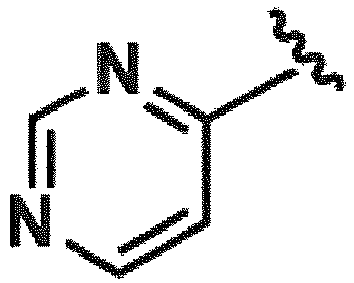
a group of formula (2'):
- The compound according to any one of Items 1A to 10A, or a pharmaceutically acceptable salt thereof, wherein m is 0 or 1.
- The compound according to any one of Items 1A to 11A, or a pharmaceutically acceptable salt thereof, wherein at least one of R1 and R2 is:
- C1-6 alkyl, wherein the alkyl may be optionally substituted with 1 or 2 substituents independently selected from the group consisting of:
- (a) hydroxy,
- (b) C1-4 alkoxy, and
- (c) C3-6 cycloalkyl, or
- halogen.
- A compound selected from the group consisting of the following structural formulae:

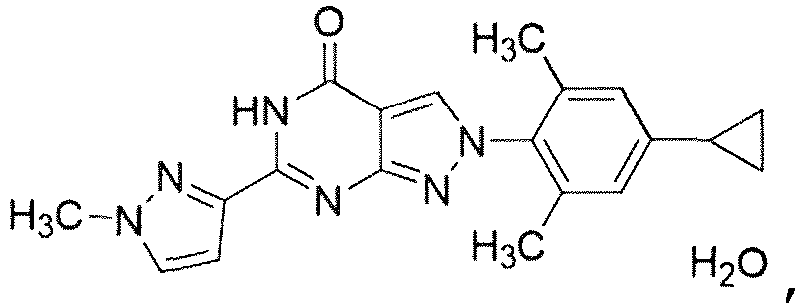
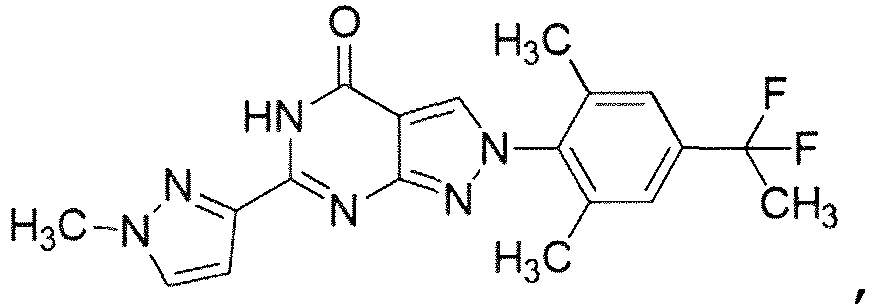


- A pharmaceutical composition comprising a compound according to any one of Items 1A to 13A, or a pharmaceutically acceptable salt thereof, and a pharmaceutically acceptable carrier.
- An NLRP3 inflammasome inhibitor comprising a compound according to any one of Items 1A to 13A, or a pharmaceutically acceptable salt thereof.
- A medicament for treating or preventing a disease selected from the group consisting of multiple sclerosis, chronic kidney disease, inflammatory bowel disease (for example, ulcerative colitis and Crohn's disease), arteriosclerosis, Cryopyrin-associated periodic syndrome (for example, familial cold autoinflammatory syndrome, Muckle-Wells syndrome, chronic infantile neurologic cutaneous and articular syndrome, and neonatal onset multisystem inflammatory disease), nonalcoholic steatohepatitis, gout, gouty arthritis, rheumatoid arthritis, contact dermatitis, dry eye, ischemic heart disease (for example, acute myocardial infarction), systemic lupus erythematosus, systemic juvenile idiopathic arthritis, recurrent pericarditis, adult onset Still's disease (for example, hemophagocytic lymphohistiocytosis and macrophage activation syndrome), Schnitzler syndrome, deficiency of the IL-1 receptor antagonist, familial Mediterranean fever, mevalonate kinase deficiency, hyper IgD syndrome, Behcet's disease, lung cancer, psoriasis, hypertension, diabetic retinopathy, Alzheimer's disease, mild cognitive impairment, Parkinson's disease, Huntington's disease, amyotrophic lateral sclerosis, traumatic brain injury, cerebral infarct, intracerebral bleeding, epilepsy, depressive illness, autism spectrum disorder, spinal cord injury, septic encephalopathy, neuropathic pain, COVID-19, frontotemporal dementia, age-related macular degeneration, diabetic macular edema, hereditary transient corneal endotheliitis, and TNF receptor-associated periodic syndrome, comprising a compound according to any one of Items 1A to 13A, or a pharmaceutically acceptable salt thereof.
- The medicament according to Item 16A, wherein the inflammatory bowel disease is ulcerative colitis or Crohn's disease.
- The medicament according to Item 16A, wherein the Cryopyrin-associated periodic syndrome is familial cold autoinflammatory syndrome, Muckle-Wells syndrome, chronic infantile neurologic cutaneous and articular syndrome, or neonatal onset multisystem inflammatory disease.
- The medicament according to Item 16A, wherein the disease is selected from the group consisting of multiple sclerosis, dry eye, diabetic retinopathy, Alzheimer's disease, mild cognitive impairment, Parkinson's disease, Huntington's disease, amyotrophic lateral sclerosis, traumatic brain injury, cerebral infarct, intracerebral bleeding, epilepsy, depressive illness, autism spectrum disorder, spinal cord injury, septic encephalopathy, neuropathic pain, frontotemporal dementia, age-related macular degeneration, diabetic macular edema, and hereditary transient corneal endotheliitis.
- A method for inhibiting NLRP3 inflammasome, comprising administering a therapeutically effective amount of a compound according to any one of Items 1A to 13A, or a pharmaceutically acceptable salt thereof, to a mammal.
- A method for treating or preventing a disease selected from the group consisting of multiple sclerosis, chronic kidney disease, inflammatory bowel disease (for example, ulcerative colitis and Crohn's disease), arteriosclerosis, Cryopyrin-associated periodic syndrome (for example, familial cold autoinflammatory syndrome, Muckle-Wells syndrome, chronic infantile neurologic cutaneous and articular syndrome, and neonatal onset multisystem inflammatory disease), nonalcoholic steatohepatitis, gout, gouty arthritis, rheumatoid arthritis, contact dermatitis, dry eye, ischemic heart disease (for example, acute myocardial infarction), systemic lupus erythematosus, systemic juvenile idiopathic arthritis, recurrent pericarditis, adult onset Still's disease (for example, hemophagocytic lymphohistiocytosis and macrophage activation syndrome), Schnitzler syndrome, deficiency of the IL-1 receptor antagonist, familial Mediterranean fever, mevalonate kinase deficiency, hyper IgD syndrome, Behcet's disease, lung cancer, psoriasis, hypertension, diabetic retinopathy, Alzheimer's disease, mild cognitive impairment, Parkinson's disease, Huntington's disease, amyotrophic lateral sclerosis, traumatic brain injury, cerebral infarct, intracerebral bleeding, epilepsy, depressive illness, autism spectrum disorder, spinal cord injury, septic encephalopathy, neuropathic pain, COVID-19, frontotemporal dementia, age-related macular degeneration, diabetic macular edema, hereditary transient corneal endotheliitis, and TNF receptor-associated periodic syndrome, comprising administering a therapeutically effective amount of a compound according to any one of Items 1A to 13A, or a pharmaceutically acceptable salt thereof, to a mammal.
- The method according to Item 21A, wherein the inflammatory bowel disease is ulcerative colitis or Crohn's disease.
- The method according to Item 21A, wherein the Cryopyrin-associated periodic syndrome is familial cold autoinflammatory syndrome, Muckle-Wells syndrome, chronic infantile neurologic cutaneous and articular syndrome, or neonatal onset multisystem inflammatory disease.
- The method according to Item 21A, wherein the disease is selected from the group consisting of multiple sclerosis, dry eye, diabetic retinopathy, Alzheimer's disease, mild cognitive impairment, Parkinson's disease, Huntington's disease, amyotrophic lateral sclerosis, traumatic brain injury, cerebral infarct, intracerebral bleeding, epilepsy, depressive illness, autism spectrum disorder, spinal cord injury, septic encephalopathy, neuropathic pain, frontotemporal dementia, age-related macular degeneration, diabetic macular edema, and hereditary transient corneal endotheliitis.
- Use of a compound according to any one of Items 1A to 13A, or a pharmaceutically acceptable salt thereof, in the manufacture of an NLRP3 inflammasome inhibitor.
- Use of a compound according to any one of Items 1A to 13A, or a pharmaceutically acceptable salt thereof, in the manufacture of a medicament for treating or preventing a disease selected from the group consisting of multiple sclerosis, chronic kidney disease, inflammatory bowel disease (for example, ulcerative colitis and Crohn's disease), arteriosclerosis, Cryopyrin-associated periodic syndrome (for example, familial cold autoinflammatory syndrome, Muckle-Wells syndrome, chronic infantile neurologic cutaneous and articular syndrome, and neonatal onset multisystem inflammatory disease), nonalcoholic steatohepatitis, gout, gouty arthritis, rheumatoid arthritis, contact dermatitis, dry eye, ischemic heart disease (for example, acute myocardial infarction), systemic lupus erythematosus, systemic juvenile idiopathic arthritis, recurrent pericarditis, adult onset Still's disease (for example, hemophagocytic lymphohistiocytosis and macrophage activation syndrome), Schnitzler syndrome, deficiency of the IL-1 receptor antagonist, familial Mediterranean fever, mevalonate kinase deficiency, hyper IgD syndrome, Behcet's disease, lung cancer, psoriasis, hypertension, diabetic retinopathy, Alzheimer's disease, mild cognitive impairment, Parkinson's disease, Huntington's disease, amyotrophic lateral sclerosis, traumatic brain injury, cerebral infarct, intracerebral bleeding, epilepsy, depressive illness, autism spectrum disorder, spinal cord injury, septic encephalopathy, neuropathic pain, COVID-19, frontotemporal dementia, age-related macular degeneration, diabetic macular edema, hereditary transient corneal endotheliitis, and TNF receptor-associated periodic syndrome.
- The use according to Item 26A, wherein the inflammatory bowel disease is ulcerative colitis or Crohn's disease.
- The use according to Item 26A, wherein the Cryopyrin-associated periodic syndrome is familial cold autoinflammatory syndrome, Muckle-Wells syndrome, chronic infantile neurologic cutaneous and articular syndrome, or neonatal onset multisystem inflammatory disease.
- The use according to Item 26A, wherein the disease is selected from the group consisting of multiple sclerosis, dry eye, diabetic retinopathy, Alzheimer's disease, mild cognitive impairment, Parkinson's disease, Huntington's disease, amyotrophic lateral sclerosis, traumatic brain injury, cerebral infarct, intracerebral bleeding, epilepsy, depressive illness, autism spectrum disorder, spinal cord injury, septic encephalopathy, neuropathic pain, frontotemporal dementia, age-related macular degeneration, diabetic macular edema, and hereditary transient corneal endotheliitis.
- A compound according to any one of Items 1A to 13A, or a pharmaceutically acceptable salt thereof, for use in inhibiting NLRP3 inflammasome.
- A compound according to any one of Items 1A to 13A, or a pharmaceutically acceptable salt thereof, for use in treating or preventing a disease selected from the group consisting of multiple sclerosis, chronic kidney disease, inflammatory bowel disease (for example, ulcerative colitis and Crohn's disease), arteriosclerosis, Cryopyrin-associated periodic syndrome (for example, familial cold autoinflammatory syndrome, Muckle-Wells syndrome, chronic infantile neurologic cutaneous and articular syndrome, and neonatal onset multisystem inflammatory disease), nonalcoholic steatohepatitis, gout, gouty arthritis, rheumatoid arthritis, contact dermatitis, dry eye, ischemic heart disease (for example, acute myocardial infarction), systemic lupus erythematosus, systemic juvenile idiopathic arthritis, recurrent pericarditis, adult onset Still's disease (for example, hemophagocytic lymphohistiocytosis and macrophage activation syndrome), Schnitzler syndrome, deficiency of the IL-1 receptor antagonist, familial Mediterranean fever, mevalonate kinase deficiency, hyper IgD syndrome, Behcet's disease, lung cancer, psoriasis, hypertension, diabetic retinopathy, Alzheimer's disease, mild cognitive impairment, Parkinson's disease, Huntington's disease, amyotrophic lateral sclerosis, traumatic brain injury, cerebral infarct, intracerebral bleeding, epilepsy, depressive illness, autism spectrum disorder, spinal cord injury, septic encephalopathy, neuropathic pain, COVID-19, frontotemporal dementia, age-related macular degeneration, diabetic macular edema, hereditary transient corneal endotheliitis, and TNF receptor-associated periodic syndrome.
- The compound, or a pharmaceutically acceptable salt thereof, for use according to Item 31A, wherein the inflammatory bowel disease is ulcerative colitis or Crohn's disease.
- The compound, or a pharmaceutically acceptable salt thereof, for use according to Item 31A, wherein the Cryopyrin-associated periodic syndrome is familial cold autoinflammatory syndrome, Muckle-Wells syndrome, chronic infantile neurologic cutaneous and articular syndrome, or neonatal onset multisystem inflammatory disease.
- The compound, or a pharmaceutically acceptable salt thereof, for use according to Item 31A, wherein the disease is selected from the group consisting of multiple sclerosis, dry eye, diabetic retinopathy, Alzheimer's disease, mild cognitive impairment, Parkinson's disease, Huntington's disease, amyotrophic lateral sclerosis, traumatic brain injury, cerebral infarct, intracerebral bleeding, epilepsy, depressive illness, autism spectrum disorder, spinal cord injury, septic encephalopathy, neuropathic pain, frontotemporal dementia, age-related macular degeneration, diabetic macular edema, and hereditary transient corneal endotheliitis.
- A package for commercial use, comprising the pharmaceutical composition according to Item 14A and a written document associated with the pharmaceutical composition, the document describing that the composition may be used for treating or preventing a disease selected from the group consisting of multiple sclerosis, chronic kidney disease, inflammatory bowel disease (for example, ulcerative colitis and Crohn's disease), arteriosclerosis, Cryopyrin-associated periodic syndrome (for example, familial cold autoinflammatory syndrome, Muckle-Wells syndrome, chronic infantile neurologic cutaneous and articular syndrome, and neonatal onset multisystem inflammatory disease), nonalcoholic steatohepatitis, gout, gouty arthritis, rheumatoid arthritis, contact dermatitis, dry eye, ischemic heart disease (for example, acute myocardial infarction), systemic lupus erythematosus, systemic juvenile idiopathic arthritis, recurrent pericarditis, adult onset Still's disease (for example, hemophagocytic lymphohistiocytosis and macrophage activation syndrome), Schnitzler syndrome, deficiency of the IL-1 receptor antagonist, familial Mediterranean fever, mevalonate kinase deficiency, hyper IgD syndrome, Behcet's disease, lung cancer, psoriasis, hypertension, diabetic retinopathy, Alzheimer's disease, mild cognitive impairment, Parkinson's disease, Huntington's disease, amyotrophic lateral sclerosis, traumatic brain injury, cerebral infarct, intracerebral bleeding, epilepsy, depressive illness, autism spectrum disorder, spinal cord injury, septic encephalopathy, neuropathic pain, COVID-19, frontotemporal dementia, age-related macular degeneration, diabetic macular edema, hereditary transient corneal endotheliitis, and TNF receptor-associated periodic syndrome.
- A kit for commercial use, comprising the pharmaceutical composition according to Item 14A and a written document associated with the pharmaceutical composition, the document describing that the composition may be used for treating or preventing a disease selected from the group consisting of multiple sclerosis, chronic kidney disease, inflammatory bowel disease (for example, ulcerative colitis and Crohn's disease), arteriosclerosis, Cryopyrin-associated periodic syndrome (for example, familial cold autoinflammatory syndrome, Muckle-Wells syndrome, chronic infantile neurologic cutaneous and articular syndrome, and neonatal onset multisystem inflammatory disease), nonalcoholic steatohepatitis, gout, gouty arthritis, rheumatoid arthritis, contact dermatitis, dry eye, ischemic heart disease (for example, acute myocardial infarction), systemic lupus erythematosus, systemic juvenile idiopathic arthritis, recurrent pericarditis, adult onset Still's disease (for example, hemophagocytic lymphohistiocytosis and macrophage activation syndrome), Schnitzler syndrome, deficiency of the IL-1 receptor antagonist, familial Mediterranean fever, mevalonate kinase deficiency, hyper IgD syndrome, Behcet's disease, lung cancer, psoriasis, hypertension, diabetic retinopathy, Alzheimer's disease, mild cognitive impairment, Parkinson's disease, Huntington's disease, amyotrophic lateral sclerosis, traumatic brain injury, cerebral infarct, intracerebral bleeding, epilepsy, depressive illness, autism spectrum disorder, spinal cord injury, septic encephalopathy, neuropathic pain, COVID-19, frontotemporal dementia, age-related macular degeneration, diabetic macular edema, hereditary transient corneal endotheliitis, and TNF receptor-associated periodic syndrome.
- The followings are definitions of terms that may be used herein.
- A wavy line as follows:

- The term "C1-4 alkyl" refers to a straight- or branched-chain saturated hydrocarbon group having 1 to 4 carbon atoms. "C1-4 alkyl" includes methyl, ethyl, n-propyl, isopropyl, n-butyl, sec-butyl, isobutyl, and tert-butyl. Preferably, methyl and ethyl are included. More preferably, methyl is included.
- The term "C1-6 alkyl" refers to a straight- or branched-chain saturated hydrocarbon group having 1 to 6 carbon atoms. "C1-6 alkyl" includes, for example, methyl, ethyl, n-propyl, isopropyl, n-butyl, sec-butyl, isobutyl, tert-butyl, n-pentyl, isopentyl, neopentyl, 2-methylbutyl, 1,1-dimethylpropyl, 1-ethylpropyl, n-hexyl, isohexyl, 1,1-dimethylbutyl, 2,2-dimethylbutyl, 3,3-dimethylbutyl, and 2-ethylbutyl. Preferably, methyl and ethyl are included. More preferably, methyl is included.
- The term "C2-6 alkenyl" refers to a straight- or branched-chain unsaturated hydrocarbon group having 2 to 6 carbon atoms and comprising at least one double bond. "C2-6 alkenyl" includes, for example, vinyl, allyl, 1-propenyl, isopropenyl, 2-methyl-1-propenyl, 1-butenyl, 2-butenyl, 1,3-butadienyl, 3-methyl-2-butenyl, 1,1-dimethyl-2-propenyl, 4-methyl-2-pentenyl, 4-methyl-3-pentenyl, and 1-methyl-2-butenyl.
- The term "C2-5 alkynyl" refers to a straight- or branched-chain unsaturated hydrocarbon group having 2 to 5 carbon atoms and comprising at least one triple bond. "C2-5 alkynyl" includes, for example, ethynyl, 1-propynyl, 2-propynyl, 1-butynyl, 2-butynyl, 3-butynyl, and 2-pentynyl.
- The term "C1-4 alkoxy" refers to a group wherein the above-defined "C1-4 alkyl" binds to an oxygen atom. "C1-4 alkoxy" includes methoxy, ethoxy, n-propoxy, isopropoxy, n-butoxy, sec-butoxy, isobutoxy, and tert-butoxy. Preferably, methoxy is included.
- The term "C1-6 alkoxy" refers to a group wherein the above-defined "C1-6 alkyl" binds to an oxygen atom. "C1-6 alkoxy" includes, for example, methoxy, ethoxy, n-propoxy, isopropoxy, n-butoxy, sec-butoxy, isobutoxy, tert-butoxy, pentyloxy, isopentyloxy, neopentyloxy, 2-methylbutoxy, 1,1-dimethylpropoxy, 1-ethylpropoxy, hexyloxy, isohexyloxy, 1,1-dimethylbutoxy, 2,2-dimethylbutoxy, 3,3-dimethylbutoxy, and 2-ethylbutoxy.
- The term "halogen" includes, for example, fluorine, chlorine, bromine, and iodine. Preferably, fluorine, chlorine, and bromine are included.
- The term "C1-4 haloalkyl" refers to the above-defined "C1-4 alkyl" that is substituted with 1 to 7 halogen atoms independently selected from the group of the above-defined "halogen". "C1-4 haloalkyl" includes, for example, monofluoromethyl, difluoromethyl, trifluoromethyl, chlorofluoromethyl, 2-fluoroethyl, 2-chloroethyl, 2-bromoethyl, 1,1-difluoroethyl, 2,2-difluoroethyl, 1-fluoro-1-methylethyl, 2,2,2-trifluoro-1-methylethyl, 2,2,2-trifluoroethyl, pentafluoroethyl, 3-fluoropropyl, 3-chloropropyl, 1,1-difluoropropyl, 3,3,3-trifluoropropyl, and 4,4,4-trifluorobutyl. Preferably, difluoromethyl and trifluoromethyl are included.
- The term "C1-6 haloalkyl" refers to the above-defined "C1-6 alkyl" that is substituted with 1 to 9 halogen atoms independently selected from the group of the above-defined "halogen". "C1-6 haloalkyl" includes, for example, monofluoromethyl, difluoromethyl, trifluoromethyl, chlorofluoromethyl, 2-fluoroethyl, 2-chloroethyl, 2-bromoethyl, 1,1-difluoroethyl, 2,2-difluoroethyl, 1-fluoro-1-methylethyl, 2,2,2-trifluoro-1-methylethyl, 2,2,2-trifluoroethyl, pentafluoroethyl, 3-fluoropropyl, 3-chloropropyl, 1,1-difluoropropyl, 3,3,3-trifluoropropyl, 4,4,4-trifluorobutyl, 5,5,5-trifluoropentyl, and 6,6,6-trifluorohexyl. Preferably, trifluoromethyl and 1,1-difluoroethyl are included.
- The term "C2-6 haloalkenyl" refers to the above-defined "C2-6 alkenyl" that is substituted with 1 to 9 halogen atoms independently selected from the group of the above-defined "halogen". "C2-6 haloalkenyl" includes, for example, 2-fluoroethenyl, 3-chloropropenyl, 2-fluoropropenyl, 1-trifluoromethylethenyl, and 4,4,4-trifluoro-2-butenyl.
- The term "C3-6 cycloalkyl" refers to a monocyclic saturated hydrocarbon group having 3 to 6 carbon atoms. "C3-6 cycloalkyl" includes, for example, cyclopropyl, cyclobutyl, cyclopentyl, and cyclohexyl. Preferably, cyclopropyl is included.
- The term "C5-6 cycloalkene" refers to a monocyclic partially-unsaturated hydrocarbon ring having 5 to 6 carbon atoms and comprising at least one double bond. "C5-6 cycloalkene" includes, for example, cyclopentene, cyclopentadiene, cyclohexene, and cyclohexadiene. Preferably, cyclopentene is included.
- The term "C5-6 cycloalkenyl" refers to a monocyclic partially-unsaturated hydrocarbon group having 5 to 6 carbon atoms and comprising at least one double bond. "C5-6 cycloalkenyl" includes, for example, cyclopentenyl, cyclopentadienyl, cyclohexenyl, and cyclohexadienyl.
- The term "4- to 6-membered heterocycloalkyl comprising 1 or 2 heteroatoms independently selected from the group consisting of nitrogen and oxygen atom" refers to a 4- to 6-membered monocyclic saturated heterocyclic group comprising one or two heteroatoms independently selected from the group consisting of nitrogen and oxygen atom, besides carbon atoms, as a ring-constituting atom. "4- to 6-membered heterocycloalkyl comprising 1 or 2 heteroatoms independently selected from the group consisting of nitrogen and oxygen atom" includes, for example, azetidinyl, oxetanyl, diazetidinyl, dioxetanyl, pyrrolidinyl, tetrahydrofuranyl, imidazolidinyl, pyrazolidinyl, oxazolidinyl, isoxazolidinyl, dioxolanyl, piperidinyl, tetrahydropyranyl, 1,3-diazacyclohexanyl, piperazinyl, morpholinyl, tetrahydro-1,2-oxazinyl, and dioxanyl. Preferably, oxetanyl is included.
- The term "5- to 6-membered heterocycloalkyl comprising 1 or 2 heteroatoms independently selected from the group consisting of nitrogen and oxygen atom" refers to a 5- to 6-membered monocyclic saturated heterocyclic group comprising one or two heteroatoms independently selected from the group consisting of nitrogen and oxygen atom, besides carbon atoms, as a ring-constituting atom. "5- to 6-membered heterocycloalkyl comprising 1 or 2 heteroatoms independently selected from the group consisting of nitrogen and oxygen atom" includes, for example, pyrrolidinyl, tetrahydrofuranyl, imidazolidinyl, pyrazolidinyl, oxazolidinyl, isoxazolidinyl, dioxolanyl, piperidinyl, tetrahydropyranyl, 1,3-diazacyclohexanyl, piperazinyl, morpholinyl, tetrahydro-1,2-oxazinyl, and dioxanyl.
- The term "5- to 7-membered heterocycloalkane comprising 1 or 2 heteroatoms independently selected from the group consisting of nitrogen and oxygen atom" refers to a 5- to 7-membered monocyclic saturated heterocycle comprising one or two heteroatoms independently selected from the group consisting of nitrogen and oxygen atom, besides carbon atoms, as a ring-constituting atom. "5- to 7-membered heterocycloalkane comprising 1 or 2 heteroatoms independently selected from the group consisting of nitrogen and oxygen atom" includes, for example, pyrrolidine, tetrahydrofuran, imidazolidine, pyrazolidine, dioxolane, oxazolidine, isoxazolidine, piperidine, tetrahydropyran, 1,2-diazacyclohexane, 1,3-diazacyclohexane, piperazine, dioxane, morpholine, tetrahydro-1,2-oxazine, tetrahydro-1,3-oxazine, azepane, oxepane, diazepane (for example, 1,4-diazepane), dioxepane (for example, 1,4-dioxepane), and oxazepane (for example, 1,4-oxazepane and 1,2-oxazepane). Preferably, pyrrolidine, morpholine, and tetrahydro-1,3-oxazine are included.
- The term "5- to 7-membered heterocycloalkene comprising 1 or 2 oxygen atoms" refers to a 5- to 7-membered monocyclic partially-unsaturated heterocycle comprising one or two oxygen atoms, besides carbon atoms, as a ring-constituting atom, and comprising at least one double bond. "5- to 7-membered heterocycloalkene comprising 1 or 2 oxygen atoms" includes, for example, dihydrofuran, dioxole, dihydropyran, dihydrodioxin, pyrane, tetrahydrooxepin, dihydrodioxepin, dihydrooxepin, and dioxepin. Preferably, dihydropyran is included.
- The term "5- to 7-membered heterocycloalkene comprising 1 or 2 heteroatoms independently selected from the group consisting of nitrogen and oxygen atom" refers to a 5- to 7-membered monocyclic partially-unsaturated heterocycle comprising one or two heteroatoms independently selected from the group consisting of nitrogen and oxygen atom, besides carbon atoms, as a ring-constituting atom, and comprising at least one double bond. "5- to 7-membered heterocycloalkene comprising 1 or 2 heteroatoms independently selected from the group consisting of nitrogen and oxygen atom" includes, for example, pyrroline, pyrazoline, imidazoline, dihydrofuran, dioxole, oxazoline, isoxazoline, tetrahydropyridine, tetrahydropyrimidine, tetrahydropyridazine, tetrahydropyrazine, dihydropyridine, dihydropyran, dihydrodioxin, pyrane, dihydrooxazine, tetrahydroazepine, tetrahydrodiazepine, dihydroazepine, dihydrodiazepine, tetrahydrooxepin, dihydrodioxepin, dihydrooxepin, dioxepin, tetrahydrooxazepine, and dihydrooxazepine. Preferably, pyrroline and dihydrooxazine are included.
- In one embodiment of the present invention, n in Formula [I] and Formula [IA] is 0; X1, X2, X3, and X4 are each independently carbon, nitrogen, oxygen, or sulfur atom; X1, X2, X3, and X4 are combined together with the carbon atom that is adjacent to X1 and X4 to form heteroaryl, wherein a total number of nitrogen, oxygen, and sulfur atoms as X1, X2, X3, or X4 is 1, 2, or 3, and a total number of oxygen and sulfur atoms is 0 or 1. The heteroaryl group refers to a 5-membered monocyclic aromatic heterocyclyl comprising 1 to 3 heteroatoms independently selected from the group consisting of nitrogen, oxygen, and sulfur atom, besides carbon atoms, as a ring-constituting atom, wherein a total number of oxygen and sulfur atoms is 0 or 1. The heteroaryl group includes, for example, pyrrolyl, furyl, thienyl, pyrazolyl, imidazolyl, oxazolyl, isoxazolyl, thiazolyl, isothiazolyl, oxadiazolyl (for example, 1,2,3-oxadiazolyl, 1,2,4-oxadiazolyl, 1,2,5-oxadiazolyl, and 1,3,4-oxadiazolyl), thiadiazolyl (for example, 1,2,3-thiadiazolyl, 1,2,4-thiadiazolyl, 1,2,5-thiadiazolyl, and 1,3,4-thiadiazolyl), and triazolyl (for example, 1,2,3-triazolyl and 1,2,4-triazolyl). Preferably, pyrazolyl, imidazolyl, oxazolyl, isoxazolyl, thiazolyl, 1,3,4-oxadiazolyl, 1,2,3-triazolyl, and 1,2,4-triazolyl are included. More preferably, pyrazolyl, imidazolyl, and thiazolyl are included. Still more preferably, the following groups:

- In another embodiment of the present invention, n in Formula [I] and Formula [IA] is 1; X1, X2, X3, X4, and X5 are each independently carbon or nitrogen atom; X1, X2, X3, X4, and X5 are combined together with the carbon atom that is adjacent to X1 and X5 to form heteroaryl, wherein a total number of nitrogen atoms as X1, X2, X3, X4, or X5 is 1 or 2. The heteroaryl group refers to a 6-membered monocyclic aromatic heterocyclyl comprising 1 or 2 nitrogen atoms, besides carbon atoms, as a ring-constituting atom. The heteroaryl group includes, for example, pyridyl, pyrimidyl, pyridazinyl, and pyrazinyl. Preferably, pyrimidyl and pyridazinyl are included. More preferably, the following groups:

- In certain embodiments of the present invention, a partial structure in Formula [IA]:


- In certain embodiments of the present invention, a partial structure in Formula [IA]:

- The phrase wherein α may be "optionally substituted with" β means that α is unsubstituted, or any of replaceable hydrogen atoms of α is replaced with β. For example, "C1-6 alkyl optionally substituted with hydroxy" means that C1-6 alkyl is unsubstituted, or any of hydrogen atoms of C1-6 alkyl is replaced with hydroxy.
- Embodiments of each substituent of a compound of Formula [I] or [IA] are illustrated as below. Each substituent of a compound of Formula [I] or [IA] is, however, not limited to these embodiments, and a compound of Formula [I] or [IA] also includes any combination of two or more of these embodiments in each substituent.
- R1 and R2 are preferably each independently
- (1) hydrogen,
- (2) C1-6 alkyl, wherein the alkyl may be optionally substituted with 1 or 2 substituents independently selected from the group consisting of:
- (a) hydroxy,
- (b) C1-4 alkoxy, and
- (c) C3-6 cycloalkyl,
- (3) C1-6 alkoxy, wherein the alkoxy may be optionally substituted with C3-6 cycloalkyl,
- (4) halogen,
- (5) C1-4 haloalkyl,
- (6) -O-C1-4 haloalkyl, or
- (7) C3-6 cycloalkyl.
- R1 and R2 are preferably each independently
- (1) hydrogen,
- (2) C1-6 alkyl, wherein the alkyl may be optionally substituted with 1 or 2 substituents independently selected from the group consisting of:
- (a) hydroxy,
- (b) C1-4 alkoxy, and
- (c) C3-6 cycloalkyl, or
- (3) halogen.
- R1 and R2 are more preferably each independently C1-6 alkyl, wherein the alkyl may be optionally substituted with hydroxy or C1-4 alkoxy.
- R3 and R4 are preferably hydrogen.
- R5 is preferably
- (1) hydrogen,
- (2) C1-6 alkyl,
- (3) C1-4 alkoxy,
- (4) halogen,
- (5) C1-6 haloalkyl,
- (6) -O-C1-4 haloalkyl, or
- (7) C3-6 cycloalkyl, wherein the cycloalkyl may be optionally substituted with 1 to 3 halogen or C1-4 haloalkyl.
- In the following partial structure:

- (1) hydrogen,
- (2) C1-6 alkyl, wherein the alkyl may be optionally substituted with 1 or 2 substituents independently selected from the group consisting of:
- (a) hydroxy,
- (b) C1-4 alkoxy, and
- (c) C3-6 cycloalkyl,
- (3) C1-6 alkoxy, wherein the alkoxy may be optionally substituted with C3-6 cycloalkyl,
- (4) halogen,
- (5) C1-4 haloalkyl,
- (6) -O-C1-4 haloalkyl, or
- (7) C3-6 cycloalkyl;
- R3 and R4 are preferably hydrogen; and
- R5 is
- (1) hydrogen,
- (2) C1-6 alkyl,
- (3) C1-4 alkoxy,
- (4) halogen,
- (5) C1-6 haloalkyl,
- (6) -O-C1-4 haloalkyl, or
- (7) C3-6 cycloalkyl, wherein the cycloalkyl may be optionally substituted with 1 to 3 halogen or C1-4 haloalkyl.
- R3A and R4A are preferably each independently hydrogen or C1-4 alkyl.
- R3A and R4A are more preferably hydrogen.
- R5A is preferably
- (1) hydrogen,
- (2) C1-6 alkyl,
- (3) C1-4 alkoxy,
- (4) halogen,
- (5) C1-6 haloalkyl,
- (6) -O-C1-4 haloalkyl, or
- (7) C3-6 cycloalkyl, wherein the cycloalkyl may be optionally substituted with 1 to 3 substituents independently selected from the group consisting of:
- (a) hydroxy,
- (b) halogen, and
- (c) C1-4 haloalkyl, or
- (1) C5-6 cycloalkene, or
- (2) 5- to 7-membered heterocycloalkene comprising 1 or 2 oxygen atoms.
- R5A is more preferably
- (1) halogen,
- (2) C1-6 haloalkyl, or
- (3) C3-6 cycloalkyl, wherein the cycloalkyl may be optionally substituted with 1 to 3 substituents independently selected from the group consisting of:
- (a) hydroxy,
- (b) halogen, and
- (c) C1-4 haloalkyl.
- R5A is still more preferably
- (1) halogen, or
- (2) C3-6 cycloalkyl, wherein the cycloalkyl may be optionally substituted with 1 to 3 substituents independently selected from the group consisting of:
- (a) hydroxy,
- (b) halogen, and
- (c) C1-4 haloalkyl.
- R5A is still more preferably C3-6 cycloalkyl, wherein the cycloalkyl may be optionally substituted with 1 to 3 substituents independently selected from the group consisting of:
- (a) hydroxy,
- (b) halogen, and
- (c) C1-4 haloalkyl.
- In the following partial structure:

- (1) hydrogen,
- (2) C1-6 alkyl, wherein the alkyl may be optionally substituted with 1 or 2 substituents independently selected from the group consisting of:
- (a) hydroxy,
- (b) C1-4 alkoxy, and
- (c) C3-6 cycloalkyl, or
- (3) halogen;
- R3A and R4A are each independently hydrogen or C1-4 alkyl;
- R5A is
- (1) hydrogen,
- (2) C1-6 alkyl,
- (3) C1-4 alkoxy,
- (4) halogen,
- (5) C1-6 haloalkyl,
- (6) -O-C1-4 haloalkyl, or
- (7) C3-6 cycloalkyl, wherein the cycloalkyl may be optionally substituted with 1 to 3 substituents independently selected from the group consisting of:
- (a) hydroxy,
- (b) halogen, and
- (c) C1-4 haloalkyl, or
- (1) C5-6 cycloalkene, or
- (2) 5- to 7-membered heterocycloalkene comprising 1 or 2 oxygen atoms.
- In the following partial structure:

wherein the alkyl may be optionally substituted with hydroxy or C1-4 alkoxy; - R3A and R4A are hydrogen;
- R5A is
- (1) halogen,
- (2) C1-6 haloalkyl, or
- (3) C3-6 cycloalkyl, wherein the cycloalkyl may be optionally substituted with 1 to 3 substituents independently selected from the group consisting of:
- (a) hydroxy,
- (b) halogen, and
- (c) C1-4 haloalkyl.
- In the following partial structure:

- R3A and R4A are hydrogen;
- R5A is
- (1) halogen, or
- (2) C3-6 cycloalkyl, wherein the cycloalkyl may be optionally substituted with 1 to 3 substituents independently selected from the group consisting of:
- (a) hydroxy,
- (b) halogen, and
- (c) C1-9 haloalkyl.
- In the following partial structure:

- R3A and R4A are hydrogen;
- R5A is C3-6 cycloalkyl, wherein the cycloalkyl may be optionally substituted with 1 to 3 substituents independently selected from the group consisting of:
- (a) hydroxy,
- (b) halogen, and
- (c) C1-4 haloalkyl.
- R6 is preferably
- (1) C1-9 alkyl, wherein the alkyl may be optionally substituted with C1-9 alkoxy,
- (2) C1-4 alkoxy,
- (3) halogen, or
- (4) C1-4 haloalkyl.
- R6A is preferably independently
- (1) C1-4 alkyl, wherein the alkyl may be optionally substituted with C1-4 alkoxy,
- (2) C1-4 alkoxy,
- (3) halogen, or
- (4) C1-4 haloalkyl.
- R6A is more preferably independently C1-4 alkyl, wherein the alkyl may be optionally substituted with C1-4 alkoxy.
- m is preferably 0 or 1.
- X1 is preferably carbon, nitrogen, or oxygen atom.
- X1 is more preferably carbon or nitrogen atom.
- X2 is preferably carbon or nitrogen atom.
- X3 is preferably carbon, nitrogen or sulfur atom.
- X4 is preferably carbon, nitrogen, or sulfur atom.
- X4 is more preferably carbon atom.
- X5 is preferably carbon atom.
- n is preferably 0.
- In the following partial structure:

- m is 0 or 1;
- R6A is
- (1) C1-4 alkyl, wherein the alkyl may be optionally substituted with C1-4 alkoxy,
- (2) C1-4 haloalkyl, or
- (3) 4- to 6-membered heterocycloalkyl comprising 1 or 2 heteroatoms independently selected from the group consisting of nitrogen and oxygen atom;
- X1 is carbon, nitrogen, or oxygen atom;
- X2 is carbon or nitrogen atom;
- X3 is carbon, nitrogen, oxygen, or sulfur atom;
- X4 is carbon, nitrogen, or sulfur atom, wherein a total number of nitrogen, oxygen, and sulfur atoms as X1, X2, X3, or X4 is 1, 2, or 3 and a total number of oxygen and sulfur atoms is 0 or 1; and
- X1, X2, X3, and X4 are combined together with the carbon atom that is adjacent to X1 and X4 to form heteroaryl.
- In the following partial structure:

- m is 0 or 1;
- R6A is
- (1) C1-4 alkyl, wherein the alkyl may be optionally substituted with C1-4 alkoxy,
- (2) C1-4 haloalkyl, or
- (3) 4- to 6-membered heterocycloalkyl comprising 1 or 2 heteroatoms independently selected from the group consisting of nitrogen and oxygen atom;
- X1 is carbon, nitrogen, or oxygen atom;
- X2 is carbon or nitrogen atom;
- X3 is carbon, nitrogen, oxygen, or sulfur atom;
- X4 is carbon, nitrogen, or sulfur atom, wherein a total number of nitrogen, oxygen, and sulfur atoms as X1, X2, X3, or X4 is 2 or 3 and a total number of oxygen and sulfur atoms is 0 or 1; and
- X1, X2, X3, and X4 are combined together with the carbon atom that is adjacent to X1 and X4 to form heteroaryl.
- In the following partial structure:

- m is 0 or 1;
- R6A is C1-4 alkyl, wherein the alkyl may be optionally substituted with C1-4 alkoxy;
- X1 is nitrogen atom;
- X2 is carbon or nitrogen atom;
- X3 is carbon, nitrogen, or sulfur atom;
- X4 is carbon atom, wherein a total number of nitrogen and sulfur atoms as X1, X2, or X3 is 2; and
- X1, X2, X3, and X4 are combined together with the carbon atom that is adjacent to X1 and X4 to form heteroaryl.
- The following partial structure:


R6A is C1-4 alkyl, wherein the alkyl may be optionally substituted with C1-4 alkoxy. - In the following partial structure:

- m is 0 or 1;
- R6A is
- (1) C1-4 alkoxy,
- (2) halogen, or
- (3) C1-4 haloalkyl;
- X1, X2, X3, and X4 are each independently carbon or nitrogen atom, wherein a total number of nitrogen atoms as X1, X2, X3, or X4 is 1 or 2;
- X5 is carbon atom; and
- X1, X2, X3, X4, and X5 are combined together with the carbon atom that is adjacent to X1 and X5 to form heteroaryl.
- In the following partial structure:

- m is 0;
- X1 and X2 are each independently carbon or nitrogen atom;
- X3 is nitrogen atom, wherein a total number of nitrogen atoms as X1, X2, or X3 is 2;
- X4 and X5 are carbon atom; and
- X1, X2, X3, X4, and X5 are combined together with the carbon atom that is adjacent to X1 and X5 to form heteroaryl.
- The following partial structure:
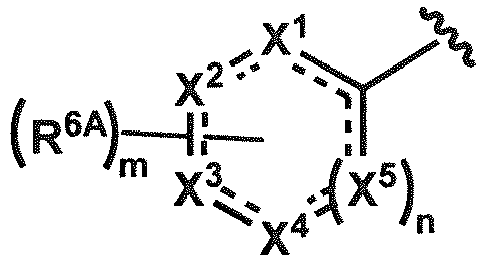
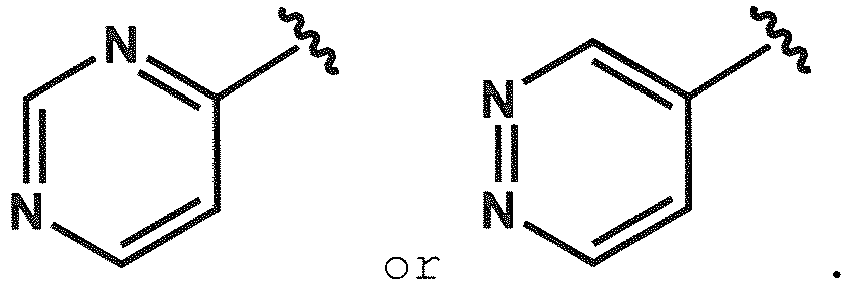
- In the following partial structure:

- m is 0 or 1;
- R6A is
- (1) C1-4 alkyl, wherein the alkyl may be optionally substituted with C1-4 alkoxy,
- (2) C1-4 haloalkyl, or
- (3) 4- to 6-membered heterocycloalkyl comprising 1 or 2 heteroatoms independently selected from the group consisting of nitrogen and oxygen atom;
- X1 is carbon, nitrogen, or oxygen atom;
- X2 is carbon or nitrogen atom;
- X3 is carbon, nitrogen, oxygen, or sulfur atom;
- X4 is carbon, nitrogen, or sulfur atom, wherein a total number of nitrogen, oxygen, and sulfur atoms as X1, X2, X3, or X4 is 2 or 3 and a total number of oxygen and sulfur atoms is 0 or 1; and
- X1, X2, X3, and X4 are combined together with the carbon atom that is adjacent to X1 and X4 to form heteroaryl.
- In the following partial structure:

- m is 0 or 1;
- R6A is C1-4 alkyl, wherein the alkyl may be optionally substituted with C1-4 alkoxy;
- X1 is carbon, nitrogen, or oxygen atom;
- X2 is carbon or nitrogen atom;
- X3 is carbon, nitrogen, oxygen, or sulfur atom;
- X4 is carbon, nitrogen, or sulfur atom, wherein a total number of nitrogen, oxygen, and sulfur atoms as X1, X2, X3, or X4 is 2 or 3 and a total number of oxygen and sulfur atoms is 0 or 1; and
- X1, X2, X3, and X4 are combined together with the carbon atom that is adjacent to X1 and X4 to form heteroaryl.
- In the following partial structure:

- m is 0 or 1;
- R6A is C1-4 alkyl, wherein the alkyl may be optionally substituted with C1-4 alkoxy;
- X1 is nitrogen atom;
- X2 is carbon or nitrogen atom;
- X3 is carbon, nitrogen, or sulfur atom;
- X4 is carbon atom, wherein a total number of nitrogen and sulfur atoms as X1, X2, or X3 is 2; and
- X1, X2, X3, and X4 are combined together with the carbon atom that is adjacent to X1 and X4 to form heteroaryl.
- The following partial structure:


R6A is C1-4 alkyl, wherein the alkyl may be optionally substituted with C1-4 alkoxy. - In the following partial structure:

- m is 0 or 1;
- R6A is
- (1) C1-4 alkoxy,
- (2) halogen, or
- (3) C1-4 haloalkyl;
- X1, X2, X3, and X4 are each independently carbon or nitrogen atom, wherein a total number of nitrogen atoms as X1, X2, X3, or X4 is 1 or 2;
- X5 is carbon atom; and
- X1, X2, X3, X4, and X5 are combined together with the carbon atom that is adjacent to X1 and X5 to form heteroaryl.
- In the following partial structure:

- m is 0;
- X1 and X2 are each independently carbon or nitrogen atom;
- X3 is nitrogen atom, wherein a total number of nitrogen atoms as X1, X2, or X3 is 2;
- X4 and X5 are carbon atom; and
- X1, X2, X3, X4, and X5 are combined together with the carbon atom that is adjacent to X1 and X5 to form heteroaryl.
- The following partial structure:


- A preferable embodiment of a compound of Formula [I] is a compound of Formula [I] wherein
- R1 and R2 are each independently
- (1) hydrogen,
- (2) C1-6 alkyl, wherein the alkyl may be optionally substituted with 1 or 2 substituents independently selected from the group consisting of:
- (a) hydroxy,
- (b) C1-4 alkoxy, and
- (c) C3-6 cycloalkyl,
- (3) C1-6 alkoxy, wherein the alkoxy may be optionally substituted with C3-6 cycloalkyl,
- (4) halogen,
- (5) C1-4 haloalkyl,
- (6) -O-C1-4 haloalkyl, or
- (7) C3-6 cycloalkyl;
- R3 and R4 are preferably hydrogen;
- R5 is
- (1) hydrogen,
- (2) C1-6 alkyl,
- (3) C1-4 alkoxy,
- (4) halogen,
- (5) C1-6 haloalkyl,
- (6) -O-C1-4 haloalkyl, or
- (7) C3-6 cycloalkyl, wherein the cycloalkyl may be optionally substituted with 1 to 3 halogen or C1-4 haloalkyl;
- R6 is
- (1) C1-4 alkyl, wherein the alkyl may be optionally substituted with C1-4 alkoxy,
- (2) C1-4 alkoxy,
- (3) halogen, or
- (4) C1-4 haloalkyl;
- m is 0, 1, or 2;
- n is 0 or 1;
- provided that when n is 0, then X1, X2, X3, and X4 are each independently carbon, nitrogen, oxygen, or sulfur atom, wherein a total number of nitrogen, oxygen, and sulfur atoms as X1, X2, X3, or X4 is 1, 2, or 3 and a total number of oxygen and sulfur atoms is 0 or 1, and X1, X2, X3, and X4 are combined together with the carbon atom that is adjacent to X1 and X4 to form heteroaryl; and
- provided that when n is 1, then X1, X2, X3, X4, and X5 are each independently carbon or nitrogen atom, wherein a total number of nitrogen atoms as X1, X2, X3, X4, or X5 is 1 or 2, and X1, X2, X3, X4, and X5 are combined together with the carbon atom that is adjacent to X1 and X5 to form heteroaryl.
- A preferable embodiment of a compound of Formula [IA] is a compound of Formula [IA] wherein
- R1 and R2 are each independently
- (1) hydrogen,
- (2) C1-6 alkyl, wherein the alkyl may be optionally substituted with 1 or 2 substituents independently selected from the group consisting of:
- (a) hydroxy,
- (b) C1-4 alkoxy, and
- (c) C3-6 cycloalkyl,
- (3) halogen;
- R3A and R4A are each independently
- (1) hydrogen, or
- (2) C1-4 alkyl;
- R5A is
- (1) hydrogen,
- (2) C1-6 alkyl,
- (3) C1-4 alkoxy,
- (4) halogen,
- (5) C1-6 haloalkyl,
- (6) -O-C1-4 haloalkyl,
- (7) C3-6 cycloalkyl, wherein the cycloalkyl may be optionally substituted with 1 to 3 substituents independently selected from the group consisting of:
- (a) hydroxy,
- (b) halogen, and
- (c) C1-4 haloalkyl, or
- R5A is combined together with R3A or R4A and the carbon atoms that they attach to form:
- (1) C5-6 cycloalkene, or
- (2) 5- to 7-membered heterocycloalkene comprising 1 or 2 oxygen atoms;
- m is 0 or 1;
- R6A is
- (1) C1-4 alkyl, wherein the alkyl may be optionally substituted with C1-4 alkoxy,
- (2) C1-4 alkoxy,
- (3) halogen, or
- (4) C1-4 haloalkyl;
- n is 0 or 1;
- provided that when n is 0, then
- X1 is carbon, nitrogen, or oxygen atom;
- X2 is carbon or nitrogen atom;
- X3 is carbon, nitrogen, oxygen, or sulfur atom;
- X4 is carbon, nitrogen, or sulfur atom, wherein a total number of nitrogen, oxygen, and sulfur atoms as X1, X2, X3, or X4 is 2 or 3 and a total number of oxygen and sulfur atoms is 0 or 1; and
- X1, X2, X3, and X4 are combined together with the carbon atom that is adjacent to X1 and X4 to form heteroaryl; and provided that when n is 1, then
- X1, X2, X3, and X4 are each independently carbon or nitrogen atom, wherein a total number of nitrogen atoms as X1, X2, X3, or X4 is 1 or 2;
- X5 is carbon atom; and
- X1, X2, X3, X4, and X5 are combined together with the carbon atom that is adjacent to X1 and X5 to form heteroaryl.
- Another preferable embodiment of a compound of Formula [IA] is a compound of Formula [IA] wherein
- R1 and R2 are each independently C1-6 alkyl, wherein the alkyl may be optionally substituted with hydroxy or C1-4 alkoxy;
- R3A and R4A are hydrogen;
- R5A is
- (1) halogen,
- (2) C1-6 haloalkyl, or
- (3) C3-6 cycloalkyl, wherein the cycloalkyl may be optionally substituted with 1 to 3 substituents independently selected from the group consisting of:
- (a) hydroxy,
- (b) halogen, and
- (c) C1-4 haloalkyl;
- m is 0 or 1;
- R6A is C1-4 alkyl, wherein the alkyl may be optionally substituted with C1-4 alkoxy;
- n is 0 or 1;
- provided that when n is 0, then
- X1 is nitrogen atom;
- X2 is carbon or nitrogen atom;
- X3 is carbon, nitrogen, or sulfur atom;
- X4 is carbon atom, wherein a total number of nitrogen and sulfur atoms as X1, X2, or X3 is 2; and
- X1, X2, X3, and X4 are combined together with the carbon atom that is adjacent to X1 and X4 to form heteroaryl; and provided that when n is 1, then
- X1 and X2 are each independently carbon or nitrogen atom;
- X3 is nitrogen atom, wherein a total number of nitrogen atoms as X1, X2, or X3 is 2;
- X4 and X5 are carbon atom; and
- X1, X2, X3, X4, and X5 are combined together with the carbon atom that is adjacent to X1 and X5 to form heteroaryl.
- Still another preferable embodiment of a compound of Formula [IA] is a compound of Formula [IIA]:

- R5A is
- (1) halogen,
- (2) C1-6 haloalkyl, or
- (3) C3-6 cycloalkyl, wherein the cycloalkyl may be optionally substituted with 1 to 3 substituents independently selected from the group consisting of:
- (a) hydroxy,
- (b) halogen, and
- (c) C1-4 haloalkyl;
- m is 0 or 1;
- R6A is
- (1) C1-4 alkyl, wherein the alkyl may be optionally substituted with C1-4 alkoxy,
- (2) C1-4 haloalkyl, or
- (3) 4- to 6-membered heterocycloalkyl comprising 1 or 2 heteroatoms independently selected from the group consisting of nitrogen and oxygen atom;
- X1 is carbon, nitrogen, or oxygen atom;
- X2 is carbon or nitrogen atom;
- X3 is carbon, nitrogen, oxygen, or sulfur atom;
- X4 is carbon, nitrogen, or sulfur atom, wherein a total number of nitrogen, oxygen, and sulfur atoms as X1, X2, X3, or X4 is 2 or 3 and a total number of oxygen and sulfur atoms is 0 or 1; and
- X1, X2, X3, and X4 are combined together with the carbon atom that is adjacent to X1 and X4 to form heteroaryl.
- Still another preferable embodiment of a compound of Formula [IA] is a compound of Formula [IIIA]:

- R5A is
- (1) halogen,
- (2) C1-6 haloalkyl, or
- (3) C3-6 cycloalkyl, wherein the cycloalkyl may be optionally substituted with 1 to 3 substituents independently selected from the group consisting of:
- (a) hydroxy,
- (b) halogen, and
- (c) C1-4 haloalkyl;
- m is 0 or 1;
- R6A is
- (1) C1-4 alkoxy,
- (2) halogen, or
- (3) C1-4 haloalkyl;
- X1, X2, X3, and X4 are each independently carbon or nitrogen atom, wherein a total number of nitrogen atoms as X1, X2, X3, or X4 is 1 or 2;
- X5 is carbon atom; and
- X1, X2, X3, X4, and X5 are combined together with the carbon atom that is adjacent to X1 and X5 to form heteroaryl.
- In one preferable embodiment of a compound of Formula [IIA], R1 and R2 are each independently C1-6 alkyl, wherein the alkyl may be optionally substituted with hydroxy or C1-4 alkoxy;
- R5A is
- (1) halogen,
- (2) C1-6 haloalkyl, or
- (3) C3-6 cycloalkyl, wherein the cycloalkyl may be optionally substituted with 1 to 3 substituents independently selected from the group consisting of:
- (a) hydroxy,
- (b) halogen, and
- (c) C1-4 haloalkyl;
- m is 0 or 1;
- R6A is
- (1) C1-4 alkyl, wherein the alkyl may be optionally substituted with C1-4 alkoxy,
- (2) C1-4 haloalkyl, or
- (3) 4- to 6-membered heterocycloalkyl comprising 1 or 2 heteroatoms independently selected from the group consisting of nitrogen and oxygen atom; and
- X1, X2, X3, and X4 are combined together with the carbon atom that is adjacent to X1 and X4 to form pyrazolyl, imidazolyl, or thiazolyl.
- Another preferable embodiment of a compound of Formula [IIA] is a compound of Formula [IIA-I]:

- R5A is
- (1) halogen,
- (2) C1-6 haloalkyl, or
- (3) C3-6 cycloalkyl, wherein the cycloalkyl may be optionally substituted with 1 to 3 substituents independently selected from the group consisting of:
- (a) hydroxy,
- (b) halogen, and
- (c) C1-4 haloalkyl;
- m is 0 or 1;
- R6A is C1-4 alkyl, wherein the alkyl may be optionally substituted with C1-4 alkoxy.
- Still another preferable embodiment of a compound of Formula [IIA] is a compound of Formula [IIA-II]:

- R5A is
- (1) halogen,
- (2) C1-6 haloalkyl, or
- (3) C3-6 cycloalkyl, wherein the cycloalkyl may be optionally substituted with 1 to 3 substituents independently selected from the group consisting of:
- (a) hydroxy,
- (b) halogen, and
- (c) C1-4 haloalkyl;
- m is 0 or 1;
- R6A is C1-4 alkyl, wherein the alkyl may be optionally substituted with C1-4 alkoxy.
- Still another preferable embodiment of a compound of Formula [IIA] is a compound of Formula [IIA-III]:

- R5A is
- (1) halogen,
- (2) C1-6 haloalkyl, or
- (3) C3-6 cycloalkyl, wherein the cycloalkyl may be optionally substituted with 1 to 3 substituents independently selected from the group consisting of:
- (a) hydroxy,
- (b) halogen, and
- (c) C1-4 haloalkyl;
- m is 0 or 1;
- R6A is C1-4 alkyl, wherein the alkyl may be optionally substituted with C1-4 alkoxy.
- In one preferable embodiment of a compound of Formula [IIIA], R1 and R2 are each independently C1-6 alkyl, wherein the alkyl may be optionally substituted with hydroxy or C1-4 alkoxy;
- R5A is
- (1) halogen,
- (2) C1-6 haloalkyl, or
- (3) C3-6 cycloalkyl, wherein the cycloalkyl may be optionally substituted with 1 to 3 substituents independently selected from the group consisting of:
- (a) hydroxy,
- (b) halogen, and
- (c) C1-4 haloalkyl;
- m is 0; and
- X1, X2, X3, X4, and X5 are combined together with the carbon atom that is adjacent to X1 and X5 to form pyridazinyl or pyrimidyl.
- Another preferable embodiment of a compound of Formula [IIIA] is a compound of Formula [IIIA-I]:

R5A is - (1) halogen,
- (2) C1-6 haloalkyl, or
- (3) C3-6 cycloalkyl, wherein the cycloalkyl may be optionally substituted with 1 to 3 substituents independently selected from the group consisting of:
- (a) hydroxy,
- (b) halogen, and
- (c) C1-4 haloalkyl.
- Still another preferable embodiment of a compound of Formula [IIIA] is a compound of Formula [IIIA-II]:

R5A is - (1) halogen,
- (2) C1-6 haloalkyl, or
- (3) C3-6 cycloalkyl, wherein the cycloalkyl may be optionally substituted with 1 to 3 substituents independently selected from the group consisting of:
- (a) hydroxy,
- (b) halogen, and
- (c) C1-4 haloalkyl.
- Another preferable embodiment of a compound of Formula [IA] is a compound of Formula [IV], [V], [VI], [VII], [VIII], [IX], [X], or [XI] :


- The term "pharmaceutically acceptable salt" used herein may be any salts known in the art that are not associated with excessive toxicity. Such a pharmaceutically acceptable salt includes, specifically, salts with inorganic acids, salts with organic acids, salts with inorganic bases, and salts with organic bases. Various forms of pharmaceutically acceptable salts are well known in the art, and are described in, for example, the following references:
- (a) Berge et al., J. Pharm. Sci., 66, p1-19 (1977),
- (b) Stahl et al., "Handbook of Pharmaceutical Salt: Properties, Selection, and Use" (Wiley-VCH, Weinheim, Germany, 2002),
- (c) Paulekuhn et al., J. Med. Chem., 50, p6665-6672 (2007).
- A compound of Formula [I] or Formula [IA] may be reacted with an inorganic acid, organic acid, inorganic base, or organic base according to methods known per se to give a corresponding pharmaceutically acceptable salt thereof.
- Such a salt with inorganic acid includes salts with hydrofluoric acid, hydrochloric acid, hydrobromic acid, hydroiodic acid, nitric acid, phosphoric acid, and sulfuric acid. Such a salt preferably includes salts with hydrochloric acid, nitric acid, sulfuric acid, phosphoric acid, and hydrobromic acid.
- Such a salt with organic acid includes salts with acetic acid, adipic acid, alginic acid, 4-aminosalicylic acid, anhydromethylenecitric acid, benzoic acid, benzenesulfonic acid, calcium edetate, camphor acid, camphor-10-sulfonic acid, carbonic acid, citric acid, edetic acid, ethane-1,2-disulfonic acid, dodecylsulfuric acid, ethanesulfonic acid, fumaric acid, glucoheptonic acid, gluconic acid, glucuronic acid, glucoheptonic acid, glycollylarsanilic acid, hexylresorcinol acid, hydroxynaphthoic acid, 2-hydroxy-1-ethanesulfonic acid, lactic acid, lactobionic acid, malic acid, maleic acid, mandelic acid, methanesulfonic acid, methylsulfuric acid, methylnitric acid, methylenebis(salicylic acid), galactaric acid, naphthalene-2-sulfonic acid, 2-naphthoic acid, 1,5-naphthalenedisulfonic acid, oleic acid, oxalic acid, pamoic acid, pantothenic acid, pectic acid, picric acid, propionic acid, polygalacturonic acid, salicylic acid, stearic acid, succinic acid, tannic acid, tartaric acid, teoclic acid, thiocyanic acid, trifluoroacetic acid, p-toluenesulfonic acid, undecanoic acid, aspartic acid, and glutamic acid. Such a salt preferably includes salts with oxalic acid, maleic acid, citric acid, fumaric acid, lactic acid, malic acid, succinic acid, tartaric acid, acetic acid, trifluoroacetic acid, benzoic acid, glucuronic acid, oleic acid, pamoic acid, methanesulfonic acid, benzenesulfonic acid, p-toluenesulfonic acid, and 2-hydroxy-1-ethanesulfonic acid.
- Such a salt with inorganic base includes salts with lithium, sodium, potassium, magnesium, calcium, barium, aluminum, zinc, bismuth, and ammonium. Such a salt preferably includes salts with sodium, potassium, calcium, magnesium, and zinc.
- Such a salt with organic base includes salts with arecoline, betaine, choline, clemizole, ethylenediamine, N-methylglucamine, N-benzylphenethylamine, tris(hydroxymethyl)methylamine, arginine, and lysine. Such a salt preferably includes salts with tris(hydroxymethyl)methylamine, N-methylglucamine, and lysine.
- Compound [I] or Compound [IA] may exist in its solvate form. The term "solvate" means a compound where a solvent molecule is coordinated with, for example, Compound [I] or Compound [IA]. The solvate may be any pharmaceutically acceptable solvates; and includes, for example, a hydrate, an acetic acid solvate, an acetone solvate, an ethanolate, and a dimethyl sulfoxide solvate of Compound [I] or Compound [IA]. Such a solvate specifically includes a hemihydrate, monohydrate, dihydrate, acetic acid monosolvate, acetone monosolvate, and monoethanolate of a compound of Formula [I] or Formula [IA]; a monohydrate and acetone monosolvate of a sodium salt of a compound of Formula [I] or Formula [IA]; and a 2/3 ethanolate of a dihydrochloride salt of a compound of Formula [I] or Formula [IA]. These solvates may be obtained according to any of known methods.
- Compound [I] or Compound [IA] may exist as a tautomer. In that case, Compound [I] or Compound [IA] may exist as an individual tautomer or a mixture of tautomers. For example, a structure represented by the following formula:

- (1)

- (2)

- (3)

- (4)

- (5) a mixture of these structures.
- Compound [I] or Compound [IA] may have a carbon-carbon double bond. In that case, Compound [I] or Compound [IA] may exist as an E-isomer, a Z-isomer, or a mixture of E- and Z-isomers.
- Compound [I] or Compound [IA] may exist as a stereoisomer which should be recognized as a cis/trans isomer. In that case, Compound [I] or Compound [IA] may exist as a cis-isomer, a trans-isomer, or a mixture of cis- and trans-isomers.
- Compound [I] or Compound [IA] may have one or more asymmetric carbon atoms. In that case, Compound [I] or Compound [IA] may exist as a single enantiomer, a single diastereomer, a mixture of enantiomers, or a mixture of diastereomers.
- Compound [I] or Compound [IA] may exist as an atropisomer. In that case, Compound [I] or Compound [IA] may exist as an individual atropisomer or a mixture of atropisomers.
- Compound [I] or Compound [IA] may simultaneously have multiple structural features that can provide the above isomers. Compound [I] or Compound [IA] may also contain the above isomers in any ratios.
- Formulae, chemical structures, or chemical names without specifying a stereochemistry herein include all the above isomers which may exist, unless otherwise specified.
- Diastereomer mixtures may be isolated into each diastereomer by a conventional method such as chromatography and crystallization. Each diastereomer may be also prepared by using a starting material which is a single isomer in terms of stereochemistry or by a synthetic method using a stereoselective reaction.
- A mixture of enantiomers may be isolated into each single enantiomer by a well-known method in the art. For example, a mixture of enantiomers may be reacted with a substantially pure enantiomer which is known as a chiral auxiliary to form a mixture of diastereomers, which may be then isolated into a diastereomer with an enhanced isomeric ratio or a substantially pure single diastereomer by a common method such as fractionated crystallization or chromatography. The isolated diastereomer may be converted into a desirable enantiomer by removing the added chiral auxiliary under a cleavage reaction. A mixture of enantiomers may also be directly separated by chromatography well known in the art using a chiral stationary phase. Alternatively, either of enantiomers may also be obtained by using a substantially pure and optically active starting material or a stereoselective synthesis (i.e., asymmetric induction) from a prochiral intermediate with a chiral auxiliary or asymmetric catalyst.
- An absolute configuration may be determined by X-ray crystallographic analysis of a crystalline product or intermediate. In that case, the crystalline product or intermediate may be, if needed, induced by an agent having an asymmetric center with a known configuration.
- Compound [I] or Compound [IA] may be labeled with an isotope atom such as 2H (D), 3H, 11C, 13C, 14C, 13N, 15N, 15O, 18O, 18F, 35S, and 123I. For example, in the case where a compound of Formula [I] or Formula [IA] has a methyl group, the methyl group may be replaced with a -CD3 group. The compound thus obtained is also encompassed in the present invention. A compound of Formula [I] or Formula [IA] that is labeled with an isotope atom may be useful for medicines, pharmacokinetic studies, in vitro and/or in vivo assays, and/or diagnostics such as positron emission tomography (PET) and single photon emission computed tomography (SPECT). A compound of Formula [I] or Formula [IA] that is labeled with an isotope atom may be prepared using an isotope-labeled compound, instead of a corresponding non-labeled compound, according to known methods or the methods described herein.
- Compound [I] or Compound [IA] is preferably a substantially purified Compound [I] or Compound [IA]. A more preferable one is Compound [I] or Compound [IA] purified in an 80% or more purity.
- A pharmaceutical composition in the present invention may be prepared by optionally mixing Compound [I] or Compound [IA] with at least one or more pharmaceutically acceptable carrier(s) in a certain amount according to known methods in the art of pharmaceutical formulations. The content of Compound [I] or Compound [IA] in the pharmaceutical composition varies depending on dosage forms and doses, and is for example 0.1 to 100% by weight of the composition.
- A dosage form of Compound [I] or Compound [IA] includes oral preparations such as tablets, capsules, granules, powders, lozenges, syrups, emulsions, and suspensions; and parenteral preparations such as external preparations, suppositories, injections, eye drops, nasal preparations, and pulmonary preparations.
- The term "pharmaceutically acceptable carrier" used herein includes various organic or inorganic carrier substances which are conventionally used for a component of a formulation. Such substances include, for example, excipients, disintegrants, binders, fluidizers, and lubricants for solid preparations; solvents, solubilization agents, suspending agents, tonicity agents, buffering agents, and soothing agents for liquid preparations; and bases, emulsifying agents, wetting agents, stabilizers, stabilizing agents, dispersing agents, plasticizing agents, pH adjusters, absorption promoters, gelators, antiseptic agents, bulking agents, solubilizers, solubilization agents, and suspending agents for semisolid preparations. Additives such as preserving agents, antioxidant agents, coloring agents, and sweetening agents may be further used, if needed.
- Such excipients include, for example, lactose, white soft sugar, D-mannitol, D-sorbitol, corn starch, dextrin, microcrystalline cellulose, crystalline cellulose, carmellose, carmellose calcium, sodium carboxymethylstarch, low-substituted hydroxypropylcellulose, and gum arabic.
- Such disintegrants include, for example, carmellose, carmellose calcium, carmellose sodium, sodium carboxymethylstarch, croscarmellose sodium, crospovidone, low-substituted hydroxypropylcellulose, hydroxypropylmethyl cellulose, and crystalline cellulose.
- Such binders include, for example, hydroxypropylcellulose, hydroxypropylmethyl cellulose, povidone, crystalline cellulose, white soft sugar, dextrin, starch, gelatin, carmellose sodium, and gum arabic.
- Such fluidizers include, for example, light anhydrous silicic acid and magnesium stearate.
- Such lubricants include, for example, magnesium stearate, calcium stearate, and talc.
- Such solvents include, for example, purified water, ethanol, propylene glycol, macrogol, sesame oil, corn oil, and olive oil.
- Such solubilization agents include, for example, propylene glycol, D-mannitol, benzyl benzoate, ethanol, triethanolamine, sodium carbonate, and sodium citrate.
- Such suspending agents include, for example, benzalkonium chloride, carmellose, hydroxypropylcellulose, propylene glycol, povidone, methylcellulose, and glyceryl monostearate.
- Such tonicity agents include, for example, glucose, D-sorbitol, sodium chloride, and D-mannitol.
- Such buffering agents include, for example, sodium hydrogen phosphate, sodium acetate, sodium carbonate, and sodium citrate.
- Such soothing agents include, for example, benzyl alcohol.
- Such bases include, for example, water, oils from animals or vegetables such as olive oil, corn oil, arachis oil, sesame oil, and castor oil, lower alcohols such as ethanol, propanol, propylene glycol, 1,3-butylene glycol, and phenol, higher fatty acids and esters thereof, waxes, higher alcohol, polyhydric alcohol, hydrocarbons such as white petrolatum, liquid paraffin, and paraffin, hydrophilic petrolatum, purified lanolin, absorption ointment, hydrous lanolin, hydrophilic ointment, starch, pullulan, gum arabic, tragacanth gum, gelatin, dextran, cellulose derivatives such as methylcellulose, carboxymethyl cellulose, hydroxyethyl cellulose, and hydroxypropyl cellulose, synthetic polymers such as carboxyvinyl polymer, sodium polyacrylate, polyvinylalcohol, and polyvinylpyrrolidone, propylene glycol, macrogol such as Macrogol 200 to 600, and a combination of two or more of them.
- Such preserving agents include, for example, ethyl parahydroxybenzoate, chlorobutanol, benzyl alcohol, sodium dehydroacetate, and sorbic acid.
- Such anti-oxidant agents include, for example, sodium sulfite and ascorbic acid.
- Such coloring agents include, for example, food colors (e.g., Food Red No. 2 or No. 3, Food Yellow No. 4 or No. 5) and β-carotene.
- Such sweetening agents include, for example, saccharin sodium, dipotassium glycyrrhizinate, and aspartame.
- A pharmaceutical composition in the present invention may be administered to human as well as mammals other than human, such as mice, rats, hamsters, guinea pigs, rabbits, cats, dogs, pigs, cattle, horses, sheep, and monkeys, orally or parenterally such as locally, rectally, intravenously, intramuscularly, and subcutaneously. While a dose, which may be referred to as "a therapeutically effective amount" herein, may vary depending on subjects, diseases, symptoms, dosage forms, routes of administration, and the like, the dose of a compound of Formula [I], or a pharmaceutically acceptable salt thereof, or a compound of Formula [IA], or a pharmaceutically acceptable salt thereof, as the active ingredient ranges generally from about 0.01 mg to 1 g per day, for example when administered orally to an adult patient. The dose may be administered once to several times in a divided amount.
- Compound [I] or Compound [IA] has an inhibitory activity of NLRP3 inflammasome and is useful for treating and/or preventing various diseases or conditions that may be expected to be improved by adjusting the NLRP3 inflammasome activity. The various diseases or conditions that may be expected to be improved by adjusting the NLRP3 inflammasome activity include, for example, a disease selected from the group consisting of multiple sclerosis, chronic kidney disease, inflammatory bowel disease (for example, ulcerative colitis and Crohn's disease), arteriosclerosis, Cryopyrinassociated periodic syndrome (for example, familial cold autoinflammatory syndrome, Muckle-Wells syndrome, chronic infantile neurologic cutaneous and articular syndrome, and neonatal onset multisystem inflammatory disease), nonalcoholic steatohepatitis, gout, gouty arthritis, rheumatoid arthritis, contact dermatitis, dry eye, ischemic heart disease (for example, acute myocardial infarction), systemic lupus erythematosus, systemic juvenile idiopathic arthritis, recurrent pericarditis, adult onset Still's disease (for example, hemophagocytic lymphohistiocytosis and macrophage activation syndrome), Schnitzler syndrome, deficiency of the IL-1 receptor antagonist, familial Mediterranean fever, mevalonate kinase deficiency, hyper IgD syndrome, Behcet's disease, lung cancer, psoriasis, hypertension, diabetic retinopathy, Alzheimer's disease, mild cognitive impairment, Parkinson's disease, Huntington's disease, amyotrophic lateral sclerosis, traumatic brain injury, cerebral infarct, intracerebral bleeding, epilepsy, depressive illness, autism spectrum disorder, spinal cord injury, septic encephalopathy, neuropathic pain, COVID-19, frontotemporal dementia, age-related macular degeneration, diabetic macular edema, hereditary transient corneal endotheliitis, and TNF receptor-associated periodic syndrome.
- The expression "inhibiting NLRP3 inflammasome" means inhibiting the function of NLRP3 inflammasome so as to disappear or reduce its activity; and, for example, inhibiting the function of NLRP3 inflammasome on the basis of the condition of Test example 1 as described below. Inhibiting the function of the NLRP3 inflammasome suppresses the production amounts of IL-1β and/or IL-18, and preferably, the production amounts of IL-1β and IL-18. Preferably, "inhibiting NLRP3 inflammasome" means "inhibiting human NLRP3 inflammasome."
- Compound [I] or Compound [IA] has an NLRP3 inflammasome inhibitory activity, and Compound [I] or Compound [IA], or a pharmaceutically acceptable salt thereof, may be used as it is or may be formulated, if needed, for use as an NLRP3 inflammasome inhibitor.
- The term "treating" used herein includes improving symptoms, preventing aggravation, maintaining remission, preventing exacerbation, and preventing relapse.
- The term "preventing" used herein includes suppressing and delaying the onset of symptoms.
- As long as an embodiment disclosed herein is compatible with other embodiments disclosed in other portions of the description, any two or more combinations of these embodiments are also intended to be included in the present invention.
- General methods for preparing a compound of Formula [I], or a pharmaceutically acceptable salt thereof, or a compound of Formula [IA], or a pharmaceutically acceptable salt thereof, are illustrated as below. A method for preparing a compound of Formula [I], or a pharmaceutically acceptable salt thereof, or a compound of Formula [IA], or a pharmaceutically acceptable salt thereof, is however not limited thereto.
- Each compound obtained in each step may be isolated and/or purified, if necessary, according to any of known methods such as distillation, recrystallization, and column chromatography, or optionally, a subsequent step can proceed without isolation and/or purification.
- Herein, the term "room temperature" refers to a temperature that has not been controlled and includes 1°C to 40°C as one embodiment.
- Abbreviations used herein are as follows.
- HATU: O-(7-azabenzotriazol-1-yl)-N,N,N',N'-tetramethyluronium hexafluorophosphate
- WSC: 1-ethyl-3-(3-dimethylaminopropyl)carbodiimide, hydrochloride
- Compound [I] or a salt thereof may be prepared according to, for example, Preparation method A1 as follows.

- In the scheme, R1, R2, R3, R4, R5, R6, X1, X2, X3, X4, X5, m, and n are as defined above,
- RA11 is each independently C1-4 alkyl,
- RA12 is boronic acid, boronic acid ester (for example, boronic acid pinacol ester), trifluoroborate, or tributyltin, and
- LA11, LA12, and LA13 are each independently a leaving group (for example, halogen, methanesulfonyloxy, and p-toluenesulfonyloxy).
- Compound [A1-3] or a salt thereof may be prepared by reacting Compound [A1-1] or a salt thereof with Compound [A1-2] in a solvent in the presence of an acid.
- The acid includes, for example, sulfuric acid, hydrochloric acid, formic acid, perchloric acid, methanesulfonic acid, and p-toluenesulfonic acid. The acid is preferably sulfuric acid or p-toluenesulfonic acid.
- The solvent includes, for example, toluene, methanol, ethanol, isopropanol, tetrahydrofuran, 1,4-dioxane, and a mixed solvent thereof. The solvent is preferably toluene.
- The reaction temperature ranges, for example, from 0°C to 150°C, preferably from 5°C to 40°C.
- Compound [A1-1] or a salt thereof is commercially available, or may be prepared from commercially available products according to known methods.
- Compound [A1-2] is commercially available, or may be prepared from commercially available products according to known methods.
- Compound [A1-5] or a salt thereof may be prepared by reacting Compound [A1-3] or a salt thereof with Compound [A1-4] or a salt thereof in a solvent in the presence of a base.
- The base includes, for example, triethylamine, 1,8-diazabicyclo[5,4,0]-7-undecene, and N,N-diisopropylethylamine. The base is preferably triethylamine or N,N-diisopropylethylamine.
- The solvent includes, for example, toluene, methanol, ethanol, tetrahydrofuran, and a mixed solvent thereof. The solvent is preferably toluene or methanol.
- The reaction temperature ranges, for example, from - 78°C to 100°C, preferably from 0°C to 40°C.
- Compound [A1-4] or a salt thereof is commercially available, or may be prepared from commercially available products according to known methods.
- Compound [A1-6] or a salt thereof may be prapared by reacting Compound [A1-5] or a salt thereof in a solvent in the presence of an acid.
- The acid includes, for example, trifluoroacetic acid, sulfuric acid, hydrochloric acid, and triethylsilyl trifluoromethanesulfonate. The acid is preferably trifluoroacetic acid.
- The solvent includes, for example, toluene, tetrahydrofuran, ethyl acetate, cyclopentyl methyl ether, dichloromethane, and a mixed solvent thereof. The solvent is preferably toluene.
- The reaction temperature ranges, for example, from - 78°C to 60°C, preferably from 0°C to 40°C.
- Compound [A1-7] or a salt thereof may be prepared by reacting Compound [A1-6] or a salt thereof in a solvent in the presence of a base.
- The base includes, for example, sodium hydroxide and potassium hydroxide. The base is preferably sodium hydroxide.
- The solvent includes, for example, tetrahydrofuran, 1,2-dimethoxyethane, 1,4-dioxane, chloroform, and a mixed solvent thereof. The solvent is preferably tetrahydrofuran.
- The reaction temperature ranges, for example, from 0°C to 150°C, preferably from 50°C to 100°C.
- Compound [I] or a salt thereof may be prepared by reacting Compound [A1-7] or a salt thereof with Compound [A1-8] or a salt thereof in a solvent in the presence of a catalyst and a base.
- The catalyst includes, for example, [1,1'-bis(di-phenylphosphino)ferrocene]palladium (II) dichloride dichloromethane adduct, tetrakis(triphenylphosphine)palladium (0), [1,1'-bis(di-tert-butylphosphino)ferrocene]palladium (II) dichloride, and bis(di-tert-butyl(4-dimethylaminophenyl)phosphine)dichloropalladium (II). The catalyst is preferably [1,1'-bis(di-phenylphosphino)ferrocene]palladium (II) dichloride dichloromethane adduct.
- The base includes, for example, tripotassium phosphate, cesium carbonate, potassium carbonate, and lithium chloride. The base is preferably tripotassium phosphate.
- When RA12 is, for example, boronic acid, boronic acid ester (such as boronic acid pinacol ester), or trifluoroborate, the solvent includes, for example, water, toluene, 1,2-dimethoxyethane, 1,4-dioxane, N,N-dimethylacetamide, and a mixed solvent thereof. The solvent is preferably a mixed solvent of toluene and water.
- When RA12 is, for example, tributyltin, the solvent includes, for example, toluene, N,N-dimethylacetamide, N,N-dimethylformamide, and dimethylsulfoxide. The solvent is preferably N,N-dimethylacetamide.
- The reaction temperature ranges, for example, from 10°C to 200°C, preferably from 50°C to 150°C.
- Compound [A1-8] or a salt thereof is commercially available, or may be prepared from commercially available products according to known methods.
- The Preparation method may be carried out, instead of Compound [A1-4] or a salt thereof, with a compound, or a salt thereof, having on a benzene ring a functional group or a protected substituent that may be converted into various substituents by known reactions to give a compound corresponding to Compound [I], or a salt thereof, followed by conversion of the functional group or the protected substituent into the various substituents to give Compound [I] or a salt thereof. For example, the Preparation method may be carried out, instead of Compound [A1-4] or a salt thereof, with a hydrazine compound, or a salt thereof, that is substituted with a phenyl group having LA41, as mentioned below, to give a compound corresponding to Compound [I], i.e., Compound [I-A], or a salt thereof, followed by conversion of LA41 into Ring CyA41 according to Preparation method A4 to give Compound [I-B] or a salt thereof.
- Compound [IA] or a salt thereof may be prepared in accordance with Preparation method A1 using Compound [A1A-4] or a salt thereof instead of Compound [A1-4] or a salt thereof, and Compound [A1A-8] or a salt thereof instead of Compound [A1-8] or a salt thereof.

- In the scheme, each symbol is as defined above.
- Compound [A1A-4] or a salt thereof is commercially available, or may be prepared from commercially available products according to known methods.
- Compound [A1A-8] or a salt thereof is commercially available, or may be prepared from commercially available products according to known methods.
- The Preparation method may be carried out, instead of Compound [A1A-4] or a salt thereof, with a compound, or a salt thereof, having on a benzene ring a functional group or a protected substituent that may be converted into various substituents by known reactions to give a compound corresponding to Compound [IA], or a salt thereof, followed by conversion of the functional group or the protected substituent into the various substituents to give Compound [IA] or a salt thereof. For example, the Preparation method may be carried out, instead of Compound [A1A-4] or a salt thereof, with a hydrazine compound, or a salt thereof, that is substituted with a phenyl group having LA41, as mentioned below, to give a compound corresponding to Compound [IA], i.e., Compound [IA-A], or a salt thereof, followed by conversion of LA41 into Ring CyA41A according to Preparation method A4A to give Compound [IA-B] or a salt thereof.
- Compound [I] or a salt thereof may also be prepared by, for example, Preparation method A2 as follows.
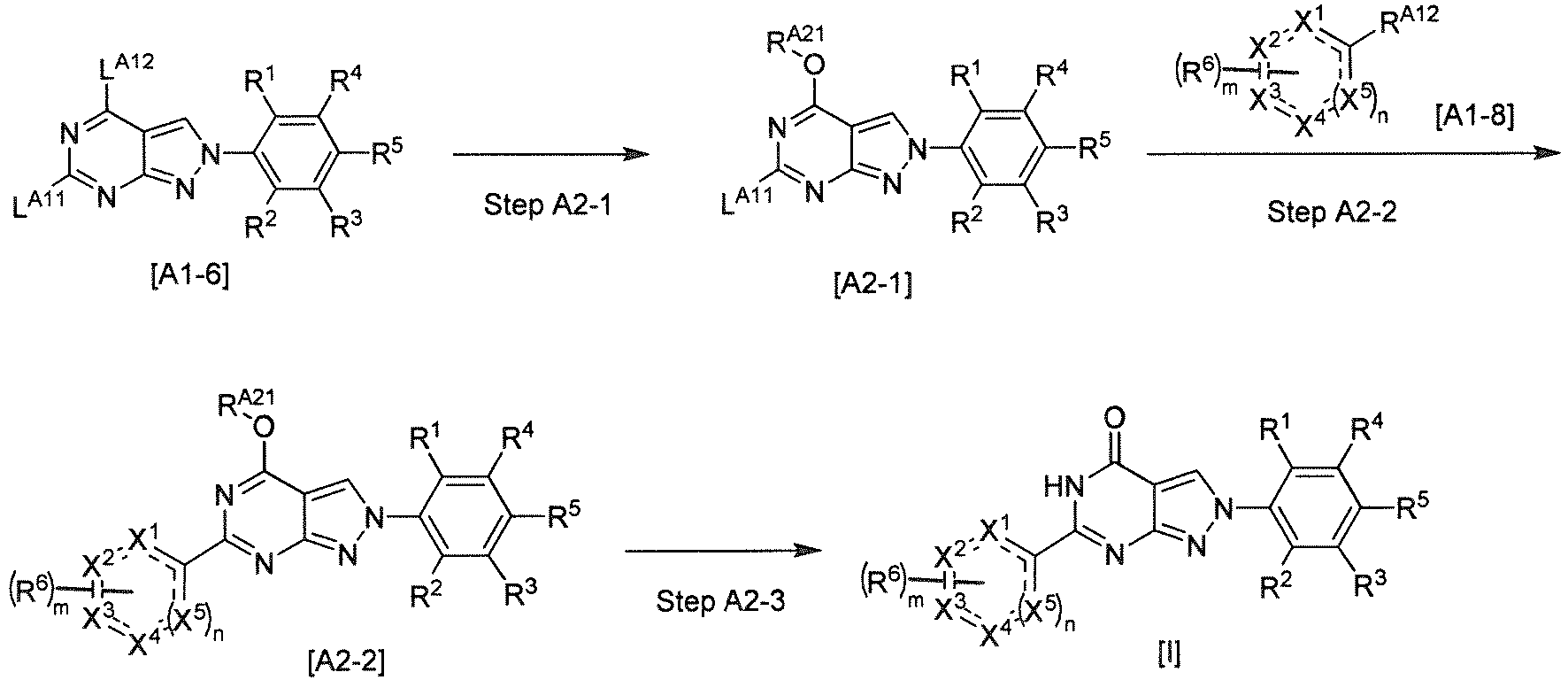
- In the scheme, R1, R2, R3, R4, R5, R6, X1, X2, X3, X4, X5, m, n, LA11, LA12, and RA12 are as defined above,
RA21 is a protecting group of hydroxy group (for example, benzyl, 4-methoxybenzyl, and 2-methoxybenzyl), and RA21 is preferably benzyl. - Compound [A2-1] or a salt thereof may be prepared by reacting Compound [A1-6] or a salt thereof in a solvent in the presence of an alcohol and a base.
- The alcohol includes, for example, benzyl alcohol, 4-methoxybenzyl alcohol, and 2-methoxybenzyl alcohol. The alcohol is preferably benzyl alcohol.
- The base includes, for example, sodium hydride, potassium tert-butoxide, and sodium tert-butoxide. The base is preferably sodium hydride.
- The solvent includes, for example, tetrahydrofuran, N,N-dimethylformamide, and a mixed solvent thereof. The solvent is preferably tetrahydrofuran.
- The reaction temperature ranges, for example, from - 20°C to 100°C, preferably from 0°C to 50°C.
- Compound [A2-2] or a salt thereof may be prepared by reacting Compound [A2-1] or a salt thereof with Compound [A1-8] or a salt thereof in a solvent in the presence of a catalyst and a base.
- The catalyst includes, for example, [1,1'-bis(di-phenylphosphino)ferrocene]palladium (II) dichloride dichloromethane adduct, tetrakis(triphenylphosphine)palladium (0), [1,1'-bis(di-tert-butylphosphino)ferrocene]palladium (II) dichloride, and bis(di-tert-butyl(4-dimethylaminophenyl)phosphine)dichloropalladium (II). The catalyst is preferably [1,1'-bis(di-tert-butylphosphino)ferrocene]palladium (II) dichloride or bis(di-tert-butyl(4-dimethylaminophenyl)phosphine)dichloropalladium (II).
- The base includes, for example, tripotassium phosphate, cesium carbonate, potassium carbonate, and lithium chloride. The base is preferably tripotassium phosphate or lithium chloride.
- When RA12 is, for example, boronic acid, boronic acid ester (such as boronic acid pinacol ester), or trifluoroborate, the solvent includes, for example, water, toluene, 1,2-dimethoxyethane, 1,4-dioxane, N,N-dimethylacetamide, and a mixed solvent thereof. The solvent is preferably a mixed solvent of toluene and water.
- When RA12 is, for example, tributyltin, the solvent includes, for example, toluene, N,N-dimethylacetamide, N,N-dimethylformamide, and dimethylsulfoxide. The solvent is preferably N,N-dimethylacetamide.
- The reaction temperature ranges, for example, from 10°C to 200°C, preferably from 50°C to 150°C.
- Compound [I] or a salt thereof may be prepared by reacting Compound [A2-2] or a salt thereof in the presence of an acid.
- The acid includes, for example, formic acid, trifluoroacetic acid, and hydrochloric acid. The acid is preferably formic acid.
- The reaction temperature ranges, for example, from 0°C to 120°C, preferably from 10°C to 100°C.
- Compound [IA] or a salt thereof may also be prepared by, for example, Preparation method A2A as follows.

- In the scheme, each symbol is as defined above.
- Compound [A2A-1] or a salt thereof may be prepared in accordance with Step A2-1 using Compound [A1A-6] or a salt thereof instead of Compound [A1-6] or a salt thereof.
- Compound [A2A-2] or a salt thereof may be prepared in accordance with Step A2-2 using Compound [A1A-8] or a salt thereof instead of Compound [A1-8] or a salt thereof.
- Compound [IA] or a salt thereof may be prepared by removing RA21 from Compound [A2A-2] or a salt thereof under a deprotection reaction. The deprotection reaction may be carried out under a suitable condition depending on RA21.
- For example, when RA21 is benzyl, Compound [IA] or a salt thereof may be prepared by reacting Compound [A2A-2] or a salt thereof in the presence of an acid. A solvent may be optionally added in the reaction.
- The acid includes, for example, formic acid, trifluoroacetic acid, and hydrochloric acid. The acid is preferably formic acid.
- The solvent includes, for example, toluene, tetrahydrofuran, and 1,4-dioxane.
- The reaction temperature ranges, for example, from 0°C to 120°C, preferably from 10°C to 100°C.
- Compound [I] or a salt thereof may also be prepared by, for example, Preparation method A3 as follows.

- In the scheme, R1, R2, R3, R4, R5, R6, X1, X2, X3, X4, X5, m, and n are as defined above,
- RA31 is C1-4 alkyl,
- RA32 is a protecting group of amino group (for example, tert-butoxycarbonyl), and
- RA33 is hydrogen or C1-4 alkyl.
- Compound [A3-3] or a salt thereof may be prepared by reacting Compound [A3-1] or a salt thereof with Compound [A3-2] or a salt thereof in a solvent in the presence of an oxidizing agent, acid, and additive.
- The oxidizing agent includes, for example, sodium nitrite, butyl nitrite, and isoamyl nitrite. The oxidizing agent is preferably sodium nitrite.
- The acid includes, for example, concentrated hydrochloric acid, concentrated sulfuric acid, and nitric acid. The acid is preferably concentrated hydrochloric acid.
- The additive includes, for example, sodium acetate, and potassium acetate. The additive is preferably sodium acetate.
- The solvent includes, for example, ethanol, methanol, butanol, water, and a mixed solvent thereof. The solvent is preferably a mixed solvent of ethanol and water.
- The reaction temperature ranges, for example, from - 40°C to 50°C, preferably from -10°C to 40°C.
- Compound [A3-1] or a salt thereof is commercially available, or may be prepared from commercially available products according to known methods.
- Compound [A3-2] or a salt thereof is commercially available, or may be prepared from commercially available products according to known methods.
- Compound [A3-5] or a salt thereof may be prepared by reacting Compound [A3-3] or a salt thereof with Compound [A3-4] in a solvent in the presence of a base.
- The base includes, for example, triethylamine, N,N-diisopropylethylamine, and 1,8-diazabicyclo[5,4,0]-7-undecene. The base is preferably triethylamine.
- The solvent includes, for example, chloroform, 1,2-dichloroethane, dichloromethane, and a mixed solvent thereof. The solvent is preferably chloroform.
- The reaction temperature ranges, for example, from 20°C to 120°C, preferably from 50°C to 100°C.
- Compound [A3-4] is commercially available.
- Compound [A3-6] or a salt thereof may be prepared by reacting Compound [A3-5] or a salt thereof in a solvent in the presence of a base.
- The base includes, for example, sodium hydroxide, potassium hydroxide, lithium hydroxide, and calcium hydroxide. The base is preferably sodium hydroxide.
- The solvent includes, for example, ethanol, methanol, butanol, tetrahydrofuran, water, and a mixed solvent thereof. The solvent is preferably a mixed solvent of ethanol and water.
- The reaction temperature ranges, for example, from 0°C to 100°C, preferably from 5°C to 50°C.
- Compound [A3-7] or a salt thereof may be prepared by reacting Compound [A3-6] or a salt thereof in a solvent in the presence of a reactant and a base.
- The reactant includes, for example, sodium azide and diphenylphosphoryl azide. The reactant is preferably diphenylphosphoryl azide.
- The base includes, for example, triethylamine, N,N-diisopropylethylamine, and 1,8-diazabicyclo[5,4,0]-7-undecene. The base is preferably triethylamine.
- The solvent includes, for example, tert-butanol, benzyl alcohol, tetrahydrofuran, and a mixed solvent thereof. The solvent is preferably tert-butanol.
- The reaction temperature ranges, for example, from 0°C to 150°C, preferably from 50°C to 120°C.
- Compound [A3-8] or a salt thereof may be prepared by reacting Compound [A3-7] or a salt thereof in a solvent in the presence of an oxidizing agent and a base.
- The oxidizing agent includes, for example, hydrogen peroxide solution, triiron tetraoxide, and manganese dioxide. The oxidizing agent is preferably hydrogen peroxide solution.
- The base includes, for example, sodium hydroxide, potassium hydroxide, and barium hydroxide. The base is preferably sodium hydroxide.
- The solvent includes, for example, ethanol, dimethylsulfoxide, water, and a mixed solvent thereof. The solvent is preferably a mixed solvent of ethanol, dimethylsulfoxide, and water.
- The reaction temperature ranges, for example, from - 20°C to 50°C, preferably from 10°C to 40°C.
- Compound [A3-9] or a salt thereof may be prepared by removing RA32 from Compound [A3-8] or a salt thereof under a deprotection reaction. The deprotection reaction may be carried out under a suitable condition depending on RA32.
- For example, when RA32 is tert-butoxycarbonyl, Compound [A3-9] or a salt thereof may be prepared by reacting Compound [A3-8] or a salt thereof in a solvent in the presence of an acid.
- The acid includes, for example, hydrogen chloride, trifluoroacetic acid, and sulfuric acid. The acid is preferably hydrogen chloride.
- The solvent includes, for example, ethyl acetate, cyclopentyl methyl ether, and a mixed solvent thereof. The solvent is preferably ethyl acetate.
- The reaction temperature ranges, for example, from 0°C to 80°C, preferably from 10°C to 50°C.
- Compound [A3-9] or a salt thereof may also be prepared by reversing the order of Steps A3-5 and A3-6.
- Compound [A3-11] or a salt thereof may be prepared by reacting Compound [A3-9] or a salt thereof with Compound [A3-10] or a salt thereof in a solvent in the presence of a condensing agent and a base.
- The condensing agent includes, for example, HATU, WSC, and propylphosphonic acid anhydride. The condensing agent is preferably HATU.
- The base includes, for example, sodium methoxide, triethylamine, N,N-diisopropylethylamine, potassium tert-butoxide, and 1,8-diazabicyclo[5,4,0]-7-undecene. The base is preferably N,N-diisopropylethylamine.
- The solvent includes, for example, methanol, N-methylpyrrolidone, N,N-dimethylacetamide, and a mixed solvent thereof. The solvent is preferably N-methylpyrrolidone.
- The reaction temperature ranges, for example, from 0°C to 120°C, preferably from 50°C to 100°C.
- Compound [A3-10] or a salt thereof is commercially available, or may be prepared from commercially available products according to known methods.
- Compound [I] or a salt thereof may be prepared by reacting Compound [A3-11] or a salt thereof in a solvent in the presence of a base.
- The base includes, for example, sodium methoxide, sodium tert-butoxide, and 1,8-diazabicyclo[5,4,0]-7-undecene. The base is preferably 1,8-diazabicyclo[5,4,0]-7-undecene.
- The solvent includes, for example, ethanol, methanol, butanol, water, and a mixed solvent thereof. The solvent is preferably a mixed solvent of ethanol and water.
- The reaction temperature ranges, for example, from 0°C to 180°C, preferably from 50°C to 150°C.
- The Preparation method may be carried out, instead of Compound [A3-1] or a salt thereof, with a compound, or a salt thereof, having on a benzene ring a functional group or a protected substituent that may be converted into various substituents by known reactions to give a compound corresponding to Compound [I], or a salt thereof, followed by conversion of the functional group or the protected substituent into the various substituents to give Compound [I] or a salt thereof. For example, the Preparation method may be carried out, instead of Compound [A3-1] or a salt thereof, with a compound, or a salt thereof, having an amino group and LA41, as mentioned below, on the benzene ring to give a compound corresponding to Compound [I], i.e., Compound [I-A], or a salt thereof, followed by conversion of LA41 into Ring CyA41 according to Preparation method A4 to give Compound [I-B] or a salt thereof.
- The Preparation method may be carried out, instead of Compound [A3-1] or a salt thereof, with a compound, or a salt thereof, having on a benzene ring a functional group or a protected substituent that may be converted into various substituents by known reactions to give a compound corresponding to Compound [A3-9], or a salt thereof, followed by conversion of the functional group or the protected substituent into the various substituents to give Compound [A3-9] or a salt thereof. For example, the Preparation method may be carried out, instead of Compound [A3-1] or a salt thereof, with a compound, or a salt thereof, having an amino group and LA41, as mentioned below, on the benzene ring to give a compound corresponding to Compound [A3-9], i.e., Compound [A3-9-A], or a salt thereof, followed by conversion of LA41 into Ring CyA41 according to Preparation method A5 to give Compound [A3-9-B] or a salt thereof.
- Compound [IA] or a salt thereof may also be prepared by, for example, Preparation method A3A as follows.

- In the scheme, R1, R2, R3A, R4A, R5A, R6A, RA31, RA33, X1, X2, X3, X4, X5, m, and n are as defined above, and
RA32A is a protecting group of hydrogen or amino group (for example, tert-butoxycarbonyl). - Compound [A3A-3] or a salt thereof may be prepared in accordance with Step A3-1 using Compound [A3A-1] or a salt thereof instead of Compound [A3-1] or a salt thereof.
- Compound [A3A-1] or a salt thereof is commercially available, or may be prepared from commercially available products according to known methods.
- Compound [A3A-5] or a salt thereof may be prepared in accordance with Step A3-2 using Compound [A3A-3] or a salt thereof instead of Compound [A3-3] or a salt thereof.
- Compound [A3A-6] or a salt thereof may be prepared in accordance with Step A3-3 using Compound [A3A-5] or a salt thereof instead of Compound [A3-5] or a salt thereof.
- Compound [A3A-7] or a salt thereof may be prepared in accordance with Step A3-4 using Compound [A3A-6] or a salt thereof instead of Compound [A3-6] or a salt thereof.
- Compound [A3A-8] or a salt thereof may be prepared in accordance with Step A3-5 using Compound [A3A-7] or a salt thereof instead of Compound [A3-7] or a salt thereof.
- Compound [A3A-9] or a salt thereof may be prepared by removing RA32A from Compound [A3A-8] or a salt thereof under a deprotection reaction. The deprotection reaction may be carried out under a suitable condition depending on RA32A.
- For example, when RA32A is tert-butoxycarbonyl, Compound [A3A-9] or a salt thereof may be prepared by reacting Compound [A3A-8] or a salt thereof in a solvent in the presence of an acid.
- The acid includes, for example, hydrogen chloride, trifluoroacetic acid, and sulfuric acid. The acid is preferably hydrogen chloride.
- The solvent includes, for example, ethyl acetate, cyclopentyl methyl ether, and a mixed solvent thereof. The solvent is preferably ethyl acetate.
- The reaction temperature ranges, for example, from 0°C to 80°C, preferably from 10°C to 50°C.
- Compound [A3A-9] or a salt thereof may also be prepared by performing Step A3A-6 for Compound [A3A-7] or a salt thereof, followed by the reaction of Step A3A-5.
- Compound [A3A-11] or a salt thereof may be prepared in accordance with Step A3-7 using Compound [A3A-9] or a salt thereof instead of Compound [A3-9] or a salt thereof, and Compound [A3A-10] or a salt thereof instead of Compound [A3-10] or a salt thereof.
- Compound [A3A-10] or a salt thereof is commercially available, or may be prepared from commercially available products according to known methods.
- Compound [IA] or a salt thereof may be prepared in accordance with Step A3-8 using Compound [A3A-11] or a salt thereof instead of Compound [A3-11] or a salt thereof.
- The Preparation method may be carried out, instead of Compound [A3A-1] or a salt thereof, with a compound, or a salt thereof, having on a benzene ring a functional group or a protected substituent that may be converted into various substituents by known reactions to give a compound corresponding to Compound [IA], or a salt thereof, followed by conversion of the functional group or the protected substituent into the various substituents to give Compound [IA] or a salt thereof. For example, the Preparation method may be carried out, instead of Compound [A3A-1] or a salt thereof, with a compound, or a salt thereof, having an amino group and LA41, as mentioned below, on the benzene ring to give a compound corresponding to Compound [IA], i.e., Compound [IA-A], or a salt thereof, followed by conversion of LA41 into Ring CyA41A according to Preparation method A4A to give Compound [IA-B] or a salt thereof.
- The Preparation method may be carried out, instead of Compound [A3A-1] or a salt thereof, with a compound, or a salt thereof, having on a benzene ring a functional group or a protected substituent that may be converted into various substituents by known reactions to give a compound corresponding to Compound [A3A-8], or a salt thereof, followed by conversion of the functional group or the protected substituent into the various substituents to give Compound [A3A-8] or a salt thereof. For example, the Preparation method may be carried out, instead of Compound [A3A-1] or a salt thereof, with a compound, or a salt thereof, having an amino group and LA41, as mentioned below, on the benzene ring to give a compound corresponding to Compound [A3A-8], i.e., Compound [A3A-8-A], or a salt thereof, followed by conversion of LA41 into Ring CyA41A according to Preparation method A5A to give Compound [A3A-8-B] or a salt thereof.
- Compound [I-B] or a salt thereof may be prepared by, for example, Preparation method A4 as follows.

- In the scheme, R6, X1, X2, X3, X4, X5, m, and n are as defined above,
- CyA41 is C3-6 cycloalkyl, wherein the cycloalkyl may be optionally substituted with 1 to 3 halogen or C1-4 haloalkyl, and
- LA41 is a leaving group (for example, halogen, methanesulfonyloxy, and trifluoromethanesulfonyloxy), provided that the leaving group is attached to ortho- or para-position of the benzene ring.
- Compound [I-B] or a salt thereof may be prepared by reacting Compound [I-A] or a salt thereof with Compound [A4-1] or a derivative thereof (for example, cyclopropylboronic acid pinacol ester and potassium cyclopropyltrifluoroborate) in a solvent in the presence of a catalyst and a base.
- The catalyst includes, for example, [1,1'-bis(diphenylphosphino)ferrocene]palladium (II) dichloride dichloromethane adduct, tetrakis(triphenylphosphine)palladium (0), and [1,1'-bis(di-tert-butylphosphino)ferrocene]palladium (II) dichloride. The catalyst is preferably [1,1'-bis(di-tert-butylphosphino)ferrocene]palladium (II) dichloride.
- The base includes, for example, tripotassium phosphate, cesium carbonate, and potassium carbonate. The base is preferably tripotassium phosphate.
- The solvent includes, for example, water, toluene, 1,2-dimethoxyethane, 1,4-dioxane, and a mixed solvent thereof. The solvent is preferably a mixed solvent of toluene and water.
- The reaction temperature ranges, for example, from 10°C to 200°C, preferably from 50°C to 150°C.
- Compound [I-A] or a salt thereof may be prepared from commercially available products according to known methods. Compound [I-A] or a salt thereof may be prepared by, for example, the above-mentioned Preparation methods.
- Compound [A4-1] or a derivative thereof is commercially available, or may be prepared from commercially available products according to known methods.
- Compound [IA-B] or a salt thereof may be prepared in accordance with Preparation method A4 using Compound [IA-A] or a salt thereof instead of Compound [I-A] or a salt thereof, and Compound [A4A-1] or a salt thereof instead of Compound [A4-1] or a salt thereof.

- In the scheme, R6A, LA41, X1, X2, X3, X4, X5, m, and n are as defined above, and
- CyA41A is C3-6 cycloalkyl, wherein the cycloalkyl may be optionally substituted with 1 to 3 substituents independently selected from the group consisting of:
- (a) hydroxy,
- (b) halogen, and
- (c) C1-4 haloalkyl.
- Compound [IA-A] or a salt thereof may be prepared from commercially available products according to known methods. Compound [IA-A] or a salt thereof may be prepared by, for example, the above-mentioned Preparation methods.
- Compound [A4A-1] or a derivative thereof is commercially available, or may be prepared from commercially available products according to known methods.
- Compound [A3-9-B] or a salt thereof may be prepared by, for example, Preparation method A5 as follows.

- In the scheme, each symbol is as defined above.
- Compound [A3-9-B] or a salt thereof may be prepared by reacting Compound [A3-9-A] or a salt thereof with Compound [A4-1] or a derivative thereof (for example, cyclopropylboronic acid pinacol ester and potassium cyclopropyltrifluoroborate) in a solvent in the presence of a catalyst and a base.
- The catalyst includes, for example, [1,1'-bis(di-phenylphosphino)ferrocene]palladium (II) dichloride dichloromethane adduct, tetrakis(triphenylphosphine)palladium (0), and [1,1'-bis(di-tert-butylphosphino)ferrocene]palladium (II) dichloride. The catalyst is preferably [1,1'-bis(di-tert-butylphosphino)ferrocene]palladium (II) dichloride.
- The base includes, for example, tripotassium phosphate, cesium carbonate, and potassium carbonate. The base is preferably tripotassium phosphate.
- The solvent includes, for example, water, toluene, 1,2-dimethoxyethane, 1,4-dioxane, and a mixed solvent thereof. The solvent is preferably a mixed solvent of toluene and water.
- The reaction temperature ranges, for example, from 10°C to 200°C, preferably from 50°C to 150°C.
- Compound [A3-9-A] or a salt thereof may be prepared from commercially available products according to known methods. Compound [A3-9-A] or a salt thereof may be prepared by, for example, the above-mentioned Preparation methods.
- Compound [A3A-8-B] or a salt thereof may be prepared by, for example, Preparation method A5A as follows.

- In the scheme, each symbol is as defined above.
- Compound [A3A-8-B] or a salt thereof may be prepared by reacting Compound [A3A-8-A] or a salt thereof with Compound [A4A-1] or a derivative thereof (for example, cyclopropylboronic acid pinacol ester and potassium cyclopropyltrifluoroborate) in a solvent in the presence of a catalyst and a base.
- The catalyst includes, for example, [1,1'-bis(di-phenylphosphino)ferrocene]palladium (II) dichloride dichloromethane adduct, tetrakis(triphenylphosphine)palladium (0), and [1,1'-bis(di-tert-butylphosphino)ferrocene]palladium (II) dichloride. The catalyst is preferably [1,1'-bis(di-tert-butylphosphino)ferrocene]palladium (II) dichloride.
- The base includes, for example, tripotassium phosphate, cesium carbonate, and potassium carbonate. The base is preferably tripotassium phosphate.
- The solvent includes, for example, water, toluene, 1,2-dimethoxyethane, 1,4-dioxane, and a mixed solvent thereof. The solvent is preferably a mixed solvent of toluene and water.
- The reaction temperature ranges, for example, from 10°C to 200°C, preferably from 50°C to 150°C.
- Compound [A3A-8-A] or a salt thereof may be prepared from commercially available products according to known methods. Compound [A3A-8-A] or a salt thereof may be prepared by, for example, the above-mentioned Preparation methods.
- Compound [IA] or a salt thereof may be prepared by, for example, Preparation method A6 as follows.

- In the scheme, R1, R2, R3A, R4A, R5A, R6A, X1, X2, X3, X4, X5, m, and n are as defined above,
- RA61 is hydrogen, or a protecting group of amino group (for example, trimethylsilyl),
- RA62 and RA63 are each independently C1-4 alkyl, and
- LA61 and LA62 are each independently a leaving group (for example, halogen, methanesulfonyloxy, and p-toluenesulfonyloxy).
- Compound [A6-2] or a salt thereof may be prepared by reacting Compound [A6-1] or a salt thereof in a solvent in the presence of a reactant. An acid may be optionally added in the reaction.
- The reactant includes lithium bis(trimethylsilyl)amide, ammonia, and ammonium chloride. The reactant is preferably lithium bis(trimethylsilyl)amide.
- The acid includes, for example, hydrogen chloride, sulfuric acid.
- The solvent includes, for example, methanol, tetrahydrofuran, 1,4-dioxane, and a mixed solvent thereof. The solvent is preferably tetrahydrofuran.
- The reaction temperature ranges, for example, from - 78°C to 40°C, preferably -10°C to 10°C.
- Compound [A6-1] or a salt thereof is commercially available, or may be prepared from commercially available products according to known methods.
- Compound [A6-4] or a salt thereof may be prepared by reacting Compound [A6-2] or a salt thereof with Compound [A6-3] or a salt thereof in a solvent.
- The solvent includes, for example, methanol, ethanol, isopropanol, tetrahydrofuran, and a mixed solvent thereof. The solvent is preferably a mixed solvent of tetrahydrofuran and methanol.
- The reaction temperature ranges, for example, from room temperature to 120°C, preferably from 60°C to 100°C.
- Compound [A6-3] or a salt thereof is commercially available, or may be prepared from commercially available products according to known methods.
- Compound [A6-5] or a salt thereof may be prepared by reacting Compound [A6-4] or a salt thereof in a solvent in the presence of the Vilsmeier reagent, followed by addition of phosphorus oxychloride and heating; the reaction temperature is, for example, 80°C.
- The solvent includes, for example, N,N-dimethylformamide, toluene, benzene, and a mixed solvent thereof. The solvent is preferably a mixed solvent of N,N-dimethylformamide and toluene.
- The reaction temperature ranges, for example, from - 20°C to 100°C, preferably from -10°C to 90°C.
- The Vilsmeier reagent is prepared from, for example, phosphorus oxychloride and N,N-dimethylformamide.
- Compound [A6-7] or a salt thereof may be prepared by reacting Compound [A6-5] or a salt thereof with Compound [A6-6] or a salt thereof in a solvent in the presence of a base.
- The base includes, for example, triethylamine, N,N-diisopropylethylamine, and 1,8-diazabicyclo[5,4,0]-7-undecene. The base is preferably triethylamine.
- The solvent includes, for example, methanol, ethanol, tetrahydrofuran, toluene, cyclopentyl methyl ether, acetonitrile, water, and a mixed solvent thereof. The solvent is preferably a mixed solvent of tetrahydrofuran and water.
- The reaction temperature ranges, for example, from - 20°C to 80°C, preferably from 0°C to room temperature.
- Compound [A6-6] or a salt thereof is commercially available, or may be prepared from commercially available products according to known methods.
- Compound [IA] or a salt thereof may be prepared by reacting Compound [A6-7] or a salt thereof in a solvent in the presence of an acid.
- The acid includes, for example, formic acid, trifluoroacetic acid, and hydrochloric acid. The acid is preferably trifluoroacetic acid.
- The solvent includes, for example, water, acetonitrile, tetrahydrofuran, and a mixed solvent thereof. The solvent is preferably a mixed solvent of acetonitrile and water.
- The reaction temperature ranges, for example, from 0°C to 100°C, preferably 50°C to 70°C.
- The Preparation method may be carried out, instead of Compound [A6-6] or a salt thereof, with a compound, or a salt thereof, having on a benzene ring a functional group or a protected substituent that may be converted into various substituents by known reactions to give a compound corresponding to Compound [IA], or a salt thereof, followed by conversion of the functional group or the protected substituent into the various substituents to give Compound [IA] or a salt thereof. For example, the Preparation method may be carried out, instead of Compound [A6-6] or a salt thereof, with a hydrazine compound, or a salt thereof, that is substituted with a phenyl group having LA41 to give a compound corresponding to Compound [IA], i.e., Compound [IA-A], or a salt thereof, followed by conversion of LA41 into Ring CyA41A according to Preparation method A4A to give Compound [IA-B] or a salt thereof.
- Preparation methods of a compound of formula [I], or a pharmaceutically acceptable salt thereof, or a compound of formula [IA], or a pharmaceutically acceptable salt thereof, are described specifically in the following Preparation examples. However, preparation methods of a compound of formula [I], or a pharmaceutically acceptable salt thereof, or a compound of formula [IA], or a pharmaceutically acceptable salt thereof, are not intended to be limited thereto.
- % refers to weight %, unless otherwise specified. The ratio recited in a mixed solvent refers to a volume ratio, unless otherwise specified.
- NMRs were determined at 400 MHz.
-
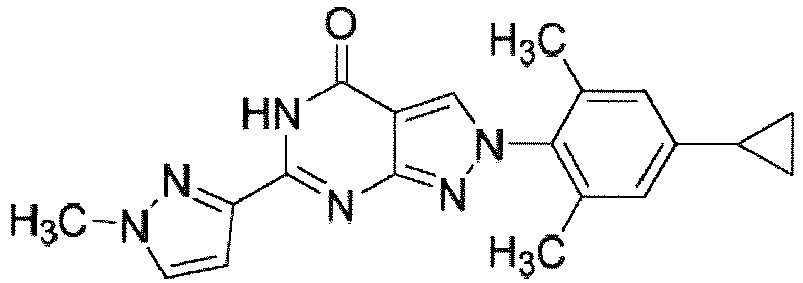
-

- Under a nitrogen atmosphere, to a mixture of (4-bromo-2,6-dimethylphenyl)hydrazine hydrochloride (147 g) and tetrahydrofuran (1000 mL) were added N,N-diisopropylethylamine (224 mL) and benzyl chloroformate (83 mL) at 0°C, and the mixture was stirred at room temperature for 40 minutes. Toluene (441 mL) and water (441 mL) were added to the reaction mixture, which was then stirred at room temperature for 20 minutes. After separation, the resulted organic layer was dried over anhydrous sodium sulfate, and about 1 L of the solvent was removed under reduced pressure. To the residue was added hexane (294 mL), and the mixture was stirred for 1 hour. Then, thereto was added hexane (294 mL), and the mixture was stirred for 15 minutes. The resulted solid was collected by filtration, and then washed with a mixed solution of hexane/toluene (v/v = 2/1) to give a titled compound (179 g).
1H-NMR (CDCl3) δ: 7.32 (5H, br s), 7.09 (2H, s), 6.52 (1H, br s), 5.67 (1H, br s), 5.06 (2H, s), 2.33 (6H, br s). -

- Under an argon atmosphere, tripotassium phosphate (190 g) was dissolved in water (357 mL), and then thereto were added toluene (715 mL), benzyl 2-(4-bromo-2,6-dimethylphenyl)hydrazine-1-carboxylate (89.3 g), cyclopropylboronic acid (61.7 g), and [1,1'-bis(di-phenylphosphino)ferrocene]palladium (II) dichloride dichloromethane adduct (4.18 g), and the mixture was stirred at 105°C for 4 hours. The reaction mixture was let cool to room temperature, followed by separation after addition of 6 M hydrochloric acid (298 mL). The resulted organic layer was dried over anhydrous magnesium sulfate, and then the solvent was removed under reduced pressure. To the residue was added hexane (450 mL), and the mixture was stirred. Then, the resulted solid was collected by filtration to give the titled compound (64.2 g).
1H-NMR (CDCl3) δ: 7.31 (5H, br s), 6.68 (2H, s), 6.48 (1H, br s), 5.65 (1H, br s), 5.06 (2H, s), 2.32 (6H, br s), 1.80-1.73 (1H, m), 0.87-0.84 (2H, m), 0.61-0.59 (2H, m). -

- Under a nitrogen atmosphere, to a mixture of benzyl 2-(4-cyclopropyl-2,6-dimethylphenyl)hydrazine-1-carboxylate (133 g) that was synthesized in accordance with Step 1-2 and ethanol (798 mL) was added 4 M aqueous sodium hydroxide solution (536 mL), and the mixture was stirred at 80°C for 3 hours. The reaction mixture was ice-cooled, and thereto was added. Then, the mixture was extracted with toluene (1 L) after addition of acetic acid (73.6 mL). The resulted organic layer was dried over anhydrous magnesium sulfate, and then was concentrated until the volume of solution became about 1/4. Toluene (500 mL) was added to the resulted mixture, and a 4 M solution of hydrogen chloride in dioxane (102 mL) was added slowly to the mixture with stirring under ice cooling. Hexane (50 mL) was added to the mixture, and the mixture was stirred at room temperature for 10 minutes. Then, the resulted solid was collected by filtration and washed with hexane to give the titled compound (83 g).
1H-NMR (DMSO-d6) δ: 9.50 (3H, br s), 6.79 (2H, s), 6.66 (1H, br s), 2.33 (6H, s), 1.83-1.81 (1H, m), 0.97-0.84 (2H, m), 0.65-0.62 (2H, m). -

- Under a nitrogen atmosphere, to a mixture of 2,4,6-trichloropyrimidine-5-carbaldehyde (250 g) and toluene (1.5 L) were added trimethyl orthoformate (750 mL) and sulfuric acid (1.6 mL), and the mixture was stirred at room temperature for 1.5 hours. To the reaction mixture was added basic silica gel (Fuji Silysia, 500 g), and the mixture was stirred for 2 hours. Then, the added silica gel was removed by filtration. The silica gel was washed with ethyl acetate (1.0 L), and then the solvent was removed under reduced pressure to give the titled compound (268 g).
1H-NMR (CDCl3) δ: 5.70 (1H, s), 3.50 (6H, s). -

- Under a nitrogen atmosphere, to a mixture of 2,4,6-trichloro-5-(dimethoxymethyl)pyrimidine (94 g) and toluene (1160 mL) were added (4-cyclopropyl-2,6-dimethylphenyl)hydrazine hydrochloride (83 g) and triethylamine (102 mL) under ice cooling, and the mixture was stirred at the same temperature for 40 minutes. To the reaction mixture was added dropwise and slowly trifluoroacetic acid (98 mL), and the mixture was stirred at room temperature for 2 hours. Under an ice bath, the reaction mixture was added dropwise and slowly to an aqueous solution (776 mL) of tripotassium phosphate (310 g), and then the mixture was stirred at room temperature for 10 minutes. After separation, the resulted aqueous layer was extracted with toluene. All organic layers were collected and dried over anhydrous magnesium sulfate, and then the solvent was removed under reduced pressure to give a crude product (162 g) of the titled compound.
1H-NMR (CDCl3) δ: 8.17 (1H, s), 6.89 (2H, s), 1.98 (6H, s), 1.94-1.87 (1H, m), 1.07-1.01 (2H, m), 0.77-0.72 (2H, m). -

- Under a nitrogen atmosphere, to a mixture of a crude product (162 g) of 4,6-dichloro-2-(4-cyclopropyl-2,6-dimethylphenyl)-2H-pyrazolo[3,4-d]pyrimidine and tetrahydrofuran (970 mL) was added 2M aqueous sodium hydroxide solution (913 mL), and the mixture was stirred at 75°C for 3 hours. The reaction mixture was ice-cooled, and then thereto was added 6 M hydrochloric acid (243 mL). To the reaction mixture was added ethyl acetate, and after separation, the resulted aqueous layere was extracted with ethyl acetate. All organic layers were collected and dried over anhydrous magnesium sulfate, and then the solvent was removed under reduced pressure. To the resulted solid was added ethyl acetate, and the mixture was stirred at room temperature for 10 minutes. Then, the resulted solid was collected by filtration and washed with ethyl acetate. The resulted solid was dried under reduced pressure to give the titled compound (74 g).
1H-NMR (DMSO-D6) δ: 12.89 (1H, br s), 8.80 (1H, s), 7.00 (2H, s), 2.03-1.95 (7H, m), 1.03-1.01 (2H, m), 0.78-0.76 (2H, m). -

- Under an argon atmosphere, tripotassium phosphate (148 g) was dissolved in water (510 mL), and then thereto were added toluene (880 mL), 6-chloro-2-(4-cyclopropyl-2,6-dimethylphenyl)-2,5-dihydro-4H-pyrazolo[3,4-d]pyrimidin-4-one (73 g), 1-methyl-3-(4,4,5,5-tetramethyl-1,3,2-dioxaborolan-2-yl)-1H-pyrazole (57.9 g), and [1,1'-bis(di-phenylphosphino)ferrocene]palladium (II) dichloride dichloromethane adduct (4.73 g). The reaction mixture was stirred at 110°C for 3 hours, and then let cool to 60°C. Thereto was added tetrahydrofuran (290 mL), and the mixture was cooled to 15°C with an ice bath. Then, thereto was added dropwise and slowly 6 M hydrochloric acid (193 mL), and the mixture was stirred for 20 minutes. To the reaction mixture was added tetrahydrofuran (150 mL), and then the mixture was extracted with ethyl acetate. The resulted organic layer was dried over anhydrous magnesium sulfate, and then the solvent was removed under reduced pressure. To the residue were added toluene (500 mL) and ethyl acetate (500 mL), and the mixture was stirred at room temperature for 30 minutes. Then, the resulted solid was collected by filtration and washed with toluene. The resulted solid was dissolved in tetrahydrofuran (800 mL), and then thereto was added ISOLUTE Si-TMT (metal scavenging-silica gel, manufactured by Biotage, 0.47 mmol TMT/g, 49 g). The mixture was stirred at room temperature for 2 hours. The added ISOLUTE Si-TMT was removed by filtration and washed with ethyl acetate (700 mL). To the resulted solution were added silica gel (70 g) and basic silica gel (Fuji Silysia, 70 g), and the mixture was stirred at room temperature for 3 hours. The added silica gel was removed by filtration and washed sequentially with a mixed solution (v/v = 1/1, 300 mL) of ethyl acetate/tetrahydrofuran and ethyl acetate (700 mL), and then the solvent was removed under reduced pressure.
- To the resulted solid was added acetone (180 mL), and then the mixture was stirred under ice cooling for 30 minutes. The resulted solid was collected by filtration, washed with cooled acetone (180 mL), and then dried under reduced pressure to give a crystal of the titled compound (Form α, 49.7 g).
- 1H-NMR (DMSO-D6) δ: 11.21 (1H, s), 8.70 (1H, s), 7.90 (1H, d, J = 2.3 Hz), 6.97 (2H, s), 6.96 (1H, d, J = 2.3 Hz), 3.98 (3H, s), 1.96-1.94 (7H, m), 1.01-0.97 (2H, m), 0.75-0.73 (2H, m) .
- LC-MS(MH+): 361.
-

- A crystal of 2-(4-cyclopropyl-2,6-dimethylphenyl)-6-(1-methyl-1H-pyrazol-3-yl)-2,5-dihydro-4H-pyrazolo[3,4-d]pyrimidin-4-one (Form α, 16.0 g) was dissolved in methanol (100 mL) at 80°C under heating. At the same temperature, water (100 mL) was added thereto, and then the mixture was stirred for 1 hour. Then, water (200 mL) was further added thereto. The mixture was let cool to room temperature and stirred for additional 2 hours. The resulted solid was collected by filtration, and then dried under reduced pressure to give a crystal of the titled compound (Form β, 16.2 g).
- 1H-NMR (DMSO-d6) δ: 11.19 (1H, s), 8.69 (1H, s), 7.90 (1H, d, J = 2.3 Hz), 6.97 (2H, s), 6.95 (1H, d, J = 2.3 Hz), 3.97 (3H, s), 1.98-1.91 (7H, m), 1.00-0.98 (2H, m), 0.76-0.72 (2H, m).
- LC-MS(MH+): 361
-

-

- Under an argon atmosphere, to a mixture of 2,5-dibromo-1,3-dimethylbenzene (11.6 g) and tetrahydrofuran (170 mL) was added dropwise and slowly a solution of n-butyllithium in n-hexane (1.59 M, 25.2 mL) at -78°C, and then the mixture was stirred at the same temperature for 20 minutes. To the reaction mixture was added N-methoxy-N-methylacetamide (5.61 mL), and then the mixure was stirred at the same temperature for 1 hour. To the reaction mixture was added aqueous saturated ammonium chloride solution, and then the mixture was extracted with ethyl acetate. The resulted organic layer was washed with brine and dried over anhydrous magnesium sulfate, and then the solvent was removed under reduced pressure. The residue was purified by column chromatography (Developing solvent: hexane/ethyl acetate) to give the titled compound (5.79 g).
1H-NMR (CDCl3) δ: 7.64 (2H, s), 2.57 (3H, s), 2.47 (6H, s). -

- Under an argon atmosphere, to 1-(4-bromo-3,5-dimethylphenyl)ethan-1-one (5.0 g) were added a 50% solution of bis(2-methoxyethyl)aminosulfur trifluoride in tetrahydrofuran (48.7 mL) and methanol (0.089 mL) at 0°C, and the mixture was stirred at 80°C for 7 hours. The reaction mixture was added dropwise to aqueous saturated sodium hydrogen carbonate solution and then extracted with ethyl acetate. The resulted organic layer was washed with brine and dried over anhydrous magnesium sulfate, and then the solvent was removed under reduced pressure. The residue was purified by column chromatography (Developing solvent: hexane/ethyl acetate) to give the titled compound (3.58 g). 1H-NMR (CDCl3) δ: 7.20 (2H, s), 2.44 (6H, s), 1.88 (3H, t, J = 18.1 Hz).
-

- Under an argon atmosphere, to a mixture of 2-bromo-5-(1,1-difluoroethyl)-1,3-dimethylbenzene (3.58 g) and tetrahydrofuran (72 mL) was added a solution of n-butyllithium in n-hexane (1.56 M, 11 mL) at -78°C, and the mixture was stirred at the same temperature for 30 minutes. To the reaction mixture was added di-tert-butyl azodicarboxylate (4.96 g), and then the mixture was stirred for additional 30 minutes. To the reaction mixture was added aqueous saturated ammonium chloride solution, and then the mixture was extracted with ethyl acetate. The resulted organic layer was washed with brine and dried over anhydrous magnesium sulfate, and then the solvent was removed under reduced pressure. The residue was purified by column chromatography (Developing solvent: hexane/ethyl acetate) to give the titled compound (3.38 g).
1H-NMR (CDCl3) δ: 7.19-7.18 (2H, m), 6.60 (1H, br s), 2.38 (6H, s), 1.94-1.82 (3H, m), 1.55-1.37 (18H, m). -

- To di-tert-butyl 1-{4-(1,1-difluoroethyl)-2,6-dimethylphenyl}hydrazine-1,2-dicarboxylate (3.38 g) was added a 4 M solution of hydrogen chloride in ethyl acetate (34 mL), and the mixture was stirred at room temperature for 1.5 hours. The solvent was removed under reduced pressure to give the titled compound (2.0 g).
1H-NMR (DMSO-D6) δ: 9.61 (3H, br s), 7.29 (2H, s), 6.85 (1H, br s), 2.42 (6H, s), 1.93 (3H, t, J = 18.8 Hz). -

- Under an argon atmosphere, to a mixture of {4- (1, 1-difluoroethyl)-2,6-dimethylphenyl}hydrazine hydrochloride (2.0 g), triethylamine (3.53 mL), and methanol (40 mL) was added at 0°C 2,4,6-trichloro-5-(dimethoxymethyl)pyrimidine (2.18 g) which was synthesized in accordance with Preparation example 1 Step 1-4. The mixture was stirred at room temperature for 1 hour, and then the solvent was removed under reduced pressure. Ethyl acetate was added thereto. The resulted solid was removed by filtration, and then the solvent was removed under reduced pressure to give a crude product of the titled compound (3.56 g).
LC-MS (MH+): 421. -

- Under an argon atmosphere, to a mixture of a crude product of 2,4-dichloro-6-[2-{4-(1,1-difluoroethyl)-2,6-dimethylphenyl}hydrazinyl]-5-(dimethoxymethyl)pyrimidine (3.56 g) and toluene (36 mL) was added dropwise and slowly trifluoroacetic acid (1.62 mL), and then the mixture was stirred at room temperature for 1 hour. The reaction mixture was added dropwise and slowly to 2 M aqueous tripotassium phosphate solution and then extracted with ethyl acetate. The resulted organic layer was washed with brine and dried over anhydrous magnesium sulfate, and then the solvent was removed under reduced pressure. The residue was purified by column chromatography (Developing solvent: hexane/ethyl acetate) to give the titled compound (1.89 g).
LC-MS (MH+): 357. -

- To a mixture of 4,6-dichloro-2-{4-(1,1-difluoroethyl)-2,6-dimethylphenyl}-2H-pyrazolo[3,4-d]pyrimidine (1.89 g) and tetrahydrofuran (19 mL) was added 2M aqueous sodium hydroxide solution (5.29 mL), and the mixture was stirred at room temperature for 2 hours. The reaction mixture was neutralized with 2 M hydrochloric acid and then extracted with ethyl acetate. The resulted organic layer was washed with brine and dried over anhydrous magnesium sulfate, and then the solvent was removed under reduced pressure. The residue was purified by column chromatography (Developing solvent: hexane/ethyl acetate), and then the resulted solid was stirred in a mixed solution of ethyl acetate/diisopropyl ether. The resulted solid was collected by filtration, and then dried under reduced pressure to give the titled compound (1.03 g).
1H-NMR (DMSO-D6) δ: 12.90 (1H, br s), 8.85 (1H, s), 7.49 (2H, s), 2.03-1.98 (9H, m). -

- Under an argon atmosphere, to a mixture of 6-chloro-2-{4-(1,1-difluoroethyl)-2,6-dimethylphenyl}-2,5-dihydro-4H-pyrazolo[3,4-d]pyrimidin-4-one (1.03 g) and toluene/water (v/v = 5/1, 12.9 mL) were added 1-methyl-3-(4,4,5,5-tetramethyl-1,3,2-dioxaborolan-2-yl)-1H-pyrazole (0.949 g), [1,1'-bis(di-phenylphosphino)ferrocene]palladium (II) dichloride dichloromethane adduct (0.198 g), and tripotassium phosphate (1.94 g), and the mixture was stirred at 105°C for 2 hours. The reaction mixture was let cool to room temperature, and 2M hydrochloric acid was added dropwise and slowly thereto. Then, the reaction mixture was extracted with ethyl acetate. The resulted organic layer was washed with brine and dried over anhydrous magnesium sulfate, and then the solvent was removed under reduced pressure.
- The residue was dissolved in a mixed solution of tetrahydrofuran/ethyl acetate, and then thereto was added ISOLUTE Si-TMT (metal scavenging-silica gel, manufactured by Biotage, 0.47 mmol TMT/g, 3 g). Then, the mixture was stirred at room temperature for 1 hour. The added ISOLUTE Si-TMT was removed by filtration and washed with ethyl acetate, and then the solvent was removed under reduced pressure. The residue was purified by column chromatography (Developing solvent: hexane/ethyl acetate). The resulted solid was stirred in a mixed solution of ethyl acetate/diisopropyl ether, and then the resulted solid was collected by filtration to give the titled compound (1.02 g).
- 1H-NMR (DMSO-D6) δ: 11.28 (1H, s), 8.80 (1H, s), 7.90 (1H, d, J = 2.2 Hz), 7.50 (2H, s), 6.96 (1H, d, J = 2.2 Hz), 3.98 (3H, s), 2.05-1.98 (9H, m).
- LC-MS (MH+) : 385.
-

-

- Under a nitrogen atmosphere, to a mixture of (4-bromo-2,6-dimethylphenyl)hydrazine hydrochloride (150 g) and tetrahydrofuran (1.0 L) were added N,N-diisopropylethylamine (220 mL) and benzyl chloroformate (82 mL) at 0°C, and the mixture was stirred at room temperature for 1 hour. To the reaction mixture were added toluene (500 mL) and water (500 mL), and the mixture was stirred at room temperature for 20 minutes. After separation, the resulted organic layer was dried over anhydrous sodium sulfate and anhydrous magnesium sulfate, and the solvent was removed under reduced pressure. To the residue were added toluene (200 mL) and hexane (600 mL), and the mixture was stirred. Then, the resulted solid was collected by filtration to give the titled compound (180 g).
1H-NMR (CDCl3) δ: 7.32 (5H, br s), 7.09 (2H, s), 6.52 (1H, br s), 5.67 (1H, br s), 5.06 (2H, s), 2.33 (6H, br s). -

- Under a nitrogen atmosphere, tripotassium phosphate (380 g) was dissolved in water (710 mL), and then thereto were added toluene (1400 mL), benzyl 2-(4-bromo-2,6-dimethylphenyl)hydrazine-1-carboxylate (180 g), cyclopropylboronic acid (110 g), and [1,1'-bis(diphenylphosphino)ferrocene]palladium (II) dichloride dichloromethane adduct (8.3 g). The mixture was stirred at 110°C for 5 hours. The reaction mixture was let cool to room temperature, and then thereto was added 6 M hydrochloric acid (600 mL). Then, the mixture was stirred for 10 minutes. The aqueous layer was removed by separation, and the resulted organic layer was dried over anhydrous magnesium sulfate. Then, the solvent was removed under reduced pressure. To the residue was added a mixed solution of toluene/hexane (v/v = 1/1, 360 mL), and the mixture was stirred for 2 hours. Then, thereto was added hexane (360 mL), and the mixture was stirred for additional 1 hour. The resulted solid was collected by filtration and washed sequentially with a mixed solution of toluene/hexane (v/v = 1/10, 550 mL) and hexane (300 mL) to give the titled compound (100 g).
1H-NMR (CDCl3) δ: 7.31 (5H, br s), 6.68 (2H, s), 6.48 (1H, br s), 5.65 (1H, br s), 5.06 (2H, s), 2.32 (6H, br s), 1.80-1.73 (1H, m), 0.87-0.84 (2H, m), 0.61-0.59 (2H, m). -

- Under a nitrogen atmosphere, to a mixture of benzyl 2-(4-cyclopropyl-2,6-dimethylphenyl)hydrazine-1-carboxylate (100 g) and ethanol (600 mL) was added 4 M aqueous sodium hydroxide solution (400 mL), and the mixture was stirred at 80°C for 3 hours. The reaction mixture was let cool, and then thereto was added acetic acid (55 mL). Then, the mixture was extracted with toluene. The resulted organic layer was dried over anhydrous magnesium sulfate and concentrated until the volume of solution became about 1/4. To the resulted mixture was added toluene (400 mL), and a 4 M solution of hydrogen chloride in 1,4-dioxane (77 mL) was added slowly to the mixture with stirring under ice cooling. The mixture was stirred at room temperature for 30 minutes, and then thereto was added hexane (40 mL). The mixture was stirred for additional 5 minutes. The resulted solid was collected by filtration and then washed sequentially with a mixed solution of toluene/hexane (v/v = 1/1) and hexane to give the titled compound (54 g).
1H-NMR (DMSO-d6) δ: 9.50 (3H, br s), 6.79 (2H, s), 6.66 (1H, br s), 2.33 (6H, s), 1.83-1.81 (1H, m), 0.97-0.84 (2H, m), 0.65-0.62 (2H, m). -

- Under a nitrogen atmosphere, to a mixture of 2,4,6-trichloro-5-(dimethoxymethyl)pyrimidine (63 g) which was synthesized in accordance with Preparation example 1 Step 1 -4 and toluene (780 mL) were added (4-cyclopropyl-2,6-dimethylphenyl)hydrazine hydrochloride (54 g) and triethylamine (68 mL) under ice cooling, and the mixture was stirred at the same temperature for 40 minutes. To the reaction mixture was added dropwise and slowly trifluoroacetic acid (66 mL), and then the mixture was stirred at room temperature for 2 hours. The reaction mixture was added dropwise and slowly to a solution of tripotassium phosphate (210 g) in water (470 mL) under ice cooling, and then the mixture was stirred at room temperature for 10 minutes. The organic layer was separated, and then the aqueous layer was extracted with toluene. All organic layers were collected and dried over anhydrous magnesium sulfate, and then the solvent was removed under reduced pressure to give a crude product of the titled compound (102 g). A part of the resulted crude product was purified by column chromatography (Developing solvent: hexane/ethyl acetate) to give the titled compound (1.6 g).
LC-MS (MH+): 333. -

- Under an argon atmosphere, to a mixture of sodium hydride (60% in oil, 200 mg) and tetrahydrofuran (24 mL) was added benzyl alcohol (630 mg), and the mixture was stirred at 50°C for 30 minutes. The reaction mixture was cooled under ice cooling, and then thereto was added 4,6-dichloro-2-(4-cyclopropyl-2,6-dimethylphenyl)-2H-pyrazolo[3,4-d]pyrimidine (1.6 g). The mixture was stirred at the same temperature for 30 minutes. To the reaction mixture was added 2 M hydrochloric acid (0.73 mL), and then the mixture was extracted with ethyl acetate. The resulted organic layer was dried over anhydrous magnesium sulfate, and then the solvent was removed under reduced pressure. The residue was added to a mixed solution of hexane/ethyl acetate (v/v = 4/1), and the mixture was stirred. Then, the resulted solid was collected by filtration to give the titled compound (1.8 g).
- 1H-NMR (CDCl3) δ: 8.00 (1H, s), 7.55-7.52 (2H, m), 7.43-7.41 (3H, m), 6.85 (2H, s), 5.64 (2H, s), 1.95 (6H, s), 1.91-1.86 (1H, m), 1.02-0.99 (2H, m), 0.73-0.71 (2H, m).
- LC-MS (MH+): 405.
-

- Under an argon atmosphere, to a mixture of 4-(benzyloxy)-6-chloro-2-(4-cyclopropyl-2,6-dimethylphenyl)-2H-pyrazolo[3,4-d]pyrimidine (70 mg) and N,N-dimethylacetamide (1.0 mL) were added bis(di-tert-butyl(4-dimethylaminophenyl)phosphine)dichloropalladium (II) (12 mg), lithium chloride (7.3 mg), and 1-methyl-4-(tributylstannyl)-1H-imidazole (0.11 mL), and the mixture was stirred at 120°C for 3 hours. The reaction mixture was purified by column chromatography (Developing solvent: methanol/ethyl acetate) to give a mixture (110 mg) of 4-(benzyloxy)-2-(4-cyclopropyl-2,6-dimethylphenyl)-6-(1-methyl-1H-imidazol-4-yl)-2H-pyrazolo[3,4-d]pyrimidine and 2-(4-cyclopropyl-2,6-dimethylphenyl)-6-(1-methyl-1H-imidazol-4-yl)-2,5-dihydro-4H-pyrazolo[3,4-d]pyrimidin-4-one.
- 4-(Benzyloxy)-2-(4-cyclopropyl-2,6-dimethylphenyl)-6-(1-methyl-1H-imidazol-4-yl)-2H-pyrazolo[3,4-d]pyrimidine LC-MS (MH+): 451.
- 2-(4-Cyclopropyl-2,6-dimethylphenyl)-6-(1-methyl-1H-imidazol-4-yl)-2,5-dihydro-4H-pyrazolo[3,4-d]pyrimidin-4-one
- LC-MS (MH+): 361.
-

- Under an argon atmosphere, to a mixture (110 mg) of 4-(benzyloxy)-2-(4-cyclopropyl-2,6-dimethylphenyl)-6-(1-methyl-1H-imidazol-4-yl)-2H-pyrazolo[3,4-d]pyrimidine and 2-(4-cyclopropyl-2,6-dimethylphenyl)-6-(1-methyl-1H-imidazol-4-yl)-2,5-dihydro-4H-pyrazolo[3,4-d]pyrimidin-4-one was added formic acid (1.0 mL), and the mixture was stirred at 90°C for 1 hour. Then, the solvent was removed under reduced pressure. The residue was purified by reversed column chromatography (Developing solvent: acetonitrile/water), and then treated with hexane/ethyl acetate to give a solid, the titled compound (23 mg).
- 1H-NMR (DMSO-D6) δ: 10.77 (1H, br s), 8.70 (1H, s), 8.06 (1H, d, J = 1.3 Hz), 7.87 (1H, d, J = 1.3 Hz), 7.00 (2H, s), 3.80 (3H, s), 2.02-1.94 (7H, m), 1.04-1.01 (2H, m), 0.79-0.76 (2H, m) .
- LC-MS (MH+): 361.
-

-

- To a mixture of 4-iodo-2,6-dimethylaniline (24 g) and ethanol (73 mL) was added di-tert-butyl dicarbonate (40 mL), and the mixture was stirred at room temperature overnight. To the reaction mixture was added water, and then the resulted solid was collected by filtration and washed with water and hexane. The resulted solid was dissolved in ethyl acetate (150 mL), and then thereto was added silica gel (24 g). The mixture was stirred for 15 minutes, and then the added silica gel was removed by filtration. Silica gel was washed with a mixed solution of hexane/ethyl acetate (v/v = 1/1), and then the solvent was removed under reduced pressure. The resulted solid was stirred and washed with hexane, and then collected by filtration to give the titled compound (29 g).
1H-NMR (DMSO-D6) δ: 8.43 (1H, br s), 7.43 (2H, s), 2.11 (6H, s), 1.44 (9H, s). -

- Under a nitrogen atmosphere, to a mixture of tert-butyl(4-iodo-2,6-dimethylphenyl)carbamate (29 g) and dimethylsulfoxide (230 mL) were added 2-bromo-2,2-difluoroethyl acetate (21 mL) and copper (16 g), and the mixture was stirred at 70°C for 4 hours. A solid was removed by filtration, and then aqueous saturated ammonium chloride solution was added to the resultant. Then, the mixture was extracted with ethyl acetate. The resulted organic layer was washed sequentially with aqueous saturated ammonium chloride solution, water, and brine, and then thereto were added anhydrous sodium sulfate and silica gel. The mixture was stirred. The resulted solid was removed by filtration and washed with ethyl acetate, and then the solvent was removed under reduced pressure to give the titled compound (18 g).
1H-NMR (DMSO-D6) δ: 8.63 (1H, br s), 7.27 (2H, s), 4.31 (2H, q, J = 7.0 Hz), 2.21 (6H, s), 1.45 (9H, s), 1.23 (3H, t, J = 7.0 Hz). -

- Under a nitrogen atmosphere, to a mixture of ethyl 2-[4-{(tert-butoxycarbonyl)amino)}-3,5-dimethylphenyl]-2,2-difluoroacetate (30 g) which was synthesized in accordance with Step 4-2 and ethanol (240 mL) was added slowly sodium borohydride (2.7 g) over 16 minutes. The reaction mixture was stirred at room temperature for 30 minutes, and then cooled with an ice bath. 1M hydrochloric acid was added slowly thereto at the same temperature, and then the mixture was diluted with ethyl acetate, hexane, and water. The resulted mixture was separated, and then the aqueous layer was extracted with a mixed solution of ethyl acetate/hexane (v/v = 1/1). All organic layers were collected, and then were washed sequentially with water, aqueous saturated sodium hydrogen carbonate solution, and brine and dried over anhydrous sodium sulfate. Then, the solvent was removed under reduced pressure. The residue was stirred in a mixed solution of hexane/ethyl acetate (180 mL/9 mL). The resulted solid was collected by filtration, and then washed with hexane to give the titled compound (25 g).
1H-NMR (DMSO-D6) δ: 8.53 (1H, br s), 7.19 (2H, s), 5.58 (1H, t, J = 6.2 Hz), 3.81 (2H, td, J = 14.1, 6.2 Hz), 2.19 (6H, s), 1.45 (9H, s). -

- Under a nitrogen atmosphere, to a mixture of tert-butyl {4-(1,1-difluoro-2-hydroxyethyl)-2,6-dimethylphenyl}carbamate (16 g), pyridine (5.6 mL), and toluene (130 mL) was added dropwise and slowly trifluoromethanesulfonic acid anhydride (9.4 mL) under ice cooling, and then the mixture was stirred at the same temperature for 1 hour. Water was added to the reaction mixture, and then the mixture was extracted with ethyl acetate. The resulted organic layer was washed sequentially with 1 M hydrochloric acid, water, and aqueous saturated sodium hydrogen carbonate solution, and then thereto were added anhydrous sodium sulfate and silica gel. Then, the mixture was stirred at room temperature for 15 minutes. The resulted solid was removed by filtration, and then the resultant was washed with a mixed solution of ethyl acetate/toluene (v/v = 1/2). Then, the solvent was removed under reduced pressure. To the residue was added a mixed solution of hexane/ethyl acetate (v/v = 30/1, 50 mL), and then the mixture was stirred at room temperature for 1.5 hours. Then, the mixture was stirred under ice cooling for 15 minutes. The resulted solid was collected by filtration, and then washed with hexane to give the titled compound (21 g).
1H-NMR (DMSO-D6) δ: 8.63 (1H, br s), 7.33 (2H, s), 5.33 (2H, t, J = 13.9 Hz), 2.22 (6H, s), 1.45 (9H, s). -

- Under a nitrogen atmosphere, to a mixture of 2-[4-{ (tert-butoxycarbonyl)amino}-3,5-dimethylphenyl]-2,2-difluoroethyl trifluoromethanesulfonate (21 g) and dimethylsulfoxide (150 mL) was added slowly sodium borohydride (2.7 g). The reaction mixture was stirred at room temperature overnight, and then thereto were added 1 M hydrochloric acid (60 mL) and water (140 mL) under a water bath. The resulted mixture was extracted with ethyl acetate/hexane (v/v = 6/5), and then washed sequentially with water and aqueous saturated sodium hydrogen carbonate solution and dried over anhydrous sodium sulfate. Then, the solvent was removed under reduced pressure to give a crude product of the titled compound (14 g).
-

- To a mixture of a crude product of tert-butyl{4-(1,1-difluoroethyl)-2,6-dimethylphenyl}carbamate (14 g) and ethyl acetate (68 mL) was added a 4 M solution of hydrogen chloride in ethyl acetate (140 mL), and the mixture was stirred at room temperature for 2 hours. The resulted solid was collected by filtration, and then washed with ethyl acetate to give the titled compound (11 g).
1H-NMR (DMSO-D6) δ: 7.15 (2H, s), 7.10 (3H, br s), 2.24 (6H, s), 1.90 (3H, t, J = 19.1 Hz). -

- To 4-(1,1-difluoroethyl)-2,6-dimethylaniline hydrochloride (2.0 g) were added concentrated hydrochloric acid (9.0 mL) and 6 M hydrochloric acid (15 mL), and then the mixture was cooled to -20°C. To the reaction mixture was added dropwise and slowly a solution of sodium nitrite (690 mg) in water (3.0 mL), and then the mixture was stirred at 0°C for 40 minutes. Thereto was added dropwise and slowly a solution of tin (II) chloride dihydrate (6.1 g) in concentrated sulfuric acid (9.0 mL) at -20°C over 5 minutes, and then the mixture was stirred at 0°C for 5 hours. The resulted solid was collected by filtration, and then washed sequentially with ice-cooled 2 M hydrochloric acid and a mixed solution of hexane/ethyl acetate (v/v = 4/1) to give the titled compound (1.8 g).
1H-NMR (DMSO-D6) δ: 9.68 (3H, br s), 7.29 (2H, s), 6.84 (1H, s), 2.42 (6H, s), 1.93 (3H, t, J = 18.9 Hz). -

- Under an argon atmosphere, to a mixture of {4-(1,1-difluoroethyl)-2,6-dimethylphenyl}hydrazine hydrochloride (500 mg), triethylamine (0.88 mL), and methanol (10 mL) was added 2,4,6-trichloro-5-(dimethoxymethyl)pyrimidine (540 mg) which was synthesized in accordance with Preparation example 1 Step 1-4 at 0°C, and the mixture was stirred at room temperature for 1.5 hours. The solvent was removed under reduced pressure, and then thereto was added ethyl acetate. The resulted solid was removed by filtration, and the solvent was removed under reduced pressure to give a crude product of the titled compound (890 mg).
LC-MS (MH+): 421. -

- Under an argon atmosphere, to a mixture of a crude product of 2,4-dichloro-6-[2-{4-(1,1-difluoroethyl)-2,6-dimethylphenyl}hydrazinyl]-5-(dimethoxymethyl)pyrimidine (890 mg) and toluene (8.9 mL) was added trifluoroacetic acid (0.40 mL), and the mixture was stirred at room temperature for 1 hour. Then, the mixture was added dropwise to a 2M aqueous solution of tripotassium phosphate. The resulted mixture was extracted with ethyl acetate, and the organic layer was washed with brine and dried over anhydrous magnesium sulfate. Then, the solvent was removed under reduced pressure. The residue was purified by column chromatography (Developing solvent: hexane/ethyl acetate) to give the titled compound (520 mg).
- 1H-NMR (DMSO-D6) δ: 9.36 (1H, s), 7.55 (2H, s), 2.05-2.00 (9H, m).
- LC-MS (MH+): 357.
-

- Under an argon atmosphere, to a mixture of benzyl alcohol (0.18 mL) and tetrahydrofuran (10 mL) was added sodium hydride (60% in oil, 61 mg), and the mixture was stirred at 50°C for 30 minutes. The reaction mixture was cooled to 0°C, and then thereto was added 4,6-dichloro-2-{4-(1,1-difluoroethyl)-2,6-dimethylphenyl}-2H-pyrazolo[3,4-d]pyrimidine (520 mg). Then, the mixture was stirred at the same temperature for 1 hour. The reaction mixture was diluted with ethyl acetate, and then thereto was added 2 M hydrochloric acid (1.0 mL). Then, the mixture was extracted with ethyl acetate. The resulted organic layer was washed sequentially with water and brine and dried over anhydrous magnesium sulfate, and then the solvent was removed under reduced pressure. The residue was stirred with a mixed solution of hexane/diisopropyl ether (v/v = 1/1), and then the resulted solid was collected by filtration to give the titled compound (430 mg).
1H-NMR (DMSO-D6) δ: 9.05 (1H, s), 7.59-7.57 (2H, m), 7.51 (2H, s), 7.45-7.41 (3H, m), 5.65 (2H, s), 2.04-1.98 (9H, m). -

- Under an argon atmosphere, to a mixture of 4-(benzyloxy)-6-chloro-2-{4-(1,1-difluoroethyl)-2,6-dimethylphenyl}-2H-pyrazolo[3,4-d]pyrimidine (80 mg) and N,N-dimethylacetamide (1.0 mL) were added bis(di-tert-butyl(4-dimethylaminophenyl)phosphine)dichloropalladium (II) (13 mg), lithium chloride (7.9 mg), and 1-methyl-4-(tributylstannyl)-1H-imidazole (0.12 mL), and the mixture was stirred at 120°C for 3 hours. The reaction mixture was purified by column chromatography (Developing solvent: methanol/ethyl acetate) and reversed-phase column chromatography (Developing solvent: acetonitrile/water) to give the titled compound (8.2 mg).
- 1H-NMR (DMSO-D6) δ: 10.78 (1H, s), 8.77 (1H, s), 8.04 (1H, d, J = 1.3 Hz), 7.84 (1H, d, J = 1.3 Hz), 7.49 (2H, s), 3.77 (3H, s), 2.05-1.98 (9H, m).
- LC-MS (MH+): 385.
-
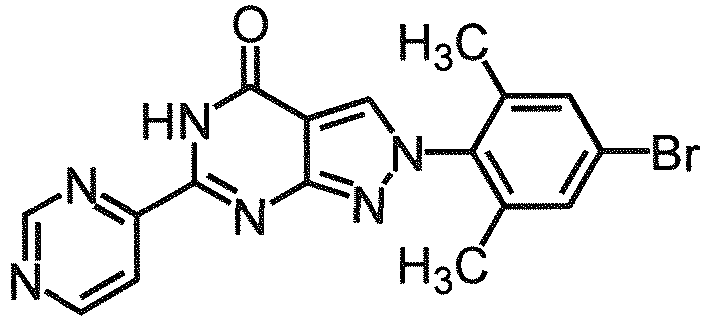
-

- A mixture of 4-bromo-2,6-dimethylaniline (45 g), ethanol (72 mL), water (25 mL), and concentrated hydrochloric acid (47 mL) was cooled to -10°C, and then thereto was added dropwise and slowly an aqueous solution (54 mL) of sodium nitrite (17 g) over 30 minutes. The mixture was stirred at the same temperature for 30 minutes, and then thereto were added sequentially methyl 2-chloro-3-oxobutanoate (27 mL) and sodium acetate (55 g). Then, the mixture was stirred at room temperature for 2 hours. The reaction mixture was extracted with ethyl acetate. The resulted organic layer was dried over anhydrous magnesium sulfate, and then the solvent was removed under reduced pressure to give a crude product of the titled compound (81 g).
1H-NMR (CDCl3) δ: 7.28 (2H, t, J = 0.6 Hz), 7.19 (1H, br s), 3.90 (3H, s), 2.34 (6H, s). -

- Under an argon atmosphere, to a mixture of a crude product of methyl 2-{2-(4-bromo-2,6-dimethylphenyl)hydrazinylidene}-2-chloroacetate (81 g) and chloroform (580 mL) were added triethylamine (36 mL) and fumaronitrile (20 g), and then the mixture was stirred at 80°C for 40 minutes. The reaction mixture was let cool to room temperature, and then thereto was added silica gel (250 g). Then, the mixture was stirred at room temperature for 30 minutes. Silica gel was removed by filtration with Celite, and then washed with ethyl acetate. Solvent was removed from all the resulted organic layers under reduced pressure, and then the resulted solid was washed with ethyl acetate to give the titled compound (37 g).
1H-NMR (DMSO-d6) δ: 9.01 (1H, s), 7.57 (2H, s), 3.90 (3H, s), 1.98 (6H, s). -

- To a mixture of methyl 1-(4-bromo-2,6-dimethylphenyl)-4-cyano-1H-pyrazole-3-carboxylate (36 g) and methanol (360 mL) was added 2 M aqueous sodium hydroxide solution (110 mL), and the mixture was stirred at room temperature for 2.5 hours. The reaction mixture was adjusted to pH = 1 by addition of 6 M hydrochloric acid, and then extracted with ethyl acetate. The resulted organic layer was dried over anhydrous magnesium sulfate, and then the solvent was removed under reduced pressure. To the resulted solid was added a mixed solution of ethyl acetate/diisopropyl ether (v/v = 1/1, 200 mL), and the mixture was stirred for 5 minutes. Then, hexane was added thereto until a solid stopped precipitating. The resulted solid was collected by filtration to give the titled compound (30 g).
1H-NMR (DMSO-d6) δ: 13.86 (1H, br s), 8.96 (1H, s), 7.56 (2H, s), 1.97 (6H, s). -

- Under an argon atmosphere, to a mixture of 1-(4-bromo-2,6-dimethylphenyl)-4-cyano-1H-pyrazole-3-carboxylic acid (30 g) and t-butanol (450 mL) were added triethylamine (26 mL) and diphenylphosphoryl azide (30 mL) at room temperature, and then the mixture was stirred at 90°C for 3 hours. The solvent was removed under reduced pressure, and then to the residue were added chloroform (180 mL) and trifluoroacetic acid (22 mL). The mixture was stirred at 80°C for 1 hour. The reaction mixture was cooled to 0°C, and then neutralized with aqueous saturated sodium hydrogen carbonate solution. The reaction mixture was extracted with ethyl acetate, and the resulted organic layer was dried over anhydrous sodium sulfate, and then the solvent was removed under reduced pressure. The residue was purified by column chromatography (Developing solvent: 15 vol% to 60 vol% of ethyl acetate/hexane) and then, the resulted solid was washed with a mixed solution of diisopropyl ether/ethyl acetate (v/v = 1/1) to give the titled compound (11 g).
- 1H-NMR (DMSO-d6) δ: 8.31 (1H, s), 7.46 (2H, s), 5.76 (2H, s), 2.01 (6H, s).
- LC-MS (MH+): 291.
-

- Under an argon atmosphere, to a mixture of 3-amino-1-(4-bromo-2,6-dimethylphenyl)-1H-pyrazole-4-carbonitrile (11 g), dimethylsulfoxide (17 mL), and ethanol (66 mL) were added sodium hydroxide (4.5 g) and 30% hydrogen peroxide solution (15 mL) at 0°C, and the mixture was stirred at room temperature for 40 minutes. The reaction mixture was cooled to 0°C, and then thereto was addded aqueous saturated sodium sulfite solution. The reaction mixture was adjusted to pH = 2 by addition of 12 M hydrochloric acid, and then extracted with ethyl acetate. The resulted organic layer was dried over anhydrous magnesium sulfate, and then the solvent was removed under reduced pressure. The resulted solid was washed with a mixed solution of diisopropyl ether/ethyl acetate (v/v = 1/1) to give the titled compound (10 g).
- 1H-NMR (DMSO-d6) δ: 7.97 (1H, s), 7.45 (2H, s), 7.31 (1H, br s), 6.91 (1H, br s), 5.53 (2H, s), 2.02 (6H, s).
- LC-MS (MH+): 309.
-

- To a mixture of pyrimidine-4-carboxylic acid (60 mg) and N,N-dimethylformamide (1.5 mL) were added HATU (180 mg) and N,N-diisopropylethylamine (160 mg), and the mixture was stirred at room temperature for 5 minutes. Then, thereto was added 3-amino-1-(4-bromo-2,6-dimethylphenyl)-1H-pyrazole-4-carboxamide (75 mg), and the mixture was stirred at 50°C for 2 hours. The reaction mixture was let cool to room temperature and diluted with ethyl acetate, and then washed sequentially with water and brine. The resulted organic layer was dried over anhydrous magnesium sulfate, and then the solvent was removed under reduced pressure to give a crude product of the titled compound (100 mg).
LC-MS (MH+): 415. -

- Under an argon atmosphere, to a mixture of a crude product of N-(1-(4-bromo-2,6-dimethylphenyl)-4-carbamoyl-1H-pyrazol-3-yl)pyrimidine-4-carboxamide (100 mg), ethanol (1.0 mL), and water (1.0 mL) was added 1,8-diazabicyclo[5.4.0]undec-7-ene (1.0 mL), and the mixture was stirred at 110°C for 2 hours. The reaction mixture was let cool to room temperature, and thereto was added water. Then, the mixture was extracted with ethyl acetate. The resulted organic layer was washed sequentially with water and brine and dried over anhydrous magnesium sulfate, and then the solvent was removed under reduced pressure. The residue was purified by column chromatography (Developing solvent: 50 vol% to 100 vol% of ethyl acetate/hexane) to give the titled compound (47 mg).
- 1H-NMR (CDCl3) δ: 10.62 (1H, br s), 9.36 (1H, d, J = 1.4 Hz), 9.03 (1H, d, J = 5.3 Hz), 8.54 (1H, dd, J = 5.2, 1.5 Hz), 8.18 (1H, s), 7.38 (2H, s), 2.06 (6H, s).
- LC-MS (MH+): 397.
-

-
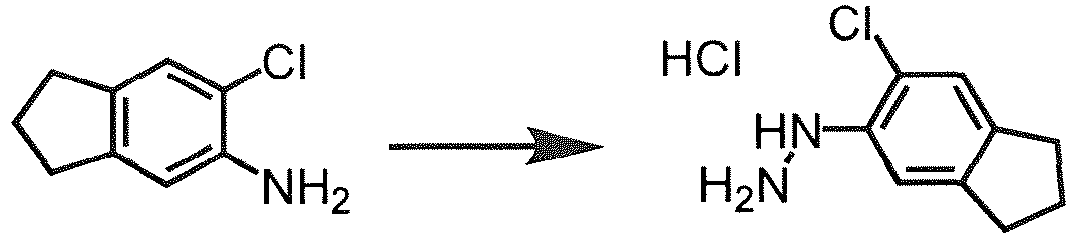
- To a mixture of 6-chloro-2,3-dihydro-1H-inden-5-amine (1.0 g) and 6 M hydrochloric acid (5.0 mL) was added concentrated hydrochloric acid (3.0 mL), and then the mixture was cooled to 0°C. To the reaction mixture was added dropwise and slowly an aqueous solution (1.0 mL) of sodium nitrite (0.43 g) over 3 minutes. Then, the mixture was stirred at the same temperature for 70 minutes. To the reaction mixture was added dropwise and slowly a mixture of tin (II) chloride dihydrate (2.8 g) and concentrated hydrochloric acid (2.3 mL) over 5 minutes. The mixture was stirred at the same temperature for 1 hour, and then stirred at room temperature for 2 hours. The resulted solid was collected by filtration, and then washed sequentially with 2M hydrochloric acid and diisopropyl ether to give the titled compound (1.2 g).
1H-NMR (DMSO-D6) δ: 10.12 (3H, br s), 7.86 (1H, br s), 7.28 (1H, s), 7.00 (1H, s), 2.83-2.81 (4H, m), 2.06-1.99 (2H, m). -

- Under an argon atmosphere, to a mixture of 1-methyl-1H-pyrazole-3-carbonitrile (53 g) and tetrahydrofuran (11 mL) was added a 1.2 M solution (500 mL) of lithium bis(trimethylsilyl)amide in tetrahydrofuran at 0°C, and the mixture was stirred at room temperature for 2 hours. The reaction mixture was cooled to 5°C, and then thereto were added dimethyl malonate (110 mL) and methanol (320 mL). The mixture was stirred at 80°C for 24 hours. The reaction mixture was cooled to room temperature, and then thereto was added tetrahydrofuran (320 mL). The mixture was stirred at room temperature for 1 hour. The resulted solid was collected by filtration, and then washed sequentially with a mixed solution of methanol/tetrahydrofuran (v/v = 1/2, 150 mL) and tetrahydrofuran (200 mL) to give the titled compound (100 g).
1H-NMR (CD3OD) δ: 7.64 (1H, d, J = 2.2 Hz), 6.91 (1H, d, J = 2.2 Hz), 5.11 (1H, s), 3.97 (3H, s). -

- Under a nitrogen atmosphere, phosphorus oxychloride (64 mL) was added to N,N-dimethylformamide (270 mL) at 0°C, and then the mixture was stirred at room temperature for 1 hour. The mixture was cooled to 0°C, and then added dropwise and slowly to a mixture of lithium 6-hydroxy-2-(1-methyl-1H-pyrazol-3-yl)pyrimidin-4-olate (90 g) and toluene (270 mL) which was cooled to 0°C. The reaction mixture was stirred at room temperature overnight, and then cooled to 0°C again. To the reaction mixture was added dropwise and slowly phosphorus oxychloride (380 mL), and then the mixture was stirred at 80°C for 6 hours. The reaction mixture was let cool to room temperature, and then was added dropwise and slowly to a mixture of disodium hydrogenphosphate (770 g) and water (3.0 L) which was cooled below 10°C. The mixture was stirred at the same temperature for 30 minutes, and then stirred at room temperature for 1 hour. The resulted solid was collected by filtration, and then washed with water to give the titled compound (79 g).
1H-NMR (DMSO-D6) δ: 10.28 (1H, s), 7.92 (1H, d, J = 2.5 Hz), 7.03 (1H, d, J = 2.5 Hz), 4.00 (3H, s). -

- To a mixture of (6-chloro-2,3-dihydro-1H-inden-5-yl)hydrazine hydrochloride (100 mg), N,N-diisopropylethylamine (0.40 mL), tetrahydrofuran (1.5 mL), and water (0.50 mL) was added 4,6-dichloro-2-(1-methyl-1H-pyrazol-3-yl)pyrimidine-5-carbaldehyde (120 mg), and the mixture was stirred at room temperature for 1 hour. To the reaction mixture was added water, and then the mixture was extracted with ethyl acetate. The resulted organic layer was washed with brine and dried over anhydrous magnesium sulfate, and then the solvent was removed under reduced pressure. The residue was purified by column chromatography (Developing solvent: 1 vol% to 100 vol% of ethyl acetate/hexane) to give the titled compound (55 mg).
1H-NMR (DMSO-D6) δ: 9.25 (1H, s), 7.85 (1H, d, J = 2.2 Hz), 7.66-7.64 (2H, m), 6.99 (1H, d, J = 2.2 Hz), 3.98 (3H, s), 3.02-2.93 (4H, m), 2.15-2.10 (2H, m). -

- Under an argon atmosphere, to a mixture of 4-chloro-2-(6-chloro-2,3-dihydro-1H-inden-5-yl)-6-(1-methyl-1H-pyrazol-3-yl)-2H-pyrazolo[3,4-d]pyrimidine (55 mg), acetonitrile (0.55 mL), and water (0.28 mL) was added trifluoroacetic acid (0.033 mL), and the mixture was stirred at 60°C for 1 hour. To the reaction mixture was added water, and then the mixture was extracted with ethyl acetate. The resulted organic layer was washed with brine and dried over anhydrous magnesium sulfate, and then the solvent was removed under reduced pressure. The residue was purified by column chromatography (Developing solvent: 1 vol% to 100 vol% of ethyl acetate/hexane), and then treated with a mixed solution of ethyl acetate/hexane (v/v = 1/5, 12 mL) to give a solid, the titled compound (44 mg).
1H-NMR (DMSO-D6) δ: 11.28 (1H, br s), 8.85 (1H, s), 7.90 (1H, d, J = 2.5 Hz), 7.57 (2H, d, J = 11.5 Hz), 6.96 (1H, d, J = 2.5 Hz), 3.98 (3H, s), 2.98-2.91 (4H, m), 2.14-2.07 (2H, m). LC-MS (MH+): 367. - Example compounds in addition to those described above were obtained in a similar manner to the above Preparation methods and Preparation examples, or if necessary, by known methods. The structure and physical property data of each Example compound are shown in the following tables.


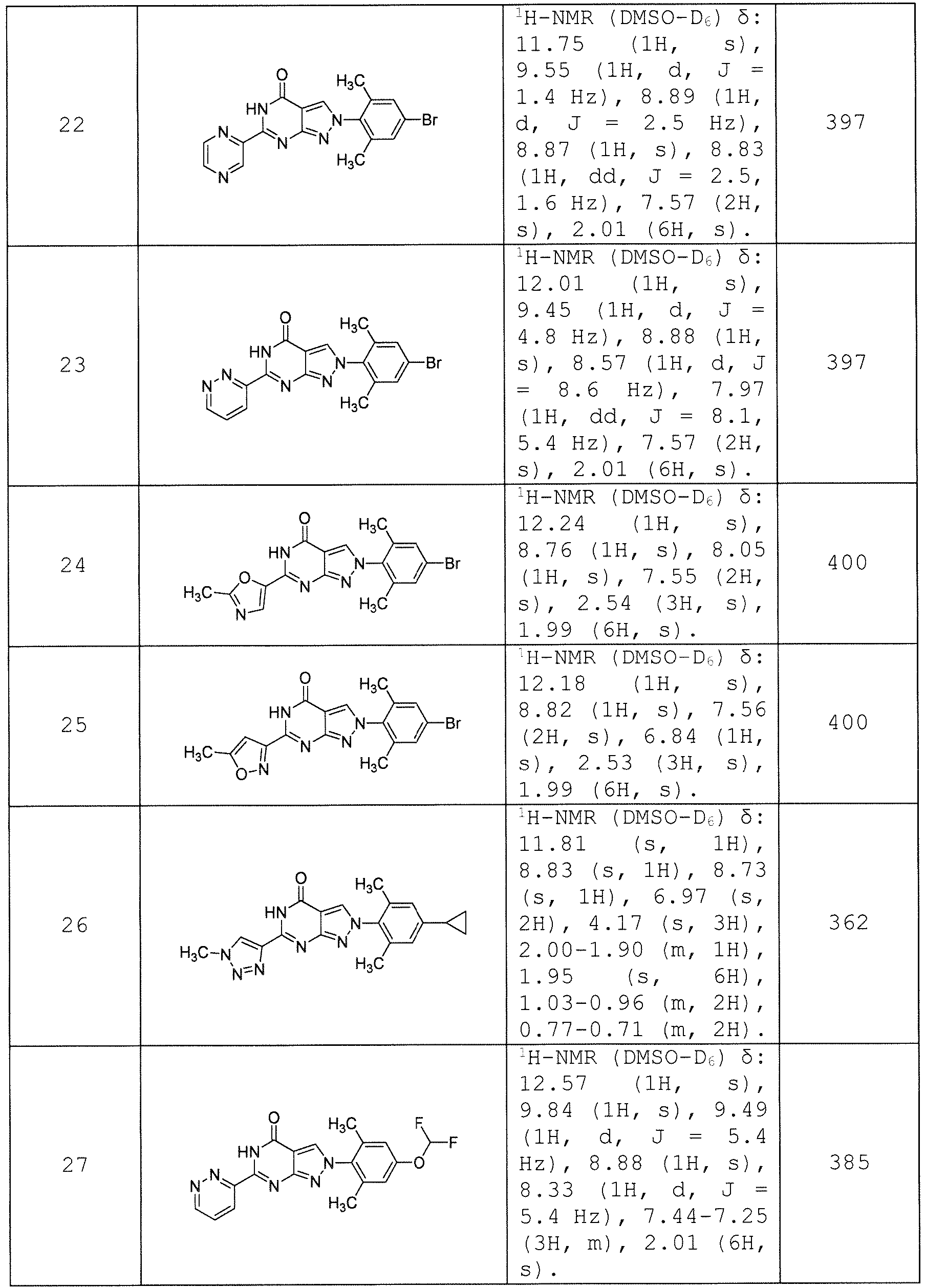


- The NLRP3 inflammasome inhibitory activity of test compounds were evaluated on the basis of the inhibitory activity of the IL-1β production in THP1-Null cells (Product Number: thp-null, InvivoGen). Cells were maintained for culture in RPMI-1640 media containing 10% (v/v) fetal bovine serum, 25 mmol/L HEPES, 100 U/mL penicillin, 100 µg/mL streptomycin, 100 µg/mL normocin, and 200 µg/mL hygromycin B (set at 37°C, 5% CO2/95% air).
- Cells were suspended with media for assay containing 0.5 µmol/L PMA (RPMI-1640 media containing 10% (v/v) fetal bovine serum, 100 U/mL penicillin, and 100 µg/mL streptomycin), and the suspended cells were seeded on Corning (registered trademark) 384-well Flat Clear Bottom Black Polystyrene TC-treated Microplates (25,000 cells/25 µL/well), followed by incubation (set at 37°C, 5% CO2/95% air) overnight. The supernatant of the culture was removed, and thereto was added media for assay (25 µL/well) containing 1 µg/mL Lipopolysaccharides (Product Number: L2654, Sigma-Aldrich (registered trademark)). Then, the culture was further incubated for 3 hours (set at 37°C, 5% CO2/95% air). The supernatant of the culture was removed. Then, a vehicle solution prepared from Opti-MEM (trademark) medium (Product Number: 31985-070, Invitrogen) was added to blank-setting wells and control-setting wells (20 µL/well), followed by incubation for 15 minutes (set at 37°C, 5% CO2/95% air). A solution containing a test compound (20 µL/well) was added to test compound-setting wells. Further, Opti-MEM (trademark) medium containing Nigericin (Product Number: N7143, Sigma-Aldrich (registered trademark)) was added to the control-setting wells and test compound-setting wells (5 µL/well), followed by incubation for 1.5 hours (set at 37°C, 5% CO2/95% air). The final concentration of Nigericin was adjusted to be 7.5 µmol/L. 5 µL/well of Opti-MEM (trademark) medium was added to the blank-setting wells. The supernatant of the culture was cryonically stored (set at -20°C) until measurement of IL-1β.
- The amount of IL-1β in the culture supernatant was quantitated with AlphaLISA (registered trademark) Human IL-1β Detection Kit (Product Number: AL220C, Perkin Elmer). Fluorescence intensity was measured with a microplate reader EnSpier (Model number: 2300-00J, Perkin Elmer) or EnSight (Model number: HH34000000, Perkin Elmer) according to procedure manuals attached thereto. Inhibition rates of the test compound-setting wells were calculated on the basis of 100% for the blank-setting wells and 0% for the control-setting wells. IC50 values (i.e., 50% inhibitory concentrations) of the test compounds were calculated by logistic regression analysis. The result of each Example compound is shown in the following tables.
Example No. IC50 (µM) 1 3.8 2 0.064 3 0.11 4 0.015 5 0.023 6 0.05 7 0.11 8 0.033 9 0.049 10 0.02 11 0.018 12 0.0078 13 0.029 14 0.39 15 0.015 16 0.047 17 0.22 18 0.055 19 0.062 20 0.023 21 0.013 22 0.068 23 0.022 24 0.053 25 0.015 26 0.012 27 0.062 28 0.011 29 0.069 30 0.04 31 0.94 32 0.077 33 0.022 34 0.027 35 0.024 36 0.016 37 0.036 38 0.015 39 0.023 40 0.0063 41 0.04 42 0.014 43 0.0043 44 0.88 45 34% inhibition at 2.4 µM 46 0.0031 47 0.0067 48 0.0025 49 0.037 Example No. IC50 (µM) 50 0.006 51 35% inhibition at 0.3 µM 52 0.002 53 0.24 54 0.009 55 0.024 56 0.084 57 0.009 58 0.003 59 0.034 60 0.39 61 0.49 - Formulation examples of the present invention include the following formulations, but are not intended to be limited thereto.
-
(1) A compound of Example 1 30 mg (2) Microcrystalline cellulose 10 mg (3) Lactose 19 mg (4) Magnesium stearate 1 mg - Ingredients (1), (2), (3), and (4) are mixed to be filled in a gelatin capsule.
-
(1) A compound of Example 1 10 g (2) Lactose 50 g (3) Cornstarch 15 g (4) Carmellose calcium 44 g (5) Magnesium stearate 1 g - The total amounts of Ingredients (1), (2), and (3) and 30 g of Ingredient (4) are combined with water, dried in vacuo, and then granulated. The resulted granules are mixed with 14 g of Ingredient (4) and 1 g of Ingredient (5), and tableted with a tabletting machine. In this manner, 1,000 tablets of which each tablet comprises 10 mg of the compound of Example 1 are obtained.
- A compound of Formula [I], or a pharmaceutically acceptable salt thereof, or a compound of Formula [IA], or a pharmaceutically acceptable salt thereof, has an NLRP3 inflammasome inhibitory activity, and thus is expected to be useful for treating or preventing a disease selected from the group consisting of multiple sclerosis, chronic kidney disease, inflammatory bowel disease (for example, ulcerative colitis and Crohn's disease), arteriosclerosis, Cryopyrin-associated periodic syndrome (for example, familial cold autoinflammatory syndrome, Muckle-Wells syndrome, chronic infantile neurologic cutaneous and articular syndrome, and Neonatal onset multisystem inflammatory disease), nonalcoholic steatohepatitis, gout, gouty arthritis, rheumatoid arthritis, contact dermatitis, dry eye, ischemic heart disease (for example, acute myocardial infarction), systemic lupus erythematosus, systemic juvenile idiopathic arthritis, recurrent pericarditis, adult onset Still's disease (for example, hemophagocytic lymphohistiocytosis and macrophage activation syndrome), Schnitzler syndrome, deficiency of the IL-1 receptor antagonist, familial Mediterranean fever, mevalonate kinase deficiency, hyper IgD syndrome, Behcet's disease, lung cancer, psoriasis, hypertension, diabetic retinopathy, Alzheimer's disease, mild cognitive impairment, Parkinson's disease, Huntington's disease, amyotrophic lateral sclerosis, traumatic brain injury, cerebral infarct, intracerebral bleeding, epilepsy, depressive illness, autism spectrum disorder, spinal cord injury, septic encephalopathy, neuropathic pain, COVID-19, frontotemporal dementia, age-related macular degeneration, diabetic macular edema, hereditary transient corneal endotheliitis, and TNF receptor-associated periodic syndrome.
Claims (34)
- A compound of Formula [IA]:
 or a pharmaceutically acceptable salt thereof,wherein a bond represented by:
 is a single bond or a double bond;R1 and R2 are each independently(1) hydrogen,(2) hydroxy,(3) cyano,(4) C1-6 alkyl, wherein the alkyl may be optionally substituted with 1 or 2 substituents independently selected from the group consisting of:(a) hydroxy,(b) C1-4 alkoxy, and(c) C3-6 cycloalkyl,(5) C1-6 alkoxy, wherein the alkoxy may be optionally substituted with C3-6 cycloalkyl,(6) halogen,(7) C1-4 haloalkyl,(8) -CHO,(9) -O-C1-4 haloalkyl,(10) -O-C3-6 cycloalkyl,(11) -CO-C1-4 alkyl,(12) -CO-C3-6 cycloalkyl,(13) -NR7R8, wherein R7 and R8 are each independently hydrogen or 2,4-dimethoxybenzyl, or alternatively, R7 and R8 may be combined together with the nitrogen atom to which they attach and the -NR7R8 group may form 5- to 6-membered heterocycloalkyl comprising 1 or 2 heteroatoms independently selected from the group consisting of nitrogen and oxygen atom, or(14) C3-6 cycloalkyl,R3A and R4A are each independently(1) hydrogen,(2) C1-4 alkyl, or(3) C1-4 haloalkyl,R5A is(1) hydrogen,(2) cyano,(3) C1-6 alkyl,(4) C2-6 alkenyl,(5) C2-5 alkynyl,(6) C1-4 alkoxy,(7) halogen,(8) C1-6 haloalkyl,(9) C2-6 haloalkenyl,(10) -O-C1-4 haloalkyl,(11) C3-6 cycloalkyl, wherein the cycloalkyl may be optionally substituted with 1 to 3 substituents independently selected from the group consisting of:(a) hydroxy,(b) halogen, and(c) C1-4 haloalkyl,(12) C5-6 cycloalkenyl, or(13) 4- to 6-membered heterocycloalkyl comprising 1 or 2 heteroatoms independently selected from the group consisting of nitrogen and oxygen atom, or alternativelyR5A may be combined together with R3A or R4A and the carbon atom to which they attach to form:(1) C5-6 cycloalkene, or(2) 5- to 7-membered heterocycloalkene comprising 1 or 2 oxygen atoms,R6A is independently(1) C1-4 alkyl, wherein the alkyl may be optionally substituted with C1-4 alkoxy,(2) C1-4 alkoxy,(3) halogen,(4) C1-4 haloalkyl, or(5) 4- to 6-membered heterocycloalkyl comprising 1 or 2 heteroatoms independently selected from the group consisting of nitrogen and oxygen atom,m is 0, 1, or 2,provided that when m is 2, then two adjacent R6As may be combined together with the two adjacent atoms among X1, X2, X3, X4, and X5 to which they attach to form 5- to 7-membered heterocycloalkane or heterocycloalkene comprising 1 or 2 heteroatoms independently selected from the group consisting of nitrogen and oxygen atom,n is 0 or 1,provided that when n is 0, then X1, X2, X3, and X4 are each independently carbon, nitrogen, oxygen, or sulfur atom, wherein a total number of nitrogen, oxygen, and sulfur atoms as X1, X2, X3, or X4 is 1, 2, or 3, and a total number of oxygen and sulfur atoms is 0 or 1, and X1, X2, X3, and X4 are combined together with the carbon atom that is adjacent to X1 and X4 to form heteroaryl, andprovided that when n is 1, then X1, X2, X3, X4, and X5 are each independently carbon or nitrogen atom, wherein a total number of nitrogen atoms as X1, X2, X3, X4, or X5 is 1 or 2, and X1, X2, X3, X4, and X5 are combined together with the carbon atom that is adjacent to X1 and X5 to form heteroaryl.
 - The compound according to claim 1, or a pharmaceutically acceptable salt thereof, wherein R3A and R4A are hydrogen.
- The compound according to claim 1 or 2, or a pharmaceutically acceptable salt thereof, wherein the compound is represented by Formula [IIA]:

- The compound according to any one of claims 1 to 3, or a pharmaceutically acceptable salt thereof, wherein X1, X2, X3, and X4 are combined together with the carbon atom that is adjacent to X1 and X4 to form pyrazolyl, imidazolyl, oxazolyl, isoxazolyl, thiazolyl, oxadiazolyl, or triazolyl.
- The compound according to any one of claims 1 to 4, or a pharmaceutically acceptable salt thereof, wherein X1, X2, X3, and X4 are combined together with the carbon atom that is adjacent to X1 and X4 to form pyrazolyl, imidazolyl, or thiazolyl.
- The compound according to any one of claims 1 to 5, or a pharmaceutically acceptable salt thereof, wherein X1, X2, X3, and X4 are combined together with the carbon atom that is adjacent to X1 and X4 to form a group of formula (1):


a group of formula (3):
- The compound according to claim 1 or 2, or a pharmaceutically acceptable salt thereof, wherein the compound is represented by Formula [IIIA]:

- The compound according to any one of claim 1, 2, or 7, or a pharmaceutically acceptable salt thereof, wherein X1, X2, X3, X4, and X5 are combined together with the carbon atom that is adjacent to X1 and X5 to form pyridyl, pyridazinyl, pyrimidyl, or pyrazinyl.
- The compound according to any one of claim 1, 2, 7, or 8, or a pharmaceutically acceptable salt thereof, wherein X1, X2, X3, X4, and X5 are combined together with the carbon atom that is adjacent to X1 and X5 to form pyridazinyl or pyrimidyl.
- The compound according to any one of claim 1, 2, 7, 8, or 9, or a pharmaceutically acceptable salt thereof, wherein X1, X2, X3, X4, and X5 are combined together with the carbon atom that is adjacent to X1 and X5 to form a group of formula (1'):

a group of formula (2'):
- The compound according to any one of claims 1 to 10, or a pharmaceutically acceptable salt thereof, wherein m is 0 or 1.
- The compound according to any one of claims 1 to 11, or a pharmaceutically acceptable salt thereof, wherein at least one of R1 and R2 is:C1-6 alkyl, wherein the alkyl may be optionally substituted with 1 or 2 substituents independently selected from the group consisting of:(a) hydroxy,(b) C1-4 alkoxy, and(c) C3-6 cycloalkyl, orhalogen.
- A compound selected from the group consisting of the following structural formulae:


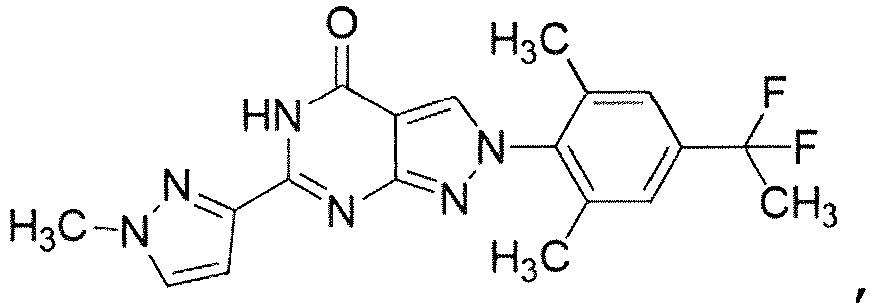


- A pharmaceutical composition comprising a compound according to any one of claims 1 to 13, or a pharmaceutically acceptable salt thereof, and a pharmaceutically acceptable carrier.
- An NLRP3 inflammasome inhibitor comprising a compound according to any one of claims 1 to 13, or a pharmaceutically acceptable salt thereof.
- A medicament for treating or preventing a disease selected from the group consisting of multiple sclerosis, inflammatory bowel disease, arteriosclerosis, Cryopyrin-associated periodic syndrome, nonalcoholic steatohepatitis, gout, ischemic heart disease, Alzheimer's disease, Parkinson's disease, Huntington's disease, amyotrophic lateral sclerosis, and traumatic brain injury, comprising a compound according to any one of claims 1 to 13, or a pharmaceutically acceptable salt thereof.
- The medicament according to claim 16, wherein the inflammatory bowel disease is ulcerative colitis or Crohn's disease.
- The medicament according to claim 16, wherein the Cryopyrin-associated periodic syndrome is familial cold autoinflammatory syndrome, Muckle-Wells syndrome, chronic infantile neurologic cutaneous and articular syndrome, or neonatal onset multisystem inflammatory disease.
- The medicament according to claim 16, wherein the disease is selected from the group consisting of multiple sclerosis, Alzheimer's disease, Parkinson's disease, Huntington's disease, amyotrophic lateral sclerosis, and traumatic brain injury.
- A method for inhibiting NLRP3 inflammasome, comprising administering a therapeutically effective amount of a compound according to any one of claims 1 to 13, or a pharmaceutically acceptable salt thereof, to a mammal.
- A method for treating or preventing a disease selected from the group consisting of multiple sclerosis, inflammatory bowel disease, arteriosclerosis, Cryopyrin-associated periodic syndrome, nonalcoholic steatohepatitis, gout, ischemic heart disease, Alzheimer's disease, Parkinson's disease, Huntington's disease, amyotrophic lateral sclerosis, and traumatic brain injury, comprising administering a therapeutically effective amount of a compound according to any one of claims 1 to 13, or a pharmaceutically acceptable salt thereof, to a mammal.
- The method according to claim 21, wherein the inflammatory bowel disease is ulcerative colitis or Crohn's disease.
- The method according to claim 21, wherein the Cryopyrin-associated periodic syndrome is familial cold autoinflammatory syndrome, Muckle-Wells syndrome, chronic infantile neurologic cutaneous and articular syndrome, or neonatal onset multisystem inflammatory disease.
- The method according to claim 21, wherein the disease is selected from the group consisting of multiple sclerosis, Alzheimer's disease, Parkinson's disease, Huntington's disease, amyotrophic lateral sclerosis, and traumatic brain injury.
- Use of a compound according to any one of claims 1 to 13, or a pharmaceutically acceptable salt thereof, in the manufacture of an NLRP3 inflammasome inhibitor.
- Use of a compound according to any one of claims 1 to 13, or a pharmaceutically acceptable salt thereof, in the manufacture of a medicament for treating or preventing a disease selected from the group consisting of multiple sclerosis, inflammatory bowel disease, arteriosclerosis, Cryopyrin-associated periodic syndrome, nonalcoholic steatohepatitis, gout, ischemic heart disease, Alzheimer's disease, Parkinson's disease, Huntington's disease, amyotrophic lateral sclerosis, and traumatic brain injury.
- The use according to claim 26, wherein the inflammatory bowel disease is ulcerative colitis or Crohn's disease.
- The use according to claim 26, wherein the Cryopyrin-associated periodic syndrome is familial cold autoinflammatory syndrome, Muckle-Wells syndrome, chronic infantile neurologic cutaneous and articular syndrome, or neonatal onset multisystem inflammatory disease.
- The use according to claim 26, wherein the disease is selected from the group consisting of multiple sclerosis, Alzheimer's disease, Parkinson's disease, Huntington's disease, amyotrophic lateral sclerosis, and traumatic brain injury.
- A compound according to any one of claims 1 to 13, or a pharmaceutically acceptable salt thereof, for use in inhibiting NLRP3 inflammasome.
- A compound according to any one of claims 1 to 13, or a pharmaceutically acceptable salt thereof, for use in treating or preventing a disease selected from the group consisting of multiple sclerosis, inflammatory bowel disease, arteriosclerosis, Cryopyrin-associated periodic syndrome, nonalcoholic steatohepatitis, gout, ischemic heart disease, Alzheimer's disease, Parkinson's disease, Huntington's disease, amyotrophic lateral sclerosis, and traumatic brain injury.
- The compound, or a pharmaceutically acceptable salt thereof, for use according to claim 31, wherein the inflammatory bowel disease is ulcerative colitis or Crohn's disease.
- The compound, or a pharmaceutically acceptable salt thereof, for use according to claim 31, wherein the Cryopyrin-associated periodic syndrome is familial cold autoinflammatory syndrome, Muckle-Wells syndrome, chronic infantile neurologic cutaneous and articular syndrome, or neonatal onset multisystem inflammatory disease.
- The compound, or a pharmaceutically acceptable salt thereof, for use according to claim 31, wherein the disease is selected from the group consisting of multiple sclerosis, Alzheimer's disease, Parkinson's disease, Huntington's disease, amyotrophic lateral sclerosis, and traumatic brain injury.
Applications Claiming Priority (3)
| Application Number | Priority Date | Filing Date | Title |
|---|---|---|---|
| JP2022135949 | 2022-08-29 | ||
| JP2023027426 | 2023-02-24 | ||
| PCT/JP2023/030980 WO2024048519A1 (en) | 2022-08-29 | 2023-08-28 | Pyrazolopyrimidine compound and pharmaceutical use thereof |
Publications (2)
| Publication Number | Publication Date |
|---|---|
| EP4582428A1 true EP4582428A1 (en) | 2025-07-09 |
| EP4582428A4 EP4582428A4 (en) | 2026-08-12 |
Family
ID=90099947
Family Applications (1)
| Application Number | Title | Priority Date | Filing Date |
|---|---|---|---|
| EP23860281.7A Pending EP4582428A4 (en) | 2022-08-29 | 2023-08-28 | PYRAZOLOPYRIMIDINE COMPOUND AND PHARMACEUTICAL USE OF IT |
Country Status (15)
| Country | Link |
|---|---|
| US (1) | US20250114361A1 (en) |
| EP (1) | EP4582428A4 (en) |
| JP (2) | JP7585409B2 (en) |
| KR (1) | KR20250056233A (en) |
| CN (1) | CN119790055A (en) |
| AR (1) | AR130318A1 (en) |
| AU (1) | AU2023334673A1 (en) |
| CL (1) | CL2025000495A1 (en) |
| CO (1) | CO2025002359A2 (en) |
| IL (1) | IL319000A (en) |
| MX (1) | MX2025002450A (en) |
| PE (1) | PE20251551A1 (en) |
| TW (1) | TW202416965A (en) |
| WO (1) | WO2024048519A1 (en) |
| ZA (1) | ZA202501724B (en) |
Families Citing this family (6)
| Publication number | Priority date | Publication date | Assignee | Title |
|---|---|---|---|---|
| EP4671246A1 (en) * | 2023-02-24 | 2025-12-31 | Japan Tobacco Inc. | 6-ALKOXYPYRAZOLOPYRIMIDINE COMPOUND AND PHARMACEUTICAL USE OF IT |
| TW202448887A (en) * | 2023-02-24 | 2024-12-16 | 日商日本煙草產業股份有限公司 | Substituted pyrazolopyrimidine compounds and medical use thereof |
| KR20250170647A (en) | 2023-04-14 | 2025-12-05 | 다케다 야쿠힌 고교 가부시키가이샤 | Pyrazolopyrimidine derivatives as NLRP3 inhibitors |
| WO2025140708A1 (en) * | 2023-12-31 | 2025-07-03 | 杭州百新生物医药科技有限公司 | Pyrazolopyrimidine compound and pharmaceutical use thereof |
| TW202545527A (en) | 2024-01-16 | 2025-12-01 | 英商諾得瑟拉公司 | Nlrp3 and glp-1a combination therapies |
| WO2026164254A1 (en) * | 2025-01-31 | 2026-08-06 | 塩野義製薬株式会社 | Method for producing pyrazolopyrimidine compound and synthetic intermediate thereof |
Family Cites Families (7)
| Publication number | Priority date | Publication date | Assignee | Title |
|---|---|---|---|---|
| JP6929792B2 (en) * | 2015-02-16 | 2021-09-01 | ザ ユニバーシティ オブ クィーンズランド | Sulfonylureas and related compounds and their use |
| CR20200588A (en) * | 2018-05-04 | 2021-06-24 | Inflazome Ltd | Novel compounds |
| CA3174837A1 (en) * | 2020-04-15 | 2021-10-21 | Daniel Oehlrich | Pyrazolo[1,5-d][1,2,4]triazine-5(4h)-acetamides as inhibitors of the nlrp3 inflammasome pathway |
| CA3182276A1 (en) | 2020-05-08 | 2021-12-02 | Halia Therapeutics, Inc. | Inhibitors of nek7 kinase |
| US20240043450A1 (en) | 2020-09-24 | 2024-02-08 | Janssen Pharmaceutica Nv | New compound |
| CN113549080B (en) | 2021-08-27 | 2023-05-16 | 中国医学科学院放射医学研究所 | 1,2, 3-triazolopyrimidine compounds, preparation method and application thereof |
| KR20240055035A (en) * | 2021-08-31 | 2024-04-26 | 니뽄 다바코 산교 가부시키가이샤 | 6-Aminopyrazolopyrimidine compounds and their medicinal uses |
-
2023
- 2023-08-28 AR ARP230102274A patent/AR130318A1/en unknown
- 2023-08-28 AU AU2023334673A patent/AU2023334673A1/en active Pending
- 2023-08-28 KR KR1020257009740A patent/KR20250056233A/en active Pending
- 2023-08-28 JP JP2023137929A patent/JP7585409B2/en active Active
- 2023-08-28 PE PE2025000467A patent/PE20251551A1/en unknown
- 2023-08-28 WO PCT/JP2023/030980 patent/WO2024048519A1/en not_active Ceased
- 2023-08-28 TW TW112132370A patent/TW202416965A/en unknown
- 2023-08-28 US US18/705,065 patent/US20250114361A1/en active Pending
- 2023-08-28 CN CN202380062735.4A patent/CN119790055A/en active Pending
- 2023-08-28 IL IL319000A patent/IL319000A/en unknown
- 2023-08-28 EP EP23860281.7A patent/EP4582428A4/en active Pending
-
2024
- 2024-11-06 JP JP2024194113A patent/JP2025013515A/en active Pending
-
2025
- 2025-02-21 CL CL2025000495A patent/CL2025000495A1/en unknown
- 2025-02-25 ZA ZA2025/01724A patent/ZA202501724B/en unknown
- 2025-02-27 CO CONC2025/0002359A patent/CO2025002359A2/en unknown
- 2025-02-27 MX MX2025002450A patent/MX2025002450A/en unknown
Also Published As
| Publication number | Publication date |
|---|---|
| IL319000A (en) | 2025-04-01 |
| CL2025000495A1 (en) | 2025-06-13 |
| KR20250056233A (en) | 2025-04-25 |
| AR130318A1 (en) | 2024-11-27 |
| CN119790055A (en) | 2025-04-08 |
| JP2024032686A (en) | 2024-03-12 |
| AU2023334673A1 (en) | 2025-03-27 |
| JP7585409B2 (en) | 2024-11-18 |
| TW202416965A (en) | 2024-05-01 |
| MX2025002450A (en) | 2025-04-02 |
| EP4582428A4 (en) | 2026-08-12 |
| ZA202501724B (en) | 2025-11-26 |
| WO2024048519A1 (en) | 2024-03-07 |
| JP2025013515A (en) | 2025-01-24 |
| PE20251551A1 (en) | 2025-06-05 |
| US20250114361A1 (en) | 2025-04-10 |
| CO2025002359A2 (en) | 2025-03-27 |
Similar Documents
| Publication | Publication Date | Title |
|---|---|---|
| JP7483810B2 (en) | 6-Aminopyrazolopyrimidine compounds and their medical uses | |
| JP7585409B2 (en) | PYRAZOLOPYRIMIDINE COMPOUNDS AND THEIR MEDICINAL USE | |
| KR102943760B1 (en) | Pyridazine derivative inhibitor, and its manufacturing method and use | |
| ES3029140T3 (en) | Substituted aminothiazoles as dgkzeta inhibitors for immune activation | |
| WO2024067744A1 (en) | Heterocyclic substituted quinazoline, preparation method therefor, and use thereof | |
| JP7729000B2 (en) | 6-alkoxypyrazolopyrimidine compounds and their medical uses | |
| EP4671247A1 (en) | SUBSTITUTED PYRAZOLOPYRIMIDINE COMPOUND AND PHARMACEUTICAL USE OF IT | |
| CA3093445A1 (en) | Aminopyrazine diol compounds as pi3k-.gamma. inhibitors | |
| EP3212652B1 (en) | Ripk2 inhibitors and method of treating cancer with same | |
| US20240400578A1 (en) | Substituted azetidine dihydrothienopyridines and their use as phosphodiesterase inhibitors | |
| KR20230143611A (en) | TYK2 inhibitor compounds containing a bicyclic ring | |
| KR20180085814A (en) | Preparation of Substituted 5,6-dihydro-6-phenylbenzo [f] isoquinolin-2-amine | |
| HK40128856A (en) | Pyrazolopyrimidine compound and pharmaceutical use thereof | |
| HK40112889A (en) | 6-aminopyrazolopyrimidine compound and pharmaceutical use thereof | |
| CN117881682A (en) | 6-amino pyrazolopyrimidine compound and medical application thereof | |
| KR20210155806A (en) | Polymorphism of PI3K inhibitor and method for preparing same |
Legal Events
| Date | Code | Title | Description |
|---|---|---|---|
| STAA | Information on the status of an ep patent application or granted ep patent |
Free format text: STATUS: THE INTERNATIONAL PUBLICATION HAS BEEN MADE |
|
| PUAI | Public reference made under article 153(3) epc to a published international application that has entered the european phase |
Free format text: ORIGINAL CODE: 0009012 |
|
| STAA | Information on the status of an ep patent application or granted ep patent |
Free format text: STATUS: REQUEST FOR EXAMINATION WAS MADE |
|
| 17P | Request for examination filed |
Effective date: 20250328 |
|
| AK | Designated contracting states |
Kind code of ref document: A1 Designated state(s): AL AT BE BG CH CY CZ DE DK EE ES FI FR GB GR HR HU IE IS IT LI LT LU LV MC ME MK MT NL NO PL PT RO RS SE SI SK SM TR |
|
| DAV | Request for validation of the european patent (deleted) | ||
| REG | Reference to a national code |
Ref country code: HK Ref legal event code: DE Ref document number: 40128856 Country of ref document: HK |
|
| RAP1 | Party data changed (applicant data changed or rights of an application transferred) |
Owner name: SHIONOGI & CO., LTD. |
|
| A4 | Supplementary search report drawn up and despatched |
Effective date: 20260706 |