EP4582423A1 - Novel tricyclic derivative compound and uses thereof - Google Patents
Novel tricyclic derivative compound and uses thereof Download PDFInfo
- Publication number
- EP4582423A1 EP4582423A1 EP23877711.4A EP23877711A EP4582423A1 EP 4582423 A1 EP4582423 A1 EP 4582423A1 EP 23877711 A EP23877711 A EP 23877711A EP 4582423 A1 EP4582423 A1 EP 4582423A1
- Authority
- EP
- European Patent Office
- Prior art keywords
- methyl
- dihydro
- imidazo
- quinolin
- chloro
- Prior art date
- Legal status (The legal status is an assumption and is not a legal conclusion. Google has not performed a legal analysis and makes no representation as to the accuracy of the status listed.)
- Pending
Links
Classifications
-
- A—HUMAN NECESSITIES
- A61—MEDICAL OR VETERINARY SCIENCE; HYGIENE
- A61P—SPECIFIC THERAPEUTIC ACTIVITY OF CHEMICAL COMPOUNDS OR MEDICINAL PREPARATIONS
- A61P35/00—Antineoplastic agents
-
- A—HUMAN NECESSITIES
- A61—MEDICAL OR VETERINARY SCIENCE; HYGIENE
- A61K—PREPARATIONS FOR MEDICAL, DENTAL OR TOILETRY PURPOSES
- A61K31/00—Medicinal preparations containing organic active ingredients
- A61K31/33—Heterocyclic compounds
- A61K31/395—Heterocyclic compounds having nitrogen as a ring hetero atom, e.g. guanethidine or rifamycins
- A61K31/435—Heterocyclic compounds having nitrogen as a ring hetero atom, e.g. guanethidine or rifamycins having six-membered rings with one nitrogen as the only ring hetero atom
- A61K31/4353—Heterocyclic compounds having nitrogen as a ring hetero atom, e.g. guanethidine or rifamycins having six-membered rings with one nitrogen as the only ring hetero atom ortho- or peri-condensed with heterocyclic ring systems
- A61K31/4375—Heterocyclic compounds having nitrogen as a ring hetero atom, e.g. guanethidine or rifamycins having six-membered rings with one nitrogen as the only ring hetero atom ortho- or peri-condensed with heterocyclic ring systems the heterocyclic ring system containing a six-membered ring having nitrogen as a ring heteroatom, e.g. quinolizines, naphthyridines, berberine, vincamine
-
- A—HUMAN NECESSITIES
- A61—MEDICAL OR VETERINARY SCIENCE; HYGIENE
- A61K—PREPARATIONS FOR MEDICAL, DENTAL OR TOILETRY PURPOSES
- A61K31/00—Medicinal preparations containing organic active ingredients
- A61K31/33—Heterocyclic compounds
- A61K31/395—Heterocyclic compounds having nitrogen as a ring hetero atom, e.g. guanethidine or rifamycins
- A61K31/435—Heterocyclic compounds having nitrogen as a ring hetero atom, e.g. guanethidine or rifamycins having six-membered rings with one nitrogen as the only ring hetero atom
- A61K31/47—Quinolines; Isoquinolines
- A61K31/4738—Quinolines; Isoquinolines ortho- or peri-condensed with heterocyclic ring systems
- A61K31/4745—Quinolines; Isoquinolines ortho- or peri-condensed with heterocyclic ring systems condensed with ring systems having nitrogen as a ring hetero atom, e.g. phenantrolines
-
- C—CHEMISTRY; METALLURGY
- C07—ORGANIC CHEMISTRY
- C07D—HETEROCYCLIC COMPOUNDS
- C07D417/00—Heterocyclic compounds containing two or more hetero rings, at least one ring having nitrogen and sulfur atoms as the only ring hetero atoms, not provided for by group C07D415/00
- C07D417/14—Heterocyclic compounds containing two or more hetero rings, at least one ring having nitrogen and sulfur atoms as the only ring hetero atoms, not provided for by group C07D415/00 containing three or more hetero rings
-
- C—CHEMISTRY; METALLURGY
- C07—ORGANIC CHEMISTRY
- C07D—HETEROCYCLIC COMPOUNDS
- C07D471/00—Heterocyclic compounds containing nitrogen atoms as the only ring hetero atoms in the condensed system, at least one ring being a six-membered ring with one nitrogen atom, not provided for by groups C07D451/00 - C07D463/00
- C07D471/02—Heterocyclic compounds containing nitrogen atoms as the only ring hetero atoms in the condensed system, at least one ring being a six-membered ring with one nitrogen atom, not provided for by groups C07D451/00 - C07D463/00 in which the condensed system contains two hetero rings
- C07D471/04—Ortho-condensed systems
-
- C—CHEMISTRY; METALLURGY
- C07—ORGANIC CHEMISTRY
- C07D—HETEROCYCLIC COMPOUNDS
- C07D471/00—Heterocyclic compounds containing nitrogen atoms as the only ring hetero atoms in the condensed system, at least one ring being a six-membered ring with one nitrogen atom, not provided for by groups C07D451/00 - C07D463/00
- C07D471/12—Heterocyclic compounds containing nitrogen atoms as the only ring hetero atoms in the condensed system, at least one ring being a six-membered ring with one nitrogen atom, not provided for by groups C07D451/00 - C07D463/00 in which the condensed system contains three hetero rings
- C07D471/14—Ortho-condensed systems
Definitions
- the present disclosure relates to novel tricycle derivative compounds and uses thereof, and more particularly, to novel tricycle derivative compounds with methionine adenosyltransferase 2A (MAT2A) inhibitory activity and uses thereof.
- MAT2A methionine adenosyltransferase 2A
- MTAP activity is also present in primary leukemia, glioma, melanoma, pancreatic cancer, non-small cell lung cancer (NSCLC), bladder cancer, astrocytoma, osteosarcoma, head and neck cancer, myxoid chondrosarcoma, ovarian cancer, endometrial cancer, breast cancer, soft tissue sarcoma, non-Hodgkin lymphoma, and mesothelioma.
- NSCLC non-small cell lung cancer
- the inventors of the present disclosure have completed the present disclosure by developing novel tricycle derivative compounds with MAT2A inhibitory activity and uses thereof.
- An objective of the present disclosure is to provide a novel tricycle derivative compound.
- Another objective of the present disclosure is to provide a pharmaceutical composition including the aforementioned compound as an active ingredient for treating or preventing a methionine adenosyltransferase 2A (MAT2A)-related disease or disorder.
- MAT2A methionine adenosyltransferase 2A
- An embodiment of the present disclosure provides a compound selected from compounds of Formula 1 below and enantiomers, diastereomers, solvates and hydrates thereof, and pharmaceutically acceptable salts thereof.
- Another embodiment of the present disclosure provides a pharmaceutical composition for treating or preventing a methionine adenosyltransferase 2A (MAT2A)-related disease or disorder, the pharmaceutical composition including, as an active ingredient, the compound selected from the compounds of Formula 1 and enantiomers, diastereomers, solvates and hydrates thereof, and pharmaceutically acceptable salts thereof.
- MAT2A methionine adenosyltransferase 2A
- a novel tricycle derivative compound which has a structure of Formula 1 according to an embodiment of the present disclosure, and a pharmaceutical composition, which includes the same, are effective against a methionine adenosyltransferase 2A (MAT2A)-related disease or disorder, and may be useful as a therapeutic agent.
- MAT2A methionine adenosyltransferase 2A
- An embodiment of the present disclosure provides a compound selected from compounds of Formula 1 below and enantiomers, diastereomers, solvates and hydrates thereof, and pharmaceutically acceptable salts thereof.
- alkyl refers to a straight-chain or branched hydrocarbon residue, which may be substituted or unsubstituted, unless otherwise noted.
- the alkyl may be a linear saturated monovalent hydrocarbon radical of 1 to 6 carbon atoms or a branched saturated monovalent hydrocarbon radical of 3 to 6 carbon atoms.
- the alkyl may be, but not limited to, methyl, ethyl, propyl, butyl, pentyl, or isopropyl, isobutyl, or t-butyl, etc. It is recognized by those skilled in the art that the term “alkyl” may include "alkylene".
- alkenyl refers to an alkyl group containing one or more double bonds, which may be substituted or unsubstituted, unless otherwise noted.
- the alkenyl may be, but not limited to, prop-1-ene, but-1-ene, but-2-ene, 3-methylbut-1-ene, or pent-1-ene, etc.
- alkynyl refers to an alkyl group containing one or more triple bonds, which may be substituted or unsubstituted, unless otherwise noted.
- the alkynyl may be, but not limited to, ethynyl, propynyl, butynyl, pentynyl, hexynyl, or a branched-chain alkynyl group, etc.
- halogen refers to F, Cl, Br, or I.
- haloalkoxy refers to an -OR radical wherein R is a haloalkyl as defined herein, unless otherwise noted.
- the haloalkoxy may be, but not limited to, -OCF 3 , -OCHF 2 , etc.
- haloalkoxyalkyl refers to an alkyl group substituted with a haloalkoxy as defined above, unless otherwise noted.
- the haloalkoxyalkyl may be, but not limited to, a haloC 1-6 alkoxyalkyl including a total of 1 to 6 carbon atoms.
- haloalkoxyalkyl may be, but not limited to, trifluoromethoxymethyl, trifluoroethoxyethyl, etc.
- cycloalkyl refers to a saturated or partially unsaturated, monocyclic, bicyclic, or polycyclic hydrocarbon ring, which may be substituted or unsubstituted, unless otherwise noted.
- the cycloalkyl may be, but not limited to, cyclopropyl, cyclobutyl, cyclopentyl, cyclohexyl, cycloheptyl, indanyl, indenyl, or tetrahydro-naphthalenyl, etc.
- the cycloalkyl includes bridged cycloalkyl, fused cycloalkyl, or spirocycloalkyl.
- bridged cycloalkyl refers to two rings sharing two non-adjacent common ring atoms, unless otherwise noted.
- the bridged cycloalkyl may be divided into dicyclic, tricyclic, tetracyclic, or a polycyclic bridged cycloalkyl based on the number of rings.
- the bridged cycloalkyl may be, but not limited to, etc.
- fused cycloalkyl refers to, unless otherwise noted, that each ring shares an adjacent carbon atom pair with another ring, and one or more rings may share one or more double bonds, but none of these rings has a complete conjugated ⁇ -electron system.
- the fused cycloalkyl may be divided into dicyclic, tricyclic, tetracyclic, or a polycyclic fused cycloalkyl depending on the number of rings.
- the fused cycloalkyl may be, but not limited to, etc.
- spirocycloalkyl refers to, a saturated carbocycle compound including two rings, wherein both rings share only one carbon atom as part of the ring, unless otherwise noted.
- the spirocycloalkyl may be, but not limited to, , etc.
- ureido refers to a -NH-CO-NH 2 radical.
- heterocyclylcarbonyl refers to a -C(O)R radical where R is a heterocyclyl as defined herein, unless otherwise noted.
- aminoC 1-6 alkylamino refers to a radical of the formula - NH-C 1-6 alkyl, where C 1-6 alkyl is partially or completely substituted by amino, in other words, a radical of the formula -NH-C 1-6 alkyl-amino, unless otherwise noted.
- sulfonylamino refers to the radical -NR'S(O) 2 R", wherein R' and R" are each hydrogen, alkyl, alkenyl, alkynyl, aryl, cycloalkyl, or heterocyclyl, unless otherwise noted.
- alkylsulfonylamino refers to a -NHS(O) 2 R radical wherein R is alkyl as defined herein, unless otherwise noted.
- alkoxyalkoxy refers to an -OR radical wherein R is an alkoxyalkyl as defined herein.
- R is an alkoxyalkyl as defined herein.
- the alkoxyalkoxy may be, but not limited to, methoxyethyloxy, ethyloxypropyloxy, etc.
- aminoalkyl refers to a saturated alkyl group of a straight-chain or branched-chain represented by -NR'R" wherein R', R" are each an alkyl as defined herein, unless otherwise noted.
- R' and R" may be substituted with haloalkyl, hydroxyalkyl, alkoxyalkyl, or alkylcarbonyl.
- the aminoalkyl may be, for example, but not limited to, aminomethyl, aminoethyl, methylaminomethyl, etc.
- aminoalkoxy refers to an -OR radical wherein R is an aminoalkyl as defined herein.
- the aminoalkoxy may be, but not limited to, aminoethyloxy, methylaminopropyloxy, dimethylaminoethyloxy, diethylaminopropyloxy, etc.
- aryl refers to a monocyclic, bicyclic, or polycyclic aromatic hydrocarbon radical, which may be substituted or unsubstituted, unless otherwise noted.
- the aryl may include, but not limited to, C 6-10 aryl.
- a double bond may alternate (resonate) between adjacent carbon atoms or suitable heteroatoms.
- the aryl may be, but not limited to, phenyl, biphenyl, naphthyl, toluyl, or naphthalenyl, etc.
- the heteroaryl may include, but not limited to, a C 4-10 heteroaryl.
- the monocyclic heteroaryl may be, but not limited to, pyridinyl, imidazolyl, thiazolyl, oxazolyl, thiophenyl, furanyl, pyrrolyl, isoxazolyl, pyrazolyl, triazolyl, thiadiazolyl, tetrazolyl, oxadiazolyl, pyridazinyl, pyrimidinyl, or pyrazinyl, etc.
- the bicyclic heteroaryl may be, but not limited to, indolyl, benzothiophenyl, benzofuranyl, benzimidazolyl, benzoxazolyl, benzisoxazolyl, benzthiazolyl, benzthiadiazolyl, benztriazolyl, quinolinyl, isoquinolinyl, purinyl, or furopyridinyl, etc.
- the heterocyclyl may be, but not limited to, azetidinyl, pyrrolinyl, pyrrolidinyl, pyrazolinyl, pyrazolidinyl, imidazolinyl, imidazolidinyl, isoxazolinyl, isoxazolidinyl, isothiazolinyl, isothiazolidinyl, oxazolinyl, oxazolidinyl, thiazolinyl, thiazolidinyl, triazolinyl, triazolidinyl, oxadiazolinyl, oxadiazolidinyl, thiadiazolinyl, thiadiazolidinyl, tetrazolinyl, tetrazolidinyl, piperazinyl, piperidinyl, morpholinyl, thiomorpholinyl, dihydro-indazolyl, tetrahydr
- heterocyclyloxy refers to an -OR radical where R is a heterocyclyl as defined herein, unless otherwise noted.
- the heterocyclyloxy may be, but not limited to, pyrrole-2-yloxy, pyrrole-3-yloxy, piperidin-2-yloxy, piperidin-3-yloxy, piperazine-2-yloxy, or piperidin-4-yloxy, etc.
- heterocyclylamino refers to a -NHR radical wherein R is a heterocyclyl as defined herein, unless otherwise noted.
- the heterocyclylamino may be, but not limited to, pyrrole-2-ylamino, pyrrole-3-ylamino, piperidin-2-ylamino, piperidin-3-ylamino, piperazine-2-ylamino, or piperidin-4-ylamino, etc.
- heterocyclyloxyalkoxy refers to an -OR radical, wherein R is heterocyclyl as defined herein, unless otherwise noted.
- the heterocyclyloxyalkoxy may be, but not limited to, pyrrole-2-yloxymethoxy, pyrrole-3-yloxyethoxy, piperidin-2-yloxyethoxy, piperidin-3-yloxyethoxy, piperazine-2-yloxymethoxy, or piperidin-4-yloxyethoxy, etc.
- heterocyclyloxyalkylamino refers to a -NR-(alkylene)-R' radical wherein R' is hydrogen or an alkyl as defined herein and R" is heterocyclyloxy as defined herein.
- the heterocyclyloxyalkylamino may be, but not limited to, oxetanyloxyethylamino, piperidinyloxyethylamino, etc.
- stereoisomer may refer to compounds of the present disclosure or salts thereof that have the same chemical formula or molecular formula but differ optically or sterically, and includes enantiomers or diastereomers.
- enantiomers refers to two stereoisomers of a compound that are non-overlapping mirror images of each other.
- diastereomer refers to a stereoisomer with two or more chiral centers, the molecules of which are not mirror images of each other.
- the compounds of the present disclosure may include asymmetric or chiral centers, and thus may exist in different stereoisomeric forms. All stereoisomeric forms of the compounds of the present disclosure, such as diastereomers, enantiomers, and racemic mixtures, are considered to compose a portion of the present disclosure. A 50:50 mixture of enantiomers is referred to as a racemic mixture or racemate.
- the composition may exhibit MAT2A inhibitory activity.
- the composition may be for treating a methylthioadenosine phosphorylase (MTAP) deficient cancer.
- MTAP methylthioadenosine phosphorylase
- the pharmaceutical composition may include, in a therapeutically effective amount, the compound selected from the compounds of Formula 1 and enantiomers, diastereomers, solvates and hydrates thereof, and pharmaceutically acceptable salts thereof.
- the term "therapeutically effective amount” refers to an amount of a compound of the present disclosure that treats or prevents a particular disease, condition, or disorder; attenuates, ameliorates, or eliminates one or more symptoms of a particular disease, condition, or disorder; or prevents or delays the onset of one or more symptoms of a particular disease, condition, or disorder.
- the pharmaceutical composition may include, but not limited to, 0.0001 mg to 10 g of the compound.
- the pharmaceutical composition may further include a pharmaceutically acceptable additive in addition to the active ingredient.
- the additive may be, for example, but not limited to, diluents, disintegrating agents, binders, lubricants, surfactants, suspending agents, or emulsifiers, etc.
- compositions of the present disclosure may be formulated according to usual methods and may be prepared in various oral dosage forms, such as tablets, pills, powders, capsules, syrups, emulsions, microemulsions, or parenteral dosage forms, such as intramuscular, intravenous, or subcutaneous administration.
- Another embodiment of the present disclosure provides a method of treatment by administering to a subject suffering from a MAT2A-related disease or disorder the pharmaceutical composition including as an active ingredient the compound selected from the compounds of Formula 1 and enantiomers, diastereomers, solvates and hydrates thereof, and pharmaceutically acceptable salts thereof.
- treating refers to inhibiting a disease, for example, inhibiting a disease, condition, or disorder in a subject experiencing or exhibiting the pathology or symptoms of the disease, condition, or disorder, that is, preventing or reversing further development of the pathology and/or symptoms, or ameliorating a disease, for example, reducing disease severity.
- preventing refers to preventing a disease, for example, preventing a disease, condition, or disorder in an individual who may have a predisposition to the disease, condition, or disorder but has not yet experienced or exhibited the pathology or symptoms of the disease.
- a subject may be a vertebrate such as a mammal, fish, bird, reptile, or amphibian.
- a subject may be a human, nonhuman primate, horse, pig, rabbit, dog, sheep, goat, cow, cat, guinea pig, or rodent.
- administering and “administration” refer to any method of providing a disclosed composition to a subject.
- the dosage, number of doses, or method of administration of a compound or pharmaceutical composition according to an embodiment may vary depending on the subject being treated, the severity of the disease or condition, the rate of administration, and the judgment of the prescribing physician.
- a typical dosage for a person weighing 70 kg may be administered in an amount from 0.0001 mg to 10 g per day, for example 1 mg to 1 g per day.
- the number of doses may be administered once to several times, for example 1 to 4 times, or on an on/off schedule, and the method of administration may be by an oral or parenteral route.
- a compound or pharmaceutical composition according to an embodiment may be administered by an oral or parenteral route in an amount ranging from 0.1 to 100 mg/kg (body weight).
- the physician may start at a lower level than necessary to achieve the target therapeutic effect and gradually increase the dose of the compound or pharmaceutical composition of the present disclosure administered to the subject until the intended effect is achieved.
- kits including as an active ingredient the compound selected from the compounds of Formula 1 and enantiomers, diastereomers, solvates and hydrates thereof, and pharmaceutically acceptable salts thereof.
- the therapeutic agent may be a drug for treating a MAT2A-related disease or disorder, such as a drug for treating cancer.
- the therapeutic agent may be a chemotherapeutic agent for the treatment of cancer.
- the therapeutic agent may be a chemotherapeutic agent, an antimetabolite, an antimitotic, an alkylating agent, a DNA damaging agent, an antineoplastic antibiotic, a platinum coordination complex, a proteasome inhibitor, a hormone and hormone analog, an immunosuppressant, an anti-angiogenic compound and a vascular endothelial growth factor inhibitor, a fibroblast growth factor inhibitor, an epidermal growth factor receptor inhibitor, an antibody, a checkpoint inhibitor, a corticosteroid, a DNA repair enzyme inhibitor, a treatment for autoimmune disorders, a treatment for diabetes, a treatment for liver disease, a treatment for cardiovascular disorder, a treatment for metabolic disorder, an antiviral agent, or an ophthalmic agent.
- a chemotherapeutic agent an antimetabolite, an antimitotic, an alkylating agent, a DNA damaging agent, an antineoplastic antibiotic, a platinum coordination complex, a proteasome inhibitor, a hormone and hormone analog, an immunosuppressant, an anti
- the compounds, compositions and kits of the present disclosure may be administered alone or simultaneously with at least one other therapeutic agent, separately or sequentially.
- the numerical range indicated using the term “to” refers to a range that includes the numerical values written before and after the term “to” as the lower limit and upper limit, respectively.
- the terms “has,” “may have,” “includes,” or “may include” refer to the presence of a particular feature (for example, a number, or a component such as an ingredient) and do not exclude the presence of additional features.
- Methyl 2-amino-4-chlorobenzoate (8.72 g, 47.0 mmol) synthesized in [Process 1] above, bromobenzene (4.99 mL, 47.0 mmol), cesium carbonate (23.20 g, 70.5 mmol), palladium acetate (215 mg, 0.94 mmol), and xantphos (1.09 g, 1.88 mmol) were added to toluene (88 mL), and after nitrogen gas substitution, the mixture was refluxed at 100 °C for 12 hours. After cooling the reaction product to room temperature, the solid was filtered and washed with dichloromethane. The filtrate was concentrated and purified by silica gel column chromatography to obtain the title compound (8.56 g, 69.57 %).
- Tetrahydrofuran (125 mL) was added to methyl 4-chloro-2-( N- phenylacetamido)benzoate (8.32 g, 27.39 mmol) synthesized in [Process 3] above, and the reaction solution was cooled to -78 °C. A solution of potassium bis(trimethylsilyl)amide 1 M tetrahydrofuran was slowly added dropwise to the reaction solution for 1 hour. The reaction product was concentrated, water was added, and acidified with 6N hydrochloric acid. The resulting solid was collected by filtration and washed with excess water. The solid was stirred in diethyl ether for 30 minutes, collected by filtration, and dried to obtain the title compound (6.02 g, 80.89 %), which was used without additional purification.
- Phosphorus oxychloride (65 mL, 683.41 mmol) was added to 7-chloro-4-hydroxy-3-nitro-1-phenylquinolin-2(1 H )-one (6.5 g, 20.52 mmol) synthesized in [Process 5] above. After cooling the reaction solution to 0 °C, triethylamine (6.5 mL, 46.17 mmol) was slowly added dropwise.
- the reaction solution was stirred at room temperature for 30 minutes, followed by adding ice water and was subjected to extraction with ethyl acetate.
- the obtained organic layer was dried with anhydrous magnesium sulfate and vacuum distilled.
- the concentrated reactant was purified by silica gel column chromatography to obtain the title compound (4.4 mg, 20.22 %).
- reaction solution was stirred at room temperature for 5 hours, and was subjected to extraction with ethyl acetate by adding water.
- the separated organic layer was dried with anhydrous sodium sulfate and concentrated by vacuum distillation to obtain the title compound (104 mg, 97.19 %), which was proceeded to the next reaction [Process 11] without additional purification.
- the obtained residue was diluted with water and washed with diethyl ether to remove the organic layer, and the remaining aqueous layer was adjusted to pH 2 to 3 with an 1 N aqueous hydrochloric acid solution, and the resulting solid was collected by filtration, washed with methanol and excess water, and dried to obtain the title compound (5.6 g, 38 %).
- reaction mixture was diluted with ethyl acetate and washed with water.
- the separated organic layer was vacuum distilled and the obtained residue was dissolved with hexane:ethyl acetate (4:1 (volume ratio), 20 mL) mixed solvent and the resulting solid was filtered to obtain the title compound (570 mg, 67 %).
- N -(2,7-dichloro-4-(methylamino)quinolin-3-yl)-2-(4-methoxyphenyl)acetamide (520 mg, 1.40 mmol) synthesized in [Process 5] above was diluted with 1,4-dioxane (9.7 mL) and water (9.7 mL), then sodium hydroxide (520 mg, 1.40 mmol) was added and the above mixture was stirred at 100 °C for 1 hour. After completion of the reaction, the reaction solution was cooled to room temperature and adjusted to pH 7 to 8 with an 1 N aqueous hydrochloric acid solution, and the solvent was removed by vacuum distillation. The resulting solid from the addition of saturated sodium bicarbonate solution was collected by filtration, washed with water, and dried to obtain the title compound (520 mg, 96 %).
- the mixed solution was refluxed at 100 °C for 20 hours and cooled to room temperature after completion of the reaction.
- Water was added to the reaction product and was subjected to extraction with ethyl acetate, and the separated organic layer was dried with anhydrous magnesium sulfate and vacuum distilled.
- the obtained residue was purified by silica gel column chromatography to obtain the title compound (115 mg, 21.4 %).
- the reaction mixture was cooled at room temperature, filtered through celite and vacuum distilled, the filtrate was concentrated, stirred again in ethyl acetate and vacuum filtered, and the obtained solid was purified by silica gel column chromatography to obtain the title compound (43 mg, 33.6 %).
- the mixed solution was refluxed at 100 °C for 72 hours and cooled to room temperature after completion of the reaction.
- Water was added to the reaction product and was subjected to extraction with dichloromethane and methanol, and the separated organic layer was dried with anhydrous magnesium sulfate and vacuum distilled.
- the obtained residue was purified by silica gel column chromatography to obtain the title compound (3.5 mg, 3.88 %).
- the compound of Formula 1 may be a compound selected from the group consisting of the compounds listed in [Table 3] below.
- [Table 3] Compound No. Structure Nomenclature MS[M+H] + 1 H-NMR spectrum (300MHz) 21 7-chloro-2-(4-methoxybenzyl)-1-methyl-5-(2-methylpyridin-3-yl)-1,5-dihydro-4 H -imidazo[4,5- c ]quinolin-4-one 445.14 1 H-NMR spectrum (300 MHz, CDCl 3 ) ⁇ 8.72(dd, 1H), 7.96(d, 1H), 7.55(dd, 1H), 7.41(dd, 1H), 7.23-7.18(m, 3H), 6.86(d, 2H), 6.58(d, 1H), 4.36(s, 2H), 3.96(s, 3H), 3.79(s, 3H), 2.29(s, 3H) 22 2-(4-methoxybenzy
- the filtrate was vacuum distilled, followed by adding water and was subjected to extraction with ethyl acetate.
- the separated organic layer was dried with anhydrous sodium sulfate, followed by vacuum filtration and vacuum distillation.
- the obtained residue was dissolved in ethyl acetate (40 mL), followed by adding 4 N hydrochloric acid 1,4-dioxane solution (20 mL) and stirred at room temperature for 30 minutes.
- the resulting solid was collected by filtration, washed with excess ethyl acetate and dried to obtain the title compound (3.22 g, 63.25 %).
- the mixed solution was refluxed at 100 °C for 14 hours and cooled to room temperature after completion of the reaction.
- a saturated aqueous solution of ammonium chloride was added to the reaction product and was subjected to extraction with ethyl acetate, and the separated organic layer was dried with anhydrous sodium sulfate and vacuum distilled.
- the obtained residue was purified by silica gel column chromatography to obtain the title compound (1 g, 34.53 %).
- the mixed solution was refluxed at 90 °C for 14 hours and cooled to room temperature after completion of the reaction.
- a saturated aqueous solution of ammonium chloride was added to the reaction product and was subjected to extraction with ethyl acetate, and the separated organic layer was dried with anhydrous sodium sulfate and vacuum distilled.
- the obtained residue was purified by silica gel column chromatography to obtain the title compound (1.4 g, 39.61 %).
- Acetic acid (1 mL) and a 38 % aqueous hydrochloric acid solution (1 mL) were added to 7-(benzyloxy)-2-(4-methoxybenzyl)-1-methyl-5-(2-methylpyridin-3-yl)-1,5-dihydro-4 H -imidazo[4,5-c]quinolin-4-one (1.4 g, 2.71 mmol) synthesized in [Process 6] above.
- the mixed solution was refluxed at 140 °C for 7 hours and cooled to room temperature after completion of the reaction.
- the reaction product was vacuum distilled, followed by adding a saturated aqueous solution of sodium hydrogen carbonate, stirred for 30 minutes, and was subjected to extraction with dichloromethane and methanol.
- the separated organic layer was dried with anhydrous sodium sulfate and vacuum distilled.
- the obtained residue was purified by silica gel column chromatography to obtain the title compound (630 mg, 54.51 %).
- the mixed solution was refluxed at 100 °C for 2 hours and cooled to room temperature after completion of the reaction.
- Water was added to the reaction product and was subjected to extraction with ethyl acetate, and the separated organic layer was dried with anhydrous sodium sulfate and vacuum distilled.
- the obtained residue was purified by silica gel column chromatography to obtain the title compound (145 mg, 94.66 %).
- reaction product was cooled to room temperature, followed by adding water and was subjected to extraction with ethyl acetate, and the separated organic layer was dried with anhydrous sodium sulfate and vacuum distilled.
- the obtained residue was purified by silica gel column chromatography to obtain 2-(4-methoxybenzyl)-1-methyl-5-(2-methylpyridin-3-yl)-7-((trimethylsilyl)ethynyl)-1,5-dihydro-4 H -imidazo[4,5-c]quinolin-4-one (14 mg, 77.16 %).
- Example 48 7-isopropyl-2-(4-methoxybenzyl)-1-methyl-5-(2-methylpyridin-3-yl)-1,5-dihydro-4 H -imidazo[4,5- c ]quinolin-4-one
- the mixed solution was refluxed at 100 °C for 1 hour and cooled to room temperature after completion of the reaction.
- Water was added to the reaction product and was subjected to extraction with ethyl acetate, and the separated organic layer was dried with anhydrous sodium sulfate and vacuum distilled.
- the obtained residue was purified by silica gel column chromatography to obtain the title compound (2 mg, 23.29 %).
- the mixed solution was refluxed at 100 °C for 2 hours and cooled to room temperature after completion of the reaction.
- the reaction product was vacuum distilled and purified by silica gel column chromatography to obtain 7-((diphenylmethylene)amino)-2-(4-methoxybenzyl)-1-methyl-5-(2-methylpyridin-3-yl)-1,5-dihydro-4 H -imidazo[4,5- c ]quinolin-4-one (63.8 mg).
- the obtained intermediate was dissolved in tetrahydrofuran (1 mL) and 1 N aqueous hydrochloric acid solution (0.1 mL) and stirred at room temperature for 30 minutes. After completion of the reaction, sodium hydrogen carbonate saturated aqueous solution was added and the mixture was subjected to extraction with ethyl acetate, and the separated organic layer was dried with anhydrous sodium sulfate and vacuum distilled. The obtained residue was purified by silica gel column chromatography to obtain the title compound (39 mg, 51.19 %).
- the compound of Formula 1 may be a compound selected from the group consisting of the compounds listed in [Table 4] below.
- [Table 4] Compound No. Structure Nomenclature MS[M+H] + 1 H-NMR spectrum (300MHz) 43 7-Hydroxy-2-(4-methoxybenzyl)-1-methyl-5-(2-methylpyridin-3-yl)-1,5-dihydro-4 H -imidazo[4,5- c ]quinolin-4-one 427.17 1 H-NMR spectrum (300 MHz, CDCl 3 ) ⁇ 8.61 (dd, 1H), 7.94(d, 1H), 7.63(dd, 1H), 7.45(dd, 1H), 7.18(d, 2H), 6.87(d, 2H), 6.84(m, 1H), 6.04(d, 1H), 4.31(s, 2H), 3.95(s, 3H), 3.79(s, 3H), 2.28(s, 3H) 44 2-(dd, 1H),
- 2-fluoro-6-(trifluoromethyl)pyridine (15 g, 80.04 mmol) was dissolved in anhydrous tetrahydrofuran (150 mL), and substituted with nitrogen gas. The mixed solution was cooled to -78 °C and then 2.0 M lithium diisopropylamide solution (53.43 mL, 106.85 mmol) was slowly added dropwise and stirred at the same temperature for 1 hour. Trimethylboronic acid (12 mL, 106.85 mmol) was slowly added dropwise and stirred at room temperature for 22 hours.
- the mixed solution was refluxed at 120 °C for 14 hours and cooled to room temperature after completion of the reaction.
- Water was added to the reaction product and was subjected to extraction with dichloromethane and methanol, and the separated organic layer was dried with anhydrous magnesium sulfate and vacuum distilled.
- the obtained residue was purified by silica gel column chromatography to obtain the title compound (539 mg, 43.53 %).
- the mixed solution was stirred at room temperature for 1 hour, after completion of the reaction, water was added and was subjected to extraction with dichloromethane and methanol.
- the separated organic layer was dried with anhydrous magnesium sulfate and vacuum distilled.
- the obtained residue was purified by silica gel column chromatography to obtain the title compound (17.8 mg, 14.68 %).
- Example 58 2-(4-(difluoromethoxy)benzyl)-1-methyl-5-(2-methylpyridin-3-yl)-7-(trifluoromethyl)-1,5-dihydro-4 H -imidazo[4,5- c ][1,8]naphthyridin-4-one
- reaction solution was cooled to room temperature, water was added to the reaction solution and was subjected to extraction with ethyl acetate, and the separated organic layer was dried with anhydrous sodium sulfate and vacuum distilled. The obtained residue was purified by silica gel column chromatography to obtain the title compound (5.47 g, 45.92 %).
- the mixed solution was refluxed at 100 °C for 18 hours and cooled to room temperature after completion of the reaction.
- Water was added to the reaction product and was subjected to extraction with ethyl acetate, and the separated organic layer was dried with anhydrous magnesium sulfate and vacuum distilled.
- the obtained residue was purified by silica gel column chromatography to obtain the title compound (17 mg, 4.49 %).
- Example 62 7-ethoxy-2-(4-methoxybenzyl)-1-methyl-5-(2-methylpyridin-3-yl)-1,5-dihydro-4 H -imidazo[4',5':4,5]pyrido[2,3- d ]pyrimidin-4-one
- reaction solution was stirred at room temperature for 1 hour, and was subjected to extraction with ethyl acetate by adding water.
- the separated organic layer was dried with anhydrous sodium sulfate and concentrated by vacuum distillation. Purification was performed using silica gel column chromatography to obtain the title compound (1.46 g, 90.94 %).
- Example 64 7-methoxy-2-(4-methoxybenzyl)-1-methyl-5-(2-methylpyridin-3-yl)-1,5-dihydro-4 H -imidazo[4,5- c ][1,8]naphthyridin-4-one
- Example 65 2-(4-(difluoromethoxy)benzyl)-7-ethyl-1-methyl-5-(2-methylpyridin-3-yl)-1,5-dihydro-4 H -imidazo[4,5- c ][1,8]naphthyridin-4-one
- reaction solution A 2-3 drops of N,N -dimethylformamide were added to the reaction solution of 2,6-dichloronicotinic acid (4.63 g, 23.6 mmol) dissolved in dichloromethane (75 mL), and oxalyl chloride (5.79 mL, 67.50 mmol) was slowly added dropwise, and the mixture was stirred at room temperature for 3 hours.
- the reaction product was immediately used in the next reaction by removing the solvent by distillation and adding tetrahydrofuran (30 mL). (Reaction solution A).
- the reaction product was cooled to room temperature, followed by adding 3 N aqueous hydrochloric acid solution to adjust the pH to acidic, and was subjected to extraction with ethyl acetate.
- the extracted organic layer was washed with water, dried with anhydrous sodium sulfate, followed by concentration under decompression.
- the obtained residue (6.5 g, 80.3 %) was used in the following reaction without a purification procedure.
- reaction solution was subjected to extraction with ethyl acetate with the addition of water.
- the separated organic layer was dried with anhydrous sodium sulfate and concentrated by vacuum distillation.
- Acetic acid (1 mL) was added to the concentrated mixture, and the reaction solution was stirred at 100 °C for 16 hours.
- the reaction product was dried by vacuum distillation and purified by silica gel column chromatography to obtain the title compound (164 mg, 79.48 %).
- Example 66 7-cyclopropyl-2-(4-(difluoromethoxy)benzyl)-1-methyl-5-(2-methylpyridin-3-yl)-1,5-dihydro-4 H -imidazo[4,5- c ][1,8]naphthyridin-4-one
- the compound of Formula 1 may be a compound selected from the group consisting of the compounds listed in [Table 5] below.
- [Table 5] Compound No. Structure Nomenclature MS[M+H] + 1 H-NMR spectrum (300MHz) 56 5-(4-(Difluoromethoxy)phenyl)-2-(4-methoxybenzyl)-1-methyl-7-(trifluoromethyl)-1,5-dihydro-4 H- imidazo[4,5- c ][1,8]naphthyridin-4-one 531.14 1 H-NMR spectrum (300 MHz, CDCl 3 ) ⁇ 8.40(d, 1H), 7.53(d, 1H), 7.27-7.26(m, 4H), 7.18(d, 2H), 6.86(d, 2H), 6.61(t, 1H), 4.37(s, 2H), 3.97(s, 3H), 3.79(s, 3H) 57 2-(4-methoxybenzyl)-1
- HCT116 MTAP-/- (homozygous knockout of MTAP gene in HCT116 MTAP-WT cells by CRISPER/Cas9 method) cells were maintained in RPMI1640 medium containing 10 % FBS and 1 % penicillin-streptomycin. Approximately 5 ⁇ 10 2 cells were seeded in a 96-well plate and treated with a test compound. (0.64 nM - 2,000 nM, 6 dose points for HCT116 MTAP-/- cells for 5x and 6 days) cell growth was measured by SRB staining and absorbance was detected at 540 nm on a Synergy TM NEO microplate reader. The 50 % growth inhibition value (GI 50 ) of the cell line was calculated using GraphPad Prism V9 software.
- HCT116 MTAP-/- cell growth inhibition (GI 50 , nM) 1 B 2 A 3 D 4 A 5 B 6 B 7 D 8 B 9 D 10 A 11 C 12 D 15 D 16 D 17 D 18 A 19 C 20 C 21 A 22 C 23 B 24 B 25 B 26 B 27 A 28 A 29 A 30 A 31 A 32 D 33 A 34 D 35 A 36 A 37 A 38 A 39 A 40 D 41 D 42 D 43 D 44 A 45 A 46 A 47 A 48 B 49 B 50 D 51 A 52 C 53 A 54 A 55 A 56 D 57 A 58 A 59 A 60 B 61 A 62 D 63 A 64 A 65 A 66 A
Landscapes
- Chemical & Material Sciences (AREA)
- Organic Chemistry (AREA)
- Health & Medical Sciences (AREA)
- Veterinary Medicine (AREA)
- General Health & Medical Sciences (AREA)
- Medicinal Chemistry (AREA)
- Public Health (AREA)
- Pharmacology & Pharmacy (AREA)
- Life Sciences & Earth Sciences (AREA)
- Animal Behavior & Ethology (AREA)
- Epidemiology (AREA)
- General Chemical & Material Sciences (AREA)
- Nuclear Medicine, Radiotherapy & Molecular Imaging (AREA)
- Chemical Kinetics & Catalysis (AREA)
- Pharmaceuticals Containing Other Organic And Inorganic Compounds (AREA)
- Nitrogen Condensed Heterocyclic Rings (AREA)
- Saccharide Compounds (AREA)
Abstract
Description
- The present disclosure relates to novel tricycle derivative compounds and uses thereof, and more particularly, to novel tricycle derivative compounds with methionine adenosyltransferase 2A (MAT2A) inhibitory activity and uses thereof.
- Methionine adenosyltransferase (MAT), also known as S-adenosylmethionine synthase, is a cellular enzyme that catalyzes the synthesis of S-adenosylmethionine (SAM or AdoMet) from methionine and ATP and is thought to be the rate-limiting process in the methionine cycle. SAM is a propylamino donor in polyamine biosynthesis, a major methyl donor for DNA methylation, and is involved in gene transcription and cellular proliferation as well as the production of secondary metabolites.
- Methylthioadenosine phosphorylase (MTAP) is an enzyme found in all normal tissues that catalyzes the conversion of methylthioadenosine (MTA) to adenine and 5-methylthiouribose-1-phosphate. Adenine is recovered to produce adenosine monophosphate, and 5-methylthiouribose-1-phosphate is converted to methionine and formate. Because of this recovery pathway, MTA may be provided as an alternative purine source, for example, when new purine synthesis is blocked using an antimetabolite, such as L-alanosine.
- Many human and murine malignant cells lack MTAP activity. In addition to MTAP deficiency being found in tissue culture cells, such deficiency is also present in primary leukemia, glioma, melanoma, pancreatic cancer, non-small cell lung cancer (NSCLC), bladder cancer, astrocytoma, osteosarcoma, head and neck cancer, myxoid chondrosarcoma, ovarian cancer, endometrial cancer, breast cancer, soft tissue sarcoma, non-Hodgkin lymphoma, and mesothelioma.
- The inventors of the present disclosure have completed the present disclosure by developing novel tricycle derivative compounds with MAT2A inhibitory activity and uses thereof.
-
- (Patent Document 1)
Korean Public Patent No. 10-2022-0051301 - (Patent Document 2)
Korean Public Patent No. 10-2022-0050832 - (Patent Document 3)
Korean Public Patent No. 10-2021-0103498 - (Patent Document 4)
Korean Public Patent No. 10-2018-0100125 - (Patent Document 5)
Korean Public Patent No. 10-2019-0046921 - (Patent Document 6)
Korean Public Patent No. 10-2020-0138769 - An objective of the present disclosure is to provide a novel tricycle derivative compound.
- Another objective of the present disclosure is to provide a pharmaceutical composition including the aforementioned compound as an active ingredient for treating or preventing a methionine adenosyltransferase 2A (MAT2A)-related disease or disorder.
- Other objectives and advantages of the present disclosure will become apparent from the following detailed description in conjunction with the appended claims. Anything not set forth herein may be readily recognized and inferred by one of ordinary skill in the art of the present disclosure or a similar art and is hereby omitted.
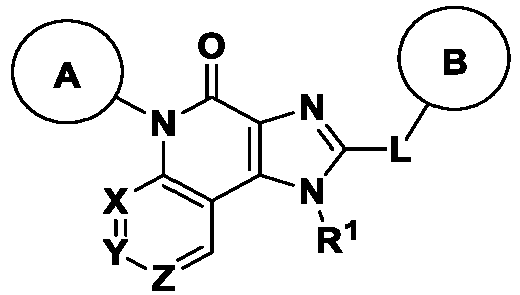
- An embodiment of the present disclosure provides a compound selected from compounds of Formula 1 below and enantiomers, diastereomers, solvates and hydrates thereof, and pharmaceutically acceptable salts thereof.

- Another embodiment of the present disclosure provides a pharmaceutical composition for treating or preventing a methionine adenosyltransferase 2A (MAT2A)-related disease or disorder, the pharmaceutical composition including, as an active ingredient, the compound selected from the compounds of Formula 1 and enantiomers, diastereomers, solvates and hydrates thereof, and pharmaceutically acceptable salts thereof.
- A novel tricycle derivative compound, which has a structure of Formula 1 according to an embodiment of the present disclosure, and a pharmaceutical composition, which includes the same, are effective against a methionine adenosyltransferase 2A (MAT2A)-related disease or disorder, and may be useful as a therapeutic agent.
- The following describes the present disclosure in more detail.
- All technical terms used in the present disclosure, unless otherwise defined, are used as commonly understood by one of ordinary skill in the relevant field of the present disclosure. In addition, while suitable methods or samples are described herein, similar or equivalent methods are also included within the scope of the present disclosure.
- An embodiment of the present disclosure provides a compound selected from compounds of Formula 1 below and enantiomers, diastereomers, solvates and hydrates thereof, and pharmaceutically acceptable salts thereof.

- wherein, in Formula 1 above,
- X and Z may each independently be N or CH; and
- Y may be CR3; and
- R3 may be H, alkyl, alkenyl, alkynyl, alkoxy, alkylthio, alkylsulfonyl, hydroxy, halogen, haloalkyl, haloalkoxy, cycloalkyl, cyano, amino, alkylamino, haloalkylamino, dialkylamino, alkylcarbonyl, alkoxycarbonyl, aminocarbonyl, alkylaminocarbonyl, dialkylaminocarbonyl, hydroxyalkyl, hydroxyalkoxy, hydroxyalkylamino, alkoxyalkyl, alkoxyalkoxy, alkoxyalkylamino, aminoalkyl, aminoalkoxy, aminoalkylamino, aryl, heteroaryl, heteroaryloxy, heteroarylamino, heterocyclyl, heterocyclyloxy, heterocyclylamino, heterocyclyloxyalkoxy, or heterocyclyloxyalkylamino,
- wherein each of the aryl, heteroaryl, or heterocyclyl, may be
- unsubstituted or substituted with 1 to 3 members selected from alkyl, cycloalkyl, haloalkyl, haloalkoxy, alkoxy, hydroxy, halo, cyano, hydroxyalkyl, alkoxyalkyl, and aminoalkyl;
-

- each of the cycloalkyl, aryl, heteroaryl, or heterocyclyl may be monocyclic, bicyclic, or polycyclic,
- wherein the cycloalkyl, aryl, heteroaryl, or heterocyclyl may be unsubstituted or substituted with 1 to 3 members independently selected from R2 below;
- L may be C1-3alkylene, O, NH, N(C1-3alkyl), S, SO, SO2, or a bond;
- R2 may be alkyl, cycloalkyl, haloalkyl, haloalkoxy, alkoxy, hydroxy, alkylsulfonyl, halogen, cyano, carboxy, alkoxycarbonyl, hydroxyalkyl, alkoxyalkyl, aminoalkyl, aminosulfonyl, alkylaminosulfonyl, dialkylaminosulfonyl, sulfonylamino, aminocarbonyl, alkylaminocarbonyl, dialkylaminocarbonyl, heterocyclylcarbonyl, or ureido; and
- R1 may be H, alkyl, haloalkyl, hydroxyalkyl, alkoxyalkyl, aminoalkyl, substituted aminoalkyl, aminocarbonylalkyl, or aminosulfonylalkyl.
- As used herein, the term "alkyl" refers to a straight-chain or branched hydrocarbon residue, which may be substituted or unsubstituted, unless otherwise noted. For example, the alkyl may be a linear saturated monovalent hydrocarbon radical of 1 to 6 carbon atoms or a branched saturated monovalent hydrocarbon radical of 3 to 6 carbon atoms. For example, the alkyl may be, but not limited to, methyl, ethyl, propyl, butyl, pentyl, or isopropyl, isobutyl, or t-butyl, etc. It is recognized by those skilled in the art that the term "alkyl" may include "alkylene".
- As used herein, the term "alkylene" refers to a straight-chain or branched hydrocarbon residue which may be substituted or unsubstituted, unless otherwise noted. For example, the alkylene may be a linear saturated divalent hydrocarbon radical of 1 to 6 carbon atoms or a branched saturated divalent hydrocarbon radical of 3 to 6 carbon atoms. For example, the alkylene may be, but not limited to, methylene, ethylene, propylene, 1-methylpropylene, 2-methylpropylene, butylene, pentylene, etc. For example, C1-3alkylene may include a form in which any one hydrogen is substituted or unsubstituted, such as a form in which any one hydrogen is unsubstituted or substituted with C1-3alkyl.
- As used herein, the term "alkenyl" refers to an alkyl group containing one or more double bonds, which may be substituted or unsubstituted, unless otherwise noted. For example, the alkenyl may be, but not limited to, prop-1-ene, but-1-ene, but-2-ene, 3-methylbut-1-ene, or pent-1-ene, etc.
- As used herein, the term "alkynyl" refers to an alkyl group containing one or more triple bonds, which may be substituted or unsubstituted, unless otherwise noted. For example, the alkynyl may be, but not limited to, ethynyl, propynyl, butynyl, pentynyl, hexynyl, or a branched-chain alkynyl group, etc.
- As used herein, the term "alkoxy" refers to a radical that has an oxygen-linked straight-chain or branched hydrocarbon residue, which may be substituted or unsubstituted, unless otherwise noted. For example, the alkoxy may be, but not limited to, methoxy, ethoxy, propoxy, and butoxy, or isopropoxy, isobutoxy, or t-butoxy, etc.
- As used herein, the term "alkylthio" refers to a -SR radical wherein R is an alkyl as defined herein, unless otherwise noted. For example, the alkylthio may be, but not limited to, methylthio, ethylthio, etc.
- As used herein, the term "alkylsulfonyl" refers to a -SO2R radical wherein R is an alkyl as defined herein, unless otherwise noted. For example, the alkylsulfonyl may be, but not limited to, methylsulfonyl, ethylsulfonyl, etc.
- As used herein, the term "aminosulfonyl" refers to a -SO2NH2 radical, unless otherwise noted.
- As used herein, the term "alkylaminosulfonyl" refers to a -SO2NHR radical where R is an alkyl as defined herein, unless otherwise noted. For example, the alkylaminosulfonyl may be, but not limited to, methylaminosulfonyl, ethylaminosulfonyl, etc.
- As used herein, the term "dialkylaminosulfonyl" refers to a -SO2NR'R" radical, wherein R', R" are each alkyl as defined herein, unless otherwise noted.
- As used herein, the term "halogen" refers to F, Cl, Br, or I.
- As used herein, the term "haloalkyl" refers to including monohaloalkyl and polyhaloalkyl, which may be substituted or unsubstituted, unless otherwise noted. For example, the haloalkyl may be, but not limited to, -CH2Cl, -CF3, -CHF2, -CH2CF3, -CF2CF3, -CF(CH3)2, etc.
- As used herein, the term "haloalkoxy" refers to an -OR radical wherein R is a haloalkyl as defined herein, unless otherwise noted. For example, the haloalkoxy may be, but not limited to, -OCF3, -OCHF2, etc.
- As used herein, the term "haloalkoxyalkyl" refers to an alkyl group substituted with a haloalkoxy as defined above, unless otherwise noted. For example, the haloalkoxyalkyl may be, but not limited to, a haloC1-6alkoxyalkyl including a total of 1 to 6 carbon atoms.
- For example, the haloalkoxyalkyl may be, but not limited to, trifluoromethoxymethyl, trifluoroethoxyethyl, etc.
- As used herein, the term "cycloalkyl" refers to a saturated or partially unsaturated, monocyclic, bicyclic, or polycyclic hydrocarbon ring, which may be substituted or unsubstituted, unless otherwise noted. For example, the cycloalkyl may be, but not limited to, cyclopropyl, cyclobutyl, cyclopentyl, cyclohexyl, cycloheptyl, indanyl, indenyl, or tetrahydro-naphthalenyl, etc. The cycloalkyl includes bridged cycloalkyl, fused cycloalkyl, or spirocycloalkyl.
- As used herein, the term "bridged cycloalkyl" refers to two rings sharing two non-adjacent common ring atoms, unless otherwise noted. The bridged cycloalkyl may be divided into dicyclic, tricyclic, tetracyclic, or a polycyclic bridged cycloalkyl based on the number of rings. For example, the bridged cycloalkyl may be, but not limited to,


- As used herein, the term "fused cycloalkyl" refers to, unless otherwise noted, that each ring shares an adjacent carbon atom pair with another ring, and one or more rings may share one or more double bonds, but none of these rings has a complete conjugated π-electron system. For example, the fused cycloalkyl may be divided into dicyclic, tricyclic, tetracyclic, or a polycyclic fused cycloalkyl depending on the number of rings. For example, the fused cycloalkyl may be, but not limited to,


- As used herein, the term "spiro" refers to two rings sharing one atom, and the two rings are not bridged, unless otherwise noted. As used herein, the term "spiro linkage" refers to a linker that share one atom, unless otherwise noted.
- As used herein, the term "spirocycloalkyl" refers to, a saturated carbocycle compound including two rings, wherein both rings share only one carbon atom as part of the ring, unless otherwise noted. For example, the spirocycloalkyl may be, but not limited to,


- As used herein, the term "cyano" refers to a -CN group.
- As used herein, the term "ureido" refers to a -NH-CO-NH2 radical.
- As used herein, the term "amino" refers to a -NH2 group. As used herein, the terms "alkylamino", "haloalkylamino", "dialkylamino", "hydroxyalkylamino", "alkoxyalkylamino", "aminoalkylamino", "sulfonylamino", "heteroarylamino", "heterocyclylamino", and "heterocyclyloxyalkylamino" refers to certain N-substituted organic radicals each bearing alkyl, haloalkyl, dialkyl, hydroxyalkyl, alkoxyalkyl, aminoalkyl, sulfonyl, heteroaryl, heterocyclyl, and heterocyclyloxyalkyl substituent. For example, the alkylamino may be, but not limited to, methylamino, ethylamino, or propylamino, etc. For example, the haloalkylamino may be, but not limited to, trifluoromethylamino or trifluoroethylamino, etc.
- As used herein, the term "alkylcarbonyl" refers to a -C(O)R radical wherein R is an alkyl as defined herein, unless otherwise noted. For example, the alkylcarbonyl may include, but not limited to, C1-6 alkylcarbonyl. For example, the alkylcarbonyl may be, but not limited to, methylcarbonyl, ethylcarbonyl, etc.
- As used herein, the term "alkoxycarbonyl" refers to a -C(O)OR radical where R is an alkyl as defined herein, unless otherwise noted. For example, the alkoxycarbonyl may include, but not limited to, a C1-6alkoxycarbonyl. For example, the alkoxycarbonyl may be, but not limited to, methoxycarbonyl, ethoxycarbonyl, etc.
- As used herein, the term "aminocarbonyl" refers to a -CONH2 radical, unless otherwise noted.
- As used herein, the term "alkylaminocarbonyl" refers to a -CONHR radical where R is an alkyl as defined herein, unless otherwise noted. For example, the alkylaminocarbonyl may include, but not limited to, C1-6 alkylaminocarbonyl. For example, the alkylaminocarbonyl may be, but not limited to, methylaminocarbonyl, ethylaminocarbonyl, etc.
- As used herein, the term "dialkylaminocarbonyl" refers to a -CONR'R" radical wherein R' R" is each an alkyl as defined herein, unless otherwise noted. For example, the dialkylaminocarbonyl may include, but not limited to, (C1-6alkyl)2aminocarbonyl.
- As used herein, the term "heterocyclylcarbonyl" refers to a -C(O)R radical where R is a heterocyclyl as defined herein, unless otherwise noted.
- As used herein, the term "aminosulfonylalkyl" refers to -alkyl-S(=O)2-NH2, wherein alkyl is as defined herein, unless otherwise noted.
- As used herein, the term "aminocarbonylalkyl" refers to -alkylene-(C=O)-NH2, unless otherwise noted.
- As used herein, the term "hydroxyalkyl" refers to an alkyl group substituted with an -OH group. For example, the hydroxyalkyl may be, but not limited to, hydroxymethyl, 2-hydroxy-ethyl, 2-hydroxypropyl, 3-hydroxypropyl, 1-(hydroxymethyl)-2-methylpropyl, 3-hydroxybutyl, 4-hydroxybutyl, 2,3-dihydroxypropyl, 1-(hydroxymethyl)-2-hydroxyethyl, 2,3-dihydroxybutyl, or 3,4-dihydroxybutyl, etc.
- As used herein, the term "hydroxyalkoxy" refers to an -OR radical wherein R is a hydroxyalkyl as defined herein. For example, the hydroxyalkoxy may be, but not limited to, hydroxyethyloxy, hydroxypropyloxy, etc.
- As used herein, the term "alkylamino" refers to a -NHR radical wherein R is an alkyl as defined herein. For example, the alkylamino may be, but not limited to, methylamino, ethylamino, propylamino, or isopropylamino, etc.
- As used herein, the term "dialkylamino" refers to a -NR'R" radical wherein R' and R" are each alkyl as defined herein. For example, the dialkylamino may include, but not limited to, a (C1-6alkyl)2-amino. For example, the dialkylamino may include, but not limited to, dimethylamino, diethylamino, or methylethylamino.
- As used herein, the term "hydroxyalkylamino" refers to a -NR'R" radical wherein R' is hydrogen or alkyl as defined herein and R" is hydroxyalkyl as defined herein. For example, the hydroxyalkylamino may be, but not limited to, hydroxyethylamino, hydroxypropylamino, etc.
- As used herein, the term "haloC1-6alkylamino" refers to a radical of the formula - NH-C1-6alkyl, where C1-6alkyl is partially or completely substituted by a halogen atom when permitted by available valence, in other words, a radical of the formula -NH-C1-6alkyl-halo, unless otherwise noted.
- As used herein, the term "(haloC1-6alkyl)2amino" refers to a radical of the formula - N-(C1-6alkyl-halo)2, unless otherwise noted.
- As used herein, the term "C1-6alkoxyC1-6alkylamino" refers to a radical of the formula -NH-C1-6alkyl, where C1-6alkyl is partially or completely substituted with C1-6alkoxy, in other words, a radical of the formula -NH-C1-6alkyl-C1-6alkoxy, unless otherwise noted.
- As used herein, the term "aminoC1-6alkylamino" refers to a radical of the formula - NH-C1-6alkyl, where C1-6alkyl is partially or completely substituted by amino, in other words, a radical of the formula -NH-C1-6alkyl-amino, unless otherwise noted.
- As used herein, the term "sulfonylamino" refers to the radical -NR'S(O)2R", wherein R' and R" are each hydrogen, alkyl, alkenyl, alkynyl, aryl, cycloalkyl, or heterocyclyl, unless otherwise noted.
- As used herein, the term "alkylsulfonylamino" refers to a -NHS(O)2R radical wherein R is alkyl as defined herein, unless otherwise noted.
- As used herein, the term "alkoxyalkyl" refers to an R'-O-R" radical, where R' and R" are each an alkyl as defined herein, unless otherwise noted. For example, the alkoxyalkyl may be, but not limited to, 2-methoxyethyl, 1-, 2-, or 3-methoxypropyl, 2-ethoxyethyl, etc. As used herein, the term "C1-6alkoxyalkyl" refers to an alkyl-O-alkyl ether having a total number of carbons from 1 to 6, unless otherwise noted.
- As used herein, the term "alkoxyalkoxy" refers to an -OR radical wherein R is an alkoxyalkyl as defined herein. For example, the alkoxyalkoxy may be, but not limited to, methoxyethyloxy, ethyloxypropyloxy, etc.
- As used herein, the term "aminoalkyl" refers to a saturated alkyl group of a straight-chain or branched-chain represented by -NR'R" wherein R', R" are each an alkyl as defined herein, unless otherwise noted.
- In an embodiment, R' and R" may be substituted with haloalkyl, hydroxyalkyl, alkoxyalkyl, or alkylcarbonyl.
- The aminoalkyl may be, for example, but not limited to, aminomethyl, aminoethyl, methylaminomethyl, etc.
- As used herein, the term "aminoalkoxy" refers to an -OR radical wherein R is an aminoalkyl as defined herein. For example, the aminoalkoxy may be, but not limited to, aminoethyloxy, methylaminopropyloxy, dimethylaminoethyloxy, diethylaminopropyloxy, etc.
- As used herein, the term "aryl" refers to a monocyclic, bicyclic, or polycyclic aromatic hydrocarbon radical, which may be substituted or unsubstituted, unless otherwise noted. For example, the aryl may include, but not limited to, C6-10 aryl. A double bond may alternate (resonate) between adjacent carbon atoms or suitable heteroatoms. For example, the aryl may be, but not limited to, phenyl, biphenyl, naphthyl, toluyl, or naphthalenyl, etc.
- As used herein, the term "hetero" refers to an atom selected from B, N, O, S, P(=O), Si, and P.
- As used herein, the term "heteroaryl" refers to a monocyclic, bicyclic, or polycyclic aromatic radical, which may be substituted or unsubstituted, including one or more heteroatoms selected from B, N, O, S, P(=O), Si, and P, unless otherwise noted. For example, the heteroaryl may include, but not limited to, a C4-10 heteroaryl. For example, the monocyclic heteroaryl may be, but not limited to, pyridinyl, imidazolyl, thiazolyl, oxazolyl, thiophenyl, furanyl, pyrrolyl, isoxazolyl, pyrazolyl, triazolyl, thiadiazolyl, tetrazolyl, oxadiazolyl, pyridazinyl, pyrimidinyl, or pyrazinyl, etc. For example, the bicyclic heteroaryl may be, but not limited to, indolyl, benzothiophenyl, benzofuranyl, benzimidazolyl, benzoxazolyl, benzisoxazolyl, benzthiazolyl, benzthiadiazolyl, benztriazolyl, quinolinyl, isoquinolinyl, purinyl, or furopyridinyl, etc.
- As used herein, the term "heteroaryloxy" refers to an -OR radical wherein R is a heteroaryl as defined herein, unless otherwise noted. For example, the heteroaryloxy may include, but not limited to, a C4-10heteroaryloxy.
- As used herein, the term "heterocyclyl" refers to a saturated or partially unsaturated, monocyclic, bicyclic, or polycyclic carbon atom ring structure radical, which may be substituted or unsubstituted, including one or more heteroatoms selected from B, N, O, S, P(=O), Si, and P, unless otherwise noted. For example, the heterocyclyl may be, but not limited to,


- As used herein, the term "bridged heterocycloalkyl" refers to a bridged cycloalkyl containing one or more heteroatoms selected from B, N, O, S, P(=O), Si, and P, unless otherwise noted.
- As used herein, the term "fused heterocycloalkyl" refers to a fused cycloalkyl containing one or more heteroatoms selected from B, N, O, S, P(=O), Si, and P, unless otherwise noted.
- As used herein, the term "heterospirocycloalkyl" refers to a spirocycloalkyl containing one or more hetero atoms selected from B, N, O, S, P(=O), Si, and P, unless otherwise noted. For example, the heterospirocycloalkyl may be, but not limited to,

- As used herein, the term "heterocyclyloxy" refers to an -OR radical where R is a heterocyclyl as defined herein, unless otherwise noted. For example, the heterocyclyloxy may be, but not limited to, pyrrole-2-yloxy, pyrrole-3-yloxy, piperidin-2-yloxy, piperidin-3-yloxy, piperazine-2-yloxy, or piperidin-4-yloxy, etc.
- As used herein, the term "heterocyclylamino" refers to a -NHR radical wherein R is a heterocyclyl as defined herein, unless otherwise noted. For example, the heterocyclylamino may be, but not limited to, pyrrole-2-ylamino, pyrrole-3-ylamino, piperidin-2-ylamino, piperidin-3-ylamino, piperazine-2-ylamino, or piperidin-4-ylamino, etc.
- As used herein, the term "heterocyclyloxyalkoxy" refers to an -OR radical, wherein R is heterocyclyl as defined herein, unless otherwise noted. For example, the heterocyclyloxyalkoxy may be, but not limited to, pyrrole-2-yloxymethoxy, pyrrole-3-yloxyethoxy, piperidin-2-yloxyethoxy, piperidin-3-yloxyethoxy, piperazine-2-yloxymethoxy, or piperidin-4-yloxyethoxy, etc.
- As used herein, the term "heterocyclyloxyalkylamino" refers to a -NR-(alkylene)-R' radical wherein R' is hydrogen or an alkyl as defined herein and R" is heterocyclyloxy as defined herein. For example, the heterocyclyloxyalkylamino may be, but not limited to, oxetanyloxyethylamino, piperidinyloxyethylamino, etc.
- As used herein, the term "heterocycloalkyl" refers to a monocyclic, which may be substituted or unsubstituted, cyclic alkyl including one or more heteroatoms selected from B, N, O, S, P(=O), Si, and P, unless otherwise noted. For example, the heterocycloalkyl may be, but not limited to, piperidinyl, piperazineyl, morpholinyl, pyrrolidinyl, thiomorpholinyl, imidazolidinyl, or tetrahydrofuryl, etc.
- As used herein, the term "stereoisomer" may refer to compounds of the present disclosure or salts thereof that have the same chemical formula or molecular formula but differ optically or sterically, and includes enantiomers or diastereomers.
- As used herein, the term "enantiomers" refers to two stereoisomers of a compound that are non-overlapping mirror images of each other.
- As used herein, the term "diastereomer" refers to a stereoisomer with two or more chiral centers, the molecules of which are not mirror images of each other.
- The compounds of the present disclosure may include asymmetric or chiral centers, and thus may exist in different stereoisomeric forms. All stereoisomeric forms of the compounds of the present disclosure, such as diastereomers, enantiomers, and racemic mixtures, are considered to compose a portion of the present disclosure. A 50:50 mixture of enantiomers is referred to as a racemic mixture or racemate.
- As used herein, the term "solvate" may refer to a compound of the present disclosure or a salt thereof including a stoichiometric or non-stoichiometric amount of solvent bound by non-covalent intermolecular forces. Suitable solvents may include those that are volatile, non-toxic, and/or suitable for human administration. A "solvate" may include a molecular complex including the compound and one or more pharmaceutically acceptable solvent molecules, for example ethanol.
- As used herein, the term "hydrate" refers to a complex in which the solvent molecule is water.
- As used herein, the term "pharmaceutically acceptable salt" refers to a pharmaceutically acceptable organic or inorganic salt, which may be prepared by any suitable method useful to those skilled in the art. For example, when the compound of the present disclosure is a base, the desired pharmaceutically acceptable salt may be prepared by any suitable method useful to those skilled in the art, for example, by treating the free base with an inorganic acid or organic acid.
- In an embodiment, in Formula 1 above

- In an embodiment, in Formula 1 above
- X and Z may each independently be N or CH;
- Y may be CR3a;
- R3a may be H, C1-6alkyl, C2-6alkenyl, C2-6alkynyl, C1-6alkoxy, C1-6alkylthio, C1-6alkylsulfonyl, hydroxy, halogen, haloC1-6alkyl, haloC1-6alkoxy, C3-10cycloalkyl, cyano, amino, C1-6alkylamino, haloC1-6alkylamino, C2-12dialkylamino, C1-6alkylcarbonyl, C1-6alkoxycarbonyl, aminocarbonyl, C1-6alkylaminocarbonyl, C2-12dialkylaminocarbonyl, hydroxyC1-6alkyl, hydroxyC1-6alkoxy, hydroxyC1-6alkylamino, C1-6alkoxyC1-6alkyl, C1-6alkoxyC1-6alkoxy, C1-6alkoxyC1-6alkylamino, aminoC1-6alkyl, aminoC1-6alkoxy, aminoC1-6alkylamino, C1-10aryl, C5-10heteroaryl, C5-10heteroaryloxy, C4-10heteroarylamino, C1-10heterocyclyl, C1-10heterocyclyloxy, C1-10heterocyclylamino, C1-10heterocyclyloxyalkoxy, or C1-10heterocyclyloxyalkylamino,
- wherein each of C6-10aryl, C4-10heteroaryl, or C1-10heterocyclyl may be
- unsubstituted or substituted with 1 to 3 members selected from C1-6alkyl, C3-10cycloalkyl, haloC1-6alkyl, haloC1-6alkoxy, C1-6alkoxy, hydroxy, halogen, cyano, hydroxyC1-6alkyl, C1-6alkoxyC1-6alkyl, and aminoC1-6alkyl;
-

- L may be C1-3alkylene, O, NH, NCH3, S, SO, SO2, or a bond;
- R2a may be C1-6alkyl, C3-10cycloalkyl, haloC1-6alkyl, haloC1-6alkylamino, haloC1-6alkoxy, C1-6alkoxy, hydroxy, C1-6alkylsulfonyl, halogen, cyano, carboxy, C1-6alkoxycarbonyl, hydroxyC1-6alkyl, C1-6alkoxyalkyl, aminoC1-6alkyl, aminosulfonyl, C1-6alkylaminosulfonyl, (C1-6alkyl)2aminosulfonyl, sulfonylamino, aminocarbonyl, C1-6alkylaminocarbonyl, (C1-6alkyl)2aminocarbonyl, C1-10heterocyclylcarbonyl, or ureido; and
- R1 may be H, C1-6alkyl, haloC1-6alkyl, hydroxyC1-6alkyl, C1-6alkoxyalkyl, aminoC1-6alkyl, substituted aminoC1-6alkyl, aminocarbonylC1-6alkyl, or aminosulfonylC1-6alkyl.
- In an embodiment, in Formula 1 above
- X and Z may each independently be N or CH;
- Y may be CR3b;
- R3b may be H, C2-4alkenyl, C2-4alkynyl, C1-3alkoxy, hydroxy, halogen, haloC1-6alkyl, C3-6cycloalkyl, amino, C1-3alkylamino, haloC1-6alkylamino, or C2-6heterocyclyl;
-

- L may be C1-6alkylene, O, NH, NCH3, S, SO, SO2, or a bond;
- R2b may be C1-6alkyl, haloC1-3alkyl, haloC1-3alkoxy, C1-6alkoxy, hydroxy, or halogen; and
- R1 may be H or C1-6alkyl.
- In an embodiment, in Formula 1 above
- X and Z may each independently be N or CH;
- Y may be CR3c;
- R3c may be H, C2-4alkenyl, C2-4alkynyl, C1-3alkoxy, hydroxy, halogen, haloC1-3alkyl, C3-6cycloalkyl, amino, C1-3alkylamino, haloC1-3alkylamino, or C2-6heterocyclyl;
-
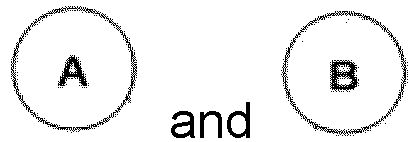


- L may be C1-3alkylene, O, NH, NCH3, S, SO, SO2, or a bond; and
- R1 may be H or C1-3alkyl.
- In an embodiment, in Formula 1 above
-
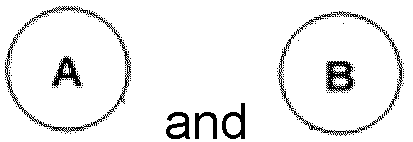


- wherein

- In an embodiment, in Formula 1 above
-

- may be unsubstituted or substituted with 1 to 3 members independently selected from C1-3alkyl, haloC1-3alkyl, haloC1-3alkoxy, C1-3alkoxy, and halogen;
-


- may be unsubstituted or substituted with 1 to 3 members independently selected from C1-3alkyl, haloC1-3alkoxy, C1-3alkoxy, hydroxy, and halogen;
- X and Z may each be independently N or CH;
- Y may be CR3c, wherein R3c may be H, C2-4alkenyl, C2-4alkynyl, C1-3alkoxy, hydroxy, halogen, haloC1-3alkyl, C3-6cycloalkyl, amino, C1-3alkylamino, haloC1-3alkylamino, or C2-6heterocyclyl;
- L may be methylene, ethylene, O, NH, NCH3, S, SO, or SO2; and/or
- R1 may be H or methyl.
- In an embodiment
- X and Z may each independently be N or CH;
- Y may be CR3c, wherein R3c may be H, C2-4alkenyl, C2-4alkynyl, C1-3alkoxy, hydroxy, halogen, haloC1-3alkyl, C3-6cycloalkyl, amino, C1-3alkylamino, haloC1-3alkylamino, or C2-6heterocyclyl;
-

-


- wherein

- unsubstituted or substituted with 1 to 3 members independently selected from C1-3alkyl, haloC1-3alkyl, haloC1-3alkoxy, C1-3alkoxy, hydroxy, and halogen;
- L may be methylene, ethylene, O, NH, NCH3, S, SO, or SO2; and
- R1 may be H or methyl.
- In an embodiment, the compound may be selected from the group consisting of the following compounds and enantiomers, diastereomers, solvates and hydrates thereof, and pharmaceutically acceptable salts thereof.
- 1) 2-benzyl-7-chloro-1-methyl-5-phenyl-1,5-dihydro-4H-imidazo[4,5-c]quinolin-4-one;
- 2) 7-chloro-2-(4-methoxybenzyl)-1-methyl-5-phenyl-1,5-dihydro-4H-imidazo[4,5-c]quinolin-4-one;
- 3) 7-chloro-2-(4-hydroxybenzyl)-1-methyl-5-phenyl-1,5-dihydro-4H-imidazo[4,5-c]quinolin-4-one;
- 4) 7-chloro-2-(3-methoxybenzyl)-1-methyl-5-phenyl-1,5-dihydro-4H-imidazo[4,5-c]quinolin-4-one;
- 5) 7-chloro-2-(2-methoxybenzyl)-1-methyl-5-phenyl-1,5-dihydro-4H-imidazo[4,5-c]quinolin-4-one;
- 6) 7-chloro-2-(4-chlorobenzyl)-1-methyl-5-phenyl-1,5-dihydro-4H-imidazo[4,5-c]quinolin-4-one;
- 7) 7-chloro-1-methyl-5-phenyl-2-(pyridin-4-ylmethyl)-1,5-dihydro-4H-imidazo[4,5-c]quinolin-4-one;
- 8) 7-chloro-2-(3,4-dimethoxybenzyl)-1-methyl-5-phenyl-1,5-dihydro-4H-imidazo[4,5-c]quinolin-4-one;
- 9) 7-chloro-1-methyl-2-phenethyl-5-phenyl-1,5-dihydro-4H-imidazo[4,5-c]quinolin-4-one;
- 10) 7-chloro-2-(4-methoxyphenyl)-1-methyl-5-(o-tolyl)-1,5-dihydro-4H-imidazo[4,5-c]quinolin-4-one;
- 11) 2-benzyl-7-chloro-5-phenyl-15-dihydro-4H-imidazo[4,5-c]quinolin-4-one-,
- 12) 2-((1H-imidazol-1-yl)methyl)-7-chloro-1-methyl-5-phenyl-1,5-dihydro-4H-imidazo[4,5-c]quinolin-4-one;
- 13) 7-chloro-2-((3-methoxypyrrolidin-1-yl)methyl)-1-methyl-5-phenyl-1,5-dihydro-4H-imidazo[4,5-c]quinolin-4-one;
- 14) 7-chloro-2-((3-hydroxypyrrolidin-1-yl)methyl)-1-methyl-5-phenyl-1,5-dihydro-4H-imidazo[4,5-c]quinolin-4-one;
- 15) 2-(4-methoxybenzyl)-1-methyl-5-phenyl-7-((2,2,2-trifluoroethyl)amino)-1,5-dihydro-4H-imidazo[4,5-c][1,8]naphthyridin-4-one;
- 16) 7-chloro-5-(4-chloro-3-fluorophenyl)-2-(4-methoxybenzyl)-1-methyl-1,5-dihydro-4H-imidazo[4,5-c]quinolin-4-one;
- 17) 7-chloro-5-(3-chloro-4-fluorophenyl)-2-(4-methoxybenzyl)-1-methyl-1,5-dihydro-4H-imidazo[4,5-c]quinolin-4-one;
- 18) 7-chloro-2-((4-methoxyphenyl)thio)-1-methyl-5-phenyl-1,5-dihydro-4H-imidazo[4,5-c]quinolin-4-one;
- 19) 7-chloro-2-((4-methoxyphenyl)sulfonyl)-1-methyl-5-phenyl-1,5-dihydro-4H-imidazo[4,5-c]quinolin-4-one;
- 20) 7-chloro-2-((4-methoxyphenyl)sulfinyl)-1-methyl-5-phenyl-1,5-dihydro-4H-imidazo[4,5-c]quinolin-4-one;
- 21) 7-chloro-2-(4-methoxybenzyl)-1-methyl-5-(2-methylpyridin-3-yl)-1,5-dihydro-4H-imidazo[4,5-c]quinolin-4-one;
- 22) 2-(4-methoxybenzyl)-1-methyl-5-(2-methylpyridin-3-yl)-1,5-dihydro-4H-imidazo[4,5-c]quinolin-4-one;
- 23) 7-chloro-2-(4-methoxybenzyl)-1-methyl-5-(2-(trifluoromethyl)pyridin-3-yl)-1,5-dihydro-4H-imidazo[4,5-c]quinolin-4-one;
- 24) 7-chloro-5-(2-cyclopropylpyridin-3-yl)-2-(4-methoxybenzyl)-1-methyl-1,5-dihydro-4H-imidazo[4,5-c]quinolin-4-one;
- 25) 7-chloro-2-(4-methoxybenzyl)-1-methyl-5-(2-(trifluoromethyl)phenyl)-1,5-dihydro-4H-imidazo[4,5-c]quinolin-4-one;
- 26) 7-chloro-5-(2-chlorophenyl)-2-(4-methoxybenzyl)-1-methyl-1,5-dihydro-4H-imidazo[4,5-c]quinolin-4-one;
- 27) 2-(4-methoxybenzyl)-1-methyl-5-(2-methylpyridin-3-yl)-7-(trifluoromethyl)-1,5-dihydro-4H-imidazo[4,5-c]quinolin-4-one;
- 28) 7-chloro-2-(4-fluorobenzyl)-1-methyl-5-(2-methylpyridin-3-yl)-1,5-dihydro-4H-imidazo[4,5-c]quinolin-4-one;
- 29) 2-(benzo[d][1,3]dioxol-5-ylmethyl)-7-chloro-1-methyl-5-(2-methylpyridin-3-yl)-1,5-dihydro-4H-imidazo[4,5-c]quinolin-4-one;
- 30) 7-chloro-2-(3,4-difluorobenzyl)-1-methyl-5-(2-methylpyridin-3-yl)-1,5-dihydro-4H-imidazo[4,5-c]quinolin-4-one;
- 31) 7-chloro-2-(4-methoxybenzyl)-1-methyl-5-(pyridin-3-yl)-1,5-dihydro-4H-imidazo[4,5-c]quinolin-4-one;
- 32) 7-chloro-5-(4-fluorophenyl)-2-(4-methoxybenzyl)-1-methyl-1,5-dihydro-4H-imidazo[4,5-c]quinolin-4-one;
- 33) 7-chloro-2-(4-(difluoromethoxy)benzyl)-1-methyl-5-(2-methylpyridin-3-yl)-1,5-dihydro-4H-imidazo[4,5-c]quinolin-4-one;
- 34) 7-chloro-5-(4-methoxyphenyl)-2-((4-methoxyphenyl)thio)-1-methyl-1,5-dihydro-4H-imidazo[4,5-c]quinolin-4-one;
- 35) 7-chloro-2-((4-methoxyphenyl)thio)-1-methyl-5-(2-methylpyridin-3-yl)-1,5-dihydro-4H-imidazo[4,5-c]quinolin-4-one;
- 36) 7-chloro-2-((4-fluorophenyl)thio)-1-methyl-5-(2-methylpyridin-3-yl)-1,5-dihydro-4H-imidazo[4,5-c]quinolin-4-one;
- 37) 7-chloro-2-((3,4-difluorophenyl)thio)-1-methyl-5-(2-methylpyridin-3-yl)-1,5-dihydro-4H-imidazo[4,5-c]quinolin-4-one;
- 38) 2-(benzo[d][1,3]dioxol-5-ylthio)-7-chloro-1-methyl-5-(2-methylpyridin-3-yl)-1,5-dihydro-4H-imidazo[4,5-c]quinolin-4-one;
- 39) 7-chloro-2-((2,4-difluorophenyl)thio)-1-methyl-5-(2-methylpyridin-3-yl)-1,5-dihydro-4H-imidazo[4,5-c]quinolin-4-one;
- 40) 7-chloro-2-((4-methoxyphenyl)amino)-1-methyl-5-phenyl-1,5-dihydro-4H-imidazo[4,5-c]quinolin-4-one;
- 41) 7-chloro-2-((4-methoxyphenyl)(methyl)amino)-1-methyl-5-phenyl-1,5-dihydro-4H-imidazo[4,5-c]quinolin-4-one;
- 42) 7-chloro-2-(4-methoxyphenoxy)-1-methyl-5-phenyl-1,5-dihydro-4H-imidazo[4,5-c]quinolin-4-one;
- 43) 7-hydroxy-2-(4-methoxybenzyl)-1-methyl-5-(2-methylpyridin-3-yl)-1,5-dihydro-4H-imidazo[4,5-c]quinolin-4-one;
- 44) 2-(4-methoxybenzyl)-1-methyl-5-(2-methylpyridin-3-yl)-7-vinyl-1,5-dihydro-4H-imidazo[4,5-c]quinolin-4-one;
- 45) 7-ethyl-2-(4-methoxybenzyl)-1-methyl-5-(2-methylpyridin-3-yl)-1,5-dihydro-4H-imidazo[4,5-c]quinolin-4-one;
- 46) 7-cyclopropyl-2-(4-methoxybenzyl)-1-methyl-5-(2-methylpyridin-3-yl)-1,5-dihydro-4H-imidazo[4,5-c]quinolin-4-one;
- 47) 7-ethynyl-2-(4-methoxybenzyl)-1-methyl-5-(2-methylpyridin-3-yl)-1,5-dihydro-4H-imidazo[4,5-c]quinolin-4-one;
- 48) 7-isopropyl-2-(4-methoxybenzyl)-1-methyl-5-(2-methylpyridin-3-yl)-1,5-dihydro-4H-imidazo[4,5-c]quinolin-4-one;
- 49) 2-(4-methoxybenzyl)-1,7-dimethyl-5-(2-methylpyridin-3-yl)-1,5-dihydro-4H-imidazo[4,5-c]quinolin-4-one;
- 50) 2-(4-methoxybenzyl)-1-methyl-5-(2-methylpyridin-3-yl)-7-(pyrrolidin-1-yl)-1,5-dihydro-4H-imidazo[4,5-c]quinolin-4-one;
- 51) 7-methoxy-2-(4-methoxybenzyl)-1-methyl-5-(2-methylpyridin-3-yl)-1,5-dihydro-4H-imidazo[4,5-c]quinolin-4-one;
- 52) 7-amino-2-(4-methoxybenzyl)-1-methyl-5-(2-methylpyridin-3-yl)-1,5-dihydro-4H-imidazo[4,5-c]quinolin-4-one;
- 53) 2-(4-methoxybenzyl)-1-methyl-7-(methylamino)-5-(2-methylpyridin-3-yl)-1,5-dihydro-4H-imidazo[4,5-c]quinolin-4-one;
- 54) 2-(4-(difluoromethoxy)benzyl)-7-ethyl-1-methyl-5-(2-methylpyridin-3-yl)-1,5-dihydro-4H-imidazo[4,5-c]quinolin-4-one;
- 55) 2-(4-(difluoromethoxy)benzyl)-7-methoxy-1-methyl-5-(2-methylpyridin-3-yl)-1,5-dihydro-4H-imidazo[4,5-c]quinolin-4-one;
- 56) 5-(4-(difluoromethoxy)phenyl)-2-(4-methoxybenzyl)-1-methyl-7-(trifluoromethyl)-1,5-dihydro-4H-imidazo[4,5-c][1,8]naphthyridin-4-one;
- 57) 2-(4-methoxybenzyl)-1-methyl-5-(2-methylpyridin-3-yl)-7-(trifluoromethyl)-1,5-dihydro-4H-imidazo[4,5-c][1,8]naphthyridin-4-one;
- 58) 2-(4-(difluoromethoxy)benzyl)-1-methyl-5-(2-methylpyridin-3-yl)-7-(trifluoromethyl)-1,5-dihydro-4H-imidazo[4,5-c][1,8]naphthyridin-4-one;
- 59) 2-((4-methoxyphenyl)thio)-1-methyl-5-(2-methylpyridin-3-yl)-7-(trifluoromethyl)-1,5-dihydro-4H-imidazo[4,5-c][1,8]naphthyridin-4-one;
- 60) 2-((4-fluorophenyl)thio)-1-methyl-5-(2-methylpyridin-3-yl)-7-(trifluoromethyl)-1,5-dihydro-4H-imidazo[4,5-c][1,8]naphthyridin-4-one;
- 61) 2-((4-methoxyphenyl)thio)-1-methyl-5-(2-methylpyridin-3-yl)-7-(trifluoromethyl)-1,5-dihydro-4H-imidazo[4',5':4,5]pyrido[2,3-d]pyrimidin-4-one;
- 62) 7-ethoxy-2-(4-methoxybenzyl)-1-methyl-5-(2-methylpyridin-3-yl)-1,5-dihydro-4H-imidazo[4',5':4,5]pyrido[2,3-d]pyrimidin-4-one;
- 63) 2-(4-(difluoromethoxy)benzyl)-7-methoxy-1-methyl-5-(2-methylpyridin-3-yl)-1,5-dihydro-4H-imidazo[4,5-c][1,8]naphthyridin-4-one;
- 64) 7-methoxy-2-(4-methoxybenzyl)-1-methyl-5-(2-methylpyridin-3-yl)-1,5-dihydro-4H-imidazo[4,5-c][18]naphthyridin-4-one;
- 65) 2-(4-(difluoromethoxy)benzyl)-7-ethyl-1-methyl-5-(2-methylpyridin-3-yl)-1,5-dihydro-4H-imidazo[4,5-c][1,8]naphthyridin-4-one; and
- 66) 7-cyclopropyl-2-(4-(difluoromethoxy)benzyl)-1-methyl-5-(2-methylpyridin-3-yl)-1,5-dihydro-4H-imidazo[4,5-c][1,8]naphthyridin-4-one.
- Another embodiment of the present disclosure provides a pharmaceutical composition for treating or preventing a methionine Adenosyltransferase 2A (MAT2A)-related disease or disorder, the pharmaceutical composition including as an active ingredient a compound selected from the compounds of Formula 1 and enantiomers, diastereomers, solvates and hydrates thereof, and pharmaceutically acceptable salts thereof.
- In an embodiment, the composition may exhibit MAT2A inhibitory activity.
- In an embodiment, the composition may be for treating cancer. For example, the cancer may be a solid tumor.
- In an embodiment, the composition may be for treating a methylthioadenosine phosphorylase (MTAP) deficient cancer.
- In an embodiment, the pharmaceutical composition may include, in a therapeutically effective amount, the compound selected from the compounds of Formula 1 and enantiomers, diastereomers, solvates and hydrates thereof, and pharmaceutically acceptable salts thereof.
- As used herein, the term "therapeutically effective amount" refers to an amount of a compound of the present disclosure that treats or prevents a particular disease, condition, or disorder; attenuates, ameliorates, or eliminates one or more symptoms of a particular disease, condition, or disorder; or prevents or delays the onset of one or more symptoms of a particular disease, condition, or disorder.
- A physician of ordinary skill in the relevant art may readily determine and prescribe an effective required dose of a pharmaceutical composition. For example, the pharmaceutical composition may include, but not limited to, 0.0001 mg to 10 g of the compound.
- In an embodiment, the pharmaceutical composition may further include a pharmaceutically acceptable additive in addition to the active ingredient. The additive may be, for example, but not limited to, diluents, disintegrating agents, binders, lubricants, surfactants, suspending agents, or emulsifiers, etc.
- The pharmaceutical compositions of the present disclosure may be formulated according to usual methods and may be prepared in various oral dosage forms, such as tablets, pills, powders, capsules, syrups, emulsions, microemulsions, or parenteral dosage forms, such as intramuscular, intravenous, or subcutaneous administration.
- Another embodiment of the present disclosure provides a method of treatment by administering to a subject suffering from a MAT2A-related disease or disorder the pharmaceutical composition including as an active ingredient the compound selected from the compounds of Formula 1 and enantiomers, diastereomers, solvates and hydrates thereof, and pharmaceutically acceptable salts thereof.
- As used herein, the term "treating" or "curing" refers to inhibiting a disease, for example, inhibiting a disease, condition, or disorder in a subject experiencing or exhibiting the pathology or symptoms of the disease, condition, or disorder, that is, preventing or reversing further development of the pathology and/or symptoms, or ameliorating a disease, for example, reducing disease severity.
- As used herein, the term "preventing" or "prophylactic" refers to preventing a disease, for example, preventing a disease, condition, or disorder in an individual who may have a predisposition to the disease, condition, or disorder but has not yet experienced or exhibited the pathology or symptoms of the disease.
- As used herein, the term "subject" or "individual" may be a vertebrate such as a mammal, fish, bird, reptile, or amphibian. For example, a subject may be a human, nonhuman primate, horse, pig, rabbit, dog, sheep, goat, cow, cat, guinea pig, or rodent.
- As used herein, the terms "administering" and "administration" refer to any method of providing a disclosed composition to a subject.
- The dosage, number of doses, or method of administration of a compound or pharmaceutical composition according to an embodiment may vary depending on the subject being treated, the severity of the disease or condition, the rate of administration, and the judgment of the prescribing physician. For example, a typical dosage for a person weighing 70 kg may be administered in an amount from 0.0001 mg to 10 g per day, for example 1 mg to 1 g per day. The number of doses may be administered once to several times, for example 1 to 4 times, or on an on/off schedule, and the method of administration may be by an oral or parenteral route. For example, a compound or pharmaceutical composition according to an embodiment may be administered by an oral or parenteral route in an amount ranging from 0.1 to 100 mg/kg (body weight).
- The physician may start at a lower level than necessary to achieve the target therapeutic effect and gradually increase the dose of the compound or pharmaceutical composition of the present disclosure administered to the subject until the intended effect is achieved.
- Another embodiment of the present disclosure provides a kit including as an active ingredient the compound selected from the compounds of Formula 1 and enantiomers, diastereomers, solvates and hydrates thereof, and pharmaceutically acceptable salts thereof.
- In an embodiment, the therapeutic agent may be a drug for treating a MAT2A-related disease or disorder, such as a drug for treating cancer. For example, the therapeutic agent may be a chemotherapeutic agent for the treatment of cancer.
- In an embodiment, the therapeutic agent may be a chemotherapeutic agent, an antimetabolite, an antimitotic, an alkylating agent, a DNA damaging agent, an antineoplastic antibiotic, a platinum coordination complex, a proteasome inhibitor, a hormone and hormone analog, an immunosuppressant, an anti-angiogenic compound and a vascular endothelial growth factor inhibitor, a fibroblast growth factor inhibitor, an epidermal growth factor receptor inhibitor, an antibody, a checkpoint inhibitor, a corticosteroid, a DNA repair enzyme inhibitor, a treatment for autoimmune disorders, a treatment for diabetes, a treatment for liver disease, a treatment for cardiovascular disorder, a treatment for metabolic disorder, an antiviral agent, or an ophthalmic agent.
- In an embodiment, the compounds, compositions and kits of the present disclosure may be administered alone or simultaneously with at least one other therapeutic agent, separately or sequentially.
- In the context of the present disclosure, the singular form of a word may include the plural and vice versa, unless the context clearly indicates otherwise.
- Figures given herein shall be deemed to include the meaning of "about" even if not expressly stated. As used herein, the term "about" refers to within 5 % of a certain value or range, preferably within 1 % to 2 %.
- As used herein, the numerical range indicated using the term "to" refers to a range that includes the numerical values written before and after the term "to" as the lower limit and upper limit, respectively.
- As used herein, the terms "has," "may have," "includes," or "may include" refer to the presence of a particular feature (for example, a number, or a component such as an ingredient) and do not exclude the presence of additional features.
- The contents of all publications incorporated by reference herein are hereby incorporated by reference in their entirety.
- Hereinafter, the present disclosure will be further described in more detail through the following embodiments and experimental examples. However, these embodiments and examples are intended only to illustrate the present disclosure and are not intended to limit the scope of the present disclosure in any way.
-

-

- 2-amino-4-chlorobenzoic acid (10 g, 57.12 mmol), potassium carbonate (11.90 g, 85.67 mmol) and iodomethane (3.63 mL, 57.12 mmol) were sequentially added to N,N-dimethylformamide (200 mL) and the reaction solution was stirred at room temperature for 2 hours. Water was added to the reaction product and stirred at room temperature for 2 hours. The resulting solid was collected by filtration, washed with water, and dried to obtain the title compound (8.72 g, 82.3 %).
-

- Methyl 2-amino-4-chlorobenzoate (8.72 g, 47.0 mmol) synthesized in [Process 1] above, bromobenzene (4.99 mL, 47.0 mmol), cesium carbonate (23.20 g, 70.5 mmol), palladium acetate (215 mg, 0.94 mmol), and xantphos (1.09 g, 1.88 mmol) were added to toluene (88 mL), and after nitrogen gas substitution, the mixture was refluxed at 100 °C for 12 hours. After cooling the reaction product to room temperature, the solid was filtered and washed with dichloromethane. The filtrate was concentrated and purified by silica gel column chromatography to obtain the title compound (8.56 g, 69.57 %).
-
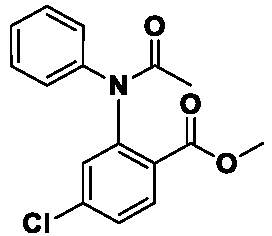
- Methyl 4-chloro-2-(phenylamino)benzoate (7.56 g, 28.89 mmol) synthesized in [Process 2] above was dissolved in acetic acid (60 mL), followed by the addition of acetic anhydride (54.62 mL, 577.76 mmol) and was refluxed at 120 °C for 23 hours. The reaction product was cooled to room temperature, then poured into ice water and stirred for 30 minutes. The resulting solid was collected by filtration, washed with water and dried to obtain the title compound (8.32 g, 94.82 %), which was used without additional purification.
-

- Tetrahydrofuran (125 mL) was added to methyl 4-chloro-2-(N-phenylacetamido)benzoate (8.32 g, 27.39 mmol) synthesized in [Process 3] above, and the reaction solution was cooled to -78 °C. A solution of potassium bis(trimethylsilyl)amide 1 M tetrahydrofuran was slowly added dropwise to the reaction solution for 1 hour. The reaction product was concentrated, water was added, and acidified with 6N hydrochloric acid. The resulting solid was collected by filtration and washed with excess water. The solid was stirred in diethyl ether for 30 minutes, collected by filtration, and dried to obtain the title compound (6.02 g, 80.89 %), which was used without additional purification.
-

- Acetic acid (100 mL), nitric acid (6.2 mL, 88.63 mmol), and sodium nitrite (312 mg, 4.43 mmol) were added to 7-chloro-4-hydroxy-1-phenylquinolin-2(1H)-one (6.02 g, 22.16 mmol) synthesized in [Process 4] above and stirred at room temperature for 2 hours. The reaction product was poured into ice water and stirred for 1 hour. The resulting solid was collected by filtration, washed with excess water and dried to obtain the title compound (6.5 g, 92.63 %).
-

- Phosphorus oxychloride (65 mL, 683.41 mmol) was added to 7-chloro-4-hydroxy-3-nitro-1-phenylquinolin-2(1H)-one (6.5 g, 20.52 mmol) synthesized in [Process 5] above. After cooling the reaction solution to 0 °C, triethylamine (6.5 mL, 46.17 mmol) was slowly added dropwise.
- The mixture was then refluxed at 110 °C for 1 hour. The reaction product was cooled to room temperature, then poured into ice water and stirred for 1 hour. The resulting solid was collected by filtration, washed with excess water and dried to obtain the title compound (5.76 g, 83.67 %).
-

- 4,7-dichloro-3-nitro-1-phenylquinolin-2(1H)-one (5.76 g, 17.17 mmol) synthesized in [Process 6] above was dissolved in dichloromethane, followed by adding methylamine hydrochloride (1.42 g, 20.61 mmol) and triethylamine (7.26 mL, 51.52 mmol). The reaction solution was stirred at room temperature for 1 hour, concentrated, and then water was added and stirred for 1 hour. The resulting solid was collected by filtration, washed with excess water and dried to obtain the title compound (5.05 g, 89.19 %).
-

- Raney-nickel (5.39 g, 45.95 mmol), dichloromethane (60 mL)/methanol (30 mL) were added to 7-chloro-4-(methylamino)-3-nitro-1-phenylquinolin-2(1H)-one (5.05 g, 15.32 mmol) synthesized in [Process 7] above and was fitted with a hydrogen balloon. The reaction solution was stirred at room temperature for 16 hours, filtered through celite, and purified by silica gel column chromatography to obtain the title compound (2.16 g, 47.05 %).
-

- 3-amino-7-chloro-4-(methylamino)-1-phenylquinolin-2(1H)-one (40 mg, 0.13 mmol) synthesized in [Process 8] above was dissolved in dichloromethane (1 mL), cooled to 0 °C, and triethylamine (21 µL, 0.15 mmol) and 2-phenylacetyl chloride (18 µL, 0.13 mmol) were slowly added dropwise. The reaction solution was stirred at room temperature for 1 hour, f and was subjected to extraction with dichloromethane by adding water. The separated organic layer was dried with anhydrous sodium sulfate and concentrated by vacuum distillation. Purification was performed using silica gel column chromatography to obtain the title compound (15.3 mg, 27.44 %).
-

- N-(7-chloro-4-(methylamino)-2-oxo-1-phenyl-1,2-dihydroquinolin-3-yl)-2-phenylacetamide (15 mg, 0.04 mmol) synthesized in [Process 9] above was dissolved in 1,4-dioxane (0.5 mL) and 2 N sodium hydroxide (0.5 mL) was added. The reaction solution was stirred at 120 °C for 2 hours, after completion of the reaction, the reaction solution was cooled to 0 °C and neutralized with 1 N hydrochloric acid. The resulting solid was collected by filtration, washed with excess water and dried to obtain the title compound (13.2 mg, 78.5 %).
-

- The same reaction was carried out using 2-(4-methoxyphenyl)acetyl chloride instead of 2-phenylacetyl chloride, in [Process 9] of Example 1, to obtain the title compound (8.7 mg, 15.17 %).
-

- 7-chloro-2-(4-methoxybenzyl)-1-methyl-5-phenyl-1,5-dihydro-4H-imidazo[4,5-c]quinolin-4-one [title compound of Example 2] (20 mg, 0.05 mmol) was dissolved in dichloromethane (0.5 mL), cooled to 0 °C, and boric acid tribromide (9 µL, 0.1 mmol) was slowly added dropwise. The reaction solution was stirred at room temperature for 1 hour, poured into ice water, followed by adding a saturated aqueous solution of sodium hydrogen carbonate and was subjected to extraction with dichloromethane. The separated organic layer was dried with anhydrous magnesium sulfate and concentrated by vacuum distillation. Then purified by silica gel column chromatography to obtain the title compound (3.4 mg, 17.18 %).
-

- The same reaction was carried out up to [Process 10] using 2-(3-methoxyphenyl)acetyl chloride instead of 2-phenylacetyl chloride, in [Process 9] of Example 1, to obtain the title compound (22 mg, 30.68 %).
-

- The same reaction was carried out up to [Process 10] using 2-(2-methoxyphenyl)acetyl chloride instead of 2-phenylacetyl chloride, in [Process 9] of Example 1, to obtain the title compound (15 mg, 20.92 %).
-

- The same reaction was carried out up to [Process 10] using 2-(4-chlorophenyl)acetyl chloride instead of 2-phenylacetyl chloride, in [Process 9] of Example 1, to obtain the title compound (12.9 mg, 64.46 %).
-

- 3-amino-7-chloro-4-(methylamino)-1-phenylquinolin-2(1H)-one (20 mg, 0.06 mmol) synthesized in [Process 8] of Example 1 was dissolved in N,N-dimethylformamide (1 mL), followed by adding 4-pyridyl acetic acid hydrochloride (12.4 mg, 0.07 mmol), 1-[bis(dimethylamino)methylene]-1H-1,2,3-triazolo[4,5-b]pyridinium 3-oxide hexafluorophosphate (HATU) (50.7 mg, 0.13 mmol), and diisopropylethylamine (43 mg, 0.33 mmol). The reaction solution was stirred at room temperature for 16 hours, and was subjected to extraction with ethyl acetate. The separated organic layer was dried with anhydrous sodium sulfate and concentrated by vacuum distillation. The same reaction was carried out up to [Process 10] without purification to obtain the title compound (8 mg, 21.50 %).
-

- The same reaction was carried out up to [Process 10] using 2-(3,4-dimethoxyphenyl)acetyl chloride instead of 2-phenylacetyl chloride, in [Process 9] of Example 1, to obtain the title compound (37 mg, 46.59 %).
-

- The same reaction was carried out up to [Process 10] using 3-phenylpropanoyl chloride instead of 2-phenylacetyl chloride, in [Process 9] of Example 1, to obtain the title compound (16.4 mg, 60.05 %).
-

- The same reaction was carried out up to [Process 10] using 1-bromo-2-methylbenzene instead of bromobenzene, in [Process 2] of Example 1, and 2-(4-methoxyphenyl)acetyl chloride instead of 2-phenylacetyl chloride, in [Process 9] of Example 1, to obtain the title compound (45.6 mg, 78.56 %).
-

- The same reaction was carried out, except that the compound was dissolved in tetrahydrofuran instead of dissolving in dichloromethane, and ammonia water was added instead of adding methylamine hydrochloride and triethylamine, to synthesize 4-amino-7-chloro-3-nitro-1-phenylquinolin-2(1H)-one, in [Process 7] of Example 1, to obtain the title compound (2 mg, 41.87 %).
- According to an embodiment of the present disclosure, the compound of Formula 1 may be a compound selected from the group consisting of the compounds listed in [Table 1] below.
[Table 1] Compound No. Structure Nomenclature MS[M+H]+ 1H-NMR spectrum (300MHz) 1 
2-benzyl-7-chloro-1-methyl-5-phenyl-1,5-dihydro-4H-imidazo[4,5-c]quinolin-4-one 400.11 1H-NMR spectrum (300 MHz, DMSO-d6) δ 8.27(d, 1H), 7.68-7.57(m, 3H), 7.38-7.25(m, 8H), 6.49(d, 1H), 4.36(s, 2H), 4.05(s, 3H). 2 
7-chloro-2-(4-methoxybenzyl)-1-methyl-5-phenyl-1,5-dihydro-4H-imidazo[4,5-c]quinolin-4-one 430.12 1H-NMR spectrum (300 MHz, CDCl3) δ 7.92(d, 1H), 7.64-7.54(m, 3H), 7.30-7.16(m, 5H), 6.85(d, 2H), 6.73(d, 1H), 4.35(s, 2H), 3.94(s, 3H), 3.78(s, 3H). 3 
7-chloro-2-(4-hydroxybenzyl)-1-methyl-5-phenyl-1,5-dihydro-4H-imidazo[4,5-c]quinolin-4-one 416.11 1H-NMR spectrum (300 MHz, DMSO-d6) δ 9.30 (brs, 1H), 8.27(d, 1H), 7.69-7.59(m, 3H), 7.35-7.32(m, 3H), 7.07(d, 2H), 6.72(d, 2H), 6.50(d, 1H), 4.24(s, 2H), 4.04(s, 3H). 4 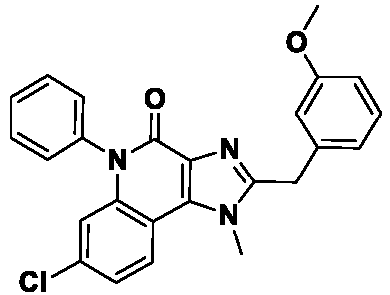
7-chloro-2-(3-methoxybenzyl)-1-methyl-5-phenyl-1,5-dihydro-4H-imidazo[4,5-c]quinolin-4-one 430.12 1H-NMR spectrum (300 MHz, CDCl3) δ 7.92(d, 1H), 7.64-7.55(m, 3H), 7.31-7.17(m, 4H), 6.86-6.79(m, 3H), 6.73(d, 1H), 4.39(s, 2H), 3.94(s, 3H), 3.77(s, 3H). 5 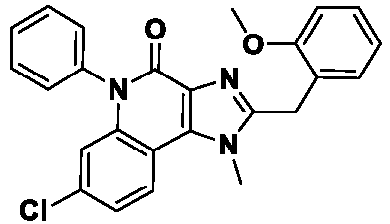
7-chloro-2-(2-methoxybenzyl)-1-methyl-5-phenyl-1,5-dihydro-4H-imidazo[4,5-c]quinolin-4-one 430.12 1H-NMR spectrum (300 MHz, CDCl3) δ 7.94(d, 1H), 7.64-7.54(m, 3H), 7.30-7.17(m, 4H), 7.08(d, 1H), 6.94-6.84(m, 2H), 6.72(s, 1H), 4.39(s, 2H), 3.95(s, 3H), 3.93(s, 3H). 6 
7-chloro-2-(4-chlorobenzyl)-1-methyl-5-phenyl-1,5-dihydro-4H-imidazo[4,5-c]quinolin-4-one 434.07 1H-NMR spectrum (300 MHz, DMSO-d6) δ 8.26(d, 1H), 7.64-7.57(m, 3H), 7.40-7.28(m, 7H), 6.48(d, 1H), 4.35(s, 2H), 4.04(s, 3H). 7 
7-chloro-1-methyl-5-phenyl-2-(pyridin-4-ylmethyl)-1,5-dihydro-4H-imidazo[4,5-c]quinolin-4-one 401.11 1H-NMR spectrum (300 MHz, DMSO-d6) δ 8.51 (d, 2H), 8.28(d, 1H), 7.69-7.55(m, 3H), 7.36-7.26(m, 5H), 6.49(d, 1H), 4.40(s, 2H), 4.06(s, 3H). 8 
7-chloro-2-(3,4-dimethoxybenzyl)-1-methyl-5-phenyl-1,5-dihydro-4H-imidazo[4,5-c]quinolin-4-one 460.13 1H-NMR spectrum (300 MHz, CDCl3) δ 7.93(d, 1H), 7.65-7.55(m, 3H), 7.31-7.18(m, 3H), 6.81-6.74(m, 4H), 4.35(s, 2H), 3.96(s, 3H), 3.86(s, 3H), 3.82(s, 3H). 9 
7-chloro-1-methyl-2-phenethyl-5-phenyl-1,5-dihydro-4H-imidazo[4,5-c]quinolin-4-one 414.13 1H-NMR spectrum (300 MHz, CDCl3) δ 7.92(d, 1H), 7.63-7.53(m, 3H), 7.31-7.17(m, 8H), 6.72(d, 1H), 3.80(s, 3H), 3.21(s, 4H). 10 
7-chloro-2-(4-methoxyphenyl)-1-methyl-5-(o-tolyl)-1,5-dihydro-4H-imidazo[4,5-c]quinolin-4-one 444.14 1H-NMR spectrum (300 MHz, CDCl3) δ 7.93(d, 1H), 7.42-7.35(m, 3H), 7.19-7.11(m, 4H), 6.83(d, 2H), 6.61(s, 1H), 4.31(s, 2H), 3.92(s, 3H), 3.76(s, 3H), 2.00(s, 3H). 11 
2-benzyl-7-chloro-5-phenyl-1,5-dihydro-4H-imidazo[4,5-c]quinolin-4-one 386.10 1H-NMR spectrum (300 MHz, CDCl3) δ 12.43(brs, 1H), 8.31 (d, 1H), 7.64-7.54(m, 3H), 7.33-7.29(m, 3H), 7.26-7.15(m, 5H), 6.75(d, 1H), 4.12(s, 2H). -

-

- 2-chloro-1,1,1-trimethoxyethane (0.25 mL, 1.84 mmol), p-toluenesulfonic acid monohydrate (8.25 mg, 0.04 mmol) were added to 3-amino-7-chloro-4-(methylamino)-1-phenylquinolin-2(1H)-one synthesized in [Process 8] of Example 1 and stirred at 100 °C for 1 hour. The reaction solution was concentrated by cooling to room temperature and stirred in diethyl ether for 1 hour. The resulting solid was collected by filtration, washed with diethyl ether to obtain the title compound (152.6 mg, 98.23 %), which was used without additional purification.
-

- Imidazole (7.7 mg, 0.11 mmol) was dissolved in N,N-dimethylformamide (0.2 mL), cooled to 0 °C, and sodium hydride (6.7 mg, 0.17 mmol) was added fractionally under nitrogen. After stirring for 30 minutes, 7-chloro-2-(chloromethyl)-1-methyl-5-phenyl-1,5-dihydro-4H-imidazo[4,5-c]quinolin-4-one (20 mg, 0.06 mmol) synthesized in [Process 1] was slowly added dropwise to the mixture above dissolved in N,N-dimethylformamide (0.3 mL). The reaction solution was stirred at room temperature for 30 minutes, followed by adding ice water and was subjected to extraction with ethyl acetate. The obtained organic layer was dried with anhydrous magnesium sulfate and vacuum distilled. The concentrated reactant was purified by silica gel column chromatography to obtain the title compound (4.4 mg, 20.22 %).
-
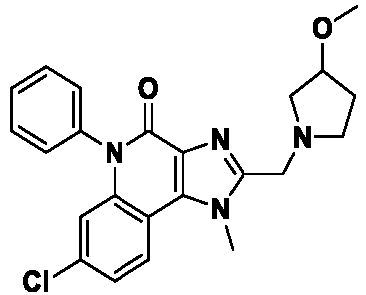
- The same reaction was carried out, except for the use of 3-methoxypyrrolidine instead of imidazole, in [Process 2] of Example 12, to obtain the title compound (30.5 mg, 51.67 %).
-

- The same reaction was carried out, except for the use of 7-chloro-2-((3-methoxypyrrolidin-1-yl)methyl)-1-methyl-5-phenyl-1,5-dihydro-4H-imidazo[4,5-c]quinolin-4-one [the title compound of Example 13] instead of 7-chloro-2-(4-methoxybenzyl)-1-methyl-5-phenyl-1,5-dihydro-4H-imidazo[4,5-c]quinolin-4-one, in Example 3, to obtain the title compound (12.4 mg, 64.13 %).
-

-

- Aniline (6.15 g, 65.3 mmol) was diluted with tetrahydrofuran (60 mL) and the reaction solution was cooled to -75 °C, then a 1 M lithium bis(trimethylsilyl)amide tetrahydrofuran solution (16.7 g, 100 mmol) was added dropwise and stirred for 1 hour. To this mixture 2,6-dichloronicotinic acid (6.00 g, 31.3 mmol) was added and the reaction solution was stirred at room temperature for 16 hours. After completion of the reaction, the mixture was diluted with ethyl acetate and washed with 1 N aqueous hydrochloric acid solution and saturated brine. The separated organic layer was dried with anhydrous sodium sulfate, followed by vacuum filtration and vacuum distillation. The obtained residue was separated by silica gel column chromatography to obtain the title compound (3.7 g, 48 %).
-

- 6-chloro-2-(phenylamino)nicotinic acid (3.70 g, 14.9 mmol), 1,2,3-benzotriazole (1.81 g, 14.9 mmol) and 1-ethyl-3-(3-dimethylaminopropyl)carbodiimide (2.85 g, 14.9 mmol) synthesized in [Process 1] above were sequentially added to dichloromethane (13 mL), and the reaction solution was stirred at room temperature for 16 hours. After completion of the reaction, the mixture was diluted with dichloromethane and washed with distilled water. The separated organic layer was dried with anhydrous sodium sulfate, followed by vacuum filtration and vacuum distillation. The obtained residue was separated by silica gel column chromatography to obtain the title compound (3.83 g, 74 %).
-

- Ethyl acetate (1.45 g, 16.5 mmol) was diluted with tetrahydrofuran (30 mL), cooled to -78 °C and a 2 N lithium diisopropylamide tetrahydrofuran/heptane/benzene solution (12.1 mL, 24.2 mmol) was slowly added dropwise. The reaction solution was stirred at - 78 °C for 1 hour, then a dilute solution of (1H-benzo[d][1,2,3]triazol-1-yl)(6-chloro-2-(phenylamino)pyridin-3-yl)methanone (3.83 g, 11.0 mmol) synthesized in [Process 2] above in tetrahydrofuran (10 mL) was added dropwise and stirred at the same temperature for 2 hours, followed by stirring at room temperature for 16 hours. After completion of the reaction, the mixture was diluted with ethyl acetate and washed with 1 N aqueous hydrochloric acid solution. The separated organic layer was dried with anhydrous sodium sulfate, followed by vacuum filtration and vacuum distillation. The obtained residue was separated by silica gel column chromatography to obtain the title compound (1.3 g, 29 %).
-
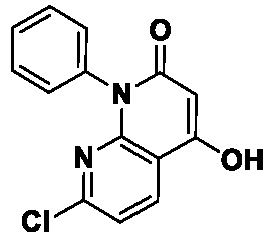
- N,N-diisopropylethylamine (4.62 mL, 26.5 mmol) and 1,8-diazabicyclo[5,4,0]undec-7-ene (0.61 mL, 4.08 mmol) were added to ethyl 3-(6-chloro-2-(phenylamino)pyridin-3-yl)-3-oxopropanoate (1.30 g, 4.08 mmol) synthesized in [Process 3] above and stirred at 120 °C for 2 hours. After completion of the reaction, the resulting reaction mixture was cooled to room temperature, diluted with ethyl acetate and washed with an 1 N aqueous hydrochloric acid solution. The separated organic layer was dried with anhydrous sodium sulfate, followed by vacuum filtration and vacuum distillation. The obtained residue was separated by silica gel column chromatography to obtain the title compound (1.1 g, 98 %).
-

- The same method was carried out, except for the use of 7-chloro-4-hydroxy-1-phenyl-1,8-naphthyridin-2(1H)-one synthesized in [Process 4] above instead of 7-chloro-4-hydroxy-1-phenylquinolin-2(1H)-one in [Process 5] of Example 1, to obtain the title compound (450 mg, 39%).
-

- The same method was carried out, except for the use of 7-chloro-4-hydroxy-3-nitro-1-phenyl-1,8-naphthyridin-2(1H)-one synthesized in [Process 5] above instead of 7-chloro-4-hydroxy-3-nitro-1-phenylquinolin-2(1H)-one in [Process 6] of Example 1, to obtain the title compound (460 mg, 97%).
-
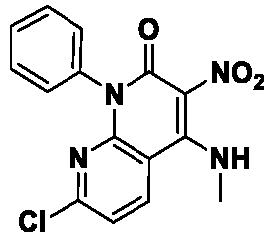
- The same reaction was carried out, except for the use of 4,7-dichloro-3-nitro-1-phenyl-1,8-naphthyridin-2(1H)-one synthesized in [Process 6] above instead of 4,7-dichloro-3-nitro-1-phenylquinolin-2(1H)-one in [Process 7] of Example 1, to obtain the title compound (347 mg, 80.15%).
-

- 7-chloro-4-(methylamino)-3-nitro-1-phenyl-1,8-naphthyridin-2(1H)-one (160 mg, 0.48 mmol) synthesized in [Process 7] above was dissolved in N-methylpyrrolidone (2 mL), followed by adding 2,2,2-trifluoroethylamine (0.78 mL, 9.62 mmol), N,N-diisopropylethylamine (0.42 mL, 2.40 mmol), and the mixture was stirred for 3 hours at 160 °C in a microwave reactor. After cooling to room temperature, water was added to the reaction product and was subjected to extraction with ethyl acetate. The obtained organic layer was dried with anhydrous sodium sulfate and vacuum distilled.
-

- The same reaction was carried out except for the use of 4-(methylamino)-3-nitro-1-phenyl-7-((2,2,2-trifluoroethyl)amino)-1,8-naphthyridin-2(1H)-one synthesized in [Process 8] above instead of 7-chloro-4-(methylamino)-3-nitro-1-phenylquinolin-2(1H)-one, in [Process 8] of Example 1, to obtain the title compound (76 mg, 58.35 %).
-

- 3-amino-4-(methylamino)-1-phenyl-7-((2,2,2-trifluoroethyl)amino)-1,8-naphthyridin-2(1H)-one (76 mg, 0.21 mmol) synthesized in [Process 9] above was dissolved in N,N-dimethylformamide (1 mL), followed by adding 2-(4-methoxyphenyl)acetic acid (38.24 mg, 0.23 mmol), 1-[bis(dimethylamino)methylene]-1H-1,2,3-triazolo[4,5-b]pyridinium 3-oxide hexafluorophosphate (HATU) (159.07 mg, 0.42 mmol), diisopropylethylamine (135.18 mg, 1.05 mmol). The reaction solution was stirred at room temperature for 5 hours, and was subjected to extraction with ethyl acetate by adding water. The separated organic layer was dried with anhydrous sodium sulfate and concentrated by vacuum distillation to obtain the title compound (104 mg, 97.19 %), which was proceeded to the next reaction [Process 11] without additional purification.
-

- The same reaction was carried out, except for the use of 2-(4-methoxyphenyl)-N-(4-(methylamino)-2-oxo-1-phenyl-7-((2,2,2-trifluoroethyl)amino)-1,2-dihydro-1,8-naphthyridin-3-yl)acetamide synthesized in [Process 10] above instead of N-(7-chloro-4-(methylamino)-2-oxo-1-phenyl-1,2-dihydroquinolin-3-yl)-2-phenylacetamide, in [Process 10] of Example 1, to obtain the title compound (6.2 mg, 5.49 %).
-

-

- 7-chloro-2H-benzo[d][1,3]oxazine-2,4(1H)-dione (12.0 g, 60.7 mmol), ethyl nitroacetate (12.5 g, 91.1 mmol) and triethylamine (12.7 mL, 91.1 mmol) were sequentially added to tetrahydrofuran (120 mL), and the reaction solution was stirred at 55 °C for 16 hours. After completion of the reaction, the mixture was cooled to room temperature and the solvent was distilled under decompression. The obtained residue was diluted with water and washed with diethyl ether to remove the organic layer, and the remaining aqueous layer was adjusted to pH 2 to 3 with an 1 N aqueous hydrochloric acid solution, and the resulting solid was collected by filtration, washed with methanol and excess water, and dried to obtain the title compound (5.6 g, 38 %).
-

- Phosphoryl chloride (10.8 mL, 116 mmol) was added to 7-chloro-4-hydroxy-3-nitroquinolin-2(1H)-one (995 mg, 4.14 mmol) synthesized in [Process 1] above, the reaction solution was cooled to 0 °C, and triethylamine (0.98 mL, 7.04 mmol) was slowly added dropwise. The reaction mixture was refluxed at 100 °C for 4 hours and the reaction solution was cooled to room temperature, poured into ice water and was subjected to 1st extraction with ethyl acetate. After adjusting the pH to 7 to 8 with saturated sodium bicarbonate solution, the mixture was subjected to 2nd extraction with dichloromethane. The obtained organic layer was dried with anhydrous sodium sulfate, followed by vacuum filtration and vacuum distillation to obtain the title compound (1.15 g, 100 %).
-

- The same method was carried out, except for the use of 2,4,7-trichloro-3-nitroquinoline synthesized in [Process 2] above instead of 4,7-dichloro-3-nitro-1-phenylquinolin-2(1H)-one in [Process 7] of Example 1, to obtain the title compound (740 mg, 64 %).
-

- The same method was carried out ,except for the use of 2,7-dichloro-N-methyl-3-nitroquinolin-4-amine synthesized in [Process 3] above instead of 7-chloro-4-(methylamino)-3-nitro-1-phenylquinolin-2(1H)-one in [Process 8] of Example 1, to obtain the title compound (470 mg, 71 %).
-

- 2,7-dichloro-N4-methylquinolin-3,4-diamine (530 mg, 2.19 mmol) synthesized in [Process 4] above, 2-(4-methoxyphenyl)acetic acid (400 mg, 2.41 mmol) and 1-[bis(dimethylamino)methylene]-1H-1,2,3-triazolo[4,5-b]pyridinium 3-oxide hexafluorophosphate (1.25 g, 3.28 mmol) were diluted with N,N-dimethylformamide (5 mL), then N,N-diisopropylethylamine (849 mg, 6.57 mmol) was added and the mixture was stirred at room temperature for 16 hours. After completion of the reaction, the reaction mixture was diluted with ethyl acetate and washed with water. The separated organic layer was vacuum distilled and the obtained residue was dissolved with hexane:ethyl acetate (4:1 (volume ratio), 20 mL) mixed solvent and the resulting solid was filtered to obtain the title compound (570 mg, 67 %).
-

- N-(2,7-dichloro-4-(methylamino)quinolin-3-yl)-2-(4-methoxyphenyl)acetamide (520 mg, 1.40 mmol) synthesized in [Process 5] above was diluted with 1,4-dioxane (9.7 mL) and water (9.7 mL), then sodium hydroxide (520 mg, 1.40 mmol) was added and the above mixture was stirred at 100 °C for 1 hour. After completion of the reaction, the reaction solution was cooled to room temperature and adjusted to pH 7 to 8 with an 1 N aqueous hydrochloric acid solution, and the solvent was removed by vacuum distillation. The resulting solid from the addition of saturated sodium bicarbonate solution was collected by filtration, washed with water, and dried to obtain the title compound (520 mg, 96 %).
-
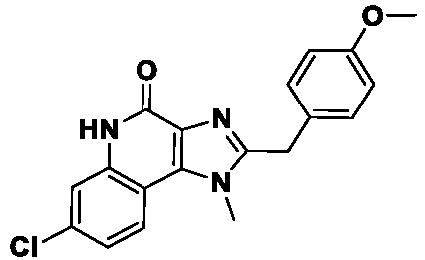
- 5 N aqueous hydrochloric acid solution (7 mL) and ethanol (17 mL) were added to 4,7-dichloro-2-(4-methoxybenzyl)-1-methyl-1H-imidazo[4,5-c]quinoline (520 mg, 1.40 mmol) synthesized in [Process 6] above, and the reaction solution was stirred at 100 °C for 4 hours. After completion of the reaction, the reaction solution was cooled to room temperature and adjusted to pH 7 to 8 with a saturated aqueous solution of sodium bicarbonate and water, and stirred for 10 minutes. The resulting solid was collected by filtration, washed with water, and dried to obtain the title compound (440 mg, 89 %).
-

- 7-chloro-2-(4-methoxybenzyl)-1-methyl-1,5-dihydro-4H-imidazo[4,5-c]quinolin-4-one (40 mg, 0.11 mmol) synthesized in [Process 7] above was dissolved in dimethyl sulfoxide (1 mL), followed by adding 4-chloro-3-fluorophenylboronic acid (40 mg, 0.23 mmol), pyridine (0.04 mL, 0.45 mmol), molecular sieve (4 Å), and cobalt(II) acetate (42 mg, 0.23 mmol), and the mixture was stirred in an open vial at 80 °C for 16 hours. After cooling the reaction product to room temperature, water was added to the reaction product and was subjected to extraction with ethyl acetate. The obtained organic layer was dried with anhydrous sodium sulfate and vacuum distilled. Purification was performed using silica gel column chromatography to obtain the title compound (2.7 mg, 4.95 %).
-

- The same reaction was carried out using 3-chloro-4-fluorophenylboronic acid instead of 4-chloro-3-fluorophenylboronic acid, in [Process 8] of Example 16, to obtain the title compound (2.6 mg, 4.77 %).
-

-

- 3-amino-7-chloro-4-(methylamino)-1-phenylquinolin-2(1H)-one (300 mg, 1.00 mmol) synthesized in [Process 8] of Example 1 was dissolved in triethyl orthoformate (3.4 mL, 20.02 mmol) and stirred at 120 °C for 2 hours. After completion of the reaction, the reaction solution was cooled to room temperature and the resulting solid was collected by filtration, washed with ethyl acetate and dried to obtain the title compound (265 mg, 85.5 %).
-

- 7-chloro-1-methyl-5-phenyl-1,5-dihydro-4H-imidazo[4,5-c]quinolin-4-one (100 mg, 0.32 mmol) synthesized in [Process 1] above was dissolved in dimethylformamide (3 mL), followed by adding 4-methoxybenzenthiol (67.9 mg, 0.48 mmol), copper(I) chloride (32.3 mg, 0.32 mmol), 1,10-phenanthroline (59.4 mg, 0.32 mmol) and sodium carbonate (86.4 mg, 0.81 mmol). The reaction solution was stirred at 140 °C for 3 days, and after completion of the reaction, the reaction solution was cooled to room temperature, followed by adding water and was subjected to extraction with ethyl acetate. The separated organic layer was dried with magnesium sulfate and concentrated by vacuum distillation. Then purified by silica gel column chromatography and crystallized from methanol to obtain the title compound (29 mg, 20.0 %).
-

-

- 7-chloro-2-((4-methoxyphenyl)thio)-1-methyl-5-phenyl-1,5-dihydro-4H-imidazo[4,5-c]quinolin-4-one (25 mg, 0.06 mmol) synthesized in Example 18 above was dissolved in dichloromethane (0.56 mL), cooled to 0 °C, followed by slowly adding 3-chloroperoxycarboxylic acid (19 mg, 0.08 mmol). The reaction solution was stirred at 0 °C for 30 minutes, and after completion of the reaction, a saturated aqueous solution of sodium thiosulfate was added and was subjected to extraction with dichloromethane. The separated organic layer was dried with anhydrous magnesium sulfate and concentrated by vacuum distillation. Then purified by silica gel column chromatography to each obtain [the title compound of Example 19] 7-chloro-2-((4-methoxyphenyl)sulfonyl)-1-methyl-5-phenyl-1,5-dihydro-4H-imidazo[4,5-c]quinolin-4-one (15 mg, 56.0 %) and [the title compound of Example 20] 7-chloro-2-((4-methoxyphenyl)sulfinyl)-1-methyl-5-phenyl-1,5-dihydro-4H-imidazo[4,5-c]quinolin-4-one (8 mg, 25.9 %).
- According to an embodiment of the present disclosure, the compound of Formula 1 may be a compound selected from the group consisting of the compounds listed in [Table 2] below.
[Table 2] Compound No. Structure Nomenclature MS[M+H]+ 1H-NMR spectrum (300MHz) 12 
2-((1H-imidazol-1-yl)methyl)-7-chloro-1-methyl-5-phenyl-1,5-dihydro-4H-imidazo[4,5-c]quinolin-4-one 390.11 1H-NMR spectrum (300 MHz, CDCl3) δ 7.94(d, 1H), 7.66-7.56(m, 4H), 7.30-7.22(m, 3H), 7.12(s, 1H), 7.03(s, 1H), 6.76(d, 1H), 5.52(s, 2H), 4.00(s, 3H). 13 
7-chloro-2-((3-methoxypyrrolidin-1-yl)methyl)-1-methyl-5-phenyl-1,5-dihydro-4H-imidazo[4,5-c]quinolin-4-one 423.15 1H-NMR spectrum (300 MHz, CDCl3) δ 8.03(d, 1H), 7.64-7.53(m, 3H), 7.29-7.21 (m, 3H), 6.72(d, 1H), 4.26(s, 3H), 3.98(s, 2H), 3.98-3.90(m, 1H), 3.26(s, 3H), 2.87-2.85(m, 1H), 2.73(d, 2H), 7.55-7.47(m, 1H), 2.16-2.06(m, 1H), 1.87-1.76(m, 1H) 14 
7-chloro-2-((3-hydroxypyrrolidin-1-yl)methyl)-1-methyl-5-phenyl-1,5-dihydro-4H-imidazo[4,5-c]quinolin-4-one 409.14 1H-NMR spectrum (300 MHz, DMSO-d6) δ 8.03(d, 1H), 7.64-7.51 (m, 3H), 7.29-7.21(m, 3H), 6.73(d, 1H), 4.41-4.38(m, 1H), 4.25(s, 3H), 4.02(s, 2H), 3.00-2.94(m, 1H), 2.79-2.76(m, 1H), 2.72-2.67(m, 1H), 2.53-2.45(m, 1H), 2.24-2.17(m, 1H), 1.81-1.77(m, 1H) 15 
2-(4-methoxybenzyl)-1-methyl-5-phenyl-7-((2,2,2-trifluoroethyl)amino)-1,5-dihydro-4H-imidazo[4,5-c][1,8]naphthyridin-4-one 494.17 1H-NMR spectrum (300 MHz, DMSO-d6) δ 8.27(d, 1H), 7.54-7.40(m, 4H), 7.20-7.16(m, 4H), 6.87(d, 2H), 6.52(d, 1H), 4.22(s, 2H), 3.91(s, 3H), 3.71(s, 3H), 3.65-3.60(m, 2H). 16 
7-chloro-5-(4-chloro-3-fluorophenyl)-2-(4-methoxybenzyl)-1-methyl-1,5-dihydro-4H-imidazo[4,5-c]quinolin-4-one 482.08 1H-NMR spectrum (300 MHz, CDCl3) δ 7.93(d, 1H), 7.66(t, 1H), 7.26-7.13(m, 4H), 7.09-7.05(q, 1H), 6.84(d, 2H), 6.75(d, 1H), 4.34(s, 2H), 3.94(s, 3H), 3.78(s, 3H). 17 
7-chloro-5-(3-chloro-4-fluorophenyl)-2-(4-methoxybenzyl)-1-methyl-1,5-dihydro-4H-imidazo[4,5-c]quinolin-4-one 482.08 1H-NMR spectrum (300 MHz, CDCl3) δ 7.93(d, 1H), 7.42-7.37(m, 2H), 7.25-7.16(m, 4H), 6.84(d, 2H), 6.73(d, 1H), 4.34(s, 2H), 3.94(s, 3H), 3.78(s, 3H). 18 
7-chloro-2-((4-methoxyphenyl)thio)-1-methyl-5-phenyl-1,5-dihydro-4H-imidazo[4,5-c]quinolin-4-one 448.08 1H-NMR spectrum (300 MHz, DMSO) δ 8.31 (d, 1H), 7.69-7.59(m, 3H), 7.46-7.42(m, 2H), 7.40-7.33(m, 3H), 1.01-6.98(m, 2H), 6.50(d, 1H), 4.21(s, 3H), 3.76(s, 3H). 19 
7-chloro-2-((4-methoxyphenyl)sulfonyl)-1-methyl-5-phenyl-1,5-dihydro-4H-imidazo[4,5-c]quinolin-4-one 480.07 1H-NMR spectrum (300 MHz, CDCl3) δ 8.09-8.04(m, 3H), 7.63-7.54(m, 3H), 7.29-7.19(m, 3H), 7.08-7.04(m, 2H), 6.74(d, 1H), 4.57(s, 3H), 3.89(s, 3H). 20 
7-chloro-2-((4-methoxyphenyl)sulfinyl)-1-methyl-5-phenyl-1,5-dihydro-4H-imidazo[4,5-c]quinolin-4-one 464.08 1H-NMR spectrum (300 MHz, CDCl3) δ 7.94(d, 1H), 7.71-7.54(m, 5H), 7.29-7.20(m, 3H), 7.07-7.02(m, 2H), 6.74(d, 1H), 4.30(s, 3H), 3.85(s, 3H). -

- Bis(pinacolato)diboron (1.99 g, 7.66 mmol), potassium carbonate (2.66 g, 19.2 mmol), tetrakis(triphenylphosphine)palladium(0) (369 mg, 0.32 mmol) were sequentially added to anhydrous 1,4-dioxane, and after argon gas substitution, 1-(chloromethyl)-4-methoxybenzene (1.02 g, 6.38 mmol) was added, and the mixture was refluxed at 120 °C for 18 hours. After the reaction product was cooled to room temperature, the solid was filtered and washed with dichloromethane. The filtrate was concentrated and purified by silica gel column chromatography to obtain the title compound (725 mg, 45.76 %).
-

-

- 1-,ethylimidazole-4-carboxylic acid (10 g, 77.71 mmol) was dissolved in ethanol (100 mL), cool to 0 °C and thionyl chloride (20 mL, 77.71 mmol) was slowly added dropwise over 15 minutes. The mixture was refluxed at 80 °C for 14 hours. The reaction product was cooled to room temperature, neutralized with a saturated aqueous solution of sodium hydrogen carbonate (200 mL), and was subjected to extraction with dichloromethane. The separated organic layer was dried with anhydrous magnesium sulfate, followed by concentration under decompression. The obtained residue (10.7 g, 89.3 %) was used in the following reaction without a purification procedure.
-

- Ethyl 1-methyl-1H-imidazole-4-carboxylate (6.3 g, 40.9 mmol) obtained in [Process 1] was dissolved in tetrahydrofuran (63 mL), and cooled to 0 °C, followed by adding N-bromosuccinimide (11.1 g, 61.3 mmol) and potassium triphosphate (13.0 g, 61.3 mmol). The reaction solution was stirred at room temperature for 12 hours, followed by adding a saturated aqueous solution of sodium thiosulfate and was subjected to extraction using ethyl acetate. The separated organic layer was dried with anhydrous magnesium sulfate and vacuum distilled. The obtained residue was purified by silica gel column chromatography to obtain the title compound (6.3 g, 66.1 %).
-

- Ethyl 2-bromo-1-methyl-1H-imidazole-4-carboxylate (11.0 g, 47.2 mmol) obtained in [Process 2] was dissolved in anhydrous 1,4-dioxane, followed by sequentially adding [Intermediate 6-1] 2-(4-methoxybenzyl)-4,4,5,5-tetramethyl-1,3,2-dioxaborolane (23.4 g, 94.4 mmol) synthesized above, potassium triphosphate (30.1 g, 142 mmol) and [1,1'-bis(diphenylphosphino)ferrocene]dichloropalladium(II) (1.09 g, 1.42 mmol). The mixed solution was substituted with nitrogen gas for 30 minutes, then refluxed at 120 °C for 48 hours. The reaction product was cooled to room temperature, followed by adding water and was subjected to extraction with ethyl acetate. The separated organic layer was dried with anhydrous magnesium sulfate and vacuum distilled. The obtained residue was purified by silica gel column chromatography to obtain the title compound (5.24 g, 40.47 %).
-

- Ethyl 2-(4-methoxybenzyl)-1-methyl-1H-imidazole-4-carboxylate (1.27 g, 4.63 mmol) obtained in [Process 3] was dissolved in dichloromethane (12.7 mL), and cooled to 0 °C, followed by adding N-bromosuccinimide (832 mg, 4.63 mmol). The reaction solution was stirred at room temperature for 12 hours, followed by adding a saturated aqueous solution of sodium thiosulfate and was subjected to extraction using dichloromethane. The separated organic layer was dried with anhydrous magnesium sulfate and vacuum distilled. The obtained residue was purified by silica gel column chromatography to obtain the title compound (1.27 g, 77.7 %).
-

- Ethyl 1-methyl-1H-imidazole-4-carboxylate (7.43 g, 48.2 mmol) obtained in [Process 1] was dissolved in dichloromethane (2 mL), and cooled to 0 °C, followed by adding N-bromosuccinimide (13 g, 72.3 mmol). The reaction solution was stirred at room temperature for 12 hours, followed by adding a saturated aqueous solution of sodium thiosulfate and was subjected to extraction using dichloromethane. The separated organic layer was dried with anhydrous sodium sulfate and vacuum distilled. The obtained residue was purified by silica gel column chromatography to obtain the title compound (3.73 g, 33.2 %).
-

-

- 2-bromo-5-chloroaniline (8 g, 37.98 mmol), bis(pinacolato)diboron (17.71 g, 68.3 mmol), potassium acetate (7.53 g, 75.9 mmol), and 1,1'-bis(diphenylphosphino)ferrocene-palladium(II) dichloride dichloromethane complex (1.57 g, 1.90 mmol) was added to dimethyl sulfoxide (100 mL) and stirred at 85 °C for 3 hours. The reaction product was cooled to room temperature, followed by adding water and then was subjected to extraction with ethyl acetate. The separated organic layer was dried with anhydrous sodium sulfate and vacuum distilled. The obtained residue was purified by silica gel column chromatography to obtain the title compound (9.1 g, 94.5 %).
-

- 5-Chloro-2-(4,4,5,5-tetramethyl-1,3,2-dioxaborolan-2-yl)aniline (511 mg, 2.02 mmol) obtained in [Process 1] and ethyl 5-bromo-2-(4-methoxybenzyl)-1-methyl-1H-imidazole-4-carboxylate (475 mg, 1.34 mmol) obtained in [Intermediate 6-1] were added to 1,4-dioxane (4.75 mL), water (0.95 mL), to substitute nitrogen gas, followed by adding potassium triphosphate (571 mg, 2.69 mmol), [1,1'-bis(diphenylphosphino)ferrocene]dichloropalladium(II) (31 mg, 0.04 mmol). The mixed solution was refluxed at 100 °C for 20 hours and cooled to room temperature after completion of the reaction. Water was added to the reaction product and was subjected to extraction with ethyl acetate, and the separated organic layer was dried with anhydrous magnesium sulfate and vacuum distilled. The obtained residue was purified by silica gel column chromatography to obtain the title compound (115 mg, 21.4 %).
-

- Ethyl 5-(2-amino-4-chlorophenyl)-2-(3-methoxybenzyl)-1-methyl-1H-imidazole-4-carboxylate (115 mg, 0.29 mmol) obtained in [Process 2] was added to toluene (2.9 mL), followed by sequentially adding 3-bromo-2-methylpyridine (0.05 mL, 0.43 mmol), cesium carbonate (189 mg, 0.58 mmol), tris(dibenzylideneacetone)dipalladium(0) (26 mg, 0.03 mmol), and xantphos (17 mg, 0.03 mmol), nitrogen gas was substituted, and refluxed at 100 °C 18 hours. The reaction mixture was cooled at room temperature, filtered through celite and vacuum distilled, the filtrate was concentrated, stirred again in ethyl acetate and vacuum filtered, and the obtained solid was purified by silica gel column chromatography to obtain the title compound (43 mg, 33.6 %).
-

- 7-chloro-2-(4-methoxybenzyl)-1-methyl-5-(2-methylpyridin-3-yl)-1,5-dihydro-4H-imidazo[4,5-c]quinolin-4-one (20 mg, 0.05 mmol) synthesized in [Process 3] of Synthesis Example 6 and 10 % palladium/carbon (14.4 mg) were dissolved in methanol (0.43 mL) and was fitted with a hydrogen balloon. The reaction solution was stirred at room temperature for 14 hours and additionally stirred at 40 °C for 2 hours, and after completion of the reaction was cooled to room temperature. The reaction mixture was filtered through celite and vacuum distilled, and the obtained residue was purified by silica gel column chromatography to obtain the title compound (12 mg, 65.03 %).
-

- The same reaction was carried out using 3-bromo-2-(trifluoromethyl)pyridine instead of 3-bromo-2-methylpyridine, in [Process 3] of Example 21, to obtain the title compound (15 mg, 21.03 %).
-

- The same reaction was carried out using 3-bromo-2-cyclopropyl-pyridine instead of 3-bromo-2-methylpyridine, in [Process 3] of Example 21, to obtain the title compound (6 mg, 8.91 %).
-

- The same reaction was carried out using 1-bromo-2-(trifluoromethyl)benzene instead of 3-bromo-2-methylpyridine, in [Process 3] of Example 21, to obtain the title compound (25.7 mg, 24.82 %).
-

- The same reaction was carried out using 1-bromo-2-chlorobenzene instead of 3-bromo-2-methylpyridine, in [Process 3] of Example 21, to obtain the title compound (16.7 mg, 17.38 %).
-

- The same reaction was carried out using ethyl 5-(2-amino-4-(trifluoromethyl)phenyl)-2-(4-methoxybenzyl)-1-methyl-1H-imidazole-4-carboxylate instead of ethyl 5-(2-amino-4-chlorophenyl)-2-(3-methoxybenzyl)-1-methyl-1H-imidazole-4-carboxylate, in [Process 3] of Example 21, to obtain the title compound (36.4 mg, 39.65 %).
-

- The same reaction was carried out using ethyl 5-(2-amino-4-chlorophenyl)-2-(4-fluorobenzyl)-1-methyl-1H-imidazole-4-carboxylate instead of ethyl 5-(2-amino-4-chlorophenyl)-2-(3-methoxybenzyl)-1-methyl-1H-imidazole-4-carboxylate, in [Process 3] of Example 21, to obtain the title compound (18.2 mg, 24.82 %).
-

- The same reaction was carried out using ethyl 5-(2-amino-4-chlorophenyl)-2-(benzo[d][1,3]dioxol-5-ylmethyl)-1-methyl-1H-imidazole-4-carboxylate instead of ethyl 5-(2-amino-4-chlorophenyl)-2-(3-methoxybenzyl)-1-methyl-1H-imidazole-4-carboxylate, in [Process 3] of Example 21, to obtain the title compound (33.5 mg, 29.18 %).
-

- The same reaction was carried out using ethyl 5-(2-amino-4-chlorophenyl)-2-(3,4-difluorobenzyl)-1-methyl-1H-imidazole-4-carboxylate instead of ethyl 5-(2-amino-4-chlorophenyl)-2-(3-methoxybenzyl)-1-methyl-1H-imidazole-4-carboxylate, in [Process 3] of Example 21, to obtain the title compound (16 mg, 21.82 %).
-

- The same reaction was carried out using 3-bromopyridine instead of 3-bromo-2-methylpyridine, in [Process 3] of Example 21, to obtain the title compound (11 mg, 12.76 %).
-

- 5-chloro-N-(4-fluorophenyl)-2-(4,4,5,5-tetramethyl-1,3,2-dioxaborolan-2-yl)aniline (70 mg, 0.20 mmol) and ethyl 5-bromo-2-(4-methoxybenzyl)-1-methyl-1H-imidazole-4-carboxylate (106 mg, 0.30 mmol) obtained in [Intermediate 6-2] were added to 1,4-dioxane (1 mL), water (0.1 mL), to substitute nitrogen gas, followed by adding fluorocesium (95 mg, 0.61 mmol), [1,1'-bis(diphenylphosphino)ferrocene]dichloropalladium(II) (16 mg, 0.02 mmol). The mixed solution was refluxed at 100 °C for 72 hours and cooled to room temperature after completion of the reaction. Water was added to the reaction product and was subjected to extraction with dichloromethane and methanol, and the separated organic layer was dried with anhydrous magnesium sulfate and vacuum distilled. The obtained residue was purified by silica gel column chromatography to obtain the title compound (3.5 mg, 3.88 %).
-

- The same reaction was carried out using ethyl 5-(2-amino-4-chlorophenyl)-2-(4-difluoromethoxy)benzyl)-1-methyl-1H-imidazole-4-carboxylate instead of ethyl 5-(2-amino-4-chlorophenyl)-2-(3-methoxybenzyl)-1-methyl-1H-imidazole-4-carboxylate, in [Process 3] of Example 21, to obtain the title compound (12 mg, 10.88 %).
-

- The same reaction was carried out using 7-chloro-5-(4-methoxyphenyl)-1-methyl-1,5-dihydro-4H-imidazo[4,5-c]quinolin-4-one instead of 7-chloro-1-methyl-5-phenyl-1,5-dihydro-4H-imidazo[4,5-c]quinolin-4-one, in [Process 2] of Example 18, to obtain the title compound (8 mg, 18.95 %).
-

- The same reaction was carried out using 7-chloro-1-methyl-5-(2-methylpyridin-3-yl)-1,5-dihydro-4H-imidazo[4,5-c]quinolin-4-one instead of 7-chloro-1-methyl-5-phenyl-1,5-dihydro-4H-imidazo[4,5-c]quinolin-4-one, in [Process 2] of Example 18, to obtain the title compound (65 mg, 18.24 %).
-

- The same reaction was carried out using 7-chloro-1-methyl-5-(2-methylpyridin-3-yl)-1,5-dihydro-4H-imidazo[4,5-c]quinolin-4-one and 4-fluorobenzenthiol instead of 7-chloro-1-methyl-5-phenyl-1,5-dihydro-4H-imidazo[4,5-c]quinolin-4-one and 4-methoxybenzenthiol, in [Process 2] of Example 18, to obtain the title compound (18 mg, 8.50 %).
-

- The same reaction was carried out using 7-chloro-1-methyl-5-(2-methylpyridin-3-yl)-1,5-dihydro-4H-imidazo[4,5-c]quinolin-4-one and 3,4-difluorobenzenthiol instead of 7-chloro-1-methyl-5-phenyl-1,5-dihydro-4H-imidazo[4,5-c]quinolin-4-one and 4-methoxybenzenthiol, in [Process 2] of Example 18, to obtain the title compound (37 mg, 24.50 %).
-

- The same reaction was carried out using 7-chloro-1-methyl-5-(2-methylpyridin-3-yl)-1,5-dihydro-4H-imidazo[4,5-c]quinolin-4-one and benzo[d][1,3]dioxol-5-thiol instead of 7-chloro-1-methyl-5-phenyl-1,5-dihydro-4H-imidazo[4,5-c]quinolin-4-one and 4-methoxybenzenthiol, in [Process 2] of Example 18, to obtain the title compound (37 mg, 25.20 %).
-

- The same reaction was carried out using 7-chloro-1-methyl-5-(2-methylpyridin-3-yl)-1,5-dihydro-4H-imidazo[4,5-c]quinolin-4-one and 2,4-difluorobenzenthiol instead of 7-chloro-1-methyl-5-phenyl-1,5-dihydro-4H-imidazo[4,5-c]quinolin-4-one and 4-methoxybenzenthiol, in [Process 2] of Example 18, to obtain the title compound (9.5 mg, 6.58 %).
-

-

- 3-amino-7-chloro-4-(methylamino)-1-phenylquinolin-2(1H)-one (200 mg, 0.67 mmol) and 4-methoxyphenyl isocyanate (0.1 mL, 0.80 mmol) synthesized in [Process 8] of Example 1 were added to dichloromethane (3 mL), and the reaction solution was stirred at room temperature for 16 hours and at 70 °C for 4 hours. The reaction solution was concentrated by vacuum distillation and then purification was performed using silica gel column chromatography to obtain the title compound (130 mg, 43.40 %).
-

- 1-(7-chloro-4-(methylamino)-2-oxo-1-phenyl-1,2-dihydroquinolin-3-yl)-3-(4-methoxyphenyl)urea (48 mg, 0.11 mmol) synthesized in [Process 1] above was added to phosphoryl chloride (1 mL), and the reaction solution was stirred at 80 °C for 2 hours. The reaction solution was adjusted to pH 7 to 8 with saturated sodium bicarbonate solution at room temperature and then was subjected to extraction with ethyl acetate. The separated organic layer was dried with anhydrous sodium sulfate and concentrated by vacuum distillation. Purification was performed using silica gel column chromatography to obtain the title compound (12.8 mg, 24.64 %).
-

-

- 3-amino-7-chloro-4-(methylamino)-1-phenylquinolin-2(1H)-one (150 mg, 0.50 mmol), triphosgene (189 mg, 0.60 mmol) and triethylamine (0.14 mL, 1.00 mmol) synthesized in [Process 8] of Example 1 were added to tetrahydrofuran (5 mL), and the reaction solution was stirred at room temperature for 20 hours. The reaction solution was adjusted to pH 7 to 8 with saturated sodium bicarbonate solution at room temperature and then was subjected to extraction with dichloromethane:methanol = 20:1 (volume ratio). The separated organic layer was dried with anhydrous sodium sulfate and concentrated by vacuum distillation. Then purified by silica gel column chromatography to obtain the title compound (86.9 mg, 53.31 %).
-

- 7-chloro-2-hydroxy-1-methyl-5-phenyl-1,5-dihydro-4H-imidazo[4,5-c]quinolin-4-one (60 mg, 0.18 mmol) and phosphoryl bromide (5.6 g, 18.4 mmol) synthesized in [Process 1] above were added to toluene (1 mL), and the reaction solution was stirred at 110 °C for 2 days. The reaction solution was adjusted to pH 7 to 8 with saturated sodium bicarbonate solution at room temperature and then was subjected to extraction with ethyl acetate. The separated organic layer was dried with anhydrous sodium sulfate, concentrated by vacuum distillation, and purified by silica gel column chromatography to obtain the title compound (13.7 mg, 19.14 %).
-

- 2-bromo-7-chloro-1-methyl-5-phenyl-1,5-dihydro-4H-imidazo[4,5-c]quinolin-4-one (17 mg, 0.04 mmol) synthesized in [Process 2] above and 4-methoxy-N-methylaniline (12 mg, 0.09 mmol), cesium carbonate (29 mg, 0.09 mmol), tris(dibenzylideneacetone)dipalladium(0) (4 mg, 0.004 mmol), rac-BINAP (8.4 mg, 0.013 mmol) were added to toluene (0.4 mL), and after nitrogen gas substitution, the mixture was refluxed at 100 °C for 16 hours. After the reaction product was cooled to room temperature, the solid was filtered and washed with dichloromethane: Methanol= 10:1 (volume ratio). The filtrate was concentrated and purified by silica gel column chromatography to obtain the title compound (6.8 mg, 34.94 %).
-

-

- Phosphorus oxychloride (0.35 mL, 3.68 mmol) was added to 7-chloro-2-hydroxy-1-methyl-5-phenyl-1,5-dihydro-4H-imidazo[4,5-c]quinolin-4-one (20 mg, 0.06 mmol) synthesized in [Process 1] of Example 41 and refluxed at 120 °C for 3 days. The reaction product was cooled to room temperature and then vacuum distilled. Then a saturated aqueous solution of sodium hydrogen carbonate was added and the mixture was subjected to extraction with dichloromethane and methanol. The separated organic layer was dried with anhydrous sodium sulfate, concentrated by vacuum distillation, and purified by silica gel column chromatography to obtain the title compound (15 mg, 70.98 %).
-

- 4-methoxyphenol (218.58 mg, 1.74 mmol) and cesium carbonate (28.68 mg, 0.09 mmol) were added to 2,7-dichloro-1-methyl-5-phenyl-1,5-dihydro-4H-imidazo[4,5-c]quinolin-4-one (15 mg, 0.04 mmol) synthesized in [Process 1] above and refluxed at 140 °C for 24 hours. The reaction product was cooled to room temperature and purification was performed using silica gel column chromatography to obtain the title compound (6 mg, 31.88 %).
- According to an embodiment of the present disclosure, the compound of Formula 1 may be a compound selected from the group consisting of the compounds listed in [Table 3] below.
[Table 3] Compound No. Structure Nomenclature MS[M+H]+ 1H-NMR spectrum (300MHz) 21 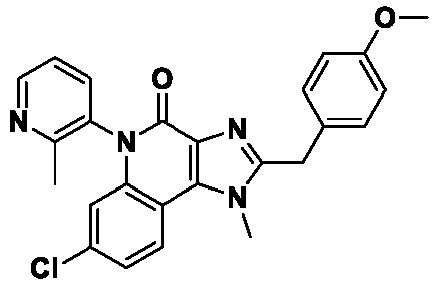
7-chloro-2-(4-methoxybenzyl)-1-methyl-5-(2-methylpyridin-3-yl)-1,5-dihydro-4H-imidazo[4,5-c]quinolin-4-one 445.14 1H-NMR spectrum (300 MHz, CDCl3) δ 8.72(dd, 1H), 7.96(d, 1H), 7.55(dd, 1H), 7.41(dd, 1H), 7.23-7.18(m, 3H), 6.86(d, 2H), 6.58(d, 1H), 4.36(s, 2H), 3.96(s, 3H), 3.79(s, 3H), 2.29(s, 3H) 22 
2-(4-methoxybenzyl)-1-methyl-5-(2-methylpyridin-3-yl)-1,5-dihydro-4H-imidazo[4,5-c]quinolin-4-one 411.17 1H-NMR spectrum (300 MHz, CDCl3) δ 8.67(d, 1H), 8.06(m, 1H), 7.55(dd, 1H), 7.38(dd, 1H), 7.28(m, 2H), 7.20(d, 2H), 6.86(d, 2H), 6.60(m, 1H), 4.36(s, 2H), 3.98(s, 3H), 3.79(s, 3H), 2.28(s, 3H) 23 
7-chloro-2-(4-methoxybenzyl)-1-methyl-5-(2-(trifluoromethyl)pyridin-3-yl)-1,5-dihydro-4H-imidazo[4,5-c]quinolin-4-one 499.11 1H-NMR spectrum (300 MHz, CDCl3) δ 8.94(qd, 1H), 7.96(d, 1H), 7.83-7.77(m, 2H), 7.24(dd, 1H), 7.17(d, 2H), 6.86(td, 2H), 6.46(d, 1H), 4.34(d, 2H), 3.95(s, 3H), 3.79(s, 3H) 24 
7-chloro-5-(2-cyclopropylpyridin-3-yl)-2-(4-methoxybenzyl)-1-methyl-1,5-dihydro-4H-imidazo[4,5-c]quinolin-4-one 471.15 1H-NMR spectrum (300 MHz, CDCl3) δ 8.64(dd, 1H), 7.96(d, 1H), 7.51(dd, 1H), 7.32-7.21(m, 4H), 6.86(qd, 2H), 6.67(d, 1H), 4.35(s, 2H), 3.95(s, 3H), 3.79(s, 3H), 1.57-1.52(m, 1H), 1.24-1.17(m, 1H), 1.07-1.01(m, 1H), 0.87-0.79(m, 1H), 0.72-0.67(m, 1H) 25 
7-chloro-2-(4-methoxybenzyl)-1-methyl-5-(2-(trifluoromethyl)phenyl)-1,5-dihydro-4H-imidazo[4,5-c]quinolin-4-one 498.11 1H-NMR spectrum (300 MHz, CDCl3) δ 7.95-7.90(m, 2H), 7.82(m, 1H), 7.71(m, 1H), 7.35(d, 1H), 7.20-7.17(m, 3H), 6.85(td, 2H), 6.49(d, 1H), 4.33(d, 2H), 3.93(s, 3H), 3.78(s, 3H) 26 
7-chloro-5-(2-chlorophenyl)-2-(4-methoxybenzyl)-1-methyl-1,5-dihydro-4H-imidazo[4,5-c]quinolin-4-one 464.09 1H-NMR spectrum (300 MHz, CDCl3) δ 7.93(d, 1H), 7.65(m, 1H), 7.52-49(m, 2H), 7.36-32(m, 1H), 7.21-7.16(m, 3H), 6.85(d, 2H), 6.59(d, 1H), 4.33(d, 2H), 3.93(s, 3H), 3.77(s, 3H) 27 
2-(4-methoxybenzyl)-1-methyl-5-(2-methylpyridin-3-yl)-7-(trifluoromethyl)-1,5-dihydro-4H-imidazo[4,5-c]quinolin-4-one 479.16 1H-NMR spectrum (300 MHz, CDCl3) δ 8.71(dd, 1H), 8.14(d, 1H), 7.55-46(m, 2H), 7.42-37(m, 1H), 7.17(d, 2H), 6.86-82(m, 3H), 4.36(s, 2H), 3.99(s, 3H), 3.77(s, 3H), 2.26(s, 3H) 28 
7-chloro-2-(4-fluorobenzyl)-1-methyl-5-(2-methylpyridin-3-yl)-1,5-dihydro-4H-imidazo[4,5-c]quinolin-4-one 433.12 1H-NMR spectrum (300 MHz, CDCl3) δ 8.74-8.72 (dd, 1H), 7.98(d, 1H), 7.56(dd, 1H), 7.42(m, 1H), 7.25(m, 3H), 7.03(t, 2H), 6.61 (d, 1H), 4.40 (s, 2H), 3.98(s, 3H), 2.30(s, 3H) 29 
2-(benzo[d][1,3]dioxol-5-ylmethyl)-7-chloro-1-methyl-5-(2-methylpyridin-3-yl)-1,5-dihydro-4H-imidazo[4,5-c]quinolin-4-one 459.11 1H-NMR spectrum (300 MHz, CDCl3) δ 8.72(dd, 1H), 7.97(d, 1H), 7.55(dd, 1H), 7.41(dd, 1H), 7.26-7.23(m, 1H), 6.78-6.72(m, 3H), 6.59(d, 1H), 5.94(s, 2H), 4.33(s, 2H), 3.98(s, 3H), 2.29(s, 3H) 30 
7-chloro-2-(3,4-difluorobenzyl)-1-methyl-5-(2-methylpyridin-3-yl)-1,5-dihydro-4H-imidazo[4,5-c]quinolin-4-one 451.11 1H-NMR spectrum (300 MHz, CDCl3) δ 8.71 (dd, 1H), 7.98(d, 1H), 7.55(dd, 1H), 7.41(dd, 1H), 7.28-7.24(m, 1H), 7.15-7.09(m, 2H), 7.08-7.03(m, 1H), 6.60(d, 1H), 4.37(s, 2H), 3.98(s, 3H), 2.30(s, 3H) 31 
7-chloro-2-(4-methoxybenzyl)-1-methyl-5-(pyridin-3-yl)-1,5-dihydro-4H-imidazo[4,5-c]quinolin-4-one 431.12 1H-NMR spectrum (300 MHz, CDCl3) δ 8.81 (d, 1H), 8.58(d, 1H), 7.95(d, 1H), 7.71(td, 1H), 7.59(dd, 1H), 7.26-7.17(m, 3H), 6.84(td, 2H), 6.69(d, 1H), 4.35(s, 2H), 3.95(s, 3H), 3.79(s, 3H) 32 
7-chloro-5-(4-fluorophenyl)-2-(4-methoxybenzyl)-1-methyl-1,5-dihydro-4H-imidazo[4,5-c]quinolin-4-one 448.11 1H-NMR spectrum (300 MHz, MeOD) δ 8.24(d, 1H), 7.44-7.32(m, 5H), 7.18(d, 2H), 6.88(d, 2H), 6.72(d, 1H), 4.33(s, 2H), 4.04(s, 3H), 3.75(s, 3H) 33 
7-chloro-2-(4-(difluoromethoxy)benzyl)-1-methyl-5-(2-methylpyridin-3-yl)-1,5-dihydro-4H-imidazo[4,5-c]quinolin-4-one 481.12 1H-NMR spectrum (300 MHz, CDCl3) δ 8.72(dd, 1H), 7.97(d, 1H), 7.55(dd, 1H), 7.41(dd, 1H), 7.30-7.23(m, 3H), 7.10(d, 2H), 6.74-6.25(t, 1H), 6.59(d, 1H), 4.40(s, 2H), 3.98(s, 3H), 2.29(s, 3H) 34 
7-chloro-5-(4-methoxyphenyl)-2-((4-methoxyphenyl)thio)-1-methyl-1,5-dihydro-4H-imidazo[4,5-c]quinolin-4-one 478.09 1H-NMR spectrum (300 MHz, CDCl3) δ 7.96(d, 1H), 7.45(td, 2H), 7.23-7.08(m, 5H), 6.85(td, 2H), 6.80(d, 1H), 4.17(s, 3H), 3.90(s, 3H), 3.78(s, 3H) 35 
7-chloro-2-((4-methoxyphenyl)thio)-1-methyl-5-(2-methylpyridin-3-yl)-1,5-dihydro-4H-imidazo[4,5-c]quinolin-4-one 463.09 1H-NMR spectrum (300 MHz, CDCl3) δ 8.71 (dd, 1H), 8.02(d, 1H), 7.53-7.47(m, 3H), 7.42-7.39(m, 1H), 7.28-7.24(m, 1H), 6.88(td, 2H), 6.58(d, 1H), 4.20(s, 3H), 3.79(s, 3H), 2.27(s, 3H) 36 
7-chloro-2-((4-fluorophenyl)thio)-1-methyl-5-(2-methylpyridin-3-yl)-1,5-dihydro-4H-imidazo[4,5-c]quinolin-4-one 451.07 1H-NMR spectrum (300 MHz, CDCl3) δ 8.72(m, 1H), 8.03(d, 1H), 7.54-7.49(m, 3H), 7.43-7.41(m, 1H), 7.30-7.26(m, 1H), 7.08-7.02(m, 2H), 6.60(d, 1H), 4.22(s, 3H), 2.28(s, 3H) 37 
7-chloro-2-((3,4-difluorophenyl)thio)-1-methyl-5-(2-methylpyridin-3-yl)-1,5-dihydro-4H-imidazo[4,5-c]quinolin-4-one 469.06 1H-NMR spectrum (300 MHz, CDCl3) δ 8.71(m, 1H), 8.05(d, 1H), 7.53(dd, 1H), 7.41(dd, 1H), 7.35-7.13(m, 3H), 6.61(d, 2H), 4.23(s, 3H), 2.29(s, 3H) 38 
2-(benzo[d][1,3]dioxol-5-ylthio)-7-chloro-1-methyl-5-(2-methylpyridin-3-yl)-1,5-dihydro-4H-imidazo[4,5-c]quinolin-4-one 477.07 1H-NMR spectrum (300 MHz, CDCl3) δ 8.71 (dd, 1H), 8.03(d, 1H), 7.52(dd, 1H), 7.42-7.40(m, 1H), 7.29-7.26(m, 1H), 7.05(dd, 1H), 6.99(d, 1H), 6.78(d, 1H), 6.59(d, 1H), 5.97(s, 2H), 4.20(s, 3H), 2.28(s, 3H) 39 
7-chloro-2-((2,4-difluorophenyl)thio)-1-methyl-5-(2-methylpyridin-3-yl)-1,5-dihydro-4H-imidazo[4,5-c]quinolin-4-one 469.06 1H-NMR spectrum (300 MHz, CDCl3) δ 8.71(m, 1H), 8.06(d, 1H), 7.65-7.61(m, 1H), 7.52-7.49(m, 1H), 7.42-7.36(m, 1H), 7.31-7.26(m, 1H), 6.93-6.85(m, 2H), 6.59(d, 1H), 4.30(s, 3H), 2.27(s, 3H) 40 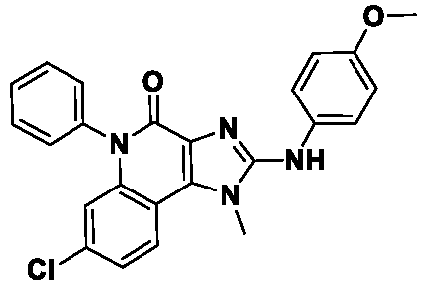
7-chloro-2-((4-methoxyphenyl)amino)-1-methyl-5-phenyl-1,5-dihydro-4H-imidazo[4,5-c]quinolin-4-one 431.12 1H-NMR spectrum (300 MHz, DMSO-d6) δ 8.85(s, 1H), 8.26(d, 1H), 7.68-7.58(m, 5H), 7.34(d, 2H), 6.92(d, 2H), 6.48(s, 1H), 4.06(s, 3H), 3.73(s, 3H) 41 
7-chloro-2-((4-methoxyphenyl)(methyl)amino)-1-methyl-5-phenyl-1,5-dihydro-4H-imidazo[4,5-c]quinolin-4-one 445.14 1H-NMR spectrum (300 MHz, CDCl3) δ 7.85 (d, 1H), 7.64-7.54(m, 3H), 7.30-7.26(m, 2H), 7.17(dd, 1H), 6.97(d, 2H), 6.87(d, 2H), 6.72(d, 1H), 3.80(s, 3H), 3.61(s, 3H), 3.52(s, 3H) 42 
7-chloro-2-(4-methoxyphenoxy)-1-methyl-5-phenyl-1,5-dihydro-4H-imidazo[4,5-c]quinolin-4-one 432.10 1H-NMR spectrum (300 MHz, CDCl3) δ 7.98(d, 1H), 7.63-7.53(m, 3H), 7.35(td, 2H), 7.27-7.22(m, 3H), 6.91(td, 2H), 6.73(d, 1H), 4.12(s, 3H), 3.81(s, 3H) -

- Ethyl 2-(4-methoxybenzyl)-1-methyl-1H-imidazole-4-carboxylate (1 g, 3.65 mmol) obtained in [Process 3] of [Intermediate 6-2] was dissolved in N,N-dimethylformamide (20 mL), followed by adding N-iodosuccinimide (2.54 g, 10.94 mmol). The reaction solution was refluxed at 100 °C for 17 hours, then cooled to room temperature, followed by adding a saturated aqueous solution of sodium thiosulfate and was subjected to extraction using ethyl acetate. The separated organic layer was dried with anhydrous sodium sulfate and vacuum distilled. The obtained residue was purified by silica gel column chromatography to obtain the title compound (1.4 g, 95.96 %).

-

- 4-amino-3-nitrophenol (10.3 g, 64.89 mmol) was dissolved in 38 % aqueous hydrochloric acid solution (5 mL), cooled to 0 °C and an aqueous solution (20 mL) of sodium nitrite (9.14 g, 129.77 mmol) was slowly added dropwise. After stirring at 0 °C for 1 h, an aqueous solution (40 mL) of potassium iodide (21.54 g, 129.77 mmol) was slowly added dropwise. After the reaction solution was stirred at room temperature for 15 hours, the resulting solid was collected by filtration, washed with excess water and dried to obtain the title compound (16.5 g, 95.96 %).
-

- 4-Iodo-3-nitrophenol (16.5 g, 62.26 mmol) obtained in [Process 1] above was dissolved in acetone (165 mL), followed by adding potassium carbonate (17.30 g, 124.52 mmol) and benzyl bromide (8.31 mL, 68.49 mmol). The reaction solution was stirred at room temperature for 18 hours and the resulting solid was removed by filtration, and the filtrate was vacuum distilled. Water was added and the mixture was subjected to extraction using ethyl acetate. The separated organic layer was dried with anhydrous sodium sulfate, followed by vacuum filtration and vacuum distillation to obtain the title compound (21 g, 94.98 %).
-

- 4-(Benzyloxy)-1-iodo-2-nitrobenzene (5 g, 14.08 mmol) obtained in [Process 2] above was dissolved in methanol (37.5 mL), followed by adding activated carbon (845 mg, 70.40 mmol) and iron(III) chloride (235 mg, 1.41 mmol), and after nitrogen gas substitution, the mixture was stirred for 10 minutes at 70 °C. After cooling the reaction solution to room temperature, hydrazine monohydrate (3.48 mL, 70.40 mmol) was slowly added dropwise. The reaction solution was refluxed at 70 °C for 21 hours, then cooled to room temperature and filtered through celite. The filtrate was vacuum distilled, followed by adding water and was subjected to extraction with ethyl acetate. The separated organic layer was dried with anhydrous sodium sulfate, followed by vacuum filtration and vacuum distillation. The obtained residue was dissolved in ethyl acetate (40 mL), followed by adding 4 N hydrochloric acid 1,4-dioxane solution (20 mL) and stirred at room temperature for 30 minutes. The resulting solid was collected by filtration, washed with excess ethyl acetate and dried to obtain the title compound (3.22 g, 63.25 %).
-
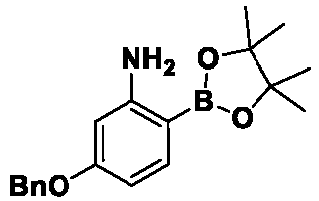
- 5-(benzyloxy)-2-iodoaniline hydrochloride (3.22 g, 8.90 mmol) obtained in [Process 3] above was added to anhydrous 1,4-dioxane (48.3 mL) to substitute nitrogen gas, followed by adding triethylamine (6.27 mL, 44.52 mmol), 1,1'-bis(diphenylphosphino)ferrocene-palladium(II) dichloride dichloromethane complex (368 mg, 0.44 mmol), 4,4,5,5-tetramethyl-1,3,2-dioxaborolane (3.52 g, 26.71 mmol). The mixed solution was refluxed at 100 °C for 14 hours and cooled to room temperature after completion of the reaction. A saturated aqueous solution of ammonium chloride was added to the reaction product and was subjected to extraction with ethyl acetate, and the separated organic layer was dried with anhydrous sodium sulfate and vacuum distilled. The obtained residue was purified by silica gel column chromatography to obtain the title compound (1 g, 34.53 %).
-

- 5-(benzyloxy)-2-(4,4,5,5-tetramethyl-1,3,2-dioxaborolan-2-yl)aniline (2.68 g, 8.25 mmol) synthesized in [Process 4] above and [Intermediate 7-1] ethyl 5-iodo-2-(4-methoxybenzyl)-1-methyl-1H-imidazole-4-carboxylate (3 g, 7.50 mmol) were added to anhydrous 1,4-dioxane (30 mL), water (15 mL), to substitute nitrogen gas, followed by adding sodium hydrogen carbonate (1.9 g, 22.49 mmol), tetrakis(triphenylphosphine)palladium(0) (446 mg, 0.37 mmol). The mixed solution was refluxed at 90 °C for 14 hours and cooled to room temperature after completion of the reaction. A saturated aqueous solution of ammonium chloride was added to the reaction product and was subjected to extraction with ethyl acetate, and the separated organic layer was dried with anhydrous sodium sulfate and vacuum distilled. The obtained residue was purified by silica gel column chromatography to obtain the title compound (1.4 g, 39.61 %).
-

- The same reaction was carried out using ethyl 5-(2-amino-4-(benzyloxy)phenyl)-2-(4-methoxybenzyl)-1-methyl-1H-imidazole-4-carboxylate instead of ethyl 5-(2-amino-4-chlorophenyl)-2-(3-methoxybenzyl)-1-methyl-1H-imidazole-4-carboxylate, in [Process 3] of Example 21, to obtain the title compound (1.4 g, 91.28 %).
-

- Acetic acid (1 mL) and a 38 % aqueous hydrochloric acid solution (1 mL) were added to 7-(benzyloxy)-2-(4-methoxybenzyl)-1-methyl-5-(2-methylpyridin-3-yl)-1,5-dihydro-4H-imidazo[4,5-c]quinolin-4-one (1.4 g, 2.71 mmol) synthesized in [Process 6] above. The mixed solution was refluxed at 140 °C for 7 hours and cooled to room temperature after completion of the reaction. The reaction product was vacuum distilled, followed by adding a saturated aqueous solution of sodium hydrogen carbonate, stirred for 30 minutes, and was subjected to extraction with dichloromethane and methanol. The separated organic layer was dried with anhydrous sodium sulfate and vacuum distilled. The obtained residue was purified by silica gel column chromatography to obtain the title compound (630 mg, 54.51 %).
-

- 7-hydroxy-2-(4-methoxybenzyl)-1-methyl-5-(2-methylpyridin-3-yl)-1,5-dihydro-4H-imidazo[4,5-c]quinolin-4-one (150 mg, 0.35 mmol) synthesized in [Process 7] above was dissolved in dichloromethane (1.5 mL), followed by adding triethylamine (0.10 mL, 0.70 mmol) and 1,1,1-trifluoro-N-phenyl-N-((trifluoromethyl)sulfonyl)methanesulfonamide (192 mg, 0.53 mmol). The reaction solution was stirred at room temperature for 4 hours and then vacuum distilled. The obtained residue was purified by silica gel column chromatography to obtain the title compound (196 mg, 100 %).
-

- (4-methoxybenzyl)-1-methyl-5-(2-methylpyridin-3-yl)-4-oxo-4,5-dihydro-1H-imidazo[4,5-c]quinolin-7-yl trifluoromethanesulfonate (196 mg, 0.35 mmol) synthesized in [Process 8] above was dissolved in anhydrous 1,4-dioxane (2 mL), substituted with argon gas, followed by adding potassium carbonate (146 mg, 1.05 mmol), tetrakis(triphenylphosphine) palladium(0) (41.8 mg, 0.04 mmol) and 4,4,5,5-tetramethyl-2-vinyl-1,3,2-dioxaborolane (0.09 mL, 0.53 mmol). The mixed solution was refluxed at 100 °C for 2 hours and cooled to room temperature after completion of the reaction. Water was added to the reaction product and was subjected to extraction with ethyl acetate, and the separated organic layer was dried with anhydrous sodium sulfate and vacuum distilled. The obtained residue was purified by silica gel column chromatography to obtain the title compound (145 mg, 94.66 %).
-

- 2-(4-methoxybenzyl)-1-methyl-5-(2-methylpyridin-3-yl)-7-vinyl-1,5-dihydro-4H-imidazo[4,5-c]quinolin-4-one (145 mg, 0.33 mmol) synthesized in [Process 9] above and 10 % palladium/carbon (177 mg) were dissolved in methanol (3.32 mL) and was fitted with a hydrogen balloon. The reaction solution was stirred at room temperature for 3 hours. The reaction mixture was filtered through celite and vacuum distilled, and the obtained residue was purified by silica gel column chromatography to obtain the title compound (63 mg, 43.25 %).
-

- The same reaction was carried out using cyclopropyl boronic acid instead of 4,4,5,5-tetramethyl-2-vinyl-1,3,2-dioxaborolane, in [Process 9] of <Synthesis Example 7>, to obtain the title compound (5 mg, 65.79 %).
-

- 2-(4-methoxybenzyl)-1-methyl-5-(2-methylpyridin-3-yl)-4-oxo-4,5-dihydro-1H-imidazo[4,5-c]quinolin-7-yl trifluoromethanesulfonate (20 mg, 0.04 mmol) synthesized in [Process 8] of <Synthesis Example 7>, ethynyltrimethylsilane (0.02 mL, 0.18 mmol), tetrakis(triphenylphosphine)palladium(0) (4.3 mg, 0.004 mmol), cuprous iodide (0.68 mg, 0.004 mmol), trimethylamine (0.01 mL, 0.07 mmol) were dissolved in N,N-dimethylformamide (1 mL) and the mixed solution was stirred at 40 °C for 18 hours. After completion of the reaction, the reaction product was cooled to room temperature, followed by adding water and was subjected to extraction with ethyl acetate, and the separated organic layer was dried with anhydrous sodium sulfate and vacuum distilled. The obtained residue was purified by silica gel column chromatography to obtain 2-(4-methoxybenzyl)-1-methyl-5-(2-methylpyridin-3-yl)-7-((trimethylsilyl)ethynyl)-1,5-dihydro-4H-imidazo[4,5-c]quinolin-4-one (14 mg, 77.16 %).
- 2-(4-methoxybenzyl)-1-methyl-5-(2-methylpyridin-3-yl)-7-((trimethylsilyl)ethynyl)-1,5-dihydro-4H-imidazo[4,5-c]quinolin-4-one (14 mg, 0.03 mmol) and potassium carbonate (38 mg, 0.28 mmol) were dissolved in methanol (0.28 mL) and stirred at room temperature for 16 hours. After completion of the reaction, water was added to the reaction product and was subjected to extraction with dichloromethane, and the separated organic layer was dried with anhydrous sodium sulfate and vacuum distilled. The obtained residue was purified by silica gel column chromatography to obtain the title compound (2.4 mg, 19.19 %).
-

- The same reaction was carried out using 2-(4-methoxybenzyl)-1-methyl-5-(2-methylpyridin-3-yl)-7-(prop-1-en-2-yl)-1,5-dihydro-4H-imidazo[4,5-c]quinolin-4-one instead of 2-(4-methoxybenzyl)-1-methyl-5-(2-methylpyridin-3-yl)-7-vinyl-1,5-dihydro-4H-imidazo[4,5-c]quinolin-4-one, in [Process 10] of <Synthesis Example 7>, to obtain the title compound (11.5 mg, 77.55 %).
-

- The same reaction was carried out using 2,4,6-trimethyl-1,3,5,2,4,6-trioxatriborinane instead of 4,4,5,5-tetramethyl-2-vinyl-1 ,3,2-dioxaborolane, in [Process 9] of <Synthesis Example 7>, to obtain the title compound (3 mg, 37.19 %).
-

- 2-(4-methoxybenzyl)-1-methyl-5-(2-methylpyridin-3-yl)-4-oxo-4,5-dihydro-1H-imidazo[4,5-c]quinolin-7-yl trifluoromethanesulfonate (10 mg, 0.02 mmol) synthesized in [Process 8] of <Synthesis Example 7> and cesium carbonate (11.78 mg, 0.04 mmol), palladium acetate (0.41 mg, 0.002 mmol), 2,2'-bis(diphenylphosphino)-1,1'-binaphthalene (1.7 mg, 0.002 mmol), pyrrolidine (0.005 mL, 0.05 mmol) were dissolved in anhydrous 1,4-dioxane (0.2 mL), and substituted with argon gas. The mixed solution was refluxed at 100 °C for 1 hour and cooled to room temperature after completion of the reaction. Water was added to the reaction product and was subjected to extraction with ethyl acetate, and the separated organic layer was dried with anhydrous sodium sulfate and vacuum distilled. The obtained residue was purified by silica gel column chromatography to obtain the title compound (2 mg, 23.29 %).
-

- 7-hydroxy-2-(4-methoxybenzyl)-1-methyl-5-(2-methylpyridin-3-yl)-1,5-dihydro-4H-imidazo[4,5-c]quinolin-4-one (10 mg, 0.03 mmol) synthesized in [Process 7] of <Synthesis Example 7> was dissolved in N,N-dimethylformamide (0.23 mL), followed by adding potassium carbonate (6.5 mg, 0.05 mmol) and methyl iodide (0.003 mL, 0.05 mmol). The mixed solution was stirred at room temperature for 1 hour, then water and ethyl acetate were added and was subjected to extraction with ethyl acetate. The separated organic layer was dried with anhydrous sodium sulfate and vacuum distilled. The obtained residue was purified by silica gel column chromatography to obtain the title compound (4.3 mg, 41.63 %).
-

- 2-(4-methoxybenzyl)-1-methyl-5-(2-methylpyridin-3-yl)-4-oxo-4,5-dihydro-1H-imidazo[4,5-c]quinolin-7-yl trifluoromethanesulfonate (100 mg, 0.18 mmol) synthesized in [Process 8] of <Synthesis Example 7> and cesium carbonate (117.85 mg, 0.36 mmol), palladium acetate (4.1 mg, 0.02 mmol), 2,2'-bis(diphenylphosphino)-1,1'-binaphthalene (17.24 mg, 0.03 mmol), benzophenoneimine (0.15 mL, 0.90 mmol) were dissolved in anhydrous 1,4-dioxane (1 mL), and substituted with argon gas. The mixed solution was refluxed at 100 °C for 2 hours and cooled to room temperature after completion of the reaction. The reaction product was vacuum distilled and purified by silica gel column chromatography to obtain 7-((diphenylmethylene)amino)-2-(4-methoxybenzyl)-1-methyl-5-(2-methylpyridin-3-yl)-1,5-dihydro-4H-imidazo[4,5-c]quinolin-4-one (63.8 mg).
- The obtained intermediate was dissolved in tetrahydrofuran (1 mL) and 1 N aqueous hydrochloric acid solution (0.1 mL) and stirred at room temperature for 30 minutes. After completion of the reaction, sodium hydrogen carbonate saturated aqueous solution was added and the mixture was subjected to extraction with ethyl acetate, and the separated organic layer was dried with anhydrous sodium sulfate and vacuum distilled. The obtained residue was purified by silica gel column chromatography to obtain the title compound (39 mg, 51.19 %).
-

- 7-amino-2-(4-methoxybenzyl)-1-methyl-5-(2-methylpyridin-3-yl)-1,5-dihydro-4H-imidazo[4,5-c]quinolin-4-one (10 mg, 0.02 mmol) synthesized in Example 52, a 25 wt% sodium methoxide methanol solution (0.05 mL) and 10 % palladium/carbon (0.5 mg, 0.0005 mmol) were dissolved in methanol (0.5 mL) and refluxed at 130 °C for 3 days and cooled to room temperature after completion of the reaction. The reaction mixture was filtered through celite and vacuum distilled, and the obtained residue was purified by silica gel column chromatography to obtain the title compound (4 mg, 38.72 %).
-

- The same reaction was carried out using ethyl 5-(2-amino-4-ethylphenyl)-2-(4-(difluoromethoxy)benzyl)-1-methyl-1H-imidazole-4-carboxylate instead of ethyl 5-(2-amino-4-chlorophenyl)-2-(3-methoxybenzyl)-1-methyl-1H-imidazole-4-carboxylate, in [Process 3] of Example 21, to obtain the title compound (290 mg, 52.50 %).
-

- The same reaction was carried out using ethyl 5-(2-amino-4-methoxyphenyl)-2-(4-(difluoromethoxy)benzyl)-1-methyl-1H-imidazole-4-carboxylate instead of ethyl 5-(2-amino-4-chlorophenyl)-2-(3-methoxybenzyl)-1-methyl-1H-imidazole-4-carboxylate, in [Process 3] of Example 21, to obtain the title compound (124 mg, 61.69 %).
- According to an embodiment of the present disclosure, the compound of Formula 1 may be a compound selected from the group consisting of the compounds listed in [Table 4] below.
[Table 4] Compound No. Structure Nomenclature MS[M+H]+ 
43 
7-Hydroxy-2-(4-methoxybenzyl)-1-methyl-5-(2-methylpyridin-3-yl)-1,5-dihydro-4H-imidazo[4,5-c]quinolin-4-one 427.17 1H-NMR spectrum (300 MHz, CDCl3) δ 8.61 (dd, 1H), 7.94(d, 1H), 7.63(dd, 1H), 7.45(dd, 1H), 7.18(d, 2H), 6.87(d, 2H), 6.84(m, 1H), 6.04(d, 1H), 4.31(s, 2H), 3.95(s, 3H), 3.79(s, 3H), 2.28(s, 3H) 44 
2-(4-methoxybenzyl)-1-methyl-5-(2-methylpyridin-3-yl)-7-vinyl-1,5-dihydro-4H-imidazo[4,5-c]quinolin-4-one 437.19 1H-NMR spectrum (300 MHz, CDCl3) δ 8.70(dd, 1H), 8.00(d, 1H), 7.56(dd, 1H), 7.38(m, 2H), 7.20(d, 2H), 6.86(d, 2H), 6.55(m, 1H), 5.63(d, 1H), 5.26(d, 1H), 4.36(s, 2H), 3.97(s, 3H), 3.79(s, 3H), 2.29(s, 3H) 45 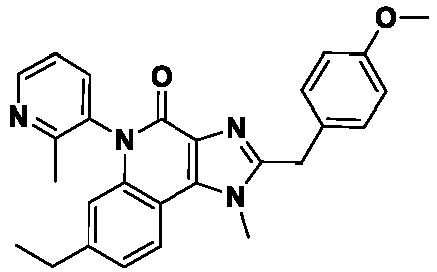
7-Ethyl-2-(4-methoxybenzyl)-1-methyl-5-(2-methylpyridin-3-yl)-1,5-dihydro-4H-imidazo[4,5-c]quinolin-4-one 439.21 1H-NMR spectrum (300 MHz, CDCl3) δ 8.69(dd, 1H), 7.96(d, 1H), 7.56(dd, 1H), 7.39(dd, 1H), 7.19(d, 2H), 7.12(dd, 1H), 6.85(d, 2H), 6.38(s, 1H), 4.35(s, 2H), 3.95(s, 3H), 3.79(s, 3H), 2.56(dd, 2H), 2.28(s, 3H), 1.12(t, 3H) 46 
7-Cyclopropyl-2-(4-methoxybenzyl)-1-methyl-5-(2-methylpyridin-3-yl)-1,5-dihydro-4H-imidazo[4,5-c]quinolin-4-one 451.21 1H-NMR spectrum (300 MHz, CDCl3) δ 8.68(m, 1H), 7.91(d, 1H), 7.55(m, 1H), 7.39(dd, 1H), 7.19(d, 2H), 6.86(m, 3H), 6.32(d, 1H), 4.34(s, 2H), 3.94(s, 3H), 3.79(s, 3H), 2.29(s, 3H), 1.77(m, 1H), 0.94(m, 2H), 0.57(m, 2H) 47 
7-ethynyl-2-(4-methoxybenzyl)-1-methyl-5-(2-methylpyridin-3-yl)-1,5-dihydro-4H-imidazo[4,5-c]quinolin-4-one 435.17 1H-NMR spectrum (300 MHz, CDCl3) δ 8.71 (dd, 1H), 7.99(d, 1H), 7.55(dd, 1H), 7.42(m, 1H), 7.36(dd, 1H), 7.20(d, 2H), 6.86(d, 2H), 6.71(d, 1H), 4.36(s, 2H), 3.97(s, 3H), 3.79(s, 3H), 3.10(s, 1H), 2.29(s, 3H) 48 
7-isopropyl-2-(4-methoxybenzyl)-1-methyl-5-(2-methylpyridin-3-yl)-1,5-dihydro-4H-imidazo[4,5-c]quinolin-4-one 453.22 1H-NMR spectrum (300 MHz, CDCl3) δ 8.69(dd, 1H), 7.97(d, 1H), 7.57(dd, 1H), 7.39(dd, 1H), 7.16(m, 3H), 6.85(d, 2H), 6.39(d, 1H), 4.35(s, 2H), 3.95(s, 3H), 3.79(s, 3H), 2.78(m, 1H), 2.28(s, 3H), 1.13(d, 6H) 49 
2-(4-methoxybenzyl)-1,7-dimethyl-5-(2-methylpyridin-3-yl)-1,5-dihydro-4H-imidazo[4,5-c]quinolin-4-one 425.19 1H-NMR spectrum (300 MHz, CDCl3) δ 8.69(dd, 1H), 7.93(d, 1H), 7.55(dd, 1H), 7.39(m, 1H), 7.20(d, 2H), 7.08(d, 1H), 6.85 (d, 2H), 6.37(s, 1H), 4.35(s, 2H), 3.95(s, 3H), 3.79(s, 3H), 2.28(s, 6H) 50 
2-(4-methoxybenzyl)-1-methyl-5-(2-methylpyridin-3-yl)-7-(pyrrolidin-1-yl)-1,5-dihydro-4H-imidazo[4,5-c]quinolin-4-one 480.23 1H-NMR spectrum (300 MHz, CDCl3) δ 8.66(dd, 1H), 7.84(d, 1H), 7.57(dd, 1H), 7.36(dd, 1H), 7.20(d, 2H), 6.86(d, 2H), 6.51(dd, 1H), 5.50(d, 1H), 4.31(s, 2H), 3.89(s, 3H), 3.79(s, 3H), 3.08(m, 4H), 2.32(s, 3H), 1.94(m, 4H) 51 
7-methoxy-2-(4-methoxybenzyl)-1-methyl-5-(2-methylpyridin-3-yl)-1,5-dihydro-4H-imidazo[4,5-c]quinolin-4-one 441.18 1H-NMR spectrum (300 MHz, CDCl3) δ 8.68(dd, 1H), 7.95(d, 1H), 7.55(dd, 1H), 7.38(dd, 1H), 7.20(d, 2H), 6.85(m, 3H), 6.05(d, 1H), 4.34(s, 2H), 3.93(s, 3H), 3.79(s, 3H), 3.67(s, 3H), 2.30(s, 3H) 52 
7-amino-2-(4-methoxybenzyl)-1-methyl-5-(2-methylpyridin-3-yl)-1,5-dihydro-4H-imidazo[4,5-c]quinolin-4-one 426.19 1H-NMR spectrum (300 MHz, CDCl3) δ 8.66(m, 1H), 7.81 (d, 1H), 7.55(d, 1H), 7.38(dd, 1H), 7.19(d, 2H), 6.85(d, 2H), 6.59(dd, 1H), 5.77(d, 1H), 4.32(s, 2H), 3.39(s, 3H), 3.79(s, 3H), 2.31(s, 3H) 53 
2-(4-methoxybenzyl)-1-methyl-7-(methylamino)-5-(2-methylpyridin-3-yl)-1,5-dihydro-4H-imidazo[4,5-c]quinolin-4-one 440.20 1H-NMR spectrum (300 MHz, CDCl3) δ 8.66(dd, 1H), 7.83(d, 1H), 7.55(dd, 1H), 7.37(dd, 1H), 7.19(d, 2H), 6.85(d, 2H), 6.54(dd, 1H), 5.62(d, 1H), 4.31(s, 2H), 3.89(s, 3H), 3.79(s, 3H), 2.68(s, 3H), 2.31(s, 3H) 54 
2-(4-(difluoromethoxy)benzyl)-7-ethyl-1-methyl-5-(2-methylpyridin-3-yl)-1,5-dihydro-4H-imidazo[4,5-c]quinolin-4-one 475.19 1H-NMR spectrum (300 MHz, MeOD) δ 8.67(dd, 1H), 8.25(d, 1H), 7.75(dd, 1H), 7.57(dd, 1H), 7.31(m, 3H), 7.12(d, 2H), 6.78(t, 1H), 6.44(s, 1H), 4.41(s, 2H), 4.08(s, 3H), 2.59(dd, 2H), 2.20(s, 3H), 1.11 (t, 3H) 55 
2-(4-(Difluoromethoxy)benzyl)-7-methoxy-1-methyl-5-(2-methylpyridin-3-yl)-1,5-dihydro-4H-imidazo[4,5-c]quinolin-4-one 477.17 1H-NMR spectrum (300 MHz, CDCl3) δ 8.68(dd, 1H), 7.96(d, 1H), 7.56(dd, 1H), 7.38(dd, 1H), 7.29(d, 2H), 7.09(d, 2H), 6.86(dd, 1H), 6.49(t, 1H), 6.06(d, 1H), 4.38(s, 2H), 3.94(s, 3H), 3.67(s, 3H), 2.30(s, 3H) -

-

- 2-fluoro-6-(trifluoromethyl)pyridine (15 g, 80.04 mmol) was dissolved in anhydrous tetrahydrofuran (150 mL), and substituted with nitrogen gas. The mixed solution was cooled to -78 °C and then 2.0 M lithium diisopropylamide solution (53.43 mL, 106.85 mmol) was slowly added dropwise and stirred at the same temperature for 1 hour. Trimethylboronic acid (12 mL, 106.85 mmol) was slowly added dropwise and stirred at room temperature for 22 hours. To the reaction solution 5 wt% aqueous sodium hydroxide solution (200 mL) was added, then neutralized with 5 N aqueous hydrochloric acid solution and was subjected to extraction with ethyl acetate. The separated organic layer was dried with anhydrous sodium sulfate, and vacuum distilled to obtain the title compound (16 g, 86.01 %).
-

- (2-fluoro-6-(trifluoromethyl)pyridin-3-yl)boronic acid (1.18 g, 5. 66 mmol) synthesized in [Process 1] and ethyl 5-bromo-2-(4-methoxybenzyl)-1-methyl-1H-imidazole-4-carboxylate (1.00 g, 2.83 mmol) obtained from [Intermediate 6-2] were added to anhydrous 1,4-dioxane (10 mL), water (1 mL), to substitute nitrogen gas, followed by adding cesium carbonate (1.11 g, 7.08 mmol), 2-dicyclohexylphosphino-2', 6'-diisopropoxybiphenyl (67.4 mg, 0.14 mmol), (2-dicyclohexylphosphino-2', 6'-diisopropoxy-1,1'-biphenyl)[2-(2'-amino-1,1'-biphenyl)]palladium(II) methanesulfonate (123 mg, 0.14 mmol). The mixed solution was refluxed at 120 °C for 14 hours and cooled to room temperature after completion of the reaction. Water was added to the reaction product and was subjected to extraction with dichloromethane and methanol, and the separated organic layer was dried with anhydrous magnesium sulfate and vacuum distilled. The obtained residue was purified by silica gel column chromatography to obtain the title compound (539 mg, 43.53 %).
-

- Ethyl 5-(2-fluoro-6-(trifluoromethyl)pyridin-3-yl)-2-(4-methoxybenzyl)-1-methyl-1H-imidazole-4-carboxylate (100 mg, 0.23 mmol) and 4-(difluoromethoxy)aniline (45 mg, 0.27 mmol) synthesized in [Process 2] above were dissolved in anhydrous tetrahydrofuran (2.28 mL), and substituted with nitrogen gas. The mixed solution was cooled to 0 °C and a 1.0 M lithium bis(trimethylsilyl)amide tetrahydrofuran solution (0.69 mL, 0.69 mmol) was slowly added dropwise. The mixed solution was stirred at room temperature for 1 hour, after completion of the reaction, water was added and was subjected to extraction with dichloromethane and methanol. The separated organic layer was dried with anhydrous magnesium sulfate and vacuum distilled. The obtained residue was purified by silica gel column chromatography to obtain the title compound (17.8 mg, 14.68 %).
-

- The same reaction was carried out using 2-methylpyridin-3-amine instead of 4-(difluoromethoxy)aniline, in [Process 3] of <Synthesis Example 8>, to obtain the title compound (27.3 mg, 19.16 %).
-

- The same reaction was carried out using ethyl 2-(4-(difluoromethoxy)benzyl)-5-(2-fluoro-6-(trifluoromethyl)pyridin-3-yl)-1-methyl-1H-imidazole-4-carboxylate and 2-methylpyridin-3-amine instead of ethyl 5-(2-fluoro-6-(trifluoromethyl)pyridin-3-yl)-2-(4-methoxybenzyl)-1-methyl-1H-imidazole-4-carboxylate and 4-(difluoromethoxy)aniline, in [Process 3] of <Synthesis Example 8>, to obtain the title compound (150 mg, 68.88 %).
-

- The same reaction was carried out using 1-methyl-5-(2-methylpyridin-3-yl)-7-(trifluoromethyl)-1,5-dihydro-4H-imidazo[4,5-c][1,8]naphthyridin-4-one instead of 7-chloro-1-methyl-5-phenyl-1,5-dihydro-4H-imidazo[4,5-c]quinolin-4-one, in [Process 2] of Example 18, to obtain the title compound (81 mg, 71.42 %).
-

- The same reaction was carried out using 1-methyl-5-(2-methylpyridin-3-yl)-7-(trifluoromethyl)-1,5-dihydro-4H-imidazo[4,5-c][1,8]naphthyridin-4-one and 4-fluorobenzenthiol instead of 7-chloro-1-methyl-5-phenyl-1,5-dihydro-4H-imidazo[4,5-c]quinolin-4-one and 4-methoxybenzenthiol, in [Process 2] of Example 18, to obtain the title compound (70 mg, 64.76 %).
-

-

- 2-(Trifluoromethyl)pyrimidin-4(3H)-one (6.18 g, 35.8 mmol) was dissolved in N,N-dimethylformamide (50 mL), followed by adding N-bromosuccinimide (7.80 g, 42.9 mmol). The mixed solution was stirred at 40 °C for 22 hours and cooled to room temperature after completion of the reaction. Water was added to the reaction solution and was subjected to extraction with ethyl acetate, and the separated organic layer was dried with anhydrous sodium sulfate, and vacuum distilled to obtain the title compound (8.69 g, 100 %).
-

- 5-bromo-2-(trifluoromethyl)pyrimidin-4(3H)-one (8.69 g, 35.76 mmol) synthesized in [Process 1] above was dissolved in tetrahydrofuran (86.9 mL), followed by adding 2,6-lutidine (6.3 mL, 53.6 mmol) and cooled to -78 °C. After 30 minutes, trifluoromethanesulfonic anhydride (8.0 mL, 46.5 mmol) was slowly added dropwise at the same temperature and stirred at 0 °C for 3 hours. 2-methylpyridin-3-amine (11.8 g, 107 mmol) was added to the reaction solution and refluxed at 70 °C for 4 hours. After completion of the reaction, the reaction solution was cooled to room temperature, water was added to the reaction solution and was subjected to extraction with ethyl acetate, and the separated organic layer was dried with anhydrous sodium sulfate and vacuum distilled. The obtained residue was purified by silica gel column chromatography to obtain the title compound (5.47 g, 45.92 %).
-

- 5-bromo-N-(2-methylpyridin-3-yl)-2-(trifluoromethyl)pyrimidin-4-amine (717 mg, 1.50 mmol) synthesized in [Process 2] above was added to anhydrous 1,4-dioxane (5 mL) to substitute nitrogen gas followed by adding bis(pinacolato)diboron (837 mg, 3.23 mmol), [1,1'-bis(diphenylphosphino)ferrocene]dichloropalladium(II) (166 mg, 0.22 mmol) and potassium acetate (640 mg, 6.46 mmol). The mixed solution was refluxed at 100 °C for 19 hours and cooled to room temperature after completion of the reaction. Water was added to the reaction product and was subjected to extraction with ethyl acetate, and the separated organic layer was dried with anhydrous magnesium sulfate and vacuum distilled. The obtained residue was purified by silica gel column chromatography to obtain the title compound (240 mg, 29.33 %).
-

- N-(2-methylpyridin-3-yl)-5-(4,4,5,5-tetramethyl-1,3,2-dioxaborolan-2-yl)-2-(trifluoromethyl)pyrimidin-4-amine (798 mg, 1.05 mmol) synthesized in [Process 3] above was added to 1,4-dioxane (1 mL) and water (0.1 mL), to substitute nitrogen gas, followed by adding ethyl 5-bromo-1-methyl-1H-imidazole-4-carboxylate (245 mg, 1.05 mmol) obtained from [Intermediate 6-3], fluorocesium (493 mg, 3.15 mmol), [1,1'-bis(di-tert-butylphosphino)ferrocene]dichloropalladium(II) (70.5 mg, 0.11 mmol). The mixed solution was refluxed at 100 °C for 18 hours and cooled to room temperature after completion of the reaction. Water was added to the reaction product and was subjected to extraction with ethyl acetate, and the separated organic layer was dried with anhydrous magnesium sulfate and vacuum distilled. The obtained residue was purified by silica gel column chromatography to obtain the title compound (17 mg, 4.49 %).
-

- The same reaction was carried out using 1-methyl-5-(2-methylpyridin-3-yl)-7-(trifluoromethyl)-1,5-dihydro-4H-imidazo[4',5':4,5]pyrido[2,3-d]pyrimidin-4-one instead of 7-chloro-1-methyl-5-phenyl-1,5-dihydro-4H-imidazo[4,5-c]quinolin-4-one, in [Process 2] of Example 18, to obtain the title compound (7.8 mg, 33.16 %).
-

-

- 2-methylpyridin-3-amine (994 mg, 9.00 mmol) was dissolved in tetrahydrofuran (14 mL) and cooled to 0 °C. At the same temperature, sodium hydride (720 mg, 18.00 mmol) was added and stirred at room temperature for 30 minutes. The reaction solution was cooled to 0 °C and a tetrahydrofuran solution of 5-bromo-4-chloro-2-(methylthio)pyrimidine (2 g, 8.18 mmol) (6 mL) was added dropwise and refluxed at 55 °C for 15 hours. After completion of the reaction, the mixture was cooled to room temperature, followed by adding water and the resulting solid was collected by filtration, washed with excess water. The obtained residue was purified by silica gel column chromatography to obtain the title compound (1.0 g, 38 %).
-

- 5-bromo-N-(2-methylpyridin-3-yl)-2-(methylthio)pyrimidin-4-amine (500 mg, 1.61 mmol) synthesized in [Process 1] above was added to dichloromethane (5 mL) and cooled to 0 °C. 3-chloroperoxybenzoic acid (1.19 g, 4.82 mmol) was added slowly and stirred at room temperature for 1 hour. After completion of the reaction, a saturated aqueous solution of sodium hydrogen carbonate was added and was subjected to extraction with dichloromethane and methanol, the separated organic layer was dried with anhydrous magnesium sulfate, and vacuum distilled to obtain the title compound (395 mg, 71.69 %).
-

- 5-bromo-N-(2-methylpyridin-3-yl)-2-(methylsulfonyl)pyrimidin-4-amine (395 mg, 1.15 mmol) synthesized in [Process 2] above was dissolved in tetrahydrofuran (11.5 mL) and then a 21 wt% sodium ethoxide ethanol solution (447 mg, 1.38 mmol) was added dropwise. The mixed solution was stirred at room temperature for 2 hours. After completion of the reaction, the mixed solution was vacuum distilled and the obtained residue was purified by silica gel column chromatography to obtain the title compound (245 mg, 68.8 %).
-

- The same reaction was carried out using 5-bromo-N-(2-methylpyridin-3-yl)-2-(trifluoromethyl)pyrimidin-4-amine instead of 5-bromo-2-ethoxy-N-(2-methylpyridin-3-yl)pyrimidin-4-amine, in [Process 3] of Example 61, to obtain the title compound (57 mg, 20.19 %).
-

- The same reaction was carried out using 2-ethoxy-N-(2-methylpyridin-3-yl)-5-(4,4,5,5-tetramethyl-1,3,2-dioxaborolan-2-yl)pyrimidin-4-amine and ethyl 5-bromo-2-(4-methoxybenzyl)-1-methyl-1H-imidazole-4-carboxylate obtained from [Intermediate 6-2] instead of N-(2-methylpyridin-3-yl)-5-(4,4,5,5-tetramethyl-1,3,2-dioxaborolan-2-yl)-2-(trifluoromethyl)pyrimidin-4-amine and ethyl 5-bromo-1-methyl-1H-imidazole-4-carboxylate, in [Process 4] of Example 61, to obtain the title compound (12.5 mg, 17.11 %).
-

-
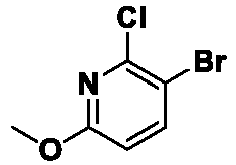
- 2-chloro-6-methoxypyridine (4.1 mL, 34.1 mmol) and benzoyl peroxide (551 mg, 1.7 mmol) were added to acetonitrile (20 mL). N-bromosuccinimide (9.2 g, 51.2 mmol) was added to the above mixture and the reactant was refluxed at 100 °C for 3 hours. The reaction product was cooled to room temperature, followed by adding water then was subjected to extraction with ethyl acetate. The separated organic layer was dried with anhydrous sodium sulfate and concentrated by vacuum distillation. Purification was performed using silica gel column chromatography to obtain the title compound (5.4 g, 71.52 %).
-

- 3-bromo-2-chloro-6-methoxypyridine (6.3 g, 28.3 mmol) synthesized in [Process 1] above and bis(pinacolato)diboron (11 g, 42.4 mmol), potassium acetate (5.6 g, 56.5 mmol), [1,1'-bis(diphenylphosphino)ferrocene]dichloropalladium(II) (4.4 g, 5.65 mmol) were added to anhydrous 1,4-dioxane (57 mL), and after nitrogen gas substitution, the mixture was refluxed at 100 °C for 20 hours. After the reaction product was cooled to room temperature, the solid was filtered and washed with dichloromethane:methanol= 10:1 (volume ratio). The filtrate was concentrated and purified by silica gel column chromatography to obtain the title compound (4.5 g, 58.95 %).
-

- 2-chloro-6-methoxy-3-(4,4,5,5-tetramethyl-1,3,2-dioxaborolan-2-yl)pyridine (2.9 g, 10.6 mmol) synthesized in [Process 2] above and ethyl 5-bromo-2-[[4-(difluoromethoxy)phenyl]methyl]-1-methyl-imidazole-4-carboxylate (2.1 g, 5.31 mmol), cesium fluoride (4.2 g, 26.6 mmol), RuPhos (253 mg, 0.53 mmol), RuPhos Pd G3 (468 mg, 0.53 mmol) were added to 1,4-dioxane (20 mL) and water (2 mL), and after nitrogen gas substitution, the mixture was refluxed at 120 °C for 17 hours. After the reaction product was cooled to room temperature, 6 M potassium carbonate solution (2 mL) was added, followed by adding water and was subjected to extraction with ethyl acetate. The separated organic layer was dried with anhydrous sodium sulfate and concentrated by vacuum distillation. The filtrate was concentrated and purified by silica gel column chromatography to obtain the title compound (1.4 g, 58.73 %).
-
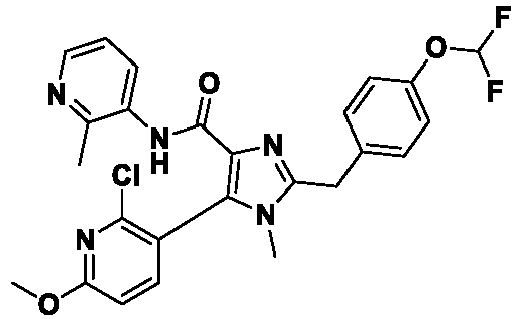
- Ethyl 5-(2-chloro-6-methoxypyridin-3-yl)-2-(4-(difluoromethoxy)benzyl)-1-methyl-1H-imidazole-4-carboxylate (1.4 g, 3.12 mmol) and 3-aminopicolin (379 mg, 3.43 mmol) synthesized in [Process 3] above were added to anhydrous tetrahydrofuran (31 mL) and was fitted with an argon balloon. The reaction solution was cooled to -78 °C and lithium bis(trimethylsilyl)amide 1 M tetrahydrofuran solution (6.9 mL, 6.87 mmol) was slowly added dropwise. The reaction solution was stirred at room temperature for 1 hour, and was subjected to extraction with ethyl acetate by adding water. The separated organic layer was dried with anhydrous sodium sulfate and concentrated by vacuum distillation. Purification was performed using silica gel column chromatography to obtain the title compound (1.46 g, 90.94 %).
-

- 5-(2-chloro-6-methoxypyridin-3-yl)-2-(4-(difluoromethoxy)benzyl)-1-methyl-N-(2-methylpyridin-3-yl)-1H-imidazole-4-carboxamide (1.3 g, 2.49 mmol) synthesized in [Process 4] above and sodium hydride (199 mg, 4.98 mmol) were added to N,N-dimethylformamide (12 mL) at 0 °C, and the reaction solution was stirred at room temperature for 30 minutes. Water and a saturated aqueous solution of ammonium chloride were added to the reaction solution and was subjected to extraction with ethyl acetate. The separated organic layer was dried with anhydrous sodium sulfate and concentrated by vacuum distillation. Purification was performed using silica gel column chromatography to obtain the title compound (633 mg, 53.17 %).
-

- The same reaction was carried out, except for the use of ethyl 5-bromo-2-[[4-(difluoromethoxy)phenyl]methyl]-1-methyl-imidazole-4-carboxylate [Intermediate 6-2 of Synthesis Example 6] instead of ethyl 5-bromo-2-(4-methoxybenzyl)-1-methyl-1H-imidazole-4-carboxylate, in Example 63, to obtain the title compound (223 mg, 67.82 %).
-

-

- 2-3 drops of N,N-dimethylformamide were added to the reaction solution of 2,6-dichloronicotinic acid (4.63 g, 23.6 mmol) dissolved in dichloromethane (75 mL), and oxalyl chloride (5.79 mL, 67.50 mmol) was slowly added dropwise, and the mixture was stirred at room temperature for 3 hours. The reaction product was immediately used in the next reaction by removing the solvent by distillation and adding tetrahydrofuran (30 mL). (Reaction solution A).
- Ethyl 3-((2-methylpyridin-3-yl)amino)-3-oxopropanoate (5.0 g, 22.50 mmol) was dissolved in tetrahydrofuran (120 mL), and sodium hydride (3.6 g, 90.00 mmol) was slowly added dropwise, stirred at room temperature for 30 minutes and cooled to 0 °C. The Reaction solution A above was added dropwise to the cooled reaction solution, and the temperature was slowly raised to room temperature, stirred for 2 hours, and then stirred and refluxed at 80 °C for 12 hours. The reaction product was cooled to room temperature, followed by adding 3 N aqueous hydrochloric acid solution to adjust the pH to acidic, and was subjected to extraction with ethyl acetate. The extracted organic layer was washed with water, dried with anhydrous sodium sulfate, followed by concentration under decompression. The obtained residue (6.5 g, 80.3 %) was used in the following reaction without a purification procedure.
-

- Ethyl 7-chloro-4-hydroxy-1-(2-methylpyridin-3-yl)-2-oxo-1,2-dihydro-1,8-naphthyridin-3-carboxylate (8.94 g, 24.8 mmol) synthesized in [Process 1] was added to trifluoroacetic acid (40 mL)/35 % hydrochloric acid (40 mL) and stirred refluxed at 100 °C for 4 hours. The reaction product was cooled to room temperature, vacuum concentrated, neutralized with a saturated aqueous solution of sodium carbonate (pH=6) and was subjected to extraction with ethyl acetate. The separated organic layer was dried with anhydrous sodium sulfate, filtered and concentrated. Ethyl acetate (50 mL) was again added to the concentrate, and the resulting solid was vacuum filtered to obtain the title compound (3.44 g, 48 %).
-

- 7-chloro-4-hydroxy-1-(2-methylpyridin-3-yl)-1,8-naphthyridin-2(1H)-one (900 mg, 3.13 mmol) synthesized in [Process 2] above and tributyl(vinyl)tin (1.0 mL, 3.44 mmol), [1,1'-bis(diphenylphosphino)ferrocene]dichloropalladium(II) dichloromethane complex (264 mg, 0.31 mmol) were added to 1,4-dioxane (31 mL), and after nitrogen gas substitution, the mixture was refluxed at 110 °C for 15 hours. A saturated aqueous solution of potassium fluoride was added to the reaction product, and the mixture was stirred at room temperature for 2 hours. The reaction mixture was filtered through celite and, followed by adding water and was subjected to extraction with ethyl acetate. The separated organic layer was dried with anhydrous sodium sulfate and concentrated by vacuum distillation. Purification was performed using silica gel column chromatography to obtain the title compound (358 mg, 40.94 %).
-

- Palladium (Pd/C) (164 mg, 0.15 mmol) in 10 % activated carbon, methanol (26 mL) were added to 4-hydroxy-1-(2-methylpyridin-3-yl)-7-vinyl-1,8-naphthyridin-2(1H)-one (358 mg, 1.28 mmol) synthesized in [Process 3] above, and was fitted with a hydrogen balloon. The reaction solution was stirred at room temperature for 16 hours, filtered through celite, and purified by silica gel column chromatography to obtain the title compound (224 mg, 62.09 %).
-

- 7-ethyl-4-hydroxy-1-(2-methylpyridin-3-yl)-1,8-naphthyridin-2(1H)-one (606 mg, 2.15 mmol) synthesized in [Process 4] above and sodium nitrite (30 mg, 0.43 mmol) were added to acetic acid (4 mL), and then fuming nitric acid (0.85 mL, 18.3 mmol) was slowly added dropwise to the reaction solution. The mixture was stirred at 50 °C for 20 minutes, cooled to room temperature, poured into ice water and stirred for 30 minutes. The resulting solid was collected by filtration, washed with water, and dried to obtain the title compound (340 mg, 48.35 %).
-

- 7-ethyl-4-hydroxy-1-(2-methylpyridin-3-yl)-3-nitro-1,8-naphthyridin-2(1H)-one (347 mg, 1.06 mmol) synthesized in [Process 5] above, phosphoryl chloride (0.61 mL, 6.38 mmol) and N,N-diisopropylethylamine (0.56 mL, 3.19 mmol) were added to toluene (11 mL) and the reaction solution was stirred at 100 °C for 2 hours. The reaction product was concentrated by vacuum distillation and dried to obtain the title compound (367 mg, 99.99 %).
-

- 4-chloro-7-ethyl-1-(2-methylpyridin-3-yl)-3-nitro-1,8-naphthyridin-2(1H)-one (367 mg, 1.06 mmol) synthesized in [Process 6] above, methylamine hydrochloride (87.97 mg, 1.28 mmol) and N,N-diisopropylethylamine (1.68 mL, 9.58 mmol) were added to dichloromethane (11 mL), and the reaction solution was stirred at room temperature for 16 hours. After drying the reaction product and adding water, the resulting solid was collected by filtration, washed with water, and dried to obtain the title compound (330 mg, 91.26 %).
-

- Raney-nickel (114 mg, 0.97 mmol), dichloromethane (9 mL)/methanol (3 mL) was added to 7-ethyl-4-(methylamino)-1-(2-methylpyridin-3-yl)-3-nitro-1,8-naphthyridin-2(1H)-one (330 mg, 0.97 mmol) synthesized in [Process 7] above, and was fitted with a hydrogen balloon. The reaction solution was stirred at room temperature for 16 hours, filtered through celite, and purified by silica gel column chromatography to obtain the title compound (228 mg, 75.74 %).
-

- 3-amino-7-ethyl-4-(methylamino)-1-(2-methylpyridin-3-yl)-1,8-naphthyridin-2(1H)-one (134 mg, 0.43 mmol) synthesized in [Process 8] above, 2-[4-(difluoromethoxy)phenyl]acetic acid (87.6 mg, 0.43 mmol), 1-[bis(dimethylamino)methylene]-1H-1,2,3-triazolo[4,5-b]pyridinium 3-oxide hexafluorophosphate (HATU) (181 mg, 0.48 mmol) and triethylamine (0.18 mL, 1.30 mmol) were sequentially added to N,N-dimethylformamide (4.3 mL) and the reaction solution was stirred at room temperature for 1 hour. The reaction solution was subjected to extraction with ethyl acetate with the addition of water. The separated organic layer was dried with anhydrous sodium sulfate and concentrated by vacuum distillation. Acetic acid (1 mL) was added to the concentrated mixture, and the reaction solution was stirred at 100 °C for 16 hours. The reaction product was dried by vacuum distillation and purified by silica gel column chromatography to obtain the title compound (164 mg, 79.48 %).
-

- The same reaction was carried out, using 3-amino-7-cyclopropyl-4-(methylamino)-1-(2-methylpyridin-3-yl)-1,8-naphthyridin-2(1H)-one and 2-(4-(difluoromethoxy)phenyl)acetic acid instead of 3-amino-7-ethyl-4-(methylamino)-1-(2-methylpyridin-3-yl)-1,8-naphthyridin-2(1H)-one and 2-(4-methoxyphenyl)acetic acid, in [Process 9] of Example 65, to obtain the title compound (184 mg, 52.28 %).
- According to an embodiment of the present disclosure, the compound of Formula 1 may be a compound selected from the group consisting of the compounds listed in [Table 5] below.
[Table 5] Compound No. Structure Nomenclature MS[M+H]+ 1H-NMR spectrum (300MHz) 56 
5-(4-(Difluoromethoxy)phenyl)-2-(4-methoxybenzyl)-1-methyl-7-(trifluoromethyl)-1,5-dihydro-4H-imidazo[4,5-c][1,8]naphthyridin-4-one 531.14 1H-NMR spectrum (300 MHz, CDCl3) δ 8.40(d, 1H), 7.53(d, 1H), 7.27-7.26(m, 4H), 7.18(d, 2H), 6.86(d, 2H), 6.61(t, 1H), 4.37(s, 2H), 3.97(s, 3H), 3.79(s, 3H) 57 
2-(4-methoxybenzyl)-1-methyl-5-(2-methylpyridin-3-yl)-7-(trifluoromethyl)-1,5-dihydro-4H-imidazo[4,5-c][1,8]naphthyridin-4-one 480.16 1H-NMR spectrum (300 MHz, CDCl3) δ 8.60(dd, 1H), 8.44(d, 1H), 7.54(d, 1H), 7.48(dd, 1H), 7.32-28(m, 1H), 7.17(d, 2H), 6.84(d, 2H), 4.35(s, 2H), 3.98(s, 3H), 3.76(s, 3H), 2.20(s, 3H) 58 
2-(4-(Difluoromethoxy)benzyl)-1-methyl-5-(2-methylpyridin-3-yl)-7-(trifluoromethyl)-1,5-dihydro-4H-imidazo[4,5-c][1,8]naphthyridin-4-one 516.14 1H-NMR spectrum (300 MHz, CDCl3) δ 8.64(dd, 1H), 8.44(d, 1H), 7.57(d, 1H), 7.50(dd, 1H), 7.33(dd, 1H), 7.30(d, 2H), 7.11(d, 2H), 6.50(t, 1H), 4.43(s, 2H), 4.01(s, 3H), 2.23(s, 3H) 59 
2-((4-methoxyphenyl)thio)-1-methyl-5-(2-methylpyridin-3-yl)-7-(trifluoromethyl)-1,5-dihydro-4H-imidazo[4,5-c][1,8]naphthyridin-4-one 498.11 1H-NMR spectrum (300 MHz, CDCl3) δ 8.62(dd, 1H), 8.49(d, 1H), 7.58(d, 1H), 7.52(td, 2H), 7.46(dd, 1H), 7.31 (dd, 1H), 6.89(td, 2H), 4.22(s, 3H), 3.80(s, 3H), 2.20(s, 3H) 60 
2-((4-fluorophenyl)thio)-1-methyl-5-(2-methylpyridin-3-yl)-7-(trifluoromethyl)-1,5-dihydro-4H-imidazo[4,5-c][1,8]naphthyridin-4-one 486.09 1H-NMR spectrum (300 MHz, CDCl3) δ 8.62(d, 1H), 8.51(d, 1H), 7.61-7.53(m, 3H), 7.46(dd, 1H), 7.32(dd, 1H), 7.10-7.04(m, 2H), 4.24(s, 3H), 2.21(s, 3H) 61 
2-((4-methoxyphenyl)thio)-1-methyl-5-(2-methylpyridin-3-yl)-7-(trifluoromethyl)-1,5-dihydro-4H-imidazo[4',5':4,5]pyrido[2,3-d]pyrimidin-4-one 499.11 1H-NMR spectrum (300 MHz, CDCl3) δ 9.44(s, 1H), 8.66(dd, 1H), 7.53(td, 2H), 7.44(dd, 1H), 7.34(dd, 1H), 6.90(td, 2H), 4.23(s, 3H), 3.80(s, 3H), 2.22(s, 3H) 62 
7-ethoxy-2-(4-methoxybenzyl)-1-methyl-5-(2-methylpyridin-3-yl)-1,5-dihydro-4H-imidazo[4',5':4,5]pyrido[2,3-d]pyrimidin-4-one 457.19 1H-NMR spectrum (300 MHz, CDCl3) δ 9.09(s, 1H), 8.63(dd, 1H), 7.49(dd, 1H), 7.33(dd, 1H), 7.20(d, 2H), 6.87(d, 2H), 4.34(s, 2H), 4.04(dd, 2H), 3.93(s, 3H), 3.79(s, 3H), 2.28(s, 3H), 1.21(t, 3H) 63 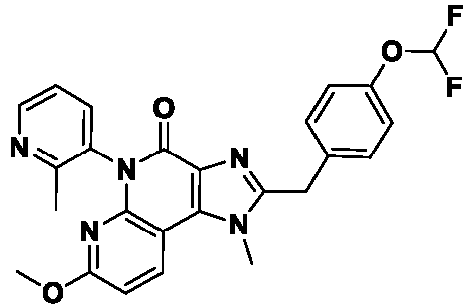
2-(4-(difluoromethoxy)benzyl)-7-methoxy-1-methyl-5-(2-methylpyridin-3-yl)-1,5-dihydro-4H-imidazo[4,5-c][1,8]naphthyridin-4-one 478.16 1H-NMR spectrum (300 MHz, CDCl3) δ 8.45(d, 1H), 8.18(d, 1H), 7.42(d, 1 H), 7.21-7.18(m, 3H), 6.97(d, 2H), 6.58(d, 1H), 6.42(t, 1H), 4.26(s, 2H), 3.84(s, 3H), 3.37(s, 3H), 2.17(s, 3H) 64 
7-methoxy-2-(4-methoxybenzyl)-1-methyl-5-(2-methylpyridin-3-yl)-1,5-dihydro-4H-imidazo[4,5-c][1,8]naphthyridin-4-one 442.18 1H-NMR spectrum (300 MHz, CDCl3) δ 8.57 (d, 1H), 7.53-7.45(m, 2H), 7.33-7.28(d, 1H), 7.20(d, 2H), 6.85(d, 2H), 6.65(d, 1H), 4.34(s, 2H), 3.90(s, 3H), 3.79(s, 3H), 3.45(s, 3H), 2.27(s, 3H) 65 
2-(4-(difluoromethoxy)benzyl)-7-ethyl-1-methyl-5-(2-methylpyridin-3-yl)-1,5-dihydro-4H-imidazo[4,5-c][1,8]naphthyridin-4-one 476.18 1H-NMR spectrum (300 MHz, CDCl3) δ 8.55(d, 1H), 8.20(d, 1H), 7.47(dd, 1H), 7.29-7.24(m, 3H), 7.05(d, 3H), 6.47(t, 1H), 4.35(s, 2H), 3.93(s, 3H), 2.62(q, 2H), 2.19(s, 3H), 1.01(t, 3H) 66 
7-cyclopropyl-2-(4-(difluoromethoxy)benzyl)-1-methyl-5-(2-methylpyridin-3-yl)-1,5-dihydro-4H-imidazo[4,5-c][1,8]naphthyridin-4-one 488.18 1H-NMR spectrum (300 MHz, CDCl3) δ 8.60(dd, 1H), 8.11(d, 1H), 7.45(dd, 1H), 7.30(m, 3H), 7.10(m, 3H), 6.49(t, 1H), 4.38(s, 2H), 3.94(s, 3H), 2.20(s, 3H), 1.89(m, 1H), 0.80(m, 2H), 0.56(m, 2H) - The synthetic compounds above were tested for cell growth inhibition against HCT116 cells.
- HCT116 MTAP-/- (homozygous knockout of MTAP gene in HCT116 MTAP-WT cells by CRISPER/Cas9 method) cells were maintained in RPMI1640 medium containing 10 % FBS and 1 % penicillin-streptomycin. Approximately 5×10² cells were seeded in a 96-well plate and treated with a test compound. (0.64 nM - 2,000 nM, 6 dose points for HCT116 MTAP-/- cells for 5x and 6 days) cell growth was measured by SRB staining and absorbance was detected at 540 nm on a Synergy™ NEO microplate reader. The 50 % growth inhibition value (GI50) of the cell line was calculated using GraphPad Prism V9 software.
- The results of Experimental Example 1 are shown in [Table 6] below.
- GI50 values less than 100 nM were labeled as A, at least 100 nM but less than 500 nM were labeled as B, at least 500 nM but less than 1 µM were labeled as C, and 1 µM or more were labeled as D.
[Table 6] Compound No. HCT116 MTAP-/- cell growth inhibition (GI50, nM) 1 B 2 A 3 D 4 A 5 B 6 B 7 D 8 B 9 D 10 A 11 C 12 D 15 D 16 D 17 D 18 A 19 C 20 C 21 A 22 C 23 B 24 B 25 B 26 B 27 A 28 A 29 A 30 A 31 A 32 D 33 A 34 D 35 A 36 A 37 A 38 A 39 A 40 D 41 D 42 D 43 D 44 A 45 A 46 A 47 A 48 B 49 B 50 D 51 A 52 C 53 A 54 A 55 A 56 D 57 A 58 A 59 A 60 B 61 A 62 D 63 A 64 A 65 A 66 A - So far, the present disclosure has been examined focusing on its specific embodiments. A person skilled in the art to which the present disclosure pertains may understand that the present disclosure may be implemented in a modified form without departing from the essential characteristics of the present disclosure. Therefore, the disclosed embodiments should be considered from an illustrative perspective rather than a limiting one. The scope of the present disclosure is indicated in the claims rather than the foregoing description, and all differences within the equivalent scope should be construed as being included in the present disclosure.
Claims (11)
- A compound selected from compounds of Formula 1 below and enantiomers, diastereomers, solvates and hydrates thereof, and pharmaceutically acceptable salts thereof:
 wherein, in Formula 1 above,X and Z are each independently N or CH;Y is CR3;R3 is H, alkyl, alkenyl, alkynyl, alkoxy, alkylthio, alkylsulfonyl, hydroxy, halogen, haloalkyl, haloalkoxy, cycloalkyl, cyano, amino, alkylamino, haloalkylamino, dialkylamino, alkylcarbonyl, alkoxycarbonyl, aminocarbonyl, alkylaminocarbonyl, dialkylaminocarbonyl, hydroxyalkyl, hydroxyalkoxy, hydroxyalkylamino, alkoxyalkyl, alkoxyalkoxy, alkoxyalkylamino, aminoalkyl, aminoalkoxy, aminoalkylamino, aryl, heteroaryl, heteroaryloxy, heteroarylamino, heterocyclyl, heterocyclyloxy, heterocyclylamino, heterocyclyloxyalkoxy, or heterocyclyloxyalkylamino,wherein each of the aryl, heteroaryl, or heterocyclyl isunsubstituted or substituted with 1 to 3 members selected from alkyl, cycloalkyl, haloalkyl, haloalkoxy, alkoxy, hydroxy, halo, cyano, hydroxyalkyl, alkoxyalkyl, and aminoalkyl;
 each of the cycloalkyl, aryl, heteroaryl, or heterocyclyl is monocyclic, bicyclic, or polycyclic,wherein the cycloalkyl, aryl, heteroaryl, or heterocyclyl is unsubstituted or substituted with 1 to 3 members independently selected from R2 below;L is C1-3alkylene, O, NH, N(C1-3alkyl), S, SO, SO2, or a bond;R2 is alkyl, cycloalkyl, haloalkyl, haloalkoxy, alkoxy, hydroxy, alkylsulfonyl, halogen, cyano, carboxy, alkoxycarbonyl, hydroxyalkyl, alkoxyalkyl, aminoalkyl, aminosulfonyl, alkylaminosulfonyl, dialkylaminosulfonyl, sulfonylamino, aminocarbonyl, alkylaminocarbonyl, dialkylaminocarbonyl, heterocyclylcarbonyl, or ureido; andR1 is H, alkyl, haloalkyl, hydroxyalkyl, alkoxyalkyl, aminoalkyl, substituted aminoalkyl, aminocarbonylalkyl, or aminosulfonylalkyl.
 - The compound of claim 1, wherein
- The compound of claim 1, whereinX and Z are each independently N or CH;Y is CR3a;R3a is H, C1-6alkyl, C2-6alkenyl, C2-6alkynyl, C1-6alkoxy, C1-6alkylthio, C1-6alkylsulfonyl, hydroxy, halogen, haloC1-6alkyl, haloC1-6alkoxy, C3-10cycloalkyl, cyano, amino, C1-6alkylamino, haloC1-6alkylamino, C2-12dialkylamino, C1-6alkylcarbonyl, C1-6alkoxycarbonyl, aminocarbonyl, C1-6alkylaminocarbonyl, C2-12dialkylaminocarbonyl, hydroxyC1-6alkyl, hydroxyC1-6alkoxy, hydroxyC1-6alkylamino, C1-6alkoxyC1-6alkyl, C1-6alkoxyC1-6alkoxy, C1-6alkoxyC1-6alkylamino, aminoC1-6alkyl, aminoC1-6alkoxy, aminoC1-6alkylamino, C6-10aryl, C5-10heteroaryl, C5-10heteroaryloxy, C4-10heteroarylamino, C1-10heterocyclyl, C1-10heterocyclyloxy, C1-10heterocyclylamino, C1-10heterocyclyloxyalkoxy, or C1-10heterocyclyloxyalkylamino,wherein each of C6-10aryl, C4-10heteroaryl, or C1-10heterocyclyl isunsubstituted or substituted with 1 to 3 members selected from C1-6alkyl, C3-10cycloalkyl, haloC1-6alkyl, haloC1-6alkoxy, C1-6alkoxy, hydroxy, halogen, cyano, hydroxyC1-6alkyl, C1-6alkoxyC1-6alkyl, and aminoC1-6alkyl;
 are each independently H, C3-10 cycloalkyl, bridged C8-16 cycloalkyl, fused C3-10 cycloalkyl, C8-16 spirocycloalkyl, C6-10 aryl, C4-10 heteroaryl, C1-10 heterocyclyl, bridged C6-14 heterocyclyl, fused C1-10heterocyclyl, or C6-14spiroheterocyclyl, wherein C6-10aryl, C4-10heteroaryl, or C1-10heterocyclyl is unsubstituted or substituted with 1 to 3 members independently selected from R2a below;L is C1-3alkylene, O, NH, NCH3, S, SO, SO2, or a bond;R2a is C1-6alkyl, C3-10cycloalkyl, haloC1-6alkyl, haloC1-6alkylamino, haloC1-6alkoxy, C1-6alkoxy, hydroxy, C1-6alkylsulfonyl, halogen, cyano, carboxy, C1-6alkoxycarbonyl, hydroxyC1-6alkyl, C1-6alkoxyalkyl, aminoC1-6alkyl, aminosulfonyl, C1-6alkylaminosulfonyl, (C1-6alkyl)2aminosulfonyl, sulfonylamino, aminocarbonyl, C1-6alkylaminocarbonyl, (C1-6alkyl)2aminocarbonyl, C1-10heterocyclylcarbonyl, or ureido; andR' is H, C1-6alkyl, haloC1-6alkyl, hydroxyC1-6alkyl, C1-6alkoxyalkyl, aminoC1-6alkyl, substituted aminoC1-6alkyl, aminocarbonylC1-6alkyl, or aminosulfonylC1-6alkyl.
 - The compound of claim 1, whereinX and Z are each independently N or CH;Y is CR3b;R3b is H, C2-4alkenyl, C2-4alkynyl, C1-3alkoxy, hydroxy, halogen, haloC1-6alkyl, C3-6cycloalkyl, amino, C1-3alkylamino, haloC1-6alkylamino, or C2-6heterocyclyl;
 are each independently H, C6-10aryl, C4-10heteroaryl, or C1-10heterocyclyl, wherein C6-10aryl, C4-10heteroaryl, or fused C1-10heterocyclyl is unsubstituted or substituted with 1 to 3 members independently selected from R2b below;L is C1-6alkylene, O, NH, NCH3, S, SO, SO2, or a bond;R2b is C1-6alkyl, haloC1-3alkyl, haloC1-3alkoxy, C1-6alkoxy, hydroxy, or halogen; andR' is H or C1-6alkyl.
 - The compound of claim 1, whereinX and Z are each independently N or CH;Y is CR3c;R3c is H, C2-4alkenyl, C2-4alkynyl, C1-3alkoxy, hydroxy, halogen, haloC1-3alkyl, C3-6cycloalkyl, amino, C1-3alkylamino, haloC1-3alkylamino, or C2-6heterocyclyl;


 L is C1-3alkylene, O, NH, NCH3, S, SO, SO2, or a bond; andR' is H or C1-3alkyl.
 - The compound of claim 1, whereinX and Z are each independently N or CH;Y is CR3c, wherein R3c is H, C2-4alkenyl, C2-4alkynyl, C1-3alkoxy, hydroxy, halogen, haloC1-3alkyl, C3-6cycloalkyl, amino, C1-3alkylamino, haloC1-3alkylamino, or C2-6heterocyclyl;


 wherein
 unsubstituted or substituted with 1 to 3 members independently selected from C1-3alkyl, haloC1-3alkyl, haloC1-3alkoxy, C1-3alkoxy, hydroxy, and halogen;L is methylene, ethylene, O, NH, NCH3, S, SO, or SO2; andR' is H or methyl.
 - The compound of claim 1, wherein the compound is selected from the group consisting of the following compounds and enantiomers, diastereomers, solvates and hydrates thereof, and pharmaceutically acceptable salts thereof:1) 2-benzyl-7-chloro-1-methyl-5-phenyl-1,5-dihydro-4H-imidazo[4,5-c]quinolin-4-one2) 7-chloro-2-(4-methoxybenzyl)-1-methyl-5-phenyl-1,5-dihydro-4H-imidazo[4,5-c]quinolin-4-one;3) 7-chloro-2-(4-hydroxybenzyl)-1-methyl-5-phenyl-1,5-dihydro-4H-imidazo[4,5-c]quinolin-4-one;4) 7-chloro-2-(3-methoxybenzyl)-1-methyl-5-phenyl-1,5-dihydro-4H-imidazo[4,5-c]quinolin-4-one;5) 7-chloro-2-(2-methoxybenzyl)-1-methyl-5-phenyl-1,5-dihydro-4H-imidazo[4,5-c]quinolin-4-one;6) 7-chloro-2-(4-chlorobenzyl)-1-methyl-5-phenyl-1,5-dihydro-4H-imidazo[4,5-c]quinolin-4-one;7) 7-chloro-1-methyl-5-phenyl-2-(pyridin-4-ylmethyl)-1,5-dihydro-4H-imidazo[4,5-c]quinolin-4-one;8) 7-chloro-2-(3,4-dimethoxybenzyl)-1-methyl-5-phenyl-1,5-dihydro-4H-imidazo[4,5-c]quinolin-4-one;9) 7-chloro-1-methyl-2-phenethyl-5-phenyl-1,5-dihydro-4H-imidazo[4,5-c]quinolin-4-one;10) 7-chloro-2-(4-methoxyphenyl)-1-methyl-5-(o-tolyl)-1,5-dihydro-4H-imidazo[4,5-c]quinolin-4-one;11) 2-benzyl-7-chloro-5-phenyl-1,5-dihydro-4H-imidazo[4,5-c]quinolin-4-one;12) 2-((1H-imidazol-1-yl)methyl)-7-chloro-1-methyl-5-phenyl-1,5-dihydro-4H-imidazo[4,5-c]quinolin-4-one;13) 7-chloro-2-((3-methoxypyrrolidin-1-yl)methyl)-1-methyl-5-phenyl-1,5-dihydro-4H-imidazo[4,5-c]quinolin-4-one;14) 7-chloro-2-((3-hydroxypyrrolidin-1-yl)methyl)-1-methyl-5-phenyl-1,5-dihydro-4H-imidazo[4,5-c]quinolin-4-one;15) 2-(4-methoxybenzyl)-1-methyl-5-phenyl-7-((2,2,2-trifluoroethyl)amino)-1,5-dihydro-4H-imidazo[4,5-c][1,8]naphthyridin-4-one;16) 7-chloro-5-(4-chloro-3-fluorophenyl)-2-(4-methoxybenzyl)-1-methyl-1,5-dihydro-4H-imidazo[4,5-c]quinolin-4-one;17) 7-chloro-5-(3-chloro-4-fluorophenyl)-2-(4-methoxybenzyl)-1-methyl-1,5-dihydro-4H-imidazo[4,5-c]quinolin-4-one;18) 7-chloro-2-((4-methoxyphenyl)thio)-1-methyl-5-phenyl-1,5-dihydro-4H-imidazo[4,5-c]quinolin-4-one ;19) 7-chloro-2-((4-methoxyphenyl)sulfonyl)-1-methyl-5-phenyl-1,5-dihydro-4H-imidazo[4,5-c]quinolin-4-one;20) 7-chloro-2-((4-methoxyphenyl)sulfinyl)-1-methyl-5-phenyl-1,5-dihydro-4H-imidazo[4,5-c]quinolin-4-one;21) 7-chloro-2-(4-methoxybenzyl)-1-methyl-5-(2-methylpyridin-3-yl)-1,5-dihydro-4H-imidazo[4,5-c]quinolin-4-one;22) 2-(4-methoxybenzyl)-1-methyl-5-(2-methylpyridin-3-yl)-1,5-dihydro-4H-imidazo[4,5-c]quinolin-4-one;23) 7-chloro-2-(4-methoxybenzyl)-1-methyl-5-(2-(trifluoromethyl)pyridin-3-yl)-1,5-dihydro-4H-imidazo[4,5-c]quinolin-4-one;24) 7-chloro-5-(2-cyclopropylpyridin-3-yl)-2-(4-methoxybenzyl)-1-methyl-1,5-dihydro-4H-imidazo[4,5-c]quinolin-4-one;25) 7-chloro-2-(4-methoxybenzyl)-1-methyl-5-(2-(trifluoromethyl)phenyl)-1,5-dihydro-4H-imidazo[4,5-c]quinolin-4-one;26) 7-chloro-5-(2-chlorophenyl)-2-(4-methoxybenzyl)-1-methyl-1,5-dihydro-4H-imidazo[4,5-c]quinolin-4-one;27) 2-(4-methoxybenzyl)-1-methyl-5-(2-methylpyridin-3-yl)-7-(trifluoromethyl)-1,5-dihydro-4H-imidazo[4,5-c]quinolin-4-one;28) 7-chloro-2-(4-fluorobenzyl)-1-methyl-5-(2-methylpyridin-3-yl)-1,5-dihydro-4H-imidazo[4,5-c]quinolin-4-one;29) 2-(benzo[d][1,3]dioxol-5-ylmethyl)-7-chloro-1-methyl-5-(2-methylpyridin-3-yl)-1,5-dihydro-4H-imidazo[4,5-c]quinolin-4-one;30) 7-chloro-2-(3,4-difluorobenzyl)-1-methyl-5-(2-methylpyridin-3-yl)-1,5-dihydro-4H-imidazo[4,5-c]quinolin-4-one;31) 7-chloro-2-(4-methoxybenzyl)-1-methyl-5-(pyridin-3-yl)-1,5-dihydro-4H-imidazo[4,5-c]quinolin-4-one;32) 7-chloro-5-(4-fluorophenyl)-2-(4-methoxybenzyl)-1-methyl-1,5-dihydro-4H-imidazo[4,5-c]quinolin-4-one;33) 7-chloro-2-(4-(difluoromethoxy)benzyl)-1-methyl-5-(2-methylpyridin-3-yl)-1,5-dihydro-4H-imidazo[4,5-c]quinolin-4-one;34) 7-chloro-5-(4-methoxyphenyl)-2-((4-methoxyphenyl)thio)-1-methyl-1,5-dihydro-4H-imidazo[4,5-c]quinolin-4-one;35) 7-chloro-2-((4-methoxyphenyl)thio)-1-methyl-5-(2-methylpyridin-3-yl)-1,5-dihydro-4H-imidazo[4,5-c]quinolin-4-one;36) 7-chloro-2-((4-fluorophenyl)thio)-1-methyl-5-(2-methylpyridin-3-yl)-1,5-dihydro-4H-imidazo[4,5-c]quinolin-4-one;37) 7-chloro-2-((3,4-difluorophenyl)thio)-1-methyl-5-(2-methylpyridin-3-yl)-1,5-dihydro-4H-imidazo[4,5-c]quinolin-4-one;38) 2-(benzo[d][1,3]dioxol-5-ylthio)-7-chloro-1-methyl-5-(2-methylpyridin-3-yl)-1,5-dihydro-4H-imidazo[4,5-c]quinolin-4-one;39) 7-chloro-2-((2,4-difluorophenyl)thio)-1-methyl-5-(2-methylpyridin-3-yl)-1,5-dihydro-4H-imidazo[4,5-c]quinolin-4-one;40) 7-chloro-2-((4-methoxyphenyl)amino)-1-methyl-5-phenyl-1,5-dihydro-4H-imidazo[4,5-c]quinolin-4-one;41) 7-chloro-2-((4-methoxyphenyl)(methyl)amino)-1-methyl-5-phenyl-1,5-dihydro-4H-imidazo[4,5-c]quinolin-4-one;42) 7-chloro-2-(4-methoxyphenoxy)-1-methyl-5-phenyl-1,5-dihydro-4H-imidazo[4,5-c]quinolin-4-one;43) 7-hydroxy-2-(4-methoxybenzyl)-1-methyl-5-(2-methylpyridin-3-yl)-1,5-dihydro-4H-imidazo[4,5-c]quinolin-4-one;44) 2-(4-methoxybenzyl)-1-methyl-5-(2-methylpyridin-3-yl)-7-vinyl-1,5-dihydro-4H-imidazo[4,5-c]quinolin-4-one;45) 7-ethyl-2-(4-methoxybenzyl)-1-methyl-5-(2-methylpyridin-3-yl)-1,5-dihydro-4H-imidazo[4,5-c]quinolin-4-one;46) 7-cyclopropyl-2-(4-methoxybenzyl)-1-methyl-5-(2-methylpyridin-3-yl)-1,5-dihydro-4H-imidazo[4,5-c]quinolin-4-one;47) 7-ethynyl-2-(4-methoxybenzyl)-1-methyl-5-(2-methylpyridin-3-yl)-1,5-dihydro-4H-imidazo[4,5-c]quinolin-4-one;48) 7-isopropyl-2-(4-methoxybenzyl)-1-methyl-5-(2-methylpyridin-3-yl)-1,5-dihydro-4H-imidazo[4,5-c]quinolin-4-one;49) 2-(4-methoxybenzyl)-1,7-dimethyl-5-(2-methylpyridin-3-yl)-1,5-dihydro-4H-imidazo[4,5-c]quinolin-4-one;50) 2-(4-methoxybenzyl)-1-methyl-5-(2-methylpyridin-3-yl)-7-(pyrrolidin-1-yl)-1,5-dihydro-4H-imidazo[4,5-c]quinolin-4-one;51) 7-methoxy-2-(4-methoxybenzyl)-1-methyl-5-(2-methylpyridin-3-yl)-1,5-dihydro-4H-imidazo[4,5-c]quinolin-4-one;52) 7-amino-2-(4-methoxybenzyl)-1-methyl-5-(2-methylpyridin-3-yl)-1,5-dihydro-4H-imidazo[4,5-c]quinolin-4-one;53) 2-(4-methoxybenzyl)-1-methyl-7-(methylamino)-5-(2-methylpyridin-3-yl)-1,5-dihydro-4H-imidazo[4,5-c]quinolin-4-one;54) 2-(4-(difluoromethoxy)benzyl)-7-ethyl-1-methyl-5-(2-methylpyridin-3-yl)-1,5-dihydro-4H-imidazo[4,5-c]quinolin-4-one;55) 2-(4-(difluoromethoxy)benzyl)-7-methoxy-1-methyl-5-(2-methylpyridin-3-yl)-1,5-dihydro-4H-imidazo[4,5-c]quinolin-4-one;56) 5-(4-(difluoromethoxy)phenyl)-2-(4-methoxybenzyl)-1-methyl-7-(trifluoromethyl)-1,5-dihydro-4H-imidazo[4,5-c][1,8]naphthyridin-4-one;57) 2-(4-methoxybenzyl)-1-methyl-5-(2-methylpyridin-3-yl)-7-(trifluoromethyl)-1,5-dihydro-4H-imidazo[4,5-c][1,8]naphthyridin-4-one;58) 2-(4-(difluoromethoxy)benzyl)-1-methyl-5-(2-methylpyridin-3-yl)-7-(trifluoromethyl)-1,5-dihydro-4H-imidazo[4,5-c][1,8]naphthyridin-4-one;59) 2-((4-methoxyphenyl)thio)-1-methyl-5-(2-methylpyridin-3-yl)-7-(trifluoromethyl)-1,5-dihydro-4H-imidazo[4,5-c][1,8]naphthyridin-4-one;60) 2-((4-fluorophenyl)thio)-1-methyl-5-(2-methylpyridin-3-yl)-7-(trifluoromethyl)-1,5-dihydro-4H-imidazo[4,5-c][1,8]naphthyridin-4-one;61) 2-((4-methoxyphenyl)thio)-1-methyl-5-(2-methylpyridin-3-yl)-7-(trifluoromethyl)-1,5-dihydro-4H-imidazo[4',5':4,5]pyrido[2,3-d]pyrimidin-4-one;62) 7-ethoxy-2-(4-methoxybenzyl)-1-methyl-5-(2-methylpyridin-3-yl)-1,5-dihydro-4H-imidazo[4',5':4,5]pyrido[2,3-d]pyrimidin-4-one;63) 2-(4-(difluoromethoxy)benzyl)-7-methoxy-1-methyl-5-(2-methylpyridin-3-yl)-1,5-dihydro-4H-imidazo[4,5-c][1,8]naphthyridin-4-one-,64) 7-methoxy-2-(4-methoxybenzyl)-1-methyl-5-(2-methylpyridin-3-yl)-1,5-dihydro-4H-imidazo[4,5-c][1,8]naphthyridin-4-one-,65) 2-(4-(difluoromethoxy)benzyl)-7-ethyl-1-methyl-5-(2-methylpyridin-3-yl)-1,5-dihydro-4H-imidazo[4,5-c][1,8]naphthyridin-4-one; and66) 7-cyclopropyl-2-(4-(difluoromethoxy)benzyl)-1-methyl-5-(2-methylpyridin-3-yl)-1,5-dihydro-4H-imidazo[4,5-c][1,8]naphthyridin-4-one.
- A pharmaceutical composition for treating or preventing a methionine adenosyltransferase 2A-related disease or disorder, comprising, as an active ingredient, a compound selected from the group consisting of the compounds of any one of claims 1 to 7 and enantiomers, diastereomers, solvates and hydrates thereof, and pharmaceutically acceptable salts thereof.
- The pharmaceutical composition of claim 8, wherein the pharmaceutical composition exhibits MATA2A inhibitory activity.
- The pharmaceutical composition of claim 8, wherein the pharmaceutical composition is for treating a cancer.
- The pharmaceutical composition of claim 8, wherein the pharmaceutical composition is for treating a methylthioadenosine phosphorylase deficient cancer.
Applications Claiming Priority (2)
| Application Number | Priority Date | Filing Date | Title |
|---|---|---|---|
| KR20220131761 | 2022-10-13 | ||
| PCT/KR2023/015752 WO2024080788A1 (en) | 2022-10-13 | 2023-10-12 | Novel tricyclic derivative compound and uses thereof |
Publications (1)
| Publication Number | Publication Date |
|---|---|
| EP4582423A1 true EP4582423A1 (en) | 2025-07-09 |
Family
ID=90670024
Family Applications (1)
| Application Number | Title | Priority Date | Filing Date |
|---|---|---|---|
| EP23877711.4A Pending EP4582423A1 (en) | 2022-10-13 | 2023-10-12 | Novel tricyclic derivative compound and uses thereof |
Country Status (12)
| Country | Link |
|---|---|
| EP (1) | EP4582423A1 (en) |
| JP (1) | JP2025533273A (en) |
| KR (1) | KR20240051860A (en) |
| CN (1) | CN120077041A (en) |
| AR (1) | AR130747A1 (en) |
| AU (1) | AU2023361063A1 (en) |
| CL (1) | CL2025001113A1 (en) |
| IL (1) | IL319643A (en) |
| MX (1) | MX2025004350A (en) |
| PE (1) | PE20251525A1 (en) |
| TW (1) | TW202415370A (en) |
| WO (1) | WO2024080788A1 (en) |
Families Citing this family (1)
| Publication number | Priority date | Publication date | Assignee | Title |
|---|---|---|---|---|
| IL314207A (en) * | 2022-01-26 | 2024-09-01 | Suzhou Genhouse Bio Co Ltd | Methionine adenosyltransferase 2a inhibitor for treating mtap deletion-type cancer |
Family Cites Families (11)
| Publication number | Priority date | Publication date | Assignee | Title |
|---|---|---|---|---|
| JPH1180156A (en) * | 1997-09-04 | 1999-03-26 | Hokuriku Seiyaku Co Ltd | 1- (substituted aryl) alkyl-1H-imidazopyridin-4-amine derivatives |
| US8138173B2 (en) * | 2005-04-01 | 2012-03-20 | 3M Innovative Properties Company | Pyrazolo[3,4-C]quinolines, pyrazolo[3,4-C]naphthyridines, analogs thereof, and methods |
| US20130137728A1 (en) * | 2010-03-24 | 2013-05-30 | MUSC Foundation for Research and Development | Compositions and Methods for the Treatment of Degenerative Diseases |
| MX2018006781A (en) | 2015-12-03 | 2018-11-09 | Agios Pharmaceuticals Inc | Mat2a inhibitors for treating mtap null cancer. |
| SG11201901747VA (en) | 2016-08-31 | 2019-03-28 | Agios Pharmaceuticals Inc | Inhibitors of cellular metabolic processes |
| AU2019243289B2 (en) | 2018-03-30 | 2023-01-12 | Les Laboratoires Servier | Heterobicyclic inhibitors of MAT2A and methods of use for treating cancer |
| MX2021006841A (en) | 2018-12-10 | 2021-07-02 | Ideaya Biosciences Inc | 2-OXOQUINAZOLINE DERIVATIVES AS INHIBITORS OF METHIONINE ADENOSYLTRANSFERASE 2?. |
| PE20212303A1 (en) | 2018-12-27 | 2021-12-10 | Les Laboratoires Servier Sas | AZA-HETEROBYCYCLIC MAT2A INHIBITORS AND METHODS OF USE IN THE TREATMENT OF CANCER |
| ES2942310T3 (en) | 2018-12-27 | 2023-05-31 | Servier Lab | AZA-heterobicyclic MAT2A inhibitors and methods of use for the treatment of cancer |
| WO2020243376A1 (en) * | 2019-05-31 | 2020-12-03 | Agios Pharmaceuticals, Inc. | Heterobicyclic inhibitors of mat2a and methods of use for treating cancer |
| WO2022143864A1 (en) * | 2020-12-31 | 2022-07-07 | 江苏先声药业有限公司 | Tricyclic compound and use thereof |
-
2023
- 2023-10-12 AR ARP230102731A patent/AR130747A1/en unknown
- 2023-10-12 JP JP2025521234A patent/JP2025533273A/en active Pending
- 2023-10-12 TW TW112138856A patent/TW202415370A/en unknown
- 2023-10-12 EP EP23877711.4A patent/EP4582423A1/en active Pending
- 2023-10-12 CN CN202380071687.5A patent/CN120077041A/en active Pending
- 2023-10-12 WO PCT/KR2023/015752 patent/WO2024080788A1/en not_active Ceased
- 2023-10-12 PE PE2025000800A patent/PE20251525A1/en unknown
- 2023-10-12 KR KR1020230135955A patent/KR20240051860A/en active Pending
- 2023-10-12 AU AU2023361063A patent/AU2023361063A1/en active Pending
- 2023-10-12 IL IL319643A patent/IL319643A/en unknown
-
2025
- 2025-04-11 MX MX2025004350A patent/MX2025004350A/en unknown
- 2025-04-11 CL CL2025001113A patent/CL2025001113A1/en unknown
Also Published As
| Publication number | Publication date |
|---|---|
| AU2023361063A1 (en) | 2025-04-17 |
| MX2025004350A (en) | 2025-05-02 |
| WO2024080788A1 (en) | 2024-04-18 |
| KR20240051860A (en) | 2024-04-22 |
| PE20251525A1 (en) | 2025-06-05 |
| AR130747A1 (en) | 2025-01-15 |
| CL2025001113A1 (en) | 2025-07-11 |
| CN120077041A (en) | 2025-05-30 |
| JP2025533273A (en) | 2025-10-03 |
| TW202415370A (en) | 2024-04-16 |
| IL319643A (en) | 2025-05-01 |
Similar Documents
| Publication | Publication Date | Title |
|---|---|---|
| KR102288281B1 (en) | FGFR4 inhibitors, methods for their preparation and pharmaceutical applications | |
| US11358955B2 (en) | 1-(arylmethyl)quinazoline-2,4(1H,3H)-diones as PARP inhibitors and the use thereof | |
| KR102379517B1 (en) | Serine/threonine kinase inhibitors | |
| EP3181560A1 (en) | Pyridine amidopyrimidine derivative, preparation method and use thereof | |
| US9102631B2 (en) | 1-(arylmethyl)-5,6,7,8-tetrahydroquinazoline-2,4-diones and analogs and the use thereof | |
| CA2740792A1 (en) | Pyrazolopyrimidine jak inhibitor compounds and methods | |
| AU2014272776A1 (en) | Pyrazolopyrrolidine derivatives and their use in the treatment of disease | |
| WO2023025307A1 (en) | Substituted tricyclic compounds as parp inhibitors and use thereof | |
| US20250215013A1 (en) | Substituted tricyclic compounds as parp inhibitors and the use thereof | |
| EP3345906A1 (en) | 2-arylamino pyridine, pyridine or triazine derivative, preparation method and use thereof | |
| CN103224496A (en) | Tricyclic PI3K and/or mTOR inhibitors | |
| US20160257676A1 (en) | Aminoisoquinoline Derivatives as Protein Kinase Inhibitors | |
| IL319643A (en) | Novel tricycle derivative compounds and uses thereof | |
| CN117412967A (en) | Methionine adenosyltransferase 2A inhibitor | |
| CN116940573A (en) | Tricyclic compounds and uses thereof | |
| EP3466948B1 (en) | Fused pyrimidinopiperidine derivative, and manufacturing method and application thereof | |
| CA3268758A1 (en) | Novel tricyclic derivative compound and uses thereof | |
| EA053161B1 (en) | A NEW TRICYCLIC DERIVATIVE AND ITS APPLICATIONS | |
| JP2026507185A (en) | Substituted nitrogen-containing tricyclic compounds as parp inhibitors and their uses | |
| HK1230999B (en) | Serine/threonine kinase inhibitors | |
| HK1230999A1 (en) | Serine/threonine kinase inhibitors | |
| HK1223877B (en) | Serine/threonine kinase inhibitors |
Legal Events
| Date | Code | Title | Description |
|---|---|---|---|
| STAA | Information on the status of an ep patent application or granted ep patent |
Free format text: STATUS: THE INTERNATIONAL PUBLICATION HAS BEEN MADE |
|
| PUAI | Public reference made under article 153(3) epc to a published international application that has entered the european phase |
Free format text: ORIGINAL CODE: 0009012 |
|
| STAA | Information on the status of an ep patent application or granted ep patent |
Free format text: STATUS: REQUEST FOR EXAMINATION WAS MADE |
|
| 17P | Request for examination filed |
Effective date: 20250331 |
|
| AK | Designated contracting states |
Kind code of ref document: A1 Designated state(s): AL AT BE BG CH CY CZ DE DK EE ES FI FR GB GR HR HU IE IS IT LI LT LU LV MC ME MK MT NL NO PL PT RO RS SE SI SK SM TR |
|
| REG | Reference to a national code |
Ref country code: HK Ref legal event code: DE Ref document number: 40122173 Country of ref document: HK |
|
| DAV | Request for validation of the european patent (deleted) | ||
| DAX | Request for extension of the european patent (deleted) |