EP4579811A1 - Lithium-rich metal oxide and preparation method therefor, positive electrode sheet, battery cell, and battery - Google Patents
Lithium-rich metal oxide and preparation method therefor, positive electrode sheet, battery cell, and battery Download PDFInfo
- Publication number
- EP4579811A1 EP4579811A1 EP23923255.6A EP23923255A EP4579811A1 EP 4579811 A1 EP4579811 A1 EP 4579811A1 EP 23923255 A EP23923255 A EP 23923255A EP 4579811 A1 EP4579811 A1 EP 4579811A1
- Authority
- EP
- European Patent Office
- Prior art keywords
- lithium
- metal oxide
- rich metal
- rich
- core
- Prior art date
- Legal status (The legal status is an assumption and is not a legal conclusion. Google has not performed a legal analysis and makes no representation as to the accuracy of the status listed.)
- Pending
Links
Images


Classifications
-
- C—CHEMISTRY; METALLURGY
- C01—INORGANIC CHEMISTRY
- C01D—COMPOUNDS OF ALKALI METALS, i.e. LITHIUM, SODIUM, POTASSIUM, RUBIDIUM, CAESIUM, OR FRANCIUM
- C01D15/00—Lithium compounds
- C01D15/02—Oxides; Hydroxides
-
- C—CHEMISTRY; METALLURGY
- C01—INORGANIC CHEMISTRY
- C01G—COMPOUNDS CONTAINING METALS NOT COVERED BY SUBCLASSES C01D OR C01F
- C01G53/00—Compounds of nickel
- C01G53/40—Complex oxides containing nickel and at least one other metal element
- C01G53/42—Complex oxides containing nickel and at least one other metal element containing alkali metals, e.g. LiNiO2
- C01G53/44—Complex oxides containing nickel and at least one other metal element containing alkali metals, e.g. LiNiO2 containing manganese
- C01G53/50—Complex oxides containing nickel and at least one other metal element containing alkali metals, e.g. LiNiO2 containing manganese of the type (MnO2)n-, e.g. Li(NixMn1-x)O2 or Li(MyNixMn1-x-y)O2
-
- H—ELECTRICITY
- H01—ELECTRIC ELEMENTS
- H01M—PROCESSES OR MEANS, e.g. BATTERIES, FOR THE DIRECT CONVERSION OF CHEMICAL ENERGY INTO ELECTRICAL ENERGY
- H01M10/00—Secondary cells; Manufacture thereof
- H01M10/05—Accumulators with non-aqueous electrolyte
- H01M10/052—Li-accumulators
- H01M10/0525—Rocking-chair batteries, i.e. batteries with lithium insertion or intercalation in both electrodes; Lithium-ion batteries
-
- H—ELECTRICITY
- H01—ELECTRIC ELEMENTS
- H01M—PROCESSES OR MEANS, e.g. BATTERIES, FOR THE DIRECT CONVERSION OF CHEMICAL ENERGY INTO ELECTRICAL ENERGY
- H01M4/00—Electrodes
- H01M4/02—Electrodes composed of, or comprising, active material
- H01M4/13—Electrodes for accumulators with non-aqueous electrolyte, e.g. for lithium-accumulators; Processes of manufacture thereof
- H01M4/131—Electrodes based on mixed oxides or hydroxides, or on mixtures of oxides or hydroxides, e.g. LiCoOx
-
- H—ELECTRICITY
- H01—ELECTRIC ELEMENTS
- H01M—PROCESSES OR MEANS, e.g. BATTERIES, FOR THE DIRECT CONVERSION OF CHEMICAL ENERGY INTO ELECTRICAL ENERGY
- H01M4/00—Electrodes
- H01M4/02—Electrodes composed of, or comprising, active material
- H01M4/36—Selection of substances as active materials, active masses, active liquids
- H01M4/362—Composites
- H01M4/366—Composites as layered products
-
- H—ELECTRICITY
- H01—ELECTRIC ELEMENTS
- H01M—PROCESSES OR MEANS, e.g. BATTERIES, FOR THE DIRECT CONVERSION OF CHEMICAL ENERGY INTO ELECTRICAL ENERGY
- H01M4/00—Electrodes
- H01M4/02—Electrodes composed of, or comprising, active material
- H01M4/36—Selection of substances as active materials, active masses, active liquids
- H01M4/48—Selection of substances as active materials, active masses, active liquids of inorganic oxides or hydroxides
- H01M4/485—Selection of substances as active materials, active masses, active liquids of inorganic oxides or hydroxides of mixed oxides or hydroxides for inserting or intercalating light metals, e.g. LiTi2O4 or LiTi2OxFy
-
- H—ELECTRICITY
- H01—ELECTRIC ELEMENTS
- H01M—PROCESSES OR MEANS, e.g. BATTERIES, FOR THE DIRECT CONVERSION OF CHEMICAL ENERGY INTO ELECTRICAL ENERGY
- H01M4/00—Electrodes
- H01M4/02—Electrodes composed of, or comprising, active material
- H01M4/36—Selection of substances as active materials, active masses, active liquids
- H01M4/48—Selection of substances as active materials, active masses, active liquids of inorganic oxides or hydroxides
- H01M4/50—Selection of substances as active materials, active masses, active liquids of inorganic oxides or hydroxides of manganese
- H01M4/505—Selection of substances as active materials, active masses, active liquids of inorganic oxides or hydroxides of manganese of mixed oxides or hydroxides containing manganese for inserting or intercalating light metals, e.g. LiMn2O4 or LiMn2OxFy
-
- H—ELECTRICITY
- H01—ELECTRIC ELEMENTS
- H01M—PROCESSES OR MEANS, e.g. BATTERIES, FOR THE DIRECT CONVERSION OF CHEMICAL ENERGY INTO ELECTRICAL ENERGY
- H01M4/00—Electrodes
- H01M4/02—Electrodes composed of, or comprising, active material
- H01M4/36—Selection of substances as active materials, active masses, active liquids
- H01M4/48—Selection of substances as active materials, active masses, active liquids of inorganic oxides or hydroxides
- H01M4/52—Selection of substances as active materials, active masses, active liquids of inorganic oxides or hydroxides of nickel, cobalt or iron
- H01M4/525—Selection of substances as active materials, active masses, active liquids of inorganic oxides or hydroxides of nickel, cobalt or iron of mixed oxides or hydroxides containing iron, cobalt or nickel for inserting or intercalating light metals, e.g. LiNiO2, LiCoO2 or LiCoOxFy
-
- C—CHEMISTRY; METALLURGY
- C01—INORGANIC CHEMISTRY
- C01P—INDEXING SCHEME RELATING TO STRUCTURAL AND PHYSICAL ASPECTS OF SOLID INORGANIC COMPOUNDS
- C01P2004/00—Particle morphology
- C01P2004/01—Particle morphology depicted by an image
- C01P2004/03—Particle morphology depicted by an image obtained by SEM
-
- C—CHEMISTRY; METALLURGY
- C01—INORGANIC CHEMISTRY
- C01P—INDEXING SCHEME RELATING TO STRUCTURAL AND PHYSICAL ASPECTS OF SOLID INORGANIC COMPOUNDS
- C01P2004/00—Particle morphology
- C01P2004/60—Particles characterised by their size
- C01P2004/61—Micrometer sized, i.e. from 1-100 micrometer
-
- C—CHEMISTRY; METALLURGY
- C01—INORGANIC CHEMISTRY
- C01P—INDEXING SCHEME RELATING TO STRUCTURAL AND PHYSICAL ASPECTS OF SOLID INORGANIC COMPOUNDS
- C01P2004/00—Particle morphology
- C01P2004/80—Particles consisting of a mixture of two or more inorganic phases
-
- C—CHEMISTRY; METALLURGY
- C01—INORGANIC CHEMISTRY
- C01P—INDEXING SCHEME RELATING TO STRUCTURAL AND PHYSICAL ASPECTS OF SOLID INORGANIC COMPOUNDS
- C01P2006/00—Physical properties of inorganic compounds
- C01P2006/12—Surface area
-
- C—CHEMISTRY; METALLURGY
- C01—INORGANIC CHEMISTRY
- C01P—INDEXING SCHEME RELATING TO STRUCTURAL AND PHYSICAL ASPECTS OF SOLID INORGANIC COMPOUNDS
- C01P2006/00—Physical properties of inorganic compounds
- C01P2006/40—Electric properties
-
- Y—GENERAL TAGGING OF NEW TECHNOLOGICAL DEVELOPMENTS; GENERAL TAGGING OF CROSS-SECTIONAL TECHNOLOGIES SPANNING OVER SEVERAL SECTIONS OF THE IPC; TECHNICAL SUBJECTS COVERED BY FORMER USPC CROSS-REFERENCE ART COLLECTIONS [XRACs] AND DIGESTS
- Y02—TECHNOLOGIES OR APPLICATIONS FOR MITIGATION OR ADAPTATION AGAINST CLIMATE CHANGE
- Y02E—REDUCTION OF GREENHOUSE GAS [GHG] EMISSIONS, RELATED TO ENERGY GENERATION, TRANSMISSION OR DISTRIBUTION
- Y02E60/00—Enabling technologies; Technologies with a potential or indirect contribution to GHG emissions mitigation
- Y02E60/10—Energy storage using batteries
Definitions
- This application relates to the field of battery technology, and in particular, to a lithium-rich metal oxide and a preparation method thereof, a positive electrode plate, a battery cell, and a battery.
- lithium-rich metal oxide is crucial to the performance of the battery cell. Therefore, how to provide a lithium-rich metal oxide to improve the performance of the battery cell is a pressing technical challenge.
- An objective of this application is to provide a lithium-rich metal oxide to improve performance of battery cells.
- this application provides a lithium-rich metal oxide and a preparation method thereof, a positive electrode plate, a battery cell, and a battery.
- this application provides a lithium-rich metal oxide.
- the lithium-rich metal oxide includes: a lithium-rich metal oxide core; and residual lithium on a surface of the lithium-rich metal oxide core. Based on 100 wt% as a total mass of the lithium-rich metal oxide, a mass percent k of the residual lithium satisfies: k ⁇ 0.5 wt%, and a lithium-ion diffusion coefficient D of the lithium-rich metal oxide satisfies: D ⁇ 1.0 ⁇ 10 -15 cm 2 /s.
- An embodiment of this application provides a lithium-rich metal oxide that includes a lithium-rich metal oxide core and residual lithium on a surface of the metal oxide core.
- the content of lithium ions in the lithium-rich metal oxide core is relatively high.
- the lithium-rich metal oxide core selected for preparing a positive electrode material improves the charge capacity of a battery cell.
- k 0.1 wt%. In this way, the content of residual lithium on the surface of the lithium-rich metal oxide core is further reduced, thereby further reducing the impact of the residual lithium on the processing of the positive electrode plate and the impact on the deintercalation of the lithium ions from the lithium-rich metal oxide, facilitating the preparation of the positive electrode plate, and further improving the charge capacity of the battery cell.
- a resistivity ⁇ of the lithium-rich metal oxide satisfies: ⁇ ⁇ 1 ⁇ cm, and optionally, ⁇ ⁇ 0.5 ⁇ cm. In this way, the resistivity of the lithium-rich metal oxide is relatively low, thereby improving the conductivity of the lithium-rich metal oxide, making it convenient to deintercalate the lithium ions from the lithium-rich metal oxide, and improving the charge capacity of the battery cell.
- the lithium-rich metal oxide includes the compound Li z X on the surface of the lithium-rich metal oxide core.
- the compound Li z X exerts little impact on the processing of the positive electrode plate.
- the compound Li z X is less likely to cause denaturation of the binder polyvinylidene difluoride and consequent gelation of a positive electrode slurry.
- the compound Li z X exerts little impact on the deintercalation of lithium ions from the lithium-rich metal oxide core, thereby improving the charge capacity of the battery cell. Therefore, this technical solution improves the performance of the battery cell.
- the lithium-rich metal oxide includes: the lithium-rich metal oxide core; and a coating layer.
- the coating layer coats the lithium-rich metal oxide core, and the coating layer includes the compound Li z X.
- the coating layer coats the lithium-rich metal oxide core, thereby reducing the risk that the lithium-rich metal oxide core reacts with water and carbon dioxide in the air, thereby improving the stability of the lithium-rich metal oxide.
- the coating layer includes the compound Li z X, thereby improving the diffusion coefficient of lithium ions in the coating layer and the conductivity of the coating layer, and in turn, improving the charge capacity of the battery cell.
- a molar ratio of the compound Li z X to the lithium-rich metal oxide core is 0.01: 1 to 0.1: 1, and optionally, the molar ratio of the compound Li z X to the lithium-rich metal oxide core is 0.02: 1 to 0.05: 1.
- a volume median diameter D v50 of the lithium-rich metal oxide is 2 ⁇ m to 10 ⁇ m, and optionally 4 ⁇ m to 8 ⁇ m.
- the path for deintercalation of lithium ions from the lithium-rich metal oxide core is moderate in length, thereby facilitating deintercalation of lithium ions, and improving the charge capacity of the battery cell prepared from the lithium-rich metal oxide.
- a specific surface area of the lithium-rich metal oxide is 0.2 m 2 /g to 5 m 2 /g, and optionally 0.5 m 2 /g to 2 m 2 /g. This arrangement further improves the capacity of the battery cell.
- a material of the lithium-rich metal oxide core includes Li a M n O y , where 2 ⁇ a ⁇ 8.
- the Li a M n O y includes one or more of Li 2 M 1 O 2 , Li 2 M 2 O 3 , Li 3 M 3 O 4 , Li 5 M 4 O 4 , Li 6 M 5 O 4 , or Li 8 M 6 O 6 .
- this application provides a method for preparing a lithium-rich metal oxide.
- the method includes: providing an ammonium salt and a lithium-rich metal oxide core; and mixing the ammonium salt and the lithium-rich metal oxide core, and treating the mixture to obtain the lithium-rich metal oxide.
- the lithium-rich metal oxide prepared by this method is of high conductivity and stability. When applied to a battery cell, the lithium-rich metal oxide of this application improves the performance of the battery cell.
- the treatment includes: sintering in an inert atmosphere for 2 to 10 hours, and optionally 4 to 8 hours; and/or the treatment is performed at a temperature of 100 °C to 600 °C, and optionally 200 °C to 500 °C.
- the reasonable setting of the sintering time and treatment temperature facilitates the reaction between the ammonium salt and the residual lithium on the surface of the lithium-rich metal oxide core, so as to obtain the compound Li z X on the surface of the lithium-rich metal oxide core after completion of the reaction.
- the reasonable setting is also conducive to saving cost and reducing the consumption of active lithium in the lithium-rich metal oxide core.
- the ammonium salt includes at least one of ammonium fluoride, ammonium chloride, ammonium nitrate, ammonium sulfate, or ammonium bisulfate; and optionally, the ammonium salt includes ammonium fluoride. In this way, it is convenient to select the type of ammonium salt flexibly according to actual conditions.
- a molar ratio of the ammonium salt to the lithium-rich metal oxide core is (0.021 to 0.15): 1, and optionally 0.03: 1 to 0.08: 1. In this way, the ratio of the ammonium salt to the lithium-rich metal oxide core is set reasonably to generate the desired compound Li z X without incurring adverse effects such as waste caused by excessive ammonium salt content.
- a material of the lithium-rich metal oxide core includes Li a M n O y , where 2 ⁇ a ⁇ 8.
- the Li a M n O y includes one or more of Li 2 M 1 O 2 , Li 2 M 2 O 3 , Li 3 M 3 O 4 , Li 5 M 4 O 4 , Li 6 M 5 O 4 , or Li 8 M 6 O 6 .
- M 1 includes one or more of Ni, Co, Fe, Mn, Zn, Mg, Ca, Cu, or Mo
- M 2 includes one or more of Mn, Sn, Mo, Ru, or Ir
- M 3 includes one or more of V, Nb, Cr, or Mo
- M 4 includes one or more of Fe, Cr, V, or Mo
- M 5 includes one or more of Co, V, Cr, or Mo
- M 6 includes Sn.
- the Li a M n O y includes one or more of Li 2 NiO 2 , Li 2 CuO 2 , Li 2 MnO 3 , Li 3 VO 4 , Li 3 NbO 4 , Li 5 FeO 4 , Li 6 CoO 4 , or Li 8 SnO 6 . In this way, it is convenient to flexibly select an appropriate lithium-rich metal oxide core according to actual needs.
- this application provides a positive electrode plate.
- the positive electrode plate includes the lithium-rich metal oxide disclosed in the first aspect or any one possible implementation of the first aspect.
- this application provides a battery cell.
- the battery cell includes the positive electrode plate disclosed in the third aspect.
- this application provides a battery.
- the battery includes the battery cell disclosed in the fourth aspect.
- An embodiment of this application provides a lithium-rich metal oxide that includes a lithium-rich metal oxide core and residual lithium on a surface of the metal oxide core.
- the content of lithium ions in the lithium-rich metal oxide core is relatively high.
- the lithium-rich metal oxide core selected for preparing a positive electrode material improves the charge capacity of a battery cell.
- the mass percent k of the residual lithium on the surface of the lithium-rich metal oxide core is less than or equal to 0.5 wt%, thereby reducing the impact of the residual lithium on the processing of the positive electrode plate, reducing the impact of the residual lithium on the deintercalation of lithium ions from the lithium-rich metal oxide core, and in turn, reducing the impact on the charge capacity of the battery cell.
- the lithium-ion diffusion coefficient D of the lithium-rich metal oxide satisfies: D ⁇ 1.0 ⁇ 10 -15 cm 2 /s, thereby making it convenient to deintercalate the lithium ions from the lithium-rich metal oxide, and improving the charge capacity of the battery cell. Therefore, when applied to a battery cell, the lithium-rich metal oxide according to this embodiment of this application improves the performance of the battery cell.
- a numerical range "a to b" is a brief representation of a combination of any real numbers between a and b inclusive, where both a and b are real numbers.
- a numerical range "0 to 5" herein means all real numbers recited between 0 and 5 inclusive, and the expression "0 to 5" is just a brief representation of a combination of such numbers.
- a statement that a parameter is an integer greater than or equal to 2 is equivalent to a disclosure that the parameter is an integer such as 2, 3, 4, 5, 6, 7, 8, 9, 10, 11, 12, and so on.
- any embodiments and optional embodiments of this application may be combined with each other to form a new technical solution.
- any technical features and optional technical features hereof may be combined with each other to form a new technical solution.
- steps described herein may be performed in sequence or at random, and preferably in sequence.
- the method includes steps (a) and (b) indicates that the method may include steps (a) and (b) performed in sequence, or steps (b) and (a) performed in sequence.
- the method may further include step (c) indicates that step (c) may be added into the method in any order.
- the method may include steps (a), (b), and (c), or may include steps (a), (c), and (b), or may include steps (c), (a), and (b), and so on.
- the term "or” used herein is inclusive.
- the expression “A or B” means “A alone, B alone, or both A and B”. More specifically, all and any of the following conditions satisfy the condition "A or B”: A is true (or existent) and B is false (or absent); A is false (or absent) and B is true (or existent); and, both A and B are true (or existent).
- lithium-ion batteries are widely used in the fields such as mobile phones, electric vehicles, and power storage stations.
- Lithium-rich metal oxides in a lithium-ion battery are crucial to the performance such as charge capacity of the lithium-ion battery.
- the lithium-rich metal oxide is widely used in the preparation of lithium-ion batteries.
- the lithium-rich metal oxide is of relatively low stability, and is prone to react with carbon dioxide and water in the air to generate residual lithium such as a lithium oxide, a hydroxide, and a carbonate salt on the surface of the lithium-rich metal oxide.
- residual lithium such as a lithium oxide, a hydroxide, and a carbonate salt on the surface of the lithium-rich metal oxide.
- the presence of the residual lithium affects the performance of the lithium-rich metal oxide.
- the lithium-rich metal oxide is used for preparing a battery cell, the presence of the residual lithium is detrimental to the preparation of the battery cell and the improvement of the charge capacity of the battery cell, thereby impairing the performance of the battery cell.
- this application provides a lithium-rich metal oxide.
- the content of residual lithium in the lithium-rich metal oxide is relatively low, and the lithium-ion diffusion coefficient of the lithium-rich metal oxide is relatively high.
- the lithium-rich metal oxide of this application improves the performance of the battery cell.
- An embodiment of this application provides a lithium-rich metal oxide that includes a lithium-rich metal oxide core and residual lithium on a surface of the lithium-rich metal oxide core.
- the material of the lithium-rich metal oxide core is a lithium-rich metal oxide such as lithium iron oxide.
- the mass percent k of the residual lithium on the surface of the lithium-rich metal oxide core is less than or equal to 0.5 wt%, thereby reducing the impact of the residual lithium on the processing of the positive electrode plate, reducing the impact of the residual lithium on the deintercalation of lithium ions from the lithium-rich metal oxide core, and in turn, reducing the impact on the charge capacity of the battery cell.
- the lithium-ion diffusion coefficient D of the lithium-rich metal oxide satisfies: D ⁇ 1.0 ⁇ 10 -15 cm 2 /s, thereby making it convenient to deintercalate the lithium ions from the lithium-rich metal oxide, and improving the charge capacity of the battery cell. Therefore, when applied to a battery cell, the lithium-rich metal oxide of this application improves performance of the battery cell.
- a resistivity ⁇ of the lithium-rich metal oxide satisfies: ⁇ ⁇ 1 ⁇ cm, and optionally, ⁇ ⁇ 0.5 ⁇ cm.
- the resistivity ⁇ of the lithium-rich metal oxide is less than or equal to 1 ⁇ cm, thereby improving the conductivity of the lithium-rich metal oxide and the charge capacity of the battery cell.
- the resistivity ⁇ of the lithium-rich metal oxide being less than or equal to 0.5 ⁇ cm further improves the conductivity of the lithium-rich metal oxide and the charge capacity of the battery cell.
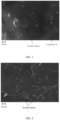
- FIG. 1 is a scanning electron microscope (SEM) image of a lithium-rich metal oxide according to an embodiment of this application.
- the compound Li z X is LiF, LiCl, LiNO 3 , or Li 2 SO 4 .
- FIG. 2 is an SEM image of a lithium-rich metal oxide core before reaction. As shown in FIG. 2 , before the compound Li z X is generated on the surface of the lithium-rich metal oxide core, a relatively large amount of residual lithium exists on the surface of the lithium-rich metal oxide core.
- the compound Li z X may be a product of reaction between an ammonium salt and the residual lithium. After the reaction occurs, the residual lithium is converted into the compound Li z X. Compared with the residual lithium, the compound Li z X does not react with the binder PVDF to cause the binder to denature.
- the compound Li z X is of relatively high conductivity, and lithium ions can be deintercalated from the compound Li z X. Therefore, the residual lithium on the surface of the lithium-rich metal oxide core is converted into the compound Li z X, thereby improving the performance of the lithium-rich metal oxide, and facilitating the preparation of the positive electrode plate, and improving the charge capacity of the battery cell.
- the ammonium salt includes at least one of ammonium fluoride, ammonium chloride, ammonium nitrate, ammonium sulfate, or ammonium bisulfate.
- the lithium-rich metal oxide includes the compound Li z X on the surface of the lithium-rich metal oxide core.
- the compound Li z X exerts little impact on the processing of the positive electrode plate.
- the compound Li z X exerts little impact on the deintercalation of lithium ions from the lithium-rich metal oxide core, thereby improving the charge capacity of the battery cell. Therefore, this technical solution improves the performance of the battery cell.
- the lithium-rich metal oxide includes a lithium-rich metal oxide core and a coating layer.
- the coating layer coats the lithium-rich metal oxide core, and the coating layer includes the compound Li z X.
- the lithium-rich metal oxide Before the lithium-rich metal oxide is prepared from the lithium-rich metal oxide core and the ammonium salt, residual lithium exists on the surface of the lithium-rich metal oxide core. After the residual lithium reacts with the ammonium salt, at least a part of the residual lithium is converted into the compound Li z X. In other words, after the residual lithium reacts with the ammonium salt, no residual lithium exists on the surface of the lithium-rich metal oxide core, that is, all the residual lithium is converted into the compound Li z X.
- residual lithium reacts with the ammonium salt, residual lithium exists on the surface of the lithium-rich metal oxide core, that is, a part of the residual lithium is converted into the compound Li z X, and the rest of the residual lithium still exists on the surface of the lithium-rich metal oxide core.
- the coating layer coats the entire lithium-rich metal oxide core, thereby further improving the stability of the lithium-rich metal oxide.
- the coating layer coats the lithium-rich metal oxide core, thereby reducing the risk that the lithium-rich metal oxide core reacts with water and carbon dioxide in the air, thereby improving the stability of the lithium-rich metal oxide.
- the coating layer includes the compound Li z X, thereby improving the diffusion coefficient of lithium ions in the coating layer and the conductivity of the coating layer, and in turn, improving the charge capacity of the battery cell.
- a molar ratio of the compound Li z X to the lithium-rich metal oxide core is 0.01: 1 to 0.1: 1, and optionally, the molar ratio of the compound Li z X to the lithium-rich metal oxide core is 0.02: 1 to 0.05: 1.
- the content of the compound Li z X further improves the ion conductivity of the lithium-rich metal oxide and the charge capacity of the battery cell.
- the amount of the raw materials required for preparing the compound Li z X can be controlled, thereby saving cost.
- the coating thickness of the Li z X on the lithium-rich metal oxide can be controlled.
- the molar ratio of the compound Li z X to the lithium-rich metal oxide core is 0.01: 1 to 0.1: 1, thereby improving the charge capacity of the battery cell, and at the same time, controlling the cost of production and processing of the battery cell.
- the molar ratio of the compound Li z X to the lithium-rich metal oxide core is 0.02: 1 to 0.05: 1. This arrangement achieves a better trade-off between the charge capacity of the battery cell and the cost of production and processing of the battery cell.
- the compound Li z X is LiF. This arrangement further improves the performance of the lithium-rich metal oxide, thereby further improving the charge capacity of the battery cell.
- a volume median diameter D v50 of the lithium-rich metal oxide is 2 ⁇ m to 10 ⁇ m, and optionally 4 ⁇ m to 8 ⁇ m.
- the volume median diameter D v50 may refer to a particle diameter corresponding to a point at which the cumulative volume distribution percent reaches 50% in a volume-based particle size distribution curve of a specimen.
- the volume median diameter D v50 of the lithium-rich metal oxide is related to the volume median diameter of the lithium-rich metal oxide core.
- the volume median diameter of the lithium-rich metal oxide is excessively large, the path for deintercalation of lithium ions from the lithium-rich metal oxide core is excessively long, thereby being detrimental to the deintercalation of lithium ions, and impairing the charge capacity of the battery cell prepared from the lithium-rich metal oxide. If the volume median diameter of the lithium-rich metal oxide is excessively small, the surface activity of the lithium-rich metal oxide is relatively high, agglomeration is prone to occur between the lithium-rich metal oxide particles, or between the lithium-rich metal oxide core particles, and the dispersivity of the particles is relatively low, thereby making it inconvenient to generate the compound Li z X uniformly on the surface of the lithium-rich metal oxide core.
- the volume median diameter D v50 of the lithium-rich metal oxide falls within the range of 2 ⁇ m to 10 ⁇ m, the path for deintercalation of lithium ions from the lithium-rich metal oxide core is moderate in length, thereby facilitating deintercalation of lithium ions, and improving the charge capacity of the battery cell prepared from the lithium-rich metal oxide.
- such a volume median diameter is also conducive to controlling the surface activity of the lithium-rich metal oxide, and suppressing the agglomeration between lithium-rich metal oxide particles or lithium-rich metal oxide core particles.
- such a volume median diameter contributes to high dispersivity of particles, thereby making it convenient to distribute the compound Li z X uniformly on the surface of the lithium-rich metal oxide core.
- the appropriate value of the volume median diameter of the lithium-rich metal oxide contributes to a good trade-off between the uniformity of distribution of the compound Li z X of the lithium-rich metal oxide and the charge capacity of the battery cell.
- the volume median diameter of the lithium-rich metal oxide is 4 ⁇ m to 8 ⁇ m, and the specific surface area of the lithium-rich metal oxide is 0.5 m 2 /g to 2 m 2 /g, thereby improving the charge capacity of the battery cell.
- the reaction between the ammonium salt and the residual lithium is sufficient, and at the same time, the production cost is not high.
- the lithium-ion diffusion coefficient D of the lithium-rich metal oxide also changes accordingly.
- Specific parameters are set out in Table 1.
- Comparative Embodiment 1 differs from Embodiment 1 in that: the lithium-rich metal oxide core Li 5 FeO 4 is not reacted with the ammonium salt to prepare the lithium-rich metal oxide; and the lithium-rich metal oxide core Li 5 FeO 4 is used as the lithium-rich metal oxide.
- Comparative Embodiments 2 to 5 differ from Comparative Embodiment 1 in the lithium-rich metal oxide core.
- the test process is described here by using an example in which the residual lithium on the surface of the lithium-rich metal oxide includes lithium carbonate and lithium hydroxide.
- the test process includes: Adding m1 grams of lithium-rich metal oxide into b mL of deionized water, and stirring the solution at a speed of 200 rpm for 5 minutes; titrating the lithium-rich metal oxide by using a hydrochloric acid standard solution (the concentration of the hydrochloric acid is c mol/L) (the hydrochloric acid reacts with the lithium carbonate and lithium hydroxide in the lithium-rich metal oxide), using a composite pH electrode as an indicator electrode, determining a titration endpoint with the aid of jumps caused by the potential change, and calculating the content of residual lithium of the lithium-rich metal oxide.
- potential jumps E 1 and E 2 are generated.
- the lithium hydroxide reacts with the hydrochloric acid to generate lithium chloride
- the lithium carbonate reacts with the hydrochloric acid to generate lithium chloride and lithium bicarbonate.
- the volume of the hydrochloric acid consumed at this time is V 1 .
- the lithium bicarbonate reacts with the hydrochloric acid to generate lithium chloride.
- the volume of the hydrochloric acid consumed at this time is V 2 .
- the content of the residual lithium can be calculated based on the consumed hydrochloric acid volumes V 1 and V 2 .
- ICP-AES Inductively Coupled Plasma-Atomic Emission Spectroscopy
- the BET specific surface area of the positive active material bears the meaning well known in the art, and may be measured by using an instrument and method well known in the art.
- the specific surface area is measured by a gas adsorption method with reference to the test standard GB/T19587 2017.
- An exemplary measurement method is as follows: Taking a lithium-rich metal oxide material as a specimen, and immersing the specimen in 196 °C liquid nitrogen; measuring the adsorption amount of nitrogen on a solid surface at different relative pressures that range from 0.05 to 0.30; and determining a monolayer adsorption amount of the specimen based on the BET multilayer adsorption theory and formula, and calculating the specific surface area of the lithium-rich metal oxide material.
- the lithium-ion diffusion coefficient may be determined by a conventional method in the art, such as coin cell cyclic voltammetry (CV), electrochemical impedance spectroscopy (EIS), Galvanostatic Intermittent Titration Technique (GITT), or Potentiostatic Intermittent Titration Technique (PITT), and calculated based on the Fick's first law and the Fick's second law.
- CV coin cell cyclic voltammetry
- EIS electrochemical impedance spectroscopy
- GITT Galvanostatic Intermittent Titration Technique
- PITT Potentiostatic Intermittent Titration Technique
- the steps for determining the lithium-ion diffusion coefficient of lithium-rich metal oxide as a positive active material are as follows: Grinding the lithium-rich metal oxide material to let the material enter a powder microelectrode, connecting the powder microelectrode to an electrochemical workstation, and performing Coulometric titration, during which the pulse current is 20 ⁇ A, the titration time is 1 h, and the interval is 4 h.
- Preparing a positive electrode plate Dissolving lithium-rich metal oxide, polyvinylidene fluoride (PVDF) as a binder, and acetylene black as a conductive agent at a mass ratio of 97: 2: 1 in an N-methylpyrrolidone (NMP) solvent, and stirring the mixture well to form a positive electrode slurry; and applying the positive electrode slurry onto a positive current collector aluminum foil evenly, and then performing oven-drying, cold-pressing, and slitting to obtain a positive electrode plate.
- NMP N-methylpyrrolidone
- the lithium-rich metal oxide serves as an active material, and no other active materials are added.
- Preparing a negative electrode plate Dispersing artificial graphite as a negative active material, acetylene black as a conductive agent, styrene-butadiene rubber (SBR) as a binder, and sodium carboxymethyl cellulose (CMC-Na) as a thickener at a mass ratio of 96: 1.5: 1.5: 1.0 in deionized water, and stirring well to make a negative electrode slurry; and applying the negative electrode slurry onto a negative current collector copper foil, and then performing oven-drying, cold-pressing, and slitting to obtain a negative electrode plate.
- SBR styrene-butadiene rubber
- CMC-Na sodium carboxymethyl cellulose
- Separator Using a polypropylene film as a separator.
- Preparing an electrolyte solution Mixing ethylene carbonate (EC), ethyl methyl carbonate (EMC), and diethyl carbonate (DEC) at a volume ratio of 1: 1: 1, and dissolving LiPF 6 in the forgoing solution homogeneously to obtain an electrolyte solution.
- the concentration of the LiPF 6 is 1 mol/L.
- Preparing a lithium-ion battery Stacking the positive electrode plate, the separator, and the negative electrode plate in sequence, and winding the stacked structure to obtain an electrode assembly. Placing the electrode assembly into an outer package, injecting the electrolyte solution prepared above, and performing steps such as packaging, standing, chemical formation, and aging to obtain a lithium-ion battery.
- Table 1 shows specific parameters and experimental results of different embodiments and comparative embodiments.
- k represents the mass percent of residual lithium on the surface of the lithium-rich metal oxide core in the lithium-rich metal oxide based on 100 wt% as a total mass of the lithium-rich metal oxide; D represents the lithium-ion diffusion coefficient; ⁇ represents the resistivity of the lithium-rich metal oxide; T1 represents the reaction temperature of the reaction between the ammonium salt and the residual lithium; L represents the reaction time of the reaction between the ammonium salt and the residual lithium; Li z X represents the compound on the surface of the lithium-rich metal oxide core; m1 represents the molar ratio of the ammonium salt to the lithium-rich metal oxide core; m2 represents the molar ratio of the compound Li z X to the lithium-rich metal oxide core; D v50 represents the volume median diameter of the lithium-rich metal oxide; s represents the specific surface area of the lithium-rich metal oxide; and Q represents the first-cycle charge capacity of the lithium-ion battery
- the mass percent of residual lithium in Comparative Embodiment 1 is relatively high, and the charge capacity of the lithium-ion battery in Comparative Embodiment 1 is significantly lower than the charge capacity of the lithium-ion battery in Embodiments 1 to 25 of this application.
- the mass percent of residual lithium in Comparative Embodiments 2 to 5 is relatively high, and the charge capacity of the lithium-ion batteries in Comparative Embodiments 2 to 5 is significantly lower than the charge capacity of the lithium-ion batteries in Embodiments 26 to 29 of this application.
- a reasonable value of the molar ratio of the ammonium salt to the lithium-rich metal oxide core is conducive to obtaining a more suitable molar ratio of the lithium-containing compound Li z X to the lithium-rich metal oxide core, reducing the mass percent of residual lithium on the surface of the lithium-rich metal oxide core, increasing the lithium-ion diffusion coefficient, reducing the resistivity of the lithium-rich metal oxide, and increasing the charge capacity of the lithium-ion battery cell.
- the reasonable values of the reaction temperature and reaction time of the reaction between the ammonium salt and the lithium-rich metal oxide core are conducive to obtaining a suitable molar ratio of the lithium-containing compound Li z X to the lithium-rich metal oxide core, reducing the mass percent of residual lithium on the surface of the lithium-rich metal oxide core, increasing the lithium-ion diffusion coefficient, reducing the resistivity of the lithium-rich metal oxide, and increasing the charge capacity of the lithium-ion battery cell.
Landscapes
- Chemical & Material Sciences (AREA)
- Engineering & Computer Science (AREA)
- Materials Engineering (AREA)
- Organic Chemistry (AREA)
- Inorganic Chemistry (AREA)
- Chemical Kinetics & Catalysis (AREA)
- Electrochemistry (AREA)
- General Chemical & Material Sciences (AREA)
- Composite Materials (AREA)
- Manufacturing & Machinery (AREA)
- Battery Electrode And Active Subsutance (AREA)
Abstract
Description
- This application relates to the field of battery technology, and in particular, to a lithium-rich metal oxide and a preparation method thereof, a positive electrode plate, a battery cell, and a battery.
- With the aggravation of environmental pollution, the new energy industry is attracting more and more attention. Battery technology is crucial to the development of the new energy industry.
- As a material for preparing a positive electrode plate of a battery cell, lithium-rich metal oxide is crucial to the performance of the battery cell. Therefore, how to provide a lithium-rich metal oxide to improve the performance of the battery cell is a pressing technical challenge.
- This application addresses the above challenge. An objective of this application is to provide a lithium-rich metal oxide to improve performance of battery cells.
- To achieve the above objective, this application provides a lithium-rich metal oxide and a preparation method thereof, a positive electrode plate, a battery cell, and a battery.
- According to a first aspect, this application provides a lithium-rich metal oxide. The lithium-rich metal oxide includes: a lithium-rich metal oxide core; and residual lithium on a surface of the lithium-rich metal oxide core. Based on 100 wt% as a total mass of the lithium-rich metal oxide, a mass percent k of the residual lithium satisfies: k ≤ 0.5 wt%, and a lithium-ion diffusion coefficient D of the lithium-rich metal oxide satisfies: D ≥ 1.0 × 10⁻¹⁵ cm2/s.
- An embodiment of this application provides a lithium-rich metal oxide that includes a lithium-rich metal oxide core and residual lithium on a surface of the metal oxide core. The content of lithium ions in the lithium-rich metal oxide core is relatively high. The lithium-rich metal oxide core selected for preparing a positive electrode material improves the charge capacity of a battery cell. Based on 100 wt% as a total mass of the lithium-rich metal oxide, the mass percent k of the residual lithium on the surface of the lithium-rich metal oxide core is less than or equal to 0.5 wt%, thereby reducing the impact of the residual lithium on the processing of the positive electrode plate, reducing the impact of the residual lithium on the deintercalation of lithium ions from the lithium-rich metal oxide core, and in turn, reducing the impact on the charge capacity of the battery cell. The lithium-ion diffusion coefficient D of the lithium-rich metal oxide satisfies: D ≥ 1.0 × 10⁻¹⁵ cm2/s, thereby making it convenient to deintercalate the lithium ions from the lithium-rich metal oxide, and improving the charge capacity of the battery cell. Therefore, when applied to a battery cell, the lithium-rich metal oxide according to this embodiment of this application improves the performance of the battery cell.
- In a possible implementation, k ≤ 0.1 wt%. In this way, the content of residual lithium on the surface of the lithium-rich metal oxide core is further reduced, thereby further reducing the impact of the residual lithium on the processing of the positive electrode plate and the impact on the deintercalation of the lithium ions from the lithium-rich metal oxide, facilitating the preparation of the positive electrode plate, and further improving the charge capacity of the battery cell.
- In a possible implementation, D ≥ 1.0 × 10⁻¹² cm2/s. In this way, the diffusion coefficient of lithium ions in the lithium-rich metal oxide is further increased, thereby making it convenient to deintercalate the lithium ions from the lithium-rich metal oxide, and further improving the charge capacity of the battery cell.
- In a possible implementation, a resistivity ρ of the lithium-rich metal oxide satisfies: ρ ≤ 1 Ω·cm, and optionally, ρ ≤ 0.5 Ω·cm. In this way, the resistivity of the lithium-rich metal oxide is relatively low, thereby improving the conductivity of the lithium-rich metal oxide, making it convenient to deintercalate the lithium ions from the lithium-rich metal oxide, and improving the charge capacity of the battery cell.
- In a possible implementation, the lithium-rich metal oxide further includes: a compound LizX on the surface of the lithium-rich metal oxide core, where X includes at least one of F-, Cl-, NO3 -, or HSO4 -1, and z = 1; or, X includes SO4 2-, and z = 2.
- In the above technical solution, the lithium-rich metal oxide includes the compound LizX on the surface of the lithium-rich metal oxide core. On the one hand, the compound LizX exerts little impact on the processing of the positive electrode plate. For example, the compound LizX is less likely to cause denaturation of the binder polyvinylidene difluoride and consequent gelation of a positive electrode slurry. On the other hand, the compound LizX exerts little impact on the deintercalation of lithium ions from the lithium-rich metal oxide core, thereby improving the charge capacity of the battery cell. Therefore, this technical solution improves the performance of the battery cell.
- In a possible implementation, the lithium-rich metal oxide includes: the lithium-rich metal oxide core; and a coating layer. The coating layer coats the lithium-rich metal oxide core, and the coating layer includes the compound LizX.
- In the above scheme, the coating layer coats the lithium-rich metal oxide core, thereby reducing the risk that the lithium-rich metal oxide core reacts with water and carbon dioxide in the air, thereby improving the stability of the lithium-rich metal oxide. The coating layer includes the compound LizX, thereby improving the diffusion coefficient of lithium ions in the coating layer and the conductivity of the coating layer, and in turn, improving the charge capacity of the battery cell.
- In a possible implementation, a molar ratio of the compound LizX to the lithium-rich metal oxide core is 0.01: 1 to 0.1: 1, and optionally, the molar ratio of the compound LizX to the lithium-rich metal oxide core is 0.02: 1 to 0.05: 1. This arrangement achieves a good trade-off between the charge capacity of the battery cell and the cost of production and processing of the battery cell.
- In a possible implementation, the compound LizX is LiF. This arrangement further improves the performance of the lithium-rich metal oxide, thereby further improving the charge capacity of the battery cell.
- In a possible implementation, a volume median diameter Dv50 of the lithium-rich metal oxide is 2 µm to 10 µm, and optionally 4 µm to 8 µm. When the volume median diameter of the lithium-rich metal oxide falls within the above range, the path for deintercalation of lithium ions from the lithium-rich metal oxide core is moderate in length, thereby facilitating deintercalation of lithium ions, and improving the charge capacity of the battery cell prepared from the lithium-rich metal oxide. When the volume median diameter of the lithium-rich metal oxide falls within the above range, the surface activity of the lithium-rich metal oxide can be controlled, and the agglomeration between lithium-rich metal oxide particles or lithium-rich metal oxide core particles can be suppressed, and the particles are of high dispersivity, thereby making it convenient to distribute the compound LizX uniformly on the surface of the lithium-rich metal oxide core. The appropriate value of the volume median diameter of the lithium-rich metal oxide contributes to a good trade-off between the uniformity of distribution of the compound LizX of the lithium-rich metal oxide and the charge capacity of the battery cell.
- In a possible implementation, a specific surface area of the lithium-rich metal oxide is 0.2 m2/g to 5 m2/g, and optionally 0.5 m2/g to 2 m2/g. This arrangement further improves the capacity of the battery cell.
- In a possible implementation, a material of the lithium-rich metal oxide core includes LiaMnOy, where 2 ≤ a ≤ 8. The LiaMnOy includes one or more of Li2M1O2, Li2M2O3, Li3M3O4, Li5M4O4, Li6M5O4, or Li8M6O6. M1 includes one or more of Ni, Co, Fe, Mn, Zn, Mg, Ca, Cu, or Mo; M2 includes one or more of Mn, Sn, Mo, Ru, or Ir; M3 includes one or more of V, Nb, Cr, or Mo; M4 includes one or more of Fe, Cr, V, or Mo; M5 includes one or more of Co, V, Cr, or Mo; M6 includes Sn. Optionally, the LiaMnOy includes one or more of Li2NiO2, Li2CuO2, Li2MnO3, Li3VO4, Li3NbO4, Li5FeO4, Li6CoO4, or Li8SnO6. In this way, it is convenient to flexibly select an appropriate lithium-rich metal oxide core according to actual needs.
- According to a second aspect, this application provides a method for preparing a lithium-rich metal oxide. The method includes: providing an ammonium salt and a lithium-rich metal oxide core; and mixing the ammonium salt and the lithium-rich metal oxide core, and treating the mixture to obtain the lithium-rich metal oxide. The lithium-rich metal oxide prepared by this method is of high conductivity and stability. When applied to a battery cell, the lithium-rich metal oxide of this application improves the performance of the battery cell.
- In a possible embodiment, the treatment includes: sintering in an inert atmosphere for 2 to 10 hours, and optionally 4 to 8 hours; and/or the treatment is performed at a temperature of 100 °C to 600 °C, and optionally 200 °C to 500 °C. In this way, the reasonable setting of the sintering time and treatment temperature facilitates the reaction between the ammonium salt and the residual lithium on the surface of the lithium-rich metal oxide core, so as to obtain the compound LizX on the surface of the lithium-rich metal oxide core after completion of the reaction. The reasonable setting is also conducive to saving cost and reducing the consumption of active lithium in the lithium-rich metal oxide core.
- Optionally, the ammonium salt includes at least one of ammonium fluoride, ammonium chloride, ammonium nitrate, ammonium sulfate, or ammonium bisulfate; and optionally, the ammonium salt includes ammonium fluoride. In this way, it is convenient to select the type of ammonium salt flexibly according to actual conditions.
- In a possible implementation, a molar ratio of the ammonium salt to the lithium-rich metal oxide core is (0.021 to 0.15): 1, and optionally 0.03: 1 to 0.08: 1. In this way, the ratio of the ammonium salt to the lithium-rich metal oxide core is set reasonably to generate the desired compound LizX without incurring adverse effects such as waste caused by excessive ammonium salt content.
- In a possible implementation, the method further includes: performing airflow pulverization and sieving on a product of the treatment to obtain the lithium-rich metal oxide. In this way, the lithium-rich metal oxide of an appropriate particle size is obtained conveniently.
- In a possible implementation, a material of the lithium-rich metal oxide core includes LiaMnOy, where 2 ≤ a ≤ 8. The LiaMnOy includes one or more of Li2M1O2, Li2M2O3, Li3M3O4, Li5M4O4, Li6M5O4, or Li8M6O6. M1 includes one or more of Ni, Co, Fe, Mn, Zn, Mg, Ca, Cu, or Mo; M2 includes one or more of Mn, Sn, Mo, Ru, or Ir; M3 includes one or more of V, Nb, Cr, or Mo; M4 includes one or more of Fe, Cr, V, or Mo; M5 includes one or more of Co, V, Cr, or Mo; M6 includes Sn. Optionally, the LiaMnOy includes one or more of Li2NiO2, Li2CuO2, Li2MnO3, Li3VO4, Li3NbO4, Li5FeO4, Li6CoO4, or Li8SnO6. In this way, it is convenient to flexibly select an appropriate lithium-rich metal oxide core according to actual needs.
- According to a third aspect, this application provides a positive electrode plate. The positive electrode plate includes the lithium-rich metal oxide disclosed in the first aspect or any one possible implementation of the first aspect.
- According to a fourth aspect, this application provides a battery cell. The battery cell includes the positive electrode plate disclosed in the third aspect.
- According to a fifth aspect, this application provides a battery. The battery includes the battery cell disclosed in the fourth aspect.
- According to a sixth aspect, this application provides an electrical device. The electrical device includes the battery disclosed in the fifth aspect.
- An embodiment of this application provides a lithium-rich metal oxide that includes a lithium-rich metal oxide core and residual lithium on a surface of the metal oxide core. The content of lithium ions in the lithium-rich metal oxide core is relatively high. The lithium-rich metal oxide core selected for preparing a positive electrode material improves the charge capacity of a battery cell. Based on 100 wt% as a total mass of the lithium-rich metal oxide, the mass percent k of the residual lithium on the surface of the lithium-rich metal oxide core is less than or equal to 0.5 wt%, thereby reducing the impact of the residual lithium on the processing of the positive electrode plate, reducing the impact of the residual lithium on the deintercalation of lithium ions from the lithium-rich metal oxide core, and in turn, reducing the impact on the charge capacity of the battery cell. The lithium-ion diffusion coefficient D of the lithium-rich metal oxide satisfies: D ≥ 1.0 × 10⁻¹⁵ cm2/s, thereby making it convenient to deintercalate the lithium ions from the lithium-rich metal oxide, and improving the charge capacity of the battery cell. Therefore, when applied to a battery cell, the lithium-rich metal oxide according to this embodiment of this application improves the performance of the battery cell.
-
-
FIG. 1 is a scanning electron microscope image of a lithium-rich metal oxide according to an embodiment of this application; -
FIG. 2 is an SEM image of a lithium-rich metal oxide core before reaction; -
FIG. 3 is a schematic diagram of a method for preparing a lithium-rich metal oxide according to an embodiment of this application; -
FIG. 4 is a schematic diagram of a battery cell according to an embodiment of this application; -
FIG. 5 is a schematic diagram of a battery module according to an embodiment of this application; -
FIG. 6 is a schematic diagram of a battery according to an embodiment of this application; and -
FIG. 7 is a schematic diagram of an electrical device according to an embodiment of this application. - The following discloses and describes in detail some embodiments of a lithium-rich metal oxide and a preparation method thereof, a battery cell, a battery, and an electrical device of this application with due reference to drawings. However, unnecessary details may be omitted in some cases. For example, a detailed description of a well-known matter or repeated description of an essentially identical structure may be omitted. That is intended to prevent the following descriptions from becoming unnecessarily lengthy, and to facilitate understanding by a person skilled in the art. In addition, the drawings and the following descriptions are intended for a person skilled in the art to thoroughly understand this application, but not intended to limit the subject-matter set forth in the claims.
- A "range" disclosed herein is defined in the form of a lower limit and an upper limit. A given range is defined by a lower limit and an upper limit selected. The selected lower and upper limits define the boundaries of a particular range. A range so defined may be inclusive or exclusive of the end values, and a lower limit of one range may be arbitrarily combined with an upper limit of another range to form a range. For example, if a given parameter falls within a range of 60 to 120 and a range of 80 to 110, it is expectable that the parameter may fall within a range of 60 to 110 and a range of 80 to 120 as well. In addition, if lower-limit values 1 and 2 are listed, and if upper-
limit values - Unless otherwise expressly specified herein, any embodiments and optional embodiments of this application may be combined with each other to form a new technical solution.
- Unless otherwise expressly specified herein, any technical features and optional technical features hereof may be combined with each other to form a new technical solution.
- Unless otherwise expressly specified herein, all steps described herein may be performed in sequence or at random, and preferably in sequence. For example, that the method includes steps (a) and (b) indicates that the method may include steps (a) and (b) performed in sequence, or steps (b) and (a) performed in sequence. For example, that the method may further include step (c) indicates that step (c) may be added into the method in any order. For example, the method may include steps (a), (b), and (c), or may include steps (a), (c), and (b), or may include steps (c), (a), and (b), and so on.
- Unless otherwise expressly specified herein, "include" and "comprise" mentioned herein mean openended inclusion, or closed-ended inclusion. For example, the terms "include" and "comprise" may mean inclusion of other items that are not recited, or inclusion of only the items recited.
- Unless otherwise expressly specified, the term "or" used herein is inclusive. For example, the expression "A or B" means "A alone, B alone, or both A and B". More specifically, all and any of the following conditions satisfy the condition "A or B": A is true (or existent) and B is false (or absent); A is false (or absent) and B is true (or existent); and, both A and B are true (or existent).
- By virtue of characteristics such as a high energy density, high voltage, and a long life, lithium-ion batteries are widely used in the fields such as mobile phones, electric vehicles, and power storage stations. Lithium-rich metal oxides in a lithium-ion battery are crucial to the performance such as charge capacity of the lithium-ion battery.
- With a relatively high content of lithium ions, the lithium-rich metal oxide is widely used in the preparation of lithium-ion batteries. The lithium-rich metal oxide is of relatively low stability, and is prone to react with carbon dioxide and water in the air to generate residual lithium such as a lithium oxide, a hydroxide, and a carbonate salt on the surface of the lithium-rich metal oxide. The presence of the residual lithium affects the performance of the lithium-rich metal oxide. In addition, when the lithium-rich metal oxide is used for preparing a battery cell, the presence of the residual lithium is detrimental to the preparation of the battery cell and the improvement of the charge capacity of the battery cell, thereby impairing the performance of the battery cell.
- In some treatment methods, in order to improve the performance of the lithium-rich metal oxide, a corresponding acid is added into a slurry to perform an acid-base neutralization reaction to reduce the content of residual lithium on the surface of the lithium-rich metal oxide. However, the effect of this treatment method is not satisfactory. On the one hand, the content of the residual lithium in the lithium-rich metal oxide obtained after the treatment is relatively high, and the lithium-ion diffusion coefficient of the lithium-rich metal oxide is relatively low. On the other hand, the uneven distribution of the acid in the slurry is prone to cause excessive reaction of some lithium-rich metal oxides, thereby resulting in a decrease in the active lithium inside the lithium-rich metal oxide, and producing an adverse effect on the performance of the battery cell. The lithium-rich metal oxide obtained by the above treatment method is detrimental to improving the performance of the battery cell.
- In view of the above situation, this application provides a lithium-rich metal oxide. The content of residual lithium in the lithium-rich metal oxide is relatively low, and the lithium-ion diffusion coefficient of the lithium-rich metal oxide is relatively high. The lithium-rich metal oxide of this application improves the performance of the battery cell.
- An embodiment of this application provides a lithium-rich metal oxide that includes a lithium-rich metal oxide core and residual lithium on a surface of the lithium-rich metal oxide core.
- The content of lithium ions in the lithium-rich metal oxide core is relatively high. The lithium-rich metal oxide core selected for preparing a battery cell improves the charge capacity of a battery cell.
- The material of the lithium-rich metal oxide core is a lithium-rich metal oxide such as lithium iron oxide.
- Optionally, the shape of the lithium-rich metal oxide core may be spherical or quasi-spherical. The shape of the lithium-rich metal oxide core is not particularly limited herein, as long as the material is lithium-rich metal oxide.
- The lithium-rich metal oxide includes active lithium contained in the lithium-rich metal oxide core and residual lithium on the surface of the lithium-rich metal oxide core. The active lithium in the lithium-rich metal oxide can be deintercalated from or intercalated into the lithium-rich metal oxide to participate in the charge-discharge process of the battery cell. The residual lithium on the surface of the lithium-rich metal oxide core does not participate in the charge-discharge process of the battery cell.
- The residual lithium refers to the residual lithium on the surface of the lithium-rich metal oxide, and is also referred to as free lithium. The surface of the lithium-rich metal oxide core may be a surface, close to the external environment, of the lithium-rich metal oxide core.
- The residual lithium is lithium oxide, lithium hydroxide, lithium carbonate, and other products that are generated by the reaction between the lithium-rich metal oxide core and substituents in the air, where the substituents include water, carbon dioxide, and the like. For example, the residual lithium is Li2CO3, LiOH, Li2O, or the like.
- The residual lithium is located on the surface of the lithium-rich metal oxide core, and affects the deintercalation of lithium ions in the lithium-rich metal oxide core, and results in a decline in the performance of the lithium-rich metal oxide and a decrease in the charge capacity of the battery cell. In addition, the residual lithium is relatively alkaline. When the lithium-rich metal oxide core is mixed with a binder to form a slurry to prepare a positive electrode plate, the residual lithium affects the performance of the binder, causes denaturation of the binder such as polyvinylidene fluoride (PVDF), and affects the performance of the slurry and the application of the slurry, thereby affecting the processing of the positive electrode plate. In an embodiment of this application, based on 100 wt% as a total mass of the lithium-rich metal oxide, the mass percent k of the residual lithium satisfies: k ≤ 0.5 wt%, thereby reducing the impact of the residual lithium on the processing of the positive electrode plate, reducing the impact of the residual lithium on the deintercalation of lithium ions from the lithium-rich metal oxide core, and in turn, reducing the impact on the charge capacity of the battery cell, and improving the charge capacity of the battery cell.
- The lithium-ion diffusion coefficient may refer to an average number of lithium ions passing through a medium per unit area per unit time, and can reflect the penetration rate of lithium ions in the medium. The lithium-ion diffusion coefficient of the lithium-rich metal oxide may refer to the diffusion coefficient of lithium ions in the lithium-rich metal oxide.
- The lithium-ion diffusion coefficient D of the lithium-rich metal oxide satisfies: D ≥ 1.0 × 10⁻¹⁵ cm2/s, thereby making it convenient to deintercalate the lithium ions from the lithium-rich metal oxide, and improving the charge capacity of the battery cell.
- Optionally, the charge capacity of the battery cell may include a first-cycle charge capacity of the battery cell. During charge of the battery cell, lithium ions are deintercalated from the lithium-rich metal oxide. For example, the charge capacity of the battery cell may be a ratio of the capacity of a fully charged battery cell to a mass of active materials in the battery cell.
- Optionally, the lithium-rich metal oxide in an embodiment of this application may be used as a lithium supplement additive. For example, the lithium-rich metal oxide is mixed with another positive electrode material to supplement active lithium.
- Optionally, the lithium-rich metal oxide in an embodiment of this application may also be used as an active agent. For example, the lithium-rich metal oxide is mixed with a binder and a conductive agent to form a slurry, and the slurry is applied onto a positive current collector to make a positive electrode plate.
- An embodiment of this application provides a lithium-rich metal oxide that includes a lithium-rich metal oxide core and residual lithium on a surface of the metal oxide core. The content of lithium ions in the lithium-rich metal oxide core is relatively high. The lithium-rich metal oxide core selected for preparing a positive electrode material improves the charge capacity of a battery cell. Based on 100 wt% as a total mass of the lithium-rich metal oxide, the mass percent k of the residual lithium on the surface of the lithium-rich metal oxide core is less than or equal to 0.5 wt%, thereby reducing the impact of the residual lithium on the processing of the positive electrode plate, reducing the impact of the residual lithium on the deintercalation of lithium ions from the lithium-rich metal oxide core, and in turn, reducing the impact on the charge capacity of the battery cell. The lithium-ion diffusion coefficient D of the lithium-rich metal oxide satisfies: D ≥ 1.0 × 10⁻¹⁵ cm2/s, thereby making it convenient to deintercalate the lithium ions from the lithium-rich metal oxide, and improving the charge capacity of the battery cell. Therefore, when applied to a battery cell, the lithium-rich metal oxide of this application improves performance of the battery cell.
- In some embodiments, k ≤ 0.1 wt%. In this way, the content of residual lithium on the surface of the lithium-rich metal oxide core is further reduced, thereby further reducing the impact of the residual lithium on the processing of the positive electrode plate and the impact on the deintercalation of the lithium ions from the lithium-rich metal oxide, facilitating the preparation of the positive electrode plate, and further improving the charge capacity of the battery cell.
- In some embodiments, D ≥ 1.0 × 10⁻¹² cm2/s. In this way, the diffusion coefficient of lithium ions in the lithium-rich metal oxide is further increased, thereby making it convenient to deintercalate the lithium ions from the lithium-rich metal oxide, and further improving the charge capacity of the battery cell.
- In some embodiments, a resistivity ρ of the lithium-rich metal oxide satisfies: ρ ≤ 1 Ω·cm, and optionally, ρ ≤ 0.5 Ω·cm.
- The lower the resistivity of the lithium-rich metal oxide, the higher the conductivity of the lithium-rich metal oxide, and the more smoothly the lithium ions are deintercalated from the lithium-rich metal oxide.
- In the above embodiments, the resistivity ρ of the lithium-rich metal oxide is less than or equal to 1 Ω·cm, thereby improving the conductivity of the lithium-rich metal oxide and the charge capacity of the battery cell.
- The resistivity ρ of the lithium-rich metal oxide being less than or equal to 0.5 Ω·cm further improves the conductivity of the lithium-rich metal oxide and the charge capacity of the battery cell.
-
FIG. 1 is a scanning electron microscope (SEM) image of a lithium-rich metal oxide according to an embodiment of this application. In some embodiments, as shown inFIG. 1 , the lithium-rich metal oxide further includes: a compound LizX on the surface of the lithium-rich metal oxide core, where X includes at least one of F-, Cl-, NO3 -, or HSO4 -1, and z = 1; or, X includes SO4 2-, and z = 2. For example, the compound LizX is LiF, LiCl, LiNO3, or Li2SO4. -
FIG. 2 is an SEM image of a lithium-rich metal oxide core before reaction. As shown inFIG. 2 , before the compound LizX is generated on the surface of the lithium-rich metal oxide core, a relatively large amount of residual lithium exists on the surface of the lithium-rich metal oxide core. - The compound LizX may be a product of reaction between an ammonium salt and the residual lithium. After the reaction occurs, the residual lithium is converted into the compound LizX. Compared with the residual lithium, the compound LizX does not react with the binder PVDF to cause the binder to denature. The compound LizX is of relatively high conductivity, and lithium ions can be deintercalated from the compound LizX. Therefore, the residual lithium on the surface of the lithium-rich metal oxide core is converted into the compound LizX, thereby improving the performance of the lithium-rich metal oxide, and facilitating the preparation of the positive electrode plate, and improving the charge capacity of the battery cell.
- Optionally, as shown in
FIG. 1 and FIG. 2 , after the ammonium salt reacts with the residual lithium, the residual lithium on the surface of the lithium-rich metal oxide core is greatly reduced. - Optionally, the ammonium salt includes at least one of ammonium fluoride, ammonium chloride, ammonium nitrate, ammonium sulfate, or ammonium bisulfate.
- In the above embodiment, the lithium-rich metal oxide includes the compound LizX on the surface of the lithium-rich metal oxide core. On the one hand, the compound LizX exerts little impact on the processing of the positive electrode plate. On the other hand, the compound LizX exerts little impact on the deintercalation of lithium ions from the lithium-rich metal oxide core, thereby improving the charge capacity of the battery cell. Therefore, this technical solution improves the performance of the battery cell.
- In some embodiments, the lithium-rich metal oxide includes a lithium-rich metal oxide core and a coating layer.
- The coating layer coats the lithium-rich metal oxide core, and the coating layer includes the compound LizX.
- Before the lithium-rich metal oxide is prepared from the lithium-rich metal oxide core and the ammonium salt, residual lithium exists on the surface of the lithium-rich metal oxide core. After the residual lithium reacts with the ammonium salt, at least a part of the residual lithium is converted into the compound LizX. In other words, after the residual lithium reacts with the ammonium salt, no residual lithium exists on the surface of the lithium-rich metal oxide core, that is, all the residual lithium is converted into the compound LizX. Alternatively, after the residual lithium reacts with the ammonium salt, residual lithium exists on the surface of the lithium-rich metal oxide core, that is, a part of the residual lithium is converted into the compound LizX, and the rest of the residual lithium still exists on the surface of the lithium-rich metal oxide core.
- Optionally, the coating layer further includes residual lithium.
- Optionally, the coating layer coats a part of the lithium-rich metal oxide core. The coating layer is generated at a position at which, before the reaction, the residual lithium is located.
- Optionally, the coating layer coats the entire lithium-rich metal oxide core, thereby further improving the stability of the lithium-rich metal oxide.
- In the above embodiment, the coating layer coats the lithium-rich metal oxide core, thereby reducing the risk that the lithium-rich metal oxide core reacts with water and carbon dioxide in the air, thereby improving the stability of the lithium-rich metal oxide. The coating layer includes the compound LizX, thereby improving the diffusion coefficient of lithium ions in the coating layer and the conductivity of the coating layer, and in turn, improving the charge capacity of the battery cell.
- In some embodiments, a molar ratio of the compound LizX to the lithium-rich metal oxide core is 0.01: 1 to 0.1: 1, and optionally, the molar ratio of the compound LizX to the lithium-rich metal oxide core is 0.02: 1 to 0.05: 1.
- In a case that the molar ratio of the compound LizX to the lithium-rich metal oxide core is not less than 0.01: 1, the content of the compound LizX further improves the ion conductivity of the lithium-rich metal oxide and the charge capacity of the battery cell.
- In a case that the molar ratio of the compound LizX to the lithium-rich metal oxide core is not higher than 0.1: 1, on the one hand, the amount of the raw materials required for preparing the compound LizX can be controlled, thereby saving cost. On the other hand, the coating thickness of the LizX on the lithium-rich metal oxide can be controlled.
- In the above embodiment, the molar ratio of the compound LizX to the lithium-rich metal oxide core is 0.01: 1 to 0.1: 1, thereby improving the charge capacity of the battery cell, and at the same time, controlling the cost of production and processing of the battery cell.
- Optionally, the molar ratio of the compound LizX to the lithium-rich metal oxide core is 0.02: 1 to 0.05: 1. This arrangement achieves a better trade-off between the charge capacity of the battery cell and the cost of production and processing of the battery cell.
- In some embodiments, the compound LizX is LiF. This arrangement further improves the performance of the lithium-rich metal oxide, thereby further improving the charge capacity of the battery cell.
- In some embodiments, a volume median diameter Dv50 of the lithium-rich metal oxide is 2 µm to 10 µm, and optionally 4 µm to 8 µm.
- The volume median diameter Dv50 may refer to a particle diameter corresponding to a point at which the cumulative volume distribution percent reaches 50% in a volume-based particle size distribution curve of a specimen.
- The volume median diameter Dv50 of the lithium-rich metal oxide is related to the volume median diameter of the lithium-rich metal oxide core. The larger the volume median diameter of the lithium-rich metal oxide core, the larger the volume median diameter Dv50 of the lithium-rich metal oxide. The smaller the volume median diameter of the lithium-rich metal oxide core, the smaller the volume median diameter Dv50 of the lithium-rich metal oxide.
- If the volume median diameter of the lithium-rich metal oxide is excessively large, the path for deintercalation of lithium ions from the lithium-rich metal oxide core is excessively long, thereby being detrimental to the deintercalation of lithium ions, and impairing the charge capacity of the battery cell prepared from the lithium-rich metal oxide. If the volume median diameter of the lithium-rich metal oxide is excessively small, the surface activity of the lithium-rich metal oxide is relatively high, agglomeration is prone to occur between the lithium-rich metal oxide particles, or between the lithium-rich metal oxide core particles, and the dispersivity of the particles is relatively low, thereby making it inconvenient to generate the compound LizX uniformly on the surface of the lithium-rich metal oxide core.
- In the above embodiments, the volume median diameter Dv50 of the lithium-rich metal oxide falls within the range of 2 µm to 10 µm, the path for deintercalation of lithium ions from the lithium-rich metal oxide core is moderate in length, thereby facilitating deintercalation of lithium ions, and improving the charge capacity of the battery cell prepared from the lithium-rich metal oxide. In addition, such a volume median diameter is also conducive to controlling the surface activity of the lithium-rich metal oxide, and suppressing the agglomeration between lithium-rich metal oxide particles or lithium-rich metal oxide core particles. Moreover, such a volume median diameter contributes to high dispersivity of particles, thereby making it convenient to distribute the compound LizX uniformly on the surface of the lithium-rich metal oxide core. The appropriate value of the volume median diameter of the lithium-rich metal oxide contributes to a good trade-off between the uniformity of distribution of the compound LizX of the lithium-rich metal oxide and the charge capacity of the battery cell.
- In some embodiments, a specific surface area of the lithium-rich metal oxide is 0.2 m2/g to 5 m2/g, and optionally 0.5 m2/g to 2 m2/g. This arrangement further improves the capacity of the battery cell.
- In some embodiments, the volume median diameter of the lithium-rich metal oxide is 4 µm to 8 µm, and the specific surface area of the lithium-rich metal oxide is 0.5 m2/g to 2 m2/g, thereby improving the charge capacity of the battery cell.
- In some embodiments, the material of the lithium-rich metal oxide core includes LiaMnOy, where 2 ≤ a ≤ 8. The LiaMnOy includes one or more of Li2M1O2, Li2M2O3, Li3M3O4, Li5M4O4, Li6M5O4, or Li8M6O6. M1 includes one or more of Ni, Co, Fe, Mn, Zn, Mg, Ca, Cu, or Mo; M2 includes one or more of Mn, Sn, Mo, Ru, or Ir; M3 includes one or more of V, Nb, Cr, or Mo; M4 includes one or more of Fe, Cr, V, or Mo; M5 includes one or more of Co, V, Cr, or Mo; M6 includes Sn. Optionally, the LiaMnOy includes one or more of Li2NiO2, Li2CuO2, Li2MnO3, Li3VO4, Li3NbO4, Li5FeO4, Li6CoO4, or Li8SnO6. In this way, it is convenient to flexibly select an appropriate lithium-rich metal oxide core according to actual needs.
- The above has described some embodiments of the lithium-rich metal oxide of this application, and the following will describe in detail some embodiments of a method for preparing the lithium-rich metal oxide. For the part not described in the embodiments of the method for preparing the lithium-rich metal oxide, reference may be made to the relevant description of the embodiment of the lithium-rich metal oxide.
-
FIG. 3 is a schematic diagram of a method for preparing a lithium-rich metal oxide according to an embodiment of this application. As shown inFIG. 3 , themethod 100 includesstep 110 andstep 120. - Step 110: Providing an ammonium salt and a lithium-rich metal oxide core.
- Step 120: Mixing the ammonium salt and the lithium-rich metal oxide core, and treating the mixture to obtain a lithium-rich metal oxide.
- The lithium-rich metal oxide core is prone to react with water, carbon dioxide, and the like in the air. Therefore, residual lithium such as Li2CO3, LiOH, Li2O, and the like exists on the surface of the lithium-rich metal oxide core. The ammonium salt can react with the residual lithium. After the reaction, at least a part of the residual lithium is converted into the compound LizX.
- After the ammonium salt reacts with the residual lithium on the surface of the lithium-rich metal oxide core, the content of the residual lithium on the surface of the lithium-rich metal oxide core decreases, for example, decreases to less than 0.5% or even 0.1% of the mass of the lithium-rich metal oxide.
- Compared with the residual lithium, the compound LizX is of relatively high conductivity, and exerts less impact on the deintercalation of lithium ions from the lithium-rich metal oxide, and exerts less impact on the binder PVDF. In addition, at least a part of the surface of the lithium-rich metal oxide is the compound LizX or a combination of the compound LizX and the residual lithium, thereby being not prone to react with water and carbon dioxide in the air.
- In an embodiment of this application, the lithium-rich metal oxide prepared by the
method 100 is of high conductivity and stability. When applied to a battery cell, the lithium-rich metal oxide of this application improves the performance of the battery cell. - In some embodiments, the treatment includes: sintering in an inert atmosphere for 2 to 10 hours, and optionally 4 to 8 hours; and/or the treatment is performed at a temperature of 100 °C to 600 °C, and optionally 200 °C to 500 °C.
- Optionally, the inert atmosphere includes one or more of nitrogen, argon, or helium. In this way, it is convenient to select an appropriate inert gas according to actual needs.
- In a case that the sintering time in the inert atmosphere is not less than 2 hours, the inert atmosphere is favorable for the ammonium salt to fully react with the residual lithium on the surface of the lithium-rich metal oxide core. In a case that the sintering time in the inert atmosphere is not more than 10 hours, the sintering time is appropriate and conducive to reducing cost.
- In a case that the treatment temperature is not less than 100 °C, the temperature is favorable for the ammonium salt to fully react with the residual lithium on the surface of the lithium-rich metal oxide core. In a case that the treatment temperature is not higher than 600 °C, the temperature is favorable for maintaining an appropriate content of active lithium in the lithium-rich metal oxide core.
- Optionally, by sintering in an inert atmosphere for 4 to 8 hours, the reaction between the ammonium salt and the residual lithium is sufficient, and at the same time, the production cost is not high.
- Optionally, by keeping the treatment temperature within the range of 200 °C to 500 °C, the reaction between the ammonium salt and the residual lithium is sufficient, and the content of active lithium in the lithium-rich metal oxide core is high enough.
- In the above embodiment, the reasonable setting of the sintering time and treatment temperature facilitates the reaction between the ammonium salt and the residual lithium on the surface of the lithium-rich metal oxide core, so as to obtain the compound LizX on the surface of the lithium-rich metal oxide core after completion of the reaction. The reasonable setting is also conducive to saving cost and reducing the consumption of active lithium in the lithium-rich metal oxide core.
- Optionally, the ammonium salt includes at least one of ammonium fluoride, ammonium chloride, ammonium nitrate, ammonium sulfate, or ammonium bisulfate; and optionally, the ammonium salt includes ammonium fluoride. In this way, it is convenient to select the type of ammonium salt flexibly according to actual conditions.
- In some embodiments, a molar ratio of the ammonium salt to the lithium-rich metal oxide core is (0.021 to 0.15): 1, and optionally 0.03: 1 to 0.08: 1. In this way, the ratio of the ammonium salt to the lithium-rich metal oxide core is set reasonably to generate the desired compound LizX without incurring adverse effects such as waste caused by excessive ammonium salt content.
- In some embodiments, the
method 100 further includes: performing airflow pulverization and sieving on a product of the treatment to obtain the lithium-rich metal oxide. In this way, the lithium-rich metal oxide of an appropriate particle size is obtained conveniently. - In some embodiments, the material of the lithium-rich metal oxide core includes LiaMnOy, where 2 ≤ a ≤ 8. The LiaMnOy includes one or more of Li2M1O2, Li2M2O3, Li3M3O4, Li5M4O4, Li6M5O4, or Li8M6O6. M1 includes one or more of Ni, Co, Fe, Mn, Zn, Mg, Ca, Cu, or Mo; M2 includes one or more of Mn, Sn, Mo, Ru, or Ir; M3 includes one or more of V, Nb, Cr, or Mo; M4 includes one or more of Fe, Cr, V, or Mo; M5 includes one or more of Co, V, Cr, or Mo; M6 includes Sn. Optionally, the LiaMnOy includes one or more of Li2NiO2, Li2CuO2, Li2MnO3, Li3VO4, Li3NbO4, Li5FeO4, Li6CoO4, or Li8SnO6. In this way, it is convenient to flexibly select an appropriate lithium-rich metal oxide core according to actual needs.
- In some embodiments, the treatment temperature is not higher than 500 °C. Optionally, the treatment temperature is not higher than 300 °C. In this way, a lithium-rich metal oxide 1 coated with a uniform and dense coating layer can be achieved at a relatively low temperature.
- In some embodiments, the step of providing a lithium-rich metal oxide core includes the following substeps: (i) mixing a lithium source and a manganese source at a molar ratio of (a+0.05): 1 to a: 1, and then sintering the mixture for a first time in an inert atmosphere for 4 to 8 hours, where the sintering temperature is 400 °C to 600 °C, the lithium source includes one or more of lithium oxide, lithium carbonate, lithium oxalate, lithium acetate, or lithium hydroxide; the manganese source includes one or more of manganese oxide, hydroxide, halide, sulfate salt, carbonate salt, nitrate salt, oxalate salt, acetate salt, sulfide, or nitride; optionally, the sintering temperature is 450 °C to 550 °C; and optionally, the inert atmosphere includes one or more of nitrogen, argon, or helium; and (ii) performing airflow pulverization on the product of the first-time sintering to obtain a lithium-rich metal oxide core. In this way, it is convenient to prepare an appropriate lithium-rich metal oxide core, so as to facilitate the subsequent preparation of a lithium-rich metal oxide. In addition, this method can prepare a lithium-rich metal oxide core at a relatively low sintering temperature, thereby reducing cost and alleviating the volatilization of active lithium.
- This application provides a positive electrode plate. The positive electrode plate includes the lithium-rich metal oxide prepared in any one of the embodiments of this application.
- This application provides a battery cell. The battery cell includes the positive electrode plate disclosed in the above embodiment.
- The shape of the battery cell is not particularly limited in this application, and may be cylindrical, prismatic or in any other shape.
-
FIG. 4 is a schematic diagram of a battery cell according to an embodiment of this application. As shown inFIG. 4 , thebattery cell 4 includes ahousing 31, acover plate 32, and anelectrode assembly 33 disposed in thehousing 31. - The
electrode assembly 33 may be prepared from the positive electrode plate of this application, a negative electrode plate, and a separator by a winding or stacking process. - Optionally, the
battery cell 3 further includes an electrolyte. The electrolyte may be solid, semi-solid, or liquid. The form of the electrolyte is not particularly limited herein. - In some embodiments, the battery cell may be assembled into a battery module. The battery module may include one or more battery cells, and the specific number of battery cells in a battery module may be selected by a person skilled in the art depending on the application scenario and capacity of the battery module.
-
FIG. 5 is a schematic diagram of a battery module according to an embodiment of this application. Referring toFIG. 5 , in thebattery module 4, a plurality ofbattery cells 3 may be arranged sequentially along a length direction of thebattery module 4. Alternatively, the secondary batteries may be arranged in any other manner. Further, the plurality ofbattery cells 3 may be fixed by a fastener. - Optionally, the
battery module 4 may further include a shell that provides an accommodation space. The plurality ofbattery cells 3 are accommodated in the accommodation space. - This application provides a battery. The battery includes the battery cell disclosed in the above embodiment.
-
FIG. 6 is a schematic diagram of a battery according to an embodiment of this application. As shown inFIG. 6 , this application provides a battery 5. The battery includes thebattery cell 3 disclosed in any one of the above embodiments. - The
battery cell 3 may directly form the battery 5. Alternatively, a plurality of sodium metal battery cells form a battery module first, and then a plurality of battery modules form the battery 5. - This application provides an electrical device. The electrical device includes the battery disclosed in the above embodiment.
-
FIG. 7 is a schematic diagram of an electrical device according to an embodiment of this application. As shown inFIG. 7 , this application provides anelectrical device 6. The electrical device includes the battery 5 disclosed in the above embodiment. - The following describes some embodiments of this application. The embodiments described below are illustrative, and are merely intended to construe this application but not to limit this application. Unless techniques or conditions are otherwise expressly specified in an embodiment hereof, the techniques or conditions described in the literature in this field or in an instruction manual of the product are applicable in the embodiment. A reagent or instrument used herein without specifying a manufacturer is a conventional product that is commercially available in the market.
- In Embodiment 1, a lithium-rich metal oxide core reacts with an ammonium salt at 350 °C for 6 hours to obtain a lithium-rich metal oxide. The lithium-rich metal oxide core is Li5FeO4. The molar ratio m1 of the ammonium salt NH4F to the lithium-rich metal oxide core Li5FeO4 is 0.05: 1.
- The compound LizX on the surface of the lithium-rich metal oxide core is LiF. The molar ratio m2 of the compound LiF to the lithium-rich metal oxide core Li5FeO4 is 0.03: 1. The mass percent k of the residual lithium on the surface of the lithium-rich metal oxide core is 0.021 wt%. The lithium-ion diffusion coefficient D of the lithium-rich metal oxide is 2.8×10⁻¹¹ cm2/s. The resistivity ρ of the lithium-rich metal oxide is 0.22 Ω·cm. The specific surface area s of the lithium-rich metal oxide is 1.215 m2/g.
- Embodiments 2 to 5 differ from Embodiment 1 in the molar ratio m1 of the ammonium salt NH4F to the lithium-rich metal oxide core Li5FeO4.
- Correspondingly, the mass percent k of the residual lithium on the surface of the lithium-rich metal oxide core, the lithium-ion diffusion coefficient D of the lithium-rich metal oxide, the resistivity ρ of the lithium-rich metal oxide, and the molar ratio m2 of the compound LiF to the lithium-rich metal oxide core Li5FeO4 also change accordingly. Specific parameters are set out in Table 1.
-
Embodiments 6 to 9 differ from Embodiment 1 in the reaction temperature T1 of the reaction between the ammonium salt NH4F and the lithium-rich metal oxide core Li5FeO4. - Correspondingly, the mass percent k of the residual lithium on the surface of the lithium-rich metal oxide core, the lithium-ion diffusion coefficient D of the lithium-rich metal oxide, the resistivity ρ of the lithium-rich metal oxide, and the molar ratio m2 of the compound LiF to the lithium-rich metal oxide core Li5FeO4 also change accordingly. Specific parameters are set out in Table 1.
- Embodiments 10 to 13 differ from Embodiment 1 in the reaction time L of the reaction between the ammonium salt NH4F and the lithium-rich metal oxide core Li5FeO4.
- Correspondingly, the mass percent k of the residual lithium on the surface of the lithium-rich metal oxide core, the lithium-ion diffusion coefficient D of the lithium-rich metal oxide, the resistivity ρ of the lithium-rich metal oxide, and the molar ratio m2 of the compound LiF to the lithium-rich metal oxide core Li5FeO4 also change accordingly. Specific parameters are set out in Table 1.
- Embodiments 14 to 17 differ from Embodiment 1 in the volume median diameter Dv50 of the lithium-rich metal oxide.
- Correspondingly, the mass percent k of the residual lithium on the surface of the lithium-rich metal oxide core, the lithium-ion diffusion coefficient D of the lithium-rich metal oxide, and the specific surface area s of the lithium-rich metal oxide also change accordingly. Specific parameters are set out in Table 1.
- Embodiments 18 to 21 differ from Embodiment 1 in the ammonium salt.
- Correspondingly, the lithium-ion diffusion coefficient D of the lithium-rich metal oxide also changes accordingly. Specific parameters are set out in Table 1.
- Embodiment 22 differs from Embodiment 1 in: the molar ratio m1 of the ammonium salt NH4F to the lithium-rich metal oxide core Li5FeO4, and the reaction temperature T1.
- Embodiment 23 differs from Embodiment 1 in: the molar ratio m1 of the ammonium salt NH4F to the lithium-rich metal oxide core Li5FeO4, the reaction temperature T1, and the reaction time L.
- Embodiment 24 differs from Embodiment 1 in: the molar ratio m1 of the ammonium salt NH4F to the lithium-rich metal oxide core Li5FeO4, the reaction time L, and the volume median diameter Dv50 of the lithium-rich metal oxide.
- Embodiment 25 differs from Embodiment 1 in: the reaction temperature T1 of the reaction between the ammonium salt NH4F and the lithium-rich metal oxide core Li5FeO4, and the volume median diameter Dv50 of the lithium-rich metal oxide.
- Embodiments 26 to 29 differ from Embodiment 1 in the material of the lithium-rich metal oxide core. The materials of the lithium-rich metal oxide core in these embodiments are: Li6CoO4, Li2CuO2, Li2NiO2, and Li3NbO4, respectively.
- Comparative Embodiment 1 differs from Embodiment 1 in that: the lithium-rich metal oxide core Li5FeO4 is not reacted with the ammonium salt to prepare the lithium-rich metal oxide; and the lithium-rich metal oxide core Li5FeO4 is used as the lithium-rich metal oxide.
- Comparative Embodiments 2 to 5 differ from Comparative Embodiment 1 in the lithium-rich metal oxide core.
- Mixing well the lithium-rich metal oxide core and an ammonium salt, and then sintering the mixture in an inert atmosphere; after completion of the sintering, performing airflow pulverization and sieving on the sintered product to obtain a lithium-rich metal oxide.
- Titrating the lithium-rich metal oxide by using a hydrochloric acid standard solution, so as to measure the content of residual lithium of the lithium-rich metal oxide.
- The test process is described here by using an example in which the residual lithium on the surface of the lithium-rich metal oxide includes lithium carbonate and lithium hydroxide. The test process includes: Adding m1 grams of lithium-rich metal oxide into b mL of deionized water, and stirring the solution at a speed of 200 rpm for 5 minutes; titrating the lithium-rich metal oxide by using a hydrochloric acid standard solution (the concentration of the hydrochloric acid is c mol/L) (the hydrochloric acid reacts with the lithium carbonate and lithium hydroxide in the lithium-rich metal oxide), using a composite pH electrode as an indicator electrode, determining a titration endpoint with the aid of jumps caused by the potential change, and calculating the content of residual lithium of the lithium-rich metal oxide.
- During the titration reaction, potential jumps E1 and E2 are generated. At the potential jump E1, the lithium hydroxide reacts with the hydrochloric acid to generate lithium chloride, and the lithium carbonate reacts with the hydrochloric acid to generate lithium chloride and lithium bicarbonate. The volume of the hydrochloric acid consumed at this time is V1. At the potential jump E2, the lithium bicarbonate reacts with the hydrochloric acid to generate lithium chloride. The volume of the hydrochloric acid consumed at this time is V2. The content of the residual lithium can be calculated based on the consumed hydrochloric acid volumes V1 and V2.
- Taking m grams of lithium-rich metal oxide to test the content of the residual lithium. Based on the mass of the lithium-rich metal oxide, the mass fraction of the residual lithium is measured, denoted as h%, and then the mole number of lithium ions in the residual lithium is (h×m)/MLi (MLi is the relative atomic mass of the lithium element).
- Taking m grams of lithium-rich metal oxide, performing an Inductively Coupled Plasma-Atomic Emission Spectroscopy (ICP-AES) test to obtain an aggregate lithium-ion mass fraction k%, denoting the mass fraction of the metal Mn as t%, and then calculating an aggregate mole number of lithium ions as (k×m)/MLi, and calculating the mole number of metal Mn as (t×m)/Mn (Mn is the relative atomic mass of the metal element Mn).
- The molar ratio of LizX to the lithium-rich metal oxide core LiaMnOy is f = [(k × m)/MLi - (h × m)/MLi - (t × m) × a/Mn]/[(t × m)/MLi), and then f = [(k - h)×Mn]/(MLi × t) - a.
- The ICP-AES test may be performed in an ICP-AES spectrometer (for example, ICAP7400 from Thermo Fisher Scientific Inc., USA). An exemplary test method is as follows: Adding 2 grams of metal oxide material into an acid solution (for example, aqua regia) for digestion, where the material may be digested while being stirred (for example, through mechanical stirring or microwave stirring), and the digestion time may be 30 minutes; and adding the digested solution into an ICAP7400 spectrometer to quantitatively analyze the chemical composition elements in the metal oxide material.
- The BET specific surface area of the positive active material bears the meaning well known in the art, and may be measured by using an instrument and method well known in the art. For example, the specific surface area is measured by a gas adsorption method with reference to the test standard GB/T19587 2017. An exemplary measurement method is as follows: Taking a lithium-rich metal oxide material as a specimen, and immersing the specimen in 196 °C liquid nitrogen; measuring the adsorption amount of nitrogen on a solid surface at different relative pressures that range from 0.05 to 0.30; and determining a monolayer adsorption amount of the specimen based on the BET multilayer adsorption theory and formula, and calculating the specific surface area of the lithium-rich metal oxide material.
- The volume median diameter Dv50 of the lithium-rich metal oxide may be determined by using a laser particle size analyzer with reference to the standard GB/T 19077-2016 Particle Size Analysis-Laser Diffraction Method.
- Drying lithium-rich metal oxide powder, and weighing out an appropriate amount of the powder as a specimen. Measuring the powder resistivity of the specimen by using a powder resistivity tester (ST2722 digital four-point probe tester, manufactured by Suzhou Jingge Electronics Co., Ltd.) with reference to the standard GB/T 30835-2014 Carbon Composite Lithium Iron Phosphate Lithium-Rich Metal Oxide for Lithium-ion Battery, during which the test pressure is 20 MPa.
- The lithium-ion diffusion coefficient may be determined by a conventional method in the art, such as coin cell cyclic voltammetry (CV), electrochemical impedance spectroscopy (EIS), Galvanostatic Intermittent Titration Technique (GITT), or Potentiostatic Intermittent Titration Technique (PITT), and calculated based on the Fick's first law and the Fick's second law.
- Described by using the GITT as an example, the steps for determining the lithium-ion diffusion coefficient of lithium-rich metal oxide as a positive active material are as follows: Grinding the lithium-rich metal oxide material to let the material enter a powder microelectrode, connecting the powder microelectrode to an electrochemical workstation, and performing Coulometric titration, during which the pulse current is 20 µA, the titration time is 1 h, and the interval is 4 h. (Note: In order to compare the effect caused by different pulse currents and titration times, a test with a pulse current of 10 µA and a titration time of 10 min may be performed in parallel.) Calculating the lithium-ion diffusion coefficient by use of the following formula after a GITT curve is obtained:


- Preparing a positive electrode plate: Dissolving lithium-rich metal oxide, polyvinylidene fluoride (PVDF) as a binder, and acetylene black as a conductive agent at a mass ratio of 97: 2: 1 in an N-methylpyrrolidone (NMP) solvent, and stirring the mixture well to form a positive electrode slurry; and applying the positive electrode slurry onto a positive current collector aluminum foil evenly, and then performing oven-drying, cold-pressing, and slitting to obtain a positive electrode plate. During the preparation of the positive electrode plate, the lithium-rich metal oxide serves as an active material, and no other active materials are added.
- Preparing a negative electrode plate: Dispersing artificial graphite as a negative active material, acetylene black as a conductive agent, styrene-butadiene rubber (SBR) as a binder, and sodium carboxymethyl cellulose (CMC-Na) as a thickener at a mass ratio of 96: 1.5: 1.5: 1.0 in deionized water, and stirring well to make a negative electrode slurry; and applying the negative electrode slurry onto a negative current collector copper foil, and then performing oven-drying, cold-pressing, and slitting to obtain a negative electrode plate.
- Separator: Using a polypropylene film as a separator.
- Preparing an electrolyte solution: Mixing ethylene carbonate (EC), ethyl methyl carbonate (EMC), and diethyl carbonate (DEC) at a volume ratio of 1: 1: 1, and dissolving LiPF6 in the forgoing solution homogeneously to obtain an electrolyte solution. In the electrolyte solution, the concentration of the LiPF6 is 1 mol/L.
- Preparing a lithium-ion battery: Stacking the positive electrode plate, the separator, and the negative electrode plate in sequence, and winding the stacked structure to obtain an electrode assembly. Placing the electrode assembly into an outer package, injecting the electrolyte solution prepared above, and performing steps such as packaging, standing, chemical formation, and aging to obtain a lithium-ion battery.
- Charging an assembled lithium-ion battery at a constant current of 0.1C until the voltage reaches 4.25 V, leaving the battery to stand for 5 minutes, recording the first-cycle charge capacity of the lithium-ion battery at this time. Dividing the first-cycle charge capacity of the battery by the mass of the lithium-rich metal oxide to obtain the first-cycle gravimetric charge capacity of the lithium-ion battery.
Table 1 Specific parameters and experimental results of embodiments and comparative embodiments (To be continued) Lithium-rich metal oxide core m1 T1 (°C) L (h) Dv50 (µm) s (m2/g) Ammonium salt Embodiment 1 Li5FCO4 0.05 350 6 6 1.215 NH4F Embodiment 2 Li5FCO4 0.02 350 6 6 1.216 NH4F Embodiment 3 Li5FCO4 0.03 350 6 6 1.214 NH4F Embodiment 4 Li5FCO4 0.08 350 6 6 1.217 NH4F Embodiment 5 Li5FeO4 0.15 350 6 6 1.213 NH4F Embodiment 6 Li5FCO4 0.05 100 6 6 1.214 NH4F Embodiment 7 Li5FCO4 0.05 200 6 6 1.215 NH4F Embodiment 8 Li5FCO4 0.05 500 6 6 1.213 NH4F Embodiment 9 Li5FCO4 0.05 600 6 6 1.217 NH4F Embodiment 10 Li5FCO4 0.05 350 2 6 1.213 NH4F Embodiment 11 Li5FCO4 0.05 350 4 6 1.215 NH4F Embodiment 12 Li5FCO4 0.05 350 8 6 1.215 NH4F Embodiment 13 Li5FCO4 0.05 350 10 6 1.214 NH4F Embodiment 14 Li5FCO4 0.05 350 6 2 4.832 NH4F Embodiment 15 Li5FCO4 0.05 350 6 4 2.111 NH4F Embodiment 16 Li5FCO4 0.05 350 6 8 0.531 NH4F Embodiment 17 Li5FCO4 0.05 350 6 10 0.201 NH4F Embodiment 18 Li5FCO4 0.05 350 6 6 1.215 NH4Cl Embodiment 19 Li5FCO4 0.05 350 6 6 1.214 NH4NO3 Embodiment 20 Li5FCO4 0.05 350 6 6 1.215 NH4HSO4 Embodiment 21 Li5FCO4 0.025 350 6 6 1.216 (NH4)2SO4 Embodiment 22 Li5FCO4 0.01 80 6 6 1.214 NH4F Embodiment 23 Li5FCO4 0.2 700 12 6 1.217 NH4F Embodiment 24 Li5FCO4 0.01 350 1 1 6.235 NH4F Embodiment 25 Li5FCO4 0.05 50 6 12 0.126 NH4F Embodiment 26 Li6CoO4 0.05 350 6 6 1.215 NH4F Embodiment 27 Li2CuO2 0.05 350 6 6 1.217 NH4F Embodiment 28 Li2NiO2 0.05 350 6 6 1.214 NH4F Embodiment 29 Li3NbO4 0.05 350 6 6 1.213 NH4F Comparative Embodiment 1 Li5FeO4 \ \ \ 6 1.215 \ Comparative Embodiment 2 Li6CoO4 \ \ \ 6 1.215 \ Comparative Embodiment 3 Li2CuO2 \ \ \ 6 1.217 \ Comparative Embodiment 4 Li2NiO2 \ \ \ 6 1.214 \ Comparative Embodiment 5 Li3NbO4 \ \ \ 6 1.213 \ Table 1 Specific parameters and experimental results of embodiments and comparative embodiments (Continued) LizX m2 k (wt%) D (cm2/s) ρ (Ω·cm) Q (mAh/g) Embodiment 1 LiF 0.03 0.021 2.8×10⁻¹¹ 0.22 682 Embodiment 2 LiF 0.015 0.446 1.7×10⁻¹⁴ 0.65 621 Embodiment 3 LiF 0.022 0.387 3.2×10⁻¹³ 0.44 657 Embodiment 4 LiF 0.028 0.369 1.1×10⁻¹² 0.45 660 Embodiment 5 LiF 0.026 0.432 2.4×10⁻¹⁴ 0.64 628 Embodiment 6 LiF 0.011 0.424 3.4×10⁻¹⁴ 0.66 620 Embodiment 7 LiF 0.018 0.309 8.2×10⁻¹³ 0.41 662 Embodiment 8 LiF 0.02 0.287 1.2×10⁻¹² 0.39 665 Embodiment 9 LiF 0.012 0.475 4.2×10⁻¹⁴ 0.57 638 Embodiment 10 LiF 0.017 0.398 8.7×10⁻¹⁴ 0.53 641 Embodiment 11 LiF 0.021 0.312 2.6×10⁻¹³ 0.38 665 Embodiment 12 LiF 0.024 0.357 1.4×10⁻¹³ 0.39 664 Embodiment 13 LiF 0.025 0.412 3.2×10⁻¹⁴ 0.52 653 Embodiment 14 LiF 0.03 0.088 8.7×10⁻¹² 0.26 677 Embodiment 15 LiF 0.03 0.083 1.1×10⁻¹¹ 0.24 679 Embodiment 16 LiF 0.03 0.082 1.2×10⁻¹¹ 0.23 680 Embodiment 17 LiF 0.03 0.085 9.2×10⁻¹² 0.25 676 Embodiment 18 LiCl 0.03 0.083 3.2×10⁻¹² 0.23 672 Embodiment 19 LiNO3 0.03 0.082 2.0×10⁻¹² 0.24 670 Embodiment 20 LiHSO4 0.03 0.084 6.1×10⁻¹³ 0.23 668 Embodiment 21 Li2SO4 0.03 0.083 5.2×10⁻¹³ 0.24 664 Embodiment 22 LiF 0.011 0.489 1.3×10⁻¹⁵ 0.98 608 Embodiment 23 LiF 0.023 0.471 1.7×10⁻¹⁵ 0.95 612 Embodiment 24 LiF 0.028 0.475 1.4×10⁻¹⁵ 0.96 609 Embodiment 25 LiF 0.013 0.483 1.1×10⁻¹⁵ 0.99 605 Embodiment 26 LiF 0.032 0.083 1.3×10⁻¹¹ 0.25 815 Embodiment 27 LiF 0.026 0.078 5.6×10⁻¹⁰ 0.2 418 Embodiment 28 LiF 0.026 0.078 5.7×10⁻¹⁰ 0.2 420 Embodiment 29 LiF 0.028 0.08 8.3×10⁻¹¹ 0.21 388 Comparative Embodiment 1 \ \ 6.855 1.8×10⁻²³ 234.45 521 Comparative Embodiment 2 \ \ 10.235 3.1×10⁻²⁴ 342.11 673 Comparative Embodiment 3 \ \ 3.238 6.5×10⁻¹⁸ 115.78 321 Comparative Embodiment 4 \ \ 3.234 6.9×10⁻¹⁸ 113.94 322 Comparative Embodiment 5 \ \ 4.221 5.8×10⁻²⁰ 189.86 257 - As shown in Table 1, Table 1 shows specific parameters and experimental results of different embodiments and comparative embodiments. In Table 1, k represents the mass percent of residual lithium on the surface of the lithium-rich metal oxide core in the lithium-rich metal oxide based on 100 wt% as a total mass of the lithium-rich metal oxide; D represents the lithium-ion diffusion coefficient; ρ represents the resistivity of the lithium-rich metal oxide; T1 represents the reaction temperature of the reaction between the ammonium salt and the residual lithium; L represents the reaction time of the reaction between the ammonium salt and the residual lithium; LizX represents the compound on the surface of the lithium-rich metal oxide core; m1 represents the molar ratio of the ammonium salt to the lithium-rich metal oxide core; m2 represents the molar ratio of the compound LizX to the lithium-rich metal oxide core; Dv50 represents the volume median diameter of the lithium-rich metal oxide; s represents the specific surface area of the lithium-rich metal oxide; and Q represents the first-cycle charge capacity of the lithium-ion battery.
- As can be seen from Embodiments 1 to 25 and Comparative Embodiment 1, the mass percent of residual lithium in Comparative Embodiment 1 is relatively high, and the charge capacity of the lithium-ion battery in Comparative Embodiment 1 is significantly lower than the charge capacity of the lithium-ion battery in Embodiments 1 to 25 of this application. As can be seen from Embodiments 26 to 29 and Comparative Embodiments 2 to 5, the mass percent of residual lithium in Comparative Embodiments 2 to 5 is relatively high, and the charge capacity of the lithium-ion batteries in Comparative Embodiments 2 to 5 is significantly lower than the charge capacity of the lithium-ion batteries in Embodiments 26 to 29 of this application. As can be seen from Embodiments 1 to 5 and Embodiments 22 to 24, a reasonable value of the molar ratio of the ammonium salt to the lithium-rich metal oxide core is conducive to obtaining a more suitable molar ratio of the lithium-containing compound LizX to the lithium-rich metal oxide core, reducing the mass percent of residual lithium on the surface of the lithium-rich metal oxide core, increasing the lithium-ion diffusion coefficient, reducing the resistivity of the lithium-rich metal oxide, and increasing the charge capacity of the lithium-ion battery cell. As can be seen from
Embodiments 6 to 9, Embodiments 10 to 13, and Embodiments 23 to 24, the reasonable values of the reaction temperature and reaction time of the reaction between the ammonium salt and the lithium-rich metal oxide core are conducive to obtaining a suitable molar ratio of the lithium-containing compound LizX to the lithium-rich metal oxide core, reducing the mass percent of residual lithium on the surface of the lithium-rich metal oxide core, increasing the lithium-ion diffusion coefficient, reducing the resistivity of the lithium-rich metal oxide, and increasing the charge capacity of the lithium-ion battery cell. As can be seen from Embodiments 14 to 17 and Embodiments 24 to 25, a reasonable value of the volume median diameter of the lithium-rich metal oxide is conducive to obtaining a suitable specific surface area of the lithium-rich metal oxide, reducing the mass percent of residual lithium on the surface of the lithium-rich metal oxide core, increasing the lithium-ion diffusion coefficient, and increasing the charge capacity of the lithium-ion battery cell. As can be seen from Embodiments 18 to 21, different ammonium salts can react with the residual lithium on the surface of the lithium-rich metal oxide core to generate corresponding compounds on the surface of the lithium-rich metal oxide core, thereby increasing the charge capacity of the lithium-ion battery. As can be seen from Embodiments 26 to 29, the lithium-rich metal oxide core may be made of different types of materials. - It is hereby noted that this application is not limited to the foregoing embodiments. The foregoing embodiments are merely examples. Any and all embodiments with substantively the same constituents or exerting the same effects as the technical ideas hereof without departing from the scope of the technical solutions of this application still fall within the technical scope of this application. In addition, all kinds of variations of the embodiments conceivable by a person skilled in the art and any other embodiments derived by combining some constituents of the embodiments hereof without departing from the subject-matter of this application still fall within the scope of this application.
Claims (21)
- A lithium-rich metal oxide, characterized in that the lithium-rich metal oxide comprises:a lithium-rich metal oxide core; andresidual lithium on a surface of the lithium-rich metal oxide core, whereinbased on 100 wt% as a total mass of the lithium-rich metal oxide, a mass percent k of the residual lithium satisfies: k ≤ 0.5 wt%, and a lithium-ion diffusion coefficient D of the lithium-rich metal oxide satisfies: D ≥ 1.0 × 10⁻¹⁵ cm2/s.
- The lithium-rich metal oxide according to claim 1, characterized in that k ≤ 0.1 wt%.
- The lithium-rich metal oxide according to claim 1 or 2, characterized in that D ≥ 1.0 × 10⁻¹² cm2/s.
- The lithium-rich metal oxide according to any one of claims 1 to 3, characterized in that a resistivity ρ of the lithium-rich metal oxide satisfies: ρ ≤ 1 Ω·cm, and optionally, ρ ≤ 0.5 Ω·cm.
- The lithium-rich metal oxide according to any one of claims 1 to 4, characterized in that the lithium-rich metal oxide further comprises: a compound LizX on the surface of the lithium-rich metal oxide core, wherein X comprises at least one of F-, Cl-, NO3 -, or HSO4 -1, and z = 1; or
X comprises SO4 2-, and z = 2. - The lithium-rich metal oxide according to claim 5, characterized in that the lithium-rich metal oxide comprises:the lithium-rich metal oxide core; anda coating layer, wherein the coating layer coats the lithium-rich metal oxide core, and the coating layer comprises the compound LizX.
- The lithium-rich metal oxide according to claim 5 or 6, characterized in that a molar ratio of the compound LizX to the lithium-rich metal oxide core is 0.01: 1 to 0.1: 1, and optionally, the molar ratio of the compound LizX to the lithium-rich metal oxide core is 0.02: 1 to 0.05: 1.
- The lithium-rich metal oxide according to any one of claims 5 to 7, characterized in that the compound LizX is LiF.
- The lithium-rich metal oxide according to any one of claims 1 to 8, characterized in that a volume median diameter Dv50 of the lithium-rich metal oxide is 2 µm to 10 µm, and optionally 4 µm to 8 µm.
- The lithium-rich metal oxide according to any one of claims 1 to 9, characterized in that a specific surface area of the lithium-rich metal oxide is 0.2 m2/g to 5 m2/g, and optionally 0.5 m2/g to 2 m2/g.
- The lithium-rich metal oxide according to any one of claims 1 to 10, characterized in that a material of the lithium-rich metal oxide core comprises LiaMnOy, 2 ≤ a ≤ 8, and the LiaMnOy comprises one or more of Li2M1O2, Li2M2O3, Li3M3O4, Li5M4O4, Li6M5O4, or Li8M6O6;M1 comprises one or more of Ni, Co, Fe, Mn, Zn, Mg, Ca, Cu, or Mo;M2 comprises one or more of Mn, Sn, Mo, Ru, or Ir;M3 comprises one or more of V, Nb, Cr, or Mo;M4 comprises one or more of Fe, Cr, V, or Mo;M5 comprises one or more of Co, V, Cr, or Mo;M6 comprises Sn; andoptionally, the LiaMnOy comprises one or more of Li2NiO2, Li2CuO2, Li2MnO3, Li3VO4, Li3NbO4, Li5FeO4, Li6CoO4, or Li8SnO6.
- A method for preparing a lithium-rich metal oxide, characterized in that the method comprises:providing an ammonium salt and a lithium-rich metal oxide core; andmixing the ammonium salt and the lithium-rich metal oxide core, and treating the mixture to obtain the lithium-rich metal oxide.
- The method according to claim 12, characterized in that the treatment comprises: sintering in an inert atmosphere for 2 to 10 hours, and optionally 4 to 8 hours;
and/or,
the treatment is performed at a temperature of 100 °C to 600 °C, and optionally 200 °C to 500 °C. - The method according to claim 12 or 13, characterized in that the ammonium salt comprises at least one of ammonium fluoride, ammonium chloride, ammonium nitrate, ammonium sulfate, or ammonium bisulfate; and optionally, the ammonium salt comprises ammonium fluoride.
- The method according to any one of claims 12 to 14, characterized in that a molar ratio of the ammonium salt to the lithium-rich metal oxide core is (0.02 to 0.15): 1, and optionally 0.03: 1 to 0.08: 1.
- The method according to any one of claims 12 to 15, characterized in that the method further comprises:
performing airflow pulverization and sieving on a product of the treatment to obtain the lithium-rich metal oxide. - The method according to any one of claims 12 to 16, characterized in that a material of the lithium-rich metal oxide core comprises LiaMnOy, 2 ≤ a ≤ 8, and the LiaMnOy comprises one or more of Li2M1O2, Li2M2O3, Li3M3O4, Li5M4O4, Li6M5O4, or Li8M6O6;M1 comprises one or more of Ni, Co, Fe, Mn, Zn, Mg, Ca, Cu, or Mo;M2 comprises one or more of Mn, Sn, Mo, Ru, or Ir;M3 comprises one or more of V, Nb, Cr, or Mo;M4 comprises one or more of Fe, Cr, V, or Mo;M5 comprises one or more of Co, V, Cr, or Mo;M6 comprises Sn; andoptionally, the LiaMnOy comprises one or more of Li2NiO2, Li2CuO2, Li2MnO3, Li3VO4, Li3NbO4, Li5FeO4, Li6CoO4, or Li8SnO6.
- A positive electrode plate, characterized in that the positive electrode plate comprises the lithium-rich metal oxide according to any one of claims 1 to 11.
- A battery cell, characterized in that the battery cell comprises the positive electrode plate according to claim 18.
- A battery, characterized in that the battery comprises the battery cell according to claim 19.
- An electrical device, characterized in that the electrical device comprises the battery according to claim 20.
Applications Claiming Priority (1)
| Application Number | Priority Date | Filing Date | Title |
|---|---|---|---|
| PCT/CN2023/077229 WO2024174069A1 (en) | 2023-02-20 | 2023-02-20 | Lithium-rich metal oxide and preparation method therefor, positive electrode sheet, battery cell, and battery |
Publications (2)
| Publication Number | Publication Date |
|---|---|
| EP4579811A1 true EP4579811A1 (en) | 2025-07-02 |
| EP4579811A4 EP4579811A4 (en) | 2025-11-26 |
Family
ID=92500094
Family Applications (1)
| Application Number | Title | Priority Date | Filing Date |
|---|---|---|---|
| EP23923255.6A Pending EP4579811A4 (en) | 2023-02-20 | 2023-02-20 | LITHIUM-RICH METAL OXIDE AND MANUFACTURING METHOD FOR IT, POSITIVE ELECTRODE FILM, BATTERY CELL AND BATTERY |
Country Status (4)
| Country | Link |
|---|---|
| US (1) | US20250206629A1 (en) |
| EP (1) | EP4579811A4 (en) |
| CN (1) | CN119343787B (en) |
| WO (1) | WO2024174069A1 (en) |
Family Cites Families (9)
| Publication number | Priority date | Publication date | Assignee | Title |
|---|---|---|---|---|
| CN104638227A (en) * | 2015-01-28 | 2015-05-20 | 合肥国轩高科动力能源股份公司 | Method for modifying positive electrode material of lithium ion battery |
| CN108206279B (en) * | 2016-12-16 | 2021-02-19 | 宁德时代新能源科技股份有限公司 | Preparation method of high-nickel ternary cathode material with lithium salt coating layer coated on surface for lithium ion battery and lithium ion battery |
| CN108054371B (en) * | 2017-12-21 | 2020-08-07 | 哈尔滨工业大学 | Lithium-rich manganese-based positive electrode material with high tap density, high multiplying power and long service life and preparation method thereof |
| CN114436675A (en) * | 2020-11-02 | 2022-05-06 | 恒大新能源技术(深圳)有限公司 | Composite material and preparation method thereof |
| CN113735192B (en) * | 2021-01-05 | 2023-06-16 | 厦门厦钨新能源材料股份有限公司 | Lithium ion battery with low capacity loss |
| EP4138158B8 (en) * | 2021-06-11 | 2024-10-23 | Contemporary Amperex Technology (Hong Kong) Limited | Composite positive electrode material and preparation method thereof, secondary battery, battery group including secondary battery, and electric apparatus including secondary battery. |
| CN115312770B (en) * | 2022-02-10 | 2025-06-17 | 深圳市德方创域新能源科技有限公司 | Lithium supplement additive and preparation method and application thereof |
| CN115347153B (en) * | 2022-06-06 | 2026-02-17 | 深圳市德方创域新能源科技有限公司 | Lithium-rich composite materials and their preparation methods, secondary batteries |
| CN115041459B (en) * | 2022-06-15 | 2024-07-30 | 江西理工大学 | Method for cleaning residual alkali on surface of positive electrode material of lithium ion battery |
-
2023
- 2023-02-20 CN CN202380044570.8A patent/CN119343787B/en active Active
- 2023-02-20 EP EP23923255.6A patent/EP4579811A4/en active Pending
- 2023-02-20 WO PCT/CN2023/077229 patent/WO2024174069A1/en not_active Ceased
-
2025
- 2025-03-07 US US19/073,973 patent/US20250206629A1/en active Pending
Also Published As
| Publication number | Publication date |
|---|---|
| CN119343787A (en) | 2025-01-21 |
| EP4579811A4 (en) | 2025-11-26 |
| CN119343787B (en) | 2026-01-13 |
| US20250206629A1 (en) | 2025-06-26 |
| WO2024174069A1 (en) | 2024-08-29 |
Similar Documents
| Publication | Publication Date | Title |
|---|---|---|
| CN1323447C (en) | Positive electrode active material and non-aqueous electrolyte secondary battery | |
| CN112151773B (en) | A kind of positive electrode active material and its preparation method and lithium battery | |
| Tarascon et al. | Li Metal‐Free Rechargeable Batteries Based on Li1+ x Mn2 O 4 Cathodes (0≤ x≤ 1) and Carbon Anodes | |
| Liu et al. | Fabrication of FePO4 layer coated LiNi1/3Co1/3Mn1/3O2: towards high-performance cathode materials for lithium ion batteries | |
| US11605816B2 (en) | Lithium secondary battery and battery module, battery pack, and electric apparatus containing same | |
| JP5915083B2 (en) | Evaluation method of non-aqueous electrolyte secondary battery | |
| EP4043403A1 (en) | Cobalt-free positive electrode material for lithium ion battery, preparation method therefor, and lithium ion battery | |
| EP4517905A1 (en) | Electrolyte for lithium secondary battery, secondary battery and electrical apparatus | |
| CN112447950A (en) | Positive electrode active material, preparation method thereof, positive electrode plate and lithium ion secondary battery | |
| JP2025539469A (en) | Positive electrode active material and method for producing the same, positive electrode piece, battery and electric device | |
| EP3267517A1 (en) | Positive electrode active substance for non-aqueous electrolyte secondary battery, and method for producing same | |
| EP3226330A1 (en) | Positive electrode active material for nonaqueous electrolyte secondary cell, method for manufacturing same, and nonaqueous electrolyte secondary cell in which said positive electrode active material is used | |
| Yuan et al. | Surfactant-assisted hydrothermal synthesis of V2O5 coated LiNi1/3Co1/3Mn1/3O2 with ideal electrochemical performance | |
| Zhu et al. | Improvement of electrochemical performance for AlF3-coated Li1. 3Mn4/6Ni1/6Co1/6O2. 40 cathode materials for Li-ion batteries | |
| EP4322259A1 (en) | Positive electrode material, manufacturing method therefor, and secondary battery having same | |
| CN115347153A (en) | Lithium-rich composite material, preparation method thereof and secondary battery | |
| EP4293777A1 (en) | Secondary battery, battery module, battery pack, and electric device | |
| EP3587352A1 (en) | Metal oxide and lithium ion battery | |
| CN117334860A (en) | High-nickel ternary positive electrode material, preparation method thereof and lithium ion battery | |
| CN114122380A (en) | Preparation method of zirconium-doped cerium fluoride-coated nickel-cobalt-manganese ternary positive electrode material and prepared positive electrode material | |
| EP4593139A1 (en) | Lithium secondary battery and electric device | |
| EP4597627A1 (en) | Positive electrode active material and preparation method therefor, and positive electrode sheet, secondary battery and electric device comprising positive electrode active material | |
| EP2631973B1 (en) | Electrode for lithium secondary battery, manufacturing method thereof and lithium secondary battery comprising the same | |
| US10096821B2 (en) | Lithium secondary battery | |
| EP4579811A1 (en) | Lithium-rich metal oxide and preparation method therefor, positive electrode sheet, battery cell, and battery |
Legal Events
| Date | Code | Title | Description |
|---|---|---|---|
| STAA | Information on the status of an ep patent application or granted ep patent |
Free format text: STATUS: THE INTERNATIONAL PUBLICATION HAS BEEN MADE |
|
| PUAI | Public reference made under article 153(3) epc to a published international application that has entered the european phase |
Free format text: ORIGINAL CODE: 0009012 |
|
| STAA | Information on the status of an ep patent application or granted ep patent |
Free format text: STATUS: REQUEST FOR EXAMINATION WAS MADE |
|
| 17P | Request for examination filed |
Effective date: 20250326 |
|
| AK | Designated contracting states |
Kind code of ref document: A1 Designated state(s): AL AT BE BG CH CY CZ DE DK EE ES FI FR GB GR HR HU IE IS IT LI LT LU LV MC ME MK MT NL NO PL PT RO RS SE SI SK SM TR |
|
| A4 | Supplementary search report drawn up and despatched |
Effective date: 20251027 |
|
| RIC1 | Information provided on ipc code assigned before grant |
Ipc: H01M 4/525 20100101AFI20251021BHEP Ipc: H01M 4/505 20100101ALI20251021BHEP Ipc: H01M 10/0525 20100101ALI20251021BHEP |