EP4579526A1 - Artificial intelligence neural network accelerator and method for transformer neural network - Google Patents
Artificial intelligence neural network accelerator and method for transformer neural network Download PDFInfo
- Publication number
- EP4579526A1 EP4579526A1 EP24219864.6A EP24219864A EP4579526A1 EP 4579526 A1 EP4579526 A1 EP 4579526A1 EP 24219864 A EP24219864 A EP 24219864A EP 4579526 A1 EP4579526 A1 EP 4579526A1
- Authority
- EP
- European Patent Office
- Prior art keywords
- neural network
- transformer
- weight
- kernel
- weights
- Prior art date
- Legal status (The legal status is an assumption and is not a legal conclusion. Google has not performed a legal analysis and makes no representation as to the accuracy of the status listed.)
- Pending
Links
Images



Classifications
-
- G—PHYSICS
- G06—COMPUTING OR CALCULATING; COUNTING
- G06N—COMPUTING ARRANGEMENTS BASED ON SPECIFIC COMPUTATIONAL MODELS
- G06N3/00—Computing arrangements based on biological models
- G06N3/02—Neural networks
- G06N3/04—Architecture, e.g. interconnection topology
- G06N3/045—Combinations of networks
-
- G—PHYSICS
- G06—COMPUTING OR CALCULATING; COUNTING
- G06N—COMPUTING ARRANGEMENTS BASED ON SPECIFIC COMPUTATIONAL MODELS
- G06N3/00—Computing arrangements based on biological models
- G06N3/02—Neural networks
- G06N3/04—Architecture, e.g. interconnection topology
- G06N3/0495—Quantised networks; Sparse networks; Compressed networks
-
- G—PHYSICS
- G06—COMPUTING OR CALCULATING; COUNTING
- G06N—COMPUTING ARRANGEMENTS BASED ON SPECIFIC COMPUTATIONAL MODELS
- G06N3/00—Computing arrangements based on biological models
- G06N3/02—Neural networks
- G06N3/06—Physical realisation, i.e. hardware implementation of neural networks, neurons or parts of neurons
- G06N3/063—Physical realisation, i.e. hardware implementation of neural networks, neurons or parts of neurons using electronic means
-
- G—PHYSICS
- G06—COMPUTING OR CALCULATING; COUNTING
- G06N—COMPUTING ARRANGEMENTS BASED ON SPECIFIC COMPUTATIONAL MODELS
- G06N3/00—Computing arrangements based on biological models
- G06N3/02—Neural networks
- G06N3/08—Learning methods
- G06N3/082—Learning methods modifying the architecture, e.g. adding, deleting or silencing nodes or connections
Definitions
- the present invention relates to an artificial intelligence (AI) neural network accelerator and a method therefor, and more particularly to an AI neural network accelerator for a transformer neural network, which requires a lot of weights while reuse of the weights is difficult, thereby requiring frequent external memory access and consequently consuming a lot of power, and a method therefor.
- AI artificial intelligence
- a transformer neural network is a neural network that learns context and meaning by tracking a relationship in sequential data, such as words in a sentence, and is replacing a convolutional neural network (CNN) or a recurrent neural network (RNN).
- CNN convolutional neural network
- RNN recurrent neural network
- Such a transformer neural network mathematically finds a pattern between elements, so that there is no need to construct a large labeled learning dataset, and has been widely used in image classification and large language models since the transformer neural network is suitable for parallel processing, and thus an execution speed is fast. Further, a mobile system providing real-time responses has been expected.
- a transformer accelerator applying pruning S. Liu et al., "16.2 A 28nm 53.8TOPS/W 8b Sparse Transformer Accelerator with In-Memory Butterfly Zero Skipper for Unstructured-Pruned NN and CIM-Based Local-Attention-Reusable Engine," 2023 IEEE International Solid- State Circuits Conference (ISSCC), San Francisco, CA, USA, 2023, pp. 250-252 ) has been proposed.
- this transformer accelerator may increase weight sparsity, the transformer accelerator may be applied only to a simple task such as predicting the next word (for example, language modeling), and cannot achieve high sparsity in advanced tasks such as language translation, question answering, and summarization.
- the present invention has been made in view of the above problems, and provides an AI neural network accelerator and a method therefor that may reduce requirement of weights for accelerating an AI neural network to reduce the amount of external memory access and consequently reduce power consumption to accelerate a highly energy-efficient mobile large language model.
- the present invention provides an AI neural network accelerator and a method therefor that may reduce requirement of weights for accelerating an AI neural network by primarily accelerating a reduced model in which basic requirement of weights required to accelerate a basic model is reduced by a predetermined ratio, and then further performing a secondary acceleration step to accelerate the basic model only in special cases where prediction accuracy of a result thereof is less than or equal to a preset threshold value.
- the present invention provides an AI neural network accelerator and a method therefor that may reduce the amount of external memory access for receiving weights by including a weight embedding logic pre-generated as a result of learning weights of a transformer neural network matched with kernel location information of the transformer neural network, receiving only the kernel location information from an external memory to generate an implicit weight for accelerating an AI neural network, and then supplying the implicit weight using an on-chip network.
- the present invention provides an AI neural network accelerator and a method therefor that may perform a process in which compressed kernel location information is received from an external memory and decompressed to reduce a time required to receive the kernel location information, thereby reducing an external memory access time.
- an artificial intelligence (AI) neural network accelerator configured to accelerate a transformer neural network
- the AI neural network accelerator including a calculator configured to predict output tokens in units of input tokens and including a plurality of transformer operation cores operating based on a transformer model using n weights (n being a natural number), and a controller configured to control an operation of each of the transformer operation cores after determining a size of the transformer model based on a number of weights, wherein the controller performs a control operation to perform primary prediction in which each of the plurality of transformer operation cores predicts output tokens using a reduced transformer model
- reduced model using m weights (m being a natural number satisfying m ⁇ n) in response to acquisition of the input tokens, and further perform secondary prediction of predicting output tokens for the input tokens using a transformer model before reduction (referred to as hereinafter “basic model”) exclusively when prediction accuracy of a result of the primary prediction is less than or equal to a preset threshold value.
- basic model a transformer model before reduction
- the AI neural network accelerator may further include a weight generator including a weight embedding logic generated in advance as a result of training by matching weights of the transformer neural network with a x b kernel location information of the transformer neural network, and configured to generate an implicit weight based on location information of a kernel input from an external memory, wherein the controller provides the implicit weight through an on-chip network in response to a request from the plurality of transformer operation cores.
- a weight generator including a weight embedding logic generated in advance as a result of training by matching weights of the transformer neural network with a x b kernel location information of the transformer neural network, and configured to generate an implicit weight based on location information of a kernel input from an external memory, wherein the controller provides the implicit weight through an on-chip network in response to a request from the plurality of transformer operation cores.
- the weight generator may include a code decompression unit configured to decompress location information of a kernel input in a code-compressed state from the external memory, and an implicit weight generation unit including the weight embedding logic and configured to apply location information of a kernel decompressed by the code decompression unit to the weight embedding logic to generate an implicit weight corresponding to a location of the decompressed kernel.
- the implicit weight generation unit may include a two-dimensional (2D) MAC array configured to perform multiplication and accumulation operations to generate the implicit weight using the decompressed location information of the kernel, and a weight embedding logic configured to select weight embedding corresponding to the location information of the kernel and transfer the weight embedding to the 2D MAC Array.
- 2D two-dimensional
- the weight generator may include a transformer weight memory configured to store the implicit weight, and an on-chip network switch configured to deliver the implicit weight through the on-chip network in response to a request from at least one of the plurality of transformer operation cores.
- a method of accelerating an AI neural network using an AI neural network accelerator including a plurality of transformer operation cores operating based on a transformer model using n weights (n being a natural number) and configured to accelerate a transformer neural network, the method including performing, by the AI neural network accelerator, primary prediction of predicting output tokens using a reduced transformer model (referred to as hereinafter “reduced model”) using m weights (m being a natural number satisfying m ⁇ n) in response to acquisition of input tokens, calculating, by the AI neural network accelerator, prediction accuracy for a prediction result of the performing primary prediction, and further performing, by the AI neural network accelerator, secondary prediction of predicting output tokens for the input tokens using a transformer model before reduction (referred to as hereinafter “basic model”) when the prediction accuracy is less than or equal to a preset threshold value.
- reduced model m weights
- basic model secondary prediction of predicting output tokens for the input tokens using a transformer model before reduction
- the method may further include including, by the AI neural network accelerator, a weight embedding logic generated in advance as a result of training by matching weights of an existing transformer neural network with a x b kernel location information of the transformer neural network, and generating an implicit weight based on location information of a kernel input from an external memory and the weight embedding logic, storing the implicit weight by the AI neural network accelerator, and transferring, by the AI neural network accelerator, the implicit weight through an on-chip network, wherein each of the performing primary prediction and the further performing secondary prediction includes predicting output tokens for the input tokens using the implicit weight.
- the generating an implicit weight may include decompressing location information of a kernel input in a code-compressed state from the external memory, and the location information of the kernel decompressed in the decompressing may be applied to the weight embedding logic to generate an implicit weight corresponding to a decompressed location of the kernel.
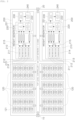
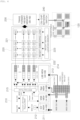
- FIGs. 1 and 2 are diagrams for describing a structure of an AI neural network accelerator according to an embodiment of the present invention.
- FIG. 1 illustrates a schematic block of the AI neural network accelerator of the present invention
- FIG. 2 illustrates in more detail a calculator and a weight generator included in the AI neural network accelerator of the present invention.
- the AI neural network accelerator 100 includes a plurality of gateways 10 and 20, a token input unit 110, a calculator 120, a controller 130, and a weight generator 200.
- the example of FIG. 2 illustrates the AI neural network accelerator 100 including 48 transformer operation cores 121, two weight generators 200, a top-level controller, an ID SIMD, and an on-chip network.
- each of the transformer operation cores 121 may include eight equivalent multipliers and accumulators (for 8-bit inputs and 8-bit weights), an input loader, a controller, an on-chip network switch, and input/weight/output memories to perform matrix multiplication required for each decoder block of the transformer and generate an output token each time.
- the gateways 10 and 20 may connect an external memory (not illustrated) and the AI neural network accelerator 100.
- the gateways 10 and 20 may be used to transfer weights stored in the external memory (not illustrated) to the AI neural network accelerator 100, and to transfer processing results generated in the AI neural network accelerator 100 to the external memory (not illustrated).
- the token input unit 110 receives input of a token. That is, the token input unit 110 receives input of one token each time from an input sentence including several tokens and transfers the token to the calculator 120.
- the calculator 120 predicts output tokens in units of input tokens input through the token input unit 110.
- the calculator 120 may include a plurality of transformer operation cores 121, and each of the transformer operation cores 121 includes a transformer model.
- the transformer model has characteristics in that a size thereof is determined based on the number of required weights, and power consumption increases as the size of the transformer model increases.
- the transformer model has a characteristic that the size thereof increases as requirement of weights increases. Due to this characteristic, in the case of decreasing requirement of weights of any transformer model (hereinafter referred to as "basic model") using n (n being a natural number) weights, the size of the basic model may be reduced, and thus power consumption may be significantly reduced.
- the present invention uses these characteristics to predict a large number of tokens among the total input tokens using a transformer model (hereinafter referred to as "reduced model”), the size of which is reduced by reducing requirement of weights to m weights (m being a natural number satisfying m ⁇ n), thereby reducing requirement of weights for accelerating the AI neural network. In this way, external memory access is reduced, thereby reducing power consumption.
- reduced model a transformer model
- the calculator 120 is controlled by the controller 130 to be described later.
- the controller 130 may control an operation of each of the transformer operation cores 121 after determining the size of the transformer model based on the number of weights.
- the controller 130 may control each of the transformer operation cores 121 so that each of the plurality of transformer operation cores 121 performs primary prediction on an input token by the reduced model, then calculates prediction accuracy for a result of the primary prediction, and additionally performs secondary prediction using the basic model only when the prediction accuracy is less than or equal to a preset threshold value (for example, prediction accuracy of 60%).
- a preset threshold value for example, prediction accuracy of 60%
- the prediction accuracy may be calculated using various known technologies.
- the controller 130 may perform management to calculate a small model first and then execute a large model as needed.
- the controller 130 causes each of the transformer operation cores 121 to primarily predict an output token using a reduced model that reduces requirement of weights of the basic model to n/10 weights (n being a natural number) in response to acquisition of the input token, and omit the secondary prediction process when the prediction accuracy exceeds the threshold value, thereby reducing requirement of weights.
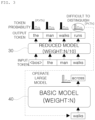
- a process of the controller 130 is schematically displayed in FIG. 3 .
- FIG. 3 is a diagram for describing an acceleration process by a hybrid structure of the AI neural network accelerator according to an embodiment of the present invention, and schematically illustrates a process of primarily performing output token prediction using a reduced model having a small amount of requirement of weights for each of input tokens acquired by the controller 130, and additionally predicting an output token using a basic model having a large amount of requirement of weights for a predetermined number of input tokens having low prediction accuracy (that is, difficult to distinguish) as a result.
- a token probability of each of output tokens (the/man/walks/runs) predicted using a reduced model (that is, transformer model having requirement of weights of "N/10") 30 is illustrated in the figure.
- the present invention has a feature of significantly reducing requirement of weights compared to conventional technology of predicting output tokens for all input tokens by the basic model by predicting output tokens for all input tokens using a reduced model having a small amount of requirement of weights, and performing additional output token prediction using a basic model having a large amount of requirement of weights only for a small number of input tokens having low prediction accuracy.
- the weight generator 200 generates a weight to be provided to each of the transformer operation cores 121.
- the weight generator 200 generates an implicit weight using an "AI neural network” trained to implicitly remember a weight of a transformer neural network, and may receive only a x b kernel location information of the transformer neural network as input and output an implicit weight corresponding to the corresponding location.
- the "AI neural network” is a neural network different from the transformer neural network, and may be used by training a multilayer perceptron, which is commonly used to generate a weight for the transformer neural network. A process of training the AI neural network and moving data will be described later with reference to FIGs. 5 and 6 .
- the weight generator 200 may include a code decompression unit 210, an implicit weight generation unit 220, a transformer weight memory 230, and an on-chip network switch 240.
- the code decompression unit 210 decompresses location information of a kernel input in a code-compressed state from an external memory.
- the code decompression unit 210 includes an index memory (IDX_MEM) 211, an MSB memory (MSB_MEM) 212, a sign memory (Sign_MEM) 213, an LSB memory (LSB_MEM) 214, and a router 215.
- IDX_MEM index memory
- MSB_MEM MSB memory
- Sign_MEM sign memory
- LSB_MEM LSB memory
- the index memory (IDX_MEM) 211 stores an address of data whose MSB is not filled with consecutive sign bits
- the MSB memory (MSB_MEM) 212 stores an MSB part value of data whose MSB side data is not filled with sign extension bits (that is, uncompressed data)
- the sign memory (Sign_MEM) 213 stores a sign bit compressed into 1 bit
- the LSB memory 214 stores LSB data
- the router 215 decompresses compressed data using data information of each of the index memory (IDX_MEM) 211, the MSB memory (MSB_MEM) 212, the sign memory (Sign_MEM) 213, the LSB memory (LSB_MEM) 214 and transfers the decompressed data to an 8-bit queue.
- the implicit weight generation unit 220 includes a two-dimensional (2D) MAC array 221 that performs multiplication and accumulation operations to generate an implicit weight using location information of a kernel decompressed by the code decompression unit 210, and a weight embedding logic 222 generated in advance as a result of training by matching weights of the transformer neural network with a x b kernel location information of the transformer neural network.
- 2D two-dimensional
- the implicit weight generation unit 220 may detect weight embedding corresponding to the location information from the weight embedding logic 222 and generate an implicit weight.
- the weight embedding logic 222 selects weight embedding corresponding to the location information of the kernel decompressed by the code decompression unit 210 and transfers the weight embedding to the 2D MAC Array 221, thereby generating an implicit weight.
- the transformer weight memory 230 stores the implicit weight generated by the implicit weight generation unit 220.
- the on-chip network switch 240 transmits an implicit weight stored in the transformer weight memory 230 to the corresponding transformer computation core 121 through the on-chip network in response to a request from at least one of the plurality of transformer operation cores 121.
- the on-chip network switch 240 may be controlled by the controller 130. That is, the controller 130 may control an operation of the on-chip network switch 240 to provide the implicit weight through the on-chip network in response to a request from the plurality of transformer operation cores 121.
- This process of the weight generator 200 is schematically illustrated in FIG. 4 .
- FIG. 4 is a diagram for describing a process in which the AI neural network accelerator generates an implicit weight according to an embodiment of the present invention.
- the code decompression unit 210 receives an address value from the IDX MEM 211 and verifies whether there is a weight whose MSB is filled with consecutive sign bits between weights 0 to 7.
- the code decompression unit 210 receives an address value from the IDX MEM 211 and verifies whether there is a weight whose MSB is filled with consecutive sign bits between weights 0 to 7.
- the code decompression unit 210 since addresses of data whose MSBs are not filled with consecutive sign bits are number 1 and number 6, number 1 and number 6 are stored in the IDX MEM 211, and the code decompression unit 210 reads address values of number 1 and number 6. In this case, the code decompression unit 210 determines that MSBs of weights of numbers 0, 2, 3, 5, and 7 are all filled with sign extension bits, while weights of numbers 1 and 6 are not, thereby fetching a sign bit compressed to 1 bit from the Sign-MEM 213 to fill MSB-side data for the weights of numbers 0, 2, 3, 5, and 7, and fetching data from the MSB MEM 212 to fill MSB-side data for the weights of numbers 1 and 6.
- the MSB data router 215 performs a process of fetching two pieces of data necessary for numbers 1 and 6 from the MSB MEM 212. Meanwhile, whether to fetch data from the MSB MEM 212 and fill an MSB part or to fetch data from the LSB MEM 214 to fill an MSB changes depending on the situation for each weight, which is determined by multiplexer logic connected to a rear end of the MSB Data router 215.
- decompressed data that is, location information of a decompressed kernel
- decompressed data that is, location information of a decompressed kernel
- 2D MAC Array 221 weight embedding corresponding to the location information is detected from the weight embedding logic 222 to generate an implicit weight.
- the implicit weight generated in this way is used in a decoder block operation (not illustrated) that forms the transformer network, and may be specifically used in attention or feed-forward operation.
- FIG. 5 is a diagram for describing a process of training the neural network to generate the implicit weight according to an embodiment of the present invention
- FIG. 6 is a diagram for describing compression and decompression for using the implicit weight according to an embodiment of the present invention.
- an embedding value 310 according to location information of specific a x b kernels among the weights of the transformer neural network is transferred to an AI neural network 320 including multilayer perceptron.
- specific M x N kernels are generated through an operation of the AI neural network 320, and a new transformer neural network 330 may be generated by collecting all of these kernels.
- the most important thing is how similar the generated new transformer neural network 330 is to an existing transformer neural network 340. Therefore, to this end, a difference (loss) between results generated by the new transformer neural network 330 and the existing transformer neural network 340 is calculated and substituted into a loss function.
- the AI neural network 320 that generates a transformer network through backpropagation. Then, the AI neural network 320 generated through this training process may be used to reduce external memory access by being used as the weight embedding logic 222 of the implicit weight generation unit 220.
- M x N transformer neural network weights at specific locations are input to the AI neural network 320 to generate embedding, then only small-sized embedding is stored in a DRAM instead of the M x N transformer neural network weights, and the chip loads only the corresponding embedding, thereby reducing external memory access.
- embedding according to location information of a kernel to be processed is input to the AI neural network 320, and the AI neural network 320 generates implicit weights of the transformer neural networks through calculation.
- the implicit weights of the transformer neural networks generated at this time is used to perform language model operation.
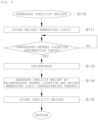
- FIGs. 7 and 8 are processing flowcharts for describing a method of accelerating an AI neural network according to an embodiment of the present invention. Referring to FIGs. 1 to 8 , the method of accelerating the AI neural network according to the embodiment of the present invention is described as follows.
- the AI neural network accelerator 100 of the present invention generates an implicit weight. That is, in step S110, the AI neural network accelerator 100 has a weight embedding logic generated in advance as a result of training by matching weights of the existing transformer neural network with a x b kernel location information of the transformer neural network, and generates an implicit weight based on the kernel location information input from an external memory and the weight embedding logic.
- step S111 the weight embedding logic is stored in the implicit weight generation unit 220, and in steps S112 and S113, the location information of the kernel input in a code-compressed state from the external memory is decompressed.
- step S114 the implicit weight generation unit 220 applies the location information of the kernel decompressed in step S113 to the weight embedding logic to generate an implicit weight corresponding to the location of the decompressed kernel. That is, in step S114, the implicit weight generation unit 220 generates an implicit weight by the decompressed kernel location and the weight embedding logic corresponding thereto.
- step S115 the transformer weight memory 230 stores the implicit weight.
- step S140 the controller 130 calculates prediction accuracy for a primary prediction result of step S130.
- the controller 130 compares the prediction accuracy with a preset threshold value, and when the prediction accuracy is less than or equal to the preset threshold value, the controller 130 controls the transformer operation core 121 so that secondary prediction is further performed to predict an output token for the input token using the transformer model before being reduced (referred to as hereinafter "basic model"). That is, in step S160, the transformer operation core 121 performs the secondary prediction under the control of the controller 130.
- the transformer operation core 121 may further include an implicit weight transfer step in which the transformer weight memory 230 requests an implicit weight, and in response, the on-chip network switch 240 transfers the implicit weight through the on-chip network.
- the transformer operation core 121 predicts an output token for the input token using the implicit weight.
- the present invention has an effect of reducing external memory access by performing some operations inside the accelerator instead of fetching all weights for acceleration of the transformer neural network from the outside.
- the present invention may increase energy efficiency while maintaining accuracy of transformer inference through large and small AI neural network hybrid structures and implicit weight generation.
- external memory access may be reduced by 39% using a method of the present invention, which performs only small model calculation first and skips large model calculation when a prediction probability of a specific token exceeds a predefined threshold value.
- external memory access may be reduced by 60% by generating implicit weights using only locations of kernels as input, and external memory access may be reduced up to 74% by applying code compression technology to compress the AI network for implicit weight generation.
- external memory access may be reduced by 42% using mixed large and small network structures, external memory access may be reduced by 67% through implicit weight generation, and external memory access may be reduced by 78% using code compression technology.
- external memory access may be reduced by 59% using mixed large and small network structures, external memory access may be reduced by 71% through implicit weight generation, and external memory access may be reduced by 78% using code compression technology.
- external memory access may be reduced by 48% using mixed large and small network structures, external memory access may be reduced by 72% through implicit weight generation, and external memory access may be reduced by 81% using code compression technology.
- FIG. 9 The effects of the present invention are schematically illustrated in FIG. 9 .
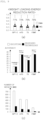
- FIG. 9 is graphs for describing effects when the AI neural network accelerator according to the embodiment of the present invention and a method therefor are applied to various transformer models (for example, GPT-2, mT5, T5, and FSMT).
- FIG. 9A illustrates the amount of reduction of weight loading energy for each of the models when the present invention is applied
- FIG. 9B illustrates a difference in accuracy compared to conventional technology when the present invention is applied to each of the models
- FIG. 9C illustrates a difference in the number of weights compared to conventional technology when the present invention is applied to each of the models.
- weight loading energy was reduced by 71% when the present invention was applied to GPT-2, weight loading energy was reduced by 73% when the present invention was applied to mT5, weight loading energy was reduced by 76% when the present invention was applied to T5, and weight loading energy was reduced by 76% when the present invention was applied to FSMT.
- the present invention shows accuracy of -0.52 to -1.29, a weight compression ratio of 74 to 81%, and a weight loading energy reduction rate of 71 to 76% compared to conventional technology.
- an AI neural network accelerator and a method therefor of the present invention has a characteristic of being able to reduce requirement of weights for accelerating an AI neural network to reduce the amount of external memory access and consequently reduce power consumption to accelerate a highly energy-efficient mobile large language model.
- the present invention has a characteristic of being able to reduce requirement of weights for accelerating an AI neural network by primarily accelerating a reduced model in which basic requirement of weights required to accelerate a basic model is reduced by a predetermined ratio, and then further performing a secondary acceleration step to accelerate the basic model only in special cases where prediction accuracy of a result thereof is less than or equal to a preset threshold value.
- the present invention has a characteristic of being able to reduce the amount of external memory access for receiving weights by including a weight embedding logic pre-generated as a result of learning weights of a transformer neural network matched with kernel location information of the transformer neural network, receiving only the kernel location information from an external memory to generate an implicit weight for accelerating an AI neural network, and then supplying the implicit weight using an on-chip network.
- An AI neural network accelerator and a method therefor of the present invention described above have an effect of being able to reduce requirement of weights for accelerating an AI neural network to reduce the amount of external memory access and consequently reduce power consumption to accelerate a highly energy-efficient mobile large language model.
- the present invention has an effect of being able to reduce requirement of weights for accelerating an AI neural network by primarily accelerating a reduced model in which basic requirement of weights required to accelerate a basic model is reduced by a predetermined ratio, and then further performing a secondary acceleration step to accelerate the basic model only in special cases where prediction accuracy of a result thereof is less than or equal to a preset threshold value.
- the present invention has an effect of being able to reduce the amount of external memory access for receiving weights by including a weight embedding logic pre-generated as a result of learning weights of a transformer neural network matched with kernel location information of the transformer neural network, receiving only the kernel location information from an external memory to generate an implicit weight for accelerating an AI neural network, and then supplying the implicit weight using an on-chip network.
Landscapes
- Engineering & Computer Science (AREA)
- Physics & Mathematics (AREA)
- Theoretical Computer Science (AREA)
- Health & Medical Sciences (AREA)
- Life Sciences & Earth Sciences (AREA)
- Biomedical Technology (AREA)
- Biophysics (AREA)
- Evolutionary Computation (AREA)
- General Engineering & Computer Science (AREA)
- Data Mining & Analysis (AREA)
- Artificial Intelligence (AREA)
- General Health & Medical Sciences (AREA)
- Molecular Biology (AREA)
- Computing Systems (AREA)
- Computational Linguistics (AREA)
- General Physics & Mathematics (AREA)
- Mathematical Physics (AREA)
- Software Systems (AREA)
- Neurology (AREA)
- Complex Calculations (AREA)
- Feedback Control In General (AREA)
Abstract
An AI neural network accelerator for a transformer neural network includes a calculator configured to predict output tokens in units of input tokens and including a plurality of transformer operation cores operating based on a transformer model using n weights (n being a natural number), a weight generator including a weight embedding logic generated in advance as a result of training by matching weights of the transformer neural network with a x b kernel location information of the transformer neural network, and configured to generate an implicit weight based on location information of a kernel input from an external memory, and a controller configured to control an operation of each of the transformer operation cores after determining a size of the transformer model based on a number of weights.
Description
- The present invention relates to an artificial intelligence (AI) neural network accelerator and a method therefor, and more particularly to an AI neural network accelerator for a transformer neural network, which requires a lot of weights while reuse of the weights is difficult, thereby requiring frequent external memory access and consequently consuming a lot of power, and a method therefor.
- A transformer neural network is a neural network that learns context and meaning by tracking a relationship in sequential data, such as words in a sentence, and is replacing a convolutional neural network (CNN) or a recurrent neural network (RNN).
- Such a transformer neural network mathematically finds a pattern between elements, so that there is no need to construct a large labeled learning dataset, and has been widely used in image classification and large language models since the transformer neural network is suitable for parallel processing, and thus an execution speed is fast. Further, a mobile system providing real-time responses has been expected.
- However, such a transformer neural network requires a lot of weights while reuse of the weights is difficult, thereby requiring frequent external memory access and consequently consuming a lot of power.
- Therefore, to solve such a problem, various technologies (Y. Wang et al., "A 28nm 27.5TOPS/W Approximate-Computing-Based Transformer Processor with Asymptotic Sparsity Speculating and Out-of-Order Computing," 2022 IEEE International Solid- State Circuits Conference (ISSCC), San Francisco, CA, USA, 2022, pp. 1-3, F. Tu et al., "A 28nm 15.59µJ/Token Full-Digital Bitline-Transpose CIM-Based Sparse Transformer Accelerator with Pipeline/Parallel Reconfigurable Modes," 2022 IEEE International Solid- State Circuits Conference (ISSCC), San Francisco, CA, USA, 2022, pp. 466-468, and F. Tu et al., "16.1 MuITCIM: A 28nm 2.24µJ /Token Attention-Token-Bit Hybrid Sparse Digital CIM-Based Accelerator for Multimodal Transformers," 2023 IEEE International Solid- State Circuits Conference (ISSCC), San Francisco, CA, USA, 2023, pp. 248-250) have been proposed to increase hardware utilization and reduce power consumption. However, system power consumption and response time of these transformer processors are not yet suitable for a mobile device. For example, a large language model such as GPT-2 has a lot of weights (400 to 700 M), and external memory access consumes 68% of the total power.
- In addition, to alleviate an external memory access bottleneck, a transformer accelerator applying pruning (S. Liu et al., "16.2 A 28nm 53.8TOPS/W 8b Sparse Transformer Accelerator with In-Memory Butterfly Zero Skipper for Unstructured-Pruned NN and CIM-Based Local-Attention-Reusable Engine," 2023 IEEE International Solid- State Circuits Conference (ISSCC), San Francisco, CA, USA, 2023, pp. 250-252) has been proposed. However, while this transformer accelerator may increase weight sparsity, the transformer accelerator may be applied only to a simple task such as predicting the next word (for example, language modeling), and cannot achieve high sparsity in advanced tasks such as language translation, question answering, and summarization.
- Therefore, a novel approach is needed to be able to compress weights to reduce the amount of external memory access for highly energy-efficient mobile large language model acceleration.
- Therefore, the present invention has been made in view of the above problems, and provides an AI neural network accelerator and a method therefor that may reduce requirement of weights for accelerating an AI neural network to reduce the amount of external memory access and consequently reduce power consumption to accelerate a highly energy-efficient mobile large language model.
- In addition, the present invention provides an AI neural network accelerator and a method therefor that may reduce requirement of weights for accelerating an AI neural network by primarily accelerating a reduced model in which basic requirement of weights required to accelerate a basic model is reduced by a predetermined ratio, and then further performing a secondary acceleration step to accelerate the basic model only in special cases where prediction accuracy of a result thereof is less than or equal to a preset threshold value.
- In addition, the present invention provides an AI neural network accelerator and a method therefor that may reduce the amount of external memory access for receiving weights by including a weight embedding logic pre-generated as a result of learning weights of a transformer neural network matched with kernel location information of the transformer neural network, receiving only the kernel location information from an external memory to generate an implicit weight for accelerating an AI neural network, and then supplying the implicit weight using an on-chip network.
- In addition, the present invention provides an AI neural network accelerator and a method therefor that may perform a process in which compressed kernel location information is received from an external memory and decompressed to reduce a time required to receive the kernel location information, thereby reducing an external memory access time.
- In accordance with an aspect of the present invention, the above and other objects can be accomplished by the provision of an artificial intelligence (AI) neural network accelerator configured to accelerate a transformer neural network, the AI neural network accelerator including a calculator configured to predict output tokens in units of input tokens and including a plurality of transformer operation cores operating based on a transformer model using n weights (n being a natural number), and a controller configured to control an operation of each of the transformer operation cores after determining a size of the transformer model based on a number of weights, wherein the controller performs a control operation to perform primary prediction in which each of the plurality of transformer operation cores predicts output tokens using a reduced transformer model
- (referred to as hereinafter "reduced model") using m weights (m being a natural number satisfying m < n) in response to acquisition of the input tokens, and further perform secondary prediction of predicting output tokens for the input tokens using a transformer model before reduction (referred to as hereinafter "basic model") exclusively when prediction accuracy of a result of the primary prediction is less than or equal to a preset threshold value.
- The AI neural network accelerator may further include a weight generator including a weight embedding logic generated in advance as a result of training by matching weights of the transformer neural network with a x b kernel location information of the transformer neural network, and configured to generate an implicit weight based on location information of a kernel input from an external memory, wherein the controller provides the implicit weight through an on-chip network in response to a request from the plurality of transformer operation cores.
- The weight generator may include a code decompression unit configured to decompress location information of a kernel input in a code-compressed state from the external memory, and an implicit weight generation unit including the weight embedding logic and configured to apply location information of a kernel decompressed by the code decompression unit to the weight embedding logic to generate an implicit weight corresponding to a location of the decompressed kernel.
- The implicit weight generation unit may include a two-dimensional (2D) MAC array configured to perform multiplication and accumulation operations to generate the implicit weight using the decompressed location information of the kernel, and a weight embedding logic configured to select weight embedding corresponding to the location information of the kernel and transfer the weight embedding to the 2D MAC Array.
- The weight generator may include a transformer weight memory configured to store the implicit weight, and an on-chip network switch configured to deliver the implicit weight through the on-chip network in response to a request from at least one of the plurality of transformer operation cores.
- In accordance with another aspect of the present invention, there is provided a method of accelerating an AI neural network using an AI neural network accelerator including a plurality of transformer operation cores operating based on a transformer model using n weights (n being a natural number) and configured to accelerate a transformer neural network, the method including performing, by the AI neural network accelerator, primary prediction of predicting output tokens using a reduced transformer model (referred to as hereinafter "reduced model") using m weights (m being a natural number satisfying m < n) in response to acquisition of input tokens, calculating, by the AI neural network accelerator, prediction accuracy for a prediction result of the performing primary prediction, and further performing, by the AI neural network accelerator, secondary prediction of predicting output tokens for the input tokens using a transformer model before reduction (referred to as hereinafter "basic model") when the prediction accuracy is less than or equal to a preset threshold value.
- The method may further include including, by the AI neural network accelerator, a weight embedding logic generated in advance as a result of training by matching weights of an existing transformer neural network with a x b kernel location information of the transformer neural network, and generating an implicit weight based on location information of a kernel input from an external memory and the weight embedding logic, storing the implicit weight by the AI neural network accelerator, and transferring, by the AI neural network accelerator, the implicit weight through an on-chip network, wherein each of the performing primary prediction and the further performing secondary prediction includes predicting output tokens for the input tokens using the implicit weight.
- The generating an implicit weight may include decompressing location information of a kernel input in a code-compressed state from the external memory, and the location information of the kernel decompressed in the decompressing may be applied to the weight embedding logic to generate an implicit weight corresponding to a decompressed location of the kernel.
- The above and other objects, features and other advantages of the present invention will be more clearly understood from the following detailed description taken in conjunction with the accompanying drawings, in which:
-
FIGs. 1 and2 are diagrams for describing a structure of an AI neural network accelerator according to an embodiment of the present invention; -
FIG. 3 is a diagram for describing an acceleration process by a hybrid structure of the AI neural network accelerator according to an embodiment of the present invention; -
FIG. 4 is a diagram for describing a process in which the AI neural network accelerator generates an implicit weight according to an embodiment of the present invention; -
FIG. 5 is a diagram for describing a process of training a neural network to generate the implicit weight according to an embodiment of the present invention; -
FIG. 6 is a diagram for describing compression and decompression for using the implicit weight according to an embodiment of the present invention; -
FIGs. 7 and8 are processing flowcharts for describing a method of accelerating an AI neural network according to an embodiment of the present invention; and -
FIG. 9 is graphs for describing effects when the AI neural network accelerator according to the embodiment of the present invention and a method therefor are applied to various transformer models. - Hereinafter, embodiments of the present invention will be described with reference to the attached drawings, and will be described in detail so that those skilled in the technical field to which the present invention pertains may easily practice the present invention. However, the present invention may be implemented in various different forms and is not limited to the embodiments described herein. Meanwhile, to clearly describe the present invention in the drawings, parts not related to the description are omitted, and similar parts are given similar drawing reference numerals throughout the specification. In addition, descriptions of parts that may be easily understood by those skilled in the art even when a detailed description is omitted are omitted.
- Throughout the specification and claims, when a part is described as including a certain component, this means that other components may be further included other than excluding other components, unless specifically stated otherwise.
-
FIGs. 1 and2 are diagrams for describing a structure of an AI neural network accelerator according to an embodiment of the present invention.FIG. 1 illustrates a schematic block of the AI neural network accelerator of the present invention, andFIG. 2 illustrates in more detail a calculator and a weight generator included in the AI neural network accelerator of the present invention. - Referring to
FIGs. 1 and2 , the AIneural network accelerator 100 according to the embodiment of the present invention includes a plurality ofgateways token input unit 110, acalculator 120, acontroller 130, and aweight generator 200. In particular, the example ofFIG. 2 illustrates the AIneural network accelerator 100 including 48transformer operation cores 121, twoweight generators 200, a top-level controller, an ID SIMD, and an on-chip network. - In this instance, each of the
transformer operation cores 121 may include eight equivalent multipliers and accumulators (for 8-bit inputs and 8-bit weights), an input loader, a controller, an on-chip network switch, and input/weight/output memories to perform matrix multiplication required for each decoder block of the transformer and generate an output token each time. - The
gateways neural network accelerator 100. Thegateways neural network accelerator 100, and to transfer processing results generated in the AIneural network accelerator 100 to the external memory (not illustrated). - The
token input unit 110 receives input of a token. That is, thetoken input unit 110 receives input of one token each time from an input sentence including several tokens and transfers the token to thecalculator 120. - The
calculator 120 predicts output tokens in units of input tokens input through thetoken input unit 110. To this end, thecalculator 120 may include a plurality oftransformer operation cores 121, and each of thetransformer operation cores 121 includes a transformer model. - In this instance, the transformer model has characteristics in that a size thereof is determined based on the number of required weights, and power consumption increases as the size of the transformer model increases. In other words, the transformer model has a characteristic that the size thereof increases as requirement of weights increases. Due to this characteristic, in the case of decreasing requirement of weights of any transformer model (hereinafter referred to as "basic model") using n (n being a natural number) weights, the size of the basic model may be reduced, and thus power consumption may be significantly reduced.
- Therefore, the present invention uses these characteristics to predict a large number of tokens among the total input tokens using a transformer model (hereinafter referred to as "reduced model"), the size of which is reduced by reducing requirement of weights to m weights (m being a natural number satisfying m < n), thereby reducing requirement of weights for accelerating the AI neural network. In this way, external memory access is reduced, thereby reducing power consumption.
- To this end, the
calculator 120 is controlled by thecontroller 130 to be described later. - The
controller 130 may control an operation of each of thetransformer operation cores 121 after determining the size of the transformer model based on the number of weights. In particular, thecontroller 130 may control each of thetransformer operation cores 121 so that each of the plurality oftransformer operation cores 121 performs primary prediction on an input token by the reduced model, then calculates prediction accuracy for a result of the primary prediction, and additionally performs secondary prediction using the basic model only when the prediction accuracy is less than or equal to a preset threshold value (for example, prediction accuracy of 60%). - In this instance, the prediction accuracy may be calculated using various known technologies. For example, to calculate the prediction accuracy, the
controller 130 may perform management to calculate a small model first and then execute a large model as needed. - For example, the
controller 130 causes each of thetransformer operation cores 121 to primarily predict an output token using a reduced model that reduces requirement of weights of the basic model to n/10 weights (n being a natural number) in response to acquisition of the input token, and omit the secondary prediction process when the prediction accuracy exceeds the threshold value, thereby reducing requirement of weights. Such a process of thecontroller 130 is schematically displayed inFIG. 3 . -
FIG. 3 is a diagram for describing an acceleration process by a hybrid structure of the AI neural network accelerator according to an embodiment of the present invention, and schematically illustrates a process of primarily performing output token prediction using a reduced model having a small amount of requirement of weights for each of input tokens acquired by thecontroller 130, and additionally predicting an output token using a basic model having a large amount of requirement of weights for a predetermined number of input tokens having low prediction accuracy (that is, difficult to distinguish) as a result. - Referring to
FIG. 3 , for each of four input tokens (<bos>/the/man/walks), a token probability of each of output tokens (the/man/walks/runs) predicted using a reduced model (that is, transformer model having requirement of weights of "N/10") 30 is illustrated in the figure. Therefore, that is, since each of token probabilities (that is prediction accuracy) (P) of each of output tokens (the/man/walks) excluding the rightmost output token (runs) exceeds the threshold value (Th), an output token is additionally predicted using a basic model (that is, a transformer model having requirement of weights of "N") 40 for the rightmost output token (runs), and it can be seen that an output token (across) whose token probability (P) exceeds the threshold value (Th) is predicted as a result. - In this way, the present invention has a feature of significantly reducing requirement of weights compared to conventional technology of predicting output tokens for all input tokens by the basic model by predicting output tokens for all input tokens using a reduced model having a small amount of requirement of weights, and performing additional output token prediction using a basic model having a large amount of requirement of weights only for a small number of input tokens having low prediction accuracy.
- In this way, when a method of the present invention, which primarily performs only small model calculation and skips large model calculation when a prediction probability of a specific token exceeds a predefined threshold, is applied to language modeling using GPT-2, there is an effect of reducing external memory access by 39%.
- Referring again to
FIGs. 1 and2 , theweight generator 200 generates a weight to be provided to each of thetransformer operation cores 121. - The
weight generator 200 generates an implicit weight using an "AI neural network" trained to implicitly remember a weight of a transformer neural network, and may receive only a x b kernel location information of the transformer neural network as input and output an implicit weight corresponding to the corresponding location. In this instance, the "AI neural network" is a neural network different from the transformer neural network, and may be used by training a multilayer perceptron, which is commonly used to generate a weight for the transformer neural network. A process of training the AI neural network and moving data will be described later with reference toFIGs. 5 and 6 . - To generate the implicit weight, the
weight generator 200 may include acode decompression unit 210, an implicitweight generation unit 220, atransformer weight memory 230, and an on-chip network switch 240. - The
code decompression unit 210 decompresses location information of a kernel input in a code-compressed state from an external memory. To this end, as a configuration for decompression of normal code-compressed data, thecode decompression unit 210 includes an index memory (IDX_MEM) 211, an MSB memory (MSB_MEM) 212, a sign memory (Sign_MEM) 213, an LSB memory (LSB_MEM) 214, and arouter 215. - The index memory (IDX_MEM) 211 stores an address of data whose MSB is not filled with consecutive sign bits, the MSB memory (MSB_MEM) 212 stores an MSB part value of data whose MSB side data is not filled with sign extension bits (that is, uncompressed data), the sign memory (Sign_MEM) 213 stores a sign bit compressed into 1 bit, the
LSB memory 214 stores LSB data, and therouter 215 decompresses compressed data using data information of each of the index memory (IDX_MEM) 211, the MSB memory (MSB_MEM) 212, the sign memory (Sign_MEM) 213, the LSB memory (LSB_MEM) 214 and transfers the decompressed data to an 8-bit queue. - The implicit
weight generation unit 220 includes a two-dimensional (2D)MAC array 221 that performs multiplication and accumulation operations to generate an implicit weight using location information of a kernel decompressed by thecode decompression unit 210, and aweight embedding logic 222 generated in advance as a result of training by matching weights of the transformer neural network with a x b kernel location information of the transformer neural network. - When location information of a kernel decompressed by the
code decompression unit 210 is input, the implicitweight generation unit 220 may detect weight embedding corresponding to the location information from theweight embedding logic 222 and generate an implicit weight. - To this end, the
weight embedding logic 222 selects weight embedding corresponding to the location information of the kernel decompressed by thecode decompression unit 210 and transfers the weight embedding to the2D MAC Array 221, thereby generating an implicit weight. - The
transformer weight memory 230 stores the implicit weight generated by the implicitweight generation unit 220. - The on-
chip network switch 240 transmits an implicit weight stored in thetransformer weight memory 230 to the correspondingtransformer computation core 121 through the on-chip network in response to a request from at least one of the plurality oftransformer operation cores 121. To this end, the on-chip network switch 240 may be controlled by thecontroller 130. That is, thecontroller 130 may control an operation of the on-chip network switch 240 to provide the implicit weight through the on-chip network in response to a request from the plurality oftransformer operation cores 121. - This process of the
weight generator 200 is schematically illustrated inFIG. 4 . -
FIG. 4 is a diagram for describing a process in which the AI neural network accelerator generates an implicit weight according to an embodiment of the present invention. Referring toFIG. 4 , when a code-compressed weight having a Start IDX of 0 and an End IDX of 7 is input to thecode decompression unit 210 to generate eight weights at the frontmost side of the neural network, thecode decompression unit 210 receives an address value from theIDX MEM 211 and verifies whether there is a weight whose MSB is filled with consecutive sign bits betweenweights 0 to 7. In the example ofFIG. 4 , since addresses of data whose MSBs are not filled with consecutive sign bits arenumber 1 andnumber 6,number 1 andnumber 6 are stored in theIDX MEM 211, and thecode decompression unit 210 reads address values ofnumber 1 andnumber 6. In this case, thecode decompression unit 210 determines that MSBs of weights ofnumbers numbers MEM 213 to fill MSB-side data for the weights ofnumbers MSB MEM 212 to fill MSB-side data for the weights ofnumbers weight generation unit 220. In this instance, theMSB data router 215 performs a process of fetching two pieces of data necessary fornumbers MSB MEM 212. Meanwhile, whether to fetch data from theMSB MEM 212 and fill an MSB part or to fetch data from theLSB MEM 214 to fill an MSB changes depending on the situation for each weight, which is determined by multiplexer logic connected to a rear end of theMSB Data router 215. - Through this process, decompressed data (that is, location information of a decompressed kernel) is stored in an 8-bit queue and then transferred to the
2D MAC Array 221, and weight embedding corresponding to the location information is detected from theweight embedding logic 222 to generate an implicit weight. - The implicit weight generated in this way is used in a decoder block operation (not illustrated) that forms the transformer network, and may be specifically used in attention or feed-forward operation.
-
FIG. 5 is a diagram for describing a process of training the neural network to generate the implicit weight according to an embodiment of the present invention, andFIG. 6 is a diagram for describing compression and decompression for using the implicit weight according to an embodiment of the present invention. - First, referring to
FIG. 5 , to train the AI neural network, first, an embeddingvalue 310 according to location information of specific a x b kernels among the weights of the transformer neural network is transferred to an AIneural network 320 including multilayer perceptron. Then, specific M x N kernels are generated through an operation of the AIneural network 320, and a new transformerneural network 330 may be generated by collecting all of these kernels. In this training process, the most important thing is how similar the generated new transformerneural network 330 is to an existing transformerneural network 340. Therefore, to this end, a difference (loss) between results generated by the new transformerneural network 330 and the existing transformerneural network 340 is calculated and substituted into a loss function. Thereafter, training is performed on the AIneural network 320 that generates a transformer network through backpropagation. Then, the AIneural network 320 generated through this training process may be used to reduce external memory access by being used as theweight embedding logic 222 of the implicitweight generation unit 220. - Referring to
FIG. 6 , as transfer of data for the use of an implicit weight, during compression outside a chip, M x N transformer neural network weights at specific locations are input to the AIneural network 320 to generate embedding, then only small-sized embedding is stored in a DRAM instead of the M x N transformer neural network weights, and the chip loads only the corresponding embedding, thereby reducing external memory access. During decompression inside the chip, embedding according to location information of a kernel to be processed is input to the AIneural network 320, and the AIneural network 320 generates implicit weights of the transformer neural networks through calculation. The implicit weights of the transformer neural networks generated at this time is used to perform language model operation. -
FIGs. 7 and8 are processing flowcharts for describing a method of accelerating an AI neural network according to an embodiment of the present invention. Referring toFIGs. 1 to 8 , the method of accelerating the AI neural network according to the embodiment of the present invention is described as follows. - First, in step S110, the AI
neural network accelerator 100 of the present invention generates an implicit weight. That is, in step S110, the AIneural network accelerator 100 has a weight embedding logic generated in advance as a result of training by matching weights of the existing transformer neural network with a x b kernel location information of the transformer neural network, and generates an implicit weight based on the kernel location information input from an external memory and the weight embedding logic. - To this end, in step S111, the weight embedding logic is stored in the implicit
weight generation unit 220, and in steps S112 and S113, the location information of the kernel input in a code-compressed state from the external memory is decompressed. - In step S114, the implicit
weight generation unit 220 applies the location information of the kernel decompressed in step S113 to the weight embedding logic to generate an implicit weight corresponding to the location of the decompressed kernel. That is, in step S114, the implicitweight generation unit 220 generates an implicit weight by the decompressed kernel location and the weight embedding logic corresponding thereto. - In step S115, the
transformer weight memory 230 stores the implicit weight. - In steps S120 and S130, the
transformer operation core 121 performs primary prediction to predict output tokens using a reduced transformer model (hereinafter referred to as a "reduced model") that uses m weights (m being a natural number satisfying m < n) in response to acquisition of input tokens. To this end, in step S130, thetransformer operation core 121 is controlled by thecontroller 130. - In step S140, the
controller 130 calculates prediction accuracy for a primary prediction result of step S130. - In addition, in steps S150 and S160, the
controller 130 compares the prediction accuracy with a preset threshold value, and when the prediction accuracy is less than or equal to the preset threshold value, thecontroller 130 controls thetransformer operation core 121 so that secondary prediction is further performed to predict an output token for the input token using the transformer model before being reduced (referred to as hereinafter "basic model"). That is, in step S160, thetransformer operation core 121 performs the secondary prediction under the control of thecontroller 130. - To this end, in steps S130 and S160, the
transformer operation core 121 may further include an implicit weight transfer step in which thetransformer weight memory 230 requests an implicit weight, and in response, the on-chip network switch 240 transfers the implicit weight through the on-chip network. - Further, in steps S130 and S160, the
transformer operation core 121 predicts an output token for the input token using the implicit weight. - In this way, the present invention has an effect of reducing external memory access by performing some operations inside the accelerator instead of fetching all weights for acceleration of the transformer neural network from the outside. In other words, the present invention may increase energy efficiency while maintaining accuracy of transformer inference through large and small AI neural network hybrid structures and implicit weight generation.
- As an example, in the case of language modeling using GPT-2, external memory access may be reduced by 39% using a method of the present invention, which performs only small model calculation first and skips large model calculation when a prediction probability of a specific token exceeds a predefined threshold value. In addition, external memory access may be reduced by 60% by generating implicit weights using only locations of kernels as input, and external memory access may be reduced up to 74% by applying code compression technology to compress the AI network for implicit weight generation.
- As another example, in the case of language translation using mT5, external memory access may be reduced by 42% using mixed large and small network structures, external memory access may be reduced by 67% through implicit weight generation, and external memory access may be reduced by 78% using code compression technology.
- In addition, in the case of summarization using T5, external memory access may be reduced by 59% using mixed large and small network structures, external memory access may be reduced by 71% through implicit weight generation, and external memory access may be reduced by 78% using code compression technology.
- Finally, in the case of language translation using FSMT, external memory access may be reduced by 48% using mixed large and small network structures, external memory access may be reduced by 72% through implicit weight generation, and external memory access may be reduced by 81% using code compression technology.
- The effects of the present invention are schematically illustrated in
FIG. 9 . -
FIG. 9 is graphs for describing effects when the AI neural network accelerator according to the embodiment of the present invention and a method therefor are applied to various transformer models (for example, GPT-2, mT5, T5, and FSMT).FIG. 9A illustrates the amount of reduction of weight loading energy for each of the models when the present invention is applied,FIG. 9B illustrates a difference in accuracy compared to conventional technology when the present invention is applied to each of the models, andFIG. 9C illustrates a difference in the number of weights compared to conventional technology when the present invention is applied to each of the models. - Referring to
FIG. 9A , it can be seen that weight loading energy was reduced by 71% when the present invention was applied to GPT-2, weight loading energy was reduced by 73% when the present invention was applied to mT5, weight loading energy was reduced by 76% when the present invention was applied to T5, and weight loading energy was reduced by 76% when the present invention was applied to FSMT. - In addition, referring to
FIG. 9B , it can be seen that accuracy decreased by 1.26 when the present invention was applied to GPT-2, accuracy decreased by 0.59 when the present invention was applied to mT5, accuracy decreased by 0.96 when the present invention was applied to T5, and accuracy decreased by 1.29 when the present invention was applied to FSMT. - Meanwhile, referring to
FIG. 9C , it can be seen that the number of weights was significantly reduced when the present invention was applied to GPT-2, mT5, T5, and FSMT. - As described above, the present invention shows accuracy of -0.52 to -1.29, a weight compression ratio of 74 to 81%, and a weight loading energy reduction rate of 71 to 76% compared to conventional technology.
- As described above, an AI neural network accelerator and a method therefor of the present invention has a characteristic of being able to reduce requirement of weights for accelerating an AI neural network to reduce the amount of external memory access and consequently reduce power consumption to accelerate a highly energy-efficient mobile large language model.
- In addition, the present invention has a characteristic of being able to reduce requirement of weights for accelerating an AI neural network by primarily accelerating a reduced model in which basic requirement of weights required to accelerate a basic model is reduced by a predetermined ratio, and then further performing a secondary acceleration step to accelerate the basic model only in special cases where prediction accuracy of a result thereof is less than or equal to a preset threshold value.
- In addition, the present invention has a characteristic of being able to reduce the amount of external memory access for receiving weights by including a weight embedding logic pre-generated as a result of learning weights of a transformer neural network matched with kernel location information of the transformer neural network, receiving only the kernel location information from an external memory to generate an implicit weight for accelerating an AI neural network, and then supplying the implicit weight using an on-chip network.
- An AI neural network accelerator and a method therefor of the present invention described above have an effect of being able to reduce requirement of weights for accelerating an AI neural network to reduce the amount of external memory access and consequently reduce power consumption to accelerate a highly energy-efficient mobile large language model.
- In addition, the present invention has an effect of being able to reduce requirement of weights for accelerating an AI neural network by primarily accelerating a reduced model in which basic requirement of weights required to accelerate a basic model is reduced by a predetermined ratio, and then further performing a secondary acceleration step to accelerate the basic model only in special cases where prediction accuracy of a result thereof is less than or equal to a preset threshold value.
- In addition, the present invention has an effect of being able to reduce the amount of external memory access for receiving weights by including a weight embedding logic pre-generated as a result of learning weights of a transformer neural network matched with kernel location information of the transformer neural network, receiving only the kernel location information from an external memory to generate an implicit weight for accelerating an AI neural network, and then supplying the implicit weight using an on-chip network.
- Even though the embodiments of the present invention have been described above, the scope of the rights of the present invention is not limited thereto, and includes all changes and modifications in a range easily modified by a person having ordinary skill in the art to which the present invention pertains from the embodiments and recognized as equivalent.
Claims (8)
- An artificial intelligence (AI) neural network accelerator configured to accelerate a transformer neural network, the AI neural network accelerator comprising:a calculator configured to predict output tokens in units of input tokens and including a plurality of transformer operation cores operating based on a transformer model using n weights (n being a natural number); anda controller configured to control an operation of each of the transformer operation cores after determining a size of the transformer model based on a number of weights,wherein the controller performs a control operation to perform primary prediction in which each of the plurality of transformer operation cores predicts output tokens using a reduced transformer model (referred to as hereinafter "reduced model") using m weights (m being a natural number satisfying m < n) in response to acquisition of the input tokens, and further perform secondary prediction of predicting output tokens for the input tokens using a transformer model before reduction (referred to as hereinafter "basic model") exclusively when prediction accuracy of a result of the primary prediction is less than or equal to a preset threshold value.
- The AI neural network accelerator according to claim 1, further comprising a weight generator including a weight embedding logic generated in advance as a result of training by matching weights of the transformer neural network with a x b kernel location information of the transformer neural network, and configured to generate an implicit weight based on location information of a kernel input from an external memory,
wherein the controller provides the implicit weight through an on-chip network in response to a request from the plurality of transformer operation cores. - The AI neural network accelerator according to claim 2, wherein the weight generator comprises:a code decompression unit configured to decompress location information of a kernel input in a code-compressed state from the external memory; andan implicit weight generation unit including the weight embedding logic and configured to apply location information of a kernel decompressed by the code decompression unit to the weight embedding logic to generate an implicit weight corresponding to a location of the decompressed kernel.
- The AI neural network accelerator according to claim 3, wherein the implicit weight generation unit comprises:a two-dimensional (2D) MAC array configured to perform multiplication and accumulation operations to generate the implicit weight using the decompressed location information of the kernel; anda weight embedding logic configured to select weight embedding corresponding to the location information of the kernel and transfer the weight embedding to the 2D MAC Array.
- The AI neural network accelerator according to claim 3, wherein the weight generator comprises:a transformer weight memory configured to store the implicit weight; andan on-chip network switch configured to deliver the implicit weight through the on-chip network in response to a request from at least one of the plurality of transformer operation cores.
- A method of accelerating an AI neural network using an AI neural network accelerator including a plurality of transformer operation cores operating based on a transformer model using n weights (n being a natural number) and configured to accelerate a transformer neural network, the method comprising:performing, by the AI neural network accelerator, primary prediction of predicting output tokens using a reduced transformer model (referred to as hereinafter "reduced model") using m weights (m being a natural number satisfying m < n) in response to acquisition of input tokens;calculating, by the AI neural network accelerator, prediction accuracy for a prediction result of the performing primary prediction; andfurther performing, by the AI neural network accelerator, secondary prediction of predicting output tokens for the input tokens using a transformer model before reduction (referred to as hereinafter "basic model") when the prediction accuracy is less than or equal to a preset threshold value.
- The method according to claim 6, further comprising:including, by the AI neural network accelerator, a weight embedding logic generated in advance as a result of training by matching weights of an existing transformer neural network with a x b kernel location information of the transformer neural network, and generating an implicit weight based on location information of a kernel input from an external memory and the weight embedding logic;storing the implicit weight by the AI neural network accelerator; andtransferring, by the AI neural network accelerator, the implicit weight through an on-chip network,wherein each of the performing primary prediction and the further performing secondary prediction comprises predicting output tokens for the input tokens using the implicit weight.
- The method according to claim 7, wherein:the generating an implicit weight comprises decompressing location information of a kernel input in a code-compressed state from the external memory, andthe location information of the kernel decompressed in the decompressing is applied to the weight embedding logic to generate an implicit weight corresponding to a decompressed location of the kernel.
Applications Claiming Priority (2)
| Application Number | Priority Date | Filing Date | Title |
|---|---|---|---|
| KR20230195690 | 2023-12-28 | ||
| KR1020240071933A KR102902465B1 (en) | 2023-12-28 | 2024-05-31 | Artificial intelligence neural network accelerator and method for transformer neural network |
Publications (1)
| Publication Number | Publication Date |
|---|---|
| EP4579526A1 true EP4579526A1 (en) | 2025-07-02 |
Family
ID=93923975
Family Applications (1)
| Application Number | Title | Priority Date | Filing Date |
|---|---|---|---|
| EP24219864.6A Pending EP4579526A1 (en) | 2023-12-28 | 2024-12-13 | Artificial intelligence neural network accelerator and method for transformer neural network |
Country Status (3)
| Country | Link |
|---|---|
| US (1) | US20250217624A1 (en) |
| EP (1) | EP4579526A1 (en) |
| JP (1) | JP7849071B2 (en) |
Family Cites Families (3)
| Publication number | Priority date | Publication date | Assignee | Title |
|---|---|---|---|---|
| GB202015297D0 (en) | 2020-09-28 | 2020-11-11 | Microsoft Technology Licensing Llc | Auxiliary model for predicting new model parameters |
| US20240095581A1 (en) | 2020-11-24 | 2024-03-21 | Nippon Telegraph And Telephone Corporation | Processing method, processing system, and processing program |
| CN115860135B (en) | 2022-11-16 | 2023-08-01 | 中国人民解放军总医院 | Heterogeneous federation learning method, equipment and medium based on super network |
-
2024
- 2024-12-10 US US18/974,855 patent/US20250217624A1/en active Pending
- 2024-12-13 EP EP24219864.6A patent/EP4579526A1/en active Pending
- 2024-12-23 JP JP2024226255A patent/JP7849071B2/en active Active
Non-Patent Citations (7)
| Title |
|---|
| CHITTY-VENKATA KRISHNA TEJA ET AL: "A survey of techniques for optimizing transformer inference", JOURNAL OF SYSTEMS ARCHITECTURE, ELSEVIER BV, NL, vol. 144, 18 September 2023 (2023-09-18), XP087424782, ISSN: 1383-7621, [retrieved on 20230918], DOI: 10.1016/J.SYSARC.2023.102990 * |
| F. TU ET AL.: "16.1 MuITCIM: A 28nm 2.24pJ /Token Attention-Token-Bit Hybrid Sparse Digital CIM-Based Accelerator for Multimodal Transformers", 2023 IEEE INTERNATIONAL SOLID- STATE CIRCUITS CONFERENCE (ISSCC, pages 248 - 250 |
| F. TU ET AL.: "A 28nm 15.59uJ/Token Full-Digital Bitline-Transpose CIM-Based Sparse Transformer Accelerator with Pipeline/Parallel Reconfigurable Modes", 2022 IEEE INTERNATIONAL SOLID- STATE CIRCUITS CONFERENCE (ISSCC, 2022, pages 466 - 468, XP034103070, DOI: 10.1109/ISSCC42614.2022.9731645 |
| MAOR ASHKENAZI ET AL: "NeRN -- Learning Neural Representations for Neural Networks", ARXIV.ORG, CORNELL UNIVERSITY LIBRARY, 201 OLIN LIBRARY CORNELL UNIVERSITY ITHACA, NY 14853, 27 December 2022 (2022-12-27), XP091403822 * |
| S. LIU ET AL.: "16.2 A 28nm 53.8TOPS/W 8b Sparse Transformer Accelerator with In-Memory Butterfly Zero Skipper for Unstructured-Pruned NN and CIM-Based Local-Attention-Reusable Engine", 2023 IEEE INTERNATIONAL SOLID- STATE CIRCUITS CONFERENCE (ISSCC, 2023, pages 250 - 252, XP034314890, DOI: 10.1109/ISSCC42615.2023.10067360 |
| SEHOON KIM ET AL: "Big Little Transformer Decoder", ARXIV.ORG, CORNELL UNIVERSITY LIBRARY, 201 OLIN LIBRARY CORNELL UNIVERSITY ITHACA, NY 14853, 15 February 2023 (2023-02-15), XP091438816 * |
| Y. WANG ET AL.: "A 28nm 27.5TOPS/W Approximate-Computing-Based Transformer Processor with Asymptotic Sparsity Speculating and Out-of-Order Computing", 2022 IEEE INTERNATIONAL SOLID- STATE CIRCUITS CONFERENCE (ISSCC, 2022, pages 1 - 3, XP034103162, DOI: 10.1109/ISSCC42614.2022.9731686 |
Also Published As
| Publication number | Publication date |
|---|---|
| JP7849071B2 (en) | 2026-04-21 |
| US20250217624A1 (en) | 2025-07-03 |
| JP2025105535A (en) | 2025-07-10 |
Similar Documents
| Publication | Publication Date | Title |
|---|---|---|
| KR102737100B1 (en) | Processing element, method of operation thereof, and accelerator including the same | |
| EP3754561A1 (en) | Reconfigurable memory compression techniques for deep neural networks | |
| US12288152B2 (en) | Neural network weight encoding | |
| US10671147B2 (en) | Dynamic power management for artificial intelligence hardware accelerators | |
| CN114626516B (en) | A Neural Network Acceleration System Based on Logarithmic Block Floating Point Quantization | |
| Kim et al. | 20.5 C-transformer: A 2.6-18.1 μJ/token homogeneous DNN-transformer/spiking-transformer processor with big-little network and implicit weight generation for large language models | |
| EP3931758A1 (en) | Neural network layer processing with scaled quantization | |
| KR20210116182A (en) | Softmax approximation method and apparatus | |
| KR20220157619A (en) | Method and apparatus for calculating nonlinear functions in hardware accelerators | |
| US20240094986A1 (en) | Method and apparatus for matrix computation using data conversion in a compute accelerator | |
| Pradeep et al. | Edgenet: Squeezenet like convolution neural network on embedded fpga | |
| Kim et al. | Slim-Llama: A 4.69 mW large-language-model processor with binary/ternary weights for billion-parameter Llama model | |
| Moon et al. | Multipurpose deep-learning accelerator for arbitrary quantization with reduction of storage, logic, and latency waste | |
| Bhattacharjee et al. | MIME: adapting a single neural network for multi-task inference with memory-efficient dynamic pruning | |
| WO2025222855A1 (en) | Data compression method and electronic device | |
| Qin et al. | 23.8 An 88.36 TOPS/W bit-level-weight-compressed large-language-model accelerator with cluster-aligned INT-FP-GEMM and bi-dimensional workflow reformulation | |
| CN118396128A (en) | Language model reasoning optimization method, electronic device, storage medium and program product | |
| Kim et al. | C-transformer: An energy-efficient homogeneous DNN-transformer/SNN-transformer processor for large language models | |
| Lee et al. | FACET: on-the-fly activation compression for efficient transformer training | |
| US20250217624A1 (en) | Artificial intelligence neural network accelerator and method for transformer neural network | |
| KR102902465B1 (en) | Artificial intelligence neural network accelerator and method for transformer neural network | |
| CN114118341A (en) | Quantization method, calculation apparatus, and computer-readable storage medium | |
| US20210248008A1 (en) | Hardware Accelerator for Natural Language Processing Applications | |
| KR102829099B1 (en) | Neural network accelerator and operating method thereof | |
| CN115115018B (en) | An acceleration system for long short-term memory neural networks |
Legal Events
| Date | Code | Title | Description |
|---|---|---|---|
| PUAI | Public reference made under article 153(3) epc to a published international application that has entered the european phase |
Free format text: ORIGINAL CODE: 0009012 |
|
| STAA | Information on the status of an ep patent application or granted ep patent |
Free format text: STATUS: REQUEST FOR EXAMINATION WAS MADE |
|
| 17P | Request for examination filed |
Effective date: 20241213 |
|
| AK | Designated contracting states |
Kind code of ref document: A1 Designated state(s): AL AT BE BG CH CY CZ DE DK EE ES FI FR GB GR HR HU IE IS IT LI LT LU LV MC ME MK MT NL NO PL PT RO RS SE SI SK SM TR |
|
| GRAP | Despatch of communication of intention to grant a patent |
Free format text: ORIGINAL CODE: EPIDOSNIGR1 |
|
| STAA | Information on the status of an ep patent application or granted ep patent |
Free format text: STATUS: GRANT OF PATENT IS INTENDED |
|
| INTG | Intention to grant announced |
Effective date: 20260206 |