EP4579181A1 - Method for optimizing and visualizing a layout area - Google Patents
Method for optimizing and visualizing a layout area Download PDFInfo
- Publication number
- EP4579181A1 EP4579181A1 EP23220885.0A EP23220885A EP4579181A1 EP 4579181 A1 EP4579181 A1 EP 4579181A1 EP 23220885 A EP23220885 A EP 23220885A EP 4579181 A1 EP4579181 A1 EP 4579181A1
- Authority
- EP
- European Patent Office
- Prior art keywords
- layout area
- ori
- control points
- accuracy threshold
- area
- Prior art date
- Legal status (The legal status is an assumption and is not a legal conclusion. Google has not performed a legal analysis and makes no representation as to the accuracy of the status listed.)
- Pending
Links
Images





Classifications
-
- G—PHYSICS
- G01—MEASURING; TESTING
- G01C—MEASURING DISTANCES, LEVELS OR BEARINGS; SURVEYING; NAVIGATION; GYROSCOPIC INSTRUMENTS; PHOTOGRAMMETRY OR VIDEOGRAMMETRY
- G01C15/00—Surveying instruments or accessories not provided for in groups G01C1/00 - G01C13/00
- G01C15/002—Active optical surveying means
Definitions
- Surveying instruments such as total stations, are used in construction industries to take individual, highly accurate measurements within a worksite, using a highly precise electronic distance measuring device and highly accurate motors to rotate this electronic distance measuring device. Centered within a total station is its coordinate frame. The orientation of the coordinate frame is usually such that the stations x-axis pointing towards right, y-axis pointing towards the floor, and z-axis pointing into forward direction.
- Known workflows to determine the pose (position and orientation) of a total station are based on manually or automatically taking measurement samples of distance and angle data in the worksite. Based on a scalable mathematical equation system, the pose can be calculated with a varying degree of precision, depending on the amount of sampling information considered. To solve the pose calculation, a minimum number of measurement samples needs to be taken, while an increasing number of measurement samples usually leads to the formation of an overdetermined mathematical equation system and an overall improved accuracy of the pose calculation.
- control points are positioned at scattered locations at the worksite to be surveyed.
- control points are materialized by prisms, cat-eyes, reflective foils, or other forms of reflective targets for returning the laser beam from the total station.
- the exact location of each control point is determined and logged in terms of coordinates on a specified coordinate frame, typically the coordinate frame of a floorplan of the worksite.
- a total station can then sight a number of these control points to determine its absolute position on that X, Y, Z coordinate frame using standard triangulation techniques.
- the operator determines the distance and angle data successively for each control point. These data are stored in the total station's computer system together with the absolute position data for the respective control points, the latter position data being preloaded into the total station.
- the total station then implements an algorithm, generally known as a free-stationing algorithm, to determine its pose from the sightings of those control points.
- the positioning accuracy of a total station is inversely proportional to the square root of the number of control points it can exploit from its location, the angular distribution of those control points, as well as the stability of the worksite at which the control points and the total station are deployed.
- the pose and its standard deviation are shown to the operator as numerical values and the interpretation of the quality is left to the operator and depends on his experience.
- Leica has released in November 2022 a new version v7.5 of their iCON Field software and included a functionality that shows to the operator a recommended working area that is a polygon created by the control points used for computing the pose.
- the disadvantage of the known functionality is that the working area is not evaluated based on an accuracy threshold that can be achieved during measuring and/or layouting with the total station.
- a method for optimizing a layout area in which accuracies not larger than a predefined accuracy threshold can be achieved during measuring and/or layouting with a surveying instrument.
- An operator of the surveying instrument should be supported in the interpretation of the quality of the pose and in the accuracy, he can achieve during measuring and/or layouting with the surveying instrument.
- a computer-implemented method for optimizing for a worksite in which a surveying instrument is deployed at a station, a layout area, in which accuracies not larger than a predefined accuracy threshold can be achieved during operating the surveying instrument, the method being performed by a computer system and comprising the steps:
- the method for optimizing a layout area supports the operator of the surveying instrument in understanding the results he achieved during stationing of the surveying instrument.
- the layout area is computed by the computer system based on the pose, the variances and covariances for the station, based on measuring accuracies, and the predefined accuracy threshold.
- the operator is supported by a graphical representation of the layout area.
- the values represented by the layout area would normally be much harder for the operator to understand if presented numerically in a spreadsheet, especially if the data set is large or complex.
- the layout area enables operators to visualize data and understand it easily. The operator can easily check via the graphical representation if he can achieve the required accuracy during layouting or measuring with the surveying instrument at the worksite.
- the curves of equal accuracy are concentric circles having the same center, wherein the radius of the circles increases with increasing accuracy threshold.
- the layout area can be defined as full circle, in which accuracies not larger than the accuracy threshold can be achieved during operating the surveying instrument, or the layout area can be an intersecting area of the full circle and a predefined working area, in which the surveying instrument is deployed.
- the inside of the contour line corresponds to the layout area, in which accuracies not larger than the accuracy threshold can be achieved, whereas at the outside of the contour line accuracies not larger than the accuracy threshold cannot be achieved.
- the layout area is related to the worksite and stored in the computer system and/or stored to a memory connected to the computer system and the layout area is provided for use in operating the surveying instrument.
- the layout area is provided for use in operating the surveying instrument.
- the layout area is provided for use in layouting a point of interest and upon selecting the point of interest, it is checked by the computer system whether the point of interest is located inside of the layout area or outside of the layout area, wherein:
- the at least one accuracy threshold comprises at least a first accuracy threshold and a second accuracy threshold different from the first accuracy threshold and in the step of computing the layout area, a first layout area is computed by the computer system for the first accuracy threshold and a second layout area is computed for the second accuracy threshold.
- a computer program comprising instructions, which, when executed by a computer system, cause the computer system to carry out the method according to the present invention.
- the computer program may be stored on the computer system or on a computer-readable medium communicatively connected to the computer system.
- computer-readable medium includes, but is not limited to, portable or non-portable storage devices, optical storage devices, and various other mediums capable of storing, containing, or carrying instruction(s) and/or data.
- an apparatus comprising means for carrying out the method according to the present invention.
- FIG. 1 shows an operator using a surveying instrument 10 deployed at a worksite 11 .
- the worksite 11 may be a construction site, inside or outside, or a surveying site, amongst others.
- a target 12 that is remote from the surveying instrument 10 may be deployed at the worksite 11.
- the target 12 may include a reflector 13 , such as a prism and/or a cat-eye, that is mounted on top of a pole 14 .
- the surveying instrument 10 is formed as a total station and comprises a measuring unit 15 that is mounted on a mounting support structure in the form of a tripod 16 .
- the surveying instrument 10 also comprises a removable control panel in the form of a remote controller 17 that can be used for remote control of the measuring unit 15 via a wireless connection 18 .
- the total station 10 Before the operator can use the total station 10 for layouting, measuring and/or other tasks, the total station must be stationed via a stationing process to the worksite 11.
- stationing processes are known, such as free-stationing process, model-based stationing process, automatic stationing process, or any other stationing process.
- control points CP-1, CP-2, CP-3, CP-4, CP-5, CP-6 are positioned at scattered locations at the worksite 11.
- the control points are materialized by prisms, cat-eyes, reflective foils, or other forms of reflective targets for returning the laser beam from the total station.
- the exact location of the control points is determined and logged in terms of coordinates on a specified coordinate frame, here the coordinate frame of the worksite 11.
- the total station 10 To determine the pose (position and orientation) of the total station 10 in the coordinate frame of the worksite 11, the total station 10 sights a number of the control points and takes measurement samples of distance and angle data in its coordinate frame.
- the coordinate frame of the worksite 11 is called “first coordinate frame” CF-1 and the coordinate frame of the total station 10 is called “second coordinate frame” CF-2 .
- the coordinates in the first coordinate frame CF-1 are called “first coordinates” and the coordinates in the second coordinate frame CF-2 are called “second coordinates".
- the pose of the total station can be calculated from the first coordinates of the control points in the first coordinate frame CF-1 and from the second coordinates of the control points in the second coordinate frame CF-2.
- the position accuracy of the pose can increase.
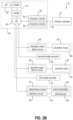
- FIGS. 2A , B show an exemplary version of the measuring unit 15 used in the surveying instrument 10 of FIG. 1 in a perspective view ( FIG. 2A ) and a block diagram of the main components of the measuring unit 15 as illustrated in FIG. 2A ( FIG. 2B ).
- the support 22 is U-formed and includes a bottom portion 27 , a first side portion 28 , and a second side portion 29 .
- the support 22 can rotate completely around its circumference at a full 360° angle with respect to the base 21 about a first axis of rotation 31 .
- the measuring head 23 is pivotably mounted to the support 22 about a second axis of rotation 32 and is arranged between the first side portion 28 and the second side portion 29 of the support.
- the first axis of rotation 31 is aligned parallel to a local direction of gravitation 33
- the second axis of rotation 32 is aligned perpendicular to the local direction of gravitation 33.
- An azimuth motor device and a first angle encoder may be located in the bottom portion 27 of the support 22 and allow to rotate the measuring unit 15 about the first axis of rotation 31 and to determine the direction of the distance measuring beam in a first plane perpendicular to the first axis of rotation 31.
- An elevation motor device and a second angle encoder may be located in the first side portion 28 of the support 22 and allow the measuring head 23 to pivot about the second axis of rotation 32 and to determine the direction of the distance measuring beam in a second plane perpendicular to the second axis of rotation 32.
- a self-leveling device which may be arranged in the bottom portion 27 of the support 22, can be included.
- FIG. 2B shows a block diagram of the main components of the measuring unit 15 of the surveying instrument 10.
- the measuring unit 15 includes a first electronic device 41 , a distance measuring device 42 , a first angle encoder 43 , an azimuth motor device 44 , a second angle encoder 45 , and an elevation motor device 46 .
- the measuring unit 15 can additionally include one or more cameras, such as a tracking camera configured to track a reflector target, or an aiming camera configured to let the user aim to a point of interest.
- the accuracy threshold comprises one value.
- the accuracy threshold can comprise a first accuracy threshold u 1 and a second accuracy threshold u 2 different from the first accuracy threshold.
- a first layout area L-1 corresponding to the first accuracy threshold u 1 and a second layout area L-2 corresponding to the second accuracy threshold u 2 can be computed by the computer system 94.
- a first graphical representation of the first layout area, a second graphical representation of the second layout area, or the first graphical representation of the first layout area and the second graphical representation of the second layout area can be displayed.
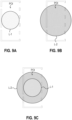
- FIGS. 9A-C illustrate the three options how to visualize the first and second layout areas.
Landscapes
- Physics & Mathematics (AREA)
- Engineering & Computer Science (AREA)
- General Physics & Mathematics (AREA)
- Radar, Positioning & Navigation (AREA)
- Remote Sensing (AREA)
- Length Measuring Devices With Unspecified Measuring Means (AREA)
Abstract
A computer-implemented method for optimizing for a worksite, in which a surveying instrument is deployed at a station, a layout area, in which accuracies not larger than a predefined accuracy threshold can be achieved during operating the surveying instrument, the method being performed by a computer system and comprising the steps:
▪ Defining a plurality of groups of at least two control points from a set of control points, wherein the control points having known first coordinates in a first coordinate frame of the worksite and known second coordinates in a second coordinate frame of the surveying instrument,
▪ Computing for the plurality of groups of control points a pose and corresponding variances and covariances for the station of the surveying instrument,
▪ Computing a layout area for each group of the plurality of groups of control points based on the pose, the variances and covariances, measuring accuracies, and the accuracy threshold,
▪ Computing an evaluation parameter for each group of the plurality of groups of control points, wherein the evaluation parameter is at least one of a surface area of a full circle and an intersecting area of the full circle and a predefined working area of the worksite,
▪ Comparing the layout areas of the plurality of groups of control points based on the evaluation parameter and a predefined evaluation criterion,
▪ Selecting as best layout area the layout area of that group of control points that fulfills the evaluation criterion best, and
▪ Instructing a display to visualize a graphical representation of the best layout area (LAY).
▪ Defining a plurality of groups of at least two control points from a set of control points, wherein the control points having known first coordinates in a first coordinate frame of the worksite and known second coordinates in a second coordinate frame of the surveying instrument,
▪ Computing for the plurality of groups of control points a pose and corresponding variances and covariances for the station of the surveying instrument,
▪ Computing a layout area for each group of the plurality of groups of control points based on the pose, the variances and covariances, measuring accuracies, and the accuracy threshold,
▪ Computing an evaluation parameter for each group of the plurality of groups of control points, wherein the evaluation parameter is at least one of a surface area of a full circle and an intersecting area of the full circle and a predefined working area of the worksite,
▪ Comparing the layout areas of the plurality of groups of control points based on the evaluation parameter and a predefined evaluation criterion,
▪ Selecting as best layout area the layout area of that group of control points that fulfills the evaluation criterion best, and
▪ Instructing a display to visualize a graphical representation of the best layout area (LAY).
Description
- The present invention relates to a method for optimizing in a worksite a layout area according to the definition of
claim 1, to a computer program according to the definition ofclaim 7, and to an apparatus according to the definition ofclaim 8. - Surveying instruments, such as total stations, are used in construction industries to take individual, highly accurate measurements within a worksite, using a highly precise electronic distance measuring device and highly accurate motors to rotate this electronic distance measuring device. Centered within a total station is its coordinate frame. The orientation of the coordinate frame is usually such that the stations x-axis pointing towards right, y-axis pointing towards the floor, and z-axis pointing into forward direction.
- Known workflows to determine the pose (position and orientation) of a total station are based on manually or automatically taking measurement samples of distance and angle data in the worksite. Based on a scalable mathematical equation system, the pose can be calculated with a varying degree of precision, depending on the amount of sampling information considered. To solve the pose calculation, a minimum number of measurement samples needs to be taken, while an increasing number of measurement samples usually leads to the formation of an overdetermined mathematical equation system and an overall improved accuracy of the pose calculation.
- The basic concept of surveying using a total station is that at an initial phase, a number of control points are positioned at scattered locations at the worksite to be surveyed. Typically, control points are materialized by prisms, cat-eyes, reflective foils, or other forms of reflective targets for returning the laser beam from the total station. The exact location of each control point is determined and logged in terms of coordinates on a specified coordinate frame, typically the coordinate frame of a floorplan of the worksite. A total station can then sight a number of these control points to determine its absolute position on that X, Y, Z coordinate frame using standard triangulation techniques.
- In operation, the operator determines the distance and angle data successively for each control point. These data are stored in the total station's computer system together with the absolute position data for the respective control points, the latter position data being preloaded into the total station. The total station then implements an algorithm, generally known as a free-stationing algorithm, to determine its pose from the sightings of those control points. The positioning accuracy of a total station is inversely proportional to the square root of the number of control points it can exploit from its location, the angular distribution of those control points, as well as the stability of the worksite at which the control points and the total station are deployed.
- Typically, the pose and its standard deviation are shown to the operator as numerical values and the interpretation of the quality is left to the operator and depends on his experience. To support the operator in the interpretation of the pose and its quality, Leica has released in November 2022 a new version v7.5 of their iCON Field software and included a functionality that shows to the operator a recommended working area that is a polygon created by the control points used for computing the pose. The disadvantage of the known functionality is that the working area is not evaluated based on an accuracy threshold that can be achieved during measuring and/or layouting with the total station.
- Therefore, what is desired is a method for optimizing a layout area, in which accuracies not larger than a predefined accuracy threshold can be achieved during measuring and/or layouting with a surveying instrument. An operator of the surveying instrument should be supported in the interpretation of the quality of the pose and in the accuracy, he can achieve during measuring and/or layouting with the surveying instrument.
- These objectives are achieved by realizing the features of the independent claims. Features which further develop the invention in an advantageous manner are described in the dependent claims.
- According to an aspect of the present invention, there is provided a computer-implemented method for optimizing for a worksite, in which a surveying instrument is deployed at a station, a layout area, in which accuracies not larger than a predefined accuracy threshold can be achieved during operating the surveying instrument, the method being performed by a computer system and comprising the steps:
- ▪ Defining a plurality of groups of at least two control points from a set of control points, wherein the control points having known first coordinates in a first coordinate frame of the worksite and known second coordinates in a second coordinate frame of the surveying instrument,
- ▪ Computing for the plurality of groups of control points a pose and corresponding variances and covariances for the station of the surveying instrument,
- ▪ Computing a layout area for each group of the plurality of groups of control points based on the pose, the variances and covariances, measuring accuracies, and the accuracy threshold,
- ▪ Computing an evaluation parameter for each group of the plurality of groups of control points, wherein the evaluation parameter is at least one of a surface area of a full circle and an intersecting area of the full circle and a predefined working area of the worksite,
- ▪ Comparing the layout areas of the plurality of groups of control points based on the evaluation parameter and a predefined evaluation criterion,
- ▪ Selecting as best layout area the layout area of that group of control points that fulfills the evaluation criterion best, and
- ▪ Instructing a display to visualize a graphical representation of the best layout area.
- The method for optimizing a layout area according to the present invention supports the operator of the surveying instrument in understanding the results he achieved during stationing of the surveying instrument. The layout area is computed by the computer system based on the pose, the variances and covariances for the station, based on measuring accuracies, and the predefined accuracy threshold. The operator is supported by a graphical representation of the layout area. The values represented by the layout area would normally be much harder for the operator to understand if presented numerically in a spreadsheet, especially if the data set is large or complex. The layout area enables operators to visualize data and understand it easily. The operator can easily check via the graphical representation if he can achieve the required accuracy during layouting or measuring with the surveying instrument at the worksite.
- Preferably, the layout area is defined by a circular contour line having a center defined by


- The layout area can be defined as full circle, in which accuracies not larger than the accuracy threshold can be achieved during operating the surveying instrument, or the layout area can be an intersecting area of the full circle and a predefined working area, in which the surveying instrument is deployed. The inside of the contour line corresponds to the layout area, in which accuracies not larger than the accuracy threshold can be achieved, whereas at the outside of the contour line accuracies not larger than the accuracy threshold cannot be achieved.
- Preferably, the layout area is related to the worksite and stored in the computer system and/or stored to a memory connected to the computer system and the layout area is provided for use in operating the surveying instrument. By providing the layout area for use in operating the surveying instrument, the operator is supported in the interpretation of the data, he can easily check via the graphical representation of the layout area if he can achieve the required accuracy.
- Preferably, the layout area is provided for use in layouting a point of interest and upon selecting the point of interest, it is checked by the computer system whether the point of interest is located inside of the layout area or outside of the layout area, wherein:
- ▪ upon verification that the point of interest is located inside of the layout area, a predefined action is performed, the predefined action comprising generating a message stating that the point of interest is located inside of the layout area and/or that the accuracy threshold can be achieved, and
- ▪ upon verification that the point of interest is located outside of the layout area, a predefined action is performed, the predefined action comprising generating a message stating that the point of interest is not located inside of the layout area and/or that the accuracy threshold cannot be achieved.
- By checking via the computer system whether a point of interest selected for layouting is located inside or outside of the layout area, the operator is supported in achieving the required accuracy.
- In a preferred embodiment, the at least one accuracy threshold comprises at least a first accuracy threshold and a second accuracy threshold different from the first accuracy threshold and in the step of computing the layout area, a first layout area is computed by the computer system for the first accuracy threshold and a second layout area is computed for the second accuracy threshold. By using a first accuracy threshold to compute a first layout area and a second accuracy threshold to compute a second layout area, the operator can be supported in the interpretation of different accuracies he can achieve during layouting and/or measuring with the surveying instrument.
- Preferably, a first graphical representation of the first layout area is displayed, a second graphical representation of the second layout area is displayed, or the first graphical representation of the first layout area and the second graphical representation of the second layout area are displayed. During layouting with a surveying instrument at a worksite, at which the surveying instrument is deployed, different accuracies can be required.
- According to a further aspect of the present invention, there is provided a computer program comprising instructions, which, when executed by a computer system, cause the computer system to carry out the method according to the present invention. The computer program may be stored on the computer system or on a computer-readable medium communicatively connected to the computer system. The term "computer-readable medium" includes, but is not limited to, portable or non-portable storage devices, optical storage devices, and various other mediums capable of storing, containing, or carrying instruction(s) and/or data.
- According to a further aspect of the present invention, there is provided an apparatus comprising means for carrying out the method according to the present invention.
- The aspects of the invention are described or explained in more detail below, purely by way of example, with reference to working examples shown schematically in the drawing. Identical elements are labelled with the same reference numerals in the figures. The described embodiments are generally not shown true in scale, and they are also not to be interpreted as limiting the invention. Specifically,
- FIG. 1
- shows an operator using a surveying instrument deployed at a worksite, the surveying instrument comprising a measuring unit mounted on a tripod and a remote controller connected via a communication link to the measuring unit,
- FIGS. 2A, B
- show an exemplary version of the measuring unit used in the surveying instrument of
FIG. 1 (FIG. 2A ) and a block diagram of the main components of the measuring unit as illustrated inFIG. 2A (FIG. 2B ), - FIGS. 3A, B
- show an exemplary version of the remote controller used in the surveying instrument of
FIG. 1 (FIG. 3A ) and a block diagram of the main components of the remote controller as illustrated inFIG. 3A (FIG. 3B ), - FIG. 4
- shows a method for optimizing a layout area according to the present invention in a flow chart,
- FIGS. 5A, B
- illustrate a graphical user interface showing a first type of layout area formed as a full circle (
FIG. 5A ) and a second type of layout area formed as an intersecting area (FIG. 5B ), - FIGS. 6A, B
- illustrate an exemplary version of a layout area formed as full circle in a first graphical representation (
FIG. 6A ) and in a second graphical representation (FIG. 6B ), - FIGS. 7A, B
- illustrate a graphical user interface of an exemplary implementation of the method for optimizing a layout area according to the present invention,
- FIGS. 8A, B
- illustrate the graphical user interface of
FIG. 7 during stationing of a total station via a free-stationing process, and - FIGS. 9A-C
- illustrate schematically a first graphical representation (
FIG. 9A ), a second graphical representation (FIG. 9B ), and a first and second graphical representation (FIG. 9C ). - Reference will now be made in detail to the present preferred embodiment, an example of which is illustrated in the accompanying drawings. It is to be understood that the technology disclosed herein is not limited in its application to the details of construction and the arrangement of components set forth in the following description or illustrated in the drawings. The technology disclosed herein is capable of other embodiments and of being practiced or of being carried out in various ways.
-
FIG. 1 shows an operator using a surveyinginstrument 10 deployed at aworksite 11. Theworksite 11 may be a construction site, inside or outside, or a surveying site, amongst others. In addition to the surveyinginstrument 10, atarget 12 that is remote from the surveyinginstrument 10 may be deployed at theworksite 11. Thetarget 12 may include areflector 13, such as a prism and/or a cat-eye, that is mounted on top of apole 14. - The surveying
instrument 10 is formed as a total station and comprises a measuringunit 15 that is mounted on a mounting support structure in the form of atripod 16. The surveyinginstrument 10 also comprises a removable control panel in the form of aremote controller 17 that can be used for remote control of the measuringunit 15 via awireless connection 18. - Before the operator can use the
total station 10 for layouting, measuring and/or other tasks, the total station must be stationed via a stationing process to theworksite 11. From prior art, different stationing processes are known, such as free-stationing process, model-based stationing process, automatic stationing process, or any other stationing process. - The basic concept of free-stationing processes is that at an initial phase, a number of control points, here control points CP-1, CP-2, CP-3, CP-4, CP-5, CP-6, are positioned at scattered locations at the
worksite 11. The control points are materialized by prisms, cat-eyes, reflective foils, or other forms of reflective targets for returning the laser beam from the total station. The exact location of the control points is determined and logged in terms of coordinates on a specified coordinate frame, here the coordinate frame of theworksite 11. - To determine the pose (position and orientation) of the
total station 10 in the coordinate frame of theworksite 11, thetotal station 10 sights a number of the control points and takes measurement samples of distance and angle data in its coordinate frame. To differ between the coordinate frames, the coordinate frame of theworksite 11 is called "first coordinate frame" CF-1 and the coordinate frame of thetotal station 10 is called "second coordinate frame" CF-2. The coordinates in the first coordinate frame CF-1 are called "first coordinates" and the coordinates in the second coordinate frame CF-2 are called "second coordinates". - Based on a mathematical equation system, the pose of the total station can be calculated from the first coordinates of the control points in the first coordinate frame CF-1 and from the second coordinates of the control points in the second coordinate frame CF-2. With increasing number of measurement samples and a good angular distribution of the control points at the
worksite 11 the position accuracy of the pose can increase. -
FIGS. 2A , B show an exemplary version of the measuringunit 15 used in the surveyinginstrument 10 ofFIG. 1 in a perspective view (FIG. 2A ) and a block diagram of the main components of the measuringunit 15 as illustrated inFIG. 2A (FIG. 2B ). - The surveying
instrument 10 is designed as robotic total station and the measuringunit 15 comprises abase 21, asupport 22, and a measuringhead 23. The measuringhead 23 is enclosed by ahousing 24, which includes anexit window 25. In thehousing 24, a distance measuring device that can emit a distance measuring beam and a tracking device that can emit a radiation are arranged. The distance measuring beam and the radiation are emitted through theexit window 25 to leave thehousing 24. - In the exemplary version of
FIG. 2A , thesupport 22 is U-formed and includes abottom portion 27, afirst side portion 28, and asecond side portion 29. Thesupport 22 can rotate completely around its circumference at a full 360° angle with respect to the base 21 about a first axis ofrotation 31. The measuringhead 23 is pivotably mounted to thesupport 22 about a second axis ofrotation 32 and is arranged between thefirst side portion 28 and thesecond side portion 29 of the support. Usually, the first axis ofrotation 31 is aligned parallel to a local direction ofgravitation 33, and the second axis ofrotation 32 is aligned perpendicular to the local direction ofgravitation 33. - An azimuth motor device and a first angle encoder may be located in the
bottom portion 27 of thesupport 22 and allow to rotate the measuringunit 15 about the first axis ofrotation 31 and to determine the direction of the distance measuring beam in a first plane perpendicular to the first axis ofrotation 31. An elevation motor device and a second angle encoder may be located in thefirst side portion 28 of thesupport 22 and allow the measuringhead 23 to pivot about the second axis ofrotation 32 and to determine the direction of the distance measuring beam in a second plane perpendicular to the second axis ofrotation 32. To make theinstrument 12 fully automatic, a self-leveling device, which may be arranged in thebottom portion 27 of thesupport 22, can be included. -
FIG. 2B shows a block diagram of the main components of the measuringunit 15 of the surveyinginstrument 10. The measuringunit 15 includes a firstelectronic device 41, adistance measuring device 42, afirst angle encoder 43, an azimuth motor device 44, asecond angle encoder 45, and anelevation motor device 46. Optionally, the measuringunit 15 can additionally include one or more cameras, such as a tracking camera configured to track a reflector target, or an aiming camera configured to let the user aim to a point of interest. - The first
electronic device 41 comprises a first processing circuit (µP) 50, afirst memory circuit 51 that may include associated random-access memory (RAM) and read only memory (ROM), afirst communications circuit 52, and a first input/output (I/O)interface circuit 53. Thefirst processing circuit 50, also called device control unit, may communicate with thefirst memory circuit 51 andfirst communications circuit 52 and is configured to control thelaser instrument 12. Thefirst communications circuit 52 includes afirst transmitter circuit 54 and afirst receiver circuit 55 and is configured to be connected to a communications circuit of the remote controller via the communication link. The first input/output interface circuit 53 is an interface between thefirst processing circuit 50 and the various types of motor driver circuits and sensor circuits of the measuringunit 15. - The
distance measuring device 42 includes alaser transmitter 56, alaser driver circuit 57, aphotosensor 58, and a laserreceiver interface circuit 59. Thelaser driver circuit 57 provides current for thelaser transmitter 56 which emits a distance measuring beam. Thephotosensor 58 receives at least a part of the distance measuring beam reflected at a target or a surface of the worksite, and the current signal that is outputted by thephotosensor 58 is directed to the laserreceiver interface circuit 59. After appropriate amplification and demodulation, the signal is sent via the first input/output interface circuit 53 to thefirst processing circuit 50. - The
first angle encoder 43 provides input signals to thefirst processing circuit 50, so that it knows exactly in which horizontal angle thelaser transmitter 56 is arranged in the horizontal plane; the output signal of thefirst angle encoder 43 is directed to the first input/output interface circuit 53. The azimuth motor device 44 includes anazimuth motor 62, which is the motive force to rotate themain housing 22 of the measuringunit 15 about the first axis ofrotation 31, and an azimuthmotor driver circuit 63, which will provide the proper current and voltage to drive theazimuth motor 62. - The
second angle encoder 45 provides input signals to thefirst processing circuit 50, so that it knows exactly in which second angle thelaser transmitter 56 is arranged in the second plane; the output signal of thesecond angle encoder 45 is directed to the first input/output interface circuit 53. Theelevation motor device 46 includes anelevation motor 65, which is the motive force to pivot the measuringhead 23 about the second axis ofrotation 32, and an elevationmotor driver circuit 66, which will provide the proper current and voltage to drive theelevation motor 65. -
FIGS. 3A , B show an exemplary version of theremote controller 17 used in the surveyinginstrument 10 ofFIG. 1 in a front view (FIG. 3A ) and a block diagram of the main components of theremote controller 17 as illustrated inFIG. 3A (FIG. 3B ). - The
remote controller 17 is designed as tablet computer and includes ahousing 81, atouch screen display 82, a battery 83, a set ofbuttons 84, e.g., volume control button, power on/off button, and display control button, a set ofindicators 85, e.g., for operating status, data storage status, and battery status, a set ofconnectors 86, e.g., for docking, data storage, and USB, and a card slot 87. -
FIG. 3B shows a block diagram of the main components of theremote controller 17. Theremote controller 17 may include a secondelectronic device 91, adisplay device 92, and aninput device 93. - The second
electronic device 91 comprises a second processing circuit (µP) 94, asecond memory circuit 95 that may include associated random-access memory (RAM), read only memory (ROM), and some type of bulk memory (BULK), asecond communications circuit 96, and a second input/output (I/O)interface circuit 97. Thesecond processing circuit 94 may communicate with thesecond memory circuit 95 andsecond communications circuit 96 and is configured to control theremote controller 17. Thesecond communications circuit 96 includes asecond transmitter circuit 98 and asecond receiver circuit 99 and is configured to be connected to thefirst communications circuit 52 of the measuringunit 15 via thewireless communication 18. The second input/output interface circuit 97 is an interface between thesecond processing circuit 94 and the various driver circuits of theremote controller 17. - In the
second memory circuit 95 several program codes having computer-executable instructions for performing a method may be stored. The stored program codes may include a program code for performing a method for determining for a worksite, at which a surveying instrument is deployed, a layout area, in which accuracies not larger than a predefined accuracy threshold can be achieved during operating the surveying instrument. - The method for determining a layout area is performed by a computer system having evaluation, data processing and/or control functionality. In the exemplary version of the surveying
instrument 10, the computer system is integrated into thesecond processing circuit 94 of the secondelectronic device 91 of theremote controller 17. Alternatively, the computer system may be integrated into thefirst processing circuit 50, or into the first andsecond processing circuits - The
display device 92 includes adisplay 101 and adisplay driver circuit 102. The display driver circuit will be in communication with the second I/O interface circuit 97 and provides the correct interface and data signals for thedisplay 101. If theremote controller 17 is a laptop computer, for example, then this would be the standard display seen in most laptop computers. Or, if theremote controller 17 is a tablet computer or a smart phone, in which case the display device is a much smaller physical device, thedisplay device 101 could be a touch screen display. - The user-operated
input device 93 includes akeypad 103 and akeypad driver circuit 104. The keypad driver circuit will be in communication with the second I/O interface circuit 97 and controls the signals that interface to thekeypad 103. If thedisplay device 101 is a touch screen display, then there may not be a separate keypad on theremote controller 17, because most of the command or data to input functions will be available by touching the display itself and the keypad is integrated in the touch screen display. There may be some type of power on/off button, but that would not necessarily be considered a true keypad and typically would not be used for entering data. -
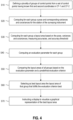
FIG. 4 shows a method for optimizing for a worksite, in which a surveying instrument is deployed at a station, a layout area according to the present invention in a flow chart. The surveyinginstrument 10 deployed at theworksite 11 and thecomputer system 94 can be used to perform the method according to the present invention. - The layout area defines at the
worksite 11 an area, in which accuracies not larger than a predefined accuracy threshold u can be achieved during operating the surveyinginstrument 10. Measurements with the surveyinginstrument 10 are usually described by a well-established error model, where angle and distance measurements are treated as independent random variables with measuring accuracies σHA for the horizontal angle HA and σHD for the horizontal distance HD. - The method for optimizing a layout area according to the present invention is performed by the
computer system 94 and comprises the following steps: - ▪ Defining a plurality of groups of at least two control points from a set of control points, wherein the control points having known first coordinates in the first coordinate frame CF-1 of the
worksite 11 and known second coordinates in the second coordinate frame CF-2 of the surveying instrument 10 (step S10), - ▪ Computing for each group of the plurality of groups of control points a pose (ES, NS, ori) and corresponding variances (QES,ES, QNS,NS, Qori, ori) and covariances (QES,ori, QNS,ori) for the station of the surveying instrument 10 (step S20),
- ▪ Computing a layout area for each group of the plurality of groups of control points based on the pose (ES, NS, ori), the variances (QES,ES, QNS,NS, Qori, ori) and covariances (QES,ori, QNS,ori), the measuring accuracies (σHA, σHD), and the accuracy threshold u (step S30),
- ▪ Computing an evaluation parameter for each group of the plurality of groups of control points, wherein the evaluation parameter is at least one of a surface area of a full circle and an intersecting area of the full circle and a predefined working area of the worksite, (step S40),
- ▪ Comparing the layout areas of all groups of the plurality of groups of control points based on the evaluation parameter and a predefined evaluation criterion (step S50),
- ▪ Selecting as best layout area the layout area of that group of the plurality of groups of control points that fulfills the evaluation criterion best (step S60), and
- ▪ Instructing a display (101) to visualize a graphical representation of the best layout area (step S70).
- Although the steps of the method are illustrated in a particular order, in some embodiments, one or more steps may be executed in a different order than illustrated in
FIG. 4 . For example, the steps S20, S30 and S40 can be executed for each group of the plurality of groups of control points separately or each of the steps S20, S30 and S40 is executed for all groups of the plurality of groups of control points. - In step S40, an evaluation parameter is computed for each group of the plurality of groups of control points, wherein the evaluation parameter is at least one of a surface area of a full circle and an intersecting area of the full circle and a predefined working area of the worksite. In step S50, the layout areas of the plurality of groups of control points are compared based on the evaluation parameter and a predefined evaluation criterion; the evaluation criterion can be the largest surface area of the full circle or the largest intersecting area of the full circle and the working area. In step S60, the layout area of that group of control points that fulfills the evaluation criterion best is selected as best layout area.
- The pose of the total station can be calculated by a free-stationing process, a model-based stationing process, an automatic stationing process, or any other stationing process. For the free-stationing process that is used according to the present invention, at least two control points are used, the control points having known first coordinates in the first coordinate frame CF-1 of the
worksite 11 and known second coordinates in the second coordinate frame CF-2 of the surveyinginstrument 10. - In statistics, a covariance matrix is a square matrix giving the covariance values between each pair of elements of a given random vector.
- The covariance matrix Qxx of the pose (ES, NS, ori) can be written as:
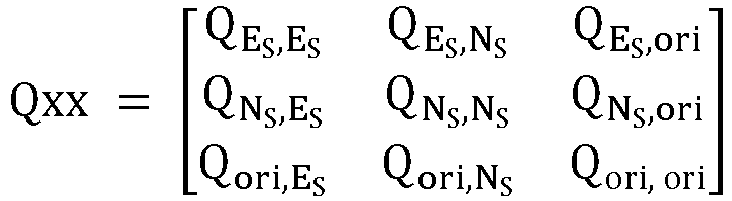
- Whereas the diagonal elements (QES,ES, QNS,NS, Qori, ori) represent the variances of the variables ES and NS, i.e., covariances of an element with itself, and the off-diagonal elements (QES,NS = QNS,ES, QES,ori = Qori,ES, QNS,ori = Qori,NS) represent the covariances between pairs of the elements ES, NS, ori.
- An observation point OP can be denoted by variables HD and HA with HD being a horizontal distance and HA being a horizontal angle. With the pose (ES, NS, ori), the coordinates E and N of the observation point OP can be computed by:


- The covariance matrix ΣE, N of E and N can be computed through variance propagation by


- Curves of equal accuracy u can be denoted by

- The curves of equal accuracy u = const. take the form of concentric circles and can be transformed to equations for the center and the radius. The center is defined in the first coordinate frame CF-1 of the
worksite 11 by:
- The radius is defined by:

- As discussed with reference to
FIG. 4 , the layout area, in which accuracies not larger than the predefined accuracy threshold u can be achieved during operating the surveyinginstrument 10, takes the form of a circle.FIGS. 5A , B illustrate a graphical user interface showing a first type of layout area formed as a full circle (FIG. 5A ) and a second type of layout area formed as an intersecting area (FIG. 5B ). -
FIG. 5A illustrates the graphical user interface showing the first type of layout area. The layout area is formed as a full circle that is projected onto a two-dimensional plan of the worksite.FIG. 5B illustrates the graphical user interface showing the second type of layout area. The layout area is formed as intersecting area of the full circle and a predefined working area at the worksite. In practice, the operator is interested in that section of the working area, in which he can achieve accuracies smaller than the predefined accuracy threshold. The intersecting area visualizes that section of the working area. The working area can be defined by the operator as polygon, or the computer system can define the working area as polygon that is defined by the set of control points that is used for the stationing process of thetotal station 10. - Both types of layout area allow an operator to easily check if he can achieve the required accuracy during layouting or measuring with the surveying instrument at the worksite. The first and second type of layout area enable the operator to visualize data and understand it easily.
-
FIGS. 6A , B illustrate an exemplary version of a layout area formed as full circle in a first graphical representation (FIG. 6A ) and in a second graphical representation (FIG. 6B ). -
FIG. 6A shows the first graphical representation that contains acontour line 111 of equal accuracy, wherein the inside of the contour line is filled. The first graphical representation of the layout area is called "full circle (positive)" and refers to the feature "graphical representation" of the present invention. -
FIG. 6B shows the second graphical representation that contains thecontour line 111 of equal accuracy, wherein the outside of the contour line is filled. The second graphical representation of the layout area is called "full circle (negative)" and refers to the feature "graphical representation" of the present invention. -
FIGS. 7A , B illustrate a graphical user interface of an exemplary implementation of the method for optimizing a layout area according to the present invention. Before an operator can use thetotal station 10 for layouting, measuring and/or other tasks at a worksite, thetotal station 10 must be stationed via a stationing process to theworksite 11. - In the exemplary version shown in
FIG. 7A , the stationing process is a free-stationing process using a set of control points. At an initial phase, the operator has loaded a floorplan of the worksite and a set of control points CP-1 to CP-13 to thecomputer system 94. The control points have known first coordinates in the first coordinate frame CF-1 of the worksite. To determine the pose of thetotal station 10 in the first coordinate frame CF-1, thetotal station 10 will sight a number of the control points and take measurement samples of distance and angle data in the second coordinate frame CF-2 of thetotal station 10. The measurements can be performed manually by the operator, semi-automatically or automatically by thetotal station 10. In the exemplary version, the control points are materialized by reflector foils (CP-1, CP-11, and CP-12), by two-dimensional cat-eyes (CP2 to CP-10), and by glass prisms (CP-13). - In the exemplary version of
FIG. 7A , the measurements are performed semi-automatically by thetotal station 10. The operator selects a control point from the set of control points by clicking and confirms his selection by clicking ameasurement button 121. -
FIG. 7B illustrates the graphical user interface that allows the operator to define the layout area. In the exemplary version shown inFIG. 7B , the operator can select the accuracy threshold that is used for computing the layout area and the type of layout area that is used for visualization. As discussed with reference toFIGS. 5 and6 , the layout area can be a full circle (positive), a full circle (negative) or an intersecting area of the full circle and the working area. - The accuracy threshold and the type of layout area can be selected from a menu. In
FIG. 7B , both menus for the accuracy threshold and the type of layout area are shown. This is done for illustration. In practice, only one menu can be shown. Instead of using predefined values for the accuracy threshold as shown inFIG. 7B , the accuracy threshold can be defined by the operator by setting a value in millimeters. -
FIGS. 8A , B illustrate the graphical user interface ofFIG. 7 during stationing of thetotal station 10 via a free-stationing process. As explained with respect toFIG. 7 , the operator has loaded a floorplan of the worksite and the control points CP-1 to CP-13 to thecomputer system 94. - Before an operator can start the method for optimizing a layout area, the
total station 10 has to take measurement samples of distance and angle data in the second coordinate frame CF-2 of thetotal station 10. -
FIG. 8A shows measurement samples for five control points, CP-7, CP-13, CP-2, CP-10, and CP-8. Since the measured distance and the CAD information derived from the floorplan do not match for the control point CP-8, this control point is excluded from computing the pose and the layout area. - The control points CP-7, CP-13, CP-2, and CP-10 define the set of control points that is used for optimizing the layout area. If the operator defines a minimum number of three control points necessary for computing the pose of the surveying
instrument 10, a plurality of five groups of control points can be defined by thecomputer system 94 in order to determine a layout area, and if the operator defines a minimum number of two control points necessary for computing the pose of the surveyinginstrument 10, a plurality of eleven groups of control points can be defined by thecomputer system 94 in order to determine a layout area. - In the exemplary versions of the layout area shown in
FIGS. 5 to 8 , the accuracy threshold comprises one value. Alternatively, the accuracy threshold can comprise a first accuracy threshold u1 and a second accuracy threshold u2 different from the first accuracy threshold. In the step S20 of computing the layout area, a first layout area L-1 corresponding to the first accuracy threshold u1 and a second layout area L-2 corresponding to the second accuracy threshold u2 can be computed by thecomputer system 94. In the step S30 of visualizing a graphical representation of the layout area, a first graphical representation of the first layout area, a second graphical representation of the second layout area, or the first graphical representation of the first layout area and the second graphical representation of the second layout area can be displayed.FIGS. 9A-C illustrate the three options how to visualize the first and second layout areas. - In the exemplary version of
FIG. 9 , the first graphical representation is a first contour line related to the first accuracy threshold u1 (FIG. 9A ), and the second graphical representation is a second contour line related to the second accuracy threshold u2 (FIG. 9B ). InFig. 9C , the first contour line and the second contour line are displayed. - The layout area that is determined during stationing of the
total station 10 is provided for use in layouting a point of interest POI. Upon selecting the point of interest POI by the operator, it is checked by thecomputer system 94 whether the selected point of interest POI is located inside or outside of the layout area. - As shown in
FIG. 9A , the point of interest POI is located outside of the (first) layout area L-1. Upon verification that the point of interest POI is located outside of the (first) layout area L-1, a predefined action can be performed. The predefined action may comprise generating a message stating that the point of interest POI is not located inside of the (first) layout area and/or that the (first) accuracy threshold cannot be achieved. - As shown in
FIG. 9B , the point of interest POI is located inside of the (second) layout area L-2. Upon verification that the point of interest POI is located inside of the (second) layout area L-2, a predefined action can be performed. The predefined action may comprise generating a message stating that the point of interest POI is located inside of the (second) layout area and/or that the (second) accuracy threshold can be achieved.
Claims (8)
- A computer-implemented method for optimizing for a worksite (11), in which a surveying instrument (10) is deployed at a station, a layout area, in which accuracies not larger than a predefined accuracy threshold (u) can be achieved during operating the surveying instrument (10), the method being performed by a computer system (94) and comprising the steps:▪ Defining a plurality of groups of at least two control points from a set of control points (CP-2, CP-7, CP-10, CP-13), wherein the control points having known first coordinates in a first coordinate frame (CF-1) of the worksite (11) and known second coordinates in a second coordinate frame (CF-2) of the surveying instrument (10),▪ Computing for each group of the plurality of groups of control points a pose (ES, NS, ori) and corresponding variances (QES,ES, QNS,NS, Qori, ori) and covariances (QES,ori, QNS,ori) for the station of the surveying instrument (10),▪ Computing a layout area for each group of the plurality of groups of control points based on the pose (ES, NS, ori), the variances (QES,ES, QNS,NS, Qori, ori) and covariances (QES,ori, QNS,ori), measuring accuracies (σHA, σHD), and the accuracy threshold (u),▪ Computing an evaluation parameter for each group of the plurality of groups of control points, wherein the evaluation parameter is at least one of a surface area of a full circle and an intersecting area of the full circle and a predefined working area of the worksite,▪ Comparing the layout areas of all groups of the plurality of groups of control points based on the evaluation parameter and a predefined evaluation criterion,▪ Selecting as best layout area the layout area of that group of the plurality of groups of control points that fulfills the evaluation criterion best, and▪ Instructing a display (101) to visualize a graphical representation (LAY) of the best layout area.
- Method according to claim 1, wherein the layout area is defined by a circular contour line having a center defined by


- Method of any one of claims 1 to 2, wherein the layout area is related to the worksite (11) and stored in the computer system (94) and/or stored to a memory connected to the computer system (94) and the layout area is provided for use in operating the surveying instrument (10).
- Method of claim 3, wherein the layout area is provided for use in layouting a point of interest (POI) and upon selecting the point of interest (POI), it is checked by the computer system (94) whether the point of interest (POI) is located inside of the layout area or outside of the layout area, wherein:▪ upon verification that the point of interest (POI) is located inside of the layout area, a predefined action is performed, the predefined action comprising generating a message stating that the point of interest (POI) is located inside of the layout area and/or that the accuracy threshold can be achieved, and▪ upon verification that the point of interest (POI) is located outside of the layout area, a predefined action is performed, the predefined action comprising generating a message stating that the point of interest (POI) is not located inside of the layout area and/or that the accuracy threshold cannot be achieved.
- Method of any one of claims 1 to 4, wherein the at least one accuracy threshold comprises at least a first accuracy threshold (u1) and a second accuracy threshold (u2) different from the first accuracy threshold (u1) and in the step of computing the layout area, a first layout area (L-1) corresponding to the first accuracy threshold (u1) and a second layout area (L-2) corresponding to the second accuracy threshold (u2) are computed by the computer system (94).
- Method of the previous claim 5, wherein a first graphical representation of the first layout area (L-1) is displayed, a second graphical representation of the second layout area (L-2) is displayed, or the first graphical representation of the first layout area (L-1) and the second graphical representation of the second layout area (L-2) are displayed.
- A computer program comprising instructions, which, when executed by a computer system (94), cause the computer system (94) to carry out the method according to any one of claims 1 to 6.
- An apparatus comprising means for carrying out the method according to any one of claims 1 to 6.
Priority Applications (2)
| Application Number | Priority Date | Filing Date | Title |
|---|---|---|---|
| EP23220885.0A EP4579181A1 (en) | 2023-12-31 | 2023-12-31 | Method for optimizing and visualizing a layout area |
| PCT/EP2024/087071 WO2025140900A1 (en) | 2023-12-31 | 2024-12-18 | Method for optimizing and visualizing a layout area |
Applications Claiming Priority (1)
| Application Number | Priority Date | Filing Date | Title |
|---|---|---|---|
| EP23220885.0A EP4579181A1 (en) | 2023-12-31 | 2023-12-31 | Method for optimizing and visualizing a layout area |
Publications (1)
| Publication Number | Publication Date |
|---|---|
| EP4579181A1 true EP4579181A1 (en) | 2025-07-02 |
Family
ID=89473264
Family Applications (1)
| Application Number | Title | Priority Date | Filing Date |
|---|---|---|---|
| EP23220885.0A Pending EP4579181A1 (en) | 2023-12-31 | 2023-12-31 | Method for optimizing and visualizing a layout area |
Country Status (2)
| Country | Link |
|---|---|
| EP (1) | EP4579181A1 (en) |
| WO (1) | WO2025140900A1 (en) |
Citations (5)
| Publication number | Priority date | Publication date | Assignee | Title |
|---|---|---|---|---|
| US7199872B2 (en) * | 2004-05-18 | 2007-04-03 | Leica Geosystems Ag | Method and apparatus for ground-based surveying in sites having one or more unstable zone(s) |
| WO2011141447A1 (en) * | 2010-05-10 | 2011-11-17 | Leica Geosystems Ag | Surveying method |
| US20170276485A1 (en) * | 2016-03-22 | 2017-09-28 | Hexagon Technology Center Gmbh | Construction site referencing |
| US20220090910A1 (en) * | 2018-10-31 | 2022-03-24 | Leica Geosystems Ag | Surveying system and auxiliary measuring instrument |
| US20220172406A1 (en) * | 2018-12-13 | 2022-06-02 | Leica Geosystems Ag | Measurement method, measurement systems and auxiliary measurement instruments |
-
2023
- 2023-12-31 EP EP23220885.0A patent/EP4579181A1/en active Pending
-
2024
- 2024-12-18 WO PCT/EP2024/087071 patent/WO2025140900A1/en active Pending
Patent Citations (5)
| Publication number | Priority date | Publication date | Assignee | Title |
|---|---|---|---|---|
| US7199872B2 (en) * | 2004-05-18 | 2007-04-03 | Leica Geosystems Ag | Method and apparatus for ground-based surveying in sites having one or more unstable zone(s) |
| WO2011141447A1 (en) * | 2010-05-10 | 2011-11-17 | Leica Geosystems Ag | Surveying method |
| US20170276485A1 (en) * | 2016-03-22 | 2017-09-28 | Hexagon Technology Center Gmbh | Construction site referencing |
| US20220090910A1 (en) * | 2018-10-31 | 2022-03-24 | Leica Geosystems Ag | Surveying system and auxiliary measuring instrument |
| US20220172406A1 (en) * | 2018-12-13 | 2022-06-02 | Leica Geosystems Ag | Measurement method, measurement systems and auxiliary measurement instruments |
Also Published As
| Publication number | Publication date |
|---|---|
| WO2025140900A1 (en) | 2025-07-03 |
Similar Documents
| Publication | Publication Date | Title |
|---|---|---|
| US10586349B2 (en) | Excavator bucket positioning via mobile device | |
| US7460214B2 (en) | Surface metering device | |
| US7742176B2 (en) | Method and system for determining the spatial position of a hand-held measuring appliance | |
| JP5538929B2 (en) | Three-dimensional position measurement and ink marking system and its usage | |
| US8411285B2 (en) | Stationing an unleveled optical total station | |
| US11461526B2 (en) | System and method of automatic re-localization and automatic alignment of existing non-digital floor plans | |
| EP1637835A2 (en) | Reference coordinate calculating method, reference coordinate calculating program, recording medium thereof, reference plate and form measuring machine | |
| EP3945282B1 (en) | Surveying system, staking assistance method, and staking assistance program | |
| EP3479143B1 (en) | Portable survey meter and method | |
| EP4579182A1 (en) | Method for determining and visualizing an accuracy map | |
| CN114755699A (en) | RTK receiver and lofting method | |
| CN110161490B (en) | Distance measuring system with layout generating function | |
| US11448504B2 (en) | Surveying device | |
| EP4579181A1 (en) | Method for optimizing and visualizing a layout area | |
| CN110332854A (en) | Localization method, gun sight and the computer readable storage medium of object | |
| JP6812114B2 (en) | Surveying position display device and surveying position display program | |
| EP4579180A1 (en) | Method for determining and visualizing a layout area | |
| EP4679032A1 (en) | Method for determining an accuracy for a point of interest | |
| CN113034603A (en) | Method and device for determining calibration parameters | |
| US20130021618A1 (en) | Apparatus and method to indicate a specified position using two or more intersecting lasers lines | |
| WO2025140907A1 (en) | Method for determining and visualizing an accuracy map | |
| US20220170742A1 (en) | Construction verification system, method and computer program product | |
| EP4696981A1 (en) | Motorized layout pointer including a distance measuring unit and method for indicating a layout point at a jobsite | |
| US20170097228A1 (en) | Measurement Apparatus to Locate an Orientation With Respect to a Surface | |
| EP4696978A1 (en) | Apparatus and method for indicating a layout point at a jobsite using a total station |
Legal Events
| Date | Code | Title | Description |
|---|---|---|---|
| PUAI | Public reference made under article 153(3) epc to a published international application that has entered the european phase |
Free format text: ORIGINAL CODE: 0009012 |
|
| STAA | Information on the status of an ep patent application or granted ep patent |
Free format text: STATUS: THE APPLICATION HAS BEEN PUBLISHED |
|
| AK | Designated contracting states |
Kind code of ref document: A1 Designated state(s): AL AT BE BG CH CY CZ DE DK EE ES FI FR GB GR HR HU IE IS IT LI LT LU LV MC ME MK MT NL NO PL PT RO RS SE SI SK SM TR |