EP4579032A1 - Water-repellent textile - Google Patents
Water-repellent textile Download PDFInfo
- Publication number
- EP4579032A1 EP4579032A1 EP23856566.7A EP23856566A EP4579032A1 EP 4579032 A1 EP4579032 A1 EP 4579032A1 EP 23856566 A EP23856566 A EP 23856566A EP 4579032 A1 EP4579032 A1 EP 4579032A1
- Authority
- EP
- European Patent Office
- Prior art keywords
- water
- repellent
- compound
- textile
- resin film
- Prior art date
- Legal status (The legal status is an assumption and is not a legal conclusion. Google has not performed a legal analysis and makes no representation as to the accuracy of the status listed.)
- Pending
Links
Classifications
-
- D—TEXTILES; PAPER
- D06—TREATMENT OF TEXTILES OR THE LIKE; LAUNDERING; FLEXIBLE MATERIALS NOT OTHERWISE PROVIDED FOR
- D06M—TREATMENT, NOT PROVIDED FOR ELSEWHERE IN CLASS D06, OF FIBRES, THREADS, YARNS, FABRICS, FEATHERS OR FIBROUS GOODS MADE FROM SUCH MATERIALS
- D06M15/00—Treating fibres, threads, yarns, fabrics, or fibrous goods made from such materials, with macromolecular compounds; Such treatment combined with mechanical treatment
- D06M15/19—Treating fibres, threads, yarns, fabrics, or fibrous goods made from such materials, with macromolecular compounds; Such treatment combined with mechanical treatment with synthetic macromolecular compounds
- D06M15/37—Macromolecular compounds obtained otherwise than by reactions only involving carbon-to-carbon unsaturated bonds
- D06M15/564—Polyureas, polyurethanes or other polymers having ureide or urethane links; Precondensation products forming them
-
- D—TEXTILES; PAPER
- D06—TREATMENT OF TEXTILES OR THE LIKE; LAUNDERING; FLEXIBLE MATERIALS NOT OTHERWISE PROVIDED FOR
- D06M—TREATMENT, NOT PROVIDED FOR ELSEWHERE IN CLASS D06, OF FIBRES, THREADS, YARNS, FABRICS, FEATHERS OR FIBROUS GOODS MADE FROM SUCH MATERIALS
- D06M13/00—Treating fibres, threads, yarns, fabrics or fibrous goods made from such materials, with non-macromolecular organic compounds; Such treatment combined with mechanical treatment
- D06M13/50—Treating fibres, threads, yarns, fabrics or fibrous goods made from such materials, with non-macromolecular organic compounds; Such treatment combined with mechanical treatment with organometallic compounds; with organic compounds containing boron, silicon, selenium or tellurium atoms
- D06M13/51—Compounds with at least one carbon-metal or carbon-boron, carbon-silicon, carbon-selenium, or carbon-tellurium bond
- D06M13/513—Compounds with at least one carbon-metal or carbon-boron, carbon-silicon, carbon-selenium, or carbon-tellurium bond with at least one carbon-silicon bond
-
- D—TEXTILES; PAPER
- D06—TREATMENT OF TEXTILES OR THE LIKE; LAUNDERING; FLEXIBLE MATERIALS NOT OTHERWISE PROVIDED FOR
- D06M—TREATMENT, NOT PROVIDED FOR ELSEWHERE IN CLASS D06, OF FIBRES, THREADS, YARNS, FABRICS, FEATHERS OR FIBROUS GOODS MADE FROM SUCH MATERIALS
- D06M13/00—Treating fibres, threads, yarns, fabrics or fibrous goods made from such materials, with non-macromolecular organic compounds; Such treatment combined with mechanical treatment
- D06M13/10—Treating fibres, threads, yarns, fabrics or fibrous goods made from such materials, with non-macromolecular organic compounds; Such treatment combined with mechanical treatment with compounds containing oxygen
- D06M13/144—Alcohols; Metal alcoholates
-
- D—TEXTILES; PAPER
- D06—TREATMENT OF TEXTILES OR THE LIKE; LAUNDERING; FLEXIBLE MATERIALS NOT OTHERWISE PROVIDED FOR
- D06M—TREATMENT, NOT PROVIDED FOR ELSEWHERE IN CLASS D06, OF FIBRES, THREADS, YARNS, FABRICS, FEATHERS OR FIBROUS GOODS MADE FROM SUCH MATERIALS
- D06M13/00—Treating fibres, threads, yarns, fabrics or fibrous goods made from such materials, with non-macromolecular organic compounds; Such treatment combined with mechanical treatment
- D06M13/322—Treating fibres, threads, yarns, fabrics or fibrous goods made from such materials, with non-macromolecular organic compounds; Such treatment combined with mechanical treatment with compounds containing nitrogen
- D06M13/395—Isocyanates
-
- D—TEXTILES; PAPER
- D06—TREATMENT OF TEXTILES OR THE LIKE; LAUNDERING; FLEXIBLE MATERIALS NOT OTHERWISE PROVIDED FOR
- D06M—TREATMENT, NOT PROVIDED FOR ELSEWHERE IN CLASS D06, OF FIBRES, THREADS, YARNS, FABRICS, FEATHERS OR FIBROUS GOODS MADE FROM SUCH MATERIALS
- D06M13/00—Treating fibres, threads, yarns, fabrics or fibrous goods made from such materials, with non-macromolecular organic compounds; Such treatment combined with mechanical treatment
- D06M13/322—Treating fibres, threads, yarns, fabrics or fibrous goods made from such materials, with non-macromolecular organic compounds; Such treatment combined with mechanical treatment with compounds containing nitrogen
- D06M13/46—Compounds containing quaternary nitrogen atoms
- D06M13/47—Compounds containing quaternary nitrogen atoms derived from heterocyclic compounds
- D06M13/477—Compounds containing quaternary nitrogen atoms derived from heterocyclic compounds having six-membered heterocyclic rings
-
- D—TEXTILES; PAPER
- D06—TREATMENT OF TEXTILES OR THE LIKE; LAUNDERING; FLEXIBLE MATERIALS NOT OTHERWISE PROVIDED FOR
- D06M—TREATMENT, NOT PROVIDED FOR ELSEWHERE IN CLASS D06, OF FIBRES, THREADS, YARNS, FABRICS, FEATHERS OR FIBROUS GOODS MADE FROM SUCH MATERIALS
- D06M15/00—Treating fibres, threads, yarns, fabrics, or fibrous goods made from such materials, with macromolecular compounds; Such treatment combined with mechanical treatment
- D06M15/19—Treating fibres, threads, yarns, fabrics, or fibrous goods made from such materials, with macromolecular compounds; Such treatment combined with mechanical treatment with synthetic macromolecular compounds
- D06M15/21—Macromolecular compounds obtained by reactions only involving carbon-to-carbon unsaturated bonds
- D06M15/227—Macromolecular compounds obtained by reactions only involving carbon-to-carbon unsaturated bonds of hydrocarbons, or reaction products thereof, e.g. afterhalogenated or sulfochlorinated
-
- D—TEXTILES; PAPER
- D06—TREATMENT OF TEXTILES OR THE LIKE; LAUNDERING; FLEXIBLE MATERIALS NOT OTHERWISE PROVIDED FOR
- D06M—TREATMENT, NOT PROVIDED FOR ELSEWHERE IN CLASS D06, OF FIBRES, THREADS, YARNS, FABRICS, FEATHERS OR FIBROUS GOODS MADE FROM SUCH MATERIALS
- D06M15/00—Treating fibres, threads, yarns, fabrics, or fibrous goods made from such materials, with macromolecular compounds; Such treatment combined with mechanical treatment
- D06M15/19—Treating fibres, threads, yarns, fabrics, or fibrous goods made from such materials, with macromolecular compounds; Such treatment combined with mechanical treatment with synthetic macromolecular compounds
- D06M15/21—Macromolecular compounds obtained by reactions only involving carbon-to-carbon unsaturated bonds
- D06M15/356—Macromolecular compounds obtained by reactions only involving carbon-to-carbon unsaturated bonds of other unsaturated compounds containing nitrogen, sulfur, silicon or phosphorus atoms
- D06M15/3568—Macromolecular compounds obtained by reactions only involving carbon-to-carbon unsaturated bonds of other unsaturated compounds containing nitrogen, sulfur, silicon or phosphorus atoms containing silicon
-
- D—TEXTILES; PAPER
- D06—TREATMENT OF TEXTILES OR THE LIKE; LAUNDERING; FLEXIBLE MATERIALS NOT OTHERWISE PROVIDED FOR
- D06M—TREATMENT, NOT PROVIDED FOR ELSEWHERE IN CLASS D06, OF FIBRES, THREADS, YARNS, FABRICS, FEATHERS OR FIBROUS GOODS MADE FROM SUCH MATERIALS
- D06M15/00—Treating fibres, threads, yarns, fabrics, or fibrous goods made from such materials, with macromolecular compounds; Such treatment combined with mechanical treatment
- D06M15/19—Treating fibres, threads, yarns, fabrics, or fibrous goods made from such materials, with macromolecular compounds; Such treatment combined with mechanical treatment with synthetic macromolecular compounds
- D06M15/37—Macromolecular compounds obtained otherwise than by reactions only involving carbon-to-carbon unsaturated bonds
- D06M15/643—Macromolecular compounds obtained otherwise than by reactions only involving carbon-to-carbon unsaturated bonds containing silicon in the main chain
-
- D—TEXTILES; PAPER
- D06—TREATMENT OF TEXTILES OR THE LIKE; LAUNDERING; FLEXIBLE MATERIALS NOT OTHERWISE PROVIDED FOR
- D06M—TREATMENT, NOT PROVIDED FOR ELSEWHERE IN CLASS D06, OF FIBRES, THREADS, YARNS, FABRICS, FEATHERS OR FIBROUS GOODS MADE FROM SUCH MATERIALS
- D06M13/00—Treating fibres, threads, yarns, fabrics or fibrous goods made from such materials, with non-macromolecular organic compounds; Such treatment combined with mechanical treatment
- D06M13/10—Treating fibres, threads, yarns, fabrics or fibrous goods made from such materials, with non-macromolecular organic compounds; Such treatment combined with mechanical treatment with compounds containing oxygen
- D06M13/144—Alcohols; Metal alcoholates
- D06M13/148—Polyalcohols, e.g. glycerol or glucose
-
- D—TEXTILES; PAPER
- D06—TREATMENT OF TEXTILES OR THE LIKE; LAUNDERING; FLEXIBLE MATERIALS NOT OTHERWISE PROVIDED FOR
- D06M—TREATMENT, NOT PROVIDED FOR ELSEWHERE IN CLASS D06, OF FIBRES, THREADS, YARNS, FABRICS, FEATHERS OR FIBROUS GOODS MADE FROM SUCH MATERIALS
- D06M15/00—Treating fibres, threads, yarns, fabrics, or fibrous goods made from such materials, with macromolecular compounds; Such treatment combined with mechanical treatment
- D06M15/19—Treating fibres, threads, yarns, fabrics, or fibrous goods made from such materials, with macromolecular compounds; Such treatment combined with mechanical treatment with synthetic macromolecular compounds
- D06M15/21—Macromolecular compounds obtained by reactions only involving carbon-to-carbon unsaturated bonds
- D06M15/263—Macromolecular compounds obtained by reactions only involving carbon-to-carbon unsaturated bonds of unsaturated carboxylic acids; Salts or esters thereof
-
- D—TEXTILES; PAPER
- D06—TREATMENT OF TEXTILES OR THE LIKE; LAUNDERING; FLEXIBLE MATERIALS NOT OTHERWISE PROVIDED FOR
- D06M—TREATMENT, NOT PROVIDED FOR ELSEWHERE IN CLASS D06, OF FIBRES, THREADS, YARNS, FABRICS, FEATHERS OR FIBROUS GOODS MADE FROM SUCH MATERIALS
- D06M2200/00—Functionality of the treatment composition and/or properties imparted to the textile material
- D06M2200/10—Repellency against liquids
- D06M2200/12—Hydrophobic properties
-
- D—TEXTILES; PAPER
- D10—INDEXING SCHEME ASSOCIATED WITH SUBLASSES OF SECTION D, RELATING TO TEXTILES
- D10B—INDEXING SCHEME ASSOCIATED WITH SUBLASSES OF SECTION D, RELATING TO TEXTILES
- D10B2331/00—Fibres made from polymers obtained otherwise than by reactions only involving carbon-to-carbon unsaturated bonds, e.g. polycondensation products
- D10B2331/04—Fibres made from polymers obtained otherwise than by reactions only involving carbon-to-carbon unsaturated bonds, e.g. polycondensation products polyesters, e.g. polyethylene terephthalate [PET]
-
- D—TEXTILES; PAPER
- D10—INDEXING SCHEME ASSOCIATED WITH SUBLASSES OF SECTION D, RELATING TO TEXTILES
- D10B—INDEXING SCHEME ASSOCIATED WITH SUBLASSES OF SECTION D, RELATING TO TEXTILES
- D10B2401/00—Physical properties
- D10B2401/02—Moisture-responsive characteristics
- D10B2401/021—Moisture-responsive characteristics hydrophobic
-
- D—TEXTILES; PAPER
- D10—INDEXING SCHEME ASSOCIATED WITH SUBLASSES OF SECTION D, RELATING TO TEXTILES
- D10B—INDEXING SCHEME ASSOCIATED WITH SUBLASSES OF SECTION D, RELATING TO TEXTILES
- D10B2401/00—Physical properties
- D10B2401/06—Load-responsive characteristics
- D10B2401/062—Load-responsive characteristics stiff, shape retention
Definitions
- the present invention relates to a water-repellent textile subjected to water-repellent treatment.
- water repellents used for water-repellent finishing are mainly divided into two categories: fluorinated water repellents and non-fluorinated water repellents.
- fluorinated water repellents textiles treated with fluorinated water repellents have advantages such as high water repellency and high washing resistance
- an ammonium perfluorooctanoate (hereinafter referred to as PFOA) and perfluorooctane sulfonate compound (hereinafter referred to as PFOS) contained in the fluorinated water repellents are genotoxic and reproductive toxic, and are difficult to biodegrade, which is not conducive to environmental protection.
- Chinese patent document CN106758252A discloses a water and oil proofing agent convenient for maintenance, a preparation method thereof, and a textile, and specifically discloses a textile processed with a water and oil proofing agent containing polyurethane, wherein the polyurethane is obtained by reacting polyisocyanates, fluorosilicone polyols, silicon-containing polyols, other polyols and sealants.
- the textile finished with the water and oil proofing agent has better water and oil proofing effects and washing resistance.
- the water and oil proofing agent contains fluorinated compounds, and thus does not meet environmental protection requirements.
- a water-repellent fabric processed with an environmentally-friendly non-fluorinated water repellent has excellent initial water repellency and durability after being washed for 10 times (or 30 times), but the water repellency decreases significantly after being washed for more times, such as 100 times.
- Chinese patent document CN105734970A discloses a textile subjected to water-repellent treatment and a production method thereof, and specifically discloses that the surface of a single fiber of the textile is covered with a resin film, and a main component of the resin film is a non-fluorinated compound.
- Japanese patent document laid-open 2019-173185 discloses a water-repellent composition for fibers and a water-repellent fiber product, wherein the water-repellent composition includes a component (A), silicone resin (B) and water, the component (A) being at least one of an urethane compound (A1), acrylic resin (A2) and reactive silicone (A3).
- the fiber product processed with the water repellent has a water repellency of only level 3 after being washed for 5 times, and the problem of decreased water repellency after more washing times is also not solved.
- An object of the present invention is to provide an environmentally-friendly textile having better water repellency and washing durability.
- the surface of its single fiber is covered with a resin film with a specific thickness, and main components of this resin film are a non-fluorinated water-repellent compound and an isocyanate compound.
- a resin film can make it difficult for water molecules to penetrate, thereby obtaining excellent initial water repellency;
- the isocyanate compound in the resin film can also react with the fiber to make the non-fluorinated water-repellent compound firmly attached to the single fiber, thereby improving the washing durability.
- the non-fluorinated compound is safe and more environmentally friendly.
- main components of the resin film are a non-fluorinated water-repellent compound and an isocyanate compound.
- the non-fluorinated water-repellent compound can form a film on the single fiber, which can give the textile good water repellency, while isocyanate groups in the isocyanate compound can not only react with the non-fluorinated water-repellent compound, but also react with the fiber to make the non-fluorinated water-repellent compound firmly attached to the single fiber, thereby significantly improving the washing durability.
- the isocyanate compound in the resin film of the present invention is a polymer formed from aromatic multifunctional isocyanates and polyols.
- the above-mentioned polymer has a network structure, which can lock the non-fluorinated water-repellent compound more firmly, making it less likely to fall off, and further improving the washing durability.
- the polyols herein are not particularly limited and may be diols and/or triols.
- the polyol preferably has a structure shown in formula 1:
- the non-fluorinated water-repellent compound is a hydrocarbon compound, a polysiloxane compound A or a copolymer thereof.
- the hydrocarbon compound is not particularly limited, and may be an acrylate compound, a stearate compound, an N-hydroxymethyl compound, or the like.
- the acrylate compound include butyl acrylate, acrylonitrile, acrylamide, etc.
- examples of the stearate compound include sodium stearate, calcium stearate, aluminum stearate, etc.
- examples of the N-hydroxymethyl compound include etherified hexamethylol melamine, N-Hydroxymethyloctadecamide, etc.
- the hydrocarbon compound can enhance the interaction between emulsion particles and water molecules, which is beneficial to the formation of dense cross-linked structures, and can improve the film-forming strength while being self-polymerized into a film on the surface of the single fiber.
- the hydrocarbon compound is an acrylate compound
- a water-repellent film formed by this compound has better uniformity, making water molecules difficult to penetrate, and has certain stiffness to withstand the impact of external forces (washing or friction rubbing, etc.), and is thus not easy to fall off.
- the hydrocarbon compound is an acrylate compound having a structural unit shown in formula 2,
- the polysiloxane compound A Due to its low molecular weight, the polysiloxane compound A is easy to enter the fiber, and a film formed on the surface of this compound can reduce the friction coefficient between yarns, thereby improving the hand feel.
- the polysiloxane compound A is a compound having a structure shown in formula 3, wherein, R 3 , R 4 and R 5 are alkyl or unsaturated hydrocarbon groups, respectively.
- the resin film of the present invention includes a flexible compound, and the flexible compound is a polyethylene compound and/or a polysiloxane compound B.
- This compound can make the film formed on the fiber surface have lower surface tension and smoothness, reduce the friction coefficient between fibers, and improve the hand feel.
- the polysiloxane compound B is not particularly limited, but preferably has a structural unit shown in formula 4, wherein, R 6 and R 7 are an H atom, alkyl or unsaturated hydrocarbon groups, respectively; and 2 ⁇ n ⁇ 200.
- the thickness of the resin film of the water-repellent textile of the present invention is 40 to 100 nm after being washed for 100 times according to the method 103 in JIS L 0217:1995 criteria or the method C4M in JIS L 1930:2014 criteria.
- the water-repellent textile of the present invention has an initial water repellency of level 4 or above according to a test using the spray method in JIS L 1092:2009 criteria.
- the water-repellent textile of the present invention has a water repellency of level 3 or above after being washed for 100 times according to the method 103 in JIS L 0217:1995 criteria or the method C4M in JIS L 1930:2014 criteria, and then tested according to the spray method in JIS L 1092:2009 criteria.
- the fiber raw material of the water-repellent textile of the present invention is not particularly limited, and may be composed of cellulose fiber and/or synthetic fiber.
- the cellulose fibers herein include natural cellulose fibers and regenerated cellulose fibers.
- examples of the natural fibers include cotton fibers, hemp fibers, etc.
- examples of the regenerated cellulose fibers include viscose fibers, modal fibers, etc.
- examples of the synthetic fibers include polyester fibers (PET), polyamide fibers, polyacrylonitrile fibers, etc.
- the water-repellent textile of the present invention may be a woven fabric or a knitted fabric.
- the weaves of the woven fabric are not particularly limited, and may include plain weave, twill weave, satin weave, etc.
- the weaves of the knitted fabric are not specifically limited, and may include weft plain weave, ribbing weave, double reverse weave, warp plain weave, and warp satin, etc.
- a preparation method of the water-repellent textile of the present invention is not particularly limited, and may be prepared by the following method: pre-treatment of grey cloth (desizing and degreasing), intermediate shaping, dyeing (optional), and post-finishing to obtain the product of the present invention.
- the post-finishing process preferably uses a processing solution containing the following components for dipping and padding processing, which is then dried at a temperature of 80 to 150°C, and finally subjected to shaping finishing at 130 to 200°C.
- the dipping and padding solution is composed of the following components: water repellent 10 to 200 g/L crosslinker 5 to 50 g/L softener 0 to 40 g/L penetrant 5 to 30 g/L the rest being water.
- the gram weight of the grey cloth here is preferably 50 to 300 g/m 2 . If the gram weight of grey cloth is less than 50 g/m 2 , the requirements for the weaving process are relatively high, and yarn breakage may occur, which is not conducive to production, so this grey cloth is not preferred; and if the gram weight of grey cloth is greater than 300 g/m 2 , it may affect wearing comfort, so this grey cloth is not preferred.
- the water repellent herein is a non-fluorinated water repellent, and its type is not particularly limited, and is preferably one or more of a hydrocarbon compound, a paraffin compound, and a polysiloxane compound A.
- the amount of the water repellent is preferably 40 to 100 g/L. When the amount of a water repellent is less than 40 g/L, it is difficult to form a uniform water-repellent film on the fiber surface, so this water repellent is not preferred due to poor water repellency; and when the amount of a water repellent is greater than 100 g/L, effective components covering the fiber surface are already saturated, and the water repellency cannot be further improved, which will affect the hand feel and increase the cost, so this water repellent is not preferred.
- the type of the crosslinker is not particularly limited, but is preferably blocked isocyanate, and more preferably a polymer of aromatic polyfunctional isocyanate and polyol.
- the amount of the crosslinker is preferably 10 to 40 g/L. When the amount of a crosslinker is less than 10 g/L, reactive groups that can react with the water repellent and attach to the fiber surface are relatively few, and after multiple washes, especially after 100 washes, a large amount of isocyanate attached to the water repellent falls off, so the textile cannot have super-high washing durability, and is therefore not preferred; and when the amount of a crosslinker is greater than 40 g/L, effective components that can react with the water repellent are already saturated, and the washing durability cannot be further improved, but the hand feel will be affected, and the cost will also be increased, so this crosslinker is not preferred.
- the type of the softener is not particularly limited, but is preferably a polyethylene compound and/or a polysiloxane compound B.
- the amount of the softener is preferably 10 to 30 g/L. When the amount of a softener is less than 10 g/L, it is difficult to form a uniform soft film on the fiber surface, and to improve the hand feel, so this softener is not preferred; and when the amount of a softener is greater than 30 g/L, the effect of improving the hand feel is not obvious, and the water repellency of the textile possibly decreases, so this softener is not preferred.
- the type of the penetrant here is not particularly limited, but is preferably isopropanol and/or aliphatic ethoxylated alcohol.
- the amount of the penetrant is preferably 10 to 20 g/L. When the amount of a penetrant is less than 10 g/L, It is difficult for a agent to penetrate into the fibers, and it is difficult to form a uniform water-repellent film between the fibers, which makes it possible for water molecules to enter and affect the water repellency, so this penetrant is not preferred; and when the amount of a penetrant is greater than 20g/L, active components are already saturated, and the cost will be increased, so this penetrant is not preferred.
- the above-mentioned agents may be commercially available or synthesized according to the known techniques in the art.
- the water repellent can form a film at a drying temperature of ⁇ 80°C to produce a water-repellent effect; and the crosslinker undergoes a chemical reaction at a setting temperature of more than 130°C and firmly adheres to the textile, making the textile both water-repellent and wash-resistant.
- a method for preparing a processing solution is not particularly limited and may be carried out as follows: a water repellent and a crosslinker are added in sequence, further added with a softener if the hand feel needs to be improved, added with water for blending, and stirred continuously, but the stirring speed should not be too fast to avoid demulsification.
- a processing agent used in actual processing and its amount need to be adjusted according to different textiles to be processed. At the same time, local adjustments should be made to the processing method in a timely manner to ensure that the processing solution can fully play its role and improve the properties of the textiles.
- a piece of sample cloth having a size of 1 cm ⁇ 1 cm was taken, and cut along a position perpendicular to a warp or weft direction of the textile to obtain a cross section, and then the following equipment was used to observe the thickness of the resin film deposited on the surface of the textile on the cross section to be tested. One of the equipment was selected as needed for measurement.
- a 10 g piece of sample cloth was cut into pieces and put into a reactor, wherein treatment conditions were as follows: the temperature was 250-340°C and the pressure was 50-150 KPa; and under the catalysis of an alkali metal hydroxide (such as sodium hydroxide), a mixture containing a polyol was obtained.
- the mixture containing the polyol was extracted and separated with an organic solvent, N,N-dimethylformamide, and dried to obtain polyol crystals.
- the polyol crystals separated and extracted above were analyzed by element analysis using an EDS spectrometer (model: OXFORD INSTRUMENTS Xplore); an infrared spectrum was obtained using the Fourier transform attenuated total reflection infrared spectrometer, and a carbon spectrum ( 13 C NMR) and a hydrogen spectrum ( 1 H NMR) were obtained using a nuclear magnetic resonance spectrometer (model: Bruker AVANCE 600), to determine whether a polyol containing the structure of Formula 1 was present.
- EDS spectrometer model: OXFORD INSTRUMENTS Xplore
- an infrared spectrum was obtained using the Fourier transform attenuated total reflection infrared spectrometer
- a carbon spectrum ( 13 C NMR) and a hydrogen spectrum ( 1 H NMR) were obtained using a nuclear magnetic resonance spectrometer (model: Bruker AVANCE 600), to determine whether a polyol containing the structure of Formula 1 was present.
- a dipping and padding solution was composed of the following components, with the rest being the same as in Example 1, to obtain the water-repellent textile of the present invention.
- the test results of various properties were shown in Table 1.
- a dipping and padding solution was composed of the following components, with the rest being the same as in Example 1, to obtain the water-repellent textile of the present invention.
- the test results of various properties were shown in Table 2.
- a dipping and padding solution was composed of the following components, with the rest being the same as in Example 1, to obtain the water-repellent textile of the present invention.
- the test results of various properties were shown in Table 2.
- a dipping and padding solution was composed of the following components, with the rest being the same as in Example 1, to obtain a water-repellent textile.
- the test results of various properties were shown in Table 2.
Landscapes
- Engineering & Computer Science (AREA)
- Textile Engineering (AREA)
- Chemical & Material Sciences (AREA)
- Chemical Kinetics & Catalysis (AREA)
- Inorganic Chemistry (AREA)
- Organic Chemistry (AREA)
- Treatments For Attaching Organic Compounds To Fibrous Goods (AREA)
- Materials Applied To Surfaces To Minimize Adherence Of Mist Or Water (AREA)
Abstract
The present invention discloses a water-repellent textile. The surface of a single fiber constituting the water-repellent textile is covered with a resin film with a thickness of 60 to 100 nm, and main components of the resin film are a non-fluorinated water-repellent compound and an isocyanate compound. The water-repellent textile of the present invention not only has more excellent water repellency and washing durability, but also has good hand feel and is safe and environmentally friendly.
Description
- The present invention relates to a water-repellent textile subjected to water-repellent treatment.
- In pursuit of a healthy, fashionable and natural life, more and more people are heading outdoors. For outdoor sportswear fabrics, people expect them to have excellent water repellency.
- At present, water repellents used for water-repellent finishing are mainly divided into two categories: fluorinated water repellents and non-fluorinated water repellents. Although textiles treated with fluorinated water repellents have advantages such as high water repellency and high washing resistance, an ammonium perfluorooctanoate (hereinafter referred to as PFOA) and perfluorooctane sulfonate compound (hereinafter referred to as PFOS) contained in the fluorinated water repellents are genotoxic and reproductive toxic, and are difficult to biodegrade, which is not conducive to environmental protection. For example, Chinese patent document
CN106758252A discloses a water and oil proofing agent convenient for maintenance, a preparation method thereof, and a textile, and specifically discloses a textile processed with a water and oil proofing agent containing polyurethane, wherein the polyurethane is obtained by reacting polyisocyanates, fluorosilicone polyols, silicon-containing polyols, other polyols and sealants. The textile finished with the water and oil proofing agent has better water and oil proofing effects and washing resistance. However, the water and oil proofing agent contains fluorinated compounds, and thus does not meet environmental protection requirements. - A water-repellent fabric processed with an environmentally-friendly non-fluorinated water repellent has excellent initial water repellency and durability after being washed for 10 times (or 30 times), but the water repellency decreases significantly after being washed for more times, such as 100 times. For example, Chinese patent document
CN105734970A discloses a textile subjected to water-repellent treatment and a production method thereof, and specifically discloses that the surface of a single fiber of the textile is covered with a resin film, and a main component of the resin film is a non-fluorinated compound. Based upon the measurement according to the JIS L 1092 spray method criteria, this textile has a water repellency of level 3 or above after being washed for 10 times, but the problem of decreased water repellency after more washing times cannot be solved. In addition,Japanese patent document laid-open 2019-173185 - An object of the present invention is to provide an environmentally-friendly textile having better water repellency and washing durability.
- In order to achieve the above object, the technical solution of the present invention is as follows:
the present invention provides a water-repellent textile, wherein the surface of a single fiber constituting this textile is covered with a resin film with a thickness of 60 to 100 nm, and main components of the resin film are a non-fluorinated water-repellent compound and an isocyanate compound. - In the water-repellent textile of the present invention, the surface of its single fiber is covered with a resin film with a specific thickness, and main components of this resin film are a non-fluorinated water-repellent compound and an isocyanate compound. On the one hand, such a resin film can make it difficult for water molecules to penetrate, thereby obtaining excellent initial water repellency; on the other hand, in addition to reacting with the non-fluorinated water-repellent compound, the isocyanate compound in the resin film can also react with the fiber to make the non-fluorinated water-repellent compound firmly attached to the single fiber, thereby improving the washing durability. In addition, compared with fluorinated compounds, the non-fluorinated compound is safe and more environmentally friendly.
- The present invention provides a water-repellent textile, wherein the surface of a single fiber constituting this water-repellent textile is covered with a resin film with a thickness of 60 to 100 nm. This is because if the thickness of the resin film is less than 60 nm, after multiple washes, especially 100 washes, the resin film will be severely damaged and the textile will not have super-high washing durability; and if the thickness of the resin film is greater than 100 nm, the effective components are already saturated and the water repellency cannot be further improved, which will affect the hand feel and increase the cost. Preferably, the thickness of the resin film is 70 to 90 nm. This is because within this range, the textile has particularly excellent washing durability and good hand feel.
- In the present invention, main components of the resin film are a non-fluorinated water-repellent compound and an isocyanate compound. The non-fluorinated water-repellent compound can form a film on the single fiber, which can give the textile good water repellency, while isocyanate groups in the isocyanate compound can not only react with the non-fluorinated water-repellent compound, but also react with the fiber to make the non-fluorinated water-repellent compound firmly attached to the single fiber, thereby significantly improving the washing durability.
- Preferably, the isocyanate compound in the resin film of the present invention is a polymer formed from aromatic multifunctional isocyanates and polyols. The above-mentioned polymer has a network structure, which can lock the non-fluorinated water-repellent compound more firmly, making it less likely to fall off, and further improving the washing durability.
- The polyols herein are not particularly limited and may be diols and/or triols. The polyol preferably has a structure shown in formula 1:

- wherein, M is an H atom, alkyl, Alkoxy group, hydroxyl, Hydroxyalkyl group or carbonyl; and
- 2 ≤ n ≤ 16.
- This is because the polyol containing the structure of Formula 1, due to its terminal groups -OH and -M, easily reacts with aromatic multifunctional isocyanate to form chemical bonds, making the formed network structure more compact, thereby locking the non-fluorinated water-repellent compound more firmly in the network structure, making it less likely to fall off, and further improving the washing durability.
- Preferably, the non-fluorinated water-repellent compound is a hydrocarbon compound, a polysiloxane compound A or a copolymer thereof.
- The hydrocarbon compound is not particularly limited, and may be an acrylate compound, a stearate compound, an N-hydroxymethyl compound, or the like. Examples of the acrylate compound include butyl acrylate, acrylonitrile, acrylamide, etc.; examples of the stearate compound include sodium stearate, calcium stearate, aluminum stearate, etc.; and examples of the N-hydroxymethyl compound include etherified hexamethylol melamine, N-Hydroxymethyloctadecamide, etc. The hydrocarbon compound can enhance the interaction between emulsion particles and water molecules, which is beneficial to the formation of dense cross-linked structures, and can improve the film-forming strength while being self-polymerized into a film on the surface of the single fiber.
- When the hydrocarbon compound is an acrylate compound, a water-repellent film formed by this compound has better uniformity, making water molecules difficult to penetrate, and has certain stiffness to withstand the impact of external forces (washing or friction rubbing, etc.), and is thus not easy to fall off. Preferably, the hydrocarbon compound is an acrylate compound having a structural unit shown in formula 2,

- wherein, R1 and R2 are alkyl or unsaturated hydrocarbon groups, respectively; and
- 2 ≤ n ≤ 200.
- Due to its low molecular weight, the polysiloxane compound A is easy to enter the fiber, and a film formed on the surface of this compound can reduce the friction coefficient between yarns, thereby improving the hand feel. Preferably, the polysiloxane compound A is a compound having a structure shown in formula 3,

- Preferably, the resin film of the present invention includes a flexible compound, and the flexible compound is a polyethylene compound and/or a polysiloxane compound B. This compound can make the film formed on the fiber surface have lower surface tension and smoothness, reduce the friction coefficient between fibers, and improve the hand feel.
- The polysiloxane compound B is not particularly limited, but preferably has a structural unit shown in formula 4,

- Preferably, the thickness of the resin film of the water-repellent textile of the present invention is 40 to 100 nm after being washed for 100 times according to the method 103 in JIS L 0217:1995 criteria or the method C4M in JIS L 1930:2014 criteria.
- Preferably, the water-repellent textile of the present invention has an initial water repellency of level 4 or above according to a test using the spray method in JIS L 1092:2009 criteria.
- Preferably, the water-repellent textile of the present invention has a water repellency of level 3 or above after being washed for 100 times according to the method 103 in JIS L 0217:1995 criteria or the method C4M in JIS L 1930:2014 criteria, and then tested according to the spray method in JIS L 1092:2009 criteria.
- The fiber raw material of the water-repellent textile of the present invention is not particularly limited, and may be composed of cellulose fiber and/or synthetic fiber. The cellulose fibers herein include natural cellulose fibers and regenerated cellulose fibers. Wherein, examples of the natural fibers include cotton fibers, hemp fibers, etc.; examples of the regenerated cellulose fibers include viscose fibers, modal fibers, etc.; and examples of the synthetic fibers include polyester fibers (PET), polyamide fibers, polyacrylonitrile fibers, etc.
- The water-repellent textile of the present invention may be a woven fabric or a knitted fabric. The weaves of the woven fabric are not particularly limited, and may include plain weave, twill weave, satin weave, etc. The weaves of the knitted fabric are not specifically limited, and may include weft plain weave, ribbing weave, double reverse weave, warp plain weave, and warp satin, etc.
- A preparation method of the water-repellent textile of the present invention is not particularly limited, and may be prepared by the following method: pre-treatment of grey cloth (desizing and degreasing), intermediate shaping, dyeing (optional), and post-finishing to obtain the product of the present invention.
- Wherein, the post-finishing process preferably uses a processing solution containing the following components for dipping and padding processing, which is then dried at a temperature of 80 to 150°C, and finally subjected to shaping finishing at 130 to 200°C.
- The dipping and padding solution is composed of the following components:
water repellent 10 to 200 g/L crosslinker 5 to 50 g/L softener 0 to 40 g/L penetrant 5 to 30 g/L - The gram weight of the grey cloth here is preferably 50 to 300 g/m2. If the gram weight of grey cloth is less than 50 g/m2, the requirements for the weaving process are relatively high, and yarn breakage may occur, which is not conducive to production, so this grey cloth is not preferred; and if the gram weight of grey cloth is greater than 300 g/m2, it may affect wearing comfort, so this grey cloth is not preferred.
- The water repellent herein is a non-fluorinated water repellent, and its type is not particularly limited, and is preferably one or more of a hydrocarbon compound, a paraffin compound, and a polysiloxane compound A. The amount of the water repellent is preferably 40 to 100 g/L. When the amount of a water repellent is less than 40 g/L, it is difficult to form a uniform water-repellent film on the fiber surface, so this water repellent is not preferred due to poor water repellency; and when the amount of a water repellent is greater than 100 g/L, effective components covering the fiber surface are already saturated, and the water repellency cannot be further improved, which will affect the hand feel and increase the cost, so this water repellent is not preferred.
- The type of the crosslinker is not particularly limited, but is preferably blocked isocyanate, and more preferably a polymer of aromatic polyfunctional isocyanate and polyol. The amount of the crosslinker is preferably 10 to 40 g/L. When the amount of a crosslinker is less than 10 g/L, reactive groups that can react with the water repellent and attach to the fiber surface are relatively few, and after multiple washes, especially after 100 washes, a large amount of isocyanate attached to the water repellent falls off, so the textile cannot have super-high washing durability, and is therefore not preferred; and when the amount of a crosslinker is greater than 40 g/L, effective components that can react with the water repellent are already saturated, and the washing durability cannot be further improved, but the hand feel will be affected, and the cost will also be increased, so this crosslinker is not preferred.
- The type of the softener is not particularly limited, but is preferably a polyethylene compound and/or a polysiloxane compound B. The amount of the softener is preferably 10 to 30 g/L. When the amount of a softener is less than 10 g/L, it is difficult to form a uniform soft film on the fiber surface, and to improve the hand feel, so this softener is not preferred; and when the amount of a softener is greater than 30 g/L, the effect of improving the hand feel is not obvious, and the water repellency of the textile possibly decreases, so this softener is not preferred.
- The type of the penetrant here is not particularly limited, but is preferably isopropanol and/or aliphatic ethoxylated alcohol. The amount of the penetrant is preferably 10 to 20 g/L. When the amount of a penetrant is less than 10 g/L, It is difficult for a agent to penetrate into the fibers, and it is difficult to form a uniform water-repellent film between the fibers, which makes it possible for water molecules to enter and affect the water repellency, so this penetrant is not preferred; and when the amount of a penetrant is greater than 20g/L, active components are already saturated, and the cost will be increased, so this penetrant is not preferred.
- The above-mentioned agents may be commercially available or synthesized according to the known techniques in the art.
- This is because the water repellent can form a film at a drying temperature of ≥ 80°C to produce a water-repellent effect; and the crosslinker undergoes a chemical reaction at a setting temperature of more than 130°C and firmly adheres to the textile, making the textile both water-repellent and wash-resistant.
- A method for preparing a processing solution is not particularly limited and may be carried out as follows: a water repellent and a crosslinker are added in sequence, further added with a softener if the hand feel needs to be improved, added with water for blending, and stirred continuously, but the stirring speed should not be too fast to avoid demulsification. A processing agent used in actual processing and its amount need to be adjusted according to different textiles to be processed. At the same time, local adjustments should be made to the processing method in a timely manner to ensure that the processing solution can fully play its role and improve the properties of the textiles.
- The present invention will be further described below with reference to the examples and comparative examples.
- Various physical property parameters involved in the present invention are tested according to the following method.
-
- 1) A piece of 5 cm × 2 cm sample cloth was taken, and fixed on a sample cloth holder according to DB44/T 1872-2016 Test Criteria for wetting performance of textile surfaces (contact angle method); the sample cloth holder was placed on a laboratory table of a contact angle meter; and the surface of the sample cloth was adjusted to a height of 10 mm away from a needle tip of an injection needle. 5 µL droplets were dropped on the surface of the sample cloth. After a contact time of 60 seconds, the sample cloth and the droplets on the sample cloth were photographed. If a contact angle θ > 0°, it can be preliminarily determined that the sample cloth was a textile containing a water-repellent compound.
- 2) Another piece of sample cloth with a size of 1 cm × 1 cm was then taken, the surface of the sample cloth was scanned with an element analyzer, and the fluorine content was measured. If the measured fluorine content was 0, it can be determined that the resin film contained a non-fluorinated compound.
- A piece of sample cloth having a size of 1 cm × 1 cm was taken, and cut along a position perpendicular to a warp or weft direction of the textile to obtain a cross section, and then the following equipment was used to observe the thickness of the resin film deposited on the surface of the textile on the cross section to be tested. One of the equipment was selected as needed for measurement.
-
- Equipment Model: Hitachi Regulus-8100 Field Emission Scanning Electron Microscope
- Test conditions: No gold spraying, 1kV voltage deceleration mode
- The operating method referred to JY/T 010-1996 "General Rules for Analytical Scanning Electron Microscopy Methods".
-
- Equipment Model: JEOL JEM-2200FS 200kV Energy Filtered Field Emission Transmission Electron Microscope
- Test conditions: RuO4 stained ultrathin sections, accelerating voltage: 200 kV
- The operation method referred to KS D 8544-2006 "Metallic Coatings. Coating Thickness Measurement. Transmission Electron Microscopy Method".
-
- 1) The diameter d of the single fiber to be tested was calculated by the following formula:

- d: Single fiber diameter (cm)
- γ: Fiber density (g/cm3)
- Ndt: Fiber linear density (dtex)
- 2) Point A at any position on the cross section of the single fiber was taken;
- 3) a circle was drawn with A as the center and 0.1 times the diameter of the single fiber d as the radius, and intersected with the cross section of the single fiber at point B;
- 4) tangent lines were drawn with A and B as tangent points along the cross section surface and intersected at point O, and an internal angle of intersection was measured as θ;
- 5) when 90° ≤ θ < 178°, taking O as an endpoint, a ray was drawn at an angle of θ°/2 and the internal angle ∠AOB, and intersected with the cross section at point E, and the film thickness at this point was measured; and
- 6) steps 1) to 5) were repeated for a total of five measurements, that is, five times at different positions on the same sample cloth, to obtain five groups of data, which were then averaged as the thickness of the resin film of the present invention.
- Two pieces of 10 cm x 10 cm sample cloth were taken. Qualitative analysis was performed using a Fourier transform attenuated total reflection infrared spectrometer, and the operating method referred to
GB/T 6040-2002 - According to the spectrum X, there were characteristic absorption peaks at 1725 cm-1, 1250 cm-1, 1200-1150 cm-1 and 1125-1100 cm-1, and strong absorption peaks between 1725 cm-1 and 1200-1150 cm-1, indicating the presence of an acrylic compound; there were characteristic absorption peaks near 2953.1 cm-1, 2921.0 cm-1, 2853.3 cm-1, 1456.9 cm-1, 1376.9 cm-1, and 722.7 cm-1, among which there were strong absorption peaks near 2953.1 cm-1 and 2921.0 cm-1, indicating the presence of a paraffin compound; there were a weak absorption band near 1420 cm-1, a sharp strong absorption peak near 1265-1270 cm-1, as well as strong wide absorption bands near 1087 cm-1 and 1020 cm-1, indicating the presence of a polysiloxane compound B; and there were characteristic absorption peaks near 1563 cm-1 and 816 cm-1, indicating the presence of an isocyanate compound.
- According to the spectrum Y, there were a weak absorption peak near 1458 cm-1, and sharp strong absorption peaks near 827 cm-1, 1091 cm-1, 1193 cm-1, 2840 cm-1, and 2941 cm-1, indicating the presence of a polysiloxane compound A. There were a weak absorption peak in a range of 1200-700 cm-1, a strong absorption peak at 2960-2850 cm-1, and an absorption peak in a range of 1275-1020 cm-1, indicating the presence of polyols.
- A 10 g piece of sample cloth was cut into pieces and put into a reactor, wherein treatment conditions were as follows: the temperature was 250-340°C and the pressure was 50-150 KPa; and under the catalysis of an alkali metal hydroxide (such as sodium hydroxide), a mixture containing a polyol was obtained. The mixture containing the polyol was extracted and separated with an organic solvent, N,N-dimethylformamide, and dried to obtain polyol crystals.
- The polyol crystals separated and extracted above were analyzed by element analysis using an EDS spectrometer (model: OXFORD INSTRUMENTS Xplore); an infrared spectrum was obtained using the Fourier transform attenuated total reflection infrared spectrometer, and a carbon spectrum (13C NMR) and a hydrogen spectrum (1H NMR) were obtained using a nuclear magnetic resonance spectrometer (model: Bruker AVANCE 600), to determine whether a polyol containing the structure of Formula 1 was present.
- According to the spray method in JIS L 1092:2009 criteria.
- Washing for 100 times according to the method 103 of JIS L 0217:1995 criteria or the method C4M of JIS L 1930:2014 criteria.
- The stiffness of the textile was tested according to JIS L 1096 2010: Method A (cantilever method). The lower the stiffness value is, the softer the textile is.
- The resins used in the following examples and comparative examples were as follows:
- (1) Water repellent A: A copolymer of a hydrocarbon compound and a polysiloxane compound, with the trade name of RUCO-DRY DHT and the manufacturer of Rudolf Chemical.
- (2) Water repellent B: Polysiloxane, with the trade name of NEOSEED NR-8800, and the manufacturer of NICCA Chemical (China) Co., Ltd.
- (3) Water repellent C: pyridine quaternary ammonium salt, with the trade name of PF, and the manufacturer of Changsha Jianglong Chemical Technology Co., Ltd.
- (4) Crosslinker A: a self-made polymer formed from an aromatic isocyanate compound and a polyol, wherein:
- a structural formula of the aromatic isocyanate compound was:

- a structural formula of the polyol was:

- a structural formula of the aromatic isocyanate compound was:
- (5) Crosslinker B: aliphatic isocyanate, with the trade name of FB-12, and the manufacturer of Shanghai Siwo Polymer Materials Co., Ltd.
- (6) Crosslinker C: aromatic isocyanate (excluding polyols), with the trade name of XDI, and the manufacturer of Mitsui Chemicals Inc.
- (7) Crosslinker D: melamine, with the trade name of M-3, and the manufacturer of DIC Corporation.
- (8) Crosslinker E: a self-made polymer formed from an aromatic isocyanate compound and a polyol, wherein:
- a structural formula of the aromatic isocyanate compound was:

- a structural formula of the polyol was:

- a structural formula of the aromatic isocyanate compound was:
- (9) Softener A: polysiloxane, with the trade name of S-1723, and the manufacturer of Nantong Dongrou Industry and Trade Co., Ltd.
- (10) Softener B: polyethylene, with the trade name of RUCO-LUB KSA, and the manufacturer of Rudolf Chemical Co., Ltd.
- (11) Penetrant: isopropanol, with the trade name of TEXPORT BG-2, and the manufacturer of Zhejiang NICCA Chemical Co., Ltd.
- A piece of 100% plain woven grey cloth containing polyester fibers with a density of 200 × 170 fibers/inch was selected, and then subjected to conventional pretreatment (desizing and degreasing), dyeing (disperse dye at 130°C × 45 min), intermediate setting (170°C × 1min), and post-finishing to obtain the water-repellent textile of the present invention. The test results of various properties were shown in Table 1.
- Wherein, the specific conditions of the post-finishing process were as follows: one dipping and one padding were adopted, wherein the pickup rate was about 80%, then heat treatment was performed at a temperature of 130°C for 2 min, and finally shaping and finishing were performed at 170°C for 1 min. A dipping and padding processing solution was composed of the following components:
water repellent A 70 g/L crosslinker A 30 g/L softener A 10 g/L penetrant 10 g/L - A dipping and padding solution was composed of the following components, with the rest being the same as in Example 1, to obtain the water-repellent textile of the present invention. The test results of various properties were shown in Table 1.
water repellent A 100 g/L crosslinker A 30 g/L softener A 10 g/L penetrant 10 g/L - A dipping and padding solution was composed of the following components, with the rest being the same as in Example 1, to obtain the water-repellent textile of the present invention. The test results of various properties were shown in Table 1.
water repellent A 70 g/L crosslinker B 30 g/L softener A 10 g/L penetrant 10 g/L - A dipping and padding solution was composed of the following components, with the rest being the same as in Example 1, to obtain the water-repellent textile of the present invention. The test results of various properties were shown in Table 1.
water repellent A 70 g/L crosslinker A 30 g/L penetrant 10 g/L - A dipping and padding solution was composed of the following components, with the rest being the same as in Example 1, to obtain the water-repellent textile of the present invention. The test results of various properties were shown in Table 1.
water repellent B 70 g/L crosslinker A 30 g/L softener A 10 g/L penetrant 10 g/L - A dipping and padding solution was composed of the following components, with the rest being the same as in Example 1, to obtain the water-repellent textile of the present invention. The test results of various properties were shown in Table 1.
water repellent C 70 g/L crosslinker A 30 g/L softener A 10 g/L penetrant 10 g/L - A dipping and padding solution was composed of the following components, with the rest being the same as in Example 1, to obtain the water-repellent textile of the present invention. The test results of various properties were shown in Table 1
water repellent A 70 g/L crosslinker A 30 g/L softener B 10 g/L penetrant 10 g/L - A dipping and padding solution was composed of the following components, with the rest being the same as in Example 1, to obtain the water-repellent textile of the present invention. The test results of various properties were shown in Table 1.
water repellent A 150 g/L crosslinker A 30 g/L softener A 10 g/L penetrant 10 g/L - A dipping and padding solution was composed of the following components, with the rest being the same as in Example 1, to obtain the water-repellent textile of the present invention. The test results of various properties were shown in Table 2.
water repellent A 30 g/L crosslinker A 30 g/L softener A 10 g/L penetrant 10 g/L - A dipping and padding solution was composed of the following components, with the rest being the same as in Example 1, to obtain the water-repellent textile of the present invention. The test results of various properties were shown in Table 2.
water repellent A 70 g/L crosslinker A 10 g/L softener A 10 g/L penetrant 10 g/L - A dipping and padding solution was composed of the following components, with the rest being the same as in Example 1, to obtain the water-repellent textile of the present invention. The test results of various properties were shown in Table 2.
water repellent A 70 g/L crosslinker A 50 g/L softener A 10 g/L penetrant 10 g/L - A dipping and padding solution was composed of the following components, with the rest being the same as in Example 1, to obtain the water-repellent textile of the present invention. The test results of various properties were shown in Table 2.
water repellent A 70 g/L crosslinker A 30 g/L softener A 30 g/L penetrant 10 g/L - A dipping and padding solution was composed of the following components, with the rest being the same as in Example 1, to obtain the water-repellent textile of the present invention. The test results of various properties were shown in Table 2.
water repellent A 70 g/L crosslinker C 30 g/L softener A 10 g/L penetrant 10 g/L - A dipping and padding solution was composed of the following components, with the rest being the same as in Example 1, to obtain the water-repellent textile of the present invention. The test results of various properties were shown in Table 2.
water repellent A 70 g/L crosslinker E 30 g/L softener A 10 g/L penetrant 10 g/L - A dipping and padding solution was composed of the following components, with the rest being the same as in Example 1, to obtain a water-repellent textile. The test results of various properties were shown in Table 2.
water repellent A 70 g/L softener A 10 g/L penetrant 10 g/L - A dipping and padding solution was composed of the following components, with the rest being the same as in Example 1, to obtain a water-repellent textile. The test results of various properties were shown in Table 2.
water repellent A 70 g/L crosslinker D 30 g/L softener A 10 g/L penetrant 10 g/L [Table 1] Embodiment 1 Embodiment 2 Embodiment 3 Embodiment 4 Embodiment 5 Embodiment 6 Embodiment 7 Embodiment 8 Base cloth Fiber type Polyester Polyester Polyester Polyester Polyester Polyester Polyester Polyester Treatment solution Water repellent Type A A A A B C A A Amount (g/L) 70 100 70 70 70 70 70 150 Crosslinker Type A A B A A A A A Amount (g/L) 30 30 30 30 30 30 30 30 Softener Type A A A - A A B A Amount (g/L) 10 10 10 10 10 10 10 Textile Thickness of resin film (nm) Not washed 80 90 80 80 70 75 60 95 Washed for100 times 50 80 40 50 50 45 50 65 Water repellency (level) Not washed 5 5 5 5 5 5 5 5 Washed for100 times 4 4 3 4 3 3 4 4 Hand feel Stiffness (mm) 49 58 48 56 46 48 48 60 [Table 2] Embodiment 9 Embodiment 10 Embodiment 11 Embodiment 12 Embodiment 13 Embodiment 14 Comparative example 1 Comparative example 2 Base cloth Fiber type Polyester Polyester Polyester Polyester Polyester Polyester Polyester Polyester Treatment solution Water repellent Type A A A A A A A A Amount (g/L) 30 70 70 70 70 70 70 70 Crosslinker Type A A A A C E - D Amount (g/L) 30 10 50 30 30 30 30 Softener Type A A A A A A A A Amount (g/L) 10 10 10 30 10 10 10 10 Textile Thickness of resin film (nm) Not washed 60 80 80 80 80 70 60 80 Washed for100 times 40 40 55 50 50 45 20 30 Water repellency (level) Not washed 5 5 5 4 5 5 5 5 Washed for100 times 3 3 4 3 3 2 2 2 Hand feel Stiffness (mm) 43 40 52 46 45 50 38 48 - According to Table 1 and Table 2,
- (1) it can be seen from Embodiment 1 and Embodiment 3 that, under the same conditions, the water-repellent textile processed with the crosslinker generated by the reaction of a polyol and aromatic isocyanate was compared with the water-repellent textile processed with an aliphatic isocyanate crosslinker, both of which had comparable water repellency and hand feel before being washed, but the water repellency of the former after being washed for 100 times was better than that of the latter.
- (2) It can be seen from Embodiment 1 and Embodiment 4 that, under the same conditions, the water-repellent textile processed with the softener was compared with the water-repellent textile processed without the softener, both of which had comparable water repellency before and after being washed, but the former had better hand feel than that of the latter.
- (3) It can be seen from Embodiment 1 and Embodiment 5 that, under the same conditions, the water-repellent textile processed with the water repellent formed from a copolymer of the hydrocarbon compound and the polysiloxane compound was compared with the water-repellent textile processed with a polysiloxane water repellent, both of which had comparable water repellency before being washed, but the water repellency of the former after being washed for 100 times was better than that of the latter although the hand feel of the former was slightly worse than that of the latter.
- (4) It can be seen from Embodiment 1 and Embodiment 6 that, under the same conditions, the water-repellent textile processed with the water repellent formed from a copolymer of the hydrocarbon compound and the polysiloxane compound was compared with the water-repellent textile processed with the pyridine quaternary ammonium salt water repellent, both of which had comparable water repellency and hand feel before being washed, but the water repellency of the former after being washed for 100 times was better than that of the latter.
- (5) It can be seen from Embodiment 1 and Embodiment 14 that, under the same conditions, the water-repellent textile processed with the crosslinker A (containing a polyol having a structure of formula 1) was compared with the water-repellent textile processed with the crosslinker E (not containing a polyol having a structure of formula 1), both of which had comparable water repellency and hand feel before being washed, but the water repellency of the former after being washed for 100 times was far better than that of the latter.
- (6) It can be seen from Comparative Example 1 and Example 13 that, under the same conditions, the textile processed without a crosslinker was compared with the textile processed with an aromatic isocyanate crosslinker (not containing a polyol), wherein the former had better water repellency and hand feel before being washed, but only had the water repellency of level 2 after being washed for 100 times.
- (7) It can be seen from Comparative Example 2 and Embodiment 13 that, under the same conditions, the textile processed with a melamine crosslinker was compared with the textile processed with the aromatic isocyanate crosslinker (not containing a polyol), wherein the former had better water repellency before being washed, but only had the water repellency of level 2 after being washed for 100 times.
Claims (10)
- A water-repellent textile, wherein the surface of a single fiber constituting the textile is covered with a resin film with a thickness of 60 to 100 nm, and main components of the resin film are a non-fluorinated water-repellent compound and an isocyanate compound.
- The water-repellent textile according to claim 1, wherein the isocyanate compound is a polymer formed from aromatic multifunctional isocyanate and a polyol.
- The water-repellent textile according to claim 2, wherein the polyol has a structure shown in formula 1,
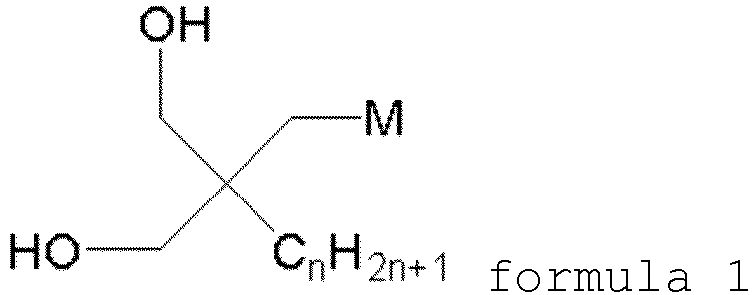 wherein M is an H atom, alkyl, Alkoxy group, hydroxyl, Hydroxyalkyl group or carbonyl; and2 ≤ n ≤ 16.
 - The water-repellent textile according to claim 1, wherein the non-fluorinated water-repellent compound is a hydrocarbon compound, a polysiloxane compound A or a copolymer thereof.
- The water-repellent textile according to claim 4, wherein the hydrocarbon compound is an acrylate compound having a structural unit shown in formula 2,
 wherein R1 and R2 are alkyl or unsaturated hydrocarbon groups, respectively; and2 ≤ n ≤ 200.
 - The water-repellent textile according to claim 4, wherein the polysiloxane compound A is a compound having a structure shown in formula 3,

- The water-repellent textile according to claim 1, wherein the resin film comprises a flexible compound, and the flexible compound is a polyethylene compound and/or a polysiloxane compound B.
- The water-repellent textile according to any one of claims 1 to 7, wherein the resin film has a thickness of 40 to 100 nm after being washed for 100 times according to the method 103 in JIS L 0217:1995 criteria or the method C4M in JIS L 1930:2014 criteria.
- The water-repellent textile according to any one of claims 1 to 7, wherein the initial water repellency of the textile is level 4 or above according to a test using the spray method in JIS L 1092:2009 criteria.
- The water-repellent textile according to any one of claims 1 to 7, wherein the textile has a water repellency of level 3 or above after being washed for 100 times according to the method 103 in JIS L 0217:1995 criteria or the method C4M in JIS L 1930:2014 criteria, and then tested according to the spray method in JIS L 1092:2009 criteria.
Applications Claiming Priority (2)
| Application Number | Priority Date | Filing Date | Title |
|---|---|---|---|
| CN202211002878 | 2022-08-22 | ||
| PCT/CN2023/113969 WO2024041476A1 (en) | 2022-08-22 | 2023-08-21 | Water-repellent textile |
Publications (1)
| Publication Number | Publication Date |
|---|---|
| EP4579032A1 true EP4579032A1 (en) | 2025-07-02 |
Family
ID=90012482
Family Applications (1)
| Application Number | Title | Priority Date | Filing Date |
|---|---|---|---|
| EP23856566.7A Pending EP4579032A1 (en) | 2022-08-22 | 2023-08-21 | Water-repellent textile |
Country Status (7)
| Country | Link |
|---|---|
| US (1) | US20250376804A1 (en) |
| EP (1) | EP4579032A1 (en) |
| JP (1) | JP2025526550A (en) |
| KR (1) | KR20250050865A (en) |
| CN (1) | CN119317747A (en) |
| TW (1) | TW202411496A (en) |
| WO (1) | WO2024041476A1 (en) |
Family Cites Families (14)
| Publication number | Priority date | Publication date | Assignee | Title |
|---|---|---|---|---|
| CN101001912B (en) * | 2004-09-09 | 2010-11-17 | 三菱丽阳株式会社 | Nanosubstance-containing composition, method for producing same, and composite using same |
| JP4996875B2 (en) * | 2005-04-28 | 2012-08-08 | 日華化学株式会社 | Water repellent, water repellent processing method and water repellent fiber product |
| JP2010510395A (en) * | 2006-11-17 | 2010-04-02 | ビーエーエスエフ ソシエタス・ヨーロピア | Aqueous preparation and use thereof |
| JP2010065066A (en) * | 2008-09-08 | 2010-03-25 | Fujifilm Corp | Hydrophilic polymer, method for producing hydrophilic polymer, hydrophilic membrane composition, and hydrophilic member using the same |
| CN103174025B (en) * | 2011-12-23 | 2016-06-22 | 东丽纤维研究所(中国)有限公司 | A kind of Antistatic nylon textile |
| JP6224487B2 (en) * | 2014-03-03 | 2017-11-01 | 帝人フロンティア株式会社 | Water-repellent fabric and method for producing the same |
| CN105734970A (en) | 2014-12-09 | 2016-07-06 | 东丽纤维研究所(中国)有限公司 | Textile subjected to water repellency treatment and production method thereof |
| CN107447523B (en) * | 2016-06-01 | 2021-03-05 | 东丽纤维研究所(中国)有限公司 | Textile subjected to water repellent treatment |
| CN106758252B (en) | 2016-11-29 | 2019-08-30 | 绍兴德美新材料有限公司 | Type water and oil repellent agent easy to maintain and preparation method thereof, textile |
| JP7064083B2 (en) * | 2017-10-02 | 2022-05-10 | ダイワボウレーヨン株式会社 | Water-repellent regenerated cellulose fiber, its manufacturing method and fiber structure containing it |
| JP7146426B2 (en) | 2018-03-27 | 2022-10-04 | 松本油脂製薬株式会社 | Textile water repellent composition and use thereof |
| JP2020200456A (en) * | 2019-06-10 | 2020-12-17 | 日華化学株式会社 | Non-fluorine-based polymer, surface treatment agent, water-repellent textile product and method for producing water-repellent textile product |
| JP6695582B1 (en) * | 2019-12-03 | 2020-05-20 | 株式会社finetrack | Water repellent knitted fabric, method for producing water repellent knitted fabric, garment composed of water repellent knitted fabric, and layering including the garment |
| JP7532954B2 (en) * | 2020-06-30 | 2024-08-14 | 株式会社レゾナック | Water-repellent treatment agent, water-repellent structure, and method for producing water-repellent structure |
-
2023
- 2023-08-21 EP EP23856566.7A patent/EP4579032A1/en active Pending
- 2023-08-21 CN CN202380047028.8A patent/CN119317747A/en active Pending
- 2023-08-21 US US18/874,082 patent/US20250376804A1/en active Pending
- 2023-08-21 TW TW112131330A patent/TW202411496A/en unknown
- 2023-08-21 JP JP2025500779A patent/JP2025526550A/en active Pending
- 2023-08-21 WO PCT/CN2023/113969 patent/WO2024041476A1/en not_active Ceased
- 2023-08-21 KR KR1020257002309A patent/KR20250050865A/en active Pending
Also Published As
| Publication number | Publication date |
|---|---|
| WO2024041476A1 (en) | 2024-02-29 |
| JP2025526550A (en) | 2025-08-15 |
| KR20250050865A (en) | 2025-04-15 |
| CN119317747A (en) | 2025-01-14 |
| US20250376804A1 (en) | 2025-12-11 |
| TW202411496A (en) | 2024-03-16 |
Similar Documents
| Publication | Publication Date | Title |
|---|---|---|
| Castelvetro et al. | Evaluating fluorinated acrylic latices as textile water and oil repellent finishes | |
| Periyasamy et al. | Salt free dyeing: a new method of dyeing of Lyocell fabrics with reactive dyes | |
| Gargoubi et al. | Water repellent treatment for cotton fabrics with long-chain fluoropolymer and its short-chain eco-friendly alternative | |
| CN109518468A (en) | A kind of preparation and application of organosilicon polymer superhydrophobic fabric finishing agent | |
| CN119711162A (en) | High-strength waterproof ultraviolet-resistant fabric and preparation method thereof | |
| US6245117B1 (en) | Modifier of cellulose fibers and modification method of cellulose fibers | |
| CN111893670A (en) | Dyeing and finishing integrated production equipment for textiles and use method thereof | |
| Shao et al. | Water and oil repellent and durable press finishes for cotton based on a perfluoroalkyl-containing multi-epoxy compound and citric acid | |
| Abou-Taleb et al. | Preparation of superhydrophobic polyester fabric for swimsuits using amino silicon micro-emulsion | |
| Wang et al. | A novel quaternary ammonium triethanolamine modified polyester polyether for rapid wetting and penetration pretreatment for digital inkjet dyeing of polyester fabric | |
| Tania et al. | Effects of resin treatments on the quality of cotton fabric dyed with reactive dye | |
| El-Newashy et al. | Wool fabrics with improved performance and comfort characteristics using functional polysiloxane | |
| US20250376804A1 (en) | Water-repellent textile | |
| KR20110056876A (en) | Antifouling fabric with improved friction durability and its manufacturing method | |
| Kabir et al. | A comparative study on dyeing properties of hemp and cotton fiber | |
| Borisova et al. | Hydrophobic treatment of blended fabric’s surface | |
| CN107447523B (en) | Textile subjected to water repellent treatment | |
| Haji et al. | Comparative study of exhaustion and pad-steam methods for improvement of handle, dye uptake and water absorption of polyester/cotton fabric | |
| CN114875554B (en) | Garment with antifouling and anti-wrinkle fabric | |
| CN113957728B (en) | Preparation method and application of nanogel composite dyeing flame retardant | |
| Wang et al. | Cotton fabric properties with water-repellent finishing via sol–gel process | |
| Atalie et al. | Development of Silicone Based Waterproof Polyester-Cotton Canvas Fabrics for Auto Rickshaw Cover | |
| Liu et al. | Salt-free dyeability of thiourea grafted cotton fabric | |
| EP3902953B1 (en) | Process for producing textile articles and textile articles obtained therefrom | |
| Yağız | Effect of different finishing processes on abrasion resistance of upholstery fabrics produced from polyester and acrylic chenille yarns |
Legal Events
| Date | Code | Title | Description |
|---|---|---|---|
| STAA | Information on the status of an ep patent application or granted ep patent |
Free format text: STATUS: THE INTERNATIONAL PUBLICATION HAS BEEN MADE |
|
| PUAI | Public reference made under article 153(3) epc to a published international application that has entered the european phase |
Free format text: ORIGINAL CODE: 0009012 |
|
| STAA | Information on the status of an ep patent application or granted ep patent |
Free format text: STATUS: REQUEST FOR EXAMINATION WAS MADE |
|
| 17P | Request for examination filed |
Effective date: 20241210 |
|
| AK | Designated contracting states |
Kind code of ref document: A1 Designated state(s): AL AT BE BG CH CY CZ DE DK EE ES FI FR GB GR HR HU IE IS IT LI LT LU LV MC ME MK MT NL NO PL PT RO RS SE SI SK SM TR |
|
| DAV | Request for validation of the european patent (deleted) | ||
| DAX | Request for extension of the european patent (deleted) |