EP4576838A1 - Tag, asset with tags, asset management system, and method for controlling the sending of communication packets of a tag - Google Patents
Tag, asset with tags, asset management system, and method for controlling the sending of communication packets of a tag Download PDFInfo
- Publication number
- EP4576838A1 EP4576838A1 EP23218833.4A EP23218833A EP4576838A1 EP 4576838 A1 EP4576838 A1 EP 4576838A1 EP 23218833 A EP23218833 A EP 23218833A EP 4576838 A1 EP4576838 A1 EP 4576838A1
- Authority
- EP
- European Patent Office
- Prior art keywords
- tag
- sending rate
- asset
- sending
- increased
- Prior art date
- Legal status (The legal status is an assumption and is not a legal conclusion. Google has not performed a legal analysis and makes no representation as to the accuracy of the status listed.)
- Pending
Links
Images


Classifications
-
- H—ELECTRICITY
- H04—ELECTRIC COMMUNICATION TECHNIQUE
- H04W—WIRELESS COMMUNICATION NETWORKS
- H04W4/00—Services specially adapted for wireless communication networks; Facilities therefor
- H04W4/02—Services making use of location information
- H04W4/025—Services making use of location information using location based information parameters
- H04W4/027—Services making use of location information using location based information parameters using movement velocity, acceleration information
-
- B—PERFORMING OPERATIONS; TRANSPORTING
- B25—HAND TOOLS; PORTABLE POWER-DRIVEN TOOLS; MANIPULATORS
- B25F—COMBINATION OR MULTI-PURPOSE TOOLS NOT OTHERWISE PROVIDED FOR; DETAILS OR COMPONENTS OF PORTABLE POWER-DRIVEN TOOLS NOT PARTICULARLY RELATED TO THE OPERATIONS PERFORMED AND NOT OTHERWISE PROVIDED FOR
- B25F5/00—Details or components of portable power-driven tools not particularly related to the operations performed and not otherwise provided for
-
- B—PERFORMING OPERATIONS; TRANSPORTING
- B25—HAND TOOLS; PORTABLE POWER-DRIVEN TOOLS; MANIPULATORS
- B25H—WORKSHOP EQUIPMENT, e.g. FOR MARKING-OUT WORK; STORAGE MEANS FOR WORKSHOPS
- B25H3/00—Storage means or arrangements for workshops facilitating access to, or handling of, work tools or instruments
-
- G—PHYSICS
- G06—COMPUTING OR CALCULATING; COUNTING
- G06K—GRAPHICAL DATA READING; PRESENTATION OF DATA; RECORD CARRIERS; HANDLING RECORD CARRIERS
- G06K17/00—Methods or arrangements for effecting co-operative working between equipments covered by two or more of main groups G06K1/00 - G06K15/00, e.g. automatic card files incorporating conveying and reading operations
- G06K17/0022—Methods or arrangements for effecting co-operative working between equipments covered by two or more of main groups G06K1/00 - G06K15/00, e.g. automatic card files incorporating conveying and reading operations arrangements or provisions for transferring data to distant stations, e.g. from a sensing device
- G06K17/0029—Methods or arrangements for effecting co-operative working between equipments covered by two or more of main groups G06K1/00 - G06K15/00, e.g. automatic card files incorporating conveying and reading operations arrangements or provisions for transferring data to distant stations, e.g. from a sensing device the arrangement being specially adapted for wireless interrogation of grouped or bundled articles tagged with wireless record carriers
-
- H—ELECTRICITY
- H04—ELECTRIC COMMUNICATION TECHNIQUE
- H04W—WIRELESS COMMUNICATION NETWORKS
- H04W4/00—Services specially adapted for wireless communication networks; Facilities therefor
- H04W4/02—Services making use of location information
- H04W4/029—Location-based management or tracking services
-
- H—ELECTRICITY
- H04—ELECTRIC COMMUNICATION TECHNIQUE
- H04W—WIRELESS COMMUNICATION NETWORKS
- H04W52/00—Power management, e.g. Transmission Power Control [TPC] or power classes
- H04W52/02—Power saving arrangements
- H04W52/0209—Power saving arrangements in terminal devices
- H04W52/0212—Power saving arrangements in terminal devices managed by the network, e.g. network or access point is leader and terminal is follower
- H04W52/0216—Power saving arrangements in terminal devices managed by the network, e.g. network or access point is leader and terminal is follower using a pre-established activity schedule, e.g. traffic indication frame
-
- H—ELECTRICITY
- H04—ELECTRIC COMMUNICATION TECHNIQUE
- H04W—WIRELESS COMMUNICATION NETWORKS
- H04W52/00—Power management, e.g. Transmission Power Control [TPC] or power classes
- H04W52/02—Power saving arrangements
- H04W52/0209—Power saving arrangements in terminal devices
- H04W52/0225—Power saving arrangements in terminal devices using monitoring of external events, e.g. the presence of a signal
- H04W52/0245—Power saving arrangements in terminal devices using monitoring of external events, e.g. the presence of a signal according to signal strength
-
- H—ELECTRICITY
- H04—ELECTRIC COMMUNICATION TECHNIQUE
- H04W—WIRELESS COMMUNICATION NETWORKS
- H04W52/00—Power management, e.g. Transmission Power Control [TPC] or power classes
- H04W52/02—Power saving arrangements
- H04W52/0209—Power saving arrangements in terminal devices
- H04W52/0251—Power saving arrangements in terminal devices using monitoring of local events, e.g. events related to user activity
- H04W52/0254—Power saving arrangements in terminal devices using monitoring of local events, e.g. events related to user activity detecting a user operation or a tactile contact or a motion of the device
-
- H—ELECTRICITY
- H04—ELECTRIC COMMUNICATION TECHNIQUE
- H04W—WIRELESS COMMUNICATION NETWORKS
- H04W52/00—Power management, e.g. Transmission Power Control [TPC] or power classes
- H04W52/02—Power saving arrangements
- H04W52/0209—Power saving arrangements in terminal devices
- H04W52/0261—Power saving arrangements in terminal devices managing power supply demand, e.g. depending on battery level
- H04W52/0274—Power saving arrangements in terminal devices managing power supply demand, e.g. depending on battery level by switching on or off the equipment or parts thereof
- H04W52/028—Power saving arrangements in terminal devices managing power supply demand, e.g. depending on battery level by switching on or off the equipment or parts thereof switching on or off only a part of the equipment circuit blocks
-
- H—ELECTRICITY
- H04—ELECTRIC COMMUNICATION TECHNIQUE
- H04W—WIRELESS COMMUNICATION NETWORKS
- H04W4/00—Services specially adapted for wireless communication networks; Facilities therefor
- H04W4/80—Services using short range communication, e.g. near-field communication [NFC], radio-frequency identification [RFID] or low energy communication
Definitions
- the present invention relates to a tag for an asset management system, to an asset with the tag, to an asset management system, to a method for controlling sending of communication packets of a tag, and to a computer program product to carry out the method.
- Asset management solutions or systems comprise assets with tags that periodically send communication packets, e.g., RF beacons such as advertising packets, via wireless communication.
- Devices e.g., gateways or mobile phones, can receive these communication packets.
- the receiving device knows that the tag, and therefore the tagged asset, is in its vicinity.
- Gateways with power supply from the grid, as receiving devices, often scan permanently for advertising packets. Due to their limited battery capacity, mobile phones or battery powered gateways may only scan on demand or less frequently. Tags have to send their communication packets often enough to fulfil requirements on timeliness of the information of the asset management system. When a mobile phone is used as receiving device, tags should send their communication packets often enough to be included in the scan of the mobile phone. E.g., a user may not want to wait for several minutes for a tag sending only every 5 minutes an advertising packet. However, sending frequently communication packets is consuming energy, and can reduce the lifetime of a tag with a non-exchangeable battery.
- a tag for an asset management system is comprising: a wireless communication unit, configured to send communication packets, in particular RF beacons, e.g. advertising packets, with an adjustable sending rate; a movement detection unit, configured to detect a movement of the tag and/or a use of a power tool or a power tool battery pack the tag is part of or attached to; one or more first processors of the tag, configured to instruct sending the communication packets with at least a first and a second sending rate, e.g., an RF beaconing rate, in dependence of detected changes of the movement or the use of the tag.
- a wireless communication unit configured to send communication packets, in particular RF beacons, e.g. advertising packets, with an adjustable sending rate
- a movement detection unit configured to detect a movement of the tag and/or a use of a power tool or a power tool battery pack the tag is part of or attached to
- one or more first processors of the tag configured to instruct sending the communication packets with at least a first and a second sending
- a tag being able to send with an adjustable sending rate may be set only on the higher sending rate, when necessary, e.g., for the asset management system.
- the tag may identify situations where a lower sending rate is sufficient and/or where a higher sending rate is preferable. E.g., when a tag is not moved, there will be also no changes to the location of the tag in the asset management system, however, when the tag is moved, the location in the asset management system may be changed. While an asset such as a power tool is used, it is also usually not transferred to another location in the asset management system.
- the sending rate may be reduced to, e.g., to the lower sending rate.
- a tag may be part of a power tool or a power tool battery pack and can be integrated in its electronic or a tag may be attached to a power tool or a power tool battery pack.
- the movement detection unit comprises an acceleration sensor, a vibration sensor, a GPS sensor, an orientation sensor, a gyro sensor, and/or a magnetometer.
- the kind of movement may be less relevant than the simple information that there is some kind of activity with the tag.
- Vibration of the tag may indicate a use of the asset the tag is attached to or a movement.
- the tag may be configured in a way, e.g., using artificial intelligence, to distinguish between vibrations due to movements and vibrations due to use.
- the movement detection unit may also receive information on use of the power tool the tag is attached to from the power tool itself, e.g., via an interface or being integrated with the power tool.
- the wireless communication unit may comprise a radiofrequency sender, e.g. a Bluetooth, Zigbee, Z-Wave, or LoRa sender.
- the wireless communication unit may additionally comprise a radiofrequency receiver, such as a Bluetooth, Zigbee, Z-Wave, or LoRa receiver.
- the tag is further comprising a battery, particularly, a coin cell, and/or a memory.
- Coin cells also known as button cells or coin batteries, are a useful power source for the tag.
- the battery may be exchangeable or not exchangeable, the battery may also be rechargeable or non-rechargeable. In particular for batteries, which cannot be exchanged, a low power consumption is desirable.
- an asset is proposed, in particular a power tool, more particular a saw, a driver, a wrench, a rotary hammer, a drill, or a screwdriver, or a or power tool battery pack with the described tag, particularly, wherein the tag is attached to, particularly glued to, or part of the asset.
- a power tool more particular a saw, a driver, a wrench, a rotary hammer, a drill, or a screwdriver, or a or power tool battery pack with the described tag, particularly, wherein the tag is attached to, particularly glued to, or part of the asset.
- tags can be attached to the power tools.
- Tags can be glued to the power tools or can be part of a power tool, e.g. embedded in the power tool and, e.g., integrated in its electronics.
- tags have non-exchangeable batteries to avoid servicing tags in the field, which might be burdensome, given the number of power tools on a construction site. If the lifetime of such a tag exceeds the typical service or exchange interval of the power tool, no field service due to the tag is necessary.
- the tag may use, alternatively or additionally to an own battery, the battery pack as power source or a power source of the power tool, e.g., the battery pack of the power tool.
- an asset management system comprising: the described tag and/or the described asset; and a gateway and/or a mobile device, particularly, a mobile phone, a tablet, or a laptop, configured to scan for communication packets of the tag.
- Gateways or mobile devices may be used in an asset management system to communicate with the assets, e.g., detect which assets identified with their tag are in their vicinity, and to communicate with a backend of the asset management system, e.g., reporting which assets are in their vicinity.
- the backend can process data from one or more gateways and provide information to a user, e.g., provide the information on which construction site a specific power tool is.
- Gateways are often stationary to a site, e.g., in a warehouse, at least over a certain time period of at least several weeks and are supplied with electricity from the grid. Gateways may also be installed in vans or containers where they may derive power from a battery or an external source.
- a gateway may scan for assets continually or periodically. The interval between scans may depend on the power source. When the distance of an asset to a gateway is increased, after a certain distance, depending on the sending power of the asset, the gateway will not be able to find the asset anymore and can report a removal of the asset from the location covered by the gateway. Similarly mobile devices may be used to scan for assets, respectively the associated tags, in their vicinity.
- a method for controlling sending of communication packets comprising: sending communication packets at a first sending rate by the tag; monitoring a motion state of the tag and/or a use state of a power tool, the tag is attached to or part of; sending the communication packets by the tag at a second sending rate, the second sending rate being higher or lower than the first sending rate, after a change in the motion state of the tag and/or a change in the use state of the power tool has been detected by the monitoring.
- the method allows to adjust a setting for the sending rate of a tag, e.g., optimized, to its environment.
- the change of the motion state of the tag or the use state of a power tool, to which the tag is associated, is monitored and is an input for determining the sending rate.
- the method may help to increase the lifetime of the tag, in particular, for a tag with a not exchangeable battery.
- the method may also reduce noise created by a frequent sending of communication packets, so-called beacons.
- the method may be implemented in various ways, some discussed in embodiments.
- the tag itself may monitor its movement. There are at least two different sending rates which may be selected for sending the communication packets.
- a lower sending rate is increased to a higher sending rate, if the motion state of the tag changes from not moving to moving; and the higher sending rate is decreased to the lower sending rate, if the motion state of the tag changes from moving to not moving.
- Lower sending rate and higher sending rate just describe a relation of the two sending rates, having a longer time period between communication packets, and having a shorter time period between communication packets.
- a tag and/or the asset associated with a tag e.g., a power tool or its accessories
- a longer time period between communication packets may be acceptable, as no new or changed information, e.g., that the tag is at a location, is transferred.
- the probability for the tag and/or the associated asset to be relocated is higher.
- the sending rate for the communication packets is increased and only after the movement has stopped, the sending rate is reduced again.
- a lower sending rate is increased to a higher sending rate for a predetermined first time period, if the motion state of the tag changes from not moving to moving; the lower sending rate is increased to the higher sending rate for a predetermined second time period, if the motion state of the tag changes from moving to not moving; and the higher sending rate is decreased to the lower sending rate after the predetermined first and/or second time period.
- a higher sending rate may be necessary.
- the sending rate of a tag may be lower and only when the van arrives at its destination the sending rate may be increased again. After no movement at the destination for a predetermined time, the sending rate may be lowered again.
- the lower sending rate is not increased and/or the higher sending rate is not decreased for a predetermined waiting period, after the change of the motion state of the tag has been detected, in particular, wherein the lower sending rate is not increased for the waiting period, after the change of the motion state from moving to not moving has been detected; and optionally, the lower sending rate is increased and/or the higher sending rate is decreased only if no further change of the motion state of the tag is detected during the waiting period.
- a waiting period may be introduced and only if no further change happens in the waiting period, the sending rate is changed.
- the waiting period may also support certain environments, such as the van, where the interesting time for determining assets at a location is after a movement has started or after a movement has stopped.
- a higher sending rate is decreased to a lower sending rate, if the use state of the tag changes from not used to used; and the lower sending rate is increased to the higher sending rate, if the use state of the tag changes from used to not used.
- Lower sending rate and higher sending rate just describe a relation of the two sending rates, having a longer time period between communication packets, and having a shorter time period between communication packets.
- a tag and/or the asset associated with a tag e.g., a power tool or its accessories
- a change of the location is not likely, and the tag and/or asset stays at the same location to which it is assigned in an asset management system.
- a drill will not be moved from one construction site to another construction site, while drilling.
- a longer time period between communication packets may be acceptable, as no new or changed information, e.g., that the tag is at a location, is transferred.
- the probability for the tag and/or the associated asset to be relocated is higher. To track this relocation, the sending rate for the communication packets is increased and only after the use has started again, the sending rate is reduced again.
- a higher sending rate is decreased to a lower sending rate for a predetermined third time period, if the use state of the tag changes from used to not used; the higher sending rate is decreased to the lower sending rate for a predetermined fourth time period, if the use state of the tag changes from not used to used; and the lower sending rate is increased to the higher sending rate after the predetermined third and/or fourth time period.
- the higher sending rate is not decreased and/or the lower sending rate is not increased for a predetermined waiting period, after the change of the use state of the tag has been detected, in particular, wherein the lower sending rate is not increased for the waiting period, after the change of the use state from used to not used has been detected; and optionally, the lower sending rate is increased and/or the higher sending rate is decreased only if no further change of the motion state of the tag is detected during the waiting period.
- a waiting period may be introduced and only if no further change happens in the waiting period, the sending rate is changed.
- the waiting period may also support certain environments, where the interesting time for determining assets at a location is after a use has been started or after a use has been stopped.
- the described method may be used for managing assets.
- the method may further comprise scanning for communication packets of one or more tags, particularly by a gateway.
- the described method is using the described tag, the described asset, and/or the described asset management system.
- a computer program product comprising instructions which, when the program is executed by one or more processors of a described tag, cause the processors to carry out the described method with the described tag, the described asset, and/or the described asset management system.
- the various embodiments of the method for controlling the sending of communication packets of tags may be combined with the disclosed tags, assets, asset management system, and/or the disclosed computer program product.
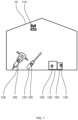
- Fig. 1 shows schematically the situation of a warehouse 10 with a gateway 110 for determining which assets 120 are in the vicinity of the gateway 110 and thus at the location assigned to the warehouse 10 in an asset management system.
- the gateway 110 reports to a backend of the asset management system the tags 100, from which the gateway 110 receives communication packets, e.g. RF beacons, particularly under Bluetooth, Zigbee, Z-Wave, or LoRa standards, and the tags 100 can be related to assets 120 in the asset management system.
- the tags 100 and or assets 120 with integrated tags 100 can send periodically communication packets, to advertise that they are present, so-called RF beacons.
- Tags 100 can be attached, e.g., glued, to an asset 120.
- the tags 100 send RF beacons periodically at regular intervals, e.g., every 5 seconds, 10 s, or 60 s, irrespective whether they are stationary present at the same location and scanned by the gateway 110 or if they are recently moved in or moved out of the range of the gateway 100, e.g., moved in or out of the warehouse 10. While assets 120 are stationary at the warehouse 10, no frequent updates might be necessary, thus saving energy. However, if an asset 120 is removed from the warehouse 10, a prompt information to the asset management system may be desirable. This can be supported by increasing the sending rate for beacons of a tag 100 associated to an asset 120, when the asset 120 is moved.
- Fig. 2 shows the general situation of a vehicle 20 with an asset determination system.
- the gateway 110 scans for Bluetooth beacons from assets 120 or tags 100 on assets 120.
- tags 100 representing assets 120 which are within the vehicle 20.
- tags 100 representing assets 120 which are outside of the vehicle, however, all shown tags 100 are within the detection range of the gateway 110, i.e., the signal strength of the tags 100 is high enough to be detected by the gateway 110.
- the asset determination system can only determine that the shown tags 100 are in the detection range 130 of the gateway 110.
- An asset management system may use the information to inform a user about assets 120 present or missing at a given location.
- Fig. 3 shows a process flow for a method for controlling sending of communication packets of a tag.
- communication packets are sent at a first sending rate by a first tag 100.
- the communication packets may be sent by a wireless communication unit 300 of the tag 100.
- a motion state of the tag 100 and/or a use state of a power tool, the tag 100 is attached to or part of, is monitored. This can be done by sensors of or an interface to a movement detection unit 330 of the first tag 100.
- the communication packets may include identification information of the tag 100, however, may also comprise further information such as temperature, position, movement, vibration.
- step S110 If in the parallel step S110 a change in the motion state of the tag 100 is detected, the tag 100 adjusts the sending rate to a second sending rate, different from the first sending rate, and sends in step S120 the communication packets with the second sending rate.
- the parallel monitoring of the motion or use state of step S110 may be also realized by alternating sending of one or more communication packets and monitoring the motion state, e.g., monitoring vibrations and or acceleration.
- the tag 100 or the power tools sending RF beacons thus can use changes of motion or use state, such as start and end of a movement or usage of the associated power tool, to adjust the intervals used to send RF beacons.
- the tag 100 or the asset 120 can use longer intervals between its beacons, enabling to save battery energy.
- the longer intervals should still enable the tag 100 or asset 120 to be scanned by a gateway 110 in the vicinity of the tag 100 or asset 120 from time to time, to enable the asset management system to function properly, i.e., to mark the asset 120 as present at the location.
- Fig. 4 shows an example of tag movement based adaptive beaconing where start of a movement triggers an increased beaconing rate.
- a tag 100 attached to an asset 120 shows two different states: In the static state, the tag 100 attached to the asset 120 is placed idle without change in position or not being used. In the kinetic state, the tag 100 attached to the asset 120 is being transported, moved, carried, or being used.
- the solid arrows 400 represent the communication packets sent on a timeline.
- the tag 100 beacons at longer intervals during static state of the asset 120 as the information on location transmitted by the tag 100 does not change.
- the beacon interval is set to shorter beacon interval. This enables a gateway 110 within the detection range 130 to capture important information such as when the asset 120 leaves the warehouse 10 and when the asset 120 comes back to the warehouse 10. Setting the beacon to shorter intervals during motion also enables a van gateway 110 to efficiently scan the assets 120 in the van 20 during transport without any delay.
- Fig. 5 shows an example of tag movement based adaptive beaconing where start 410 and stop 420 of a movement triggers an increased beaconing rate.
- the beacon interval is changed when the tag 100 has detected the start of motion 410 or the end of motion 420 and the change is reversed after a predetermined time.
- the gateway 110 may determine that the tag 100 has gone out of it range if it does not scan any beacon for a duration T L .
- the intervals T s or T h used by the tag 100 must be short enough compared to T L , e.g., shorter than 1/5 or 1/10 of T L , to ensure that the gateway 110 receives at least one beacon from the tag 100 to determine that it is still present at its location.
- Figs. 6 a and b show an example of tag movement based adaptive beaconing, where start 410 and stop 420 of a movement triggers an increased beaconing rate, which is adapted for a vehicle 20.
- the embodiment of Fig. 6 a and b is based on the example described in relation to Fig. 5 and the parameters may be the same as in Fig. 5 .
- the tag 100 detects a motion start 410 when a vehicle 20 starts to move and it detects a motion stop 420 when the vehicle 20 stops.
- the tag 100 detects the motion stop 420, it waits, different to the example in Fig. 5 , for a time period T m before switching to sending its beacons at interval T n for a predetermined time period T d2 .
- the tag 100 detects a motion start 410-2 before the interval T m has expired, the tag 100 cancels the switching to send beacons at interval T n , however, the tag 100 continues to send the beacons at interval T h , as shown in Fig. 6 b.
- FIGs. 7 a, b, and c show an example of a tool usage based adaptive beaconing.
- a tag 100 may have an algorithm to distinguish the transport or carrying vibration from power tool usage vibrations.
- the information on tool usage may also come directly from the power tool, e.g., based on turning its motor on or off, and the information is communicated to the tag 100 to enable it to adjust the intervals to send its RF beacons.
- the embodiment may be implemented, as shown in Fig. 7a , with the following parameters:
- a gateway 110 may determine that the tag 100 has gone out of it range if it does not scan any beacon for a duration T L .
- the intervals T s or T n used by the tag 100 must be short enough compared to T L , e.g., shorter than 1/5 or 1/10 of T L , to ensure that the gateway 110 receives at least one beacon from the tag 100 to determine that it is still present at its location.
- Figs. 7 b and c show how this frequent switching may be reduced.
- FIG. 7 c shows now that, if the next usage starts 710-2 within the stay back timer interval, i.e., less than T B time since the last usage has ended, the power tool cancels the switching to sending beacons with the intervals T n and continues to send beacons with the intervals T h .
- Fig. 7 c depicts that at time T 1 , the tag 100 detects a start of another usage 710-2 while the previous end of usage 720 was less than the interval T B ago. Therefore, the tag 100 cancels switching to using shorter intervals T n and continues to send its beacons at longer intervals T h .
- the tag 100 switches to using short intervals T n to send its beacons as it did not detect any new start of usage 710 within interval T B since the last usage stopped 720-2.
- the tag 100 may be integrated in the electronics of an asset 120, e.g., a power tool.
- the logic to detect a motion start or motion stop may be implemented for the method also in a separate module, e.g., an electronics module, outside the tag.
- Fig. 8 shows a schematic representation of a tag 100.
- the tag 100 comprises a wireless communication unit 300, which is configured to send communication packets with an adjustable sending rate, at least a lower sending rate and a higher sending rate are selectable for adjusting the sending rate.
- the tag 100 comprises a movement detection unit 330, configured to detect a movement and or a use of the tag 100.
- the movement detection unit 330 may comprise an acceleration sensor, a vibration sensor, a GPS sensor, an orientation sensor, a gyro sensor, and/or a magnetometer.
- the movement detection unit 330 is enabled by such a sensor to identify a movement of the tag 100, and its associated asset 120. There is no necessity to identify, e.g., a direction of the tag 100. It is sufficient to determine whether there is any movement.
- a use of a power tool, to which the tag 100 is attached to or of which the tag 100 is part of, may be determined from a specific movement of the tag 100, e.g., from a vibration signature.
- the tag 100 may, e.g., use artificial intelligence to differentiate between a use of a power tool and a change of the location of a power tool.
- the tag 100 may also have an interface to the power tool to get information on use of the power tool.
- the tag 100 comprises one or more processors 340.
- the processors 340 of the tag 100 are configured to instruct sending the communication packets with the lower or higher sending rate.
- the processors may be realized in various ways, e.g., as ASICS.
- a memory 350 may be included in the tags 100. The memory 350 may be used to store settings, such as the first and or second sending rate, or a waiting period.
- the tag 100 comprises a battery 360, powering the wireless communication unit 300, the sensors of the movement detection unit 330, the processors 340, and the memory 350.
- the battery 360 may be a non-exchangeable coin cell.
- the tag 100 may be connected to the power source of a power tool and, e.g., use the power tool battery or the tag may be part of or connected to a power tool battery pack.
Landscapes
- Engineering & Computer Science (AREA)
- Computer Networks & Wireless Communication (AREA)
- Signal Processing (AREA)
- Mechanical Engineering (AREA)
- General Engineering & Computer Science (AREA)
- Physics & Mathematics (AREA)
- General Physics & Mathematics (AREA)
- Theoretical Computer Science (AREA)
- Burglar Alarm Systems (AREA)
Abstract
A method for controlling sending of communication packets of a tag comprising:sending communication packets at a first sending rate by the tag; monitoring a motion state of the tag and/or a use state of a power tool, the tag is attached to or part of; sending the communication packets by the tag at a second sending rate, the second sending rate being higher or lower than the first sending rate, after a change in the motion state of the tag and/or a change in the use state of the power tool has been detected by the monitoring.
Description
- The present invention relates to a tag for an asset management system, to an asset with the tag, to an asset management system, to a method for controlling sending of communication packets of a tag, and to a computer program product to carry out the method.
- Asset management solutions or systems comprise assets with tags that periodically send communication packets, e.g., RF beacons such as advertising packets, via wireless communication. Devices, e.g., gateways or mobile phones, can receive these communication packets. When a communication packet from a tag is received, the receiving device knows that the tag, and therefore the tagged asset, is in its vicinity.
- An example for an asset management system is described in "Hilti ON!Track Proaktives Tracking - Immer einen Schritt voraus", https://www.youtube.com/watch?v=b0y5elXzf1Y, retrieved November 15, 2023, Hilti Osterreich.
- Gateways, with power supply from the grid, as receiving devices, often scan permanently for advertising packets. Due to their limited battery capacity, mobile phones or battery powered gateways may only scan on demand or less frequently. Tags have to send their communication packets often enough to fulfil requirements on timeliness of the information of the asset management system. When a mobile phone is used as receiving device, tags should send their communication packets often enough to be included in the scan of the mobile phone. E.g., a user may not want to wait for several minutes for a tag sending only every 5 minutes an advertising packet. However, sending frequently communication packets is consuming energy, and can reduce the lifetime of a tag with a non-exchangeable battery.
- It is one object of the present invention to provide an improved tag and method for controlling the sending of communication packets of tags.
- A tag for an asset management system is comprising: a wireless communication unit, configured to send communication packets, in particular RF beacons, e.g. advertising packets, with an adjustable sending rate; a movement detection unit, configured to detect a movement of the tag and/or a use of a power tool or a power tool battery pack the tag is part of or attached to; one or more first processors of the tag, configured to instruct sending the communication packets with at least a first and a second sending rate, e.g., an RF beaconing rate, in dependence of detected changes of the movement or the use of the tag.
- A tag being able to send with an adjustable sending rate, e.g. with two sending rates, one being a higher sending rate and one being a lower sending rate, may be set only on the higher sending rate, when necessary, e.g., for the asset management system. With a movement detection unit, the tag may identify situations where a lower sending rate is sufficient and/or where a higher sending rate is preferable. E.g., when a tag is not moved, there will be also no changes to the location of the tag in the asset management system, however, when the tag is moved, the location in the asset management system may be changed. While an asset such as a power tool is used, it is also usually not transferred to another location in the asset management system. When no change to the location in the asset management system is to be expected, the sending rate may be reduced to, e.g., to the lower sending rate. A tag may be part of a power tool or a power tool battery pack and can be integrated in its electronic or a tag may be attached to a power tool or a power tool battery pack.
- In an embodiment, the movement detection unit comprises an acceleration sensor, a vibration sensor, a GPS sensor, an orientation sensor, a gyro sensor, and/or a magnetometer. The kind of movement may be less relevant than the simple information that there is some kind of activity with the tag. Vibration of the tag may indicate a use of the asset the tag is attached to or a movement. The tag may be configured in a way, e.g., using artificial intelligence, to distinguish between vibrations due to movements and vibrations due to use. The movement detection unit may also receive information on use of the power tool the tag is attached to from the power tool itself, e.g., via an interface or being integrated with the power tool.
- The wireless communication unit may comprise a radiofrequency sender, e.g. a Bluetooth, Zigbee, Z-Wave, or LoRa sender. The wireless communication unit may additionally comprise a radiofrequency receiver, such as a Bluetooth, Zigbee, Z-Wave, or LoRa receiver.
- In an embodiment, the tag is further comprising a battery, particularly, a coin cell, and/or a memory. Coin cells, also known as button cells or coin batteries, are a useful power source for the tag. The battery may be exchangeable or not exchangeable, the battery may also be rechargeable or non-rechargeable. In particular for batteries, which cannot be exchanged, a low power consumption is desirable.
- Furthermore, an asset is proposed, in particular a power tool, more particular a saw, a driver, a wrench, a rotary hammer, a drill, or a screwdriver, or a or power tool battery pack with the described tag, particularly, wherein the tag is attached to, particularly glued to, or part of the asset.
- On a construction site there may be hundreds of power tools, which may also be used at other construction sites. To have an overview which power tools are on which site, tags can be attached to the power tools. Tags can be glued to the power tools or can be part of a power tool, e.g. embedded in the power tool and, e.g., integrated in its electronics. Usually, tags have non-exchangeable batteries to avoid servicing tags in the field, which might be burdensome, given the number of power tools on a construction site. If the lifetime of such a tag exceeds the typical service or exchange interval of the power tool, no field service due to the tag is necessary.
- Alternatively, in particular if a tag is part of a power tool or a power tool battery pack, the tag may use, alternatively or additionally to an own battery, the battery pack as power source or a power source of the power tool, e.g., the battery pack of the power tool.
- Furthermore, an asset management system is proposed, comprising: the described tag and/or the described asset; and a gateway and/or a mobile device, particularly, a mobile phone, a tablet, or a laptop, configured to scan for communication packets of the tag.
- Gateways or mobile devices may be used in an asset management system to communicate with the assets, e.g., detect which assets identified with their tag are in their vicinity, and to communicate with a backend of the asset management system, e.g., reporting which assets are in their vicinity. The backend can process data from one or more gateways and provide information to a user, e.g., provide the information on which construction site a specific power tool is. Gateways are often stationary to a site, e.g., in a warehouse, at least over a certain time period of at least several weeks and are supplied with electricity from the grid. Gateways may also be installed in vans or containers where they may derive power from a battery or an external source. E.g., depending on the power source, a gateway may scan for assets continually or periodically. The interval between scans may depend on the power source. When the distance of an asset to a gateway is increased, after a certain distance, depending on the sending power of the asset, the gateway will not be able to find the asset anymore and can report a removal of the asset from the location covered by the gateway. Similarly mobile devices may be used to scan for assets, respectively the associated tags, in their vicinity.
- While an asset is not moved, no change is to be expected and the sending rate of the tag of the asset may be reduced. When the asset is moved, it might be advantageous to increase the sending rate, the number of communication packets per time, of the tag of the asset, e.g., to be better and/or faster detectable by another gateway or by a mobile device.
- According to a further aspect, a method for controlling sending of communication packets, e.g., RF beacons such as advertising packets, of a tag is proposed, comprising: sending communication packets at a first sending rate by the tag; monitoring a motion state of the tag and/or a use state of a power tool, the tag is attached to or part of; sending the communication packets by the tag at a second sending rate, the second sending rate being higher or lower than the first sending rate, after a change in the motion state of the tag and/or a change in the use state of the power tool has been detected by the monitoring.
- The method allows to adjust a setting for the sending rate of a tag, e.g., optimized, to its environment. The change of the motion state of the tag or the use state of a power tool, to which the tag is associated, is monitored and is an input for determining the sending rate. Based on the specific system, in which the tag is used, the method may help to increase the lifetime of the tag, in particular, for a tag with a not exchangeable battery. The method may also reduce noise created by a frequent sending of communication packets, so-called beacons. The method may be implemented in various ways, some discussed in embodiments. The tag itself may monitor its movement. There are at least two different sending rates which may be selected for sending the communication packets.
- In an embodiment, a lower sending rate is increased to a higher sending rate, if the motion state of the tag changes from not moving to moving; and the higher sending rate is decreased to the lower sending rate, if the motion state of the tag changes from moving to not moving. Lower sending rate and higher sending rate just describe a relation of the two sending rates, having a longer time period between communication packets, and having a shorter time period between communication packets. Usually, if a tag and/or the asset associated with a tag, e.g., a power tool or its accessories, is not moved, a change of the location is not likely, and the tag and/or asset stays at the same location to which it is assigned in an asset management system. In a situation where no movement has to be expected, a longer time period between communication packets may be acceptable, as no new or changed information, e.g., that the tag is at a location, is transferred. When a movement is detected, the probability for the tag and/or the associated asset to be relocated is higher. To track this relocation, the sending rate for the communication packets is increased and only after the movement has stopped, the sending rate is reduced again.
- In an embodiment, a lower sending rate is increased to a higher sending rate for a predetermined first time period, if the motion state of the tag changes from not moving to moving; the lower sending rate is increased to the higher sending rate for a predetermined second time period, if the motion state of the tag changes from moving to not moving; and the higher sending rate is decreased to the lower sending rate after the predetermined first and/or second time period. There may be environments where only when the motion state is changed a higher sending rate may be necessary. E.g., in an asset management system operating on a van, after the van starts moving no new assets can be brought on board of the van. Therefore, in the middle of the drive of a van the sending rate of a tag may be lower and only when the van arrives at its destination the sending rate may be increased again. After no movement at the destination for a predetermined time, the sending rate may be lowered again.
- In an embodiment, the lower sending rate is not increased and/or the higher sending rate is not decreased for a predetermined waiting period, after the change of the motion state of the tag has been detected, in particular, wherein the lower sending rate is not increased for the waiting period, after the change of the motion state from moving to not moving has been detected; and optionally, the lower sending rate is increased and/or the higher sending rate is decreased only if no further change of the motion state of the tag is detected during the waiting period. To avoid changing the sending rate for a lot of short and intermittent changes of the motion state, a waiting period may be introduced and only if no further change happens in the waiting period, the sending rate is changed. The waiting period may also support certain environments, such as the van, where the interesting time for determining assets at a location is after a movement has started or after a movement has stopped.
- In an embodiment, a higher sending rate is decreased to a lower sending rate, if the use state of the tag changes from not used to used; and the lower sending rate is increased to the higher sending rate, if the use state of the tag changes from used to not used.
- Lower sending rate and higher sending rate just describe a relation of the two sending rates, having a longer time period between communication packets, and having a shorter time period between communication packets. Usually, if a tag and/or the asset associated with a tag, e.g., a power tool or its accessories, is used, a change of the location is not likely, and the tag and/or asset stays at the same location to which it is assigned in an asset management system. E.g., a drill will not be moved from one construction site to another construction site, while drilling. In a situation where no movement has to be expected, a longer time period between communication packets may be acceptable, as no new or changed information, e.g., that the tag is at a location, is transferred. When no use of the power tool is detected, the probability for the tag and/or the associated asset to be relocated is higher. To track this relocation, the sending rate for the communication packets is increased and only after the use has started again, the sending rate is reduced again.
- In an embodiment, a higher sending rate is decreased to a lower sending rate for a predetermined third time period, if the use state of the tag changes from used to not used; the higher sending rate is decreased to the lower sending rate for a predetermined fourth time period, if the use state of the tag changes from not used to used; and the lower sending rate is increased to the higher sending rate after the predetermined third and/or fourth time period.
- In an embodiment, the higher sending rate is not decreased and/or the lower sending rate is not increased for a predetermined waiting period, after the change of the use state of the tag has been detected, in particular, wherein the lower sending rate is not increased for the waiting period, after the change of the use state from used to not used has been detected; and optionally, the lower sending rate is increased and/or the higher sending rate is decreased only if no further change of the motion state of the tag is detected during the waiting period. To avoid changing the sending rate for a lot of short and intermittent changes of the use state, a waiting period may be introduced and only if no further change happens in the waiting period, the sending rate is changed. The waiting period may also support certain environments, where the interesting time for determining assets at a location is after a use has been started or after a use has been stopped.
- The described method may be used for managing assets. The method may further comprise scanning for communication packets of one or more tags, particularly by a gateway.
- In an embodiment, the described method is using the described tag, the described asset, and/or the described asset management system.
- Furthermore, a computer program product is proposed, comprising instructions which, when the program is executed by one or more processors of a described tag, cause the processors to carry out the described method with the described tag, the described asset, and/or the described asset management system.
- The various embodiments of the method for controlling the sending of communication packets of tags may be combined with the disclosed tags, assets, asset management system, and/or the disclosed computer program product.
- Further possible implementations or alternative solutions of the invention also encompass combinations - that are not explicitly mentioned herein - of features described above or below with regard to the embodiments. The person skilled in the art may also add individual or isolated aspects and features to the most basic form of the invention.
- Further embodiments, features and advantages of the present invention will become apparent from the subsequent description and dependent claims, taken in conjunction with the accompanying drawings, in which:
- Fig. 1
- shows schematically the situation of a warehouse with a gateway for determining which assets are in the vicinity of the gateway;
- Fig. 2
- shows the general situation of a
vehicle 20 with an asset determination system; - Fig. 3
- shows a process flow for a method for controlling a sending of communication packets of tags;
- Fig. 4
- shows an example of tag movement based adaptive beaconing, where start of a movement triggers an increased beaconing rate;
- Fig. 5
- shows an example of tag movement based adaptive beaconing where start and stop of a movement triggers an increased beaconing rate;
- Figs. 6 a, b
- show an example of tag movement based adaptive beaconing, where start and stop of a movement triggers an increased beaconing rate, adapted for a vehicle;
- Figs. 7 a, b, c
- show an example of tool usage based adaptive beaconing; and
- Fig. 8
- shows a schematic representation of a tag.
- In the Figures, like reference numerals designate like or functionally equivalent elements, unless otherwise indicated.
-
Fig. 1 shows schematically the situation of awarehouse 10 with agateway 110 for determining whichassets 120 are in the vicinity of thegateway 110 and thus at the location assigned to thewarehouse 10 in an asset management system. Thegateway 110 reports to a backend of the asset management system thetags 100, from which thegateway 110 receives communication packets, e.g. RF beacons, particularly under Bluetooth, Zigbee, Z-Wave, or LoRa standards, and thetags 100 can be related toassets 120 in the asset management system. Thetags 100 and orassets 120 withintegrated tags 100 can send periodically communication packets, to advertise that they are present, so-called RF beacons.Tags 100 can be attached, e.g., glued, to anasset 120.Tags 100 may also be embedded in the electronics of an asset, e.g., in the electronics of a power tool or a battery pack. The Bluetooth standard may be used for the sending of the RF beacons as advertising packets. The asset management system can inform users about theassets 120 in thewarehouse 10. Sending RF beacons consumes energy, e.g., from the limited power supply, e.g., a coin cell, of atag 100. - Usually, the
tags 100 send RF beacons periodically at regular intervals, e.g., every 5 seconds, 10 s, or 60 s, irrespective whether they are stationary present at the same location and scanned by thegateway 110 or if they are recently moved in or moved out of the range of thegateway 100, e.g., moved in or out of thewarehouse 10. Whileassets 120 are stationary at thewarehouse 10, no frequent updates might be necessary, thus saving energy. However, if anasset 120 is removed from thewarehouse 10, a prompt information to the asset management system may be desirable. This can be supported by increasing the sending rate for beacons of atag 100 associated to anasset 120, when theasset 120 is moved. -
Fig. 2 shows the general situation of avehicle 20 with an asset determination system. There is agateway 110 on the vehicle. Thegateway 110 scans for Bluetooth beacons fromassets 120 ortags 100 onassets 120. There aretags 100 representingassets 120, which are within thevehicle 20. There aretags 100 representingassets 120, which are outside of the vehicle, however, all showntags 100 are within the detection range of thegateway 110, i.e., the signal strength of thetags 100 is high enough to be detected by thegateway 110. The asset determination system can only determine that the showntags 100 are in thedetection range 130 of thegateway 110. An asset management system may use the information to inform a user aboutassets 120 present or missing at a given location. -
Fig. 3 shows a process flow for a method for controlling sending of communication packets of a tag. In step S100 communication packets are sent at a first sending rate by afirst tag 100. The communication packets may be sent by awireless communication unit 300 of thetag 100. In parallel, in step S110, a motion state of thetag 100 and/or a use state of a power tool, thetag 100 is attached to or part of, is monitored. This can be done by sensors of or an interface to amovement detection unit 330 of thefirst tag 100. The communication packets may include identification information of thetag 100, however, may also comprise further information such as temperature, position, movement, vibration. If in the parallel step S110 a change in the motion state of thetag 100 is detected, thetag 100 adjusts the sending rate to a second sending rate, different from the first sending rate, and sends in step S120 the communication packets with the second sending rate. Of course, the parallel monitoring of the motion or use state of step S110 may be also realized by alternating sending of one or more communication packets and monitoring the motion state, e.g., monitoring vibrations and or acceleration. - The
tag 100 or the power tools sending RF beacons, thus can use changes of motion or use state, such as start and end of a movement or usage of the associated power tool, to adjust the intervals used to send RF beacons. - If a
tag 100 or the associatedasset 120 is present at its location and does not detect any movement, thetag 100 or theasset 120 can use longer intervals between its beacons, enabling to save battery energy. The longer intervals should still enable thetag 100 orasset 120 to be scanned by agateway 110 in the vicinity of thetag 100 orasset 120 from time to time, to enable the asset management system to function properly, i.e., to mark theasset 120 as present at the location. -
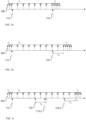
Fig. 4 shows an example of tag movement based adaptive beaconing where start of a movement triggers an increased beaconing rate. Atag 100 attached to anasset 120 shows two different states: In the static state, thetag 100 attached to theasset 120 is placed idle without change in position or not being used. In the kinetic state, thetag 100 attached to theasset 120 is being transported, moved, carried, or being used. Thesolid arrows 400 represent the communication packets sent on a timeline. - To save battery energy, the
tag 100 beacons at longer intervals during static state of theasset 120 as the information on location transmitted by thetag 100 does not change. When thetag 100 detects motion, e.g. a vibration, the beacon interval is set to shorter beacon interval. This enables agateway 110 within thedetection range 130 to capture important information such as when theasset 120 leaves thewarehouse 10 and when theasset 120 comes back to thewarehouse 10. Setting the beacon to shorter intervals during motion also enables avan gateway 110 to efficiently scan theassets 120 in thevan 20 during transport without any delay. - This may be implemented with the following parameters:
- Ts is a beacon interval in the static state and may be, e.g., between 60 seconds and 240 s;
- Tk is a beacon interval in the kinetic state and may be, e.g., between 5 s and 10 s; and
- Tw is a wait time to revert from Tk to Ts and may be between 120 s and 300 s.
- If the tag is in the static state, the beacon interval may be set to Ts = 60 s. When the tag has detected motion or vibration at the
time 410, the beacon interval will be changed to Tk =7 s and stays in this beacon interval settings until no movement is detected for a continuous waiting period Tw = 300 seconds. I.e. when the movement stops at thetime 420, the beaconing interval will be increased only at thetime 430. -
Fig. 5 shows an example of tag movement based adaptive beaconing where start 410 and stop 420 of a movement triggers an increased beaconing rate. The beacon interval is changed when thetag 100 has detected the start ofmotion 410 or the end ofmotion 420 and the change is reversed after a predetermined time. - This may be implemented with the following parameters:
- if the
tag 100 detects a start of a movement, it sends its RF beacons at intervals Tn, e.g., Tn is between 5 s and 10 s; - the
tag 100 continues to send its RF beacons at this rate for a predetermined time period Td1; - if the
tag 100 detects that the motion has stopped, it starts to send its beacon at intervals Tn again; - the
tag 100 continues to send its RF beacons at this rate for a predetermined time period Td2; - after the time periods Td1 and Td2, the
tag 100 starts to send its RF beacons at intervals Th, e.g., Th being between 60 s and 300 s. - In an asset management system, the
gateway 110 may determine that thetag 100 has gone out of it range if it does not scan any beacon for a duration TL. The intervals Ts or Th used by thetag 100 must be short enough compared to TL, e.g., shorter than 1/5 or 1/10 of TL, to ensure that thegateway 110 receives at least one beacon from thetag 100 to determine that it is still present at its location. -
Figs. 6 a and b show an example of tag movement based adaptive beaconing, where start 410 and stop 420 of a movement triggers an increased beaconing rate, which is adapted for avehicle 20. The embodiment ofFig. 6 a and b is based on the example described in relation toFig. 5 and the parameters may be the same as inFig. 5 . Thetag 100 detects amotion start 410 when avehicle 20 starts to move and it detects amotion stop 420 when thevehicle 20 stops. When thetag 100 detects themotion stop 420, it waits, different to the example inFig. 5 , for a time period Tm before switching to sending its beacons at interval Tn for a predetermined time period Td2. - If now the
tag 100 detects a motion start 410-2 before the interval Tm has expired, thetag 100 cancels the switching to send beacons at interval Tn, however, thetag 100 continues to send the beacons at interval Th, as shown inFig. 6 b. -
Figs. 7 a, b, and c show an example of a tool usage based adaptive beaconing. Atag 100 may have an algorithm to distinguish the transport or carrying vibration from power tool usage vibrations. The information on tool usage may also come directly from the power tool, e.g., based on turning its motor on or off, and the information is communicated to thetag 100 to enable it to adjust the intervals to send its RF beacons. - The embodiment may be implemented, as shown in
Fig. 7a , with the following parameters: - If a
tag 100 detects a start ofusage 710, it starts to send its RF beacons at intervals Th, e.g., Th between 60 s, and 120 s; - The
tag 100 continues to send its RF beacons at this longer interval during usage of its attached tool; - if the
tag 100 detects that the usage has stopped 720, it starts to send its beacon at intervals Tn, e.g., Tn between 5 s and 10 seconds. - In an asset management system, a
gateway 110 may determine that thetag 100 has gone out of it range if it does not scan any beacon for a duration TL. The intervals Ts or Tn used by thetag 100 must be short enough compared to TL, e.g., shorter than 1/5 or 1/10 of TL, to ensure that thegateway 110 receives at least one beacon from thetag 100 to determine that it is still present at its location. - Some power tools may only be used for a short time period, e.g., power tools used for drilling. This may result in frequent switching between sending beacons with longer interval and shorter interval.
Figs. 7 b and c show how this frequent switching may be reduced. After the stop ofusage 720 has been identified by thetag 100, inFig. 7 b , thetag 100 starts to send its beacons at intervals Tn only after the predetermined time period TB, a stay back timer, has passed since the usage has stopped.Fig. 7 c shows now that, if the next usage starts 710-2 within the stay back timer interval, i.e., less than TB time since the last usage has ended, the power tool cancels the switching to sending beacons with the intervals Tn and continues to send beacons with the intervals Th.Fig. 7 c depicts that at time T1, thetag 100 detects a start of another usage 710-2 while the previous end ofusage 720 was less than the interval TB ago. Therefore, thetag 100 cancels switching to using shorter intervals Tn and continues to send its beacons at longer intervals Th. - At time T2, the
tag 100 switches to using short intervals Tn to send its beacons as it did not detect any new start ofusage 710 within interval TB since the last usage stopped 720-2. - The
tag 100 may be integrated in the electronics of anasset 120, e.g., a power tool. The logic to detect a motion start or motion stop may be implemented for the method also in a separate module, e.g., an electronics module, outside the tag. -
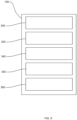
Fig. 8 shows a schematic representation of atag 100. Thetag 100 comprises awireless communication unit 300, which is configured to send communication packets with an adjustable sending rate, at least a lower sending rate and a higher sending rate are selectable for adjusting the sending rate. - The
tag 100 comprises amovement detection unit 330, configured to detect a movement and or a use of thetag 100. Themovement detection unit 330 may comprise an acceleration sensor, a vibration sensor, a GPS sensor, an orientation sensor, a gyro sensor, and/or a magnetometer. Themovement detection unit 330 is enabled by such a sensor to identify a movement of thetag 100, and its associatedasset 120. There is no necessity to identify, e.g., a direction of thetag 100. It is sufficient to determine whether there is any movement. A use of a power tool, to which thetag 100 is attached to or of which thetag 100 is part of, may be determined from a specific movement of thetag 100, e.g., from a vibration signature. Thetag 100 may, e.g., use artificial intelligence to differentiate between a use of a power tool and a change of the location of a power tool. Thetag 100 may also have an interface to the power tool to get information on use of the power tool. - The
tag 100 comprises one ormore processors 340. Theprocessors 340 of thetag 100 are configured to instruct sending the communication packets with the lower or higher sending rate. The processors may be realized in various ways, e.g., as ASICS. Additionally, amemory 350 may be included in thetags 100. Thememory 350 may be used to store settings, such as the first and or second sending rate, or a waiting period. - The
tag 100 comprises abattery 360, powering thewireless communication unit 300, the sensors of themovement detection unit 330, theprocessors 340, and thememory 350. Thebattery 360 may be a non-exchangeable coin cell. - In alternative embodiments, the
tag 100 may be connected to the power source of a power tool and, e.g., use the power tool battery or the tag may be part of or connected to a power tool battery pack. -
- 10
- warehouse
- 20
- van
- 100
- tag
- 110
- gateway
- 120
- asset
- 130
- detection range
- 300
- wireless communication unit
- 330
- movement detection unit
- 340
- processor
- 350
- memory
- 360
- battery
- 400
- communication packets
- 410, 410-2
- start of movement
- 420
- stop of movement
- 430
- decrease beaconing rate
- 710,710-2
- start of usage
- 720, 720-2
- stop of usage
- S100
- sending communication packets at first sending rate
- S110
- monitoring movement and/or use state
- S120
- sending communication packets at second sending rate
Claims (15)
- A tag (100) for an asset management system comprising:- a wireless communication unit (300), configured to send communication packets with an adjustable sending rate;- a movement detection unit (330), configured to detect a movement of the tag (100) and/or a use of a power tool or power tool battery pack, the tag (100) is part of or attached to;- one or more first processors (340) of the tag (100), configured to instruct sending the communication packets with at least a first and a second sending rate in dependence of detected changes of the movement or the use of the tag (100).
- The tag (100) according to claim 1, wherein the movement detection unit (330) comprises an acceleration sensor, a vibration sensor, a GPS sensor, an orientation sensor, a gyro sensor, and/or a magnetometer and/or wherein the wireless communication unit (300) comprises a radiofrequency sender, particularly a Bluetooth, Zigbee, Z-Wave, or LoRa sender.
- The tag (100) according to any of the claims 1 to 3, further comprising a battery (360), particularly, a coin cell, and/or a memory (350).
- An asset (120), in particular a power tool or a power tool battery pack, more particular a saw, a driver, a wrench, a rotary hammer, a drill, or a screwdriver, with a tag (100) according to any of the claims 1 to 3, particularly, wherein the tag (100) is attached to, particularly glued to, or part of the asset (120).
- An asset management system comprising:- a tag (100) according to any of the claims 1 to 3 and/or an asset (120) according to claim 4; and- a gateway (110) and/or a mobile device, particularly, a mobile phone (120), a tablet, or a laptop, configured to scan for communication packets of the tag (100).
- A method for controlling sending of communication packets of a tag (100) comprising:- sending (S100) communication packets at a first sending rate by the tag (100);- monitoring (S110) a motion state of the tag (100) and/or a use state of a power tool, the tag (100) is attached to or part of;- sending the communication packets by the tag (100) at a second sending rate, the second sending rate being higher or lower than the first sending rate, after a change in the motion state of the tag (100) and/or a change in the use state of the power tool has been detected by the monitoring.
- The method according to claim 6, wherein- a lower sending rate is increased to a higher sending rate, if the motion state of the tag (100) changes from not moving to moving (410); and- the higher sending rate is decreased to the lower sending rate, if the motion state of the tag (100) changes from moving to not moving (420).
- The method according to claim 6, wherein- a lower sending rate is increased to a higher sending rate for a predetermined first time period, if the motion state of the tag (100) changes from not moving to moving (410);- the lower sending rate is increased to the higher sending rate for a predetermined second time period, if the motion state of the tag (100) changes from moving to not moving (420); and- the higher sending rate is decreased to the lower sending rate after the predetermined first and/or second time period.
- The method according to claim 7 or 8, wherein- the lower sending rate is not increased and/or the higher sending rate is not decreased for a predetermined waiting period, after the change of the motion state of the tag (100) has been detected, in particular, wherein the lower sending rate is not increased for the waiting period, after the change of the motion state from moving to not moving (420) has been detected; and- optionally, the lower sending rate is increased and/or the higher sending rate is decreased only if no further change of the motion state of the tag (100) is detected during the waiting period.
- The method according to any of the claims 6 to 9, wherein- a higher sending rate is decreased to a lower sending rate, if the use state of the tag (100) changes from not used to used (710); and- the lower sending rate is increased to the higher sending rate, if the use state of the tag (100) changes from used to not used (720).
- The method according to claim 6, wherein the- a higher sending rate is decreased to a lower sending rate for a predetermined third time period, if the use state of the tag (100) changes from used to not used (420);- the higher sending rate is decreased to the lower sending rate for a predetermined fourth time period, if the use state of the tag (100) changes from not used to used (410); and- the lower sending rate is increased to the higher sending rate after the predetermined third and/or fourth time period.
- The method according to claim 10 or 11, wherein- the higher sending rate is not decreased and/or the lower sending rate is not increased for a predetermined waiting period, after the change of the use state of the tag (100) has been detected, in particular, wherein the lower sending rate is not increased for the waiting period, after the change of the use state from used to not used (720) has been detected; and- optionally, the lower sending rate is increased and/or the higher sending rate is decreased only if no further change of the motion state of the tag (100) is detected during the waiting period.
- The method according to any of the claims 6 to 12, particularly used for managing assets (120), further comprising:- scanning (S120) for communication packets of one or more tags (100), particularly by a gateway (110).
- The method according to any of the claims 6 to 13, using the tag (100) according to any of the claims 1 to 3, the asset (120) according to claim 4 and/or the asset management system according to claim 5 .
- A computer program product comprising instructions which, when the program is executed by the one or more processors (340) cause the processors (340) to carry out the method according to any of the claims 6 to 13 with a tag (100) according to any of the claims 1 to 3, an asset (120) according to claim 4 and/or an asset management system according to claim 5.
Priority Applications (2)
| Application Number | Priority Date | Filing Date | Title |
|---|---|---|---|
| EP23218833.4A EP4576838A1 (en) | 2023-12-20 | 2023-12-20 | Tag, asset with tags, asset management system, and method for controlling the sending of communication packets of a tag |
| PCT/EP2024/084783 WO2025131738A1 (en) | 2023-12-20 | 2024-12-05 | Tag, asset with tags, asset management system, and method for controlling the sending of communication packets of a tag |
Applications Claiming Priority (1)
| Application Number | Priority Date | Filing Date | Title |
|---|---|---|---|
| EP23218833.4A EP4576838A1 (en) | 2023-12-20 | 2023-12-20 | Tag, asset with tags, asset management system, and method for controlling the sending of communication packets of a tag |
Publications (1)
| Publication Number | Publication Date |
|---|---|
| EP4576838A1 true EP4576838A1 (en) | 2025-06-25 |
Family
ID=89386268
Family Applications (1)
| Application Number | Title | Priority Date | Filing Date |
|---|---|---|---|
| EP23218833.4A Pending EP4576838A1 (en) | 2023-12-20 | 2023-12-20 | Tag, asset with tags, asset management system, and method for controlling the sending of communication packets of a tag |
Country Status (2)
| Country | Link |
|---|---|
| EP (1) | EP4576838A1 (en) |
| WO (1) | WO2025131738A1 (en) |
Citations (3)
| Publication number | Priority date | Publication date | Assignee | Title |
|---|---|---|---|---|
| US20100039280A1 (en) * | 2008-08-18 | 2010-02-18 | Honeywell International Inc. | Method and apparatus for wireless asset tracking using asset tags with motion sensors |
| EP3136319A1 (en) * | 2015-08-26 | 2017-03-01 | BlackBerry Limited | Method and system for asset tracking in an enterprise environment |
| US20180293862A1 (en) * | 2013-10-07 | 2018-10-11 | Recon Dynamics, Llc | System and method for automatic tool tracking, monitoring, and inventory management |
-
2023
- 2023-12-20 EP EP23218833.4A patent/EP4576838A1/en active Pending
-
2024
- 2024-12-05 WO PCT/EP2024/084783 patent/WO2025131738A1/en active Pending
Patent Citations (3)
| Publication number | Priority date | Publication date | Assignee | Title |
|---|---|---|---|---|
| US20100039280A1 (en) * | 2008-08-18 | 2010-02-18 | Honeywell International Inc. | Method and apparatus for wireless asset tracking using asset tags with motion sensors |
| US20180293862A1 (en) * | 2013-10-07 | 2018-10-11 | Recon Dynamics, Llc | System and method for automatic tool tracking, monitoring, and inventory management |
| EP3136319A1 (en) * | 2015-08-26 | 2017-03-01 | BlackBerry Limited | Method and system for asset tracking in an enterprise environment |
Non-Patent Citations (1)
| Title |
|---|
| HILTI OSTERREICH, HILTI ON!TRACK PROAKTIVES TRACKING - IMMER EINEN SCHRITT VORAUS, 15 November 2023 (2023-11-15), Retrieved from the Internet <URL:https://www.youtube.com/watch?v=b0y5elXzf1Y> |
Also Published As
| Publication number | Publication date |
|---|---|
| WO2025131738A1 (en) | 2025-06-26 |
Similar Documents
| Publication | Publication Date | Title |
|---|---|---|
| CN100409262C (en) | Apparatus, system and method for position reporting or tracking | |
| CN1930897B (en) | Method and apparatus for intuitive energy management for short-range communication transceivers associated with mobile terminals | |
| US8305190B2 (en) | Method and apparatus for power management for a radio frequency identification system | |
| US8135415B2 (en) | Integrated active tags in mobile devices | |
| US8674807B2 (en) | Method, system and devices for data acquisition | |
| US9713116B2 (en) | Apparatus and method for radio frequency silencing in oil and gas operations, excavation sites, and other environments | |
| CN103380446A (en) | Power management in wireless tracking device operating with restricted power source | |
| US20070019452A1 (en) | Electronic apparatus and sensor network system | |
| US11902851B2 (en) | Smart cord for corded power tools | |
| JP2009017621A (en) | Portable terminal device and charge guidance method | |
| US20250219509A1 (en) | Microcontroller Board for a Power Tool, Monitoring System and Method | |
| US20070149257A1 (en) | Novel design for a wireless network device | |
| WO2025131738A1 (en) | Tag, asset with tags, asset management system, and method for controlling the sending of communication packets of a tag | |
| JP2006108755A (en) | Radio equipment and radio transmission/reception system using the radio equipment | |
| EP4576837A1 (en) | Tag, asset with tags, asset management system, and method for controlling the sending of advertising packets of tags | |
| US10045185B1 (en) | Dynamic advertisement data | |
| US12552002B2 (en) | Systems and methods for power tool communication | |
| JP2004133795A (en) | Data sender | |
| JP7757558B1 (en) | Device, device control method, and device control program | |
| WO2026048003A1 (en) | Spatial power transmission system | |
| CN101819613A (en) | Notebook computer with displacement detection function | |
| WO2026047996A1 (en) | Spatial power transmission system | |
| WO2005065363A2 (en) | Methods and apparatus of aggregating and communicating tracking information with routing set-up for tracking devices | |
| WO2006105380A1 (en) | A portable motion-activated position reporting device | |
| WO2023039148A1 (en) | Systems and methods for information retrieval of power tools in a mesh network |
Legal Events
| Date | Code | Title | Description |
|---|---|---|---|
| PUAI | Public reference made under article 153(3) epc to a published international application that has entered the european phase |
Free format text: ORIGINAL CODE: 0009012 |
|
| STAA | Information on the status of an ep patent application or granted ep patent |
Free format text: STATUS: THE APPLICATION HAS BEEN PUBLISHED |
|
| AK | Designated contracting states |
Kind code of ref document: A1 Designated state(s): AL AT BE BG CH CY CZ DE DK EE ES FI FR GB GR HR HU IE IS IT LI LT LU LV MC ME MK MT NL NO PL PT RO RS SE SI SK SM TR |
|
| STAA | Information on the status of an ep patent application or granted ep patent |
Free format text: STATUS: THE APPLICATION IS DEEMED TO BE WITHDRAWN |