EP4576786A1 - Time-limit interpolation - Google Patents
Time-limit interpolation Download PDFInfo
- Publication number
- EP4576786A1 EP4576786A1 EP24212662.1A EP24212662A EP4576786A1 EP 4576786 A1 EP4576786 A1 EP 4576786A1 EP 24212662 A EP24212662 A EP 24212662A EP 4576786 A1 EP4576786 A1 EP 4576786A1
- Authority
- EP
- European Patent Office
- Prior art keywords
- tiles
- tile
- computer
- rendered
- implemented method
- Prior art date
- Legal status (The legal status is an assumption and is not a legal conclusion. Google has not performed a legal analysis and makes no representation as to the accuracy of the status listed.)
- Pending
Links
Images

Classifications
-
- H—ELECTRICITY
- H04—ELECTRIC COMMUNICATION TECHNIQUE
- H04N—PICTORIAL COMMUNICATION, e.g. TELEVISION
- H04N21/00—Selective content distribution, e.g. interactive television or video on demand [VOD]
- H04N21/20—Servers specifically adapted for the distribution of content, e.g. VOD servers; Operations thereof
- H04N21/23—Processing of content or additional data; Elementary server operations; Server middleware
- H04N21/234—Processing of video elementary streams, e.g. splicing of video streams or manipulating encoded video stream scene graphs
- H04N21/2343—Processing of video elementary streams, e.g. splicing of video streams or manipulating encoded video stream scene graphs involving reformatting operations of video signals for distribution or compliance with end-user requests or end-user device requirements
-
- G—PHYSICS
- G06—COMPUTING OR CALCULATING; COUNTING
- G06T—IMAGE DATA PROCESSING OR GENERATION, IN GENERAL
- G06T9/00—Image coding
-
- H—ELECTRICITY
- H04—ELECTRIC COMMUNICATION TECHNIQUE
- H04N—PICTORIAL COMMUNICATION, e.g. TELEVISION
- H04N19/00—Methods or arrangements for coding, decoding, compressing or decompressing digital video signals
- H04N19/10—Methods or arrangements for coding, decoding, compressing or decompressing digital video signals using adaptive coding
- H04N19/102—Methods or arrangements for coding, decoding, compressing or decompressing digital video signals using adaptive coding characterised by the element, parameter or selection affected or controlled by the adaptive coding
- H04N19/127—Prioritisation of hardware or computational resources
-
- G—PHYSICS
- G06—COMPUTING OR CALCULATING; COUNTING
- G06T—IMAGE DATA PROCESSING OR GENERATION, IN GENERAL
- G06T15/00—Three-dimensional [3D] image rendering
- G06T15/005—General purpose rendering architectures
-
- H—ELECTRICITY
- H04—ELECTRIC COMMUNICATION TECHNIQUE
- H04N—PICTORIAL COMMUNICATION, e.g. TELEVISION
- H04N19/00—Methods or arrangements for coding, decoding, compressing or decompressing digital video signals
-
- H—ELECTRICITY
- H04—ELECTRIC COMMUNICATION TECHNIQUE
- H04N—PICTORIAL COMMUNICATION, e.g. TELEVISION
- H04N19/00—Methods or arrangements for coding, decoding, compressing or decompressing digital video signals
- H04N19/10—Methods or arrangements for coding, decoding, compressing or decompressing digital video signals using adaptive coding
- H04N19/134—Methods or arrangements for coding, decoding, compressing or decompressing digital video signals using adaptive coding characterised by the element, parameter or criterion affecting or controlling the adaptive coding
- H04N19/136—Incoming video signal characteristics or properties
- H04N19/14—Coding unit complexity, e.g. amount of activity or edge presence estimation
-
- H—ELECTRICITY
- H04—ELECTRIC COMMUNICATION TECHNIQUE
- H04N—PICTORIAL COMMUNICATION, e.g. TELEVISION
- H04N19/00—Methods or arrangements for coding, decoding, compressing or decompressing digital video signals
- H04N19/10—Methods or arrangements for coding, decoding, compressing or decompressing digital video signals using adaptive coding
- H04N19/134—Methods or arrangements for coding, decoding, compressing or decompressing digital video signals using adaptive coding characterised by the element, parameter or criterion affecting or controlling the adaptive coding
- H04N19/167—Position within a video image, e.g. region of interest [ROI]
-
- H—ELECTRICITY
- H04—ELECTRIC COMMUNICATION TECHNIQUE
- H04N—PICTORIAL COMMUNICATION, e.g. TELEVISION
- H04N19/00—Methods or arrangements for coding, decoding, compressing or decompressing digital video signals
- H04N19/10—Methods or arrangements for coding, decoding, compressing or decompressing digital video signals using adaptive coding
- H04N19/169—Methods or arrangements for coding, decoding, compressing or decompressing digital video signals using adaptive coding characterised by the coding unit, i.e. the structural portion or semantic portion of the video signal being the object or the subject of the adaptive coding
- H04N19/17—Methods or arrangements for coding, decoding, compressing or decompressing digital video signals using adaptive coding characterised by the coding unit, i.e. the structural portion or semantic portion of the video signal being the object or the subject of the adaptive coding the unit being an image region, e.g. an object
- H04N19/172—Methods or arrangements for coding, decoding, compressing or decompressing digital video signals using adaptive coding characterised by the coding unit, i.e. the structural portion or semantic portion of the video signal being the object or the subject of the adaptive coding the unit being an image region, e.g. an object the region being a picture, frame or field
-
- H—ELECTRICITY
- H04—ELECTRIC COMMUNICATION TECHNIQUE
- H04N—PICTORIAL COMMUNICATION, e.g. TELEVISION
- H04N19/00—Methods or arrangements for coding, decoding, compressing or decompressing digital video signals
- H04N19/50—Methods or arrangements for coding, decoding, compressing or decompressing digital video signals using predictive coding
- H04N19/59—Methods or arrangements for coding, decoding, compressing or decompressing digital video signals using predictive coding involving spatial sub-sampling or interpolation, e.g. alteration of picture size or resolution
Definitions
- the present invention relates to methods and systems for tile-based encoding in cloud gaming.
- a current area of rapidly growing technology is the field of cloud gaming, also known as game streaming.
- cloud gaming the game is processed and rendered on remote servers in data centres, and the video output is streamed to a player's device over the internet. The player's device then decodes and displays the video stream.
- tiles in an image frame may be ordered when sending the frame.
- the video frames are often divided into smaller tiles, which can be efficiently encoded, transmitted, and rendered on a player's device.
- the player's device then reassembles these tiles to form the final image.
- Frame interpolation in video streaming is known. Often tile-based encoding schemes are used. It is known to only send the tiles that have changed, to reduce the amount of data sent, then fill in the gaps from the previous frame. This often does not use encoders in the most efficient way. There can still be issues with latency.
- a position of a tile in the rendering order is at least partially dependent on a change of the plurality of pixels in the tile compared to the previous frame.
- the rendering order is determined based, at least in part, on a saliency map comprising a most obvious area.
- a position of a tile in the rendering order is at least partially dependent on the tile corresponding to the most obvious area.
- a position of a tile in the rendering order is at least partially dependent on the tile corresponding to the hottest area.
- a time period since a last tile was rendered is one second.
- a position of a tile in the rendering order is at least partially dependent on a time since the tile was last rendered.
- the predetermined time is 8 milliseconds, 16 milliseconds, or 33 milliseconds.
- the predetermined time is adjustable.
- a computer-implemented method comprising: receiving a plurality of rendered tiles that is less than or equal to a plurality of tiles in a current frame produced according to the method of any embodiment or example of the first aspect of the disclosure; and interpolating each tile that has not been rendered in the current frame from available information.
- a computer-implemented method comprising: receiving a plurality of rendered tiles that is less than or equal to a plurality of tiles in a current frame; and interpolating each tile that has not been rendered in the current frame from available information.
- the available information is a previous frame, one or more neighbouring tiles, and/or sideband information.
- the sideband information comprises one or more motion vectors.
- a receiver device comprising: a processor; a memory; and wherein, the receiver device is configured to carry out the method of any embodiment or example of the second or third aspect of the disclosure.
- a transmitter device comprising: a network interface; a processor; a memory communicatively coupled to the processor, the memory comprising instructions operable, when executed by the processor, to cause the processor to carry out the method of any embodiment or example of the first aspect of the disclosure.
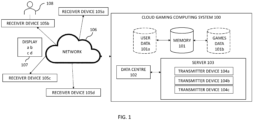
- FIG. 1 an example system used to load game files for a game (which may also be referred to in the present disclosure as a cloud video game) available through a cloud gaming computing system 100 is shown.
- the system includes a plurality of receiver devices 105a-105d that are communicatively connected to the cloud gaming computing system 100 over a wired or wireless network 106, such as the internet.
- a receiver device 105 may include, but is not limited to, a video game playing device (games console), a smart TV, a smartphone, laptop, personal computer (PC), etc.
- the receiver device 105 is configured to receive information such as video frames from the cloud gaming computing system 100, via the network 106.
- the receiver device 105 may also be referred to in the present disclosure as a client device or a computing device.
- the cloud gaming computing system 100 accesses user account information stored in a memory 101 (which may also be referred to in the present disclosure as a cloud storage), specifically in user data 101a, to identify a user 108 associated with the receiver device 105b through which the request is initiated.
- the cloud gaming computing system 100 may also validate the identified user 108 in order to determine all the games the user is authorised to view/play.
- the cloud gaming computing system 100 accesses game titles information stored in memory 101, specifically in games data 101b, to identify the game titles that are available at the cloud gaming computing system 100 for the user 108 initiating the request.
- the receiver device 105b from where the request is initiated may or may not be registered with the cloud gaming computing system 100, when the request was initiated. If the user of the receiver device initiating the request is not a registered user, then the cloud gaming computing system 100 may identify the user as a new user and select the game titles (for e.g., a default set of game titles) that are appropriate for a new user. The identified game titles (a, b, c, d) are returned to the receiver device 105b for presenting on a display 107, as shown in FIG. 1A.
- the cloud gaming computing system 100 proactively determines a data centre where the game is being hosted and sends a signal to the identified data centre 102 to load the game associated with the game title for which the user interaction is detected. In some embodiments, more than one data centre may be hosting the game.
- the identified data centre 102 selects a server 103 at the data centre 102 to initiate the game on the server 103.
- the server 103 includes a plurality of transmitter devices 104a-104c and the server determines which one of the plurality of transmitter devices 104a-104c to use to load the game.
- the generic game-related code for the game is loaded onto the transmitter device 104b and a signal is returned to the receiver device 105b over the network 106 identifying the transmitter device 104b on which the game is initiated.
- the loaded game is thus made available to the user 108.
- FIG.2 is a block diagram of one example implementation of a transmitter device 104 according to an embodiment of the present disclosure.
- the transmitter device 104 is associated with executable instructions 115 for causing the transmitter device 104 to perform one or more of the methodologies discussed herein.
- the transmitter device 104 may form part of the cloud gaming computing system 100.
- the transmitter device 104 may be connected (e.g., networked) to other machines in a Local Area Network (LAN), an intranet, an extranet, or the Internet.
- LAN Local Area Network
- the transmitter device 104 may operate in the capacity of a server or a client machine in a client-server network environment, or as a peer machine in a peer-to-peer (or distributed) network environment.
Landscapes
- Engineering & Computer Science (AREA)
- Multimedia (AREA)
- Signal Processing (AREA)
- Theoretical Computer Science (AREA)
- Physics & Mathematics (AREA)
- General Physics & Mathematics (AREA)
- Computing Systems (AREA)
- Computer Graphics (AREA)
- Information Transfer Between Computers (AREA)
- Compression Or Coding Systems Of Tv Signals (AREA)
Abstract
Description
- The present invention relates to methods and systems for tile-based encoding in cloud gaming.
- A current area of rapidly growing technology is the field of cloud gaming, also known as game streaming. In cloud gaming, the game is processed and rendered on remote servers in data centres, and the video output is streamed to a player's device over the internet. The player's device then decodes and displays the video stream.
- In cloud gaming, tiles in an image frame may be ordered when sending the frame. The video frames are often divided into smaller tiles, which can be efficiently encoded, transmitted, and rendered on a player's device. The player's device then reassembles these tiles to form the final image.
- The first step in the process of ordering tiles in an image frame is to divide the image frame into smaller tiles. The number and size of the tiles depend on various factors, such as the device's screen resolution, network conditions, and the available computational resources in the cloud server. After dividing the image into tiles, each tile is independently encoded. The most common encoding formats for cloud gaming are H.264 or H.265 (HEVC). These formats allow efficient compression and transmission of video data. Once the tiles are encoded, they are sent over the network to the player's device. The transmission can be done using adaptive bitrate streaming protocols, such as HTTP Live Streaming (HLS) or Dynamic Adaptive Streaming over HTTP (DASH), which adjust the video quality based on the available bandwidth. On the player's device, the received tiles are decoded and then arranged in the correct order to reconstruct the final image. The order is usually determined by the coordinates assigned to each tile during the encoding process. The fully reconstructed image frame is then displayed on the player's screen.
- Frame interpolation in video streaming is known. Often tile-based encoding schemes are used. It is known to only send the tiles that have changed, to reduce the amount of data sent, then fill in the gaps from the previous frame. This often does not use encoders in the most efficient way. There can still be issues with latency.
- Aspects and embodiments were conceived with the foregoing in mind.
- Aspects of the present disclosure are set out in the accompanying independent and dependent claims. Combinations of features from the dependent claims may be combined with features of the independent claims as appropriate and not merely as explicitly set out in the claims.
- According to a first aspect of the present disclosure, there is provided a computer-implemented method, comprising: providing a current frame including a plurality of tiles; generating a priority list, wherein the priority list stores a rendering order of the plurality of tiles in the current frame; setting a predetermined time; wherein, the predetermined time is a maximum time to be spent rendering the current frame; starting rendering of the plurality of tiles in the current frame in the rendering order and ending rendering when the predetermined time expires, thereby producing a plurality of rendered tiles that is less than or equal to the plurality of tiles; and transmitting the plurality of rendered tiles to a receiver.
- The invention as claimed solves the problems associated with the prior art by setting a predetermined time and rendering tiles in a current frame in a rendering order using a priority list. The tiles are processed in order of priority. Any tiles which have not been rendered and transmitted to a receiver can be interpolated from available information.
- Data transfer over the internet is therefore minimised and latency is reduced, ensuring smoother gameplay.
- Optionally, the computer-implemented method further comprises providing a previous frame including a plurality of tiles, wherein each tile in the previous frame corresponds to a respective tile in the current frame.
- Optionally, each tile comprises a plurality of pixels, wherein each pixel has a pixel value within a range 0-255.
- Optionally, a position of a tile in the rendering order is at least partially dependent on a change of the plurality of pixels in the tile compared to the previous frame.
- Optionally, the rendering order is determined based, at least in part, on a saliency map comprising a most obvious area.
- Optionally, a position of a tile in the rendering order is at least partially dependent on the tile corresponding to the most obvious area.
- Optionally, the rendering order is determined based, at least in part, on a heatmap comprising a hottest area.
- Optionally, a position of a tile in the rendering order is at least partially dependent on the tile corresponding to the hottest area.
- Optionally, a time period since a last tile was rendered is one second.
- Optionally, a position of a tile in the rendering order is at least partially dependent on a time since the tile was last rendered.
- Optionally, the predetermined time is 8 milliseconds, 16 milliseconds, or 33 milliseconds.
- Optionally, the predetermined time is adjustable.
- In a second aspect of the present disclosure, there is provided a computer-implemented method, comprising: receiving a plurality of rendered tiles that is less than or equal to a plurality of tiles in a current frame produced according to the method of any embodiment or example of the first aspect of the disclosure; and interpolating each tile that has not been rendered in the current frame from available information.
- In a third aspect of the present disclosure, there is provided a computer-implemented method, comprising: receiving a plurality of rendered tiles that is less than or equal to a plurality of tiles in a current frame; and interpolating each tile that has not been rendered in the current frame from available information.
- Optionally, the available information is a previous frame, one or more neighbouring tiles, and/or sideband information.
- Optionally, when the available information is sideband information, the sideband information comprises one or more motion vectors.
- In a fourth aspect of the present disclosure, there is provided a receiver device, comprising: a processor; a memory; and wherein, the receiver device is configured to carry out the method of any embodiment or example of the second or third aspect of the disclosure.
- In a fifth aspect of the present disclosure, there is provided a transmitter device, comprising: a network interface; a processor; a memory communicatively coupled to the processor, the memory comprising instructions operable, when executed by the processor, to cause the processor to carry out the method of any embodiment or example of the first aspect of the disclosure.
- Embodiments of this disclosure will be described hereinafter, by way of example only, with reference to the accompanying drawings in which like reference signs relate to like elements and in which:
-
Figure 1 shows a simplified block diagram of a system that is used to preload game content onto a cloud game server according to an embodiment of this disclosure; -
Figure 2 is a block diagram representing a transmitter device according to an embodiment of this disclosure; -
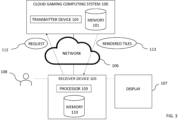
Figure 3 illustrates a system for streaming a cloud video game to a receiver device according to an embodiment of this disclosure; -
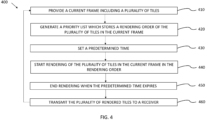
Figure 4 illustrates a computer-implemented method for rendering a plurality of tiles in a rendering order according to an embodiment of this disclosure; and -
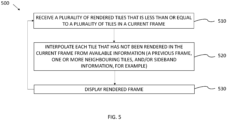
Figure 5 illustrates a computer-implemented method for interpolating each tile that has not been rendered from available information according to an embodiment of this disclosure. - Embodiments of this disclosure are described in the following with reference to the accompanying drawings.
- Referring to
FIG. 1 , an example system used to load game files for a game (which may also be referred to in the present disclosure as a cloud video game) available through a cloudgaming computing system 100 is shown. The system includes a plurality ofreceiver devices 105a-105d that are communicatively connected to the cloudgaming computing system 100 over a wired orwireless network 106, such as the internet. - A
receiver device 105 may include, but is not limited to, a video game playing device (games console), a smart TV, a smartphone, laptop, personal computer (PC), etc. Thereceiver device 105 is configured to receive information such as video frames from the cloudgaming computing system 100, via thenetwork 106. Thereceiver device 105 may also be referred to in the present disclosure as a client device or a computing device. - When a request to access the cloud
gaming computing system 100 is received from areceiver device 105, the cloudgaming computing system 100 accesses user account information stored in a memory 101 (which may also be referred to in the present disclosure as a cloud storage), specifically inuser data 101a, to identify auser 108 associated with thereceiver device 105b through which the request is initiated. In some embodiments, the cloudgaming computing system 100 may also validate the identifieduser 108 in order to determine all the games the user is authorised to view/play. Following user account identification/validation, the cloudgaming computing system 100 accesses game titles information stored inmemory 101, specifically ingames data 101b, to identify the game titles that are available at the cloudgaming computing system 100 for theuser 108 initiating the request. Thereceiver device 105b from where the request is initiated may or may not be registered with the cloudgaming computing system 100, when the request was initiated. If the user of the receiver device initiating the request is not a registered user, then the cloudgaming computing system 100 may identify the user as a new user and select the game titles (for e.g., a default set of game titles) that are appropriate for a new user. The identified game titles (a, b, c, d) are returned to thereceiver device 105b for presenting on adisplay 107, as shown in FIG. 1A. - User interaction at one of the game titles (a, b, c, d) rendered on the
receiver device 105b is detected and a signal is sent to the cloudgaming computing system 100. In response to the signal received from thereceiver device 105b, the cloudgaming computing system 100 proactively determines a data centre where the game is being hosted and sends a signal to the identifieddata centre 102 to load the game associated with the game title for which the user interaction is detected. In some embodiments, more than one data centre may be hosting the game. - The identified
data centre 102 selects aserver 103 at thedata centre 102 to initiate the game on theserver 103. Theserver 103 includes a plurality oftransmitter devices 104a-104c and the server determines which one of the plurality oftransmitter devices 104a-104c to use to load the game. - Once the
transmitter device 104b is identified, for example, the generic game-related code for the game is loaded onto thetransmitter device 104b and a signal is returned to thereceiver device 105b over thenetwork 106 identifying thetransmitter device 104b on which the game is initiated. The loaded game is thus made available to theuser 108. -
FIG.2 is a block diagram of one example implementation of atransmitter device 104 according to an embodiment of the present disclosure. Thetransmitter device 104 is associated withexecutable instructions 115 for causing thetransmitter device 104 to perform one or more of the methodologies discussed herein. Thetransmitter device 104 may form part of the cloudgaming computing system 100. In alternative implementations, thetransmitter device 104 may be connected (e.g., networked) to other machines in a Local Area Network (LAN), an intranet, an extranet, or the Internet. Thetransmitter device 104 may operate in the capacity of a server or a client machine in a client-server network environment, or as a peer machine in a peer-to-peer (or distributed) network environment. Thetransmitter device 104 may be any machine capable of executing a set of instructions (sequential or otherwise) that specify actions to be taken by that machine. Further, while only a single transmitter device is illustrated, the term "transmitter device" shall also be taken to include any collection of machines (e.g., computers) that individually or jointly execute a set (or multiple sets) of instructions to perform any one or more of the methodologies discussed herein. - The
example transmitter device 104 includes aprocessor 111, and amemory 114 which includes a main memory (e.g., read-only memory (ROM), flash memory, dynamic random-access memory (DRAM) such as synchronous DRAM (SDRAM) or Rambus DRAM (RDRAM), etc.), a static memory (e.g., flash memory, static random-access memory (SRAM), etc.), and/or a secondary memory. Thetransmitter device 104 may further include a wired or wireless network interface 116. -
Processor 111 represents one or more general-purpose processors such as a microprocessor, central processing unit, or the like. More particularly, theprocessor 111 may be a complex instruction set computing (CISC) microprocessor, reduced instruction set computing (RISC) microprocessor, very long instruction word (VLIW) microprocessor, processor implementing other instruction sets, or processors implementing a combination of instruction sets.Processor 111 may also be one or more special-purpose processing devices such as an application specific integrated circuit (ASIC), a field programmable gate array (FPGA), a digital signal processor (DSP), network processor, or the like.Processor 111 is configured to execute the processing logic (instructions 115) for performing the operations and steps discussed herein. - In an implementation, the modules, components and other features described herein can be implemented as discrete components or integrated in the functionality of hardware components such as ASICS, FPGAs, DSPs or similar devices.
- A "hardware component" is a tangible (e.g., non-transitory) physical component (e.g., a set of one or more processors) capable of performing certain operations and may be configured or arranged in a certain physical manner. A hardware component may include dedicated circuitry or logic that is permanently configured to perform certain operations. A hardware component may be or include a special-purpose processor, such as a field programmable gate array (FPGA) or an ASIC. A hardware component may also include programmable logic or circuitry that is temporarily configured by software to perform certain operations.
- Accordingly, the phrase "hardware component" should be understood to encompass a tangible entity that may be physically constructed, permanently configured (e.g., hardwired), or temporarily configured (e.g., programmed) to operate in a certain manner or to perform certain operations described herein.
- In addition, the modules and components can be implemented as firmware or functional circuitry within hardware devices. Further, the modules and components can be implemented in any combination of hardware devices and software components, or only in software (e.g., code stored or otherwise embodied in a machine-readable medium or in a transmission medium).
- Unless specifically stated otherwise, as apparent from the following discussion, it is appreciated that throughout the description, discussions utilising terms such as "providing", "calculating", "computing," "identifying", "detecting ", "establishing" , "training", "determining", "storing", "generating" "checking", "obtaining" or the like, refer to the actions and processes of a computer system, or similar electronic computing device, that manipulates and transforms data represented as physical (electronic) quantities within the computer system's registers and memories into other data similarly represented as physical quantities within the computer system memories or registers or other such information storage, transmission or display devices.
- Referring to
FIG. 3 , an example system for transmitting rendered tiles to areceiver device 105 according to an embodiment of this disclosure is shown. The system includes areceiver device 105 communicatively connected to a cloudgaming computing system 100 through anetwork 106, such as the internet. Arequest 112 to initiate gameplay of a game may be transmitted from thereceiver device 105 to the cloudgaming computing system 100 via thenetwork 106. - The example system further comprises at least one display 107 (which may also be referred to in the present disclosure as a display device or display screen). The display 107 (e.g., a liquid crystal display (LCD) or a cathode ray tube (CRT)) is configured to receive and display a video game stream. It will be appreciated that in some implementations, the
display 107 can be a head-mounted display. Thereceiver device 105 anddisplay 107 are operably connected by a wired or wireless network or connection. In some embodiments, thedisplay 107 is integral to thereceiver device 105. - The
receiver device 105 may include various other components, such as an alphanumeric input device (e.g., a keyboard or touchscreen), a cursor control device (e.g., a mouse or touchscreen), and/or an audio device (e.g., a speaker). Thereceiver device 105 comprises aprocessor 109 to execute various modules stored in amemory 110.Memory 110 includes a main memory (e.g., read-only memory (ROM), flash memory, dynamic random-access memory (DRAM) such as synchronous DRAM (SDRAM) or Rambus DRAM (RDRAM), etc.), a static memory (e.g., flash memory, static random-access memory (SRAM), etc.), and/or a secondary memory. Thereceiver device 105 further comprises a codec, or decoder comprising decoding logic. The decoding logic may include hardware, firmware, and/or software stored on thememory 110. Systems for decoding (and encoding) video streams are well known in the art and vary depending on the encoding scheme or format used. It will be appreciated that encoding a video can also be referred to as compressing a video, as this action reduces the amount of data required to be transmitted (or the file size). -
Processor 109 represents one or more general-purpose processors such as a microprocessor, central processing unit, or the like. More particularly, theprocessor 109 may be a complex instruction set computing (CISC) microprocessor, reduced instruction set computing (RISC) microprocessor, very long instruction word (VLIW) microprocessor, processor implementing other instruction sets, or processors implementing a combination of instruction sets.Processor 109 may also be one or more special-purpose processing devices such as an application specific integrated circuit (ASIC), a field programmable gate array (FPGA), a digital signal processor (DSP), network processor, or the like.Processor 109 is configured to execute the processing logic for performing the operations and steps discussed herein. - The
request 112, which is transmitted from thereceiver device 105 over thenetwork 106, is received at the cloudgaming computing system 100. The cloudgaming computing system 100 comprises at least onetransmitter device 104 on which the games stored at the cloudgaming computing system 100 is executed. - The cloud
gaming computing system 100 is configured to encode data, which includes video data, and generate a video game stream. Preferably, the video game stream includes a video stream and an audio stream. The video stream comprises a plurality of video frames, and each video frame is divided into a plurality of renderedtiles 113. The plurality of renderedtiles 113 may be encoded prior to transmission to thereceiver device 105. The plurality of renderedtiles 113 are sent to thereceiver device 105. -
FIG. 4 illustrates an iterative computer-implementedmethod 400 for rendering a plurality of tiles in a rendering order, by atransmitter device 104, according to an embodiment of this disclosure. - At
method step 410, a current frame, which is a single image or scene (comprising a plurality of virtual objects) of a video game, is constructed using multiple tiles. These tiles are arranged in a grid or pattern to create the complete scene. Other methods of splitting frames into tiles may be used, and the tiles may not be all the same e.g., a frame may be formed of non-contiguous parts. The tiles may be defined by priority, distance from camera, or other metric to determine importance. Each tile may comprise a plurality of pixels, each pixel having a pixel value that corresponds to the colour of said pixel. Pixel value refers to the numerical representation of the colour or intensity of a single point in a scene. Each pixel has a specific location within the scene and is assigned a pixel value that corresponds to its colour or greyscale intensity. In a greyscale scene, each pixel's value typically ranges from 0 to 255, with 0 representing black and 255 representing white. The values in between represent various shades of grey. In a colour scene, each pixel is typically represented as a combination of three colour channels: red, green, and blue (RGB). The pixel value for each channel usually ranges from 0 to 255, with 0 indicating the absence of that colour and 255 indicating the maximum intensity of that colour. For example, a bright red pixel would have a pixel value of (255,0,0). - At
step 420, a priority list which stores a rendering order of the plurality of tiles in the current frame is generated. The priority list manages the order in which the plurality of tiles is rendered. The priority list is a data structure that stores items along with their associated priorities. The items comprise an ID number corresponding to each tile in the current frame. Each tile is assigned a priority value. The value indicating the rendering order. For example, higher values may indicate that the tile should be rendered before tiles with lower values. Alternatively, lower values may indicate that the tile should be rendered before tiles with higher values. Preferably, tiles with higher priorities are placed at the top of the priority list, and tiles with lower priorities are placed at the bottom of the priority list. - At
step 430, a predetermined time is set. The predetermined time is set in a script, for example. The predetermined time represents the maximum time allowed for rendering the current frame, and therefore ensures the rendering process does not exceed the specified predetermined time. Preferably, the predetermined time is 8 milliseconds, 16 milliseconds, or 33 milliseconds. A shorter predetermined time decreases latency. The predetermined time may be set according to the use or system requirements. In some embodiments, the predetermined time is adjustable. - At
step 440, rendering of the plurality of tiles in the current frame in the rendering order is started. When the predetermined time expires, atstep 450, a plurality of rendered tiles 313 are produced. The plurality of rendered tiles is less than or equal to the plurality of tiles i.e., some or all the tiles specified in the priority list are rendered. Atstep 460, the plurality of rendered tiles 313 are transmitted to a receiver device 305. The plurality of rendered tiles 313 are transmitted to the receiver device 305 via the communication channel 314. In some embodiments, the plurality of rendered tiles 313 are compressed prior to transmission. -
Process 400 is an iterative process. Each iteration provides the next frame. The previous frame (i.e., the frame from the previous iteration) refers to a frame that is provided immediately before the current frame, in a sequence of frames. The previous frame includes a plurality of tiles. Each tile in the previous frame corresponds to a respective tile in the current frame (i.e., the frame from the current iteration). Each tile in the previous frame may comprise a plurality of pixels, each pixel having a pixel value that corresponds to the colour of said pixel. - In some embodiments, a position of a tile in the rendering order is at least partially dependent on a change of the plurality of pixels in the tile in the previous compared to the corresponding tile in the current frame. For example, the tile having the most change of the plurality of pixels is placed at the top of the priority list. The "most change of the plurality of pixels" refers to identifying or measuring the extent to which the pixels in a tile in a current frame have changed from the corresponding tile in a previous frame. The extent of change may be calculated using various methods, such as the absolute difference in pixel values or colour difference.
- In some embodiments, the rendering order is determined based, at least in part, on a saliency map comprising a most obvious area. The "most obvious area" in a saliency map refers to the region or regions with the highest saliency values (indicating the parts of the tile that are most visually different from their surroundings). To identify the "most obvious area" in a saliency map, a threshold is applied to the saliency map, designating regions with saliency values above the threshold as the most salient areas. Preferably, the threshold is adjustable, to control the level of saliency considered as "most obvious". In some embodiments, a position of a tile in the rendering order is at least partially dependent on the tile corresponding to the most obvious area (in the current frame). For example, the tile corresponding to the most obvious area is placed at the top of the priority list.
- In some embodiments, the rendering order is determined based, at least in part, on a heat map comprising a hottest area. A heatmap uses colour intensity to represent the values of a data matrix in a graphical format. The "hottest area" in a heat map is identified as the region with the highest values or concentration of data points. This can be done through various methods known to the skilled person, including thresholding, or clustering or density estimation. In some embodiments, a position of a tile in the rendering order is at least partially dependent on the tile corresponding to the hottest area (in the current frame). For example, the tile corresponding to the hottest area is placed at the top of the priority list.
- In some embodiments, when
process 400 is iterated multiple times, a position of a tile in the rendering order is at least partially dependent on a time since the last tile was rendered. Preferably, a time period since the last tile was rendered is 1 second. In some embodiments, a threshold time is set, and if the time since the last tile was rendered exceeds the threshold, then the tile is placed at the top of the priority list. Preferably, the threshold is adjustable. -
Figure 5 illustrates an iterative computer-implementedmethod 500 for interpolating each tile that has not been rendered, by areceiver device 105, from available information, according to an embodiment of this disclosure. - At
step 510, the plurality of rendered tiles 113 (that is less than or equal to the plurality of tiles in the current frame) are received. - At
step 520, each tile that has not been rendered in the current frame is interpolated from available information or data. For example, the available information may comprise a previous frame, one or more neighbouring tiles from the plurality of renderedtiles 113 and/or sideband information. In some embodiments, when the available information is sideband information, the sideband information comprises one or more motion vectors. Motion vectors provide information about how virtual objects or regions within a frame move from one frame to the next. - If the plurality of rendered
tiles 113 were compressed prior to transmission, the plurality of renderedtiles 113 are decompressed at thereceiver device 105. Systems and methods for decompressing the plurality of renderedtiles 113 are well known in the art and vary depending on the compression technique used. In some embodiments, thereceiver device 105 is configured to determine which compression technique has been used, based on the received compressed plurality of renderedtiles 113, and reverses the compression using the corresponding decompression technique. In some embodiments, the video game is rendered at thereceiver device 105. Atstep 530, a rendered frame is displayed ondisplay 107. - Although particular embodiments of this disclosure have been described, it will be appreciated that many modifications/additions and/or substitutions may be made within the scope of the claims.
Claims (15)
- A computer-implemented method, comprising:providing a current frame including a plurality of tiles;generating a priority list, wherein the priority list stores a rendering order of the plurality of tiles in the current frame;setting a predetermined time;wherein, the predetermined time is a maximum time to be spent rendering the current frame;starting rendering of the plurality of tiles in the current frame in the rendering order and ending rendering when the predetermined time expires, thereby producing a plurality of rendered tiles that is less than or equal to the plurality of tiles; andtransmitting the plurality of rendered tiles to a receiver.
- A computer-implemented method according to claim 1, comprising:
providing a previous frame including a plurality of tiles, wherein each tile in the previous frame corresponds to a respective tile in the current frame. - A computer-implemented method according to claim 2, wherein:each tile comprises a plurality of pixels, wherein each pixel has a pixel value within a range 0-255; andoptionally, a position of a tile in the rendering order is at least partially dependent on a change of the plurality of pixels in the tile compared to the previous frame.
- A computer-implemented method according to any previous claim, wherein:
the rendering order is determined based, at least in part, on a saliency map comprising a most obvious area. - A computer-implemented method according to claim 4, wherein:a position of a tile in the rendering order is at least partially dependent on the tile corresponding to the most obvious area.
- A computer-implemented method according to any previous claim, wherein:the rendering order is determined based, at least in part, on a heatmap comprising a hottest area; andoptionally, a position of a tile in the rendering order is at least partially dependent on the tile corresponding to the hottest area.
- A computer-implemented method according to any previous claim, wherein;
a time period since a last tile was rendered is one second. - A computer-implemented method according to any of claims 1-6, wherein:
a position of a tile in the rendering order is at least partially dependent on a time since the tile was last rendered. - A computer-implemented method according to any previous claim, wherein:
the predetermined time is 8 milliseconds, 16 milliseconds, or 33 milliseconds. - A computer-implemented method according to any of claims 1-8, wherein:
the predetermined time is adjustable. - A computer-implemented method, comprising:receiving a plurality of rendered tiles that is less than or equal to a plurality of tiles in a current frame produced according to the method of any of claims 1-10; andinterpolating each tile that has not been rendered in the current frame from available information.
- A computer-implemented method, comprising:receiving a plurality of rendered tiles that is less than or equal to a plurality of tiles in a current frame; andinterpolating each tile that has not been rendered in the current frame from available information.
- A computer-implemented method according to claim 11 or claim 12, wherein:the available information is a previous frame, one or more neighbouring tiles, and/or sideband information; andoptionally, when the available information is sideband information, the sideband information comprises one or more motion vectors.
- A receiver device, comprising:a processor;a memory; andwherein, the receiver device is configured to carry out the method of any of claims 11-13.
- A transmitter device, comprising:a network interface;a processor;a memory communicatively coupled to the processor, the memory comprising instructions operable, when executed by the processor, to cause the processor to carry out the method of any of claims 1-10.
Applications Claiming Priority (1)
| Application Number | Priority Date | Filing Date | Title |
|---|---|---|---|
| GB2319634.8A GB2636739A (en) | 2023-12-20 | 2023-12-20 | Time-limit interpolation |
Publications (1)
| Publication Number | Publication Date |
|---|---|
| EP4576786A1 true EP4576786A1 (en) | 2025-06-25 |
Family
ID=89662779
Family Applications (1)
| Application Number | Title | Priority Date | Filing Date |
|---|---|---|---|
| EP24212662.1A Pending EP4576786A1 (en) | 2023-12-20 | 2024-11-13 | Time-limit interpolation |
Country Status (3)
| Country | Link |
|---|---|
| US (1) | US20250211748A1 (en) |
| EP (1) | EP4576786A1 (en) |
| GB (1) | GB2636739A (en) |
Citations (2)
| Publication number | Priority date | Publication date | Assignee | Title |
|---|---|---|---|---|
| US20170180758A1 (en) * | 2015-12-22 | 2017-06-22 | Vallabhajosyula S. Somayazulu | Tiled Wireless Display |
| WO2020055684A1 (en) * | 2018-09-13 | 2020-03-19 | Qualcomm Incorporated | In-flight adaptive foveated rendering |
Family Cites Families (1)
| Publication number | Priority date | Publication date | Assignee | Title |
|---|---|---|---|---|
| JP2011146790A (en) * | 2010-01-12 | 2011-07-28 | Jvc Kenwood Holdings Inc | Motion picture decoding device and motion picture decoding method |
-
2023
- 2023-12-20 GB GB2319634.8A patent/GB2636739A/en active Pending
-
2024
- 2024-11-13 EP EP24212662.1A patent/EP4576786A1/en active Pending
- 2024-12-19 US US18/986,910 patent/US20250211748A1/en active Pending
Patent Citations (2)
| Publication number | Priority date | Publication date | Assignee | Title |
|---|---|---|---|---|
| US20170180758A1 (en) * | 2015-12-22 | 2017-06-22 | Vallabhajosyula S. Somayazulu | Tiled Wireless Display |
| WO2020055684A1 (en) * | 2018-09-13 | 2020-03-19 | Qualcomm Incorporated | In-flight adaptive foveated rendering |
Non-Patent Citations (1)
| Title |
|---|
| GHABASHNEH EHAB ET AL: "Dragonfly: Higher Perceptual Quality For Continuous 360� Video Playback", PROCEEDINGS OF THE ACM SIGCOMM 2023 CONFERENCE, ACMPUB27, NEW YORK, NY, USA, 10 September 2023 (2023-09-10), pages 516 - 532, XP059428304, ISBN: 979-8-4007-0256-3, DOI: 10.1145/3603269.3604876 * |
Also Published As
| Publication number | Publication date |
|---|---|
| GB2636739A (en) | 2025-07-02 |
| US20250211748A1 (en) | 2025-06-26 |
| GB202319634D0 (en) | 2024-01-31 |
Similar Documents
| Publication | Publication Date | Title |
|---|---|---|
| CN115089966B (en) | Video rendering method, system and related equipment applied to cloud game | |
| CN109688465B (en) | Video enhancement control method, device and electronic device | |
| CN111182303A (en) | Coding method, apparatus, computer readable medium and electronic device for sharing screen | |
| CN113041617B (en) | Game picture rendering method, device, equipment and storage medium | |
| US12231652B2 (en) | Systems and methods for deferred post-processes in video encoding | |
| EP3177024A1 (en) | System for cloud streaming service, method for same using still-image compression technique and apparatus therefor | |
| KR102273141B1 (en) | System for cloud streaming service, method of cloud streaming service using still image compression technique and apparatus for the same | |
| US20250211748A1 (en) | Time-limit interpolation | |
| CN106937127B (en) | Display method and system for intelligent search preparation | |
| CN109413445B (en) | A video transmission method and device | |
| CN109493304B (en) | Image data processing method and device | |
| CN114466228A (en) | Method, equipment and storage medium for improving screen projection display fluency | |
| US10986337B2 (en) | Systems and methods for selective transmission of media content | |
| US12425667B2 (en) | Video encoding method and apparatus, real-time communication method and apparatus, device, and storage medium | |
| CN111918067A (en) | A data processing method, apparatus and computer readable storage medium | |
| US20240155160A1 (en) | Realtime pre-encoding content-adaptive gpu image dithering | |
| CN110662060B (en) | Video encoding method and apparatus, video decoding method and apparatus, and storage medium | |
| CN112565819A (en) | Video data processing method and device, electronic equipment and storage medium | |
| CN111131879A (en) | Video data playback method, device and computer-readable storage medium | |
| CN116567229B (en) | Image processing method, device, equipment and storage medium | |
| US20250363727A1 (en) | Video streaming system and method | |
| Wu et al. | Content-aware progressive image compression and syncing | |
| US20250161808A1 (en) | Coding scheme for video game textures | |
| CN116114245B (en) | Parallel processing of video frames during video encoding | |
| CN117896524A (en) | Video frame processing method, device, computer equipment, medium, and product |
Legal Events
| Date | Code | Title | Description |
|---|---|---|---|
| PUAI | Public reference made under article 153(3) epc to a published international application that has entered the european phase |
Free format text: ORIGINAL CODE: 0009012 |
|
| STAA | Information on the status of an ep patent application or granted ep patent |
Free format text: STATUS: THE APPLICATION HAS BEEN PUBLISHED |
|
| AK | Designated contracting states |
Kind code of ref document: A1 Designated state(s): AL AT BE BG CH CY CZ DE DK EE ES FI FR GB GR HR HU IE IS IT LI LT LU LV MC ME MK MT NL NO PL PT RO RS SE SI SK SM TR |
|
| STAA | Information on the status of an ep patent application or granted ep patent |
Free format text: STATUS: REQUEST FOR EXAMINATION WAS MADE |
|
| 17P | Request for examination filed |
Effective date: 20251104 |
|
| GRAP | Despatch of communication of intention to grant a patent |
Free format text: ORIGINAL CODE: EPIDOSNIGR1 |
|
| STAA | Information on the status of an ep patent application or granted ep patent |
Free format text: STATUS: GRANT OF PATENT IS INTENDED |
|
| RIC1 | Information provided on ipc code assigned before grant |
Ipc: H04N 21/2343 20110101AFI20251117BHEP Ipc: H04N 19/167 20140101ALI20251117BHEP |
|
| INTG | Intention to grant announced |
Effective date: 20251216 |
|
| GRAS | Grant fee paid |
Free format text: ORIGINAL CODE: EPIDOSNIGR3 |
|
| GRAA | (expected) grant |
Free format text: ORIGINAL CODE: 0009210 |
|
| STAA | Information on the status of an ep patent application or granted ep patent |
Free format text: STATUS: THE PATENT HAS BEEN GRANTED |