EP4576455A1 - A monolithic integrated circuit laser multiplexer - Google Patents
A monolithic integrated circuit laser multiplexer Download PDFInfo
- Publication number
- EP4576455A1 EP4576455A1 EP24205400.5A EP24205400A EP4576455A1 EP 4576455 A1 EP4576455 A1 EP 4576455A1 EP 24205400 A EP24205400 A EP 24205400A EP 4576455 A1 EP4576455 A1 EP 4576455A1
- Authority
- EP
- European Patent Office
- Prior art keywords
- layer
- transistors
- light
- emitting sources
- epitaxial layers
- Prior art date
- Legal status (The legal status is an assumption and is not a legal conclusion. Google has not performed a legal analysis and makes no representation as to the accuracy of the status listed.)
- Pending
Links
Images
Classifications
-
- H—ELECTRICITY
- H01—ELECTRIC ELEMENTS
- H01S—DEVICES USING THE PROCESS OF LIGHT AMPLIFICATION BY STIMULATED EMISSION OF RADIATION [LASER] TO AMPLIFY OR GENERATE LIGHT; DEVICES USING STIMULATED EMISSION OF ELECTROMAGNETIC RADIATION IN WAVE RANGES OTHER THAN OPTICAL
- H01S5/00—Semiconductor lasers
- H01S5/40—Arrangement of two or more semiconductor lasers, not provided for in groups H01S5/02 - H01S5/30
- H01S5/4025—Array arrangements, e.g. constituted by discrete laser diodes or laser bar
-
- H—ELECTRICITY
- H01—ELECTRIC ELEMENTS
- H01S—DEVICES USING THE PROCESS OF LIGHT AMPLIFICATION BY STIMULATED EMISSION OF RADIATION [LASER] TO AMPLIFY OR GENERATE LIGHT; DEVICES USING STIMULATED EMISSION OF ELECTROMAGNETIC RADIATION IN WAVE RANGES OTHER THAN OPTICAL
- H01S5/00—Semiconductor lasers
- H01S5/02—Structural details or components not essential to laser action
- H01S5/026—Monolithically integrated components, e.g. waveguides, monitoring photo-detectors, drivers
- H01S5/0261—Non-optical elements, e.g. laser driver components, heaters
-
- H—ELECTRICITY
- H01—ELECTRIC ELEMENTS
- H01S—DEVICES USING THE PROCESS OF LIGHT AMPLIFICATION BY STIMULATED EMISSION OF RADIATION [LASER] TO AMPLIFY OR GENERATE LIGHT; DEVICES USING STIMULATED EMISSION OF ELECTROMAGNETIC RADIATION IN WAVE RANGES OTHER THAN OPTICAL
- H01S5/00—Semiconductor lasers
- H01S5/04—Processes or apparatus for excitation, e.g. pumping, e.g. by electron beams
- H01S5/042—Electrical excitation ; Circuits therefor
-
- H—ELECTRICITY
- H01—ELECTRIC ELEMENTS
- H01S—DEVICES USING THE PROCESS OF LIGHT AMPLIFICATION BY STIMULATED EMISSION OF RADIATION [LASER] TO AMPLIFY OR GENERATE LIGHT; DEVICES USING STIMULATED EMISSION OF ELECTROMAGNETIC RADIATION IN WAVE RANGES OTHER THAN OPTICAL
- H01S5/00—Semiconductor lasers
- H01S5/06—Arrangements for controlling the laser output parameters, e.g. by operating on the active medium
- H01S5/062—Arrangements for controlling the laser output parameters, e.g. by operating on the active medium by varying the potential of the electrodes
- H01S5/06203—Transistor-type lasers
-
- H—ELECTRICITY
- H01—ELECTRIC ELEMENTS
- H01S—DEVICES USING THE PROCESS OF LIGHT AMPLIFICATION BY STIMULATED EMISSION OF RADIATION [LASER] TO AMPLIFY OR GENERATE LIGHT; DEVICES USING STIMULATED EMISSION OF ELECTROMAGNETIC RADIATION IN WAVE RANGES OTHER THAN OPTICAL
- H01S5/00—Semiconductor lasers
- H01S5/40—Arrangement of two or more semiconductor lasers, not provided for in groups H01S5/02 - H01S5/30
- H01S5/42—Arrays of surface emitting lasers
- H01S5/423—Arrays of surface emitting lasers having a vertical cavity
-
- H—ELECTRICITY
- H10—SEMICONDUCTOR DEVICES; ELECTRIC SOLID-STATE DEVICES NOT OTHERWISE PROVIDED FOR
- H10W—GENERIC PACKAGES, INTERCONNECTIONS, CONNECTORS OR OTHER CONSTRUCTIONAL DETAILS OF DEVICES COVERED BY CLASS H10
- H10W90/00—Package configurations
-
- H—ELECTRICITY
- H01—ELECTRIC ELEMENTS
- H01S—DEVICES USING THE PROCESS OF LIGHT AMPLIFICATION BY STIMULATED EMISSION OF RADIATION [LASER] TO AMPLIFY OR GENERATE LIGHT; DEVICES USING STIMULATED EMISSION OF ELECTROMAGNETIC RADIATION IN WAVE RANGES OTHER THAN OPTICAL
- H01S5/00—Semiconductor lasers
- H01S5/04—Processes or apparatus for excitation, e.g. pumping, e.g. by electron beams
- H01S5/042—Electrical excitation ; Circuits therefor
- H01S5/0428—Electrical excitation ; Circuits therefor for applying pulses to the laser
-
- H—ELECTRICITY
- H01—ELECTRIC ELEMENTS
- H01S—DEVICES USING THE PROCESS OF LIGHT AMPLIFICATION BY STIMULATED EMISSION OF RADIATION [LASER] TO AMPLIFY OR GENERATE LIGHT; DEVICES USING STIMULATED EMISSION OF ELECTROMAGNETIC RADIATION IN WAVE RANGES OTHER THAN OPTICAL
- H01S5/00—Semiconductor lasers
- H01S5/20—Structure or shape of the semiconductor body to guide the optical wave ; Confining structures perpendicular to the optical axis, e.g. index or gain guiding, stripe geometry, broad area lasers, gain tailoring, transverse or lateral reflectors, special cladding structures, MQW barrier reflection layers
- H01S5/2054—Methods of obtaining the confinement
- H01S5/2081—Methods of obtaining the confinement using special etching techniques
- H01S5/209—Methods of obtaining the confinement using special etching techniques special etch stop layers
Definitions
- the present disclosure generally relates to a monolithic integrated circuit laser multiplexer.
- aspects of the present disclosure relate to a monolithic integrated circuit laser multiplexer.
- Various issues may exist with conventional solutions for monolithic integrated circuit laser multiplexer.
- conventional systems and methods for a monolithic integrated circuit laser multiplexer may be costly, cumbersome, and/or inefficient.
- x and/or y means any element of the three-element set ⁇ (x), (y), (x, y) ⁇ . In other words, “x and/or y” means “one or both of x and y”.
- x, y, and/or z means any element of the seven-element set ⁇ (x), (y), (z), (x, y), (x, z), (y, z), (x, y, z) ⁇ . In other words, "x, y and/or z” means “one or more of x, y and z”.
- first means “first,” “second,” etc. may be used herein to describe various elements, and these elements should not be limited by these terms. These terms are only used to distinguish one element from another. Thus, for example, a first element discussed in this disclosure could be termed a second element without departing from the teachings of the present disclosure.
- Coupled may be used to describe two elements directly contacting each other or describe two elements indirectly connected by one or more other elements.
- element A is coupled to element B, then element A can be directly contacting element B or indirectly connected to element B by an intervening element C.
- the terms “over” or “on” may be used to describe two elements directly contacting each other or describe two elements indirectly connected by one or more other elements.
- Embodiments of the present disclosure may comprise a monolithic integrated circuit device comprising an addressable laser array, the addressable laser array comprising a plurality of N light-emitting sources.
- Embodiments may also comprise a multiplexer comprising N transistors, each of the N transistors associated with a different one of the plurality of N light-emitting sources.
- each of the N transistors may be operable to address the associated one light-emitting source.
- Embodiments may comprise each of the plurality of N light-emitting sources may be an LED, an EEL, a VCSEL, or a PCSEL.
- the monolithic integrated circuit may comprise a substrate / wafer made of GaN, GaAs, InP, SiC, or GaSb.
- Embodiments may also comprise each of the plurality of N transistors may be a MESFET, pHEMT, HFET, or HBT that may be operable for 3-terminal analog functionality.
- the monolithic integrated circuit may comprise a plurality of epitaxial layers operable to form the light-emitting sources and the transistors.
- the epitaxial layers used to form the light-emitting sources may be isolated form the epitaxial layers used to form the transistors by one or more epitaxial layers of highly resistive GaAs and/or InGaP.
- the InGaP layer may be operable to stop etching between one or more epitaxial layers associated with the plurality of light-emitting sources and one or more epitaxial layers associated with the plurality of transistors.
- the epitaxial layers used to form the light-emitting sources may be different from the epitaxial layers used to form the transistors.
- An etch stop layer may also be made from AlAs or AlGaAs. In accordance with various embodiments, instead of an etch-stop layer, a timed-etch fabrication process may be used.
- a timed-etch fabrication process may refer to the controlled removal of material from the surface of a semiconductor wafer using a chemical etchant for a specified duration, in order to etch away material with precision.
- the process may be governed by a predetermined etch rate, i.e., the volume of material removed per unit time.
- the epitaxial layers associated with the transistors may overlay the epitaxial layers associated with the light-emitting sources.
- Embodiments may also comprise an epitaxial structure of the plurality of N light-emitting sources that may comprise a smoothing buffer layer, an N-type DBR layer, one or more active layers, and a P-type DBR layer.
- the smoothing buffer layer, the N-type DBR layer, the one or more active layers, and the P-type DBR layer each may comprise a plurality of epitaxial layers.
- Embodiments may also comprise an epitaxial structure of the plurality of N transistors that may comprise one or more single recess pHEMTs.
- Embodiments may also comprise an epitaxial structure of the plurality of N transistors that may comprise one or more double recess pHEMTs.
- Embodiments may also comprise a lower barrier layer.
- Embodiments may also comprise a lower delta doped layer.
- Embodiments may also comprise a lower spacer layer.
- Embodiments may also comprise a channel layer.
- Embodiments may also comprise an upper spacer layer.
- Embodiments may also comprise an upper delta doped layer.
- Embodiments may also comprise an upper barrier layer.
- Embodiments may also comprise a Schottky layer.
- Embodiments may also comprise a recess layer.
- Embodiments may also comprise an etch stop layer.
- Embodiments may also comprise a cap layer.
- Embodiments may also comprise an epitaxial structure of the plurality of N transistors that may comprise HBTs.
- Embodiments may comprise a sub collector layer, a collector layer, a base layer, an emitter layer and/or an emitter cap layer.
- the transistors may be isolated from the light-emitting sources by ion implantation and/or mesa etching.
- a triode laser functionality may be monolithically integrated on-chip, useful for laser arrays.
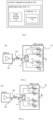
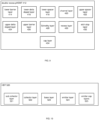
- FIG. 1 is a block diagram that describes a monolithic integrated circuit device 100, according to some embodiments of the present disclosure.
- the monolithic integrated circuit device 100 may include an addressable laser array 110.
- the addressable laser array 110 may include a plurality of N light-emitting sources 112 and a multiplexer 114.
- the multiplexer 114 may also include N transistors 116, each of the N transistors 116 associated with a different one of the plurality of N light-emitting sources 112.
- Each of the N transistors 116 may be operable to address the associated one light-emitting source 112.
- the monolithic integrated circuit device 100 may be operable as an electronic circuit integrated onto a single semiconductor substrate and may be operable as a component housing further elements on the semiconductor.
- the addressable laser array 110 may be operable to activate laser sources, for example light-emitting sources 112, selectively. Each light-emitting source 112 in the addressable laser array 110 may be controlled individually.
- the light emitting sources 112 may be operable to emit light, for example using laser light sources.
- the multiplexer 114 may be operable to manage, address and control the plurality of light-emitting sources 112. Each light emitting source 112 may be associated with a transistor 116 forming part of the multiplexer 114.
- the transistors 116 may allow for individual control of light emitting sources 112.
- FIG. 2 illustrates an exemplary schematic of a monolithic integrated circuit device 100, in accordance with various embodiments of the present disclosure.
- FIG. 2 further comprises a control interface 120 and a driver 130.
- the control interface 120 may be coupled between the driver 130 and the multiplexer 114.
- the driver 130 may be operable to supply power to the light-emitting sources 112.
- the control interface 120 may generally be a bandwidth-limited and time-sensitive interface. It may thus be desirable to reduce the number of control interfaces 120.
- control interface 120 it is preferable to use a single control interface 120 and then use multiplexer 114 to select a desired light-emitting source 112 instead of addressing each light-emitting source 112 individually with a control interface 120.
- FIG. 3 illustrates a further exemplary schematic of a monolithic integrated circuit device 100, in accordance with various embodiments of the present disclosure.
- each of the plurality of N light-emitting sources 112 may be an LED, an EEL, a VCSEL, or a PCSEL.
- An LED may be a light emitting diode.
- An LED may be a semiconductor light source that may emit light when current flows through it. This may occur due to a process known as electroluminescence, wherein the movement of electrons in the semiconductor material may release energy in the form of photons.
- LED's may be highly efficient, durable, and offer a long operational lifespan. LEDs may be widely used in a variety of applications, for example displays or indicators. LEDs may have low energy consumption and low heat generation.
- An EEL may be an Edge-Emitting Laser.
- An Edge-Emitting Laser may be a type of semiconductor laser where light may be emitted from the edge of the semiconductor chip, rather than the surface. EELs may often be used in applications that require higher output power and longer coherence length. EELs may often be employed in telecommunications and high-speed data transmission due to their capacity to produce highly collimated, or parallel, beams of light.
- a VCSEL may be a Vertical-Cavity Surface-Emitting Laser.
- a VCSEL may be a type of semiconductor laser diode that emits light perpendicular to the surface of the wafer, rather than from its edge.
- the distinguishing feature of a VCSEL may be its vertical cavity structure, which may be formed by Bragg mirrors.
- VCSELs may provide low manufacturing costs, high efficiency, and the ability to be easily tested and configured into two-dimensional arrays. They may be commonly used in optical communication, sensing applications, and consumer electronics.
- a PCSEL may be a Photonic Crystal Surface-Emitting Laser.
- a PCSEL may be a laser that leverages the properties of photonic crystals to control the emission of light.
- Photonic crystals may be optical materials that have a periodic structure on the scale of the wavelength of light. This may permit PCSELs to produce highly directional and coherent light beams. Their structure enables greater control over the laser's optical characteristics, which may make them desirable for specialized applications such as high-density data storage and advanced optical communications.
- the monolithic integrated circuit may also include a substrate /wafer made of GaN, GaAs, InP, SiC, or GaSb.
- GaN may refer to Gallium Nitride.
- Gallium Nitride may be a binary III-V direct bandgap semiconductor material that may possess high electron mobility and thermal stability.
- GaN may be particularly useful for high-frequency and high-power applications such as radio frequency components and power electronics. Its wide bandgap, high breakdown field, and thermal conductivity may make it a desirable choice for devices that may be required to operate in extreme conditions, such as high-temperature and high-voltage environments.
- GaAs may refer to Gallium Arsenide.
- Gallium Arsenide may be another III-V compound semiconductor with a direct bandgap, known for its higher electron mobility compared to silicon.
- GaAs may be used in applications requiring high-frequency operation and low-noise amplification, for example. This may include microwave and millimeter-wave technology applications. Its high electron mobility may allow for fast electronic components.
- InP may refer to Indium Phosphide.
- Indium Phosphide may be a binary semiconductor composed of indium and phosphorus, belonging to the III-V group of semiconductors. It may have a direct bandgap and possesses high electron mobility and large intrinsic resistivity.
- InP substrates may be used frequently in optoelectronic devices like high-speed photodetectors and lasers, as well as in high-frequency integrated circuits. It may offer advantages in terms of low noise and high frequency capabilities.
- SiC may refer to Silicon Carbide.
- Silicon Carbide may be a wide-bandgap semiconductor material that is particularly hard, chemically inert, and thermally stable.
- SiC may be highly valued for high-power, high-temperature, and high-frequency applications. Its wide bandgap and high thermal conductivity may make it a desirable substrate material for power electronics, including high-voltage transistors and diodes, especially in environments where high temperatures or high frequencies are prevalent.
- GaSb may refer to Gallium Antimonide.
- Gallium Antimonide may be a III-V compound semiconductor with a narrower bandgap than GaAs or GaN.
- GaSb may be desirable for infrared photodetectors and thermophotovoltaic devices. Its bandgap may make it advantageous for specialized applications in optoelectronics and for devices that operate in the mid-infrared wavelength range.
- each of the plurality of N transistors may be a MESFET, pHEMT, HFET, or HBT that may be operable for 3-terminal analog functionality.
- MESFET may refer to Metal-Semiconductor Field-Effect Transistors.
- MESFET may be a field-effect transistor that uses a metal-semiconductor junction (Schottky barrier) as the gate. This type of transistor may be commonly fabricated using compound semiconductors like GaAs or SiC, and may be desirable for use in microwave and radiofrequency (RF) applications.
- RF radiofrequency
- the MESFET's high electron mobility and low parasitic capacitance make it particularly advantageous in high-frequency, high-power, and low-noise applications such as radar systems and satellite communications.
- pHEMT may refer to Pseudomorphic High Electron Mobility Transistor.
- a pHEMT may be a specialized type of field-effect transistor that features a higher concentration of charge carriers. This may allow for increased electron mobility and desirable performance.
- the pHEMT may be used predominantly in high-frequency and low-noise applications, such as RF amplifiers because of its desirable high-frequency characteristics.
- HFET may refer to Heterostructure Field-Effect Transistors. HFET may also be referred to as HEMT (High Electron Mobility Transistor), although HFETs may comprise different types of heterostructure transistors. HFETs may employ a heterostructure to create a channel with high electron mobility, making them suitable for high-frequency and high-power applications. They may be used in telecommunications, broadband amplifiers, and other applications requiring high-speed operation, for example.
- HEMT High Electron Mobility Transistor
- HBT may refer to Heterojunction Bipolar Transistor.
- HBT may be a type of bipolar transistor that may employ differing semiconductor materials for the emitter and base regions, creating a heterojunction. This may permit improved performance, including higher speed and efficiency compared to traditional bipolar transistors.
- HBTs may be used commonly in high-frequency applications such as RF and microwave circuits. They may also be used in optoelectronics, where their high current densities may be advantageous for laser drivers and photodetectors.
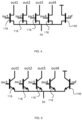
- FIG. 4 illustrates an exemplary structure of a multiplexer 114 using pHEMTs.
- a plurality of pHEMTs 116 may switch an "in” signal to one of four output signals labeled "out1", “out2", “out3”, “out4".
- such a multiplexer 114 may be used in a monolithic integrated circuit 100 as illustrated in FIG. 2 .
- a reference switch 140 There is also shown a reference switch 140.
- the reference switch 140 may be used to provide a consistent voltage or current level against which the other inputs may be compared. This may be desirable to ensure that the switching operates correctly and that there may be minimal crosstalk or interference between channels.
- the reference switch 140 may be used as a safety or calibration point. For example, when no other switches may be activated, the reference switch 140 might engage to ensure that no laser may be activated unintentionally. In other instances, the reference switch 140 may be used to monitor the multiplexer 114.
- FIG. 5 illustrates an exemplary structure of a multiplexer 114 using HBTs.
- a multiplexer 114 may switch an "in” signal to one of four output signals labeled "out1", “out2", “out3”, “out4".
- such a multiplexer 114 may be used in a monolithic integrated circuit 100 as illustrated in FIG. 3 .
- the monolithic integrated circuit may include a plurality of epitaxial layers operable to form the light-emitting sources 112 and the transistors 116.
- Epitaxial layers may refer to layers of crystalline semiconductor material that may be grown on a crystalline semiconductor substrate.
- the ordered growth of the epitaxial layer in alignment with the crystalline structure of the substrate may ensure that the epitaxial layer inherits the same crystalline structure as the underlying substrate.
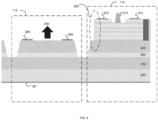
- FIG. 6 illustrates an exemplary monolithic GaAs VCSEL - pHEMT structure.
- a cross-section of semiconductor layers comprising a pHEMT 116 and a VCSEL laser light-emitting source 112.
- a direction of emitted light 290 for the VCSEL light-emitting source 112, there is further shown a direction of emitted light 290, anodes 280, a cathode 201, a smoothing buffer layer 220, an N-type DBR (Distributed Bragg Reflector) layer 230, active layer 250, and a P-type DBR layer 240.
- epitaxial layers 260 For the pHEMT 116, there is shown epitaxial layers 260, a source connector 272, a gate connector 270, and the drain connector 274.
- the VCSEL light-emitting source 112 comprise N-type DBR layer 230 and P-type DBR layer 240 that may act as mirrors, forming the laser cavity's top and bottom.
- the active layer 250 is where the light generation and amplification may occur.
- the pHEMT 116 may be formed by the epitaxial layers 260.
- the epitaxial layers 260 may comprise a channel that may be made from InGaAs. This layer may be strained, resulting in enhanced electron mobility. Further, the epitaxial layers 260 may comprise a barrier layer, for example a layer of AlGaAs or AIGalnAs, that may form a heterojunction with the channel. Further, the epitaxial layers 260 may comprise one or more layers, made of doped GaAs, for example.
- the epitaxial layers used to form the light-emitting sources 112 may be isolated from the epitaxial layers used to form the transistors 116 by one or more epitaxial layers of highly resistive GaAs (Gallium Arsenide) and/or InGaP (Indium Gallium Phosphide).
- highly resistive GaAs GaAs
- InGaP Indium Gallium Phosphide
- FIG. 6 one or more highly resistive epitaxial layers 260 may be located adjacent to the P-type DBR layer 240.
- a highly resistive InGaP layer may be immediately adjacent to the P-type DBR layer 240.
- an etch stop layer of an HBT as shown in FIG. 7 may be conductive or resistive.
- the highly resistive InGaP layer may also stop etching between one or more epitaxial layers of the transistors.
- An etch stop layer may also be made from AlAs or AlGaAs.
- a timed-etch fabrication process may be used instead of an etch-stop layer.
- FIG. 7 illustrates an exemplary monolithic GaAs VCSEL - HBT structure.
- a cross-section of semiconductor layers comprising an HBT 116 and a VCSEL laser light-emitting source 112.
- VCSEL light-emitting source 112 there is further shown a direction of emitted light 290, anodes 280, a cathode 201, a smoothing buffer layer 220, an N-type DBR (Distributed Bragg Reflector) layer 230, active layer 250, and a P-type DBR layer 240.
- epitaxial layers 260 there is shown epitaxial layers 260, a collector connector 292, a base connector 296, and an emitter connector 294.
- an isolation layer 301 there is shown an emitter 302 (for example an InGaP emitter), and base 303 (for example a GaAs base).
- emitter 302 for example an InGaP emitter
- base 303 for example a GaAs base
- an InGaP layer may be operable to stop etching between one or more epitaxial layers associated with the plurality of light-emitting sources 112 and one or more epitaxial layers 260 associated with the plurality of transistors.
- An etch stop layer may also be made from AlAs or AlGaAs.
- a timed-etch fabrication process may be used instead of an etch-stop layer.
- the epitaxial layers used to form the light-emitting sources 112 may be different from the epitaxial layers used to form the transistors 116, as illustrated in FIG. 6 and FIG. 7 .
- the epitaxial layers associated with the transistors 116 may overlay the epitaxial layers associated with the light-emitting sources 112.
- the transistors 116 may be isolated from the light-emitting sources 112 by ion implantation and/or mesa etching.
- the light-emitting sources 112 may comprise comprises a smoothing buffer layer 220, an N-type DBR layer 230, one or more active layers 250, and a P-type DBR layer 240.
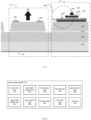
- FIG. 8 is a block diagram that further describes the monolithic integrated circuit device 100 from FIG. 1 and FIG. 6 , according to some embodiments of the present disclosure.
- an epitaxial structure of the plurality of N transistors 116 may comprise one or more single recess pHEMTs 312.
- the one or more single recess pHEMTs 312 may comprise a lower barrier layer 314, a lower delta doped layer 316, a lower spacer layer 318, a channel layer 320, an upper spacer layer 322, an upper delta doped layer 324, an upper barrier layer 326, a Schottky layer 328, an etch stop layer 330, and a cap layer 332.
- the delta doped layers 324 and 316 may be layers that comprise a sharp concentration of dopants within a narrow region.
- the delta doped layers 324 and 316 may be made of a suitable dopant material, for example Silicon.
- a pHEMT 312 may be formed without an upper delta doped layer 324.
- the Schottky layer 328 may refer to the region near the interface of a Schottky barrier that may form when a metal comes into contact with a semiconductor, for example between the metal gate and the underlying semiconductor material in a pHEMT.
- Spacer layers 318, 322 may be operable to provide electron separation in the electron gas channel from their donor atoms in the delta-doped layers 316, 324. This may reduce scattering and improve electron mobility.
- the spacer layer may also contribute to the confinement of the electrons in the quantum well, ensuring that they remain in the high-mobility channel.
- the spacer layers 318, 322 may be made from AlGaAs or InAIAs, for example.
- single recess may refer to a fabrication step where a portion of the semiconductor layers above the two-dimensional electron gas channel may be etched away ("recessed") to define and optimize the gate region. This recessing process may be executed to reduce the thickness of the barrier layer right beneath the metal gate contact, which in turn affects the Schottky barrier height and may permit for better control over the threshold voltage and transconductance of the device.
- FIG. 9 is a block diagram that further describes the monolithic integrated circuit device 100 from FIG. 1 and FIG. 6 , according to some embodiments of the present disclosure.
- an epitaxial structure of the plurality of N transistors 116 may comprise one or more double recess pHEMTs 412.
- the one or more double recess pHEMTs 412 may comprise a lower barrier layer 414, a lower delta doped layer 416, a lower spacer layer 418, a channel layer 420, an upper spacer layer 422, an upper delta doped layer 424, an upper barrier layer 426, a Schottky layer 428, a recess layer 430, an etch stop layer 432, and a cap layer 434.
- These layers may be similar to those described for FIG. 8 .
- double recess may be contrasted to single recess described for FIG. 8 in that multiple distinct recess etching steps may be performed on different layers or regions of the device to achieve specific device characteristics.
- the recess process may enhance the overall performance of the pHEMT by allowing for a more precise control over the channel's electron density and thus improving the device's RF performance, power handling, and linearity.
- the recess layer 430 may refer to a layer affected by the recessing steps, for example gate recess or channel recess.
- FIG. 10 is a block diagram that further describes the monolithic integrated circuit device 100 from FIG. 1 and FIG. 7 , according to some embodiments of the present disclosure.
- an epitaxial structure of the transistors 116 may comprise HBTs 520.
- HBTs 520 may comprise a sub collector layer 521, a collector layer 522, a base layer 523, an emitter layer 524, and one or more emitter cap layer 525.
- the sub collector layer 521 may comprise, for example, Sl GaAs or InGaP.
- the collector layer 522 may comprise, for example, GaAs.
- the base layer 523 may comprise, for example, GaAs.
- the emitter layer 524 may comprise, for example, InGaP.
- the emitter cap layer 525 may comprise, for example InGaAs.
- the transistors 116 are isolated from the light-emitting sources 112 by ion implantation and/or mesa etching.
- Embodiments of the present disclosure may comprise a monolithic integrated circuit device comprising an addressable laser array, where the addressable laser array comprises a plurality of N light-emitting sources.
- Embodiments may also comprise a multiplexer including N transistors, where each of the N transistors are associated with a different one of the plurality of N light-emitting sources.
- each of the N transistors may be operable to address the associated light-emitting source.
Landscapes
- Physics & Mathematics (AREA)
- Condensed Matter Physics & Semiconductors (AREA)
- General Physics & Mathematics (AREA)
- Electromagnetism (AREA)
- Optics & Photonics (AREA)
- Geometry (AREA)
- Semiconductor Lasers (AREA)
- Junction Field-Effect Transistors (AREA)
- Bipolar Transistors (AREA)
Abstract
Embodiments of the present disclosure may comprise a monolithic integrated circuit device comprising an addressable laser array, where the addressable laser array comprises a plurality of N light-emitting sources. Embodiments may also comprise a multiplexer including N transistors, where each of the N transistors are associated with a different one of the plurality of N light-emitting sources. In accordance with various embodiments, each of the N transistors may be operable to address the associated light-emitting source.
Description
- The present disclosure generally relates to a monolithic integrated circuit laser multiplexer.
- Aspects of the present disclosure relate to a monolithic integrated circuit laser multiplexer. Various issues may exist with conventional solutions for monolithic integrated circuit laser multiplexer. In this regard, conventional systems and methods for a monolithic integrated circuit laser multiplexer may be costly, cumbersome, and/or inefficient.
- Limitations and disadvantages of conventional systems and methods will become apparent to one of skill in the art, through comparison of such approaches with some aspects of the present methods and systems set forth in the remainder of this disclosure with reference to the drawings.
- Shown in and/or described in connection with at least one of the figures, and set forth more completely in the claims, is a monolithic integrated circuit laser multiplexer.
- These and other advantages, aspects and novel features of the present disclosure, as well as details of illustrated embodiments thereof, will be more fully understood from the following description and drawings.
- The various features and advantages of the present disclosure may be more readily understood with reference to the following detailed description taken in conjunction with the accompanying drawings, wherein like reference numerals designate like structural elements.
-
FIG. 1 is a block diagram illustrating a monolithic integrated circuit laser multiplexer, according to some embodiments of the present disclosure. -
FIG. 2 illustrates an exemplary schematic of a monolithicintegrated circuit device 100, in accordance with various embodiments of the present disclosure. -
FIG. 3 illustrates a further exemplary schematic of a monolithicintegrated circuit device 100, in accordance with various embodiments of the present disclosure. -
FIG. 4 illustrates an exemplary structure of amultiplexer 114 using pHEMTs. -
FIG. 5 illustrates an exemplary structure of amultiplexer 114 using HBTs. -
FIG. 6 illustrates an exemplary monolithic GaAs VCSEL - pHEMT structure. -
FIG. 7 illustrates an exemplary monolithic GaAs VCSEL - HBT structure. -
FIG. 8 is a block diagram that further describes the monolithic integrated circuit device. -
FIG. 9 is a block diagram that further describes the monolithic integrated circuit device. -
FIG. 10 is a block diagram that further describes the monolithic integrated circuit device. - The following discussion provides various examples of method and system for a monolithic integrated circuit laser multiplexer. Such examples are non-limiting, and the scope of the appended claims should not be limited to the particular examples disclosed. In the following discussion, the terms "example" and "e.g.," are non-limiting.
- The figures illustrate the general manner of construction, and descriptions and details of well-known features and techniques may be omitted to avoid unnecessarily obscuring the present disclosure. In addition, elements in the drawing figures are not necessarily drawn to scale. For example, the dimensions of some of the elements in the figures may be exaggerated relative to other elements to help improve understanding of the examples discussed in the present disclosure. The same reference numerals in different figures denote the same elements.
- The term "and/or" means any one or more of the items in the list joined by "and/or". As an example, "x and/or y" means any element of the three-element set {(x), (y), (x, y)}. In other words, "x and/or y" means "one or both of x and y". As another example, "x, y, and/or z" means any element of the seven-element set {(x), (y), (z), (x, y), (x, z), (y, z), (x, y, z)}. In other words, "x, y and/or z" means "one or more of x, y and z".
- The terms "comprises," "comprising," "comprises," and/or "including," are "open ended" terms and specify the presence of stated features, but do not preclude the presence or addition of one or more other features.
- The terms "first," "second," etc. may be used herein to describe various elements, and these elements should not be limited by these terms. These terms are only used to distinguish one element from another. Thus, for example, a first element discussed in this disclosure could be termed a second element without departing from the teachings of the present disclosure.
- Unless specified otherwise, the term "coupled" may be used to describe two elements directly contacting each other or describe two elements indirectly connected by one or more other elements. For example, if element A is coupled to element B, then element A can be directly contacting element B or indirectly connected to element B by an intervening element C. Similarly, the terms "over" or "on" may be used to describe two elements directly contacting each other or describe two elements indirectly connected by one or more other elements.
- Embodiments of the present disclosure may comprise a monolithic integrated circuit device comprising an addressable laser array, the addressable laser array comprising a plurality of N light-emitting sources. Embodiments may also comprise a multiplexer comprising N transistors, each of the N transistors associated with a different one of the plurality of N light-emitting sources. In accordance with various embodiments, each of the N transistors may be operable to address the associated one light-emitting source.
- Embodiments may comprise each of the plurality of N light-emitting sources may be an LED, an EEL, a VCSEL, or a PCSEL. In accordance with various embodiments, the monolithic integrated circuit may comprise a substrate / wafer made of GaN, GaAs, InP, SiC, or GaSb. Embodiments may also comprise each of the plurality of N transistors may be a MESFET, pHEMT, HFET, or HBT that may be operable for 3-terminal analog functionality.
- In accordance with various embodiments, the monolithic integrated circuit may comprise a plurality of epitaxial layers operable to form the light-emitting sources and the transistors. In accordance with various embodiments, the epitaxial layers used to form the light-emitting sources may be isolated form the epitaxial layers used to form the transistors by one or more epitaxial layers of highly resistive GaAs and/or InGaP.
- In accordance with various embodiments, the InGaP layer may be operable to stop etching between one or more epitaxial layers associated with the plurality of light-emitting sources and one or more epitaxial layers associated with the plurality of transistors. In accordance with various embodiments, the epitaxial layers used to form the light-emitting sources may be different from the epitaxial layers used to form the transistors. An etch stop layer may also be made from AlAs or AlGaAs. In accordance with various embodiments, instead of an etch-stop layer, a timed-etch fabrication process may be used. A timed-etch fabrication process may refer to the controlled removal of material from the surface of a semiconductor wafer using a chemical etchant for a specified duration, in order to etch away material with precision. The process may be governed by a predetermined etch rate, i.e., the volume of material removed per unit time.
- In accordance with various embodiments, the epitaxial layers associated with the transistors may overlay the epitaxial layers associated with the light-emitting sources. Embodiments may also comprise an epitaxial structure of the plurality of N light-emitting sources that may comprise a smoothing buffer layer, an N-type DBR layer, one or more active layers, and a P-type DBR layer.
- In accordance with various embodiments, the smoothing buffer layer, the N-type DBR layer, the one or more active layers, and the P-type DBR layer each may comprise a plurality of epitaxial layers. Embodiments may also comprise an epitaxial structure of the plurality of N transistors that may comprise one or more single recess pHEMTs.
- Embodiments may also comprise an epitaxial structure of the plurality of N transistors that may comprise one or more double recess pHEMTs. Embodiments may also comprise a lower barrier layer. Embodiments may also comprise a lower delta doped layer. Embodiments may also comprise a lower spacer layer. Embodiments may also comprise a channel layer. Embodiments may also comprise an upper spacer layer. Embodiments may also comprise an upper delta doped layer. Embodiments may also comprise an upper barrier layer. Embodiments may also comprise a Schottky layer. Embodiments may also comprise a recess layer. Embodiments may also comprise an etch stop layer. Embodiments may also comprise a cap layer.
- Embodiments may also comprise an epitaxial structure of the plurality of N transistors that may comprise HBTs. Embodiments may comprise a sub collector layer, a collector layer, a base layer, an emitter layer and/or an emitter cap layer. In accordance with various embodiments, the transistors may be isolated from the light-emitting sources by ion implantation and/or mesa etching.
- Traditionally, lasers may often be driven by external driver circuits. This approach may not allow optimal switching speeds. If one may desire a chip with individually addressable lasers or sub-arrays, such an approach may be costly and of an inconvenient form factor. The present disclosure monolithically integrates an analog multiplexer function on a laser chip so that it may be efficiently driven by a circuit. In accordance with various embodiments of the present disclosure, a triode laser functionality may be monolithically integrated on-chip, useful for laser arrays.
-
FIG. 1 is a block diagram that describes a monolithicintegrated circuit device 100, according to some embodiments of the present disclosure. In some embodiments, the monolithicintegrated circuit device 100 may include anaddressable laser array 110. Theaddressable laser array 110 may include a plurality of N light-emittingsources 112 and amultiplexer 114. Themultiplexer 114 may also includeN transistors 116, each of theN transistors 116 associated with a different one of the plurality of N light-emittingsources 112. Each of theN transistors 116 may be operable to address the associated one light-emittingsource 112. - The monolithic
integrated circuit device 100 may be operable as an electronic circuit integrated onto a single semiconductor substrate and may be operable as a component housing further elements on the semiconductor. Theaddressable laser array 110 may be operable to activate laser sources, for example light-emittingsources 112, selectively. Each light-emittingsource 112 in theaddressable laser array 110 may be controlled individually. Thelight emitting sources 112 may be operable to emit light, for example using laser light sources. Themultiplexer 114 may be operable to manage, address and control the plurality of light-emittingsources 112. Eachlight emitting source 112 may be associated with atransistor 116 forming part of themultiplexer 114. Thetransistors 116 may allow for individual control of light emittingsources 112. -
FIG. 2 illustrates an exemplary schematic of a monolithicintegrated circuit device 100, in accordance with various embodiments of the present disclosure. In addition to the elements shown inFIG. 1, FIG. 2 further comprises acontrol interface 120 and adriver 130. Thecontrol interface 120 may be coupled between thedriver 130 and themultiplexer 114. Thedriver 130 may be operable to supply power to the light-emittingsources 112. Thecontrol interface 120 may generally be a bandwidth-limited and time-sensitive interface. It may thus be desirable to reduce the number of control interfaces 120. According to various embodiments of the present disclosure, it is preferable to use asingle control interface 120 and then usemultiplexer 114 to select a desired light-emittingsource 112 instead of addressing each light-emittingsource 112 individually with acontrol interface 120. -
FIG. 3 illustrates a further exemplary schematic of a monolithicintegrated circuit device 100, in accordance with various embodiments of the present disclosure. - In some embodiments, each of the plurality of N light-emitting
sources 112 may be an LED, an EEL, a VCSEL, or a PCSEL. - An LED may be a light emitting diode. An LED may be a semiconductor light source that may emit light when current flows through it. This may occur due to a process known as electroluminescence, wherein the movement of electrons in the semiconductor material may release energy in the form of photons. LED's may be highly efficient, durable, and offer a long operational lifespan. LEDs may be widely used in a variety of applications, for example displays or indicators. LEDs may have low energy consumption and low heat generation.
- An EEL may be an Edge-Emitting Laser. An Edge-Emitting Laser (EEL) may be a type of semiconductor laser where light may be emitted from the edge of the semiconductor chip, rather than the surface. EELs may often be used in applications that require higher output power and longer coherence length. EELs may often be employed in telecommunications and high-speed data transmission due to their capacity to produce highly collimated, or parallel, beams of light.
- A VCSEL may be a Vertical-Cavity Surface-Emitting Laser. A VCSEL may be a type of semiconductor laser diode that emits light perpendicular to the surface of the wafer, rather than from its edge. The distinguishing feature of a VCSEL may be its vertical cavity structure, which may be formed by Bragg mirrors. VCSELs may provide low manufacturing costs, high efficiency, and the ability to be easily tested and configured into two-dimensional arrays. They may be commonly used in optical communication, sensing applications, and consumer electronics.
- A PCSEL may be a Photonic Crystal Surface-Emitting Laser. A PCSEL may be a laser that leverages the properties of photonic crystals to control the emission of light. Photonic crystals may be optical materials that have a periodic structure on the scale of the wavelength of light. This may permit PCSELs to produce highly directional and coherent light beams. Their structure enables greater control over the laser's optical characteristics, which may make them desirable for specialized applications such as high-density data storage and advanced optical communications.
- In some embodiments, the monolithic integrated circuit may also include a substrate /wafer made of GaN, GaAs, InP, SiC, or GaSb.
- GaN may refer to Gallium Nitride. Gallium Nitride may be a binary III-V direct bandgap semiconductor material that may possess high electron mobility and thermal stability. As a substrate in monolithic integrated circuits, GaN may be particularly useful for high-frequency and high-power applications such as radio frequency components and power electronics. Its wide bandgap, high breakdown field, and thermal conductivity may make it a desirable choice for devices that may be required to operate in extreme conditions, such as high-temperature and high-voltage environments.
- GaAs may refer to Gallium Arsenide. Gallium Arsenide may be another III-V compound semiconductor with a direct bandgap, known for its higher electron mobility compared to silicon. In the context of monolithic integrated circuits, GaAs may be used in applications requiring high-frequency operation and low-noise amplification, for example. This may include microwave and millimeter-wave technology applications. Its high electron mobility may allow for fast electronic components.
- InP may refer to Indium Phosphide. Indium Phosphide may be a binary semiconductor composed of indium and phosphorus, belonging to the III-V group of semiconductors. It may have a direct bandgap and possesses high electron mobility and large intrinsic resistivity. InP substrates may be used frequently in optoelectronic devices like high-speed photodetectors and lasers, as well as in high-frequency integrated circuits. It may offer advantages in terms of low noise and high frequency capabilities.
- SiC may refer to Silicon Carbide. Silicon Carbide may be a wide-bandgap semiconductor material that is particularly hard, chemically inert, and thermally stable. In the realm of monolithic integrated circuits, SiC may be highly valued for high-power, high-temperature, and high-frequency applications. Its wide bandgap and high thermal conductivity may make it a desirable substrate material for power electronics, including high-voltage transistors and diodes, especially in environments where high temperatures or high frequencies are prevalent.
- GaSb may refer to Gallium Antimonide. Gallium Antimonide may be a III-V compound semiconductor with a narrower bandgap than GaAs or GaN. As a substrate material in monolithic integrated circuits, GaSb may be desirable for infrared photodetectors and thermophotovoltaic devices. Its bandgap may make it advantageous for specialized applications in optoelectronics and for devices that operate in the mid-infrared wavelength range.
- In some embodiments, each of the plurality of N transistors may be a MESFET, pHEMT, HFET, or HBT that may be operable for 3-terminal analog functionality.
- MESFET may refer to Metal-Semiconductor Field-Effect Transistors. MESFET may be a field-effect transistor that uses a metal-semiconductor junction (Schottky barrier) as the gate. This type of transistor may be commonly fabricated using compound semiconductors like GaAs or SiC, and may be desirable for use in microwave and radiofrequency (RF) applications. The MESFET's high electron mobility and low parasitic capacitance make it particularly advantageous in high-frequency, high-power, and low-noise applications such as radar systems and satellite communications.
- pHEMT may refer to Pseudomorphic High Electron Mobility Transistor. A pHEMT may be a specialized type of field-effect transistor that features a higher concentration of charge carriers. This may allow for increased electron mobility and desirable performance. The pHEMT may be used predominantly in high-frequency and low-noise applications, such as RF amplifiers because of its desirable high-frequency characteristics.
- HFET may refer to Heterostructure Field-Effect Transistors. HFET may also be referred to as HEMT (High Electron Mobility Transistor), although HFETs may comprise different types of heterostructure transistors. HFETs may employ a heterostructure to create a channel with high electron mobility, making them suitable for high-frequency and high-power applications. They may be used in telecommunications, broadband amplifiers, and other applications requiring high-speed operation, for example.
- HBT may refer to Heterojunction Bipolar Transistor. HBT may be a type of bipolar transistor that may employ differing semiconductor materials for the emitter and base regions, creating a heterojunction. This may permit improved performance, including higher speed and efficiency compared to traditional bipolar transistors. HBTs may be used commonly in high-frequency applications such as RF and microwave circuits. They may also be used in optoelectronics, where their high current densities may be advantageous for laser drivers and photodetectors.
-
FIG. 4 illustrates an exemplary structure of amultiplexer 114 using pHEMTs. There is shown a plurality ofpHEMTs 116 that may switch an "in" signal to one of four output signals labeled "out1", "out2", "out3", "out4". In accordance with various embodiments of the present disclosure, such amultiplexer 114 may be used in a monolithicintegrated circuit 100 as illustrated inFIG. 2 . There is also shown areference switch 140. - The
reference switch 140 may be used to provide a consistent voltage or current level against which the other inputs may be compared. This may be desirable to ensure that the switching operates correctly and that there may be minimal crosstalk or interference between channels. In some instances, thereference switch 140 may be used as a safety or calibration point. For example, when no other switches may be activated, thereference switch 140 might engage to ensure that no laser may be activated unintentionally. In other instances, thereference switch 140 may be used to monitor themultiplexer 114. -
FIG. 5 illustrates an exemplary structure of amultiplexer 114 using HBTs. There is shown a plurality ofHBTs 116 that may switch an "in" signal to one of four output signals labeled "out1", "out2", "out3", "out4". In accordance with various embodiments of the present disclosure, such amultiplexer 114 may be used in a monolithicintegrated circuit 100 as illustrated inFIG. 3 . - In some embodiments, the monolithic integrated circuit may include a plurality of epitaxial layers operable to form the light-emitting
sources 112 and thetransistors 116. - Epitaxial layers may refer to layers of crystalline semiconductor material that may be grown on a crystalline semiconductor substrate. The ordered growth of the epitaxial layer in alignment with the crystalline structure of the substrate may ensure that the epitaxial layer inherits the same crystalline structure as the underlying substrate.
-
FIG. 6 illustrates an exemplary monolithic GaAs VCSEL - pHEMT structure. There is shown a cross-section of semiconductor layers comprising apHEMT 116 and a VCSEL laser light-emittingsource 112. For the VCSEL light-emittingsource 112, there is further shown a direction of emitted light 290,anodes 280, acathode 201, a smoothingbuffer layer 220, an N-type DBR (Distributed Bragg Reflector)layer 230,active layer 250, and a P-type DBR layer 240. For thepHEMT 116, there is shownepitaxial layers 260, asource connector 272, a gate connector 270, and the drain connector 274. - The VCSEL light-emitting
source 112 comprise N-type DBR layer 230 and P-type DBR layer 240 that may act as mirrors, forming the laser cavity's top and bottom. Theactive layer 250 is where the light generation and amplification may occur. - The
pHEMT 116 may be formed by the epitaxial layers 260. Theepitaxial layers 260 may comprise a channel that may be made from InGaAs. This layer may be strained, resulting in enhanced electron mobility. Further, theepitaxial layers 260 may comprise a barrier layer, for example a layer of AlGaAs or AIGalnAs, that may form a heterojunction with the channel. Further, theepitaxial layers 260 may comprise one or more layers, made of doped GaAs, for example. - In some embodiments, the epitaxial layers used to form the light-emitting
sources 112 may be isolated from the epitaxial layers used to form thetransistors 116 by one or more epitaxial layers of highly resistive GaAs (Gallium Arsenide) and/or InGaP (Indium Gallium Phosphide). For example, inFIG. 6 , one or more highly resistiveepitaxial layers 260 may be located adjacent to the P-type DBR layer 240. InFIG. 7 , for example, a highly resistive InGaP layer may be immediately adjacent to the P-type DBR layer 240. In accordance with various embodiments, an etch stop layer of an HBT as shown inFIG. 7 may be conductive or resistive. In some embodiments, the highly resistive InGaP layer may also stop etching between one or more epitaxial layers of the transistors. An etch stop layer may also be made from AlAs or AlGaAs. In accordance with various embodiments, instead of an etch-stop layer, a timed-etch fabrication process may be used. -
FIG. 7 illustrates an exemplary monolithic GaAs VCSEL - HBT structure. There is shown a cross-section of semiconductor layers comprising anHBT 116 and a VCSEL laser light-emittingsource 112. For the VCSEL light-emittingsource 112, there is further shown a direction of emitted light 290,anodes 280, acathode 201, a smoothingbuffer layer 220, an N-type DBR (Distributed Bragg Reflector)layer 230,active layer 250, and a P-type DBR layer 240. For theHBT 116, there is shownepitaxial layers 260, acollector connector 292, abase connector 296, and anemitter connector 294. Further, there is shown anisolation layer 301, an emitter 302 (for example an InGaP emitter), and base 303 (for example a GaAs base). - In some embodiments, an InGaP layer may be operable to stop etching between one or more epitaxial layers associated with the plurality of light-emitting
sources 112 and one or moreepitaxial layers 260 associated with the plurality of transistors. An etch stop layer may also be made from AlAs or AlGaAs. In accordance with various embodiments, instead of an etch-stop layer, a timed-etch fabrication process may be used. - In some embodiments, the epitaxial layers used to form the light-emitting
sources 112 may be different from the epitaxial layers used to form thetransistors 116, as illustrated inFIG. 6 andFIG. 7 . In some embodiments, the epitaxial layers associated with thetransistors 116 may overlay the epitaxial layers associated with the light-emittingsources 112. In some embodiments, thetransistors 116 may be isolated from the light-emittingsources 112 by ion implantation and/or mesa etching. In accordance with various embodiments of the present disclosure, the light-emittingsources 112 may comprise comprises a smoothingbuffer layer 220, an N-type DBR layer 230, one or moreactive layers 250, and a P-type DBR layer 240. -
FIG. 8 is a block diagram that further describes the monolithicintegrated circuit device 100 fromFIG. 1 andFIG. 6 , according to some embodiments of the present disclosure. In some embodiments, an epitaxial structure of the plurality ofN transistors 116 may comprise one or moresingle recess pHEMTs 312. The one or moresingle recess pHEMTs 312 may comprise alower barrier layer 314, a lower delta dopedlayer 316, alower spacer layer 318, achannel layer 320, anupper spacer layer 322, an upper delta dopedlayer 324, anupper barrier layer 326, aSchottky layer 328, anetch stop layer 330, and acap layer 332. - The delta doped
layers layers pHEMT 312 may be formed without an upper delta dopedlayer 324. - The
Schottky layer 328 may refer to the region near the interface of a Schottky barrier that may form when a metal comes into contact with a semiconductor, for example between the metal gate and the underlying semiconductor material in a pHEMT. - Spacer layers 318, 322 may be operable to provide electron separation in the electron gas channel from their donor atoms in the delta-doped
layers - In the context of a
pHEMT 312, single recess may refer to a fabrication step where a portion of the semiconductor layers above the two-dimensional electron gas channel may be etched away ("recessed") to define and optimize the gate region. This recessing process may be executed to reduce the thickness of the barrier layer right beneath the metal gate contact, which in turn affects the Schottky barrier height and may permit for better control over the threshold voltage and transconductance of the device. -
FIG. 9 is a block diagram that further describes the monolithicintegrated circuit device 100 fromFIG. 1 andFIG. 6 , according to some embodiments of the present disclosure. In some embodiments, an epitaxial structure of the plurality ofN transistors 116 may comprise one or moredouble recess pHEMTs 412. The one or moredouble recess pHEMTs 412 may comprise alower barrier layer 414, a lower delta dopedlayer 416, alower spacer layer 418, achannel layer 420, anupper spacer layer 422, an upper delta dopedlayer 424, anupper barrier layer 426, aSchottky layer 428, arecess layer 430, anetch stop layer 432, and acap layer 434. These layers may be similar to those described forFIG. 8 . - In the context of a
pHEMT 412, double recess may be contrasted to single recess described forFIG. 8 in that multiple distinct recess etching steps may be performed on different layers or regions of the device to achieve specific device characteristics. - The recess process may enhance the overall performance of the pHEMT by allowing for a more precise control over the channel's electron density and thus improving the device's RF performance, power handling, and linearity. The
recess layer 430 may refer to a layer affected by the recessing steps, for example gate recess or channel recess. -
FIG. 10 is a block diagram that further describes the monolithicintegrated circuit device 100 fromFIG. 1 andFIG. 7 , according to some embodiments of the present disclosure. In some embodiments, an epitaxial structure of thetransistors 116 may compriseHBTs 520.HBTs 520 may comprise asub collector layer 521, acollector layer 522, abase layer 523, anemitter layer 524, and one or moreemitter cap layer 525. - The
sub collector layer 521 may comprise, for example, Sl GaAs or InGaP. Thecollector layer 522 may comprise, for example, GaAs. Thebase layer 523 may comprise, for example, GaAs. Theemitter layer 524 may comprise, for example, InGaP. Theemitter cap layer 525 may comprise, for example InGaAs. - In some embodiments, the
transistors 116 are isolated from the light-emittingsources 112 by ion implantation and/or mesa etching. - The present disclosure claims priority of
U.S. Patent Application No. 18/545,269 filed December 19, 2023 - Embodiments of the present disclosure may comprise a monolithic integrated circuit device comprising an addressable laser array, where the addressable laser array comprises a plurality of N light-emitting sources. Embodiments may also comprise a multiplexer including N transistors, where each of the N transistors are associated with a different one of the plurality of N light-emitting sources. In accordance with various embodiments, each of the N transistors may be operable to address the associated light-emitting source.
- The present disclosure comprises reference to certain examples; however, it will be understood by those skilled in the art that various changes may be made and equivalents may be substituted without departing from the scope of the disclosure. In addition, modifications may be made to the disclosed examples without departing from the scope of the present disclosure. Therefore, it is intended that the present disclosure not be limited to the examples disclosed, but that the disclosure will comprise all examples falling within the scope of the appended claims.
Claims (15)
- A monolithic integrated circuit device comprising an addressable laser array, said addressable laser array comprising:a plurality of N light-emitting sources;a multiplexer comprising N transistors, each of said N transistors associated with a different one of said plurality of N light-emitting sources; andwherein each of said N transistors is operable to address said associated one light-emitting source.
- The device according to claim 1, wherein each of said plurality of N light-emitting sources is an LED, an EEL, a VCSEL, or a PCSEL.
- The device according to claim 1 or 2, wherein said monolithic integrated circuit comprises a substrate /wafer made of GaN, GaAs, InP, SiC, or GaSb.
- The device according to any one of claims 1 to 3, wherein each of said plurality of N transistors is a MESFET, pHEMT, HFET, or HBT that is operable for 3-terminal analog functionality.
- The device according to any one of claims 1 to 4, wherein said monolithic integrated circuit comprises a plurality of epitaxial layers operable to form said light-emitting sources and said transistors.
- The device according to claim 5, wherein said epitaxial layers used to form said light-emitting sources are isolated form said epitaxial layers used to form said transistors by one or more epitaxial layers of highly resistive GaAs and/or InGaP.
- The device according to claim 5 or 6, wherein said epitaxial layers used to form said light-emitting sources are different from said epitaxial layers used to form said transistors.
- The device according to any one of claims 1 to 7, wherein an epitaxial structure of said plurality of N light-emitting sources comprises a smoothing buffer layer, an N-type DBR layer, one or more active layers, and a P-type DBR layer.
- The epitaxial structure of claim 8, wherein said smoothing buffer layer, said N-type DBR layer, said one or more active layers, and said P-type DBR layer each comprise a plurality of epitaxial layers.
- The device according to any one of claims 1 to 9, wherein an epitaxial structure of said plurality of N transistors comprises one or more single recess pHEMTs that comprise a lower barrier layer, a lower delta doped layer, a lower spacer layer, a channel layer, an upper spacer layer, an upper delta doped layer, an upper barrier layer, a Schottky layer, an etch stop layer and a cap layer.
- The device according to any one of claims 1 to 10, wherein an epitaxial structure of said plurality of N transistors comprises one or more double recess pHEMTs that comprise a lower barrier layer, a lower delta doped layer, a lower spacer layer, a channel layer, an upper spacer layer, an upper delta doped layer, an upper barrier layer, a Schottky layer, a recess layer, an etch stop layer and a cap layer.
- The device according to any one of claims 1 to 11, wherein an epitaxial structure of said plurality of N transistors comprise HBTs that comprise a sub collector layer, a collector layer, a base layer, an emitter layer, and emitter cap layers.
- The device according to claim 6 or 7 or of any one of claims 8 to 12 with additional reference to claim 6 or 7, wherein said InGaP layer is operable to stop etching between one or more epitaxial layers associated with said plurality of light-emitting sources and one or more epitaxial layers associated with said plurality of transistors.
- The device according to any one of claims 5 to 7 or of any one of claims 8 to 13 with additional reference to any one of claims 5 to 7, wherein said epitaxial layers associated with said transistors overlay said epitaxial layers associated with said light-emitting sources.
- The device according to any one of claims 1 to 14, wherein said transistors are isolated from said light-emitting sources by ion implantation and/or mesa etching.
Applications Claiming Priority (1)
| Application Number | Priority Date | Filing Date | Title |
|---|---|---|---|
| US18/545,269 US20250202191A1 (en) | 2023-12-19 | 2023-12-19 | Monolithic Integrated Circuit Laser Multiplexer |
Publications (1)
| Publication Number | Publication Date |
|---|---|
| EP4576455A1 true EP4576455A1 (en) | 2025-06-25 |
Family
ID=93037317
Family Applications (1)
| Application Number | Title | Priority Date | Filing Date |
|---|---|---|---|
| EP24205400.5A Pending EP4576455A1 (en) | 2023-12-19 | 2024-10-08 | A monolithic integrated circuit laser multiplexer |
Country Status (5)
| Country | Link |
|---|---|
| US (1) | US20250202191A1 (en) |
| EP (1) | EP4576455A1 (en) |
| JP (1) | JP7847189B2 (en) |
| CN (1) | CN120184739A (en) |
| TW (1) | TWI919477B (en) |
Citations (2)
| Publication number | Priority date | Publication date | Assignee | Title |
|---|---|---|---|---|
| US20150092258A1 (en) * | 2012-03-01 | 2015-04-02 | Iee International Electronics & Engineering. S.A. | Compact laser source for active illumination for hybrid three-dimensional imagers |
| JP2019067831A (en) * | 2017-09-28 | 2019-04-25 | シャープ株式会社 | Optical sensor and electronic apparatus |
Family Cites Families (7)
| Publication number | Priority date | Publication date | Assignee | Title |
|---|---|---|---|---|
| US5283447A (en) * | 1992-01-21 | 1994-02-01 | Bandgap Technology Corporation | Integration of transistors with vertical cavity surface emitting lasers |
| US6806129B1 (en) * | 2003-05-09 | 2004-10-19 | Agilent Technologies, Inc. | Self-aligned process using indium gallium arsenide etching to form reentry feature in heterojunction bipolar transistors |
| US20050063440A1 (en) * | 2003-09-18 | 2005-03-24 | Deppe Dennis G. | Epitaxial mode-confined vertical cavity surface emitting laser (VCSEL) and method of manufacturing same |
| ITTO20120675A1 (en) | 2011-08-01 | 2013-02-02 | Selex Sistemi Integrati Spa | PHEMT DEVICE FOR ENRICHMENT / EMPTYING AND ITS MANUFACTURING METHOD |
| CN215528189U (en) | 2021-05-25 | 2022-01-14 | 威科赛乐微电子股份有限公司 | A warp-adjustable Vcsel epitaxial structure |
| EP4379822A4 (en) | 2021-08-10 | 2024-10-30 | Sony Semiconductor Solutions Corporation | CONDUCTIVE LAYER STRUCTURE AND LIGHT-EMITTING DEVICE |
| US12494618B2 (en) * | 2022-09-14 | 2025-12-09 | Apple Inc. | Vertical emitters with integrated final-stage transistor switch |
-
2023
- 2023-12-19 US US18/545,269 patent/US20250202191A1/en active Pending
-
2024
- 2024-10-08 TW TW113138271A patent/TWI919477B/en active
- 2024-10-08 EP EP24205400.5A patent/EP4576455A1/en active Pending
- 2024-10-16 JP JP2024180502A patent/JP7847189B2/en active Active
- 2024-12-05 CN CN202411781745.6A patent/CN120184739A/en active Pending
Patent Citations (2)
| Publication number | Priority date | Publication date | Assignee | Title |
|---|---|---|---|---|
| US20150092258A1 (en) * | 2012-03-01 | 2015-04-02 | Iee International Electronics & Engineering. S.A. | Compact laser source for active illumination for hybrid three-dimensional imagers |
| JP2019067831A (en) * | 2017-09-28 | 2019-04-25 | シャープ株式会社 | Optical sensor and electronic apparatus |
Also Published As
| Publication number | Publication date |
|---|---|
| JP2025097903A (en) | 2025-07-01 |
| TWI919477B (en) | 2026-03-21 |
| US20250202191A1 (en) | 2025-06-19 |
| TW202539109A (en) | 2025-10-01 |
| JP7847189B2 (en) | 2026-04-16 |
| CN120184739A (en) | 2025-06-20 |
Similar Documents
| Publication | Publication Date | Title |
|---|---|---|
| US12418160B2 (en) | Vertical-cavity surface-emitting laser array with isolated cathodes and a common anode | |
| Jewell et al. | Low-threshold electrically pumped vertical-cavity surface-emitting microlasers | |
| US7394104B2 (en) | Semiconductor optical device having current-confined structure | |
| KR20110112415A (en) | Light Emitting and Laser Semiconductor Devices and Methods | |
| US5455429A (en) | Semiconductor devices incorporating p-type and n-type impurity induced layer disordered material | |
| CN1131819A (en) | Method of fabricating monolithic multifunction integrated circuit devices | |
| US11757253B2 (en) | Vertical cavity surface emitting laser with active layer-specific addressability | |
| WO2018156679A1 (en) | Integrated circuit implementing a vcsel array or vcsel device | |
| KR100386928B1 (en) | Manufacturing a heterobipolar transistor and a laser diode on the same substrate | |
| CN105932542B (en) | A Transistor Vertical Cavity Surface Emitting Laser | |
| AU2010237044B2 (en) | Light emitting semiconductor methods and devices | |
| Ren et al. | Selfaligned AlGaAs/GaAs HBT grown by MOMBE | |
| US20250202191A1 (en) | Monolithic Integrated Circuit Laser Multiplexer | |
| CN104752952B (en) | A kind of GaAs bases HBT vertical cavity surface emitting lasers | |
| US5574745A (en) | Semiconductor devices incorporating P-type and N-type impurity induced layer disordered material | |
| Mochizuki et al. | GaInP/GaAs collector-up tunneling-collector heterojunction bipolar transistors (C-up TC-HBTs): Optimization of fabrication process and epitaxial layer structure for high-efficiency high-power amplifiers | |
| CN115548874A (en) | Gallium arsenide-based multi-junction diluted nitride long-wavelength vertical cavity surface emitting laser | |
| US7838893B2 (en) | Semiconductor optical device | |
| Najjar et al. | Very high gain AlGaAs/GaAs pnp heterojunction bipolar transistor | |
| Ünlü et al. | 500 mA AlGaAs/GaAs power heterojunction bipolar transistor | |
| CN118431078A (en) | A method for manufacturing an epitaxial structure integrating VCSEL and HBT | |
| Telford | Advances in InP and competing materials | |
| Snowden | Compound interest | |
| CN117543331A (en) | Semiconductor laser transmitter and photoelectric device | |
| CN118099928A (en) | Multi-chip addressable laser and device structure thereof |
Legal Events
| Date | Code | Title | Description |
|---|---|---|---|
| PUAI | Public reference made under article 153(3) epc to a published international application that has entered the european phase |
Free format text: ORIGINAL CODE: 0009012 |
|
| STAA | Information on the status of an ep patent application or granted ep patent |
Free format text: STATUS: REQUEST FOR EXAMINATION WAS MADE |
|
| 17P | Request for examination filed |
Effective date: 20241008 |
|
| AK | Designated contracting states |
Kind code of ref document: A1 Designated state(s): AL AT BE BG CH CY CZ DE DK EE ES FI FR GB GR HR HU IE IS IT LI LT LU LV MC ME MK MT NL NO PL PT RO RS SE SI SK SM TR |
|
| P01 | Opt-out of the competence of the unified patent court (upc) registered |
Free format text: CASE NUMBER: APP_31219/2025 Effective date: 20250627 |