EP4576269A1 - Negative electrode slurry for lithium ion secondary batteries, negative electrode for lithium ion secondary batteries, and lithium ion secondary battery - Google Patents

Negative electrode slurry for lithium ion secondary batteries, negative electrode for lithium ion secondary batteries, and lithium ion secondary battery Download PDF

Info

Publication number
EP4576269A1
EP4576269A1 EP23854730.1A EP23854730A EP4576269A1 EP 4576269 A1 EP4576269 A1 EP 4576269A1 EP 23854730 A EP23854730 A EP 23854730A EP 4576269 A1 EP4576269 A1 EP 4576269A1
Authority
EP
European Patent Office
Prior art keywords
negative electrode
slurry
lithium ion
ion secondary
secondary battery
Prior art date
Legal status (The legal status is an assumption and is not a legal conclusion. Google has not performed a legal analysis and makes no representation as to the accuracy of the status listed.)
Pending
Application number
EP23854730.1A
Other languages
German (de)
French (fr)
Inventor
Satoshi Komi
Yukiho OKUNO
Current Assignee (The listed assignees may be inaccurate. Google has not performed a legal analysis and makes no representation or warranty as to the accuracy of the list.)
Panasonic Intellectual Property Management Co Ltd
Original Assignee
Panasonic Intellectual Property Management Co Ltd
Priority date (The priority date is an assumption and is not a legal conclusion. Google has not performed a legal analysis and makes no representation as to the accuracy of the date listed.)
Filing date
Publication date
Application filed by Panasonic Intellectual Property Management Co Ltd filed Critical Panasonic Intellectual Property Management Co Ltd
Publication of EP4576269A1 publication Critical patent/EP4576269A1/en
Pending legal-status Critical Current

Links

Images

Classifications

    • HELECTRICITY
    • H01ELECTRIC ELEMENTS
    • H01MPROCESSES OR MEANS, e.g. BATTERIES, FOR THE DIRECT CONVERSION OF CHEMICAL ENERGY INTO ELECTRICAL ENERGY
    • H01M4/00Electrodes
    • H01M4/02Electrodes composed of, or comprising, active material
    • H01M4/36Selection of substances as active materials, active masses, active liquids
    • H01M4/58Selection of substances as active materials, active masses, active liquids of inorganic compounds other than oxides or hydroxides, e.g. sulfides, selenides, tellurides, halogenides or LiCoFy; of polyanionic structures, e.g. phosphates, silicates or borates
    • H01M4/583Carbonaceous material, e.g. graphite-intercalation compounds or CFx
    • HELECTRICITY
    • H01ELECTRIC ELEMENTS
    • H01MPROCESSES OR MEANS, e.g. BATTERIES, FOR THE DIRECT CONVERSION OF CHEMICAL ENERGY INTO ELECTRICAL ENERGY
    • H01M10/00Secondary cells; Manufacture thereof
    • H01M10/05Accumulators with non-aqueous electrolyte
    • H01M10/052Li-accumulators
    • H01M10/0525Rocking-chair batteries, i.e. batteries with lithium insertion or intercalation in both electrodes; Lithium-ion batteries
    • HELECTRICITY
    • H01ELECTRIC ELEMENTS
    • H01MPROCESSES OR MEANS, e.g. BATTERIES, FOR THE DIRECT CONVERSION OF CHEMICAL ENERGY INTO ELECTRICAL ENERGY
    • H01M4/00Electrodes
    • H01M4/02Electrodes composed of, or comprising, active material
    • H01M4/13Electrodes for accumulators with non-aqueous electrolyte, e.g. for lithium-accumulators; Processes of manufacture thereof
    • H01M4/133Electrodes based on carbonaceous material, e.g. graphite-intercalation compounds or CFx
    • HELECTRICITY
    • H01ELECTRIC ELEMENTS
    • H01MPROCESSES OR MEANS, e.g. BATTERIES, FOR THE DIRECT CONVERSION OF CHEMICAL ENERGY INTO ELECTRICAL ENERGY
    • H01M4/00Electrodes
    • H01M4/02Electrodes composed of, or comprising, active material
    • H01M4/62Selection of inactive substances as ingredients for active masses, e.g. binders, fillers
    • H01M4/628Inhibitors, e.g. gassing inhibitors, corrosion inhibitors
    • HELECTRICITY
    • H01ELECTRIC ELEMENTS
    • H01MPROCESSES OR MEANS, e.g. BATTERIES, FOR THE DIRECT CONVERSION OF CHEMICAL ENERGY INTO ELECTRICAL ENERGY
    • H01M50/00Constructional details or processes of manufacture of the non-active parts of electrochemical cells other than fuel cells, e.g. hybrid cells
    • H01M50/10Primary casings; Jackets or wrappings
    • H01M50/102Primary casings; Jackets or wrappings characterised by their shape or physical structure
    • H01M50/107Primary casings; Jackets or wrappings characterised by their shape or physical structure having curved cross-section, e.g. round or elliptic
    • HELECTRICITY
    • H01ELECTRIC ELEMENTS
    • H01MPROCESSES OR MEANS, e.g. BATTERIES, FOR THE DIRECT CONVERSION OF CHEMICAL ENERGY INTO ELECTRICAL ENERGY
    • H01M4/00Electrodes
    • H01M4/02Electrodes composed of, or comprising, active material
    • H01M2004/026Electrodes composed of, or comprising, active material characterised by the polarity
    • H01M2004/027Negative electrodes
    • YGENERAL TAGGING OF NEW TECHNOLOGICAL DEVELOPMENTS; GENERAL TAGGING OF CROSS-SECTIONAL TECHNOLOGIES SPANNING OVER SEVERAL SECTIONS OF THE IPC; TECHNICAL SUBJECTS COVERED BY FORMER USPC CROSS-REFERENCE ART COLLECTIONS [XRACs] AND DIGESTS
    • Y02TECHNOLOGIES OR APPLICATIONS FOR MITIGATION OR ADAPTATION AGAINST CLIMATE CHANGE
    • Y02EREDUCTION OF GREENHOUSE GAS [GHG] EMISSIONS, RELATED TO ENERGY GENERATION, TRANSMISSION OR DISTRIBUTION
    • Y02E60/00Enabling technologies; Technologies with a potential or indirect contribution to GHG emissions mitigation
    • Y02E60/10Energy storage using batteries

Definitions

  • the present disclosure relates to a negative electrode slurry for a lithium ion secondary battery, a negative electrode for a lithium ion secondary battery, and a lithium ion secondary battery.
  • a negative electrode for a lithium ion secondary battery is usually formed with use of a slurry (negative electrode slurry) that contains materials of the negative electrode.
  • a slurry negative electrode slurry
  • Various proposals have been made regarding negative electrode slurries.
  • PTL 1 Japanese Laid-Open Patent Publication No. H05(1993)-074461 discloses the use of carboxymethylcellulose and the like as a water-soluble thickener.
  • PTL 2 Japanese Laid-Open Patent Publication No. 2022-002166 discloses "a method for manufacturing a non-aqueous electrolyte secondary battery including an electrode body including a positive electrode, a negative electrode, and a separator, and a non-aqueous electrolyte, wherein steps for manufacturing the negative electrode includes: a step for preparing a negative electrode mixture slurry containing a negative electrode active material, at least one of carboxymethylcellulose and a salt thereof, an alkanolamine, and water; and a step for forming a negative electrode mixture layer by applying the negative electrode mixture slurry to at least one surface of a negative electrode core body to form a coating film, drying the coating film, and compressing the coating film.”
  • the viscosity of a negative electrode slurry decreases, sedimentation of a negative electrode active material dispersed in the slurry occurs. Accordingly, a reduction in the viscosity of the negative electrode slurry leads to degradation of characteristics of the negative electrode and a battery in which the negative electrode is used, and a reduction in the production yield of the battery. Moreover, the reduction in the viscosity of the negative electrode slurry degrades storage properties of the negative electrode slurry and increases the production cost.
  • an object of the present disclosure is to provide a negative electrode slurry for a lithium ion secondary battery that can suppress a reduction in the viscosity over time.
  • the negative electrode slurry is a negative electrode slurry for a lithium ion secondary battery including a negative electrode active material, a thickener, an antiseptic component, and a solvent, wherein the thickener includes a carboxymethylcellulose salt, the solvent includes water, and the antiseptic component includes a compound represented by the following formula (1).
  • R1 to R5 each independently represent a hydrogen atom or an alkoxy group. A total number of carbon atoms included in R1 to R5 is 3 or less. At least two of R1 to R5 represent hydrogen atoms. At least one of R1 to R5 represents an alkoxy group.
  • the negative electrode is a negative electrode for a lithium ion secondary battery and includes a negative electrode mixture layer containing a negative electrode active material, a thickener, and an antiseptic component, wherein the thickener includes a carboxymethylcellulose salt, and the antiseptic component includes a compound represented by the above formula (1).
  • Another aspect of the present disclosure relates to a lithium ion secondary battery including the negative electrode according to the present disclosure.
  • a negative electrode slurry according to the present embodiment is a slurry for a lithium ion secondary battery.
  • the negative electrode slurry according to the present embodiment may be referred to as a "negative electrode slurry (S)" or a “slurry (S)".
  • the slurry (S) is used in the formation of a negative electrode mixture layer included in a negative electrode of a lithium ion secondary battery.
  • the slurry (S) contains a negative electrode active material, a thickener, an antiseptic component, and a solvent (liquid solvent).
  • the thickener includes a carboxymethylcellulose salt.
  • the solvent includes water.
  • the antiseptic component includes a compound represented by the following formula (1).
  • the compound represented by the formula (1) may be hereinafter referred to as a "compound (1)".
  • R1 to R5 each independently represent a hydrogen atom or an alkoxy group. The total number of carbon atoms included in R1 to R5 is 3 or less. At least two of R1 to R5 represent hydrogen atoms. At least one of R1 to R5 represents an alkoxy group.
  • the carboxymethylcellulose salt (hereinafter may be referred to as a "CMC salt”) may be decomposed by microorganisms such as bacteria. If the CMC salt is decomposed, the viscosity of the negative electrode slurry decreases, and there arises a problem in that sedimentation of the negative electrode active material contained in the negative electrode slurry occurs.
  • the slurry (S) according to the present embodiment contains the compound represented by the formula (1) as the antiseptic component, and therefore, decomposition of the CMC salt by microorganisms can be suppressed.
  • an antiseptic agent suitable for use in batteries may degrade effects of the CMC salt because the amine-based antiseptic agent increases the pH of the slurry.
  • the inventors of the present application newly found through studies that it is possible to obtain high effects by using the compound represented by the formula (1) as an antiseptic component. The present disclosure is based on this new finding.
  • the compound represented by the formula (1) may be referred to as a "compound (1)".
  • examples of the alkoxy group include a methoxy group, an ethoxy group, an n-propoxy group, and an isopropoxy group.
  • three of R1 to R5 may represent hydrogen atoms, and two of R1 to R5 may represent alkoxy groups.
  • the two alkoxy groups are a methoxy group and an ethoxy group.
  • the compound (1) in an example of the compound (1), four of R1 to R5 represent hydrogen atoms, and one of R1 to R5 represents an alkoxy group.
  • the alkoxy group is a methoxy group, an ethoxy group, an n-propoxy group, or an isopropoxy group.
  • the compound (1) represented by the formula (1) may be 2-methoxyphenol (common name: guaiacol) represented by the following formula (1a).
  • the content of the compound (1) represented by the formula (1) in the negative electrode slurry (S) may be 0.1% by mass or more.
  • the content may be 0.2% by mass or more.
  • the content may be 1.3% by mass or less, or 1.0% by mass or less.
  • the negative electrode slurry may also contain an antiseptic component other than the compound (1).
  • the other antiseptic component include alcohols.
  • the thickener It is possible to adjust the viscosity of the slurry (S) so as to fall in an appropriate range by using the thickener.
  • the carboxymethylcellulose salt (CMC salt) used as the thickener include an ammonium salt, a sodium salt, a potassium salt, and a lithium salt, and the carboxymethylcellulose salt may be an ammonium salt and/or a sodium salt.
  • the CMC salt is typically a partially neutralized salt in which some carboxyl groups are neutralized.
  • the weight average molecular weight of the CMC salt is not particularly limited, and may be 200,000 to 500,000.
  • the slurry (S) and the negative electrode mixture layer may contain carboxymethylcellulose (CMC). A portion of the CMC salt added to the slurry (S) may be converted to CMC.
  • the content of the CMC salt in the slurry (S) may be 0.1% by mass or more, or 0.5% by mass or more, and may be 5.0% by mass or less, or 3.0% by mass or less.
  • the slurry (S) may contain a thickener other than the CMC salt.
  • a thickener other than the CMC salt.
  • the other thickener include known thickeners, such as polyethylene glycol and polyethylene oxide.
  • the content of the solvent in the slurry (S) may be 30% by mass or more, or 40% by mass or more, and may be 70% by mass or less, or 60% by mass or less.
  • the content of the negative electrode active material in the slurry (S) may be 30% by mass or more, or 40% by mass or more, and may be 60% by mass or less, or 70% by mass or less.
  • the negative electrode slurry (S) may contain components other than the above-described components. There is no particular limitation on the other components, and it is possible to use components that are used in known negative electrode slurries for lithium ion secondary batteries.
  • the slurry (S) may also contain a binder and a conductive material.
  • One type of each component may be used alone, or two or more types of each component may be used in combination.
  • binder examples include polyethylene, polypropylene, a fluorine-based binder, a rubber-based binder, an acrylic polymer, and a vinyl-based polymer.
  • fluorine-based binder examples include polytetrafluoroethylene (PTFE), polyvinylidene fluoride (PVDF), a tetrafluoroethylene-hexafluoropropylene copolymer (FEP), and a vinylidene fluoride-hexafluoropropylene copolymer.
  • PVDF polyvinylidene fluoride
  • FEP tetrafluoroethylene-hexafluoropropylene copolymer
  • vinylidene fluoride-hexafluoropropylene copolymer examples include acrylic rubber, styrene-butadiene rubber (SBR), and acrylonitrile rubber.
  • the rubber-based binder is typically supplied as a dispersion containing water as a dispersion medium.
  • the content of the binder in the slurry (S) may be in a range from 0.1 to 5% by mass (e.g., from 0.5 to 3% by mass).
  • the slurry (S) can be produced with use of a method similar to known methods for producing a negative electrode slurry.
  • the slurry (S) can be produced by mixing components (the negative electrode active material, the thickener, the antiseptic component, etc.) of the negative electrode mixture layer with the solvent.
  • the slurry (S) may also contain components other than the negative electrode active material, the thickener, and the antiseptic component as described above.
  • the present disclosure provides a method for producing a negative electrode slurry for a lithium ion secondary battery.
  • the method includes a step of mixing a negative electrode active material, a thickener, an antiseptic component, and a solvent.
  • the negative electrode active material, the thickener, the antiseptic component, and the solvent are described above, and therefore, redundant descriptions thereof are omitted.
  • the materials of the slurry (S) may be mixed with use of a commercially-available dispersion device.
  • the dispersion device may be a dispersion device that uses a medium, such as a bead mill, a ball mill, a planetary ball mill, a kneader, a planetary mixer, or a disperser mixer.
  • the dispersion device may be a dispersion device that does not use a medium, such as a homogenizer.
  • a negative electrode according to the present embodiment is a negative electrode for a lithium ion secondary battery.
  • the negative electrode includes a negative electrode mixture layer containing a negative electrode active material, a thickener, and an antiseptic component.
  • the thickener includes a carboxymethylcellulose salt.
  • the antiseptic component includes a compound (1) represented by the above formula (1).
  • the negative electrode mixture layer of the negative electrode according to the present embodiment contains the thickener and the antiseptic component, and therefore, the negative electrode active material is dispersed uniformly. Therefore, it is possible to produce a battery having excellent characteristics with a high production yield by using the negative electrode according to the present embodiment. Moreover, the influence of bacteria and the like can be suppressed even after the negative electrode is formed, and therefore, it is possible to maintain high quality.
  • the negative electrode mixture layer is formed with use of the above-described slurry (S). Accordingly, the components (components other than the solvent) contained in the slurry (S) are contained in the negative electrode mixture layer.
  • the components (the negative electrode active material, the thickener, the antiseptic component, etc.) contained in the negative electrode mixture layer are described above, and therefore, redundant descriptions thereof are omitted.
  • the ratio between the components contained in the slurry (S) is usually reflected as is in the ratio of the components contained in the negative electrode mixture layer. However, the contents of the respective components in the negative electrode mixture layer are higher than the contents of the respective components in the slurry (S) due to the amount of the solvent that is removed.
  • the content of the compound (1) represented by the formula (1) in the negative electrode mixture layer may be 0.2% by mass or more.
  • the content may be 0.4% by mass or more.
  • the content may be 2.6% by mass or less, or 2.0% by mass or less.
  • the negative electrode may include a negative electrode current collector and the negative electrode mixture layer formed on the negative electrode current collector.
  • the negative electrode current collector is not particularly limited, and it is possible to use a known negative electrode current collector that is used in lithium ion secondary batteries.
  • Examples of the negative electrode current collector include a metal sheet (e.g., a metal foil or a porous metal sheet).
  • Examples of the metal constituting the negative electrode current collector include copper, nickel, and alloys containing copper and nickel.
  • the thickness of the negative electrode mixture layer there is no particular limitation on the thickness of the negative electrode mixture layer. If the negative electrode mixture layer is formed only on a surface of the negative electrode current collector, the thickness of the negative electrode mixture layer may be in a range from 20 to 150 ⁇ m. If two negative electrode mixture layers are formed on opposite surfaces of the negative electrode current collector, the total thickness of the two negative electrode mixture layers may be in a range from 40 to 300 ⁇ m.
  • the negative electrode includes the negative electrode current collector, the negative electrode may be produced with use of a method including the following steps (i) to (iii).
  • the step (i) is a step for preparing the slurry (S) by mixing the materials of the slurry (S).
  • the step (ii) is a step for forming a coating film by applying the slurry (S) to the negative electrode current collector.
  • the method for applying the slurry (S) there is no particular limitation on the method for applying the slurry (S), and it is also possible to apply a known application method. For example, it is possible to use a slit die coater, a reverse roll coater, a lip coater, a blade coater, a knife coater, a gravure coater, a dip coater, or the like.
  • the step (iii) is a step for removing at least a portion of the solvent from the coating film.
  • the step (iii) may be performed by drying the coating film at a temperature of 100°C to 200°C for 10 minutes to 1 hour.
  • a laminate (negative electrode) including the negative electrode current collector and a mixture layer formed on the negative electrode current collector can be formed.
  • the laminate may be rolled as necessary. Also, after the step (iii), the laminate may be cut or a lead may be connected to the laminate as necessary, for example. Thus, the negative electrode can be produced.
  • a lithium ion secondary battery according to the present embodiment includes the negative electrode according to the present embodiment. Therefore, the lithium ion secondary battery has excellent characteristics and can be produced with a high production yield.
  • constituent elements other than the negative electrode and it is possible to use constituent elements of a known lithium ion secondary battery.
  • the positive electrode includes a positive electrode mixture layer.
  • the positive electrode may include a positive electrode current collector and the positive electrode mixture layer formed on the positive electrode current collector.
  • the positive electrode may be formed with use of a known method.
  • the positive electrode mixture layer may be formed by applying a positive electrode slurry to the positive electrode current collector to form a coating film, drying the coating film, and rolling the coating film.
  • the method described as an example of the method for forming the negative electrode mixture layer with use of the negative electrode slurry may be used as a method for forming the positive electrode mixture layer with use of the positive electrode slurry.
  • the positive electrode mixture layer contains a positive electrode active material, and may also contain other components (e.g., a conductive material, a binder, a thickener, etc.).
  • the positive electrode slurry can be obtained by mixing these components with a dispersion medium. There is no particular limitation on these components and the dispersion medium, and it is possible to use known substances that are used in positive electrodes of lithium ion secondary batteries.
  • the positive electrode active material examples include olivine-type lithium salts (e.g., LiFePO 4 ), chalcogen compounds (titanium disulfide, molybdenum disulfide), manganese dioxide, and lithium-containing composite metal oxides.
  • the lithium-containing composite metal oxides include metal oxides containing lithium and transition metals. A portion of the transition metals contained in the metal oxides may be substituted by different elements. Examples of the different elements include Na, Mg, Sc, Y, Mn, Fe, Co, Ni, Cu, Zn, Al, Cr, Pb, Sb, and B. Preferable examples of the different elements include Mn, Al, Co, Ni, and Mg. One different element may be contained, or two or more different elements may be contained.
  • lithium-containing composite metal oxides examples include Li x CoO 2 , Li x NiO 2 , Li x MnO 2 , Li x Co y Ni 1-y O 2 , Li x Co y M 1-y O z , Li x Ni 1-y M y O z , Li x Mn 2 O 4 , Li x Mn 2-y M y O 4 , LiMPO 4 , and Li 2 MPO 4 F.
  • M represents at least one element selected from the group consisting of Na, Mg, Sc, Y, Mn, Fe, Co, Ni, Cu, Zn, Al, Cr, Pb, Sb, V, and B.
  • Examples of the conductive material include carbon black, graphite, carbon fiber, and metal fiber.
  • Examples of the binder include the substances described as examples of the binder that may be contained in the slurry (S).
  • Examples of the thickener include carboxymethylcellulose salts.
  • dispersion medium examples include amides (e.g., N,N-dimethylformamide, dimethylacetamide, methylformamide, hexamethyl sulfonamide, and tetramethylurea), N-methyl-2-pyrrolidone (NMP), ketones (e.g., amines such as dimethylamine, methylethylketone, acetone, and cyclohexane), ethers (e.g., tetrahydrofuran), and sulfoxides (e.g., dimethylsulfoxide).
  • amides e.g., N,N-dimethylformamide, dimethylacetamide, methylformamide, hexamethyl sulfonamide, and tetramethylurea
  • NMP N-methyl-2-pyrrolidone
  • ketones e.g., amines such as dimethylamine, methylethylketone, acetone, and cyclohexane
  • a separator is disposed between the positive electrode and the negative electrode.
  • the separator is not particularly limited, and it is possible to use a known separator that is used in lithium ion secondary batteries.
  • the separator may be a microporous film formed from a polymer material.
  • polymer material examples include polyethylene, polypropylene, polyvinylidenefluoride, polyvinylidenechloride, polyacrylonitrile, polyacrylamide, polytetrafluoroethylene, polysulfone, polyethersulfone, polycarbonate, polyamide, polyimide, polyethers (polyethylene oxide and polypropylene oxide), cellulose (carboxymethylcellulose and hydroxypropylcellulose), poly(meth)acrylic acid, and poly(meth)acrylic esters.
  • One of these polymer materials may be used alone, or two or more of them may be used in combination.
  • the separator may include a plurality of layers stacked on each other.
  • a non-aqueous electrolyte can be used as an electrolyte, and a known electrolyte that is used in lithium ion secondary batteries may be used.
  • the electrolyte may be a non-aqueous electrolyte containing a non-aqueous solvent and an electrolyte salt.
  • the electrolyte may be a gel electrolyte obtained with use of a gel polymer or the like.
  • non-aqueous solvent examples include cyclic carbonates and chain carbonates.
  • examples of the cyclic carbonates include ethylene carbonate, propylene carbonate, and butylene carbonate.
  • Examples of the chain carbonates include dimethyl carbonate, diethyl carbonate, and ethylmethyl carbonate.
  • electrolyte salt examples include LiPF 6 , LiBF 4 , LiClO 4 , LiAsF 6 , LiCF 3 SO 3 , LiN(SO 2 CF 3 ) 2 , LiN(SO 2 C 2 F 5 ) 2 , and LiC(SO 2 CF 3 ) 3 .
  • One non-aqueous solvent may be used alone, or two or more non-aqueous solvents may be used in combination.
  • One electrolyte salt may be used alone, or two or more electrolyte salts may be used in combination.
  • the shape of the lithium ion secondary battery is not particularly limited, and may be a cylindrical shape, a rectangular shape, or a coin shape (including a button shape).
  • a case of the lithium ion secondary battery is selected according to the shape of the lithium ion secondary battery, for example.
  • the case may be made of metal or resin.
  • the positive electrode, the negative electrode, and the separator compose an electrode group.
  • the electrode group may be a wound electrode group formed by winding the positive electrode, the negative electrode, and the separator.
  • the electrode group may be a stacked electrode group formed by stacking the positive electrode, the negative electrode, and the separator.
  • the lithium ion secondary battery according to the present embodiment may be produced with use of a known method for producing a lithium ion secondary battery.
  • the present disclosure provides a method for producing a lithium ion secondary battery.
  • the method includes a step for producing the above-described slurry (S).
  • the constituent elements described above can be applied to constituent elements of the following example. Also, the constituent elements of the following example can be modified based on the above description. Also, matter described below may be applied to the embodiment described above. In the following example, constituent elements that are not essential to the lithium ion secondary battery according to the present disclosure may be omitted.
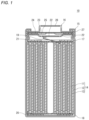
  • FIG. 1 is a cross-sectional view schematically showing a cross section of an example of a lithium ion secondary battery according to the present embodiment.
  • a lithium ion secondary battery 10 shown in FIG. 1 is a cylindrical battery.
  • the secondary battery 10 includes a cylindrical battery case, a wound electrode group 14 housed in the battery case, and a non-aqueous electrolyte (not shown).
  • the battery case includes a case body 15 and a sealing body 16 that seals an opening of the case body 15.
  • the case body 15 is a cylindrical metal case having a bottom and includes a step portion 21.
  • a gasket 27 is disposed between the case body 15 and the sealing body 16. Insulating plates 17 and 18 are respectively disposed at opposite ends of the electrode group 14 in the case body 15.
  • Negative electrode slurries for a lithium ion secondary battery were produced and evaluated as follows in Experiment Example 1.
  • a slurry C1 was produced with use of the same method under the same conditions as those used in the production of the slurry A1, except that the antiseptic component was not added.
  • FIG. 2 The vertical axis in FIG. 2 shows relative values (retention rate) when an initial viscosity is taken to be 100%. The higher the retention rate is, the smaller the reduction in the viscosity is.
  • a change in the viscosity of the slurry C2 over time was measured with use of the same method under the same conditions as those used in Experiment Example 1. Specifically, a bacteria liquid was added to the slurry C2, thereafter the slurry was held in a constant temperature bath, and a change in the viscosity over time was measured as in Experiment Example 1.
  • FIG. 3 shows the change in the viscosity of the slurry C2 over time.
  • FIG. 3 also shows the results of the slurry A1 in Experiment Example 1. Note that the pH of the slurry A1 immediately after the production was 7.0. The pH of the slurry C1 immediately after the production was 7.2.
  • the viscosity of the slurry C2 was low from immediately after the production. It is thought that this is because the effect of CMC-Na was reduced due to the pH exceeding 10. CMC-Na may be depolymerized if the pH is high.
  • the present disclosure can be used for a negative electrode slurry for a lithium ion secondary battery, a negative electrode for a lithium ion secondary battery, and a lithium ion secondary battery.

Landscapes

  • Chemical & Material Sciences (AREA)
  • Chemical Kinetics & Catalysis (AREA)
  • Electrochemistry (AREA)
  • General Chemical & Material Sciences (AREA)
  • Engineering & Computer Science (AREA)
  • Materials Engineering (AREA)
  • Manufacturing & Machinery (AREA)
  • Inorganic Chemistry (AREA)
  • Battery Electrode And Active Subsutance (AREA)

Abstract

A disclosed negative electrode slurry contains a negative electrode active material, a thickener, an antiseptic component, and a solvent. The thickener includes a carboxymethylcellulose salt. The solvent includes water. The antiseptic component includes a compound represented by the following formula (1), where R1 to R5 each independently represent a hydrogen atom or an alkoxy group, the total number of carbon atoms included in R1 to R5 is 3 or less, at least two of R1 to R5 represent hydrogen atoms, and at least one of R1 to R5 represents an alkoxy group.

Description

    [Technical Field]
  • The present disclosure relates to a negative electrode slurry for a lithium ion secondary battery, a negative electrode for a lithium ion secondary battery, and a lithium ion secondary battery.
  • [Background Art]
  • A negative electrode for a lithium ion secondary battery is usually formed with use of a slurry (negative electrode slurry) that contains materials of the negative electrode. Various proposals have been made regarding negative electrode slurries.
  • PTL 1 ( Japanese Laid-Open Patent Publication No. H05(1993)-074461 ) discloses the use of carboxymethylcellulose and the like as a water-soluble thickener.
  • PTL 2 ( Japanese Laid-Open Patent Publication No. 2022-002166 ) discloses "a method for manufacturing a non-aqueous electrolyte secondary battery including an electrode body including a positive electrode, a negative electrode, and a separator, and a non-aqueous electrolyte, wherein steps for manufacturing the negative electrode includes: a step for preparing a negative electrode mixture slurry containing a negative electrode active material, at least one of carboxymethylcellulose and a salt thereof, an alkanolamine, and water; and a step for forming a negative electrode mixture layer by applying the negative electrode mixture slurry to at least one surface of a negative electrode core body to form a coating film, drying the coating film, and compressing the coating film."
  • [Citation List] [Patent Literature]
    • PTL 1: Japanese Laid-Open Patent Publication No. H05(1993)-074461
    • PTL 2: Japanese Laid-Open Patent Publication No. 2022-002166
    [Summary of Invention] [Technical Problem]
  • If the viscosity of a negative electrode slurry decreases, sedimentation of a negative electrode active material dispersed in the slurry occurs. Accordingly, a reduction in the viscosity of the negative electrode slurry leads to degradation of characteristics of the negative electrode and a battery in which the negative electrode is used, and a reduction in the production yield of the battery. Moreover, the reduction in the viscosity of the negative electrode slurry degrades storage properties of the negative electrode slurry and increases the production cost.
  • Under the above circumstances, an object of the present disclosure is to provide a negative electrode slurry for a lithium ion secondary battery that can suppress a reduction in the viscosity over time.
  • [Solution to Problem]
  • An aspect of the present disclosure relates to a negative electrode slurry. The negative electrode slurry is a negative electrode slurry for a lithium ion secondary battery including a negative electrode active material, a thickener, an antiseptic component, and a solvent, wherein the thickener includes a carboxymethylcellulose salt, the solvent includes water, and the antiseptic component includes a compound represented by the following formula (1).
    Figure imgb0001
    R1 to R5 each independently represent a hydrogen atom or an alkoxy group. A total number of carbon atoms included in R1 to R5 is 3 or less. At least two of R1 to R5 represent hydrogen atoms. At least one of R1 to R5 represents an alkoxy group.
  • Another aspect of the present disclosure relates to a negative electrode. The negative electrode is a negative electrode for a lithium ion secondary battery and includes a negative electrode mixture layer containing a negative electrode active material, a thickener, and an antiseptic component, wherein the thickener includes a carboxymethylcellulose salt, and the antiseptic component includes a compound represented by the above formula (1).
  • Another aspect of the present disclosure relates to a lithium ion secondary battery including the negative electrode according to the present disclosure.
  • [Advantageous Effects of Invention]
  • According to the present disclosure, it is possible to obtain a negative electrode slurry that can suppress a reduction in the viscosity over time.
  • Although novel features of the present invention are described in the appended claims, the following detailed description referring to the drawings will further facilitate understanding of both the configuration and the content of the present invention as well as other objects and features of the present invention.
  • [Brief Description of Drawings]
    • FIG. 1 is a cross-sectional view schematically showing an example of a lithium ion secondary battery according to the present embodiment.
    • FIG. 2 is a graph showing results of Experiment Example 1.
    • FIG. 3 is a graph showing results of Experiment Example 2.
    [Description of Embodiments]
  • The following describes examples of embodiments according to the present disclosure, but the present disclosure is not limited to the following examples. In the following description, specific numerical values and materials are described as examples, but other numerical values and materials may be applied as long as the invention according to the present disclosure can be implemented. In the present specification, the wording "from a numerical value A to a numerical value B" refers to a range that includes the numerical values A and B, and can be read as "the numerical value A or more and the numerical value B or less". Examples of a lower limit and examples of an upper limit of numerical values relating to a specific physical property or condition described below can be combined suitably as long as the lower limit is not equal to or higher than the upper limit.
  • (Negative Electrode Slurry for Lithium Ion Secondary Battery)
  • A negative electrode slurry according to the present embodiment is a slurry for a lithium ion secondary battery. Hereinafter, the negative electrode slurry according to the present embodiment may be referred to as a "negative electrode slurry (S)" or a "slurry (S)". The slurry (S) is used in the formation of a negative electrode mixture layer included in a negative electrode of a lithium ion secondary battery.
  • The slurry (S) contains a negative electrode active material, a thickener, an antiseptic component, and a solvent (liquid solvent). The thickener includes a carboxymethylcellulose salt. The solvent includes water. The antiseptic component includes a compound represented by the following formula (1). The compound represented by the formula (1) may be hereinafter referred to as a "compound (1)".
    Figure imgb0002
    Figure imgb0003
    R1 to R5 each independently represent a hydrogen atom or an alkoxy group. The total number of carbon atoms included in R1 to R5 is 3 or less. At least two of R1 to R5 represent hydrogen atoms. At least one of R1 to R5 represents an alkoxy group.
  • If the negative electrode slurry does not contain an antiseptic component, the carboxymethylcellulose salt (hereinafter may be referred to as a "CMC salt") may be decomposed by microorganisms such as bacteria. If the CMC salt is decomposed, the viscosity of the negative electrode slurry decreases, and there arises a problem in that sedimentation of the negative electrode active material contained in the negative electrode slurry occurs. However, the slurry (S) according to the present embodiment contains the compound represented by the formula (1) as the antiseptic component, and therefore, decomposition of the CMC salt by microorganisms can be suppressed. As a result, it is possible to suppress a reduction in the viscosity over time and the occurrence of sedimentation of the negative electrode active material in the slurry (S). If the slurry (S) is used, it is possible to suppress unevenness of a coating film formed by applying the slurry (S) onto a negative electrode current collector. Therefore, it is possible to produce a battery having good characteristics with a high production yield by using the slurry (S).
  • Although there are various antiseptic agents, it is difficult to find an antiseptic agent suitable for use in batteries. For example, an amine-based antiseptic agent may degrade effects of the CMC salt because the amine-based antiseptic agent increases the pH of the slurry. The inventors of the present application newly found through studies that it is possible to obtain high effects by using the compound represented by the formula (1) as an antiseptic component. The present disclosure is based on this new finding.
  • (Compound Represented by Formula (1))
  • Hereinafter, the compound represented by the formula (1) may be referred to as a "compound (1)". In the formula (1), examples of the alkoxy group include a methoxy group, an ethoxy group, an n-propoxy group, and an isopropoxy group.
  • In an example of the compound (1), three of R1 to R5 may represent hydrogen atoms, and two of R1 to R5 may represent alkoxy groups. In this case, the two alkoxy groups are a methoxy group and an ethoxy group.
  • In an example of the compound (1), four of R1 to R5 represent hydrogen atoms, and one of R1 to R5 represents an alkoxy group. In this case, the alkoxy group is a methoxy group, an ethoxy group, an n-propoxy group, or an isopropoxy group. For example, the compound (1) represented by the formula (1) may be 2-methoxyphenol (common name: guaiacol) represented by the following formula (1a).
    Figure imgb0004
    Figure imgb0005
  • It is possible to obtain a particularly high effect by setting the content of the compound (1) represented by the formula (1) in the negative electrode slurry (S) to 0.1% by mass or more. The content may be 0.2% by mass or more. The content may be 1.3% by mass or less, or 1.0% by mass or less.
  • Note that the negative electrode slurry may also contain an antiseptic component other than the compound (1). Examples of the other antiseptic component include alcohols.
  • (Thickener)
  • It is possible to adjust the viscosity of the slurry (S) so as to fall in an appropriate range by using the thickener. Examples of the carboxymethylcellulose salt (CMC salt) used as the thickener include an ammonium salt, a sodium salt, a potassium salt, and a lithium salt, and the carboxymethylcellulose salt may be an ammonium salt and/or a sodium salt. The CMC salt is typically a partially neutralized salt in which some carboxyl groups are neutralized. The weight average molecular weight of the CMC salt is not particularly limited, and may be 200,000 to 500,000. Note that the slurry (S) and the negative electrode mixture layer may contain carboxymethylcellulose (CMC). A portion of the CMC salt added to the slurry (S) may be converted to CMC.
  • There is no particular limitation on the content of the CMC salt in the slurry (S), and the CMC salt is added such that the slurry (S) has desired physical properties (e.g., viscosity). The content of the CMC salt in the slurry (S) may be 0.1% by mass or more, or 0.5% by mass or more, and may be 5.0% by mass or less, or 3.0% by mass or less.
  • The slurry (S) may contain a thickener other than the CMC salt. Examples of the other thickener include known thickeners, such as polyethylene glycol and polyethylene oxide.
  • The viscosity of the slurry (S) may be 2000 mPa·s or more, or 5000 mPa·s or more, and may be 20000 mPa·s or less, or 15000 mPa·s or less. It is possible to make the dispersibility of the negative electrode active material particularly high by setting the viscosity to 2000 mPa·s or more. If the viscosity is 20000 mPa·s or less, the slurry (S) can be applied easily. A reduction in the viscosity of the slurry (S) over time is small. Accordingly, if the slurry (S) has a viscosity in the above-described range when the slurry is produced, the slurry (S) can have a viscosity in the above-described range when 48 hours (or 72 hours) have elapsed from the preparation of the slurry (S).
  • The viscosity of the slurry (S) is measured with use of a BM rotational viscometer in an environment at 25°C after a rotor is rotated for 1 minute at a rotational speed of 20 rpm.
  • The effect of the CMC salt used as the thickener in the slurry (S) is high when the pH of the slurry (S) is 5.0 to 10.0, and particularly high when the pH of the slurry (S) is 7.0 to 9.0. The use of the antiseptic component described above makes it easy to adjust the pH of the slurry (S) so as to fall in the above-described range. The pH of the slurry (S) may be 5.0 or more, or 7.0 or more, and may be 10.0 or less, or 9.0 or less. The pH of the slurry (S) may be in a range from 5.0 to 10.0 (e.g., from 7.0 to 9.0).
  • (Solvent)
  • The negative electrode active material is dispersed in the solvent of the slurry (S). The solvent includes water. The water content in the solvent is typically 50% by mass or more, and may be 80% by mass or more, 90% by mass or more, or 95% by mass or more. The solvent may also be constituted of only water. The water used as the solvent is not particularly limited, and may be ultrapure water, pure water, or industrial water, and A1 water defined in Japanese Industrial Standards (JIS) may also be used. The solvent may also include a water-soluble organic solvent such as an alcohol, for example.
  • The content of the solvent in the slurry (S) may be 30% by mass or more, or 40% by mass or more, and may be 70% by mass or less, or 60% by mass or less.
  • (Negative Electrode Active Material)
  • A substance that absorbs and releases lithium ions reversibly is used as the negative electrode active material. The negative electrode active material is not particularly limited, and it is possible to use a known negative electrode active material that is used in lithium ion secondary batteries. Examples of the negative electrode active material include carbon-based active materials and Si-based active materials. Examples of the carbon-based active materials include graphite. Examples of the graphite include natural graphite such as flake graphite, vein graphite, and amorphous graphite and artificial graphite such as massive artificial graphite (MAG) and graphitized mesophase carbon microbeads (MCMB). The graphite may have a (volume-based) median diameter in a range from 18 to 24 µm. Examples of the Si-based active materials include a composite material having a structure in which Si particles are dispersed in an oxide phase containing Si. Examples of the oxide phase containing Si include a silicon oxide (SiO2) phase and a composite oxide phase containing Si and a metal element (e.g., Li). A carbon-based active material and an Si-based active material may also be used in combination as the negative electrode active material.
  • The content of the negative electrode active material in the slurry (S) may be 30% by mass or more, or 40% by mass or more, and may be 60% by mass or less, or 70% by mass or less.
  • (Other Components)
  • The negative electrode slurry (S) may contain components other than the above-described components. There is no particular limitation on the other components, and it is possible to use components that are used in known negative electrode slurries for lithium ion secondary batteries. For example, the slurry (S) may also contain a binder and a conductive material. One type of each component may be used alone, or two or more types of each component may be used in combination. It is possible to use, as the conductive material, materials described as examples of a conductive material contained in a positive electrode mixture layer.
  • Examples of the binder include polyethylene, polypropylene, a fluorine-based binder, a rubber-based binder, an acrylic polymer, and a vinyl-based polymer. Examples of the fluorine-based binder include polytetrafluoroethylene (PTFE), polyvinylidene fluoride (PVDF), a tetrafluoroethylene-hexafluoropropylene copolymer (FEP), and a vinylidene fluoride-hexafluoropropylene copolymer. Examples of the rubber-based binder include acrylic rubber, styrene-butadiene rubber (SBR), and acrylonitrile rubber. The rubber-based binder is typically supplied as a dispersion containing water as a dispersion medium. The content of the binder in the slurry (S) may be in a range from 0.1 to 5% by mass (e.g., from 0.5 to 3% by mass).
  • (Method for Producing Negative Electrode Slurry (S))
  • There is no particular limitation on the method for producing the slurry (S), and the slurry (S) can be produced with use of a method similar to known methods for producing a negative electrode slurry. Specifically, the slurry (S) can be produced by mixing components (the negative electrode active material, the thickener, the antiseptic component, etc.) of the negative electrode mixture layer with the solvent. The slurry (S) may also contain components other than the negative electrode active material, the thickener, and the antiseptic component as described above.
  • The present disclosure provides a method for producing a negative electrode slurry for a lithium ion secondary battery. The method includes a step of mixing a negative electrode active material, a thickener, an antiseptic component, and a solvent. The negative electrode active material, the thickener, the antiseptic component, and the solvent are described above, and therefore, redundant descriptions thereof are omitted.
  • The materials of the slurry (S) may be mixed with use of a commercially-available dispersion device. The dispersion device may be a dispersion device that uses a medium, such as a bead mill, a ball mill, a planetary ball mill, a kneader, a planetary mixer, or a disperser mixer. The dispersion device may be a dispersion device that does not use a medium, such as a homogenizer.
  • (Negative Electrode and Method for Producing Negative Electrode)
  • A negative electrode according to the present embodiment is a negative electrode for a lithium ion secondary battery. The negative electrode includes a negative electrode mixture layer containing a negative electrode active material, a thickener, and an antiseptic component. The thickener includes a carboxymethylcellulose salt. The antiseptic component includes a compound (1) represented by the above formula (1).
  • The negative electrode mixture layer of the negative electrode according to the present embodiment contains the thickener and the antiseptic component, and therefore, the negative electrode active material is dispersed uniformly. Therefore, it is possible to produce a battery having excellent characteristics with a high production yield by using the negative electrode according to the present embodiment. Moreover, the influence of bacteria and the like can be suppressed even after the negative electrode is formed, and therefore, it is possible to maintain high quality.
  • The negative electrode mixture layer is formed with use of the above-described slurry (S). Accordingly, the components (components other than the solvent) contained in the slurry (S) are contained in the negative electrode mixture layer. The components (the negative electrode active material, the thickener, the antiseptic component, etc.) contained in the negative electrode mixture layer are described above, and therefore, redundant descriptions thereof are omitted. The ratio between the components contained in the slurry (S) is usually reflected as is in the ratio of the components contained in the negative electrode mixture layer. However, the contents of the respective components in the negative electrode mixture layer are higher than the contents of the respective components in the slurry (S) due to the amount of the solvent that is removed.
  • It is possible to obtain a particularly high effect by setting the content of the compound (1) represented by the formula (1) in the negative electrode mixture layer to 0.2% by mass or more. The content may be 0.4% by mass or more. The content may be 2.6% by mass or less, or 2.0% by mass or less.
  • The negative electrode may include a negative electrode current collector and the negative electrode mixture layer formed on the negative electrode current collector. The negative electrode current collector is not particularly limited, and it is possible to use a known negative electrode current collector that is used in lithium ion secondary batteries. Examples of the negative electrode current collector include a metal sheet (e.g., a metal foil or a porous metal sheet). Examples of the metal constituting the negative electrode current collector include copper, nickel, and alloys containing copper and nickel.
  • There is no particular limitation on the thickness of the negative electrode mixture layer. If the negative electrode mixture layer is formed only on a surface of the negative electrode current collector, the thickness of the negative electrode mixture layer may be in a range from 20 to 150 µm. If two negative electrode mixture layers are formed on opposite surfaces of the negative electrode current collector, the total thickness of the two negative electrode mixture layers may be in a range from 40 to 300 µm.
  • There is no particular limitation on the method for producing the negative electrode, except that the above-described slurry (S) is used, and it is also possible to apply a known method for producing a negative electrode. If the negative electrode includes the negative electrode current collector, the negative electrode may be produced with use of a method including the following steps (i) to (iii). The step (i) is a step for preparing the slurry (S) by mixing the materials of the slurry (S).
  • The step (ii) is a step for forming a coating film by applying the slurry (S) to the negative electrode current collector. There is no particular limitation on the method for applying the slurry (S), and it is also possible to apply a known application method. For example, it is possible to use a slit die coater, a reverse roll coater, a lip coater, a blade coater, a knife coater, a gravure coater, a dip coater, or the like.
  • The step (iii) is a step for removing at least a portion of the solvent from the coating film. The step (iii) may be performed by drying the coating film at a temperature of 100°C to 200°C for 10 minutes to 1 hour. Thus, a laminate (negative electrode) including the negative electrode current collector and a mixture layer formed on the negative electrode current collector can be formed.
  • After the step (iii), the laminate may be rolled as necessary. Also, after the step (iii), the laminate may be cut or a lead may be connected to the laminate as necessary, for example. Thus, the negative electrode can be produced.
  • (Lithium Ion Secondary Battery and Method for Producing Lithium Ion Secondary Battery)
  • A lithium ion secondary battery according to the present embodiment includes the negative electrode according to the present embodiment. Therefore, the lithium ion secondary battery has excellent characteristics and can be produced with a high production yield. There is no particular limitation on constituent elements other than the negative electrode, and it is possible to use constituent elements of a known lithium ion secondary battery.
  • The following describes examples of constituent elements of the lithium ion secondary battery other than the negative electrode. However, it is also possible to use constituent elements other than the following examples.
  • (Positive Electrode)
  • The positive electrode includes a positive electrode mixture layer. The positive electrode may include a positive electrode current collector and the positive electrode mixture layer formed on the positive electrode current collector. The positive electrode may be formed with use of a known method. For example, the positive electrode mixture layer may be formed by applying a positive electrode slurry to the positive electrode current collector to form a coating film, drying the coating film, and rolling the coating film. The method described as an example of the method for forming the negative electrode mixture layer with use of the negative electrode slurry may be used as a method for forming the positive electrode mixture layer with use of the positive electrode slurry.
  • The positive electrode mixture layer contains a positive electrode active material, and may also contain other components (e.g., a conductive material, a binder, a thickener, etc.). The positive electrode slurry can be obtained by mixing these components with a dispersion medium. There is no particular limitation on these components and the dispersion medium, and it is possible to use known substances that are used in positive electrodes of lithium ion secondary batteries.
  • Examples of the positive electrode active material include olivine-type lithium salts (e.g., LiFePO4), chalcogen compounds (titanium disulfide, molybdenum disulfide), manganese dioxide, and lithium-containing composite metal oxides. Examples of the lithium-containing composite metal oxides include metal oxides containing lithium and transition metals. A portion of the transition metals contained in the metal oxides may be substituted by different elements. Examples of the different elements include Na, Mg, Sc, Y, Mn, Fe, Co, Ni, Cu, Zn, Al, Cr, Pb, Sb, and B. Preferable examples of the different elements include Mn, Al, Co, Ni, and Mg. One different element may be contained, or two or more different elements may be contained.
  • Examples of the lithium-containing composite metal oxides include LixCoO2, LixNiO2, LixMnO2, LixCoyNi1-yO2, LixCoyM1-yOz, LixNi1-yMyOz, LixMn2O4, LixMn2-yMyO4, LiMPO4, and Li2MPO4F. In each formula, M represents at least one element selected from the group consisting of Na, Mg, Sc, Y, Mn, Fe, Co, Ni, Cu, Zn, Al, Cr, Pb, Sb, V, and B. In these composition formulas, x, y, and z may satisfy: x=0 to 1.2, y=0 to 0.9, and z=2.0 to 2.3.
  • Examples of the conductive material include carbon black, graphite, carbon fiber, and metal fiber. Examples of the binder include the substances described as examples of the binder that may be contained in the slurry (S). Examples of the thickener include carboxymethylcellulose salts.
  • Examples of the dispersion medium include amides (e.g., N,N-dimethylformamide, dimethylacetamide, methylformamide, hexamethyl sulfonamide, and tetramethylurea), N-methyl-2-pyrrolidone (NMP), ketones (e.g., amines such as dimethylamine, methylethylketone, acetone, and cyclohexane), ethers (e.g., tetrahydrofuran), and sulfoxides (e.g., dimethylsulfoxide).
  • (Separator)
  • A separator is disposed between the positive electrode and the negative electrode. The separator is not particularly limited, and it is possible to use a known separator that is used in lithium ion secondary batteries. The separator may be a microporous film formed from a polymer material. Examples of the polymer material include polyethylene, polypropylene, polyvinylidenefluoride, polyvinylidenechloride, polyacrylonitrile, polyacrylamide, polytetrafluoroethylene, polysulfone, polyethersulfone, polycarbonate, polyamide, polyimide, polyethers (polyethylene oxide and polypropylene oxide), cellulose (carboxymethylcellulose and hydroxypropylcellulose), poly(meth)acrylic acid, and poly(meth)acrylic esters. One of these polymer materials may be used alone, or two or more of them may be used in combination. The separator may include a plurality of layers stacked on each other.
  • (Electrolyte)
  • A non-aqueous electrolyte can be used as an electrolyte, and a known electrolyte that is used in lithium ion secondary batteries may be used. The electrolyte may be a non-aqueous electrolyte containing a non-aqueous solvent and an electrolyte salt. The electrolyte may be a gel electrolyte obtained with use of a gel polymer or the like.
  • Examples of the non-aqueous solvent include cyclic carbonates and chain carbonates. Examples of the cyclic carbonates include ethylene carbonate, propylene carbonate, and butylene carbonate. Examples of the chain carbonates include dimethyl carbonate, diethyl carbonate, and ethylmethyl carbonate.
  • Examples of the electrolyte salt include LiPF6, LiBF4, LiClO4, LiAsF6, LiCF3SO3, LiN(SO2CF3)2, LiN(SO2C2F5)2, and LiC(SO2CF3)3. One non-aqueous solvent may be used alone, or two or more non-aqueous solvents may be used in combination. One electrolyte salt may be used alone, or two or more electrolyte salts may be used in combination.
  • (Others)
  • The shape of the lithium ion secondary battery is not particularly limited, and may be a cylindrical shape, a rectangular shape, or a coin shape (including a button shape). A case of the lithium ion secondary battery is selected according to the shape of the lithium ion secondary battery, for example. The case may be made of metal or resin. The positive electrode, the negative electrode, and the separator compose an electrode group. The electrode group may be a wound electrode group formed by winding the positive electrode, the negative electrode, and the separator. Alternatively, the electrode group may be a stacked electrode group formed by stacking the positive electrode, the negative electrode, and the separator.
  • There is no particular limitation on the method for producing the lithium ion secondary battery, except that the negative electrode according to the present embodiment is used. The lithium ion secondary battery according to the present embodiment may be produced with use of a known method for producing a lithium ion secondary battery.
  • The present disclosure provides a method for producing a lithium ion secondary battery. The method includes a step for producing the above-described slurry (S).
  • The following specifically describes an example of the lithium ion secondary battery according to the present disclosure with reference to the drawings. The constituent elements described above can be applied to constituent elements of the following example. Also, the constituent elements of the following example can be modified based on the above description. Also, matter described below may be applied to the embodiment described above. In the following example, constituent elements that are not essential to the lithium ion secondary battery according to the present disclosure may be omitted.
  • FIG. 1 is a cross-sectional view schematically showing a cross section of an example of a lithium ion secondary battery according to the present embodiment. A lithium ion secondary battery 10 shown in FIG. 1 is a cylindrical battery. The secondary battery 10 includes a cylindrical battery case, a wound electrode group 14 housed in the battery case, and a non-aqueous electrolyte (not shown). The battery case includes a case body 15 and a sealing body 16 that seals an opening of the case body 15. The case body 15 is a cylindrical metal case having a bottom and includes a step portion 21. A gasket 27 is disposed between the case body 15 and the sealing body 16. Insulating plates 17 and 18 are respectively disposed at opposite ends of the electrode group 14 in the case body 15.
  • The sealing body 16 includes a filter 22, a lower valve body 23, an insulating member 24, an upper valve body 25, and a cap 26. The members excluding the insulating member 24 are electrically connected to each other.
  • The electrode group 14 is formed by winding a positive electrode 11, a negative electrode 12, and a separator 13 such that the separator 13 is disposed between the positive electrode and the negative electrode. The positive electrode 11, the negative electrode 12, and the separator 13 each have a band shape. The positive electrode 11 includes a positive electrode current collector and positive electrode mixture layers formed on opposite surfaces of the positive electrode current collector. The negative electrode 12 includes a negative electrode current collector and negative electrode mixture layers formed on opposite surfaces of the negative electrode current collector. The negative electrode 12 is the above-described negative electrode according to the present embodiment. The negative electrode 12 can be formed with use of the negative electrode slurry (S.)
  • An end of a positive electrode lead 19 is connected to the positive electrode 11, and the other end of the positive electrode lead 19 is connected to the filter 22. That is to say, the positive electrode 11 is electrically connected to the cap 26 that also serves as a positive electrode terminal. An end of a negative electrode lead 20 is connected to the negative electrode 12, and the other end of the negative electrode lead 20 is connected to the case body 15 that also serves as a negative electrode terminal.
  • (Supplementary Note)
  • The following technologies are disclosed by the above description.
  • (Technology 1)
  • A negative electrode slurry for a lithium ion secondary battery including a negative electrode active material, a thickener, an antiseptic component, and a solvent,
    • wherein the thickener includes a carboxymethylcellulose salt,
    • the solvent includes water, and
    • the antiseptic component includes a compound represented by the above formula (1), where R1 to R5 each independently represent a hydrogen atom or an alkoxy group, a total number of carbon atoms included in R1 to R5 is 3 or less, at least two of R1 to R5 represent hydrogen atoms, and at least one of R1 to R5 represents an alkoxy group.
    (Technology 2)
  • The negative electrode slurry according to the technology 1, wherein four of R1 to R5 represent hydrogen atoms, and
    one of R1 to R5 represents an alkoxy group.
  • (Technology 3)
  • The negative electrode slurry according to the technology 1, wherein the compound represented by the formula (1) is 2-methoxyphenol.
  • (Technology 4)
  • A negative electrode for a lithium ion secondary battery, including:
    • a negative electrode mixture layer containing a negative electrode active material, a thickener, and an antiseptic component,
    • wherein the thickener includes a carboxymethylcellulose salt, and
    • the antiseptic component includes a compound represented by the above formula (1), where R1 to R5 each independently represent a hydrogen atom or an alkoxy group, a total number of carbon atoms included in R1 to R5 is 3 or less, at least two of R1 to R5 represent hydrogen atoms, and at least one of R1 to R5 represents an alkoxy group.
    (Technology 5)
  • The negative electrode according to the technology 4, wherein four of R1 to R5 represent hydrogen atoms, and
    one of R1 to R5 represents an alkoxy group.
  • (Technology 6)
  • The negative electrode according to the technology 4, wherein the compound represented by the formula (1) is 2-methoxyphenol.
  • (Technology 7)
  • A lithium ion secondary battery including the negative electrode according to any one of the technologies 4 to 6.
  • Examples
  • The following describes the present disclosure in more detail using examples, but the present disclosure is not limited to the following examples.
  • (Experiment Example 1)
  • Negative electrode slurries for a lithium ion secondary battery were produced and evaluated as follows in Experiment Example 1.
  • (Slurry A1)
  • First, a mixture of water, graphite powder (negative electrode active material), carboxymethylcellulose sodium (thickener), and 2-methoxyphenol (antiseptic component) was stirred for 1 hour with use of a planetary mixture to obtain a slurry A1 (negative electrode slurry for a lithium ion secondary battery). Hereinafter, the carboxymethylcellulose sodium may be referred to as "CMC-Na". Water, graphite powder, CMC-Na, and 2-methoxyphenol were mixed at a mass ratio of: water:graphite powder: CMC-Na:2-methoxyphenol=50.0:49.5:0.4:0.1.
  • (Slurry C1)
  • A slurry C1 was produced with use of the same method under the same conditions as those used in the production of the slurry A1, except that the antiseptic component was not added. In the production of the slurry C1, water, graphite powder, and CMC-Na were mixed at a mass ratio of: water:graphite powder: CMC-Na=50.0:49.6:0.4.
  • (Measurement of change in viscosity over time)
  • With respect to each negative electrode slurry obtained as described above, a change in the viscosity over time was measured with use of the following method. First, a bacteria liquid containing bacteria was added to the negative electrode slurry. Bacteria that produce an enzyme that decomposes CMC-Na were used. Next, the negative electrode slurry to which the bacteria liquid had been added was placed in a container having an inner diameter of 55 mm and a depth of 115 mm, and the temperature was kept at 25±0.2°C in a constant temperature water bath. A change in the viscosity of the negative electrode slurry over time was measured in this state. The viscosity was measured with use of a BM rotational viscometer ("TVB-15M" manufactured by Toki Sangyo Co., Ltd). The viscosity was measured after a rotor was rotated for 1 minute at a rotational speed of 20 rpm.
  • Measurement results are shown in FIG. 2. The vertical axis in FIG. 2 shows relative values (retention rate) when an initial viscosity is taken to be 100%. The higher the retention rate is, the smaller the reduction in the viscosity is.
  • The slurry A1 is a slurry (S) according to the present embodiment. The slurry C1 is a slurry of Comparative Example. As shown in FIG. 2, the viscosity of the slurry A1 hardly decreased over time. In contrast, the viscosity of the slurry C1 significantly decreased with the passage of time.
  • (Experiment Example 2)
  • In Experiment Example 2, the influence of the pH of the negative electrode slurries was examined. A slurry C2 was produced with use of the same method under the same conditions as those used in the production of the slurry A1 in Experiment Example 1, except that the antiseptic component was changed. In the production of the slurry C2, 2-hydroxymethyl amino ethanol, which is an alkaline antiseptic agent, was used as an antiseptic component instead of 2-methoxyphenol. Note that the content of the alkaline antiseptic agent in the negative electrode slurry was set to 0.2% by mass. The pH of the slurry C2 immediately after the production was 10.2.
  • A change in the viscosity of the slurry C2 over time was measured with use of the same method under the same conditions as those used in Experiment Example 1. Specifically, a bacteria liquid was added to the slurry C2, thereafter the slurry was held in a constant temperature bath, and a change in the viscosity over time was measured as in Experiment Example 1.
  • FIG. 3 shows the change in the viscosity of the slurry C2 over time. FIG. 3 also shows the results of the slurry A1 in Experiment Example 1. Note that the pH of the slurry A1 immediately after the production was 7.0. The pH of the slurry C1 immediately after the production was 7.2.
  • As shown in FIG. 3, the viscosity of the slurry C2 was low from immediately after the production. It is thought that this is because the effect of CMC-Na was reduced due to the pH exceeding 10. CMC-Na may be depolymerized if the pH is high.
  • [Industrial Applicability]
  • The present disclosure can be used for a negative electrode slurry for a lithium ion secondary battery, a negative electrode for a lithium ion secondary battery, and a lithium ion secondary battery.
  • Although the present invention has been described in terms of the presently preferred embodiment, it is to be understood that such a disclosure is not to be interpreted as limiting. Various alterations and modifications will no doubt become apparent to those skilled in the art to which the present invention pertains, after having read the above disclosure. Accordingly, it is intended that the appended claims be interpreted as covering all alterations and modifications that fall within the true spirit and scope of the invention.
  • [Reference Signs List]
  • 10: lithium ion secondary battery, 11: positive electrode, 12: negative electrode, 13: separator, 14: electrode group
Claims (7)

  1. A negative electrode slurry for a lithium ion secondary battery, comprising:
    a negative electrode active material;
    a thickener;
    an antiseptic component; and
    a solvent,
    wherein the thickener includes a carboxymethylcellulose salt,
    the solvent includes water, and
    the antiseptic component includes a compound represented by the following formula (1),
    Figure imgb0006
    where R1 to R5 each independently represent a hydrogen atom or an alkoxy group, a total number of carbon atoms included in R1 to R5 is 3 or less, at least two of R1 to R5 represent hydrogen atoms, and at least one of R1 to R5 represents an alkoxy group.
  2. The negative electrode slurry according to claim 1,
    wherein four of R1 to R5 represent hydrogen atoms, and
    one of R1 to R5 represents an alkoxy group.
  3. The negative electrode slurry according to claim 1,
    wherein the compound represented by the formula (1) is 2-methoxyphenol.
  4. A negative electrode for a lithium ion secondary battery, comprising:
    a negative electrode mixture layer containing a negative electrode active material, a thickener, and an antiseptic component,
    wherein the thickener includes a carboxymethylcellulose salt, and
    the antiseptic component includes a compound represented by the following formula (1),
    Figure imgb0007
    where R1 to R5 each independently represent a hydrogen atom or an alkoxy group, a total number of carbon atoms included in R1 to R5 is 3 or less, at least two of R1 to R5 represent hydrogen atoms, and at least one of R1 to R5 represents an alkoxy group.
  5. The negative electrode according to claim 4,
    wherein four of R1 to R5 represent hydrogen atoms, and
    one of R1 to R5 represents an alkoxy group.
  6. The negative electrode according to claim 4,
    wherein the compound represented by the formula (1) is 2-methoxyphenol.
  7. A lithium ion secondary battery comprising the negative electrode according to any one of claims 4 to 6.
EP23854730.1A 2022-08-19 2023-07-04 Negative electrode slurry for lithium ion secondary batteries, negative electrode for lithium ion secondary batteries, and lithium ion secondary battery Pending EP4576269A1 (en)

Applications Claiming Priority (2)

Application Number Priority Date Filing Date Title
JP2022131247 2022-08-19
PCT/JP2023/024782 WO2024038693A1 (en) 2022-08-19 2023-07-04 Negative electrode slurry for lithium ion secondary batteries, negative electrode for lithium ion secondary batteries, and lithium ion secondary battery

Publications (1)

Publication Number Publication Date
EP4576269A1 true EP4576269A1 (en) 2025-06-25

Family

ID=89941478

Family Applications (1)

Application Number Title Priority Date Filing Date
EP23854730.1A Pending EP4576269A1 (en) 2022-08-19 2023-07-04 Negative electrode slurry for lithium ion secondary batteries, negative electrode for lithium ion secondary batteries, and lithium ion secondary battery

Country Status (5)

Country Link
US (1) US20260045500A1 (en)
EP (1) EP4576269A1 (en)
JP (1) JPWO2024038693A1 (en)
CN (1) CN119678272A (en)
WO (1) WO2024038693A1 (en)

Family Cites Families (7)

* Cited by examiner, † Cited by third party
Publication number Priority date Publication date Assignee Title
JPS5196B2 (en) * 1972-03-07 1976-01-05
JPS515370B2 (en) * 1972-08-10 1976-02-19
JP3101775B2 (en) 1991-09-13 2000-10-23 旭化成工業株式会社 Secondary battery negative electrode
JP2010144044A (en) * 2008-12-18 2010-07-01 Lion Corp Support for active ingredient
CN101937983B (en) * 2009-06-29 2012-12-12 上海比亚迪有限公司 Lithium ion battery negative slurry and lithium ion battery
CN103606703A (en) * 2013-11-15 2014-02-26 江苏天鹏电源有限公司 Lithium ion battery with uniform and stable current density
JP2022002166A (en) 2018-09-18 2022-01-06 パナソニック株式会社 Non-aqueous electrolyte secondary battery and manufacturing method of non-aqueous electrolyte secondary battery

Also Published As

Publication number Publication date
JPWO2024038693A1 (en) 2024-02-22
CN119678272A (en) 2025-03-21
US20260045500A1 (en) 2026-02-12
WO2024038693A1 (en) 2024-02-22

Similar Documents

Publication Publication Date Title
US7968232B2 (en) Cathode and lithium battery including the same
JP7027387B2 (en) Titanium dope niobate and batteries
CN110600687B (en) Methods of preparing composite materials
EP3442062A1 (en) Binder for electrochemical element
CN107408670B (en) Electrode for electrochemical device, method of making the same, and electrochemical device comprising the same
US20100136430A1 (en) Ncm positive active material for secondary battery and secondary battery including the same
EP4071861A1 (en) Aqueous slurry for positive electrode, positive electrode composition, lithium-ion secondary battery including said positive electrode composition, and methods for manufacturing same
FR3122286A1 (en) Mixture of active materials for cathode of lithium-ion element
JP2013114959A (en) Negative electrode slurry for lithium ion secondary battery, negative electrode plate for lithium ion secondary battery and lithium ion secondary battery
EP3714498B1 (en) Use of a mixture of salts as additive in a gelified lithium battery
KR20200040988A (en) Lithium air battery and manufacturing method thereof
EP4576269A1 (en) Negative electrode slurry for lithium ion secondary batteries, negative electrode for lithium ion secondary batteries, and lithium ion secondary battery
EP2889934B1 (en) Separator for rechargeable lithium battery and rechargeable lithium battery including same
WO2006045923A2 (en) Nanostructure material, method for the preparation thereof
EP4576268A1 (en) Negative electrode slurry for lithium-ion secondary battery, negative electrode for lithium-ion secondary battery, and lithium-ion secondary battery
EP4297125A1 (en) Negative electrode slurry for lithium ion secondary battery, method for manufacturing negative electrode for lithium ion secondary battery, method for manufacturing lithium ion secondary battery, negative electrode for lithium ion secondary battery, and lithium ion secondary battery
WO2006045921A1 (en) Method for the preparation of gamma-liv2o5.
US20250105270A1 (en) Lithium manganese rich oxides with protective coating for cathodes
KR101490406B1 (en) Positive electrode active material coated with fluorine compounds for lithium secondary battery and preparation method thereof
WO2025047399A1 (en) Negative electrode slurry for lithium-ion secondary battery, negative electrode for lithium-ion secondary battery, and lithium-ion secondary battery
EP4297126A1 (en) Negative electrode slurry for lithium ion secondary battery, method for manufacturing negative electrode for lithium ion secondary battery, method for manufacturing lithium ion secondary battery, negative electrode for lithium ion secondary battery, and lithium ion secondary battery
EP4641649A1 (en) Negative electrodes for rechargeable lithium batteries, manufacturing methods of the same, and rechargeable lithium batteries including the same
EP4560727A1 (en) Negative electrode for rechargeable lithium battery and rechargeable lithium battery including same
EP4651292A2 (en) Separator for rechargeable lithium battery and rechargeable lithium battery including the same
EP4629377A1 (en) Separator for rechargeable lithium battery and rechargeable lithium battery including the same

Legal Events

Date Code Title Description
STAA Information on the status of an ep patent application or granted ep patent

Free format text: STATUS: THE INTERNATIONAL PUBLICATION HAS BEEN MADE

PUAI Public reference made under article 153(3) epc to a published international application that has entered the european phase

Free format text: ORIGINAL CODE: 0009012

STAA Information on the status of an ep patent application or granted ep patent

Free format text: STATUS: REQUEST FOR EXAMINATION WAS MADE

17P Request for examination filed

Effective date: 20250205

AK Designated contracting states

Kind code of ref document: A1

Designated state(s): AL AT BE BG CH CY CZ DE DK EE ES FI FR GB GR HR HU IE IS IT LI LT LU LV MC ME MK MT NL NO PL PT RO RS SE SI SK SM TR

DAV Request for validation of the european patent (deleted)
DAX Request for extension of the european patent (deleted)