EP4575256A1 - Integrated wheel end system - Google Patents
Integrated wheel end system Download PDFInfo
- Publication number
- EP4575256A1 EP4575256A1 EP24220212.5A EP24220212A EP4575256A1 EP 4575256 A1 EP4575256 A1 EP 4575256A1 EP 24220212 A EP24220212 A EP 24220212A EP 4575256 A1 EP4575256 A1 EP 4575256A1
- Authority
- EP
- European Patent Office
- Prior art keywords
- rocker
- shift fork
- actuation system
- solenoid
- pivot
- Prior art date
- Legal status (The legal status is an assumption and is not a legal conclusion. Google has not performed a legal analysis and makes no representation as to the accuracy of the status listed.)
- Pending
Links
Images










Classifications
-
- F—MECHANICAL ENGINEERING; LIGHTING; HEATING; WEAPONS; BLASTING
- F16—ENGINEERING ELEMENTS AND UNITS; GENERAL MEASURES FOR PRODUCING AND MAINTAINING EFFECTIVE FUNCTIONING OF MACHINES OR INSTALLATIONS; THERMAL INSULATION IN GENERAL
- F16D—COUPLINGS FOR TRANSMITTING ROTATION; CLUTCHES; BRAKES
- F16D27/00—Magnetically- or electrically- actuated clutches; Control or electric circuits therefor
- F16D27/10—Magnetically- or electrically- actuated clutches; Control or electric circuits therefor with an electromagnet not rotating with a clutching member, i.e. without collecting rings
- F16D27/118—Magnetically- or electrically- actuated clutches; Control or electric circuits therefor with an electromagnet not rotating with a clutching member, i.e. without collecting rings with interengaging jaws or gear teeth
-
- F—MECHANICAL ENGINEERING; LIGHTING; HEATING; WEAPONS; BLASTING
- F16—ENGINEERING ELEMENTS AND UNITS; GENERAL MEASURES FOR PRODUCING AND MAINTAINING EFFECTIVE FUNCTIONING OF MACHINES OR INSTALLATIONS; THERMAL INSULATION IN GENERAL
- F16H—GEARING
- F16H63/00—Control outputs from the control unit to change-speed- or reversing-gearings for conveying rotary motion or to other devices than the final output mechanism
- F16H63/02—Final output mechanisms therefor; Actuating means for the final output mechanisms
- F16H63/30—Constructional features of the final output mechanisms
- F16H63/32—Gear shift yokes, e.g. shift forks
-
- F—MECHANICAL ENGINEERING; LIGHTING; HEATING; WEAPONS; BLASTING
- F16—ENGINEERING ELEMENTS AND UNITS; GENERAL MEASURES FOR PRODUCING AND MAINTAINING EFFECTIVE FUNCTIONING OF MACHINES OR INSTALLATIONS; THERMAL INSULATION IN GENERAL
- F16H—GEARING
- F16H59/00—Control inputs to control units of change-speed- or reversing-gearings for conveying rotary motion
- F16H59/02—Selector apparatus
-
- F—MECHANICAL ENGINEERING; LIGHTING; HEATING; WEAPONS; BLASTING
- F16—ENGINEERING ELEMENTS AND UNITS; GENERAL MEASURES FOR PRODUCING AND MAINTAINING EFFECTIVE FUNCTIONING OF MACHINES OR INSTALLATIONS; THERMAL INSULATION IN GENERAL
- F16H—GEARING
- F16H61/00—Control functions within control units of change-speed- or reversing-gearings for conveying rotary motion ; Control of exclusively fluid gearing, friction gearing, gearings with endless flexible members or other particular types of gearing
- F16H61/02—Control functions within control units of change-speed- or reversing-gearings for conveying rotary motion ; Control of exclusively fluid gearing, friction gearing, gearings with endless flexible members or other particular types of gearing characterised by the signals used
- F16H61/0202—Control functions within control units of change-speed- or reversing-gearings for conveying rotary motion ; Control of exclusively fluid gearing, friction gearing, gearings with endless flexible members or other particular types of gearing characterised by the signals used the signals being electric
- F16H61/0204—Control functions within control units of change-speed- or reversing-gearings for conveying rotary motion ; Control of exclusively fluid gearing, friction gearing, gearings with endless flexible members or other particular types of gearing characterised by the signals used the signals being electric for gearshift control, e.g. control functions for performing shifting or generation of shift signal
-
- F—MECHANICAL ENGINEERING; LIGHTING; HEATING; WEAPONS; BLASTING
- F16—ENGINEERING ELEMENTS AND UNITS; GENERAL MEASURES FOR PRODUCING AND MAINTAINING EFFECTIVE FUNCTIONING OF MACHINES OR INSTALLATIONS; THERMAL INSULATION IN GENERAL
- F16H—GEARING
- F16H63/00—Control outputs from the control unit to change-speed- or reversing-gearings for conveying rotary motion or to other devices than the final output mechanism
- F16H63/02—Final output mechanisms therefor; Actuating means for the final output mechanisms
- F16H63/30—Constructional features of the final output mechanisms
- F16H63/34—Locking or disabling mechanisms
-
- B—PERFORMING OPERATIONS; TRANSPORTING
- B60—VEHICLES IN GENERAL
- B60K—ARRANGEMENT OR MOUNTING OF PROPULSION UNITS OR OF TRANSMISSIONS IN VEHICLES; ARRANGEMENT OR MOUNTING OF PLURAL DIVERSE PRIME-MOVERS IN VEHICLES; AUXILIARY DRIVES FOR VEHICLES; INSTRUMENTATION OR DASHBOARDS FOR VEHICLES; ARRANGEMENTS IN CONNECTION WITH COOLING, AIR INTAKE, GAS EXHAUST OR FUEL SUPPLY OF PROPULSION UNITS IN VEHICLES
- B60K17/00—Arrangement or mounting of transmissions in vehicles
- B60K17/34—Arrangement or mounting of transmissions in vehicles for driving both front and rear wheels, e.g. four wheel drive vehicles
- B60K17/348—Arrangement or mounting of transmissions in vehicles for driving both front and rear wheels, e.g. four wheel drive vehicles having differential means for driving one set of wheels, e.g. the front, at one speed and the other set, e.g. the rear, at a different speed
- B60K17/35—Arrangement or mounting of transmissions in vehicles for driving both front and rear wheels, e.g. four wheel drive vehicles having differential means for driving one set of wheels, e.g. the front, at one speed and the other set, e.g. the rear, at a different speed including arrangements for suppressing or influencing the power transfer, e.g. viscous clutches
- B60K17/3515—Arrangement or mounting of transmissions in vehicles for driving both front and rear wheels, e.g. four wheel drive vehicles having differential means for driving one set of wheels, e.g. the front, at one speed and the other set, e.g. the rear, at a different speed including arrangements for suppressing or influencing the power transfer, e.g. viscous clutches with a clutch adjacent to traction wheel, e.g. automatic wheel hub
-
- F—MECHANICAL ENGINEERING; LIGHTING; HEATING; WEAPONS; BLASTING
- F16—ENGINEERING ELEMENTS AND UNITS; GENERAL MEASURES FOR PRODUCING AND MAINTAINING EFFECTIVE FUNCTIONING OF MACHINES OR INSTALLATIONS; THERMAL INSULATION IN GENERAL
- F16D—COUPLINGS FOR TRANSMITTING ROTATION; CLUTCHES; BRAKES
- F16D23/00—Details of mechanically-actuated clutches not specific for one distinct type
- F16D23/12—Mechanical clutch-actuating mechanisms arranged outside the clutch as such
- F16D2023/126—Actuation by rocker lever; Rocker levers therefor
-
- F—MECHANICAL ENGINEERING; LIGHTING; HEATING; WEAPONS; BLASTING
- F16—ENGINEERING ELEMENTS AND UNITS; GENERAL MEASURES FOR PRODUCING AND MAINTAINING EFFECTIVE FUNCTIONING OF MACHINES OR INSTALLATIONS; THERMAL INSULATION IN GENERAL
- F16D—COUPLINGS FOR TRANSMITTING ROTATION; CLUTCHES; BRAKES
- F16D23/00—Details of mechanically-actuated clutches not specific for one distinct type
- F16D23/12—Mechanical clutch-actuating mechanisms arranged outside the clutch as such
- F16D23/14—Clutch-actuating sleeves or bearings; Actuating members directly connected to clutch-actuating sleeves or bearings
- F16D2023/141—Clutch-actuating sleeves or bearings; Actuating members directly connected to clutch-actuating sleeves or bearings characterised by using a fork; Details of forks
-
- F—MECHANICAL ENGINEERING; LIGHTING; HEATING; WEAPONS; BLASTING
- F16—ENGINEERING ELEMENTS AND UNITS; GENERAL MEASURES FOR PRODUCING AND MAINTAINING EFFECTIVE FUNCTIONING OF MACHINES OR INSTALLATIONS; THERMAL INSULATION IN GENERAL
- F16D—COUPLINGS FOR TRANSMITTING ROTATION; CLUTCHES; BRAKES
- F16D23/00—Details of mechanically-actuated clutches not specific for one distinct type
- F16D23/12—Mechanical clutch-actuating mechanisms arranged outside the clutch as such
- F16D23/14—Clutch-actuating sleeves or bearings; Actuating members directly connected to clutch-actuating sleeves or bearings
Definitions
- the present disclosure relates to an integrated wheel end system and more particularly, to an actuator for initiating the shifting action of a clutch to affect engagement/disengagement of drive and driven shafts.
- the sliding movement is achieved by what will here be referred to as an actuator.
- the actuator can be many types including, e.g., a shift lever, manual hand operated, magnetically actuated, electrically actuated, cam actuated, or pneumatically actuated.
- an actuator for a wheel end disconnect system includes a housing and a solenoid mounted to the housing, the solenoid is actuatable to move a plunger in a fore and aft direction.
- a rocker is pivotally mounted to the housing and having a first end connected to the plunger.
- a shift fork is slidably mounted on a translation pin extending from the housing, the shift fork including a channel for receiving a second end of the rocker, wherein activation of the solenoid causes pivotal movement of the rocker to cause the shift fork to translate along the translation pin.
- the channel is V-shaped.
- the translation pin is parallel to the direction of movement of the plunger.
- the channel extends on opposite sides of the translation pin.
- a bottom surface of the channel is aligned with the translation pin.
- the second end of the rocker includes a cutout to define a pair of legs that straddle the translation pin.
- the rocker includes a pair of pivot arms for mounting the rocker to the housing.
- a magnet is mounted to the shift fork and a sensor is mounted to the housing for sensing a position of the magnet on the shift fork relative to the housing.
- the shift fork includes an anti-rotation feature for preventing the shift fork from rotating relative to the translation pin.
- a clutch ring is connected to the shift fork.
- a control unit for controlling the solenoid and for receiving position signals from the sensor.
- the control unit receives signals from the sensor and if the sensor signal indicates that the desired shift is not achieved within a predetermined time period, the shift control is halted.
- control unit received command signals from a vehicle interface.
- control unit is mounted to a printed circuit board of the actuator.
- the senor is mounted to the printed circuit board.
- the solenoid includes a first coil driver for operating a first coil of the solenoid in a first direction and a second coil driver for operating a second coil of the solenoid in a second direction.
- a current to one of the first and second coils is approximately 1/3 of the current to the other of the first and second coils.
- the solenoid has an operating current of less than or equal to 7A.
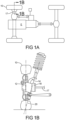
- FIG. 1A schematically illustrates a vehicle chassis including front wheels 10 as may incorporate a clutch actuator assembly of the present disclosure.
- FIG. 1B is a partial view as taken along lines 1B-1B of FIG. 1A and illustrates a front wheel 10 having a hub 12 extended inward where it is supported by a steering knuckle 14.
- a bearing pack (not shown) allows rotation of the wheel 10 relative to the steering knuckle 14.
- a drive axle 17 (of the vehicle drive train) connects to a CV-joint 18 which is secured to the knuckle.
- the CV-joint 18 is adapted to accommodate the pivotal axis 20 of the wheel 10 and knuckle 14 whereby turning of the front wheel is permitted while remaining in driving engagement with the axle 17.
- the CV-joint 18 includes an axle portion that is configured to provide an annular portion having splines that are in mating alignment with splines provided on a coupler. It will thus be apparent that the CV-joint 18 is rotatably supported in the hub 12 which is rotatably supported in the knuckle 14.
- a clutch ring 40 engages with both spline sets of the CV-joint 18 and the coupler, respectively.
- the CV-joint (driven by axle 17) drives the wheel hub 12 and accordingly wheel 10.
- the clutch ring 40 is, however, slidable to disengage from the coupler thereby disengaging wheel 10 from the drive axle 17. Such sliding movement of the clutch ring 40 is provided by an actuator assembly 42.
- the actuator assembly 42 includes a housing 44 that can be mounted to the knuckle 14 in a wheel end disconnect system.
- a gasket 45 can be provided between the housing 44 and the knuckle 14.
- the housing 44 can include a recessed groove for receiving the gasket 45.
- the housing 44 can be made from aluminum and includes a solenoid portion 44a for mounting a solenoid 46.
- the housing 44 can include a pair of alignment pins 47 (best shown in FIGS. 2 and 3 ) that can be used to align the housing when the actuator assembly 42 is mounted to the knuckle 14.
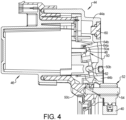
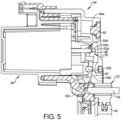
- the solenoid 46 includes a plunger 48 (best shown in FIGS. 4 and 5 that engages a rocker 50. As shown in FIGS.4 and 5 , the rocker 50 is pivotally mounted to the housing 44 and is engaged with a shift fork 52.
- a vent 60 is provided in the housing 44.
- the shift fork 52 is slidably supported on an elongated translation pin 54 extending from an intermediate portion 44b of the housing 44.
- the elongated translation pin 54 can extend parallel to an axis of rotation of the CV joint 18.
- the plunger 48 moves in fore and aft directions and pivots the rocker 50 to cause the shift fork 52 to translate along the translation pin 54.
- the shift fork 52 includes a pair of arms 56a, 56b that engage with the clutch ring 40 to move the clutch ring 40 from an engaged to a disengaged position and vice versa.
- a shaft seal 58 is mounted to a shaft portion 44c of the housing 44.
- the shaft seal 58 engages the CV joint 18 which extends through the shaft portion 44c of the housing 44.
- the rocker 50 can be made from plastic or metal and can include a pair of integral pivot arms 62 extending from a mid-portion 50a of the rocker 50.
- An upper end 50b of the rocker 50 includes snap engagement members 64a, 64b for engagement with a cross pin 48a of the plunger 48.
- a pair of optional latches 64c are provided for engaging a top end of the cross pin 48a of the plunger 48.
- the pair of latches 64c have a tapered inner face to facilitate insertion of the cross pin.
- the pair of latches 64c can flex laterally outward when the cross pin is inserted and snap back to secure the cross pin in place.
- a lower end 50c of the rocker 50 includes a rounded interface for engagement with a V-shaped channel 66 in an upper surface of the shift fork 52.
- the rocker 50 is pivotally mounted to the housing 44 and the cross pin 48a of the plunger 48 of the solenoid 46 is connected to the snap engagement members 64a, 64b for allowing the solenoid to move the rocker 50 in a pivoting motion.
- the lower end 50c of the rocker 50 moves the shift fork 52 linearly along the translation pin 54.
- FIG. 4 shows the plunger 48 retracted so that the shift fork 52 is extended
- FIG. 5 shows the plunger 48 extended so that the shift fork 52 is retracted. Accordingly, the shift fork 52 moves linearly to laterally shift the clutch ring 40 from an engaged to disengaged mode and vice versa.
- the linear movement of the shift fork 52 creates a more durable design and requires less space and less material as compared to a pivoting shift fork design.
- the rocker 50 allows for an optimal design fit to the vehicle knuckle 14 as well as an easy customizable rocker profile to accommodate different sized half shaft axles, or solenoids/actuators.
- the mass of the clutch ring 40 and the plunger 48 of the solenoid 46 move in opposite directions thereby balancing loads due to vehicle lateral acceleration (G-loading).
- G-loading can be important in that the G-loading can induce an involuntary disconnect shift if the resultant forces are not balanced.
- the design provides flexibility to offset and change the angle of the solenoid 46 from the axle centerline.
- the design also positions the line of force between the rocker 50 and the shift fork 52 very close to the shift fork translation pin 54, thereby eliminating translation stiction.
- the use of the rocker 50 may be applicable to other disconnects including a differential disconnect.
- the solenoid 46 can be "bi-stable" with a magnetic latching mechanism so that current is not needed when the solenoid is extended or retracted. However, a mono-stable solenoid may also be used.
- a magnet 70 is mounted to an upward extending arm 71 of the shift fork 52.
- the magnet 70 is movable with the shift fork 52 relative to a sensor 72 that senses the position of the magnet on the shift fork 52.
- the sensor 72 can be used to provide positional feedback to a controller, as will described herein.
- the sensor 72 can be mounted/grounded to the housing 44 or to a printed circuit board 73 that is mounted to the housing 44.
- the actuator 42 of the wheel end disconnect system is activated to move the clutch ring 40 to an engaged state, as shown in FIG. 4 .
- the solenoid 46 is energized and retracts the plunger 48 to pull the rocker 50.
- the rocker 50 rotates and pushes on the shift fork 52.
- the shift fork 52 translates and translates the clutch ring 40 along the shaft splines engaging the clutch ring 40 to the coupler. If the clutch ring splines are blocked, preventing the clutch ring 40 from completing translation on the shaft, the solenoid shift times out, as shown in the graph of FIG. 13 , and a retry procedure is executed. A retry procedure is not performed until a second predetermined period of time has passed.
- the solenoid 46 is energized to extend the plunger 48 to push the rocker 50.
- the rocker 50 rotates and pulls on the shift fork 52.
- the shift fork 52 translates and translates the clutch ring 40 along the shaft splines disengaging the clutch ring 40 from the coupler. If the clutch ring splines are pinched, preventing the clutch ring 40 from completing translation on the shaft, the solenoid shift times out, as shown in the graph of FIG. 13 , and a retry procedure is executed.
- the magnetic latching mechanism may instead be a mechanical latch, including one which operates like the well-known "click pen" stepped cam operation.
- the mechanical latching mechanism may be located near the tail of the solenoid plunger which extends beyond the solenoid.
- the extended tail of the solenoid plunger may be fixed to a plate which may engage or disengage with a latching mechanism located between the housing and the solenoid.
- the solenoid may be biased or spring-loaded so that it is stable in the engaged or disengaged positions (bi-stable).
- a manual override may be configured such that in the event of power loss, the solenoid plunger may be manually actuated to stimulate engagement or disengagement.
- These latching embodiments may enable the solenoid to generate higher forces within the same packaging space, and they are not limited to one type of vehicle disconnect.
- These solenoid latching mechanisms could also be implemented in any type of vehicle disconnect such as an axle disconnect, or differential disconnect.
- the lower end 50c of the rocker 50 can include a center cutout region 76 that allows the point of actuation with the shift fork 52 to be as close to in line with a center of the linear shaft axis as possible so that binding of the shift fork 52 to the translation pin 54 is effectively eliminated.
- the center cutout region 76 defines two legs 78 at the lower end 50c of the rocker 50 that straddle the translation pin 54.
- the V-shaped channel 66 of the shift fork 52 is also located to have separate channel portions 66a, 66b that are on opposite sides of the translation pin 54.
- the shift fork 52 can include an anti-rotation stop in the form of a protrusion 80 on each arm 56a, 56b to prevent rotation of the shift fork 52 about the elongated translation pin 54.
- the protrusions 80 prevent the rotation of the shift fork in order to maintain a proper air gap of the magnet 70 with the sensor 72 at location 82.
- the control circuit 90 includes the solenoid 46 including a first coil driver 92 and a second coil driver 94 each operated by a control unit (MCU) 96.
- the first coil driver 92 and the second coil driver 94 each include a power terminal and a common ground 95.
- the current is limited to 7A externally.
- the two coils of the bi-stable solenoid 46 can be controlled by flipping the polarity of the voltage between the two terminals for extending or retracting the plunger 48.
- the external circuitry will limit one of the coils to approximately 1/3 of the current of the other in order to deliver a larger total current to the coil mainly responsible for actuation of the shift.
- the coil with approximately 1/3 the current is mainly responsible for negating the magnetic flux produced by the permanent magnet, thus requiring much less current.
- the position sensor 72 provides position signals to the control unit 96.
- a vehicle interface 98 is provided in communication with the control unit 96 by an input/output conditioning circuit 100 to provide feedback signals 102 to the vehicle interface 98 and to receive command signals 104 from the vehicle interface 98.
- the vehicle interface 98 can include a touch screen, a button, a toggle switch or other indicator of the driver's desired two-wheel drive or four wheel drive vehicle operating condition.
- the control circuit 90 of the actuator assembly 42 can receive power from the vehicle battery 106 via a power conditioning circuit 108. With the control circuit 90, the actuator assembly control unit 96 is implemented in the actuator assembly and external to the vehicle control system.
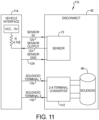
- an alternative control circuit 110 for controlling the actuator assembly 42 includes a solenoid 46 that is operated by a 2-4 terminal converter 112 that receives operating signals from a vehicle interface 114 that includes a first solenoid terminal 116 and a second solenoid terminal 118.
- the 2-4 terminal converter converts the operating signals from the first solenoid terminal 116 and the second solenoid terminal for operating the solenoid in either of the engaged or disengaged directions.
- the current is limited to 7A via a closed loop pulse width modulated control.
- the pulse width modulated closed loop current control is also used to limit the current of one of the solenoid coils to approximately 1/3 the current of the other coil.
- the other coil is limited to a much higher current (approximately 6A) using the same strategy as long as the total current is under 7A.
- the control of the two coils switches depending on if the requested command is to retract or extend the solenoid plunger 48.
- the sensor 72 receives a regulated 5V power supply 120 from the vehicle interface 114.
- the sensor 72 provides feedback signals 122 to the vehicle interface 114 and is also grounded at 124 through the vehicle interface 114.
- the magnet 71 is shown mounted within an arm 52a of the shift fork 52.
- the magnet 71 and shift fork 52 are illustrated in a retracted position in FIG. 26 and in an extended position in FIG. 27 .
- the sensor 72 reads the position of the magnetic field for the magnet 71 that is embedded in the shift fork 52.
- the position of the shift fork 52 controls the position of the clutch ring 40 between an engaged and a disengaged position.
- the control of the actuator assembly 42 can timeout after a predetermined period of time if the engagement or disengagement of the clutch ring 40 is not confirmed by the sensor 72.
- the sensor 72 detects the position of the magnet 70.
- the sensor 72 sends out a pulse width modulated signal relaying where the clutch ring 40 is in the translation from engaged to disengaged, and vice versa.
- the clutch ring 40 is in the translation from engaged to disengaged, and vice versa.
- the rocker profile can be modified to allow the design to be reconfigured for optimal fit to the vehicle knuckle.
- the solenoid 46 can be reoriented at different angles for a better fit to the wheel end packaging. As shown in FIG. 14 , the solenoid 46 is oriented with the plunger 48 at an example angle ⁇ of between 25 and 35 degrees from an axis of the translation pin 54.
- the rocker 150 has an upper portion 152 above the pivot arms 162 that is angled relative to a lower portion 154 below the pivot arms 162.
- the pivot arms 162 are mounted to a mount structure 164 of the solenoid mount 166.
- the angle between the upper portion 152 and the lower portion can be the same or similar to the angle ⁇ of the plunger 48 relative to the translation pin 54.
- the angle of the solenoid 46 can be adjusted to allow up to a 90-degree orientation relative to the translation pin 54 by modifying the angle of the upper portion 152 of the rocker 150 relative to the lower portion 154.
- a connection between the upper end 152 of the rocker 150 and the plunger 48 and between the lower end 154 of the rocker 150 and the shift fork 52 can be the same as previous embodiments.
- a height of the rocker 250 can be increased to allow for the solenoid 46 to be higher off the center axis of the translation pin 54 to allow more clearance for the half shaft.
- the rocker 250 can include a center pivot pin 252 that is clipped to a mount structure 254 that extends below the solenoid mount 256 of the solenoid 46.
- the mount structure is modified to accommodate for the longer height of the rocker 250.
- the rocker 350 can be tuned to allow for a different ratio of solenoid stroke to shift fork throw to be realized. This ratio may also be altered to optimize the shift force transferred between the actuator and the shift fork through the rocker 350.
- the rocker 350 has an upper portion 352 above the pivot arms 162 that is longer than a lower portion 354 below the pivot arms 62.
- the longer upper arm portion 352 as shown is 1.25 times longer than the lower portion 354, although other ratios can be used.
- the longer upper arm portion 352 allows for full extension of the plunger 48 and provides a shorter travel of the shift fork 52 along the translation pin 54.
- the upper portion 352 of the rocker 350 could be made shorter than the lower portion 354 to allow a shorter solenoid stroke to result in a longer shift fork throw. Accordingly, modifying a ratio of the length of the upper portion 352 relative to the lower portion 354 of the rocker 350 allows for different packaging that may require more or less translation/throw of the clutch ring 40.
- the rocker 450 includes pivot arms 452 each with a partial cylindrical rocker pivot bearing face 454 on one side of the rocker and a center rocker pivot 456 with a partial cylindrical rocker pivot bearing face 458 on an opposite side of the rocker 450. Accordingly, providing pivot features on opposite sides of the rocker 450 allow for easier mounting with pivot slots of a front cover engaging the pivot arms and a pivot slot of the solenoid mount engaging the center rocker pivot 456 to pivotally entrap the rocker 450 therebetween when the front cover is assembled to the solenoid mount.
- the rocker 550 may have a pivot shaft 552 in place of molded in trunnions.
- the pivot shaft 552 can be molded in or inserted through shaft openings formed or drilled in the rocker 550.
- the pivot shaft 552 defines a pair of pivot arms 552a and a center rocker pivot 552b.
- an alternative shift fork 652 is slidably supported on an elongated translation pin 654 that is laterally offset from the plunger 48 of the solenoid 46.
- the offset translation pin 654 allows the rocker 650 to interact with the shift fork 652 at a lower point with respect to the elongated translation pin axis.
- the end of the rocker 650 is aligned with an axis of the translation pin 654 in order to reduce any binding effect.
- the offset translation pin 654 can be offset by a distance X.
- the shift fork 752 is shown with three clutch ring wear features 754 that are designed to engage the clutch ring 40 as shown in FIG. 25 .
- the three wear features 754 can be spaced from one another to engage within a groove of the clutch ring 40 at spaced circumferential locations. Alternatively, more or fewer wear features 754 can be used up to a single continuous wear contact feature.
- the wear features 754 can be molded onto the shift fork 752 and can be formed from a synthetic fluoropolymer such as Polyterafluoroethylene (PTFE), TEFLON (preferably injection molded and glass filled), a synthetic polymer such as nylon (preferably injection molded and glass filled), infused nylon, Polyoxymethylene (POM-H) sold under the name DELRIN, a polyimide based plastic such as VESPEL manufactured by DuPont de Nemours, Inc., Powder Metallurgy (PM) Bronze, Polyamide-imide (PAI), polyimide, or similar material with a low coefficient of friction and high wear tolerance.
- a synthetic fluoropolymer such as Polyterafluoroethylene (PTFE), TEFLON (preferably injection molded and glass filled), a synthetic polymer such as nylon (preferably injection molded and glass filled), infused nylon, Polyoxymethylene (POM-H) sold under the name DELRIN, a polyimide based plastic such as VESPEL manufactured by DuP
- a slide bearing feature 756 can be molded within the aperture 758 of the shift fork 752 to provide easier translation of the shift fork 752 along the translation pin 54.
- the slide bearing feature 756 can be formed from a synthetic fluoropolymer such as Polyterafluoroethylene (PTFE) such as that sold under the tradename PULON by Saint-Gobain Performance Plastics, TEFLON (preferably injection molded and glass filled), a synthetic polymer such as nylon (preferably injection molded and glass filled), infused nylon, Polyoxymethylene (POM-H) sold under the name DELRIN, a polyimide based plastic such as VESPEL manufactured by DuPont de Nemours, Inc., Powder Metallurgy (PM) Bronze, Polyamide-imide (PAI), polyimide, or similar material with a low coefficient of friction and high wear tolerance.
- PTFE Polyterafluoroethylene
- TEFLON preferably injection molded and glass filled
- nylon preferably injection molded and glass filled
- the rocker 850 is shown including a pivot 852 that is at a first (upper) end of the rocker 850.
- the rocker 850 is connected to the plunger 48 of the solenoid 46 at an intermediate location by a cross pin 854 and engages with the shift fork 52 at a second (lower) shift fork engagement end 856 of the rocker 850.
- a length between the pivot 852 and the cross pin 854 and between the cross pin 854 and the second shift fork engagement end 856 can be selected to allow for the proper amount of throw of the shift fork 52 to properly engage and disengage the clutch ring 40.
- one or more coil springs 900 are shown between the rocker 950 and the shift fork 952.
- the springs 900 can compress when a shift of the clutch ring 40 is blocked, and when the clutch ring 40 is no longer blocked, the compressed springs 900 cause the clutch ring shift to occur.
- the shift fork 952 can include pockets 954 for receiving the springs 900 between a wall 956 and the second end of the rocker 950.
- a return spring 1000 is shown for biasing the rocker 1050 to the disengaged state, as shown. Accordingly, when the solenoid 46 is activated, the plunger 48 moves to a retracted position causing the rocker 1050 to rotate counter-clockwise, as shown to push the shift fork 1052 toward an engaged (4x4) position.
- the return spring 1000 acts to bias the shift fork 1050 to a disengaged position (4x2) when the energizing of the solenoid 46 is halted.
- the return spring 1000 can be a torsion spring, coli spring, extension or compression spring as needed for specific applications.
- the torsion spring 1000 as shown includes a first arm 1000a engaged with the rocker 1050 and a second arm 1000b engaged with the solenoid mount or housing.
- the shift fork 1152 may use guide rail features 1100 to support the shift fork for translation along the horizontal axis.
- the guide rail features 1100 are received in guide slots 1102 that control the translation and rotation of the shift fork 1152.
- the sift fork 1152 includes an engagement slot 1154 for receiving an end of the rocker 50 for moving the shift fork along the guide slots 1102.
- Translation wear features 1156 can be provided along the slots 1102 or on the shift fork rails 1100 to facilitate easier sliding of the shift fork 1152.
- the rocker 1250 is profiled to allow offset of the solenoid 46 along the vertical axis A.
- the rocker 1240 includes curved regions 1260 above the pivot arms 1262 to allow the solenoid 46 to be laterally offset from the axis of the translation pin 54.
- Example embodiments are provided so that this disclosure will be thorough, and will fully convey the scope to those who are skilled in the art. Numerous specific details are set forth such as examples of specific components, devices, and methods, to provide a thorough understanding of embodiments of the present disclosure. It will be apparent to those skilled in the art that specific details need not be employed, that example embodiments may be embodied in many different forms and that neither should be construed to limit the scope of the disclosure. In some example embodiments, well-known processes, well-known device structures, and well-known technologies are not described in detail.
- first, second, third, etc. may be used herein to describe various elements, components, regions, layers and/or sections, these elements, components, regions, layers and/or sections should not be limited by these terms. These terms may be only used to distinguish one element, component, region, layer or section from another region, layer or section. Terms such as “first,” “second,” and other numerical terms when used herein do not imply a sequence or order unless clearly indicated by the context. Thus, a first element, component, region, layer or section discussed below could be termed a second element, component, region, layer or section without departing from the teachings of the example embodiments.
- spatially relative terms such as “inner,” “outer,” “beneath,” “below,” “lower,” “above,” “upper,” and the like, may be used herein for ease of description to describe one element or feature's relationship to another element(s) or feature(s) as illustrated in the figures.
- Spatially relative terms may be intended to encompass different orientations of the device in use or operation in addition to the orientation depicted in the figures. For example, if the device in the figures is turned over, elements described as “below” or “beneath” other elements or features would then be oriented “above” the other elements or features.
- the example term “below” can encompass both an orientation of above and below.
- the device may be otherwise oriented (rotated 90 degrees or at other orientations) and the spatially relative descriptors used herein interpreted accordingly.
Landscapes
- Engineering & Computer Science (AREA)
- General Engineering & Computer Science (AREA)
- Mechanical Engineering (AREA)
- Physics & Mathematics (AREA)
- Electromagnetism (AREA)
- Arrangement And Mounting Of Devices That Control Transmission Of Motive Force (AREA)
- Chemical & Material Sciences (AREA)
- Combustion & Propulsion (AREA)
- Transportation (AREA)
Abstract
An actuator for a wheel end disconnect system includes a housing and a solenoid mounted to the housing, the solenoid is actuatable to move a plunger in a fore and aft direction. A rocker is pivotally mounted to the housing and is connected to the plunger. A shift fork slidably mounted on a translation pin extending from the housing, the shift fork including a channel for receiving an end of the rocker, wherein activation of the solenoid causes pivotal movement of the rocker to cause the shift fork to translate along the translation pin.
Description
- This application claims the benefit of
U.S. Provisional Application No. 63/611,385, filed on December 18, 2023 - The present disclosure relates to an integrated wheel end system and more particularly, to an actuator for initiating the shifting action of a clutch to affect engagement/disengagement of drive and driven shafts.
- This section provides background information related to the present disclosure which is not necessarily prior art.
- In recent years it has become increasingly popular to provide vehicles with the ability to convert between two-wheel and four-wheel drive. As popularity has grown, so to have the many ways of affecting conversion. In one example there is a permanently driven drive line segment to the rear wheels of a vehicle, and a part-time driven drive line segment to the front wheels. The part-time driven drive line segment is simply disconnected/decoupled from the engine's drive shaft at the transmission or transfer case and that segment is rendered passive (undriven).
- There is often a second point of disconnection which may be at or near the differential (a center disconnect) or at both wheels. There is a mechanical action that takes place to achieve each connection and disconnection as contemplated herein. Two shafts or drive line segments are in close relationship and a clutch ring that is permanently coupled to one shaft is slidable into engagement with the other shaft to couple the shafts and is slidable out of engagement with the other shaft to decouple the two shafts.
- The sliding movement is achieved by what will here be referred to as an actuator. The actuator can be many types including, e.g., a shift lever, manual hand operated, magnetically actuated, electrically actuated, cam actuated, or pneumatically actuated.
- This section provides a general summary of the disclosure, and is not a comprehensive disclosure of its full scope or all of its features.
- According to an aspect of the present disclosure, an actuator for a wheel end disconnect system includes a housing and a solenoid mounted to the housing, the solenoid is actuatable to move a plunger in a fore and aft direction. A rocker is pivotally mounted to the housing and having a first end connected to the plunger. A shift fork is slidably mounted on a translation pin extending from the housing, the shift fork including a channel for receiving a second end of the rocker, wherein activation of the solenoid causes pivotal movement of the rocker to cause the shift fork to translate along the translation pin.
- According to another aspect, the channel is V-shaped.
- According to another aspect, the translation pin is parallel to the direction of movement of the plunger.
- According to another aspect, the channel extends on opposite sides of the translation pin.
- According to another aspect, a bottom surface of the channel is aligned with the translation pin.
- According to another aspect, the second end of the rocker includes a cutout to define a pair of legs that straddle the translation pin.
- According to another aspect, the rocker includes a pair of pivot arms for mounting the rocker to the housing.
- According to another aspect, a magnet is mounted to the shift fork and a sensor is mounted to the housing for sensing a position of the magnet on the shift fork relative to the housing.
- According to another aspect, the shift fork includes an anti-rotation feature for preventing the shift fork from rotating relative to the translation pin.
- According to another aspect, a clutch ring is connected to the shift fork.
- According to another aspect, a control unit is provided for controlling the solenoid and for receiving position signals from the sensor.
- According to another aspect, during a controlled shift of the wheel end disconnect system, the control unit receives signals from the sensor and if the sensor signal indicates that the desired shift is not achieved within a predetermined time period, the shift control is halted.
- According to another aspect, the control unit received command signals from a vehicle interface.
- According to another aspect, the control unit is mounted to a printed circuit board of the actuator.
- According to another aspect, the sensor is mounted to the printed circuit board.
- According to another aspect, the solenoid includes a first coil driver for operating a first coil of the solenoid in a first direction and a second coil driver for operating a second coil of the solenoid in a second direction.
- According to another aspect, during a shift, a current to one of the first and second coils is approximately 1/3 of the current to the other of the first and second coils.
- According to another aspect, the solenoid has an operating current of less than or equal to 7A.
- Further areas of applicability will become apparent from the description provided herein. The description and specific examples in this summary are intended for purposes of illustration only and are not intended to limit the scope of the present disclosure.
- The drawings described herein are for illustrative purposes only of selected embodiments and not all possible implementations, and are not intended to limit the scope of the present disclosure.
-
FIGS. 1A and 1B illustrate a vehicle and a wheel end of the vehicle for which the present disclosure is contemplated; -
FIG. 2 is an exploded perspective view of the actuator of an integrated wheel end system according to the principles of the present disclosure; -
FIG. 3 is a plan view of the actuator shown inFIG. 2 ; -
FIG. 4 is a cross-sectional view of the actuator shown with the solenoid retracted and the shift fork extended in a 4 wheel drive operating mode; -
FIG. 5 is a cross-sectional view of the actuator shown with the solenoid extended and the shift fork retracted in a 2 wheel drive operating mode; -
FIG. 6 is a detailed side plan view of a position detection system for the actuator; -
FIG. 7 is a detailed front plan view of the position detection system for the actuator; -
FIG. 8 is a detailed perspective view of the rocker according to the principles of the present disclosure; -
FIG. 9 is a plan view of the shift fork according to the principles of the present disclosure; -
FIG. 10 is a schematic view of an implementation of external controls for the actuator; -
FIG. 11 is a schematic view of an implementation of internal controls for the actuator; -
FIG. 12 is an example graph of the clutch ring positional feedback according to the principles of the present disclosure; -
FIG. 13 is an example graph of solenoid current and clutch ring travel over time for a blocked or pinched shift; -
FIG. 14 is a side plan view of the actuator having a rocker configured for the solenoid to be oriented at different angles; -
FIG. 15 is a front plan view of the actuator having a rocker configured for the solenoid to be oriented at different angles; -
FIG. 16 is a side plan view of the actuator having a rocker configured for the solenoid to be located further away from the shift fork and clutch ring; -
FIG. 17 is a front plan view of the actuator having a rocker configured for the solenoid to be located further away from the shift fork and clutch ring; -
FIG. 18 is a side plan view of the actuator having a rocker configured to allow for a different ratio of solenoid stroke to shift fork throw; -
FIG. 19 is a front plan view of the actuator having a rocker configured to allow for a different ratio of solenoid stroke to shift fork throw; -
FIG. 20 is a front perspective view of a rocker according to an embodiment of the present disclosure; -
FIG. 21 is a rear perspective view of the rocker shown inFIG. 20 ; -
FIG. 22 is a front perspective view of a rocker according to an additional embodiment of the present disclosure; -
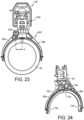
FIG. 23 is a front plan view of an actuator according to a further embodiment of the present disclosure; -
FIG. 24 is a perspective view of a shift fork with wear features according to the principles of the present disclosure; -
FIG. 25 is a cross-sectional view of the actuator shown with the wear features on the shift fork according to the principles of the present disclosure; -
FIG. 26 is a cross sectional view of the actuator showing the location of the position sensor magnet with the shift fork in a retracted position; -
FIG. 27 is a cross sectional view of the actuator showing the location of the position sensor magnet with the shift fork in an extended position; -
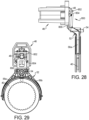
FIG. 28 is a side plan view of the actuator having a rocker configured to have a top pivot mount; -
FIG. 29 is a front plan view of the actuator having a rocker configured to have a top pivot mount; -
FIG. 30 is a cross-sectional view of the actuator having a lost motion spring between the rocker and the shift fork; -
FIG. 31 is a front plan view of the actuator having a lost motion spring between the rocker and the shift fork; -
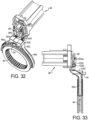
FIG. 32 is a top perspective view of the actuator having a pair of lost motion springs between the rocker and the shift fork; -
FIG. 33 is a side plan view of the actuator having a torsion spring acting against the rocker; -
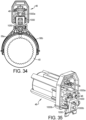
FIG. 34 is a font plan view of the actuator having a torsion spring acting against the rocker; -
FIG. 35 is a perspective view of the actuator having a torsion spring acting against the rocker; -
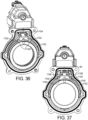
FIG. 36 is a front perspective view of the actuator having rials supporting the shift fork; -
FIG. 37 is a front plan view of an actuator having rails supporting the shift fork; -
FIG. 38 is a side plan view of the actuator having a laterally offset shift fork according to the principles of the present disclosure; and -
FIG. 39 is a front plan view of the actuator having a laterally offset shit fork according to the principles of the present disclosure. - Corresponding reference numerals indicate corresponding parts throughout the several views of the drawings.
- Example embodiments will now be described more fully with reference to the accompanying drawings.
-
FIG. 1A schematically illustrates a vehicle chassis includingfront wheels 10 as may incorporate a clutch actuator assembly of the present disclosure.FIG. 1B is a partial view as taken alonglines 1B-1B ofFIG. 1A and illustrates afront wheel 10 having ahub 12 extended inward where it is supported by asteering knuckle 14. A bearing pack (not shown) allows rotation of thewheel 10 relative to thesteering knuckle 14. As shown inFIG. 1B , a drive axle 17 (of the vehicle drive train) connects to a CV-joint 18 which is secured to the knuckle. As is well known in the industry, the CV-joint 18 is adapted to accommodate thepivotal axis 20 of thewheel 10 andknuckle 14 whereby turning of the front wheel is permitted while remaining in driving engagement with theaxle 17. - The CV-joint 18 includes an axle portion that is configured to provide an annular portion having splines that are in mating alignment with splines provided on a coupler. It will thus be apparent that the CV-joint 18 is rotatably supported in the
hub 12 which is rotatably supported in theknuckle 14. - A
clutch ring 40 engages with both spline sets of the CV-joint 18 and the coupler, respectively. In this relation, the CV-joint (driven by axle 17) drives thewheel hub 12 and accordingly wheel 10. Theclutch ring 40 is, however, slidable to disengage from the coupler thereby disengagingwheel 10 from thedrive axle 17. Such sliding movement of theclutch ring 40 is provided by anactuator assembly 42. - With reference to
FIGS. 2-5 , theactuator assembly 42 includes ahousing 44 that can be mounted to theknuckle 14 in a wheel end disconnect system. Agasket 45 can be provided between thehousing 44 and theknuckle 14. Thehousing 44 can include a recessed groove for receiving thegasket 45. Thehousing 44 can be made from aluminum and includes asolenoid portion 44a for mounting asolenoid 46. Thehousing 44 can include a pair of alignment pins 47 (best shown inFIGS. 2 and3 ) that can be used to align the housing when theactuator assembly 42 is mounted to theknuckle 14. Thesolenoid 46 includes a plunger 48 (best shown inFIGS. 4 and5 that engages arocker 50. As shown inFIGS.4 and5 , therocker 50 is pivotally mounted to thehousing 44 and is engaged with ashift fork 52. Avent 60 is provided in thehousing 44. - With reference to
FIG. 4 , theshift fork 52 is slidably supported on anelongated translation pin 54 extending from anintermediate portion 44b of thehousing 44. Theelongated translation pin 54 can extend parallel to an axis of rotation of the CV joint 18. When thesolenoid 46 is actuated, theplunger 48 moves in fore and aft directions and pivots therocker 50 to cause theshift fork 52 to translate along thetranslation pin 54. As best shown inFIG. 2 , theshift fork 52 includes a pair ofarms clutch ring 40 to move theclutch ring 40 from an engaged to a disengaged position and vice versa. - A
shaft seal 58 is mounted to ashaft portion 44c of thehousing 44. Theshaft seal 58 engages the CV joint 18 which extends through theshaft portion 44c of thehousing 44. - The
rocker 50 can be made from plastic or metal and can include a pair ofintegral pivot arms 62 extending from a mid-portion 50a of therocker 50. Anupper end 50b of therocker 50 includessnap engagement members cross pin 48a of theplunger 48. As shown inFIG. 8 , a pair ofoptional latches 64c are provided for engaging a top end of thecross pin 48a of theplunger 48. The pair oflatches 64c have a tapered inner face to facilitate insertion of the cross pin. The pair oflatches 64c can flex laterally outward when the cross pin is inserted and snap back to secure the cross pin in place. Alower end 50c of therocker 50 includes a rounded interface for engagement with a V-shaped channel 66 in an upper surface of theshift fork 52. - Accordingly, in operation, the
rocker 50 is pivotally mounted to thehousing 44 and thecross pin 48a of theplunger 48 of thesolenoid 46 is connected to thesnap engagement members rocker 50 in a pivoting motion. As therocker 50 is pivoted, thelower end 50c of therocker 50 moves theshift fork 52 linearly along thetranslation pin 54.FIG. 4 shows theplunger 48 retracted so that theshift fork 52 is extended andFIG. 5 shows theplunger 48 extended so that theshift fork 52 is retracted. Accordingly, theshift fork 52 moves linearly to laterally shift theclutch ring 40 from an engaged to disengaged mode and vice versa. The linear movement of theshift fork 52 creates a more durable design and requires less space and less material as compared to a pivoting shift fork design. Therocker 50 allows for an optimal design fit to thevehicle knuckle 14 as well as an easy customizable rocker profile to accommodate different sized half shaft axles, or solenoids/actuators. - The mass of the
clutch ring 40 and theplunger 48 of thesolenoid 46 move in opposite directions thereby balancing loads due to vehicle lateral acceleration (G-loading). The G-loading can be important in that the G-loading can induce an involuntary disconnect shift if the resultant forces are not balanced. The design provides flexibility to offset and change the angle of thesolenoid 46 from the axle centerline. The design also positions the line of force between therocker 50 and theshift fork 52 very close to the shiftfork translation pin 54, thereby eliminating translation stiction. The use of therocker 50 may be applicable to other disconnects including a differential disconnect. - The
solenoid 46 can be "bi-stable" with a magnetic latching mechanism so that current is not needed when the solenoid is extended or retracted. However, a mono-stable solenoid may also be used. - With reference to
FIGS. 6 and 7 , amagnet 70 is mounted to an upward extendingarm 71 of theshift fork 52. Themagnet 70 is movable with theshift fork 52 relative to asensor 72 that senses the position of the magnet on theshift fork 52. Thesensor 72 can be used to provide positional feedback to a controller, as will described herein. Thesensor 72 can be mounted/grounded to thehousing 44 or to a printedcircuit board 73 that is mounted to thehousing 44. - During four-wheel drive engagement, the
actuator 42 of the wheel end disconnect system is activated to move theclutch ring 40 to an engaged state, as shown inFIG. 4 . Thesolenoid 46 is energized and retracts theplunger 48 to pull therocker 50. Therocker 50 rotates and pushes on theshift fork 52. Theshift fork 52 translates and translates theclutch ring 40 along the shaft splines engaging theclutch ring 40 to the coupler. If the clutch ring splines are blocked, preventing theclutch ring 40 from completing translation on the shaft, the solenoid shift times out, as shown in the graph ofFIG. 13 , and a retry procedure is executed. A retry procedure is not performed until a second predetermined period of time has passed. When thesolenoid plunger 48 is at zero air gap, a permanent magnet holds the plunger in a latched position with the wheel end disconnect in an engaged state. - During four-wheel drive to two wheel drive disengagement (as shown in
FIG. 5 ), thesolenoid 46 is energized to extend theplunger 48 to push therocker 50. Therocker 50 rotates and pulls on theshift fork 52. Theshift fork 52 translates and translates theclutch ring 40 along the shaft splines disengaging theclutch ring 40 from the coupler. If the clutch ring splines are pinched, preventing theclutch ring 40 from completing translation on the shaft, the solenoid shift times out, as shown in the graph ofFIG. 13 , and a retry procedure is executed. When thesolenoid plunger 48 is at zero air gap, a permanent magnet holds the plunger in a latched position with the wheel end disconnect in a disengaged state. In an alternative embodiment, as shwon in FIG. 40, the magnetic latching mechanism may instead be a mechanical latch, including one which operates like the well-known "click pen" stepped cam operation. In an alternative embodiment, the mechanical latching mechanism may be located near the tail of the solenoid plunger which extends beyond the solenoid. The extended tail of the solenoid plunger may be fixed to a plate which may engage or disengage with a latching mechanism located between the housing and the solenoid. The solenoid may be biased or spring-loaded so that it is stable in the engaged or disengaged positions (bi-stable). In this embodiment, a manual override may be configured such that in the event of power loss, the solenoid plunger may be manually actuated to stimulate engagement or disengagement. These latching embodiments may enable the solenoid to generate higher forces within the same packaging space, and they are not limited to one type of vehicle disconnect. These solenoid latching mechanisms could also be implemented in any type of vehicle disconnect such as an axle disconnect, or differential disconnect. - With reference to
FIG. 8 , thelower end 50c of therocker 50 can include acenter cutout region 76 that allows the point of actuation with theshift fork 52 to be as close to in line with a center of the linear shaft axis as possible so that binding of theshift fork 52 to thetranslation pin 54 is effectively eliminated. Thecenter cutout region 76 defines twolegs 78 at thelower end 50c of therocker 50 that straddle thetranslation pin 54. InFIG. 8 , the V-shaped channel 66 of theshift fork 52 is also located to haveseparate channel portions translation pin 54. - With reference to
FIG. 9 , theshift fork 52 can include an anti-rotation stop in the form of aprotrusion 80 on eacharm shift fork 52 about theelongated translation pin 54. Theprotrusions 80 prevent the rotation of the shift fork in order to maintain a proper air gap of themagnet 70 with thesensor 72 atlocation 82. - With reference to
FIG. 10 , an example of acontrol circuit 90 for controlling theactuator assembly 42 of the wheel end disconnect system will be described. Thecontrol circuit 90 includes thesolenoid 46 including afirst coil driver 92 and asecond coil driver 94 each operated by a control unit (MCU) 96. Thefirst coil driver 92 and thesecond coil driver 94 each include a power terminal and acommon ground 95. The current is limited to 7A externally. The two coils of thebi-stable solenoid 46 can be controlled by flipping the polarity of the voltage between the two terminals for extending or retracting theplunger 48. The external circuitry will limit one of the coils to approximately 1/3 of the current of the other in order to deliver a larger total current to the coil mainly responsible for actuation of the shift. The coil with approximately 1/3 the current is mainly responsible for negating the magnetic flux produced by the permanent magnet, thus requiring much less current. Theposition sensor 72 provides position signals to thecontrol unit 96. Avehicle interface 98 is provided in communication with thecontrol unit 96 by an input/output conditioning circuit 100 to providefeedback signals 102 to thevehicle interface 98 and to receivecommand signals 104 from thevehicle interface 98. Thevehicle interface 98 can include a touch screen, a button, a toggle switch or other indicator of the driver's desired two-wheel drive or four wheel drive vehicle operating condition. Thecontrol circuit 90 of theactuator assembly 42 can receive power from thevehicle battery 106 via apower conditioning circuit 108. With thecontrol circuit 90, the actuatorassembly control unit 96 is implemented in the actuator assembly and external to the vehicle control system. - With reference to
FIG. 11 , analternative control circuit 110 for controlling theactuator assembly 42 includes asolenoid 46 that is operated by a 2-4terminal converter 112 that receives operating signals from avehicle interface 114 that includes afirst solenoid terminal 116 and asecond solenoid terminal 118. The 2-4 terminal converter converts the operating signals from thefirst solenoid terminal 116 and the second solenoid terminal for operating the solenoid in either of the engaged or disengaged directions. The current is limited to 7A via a closed loop pulse width modulated control. The pulse width modulated closed loop current control is also used to limit the current of one of the solenoid coils to approximately 1/3 the current of the other coil. The other coil is limited to a much higher current (approximately 6A) using the same strategy as long as the total current is under 7A. The control of the two coils switches depending on if the requested command is to retract or extend thesolenoid plunger 48. Thesensor 72 receives a regulated5V power supply 120 from thevehicle interface 114. Thesensor 72 provides feedback signals 122 to thevehicle interface 114 and is also grounded at 124 through thevehicle interface 114. - With reference to
FIGS. 26 and 27 , themagnet 71 is shown mounted within anarm 52a of theshift fork 52. Themagnet 71 and shiftfork 52 are illustrated in a retracted position inFIG. 26 and in an extended position inFIG. 27 . Thesensor 72 reads the position of the magnetic field for themagnet 71 that is embedded in theshift fork 52. The position of theshift fork 52 controls the position of theclutch ring 40 between an engaged and a disengaged position. - As shown in
FIG. 13 , the control of theactuator assembly 42 can timeout after a predetermined period of time if the engagement or disengagement of theclutch ring 40 is not confirmed by thesensor 72. As shown inFIG. 12 , when theactuator 42 of the wheel end disconnect is actuated and theclutch ring 40 moves along the splines, thesensor 72 detects the position of themagnet 70. Thesensor 72 sends out a pulse width modulated signal relaying where theclutch ring 40 is in the translation from engaged to disengaged, and vice versa. By way of example, as shown inFIG. 12 , at less than 15% the wheel end disconnect is disengaged, at 15-84% is where the clutch ring position is in translation from disengaged to engaged and at greater than 85%, the wheel end disconnect is engaged. - The rocker profile can be modified to allow the design to be reconfigured for optimal fit to the vehicle knuckle. With reference to
FIGS. 14 and 15 , thesolenoid 46 can be reoriented at different angles for a better fit to the wheel end packaging. As shown inFIG. 14 , thesolenoid 46 is oriented with theplunger 48 at an example angle α of between 25 and 35 degrees from an axis of thetranslation pin 54. Therocker 150 has anupper portion 152 above thepivot arms 162 that is angled relative to alower portion 154 below thepivot arms 162. Thepivot arms 162 are mounted to amount structure 164 of thesolenoid mount 166. The angle between theupper portion 152 and the lower portion can be the same or similar to the angle α of theplunger 48 relative to thetranslation pin 54. The angle of thesolenoid 46 can be adjusted to allow up to a 90-degree orientation relative to thetranslation pin 54 by modifying the angle of theupper portion 152 of therocker 150 relative to thelower portion 154. A connection between theupper end 152 of therocker 150 and theplunger 48 and between thelower end 154 of therocker 150 and theshift fork 52 can be the same as previous embodiments. - With reference to
FIGS. 16 and 17 , a height of therocker 250 can be increased to allow for thesolenoid 46 to be higher off the center axis of thetranslation pin 54 to allow more clearance for the half shaft. Therocker 250 can include acenter pivot pin 252 that is clipped to amount structure 254 that extends below thesolenoid mount 256 of thesolenoid 46. The mount structure is modified to accommodate for the longer height of therocker 250. - With reference to
FIGS. 18 and 19 , therocker 350 can be tuned to allow for a different ratio of solenoid stroke to shift fork throw to be realized. This ratio may also be altered to optimize the shift force transferred between the actuator and the shift fork through therocker 350. In the embodiment shown, therocker 350 has anupper portion 352 above thepivot arms 162 that is longer than alower portion 354 below thepivot arms 62. The longerupper arm portion 352 as shown is 1.25 times longer than thelower portion 354, although other ratios can be used. The longerupper arm portion 352 allows for full extension of theplunger 48 and provides a shorter travel of theshift fork 52 along thetranslation pin 54. Alternatively, theupper portion 352 of therocker 350 could be made shorter than thelower portion 354 to allow a shorter solenoid stroke to result in a longer shift fork throw. Accordingly, modifying a ratio of the length of theupper portion 352 relative to thelower portion 354 of therocker 350 allows for different packaging that may require more or less translation/throw of theclutch ring 40. - With reference to
FIGS. 20 and 21 , therocker 450 includespivot arms 452 each with a partial cylindrical rockerpivot bearing face 454 on one side of the rocker and acenter rocker pivot 456 with a partial cylindrical rockerpivot bearing face 458 on an opposite side of therocker 450. Accordingly, providing pivot features on opposite sides of therocker 450 allow for easier mounting with pivot slots of a front cover engaging the pivot arms and a pivot slot of the solenoid mount engaging thecenter rocker pivot 456 to pivotally entrap therocker 450 therebetween when the front cover is assembled to the solenoid mount. - With reference to
FIG. 22 , therocker 550 may have apivot shaft 552 in place of molded in trunnions. Thepivot shaft 552 can be molded in or inserted through shaft openings formed or drilled in therocker 550. Thepivot shaft 552 defines a pair ofpivot arms 552a and acenter rocker pivot 552b. - With reference to
FIG. 23 , analternative shift fork 652 is slidably supported on anelongated translation pin 654 that is laterally offset from theplunger 48 of thesolenoid 46. The offsettranslation pin 654 allows therocker 650 to interact with theshift fork 652 at a lower point with respect to the elongated translation pin axis. Preferably, the end of therocker 650 is aligned with an axis of thetranslation pin 654 in order to reduce any binding effect. As shown inFIG. 23 , the offsettranslation pin 654 can be offset by a distance X. - With reference to
FIGS. 24 and25 , theshift fork 752 is shown with three clutch ring wear features 754 that are designed to engage theclutch ring 40 as shown inFIG. 25 . The three wear features 754 can be spaced from one another to engage within a groove of theclutch ring 40 at spaced circumferential locations. Alternatively, more or fewer wear features 754 can be used up to a single continuous wear contact feature. The wear features 754 can be molded onto theshift fork 752 and can be formed from a synthetic fluoropolymer such as Polyterafluoroethylene (PTFE), TEFLON (preferably injection molded and glass filled), a synthetic polymer such as nylon (preferably injection molded and glass filled), infused nylon, Polyoxymethylene (POM-H) sold under the name DELRIN, a polyimide based plastic such as VESPEL manufactured by DuPont de Nemours, Inc., Powder Metallurgy (PM) Bronze, Polyamide-imide (PAI), polyimide, or similar material with a low coefficient of friction and high wear tolerance. - As shown in
FIG. 25 , aslide bearing feature 756 can be molded within theaperture 758 of theshift fork 752 to provide easier translation of theshift fork 752 along thetranslation pin 54. Theslide bearing feature 756 can be formed from a synthetic fluoropolymer such as Polyterafluoroethylene (PTFE) such as that sold under the tradename PULON by Saint-Gobain Performance Plastics, TEFLON (preferably injection molded and glass filled), a synthetic polymer such as nylon (preferably injection molded and glass filled), infused nylon, Polyoxymethylene (POM-H) sold under the name DELRIN, a polyimide based plastic such as VESPEL manufactured by DuPont de Nemours, Inc., Powder Metallurgy (PM) Bronze, Polyamide-imide (PAI), polyimide, or similar material with a low coefficient of friction and high wear tolerance. - With reference to
FIGS. 28 and 29 , therocker 850 is shown including apivot 852 that is at a first (upper) end of therocker 850. Therocker 850 is connected to theplunger 48 of thesolenoid 46 at an intermediate location by across pin 854 and engages with theshift fork 52 at a second (lower) shiftfork engagement end 856 of therocker 850. A length between thepivot 852 and thecross pin 854 and between thecross pin 854 and the second shiftfork engagement end 856 can be selected to allow for the proper amount of throw of theshift fork 52 to properly engage and disengage theclutch ring 40. - With reference to
FIGS. 30-32 , one ormore coil springs 900 are shown between therocker 950 and theshift fork 952. As therocker 950 is pivoted to move theshift fork 952 to engage theclutch ring 40, thesprings 900 can compress when a shift of theclutch ring 40 is blocked, and when theclutch ring 40 is no longer blocked, thecompressed springs 900 cause the clutch ring shift to occur. Theshift fork 952 can includepockets 954 for receiving thesprings 900 between awall 956 and the second end of therocker 950. - With reference to
FIGS. 33-35 , areturn spring 1000 is shown for biasing therocker 1050 to the disengaged state, as shown. Accordingly, when thesolenoid 46 is activated, theplunger 48 moves to a retracted position causing therocker 1050 to rotate counter-clockwise, as shown to push theshift fork 1052 toward an engaged (4x4) position. Thereturn spring 1000 acts to bias theshift fork 1050 to a disengaged position (4x2) when the energizing of thesolenoid 46 is halted. Thereturn spring 1000 can be a torsion spring, coli spring, extension or compression spring as needed for specific applications. Thetorsion spring 1000, as shown includes afirst arm 1000a engaged with therocker 1050 and asecond arm 1000b engaged with the solenoid mount or housing. - With reference to
FIGS. 36 and 37 , theshift fork 1152 may use guide rail features 1100 to support the shift fork for translation along the horizontal axis. The guide rail features 1100 are received inguide slots 1102 that control the translation and rotation of theshift fork 1152. The siftfork 1152 includes anengagement slot 1154 for receiving an end of therocker 50 for moving the shift fork along theguide slots 1102. Translation wear features 1156 can be provided along theslots 1102 or on theshift fork rails 1100 to facilitate easier sliding of theshift fork 1152. - With reference to
FIGS. 38 and 39 , therocker 1250 is profiled to allow offset of thesolenoid 46 along the vertical axis A. In particular, as shown inFIG. 39 , the rocker 1240 includescurved regions 1260 above thepivot arms 1262 to allow thesolenoid 46 to be laterally offset from the axis of thetranslation pin 54. - Example embodiments are provided so that this disclosure will be thorough, and will fully convey the scope to those who are skilled in the art. Numerous specific details are set forth such as examples of specific components, devices, and methods, to provide a thorough understanding of embodiments of the present disclosure. It will be apparent to those skilled in the art that specific details need not be employed, that example embodiments may be embodied in many different forms and that neither should be construed to limit the scope of the disclosure. In some example embodiments, well-known processes, well-known device structures, and well-known technologies are not described in detail.
- The terminology used herein is for the purpose of describing particular example embodiments only and is not intended to be limiting. As used herein, the singular forms "a," "an," and "the" may be intended to include the plural forms as well, unless the context clearly indicates otherwise. The terms "comprises," "comprising," "including," and "having," are inclusive and therefore specify the presence of stated features, integers, steps, operations, elements, and/or components, but do not preclude the presence or addition of one or more other features, integers, steps, operations, elements, components, and/or groups thereof. The method steps, processes, and operations described herein are not to be construed as necessarily requiring their performance in the particular order discussed or illustrated, unless specifically identified as an order of performance. It is also to be understood that additional or alternative steps may be employed.
- When an element or layer is referred to as being "on," "engaged to," "connected to," or "coupled to" another element or layer, it may be directly on, engaged, connected or coupled to the other element or layer, or intervening elements or layers may be present. In contrast, when an element is referred to as being "directly on," "directly engaged to," "directly connected to," or "directly coupled to" another element or layer, there may be no intervening elements or layers present. Other words used to describe the relationship between elements should be interpreted in a like fashion (e.g., "between" versus "directly between," "adjacent" versus "directly adjacent," etc.). As used herein, the term "and/or" includes any and all combinations of one or more of the associated listed items.
- Although the terms first, second, third, etc. may be used herein to describe various elements, components, regions, layers and/or sections, these elements, components, regions, layers and/or sections should not be limited by these terms. These terms may be only used to distinguish one element, component, region, layer or section from another region, layer or section. Terms such as "first," "second," and other numerical terms when used herein do not imply a sequence or order unless clearly indicated by the context. Thus, a first element, component, region, layer or section discussed below could be termed a second element, component, region, layer or section without departing from the teachings of the example embodiments.
- Spatially relative terms, such as "inner," "outer," "beneath," "below," "lower," "above," "upper," and the like, may be used herein for ease of description to describe one element or feature's relationship to another element(s) or feature(s) as illustrated in the figures. Spatially relative terms may be intended to encompass different orientations of the device in use or operation in addition to the orientation depicted in the figures. For example, if the device in the figures is turned over, elements described as "below" or "beneath" other elements or features would then be oriented "above" the other elements or features. Thus, the example term "below" can encompass both an orientation of above and below. The device may be otherwise oriented (rotated 90 degrees or at other orientations) and the spatially relative descriptors used herein interpreted accordingly.
- The foregoing description of the embodiments has been provided for purposes of illustration and description. It is not intended to be exhaustive or to limit the disclosure. Individual elements or features of a particular embodiment are generally not limited to that particular embodiment, but, where applicable, are interchangeable and can be used in a selected embodiment, even if not specifically shown or described. The same may also be varied in many ways. Such variations are not to be regarded as a departure from the disclosure, and all such modifications are intended to be included within the scope of the disclosure.
Claims (15)
- An actuation system for a wheel end disconnect system, comprising;a housing;an actuator mounted to the housing, the actuator is actuatable to move a plunger in a fore and aft direction;a rocker pivotally mounted to the housing and connected to the plunger; anda shift fork slidably mounted for translation along an axis, the shift fork including an engagement feature for receiving a portion of the rocker, wherein activation of the actuator causes pivotal movement of the rocker to cause the shift fork to translate along the axis.
- The actuation system according to claim 1, wherein the engagement feature is a channel.
- The actuation system according to claim 1 or 2, wherein the shift fork is supported by a translation pin.
- The actuation system according to one of the preceding claims, wherein the rocker includes a pair of pivot arms for mounting the rocker to the housing.
- The actuation system according to one of the preceding claims, further comprising a magnet mounted to the shift fork and a sensor mounted to the housing for sensing a position of the shift fork relative to the housing.
- The actuation system according to one of the preceding claims, further comprising a clutch ring engaged by the shift fork.
- The actuation system according to one of the preceding claims, wherein the solenoid includes a first coil driver for operating a first coil of the actuator in a first direction and a second coil driver for operating a second coil of the actuator in a second direction.
- The actuation system according to one of the preceding claims, wherein the rocker includes a pivot feature and an upper portion extending in a first direction from the pivot feature and a lower portion extending from the pivot feature in a second direction that is angled relative to the upper portion of the rocker.
- The actuation system according to one of claims 1 to 7, wherein the rocker includes a pivot feature and an upper portion extending in a first direction from the pivot feature and a lower portion extending from the pivot feature in a second direction, wherein the upper portion has a different moment arm than the lower portion.
- The actuation system according to one of the preceding claims, wherein the rocker includes snap engagement members for engagement with a cross pin of the plunger.
- The actuation system according to one of the preceding claims, wherein the rocker includes a pair of pivot arms and a center rocker pivot each molded integrally with the rocker.
- The actuation system according to one of the preceding claims, wherein the rocker includes a metal pivot shaft.
- The actuation system according to one of the preceding claims, wherein the rocker includes a pivot at a first end, a shift fork engagement feature at a second end and is connected to the plunger at an intermediate portion.
- The actuation system according to one of the preceding claims, further comprising a spring disposed between the rocker and the shift fork.
- The actuation system according to one of the preceding claims, further comprising a torsion spring for biasing the rocker in a predetermined direction.
Applications Claiming Priority (1)
| Application Number | Priority Date | Filing Date | Title |
|---|---|---|---|
| US202363611385P | 2023-12-18 | 2023-12-18 |
Publications (1)
| Publication Number | Publication Date |
|---|---|
| EP4575256A1 true EP4575256A1 (en) | 2025-06-25 |
Family
ID=93924451
Family Applications (1)
| Application Number | Title | Priority Date | Filing Date |
|---|---|---|---|
| EP24220212.5A Pending EP4575256A1 (en) | 2023-12-18 | 2024-12-16 | Integrated wheel end system |
Country Status (3)
| Country | Link |
|---|---|
| US (1) | US20250196630A1 (en) |
| EP (1) | EP4575256A1 (en) |
| CN (1) | CN120175837A (en) |
Families Citing this family (1)
| Publication number | Priority date | Publication date | Assignee | Title |
|---|---|---|---|---|
| US12508900B2 (en) | 2022-09-22 | 2025-12-30 | Warn Automotive, Llc | Latched mono-stable axial coupling |
Citations (3)
| Publication number | Priority date | Publication date | Assignee | Title |
|---|---|---|---|---|
| CN201875013U (en) * | 2010-07-20 | 2011-06-22 | 浙江中马汽车变速器股份有限公司 | Reverse synchronizing device of car transmission |
| US11168743B2 (en) * | 2017-05-23 | 2021-11-09 | Magna Powertrain Of America Inc. | Shift isolation lever system for power-actuated coupling device |
| EP4249775A1 (en) * | 2021-01-04 | 2023-09-27 | Jing-Jin Electric Technologies Co., Ltd. | Transmission shifting and parking structure and new energy vehicle |
-
2024
- 2024-12-13 US US18/980,261 patent/US20250196630A1/en active Pending
- 2024-12-16 EP EP24220212.5A patent/EP4575256A1/en active Pending
- 2024-12-18 CN CN202411867775.9A patent/CN120175837A/en active Pending
Patent Citations (3)
| Publication number | Priority date | Publication date | Assignee | Title |
|---|---|---|---|---|
| CN201875013U (en) * | 2010-07-20 | 2011-06-22 | 浙江中马汽车变速器股份有限公司 | Reverse synchronizing device of car transmission |
| US11168743B2 (en) * | 2017-05-23 | 2021-11-09 | Magna Powertrain Of America Inc. | Shift isolation lever system for power-actuated coupling device |
| EP4249775A1 (en) * | 2021-01-04 | 2023-09-27 | Jing-Jin Electric Technologies Co., Ltd. | Transmission shifting and parking structure and new energy vehicle |
Also Published As
| Publication number | Publication date |
|---|---|
| US20250196630A1 (en) | 2025-06-19 |
| CN120175837A (en) | 2025-06-20 |
Similar Documents
| Publication | Publication Date | Title |
|---|---|---|
| EP4575256A1 (en) | Integrated wheel end system | |
| CN101469768B (en) | Park inhibition solenoid assembly | |
| US7726455B2 (en) | Electro-mechanical clutch | |
| JP5315421B2 (en) | Valve train switching device | |
| CA1187382A (en) | Dual mode control lever assembly | |
| CA2971031C (en) | Autopilot and manual control switching | |
| US20160201781A1 (en) | Linear driving device, connector and exhaust gas recirculation control valve | |
| KR20140009342A (en) | Electromechanical assembly to control the operating mode of a coupling apparatus | |
| CN100504015C (en) | Stop device for stopping a door in an undefined holding position | |
| WO2015032454A1 (en) | Shift lever assembly with electronic detection of modes of transmission | |
| EP2816255B1 (en) | Differential assembly having a clutch collar actuator mechanism | |
| US20200094675A1 (en) | Electronic integrated wheel end disconnect for automotive application | |
| US20030061891A1 (en) | Shift actuator for a transmission | |
| CN117255903A (en) | actuator system | |
| CN109488758B (en) | Electronic gear shifter | |
| CN105190125B (en) | Parking device for vehicles | |
| US5433126A (en) | Rotary controlled motion transmission assembly | |
| JP4200853B2 (en) | Driving force transmission device and unbalance confirmation method thereof | |
| AU2021393852A9 (en) | Vehicle differential locking device | |
| US11053988B2 (en) | Powertrain system actuator and powertrain system therewith | |
| EP4326613B1 (en) | Unpowered breakout locking mechanism | |
| CN111609129B (en) | Emergency parking device for vehicle and vehicle with same | |
| US11655895B2 (en) | Integrated park module systems and methods | |
| US20250282217A1 (en) | Vehicle differential disconnect assembly | |
| CN223864639U (en) | Bolt elevating system and traction AGV latency |
Legal Events
| Date | Code | Title | Description |
|---|---|---|---|
| PUAI | Public reference made under article 153(3) epc to a published international application that has entered the european phase |
Free format text: ORIGINAL CODE: 0009012 |
|
| STAA | Information on the status of an ep patent application or granted ep patent |
Free format text: STATUS: THE APPLICATION HAS BEEN PUBLISHED |
|
| AK | Designated contracting states |
Kind code of ref document: A1 Designated state(s): AL AT BE BG CH CY CZ DE DK EE ES FI FR GB GR HR HU IE IS IT LI LT LU LV MC ME MK MT NL NO PL PT RO RS SE SI SK SM TR |
|
| STAA | Information on the status of an ep patent application or granted ep patent |
Free format text: STATUS: REQUEST FOR EXAMINATION WAS MADE |
|
| 17P | Request for examination filed |
Effective date: 20251114 |