EP4575182A1 - Two piece retractable engine center body for balancing - Google Patents
Two piece retractable engine center body for balancing Download PDFInfo
- Publication number
- EP4575182A1 EP4575182A1 EP24223058.9A EP24223058A EP4575182A1 EP 4575182 A1 EP4575182 A1 EP 4575182A1 EP 24223058 A EP24223058 A EP 24223058A EP 4575182 A1 EP4575182 A1 EP 4575182A1
- Authority
- EP
- European Patent Office
- Prior art keywords
- rotor
- center body
- connection
- rear portion
- gas turbine
- Prior art date
- Legal status (The legal status is an assumption and is not a legal conclusion. Google has not performed a legal analysis and makes no representation as to the accuracy of the status listed.)
- Pending
Links
Images




Classifications
-
- F—MECHANICAL ENGINEERING; LIGHTING; HEATING; WEAPONS; BLASTING
- F01—MACHINES OR ENGINES IN GENERAL; ENGINE PLANTS IN GENERAL; STEAM ENGINES
- F01D—NON-POSITIVE DISPLACEMENT MACHINES OR ENGINES, e.g. STEAM TURBINES
- F01D5/00—Blades; Blade-carrying members; Heating, heat-insulating, cooling or antivibration means on the blades or the members
- F01D5/02—Blade-carrying members, e.g. rotors
- F01D5/027—Arrangements for balancing
-
- F—MECHANICAL ENGINEERING; LIGHTING; HEATING; WEAPONS; BLASTING
- F01—MACHINES OR ENGINES IN GENERAL; ENGINE PLANTS IN GENERAL; STEAM ENGINES
- F01D—NON-POSITIVE DISPLACEMENT MACHINES OR ENGINES, e.g. STEAM TURBINES
- F01D15/00—Adaptations of machines or engines for special use; Combinations of engines with devices driven thereby
- F01D15/10—Adaptations for driving, or combinations with, electric generators
-
- F—MECHANICAL ENGINEERING; LIGHTING; HEATING; WEAPONS; BLASTING
- F01—MACHINES OR ENGINES IN GENERAL; ENGINE PLANTS IN GENERAL; STEAM ENGINES
- F01D—NON-POSITIVE DISPLACEMENT MACHINES OR ENGINES, e.g. STEAM TURBINES
- F01D5/00—Blades; Blade-carrying members; Heating, heat-insulating, cooling or antivibration means on the blades or the members
- F01D5/02—Blade-carrying members, e.g. rotors
- F01D5/10—Anti- vibration means
-
- F—MECHANICAL ENGINEERING; LIGHTING; HEATING; WEAPONS; BLASTING
- F02—COMBUSTION ENGINES; HOT-GAS OR COMBUSTION-PRODUCT ENGINE PLANTS
- F02C—GAS-TURBINE PLANTS; AIR INTAKES FOR JET-PROPULSION PLANTS; CONTROLLING FUEL SUPPLY IN AIR-BREATHING JET-PROPULSION PLANTS
- F02C7/00—Features, components parts, details or accessories, not provided for in, or of interest apart form groups F02C1/00 - F02C6/00; Air intakes for jet-propulsion plants
- F02C7/32—Arrangement, mounting, or driving, of auxiliaries
-
- F—MECHANICAL ENGINEERING; LIGHTING; HEATING; WEAPONS; BLASTING
- F02—COMBUSTION ENGINES; HOT-GAS OR COMBUSTION-PRODUCT ENGINE PLANTS
- F02K—JET-PROPULSION PLANTS
- F02K3/00—Plants including a gas turbine driving a compressor or a ducted fan
- F02K3/02—Plants including a gas turbine driving a compressor or a ducted fan in which part of the working fluid by-passes the turbine and combustion chamber
- F02K3/04—Plants including a gas turbine driving a compressor or a ducted fan in which part of the working fluid by-passes the turbine and combustion chamber the plant including ducted fans, i.e. fans with high volume, low pressure outputs, for augmenting the jet thrust, e.g. of double-flow type
- F02K3/06—Plants including a gas turbine driving a compressor or a ducted fan in which part of the working fluid by-passes the turbine and combustion chamber the plant including ducted fans, i.e. fans with high volume, low pressure outputs, for augmenting the jet thrust, e.g. of double-flow type with front fan
-
- F—MECHANICAL ENGINEERING; LIGHTING; HEATING; WEAPONS; BLASTING
- F05—INDEXING SCHEMES RELATING TO ENGINES OR PUMPS IN VARIOUS SUBCLASSES OF CLASSES F01-F04
- F05D—INDEXING SCHEME FOR ASPECTS RELATING TO NON-POSITIVE-DISPLACEMENT MACHINES OR ENGINES, GAS-TURBINES OR JET-PROPULSION PLANTS
- F05D2220/00—Application
- F05D2220/30—Application in turbines
- F05D2220/32—Application in turbines in gas turbines
-
- F—MECHANICAL ENGINEERING; LIGHTING; HEATING; WEAPONS; BLASTING
- F05—INDEXING SCHEMES RELATING TO ENGINES OR PUMPS IN VARIOUS SUBCLASSES OF CLASSES F01-F04
- F05D—INDEXING SCHEME FOR ASPECTS RELATING TO NON-POSITIVE-DISPLACEMENT MACHINES OR ENGINES, GAS-TURBINES OR JET-PROPULSION PLANTS
- F05D2220/00—Application
- F05D2220/70—Application in combination with
- F05D2220/76—Application in combination with an electrical generator
-
- F—MECHANICAL ENGINEERING; LIGHTING; HEATING; WEAPONS; BLASTING
- F05—INDEXING SCHEMES RELATING TO ENGINES OR PUMPS IN VARIOUS SUBCLASSES OF CLASSES F01-F04
- F05D—INDEXING SCHEME FOR ASPECTS RELATING TO NON-POSITIVE-DISPLACEMENT MACHINES OR ENGINES, GAS-TURBINES OR JET-PROPULSION PLANTS
- F05D2240/00—Components
- F05D2240/20—Rotors
- F05D2240/24—Rotors for turbines
-
- F—MECHANICAL ENGINEERING; LIGHTING; HEATING; WEAPONS; BLASTING
- F05—INDEXING SCHEMES RELATING TO ENGINES OR PUMPS IN VARIOUS SUBCLASSES OF CLASSES F01-F04
- F05D—INDEXING SCHEME FOR ASPECTS RELATING TO NON-POSITIVE-DISPLACEMENT MACHINES OR ENGINES, GAS-TURBINES OR JET-PROPULSION PLANTS
- F05D2260/00—Function
- F05D2260/15—Load balancing
-
- F—MECHANICAL ENGINEERING; LIGHTING; HEATING; WEAPONS; BLASTING
- F05—INDEXING SCHEMES RELATING TO ENGINES OR PUMPS IN VARIOUS SUBCLASSES OF CLASSES F01-F04
- F05D—INDEXING SCHEME FOR ASPECTS RELATING TO NON-POSITIVE-DISPLACEMENT MACHINES OR ENGINES, GAS-TURBINES OR JET-PROPULSION PLANTS
- F05D2260/00—Function
- F05D2260/30—Retaining components in desired mutual position
- F05D2260/31—Retaining bolts or nuts
-
- F—MECHANICAL ENGINEERING; LIGHTING; HEATING; WEAPONS; BLASTING
- F05—INDEXING SCHEMES RELATING TO ENGINES OR PUMPS IN VARIOUS SUBCLASSES OF CLASSES F01-F04
- F05D—INDEXING SCHEME FOR ASPECTS RELATING TO NON-POSITIVE-DISPLACEMENT MACHINES OR ENGINES, GAS-TURBINES OR JET-PROPULSION PLANTS
- F05D2260/00—Function
- F05D2260/96—Preventing, counteracting or reducing vibration or noise
Definitions
- This application relates to a gas turbine engine having a fixed center body.
- Gas turbine engines typically include a propulsor delivering air into a bypass duct and into a core compressor.
- the propulsor typically rotates with a rotor having blades. It is known to provide balance weights on a rotating body in a gas turbine engine to address imbalances.
- a gas turbine engine includes a propulsor having a rotor with blades, and an adapter connecting the rotor to a drive line at a connection.
- the drive line is connected to an accessory.
- the drive line and the accessory are received within a static center body.
- Bolts secure the adapter to the rotor.
- the center body has a rear end adjacent to, and axially spaced, and optionally closely spaced, from, the connection, such that the center body limits access to the connection of the adapter to the rotor.
- the center body is formed with a forward portion and a separate rear portion defining the rear end. The forward portion and the rear portion are secured together. The rear portion is selectively slidable relative to the forward portion such that the rear portion can be moved away from the connection, optionally to provide access to change balance members that may be associated with the rotor.
- a securement member is received in the forward and rear grooves to secure the forward portion and rear portion together.
- the securement member is a clip.
- the clip is a snap ring having circumferentially spaced ends such that the snap ring does not extend around 360 degrees of an axis of rotation of the propulsor.
- the securement member is a clip.
- the clip is a snap ring having circumferentially spaced ends such that the snap ring does not extend around 360 degrees of an axis of rotation of the propulsor.
- the bolts are changed as the balance members.
- the balance members are adjacent the connection, and is an element other than the bolts.
- the accessory is a generator.
- a fan case surrounds the propulsor rotor and blades.
- a method of balancing rotating members in a gas turbine engine includes the steps of 1) providing a propulsor having a rotor and blades, and an adapter connecting the rotor to a drive line, the drive line received within a static center body having a forward portion and a separate rear portion, there being bolts securing the adapter to the rotor, the center body having a rear end adjacent to, and axially spaced, and optionally closely spaced, from, the connection, such that the center body limits access to the connection, 2) moving the separate rear portion toward the forward portion and away from the connection with the forward portion remaining static, and 3) changing balance members to balance at least some rotating members that may be associated with the rotor.
- step 2 including moving the securement member out of the forward groove.
- a securement member is a clip.
- the clip is a snap ring having circumferentially spaced ends such that the snap ring does not extend around 360 degrees of an axis of rotation of the propulsor.
- the drive line drives an accessory.
- the accessory is a generator.
- the bolts are changed as the balance members.
- the balance members are adjacent the connection, and is an element other than the bolts.
- the present invention may include any one or more of the individual features disclosed above and/or below alone or in any combination thereof.
- FIG. 1 shows a gas turbine engine 100 schematically.
- Combustor 101 receives compressed air from a compressor 102.
- Compressor 102 is driven by a turbine 103.
- Another turbine 104 drives a propulsor rotor 106, in turn connected to an adapter member 105.
- Propulsor rotor 106 drives propulsor blades 107.
- Adapter member 105 drives a drive shaft 108 that in turn drives a generator 109.
- a fan case 110 surrounds and is secured to a static center body 111 having two portions, a forward portion 112 and a rear portion 114. Spars 113 fix forward portion 112 to the fan case 110.
- the gas turbine engine 100 may operate as known. Propulsor blades 107 provide air into the compressor 102, and further into a bypass duct defined between a core housing 115 and the fan case 110.
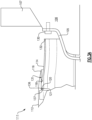
- Figure 2A shows the center body 111 having the forward portion 112 and the rear portion 114.
- rear portion 114 has a cylindrical guiding surface 116 received within a cylindrical guiding surface 118 of the forward portion 112.
- a snap ring 120 is shown received in a groove 123 in the forward portion 112 and in a groove 121 on the outer surface 116 of the rear portion 114.
- Figure 2B shows there are holes 131 to provide access to the ring 120. While one hole 131 is shown on the outer surface of the forward portion 112 in Figures 2A and 2B it should be understood there will typically be a plurality of such holes.
- This application discloses a way of moving rear portion 114 such that the rear end 132 is spaced away from the location of the bolt to facilitate balancing of a rotor assembly.
- Figure 2C shows a pin 134 extending through the hole 131 to contact ring 120 and deflect it radially inwardly and out of groove 123. As shown, prior to this movement there is additional space 132 at a radially inner end of the groove 121.
- the clip 120 is generally cylindrical, however, it has ends 133 which are spaced by a small circumferential gap. This allows the clip 120 to collapse inwardly. Because of circumferentially spaced ends 133 the snap ring does not extend around 360 degrees of an axis of rotation of the propulsor.
- Figure 3A shows a step subsequent to Figure 2C for balancing rotating portions of engine 100.
- the clip 120 has been moved inward of the groove 123 in the inner surface 118 of forward portion 112.
- the housing member 114 is moved forwardly, or to the left between Figures 2A to Figure 3A .
- a forward end 136 of the rear portions 114 abuts a stop 137.
- Figure 3B shows that the bolt 130 has now been removed. This would be done to allow the changing of the weight or class of bolt utilized to better balance the rotating portions of engine 100.
- Figure 3C shows that a new bolt 140 has replaced the bolt 130. Again, the bolt 140 would be of a different class or weight to achieve better balancing.
- the housing part 114 is merely moved rearwardly, or to the right from the Figure 3A position back to the Figure 2A position.
- the clip 120 has a bias that will cause it to spring back into the groove 123 securing the forward portion 112 and rear portion 114 together.
- Figure 3D shows another embodiment where the bolts are not changed for balancing.
- the reference numbers are all increased by 100 from Figure 3C .
- a balancing member 242 adjacent the connection between the adapter 205 and the rotor 206 is changed.
- the balancing member 242 could be any number of balancing features. In examples, it could be a counterweight riveted to the rotor, a weighted snap ring that is spun to the connection, etc.
- the location and shape is shown schematically, and a worker of skill in this art would know the types of balancing members that may be utilized and changed. The details of this disclosure extend to providing access to the balancing member 242 for balancing. After balancing, the engine is returned to the Figure 2A position.
- a gas turbine engine under this disclosure could be said to include a propulsor having a rotor with blades.
- An adapter connects the rotor to a drive line.
- the drive line connects to an accessory.
- the drive line and the accessory are received within a static center body.
- Bolts secure the adapter to the rotor.
- the center body has a rear end closely spaced from the bolts, such that the center body limits access to a connection between the adapter and the rotor.
- the center body is formed with a forward portion and a separate rear portion defining the rear end. The forward portion and the rear portion are secured together.
- the rear portion is selectively slidable relative to the forward portion such that the rear portion can be moved away from the adapter to move the rear end away to provide access to the connection to allow balancing.
- a method of balancing rotating members in a gas turbine engine under this disclosure could be said to include the steps of providing a propulsor having a rotor and blades, and an adapter connecting the rotor to a drive line.
- the drive line is received within a static center body having a forward portion and a separate rear portion.
- the center body has a rear end closely spaced from the bolts, such that the center body limits access a connection between the adapter and the rotor.
- the method moves the separate rear portion toward the forward portion and away from the connection with the forward portion remaining static. Balance members are then changed to balance at least some rotating members.
Landscapes
- Engineering & Computer Science (AREA)
- Mechanical Engineering (AREA)
- General Engineering & Computer Science (AREA)
- Chemical & Material Sciences (AREA)
- Combustion & Propulsion (AREA)
- Structures Of Non-Positive Displacement Pumps (AREA)
Abstract
A gas turbine engine (100) includes a propulsor having a rotor (106) with blades, and an adapter (105) connecting the rotor (106) to a drive line (108) at a connection. The drive line (108) is connected to an accessory (109). The drive line (108) and the accessory (109) are received within a static center body (111). Bolts secure the adapter (105) to the rotor (106). The center body (111) has a rear end (132) closely spaced from the connection, such that the center body (111) limits access to the connection of the adapter (105) to the rotor (106). The center body (111) is formed with a forward portion (112) and a separate rear portion (114) defining the rear end (132). The forward portion (112) and the rear portion (114) are secured together. The rear portion (114) is selectively slidable relative to the forward portion (112) such that the rear portion (114) can be moved away from the connection to provide access to change balance members.

Description
- This application relates to a gas turbine engine having a fixed center body.
- Gas turbine engines are known, and typically include a propulsor delivering air into a bypass duct and into a core compressor. The propulsor typically rotates with a rotor having blades. It is known to provide balance weights on a rotating body in a gas turbine engine to address imbalances.
- In one known gas turbine engine there is a fixed center body forward of an area where the balance weights are used.
- Currently the center body must be removed to gain access to the balance area. This is cumbersome, and further requires the reattachment of the center body. This may cause the rotor to move back out of balance.
- According to a first aspect of the invention, a gas turbine engine includes a propulsor having a rotor with blades, and an adapter connecting the rotor to a drive line at a connection. The drive line is connected to an accessory. The drive line and the accessory are received within a static center body. Bolts secure the adapter to the rotor. The center body has a rear end adjacent to, and axially spaced, and optionally closely spaced, from, the connection, such that the center body limits access to the connection of the adapter to the rotor. The center body is formed with a forward portion and a separate rear portion defining the rear end. The forward portion and the rear portion are secured together. The rear portion is selectively slidable relative to the forward portion such that the rear portion can be moved away from the connection, optionally to provide access to change balance members that may be associated with the rotor.
- In an embodiment according to the previous embodiment, there is a forward groove formed in the forward portion and a rear groove formed in the rear portion. A securement member is received in the forward and rear grooves to secure the forward portion and rear portion together.
- In another embodiment according to any of the previous embodiments, there is at least one hole through an outer surface of the forward portion, such that a tool can be inserted into the at least one hole to move the securement member out of the forward groove in the forward portion and such that the rear portion can be slid away from the balance member.
- In another embodiment according to any of the previous embodiments, the securement member is a clip.
- In another embodiment according to any of the previous embodiments, the clip is a snap ring having circumferentially spaced ends such that the snap ring does not extend around 360 degrees of an axis of rotation of the propulsor.
- In another embodiment according to any of the previous embodiments, the securement member is a clip.
- In another embodiment according to any of the previous embodiments, the clip is a snap ring having circumferentially spaced ends such that the snap ring does not extend around 360 degrees of an axis of rotation of the propulsor.
- In another embodiment according to any of the previous embodiments, the bolts are changed as the balance members.
- In another embodiment according to any of the previous embodiments, the balance members are adjacent the connection, and is an element other than the bolts.
- In another embodiment according to any of the previous embodiments, the accessory is a generator.
- In another embodiment according to any of the previous embodiments, a fan case surrounds the propulsor rotor and blades.
- According to another aspect of the invention, a method of balancing rotating members in a gas turbine engine includes the steps of 1) providing a propulsor having a rotor and blades, and an adapter connecting the rotor to a drive line, the drive line received within a static center body having a forward portion and a separate rear portion, there being bolts securing the adapter to the rotor, the center body having a rear end adjacent to, and axially spaced, and optionally closely spaced, from, the connection, such that the center body limits access to the connection, 2) moving the separate rear portion toward the forward portion and away from the connection with the forward portion remaining static, and 3) changing balance members to balance at least some rotating members that may be associated with the rotor.
- In another embodiment according to any of the previous embodiments, there is a forward groove formed in the forward portion and a rear groove formed in the rear portion, and a securement member is received in the forward and rear grooves to secure the forward portion and the rear portion together, and step 2) including moving the securement member out of the forward groove.
- In another embodiment according to any of the previous embodiments, there is at least one hole through an outer surface of the forward portion, and a tool is inserted into the at least one hole to move the securement member out of the forward groove and such that the rear portion can be moved away from the bolts.
- In another embodiment according to any of the previous embodiments, a securement member is a clip.
- In another embodiment according to any of the previous embodiments, the clip is a snap ring having circumferentially spaced ends such that the snap ring does not extend around 360 degrees of an axis of rotation of the propulsor.
- In another embodiment according to any of the previous embodiments, the drive line drives an accessory.
- In another embodiment according to any of the previous embodiments, the accessory is a generator.
- In another embodiment according to any of the previous embodiments, the bolts are changed as the balance members.
- In another embodiment according to any of the previous embodiments, the balance members are adjacent the connection, and is an element other than the bolts.
- The present invention may include any one or more of the individual features disclosed above and/or below alone or in any combination thereof.
- These and other features of the present invention can be best understood from the following specification and drawings, the following of which is a brief description.
-
-
Figure 1 schematically shows a gas turbine engine. -
Figure 2A shows a center body. -
Figure 2B shows a detail of theFigure 2A center body. -
Figure 2C shows a further detail of the center body. -
Figure 2D shows a clip that secures two portions of the center body. -
Figure 3A shows one center body portion moved relative to another to provide access for balancing and on-wing or off-wing trim balancing. -
Figure 3B shows a subsequent step in a balancing process. -
Figure 3C shows yet another subsequent step in the balancing process. -
Figure 3D shows another embodiment balancing member. -
Figure 1 shows agas turbine engine 100 schematically. Combustor 101 receives compressed air from acompressor 102.Compressor 102 is driven by aturbine 103. Anotherturbine 104 drives apropulsor rotor 106, in turn connected to anadapter member 105.Propulsor rotor 106drives propulsor blades 107.Adapter member 105 drives adrive shaft 108 that in turn drives agenerator 109. - A
fan case 110 surrounds and is secured to astatic center body 111 having two portions, aforward portion 112 and arear portion 114. Spars 113 fixforward portion 112 to thefan case 110. - The
gas turbine engine 100 may operate as known.Propulsor blades 107 provide air into thecompressor 102, and further into a bypass duct defined between acore housing 115 and thefan case 110. - During assembly and maintenance of the
gas turbine engine 100 it is sometimes necessary to trim balance at theadapter member 105 and thehub 106 connection. In particular, one may sometimes need to gain access to bolts which are utilized to connect the two such that the classification or weight of the bolts may be changed to achieve better balancing for associated rotating components. -
Figure 2A shows thecenter body 111 having theforward portion 112 and therear portion 114. As shown,rear portion 114 has a cylindrical guidingsurface 116 received within a cylindrical guidingsurface 118 of theforward portion 112. Asnap ring 120 is shown received in agroove 123 in theforward portion 112 and in agroove 121 on theouter surface 116 of therear portion 114. As further shown, there are a plurality ofholes 131 through an outer surface of theforward portion 112 and extending intogroove 123. -
Figure 2B shows there areholes 131 to provide access to thering 120. While onehole 131 is shown on the outer surface of theforward portion 112 inFigures 2A and2B it should be understood there will typically be a plurality of such holes. - Returning to
Figure 2A , one can see abolt 130 securing theadapter member 105 to thepropulsor rotor 106. However, arear end 132 of therear portion 114 limits access to thebolt 130. - This application discloses a way of moving
rear portion 114 such that therear end 132 is spaced away from the location of the bolt to facilitate balancing of a rotor assembly. -
Figure 2C shows apin 134 extending through thehole 131 to contactring 120 and deflect it radially inwardly and out ofgroove 123. As shown, prior to this movement there isadditional space 132 at a radially inner end of thegroove 121. - As shown in
Figure 2D , theclip 120 is generally cylindrical, however, it has ends 133 which are spaced by a small circumferential gap. This allows theclip 120 to collapse inwardly. Because of circumferentially spaced ends 133 the snap ring does not extend around 360 degrees of an axis of rotation of the propulsor. -
Figure 3A shows a step subsequent toFigure 2C for balancing rotating portions ofengine 100. Theclip 120 has been moved inward of thegroove 123 in theinner surface 118 offorward portion 112. At that point thehousing member 114 is moved forwardly, or to the left betweenFigures 2A to Figure 3A . At that point, aforward end 136 of therear portions 114 abuts astop 137. - Now, when balancing is desired, the
ring 120 is moved inwardly as shown inFigure 2C and therear portion 114 is moved forwardly or to the left to theFigure 3A position. There is now good access tobolt 130. -
Figure 3B shows that thebolt 130 has now been removed. This would be done to allow the changing of the weight or class of bolt utilized to better balance the rotating portions ofengine 100. - Next,
Figure 3C shows that anew bolt 140 has replaced thebolt 130. Again, thebolt 140 would be of a different class or weight to achieve better balancing. - After the
Figure 3C step, thehousing part 114 is merely moved rearwardly, or to the right from theFigure 3A position back to theFigure 2A position. At that point, theclip 120 has a bias that will cause it to spring back into thegroove 123 securing theforward portion 112 andrear portion 114 together. -
Figure 3D shows another embodiment where the bolts are not changed for balancing. The reference numbers are all increased by 100 fromFigure 3C . Rather, a balancingmember 242 adjacent the connection between theadapter 205 and therotor 206 is changed. The balancingmember 242 could be any number of balancing features. In examples, it could be a counterweight riveted to the rotor, a weighted snap ring that is spun to the connection, etc. The location and shape is shown schematically, and a worker of skill in this art would know the types of balancing members that may be utilized and changed. The details of this disclosure extend to providing access to the balancingmember 242 for balancing. After balancing, the engine is returned to theFigure 2A position. - A gas turbine engine under this disclosure could be said to include a propulsor having a rotor with blades. An adapter connects the rotor to a drive line. The drive line connects to an accessory. The drive line and the accessory are received within a static center body. Bolts secure the adapter to the rotor. The center body has a rear end closely spaced from the bolts, such that the center body limits access to a connection between the adapter and the rotor. The center body is formed with a forward portion and a separate rear portion defining the rear end. The forward portion and the rear portion are secured together. The rear portion is selectively slidable relative to the forward portion such that the rear portion can be moved away from the adapter to move the rear end away to provide access to the connection to allow balancing.
- A method of balancing rotating members in a gas turbine engine under this disclosure could be said to include the steps of providing a propulsor having a rotor and blades, and an adapter connecting the rotor to a drive line. The drive line is received within a static center body having a forward portion and a separate rear portion. There are bolts securing the adapter to the rotor. The center body has a rear end closely spaced from the bolts, such that the center body limits access a connection between the adapter and the rotor. The method moves the separate rear portion toward the forward portion and away from the connection with the forward portion remaining static. Balance members are then changed to balance at least some rotating members.
- Although an embodiment has been shown and disclosed, a worker of ordinary skill in this art would recognize that modifications would come within the scope of this disclosure. For that reason, the following claims should be studied to determine the true scope and content of this disclosure.
Claims (15)
- A gas turbine engine (100) comprising:a propulsor having a rotor (106) with blades (107), and an adapter (105) connecting the rotor (106) to a drive line (108) at a connection, the drive line (108) connected to an accessory (109), the drive line (108) and the accessory (109) received within a static center body (111), bolts (130) securing the adapter (105) to the rotor (106);the center body (111) having a rear end (132) closely spaced from the connection, such that the center body (111) limits access to the connection of the adapter (105) to the rotor (106); andthe center body (111) being formed with a forward portion (112) and a separate rear portion (114) defining the rear end (132), and the forward portion (112) and the rear portion (114) being secured together, the rear portion (114) being selectively slidable relative to the forward portion (112) such that the rear portion (114) can be moved away from the connection to provide access to change balance members.
- The gas turbine engine of claim 1, wherein the balance members include the bolts (130).
- The gas turbine engine of claim 1, wherein the balance members are adjacent the connection, and are an element other than the bolts (130).
- The gas turbine engine of any preceding claim, further comprising a fan case (110) that surrounds the propulsor rotor (106) and blades (107).
- The gas turbine engine of any preceding claim, comprising a forward groove (123) formed in the forward portion (112), a rear groove (121) formed in the rear portion (114), and a securement member (120) received in the forward and rear grooves to secure the forward portion and rear portion together.
- The gas turbine engine of claim 5, comprising at least one hole (131) through an outer surface of the forward portion (112), such that a tool can be inserted into the at least one hole (131) to move the securement member (120) out of the forward groove (123) in the forward portion (112) such that the rear portion (114) can be slid away from the balance member.
- A method of balancing rotating members in a gas turbine engine, the method comprising the steps of:1) providing a propulsor having a rotor (106) and blades (107), and an adapter (105) connecting the rotor (106) to a drive line (108), the drive line (108) received within a static center body (111) having a forward portion (112) and a separate rear portion (114), there being bolts (130) securing the adapter (105) to the rotor (106), the center body (111) having a rear end (132) closely spaced from the connection, such that the center body (111) limits access to the connection;2) moving the separate rear portion (114) toward the forward portion (112) and away from the connection, with the forward portion (112) remaining static; and3) changing balance members to balance at least some rotating members.
- The method of claim 7, wherein there is a forward groove (123) formed in the forward portion (112) and a rear groove (121) formed in the rear portion (114), and a securement member (120) is received in the forward and rear grooves to secure the forward portion (112) and the rear portion (114) together, and wherein step 2) includes moving the securement member (120) out of the forward groove (123).
- The method of claim 8, wherein there is at least one hole (131) through an outer surface (116) of the forward portion (112), and a tool is inserted into the at least one hole (131) to move the securement member (120) out of the forward groove (123) and such that the rear portion (114) can be moved away from the bolts.
- The gas turbine engine of claim 5 or 6, or the method of claim 8 or 9, wherein the securement member (120) is a clip.
- The gas turbine engine or method of claim 10, wherein the clip (120) is a snap ring having circumferentially spaced ends (133) such that the snap ring does not extend around 360 degrees of an axis of rotation of the propulsor.
- The method of any of claims 7 to 11, wherein the drive line (108) drives an accessory (109).
- The gas turbine engine of any preceding claim, or the method of claim 12, wherein the accessory is a generator (109).
- The method of any of claims 7 to 13, wherein changing the balance members includes changing the bolts (130).
- The method of any of claims 7 to 13, wherein the balance members are adjacent the connection, and are an element other than the bolts (130).
Applications Claiming Priority (1)
| Application Number | Priority Date | Filing Date | Title |
|---|---|---|---|
| US18/393,410 US12595737B2 (en) | 2023-12-21 | 2023-12-21 | Two piece retractable engine center body for balancing |
Publications (1)
| Publication Number | Publication Date |
|---|---|
| EP4575182A1 true EP4575182A1 (en) | 2025-06-25 |
Family
ID=94083082
Family Applications (1)
| Application Number | Title | Priority Date | Filing Date |
|---|---|---|---|
| EP24223058.9A Pending EP4575182A1 (en) | 2023-12-21 | 2024-12-23 | Two piece retractable engine center body for balancing |
Country Status (2)
| Country | Link |
|---|---|
| US (1) | US12595737B2 (en) |
| EP (1) | EP4575182A1 (en) |
Citations (6)
| Publication number | Priority date | Publication date | Assignee | Title |
|---|---|---|---|---|
| US20060053882A1 (en) * | 2004-09-16 | 2006-03-16 | Lee Michael J | Method and apparatus for balancing gas turbine engines |
| FR2908827A1 (en) * | 2006-11-16 | 2008-05-23 | Snecma Sa | Turbine engine i.e. turbo jet engine, spinner for aircraft, has groove sealing ring including outer surface aligned with outer surface of spinner, and threaded surface formed in direction inverse to rotational direction of fan blade |
| US20090039653A1 (en) * | 2007-08-07 | 2009-02-12 | Snecma | Turbojet comprising a current generator mounted in the fan and a method of mounting said generator in the fan |
| FR2980240A1 (en) * | 2011-09-16 | 2013-03-22 | Snecma | TURBOMACHINE ROTATING INPUT HOOD |
| US20150000304A1 (en) * | 2012-12-28 | 2015-01-01 | United Technologies Corporation | Removable nosecone for a gas turbine engine |
| US20220302801A1 (en) * | 2021-03-18 | 2022-09-22 | General Electric Company | Bearing current mitigation for an electric machine embedded in a gas turbine engine |
Family Cites Families (3)
| Publication number | Priority date | Publication date | Assignee | Title |
|---|---|---|---|---|
| US9784215B2 (en) | 2014-11-07 | 2017-10-10 | Rohr, Inc. | Exhaust nozzle center body attachment |
| US10344672B2 (en) | 2016-11-03 | 2019-07-09 | Rolls-Royce Corporation | Low weight nose cone assembly |
| US10823151B2 (en) | 2018-10-05 | 2020-11-03 | Hamilton Sunstrand Corporation | Ram air turbine single-unit nose mass |
-
2023
- 2023-12-21 US US18/393,410 patent/US12595737B2/en active Active
-
2024
- 2024-12-23 EP EP24223058.9A patent/EP4575182A1/en active Pending
Patent Citations (6)
| Publication number | Priority date | Publication date | Assignee | Title |
|---|---|---|---|---|
| US20060053882A1 (en) * | 2004-09-16 | 2006-03-16 | Lee Michael J | Method and apparatus for balancing gas turbine engines |
| FR2908827A1 (en) * | 2006-11-16 | 2008-05-23 | Snecma Sa | Turbine engine i.e. turbo jet engine, spinner for aircraft, has groove sealing ring including outer surface aligned with outer surface of spinner, and threaded surface formed in direction inverse to rotational direction of fan blade |
| US20090039653A1 (en) * | 2007-08-07 | 2009-02-12 | Snecma | Turbojet comprising a current generator mounted in the fan and a method of mounting said generator in the fan |
| FR2980240A1 (en) * | 2011-09-16 | 2013-03-22 | Snecma | TURBOMACHINE ROTATING INPUT HOOD |
| US20150000304A1 (en) * | 2012-12-28 | 2015-01-01 | United Technologies Corporation | Removable nosecone for a gas turbine engine |
| US20220302801A1 (en) * | 2021-03-18 | 2022-09-22 | General Electric Company | Bearing current mitigation for an electric machine embedded in a gas turbine engine |
Also Published As
| Publication number | Publication date |
|---|---|
| US20250207498A1 (en) | 2025-06-26 |
| US12595737B2 (en) | 2026-04-07 |
Similar Documents
| Publication | Publication Date | Title |
|---|---|---|
| EP2169181B1 (en) | Gas turbine engine rotor and balance weight therefor | |
| EP1841960B1 (en) | Starter generator system for a tip turbine engine | |
| US7299621B2 (en) | Three-spool by-pass turbojet with a high by-pass ratio | |
| US20100226786A1 (en) | Nose cone assembly | |
| US8365511B2 (en) | Tip turbine engine integral case, vane, mount and mixer | |
| US8162615B2 (en) | Split disk assembly for a gas turbine engine | |
| EP3054088B1 (en) | Gas turbine engine rotor disk balancing | |
| EP3587733B1 (en) | System and method for balancing a rotor in an assembled engine | |
| US3964342A (en) | Turbine shaft balancing | |
| EP1947297A2 (en) | Seal assembly for a fan-turbine rotor of a tip turbine engine | |
| EP3553284A1 (en) | Securing a centering spring to a static structure with mounting tabs | |
| US10408068B2 (en) | Fan blade dovetail and spacer | |
| US4059972A (en) | Turbine shaft balancing | |
| US9957799B2 (en) | Balance ring for gas turbine engine | |
| US8961141B2 (en) | Axial retention system for a bladed rotor with multiple blade types | |
| EP4575182A1 (en) | Two piece retractable engine center body for balancing | |
| EP3647541B1 (en) | Split vernier ring for turbine rotor stack assembly | |
| US11168582B2 (en) | Aircraft turbomachine comprising decoupling means | |
| EP3647545A1 (en) | Turbine blade assembly, corresponding gas turbine engine and corresponding methode of securing a turbine blade | |
| EP3623581B1 (en) | Integral vane stage | |
| US12000292B1 (en) | Systems and methods for multi-dimensional variable vane stage rigging | |
| EP3323998B1 (en) | Inner shroud segment and corresponding inner shroud and gas turbine motor | |
| EP1969222B1 (en) | Bearing-like structure to control deflections of a rotating component | |
| EP4667708A1 (en) | Destabilizer induced buckling in spoked bearing support | |
| EP4667707A1 (en) | Slip based radial bearing support |
Legal Events
| Date | Code | Title | Description |
|---|---|---|---|
| PUAI | Public reference made under article 153(3) epc to a published international application that has entered the european phase |
Free format text: ORIGINAL CODE: 0009012 |
|
| STAA | Information on the status of an ep patent application or granted ep patent |
Free format text: STATUS: THE APPLICATION HAS BEEN PUBLISHED |
|
| AK | Designated contracting states |
Kind code of ref document: A1 Designated state(s): AL AT BE BG CH CY CZ DE DK EE ES FI FR GB GR HR HU IE IS IT LI LT LU LV MC ME MK MT NL NO PL PT RO RS SE SI SK SM TR |
|
| STAA | Information on the status of an ep patent application or granted ep patent |
Free format text: STATUS: REQUEST FOR EXAMINATION WAS MADE |
|
| 17P | Request for examination filed |
Effective date: 20251224 |