EP4574928A1 - Process for treating a carbonaceous liquid feedstock from a hydrothermal liquefaction treatment - Google Patents
Process for treating a carbonaceous liquid feedstock from a hydrothermal liquefaction treatment Download PDFInfo
- Publication number
- EP4574928A1 EP4574928A1 EP23315465.7A EP23315465A EP4574928A1 EP 4574928 A1 EP4574928 A1 EP 4574928A1 EP 23315465 A EP23315465 A EP 23315465A EP 4574928 A1 EP4574928 A1 EP 4574928A1
- Authority
- EP
- European Patent Office
- Prior art keywords
- biocrude
- diluent
- solvent
- feedstock
- liquid
- Prior art date
- Legal status (The legal status is an assumption and is not a legal conclusion. Google has not performed a legal analysis and makes no representation as to the accuracy of the status listed.)
- Pending
Links
Images
Classifications
-
- C—CHEMISTRY; METALLURGY
- C10—PETROLEUM, GAS OR COKE INDUSTRIES; TECHNICAL GASES CONTAINING CARBON MONOXIDE; FUELS; LUBRICANTS; PEAT
- C10G—CRACKING HYDROCARBON OILS; PRODUCTION OF LIQUID HYDROCARBON MIXTURES, e.g. BY DESTRUCTIVE HYDROGENATION, OLIGOMERISATION, POLYMERISATION; RECOVERY OF HYDROCARBON OILS FROM OIL-SHALE, OIL-SAND, OR GASES; REFINING MIXTURES MAINLY CONSISTING OF HYDROCARBONS; REFORMING OF NAPHTHA; MINERAL WAXES
- C10G21/00—Refining of hydrocarbon oils, in the absence of hydrogen, by extraction with selective solvents
- C10G21/06—Refining of hydrocarbon oils, in the absence of hydrogen, by extraction with selective solvents characterised by the solvent used
- C10G21/08—Inorganic compounds only
-
- C—CHEMISTRY; METALLURGY
- C10—PETROLEUM, GAS OR COKE INDUSTRIES; TECHNICAL GASES CONTAINING CARBON MONOXIDE; FUELS; LUBRICANTS; PEAT
- C10G—CRACKING HYDROCARBON OILS; PRODUCTION OF LIQUID HYDROCARBON MIXTURES, e.g. BY DESTRUCTIVE HYDROGENATION, OLIGOMERISATION, POLYMERISATION; RECOVERY OF HYDROCARBON OILS FROM OIL-SHALE, OIL-SAND, OR GASES; REFINING MIXTURES MAINLY CONSISTING OF HYDROCARBONS; REFORMING OF NAPHTHA; MINERAL WAXES
- C10G1/00—Production of liquid hydrocarbon mixtures from oil-shale, oil-sand, or non-melting solid carbonaceous or similar materials, e.g. wood, coal
- C10G1/06—Production of liquid hydrocarbon mixtures from oil-shale, oil-sand, or non-melting solid carbonaceous or similar materials, e.g. wood, coal by destructive hydrogenation
- C10G1/065—Production of liquid hydrocarbon mixtures from oil-shale, oil-sand, or non-melting solid carbonaceous or similar materials, e.g. wood, coal by destructive hydrogenation in the presence of a solvent
-
- C—CHEMISTRY; METALLURGY
- C10—PETROLEUM, GAS OR COKE INDUSTRIES; TECHNICAL GASES CONTAINING CARBON MONOXIDE; FUELS; LUBRICANTS; PEAT
- C10G—CRACKING HYDROCARBON OILS; PRODUCTION OF LIQUID HYDROCARBON MIXTURES, e.g. BY DESTRUCTIVE HYDROGENATION, OLIGOMERISATION, POLYMERISATION; RECOVERY OF HYDROCARBON OILS FROM OIL-SHALE, OIL-SAND, OR GASES; REFINING MIXTURES MAINLY CONSISTING OF HYDROCARBONS; REFORMING OF NAPHTHA; MINERAL WAXES
- C10G1/00—Production of liquid hydrocarbon mixtures from oil-shale, oil-sand, or non-melting solid carbonaceous or similar materials, e.g. wood, coal
- C10G1/08—Production of liquid hydrocarbon mixtures from oil-shale, oil-sand, or non-melting solid carbonaceous or similar materials, e.g. wood, coal with moving catalysts
- C10G1/083—Production of liquid hydrocarbon mixtures from oil-shale, oil-sand, or non-melting solid carbonaceous or similar materials, e.g. wood, coal with moving catalysts in the presence of a solvent
-
- C—CHEMISTRY; METALLURGY
- C10—PETROLEUM, GAS OR COKE INDUSTRIES; TECHNICAL GASES CONTAINING CARBON MONOXIDE; FUELS; LUBRICANTS; PEAT
- C10G—CRACKING HYDROCARBON OILS; PRODUCTION OF LIQUID HYDROCARBON MIXTURES, e.g. BY DESTRUCTIVE HYDROGENATION, OLIGOMERISATION, POLYMERISATION; RECOVERY OF HYDROCARBON OILS FROM OIL-SHALE, OIL-SAND, OR GASES; REFINING MIXTURES MAINLY CONSISTING OF HYDROCARBONS; REFORMING OF NAPHTHA; MINERAL WAXES
- C10G21/00—Refining of hydrocarbon oils, in the absence of hydrogen, by extraction with selective solvents
- C10G21/28—Recovery of used solvent
-
- C—CHEMISTRY; METALLURGY
- C10—PETROLEUM, GAS OR COKE INDUSTRIES; TECHNICAL GASES CONTAINING CARBON MONOXIDE; FUELS; LUBRICANTS; PEAT
- C10G—CRACKING HYDROCARBON OILS; PRODUCTION OF LIQUID HYDROCARBON MIXTURES, e.g. BY DESTRUCTIVE HYDROGENATION, OLIGOMERISATION, POLYMERISATION; RECOVERY OF HYDROCARBON OILS FROM OIL-SHALE, OIL-SAND, OR GASES; REFINING MIXTURES MAINLY CONSISTING OF HYDROCARBONS; REFORMING OF NAPHTHA; MINERAL WAXES
- C10G2300/00—Aspects relating to hydrocarbon processing covered by groups C10G1/00 - C10G99/00
- C10G2300/10—Feedstock materials
- C10G2300/1011—Biomass
-
- C—CHEMISTRY; METALLURGY
- C10—PETROLEUM, GAS OR COKE INDUSTRIES; TECHNICAL GASES CONTAINING CARBON MONOXIDE; FUELS; LUBRICANTS; PEAT
- C10G—CRACKING HYDROCARBON OILS; PRODUCTION OF LIQUID HYDROCARBON MIXTURES, e.g. BY DESTRUCTIVE HYDROGENATION, OLIGOMERISATION, POLYMERISATION; RECOVERY OF HYDROCARBON OILS FROM OIL-SHALE, OIL-SAND, OR GASES; REFINING MIXTURES MAINLY CONSISTING OF HYDROCARBONS; REFORMING OF NAPHTHA; MINERAL WAXES
- C10G2300/00—Aspects relating to hydrocarbon processing covered by groups C10G1/00 - C10G99/00
- C10G2300/10—Feedstock materials
- C10G2300/1011—Biomass
- C10G2300/1014—Biomass of vegetal origin
-
- C—CHEMISTRY; METALLURGY
- C10—PETROLEUM, GAS OR COKE INDUSTRIES; TECHNICAL GASES CONTAINING CARBON MONOXIDE; FUELS; LUBRICANTS; PEAT
- C10G—CRACKING HYDROCARBON OILS; PRODUCTION OF LIQUID HYDROCARBON MIXTURES, e.g. BY DESTRUCTIVE HYDROGENATION, OLIGOMERISATION, POLYMERISATION; RECOVERY OF HYDROCARBON OILS FROM OIL-SHALE, OIL-SAND, OR GASES; REFINING MIXTURES MAINLY CONSISTING OF HYDROCARBONS; REFORMING OF NAPHTHA; MINERAL WAXES
- C10G2300/00—Aspects relating to hydrocarbon processing covered by groups C10G1/00 - C10G99/00
- C10G2300/10—Feedstock materials
- C10G2300/1011—Biomass
- C10G2300/1018—Biomass of animal origin
Definitions
- the present invention relates to the production of recoverable chemicals or biofuels from biomass, including lignocellulosic biomass. More specifically, the invention relates to biomass hydrothermal liquefaction processes, also known by the acronym HTL for "HydroThermal Liquefaction", which make it possible to transform biomass into a carbon load called “biocrude”. This so-called “biocrude” load must then be treated, including notably hydroconversion, hydrotreatment, hydrocracking, catalytic cracking, to obtain the desired chemicals to the desired specifications.
- Hydrothermal liquefaction (see “ Continuous Hydrothermal Liquefaction of biomass: a critical review", D. Castello, T. H. Pederson, L. A. Rosendahl, Energys 2018, 11, 3165 ) is a process of converting a charge in the presence of water at a pressure between 100 and 350 bar (between 10 7 Pa and 3.5. 10 7 Pa) and at a temperature between 250 and 450°C.
- Catalysts can be used for hydrothermal liquefaction, like pH modifiers, NaOH, KOH, K 2 CO 3 , Na 2 CO 3 , etc.
- Biocrude consisting mainly of organic molecules, an aqueous phase comprising water-soluble organic compounds (alcohols, acids, ketones, phenols, etc.) and salts, gases and possibly biochar.
- Biochar is a solid product rich in carbon, 'char' deriving from the word 'charcoal'.
- the gas produced consists mainly of CO 2 , but it can also contain hydrogen, methane and CO.
- water may be present in liquid form or in a relatively dense supercritical state.
- Water close to the critical point (374°C, 221 bar) has very different properties from those of water at room temperature. These near-critical properties allow water to play several roles in the conversion process such as being a reactant, a catalyst or a source of hydrogen.
- Near the critical point or in the supercritical state water has properties that facilitate liquefaction such as a low dielectric constant that allows solubilization of nonpolar molecules and an ionic product high enough to favor ionic reactions leading to liquid products over free radical reactions leading to solid or gaseous products.
- hydrothermal liquefaction process The reactions taking place in the hydrothermal liquefaction process are numerous and complex, but one can mention depolymerization reactions including hydrolysis, dehydration, decarboxylation, and repolymerization reactions including condensation.
- the yields and composition of the biocrude depend on the operating conditions, but also on the feedstock treated with hydrothermal liquefaction. For example, for a feedstock made of wood, hydrothermal liquefaction obtains a mass yield of around 40-45% of biocrude and of gas of 40-45% as well.
- the hydrothermal liquefaction feedstock can be biomass, preferably selected from plants, grasses, trees, wood chips, seeds, fibers, seed husks; aquatic plants, algae, hay and other sources of lignocellulosic materials, such as those from organic waste, municipal waste, agri-food waste, animal waste, forestry waste, sawmill waste, forest residues, agricultural and industrial waste (such as sugarcane bagasse, oil palm waste, sawdust or straw).
- the load of hydrothermal liquefaction can also come from paper pulp and paper by-products, recycled or not, or from by-products from paper mills, waste such as used plastics, worn tires.
- the feedstock can also be a mixture of two or more of these materials.
- Biocrude obtained by hydrothermal liquefaction is a complex mixture of compounds, consisting mainly of hydrocarbons and oxygenated compounds.
- oxygenated compounds are organic acids, ketones, oxygenated aromatic compounds, alcohols, aldehydes, esters, ethers, and water. Water usually accounts for less than 15% by weight of the biocrude.
- the biocrude contains compounds from cellulose, hemicellulose and lignin (the structure found in lignocellulosic biomass).
- the biocrude obtained by hydrothermal liquefaction has an oxygen, sulfur and nitrogen content that varies greatly depending on the feedstock of the hydrothermal liquefaction (algae, wood, etc.).
- the biocrude from hydrothermal liquefaction of wood is generally made up of 5 to 20% weight of oxygen, less than 0.5% weight of sulfur and less than 5% weight of nitrogen in the dry biocrude (without water).
- Biocrude can contain up to 4% weight of inorganics (mineral compounds), mainly metals such as sodium, potassium but also calcium, iron, etc.
- inorganic compounds mainly metals such as sodium, potassium but also calcium, iron, etc.
- These inorganic compounds can come from the catalysts used for hydrothermal liquefaction, from the hydrothermal liquefaction feedstock itself, and from the metals possibly used to grind the hydrothermal liquefaction feedstock.
- Sodium and potassium may be present in relatively large quantities in the biocrude, as the hydrothermal liquefaction process generally uses alkali-based catalysts (NaOH, KOH, K 2 CO 3 , Na 2 CO 3 , etc.) in significant quantities.
- biocrude To be transformed into biofuels (petrol, kerosene, diesel, marine fuel oil) or chemicals, biocrude must be processed, in particular with a view to reducing heteroatpms and more particularly the oxygen it contains.
- This treatment may include at least one operation chosen from hydroconversion, hydrotreatment, hydrocracking, or catalytic cracking.
- these operations use catalysts known to the skilled person as sensitive to metal content (in particular alkali or alkaline earth metals such as Na, K, Ca, etc.). These metals poison the catalysts: they deactivate them at least partially.
- the aim of the invention is therefore to develop a treatment to reduce the content of mineral compounds, in particular metallics, of a biocrude-type feedstock, a treatment that is preferably simple to implement, and preferably economical in terms of tools and/or utility consumption.
- the invention first relates to a method for treating a liquid feedstock which comprises at least partly carbonaceous products and which is the result of a hydrothermal liquefaction treatment, known as biocrude feedstock, with a view to reducing its content of inorganic compounds, in particular metallic compounds, such as the said treatment comprises:
- the invention succeeds in significantly reducing the inorganic compound content of a biocrude-type feedstock, the reduction being sufficient to allow the subsequent processing steps of such a feedstock to be carried out without having to modify its conventional operation, in particular by maintaining the type of catalyst usually used for the steps like a hydroconversion, a hydrotreatment, a hydrocracking, or a catalytic cracking step.
- the invention first uses dilution with a "light" organic diluent (less dense and less viscous than biocrude), then a counter-current liquid/liquid extraction with an aqueous solvent. And it turned out that this combination of dilution + extraction is very effective.
- Counter-current liquid/liquid extraction can be implemented quite simply, by an extraction column such as gravity extraction for example (or several columns in series or parallel). Extracting in such a column requires a sufficient difference in density between the phases present (often greater than 50 kg/m 3 ), and the greater the difference in density, the easier it will be.
- the viscosity of one or both phases plays an important role in this operation, as the more it increases, the more the transfer of material between phases will be slowed down on the one hand, and the more the capacity of the column is likely to decrease, in terms of the possible feedstock rate per column section unit.
- Counter-current columns are interesting because they allow the desired solutes to be extracted in a much better way than in a co-current column or in a stirred tank. Indeed, the number of theoretical stages can reach high values (between 2 and 15 in the vast majority of cases), and with minimized solvent consumption.
- step (b) of contact is implemented with a single solvent.
- said solvent is an aqueous solution, which can be pure water, demineralized water, water with soluble organic molecules, or even an acidic aqueous solution.
- step (b) of contact is implemented with at least two different solvents, notably with two solvents.
- step (b) of contacting the dilute biocrude obtained in step (a) is carried out with at least two separate solvents which are brought into contact with said dilute biocrude in separate contact zones.
- first solvent which is an aqueous liquid phase with a neutral pH, in particular between 6.5 and 7.5 and a second solvent which is an acidic aqueous liquid phase, having a pH of less than 6.5, with counter-current liquid-liquid extraction, so as to obtain, on the one hand, a raffinate comprising the biocrude depleted in inorganic (mineral) compounds and the diluent, and on the other hand an extract comprising the solvent s enriched in inorganic (mineral) compounds.
- One or at least one of the solvents when there are several, may also be an aqueous solution acidified by injection of carbon dioxide into the aqueous solution (which may already contain one of the above-mentioned acids). Indeed, the hydrothermal liquefaction step prior to the treatment according to the invention tends to generate carbon dioxide, which can therefore be advantageously used to acidify the solvent(s), if necessary.
- the ratio R 2 of the flow rate of the second solvent Q s2 to the flow rate of the dilute biocrude Q m is preferably between 0.05 and 5, preferably between 0.1 and 3.
- the method of the invention also comprises:
- This recycling can be partial or total: it can be supplemented by an addition of external diluent, if necessary, but it is very interesting, because it makes it possible to drastically reduce the consumption in diluent of the treatment process according to the invention.
- Step (e) can also allow to recover these inorganic compounds, e.g., metal salts, for recycling.
- the diluent has a final boiling point of not more than 150°C, preferably not more than 100°C.
- the diluent used in dilution step a) is selected from a light cut in the biocrude feedstock, or a chemical compound or mixture of chemical compounds, including alcohols, ethers, ketones and hydrocarbons.
- the process can be started with a diluent of boiling temperature close to that of the phase comprising the diluent to be recycled according to step d), which is a light cut of the biocrude, then this phase will gradually accumulate in the recycling loop over time and will thus gradually replace the initial diluent.
- the ratio R of the flow rate Qd of the diluent to the flow rate Qb of the biocrude feedstock is at most 10, and in particular at least 0.1, with the ratio R preferably between 0.5 and 3.
- contacting step (b) is carried out at a pressure between 0.5.10 5 Pa and 5.1 5 Pa, and at a temperature between 15 and 100°C, while remaining below the boiling temperature of the diluent at the contact pressure.
- separation step (c) is a treatment consisting of at least evaporation, distillation, flash, and may use an exchanger followed by a separator flask.
- the solvent used in contacting step (b) shall be selected from at least one of the following solutions: a pure aqueous solution, a demineralized aqueous solution, an aqueous solution containing soluble organic compounds, an acidic aqueous solution.
- an acidic aqueous solution it may contain from 10 ppm to 20% weight of an organic or mineral acid, strong or weak, such as acetic acid, nitric acid, sulfuric acid, hydrochloric acid, citric acid, oxalic acid, lactic acid, formic acid or any other acid.
- step (e) aimed at reducing its content of mineral salts, in particular metallic salts: this is the recycling of step (f) described above.
- the invention also relates to a biomass treatment process comprising a hydrothermal liquefaction of biomass, then a treatment to reduce the mineral content of the biocrude obtained, as described above, and then possibly conversion treatment of the treated biocrude such as hydroconversion, hydrotreating, hydrocracking, catalytic cracking in order to produce biofuels and/or other chemical (bio-based) compounds.
- contacting step b) may be preceded and/or followed by step b1) and/or b2) of settling (decantation).
- the invention also relates to a treatment plant for a liquid charge comprising at least partly carbonaceous products and resulting from a hydrothermal liquefaction treatment, known as biocrude feedstock, with a view to reducing the content of mineral compounds, in particular metallic compounds, which implements the process described above.
- the invention also relates to a facility for the treatment of a liquid charge comprising at least partly carbonaceous products and resulting from a hydrothermal liquefaction treatment, known as a biocrude feedstock, with a view to reducing the content thereof of mineral compounds, in particular metallic compounds, so that said installation comprises
- the dilution device can be a tank-type device fed by both the biocrude and the diluent. It can also be achieved simply by a plurality of inlet pipes that converge to a common pipe(s) where mixing/dilution is carried out dynamically to the contacting device, using appropriate valves.
- the contacting device is preferably a liquid/liquid extraction column with gravitational counterflow. It can be a single column or a plurality, mounted in series or in parallel.
- the column(s) can be equipped at the top and/or bottom of the column with settling devices.
- the contacting device uses only one solvent.
- the device (b) for contacting the dilute biocrude charge obtained in step (a) uses at least two separate solvents, a first solvent which is an aqueous liquid phase with a neutral pH, in particular between 6.5 and 7.5, and a second solvent which is an acidic aqueous liquid phase, having a pH of less than 6.5: said device may include a column of counter-current liquid-liquid extraction, preferably gravity-driven, the first and second solvents having separate inlets and arranged at different heights of the column.
- At least one of the first and second solvents comprises at least two separate inlets arranged at different heights of the column.
- one of the solvents may have two different injection points, at different column heights, e.g., one injection point at the head of the column and (at least) another at an intermediate column height, or two injection points at different intermediate column heights .
- At least one of the inputs of the first solvent may be at the head of the column. It is also possible that one of the inputs of the second solvent is at the head of the column.
- At least one of the inputs of the second solvent is at an intermediate height of the column, in particular at a height H 2 with respect to the total height H of the column such that the ratio H 2 /H is between 0.2 and 0.8.
- the total height H is the useful height of the column, which is known in the field of liquid-liquid extraction or distillation columns.
- this intermediate height H 3 is preferably less than the height H 2 of the inlet of the second solvent (or first solvent).
- this height H 3 of the second inlet of the first solvent (or of the second solvent) can be such that, H being the total height of the column, the ratio H 3 /H is between 0.05 and 0.4.
- the separation device is at least one device chosen from: a distillation column, an evaporator, an exchanger followed by a separator tank, in particular a so-called “flash" separator tank.
- the facility according to the invention may also comprise a recycling device of at least part of the phase comprising the diluent obtained with device c) as a diluent for the dilution device a).
- This recirculation device can be made up of pipe(s) providing a fluidic connection between the two devices a) and c) and controlled in a known way by valves.
- the facility according to the invention may provide that the contacting device b) comprises a liquid/counter-current liquid extraction column equipped at the bottom of the column and/or at the head of the column with a settling device b1,b2.
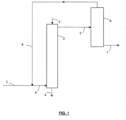
- FIG. 1 This figure shows in a very schematic way a facility implementing the biocrude treatment process according to the invention.
- the invention aims to treat biocrude-type feedstocks in order to reduce the content of inorganic (mineral) compounds, particularly metallic compounds.
- the biocrude obtained by hydrothermal liquefaction is a complex mixture of compounds consisting mainly of hydrocarbons and oxygenated compounds.
- oxygenated compounds are organic acids, ketones, oxygenated aromatic compounds, alcohols, aldehydes, esters, ethers, and water. Water usually accounts for less than 15% by weight of the biocrude.
- Biocrude can contain up to 4% weight of inorganics, mainly metals such as sodium, potassium but also calcium, iron, etc.
- Inorganics can come from catalysts used for hydrothermal liquefaction, from the hydrothermal liquefaction feedstock, and from metals used to grind the hydrothermal liquefaction charge.
- Sodium and potassium can be present in significant quantities in the biocrude because the hydrothermal liquefaction process uses alkali-based catalysts (NaOH, KOH, K 2 CO 3 , Na 2 CO 3 , etc.) in significant quantities.
- the biocrude is generally characterized by a kinematic viscosity at 50°C between 10 and 40,000 cSt, a dynamic viscosity at 50°C between 10 and 40,000 cP, a density at 15°C between 0.9 and 1.2 and a final distillation temperature exceeding 750°C.
- Biocrude has a very wide distillation range, from room temperature to over 750°C.
- a biocrude from hydrothermal liquefaction of wood about 10% weight of the biocrude is vaporized in the range 20-180°C, 10% weight to 45% weight of the biocrude is vaporized in the interval 180-350°C and 45% weight to 80% weight of the biocrude is vaporized above 350°C.
- FIG. 1 shows an installation for implementing the invention , which will be described below.
- Biocrude 1 from the hydrothermal liquefaction unit has a flow rate Qb.
- Biocrude 1 is mixed with recycled diluent 8 (the origin of which will be described below) with a flow rate Qd of 0.1 ⁇ Qd/Qb ⁇ 10 and preferably 0.5 ⁇ Qd/Qb ⁇ 3.
- Flow rates are measured in mass per unit of time.
- Recycled diluent 8 is a compound or mixture of compounds having a dynamic viscosity at 20°C less than 4 cP, and generally not less than 0.3 cP, and a density at 15°C between 600 and 850 kg/m 3 .
- the dilution is done by providing a pipe in the supply pipe from biocrude 1 to the extraction column 2 with a pipe bringing the diluent: the mixture between the biocrude and the diluent is carried out in the common pipe portion downstream of the tapping.
- upstream and downstream are understood in this text by considering the progression of the biocrude in the installation).
- biocrude + diluent called “dilute biocrude”
- dilute biocrude has a dynamic viscosity at 20°C less than or equal to 7 cP, preferably less than or equal to 4 cP and a density at 15°C less than or equal to 950 kg/m 3 , preferably less than or equal to 900 kg/m 3 and generally not less than 600 kg/m 3 .
- Diluent 8 can be a light cut present in the biocrude (the process can start with an initial diluent, which will gradually be replaced by the recycled phase containing the diluent, as indicated above) or a chemical compound (or a mixture of chemical compounds) present or not present in the biocrude.
- the diluent can consist of compounds from the family of alcohols, ethers, ketones and hydrocarbons, for example.
- the final boiling point of diluent 8 is preferably less than or equal to 150°C, and preferably less than or equal to 100°C. It is preferably at least 60°C.
- Dilute biocrude 9 feeds a liquid-liquid extraction column called gravity column 2 at its bottom and has a mass flow rate Qm.
- Column 2 extends along a vertical or essentially vertical longitudinal axis.
- Solvent 3 feeds column 2 in the high position (column head) with a flow rate Qs.
- the Qs flow rate of solvent 3 is chosen such as 0.05 ⁇ Qs/Qm ⁇ 5 and preferably 0.3 ⁇ Qs/Qm ⁇ 3.
- the usable height of column 2 is between 1.5 m and 50 m high, preferably between 1.8 m and 25 m.
- the column can be of different types: packed column, perforated plate column, mechanical stirring column, pulsed column or other types.
- Raffinate 5 feeds a separation device 6 based on boiling temperature, such as a distillation column, an evaporator, an exchanger followed by a flash separator flask.
- This device makes it possible to separate a "diluent" 8 (which can be recycled at an inlet of column 2), which consists of a light constituent or a mixture of light constituents, and a demineralized biocrude 7 with a greatly reduced content of inorganics, in particular metals, compared to biocrude 1.
- a reduction (by weight) of the content of inorganic compounds, such as mineral salts / metal salts is obtained by at least 50% (by weight) and in particular by at least 70% (by weight).
- Biocrude grades can be achieved with levels of up to 500 ppm, including no more than 400 or 300 or 200 or 100 ppm of all these inorganic compounds.
- a biocrude derived from hydrothermal liquefaction of lignocellulosic biomass has a dynamic viscosity at 20°C of 142 cP and a density at 15°C of 985 kg/m 3 .
- the biocrude contains several inorganics including sodium Na, potassium K and calcium Ca.
- the sodium concentration is 912 ppm weight
- the potassium concentration is 640 ppm weight
- the calcium concentration is 30 ppm weight.
- the biocrude is diluted with 2-butanone (or methyl ethyl ketone, or MEK) with a MEK/biocrude mass ratio of 1 to reduce density and viscosity.
- MEK has a density at 15°C of 805 kg/m 3 and a dynamic viscosity at 20°C of 0.42 cP. It has a boiling point of 79.6 °C.
- the dilute biocrude has a dynamic viscosity at 20°C of 1.7 cP and a density at 15°C of 890 kg/m 3 .
- a contacting test of biocrude diluted with demineralized water is carried out in a 3-liter closed reactor with a dilute water/biocrude mass ratio equal to 0.5.
- the reactor equipped with an agitating means (propeller shape), is stirred at 500 rpm for 1 hour and then left to rest for 1 day.
- the reactor is operated at 40°C under 1 atm (10 5 Pa).
- the settled organic phase is separated and analyzed.
- the analysis results indicate a sodium content of 98 ppm weight, a potassium content of 51 ppm and a calcium content of 13 ppm in the organic phase after the contacting step, i.e., in the raffinate.
- the same diluted biocrude as in example 1 is contacted with demineralized water in a stirred counter-current liquid-liquid extraction column 2 of type Sulzer ECR, with an internal diameter of 32 mm and a usable height of 1800 mm.
- the operation is performed at 40°C under 1 atm (10 5 Pa).
- the dispersed phase is the light phase (dilute biocrude 9).
- the flow rate of diluted biocrude is 6 kg/h and the flow rate of demineralized water (3) is 3 kg/h.
- the ratio of the water mass flow rate to the dilute biocrude mass flow rate is 0.5.
- the column is agitated at a stirring speed of 90 rpm during operation.
- the organic phase (dilute biocrude 9) feeds the column from the bottom, and the aqueous phase (demineralized water 3) feeds the column from the head (top) of the column.
- the column has an estimated number of theoretical stages of the order of 3 under those operating conditions.
- the organic phase thus treated and exiting at the top of the extraction column 2 is analyzed.
- the test results indicate a sodium content of 3 ppm by weight, a potassium content of 2 ppm and a calcium content of 10 ppm in the organic phase after liquid-liquid extraction.
- Table 1 The sodium, potassium and calcium levels obtained with these two examples are compiled in Table 1 below: Table 1 Initial content (biocrude) Final content (Demineralized biocrude) Example 1 Final content (Demineralized biocrude) Example 2 Sodium Na content (ppm weight) 912 98 3 Potassium K content (ppm weight) 640 51 2 Calcium Ca content (ppm weight) 30 13 10
Landscapes
- Chemical & Material Sciences (AREA)
- Oil, Petroleum & Natural Gas (AREA)
- Engineering & Computer Science (AREA)
- Chemical Kinetics & Catalysis (AREA)
- General Chemical & Material Sciences (AREA)
- Organic Chemistry (AREA)
- Life Sciences & Earth Sciences (AREA)
- Wood Science & Technology (AREA)
- Inorganic Chemistry (AREA)
- Extraction Or Liquid Replacement (AREA)
Abstract
The invention relates to a method for treating a liquid feedstock comprising at least partly carbonaceous products resulting from a hydrothermal liquefaction treatment, known as biocrude feedstock (1), with a view to reducing the content of mineral compounds, such as said treatment comprises
- a step (a) dilution of the biocrude feedstock with a diluent (8) comprising an organic liquid phase, so as to obtain a dilute biocrude (9),
- a step (b) contacting the dilute biocrude obtained in step (a) with at least one solvent (3) which comprises a liquid aqueous phase, with counter-current liquid-liquid extraction, so as to obtain, on the one hand, a raffinate (5) comprising the mineral-depleted biocrude and the diluent, and on the other hand an extract (4) comprising the solvent enriched with mineral compounds,
- a step (c) of separation of the raffinate (5) obtained in step (b), so as to obtain, on the one hand, the biocrude depleted in mineral compounds (7) and on the other hand a phase comprising the diluent (8).
- a step (a) dilution of the biocrude feedstock with a diluent (8) comprising an organic liquid phase, so as to obtain a dilute biocrude (9),
- a step (b) contacting the dilute biocrude obtained in step (a) with at least one solvent (3) which comprises a liquid aqueous phase, with counter-current liquid-liquid extraction, so as to obtain, on the one hand, a raffinate (5) comprising the mineral-depleted biocrude and the diluent, and on the other hand an extract (4) comprising the solvent enriched with mineral compounds,
- a step (c) of separation of the raffinate (5) obtained in step (b), so as to obtain, on the one hand, the biocrude depleted in mineral compounds (7) and on the other hand a phase comprising the diluent (8).
Description
- The present invention relates to the production of recoverable chemicals or biofuels from biomass, including lignocellulosic biomass. More specifically, the invention relates to biomass hydrothermal liquefaction processes, also known by the acronym HTL for "HydroThermal Liquefaction", which make it possible to transform biomass into a carbon load called "biocrude". This so-called "biocrude" load must then be treated, including notably hydroconversion, hydrotreatment, hydrocracking, catalytic cracking, to obtain the desired chemicals to the desired specifications.
- Hydrothermal liquefaction (see "Continuous Hydrothermal Liquefaction of biomass: a critical review", D. Castello, T. H. Pederson, L. A. Rosendahl, Energies 2018, 11, 3165) is a process of converting a charge in the presence of water at a pressure between 100 and 350 bar (between 10 7 Pa and 3.5. 107 Pa) and at a temperature between 250 and 450°C. Catalysts can be used for hydrothermal liquefaction, like pH modifiers, NaOH, KOH, K 2CO3, Na2CO3, etc.
- The products of hydrothermal liquefaction are called "biocrude", consisting mainly of organic molecules, an aqueous phase comprising water-soluble organic compounds (alcohols, acids, ketones, phenols, etc.) and salts, gases and possibly biochar. Biochar is a solid product rich in carbon, 'char' deriving from the word 'charcoal'. The gas produced consists mainly of CO2 , but it can also contain hydrogen, methane and CO.
- In the hydrothermal liquefaction process, water may be present in liquid form or in a relatively dense supercritical state. Water close to the critical point (374°C, 221 bar) has very different properties from those of water at room temperature. These near-critical properties allow water to play several roles in the conversion process such as being a reactant, a catalyst or a source of hydrogen. Near the critical point or in the supercritical state, water has properties that facilitate liquefaction such as a low dielectric constant that allows solubilization of nonpolar molecules and an ionic product high enough to favor ionic reactions leading to liquid products over free radical reactions leading to solid or gaseous products.
- The reactions taking place in the hydrothermal liquefaction process are numerous and complex, but one can mention depolymerization reactions including hydrolysis, dehydration, decarboxylation, and repolymerization reactions including condensation.
- The yields and composition of the biocrude depend on the operating conditions, but also on the feedstock treated with hydrothermal liquefaction. For example, for a feedstock made of wood, hydrothermal liquefaction obtains a mass yield of around 40-45% of biocrude and of gas of 40-45% as well.
- The hydrothermal liquefaction feedstock can be biomass, preferably selected from plants, grasses, trees, wood chips, seeds, fibers, seed husks; aquatic plants, algae, hay and other sources of lignocellulosic materials, such as those from organic waste, municipal waste, agri-food waste, animal waste, forestry waste, sawmill waste, forest residues, agricultural and industrial waste (such as sugarcane bagasse, oil palm waste, sawdust or straw). The load of hydrothermal liquefaction can also come from paper pulp and paper by-products, recycled or not, or from by-products from paper mills, waste such as used plastics, worn tires. The feedstock can also be a mixture of two or more of these materials.
- Biocrude obtained by hydrothermal liquefaction is a complex mixture of compounds, consisting mainly of hydrocarbons and oxygenated compounds. In general, oxygenated compounds are organic acids, ketones, oxygenated aromatic compounds, alcohols, aldehydes, esters, ethers, and water. Water usually accounts for less than 15% by weight of the biocrude. In the case of a lignocellulosic biomass feedstock, the biocrude contains compounds from cellulose, hemicellulose and lignin (the structure found in lignocellulosic biomass).
- The biocrude obtained by hydrothermal liquefaction has an oxygen, sulfur and nitrogen content that varies greatly depending on the feedstock of the hydrothermal liquefaction (algae, wood, etc.). For example, the biocrude from hydrothermal liquefaction of wood is generally made up of 5 to 20% weight of oxygen, less than 0.5% weight of sulfur and less than 5% weight of nitrogen in the dry biocrude (without water).
- Biocrude can contain up to 4% weight of inorganics (mineral compounds), mainly metals such as sodium, potassium but also calcium, iron, etc. These inorganic compounds can come from the catalysts used for hydrothermal liquefaction, from the hydrothermal liquefaction feedstock itself, and from the metals possibly used to grind the hydrothermal liquefaction feedstock. Sodium and potassium may be present in relatively large quantities in the biocrude, as the hydrothermal liquefaction process generally uses alkali-based catalysts (NaOH, KOH, K2CO3, Na2CO3, etc.) in significant quantities.
- This content of inorganics, especially metals, generally does not allow the biocrude to be used as a fuel because the amount of ash is too high.
- To be transformed into biofuels (petrol, kerosene, diesel, marine fuel oil) or chemicals, biocrude must be processed, in particular with a view to reducing heteroatpms and more particularly the oxygen it contains. This treatment may include at least one operation chosen from hydroconversion, hydrotreatment, hydrocracking, or catalytic cracking. However, these operations use catalysts known to the skilled person as sensitive to metal content (in particular alkali or alkaline earth metals such as Na, K, Ca, etc.). These metals poison the catalysts: they deactivate them at least partially.
- It is therefore necessary to purify the biocrude, i.e., to reduce its content of mineral compounds, especially metallics, so that its subsequent treatments can be carried out. It is known of patent applications
WO18177877 WO19092173 WO21121662 - The aim of the invention is therefore to develop a treatment to reduce the content of mineral compounds, in particular metallics, of a biocrude-type feedstock, a treatment that is preferably simple to implement, and preferably economical in terms of tools and/or utility consumption.
- The invention first relates to a method for treating a liquid feedstock which comprises at least partly carbonaceous products and which is the result of a hydrothermal liquefaction treatment, known as biocrude feedstock, with a view to reducing its content of inorganic compounds, in particular metallic compounds, such as the said treatment comprises:
- a step (a) diluting the biocrude feedstock with a diluent that comprises an organic liquid phase that has a lower viscosity and density than those of the biocrude feedstock, so as to obtain a dilute biocrude,
- a step (b) of contacting the dilute biocrude obtained in step (a) with at least one solvent comprising a liquid aqueous phase, with counter-current liquid-liquid extraction, so as to obtain, on the one hand, a raffinate comprising the inorganic-depleted biocrude and diluent, and on the other hand an extract comprising the solvent enriched with inorganic compounds,
- a step (c) of separation of the raffinate obtained in step (b), so as to obtain, on the one hand, the biocrude depleted in inorganic compounds, and on the other hand a phase comprising the diluent.
- Thus, the invention succeeds in significantly reducing the inorganic compound content of a biocrude-type feedstock, the reduction being sufficient to allow the subsequent processing steps of such a feedstock to be carried out without having to modify its conventional operation, in particular by maintaining the type of catalyst usually used for the steps like a hydroconversion, a hydrotreatment, a hydrocracking, or a catalytic cracking step.
- And to do this, the invention first uses dilution with a "light" organic diluent (less dense and less viscous than biocrude), then a counter-current liquid/liquid extraction with an aqueous solvent. And it turned out that this combination of dilution + extraction is very effective. Counter-current liquid/liquid extraction can be implemented quite simply, by an extraction column such as gravity extraction for example (or several columns in series or parallel). Extracting in such a column requires a sufficient difference in density between the phases present (often greater than 50 kg/m3), and the greater the difference in density, the easier it will be. In addition, the viscosity of one or both phases plays an important role in this operation, as the more it increases, the more the transfer of material between phases will be slowed down on the one hand, and the more the capacity of the column is likely to decrease, in terms of the possible feedstock rate per column section unit.
- Counter-current columns are interesting because they allow the desired solutes to be extracted in a much better way than in a co-current column or in a stirred tank. Indeed, the number of theoretical stages can reach high values (between 2 and 15 in the vast majority of cases), and with minimized solvent consumption.
- According to an embodiment of the invention, step (b) of contact is implemented with a single solvent. Preferably, said solvent is an aqueous solution, which can be pure water, demineralized water, water with soluble organic molecules, or even an acidic aqueous solution.
- According to another embodiment of the invention, step (b) of contact is implemented with at least two different solvents, notably with two solvents. In this case, it is preferable that step (b) of contacting the dilute biocrude obtained in step (a) is carried out with at least two separate solvents which are brought into contact with said dilute biocrude in separate contact zones. It can be used a first solvent which is an aqueous liquid phase with a neutral pH, in particular between 6.5 and 7.5 and a second solvent which is an acidic aqueous liquid phase, having a pH of less than 6.5, with counter-current liquid-liquid extraction, so as to obtain, on the one hand, a raffinate comprising the biocrude depleted in inorganic (mineral) compounds and the diluent, and on the other hand an extract comprising the solvent s enriched in inorganic (mineral) compounds.
- In this other embodiment, preferably, the first solvent S1 is chosen from pure water, demineralized water, water with soluble organic molecules. And preferably, the second solvent S2 is an acidic aqueous solution, having a pH of less than 6.5.
- Advantageously, the second solvent S2 is an acidic aqueous solution containing from 10 ppm, in particular from 100 ppm, to 20% weight of at least one strong or weak acid, organic or inorganic one, in particular chosen from at least one of the following acids: acetic acid, nitric acid, sulfuric acid, hydrochloric acid, citric acid, oxalic acid, lactic acid, formic acid, and possibly soluble organic molecules.
- One or at least one of the solvents, when there are several, may also be an aqueous solution acidified by injection of carbon dioxide into the aqueous solution (which may already contain one of the above-mentioned acids). Indeed, the hydrothermal liquefaction step prior to the treatment according to the invention tends to generate carbon dioxide, which can therefore be advantageously used to acidify the solvent(s), if necessary.
- In step (b) of contacting with two solvents, the ratio R1 of the flow rate of the first solvent Q s1 to the flow rate of the dilute biocrude Qm is preferably between 0.05 and 5, preferably between 0.1 and 3.
- In step b) of contacting with two solvents, the ratio R2 of the flow rate of the second solvent Q s2 to the flow rate of the dilute biocrude Qm is preferably between 0.05 and 5, preferably between 0.1 and 3.
- Preferably, contacting step b) includes dedicated or additional settling (decantation), to improve the settling between the two aqueous and organic phases. The settling device used (e.g., a decanter) may be located after the last liquid-liquid extraction column or between two liquid-liquid extraction columns in series that are used in separation step c). Extraction column (or one of those used in step c) may have a short-residence time settling function, which tends to separate the phases in a non-optimal manner, and it is possible that a fraction of residual free water (droplets) may be entrained in raffinate. In this case, a decanter can be placed online downstream to better separate the water (and not upstream of column). If the contacting between the two liquid phases is made via two separate columns, then a decanter can be placed between the two columns, or only one at the outlet of the second column (or having no decanter).
- Advantageously, the method of the invention also comprises:
- a step (d) of recycling at least part of the phase comprising the diluent as a diluent in step (a) of dilution.
- This recycling can be partial or total: it can be supplemented by an addition of external diluent, if necessary, but it is very interesting, because it makes it possible to drastically reduce the consumption in diluent of the treatment process according to the invention.
- Advantageously, the method of the invention also comprises:
- a step (e) of processing the extract obtained in step (b) to reduce its inorganic (mineral) content,
- a step (f) of recycling at least part of the extract with reduced inorganic content obtained in step (e) as a solvent in contacting step (b). Again, this extract can therefore be at least partially recycled, preferably by purifying it beforehand, to replace all or part of the (aqueous) solvent used during the liquid/liquid extraction, which also reduces the water consumption of the process according to the invention.
- Step (e) can also allow to recover these inorganic compounds, e.g., metal salts, for recycling.
- Preferably, in dilution step a), the diluent has a final boiling point of not more than 150°C, preferably not more than 100°C.
- Preferably, the diluent used in dilution step a) is selected from a light cut in the biocrude feedstock, or a chemical compound or mixture of chemical compounds, including alcohols, ethers, ketones and hydrocarbons. The process can be started with a diluent of boiling temperature close to that of the phase comprising the diluent to be recycled according to step d), which is a light cut of the biocrude, then this phase will gradually accumulate in the recycling loop over time and will thus gradually replace the initial diluent.
- Preferably, at the end of dilution step a), the dilute biocrude load has a dynamic viscosity at 20°C of at most 7 cP, preferably at most 4 cP, and a density at 15°C of at most 950 kg/m3, preferably at most 900 kg/m3.
- Preferably, in dilution step a), the ratio R of the flow rate Qd of the diluent to the flow rate Qb of the biocrude feedstock is at most 10, and in particular at least 0.1, with the ratio R preferably between 0.5 and 3.
- Preferably, contacting step (b) is carried out at a pressure between 0.5.105 Pa and 5.1 5 Pa, and at a temperature between 15 and 100°C, while remaining below the boiling temperature of the diluent at the contact pressure.
- Preferably, separation step (c) is a treatment consisting of at least evaporation, distillation, flash, and may use an exchanger followed by a separator flask.
- Preferably, the solvent used in contacting step (b) shall be selected from at least one of the following solutions: a pure aqueous solution, a demineralized aqueous solution, an aqueous solution containing soluble organic compounds, an acidic aqueous solution. In the case of an acidic aqueous solution, it may contain from 10 ppm to 20% weight of an organic or mineral acid, strong or weak, such as acetic acid, nitric acid, sulfuric acid, hydrochloric acid, citric acid, oxalic acid, lactic acid, formic acid or any other acid.
- As seen above, it can in fact be made up of all or part of the extract after treatment by step (e) aimed at reducing its content of mineral salts, in particular metallic salts: this is the recycling of step (f) described above.
- It can be a mixture of at least two of these solutions.
- The invention also relates to a biomass treatment process comprising a hydrothermal liquefaction of biomass, then a treatment to reduce the mineral content of the biocrude obtained, as described above, and then possibly conversion treatment of the treated biocrude such as hydroconversion, hydrotreating, hydrocracking, catalytic cracking in order to produce biofuels and/or other chemical (bio-based) compounds.
- According to one embodiment, contacting step b) may be preceded and/or followed by step b1) and/or b2) of settling (decantation).
- The invention also relates to a treatment plant for a liquid charge comprising at least partly carbonaceous products and resulting from a hydrothermal liquefaction treatment, known as biocrude feedstock, with a view to reducing the content of mineral compounds, in particular metallic compounds, which implements the process described above.
- The invention also relates to a facility for the treatment of a liquid charge comprising at least partly carbonaceous products and resulting from a hydrothermal liquefaction treatment, known as a biocrude feedstock, with a view to reducing the content thereof of mineral compounds, in particular metallic compounds, so that said installation comprises
- a device a) for diluting the biocrude feedstock with a diluent which comprises an organic phase which has a viscosity and density lower than that of the biocrude feedstock, so as to obtain a dilute biocrude feedstock
- a device b) for contacting the dilute biocrude obtained with device a) with at least one solvent comprising an aqueous phase, said device comprising a counter-current liquid-liquid extraction column, preferably gravity-based, so as to obtain a raffinate comprising the mineral-depleted biocrude filler and diluent, and on the other hand an extract comprising the solvent enriched with mineral compounds
- a device (c) for separating the raffinate obtained with device b), so as to obtain on the one hand the biocrude charge depleted in mineral compounds and on the other hand a phase comprising the diluent.
- The dilution device can be a tank-type device fed by both the biocrude and the diluent. It can also be achieved simply by a plurality of inlet pipes that converge to a common pipe(s) where mixing/dilution is carried out dynamically to the contacting device, using appropriate valves.
- The contacting device is preferably a liquid/liquid extraction column with gravitational counterflow. It can be a single column or a plurality, mounted in series or in parallel. The column(s) can be equipped at the top and/or bottom of the column with settling devices.
- According to one embodiment, the contacting device uses only one solvent.
- According to another embodiment, the device (b) for contacting the dilute biocrude charge obtained in step (a) uses at least two separate solvents, a first solvent which is an aqueous liquid phase with a neutral pH, in particular between 6.5 and 7.5, and a second solvent which is an acidic aqueous liquid phase, having a pH of less than 6.5: said device may include a column of counter-current liquid-liquid extraction, preferably gravity-driven, the first and second solvents having separate inlets and arranged at different heights of the column.
- According to this embodiment, in a variant, at least one of the first and second solvents comprises at least two separate inlets arranged at different heights of the column. Thus, one of the solvents may have two different injection points, at different column heights, e.g., one injection point at the head of the column and (at least) another at an intermediate column height, or two injection points at different intermediate column heights .
- For example, at least one of the inputs of the first solvent may be at the head of the column. It is also possible that one of the inputs of the second solvent is at the head of the column.
- For example, at least one of the inputs of the second solvent is at an intermediate height of the column, in particular at a height H2 with respect to the total height H of the column such that the ratio H2/H is between 0.2 and 0.8.
- It is also possible that it is rather one of the inlets of the first solvent that is at an intermediate height of the column, especially at said height H2 .
- The total height H is the useful height of the column, which is known in the field of liquid-liquid extraction or distillation columns.
- If the first solvent (or the second solvent) has a second inlet in the column at an intermediate height H3, then this intermediate height H3 is preferably less than the height H2 of the inlet of the second solvent (or first solvent).
- Advantageously, this height H3 of the second inlet of the first solvent (or of the second solvent) can be such that, H being the total height of the column, the ratio H3/H is between 0.05 and 0.4.
- For example, the separation device is at least one device chosen from: a distillation column, an evaporator, an exchanger followed by a separator tank, in particular a so-called "flash" separator tank.
- The facility according to the invention may also comprise a recycling device of at least part of the phase comprising the diluent obtained with device c) as a diluent for the dilution device a). This recirculation device can be made up of pipe(s) providing a fluidic connection between the two devices a) and c) and controlled in a known way by valves.
- The facility according to the invention may provide that the contacting device b) comprises a liquid/counter-current liquid extraction column equipped at the bottom of the column and/or at the head of the column with a settling device b1,b2.
-
Figure 1 : This figure shows in a very schematic way a facility implementing the biocrude treatment process according to the invention. - This figure therefore does not represent all the equipment in the installation, but those that are most useful for understanding the invention. The different devices and others are not necessarily to scale, nor necessarily represented in space as they can be in an industrial site.
- The invention aims to treat biocrude-type feedstocks in order to reduce the content of inorganic (mineral) compounds, particularly metallic compounds.
- As a reminder, the characteristics of a biocrude-type feedstock of interest to the invention may be as follows: The biocrude obtained by hydrothermal liquefaction is a complex mixture of compounds consisting mainly of hydrocarbons and oxygenated compounds. In general, oxygenated compounds are organic acids, ketones, oxygenated aromatic compounds, alcohols, aldehydes, esters, ethers, and water. Water usually accounts for less than 15% by weight of the biocrude.
- In the case of a lignocellulosic biomass load, the biocrude contains compounds from cellulose, hemicellulose and lignin (structure present in lignocellulosic biomass).
- The biocrude obtained by hydrothermal liquefaction has an oxygen, sulfur and nitrogen content that varies greatly depending on the load of the hydrothermal liquefaction (algae, wood, etc.). For example, the biocrude from hydrothermal liquefaction of wood is generally made up of 5 to 20% weight of oxygen, less than 0.5% weight of sulfur and less than 5% weight of nitrogen in the dry biocrude (without water).
- Biocrude can contain up to 4% weight of inorganics, mainly metals such as sodium, potassium but also calcium, iron, etc. Inorganics can come from catalysts used for hydrothermal liquefaction, from the hydrothermal liquefaction feedstock, and from metals used to grind the hydrothermal liquefaction charge. Sodium and potassium can be present in significant quantities in the biocrude because the hydrothermal liquefaction process uses alkali-based catalysts (NaOH, KOH, K 2CO3, Na2CO3, etc.) in significant quantities. The biocrude is generally characterized by a kinematic viscosity at 50°C between 10 and 40,000 cSt, a dynamic viscosity at 50°C between 10 and 40,000 cP, a density at 15°C between 0.9 and 1.2 and a final distillation temperature exceeding 750°C.
- Biocrude has a very wide distillation range, from room temperature to over 750°C. For example, for a biocrude from hydrothermal liquefaction of wood, about 10% weight of the biocrude is vaporized in the range 20-180°C, 10% weight to 45% weight of the biocrude is vaporized in the interval 180-350°C and 45% weight to 80% weight of the biocrude is vaporized above 350°C.
-
Figure 1 shows an installation for implementing the invention , which will be described below.Biocrude 1 from the hydrothermal liquefaction unit has a flow rate Qb.Biocrude 1 is mixed with recycled diluent 8 (the origin of which will be described below) with a flow rate Qd of 0.1 < Qd/Qb < 10 and preferably 0.5 < Qd/Qb < 3. Flow rates are measured in mass per unit of time.Recycled diluent 8 is a compound or mixture of compounds having a dynamic viscosity at 20°C less than 4 cP, and generally not less than 0.3 cP, and a density at 15°C between 600 and 850 kg/m3. The dilution is done by providing a pipe in the supply pipe frombiocrude 1 to theextraction column 2 with a pipe bringing the diluent: the mixture between the biocrude and the diluent is carried out in the common pipe portion downstream of the tapping. ("upstream" and "downstream" are understood in this text by considering the progression of the biocrude in the installation). -
Mixture 9, biocrude + diluent, called "dilute biocrude", here has a dynamic viscosity at 20°C less than or equal to 7 cP, preferably less than or equal to 4 cP and a density at 15°C less than or equal to 950 kg/m3, preferably less than or equal to 900 kg/m3 and generally not less than 600 kg/m3. These properties are obtained by choosing an appropriate diluent type and diluent flow rate (in relation to the biocrude flow rate). - Diluent 8 can be a light cut present in the biocrude (the process can start with an initial diluent, which will gradually be replaced by the recycled phase containing the diluent, as indicated above) or a chemical compound (or a mixture of chemical compounds) present or not present in the biocrude. The diluent can consist of compounds from the family of alcohols, ethers, ketones and hydrocarbons, for example.
- The final boiling point of
diluent 8 is preferably less than or equal to 150°C, and preferably less than or equal to 100°C. It is preferably at least 60°C. -
Dilute biocrude 9 feeds a liquid-liquid extraction column calledgravity column 2 at its bottom and has a mass flow rate Qm.Column 2 extends along a vertical or essentially vertical longitudinal axis. - Liquid-liquid extraction is carried out using a solvent 3 consisting of an aqueous solution, which can be pure water, demineralized water, water with soluble organic molecules, an acidic aqueous solution containing from 10 ppm to 20% weight of an acid such as acetic acid, nitric acid, sulfuric acid, hydrochloric acid, citric acid, formic acid or any other acid, or a mixture of these different aqueous solutions.
- Solvent 3 can come from the recycling of extract 4 (described below), if
extract 4 has been previously treated to reduce its inorganic content (e.g., evaporation) and by adding acid if necessary. - Solvent 3
feeds column 2 in the high position (column head) with a flow rate Qs. The Qs flow rate of solvent 3 is chosen such as 0.05 < Qs/Qm < 5 and preferably 0.3 < Qs/Qm < 3. -
Extraction column 2 has the following features: - Operating pressure P between 0.5 bar abs (0.5.105 Pa) and 15 bar abs (1 5.105 Pa ), preferably between 0.9 bar abs (0.9.105 Pa ) and 1.5 bar abs (15.10 5 Pa).
- Operating temperature T between 15°C and 150°C, preferably between 20°C and 60°C
- T/S between 5 and 80 m/h, preferably between 10 and 40 m/h, with:
- S is the cross-section of
column 2, in m2 - T is the total volume traffic in
column 2, where T is defined as follows - T = Qm/rhom + Qs/ rhos, expressed in m 3/h
- With rhom and rhos the densities, e.g., in kg/m3, respectively of
dilute biocrude 9 and solvent 3 under the operating conditions of column 2 (pressure, temperature).
- S is the cross-section of
- The usable height of
column 2 is between 1.5 m and 50 m high, preferably between 1.8 m and 25 m. The column can be of different types: packed column, perforated plate column, mechanical stirring column, pulsed column or other types. - In
column 2, two phases are mixed and brought into contact: an organic phase (dilute biocrude 9) and an aqueous phase (solvent 3). Incolumn 2, one phase is dispersed into the other, which is the continuous phase. - The organic phase is called the light phase because its density is lower than the other phase, the aqueous phase. The aqueous phase is called the heavy phase.
- The dispersed phase can be the heavy phase (solvent 3) or the light phase (dilute biocrude 9), but preferably the light phase (dilute biocrude 9). If the dispersed phase is the heavy phase (solvent 3), the column is preferably equipped with a decanter at its base. The decanter will be at the head of the column if the dispersed phase is the light phase (dilute biocrude 9). It is also possible to provide a decanter at the foot and at the head of the column.
-
Column 2 allows to reach a theoretical number of stages between 2 and 15, and preferably between 2.5 and 7. - The effluents in
column 2 are: - A
raffinate 5 consisting mainly of the biocrude, the diluent and the compounds present in the solvent (mainly water). The amount of inorganics/mineral compounds present inRaffinate 5 is much lower than inDilute Biocrude 9, due to the efficiency of liquid-liquid extraction, - An
extract 4 consisting mainly of solvent, inorganic extracts, compounds present indilute biocrude 9, such as diluent and biocrude. -
Raffinate 5 feeds aseparation device 6 based on boiling temperature, such as a distillation column, an evaporator, an exchanger followed by a flash separator flask. This device makes it possible to separate a "diluent" 8 (which can be recycled at an inlet of column 2), which consists of a light constituent or a mixture of light constituents, and ademineralized biocrude 7 with a greatly reduced content of inorganics, in particular metals, compared tobiocrude 1. With the invention, a reduction (by weight) of the content of inorganic compounds, such as mineral salts / metal salts, is obtained by at least 50% (by weight) and in particular by at least 70% (by weight). Biocrude grades can be achieved with levels of up to 500 ppm, including no more than 400 or 300 or 200 or 100 ppm of all these inorganic compounds. - A biocrude derived from hydrothermal liquefaction of lignocellulosic biomass has a dynamic viscosity at 20°C of 142 cP and a density at 15°C of 985 kg/m3. The biocrude contains several inorganics including sodium Na, potassium K and calcium Ca. The sodium concentration is 912 ppm weight, the potassium concentration is 640 ppm weight, and the calcium concentration is 30 ppm weight.
- The biocrude is diluted with 2-butanone (or methyl ethyl ketone, or MEK) with a MEK/biocrude mass ratio of 1 to reduce density and viscosity. MEK has a density at 15°C of 805 kg/m3 and a dynamic viscosity at 20°C of 0.42 cP. It has a boiling point of 79.6 °C.
- The dilute biocrude has a dynamic viscosity at 20°C of 1.7 cP and a density at 15°C of 890 kg/m3.
- A contacting test of biocrude diluted with demineralized water is carried out in a 3-liter closed reactor with a dilute water/biocrude mass ratio equal to 0.5. The reactor, equipped with an agitating means (propeller shape), is stirred at 500 rpm for 1 hour and then left to rest for 1 day. The reactor is operated at 40°C under 1 atm (105 Pa).
- The settled organic phase is separated and analyzed. The analysis results indicate a sodium content of 98 ppm weight, a potassium content of 51 ppm and a calcium content of 13 ppm in the organic phase after the contacting step, i.e., in the raffinate.
- The same diluted biocrude as in example 1 is contacted with demineralized water in a stirred counter-current liquid-
liquid extraction column 2 of type Sulzer ECR, with an internal diameter of 32 mm and a usable height of 1800 mm. The operation is performed at 40°C under 1 atm (105 Pa). The dispersed phase is the light phase (dilute biocrude 9). - The flow rate of diluted biocrude is 6 kg/h and the flow rate of demineralized water (3) is 3 kg/h. The ratio of the water mass flow rate to the dilute biocrude mass flow rate is 0.5.
- The column is agitated at a stirring speed of 90 rpm during operation. The organic phase (dilute biocrude 9) feeds the column from the bottom, and the aqueous phase (demineralized water 3) feeds the column from the head (top) of the column.
- The column has an estimated number of theoretical stages of the order of 3 under those operating conditions.
- The organic phase thus treated and exiting at the top of the
extraction column 2 is analyzed. The test results indicate a sodium content of 3 ppm by weight, a potassium content of 2 ppm and a calcium content of 10 ppm in the organic phase after liquid-liquid extraction. - The sodium, potassium and calcium levels obtained with these two examples are compiled in Table 1 below:
Table 1 Initial content (biocrude) Final content (Demineralized biocrude) Example 1 Final content (Demineralized biocrude) Example 2 Sodium Na content (ppm weight) 912 98 3 Potassium K content (ppm weight) 640 51 2 Calcium Ca content (ppm weight) 30 13 10 - From the comparison of these two examples, it can be seen that the method of the invention using a particular liquid-liquid extraction with a counter-current aqueous phase is much more efficient than a simple contact in a stirred reactor: with the invention the sodium content of the biocrude can be dramatically reduced from 912 ppm to 3 ppm, that is, one can actually cut out almost all of the sodium with the present invention. And this is also the case with potassium. There is also a sharp reduction in calcium and iron.
Claims (17)
- Process for treating a liquid feedstock comprising at least partly carbonaceous products and resulting from a hydrothermal liquefaction treatment, known as biocrude feedstock (1), with a view to reducing the content of mineral compounds, in particular metallic compounds, characterized in that said treatment comprises- a step a) dilution of the biocrude feedstock with a diluent (8) comprising an organic liquid phase that has a lower viscosity and density than the biocrude feedstock, so as to obtain a dilute biocrude (9),- a step b) of contacting the dilute biocrude obtained in step a) with at least one solvent (3) that includes a liquid aqueous phase, with counter-current liquid-liquid extraction, so as to obtain, on the one hand, a raffinate (5) comprising the mineral-depleted biocrude and the diluent, and on the other hand, an extract (4) comprising the solvent enriched in mineral compounds,- a step c) of separation of the raffinate (5) obtained in step(b), so as to obtain, on the one hand, the biocrude depleted of mineral compounds (7) and on the other hand a phase comprising the diluent (8).
- A process according to the preceding claim, characterized in that it comprises- a step (d) of recycling at least part of the phase comprising the diluent (8) as a diluent in step(a) of dilution.
- A process according to one of the preceding claims, characterized in that it comprises- a step (e) of processing the extract (4) obtained in step b) to reduce its mineral content,- a step (f) of recycling of at least part of the extract with a reduced mineral content obtained in step e) as a solvent (3) in contacting step b).
- A process according to one of the preceding claims, characterized in that, in dilution step a), the diluent has a final boiling point of at most 150°C, preferably of at most 100°C.
- A process according to one of the preceding claims, characterized in that, at the end of dilution step a), the diluted biocrude (9) has a dynamic viscosity at 20°C of at most 7 cP, preferably of at most 4 cP, and a density at 15°C of at most 950 kg/m3, preferably of at most 900 kg/m3.
- A method according to one of the preceding claims, characterized in that, in dilution step a), the ratio R of the flow rate Qd of the diluent to the flow rate Qb of the biocrude feedstock (1) is at most 10, and in particular at least 0.1, the ratio R being preferably between 0.5 and 3.
- A method according to one of the preceding claims, characterized in that contacting step b) is carried out at a temperature between 15 and 100°C and below the boiling point of the diluent (8) at the contacting pressure, and at a contacting pressure between 0.5.105 Pa and 5.105 Pa.
- A process according to one of the preceding claims, characterized in that separation step c) is a treatment comprising at least evaporation, distillation, or using a heat exchanger followed by a separator flask.
- A process according to one of the preceding claims, characterized in that the diluent (8) used in dilution step a) is selected from a light cut present in the biocrude feedstock or a chemical compound or mixture of chemical compounds, in particular of the family of alcohols, ethers, ketones and hydrocarbons.
- A process according to one of the preceding claims, characterized in that the solvent (3) used in contacting step b) is selected from at least one of the following solutions: a pure aqueous solution, a demineralized aqueous solution, an aqueous solution containing soluble organic compounds, an acidic aqueous solution.
- A method according to one of the preceding claims, characterized in that contacting step b) is preceded and/or followed by step b1) and/or b2) of settling.
- A method according to one of the preceding claims, characterized in that contacting step b) of contacting the dilute biocrude feedstock (9) obtained in dilution step a) is carried out with at least two separate solvents which are brought into contact with said feedstock in separate contact areas and comprising a first solvent which is an aqueous liquid phase with a neutral pH, in particular between 6.5 and 7.5, and a second solvent which is an acidic aqueous liquid phase, having a pH of less than 6.5, with counter-current liquid-liquid extraction, so as to obtain, on the one hand, a raffinate (5) comprising the biocrude charge depleted in mineral compounds and the diluent, and on the other hand an extract (4) comprising the solvent s enriched with mineral compounds,
- A facility for the treatment of a liquid feedstock comprising at least partly carbonaceous products and resulting from a hydrothermal liquefaction treatment, known as a biocrude feedstock, with a view to reducing the content of mineral compounds, in particular metallic compounds, characterized in that the said plant comprises- a) a device for diluting the biocrude filler with a diluent (8) comprising an organic phase that has a viscosity and density lower than that of the biocrude feedstock (1), so as to obtain a dilute biocrude(9)- a device (b) for contacting (2) the dilute biocrude (9) obtained in step a) with at least one solvent (3 ) that comprises an aqueous phase, said device comprising a counter-current liquid-liquid extraction column (2), preferably gravity-based, so as to obtain, on the one hand, a raffinate (5) comprising the biocrude depleted in mineral compounds and the diluent and, on the other hand, an extract (4) comprising the solvent enriched in mineral compounds- a separation device c) for separating (6) the raffinate obtained with device b), so as to obtain, on the one hand, the biocrude depleted in mineral compounds (7) and, on the other hand, a phase comprising the diluent.
- A facility according to the preceding claim, characterized in that the contacting device b) (2) of the dilute biocrude (9) obtained in step (a) uses at least two separate solvents including a first solvent which is an aqueous liquid phase with a neutral pH, in particular between 6.5 and 7.5, and a second solvent which is an acidic aqueous liquid phase, having a pH of less than 6.5, said device comprising a counter-current liquid-liquid extraction column (2), preferably gravity-based, the first and second solvents having separate inlets and arranged at different heights of the column.
- A facility according to claim 13 or 14, characterized in that the separation device (6) comprises at least one device selected from a distillation column, an evaporator, an exchanger followed by a separator flask, in particular a so-called "flash" separator flask.
- A facility according to one of claims 13 to 15, characterized in that it comprises a recycling device of at least part of the phase comprising the diluent obtained with separation device c) as a diluent (8) for the dilution device a).
- A facility according to one of claims 13 to 16, characterized in that the contacting device b) comprises a liquid/counter-current liquid extraction column (2)equipped at the bottom of the column and/or at the head of the column with a settling device b1), b2).
Priority Applications (2)
| Application Number | Priority Date | Filing Date | Title |
|---|---|---|---|
| EP23315465.7A EP4574928A1 (en) | 2023-12-20 | 2023-12-20 | Process for treating a carbonaceous liquid feedstock from a hydrothermal liquefaction treatment |
| PCT/EP2024/084372 WO2025131657A1 (en) | 2023-12-20 | 2024-12-02 | Method for treating a liquid carbonaceous feedstock resulting from a hydrothermal liquefaction treatment |
Applications Claiming Priority (1)
| Application Number | Priority Date | Filing Date | Title |
|---|---|---|---|
| EP23315465.7A EP4574928A1 (en) | 2023-12-20 | 2023-12-20 | Process for treating a carbonaceous liquid feedstock from a hydrothermal liquefaction treatment |
Publications (1)
| Publication Number | Publication Date |
|---|---|
| EP4574928A1 true EP4574928A1 (en) | 2025-06-25 |
Family
ID=89620206
Family Applications (1)
| Application Number | Title | Priority Date | Filing Date |
|---|---|---|---|
| EP23315465.7A Pending EP4574928A1 (en) | 2023-12-20 | 2023-12-20 | Process for treating a carbonaceous liquid feedstock from a hydrothermal liquefaction treatment |
Country Status (2)
| Country | Link |
|---|---|
| EP (1) | EP4574928A1 (en) |
| WO (1) | WO2025131657A1 (en) |
Citations (6)
| Publication number | Priority date | Publication date | Assignee | Title |
|---|---|---|---|---|
| US2497588A (en) * | 1947-10-07 | 1950-02-14 | Texas Co | Method of refining oil with a selective solvent |
| US2600184A (en) * | 1951-11-27 | 1952-06-10 | Texas Co | Refining kerosenes and gas oil by ternary azeotropic distillation |
| US20170081595A1 (en) * | 2010-05-17 | 2017-03-23 | Pt Pertamina (Persero) | Process To Produce Oil With Low Polyaromatic Hydrocarbon Content |
| WO2018177877A1 (en) | 2017-03-30 | 2018-10-04 | Steeper Energy Aps | Separation method for high pressure processing system |
| WO2019092173A1 (en) | 2017-11-10 | 2019-05-16 | Steeper Energy Aps | Recovery system for high pressure processing system |
| WO2021121662A1 (en) | 2019-12-16 | 2021-06-24 | Steeper Energy Aps | Product separation & purification method and system |
-
2023
- 2023-12-20 EP EP23315465.7A patent/EP4574928A1/en active Pending
-
2024
- 2024-12-02 WO PCT/EP2024/084372 patent/WO2025131657A1/en active Pending
Patent Citations (6)
| Publication number | Priority date | Publication date | Assignee | Title |
|---|---|---|---|---|
| US2497588A (en) * | 1947-10-07 | 1950-02-14 | Texas Co | Method of refining oil with a selective solvent |
| US2600184A (en) * | 1951-11-27 | 1952-06-10 | Texas Co | Refining kerosenes and gas oil by ternary azeotropic distillation |
| US20170081595A1 (en) * | 2010-05-17 | 2017-03-23 | Pt Pertamina (Persero) | Process To Produce Oil With Low Polyaromatic Hydrocarbon Content |
| WO2018177877A1 (en) | 2017-03-30 | 2018-10-04 | Steeper Energy Aps | Separation method for high pressure processing system |
| WO2019092173A1 (en) | 2017-11-10 | 2019-05-16 | Steeper Energy Aps | Recovery system for high pressure processing system |
| WO2021121662A1 (en) | 2019-12-16 | 2021-06-24 | Steeper Energy Aps | Product separation & purification method and system |
Non-Patent Citations (1)
| Title |
|---|
| D. CASTELLOT. H. PEDERSONL. A. ROSENDAHL: "Continuous Hydrothermal Liquefaction of biomass: a critical review", ENERGIES, 1 December 2018 (2018-12-01) |
Also Published As
| Publication number | Publication date |
|---|---|
| WO2025131657A1 (en) | 2025-06-26 |
Similar Documents
| Publication | Publication Date | Title |
|---|---|---|
| US11661355B2 (en) | Catalytic fast pyrolysis process with impurity removal | |
| AU2012101985A4 (en) | System for removal of toxic waste from woody materials | |
| EP2182047A1 (en) | Method for production of liquefied fuel oil using biomass as raw material | |
| US20130167603A1 (en) | Methods and systems for processing plants and converting cellulosic residue to crude bio-oils | |
| EP3720926B1 (en) | Recovery process for high pressure processing system | |
| EP3083891A1 (en) | Biomass treatment for hydrothermal hydrocatalytic conversion | |
| CN106029839A (en) | Motion tracking | |
| EP3083897A2 (en) | Biomass treatment for hydrothermal hydrocatalytic conversion | |
| US20210199287A1 (en) | Process and apparatus for removing impurities from solid biomass feeds | |
| EP2774972B1 (en) | Process for modifying bio-oil | |
| Ishida et al. | Multi-step pre-treatment of rice husk for fractionation of components including silica | |
| KR101413993B1 (en) | Oil production system from biomass and catalyst therefor | |
| EP4574928A1 (en) | Process for treating a carbonaceous liquid feedstock from a hydrothermal liquefaction treatment | |
| EP4574929A1 (en) | Process for treating a carbonaceous liquid feedstock from a hydrothermal liquefaction treatment | |
| EP4574930A1 (en) | Process for treating a carbonaceous liquid feedstock from a hydrothermal liquefaction treatment | |
| US20250197737A1 (en) | Process for conversion of lignocellulosic material to an organic liquefaction product | |
| EP3047029B1 (en) | Method for producing organic acids and organic acid degradation compounds from biomass | |
| EP1632550A1 (en) | Process for converting biomass into gaseous products | |
| HK1169374A1 (en) | Production of formic acid | |
| HK1169374B (en) | Production of formic acid |
Legal Events
| Date | Code | Title | Description |
|---|---|---|---|
| PUAI | Public reference made under article 153(3) epc to a published international application that has entered the european phase |
Free format text: ORIGINAL CODE: 0009012 |
|
| STAA | Information on the status of an ep patent application or granted ep patent |
Free format text: STATUS: THE APPLICATION HAS BEEN PUBLISHED |
|
| AK | Designated contracting states |
Kind code of ref document: A1 Designated state(s): AL AT BE BG CH CY CZ DE DK EE ES FI FR GB GR HR HU IE IS IT LI LT LU LV MC ME MK MT NL NO PL PT RO RS SE SI SK SM TR |
|
| STAA | Information on the status of an ep patent application or granted ep patent |
Free format text: STATUS: REQUEST FOR EXAMINATION WAS MADE |
|
| 17P | Request for examination filed |
Effective date: 20260102 |